community magazine 2026 FALL ISSUE
PUBLISHERS
Meredith & Scott Tredeau 678-852-2715 info@thenewtoncommunity.com SALES
Maree Taylor 770-530-7837 sales@thenewtoncommunity.com
FEATURE
EXECUTIVE EDITOR
12 An Oasis of Healing
Brian Knapp
PHOTOGRAPHER
Michie Turpin
CONTRIBUTING WRITERS
HEALTH & WELLNESS 22 Care Package 28 Medicine in Motion
SPORTS & RECREATION 36 Dance in the Dust 40 Step by Step
Kari Apted Anderson Byrd Chris Bridges Delaney Derry Michelle Floyd Avril Occilien-Similien Wendy Rodriguez ILLUSTRATOR
Scott Fuss
The NEWTON Community Magazine is published quarterly. All contents are copyrighted by The NEWTON Community Magazine. Reproduction, in whole or part, without permission is prohibited. The NEWTON Community Magazine reserves liability in error to a printed correction.
ARTS, EDUCATION & INNOVATION 48 One Note at a Time 52 Percussive Passion
6 The NEWTON Community Magazine
LIVING
58 Powerful Pages 62 No Feline Left Behind
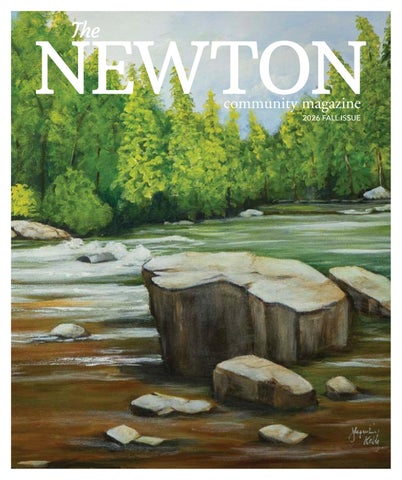
On the Cover
‘RIVER ROCKS’ by BRIAN KNAPP
Jacqueline Kelly often draws inspiration from nature and the God who created it, as evidenced in “River Rocks”—the painting she crafted for the 2026 Fall Issue of The NEWTON Community Magazine. “The Yellow River provided the setting for this piece,” she said. “As I reflected on the local scenery, I was especially drawn to the way the rocks stood steadfast and unmoving while the water flowed around them. I’m continually intrigued by the hand of God as the Master Creator and by the beauty He places before us. As I create, I often look for a spiritual connection or a meaningful lesson within the subject. In this painting, the strength and steadfastness of the rocks became a reminder of remaining grounded and faithful, even as life continually moves around us.” The painting was brought to life through Kelly’s masterful use of acrylic paint over a layer of watercolor pencils. It took her an estimated 25 hours to complete. “I enjoy working with mixed media because it allows me to explore different
techniques and textures within a single piece,” she said. “I’m always excited by the opportunity to push boundaries, experiment and try something new. For me, the creative process is just as rewarding as the finished painting.” Kelly was born in Brunswick, Georgia, but grew up in Buffalo, New York. She relocated to Covington some 26 years ago. Having spent more than three decades as a classroom teacher, Kelly considers herself a lifelong learner and a largely self-taught artist who seeks out avenues through which to improve her craft. As one of many artists associated with the Southern Heartland Art Gallery, a more complete connection to her work can be found atsouthernheartlandart.com/ artists/jackie-kelly. “I truly enjoy continuing to grow as an artist by taking classes, attending workshops and learning alongside other artists,” she said. “There’s always something new to discover, and I believe that remaining open to learning is an important part of the creative journey.”
PUBLISHERS’ NOTE
One Sunday, when I was a relatively new believer, I made the following comment: “I need to pray for patience.” The collective gasp and the advice that followed was surprising and resulted in probably the worst guidance I could have ever received. “Scott,” they said, “I wouldn’t do that because then God will really test your patience.” I’ve heard this same advice over the years from new and old believers. Where did this way of thinking come from? Why wouldn’t I pray for help in this area? I pray for counsel in so many other areas, so why should patience be any different? It’s not as though I won’t need it, whether I pray for it or not. I’m human. I live in this world. I have three kids. Trials are inevitable. Patience is needed, and it will be tested. When did God ever tell us not to pray for patience? Correct me if I’m wrong—and I’m wrong often—but my understanding is that He calls us to come to Him with all things. I want God to renew my mind, and I know that process includes testing, friction and time in the wilderness that can seem to last forever. I will ask Him for the patience not just to endure the testing but to embrace it. I’ve come to trust that God can take all things, the good and the bad, and weave them together for a greater purpose. I will continue to pray for patience all the time, and I will enjoy the ride. Count it all joy. Scott Tredeau 2026 Fall Issue 7
F E AT U R E
Stories by Kari Apted
AN OASIS OF HEALING A Victorian farmhouse and five acres of revived soil tell a story of faith‑driven restoration, heritage and homegrown renewal at Bonds Estate and Gardens. by KARI APTED
Visiting Bonds Estate and Gardens off Hopewell Church Road in Covington feels like stepping back in time. The property’s focal point is a lovely white and black Victorian farmhouse. Built in 1895 and well maintained since, it features a wraparound porch that beckons guests to pour a cup of tea and sit awhile. Massive, ancient trees weave a welcome canopy of shade overhead, while a tranquil calm fills the surrounding gardens. It feels like coming home. That was exactly how Robert and L.A. Bonds felt when they purchased the property in 2020. Together with their sons, Terrell, Canaan, Gabriel, Ezra and Zion, the family needed a larger space to continue their ongoing journey toward health. That pursuit began in 2007, when Robert was diagnosed with vitiligo—a chronic autoimmune disorder that causes patches of skin to lose pigmentation. The Bonds are strong believers in Christianity, and L.A. was not satisfied with the doctors’ opinion that her husband’s condition was incurable. “I’m the daughter of a Healer,” she said. “The Lord pressed on my heart to start growing some vegetables for Robert, and that sparked the rest of our journey. I knew it wasn’t going to be easy to change his eating habits because he didn’t grow up almost vegetarian, like me.” Robert was raised on traditional Southern cuisine, eating a lot of meat and fried and processed foods. PICTURED ON FACING PAGE (L-R) EZRA, TERRELL, L.A., GABRIEL, ROBERT, CANAAN AND ZION BONDS
12 The NEWTON Community Magazine
“Vegetables were natural to me but foreign to him,” she said. “I had to be creative to mask the vegetables.” L.A. started by grating fresh carrots into spaghetti sauce, making smoothies with hidden veggies and baking “Morning Glory” muffins rich with carrots, zucchini and yams. Robert was not always aware of what he was consuming, but his body appreciated the new influx of complex nutrients. “He wasn’t that warm to any of it in the beginning, but he had a dense nutrient issue. As he began to see results happening in real time, it was eye-opening to him,” L.A. said. “We saw Genesis 1:29 come to life, to let the food be our medicine.” Within three months, the vitiligo reversed itself without Robert having to take medication. At the time, the Bonds lived in Gwinnett County and grew vegetables in a community garden. They knew they needed more space to do all they felt they could do, and when the five acres in Newton County became available, they decided to step fully into the homesteading lifestyle. “We were surprised to learn that the property used to be a slave plantation,” L.A. said. “There is a lot of history on the land, both good and bad. Hopewell Presbyterian Church and its cemetery sit about 100 feet up our private road.” L.A. later learned through research that the church had built a pavilion on top of some slave graves.
“We saw Genesis 1:29 come to life, to let the food be our medicine.” L.A. Bonds 2026 Fall Issue 13
F E AT U R E
She hopes someday to find out who they were and if they have living relatives. The Bonds took stewardship of their new property seriously. They walked the land and prayed over the plants and trees they found. “The people who sold it to us told us that the apple and pear trees had never borne fruit,” L.A. said. “Later that year, I thought I kept seeing red birds in the apple tree, but they never seemed to leave.” When she inspected it more closely, she realized the red splashes of color were apples. The trees she thought were dying had borne fruit. The apple trees had apples; the pear trees had pears; and the pecan trees produced nuts. “All we did was prune them and pray over them,” L.A. said. “The Lord gave us fruit we didn’t plant.” The couple found other plants in need of revitalization. “There was goldenrod, purslane, nettles, mullein and more,” L.A. said. “I was awed to see all these healing herbs and realize
14 The NEWTON Community Magazine
the Lord supplies all we need. He just asks us to look over it.” It was a new chapter of life that opened the Bonds’ eyes to the tangible healing hidden within the foods on their plates. “I found myself going down the path of a nutritionist,” she said. The more L.A. learned, the more she believed in the healing power of the plants God created. “The Bible says that we perish for a lack of knowledge. It’s not just that. We also want things to be complicated, too. Sometimes all you need to feel better is to just drink some water,” she said with a laugh, “but no, we’d rather have a doctor tell us to take this pill and that one when you could just drink the water.” During the coronavirus pandemic, the Bonds family saw more evidence of the power of herbal remedies. “My husband and all our children came down with COVID at the same time. I was taking care of everyone but never contracted it,” L.A. said. “I was drinking a tea blend with all our respiratory-healing herbs and chasing it with a shot of homemade elderberry syrup every hour. It worked.” L.A. does not oppose modern medicine. She just believes other options are sometimes available. “There’s a place for ‘big pharma’ and doctors,” she said. “If I break my arm, I want all the medical care. But God made our bodies so smart, and He is faithful to his word. We forget that
God gave scientists their talent, skills and intelligence and meant for all of it to be used for His glory.” Over time, the Bonds began to fulfill their dreams of the estate becoming a place of restoration. They sell many of the fruits, vegetables, nuts and herbs they grow to both visitors and participants in their Community Supported Agriculture program. A CSA connects people directly with farmers who provide them with locally raised food. Participants often form lasting relationships with farmers through the process. The Bonds have created a line of medicinal teas from the herbs they grow, and they host tea-tasting events where people can discover which handcrafted tea they prefer. Then they can leave with teas bearing soothing names such as Peaceful Heart and Renewed Mind. L.A. wants everyone who leaves her home to walk away having learned something new, and she tailors classes and programs for people of varying ages.
Guests may participate in the “Taste and See” tour, where they sample different foods at the places where they are grown. L.A. has been surprised by how many kids do not realize that carrots grow underground or that biscuits are made from flour ground from whole grains. She teaches children how to mill flour and, during her heritage tour, talks to them about the origins of slavery and its relation to God’s desire for restoration. Other classes include how to make herbal pain and allergy remedies, how to eat healthfully and the basics of homesteading. The Bonds homeschool their children and often host other homeschoolers for youth agricultural education and self-sufficiency workshops. Together with her friend, Jenelle Davis, L.A. created The Keepers Club for girls. “We saw a need to create a space for girls that would raise them up in the Titus 2 mandate that says older women should teach the younger ones how to be a wife, mother and keeper of 2026 Fall Issue 15
F E AT U R E
the home,” she said. “That call doesn’t change for me just because I didn’t have daughters.” Bonds takes pride in having become Georgia Grown Certified this year and enjoys watching her sons utilize what they have learned from their parents. Their oldest son, Terrell, recently bought his first home at the tender age of 17, and their second son, Canaan, is described as a culinary guru. “Food Network saw his online content (Canaan Cooks) and reached out to him when he was 9,” L.A. said. “When we have guests doing our Harvest Homestead private dining events, he is their chef.” L.A. admits she once felt like the woman named Wisdom in Proverbs 1:20–33, calling out from the middle of the street with advice, unsure if anyone was listening. “I felt that way in the past but not now,” she said. “People are waking up. Our community has become richer in this area of health, using their knowledge and spreading it. I don’t feel like I’m pulling teeth anymore, because people are coming to me to learn and to change.” Visit bondsestateandgardens.org for more information about classes, the CSA and how to schedule a visit. Follow Bonds Estate and Gardens on Facebook and Instagram and check out L.A.’s homemaking tips on her YouTube channel @iamlabonds.
16 The NEWTON Community Magazine
Favorite Four by KARI APTED
When Robert and L.A. Bonds purchased their Newton County farmland, it led to a fun scavenger hunt to determine which plants were already established and which ones they wanted to add. After years of trial and error, L.A. has identified four medicinal plants that must always be in her garden: goldenrod, mullein, nettles and purslane. She enjoys teaching others what she has learned about these plants, making teas from them GOLDENROD Goldenrod is an herbaceous perennial in the same family as daisies and sunflowers. Its gor‑ geous yellow flowers bloom in late summer and autumn, causing people to mistake it for the similarlooking but allergy-causing plant called ragweed. Goldenrod’s scientific name, Solidago, means “to make whole.” Its leaves and flowers have long been used to make extracts and teas to soothe allergy symptoms and reduce inflammation. The herb is a key ingredient in Bonds’ Blissful Relief tea, created to help with various respiratory issues. MULLEIN Mullein is not as well-known as goldenrod, but the tall, velvetyleafed plant also carries potent power to soothe respiratory distress, particularly coughs and throat irritation. “Mullein is good for clearing out mucus,” L.A. said. “It’s been traditionally used for colds, bronchitis and for loosening
and witnessing their ability to help others achieve better health. L.A. describes these herbs as having a similar, overall bitter flavor. Still, each also carries unique fruity notes that she enhances in her teas by adding dried fruit harvested from their organic garden. The medicinal use of these plants dates back thousands of years. Even so, L.A. recommends checking with your healthcare provider before consuming them.
up congestion.” Historically, mullein tea has also been said to improve digestive function, support the immune system and reduce overall inflammation. Bonds harvests fresh batches from her garden to form the basis of her Breathe Clear tea. NETTLES If you have ever been on a hike, you probably cringe at the word “nettle.” Most people know it as an infamous stinging plant, with leaves and stems covered in fine hairs that penetrate the skin like microscopic needles and inject a bothersome cocktail of histamines. However, the nettle plants that the Bonds grow are devoid of this irritating feature. “We grow a lot of dead nettles,” L.A. said. “Because there are so many allergies in Georgia, we do a lot of respiratory teas. Nettle tea is good for seasonal allergies, but it also works as a diuretic that pulls toxins out of the urinary tract.” According to theherbalacademy.com, flowers and leaves from the dead nettle
plant have antihistamine, antiinflammatory, antimicrobial, astringent and styptic properties. Foragers have long harvested raw dead nettle as a wild edible green used in salads and smoothies. It is rich in quercetin, vitamins A, C and K, iron and fiber. PURSLANE “Our purslane grows prolifically,” L.A. said with a laugh. “It is tradition‑ ally used in Africa as a medicine.” She describes the plant as succulentlike, with tiny, lemony leaves that many people enjoy eating raw. “We sell it dried and fresh. Some people like to sprinkle it on top of eggs, things like that.” Purslane’s health benefits are many and have been touted since the 4th century B.C. Even the National Library of Medicine shared that purslane’s “medicinal value is evident from its use for treatment of burns, headache, and diseases related to the intestine, liver, stomach, cough, shortness of breath, and arthritis.”
2026 Fall Issue 17
H E A LT H & W E L L N E S S
Stories by Avril Occilien-Similien
Care Package
Susann Whittle has helped Newton County families welcome new life for more than three decades, having built a career through compassion, community and support close to home. by AVRIL OCCILIEN-SIMILIEN Long before Susann Whittle became clinical manager of Women’s Services at Piedmont Newton Hospital, she was personally connected to it: She was born there. Growing up in Covington, Whittle could not have known that the hospital where her life began would become the place where she would welcome thousands of other lives into the world. Her story reflects deep community roots, professional growth and a commitment to providing Newton County families with compassionate care close to home. Whittle’s first opportunity to serve at the hospital came while she was a student at Newton High School. As a candy striper, she volunteered alongside hospital staff and gained an early view of the demands and rewards of healthcare. Her interest was strengthened by health occupations teacher Nancy Knight, who helped her recognize that nursing could become both a calling and a career. After she was awarded a nursing school scholarship, Whittle attended what was then DeKalb College, now part of Georgia State University. After graduation, she spent two years at Morgan Medical Center in Madison before returning to her hometown hospital in 1995. Whittle originally expected to work in medical-surgical nursing. However, after experiences as a certified nursing assistant and in the emergency room, she joined Piedmont Newton’s float pool. She was repeatedly assigned to Women’s Services and soon discovered that labor and delivery was where she belonged. More than three decades later, the work of caring for others still matters deeply to her. She has coached mothers through hours
22 The NEWTON Community Magazine
(L-R) SUSANN WHITTLE AND BETH MURDOCK
of labor, helped partners participate in the birthing process and assisted with babies who arrived before everyone had time to prepare. Whittle has also supported families through the difficulty and complications of loss, her career marked by longevity and passion. “Helping women have the best experience possible, even during a difficult time, fills my cup,” she said. For Whittle, excellent care is both clinical and personal. Every birth is different, and not every outcome follows a family’s plan. She takes pride in helping mothers feel safe, heard and empowered while meeting each family with compassion. With every new opportunity, Whittle expanded her impact from caring for patients at the bedside to guiding the nurses who care for them. Her experience as a charge nurse and clinical coordinator prepared her to step into broader leadership, including serving as interim director, before assuming her current role as clinical manager of Women’s Services in April 2021. Her advancement came through dependable service, continued learning and a
(L-R) SUSANN WHITTLE, ALI ADAMS, AND TAMARA COURSE
2026 Fall Issue 23
H E A LT H & W E L L N E S S
willingness to accept greater responsibility. It was Beth Murdock, Piedmont Newton’s chief nursing officer, who encouraged Whittle to pursue her Bachelor of Science in nursing, which she earned from Western Governors University in 2021. Today, Whittle leads and mentors nurses who provide care across labor and delivery, postpartum and newborn support. She takes pride in the team she has helped build—a group of compassionate professionals who are eager to learn and committed to providing families with an excellent experience. Her loyalty to Piedmont Newton works in concert with her loyalty to the community, and after 31 years, she has cared for multiple generations of Newton County families. Whittle regularly encounters former patients and their children around town, at the grocery store and even while camping. Those moments remind her that labor and delivery nursing creates relationships that extend far beyond a hospital stay. Whittle embraces the call to provide a critical service for the local community. “I want women to know they don’t have to drive to Atlanta for excellent care and that it’s right here in Newton County,” she said. That commitment increases in importance as the county grows. The addition of a Level III neonatal intensive care unit allows Piedmont Newton to keep more newborns near their families rather than transferring them to hospitals in Gwinnett County or Atlanta. Since the NICU opened in December, more than 30 babies who might otherwise have required transfer have received care locally. The hospital also offers access to specialized services on campus, including neonatology, maternal-fetal medicine and a heart clinic. Together, these resources support mothers and babies with more complex medical needs while reducing travel and helping families remain close to their support systems. Service is equally important in Whittle’s personal life. She grew up at Covington Mill United Methodist Church and remains involved in its food pantry, school-supply collections and other outreach efforts. As a mother of three, she has volunteered with Girl Scouts and Boy Scouts and coached archery. Whittle and her team also extend their work beyond hospital walls through community events, business visits and educational initiatives. A new breastfeeding education “sip and stroll” offers families information and connection in a relaxed environment. In addition, Women’s Services participates in events at Legion Field, including an annual Christmas tree display. As Whittle looks to the future of care, she brings the same clarity to the development of student nurses. She often counsels students that while nursing offers opportunities, financial motivation alone cannot sustain them through its emotional and physical demands. “You have to love what you do,” she said. “It’s not just about the pay. It’s about the passion behind the care.”
24 The NEWTON Community Magazine
“Helping women have the best experience possible, even during a difficult time, fills my cup.” Susann Whittle
2026 Fall Issue 25
H E A LT H & W E L L N E S S
“The silence is not evidence that God stopped working but that He is accomplishing something greater than we can understand.” Anderson Byrd
26 The NEWTON Community Magazine
Grace & Truth
GRACE & TRUTH
When Heaven Feels Silent Quiet seasons do not signal abandonment. God moves in hidden ways long before His answers appear. by ANDERSON BYRD
I’m a firm believer in Christ’s power and love, but my confidence in Jesus does not come without questions and doubt arising at times. Don’t get me wrong. There are seasons of great faith when it’s easy for me to celebrate and say “I trust in the Lord” because He has answered my prayers as soon as I prayed them. However, whenever life’s worries and struggles overwhelm me, it can be easy to get into this mindset of “God where are you?” There are also seasons when Heaven feels painfully quiet. The prayers continue and the tears flow, and yet, the silence remains. David begins Psalm 13 with “How long, Lord? Will you forget me forever? How long will you hide your face from me?” These are words of a man who wonders why he feels alone in the fight. He reveals the pain of his waiting and finds himself repeatedly asking “How long?” I can relate to this. Every passing day with no answer feels like God has forgotten. Silence can convince us that prayers only go as high as the ceiling while our circumstances remain unchanged. David battled constantly with this feeling of being forsaken by God. When life presents struggles, it can be easy to convince yourself that He doesn’t care. Look at Psalm 22, where David starts by uttering words that are almost shocking to hear. He says, “My God, my God, why have you abandoned me? Why are you so far from my deliverance and from my words of groaning? My God, I cry by day, but you do not answer, by night, yet I have no rest.” This is not just unanswered prayer; this is a feeling of complete abandonment. The man after God’s heart feels like his heart has been forsaken by that same God. In both Psalms, David couldn’t see what God was doing behind the scenes. The same holds true for us. We never see the
full picture, and we mistake God’s silence for inactivity. We assume that because we cannot see movement, nothing is happening. Scripture reminds us that God’s work is invisible long before it becomes visible. Faith is not believing because you have the answers. Faith is trusting God’s character even when you cannot see His hands at work. Psalm 13 ends with David going from “How long?” to “I trust.” Psalm 22 goes from “Why have You abandoned me?” to “You are my strength” and “He has done it!” Not because his situation had changed, but because he reminded himself of God’s goodness. I think of Jesus on the cross as He quotes the first verse of Psalm 22. To everyone watching, it looked like Heaven had gone silent. The Son of God hung there suffering, and God did not intervene. Behind the “silence,” God was accomplishing our redemption. The act that led to salvation unfolded but looked like abandonment. This gives hope to our seasons of suffering and waiting. Silence is not evidence that God stopped working but that He is accomplishing something greater than we can understand. If heaven feels silent today, don’t stop praying. Don’t stop trusting. Don’t assume that an unanswered prayer is an unheard prayer. Evidence of God’s faithfulness is not that He answers immediately but that He faithfully works while we wait. The God who seemed silent to David and accomplished salvation through the cross is the same God who is working for your good even when you cannot yet see it. Anderson Byrd is the director of ministry at LifeNow Church in Covington. For more information, visit lifenowcov.org. 2026 Fall Issue 27
H E A LT H & W E L L N E S S
Stories by Michelle Floyd
MEDICINE IN MOTION
Dr. Parisa Biazar’s path from Toronto to Covington reflects a career shaped by curiosity, service and a willingness to go where her skills are needed. She focuses on building deep patient relationships while championing preventive care and collaborative conversations. by MICHELLE FLOYD
A primary care physician from Canada made Covington the latest stop on her journey. Originally from Toronto, Dr. Parisa Biazar moved to the Atlanta area in the summer of 2024 to continue her medical practice. She had previously studied at the American University of the Caribbean in St. Maarten for four years and also conducted research on exercise, family medicine and chronic disease at the Mayo Clinic in Florida and in Barbados. In addition, Biazar lived in New York for one year of medical training and worked at the Grand Strand Medical Center in Myrtle Beach, South Carolina, for her residency for three years. She began the next chapter of her medical career at Piedmont Primary Care at Eastside Crossing in Covington in September 2024. “Since I’m from Canada, I’m on a Visa, so we have to go to an area that doesn’t have enough doctors,” Biazar said while discussing her decision to land in Newton County. “Since Covington is growing so much, they need more doctors.” Biazar, who lives near Atlanta with her husband, Zack, and their dog, has grown accustomed to moving around to various areas and climates. For a couple of years in high school, she even lived in Barbados, where her uncles were doctors. “As long as I can remember, I wanted to be a doctor. There wasn’t a certain event that happened for me,” Biazar said. “I’ve been
28 The NEWTON Community Magazine
a bookworm, and I love school. The sciences were the most interesting to me, so I naturally gravitated toward it, and I wanted to help people, as well.” Growing up, Biazar participated in volunteer work in hospitals and with HIV organizations. She revealed she had a desire to practice primary care before she went into medical school. “I like being the person that patients feel like they can come to,” said Biazar, who won a leadership award during her residency and even earned the spot of chief resident. “Even if they go to a specialist, they come back. Seeing the parents and sometimes their kids and taking care of the whole family is nice.” Rhonda Whiten, who has spent more than 20 years as physicians operations coordinator with the practice, considers Biazar a wonderful asset to the team. “Her caring and empathy to patients is amazing,” Whiten said. “She has a great rapport with staff and patients. We’ve got nothing but great feedback from everyone.” Piedmont Primary Care currently boasts seven doctors and four nurse practitioners. Medical assistant Ebony Dean has been with the practice for roughly a decade and understands why many patients embrace Biazar’s youth, as it means they are more likely to keep her as a doctor for longer.
“As long as I can remember, I wanted to be a doctor.” Dr. Parisa Biazar
2026 Fall Issue 29
H E A LT H & W E L L N E S S
“She’s easy to get along with,” Dean said. “She focuses on them taking their medicines, and she will try to do what she can for them.” Biazar revealed that most of her patients are new to the growing practice. “Everyone has been great,” she said. “They are motivated to get better, which I love to see. I love the receptiveness to find help.” Currently, Biazar sees 16 to 18 patients per day and continues to accept new clients, like many of the other doctors in the practice at their facility on U.S. 278. She mostly deals with common concerns like diabetes, high cholesterol, COPD (chronic obstructive pulmonary disease) and menopause. While Biazar practices as a family medicine doctor, she focuses on women’s health and getting patients healthy. She also sees patients who need assistance with mental health. “My goal with my patients is to provide quality care. I’m passionate about preventive care and obtaining my patients’ health goals,” Biazar said. “I want my patients to be able to feel like they’re being taken care of, and I take the approach to try to hone in not only on medicine and lifestyle changes first but also their way of eating and activity levels to prevent chronic conditions.”
30 The NEWTON Community Magazine
Biazar offers referrals for those who require care from a specialist. “I’m so eager that if there is something [extra needed], we’re still willing to dive deep in research and find more,” she said. “It’s about just trying to have that discussion. If it needs medicines, it’s there, but they also may need to try to change their way of living to help in the long run, as well.” Biazar concedes that social media sometimes influences patients’ questions and worries, but she continues to listen to their concerns. “We require more discussion with patients to see if the sources they’re using are relevant or if part of it’s true. It’s just more discussion,” she said. “I appreciate when my patients take interest in their own health because I can only do so much. I want them to know what they’re being treated for, and we take time together so it’s more of a discussion [and] not a quick fix.”
BUSINESS HIGHLIGHT
Business Highlights
BUSINESS HIGHLIGHT
Taking a 50-Year Legacy of Health
Into the Future
Newton Drive Family Dentistry redefines oral healthcare in Covington through modern technology and a cutting-edge approach. Newton Drive Family Dentistry has served the Covington community for more than five decades. Founded by Dr. Dale Evans in 1974, the practice stays true to the focus around which it was built: Earning the trust of patients and treating them with care. Dr. Richard Kim carries that tradition forward while bringing a different set of tools to the table. For Kim, the future of dentistry involves finding ways to use technology to make diagnosis and treatment more precise while maintaining the personal approach patients expect. “What sets us apart isn’t just our commitment to patient comfort, although that’s certainly a top priority,” he said. “Our commitment to patient health runs deep. We also offer technology to bring more precision to treatments along with faster healing times.” That philosophy can be seen throughout the office. Newton Drive Family Dentistry uses a combination of laser and light-based therapies as part of its approach. Laser technology can be used for certain hard- and soft-tissue procedures, while LightStim red-light therapy is incorporated into protocols, with the goal of supporting tissue healing and patient comfort. Technology also plays an important role in how the team evaluates patients and plans treatment. Three-dimensional CBCT imaging provides detailed views that can help clinicians better understand what is happening beneath the surface. In addition, the practice uses the iTero Lumina intraoral scanner to create digital images of the mouth, alongside digital X-ray technology and AI-assisted analysis tools. Much of it happens behind the scenes, giving the dental team additional information when evaluating problems or planning procedures. That emphasis on prevention and overall health extends to the practice’s approach to materials and treatment. Kim and his team emphasize minimally invasive dentistry when appropriate and
32 The NEWTON Community Magazine
consider the relationship between oral health and overall wellness when developing treatment plans. Moreover, the practice is an IAOMT-certified SMART provider, offering amalgam removal using protocols designed to limit exposure during procedures. Cleaning and preventive care have also received technological updates. As a Guided Biofilm Therapy provider, Newton Drive Family Dentistry uses EMS Airflow technology and warm-water scaling as part of its hygiene services. The practice also incorporates ozone therapy into certain treatment protocols. Technological improvements notwithstanding, Kim believes the most important part of the practice remains the relationship between the team and the patient. That can be an especially important distinction in a field where appointments sometimes feel hurried or impersonal. The practice places an emphasis on taking its time with patients, explaining treatment options and creating a relaxing environment where people feel comfortable sharing their concerns. After more than 50 years, the technology at Newton Drive Family Dentistry looks quite different from what was available when the doors first opened. For Kim, moving forward means using new technology thoughtfully while staying grounded in the philosophies that have always been at the heart of the practice. “We care about caring for people in the best way possible and maintaining strong relationships with our patients,” Kim said. “It’s all about embracing what’s new without losing what made the practice matter in the first place.” Newton Drive Family Dentistry is located at 2104 Newton Drive Northeast in Covington, near the Covington Family YMCA. For more information, visit newtondrivedentistry.com.
(L-R) RHONDA BAKER, JESSICA WRIGHT, CHERIE POWEL, DR. RICHARD KIM, SHANOLA COSBY, BECKY BOYD AND ELLEN BELL
“Our ongoing mission is to put the patients and their dental needs first.” Dr. Richard Kim 2026 Fall Issue 33
S P O R T S & R E C R E AT I O N
36 The NEWTON Community Magazine
DANCE IN THE DUST
Stories by Chris Bridges
Jamie Hays followed her childhood love of horses into the demanding sport of cutting, where she built a world-class resume defined by grit, skill and sportsmanship. by CHRIS BRIDGES
Jamie Hays always had a love for horses, even as a young child. It all began in Jersey, a small town in Walton County where she grew up on a modest farm owned by her grandparents, Jimmy and Patty Hammond. “We had horses, cows, dogs and cats, an occasional hog or two and a few chickens,” Hays said. “We only had grade horses that were picked up from the local sale barn. I had friends who mostly rode English. However, my love was for the Western way of riding.” Hays did ride English on occasion, just to fit in with friends she enjoyed socializing with during the summer. “I really began learning the art and skill of riding when I took a job one summer at a small horse farm in Covington,” she said. “Sandy and Jim Usher owned a farm off of Hwy. 142. I was about 13 years old. My grandmother would carry me early and drop me off, and I would do farm chores that included cleaning stalls, feeding and watering horses [and] helping tack up the horses. I received a small weekly paycheck, and the best part was I would receive a couple of riding lessons from Sandy each week.” Usher was a barrel racer and an outstanding horseman. She trained her own horses and taught them how to move in sync with her legs and hands. Hays dreamed of one day having horses that were so well trained. It was an invaluable experience.
“She taught me a lot about riding and about horses, in general,” Hays said. “She would allow me to help her exercise a few of her great horses. As time went on, I continued to ride and try to improve and apply everything I had learned from Sandy. I was never interested in barrel racing. I just enjoyed riding.” Hays was introduced to the sport of cutting at age 15 when her mother, Connie, married Roger Cato. He had cutting horses—quarter horses trained specifically for the sport. The cow-horse competition involves a cutter riding into a herd of cattle and separating one cow from the rest. The horse then 2026 Fall Issue 37
S P O R T S & R E C R E AT I O N
(L-R) TWISTED METAL JAMIE AND JULIUS HAYS
“Big things happen when you have a dream and you keep setting goals and continue to work hard to achieve those goals.” Jamie Hays
becomes one with the rider and controls the cow from returning to the herd. Riders can only use their legs, with no visible cueing via the reins while the horse mirrors the movements of the cow. It is as if the horse and cow are dancing with each other. It is a judged event. Competitors have 2.5 minutes to separate at least two individuals from the herd and demonstrate control and correctness of working the cows. “We would practice cutting every week at Ronnie Hodges Horse Farm,” Hays said. “I began showing my stepdad’s cutting horse in the youth division in 1991. I showed cutters from 1991–93, and then I went away to college to focus on furthering my education.” Hays admits she always knew she would one day return to the sport. She graduated from the University of Georgia in 1997 and earned a Master of Medical Science degree from the Emory University School of Medicine in 2002. She then began a career as an anesthesiologist assistant at Newton Medical Center, now Piedmont Newton. Hays’ first major purchase after she entered the workforce was Toy Blaze, a cutting horse she bought from Reid Bruce of Norman Bruce Cutting Horses in Rutledge.
38 The NEWTON Community Magazine
“I showed Blaze for many years, [starting] at the beginner level and climbing up through the ranks over the years,” she said. “Blaze is still with us, enjoying his life turned out to pasture at 29 years old. I have had several cutting horses over the years.” Hays’ current horse is Twisted Metal, an own son—direct male child—of Metallic Cat, the stallion featured in the hit television series “Yellowstone.” He has been her main horse for the past five years. “In 2025, we hauled for the Top 15 in [the National Cutting Horse Association],” Hays said. “This requires showing at NCHA-approved shows throughout the year, and standings are determined by the amount of prize money earned at each show. We made it in, which qualified us to show in November 2025 at the World Show that was held in Fort Worth, Texas. We are on track this year once again for the Top 15. Our goal is to show again at the World Show for 2026.” Hays and Twisted Metal also accomplished a major milestone by qualifying for induction into the Non-Pro NCHA Hall of Fame. “I will be formally inducted at the NCHA convention in 2027,” she said. “In 2025, I was awarded the Mary Kingsbury Amateur Sportsmanship Award during the NCHA Futurity in Fort Worth. This award is given each year to an amateur competitor who exemplifies the true spirit of sportsmanship, both in and out of the arena. I was honored to be nominated for this award by my fellow competitors from across the Southeast.” Hays remains deeply committed to the sport of cutting and loves to see new people discover it. “I am very involved with the Country Music Cutting Horse Association, an NCHA affiliate in Lebanon, Tennessee,” she said. “We strive to produce weekend cuttings that provide a fun and friendly atmosphere for all levels of competitors. Everyone has to start somewhere, and we hope [that] if they get the right start, they will continue in the sport for many years to come.” When Hays reflects on her career, she focuses on the factors that led her to this point. “Big things happen when you have a dream and you keep setting goals and continue to work hard to achieve those goals,” she said. “Just a small-town, country girl that grew up loving horses and had big dreams of being a true horseman one day. Here we are.” Hays and her husband, Julius, own Triple J Farm on the east side of Newton County. She now works as an anesthesiologist assistant at Piedmont Henry in Stockbridge. “We raise beef cattle and enjoy our horses,” Hays said. “My husband and daughter, Jessie, have both shown competitively over the years. My husband has recently retired, and our daughter is currently a family medicine resident at Northeast Georgia Medical Center in Gainesville. I’m sure once she begins her career she will be back in the show pen.” 2026 Fall Issue 39
S P O R T S & R E C R E AT I O N
40 The NEWTON Community Magazine
(L-R) NNEKA COFFEY, DONIELE BENSON, MIRA EVANS, LISA CRAWFORD, RENITA POOLE-LANE, ALTONIA FOWLER DUGAR, GEORGIA GORDON, AJENE GREENWOOD, A’YIANAH DUGAR AND KELLY CAIN
Stories by Michelle Floyd
A simple Facebook post turned into a movement where women walk, heal and show up for themselves and one another. The 5:55 Walk Club offers connection, encouragement and a reminder that every person needs to move. by MICHELLE FLOYD
If you can move your body for 55 minutes, Altonia Fowler Dugar wants to walk with you. A Covington resident for the past 15 years, Dugar started the 5:55 Walk Club in the spring as something of a women’s exercise community and watched it evolve into so much more. “I was already walking, and I was tired of walking alone,” she said. “I made a simple post on Facebook asking if anyone wanted to walk with me. Women responded. We met up and walked, and that was the beginning of the 5:55 Walk Club. There wasn’t some huge master plan behind it. It started with a need for community, and I quickly realized I wasn’t the only woman who needed it.” The group adopted a simple philosophy: No one walks alone, and all ages, levels, paces and bodies are welcome. “It has grown into something much bigger,” Dugar said. “It’s a reminder that movement can be powerful, community can be healing and you never know what can change when you simply decide to keep showing up. Movement looks different for every woman. I want women to start where they are, honor their bodies and recognize that sometimes the biggest victory is simply being able to move.” Women have joined the club through seeing social media posts and by invitation.
“One of my friends sent it to me,” Chelsey Reece said. “We were trying to get active and do some things over the summer.” Reece highlighted the camaraderie and sisterhood that develops from being with a diverse group of ethnicities, ages and abilities. “It’s a great culture being built. It’s very uplifting,” she said. “It opens doors for people to network, not just being healthy, and it exposes you to different opportunities and community.” Groups of five to 20 women—mostly 25 years of age and older—meet regularly in Covington and Conyers on Sundays, Tuesdays and Thursdays at 5:55 p.m. In the summer, the time changes to 6:55 p.m. due to Georgia’s infamous heat and humidity. They also sometimes walk in the mornings. “Our goal is simple: Move your body for 55 minutes,” Dugar said. “Steps and miles don’t matter. Pace doesn’t matter. You walk one mile while someone else walks three. The accomplishment is that you showed up and moved your body for 55 minutes.” Walks take place at Legion Field, the Cricket Frog Trail, the Forum at Covington Town Center, Wheeler Park and other locales around Covington and Conyers. Schedules are usually posted on the 5:55 Walk Club Facebook page. 2026 Fall Issue 41
S P O R T S & R E C R E AT I O N
“We intentionally choose local locations in Covington and Conyers,” said Dugar, who also enjoys walking along the Atlanta BeltLine. “I wanted the club to be rooted in our community and to introduce women to safe, accessible places where they can continue walking, even when they aren’t walking with the club.” Some walks are simply about getting together to move, while others may carry a specific theme or focus. “During our scheduled walks, we may start with affirmations or prayer,” Dugar said. “We sing, laugh, talk, encourage each other and, of course, walk. For awareness walks, we are much more intentional about incorporating education and personal stories. I want those walks to be more than putting on a color and taking pictures. I want women to leave having learned something, connected with someone or feeling encouraged by another woman’s story.” She lives with lupus and wants others to know how walking has helped her improve her health while dealing with the chronic autoimmune disease. Dugar lifts weights in addition to walking. She has lost 37 pounds and has even run in 5Ks. “There was a time when mobility was an issue for me, and there were days when simply moving my body was difficult,” she said. “That makes what I’m able to do today even more meaningful.
I didn’t start walking with a weight-loss goal. I started walking because I needed it mentally and emotionally. The physical transformation became a byproduct of consistently showing up for myself.” Fellow group member Tenille Stewart has battled lupus for more than 20 years. She got wind of the club after moving to the area from Florida. “They are super welcoming,” Stewart said. “I’m excited to explore.” Dugar has already staged a lupus walk and plans to host more awareness events in the future. “My vision is for the 5:55 Walk Club to continue growing as a positive, safe space where women can move their bodies, become healthier and find genuine community,” she said. “Yes, we walk, but it has become about so much more than walking. It’s about connection, accountability, encouragement and sisterhood.” Dugar hopes others can discover walking as an additional positive outlet. “It gives me space to think, release, reset and reconnect with myself,” she said. “There’s something empowering about realizing that your body is capable of more than you thought.”
“There was a time when mobility was an issue for me, and there were days when simply moving my body was difficult.” Altonia Fowler Dugar
42 The NEWTON Community Magazine
A R T S , E D U C AT I O N & I N N O VAT I O N
Stories by Wendy Rodreguez
One Note at a Time Engrained in Black‑church traditions and driven by a calling to serve, Dr. Emorja Roberson built choirs, forged community relationships and used music as a bridge between generations, campuses and congregations. by WENDY RODRIGUEZ
Growing up in a small town in Florida, Dr. Emorja Roberson was surrounded by music, faith and a deep commitment to community building. His musical journey began at Temple Missionary Baptist Church, a predominantly Black congregation where sacred music quickly became central to his life. Primarily self-taught through diligent practice and study, Roberson developed his musicianship at the piano, transforming a childhood curiosity into a lifelong passion. Guided by his faith and unconstrained by denominational boundaries, he found community wherever music was shared. Through that passion, he founded choirs where none existed, cultivated fellowship and leaned into his faith whenever the future seemed uncertain.
48 The NEWTON Community Magazine
His broader story emphasized creating opportunities for young people to sing, building community through music and using choir as a way to bring people together. “I was grappling between what I wanted to do and what I knew I could do,” Roberson said. With the support of his academic and faith communities, Roberson competed in the Negro Spiritual Scholarship Foundation’s Grady-Rayam Project during his senior year in high school. He entered a vocal performance competition and received first runner-up for the region. One of the judges was a professor at the University of North Florida in Jacksonville. That professor subsequently offered Roberson a full scholarship to UNF,
2026 Fall Issue 49
A R T S , E D U C AT I O N & I N N O VAT I O N
“I was grappling between what I wanted to do and what I knew I could do.” Dr. Emorja Roberson
which helped convince him to pursue music professionally. He expanded his vocal repertoire in classical music at North Florida, all while maintaining deep roots in gospel and sacred traditions. Roberson also performed in chamber ensembles and operas, traveled internationally to Italy and South Africa and served as a music intern in the Episcopal Church, broadening his liturgical and musical foundation beyond his Baptist upbringing. After earning his Bachelor of Music in Vocal Performance from UNF, Roberson spent two years working for the Girl Scouts in Jacksonville, during which time he founded the Rejuvenation Gospel Choir in Middleburg, Florida. He subsequently pursued graduate studies at the University of Notre Dame, accepting a fully funded master’s program in Sacred Music and Vocal Performance. As the first African American in the program, he initially faced expectations that
50 The NEWTON Community Magazine
centered primarily on performing African American spirituals. Encouraged by a mentor to serve as a cultural ambassador, Roberson embraced the opportunity to provide rich historical and musical context for Black-sacred music. Driven by his commitment to pursue advanced studies only through fully funded opportunities, Roberson continued at Notre Dame through a research assistantship before transitioning into the doctoral program in Choral Conducting. Advocating for representation of the Black church tradition within ecumenical sacred music studies, he became the first African American to earn a Doctor of Musical Arts degree in Choral Conducting from Notre Dame. During his doctoral studies, Roberson curated “Unsung: The Exploration of the Sounds of Black Folk,” which celebrated jazz, gospel and hip-hop. He also premiered his doctoral project, “BE-SPOKEN,” a cross-genre oratorio that integrates sacred texts, gospel, jazz, hip-hop, spoken word and dance to
address themes of racial empowerment, social justice and community healing. Roberson’s initiatives actively bridged the university with local Black churches and community organizations. “My goal,” he said, “was to not just let them hear new music but also to help to break barriers and to help build relationships.” Roberson moved back to the South because he wanted to be closer to his family. He shared that his aunt’s death brought a renewed awareness of the family moments he had been missing and deepened his desire to return home. That pull ultimately led him to accept a position as assistant professor of Music and African American Studies at Oxford College of Emory University, honoring, in part, his late aunt’s wish for him to be closer to family. During his tenure at Oxford, Roberson directed the college choir and created opportunities for students to connect their musical education with the broader community. He engaged students through performances at local churches and community events, facilitated collaborations with Morehouse College and Spelman College and established initiatives centered on African American musical traditions. Roberson also led Oxford students in a historic joint performance with the Emory Symphony Orchestra. His work extended into the Newton County community, as well. During Oxford’s Martin Luther King Jr. celebrations, student ensembles performed alongside the Newton County Community Choir. Roberson directed Oxappella as part of the celebration in 2024, bringing together Oxford students, other college ensembles and community musicians.
For Roberson, the work involved more than just teaching students to sing. It was about using music as a way to create relationships, expose students to cultural traditions and connect the college to the community beyond its campus. “My goal as an educator is to expose my students and amplify the rituals, the pedagogies [and] the practices of African-derived music, with a focus on the oral transmission of gospel music,” he said. At the core of Roberson’s pedagogy is a commitment to exposing students to African-derived musical heritage while demonstrating that musical training is important and that transferable leadership skills include teamwork, communication, organization and personal responsibility. Through his teaching and artistic leadership, he continues to build community and preserve Black church traditions for future generations. Roberson has embraced his role in higher education, claiming and incorporating cultural heritage in environments where diversity was rare. His impactful work throughout his career led to his appointment as associate professor of Music and Director of Choral Activities at Voorhees University, a historically Black university in Denmark, South Carolina. Roberson maintains ties in the Augusta area to support family and professional engagements across Georgia and South Carolina. “Now,” he said, “I’m going to be using my degree where I’m moving from a position where it was more lecture-based, [with] the choir on the side, to where there is more choir and then do my lecture-based [teaching] on the side.” 2026 Fall Issue 51
A R T S , E D U C AT I O N & I N N O VAT I O N
“The drums chose me.” Tim Kirkland
52 The NEWTON Community Magazine
e v i s s u c PPerassion
Stories by Brian Knapp
A drummer since the age of 4, Tim Kirkland pours his instinctive talent into teaching, worship and a growing musical journey anchored in faith and family. by BRIAN KNAPP
If Tim Kirkland had entered the world before the advent of the written word, legend may have told of a baby boy born with tapered sticks in his hands and a pulsing rhythm in his feet. He feels more at home behind a drum set than he does virtually anywhere else. It was as if he was meant to play them. “I didn’t choose the drums. The drums chose me,” Kirkland said. “The deep desire to play came from God. My mom tells me I had wooden spoons, and I was beating on the pots, the pans, the pillows, the couch, my legs, whatever. The Lord blessed me with the gift of drums. I started playing when I was about 4—in church, of course.” One of two sons born to Veronica Hardy, Kirkland found himself surrounded by artistic relatives. From his brother, Victor Kirkland, and his aunt, Valerie Bentley, to his cousins, Ansley Bentley, Armahni Clark and Annah Clark, talented musicians
and vocalists seemed to be everywhere he turned. Far from a one-man band, Kirkland fit right in. Now 28, he still attends services where he learned to embrace the Christian faith and got his start as a drummer: New Hope Baptist Church in Covington. “Twice out of the month, I’m there,” Kirkland said. “It’s my home church. My family’s there. Two other Sundays out of the month, I tend to visit [other churches] just to see what other musical opportunities I can take part in while growing spiritually in my walk with Jesus.” A Newton High School alum and graduate of the Atlanta Institute of Music, Kirkland shares his passion for percussion through lessons he provides at McKibben Music in Covington and Music & Arts in Conyers. His chance conversation with Mack McKibben—longtime owner of the aforementioned McKibben Music on The Square—opened the door to unforeseen possibilities. 2026 Fall Issue 53
A R T S , E D U C AT I O N & I N N O VAT I O N
“I would go in the store just for basic things,” Kirkland said, “and he asked me what I was doing one day, because he’d seen me play drums before. I told him, ‘I’m just playing at church and getting ready to go to music school.’ He said, ‘Well, you go to music school, [and] when you come back, come see me.’” McKibben’s advice struck a chord. “I went to music school, graduated and came back to see him, and he was like, ‘Hey, I’ve got a job opportunity for you,’” Kirkland said. “No interview. No application needed. Just boom, right there, and we started working.” Word soon spread. Kirkland estimates he currently has 40–50 clients that range in age from PreK students to senior citizens in their 70s. Sessions start at 30 minutes but can extend well beyond an hour. The experience allows Kirkland to view music through a mentor’s lens. “When they bring a song that they love and we’re able to work through the parts and it makes sense for them and that light bulb goes off, just to see the looks on their faces, see that they’re learning, it’s a great feeling for me, especially
(L-R) TIM KIRKLAND AND SOPHIE MITCHELL
54 The NEWTON Community Magazine
knowing that it’s not necessarily me,” he said. “It’s the Lord that gave me the gift, and now He’s working through me to give it to other people. That’s the most inspirational part for me.” Kirkland’s students adore him and rave about his approach. Sophie Mitchell, a junior at Social Circle High School and confessed grunge music aficionado, has taken lessons from him for almost three years. “He’s fun to be around,” she said. “He explains the fundamentals in a way I really understand. He also lets me bring my favorite songs to learn. I’ve really improved drum rudiments and my ability to do drum fills.” Drums provide a welcomed outlet for Kirkland on a personal level, too. “I’m at an age where it’s time to start moving on with things,” he said. “Sometimes, with the pressures of life and the outside noise and distractions, drums are almost like a refuge for me. If everything falls apart, I can still go back behind my instrument, and nothing else matters but serving the Lord. Nothing else matters but me practicing and putting my heart and my passion into the instrument, especially when I’m worshipping at church or the other times when I get to go out and play. That’s where I get to let it out. Drums have been a safe space for me my entire life, but now more than ever before.” Kirkland believes God will use his talents elsewhere in the years to come, as he strives to one day drum professionally as a means to share both his abilities and his faith. “Faith without works is dead,” he said. “As an aspiring musician, I have to put that faith into action. I’ve got to step out and be OK getting uncomfortable. God has blessed me. I’ve got friends and family—people in my corner who I can reach out to and ask questions. I’ve just got to get uncomfortable.” Pieces have already started to fall into place. “I’ve got to set some time aside to actually dive deep into it,” Kirkland said. “I’m in a season of growth and expectation, and standing and acting on faith will move me into the position I’m called to be in.”
(L-R) VICTOR KIRKLAND, ANSLEY BENTLEY, VALERIE BENTLEY, ANNIE HARDY, JOHNNY BENTLEY, VANESSA HARDY, ANNAH CLARK, ARMAHNI CLARK, THADDEUS JACKSON, VERONICA HARDY AND TIM KIRKLAND
2026 Fall Issue 55
LIVING
Stories by Kari Apted
POWERFUL PA G E S
Retired Army Major Joe Dipierro never planned to become a published author, but a desire to share his legacy with future generations and an undying love for his wife led him to pen his memoirs in ‘The Soldier She Made Me.’ by KARI APTED
The writing muse finds people in different ways. For some, it’s a lifelong nudge to apply words to experiences. For others, it’s a serendipitous encounter or even a simple love for language itself. For Joe Dipierro, it was a beautiful blonde German with deep hazel eyes and a desire to leave his children and grandchildren the story of their 63 years together. Dipierro met his future wife, Hiltrud, at a friend’s house in 1961, when he was a 21-year-old soldier stationed in Kaiserslautern, Germany. He remembers the details vividly.
58 The NEWTON Community Magazine
“We met on Oct. 15 at 6:28 in the evening,” Dipierro said. “It was a Sunday. She was babysitting for a friend of mine who lived in town, and he told me I should come over to meet someone.” Dipierro admits it was probably not the best timing, as he and another friend had spent the day sampling new wines at a festival in a nearby village. “It was love at first sight on my end but probably not hers,” he said, “but I persisted.” Dipierro jokes that Hiltrud spoke better English than he did, as he had grown up as a farmer’s son in rural New Jersey. She worked as a trilingual document translator for a German rail system in an area where American and French forces were stationed. She was just 18 years old when they met, and her family had difficulty accepting their relationship at first. As was common for German families post-WWII, feelings toward Americans were complicated, and they were not eager for their daughters to marry foreigners who would likely take them overseas. When Hiltrud’s family invited Dipierro over for Sunday dinner, he arrived with a big bouquet of flowers for her mom. “That broke the ice very well,” he said. The couple were engaged after about six months and married a year later—on Hiltrud’s 19th birthday. “We lived there until July 1964,” Dipierro said. “We went back and forth to Germany several times during my military career. I did a total of nine years in Germany during my 22 years of service.” Dipierro joined the Army right after graduating from high school. “Several of my friends and I talked about joining the Army together and getting
2026 Fall Issue 59
LIVING
our obligation out of the way instead of waiting to be drafted, but when the day came, they all changed their minds,” he said. “I decided to go anyway, with the intent of doing three years and getting out. I ended up liking it and decided to stay in.” The hard-working Dipierro impressed his leaders, joining as a private and rising to the rank of major by the time of retirement. He does not know for certain, but he suspects he was one of the fastest-promoted artillery soldiers at the time. As he wrote in his memoir, “It had taken me exactly 32 months … to go from pay grade E-1 (Private) to pay grade E-6 (Staff Sergeant). At that time, the normal progression from E-1 to E-6 was 10 to 12 years.” At the urging of a second lieutenant friend, he applied to Officer Candidate School and was accepted despite not having a college degree. Dipierro later would earn a degree in history and enjoys telling people that it “only” took him 15 years to do so. Of course, he had to fit his studies around a busy military career that included two deployments to Vietnam. On his first tour in 1966, he frequently came under fire while overseeing ammunitionrestocking missions. His second tour was in 1970, when he served as an advisor to South Vietnamese General Minh’s operations staff. The Dipierros had three daughters, Sandy, Diana and Michelle, whom he calls “magnificent” and “perfect in their own ways” in his book. After retiring from the military in 1981, the family settled back in New Jersey. Their daughters were teenagers at the time, and Dipierro wanted to be physically with his family more than a military career could allow. He explored different career paths after retirement, always with Hiltrud’s full support while she worked for a bank. Dipierro owned a carpet cleaning business for a while, then worked in security before applying for a range officer position at Fort Dix, New Jersey. He admits he wishes he had stayed with that job but decided to work in finance for a while before moving on to a career in real estate. Doing so required attending multiple mayoral and council meetings, where he realized their small town was terribly disorganized. A friend suggested that Dipierro run for mayor. “I had never considered running for any political office,” he said with a laughing before sharing Hiltrud’s pragmatic opinion. “She said, ‘Why not? You’re not doing anything important anyway.’” On Jan. 1, 1996, Joe Dipierro was sworn in as the mayor of Jamesburg, New Jersey. A few days later, the Blizzard of 1996 buried the state in snow. One of his first trials as mayor was ensuring citizens’ safety and hiring people with the necessary equipment to clear the heavy snow. Other achievements during his term included restructuring meetings, cutting his own salary and improving ADA accessibility in the town. Dipierro also finds pride in his daughters, their families and their achievements. Sandy worked for Delta Airlines for 30 years—a job that would eventually lead the entire family to relocate from New Jersey to Georgia. Tragically, she died from
60 The NEWTON Community Magazine
cancer in 2016. “Losing her was one of the hardest things I have ever faced,” Dipierro said. Middle daughter Diana became a computer programmer and had two children, Anthony and Kendel. She is married to Robert Moon, a quality control specialist. Youngest daughter Michelle became a court reporter and had one daughter, Dani. She is married to Darren Fairey, a sales manager for Triumph Motorcycles. In 2017, Hiltrud was diagnosed with lung cancer. She put up a valiant fight and won, but her battle further weakened her lungs. Her COPD developed into emphysema, and she died on
June 23, 2024. Diana’s eyes filled with tears as she described her mother’s strength and unwavering support, reflected in the title of Dipierro’s memoir. “She was the rock of the whole family,” Diana said. “If it wasn’t for her, we wouldn’t be the successful people we are today. She held up everyone. Dad did a lot of things, but Mom was the backbone. Her specialty was being the person you needed in that moment. Sometimes, you needed someone to hug you, and sometimes, you needed someone to say, ‘That’s it. It’s time to move on.’”
Despite dealing with some heart issues, Dipierro still feels strong at 85 and maintains an active lifestyle, attending senior exercise classes twice a week and playing golf regularly. He misses Hiltrud deeply but remains forever grateful for the life they built together. “If I [leave] anything behind,” Dipierro said, “I hope it is an example of service, of resilience and of devotion to family.” Joseph Dipierro’s “The Soldier She Made Me” is available on Amazon and Barnes & Noble.
“It was love at first sight on my end but probably not hers.” Joe Dipierro
2026 Fall Issue 61
LIVING
Stories by Delaney Derry
No Feline Left Behind Built on a childhood love of rescuing strays, Kat Pawz Sanctuary endures as Payton Coleman’s way of honoring her late sister by offering refuge to the cats they vowed to protect. by DELANEY DERRY
What began as a simple desire to help stray cats grew into something much more significant for sisters Payton and Brittany Coleman. It kickstarted a journey toward a sanctuary and a shared vision that would ultimately become one sister’s way of carrying the other forward. In 2021, the Colemans opened Kat Pawz Sanctuary, a cagefree, no-kill shelter and rescue dedicated to giving cats a safe place to heal and, whenever possible, find their forever homes. Built in the backyard of their Georgia home, the sanctuary was born from a love of animals that had been passed down through generations of their family. “Our grandmother grew up rescuing cats, then our mother did, so it was never out of nowhere. It was how we grew up,” Payton said. “Then, it really became our dream that we’d have a space so that every cat we came across, like in a fast-food restaurant, we wouldn’t have to cry anymore about not being able to take them home with us.” For years, that dream seemed unlikely to become reality. However, the sisters moved from North Carolina to Georgia in 2019. They bought land and began settling into a new life with the vision of the sanctuary still in mind. When the coronavirus pandemic brought an unexpected pause to the world in 2020, Payton and Brittany found themselves with the time to begin building the dream they had talked about for years. “During the pandemic, when we had time to really start our social media and stuff, we bought what we call ‘The Cat House,’ which is a separate building behind our house, and that’s when we really started the nonprofit,” Payton said, “and we slowly started building from there.”
62 The NEWTON Community Magazine
The home they found together became the sanctuary’s home, too. What once might have been an ordinary backyard became a refuge for cats who had nowhere else to go. The sisters opened their lives, their property and their hearts to animals in need, officially opening Kat Pawz Sanctuary in 2021. “It was so much fun,” Payton said. “Like I said, it was something I think every little kid [thinks about]. ‘Wouldn’t it be nice to have every stray come home.’ It’s hard to put it into words, but seeing it happen and donations coming in and all the support on social media and stuff, it was just like we were living a dream every day.”
BRITTANY COLEMAN
For Payton and Brittany, the sanctuary was never simply about rescuing cats. They wanted to create a place where overlooked animals could finally be seen as deserving of necessary care and a loving home. Today, Kat Pawz is home to around 80 cats. Tragically, in January 2025, the sanctuary changed forever when Brittany lost her life in a car accident. The place the sisters had built together, a place meant to offer peace and refuge to animals, suddenly became the place where Payton was left to carry a shared dream on her own. “The grief has been crippling,” Payton said. “It makes you want to stop everything, but the cats never stop needing you, so that really drives me every day. Now, it is just so rewarding because Brittany and I were so close that I never have to wonder what
she would do in this situation because I know, so every injured cat, every sick cat that [doesn’t] have any help that I can step in and change their lives, that keeps me going.” In the months since Brittany’s death, Payton has found a different kind of purpose in the work. Every cat that arrives needing help becomes another opportunity to live out the compassion the sisters shared. Kat Pawz once adopted out roughly 150 cats each year. For now, however, the sanctuary has temporarily closed public intake to concentrate on the long-term residents already in its care. One of Payton’s current focuses involves a new section of the sanctuary called “Purrasic Park,” created specifically for Feline Immunodeficiency Virus-positive cats. 2026 Fall Issue 63
LIVING
“I have a good relationship with the county shelters, and if they have a cat test positive for FIV, they know to call me [and] that I’ll take them,” Payton said. “People on Facebook will always be tagging me if there’s like an injured cat, a cat needing rehab [or] a special-needs cat.” Sometimes cats are brought directly to the sanctuary. Others are discovered in public places or referred by people who know they need somewhere safe to go. Many come from county pounds,
where cats requiring specialized care have very few options. The work is demanding, but Payton has not carried it alone. After Brittany’s death, the sisters’ parents moved from North Carolina to Georgia to be closer to Payton and help with the sanctuary. Friends and members of the community have also stepped forward, volunteering and donating when Payton needed support most. “[The community] really rallied last year and donated to our GoFundMe,” she said. “Everyone showed up to volunteer and get me through when I was really down and couldn’t take care of the cats, so I am really grateful to my friends in the community for that.” The sanctuary is sustained in part through donations and an Airbnb suite located on the property, which includes a private entrance, bedroom, bathroom, theater and exclusive access to the cat room. The rescue’s doors are also always open to people who want to visit, give the cats love and attention or donate supplies. For Payton, keeping Kat Pawz alive is about preserving what she and her sister believed in and maintaining what they built. “I hope it stays sustainable,” Payton said. “I think me and Brittany built it to a point that we were so proud of and really content with it. Maybe in the future I’ll be able to branch out and start adopting out again, but right now, I just want to sustain it and be able to keep on taking in the most needy cats. That’s my goal.” At the heart of that goal is a simple belief: Animals are not disposable. “Our sanctuary is a place where cats can heal and feel safe and have a forever home,” Payton said. “I wish people could change their mindset about animals and see how loving they are.” That is a legacy Payton is determined to protect, not only for the cats but for the sister who dared to dream beside her. There are still cats who need a place to sleep, injured cats who need someone to notice them and frightened cats who need to learn that people can be kind. A unique sanctuary in an Oxford backyard carries on the vision of two sisters who once hoped that someday they could save every stray they encountered. “Going forward, I’m just trying to continue Brittany’s legacy,” Payton said. “I want her compassion and empathy to carry forward.” For information on Kat Pawz Sanctuary, visit katpawzsanctuary.com.
“I wish people could change their mindset about animals and see how loving they are.” Payton Coleman
64 The NEWTON Community Magazine
W H AT ’ S C O O K I N G
(L-R) KARA HOGG AND NOËLLE COSBY
70 The NEWTON Community Magazine
NOELLE COSBY’S SMOKED GOUDA PIMENTO CHEESE I’m from Michigan, so I had no experience with pimento cheese until we moved to Georgia. I wanted to like the classic Southern spread, but every version I tried was either too heavy, too oily or too bland. Once we opened Lily & Sparrow Mercantile, we partnered with Boars Head to offer their deli meats and cheeses. I felt like we should add pimento cheese to our menu, but I wanted to do it in a way that would elevate it. How could we create a pimento cheese that even I couldn’t stop eating? Because I’m French-Canadian, I wanted to incorporate ingredients that would reflect my heritage. I thought a good smoked Gouda would be an
ideal addition to the sharp cheddar commonly used in pimento cheese. To further elevate it, we paired it with smoked paprika and roasted red peppers instead of jarred pimentos. I knew I’d hit the right combination of ingredients when a friend who considers herself a pimento cheese connoisseur declared it the best she’d ever had. It’s easy to make a batch of this delicious spread at home, but if you’re pressed for time, stop by Lily & Sparrow. After some time off the menu to make room for other items, I’m pleased to announce that our pimento cheese is back. It’s available on sandwiches or in eight- and 16-ounce tubs—a perfect addition to your holiday parties.
Ingredients • 1 cup shredded Vermont cheddar cheese • 1 cup shredded smoked Gouda cheese • cup whipped cream cheese, softened • 2 tablespoons roasted red peppers, finely diced
• ¼ teaspoon salt • ¼ teaspoon black pepper • ¼ teaspoon smoked paprika • 6 tablespoons Duke’s mayonnaise
Directions In a medium mixing bowl, combine the cheddar and smoked Gouda. Stir in the diced roasted red peppers. Add the whipped cream cheese, mayonnaise, salt, pepper and smoked paprika. Mix well until creamy and evenly blended. Cover and refrigerate for at least 30 minutes before serving for best flavor. Serve with crackers, toasted bread, pretzels or fresh vegetables, or use it as a sandwich spread. It yields about two cups and serves roughly four to six people. Store in an airtight container and refrigerate for up to seven days.
2026 Fall Issue 71