www.facebook.com/thenewsyoulike
`30
www.thenews.co.in
PAGES: 68 VOL.7 | ISSUE: 10, NOVEMBER, 2019
EDITORIAL
3
C
VOL:7 I SSUE:10 I NOVEMBER, 2019 `30
Editor
A . Rammohan Rao Special Correspondent
D. Bal Reddy
Correspondents
Mallesh Babu Mandha Ravi Kumar G.P. Nagaraju Reporters
M.Praveen Kumar, P. Vishnuvardhan Reddy Photographers
M Vijay S. Sridhar, Shair Ali Baig Cover & Layout
ACK. Venkata Srujan General Manager
Mohd. Nizamuddin Chief Executive (Marketing)
Venkata K. Ganjam (GK)
Chief - Business & LifeStyle
K. Bharath Reddy
Marketing Associate
M. Akhil Raj Shaker The News You Like
Phone: 9701141377, 9848133363 E-mail: thenewscoordinator@gmail.com Website: thenews.co.in
Address for correspondance:
#3-5-890, Flat No. 203, Paras Chambers, Beside Telangana Tourism Bldg, Himayatnagar, Hyderabad-500029. Phone: 98481 33363, 97011 41377. email: 24thenews@gmail.com thenewscoordinator@gmail.com Printed, Published And Owned By Ramya Sree , Printed At S.M.S. Press, H.No.11-38, Pragathi Nagar, P&T Colony, Saroor Nagar, Dist Ranga Reddy – 60, Published At The News Publications, H.No.334, B, Prajay Sai Gardens, Keesara Mandal, Dist - Ranga Reddy, Telangana Editor : A. Rammohan Rao
ommitment, integrity, Sacrifice. These words sound sacred and also remind their scarcity in our society. But any profession you name is adored and it's members are respected for relentlessly practising these virtues. When I see deeds of utter selfish politicians, greedy corporate businesses, Beyiman bureaucrats, I strongly feel that if we have dedicated police, Judiciary and media the country can show to those scoundrels their proper place. YES, three and half decades of experience as a journalist makes me believe that independent police, active judiciary and responsible media can only save this country from further deterioration and protect our democracy. Many Politicians and bureaucrats still behave with a colonial mindset and look down upon citizens of this democratic country. Some businessmen adulterate any commodity from food to life-saving drugs without a blink. Criminals and antisocial elements are ahead in using technologies to cheat, rob people in many ways. In these circumstances what will help common man to be relatively safe from these forces in general? It is Police! Yes, it may sound exaggeration or flattery at the first instance. But sacrifices of many policemen, officers have laid the foundation for responsible policing. In spite of archaic laws, political interference, shortage of manpower various divisions of our police department are functioning without complaining. When we think of coming back home late in the night or our children going to schools - colleges and safely returning, driving vehicles on busy roads, withdrawing large amounts of money from banks, sleeping peacefully without fear of dacoits is possible without vigilant police personnel. They are there on duty 24/7 without weekly offs or festivals. There are black sheep among police too who are corrupt and cannot see the difference between cruelty and strictness. Do favours to rich & powerful and lookdown upon poor common people. But overall without active surveillance of police personnel, our daily life will be filled with endless threats. That majority who slog for the safety of society need to be thanked. Shown gratitude. For those who have made ultimate sacrifice of losing life in maintaining law and order, fighting anti-social elements of various shades we need to pay homage. We at The News strongly feel our responsibility to pay tributes to these fallen heroes of the police department; sincerely thank devoted police personnel who are placing safety and security of society as a high priority. This being followed from the inception of this publication by devoting our November issue every year as Police Commemoration special. This issue of The News in your hands is the latest of tradition. Jai Hind !
Note: Focus/Infocus features are marketing initiatives, any legal disputes comes under the jurisdiction of courts in Hyderabad
(A Rammohan Rao) THE NEWS YOU LIKE | NOVEMBER 2019
4
CONTENT
Hyd. Police
Social service with a commitment 28
India
Manipulating social media? 30
Huzurnagar by-poll
Morale booster for TRS 31 THE NEWS YOU LIKE | NOVEMBER 2019
CONTENT
Can TS RTC Survive? 38
IT dept raids on MEIL 52
India gets Nizam’s funds 62 THE NEWS YOU LIKE | NOVEMBER 2019
5
6
COVER STORY
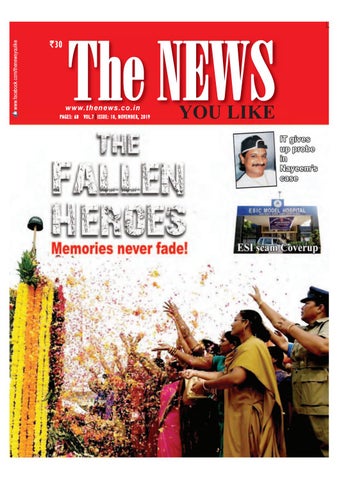
Rich tributes paid to Police martyrs
‘Guardians of internal security’
THE NEWS BUREAU
T
elangana and Andhra Pradesh police departments have observed 21st of October as the Police Commemoration Day. Tributes are paid to police personnel who laid down their lives, for the nation. Many programmes were conducted on the eve of police commemoration day. Police Commemoration Week was observed from 15 to 21 October in all Police Districts / Commissionerates, Training Centers and Special Police Battalions. During this
week, different programmes conducted in all the Districts. Police Commemoration Parade was held. Chief Minister K Chandrashekhar Rao said police personnel sacrifice their lives to protect peace, harmony and security of the people and work with integrity and commitment.“It is no less a service than that rendered by the Border Security Forces. They have lost their lives while controlling anti-social elements,” the Chief Minister said on the occasion of Police Martyrs Commemoration Day. In Telangana the Police Com-
memoration Day function held at the Goshamahal police stadium. Speaking at function Home Minister Mohammed Mahmood Ali said the State government is keen on taking up welfare measures for the well-being of the policemen in the State. said the State government was constructing a 20-storeyed state of art Police Command and Control Centre. He said the government had provided the police department infrastructure needed for better policing. Telangana DGP M Mahender Reddy said a total of 292 police-
THE NEWS YOU LIKE | NOVEMBER 2019
COVER STORY 7
men of different ranks sacrificed their lives while performing their duty across the country. He said the state police were focused in ensuring safety and security of the people of Telangana. The police were taking up various communitybased policing initiatives in the State apart from its regular duties of law enforcement and protecting the public from vested interests. He recalled the exemplary work of the Telangana police in ensuring the conviction of an accused in a case of rape of a baby at Warangal by holding the trial in a special court. The efforts of the police made sure the judgment in the case was pronounced in a record time of 21 days and the man was convicted for a life-term. The DGP said the State government has taken up several measures including providing accident insurance cover, health facilities and also announced ex-gratia package in case of death of policemen while performing their duty. He said the State government is keen to
improve the functioning of the police by providing necessary infrastructure and equipment. The Home Minister and the DGP later placed wreaths at the Martyrs Memorial and paid tributes to the policemen who lost their lives while performing their duty. The Home Minister and the Director-General of Police, Rachakonda Police Commissioner, Mahesh M Bhagawat, Hyderabad City Police Commissioner, Anjani Kumar and other senior police officials later placed wreaths at the martyrs memorial and paid tributes to the policemen who lost their lives while performing their duty across the country. In Cyberabad, Police Commissioner VC Sajjanar said people had entrusted their faith in the police department and the police personnel too were performing their duties risking their lives. Police Commemoration Day was observed at the Railway Protection Force (RPF) Training Centre, Moula-Ali as well, during which a
parade was held to pay tribute to the martyrs. Police personnel from Cyberabad and Rachakonda commissionerate including the police commissioner Mahesh Bhagwat donated blood in blood donation camps organized on the eve of Police Commemoration Day. Ahead of commemoration day the blood donation camps were organized. Police officers turned out in huge numbers for the camp and donated blood. Speaking to the media, Mahesh Bhagwat said that Rachakonda Police has been awarded best blood donor by the Governor for the last two years for the highest number of blood donations on a single day. "Police in Rachakonda donate blood whenever required to Thalesimia patients, emergency and to accident victims whenever required", he added. On the eve of Police Commemoration Day Traffic wing and She teams have conducted various awareness programs in schools,
THE NEWS YOU LIKE | NOVEMBER 2019
8
COVER STORY
colleges' orphanages. The essay competition was conducted for the police. SHOs visited the families of police martyrs expressing solidarity Competitions in Elocution, Essay Writing, Painting and Cartoon Drawing, are conducted for School and College students. The Andhra Pradesh The state police department has organized week-long activities to mark the Police Commemoration Day, starting October 15. A parade by the police, at Indira Gandhi Municipal Corporation Stadium, paying homage to the martyrs would mark the conclusion of the celebrations on October 21. Chief Minister Y.S. Jagan Mohan Reddy has recalled the services of the police personnel who laid down their lives while discharging their duties. Jagan Reddy, along with Home Minister Mekathoti Sucharita, Director General of Police D. Gautam Sawang and other officers saluted the police martyrs and paid tributes at the pylon during the Smriti Parade (Police Commemoration
Parade) at the Indira Gandhi Municipal Corporation Stadium. Addressing the gathering, the Chief Minister said police were discharging duties under a lot of pressure and to give them some relief the government had introduced a weekly off for them, which was a first in the country.“One day off in a week will help the policemen spend time with family, take rest and serve the society better,” Jagan Reddy said. “I have seen the difficulties of the policemen and enhanced the salaries of home guards from Rs.18,000 to Rs. 21,000. Compensation to home guards, in case of death, and insurance coverage is being provided to them.“For policemen, insurance coverage will be given even after retirement,” Jagan Reddy said. Stating that all were equal before the law, CM asked the police to be tough in maintaining law and order. Police should focus on giving protection for women and children, he said and assured them of support from the govern-
ment in this regard. Arms have been reversed and silence will be observed for two minutes in honour of the departed souls. The names of all the Martyrs of various State Police and Paramilitary forces. According to Director-General of Police (DGP) Gautam Sawang on Sunday, All district units have observed Open House at every police station and conduct essay writing and other creative competitions for the children on the first day. On day two, elocution and essay writing competitions would be held for the children of police personnel In the subsequent days, the police have also organised service activities like blood donation camps, public awareness seminars and others. The AP police department also organized a state-level marathon, open to all at Vizag on October 18. The DGP saluted the martyrs for their courage. He thanked the government for giving top priority to police welfare.
THE NEWS YOU LIKE | NOVEMBER 2019
COVER STORY 9
Nation pays tribute to martyrs
‘Police are silent sentinels of the nation’
THE NEWS BUREAU
A
t National capital New Delhi, Police Commemoration Day is observed on 21 October at at the National Police Memorial, in New Delhi, Union Minister of Home Affairs Amit Shah presided over the occasion of the Police commemoration Day and paid homage to the police personnel martyred in the line of duty. Speaking on the occasion, Union Home Minster recalled the battle of Hot Springs and remembered the valour of the CRPF men martyred in it. He acknowledged the service of all police personnel and hailed the history of police forces as a legacy of pride and valour. HE commended all police personnel and called them the
silent sentinels of the nation. He said that from the guarding of borders to traffic management and fighting the menace of illicit drugs to battling terrorism, police personnel have played a quiet yet seminal role in the nation’s development. He noted that the fruits of development can reach the last mile only when law and order are stable, and peace prevails, and police have an incredibly important role in ensuring that it does. Remembering the martyrs, Amit Shah said that 34844 police personnel have laid down lives in the line of duty till now. Speaking on the difficult conditions under which police personnel operate, he said that police forces in India are severely understaffed, with an actual strength of 144 police per-
sonnel per one lakh population as opposed to the sanctioned strength of 222. Shri Shah said that because of this shortage of manpower, most policemen work long hours and not take weekly leaves. While acknowledging the difficult realities of the police work environment, Shah said that the NDA Government is committed to the holistic welfare of police personnel – from residence and work environment to health and education. Tributes will be paid to the martyred police personnel. The Martyrs Book was brought to the memorial in a slow march. Names of the martyrs, who sacrificed their lives from 1 September previous year to 31 August of the current year, are announced on the occasion of Police Commemoration
THE NEWS YOU LIKE | NOVEMBER 2019
10 COVER STORY Day. The guard presented arms in Salami Sasthra and trumpeters sounds the last post and flag of all forces was slowly brought to halfmast. The martyrs who were remembered belonged to all the states of the country including union territories. Union Minister of State for Home Affairs, G. Kishan Reddy said that India continues with its policy of zero-tolerance against terrorism. He was speaking at the Police Commemoration Day organised by Assam Police in Guwahati on October 21, where he asserted that Indian forces have been capable of thwarting all threats to India’s internal security and there have been a reduction in casualties of Police Personnel and civilians. Addressing the gathering during the ‘Smriti Parade’, Union Minister of State for Home Affairs said that the entire country salutes our police forces, their families and remember with pride those brave police personnel martyred in the line of duty this day on Police Commemoration Day. Acknowledging the exemplary service rendered by Assam Police, the Minister said that in the several decades of fighting insurgency and militancy Assam Police have displayed great professional qualities, courage and valour in the conduct of counterintelligence operations. “Assam Police personnel have sacrificed their lives in the battle against militants and insurgents, tackling crime, ensuring security in the border areas, maintenance of law & order, apart from helping the needy in times of floods and other natural disasters”, the Minister said. Since 1964, a total of 879 Assam Police Personnel have laid down their lives for maintenance
of law order & order in the state, he added. Lauding with great pride the supreme sacrifices made by Assam Police Personnel, Shri Reddy said that it is because of them that the security situation in Assam has completely changed and they have ushered in an era of peace and prosperity with a fillip to investment opportunities in the state. The entire state is carrying forward the Vision of Prime Minister Shri Narendra Modi of Act East Policy in word and spirit, he added. The Minister attributed courage, sincerity and devotion to duty as the hallmark of Assam Police. While speaking to the media, the Minister appealed to all the remaining militant or insurgent groups of the Northeast to lay
down their arms and join the mainstream where they can also contribute to progress of the nation. He added that everyone should abjure violence and in a democracy like India, there is no place for violence and that every difference can be sorted out through dialogue in a peaceful manner. As like every year across the country on October 21 is observed as Police Martyr’s Day. The day is to commemorate and pay a solemn tribute to those dedicated brave souls who made supreme sacrifice by laying down their lives in service of Nation while battling the divisive, anti-national and antisocial elements. This (2018 -19) year in total - 292 Police personnel were killed all over the country.
THE NEWS YOU LIKE | NOVEMBER 2019
COVER STORY 15
Why Police Martyrs Day?
THE NEWS BUREAU
W
e have several days to thank people for their highest sacrifices and pay tributes by declaring them as ‘Martyrs’ Day. On 21st October every year, the country celebrates as Police Martyrs or commemoration day. In Telugu states, this day is observed as ‘Police amaraveerula dinotsavam.’ Parades are held in all police units as a mark of respect to brave police martyrs, who sacrificed their lives in the line of duty. But why and how observing Police Martyrs Day has begun? It has a glorious history of significance coupled with sacrifice. The history of commemoration day traces back to 1959. In those days Indian Police personnel were responsible for manning the 2500 mile long border of India with Tibet until the autumn. On October 20, 1959, three reconnaissance parties were launched from Hot Springs in North Eastern Ladakh in prepara-
tion for further movement of an Indian expedition which was on its way to Lanak La. While members of two parties returned to Hot Springs by the afternoon of that day, the third one comprising of two Police Constables and a Porter did not return. All available personnel were mobilized early in the next morning in search of the missing personnel. A party of about 20 personnel of the Intelligence Bureau and CRPF led by Karam Singh, DCIO proceeded ahead on horseback, while others followed on foot in three Sections. At about mid-day, Chinese Army personnel on a hillock opened fire and threw grenades at the party led by Karam Singh. Since there was no cover, most personnel were injured. 10 of them died, seven were taken prisoner by the Chinese and the remaining managed to escape. Bodies of the 10 personnel were returned by the Chinese only on November 28, 1959, full five weeks after the incident. These bodies
were cremated with full Police honours at Hot Springs. After that the Annual Conference of Inspectors General of Police of States and Union Territories of the country held in January 1960 decided that October 21 would henceforth be observed as Commemoration Day in all Police Lines throughout India to mark the memory of these gallant men who were martyred in Ladakh and all other Police personnel martyred on duty during the year. It was also decided to erect a memorial at Hot Springs and, every year, members of Police Forces from different parts of the country trek to Hot Springs to pay homage to those gallant martyrs. Works did on the day the arms are reversed and two minutes silence is observed in the honour of the departed souls. The names of police martyrs of states, police and paramilitary forces are read out, to acknowledge with pride the supreme sacrifices made by them.
THE NEWS YOU LIKE | NOVEMBER 2019
16
COVER STORY
Heroic sacriďŹ ces for society
Memories never fade D.BAL REDDY
C
ommander is one who leads by deeds. Some people may think that police officer sit in a comfortable air-conditioned room to order staff to face and contain a crisis. It may be the case with some officers who are untrue to their profession. Many senior police officers in both the Telugu states lead their subordinate from the front. Doing so few have made the ultimate sacrifice, their very lives for protecting the people. The News presents short profiles of four such senior police officers who laid down their lives in the line of duty. The four fallen heroes are KS Vyas, Paradesi Naidu, Chadalawada Umesh Chandra and G Krishna Prasad.
K.S. VYAS Kota Srinivasa (KS) Vyas was an Andhra Pradesh cadre Indian Police Service (IPS) officer of the 1974 batch. With his honesty and uprightness, Vyas also became a cult figure among youths in the State wanting to join the police force. Vyas was the first superintendent of police for the Vijayawada urban district, which was formed in 1983. He became a cult figure among youth. Vyas successfully dealt with Vijayawada Rowdy menace in the 1980's. He was the first police officer to arrest the goons. Vyas is known as the founder of Greyhounds, the elite anti-Naxalite police force. In 1989, he founded the elite Greyhounds police unit to counter anti-Naxalite operations also Special Investigation Branch (SIB) that provided intelligence support on the subject. He became joint director of the Andhra Pradesh Police Academy (APPA). Vyas was high on PWG's hit list because he was the architect of the elite Greyhounds to be exclusively involved in anti-Naxalite operations in the state. Though he was moved out of anti-Naxalite task force, he was consulted regularly on operations. He was assassinated at gunpoint by the Naxalites of PWG(now Maoists) on 27 January 1993 while jogging at Lal Bahadur Stadium in Hyderabad. He was the first IPS officer to be killed by Naxalites. Later, the
Greyhounds was revived with full vigour and a specialised intelligence cell named the Special Intelligence Bureau (SIB) was created to help Greyhounds locate the target. The main accuser of his killing Nayeem was gunned down by police on August 8, 2016. A police complex has been named after Vyas in Vijayawada and an annual memorial lecture is given
THE NEWS YOU LIKE | NOVEMBER 2019
COVER STORY 17 at the AP state police Academy.
G PARADESI NAIDU Paradesi Naidu comes from a highly educated, socially conscious family. He was a son of Justice
G.Ramanujulu Naidu. He did an MA with Economics and was Gold medalist. Always shouldered responsibilities, however challenging they are with trade mark smile on his face. It was November 13, 1993. Young IPS officer G.Paradesi Naidu was the Superintendent of Police for Mahbubnagar district. Maoist has blown up a forest guest house and an RTC bus. The dynamic Paradesi Naidu was coming back from Somasila after inspecting the crime scene and appealing to the people not to extend cooperation to the Maoists. Somasila village is in the thick forest of Nallamala. Usually, senior police officers do not venture out to such areas soon after Maoist action. But Paradesi Naidu went there to inspect and interact with people. As convey returning the bus in which the SP and other personnel were travelling was blown off and it went up in the air coming in contact with the live high power cables resulting in electric short
circuit. This did not deter Paradesi Naidu’s courage. So brave was he, immediately ordered and motivated his staff with him to fight back when he has already lost two legs in land mine blast and bleeding profusely. Asked them not give a chance to single left-wing extremists from the scene. While the injured police personnel were still in shock, the Maoists opened gunfire asking the cops to surrender. The SPs words worked wonders and those who were in a position to handle weapons retaliated. The pitched battle went on for two hours until reinforcements came. However, Paradesi Naidu bled to
death by the time the gunfight was over. He himself fought and breathed last at the place itself. Beside Paradesi Naidu others including Sub Inspectors A.Shiva Prasad – T. Kishore Kumar, Head Constable M.V.Ranga Reddy, and Constables Sheik Haider-Md.IqbalYVS Prasad-S.Subash-Jayaramulu lost life in fighting with Maoist that fateful day.
Prasad was shot to death along with his gunman G.Venkateswar Rao This has happened on November 29, 1992, Brindavan Colony in Tolichowki area when they were raiding an allegedly ISI sponsored hideout of a Kashmiri terrorist outfit. That cold November morning has turned out to be very hot for AP Police department and left Krishna Prasad family with unbearable lifelong pain. Krishna Prasad for had gone to search a house following inputs about some terrorists hiding in a house at Brindavan Colony in Tolichowki area of Old city. Information about the hideout was given by two Kashmiri terrorist nabbed by police a day before. The officer did not think, that the terrorists may be armed with automatic rifles like Kalashnikovs. He knocked at the door and terrorist became alert and sent their female associates. Two unsuspecting girls opened the door and tried to prevent Krishna Prasad from making his way into the house. In the meantime, the terrorists opened fire with the automatic rifles head constable Venkateshwer Rao received the first bullet and fell. Courageous Krishna Prasad got into the house firing from his service revolver only to receive the rain of bullets from automatic rifles
G KRISHNA PRASAD Additional Superintendent of Police (Intelligence) G. Krishna THE NEWS YOU LIKE | NOVEMBER 2019
18
COVER STORY
killing him instantaneously. However, the valour of Krishna Prasad and his gunman did not go in vain. Since Krishna Prasad opened fire from his service pistol in reply to the gunfire from an AK56 rifle, the girls received some bullet wounds and came to a hospital for treatment but were caught. Subsequently, they were interrogated and the terror module was neutralised.
UMESH CHANDRA Chadalawada Umesh Chandra
was a courageous and sincere IPS officer known for his great leadership qualities, effective law and order management skills and humanitarian outlook. This young Post Graduate from Osmania University has set new benchmarks in all areas he has worked. When common people -constabulary -junior police officers admired and adored him Maoist – factionist – antisocial terrified by his courageous actions. Fearing total elimination where ever Umesh Chandra has been posted Maoists shot him dead on busy Sanjeeva Reddynagar junction Hyderabad city on September 4, 1999 in broad daylight. In spite of lack of proper security at that juncture, he fought bravely.
Umesh Chandra was commanded by unquestioned loyalty and respect from his colleagues. He took a keen interest in addressing the problems of the police personnel at home front. He ensured that basic facilities such as water and power connections and road facility were provided for the residential colonies of the police personnel. While working as the Superintendent of Police, he organised flood relief operations in Kadapa district, without the support of any NGO or the government. He also
founded Warangal Police Jagruthi Brundam to dissuade the left-wing extremists from the wrong path. Umesh Chandra worked hard to curb the Maoist menace wherever he worked. He conducted some of the best operations in the annals of AP Police history to curb the Maoist menace. Umesh Chandra in his very short span of 33 years life left an impression on all who know him which can never fade for a lifetime.
We Salute Police Martyrs
Mallakunta Finance Association Goshamahal THE NEWS YOU LIKE | NOVEMBER 2019
GUEST COLUMN
19
P.VISHNUVARDHAN REDDY
The force on the frontline W
henever there is an emergency situation, be it a riot, violent protest, extremist ambush, natural calamity or celebration of festivals, the Special Police of Telangana and Andhra Pradesh play a vital role keeping the situation under control. Special Police (SP), the armed wing of the police departments of Telangana(TSSP) and Andhra Pradesh (APSP is trained to tackle any situation with utmost courage and commitment. Referred to as ‘Situation Specialists’, the TSSP & APSP men aid the local police in tackling major law and order problems such as counter-extremist operations, riots and natural calamities within and outside the state. The TSSP & APSP forms about one-sixth of the police forces of the two states. The TSSP & APSP contribution and significance can be assumed with the fact that a majority of the elite anti-extremist wing, the Greyhounds commandos are drawn from the TSSP & APSP. Further, TSSP & APSP is also the feeder force for district and city armed reserve units in the state. Constant training and upgradation of skills are the key aspects of TSSP & APSP in view of the fastchanging internal security scenario was disruptive and terrorist forces adopt the latest techniques in low intensified warfare.
To keep the TSSP & APSP battle worthy at all times to meet any challenge likely to be thrown up by disruptive elements, the special police wing has targeted 100 per cent refresher training for all its men and officers at least once a year. Inservice courses are organized in all battalions regularly with this objective in mind. TSSP & APSP is deployed whenever major bandobast arrangements are to be made for events like Ganesh festival, Bonalu, political events, riot control and guarding police stations in sensitive areas etc. TSSP and APSP is also deployed in times of natural calamities to help victims. It is the TSSP & APSP personnel who first face the bullets of the disruptive elements in case there is an attack on the police stations because of the TSSP and APSP personnel are deployed in almost every
police station located in the extremist affected areas. Of late, there has been tremendous work pressure on the TSSP & APSP personnel due to growing demand for their services within and outside the state. The work pressure has been keeping the TSSP & APSP personnel away from their homes for longer periods than stipulated time inviting criticism from the families of the personnel. However, higher-ups of the police department initiated certain measures in a move to ease pressure on the personnel. Besides, the department has started central police canteens at almost all the battalion headquarters where police personnel can get everything at subsidized prices on the lines of military canteens.
THE NEWS YOU LIKE | NOVEMBER 2019
(The author is Crime Reporter with The News Magazine.)
20
GUEST COLUMN
Jammed with work pressure BY: JITENDER, IPS
U
rbanization has emerged as a trend world over. As more and more people shifting to cities from towns and villages, there is massive growth in population in cities and the boundaries of cities are expanding unpresidential. This naturally leading to people to travel distances for their work. The innovation of the wheel has made transportation easier and resulted in the outbreak of the industrial revolution. Hyderabad is growing in leaps and bounds with major IT compa-
nies making it their hub of activities. The diversity of traffic is in transit regularly on the roads of Hyderabad unique. Form of pushcarts to heavy vehicles on the roads of Hyderabad is leading to traffic congestion with the fixed carriageway of 9% which is very meagre when compared to other metros. This is major challenge for the police to regulate and road using public to travel safely. The traffic police personnel who strive to regulate the traffic from dawn to dusk are facing serious health problems. Air and sound pollution are causing disorders among them.
The percentage of Chlorofluorocarbons, commonly-known as CFCs, present in the environment is increasing by the day with the increase in vehicular traffic leading to a gradual reduction in the life span of traffic police personnel. Yet, the traffic police go unrecognized and the personnel posted on traffic duties feel theirs is a thankless job. Moreover, traffic personnel are cursed by many for the traffic snarls caused on the roads due to lapses of other departments. Traffic police personnel strive to clear the water logging, remove the fallen
THE NEWS YOU LIKE | NOVEMBER 2019
GUEST COLUMN 21
trees and fill the pits on the roads to ensure the free flow of traffic in adverse climatic conditions, though it is not their job. But neither the society nor the media recognizes the problems of the traffic personnel. Further, the bifurcation of the state has multiplied the number of VIPs in the jurisdiction of Hyderabad and Secunderabad with the reduced carriageway due to metro rail project. This has made the life of traffic police personnel miserable, but they never lose their cool and instead exhibit their patience in regulating the traffic for long hours. In the process, traffic personnel are deprived of physical and mental rest and vacation. Traffic police have taken up the onus of saving the lives of individ-
uals by covering the manholes on the roads, removing fallen electric wires and clearing the road for ambulances. Also, accidents are reduced through stringent enforcement against drunken driving and other traffic violations. Thus, traffic personnel are proving to be lifesaving angels, while their own life span is reducing gradually because of air and noise pollution and adverse climatic conditions they work. However, traffic police personnel are visualized in a negative manner due to strict enforcement drives meant to save the lives of commuters. To overcome this hurdle and to uphold the brand image of Hyderabad, the city police have introduced people-friendly policing and non-contact enforce-
ment, non-enforcement during peak hours, no enforcement at junctions, the introduction of proper signage at the place of enforcement and introduction of body-worn. The police personnel are being sensitized and the violators are being brought to book without confrontation. Also, road engineering aspects such as improving traffic signalling systems in the last stage of completion and the traffic police is planning to bring all the junctions under electronic surveillance with which the citizens will become more responsible and law-abiding so that accidents and casualties will be reduced and will enable the city of Hyderabad to be safe and smart.
THE NEWS YOU LIKE | NOVEMBER 2019
(The author is Ad. DG (L&O) Telangana.)
22 GUEST COLUMN
D. BAL REDDY
The trendsetting commando force T
he elite commando force, a brainchild of slain IPS officer K S Vyas, was raised in 1989 with the main objective of dealing effectively with the left-wing extremism. Back then the united Andhra Pradesh was one of the strongest places for the Naxals in India. They are reported to have shown this as a model for various other rebel forces in an alleged meeting. So the elite unit had a motive to work hard and to avenge their fallen captain. The commando force, with the help of inputs given by the Special Intelligence Bureau (SIB), has been able to chase away the Maoists from the state and still keeps the outlaws at bay. Today, Greyhounds academy imparts commando training for police personnel from the Maoist affected states in fighting the outlaws. Greyhounds have to undergo the toughest training phase in the country. They had set an entirely new standard for police personnel across the nation. Young, motivated souls are selected and they are trained on par with NSG in Counter Insurgency techniques.
But the Greyhounds does not recruit personnel directly. It only takes personnel on deputation from other units of the police department, after testing their strengths. The state's paramilitary force, TSSP and APSP, are the feeding units for the Greyhounds. Not only selection of the candidates is very rigour and the selection rate is very low, but one can serve in the Hounds for only a limited time and
then have to return to the parent unit. This helped in keeping the force young and the regular units with experienced people at the helm. The Greyhounds training is very tough and very effective that even paramilitary forces, police forces from other states and even neighbouring countries are sending select personnel for training at the Greyhounds academy. Greyhounds did the most im-
THE NEWS YOU LIKE | NOVEMBER 2019
GUEST COLUMN 23
portant thing in CI which no other police force bothered to do so, except for the Punjab police back then. The Greyhounds commandos are deployed in jungles after analysing the intelligence inputs and in perfect coordination with the district police units to function through local police in specific situations. They created a grass root level network of informers and maintained constant touch with the
masses. They penetrated the strongholds by not excessive force but by PERSUADING them. This helped them in gathering more information than any other police force. They maintained a Special Intelligence Branch to monitor these activities. They are the first to use the counter-guerrilla tactics in police forces, to a great effect. Greyhounds completed their basic objective, i,e to check the growth of Naxal power in the AOB and Telangana region. The Nallamala forest which is once the most dreaded place in the state is now safe enough to go. They created a great network of operators and informers who can monitor every activity of the Naxals in the state. They were praised as the best CI Police force and other states, Central Forces are asked to replicate them. Greyhounds commandos also provide security cover for VIPs and VVIPs, besides helping local police in times of grave law and order troubles and natural calamities. Greyhounds commandos have been making enormous sacrifices.
Despite tough training, its commandos face various health problems, particularly viral fevers and knee joint pains because of the terrain in which they work. As many as 57 Greyhounds personnel had been killed in the line of duty so far. Of this, 36 personnel were killed in just one incident at Balimela, in the state of Odisha. The Greyhounds is trying to erase the unfortunate incident from the memory and ensure maximum welfare measures for its commandos. They received a great deal of support from successive governments in terms of money, logistics and moral support. They are provided with modern arms, communication equipment, night vision glasses, bulletproof vests, sleeping bags and dry rations and every other required. The support from the public started after their success stories came out and still enjoy awe from people here.
THE NEWS YOU LIKE | NOVEMBER 2019
(The author is Sr. Journalist covering police affairs for more than two decades.)
24
GUEST COLUMN
Rules of Raj times stinking
India needs Independent police
BY: A K VERMA
W
hy do we Indians look down on the police as corrupt, cruel, favouring rich and powerful sections of the society? The seeds of the mystery are buried in the deep history of the British Raj, so deep that the modern narrative on the subject hardly ever brings it under scrutiny. If the society will not rise to higher values, neither will the police. In the UK the police are now a well-loved institution. Police in India should be given the same pedestal that the judiciary enjoys. This can only happen if all the stakeholders here do their bit. The original culprit is the Police Act of 1861which laid the foundations of the current police systems
in the country. The Act was a creation to safeguard the Raj and its officialdom and not the interests of the Indian people. The Act, among other measures, established the rural police to control crime and law and order in the villages of the country. The rural police who were expected to patrol the villages were not provided funds for transportation or food while on tour. They were expected to live off the ground. The practise grew into the ‘hafta’ habit, overlooked by the administration on one hand but treated as an unwarranted imposition by the people at large. The Police Act of 1861 did not see any change when India emerged as an independent nation in 1947. The new executive infra-
structure continued to exercise the same absolute control over the police through the mechanism of superintendence. The systems were not altered to bring them in line with those in other democracies of the world that all preferred to give their police an autonomous status for it to function in an independent accountable fashion. For our Police passage of India from colonialism to independence only amounted to change of masters. Instead of the earlier Raj agenda, the police were now constrained to support the party and personal briefs. Whims and fancies of the ruling classes now defined what needed to be done or avoided. The interests of the Common people were never the prime consideration of the powers
THE NEWS YOU LIKE | NOVEMBER 2019
GUEST COLUMN 25 that be. The Aam Admi in independent India also started believing that police was no friend of his. The Indian Evidence Act added to the miseries of the police and enhanced the distrust which the society had for the police. This law stipulated that no confession made before a police officer would on its own constitute valid evidence in a court of law irrespective of his rank. In other flourishing democracies of the world, the word of a policeman has the same value in a court as that of any other government functionary. The Constitution of the country also handicaps the operational objectives of the police. When it makes police a subject within the exclusive jurisdiction of the States, it automatically denies the Centre any rights to constructive deliberation on policy issues. This has resulted in numerous problems since the police remain at the mercy of the state executive. The magnitude of the resultant harm is glaringly evident in the way terrorism and Maoism, arguably the most sinister threats to national security, are
being handled in the country. No national policy to tackle them can be evolved. There is no national coordination. No effective single national instrument to deal with them holistically can be created. Disgust against the police naturally soars Such an unfortunate predicament of the police is well recognized since long by the wellwishers of the police. Numerous commissions at the central and state levels after deep scrutiny of all the factors have suggested a slew of reforms to convert police into a people friendly effective, accountable and transparent institution. A committee under the eminent lawyer, Soli Sorabjee, drafted a new Police Act to replace the Act of 1861 but the state or central administrations have shown almost total indifference to the recommendations. Their attitude proclaims that let the people suffer or the police have a damaging image but they cannot let go of their powers of superintendence over the police as otherwise their freedom to use police any way they want will get curtailed.
Seeing no other way out some activists finally took the matter to the Supreme Court in 2006 through a PIL.In 2008 the apex Court gave mandatory directions which would make police autonomous in investigations, guarantee them at various levels a minimum tenure of posting and free the appointments of Director Generals of Police from the benumbing control of the executive heads of the governments. A mechanism was also provided to look exhaustively into complaints against the police.Sad to say the mandatory orders of the Supreme Court have not been implemented by anyone and A society gets the police it deserves. If the society will not rise to higher values, neither will the police. In the UK the police are now a well-loved institution. Police in India should be given the same pedestal that the judiciary enjoys. This can only happen if all the stakeholders here do their bit.
THE NEWS YOU LIKE | NOVEMBER 2019
(The author is former president, The Association of Retired IPS officers.)
26 GUEST COLUMN
Internal security
still a challenge BY: KALYAN K MITRA, IPS
T
here is perceptible positive change in the country's internal security in last five half years. Terrorist strikes in crowded city centres in different parts of the country, ethnic insurgency in several states in the North-East is pain memories of the past. Yet times are still turbulent. The country is still facing innumerable problems both from outside and within. The cross-border terrorism in Jammu & Kashmir, the ethnic insurgency in few places in the North-East and above all, the reign of terror by the Naxals in some states are putting India’s internal security at serious risk. The internal security is as important as at borders. These persistent security threats are the core issues needing urgent attention from the government because India’s much vaunted march forward as a regional power will depend on whether or not we succeed in overcoming the challenges. The threats from various nonstate actors have posed a severe challenge to the state overshadowing the traditional military threats to India’s territorial integrity from Pakistan and China. The ISI of Pakistan has been training, funding and adding and encouraging separatist groups in Kashmir. Home-
grown ‘Jihadi’ terror cells in different parts of the country and the insurgents in the North-East. There are reasons to believe that the socalled ‘left extremists’ are also receiving arms, equipment and support from our neighbourhood. It is important to note that nearly all our internal security problems have external dimensions, one way or the other. A large multi-ethnic, multi-religious, diverse country with hundreds of castes and tribes have the inherent potential for intra-state conflicts. The problem has become all the more acute because the state, even after seventy-two years of Independ-
ence, has failed to deliver social and economic justice to the vast majority of its citizens despite tall promises made in the constitution. A democratic, free, liberal country like ours is especially vulnerable because it offers endless opportunities to terrorists and insurgents to operate, establish bases, raise funds, procure weapons, communicate and mobilize support from the civil society. The ruling political elite and corrupt, inefficient bureaucracy has not only failed to govern and deliver the core services, they have also many decades demonstrated lamentable lack of will and courage
THE NEWS YOU LIKE | NOVEMBER 2019
GUEST COLUMN 27 to adopt strong measures and tackle the growing threats to security. The political party leaders have politicized the response to terror. They remain ever reluctant to adopt strong legal measures for fear of losing at the elections. Our security architecture, both at the Centre and the states needs radical reform. The government at the centre has taken certain measures. It is the time that the logic of overriding national interest finally prevailed over petty short-sighted electoral politics. The need of the hour is an apex body like the National Counter Terrorism Centre which will have the database relating to all terrorist incidents and terrorism related information with powers to tackle all aspects of terrorism - right from prevention and pre-emption through collection of inputs/intelligence from central and state agencies, coordination and sharing of intelligence between central and state agencies to monitoring investigation, prosecution and trial of cases. Finally and most importantly, we need to examine our intelligence set up and revitalize the Indian intelligence mechanism. With rapid advances in technology and information revolution, the agencies will more and more need talented experts, scientists, engineers, IT professionals etc. in order to collect, analyze and interpret the vast quantity of complex data from a variety of sources. The effectiveness of our national intelligence effort will be directly proportional to the quality and skill of men and women recruited by the agencies. This calls for sufficient career incentives to attract and retain qualified individuals from the universities, private sector, corporate world and institutes of excel-
lence. In other words, there is a need for a paradigm shift in national security culture so that lateral recruitment of experts at all levels could be done as and when necessary. While structural reforms are essential, any rethinking about intelligence will no doubt focus on what kind of intelligence should be or need to be collected. As there are no institutionalized systems of tasking by the consumers of intelligence and performance audit, the agencies disseminate whatever they collect, process and analyze. Their typical product is treated as a free good. In the absence of regular feedback from consumers, there is excessive reliance on reportorial current intelligence because what is easy to read is most likely to be read. Further, the policymaker is often reluctant to accept information that challenges past experience and conventional wisdom. As a result, the analysts in the agency work under constant pressure for conformity and shun innovative, out of the box conclusions. They seldom anticipate scenarios that
appear low in probability but high in consequence. Since there is no accountability, heads do not roll when disaster strikes. It is time we had legislative oversight of intelligence activities to ensure the accountability of our agencies. The state police forces and their intelligence branches are grossly unprepared to deal with the challenges facing them. They are understaffed, under-equipped, ill-trained and poorly paid. India has one of the lowest police - population ratio in the world (142 per 100000). The ratio is 315 in the USA, 290 in Australia, 300 in Germany and 200 in the U.K. The problem is further compounded by huge chunk of the force wasted for protection of the so-called VIP’s. Another urgent and long-pending task is police reforms and modernization of the police in the states. Internal security cannot be maintained unless the states discharge their constitutional duty to secure peace and public order. (The the author is Retired IPS Officer Was Associated with Indian Intelligence for a long)
THE NEWS YOU LIKE | NOVEMBER 2019
28
SOCIAL SERVICE
PRT by Hyd.Police
Community service with a commitment
THE NEWS BUREAU
T
he Pre-Recruitment Training (PRT) programme being conducted by Hyderabad police has turned out to be the most successful. The programme taken Community Oriented Initiative has to lead to a wide range of positive implications on the society at large. As the final selection into police service gives a recognition along with the providing livelihood with an added stability. The journey of all the aspirants besides securing a job, the association with senior police officers also have an everlasting impression with respect to acquiring Self-Discipline and shaping them into law-abiding citizens. One successful selection in a locality is able to make a large impact beyond
all measures in a neighbourhood. The initiative by Hyderabad City Police was part of Community Policing, devoted to quality public services, unyielding in purpose and dedicated to living by values reflects a genuine desire to care for the safety and wellbeing of the society. The Pre Recruitment Training Program has begun on August 2017 batch started at various police zones of Hyderabad. in North Zone – at Hockey ground Secunderabad, East Zone – Amberpet, West Zone – Goshamahal Stadium, South Zone – Barkas, in Central Zone – at NTR Stadium. The government notification for police recruitment published in May 2018. The preliminary exam was held in September 2018. Outdoor physical events
Feb 2019, Final Exams were held on April 20, 2019. 5000 students trained by Hyderabad city police have participated in the Preliminary Examinations. Of that 3000 plus students qualified for Outdoor/Physical events 2100 students attended for the Final Examinations. Of the 984 students got selected for various posts like SIs, PCs in Civil, AR, Special police, Communication, drivers etc. “This entire program has been done with the assistance of Bhagyakiran Institute, Hyderabad It is a remarkable fete of organizing a training program for 5000 members near about 24 months which is first of its kind in the whole of the country,” said Anjani Kumar the Hyderabad city police commissioner. He said the police
THE NEWS YOU LIKE | NOVEMBER 2019
SOCIAL SERVICE
P.Madhukar Swamy, SHO, Karkhana
department has taken special initiative in training the candidates by improving their soft skills and motivational lectures by eminent personalities and also coordinated with the outside institutes like Bhagyakiran institute for imparting Indoor training to the selected 5000 candidates. Outdoor training was given to the candidates by specialist police officers who are experts in various specialities at five places to make aspirants come out successfully in physical events. Madhukar Swamy has played key role all resources and spearheaded the PRT by involving several institutes and eminent personalities including Bhagyakiran to bring out the hidden talent
of the aspirants. According to Hyderabad city police commissioner state government has given more importance to the Law and Order. No state has given this much importance for law
29
and order. We are proudly announcing the statement the government has given more priority for maintaining law and order issues, from the fact that the state government has issued yet another mammoth notification for the recruitment of 20000 posts in the department. “Citizen friendly policing has turned out to be the inspiration to the whole of the country,� said Anjani Kumar. He told that the police is receiving around 400-800 dial100 calls every day. With the successful implementation of technology, the Petro cars are reaching at the scene within 5, 10 minutes. Now it is the time to learn the technologies to improve your technical skills to prove your selves. Police have to deliver duties with utmost responsibilities with pressure from all sections. The support from the family members is necessary for the police to come out successful in their duties.
THE NEWS YOU LIKE | NOVEMBER 2019
30
CYBER SPACE
Oxford study exposes India
Manipulating social media
THE NEWS BUREAU
A
study by researchers at Oxford University has found that India is among the nations involved in organised social media manipulation and such disinformation campaigns can be attributed to politicians and political parties. The report titled The Global Disinformation Order was released in October, said there is a growing use of social media to manufacture consensus, automate suppression, and undermine trust in the liberal international order around the world. The researchers monitored social media platforms for three years to take note of organised manipulation by government agencies or political parties, and found over 70 countries were playing foul, up from 48 in 2018. Facebook and Twitter attributed foreign influence operations to seven countries China, India, Iran, Pakistan,
Russia, Saudi Arabia, and Venezuela - who have used these platforms to influence global audiences. The authors of the study note, this disinformation campaign "involves building an inventory of the evolving strategies, tools, and techniques of computational propaganda, including the use of 'political bots' to amplify hate speech or other forms of manipulated content, the illegal harvesting of data or micro-targeting, or deploying an army of 'trolls' to bully or harass political dissidents or journalists online." It termed these actors as "cyber troops" In India, the report counted instance of political parties using advertising to target voters with manipulated media. It found political parties and private contractors high among those engaged in social media manipulation, but also noted such cases by civil society organi-
sations and private citizens and influencers. In India, it found social media manipulations of three types: Supporting the government, attacking the opposition and driving divisions. Such actions were common among other nations, including the US, the report identified with manipulation. State-sponsored trolling or doxing was also on the rise globally, with 47 nations using such tactics. In 52 of the 70 countries, cyber troops actively created content such as memes, videos, fake news websites or manipulated media in order to mislead users. In India, it noted misleading campaigns, trolls as well as data-driven strategies by cyber troops. The capacity of cyber troops varied among nations. India was among nations with "medium cyber troop capacity", involving full-time staff members who are employed yearround to control the information space. The US, China, Russia, Iran and Israel were among nations with "high cyber troop capacity", involving large numbers of staff, and large budgetary expenditure on psychological operations or information warfare. It's not always bots that engage in social media manipulation. The report said human-run accounts were more common than bots in such works. Such accounts engage in conversations by posting comments or tweets, or by private messaging individuals via social media platforms.
THE NEWS YOU LIKE | NOVEMBER 2019
STATES
31
Huzurnagar by-poll
Morale booster for TRS
A.RAMMOHAN RAO
T
elangana voters did it again. In spite of widespread desent about government policies, programmes implementation, it’s response to agitations of the various section the ruling Telangana Rashtra Samiti was(TRS) crowned with a MLA in a fiercely fought election battle. TRS has won in lone assembly segment on October 21 in the state. The ruling party wrested Huzurnagar seat from the Congress party by a huge margin in the by-polls. After a huge gap of time KCR has addressed a press conference.
Voice filled with unbounded joy and confidence he attacked both opposition parties and TSRTC union leaders in his typical no holds bared language & style. He termed the strike illegal and the political support to their agitation unethical citing the state financial situation. The very next day of results KCR proceeded to Huzurnagar to address gathering of people who provided him badly needed victory. The TRS candidate S Saidi Reddy has won the seat by a majority of 43,000 votes over Congress candidate N Padmavathi. The by-
election was necessitated following the resignation of sitting MLA and Pradesh Congress Committee (PCC) president N Uttam Kumar Reddy after his victory in the Lok Sabha elections. The TRS fielded Saidi Reddy for the second time even though he had lost the seat by over 7,000 votes against Uttam Kumar Reddy in the state assembly elections held in December 2018. On the other hand, the Congress party nomi-
THE NEWS YOU LIKE | NOVEMBER 2019
32
STATES
nated Uttam Kumar's wife Padmavathi as its candidate in the by-election. The election result was a big disappointment for the Congress party, particularly for Uttam Kumar Reddy, who had won from Huzurnagar assembly constituency for the three consecutive times. The TRS candidate secured 1,12,796 votes, or 56.45 per cent of the total polled votes while the Congress candidate secured close to 70,000 votes or 36 per cent of the total polled votes in this election. The Telugu Desam Party (TDP) and the Bharatiya Janata Party (BJP) also contested and the candidates of the two respective parties lost their deposits. The by-election drew a lot of attention from the public and the media as the two main rival political parties took the election as a challenge. The margin of the TRS’s win has surprised many. It effectively means that Congress and BJP have failed miserably with regard to communication. The Huzurnagar victory comes as a big morale booster to the TRS leadership, which has been battling with the united opposition over the issue of the ongoing indefinite strike launched by the state road transport corporation (TSRTC) employees demanding pay hike among other things. The bye-poll result was also another positive for the TRS, which took a beating in the 2019 Lok Sabha polls after it won only 9 out of the 17 parliamentary seats (Congress won 3, while Bharatiya Janata Party won 4). While winning or losing one by-poll will not make a big difference in the strength TRS, which now has 104 MLAs in the state assembly. But the win may set the tone for the upcoming municipal polls, likely to be held in November.
THE NEWS YOU LIKE | NOVEMBER 2019
THE NATION 37
Sedition cases
To silence dissent?
THE NEWS BUREAU
S
edation cases are on the rise. The latest crime data released by the National Crime Records Bureau, which is two years old, shows that there was a 45 per cent rise in sedition cases in 2017 compared to 2016. There is over fivefold increase in the number of people arrested for it. While 48 people were arrested in 2016, in 2017 the number rose to 228. The report also throws up interesting insights on how slow the cases move and how police are quick to act on new cases while old ones keep pending. There were 156 cases of sedition taken up for investigation in 2017 - 51 reported in that year and 105 pending from previous years. Out of these, 11 were dropped for either being false or for lack of ev-
idence. Out of the rest 145 cases, police managed to submit charge sheets in only 27 cases - 20 from that year and only 7 from previous years. That means over 75 per cent of the cases (118) were still pending at the end of the year. There were 58 cases at the trial stage - 31 pending from previous years and 27 filed in 2017. By the end of the year, trials were completed in just six cases and only one ended in a conviction. That's a conviction rate of just 16.7 per cent (conviction as a percent of completed trials) and pendency of close to 90 per cent. 228 people (219 men and 9 women) were arrested on charges of sedition in 2017 out of which 160 (151 men and 9 women) were charge-sheeted. By the end of the year, only four persons were convicted and seven were acquitted.
What happened to the rest? They were probably somewhere in the middle of the long road to justice. Between 2014 and 2017, 165 people were arrested for sedition but in almost every case, courts rubbished the charge and the accused walked free - but after suffering the discomfort of arrest, imprisonment and trial. Since the aggrieved party in sedition cases is the ruling government of the day, it is able to use its might to prolong the case even if is unable to prove it later. That could also be the reason why police are quick to jump on new cases without taking the pending ones to a conclusion. The 1870 law that was relied upon by the British to put away troublesome Indian nationalists in jail for life has now become a weapon in the hands of governments to silence dissent.
THE NEWS YOU LIKE | NOVEMBER 2019
38
STATES
Compromising on TS interests
The clash of egos in RTC strike D.BAL REDDY & A.RAMMOHAN RAO
I
t was a Dark Deepavali for employees of Telangana Road Transport Corporation (TSRTC). The 49 thousand pluas employees of TS public transport organization are on indefinite strike. The drivers, conductors and other employees of the state-owned public utility spent Deepavali with no celebrations. Though their houses are in the dark RTC employees families spent the festival of lights in protests in front of the TSRTC depots across the state. The strike already saw three employees including a woman conductor committing suicide due to depression over not getting salaries and the fears of losing the jobs. Leaders of employee unions said six other employees died of cardiac
arrest. There seem no signs of an end to the stalemate. TSRTC employees were not even paid salaries for September, the month they have done duties. State Chief Minister K.Chnadrashekar Rao says RTC employees were “self dismissed.” As Chief Minister K Chandrasekhar Rao declared that the striking workers ceased to be employees of the TSRTC, They face an uncertain future. Why the employees of a quasigovernment organization who has played key role in realizing separate Telangana state is now on fight for survival in their own state. Under the same leader who took the support of them on September 15, 2011 to be part of the Sakala Janula Samme demanding the formation of Telangana? What has changed the leader’s mind or TSRTC employees aspirations?
‘‘ It is a gone case. TSRTC itself is shutting down. What is there to stop the strike? - CM KCR
PROMISES & PROBLEMS: Chief Minister KCR as leader spreading leader of Telangana agitation use to say RTC employees deserve to get salaries on par with
THE NEWS YOU LIKE | NOVEMBER 2019
STATES
government employees. All their problems need to be immediately solved as RTC, public transport organization should be given utmost importance. With his positive ap-
proach to them, he could get unwavering support of RTC employees and all their unions of Telangana. With confidence on KCR’s words RTC employees have gone on
strike for 27 days to press the demand for a separate Telangana state. Initially, he was positive to RTC and increased salaries twice. But later it is alleged that the attitude of the government has completely changed. The amounts due from government and GHMC were not released. On the other hand, move to increase private buses and handing over precious land properties to people close to ruling party high command has begun in a big way. This has raised the apprehensions about systematic stripping away of RTC properties and privatisation of RTC. The public transport corporation(presently TSRTC) in Telangana which is originally started in the 1930s by Nizam and came as an inheritance to Telangana people. NowTSRTC runs a fleet of 10,500 buses in the state. In undived AP the Telangana RTC was part of APSRTC(Andhra Pradesh State Road Transport Corporation). After Telangana formation, the corporation was bifurcated in June 20 14. On September 4, AP
39
state government has decided to take its RTC employees into government service and appointed an experts committee head by senior retired IPS officer C.AnjaneyaReddy to work out modalities. As he was former CMD of APSRTC Anjaneya Reddy is very well aware of problems and prospects of RTC. According to sources, the committee has prepared the proposal where new department by the name ‘Public transport department’(PTD) will be established and all the APSRTC employees will be made fullfledged government employees of that. APSRTC will be an organization with a fleet of busses. The employees of PTD will be deputed to that and they will also get salaries from RTC and the commissioner of PTD will act as CMD of APSRTC. A month later, on October 4,
THE NEWS YOU LIKE | NOVEMBER 2019
40
STATES
TSRTC workers’ unions raised the same demand. In its October 4 resolution, the TSRTC Joint Action Committee had listed 25 demands apart from the merger of the corporation with the state government. The workers primarily demanded job security, benefits for pensioners, new buses and exemption from taxes. The charter of demands asked the state to clear maintenance dues of Rs 1,400 crore, apart from asking the government to allot one per cent of its annual budget to the Road Transport Corporation. The employees who demanded a pending salary hike also asked the state to bear the burden of increasing diesel costs. The government should fill vacant posts and provide jobs for the kin of deceased workers, the demands read. The charter of demands also asked the state not to transfer employees indiscriminately and provide alternate employment for those employees who were recruited into RTC even though they were medically unfit and colour blind. When their demands were not met, 49,000 employees went on strike on October 5. The strike, complete with fiery speeches, antigovernment sloganeering and suicide bids has now become a political rallying point in the state.
Opposition parties including the Congress, Bharatiya Janata Party, Communist Party of India (Marxist), Communist Party of India, Communist Party of India (Marxist-Leninist) Liberation and their regional counterparts, the Telugu Desam Party, Jana Sena Party and Telangana Jana Samithi, have taken over the RTC platform to rake up an anti-incumbency wave against the ruling TRS government and Chief Minister KCR. For the state government, which has been reluctant to relent to the striking unions, TSRTC strike has become a “prestige issue”—an agitation which should be quelled. There is also a fear that this agitation might just get too big to handle—many of the union leaders
had also participated in the KCR led agitation for a separate Telangana state, and said they were following the protest strategies they used at the time. Buoyed by the massive the victory of TRS in Huzurnagar byepoll, Chief Minister KCR declared in his trademark confrontational style that there was no question of merging the TSRTC and said that there was no future for the TSRTC. Stating that he has abandoned the idea of saving public transport, the CM said that nobody can save TSRTC. “It is a gone case. TSRTC itself is shutting down. What is there to stop the strike?” the CM remarked while addressing the media. Earlier to that Chief Minister has ‘fired’ 48,000 striking workers of the RTC by declaring they have “self-dismissed” a claim the High Court of Telangana has not yet attested. While hearing four PILs, the court has also asked the state government to hold talks with the unions. Namesake talks arranged to fulfil high court order has failed. A hearing of the case between the State of Telangana and TSRTC unions is posted for October 28. (With 'The News' Bureau inputs.)
THE NEWS YOU LIKE | NOVEMBER 2019
THE NATION 41
Maha & Haryana elections
Bittersweet results for BJP
A.RAMMOHAN RAO
M
anohar Lal Khattar took oath as the chief minister of Haryana for a second consecutive term on Sunday, three days after the assembly elections in the state concluded with a hung mandate. Along with Khattar, Jannayak Janta Party (JJP) leader Dushyant Chautala also took the oath, he has become the deputy chief minister of the state. The ruling Bharatiya Janata Party (BJP) fell short of a majority after it could only win 40 out of the 90 assembly seats. It was a bitter-sweet result for the BJP in Maharashtra, for even though it will form the next government in alliance with its partner the Shiv Sena, the party's dependence on its regional partner has increased. Shiv Sena chief Uddhav
Thackeray already smelling blood by raising the demand for not just an equal stake in the government but also the state's chief ministership. So what cost the BJP a majority on its own? Why In the recently concluded assembly elections in Maharashtra and Haryana, the Bharatiya Janata Party (BJP) performed below its expectations? The party was unable to retain some of the seats it had won in 2014 state polls. While the party lost 19 seats in Maharashtra, in Haryana BJP, lost 7 seats. Though there are more than one reasons political pundits are unanimous in two major reasons. The first and more evident in election results is rebels bringing down BJP tally in Maharashtra and Haryana. Twenty rebel candidates
of National Democratic Alliance (NDA) won in Maharashtra while in Haryana the number of rebel candidates who won on their own was five. This result could be an outcome of overconfidence. The party had anticipated that results would be different. If we look at Haryana, BJP has only lost 7 seats but the party was denied a majority. Senior leaders of the BJP also point out that the outcome of the assembly elections is also worrisome because during the 2019 general elections five months back, BJP and Shiv Sena had won 41 out of the 48 Lok Sabha seats while in Haryana the party had managed to win all the 10 seats. There were more than 50 rebel candidates of NDA in Maharashtra alone. The candidates contested independents
THE NEWS YOU LIKE | NOVEMBER 2019
42
THE NATION
and damaged the prospects of BJP and Shiv Sena candidates. BJP leaders point out that in areas of Rohtak, Jhajjar and Jind, the party lost most of the seats to Congress while in some areas alliance partner Jannayak Janta Party (JJP) won a few seats."The party will have to rethink it's strategy in Haryana because it seems that the Jat community chose to vote for other political parties more in comparison to BJP. The social engineering of the party needs a rethink," the BJP leader added. Members of the BJP also point out that the victory of dissidents in both Maharashtra and Haryana suggests problems in the selection of candidates. Even though at the national level the Jats supported the Narendra Modi-led dispensation in the 2019 Lok Sabha elections — 50 per cent of them voted for the BJP versus just 19 per cent in 2014 Lok Sabha polls. In Maharashtra the BJP-Shiv Sena 'Mahayuti alliance' has not had the smoothest of rides in recent years. This time around too, it wasn't all smooth sailing despite a pre-poll alliance — even as the Shiv Sena reluctantly agreed to contest on fewer seats, 124, vis-avis the BJP's 164 of which 14 seats were given to the alliance's smaller partners (despite an earlier pact wherein they were to split seats equally), the duo fought against each other in the Konkan region. The combined factor of the rebel candidates and the internecine warfare in the Mahayuti alliance probably ate up the vote share of both the Shiv Sena and the BJP and possibly ended up benefitting the NCP-Congress alliance, each of whom improved their seat tally despite getting a lesser vote share than in 2014. While the NCP won
54 seats compared to 41 in 2014 the Congress won 44 a small improvement from its tally of 42 seats five years back. The second is local issues such as joblessness, farmers distress suicides may have mattered more than national issues, such as Kashmir and the abrogation of Article 370. Fadnavis, who had announced a grandiose scheme in 2016 to make the state drought-free by 2019, failed to deliver spectacularly — with 40 per cent of Maharashtra reeling under a drought that has led to a booming business for the water tankers. This has hit the state's farmers hard and the state has earned notoriety as India's farmer suicide land — in the three years between 2015-2018, 12,021 farmers committed suicide due to the agrarian the crisis caused by a combination of drought-related crop failures and high loans taken to tide over their financial woes. For a government that's popularly elected, that would certainly have created some unpopularity. In Haryana, joblessness may have mattered more. In a state, where two-thirds of India’s passen-
ger cars and 60 per cent of its twowheelers are manufactured, has been struggling with rising unemployment that is three and a half times the national average. In the last four years, Haryana's unemployment has nearly doubled while India's unemployment has reduced — with the auto sector bearing the brunt of the economic slowdown that has led to job losses of up to 50,000 workers in the GurgaonManesar auto belt. That's hardly surprising given those auto sales declined for the 11th straight month in September with a 24 per cent drop. Nationalism and pride of being an Indian are good only when basic needs are fulfilled. Deprived of them public opinion changes and can turntables. Unrestricted admission of selfish & greedy politicians for families run political parties will only further increase the menace of ‘Rebel’ candidates at the time of elections. This is more than evident in the latest election results of Maharashtra and Haryana. BJP as a ruling party needs to realize it faster to save the country from dynastic and anti-national politics.
THE NEWS YOU LIKE | NOVEMBER 2019
DEFENCE DEFINED
43
WG CDR TJ REDDY VSM (RETD)
Defence pensions
Way to reduce escalation C
entral Government recently announced, some called it a Diwali bonanza, five per cent additional instalment of dearness allowance (DA) to Central Government employees as well as dearness relief (DR) for pensioners, over the existing rate of 12% of basic pay/pension, to compensate for the price rise. The hike, to be effective from July 1, 2019, would result in an additional outgo of Rs 15,909.35 crore annually for the Government. This will benefit about 49.93 lakhs Central Government employees and 65.26 lakh pensioners, including defence pensioners. Defence pensions : Defence Pensions are budgeted and accounted for under the Ministry of Defence and provide for pensionary charges in respect of retired defence personnel, including civilian employees of the three Services viz., Army, Navy and Air Force and also employees of Ordnance Factories etc. A glance at the figures below (in Rupees) gives an idea of bourgeoning pension bill over the years. The yearly increase in pensions is mainly due to the increase in the number of pensioners and the
impact of dearness relief. Per capita expenditure on military vis-a-vis defence civilian pensioners: In 2014-15 total pensioners under MoD was 24.62 lakhs, including 5.62 lakh (22.83%) def civilian pensioners. However, approximately 36 per cent of the amount budged for defence pensions is on account of defence civilians. On average, a defence civilian pensioners cost five times more than a military pensioner. The per capita expendi-
ture on 25 Lakh military veterans is approximately Rs. 1.5 Lakhs annually, in comparison with 5.38 Lakhs a year for civilian pensioners paid from the defence services estimates. The per capita bill on account of defence civilian pensioners is higher mainly because defence civilian officers serve longer, reach the highest gra des in the pay scales, are eligible for One Rank, One Pension (OROP) pensions, and are entitled to NonFunctional Upgradations (NFU).
THE NEWS YOU LIKE | NOVEMBER 2019
44
DEFENCE DEFINED
The ratio of military pensioners China, and in advanced economies Officers, after they complete their to serving personnel like S Korea, Singapore, Israel, term of military service, resulting The present overall ratio of Switzerland, and the United in savings of tens of thousands of Central government pensioners to States.The transfer and absorption crores. Improving the post-military serving personnel is 65.26 lakhs vs of Armed Forces personnel after service prospects of Short Service 49.93 lakhs i.e., 1.31 to 1. The the end of their military service into Commissioned Officers find a current ratio of military pensioners government organizations and de- prominent place in the BJP manito serving military personnel is 1.7 partments where their unique skills, festo 2014, a pledge on which the to 1. In comparison, the ratio of training, discipline and strengths BJP has still to act. civil pensioners to civil workforce can be optimally used, despite recIn the Ministry of Home Affairs is 0.56 to 1. This change is obvi- ommendations of the Parliament (MHA) the resistance to these imously due to the early retirement of and Pay Commission has not been minently sensible measures was military personnel leading to the acted upon over the years. Perhaps from the civil and police bureaugrowing increase in the strength of due to lack of commitment in a bu- cracy, especially from the heads of military pensioners. reaucratic environment in MoD Indian Para Military Forces, also Measures to reduce the Armed and sustained obstruction by IPS called Central Armed Police Forces Forces pension bill Savings from bureaucrats in Ministry of Home (CAPFs).The seven CAPFs are lateral movement of Armed Forces Affairs (MHA). headed by officers from Indian personnel The 6 CPC found that Indian Police Service. They have direct Fifth Central Pay Comaccess to the Minister of Defence budget Defence pension budget Home Affairs, and were mission (5 CPC) : The 5 Year 2,24,000 crores 53,582.15 crores CPC, in its report submit- 2013-14 elevated by the UPA 2,46,727crores 62,852.60 crores ted in January 1997, rec- 2015-16 Government to apex pay 2,74,114 crores 91,999.58 crores ommended an increase in 2017-18 grades, a grade higher 3,18,931.22 1,12,079.57 crores posts for Armed Forces 2019-20 than that of most Lt personnel in Group C and Generals, including D in Central Armed Police Forces Para Military Forces, called Central those in command of Corps of the (CAPFs) from 10 per cent to 25 per Armed Police Forces-CAPFs, Indian Army. cent. For Short Service Commis- which has a total strength of about The most practical way of resioned Officers, on completion of 9,00,000 (2014), and defence civil- ducing escalating defence pension their military service, 5 CPC rec- ians in Ministry of Defence, which budget is to effectively implement ommended earmarking 25 per cent had a strength of 4,00,000 [2014], long-overdue recommendations officer's post in the CAPFs. The have a combined annual intake of made by VI CPC by way of lateral intent of these recommendations around 35,000 personnel; in com- transfer-absorption of Armed were to reduce the defence pension parison Armed Forces personnel Forces personnel to civil departbill, save on training and recruit- (Army, Air Force, and Navy) pen- ments, including police and ment costs, provide trained man- sioned off every year (in 1996) was AAPFs. This will greatly enhance power to government departments, approximately 40,000. The 6 CPC the reemployment opportunities of and provide soldiers a second on the basis of its analysis con- retiring armed forces personnel career after their term of military cluded that "potential to allow a mainly in the category of those engagement.: lateral shift of nearly all Defence below the officer rank. Sixth Central Pay Commis- Forces personnel to CPOs and (Author A Wing Commander who sion(6 CPC): The 6 CPC and various cadres of defence civilians was commissioned in the AdministraKoshyari Committee, had urged the exist". Government to absorb Armed The 6 CPC recommended that tion branch of IAF had actively parForces personnel after their mili- in future posts in the "CPOs/ ticipated in 1965 and 1971 wars as a tary engagement in Civil Govern- defence civilian organisations" Fighter Controller. He is currently ment organization including Police should be filled by lateral transfer the President of Air Force AssociaOrganization as is the custom in of Armed Forces personnel, includ- tion AP &Telangana branch. The many countries, including in ing Short Service Commissioned views expressed are personal). THE NEWS YOU LIKE | NOVEMBER 2019
COVERUP
45
ACB probe in ESI scam is an eye wash
Actual schemers being covered up
Kalvakuntla Padma (L) & Dr Ch Devika Rani (R)
THE NEWS BUREAU
I
t appears the probe into massive ESI drug purchase scam is progressing in one particular direction apparently to cover up the plotters. It may be recalled the massive scam of around Rs 700 crore came to light after the Vigilance & Enforcement (V&E) wing of the state government submitted a detailed report in February 2019 on the massive corrupt practices in purchasing the drugs meant to be given to the patients at ESI hospitals. The state government sat on the report for months and allowed the officials who played role in the scam to continue in the same positions before they were arrested in September only to cover up the schemers.
Sources said the government used the V&E report to deny assembly tickets to former home minister Nayini Narsimha Reddy and his sonin-law, GHMC corporator (Ramnagar Division) V. Sreenivasa Reddy. Though the TRS leadership never revealed the reasons for denying party tickets to Nayini and his son-in-law, sources said the TRS chief K Chandrasekhar Rao was angry at the former home minister since his son-in-law’s name figured as the main schemer in the ESI drug purchase scam. The TRS leadership is learnt to have arrived at a conclusion that Sreenivasa Reddy could not have plotted such a massive scam without the blessings of his fatherin-law and the then home minister of Telangana. Annoyed over this, the TRS leadership denied tickets
to Nayini and his son-in-law, sources said. Further, the government did not initiate action until August on the V&E report as some other schemers in the scam allegedly have connections in high places in the dispensation. In fact, the government wanted to keep the scam under wraps but had to act on the V&E report as the ESI, PF Subscribers Forum had been waging a relentless struggle for a CBI probe into the scam. The current dispensation was wary about CBI probe in view of the aggressive nature of the central government. With a view to prevent any damage to the government, the current dispensation ordered an ACB probe, sources said. However, the ACB has allegedly been asked to restrict the
THE NEWS YOU LIKE | NOVEMBER 2019
46
COVERUP
V. Sreenivasa Reddy probe to the transactions with a couple of drug suppliers thus covering up the schemers, sources said. “The V&E has submitted its report on ESI scam in February. However, the government sat on the report for months and deliberately continued the Director of In-
Nayini Narsimha Reddy surance Medical Services, Dr Ch Devika Rani and Joint Director Kalvakuntla Padma in the same positions only to cover up the schemers. The ACB probe is just an eye-wash”, ESI, PF Subscribers Forum president, Chodeti Prasad told The News. “The ACB probe is being
carried out in a particular direction against a couple of drug suppliers with an intention to save the actual schemers who are still holding positions in the government. It is the hard earned money of the smalltime employees and we will not rest until CBI probe is ordered”, Prasad said.
SUBSCRIPTION FORM Subscriber Name: _________________________________________________________________________________________ Address: ____________________________________________________________________________________________________ Street: ________________________________________________ Vil/Mdl: _____________________________________________ Phone: ________________________________________________ Mobile:_____________________________________________ email:________________________________________________________________________________________________________ Life time Subscription*: Rs. 3500/- (inwords _____________________________________________________________ In favour of: The NEWS PUBLICATIONS, DD No/Cheque No/ ____________________________________________ Online payment Reference Number: 97011 41377
Date:________________________________________
Address: The News You Like, # 3-5-890, Flat No. 203, Paras Chambers, Beside Telangana Tourism Building, Himayatnagar, Hyderabad-500029. Telangana. Phone: 97011 41377. email: thenews.sub@gmail.com THE NEWS YOU LIKE | NOVEMBER 2019
CRIME
47
Small cities big in crime P. VISHNUVARDHAN REDDY
T
here is no doubt that Delhi has earned for itself an ignominious title as the country's crime capital. This time too it leads all the metro cities in the total number of crimes. But given its huge population, of almost 2 crores, its the crime rate is less than half of India's most crime-prone city now, the Kochi. Yes, you read that right - the port city in Kerala has a crime rate, defined as the number of crimes per 1 lakh of population, that is more than the combined crime rate of both Delhi and Mumbai. In fact Mumbai, which has a population that's greater than Delhi's, does not even figure in the top 10 crimeprone cities of India, even though it recorded the second-highest number of crimes, according to the 2017 Crime In India report which compares crimes across India's
metro cities with a minimum population of 2 million. Delhi may see the most number of murders in a year among India's largest cities, but you're more likely to be murdered in Patna, Indore, Nagpur or Bengaluru than in India's national capital as these cities have a higher rate of murders. Murder in Patna is 8.9, highest in the country. With 3 Indore is in the second position. Jaipur(2.9) and Bengaluru(2.8) occupying third positions. In fact, Mumbai's crime rate in murders is among the lowest, at 0.7 - just below Kochi and Kolkata's, which share the honours for the lowest murder rate at 0.5. The Pink City, as Jaipur is known, has earned the notorious distinction for recording the highest number of fraud cases (Sec 420) in the country. Not just that, you're far more likely to be de-
frauded in the state capital of Rajasthan than anywhere else - with the city having the highest crime rate in frauds. It turns out, that banning liquor across an entire state isn't really all that great an idea - as Ahmedabad tops the country for the most number of violations of the Liquor and Narcotic drugs-related Acts. Gujarat, where Ahmedabad is located, has prohibition in force since 1960, when it was carved out as a separate state from the then Bombay state - as a mark of respect for Mahatma Gandhi. That, however, hasn't stopped a thriving bootlegging business in the state, where it's sold under the code name Vitamin A (presumably, the A standing for alcohol). In fact, it's not just Ahmedabad - Surat, another city in Gujarat, has the third-highest number of cases of liquor law violations.
THE NEWS YOU LIKE | NOVEMBER 2019
48
EDUVOICE
PROF. G. NARSIMULU
Student-centric education
Freedom Schools L
earning is joyful when the child acquires knowledge without any kind of stress. The shift from Teacher centred to student-centred education imparted in educational institutions will give a positive and healthy environment in educational institutions in Telangana state. Under the leadership of Dr RS Praveen Kumar who took as secretary of these institutions, conceptualised the future plan with allround development of its pupil. The intake of these institutions are from deprived-sections of the society And more or less are firstgeneration literates. At present more than 150000 students are admitting in these residential institutions throughout in Telangana state where special importance and equal weightage is given to curricular and extracurricular activities. To support the functioning of these institutions senior students are encouraged to supplement the teaching activities of junior students who are otherwise weak in the studies. The institution will sanction pocket money to these senior students for spending their leisure time to guide junior
students. The students are encouraged and trained to participate in sports and art forms. The students are encouraged to speak in English and participate Debate, elocution and group discussions. The students are given Ten Commandments and practice them throughout their life. One of the commandments is to return back to society whatever you enjoyed during schooling. The intake of these institutions are mostly from rural and deprived sections and they are denied centuries to the portals of education. The innovative approach towards teaching and grooming students seems to be integrated in the social welfare residential educational institutions. The secretary has started various new measures Like ‘DILSE’ to greet teachers and FREEDOM SCHOOLS for collaborative teaching and learning for peers. The idea to start these twenty-three FREEDOM SCHOOLS during the academic year 2019-20 on experimental basis, and if the innovative curriculum is successful and results are encouraging slowly it will extend
entire schools. The concept of FREEDOM SCHOOLS are drawn from the
Mississippi freedom schools organised for African Americans during the summer of 1964. The aim of these Freedom schools was part of a nationwide effort during the civil right movement to organise African Americans to achieve Social political and economic equality in the USA.
THE NEWS YOU LIKE | NOVEMBER 2019
EDUVOICE In late1963, Charles Cobb a student non-violence coordinating committee activities propose the organisational sponsor a new work of Freedom schools. The African Americans who were denied the schooling on par with white children were brought through providing education through the freedom schools concept. The freedom schools having their types of the curriculum include Academic, Citizenship and Recreations. The concept of Free school is not known to Indian context before independence Ravindra Nath Tagore ‘s Shantiniketan and Jiddu Krishnamurthy school were on the guidelines of Freedom schools. During the academic year 201920 23 schools under social welfare
should play an active role to understand the aim and scope of modules and they will participate in group discussions, Debate and involve themselves Into projects formulation and execution. The class teacher role is only silence observer. There is no paperwork and examination related tension, The performance of each individual is assessed by themselves and no teacher is assigned this task The students of Freedom schools are encouraged to excellence in one sports, Games and art forms and interdisciplinary subjects are chosen based on the interest of individual students. The Freedom schools will run in a democratic manner where students will be part of the Decision-
residential institute drew from entire Telangana state. Every day in Freedom schools four classes are conducted and each class is of 90Minutes duration and with an intake of forty students. Every leader for four-member batch and curriculum is given in the shape of Modules. The students
making Process, besides in the teaching and learning process and the teachers and principal as Facilitators. Teaching and Learning in these schools will be free from stressed learning and From the clutch’s of traditional classrooms at rote learning methodsThe learning will be more Of the activity or ex-
49
perimental or discussions and experiences based out and studentcentric. The Assessment will not be just by mere paper and pen but also through various manners included through presentations and experiments and performance. This system will be put in Place of students in class V to IX. A unique feature of the freedom school is that they will e free of Plastic and Litter, No formal greeting either. Everybody in the school is treated equally. There will be no formal greetings and students can address their teachers and principal by their names only No sir business. According to the secretary, Dr RS Praveen Kumar a teacher is a source of knowledge and Authority but He/She is not a source of Fear. Further he said we are calling it Freedom schooling with students playing a proactive role in deciding Pedagogy, Topics will be divided into Modules for effective understanding of the interdisciplinary approach to students to opt subjects like Maths and Biology as their favourites and make lessons more interesting. The concept of FREEDOM SCHOOLS is very much essential in student-centred education. The students are given the freedom to select and study the subjects and disciplines of their choice. The success of Freedom schools in scheduled classes welfare educational institutions on pilot Basis in 23 selected schools spread over in entire Telangana for this academic year will bring radical changes in entire education system and a student is given preference to choose his/her choice Of subjects. (Author is a Retired Professor Life long education Osmania university. Hyderabad, Telangana.)
THE NEWS YOU LIKE | NOVEMBER 2019
50
BUSINESS
India improved in WB index
Now it's easier to do business THE NEWS BUREAU
I
ndia has achieved its best-ever ranking on the World Bank's Ease of Doing Business Index. The country has jumped 14 spots to rank 63rd out of 190 nations, with a score of 71. That means, in the six years of the Narendra Modi government, India's ranking has improved 79 places from 142nd in 2014 to 63rd in 2019 a record for a major economy. India also figured among the top 10 performers on the list for the third time in a row and ranked No. 1 in South Asia, with Bhutan in second and Nepal third. This after the Reserve Bank of
India, International Monetary Fund and World Bank and various rating agencies had slashed India's GDP growth forecasts for 2019-20, amid a slowdown in the global economy. India also dropped 10 places to 68th on the Global Competitiveness Index, 2019, released by the World Economic Forum (WEF) earlier in October month. Also, the Narendra Modi government was targetting a 50th place finish on the Index. The index, which assessed reforms implemented in 10 areas of business activity over a 12-month period ending May 1, 2019, saw India making the biggest jump in
rankings in the 'Resolving Insolvency' category (from 108th to 52nd). This after successfully implementing the Insolvency and Bankruptcy Code. It also improved in 'Dealing with Construction Permits' (52nd to 27th) and 'Trading across Borders" (from 80th to 68th). Despite a drop in score, there was a rise in 'Registering Property' as well (from 166th to 154th). It takes 58 days and costs 7.8% of a property's value on average to register it. However, compared with last year, India's ranking slipped in 'Protecting Minority Investors' (7th to 13th) and 'Getting Electricity'-
THE NEWS YOU LIKE | NOVEMBER 2019
BUSINESS
(22nd to 25th) - and remained unchanged in 'Enforcing Contracts' at 163rd. There's also a lag in 'Enforcing Contracts' (163rd) - it takes 1,445 days for a company to resolve a commercial dispute through a local first-instance court, nearly thrice the average time is taken in high-income economies. New Zealand continued to top the Ease of Doing Business ranking and Singapore held the second position. Hong Kong moved up a notch to third, trading places with Denmark, while South Korea stayed in fifth. The US moved up two spots to No. 6, knocking Georgia back to seventh, while the UK, Norway and Sweden rounded out the top 10. China came in at 31st (with a score of 77.9) while Pakistan was placed at 108th (61). The Ease of Doing Business methodology has limitations. First, the data is restricted to just two cities — Mumbai and Delhi and therefore, may not represent regulations in other parts of the economy. Next, the data often focuses on a specific business form
usually a limited liability company (or its legal equivalent) of a specified size and may not be representative of regulations in other business forms like that of sole proprietorships. Add to this, the Doing Business indicators assume that entrepreneurs have knowledge of and comply with applicable regulations. In practice, there may be time
51
delays or they might intentionally avoid compliance. There are also aspects of bribery and other informal arrangements intended to bypass the rules — particularly the informal sector. Finally, Doing Business does not measure the full range of factors, policies, and institutions that affect the quality of an economy's business environment or its national competitiveness.
THE NEWS YOU LIKE | NOVEMBER 2019
52
BUSINESS
Tycoons of TS & AP worried
IT dept raids on MEIL
THE NEWS BUREAU
H
oneymoon seems to be coming to an end. The unholy relation between corporate and political parties, especially the ruling has received a jolt with the income tax department authorities carrying out raids at multiple offices of noted industrialist and contractor Krishna Reddy’s Mega Engineering Infrastructure Limited (MEIL) in Hyderabad and other cities. The search on MEIL has sent shivers down the spines of other major companies. Not only are they trying to correct their documents
and accounts, they are also making efforts to find out whether they were going to be the next target. All top names are in panic mode, it learnt. MEIL is one of the major infrastructure service providers in Telangana and Andhra Pradesh. MEIL director Krishna Reddy (popularly known as ‘Megha’), and Mr Pamireddy Pichhi Reddy, who is believed to be close to close to Chief Minister of Telangana, K. Chandrasekhar Rao(KCR). MEIL is the executor of the TRS government Kaleshwaram Lift Irrigation Project (KLIP). The
project is believed to be worth more than Rs 85,000 crore and KLIP, one of the world's largest lift irrigation projects. The company recently also won Polavaram Project contract in a reverse tendering conducted by Andhra Pradesh CM YS Jagan Mohan Reddy's government. The company also constructed the Pattiseema irrigation project in record time in Andhra Pradesh.MEIL also has large power projects in Jharkhand, Maharashtra, Uttar Pradesh and Andhra Pradesh. MEIL has built the Khargone lift irrigation project in Madhya Pradesh. The MEIL Group
THE NEWS YOU LIKE | NOVEMBER 2019
BUSINESS comprises 12 companies working in the fields of power generation, transmission, irrigation, infrastructure development and transportation. The turnover in 2017-18 was `20,000 crores and the company is expanding in the area of railways, airports and ports. Sources in the disclosed that an 18-member team I-T department from Delhi conducted the searches at the residences and guest houses of the company among others in 15 locations in Hyderabad and in the company's properties in Delhi and Mumbai, Varanasi, Jaipur, Bhopal, Ahmedabad, Bhubaneshwar and Bengaluru simultaneously. The I-T the department has covered more than 30 premises of MEIL in Hyderabad, NCR and Mumbai. According to the I-T department, evidence of large-scale bogus expenses, over-invoicing of purchase and sub-contract expenses have been found and seized. The taxmen found and seized evidence of illegal payments through hawala channels running into hundreds of crores and unaccounted assets of Rs 17.4 crore. The searches by the Income Tax (I-T) Department in connection with Megha Engineering and Infrastructure Limited has found that the firm allegedly transferred cash to the tune of Rs 100 crore to the All India Congress Committee (AICC). Sources said the cash was siphoned out of various government projects by the company through government expenditure. It is learnt that the searches at MEIL ultimately led to office bearers of the AICC who were handling this huge cash. The tax agency has now widened its investigation and is also probing those who handled cash on behalf of the AICC. The agency also conducted searches at
native places of office bearers of the AICC who were involved in handling the cash. Meanwhile MEIL claimed that IT officials visit their offices is a routine process that happens on a regular interval basis. "These are not raids or search operations. Every two years Income Tax officials visit the office for a routine inspection and have been happening for the past 20 years," added MEIL in a statement. Further, it said, the inspection happened only one place in Hyderabad and this is purely an internal assessment. About the in-
53
spection, MEIL stated that since the company pays taxes well in advance, IT officials come for inspection for a clarification. However, an official statement from the Income Tax Department without mentioning the name of MEILconducted Search & Survey action on a prominent business group having interest in infrastructure, irrigation, hydrocarbons and power sectors. More than 30 premises were covered in Hyderabad, NCR and Mumbai. Evidence of large-scale bogus expenses, overinvoicing of purchase and sub-
THE NEWS YOU LIKE | NOVEMBER 2019
54
BUSINESS
contract expenses have been found and seized. The group also indulged in out of books transactions and manipulation of books to suppress its taxable profits. Evidence of illegal payments through hawala channels running into hundreds of crores has also been found and seized. Unaccounted assets of Rs 17.4 cr have been seized. Further investigation is in progress. Fear of political faithful tycoons: Major business in Telangana and Andhra Pradesh, particularly those in the big infrastructure domain, have been rendered so stunned by the unexpected search and survey action on MEIL by the income-tax (I-T) department. They are all begun “cleaning-up” their books out of suspicion of similar action them too. Corporates in the aftermath of an I-T raid on MEIL that top executives of business groups are singularly focussed on clearing their books (of accounts), which essentially implies manipulation of accounts, at the earliest. The new strategy of either the Enforcement Directorate (ED) or the Central Bureau of Investigation (CBI) joining the I-T department at later stages, as was witnessed in quite a few cases of late, is making the biggies of the business community even more jittery. What has terrified the business groups was that the officials and in-
vestigator of the Hyderabad income-tax region, which comprises Telangana and AP, were deliberately kept out of the planning and information loop in the case of MEIL raids. Not only was the operation totally planned at the I-T headquarters in New Delhi, even IT officials who conducted the searches flew down with their teams, and Central para-military forces, from the national capital instead of relying on Telangana police. This was done because the tax sleuths feared leaks of information to people at Megha Engineering by local taxmen. If a corporate heavyweight like MEIL boss P.V. Krishna Reddy can be targeted, despite his political connections across all parties in the country, no one could feel too safe or immune against any action is the other major corporate leaders line of thinking. Now they have realised that having good equation with local I-T or ED officials may not be of much use as taxmen from other regions are conducting these operations, without keeping local officials in the loop, as it happened in case of MEIL. Big corporations based in Hyderabad, particularly the five big corporates known to be close friends of the top leaders of the ruling parties Telangana and Andhra Pradesh states have under-
taken serious “mopping up” operations as part of their efforts to ensure there are no paper or digital trails leading officials to possible exposure of murky associations with political parties in case of a raid, which could cause trouble in future. These five big business houses, into infrastructure, real estate and power among other sectors, and considered close to Chief Ministers of both states do not want to get caught in any political crossfire between the ruling BJP and regional parties. According highly placed sources how much of cleaning up operations they may conduct, companies are bound to come under the I-T department scanner sooner or later as the murky dealings between companies and political parties are becoming too much to handle and too hard to hide.
THE NEWS YOU LIKE | NOVEMBER 2019
TECHNOLOGY 59
Indians are excited
Prefer a robot manager THE NEWS BUREAU
A
majority of Indians are ‘excited’ about artificial intelligence (AI) rather than concerned. Nearly ninety per cent of Indian workers would trust a robot than a human manager. These startling facts came out in AI at Work report. The report by Oracle, the software services giant and Future Workplace, an HR advisory was released in October. The survey shows that acceptance, and even excitement, about AI in the workplace, is higher in countries like India and China than the West. This is despite the general understanding that robots and AI will first replace the lowlevel human workforce than higher speciality jobs. At a global scale, only 53 per cent are optimistic or excited about having a robot co-worker, and only 64 per cent would trust a robot more than their human manager. In India:
60 percent are excited about robot co-worker, and 90 per cent would trust a robot manager than a human. In China, the respective figures are 56 per cent (robot co-worker) and 78 per cent. India's preference for robot managers is highest among all nations, followed by Singapore (84 per cent). Thirty-nine per cent of the Gen Z (born mid-'90s or early 2000s) respondents said robots will replace managers but just 23 per cent of Baby Boomers share the belief. And according to the survey's respondents, managers are better than robots at activities like understanding their feelings (45 per cent), coaching them (33 per cent), creating a work culture (29 per cent), and evaluating team performance (26 per cent). But robots are better than human bosses at tasks such as providing unbiased information (36 per cent), maintaining work schedules (34 per cent), solving problems (29
per cent), and managing a budget (26 per cent).As per the survey, India and China lead the world in using AI in the workplace is some form or the other - it could be chatbot or a more complex work solution. According to the report, the findings are based on a global survey conducted by market research firm Savanta from July 2 to August 9, 2019. In total, 8,370 respondents completed the survey. The study was administered online and fielded in 10 different countries and in six languages. Permanent full-time employees between the ages of 18 and 74 were eligible to participate. The survey targeted HR leaders, managers, and employees. Respondents are invited to take part via email and are provided with a small monetary incentive for doing so. (Note: All figures in percentage, and it does not add up to 100% in all cases due to rounding off).
THE NEWS YOU LIKE | NOVEMBER 2019
60
BUSINESS
SC order on AGR
The two-operator telecom market in offing?
THE NEWS BUREAU
T
his is a big shock for telecom companies in the country. As it is when they are striving to survive the competition and increasing customer expectations now they are ordered to pay close to a one lakh crore of Rupees to the government. For 14 years telecom companies were locked in a legal battle with the Centre over the definition of 'Adjusted Gross Revenue'(AGR) on which the spectrum charges and licence fees they pay to the government depend. In the last week of October, the Supreme Court ruled in favour of the government by approving its definition of AGR.
Telecom companies pay 3-5 per cent of the AGR as spectrum usage charge and 8 per cent of AGR as licence fees. That means the higher the AGR the higher the payment to the government. The operators said that AGR should comprise revenue earned only from telecom services, while the government said that AGR should include all revenue, including those from non-core operations. A telecom company also earns a sizable revenue from things like renting or selling fixed assets, selling scrap, from corporate deposits, real estate transactions, by selling handsets or by way of dividend or interest on its investments. If all this is included as revenue for
calculating AGR, their outgo increases substantially. The definition of AGR had been a contentious issue since 2003 but in 2005 the Cellular Operators Association of India filed the first case challenging the government's definition of AGR. Since 2015, telecom companies have been calculating AGR based on a telecom tribunal ruling which includes some non-core elements and paying licence fees and spectrum charges based on it, while the government continues to demand the remainder. While the industry is estimated to have paid about 85 per cent of the licence and spectrum fees due from them, 15 per cent has been disputed by the two sides for a long time as the case has gone through courts and tribunals. That's the reason why the actual dues of Rs 23,189 crore have ballooned to Rs 92,641 crore with Rs 41,650 crore of interest, Rs 10,923 crore of penalty and Rs 16,878 crore of interest on penalty got added to it. The telecom companies will now have to pay up as the SC has made it clear that there would be no further litigation on the issue and it would fix a time frame for calculation and payment of dues. However, analysts say that the government may be able to recover only half of that as most telecom operators have either exited the sector post the 2G ruling or are not doing well. The sector also had debts of over Rs 7 lakh crore. The Supreme Court's judgement backing the government’s definition of AGR may hasten further consolidation, paving the way for a two-operator telecom market, comprising Reliance Jio and Bharti Airtel with Vodafone Idea’s very survival at stake, analysts said.
THE NEWS YOU LIKE | NOVEMBER 2019
CRIME
61
IT gives up probe in Nayeem’s case
Wife claims money earned from tailoring THE NEWS BUREAU
T
elangana police have registered over 200 cases against late gangster Nayeemuddin and his gang. Hundreds of persons were arrested and over 1000 witnesses examined. About dozen police officials were suspended for alleged links with Nayeem and charge memos were issued to several others. Telangana police left no stone unturned in demonizing Nayeem, who had actually played vital role in killing the rank and file of CPI (Maoist). Quite a few police officers held media conferences and issued press releases boasting about arresting the members of Nayeem gang and completely bringing their unlawful activities under control. The officers also claimed to have seized documents related to innumerable properties acquired through dubious means by Nayeem. The police narrative also claimed that Nayeem amassed huge wealth and therefore income
tax department would be requested to probe into the tax evasion angle. However, the income tax officers probing the case hit the rock when Nayeem’s widow Hasina Begum told the officials that the properties in question were acquired by her family from the savings of the money earned from tailoring and stitching works carried out for years. IT sources told The News that police made much hulla baloo in the cases and spoke only of figures. However, to probe tax evasion, the
department needs verifiable sources of income such as bank accounts etc. In Nayeem’s case, all the transactions were carried out in cash and the amounts mentioned in the registered documents are meager. Thus, income tax department could not get anything against late Nayeem, the sources said. Despite this, some police officials still continue to demonise late Nayeem apparently to please some political bosses.
We Salute Police Martyrs
THE NEWS YOU LIKE | NOVEMBER 2019
62
THE NATION
Pakistan made self-goal
India gets Nizam’s funds
THE NEWS BUREAU
P
akistan lost its case for the right to inherit the money belonging to the former Nizam of Hyderabad in the High Court of Justice Business and Property Courts of England and Wales, to India. The account originally contained an amount of close to £1.08 million which is estimated to be worth £35 million(Rs. 319.54 crores.) today. Ruling in favour of the Nizam of Hyderabad’s heirs and the Indian government, the High Court of the United Kingdom has ruled that Pakistan has no claim to the funds of the Nizam of Hyderabad transferred to its then high commissioner – which amount to around £35 million.
The case, which was filed by the then Nizam in 1954, pertained to a transfer of £1,007,940 and some change in 1948 by the Nizam's Finance Minister and Minister for External Affairs Nawab Moin Nawaz Jung to Habib Ibrahim Rahimtoola who served as Pakistan's High Commissioner to the UK when the money was transferred for possible purchase of arms and ammunition by Hyderabad from Pakistan as the Nizam after India's independence in 1947 feared annexation by Indian military forces. Pakistan had then invoked sovereign immunity, due to which the proceedings had been halted on directions of the UK's House of Lords. Islamabad's filing of a case in 2013 against the Na-
tional Westminster Bank - where the account was held - for payment of the fund to it waived off the cover of sovereign immunity. On September 17, 1948, the Hyderabad army surrendered to the Indian army after a military operation that lasted 108 hours. Three days later on September 20, Nizam’s finance Minister Nawaz Moin Nawaz Jung transferred an amount of over £1 million from Hyderabad government’s account in National Westminster bank to Habib Ibrahim Rahimtoola, who was then the high commissioner of Pakistan in London. The seventh Nizam, once known as the richest man in the world, had first initiated the proceedings against Pakistan in 1954.
THE NEWS YOU LIKE | NOVEMBER 2019
THE NATION The House of Lords stayed the proceedings, “on grounds of Pakistan’s successful assertion of sovereign immunity”. In 1965, Nizam VII appointed the capital and income from his interest in the fund to his two grandsons – his successor as eighth Nizam and latter’s younger brother, Prince Muffakham Jah. That year, the erstwhile ruler of Hyderabad also assigned his claim to the funds to the President of India. After a gap of 48 years, Pakistan initiated fresh proceedings by waiving her sovereign immunity. Pakistan’s 2013 case was against the bank for payment of the amount and consequently, Islamabad for
the first time expressed interest in the fund as a beneficiary. Pakistan claimed the funds – whose worth has increased to over £35 million over the years – on the grounds that the money was transferred to procure and transport weapons. Another argument for Pakistan’s claim to be a beneficiary was that the money was transferred in order to keep the amount out of India’s hands. The hearing dates before the High Court were over two weeks in June this year. Over four months later, Justice Marcus Smith delivered the judgment on October 2. He ruled that the fund was held by Pakistan through its high commis-
63
sioner to the UK “In trust for Nizam VII and his successors in title”. “The Fund was not held by Rahimtoola personally, nor did either Pakistan or Rahimtoola have any beneficial interest in the Fund,” said the order. Pakistan had also forwarded two other further points for disputing the claimants. One, Islamabad contended that case was “non-justiciable” as the transfer was akin to “transactions of a governmental nature engaged in by two sovereign states in a political context”. Secondly, Pakistan also asserted the incorporation of Hyderabad was an “unlawful act” as per UN charter, 1947 India Independence Act and
64
THE NATION
1947 Standstill agreement. The High Court judge found that both these contentions did not hold water and accepted India’s argument that these are “analytically irrelevant”. Further, Justice Smith observed that it is a “fact of the state” that Hyderabad is a part of India. Referring to the UK’s recognition of accession of Hyderabad to India, he said that any stay on proceedings would have been “inconsistent with United Kingdom’s position regarding the status within India of the former State of Hyderabad, which status began in 1950.” India had also made a claim of restitution against both Pakistan and the bank. But, Pakistan had advanced that this demand was barred by the statute of limitations under UK law. However, both the claimants pointed out that it was Pakistan’s invocation of sovereign immunity that had led to the expiry of the viable period under the statute of limitations.“I find that Pakistan’s assertion of a defence of limitation is an abuse of the process of the court and order that the paragraphs in Pakistan’s statements of case asserting this defence be struck out. The Bank never pleaded
the defence of limitation, and I find that a claim in restitution is properly maintainable against the Bank,” said the judgment. The High Court ruled that “Nizam VII was beneficially entitled to the Fund and those claiming in right of Nizam VII – the Princes and India – are entitled to have the sum paid out to their order”. In New Delhi, the Indian government said that the UK High Court had “upheld the claims of India in the 70 years old £35 million fund that is being held by the National Westminster Bank in
London”. The ministry of external affairs pointed out that the “wideranging judgement” was delivered after “analysing documentation going back more than 70 years and embracing the law of constructive and resulting trusts, unjust enrichment, a foreign act of state, illegality and limitation of actions”. It noted that as per the ruling, “India and the two grandsons of (seventh) Nizam were now entitled to have the Fund”. The Pakistan foreign office said that it was examining the judgment and would “take further action in light of legal advice received”. The statement continued to assert the “illegality” of Hyderabad being incorporated into the Indian union. “The ruling does not take into account the historical context of the transfer when India illegally annexed Hyderabad in violation of International Law and all civilised norms, leading the Nizam of Hyderabad to make desperate efforts to defend his people and the state from Indian invasion,” said the press note released by the Pakistani foreign ministry.
THE NEWS YOU LIKE | NOVEMBER 2019
SHOBHA’S PAT ON MIND 65
BY - DR SHOBHA RAJU
KARMA:
The unfailing law of the universe T
“
“For here you are, standing there, loving me Whether or not you should So somewhere in my youth or childhood I must have done something good”
his is a song from the classic movie, “Sound of Music”, which I saw as a school going child. Maria comes to the house of a retired naval officer as a governess to his seven children. She sings this in ecstasy when the naval officer proposes to marry her. She sings that she must have done some good Karma in the earlier days of her life to get a loving man in her life. “Karma”, sometimes disgustedly uttered with a gesture of hitting one’s forehead with one’s own hand. It implies that the unpalatable consequence had to be faced on account of one’s fate. But Karma doesn’t mean fate. It means action in Sanskrit. This word is benevolently adopted in many languages, particularly in English. When a westerner says Karma, we can gauge how far the efforts of Swami Vivekananda and his successors, who travelled in the west, - have come. Karma forms the fate. “Every
action has an equal and opposite reaction”. This Newton’s 3rd law of motion in physics is frequently quoted to explain the Law of Karma. When one does something good, an equal amount of good comes back to the one. When one does something bad, equal amount of bad comes back to the one. This is precisely the Law of Karma (Karma Siddhanta). Annamayya says that God is a cloth merchant selling different saris of births to different souls. What is the price the souls pay? The price of their past good and bad Karma. “Matchika Jeevula pedda maila santalalona Vetchapu karma dhanamu viluva chesi ......................................... Vaadala vaadala venta vaadevo vaadevo Needanundi cheeralamme neta behaaree” - Annamacharya (1408 – 1503) What is good Karma? What is
THE NEWS YOU LIKE | NOVEMBER 2019
66 SHOBHA’S PAT ON MIND bad Karma? Actions that are comforting and useful to other lives is good Karma. Actions that hurt and harm others is bad Karma. Precisely. Compassion is the prerequisite to do good Karma. Absence of it or covetousness is the reason to do bad Karma. This Karma is of three types... mental, verbal and physical (mano, vaak, kaaya karma). Wishing ill for others is mental. Hurting others by rude talk is verbal. Hurting others with action is Karma...physical. You can do good Karma by wishing good for others or prayers, you can do good for others with words by speaking comforting words or recommending for help. You can do good in action like the charity of food, clothes and money to the needy. Knowingly helping the undeserving (Apatra Danam) may not yield good “Karma phalam” (the consequence of an action). Like giving money to a lethargic person. “I didn’t do anything bad or wrong knowingly. Why am I suffering like this?” “That guy duped so many people. How come he is so successful?” - are the two questions very frequently asked. There are three kinds of Karmas again. 1. Sanchitha, 2. Prarbdha, 3. Aagaami Karmas. Sanchita Karma is that which is accumulated from so many births. Prarabdha is the portion which you brought from that store of Sanchitha to go through in this birth. Aagami is the one which you do in this birth afresh. Mallayya took a bank loan of fifty lakhs. He has to pay back fifty lakhs. That could be compared to Sanchita. But it will be recovered over a period of ten years. Those 120 months could be compared to births. The monthly EMI of Rupees
Fifty Thousand could be compared to Prarabdha. Mallayya took another loan of Rupees Two Lakh this month from another bank, for a pleasure trip to Thailand. This fresh loan could be compared to Aagami. Divinity has a wonderful app to record all our Karma, good and bad. It’s a subtle and invisible software. It has an unerring auditing
system too to maintain the accounts as to how much Karma, good or bad, is paid off by an individual and how much is yet to be paid, how much is being done afresh. It has the intelligence to work out the ratio of good and bad Karma and distribute them to each Birth of an individual, to go through. When there is big backlog of bad Karma to go through, one experiences tough times though one is involved in good Karma presently. That’s the reason we see a lot of righteous people going through tough times. There could be a divine intent to exhaust the Karma of a particular individual so that the individual attains “Moksha” (liberation from Karma, good & bad, which cause the chain of births). It can be attained while
one is alive also. My sister asked me, “How come Hitler tortured so many so inhumanly and got away in a minute with suicide without any equivalent punishment?”. Life is an episode in the mega serial, that is - a chain of births. Hitler accumulated some more bad Karma (Aagami) by committing suicide. We cannot see the remaining episodes in which he will have miserable situations He could be some Robert or Cristopher with different looks and we may not even meet or know him. “...Chesina karmamu chedani padaarthamu vatchunu mana venta” is a popularly sung “Tatwam” (Philosophical composition) by old generations. It says...the Karma is unalterable and follows us. But is there no way out from experiencing our Karma? Yes, there is. Repentance, adherence to righteousness, service to the needy, surrender to The Divinity- these things can lessen the effect. All the saints and saint composers went through their Karma. It’s the devotion that served as anaesthesia to them in going through the ordeal. Annamayya, a yogi of the highest order, standing on a platform of a seeker, says: Tolliti karmamu dontala nundaga, chellaboyi ka chesedaa?!. Which means, “When I have heaps of past Karma (Sanchitha), do I have to do some more agaIn (Aagami)?” Abstaining from bad Karma, we can create a world of love and peace. Every bad Karma originates from an evil thought. Annamacharya Bhavana Vahini works with the motto, “Eradication of Thought-Pollution through Divine Music”. (Author is a well-known musician, Devotional singer, writer and composer.)
THE NEWS YOU LIKE | NOVEMBER 2019
RNI No: APENG/2013/48048 P.R. No. RNP/HD/1187/2017-19 (DOP: 1st of Every Month; DOP: 8/9-11-2019)
www.facebook.com/thenewsyoulike
The News You Like November, 2019