Volume 33, Number I
The debate on
The magazine abour YaJe and New Haven
A DIVISION OF YALE UNIVERSITY INFORMATION TECHNOLOGY SERVICES
PUBLISHER
Shruti Adhar EDITOR-I N-CHIEF
Alan Schomfold MANAGING EDITORS
REPROGRAPHICS
& IMAGING SERVICES
Jessica Bulman, A1rya Kammttz DESIGNER
Tatiana ]itltoff PRODUCTION MANAGER
judyMilkr BusiNEss MANAGER
Silpa Pmclxrla PHOTOGRAPHY E DITOR
Whitney Grace
AssociATE EDITORS
Rrmm Givony,
Eric Rothfotkr
RESEARCH DIRECTOR
Daniel Kunz,..Pkllln CIRCULATION AND SuBSCRI PTION S MANAGERS
Maltilto Harunari, Bllllte WJson AssociATE B usiNEss MANAGER
DavidNeway Surf! Sara Hinchhorn • Carl Hunguford • Sydoey Leavens Casey Pim • Don Tomiplapbol
Mtmbm ttNi Dirmon Emily Budon • CoNtana Clelmnt • Peter B. Cooper Miwd Gerber • Tom Gri@p • Brooks Kelley Henry Schwab • FJizabeth Skdge • Fred Strtbeigh Thomas Scrong
~
Richard Blow • Jay Carney • Richard Coonilf Ruth Conniff. Eli.sba Cooper • uuren Rabin Steven Weisman • Danid Yergin
Frimtlt
s...., Ballou • Anson M. Beard. Jr. • Blai~ 8enncn
155 Whitney Avenue • 432-6560 FAX: 432-6274
Edwanf 11. Bennett, JL • Edward B. Bennett rn P.ul S. 8enncn • Gcnld Brudt • Baman 8undl Jay C.mey • Daphne O.u • Josh CMn Jonathan M. OMit • Conmntt Ckmcnt • FJislu Cooper Ptta B. Cooper • Andy Coun • Jcny and Rae Coun Masi OcN.on • Alben J. Fox • Mrs. Howvd Fox David Ft.an.an • Geoffrey Fried • Anuro c-lara Sherwin Goldnun • David G-nberc • Torn GrigJ Stephen HdJrnan • jane K2mensky • Brooks Kdlcy Jtos<r Kirwood • Andr<w J. Kuzncski, JL Lewis E. Lehnnan • Jim ~ • E. Nobles ~ Hank Mansbodt • Manha E. Neil • Ptta N<ill H.,....rd H. Newman • Sean O'Brien • julie Paas Lewis and Joan Platt • Josh Plauc • Julia Prc:scon uurcn Rabin • Fairfu C. R.ancbl • Rollin Riggs Mart Rindb • N'.chobs X. Rizopouloo • S<uan Rohrer Meta and Anhur Did< and Ocbbi< Seats
s.r •
Ridurd Shields • W. Hampcon Sid<s • Lisa $il.mnan
Elizabeth and William Slcdc< • Thomas Soonc Elixobech Tate • Ala and llcuy TO<dlo • Mdiaaa Turner Allen and Sarah WarddJ Oanid Yapn and Anc<Ja Stene Yapn
http://www.yale.edu/ris 2
C..\
THE NEW jouRNAL
TheNewJournal
Volume 33, Number I September 8, 2000
FEATURES
10
We Don't Need No Education Do~s
Ytzks vying for fitkraL fonds compromis~ a Lib"aL ~ducation? by Ronen Givony
16
Seeds of Summer Photos by Whimey Grace Essay by Anya Kamenett
20
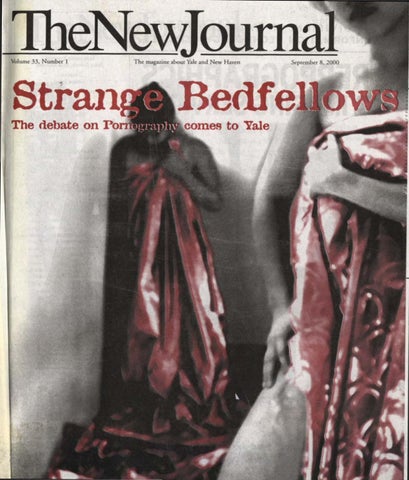
Strange Bedfellows Whos shacking up with whom in tht tkbatt on pornography by Jessica Bulman
STANDARDS 4
Points of Depa.rture
26
Essay: New Haven, 40051 by Michaa G~rbu
28
The Critical Angle: Literacy for the Literati by Alan Schomfo/d r~vi~wing How to R~ad and Why by Harold Bloom Endnote: Urban Outfitting by Eric Rothfodu
30
111. N- Joua><AL as publuhalliw tiaoc:s durift& doc ac.acltmJC _,by TH& NEW jOUL'<A.L a1 Yak. Inc.. PO. 8os J4J1 Yak Sarioa. Jlkw Hnm. CT o6f10. Of!'a addtaa: lfl Park Snuc. Pbooc: (to)) 4)1· All CIOftlmCJ CIOp)'Tish1 1000 by Ttl• NEW }ot1L".U a1 Yak. Inc. AD ~u ltescn<d. Rq>todiiCI- adler LD wbok or in pan wicbou1 wnnm pmouuioft of che publisb<t and cdito..-on-daid' is pro!Ubor.d.
:W, this ..,...nc io publisbcd by Yale ~ nud.nc.. Y•k lJnmnity u
=-'
1101
ruponsibk for
liS CODicnU.
~
choo&w>d 6w hwwlr<d copocs of coch ...,. an cLruibul<d &... 10 ...,ben o( doc Yak and Jlkw
He-. coau11unory. ~ubecriptions.,.. aV1ibbk 10 1h00< ouuid< 1h< va. Raitt One year, Sll. T- yean, S)l. TH& NEW jouvw. is pnnl<d by Turky Publkauons, Polma, WA; l>ool<hq>inc and bill one JUYlCft an br Colman Bookl<<q>in& ofi'kw Haven TH& Nw jou><AL encouraca lm<n 10 the ediror and commmu on Yak and Jlkw Haven wues. Wrue1o Edi1orW.. }4)1 Yak Scation, New Ha~n. CT AD kners for publoc:auon must indude address and sicn.,ure. We~ oh< rich• to edi1 all kn<n for pubhc:auon.
Money Train foR MORE THAN A GENERATION, mOSt comparisons of New Haven and Fairfield County-the expanse of pricey real estate that shields the Elm City from New York and is home to Greenwich and New Canaan-have highlighted the stark economic disparities between one of the nation's ten poorest cities and its most exclusive hideaway. In the past two years, however, New Haven Mayor John DeStefano, Jr. has increasingly compared his city and the suburb on other grounds. He points to Fairfield County as a vision of New Haven's furure, a sign of what's to come for his economically depressed city. Central to DeStefano's plan is Acela, Amtrak's new high-speed rail service, which wiU cut travel rime to New York City down to roughly one hour. In past monchs, the train's development has been plagued by lengthy delays, technical problems, and, most recently, allegations of fraud. For the moment, Amtrak is remaining tight-lipped about the immediate future of this $2. billion project, reluctant to divulge information regarding the service's prices and schedule. Nonetheless, many New Haveners are not hesitating to yoke their city's fortunes to an iron horse that has yet to move. Since the announcement of che buller train's eventual installation, Acela has figured prominently in the city's development strategy, as evidenced by a severalmillion-dollar upgrade of the New Haven train station. By bringing New Haven within an hour of New York City, Acela has the potential to make the city an attractive alternative for high-end commuters fleeing
CORRECTION In Anya Kamenen's article "Carolina o n my Mind" in issue 32.5 ofTNJ, Yale alumnus Josh Kagan was mistakenly identified as "a native southerner." He is from Albany, NY. We sincerely apologize for the error. The Editors of TNJ
4
Fairfield County and its astronomical property values. The dilapidated metropolis could become a virtual suburb--a "bedroom community" of New York and even Boston. This influx, according to the service's optimistic proponents, would bring a
like Bridgeport. "We are meeting people every day who are being pushed out [of New Haven]," says community organizer Andrea Cole. "There is every indicarion that there is an effort to create an upperclass, white downtown area." DeStefano's
much-needed infusion of cash and capital to New Haven's long-ailing economy. Yale officials agree, and are salivating at the prospect of using the school's proximity to Manhattan as a selling point for srudenrs and professors. Faculty spouses can more easily work in New York while living in New Haven, and professors can make their home in New York and still teach at the University. While supporters see this migrarion as the path to urban developmenc and revitaliurion, the plan's detractors srudely refer tO it as suburbaniution and question whether it will benefit New Haven at the expense of those who currently live here. Plans to do away with many of New Haven's crumbling public housing projecrs, including those on Church Street South-situated directly across from the train srarion-are a sign to some that a process of gentrification is already underway. Naysayers argue that Acela will send property values skyrocketing and reorient commercial areas to middle- and upper-class commuters instead of the city's current urban base. There is a nagging fear that New Haven will go the way of Stamford, where cenrraJized gentrification allegedly forced poorer residentS to move into suburbs and neighboring ciries
vision of New Haven's development seems desperately narrow to detractors, who charge that he is aiming to create a wealthy downtown while ignoring New Haven's poorer and predominantly minority residentS. Opponents argue that these two aspects of development-gentrification and poverty alleviation, when not defined as simply forcing the poor our of the city's boundaries--are mutually exclusive. With the advent of Acela, New Haven hopes co be within reach of something more than New York City, something it desperately needs: money. Naturally, this blessing does not come without a proviso. T he city must welcome those who have money if it wants any piece of it, and that means gentrification-a posh train starion and an upscale downtown. But the question remains whether this version of revitaliution destroys the city we know in an efforr to save it, pushing out those residents who most need irs benefits. New Haven has yet to prove that it can walk the line between development and virtual destruction, saving itself without becoming a copy of irs wealthier neighbors to the west. -Dan Kurtr.-Phelan
THE NEW JouRNAL
Eli Bucks THERE'S A LOT OP TALK THESE DAYS about a Yale graduate in the White House. Barring a political avalanche, soon the Executive Branch will wear Old Blue. But the candidates aren't the only Yalies getting involved in politics this election year. The Yale Corporation, the Universiry's highest executive body, has been staying politically active as well. In many cases, members of the Corporation have been putting their money where most ochers can only put their mouths. One would imagine that one of the world's wealthiest universities would have atereorypically conservative trustees, but GOP benefactors, against conventional wisdom, constitute the minoriry of the Corporacion. Diana Brooks, oust President and CEO of Sotheby's Holdings. contributed $1,000 dollars co John Mc.Cain and George W. Bush each. Forced &om top of one of the world's wealthiest auc:Doo houses under charges of pri~ Brooks's donations stopped after Januarf 2.000. William Reilly, former Direaor of the Environmental Protection Agen aJ.o turned out to be a generous supporte of GOP hopefuls. He donated $r,ooo to the re election campaign of Senator Richard Lugar (R-Indiana), the failed 1996 candidate for the presidential nomination. Reilly also gave $1,000 co Bush's campaign as well as another $2,000 co various Republican candidates for the House and Senate throughout the country. Ro~ Betts, President of Silver Screen Mal"if'8Bb1ent, a 6lm production company, made eorge W's war chest $2,000 richer, While Dr. Benjamin Carson of the ohns ~~
Clinton's in New York. Holcombe T. Green, CEO ofWestPoint Stevens and a Yale School of An patron, gave $1,000 to Bill Bradley and a hefty $1o,ooo in soft-money contributions to the Democratic Congressional Committee, a national electoral PAC. Charles Ellis, Managing Parmer of Greenwich Associates, an investment consulting firm, also gave $1,000 to Bradley's campaign, while former Baltimore mayor Kurt Schmoke donated $500 to Hillary Clinton and $250 co Elijah Cu~ a Maryland Democrat running fW <iongress. Hillary Clinton also receive<ta 2,000 contribution from Linda Mason, (llaitroan of Bright Horizons .-liiU-a-. ~ a specializing in ear y childlaood e~ But_aoc all the ors split along e, Executive parry Frances B · Direct~ of the Natural ces Defense Councjl. an environm 1 advocacy group, JP.I"e $1,750 to Senator Lincoln Chafeq (It-Rhode Island). Apparently, C:hafeej hOlds a certain charm for the ous.. Yale family: Four different ea..ear;. made donations totalling $6,750 .-Ia¥ !""''P'i&P Frances Beinecke has also ~· to ao Mil, D emocratic Parry in Pe~ Sbe $300 to Peter Koscm presentative who ha the Senate :"~~--tally coni'fli!JIIII!IIIAtt side of
Medi
investment firm, shelled out $1,000 to presidential hopeful Bill Bradley and another $3,000 ro various Democratic congressional and senatorial campaigns, most notably fellow alumna Hilary Rodham
SEPTEMBER
8, 2000
appoineird bench by Clinton, his gratitude hasn't come across in financial support. David Gergen, Editorat-Large of us N~s and World RqJort, hasn't spent any money on this year's cam-
Come workfor...
TheNewJournal We are looking for writers, artists, photographers computer geniuses, webmasters, businesspeople, and anyone else interested in working for the magazine about Yale and New Haven.
Come to our informational meeting: Tuesday, September 12 7 p.m. at 252 Park Street Or contact Alan at 6-4420 alan.schoenfeld@yale.edu 5
An Independent Alternative to the Campus Bookstore for Your Coursebook Needs
Open Seven Days a Week Enjoy our Outdoor Patio Seating
Booktrader Used Bookstore & Cafe 1140 Chapel Street (off of York) 787-6147
AUTHENTIC THAI CUISINE TAKEOUT MENU
1170 Chapel Street New Haven, CT 06511 (Across from COLONY INN, Downtown) OPEN EVERYDAY SUN-THURS: 11:30AM - 10:00PM FRI & SAT: 11 :30AM- 10:30PM PHONE: (203) 562-<>322
www.culinarymenus.oomfpadthal.htm Delivery $15 minimum
6
paigns either. Formerly an advisor to Presidents Nixon, Ford, Reagan, and Clinton, Gergen probably would not want to make too explicit any party affiliation. Newly named trustee Janet Yellen, an economist at uc-Berkeley, has also abstained from donating this year. The only other Corporation members with no record of u.s. campaign contributions are those who couldn't give anyway-Right Reverend Victoria Matthews, the first female bishop in Canada, and Jaime Serra, Mexico's former M inister of Com merce, who are both foreign citizens. The campaign contribution data was downloaded from the Federal Election Commission on August 3, 2000, and compiled by the Center for Responsive Politics, an independent watch-dog organization. -Don Tontipiaphol
The House in the Hill AT THE CESAR JEREZ CATHoLic WoRKER H ousE in the Hill neighborhood of New Haven, a small group of mosdy collegeeducated individuals lives in voluntary poverty, dedicating their time to serving the needs of the neighborhood. They engage in political activism to challenge what they see as the glorification of wealth, itS concentration in the hands of a few, and itS use to fund violent or wasteful policies. "We're really about non-violent revolution from the perspective of personalism [the belief that each person has a responsibility to work for the freedom and dignity of others]," says Mark Colville, a founder of the Catholic Worker House in New Haven. For nearly 70 years the Catholic Worker Movement has been growing, and those involved believe that by building relationships with the poor and sharing with others the fruitS of a good education, people can transform society. But is this mode of living the best use of an education to promote change? Today there are over 140 Catholic Worker Houses and communes in the United States. Colville and his wife Luz founded the New Haven Catholic Worker
House in July 1994. In order tO pass on to their children their deep belief in the dignity of all people, the Colvilles quit their jobs and moved to Rosette Street in the impoverished Hill neighborhood to begin a bouse of hospitality where anyone in need is welcome. Many of the values that moved the Colvilles to found the house were first articulated in 1933 by Dorothy Day, a radical leftist journalist, and Peter Maurin, a French immigrant who saw in Catholic social teachings a call for societal transformation. They began to publish The Catholic WOrker, a newspaper reporting on struggles for social justice both here and abroad. Their teachings inspired followers to form f.ums, communes, and houses of hospitality, which together comprise a deliberately decentralized movement. T he Colvilles wanted to live in a Catholic Worker H ouse in solidarity with the poor, as Mark says, "to walk with them for a while and see what became of that." The House subsistS on donations from restaurantS and supermarketS, and any food above and beyond the needs of the Colvilles and the other house occupantS is distributed to the community. All monetary income goes into a collective fund; no one living in the house receives regular wages. Over time, residentS in the neighborhood have recognized the house as a place to go for help, a free meal, or a place to stay for a few days. Colville explains that there is a deep belief in Catholic Worker communities that possessions should be held in common. Things people have beyond what they need, he says, are stolen from the poor and rightfully belong ro them. Therefore, giving to the needy is not a remarkable act: It is to be expected. Colville claims that being in a position to perform "works of mercy" -regular actS that physically and spiritually aid others, such as teaching or caring for the sick- is itself a privilege, one that has to be earned and justified by strug~ gling publicly against injustice. Thus, for him, non-violent political activism, such as protesting us sanctions in Iraq or refusing THE NEW JouRNAL
916 Whalley Ave. • New Haven • 3876799
to pay federal taxes because, he claims, they fund war-making, is closely connected to community se~ce, and is necessary to ~nsure that charitable works do not simply patch up the holes of a social system that leaves millions destitute, Colville explains. The convictions of Catholic Worker House members appeal to many college activists, especially those in depressed areas who have difficulty reconciling their costly educations at expensive schools with the conditions that surround them. Brant, a recent graduate of Fairfield University, is one of several college students who have chosen to reside in the Cesar Jerez House over the past six years. Students say they have not only shared the experience of voluntary poverty and service, but have also been challenged to think deeply about the value of their education. The Colvilles and others in the Catholic Worker Movement question the common perception of education as a vehicle for self-advancement. "There's a great societal pull to use education for personal power in an oppressive way," asserts Mark. "In this society we're very isolated and insulated. The system leads us to not be in connection with other people." In contrast, Colville believes that we have a responsibility to put our education, as a valuable possession, to the service of others in a concrete way, and he encourages students to find a means to do so. Bu t is it really possible to share a $130,ooo education with others, and is moving into a commu nity such as the Cesar Jerez house the best way to do so? Students agree that finding a concrete means of sharing o ne's education is not always easy. Yale senior Johnny Scafidi, who spent the summer in the house, found that living there and having lengthy conversations with people in the community about philosophy and theology were valuable means of imparting some of what he had learned in college. H e says that he, too, gained a great deal from hearing stories of the people around him. Mackenzie Baris, another Yale senior, found it more difficult at times to apply her Yale education in a practical manner, but she still felt that her SEPTEMBER
8,
2000
Student Discounts minutes from Yale
www.sohohair.com
ACcoRDING
JOuT
~~.. •E
To
STA'r•sTICS.
oF EVERY
tl
PALATES
ExPosED To ~ BAD 1f1NE. -DOHT LET THIS HAPPEN TO YOV!
Entrees featuring flavors from around the world: Mexican, Italian, Mediterranean & Oriental-homemade, fresh and delicious! Exciting Salads and hearty soups. Nutritious juices and smoothies made to order. Scrumptious desserts, gourmet coffees and more .. .'
7
education contributed to the life of the community: "What I think I shared with the people in the community, especially the children, was that this !Ond of education is worthwhile and possible. It's important for kids to see that Yale students would want to live on their street."
-Nadia Sussman
Chairity
THE YALE BOOKSTORE
•£ma Bette• Qpl: lojg u aa4 pt,..., rg,W• &.. Yllle ttlldenta who an filtd 20 laoun a week to work fw llw Yelc Boobore wiD ~ dtcir COUtW tCEtbooU fief! Call Doreaa ia ow: HIUIWIIt.etowaa l>epan!Datt lot deDila: m.s.uo,
at.JO?.
8
HAVE A COUPLE MILLION DOLLARS burning a hole in your pocket? If so, you just might consider immortalizing your family name and endowing a Yale professorship. But if this price seems too good to be true, realize that once the check is signed, the plaque is put up on the wall, and Yale taps the last tack into the splendid new George W. Bush Neuropharmacology Chair, you lose any say in who sits in it. C reated by individual and group donations of a minimum of $2.5 million, endowed chairs create permanent posts for professors within certain departments or disciplines. Often witness to remarkable succeSsions, some chairs have indeed been the seats of power in this school's history. Most remarkably, the Sterling Chair has been held by 159 former and current professors, including historian Jonathan Spence and Nobel Prize-winning molecular biologist Sidney Altman. But fame does not come cheap-it cost William Sterling $5 million to establish the chair back in 1918, and that was when a million dollars still meant something. More recent endowments include the V incent J. Scully History of Art Chair, given by the Archimedes Association of the Class of 1958 alumni in hono r of the popular professor, and the Maynard Mack Chair, created in 1998 by the bequest of an anonymous donor in honor of the former Sterling chair holder. Millions of dollars are nothing ro sneeze at-even at Yale. An endowed professor's salary and annual research stipend can be put to basic departmental improvements once their salary is being paid by outside donors. And open chairs can also suengthen departments by enticing new faculry with hopes of a future endowed professorship and its benefits. Even if Sterling chairholders receive only a paluy $4,000 a year for research, every dollar still counts.
THE NEW j OURNAL
Despite all this, though, Yale won't always take your money. As donors vie for the opportunity to endow a permanent chair-and attach their name to it forever-the University is caught in the dilemma of accepting money in exchange for academic control. In a few recent instances, the University has held onto its autonomy and turned down 'bffers to create chairs. When gay rightS and AlOS activist Larry Kramer (BR '57) offered two profesorships in Gay and Lesbian Studies, the d onation was rejected on the grounds that the academic worth of the subject is still being explored. In 1991, the Bass family attempted to endow University-wide chairs in Western C ivilization, but Yale returned the money when the family demanded a say in selecting scholars to hold the chairs. The issues surrounding new chairs are highly politicized, and Yale is cautious about jeopardizing its academic integrity. For better or worse, Yale has passed up opportunities both to be at the forefront of scholarship in emerging fields and to bolster a classical curriculum. So while a new professorship might make a great stoclcingstuffer for that special someone come December, it probably is not the best way to remold the face of American higher education. Caveat emptor! --Sara Hirschhorn
Featuring the finest select1on o
etter eye wear at guaranteed lowest prices.
•comprehensive eye exams •contact lenses •fashion eye wear
Why is Spector Eye Care New Haven 's best?
$25 Eye ~~ X'-liTl 1 PHOr~E
).l.~
c_, q'
,,>()"
(f'.(
(_~!rtf •
~)ht rr•
t
/111 • St,, 1t ·" n '"
' A ' , ,H''-, A• , ;! •
Moving to our New Home in September
Rimage Salon & Spa 12 1o Chapel St. 562-HA IR or 776-4248 www. RimageSalon.com Nationally Trained Colour Specialists
i~
O=O&lRm&
J a p a n ese R est a u ra nt
*
BEST JAPANESE - State Runner-Up CT Magazzn~ R~aekrs Chou·~ PoLL I998-2oou BEST JAPANESE - N~ Haven County CT ~ R~a&Urs ' C/u)lc~ Poll r998- 2oou
*
Dinner...
Sus&
Lunch...
Cate. l)JJg
S unday - Thursday s :oo pnl - 9:30pm t'nday - Sacurday 4 : 4 ~ pm - 10:00 pm M o nday - 1-'raday 11 : 30 an~ - 2 : Jo pm
1 206 Dixwell Avenue. Hamden
203-28"1 -4542 FAX 203-407-1651
S2PT£MBP.R
8,
2000
www.hamacl.com
9
E DoN'T
EED
Does Yale's vying for federal funds Every election must have an issue, and chis year's seems ro ! be education. Smooching babies and visiting preschools is no longer enough; this season, even George W. Bush is using phrases like "the soft bigotry of low expectations" to describe the stare of American education. Accordi~ · ng • .. to his campaign staff, Bush has visited some roo schools and colleges around the country since beginning his run 14 months ago. Nor to be outdone, his opponent AJ Gore has identified "revolutionary • , .. - ~ '•· ' improvements in our schools" as "the number one priority for the nation." Four years afrer . Bob Dole planned to shut down the f ·~ ·.,: ' 1 Department of Education and five years •• • ~ • • after Congress shut down the government, in part because of disputes over education spending, we find ourselves today
f
.. ,1
debating only how much mor~ money the federal government should throw at our schools. The candidates and their parties are both vying, in a student council election kind of way, for the role of education's most tireless advocate. To hear the sound bites from this most recent election, one might well think the federal government had only recently decided that education was something worth spending money on. But, for universities at least, the opposite is true. This year, federal and state government will deliver over $35 billion worth of grants to colleges and universities already grown wealthy on decades of research contracts and robust endowments. Johns '\\ , Hopkins, far and away the nation's largest recipient of feder\ a! science funding, made just under a cool $750 millionmore than most universities' entire endowments-in fiscal year 1998. T he University ofWashington, a distant but no less impressive second, netted $380 million for the year, while 20 other schools received more than $200 million each for the same period. And yet, in spite of all this money, universities have reason to believe ~ that the good times may not last. ~ America has never loved its eggheads; today, many of those working within the academy do so at the whim of
to own. Departments of science, especially, depend more on grant and contract money provided by federal funding than on any other source
THE. NEW JouRNAL
0 EDUCATION compromise a liberal education? By Ronen Givony of income. It goes without saying that when the health of an universities of its lcind-schools with an avowed commitment to a endowment or foundation depends on the favor of vote-chasing liberal arts education whose aims in scholarship might seem at odds politicians, intellectual~specially university intellectuals -have with the rules of the federal spending game. to tread lightly. Over the past 25 years, as competitions for grant money have A river of federal money runs through the Yale campus. It begins grown fiercer and more federal grant programs have withered in the with the School of Medicine and its affiliates on the southern side name of balanced budgets, many schools have moved to better posiof town, pushes north to the Schools of Art, Architecture, and tion themselves within the political arena. Following the lead of Drama, winds its way around Prospect and Hillhouse, and p roceeds corporate America, universities have formed associations and enliststeadily toward Science Hill and the School of Forestry. Along the ed lobbyists to ensure their share of lucrative govway it makes numerous detours¡ in departments ernment research contracts. Borrowing a tactic of of the physical, natural, and political sciences; in In the words of one corporate culture, they have begun to think of economics, international relations, and area their "products"- learning and research-as a University official, Yale studies; in math and compu ter science; and evenkind of asset, measurable in dollar amounts and tually all the way down to the most quotidian couldn,t be what it is traditional conceJ:ltions of risk and return. They aspects ofYale student life, like e-mail access via today if it were relying high-speed network connections. In the words speak of federal funding of medical research as an investment, of education as a cog in the wheel of of one University official, "Yale couldn't be what just on endowment economic prosperity. To justify their annual it is today if it were relying just on endowment income and tuition., research budgets, universities today are forced to income and tuition." sell their product, much like corporate lobbyists The numbers are impressive. For fiscal year market their industries, as deserving of federal dollars and con tracts. 1998, Yale received $233 million in grant and contracts, or "sponThe practice of university lobbying says a great deal about the stakes sored agreement income," from Washington. By 1999, this figure and rules of the research spending game today, about the image that had risen to $244 million, and in 2000, to over $260 million. universities must present, and about the strategies they use to ensure According to the Office of Finance and Administration, Yale profunding in a time of fiscal conservatism. jects federal revenues ofsome $284 million and a steady growth rate In the past three decades, no university has had a more intiof 7¡9 percent for fiscal year 2001. The School of Medicine, which mate relationship with the leaders of the federal government than accounts for about 50 percent of the University's budget, receives Yale, and few have benefited more consistently from the blue-chip approximately 75 percent of Yale's grant income. And while the National Institutes of H ealth (NIH) continue to provide the lion's stock of reputation. But Yale's successes are neither paraded nor share of these revenues ($190 million in 1999), other agenciesparticularly well-known to those outside the University communiincluding the Departments of Energy, Defense, and Educationty. Plenty of schools receive considerably more research money than Yale; schools such as Caltech and M.I.T. have long been known still provide $40 million on an annual basis. as important centers for federal and especially defense-related Yale received its first offer of government money in 1919, when research. Still others spend dramatically more on lobbying and the u.s. Interdepartmental Social Hygiene Board offered the School campaign contributions. Yale is significant, rather, for the singular of Medicine--then the "Medical Department"- a check for $5,100 efficiency of its rather modest efforts, and for the model it sets for to participate in research activities. Curiously, Yale President
SIIP1"nfBER
8,
2000
II
Arthur Twining Hadley hesicared before accepting the funds. President of the University for 22 years at the beginning of the century, H adley believed rhar such appropriations were nor generally used well and preferred that money spent locally be raised locally. But evenrually Hadley gave in; according to a Yale history, his misgivings were overcome "by his passion for medical advancement, and his belief that the need for social disease research was urgent." It wasn't until the end of World War II, however, that research funding approached the dramatic level we know coday. Significant sums of money rolled in with the massive postwar expansion of rhe NIH and cemented the School of Medicine's standing as an important center for research in the health sciences. Yale's fortune rose even higher when Sputnik went up in 1957. In response to criticism from Democrats, journalists, and academics, Eisenhower moved co leapfrog the Soviets in space by increasing federal support for education and expanding social programs at home. Eisenhower made federal spending on education, albeit in che arts of military science, a priority char would also fill the coffers of research expense accountS for decades co come. Ike's pronouncement would shape the way politicians right down co Bush and Gore have calked about education spending: "Trade, economic develop-
AWORLDOF GOOD GIFTS Point~d ,..;r~ ornom~nts from th~
Phillppmn $7.95 t>och
TlN THOUSAND
VILLAGES. Mon-Wed 10-6 Thurs-Sat 10-8 I 054 Chapel Street New Haven Cf 065 10 (203)776-0854
HM~~NG Line of Hair Cutting Servicing Yale for 38 Years
ment, military power, artS, science, education, the whole world of ideas-are harnessed ro this same chariot of expansion." Today, grant and contract income accountS for nearly 30 percent ofYale's annual operating revenues-more than alumni contributions, more than tuition income, more even than returns on the University endowment. The federal government is by far the largest source of Yale's operating funds from year co year, and behind those funds lie the effortS of Rich Jacob. Tucked away on the sixth floor of the Whitney-Grove Square building are rhe shared offices of University Finance and the General Counsel. Past the welcoming receptionist and down a busy corridor of noise lies the office of Yale's chief liaison with the federal government, Richard Jacob. Jacob is an energetic, youthful-looking man, with a more or less typical bureaucrat's office: a computer monitor and dozens of files resting on the floor, a lone photograph o r two, and stacks of official-looking paper piled on his desk. Jacob is professional and tactful, but his unassuming manner belies his crucial role in securing the money that keeps Yale running from year to year. On the day I mer with him, he wore a light purple polo shirt and a friendly, easy-going manner. Instead of Yale memorabilia or snapshotS with Washington's elite, Jacob's office stands free
1998 Lobbying Expenditures (in thousands of dollars)
800
Our New Location 49 High Street
700
(Behind Starbucks)
600
562-5623
500 400 300 200 100 0
c ut flowers in town!
(203) 772.2229 fax (203) 562.6004 m•chaelsflowenltd.com 26 Wh1tney Avenue, New Haven J- .....-.! ohto.- t.lw>JT....... o.y.
12
ca.
THE NEW jOU RNAL
of decoration, the space better used for diet of federal money. As rhe chief inpurposes of real political dealings. house lob byist for one of America's most Jacob's job description is straightforprominent universities, Jacob's task is to As Director of Government ward. convince government of the need for an Relations for the University, he oversees expanded investment in intellectual life. and guides Yale's lobbying efforts To partisans of small government and Yale's with federal authorities in streamlined budgets, Jacob Washington . Jacob must make a case for public Operating Revenue tracks issues befor~ funding of student aid, Congress and the of science and engiPresident t h at OTHER neering, and of the affect Yale in arts and h u maniany wayties. To advocates re searc h of private opport u n ifundraising and and ties cost control, he po te nt ia l m ust show that risks, budget the public stands debates, a nd to gain much from controversy the millions set over everything aside every year for from inte llectual research and developproperty and money ment in esoterica. Not an for studen t loans to easy task before the Con gress immigratio n policies that that nearly killed off the National affect Yale's international students and Endowment for the Arts for handing out scholars. H e meets with representatives in taxpayer money to "self-proclaimed 'artists' Congress and federal agencies, never to diswhose mentality is just so much flotsam cuss individual research grants bu t rather to floating around in a sewer," in the words of Senator Jesse H elms. lobby for larger research appropriations in general, from which Yale can expect to Jacob came to Yale in January 1995, a move profit. Jacob also keeps up con nections with Connecticut'~ con gressional delegathat says something about recent develoption, and especially with the "Yale delegamen ts in the dealings between government tion"- the 19 representatives and senators and academia. When Congress changed who grad uated from Yale and whose doors, hands in 1994, a number of universities he says, are "that m uch more open to us realized that many representatives who had when we need them." In add ition to these long championed universities and research duties, Jacob maintains ties with the govwere now gone. After Newt Gingrich's ernment relations staffs of other research notorious Contract with America, the universities and a n umber o f association s peaceful relationship that existed between universities and the governm ent changed (most pro minently t h e Association of American Universities) that exist to lobby greatly. Universities found themselves in on behalf of the education industry. need of new champions and acted accordAccord ing to mandatory lobbying ingly. rtpons filed with the C lerk of th e House of Shortly after Jacob became Associate Vice President for Federal Relations in the Represen tatives, Jacob's office spends in the Office of the General Counsel--only the neighborhood of $3oo,o00-$38o,ooo each second person to hold the position-Yale ~ tracking issues and trends of concern rook early steps to reestablish its position to the University comm unity. Jacob also with Washington. The University stepped relies upon Yale faculty an d administration, with whom he frequently travels to up its lobbying efforts and became a founding member of a group called the Science Washington for "common lobbying days" to discuss science and humanities policy Coalition, an alliance of 65 dues-paying research universities and several hundred with elected officials and federal agencies. scientific societies and professional associaLess straightforward are the strategies tions. The Science Coalition aims to find Jacob pursues in 9'1ainraining Yale's steady
SIP'I'I.t.mER 8, 2000
Hull's UNI V ERSITY
Art Supply & Framlnc
1144 Chapel Street New Haven, CT <>6511
Your most extensive source for art, modeling. framing, & a vast array of creative supplies
Charles Brice Tailors 174 Park Street (at Yale) New Haven, CT {203)865-5269 c-...,
Complete Alterations Leather Repair & Cleaning • Linings Zippers • Hooks • Buttons • Patches Complete Sewing Shop Garments Made to Order Sewing of All }\inds c-...,
Fast Service 13
Hamden Plaza
2100 Dixwell Ave, Hamden 230-0039 • open 7 days
• natural fiber clothing • Crabtree & Evely n • jewelry • toiletries • pottery • and presents for children of all
~
MAIN GARDEN
CHINESE FOOD TO TAKE OUT & EAT IN 376 Elm Street • New Haven
777-3747
Open Seven Days a Week: Mon-Thurs: 11:30 om-1om Fridox: 11om-2om Saturday: 12 noon-2om Sun: 12 noon-12 midnight
FREE DELIVERY $10.00 MINIMUM Set our menu online! http/ / moingarden.home.ml.org
TheNewJoumal would like to thank • Andy Beck • Sarah Cowan • Nicholas Jitkoff • Alex Setness • David Slifka • Nadia Sussman
14
ways to communicate the importance of down a similar gift from Larry Kramer (BR public invescmenc in science and co culti'57), who wanted to endow rwo permanenc , vate long-term support for research money professorships in Gay and Lesbian Studies from Congress and the President. at Yale. In both cases, Yale shied away from money that would have come tied to purInterestingly, Yale collects more poses or members of the research money from che National Science faculty specified by the Can a university defend donor. (Around the Foundation each year the sanctity of a liberal time of Kramer's refused than Calcech and Washington University of gift, the owners of arts education while St. Louis, either of which Yahoo! gave their alma meeting government would seem a more obvimacer Stanford $2 milous presence in the sci- demands for returns on lion to endow the Yahoo! ences. As a result of Founders Professor of investment? efforts such as the Science the School of Coalition, Yale ranks Engineering.) "The basic principle," Levin said durfourteenth among universities tn total research and development funding ing the Kramer controversy, "is that we simply don't lee donors determine the subobtained over the past ten years. A cause to rejoice-but a cause for concern as well. jects of study at Yale. That is the job of the The problem begins to open up when faculty, and it is, by and large, a job very one looks more closely at the very profwell done." But Yale's reliance upon funditable arrangement the University has creing from the government creates a situation ated for itself. While the sciences raked in in which the government donors very some $243 million dollars for Yale in 1999, much determine what che subjects of study the arcs brought in only $789,ooo-less than will be. After Rich Jacob has finished his .03 percent of the whole. The disproporjob in Washington-lobbying officials, say, for a more generous NIH annual budget-a tionate efforts co fund the sciences, a lucrative field, over the arts-at an institution lengthy process of applications and review ostensibly dedicated equally co bothstands berween a researcher and her points to some troubling questions. In irs prospective grant. Information submitted haste to secure federal contracts, is Yale under this process typically includes a procommitting itself to a situation less conject description, budget and budget justifiducive to intellectual freedom than it cation, biographical sketches of key personnel, and so on. If and when a review board would assume? Does the vase imbalance finally agrees to award a grant, the money berween funding for arcs and sciences point to a problematic future? Can a university arrives at Yale with a strictly defined purpose, and, more important, a kind of defend the sanctity of a liberal arts educaunspoken agenda as well. tion-whose value comes not in the purAn example: Applicants for grants suit of anything, but rather as an end in from the NIH are asked to address questions itself-while meeting government that identify the precise "scientific impact" demands for responsibility, results, and returns on investment? Most important, is their projects will have: the idea of a liberal education-in the lanSignificance: Does this study address guage of Yale College's Bulletin, one that an important problem? If the aims of has no single definition and is neither too the application ace achieved, how will scientific knowledge be advanced? narrowly focused nor too diffused-simply What will be the effect of these studincompatible with the goal-oriented conies on the concepts or methods that ception of learning that government would drive this 6dd? most like to fund? Innovation: Does the projea employ In 1995, Yale's truStees voted to return novel concepts, approaches or a gift of$2o million from Lee Bass (BK '79), method? Are the aims original and intended co support a sophomore-year proinnovative? Does the project chalgram for the study ofWestern Civilization, lenge existing paradigms or develop after the donor demanded control over the new methodologies or technologies? faculty appointments he was endowing. Two years Iacer, the University turned
THe NEW joURNAL
T hus, while a grant from the NIH may not come tied, as with the Bass and Kramer gifts, to the specific wishes of a given person or group, it most certainly comes tied to an expectation that the research produced will be socially useful-in other words, that the p ublic will see an acceptable return on its investment in education. In this way A1 G~e can promise, to an arena full of cheering convention supporters, that "We will find new medicines and new cures, not just for cancer, but for everything from diabetes to HIV and AIDS." Departments of science, then, must choose, for fear of losing research funds, between p rojects of merely theoretical interest and those that the nonscientific community will consider "useful." Under such thinking there remains little reason for officials to support "frivolous" pursuits in the humanities and the arts- fields that suffer, as Jacob notes, from a lesser social immediacy than, say, efforts to cure disease or improve technology. Lurking behind the government's very conditional support for education is a mandate for goal-oriented learning, for restitution, results, and payoffs-in other words, not for education at all. It reeks of what theorist Paulo Freire called the banking method of education, of an investment-oriented outlook that views learning largely in proportion to the returns it brings to the donor, and never ai an end in itself. Worst of all, it buys into the logic favored by both presidential candidates, the logic of what we now call "accouncability"-an elastic shorthand for everyth ing from standardized evaluations of students and teachers to public review of research grants. These days, Washington doesn't care to fund the son of learning that Yale has historically championed-the sort for which there exist no powerful advocates in government. Perhaps Arthur Hadley was onto something all along.
THE PLACE TO MEET FOR DINNER OR DRINKS BEFORE GOING OUT AND ABOUT IN NEW HAVEN 220 COLLEGE STREET, NEW HAVEN 203-624 - 1SS3
~
GOODFOOD
~FUN WINES
@SMOKE FREE
\
~AL
~ .fil.ut~ntic lntfian ('ui.<in~
Open 7 Days a Week Catering, Take-Out and Free Delivery Available
1111
Fri., Sat., & Sun. 20-Course All-You-Can-Eat Buffet 12-3 PM, only $6.95 I 0% discount for Yale students on any dinner, Mon-Thurs.
Free Parking Givony, a smior in Branford Co/kg~. is"" associat~ ~dit01; for TNJ.
Rtmm
~B.ER 8, 2000
140 Howe Street • Phone (203) 787-9493 www.yawanna.com/Restaurants/royal.html
''
15
Seeds of Summer Photos by Whitney Grace Essay by Anya Kamenetz
It is a tranquil, sunny Sunday in June and people of all ages, sizes, and colors pack the city lawn. Retirees in wheelchairs sit in the shade; giggling Puerto Rican and Dominican girls practice hula-hooping in the sun; dreadlocked students relax next to their mountain bikes; bearded men chat next to their Harleys. Spicy scents waft from the Thai and Caribbean food stands lining the sidewalk. On a stage at the east end, a 13 -member salsa band from Cuba is setting up, and saxophone notes rise like bright banners into the blue sky. Across the park is an even more coloiful sight: four men and four women in harlequin costume sway in unison atop flexible thirty-foot poles, dancing in the breeze like palm trees. They are Strange Fruit, a performance group from Australia. Everyone seems to be enjoying the beautiful summer day in New H aven.
Yes, this is New Haven, not New York, or San Francisco, or Sydney. For the past five years, the International Festival of Arts and Ideas has tran~formed our city with a sweeping array of cultural offerings. This year the festival ran from June I 6 to July 1 and included hundreds of performances and events in every conceivable category: classical, jazz, pop, and world mllsic; opera. ballet, and modem dance: drama from Shakespeare to street improvisation; film; visual arts; readings and spoken lectures and .\)'mposia: historical tours; and the simply unc/assifi Fruit. for example). For the first time, the festival expa~uled illlo and New London. But the heart of the proceedings remained the performances the New Haven Green. For New Haven's transient population of Yale students who think of their university as the dominant, if not only. culwral institution in New Haven, it can be amazing to see what goes on while they're out of town. "It's so good to see all kinds ofpeople on the Green. It's very different/rom how it looks when students are here," said senior 7}' Hudson, who came back to New Haven for the weekend. "/ hope the festival will begin to change people's impressions about New Haven ...
Indeed, for people interested in New Haven, the effect the festival is having on the city is as exciting as the artists drawn from all over the world. Gabe Freiman, a junior, served as Assistant Volunteer Coordinator for the festival. I found him in the volunteer headquarters in the basement of the New Haven Free Public Library, putting together a puzzle with a petformance artist from England and a 13-year-old volunteer. Freiman, who finds working with New Haven youth to be the most rewarding part of his job, estimates the festival this summer had 50 volunteers between the ages of 10 and 17, out of 300 total. "This is the first year they've had kids to volunteer like this. We had kids coming in every day, saying 'Can we volunteer, and ifwe can't volunteer, can we work?'" The young volunteers served as ushers and assistant stagehands for events, ran messages and errands, picked up trash on the Green, staffed the information booth and folded endless brochures. Their only rewards were free admission to some events and at-shirt. "They wear their shirt sort of like a badge," Freiman said. "We were reserving the mediums just for the kids, and we ran om." What motivated these inner-city kids to give up their summer to promote the arts? It seems amazingly simple. ''/started doing it to be a good citizen,'' said Deion Ross. 13, wlio was posted at the information booth with a walkie-talkie. "I know that sounds cheesy, but it's true. Also, it gives me something to do in the summer." The Wilbur Cross student is a buddi118 actor at the Educational Center for the Arts, where 116 • But it was his own idea to Miter side of New hoes his sentiis volunteering
··we couldn't have done it without till.' {young \'Oiunteer.\]." said Susan Tamulevitch, the festival's \1olumeer Coordinator. "/ think it's really important that feel ·welcome here. This is t/u•ir city and this is their iml." Tamulel-·itch and others who work with the festival an opportunity to build the kids' natural interest and to reach eren more kids with all the resources the festival has to offn: ''There are ways to broaden {the kids' experience]," Tallwlel•itch said. "In exchange for working. or along with workin~./the kids] could get an educational experience that parallels the festival.'' This is already happening on a small scale, said Christine Franquemont, the festival's Director of Del•elopment. ''One of our pe1:{"Jrmance ~roups ,.,·as Macadam, a hip-hop dance group ofstreet kids from Paris who are just the age (~{our ,·olunteers. We arranged to gl't some of the \'olumeers into the peJformance workshops with them. and [the studelll.\ · j enthusiasm was ama:ing. Perlwps this cross-culmral encounter will he the seed of the Stran~e Fruits and Macadams of rhe fwure.
Q ne nippy February night last winter, I donned my hat and scarf and set our for News Haven on a mission: to buy a copy of Hustkr magazine. Normally, Hustkr and other porn magazines would never have graced my shelves, stuffed as they were with books from classes such as Constitutional Law and The History of Feminist Thought and materials acquired the previous summer during an internship at the feminist magazine Ms. Bur I had to make an exception. The next day, I was ro interview Larry Flynt, the founder and publisher of Hustkr, and I'd yet to see a copy of his infamous magazine. Walking down Chapel Street, I felt ar once absurd and exhilarated. I'm not a fan of Flynt, but nonetheless I found the opportunity to interview a celebrity exciting. I entered News Haven and approached the porn section, where a motley group of men flipped through magazines. Others nervously avoided the area, pretending to study car and sports magazines, while darting eyes exposed their real interest. I was definitely out of place as I scanned the titles that peeked out &om tall plastic shields. When I found a copy of Hustkr, I paused to consider the purchase. On the one hand, I value free speech too highly, and hate censorship too much, to support a ban on pornography. On the other hand, I hold pornography responsible for objectifying and harming women and didn't want to make a $7.99 contribution to the industry. As I approached the counter, my feminist instincts went into over¡ drive, and I grabbed a nearby copy of Ms.whether to offset my guilt about supporting Hustkr, or because I wanted the guy behind the counter to know that this was for research, I'm not sure. In any case, I paid for the magazines, received the brown paper bag that screamed , "PoRN" and set off back ro my dorm. Larry Flynt was visiting Yale for the first of four master's teas on pornography sponsored by Calhoun College. Calhoun Master William Sledge and Associate Master Betsy Sledge also invited American Civil
Liberties Union (ACLU) President and law professor Nadine Strossen, former pornography actress Linda Boreman-betrer known as Linda Lovelace-and her attorney, law professor Catharine MacKinnon. Calhoun's guests have four of the loudest voices in the nation's pornography debate, and Yale had the rare honor of having them all speak :1~ part of a single series at a time when discussions of pornography can be found everywhere, from Internet chatrooms co Capitol Hill to university classrooms. The $ro billion-a-year pornography industry-larger than the music and movie industries combined-has been the subject of debate for centuries, but the controversy has exploded once again as the Internet redefines the way pornography is consumed and renders obsolete historical checks on its reach. But the Internet is not the only reason the pornography debate has grown more intense. Traditionally, there have been onJy two sides to the debate: civil libertarians, who argue that pornography should be protected as free speech, and social conservatives, who argue that pornography is obscene and should be banned. As the feminist movement emerged in the r970S, though, a new voice began to make itself heard, arguing that pornography was both a cause and an effect of sexual inequality. Unlike conservatives, who have made sex and sexuality their focus, feminists have concentrated on the degradation of women. Ironically, over the past few decades, conservatives and radical feminists have often united to work toward common goals. The pornography debate has become one of the most inceresting controversies in American political life, dividing some camps while forming unlikely coalition , ing itself as a matter of intellectual concern. A liberal college campus like Yale, then, was the for a series on pornography. Flynt, Strossen, Boreman, and MacKinnon-who represent the range of liberal views on pornography, from hardcore civil libertarian to radical feminist-all made powerful arguments, invoking loaded words like freedom, censorship, equality, and slavery to answer the question: Is pornography a hannless form of speech that should be protected by the First Amendment, or is it an active violation of women's civil rights that COntributes to their degradation, abuse, and subordination?
After the series, I found myself returning to one of Flynt's analogies to understand both the participants' views and my own: "You can't have five hungry wolves and one sheep voting on what to have for supper, because the sheep is going to lose every time." While at Yale, Flynt invoked this analogy several times, concluding, "I know. I've been that sheep a few times." Although probably unintentional, this analogy summarizes the pornography debate quite well--as long as you leave the roles of wolf and sheep up for grabs. Flynt, Strossen, Boreman, and MacKinnon cast this role quite differently and form a strange pair of alliances in the debate; neither the feminist law professors nor the players in the pornography industry agree with each other. Strossen and Flynt see the pornographer as a sheep needing protection from the wolves of majority-rule government and moralistic society. Boreman and MacKinnon, in contrast, argue that the sheep is a woman living in a patriarchy of wolves and brand Flynt and other pornographers wolves in sheep's clothing.
Larry F1ynt When I met Larry Flynt in an Omni Hotel conference room, he gave me a quick once-over and guessed my age, correctly. I was courteous enough not to return the favor. Flynt, who has been in a wheelchair since he was shot twice in the abdomen in 1978, was rolled into the conference room by his stocky young attendant. Flynt's appearance and demeanor surprised me; he was not domineering, as I had expected, but docile. He dressed his part-an ostentatious r d hij¡s lumltger, and his large head sat on th ar ni shirt-but his getup and az blue er ¡ g signs of Flynt's vitality. peaking is difficult or Flynt. He grumbles in low, hoarse tones, and has a hard time getting his words out, except when he eases into weU-rehearsed sound bites. Minutes into the interview, Flynt claimed provocatively that "the Church has had its hand on our crotch for over 2,000 years." Somehow, I wasn't as impressed as I had been when fd read this quote on the Web the night before. It lost even more power when I heard it the third time, later in the interview, and the fourth at the master's tea that afternoon. Flynt
he argues. "What women have to understand is that men worship is most ar home with memorized phrases like this and his beloved women, and they love to look at the female form." Apparently, rites proclamation that radical feminists' only achievement has been getof worship include "Hustler's Birch Rescue," a page of the magazine ting "a bunch of ugly women to march." Most of Flynt's sound bites are appeals to freedom of speech. portraying women as dogs needing masters and positive reviews of movies in which women are offered as "gang bang fodder. " Flynt calls himself a First Amendment absolutist, and his rhetoric plays on the AJI-American values of freedom and individualism. Flynt also plays the holier-than-thou role when it comes to sex (Freedom and individualism, of course, sound much nicer than and violence. He speaks passionately about "how screwed up a socipornography and patriarchy.) Whether I asked Flynt about the ety's priorities are when it's legal to publish a photograph of the objectification of women, the Reverend Jerry Falwell, or Hustln-'s most mutilated body-you might even win a Pulitzer Prize for itprofits, everything came back to the First Amendment. "Freedom but you can't publish consensual sex." Flynt also feels "that gratuis nor lost in one fell swoop; it's lost one book, one magazine, one itous violence is wrong." But when I asked about the intersection of movie at a time," he told me. Then, echoing a famed~.QI·~~~ sex and violence, such as the infamous Hustkr cover depicting a statement by Supreme Court Chief Justice William woman goitlg through a meat grinder, Flynt evaded my question. Rehnquist, Flynt declared, "Freedom of speech is When I questioned him more generally about the objectification not only the unrestricted expression of the thought of women in pornography, he answered, "Look at Madison you love, but also the thought you hate the most." Avenue photo cases or Elk. See the little anorexic girls with Underlying all of Flynt's talk about freedom, ~~:n• their skimpy little outfits on. They're really selling the same however, is a preoccupation with money and class. Flynt would have us see him not as a multi-milthing. Except they defend what they're doing as fashion. So lionaire who exploits women, but rather as an what we're really talking about is degrees; either you're underdog, an Everyman who brings pornography exploiting women or you're not." to the masses. Tht Ptopk vs. Larry Flynt, Milos Forman's 1996 movie about Flynt's life and legal batNadine Strossen tles, opens with shots of Flynt's impoverished childhood, evoking the American Dream and encouraging viewNadine Srrossen, the president of the ACLU and a professor at ers' hopes that this poor child will rise to wealth and success. NYU Law School, would for the most part agree. Strossen comes During our interview, Flynt consistently described pornography in down on Flynt's side in the pornography debate, but presents her terms of class, saying, "The rich and privileged have always had opinions with a grace, intelligence, and thoughtfulness that he their leather-bound editions of pornography. Today the local video lacks. Like Flynt, Strossen believes pornography deserves First store and bookstore have become the poor man's art museum. No Amendment protection. Though she wouldn't say. that the exploitation of women is clear-cut, she would concur with Flynt's underlymatter how uncomfortable pornography makes the ruling class, they can't rake it away." Flynt next declared that Hustkr set out to ing contention that the govenment has no right to protect certain be the poor man's Playboy. Whereas Playboy "presented an image of publications while condemning others. Her view goes further than a girl that was unattainable," Flynt sought to showcase "more of the Flynt's, taking into account the difficulty of restricting some speech without getting on the slippery slope coward restricting too much girl-next-door type, someone readers would see in the supermarket or the laundromat." speech-including speech that benefits women. The advent of the Internet has further democratized pornograSrrossen, who is tall with curly brown hair and an electric, phy and has given the ruling class a new problem, says Flynt, who comforting smile, arrived at Yale last April dressed more for a gala launched the Hustkr website a little over four years ago. "For centhan a discussion. Her black velvet pantsuit and high heels clearly turies people have been controlled by the flow of information. Now distinguished her from the group of jeans-wearing college students it's virtually impossible to control information." Flynt's voi who h C4Jne to hear her sp ~ Srrossen immediately set out tied coarsely as he repeated his favorite of sound bites: "For 2, e he e n • years the Church has had its hand on our crotch, and the go n ~e ~ ~~<·-~'~ ment is exceedingly moving in that direction, thinking that if it can smiled and nodded, every so often interjecting comments and aneccontrol our pleasure center, it can control us. But people are not dotes. When Strossen began to speak about pornography, she going to allow Big Brother to tell them what they can read or see in perched at the edge of her seat, letting her lively hands punctuate the privacy of their own homes." I almost expected the walls to her talk. stand and applaud. Srrossen considers herself a ferniWsr, yet is careful to distinThroughout our interview, Flynt not only redefined pornograguish her views from those of radical feminists who support the phy as a class struggle, but also adeptly turned the definition of censorship of pornography. She argues that censorship does more harm than good to women, noting that censorship measures suppornography on its head. Pornography does not degrade women,
1
ported by feminists in the past have often backfired. Most recently, the liberal Supreme Court of Canada accepted radical feminist prescriptions regarding pornography, and actions were brought against works by the Likes of Zora Neale Hurston, Audre Lorde, and Gertrude Stein while mainstream pornography went unchecked. Strossen knows that such examples of censorship are her most powerful argument against liberals who oppose pornography. Conservatives would probably be glad to see feminist and lesbian volumes disappear from their local bookstores along with Hustkr, but liberals are rightly worried about this possibility. And Strossen also knows that it is the liberals who oppose pornography-and not the conservatives-that she is most likely to win over. Such liberals were probably her only opponents present at the master's tea, and Strossen was careful to address a pitch to them, as well as to those, like myself, teetering between civil libertarian and radical feminist views. She paused emphatically before warning that censorship is a "tool of the powerful to club beliefs they don't like" and that it is "not a coincidence that those in the minority are the object of obscenity prosecutions." I was left with a haunting image of what would happen to my own bookshelves; I wouldn't mind if all copies of Hustln- (including the February issue sitting in my room) were to disappear, and I wouldn't even mind if Elk were never published again. But I would choose Hustkr's survival, even its prosperity, over the loss of Hurston, Lorde, and other feminist writers. Strossen next rurned her attention to First Amendment protection of Internet pornography, providing a legal and intellectual ftamework for Flynt's comments about pornography's democratization. She explained that throughout history, each new medium of communication, from print ro television, from radio to film, was "greeted with cries for censorship" until the Supreme Court brought it within the umbrella of the First Amendment. According ro Srrossen, the Internet completed this cycle with the 1996 case ACLU which the Supreme Co 1 mously concluded that..l::!jbldti;p.j~l deserves the same degree of proreccion as print. As president of the ACLU, Strossen clearly took pride in this decision, but rather than toot her own horn, she praised the Supreme Court's wisdom. For Srrossen, a civil libertarian, everything comes back to the rights of individuals to make their own decif sions. She may hare pornography ( __and choose not to consume it, but she wants this to be her personal choice; similarly, she argues, one woman may find pornography offensive and violating, bur another should be allowed to engage in the profession. Strossen's individualist rhetoric is
seductive, and her warnings about restricting freedom of speech are prudent and foresightful. At the same time, however, Strossen's unconditional advocacy of First Amendment rights is somewhat myopic. In her single-minded attention to individual choices, she works too hard to validate pornography and fails to address its consequences. Strossen presents
pornography as a victimless crime ::~~:~~~~ZEJ and denies the gen uine harm it can cause to the women involved in its making, as well as its responsibility for degrading societal views of women. Rather than critique both Hu.stl~r and Elk for exploiting women, she denies that either publication does so. Strossen concluded her master's tea, "What is degrading for one is empowering and liberating for another. We have to make decisions as individuals as to what we find empowering and what we find subordinating." If everyone were indeed free to make these decisions, her words would cercainly be true. Yet while Strossen's advocacy of First Amendment rights is admirable, the choice to defend pornography should nor be as easy as she makes it seem.
Linda Boreman Linda Boreman, better known as Linda Lovelace, star of the 1972 film Deep Throat, is one of many who take offense at Srrossen's
claim that what one person sees as subordinating another might find empowering. Boreman visited Yale in April to tell her story about the pornography industry. She sat with her lawyer, Catharine M ¡ nnon, at a master's tea as MacKinnon discussed her own ornography. At one point, Boreman interjected a come Deep Throat, which grossed over $8oo million and for which Boreman still receives fan mail: "Every time someone watches th 'e, they're watching me being raped." a~rowd at Yale Law di ~y: ¡ black pants and a jeans jacket. With her slightly chubby, tired-looking face framed by bangs and wavy long brown hair, Boreman both looked her 50 years and seemed like a nervous high school student delivering a report. Her voice quivered, and she often stumbled over her speech, "A Survivor Speaks Out." On several occasions she paused to choke back or wipe away rears, and MacKinnon rose to comfort her. To begin her history, Boreman stated that, unlike the majority of women in the pornography industry who have suffered abuse as a child, her childhood was healthy and normal. She was surrounded by a loving, if strict, family, including her older sister Barbara, who would play with Boreman because she thought she was .. better than a doll." Following a near-f.ual car accident around age 20, Boreman
1¡
f
returned to live with her family and soon thereafter met Charles Traynor, the man who would imprison her and force her into prostitution and pornography. As Boreman began co discuss Traynor, her maner-of-fact style became more personal, although it remained evident that her speech was scripted, and cliches often hung in the air. Nonetheless, the facrs of Boreman's story are moving and excruciating, and the tone of rage and humiliation in which she spoke ofTraynor lent her narration a power far beyond the script. So reman said that Traynor "acted like a complete gentleman and apple-pie American," and she moved in with him. Soon, however, he began to hold orgies in the downstairs bar he owned. Boreman decided to move out, but Traynor would not lee her. What ensued was "two years of imprisonment with mental, verbal, and physical abuse." Boreman told us, " I wasn't my own human being anym ore." Traynor wouldn't let her out of his sight. He watched her go to the bathroom and held a gun to her head when she was o n the phone. According to Boreman, Traynor believed that "a woman's body was made to be used and abused by a man." One day Traynor rook Boreman to a nearby Holiday Inn, where he forced her to have sex with five men, who labeled her Traynor's "new freak." As Boreman was "poked, touched, and probed in every nook and cranny," she began to cry, and one of the men told her to stop because she was reminding him of his daughter when her favorite doll broke. When Boreman narrated this event, she actually seemed like a frightened child. Tears gathered in her eyes, her voice faltered, and she had to look at MacKinnon for the encouragement to continue. Following the Holiday Inn incident, Traynor made a movie starring Boreman. Boreman, however, considers herself"the vic tim, not the star, of Dup Throat." Though she seemed aroused on screen, off-camera she was being ...:::.=--beaten, threatened, and abused. Said Boreman, "So many people comment on the big smile on my face, but no one has asked me about my bruises." Boreman finally escaped ftom Traynor, but, despite many legal efforcs, she has not been able ro bring him co justice. Unlike properry, which typica!Jy has a 20-30 year statute of limitation, damages inflicted on the human body can only be prosecuted for approximately three years. By the time Boreman had found psychological and legal help, the srarure had run out. Traynor remains free today. Boreman cold her shocked audience that when an interviewer recently asked Traynor whether he felt any remorse for his treatment of her, he answered, "She ought to thank m e for her one moment of glory." \......
Catharine MacKinnon Catharine MacKinnon, a law professor at the University of Michigan, has been trying to bring Traynor ro justice and, on a larger scale, working to bring an end to pornography. In many ways, MacKinnon 路 fRr Bore what Strossen 路s for Flynt; just as Srrossen tr latls n ch ~tp oand law, MacKinnon an es ega! and academic doctrines. Just as one can dislike Flynt and nonetheless support Suosse ~~ d e路e~ MacKinnon's pr路68<~1:aor\l~ An outspo en s o ar e ieves pornography vto are women's civil rights, MacKinnon is clearly frustrated, embittered, and brilliant. A slender and domineering woman, she arrived ac Yale wearing a grey pantsuit, her long grey hair pulled back. Boreman, who seems co revere MacKinnon, followed shyly behind. Although MacKinnon's voice is far softer than I had expected from a radical feminist often denounced as strident, her presence quickly filled the room. MacKinnon knew her large audience was mixed: some had come to praise her, others to challenge or condemn. This latter group was vocal during the questions following her talk, and MacKinnon, who had been eloquent and witty during che tea, suddenly grew hostile and snappy. She seems to see anyone who disagrees with her, particularly any feminist, as a trairor, which no doubt isolates those who might support her (and doesn't help her already Limited popularity). From the start, MacKinnon's master's tea felt more like an academic seminar than an informal discussion. While Flynt and Strossen had played to their audiences, stating rheir views in an accessible manner peppered with popular sound bites, MacKinnon jumped immediately into obscure definitions, research findings, and theoretical constructs, although she was careful to add spotouches of humor to keep her audience engaged. Unlike most participants in the pornography debate, MacKinnon does not regard po rnography as speech, but as action. Pornography is the oppression of women, she maintains, not a harmless form of speech. MacKinnon argues that pornography acts against women twice-when it is made and when it is seen. She seeks to remind us that pornographic images are not static; there is a before and an after for every picture. First, as in Boreman's case, women are abused, raped, and degraded in the making of pornography. Then, many men who view pornography similarly abuse, rape, and degrade women. D~~P Throat, says MacKinno~ , led many men co force women to try acts that Boreman had only done under hypnosis and coercion. For MacKinnon, then, pornography is nor about free speech; it is about freedom and equality, rhe freedom of women nor co be harmed rather chan the freedom of others to view pornography. Women and A
l
their bodies, she maintained, should not be treated "as pimps speech." Translating these views into action, MacKinnon has proposed several antipornography ordinances, in which '"Pornography' means the graphic sexually explicit subordination of women through pictures andfor words." The ordinances would enable women who had been coerced into pornography ro sue for damages and for the elimination of the pornography from public view, a remedy that opponents brand censorship. During rhe master's rea, MacKinnon, like Flynt, talked about the gradual democratization of pornography bur did not present this as a posi rive development. In one of her lighter moments, she referred to technologies as Trojan Horses, saying, "They go in and our pops rhe pornography." For example, the invention of the camera changed pornography by creating a bigger market for live women and democratizing pornographic images, explained MacKinnon. Then video furthered the trend, bringing pornography, both the product and the camera that makes it, into the home. Now, wherever there's a computer, ., I there's pornography, bemoaned MacKinnon, noting, "There's more real abuse, not less, on the Internet." MacKinnon's words were pointed and direct as she spoke about pornography on the Internet. "In one sense porn is porn is porn," she said. The Internet is just a "technologically sophisticated means of trafficking women." At rhe same time, the Internet is changing pornography, for Internet porn "both dominates the spaces that it c:nrers and makes it accessible to those who might resist it," MacKinnon said. Then she added with questionable, though doubtlessly intentional, word choice, "the Internet penetrates even more deeply into society." The Internet could have changed pornography for the better by using digitized computer-generated images instead of real women, according to MacKinnon. "Technology is so advanced that no acrs have ro be done ro a human being ro be sexually stimulating and credible," MacKinnon said. " But that's nor enough. The consumer wants ro see these things done to real people." Panicularly high in demand on the Imernet is violent and violating pornography, MacKinnon told us, noting that pictures of fellatio are not in high demand, bur when the act is presented as choking the woman, che downloading rare doubles. Smiling, MacKinnon recalled a Dennis the Menace cartoon she thought was "awesome~-Dennis, looking at a picture, says he "can't rell which is sex and which is violence." MacKinnon is a persuasive speaker, and her underlying contention that pornography is an act, not speech, is compelling. When she adds rhetoric such as "A human is not a word, is nor a pot of paint" and "People's lives are nor other people's fan easy," it is
easy to go along with her arguments. But if Strossen's civil libertarian view of pornography is myopic, MacKinnon's radical feminism is too. Strossen refuses ro acknowledge the problems of pornography, but her struggle to safeguard First Amendment rights protects unpopular positions, including those of feminists, from being silenced by the majority. In contrast, MacKinnon successfully diagnoses the harms of pornography but fails to see her proposed solution to irs potencial end. If she did, she would realize that her prescriptions collapse under their own weight. The problem with MacKinnon's proposed ordinance is the classic catch-2.2.: as long as society does not share MacKinnon's feminist views, her ordinance will not be effectively enforced. And yet if society were to share her views, the ordinance would not be needed, because pornography would not saturate society. There are already a number of laws that address the criminal behaviors that MacKinnon's ordinance targets. To realize the greater aim of the ordinance-the elimination of pornography-society would have to share MacKinnon's pro-woman agenda, for verdicrs that could effectively result in censorship would be left in the hands of a jury. I( society is the oppressive patriarchy MacKinnon takes it for, juries will not enforce laws in a way that will protect women and promote equality. Ironically, the burgeoning pornography industry both reflects and shapes degrading societal views of women; if juries were to deliberate about prosecutions under MacKinnon's proposed ordinance, the same views of women that MacKinnon is trying to change would likely undermine her iment. Ultimately, Flynt's beloved analogy about wolves and sheep seems equally relevant to all four positions represented in this most recent round of debate. Flynt and Scrossen believe that free speech is absolute and champion the constitutional rights of the consumer at all costs. For Boreman and MacKinnon, the matter is not one of civil liberties, but of civil rights: not of open access ro private entertainment, but freedom from public exploitation. Each position falls short by casting its own camp as the only sheep.
]mica Bulman, a junior in
&rk~ky Co/kg~.
is a managing
~dit()r for TN].
ESSAY
1chael Gerl>er N o New Haven would be complete without a pizza place, and New Haven, Kentucky, has the New Haven Pizza Shoppe. Hundreds of miles from Pepe's and Sally's and the traffic of the 1-95 corridor, New Haven sits at the junction of KY-52 and u.s. 31E. If I hadn'r seen it on rhe map while planning a visit to nearby Mammoth Cave National Park and the birthplace of Abraham Lincoln, I might never have noticed ir at all. You can drive through it in a minute, missing the town hall, the museum, the pharmacy: It's just another small town. Coming from the north on 3IE, I found myself on Main Street. A sign welcomed me co town and was followed by a few churches. A block further, I hit the main intersection. To my left was a small building labeled Town Hall; an attached garage held the town's lone fire rruck. Just past the intersection, the Cream Srat!on (an "udder delight") serves ice cream, the pharmacy offers everything from prescription drugs to arts and crafts, and the pizza shoppe serves lunch. Across the srreet is T he Sherwood Inn, the local bed and breakfusr since 1875. I crossed the railroad tracks, saw the Kentucky Railway Museum on my left, and found myself leaving town. Driving through, I saw lircle resemblance ro the town's older, more famous namesake in Connecricut. There is no ocean, no gothic university; there isn't even a high school in town. Town Hall is a small, simple building that stands out only because of the plaque in front that commemorates New Haven's war dead. A note on the front d oor told me I would have ro wait to see the inside: "Gone ro bank. Be right back." I began to wonder if the whole city shuts down when someone needs to run more than one errand or ger some lunch. I returned later and met Linda Mattingly, a city employee since 1988 and residem of 35 years. According co Linda, the mayor was not in. Linda told me about New Haven's government and gave me a tour ofTown Hall, which consisted of two rooms: a reception area, including Linda's desk, and a larger room in back.. Near the center of the room sat the photocopier. To its righr, a map of New Haven lay on a table used for meetings of rhe town commissioners. On the left, two cubicles were labeled with simple black and white plaques: "police" and "mayor."
The mayor's "office" consists of a desk, a chair, and a file cabinet. On the side of the cabinet, any doubts as to the mayor's loyaltiesshe is an outsider, originally from the Philippines-are cast aside by the "I Love New Haven" sticker. If the mayor stands up she can see right into the police chief's cubicle and discuss the lat~t crime statistics. Mayor Tessie Cecil won her first election almost 10 years ago. She is neither a Democrat nor a Republican-stare law prohibits cities the size of New Haven (rhe last census counted 796 residents) from having partisan governments-but according ro Linda the town is mostly "conservative Democrats." While Mayor Cecil does nor have the backing of a powerful political machine, she does have a chokehold on the office that resembles chat of another New Haven mayor, John DeStefano, Jr. In her first bid for re-election, Mayor Cecil won by a two-to-one margin; the second time around, no one even opposed her. Her position d oes not give her great executive authority, however, since she makes decisions in conjunction with four ocher elected officials. She cannot hire or fire city workers or make unilateral decisions on the main issues that confronr the city, like, according to at least two residents, the ongoing argumenr between sidewalk proponents and citizens who do nor want their lawns disrupted. The similarities between the two New Havens do nor end with the political dominance of the current mayor: One New Haven is an All-America City; the other is an All-Kentucky City. Like their Connecticut counterparts, the people of New Haven, KY, share a pride in their history. Samuel Pottinger settled the area in 1781 for Harrod's Company, seeing it as an importanr shipping center on the Rolling Fork River. First called Po rringer's landing, he renamed ir after a city he knew well in his home stare of Connecticut. Later, New Haven became an important point on the L&N Railroad. One of the women who runs the pharmacy is even a direct descendant of Daniel Boone, her partner bragged to me. Since then, trains have stopped coming. and instead of a bustling shipping point, the town is a quiet place for retirees, commuters to Bardstown and Louisville, and families who have lived there for generations.
THE NEW JouRNAL
Ill.
. . ..., of O.lhllmanl
_,_._
(nupp.tPO)"-'
Kim Maupin grew up in New Haven, left only to anend college in Louisville, and now has a family and three children. Her parems still live in New Haven, and she doesn't even know when her fam ily first arrived there. I met Kim when I visited New Haven's one bona fide tourist attraction: the Kentucky Railway Museum. I didn't actually see the exhibit, but I talked to her in the gift shop. I told her I was from New Haven, cr, and talked to her about her hometown. Nearly six months later, I called the Museum from home and talked to Kim. "Hi, my name is Michael, and I'm from New H aven, Connecticut, and a couple of months ago I carne through town-" "Yeah, I remember," Kim said. "You were the one with the book." I had bought a picture book about trains and asked Kim to write a message in it to the people of one New Haven from a citizen of another. After half a year, she still remembered the college kid who had come through town and shown interest in her New Haven. Most residents of New Haven, KY, have not made the journey to Connecticu t. Joanne Perkins made the uip once. Joanne works in the p harmacy, where I stopped to learn more about the town. I had a video camera with me and Joanne was more than happy to be interviewed on film. She's lived in New Haven for over 70 years, and told me about irs history. But like most residents, she couldn't see why I was so interested in her hometown. When she came to our New H aven it was only for a class trip co Pfizer during her pharmacological training. While she didn't know much about New Haven, cr, she did h ave a message for its residents: "We stole your llarne," she told the camera with a laugh. I had brought the camera to make a documen tary, which, like lllany br illiant ideas-for road trips, never quite got finished. The
Sli'TEMBER
8,
2000
video would show clips of New Haven and its town liall. I'd interview people about their town, and then I'd edit the clips so that the film would be funny. My friends at Yale could watch it and make fun of the town. And I did get my share of footage to laugh atshots of the mayor's cubicle, Joanne telling us about how they stole our name, and the outside of the Kentucky Railway Museum. But there are advantages to New Haven's size that my tape did not capture. A brochure printed by the n ewly formed New Haven Development Association explains: "[New H aven] still has the warm and hospitable atmosphere that it had many years ago when [its] forefathers fuse settled h ere. Where a hand-shake is the only contract needed between friends and your word is still considered a honorable comm itment." My first instinct on reading the brochure was to make fun of the town; the brochu re even had spelling errors. But those statemen ts on the broch ure are not just promotional platitudes to joke about; talking to residents, it became obvious they were true. The Mayor didn't run unopposed in the last election merely because people don't care. She ran unopposed because most of the town knew and liked her. The L&:N Railroad doesn't come through New Haven anymore, but the Railway Museum still runs a passenger train. Just like peop le in New Haven, cr, those in Kentucky can hop on a train to Boston; the train isn't as fast as Amtrak, but th e trip is only u miles. Of course, Boston, KY, isn't exactly Boston, MA. But no one in Kentucky seems to mind.
Michul Gn-ba; a sazior in Ezra Stiles Co/leg~. is a contributing ~ditor for TN].
Literacy for the Literati flow ro Read and Why, I larold Bloom (Scribner, 2000), pp. 283
By Alan Schoenfeld
T o write a book that claims co teach its readers how and why tO read seems presumptuous and just short of impossible. Yet equally presumptuous and impossible seem attempts to codiljr the canon of western literature and to prove that Shakespeare invented humankind's modern concepcion of itself, rwo tasks that Harold Bloom, Sterling Professor of the Humanities at Yale, pulled off with brilliance and grace in his recent books, Th~ western Canon and Shak~sp~ar~: The Invention of th~ Human. Unfortunately, Bloom's latest accempc, How to R~ad and Why, falls shore of teaching the lesson ics title promises. Though inspired and remarkably elegant ac many moments, the book lacks cohesion, offering esoteric criticism on a seemingly random smanering of short stories, poems, novels, and plays, rather chan an extended medication of some sort on the pronounced mission. The book would more aptly be titled What I've &ad and How I've &ad It. Bloom begins the book with a bold introduction, announcing his affections for his critical mentors, Dr. Samuel Johnson and William Hazlitc, and his intentions co continue in their tradition of "experiential and pragmatic, rather chan theoretical" criticism, the son of literary analysis chat strives "to make what is implicit in a book finely explicit." Bloom employs such criticism in his attempts to answer the central, and problematic, question of his book: "Informacion is endlessly available to us; where shaLl wisdom be found?" I say problematic because this question, as Bloom poses it, seems more at home in Th~ ~stern Canon, where Bloom tells us what to read, discussing the various schools of great literature and the particular wisdom of each, chan in How to R~ad and Why, which, ostensibly, will teach its readers all that the ride suggests. Thankfully, Bloom quickly abandons this question, moving, at Least for a short rime, into che how and why, rather than the what, of reading. Combining the philosophies of Johnson and Francis Bacon with Ralph Waldo Emerson's belief that the best books "impress us with the conviction, that one nature wrote and the same reads," Bloom issues this formula for reading: Find what comes near to you that can be put to the use of weighing and considering, and that addresses you as though you share the one nature, free of rime's tyranny.
This is sound advice, which Bloom attempts to heed and ilJustrate in a discussion of some 18 short stories, 21 poems, 15 novels (divided into European and American sections}, and three plays. Diligently addressing the issues of how and why to read for aU of these cexcs is nearly impossible, especiaLly in this slender volume of 283 pages. Bloom barely has the rime to cell us what he has read, let alone how and why he h:as read it.
All is not lost, however. The book is valuable as a companion to the lucky texrs Bloom has chosen. Before and/or after reading any of the stories, poems, novels, or plays featured in the book, a reader would be wise to consult How to Read and Why for, at the very least, a short analysis of the text that is likely different from his or her own. Moreover, one is bound to be inspired by Bloom's reverence for and dedication to great literature. Though his haranguing against the critics of the "school of resentment"-acadernics who, saith Bloom, destroy great literature by engaging the ideologies of multiculturalism, feminism, historicism, etc.-becomes tiresome, what is most evident in Bloom's scholarship is his sincere belief that reading great books does something wonderful for us, that it helps to "strengthen the self, and to learn its authentic interests." In the most interesting and engaging sections of the book, Bloom makes the wise jump between analyzing a text for its implicit meaning and suggesting what reading that text means in the grander scheme of things. For example, Bloom offers a reading of Tennyson's "Ulysses" that concentrates on the speaker's ability to overhear himself within the space of the poem. As Ulysses considers his voyage and relationships with his son and inferiors, his ability to listen to his own words allows him to come to a greater understanding of himself as he moves from his opening lamentation, that the Ithacans "know not me," to his final pronouncement, "my purpose holds I To sail beyond the sunset, and the baths I Of all the western stars, until I
die." Bloom capitalizes on the strength of
his own reading as he translates his analysis into a more general lesson for his readers: Only rarely can poetry aid us in communing with others. . . . Solitude is the more frequent mark of our condition; how shall we people that solitude? Poems can help us to speak ro ourselves more clearly and more fully, and to overhear that speaking.... We speak ro an otherness in ourselves, or to what may be best and oldest in ourselves. We read to find ourselves, more fuUy and more strange than otherwise we could hope to fiod.
Si!PTE.MBER 8,
2000
This is a beautiful articulation of what, for most readers, is the indescribable allure of poetry and an elegant statement of the power of literature as a companion and guide throughout the vicissitudes of life. Unfortunately, such moments of inspiration are few and far between. Much more frequently, the two or three pages Bloom spends on each text provide nothing more than an analytical reading. However good those readings may be, and however much they may elucidate the text in question, they do little to achieve the book's purported aim. Bloom rarely engages the questions of how and why to read in any appreciable manner and, when he does, his suggestions and lessons are surprisingly simplistic. For example, in the section on poetry, Bloom instructs that the "first crux" of poetry reading is that poetry should be memorized whenever possible. (Strangely, the "first crux" of poetry reading is preceded by the "first principle"-that poetry should be read closely-and is followed neither by a second crux nor a second principle.) The disparity between the erudition of Bloom's own analysis and the simplicity of his "lessons" is jarring. Perhaps all of this emanates from a central problem of this book. It seems to me that those most likely to pick up a users' manual for great literature, some sort of Reading Literary Classics for Dummies, are those who would like to be great readers but for some reason never latched on co the hobby. Yet Bloom's writing addresses an entirely different audience, a hyper-literate population that understands che import of words like "Rabelaisian" and, like Bloom, has spent many sleepless nights lamenting Turgenev's "tendentiousness." Unfortunately, such readers scarcely need to be convinced that reading is a worthwhile exercise or advised to read poetry closdy. Though Bloom claims early on in the book chat he "inrend[s] no polemics here," the rigidity of his criticism puts such a claim to lie. According to Bloom, every human being must be classified as one of four types-Hamlet, Falstaff, Don Quixote, or Sancho Panza. Similarly, all short stories are either "ChekhovianHemingwayesque" or "Borgesian:" "The first gratifies our hunger for reality, the second teaches us how ravenous we still are for what is beyond supposed reality." A short
story by Gabriel Garda Marquez, or any magic realist for that matter, breaks Bloom's mold. Such rigid and extreme criteria for classifying works of literature, let alone people, seem unnecessary and odd from a scholar who usually offers-and always demands-a nuanced approach to literature. Moreover, Bloom dedicates far too much of the book's precious little space to rearticulating and reinforcing theories he developed in earlier books. Most notably, the book frequently reads like a literary genealogy as Bloom traces authors' effects on each other, as he did in his book, The Anxiety of Influence. Perhaps such an exercise could help to fulfill the mission of the book, but Bloom does little to inform his readers how they themselves can discover or understand the Chekhovian-ness of Guy de Maupassant's short stories, let alone why they should care. Bloom also makes constant reference to his hero Shakespeare, whom he uses as the benchmark of every son of literary greatness. After reading How to Read and Why, we know that the nihilism of Dostoevsky's ¡ Crime and Punishment is unmistakably Shakespearean and that the "inwardness" of Chekhov's characters come as a result of Shakespeare's innovation of "foregrounding" his characters. Perhaps these are valuable lessons, and a reader of Bloom's Shakespeare would likely be excited co learn them. Yet in the context of How to Read and Why, they are irritating, taking the place of information that would better teach the lessons at hand. Throughout his book, Bloom makes constant reference to two impending crises: the demise of American education at the hands of politicized scholars who use literature only to advance ideology and, more importantly, his own old age (around 70 years). The book, then, seems co be Bloom's attempt to shore up the fragments of great literature against the impending ruin of education as he himself enters what he seems to think will be the final chapter of his reading life. In doing so, perhaps he heeds some of his own advice a little too closely: "Do not attempt co improve your neighbor or your neighborhood by what or how you read."
Alan Schoenfeld, a junior in Saybrook College, is editor-in-chieffor TN].
29
Urban Outfitting
IPEIIr LZ\ItH GDNJID~ THI!" R ""'"",.., SIJUE.SS
OWE'v'riR
ro 1n
I~
A
FeW '/EM.':> "11\L.C
t.hv~L- ot:veu:>P1'1~Wr ~~~ ~
Eric Rothfodn; a j unior in Saybrook Co/kg~. is an associau ~ditor for 30
TNJ. · THE NEW j ouRNAL
C1~~
TYCO
(203) 562-9723 1-888-TYCOCOPY www.tycocopy.com .,
Ianners IDH~H~
Business Cards Color Copies CasseHe Copying CuHing @@0~速~ ~liD~H0Gufillil@
Digital Output Faxing r?速!l@J~lfl@ !1@JOVilfiliU@JiffiOi@
Large Document Copying Large Fonnat Color Mailing Mounting
~
~uiilfl@
Printing IP@J00[?)速[(1f ~11速0
Resumes Rubber Stamps Scanning Xeroxlng
Family owned and operated since 1971
-
\!~~~t
TYCO
262 Elm Street, New Haven
Just Received, Righa Royal Hotel - NYC • 1OO's of Furnishings For Sale • Full Size Beds......................................from s89.95 (Complete - Includes Frame & Headboard} • Designer Dressers......................from S39.95 & up • Designer Table Lamps.........................sl4.95 & up • Ramada Writing Desks....................from s29.95 • Framed Pictures.................................s9.95 & up • Hyatt Love Seats......... ......s79.95 15 • Headboards.............. s\\:!"~ .....froms 2.95 ~~!~~~}:
l· >
j&.<?)