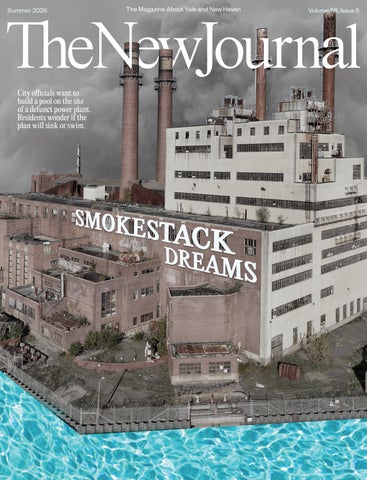
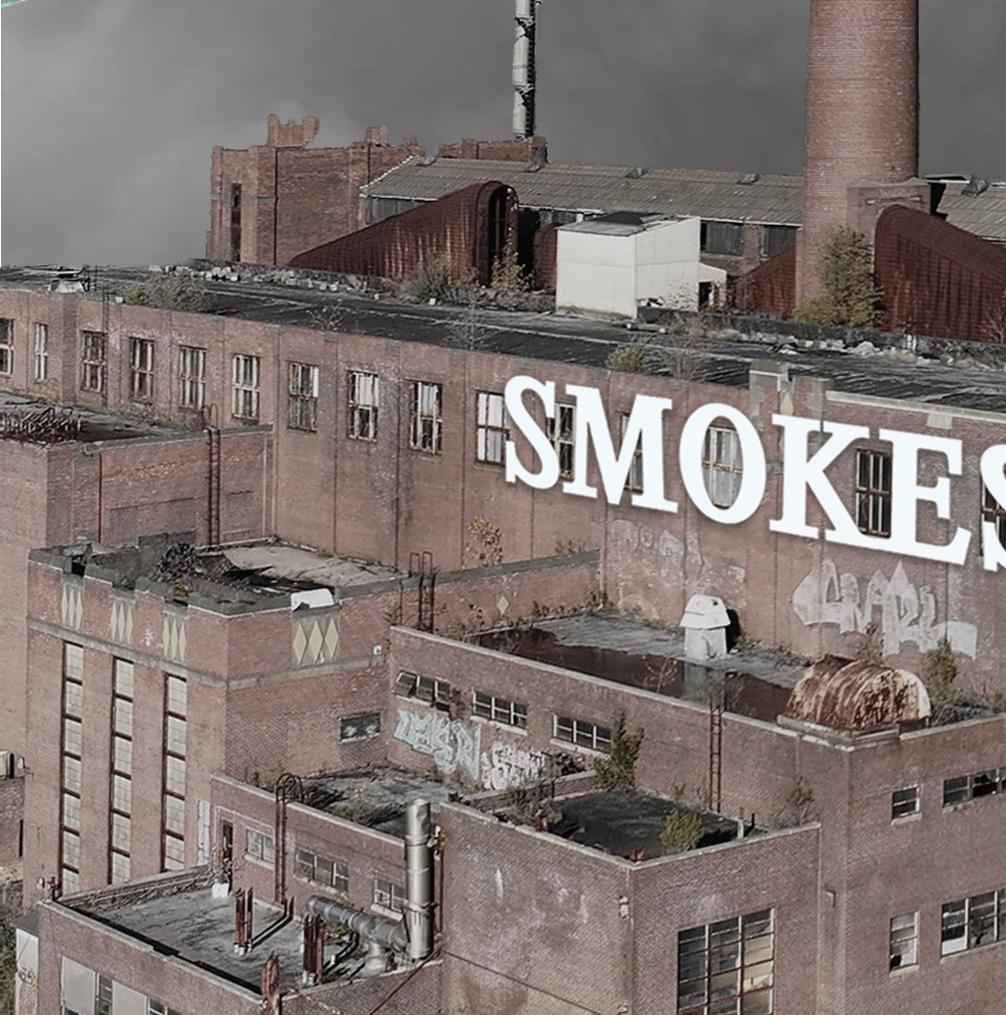
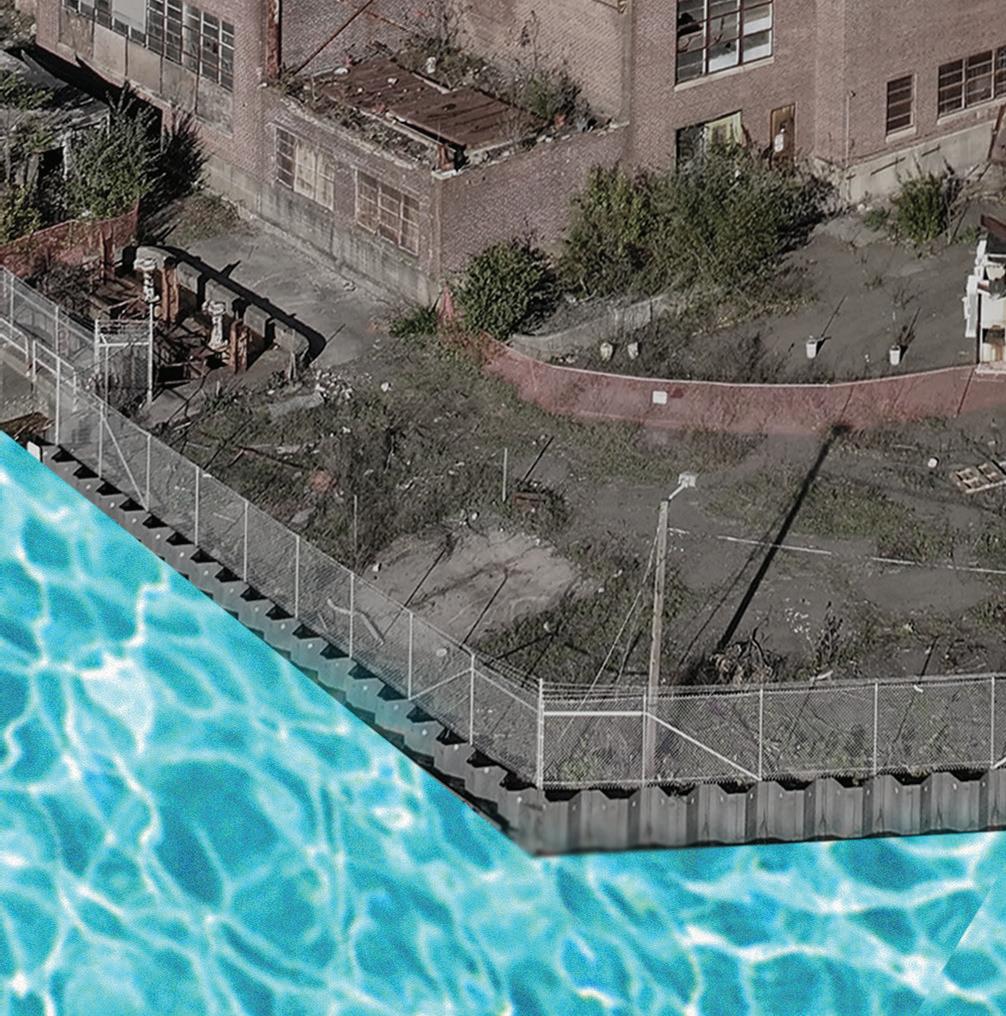
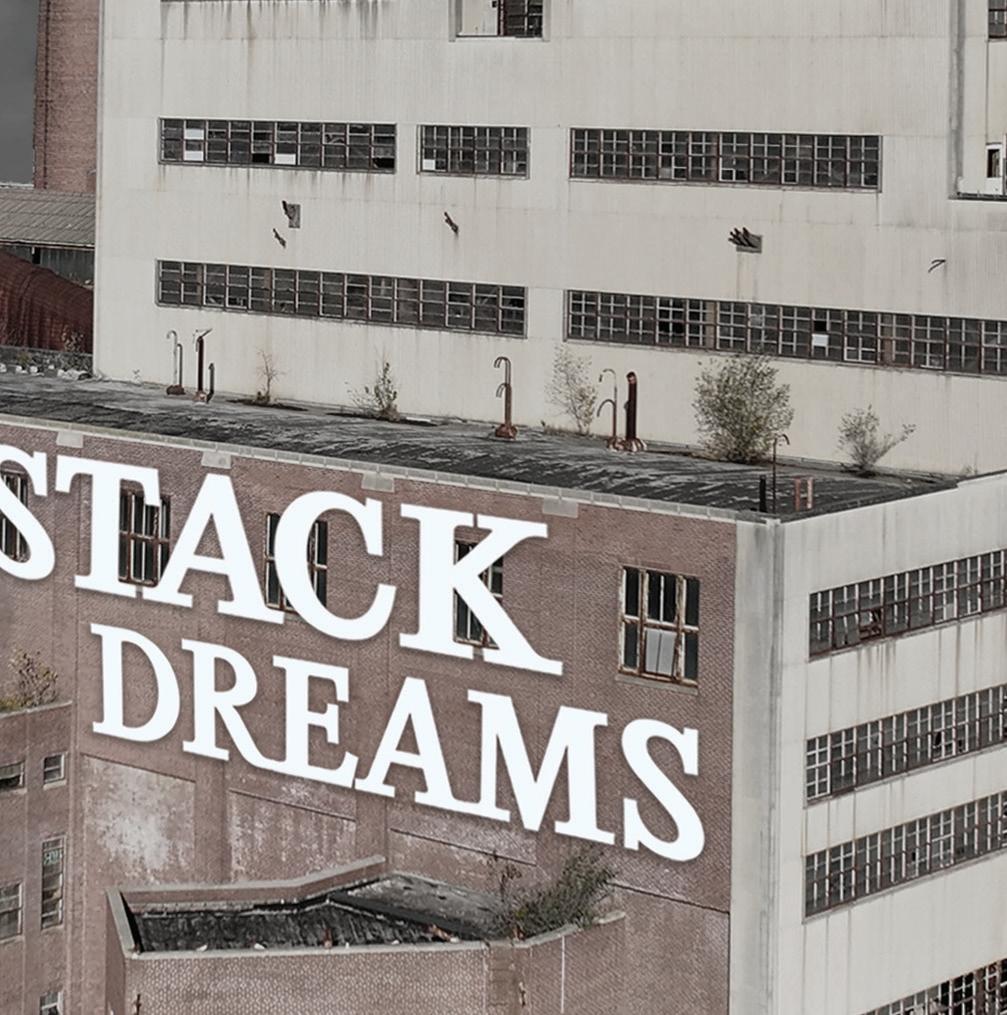
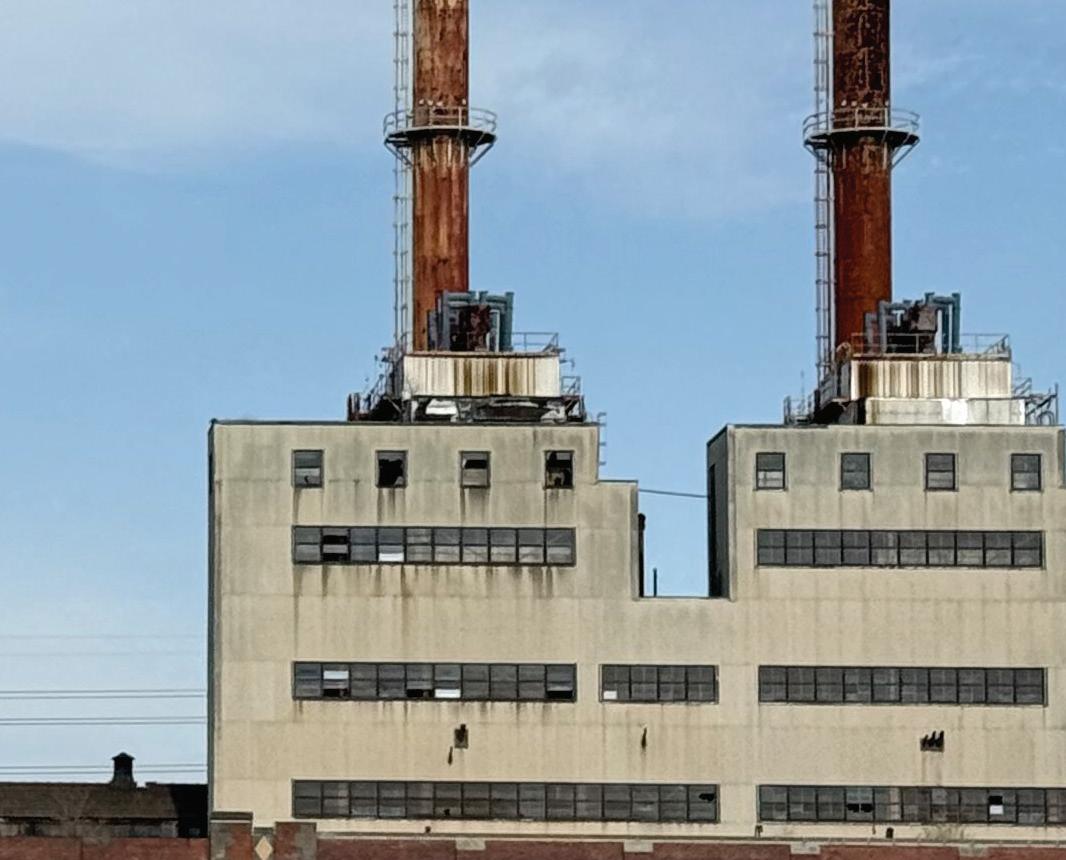
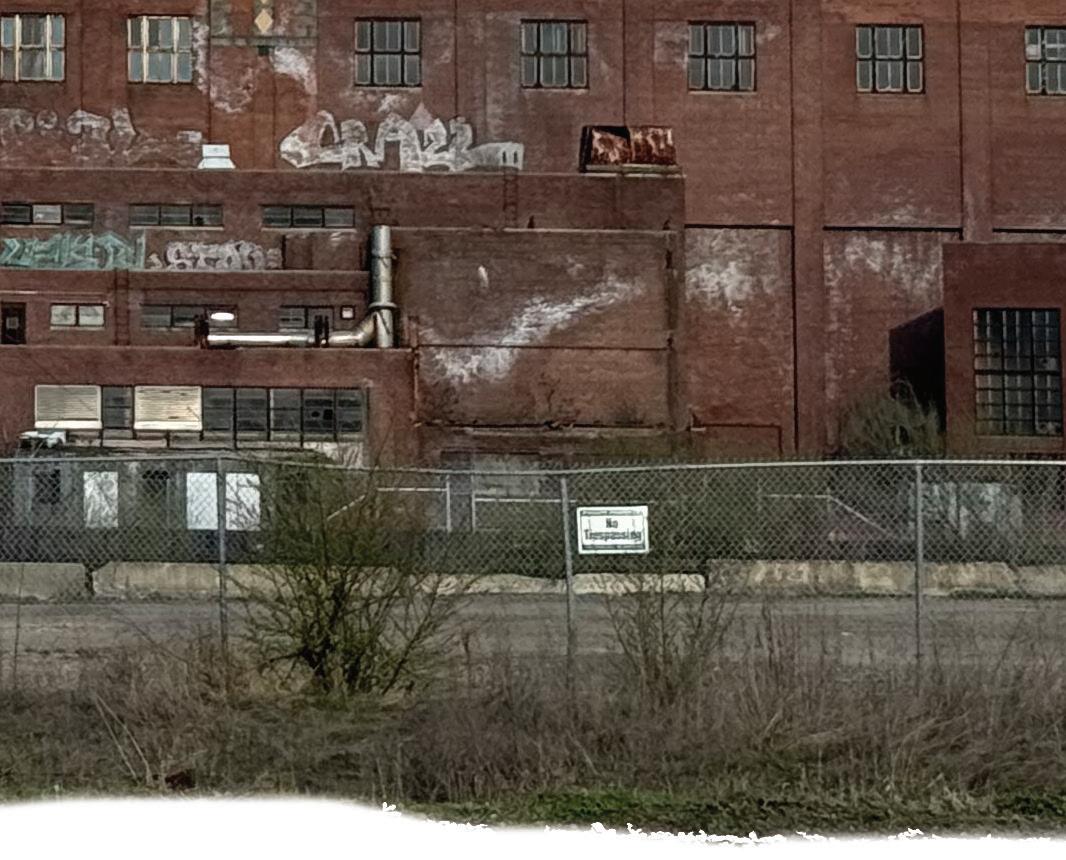
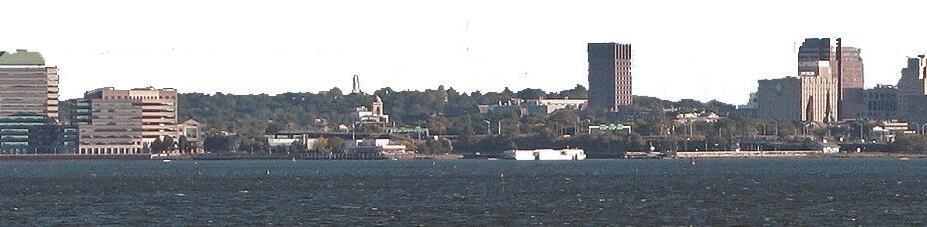
City officials want to build a pool on the site of a defunct power plant. Residents wonder if the plan will sink or swim.
Dear reader,
We write to you from a “Giant Pool of Questions.” What we mean to say is that we are in our fifth late-night huddle in the second-to-last week of the semester going back over all our unused headlines for Tajrian Khan’s remarkable cover story, “Smokestack Dreams.” We may be having some regrets. “Ruins, Renewal, and the Riverside” anyone? What about “Why a Pool?” If you want to know the answer to that question, read the article to find out.
This is our first issue as a managing board. With admiration and lots of sadness, we bid farewell to Chloe, Calista, Mia, and Tina. We have learned so much from them. Now, we get to try our hand at this.
After two years at Yale and in New Haven, we have a million questions left, and it is the work of our publication to answer as empathetically and creatively as we can. In the lead-up to our 60th anniversary next year, we’ve been looking at our archives for inspiration. To start, we’re bringing back NewsJournals, a TNJ fixture from the 1980s.
Once you’ve swum through Tajrian’s story, take a look at Ella Piper Claffy’s piece about Iranian students watching the war from New Haven. Further in, Oscar Heller explores the moldy underbelly of Connecticut’s cannabis market. Our personal essays will take you from ice fields in Patagonia to frat basements.
As always, thank you for reading, whether you’re a friend who hasn’t seen us in two weeks or you’ve just picked this up because you liked the striking cover art by our wonderful co-creative director, Serina Yan. Either way, let’s dive in together.
With love,
Adele, Kelly, Margot, Harry
Thank You to Our Donors
The Elizabethan Club The Hull Barrett Family Fund
Mark Badger
Jean-Pierre Jordan
Aliyya Swaby
Laura Heymann
Jeffrey Pollock
Julia Preston
Armand LeGardeur
Katie Hazelwood
Benjamin Lasman
R. Anthony Reese
Andrew Court
Kathrin Lassila
Fred Strebeigh
Peter Phleger
Steven Weisman
David Greenberg
Suzanne Wittebort
Romy Drucker
James Carney
Makiko Harunari
Laura Pappano
Editors-in-Chief
Adele Haeg
Kelly Kong
Executive Editor Margot Kohn
Managing Editor Harry Lowitz
Publisher Ethan Kan
Creative Directors Celina Qu
Serina Yan
Verse Editor Sophia Liu
Senior Editors
Chloe Budakian
Mia Rose Kohn
Tina Li
Sabrina Thaler
Associate Editors
Tai Caputo
Chantal Eulenstein
Calista Oetama
Drew Storino
Will Sussbauer
Aparna Dhulipala
Kade Gajdusek
Leilani Glace Irene Kim
Anna Koontz
Liam Swinney
Skye Wu
Copy Editors
Olivia Barton
Fiona Jin
Sarea Leung
Emily Pedroza
Designers
Anna Koontz
James Tibang
Associate Business Managers
Angelina Kovalchuk
Caroline Talis
Photography
Web Design
Marilynn Sager
David Gerber
Daniel Yergin
Jonathan Lear
Barak Goodman
Elizabeth Sledge
Sally Sloan
Leslie Dach
Jodi Kantor
Rollin Riggs
Hilary Callahan
Katerina Matta
Caroline Toll
Adriana Zhou
Eden Feiler
Smile Jiang
Grace Liu
Erin Lee
Nathan Saud
Cassie Boulis
Colin Kim
Samhita Kumar
Members & Directors: Haley Cohen Gilliland • Peter Cooper • Andrew Court • Jonathan Dach • Susan Dominus • Elizabeth Sledge • Fred Strebeigh • Aliyya Swaby
Advisors: Neela Banerjee • Richard Bradley • Susan Braudy • Lincoln Caplan • Jay Carney • Joshua Civin • Richard Conniff • Ruth Conniff • Elisha Cooper • David Greenberg • Sophie Haigney • Daniel Kurtz-Phelan • Laura Pappano • Jennifer Pitts • Julia Preston • Lauren Rawbin • David Slifka • John Swansburg • Anya Kamenetz • Steven Weisman • Daniel Yergin
Friends: Nicole Allan • Margaret Bauer • Mark Badger and Laura Heymann • Anson M. Beard • Susan Braudy • Julia Calagiovanni • Elisha Cooper • Peter Cooper • Andy Court • The Elizabethan Club • Leslie Dach • David Freeman and Judith Gingold • Paul Haigney and Tracey Roberts • Bob Lamm • James Liberman • Alka Mansukhani • Benjamin Mueller • Sophia Nguyen • Valerie Nierenberg • Morris Panner • Jennifer Pitts • R. Anthony Reese • Eric Rutkow • Lainie Rutkow • Laura Saavedra and David Buckley • Anne-Marie Slaughter • Elizabeth Sledge • Caroline Smith • Gabriel Snyder • Elizabeth Steig • John Jeremiah Sullivan • Daphne and David Sydney • Kristian and Margarita Whiteleather • Blake Townsend Wilson • Daniel Yergin • William Yuen
Lighting Up in the Land of Steady Habits
In Connecticut’s stunted legal cannabis industry, many Yale students turn to illicit sellers without knowing the risks.
By Oscar Heller
Sophia Zhang
Smokestack Dreams
On the site of a defunct power plant, city officials want to build a multimillion-dollar park with an outdoor aquatic center. While some residents are in favor, many are left asking: Who wants this?
By Tajrian Khan
Holding Vigil
As war rages on in the Middle East, Iranian students at Yale grapple with what solidarity and responsibility should look like from so far away.
By Ella Piper Claffy
Yearning for “Touse” in the Algorithm
Mysterious videos featuring montages of aughts-era frat culture begin flooding a writer’s feed. As she searches for what—and who—is behind them, she finds herself not on Nantucket but in the digital equivalent of a dank frat basement.
By Tali Kantor Lieber
NewsJournal
Class Colors
The morning i snuck into Professor Tamar Gendler’s office hours to ask her about CourseTable, the Yale class cataloging website, I found myself in the company of one Directed Studies student, two members of her seminar, “Intelligence: Human, Animal, Artificial,” and books of all colors.
This spring was the first semester in twelve years that Gendler taught undergraduate courses full-time. She’s returned to a Yale in which CourseTable, the student-designed website that compiles information from all course evaluations, has taken over what was once known to undergraduates as “shopping period,” now known as add-drop. Shopping CourseTable has made choosing one’s classes feel like online shopping.
I asked Gendler what professors think about CourseTable’s ubiquity among students. Do her colleagues even know about it? “I think everybody knows about CourseTable,” she said, laughing, incredulous at my astonishment.
I asked Gendler what she thought about CourseTable’s color-coding: classes that students had evaluated as requiring less time and effort are coded green, progressing through yellow and orange to red, the most rigorous. Are green, yellow, and red designed to function like universal traffic-signal colors? Does CourseTable so openly encourage students to take courses considered “easy,” green meaning go? Red as “stop” may be too simplistic a definition. After all, Alex Schapiro ’26, a Computer Science major who ran CourseTable last year, said that red doesn’t necessarily mean “worse,” but rather “more intense.”
Gendler said that we often “overvalue” color distinctions. She suggests that course evaluations might be differently conveyed, saying she “would much prefer it if it were five shades of green, ranging from dark to light, or red, ranging from dark to light.”
Gendler’s “Intelligence” seminar is brand-new, so its workload rating on CourseTable is blank, colorless. I wonder, however, if the deep red of her sweater might provide some clue.
—Tai Caputo is a first-year in Benjamin Franklin college.
Bolus Movements
IT’s march 22, 3:57am. The Atlanta airport line has passed the IHOP and is starting to double back on itself. Travelers chat in place. A young man with a beehive of a beard explains the Plane-Train to two older ladies with handbags. Children plop down on the floor while a father squats on his bag in front of the promotional Kia Telluride. Some have been waiting for hours. It has been 37 days since the United States government paid TSA employees. “I want two lines, please now folks. Two lines…” I’m probably going to miss another flight. My first flight, to Tweed-New Haven Regional Airport, took off yesterday, presumably empty, as security lines across the country swelled. A friend traveling with me stayed ten hours at the terminal to catch the next available flight to “anywhere-in-train-distance-to-Yale.” I bailed and returned early this morning, hoping to beat the lines. I have class tomorrow.
On the “ATL Airport TSA Wait Times Megathread” on Reddit, one user describes the lines as “stagnant” with occasional “bolus-movements,” the official term for the process that carries food or saliva from the mouth to the stomach. Reported wait times vary between four and eight hours.
It is on Reddit that I learn about a lucky few who slipped through the international terminal before the trick got out. User traffic on the thread itself is so great that protocols have been put
in place. Posts must be labeled “Updates, “Reports,” or “Questions.”
It is conventional wisdom that in times like these, people take care of each other. Victims of natural disasters have been known to help rebuild the homes of their neighbors. Compassion rises.
In the airport security line, compassion gives way at times to fierce competition. A woman behind me stops an agent to point out a couple that has cut the line. My neighbor notes with an edge that the other line is moving faster.
We inch forward.
In the Reddit comments, someone asks if Immigration and Customs Enforcement agents have arrived, and a predictable political argument breaks out. I only spot them once I’m nearly through the line, armed agents standing behind a glass wall.
My mouth is dry. In foolish preparation for security, I emptied my water bottle two hours ago, and now I am thirsty, unable to swallow. As we move towards the machines, I feel we are being swallowed by America.
—Asher Lytton is a sophomore in Silliman College.
The Opposite of Loss
FROG: AND OTHER ESSAYS, the new book by noted Yale writer and professor Anne Fadiman, contains seven essays on widely varied topics, but loss simmers underneath each. Her ode to a beloved printer becomes a meditation on her experience of aging. Her grammarian’s struggle with the singular “they” is also a reckoning with the perceived loss of grammatical standards. Like salt in good cooking, loss in Frog elevates every story to profundity.
The final essay, “Yes to Everything,” confronts the theme head-on. Marina Keegan, a brilliant writer and student of
Fadiman’s, graduated from Yale on May 21, 2012. Five days later, her car crashed on her way to Cape Cod. She was 22 when she died, leaving behind a trove of writing which Fadiman, alongside Keegan’s family, assembled into a collection called The Opposite of Loneliness: Essays and Stories.
The essay tonally avoids melancholy by focusing on Keegan’s righteous love of life. In their first interaction, Keegan wrote to Fadiman and identified herself, only semi-ironically, as someone “hoping to stop the death of literature.” In her junior year, after finding herself rejected from Yale’s secret society system, she wrote to Fadiman: “I’ve vowed to spend 12 hours a week writing,” Keegan said, “If I was willing to devote that much time to chatting in a tomb I should be willing to devote it to writing!”
I cried when I read “Yes to Everything.” Much of Frog revolves around death, but on finishing this essay, I found myself less afraid of the End. I felt far more adamant that I should meet the time before it with vigor.
—Will Sussbauer is a junior in Jonathan Edwards College.
Commons of Yore
IT USED TO BE THE place to be seen. Walk in and you were met with a smorgasbord of the Yale community—firstyear friend groups bound to splinter by Halloweekend, hordes of athletes in knee-length parkas scarfing down Pasta e Basta. Sometimes, you could even spot Dean Pericles Lewis staring eye-to-eye at rotisserie chickens glistening on their spits.
Commons has long been a hallmark of the weekday social scene at Yale. But since the university limited meal swipes to residential dining halls last fall, forcing
students to use points, the crowd has shriveled. The high center tables, once in demand, now seat a smattering of Directed Studies students hunched over Kant and Korean fried chicken. Only a few shameful stragglers trickle through the center aisle.
Yale’s tradition of communal dining dates back to 1718, when “Yale College” opened near what is now Bingham Hall, as the first ever combined dormitory and dining facility. Commons has had a tumultuous history. In 1828, student protesters waged the infamous “Bread and Butter Rebellion,” a campaign for improved food quality—many went on strike, refused to eat on campus, and were eventually told to return or face expulsion. In the 1900s, food fights erupted, and service declined as students failed to consistently tip waiters. Administrators enforced strict expectations of etiquette, requiring jackets, ties, and assigned seating. When Yale
dropped these regulations in 1969 after admitting women to the college, a new wave of complaints decried the loss of storied rituals.
The idea of waiters serving up clementines and Rooted bowls to diners in their Monday best may seem absurd today, yet students seem to feel a bit of nostalgia for the Commons of yore. Campaigns to vote on meals and pressure on Yale Hospitality to reinstate the meal swipe may indicate an attempt to swing the pendulum back—hopefully, students won’t have to boycott or wage food fights to get what they want now. Updated menu offerings, a new table arrangement, and cookies every day could very well save Commons. As for me, I’ll be taking up shop in the Elm until they bring back the old pesto pasta recipe upstairs.
Feiler is a junior in Ezra Stiles college.
—Eden
Commons banquet, early 1900s. Photo Credit: Detroit Publishing Co.
A Flash of Red and Gold
Lunarfest—New Haven’s Chinese New Year celebration—offers both consolation and a reminder of what cultural displays cannot translate.
By Sophia Zhang
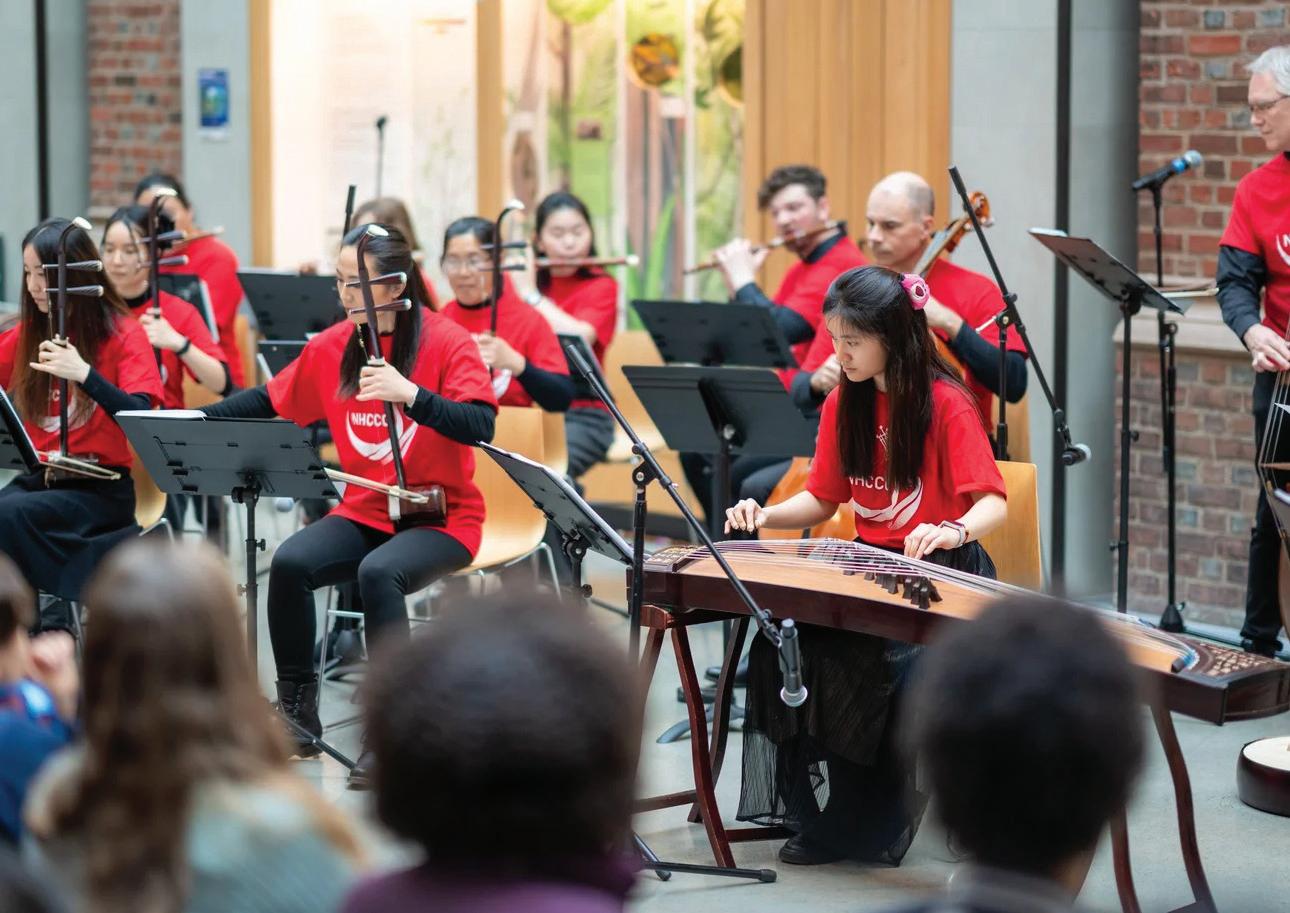
Emy Zheng sat center STAGE in the Peabody Museum’s skylit gallery, her fingers leaping over the guzheng’s 21 strings, plucking in tune with the ensemble behind her. Music evoking dancing snakes and racing horses—the old and new zodiacs of the Lunar New Year—filled the sun-soaked room. After the last notes faded, Zheng admitted a quiet truth to herself.
“I’ve lived in China all my life,” she said in Mandarin. “So when suddenly there’s a New Year when my family and friends aren’t around, I really miss them.”
In China, Zheng, a high school junior, would’ve celebrated Lunar New Year during a nine-day national holiday, reuniting with relatives and making dumplings alongside her family. But since moving to Hamden on her own for high school, she doesn’t even get the day off. This February, she celebrated the holiday at New Haven’s own Lunar New Year celebration, Lunarfest.
Started in 2012 by the Yale-China Association, Lunarfest is Connecticut’s best-attended Lunar New Year celebration. Each year, thousands come in from across the state for a festival with lion dancing on Whitney Avenue, a zodiac scavenger hunt, an artists’ market, and workshops across the city. This year, Zheng participated by playing the
Chinese zither—at a New Haven Chinese Cultural Cooperative (NHCCC) concert at the Peabody. In the midst of a new year spent mostly alone, she found the audience’s enthusiastic response to her performance heartening.
guzheng—a a Cultural
Programming at YaleChina, pitched the event as an opportunity for people who usually “don’t interact with China or Chinese culture” to see it in their own city.
“When people have a mind of discovering other cultures, sharing Chinese culture with them becomes very attractive for me,” she said.
As an international student who grew up in mainland China and attended high school in the United States, I felt a similar sense of recognition at Lunarfest. During the parade, when I heard an a cappella rendition of Dang Ni Lao Le (“When You Are Old”), a song I had first heard as a middle schooler watching TV in Shenzhen, I almost cried. I had not realized those feelings of nostalgia were there.
Although earnest, many performances seemed clumsily done: notes out of tune, a few swords and sticks dropped, handkerchiefs spun too far and luckily caught. Zheng also felt that engagement for other activities—such as a crafts workshop she helped run—was surface-level: “There’s a big challenge in moving beyond only superficial representations of our activities.”
While attendees and organizers praise Lunarfest as an opportunity for cultural visibility, many I spoke with felt that the event barely scratched the surface of Lunar New Year’s rich traditions. Among the crowd’s consoling cheers for each mistake, questions lingered: Is the event an attempt at genuine celebration, or just a performance of culture? To an audience of thousands, including many onlookers unfamiliar with Lunar New Year, could Lunarfest last beyond the flashes of red and gold?
WHEN YALE-CHINA STARTED
Lunarfest, Nancy Yao, the organization’s former president, was most focused on how the event could raise their “profile on campus.” Yao, with Annie Lin, the former director of Arts
“And I just knew it would be fun. Because who doesn’t like arts and crafts, Lunar New Year, a parade, good food?” asked Yao, “those are easy. Those are lowhanging fruits.”
Lin grew up in Morro Bay, California, a predominantly white town, and came to Yale for college, where she was exposed to a larger Asian community. After graduating, she joined Yale-China, which first took her to mainland China and Hong Kong, then back to New Haven. Returning to America, Lin began to recognize how invisible her culture had felt during her childhood.
“ There was this longing,” Lin said. “I didn’t know that something so ingrained in my blood and my body, something that my parents never felt seen for, could get recognized in this way.”
She was surprised at the size of the crowds that turned up for Lunarfest in its early years, even in sub-zero temperatures. “And you don’t have to go to Manhattan for that, or up to Boston,” Lin said of large-scale Lunar New Year celebrations. “It can be right here.”
“I didn’t know that something that was so ingrained in my blood and my body, something that my parents never felt seen for, could get recognized in this way.”
But Lunarfest’s visibility feels shortlived. When the parade concludes each year, the crowd quickly disperses back into the city. The lion dancers pile into white trucks, packing in their costumes to drive back to New York. Before noon, Whitney Avenue returns to normal. Nothing remains but the lanterns against a gray sky and the occasional stray
confetti.
Zheng was moved by the audience’s appreciation of her performance. But once the music faded and she had answered a few questions, she felt distant from them again.
“It’s not quite like they are closer to us,” Zheng said. Her impression of the bridge built seemed much more oneway; while it was touching to see her Chinese culture on display, being seen didn’t quite translate into being known.
Camille Chang ’26, a Yale-China fellow who helped run a calligraphy workshop at Lunarfest, felt that the event’s wide reach came with certain trade-offs. “There’s not as much culturally specific knowledge that you can put out there,” she said, adding that many “sacrifices” had to be made. Chang’s maternal side of the family was originally from Fujian, a coastal province in southern China. She felt that she couldn’t put a “Fujianese spin” on Lunarfest, just as other fellows couldn’t tilt the event towards their own traditions.
“It’s the idea of the mythical Asian American identity,” Chang added, “You have to create this event for New Haven, and create a China that is kind of imagined.”
MENGXI YING, who played the erhu with the NHCCC at Lunarfest,
said three kids—a Japanese girl and two white boys—came up to her after the concert, eager to learn about the instrument. She held their hands on the bow as they tried playing their first melodies.
Growing up in China, Ying’s parents had made her play the erhu, a Chinese two-stringed fiddle, against her will. She tolerated it until middle school, but quit immediately when she got permission. After moving to the United States eighteen years ago and hearing erhu music again in recordings, Ying fell back in love with the instrument. “There’s just so much nostalgia,” Ying said. “Memories about my childhood, about how this song was playing on TV.”
Her impression of the bridge built seemed much more one-way; while it was touching to see her Chinese culture on display, being seen didn’t quite translate into being known.
In China, Ying attended concerts with musicians in tuxes and dresses, elevated on a big stage. At Lunarfest, performers sat only six feet away from the audience. “Like in a village, when there’s a bonfire, dancing, and people are just standing around, and maybe
they can join later, too,” she said. “If only when I was a child, erhu was introduced to me in this way,” Ying added, “I would practice voluntarily.”
Lin, Yale-China’s former arts programming director, hopes that participants might feel inspired like Ying did. “That could be the reason they’re going to end up being someone who appreciates and wants to study abroad, right?” Lin said. “These events are “growth spaces, they’re learning spaces.”
ZHENG HAS BEEN IN THE United States for almost two years. Her friend group remains mostly Chinese, and she still finds it easier to joke and express herself in Mandarin. At school, she notices moments of brief connection, but everyday differences—food, humor, and even dating norms—often remind her of the gulf between her Chinese culture and the culture she has moved into.
Despite her doubts about how much a single day of cultural exchange can bridge divides, Zheng still thinks Lunarfest is a crucial step towards mutual understanding. “If we can help them appreciate Chinese music and think that it is beautiful, that’s already very good,” she said.
The small moments of connection after each performance sustain Zheng’s efforts. She recalls questions about her guzheng and an audience member coming up to say: “Your music reminded me of my hometown’s river.”
Trading the atmosphere of Lunar New Year in Beijing for Lunarfest’s flashes of red and gold, Zheng doesn’t consider her choice to study in the U.S. a sacrifice—just a change. “I recognize that if I was in China, I couldn’t bring this kind of music abroad,” she said. “So I feel quite happy. I don’t regret that I’m not at home.”
Zhang is a sophomore in Timothy Dwight College.
Sophia
Emy Zheng, right, performing the guzheng with the NHCCC.
Holding Vigil
As war rages on in the Middle East, Iranian students at Yale grapple with what solidarity and responsibility should look like from so far away.
By Ella Piper Claffy
IN NEW HAVEN, a world away from his home country Iran, Hadi Mahdeyan ’27 had been waiting for a strike. At 6:30 a.m. on February 28, his girlfriend urgently shook him awake. “I think they’ve started to attack,” she said.
Hadi checked the news and saw that the United States had launched an airstrike on Ayatollah Khamenei’s compound in Tehran. Whenever there was military action in the Middle East, pundits and bloggers flooded Iranian news channels and chat platforms speculating that the Supreme Leader had died. Hadi knew better than to expect anything. He
waited for more information.
Some outlets began to report that the Ayatollah had been killed, others held off. Finally, in the early afternoon, Prime Minister of Israel Benjamin Netanyahu hosted a press conference and announced that there were “many signs” that Ali Khamenei was dead. Later that day, the U.S. confirmed. They were at war with Iran.
It was the news Hadi had been waiting for most of his life. He rushed to tell friends, calling a fellow Iranian in the School of Drama and a graduate student working in a lab. Both answered and asked to call him back.
“No, no, you don’t understand,” Hadi urged them. “Khamenei’s dead.”
The next day, @yasi.yale—the Instagram account for Hadi’s newly founded Yale Alliance for Solidarity with Iran (YASI)—made its first post: a grainy photo of Iranian and Israeli flags hanging next to each other from the backyard balcony of a Yale fraternity house. The caption reads:
“ The end of his life is a blessed day.
Long live Iran.
Khamenei’s finally fucking dead. Long live Iran.”
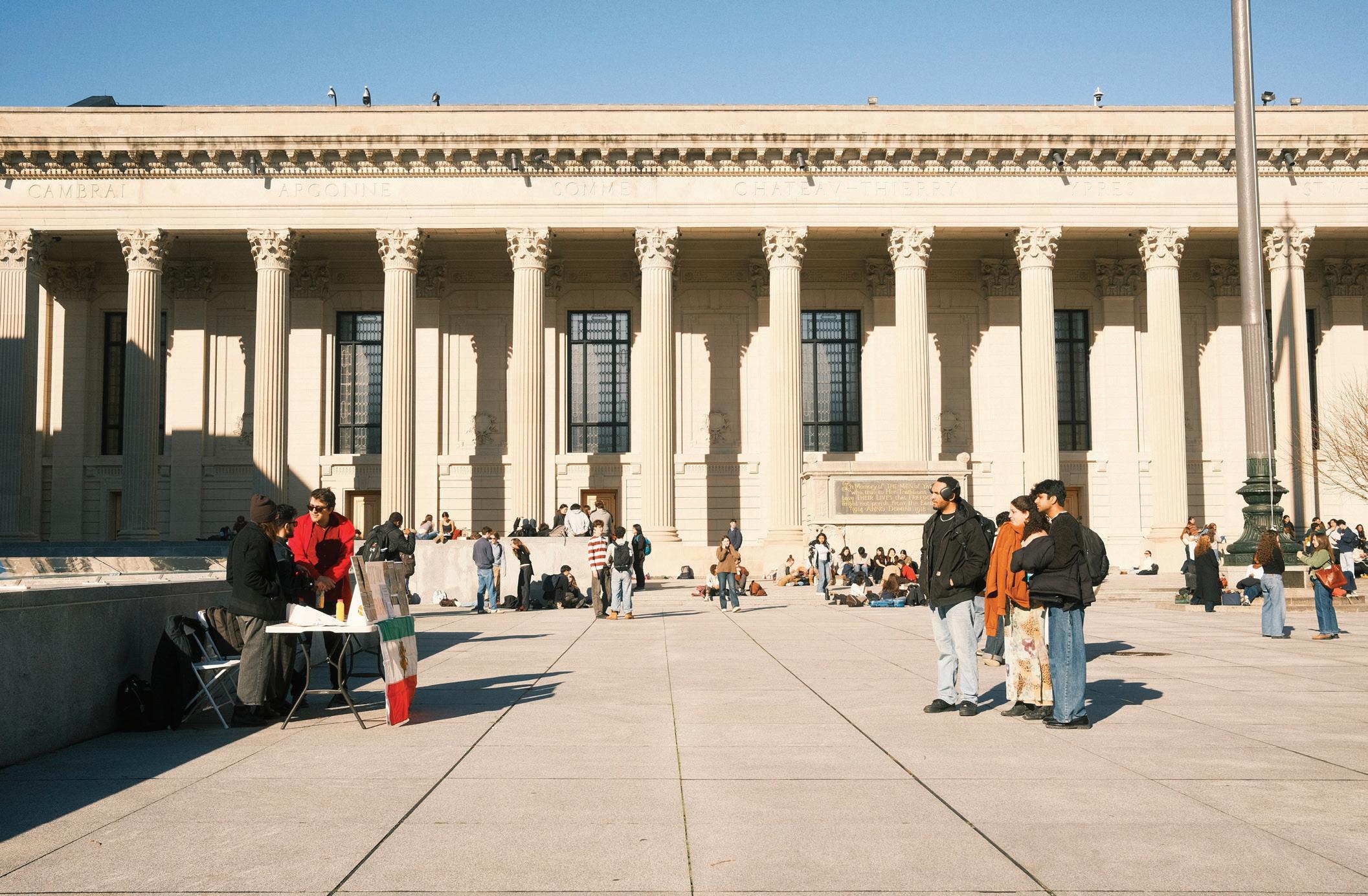
Yale Alliance for Solidarity with Iran’s (YASI) tabling event on Beinecke Plaza, March 4, 2026.
HADI foundeD YASI LAST February.
The group hosted their first event, a protest on Beinecke Plaza, on Valentine’s Day—Reza Pahlavi, the son of the deposed Iranian shah, had designated it a “Global Day of Action” against the Iranian regime following the massacre of tens of thousands of protesters in January.
Hadi, who has dark curly hair and a fondness for black-framed sunglasses, grew up in Iran. He wouldn’t say exactly where, since revealing his family’s specific location could put them in danger. But he didn’t hesitate to say that he grew up hating the Islamic regime that has governed Iran since the revolution in 1979—a regime that parked tanks in the alley right outside his house and gassed his neighborhood so frequently that his younger brother now has chronic eye infections.
(IRGC), the regime’s primary armed force that has killed tens of thousands of demonstrators in January. Hadi had intended to fully exercise his freedom of speech in the U.S. He was disappointed when the PSA asked him to keep his vigil apolitical to protect public-facing members who might run into trouble if they visited family in Iran.
Hadi was taken aback. “I said, ‘Well, she was killed by the regime.’”
“It is a very common goal, not just for me, but for basically most people my age in Iran, to leave forever.”
Nader Granmayeh ’23.5 was an unofficial leader of the PSA at the time. Before 2021, the PSA operated as an “informal network” of Persian students who knew each other through Farsi language classes. Even by 2023, most PSA gatherings were the products of open-invite texts in their group chat.
is unthinkable.
Shervin Issakhani, an Iranian graduate student at Yale and member of YASI, feels guilty all the time; for leaving his family and watching this war from halfway across the world; for spreading news from sources he’s never 100 percent sure he can trust; for not doing enough for the people of Iran.
He has no regrets, however, about his advocacy for the war. He would die if it meant a free Iran.
Milad Davaran ’28, outgoing PSA treasurer, told me that he did not know of any Iranians on campus who opposed the war. Shervin believes any who did would be too “embarrassed” to say so. After months of searching, I couldn’t find any Iranian students currently attending Yale who are anti-intervention.
“It is a very common goal, not just for me, but for basically most people my age in Iran, to leave forever,” Hadi said.
But it is difficult for Iranian students to come to the U.S. for college. Less than a dozen American universities offer need-blind admission to international students. With the dollar currently valued around 1.3 million Iranian rials, most applicants from Iran have considerable financial need. The SAT is not administered in Iran, so Hadi had to travel to Turkey for the test.
When he got into Yale, he won what he considered “basically a lottery.” In the fall of 2023, Hadi arrived on campus looking for a community of fellow Iranians. He found the Persian Students Association (PSA).
That September marked one year since the death of Mahsa Amini, an Iranian woman who died in prison after she was arrested for wearing her hijab too loosely. Her death sparked the grassroots Woman, Life, Freedom movement. Hadi was eager to see how the PSA planned to commemorate the anniversary—but they weren’t planning anything at all.
So, Hadi asked to organize something himself. The PSA met him with support. They agreed to help him host a vigil and set up some candles and flowers.
In Iran, protests are haunted by the Islamic Revolutionary Guard Corps
The group held their first political event a year before Hadi’s arrival: a vigil at the Women’s Table for Amini right after her death, where they displayed her portrait alongside bouquets of lilies. The PSA was motivated to show support for Iranians, demonstrating that “there is an international community that is behind them in their fight for freedom,” as Nader told the Yale Daily News in 2022.
Nader
Nader, who grew up in the States and graduated from Yale in 2023, is vehemently in favor of regime change. But he is against the war, and was surprised that there is no visible anti-war sentiment from Iranians on campus. Nader has witnessed the question of intervention divide his family and the rest of the Iranian diaspora.
Nader thinks Iranian citizens or those who grew up in Iran are more likely, having experienced the regime’s violence, to feel that revolutionary change is urgent—anything else would be a betrayal.
thinks Iranian citizens or those who grew up in Iran are more likely, having experienced the regime’s violence, to feel that revolutionary change is urgent—anything else would be a betrayal.
Since its founding, the Yale Alliance for Solidarity with Iran (YASI) has held weekly vigils for those killed in the January 8 and 9 Rasht massacres. Under Hadi’s leadership, the vigils are every bit as political as what he wanted for the PSA. On Thursdays, YASI gathers at the Women’s Table to read out each victim’s name, their birth year, and the refrain that they were “killed in 2026 by the Islamic republic for the crime of protesting.”
IRANIANS WHO SUPPORT THE WAR often compare the conflict to chemotherapy; removing a cancer like the regime, they argue, isn’t supposed to be easy. The war will hurt, but the alternative
This distinction is felt on Yale’s campus. Neither Hadi nor Shervin can safely go back to Iran until the current government has been deposed—they have been vocal about their anti-regime opinions and would likely be executed should they be forced to return. Their Iranian-American peers have an extra level of security because they have American passports.
Shervin recalls how surreal it was to walk around campus in early January, after the regime’s massacres. Friends of his had been killed. It felt like no one had a clue that anything had happened. He spent that day in a trance.
For members of the Iranian diaspora, taking a stance in this conflict means signing on to a cascade of related opinions. Pro-war voices tend to reject diplomatic solutions. They are also more likely
to align with Israel, a deeply polarizing force within the war.
Aaron Abrams ’27, a Persian Jew on YASI’s board, sees the stakes of this war as twofold: protecting Iranians from an oppressive regime and removing the Islamic government, which he sees as an existential threat to Israel, from power.
Neither YASI nor the PSA have any religious component to their organizations—both identify with the millennia-old Persian culture rather than Islamic practices. Having grown up in the theocracy, Hadi and Shervin are no fans of Islam.
“ We have seen the true face of Islam and Iran,” Hadi said. “The way that this country is being run—it’s exactly what’s written in the Quran, what Islam wants.”
Nader thinks Iranian citizens’ firsthand experience with the regime can get in the way of them accepting diplomatic solutions. He has been shocked and saddened that anyone could advocate for the bombing of their own home.
But for Hadi and Shervin, who are Iranian citizens, faraway “diplomatic” discussions of issues like the Strait of Hormuz are really just corrupt backroom dealings with the regime. “You don’t negotiate with terrorists,” Hadi said.
AsIDE FROM ON-CAMPUS political events, the vast majority of YASI and PSA members’ engagement with this conflict occurs on social media.
On March 1, the PSA posted a statement on Instagram: “Yesterday marked the end of one of the most evil leaders in modern history.” It continued, “This is only the beginning. Stay informed. Listen to Iranians. Stand firmly with the people of Iran.” For the last two months, YASI has reposted everything from news stories to techno-musical remixes of Trump’s announcement of Khamenei’s death to the definition of “Iransplaining.”
Instagram also serves another purpose for YASI: informing their followers. Given the compromised news and communication channels in and out of Iran, it is difficult to reliably deliver accurate information.
Hadi says much of his news comes from Iran International, a London-based media outlet—allegedly funded by the Saudi royal family—intended to inform the Iranian diaspora. But because Iran International has been declared a terrorist organization by the Iranian regime,
their journalists seldom venture inside Iran’s borders. The outlet’s reporting is largely based on analyses of videos that make it out through Starlink.
Since the regime restricted Iranians’ access to the internet on February 28, it’s been nearly impossible to get calls through to Iran. The blackouts heighten the anxiety of having family in an overseas warzone. In January, during a shorter blackout after the massacres, Milad watched violent videos released via Starlink, but was unable to immediately confirm his family’s safety. During blackouts, all messaging from inside Iran depends on Starlink. Texts are occasionally possible, but unreliable.
Hadi has since verified that his family is alright, and he was able to get a few texts through to his younger brother before the Iranian New Year on March 20. Aside from the news that his brother had received a Lego set for the holiday, no texts came back in response.
YASI HOSTED A CELEBRATION OF the Iranian New Year, or Nowruz, at the Yale Farm. For Nowruz, there is a tradition of recognizing the exact moment when winter turns to spring according to the ancient Persian calendar. Since he’s been at Yale, Hadi has FaceTimed his family to wish them a happy new year. This year, Nowruz fell three weeks into the blackouts. More than a month later, he still hasn’t heard their voices.
So instead of family, he gathered with twenty fellow students. Several others also hadn’t been able to speak to their
families for weeks.
Together, they replicated other traditions. On the Haft Seen table—traditionally arranged with seven items beginning with the Persian letter “seen”— YASI members had laid out flowers and figurines, an apple and sprouts, each with a symbolic meaning. The attendees sat around the table and talked about the war, about their families, and about the three young men who had been hanged in the city of Qom the day before.
The weekly vigil YASI hosts by the Women’s Table isn’t a large operation. They set up a projector screen across two metal tables and cast photos of each victim in succession. Sofiia Tiapkina ’28, a Ukrainian international student on the YASI board, sits at a separate table, clicking through the slides on her computer.
One week, Hadi read the names of nearly 100 victims of the January massacres. The sun had just set and a chill was settling into the air. He read the last name, and three other YASI members recited “may their memory live on” in Persian. The projector screen went dark.
How do you keep alive the memory of 30,000 people who died demanding freedom? How do you hold constant vigil for a country of 93 million?
Hadi and the rest of YASI aren’t sure they have it right, but they are trying. They plan protests. They check Iran International’s updated list of victims. They try to get texts through to family members. And they wait.
Ella Piper Claffy is a sophomore in Silliman College.
YASI tabling, March 4
Chiasmus
being human differs between human beings long for the serenity of tortoises before long periods of standing and misunderstanding periods. in history when bullets weren’t part of the story in the end of the body endorphins end the pain falling from ourselves the way fall paints Saturdays with strawberry-stained scarves saturating the air with clichés carefully crocheted to air the grievance like a dead squirrel that in all our grief we mistook for a piece of bark what a lovely mistake that we get surprised by the unlikely beetle it is by surprises we get to stay and caress the moment in our lap and stay to do what is asked of us and so we ask what do different human beings see in being human that’s so different
— Alistair Lam
Poem
Lighting Up in the Land of Steady Habits
By
Oscar Heller
Layout Design by Celina Qu
Photos by The new journal
In Connecticut’s stunted legal cannabis industry, many Yale students turn to illicit sellers without knowing the risks.
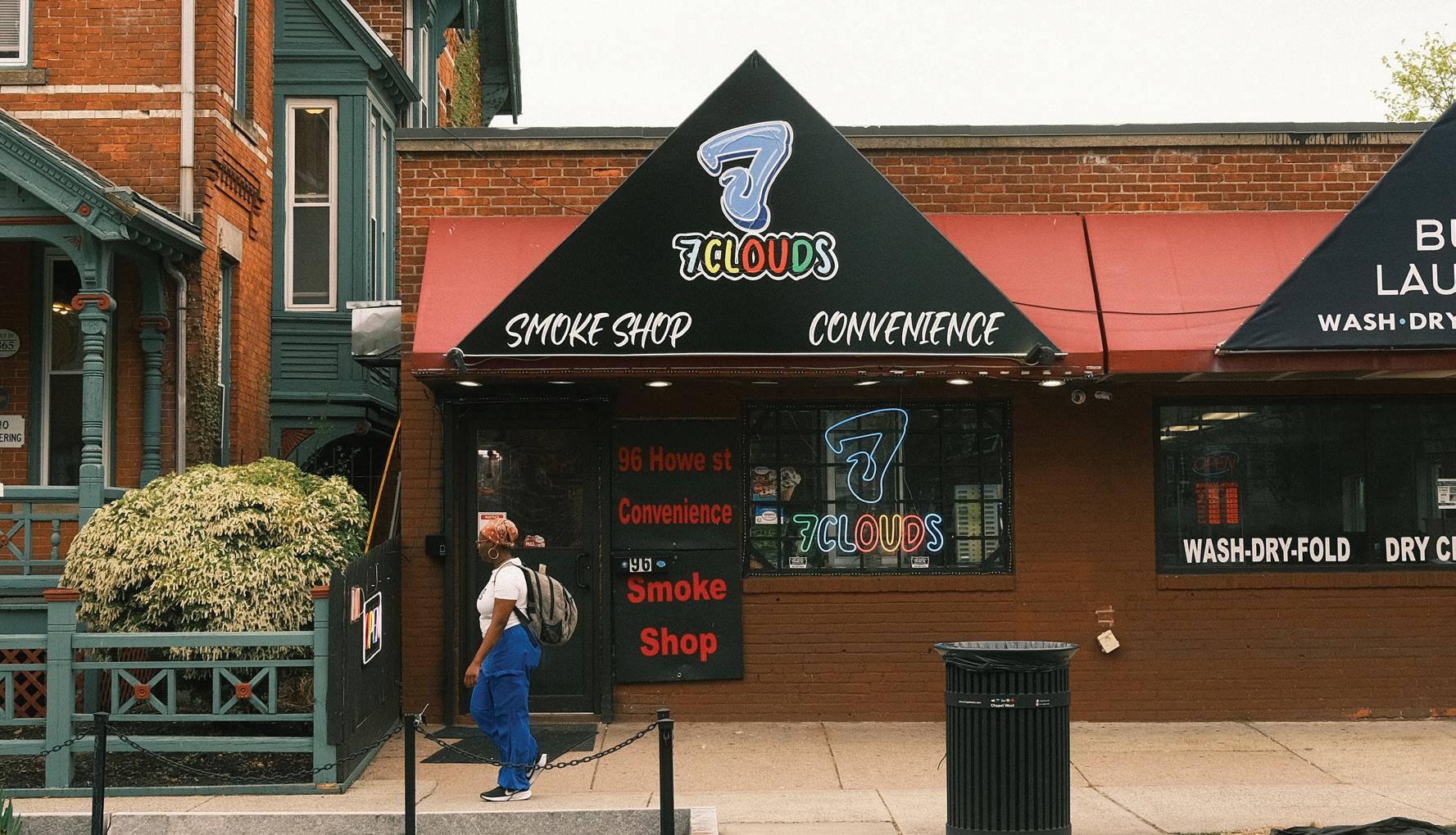
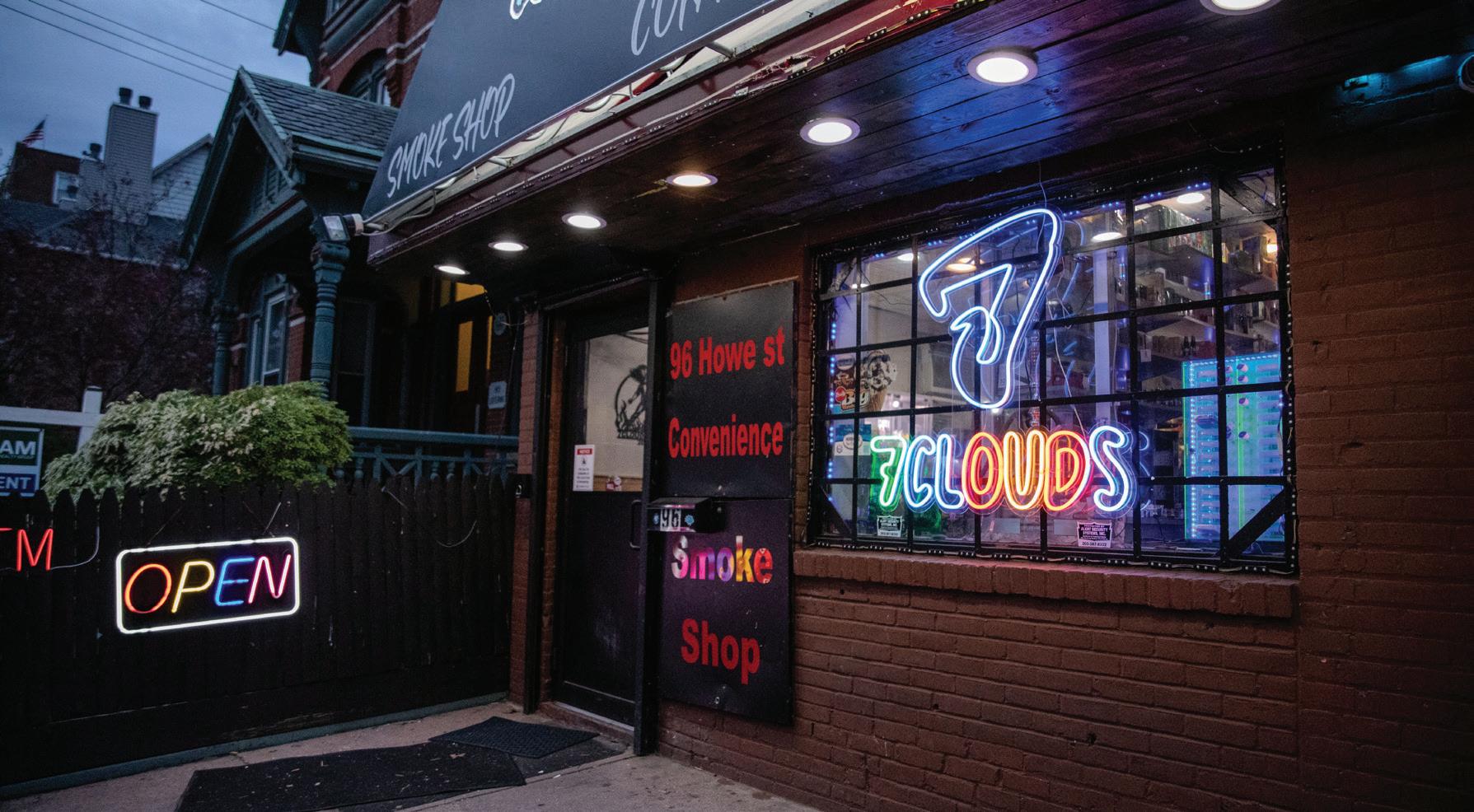
THE FACADE OF 7CLOUDS, a half-convenience, half-smoke shop on Howe Street, is less than the length of a Honda Civic, but announces itself as loud as a Hellcat. To the right of the entrance, a neon rainbow “7Clouds” sign hangs over a barred window. When night falls, it fully lights up the patch of sidewalk in front of the store.
Ross, a 21-year-old Yale junior, walks inside, pushing past a sign that reads “NOTICE: The Sale of Cannabis at This Location is Prohibited.” At the register, she asks for two pre-rolled joints stuffed with cannabis. Ross asked to be identified by a nickname to avoid repercussions for purchasing marijuana from 7Clouds.
7Clouds does not have a license to sell cannabis in Connecticut; unlike legal retailers, they aren’t required to run safety tests on their products, meaning customers like Ross have no way of knowing what they actually contain.
In March, I sent a ten-gram sample of 7Clouds’ White Runtz cannabis strain to Northeast Laboratories, one of two Connecticut labs authorized to ensure compliance with state regulations by testing marijuana products for contaminants like mold, which can pose serious infection risks.
The total mold and yeast count from the 7Clouds’ sample came in at over 30 million colony-forming units (CFU) per gram—more than 300 times Connecticut’s legal limit.
“That is dangerous. That is so bad. Wow,” said Erin Kirk, Connecticut’s cannabis ombudsman, an official medical marijuana patient advocate, when she heard the test results. “I’m trying to wrap my head around 30 million CFU. How is that even possible?”
Ross pays the $21.79 total for her two joints and a pack of Oreos. As she leaves, two other Yale students walk in and take a place in line. They are here for the same reason as Ross: cheap, accessible weed.
Connecticut’s cannabis legalization promised to prioritize “public health, public safety, criminal justice, and equity,” in Governor Ned Lamont’s words. But when Lamont signed recreational weed into law, he also instituted policies that incentivize consumers to do exactly what legalization was meant to counteract: buying from illicit sellers.
I’M not really supposed to be smoking, but I do it anyway,” Ross said. She has prescriptions for Adderall, Lexapro, and Propranolol—medications that doctors don’t recommend using with cannabis. Still, she likes the “lightness” it makes her feel. For Ross, the upside of buying from 7Clouds is that it’s
near campus, open daily from 8:00 a.m. until midnight, and sells weed that, however risky, gets her high.
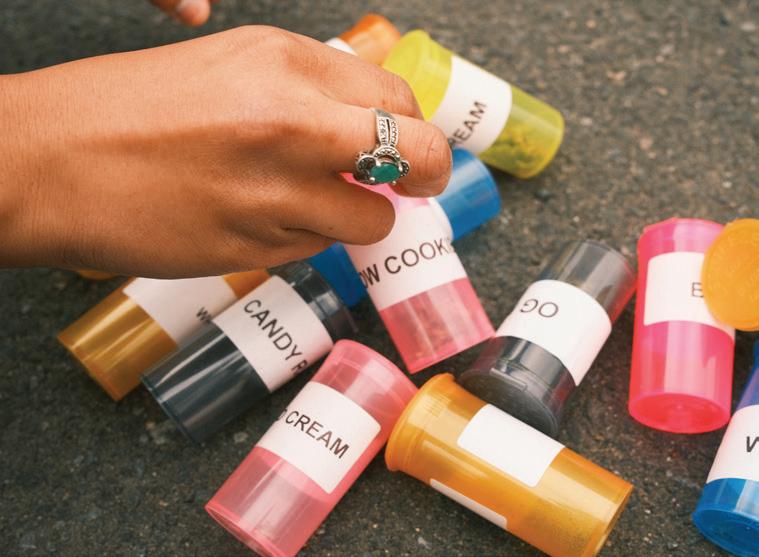
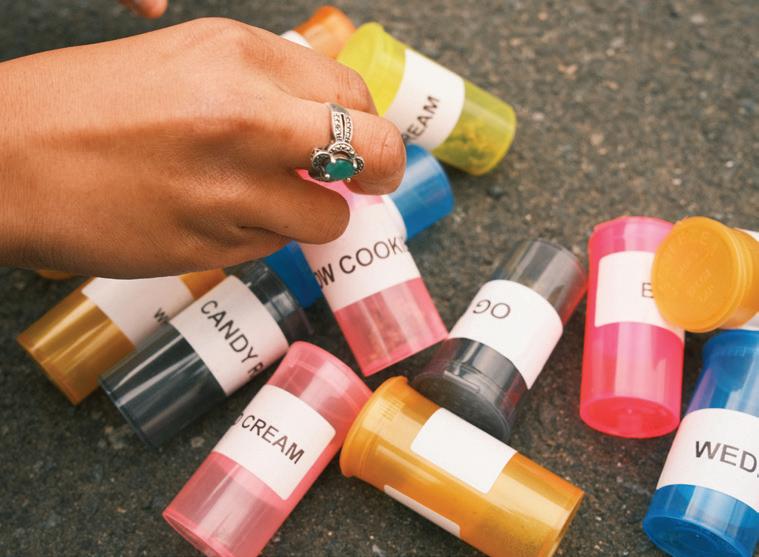
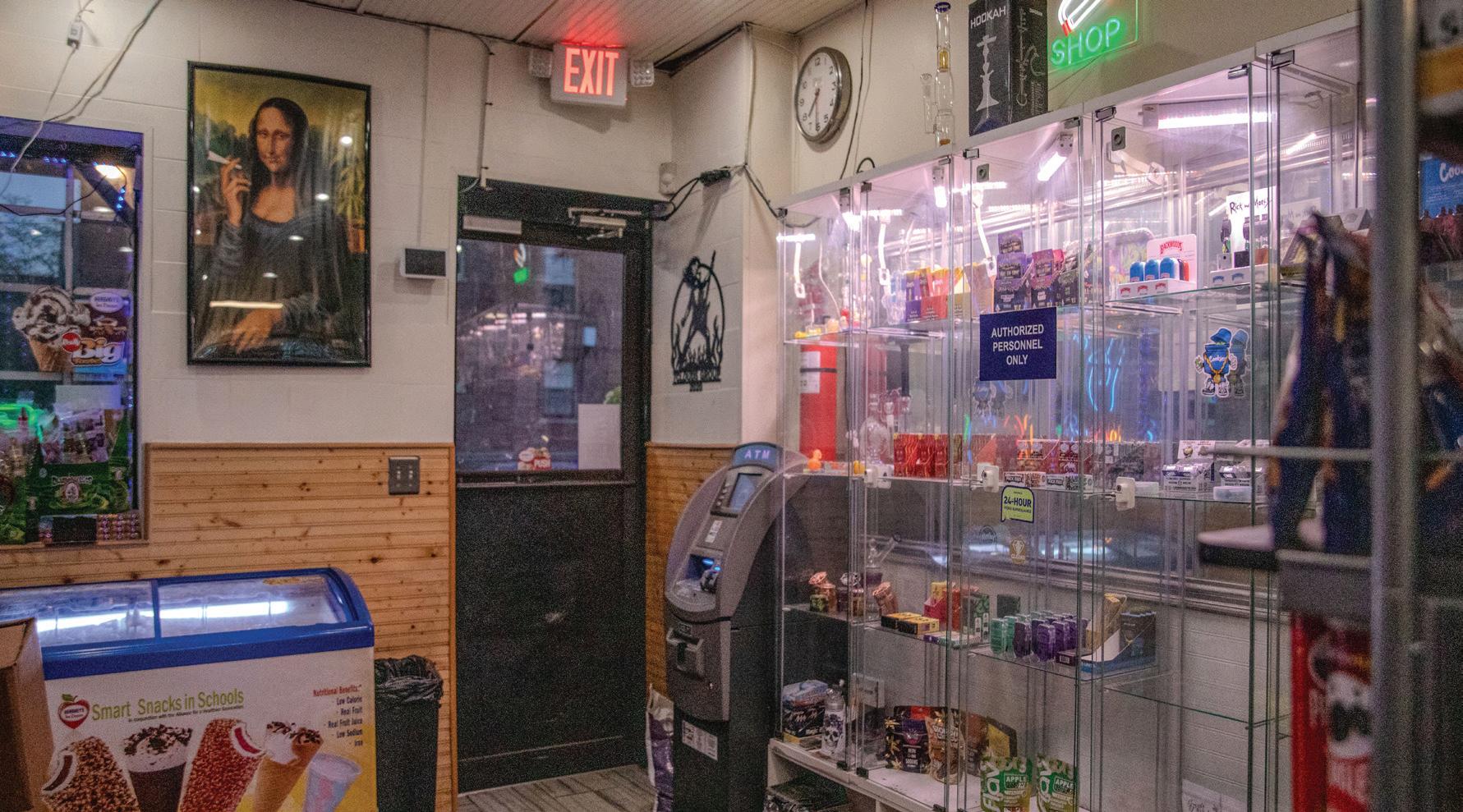
7Clouds stores its raw cannabis bud in twoinch-tall, opaque plastic pop-top bottles that look like tubes of M&M’s Minis, all kept in an opentop cardboard box. The only information about the cannabis is the strains’ names typed out in allcaps on white stickers: “GUMBO” on a blue bottle, “GREEN TEA” on an orange one, “RAINBOW COOKIE” on pink.
Unlike legal dispensaries, which use packaging like eBottles and mylar bags, 7Clouds’ bottles aren’t air-sealed. Their joints are stored similarly, just in smaller plastic tubes. With little protection from moisture and minimal airflow, mold growth becomes inevitable.
Cannabis users are 3.5 times more likely to have a fungal infection than non-cannabis users, according to a 2020 Center for Disease Control and Prevention study; with a total mold and yeast count of 30 million CFU, weed from 7Clouds puts smokers at an even higher risk of infection.
Among states that have legalized cannabis, Connecticut is unusually permissive with marijuana mold caps. At 100,000 CFU per gram, the state is more lenient than most of the country. Many states allow 10,000 CFU, but some are even stricter: Illinois and Utah cap it at 1,000 CFU. Iowa set their limit at 100.
Still, high mold counts alone don’t paint the full picture; not all mold is harmful.
The results from Northeast Laboratories also flagged the 7Clouds sample for active Aspergillus, a fungus whose spores are heat-resistant and survive combustion. Inhaling Aspergillus-contaminated cannabis puts smokers at risk of contracting a lung infection called aspergillosis.
The best case for someone who gets aspergillosis is a fever and a cough that might bring up some blood. The worst case is invasive aspergillosis, which largely affects immunocompromised people––a 2026 research review estimates a global mortality rate as high as 85%. Symptoms typically don’t show up until the disease has already reached an advanced stage.
Connecticut has a zero-tolerance policy for any cannabis contaminated with Aspergillus. But, because 7Clouds is not regulated by the state and operates outside the legal market, their cannabis is never tested, nor cleaned.
“ What the fuck?” Ross said when she learned about the mold contamination in 7Clouds’ cannabis. “I’m not expecting amazing weed, but I am expecting a somewhat decent product.”
Even for consumer willing to pay for more expensive, safer marijuana, legal weed is not always clean either. Most major producers zap the flower with radiation to eliminate contaminants. According to a McGill University study, the weed cleaning process, called irradiation, does not fully remove harmful fungi or the toxins they leave behind.
“If you put a moldy tomato in the microwave, is
it something you want to eat after?” said Kirk. “It just looks more soggy, and the mold is still there.”
Smoking weed, even of the highest quality, will always entail some level of health risk. Many smokers know this. Dexter, a Yale cannabis user identified by his first name, said disclosure is key: “It would be great to know that heavy metals and mold and other toxins don’t exceed an alarming amount in the weed you’re smoking.”
Meanwhile, Connecticut law enforcement has been challenging illicit sellers’ hold on consumers. Two years ago, State Attorney General William Tong sued Anesthesia, a New Haven smoke shop, for selling cannabis without a license. Now, metal shutters hang in front of Anesthesia’s front doors. In early April 2026, city, state, and federal law enforcement raided Chapel Smoke Shop, also for illicit cannabis sales.
7Clouds has been operating “business as usual” after the Chapel Street raid, said Henry, a Yale student who buys weed from 7Clouds, and asked to be identified by his middle name. “It feels like they have zero concerns about what’s happening.”
One anonymous patron of 7Clouds said the store is an asset because it shields Yale students from worse alternatives: “If they shut us down, that’s gonna create a lot of problems for people. It’s gonna put them in danger.”
“ We’re in a safe location. We are good for Yale. We are good for students,” he said, adding that without 7Clouds, students could run into harsher substances: “crack, heroin, pills, cocaine.” The patron spoke on the condition of anonymity for fear of retaliation.
7Clouds ownership declined repeated requests for comment over the phone and in person.
7CLOUDS HAS A “SUBSTANTIAL HOLD” on Yale’s marijuana market, according to Henry. Among 170 Yale cannabis users who responded to a survey from The New Journal this April, 41 percent reported 7Clouds as their preferred source of procuring weed, more than any other option.
That Yale students are unable to find safe, affordable cannabis may not seem like a pressing issue, but the prevalence of illicit weed in New Haven is just one consequence of Connecticut legalizing marijuana, only to implement policies that benefit few actual customers.
“Price is the biggest thing for me,” Henry said about his decision to buy from 7Clouds. Anesthesia was closer to where he lives, but a joint from there cost roughly $12. Meanwhile, the joints at 7Clouds are between $8 and $10.
At Insa, the second-closest dispensary to Yale (still an hour walk away, and a 15-minute drive), the average price of a joint is $15. But the higher cost is not within their control.
In 2021, state lawmakers introduced a potency-based tax to cannabis products based on their tetrahydrocannabinol (THC) levels. Unlike other Northeastern states, which generally use a flat-rate model, each milligram of THC sold in Connecticut is taxed between $0.00625 and $0.0275, a tax that accounts for about a quarter of marijuana products’ retail value.
Inside 7Clouds. Credit: Cassie Boulis
Lawmakers wanted to limit access to highTHC cannabis. Instead, their policies made Connecticut one of the most expensive marijuana markets in the country.
Customers are not only driven to purchase unregulated cannabis from an illicit seller like 7Clouds—some even cross state lines for lower prices, according to Kirk. As of March 2026, 100gram gummy edibles in Massachusetts are sold for about $15.82; in Connecticut, they’re sold for $25.86. Fourteen percent of Yale cannabis users––24 respondents––reported purchasing their weed outside of Connecticut, which was the second most common survey response after 7Clouds.
Across the country, the most lucrative day for cannabis sellers is April 20, or 4/20 Day––the drug’s unofficial holiday. Every year, dozens of students gather on Cross Campus to celebrate. This year, the largest smoke circle at 4:20 p.m. was a group of about 20 students, one of whom told me they were passing around 7Clouds’ joints.
Last year, from April 19 to 21, dispensaries in Massachusetts roped in $14.62 million. In the entire month of April, their Connecticut counterparts only earned around $17.5 million. By the end of 2025, Massachusetts dispensaries had out-earned their neighboring Connecticut counterparts by over one billion dollars.
“ We left $160 million, at least, on the table just in Massachusetts last year alone,” said Kirk, Connecticut’s cannabis ombudsman.
Connecticut dispensaries do face inevitable disadvantages. Bordering states like New York and Massachusetts have larger populations, and by extension, larger customer bases. But the tax on dispensary weed is also part of the reason why, despite retail sales of cannabis beginning three years ago,
7Clouds has been able to operate a small-scale cannabis monopoly in New Haven.
Still, pricing isn’t the only problem. In fact, a new bill, HB 5109, introduced on February 10, seeks to replace the state’s potency-based tax with a flat-rate model. But the lawmakers will aim for a flat rate of 10.75 percent, which Kirk said is too high to compete with neighboring states. She recommended 10.5 percent: “We need to undercut the other markets. I’m not just pulling 10.5 out of a hat.”
Another bill, HB 5350, passed the House on 4/20 and “aims to reduce overhead costs for dispensaries and support business growth,” according to Representative Roland Lemar’s official website.
However, neither bill resolves the problem of Connecticut’s strict licensing process.
7CLOUDS IS THE ONLY PLACE I REALLY GO. It’s within walking distance from where I live and where all my classes are,” said Ross.
The closest legal dispensary to Yale is Lit New Haven, which is about a 25-minute walk from Old Campus.
Kebra Smith-Bolden opened Lit New Haven in 2025 through the state’s social equity program, which gives out cannabis licenses through a lottery. The program was intended to expand Connecticut’s weed market by reducing application fees and reserving
The 7Clouds facade
half of available licenses for aspiring owners from areas most impacted by the War on Drugs––anywhere in New Haven outside Yale’s campus or East Rock.
In other words, the program sought to level the playing field. In reality, high costs and rigid requirements have constrained local owners’ entry into the New Haven cannabis industry, enabling smoke shops like 7Clouds to sell cheap, low-quality cannabis without much competition.
Despite reduced application fees for social equity candidates, larger and better-funded companies that could afford the high submission fees submitted thousands of applications; they gamed the system to boost their chances of winning a license.
“In the ninth inning, the cannabis legalization process got thrown a couple little loopholes that worked out for the larger corporations,” SmithBolden said.
It didn’t get any simpler when she opened her own dispensary.
After she received her license to sell cannabis, Smith-Bolden sought one for cultivation, which would allow her to grow weed herself and maintain higher profit margins.
But a cultivation license costs $3 million, and qualifying social equity applicants must make less than $265,287 annually over the last three years to qualify for the program. Those $3 million for SmithBolden to grow and sell her own weed––a key part for her dispensary’s long-term success––doesn’t even include the $12,500 she already paid for the retail license, or the $1 million for launching the store, or the potential $10 million for actually operating a cultivation site.
Even worse, the cultivation license requires Smith-Bolden to maintain 65 percent ownership interest, making it difficult to attract outside
investors, many of whom feel like substantial start-up funds are worth more than just a 35 percent stake. “Nobody wants to give you that kind of money and not have control,” Smith-Bolden said.
“It’s difficult to navigate a lot of these regulatory requirements, and all of the things necessary to open these businesses,” she added. “And then on top of it, having to try to raise money in this environment. Pretty difficult.”
Ross walks out of 7clouds and heads into the night with her two pre-rolls––the store’s neon light still blaring behind her. On the building’s awning, the 7 on the store’s logo starts to resemble an ouroboros––a snake eating its own tail.
Soon it will be day. Then night again. There will be other customers, but the transactions will be more or less the same.
Three days after I told Ross about the mold contamination in the sample of 7Clouds weed, she met up with a friend late at night in a campus courtyard to smoke one of the joints she had bought at the store.
“Mold contamination is the least of my concerns right now,” Ross texted me before she left that night.
Welcome to the land of steady habits.
Oscar Heller is a senior in Ezra Stiles College.
The 7Clouds neon light
Smokestack Dreams
On the site of a defunct power plant, city officials want to build a multimillion-dollar park with an outdoor aquatic center. While some residents are in favor, many are left asking: Who wants this?
By Tajrian Khan
An eyesore. An icon. A cause for “serious pain in the community.”
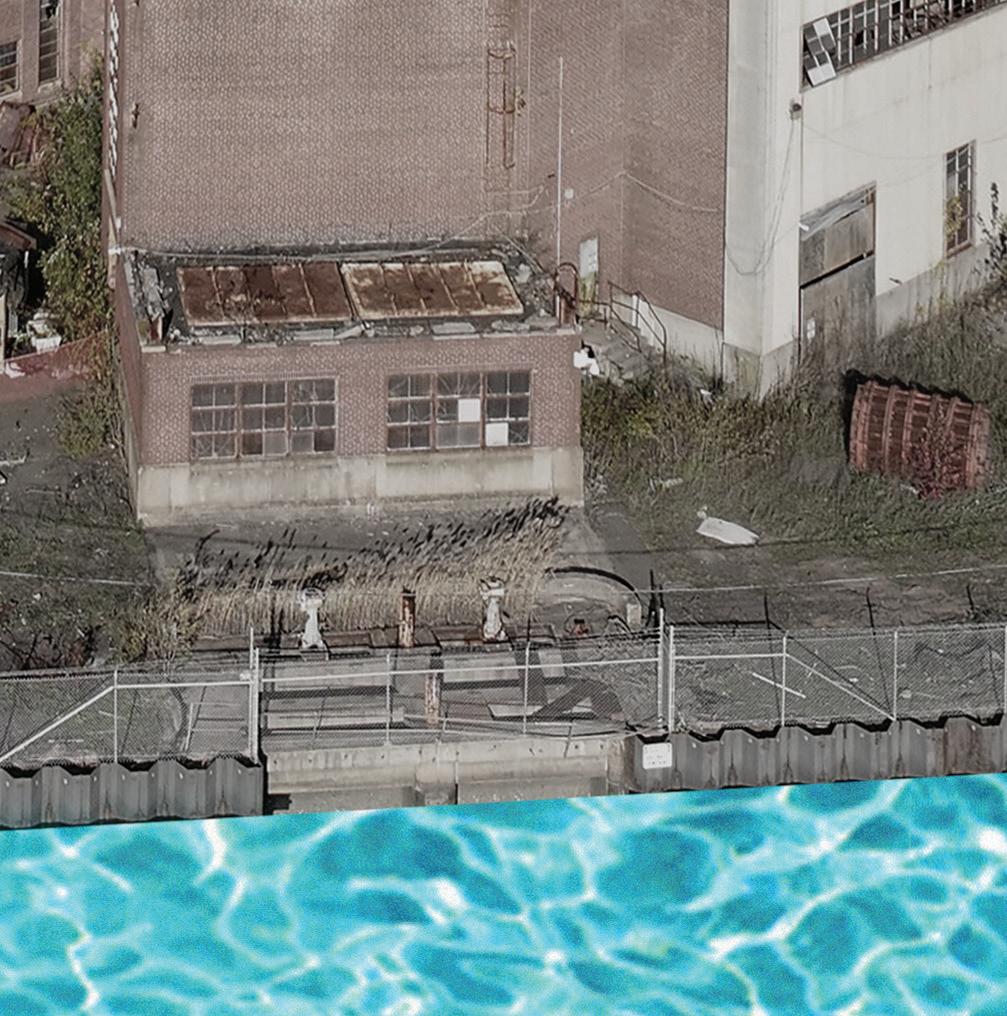
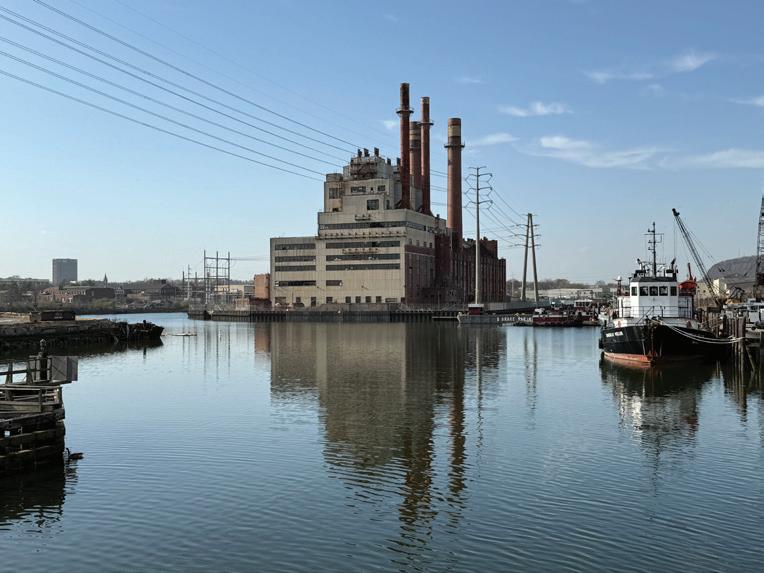
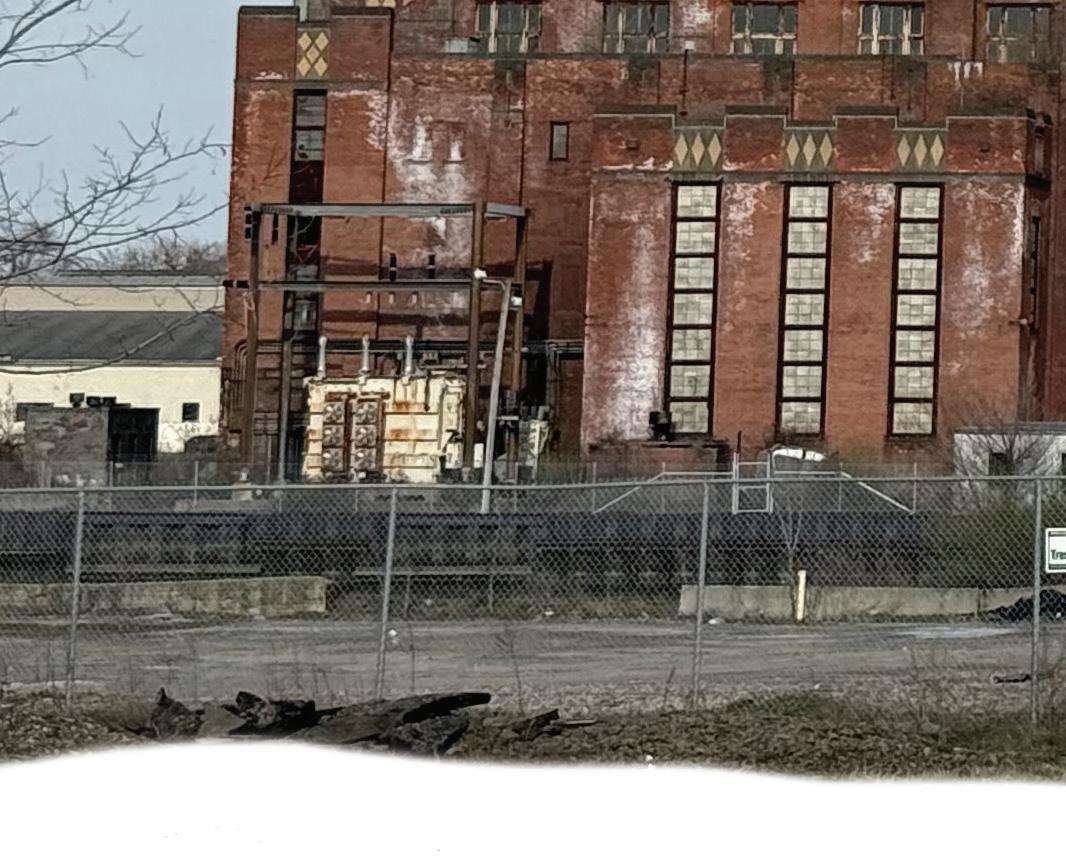
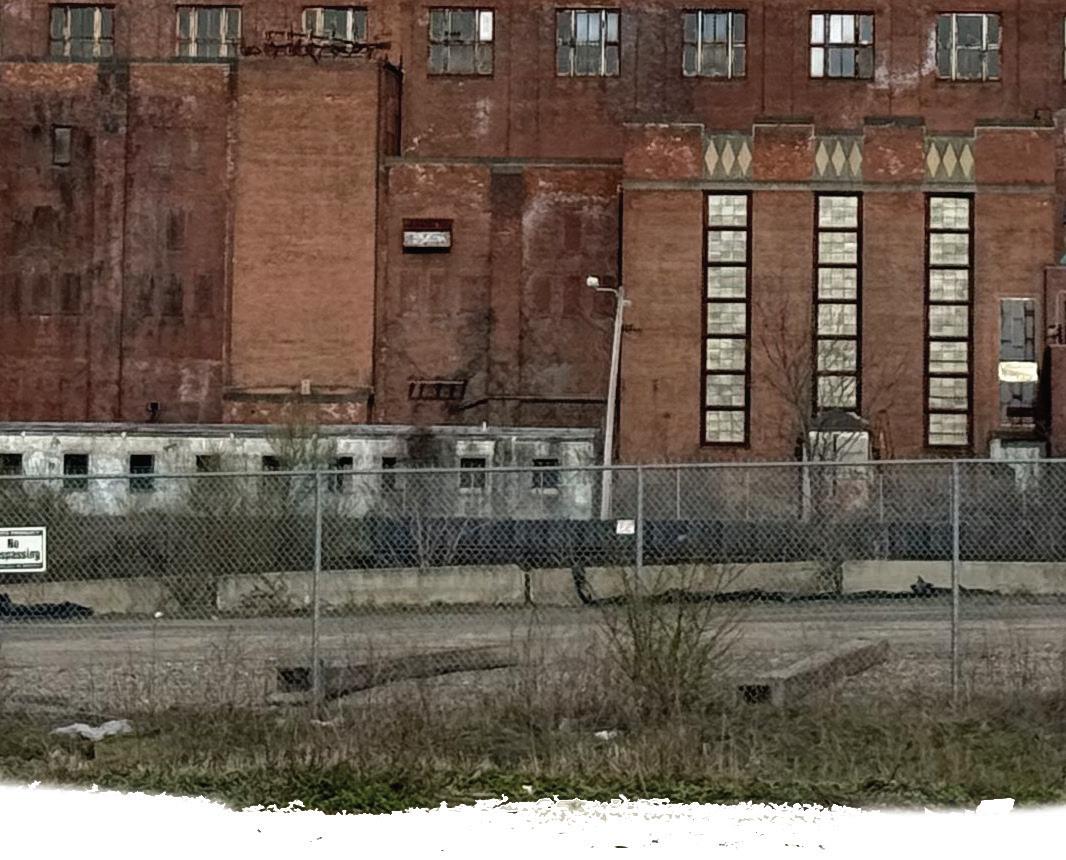
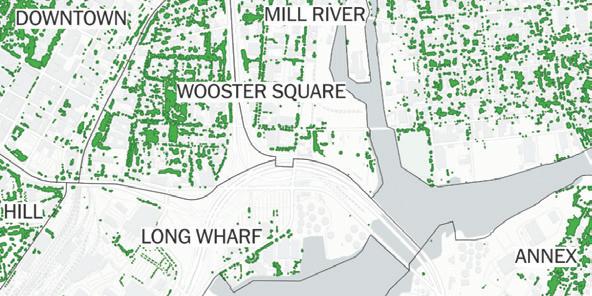
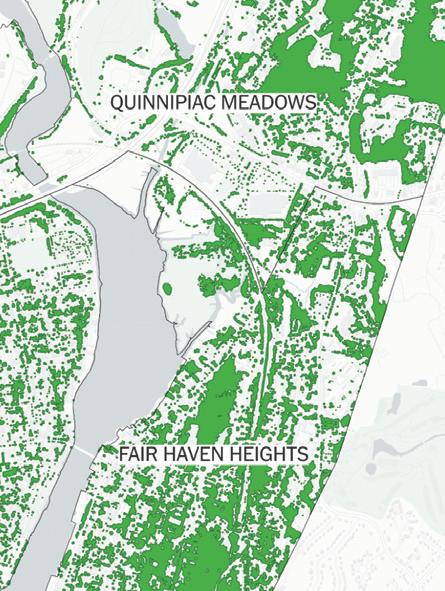
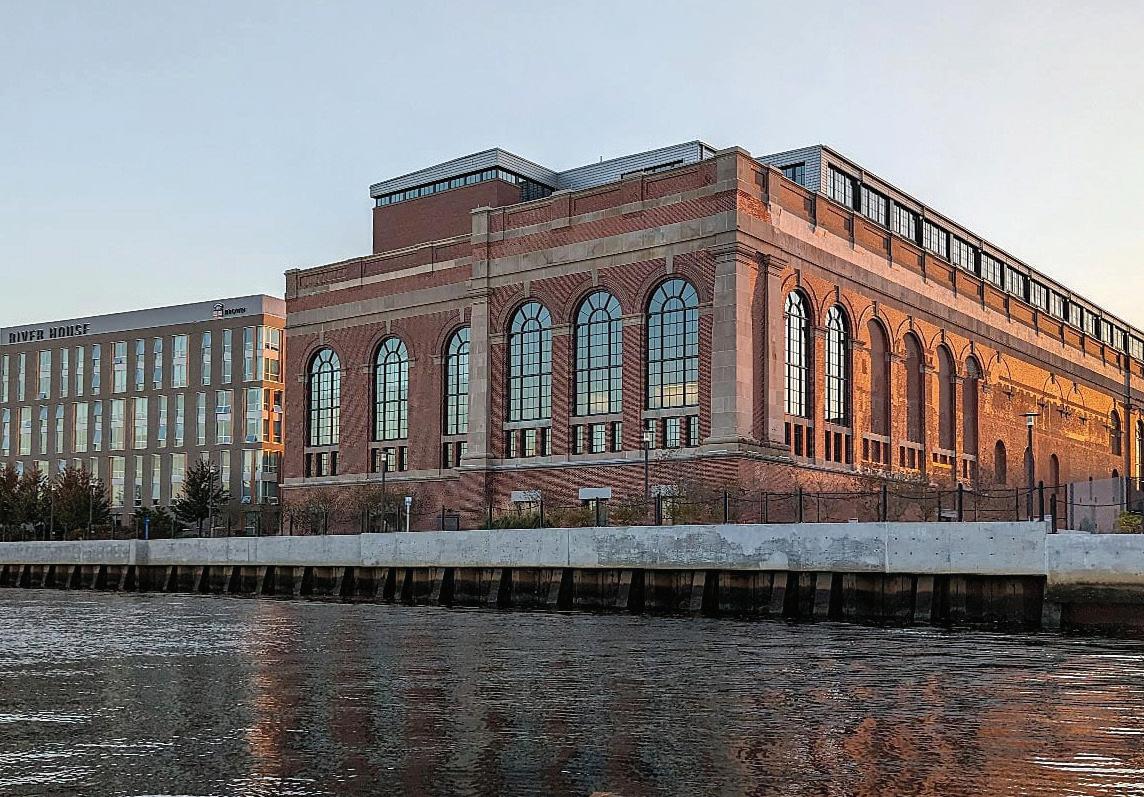
This is how New Haveners describe English Station, a defunct 97-year-old power plant in the Mill River District, between Wooster Square and Fair Haven. In the fall, the city announced plans to demolish the plant. In its place? Officials want an outdoor pool.
The English Station site, located on Ball Island, is currently blocked off to the public due to the presence of cancer-causing contaminants. Last July, city officials revealed their vision for the island’s restoration. Their tagline: “Mill River Park: From Abandoned to Amazing.”
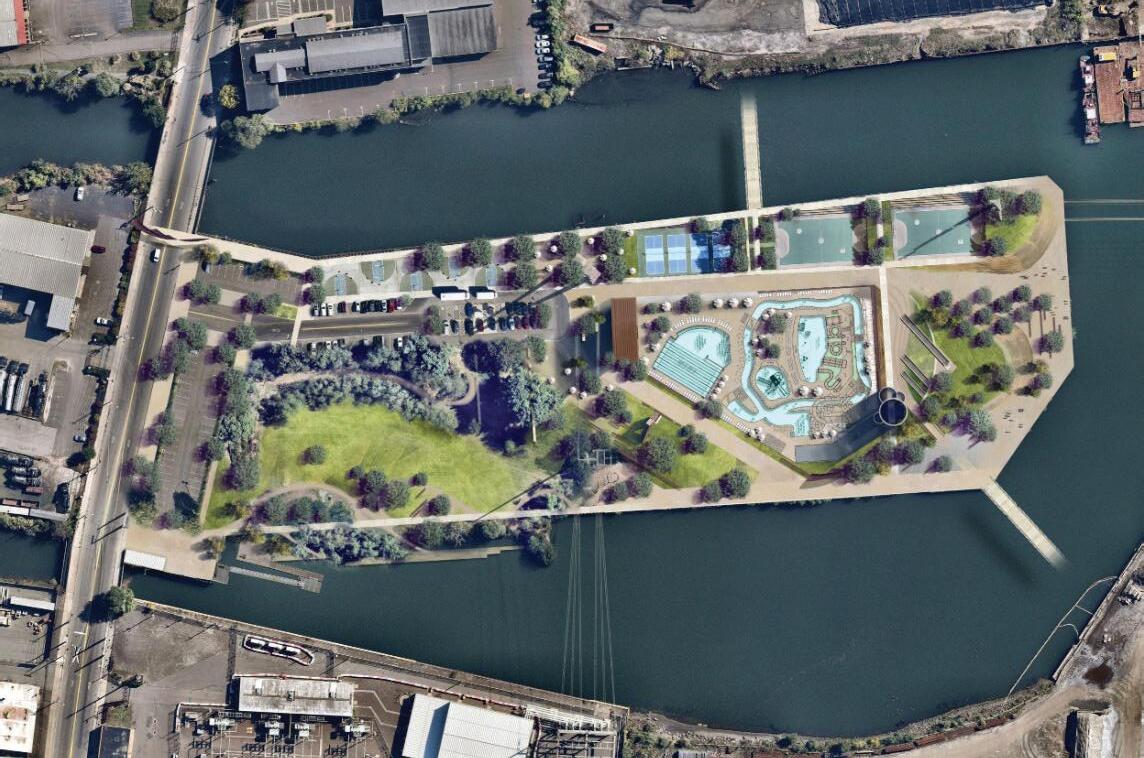
The 8.6-acre development would feature New Haven’s first public outdoor pool, including a lazy river and waterslides. The city says that the park would provide much-needed access to swimming and green space.
However, some take issue with the plan. “They need jobs and affordable housing. Anything outside of that is not responding to neighborhood interests,” Anstress Farwell, the president of the New Haven Urban Design League (UDL), said of Fair Haven residents.
Outdoor pools in Northeastern cities are typically only open during the summer, meaning the proposed pool will be closed for most of the year. But more concerning to residents is the city
officials’ lack of transparency around the cost of the plan. Even more, last summer, the city was unable to open three of its five indoor pools due to maintenance funding shortages.
The city does not yet own the English Station site, and it is contaminated with carcinogens like asbestos and PCBs. In 2016, a partial consent order tasked United Illuminating (UI), the company which operated English Station from 1929 to 1992, with cleaning up the site within three years, but the work has stalled over the past decade.
All of this has left neighbors wondering: Why does the city want to build a pool over a polluted property they don’t even own?
“I won’t even pretend to speak for them. I have no idea,” said Lee Cruz, chair of the Fair Haven Community Management Team.
The city has held five public meetings to discuss the proposal. In a phone interview, Mayor Justin Elicker said that officials have tabled at community events and issued a survey that hundreds responded to. “Many individuals from the community are enthusiastic,” said Elicker.
This spring, I sat down with eight New Haveners—professors, public officials, and organizers—to talk about the future of English Station. All of them want to see the desolate waterfront transformed into a thriving community center. Few agree on how exactly we can get there. Here are some of their visions.
What do New Haveners want for English Station?
Some want anything but a pool:
Lee Cruz, Fair Haven, chair of Fair Haven Community Management Team:
“The logical next step is to put a pause on this roulette of acquiring the property for purposes of building a pool, acknowledge that we don’t know what the cost will be, and we don’t know what all the risks are.”
Anstress Farwell, Wooster Square, president of the New Haven Urban Design League (UDL):
“We never once heard anyone in our community meetings say that a pool was what they needed. Never once.”
Frank Redente, Fair Haven, Ward 15 Alder:
“I’ve seen great proposals come into committee: art museums, ways to retrofit the building. I just don’t think we’ve explored the options enough.”
Some think English Station is an architectural icon in New Haven that should be preserved—Elihu Rubin, Yale Urban Studies professor, called it “a cathedral to electricity.”
In March, Elias, the Ward 1 Alder, voted yes on a proposal allowing New Haven to acquire English Station, by use of eminent domain— governmental power to acquire private property for public use—if necessary. He’s skeptical of the pool proposal, but his priority is to get the site cleaned up.
Elias, Downtown: “If that is not going to happen without the building being demolished, I can accept that.”
Other residents have their hearts set on the park and pool plan:
Elihu Rubin, Downtown, professor of Architecture and Urban Studies at Yale:
“Not everyone looks at a power plant and thinks it’s beautiful,” he said. “I personally believe it has the potential to house new uses.”
Elias Theodore, Downtown, Yale junior and Ward 1 Alder:
“It’s a gorgeous, towering building,” he said. “My dream scenario is that the building is preserved and reused.”
Felicia Shashinka, Milford, New Haven Youth and Recreation Department, Operations Director:
“Community partners could run ‘Learn to Swim’ boot camps,” she said. “That gives all residents of New Haven, not just the kids who already know how to swim, the foundation they need to create a safe environment around water.”
Anna Pickett, East Rock, Urban Resources Initiative (URI), Development and Outreach Manager:
“It’s really important that we, wherever we can, create more open, more green space in that part of our city.”
Mark Oppenheimer, Westville, journalist and author:
“We either want to invest in those neighborhoods, or we don’t. If we do, then we should look for reasons to say yes, not reasons to throw up roadblocks and obstacles.”
Mill River Park Concept Plan Credit: City of New Haven
Why a pool?
New Haven doesn’t have a public outdoor pool, and Fair Haven lacks park space. Proponents of the city’s plan want to fix that.
Anna, East Rock:
“Fair Haven has more percentage of land dedicated to parking lots than it does to parks and schoolyards combined,” she said.
Anna, whose work at the URI focuses on urban forestry, emphasized that as summer heat becomes more extreme, people will need access to canopy and water more than ever. Designs for Mill River Park include forested paths and a waterfront promenade lined with trees, with the pool and lazy river at its center.
Felicia, Milford:
“There are so many children and adults in New Haven who don’t know how to swim, particularly Black and brown kids.”
Mark, Westville:
“We can always use more affordable housing. Obviously, our education system could always be better. But the logic there seems to be: Until all these other problems are solved, poor Black and brown kids don’t get a place to swim. And I’m just against that.”
In February, Mark published an op-ed in The New Haven Independent titled “Let’s Go Swimming: An Argument For Building A Public Pool At English Station.” He wrote that the pool proposal was “one of the best ideas” the Elicker administration has ever had.
Anna, East Rock: “It’s not just some mediocre park but a destination that will really attract people.”
Proponents also say that the project would expand swimming access in a working-class, predominantly Black and brown neighborhood. Drowning rates for Black people under age 30 are 1.5 times higher than for their white peers; access to public pools and swimming lessons would reduce that disparity.
Elicker emphasized that it would be difficult to find a more ideal location than Ball Island for a public park and pool: it is central, next to a bus line, has ample parking space, and holds potential to revitalize an under-resourced neighborhood.
“They historically have seen a large, blighted, ugly, and polluted building, and have a beautiful waterfront that can be converted into an incredible asset for the community,” said Elicker.
Mark is not only content with the administration’s support for swimming but also with the funding situation: “They have private philanthropy outside that’s helping to fund it.”
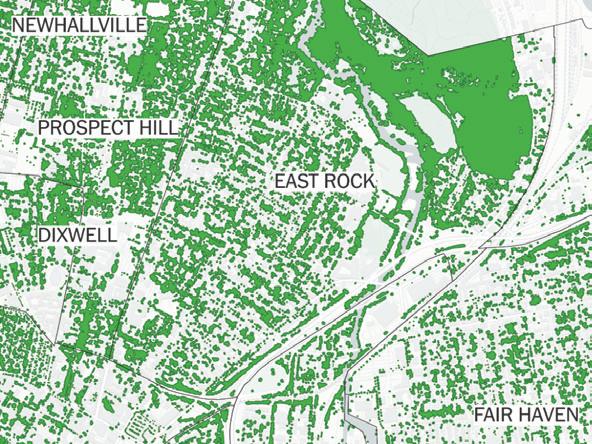
The waterfront in Mill River is one of the least forested parts of New Haven. Map: Tajrian Khan
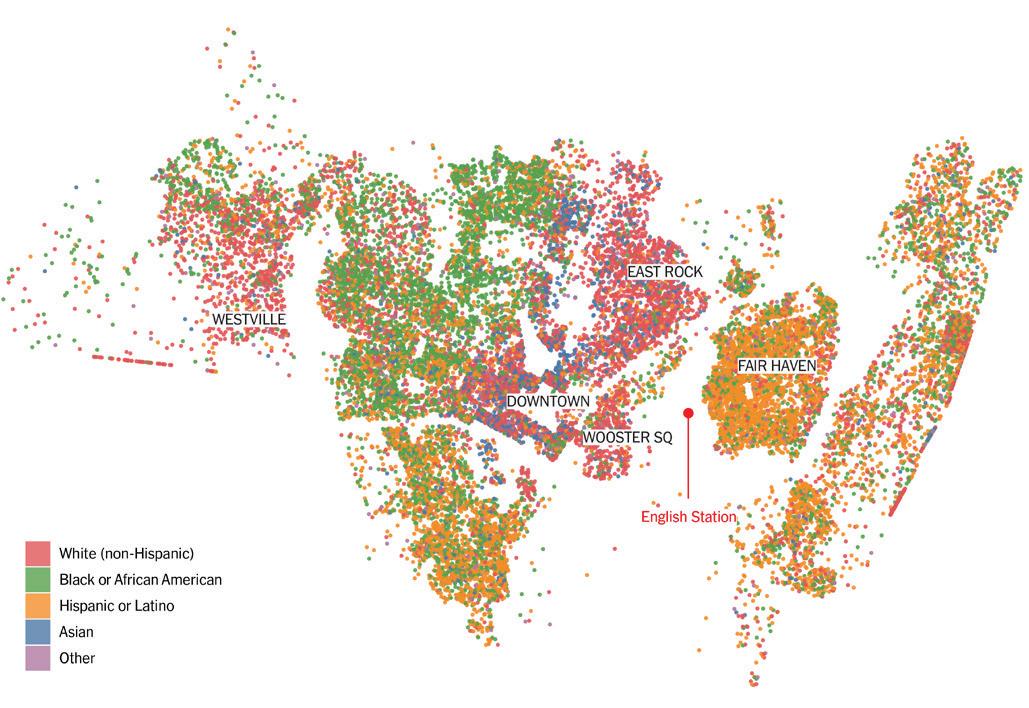
Map of New Haven demographics according to the 2020 U.S. census. Each dot represents five people. Select neighborhoods are highlighted. Map: Tajrian Khan
How would we pay for this?
In January 2025, seven months before the Mill River Park proposal was made public—when the project was still “in an early stage of planning and review”—David Yassky, the president of the Roxanne and Henry Brandt Foundation wrote to Elicker about their enthusiasm for the park and pool project:
“As one goal of the Roxanne and Henry Brandt Foundation is to expand access to swimming, we were delighted to learn that your initial proposal includes a swimming pool,” Yassky wrote to Elicker. The Brandt Foundation, a multibillion-dollar nonprofit based in New York City, was “prepared to consider contributing up to $10 million to completing a park along the lines you proposed,” Yassky wrote.
Currently, building the park and pool is estimated to cost the city $25 million. Before any construction can take place, however, UI, the utility company that formerly operated English Station, is responsible for cleaning up the site to an industrial standard for $30 million.
Still, after UI’s industrial remediation, the city must clean up the site to a park standard, which would cost $1 million to $5 million on top of the $25 million construction estimate, according to a city spokesperson. That estimate also excludes the cost of acquiring English Station.
Frank, Fair Haven:
“Who’s going to pay for it?” he said. “The funding stream is not clear. There are too many question marks.”
Who gets a say?
Between July 2025 and January 2026, engineers and economic development administrators held five meetings around New Haven to discuss the Mill River Park design so residents could voice feedback about the city’s plans.
Some said the meetings felt like advertisements for the pool plan.
Frank, Fair Haven:
“This was kind of spoon-fed to the neighborhood,” he said. “This is not what we need right now.”
Anstress, who leads walking tours of the Mill River District waterfront, thinks the interests of the community most affected by the pollution should come first.
The Brandt Foundation would contribute a “significant amount of funds to help us reduce the overall cost of the project,” Elicker said.
“We’re very grateful for that offer.” Lee, however, worries that a private donor might have too much influence over the project.
Lee, Fair Haven:
“The donor is going to want to have a voice and a vote at very fundamental levels of a project supported by philanthropy,” he said.
“It’s kind of like the tail wagging the dog instead of the other way around.”
Anstress, Wooster Square:
“We’re looking for meaningful employment and career development. After decades of pollution and abandonment, that is what is owed to this neighborhood, not a swimming pool.”
Elicker notes that the city has incorporated many suggestions from residents after community meetings, tabling, and surveys for the park plan, including sports fields, boating access for kayaks and canoes, and more naturescapes. “We’re continuing to collect feedback and alter the design based on that feedback,” said Elicker.
For Mark, skepticism is no reason to stall an ambitious plan for New Haven.
Mark, Westville:
“There’s always expense. There’s always uncertainty. That is the nature of urbanism,” he said. “But if you want to have a great city, sometimes you move ahead anyway.”
What about the building?
Many people “resent English Station,” Elias said. But he also thinks the plant is an “iconic New Haven landmark,” and he’s not alone. Elihu, Yale Urban Studies professor, believes the station is an “orienting feature” in the New Haven skyline. “It helps stitch Fair Haven back to downtown visually,” he said.
New Haven can look to surrounding cities for inspiration: A historic power plant in Providence was redeveloped in 2017 into office space and educational centers for several local universities. Another decommissioned power plant in Brooklyn was reborn as Powerhouse Arts, a hub for artists and large-scale art production.
Several New Haven residents and experts I spoke to believe that there is enormous potential for a building like English Station to become an asset for the neighborhood. For example, Anstress suggested that the giant turbine hall could become a space for pop-up restaurants, artist studios, or community events.
Anstress, Wooster Square:
“The turbine halls have beautiful, highly glazed brick and terracotta finishes designed to survive extreme heat and humidity,” she said. “We have no serious doubts that the building can be cleaned up and reused.”
If nothing else, at least its brick walls could be preserved as an architectural scale sculpture, Elihu hopes.
Elihu, Downtown:
“I believe in the potential of preservation and adaptive reuse to anchor you in place in a way that is satisfying, even if the uses are completely different from the original ones.”
Lee, Fair Haven:
“I like to say that this building, and many other buildings like it, were built to the glory of God. Like churches. The people that were designing and building them were thinking, ‘this is going to be here forever.’”
Although there is optimism about the plan, many New Haveners I spoke to are still skeptical. The latest news on English Station came this March, when the Board of Alders approved the city’s plan to acquire the site by a 17–5 vote. But even if the city successfully acquires the site, will they follow through with their plans? No one really knows the answer.
“It’s important for our community to not just sit by and hope that something nice will go there,” Elicker said. “That hasn’t worked for decades and decades.”
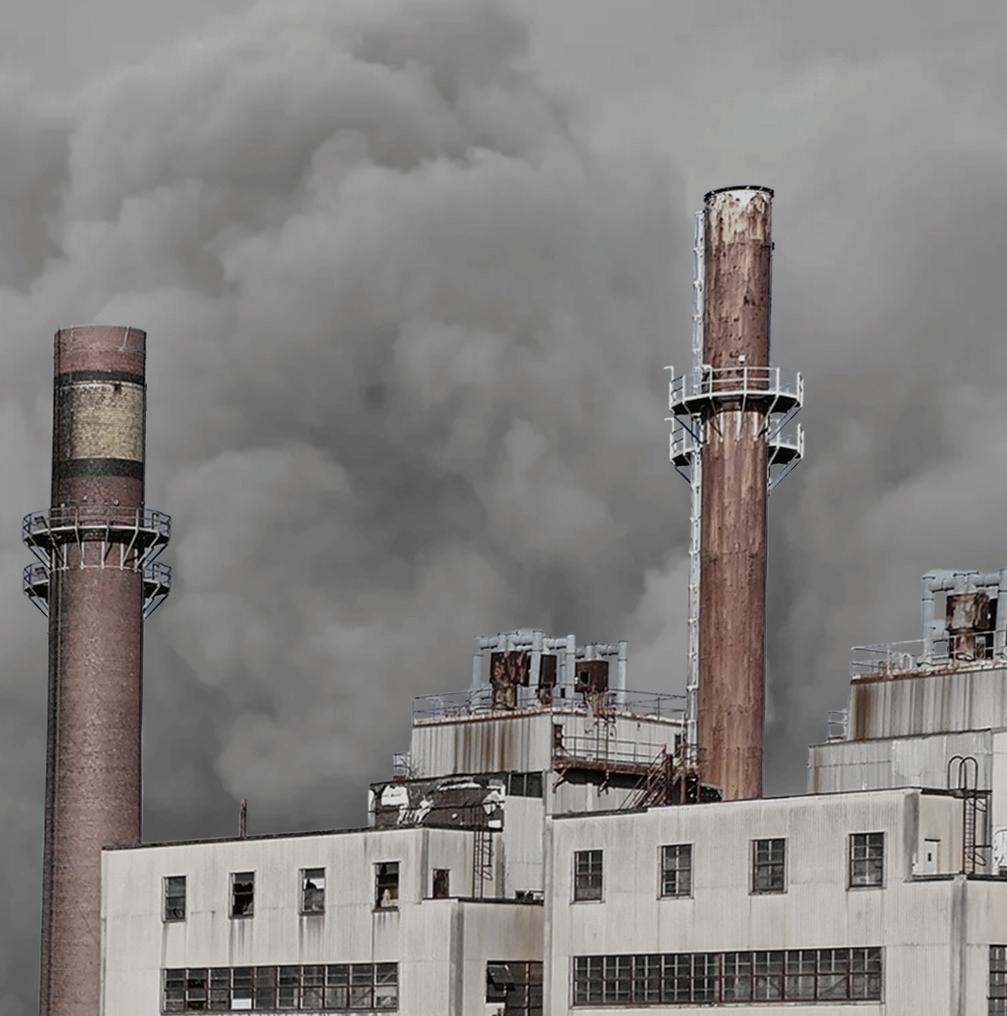
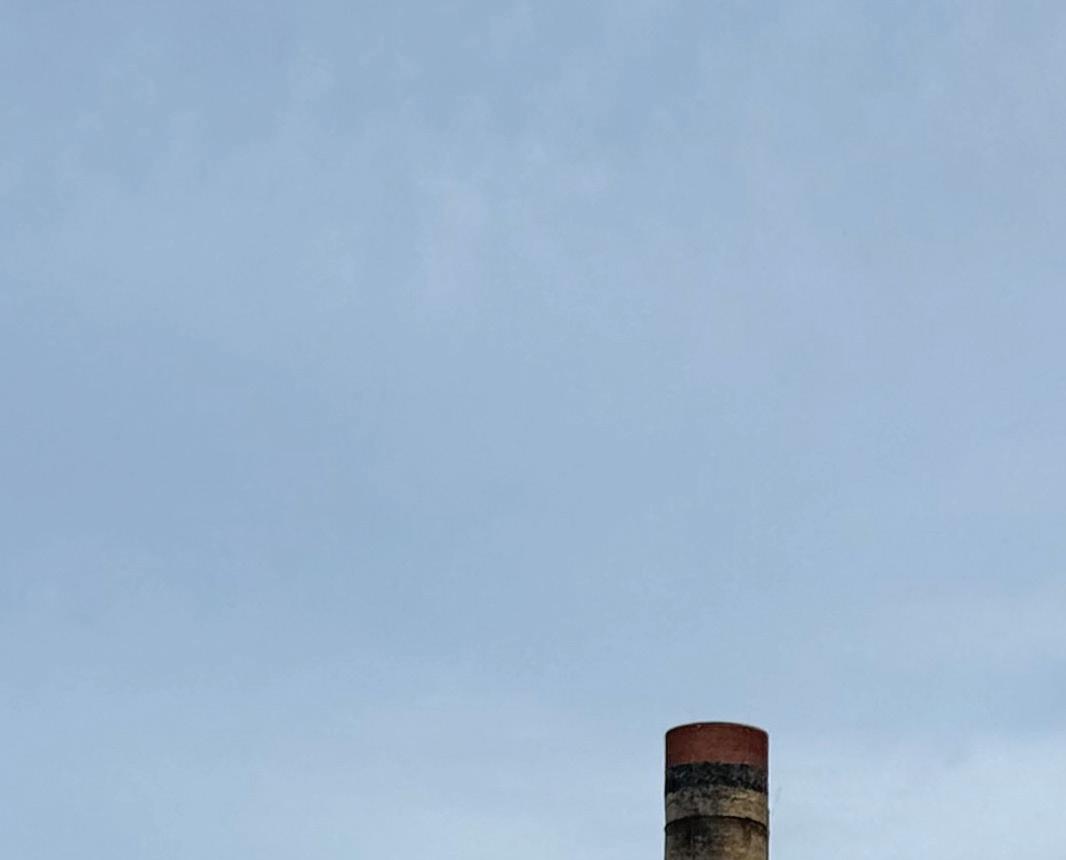
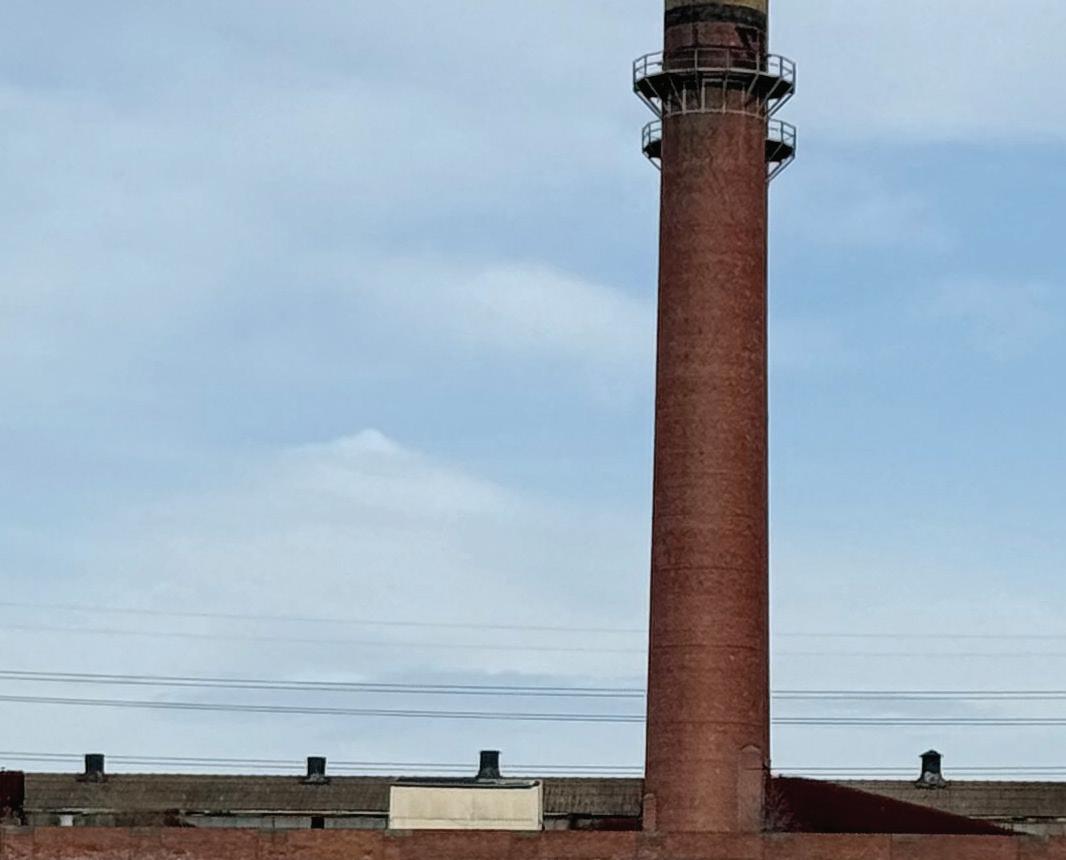
For now, the power plant still looms over the neighborhood—its smokestacks rising above salt piles, scrapyards, and a derelict waterfront. Change is closer now than it’s been before, but it seems like it will be a while before anybody is swimming on Ball Island.
Repurposed South Street Station in Rhode Island. Credit: ArtInRuins
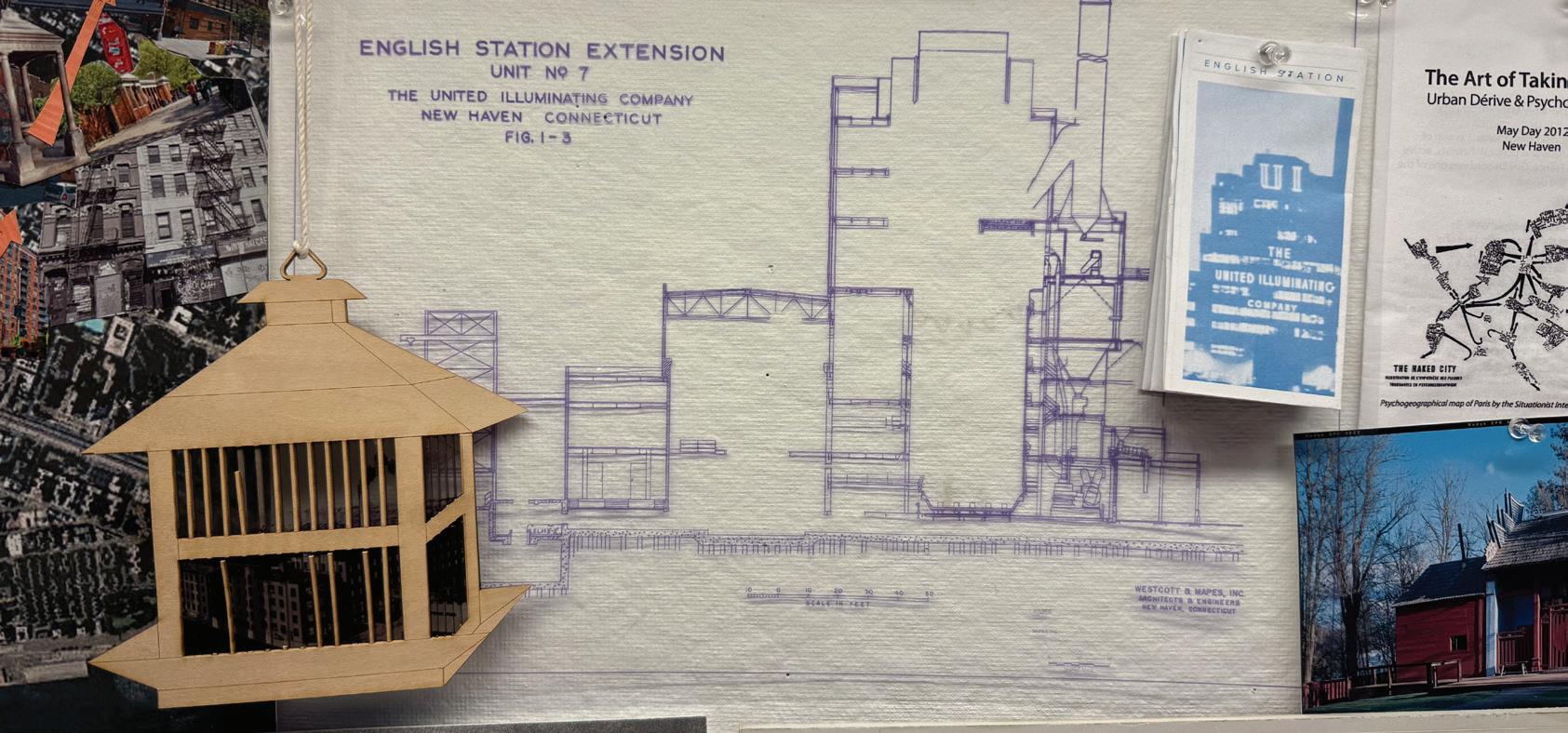
An English Station plan in Elihu’s office
Tajrian Khan is a junior in Benjamin Franklin College.
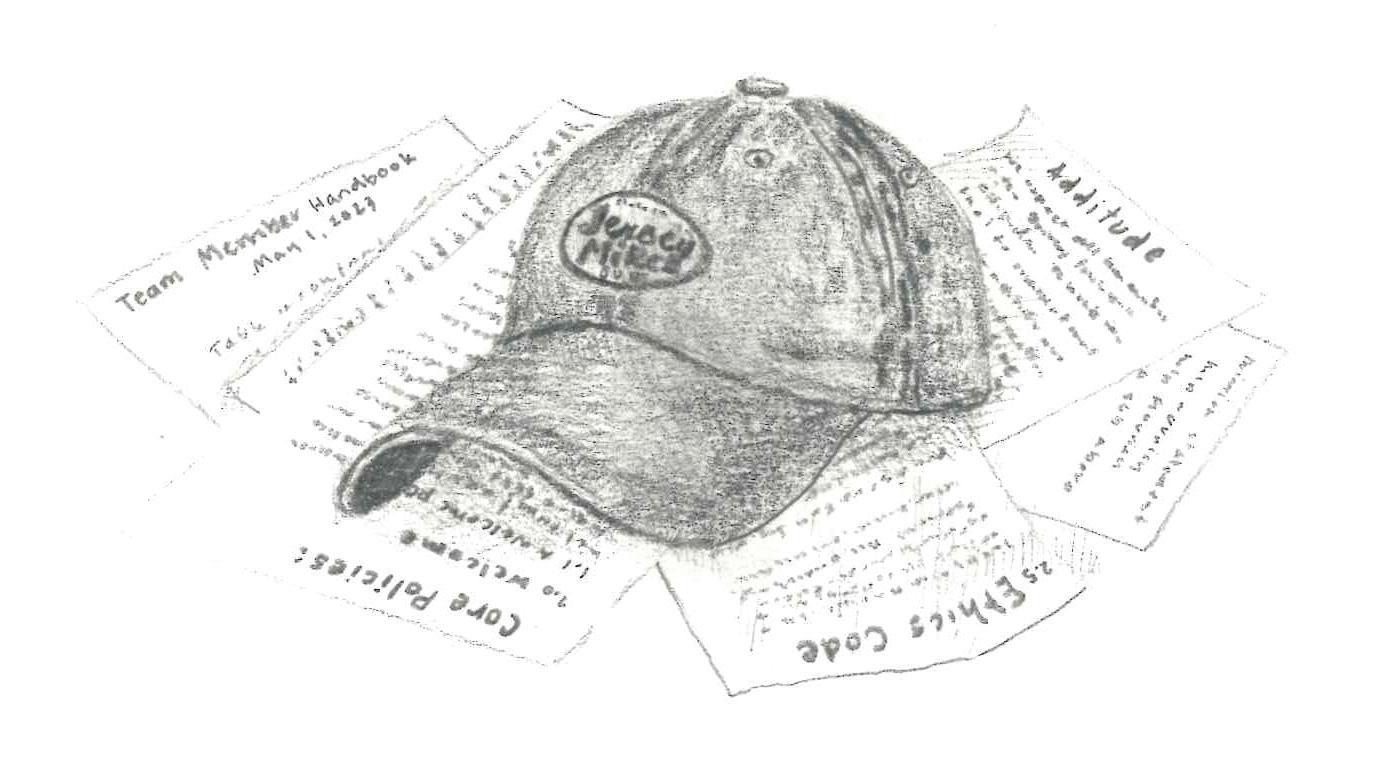
Employee Handbook, Page 22
By Tristan Hernandez
Halfway through my shift at Jersey Mike’s, I’m on the brink of passing out. I’ve been on my feet for three hours with no breaks. Everyone is yelling at me—parents, toddlers, retirees, teens from my high school, employees from Mod Pizza next door, DoorDash drivers who shove their phone in my face like their life depends on the timely delivery of a #13 Original Italian sub. I reek of onions and vinegar. I’m hot and sweaty and uncomfortable, partaking in a trauma ritual I share with the rest of my coworkers.
Except, unlike them, I am wearing a belt an inch below my ribs that squishes my stomach so tight I feel like I might puke up my gallbladder.
I don’t eat the Italian subs. In fact, I hardly eat anything. I relentlessly track my calories in my Notes app, never exceeding 1,200 a day. I’m surrounded by food that I do not wish to eat, if I were even allowed to (Employee Handbook, Page 6). Dying by wasting away at a chain restaurant in a suburban Texas strip mall would be a sad way to go. Also sadly, if I die like this, I’ll be memorialized in my dumb uniform, also known as “proper workplace attire”: Converse,
khakis, store-issued polyester shirt and apron, Jersey Mike’s ballcap, KN95 face mask. My pants are missing the mandatory solid black or brown belt (Employee Handbook, Page 22) and are instead hoisted up by a feeble shoelace. Under the layers of my uniform, no one notices the leather cinching my organs.
I thought if I could fix my appearance, shred every ounce of fat off my body, wither myself away to a shell of organs and blood, then naturally, of course, everything else in my life would have to run according to plan.
I received the belt for my First Communion in elementary school. It was the first time I had been forced to wear nice clothes to church instead of basketball shorts and a neon Nike tee. The belt was too big for me, so my dad had to drill an extra hole into the leather.
Until starting the job at Jersey Mike’s, I left the belt to rot in the dusty back corner of my dresser, still pristine.
During high school, I always thought of this belt as a corset, the kind of Regency-era girdle I’d seen women wear in the Bridgerton series. In actual history, these garments were made of wood or bones, tied in the back with a ribbon. Corsets were used to straighten posture or create a suitable silhouette. Whether for vanity or necessity, they defined proper society. Who cared if I was a boy and had no prospects of debuting into society, if I could mimic nineteenth-century debutantes’ outfits with a simple belt? I used this theory as a justification for something that was, objectively, an odd thing to do.
But a corset—or whatever it was— did not bode well for an eight-hour shift in quick service. I was expected to be able to lift up to 40 pounds (Employee Handbook, Page 23). I had to be ready to climb a ladder to grab soda concentrate or squat to the ground to clean a toilet. Though there was hardly enough room for more than four people behind the front counter, I somehow took well over 7,000 steps per shift (which, at my height, weight, and age, burned approximately 233.33 calories). I became winded quickly. I saw stars when I ran from one side of the store to the other. Luckily, when I whined about being tired, my coworkers saw it as an attempt at camaraderie, allowing me to hide in plain sight.
I do not know why I started regularly wearing my belt to compress my intestines, not in a way that is complete. It wasn’t healthy, and it made a negligible change in my appearance. I do know when I started, though. I had on the belt during one of my high school Zoom classes, and no one could see anything below my clavicle on the screen. As the class went on, I shimmied and finagled the belt up my torso until it encircled my ribs, willing my body to shrink to fit into its confines. The action was mindless, but I must have known that it was strange. I knew that if I put some force into my moves, I could tighten one belt hole and crack a bone. It was thrilling.
I would know if I cracked a rib because I could see them, the thin ridges lining my torso, skin pulled so tight to my chest it looked like a washboard. I had two percent body fat. Professional bodybuilders, when going to competition, only have as low as three percent. I insisted that I was never hungry so often that my friends joked that I had Crohn’s disease. I lied to my parents when I skipped meals.
I had to attend religious education classes for my First Communion. In one of the cultish Catholic movies we had to
watch, I saw a nun with a cilice, a medieval garment of spiked metal and cloth that she wore around her thigh. I learned that it was for penance, to punish yourself so you could get closer to God. I’m not religious—not since I was thirteen— but I guess my belt served this purpose. It pinched and chafed and squashed my insides for no good reason, except maybe proving to the anorexic gods that I was worth something.
Looking back, my best guess is that this was all a need for control or an intense obsession with perfection. I am sure it was irrational, this severe discipline I exerted on my body. But it’s difficult to ascribe a definite reason. I have gaps in my memory, and all I’m left with are snapshots where I watch myself like I’m an astral projection. The quandaries of high school seem small in retrospect—grades, deadlines, family, friends, crushes—but perhaps they all added up. I thought if I could fix my appearance, shred every ounce of fat off my body, wither myself away to a shell of organs and blood, then naturally, of course, everything else in my life would have to run according to plan.
I do not know when I stopped. I know that at some point I left my job,
and that by the time I started college, I wasn’t trapped analyzing nutritional information anymore. I never got help, but I’m still on the email list for an online therapy service. Maybe I stopped because I knew that the belt never worked. It was destined to fail, because my undefined goals were unattainable. I was trying to both waste away and be noticed, to be helped and ignored.
When my shift is about to end, I am about to pass out. I’ll faint either in the store, or worse, when I’m driving home going 60 in a 35 zone and the cops will find my mangled remains with Megan Thee Stallion still blaring on the stereo. To stay conscious, I steal half a loaf of bread to eat in the walk-in freezer. This violates the ethics code (Employee Handbook, Page 6), but I still sit on a metal rack next to slabs of beef and vats of sauce and take small bites like a Victorian peasant boy. I loosen the belt for a moment. The bread feels like a brick in my stomach.
Tristan Hernandez is a senior in Pierson College.
Climbing a Glass Castle
By Savan Parikh
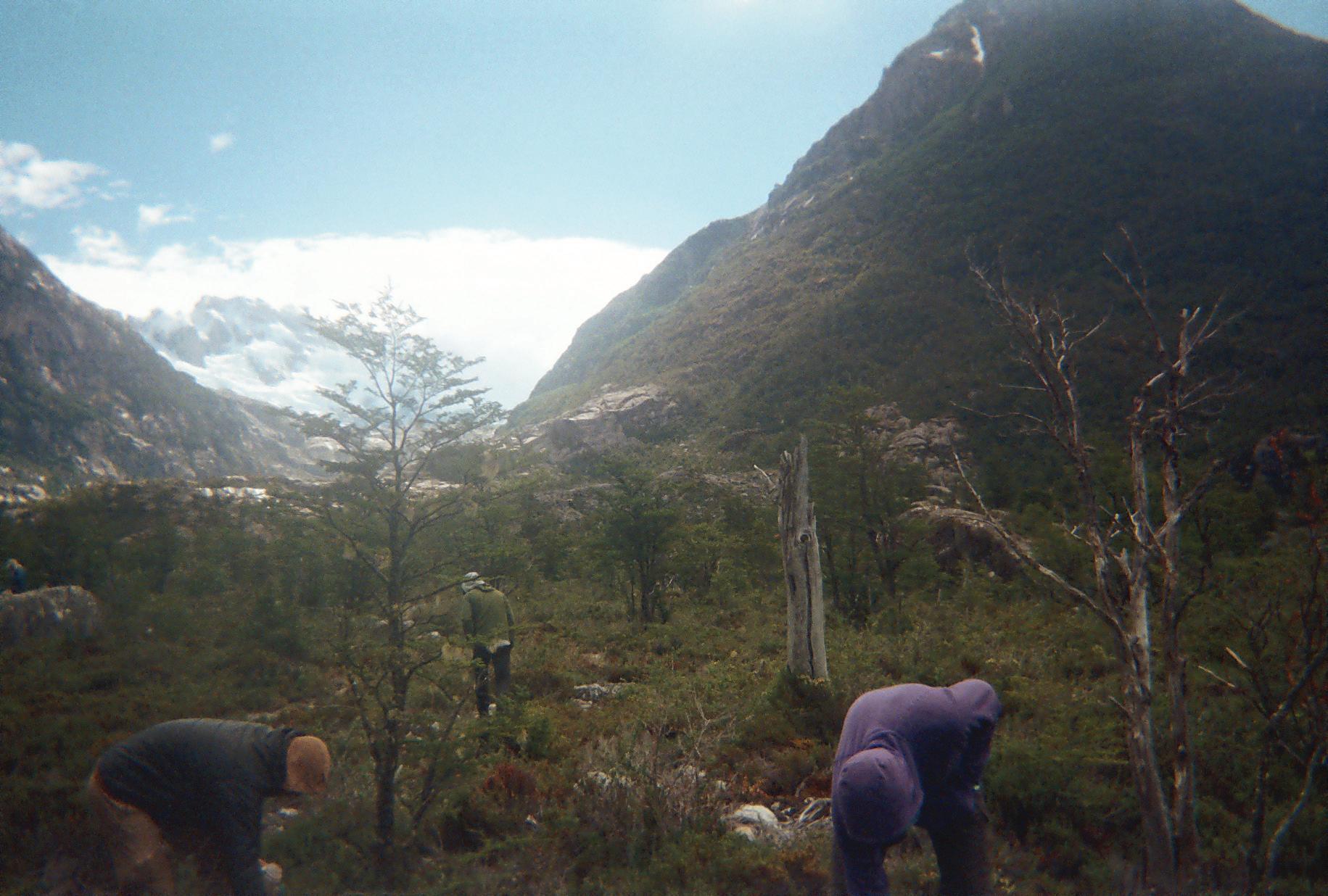
In a tent on a remote Patagonian ice field, where the wind turned rain to bullets, I first heard Juan sing. His deep warble belied a skinny frame and boyish features.
Hubo un tiempo en que fui hermoso, y fui libre de verdad.
Guardaba todos mis sueños en castillos de cristal.
There was a time when I was beautiful and truly free.
I kept all of my dreams in castles of glass.
“Canción para Mi Muerte,” or “Song for My Dead,” by Argentine singer-songwriter Charly García, was Juan’s favorite and the first song we played after 40 days in the Chilean backcountry. For a long time I couldn’t understand why Juan, who always seemed so happy, was drawn to such wistful music.
In EARLY JANUARY 2024, SEVERAL months into a pre-college gap year in South America, I met Juan Andrés Vargas Reyes in the main square of Coyhaique, Chile. We were joined there by 12 other people—nine other amateur outdoorsmen and three mountaineering instructors—about to embark on a month-long expedition to Patagonia’s Northern Ice Field.
That afternoon, sitting cross-legged on the dusty floor of a lean-to, Juan told me about himself. He was a proud Colombian and a not-so-proud resident of Bogotá, the capital city. He had spent his childhood summers escaping the city, chasing his grandparents’ two cocker spaniels around their ranch in the Andean countryside. The year before, he had graduated from the prestigious Universidad de los Andes in Bogotá with,
at his dad’s behest, an economics degree. For his first job post-grad, he managed the books at his family’s property development company. A few months in, Juan was assigned to budget a new infrastructure project that would blast tunnels through the Colombian Sierra Nevada mountain range. He told his dad he’d be stepping down. “There is nothing in the world I love more than the mountains,” he told me.
Juan and i spent the first dawn of our trip in a remote Chilean village, hauling supplies for the trip onto our motorboat. Groaning under the weight of 14 100-liter packs, our boat sputtered across Lago Plomo and dropped us in “tierra baldía,” no man’s land. We set a course for the ice field. Many of our expeditions—up glaciers, into crevasses,
and summiting mountain peaks—were derailed by hurricane-level winds and rain.
But in pockets of peace, when the storm clouds paused their brutality, we explored. One day, after trudging over dunes on the valley floor, Juan found a swimming hole. We jumped in and cleaned the grime from our skin, despite the stern warnings of our mountaineering instructors, who worried the water was too still. The next day, in the folds of wooded foothills, Juan ditched his tent set-up to sunbathe. We spent the afternoon filling our water bottles with wild berries to make jam. Juan was an avid botanist and promised the berries were “edible enough.”
I envied the zeal with which Juan chased the heart of Patagonia. Once, he spotted an Andean condor carving an arc through the sky. He followed its path, pushing into a clearing to find himself face to face with a guemal, an Andean deer. They stared at each other, heads tilted.
When I asked Juan what he planned to do after the expedition, he brushed off the question with a smile and a simple “no tengo ni idea.” I didn’t have any idea, either, though I found uncertainty far more worrying.
Juan and i PARTED WAYS in mid-February. We exchanged the most generic of goodbyes: “Give me a call if you’re ever in Colombia,” he said, and I told him the same, if he ever came to the States. I spent the next month wandering up the coast of Chile, with no plans for where to stay or what to do. I struggled to recreate the raw excitement of exploring Patagonia with Juan.
In late March, I came across an opportunity to do political science research at Universidad de los Andes, Juan’s alma mater. I called Juan to tell him I’d be flying to Bogotá soon. He flipped his camera on and panned to an empty guest bed, which he said was “esperándote”—waiting for me.
I arrived at his dad’s apartment a week later, where Juan had been staying since spending the last of his post-grad earnings on the Patagonia expedition. Juan woke me at 5:00 a.m. the next morning. We drove to the outskirts of Bogotá in his beat-up Jeep Wrangler and took off down the dirt roads of the Colombian countryside on foot. Thanks to several—I suspect intentional—wrong turns, Juan led me on an impromptu half-marathon. Though my lungs struggled in the thin mountain air and my knees flared with pain over
uneven terrain, my physical discomfort was eclipsed by the sight of Juan’s proud grin when we finally found our way back to the car.
Over the next month, Juan introduced me to his routine: spontaneity. I learned to never ask him about his plans for the next day. Initially, I thought he was hiding them. It took me a while to understand that he never knew them either.
Juan found a job that compensated him for adventure. Adidas hired him to lead the running community of Bogotá on weekend trail runs through the nearby mountains. Most mornings, I tagged along as Juan toured the city, stopping every jogger around to plug the Adidas Runners community. Within a few weeks, he persuaded nearly a hundred Bogotanos to wake up at 4:00 a.m. on Saturday mornings, drive two hours, and run trails with him. I was convinced more people were there to see Juan than to run.
Juan doubled as a park ranger on the trail. While the rest of us gasped for air in the high-altitude Colombian wetlands, he backpedaled, explaining how the leaves of the frailejones pulled moisture from the fog to provide water for the millions living thousands of
Juan in the ice field. .
meters below them. “Qué lástima,” Juan said. What a shame. What a shame that ranching companies were destroying these wetlands.
When I grew tired of research and Juan found a gap in his Adidas schedule, we filled our backpacks with gear and set out for the Colombian wilderness. Once, picking our way through a rock field in the mountains of southwestern Colombia, Juan vaulted himself onto a boulder to point out another Andean condor. The bird was exceedingly rare, he explained. Less than seven thousand remain in South America. They roost on the highest mountain ledges and, without a single flap of their wings, glide for several hours and hundreds of miles. Andean condors are believed to be a bridge between mortals and the heavens. In parts of Perú, Juan said, indigenous communities memorialize their struggle against the Spanish Empire by tying the leg of an Andean condor to the horn of a bull for a fight to the death. The condor always won.
AFTER MONTHS OF SPONTANEOUS adventures in Colombia, I began to understand why “Canción para Mi Muerte” was Juan’s favorite song. At 23, Juan had already learned to break his dreams out of the glass castle. He sought them out each day—the mountains and running, the frailejones and condors. He was convinced that our mortality made living a “beautiful and truly free” youth all the more important.
During those two months in Colombia with Juan, I began to live the same way. I stopped needing every adventure to justify itself. Juan’s impulses and mine began to blur. On my last day there, Juan and I took a detour from our run to stop by a tattoo parlor. We got matching Andean condors on our right ankles. By then, we had seen the condor on three separate expeditions. The last time, we were more than three miles above sea level, on top of a volcano in Colombia’s Parque Nacional Natural Los Nevados. We watched the condor’s ten-foot wingspan of white-accented plumes catch the air currents in big looping swells. The sun forced me to squint, but Juan sat bug-eyed. He traced the condor with an intense desire to take its place.
Savan Parikh is a sophomore in Ezra Stiles College.
The author and Juan picking berries for jam.
Yearning for “Touse” in the Algorithm
Mysterious videos featuring montages of aughts-era frat culture begin flooding a writer’s feed. As she searches for what—and who—is behind them, she finds herself pulled into their nostalgiasoaked world of Nantucket and Natty Light.
By Tali Kantor Lieber
Istarted seeing the videos in November of last year. They started to pop up on my Instagram explore page: montages of images from early 2010s WASP-y (white-Anglo-Saxon-Protestant-y) manhood would flash before my eyes, tinged with a 2016-era filter, set to a slightly dated chart-topper. There were photos of New England beach vacations, clips of lacrosse goals, fraternity houses, and excessive amounts of beer. I found them amusing, and Instagram knew it. Each time I opened the app, I was met with a visual stream of Natty Light and Nantucket.
I began to read the captions and realized that these accounts didn’t function like the normal, mass-meme-sharing accounts that are often responsible for videos with tens or hundreds of thousands of views, nor were they individual content creators with blue checks or massive followings. The accounts functioned as characters, and they were telling stories.
Chip “Bagnet” Wentworth IV posted a video with rotating images of pastel button-ups, pool parties, and American flags, set to a Calvin Harris remix. “07/04/2010,” he wrote in the caption, “Had all the boys pop out to my crib on Nantucket for the fourth [American flag emoji]. Beach was nuts when my boy Chet #booted all over the St. Paul’s chicks jeep. Ran up dad’s Amex at Chicken Box and Cisco and he is #PISSED but it had to be done. Ripped so much sack that I got an insane nosebleed and got blood all over the seats in the defender [snow emoji]. #America #4thofjuly #nantucket #ack #lax #sendy #ferda.” Chip’s account is one of the most successful of its kind—when I began following him last December, his videos only had 18,000 views. Now, his most popular video has over 800,000 views.
I found more Chip-like accounts, all with similarly styled names: Preston “P-dawg” Goldschmidt, Kyle “Ketamine” Bryler, and Peter “Pass the Bag” Bradley. Each of their bios contained a formula: boarding school, college, fraternity, drug reference, and where they “summered.” The videos invoked real places, but the ludicrous names and content told me the men were, well, made-up.
Though the names and bios attached to the accounts are personalized, the content itself feels anonymous. Each photo shows a new, but familiar, gaggle of bros. A few accounts had used AI imagery, with cartoonish portraiture of fratty men with eerie faces and noses dusted with white powder, but the vast majority of
the images look completely real, almost as if I were viewing Instagram in the year 2016. The motifs are clear: heavy drinking, private equity or finance, summer destinations (Nantucket, Martha’s Vineyard, the Hamptons), women, WASP-y prep schools (Taft, Exeter, Deerfield), colleges (University of Pennsylvania, Connecticut College), drug use (primarily cocaine), and “TOUSE,” the top fraternity house on campus. Each account is its own ode to the supposed heyday of WASP and fraternity culture.
I could see that my mutual followers were liking the Reels. Was it a kind of amused hate-watch? Spoiled white boys being a convenient target for humor? Or did they catch glimpses of their own lives in them, recalling past summers on Martha’s Vineyard or boarding school lacrosse games?
Preppy life has also been aestheticized and satirized many times over, perhaps most famously in the 1980s, with The Official Preppy Handbook by Lisa Birnbach, which sold more than a million copies. Unlike the eighties handbook, though, these posts lacked authors. I could not find an account that dated back any earlier than November 2025. Their names listed above are doubtlessly fake. Many of them claim to have played collegiate lacrosse, but a quick cross-check of 2010s rosters shows none of their names (or, at least, the names in their Instagram handles).
Also dubious to me was how these accounts diverge from a signature trait of WASP culture: logo-less, stealth wealth that often minimizes flashy displays in favor of confident, silent status. The accounts are something else entirely, brash in their wealth and openly indulgent in illegal behavior.
The more attention I paid to the Reels, the less sense they made: many of the captions use language that is notably Gen Z, despite the supposed graduation years dating the individuals as older. For example, they frequently use the term “Ferda,” a popular word among young men that shortens the slang term “for
the boys.” “Ferda culture is doing everything that has to do with frat culture,” said Nate, the former social chair of one of Yale’s most popular fraternities and a committed Instagram Reels user. He believes he first heard the word around a year ago.
But these are not current frat boys, immersed in a 2026 world of partying and wealth. The graduation years in the bios put them at about ten to 15 years out of college. All of the content is infused with a kind of longing not only for youth, but for the specific aesthetics of the 2010s. And this nostalgia is popping up all over social media: when 2026 began, Instagram users posted photos from ten years ago en masse, simply captioned “#2016.”
The nostalgia in the videos starts generic. There are #throwbacks, #misstheboys, and #goodoldays. But the lengthy captions contextualize the longing, which starts by recalling the glory days of “ripping bag” and being “touse.” Some devolve into rants about adult life: “No emails. No suits. No meetings.” The captions from accounts that have bios that read “recently single” sometimes reference their “#whorewife” and having to pay alimony. When I showed the videos to my friends, the Reels joined their algorithms too. They became hyperfixated, sending me the ones that popped up for them via Instagram DM. “I swear you’ve just discovered a crazy scheme, there are so many accounts,” one wrote to me. I was grasping for ways to pin down the origins of the content, and I expressed my frustration to another one of these friends, who asked me something so simple that I was surprised I hadn’t thought of it: “Have you tried Google reverse image search?” hen I loaded screenshots of the videos into Google, it spit the photos right back out at me with links to their appearances under “college throwback” tags on Pinterest, and in articles like “Why You Should Date a Frat Guy.” One image of a Loomis Chaffee lacrosse player came back with a real name: Jason Sands, who graduated from the boarding
When into at to name: who from
school in 2013. His real Instagram shows him smiling innocently on a beach with someone who seems to be his girlfriend, likely blissfully unaware that videos featuring his high school lacrosse photos are floating around with tens of thousands of views.
After hours of scrolling, I could not manage to figure out who was behind the accounts. So I decided to make one myself.
I crafted a persona based on what I had seen. Bradley “Bagger” Wentworth IV’s bio reads “GREENWICH/PM/ PENN LAX ’’12/ Taft Alum / Hamptons [wave emoji] / The boys [snow emoji].” I followed fifty of my now peer Instagram accounts. Within ten minutes, they started following me back. I direct messaged five of them, one of whom was pretending to be a Yale alum. Maximus “Nose Bleed” Jackson’s bio stated that he had attended Aphi formal three times and gave a convincing little “Fuck Harvard.”
I sent Nose Bleed a message that would resonate with any Yale bro: “Yo fuck Harvard shit’s bouse.” Bouse is a term for touse’s counterpart, bottom house.
“Harvard is so bouse #fuckthecrimson,” glowed on my screen five minutes later. I had to strategize. How could I squeeze more personal detail out of him without scaring him away? “Bro,” I typed, “what resco were you in my brother was ’10.”
He took longer to reply, but hit me back with a “Branford thru and thru.” The responses were human. I told him that my brother was in Branford too, and then asked him what fraternity he had been a part of. “OX,” he wrote.
OX, or Theta Chi, has never existed at Yale University. I asked him where the house was, and he left me on read.
Only one other account replied to my DM, someone named Chadwick Livingston. I prompted him to talk about lacrosse, and he told me that he used to play for men’s leagues but that “they don’t mess with the baggo now I just got a net in my back yard for my kiddo but I use it whenever I wanna rip a gt and get wired and rip shots.”
When I asked if he had played for the University of Connecticut, the college in his bio, he told me that his DUI made him give it up. I asked him why he had started posting. “Big snowstorm had me reminiscing about college and
wanted to share my glory days,” he replied. I was unsure if he was talking about a literal snowstorm or doing profuse amounts of coke. Either way, I felt sort of bad for him. His nostalgia seemed genuine. He generously invited me down to Nantucket so we could “rip cheddar and bag” together.
The more accounts I followed, the darker the content got. Once my Instagram took note of my preference, it fed me accounts with similar imagery, but different languages. It started with an #RIPCharlieKirk or a #MAGA here and there, but then it became more explicit.
Hatcher Hanesberry was feeling nostalgic for back in the day when there were “no #queers to worry about or #minorities invading the sacred land. Simpler times.” Other accounts proudly stated their status as concealed carriers and touted themselves as “Hard Right MAGA Motherf*ckers.”
In a comments section, Chadwick Winthrop told Brady McGee to “ask for forgiveness not consent.”
the scenes they put in are places I have been and have memories of,” he said, “I watch every single one to see if I’m in it.” But he recognized that his perspective was particular to him—the engagement with the videos could not possibly be driven solely by recent prep school alums.
Nate and his friends had recently discussed a shift in the frat rush process. In addition to higher rush attendance, “kids are coming in already speaking a certain way,” he told me. They just seem to know “what to do.” Were the Instagram accounts becoming the guiding figures, leaving the older brother demonstrations of maturity in the past?
What happened to just having a beer with boys on Nantucket? How had my feed devolved into something so terrifying, so fast?
I found myself nostalgic for the silly, summer-filtered pictures of tan blonde boys wearing Vineyard Vines that I had seen just days before. What happened to just having a beer with boys on Nantucket? How had my feed devolved into something so terrifying, so fast?
I took a break. I began a new semester, and tried to enjoy the fraternity culture taking place on High Street and not on my cell phone. The accounts grew. More and more of my friends seemed to know about them, and when they came across my feed again, the like and view counts had spiked dramatically.
My curiosity shifted from identifying who was behind the accounts to wondering why they appealed so heavily to the people around me.
For some, especially on elite university campuses where prep school alums are overrepresented, the draw is personal. I spoke to Ben, a Yale student who graduated from a boarding school that is frequently mentioned by the accounts. “Some of
Ben thought otherwise. Yale’s fraternity culture and the world of these Instagram reels “are separate things,” he said. Like others, he pointed to the popularity of the music and the nostalgia factor of the videos. “There’s a term for that, for a fake nostalgia for something you’ve never experienced, where guys my age can look at this and be like, ‘it would be sick to be Martha’s Vineyard 2008 with my frat bros.’”
He couldn’t think of it then, but he’s correct—John Koenig coined the term “anemoia” in his 2012 project The Dictionary of Obscure Sorrows, which attempts to create new words for emotions that currently lack clear language.
I’m still unsettled by the rapid growth of the accounts. I still want to know who is behind them. When I see the compilations of pastel board shorts and lacrosse goals, I picture scary men posting from dark basements. Whoever they are, they’ve made an addictive, transporting product—I can’t pull away. When I look up in the library at my friends, who are procrastinating by scrolling on Instagram, I wonder whether these accounts are slithering into a permanent spot in their carefully crafted algorithms. There’s no way to find out, or even really measure, whether the mass effort poured into their growth can be sustained. It’s not clear how long the intoxicating, portal-like effect will last. Maybe I’ll ask Chadwick, while we rip a few this summer.
Tali Kantor Lieber is a sophomore in Pierson College.
Fresh Start
54 Knuckle-crackin g or fidget spinning, e.g.
hatred 4 Twizzlers competitor
Declare openly
Pistachio, e.g. 6 “Want me to?”
Rockette’ s prop
Tel , Israel
Acrobat, often
"Erm ... Not for me"
___ Nostra
Roll out, as a flag
"Be silent," musically
“Sally, When the Wine Runs Out” singer 12 Yale Hub fig.
“There’ s a mouse!”
Young bloke
Satisfactory
Licorice flavor
Santa Monica landmark 62 Executive Editor last name
Nabokov Nos 28 Start to center?
___ Park, Colorado
29 Only even prime number 30 Part of LGBTQ+ 31 Website whose name, appropriately, anagrams to “movie” 32 Sullen
1 Titular protagonist in a Marcel Proust novel
36 Cons 37 Strait of Hormuz liquid
Had debts
38 Stuffed Mexican pastries 40 Black bird 41 Spanish “terrible” to English “terrible” , e.g.
Jar Jar Binks's planet
Intense hatred
43 Shake
44 Mentor to Luke Skywalker
Twizzlers competitor
45 Women’s Table architect
48 Put into law
Pistachio, e.g.
"Want me to?"
Tsp. or tbsp.
"Yeah, and!?"
Dawns... or a phonic hint to the starts of
Rockette's prop 8 Tel ___, Israel 9 Acrobat, often 10 Roll out, as a flag 11 "Sally, When the Wine Runs Out" singer 12 Yale Hub fig.
"There's a mouse!"
Young bloke
Satisfactory
Licorice flavor 26 Nabokov Nos 28 Start to center? 29 Only even prime number
30 Part of LGBTQ+ 31 Website whose name, appropriately, anagrams to "movie"
32 Sullen
50 Core-strengthe ning poses that hold the body in a right-angle shape
Cons 37 Strait of Hormuz liquid
52 Vinaigrette ingredient, briefly
The New Journal, founded in 1967, is
53 "Boy oh, boy!"
54 "Yo"
and New
We produce
38 Stuffed Mexican pastries
55 "That's enough!"
issues a year that span reportage, personal essays, and creative
40 Black bird 41 Spanish "terrible" to English "terrible," e.g. 43 Shake
Email adele.haeg@yale.edu and kelly.kong@yale.edu to join our writers' panlist and get updates on future ways to get involved. We're always excited to welcome new writers and artists to our community. You can check out past issues of The New Journal at www.thenewjournalatyale.com.
44 Mentor to Luke
45 Women's Table architect
48 Put into law
49 Sign off on
The New Journal was founded in 1967, under the following mission statement: “This university has once again reached that stage in history when people are talking about the New Yale, presumably to be distinguished from the Old Yale, which in its own day was presumably considered new. Wishing to share in this modernity, we have chosen The New Journal as the name for our publication. Besides, things seemed slow around here.” Today, The New Journal is published five times during the academic year by The New Journal at Yale, Inc. One thousand copies of each issue are distributed free to members of the Yale and New Haven community. The New Journal is printed by TCI Press, Seekonk, Massachusetts; bookkeeping and billing services are provided by Colman Bookkeeping of New Haven. Office Address: P.O. Box 3311, New Haven, CT 06515.