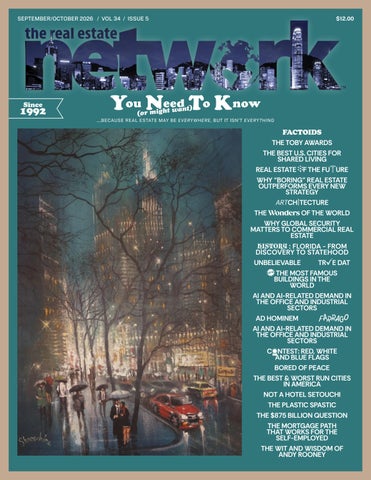
SEPTEMBER/OCTOBER 2026 / VOL 34 / ISSUE 5
$12.00
Since
1992 FACTOIDS THE TOBY AWARDS THE BEST U.S. CITIES FOR SHARED LIVING REAL ESTATE F THE FU URE WHY “BORING” REAL ESTATE OUTPERFORMS EVERY NEW STRATEGY ARTCH TECTURE THE Wonders OF THE WORLD WHY GLOBAL SECURITY MATTERS TO COMMERCIAL REAL ESTATE
: FLORIDA - FROM DISCOVERY TO STATEHOOD UNBELIEVABLE TR E DAT THE MOST FAMOUS BUILDINGS IN THE WORLD AI AND AI-RELATED DEMAND IN THE OFFICE AND INDUSTRIAL SECTORS AD HOMINEM AI AND AI-RELATED DEMAND IN THE OFFICE AND INDUSTRIAL SECTORS C NTEST: RED, WHITE AND BLUE FLAGS BORED OF PEACE THE BEST & WORST RUN CITIES IN AMERICA NOT A HOTEL SETOUCHI THE PLASTIC SPASTIC THE $875 BILLION QUESTION THE MORTGAGE PATH THAT WORKS FOR THE SELF-EMPLOYED THE WIT AND WISDOM OF ANDY ROONEY
/ THE NETWORK / SEPTEMBER/OCTOBER 2026
Aa
-2-
Amazon
Barnes & Noble
Books A Million
Bookshop.org
Crest Bookshelf
from the pages of
The Best Diversions Give yourself the gift of smiles. J A handsome, artbook-style volume with the best Diversions to appear in over the last decade. A compendium you will treasure for years to come. "This collection is laugh-out-loud funny!" Kirkland Review of Books "Prescription: Read 3-4 pages a day for a month. It’ll brighten your day! And make it last a month." Susan Carnegie, The Montreal Voice
From Where I Sit
Vertical Lines I, II, III, IV and V
The Editor’s Page in is almost totally devoted to humor and wisdom and this is a collection of some of the best of them.
Compilations of Sarcasm, Word Play, and Witticisms from the pages of . "This is simply genius. I kept on laughing the whole day when I read it." Maria Tariq "...absolutely hilarious! I laughed so hard that it brought tears to my eyes." Randal Maynard
NE
also from The CREST Publications Group
My Hand Book "Incisive yet expansive - as if the psychology of R.D. Laing encountered the selfexploration of Hugh Prather to help readers delve into their own thought, experiences and behaviours." The Rockford Tribune
"Curiously intense and ironic. This is a work that will make you think and feel and you will revisit it over and over. Marion Danziger, The Toronto Town Crier
S.H.I.T. from the Internet “An often off-color (but always entertaining and almost always hilarious) collection of jokes that you will read, enjoy – and probably tell – over and over.”
Leading With My Heart "It matters not who we have been, or why, with whom, or how. What matters is that we have met and who we are from now." Original reflections on new love, its flame, intensity, and all-consuming spirit. Short, poetic expressions of heartfelt longing, passion, and desire. Intimate expressions of tenderness and adoration, accompanied by romantic pictures. A wonderful gift for someone you love. “So simple. So eloquent and beautiful. Absolutely wonderful!” Allison Templeton
A Book
Joey Cousins, The Greenwich Times
"A perfect companion to Vertical Lines humor in bite-sized pieces.”
Farrago Short, light-hearted, satirical, unrelated vignettes. Episodic. Descriptive. Cryptic. Quixotic. Wry. Sardonic. Sarcastic. Ironical. Unrealistic. Whimsical. And probably a whole lot of other things. But most of all, fun and funny.
“Reading this collection is like attending a dinner party where every guest is both hilariously confused and somehow correct.” Marigold Splint, Editor-in-Chief, The Journal of Unnecessary Brilliance
Ellen Campbell, Sinclair Book Reviews unite!
"Dyslexics of the world, untie!” this! Punsters of the world, read shit!" L. Bartow. The Network Bookshelf
Available at your favorite online bookstores – click on the links at the top of the page.
W!
-4-
/ THE NETWORK / SEPTEMBER/OCTOBER 2026
06 MASTHEAD 07 Editor’s note
08 CONTRIBUTING
11 THE PLASTIC
WRITERS
09 INB
COVER
SPASTIC
X | ON THE
12 FACTOIDS
55
UNBELIEVABLE SATIRE
46 THE BEST U.S. CITIES
10SNE1, COLUMBIA, EXPAND YOUR VOCABULARY, MIRROR MIRROR, PRICK, SOLIDUS, THE WEEKEND, TURKEY, WORDS AND PHRASES, WORDS FOR EMOTIONS
FOR SHARED LIVING
A STORAGE CAFÉ REPORT
48 THE
19
PAGES
PICTORIAL HUMOR
FLORIDA: FROM SPANISH DISCOVERY TO STATEHOOD (1513–1845)
22 TR E DAT
52 THE
30 AMERICA’S BEST
7 WORST RUN CITIES A WALLETHUB STUDY
44
– WHO? WHAT? WHEN? WHERE? WHY? AND HOW? – THE HEINEKEN STORY
CONTRIBUTING EDITOR ROXANA TOFAN EDWARDS TAKES US INSIDE THE COMPANY’S SUCCESS
32 ARTCH TECTURE TOM SHROPSHIRE –CONTEMPORARY IMPRESSIONISM
54 SATIRE
BORED OF PEACE, UNBELIEVABLE
56 THE WIT & WISDOM
OF ANDY ROONEY
60 THE LINK
MARKETPLACE, BIDDER’S LIST & DIRECTORY
62 BACKPAGE
OUR ADVERTISERS, WINNERS FROM LAST ISSUE’S CONTEST
63 C NTEST: ONLY RED,
WHITE AND BLUE FLAGS
DIVERSI NS
41
PRETTY
THE THIGH BONE, COOL RANCH DORITOS, TONGUE PRINT, THE FUGIO CENT, SKIN, SHEEP, BABY CAGE, AGE OF THE EARTH, OWLS, STARS, BUTTERFLIES
PAGES
AD HOMINUM, WHAT IF? IT (IMPEACH TRUMP) PART III
61
UGLY
FUNNY WAYS TO SAY ‘CRAZY PERSON’ LESSER-KNOWN KNIGHTS STUPID PEOPLE EUPHEMISM THE PENIS POEM
62
SOM TING WONG CORPORATE FLOW CHART WALKIE TALKIE
/ THE NETWORK / SEPTEMBER/OCTOBER 2026
-5-
THE BLUEPRINT 36 THE MORTGAGE PATH
THAT WORKS FOR YOUR SELF-EMPLOYED CLIENTS
20 REAL ESTATE F THE FU URE
TERAFAB
ERIC BERNSTEIN OF LENDFRIEND MORTGAGE OFFERS ADVICE
37 WHY “BORING” REAL ESTATE OUTPERFORMS EVERY NEW STRATEGY ERIC BRAMLETT, BROKER-OWNER OF BRAMLETT PARTNERS, OPINES ON WHAT MAKES IT WORK
38 THE $875 BILLION DOLLAR QUESTION
CONTRIBUTING EDITOR ROXANA TOFAN EDWARDS OFFERS INSIGHT INTO MULTI-FAMILY HOUSING INDUSTRY TRENDS
27 THE TOBY AWARDS BOMA’S ANNUAL COMPETITION WINNERS
40 AI AND AI-RELATED DEMAND IN THE OFFICE AND INDUSTRIAL SECTORS AN OXFORD ECONOMICS STUDY
42 THE MOST FAMOUS
BUILDINGS IN THE WORLD
THE EMPIRE STATE BUILDING
24 THE Wonders OF THE WORLD
OUR 13TH INSTALLMENT: THE SEVEN WONDERS OF THE INDUSTRIAL ERA
44 THINKING OUT LOUD
CONTRIBUTING EDITOR T.J. EDWARDS EXAMINES: INTERNATIONAL CONFLICTS: WHY GLOBAL SECURITY MATTERS TO COMMERCIAL REAL ESTATE
47 IN THE N WS ROAD TO HOUSING ACT
58 STATES WHERE PEOPLE SPEND THE MOST & LEAST ON HOUSING A WALLETHUB STUDY
THE
FACTOR
22 NOT A HOTEL SETOUCHI
-6-
/ THE NETWORK / SEPTEMBER/OCTOBER 2026
A publication of The CREST Publications Group 4240 Hazelwood Avenue, Frisco, TX 75034 Tel: 214-755-2277 Fax: 817-924-7116 www.crestpublicationsgroup.com
SEPTEMBER/OCTOBER 2026 / VOL 34 / ISSUE 5
ABOUT US
Now in our 34th year, reaches millions of architects, engineers, developers, brokers, construction managers, property and facility managers, bankers, lawyers, appraisers, investors, service providers, and many more throughout the U.S. via professional associations, subscriptions and social media! We proudly serve and service any and all real estate associations bimonthly. If your group would like to be included, please let us know. Email: aafelder@thenetworkmagazine.org or call the number above.
CREST Publications Group EXECUTIVE STAFF ANDREW A. FELDER: Publisher/Managing Editor. aafelder@thenetworkmagazine.org XENIA MONTERO: Associate Editor, Art Director and Social Media Manager. hello@agosto.studio MARK ANGLE: National Sales Manager. mark@thenetworkmagazine.org MARIA TARIQ: Technical Director, Book Division. mariatariq237@gmail.com MUKUL TRIPATHI (SAM): Website Manager. sam@cypher-squad.com Andrew A. Felder
Xenia Montero
Mark Angle
WHAT YOU CAN DO IN MAGAZINE: CLICK ON LINKS:
Whenever you see words in italic + blue, that's a link to get more information about the subject. It works with emails, too. This is a link you can click.
CLICK ON SOCIAL MEDIA ICONS:
Click on the Instagram or Facebook icons to go to our social media pages (and give us a follow!) There’s a lot more there that you won’t find here!
ENTER OUR CONTEST:
On the inside back cover of every issue, you'll find a challenging quiz. Send us your answers for a chance to win a prize!
ADVERTISE WITH US:
Reach hundreds of thousands of real estate professionals. See more on our Media Kit.
SEND US YOUR OPINIONS:
Contact us: editor@thenetworkmagazine.org Maria Tariq
Mukul Tripathi (Sam)
WHAT OUR READERS ARE CONTRIBUTING EDITORS
saying
ANTHONY BARBIERI: Legal. ROXANA TOFAN: 6Q – Who, What, When, Where, Why and How. T. J. EDWARDS : Thinking Out Loud. Anthony Barbieri
Roxana Tofan Edwards T. J. Edwards
ADVISORY BOARD
LINDSEY KOREN, Director of Communications, American Society of Interior Designers. JONATHAN KRAATZ, Executive Director, USGBC Texas. AIMÉE LEE, National Accounts Director, Recycle Across America. LESLIE ROBINETT, Marketing and Communications Manager, International Facility Management Association. LAURA MACDONALD STEWART, RID, FASID, IIDA, LEED AP, Editor of Plinth & Chintz. JESSICA WARRIOR, Director of Property Management, Granite Properties.
Copyright ©2026 The CREST Publications Group, 4240 Hazelwood Avenue, Frisco, TX 75034. All rights reserved. All information contained herein (including, but not limited to, articles, opinions, reviews, text, photographs, images, illustrations, trademarks, service marks and the like (collectively the “Content”) is protected by copyright and other intellectual property laws. The Content is the property of The CREST Publications Group and/or third party licensors. You may not modify, publish, transmit, transfer, sell, reproduce, create derivative work from, distribute, republish, display, or in any way commercially exploit any magazine contains facts, views, opinions, statements of the Content or infringe upon trademarks or service marks contained in such Content. GENERAL DISCLAIMER AND LIMITATION OF LIABILITY: and recommendations of third party individuals and organizations. The publisher does not represent or endorse the accuracy or reliability of any advice, opinion, statement or other information displayed and any reliance upon same shall be at the viewer’s sole risk. The publisher makes no guarantees or representations as to, and shall have no liability for, any content delivered by any third party, including, without limitation, the accuracy, subject matter, quality or timeliness of any Content. Change of address: Mail to address above or email editor@crestnetwork.com.
/ THE NETWORK / SEPTEMBER/OCTOBER 2026
-7-
Editor’s note
MISS ME?
A man left work one Friday afternoon, but instead of going home, he stayed out all weekend, hunting with the boys and spending all his wages. When he finally got home Sunday night, his very angry wife confronted him. After two hours, she stopped nagging and asked, “How would you like it if you didn't see me for two or three days?” He replied, “That would be fine with me.” Monday passed, and he didn't see his wife. Tuesday and Wednesday came and went with the same result. Thursday, the swelling went down just enough for him to see her a little out of the corner of his left eye.
GONE FISHING
THE TINY PIANIST
After 35 years of marriage, a husband and wife went to counseling. When asked what the problem was, the wife launched into a tirade, listing every problem they’d had over the years. On and on and on: neglect, lack of intimacy, emptiness, loneliness, feeling unloved and unlovable— an entire laundry list of unmet needs she had endured.
A man walked into a New York bar pushing a small suitcase on wheels. He took a seat at the Managing Editor & Publisher bar and began to open the suitaafelder@thenetworkmagazine.org case carefully. With the suitcase open, he took out the tiniest piano you’ve ever seen and placed it on the bar. The bartender watched him, more than a little puzzled.
Finally, after allowing this for several minutes, the therapist got up, walked around the desk, and — after asking the wife to stand—embraced and passionately kissed her as her husband watched, with a raised eyebrow.
BY ANDREW FELDER
The man reached back into the suitcase and took out a tiny man—no taller than ten inches—and then seated him at the tiny piano. The tiny man began to play a piece by Chopin in a way that was both enchanting and beautiful. The bartender walked over and asked, “Where did you get the tiny pianist? He’s brilliant!” The man reached into his suitcase, pulled out an old magic lamp, and handed it to the bartender. “Here, rub this and make a wish,” he said. The bartender was incredulous. “Are you serious?” “Sure, go for it,” said the man. The bartender rubbed the lamp and said, “I wish for a million bucks!” There was a loud POOF sound, and then a million ducks began marching into the bar. The bartender looked at the man and said, “Buddy, I think your magic lamp is broken.”
The woman sat down in a daze. The therapist turned to the husband and said, “This is what your wife needs at least three times a week. Can you do this?” “Well,” the husband said. “I can drop her off here on Mondays and Wednesdays, no problem… but I go fishing on Fridays.”
The man looked at him, smiled, and said, “Tell me something I don’t know. You don’t really think I asked for a 10-inch pianist, do you?”
FACELIFT A woman decided to have a facelift for her birthday. She spent $5000 and felt great about the results. On her way home, she stopped at a dress shop to look around. As she was leaving, she asked the salesclerk, “I hope you don’t mind me asking, but how old do you think I am?” “About 35,” the clerk replied. “I’m actually 47,” the woman said, feeling really happy. After that, she went to McDonald’s for lunch and asked the order taker the same question. He replied, “Oh, you look about 29.” “I’m actually 47!” she said, totally elated. While standing at the bus stop, she asked an old man the same question. He replied, “I’m 85 years old, and my eyesight is going…but when I was young, there was a sure way to tell a woman’s age. If I put my hand up your skirt, I will be able to tell your exact age.” There was no one around, so the woman thought, ‘What the hell?’ and she let him slip his hand up her skirt. After feeling around for a while, the old man said, “Okay, you’re 47.” Stunned, the woman said, “That was brilliant! How did you do that?” The old man replied, “I was behind you in line at McDonald’s.” n ALL PICTURES ON THIS PAGE ©️ 2026 CREST PUBLICATIONS GROUP
-8-
/ THE NETWORK / SEPTEMBER/OCTOBER 2026
Contributing
ERIC BRAMLETT (P. 37) is the broker-owner of Bramlett Partners, the fastest-growing independent brokerage in Central Texas. A real estate professional since 2003, he launched the firm in 2012 with a vision to "build the best brokerage, not the biggest." Today, the firm has tripled in size, expanded into the Waco metroplex, and will reach $1B in annual production in 2026, all while maintaining the highest agent retention rate in the region.
Writers
BRIGADIER GENERAL THOMAS J. EDWARDS (P. 43) retired from the U.S. Army after 30 years of distinguished service, earning accolades such as the Distinguished Service Medal, five Legion of Merit awards, and the Bronze Star Medal for meritorious service in combat. He is a life member of the Veterans of Foreign Wars, The American Legion, the Military Officer’s Association of America, and the 82nd Airborne Division Association. T.J. holds a bachelor’s degree from the University of South Carolina and Master’s degrees from the University of Oklahoma, the Naval War College, and the Army War College. In May 2022, he relocated to San Antonio, Texas, earned his Texas Real Estate license, and joined Clear Integrity Group (CIG) as a partner, where he applies his leadership expertise to optimize the company's commercial real estate portfolios and operations.
ROXANA TOFAN EDWARDS (P. 38 AND P. 44) is the founder and principal broker of Clear Integrity Group, specializing in commercial real estate across Texas, Oklahoma, South Carolina, Ohio, and Tennessee. With a focus on multi-family and commercial properties, she excels in acquisitions, dispositions, and property management, particularly in transforming underperforming assets through strategic operations and team building. Roxana is a dedicated community advocate and enjoys traveling, spending time with her family, and supporting charitable causes. She has also served as a contributing editor for for over 15 years, covering topics including commercial real estate, business ownership, sports, and travel.
»»»
THE UPSIDE OF DOWNTIME... Fans of will love these compilations of humor from the last decade.
Diversions
è Vertical Lines
I, II, III, IV and V
ADAM MCCANN (P. 30 AND 58) is a personal finance writer for Wallet-Hub who also helps produce WalletHub's weekly 'Best and Worst' studies. At Hopkins he took a wide variety of classes in writing, English, economics, political science, history, and language. While pursuing his education, Adam worked part-time in the Special Collections department of JHU's Milton S. Eisenhower library, where he helped out with the university's collection of rare books and manuscripts.
Have you checked our social media yet?
theNetworkMagazine ç From
Where I Sit
They are all available at your favorite online bookseller, and you can see samples at the link here: www.crestbookshelf.com ç The Best
MARIA GATEA (P. 46) is a real estate and lifestyle editor for StorageCafe with a background in journalism and communication. After covering business and finance-related topics for 15 years, she is now focusing on researching and writing about the self storage industry. You may contact Maria via email: maria.gatea@yardi.com
ç My
Hand Book
è S.H.I.T.
From The Internet
é Farrago
ç Leading
With My Heart
è A Book
Q: Why do the French only put one egg in an omelet? A: Because one egg is un oeuf.
ERIC BERNSTEIN (P. 36) is the President and Co-Founder of LendFriend Mortgage. He has more than 12 years of experience in financial services and wealth management, with a focus on mortgage lending and residential mortgages. His mission is to simplify the mortgage process for homebuyers at every stage, whether buying a first home or navigating financing with a more complex financial profile. LendFriend Mortgage was founded in 2018 to modernize the homebuying experience and deliver exceptional service. Since then, the company has helped more than 6,000 families achieve homeownership. LinkedIn: linkedin.com/in/ericdanielbernstein.
/ THE NETWORK / SEPTEMBER/OCTOBER 2026
INB X
ON THE COVER
Age is a case of mind over matter. If you don't mind, it doesn't matter.
continues to impress with its sharp reporting and even sharper humor. The balance of insight and wit makes every issue a pleasure to read. Thank you for delivering enlightening information while still managing to brighten the day. Ellen Wisner, Coloado Springs, CO Great job on all of this! Jerry Ferrantino, Jackson, NJ I look forward to every issue—the mixture of knowledge and clever humor is exactly what I need. It’s rare to find a publication that makes me think and laugh in the same breath. Keep up the excellent work. Stephanie Kunen, Santa Barbara, CA I enjoyed the fun factoids! Michael Ramirez (on LinkedIn) Each issue offers fresh insights and genuinely interesting perspectives—an extremely thoughtful and enjoyable publication. Robinson Demarest, Fayetteville, GA Your magazine’s wide-ranging articles and consistently intriguing features make it a standout in real estate publishing. The variety of (sometimes unexpected) features keeps each issue engaging and genuinely informative. It’s rare to find a publication that informs so thoroughly while staying so interesting. Ariana Morales, Kissimmee, FL Wow! Sadia M. (on LinkedIn)
CORRECTIONS & AMPLIFICATIONS Did we make a mistake? Or does something we wrote about need further clarification? Let us know. editor@thenetworkmagazine.org
“JUST THE TWO OF US” BY TOM SHROPSHIRE "The Bill Withers song by the same title came to mind as I worked on this piece. The couple in the foreground are in love and oblivious to the rest of the world around them. “Just the two of us, we can make it if we try …” I think they can, but then I’m a romantic at heart."
-9-
RECYCLING IS TOO IMPORTANT TO BE CONFUSING. THE SOLUTION: The standardized labels on recycling bins make it easy for people to recycle right! It’s that simple.
LET’S RECYCLE RIGHT! To choose the standardized labels that work for your recycling program visit: www.RecycleAcrossAmerica.org
The nonprofit organization, Recycle Across America created the first and only standardized labels for recycling bins. This simple solution is referred to as “one of the most important environmental fixes taking root today” by the New York Times.
GABBY REECE Author, athlete, and volunteer advocate for Recycle Across America
/ THE NETWORK / SEPTEMBER/OCTOBER 2026
PLASTIC
C I T S A P S
My dad always told me, “Don’t be too quick to find faults.” Good man, terrible geologist.
There was a time when plastic was considered a miracle. It was cheap, durable, and waterproof. It could be molded into almost anything. Scientists looked at it and saw the future. (Remember the movie The Graduate?) What they failed to see was that the future would include individually wrapped cheese slices.
straw became Public Enemy Number One. We banned plastic straws and replaced them with paper straws. These were immediately rejected by the public because they have the structural integrity of a wet napkin. You take a sip and discover that the straw has collapsed somewhere around the third ice cube. Eventually, you’re forced to drink your beverage directly from the cup, like a savage. Meanwhile, somewhere in the Pacific Ocean, there is a floating mass of plastic the size of a small country. But at least your straw is paper.
BY ANDREW FELDER Managing Editor & Publisher aafelder@thenetworkmagazine.org
It has become a philosophy. Plastic says, “Why make something that will eventually disappear when you can make something that will outlast your grandchildren?” Plastic says, “Why repair something when you can throw it away and buy another one?” Plastic says, “Would you like a receipt?” "Yes."
Plastic began innocently enough. A little here. A little there. A comb. A telephone. A Tupperware container. A raincoat. Nothing alarming. Nobody looked at a plastic comb and thought, 'My God, civilization is doomed.'
"Would you like your receipt in a plastic sleeve?"
Then we discovered packaging. We decided that one layer of plastic wasn't enough to protect a cucumber, so we wrapped the cucumber in plastic. Then we put the wrapped cucumber in a plastic bag, then in another plastic bag. Then, presumably, we drove home in a car containing approximately 4.7 pounds of petroleum-derived material to eat the cucumber.
"Would you like a smaller plastic bag containing the receipt?"
Humanity had achieved the impossible: We had invented a substance designed to last for centuries, yet we used it for only a matter of seconds. This is the genius of modern civilization: Buy a bottle of water. Drink it in six minutes. Throw away the bottle. The bottle then enters a fascinating new career that lasts somewhere between 450 and 1,000 years. That's right. Your bottled water has a longer retirement plan than you do — MUCH longer. And plastic has become especially enthusiastic about food. You can now buy a banana in a plastic bag. A banana! A fruit that already comes with its own packaging. Nature spent millions of years developing a biodegradable yellow wrapper with a convenient pull tab. We took one look at it and said, "Needs plastic." The same thing has happened to oranges. Oranges have thick, rugged skins that can withstand falling from a moving truck. Yet somehow, we've decided that the orange needs additional protection. It's as though we are preparing fruit for a nuclear winter. And then there are plastic straws. For decades, humanity sucked beverages through plastic tubes without giving the matter much thought. Then somebody discovered that plastic straws could end up in the ocean, and suddenly the
"No." "Would you like a plastic bag?" “No.”
"NO." "Would you like to join our rewards program?"
This is the peculiar thing about our relationship with plastic: We are simultaneously horrified by it and completely dependent upon it. We hold conferences about reducing plastic waste while sitting in rooms filled with plastic chairs, drinking water from plastic bottles, eating catered sandwiches wrapped in plastic, using plastic name badges and taking notes with plastic pens. The conference concludes with everyone receiving a commemorative reusable plastic tote bag. Nothing says save the planet quite like producing 14,000 tote bags to encourage people not to use bags. We have also become remarkably creative in finding new ways to dispose of plastic. We recycle it. At least, that's what the little triangular symbol assures us—a symbol of three arrows chasing one another in a circle, suggesting the plastic is about to embark on a noble journey of eternal renewal. In reality, some plastic gets recycled, some gets burned, some gets buried, and some apparently gets shipped halfway around the world to sit behind a warehouse while everyone figures out whose problem it is. But the triangle remains optimistic. It believes in us. Perhaps that’s why plastic is so difficult to defeat. It has become more than a material.
At this point, you start to suspect the cashier is made of plastic. Maybe we're all made of plastic. Maybe future archaeologists will excavate the ruins of our civilization and discover that the dominant life-form was not Homo sapiens but Homo petroleum. They'll find our plastic forks, plastic toys, plastic lawn furniture, plastic Halloween decorations, plastic Easter eggs, and plastic Christmas trees. They'll examine the remains and conclude that we were an advanced species with one inexplicable weakness: We were apparently terrified of touching anything with our bare hands. And so, the plastic age continues. We wrap. We unwrap. We recycle. We throw away. We buy reusable items wrapped in disposables. We complain about plastic while ordering products online that arrive in a cardboard box containing a plastic bag containing a plastic pouch containing the product. Then we stare at the mountain of packaging on the kitchen floor and wonder where it all came from. It came from us. Every plastic bottle, every wrapper, every container, and every stupid little plastic tab represents a tiny decision made by someone who, quite reasonably at the time, thought, "Well, it's only one." Multiply that thought by eight billion people, and there you have it: The Plastic Spastic. Not a person, perhaps—a species. And apparently, we're very durable. n
Humor
THE
- 11 -
- 12 -
/ THE NETWORK / SEPTEMBER/OCTOBER 2026
FACTOIDS ‘Prick’ is a verb meaning to pierce slightly with a sharp point, or a noun referring to that action, a sharp sensation, or a small hole. It is widely used in slang as a vulgar term for a penis or as
10 S N E 1?
When you see a tennis player hold up three balls, look at them, and toss one aside before serving, they're usually making a quick judgment about which ball is best suited for the next serve. They're considering three things: 1) the fuzz (or nap) [After a few rallies, the felt becomes fluffed up. A "fluffy" ball creates more air resistance, making it travel a little slower and easier to control. A smoother ball cuts through the air faster and often feels livelier.]; 2) the pressure and bounce [Although all balls start with the same internal pressure, they gradually lose it during play. Experienced players can often tell by lightly squeezing the ball or simply from how it looks and has behaved recently.]; and 3) the wear and condition [They may reject a ball with excessive fuzz, dirt, moisture, or a damaged seam. A clean, evenly worn ball provides more predictable flight and bounce.] Players often choose the ball based on the type of serve they want to hit. On the first serve, they may be looking for power. Many prefer the smoother, newer-looking ball because it flies faster through the air, potentially adding a little pace. On the second serve, they may be looking for more spin and control and may prefer the fluffier ball because the extra fuzz gives the strings more grip, helping generate topspin or kick while also slightly slowing the ball for greater margin.
Solidus
The solidus was a highly pure gold coin issued in the Later Roman Empire and the Byzantine Empire. Today, in punctuation, it is the slash mark, also called a slash, forward slash, or diagonal (/), used to separate options (and/or) or write fractions (e.g., ¾). In math, it is the dividing line between the numerator and denominator of a fraction (also known as the fraction bar or vinculum). In chemistry, it is the equilibrium point among the solid, liquid, and gaseous states.
a derogatory insult for a contemptible person. Its history as a euphemism for 'penis' goes back to the 1500s, and Shakespeare and other writers have used it in wordplay, combining the vulgarism with the standard meaning of the noun. The earliest use of the noun prick as 'penis' appears in Shakespeare's works, where he uses it playfully as a double entendre with the non-sexual meaning of prick, i.e., 'the act of puncturing,' as in the following examples: “He that sweetest rose will find / must find love's prick and Rosalinde.” (Touchstone, in As You Like It, Act III, Scene II); “The bawdy hand of the dial is now upon the prick of noon.” (Mercutio, in Romeo and Juliet, Act II, Scene IV).
In the 16th and 17th centuries, "my prick" was used as a term of endearment by "immodest maids" for their boyfriends. A popular 18th-century saying was: "May your prick and your purse never fail you." Most linguists cite 1929 in the United States as the time and place when prick began to be used as a direct insult, as in "You prick!" or "What a prick!" This was also the period when similar sexual euphemisms, such as cunt (1928) and twat (1929), became direct insults. Dick's history is reversed: Dick as 'fool' has been recorded since the 16th century, but as 'penis' only since about 1888. However, when used with the word silly, as in "Silly prick!", the word has remained fairly inoffensive.
A Roman walked into a bar, held up two fingers and said, "Five beers, please."
Prick Betcha didn’t know...
/ THE NETWORK / SEPTEMBER/OCTOBER 2026
- 13 -
Jehovah’s Witnesses don’t celebrate Halloween. It’s ironic, really. They don’t appreciate random people knocking on their doors.
Expand Your Vocabulary
The Weekend
An inflection point is a specific moment when a significant, lasting change occurs, marking a shift from one trend or state to another.
In many Muslim-majority countries, Friday is the primary day for congregational prayer (Jumu'ah). To accommodate this, many nations have aligned their official weekend to Friday and Saturday, allowing workers to observe Friday prayers without taking time off during the workweek while preserving a two-day weekend. [Countries: Saudi Arabia, Jordan, Kuwait, Oman, Qatar, Bahrain, Egypt, Algeria, Libya, Sudan, Iraq, and Syria.]
Saturday and Sunday are not the universal weekend worldwide. While the Saturday–Sunday weekend is the most common (used by 160+ countries), the weekend pattern varies significantly across religious traditions, labor laws, and economic ties.
Quiddity is the essential quality that defines and distinguishes something. Derived from Latin quidditas ("what"), it denotes the fundamental, sometimes hidden, reality of a person or object. Usage Examples: "The quiddity of leadership is trust" (the essential core); "A philosopher asks us to accept the mysteries of life in all its delightful quiddities" (distinctive quirks or essences). Synonyms: essence, substance, nature, core, soul, crux.
é Sir Alastair Pilkington.
An odalisque was originally a female house slave or attendant in an Ottoman Turkish seraglio.
é La Grande Odalisque (1814) by Jean-Auguste-Dominique Ingres.
A seraglio is a harem or the private living quarters reserved for wives, concubines, and female relatives in a grand palace belonging to a sultan or ruler in the former Ottoman Empire. As a verb, dap means to fish by letting the bait fall lightly on the water or to dip lightly or suddenly into the water. As a noun, it is a notch in a timber for receiving part of another timber. Susurrus is a noun meaning a whispering, murmuring, or rustling sound, such as the murmur of voices or the wind moving through leaves. Petrichor is the pleasant, earthy smell that fills the air when rain falls on dry soil or pavement. Australian researchers Isabel Joy Bear and Richard Grenfell Thomas coined the term in 1964 from the Greek words petra (stone) and ichor (the fluid that flows in the veins of the gods).
Mirror Mirror On the Wall
The earliest manufactured mirrors, dating to around 6000 BCE, were crafted in Anatolia (modern-day Türkiye) from polished obsidian (a dark volcanic glass). The modern silvered-glass mirror, as we know it today, was invented in 1835 by German chemist Justus von Liebig, who developed a method to deposit a thin layer of metallic silver directly onto clear glass via chemical reduction. This eliminated toxic mercury, dramatically reduced production costs, and made bright, distortion-free mirrors accessible to everyday households. In the 1950s, Sir Alastair Pilkington's invention of the float glass process enabled the mass production of perfectly flat glass sheets coated with aluminum or silver, resulting in the affordable, high-clarity mirrors used today. [There are now around 500 glass float lines in the world, and the float process is considered the world standard for high-quality glass manufacture.]
Xenophobia is the intense fear, dislike, or hatred of strangers, foreigners, or people from different cultures. It derives from the Greek words xenos (meaning "stranger" or "foreigner") and phobos (meaning "fear"). It often results in unfair treatment, social rejection, or hostility toward outsider groups.
Iran is the most notable country that officially observes Thursday and Friday as the weekend, with Friday as the primary day off. Several Gulf countries previously followed a Thursday–Friday weekend before shifting to Friday–Saturday in the 2000s and 2010s to better align with global financial markets. Saturday is the only official weekly public holiday in Nepal. Most businesses and schools operate Sunday through Friday. In Djibouti and Somalia, Friday is the primary official day off, though some sectors observe a partial second day. In January 2022, the United Arab Emirates (UAE) shifted from a Friday–Saturday weekend to a 4.5-day workweek (Monday to Friday noon, with Saturday and Sunday as the weekend). The change was intended to align its financial sector more directly with Western and global markets. In Japan, South Korea, India, and Mexico, 6-day or 5.5-day workweeks remain common in certain industries, including manufacturing, even though Sunday is the only universally mandated day of rest.
Words and Phrases Basket case Today, this phrase describes a person who is mentally or emotionally overwhelmed to the point of being unable to function, or an entity (such as a business, economy, or government) that is hopelessly dysfunctional or failing. The term originated in American English near the end of World War I (1918–1919). Horrific casualty rates and shellfire during the war fueled a widespread urban legend that quadruple-amputee soldiers—men who had lost all four limbs—were being carried off the battlefield or housed in military hospitals in wicker litter baskets because standard stretchers were unusable. The phrase made its first prominent appearances in official press statements denying that any such soldiers existed. In March 1919, Major General Merritte W. Ireland, the U.S. Surgeon General, issued a public statement: "The Surgeon General of the Army... denies... that there is any foundation for the stories that have been circulated... of the existence of 'basket cases' in our hospitals." In reality, no official record of American quadruple-amputee "basket cases" existed in WWI military hospitals. Nevertheless, the morbid phrase entered public consciousness. Scot-free Despite how it sounds, this phrase has nothing to do with Scotland or the Scottish people. Its origins trace back to the 12th century, from the Old English word scot (derived from Old Norse skot), which meant a tax or levy. In medieval England, a "scot" was a tax or contribution paid to local authorities or a communal fund—such as the scot and lot, a local tax assessed on municipal burgesses. Someone who managed to avoid paying their share of these taxes, or who was exempted from a municipal fine, was said to
/ THE NETWORK / SEPTEMBER/OCTOBER 2026
go "scot-free" (literally: "tax-free" or "payment-free"). By the 16th century, the meaning had broadened beyond financial taxes to describe anyone who escapes punishment, injury, or legal consequences for wrongdoing altogether. Beat around the bush The phrase means to speak evasively, delay getting to the main point, or approach a subject indirectly—usually to avoid uncomfortable topics or difficult conversations. It dates to 14th- and 15th-century European hunting practices, specifically bird-catching and boar hunting. Before firearms were
common, hunters would hire assistants called "beaters." Their job was to hit the foliage around trees and bushes with sticks to startle birds or game so they would fly out into nets or toward waiting hunters. Beaters had to tread carefully. Hitting a dense bush directly could trigger a surprise attack from hidden, dangerous animals (like wild boars or poisonous snakes) or flush the birds out too quickly before the nets were ready. Consequently, beaters would first cautiously beat the surrounding brush before striking directly into the bush. By the mid-1400s, the practice entered common language to describe someone lingering around the edges of an issue instead of confronting it directly. Chip on your shoulder The phrase means to hold a persistent grudge, maintain a defensive attitude, or harbor a sense of visual
resentment, often acting as if one is constantly expecting a fight or being treated unfairly. The idiom comes from a physical custom practiced by young boys in 19th-century America to initiate a fight. If a boy wanted to pick a fight, he would place a small piece, or ‘chip,’ of wood on his shoulder and dare another boy to knock it off. Knocking the chip off the shoulder was seen as a formal acceptance of the challenge, instantly escalating the dispute into a fistfight. Over time, the phrase shifted from describing a literal piece of wood to describing an attitude—someone carrying a lingering sense of conflict or resentment, as if daring the world to trigger them. Over the top Sometimes abbreviated as OTT, this phrase means excessive, exaggerated, hyperbolic, or going beyond reasonable limits. It originated in 1915– 1916 during World War I as literal military slang on the Western Front. During trench warfare, soldiers lived in long, deep defensive trenches dug into the ground. When the order was given to attack the enemy position, soldiers had to climb over the protective wall (the parapet or sandbags) of their trench and run across "No Man's Land" into open gunfire. Officers would give the command to charge by telling the troops to go "over the top". Because leaving the safety of the trench exposed soldiers directly to machine guns and artillery shells, "going over the top" was the single most dangerous and terrifying moment of battlefield service. Following the war, the phrase was used metaphorically to describe taking an extreme, high-stakes risk or going past a safe limit. Over time, it lost its tragic association with war and evolved into its modern meaning: anything that exceeds reasonable bounds, whether it is an act, an outfit, or an overly dramatic reaction.
Scientists have grown human vocal cords from stem cells in a lab. They say the results will speak for themselves.
- 14 -
/ THE NETWORK / SEPTEMBER/OCTOBER 2026
- 15 -
Columbia preceded Uncle Sam as US symbol
Long before Uncle Sam became the face of the U.S. government, the United States was personified by a majestic warrior-goddess named Columbia. Originating in the early 1700s as a poetic name for the colonies, Columbia predates Uncle Sam by more than a century. She is the namesake of the District of Columbia. She represented the American people and the nation's highest ideals, often depicted wearing classical robes, a dress bearing the American flag, or a Native-inspired headdress. During World War I, the gruff, stern-faced Uncle Sam (see page 9) became wildly popular in government recruiting posters, which began to overshadow Columbia in the national consciousness.
Some people think there are insects on the moon; they’re lunar tics.
The first and longest-ruling mascot of the United States made her debut before the country was even a country, appearing in 17th-century poems and sermons as “Columbina.” Samuel Sewall, a chief justice of the Province of Massachusetts Bay, captured her early ethos in a 1697 essay: She was, Sewall wrote, an emblem of the “New Heaven” of the American colonies. By the early 18th century, she was known as the less diminutive “Columbia,” and she became ubiquitous in political cartoons, posters and newspapers. She was portrayed as a goddess, draped in a neoclassical gown and holding a sword, an olive branch and a laurel wreath, symbols of justice, peace and victory. As Lady Columbia’s image spread across the country, particularly after the Revolution, she came to embody the nation’s highest aspirations—and its colonial ambitions. Though largely forgotten today, she reigned for two centuries as our collective emblem, and her biography offers a miniature tale of a young democracy’s development. As she guided colonial America, Lady Columbia served as a nurturing mother figure, but by the time of the Revolution, she had become more of an avenging angel. In 1775, during the first year of the war, the pioneering African American poet Phillis Wheatley sent General George Washington
an ode to Columbia: “Columbia’s arm prevails … Proceed, great chief, with virtue on thy side, / Thy ev’ry action let the goddess guide.” Throughout the Revolution, Columbia was a source of strength and a rallying cry. By the war’s end, the victorious colonists celebrated their triumph by invoking her: “Hail Columbia, happy land, / Hail, ye heroes, heav’n-born band, / Who fought and bled in Freedom’s cause,” wrote the lawyer and poet Joseph Hopkinson in 1798. Hopkinson’s verses were soon set to music, and “Hail Columbia” became the country’s first, if unofficial, national anthem, sung throughout the 19th century. By 1931, when the “Star-Spangled Banner” was officially adopted as our national anthem, replacing “Hail Columbia,” Lady Columbia was all but gone. Yet her influence remains all around us. At Columbia University, a seated Columbia greets you, arms raised. At the National Memorial Cemetery of the Pacific in Honolulu, a grand statue of Columbia honors the mothers of fallen veterans. Her most frequent appearance these days, though, is in movie theaters, where she lives on as the Columbia Pictures logo—a role she has shone in since 1924.
/ THE NETWORK / SEPTEMBER/OCTOBER 2026
Turquía; and in Hungarian, Törökország. Much as Germany is Deutschland to a German and Spain is España to a native, Turkish people call their country Türkiye. Campaigns to promote Deutschland or España don’t seem to be on the horizon. But since President Erdoğan’s push, Türkiye is starting to be used more outside Turkey as well.
Turkey (Türkiye)
Shouldn't we all be called what we choose to be called? If my name is Elizabeth and I go by Liz, would you call me Beth? If my name is Margaret and I go by Peggy, would you call me Margie? The modern Turkish state was founded in 1923, after the fall of the Ottoman Empire. In the English-speaking world, it has long been known by its Anglicized name, Turkey. The New York Times, for example, used “Turkey” when the nation was born and again when it joined NATO nearly 30 years later. It still uses that name today. Other languages have their own names for the country, of course. In French, Turquie; in German, Türkei; in Spanish,
The United Nations officially changed the name in 2022, and the State Department began using it in 2023. as of now, both spellings appear on its website: “Turkey (Türkiye).” But for those who don’t attend U.N. sessions or regularly read State Department documents, the World Cup may have been their first exposure to the name. Television announcers use the three-syllable name during matches. A less often stated reason for Turkey’s name change is the matter of a certain galliform native to the Western Hemisphere: the turkey.
appeared in variations as far back as Ancient Greece. Then the word began to be applied to birds imported from Africa through Turkish territory, and then to the familiar bird native to the New World, according to the Oxford English Dictionary. And not every Turkish person likes the association. After all, the turkey is not the most dignified bird in the aviary. And calling someone a “turkey” is far less friendly than calling them, say, a “lion.” A 2025 study cited one motivation for the change as “deeply rooted etymological irritation stemming from the misinterpreted linkage between the turkey (the animal) and Turkey (the country) which has “led to taunts and mockery.” The study also noted “the connotational nuances arising from turkey-related puns.” The Turkish people may just want to retire old nursery-school gags in English, like ‘Hungary ate Turkey on China and slipped on Greece,’ once and for all.
»»
To be clear, “Turkey” came first. It was a name commonly used to refer to the Ottoman Empire for centuries and
SPECIFY WOOSTER
▪ “State-of-the-Art” Anti Slip Safety ▪ Any Size Construction ▪ Highly Durable ▪ Code Compliant
NITEGLOW
ALUMOGRIT SUPERGRIT SPECTRA
Wooster Products Inc. “SERVING YOU SINCE 1921”
PROUDLY MADE IN THE USA
800-321-4936 woosterproducts.com sales@wooster-products.com
I did a book signing yesterday; now I’m banned from the library.
- 16 -
/ THE NETWORK / SEPTEMBER/OCTOBER 2026
Words For Emotions You Can’t Explain
My girlfriend asked me to pass her the lip balm, but I accidentally gave her a tube of superglue; now she’s not talking to me.
Sonder is a word that describes the realization that each passerby you come across has a life as vivid and complex as your own. It also describes the realization that you may only appear once in this other person's life. Opia is the ambiguous intensity of looking someone in the eye, which can feel simultaneously invasive and vulnerable, comparable to looking through a peephole on someone's front door, unaware if someone is looking at you from the other side.
the exact same thing. Anecdoche describes a conversation where everyone is talking, yet nobody is listening. Ellipsism is the sadness you feel when you realize you'll never know how history turns out. Kuebiko is the feeling of emotional exhaustion triggered by senseless violence, forcing you to think about the world around you and the terrible things that can occur.
Énoument is the bittersweet feeling of eventually making it to the future but being unable to relay this information to your past self (to let your earlier self know how things turned out.
Lachesism is the desire to experience disaster, whether it's surviving a tragic accident or narrowly escaping a dangerous situation.
Kenopsia is the negative feeling of emptiness you get when you’re in an abandoned area that used to be buzzing with people.
Exulansis is the tendency to stop talking about an experience you've had because others can't relate to it (and telling of the experience can be met with disdain, pity, or even jealousy).
Vemödalen is the feeling of frustration at taking an amazing photograph, only to realize that there are thousands, or even millions, of other photographs of
Occhiolism is the awareness of the smallness of your perspective. Pâro isn't just the feeling of low self-esteem; it's a term for always feeling like you're doing something wrong, doubting yourself no matter what you do, even when you inherently know it's right.
Gnossienne is the realization that someone you think you know well has a private or mysterious life that you haven't seen before.
Rubatosis is the unsettling awareness of your own heartbeat, which continues to beat in your chest without your realizing it.
Chrysalism describes being inside during a storm, listening to rain, and feeling a sense of tranquility.
Altschmerz is the feeling of exhaustion that comes from dealing with the same issues you've always been plagued by.
Silience is the feeling of having a hidden talent that isn't quite extraordinary but can still make you feel good.
Vellichor is the strange wistfulness of stepping into a used bookstore, being filled with nostalgia, and letting the scent of old pages trigger that longing.
Jouska is a hypothetical conversation that plays out in your mind.
Liberos is the desire to care less about things, to live a more carefree life.
Xeno describes that fleeting, random moment when you see a stranger and make a connection with them, someone you may never see again; however, it's a moment that makes you feel less alone.
Monachopsis is the subtle but persistent feeling of being out of place.
Mauerbauertraurigkeit is the inexplicable urge to push people away, even close friends you really like, akin to being unable to tell the difference between a genuine interaction and a fake one.
- 17 -
Adronitis is the frustration associated with how long it takes to get to know someone new. Rückkehrunruhe describes the feeling you get when you return home from a trip and immediately start to forget it happened at all.
Anemoia is longing or nostalgia for a time before you existed and never knew.
Nodus Tollens describes the realization that the plot of your life no longer makes sense to you. It causes you to rethink your past.
Ecstatic Shock is that feeling of catching someone’s eye and having a thrilling energy pass through your body (like getting butterflies)..
Onism is the frustration of being stuck in just one body, inhabiting only one place at a time.
Mal De Coucou describes having a good social life, but only a few close friends you can trust.
Need help with your design? At we design solutions for your business – from a new logo to a catalogue, the packaging or menu of your restaurant or an interior design concept to attract all passers-by. CLICK ON THE IMAGES TO SEE THE PROJECTS ON OUR WEBSITE:
ED TRUST OR OF T BORA COLLA 2019 SINCE
MAGAZINE DESIGN RETAIL DESIGN CONCEPT AND INTERIORS
CREATIVE AND DESIGN SERVICES BRANDING + LOGO + PACKAGING MAGAZINES + BOOKS + CATALOGUES BUSINESS CARDS + FLYERS SOCIAL MEDIA + EMAIL CAMPAIGNS RETAIL DESIGN: CONCEPT AND INTERIOR RESTAURANT MENUS
LOGO + PACKAGING
Tell us what you need or want We'll come up with a no cost/no obligation proposal you’ll love! Get in touch! www.agosto.studio
BRANDING + MENUS
hello@agosto.studio
/ THE NETWORK / SEPTEMBER/OCTOBER 2026
- 19 -
Humor
A farrago is a jumble of odds and ends—a random collection of items, a disorganized mix of things that don't fit together. Farrago sounds more formal than hodgepodge or mishmash, but it means about the same thing. We hope you enjoy this new feature of
CF Eyecare
The Riot Act
He became lost in a morass of confusing thoughts.
I REST MY CASE
From the moment he woke up, Dan Druff knew it was going to be a bad hair day Sunday morning and Don was feeling listless Hairy Potter
THE HYMEN BAND Back Row: Hyman Toxicated, Hyman Love, Hyman deepshit, Hyman Dahole, Hyman Dahood. Seated: Hyman Overmyhead. ALL PICTURES ON THIS PAGE ©️ 2026 CREST PUBLICATIONS GROUP.
- 20 -
/ THE NETWORK / SEPTEMBER/OCTOBER 2026
RENDERING COURTESY OF SPACEX
é Terafab.
DAVID B. GLEASON FROM CHICAGO, IL, CC BY-SA 2.0, VIA WIKIMEDIA COMMONS
TERAFAB SpaceX and Tesla (Elon Musk's companies) have announced plans to collaborate on a chip-manufacturing facility in Grimes County, Texas. The facility, called Terafab, will span more than 100 million square feet and is expected to become the world's largest building by floor area, surpassing the current largest building, the 65 million-squarefoot AvtoVAZ main assembly building in Russia. (See picture below)
SpaceX claimed that its and Tesla's chip needs will exceed the world's current supply, driving the need for its own factory. "Terafab will be epic in both its mission and sheer size, designed to build new compute at an unprecedented scale and speed," said SpaceX in an announcement. "The
é The Pentagon.
[Editor’s note: By way of comparison, the Pentagon in Arlington, VA, covers 34 acres of land (including a 5-acre central courtyard) and contains about 6.5 million square feet of floor space (three times the size of the Empire State Building). Each of its five outer walls is 921.6 feet long and 77 feet tall (five stories above ground, plus two basement levels), and the building features 17.5 miles of corridors. It is ‘home’ to roughly 23,000 to 26,000 military and civilian workers.
combined SpaceX and Tesla demand for chips is expected to be in excess of one terawatt of compute, which is significantly larger than the current global supply… While we are deeply appreciative of our current chip suppliers and encourage them to expand production whenever possible, this looming gulf between supply and demand is at the core of Terafab's necessity." n
é AvtoVAZ administration building in 2010.
SHINEPHANTOM, CC BY-SA 3.0, VIA WIKIMEDIA COMMONS
The enormous factory will encompass the manufacturing, packaging, and testing of advanced logic and memory devices, producing chips for use in devices such as Tesla's Optimus robots and self-driving Cybercabs, as well as SpaceX's planned data centers in space. A rendering of Terafab shows a symmetrical pair of rectangular factory wings that terminate in a curving roof, with a long road running through the center.
“There is no such thing as fun for the whole family.” — Jerry Seinfeld
REAL ESTATE F THE FU URE
ARSENAL BUSINESS COLLECTIONS
A NON-TRADITIONAL APPROACH TO BUSINESS COLLECTIONS Accounts Receivable Tracking them is good. Collecting them is better!
It’s easy as ABC
Business-to-business debts require specialized expertise and finesse… and selecting your commercial collection service is an important decision. It revolves around Service, Trust, and Recovery. Rates matter, and recovery is the objective (the bottom line) … but there is more to it. The company you choose will handle your money, communicate with your customers, and represent you in the marketplace. As we all know, idiomatically speaking – but in a very real sense – you are judged by the company you keep. At Arsenal Business Collections, we understand that your accounts receivable are a key part of your business. Ensuring timely payment for goods or services is critical to any successful business. Whether you’re a small business owner with one past-due invoice or a multi-state corporation with a large volume of delinquent accounts, we are equipped to handle your collection needs. We assist companies across the country in collecting accounts receivable. It’s simple. At ABC, you’re never out-of-pocket for our services. We collect on prearranged terms, and we get paid only when we succeed (i.e., once we collect the money owed to you). There is no fee unless and until we collect. The initial communications between a bill collector and a debtor are often contentious. Yet those communications often determine the
success of the effort. Our experienced and knowledgeable professionals (including attorneys) work with you to customize an approach that accomplishes your objectives. We create individualized correspondence to address the specific circumstances of your delinquent account. Often, early contact with delinquent accounts increases the likelihood of returns and maximizes them. We use faxes, courier services, registered mail, first-class mail, and/or e-mail, mindful of the sensitivities of the situation. Sometimes a delinquent account results in the termination of business relationships, a referral to collections, and perhaps legal action – somewhat akin to a bitter divorce. Occasionally, however, an invoice is a particular dispute that should not disrupt an otherwise beneficial and ongoing relationship. We are discreet; we are not a clearinghouse for companies that generate hundreds of accounts receivable weekly. We view each delinquency individually; we take the time to understand and care – and we maintain regular contact with you.
ate. In certain exigencies, we can work with your Accounts Receivable Department to make calls from the earliest stages of delinquency. We make prompt contact with the customer to determine the reasons for non-payment and assess ability (and willingness) to pay. Skilled in communicating with customers, we structure and monitor payment plans where appropriate. We know the delaying tactics some customers use, how to counter them, and how to negotiate payment with a blend of sensitivity and assertiveness. We know you may not be the only creditor seeking payment from a delinquent debtor. We vigorously represent your position, and our ethical approach to collections protects your relationship with the customer. As a privately owned company, we make decisions based on what is best for clients, not shareholders or outside investors. Our focus is exclusively on improving your bottom line.
We have the knowledge and experience to deliver exceptional results. Contact us for a free consultation.
We provide verbal and written status reports and will refer the matter and supervise judicial collection efforts when you choose. Our payment is contingent upon your recovery – so our success is integrally tied to yours. We enter the picture at whatever stage you consider most appropri-
ARSENAL BUSINESS COLLECTIONS
Arsenal Business Collections …because sometimes it’s what you know Tel: 214-755-2277 Fax: 817.924.7116
www.thearsenalcompanies.com
- 22 -
/ THE NETWORK / SEPTEMBER/OCTOBER 2026
Ow
es
l
sc t an ro g ead s 70 de 2
Butterflies taste with their feet
i
re
t he
rh
ate
Swedish people don’t know what ranch flavor is, so Cool Ranch Doritos is called “Cool American” instead.
Your thigh bone, or femur, is the longest, heaviest, and strongest bone in the human body and accounts for about a quarter of your total height. Human height can vary throughout the day and with age. When you wake up, you are about 1/2 to 3/4 inches taller than when you go to bed (because the soft cartilage between your bones gets compressed by the force of gravity when you stand or sit). Beginning in your 40s or 50s, people lose nearly half an inch of height per decade due to bone density loss, disc compression, and other age-related factors.
Sheep rule the roost in New Zealand.
With a sheep population of 23.3 million compared to 5.2 million people, there are 4.4 sheep for every New Zealander.
On average, an adult's skin covers about 20 square feet and serves multiple functions. The epidermis, the outer layer, consists of dead cells that help regulate temperature and protect your body from dirt and germs. Your body constantly loses and replaces these cells. Every minute, you shed more than 30,000 dead skin cells. In fact, the entire surface of your skin is replaced every month, which means you will lose around 40 pounds of skin and have around 1,000 different skins in your lifetime!
> Using radiometric dating, scientists have determined that the Earth is 4.54 billion years old (give or take 50 million years). This makes our planet half the age of the Milky Way Galaxy (11-13 billion years old) and about a third the age of the Universe (10-15 billion years old).
> There are more stars in the observable universe (10 sextillion to 1 septillion) than grains of sand on Earth (1 quintillion to 100 quintillion). However, the number of stars visible to the naked eye from Earth is about 6,000 in total, and at any given time from one location you can see at most around 2,500-3,000 under very dark skies. Our galaxy (the Milky Way) contains roughly 100-400 billion stars, which is still fewer than the estimated number of grains of sand on Earth.
The Fugio cent, minted in 1787 as the first official U.S. coin, bore the phrase "Mind Your Business," not "In God We Trust." Designed by Benjamin Franklin, the coin was called the Fugio cent for its image of sunlight shining on a sundial, with the caption "Fugio" (Latin: I flee/fly, referring to time flying by). It wasn't until 1864, during the Civil War, that "In God We Trust" first appeared on U.S. coins, marking a shift toward incorporating religious sentiment into national symbols.
To give their babies some fresh air and sunlight, parents in the 1920s would suspend their tots outside their windows in a wire-enclosed “baby cage.” Invented and patented by Emma Read in 1922, these portable cages were mostly used by people living in apartments.
Just as no two people have the same fingerprints, the same goes for your tongue. Research has found that everyone’s “tongue print” is unique, with its own distinctive shape, size, color, and surface texture. Even identical twins have different tongues.
“When my kids become wild and unruly, I use a nice, safe playpen. When they’re finished, I climb out.” — Erma Bombeck
TR E DAT
/ THE NETWORK / SEPTEMBER/OCTOBER 2026
FACTOR
NOT A HOTEL SETOUCHI
é Bjarke Ingels.
“The difference between fiction and reality? Fiction has to make sense.” — Tom Clancy
NOT A HOTEL is a Tokyo-based hospitality venture that partners with the world’s top architects and designers to build one-of-akind full-service vacation homes across Japan. (It operates more than 30 properties in nine locations.) In April, it commenced operations for its SETOUCHI property on Sagishima Island in Hiroshima Prefecture. The three villas and the communal restaurant are the first completed buildings in Japan by the global architectural firm BIG (Bjarke Ingels Group).
SETOUCHI builds on the region’s traditions, blending elements of traditional Japanese single-story houses with modern structures and designs. The glass façade connecting the interior and exterior is a modern interpretation of shoji screens, and the floor design incorporates the layout concept of traditional tatami mats. Furthermore, the curved earthen walls employ the rammed-earth technique using local soil, imbuing the space with a texture that evokes the local climate and culture.
The three rammed-earth villas are named "360," "270," and "180" according to their location and the angles of their corresponding views of the Seto Inland Sea. They were sold as fractional ownership during construction and are accessible to their owners by speedboat and helicopter; they sit alongside a communal restaurant pavilion, and all owners have access to their own private beach. Being an owner of one NAH property allows for stays at other properties in the network with the allotted nights.
According to BIG, the rammedearth structures were designed as "extensions of the dramatic topography" of their 36,000-square-yard beachfront site and to provide visitors with uninterrupted views of the
In the last few decades, the Setouchi area of Japan has become a famed destination for art and culture, attracting millions of domestic and international tourists. The architecture for
natural landscape. BIG founder Bjarke Ingels said, "Not A Hotel Setouchi are our first completed buildings in Japan, a culture that has had a profound impact on myself and my understanding of architecture. The archipelago around Sagishima is like a Japanese landscape painting. Steep rolling hills, covered in lush green vegetation, rise from the tranquillity of the Seto Inland Sea. The four pavilions are conceived as extensions of the dramatic topography. On one hand, each home is like an inhabited view, open and extroverted. On the other, their spinal walls outline a private and protected space – open only to the sky." The earth used to create the four-bedroom villas was taken directly from the site. They are
NRKBETA, CC BY-SA 2.0, VIA WIKIMEDIA COMMONS.
THE
- 23 -
“The archipelago around Sagishima is like a Japanese landscape painting. Steep rolling hills, covered in lush green vegetation, rise from the tranquility of the Seto Inland Sea. The four pavilions are conceived as extensions of the dramatic topography. Hilltops and peninsulas, outcroppings and canyons are outlined by rammed-earth walls and solar roofs, providing pavilions with 360-, 270-, 180-, and 90-degree views of the surrounding scenery. On one hand, each home is like an inhabited view, open, and extroverted. On the other, their spinal walls outline a private and protected space—open only to the sky. Traditional and modern, integrated and outstanding, Scandinavian and Japanese, the villas are architectural oxymorons embodying seemingly contradictory elements into a holistic, hospitable whole.”
positioned to wind up the hillside like a ribbon. The villa at the highest point, named 360 for its panoramic views, is a ring-shaped structure encircling a private courtyard. The central villa, named 270, offers a 270-degree view of the surrounding sea and features a sauna and outdoor loungers arranged around a pool. The third villa (closest to the water) is named 180 and has a curved form that follows the coastline, with an inner courtyard lined with mossy pathways. The three villas have similar glass facades that dissolve the boundary between inside and out, as well as various elements of traditional Japanese architecture, such as black-slate floors (like tatami mats) and solar-tiled roofs. n
/ THE NETWORK / SEPTEMBER/OCTOBER 2026
Seven Wonders of The Industrial Era
This is part 13 of our series – 200 Wonders!
The Clock Tower (Westminster, England)
Big Ben is the nickname for the Great Bell of the Great Clock of Westminster at the north end of the Palace of Westminster, completed in 1858 (and, by extension, for the clock tower that stands at the north end of the Palace of Westminster in London, England). It is the largest four-faced chiming clock in the world and the third-tallest free-standing clock tower. Originally named the Clock Tower, the structure was renamed the Elizabeth Tower in 2012 to mark Queen Elizabeth II's Diamond Jubilee. It is a striking clock with five bells that sound the hours on a bell, gong, or other audible device. The tower, designed by Augustus Pugin and Sir Charles Barry in the Perpendicular Gothic style, is decorated with stone carvings and features symbols representing the four countries of the United Kingdom and the Tudor dynasty. A Latin inscription honors Queen Victoria, under whose reign the palace was built. It stands 316 feet tall, and the climb from ground level to the belfry is 334 steps. Its square base measures 40 feet on each side. The clock dials are 22.5 feet in diameter. The clock retains its original mechanism and, upon completion, was the largest and most accurate four-faced striking and chiming clock in the world. Big Ben is a British cultural icon and a prominent symbol of Britain and parliamentary democracy. The tolling of the bells is broadcast live in the UK and internationally twice a day, with an additional broadcast on Sundays. In 1987, it was designated a UNESCO World Heritage Site. The Palace of Westminster is the meeting place of the House of Commons and the House of Lords. It was first built in the Middle Ages, then demolished and rebuilt in the 1840s. Commonly known as the Houses of Parliament, the Palace is now one of the centers of politics in the United Kingdom. The Palace of Westminster is now part of a UNESCO World Heritage Site.
Neuschwanstein Castle (Germany)
Neuschwanstein Castle is a 19th-century historicist palace on a rugged hill in the foothills of the Alps in southern Germany, near the border with Austria. (Historicism comprises artistic styles that draw inspiration from recreating historic styles or imitating the work of historic artists and artisans.) The closest larger town is Füssen. Since 2025, the castle has been part of the UNESCO World Heritage Site "The Palaces of
LLEZ, CC BY-SA 3.0, VIA WIKIMEDIA COMMONS
The
King Ludwig II of Bavaria: Neuschwanstein, Linderhof, Schachen and Herrenchiemsee". According to Guinness World Records, it is 213 feet tall and the tallest castle in the world.
Despite the Bavarian monarchs' main residence at the time—the Munich Residenz—being one of the most extensive palace complexes in the world, King é Neuschwanstein Castle. Ludwig II of Bavaria felt the need to escape the constraints he perceived in Munich and commissioned Neuschwanstein Castle on the remote northern edges of the Alps as a retreat and in honor of composer Richard Wagner, whom he greatly admired. The three-winged complex was built between 1869 and 1892, based on plans by Eduard Riedel, in the Neo-Romanesque style. Medieval knights' castles served as its architectural model. The throne room, the bedroom, and the minstrels' hall are particularly noteworthy. Ludwig II chose to fund the palace from his personal fortune and through extensive borrowing rather than from Bavarian public funds. The castle was intended as a private residence for the king, but he died in 1886, and it was opened to the public shortly after his death. Since then, more than 61 million people have visited Neuschwanstein Castle. More than 1.3 million people visit annually, with as many as 6,000 per day in the summer.
The Statue of Liberty (New York City, United States)
The Statue of Liberty (Liberty Enlightening the World) is a colossal neoclassical sculpture of a robed, crowned woman on Liberty Island in New York Harbor, part of New York City. The copper-clad statue, a gift from the people of France to the United States, was designed by French sculptor Frédéric Auguste Bartholdi, and its metal framework was built by Gustave Eiffel. The statue was dedicated on October 28, 1886. The statue was inspired by the Roman goddess of liberty, Libertas. She holds a torch above her head with her right hand and carries a tabula ansata in her left hand, inscribed JULY IV MDCCLXXVI (July 4, 1776, in Roman numerals), the date of the U.S. Declaration of Independence. With her left foot, she steps on a broken chain and shackle, commemorating the national abolition of slavery following the American Civil War. In 1865, the French historian and abolitionist Édouard de Laboulaye proposed a monument to commemorate the U.S. centennial (1876), the perseverance of American democracy, and the liberation of the nation's slaves. The Franco-Prussian War delayed progress until 1875, when Laboulaye proposed that the people of France finance the statue and the United States provide the site and build the pedestal. Bartholdi completed the head and the torch-bearing arm before the statue was fully designed, and these pieces were exhibited for publicity at international expositions. The torch-bearing arm was displayed at the Centennial Exposition in Philadelphia in 1876 and in Madison Square Park in Manhattan from 1876 to 1882.
My girlfriend told me, “Sex is better when you’re on vacation.” Worst postcard ever to receive.
- 24 -
/ THE NETWORK / SEPTEMBER/OCTOBER 2026
- 25 -
Publisher Joseph Pulitzer of the New York World launched a fundraising drive to complete the project. The statue was built in France, shipped overseas in crates, and then assembled on the completed pedestal on what was then called Bedloe's Island. The statue's completion was marked by New York's first ticker-tape parade and a dedication ceremony presided over by President Grover Cleveland.
The Eiffel Tower (Paris, France)
Q: What’s a specimen? A: An Italian astronaut.
The Eiffel Tower is a lattice tower on the Champ de Mars in Paris, France. It is named after the engineer Gustave Eiffel, whose company designed and built it from 1887 to 1889. Locally nicknamed "La dame de fer" (French for "Iron Lady") for its use of wrought iron, it was built as the centerpiece of the 1889 World's Fair and to mark the centennial anniversary of the French Revolution. Although initially criticized by some of France's leading artists and intellectuals for its design, it has since become a global cultural icon of France and one of the most recognizable structures in the world. The tower received nearly 6,000,000 visitors in 2022. It is the most visited monument with an entrance fee in the world and was named part of a UNESCO World Heritage Site ("Paris, Banks of the Seine") in 1991. é As seen from the Champ de Mars.
The Eiffel Tower is 1,083 ft tall, about the same height as an 81-story building and the tallest structure in Paris. Its base is square, measuring 410 ft on each side. During its construction, the Eiffel Tower surpassed the Washington Monument to become, by far, the tallest human-made structure in the world, a title it held for 41 years until the Chrysler Building in New York City was finished in 1930. It was the first structure in the world to surpass both the 660 ft and 980 ft marks in height. Due to the addition of a broadcasting aerial at the top of the tower in 1957, it is now taller than the Chrysler Building by 36 ft. Excluding transmitters, the Eiffel Tower is the second-tallest free-standing structure in France after the Millau Viaduct. The tower has three levels for visitors, with restaurants on the first and second levels. The upper platform on the top level is 906 ft above ground—the highest public observation deck in the European Union. The climb from ground level to the first level is over 300 steps, as is the climb from the first level to the second, making the entire ascent a 600-step climb. Although there is a staircase to the top level, it is usually accessible only by elevator. On this top, third level, is a private apartment built for Gustave Eiffel, who decorated it with furniture by Jean Lachaise and invited friends such as Thomas Edison.
é General view in May 2026.
CANAAN, CC BY-SA 4.0, VIA WIKIMEDIA COMMONS
The statue became an icon of freedom and of the United States, widely regarded as a welcoming symbol for immigrants arriving by sea. The statue was administered by the United States Lighthouse Board until 1901 and then by the Department of War; since 1933, it has been maintained by the National Park Service as part of the Statue of Liberty National Monument and is a major tourist attraction.
The Sagrada Familia (Barcelona, Spain)
Basílica i Temple Expiatori de la Sagrada Família, or simply Sagrada Família, is a Catholic church under construction in Barcelona's Eixample district, Catalonia, Spain. Designed by the Catalan architect Antoni Gaudí, it is the tallest church in the world. On 7 November 2010, Pope Benedict XVI consecrated the church and proclaimed it a basilica. Parts of the Sagrada Família (the Nativity façade and the Crypt) were declared a UNESCO World Heritage Site in 2005 under "Works of Antoni Gaudí". On 19 March 1882, construction of Sagrada Família began under architect Francisco de Paula del Villar. In 1883, after Villar resigned, Gaudí took over as chief architect, transforming the project with his architectural and engineering style, which combined Gothic and curvilinear Art Nouveau forms. Gaudí devoted the remainder of his life to the project and is buried in the church's crypt. At the time of his death in 1926, less than a quarter of the project was complete. Relying solely on private donations, Sagrada Família's construction progressed slowly and was interrupted by the Spanish Civil War. In July 1936, anarchists from the Iberian Anarchist Federation set fire to the crypt and broke into the workshop, partially destroying Gaudí's original plans. In 1939, Francesc de Paula Quintana took over site management and continued using materials salvaged from Gaudí's workshop and reconstructing the plans from published drawings and photographs. Construction resumed with intermittent progress in the 1950s. Advancements in technologies such as computer-aided design and numerically controlled (CNC) machining have since enabled faster progress, and construction surpassed the midpoint in 2010. In 2014, it was anticipated that the building would be completed by 2026, the centenary of Gaudí's death,[12] but this schedule was threatened by work slowdowns caused by the COVID-19 pandemic. The central Tower of Jesus Christ reached structural completion on 20 February 2026, when the final piece was installed. It was inaugurated and blessed by Pope Leo XIV on 10 June 2026 during his visit to Spain, coinciding with the centenary of Gaudí's death. The tower, at 566 ft, makes the Sagrada Família the world's tallest church.
- 26 -
/ THE NETWORK / SEPTEMBER/OCTOBER 2026 Construction began on March 17, 1930, and the building opened thirteen and a half months later on May 1, 1931. Despite favorable publicity surrounding the building's construction, its owners did not make a profit until the early 1950s, due to the Great Depression and World War II.
As a symbol of New York City, the building has been named one of the Seven Wonders of the Modern World by the American Society of Civil Engineers. It was ranked first on the American Institute of Architects' List of America's Favorite Architecture in 2007. Additionally, the Empire State Building and its ground-floor interior were designated city landmarks by the New York City Landmarks Preservation Commission in 1980 and were added to the National Register of Historic Places as a National Historic Landmark in 1986.
The Empire State Building (New York City, United States)
The Empire State Building is a 102-story, supertall skyscraper in Manhattan's Midtown South neighborhood in New York City.
A supertall building is defined as one between 984 and 1,965 ft in height. Buildings taller than 600 m (2,000 ft) are called "megatall". As of September 2025, there were 70 cities with at least one supertall or taller building, and 256 completed supertall or taller buildings. Most supertall skyscrapers are in Asia. The city with the most supertall or taller buildings is Dubai, with 33, followed by Shenzhen and New York City with 22 and 18, respectively. China is the country with the most supertall or taller buildings (138), followed by the United Arab Emirates (38) and the United States (34). The building was designed in the Art Deco style by Shreve, Lamb & Harmon and constructed between 1930 and 1931. Its name derives from "Empire State," the nickname of New York state. The building has a roof height of 1,250 feet and stands 1,454 feet tall, including its antenna. The Empire State Building was the world's tallest building until the North Tower of the World Trade Center was topped out in 1970. Following the September 11 attacks in 2001, the Empire State Building was again New York City's tallest building until it was surpassed in 2012 by One World Trade Center. As of 2025, the building was the eighth-tallest in New York City, the tenth-tallest completed skyscraper in the United States, and the 59th-tallest completed skyscraper in the world. The site of the Empire State Building, on the west side of Fifth Avenue between West 33rd and 34th Streets, was developed in 1893 as the Waldorf–Astoria Hotel. In 1929, Empire State Inc. acquired the site and planned a skyscraper. The design for the Empire State Building was revised fifteen times to ensure it would be the world's tallest building.
é View from the Presidio of San Francisco.
GUILLAUME PAUMIER, CC BY-SA 3.0, VIA WIKIMEDIA COMMONS
(See feature on page 42.)
The Golden Gate Bridge (San Francisco, United States)
The Golden Gate Bridge is a suspension bridge spanning the Golden Gate, the one-mile-wide strait connecting San Francisco Bay and the Pacific Ocean in California. The structure links San Francisco—the northern tip of the San Francisco Peninsula—to Marin County, carrying both U.S. Route 101 and California State Route 1 across the strait. It also carries pedestrian and bicycle traffic and is designated as part of U.S. Bicycle Route 95. Recognized by the American Society of Civil Engineers as one of the Wonders of the Modern World, the bridge is among the most internationally recognized symbols of San Francisco and California. The idea of a fixed link between San Francisco and Marin gained popularity in the late 19th century, but it was not until the early 20th century that such a link became feasible. Joseph Strauss served as the chief engineer for the project, with Leon Moisseiff, Irving Morrow, and Charles Ellis making significant contributions to its design. The bridge opened to the public on May 27, 1937, and has undergone various retrofits and other improvement projects in the decades since. The Golden Gate Bridge is described in Frommer's travel guide as "possibly the most beautiful, certainly the most photographed, bridge in the world." At the time of its opening in 1937, it was both the longest and the tallest suspension bridge in the world, a distinction it held until it was overtaken by the 1964 Verrazano–Narrows Bridge and the 1998 Akashi Kaikyo Bridge, respectively. Its main span is 4,200 feet, and its total height is 746 feet. n
My boss told me to start every presentation with a joke. The first slide was my paycheck.
The building's Art Deco architecture, height, and observation decks have made it a popular attraction. Around four million tourists from around the world visit the building's 86th- and 102nd-floor observatories each year; an additional indoor observatory on the 80th floor opened in 2019. The Empire State Building is an international cultural icon: it has been featured in more than 250 television series and films since the release of King Kong in 1933. The building's size has been used as a standard of reference to describe the height and length of other structures.
/ THE NETWORK / SEPTEMBER/OCTOBER 2026
- 27 -
TOBY 2026 CATEGORY WINNERS
ning, and community impact. It is among the most prestigious and comprehensive programs of its kind.
“By working faithfully eight hours a day, you may eventually get to be boss and work 12 hours a day.” ― Robert Frost
At the Building Owners and Managers Association (BOMA) International’s annual conference in Long Beach, CA, 87 buildings from nine regions and three countries competed, and 19 commercial properties were honored with The (2026 Outstanding Building of the Year® (TOBY®) Awards. These buildings first won a TOBY Award from their BOMA local association
and then competed and won at the regional level. Judging is based on criteria that include community impact, occupant and employee relations, sustainability, accessibility, emergency evacuation procedures, building personnel training programs, and overall quality indicators. A team of industry experts also conducted comprehensive building inspections.
The TOBY Awards are more than the result of a oneyear competition. They are the rewards of many years of dedication, attention to detail, and relentless passion for excellence. It is truly a testament to the character of all those who contribute to making it happen. A reputation is
others' opinion, and all the nominees have earned outstanding reputations. Character is who you are.
Picture Category #
Winner
Location
Managed By
Owned By
Since 1985, the Outstanding Building of the Year Award has honored excellence in building management, operational efficiency, tenant retention, emergency plan-
The 2026 BOMA International TOBY Award winners are:
1
CORPORATE FACILITY
350 Mission Street
San Fransciso, CA
Kilroy Realty Corporation
Kilroy Realty Corporation
2
EARTH AWARD
322 Binney Street
Cambridge, MA
Alexandria Real Estate Equities
Alexandria Real Estate Equities
3
HISTORICAL BUILDING
The Chicago Board of Trade Building
Chicago, IL
R2 Companies
Apollo Global Management, LLC
4
INDUSTRIAL OFFICE BUILDING Transport Depot
Edmonton, Alberta, Canada
QuadReal Property Group
bcIMC Realty Corporation and Canadian Core Real Estate LP
5
LIFE SCIENCE BUILDING
Gateway of Pacific
South San Francusco, CA
BioMed Realty
BioMed Realty
6
MEDICAL OFFCIE BUILDING
Memorial Hermann Medical Plaza
Houston, TX
JLL
LaSalle Investment Management, Inc.
7
MIXED-USE BUILDING
RBC Gateway
Minneapolis, MN
JLL
Spear Street Capital
8
PUBLIC ASSEMBLY BUILDING
Community Link-Alexandria Real Estate Equities, Inc.
Watertown, MA
Alexandria Real Estate Equities, Inc.
Alexandria Real Estate Equities, Inc.
9
RETAIL-ENCLOSED MALL UNDER 1 MILLION SF
Park Place Shopping Centre
Lethbridge, Alberta, Canada
Primaris Management Primaris REIT Inc.
10
RENOVATED BUILDING
1900 Avenue of the Stars
Los Angeles, CA
Anderson Real Estate Anderson Real Estate
11
RETAIL-ENCLOSED MALL OVER 1 MILLION SF
Scarborough Town Centre
Scarborough, Ontario, Canada
Oxford Property Group
12 13 14
RETAIL – OPEN AIR/STRIP Taunton Gardens Whitby, Ontario, Canada Colliers MALL SUBURBAN OFFICE PARK RPO Property Lakefront at Keystone Indianapolis, IN Management, LLC LOW-RISE (1-5 STORIES) SUBURBAN OFFICE PARK MIDRealty CorpoAero Long Beach Long Beach, California Kilroy ration RISE (6-12 STORIES)
Canada Post Pension Plan Rubenstein Partners Kilroy Realty Corporation
Lincoln Property Company
Emory University
Alberta, Eleventh Avenue Place Calgary, Canada
GWL Realty Advisors Inc.
HOOPP Realty Inc
250,000 - 499,999 SF
Two Eldridge
Granite Properties
Granite Properties
500,000 - 1 MILLION SF
Bank of America Tower Houston, TX
Transwestern
Beacon Capital Partners
Century Plaza Towers
One Hundred Towers, CBRE, Inc. n LLC
15
UNDER 100,000 SF
17 Executive Park
16
100,000 - 249,000 SF
17 18 19
Alberta Investment Management Corporation and Ontario Municipal Employees’ Retirement System, through its subsidiary, Oxford Properties Group
OVER 1 MILLION SF
Brookhaven, Georgia
Houston, TX
Los Angeles, CA
- 28 -
/ THE NETWORK / SEPTEMBER/OCTOBER 2026 01
02
06
03
04
Do not underestimate your abilities. That’s your boss’s job.
07
05
08
10
09
- 29 / THE NETWORK / SEPTEMBER/OCTOBER 2026
15 11
12
13
18 17
14
19
I was watching porn last night when my girlfriend walked in. Not the best way to find out about her new job.
16
/ THE NETWORK / SEPTEMBER/OCTOBER 2026
TRENDI G BY ADAM MCCANN
Best & Worst Run Cities in America (2026)
The past year has been a real test of how effectively local governments are run. City leaders have faced a range of challenges, from economic pressures, such as high inflation, to ongoing public safety concerns, including more than 400 reported mass shootings in 2025, which have kept gun violence at the center of the national debate. Even in more stable periods, managing a city is no easy task. As cities grow, governing them becomes more complex. Beyond representing residents, local officials must balance competing community priorities against limited financial resources. This often requires difficult trade-offs—deciding which services are most essential, which departments should receive more or less funding, and whether taxes need to be adjusted. So, how can we assess the effectiveness of local leadership? One approach is to evaluate a city’s operating efficiency. Put simply, this means comparing the quality of public services delivered to residents with
the city’s overall budget to gauge how effectively public funds are managed. Using this framework, WalletHub analyzed 148 of the largest U.S. cities to identify those with the most efficient operations. The study developed a “Quality of Services” score based on 36 metrics across six key categories: 1) Financial Stability, 2) Education, 3) Health, 4) Safety, 5) Economy, and 6) Infrastructure & Pollution. The results were then compared with each city’s per-capita budget.
In-Depth Look at the Best-Run Cities
Provo, UT, is the best-run city, and the reasons for that are that the city is experiencing business growth of around 3.1%, alongside a high school graduation rate of nearly 91%, a combination that signals a strong foundation for the future. It is also a safe city that keeps its infrastructure well-maintained. It has the seventh-lowest violent crime rate in the country, the eighth-lowest property crime rate, and the 24th-best road quality in the country. With relatively short average commute times and low traffic congestion, the ease of getting around adds to its growing appeal and reflects effective city planning and infrastructure management. Nampa, ID, is the second best-run city in America, and one reason is its extremely low level of government debt. The city’s long-term outstanding debt per capita is just $902 – compare that to the top cities, where the number is in the $33k-$36k
Overall Rank
City
Quality of Total Budget City Services per Capita Rank Rank
1 2 3 4 5 6 7 8 9 10 11 12 13 14 15 16 17 18 19 20 21 22 23 24 25
Provo, UT Nampa, ID Manchester, NH Boise, ID Nashua, NH Sioux Falls, SD Fort Wayne, IN Virginia Beach, VA Lincoln, NE Mesa, AZ Las Cruces, NM Oklahoma City, OK Mobile, AL Dover, DE Chesapeake, VA Warwick, RI Durham, NC Jacksonville, FL Lexington-Fayette, KY Missoula, MT Raleigh, NC Cedar Rapids, IA Columbus, GA Madison, WI Bismarck, ND
15 66 33 10 5 12 37 2 31 62 85 76 57 126 18 30 26 97 38 43 11 17 100 3 8
2 1 3 5 15 17 12 40 19 10 6 9 14 4 35 30 33 8 28 26 51 45 7 63 53
I officially resign from adulthood. Decisions will be made using the eenie-meenie-minie-moe method, and arguments will be settled by sticking out my tongue. I’ll be at recess if you need me.
Studies and Reports
- 30 -
/ THE NETWORK / SEPTEMBER/OCTOBER 2026
- 31 -
YOUR COMMERCIAL FLOORING SPECIALIST CARPET · TILE · CONCRETE · WOOD
You deserve to work in an eco-friendly, clean, sanitized environment. Your carpet is your largest filter of allergens, dirt, bacteria, and viruses.
range. It is also a safe city, with the second-lowest property-crime rate and the 29th-lowest violent crime rate in the country. It also offers a strong overall environment for residents. A large share of residents have access to the internet, supporting connectivity and opportunity across the city. It ranks well for business growth and has the 21st-lowest poverty rate in the country. Manchester, NH, is the third best-run city, as evidenced by its clean environment and sixth-lowest air pollution levels. Its residents are also doing very well financially. The city has the 13th-highest forecast 1-year change in median home value and a relatively low share of residents living below the poverty line. It is also a safe city, with the 19th-lowest property crime rate and the 25th-lowest violent crime rate in the country. It also has the 12th-least traffic congestion and the 15th-lowest unemployment rate in the country.
Find your city, see the methodology in depth, read expert commentary, and view a detailed breakdown by city <HERE>. n
»»
“If you think your boss is stupid, remember: You wouldn’t have a job if he was any smarter.” ― John Gotti
FIRST IMPRESSIONS COUNT!
Adam McCann is a personal finance writer for WalletHub.
When it is truly clean, your flooring promotes your health and that of your staff and clients.
www.NextLevelSurfaceCare.com
Jason Cox
jason@NextLevelSurfaceCare.com (972) 905 - 1278
- 32 -
/ THE NETWORK / SEPTEMBER/OCTOBER 2026
ARTCH TECTURE
TOM SHROPSHIRE CONTEMPORARY IMPRESSIONISM 01
“I like good art, a good bourbon, a wood fire, and a good story."
Tom Shropshire is an award-winning American contemporary impressionist. His most recent work includes vivid Impressionistic paintings of city nocturnes and moody, atmospheric landscapes, as well as abstract work. These luminous landscapes and city night scenes have become widely known as his signature style. Tom is also the author of the art instruction book “Acrylic Landscapes,” part of the best-sell-
/ THE NETWORK / SEPTEMBER/OCTOBER 2026
- 33 -
02
05
03 06
04
07
“I am a contemporary painter of abstracts, impressionistic night city scenes, atmospheric landscapes, and narrative works inspired by pop culture, film, and pulp fiction. I try to express mystery, beauty, and wonder in all my work. I love the rain, moonlight, and fog more than blue skies and sunshine, and I always have. City lights glittering like broken glass have also fascinated me. The sparkle of city lights, flashing signs, and the pulsing glow of traffic create a sense of excitement and an underlying feeling of danger and edginess that is almost intoxicating! I love the romance of the city at night.” 08
ing Walter Foster How to Draw and Paint Series. Tom has won many awards during his career, and his paintings are represented in numerous private and corporate collections worldwide, as well as in museums and cultural centers. His paintings have also been featured on the covers of several novels and national magazines, as well as on the front page of the Milwaukee Journal Sentinel Sunday Edition. n
- 34 -
/ THE NETWORK / SEPTEMBER/OCTOBER 2026
09
10
All original paintings are exclusively available to purchase on the artist’s website: www.shropshireart.com REMEMBER!
12
13
14
You can click the links
11
/ THE NETWORK / SEPTEMBER/OCTOBER 2026
- 35 -
15
19
16
20
WHY ARTCH TECTURE? Great art is among the most sublime, meaningful, and redeeming creations of all civilization. Few endeavors can equal the power of great artwork to capture aesthetic beauty, to move and inspire, to change perceptions, and to communicate the nature of human experience. Great art is also complex, mysterious, and challenging. Filled with symbolism, cultural and historical references, and often visionary imagery, great artworks oblige us to reckon with their many meanings.
17
18
01. Radio City NYC. / 02. Deconstruction. / 03. Airship Attack. / 04. Airship by Moonlight. / 05. California Fires. / 06. Brooklyn Bridge Cruciform. / 07. Blue Ice. / 08. Chicago Gold. / 09. Milwaukee Fog. / 10. Hoan Bridge. / 11. Navy Pier Chicago. / 12. Heartbreak Hotel. / 13. In Pursuit. / 14. Emerald City New York. / 15. New York City of Dreams. / 16. Rainy Night. / 17. Woodland Nymph. / 18. Wired. / 19. Sorceress. / 20. Up On The Roof.
Architects and designers (many of our readers) have a lot of influence on the way we perceive the world. A structure often plays a significant part in how we experience a place. (Think of a restaurant, a museum, an arena, a stadium... even an office building - virtually anywhere!) The interior design impacts our sensory perception, our comfort, and our physical connection and there is also artistry in the exterior design. (That’s why we call it artchitecture.)
/ THE NETWORK / SEPTEMBER/OCTOBER 2026
BY ERIC BERNSTEIN
THE MORTGAGE PATH THAT WORKS FOR YOUR SELF-EMPLOYED CLIENTS Self-employed borrowers are not a small segment. Roughly one in ten American workers runs their own business, and tens of millions more earn some portion of their income outside a traditional employer arrangement. Many of them are also homebuyers or want to be. And a significant number of them will sit across from a real estate professional at some point and, almost as an afterthought, mention that they had a hard time getting preapproved for a conventional mortgage.
insurance, vehicle depreciation, and a long list of legitimate operating costs. What remains as taxable net profit is a fraction of what came in. To a conventional lender, that fraction is treated as the borrower’s entire income. By any measure other than taxable income, that borrower is a strong candidate for a mortgage. He just doesn't fit the documentation framework that conventional mortgage underwriting was built around.
A DIFFERENT WAY TO MEASURE INCOME
A bank statement loan shifts the income question from what a borrower reported to the IRS to what moved through their accounts over the past year or two. Lenders review that deposit history and calculate qualifying income instead of using tax-return income. The calculation includes an expense factor. Because business deposits include revenue that flows back out as operating costs, lenders apply a percentage reduction to estimate net income. The standard assumption for business accounts is about 50%. Borrowers whose expenses are lower can work with a CPA to document their actual expense ratio, which can be as low as 10-15% and substantially improve the income calculation.
That hard time usually has a straightforward explanation: qualifying income, or the lack thereof. It also has a solution—one more thing that real estate professionals should have a solid grounding in before that buyer walks into their office.
When a self-employed borrower applies for a conventional mortgage, the lender's starting point is the tax return. Specifically, net profit is what's left after every legitimate business deduction has been applied. That figure is averaged over two years and divided by 12 to calculate a monthly income figure, which is then compared with debts to determine how much house they can afford.
Picture a landscape contractor who operates four crews across a metro area. His business generates substantial revenue. His accountant, doing precisely what any good accountant should, writes off equipment, fuel,
WHAT REAL ESTATE PROFESSIONALS CAN DO WITH THIS KNOWLEDGE
The income question is worth raising early, before financing conversations go far or you go under contract. A self-employed buyer who mentions aggressive deductions or uncertainty about how a lender will treat their income is flagging something worth attention. A simple conversation goes a long way: conventional preapproval is one process, and self-employed borrowers with complex income have better options available to them. A denial from one lender, or even one type of lender, is not a verdict on a borrower's ability to buy. Conventional underwriting uses one income definition, while non-QM uses another. A borrower who doesn't qualify under the first framework may qualify comfortably under the second, with no change to their financial position. For instance, we recently worked with a buyer in Texas who was under contract and had been denied by a large lender just days before closing. He was convinced the denial meant something was wrong with his finances, when it really just meant the lender was looking at the wrong number. A bank statement loan got him to closing before his earnest money deadline passed.
WHY THE TAX RETURN CREATES A QUALIFICATION PROBLEM
The framework sounds logical. Yet for a business owner who has spent the year deducting home office expenses, equipment, vehicle use, travel, meals, and professional services, it produces a monthly income figure that is dramatically lower than what moves through their accounts day to day.
current earning capacity. The 24-month option suits a borrower whose income has remained relatively consistent over 2 years or has varied, since the longer window smooths out peaks and valleys. Which option makes sense will depend on their deposit history, but that's a conversation for the lender.
Service businesses with low overhead tend to come out ahead. A financial advisor running an independent practice, a chiropractor who owns her clinic, and a photographer booking corporate clients often deposit far more than they spend, keeping the lights on. The expense factors the lender applies yield a qualifying income figure that reflects the business's earning power. On program structure: the 12-month option works well for a borrower whose income has grown and who wants the calculation to reflect
Most self-employed borrowers who receive a conventional denial don't fully understand why. Helping them understand that the methodology, not their finances, caused the problem keeps them in the market. From there, directing them to a lender who regularly works with non-QM products is a natural next step.
A FINAL THOUGHT
Self-employed borrowers who manage their tax liability well are typically those who have made smart decisions for years, backed by credit scores and compensating factors such as low DTI. The mortgage process shouldn't penalize an otherwise qualified borrower for aggressive tax planning. And for professionals who understand the landscape, it doesn't have to be. n Eric Bernstein is the President and Co-founder of LendFriend Mortgage.
Normal is an illusion. What is normal for this spider is chaos for the fly.
Feature
- 36 -
/ THE NETWORK / SEPTEMBER/OCTOBER 2026
Some people graduate with honors; I am just honored to graduate.
I love boring real estate. I say it in recruiting meetings, during agent onboarding, and occasionally to a conference room full of people who came expecting a growth hack. The reaction is usually a polite silence, followed by someone asking what we actually do. Fair question. The answer is a short list of fundamentals and the discipline to ignore everything the industry sells as a substitute for them. My firm runs a little over $775 million in rolling twelve-month production across more than 1,300 transactions and 148 agents, and we got there without a single one of the strategies the industry has sold as essential over the past decade. We are not unusual in that. Every agent and brokerage we see posting big numbers is running the same unglamorous playbook while the rest of the industry reacts.
THE INDUSTRY IS A DISTRACTION MACHINE
Two kinds of noise dominate an agent's attention, and the first is the untested magic bullet: the AI dialer that will transform your follow-up, or the CRM that will finally make your database produce. Every quarter, a vendor pitches a new tool as proven, but the case studies are cherry-picked, and the agents in them would likely have gotten results by doing almost anything consistently. The vendor sells the idea that the gap between where you are and where you want to be is technological, but in my experience, it rarely is. The second kind of noise is more insidious: the dominant narrative that consumes six to twelve months of the industry's attention and then vanishes. Right now, the two big ones are "AI will replace agents" and "the NAR settlement will shatter the business." Entire conference agendas revolve around whichever narrative is current, coaches rebuild their curriculum to match, and before long, agents are spending evenings on YouTube watching takes on a story that will be replaced within the year. When the cycle ends, the agents who got swept up have nothing to show for it. Both kinds of noise share one trait: they feel productive. Researching tools feels like
working on the business, and following the lawsuit feels like staying informed. Neither has ever closed a transaction. My filter for anything new that lands in the inbox is whether it needs solving now or whether we are chasing dopamine. Most of what the industry sends us fails that test in under a minute.
BY ERIC BRAMLETT you see the data: a secret-shopping study of more than 100 brokerage inquiries found that nearly half of online property inquiries received no response, and 62% of openhouse visitors never heard from the hosting agent again. Those are buyers raising their hands during business hours who are being ignored.
THE MATH THE INDUSTRY WON'T SELL YOU
Two in three sellers, 66% to be exact, either return to an agent they have used before or hire one through a referral, and buyers are close behind at 61%, according to NAR's 2025 Profile of Home Buyers and Sellers. Combine those and you get the sphere of influence, the bucket where the majority of residential business already lives. That share matches what we see across our roster, and it is the compounding return on years of boring outreach. Hold those numbers up against where the industry directs your attention. Walk any conference floor, and nearly every booth and breakout session focuses on lead generation, a smaller slice of where business comes from. Why the disconnect? Because nobody can sell you a relationship with the people who already know you. A sphere cannot be packaged into a subscription. Boring is unsellable, so the industry pretends it does not matter. The predictable objection comes from newer agents: what if you have no sphere yet? Fair. Purchased and company-generated leads matter most in years one through three, but those leads are a runway, and the goal is to convert them into a sphere over the next three to five years. Agents who treat cold leads as a permanent business model rent their pipeline forever.
The rest of the program: · Birthday calls to past clients. Calls, not texts or cards. · Quarterly outreach to your sphere with genuinely useful content. · An annual real estate review, or just coffee, with every past client. · Showing up: to closings, to handoffs, and to the inspection when the buyer is nervous. The list is intentionally boring. Anyone who tells you the program is more complicated than that is selling you something. I say this as an owner of a firm that builds its own software and puts AI to work every day. The technology earns its keep by protecting consistency: it makes sure nobody forgets Mary's birthday, triggers the closing gift, and keeps the quarterly outreach on schedule, even in a busy month. What it never does is make the call. Hand that call to an AI voice, and Mary stops being a relationship and becomes a database entry. No database entry has ever referred a deal to anyone.
BORING IS A COMPETITIVE ADVANTAGE
The NAR settlement matters, and so does AI, in the same way a rule change does. Read the new rules once, adjust how you talk with buyers, then get back to work. The agents who spent six months panicking lost six months of business to those who adapted in twenty minutes. The fundamentals hold up precisely because almost nobody will run them for a full year without wandering off toward something shinier, so the discipline itself is the moat. The industry will keep selling salvation every quarter, and the agents who ignore the pitch and call Mary on her birthday will keep eating. I love boring real estate. It has never let me down.
THE PROGRAM IS FIVE BORING THINGS
Ready for the secret? It starts with answering the phone. That sounds like a joke until
Eric Bramlett is the broker-owner of Bramlett Partners in Central Texas.
Feature
WHY 'BORING' REAL ESTATE OUTPERFORMS EVERY NEW STRATEGY
- 37 -
/ THE NETWORK / SEPTEMBER/OCTOBER 2026
BY ROXANA TOFAN EDWARDS
THE $875 BILLION QUESTION 2026 IS THE YEAR PREPARATION BEATS PANIC IN MULTIFAMILY
Commercial real estate has always been a cyclical business. Markets expand, contract, recover, and reinvent themselves, but each cycle brings defining moments that reshape the industry. Some moments reward aggressive growth; others reward patience. The coming year will reward something else entirely: preparation. For nearly two years, economists, lenders, and commercial real estate professionals have warned of an approaching “wall of maturities.” During that time, it remained an abstract concept discussed in conference rooms, market reports, and investment committees. Today, it is no longer theoretical. It is here. According to the Mortgage Bankers Association (MBA), approximately $875 billion in commercial and multifamily mortgage debt is set to mature in 2026, with another $652 billion in 2027. Together, more than $1.5 trillion in commercial real estate debt will require refinancing, restructuring, repayment, or recapitalization over the next two years. While not every loan will encounter difficulty, the scale of these maturities is among the most consequential financial events the industry has faced since the Global Financial Crisis in 2008. Yet the real story is not the volume of debt coming due. It is how owners, lenders, investors, and operators respond to it. For many years, commercial real estate operated in an environment unlike any seen in modern history. Interest rates
hovered near historic lows, debt was inexpensive, liquidity was abundant, and valuations climbed steadily. Multifamily owners refinanced with confidence, often securing five-year bridge loans or floating-rate debt, assuming favorable financing conditions would continue. Few anticipated that inflation would reach its highest level in more than forty years or that the Federal Reserve would respond with one of the most aggressive tightening cycles in decades. Between March 2022 and July 2023, the Federal Reserve raised its benchmark interest rate eleven times to curb inflation. Although inflation has moderated from its peak, borrowing costs remain significantly higher than when many existing commercial loans were originated. Those higher rates have fundamentally altered the refinancing equation. Many owners are discovering that the challenge facing their property has little to do with operations. Their communities remain occupied, and residents continue paying rent. Delinquencies are manageable, and occupancy levels remain healthy. The asset itself is performing exactly as intended. The problem is not the property. The problem is the capital stack. A multifamily community financed several years ago may have supported a $25 million loan given the lending environment at the time. Today, with interest rates elevated and lenders adopting more conservative underwriting standards, that same property may qualify for only a $20 million loan despite stable operations. The owner is suddenly responsible for bridging a $5 million equity gap before the lender will close a new loan. That is not an operational crisis. It is a capital crisis. This distinction is critical because it changes how the industry should evaluate distressed assets. Historically, distress often stemmed from declining occupancy, poor management, deferred maintenance, rising crime, or deteriorating neighborhoods. Today’s distress often looks very different. Some of tomorrow’s distressed sales will involve attractive, well-maintained apartment communities, occupied by responsible residents and managed by experienced operators. Their challenge is that today’s financing environment no longer supports yesterday’s capital structure. This reality creates both risk and opportunity.
Despite refinancing pressure, multifamily remains one of the strongest sectors in commercial real estate. The National Multifamily Housing Council and Freddie Mac continue to project long-term demand for rental housing, supported by demographic trends, household formation, and a persistent shortage of available housing across the United States. Higher mortgage rates have significantly increased the monthly cost of homeownership, prompting many would-be buyers to remain renters longer than planned. At the same time, limited housing inventory and elevated construction costs continue to constrain the nation’s housing supply. These fundamentals explain why lenders continue to favor multifamily over many other commercial asset classes. Apartments remain essential housing. Demand has proven resilient even amid economic uncertainty. Investors continue to allocate capital to the sector because they recognize its long-term stability. However, healthy market fundamentals should not be confused with healthy capitalization. The apartment industry can remain fundamentally strong even as individual owners struggle to refinance. That distinction will shape much of the investment landscape over the next twenty-four months. Perhaps the greatest competitive advantage emerging in this cycle is not access to capital alone. It is preparation. Commercial real estate has always rewarded disciplined operators, but today’s lending environment demands a higher level of sophistication than ever. Credit committees are no longer satisfied with historical financial statements and optimistic projections. They want evidence that ownership understands every aspect of the property’s performance and has a realistic strategy for navigating future uncertainty. Owners who arrive at refinancing discussions with organized financial reporting, current rent rolls, comprehensive capital improvement histories, market analyses, realistic operating budgets, and thoughtful sensitivity models convey something invaluable to lenders: confidence. Documentation has become more than administrative paperwork. It is now a strategic asset. Every roof replacement, HVAC upgrade, parking lot repair, plumbing modernization, and operational improvement contributes to the story
You can't make everyone happy; you're not a pizza.
- 38 -
/ THE NETWORK / SEPTEMBER/OCTOBER 2026
- 39 -
I threw my back out sleeping and tweaked my neck sneezing, so I'm probably just one strong fart away from complete paralysis.
Commercial real estate is, and always has been, a relationship-driven business. In uncertain markets, relationships become even more valuable. Transparent communication with lenders, investors, vendors, and residents builds trust precisely when it matters most. Those relationships often determine whether an owner receives flexibility during a loan restructuring or faces a forced sale. The coming maturity cycle will undoubtedly produce headlines about foreclosures, restructurings, discounted acquisitions, and distressed transactions. Those stories will capture attention, but they will not define the market.
lenders evaluate. Strong documentation demonstrates stewardship and reflects management discipline. Most importantly, it reduces uncertainty, which has become one of the greatest risks lenders price into every transaction. This is where experienced operators distinguish themselves. Successful owners understand that lenders are not merely financing buildings; they are financing management teams. As refinancing challenges intensify, another segment of the commercial real estate industry is quietly preparing for substantial growth. Distressed asset management, receivership, and court-appointed property operations are expected to grow in importance as some borrowers prove unable to recapitalize their assets. Receivership is often misunderstood. Many assume receivers manage only severely distressed properties plagued by crime, vacancy, or neglect. Increasingly, however, receivers are appointed to preserve otherwise healthy assets whose financial structures have become unsustainable. Their responsibilities extend well beyond collecting rent. They are tasked with protecting collateral, preserving value, maintaining resident satisfaction, managing vendors, overseeing financial reporting, communicating with lenders, and positioning properties for eventual stabilization or disposition. It is a discipline that requires operational excellence, financial acumen, leadership, and crisis management. Not every property management company pos-
sesses those capabilities. Organizations that have invested in developing these specialized skill sets will likely be in exceptionally high demand throughout the coming refinancing cycle. History reminds us that every period of disruption creates opportunity. Some of the industry’s most successful investors built their portfolios during periods of financial dislocation rather than during periods of market exuberance. Distressed assets, discounted loan purchases, recapitalization opportunities, preferred equity investments, and strategic acquisitions often emerge when financing—not operations—becomes the market’s greatest challenge. Disciplined investors understand this. They are not waiting for headlines about widespread distress. They are already building acquisition pipelines, strengthening lender relationships, preserving liquidity, conducting market research, and positioning themselves to act quickly when opportunities arise. At the same time, prudent owners are taking equally proactive steps. Rather than waiting for maturity dates, they are engaging lenders a year or more in advance, reviewing loan covenants, updating property valuations, organizing financial records, completing deferred maintenance projects, stress-testing operating assumptions, and evaluating alternative capital sources before they become necessary. Preparation creates options. Waiting eliminates them.
The defining story will be leadership. Leadership is demonstrated long before a loan matures. It is reflected in disciplined asset management, conservative financial planning, organized reporting, transparent communication, and the willingness to confront challenges early rather than postpone difficult decisions. Each commercial real estate cycle rewards different qualities. During periods of rapid appreciation, success often favors aggressive growth. During downturns, it rewards discipline. In today’s environment, discipline and preparation have become inseparable. The $875 billion maturing in 2026 will not refinance itself. Some loans will transition smoothly to new financing. Others will require fresh equity, creative restructuring, or new ownership. Some properties will enter receivership, while others will emerge stronger through recapitalization and thoughtful leadership. The outcome for each property will depend less on market headlines than on the decisions owners make today. For those willing to prepare, this cycle offers extraordinary opportunity. For those who delay, it may become an expensive lesson. Commercial real estate has never rewarded complacency. It rewards leadership, foresight, and disciplined execution. As the industry enters one of the largest refinancing cycles in modern history, preparation is no longer a best practice. It is the competitive advantage that will determine who writes the next chapter in multifamily real estate. n
Roxana Tofan is a commercial real estate and business broker and the founder and owner of Clear Integrity Group in San Antonio. She is also a Contributing Editor of roxana@clearintegritygroup.com
AI AND AI-RELATED DEMAND IN THE OFFICE AND INDUSTRIAL SECTORS
/ THE NETWORK / SEPTEMBER/OCTOBER 2026
advanced manufacturing, power infrastructure, and related supply chains lifts industrial total returns 3.4ppts above the baseline over 2026–2027, a larger upside than for residential, hotels, offices, or retail. In a tech downturn, weaker technology investment and slower demand across these connected industries would push industrial returns 7.2ppts below the baseline, compared with declines of 6.0ppts for residential and 5.4ppts or less for the other major sectors.
INDUSTRIAL IS MOST EXPOSED TO BOTH AI UPSIDE AND TECH DOWNTURN RISK
There is evidence that stronger AI-related spending is translating into higher office demand in large, tech-focused metros. We found that the metropolitan areas benefiting most from AI are the largest and those with high densities of tech firms, such as New York, San Francisco, Seattle, Los Angeles, Washington, DC, and San Jose. The San Francisco Bay Area is leading the charge, with the emergence of several AI corridors, such as ‘Cerebral Valley’, while Manhattan recorded the strongest office leasing in two decades in H1. According to data from the National Council of Real Estate Investment Fiduciaries (NCREIF), these two tech hubs recorded some of the largest declines in office vacancy over the past year, with San Francisco down 2.5ppts and New York down 1.5ppts.
FALLING VACANCY IN A FEW TECH HUBS
Industrial therefore offers the greatest potential upside from a sustained AI investment boom, but it’s also the most exposed if technology investment retrenches. The impact will not be uniform across the sector, with markets and assets most closely tied to data centers, semiconductor production, advanced manufacturing, and technology-related supply chains likely to experience the largest shifts in demand.
DISCERNIBLE TRENDS
According to NCREIF data, US institutional property portfolios now have a larger share of warehouses, medical offices, single-family rentals (SFRs), self-storage, manufactured housing, life sciences, data centers, and senior housing assets than they did six years ago. This shift comes at the expense of ‘traditional’ investment sectors, such as strip centers, apartments, and CBD offices – over the same period, each of these sectors’ portfolio shares has fallen. We expect AI to augment rather than displace labor, but if AI adoption increases workforce churn across multiple sectors, office demand could face medium- to long-term disruption. Office performance also proves sensitive to our upside and downside AI-related scenarios. In our AI boom scenario, office total returns for established tech hubs would be relatively higher than the baseline over the next two years, while in our tech downturn scenario, office total returns would fall by around 9ppts compared to our baseline by the end of 2027, with the tech markets – Boston, New York, San Francisco, San Jose, and Seattle – getting hit the hardest. For the industrial sector, returns are expected to be the most sensitive to AI-related outcomes in either direction. In our AI boom scenario, stronger investment in data centers,
Over a similar period, the share of cross-border acquisitions in the Americas declined across most sectors. According to MSCI Real Assets data, CBD office assets recorded the largest decline in cross-border acquisition share, while hotels remained flat and industrial assets increased by 2.2%. Among the niche sectors tracked, seniors housing and data centers also saw declines in their share of cross-border acquisitions.
THE NEXT MAJOR GROWTH DRIVER IN COMMERCIAL REAL ESTATE
Beyond traditional CRE demand drivers, emerging demand drivers highlighted in this report, such as AI-related investment, along with housing affordability and spending patterns shaped by growing, will play critical roles in determining which sectors and subsectors outperform.
Why did kamikaze pilots wear helmets?
Studies and Reports
- 40 -
/ THE NETWORK / SEPTEMBER/OCTOBER 2026
Over the next five years, we expect industrial and retail to deliver the strongest average total returns across the four main property sectors. Among emerging sectors, we believe seniors housing, medical office, and medical retail (‘medtail’) are best positioned to outperform, supported by our expectation of strong growth in the 80-and-older population across US metropolitan areas.
- 41 -
translate more directly into occupancy and effective rent growth.
AFFLUENT HOUSEHOLD GROWTH REMAINS RESILIENT ACROSS GATEWAY MARKETS
THE IMPACT OF THE 21ST CENTURY ROAD TO HOUSING ACT
Still, the sector remains relatively small and operationally specialized, so it will not be an appropriate allocation for every institution or portfolio. Build-to-rent and missing-middle formats, including townhouses, duplexes and smaller apartment properties, should also benefit from provisions protecting new construction and encouraging faster permitting and zoning reform. However, the impact will depend heavily on state and local implementation.
ALTERNATIVE RESIDENTIAL SECTORS ARE GAINING GROUND IN INSTITUTIONAL PORTFOLIOS
Oxford Economics is a leading global economic advisory firm, providing data-driven insights, forecasts, and analysis to help organizations navigate complex economic landscapes. Their expertise enables leaders to make confident decisions, whether anticipating change, driving growth, generating alpha, withstanding shocks, or shaping perception. [www.oxfordeconomics.com/us]
DIVERSI NS Pretty
I told myself I should stop drinking, but I'm not about to listen to a drunk who talks to himself.
The 21st Century ROAD to Housing Act should provide the most direct support to manufactured housing by easing development and financing constraints, including the removal of the permanent chassis requirement, which could reduce costs by up to $10,000 per unit. These reforms could modestly expand supply and improve the investment backdrop for manufactured housing communities, which have already begun to gain a larger foothold in institutional portfolios, as previously mentioned.
Ugly
I'm very ugly So don't try to convince me that I am a very beautiful person Because at the end of the day I hate myself in every single way And I'm not going to lie to myself by saying There is beauty inside of me that matters So, rest assured I will remind myself
THE EFFECT OF AFFLUENT HOUSEHOLD GROWTH
Affluent household growth should support Class A apartment performance in gateway markets over the next 12 months, particularly given limited Class A construction. Households earning more than $300,000 are projected to grow faster than the 1.6% US average in most major gateways, including San Jose, San Francisco, San Diego, Los Angeles, New York, and Boston. Washington, DC is the notable laggard. Several Sun Belt markets will see even stronger affluent household growth, but larger construction pipelines will absorb more of that demand through lease-up and concessions. Gateway markets therefore offer a more favorable near-term balance between affluent demand growth and competitive supply, allowing demand gains to
That I am a worthless, terrible person And nothing you say will make me believe I still deserve love Because no matter what I am not good enough to be loved And I am in no position to believe that Beauty does exist within me Because whenever I look in the mirror, I always think Am I as ugly as people say? (Now read bottom up)
THE MOST FAMOUS
BUILDINGS IN THE WORLD
The Empire State Building is one of the world's most recognizable skyscrapers and an enduring symbol of New York City. Located in Midtown Manhattan, it rises 1,250 feet to the roof and reaches 1,454 feet to the tip of its antenna. Completed in 1931 during the depths of the Great Depression, the building was an extraordinary engineering feat that showcased the era’s ambition, innovation, and resilience. Its distinctive Art Deco design, limestone façade, and illuminated spire have made it a globally recognized landmark. Millions of people visit its observation decks each year for panoramic views of New York City and beyond.
/ THE NETWORK / SEPTEMBER/OCTOBER 2026 8. Approximately 10 million bricks were used in construction. 9. More than 60,000 tons of steel make up its structural framework. 10. It remained the world's tallest building for nearly 40 years. 11. The title ended when the North Tower of the World Trade Center was completed in 1970. 12. It is a National Historic Landmark and was designated a New York City Landmark in 1981. 13. The building's lobby features beautiful marble and Art Deco art.
THE EMPIRE STATE BUILDING
3. Construction of the Empire State Building began on March 17, 1930, and was completed in just 410 days. The building officially opened on May 1, 1931. 4. The project was developed by John J. Raskob and his partners, and the building was designed by the firm Shreve, Lamb & Harmon. 5. It has 102 stories and more than 2.7 million square feet of floor space. 6. The building has more than 70 passenger and service elevators, and the elevator technology has been modernized several times since 1931. 7. It has more than 6,500 windows.
23. The building has 1,860 steps from street level to the 102nd floor, and an annual stair-climbing race is held there. 24. Lightning strikes the building dozens of times a year. 25. Its antenna is used for radio and television broadcasting. 27. During construction, workers completed an average of more than four stories per week. 28. It has long been among New York City's most popular tourist attractions. 29. It has been featured on countless postcards and souvenirs and has appeared in numerous comic books and video games. 30. It remains one of the most photographed buildings in the world and an internationally recognized symbol of New York City. 31. Former New York Governor Al Smith served as the building's first president. 32. Thousands of workers helped build the building. Many of the steelworkers were Mohawk ironworkers, renowned for working at great heights. 33. The building's exterior is primarily clad in Indiana limestone. Granite and aluminum are also prominent exterior materials. 34. The foundations extend deep into Manhattan's bedrock. More than 200,000 cubic feet of Indiana limestone were used; more than 10 million bricks were used, and the building's frame was assembled with millions of rivets.
50 FACTS ABOUT THE EMPIRE STATE BUILDING
2. The site was once home to the Waldorf-Astoria Hotel. Demolition of the old hotel began in 1929.
22. The Empire State Building has its own ZIP code - 10118.
26. The building weighs about 365,000 tons.
Beyond its architectural significance, the Empire State Building has become a cultural icon through countless appearances in films, television, books, and works of art. It has symbolized romance, determination, and the New York skyline for nearly a century. The building continues to function as a modern office tower, incorporating cutting-edge sustainability upgrades and energy-efficient technologies. Today, it remains one of America's most-visited attractions, blending history, commerce, engineering, and tourism into a single landmark that represents both New York City and the United States.
1. The Empire State Building stands at 350 Fifth Avenue in Manhattan and occupies an entire city block between 33rd and 34th Streets.
21. Thousands of people work in the building daily. It has undergone major energy-efficiency renovations, significantly reducing energy consumption.
14. The famous mast was originally intended to serve as a docking station for dirigibles. 15. The building has observatories on the 86th and 102nd floors. The 86th-floor observatory is open-air, and millions of tourists visit the observatories, which offer 360-degree views of New York City, every year. 16. Visitors can reach the main observatory in less than a minute via elevator. 17. On clear days, visitors can see into five states. 18. The building is illuminated every night, and the tower's lights change color for holidays and special events. 19. Its lighting system uses modern LED technology. 20. The building appears in hundreds of movies and television shows. It played a starring role in the 1933 film King Kong and also appears prominently in Sleepless in Seattle.
35. The Empire State Building has appeared on U.S. postage stamps and is frequently featured in advertising campaigns promoting New York City. 36. The building has extensive security systems for tenants and visitors. 37. Its silhouette is instantly recognizable worldwide. 38. Special events are occasionally held at the observatories, and couples have become engaged on its observation decks thousands of times. 39. The building has earned recognition for its environmental initiatives and has received high ratings for energy-efficient operations. 40. Its rainwater management systems help improve sustainability. 41. The tower lights can display millions of color combinations. The building is decorated with themed lighting for sporting events and changes colors to celebrate cultural festivals.
Life is like a bowl of soup, and I'm a fork.
- 42 -
/ THE NETWORK / SEPTEMBER/OCTOBER 2026 The lighting schedule is announced in advance for many occasions.
in the early 2000s, and the ceiling features a famous Art Deco mural.
42. Modern climate-control systems have replaced the original equipment, and many of the windows have been upgraded for energy efficiency.
46. It was once nicknamed the "Empty State Building" due to low early occupancy.
43. In 1945, a B-25 bomber struck the building in heavy fog. Despite the accident, the building remained structurally sound.
48. From 1931 until the completion of the North Tower of the original World Trade Center in 1970, the Empire State Building held the title of the world's tallest building.
44. The building's architecture has inspired skyscrapers worldwide. 45. The lobby underwent a major restoration
47. It hosts annual Valentine's Day weddings for selected couples.
49. The Empire State Building was named after New York State's long-established
THINKING OUT LOUD
INTERNATIONAL CONFLICTS: WHY GLOBAL SECURITY MATTERS TO COMMERCIAL REAL ESTATE I'm not weird. I'm gifted in disguise.
In the military, commanders often remind their troops that hope is not a strategy. Successful missions are built on planning, preparation, situational awareness, and adaptability. Those same principles apply to commercial real estate. Today's market is being shaped by the Five "I's": Immigration, Interest Rates, International Conflict, Insurance, and Inflation. While each affects investment performance, international conflict is often the least understood. Many assume that wars overseas have little influence on local real estate. The reality is quite the opposite. Commercial real estate has become a global business. A multifamily acquisition in Texas, an industrial development in Tennessee, or an office investment in Florida can all be affected by military conflict thousands of miles away. Geopolitical events and international conflicts influence capital markets, insurance costs, fuel prices, supply chains, construction materials, and investor confidence—factors that directly shape property values and investment performance. Having spent three decades in the United States Army and now working in commercial real estate, I have learned that strategic awareness is just as valuable in business as on the battlefield.
THE STRATEGIC ENVIRONMENT
Today's geopolitical landscape is more unstable than it has been in decades. Russia's war in Ukraine, the ongoing conflict in the Middle East, political instability in Venezuela, and strategic competition among major powers have created heightened global uncertainty. These conflicts do not occur in isolation. Together, they heighten volatility in financial markets, influence commodity prices, erode investor confidence, and ultimately shape commercial real estate investment decisions.
SECURITY AND ECONOMICS ARE CLOSELY CONNECTED
Military leaders understand that logistics often determine success or failure. Militaries require fuel, transportation, manufacturing capacity, communication systems, and resilient supply chains. Business operates similarly. When shipping routes are disrupted, material costs rise. When energy markets become unstable, operating expenses increase. When governments increase defense spending, fiscal priorities shift. When uncertainty dominates the headlines, investors become more
- 43 nickname, "The Empire State." The nickname predates the building by more than a century. It was already widely used in the 1800s and is commonly linked to a remark attributed to George Washington in 1784, when he called New York "the Seat of the Empire." 50. Nearly a century after its completion, the Empire State Building remains one of the world's most famous and beloved landmarks and one of the greatest engineering achievements of the 20th century. (See page 26 for more about the Empire State Building.) n
BY BRIGADIER GENERAL (RET) T.J. EDWARDS cautious. These measurable realities influence property values, underwriting, development costs, and investment decisions.
RUSSIA AND THE UNITED STATES: CONTRASTING STRATEGIC APPROACHES
A recent New York Times analysis, "In Wars, Trump and Putin Offer Stark Contrasts," by Anton Troianovski and Paul Sonne, highlights two distinct approaches to military strategy and geopolitical decision-making. According to the authors, Russian President Vladimir Putin has shown a willingness to accept military casualties, economic sanctions, and long-term economic hardship to achieve strategic objectives. By contrast, President Donald Trump has generally emphasized achieving national objectives by limiting prolonged military involvement, reducing economic costs, and favoring negotiated outcomes when possible. Whether one agrees with either approach is a matter of political opinion. From a market perspective, however, the distinction matters because investors continually assess how national
leaders are likely to respond amid periods of international uncertainty. Markets dislike uncertainty, and investors dislike unpredictability even more.
ISRAEL, IRAN, AND THE MIDDLE EAST
Energy is often the first channel through which geopolitical risk reaches commercial real estate. The Middle East remains one of the world's most strategically important regions due to its central role in global energy production and international shipping. Conflict between Israel and Iran extends far beyond the region, as Iran's network of proxy organizations could disrupt shipping lanes, oil production, insurance markets, and global supply chains. Even the threat of disruption can quickly push commodity prices higher. For property owners and investors, these effects are tangible. Higher energy prices raise transportation,
/ THE NETWORK / SEPTEMBER/OCTOBER 2026
UKRAINE'S CONTINUING IMPACT
While energy markets often dominate headlines, supply chains tell another important story. Russia's invasion of Ukraine fundamentally reshaped European security policy. Nations increased defense spending, restructured energy infrastructure, redesigned supply chains, and shifted manufacturing strategies. Although businesses have adapted remarkably well, the conflict continues to influence commodity prices, construction materials, labor markets, and investor confidence. Developers continue to face longer procurement timelines and higher project costs.
VENEZUELA AND THE WESTERN HEMISPHERE
Geopolitical risk extends beyond Europe and the Middle East. Venezuela remains an important factor because of its energy resources, migration patterns, and geopolitical relationships. Sanctions, diplomatic negotiations, or oil production changes can influence global energy markets. Energy affects every commercial property. From utilities and transportation to maintenance and construction, it remains a fundamental input for successful real estate operations.
construction, maintenance, and operating costs across virtually every asset class. A conflict thousands of miles away can ultimately increase the cost of replacing an HVAC system in Texas—a reminder of how interconnected today's economy has become. Higher energy prices also contribute to inflation, putting additional pressure on the Federal Reserve to maintain or raise interest rates. Higher borrowing costs reduce purchasing power, slow transaction activity, and further pressure commercial real estate valuations.
WHY INVESTORS SHOULD PAY ATTENTION
Institutional investors routinely assess geopolitical risk before allocating capital. Lenders factor uncertainty into underwriting. Insurance companies adjust pricing models. Developers revise budgets. Construction firms modify procurement strategies. None of these decisions occur in a vacuum. Every significant international conflict affects business confidence across the global economy. Investors who understand these relationships are better positioned to protect assets and
recognize opportunities others may overlook. Periods of uncertainty often create exceptional opportunities for disciplined organizations with strong leadership, adequate liquidity, and a long-term perspective. The Five "I's" remind us that successful investing requires more than analyzing occupancy, rents, and capitalization rates. It also requires understanding the broader economic and geopolitical forces that shape local markets.
LESSONS FROM MILITARY LEADERSHIP
During my military career, I learned that effective leaders constantly scan the horizon. Waiting for uncertainty to arrive is already too late. The same principle applies to commercial real estate. Military leaders learn to distinguish between what they can control and what they can only observe. We cannot control wars, geopolitical events, or central bank decisions. However, we can observe trends, prepare contingency plans, diversify risk, maintain financial discipline, and position ourselves to respond effectively. Those same principles guide successful real estate organizations. Our responsibility is not to predict every geopolitical event but to understand how they may affect financing, operations, insurance, property performance, and investment strategy. Preparation will always outperform reaction. Leadership, whether on the battlefield or in the boardroom, begins with awareness. Success follows disciplined planning, sound judgment, and the willingness to make informed decisions before circumstances force us to do so. In today's interconnected world, geopolitical awareness is no longer optional—it is a competitive advantage. The best investors do not predict every crisis. They prepare for uncertainty before it arrives. n T. J. Edwards retired from the U.S. Army after 30 years of service. He is a Contributing Editor of . tjedwardsjr23@gmail.com
I had a hen who could count her own eggs. She was a mathemachicken.
- 44 -
/ THE NETWORK / SEPTEMBER/OCTOBER 2026
- 45 -
– WHO? WHAT? WHEN? WHERE? WHY? AND HOW?
My ducks are definitely not in a row. I don't even know where some of them are. And I'm pretty sure one of them is a pigeon.
THE HEINEKEN STORY WHAT IS HEINEKEN? Heineken is one of the world’s largest brewing companies, with its flagship lager sold in more than 190 countries. Beyond the iconic green bottle and red star, the company has grown into a global beverage leader with a portfolio of hundreds of beers, cider, and non-alcoholic beverage brands.
I recently took the Heineken Experience VIP Tour in Amsterdam, the Netherlands. Hearing and seeing the story firsthand was more than a brewery tour—it was a masterclass in entrepreneurship, branding, succession planning, and long-term business strategy.
BY ROXANA TOFAN EDWARDS
WHEN DID HEINEKEN BECOME A GLOBAL COMPANY? Although founded in 1864, Heineken’s international transformation occurred over decades. Major milestones included: expansion throughout Europe in the late 1800s and early 1900s; entry into international export markets; rapid growth following World War II; aggressive global expansion during the second half of the twentieth century; continued acquisitions throughout Europe, Asia, Africa, and the Americas; investment in premium, craft, cider, and alcohol-free beverages to meet changing consumer preferences
WHO BUILT HEINEKEN? One of the most impressive aspects of the Heineken story is that several generations of the Heineken family each left their own mark on the company. First Generation: Gerard Adriaan Heineken – The Founder - The story begins in 1864, when Gerard Adriaan Heineken, at just 22 years old, purchased the Haystack Brewery in Amsterdam. Rather than simply producing another local beer, Gerard focused on something revolutionary for the time: quality. He adopted new brewing methods, invested in science, improved consistency, and positioned Heineken as a premium product. His vision was clear—don’t compete on price; compete on excellence. Second Generation: Dr. Henry Pierre Heineken – International Expansion - Gerard’s son, Dr. Henry Pierre Heineken, expanded the business beyond the Netherlands. Under his leadership, Heineken embraced international markets, modernized operations, and strengthened production capabilities. He recognized that the company’s future depended on thinking beyond domestic customers. Third Generation: Alfred “Freddy” Heineken – Building a Global Brand - Perhaps no family member influenced the company’s global success more than Alfred “Freddy” Heineken. Freddy understood something many manufacturers overlooked: People don’t simply buy products. They buy brands. He invested heavily in advertising, sponsorships, memorable marketing campaigns, premium packaging, and consistent brand identity. Freddy also recognized the importance of emotional marketing. The green bottle, red star, distinctive label, and premium positioning became instantly recognizable around the world. His philosophy was simple: “If you’re not marketing, you’re disappearing.” His leadership helped make Heineken one of the first truly global beer brands. Fourth Generation: Charlene de Carvalho-Heineken – Stewardship and Long-Term Vision - Today, the Heineken family remains deeply connected to the company through Charlene de Carvalho-Heineken, Gerard’s great-granddaughter and one of the company’s principal shareholders. Rather than managing day-to-day operations, she has helped preserve the family’s long-term ownership philosophy while supporting professional management.
WHERE DOES HEINEKEN OPERATE? Its products are sold in more than 190 countries, with brewing operations across Europe, North and South America, Africa, Asia, and Oceania. Instead of exporting every product from the Netherlands, Heineken often produces beer locally, allowing the company to reduce transportation costs, respond more quickly to local demand, and support regional economies.
WHY HAS HEINEKEN BECOME ONE OF THE WORLD’S GREAT BRANDS? Several factors explain Heineken’s enduring success: consistency, quality, brand recognition, marketing excellence, innovation. Whether someone orders a Heineken in Amsterdam, New York, Singapore, or Rio de Janeiro, the company strives to deliver the same recognizable quality and experience. Heineken has sponsored major global events, including UEFA Champions League football, Formula 1, rugby, tennis, music festivals, and cultural events. These partnerships have helped keep the brand visible across generations and continents.
HOW DID HEINEKEN BECOME SO LARGE? One word: acquisition. While organic growth remained important, Heineken strategically acquired breweries and beverage companies worldwide. Rather than replacing respected local brands, the company often retained their identities while strengthening production, distribution, marketing, and international reach. Over the years, Heineken has added well-known brands such as Amstel, Birra Moretti, Cruzcampo, Tiger Beer, Murphy’s Irish Stout, Strongbow, Desperados, Dos Equis (XX), Tecate, and many others in various markets. This strategy allowed Heineken to enter new countries with brands consumers already trusted instead of introducing an unfamiliar product. It also diversified the company’s portfolio, reducing dependence on any single market or brand. Whether your business is brewing beer, managing commercial real estate, or leading any organization, the principles behind Heineken’s success remain remarkably relevant: think long term, invest in your brand, never compromise on quality, and build something that can outlast your own generation. n
/ THE NETWORK / SEPTEMBER/OCTOBER 2026
TRENDI G BY MARIA GATEA
The Best U.S. Cities for Shared Living
Roommate Math: Split the Bill, Keep the Living Room
Getting a roommate is no longer something you do only in your 20s. Nearly half of Americans who share a home with roommates are now Millennials or Gen Xers, for whom shared living has become a long-term affordability strategy, not a phase.
To find where shared living truly pays off, StorageCafe analyzed the nation's 100 largest rental markets to identify the cities where savings come with space, amenities and the kind of neighborhood that makes splitting a lease feel like an upgrade rather than a compromise. Many of the strongest roommate hotspots are concentrated in the South and Southwest, as well as parts of the Mountain West. Cities such as Atlanta, GA; Raleigh, NC; and Tampa, FL, continue to attract new residents and expand their job base. That steady inflow of newcomers (Chart 1) increases rental demand, and shared housing often serves as a transitional, lower-cost option while people get established, explore neighborhoods, and decide on longer-term plans. Splitting housing costs offers flexibility in fast-growing markets.
A few key findings: • Across all 100 cities analyzed, splitting a two-bedroom keeps housing costs below the recommended 30% affordability threshold – and in 88 cities, below 20% of income. • Irvine, Atlanta, and Raleigh top the ranking for roommate livability — combining above-average savings, generous per-person space, and strong neighborhood amenities. All three have seen sustained growth in shared-renter households over the past decade. • The cities with the most roommates aren't the best places to be a roommate. New York, Los Angeles and Chicago lead the nation in roommate households — yet rank only 24th, 18th and 23rd in overall roommate livability. • Annual savings peak in high-cost coastal and commuter markets. Jersey City leads the list with about $13,000 in annual savings, while Irvine and Chula Vista also exceed $12,000.
Sharing a two-bedroom apartment saves the average renter about $6,700 a year – and more than $13,000 in some cities – but that's not always enough to make or break the roommate experience.
• Suburbs are outpacing cities in roommate growth. Frisco, TX; Irvine, CA; and Gilbert, AZ posted the fastest decade-overdecade increases in shared renter households — 169%, 136%, and 135%, respectively. The roommate boom is no longer a city story.
My wife said I never listen to her... or something like that.
Studies and Reports
- 46 -
/ THE NETWORK / SEPTEMBER/OCTOBER 2026
California markets tell a different story. In cities such as Irvine and San Diego, roommates are often less about tapping into rapid growth and more about managing persistently high housing costs. Here, shared living shifts from a convenience to a necessity. The scale of shared living reflects how common this strategy has become. Nearly 5.6 million U.S. households — about 12% of the total — now rent with roommates, up 21% over the past decade. With 43.5 million households spending more than 30% of their income on housing, according to Harvard’s Joint Center for Housing Studies, splitting housing costs can be the difference between accessing opportunity and being priced out. For many Americans, living with roommates turns high-demand, job-rich metros into financially viable choices rather than out-of-reach aspirations. I named my dog ‘5Miles.’ Now I can tell everyone I walk 5Miles every day.
The financial impact is tangible across income levels and cities. At the high end, consistent roommate savings over a few years can meaningfully accelerate a down payment fund. At the national average, $6,700 a year is enough to build an emergency savings cushion, pay down high-interest debt, or cover a year of student loan payments for many borrowers. Another significant trend is emerging in suburban and secondary cities within larger metro areas. Places like Irvine in Orange County, Chandler and Gilbert in the Phoenix metro, and Colorado Springs along the Front Range have absorbed a large share of recent apartment development: newer apartment inventory, often at slightly lower price points than the urban core and with layouts well-suited for
- 47 -
roommates. These locations still offer access to the larger metro’s job market, transit links, and amenities, providing a balance between affordability and economic opportunity. The full ranking, city-by-city data, expert opinions, and methodology are available <HERE>. n Maria Gatea is a real estate and lifestyle editor for StorageCafe. maria.gatea@yardi.com
IN THE N WS The 21st Century ROAD to Housing Act (ROAD stands for Renewing Opportunity in the American Dream) is a law designed to address the country's housing shortage and affordability crisis. It is widely regarded as the largest federal housing reform package in more than 30 years. It makes it easier and faster to build homes by reducing federal regulatory barriers, streamlining certain environmental reviews, encouraging zoning and land-use reforms, and expanding support for manufactured housing. Its goal is to increase construction and reduce long-term housing costs. It also limits large institutional investors' ability to buy additional single-family homes. The law updates several longstanding federal housing and community development programs, making financing and administration more flexible and efficient. It also reforms the HOME Investment Partnerships Program and other HUD programs, expands banks' ability to invest in affordable housing projects, and introduces measures to attract more private capital into affordable housing development. It creates or expands pilot programs for smaller mortgages, improves housing counseling, and includes measures to make financing more accessible in underserved communities. The package also provides grants and planning assistance for infrastructure, disaster recovery, and community development to address housing needs. President Trump announced he would not sign the housing bill until Congress passed the SAVE America Act, which he considered a higher priority. Under Article I, Section 7 of the Constitution, if the president neither signs nor vetoes a bill within 10 days (excluding Sundays) while Congress is in session, the bill automatically becomes law. By taking no action, Trump allowed the bill to become law while signaling dissatisfaction with Congress on a different issue. For homebuyers, the law aims to increase the number of homes on the market over time and reduce competition from some large corporate buyers. For renters, increasing the housing supply could help slow rent increases, though economists generally expect any effect to take time rather than occur immediately. For homebuilders and developers, the law reduces certain regulatory hurdles and expands financing opportunities, which could make more projects economically viable. It is not expected to cause home prices or rents to fall quickly. Housing experts note that construction takes years and that many factors— including mortgage interest rates, local zoning rules, labor shortages, land costs, and material prices—will continue to affect affordability. Overall, it is designed to address the structural causes of the housing shortage rather than provide immediate price relief. Its success will depend largely on how quickly states, local governments, developers, and federal agencies implement its provisions. n
- 48 -
/ THE NETWORK / SEPTEMBER/OCTOBER 2026
DISCOVERY TO STATEHOOD (1513–1845)
ç Juan Ponce de León, governor of Puerto Rico, claimed La Florida for Spain in 1513, giving the peninsula a name that has endured for more than five centuries.
In the spring of 1513, Juan Ponce de León, a seasoned Spanish explorer, sighted an unfamiliar coastline, draped in forests and edged by brilliant white beaches. Believing he had discovered another Caribbean island, he stepped ashore and claimed the land for the Spanish Crown. He named it La Florida, a name inspired by the Easter celebration known as Pascua Florida—the "Festival of Flowers"—and the peninsula's lush vegetation. For thousands of years before that, the land was home to sophisticated Native societies that had adapted to its rivers, marshes, pine forests, and coastal estuaries. That moment marked the beginning of more than three centuries of colonial rivalry that would transform Florida from a land of thriving Indigenous civilizations into the twenty-seventh state of the United States. Along the way, Spain, France, Britain, and America would
PAGES
compete for control, while Native peoples struggled to preserve their homelands amid disease, warfare, and cultural upheaval. In 1521, Ponce de León returned to Florida hoping to establish a permanent colony. Instead, his settlers encountered fierce resistance from Native warriors. During the fighting, Ponce was wounded—likely by a poisoned arrow—and died soon afterward in Cuba. His colony failed almost immediately. Other expeditions fared little better. In 1528, Pánfilo de Narváez landed near present-day Tampa Bay with hundreds of soldiers hoping to find riches comparable to those recently discovered in Mexico. In 1539, Hernando de Soto, conqueror of Peru, arrived with more than six hundred soldiers, convinced that vast wealth lay inland. Instead of gold, his expedition encountered dense forests, swamps, and determined Native resistance. Although de Soto became the first European known to cross much of the southeastern United States and eventually reached the Mississippi River, his expedition failed to find the treasure he sought. More tragically, it spread European diseases—including smallpox, influenza, and measles—that would devastate Indigenous populations over the following decades. Spain gradually realized that Florida had little mineral wealth. Its value lay elsewhere. The peninsula occupied one of the most strategic locations in the Atlantic world. Treasure fleets carrying gold and silver from Mexico and South America sailed north through the Florida Straits on their way back to Spain. Controlling Florida meant protecting the gateway to the Spanish Empire. That strategic importance became even clearer in the 1560s, when France attempted to establish a Protestant colony on Florida's Atlantic coast. French Huguenots founded Fort Caroline near present-day Jacksonville in 1564, alarming Spain, which viewed both the French presence and Protestantism as direct threats.
é Map of the Peninsula of Florida (1639).
King Philip II responded decisively, dispatching the veteran naval commander
é Even though today's fort (Castillo de San Marcos) wasn't completed until the late 1600s, illustrations immediately establish the Spanish atmosphere.
Pedro Menéndez de Avilés, who arrived in September 1565 and founded St. Augustine, the settlement that became the first permanent European town in what is now the continental United States. Exploiting a hurricane that scattered French ships, Spanish forces marched overland and captured Fort Caroline, effectively ending France's attempt to colonize Florida. In Spain, St. Augustine served as both a military outpost and the administrative center of La Florida. During the seventeenth century, Spanish influence expanded through an extensive network of Franciscan missions established among Native communities throughout northern Florida. Missionaries introduced Christianity, European livestock, metal tools, and agricultural techniques, while encouraging Indigenous peoples to settle in organized mission villages.
é Engraving by Jacques Le Moyne showing a Timucua village ceremony.
For many Native communities, however, contact with Europeans proved catastrophic. Old World diseases repeatedly swept through Florida's villages.
She: “Thanks for all your warmth, comfort, and making married life bearable.”
FLORIDA: FROM SPANISH
THE
/ THE NETWORK / SEPTEMBER/OCTOBER 2026
Lacking immunity, Native populations declined dramatically. Entire chiefdoms disappeared within generations. By the early eighteenth century, once-powerful peoples such as the Timucua had been reduced to a handful of survivors. Colonial rivalries further intensified these losses.
He: “That's just the wine talking.”
England's growing colony of Carolina increasingly challenged Spanish authority. During Queen Anne's War in the early 1700s, English colonists and their Creek allies launched devastating raids into Spanish Florida, destroying many missions and scattering Native populations. Much of northern Florida became a contested frontier where European empires fought through Indigenous allies. Despite these conflicts, Spanish Florida developed an unusual reputation as a place of refuge.
She: “No, it's not. It's me talking to the wine!”
Beginning in the late seventeenth century, Spain offered freedom to enslaved Africans escaping from the British colonies who accepted Catholicism and agreed to serve the Spanish Crown. In 1738, these policies culminated in the founding of Fort Mose, just north of St. Augustine. Recognized as the first legally sanctioned free Black settlement in what is now the United States, Fort Mose served as both a refuge for freedom seekers and an important defensive outpost guarding Florida's northern frontier.
é Fort Mose: America's First Free Black Community.
The mid-eighteenth century brought yet another dramatic change in sovereignty. The global Seven Years' War reshaped colonial empires across North America. Under the Treaty of Paris in 1763, Spain ceded Florida to Great Britain in exchange for the return of Havana, Cuba, which British forces had captured during the war. British officials divided the colony into East Florida, governed from St. Augustine, and West Florida, administered from Pensacola. Hoping to attract set-
- 49 -
empire, had become an exposed frontier that Madrid struggled to govern.
é East and West Florida.
tlers, they offered generous land grants, encouraged plantation agriculture, and invested in roads and commerce. Thousands of loyalists who remained faithful to Britain during the American Revolution later sought refuge in Florida, reinforcing its ties to the Crown. Unlike the Thirteen Colonies to the north, Florida never joined the rebellion against Britain. Ironically, the American Revolution returned Florida to Spanish hands. When Spain entered the conflict as Britain's enemy, Spanish forces under Governor Bernardo de Gálvez captured British strongholds along the Gulf Coast, including Pensacola in 1781. The Treaty of Paris of 1783, which formally ended the Revolutionary War, restored both East and West Florida to Spain. Although Spanish rule had returned, the political landscape had changed forever. A new nation—the United States—now bordered Florida to the north. American settlers increasingly looked toward the peninsula with growing interest, while Spain struggled to govern a vast territory with a small population and a frontier that grew more difficult to control. The stage was set for Florida's final colonial chapter—one that would bring new settlers, the emergence of the Seminole people, conflict with the United States, and ultimately, the path to American statehood. When Spain regained East and West Florida from Great Britain in 1783, the victory was more symbolic than practical. The American Revolution had fundamentally altered the balance of power in North America. To the north stood the newly independent United States, a young nation already expanding beyond its original borders. Florida, once a distant outpost protecting Spain's Caribbean
Spanish officials encouraged immigration in hopes of strengthening the colony, but settlers arrived slowly. Vast stretches of pine forest, cypress swamp, and open prairie remained largely unsettled by Europeans. Along the frontier, authority often rested less with governors than with whoever happened to occupy the land. Amid this changing landscape, a new people emerged. The Seminoles were not descendants of a single ancient tribe but a confederation formed by Creek migrants who moved south from present-day Georgia and Alabama, remnants of earlier Florida tribes, and others seeking refuge beyond the reach of colonial governments. The name itself likely derives from the Spanish cimarrón, meaning "wild" or "runaway," reflecting their independent spirit.
é Black Seminole Indian Scout.
Equally important were the Black Seminoles—escaped enslaved Africans who found sanctuary among Seminole communities. Some lived in independent villages allied with Seminole leaders; others intermarried or fought alongside them. Together they built a multicultural frontier society unlike any other in North America. To slaveholders in Georgia and the expanding American South, Florida was a growing source of concern. Runaway slaves crossed the border in search of freedom, while U.S. officials complained
- 50 -
/ THE NETWORK / SEPTEMBER/OCTOBER 2026
communities determined to remain independent. Federal officials, however, had other plans.
that Spain lacked the resources—or perhaps the will—to control the territory. Cattle theft, cross-border raids, and disputes between settlers and Native communities further heightened tensions. By the early nineteenth century, many American leaders had concluded that Florida should become part of the United States.
Following passage of the Indian Removal Act of 1830, the United States sought to relocate Native peoples living east of the Mississippi River to lands in present-day Oklahoma. Most Seminoles refused.
é Andrew Jackson.
No one embodied that determination more than Andrew Jackson. A hero of the War of 1812, Jackson was ordered in 1818 to pursue Seminole raiders who had attacked settlements along the Georgia frontier. Rather than simply crossing into Florida to strike Seminole villages, Jackson launched a sweeping military campaign. His forces captured Spanish forts at St. Marks and Pensacola, removed Spanish officials, and executed two British subjects accused of aiding Native resistance. Jackson's actions sparked diplomatic outrage. Spain protested the invasion of its territory, and some American politicians questioned whether Jackson had overstepped his authority. Yet the campaign also revealed an undeniable reality: Spain could no longer effectively govern Florida. Secretary of State John Quincy Adams used that fact to strengthen America's diplomatic position. Negotiating with Spanish minister Luis de Onís, Adams secured the Adams-Onís Treaty of 1819. Under its terms, Spain ceded East and West Florida to the United States in exchange for settling border disputes and American claims against Spain. The transfer took effect in 1821, ending more than 250 years of Spanish rule.
Andrew Jackson briefly became Florida's first territorial governor, though his tenure lasted only a few months before he returned to national politics. Even so, his administration symbolized a profound transition. Florida was no longer a colonial possession guarding Spain's Atlantic empire. It had become America's newest frontier. The territorial government soon faced a practical problem. Florida possessed two historic capitals—Pensacola in the west and St. Augustine in the east—separated by hundreds of miles of difficult travel. Seeking a compromise, commissioners selected a site roughly midway between them. There, amid rolling red hills and oak forests once occupied by the Apalachee people, a new capital emerged. It became Tallahassee, a name derived from a Muskogean phrase often translated as "old fields" or "old town." As settlers poured into the territory, northern Florida changed rapidly. Fertile soils proved ideal for cotton cultivation, and plantation agriculture spread across the Panhandle and the region stretching east toward the Suwannee River. Like neighboring Georgia and Alabama, the developing economy depended heavily on enslaved labor. Yet beyond those settlements lay an entirely different Florida. South of the plantations stretched immense wilderness—longleaf pine forests, winding rivers, marshes, lakes, hammocks, and the vast subtropical wetlands of the Everglades. These landscapes offered refuge to Seminole
Come here often? If so, could you tell me where I am?
é John Quincy Adama.
The result was the Second Seminole War, which began in late 1835 and became one of the longest, most expensive, and most difficult Indian wars in American history. At the center of the conflict stood Osceola, perhaps Florida's most famous Native leader. Although not a hereditary chief, Osceola became a powerful symbol of resistance after rejecting removal and inspiring Seminole warriors to defend their homeland.
é Portrait of Osceola by George Catlin.
Unlike conventional armies, the Seminoles rarely fought pitched battles. They used the landscape as their ally, launching surprise attacks before disappearing into forests and swamps that frustrated American troops unfamiliar with the terrain. The humid climate proved nearly as formidable as the Seminoles themselves. Disease claimed thousands of soldiers. Summer heat exhausted marching columns, while rivers and wetlands slowed every advance. Military commanders accustomed to open battlefields found themselves pursuing elusive opponents through one of North America's most challenging environments. The war reached a controversial turning point in 1837.
/ THE NETWORK / SEPTEMBER/OCTOBER 2026
During negotiations under a flag of truce, Osceola was seized by U.S. forces and imprisoned. Although his capture dealt a symbolic blow to Seminole resistance, it failed to end the conflict. Osceola died of illness at Fort Moultrie in South Carolina the following year, but fighting continued across Florida. Only after years of costly campaigning did the United States gain partial control of the territory. Thousands of Seminoles were forcibly removed westward along routes tied to the broader era of Indian removal. Yet not all left.
Never do anything you wouldn't want to explain to the paramedics.
Several hundred Seminoles retreated deep into the Everglades, where they preserved their culture and maintained their independence. Their descendants continue to live in Florida today, making the Seminole Tribe of Florida and the Miccosukee Tribe living links to this remarkable chapter in American history.
full representation in Congress, greater control over local affairs, and increased political influence. Yet the issue also became entangled in the nation's growing sectional debate over slavery. Because Florida permitted slavery, northern and southern politicians carefully weighed its admission against that of future free states to preserve the fragile balance of power in the United States Senate. After years of preparation, Congress approved Florida's admission. On March 3, 1845, Florida officially became the twenty-seventh state. Its population totaled only about 66,000 people, excluding most Seminoles. Nearly half were enslaved African Americans whose labor sustained northern Florida's plantation economy. Beyond the settled counties, enormous expanses of the
- 51 -
Over the past 332 years, Florida has experienced a remarkable succession of rulers and peoples. Spanish explorers named it. French colonists briefly challenged it. British governors reorganized it. Spain reclaimed it. American settlers reshaped it. Throughout those centuries, Native peoples defended their homelands with extraordinary resilience, while Africans and African Americans— both enslaved and free—left an enduring imprint on its history. Few American states entered the Union with such a layered past. Florida's modern identity is often defined by sunshine, beaches, tourism, and tropical landscapes. But beneath that familiar image lies a much older story—a story of empires vying for a strategic frontier, of cultures meeting and colliding, of wars fought in forests and swamps, and of generations adapting to one of North America's most distinctive landscapes. When Juan Ponce de León first gazed upon Florida's green shoreline in 1513, he could scarcely have imagined the centuries of exploration, conflict, and transformation that would follow. By the time Florida raised its own star on the American flag in 1845, the peninsula had become something far greater than a distant colonial outpost. It had become a place where the histories of Europe, Africa, Native America, and the United States converged—creating one of the richest and most compelling stories in the American experience. n
é The Seminole Wars.
While war raged in the south, political life advanced steadily elsewhere in the territory. Florida's population grew as planters, merchants, and farmers arrived from older southern states. New towns sprang up along rivers and transportation routes. Legislators established courts, organized counties, and expanded territorial institutions. Although much of central and southern Florida remained frontier wilderness, the northern counties increasingly resembled those of the Deep South. As the population grew, Floridians sought admission to the Union. Statehood offered practical advantages, including
peninsula remained sparsely inhabited, and much of southern Florida was still known only through military expeditions and scattered trading posts. Statehood did not end Florida's frontier character. Railroads had yet to knit the peninsula together. Miami did not exist. Tampa was little more than a military outpost. Orlando was still years from being established. The great population boom that would transform Florida into one of America's largest states lay decades in the future. Yet the foundations had been laid.
Have you checked our social media yet?
theNetworkMagazine
/ THE NETWORK / SEPTEMBER/OCTOBER 2026
Opinion
THE BY ANDREW FELDER
Ad Hominem
PAGES
of his political vocabulary. The nicknames served a strategic purpose: they reduced complex opponents to simple caricatures that supporters could easily remember and repeat. A policy paper is forgotten by lunchtime. Facts slide off; labels stick. A nickname lives forever. Trump's nicknames are political Velcro.
Donald Trump's Favorite Form of Argument
An ad hominem argument is a personal attack on a person's character, motives, or traits rather than addressing the facts or logic of their argument. The Latin phrase translates to "to the person." It describes a fallacy in which someone attacks an opponent's character, motives, intelligence, appearance, or personal history instead of addressing the substance of that person's argument. Rather than proving an idea wrong, the speaker attempts to discredit the individual presenting it. I can’t think of any modern politician who has used ad hominem attacks as frequently as Donald Trump. If Trump were forced to debate a philosophy professor, the professor might spend twenty minutes carefully defining ad hominem. Trump would interrupt after twelve seconds. "Wrong. Terrible definition. Everybody says it's the worst they've ever heard. Low-energy philosopher." Debate over. Trump has turned the logical fallacy into a political art form. While ordinary candidates attack ideas, Trump attacks the person, targeting their haircut, IQ, smile, energy level, nickname, and even their clothing. Political scientists write papers about messaging. Trump writes nicknames. Why explain why someone's tax proposal is flawed when you can simply label its author something negative? Why spend hours building an argument when five seconds of branding can do the job? Madison Avenue spent a century learning to market toothpaste. Trump applied the same principles to people. From the moment he entered presidential politics in 2015, Trump demonstrated an extraordinary ability to dominate news cycles with personal insults. His speeches, interviews, debates, and social media posts often focused less on policy disagreements than on assigning derisive labels to political opponents. "Crooked Hillary," "Sleepy Joe," "Little Marco," "Lyin' Ted," "Low-Energy Jeb," and "Crazy Nancy" became recurring features
Trump's style departs from the traditional expectation that political leaders debate ideas. Instead of attempting to dismantle an opponent's policy proposal, he often questions the opponent's competence, honesty, intelligence, courage, or even physical appearance. Whether addressing Democrats, Republicans, journalists, prosecutors, judges, or former administration officials, Trump often frames disagreements as evidence that his critics are corrupt, stupid, weak, or malicious. His critics insist this cheapens political discourse. His supporters call it refreshing. His opponents hear playground bullying. His fans hear stand-up comedy with executive authority. Trump doesn't merely disagree with people. He demolishes their personal brand. If someone criticizes him, they are rarely just mistaken. They become incompetent, dishonest, mentally deficient, weak, overrated, irrelevant, or some combination. The disagreement itself becomes secondary, at best. Journalists have spent years trying to factcheck this style of communication. It's like trying to referee a food fight with a tape measure. The point isn't precision; it's spectacle. And spectacle is Trump's native language. Every news cycle follows roughly the same script. A reporter asks about inflation; Trump accuses the reporter of dishonesty or of being ‘fake.’ Another reporter asks about tariffs; Trump explains why the reporter’s network is failing. A reporter asks about foreign policy; Trump suggests the reporter should probably find another career. The original questioners quietly pack their bags and leave the room.
You almost have to admire the efficiency. Imagine hiring a plumber. You tell him, "The sink is leaking." He says, "Your curtains are ugly." Technically, you've had a conversation—not the one you intended, but certainly a conversation. Television news producers must secretly love Trump’s ad hominem attacks. A thoughtful discussion of fiscal policy might draw modest viewership, but a president calling someone "a third-rate loser" practically schedules itself for prime time. Every insult becomes breaking news. Every nickname becomes free advertising. Every outrage becomes another day of wall-to-wall coverage. It's political perpetual motion. The irony, of course, is that Trump himself is famously intolerant of personal criticism. Nicknames flow from him like confetti at a parade, but any nickname aimed at him is treated like an international incident. In Trump's rhetorical universe, insults are a constitutional right when he delivers them and an existential threat when aimed at him. Trump didn’t invent mudslinging in 2015; it’s been around forever. He has, however, taken it to new heights. He has shown that, in the age of social media, a memorable put-down often travels farther than a carefully reasoned argument. Whether history judges this as political brilliance or rhetorical vandalism remains to be seen. Perhaps it is both. Trump has an undeniable instinct for commanding attention, and attention is the most valuable currency in modern politics. If every headline is about you—even if it’s because of another nickname you've coined—you remain at the center of the national conversation. There is a cost, however. Democracy functions best when citizens debate evidence, ideas, and competing visions for the future. When every disagreement becomes a character assassination, politics starts to resemble a reality television show where the contestants never leave the island. The ancient logicians who coined the term ad hominem meant it as a warning. Donald Trump treats it like a manual. If Aristotle were alive today, he might soon find himself answering to "Ancient Aristotle," "Sleepy Socrates," or perhaps simply "Very Overrated Greek." n
Andrew Felder is the Managing Editor & Publisher aafelder@thenetworkmagazine.org
If my cooking is not up to your expectations, please lower your expectations.
- 52 -
/ THE NETWORK / SEPTEMBER/OCTOBER 2026
IT—PART III The Midterms Strike Back
Washington, D.C., November 4, 2026. The votes have been counted. The television networks have called the House. Democrats have won enough seats to take control. And somewhere in the White House, a television screen flashes the words: DEMOCRATS WIN THE HOUSE. President Donald Trump stares at the screen.
I've been invited to a deodorant party tomorrow: Roll-On New Year’s Eve.
He turns to an aide. "How many?" "Enough, Mr. President." "Enough for what?" The aide hesitates. "Impeachment." Trump looks at him. The lights go out. A deep, ominous chord plays. Then, from somewhere in the darkness: "They're baaaaaack." Two impeachments have already entered the history books. Now comes the sequel nobody in Washington wanted but everybody secretly knew was possible: This time, the Democrats have a new weapon—the gavel. They say they’re not afraid to use it. The first House Democratic press conference begins at 9 a.m. on November 5th. The chairman steps to the microphone. "Ladies and gentlemen, the American people have spoken." Reporters lean forward. "We intend to conduct a thorough investigation." Thunder crashes. Lightning flashes. A reporter whispers, "Is that the impeachment committee?" "No." "Then what is it?" "It's just CNN's graphics department." The new House majority immediately issues subpoenas. Trump responds: "SUBPOENAS! SUBPOENAS! SUBPOENAS!" His social media feed becomes an electronic fire alarm. “FAKE SUBPOENAS!” “WITCH HUNT!” “HOAX!” “ELECTION FRAUD!” “THE MOST SUCCESSFUL PRESIDENCY IN HISTORY!” Then, at 2:17 a.m. on Truth Social: I HAVE NEVER SEEN SO MANY SUBPOENAS. MANY PEOPLE ARE SAYING THEY’RE THE GREATEST SUBPOENAS EVER. Congressional staffers are sifting through documents. Boxes appear. More boxes appear. Eventually, a congressional employee asks: "Where do we put all this?" The answer: "Somewhere between the Mueller report and the last impeachment." "We're going to need a bigger building." Once the House votes to impeach, the matter moves to the Senate. Suddenly, Washington becomes a constitutional version of Star Wars. The House Democrats become the Rebel Alliance. The Trump administration becomes the Galactic Empire. The Senate becomes... well,
the Senate. Which means nobody is entirely sure which side it is on. The Senate trial begins. The chief justice presides. Senators sit solemnly. Lawyers make opening arguments. Television networks deploy about 14,000 experts. Every former senator in America appears on cable. Every constitutional scholar who has ever taught a freshman civics class is booked for an interview. One network displays a giant countdown clock: TIME SINCE LAST IMPEACHMENT: 0 DAYS. Another displays: WILL HE BE REMOVED? A third displays: CAN HE SURVIVE IMPEACHMENT AGAIN? The Republican senators now face the most significant political decision of their careers. Do they vote to convict? Do they vote to acquit? Do they abstain? Do they suddenly develop a mysterious illness? Do they discover that their refrigerator needs reorganizing? Do they flee to Canada? The Senate cloakroom becomes the most dangerous room in Washington. Republican senators begin calling one another. "How are you voting?" "I don't know. How are you voting?" "I asked you first." "I asked you second." "What does the president want?" "What does the base want?" "What does the Constitution want?" "Can we get back to you?" By the third day, Republican senators communicate exclusively through carrier pigeons. Trump's defense team takes the podium. "The president has done nothing wrong." Reporter: "Nothing?" "Nothing." "Not one thing?" "Not one thing." "Not even the thing you're specifically discussing?" "Especially not that." Trump then appears before the cameras. "I have been impeached more than any president in history. Nobody has been impeached like I have been. I am the greatest impeached president in American history." A reporter raises his hand. "You're also the only president to be impeached three times." "Exactly. Nobody else could do it." Within 24 hours, the Trump campaign begins selling new merchandise: I SURVIVED IMPEACHMENT III; THREE TIMES IMPEACHED — STILL STANDING; IMPEACHMENT IS JUST ANOTHER WORD FOR FANTASTIC; MAKE IMPEACHMENT GREAT AGAIN – bumper stickers, coffee mugs, baseball caps, Christmas ornaments, a commemorative plate, and a children's coloring book. Perhaps the most appropriate comparison isn't Star Wars. It's a horror movie… because the Trump impeachment saga has embodied one of the genre's fundamental rules: You can never be certain the monster is actually gone. The first impeachment ended. Trump remained. The second impeachment ended. Trump remained. Now, the third—the obvious question is: What happens next? A fourth? A presidential pardon? A Supreme Court case?
What If?
(The Impeachment of Donald Trump Part III)
- 53 -
A constitutional crisis? A television special? A Trump documentary narrated by Trump? The possibilities are endless. Hollywood has already begun work on the trailer. Dark music. An empty Capitol hallway. A slowly swinging, creaking door. A congressional gavel lying on the floor. A whisper: "You thought it was over." The gavel rolls. Trump's voice: "I'm Baaaack." In Jurassic Park, scientists thought they could control the dinosaurs. They were wrong. Washington thought it could contain Trump. We shall see. The Republican Party spent years trying to harness Trump without being devoured by him. Democrats spent years trying to defeat him without turning him into an even larger political force. Congress spent years learning that constitutional guardrails are considerably less impressive when the driver has no interest in them. Suppose the House impeaches Trump. Suppose the Senate acquits him. What then? Trump holds a press conference. "Largest victory in history." He’s been acquitted. He’s triumphant. His supporters cheer. Democrats are furious. Republicans are exhausted. The country is divided. And the Constitution quietly walks into a bar and orders a drink. "Rough day?" "Rough century." "What'll you have?" "Something strong." Impeachment isn't supposed to be a television ratings stunt, or political revenge, or a ceremonial declaration that one party dislikes the president. The House has the constitutional power to impeach by a majority vote. And that question ultimately belongs to the Constitution—not to cable television, social media, campaign strategists, or the people selling $39.95 commemorative impeachment mugs. That is why the 2026 elections could matter enormously. The Senate chamber is quiet. The votes are about to be announced. The chief justice looks down. The clerk begins: "Senator..." The camera cuts to Trump, staring straight ahead. The music rises. The clerk continues. "Senator..." Cut to the House. Cut to the Supreme Court. Cut to the White House. Cut to the American people watching television. The clerk announces the final vote. Silence. Then—TO BE CONTINUED. Apparently, in Washington, impeachment isn't a trilogy. It's a franchise. n
Donald Trump’s remarkable new approach to world peace: Start enough wars to keep the peace board fully employed. President Donald Trump formally established the Board of Peace in January 2026, with himself as its chairman. It is supposed to promote peace, resolve conflicts, encourage stable governance, oversee demilitarization, coordinate reconstruction, and help turn war zones into functioning societies—an excellent idea if your definition of peace is something that requires a board to clean up afterward. In other words, the Board of Peace is essentially the international equivalent of calling a plumber after you have spent the afternoon smashing pipes with a sledgehammer. And business is booming… because, while Trump has established a Board of Peace, his foreign policy increasingly suggests he is bored with peace. He has never been particularly interested in the traditional, slow-moving version of international relations—the tedious kind involving diplomats sitting in rooms, drinking coffee, exchanging proposals, disagreeing over commas, and occasionally agreeing not to kill one another. He prefers the accelerated model. Threaten. Issue an ultimatum. Name and initiate a military operation. Hold a press conference and proclaim victory. "Nobody else could have done it." During his second term, American military operations have expanded across an extraordinary geographic area. U.S. forces have conducted strikes and other operations in Yemen, Syria, Iraq, Somalia, and Nigeria. The administration has also launched a major military operation in Venezuela, resulting in the capture of Venezuelan President Nicolás Maduro, and has become directly involved in a major confrontation with Iran. And on top of this dubious yet intriguing organizational structure sits Trump, chairman of the Board of Peace. Under him are people whose job is apparently to figure out what to do about all the places where Trump has just made peace substantially more difficult. It is almost as if the Federal Emergency Management Agency were run by the guy who keeps driving his car into buildings. The Trump method of peace appears to have three basic stages: 1] Create an international crisis. 2] Escalate the international crisis. 3] Establish an international organization to resolve the international crisis. It’s an ingenious business model. Create the demand, then create the agency that supplies the solution. Trump could take this further. He could establish the International Board of Fire Prevention, then start fires. Or the Global Committee for
/ THE NETWORK / SEPTEMBER/OCTOBER 2026
The BORED of PEACE
Food Security, then confiscate everybody's groceries. Or the World Council for Traffic Safety, then drive 120 miles per hour through a school zone. There’s a certain administrative elegance to it. It makes perfect sense that the Board of Peace's mission includes reconstruction. Reconstruction is especially important when someone has just blown it apart. It’s like having a Board of Window Repair chaired by a man with a brick. The administration's supporters would argue that military force can sometimes be necessary to achieve peace. This is certainly true. History offers many examples in which military force helped end conflicts. But there is a difference between using force as a last resort and using it as the opening line of your diplomatic correspondence. The Trump approach can sometimes sound like this: "Dear Leader of (Country name here), We would very much like to resolve our differences peacefully. Please be advised that approximately 47 aircraft are currently approaching your country. Warmest regards, Donald Trump." Then, after the missiles have stopped flying, "Now let's talk peace." This is where the Board of Peace becomes especially useful. Trump can bomb the building. The Board can bring the blueprints. Trump can knock down the walls. The Board can discuss reconstruction. Trump can set the kitchen on fire. The Board can establish a committee on fire-resistant architecture. Eventually, someone will announce that the entire process has been an enormous success. The most extraordinary thing about the Board of Peace may not be its mission. It’s the contrast between its mission and the person at its head. Trump has repeatedly presented himself as a peacemaker. He has also made clear that he believes American military power should be used aggressively when he thinks other countries have crossed a line. That combination yields a fascinating diplomatic philosophy: "I want peace… and I want you to know I am willing to bomb you
until we get it." This is less "War and Peace" than "War, Then Peace, Then Another War, Followed by a Board Meeting." And the Board has a potentially endless agenda. Gaza? Board meeting. Iran? Board meeting. Venezuela? Board meeting. Yemen? Board meeting. Someone or someplace Trump hasn't threatened yet? (Give it time.) Board meeting. Trump has created a mechanism that is perfectly suited to his temperament and personality. He can make the world more complicated while simultaneously claiming to be simplifying it. He can create a crisis and then present himself as the only person capable of resolving it. He can cause an escalation and demand credit for the de-escalation. And when the rubble needs to be cleared? That's what the Board of Peace is for. It’s government by problem creation followed by problem management, with the problem creator receiving the Nobel Peace Prize (if it all pans out).
Imagine the Board's first annual report: · War zones created: 9 · War zones resolved: 2 · War zones requiring additional meetings: 7 · New military operations: 14 · Peace summits: 3 · Times the chairman declared the process "historic": 86 · Times the chairman said "nobody else could have done it": 112 · Total peace(s) achieved: (See Appendix B)
Trump has inadvertently created the greatest job-security program in the history of international diplomacy. Diplomats used to worry that if they successfully prevented wars, people might eventually decide they weren't needed. That problem is now solved, and the world's diplomats can relax. There will always be another crisis. There will always be another emergency summit. There will always be another reconstruction plan. There will always be another country that needs "stabilization." And there will always be another Board meeting. If Donald Trump really wants to make America—or the world—peaceful, there is a simple solution: He could stop starting conflicts. Of course, that would leave the Board of Peace with very little to do, and the president clearly has no intention of letting a perfectly good board sit around bored. So perhaps we should stop calling it the Board of Peace. The name is misleading. The Board doesn't exist because Trump is good at peace. It exists because he keeps giving peace something to do. Meet the newest institution in American foreign policy: The Bored of Peace. n
Blessed are the flexible, for they shall not get bent out of shape.
Satire
- 54 -
Q: What’s the difference between a hippo and a zippo? A: One is really heavy; the other is a little lighter.
Trump has often shown an instinctive preference for superlatives. Things are never merely good; they are the greatest, the biggest, the most incredible, the most beautiful anyone has ever seen. Reality, however, is a notoriously stubborn editor. Facts refuse to grow larger simply because an adjective has been shouted at them. That is why unbelievable has become such an unintentionally perfect companion to Trump's style. It flatters and undermines in the same breath. It is the rhetorical equivalent of a compliment delivered with crossed fingers behind one's back.
There are politicians who use statistics. There are politicians who use anecdotes. And then there are politicians who use adjectives the way medieval kings used gold leaf: lavishly, indiscriminately, and on absolutely everything. It’s like a verbal tic. Some begin every answer with "Look." Others cannot resist "frankly," even when what follows has only a passing acquaintance with frankness. Donald Trump, however, has elevated one adjective into an entire rhetorical philosophy: “unbelievable.” To his supporters, the word usually means "spectacular," "historic," or "better than anyone has ever seen." But to critics, especially those who regard Trump as a serial fabulist, it often sounds less like praise than like an inadvertent warning label. Trump tells us the crowd was unbelievable. Indeed, one is tempted to reply. In what sense? The economy was unbelievable. The deal was unbelievable. The victory was unbelievable. The hamburgers were unbelievable. If Trump ever announced that gravity was unbelievable, physicists might instinctively reach for a chair. In English, "unbelievable" is gloriously ambiguous. It can mean "astonishingly good," but it can also mean "so implausible that no reasonable person would believe it." Most speakers rely on context to resolve the ambiguity. Trump seems to preserve both meanings at once. There is almost a poetic justice to this. If one accepts the proposition that Trump has spent years making claims ranging from exaggeration to outright fabrication, then every enthusiastic "unbelievable!" becomes a tiny act of linguistic self-sabotage. "The election fraud was unbelievable." Uh-huh. "My inauguration crowd was unbelievable." Many observers would agree—though with rather different implications. "My achievements were unbelievable." Well… now we're all speaking the same language.
In ordinary English, unbelievable occupies an awkward dual citizenship. It can mean "astonishingly wonderful" or "so implausible that no sensible person would accept it." One is the reaction to seeing the Northern Lights. The other is the reaction to hearing that your neighbor's goldfish has mastered quantum mechanics. Most speakers rely on context to resolve ambiguity. But imagine the word spoken by someone with a famously elastic relationship to factual accuracy. Suddenly, every use becomes an involuntary game of linguistic roulette. Half the audience hears "remarkably good." The other half quietly wonders whether this is a confession disguised as praise. One begins to suspect that unbelievable is less an adjective than a disclaimer accidentally left in the transcript. It is one of the few words that can undermine itself while remaining grammatically impeccable. If irony had a mascot, it would surely be this adjective. The beauty of the situation lies in the fact that language occasionally stages tiny rebellions against its users. Most words obediently carry the meanings we intend, but every so often, one develops a mischievous streak. Unbelievable sits through speeches like a courtroom witness who knows far more than it lets on. Perhaps future dictionaries will include a special political usage:
unbelievable (adj.) 1. Astonishing; remarkable. 2.Not believable. 3. Conveniently applicable to any statement whose relationship to reality remains under active investigation. Linguists would call this semantic broadening. Satirists would simply call it Tuesday. The word outsources skepticism to the audience. The speaker need not qualify anything. The
- 55 adjective has already planted the seed. It is as if every sentence arrives with its own complimentary fact-check attached. And the word is infinitely recyclable. Economic figures? Unbelievable. Poll numbers? Unbelievable. Golf scores? Unbelievable. Weather? Also, unbelievable. At some point, one expects a weather forecast to announce, "Tomorrow will be unbelievable," leaving citizens uncertain whether to pack sunscreen or a philosophy textbook. In the end, perhaps unbelievable deserves recognition as the hardest-working word in modern political rhetoric. It serves as an applause line, a superlative, an escape hatch, and an accidental self-parody, all at once. Most adjectives merely describe reality. This one negotiates with it. And that may be the final irony. When a speaker famous for extravagant claims repeatedly declares things "unbelievable," critics hear inadvertent honesty hidden inside habitual hyperbole. Whether intended or not, the word becomes a tiny linguistic boomerang, returning with a meaning its user almost certainly did not throw. It is, one might say, unbelievable—in every sense of the word. Unbelievable has become Trump's accidental signature. Not because he uses it so frequently, but because it has evolved into a perfect linguistic Rorschach test. Admirers hear triumph. Skeptics hear improbability. Satirists hear the English language quietly chuckling to itself. And perhaps that is Trump's greatest unintended contribution to rhetoric. He has demonstrated that a single adjective, repeated often enough by someone whose relationship with the truth is famously contentious, can become its own punchline. It is an achievement that is, please forgive the expression, entirely unbelievable.
Donald Trump has used the word "unbelievable" (and close variants like "unbelievably") extremely frequently. Here's a representative list of things and people he has described as "unbelievable": ICE officers; border patrol agents; law enforcement after the Pittsburgh synagogue shooting and the El Paso and Dayton shootings; Gettysburg; his cognitive test results; Democrats not standing during his speech; crowds at rallies; election victories; golf courses; hotels; economic numbers; military equipment; real estate; television ratings; negotiations; individual athletes; supporters; the weather; border security statistics; trade deals; judges; criminal cases; buildings; historic moments; fireworks displays; and last, but not least, his own accomplishments. n
Satire
Unbelievable / THE NETWORK / SEPTEMBER/OCTOBER 2026
- 56 -
/ THE NETWORK / SEPTEMBER/OCTOBER 2026
Andrew Aitken Rooney (1919 – 2011) was an American radio and television writer who was best known for his weekly broadcast "A Few Minutes with Andy Rooney", a part of the CBS News program 60 Minutes from 1978 to 2011. His final regular appearance aired on October 2, 2011; he died a month later at the age of 92.
In the segment, Rooney typically offered satire on a trivial everyday issue, such as the cost of groceries, annoying relatives, or faulty Christmas presents, and often included whimsical lists, such as types of milk, bottled water brands, car brands, and sports mascots. In later years, his segments became more political. Despite being
WHEN I WAS BORN, I WAS GIVEN A CHOICE - A BIG PECKER OR A GOOD MEMORY. I DON'T REMEMBER WHAT I CHOSE.
Life is like a roll of toilet paper. The closer it gets to the end, the faster it goes.
Your birth certificate is an apology letter from the condom factory.
There are only two four-letter words that are offensive to men - 'don't' and 'stop', unless they are used together.
Panties: Not the best thing on earth, but next to the best thing on earth.
The Wit and Wisdom of
Andy Rooney
THERE ARE THREE STAGES IN A MAN'S LIFE: TRI-WEEKLY, TRY WEEKLY AND TRY WEAKLY. Virginity can be cured. Virginity is not dignity; it's lack of opportunity. Having sex is like playing bridge. If you don't have a good partner, you better have a good hand. I TRIED PHONE SEX ONCE, BUT THE HOLES IN THE DIAL WERE TOO SMALL.
Marriage is the only war where you get to sleep with the enemy. Question: What's an Australian kiss? Answer: The same thing as a French kiss, only down under.
A couple just married were happy with the Whole Thing. He was happy with the Hole, and she was happy with the Thing. Always keep your words soft and sweet, just in case you have to eat them.
A wife is a sex object. Every time you ask for sex, she objects. Impotence: nature's way of saying, "No hard feelings."
best known for his television presence on 60 Minutes, Rooney always considered himself a writer who incidentally appeared on television behind his famous walnut table, which he had made himself.
Question: What are the three biggest tragedies in a man's life? Answer: Life sucks, job sucks, and the wife doesn't. Question: Why do men find it difficult to make eye contact? Answer: Breasts don't have eyes.
DESPITE THE OLD SAYING, 'DON'T TAKE YOUR TROUBLES TO BED', MANY MEN STILL SLEEP WITH THEIR WIVES! The 50-50-90 rule: Anytime you have a 50-50 chance of getting something right, there's a 90% probability you'll get it wrong.
I've learned... that love, not time, heals all wounds. If dogs could talk, it would take a lot of the fun out of owning one. When you harbor bitterness, happiness will dock elsewhere. I've learned... that opportunities are never lost; someone will take the ones you miss. VEGETARIAN - THAT'S AN OLD INDIAN WORD MEANING LOUSY HUNTER.
The average dog is a nicer person than the average person. If you smile when no one else is around, you really mean it.
I'd be more willing to accept religion, even if I didn't believe it, if I thought it made people nicer to each other, but I don't think it does.
/ THE NETWORK / SEPTEMBER/OCTOBER 2026
Men wake up aroused in the morning. We can't help it. We just wake up and we want you. And the women are thinking, "How can he want me the way I look in the morning?" It's because we can't see you. We have no blood anywhere near our optic nerve.
Most of us end up with no more than five or six people who remember us. Teachers have thousands of people who remember them for the rest of their lives.
My wife uses fabric softener. I never knew what that stuff was for. Then I noticed women coming up to me, sniffing, then saying under their breath, "Married!" and walking away. Fabric Softeners are how our wives mark their territory. We can take off the ring, but it's hard to get that April fresh scent out of your clothes.
Everyone starts out being an atheist. No one is born with belief in anything. Infants are atheists until they are indoctrinated.
WHEN YOU PLAN TO GET EVEN WITH SOMEONE, YOU ARE ONLY LETTING THAT PERSON CONTINUE TO HURT YOU.
Women realize it's not worth buying an entire pig just to get a little sausage!
WE'RE ALL TORN BETWEEN THE DESIRE FOR PRIVACY AND THE FEAR OF LONELINESS.
It's paradoxical that the idea of living a long life appeals to everyone, but the idea of getting old doesn't appeal to anyone. Nothing in fine print is ever good news.
A woman over 30 will never wake you in the middle of the night to ask, "What are you thinking?". She doesn't care what you think. Did you ever hear one of those corny, positive messages on someone's answering machine? 'Hi, it's a great day, and I'm out enjoying it right now. I hope you are too. The thought for the day is share the love.' Beep. 'Uh, yeah, this is the VD clinic. Speaking of being positive, your test is back. Stop sharing the love.' I've learned... that just one person saying to me, 'You've made my day!' makes my day.
I've learned that under everyone's hard shell is someone who wants to be appreciated and loved.
The easiest way for me to grow as a person is to surround myself with people smarter than I am.
- 57 -
THE CLOSING OF A DOOR CAN BRING BLESSED PRIVACY AND COMFORT – THE OPENING, TERROR. CONVERSELY, THE CLOSING OF A DOOR CAN BE A SAD AND FINAL THING – THE OPENING A WONDERFULLY JOYOUS MOMENT. Sometimes all a person needs is a hand to hold and a heart to understand.
Anyone who watches golf on television would enjoy watching the grass grow on the greens. I've learned... that to ignore the facts does not change the facts.
I've learned... that the less time I have to work with, the more things I get done. I'VE LEARNED... THAT MONEY DOESN'T BUY CLASS.
The two biggest sellers in any bookstore are the cookbooks and the diet books. The cookbooks tell you how to prepare the food, and the diet books tell you how not to eat any of it! I didn't get old on purpose; it just happened. If you're lucky, it could happen to you.
/ THE NETWORK / SEPTEMBER/OCTOBER 2026
TRENDI G BY ADAM MCCANN
States Where People Spend the Most & Least on Housing
The cost of buying a home has surged in recent years, far outpacing inflation and making homeownership out of reach for many Americans. Even for those who can manage high mortgage payments, additional housing expenses, such as costly utility bills, can place a significant strain on their budgets. With housing costs consuming up to 50% of the median income in some states, the personal-finance company WalletHub released a report titled States Where People Spend the Most & Least on Housing to highlight where homeownership is least affordable for the average resident. The report analyzed mortgage and home energy payments across all 50 states. These costs were combined and compared with each state’s median household income to determine where people spend the largest share of their income on housing.
In-Depth Look
People in Hawaii spend the most on housing as a percentage of their incomes. The average Hawaiian shells out 50% of their income between monthly mortgage payments and home energy costs. For comparison, Iowa residents spend only about 17% of their income on housing costs. Hawaii residents have the fourth-highest median household income in the country, at $100,389. However, housing is so expensive in the state that people end up spending a disproportionate share of their income on it. Hawaii has both the most expensive mortgage (principal and interest) payments and the highest home energy costs in the country, solidifying its standing as the costliest state in the study.
5 Tips for Saving on Housing Get a shorter mortgage: You can save a staggering amount on interest by taking out a 15-year mortgage instead of a 30-year mortgage. Naturally, your monthly payments will be much higher, but if you can afford it, your wallet will thank you in the long run. Improve your budgeting skills: Learning how to budget properly is essential to making sure you have enough money to cover your monthly housing bills on top of all your other expenses. If you haven’t bought a house yet but plan to in the future, you should strive to budget money each month toward a down payment, after covering your basic needs and paying down existing debt. Make a large down payment: The larger your down payment, the less interest you’ll pay over the course of your mortgage and the better interest rates you may receive. Plus, making a down payment of at least 20% of the property’s price will prevent you from having to purchase private mortgage insurance. Minimize your use of utilities: Utilities won’t be as big a cost as your mortgage, but they still add up quickly. Taking shorter showers, lowering your thermostat by a few degrees in the winter, raising it by a few in the summer, turning off lights when they’re not needed, and other steps to minimize your utility use can save you a lot. Improve your credit before buying: The better your credit score, the better your mortgage interest rate is likely to be. The best ways to improve your credit score include making on-time payments on your existing debts, keeping your credit utilization low, and checking your credit report for errors. You can check your credit score and report for free right here on WalletHub.
The road less traveled is often less traveled for a reason.
Studies and Reports
- 58 -
/ THE NETWORK / SEPTEMBER/OCTOBER 2026
States Where Home-owners Spend the Most & Least on Housing Overall State Rank*
Cost of Housing as a Share of Median Monthly Household Income
1
Hawaii
50,02 %
2
California
43,00 %
3
Massachusetts
33,67 %
4
Oregon
33,56 %
5
Washington
32,97 %
6
Colorado
32,58 %
7
Nevada
32,36 %
8
Idaho
30,88 %
9
Montana
30,47 %
10
New York
30,41 %
11
Utah
30,01 %
12
Arizona
29,97 %
13
Florida
29,16 %
14
Rhode Island
28,77 %
15
Maine
26,60 %
16
New Jersey
26,13 %
17
Delaware
25,42 %
18
Vermont
25,12 %
19
Virginia
24,95 %
20
Wyoming
24,91 %
21
Connecticut
24,89 %
22
Tennessee
24,87 %
23
New Hampshire
24,68 %
24
North Carolina
24,35 %
25
Alaska
24,21 %
26
Maryland
24,00 %
27
Georgia
23,87 %
28
New Mexico
23,72 %
29
South Carolina
23,51 %
30
Texas
22,63 %
31
Minnesota
22,41 %
32
Louisiana
21,90 %
33
Alabama
21,63 %
34
Wisconsin
21,50 %
35
South Dakota
21,18 %
36
Pennsylvania
21,00 %
37
Missouri
20,68 %
38
Michigan
20,39 %
39
Oklahoma
20,36 %
40
North Dakota
20,36 %
41
Kentucky
20,34 %
42
Mississippi
20,13 %
43
Arkansas
19,93 %
44
Indiana
19,70 %
45
Illinois
19,70 %
46
Ohio
19,68 %
47
Nebraska
19,34 %
48
Kansas
18,64 %
49
West Virginia
18,39 %
50
Iowa
17,26 %
People in California spend the second-highest share of income on housing, with average costs reaching 43% of the median household income. Because California has the fifth-highest median household income in the country at $99,122 per year, the cost of living is extremely high. Californians have the second-highest mortgage payments in the country and the sixth-highest home energy costs. Massachusetts ranks third among the states where people spend the most on housing. The average resident pays about 34% of their income on housing costs. While that’s a significant difference from the percentages in Hawaii and California, it’s still far from cheap. Massachusetts has the second-highest home energy costs in the U.S. and the third-highest mortgage costs, which is why it ranks so high in this study. In addition, Massachusetts has a higher median household income than the other top states, at $103,960 per year, yet even that doesn’t fully offset the state’s high housing and energy costs.
Methodology
WalletHub analyzed the prices of three components, including rent, mortgage, and home energy, across the 50 states. They summed the individual costs of the components, adjusted the total to the median monthly income in each state, and then used these results to rank-order the sample. Sources: Data used to create this ranking were collected as of March 25, 2026, from the Council for Community and Economic Research, the U.S. Census Bureau, Zillow, and WalletHub. To view the full report and your state’s rank, visit <HERE>. n
» » »
- 59 -
States Where Renters Spend the Most & Least on Housing Overall State Rank*
Cost of Housing as a Share of Median Monthly Household Income
1
Hawaii
2
New York
62,52 % 61,28 %
3
Maine
52,72 %
4
Massachusetts
51,47 %
5
Florida
44,69 %
6
Rhode Island
43,57 %
7
Illinois
40,96 %
8
California
39,84 %
9
Connecticut
38,58 %
10
Vermont
37,55 %
11
Oregon
37,22 %
12
Maryland
35,44 %
13
Pennsylvania
34,04 %
14
New Jersey
33,53 %
15
New Mexico
32,53 %
16
Louisiana
31,42 %
17
Tennessee
31,31 %
18
Montana
31,05 %
19
New Hampshire
30,89 %
20
Arizona
30,46 %
21
South Carolina
29,99 %
22
Mississippi
29,45 %
23
Kentucky
29,14 %
24
West Virginia
28,32 %
25
Washington
28,23 %
26
Idaho
27,91 %
27
Michigan
27,47 %
28
North Carolina
27,47 %
29
Delaware
27,43 %
30
Wisconsin
27,42 %
31
Ohio
27,10 %
32
Nevada
27,02 %
33
Georgia
26,84 %
34
Alaska
26,53 %
35
Indiana
26,49 %
36
Nebraska
25,91 %
37
Alabama
25,51 %
38
Texas
25,26 %
39
Wyoming
25,03 %
40
North Dakota
25,01 %
41
Arkansas
24,87 %
42
Colorado
24,59 %
43
Missouri
24,58 %
44
Virginia
23,66 %
45
Kansas
23,55 %
46
Minnesota
22,05 %
47
South Dakota
21,86 %
48
Utah
21,73 %
49
Iowa
20,95 %
50
Oklahoma
20,29 %
Adam McCann is a personal finance writer for WalletHub.
- 60 -
/ THE NETWORK / SEPTEMBER/OCTOBER 2026
LINK : MARKETPLACE, BIDDER’S LIST & DIRECTORY ASSET | PROPERTY MANAGEMENT & COMMERCIAL BROKERAGE
LEGAL
FIRE AND SAFETY
PAVING
Wooster Products Inc.
“Make Every Step a Safe One” Anti-slip safety stair treads & walkway products
Stairmaster ® Type 511 PROUDLY MADE
Flexmaster Type 311 ®
IN THE USA sales@wooster-products.com www.woosterproducts.com 800-321-4936
INSURANCE | RISK MANAGEMENT
Coverage for the life you want to live • Auto Insurance •Home Insurance •Business Insurance
Gabi Street
YourLocalAgent | License#2484223 nstreet@farmersagent.com
Call 469-305-2041 today! For Home, Auto and Business. Advertisement producedon behalfofthefollowing speci cinsurers and seeking to obtain business for insuranceunderwrittenbyFarmersInsuranceExchange, Fire Insurance Exchange, Truck Insurance Exchange, Mid-Century Insurance Company, Farmers Insurance CompanyofWashington (Bellevue, WA) or a liates. In TX: insurance is underwrittenbyFarmersInsuranceExchange,FireInsurance Exchange, Truck Insurance Exchange, Mid-Century Insurance Company, FarmersTexas County Mutual InsuranceCompany, Mid-Century Insurance Company of Texas or Texas Farmers InsuranceCompany.InNY:insuranceisunderwritten by Farmers Insurance Exchange, Truck Insurance Exchange, Mid-Century Insurance Company or Farmers New Century Insurance Company. Home o ce,Los Angeles, CA. Each insurer has sole nancial responsibility for its own insurance. List of all insurers and states where licensed at farmers.com/companies/state/.Notallinsurers are authorized in all states. Not all products, coverages, and discounts are available in every state and may vary by state. Restrictions, exclusions, limits, and conditions apply. See agent for details.
JANITORIAL SERVICES
/ THE NETWORK / SEPTEMBER/OCTOBER 2026
- 61 -
PAVING
REACH YOUR
FOR LESS
Advertise in . View our media kit HERE HERE
DIVERSI NS LESSER KNOWN KNIGHTS OF THE ROUND TABLE
WEB DEVELOPMENT
FUNNY WAYS TO SAY CRAZY PERSON
• The knight who was afraid to fight: Sir Render • The knight no one believed: Sir Real • The knight too big to sit at the table: Sir Round • The knight who designed the table: Sir Cumference • The undercover knight: Sir Veillance • The knight who was never killed in battle: Sir Vivor • The knight who exceeded expectations: Sir Passed • The knight who showed up unexpectedly: Sir Prize • The knight who overcame obstacles: Sir Mount • The knight who funded the kingdom: Sir Tax
STUPID PEOPLE EUPHEMISMS
• The knight who kept the maps up-to-date: Sir Veyor • The knight who drank too much: Sir Rhosis • The knight who stood in for the king: Sir Rogate • The knight who stood out among the rest: Sir Perb • The knight with the fragile ego: Sir Amic • The knight who performed in three rings: Sir Cus • The saddest knight of all: Sir Rowful • The knight who wasn’t needed: Sir Perfluous • The knight who liked to dance: Sir Prance Alot
THE PENIS POEM
- 62 -
/ THE NETWORK / SEPTEMBER/OCTOBER 2026
THE BACK PAGE ANSWERS FROM THE JULY-AUGUST CONTEST: MEET THE BEATLES — 35 SONGS 1.Hey Jude / 2.Let It Be / 3.A Day in the Life / 4.Strawberry Fields Forever / 5.Penny Lane / 6.Come Together / 7.Here Comes the Sun / 8.While My Guitar Gently Weeps / 9.In My Life / 10.Eleanor Rigby / 11.All You Need Is Love / 12.I Want to Hold Your Hand / 13.She Loves You / 14.Ticket to Ride / 15.Norwegian Wood (This Bird Has Flown) / 16.Lucy in the Sky with Diamonds / 17.Across the Universe / 18.Paperback Writer / 19.Can't Buy Me Love / 20.Day Tripper / 21.We Can Work It Out / 22.Eight Days a Week / 23.Twist and Shout / 24.With a Little Help from My Friends / 25.Sgt. Pepper’s Lonely Hearts Club Band / 26.The Long and Winding Road / 27.Get Back / 28.Hello, Goodbye / 29.I Saw Her Standing There / 30.You've Got to Hide Your Love Away / 31.Drive My Car / 32.Magical Mystery Tour / 33.Back in the U.S.S.R. / 34.Dear Prudence / 35.Nowhere Man.
DIVERSI NS CORPORATE FLOW CHART
SOM TING WONG
INDEX TO OUR ADVERTISERS Agosto Creative Studio........................... 18 www.agosto.studio Anderson Paving ................................ 15, 60 www.andersonpaving.com Arsenal Business Collections............ 21 www.thearsenalcompanies.com Arsenal Companies, The ...Back Cover www.thearsenalcompanies.com Crest Publications Group ............ 3, 8, 9 www.thenetworkmagazine.org Clear Integrity Group ............................ 60 www.clearintegritygroup.com Cypher Squad .............................................. 61 www.cypher-squad.com Farmer’s Insurance ................................. 60 agents.farmers.com/tx/plano/nesta-street Image Building Maintenance ...... 9, 60 www.imagebuildingmaintenance.com Kessler Collins ........................................... 60 www.kesslercollins.com Next Level Surface Care ..................... 31 www.nextlevelsurfacecare.com
A Chinese couple named Wong welcomed a new baby. The nurse brought them a lovely, healthy, bouncy, but clearly Caucasian, baby boy. “Congratulations,” said the nurse to the new parents. “What will you name him?” The puzzled father looked at his new baby boy and said, “Well, 2 Wongs don't make a white, so I think we will name him Som Ting Wong.
IF THE PERSON WHO NAMED WALKIE-TALKIES NAMED EVERYTHING… Stamps would be Lickie Stickies A Defibrillator would be a Hearty Starty A Bumblebee would be a Fuzzy Buzzy. A Pregnancy Test would be Maybe Baby A Fork would be a Stabby Grabby Socks would be Feetie Heaties A Hippo would be a Floatie Bloatie A Nightmare would be Screamy Dreamy
Master Construction & Engineering ................................................... 61 www.masterconstruction.com Recycle Across America ....................... 10 www.recycleacrossamerica.org Reliable Paving ..................................... 2, 60 www.reliablepaving.com Wooster Products ............................. 16, 60 www.woosterproducts.com
CONGRATULATIONS TO ALL OF OUR CONTEST WINNERS! Elena Valentine, Westport, CT Sienna Ladimer, Provo, UT Brett Dilson, Springfield, IL Jenson Reilly, Manchester, UK Debra Bruzik, Myrtle berach, SC
All will receive a copy of the book Farrago.
/ THE NETWORK / SEPTEMBER/OCTOBER 2026
- 63 -
C NTEST: FLAGS – ONLY RED, WHITE, AND BLUE Of the 195 countries in the world, these are the 27 sovereign countries whose national flags contain only (or predominantly) the colors red, white, and blue. Can you match the country to its flag?
Scan or copy this page and send your entry to editor@thenetworkmagazine.org or fax it to 817.924.7116 on or before September 30, 2026 for a chance to win a valuable prize.
Australia
Czechia
Iceland
New Zealand
Russia
Thailand
Chile
Dominican Republic
Laos
North Korea
Samoa
Liberia
Norway
Serbia
United Kingdom
Luxembourg
Panama
Slovakia
Netherlands
Paraguay
Slovenia
Costa Rica Croatia
Fiji France
Cuba
01
02
03
04
05
06
07
08
09
10
11
12
13
14
17
15
18
21
25
United States
22
26
16
19
23
20
24
27
THE ARSENAL COMPANIES
...BECAUSE SOMETIMES IT'S WHAT YOU KNOW
We Speak Real Estate The Arsenal Companies are a diversified consulting, educational and publishing group, dedicated to service in the real estate industry. With national reach, regional strength and local sensibilities, we serve and service large and small companies as well as governmental entities in acquisitions, dispositions, leasing, licensing, contracting, procurement, insurance certificate tracking, educational program development, mediation services and collections. Our Contracts and Procurement Services Division provides solutions and services that help real estate owners and companies effectively manage their contractual needs and commitments. We provide industry knowledge and we practice deal facilitation rather than obstruction. Whether you are a property, facility or asset manager, your functions are integrally related to real estate contracts. Quality management is all about contracts.
Leases are highly specialized documents. A few words can make a world of difference. Anyone with experience.
Highly focused. Highly specialized. Highly respected.
Procurement Supply Chain Management Procurement Administration
Vendor/Supplier Resourcing
Vendor Reduction Programs Supplier Recognition Programs Customized Purchase Orders RFI, RFP, RFQ Administration
Are the contracts for services and supplies which your organization uses prepared for your organization – or are they the vendor’s or contractor’s agreement forms? Wouldn’t you be better off if those agreements and purchase orders were revisited from your perspective? Isn’t it time you fortified your real estate related contracts?
Contract Negotiation and Drafting Services
Acquisitions, dispositions, renewals, surrenders, amendments, abstracting, administration, interpretation – our professionals are experienced in residential, commercial, industrial, professional and retail leasing issues of all kinds.
Do you have contract issues that call out for review, interpretation and the advice of a specialist? Do you have a service contract which is about to expire and will need to be renewed or replaced? Do you have oversight of a real estate or facilities function which has been given savings targets? Have you considered ‘outsourcing’ this part of your real estate function but fear a loss of control?
Don’t assume that problems won’t occur. Plan what you can do to avoid them. A small reduction in costs can be the equivalent of a substantial increase in value. We suggest ‘refinements’ to improve language and reduce direct and indirect costs. Our attorneys have successfully resolved leasing issues for both small and Fortune 100 corporations – effectuating $millions in savings.
We analyze the details of your proposed service contracts before they begin - while you still have leverage. Or, we can review your existing service contracts, help reveal cost efficiencies and/or savings opportunities. We look for pragmatic solutions that are sensitive to your business interests, anticipating issues that may arise, and we assist in minimizing those risks that cannot be avoided.
Leasing
The Arsenal Companies 4240 Hazelwood Avenue Frisco, TX 75034 Tel: 214-755-2277 Fax: 817.924.7116 www.thearsenalcompanies.com