NOVEMBER/DECEMBER 2026 / VOL 34 / ISSUE 6
$12.00
Since
1992
FACTOIDS HAM ON WRY
THE SKYSCRAPERS OF TOMORROW
ARTCH TECTURE
ASGABAT, TURKMENISTAN
HAVOC
REAL ESTATE F THE FU URE
THE Wonders OF THE WORLD
THE BEST SMALL CITIES IN AMERICA
THE MOST FAMOUS BUILDINGS IN THE WORLD
THE LUCAS MUSEUM
C NTEST: FAMOUS SIGN-OFFS BEST REAL ESTATE MARKETS 2026
HOW AI, FDD, AGENTS, AND AUTOMATION ARE CHANGING FACILITIES MANAGEMENT THE INIMITABLE GROUCHO MARX
TR E DAT
A LETTER FROM PAUL TO THE HYPOCRITES
/ THE NETWORK / NOVEMBER/DECEMBER 2026
Aa
-2-
Amazon
Barnes & Noble
Books A Million
Bookshop.org
Crest Bookshelf
from the pages of
The Best Diversions Give yourself the gift of smiles. J A handsome, artbook-style volume with the best Diversions to appear in over the last decade. A compendium you will treasure for years to come. "This collection is laugh-out-loud funny!" Kirkland Review of Books "Prescription: Read 3-4 pages a day for a month. It’ll brighten your day! And make it last a month." Susan Carnegie, The Montreal Voice
From Where I Sit
Vertical Lines I, II, III, IV and V
The Editor’s Page in is almost totally devoted to humor and wisdom and this is a collection of some of the best of them.
Compilations of Sarcasm, Word Play, and Witticisms from the pages of . "This is simply genius. I kept on laughing the whole day when I read it." Maria Tariq "...absolutely hilarious! I laughed so hard that it brought tears to my eyes." Randal Maynard
NE
also from The CREST Publications Group
My Hand Book "Incisive yet expansive - as if the psychology of R.D. Laing encountered the selfexploration of Hugh Prather to help readers delve into their own thought, experiences and behaviours." The Rockford Tribune
"Curiously intense and ironic. This is a work that will make you think and feel and you will revisit it over and over. Marion Danziger, The Toronto Town Crier
S.H.I.T. from the Internet “An often off-color (but always entertaining and almost always hilarious) collection of jokes that you will read, enjoy – and probably tell – over and over.”
Leading With My Heart "It matters not who we have been, or why, with whom, or how. What matters is that we have met and who we are from now." Original reflections on new love, its flame, intensity, and all-consuming spirit. Short, poetic expressions of heartfelt longing, passion, and desire. Intimate expressions of tenderness and adoration, accompanied by romantic pictures. A wonderful gift for someone you love. “So simple. So eloquent and beautiful. Absolutely wonderful!” Allison Templeton
A Book
Joey Cousins, The Greenwich Times
"A perfect companion to Vertical Lines humor in bite-sized pieces.”
Farrago Short, light-hearted, satirical, unrelated vignettes. Episodic. Descriptive. Cryptic. Quixotic. Wry. Sardonic. Sarcastic. Ironical. Unrealistic. Whimsical. And probably a whole lot of other things. But most of all, fun and funny.
“Reading this collection is like attending a dinner party where every guest is both hilariously confused and somehow correct.” Marigold Splint, Editor-in-Chief, The Journal of Unnecessary Brilliance
Ellen Campbell, Sinclair Book Reviews unite!
"Dyslexics of the world, untie!” this! Punsters of the world, read shit!" L. Bartow. The Network Bookshelf
Available at your favorite online bookstores – click on the links at the top of the page.
W!
-4-
/ THE NETWORK / NOVEMBER/DECEMBER 2026
40 AMERICA’S TOP SNOWBIRD DESTINATIONS FOR 2026–2027
06 MASTHEAD 07 Editor’s note
A STORAGECAFE REPORT
08 CONTRIBUTING
49 THE
WRITERS
09 INB
COVER
X | ON THE
PAGES
HAVOC, THE DTS, MORE THAN A FOOTNOTE, ANOTHER RENAMING
11 A LETTER FROM PAUL
TO THE HYPOCRITES
A SARCASTIC LETTER TO YOU KNOW WHO YOU ARE
12 FACTOIDS
DON’T BE AN IDIOM, EL NIÑO, KAKISTOCRACY, LAME DUCK, NEW WORDS FROM TECHNOLOGY, THE OSS, THE LATEST DATING LINGO, ISOGRAMS, WERDZ
19
36. MANDATE IT: NOT
OUT OF POWER, BUT OUT OF IMPORTANCE
PICTORIAL HUMOR
NATHAN JAMAIL OFFERS LEADERSHIP ADVICE
22 TR E DAT
37 THE THREE-SECOND
UNCLAIMED BAGGAGE CENTER, THE EYE, YOUR SIGNATURE, HIPPOS, SHARK, TIGERS, TOM HANKS, THE HUMAN BODY NEEDS WATER, FISH, MERCURY, MISDIRECTED MAIL, TOMATOES, A MURDER OF CROWS
32 ARTCH TECTURE
DARREN CAREY–CAPTURING THE FEELING OF BEING THERE
42 THINKING OUT LOUD
CONTRIBUTING EDITOR T.J. EDWARDS GIVES CREDIT: TRUMP GETS ONE RIGHT
43
– WHO? WHAT? WHEN? WHERE? WHY? AND HOW? – POST-IT NOTES
CONTRIBUTING EDITOR ROXANA TOFAN EDWARDS EXAMINES HOW A MISTAKE LED TO THE CREATION OF A VERY SUCCESSFUL PRODUCT
60 THE LINK
MARKETPLACE, BIDDER’S LIST & DIRECTORY
DECISION
CONTRIBUTING EDITOR ROXANA TOFAN EDWARDS OPINES ON DECISIONMAKING ABOUT WHETHER OR NOT TO RECYCLE SOME THINGS
38 FOREIGN-BORN
POPULATION IN THE U.S.
A STATISTICAL REPORT BY THE U.S. CENSUS BUREAU
24 THE Wonders OF THE WORLD
OUR 14TH INSTALLMENT: THE SEVEN WONDERS OF THE MODERN WORLD
56 THE
INIMITABLE GROUCHO MARX 62 BACKPAGE
OUR ADVERTISERS, ANSWERS AND WINNERS FROM LAST ISSUE’S CONTEST
63 C NTEST: FAMOUS SIGN OFFS DIVERSI NS
20 I’M IN REAL ESTATE, FROSTI, FIVE KILLED, HOGWASH
37 FOUNDING FATHERS 61 CHINESE MAN CALLS IN SICK,
MERRY CHRISTMAS, NURSERY RHYMES, OXYMORONS, FISHING
62 COUPON, SHIRT
/ THE NETWORK / NOVEMBER/DECEMBER 2026
-5-
THE BLUEPRINT 27 THE BIG PICTURE
OUR EDITOR-IN-CHIEF EXAMINES HOW AI, FDD, AGENTS, AND AUTOMATION ARE CHANGING FACILITIES MANAGEMENT
54 REAL ESTATE F THE FU URE
THE SKYSCRAPER OF TOMORROW –THE CITY THAT LIVES IN THE SKY
28 THE BEST REAL
ESTATE MARKETS IN 2026 A WALLET HUB STUDY
45 THE | THE GE GRAPHY PAGES ASGABAT, TURKMENISTAN
39 THE MOST
FAMOUS BUILDINGS IN THE WORLD
THE TAJ MAHAL
30 THE
THE LUCAS MUSEUM
FACTOR
58 2026’S BEST SMALL CITIES IN AMERICA
A WALLETHUB STUDY
THE
FACTOR
31 MOHAMMED VI TOWER
-6-
/ THE NETWORK / NOVEMBER/DECEMBER 2026
A publication of The CREST Publications Group 4240 Hazelwood Avenue, Frisco, TX 75034 Tel: 214-755-2277 Fax: 817-924-7116 www.crestpublicationsgroup.com
NOVEMBER/DECEMBER 2026 / VOL 34 / ISSUE 6
ABOUT US
Now in our 34th year, reaches millions of architects, engineers, developers, brokers, construction managers, property and facility managers, bankers, lawyers, appraisers, investors, service providers, and many more throughout the U.S. via professional associations, subscriptions and social media! We proudly serve and service any and all real estate associations bimonthly. If your group would like to be included, please let us know. Email: aafelder@thenetworkmagazine.org or call the number above.
CREST Publications Group EXECUTIVE STAFF ANDREW A. FELDER: Publisher/Managing Editor. aafelder@thenetworkmagazine.org XENIA MONTERO: Associate Editor, Art Director and Social Media Manager. hello@agosto.studio MARK ANGLE: National Sales Manager. mark@thenetworkmagazine.org MARIA TARIQ: Technical Director, Book Division. mariatariq237@gmail.com MUKUL TRIPATHI (SAM): Website Manager. sam@cypher-squad.com Andrew A. Felder
Xenia Montero
Mark Angle
WHAT YOU CAN DO IN MAGAZINE: CLICK ON LINKS:
Whenever you see words in italic + blue, that's a link to get more information about the subject. It works with emails, too. This is a link you can click.
CLICK ON SOCIAL MEDIA ICONS:
Click on the Instagram or Facebook icons to go to our social media pages (and give us a follow!) There’s a lot more there that you won’t find here!
ENTER OUR CONTEST:
On the inside back cover of every issue, you'll find a challenging quiz. Send us your answers for a chance to win a prize!
ADVERTISE WITH US:
Reach hundreds of thousands of real estate professionals. See more on our Media Kit.
SEND US YOUR OPINIONS:
Contact us: editor@thenetworkmagazine.org Maria Tariq
Mukul Tripathi (Sam)
WHAT OUR READERS ARE CONTRIBUTING EDITORS ANTHONY BARBIERI: Legal. ROXANA TOFAN: 6Q – Who, What, When, Where, Why and How. T. J. EDWARDS : Thinking Out Loud. Anthony Barbieri
Roxana Tofan Edwards T. J. Edwards
saying
ADVISORY BOARD LINDSEY KOREN, Director of Communications, American Society of Interior Designers. JONATHAN KRAATZ, Executive Director, USGBC Texas. AIMÉE LEE, National Accounts Director, Recycle Across America. LESLIE ROBINETT, Marketing and Communications Manager, International Facility Management Association. LAURA MACDONALD STEWART, RID, FASID, IIDA, LEED AP, Editor of Plinth & Chintz. JESSICA WARRIOR, Director of Property Management, Granite Properties.
Copyright ©2026 The CREST Publications Group, 4240 Hazelwood Avenue, Frisco, TX 75034. All rights reserved. All information contained herein (including, but not limited to, articles, opinions, reviews, text, photographs, images, illustrations, trademarks, service marks and the like (collectively the “Content”) is protected by copyright and other intellectual property laws. The Content is the property of The CREST Publications Group and/or third party licensors. You may not modify, publish, transmit, transfer, sell, reproduce, create derivative work from, distribute, republish, display, or in any way commercially exploit any magazine contains facts, views, opinions, statements of the Content or infringe upon trademarks or service marks contained in such Content. GENERAL DISCLAIMER AND LIMITATION OF LIABILITY: and recommendations of third party individuals and organizations. The publisher does not represent or endorse the accuracy or reliability of any advice, opinion, statement or other information displayed and any reliance upon same shall be at the viewer’s sole risk. The publisher makes no guarantees or representations as to, and shall have no liability for, any content delivered by any third party, including, without limitation, the accuracy, subject matter, quality or timeliness of any Content. Change of address: Mail to address above or email editor@crestnetwork.com.
/ THE NETWORK / NOVEMBER/DECEMBER 2026
ALL I WANT FOR CHRISTMAS
My patience is basically like a gift card. I'm not sure how much is left on it, but we can give it a try.
There once was a little boy named Billy. He was known for being selfish and mean. When his dad caught him writing a multi-page letter to Santa listing everything he wanted for Christmas, he was outraged. It was time to teach his son a lesson. The father picked up the boy, set him in front of the Nativity scene in the living room, and said, “Son, I want you to look at this Nativity scene and think long and hard about what Christmas is all about. Then I want you to write a letter to Jesus.” So, Billy sat there, looked at the Nativity, and thought about it for a while. He then grabbed a piece of paper and a pen and started to write Jesus a letter. “Dear Jesus, I have been a very good boy.” But then he remembered that Jesus knows everything, so he wadded up the paper, threw it on the floor, and started over. “Dear Jesus, if you bring me all the presents I want, I will be a good boy all next year.”
THE POLISH-AMERICAN A Polish man immigrated to the United States and married an American woman. They got along well despite his English being far from perfect. One day, he hurried into a lawyer’s office and asked if the lawyer could arrange a divorce for him. The lawyer said that obtaining a divorce would depend on the circumstances and asked a few questions: Lawyer: Have you any grounds? Man: Yes, an acre and a half and a nice little home.
-7-
Editor’s note
THE AGENT
But he knew he couldn’t keep that promise, so he crumpled the paper, threw it away, and started again. “Dear Jesus, if you bring me all the presents I want, I will be good for a whole week,” but he didn’t think he could even do that. Again, he wadded up the paper and threw it on the floor. Frustrated, he kept staring at the Nativity scene until inspiration finally struck. He gently reached out, picked up the little statue of Mary, placed her in a box, and hid the box in his room. Then Billy came back into the living room, got another sheet of paper and wrote: “Dear Jesus, if you ever want to see your mother again…” Lawyer: No, I mean, what is the basis of this case? Man: It is made of concrete. Lawyer: I don’t think you understand. Do either of you have a real grudge? Man: No, we have a carport and do not need one. Lawyer: I mean, what are your relations like? Man: All my relations are still in Poland. Lawyer: Is there any infidelity in your marriage? Man: We have hi-fidelity stereo and a good DVD player. Lawyer: Does your wife beat you up? Man: No, I always get up
A crowded United Airlines flight was canceled, and a single agent was rebooking a long line of inconvenienced travelers. Suddenly, an angry passenger pushed his way to the desk. He slapped his ticket on the counter and said, “I HAVE to be the first on this flight, and it HAS TO BE FIRST CLASS.” The agent replied, “I'm sorry, sir. I'll be happy to try to help you, but I've got to help these folks first. And then I’m sure we'll be able to work something out.” The passenger was unimpressed. He asked loudly, so the passengers behind him could hear, DO YOU HAVE ANY IDEA WHO I AM?” Without missing a beat, the agent smiled and grabbed her public address microphone. “May I have your attention, please?” she began, her voice carrying clearly throughout the terminal. “We have a pas-
before her. Lawyer: Is your wife a nagger? Man: No, she is white. Lawyer: Why do you want this divorce? Man: She is going to kill me. Lawyer: What makes you think
BY ANDREW FELDER Managing Editor & Publisher aafelder@thenetworkmagazine.org
senger at gate 14 who does not know who he is. If anyone can help identify him, please come to gate 14.” With the folks behind him in line laughing hysterically, the man glared at the United Airlines agent, gritted his teeth, and hissed, “F##k you!” Without flinching, she smiled and said, “I'm sorry, sir, but you'll have to get in line for that, too.”
that? Have you got any proof? Man: Yes. She is going to poison me. She buys a bottle at the drugstore and puts it on a shelf in the bathroom. I can read it; it say: ‘Polish Remover.’ n
ALL PICTURES ON THIS PAGE ©️ 2026 CREST PUBLICATIONS GROUP
-8-
/ THE NETWORK / NOVEMBER/DECEMBER 2026
NATHAN JAMAIL (P. 36) is a CEO, bestselling author, and Adjunct Professor in the MBA program at SMU’s Cox School of Business. A former Fortune 100 Executive Director, Nathan built and led seven #1-producing teams and has spent more than two decades coaching and developing leaders worldwide. Today, he helps organizations build winning teams by strengthening leadership, accountability, and trust in an increasingly technology-driven world. Learn more at www.NathanJamail.com.
Writers
BRIGADIER GENERAL THOMAS J. EDWARDS (P. 43) retired from the U.S. Army after 30 years of distinguished service, earning accolades such as the Distinguished Service Medal, five Legion of Merit awards, and the Bronze Star Medal for meritorious service in combat. He is a life member of the Veterans of Foreign Wars, The American Legion, the Military Officer’s Association of America, and the 82nd Airborne Division Association. T.J. holds a bachelor’s degree from the University of South Carolina and Master’s degrees from the University of Oklahoma, the Naval War College, and the Army War College. In May 2022, he relocated to San Antonio, Texas, earned his Texas Real Estate license, and joined Clear Integrity Group (CIG) as a partner, where he applies his leadership expertise to optimize the company's commercial real estate portfolios and operations.
»»» THE UPSIDE OF DOWNTIME...
Fans of will love these compilations of humor from the last decade.
ç From
Where I Sit
They are all available at your favorite online bookseller, and you can see samples at the link here: www.crestbookshelf.com ç The Best
Diversions
è Vertical Lines
I, II, III, IV and V
MARIA GATEA (P. 46) is a real estate and lifestyle editor for StorageCafe with a background in journalism and communication. After covering business and finance-related topics for 15 years, she is now focusing on researching and writing about the self storage industry. You may contact Maria via email: maria.gatea@yardi.com
ADAM MCCANN (P. 28 AND P. 58) is a personal finance writer for Wallet-Hub who also helps produce WalletHub's weekly 'Best and Worst' studies. At Hopkins he took a wide variety of classes in writing, English, economics, political science, history, and language. While pursuing his education, Adam worked part-time in the Special Collections department of JHU's Milton S. Eisenhower library, where he helped out with the university's collection of rare books and manuscripts.
Have you checked our social media yet?
theNetworkMagazine
ç My
Hand Book
è S.H.I.T.
From The Internet
é Farrago
ç Leading
With My Heart
è A Book
You can't change the cards you're dealt, but you can change how you play your hand.
ROXANA TOFAN EDWARDS (P. 37 AND P. 44) is the founder and principal broker of Clear Integrity Group, specializing in commercial real estate across Texas, Oklahoma, South Carolina, Ohio, and Tennessee. With a focus on multi-family and commercial properties, she excels in acquisitions, dispositions, and property management, particularly in transforming underperforming assets through strategic operations and team building. Roxana is a dedicated community advocate and enjoys traveling, spending time with her family, and supporting charitable causes. She has also served as a contributing editor for for over 15 years, covering topics including commercial real estate, business ownership, sports, and travel.
Contributing
/ THE NETWORK / NOVEMBER/DECEMBER 2026
INB X
ON THE COVER
I really enjoyed your piece on Florida in the History Pages. I probably knew everything there, once upon a time, but I had forgotten most of it – more proof that I’ve probably forgotten more than I ever knew. Hiram Quintana, Jacksonville, FL War does not determine who’s right. It determines who’s left.
The Factoids items have always intrigued me. The eclectic mix fits the magazine's overall presentation, which is funny and informative. I was surprised to learn that Columbia preceded Uncle Sam. I knew nothing about that! And that’s the kind of thing that makes me come back for more every issue. Alayna Ladimer, Norman, OK
☺
The crop of Diversions on the Links pages was even funnier than usual in the September-October issue – so much so that I printed the page and keep it in my top desk drawer. Martin Cooper, Tacoma, WA I hope The Plastic Spastic is a preview of more sarcastic humor to come – witty, incisive, and with just the right amount of bite. Zach Tillman (on LinkedIn) (Ed. Check out page 11 [A Letter From Paul to the Hypocrites] of this issue.)
😆
You could do a whole magazine of just True Dat and Farrago. Great stuff! Kaylin Schuyler, Waltham, MA (Ed. Maybe not exactly that mix, but collections are on more of the way. For now, see page 3 of this issue and watch for www.crestbookshelf.com coming soon.)
CORRECTIONS & AMPLIFICATIONS Did we make a mistake? Or does something we wrote about need further clarification? Let us know. editor@thenetworkmagazine.org
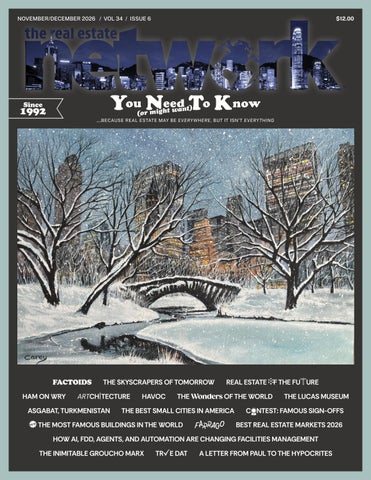
“CENTRAL PARK, NEW YORK” BY DARREN CAREY "'Central Park, New York' captures the quiet beauty of a snow-covered Central Park beneath a winter sky. Painted in watercolor and gouache, the scene focuses on Gapstow Bridge, framed by the intricate silhouettes of bare trees, with the warmth of Manhattan’s buildings glowing through the snowfall. I used M. Graham watercolors, made in New York, which seemed particularly fitting for a painting inspired by this iconic city and its winter atmosphere."
-9-
YOUR BUILDING HAS A RECYCLING SYSTEM. DOES EVERYONE UNDERSTAND IT?
Standardized recycling labels on your bins make it easier for tenants, employees, and visitors to know what goes where. One simple improvement can help make recycling easier throughout your property. Visit: .
/ THE NETWORK / NOVEMBER/DECEMBER 2026
To the Hypocrites in every land, in every church, in every legislature, and particularly to those who are especially fond of telling everyone else how to behave: Grace unto you and peace—if you can spare either. I write to you because word has reached me about your conduct, and I confess that I am perplexed. For you often speak of righteousness yet seem remarkably selective in its application. You proclaim that God sees all things yet apparently believe He has somehow overlooked what you do when no one is watching. You quote Scripture loudly but read it quietly. You carry Bibles in your hands and grudges in your hearts. You are quick to spot your neighbors’ sins and astonishingly slow to recognize your own. Brethren, this ought not to be so. You say, “Judge not,” and then immediately judge someone. You say, “Love thy neighbor,” but only if your neighbor votes and worships correctly, looks sufficiently like you, and does not park in your parking space. You proclaim that all people are children of God yet spend considerable energy deciding which children God apparently loves less. You praise humility while explaining at length how important you are. You boast of your faith while treating compassion as if it were a limited resource. When the hungry come unto you, you tell them that prayer is powerful. When the stranger comes unto you, you ask for his papers. When the poor come unto you, you give them advice. When the sick come unto you, you tell them to have faith. And when the suffering ask why God has abandoned them, you explain that their suffering is probably their own fault. Yet when you are in trouble, you suddenly desire mercy. When you are sick, you desire medicine. When you are hungry, you desire food. When you are frightened, you desire compassion. And when you have sinned, you desire context. Oh, Hypocrites! You are generous with context for yourselves and remarkably stingy with it for others. You have mastered the ancient spiritual art of turning every commandment into a suggestion for your neighbor and every suggestion into a commandment for yourself. You say, “God hates sin.” This is true, yet somehow you have appointed yourselves assistant managers of the hatred department. You keep lists. You categorize. You rank. You condemn. Somewhere along the way, you appear to have received a divine spreadsheet
listing the names of all those sufficiently sinful to warrant your attention. But I ask you: Who appointed you the keeper of another man's soul? Did Christ tell you to build a throne? Did He tell you to gather wealth while the widow went hungry? Did He instruct you to make your religion a weapon? Did He command you to shout “sinner” at everyone within earshot? No. He spoke of mercy. He spoke of forgiveness. He spoke of the poor. He spoke of the stranger. He spoke of those whom respectable people preferred not to associate with. And He was strangely unimpressed by those who made a public spectacle of their righteousness. You have become experts at performing holiness in public. You pray where everyone can see you. You give where everyone can see you. You condemn where everyone can hear you. You post your outrage online, then congratulate yourselves on your moral courage. Truly, you have discovered a wonderful new spiritual gift: the ability to sin publicly while believing that condemning someone else constitutes repentance. And what of forgiveness? You speak of it constantly. “Forgive us our trespasses,” you say. But when someone trespasses against you, the theological discussion suddenly becomes considerably more complicated. You remember every offense committed against you. You forget every offense you have committed against others. You demand apologies. You demand accountability. You demand consequences. And yet, when confronted with your own conduct, you ask everyone to “move on.” Hypocrites! You are like tombs painted beautifully on the outside, with excellent landscaping and perhaps a tasteful stone walkway, while inside are things best not examined too closely. And concerning wealth, I have heard your arguments. You say that prosperity is a blessing from God. Perhaps. But I wonder whether God also receives a percentage of the profits. You praise generosity while accumulating more than you could possibly need. You tell the poor to be content with little while you become increasingly creative in explaining why you require more. You say money cannot buy happiness. Then you spend your money attempting to buy it. And regarding politics, I must speak plainly. Some of you have apparently mistaken your preferred political party for the Kingdom of Heaven. You speak of political leaders as if they were prophets. You excuse their cruelty because they advance your cause. You overlook their dishonesty because they oppose your enemies. You forgive their arrogance because it is directed at the people you dislike. You have transformed “What would Jesus do?” into “What would Jesus do if He agreed with me?” This is a dangerous question. Christ did
BY ANDREW FELDER Managing Editor & Publisher aafelder@thenetworkmagazine.org not instruct you to love only those who love you. Tax collectors do that. He instructed you to love your enemies. And I suspect that many of you suddenly developed a theological exemption. You say, “But Paul, you do not understand these people.” Oh, I understand them. I have met difficult people. I have been imprisoned, beaten, opposed, insulted, and misunderstood. And I assure you that none of these experiences improved my opinion of myself enough to justify abandoning humility. Therefore, beloved Hypocrites, I beseech you: Before you condemn your neighbor, examine yourself. Before you demand justice, consider mercy. Before you preach morality, practice it. Before you announce what God thinks about someone else, remember that you are not God. And before you post another quotation from Scripture, perhaps read the chapter it comes from. This last suggestion may cause some of you considerable distress. For I fear that if you actually read the teachings of Christ, you may discover that He was considerably less interested in your political opinions, your cultural grievances, your accumulation of wealth, and your public displays of righteousness than you have been led to believe. He was rather preoccupied with loving people, especially inconvenient, unpopular, and people you don't like. Therefore, I say to you: Go and do likewise. Feed the hungry. Help the stranger. Visit the sick. Care for the poor. Forgive those who wrong you. Speak the truth without cruelty. Practice humility without announcing it. Give without demanding applause. And when you discover that someone has sinned, remember that you are standing in the presence of someone who, like you, is imperfect. In other words, try being a Christian before trying to identify everyone who isn't one. For faith without works is dead, and righteousness without humility is merely vanity in religious clothing. Finally, brethren, I leave you with this: If you must carry a sign, let it read “Love.” If you must shout, shout against injustice. If you must judge, judge yourself first. And if you must look for a sinner—try looking in the mirror. The grace of our Lord Jesus Christ be with you all. Even you. Especially you.
Paul
Humor
A LETTER FROM Paul TO THE Hypocrites
- 11 -
- 12 -
/ THE NETWORK / NOVEMBER/DECEMBER 2026
Betcha didn’t know... Don’t Be an Idiom Cold Feet Getting cold feet is an idiom meaning you’ve lost the courage to do something. The first idiomatic use of cold feet appeared in Stephen Crane’s second edition of Maggie: Girl on the Streets in 1896. By 1916, the related term cold-footers (and coldfeeters in Australia) had become a derogatory term for those who refused to fight in World War I. Gone to pot The idiom means that something has deteriorated or become ruined beyond repair. The expression dates to the 16th century and originally referred to the lesser cuts of meat cut up and cooked in a pot for soups and stews. Eventually, this meaning extended to describe anything broken down or deteriorated, like meat destined for stew. Synonyms: deteriorated, declined, total garbage, ruined, fallen apart, gone downhill. By the Same Token When someone says “by the same token,” they’re implying that a fact or piece of reasoning supports another point or fact. “Token” is an Old English word meaning a sign, symbol, or evidence. The full phrase derives from the word 'evidence'. It means that, given that evidence, we can infer that this other fact is also true. It’s another way
of saying for the same reason or in the same vein. Synonyms: In the same way, similarly, likewise, based on that, equally, for the same reason, on the same grounds. By the Skin of One’s Teeth Doing something by the skin of one’s teeth means narrowly succeeding or escaping a bad situation. It’s about a close call, a near miss, or achieving something by the narrowest margin. The idiom has biblical origins in the Old Testament’s Book of Job. In Job 19:20, Job says, “My bone cleaveth to my skin and to my flesh, and I escaped with the skin of my teeth.” Synonyms: by a hair’s breadth, by a narrow margin, just barely. Calling a Spade a Spade When someone calls a spade a spade, they’re speaking frankly and directly, often about an unpleasant truth or a difficult topic. This dates back to Ancient Greece, to Plutarch's works. But back then, it was “call a fig a fig and a trough a trough.” It evolved over time and made its English debut in 1542 in Nicolas Udall’s translation of Erasmus’s Apophthegmes. Fast-forward to today, and it’s still used to highlight honesty and frankness. Synonyms: tell it like it is, lay it on the line, be frank, be direct, speak one’s mind. Bought the Farm "Bought the farm" means to die. It originated in mid-20thcentury military and aviation jargon. Lexicographers don’t agree on a single, definitive source, but several popular theories explain how the phrase began: • During World War II, servicemen received government life insurance. If a soldier died, the payout was often large enough for his family to pay off a mortgage or buy a farm, so the soldier literally "bought the farm" with his death.
• Early Air Force and pilot slang linked it to fatal plane crashes. If a military plane crashed onto a private farm, the government paid the farmer for the damage. Dark humor among pilots suggested the unlucky pilot had bought the farm from the owner. • Pilots often talked about surviving the war so they could retire, settle down, and buy a farm. When a pilot died in a crash, comrades would grimly remark that he finally got his farm. The word "bought" had long been used in military slang to mean "suffered a misfortune" or "took the hit" (as in "he bought it"). Adding "the farm" was a sarcastic extension.
Lame Duck
A lame duck is an elected official in the final stretch of their time in office, either after a successor has been chosen or when they are ineligible to run again. The phrase first appeared in 1760s London to describe a stockbroker who went bankrupt or defaulted on his debts. Like an injured ("lame") duck that walks slowly or falls behind the rest of the flock, a financially ruined broker was seen as vulnerable, struggling, and unable to keep up with the competition. By the mid-1800s, the term had moved from finance to American and British politics, where it described politicians who were defeated or "broken-down" and nearing the end of their careers. Today, it describes leaders with limited power or influence because everyone knows they are leaving soon. However, because they no longer worry about re-election, they also have the freedom to make bold or unpopular choices before they leave.
A bus station is where a bus stops. A train station is where a train stops. On my desk, I have a workstation.
FACTOIDS
/ THE NETWORK / NOVEMBER/DECEMBER 2026
Werdz
Stealing ideas from one person is plagiarism; stealing from many is research.
Southpaw The term "southpaw" originated in boxing and f i s t-f ighti n g rather than baseball. The earliest known written use appears in an 1813 Philadelphia comic newspaper, The Tickler, which contrasted a "right paw" and a "south paw". The phrase was used decades before becoming a baseball term, appearing in an 1848 political cartoon depicting a left-handed punch and in an 1860 New York Herald prizefight report describing a left-handed blow. The earliest recorded baseball reference appears in the New York Atlas in 1858, describing a left-handed first baseman (disproving the myth that it was coined exclusively for pitchers). It became a common baseball term by the 1880s. Manumission Manumission is the formal act or process by which an individual slave owner voluntarily frees an enslaved person. It is carried out voluntarily by an individual master (such as through a last will and testament, a verbal promise, or a paid contract). Emancipation typically refers to freedom granted through broader government laws, executive orders, or public policy. The word comes from the Latin manumissio—combining manus (hand) and mittere (to let go)—meaning "a hand lets go".
upon the owner's death. Sometimes, enslaved individuals saved money through side labor or trade to buy their own freedom or that of family members. Governments and military leaders occasionally promised freedom to enslaved people who enlisted and served in armed conflicts (such as during the American Revolutionary War). In various ancient, colonial, or Islamic societies, freeing an enslaved person was viewed as a pious act, a condition of baptism, or a requirement after a set period of service. Why do we call a person in a bank a ‘teller?’ We call a bank clerk a "teller" because the word derives from an old meaning of the verb "tell," which meant "to count" or "to reckon." It traces back to Old English (tellan) and Middle English (tellen), where it meant to count or keep an account of items. We still use this original sense of counting in everyday phrases like "to tell time" (counting or reckoning the hours) or "all told" (counted all together).
with a larger denomination (like a paper bill) than the cost of the item. The word comes from the Old French changier and Latin cambiare, meaning to barter or exchange. By the 1620s, "change" began to describe the leftover balance returned after paying for something. By 1679, the term had shifted to specifically designate small coins—often handed back in silver or copper because paper notes were typically used only for larger sums. Amen Amen means "truly," "certainly," or "so be it." It derives from an ancient Hebrew root meaning "to be firm, faithful, or trustworthy." It expresses agreement, truth, or confirmation of a statement. When spoken at the end of a prayer or blessing, it means "let it be so." It entered Ecclesiastical Greek, then Late Latin, and eventually English and other languages through early religious texts. Some people link the word to the ancient Egyptian god Amun, but historians and linguists confirm this is merely a coincidence in sound with no real historical or linguistic connection.
Isograms By the mid-1700s, the noun "teller" was widely used to describe the bank employee whose primary job was to receive, count, and pay out cash. (This is also why an ATM is an Automated Teller Machine.) While North America commonly uses "bank teller," countries such as the United Kingdom, Australia, and New Zealand traditionally refer to the role as a bank clerk or cashier.
Owners frequently freed personal or domestic servants out of gratitude, loyalty, or close household relationships, often stipulating this in a will
- 13 -
Change (like coins in your pocket) We call loose coins "change" because the term originally described the leftover money returned to a customer during a transaction when paying
An isogram is a word or phrase in which letters either do not repeat at all or appear an equal number of times. Types: First-Order Isogram (Heterogram): Every letter appears only once (e.g., dialogue, uncopyrightable). [The word isogram itself is an isogram because no letters repeat.] [Uncopyrightable is the longest common word that is an isogram.] Second-Order Isogram: Every letter appears exactly twice (e.g., deed, bilabial). Third-Order Isogram: Every letter appears exactly three times (e.g., deeded, sestettes)
- 14 -
/ THE NETWORK / NOVEMBER/DECEMBER 2026
Nightmare
Over centuries, the meaning shifted. In the 1300s, it referred to the actual demon or monster that oppressed people during sleep. In the 1500s, it came to describe the feeling of suffocation and terror caused by the demon (sleep paralysis). By the 1800s, the meaning broadened to include any bad, frightening dream, losing its supernatural connotation. Because mare sounds identical to the modern word for a female horse, old illustrations and stories eventually began depicting nightmares as spooky, demonic horses. This was a linguistic coincidence rather than the word's true origin. renewed traction in modern political commentary as a term of criticism for incompetent or corrupt administrations.
Kakistocracy
Sounds like a made-up word... but it isn’t. A kakistocracy is a system of government run by the worst, least qualified, or most unscrupulous citizens. The word derives from two ancient Greek words: kákistos (meaning "worst") and krátos or kratia (meaning "rule" or "power"). It first appeared in the 17th century and has since gained
The Latest Dating Lingo
There’s a new vocabulary for discussing courtships — whether you’re navigating a “situationship” or a “soft launch.” You know what ‘ghosting’ is. When the person who ghosted you suddenly reaches out and acts as if nothing happened, it’s ‘Zombie-ing.’ Wildflowering means concealing undesirable qualities behind a facade. If you’re wildflowering a relationship, you’re allowing space for dishonesty, conflict, and/or confusion. ‘DTR’ stands for Define the Relationship. In other words, communicate your desires instead of waiting to see what the other person wants. The romance faded after a few dates, but your former flame still views and
Key characteristics include incompetence, corruption, and nepotism. Leaders lack the basic skills, training, or experience needed to govern effectively; they use power for personal or political gain rather than the public good; and unqualified friends, loyalists, or family members receive key government positions instead of qualified candidates. As a result, public services break down because of poor management, trust in public institutions erodes, and even “likes” your social media posts. This behavior is known as Orbiting. The person who shows interest in you but doesn’t follow through by planning a proper date or pursuing a real relationship is breadcrumbing — preying on the part of us that gets more excited by fluctuation than by stability. Then there’s catfishing (identity scamming), chatfishing (telling minor dating fibs), and kittenfishing (AI-enhanced
economic and social stability declines as decision-making favors self-serving agendas over the common good. Critics generally use the term to describe a national government. It has been used variously to describe the Russian governments of Boris Yeltsin and Vladimir Putin, the government of Egypt under Abdel Fattah Al-Sisi, governments in sub-Saharan Africa, the government of the Philippines under Rodrigo Duterte, Brazil under Jair Bolsonaro, and the governments of some presidents of the United States, including the Trump administrations. The term was named "2024 word of the year" by The Economist. fraud). The inverse of kittenfishing might be goblintimacy, meaning revealing the real you right away—warts and all. Someone in search of chalance wants commitment. (Rather than playing hard to get, a chalant dater is actively seeking love and is open about it.) Dating someone who might be less desirable than you in the relationship marketplace (but who is potentially loyal and appreciative) is known as shrekking. Keeping someone on your ‘roster’ in case your first choice doesn’t work out is called benching. When someone in a relationship keeps up flirty chats with other people ‘just in case,’ they are cushioning the blow of a potential breakup.
Politicians and diapers have one thing in common. They both need changing regularly, for the same reason.
A nightmare is a vivid, frightening dream that wakes a person from sleep and triggers strong negative emotions such as fear, terror, anxiety, or sadness. It can be caused by high anxiety, emotional tension, or major life changes; post-traumatic stress disorder (often involving the replay of past traumatic events); sleep deprivation, heavy late-night meals, alcohol, or caffeine close to bedtime; or by fevers, illness, or certain prescription medications. The word comes from Middle English and combines night and mare (an old folklore term for a goblin or demon believed to sit on a sleeping person's chest).
/ THE NETWORK / NOVEMBER/DECEMBER 2026
- 15 -
Before there was the CIA, there was the OSS
I don’t run from my problems. I sit on my couch, play on my phone, and ignore them... like all other adults.
Before World War II, the U.S. government left intelligence collection and dissemination to American foreign-policy experts and elements of the armed services. America’s entry into the war following the Pearl Harbor intelligence failure led to the establishment of the Office of Strategic Services (OSS) on June 13, 1942. President Franklin D. Roosevelt appointed William J. Donovan, a highly decorated World War I officer, as Director of the OSS. Donovan organized the OSS to reflect his vision of a national intelligence center that uniquely combined research and analysis, covert operations, counterintelligence, espionage, and technical development– core missions of today’s Central Intelligence Agency. Donovan’s Research and Analysis Branch, the OSS’s cornerstone, made significant contributions to the Allied victory. Staffed by some of America’s best minds, the branch provided timely assessments of the Allied bombing campaign in Europe, studied operations in countries where Allied forces were fighting, and prepared for the occupation of Germany. Perhaps most importantly, the branch validated Donovan’s vision of a central all-source analysis capability by demonstrating that the bulk of vital intelligence could be obtained not by parachuting behind enemy lines but by poring over papers, cables, reports, photographs, maps, journals, foreign newspapers, and other materials–laying the foundation for modern intelligence research and analysis. The OSS formed numerous “Operational Groups” to lead American units behind enemy lines. These were small teams of specially trained U.S. military commandos who fought in uniform, with no obvious ties to the OSS (so they would not be shot as spies if captured). Knowledge of a foreign language was essential. Training included parachuting, amphibious operations, skiing, mountain climbing, radio operation, and espionage tactics. Operational Groups fought in France, Italy, Greece, Yugoslavia, Burma, Malaya, and China, usually alongside partisan forces. At its peak, the OSS employed nearly 13,000 men and women and operated for just over three years, from 1942 to
1945. In that short time, it helped shorten the war and save lives across Europe, North Africa, and Asia. It left a legacy of daring and innovation that has shaped American military and intelligence thinking since World War II. The OSS did not directly become the Central Intelligence Agency (CIA). Instead, the temporary wartime agency was dissolved a month after World War II ended, and the rising threats of the Cold War prompted President Harry S. Truman to create the CIA as a permanent, peacetime replacement. The agency officially became active on September 18, 1947, alongside the newly formed National Security Council and the Department of Defense. Today’s Central Intelligence Agency draws a significant institutional and spiritual legacy from the OSS. In some cases, this legacy descended directly: key personnel, files, funds, procedures, and contacts assembled by the OSS found their way into the CIA more or less intact. In other cases, the legacy is less tangible but no less real: the professionalization of intelligence, the organizational esprit de corps, and the essential role of national intelligence in policymaking and warfare. The CIA owes a debt of gratitude to the OSS and to William J. Donovan, its charismatic leader and driving force.
- 16 -
/ THE NETWORK / NOVEMBER/DECEMBER 2026
Captchore How much time do you think we have collectively spent, as a species, convincing robots that we are not robots? By now, we must have wasted several millennia clicking all the parts of a bicycle on a captcha grid in someone’s front garden, sliding a jigsaw puzzle precisely into a pixellated hole, or clicking a box that says “I am not a robot,” as if the internet has suddenly discovered the honor system. Listen, if we ever want to pretend to be robots, let’s do
it the old-fashioned way, by covering ourselves in tinfoil and beep-booping our way into an enemy moon-lair. Quit-shaming In 2026, canceling an unwanted subscription should require exactly one mouse click. Often, though, it doesn't. If things are going well, the company will make you click through a series of increasingly desperate pages, pleading with you not to cancel (a pause? a discount? please, we love you!). Sometimes, however, you are forced to call a human being to cancel.
Chatflattery This one has real-world repercussions. The business model of large language models is retention, and they achieve this by agreeing with almost everything the user says. This makes the user feel special, but it can backfire spectacularly – as when ChatGPT confused a couple of my prompts and told me that decorating a cake with icing made of ham would be “unconventional, but potentially delicious.”
SPECIFY WOOSTER
▪ “State-of-the-Art” Anti Slip Safety ▪ Any Size Construction ▪ Highly Durable ▪ Code Compliant
NITEGLOW
ALUMOGRIT SUPERGRIT SPECTRA
Wooster Products Inc. “SERVING YOU SINCE 1921”
PROUDLY MADE IN THE USA
800-321-4936 woosterproducts.com sales@wooster-products.com
Q: What did the pirate say on his 80th birthday?
Dickover The “dickover” is the scourge of the modern age. Coined by John Gruber, a tech writer, it is “a modal panel, popover, or curtain presented by a website or app, deliberately obscuring its own content to frustrate the user.” Essentially, it’s the thing (or things) you have to click away to read what you wanted to read. It is the “accept cookies” box, the “allow notifications?” box, the “sign in with Google” box, the pop-up video box, etc.
A: Aye, matey.
New Words From Tech
/ THE NETWORK / NOVEMBER/DECEMBER 2026
- 17 -
El Niño: When the Pacific Ocean Changes the World's Weather
El Niño is a natural climate phenomenon that begins in the Pacific Ocean but can affect weather worldwide. It can influence temperatures, rainfall, storms, and droughts, including the weather experienced in the United States.
Experience is what you get when you don’t get what you want.
Peruvian fishermen named it El Niño, Spanish for “the little boy,” after noticing unusually warm ocean waters off the coast of South America around Christmas. Scientists now use the term to describe a periodic warming of the central and eastern tropical Pacific Ocean. El Niño is part of a larger climate cycle called the El Niño–Southern Oscillation (ENSO). This cycle has three phases: El Niño, its cooler counterpart La Niña, and neutral conditions. El Niño events occur irregularly, typically every two to seven years, and usually last nine to twelve months. Each event is unique, and its effects can vary considerably. What causes El Niño? Under normal conditions, steady equatorial winds, known as trade winds, push warm surface water westward toward Asia and Indonesia. Meanwhile, colder, nutrient-rich water rises from deeper waters near the coast of South America. This process supports marine life and fisheries.
During El Niño, these trade winds weaken and sometimes reverse. As a result, warm water moves back toward the Americas, and less cold water rises to the surface. Ocean temperatures rise across the central and eastern tropical Pacific, altering how heat and moisture are distributed through the atmosphere. These changes can alter large-scale wind patterns and shift the jet stream— the high-altitude air current that helps steer weather systems. The result can be significant weather changes far beyond the Pacific Ocean.
é This map shows El Niño's typical impacts on the continental U.S. and Canada during Northern Hemisphere winter. (Image credit: NOAA)
How does El Niño differ from La Niña? El Niño and La Niña often produce contrasting weather patterns, but neither guarantees a specific outcome in any given location. In the southern United States, El Niño tends to bring cooler, wetter winter conditions, sometimes increasing the likelihood of storms and heavy rainfall. La Niña often shifts the pattern in the opposite direction, favoring warmer, drier conditions and increasing drought risk in some areas. In the northern United States and parts of Canada, El Niño generally favors milder winter temperatures and, in some regions, less snowfall. La Niña can increase the likelihood of colder, snowier conditions in parts of the northern United States and Canada, including the Pacific Northwest.
These are broad tendencies, not reliable predictions for every city or every winter. Other atmospheric conditions also influence the weather, and the effects of either phase can vary year to year. What can we expect? The strength of an El Niño event matters. A particularly strong event can have far-reaching effects on global weather, increasing the risk of flooding in some regions and contributing to
drought in others. It can also influence tropical cyclone activity, agricultural production, water supplies, and ecosystems. Forecasts of a strong El Niño developing in late 2026 and continuing into early 2027 should be closely monitored. However, the event's eventual strength, timing, and regional consequences remain significant uncertainties. A “Super El Niño” is an informal term rather than a universally standardized scientific classification, and claims that an event will rank among the strongest on record require supporting observations and forecasts. El Niño does not cause every storm, drought, or heat wave. Rather, it alters the odds of certain weather conditions in different parts of the world. Understanding these changes helps scientists, governments, farmers, businesses, and communities prepare for potential disruptions. The essential point is simple: A change in ocean temperatures thousands of miles away can affect the weather where we live. El Niño is a powerful reminder that Earth's oceans and atmosphere form a single, interconnected climate system. n
Need help with your design? At we design solutions for your business – from a new logo to a catalogue, the packaging or menu of your restaurant or an interior design concept to attract all passers-by. CLICK ON THE IMAGES TO SEE THE PROJECTS ON OUR WEBSITE:
ED TRUST OR OF T BORA COLLA 2019 SINCE
MAGAZINE DESIGN RETAIL DESIGN CONCEPT AND INTERIORS
CREATIVE AND DESIGN SERVICES BRANDING + LOGO + PACKAGING MAGAZINES + BOOKS + CATALOGUES BUSINESS CARDS + FLYERS SOCIAL MEDIA + EMAIL CAMPAIGNS RETAIL DESIGN: CONCEPT AND INTERIOR RESTAURANT MENUS
LOGO + PACKAGING
Tell us what you need or want We'll come up with a no cost/no obligation proposal you’ll love! Get in touch! www.agosto.studio
BRANDING + MENUS
hello@agosto.studio
/ THE NETWORK / NOVEMBER/DECEMBER 2026
Humor
A farrago is a jumble of odds and ends—a random collection of items, a disorganized mix of things that don't fit together. Farrago sounds more formal than hodgepodge or mishmash, but it means about the same thing. We hope you enjoy this new feature of
- 19 -
donald, duck!!!!
one of the absurdities of old age is that you think of it as an achievement when you make it to the toilet without leaking.
“i am thor!!! “you’re thor? i’m so thor i can hardly thit.”
i’m at that stage of life where “make up sex” means making believe it happened.
she: “hi, andrew. how are you today?” he: “great, thanks. what’s your name?” he: “right breast?”
“yes. i’d like to hear what this dick has to say.”
‘i must’ve left it in my other pants.’
“the horses are on the track. ladies and gentlemen, there is a change in the program. there is a change in the program. the number four horse, ‘harass,’ will not be running. repeat: the number four horse, ‘harass,’ will not be running. be sure to scratch ‘harass.’”
ALL PICTURES ON THIS PAGE ©️ 2026 CREST PUBLICATIONS GROUP.
- 20 -
/ THE NETWORK / NOVEMBER/DECEMBER 2026
DIVERSI NS FROSTI HOGWASH
I used up all my sick leave, so I called in dead.
FIVE KILLED
I AM IN REAL ESTATE
ALL PICTURES ON THIS PAGE ©️ 2026 CREST PUBLICATIONS GROUP.
ARSENAL BUSINESS COLLECTIONS
A NON-TRADITIONAL APPROACH TO BUSINESS COLLECTIONS Accounts Receivable Tracking them is good. Collecting them is better!
It’s easy as ABC
Business-to-business debts require specialized expertise and finesse… and selecting your commercial collection service is an important decision. It revolves around Service, Trust, and Recovery. Rates matter, and recovery is the objective (the bottom line) … but there is more to it. The company you choose will handle your money, communicate with your customers, and represent you in the marketplace. As we all know, idiomatically speaking – but in a very real sense – you are judged by the company you keep. At Arsenal Business Collections, we understand that your accounts receivable are a key part of your business. Ensuring timely payment for goods or services is critical to any successful business. Whether you’re a small business owner with one past-due invoice or a multi-state corporation with a large volume of delinquent accounts, we are equipped to handle your collection needs. We assist companies across the country in collecting accounts receivable. It’s simple. At ABC, you’re never out-of-pocket for our services. We collect on prearranged terms, and we get paid only when we succeed (i.e., once we collect the money owed to you). There is no fee unless and until we collect. The initial communications between a bill collector and a debtor are often contentious. Yet those communications often determine the
success of the effort. Our experienced and knowledgeable professionals (including attorneys) work with you to customize an approach that accomplishes your objectives. We create individualized correspondence to address the specific circumstances of your delinquent account. Often, early contact with delinquent accounts increases the likelihood of returns and maximizes them. We use faxes, courier services, registered mail, first-class mail, and/or e-mail, mindful of the sensitivities of the situation. Sometimes a delinquent account results in the termination of business relationships, a referral to collections, and perhaps legal action – somewhat akin to a bitter divorce. Occasionally, however, an invoice is a particular dispute that should not disrupt an otherwise beneficial and ongoing relationship. We are discreet; we are not a clearinghouse for companies that generate hundreds of accounts receivable weekly. We view each delinquency individually; we take the time to understand and care – and we maintain regular contact with you.
ate. In certain exigencies, we can work with your Accounts Receivable Department to make calls from the earliest stages of delinquency. We make prompt contact with the customer to determine the reasons for non-payment and assess ability (and willingness) to pay. Skilled in communicating with customers, we structure and monitor payment plans where appropriate. We know the delaying tactics some customers use, how to counter them, and how to negotiate payment with a blend of sensitivity and assertiveness. We know you may not be the only creditor seeking payment from a delinquent debtor. We vigorously represent your position, and our ethical approach to collections protects your relationship with the customer. As a privately owned company, we make decisions based on what is best for clients, not shareholders or outside investors. Our focus is exclusively on improving your bottom line.
We have the knowledge and experience to deliver exceptional results. Contact us for a free consultation.
We provide verbal and written status reports and will refer the matter and supervise judicial collection efforts when you choose. Our payment is contingent upon your recovery – so our success is integrally tied to yours. We enter the picture at whatever stage you consider most appropri-
ARSENAL BUSINESS COLLECTIONS
Arsenal Business Collections …because sometimes it’s what you know Tel: 214-755-2277 Fax: 817.924.7116
www.thearsenalcompanies.com
- 22 -
/ THE NETWORK / NOVEMBER/DECEMBER 2026
In 1893, the case of Nix v. Hedden asked the Supreme Court to settle a burning question: Is a tomato a fruit or a vegetable? This wasn't just philosophical pondering—tariff laws taxed vegetables but not fruits, so there was serious money at stake for New York importers bringing tomatoes into the country. The Court unanimously decided that, for legal purposes, tomatoes are vegetables, even though botanically they're fruits.
Mercury, not Venus, is the closest planet to Earth on average.
k
is the onl y
h fis
A sh ar
On average, Mercury is 1.04 astronomical units (AU) away from Earth, compared with the 1.14 AU average distance between Earth and Venus. One AU is equal to the average distance between Earth and the Sun. However, Venus still comes closest to Earth during its orbit around the Sun.
c
t
h
t
ey es
th a an
blink b o
A group of crows is known as a murder, but it also has several other collective nouns, including a horde, a hover, a mob, a parcel, a parliament, and a storytelling.
It’s not unusual to find a letter in your mailbox addressed to the person who lived in your house before you, and you may be tempted to toss it in the trash. But since 1948, that’s a big no-no. Tossing out mail intended for someone else is a federal felony, with penalties that can be severe, including up to five years in federal prison and fines up to $250,000. The proper way to proceed is to write "return to sender" or “not at this address” on the envelope, put it back in the mailbox, and let the post office take it from there.
Fish form orderly queues in emergencies. When evacuating through narrow spaces in sketchy situations, schools of neon tetra fish queue so that they don’t collide or clog up the line. Scientists interpreted this behavior as showing that fish can respect social rules even in emergency situations, unlike us humans.
Tom Hanks played Fred Rogers in the 2019 film A Beautiful Day in the Neighborhood, but their connection doesn’t stop there. An Ancestry.com dig into their family trees found that the two are sixth cousins who share a five-timesgreat-grandfather. What’s more, they’re both descendants of two American brothers who fought in the Revolutionary War, according to People magazine.
Your signature could reveal personality traits. A 2016 study purports that among men, a larger signature correlates with higher social bravado, and among women, a bigger signature correlates with narcissistic traits. Some people have mocked President Trump’s signature, saying it looks like the results of a lie detector test. Analysts agree that his use of large letters indicates that he loves attention, and the narrow spaces between each letter suggest he can’t stand to be alone.
The eye is one of the most complex and fascinating organs of the human body. It can distinguish up to 10 million colors and adapts so quickly that it can adjust to extreme light conditions within seconds. Plus, your eyelids blink 15 to 20 times per minute, which is roughly 10% of the time you spend awake! If you have blue eyes, you are among the 8 to 10% of the world's population. Blue eyes result from a mutation that reduces pigment in the iris. Researchers believe this mutation first appeared in a person living in Europe 6,000 to 10,000 years ago, meaning that all blue-eyed people living today share a common ancestor.
“Cleaning your house while your kids are still growing is like shoveling the walk before it stops snowing.” — Phyllis Diller
TIGERS HAVE STRIPED SKIN, NOT JUST STRIPED FUR.
TR E DAT
IFMA 2026 18-20 Nov 2026 | Anaheim, California
THE PREMIER DESTINATION FOR FACILITY PROFESSIONALS
Embark on a journey of professional discovery. Step into a world of career possibilities. IFMA’s World Workplace is a learning and networking adventure designed to energize, inspire and inform, elevating your impact and influence in managing the built environment.
NEW CURATED TRACKS – WHAT WILL YOU EXPLORE? −
−1−
Connected Buildings
Practical application of digital technologies within the built environment
−5−
Resilient Facilities How to strengthen adaptability, continuity and preparedness in an uncertain world
Conference Education Program Sponsored by
− 2−
Digital Futures
Emerging tech, disruptive ideas and transformational trends shaping FM
− 6−
Future Workplaces
The relationship between people, place, performance, experience and evolving work
− 3−
Leading Change
How FM leaders are navigating shifts in an increasingly complex environment
−4−
Facility Operations
Operational strategies that form the backbone of high-performing facilities
− 7−
World Workplace Live*
How FM leaders are navigating shifts in an increasingly complex environment
− 8−
FM Solutions
Innovative tools and real-world solutions for tackling every-day challenges
*Sessions in this track will be livestreamed for virtual attendees.
BEST VALUE: Full event includes all sessions, speakers, networking activities and The Expo. Register at worldworkplace.ifma.org
View all sessions
- 24 -
/ THE NETWORK / NOVEMBER/DECEMBER 2026
The
of the Modern World
THOMAS WOLF, WWW.FOTO-TW.DE / WIKIMEDIA COMMONS / CC BY-SA 3.0
This is part 14 of our series – 200 Wonders!
Mount Rushmore United States
Mount Rushmore is a national memorial featuring a colossal sculpture carved into the granite face of Mount Rushmore (or Six Grandfathers Mountain) in the Black Hills, about 2 mi southwest of Keystone, South Dakota. The sculptor, Gutzon Borglum, named it the Shrine of Democracy and oversaw its execution from 1927 to 1941, with help from his son, Lincoln Borglum. The sculpture features 60-foot-tall depictions of the heads of four United States presidents: George Washington, Thomas Jefferson, Theodore Roosevelt, and Abraham Lincoln, chosen to represent the nation's foundation, expansion, development, and preservation. Mount Rushmore attracts more than two million visitors annually to the memorial park, which covers 1,278 acres. Its highest point reaches 5,725 feet. Borglum chose Mount Rushmore in part for its southeast-facing orientation and maximum exposure to sunlight. South Dakota’s state historian proposed the carving. Robinson originally wanted the sculpture to feature American West heroes, including Lewis and Clark, their expedition guide Sacagawea, Oglala Lakota chief Red Cloud, Buffalo Bill Cody, and Oglala Lakota chief Crazy Horse. Borglum argued that the sculpture should be national rather than regional in scope, which convinced them to choose the four presidents instead. Peter Norbeck, U.S. senator from South Dakota, sponsored the project and secured federal funding.[14] Construction began in 1927, and the presidents' faces were completed between 1934 and 1939. After Gutzon Borglum died in March 1941, his son Lincoln took over as leader of the project. Each president was originally to be depicted from head to waist, but lack of funding forced construction to end on October 31, 1941. Only Washington's sculpture includes any detail below chin level. The sculpture at Mount Rushmore was built on land taken from the Sioux Nation in the 1870s. In 1980, the U.S. Supreme Court ruled in United States v. Sioux Nation of Indians that the taking of the Black Hills required just compensation and awarded the tribe $102 million. The Sioux have refused the money and continue to demand the return of the land. This conflict persists, leading some critics of the monument to call it a "Shrine of Hypocrisy."
The Gateway Arch United States
Gateway Arch is a 630-foot-tall monument in St. Louis, Missouri. Clad in stainless steel and shaped as a weighted catenary arch, it is the world's tallest arch and Missouri's tallest accessible structure. Some sources consider it the tallest man-made monument in the Western Hemisphere. Built as a monument to the westward expansion of the United States and officially dedicated to "the American people," the Arch, commonly known as "The Gateway to the West," is a National Historic Landmark in Gateway Arch National Park. It has become a popular tourist destination and an internationally recognized symbol of St. Louis. Finnish-American architect Eero Saarinen designed the Arch in 1947. Construction began on February 12, 1963, and was completed on October 28, 1965, at a total cost of $13 million (equivalent to $98.4 million in 2024). The monument opened to the public on June 10, 1967. It is located at the 1764 site of St. Louis's founding on the west bank of the Mississippi River.
é LC-39A (foreground) and LC-39B (background) on April 6, 2022.
è Apollo 11, carrying the first humans to land on the Moon, lifts off from pad 39A, July 16, 1969.
The Kennedy Space Center United States
The John F. Kennedy Space Center (KSC, originally known as the NASA Launch Operations Center), located on Merritt Island, Florida, is one of NASA's ten field centers. Since 1968, it has been NASA's primary launch center for American spaceflight, research, and technology. The Center has conducted launch operations for the Apollo, Skylab, Space Shuttle, and Artemis programs from Kennedy Space Center Launch Complex 39. Located on Florida's east coast, it is adjacent to Cape Canaveral Space Force Station (CCSFS). The two entities work very closely together, share resources, and operate facilities on each other's property. Although the first Apollo flights and all Project Mercury and Project Gemini flights launched from the then-Cape Canaveral Air Force Station, KSC and its predecessor, the Launch Operations Directorate,
“My tastes are simple: I am easily satisfied with the best.” ― Winston S. Churchill
DANIEL SCHWEN, CC BY-SA 4.0, VIA WIKIMEDIA COMMONS
Seven Wonders
/ THE NETWORK / NOVEMBER/DECEMBER 2026
- 25 -
CN Tower Toronto, Canada
managed the launches. Starting with the fourth Gemini mission, the NASA launch control center in Florida (Mercury Control Center, later the Launch Control Center) began handing vehicle control to the Mission Control Center in Houston shortly after liftoff; in prior missions, it retained control throughout the mission.
The CN Tower is an 1,815.3-foot communications and observation tower in Ontario, Canada. Completed in 1976 and located in downtown Toronto, the tower's name "CN" refers to Canadian National, the railway company that built it. Following the railway's decision to divest non-core freight railway assets before the company's 1995 privatization, the railway transferred the tower to the Canada Lands Company, a federal Crown corporation responsible for the government's real estate portfolio.
The Sydney Opera House Australia
Q: Why did Tigger stick his head in the toilet?
Designed by Danish architect Jørn Utzon, the building was formally opened by Queen Elizabeth II in October 1973, 16 years after Utzon won an international design competition in 1957. The Government of New South Wales, led by Premier Joseph Cahill, authorized construction to begin in 1958, with Utzon directing the work. The government's decision to build Utzon's design is often overshadowed by subsequent events, including cost and scheduling overruns and the architect's eventual resignation. The building and its surroundings occupy the entire Bennelong Point on Sydney Harbor, between Sydney Cove and Farm Cove, adjacent to the Sydney central business district and the Royal Botanic Garden, and near the Sydney Harbor Bridge.
A: To find Pooh
The building’s multiple performance venues host more than 1,800 performances each year, drawing more than 1.4 million attendees. Numerous performing artists, including resident companies such as Opera Australia, the Sydney Theatre Company, and the Sydney Symphony Orchestra, perform. As one of Australia's most popular visitor attractions, the site draws more than ten million visitors each year. The Sydney Opera House Trust, an agency of the New South Wales State Government, manages it.
é The CN Tower as seen from Puente de Luz in 2025
CHRIS WOODRICH, CC BY-SA 4.0, VIA WIKIMEDIA COMMONS
The Sydney Opera House is a multi-venue arts center in Sydney, New South Wales, Australia. Situated on the foreshore of Sydney Harbor, it is widely regarded as one of the world's most famous and distinctive buildings and a masterpiece of 20th-century architecture.
The CN Tower held the record for the world's tallest free-standing structure for 32 years, from 1975 until 2007, when it was surpassed by the Burj Khalifa. It remained the world's tallest tower until 2009, when it was surpassed by the Canton Tower. It is currently the tenth-tallest free-standing structure in the world and remains the tallest in North America, the Western Hemisphere, and the entire Western world. It is a signature icon of Toronto's skyline, attracting more than two million international visitors annually. It houses several observation decks, a revolving restaurant at around 1,150 feet, and an entertainment complex.
THOMAS ADAMS, CC BY-SA 4.0, VIA WIKIMEDIA COMMONS
About 700 facilities and buildings are spread across the center's 144,000 acres. Unique facilities at KSC include the 525-foot-tall Vehicle Assembly Building, used to stack NASA's largest rockets; the Launch Control Center, which conducts space launches at KSC; the Operations and Checkout Building, which houses the astronauts' dormitories and suit-up area; a Space Station factory; and a 3-mile-long Shuttle Landing Facility. A Visitor Complex on site is also open to the public.
é The Guggenheim Museum Bilbao, along the Nervión Estuary in central Bilbao.
The Guggenheim Museum Bilbao, Spain
The Guggenheim Museum in Bilbao, Biscay, Spain, is a museum of modern and contemporary art. It is one of several museums affiliated with the Solomon R. Guggenheim Foundation and hosts permanent and visiting exhibitions by Spanish and international artists. King Juan Carlos I of Spain inaugurated it in October 1997 with an exhibition of 250 contemporary works of art. It is among Spain's largest museums.
NAOTAKE MURAYAMA, CC BY 2.0, VIA WIKIMEDIA COMMONS
/ THE NETWORK / NOVEMBER/DECEMBER 2026
Designed by Canadian-American architect Frank Gehry, the building sits along the Nervión River, which flows through the city to the Cantabrian Sea. A work of contemporary architecture, it has been hailed as a "signal moment in the architectural culture" because it represents "one of those rare moments when critics, academics, and the general public were all completely united about something," according to architectural critic Paul Goldberger. In the 2010 World Architecture Survey, among architecture experts, the museum was the building most frequently named as one of the most important works completed since 1980.
The Burj Khalifa United Arab Emirates
The Burj Khalifa is a megatall skyscraper in Dubai, United Arab Emirates. Designed by the SOM architectural firm, it is the world's tallest structure, standing 2,722 ft (just over half a mile). It has been the world's tallest building since its completion in 2011, surpassing Taipei 101, which had held the record since 2004. Construction of the Burj Khalifa began in 2004, and the exterior was completed five years later. The primary structure is reinforced concrete. Some of the building's structural steel was salvaged from the demolished Palace of the Republic in East Berlin. The building opened in 2010 as part of the Downtown Dubai development. It was designed to be the centerpiece of a large-scale, mixed-use development. The building became fully operational when its last major facility opened in 2011. The building is named after the former president of the United Arab Emirates (UAE), Sheikh Khalifa bin Zayed Al Nahyan. The UAE government provided Dubai with financial support because the developer, Emaar Properties, faced financial problems during the Great Recession. Then-president of the UAE, Khalifa bin Zayed, organized federal financial support. In recognition of that support, Mohammed bin Rashid, Ruler of Dubai, changed the name from "Burj Dubai" to "Burj Khalifa." The design draws on the Islamic architecture of the region, including the Great Mosque of Samarra. The Y-shaped tripartite floor plan is intended to optimize residential and hotel space. A buttressed central core and wings support the building's height. The central core houses all vertical transportation, except egress stairs, within each wing. The structure also features a cladding system designed to withstand Dubai's hot summer temperatures. The Burj Khalifa has 57 elevators and 8 escalators. n
“I always cook with wine. Sometimes I even add it to the food.” — W.C. Fields
- 26 -
/ THE NETWORK / NOVEMBER/DECEMBER 2026
THE
PICTURE
As you get older, three things happen. First, your memory goes. I can’t remember the other two.
HOW AI, FDD, AGENTS, AND AUTOMATION ARE CHANGING FACILITIES MANAGEMENT Facilities management is shifting from reactive maintenance to intelligent, increasingly autonomous operations. The convergence of AI, Fault Detection & Diagnostics (FDD), digital twins, AI agents, IoT, and workflow automation is creating a new operating model for buildings: sense understand predict decide act learn. Traditional FM systems collect enormous amounts of data but often leave people to interpret it manually. AI can continuously analyze HVAC and BAS/BMS data, energy consumption, equipment performance, occupancy and environmental conditions, work orders and maintenance histories, sensor anomalies, and asset condition and utilization, and probably much more. This shifts the FM paradigm from "What went wrong?" to "What is likely to go wrong, why, and what should we do?" It changes the very nature of a facility manager’s job, shifting it from reactive to proactive. AI is already being deployed across energy management, predictive maintenance, workflow automation, space utilization, security, and digital twin applications. Fault Detection & Diagnostics (FDD) is one of the most practical applications of AI in facilities. Instead of waiting for an occupant to report that a room is too hot, FDD can detect patterns such as a valve that is not responding properly, simultaneous heating and cooling, a damper stuck in the wrong position, an AHU operating outside its expected performance, equipment running when the building is unoccupied, or a gradual deterioration in equipment performance. Modern FDD goes beyond generating alarms. The objective is to identify the likely fault, estimate its impact, prioritize it, and guide the technician to the root cause. AI agents can sit atop FDD systems, translat-
ing diagnostic results into explanations and recommended actions.
AI AGENTS: FROM "INSIGHT" TO "ACTION"
A conventional AI system might say: "AHU-03 has an abnormal supply-air temperature." An AI agent could retrieve the relevant BAS data, compare current performance with historical patterns, check FDD rules and equipment relationships to determine probable root causes, review previous work orders, estimate the incident's severity and operational impact, recommend corrective action, create or recommend a work order, identify the appropriate technician, and monitor the equipment after the repair. In other words, the AI moves from answering questions to executing workflows. AI is only as useful as its understanding of the facility. Research increasingly combines digital twins, machine learning, IoT, BIM, and maintenance data for predictive maintenance. Instead of treating a temperature sensor as an isolated data point, the system understands that the sensor belongs to an AHU that serves specific zones, which depend on specific valves, dampers, pumps, and controls. This creates a much richer question for AI: "Why is this space uncomfortable?" rather than simply: "What is the temperature?" The real opportunity isn't merely automating analysis. It's automating the entire operational loop. In traditional facility management, the process often follows this sequence: Alarm Operator investigates Technician dispatched Repair Manual documentation. With AI-enabled facility management, it would be more like: Sensor data Detection Diagnosis Prioritization Work order Technician Repair Verification Learning.
BY ANDREW FELDER Respond to alarms
Today
Emerging Model Manage exceptions
Review dashboards
Ask AI for explanations
Schedule preventive maintenance
Optimize maintenance based on condition
Manually investigate faults
AI-assisted root-cause analysis
AI-generated/prioritized work orders
Continuously optimize energy
Capture organizational knowledge in AI
Predictive/proactive operations
Create work orders Track energy bills Rely heavily on individual expertise Reactive operations One building at a time
Portfolio-level optimization
A PRACTICAL ADOPTION PATH: 1. Connect the data — BAS/BMS, IoT, CMMS/ IWMS, and energy and asset data. 2. Clean and standardize asset information — including equipment IDs, points, locations, and relationships. 3. Deploy FDD — start with high-value HVAC and energy-related problems. 4. Add AI-assisted diagnostics — turn alarms into explanations and prioritized actions. 5. Introduce agents — automate information gathering and repetitive workflows. 6. Connect agents to CMMS/work-order systems. 7. Automate low-risk actions with human approval. 8. Move toward closed-loop optimization only after data quality, controls, cybersecurity, and governance are mature. The key principle is not to jump directly to autonomy. Emerging research emphasizes staged deployment, continuous model calibration, data provenance, human oversight, and safeguards for closed-loop automation.
AI doesn't eliminate the facility manager's role. It changes where human expertise is applied. The technician becomes less of a data detective and more of a problem solver. The facility manager increasingly becomes an orchestrator of people, assets, AI, and automated workflows. The longterm vision is not a building that simply has more sensors. It is a facility that can: Sense Understand Predict Decide Act Verify Learn. That is much more than predictive maintenance. It is an intelligent operating system for the facility.
The future of facilities management isn't simply "AI in the FM department." It is the convergence of: AI + FDD + Digital Twins + Agents + IoT + Automation + Human Expertise. Together, they transform facilities from assets people monitor and maintain into systems that continuously sense, reason, optimize, and increasingly act. The strategic shift can be summarized in one sentence: FM is moving from managing equipment and work orders to managing an intelligent, continuously learning operational system. Managing Editor & Publisher of (and an attorney) aafelder@thenetworkmagazine.org
Feature
BIG
- 27 -
/ THE NETWORK / NOVEMBER/DECEMBER 2026
TRENDI G BY ADAM MCCANN
Best Real Estate Markets in 2026 Whether you’re in the real estate business or just looking for a place to call home, it’s important to understand the housing markets you’re considering before investing in a property. If you aim to make a profit in the long run with your housing purchase, you’ll need to look beyond tangible factors like square footage and style. Those factors certainly drive up property values. From an investor’s standpoint, though, they matter less than his-
torical market trends and the economic health of residents. To determine the best local real estate markets in the U.S., WalletHub compared 300 cities of varying sizes using 17 key indicators of housing-market attractiveness and economic strength. The dataset includes metrics such as median home-price appreciation, housing affordability, and job growth.
In-Depth Look at the Best Real Estate Markets Frisco, TX, has the best real estate market, with nearly 47% of homes built between 2010 and 2024. That’s good news for people who want the benefits of a recently constructed home, like not having to put in a lot of work right away. In addition, Frisco is an affordable place to live. When you look at home prices as a percentage of income, the city is the 95th-cheapest among the 300 cities in our study. But it’s the 11th-cheapest for
phone service and the 11th-cheapest for maintenance and energy. Finally, it has the seventh-best job growth rate in the country, which helps attract new residents to its growing housing market. McKinney, TX (which borders Frisco), has the second-best real estate market in the U.S., largely due to its recent growth. McKinney has the second-highest share of homes built between 2010 and 2024, at roughly 40%, meaning new buyers have many options for homes that may not need major maintenance for a while. More new housing is also coming, as McKinney has the 10th-highest number of building permits per capita. While McKinney isn’t necessarily the cheapest city to move to, it’s also far from the most expensive. The median home price in McKinney is around 380% of the median income, making it the 73rd-cheapest of the 300 cities in our study. It also ranks among the 35 least expensive cities for maintenance, telephone, and energy costs. To top it off, McKinney has a strong job market to
I’ve been on a diet for two weeks, and all I’ve lost is 14 days.
Studies and Reports
- 28 -
Frisco, TX
70,72
2
Affordability & Economic Environment Rank
Total Score
1
Overall Rank
City
Real-Estate Market Rank
/ THE NETWORK / NOVEMBER/DECEMBER 2026
2
McKinney, TX
69,83
5
1
3
Murfreesboro, TN
68,97
3
3
4
Durham, NC
68,34
1
13
5
Denton, TX
68,08
6
39
6
Cary, NC
67,6
7
22
7
Madison, WI
66,97
4
17
8
Allen, TX
65,3
14
86
Some people's only exercise is jumping to conclusions.
9
Charlotte, NC
64,62
9
11
10
Irvine, CA
64,28
8
60
11
Charleston, SC
63,49
21
85
12
Roseville, CA
63,46
25
25
13 Gilbert, AZ
63,41
33
18
14 Salt Lake City, UT
63,4
15
7
15 Knoxville, TN
63,33
17
58
16 Richardson, TX
63,23
13
50
17
Stamford, CT
63,15
10
84
18 Jersey City, NJ
62,93
18
152
19 Raleigh, NC
62,75
20
56
20 Henderson, NV
62,45
39
55
Carrollton, TX
62,32
22
12
22 Fort Worth, TX
21
62,25
36
66
62
23
24
23 Boise, ID 24 Grand Rapids, MI
61,96
19
77
25 Nashville, TN
61,94
24
132
26 North Charleston, SC
61,68
32
79
27 Surprise, AZ
61,35
61
47
28 Lincoln, NE
61,2
41
10
29 Santa Clara, CA
61,03
11
41
30 Wilmington, NC
60,93
27
250
31 Seattle, WA
60,88
26
131
32 Austin, TX
60,84
42
153 59
33 Clovis, CA
60,83
72
34 Ontario, CA
60,81
37
6
35 Longmont, CO
60,66
12
78
36 Green Bay, WI
60,46
50
261
37 Fort Collins, CO
60,32
16
52
38 Miami, FL
60,28
30
260
39 Elk Grove, CA
60,27
55
167
40 Irving, TX
60,23
51
48
41
60,15
29
68
60,14
69
178
43 Salem, OR
60,06
46
21
44 Manchester, NH
60,05
31
87
45 Richmond, VA
59,97
35
180
46 Tempe, AZ
59,97
43
180
47 Athens-Clarke, GA
59,8
38
128
48 Columbus, OH
59,77
44
165
49 Naperville, IL
59,76
79
139
50 Chandler, AZ
59,6
73
19
Bellevue, WA
42 Peoria, AZ
- 29 -
match its healthy real estate market. It has the sixth-highest job growth rate in the nation, at over 17% annually. Murfreesboro, TN, has the third-best real estate market, driven in part by robust residential development. The city has the fourth-highest share of housing units built between 2010 and 2024, along with the 26th-highest building-permit activity in the country. It can be a bit pricey to buy a house, as Murfreesboro ranks 137th for housing affordability – but that’s still among the cheaper half of the 300 cities in our study. In addition, Murfreesboro's housing market is relatively balanced, with homes spending an average amount of time on the market. Its residents also seem able to keep up with their housing costs. The city has the 46th-lowest mortgage delinquency rate and the 11th-lowest foreclosure rate. Murfreesboro's low unemployment rate and strong job growth also help residents make their payments on time. Find the other 250 cities on the list; see the methodology in depth; and read expert commentary <HERE>. n
YOUR COMMERCIAL FLOORING SPECIALIST CARPET · TILE · CONCRETE · WOOD
FIRST IMPRESSIONS COUNT!
You deserve to work in an eco-friendly, clean, sanitized environment. Your carpet is your largest filter of allergens, dirt, bacteria, and viruses. When it is truly clean, your flooring promotes your health and that of your staff and clients.
www.NextLevelSurfaceCare.com
Jason Cox
Adam McCann is a personal finance writer for WalletHub.
jason@NextLevelSurfaceCare.com (972) 905 - 1278
- 30 -
/ THE NETWORK / NOVEMBER/DECEMBER 2026
THE
FACTOR
THE LUCAS MUSEUM When Art Becomes Real Estate
Rising at the edge of Exposition Park in South Los Angeles, the enormous white structure is hard to miss. It looks vaguely like a spaceship, a futuristic mountain, or perhaps an exceptionally expensive sneaker. Whatever you see in it, one thing is certain: nobody is going to confuse it with the building next door. And that, in many ways, is the point. The Lucas Museum opened on September 22 and is far more than a new destination for art lovers. It is a $1 billion-plus private investment in a part of Los Angeles that has historically received considerably less attention—and considerably less investment—than some of the city's more affluent neighborhoods. For anyone interested in real estate, development and urban transformation, that may be the most compelling story of all.
A BILLION-DOLLAR BET Ma Yansong, a Chinese architect and founder of MAD Architects, designed the 300,000-square-foot museum. Its enormous exterior comprises more than 1,200 fiberglass-reinforced polymer panels, assembled almost like pieces of a gigantic three-dimensional puzzle. The building's unusual shape isn't merely architectural showmanship. It was designed to interact with the surrounding park, with gardens, pedestrian paths, and landscaped areas replacing what had previously been a fenced asphalt parking lot. That is an important distinction. A development can put an impressive building on a site. A truly successful development changes how people experience the surrounding neighborhood. The Lucas Museum is attempting to do both.
LOCATION, LOCATION, CULTURE The museum's location has an almost cinematic quality of its own. It sits directly across from the University of Southern California, where Lucas studied film, and is surrounded by some of Los Angeles' most significant civic and cultural institutions. In other words, this isn't a museum dropped into the middle of nowhere. It is part of an increasingly important cultural corridor. Los Angeles has spent decades building an extraordinary collection of museums, including the Getty, the Huntington, the Norton Simon, the Hammer, the Broad, and the Los Angeles County Museum of Art. The Lucas Museum adds another major attraction to that collection while shifting some of the city's cultural gravity toward South Los Angeles. For the surrounding real-estate market, that could be significant. Museums don't simply attract museum visitors. They create reasons for people to spend time in an area. People who come for an exhibition may eat or shop nearby, stay in nearby hotels, or return for another event. Businesses notice those patterns. Developers notice them, too.
AND THEN THERE IS THE ART Eventually, visitors go inside. The Lucas collection is unlike what you might expect from a traditional art museum. George Lucas began collecting art in the 1970s, reportedly buying his first piece—a V.T. Hamlin Alley Oop comic—for very little money. His collection eventually grew to more than 40,000 works. There are paintings by artists such as Frida Kahlo and Thomas Hart Benton, illustrations by Norman Rockwell, comic art, manga, graphic novels, animation, movie-related artwork, and a wide variety of visual storytelling. And yes, there is Star Wars. Among the exhibits is Luke Skywalker's X-34 Landspeeder from Tatooine.
Filmmaker George Lucas and his wife, businesswoman Mellody Hobson, financed the project. The couple reportedly have invested more than $1 billion in the museum and its associated facilities. That's an extraordinary amount of money to put into a cultural institution. But the real-estate implications could extend considerably beyond the museum's walls.
But the museum isn't simply a colossal monument to George Lucas and his most famous creation. Its broader purpose is to elevate art forms that traditional museums have sometimes treated as popular entertainment rather than serious cultural expression. That's a particularly fitting mission for a city whose cultural identity has always been closely tied to movies, television, animation and popular culture.
Large cultural projects often catalyze surrounding development. They attract visitors, restaurants, hotels, retail businesses, transportation investment, and eventually other developers. Whether that happens here on the scale some might expect remains to be seen, but the ingredients are certainly present.
The museum's architecture may compete with the collection for attention. Ma Yansong has built a reputation for structures that don't exactly blend into their surroundings. His previous projects include the Harbin Opera House in China (which has appeared on 's pages) and the Ordos Museum in the Gobi Desert. At the Lucas, his objective was to create something that both stands out and connects with Exposition Park. é George Lucas and Mellody Hobson.
ARCHITECTURE AS ATTRACTION
The centerpiece is a massive, four-story opening spanning approximately 185 feet across the building. It creates a dramatic gateway
I wish more people were fluent in silence.
There are museums that occupy buildings—and then there are museums that become landmarks before you even step through the front door. The new Lucas Museum of Narrative Art in Los Angeles falls squarely into the second category.
/ THE NETWORK / NOVEMBER/DECEMBER 2026
- 31 -
between the museum, the park and the surrounding neighborhood. The rooftop is another attraction, featuring gardens, winding paths, plantings and views across Los Angeles. There are also two movie theaters, a restaurant, café, store, library and student center. Even if you don't consider yourself a museum person, there are plenty of reasons to visit.
THE BIGGER DEVELOPMENT QUESTION The most interesting question may not be what happens inside the Lucas Museum. It's what happens outside it. The museum replaces a gated parking lot with gardens and pedestrian connections, changing the physical environment. But the more important question is whether it changes the economic environment. Will new restaurants open nearby? Will residential development increase? Will property values rise? Will new hotels and retail projects follow? Will existing residents benefit from the investment, or will rising property costs create new pressures? Those questions don't have easy answers, and it will take years to determine the museum's full impact. But history suggests that major cultural institutions can influence the neighborhoods around them. The Lucas Museum arrives with the financial resources, architectural prominence and international recognition needed to make that influence especially interesting to watch.
MOHAMMED VI TOWER
é Walls of Kasbah of Udayas and Mohammed VI Tower.
There is also a less measurable—and perhaps more important—aspect of the project. A child may walk into the Lucas Museum to see a Star Wars spacecraft and walk out having discovered Norman Rockwell. A teenager interested in manga may encounter an artist from a completely different century. Someone who has spent hours staring at a phone may suddenly become fascinated by a drawing, a painting, or an animation. That's the gamble behind the Lucas Museum, and it's a pretty good one. George Lucas built a career on convincing people to look at stories differently. Now, with Mellody Hobson, he has created a building designed to do something similar with art. For Los Angeles, the Lucas Museum is therefore more than another museum. It is a major piece of architecture, a billion-dollar private investment, a tourist attraction, a neighborhood redevelopment project, and a potentially important new piece of the city's cultural infrastructure. In real estate, we often talk about the importance of location, location, location. Perhaps the Lucas Museum offers a fourth word: impact. n
NASA flight simulation facility. Decades later, that experience became part of the architectural vision for one of Morocco's most ambitious developments.
PETAR MILOŠEVIĆ, CC BY-SA 4.0, VIA WIKIMEDIA COMMONS
Life is short. Smile while you still have teeth.
Morocco Reaches New Heights
THE NEXT GENERATION OF VISITORS
Morocco has added a striking new landmark to its skyline with the completion of the Mohammed VI Tower, an 820-foot skyscraper that is now the country's tallest building and among Africa's most prominent high-rise developments. Rising along the Bou Regreg River between Morocco's capital, Rabat, and the historic city of Salé, the 55-story tower is designed to serve far more than a traditional office building. The mixed-use project combines corporate offices, luxury residences, hospitality, exhibition spaces, and an observation deck, creating a vertical development intended to become a destination in its own right.
A substantial podium anchors the tower, housing a reception lobby, restaurants, exhibition areas, and a bank branch. Above the base, the building's uses diversify. Office space occupies part of the tower, while residential units and hospitality facilities provide additional revenue-generating components to the development. A Waldorf Astoria hotel is also part of the project, bringing an international luxury-hospitality brand to the development. At the top, an observatory offers visitors panoramic views of Rabat, Salé, and the surrounding region. The project also illustrates the growing appeal of mixed-use vertical development. This approach creates multiple sources of activity and revenue while helping ensure that a large development remains useful throughout the day and into the evening. The tower also incorporates sustainability into its design. Its south-facing exterior features a photovoltaic double-skin facade that both generates solar power and provides thermal protection. In a climate where managing heat and cooling demand is a major consideration, integrating energy generation and solar protection directly into the building envelope is an important element of the project's design strategy. French designer Pierre-Yves Rochon created the interiors, with an approach that emphasizes luxury without relying exclusively on contemporary architectural finishes. The interior spaces incorporate white marble, bronze, brushed brass, wood paneling, Córdoba leather, and Morocco's traditional zellige ceramic tiles.
The tower is named after King Mohammed VI, who has ruled Morocco since 1999. Its location is especially significant. The Bou Regreg waterfront has undergone extensive redevelopment in recent years, with major investments to transform the area between Rabat and Salé into a modern urban and cultural center. At first glance, the Mohammed VI Tower's most distinctive feature is its unusual silhouette. The building rises from a broad base and gradually tapers upward, resembling a rocket preparing for launch. Architects Rafael de La-Hoz of Madrid and Hakim Benjelloun of Morocco developed the concept around that image. The inspiration reportedly dates to a 1969 visit by developer Othman Benjelloun to a
Elsewhere in Morocco, Oualalou + Choi and Populous are working on the 115,000-seat Grand Stade Hassan II stadium for the 2030 World Cup, which is planned to be the world's largest football stadium. n
- 32 -
/ THE NETWORK / NOVEMBER/DECEMBER 2026
ARTCH TECTURE
DARREN CAREY
01
CAPTURING THE FEELING OF BEING THERE
Finishing a painting on Southwold beach (Darren’s local beach) with its old beach huts amongst sand Dunes. Darren Carey is a Suffolk-based artist with more than 40 years of painting experience. His work is driven by a fascination with atmosphere, light and the emotional character of a place, whether capturing a familiar British landscape, a bustling city street or the timeless beauty of European architecture. Working primarily in watercolor and gouache, Darren
combines expressive brushwork with a keen eye for light, color, and detail. His paintings often explore the natural world's shifting moods — from rain-soaked city streets and dramatic coastal skies to the soft light of winter and the
warmth of an autumn afternoon. Rather than simply recording a scene, Darren aims to capture the feeling of being there. He looks for those fleeting moments when light,
weather, and surroundings converge to create something memorable, allowing the viewer to connect with the place on an emotional level. His work spans a wide range of subjects, includ-
/ THE NETWORK / NOVEMBER/DECEMBER 2026
- 33 -
02
03
04
05
06
ing cityscapes, seascapes, landscapes, and historic architecture. London, Paris, Italy, and other European destinations feature prominently alongside scenes from across the British Isles. This varied subject matter reflects Darren’s love of travel, architecture, and the ever-changing beauty of the world around him. All of Darren’s paintings are original, one-off works, and buyers in the UK and internationally collect his art. n
01. Rainy Evening at the Gherkin. / 02. Mullion Cove. / 03. Lake Como. / 04. A Stroll Through Italy. / 05. After the Rain, York City. / 06. Blackrock Cottage, Glencoe, Scotland. / 07. Annecy France. / 08. Austrian Winter. / 09. Bude Sea Loch. / 10. Edinburgh City. / 11. Canadian Winter. / 12. Echoes of Old. / 13. Edinburgh Old Town. / 14. Household Cavalry in Winter. / 15. Low Tide, the Cobb, Lyme Regis. / 16. Roman Colosseum. / 17. Madrid Reflections. / 18. Rainy Day in Times Square New York City. / 19. North Tower at Plaza de Espana, Seville. / 20. Reflections in the Rain, St Paul’s Cathedral. / 21. St Paul’s Cathedral, London City. / 22. Tapestry of Color, Balat, Turkey.
- 34 -
/ THE NETWORK / NOVEMBER/DECEMBER 2026
07
08
09
11
12
10
13
Where to find his work
Etsy: CareyDarrenArt Website: careydarrenart.co.uk Facebook: DarrenCareyArt Email: careydarren@outlook.com
REMEMBER! You can click the links
14
15
16
/ THE NETWORK / NOVEMBER/DECEMBER 2026
- 35 -
17
18
WHY ARTCH TECTURE? Great art is among the most sublime, meaningful, and redeeming creations of all civilization. Few endeavors can equal the power of great artwork to capture aesthetic beauty, to move and inspire, to change perceptions, and to communicate the nature of human experience. Great art is also complex, mysterious, and challenging. Filled with symbolism, cultural and historical references, and often visionary imagery, great artworks oblige us to reckon with their many meanings.
19
20
Architects and designers (many of our readers) have a lot of influence on the way we perceive the world. A structure often plays a significant part in how we experience a place. (Think of a restaurant, a museum, an arena, a stadium... even an office building - virtually anywhere!) The interior design impacts our sensory perception, our comfort, and our physical connection and there is also artistry in the exterior design. (That’s why we call it artchitecture.)
21
22
/ THE NETWORK / NOVEMBER/DECEMBER 2026
BY NATHAN JAMAIL
MANDATE IT: NOT OUT OF
POWER, BUT OUT OF IMPORTANCE The Problem with Being Afraid to Mandate
In today's politically correct business world, too many leaders are more concerned with avoiding offense to their employees than with helping them grow. One of the biggest obstacles to teams achieving greater success is a leader's fear of mandating the activities and behaviors required to win. Somewhere along the way, the word "mandate" became a bad word. Leaders are told to empower people, give them autonomy, trust them, and avoid micromanaging. But none of those things eliminate a leader's responsibility to set standards and hold people accountable. Let’s be clear about one important distinction: don't mandate out of power; mandate out of importance. If a leader coaches their employees, it’s not to prove they’re the boss. They mandate coaching because they believe it’s critical to that employee’s success. If weekly practice meetings are mandated, it’s because teams that practice together perform better. If it’s mandated that leaders spend intentional time working alongside their employees, it’s because leaders can’t coach effectively when they rarely observe them. That isn’t about power; it’s about priorities.
EXPECTATIONS MUST ACTUALLY BE EXPECTED
We love talking about "setting clear expectations." But an expectation that isn’t mandatory and lacks accountability or consequences isn’t an expectation. It’s merely a suggestion. Clear expectations are good leadership. Vague ones are just good intentions (or, at worst, lazy direction).
Imagine a football coach telling the team, "I expect everyone at practice tomorrow morning, but if you don't want to come, that's okay." That would be ridiculous. Yet we do the same thing every day in business. We tell leaders we expect them to coach, but we don't require coaching. We tell employees we expect them to prepare, practice, communicate, and execute certain activities, but we don't hold them accountable. Then we become frustrated when behaviors don't change. What we accept eventually becomes our standard, regardless of what is written in the employee handbook or discussed at the annual meeting.
Sometimes we need someone to push us, challenge us, and care enough about our success to refuse to settle for less than our best. Leaders owe that to their employees. As a leader, you owe it to your people to pour into them. You also owe it to your leaders to coach, challenge, and help them become their best selves. That doesn’t mean making everyone happy. Sometimes great leadership means making someone uncomfortable today so they can become better tomorrow.
MANDATING IS NOT MICROMANAGING
If someone on your team struggles with something you mandate, that doesn’t make them a bad employee or you a bad leader. It may simply mean you are misaligned. Not every leader wants to coach employees. That’s okay. But if coaching is a core expectation of leadership in your organization, that person may not be the right leader for your team.
There’s a big difference between mandating an important behavior and micromanaging how it’s performed. As a leader, you may mandate that your leaders coach their employees. You may mandate weekly practice meetings. You may mandate that they spend intentional time working alongside their people. But you don't have to dictate every detail. You don't have to mandate exactly what they teach at every practice. You don't have to script every word they use in a one-on-one. And you don't have to dictate exactly how they organize their time with their employees. You mandate the ‘what’ because it matters. You give them ownership of the ‘how’ because you trust them to lead. That’s not micromanagement—it is leadership. Great leaders create clarity around what matters most and then give their people the freedom, coaching, and accountability to execute.
WE ALL NEED SOMEONE TO PUSH US
Think about your own life. People hire personal trainers to get them to exercise, even though they know it is good for them. We hire nutritionists to help us eat better. Professional athletes have coaches, even though they are among the most talented in the world. Why? Because knowing what to do and consistently doing it are two different things.
ALIGNMENT MATTERS MORE THAN AGREEMENT
The same is true for employees. If certain activities, behaviors, and standards are fundamental to your culture and someone is unwilling to uphold them consistently, it doesn’t make them a bad employee. It may simply mean this isn’t the right culture for them. That’s not personal. It’s about alignment… and accountability creates ownership on both sides.
MANDATE WHAT MATTERS
Leadership is not about control—it is about responsibility. If something is truly critical to the success of your people, your clients and your organization, stop being afraid to make it mandatory. Then give your people the freedom and responsibility to meet those expectations in ways that let them bring their strengths, personalities and talents to the table. Don't mandate because you have the power. Mandate because it’s important. At the end of the day, one of our greatest responsibilities as leaders isn’t merely to accept people as they are today. It’s to care enough to help them become better tomorrow. n Nathan Jamail is a CEO, bestselling author, and Adjunct Professor in SMU’s Cox School of Business MBA program.
Too many people spend money they haven't earned to buy things they don't need to impress people they don't like.
Feature
- 36 -
/ THE NETWORK / NOVEMBER/DECEMBER 2026
THE THREE-SECOND DECISION It happens in about three seconds. You’re standing at the bin, a grease-stained pizza box in one hand and a plastic berry clamshell in the other, and you have to decide. One belongs. The other doesn’t. Maybe neither does.
Budgeting is just guilt disguised as math.
That brief pause is where the modern recycling system lives or dies. Behind it lies a sprawling web of science, commerce, and everyday habits. Choose well, and today’s packaging becomes tomorrow’s soda can or cereal box. Choose poorly, and an entire truckload can be rerouted to the landfill.
MORE THAN TOSSING IT IN A BIN At its core, recycling is a three-step cycle: gather materials that would otherwise be discarded, sort them, and remake them into something new. It isn’t the same as reuse, which means using an item again as-is, nor is it composting, which returns food and yard scraps to the soil. When recycling works, it conserves energy, reduces demand for raw materials, and spares precious landfill space. When the wrong items sneak in, they can spoil everything around them.
AN OLD IDEA WITH A MODERN MAKEOVER Recycling is hardly new. Papermakers in Japan were reprocessing used paper as early as 1031, and during World War II, scrap drives turned whole neighborhoods into collection points for metal, rubber, and paper. The version we know today took shape in the late 1960s and 1970s. The first Earth Day in 1970, the debut of the three-arrow Mobius loop, and growing alarm over shrinking landfill space pushed towns to build real collection programs. By the 1980s and 1990s, the curbside bin had become as ordinary as the mailbox.
A SYSTEM WITH MANY BUILDERS No single inventor gave us modern recycling. It was built piece by piece. Advocates and everyday citizens applied pressure and helped write the rules. Cities and private haulers supplied the trucks, bins, and sorting plants. And manufacturers that turn recycled aluminum, paper, and certain plastics into new goods supplied
- 37 -
the most important ingredient of all: demand. Without buyers, the whole machine grinds to a halt. The system is both local and global. Your materials begin at the curb or a drop-off center, travel to a regional sorting facility, and then leave as tightly packed bales bound for mills that may be in another state or overseas. Aluminum and paper tend to have dependable domestic buyers, while some plastics fluctuate with the market. That’s why what your program accepts depends largely on who’s buying and what equipment is on hand.
WHY IT’S WORTH GETTING RIGHT Done well, recycling pays real dividends. Making aluminum from old cans uses a fraction of the energy required to produce it from raw ore. Recycled paper eases pressure on forests and landfills alike. And the work itself sustains jobs in collection, sorting, and manufacturing. Still, recycling isn’t a cure-all. Reducing what we use and reusing what we have should come first. Recycling is the smart next step for materials that retain their value.
WHAT BELONGS, AND WHAT DOESN’T The formula is simple: put the right items, reasonably clean and dry, in the right bin. The truck collects them, a facility sorts them, and the material is sold and remade. The challenge is knowing what qualifies.
MOST CURBSIDE PROGRAMS WELCOME:
• Cardboard and paperboard, flattened • Newspapers, magazines, office paper, and mail • Aluminum and steel cans • Glass bottles and jars • Plastic bottles, jugs, and rigid containers, especially those marked #1 and #2, with caps left on
BY ROXANA TOFAN EDWARDS don’t rely on the chasing arrows symbol alone. It identifies the plastic type, not whether your local facility can handle it. Your city’s list is the final word. Above all, resist “wish-cycling,” the hopeful toss of something that probably doesn’t belong. It contaminates good material and drives up costs for everyone. When in doubt, leave it out.
A SMALL, QUIET VOTE Recycling works best as a precise habit, not a hopeful guess. Items that belong in the bin carry real value, and those that stay out protect it. So the next time you’re standing there, pizza box in one hand and clamshell in the other, take those three seconds seriously. Every item sorted correctly is a small, quiet vote for a system that can still turn yesterday’s packaging into tomorrow’s products. n
Roxana Tofan is a commercial real estate and business broker and the founder and owner of Clear Integrity Group in San Antonio. She is also a Contributing Editor of roxana@clearintegritygroup.com
DIVERSI NS CONSTITUTIONAL COVENTION
MOST PROGRAMS TURN AWAY:
• Plastic bags, film, wrap, and bubble wrap (many grocery stores collect these separately) • Grease-soaked pizza boxes and food-soiled paper (clean portions are often fine) • Styrofoam • Batteries, electronics, and light bulbs • Hoses, cables, and anything else that tangles machinery • Propane tanks, hazardous waste, needles, and medical waste • Ceramics, drinking glasses, window glass, and mirrors • Clothing and textiles • Containers still holding a lot of food A few habits go a long way. Give containers a quick rinse; they don’t need to sparkle. And
“I keep thinking we should include something in the Constitution in case the people elect a f **king moron.”
FOREIGN BORN POPULATION IN THE UNITED STATES The U.S. census counts every resident in the United States. It is mandated by Article I, Section 2 of the Constitution and takes place every 10 years. The first U.S. census was conducted in 1790, just 14 years after the nation’s founding. But it took another 60 years before the census asked every free person who lived in the United States where they were born. Starting with the 1850 Census and every decade since, the U.S. Census Bureau has documented changes in the size and characteristics of the foreign-born population. The foreign-born include those who were not U.S. citizens at birth, including naturalized U.S. citizens, lawful permanent residents (immigrants), temporary migrants (such as foreign-born students), humanitarian migrants (such as refugees and asylees), and unauthorized migrants.
/ THE NETWORK / NOVEMBER/DECEMBER 2026
In 1850, nearly all (92.2%) of the foreign-born population was born in European countries. There was little change through the 1930s, largely because U.S. immigration policy until then used quotas that reflected national-origin representation in past census numbers. Beginning in 1965, there was a shift to more open immigration policies, moving away from a quota-based system to one that favored family reunification, certain job skills and refugee resettlement. These changes contributed to growth in the foreign-born from countries outside Europe. The share of the foreign-born population from Latin America increased by 10 percentage points or more each decade from 1960 to 1990, surpassing the share from European countries for the first time after 1980.
From 1850 to 1870, the foreign-born share of the population jumped from 9.7% to 14.4%. It continued to climb, first peaking at 14.8% in 1890 (Figure 3). Starting in 1920, the foreign-born share began to consistently decline, and by 1970 it accounted for only 4.7% of the population. By 2024, it had climbed to its largest number ever: 50.2 million — 14.8% of the 340.1 million total U.S. population.
Refugee resettlement after the Vietnam War and the demand for skilled workers helped fuel robust growth in the share of the foreign-born population from Asia: up 10.4 percentage points from 8.9% in 1970 to 19.3% in 1980. By 1990, there were more foreign-born from Asia than from Europe. Today, most of the foreign-born population is from Latin American countries (51.4%), followed by people from Asian countries (30.8%). The foreign-born population from Europe is now the third-largest group at only 9.7% followed by the growing share from African countries at 5.9%, a significant shift from the early years of our nation’s founding. n
The quickest way to double money is to fold it in half and put it back in your pocket.
Studies and Reports
- 38 -
/ THE NETWORK / NOVEMBER/DECEMBER 2026
THE MOST FAMOUS
BUILDINGS IN THE WORLD
The Taj Majal is the greatest erection man ever had for woman in the history of the world.
THE TAJ MAHAL
A MONUMENT TO LOVE, POWER AND PERFECTION Few buildings in the world are as instantly recognizable as the Taj Mahal. With its enormous white-marble dome, four slender minarets, and a reflection shimmering in the waters of its surrounding gardens, it has become far more than an architectural masterpiece. It is a symbol of love, an enduring monument to one of history's most powerful rulers, and one of the world's most extraordinary real-estate projects. Located on the southern bank of the Yamuna River in Agra, India, the Taj Mahal was commissioned by Mughal emperor Shah Jahan in memory of his beloved wife, Mumtaz Mahal. Construction began around 1632, following her death in childbirth in 1631, and the principal mausoleum was substantially completed around 1638–39. Work on the larger complex continued for several more years. Mumtaz Mahal was Shah Jahan's third wife, but she was reportedly his closest companion and confidante. She accompanied him on military campaigns and was deeply involved in royal court affairs. When she died at 38 while giving birth to their fourteenth child, Shah Jahan was devastated. The Taj Mahal was his response to that loss. But calling it simply a "monument to love" doesn't quite capture what Shah Jahan built. The Taj Mahal was also a spectacular demonstration of wealth, power, craftsmanship, and imperial ambition. It was essentially a 17th-century statement that said: If an emperor wanted to build the greatest memorial imaginable, this was what it could look like. Thousands of craftsmen, laborers, stonecutters, calligraphers, and artists were involved in the project. The complex incorporated materials from many parts of India and beyond. The principal structure was largely built from white Makrana marble, while precious and semiprecious stones were used for decorative inlay.
- 39 -
The building's famous floral patterns are not merely painted decorations. Many were crafted using a technique known as pietra dura, in which pieces of colored stone are precisely cut and fitted into the marble. Carnelian, jade, lapis lazuli, and other stones were incorporated into elaborate designs. The Taj Mahal's famous dome is perhaps its most recognizable feature. Rising about 561 feet to the finial, it dominates the complex. Four minarets stand at the corners of the main marble platform, creating a sense of balance and symmetry. And symmetry is one of the secrets of the Taj Mahal's visual power. The entire complex was carefully organized along a central axis. The great gateway frames the mausoleum as visitors approach. Long reflecting pools emphasize the central perspective, while formal gardens divide the grounds into geometric sections. Even the minarets demonstrate remarkable attention to detail. They are slightly tilted outward, a design often explained as a precaution so that, in the event of an earthquake, they would theoretically fall away from the central tomb rather than onto it. Inside the mausoleum are the cenotaphs of Shah Jahan and Mumtaz Mahal. Their actual graves lie in a chamber below. The ornate
depended on taxation, political authority, and military conquest. The monument therefore represents both artistic achievement and imperial power. Over the centuries, the Taj Mahal survived political upheaval, shifting rulers, and periods of neglect. During the British colonial era, portions of the complex were altered, and concerns grew about deterioration. Conservation efforts eventually helped protect the monument, although pollution remains an ongoing challenge because airborne pollutants can discolor and damage the marble. Today, the Taj Mahal is one of India's most important tourist attractions and a UNESCO World Heritage Site. Each year, millions of visitors travel to Agra to see it. Photographs can capture its appearance, but they rarely convey the experience of seeing the building in person. Part of the magic comes from how the marble changes color throughout the day. In the morning, it can appear almost translucent. In the bright afternoon sun, it takes on a brilliant white hue. Near sunset, it can acquire warmer tones, while moonlight gives it an entirely different character.
THE TAJ MAHAL
screens surrounding the cenotaphs are masterpieces of craftsmanship, carved from marble with remarkable delicacy. Interestingly, the Taj Mahal did not remain solely Shah Jahan's monument to Mumtaz Mahal. After Shah Jahan died in 1666, he was buried beside her. His cenotaph was placed beside hers, disrupting the otherwise precise symmetry of the interior. That slight imperfection may be one of the most human aspects of the entire complex. The Taj Mahal also has a complicated history. Its construction required enormous resources, and its grandeur reflected the Mughal Empire's immense power. The same empire that produced breathtaking architecture also
Perhaps that is why the Taj Mahal has endured for nearly four centuries as one of the world's most admired buildings. It is simultaneously a tomb, a work of art, an engineering feat, a tourist destination, and a political monument. Above all, it has become a universal symbol of remembrance. Shah Jahan could not bring Mumtaz Mahal back. What he could do was create something that would outlast them both. Nearly four hundred years later, millions still walk through its gates, stand before its reflecting pools, and gaze toward that enormous marble dome. The emperor is gone. The empire is gone. The craftsmen who built it are gone. The Taj Mahal remains. n
Studies and Reports
- 40 -
/ THE NETWORK / NOVEMBER/DECEMBER 2026
TRENDI G contributes another 25, pairing warm winters with generally more approachable housing costs — and its particularly strong showing near the top suggests affordability can compete quite successfully with Florida’s more polished snowbird appeal.
BY MARIA GATEA
America’s Top Snowbird Destinations for 2026–2027
Florida Leads in Numbers, Texas Wins on Value Every fall, snowbirds — retirees and remote workers from colder states — head south for months at a time. This year, the four highest-ranked destinations are all inland. StorageCafe ranked more than 470 warmweather U.S. cities based on what matters during a months-long stay: weather, housing costs, health care, safety and things to do. Florida and Texas remain the undisputed centers of snowbird country, together accounting for 88 of the 100 highest-scoring destinations in our ranking. Florida has the deepest bench, with 63 cities and arguably the widest range of winter lifestyles, from high-energy coastal hubs to laid-back beach communities and quieter inland towns. Texas
Texas also shows just how much seasonal residents can matter to local economies. Nowhere is that clearer than the Rio Grande Valley, where the long-established “Winter Texan” population is part of the regional fabric: it is estimated that roughly 57,000 Winter Texan households generated $761 million in local spending in a single season. Beyond the big two, Arizona is the clearest alternative, with six cities among the 100 highest scorers and a very different draw: dry, sunny desert winters. Georgia follows with four cities, while Louisiana and Hawaii each place one.
1. Winter Haven, FL
Three Polk County cities make the top 10, with Winter Haven joined by Lakeland and Lake Wales, pointing to the region as a compelling inland alternative to Florida’s traditional coastal snowbird hubs. Winter Haven is built around water, although not the ocean. Its interconnected Chain of Lakes makes boating, fishing and waterfront dining part of everyday life, while eight golf courses offer plenty of ways to stay active. Housing is particularly snowbird-friendly, too: almost half of local rentals are available for seasonal visitors. LEGOLAND Florida is a bonus for families and visiting grandchildren, while Orlando and Tampa are both within day-trip range.
2. Lakeland, FL
Sitting almost midway between Tampa and Orlando, Lakeland gives snowbirds Central Florida convenience without the bustle or price tag of either big metro. The city lives up to its name, with 38 lakes within its boundaries, including Lake Hollingsworth and Lake Morton, where the resident swans have become something of a local trademark. About a third of the rentals in the area are destined for seasonal use, ensuring easy access to housing for snowbirds, while also bringing in significant money to the local economy. Downtown is compact and lively, while Florida Southern College houses the world’s largest single-site collection of Frank Lloyd Wright architecture. Add golf (no fewer than 12 courses locally), parks and easy day trips to both Gulf beaches and Orlando attractions, and Lakeland makes a particularly wellrounded winter base.
3. McAllen, TX
McAllen offers a more urban take on the Rio Grande Valley’s famously affordable Winter Texan lifestyle. Winter days are warm and generally dry, while the city has the shopping, healthcare and everyday services that make a multi-month stay easy rather than merely pleasant. The cost of living is among the most affordable among the cities analyzed, with monthly groceries around $680 for a four-person family per month. It’s also in one of America’s great birding regions: Quinta Mazatlán, a 20-acre urban sanctuary, is right in the city, with several major Rio Grande Valley nature destinations nearby. Mexican and Tex-Mex
472 Warm-Weather Cities Ranked by Snowbird Appeal Overall Rank*
City
Oct–Mar Avg Temperature (F)
AQI Index
Climate Vacant Housing Units for Seasonal, Recreational, Risk Occasional or Renting use % Index
Apartment Average Rent
Median Home Price
Groceries Cost*
Crime Rate
Hospitals per 10k Residents
1
Winter Haven, FL
67
34
54
48
US$1246
US$269.800
178
0
23,6
2
Lakeland, FL
68
34
51
33
US$1395
US$249.400
283
0
28,5
3
McAllen, TX
68
54
58
27
US$1049
US$190.400
199
0
37,6
4
Mission, TX
66
54
64
53
US$950
US$175.700
134
0
22,9
5
Vero Beach, FL
67
36
90
65
US$1221
US$391.900
32
0
139,1
6
Hollywood, FL
71
43
58
60
US$1653
US$410.600
247
0
75,4
7
Brownsville, TX
67
55
64
21
US$923
US$139.900
240
0,2
13,8
8
Harlingen, TX
66
55
66
36
US$928
US$140.600
298
0,4
28,2 46,5
9
Clearwater, FL
67
44
45
57
US$1658
US$361.300
217
0,3
10
Lake Wales, FL
67
34
58
43
US$1110
US$239.300
177
0
16,7
11
Sarasota, FL
67
47
77
71
US$1684
US$463.000
216
0,5
158,5
12
Bradenton, FL
67
38
76
47
US$1618
US$309.400
231
0
99,3
13
Yuma, AZ
64
49
61
58
US$1114
US$230.000
167
0
18,7
14
Haines City, FL
64
37
68
75
US$1224
US$288.900
93
0
8,5
15
Tampa, FL
67
51
51
22
US$1701
US$420.400
191
0,1
51,7
16
Eagle Pass, TX
61
41
43
29
US$880
US$188.000
204
0
13,1
17
New Port Richey, FL
64
37
66
57
US$1193
US$183.100
1238
0
184,8
18
Kissimmee, FL
65
41
73
38
US$1647
US$304.400
239
0
54
19
North Palm Beach, FL
64
42
45
72
US$2010
US$513.000
63
0
78,6
20
Ormond Beach, FL
64
42
69
53
US$1411
US$354.800
414
0
43,4
/ THE NETWORK / NOVEMBER/DECEMBER 2026
- 41 -
access to the Rio Grande.
5. Vero Beach, FL
The infrastructure for visitors in Vero Beach is unparalleled: 65% of the vacant housing units are for seasonal and recreational use, it’s the second safest and has the third best retail access among all the cities analyzed, it’s very walkable and there are plenty of golf courses around. Naturally, all that comes at a cost, with Vero Beach also being one of the more expensive cities in our ranking. Atlantic beaches and the Indian River Lagoon put swimming, boating, kayaking and fishing at the center of winter life, but the city also punches above its size culturally, with the Vero Beach Museum of Art and Riverside Theatre among its local institutions. It’s considerably quieter than South Florida’s major coastal hubs, making it a strong fit for snowbirds looking for the ocean without the Miami/Fort Lauderdale pace. food add a foodie dimension that’s hard to replicate elsewhere.
4. Mission, TX
Mission sits at the heart of one of the country’s most established snowbird regions, where seasonal residents are known simply as Winter Texans. RV resorts, golf courses and seasonal communities are part of the local fabric, while the combination of warm winters and relatively low living costs make longer stays particularly practical. More than half of the local rental units are earmarked for seasonal use, proving that the city has built a serious economic ecosystem around snowbirds. Nature is another major advantage: Mission is home to Bentsen-Rio Grande Valley State Park that brings more than 750 acres of protected subtropical landscape right to Mission’s doorstep, with trails for walking and cycling, waterways for paddling and easy Doctors and Clinicians per 10k Residents
Medical Organizations per 10k Beach Residents Length
Parks
6. Hollywood, FL
Hollywood delivers the classic South Florida winter, but on a somewhat more relaxed scale than neighboring Miami. Its signature feature is the Hollywood Beach Broadwalk, a roughly 2.5-mile promenade running alongside the Atlantic that’s made for walking, cycling and lingering over lunch outdoors in the middle of winter. The almost tropical weather (71 degrees average between October and March) and the 50 miles of beaches turn it into a top destination for those who appreciate sunbathing, swimming and water sports. The city itself is relatively walkable and stores abound, adding another layer of fun for snowbirds. The housing market is teeming with short-term options, as 60% of the vacant housing units are destined for seasonal use. A short-term rental unit here generates, on average, over $63K annually, a clear indicator of the huge impact snowbirds and tourists have on the
Golf Courses
Walkability Score
Retail Access per 10K Residents
Annual Revenue**
6
0
181
8
25
39,5
US$31.877
3413
5,9
0
929
12
35
54,4
US$31.877
3693
11,7
0
568
2
41
46,8
US$17.277
2031
5,6
0
461
3
30
27,2
US$15.391
1677
35,2
16,3
262
16
20
198,9
US$51.952
2209
12,6
50,1
970
7
52
72,3
US$63.449
4022
4,9
0
1690
4
35
21,7
US$25.824
3267
9
0
522
6
34
28,4
US$29.595
1145
10,1
20,9
792
9
42
49,3
US$42.188
3284 5008
1,8
0
174
4
0
38,1
US$35.283
24,4
25
585
25
52
182,4
US$64.362
5425
11,8
22,2
214
22
0
89,3
US$59.890
5400
6,1
0
321
10
34
28,8
US$26.310
1775
2,3
0
0
5
22
21,9
US$38.994
3627
12
9,2
2921
21
50
62,6
US$34.918
6065
10,2
0
255
1
36
38,5
US$13.231
940
42,5
3,4
105
9
0
139,5
US$39.268
5234
10,4
0
556
12
30
87
US$49.701
2779
12,8
26
361
2
0
74
US$85.501
3511
6,4
8,2
2139
7
21
40,2
US$44.682
6491
local economy. The location is another major asset of Hollywood, FL: Fort Lauderdale is immediately north, Miami to the south, and two major airports make getting in and out unusually easy.
7. Brownsville, TX
Brownsville pairs subtropical South Texas winters with easy access to beaches. Even if the city itself is not on the coast, South Padre Island’s beaches are roughly a 40-minute drive away, while closer to home the resacas, wetlands and wildlife refuges make this another excellent base for birding and nature. Brownsville’s historic downtown also gives it considerably more character than the typical purpose-built winter resort. All of that comes with a very affordable bill – renting and buying groceries here is significantly less expensive than in most cities in top 10. The average monthly rent hovers around $1,000 per month, while groceries for an entire family are under $700 per month.
8. Harlingen, TX
Harlingen offers a quiet and comfortable home base for exploring the Lower Rio Grande Valley, with South Padre Island, Brownsville and McAllen all within easy driving distance. It’s long been geared toward Winter Texans, with RV parks, golf and seasonal activities woven into winter life. Spending the winter months here is budget friendly as well, city ranking in top 20 most affordable for both housing and groceries among the almost 500 cities analyzed. Harlingen also has its own airport, a particularly useful perk for parttime residents, while nearby wildlife refuges and World Birding Center sites make outdoor recreation about much more than golf.
9. Clearwater, FL
Clearwater makes a very persuasive case for beach lovers, with more than 20 miles of beaches in the area. Clearwater Beach and its broad white-sand shoreline are just minutes from downtown, with boating, fishing, waterfront restaurants and the nightly sunset scene at Pier 60 close at hand. The average temperature from October to March sits at a more than comfortable 67 degrees, and nine golf courses are awaiting players. 57% of the vacant housing units in the city are classified as seasonal and recreational, giving options to snowbirds when it comes to housing. Clearwater is also part of the much larger Tampa Bay area, so seasonal residents aren’t limited to resort-town amenities: St. Petersburg and Tampa bring museums, sports and air connections within easy reach. See the complete study (including more than 250 additional cities), the methodology used and expert analysis <HERE>. n Maria Gatea is a real estate and lifestyle editor for StorageCafe. maria.gatea@yardi.com
/ THE NETWORK / NOVEMBER/DECEMBER 2026
BY BRIGADIER GENERAL (RET) T.J. EDWARDS
THINKING OUT LOUD
TRUMP GETS ONE RIGHT
The President halted a livestreamed execution. The bigger question is why his own defense secretary proposed it.
On the morning of October 15, President Trump did what his defense secretary would not: he said no. Nidal Hasan, the former Army major who killed 13 people and wounded more than 30 at Fort Hood, Texas, in November 2009, “will die, as scheduled, by firing squad,” Trump wrote, “but this event will not be streamed.” Trump thereby overruled Pete Hegseth, who had announced that the Pentagon would broadcast the first U.S. military execution since 1961 to anyone online. The reversal came after a week of bipartisan criticism, objections from military clergy and retired generals and admirals who called the plan “barbaric,” and polling showing that roughly eight in ten Americans opposed it. Trump initially expressed support but ultimately stopped the livestream; he deserves credit for getting this decision right. It should never have required his intervention.
A PENTAGON-MADE RECRUITING VIDEO Hasan did not act alone in spirit. Before the attack, he exchanged messages with Anwar al-Awlaki, the American-born al-Qaeda propagandist who later praised the massacre. Since then, Hasan has portrayed himself as a jihadist soldier. A televised execution would give him the ending he wants: a uniformed American firing squad killing a self-described holy warrior on camera. Extremists would not even need to record the scene. The U.S. government would deliver it in high definition, complete with official branding. The footage would be clipped, subtitled, scored, and circulated for decades. ISIS built its identity around execution videos. Providing its successors with an American-made counterpart would be propaganda malpractice. The danger is familiar. A leaked cellphone video of Saddam Hussein’s 2006 hanging, complete with guards taunting him, quickly made a war criminal appear sympathetic to many in the region. Hasan is also reportedly paralyzed and uses a wheelchair. Imagine how footage of his execution would play in Kabul, Karachi, or a teenager’s bedroom anywhere in America. Sen. Lisa Murkowski stated the risk plainly: a livestream would give Hasan “the martyrdom he seeks.” Speaker Mike Johnson warned that the footage could become a “recruiting tool for future terrorists.” Justice is the purpose; spectacle helps only the enemy.
THE TROOPS UNDERSTOOD FIRST The people expected to pull the triggers recognized the danger before either the secretary or the President. Within a day of Hegseth’s announcement, NOTUS reported that soldiers were seeking ways to avoid serving on the firing squad. Days later, troops were reportedly seeking help to avoid duty on what one called a “grotesque and barbaric” broadcast. Archbishop Timothy Broglio, who leads the Catholic Archdiocese for the Military Services, went further, telling Catholic soldiers not to participate. Episcopal, Catholic, and evangelical
é Nidal Hasan is pictured in a wheelchair. He suffered a spinal injury after being shot by first responders at Fort Hood. When the firing squad takes aim, one of the unknowns is whether Hasan will be harnessed to a post like the Army procedure or whether he will be in a sitting position because he is in a wheelchair and can't walk. The last prisoner to be executed via a firing squad was Private Slovik during WWII for desertion. He was harnessed to a post, and 12 men armed with M1 Garand rifles took aim; one of the 12 rifles was loaded with a blank. The official military term for a firing squad goes back to the Revolutionary War; it is called "Death by musketry," and that term was used for PVT Slovik's execution. The picture here is from the 1974 movie "The Execution of Private Slovik" starring Martin Sheen. It is considered very accurate in its depiction of the execution scene and process.
leaders joined him, and retired generals and admirals publicly condemned the plan as barbaric. These critics are not squeamish about justice. Many would carry out a lawful sentence without hesitation. They objected to turning military duty into content and their faces into enduring propaganda on jihadist message boards.
HOMELAND SECURITY DISMISSES THE RISK The Pentagon’s plan was flawed; the Department of Homeland Security’s defense of it was worse. On CBS’s Face the Nation on Sunday, Oct. 11, Secretary Markwayne Mullin said he did not see an “elevated risk” to U.S. security from streaming the execution. That is a startling claim from the nation’s chief homeland-security official. His department is supposed to anticipate threats, including lone actors radicalized by online propaganda. When Margaret Brennan asked whether the broadcast could turn Hasan into a martyr, Mullin replied, “No one has to watch it if they don’t choose to.” Counterterrorism officials are not primarily concerned about Americans who change the channel. They are concerned about the few who will replay the footage and the recruiters who will ensure they see it.
I don't need Google. My wife knows everything. I just don't remember where I put her.
Opinion
- 42 -
/ THE NETWORK / NOVEMBER/DECEMBER 2026
Mullin then replaced an argument with a slogan, saying Trump is “restoring America values” and that he gives “absolutely zero thought to the way that this man dies.” No one asked him to sympathize with Hasan. They asked the Homeland Security Secretary to consider the consequences for the homeland. That is his job.
TOUGH-GUY CASTING IS NO QUALIFICATION
I'm at that age where my back goes out more than I do.
This was not an isolated lapse. It showed what happens when the two Cabinet positions most responsible for public safety are filled based on attitude rather than expertise. Pete Hegseth served honorably in the Army National Guard, but he arrived at the Pentagon after Fox & Friends Weekend, not after leading a major command or large organization. Before taking over DHS, Markwayne Mullin owned a plumbing company, competed in mixed martial arts, and served in the Senate. Neither résumé demonstrates deep experience in counterterrorism, information warfare, or the weaponization of images. If the standard was “tough, manly men” who look convincing on television, both were qualified. But toughness is not judgment. A capable defense secretary asks how an enemy will exploit what he puts on camera. A capable homeland security secretary does not dismiss an obvious propaganda gift as harmless. Both failed that test publicly, forcing the President to correct them.
JUSTICE WITHOUT SPECTACLE A military court tried, convicted, and sentenced Nidal Hasan. His execution is set for Dec. 3. American justice should be deliberate, lawful, and final. It does not require an audience. The families of Hasan’s 13 victims deserve a country that treats their loss with gravity, not one that turns it into a stream. Several Fort Hood survivors made that point this week, and the President listened.
NOW GET MORE DECISIONS RIGHT One sound decision about an execution livestream does not make a record. Twenty-one months into his second term, Trump owns the economy. He did not create every pressure on it, as economists acknowledge, but his tariffs and the war with Iran, launched in February, are now driving up costs. He promised lower everyday expenses and peace abroad. Here is where those promises stand
» » » »»
- 43 -
Promise
What Trump Said
Where It Stands
Lower Prices, Especially Food
“A vote No. Food-at-home prices are 4% higher than for Trump in November 2024, after rising 23% over the means your previous four years. Gasoline reached $4.37 on groceries Oct. 9, 47% above its price when the Iran war will be began. cheaper” (Nov. 2024) Lower Mortgages No. The Fed raised rates on Sept. 16 for the first Interest at “2% time since 2023, as inflation driven partly by Rates again” his tariffs and the Iran war forced its hand. The (Sept. 2024) 30-year mortgage rate is about 7.3%, above its 7.04% level on Inauguration Day. Lower Prices No. Inflation climbed to 3.7% in September Inflation would from 3.4% in August, nearly twice the Fed’s “come 2% target. The New York Fed estimates that down fast” his tariffs added about 2.9 percentage points through February. Faster A booming Not really. Second-quarter growth was a solid Economic economy 2.2%, but that trails the roughly 2.8% expansion in 2024, the year before Trump returned Growth to office. Ending He would No. Nearly two years later, Secretary of State the War in end it within Rubio calls an agreement “elusive,” and Putin Ukraine 24 hours, says talks are unlikely. Trump instead reached even before a diesel deal with Moscow that Republicans taking condemned and told Ukraine to “get a new office president.” “I’m not No. The U.S. and Israel attacked Iran in late Ending the War going to February. Eight months later, peace talks with Iran start a war. remain stalled, Iran calls the latest U.S. offer I’m going to “insufficient,” and the Pentagon is preparing stop wars” new strike options. Trump has promised only (Nov. 2024) that there will be no new strikes before the midterms.
The White House cites tax cuts, new trade agreements, and record 401(k) balances. Fair enough. But nine in ten Americans told CBS News that prices shape their view of the economy, and the administration has little to show for it. Its peace record is even worse: the war Trump promised to end in a day continues, and he began another. Trump may hope voters forget. That is hard when every fill-up, carton of eggs, and mortgage statement reminds you. Memories may be short; receipts are not. The first formal verdict comes on Nov. 3, and the early report card is grim. Reuters/Ipsos puts Trump’s approval at 32%, the lowest in either term; another survey records 30%. Even a Fox News poll this week found a record low. Democrats lead the generic congressional ballot by about seven points. After years of promising constant winning, Trump has finally found a record he can break every month. Trump made the right call on Hasan. Now he should make more right decisions, especially on the grocery store, the gas pump, the closing table, and the negotiating table. Halfway through his term, there is no previous administration left to blame. n
Sources: CBS News (Oct. 11): DHS secretary defends livestream; CBS News (Oct. 14): Trump promised to lower prices. Here's what the data shows; coverage of the President's Oct. 15 reversal by Reuters, NBC News, The New York Times, and The Washington Post; NOTUS (Oct. 9) and WTOP (Oct. 12) on soldiers seeking to avoid squad duty; Reuters (Oct. 12) on Archbishop Broglio; ABC/Washington Post/Ipsos poll; September CPI coverage (AP, CNBC, Reuters, Oct. 14); Fed rate hike coverage (AP, NBC, NYT, Sept. 16–17); second-quarter GDP revision (Reuters, PBS, Sept. 30); Ukraine and Iran coverage (Reuters, NYT, CBS, PBS, NBC, Oct. 2–15); approval polling (Reuters/Ipsos, Oct. 6; The Hill, Oct. 9 and 15; Fox News, Oct. 14); NewsNation-DDHQ generic ballot (Oct. 13).
T. J. Edwards retired from the U.S. Army after 30 years of service. He is a Contributing Editor of . tjedwardsjr23@gmail.com
- 44 -
/ THE NETWORK / NOVEMBER/DECEMBER 2026
– WHO? WHAT? WHEN? WHERE? WHY? AND HOW?
HOW
POST-IT NOTES
a frustrating problem while singing in his church choir. He used scraps of paper to mark songs in his hymnal, but they kept slipping out. Fry remembered Silver's unusual adhesive and wondered whether it might solve his problem.
WHAT WAS THE KEY INNOVATION OR SCIENTIFIC EDGE?
CHANGED THE WORLD
Imagine sitting in church on a Sunday morning, ready to sing the next hymn. You open your hymnal, only to find that the little piece of paper marking your place has fallen out again. Now you're flipping through pages, trying to find the right song while everyone else has already started singing. It sounds like a small problem, but sometimes the smallest frustrations lead to the biggest inventions. That is exactly how Post-it Notes began. What started as a failed experiment in a lab eventually became one of the most recognizable office products in the world. And it all happened because two men saw an opportunity where others saw failure.
WHO WAS THE FOUNDER AND WHAT WAS THE STARTING POINT? The story began in 1968 at 3M in Minnesota with a chemist named Spencer Silver. Silver was working to develop a powerful adhesive, something strong enough to hold materials together permanently. Instead, he accidentally invented a glue that barely stuck! His unusual adhesive contained tiny sticky microspheres that allowed objects to adhere lightly and then peel away without leaving residue. It was the opposite of what he had been trying to create. Most people at 3M couldn't imagine a practical use for a weak adhesive. But Silver believed his discovery had potential, even if he didn't yet know what it was. Several years later, another 3M employee, Art Fry, encountered
paper with weak glue when they already had ordinary notepads? Rather than abandon the idea, Fry continued experimenting and encouraging others to try it. The two inventors believed that once people experienced the product, they would understand its value.
WHAT PROBLEM OR OPPORTUNITY DID THEY SEE? Fry needed a bookmark that would stay in place yet be removable without damaging the pages. Traditional bookmarks slipped out, while ordinary glue permanently attached the paper to the book. Silver's invention offered something different: an adhesive that could adhere temporarily. Fry realized that the very weakness everyone had criticized might be its greatest advantage. If the adhesive could hold a bookmark in place, perhaps it could also hold notes, reminders, and messages. Suddenly, a failed laboratory experiment had a real purpose.
WHAT WAS THE BOLD / “ALL OR NOTHING” DECISION? The biggest challenge wasn't inventing the adhesive. It was convincing people that something designed not to stick permanently was worth buying. Silver had spent years sharing his discovery with coworkers, refusing to give up on an invention that seemed to have no market. Fry decided to take the idea further. He experimented with applying the adhesive to small pieces of paper, creating notes that could stick, peel off, and be moved elsewhere. But 3M wasn't immediately convinced. Why would customers pay for little pieces of
The secret was Silver's microsphere adhesive. Unlike traditional glue, which creates a strong, permanent bond, the microspheres made only limited contact with a surface. This allowed the paper to adhere securely enough to stay in place while still being easy to remove. Fry combined this adhesive with small sheets of paper, placing a narrow strip of glue along one edge. The result was simple yet remarkable. A person could write a reminder, stick it to a desk or document, remove it, and place it elsewhere without leaving a mess. The invention didn't require complicated technology or expensive equipment for the user. Its brilliance was that it made an everyday task easier.
HOW DID IT BREAK OUT AND SCALE? At first, Fry shared the notes with coworkers at 3M. Employees began using them to mark documents, leave messages, and organize their work. Soon, people were asking for more. However, when 3M introduced the product in limited test markets under the name Press 'n Peel, sales were disappointing. Customers didn't immediately understand why they needed sticky notes. Then 3M tried something different. In 1978, the company distributed free samples to offices in Boise, Idaho, allowing people to experience the product firsthand. The response was overwhelmingly positive. Once office workers tried the notes, they discovered countless uses. They wanted more, and many said they would purchase the product. That successful sampling effort helped convince 3M that the invention
had a future. In 1980, the company launched Post-it Notes nationally in its now-famous canary yellow color. What began as a church bookmark had become an office essential.
WHAT MADE THE LEGACY ENDURING? Post-it Notes succeeded by solving a simple problem that millions of people didn't even realize existed. Before Post-it Notes, temporary reminders often meant using tape, paper clips, or loose scraps of paper. With Post-it Notes, people could leave messages almost anywhere. Students used them to study. Teachers marked important pages. Employees organized projects. Families left reminders on refrigerators and mirrors. Over time, Post-it Notes became more than an office supply. They became a simple way to communicate, organize ideas, and remember important things. Their popularity also demonstrated an important lesson about innovation: A failed experiment isn't always a failed invention. Spencer Silver created something nobody thought they needed. Art Fry recognized how that invention could solve an everyday frustration. Together, they turned an unexpected discovery into a product used worldwide. The most interesting part? The adhesive, originally considered too weak, succeeded because it wasn't permanent. Sometimes the greatest inventions don't come from getting exactly what you wanted. They come from recognizing the possibilities in something completely unexpected. Post-it Notes proved that even the smallest ideas can leave a lasting mark on the world— without leaving any glue behind. n
Roxana Tofan is a commercial real estate and business broker and the founder and owner of Clear Integrity Group in San Antonio. She is also a Contributing Editor of roxana@clearintegritygroup.com
Did you ever stop to think and forget to start again?
BY ROXANA TOFAN EDWARDS
/ THE NETWORK / NOVEMBER/DECEMBER 2026
| GE GRAPHY PAGES
ASGABAT, TURKMENISTAN
My favorite exercise is running out of time.
Turkmenistan is one of the least familiar countries in the world, a vast, sparsely populated nation in Central Asia whose history, geography, and politics are considerably more interesting than its relative isolation might suggest. Bordered by Kazakhstan, Uzbekistan, Afghanistan, and Iran, it also has a long Caspian Sea coastline. Its capital, Ashgabat, is famous for its monumental white-marble buildings, broad, empty boulevards, and an almost surreal appearance.
A LAND DOMINATED BY DESERT
Nearly 80 percent of Turkmenistan is covered by the Karakum Desert, one of the largest deserts in Central Asia. The country covers about 189,000 square miles—roughly the size of Spain—yet has a population of only about seven million. The harsh climate brings scorching summers and cold winters, and water is an especially precious resource. The most important river is the Amu Darya, which forms part of the country's eastern boundary. Turkmenistan also contains the Karakum Canal, one of the world's longest irrigation canals. Built during the Soviet period, it carries water hundreds of miles across the desert, transforming large areas into agricultural land, though at considerable environmental cost. é Karakum Canal.
FROM SILK ROAD TO SOVIET REPUBLIC
Turkmenistan has been inhabited for thousands of years. Its location made it a key crossroads along the ancient Silk Road, linking China, Persia, Central Asia, and the Middle East. Over the centuries, Persian, Turkic, and Islamic states controlled the region, while numerous Turkmen tribes developed distinct traditions and identities. Russia conquered the territory in the late 19th century, and Turkmenistan later became part of the Soviet Union. Soviet
rule brought urbanization, industrial development, and widespread education, but it also transformed traditional society. Turkmenistan declared independence from the Soviet Union in 1991. Since then, it has remained one of the world's most politically isolated countries. It is also one of the world's most repressive states. Political opposition is severely restricted, independent media are extremely limited, and access to information is tightly controlled. The government also strictly restricts foreign journalists and outside organizations. Perhaps the greatest paradox of Turkmenistan is that a country with enormous natural-gas reserves has faced persistent economic difficulties. Turkmenistan possesses some of the world's largest known natural-gas deposits, particularly at the Galkynysh gas field. Natural gas has traditionally been the backbone of the economy, with China an especially important customer. Yet ordinary citizens have not necessarily enjoyed the benefits one might expect from such resource wealth. The government has historically subsidized utilities and other necessities, while shortages of food and other goods have periodically plagued the country.
THE DOOR TO HELL
Turkmenistan's most famous tourist attraction is the Darvaza gas crater, popularly known as the "Door to Hell." The enormous burning crater in the Karakum Desert was created when a Soviet-era drilling operation caused the ground to collapse, releasing natural gas. The gas was ignited, apparently with the expectation that it would quickly burn off. Instead, the flames have continued for decades. The government has periodically discussed extinguishing the fire because of its environmental and economic costs. Turkmenistan therefore presents a remarkable blend of ancient traditions, vast desert landscapes, extraordinary natural-gas wealth, Soviet history, and one of the world's most unusual modern political systems. It is a country with both vast resources and a remarkably closed society—making it one of Central Asia's greatest mysteries.
FLYDIME, CC BY-SA 2.0, VIA WIKIMEDIA COMMONS
THE
- 45 -
é Ashgabat with the Presidential Palace.
ASHGABAT
You might think the world's most expensive city for foreigners is a popular tourist destination, like Paris or New York City. But according to a recent analysis, the most expensive place in the world – for expats, at An expat (short for expatriate) least – is unlikely to be on is a person who lives and works your summer vacation list. outside their native country.
Ashgabat, Turkmenistan, is the #1 most expensive place for expats, according to Environmental Consulting Associates’ (ECA) International's 2019 Cost of Living survey. It ranked 111 in the 2018 survey, meaning it rose 110 places in a single year! The city is famous for its flashy, expensive architecture and holds the world record for the highest density of white marble buildings (with more than 500 in total). The capital city is often referred to as "the city of the dead" because many of its streets are devoid of residents, and it's extremely difficult for visitors to obtain a visa to visit the country, which is run by a repressive regime.
é Ashgabat airport, built in the shape of a giant bird.
Ashgabat's meteoric rise to the top of the ranking is largely attributable to the economic problems of the Turkmenistan government, according to ECA. The energy-rich Central Asian nation has faced severe inflation, and a black market for foreign currencies has driven up the cost of imports. While Ashgabat may be the ECA is a London-based most expensive city for forresearch firm that advises eigners, it's a different story companies on managing for permanent residents. compensation for employees Because the ECA survey relocating internationally and develops the annual survey focuses on the cost of living by comparing the prices of for expatriates, it excludes consumer goods and services living costs such as utility purchased by expatriates in charges, rental prices, car 482 locations worldwide. purchases, and school fees, all of which are usually covered by businesses via an allowance. According to a March survey from the Economist Intelligence Unit, the most expensive cities in the world overall are tied between Singapore, Hong Kong, and Paris.
JOHN PAVELKA FROM AUSTIN, TX, USA, CC BY 2.0, VIA WIKIMEDIA COMMONS
/ THE NETWORK / NOVEMBER/DECEMBER 2026
THE MARBLE CITY
Some cities grow organically over centuries, accumulating layers of history like coats of paint. Some are shaped by commerce, war, immigration, and industry. And then there is Ashgabat—a city that sometimes seems to have been designed not so much for people as for an architectural fantasy. Known for its vast boulevards, monumental government buildings, and an extraordinary collection of white-marble structures, Ashgabat is one of the strangest capitals on Earth. Its architecture is both grandiose and sterile, beautiful and intimidating. At times, it resembles a futuristic resort. At other times, it looks like the world's largest architectural model. Located in the foothills of the Kopet Dag Mountains, about 30 miles from Turkmenistan's border with Iran, Ashgabat is home to roughly one million people in its metropolitan area and serves as the political, economic and cultural center of a country whose landscape is dominated by the enormous Karakum Desert. Ashgabat's origins are modest. The settlement developed near ancient trade routes linking Central Asia to Persia, though it did not become a major city until the 19th century. In 1881, Russian forces defeated Turkmen resistance at the Battle of Geok Tepe, bringing the tribal village and region under Russian imperial control. In 1924, it became the capital of the Turkmen Soviet Socialist Republic, then known as Poltoratsk. The city lies on a highly seismically active oasis plain, and most structures at the time were built of either adobe or fired brick. On the night of October 5, 1948, a catastrophic earthquake (estimated at magnitude 7.3) struck Ashgabat, destroying most of the city. Nearly all one-story residential buildings in the city made of mud brick were destroyed or damaged beyond repair. The Soviet government initially imposed strict secrecy surrounding the disaster. Information about the earthquake was tightly controlled, and the outside world received little reliable information. The death toll remains uncertain, but estimates commonly run into the tens of thousands and may have been considerably higher. The earthquake remains one of the defining events in the city's history. Modern Ashgabat is designed with seismic
BAYRAM A, CC BY-SA 4.0, VIA WIKIMEDIA COMMONS
- 46 -
- 47 -
considerations in mind, although its extraordinary architecture owes at least as much to politics and aesthetics as to engineering.
Niyazov also renamed months and days after himself and members of his family, though some of these changes were later reversed. After Niyazov's death in 2006, Gurbanguly Berdimuhamedow became president. Although the personality cult changed form rather than disappearing, Berdimuhamedow maintained tight political control. In 2022, his son, Serdar Berdimuhamedow, became president, while his father retained significant influence.
BAYRAM A, CC BY-SA 4.0, VIA WIKIMEDIA COMMONS
Older Soviet buildings were demolished or concealed behind monumental new structures. Government ministries, hotels, cultural centers, apartment complexes, monuments, and enormous public spaces appeared throughout the capital. The result is unlike almost any other city in the world. Today, as the capital of an independent Turké Berkarar Shopping and menistan, Ashgabat (which Entertainment Center. literally means "city of love" or "city of devotion" in modern Persian) retains a multiethnic population, with ethnic Turkmen as the majority. The city is famous for its extensive use of gleaming white stone, much of it accented with gold-colored details. Government buildings are enormous. Apartment towers rise in carefully planned rows. Decorative fountains and immaculate landscaping appear everywhere. The buildings are often symmetrical and monumental, featuring columns, arches, domes, and elaborate ornamentation. Ashgabat has even been recognized by Guinness World Records for the world's highest concentration of white-marble-clad buildings. The effect is undeniably impressive and somewhat surreal. The city's architecture has little of the visual disorder normally associated with a large capital. There are few advertisements. Buildings appear freshly cleaned. Roads are unusually wide.
One of the most famous is the Independence Monument, an enormous structure featuring a golden statue of Niyazov and architectural é Turkmen State Medical references to Turkmenistan's University. history. Another is the Monument of Neutrality, originally topped by a rotating golden statue of Niyazov. The statue was eventually removed from the city center, but the monument remains. Turkmenistan's policy of "permanent neutrality" is central to its national identity. In 1995, the United Nations formally recognized Turkmenistan's permanent neutrality, an unusual status that has enabled the country to maintain a particularly cautious foreign policy. Its monuments celebrate that neutrality on a scale normally associated with ancient emperors. Ashgabat also boasts a remarkable collection of unusual buildings. The Alem Cultural and Entertainment Center features an enormous enclosed Ferris wheel. For a time, Guinness World Records recognized it as the world's largest enclosed Ferris wheel. The building itself is shaped around the wheel and has become one of the city's most recognizable landmarks. Elsewhere, visitors encounter giant wedding halls, museums, sports complexes, luxury hotels, and enormous government buildings. To understand Ashgabat, you need to understand the personality cult that developed under Niyazov. His image was once ubiquitous. Portraits of the president appeared in public buildings and workplaces, and statues stood throughout the capital. His writings were incorporated into the education system. January was renamed after him, and April after his mother. The city itself became a kind of monument to the president. Today, as the capital of an independent Turkmenistan, Ashgabat (which literally means "city of love" or "city of devotion" in modern Persian) retains a multiethnic population, with ethnic Turkmen as the majority group.
BAYRAM A, CC BY-SA 4.0, VIA WIKIMEDIA COMMONS
The country's first president, Saparmurat Niyazov, quickly established an extraordinarily authoritarian system. He gave himself the title Turkmenbashi, meaning "Leader of the Turkmen," and cultivated an extensive per- é Saparmurat Niyazov. sonality cult. His likeness appeared throughout the country, and his philosophical book, Ruhnama, was treated almost as a sacred text. He believed that the capital should reflect the greatness of the new nation—and, not coincidentally, the greatness of its leader. Hence, his "White City" urban renewal project produced monumental structures sheathed in costly white marble.
The government has imposed é Turkmen State Institute of extensive controls over Culture campus. development, transportation, and the capital's appearance. As the city has expanded, older buildings and neighborhoods have disappeared, sometimes displacing residents. The city features monumental statues, fountains, plazas, and structures that commemorate Turkmen history, independence, and national identity.
BAYRAM A, CC BY-SA 4.0, VIA WIKIMEDIA COMMONS
Turkmenistan gained independence when the Soviet Union collapsed in 1991.
© EUROPEAN UNION, 2026, CC BY 4.0, VIA WIKIMEDIA COMMONS
INDEPENDENCE—AND A NEW ASHGABAT
Landscaping is meticulously maintained. And traffic is remarkably light. For a city of its size, Ashgabat can seem almost empty—and that is not entirely accidental.
BAYRAM A, CC BY-SA 4.0, VIA WIKIMEDIA COMMONS
/ THE NETWORK / NOVEMBER/DECEMBER 2026
- 48 -
/ THE NETWORK / NOVEMBER/DECEMBER 2026
BAYRAM A, CC BY-SA 4.0, VIA WIKIMEDIA COMMONS
ries, and the Akhal-Teke has become a powerful symbol of national identity. The government has promoted the breed extensively, and vast equestrian facilities have been built near the capital. Amid marble towers and futuristic monuments, statues of horses connect the city to Turkmenistan's nomadic and tribal past.
The strangest aspect of Ashgabat may be the contrast between what visitors see and what lies beyond the marble façades. The capital features enormous luxury hotels and government buildings, yet Turkmenistan has also faced significant economic difficulties. The country's enormous natural-gas reserves have not translated into uniformly high living standards. Turkmenistan possesses some of the world's largest natural-gas reserves, and energy exports—particularly to China—are fundamental to the economy. Ashgabat itself contains many reminders of this wealth. Monumental architecture, extravagant public projects, and carefully maintained boulevards require enormous resources.
Yet the same qualities that make Ashgabat visually fascinating can also make it feel strangely impersonal. There are few signs of the spontaneous street life found in cities such as Istanbul, Cairo, New York, or Rome. Ashgabat is orderly where most cities are chaotic. It is monumental where most cities are intimate. And it is unusually quiet for a national capital.
Yet outside the capital's showcase districts, life can be considerably less glamorous. This contrast is one reason Ashgabat fascinates observers. It is both a real city where ordinary people live and a carefully constructed national showcase. One of its most striking differences from virtually every major Western city is its lack of commercial advertising. In many capitals, billboards compete for attention with traffic signals, storefronts and electronic displays. In Ashgabat, the government tightly controls advertising and the appearance of public spaces. Instead of giant advertisements for automobiles, smartphones and fast food, visitors are more likely to encounter portraits of national leaders, patriotic slogans or carefully maintained landscaping. The absence of commercial clutter contributes greatly to the city's unusual appearance. It can also make Ashgabat feel strangely detached from the 21st-century global marketplace.
Turkmenistan has long maintained some of the world's most restrictive policies toward foreign visitors. Obtaining a visa can be complicated, independent travel has been restricted, and journalists and researchers have often faced substantial limitations. Those difficulties have helped preserve Ashgabat's reputation as one of the world's least accessible capitals. For travelers who do make it there, however, the city offers something almost impossible to find elsewhere: a capital that feels as if it were designed by a government committee imagining what a perfect capital should look like.
WHITE CARS AND A VERY UNUSUAL RULE
Ashgabat also celebrates an older symbol of Turkmenistan: the Akhal-Teke horse. The breed is renowned for its distinctive metallic coat, endurance, and elegance. Horses have been central to Turkmen culture for centu-
ULRUPPELT, CC BY-SA 3.0, VIA WIKIMEDIA COMMONS
A peculiar feature of modern Ashgabat is its obsession with white cars. The government has strongly favored white and light-colored automobiles in the capital. Dark-colored vehicles have at times faced restrictions, with authorities arguing that white cars are more appropriate for the city's appearance. The practical result is that the city’s streets can sometimes look as though an automobile manufacturer has organized a convention for white sedans. This is more than an eccentric preference. It illustrates how closely everyday life in the capital can be connected to official ideas about aesthetics and order. Even the color of a person's automobile can become a matter of government policy.
Whether one finds that vision beautiful, bizarre, or unsettling depends largely on one's perspective. Perhaps the best way to understand Ashgabat is as a physical representation of Turkmenistan itself. It is wealthy in natural resources yet economically challenged. It looks modern yet remains deeply conscious of its ancient traditions. It is proud of its independence yet intensely isolated. And it combines spectacular national ambition with extraordinary political control. Ashgabat isn’t merely Turkmenistan's capital. It is Turkmenistan's showcase, monument, political stage, and architectural fantasy—a city of white marble rising dramatically from the edge of one of the world's great deserts. Perhaps that’s what makes it so unforgettable. n
Growing old is mandatory; Growing up is optional.
It is difficult to describe Ashgabat without using the word "surreal." The city is beautiful in a highly artificial way. Marble gleams in the intense Central Asian sunlight. Monumental build- é A city full of extremes—white ings line enormous avenues. marble buildings, fountains and Fountains fill vast plazas. golden statues. Golden statues and national symbols appear against the backdrop of the Kopet Dag Mountains. At night, the buildings are dramatically illuminated.
é Ashgabat Olympic Complex.
/ THE NETWORK / NOVEMBER/DECEMBER 2026
You don't stop laughing when you grow old; You grow old when you stop laughing.
There was a time when “havoc” was something a president tried to prevent. It was what happened when a hurricane hit, when the stock market crashed, when Congress couldn’t agree on lunch, or when the White House intern accidentally hit “Reply All” to NATO. Then came the Trump Administration, which looked at havoc and said, “You know what? We can do this professionally!”
PAGES
sion by someone who learned about it at the same time as everyone else. The result is a style of government you could call Whack-a-Mole Federalism. Do something. See what happens. If it doesn't work, try something else. If that causes a problem, call it ‘fake news.’ If the problem persists, blame the previous administration. If a judge objects, appeal. If Congress objects, attack Congress. If the press objects, attack the press. If nobody objects, announce that everyone agrees. It’s less a governing philosophy than a perpetual-motion machine. And it runs beautifully — the political equivalent of a fire alarm.
BY ANDREW FELDER is not merely an unfortunate side effect of governing. It is part of the operating system. The theory appears to be that if enough things happen at once, nobody can keep up long enough to object. Congress is investigating yesterday’s outrage while the courts are considering this morning’s executive order, and cable television is still discussing something the President posted at 2:17 a.m.
One day, an agency closes. The next day, it reopens. On the third day, a federal judge rules that it was never
This constant commotion has an important political advantage: Nobody has time to remember what happened.
legally closed in the first place. By Friday, the agency’s employees have been instructed to return to work, except for those who have been fired, rehired, reassigned, placed on administrative leave, or accidentally locked out of their government email accounts.
By lunchtime, everyone has moved on to the next emergency. It is government by attention deficit. Traditional administrations had policy agendas. The Trump Administration has a policy avalanche.
There are many ways to run a government. There is the traditional way: establish priorities, gather experts, consult Congress, study the consequences, draft legislation, negotiate, compromise, and, eventually, do something mildly disappointing. And then there is the Trump method. So, beginning on Day One, the federal government was introduced to a new management philosophy: Why carefully change one thing when you can change forty-seven things before breakfast? The traditional government operates on a simple principle: identify a problem, study it, consult experts, write a proposal, hold hearings, argue about it for six years, pass something nobody likes, and then discover there is no money to implement it. The Trump Administration found this process hopelessly inefficient. Its solution was executive government by leaf blower. Every morning, somewhere in Washington, a printer apparently spews executive orders at a speed normally associated with lottery tickets. By the time a cabinet secretary finishes reading one directive, three more have arrived, two have been challenged in court, one has been revised, and another has been explained on televi-
This is not confusion. Confusion implies that someone is trying to understand what is happening. This is havoc. And havoc, under the Trump Administration,
Immigration? Avalanche. Tariffs? Avalanche. Education? Avalanche. Greenland? Avalanche. Canada? Avalanche. Venezuela? Avalanche. Iran? Avalanche. The Gulf of America? Avalanche. Lake America? Avalanche.
Opinion
Havoc
THE
- 49 -
The East Wing? Avalanche. Federal employees? Avalanche. Washington building projects? Avalanche. Jeffrey Epstein? Avalanche. Universities? Avalanche. Foreign policy? Avalanche. The Kennedy Center? Avalanche. The list is endless. Donald Trump doesn’t merely occupy the presidency. He occupies the news cycle. He doesn't just enter the room; he changes the subject. Most presidents have tried to control the message. Trump controls the volume. The result is a permanent political whiplash.
The system's genius is that the sheer volume of controversy becomes a kind of camouflage. While everyone is discussing Issue A, Issue B changes. While everyone is discussing Issue B, Issue C disappears. By the time anyone gets around to asking whether Issue A worked, everyone has forgotten Issue A. This is not necessarily disorganization. It may be strategic disorganization… and there is a difference. The opposition can’t respond to yesterday’s controversy because today has already produced four new ones. Journalists can’t finish writing about the morning because the afternoon has rendered the morning obsolete. The Trump era has also introduced a new qualification for government service: loyalty. Competence is nice. Experience is useful. Expertise can be charming. But loyalty is the entrance exam. The cabinet meeting can sometimes resemble a corporate retreat where everyone competes to convince
/ THE NETWORK / NOVEMBER/DECEMBER 2026
the boss that his latest idea was brilliant. “Yes, sir.” “Absolutely, sir.” “Historic, sir.” “Unprecedented, sir.” “Best idea anyone has ever had, sir.” Loyalty is a beautiful thing; it just used to be called something else.
to change policy? Executive order. Need to send a message? Executive order. Need to irritate someone before lunch? Executive order. The Trump presidency has turned “Wait, what?” into an official federal response.
The goal is not necessarily to make Washington run smoothly. Smoothness is suspicious. It suggests that bureaucrats, experts, lawyers, scientists, economists, and others who use terms like “consequences” have had too much influence. No, the ideal Trumpian government resembles a Las Vegas casino at three o’clock in the morning: bright lights, loud noise, people shouting contradictory instructions, and somewhere in the middle of it all, someone is absolutely certain they are winning.
He doesn't need a press secretary to tell the media what he thinks. He can tell them himself. And he does… frequently… directly… at unusual hours… with punctuation of his choosing. The result is a presidency in which the distinction between governing and communicating has largely disappeared. The message is the event. The announcement is the policy. The reaction to the announcement will be the next announcement.
At the center of this hurricane, that someone is Donald Trump, the nation’s first president to govern as though the White House were simultaneously a boardroom, a television studio, a construction site, and a family group chat. Officials learn quickly that there are only three safe answers to any question: “Yes.” “Absolutely.” And, for complex situations requiring additional nuance, “Nobody has ever seen anything like it.” The administration's approach to federal institutions might be described as aggressive redecorating. Rip out the carpet. Move the furniture. Fire the interior designer. Question the architect. Rename the building… then announce that the building has never looked better. Is the building being destroyed, or is someone simply remodeling it with a bulldozer? The answer probably depends on whether you are standing inside the building. The genius of Havoc is that it keeps everyone permanently off balance. The executive order has become the Swiss Army knife of government. Need
The administration's relationship with institutions sometimes resembles that of a homeowner who has decided the kitchen is outdated and must be demolished immediately. Never mind that the kitchen is load-bearing. Never mind that the architect is screaming. Never mind that there is no new kitchen design. Rip it out. We'll figure it out… later. Maybe. Perhaps someday historians will look back on this period and decide that the Trump Administration marked a profound political realignment. Perhaps they will conclude that it transformed the presidency, the Republican Party, the federal bureaucracy, the media, and America's relationship to political power. Or perhaps historians will simply write: “It was complicated.” The old Washington motto was “Government is complicated.” The new one might be: “Complicated? Watch this. What if we did something really interesting?” History may eventually decide whether the result was reform, recklessness, revolution, or simply an exceptionally long episode of political reality television. For now, there is a simpler word. A word that requires no polling, no focus group, no bipartisan commission, no executive order—just two syllables that pretty much cover the whole thing: Ha-voc. n
Andrew Felder is the Managing Editor & Publisher of aafelder@thenetworkmagazine.org
At my age, ‘getting lucky’ means walking into a room and remembering why I went in there.
- 50 -
/ THE NETWORK / NOVEMBER/DECEMBER 2026
Donald Trump or Delirium Tremens?
Q: Why do ducks have feathers?
Delirium tremens can cause a person to see things that aren't there. Donald Trump has perfected the political equivalent: seeing victories in defeats, conspiracies in inconveniences, and adoring crowds in rooms where the acoustics are far more enthusiastic than the audience. In either case, the sufferer may become convinced that the world is conspiring against him. With delirium tremens, this is a distressing symptom requiring urgent medical attention. With Trump, it is practically a governing philosophy.
A: To cover their butt quacks.
Delirium tremens often involves sweating, trembling, and a racing heart. Trump, by contrast, tends toward all-caps declarations, midnight social-media outbursts, and an almost athletic inability to let an insult go unanswered. Both conditions can produce disorientation. One may mistake a hospital corridor for a battlefield. The other may mistake a courtroom for a campaign
In delirium tremens, hallucinations can be terrifyingly vivid. Trump has repeatedly described political realities with a vividness that seems to have left the facts backstage, frantically searching for their cue. The distinction is that hallucinations are not usually broadcast to millions of people, printed on campaign merchandise, or repeated at press conferences until someone mistakes repetition for evidence. Medical professionals treat delirium tremens, often in a hospital, with careful monitoring and appropriate medication. Trumpism, meanwhile, is treated by pollsters, pundits, loyalists, fact-checkers, and the occasional exhausted constitutional lawyer. Results vary. Relapses are frequent. And nobody seems able to agree on whether the patient is improving or merely shouting louder.
Of course, the most dangerous feature of delirium tremens is that it can be fatal if untreated. The most dangerous feature of political delirium is that it can spread well beyond the person exhibiting it. A man may experience a private hallucination and frighten his family. A president who treats his own perceptions as incontrovertible truth can frighten entire nations, unsettle markets, undermine institutions, and leave allies wondering whether the latest announcement reflects official policy or merely the morning's improvisation. Another irony lies in the shared initials. D.T. is also short for decision theory, the study of how rational choices are supposed to be made under uncertainty. It seems an odd coincidence that the same two letters can denote a medical crisis, a political personality, and an academic discipline concerned with weighing evidence before acting. Perhaps the alphabet is trying to tell us something…or perhaps it's part of the conspiracy. I wouldn't put it past either D.T. to have an opinion. The moral of the story: Delirium tremens requires a doctor. Political delirium requires an electorate, a free press, functioning institutions, and a public capable of distinguishing a confident assertion from an established fact. If you ever find yourself wondering which D.T. is causing the greater national headache, remember—one is a medical emergency, the other a recurring item on the evening news. Neither should be confused with a treatment plan.
Another Renaming First, the Gulf of America. Then Lake America. Now Trump has decided to rename the South China Sea. To curry favor with the Chinese president, he has directed that the body of water (1,400,000 square miles) be known as the Xi Sea. Included in the Executive Order is the recognition that the Xi Sea shall be the American National Tongue Twister. (Say it 5 times fast!)
More Than a Footnote
Beyond the disdain expressed on these pages, what’s really needed is a strong, righteous governmental response to Donald Trump’s incompetence, unscrupulousness, and outright cruelty—all of which have been on display nearly every day of his presidency. He has brazenly used the office to enrich himself, his family, and his friends. He’s scheming to influence midterm turnout. He’s turning Washington into an architectural ode to his own imagined greatness. He’s working to neuter the news media and evade accountability. He’s alienating America’s friends, coddling our foes, and eroding our standing in the world. And he’s doing far more for his fellow plutocrats than for the economically struggling Americans he pledged to help. We shouldn’t worry about how foolish the orange man looks—or doesn’t—as he tries to deny the ravages of age. We should worry about how foolish he has made the rest of us look and how profoundly he’s ravaging our country. And it’s only Monday.
Satire
There are few coincidences more unsettling than the discovery that Donald Trump and Delirium Tremens share the same initials. One is a medical condition associated with severe alcohol withdrawal, characterized by confusion, agitation, hallucinations, and an occasionally spectacular detachment from reality — a recognized medical emergency. The other is a political figure, Donald Trump. Both have inspired a remarkable amount of public commentary about reality.
rally, a campaign rally for a coronation, and a coronation for an election result that hasn't yet been announced.
- 51 -
- 52 -
/ THE NETWORK / NOVEMBER/DECEMBER 2026
In the grand banquet hall of American politics — a room lit by flickering chandeliers and the faint smell of scorched norms — President Donald J. Trump strides in like a man convinced the buffet was arranged solely for him. Not to eat, mind you, but to perform. He is the HaminChief, glazed, spiralcut, and perpetually under the heat lamp of his own making. He arrives — the way a headliner arrives at a Vegas residency, confident the spotlight will find him even if the lighting crew has gone on strike. The wry part? That’s the garnish. A sprig of irony placed delicately atop a presidency that often resembles dinner theater staged in a food court.
Course One:
The Appetizer of Assertion Trump has always served his statements like hors d’oeuvres — bitesized, bold, and occasionally leaving diners wondering if they were meant to be consumed or simply admired. Some observers describe his public communication style as improvisational; others call it declarative performance art. Either way, the plate arrives hot. He is the maître d’ of certainty, ushering guests toward conclusions he has already plated. Critics describe
this as improvisation; supporters call it authenticity. Think of it as a director tearing up the script midshow and shouting, “We’re doing it live!”
Course Two:
The Entrée of Exaggeration
Some analysts argue that this dynamic reflects loyalty; others see it as strategic alignment. We think of it as culinary choreography — a synchronized dance of nodding heads and approving murmurs.
Course Four:
Trump’s public persona often leans into maximalism — the biggest, the best, the most tremendous. Critics have compared this rhetorical style to a chef who seasons with a shovel. Supporters describe it as confidence served familystyle. The wry twist: the spectacle becomes the meal. The sizzle replaces the steak. The performance becomes the protein. This dynamic has reshaped modern political communication into a traveling production where the audience is both part of the cast and the critics.
No meal is complete without something sweet, and Trump’s public responses to criticism often arrive like a surprise soufflé - dramatic, airy, and rising rapidly in the heat of attention. Whether addressing media coverage, political opposition, or institutional pushback, he often reframes the narrative with the confidence of a chef who insists the smoke is part of the recipe. The wry note: the dessert cart never stops rolling.
Course Three:
Final Bite
The Side Dish of Sycophancy Every ham needs a glaze, and every performance needs an audience. The supporting cast — advisors, commentators, and political allies — swirl around Trump like waitstaff in a restaurant where the customer is always right… even when the menu is upsidedown.
The Dessert of Deflection
“Ham on Wry” isn’t about the man himself — it’s about the spectacle of modern political performance, the theater of power, and the way public personas become entrées in the national conversation. We can taste the absurdity without mistaking it for the meal. The finale is always followed by another finale. n
She said she missed me. Normally, that would be good... but she's reloading
Satire
Ham on Wry: A Presidential Tasting Menu
/ THE NETWORK / NOVEMBER/DECEMBER 2026
Trump Jokes Dear Life: Could you at least start using a lubricant?
Trump, Don Jr., Ivanka, and Melania are flying alone in a small private plane, when Trump says “You know, I’m going to throw a $100 bill out of the plane, and it’ll make whoever finds it happy. Don Jr. says, “You really should throw ten $10 bills out of the plane and make 10 people happy”. Ivanka chimes in, “If you threw a hundred $1 bills out, you’d make 100 people happy.” Melania turns to him and says, “For God’s sake, throw yourself out of the plane and make everybody happy”.
Abraham Lincoln couldn't tell a lie. Richard Nixon couldn't tell the truth. Donald Trump can't tell the difference.
Q: Who would win in a street fight between Joe Biden and Donald Trump? A: Everyone watching.
Q: How do you get Trump to change a lightbulb? A: Tell him Barack Obama installed it.
Donald Trump was invited to address a major gathering of the American Indian nation in upstate New York. He spoke for almost an hour about his plans for increasing every Native American’s present standard of living, referring to how he had supported every Native American issue that he’d read about in the news media. Although Trump was vague about the details of his plans, he seemed enthusiastic and sincere about his ideas for helping his “red sisters and brothers.” At the conclusion of his speech, the Tribes presented him with a plaque inscribed with his new Indian name, ‘Walking Eagle.’ The proud Mr. Trump accepted the plaque and then, waving to the crowds, departed in his motorcade to a fundraiser. A news reporter later asked the group of chiefs how they had come to select the new name that they had given to the Donald. They explained that ‘Walking Eagle’ is the name given to a bird that is so full of shit that it can no longer fly. [Meticulous readers will note that this joke appeared as a Diversion in our May-June issue. We thought it was too good not to repeat here.]
Q: Why does Trump take anti-anxiety medication? A: Hispanic attacks.
Steve Jobs would have made a better president than Donald Trump, but that's comparing apples to oranges. Trump and Putin are out to dinner. The waiter asks Putin what he would like to order. "I'll have the steak," Putin says. The waiter says, "And for your vegetable?" "He'll have the steak, too." Donald Trump walks into a bar... and lowers it. People have been recently grouping all Trump supporters with these Nazi movements, which I disagree with. After all, the Russians fought against the Nazis. A man notices a Mexican bookstore and decides to go in because he’s never seen a Mexican bookstore before. He browses through the store and finally asks the man working there, "Do you have the book on Donald Trump's foreign policies with Mexico?" The clerk replies, "F#@k you!! Get out and stay out!!" The man replies, "Yeah, that's the one!"
- 53 -
God asked Bush: "What do you believe in?" Bush answered: "I believe in the free market and the strong American nation!" "Very well," said God. "Come sit to my right." Next, God asked Obama: "What do you believe in?" Obama answered: "I believe in the power of democracy, and equal rights for all." "Good,” said God. "You shall sit to my left." Finally, God asked Trump: "What do you believe in?" Trump answerd: "I believe you're sitting in my chair."
Q: What's the difference between a chickpea and a garbanzo bean? A: Donald Trump's never had a garbanzo bean on his face. Melania sat next to Rex Tillerson at official function. Making small talk, she told him that she’d bought her husband a parrot as a gift. “You know, Rex, the parrot is so friendly and smart, Donald has been playing with him and even taught him a few phrases!” “You are aware that he only vocalizes, and doesn’t really understand them, right?” said Tillerson. “True… but neither does the parrot” n
- 54 -
/ THE NETWORK / NOVEMBER/DECEMBER 2026
THE SKYSCRAPER OF TOMORROW
THE CITY THAT LIVES IN THE SKY Tomorrow's high-rises may combine homes, offices, shopping, wellness, entertainment, and education under one roof. For developers, the next great opportunity may be to build not just taller, but smarter. FROM OFFICE TOWER TO VERTICAL CITY The conventional office skyscraper was built around a straightforward assumption: people would commute to work, spend much of their day inside the building, and leave when the workday ended. Residential towers followed a similar logic, providing private living space while relying on the surrounding neighborhood for almost everything else. Forget the office tower. Forget the apartment building. The skyscraper of the future will be both—and much more. Imagine waking up on the fifty-second floor, taking an elevator down to a swimming pool, stopping at a wellness center for a checkup, picking up groceries at the building's indoor shopping mall, and spending the evening at a cinema just steps from your front door. Tomorrow morning, you might work in an office upstairs, browse a full-service library downstairs, or meet friends for dinner without ever going outside. No commute. No traffic. No searching for a parking space. No driving across town to find a gym, a bookstore or a decent restaurant. This isn't a science-fiction fantasy. It is a new way of thinking about urban real estate—one that could transform the purpose of skyscrapers around the world. For generations, developers have built tall buildings for a limited number of purposes: offices, apartments, hotels or, occasionally, a combination of two or three. The next generation could abandon those boundaries. Imagine towers in which roughly half the space is devoted to residences and the remainder to the amenities, services, recreation and entertainment that people ordinarily seek across an entire city. The result would be a vertical city, designed to put much of modern life within an elevator ride of home. And the implications for developers, investors, employers, and the future of urban living could be enormous.
The future model would combine these two worlds with a third: a carefully designed collection of shared amenities that makes the building a destination in its own right! The idea is to create a coordinated ecosystem of services that supports the daily lives of the people who live and work there. Consider a resident's typical day. Breakfast comes from a café three floors below. A short elevator ride leads to a fitness center, an indoor running track, or a swimming pool. Afterward, the resident works from a home office or a shared workspace, visits a medical or wellness facility during a break, and picks up groceries on the way back upstairs. In the evening, residents might have dinner at a restaurant in the building, then watch a movie, visit the library, or gather with neighbors. A rainy afternoon, a traffic jam or a crowded parking garage would no longer determine whether these activities were convenient. The building would function as a small city, with the important difference that its streets would be elevators, corridors, indoor promenades and shared gathering spaces.
WHY DEVELOPERS MAY EMBRACE THE CHANGE The economic argument for this model is compelling, although its success will depend on location, construction costs, tenant demand, and the developer's ability to operate a complex mixed-use property. For years, many office markets have struggled with the consequences of changing work patterns. Remote and hybrid employ-
ment have reduced the need for some traditional office space, while businesses have become more selective about where and how they accommodate employees. In certain markets, existing buildings face the expensive prospect of renovation, conversion or repositioning. Developers cannot solve every problem by adding amenities...but they can reconsider what a building is designed to offer. A tower that combines residential units, flexible office space, retail, recreation, and entertainment can draw revenue from several sources rather than relying on a single tenant category. If office demand weakens, residential occupancy or other uses may help support the property's performance. That diversification doesn't guarantee profitability, but it can provide greater flexibility. Amenities can also distinguish a building from competing properties. In a crowded rental market, a well-equipped fitness center helps; one connected to a swimming pool, wellness services, cafés, and attractive social spaces may be much more appealing. For office tenants, the same facilities can become a recruitment and retention tool. Employers competing for talented workers may find that a building offering convenient dining, childcare, exercise and social opportunities is more attractive than an otherwise comparable tower surrounded by traffic and parking lots.
THE NEW MEANING OF LUXURY Future luxury may be measured less by marble floors, elaborate chandeliers, and spectacular views than by how much time a building gives back to its occupants. Time has become one of the most valuable commodities in modern urban life. Commuting, shopping, exercise, medical appointments, childcare, and entertainment compete for hours people would rather spend with family, friends, or themselves. A thoughtfully designed skyscraper could reduce that friction. A parent might drop a child at an on-site childcare center before heading to work. An older resident could attend a fitness class, consult a health professional and meet friends for lunch without arranging transportation. A busy executive could work out, shop for groceries and watch a film without leaving the property. For residents with limited mobility, carefully planned access to services could be espe-
Let me pour you a tall glass of ‘Get Over It. Oh, and here's a straw so you can Suck It Up.
Feature
REAL ESTATE F THE FU URE
/ THE NETWORK / NOVEMBER/DECEMBER 2026 cially valuable. So could the availability of social activities that reduce isolation among people who live alone. The attraction would not necessarily be exclusivity. It could be convenience, accessibility and a better quality of everyday life. Developers seeking broader appeal will need to consider affordability, varied unit sizes, and a range of amenity price points. The question is whether vertical living can offer convenience without turning every convenience into a luxury surcharge.
A LIBRARY, A CINEMA AND A SWIMMING POOL IN THE SKY
If you don't want a sarcastic answer, don't ask a stupid question!
Among the most intriguing possibilities is reinventing amenities that developers have traditionally treated as secondary features. Take the library. Instead of a small reading room tucked beside the reception desk, a future skyscraper could include a substantial library with physical books, digital collections, research facilities, children's reading areas, and quiet study rooms. It could serve residents, office workers and, where appropriate, members of the surrounding community. A cinema could offer scheduled screenings, independent films, live cultural events and private viewing rooms. Located near restaurants and recreation facilities, it could help create an active evening environment long after conventional offices have emptied.
Developers could start treating these services as integral parts of the building's business model rather than optional decorations. The result would be a vertical community whose amenities are selected according to the needs of its residents, workers, and neighborhood.
ARCHITECTURE MUST CATCH UP WITH THE IDEA Creating such a building will require much more than combining different uses on a floor plan. Residential apartments need privacy, natural light, quiet, and reliable access to essential services. Offices require efficient circulation, adaptable layouts and appropriate technology. Retail spaces depend on visibility, deliveries and customer access. Swimming pools, cinemas, kitchens and wellness facilities have different structural, mechanical, acoustic and ventilation requirements. Intelligently separating these uses will be essential. Developers may need dedicated elevator banks, separate service routes, carefully planned security zones, and mechanical systems designed for substantially different operating demands. The vertical arrangement itself will become a strategic decision. Retail and public-facing amenities may work best on lower floors, where they are easier to access. Fitness facilities and pools may occupy purpose-designed levels with the necessary structural support. Offices and residences can be distributed according to views, access, privacy and market demand. A cluster of interconnected towers may be more practical than one enormous building. A shared podium could accommodate shops, restaurants, a library and recreation facilities, while separate towers house apartments, offices or hotels. The goal should be functional integration, not architectural novelty for its own sake.
Indoor wellness could extend well beyond exercise equipment. Depending on the building's scale, it might include swimming pools, yoga and other class studios, physiotherapy services, meditation rooms, saunas, and spaces for preventive health programs. Medical offices or telehealth suites could provide additional convenience, subject to appropriate licensing and privacy requirements. Retail could range from supermarkets and pharmacies to specialty shops, dry cleaners, salons and everyday service businesses. Restaurants and cafés could occupy different floors, while food markets and shared dining areas could encourage residents to meet rather than retreat immediately to their apartments.
THE OBSTACLES BEHIND THE VISION However, a significant difference exists between an appealing concept and a financially viable development. Building a multiuse skyscraper can be more complicated and expensive than a conventional office or residential tower. Pools, cinemas, libraries and extensive indoor retail require space, energy, staffing and maintenance. Every amenity must attract enough use—or provide enough value to occupants—to justify its cost. The 50-50 division between housing and amenities should be understood as a starting vision, not a universal formula. In some locations, residential space may occupy most of the building. In others, offices, hotels, retail or public facilities may take a larger share. The
- 55 ideal mix depends on local demand, zoning, land prices, and operating economics. A successful vertical community must complement its surroundings, not replace them. There are also environmental considerations. Concentrating services can reduce some transportation needs, but indoor pools, climate-controlled promenades and large entertainment spaces can consume substantial energy. Efficient building envelopes, heat recovery, smart energy management, water conservation and low-carbon power will be critical to making the concept sustainable. Finally, the social dimension matters. A building may offer dozens of opportunities to meet other people, but architecture alone cannot create community. Shared spaces must be welcoming, usable, and accessible, with programming and design that encourage interaction without forcing it.
THE FUTURE IS A BUILDING THAT DOES MORE The skyscraper of the future will not necessarily be taller than today's tallest towers. It may be smarter about what happens inside them. As cities evolve and expectations about work and home change, developers can rethink the high-rise as more than a stack of offices or apartments. The next generation of towers could combine private living and working spaces with the services, recreation and cultural experiences that make urban life attractive. Such a tower would not eliminate the need for neighborhoods, parks, independent businesses, or public institutions. It would, however, bring many everyday activities into closer reach while creating new opportunities for social and commercial interaction. For the real estate industry, the shift could be substantial. Developers would be designing not only structures, but integrated environments. Property managers would become operators of complex communities. Investors would evaluate not only rents and occupancy, but the performance of an entire mix of services and experiences. The skyscraper began as a solution to limited urban land. Its next evolution may solve another urban problem: the fragmentation of everyday life. Tomorrow's most desirable tower may not be the one that reaches highest into the sky. It may be the one in which residents have the least reason to leave—and the greatest number of reasons to stay. n
- 56 -
Julius Henry "Groucho" Marx (1890– 1977) was an American comedian, actor, comic vocalist, and game show host who performed in vaudeville, on Broadway, in films, on radio, and on television. A master of the one-liner,
I REFUSE TO JOIN ANY CLUB THAT WOULD HAVE ME AS A MEMBER.
Behind every successful man is a woman; behind her is his wife.
/ THE NETWORK / NOVEMBER/DECEMBER 2026
he is considered one of America's greatest comedians. He was the thirdborn of the Marx Brothers, with whom he appeared in three Broadway shows and thirteen feature films, usually portraying a fast-talking, slightly shady
The Inimitable
Groucho Marx
I have a mind to join a club and beat you over the head with it.
A MAN'S ONLY AS OLD AS THE WOMAN HE FEELS. I've had a perfectly wonderful evening. But this wasn't it.
Alimony is like buying hay for a dead horse. If I held you any closer, I would be on the other side of you. All people are born alike - except Republicans and Democrats.
I intend to live forever or die trying. WHY A FOUR-YEAR-OLD CHILD COULD UNDERSTAND THIS REPORT. RUN OUT AND FIND ME A FOURYEAR-OLD CHILD. I CAN'T MAKE HEAD NOR TAIL OUT OF IT.
protagonist and a frequent foil to the antics of his brothers Chico and Harpo. He also had a successful solo career, primarily on radio and television, most notably as the host of the quiz/interview show You Bet Your Life.
I was married by a judge. I should have asked for a jury.
Either he's dead, or my watch has stopped. Women should be obscene and not heard.
Next time I see you, remind me not to talk to you. Anyone who says he can see through women is missing a lot.
Those are my principles, and if you don't like them... well, I have others.
Marriage is a wonderful institution, but who wants to live in an institution? A hospital bed is a parked taxi with the meter running. SHE GOT HER LOOKS FROM HER FATHER. HE'S A PLASTIC SURGEON.
I WAS BORN AT A VERY EARLY AGE.
/ THE NETWORK / NOVEMBER/DECEMBER 2026
- 57 -
I find television very educational. The minute somebody turns it on, I go to the library and read a good book.
One morning I shot an elephant in my pajamas. How he got into my pajamas I'll never know.
WHOEVER NAMED IT ‘NECKING’ WAS A POOR JUDGE OF ANATOMY.
I never forget a face, but in your MILITARY INTELLIGENCE IS A case I'll be glad to make an CONTRADICTION IN TERMS. exception.
Before I speak, I have something important to say.
I worked my way up from nothing to a state of extreme poverty.
I've got the brain of a four-yearold. I'll bet he was glad to be rid of it. Military justice is to justice what military music is to music.
QUOTE ME AS SAYING I WAS MISQUOTED. In Hollywood, brides keep the bouquets and throw away the grooms.
FROM THE MOMENT I PICKED YOUR BOOK UP UNTIL I LAID IT DOWN, I WAS CONVULSED WITH LAUGHTER. SOMEDAY I INTEND TO READ IT.
THE SECRET OF LIFE IS HONESTY AND FAIR DEALING. IF YOU CAN FAKE THAT, YOU'VE GOT IT MADE.
If you've heard this story before, don't stop me, because I'd like to hear it again. Why should I care about posterity? What's posterity ever done for me?
A woman is an occasional pleasure, but a cigar is always a smoke.
Outside of a dog, a book is a man's best friend. Inside of a dog, it's too dark to read.
I remember the first time I had sex - I kept the receipt.
POLITICS DOESN'T MAKE STRANGE BEDFELLOWS - MARRIAGE DOES.
I WISH TO BE CREMATED. ONE TENTH OF MY ASHES SHALL BE GIVEN TO MY AGENT, AS WRITTEN IN OUR CONTRACT.
Room service? Send I didn't like the play, but then I saw it under adverse up a larger room. conditions - the curtain was up.
/ THE NETWORK / NOVEMBER/DECEMBER 2026
TRENDI G BY ADAM MCCANN
Percentile City
Not everyone is drawn to the bright lights and crowds of big cities. In fact, almost half of Americans (47%) say they would prefer to live in the suburbs, compared with 24% who prefer urban areas and 23% who favor rural communities. For those who value more space, fewer degrees of separation, and shorter commutes, small-city living can offer many advantages. Of course, smaller cities also come with trade-offs, including fewer restaurant choices and shorter business hours. Affordability is another major perk of living in a relatively small city. According to the Economic Policy Institute, a two-parent, two-child family in Hanford, California, would need $8,417 per month to cover the cost of living, compared with more than twice that amount, $19,275, in San Francisco. Of course, not all small cities offer the same quality of life. Which ones stand out? To find out, WalletHub compared more than 1,300 U.S. cities with populations between 25,000 and 100,000 using 45 key livability indicators. These factors range from housing costs and school-system quality to restaurants per capita. Given the large sample of cities ranked in this study, the cities were grouped by percentile. The 99th percentile represents the top 1 percent of small cities in America.
Affordability Rank
Economic Education & Quality of Health Rank Health Rank Life Rank
Safety Rank
99
Lexington, MA
71,55
487
44
3
115
5
99
Brookfield, WI
71,24
57
37
34
292
66
99
Carmel, IN
70,91
13
60
43
269
55
99
70,24
12
1
189
581
203
70,08
427
210
56
39
278
99
Apex, NC Saratoga Springs, NY Westfield, IN
69,92
18
12
51
1060
33
99
Milton, MA
69,66
157
96
17
727
39
99
Arlington, MA
69,47
497
48
1
278
20
99
Franklin, TN
69,38
399
40
73
121
48
99
Fishers, IN
69,24
22
111
44
615
44
99
Stratford, CT
69,18
501
84
34
709
331
99
Appleton, WI
69,17
162
107
260
60
336
99
Leesburg, VA
68,96
127
495
24
150
103
99
Brentwood, TN
68,96
242
124
62
379
12
99
Castle Rock, CO
68,93
80
65
64
449
32
99
Lancaster, PA
68,69
868
796
482
10
35
99
Zionsville, IN
68,66
9
110
84
762
36
99
Lehi, UT
68,34
92
10
152
915
6
99
Glen Ellyn, IL
67,8
51
199
92
606
60
98
Fair Lawn, NJ
67,7
111
460
29
806
49
98
Needham, MA
67,61
495
126
14
569
59
98
Noblesville, IN
67,6
89
152
61
602
37
98
Kaysville, UT
67,56
21
201
132
1077
7
98
Bend, OR
67,51
932
72
432
33
163
98
Mason, OH
67,5
68
112
371
481
30
98
Holland, MI
67,46
275
182
503
43
401
98
Melrose, MA
67,45
469
322
6
911
19 24
99
2026’s Best Small Cities in America
Total Score
98
Belmont, MA
67,34
725
43
3
979
98
Cottage Grove, MN
67,22
24
544
149
1174
3
98
Rockville, MD
67,14
664
261
76
90
222
Notes: *99 = Best With the exception of “Total Score,” all of the columns in the table above depict the relative rank of that city, where a rank of 1 represents the best conditions for that metric category.
Best vs. Worst Los Altos, California, and McLean, Virginia, are among the cities with the highest median annual household income, which is 9.6 times higher than in Isla Vista, California, the city with the lowest. Southlake, Texas, and New Lenox, Illinois, have the lowest share of the population living in poverty, which is 46.9 times lower than in Isla Vista, California, the city with the highest. Isla Vista, California, has the fewest average hours worked per week, which is 1.8 times fewer than in Fort Hood, Texas, the city with the most. Middletown, Connecticut, has the lowest share of adults in fair or poor health, which is 3.4 times lower than in Eagle Pass, Texas, the city with the highest.
In-Depth Look at the Best Small Cities Lexington, MA is the best small city to live in, with the fourth-lowest property crime rate and the 21st-lowest violent crime rate among more than 1,300 cities in the study. It also has safe drivers, with the 12th-fewest car crash deaths and 17th-fewest drunk driving fatalities per capita. In addition, it has one of the highest median annual household incomes in the country, at over $238,000, and residents have the ninth-highest median credit score, at 783, showing that people in the city are doing very well financially. To top things off, Lexington benefits from being in Massachusetts, the state with the best school systems in the country. On health and fitness, it has the fourth-highest percentage of people with health insurance, the 13th-lowest
I'm not sure how you have your foot in your mouth, your head in your ass, and your nose in my business. Yet here we are, you f**king wizard.
Studies and Reports
- 58 -
/ THE NETWORK / NOVEMBER/DECEMBER 2026
share of adults in poor or fair health, and the 24th-most fitness centers per capita.
Worrying is a waste of time. It doesn't change anything; it just messes with your mind and steals your happiness.
Brookfield, WI, is the second-best small city to live in. It has a 3% unemployment rate, one of the lowest in the country, and only 3.2% of the city’s population lives in poverty, the 10th-lowest percentage among the more than 1,300 cities in the study. The city also ranks 106th-highest in homeownership rate and has the seventh-best median credit score. At 785, the median credit score is well into the excellent credit range. Beyond strong economic conditions, Brookfield residents enjoy good health. The city has the 12th-lowest share of residents in fair or
- 59 -
poor health, and nearly 98% of the population has health insurance, the 15th-highest percentage in the nation. It also has the 56th-lowest percentage of adults with no leisure time. (Having adequate leisure time is beneficial for one’s mental health.) Finally, the city demonstrates safety with the 134th-lowest violent crime rate and the 25th-lowest pedestrian fatality rate in the country. Carmel, IN, is the third-best small city to live in, in part due to strong economic factors. It has one of the lowest unemployment rates in the country, at 2.90%, and the 41st-lowest rent-to-income
ratio, at nearly 15%. The median annual household income is nearly $142,000, the 112th-highest among the more than 1,300 cities in our study. Low unemployment and high incomes have helped residents achieve high credit scores. The median credit score in the city is 774, the 18th-highest in the country and well within the excellent credit range. Finally, Carmel is a good place for residents’ health and safety. It has the ninth-lowest share of adults in fair or poor health and the 21st-lowest premature death rate in the country. In terms of safety, it has the 208th-lowest pedestrian fatality rate and the 84th-lowest violent crime rate. To view the full report, learn about the methodology used, and to see the ranks of small cities nationwide, go <HERE>. n
Adam McCann is a personal finance writer for WalletHub.
- 60 -
/ THE NETWORK / NOVEMBER/DECEMBER 2026
LINK : MARKETPLACE, BIDDER’S LIST & DIRECTORY ASSET | PROPERTY MANAGEMENT & COMMERCIAL BROKERAGE
LEGAL
FIRE AND SAFETY
PAVING
Wooster Products Inc.
“Make Every Step a Safe One” Anti-slip safety stair treads & walkway products
Stairmaster ® Type 511 PROUDLY MADE
Flexmaster Type 311 ®
IN THE USA sales@wooster-products.com www.woosterproducts.com 800-321-4936
INSURANCE | RISK MANAGEMENT
Coverage for the life you want to live • Auto Insurance •Home Insurance •Business Insurance
Gabi Street
YourLocalAgent | License#2484223 nstreet@farmersagent.com
Call 469-305-2041 today! For Home, Auto and Business. Advertisement producedon behalfofthefollowing speci cinsurers and seeking to obtain business for insuranceunderwrittenbyFarmersInsuranceExchange, Fire Insurance Exchange, Truck Insurance Exchange, Mid-Century Insurance Company, Farmers Insurance CompanyofWashington (Bellevue, WA) or a liates. In TX: insurance is underwrittenbyFarmersInsuranceExchange,FireInsurance Exchange, Truck Insurance Exchange, Mid-Century Insurance Company, FarmersTexas County Mutual InsuranceCompany, Mid-Century Insurance Company of Texas or Texas Farmers InsuranceCompany.InNY:insuranceisunderwritten by Farmers Insurance Exchange, Truck Insurance Exchange, Mid-Century Insurance Company or Farmers New Century Insurance Company. Home o ce,Los Angeles, CA. Each insurer has sole nancial responsibility for its own insurance. List of all insurers and states where licensed at farmers.com/companies/state/.Notallinsurers are authorized in all states. Not all products, coverages, and discounts are available in every state and may vary by state. Restrictions, exclusions, limits, and conditions apply. See agent for details.
JANITORIAL SERVICES
/ THE NETWORK / NOVEMBER/DECEMBER 2026
- 61 -
PAVING
REACH YOUR
FOR LESS
Advertise in . View our media kit HERE HERE
DIVERSI NS MERRY CHRISTMAS In the park, a policeman on horseback said to a little girl on her bike, “Did Santa get you that?” “Yes,” she replied. “Well, tell Santa to put a reflector light on it next year. Then he issued her a $10 fine.
WEB DEVELOPMENT
The little girl looked up at the policeman and said, “Nice horse you’ve got there. Did Santa bring you that, too?” The policeman chuckled and replied, “He sure did!” “Well,” said the little girl, “next year, tell Santa the dick goes under the horse, not on top of it!”
OXYMORONS CHINESE MAN CALLS IN SICK
NURSERY RHYMES
- 62 -
/ THE NETWORK / NOVEMBER/DECEMBER 2026
INDEX TO OUR ADVERTISERS
THE BACK PAGE ANSWERS FROM THE SEPTEMBER/OCTOBER CONTEST: FLAGS – ONLY RED, WHITE, AND BLUE United States 1
Chile 11
Liberia 20
Paraguay 2
Russia 12
Slovakia 21
United Kingdom 3
Dominican Republic 13
Samoa 22
Laos 14
Panama 24
France 4 Australia 5 Netherlands 6 Iceland 7 Costa Rica 8 Cuba 9 Thailand 10
Czechia 23
Luxembourg 15 Croatia 16
Norway 25 North Korea 26
Serbia 17
Fiji 27
Slovenia 18 New Zealand 19
Agosto Creative Studio........................... 18 www.agosto.studio Anderson Paving ................................ 15, 60 www.andersonpaving.com Arsenal Business Collections............ 21 www.thearsenalcompanies.com Arsenal Companies, The ...Back Cover www.thearsenalcompanies.com Crest Publications Group ............ 3, 8, 9 www.thenetworkmagazine.org Clear Integrity Group ............................ 60 www.clearintegritygroup.com Cypher Squad .............................................. 61 www.cypher-squad.com
DIVERSI NS FISHING
Farmer’s Insurance ................................. 60 agents.farmers.com/tx/plano/nesta-street
SHIRT
Image Building Maintenance ...... 9, 60 www.imagebuildingmaintenance.com Kessler Collins ........................................... 60 www.kesslercollins.com Next Level Surface Care ..................... 29 www.nextlevelsurfacecare.com Master Construction & Engineering ................................................... 61 www.masterconstruction.com Recycle Across America ....................... 10 www.recycleacrossamerica.org Reliable Paving ..................................... 2, 60 www.reliablepaving.com Wooster Products ............................. 16, 60 www.woosterproducts.com
COUPON CONGRATULATIONS TO ALL OF OUR CONTEST WINNERS!
F OF O
K E ER
Jordana Kelly, Plymouth, MA David Foster, New York, NY Jaden Bruden, Ocala, FL Kaylin Schuyler, Montgomery, AL Willa Jimenez, Mesa, AZ
F THE OO H YO IC UR CHO
All will receive a copy of the book Vertical Lines III.
/ THE NETWORK / NOVEMBER/DECEMBER 2026
- 63 -
C NTEST: FAMOUS SIGN-OFFS Before television, hosts news anchors, radio personalities and cartoon characters could simply say, “That’s a wrap” and disappear from the screen, many had a distinctive way of saying goodbye. Some became so familiar that audiences knew exactly who was speak-
ing after hearing just a few words. Here are 20 memorable sign-offs from television, radio, and popular entertainment. Can you match each line in Column A with the person or program in Column B?
Scan or copy this page and send your entry to editor@thenetworkmagazine.org or fax it to 817.924.7116 on or before November 30, 2026 for a chance to win a valuable prize.
THE SIGN-OFFS 1._____ “Goodnight, Mrs. Calabash, wherever you are.”
2._____ “Keep your feet on the ground
and keep reaching for the stars.”
3._____ “Y’all come back now, hear?” 4._____ “Courage.” 5._____ “Happy trails to you, until we meet again.” 6._____ “That’s the way it is.” 7._____ “Th-th-th-that’s all, folks!” 8._____ “I’m so glad we had this time together.”
9._____ “Good night, Chet. Good night, David.”
10._____ “Peace.” 11._____ “Exit, stage right!” 12._____ “Goodnight and good luck.” 13._____ “Take care of yourself... and each other.”
14._____ “And that’s the way it was.” 15._____ “Hi-Ho, Silver! Away!” 16._____ “Good night, everybody.” 17._____ “Say goodnight, Gracie.” / “Goodnight, Gracie.”
18._____ “And now you know the rest of the story.”
19._____ “Good night, and God bless.” 20._____ “Goodnight, John-Boy.”
THE SPEAKERS
A. Dave Garroway — Today B. Porky Pig — Looney Tunes C. David Brinkley D. Casey Kasem — American Top 40 E. Red Skelton F. The Waltons G. Jerry Springer — The Jerry Springer Show
H. Jimmy Durante I. Walter Cronkite — CBS Evening News
J. Jack Benny K. George Burns & Gracie Allen
— The George Burns and Gracie Allen Show
L. The Lone Ranger M. Edward R. Murrow — See It Now N. Roy Rogers & Dale Evans O. Dan Rather — CBS Evening News P. Carol Burnett — The Carol Burnett Show
Q. Paul Harvey — The Rest of the Story
R. Snagglepuss S. Chet Huntley & David Brinkley —
The Huntley-Brinkley Report
T. The Beverly Hillbillies
THE ARSENAL COMPANIES
...BECAUSE SOMETIMES IT'S WHAT YOU KNOW
We Speak Real Estate The Arsenal Companies are a diversified consulting, educational and publishing group, dedicated to service in the real estate industry. With national reach, regional strength and local sensibilities, we serve and service large and small companies as well as governmental entities in acquisitions, dispositions, leasing, licensing, contracting, procurement, insurance certificate tracking, educational program development, mediation services and collections. Our Contracts and Procurement Services Division provides solutions and services that help real estate owners and companies effectively manage their contractual needs and commitments. We provide industry knowledge and we practice deal facilitation rather than obstruction. Whether you are a property, facility or asset manager, your functions are integrally related to real estate contracts. Quality management is all about contracts.
Leases are highly specialized documents. A few words can make a world of difference. Anyone with experience.
Highly focused. Highly specialized. Highly respected.
Procurement Supply Chain Management Procurement Administration
Vendor/Supplier Resourcing
Vendor Reduction Programs Supplier Recognition Programs Customized Purchase Orders RFI, RFP, RFQ Administration
Are the contracts for services and supplies which your organization uses prepared for your organization – or are they the vendor’s or contractor’s agreement forms? Wouldn’t you be better off if those agreements and purchase orders were revisited from your perspective? Isn’t it time you fortified your real estate related contracts?
Contract Negotiation and Drafting Services
Acquisitions, dispositions, renewals, surrenders, amendments, abstracting, administration, interpretation – our professionals are experienced in residential, commercial, industrial, professional and retail leasing issues of all kinds.
Do you have contract issues that call out for review, interpretation and the advice of a specialist? Do you have a service contract which is about to expire and will need to be renewed or replaced? Do you have oversight of a real estate or facilities function which has been given savings targets? Have you considered ‘outsourcing’ this part of your real estate function but fear a loss of control?
Don’t assume that problems won’t occur. Plan what you can do to avoid them. A small reduction in costs can be the equivalent of a substantial increase in value. We suggest ‘refinements’ to improve language and reduce direct and indirect costs. Our attorneys have successfully resolved leasing issues for both small and Fortune 100 corporations – effectuating $millions in savings.
We analyze the details of your proposed service contracts before they begin - while you still have leverage. Or, we can review your existing service contracts, help reveal cost efficiencies and/or savings opportunities. We look for pragmatic solutions that are sensitive to your business interests, anticipating issues that may arise, and we assist in minimizing those risks that cannot be avoided.
Leasing
The Arsenal Companies 4240 Hazelwood Avenue Frisco, TX 75034 Tel: 214-755-2277 Fax: 817.924.7116 www.thearsenalcompanies.com