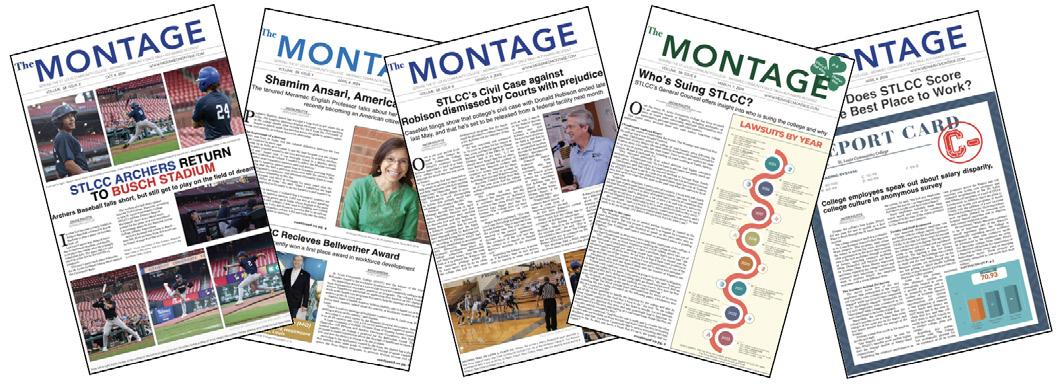
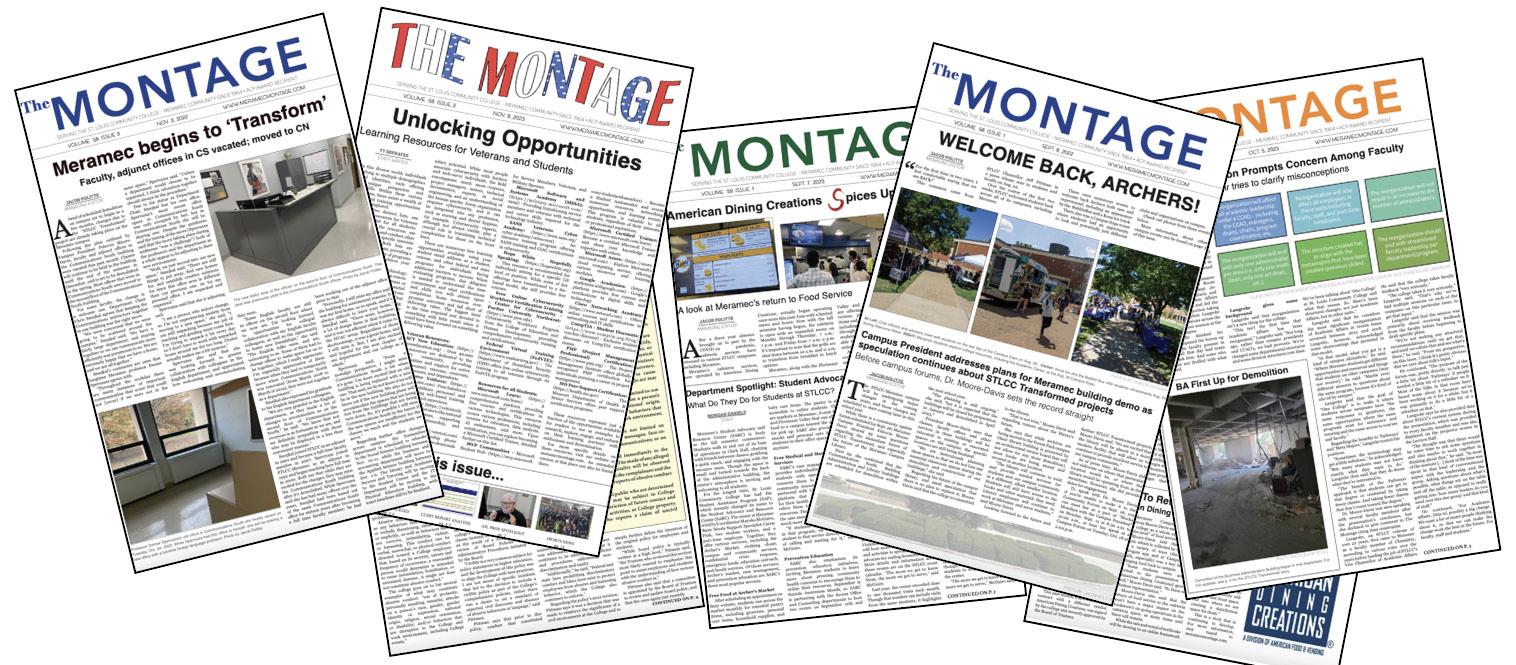
MONTAGE
Judge halts efforts to slash funding
PAGE 3
STUDENT ART SHOW
Student work featured on campus PAGE 6
ARCHERS BASEBALL
The team wraps up their spring season PAGE 10-11

Judge halts efforts to slash funding
PAGE 3
STUDENT ART SHOW
Student work featured on campus PAGE 6
The team wraps up their spring season PAGE 10-11
GRETA MCGLAWN GRAPHIC DESIGN EDITOR
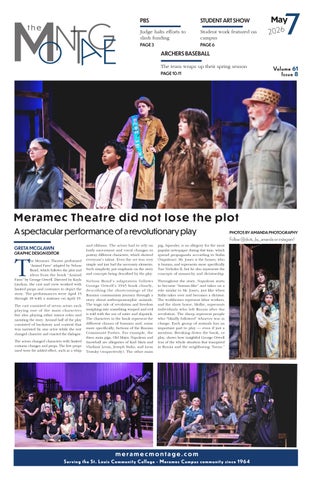
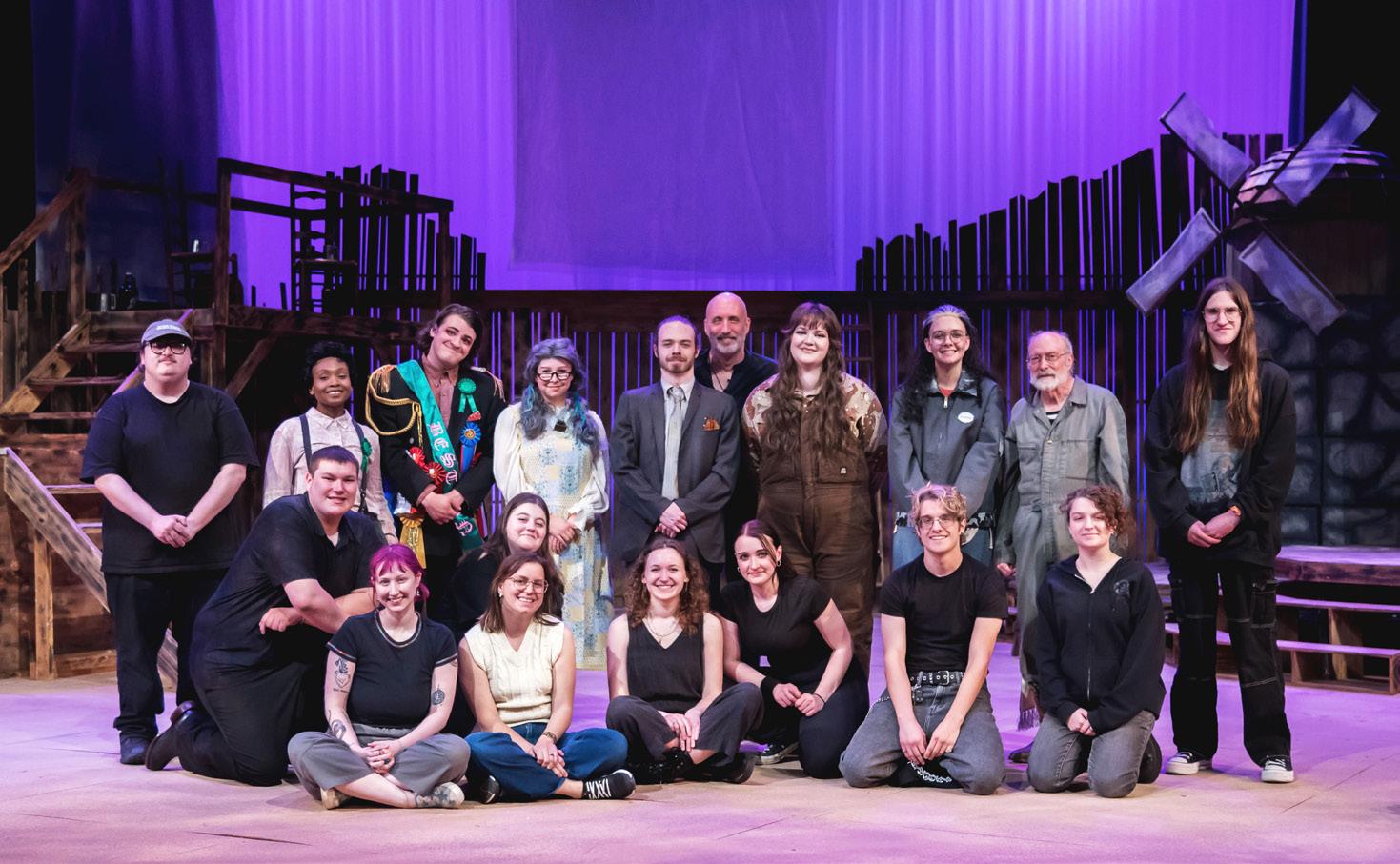
The Meramec Theatre performed “Animal Farm” adapted by Nelson Bond, which follows the plot and ideas from the book “Animal Farm” by George Orwell. Directed by Kayla Lindsay, the cast and crew worked with limited props and costumes to depict the story. The performances were April 15 through 18 with a matinee on April 19.
The cast consisted of seven actors each playing one of the main characters but also playing other minor roles and narrating the story. Around half of the play consisted of backstory and context that was narrated by one actor while the rest changed character and enacted the dialogue.
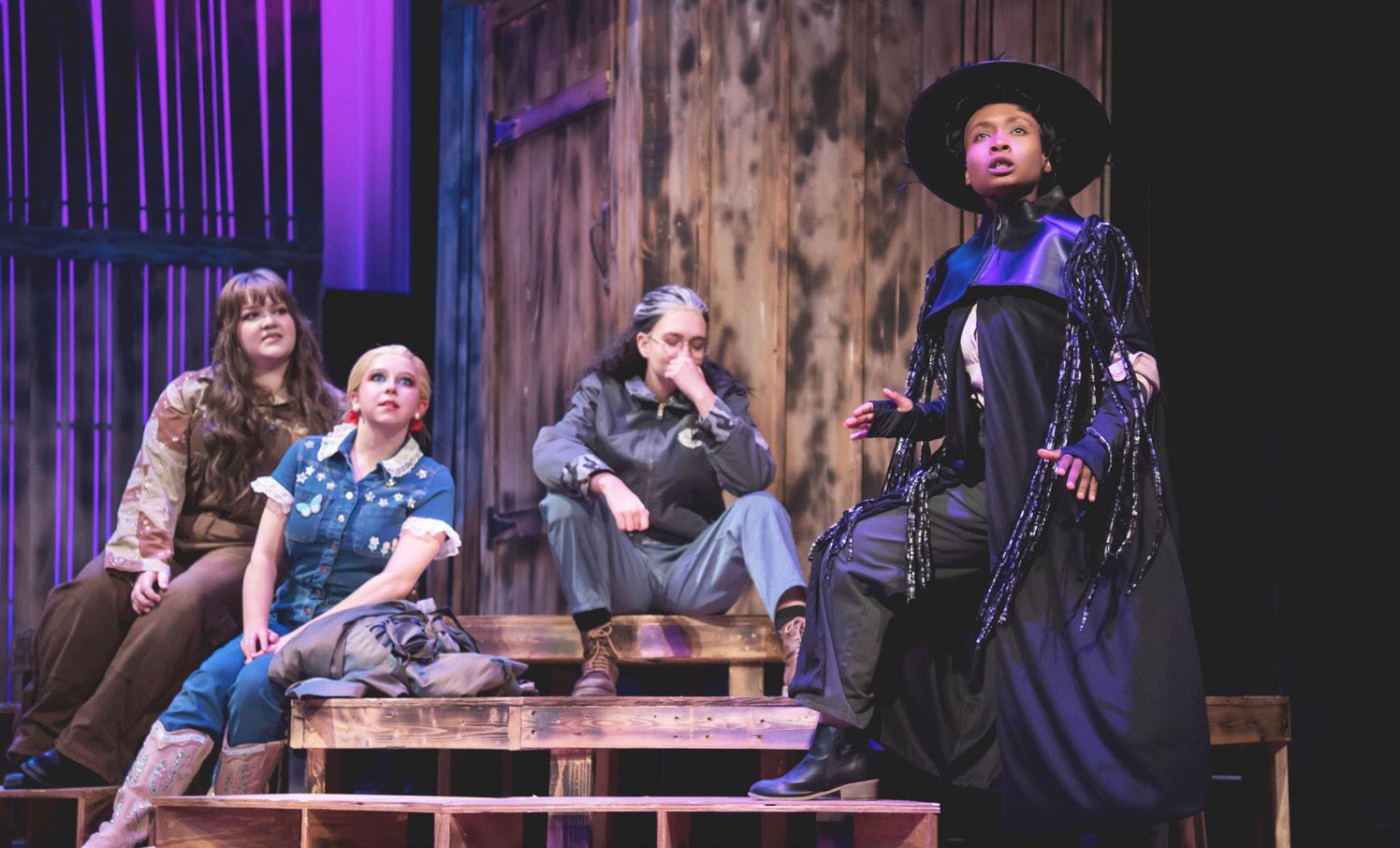
The actors changed characters with limited costume changes and props. The few props used were for added effect, such as a whip
and ribbons. The actors had to rely on body movement and vocal changes to portray different characters, which showed everyone’s talent. Even the set was very simple and just had the necessary elements. Such simplicity put emphasis on the story and concepts being described by the play.
Nelson Bond’s adaptation follows George Orwell’s 1945 book closely, describing the shortcomings of the Russian communism journey through a story about anthropomorphic animals.
The tragic tale of revolution and freedom morphing into something warped and evil is told with the use of satire and slapstick. The characters in the book represent the different classes of humans and, some more specifically, factions of the Russian Communist Parties. For example, the three main pigs, Old Major, Napoleon and Snowball are allegories of Karl Marx and Vladimir Lenin, Joseph Stalin, and Leon Trotsky (respectively). The other main
pig, Squealer, is an allegory for the most popular newspaper during that time, which spread propaganda according to Stalin (Napoleon). Mr. Jones is the farmer, who is human, and represents more specifically Tsar Nicholas II, but he also represents the concepts of monarchy and dictatorship.
Throughout the story, Napoleon starts to become “human-like” and takes on a role similar to Mr. Jones, just like when Stalin takes over and becomes a dictator.
The workhorses represent labor workers, and the show horse, Mollie, represents individuals who left Russia after the revolution. The sheep represent people who “blindly followed” whoever was in charge. Each group of animals has an important part to play — even if just a mention. Breaking down the book, or play, shows how insightful George Orwell was of the whole situation that transpired in Russia and the neighboring “farms.”
PHOTOS BY AMANDA PHOTOGRAPHY Follow @shots_by_amanda on instagram!

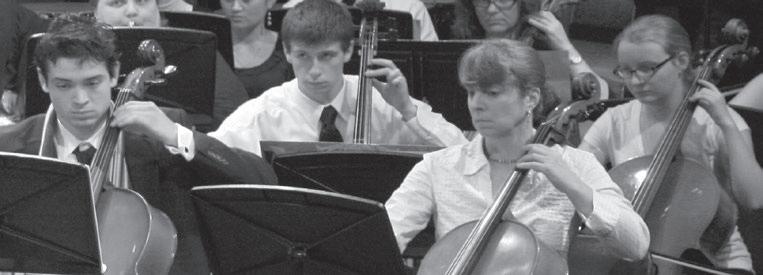

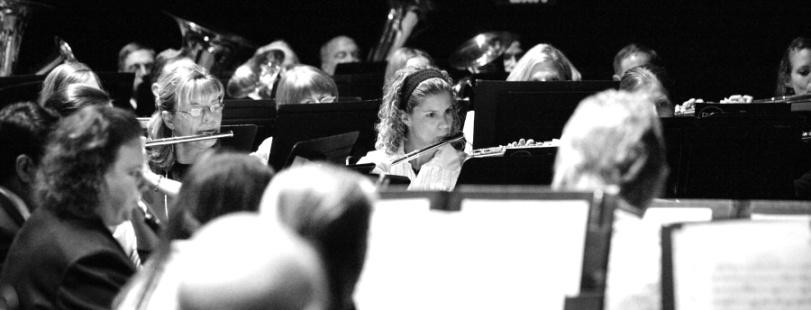

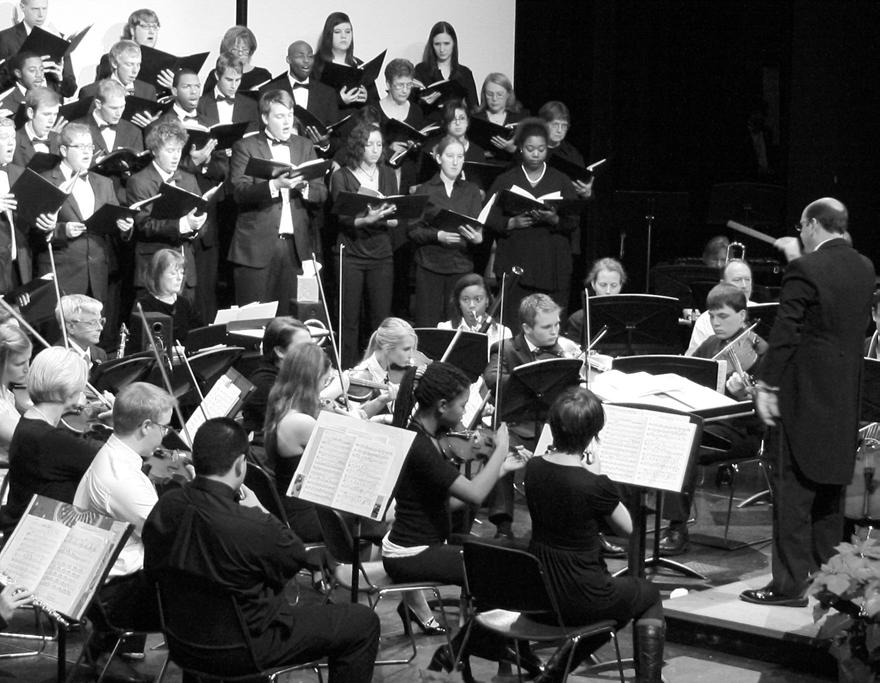
The Music Program at Meramec offers courses and ensembles for all students. Classes are available for general education credit and the Associate in Arts degree with a concentration in Music to prepare for transfer into a Bachelor of Music program.
MUS 101,102,201,202 Music Theory I,II,III,IV
MUS 103 Music Fundamentals
MUS 114
Music Appreciation
MUS 115 Group Voice
MUS 121,122,221,222 Class Piano I,II,III,IV
MUS 128 History of Rock and Roll
MUS 130 Beginning Guitar
MUS 141,142,241,242 Applied Music (Lessons) I,II,III,IV
MUS 150 Fundamentals of Music Technology
MUS 152
Audio Engineering
MUS 154 Music Recording
ENSEMBLES – CORE42GENEDCREDIT!
Music 131 – Concert Choir/Chamber Singers*
Music 132 – Orchestra
Music 134 – Symphonic Band
Music 138 – Jazz Combos
All ensembles hold a seat/part assignment hearing after the first rehearsal.
*Members of the Concert Choir may audition for the Chamber Singers/Jazz Choir. stlcc.edu/music · MeramecMusic@stlcc.edu · Humanities East 101


North 122
ELIZABETH CLEARY MANAGING EDITOR
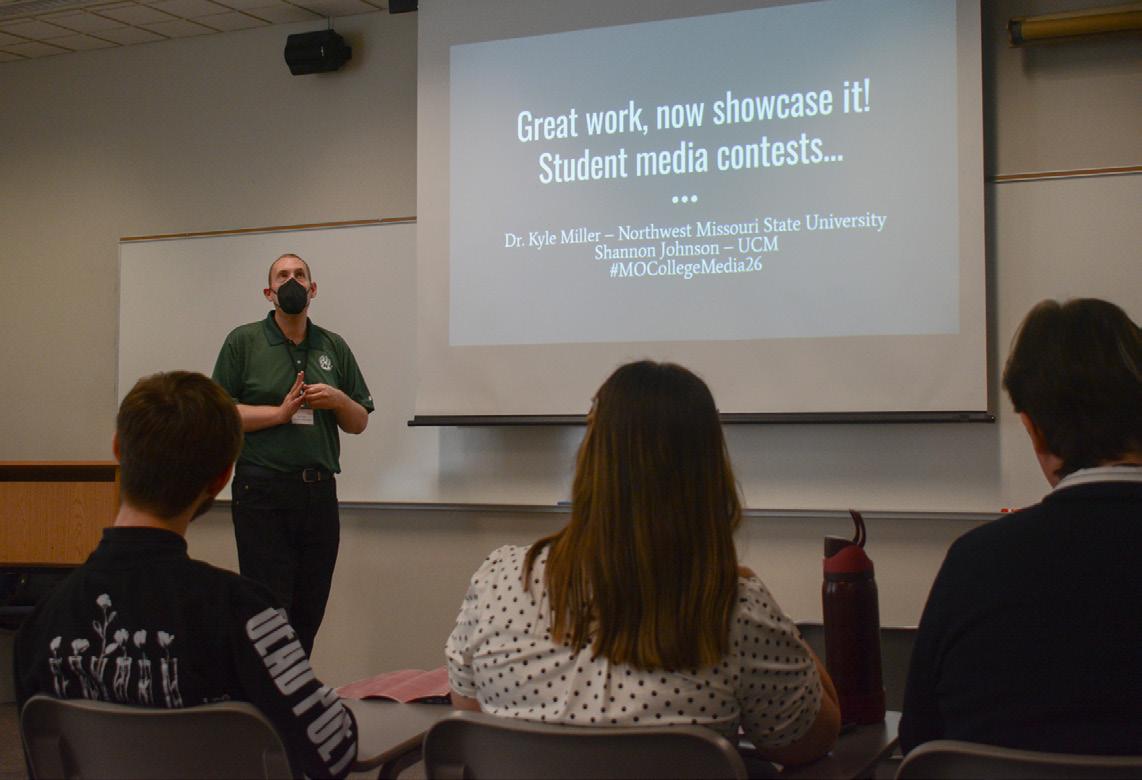
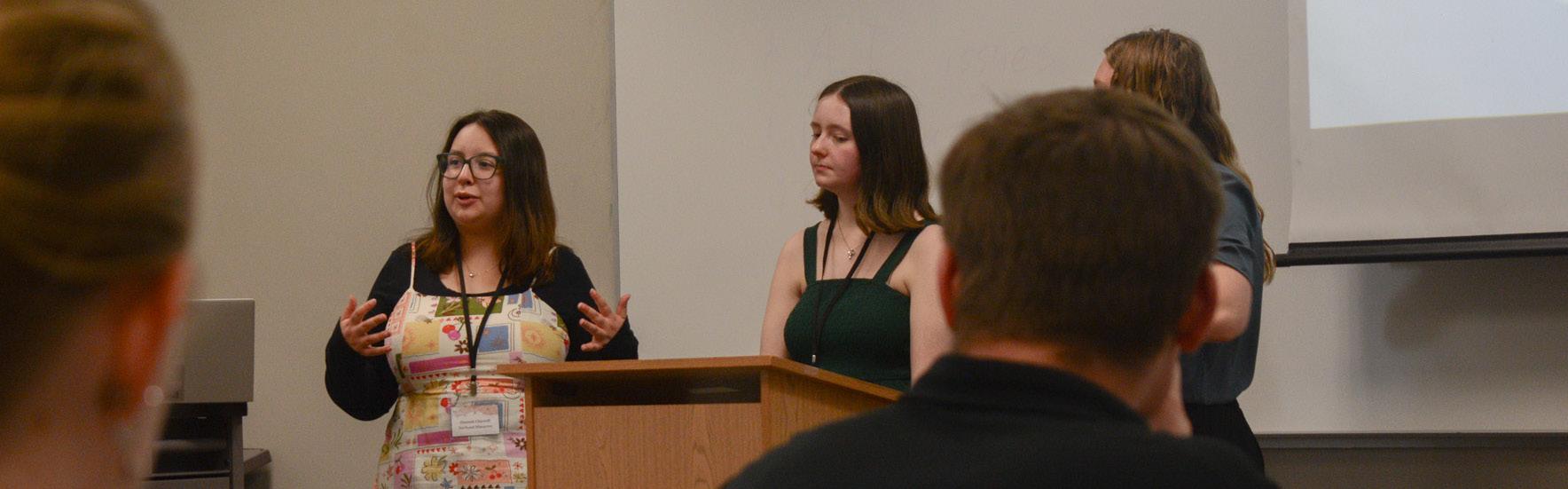
The Missouri College Media Association (MCMA) annual conference and awards ceremony was held in Springfield, Missouri, on April 11. Attendees included studentjournalists and advisors from across Missouri. The conference consisted of educational sessions, workshops and keynote speakers. Students were also able to have their publications critiqued by experienced advisors and industry professionals.
Jazlyn Summers, senior at University of Missouri-Kansas City and editorin-chief of Roo News, has attended MCMA for the past three years and has a distinctive perspective on
the conference and its purpose.
“Making connections is always my goal when it comes to these big conventions with a lot of journalists that are around the same age as me,” Summers said. “I’ve just learned, since being a senior, one of the most important things in this field is having a lot of connections – and learning, of course, we can always learn more things.”
For many, MCMA is a time to network with fellow journalists. It is also a time to learn from the educational sessions and improve publications.
Some of the sessions offered this year included a student-led panel on navigating newsroom positions, photoshop basics, advice from a firstyear reporter and covering sports on campus and for a community.

Shannon Philpott-Sanders Faculty Adviser
To place an advertisement, contact the advertising manager for rates, sample issues, etc., at 314984-7857 or email ssanders147@ stlcc.edu.
Editorial views expressed or content contained in this publication are not necessarily the views of St. Louis Community College, the Board of Trustees or the administration.
The Montage is a student publication produced four times per semester at St. Louis Community College - Meramec, 11333 Big Bend Blvd., Kirkwood, Mo., 63122.
Editorial policy: All letters should be no longer than 500 words and must include identification as a student or faculty member, phone number and address for verification purposes. Phone numbers and addresses will not be published. All letters are subject to editing for content and length. All letters submitted will be published in print and online.
Proud member of
“[The MCMA conference is] a day dedicated to learning, collaboration and celebration of student media across the state,” said a note that MCMA sent out to attendees. “This event continues to leave a lasting impression on our students for years to come.”
Summers feels that lasting impression, and she said that studentjournalism is a passion of hers.
“I’ve always believed that telling the stories of the people is one of the most important and crucial things, especially in a time like right now. As students, you’re building a foundation of what it means to be a journalist,” Summers said.
“I really encourage a lot of the people who are not as involved in their universities to just try getting
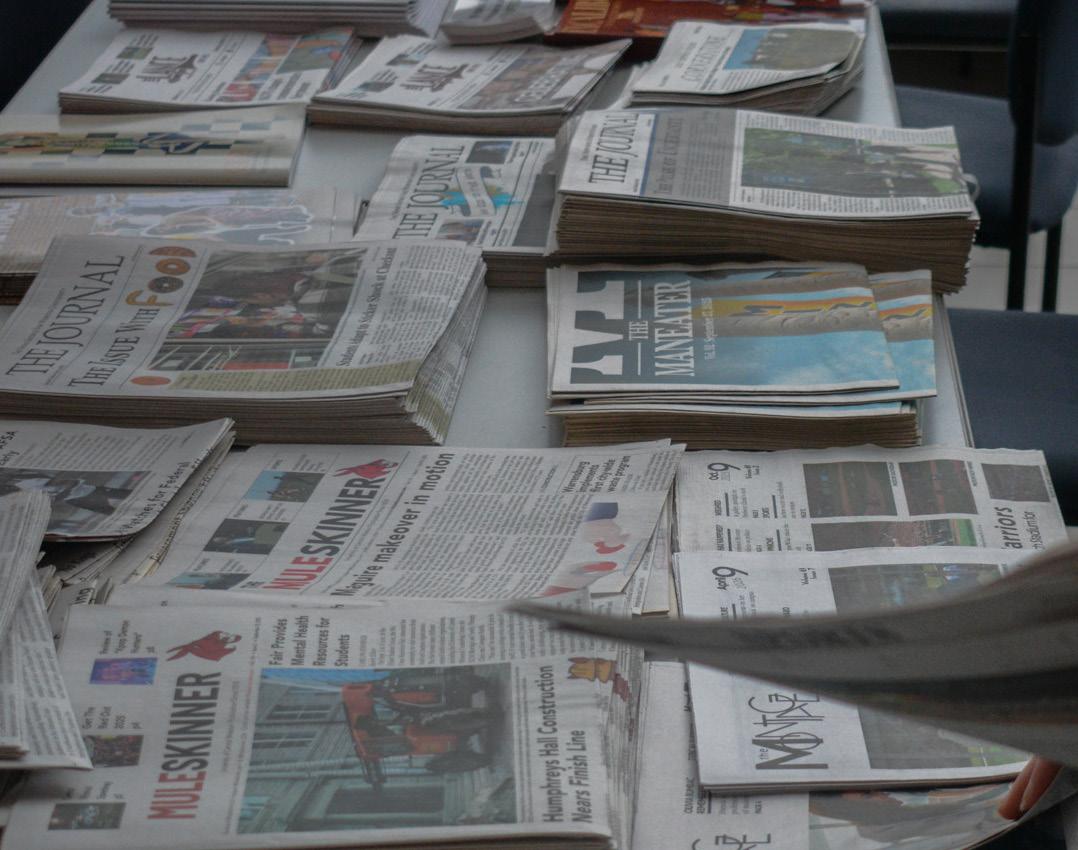
Student-journalists display their schools’ newspapers on a table at the MCMA conference. Attendees were encouraged to puruse and take inspiration from other papers.
involved in any kind of newspaper or broadcast, because it’s a really cool way to make a difference.”
At this year’s awards ceremony, The Montage was recognized with 33 awards, receiving first place wins for the Back-to-School Magazine, News Writing, Editorial Writing, Sports Writing, In-Depth Writing, Feature Photography, Design and The Montage website, in addition to staff and individual awards. The staff also received the Sweepstakes award for the most wins in Division Four.
“Congratulations to everyone who participated in the Missouri College Media Association’s 2026 competition,” read a Facebook post from MCMA.
“Thank you all for coming.”
Growing up, many watched the Public Broadcasting Service (PBS) at some point, whether it was Arnold the Aardvark, The Wonder Pets or Clifford the Big Red Dog. In some way or form, PBS was a part of many peoples’ childhoods. PBS provides educational, cultural and free television for all Americans. In May 2025, President Trump signed an executive order cutting funding to PBS, citing it as “biased media,” with funding being cut from 330 PBS and 246 NPR stations. With funds running out, many local PBS and NPR stations across the country struggled to stay afloat, relying
on the local community for support. The lack of funding also affected the St. Louis PBS stations, which lost over $1.8 million in federal funding.
Many stations have already felt the effects of the cuts, having to shorten program run times and lay off staff to stay financially stable. While no stations have shut down yet, the strain is increasing –especially for smaller, rural stations that depend more heavily on federal funding than larger, urban ones. The nine PBS stations in the St. Louis area have not had to make any major cuts thanks to the community supporting them through fundraisers and careful financial planning developed over several years. Although the St. Louis stations managed
to keep afloat, many others across the country have not been so lucky, facing major setbacks and leaving many stations unsure how long they can keep at it. However, this could all change with a federal judge blocking the cuts.
District Judge Randolph Moss ruled on March 31 that Trump’s executive order to defund NPR was unconstitutional. Moss ruled that the executive order goes against the First Amendment, highlighting the portion of Trump’s executive order directing all agencies to get rid of funding for NPR and PBS and singling them out on “the basis of their speech.”
Although the Judge ruled that the executive order was unconstitutional, the $1.1 billion for the broadcast station will not be restored, since Congress had already ruled in favor of the cuts. Overall, public media stations are managing to survive for now, largely due to donations and short-term adjustments. Still, many are making difficult cuts, and the long-term outlook, especially for smaller stations, remains unclear.
Moss wrote that, “The First Amendment draws a line, which the government may not cross, at efforts to use government power –including the power of the purse – ‘to punish or suppress disfavored expression’ by others.”
HIBA OBEED A&L EDITOR
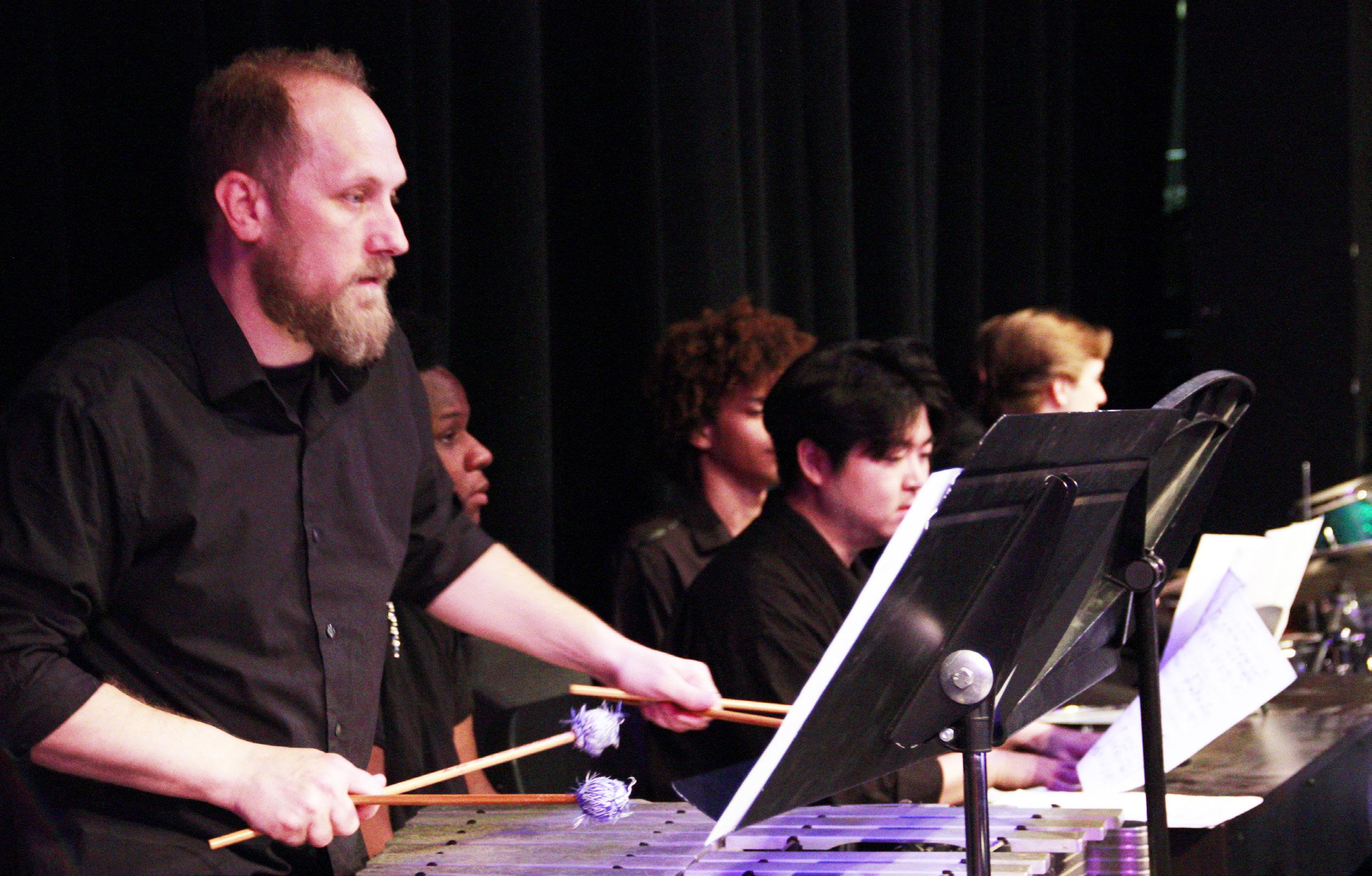
Danny Bess is STLCC Meramec’s Art Department secretary. He plays several instruments, practices several art forms including painting, drawing, printmaking and is an active Dungeons and Dragons player.
Q: What do you want people to know about you?
A: I’m an artist, I’m a musician, I try to be kind, and I try to help people.
Q: Is there anything that’s been weighing on your mind recently?
Something you’ve been contemplating?
A: I’ve been really excited for the summer to hit. My nephew’s name is Parker, his brother, his dad and his uncle will be joining me for a summer Dungeons and Dragons (DnD) campaign. Usually I will be Dungeon Master (DM) for my nephews and they love it, but this time Parker, who is now turning 15 and learning to drive, wants to DM the summer game so I’m really excited for him; I’ve been contemplating that a lot. How can I help him? How can we have the most fun this summer? That’s been on my mind because I’m a little obsessive about my DnD characters. My mind has also been fully consumed by the end of year student art show and end of year jazz band concert. I’m gonna be playing music and I’m nervous.
Q: What was your dream job/ occupation/craft as a child?
A: I always liked learning new instruments and new artistic processes, I’m obsessive about it. So because of that I tend to really dive in to learn the new skill, and get really good really fast then I get bored and move onto the next thing, learn another
instrument, another artistic process. It’s good and bad because I wish I was the master of one skill, but instead it has made me the guy who can play any instrument or use any art form. I’m well grounded and I feel good about that.
Q: What’s your biggest fear? Has it always been that?
A: My biggest fear is that my wife will have a seizure because of her epilepsy and hit her head and I won’t be there to help when she needs me the most. We both work, so are therefore in two different places and we have to make ends meet. She’s also a really good piano player. She won’t tell you that though.
Q: What is the scariest thing you’ve seen or experienced?
A: I have two, the first is that I remember when me and Elise started dating twenty years ago. First of all that’s scary in itself, but the first time I saw her have a seizure was one of the scariest things for me because I internalized that and I started to worry if I would be strong enough to take care of her as a caregiver and husband. Luckily it worked and we’ve been married for seventeen years and it’s been amazing. The second scariest thing was a lucid dream that I had as a teenager, where I was positively completely sure that figures from my dream had leaked into reality and into space and they haunted me for a small period of time. Looking back it was probably a lack of sleep that caused it. Although I was so terrified that it sticks with me to this day.
Q: What are your dreams like?
A: My dreams are very vivid. They might not be appropriate for the newspaper. The last dream I had which was fully vivid is going to prove to everyone at STLCC that I was a mad person. I had a dream that I was kidnapped and I was
strapped down to a chair and was forced to drink some sort of tonic that would knock me out. Then my kidnapper was forcing me to make wire art work on a peg wall that was eight feet tall and wide, but I knew that experience and him forcing me to do that was a part of that tonic’s effect. Then the dream shifted to a bird’s eye view that I was still strapped to the chair and the man behind me cut a surgical hole in my skull and operated in my brain hitting different nerves to make me hallucinate that I was making artwork. He would say “There there, you will have fond memories, you’ll know. Everything’s fine, you’re making artwork.” It was very creepy. Because of that, I don’t sleep very well.
Q: What’s something about you that people might not expect?
A: I would say in my previous life when I worked at Aldi for many years; they would not have expected that I was an artist and musician. Now working here at the college in the creative arts department, everyone knows and I thrive in that acknowledgement. What everyone might be surprised to know now is that, while I might seem very outgoing and that I want to show my art to everyone and be out in the world constantly making art and music, I’m really a homebody sort of person. I really like just being at home with Elise on the weekend, being in the garden and I get really nervous about performing in any way in front of people, even though I mask really well.
Q: Who is your best friend?
A: My friend Josh Paxson from grade school. I would say we’ve been buddies for many many many years.
Q: If you could do anything in the world, with no financial or physical limitations, what would you do?
A: I don’t know I’m not really a bucket list type of person.
Q: What gives you anxiety?
A: Just existing in the world everyday.
Q: Who do you trust the most?
A: My wife Elise.
Q: Is there something you’ve been avoiding?
A: No, not really. If I have big problems I try to tackle them right away before they become bigger problems.
Q: What level of power over people is too much?
A: I don’t know. The president. I don’t think having power over people is a true goal of humanity. I think it’s actually counter-human to seek power over other humans. People instead should be enjoying culture, creation, music, art, self-identity. Power is very thin and will easily go away.
Q: Have you participated in anything you view as counterculture?
A: Probably the closest thing to that is that when I was in high school and in my early 20s I was in a lot of rock bands as a drummer and we always considered ourselves counter culture. We were playing rock and roll, not pop, not top 40s. And then I think that stuff also becomes kind of a little less important as you get older. Culture changes constantly. Viewpoints from those times are different. If anything, the most current counter culture thing I’m doing now is deleting my social media accounts. I’m finding them very toxic and it doesn’t sit well with me mentally hearing and seeing some of the things I see on social media. So I’m deleting Instagram because my life shouldn’t be lived through a device.
HIBA OBEED ART & LIFE EDITOR
Q: Why art history?
A: When I was in high school I worked at a boy scout camp and I taught merit badges there. I found out very quickly I loved to figure out how to pass the knowledge I have onto other people. It’s like a little logic problem for me – when I see someone confused, I want to get them from where they are to where I need them to be. I knew I wanted to teach from high school but I didn’t know I wanted to teach art until I finished with my undergraduate degree. I took one art history class my very last semester and went to graduate school immediately after to pursue it.
Q: Is your background in art?
A: My undergraduate degree was in political science, and I took art history as an elective my last semester of college. I knew there was no turning back as soon as I did it. So kind of not, it was serendipity.
Q: What was your dream occupation or craft as a child?
A: I wanted to be a chef, I can’t remember why. I guess I liked to cook and my mom liked to cook. I liked hanging out with her.
Q: Is there a particular common misconception you hear about art history that you would like to refute?
A: I come into my classes here with the notion – whether it’s true or not – that my students think art is for the elite and that it might not have a lot to do with them. I do my very best to have them leave knowing that is not the case. It is relevant and made for everybody.
Whatever their responses to the art are, it is as valid as any art historians.
Q: Has anything been weighing on your mind recently?
A: How shitty the Trump administration is, specifically with regards to my students. I worry that young people aren’t going to realize that the world doesn’t have to be the way it is right now and that it can be changed.
Q: What do you want people to know about you?
A: I want people, especially students, to know that when I was in high school and college, I could not have possibly imagined the life that I’ve made for myself as an art history professor. The choices you make when you’re young can take you anywhere you want them to.
Q: Who is your closest companion/friend?
A: My husband Doug. We’ve been together for 28 years, married for 12.
Q: What level of power over people is too much?
A: I think any level of power that makes people their own power is diminished is too much. I like the idea of influence but I don’t like the idea of forcing or limiting choices on people.
Q: What do you believe is the importance of understanding art history?
A: We live in a world where people use images constantly to try to sell you ideas and products. If my students leave with some semblance of how images got to the way they are, then they’ll see who’s trying to shape their brains in what ways and think more intelligently about that.
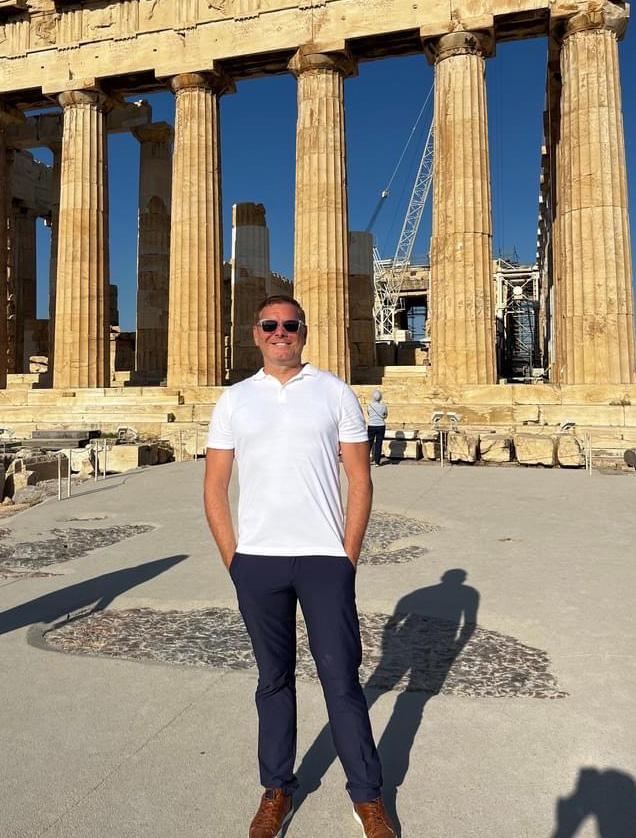
Q: Do you have any big fears or anxieties?
A: No.
Q: What is your happiest memory?
A: Getting engaged at the top of the Eiffel Tower.
Q: If you could do anything at all without any financial or physical limitations, what would that be?
A: I would do exactly what I’m doing right now, only I would do it faster.
Q: Who do you trust the most?
A: My husband Doug.
Q: Have you participated in anything you view as counterculture?
A: I think academia is a bit of counterculture. The fact that we live in a time and place where the government is trying to shut it down is good evidence that it is counter culture.
Q: Why did you initially pursue political science?
A: I had no idea. I wanted to get a college degree and I figured I’d figure it out from there. I changed my major in college on paper, officially, seven times. I had no idea what I wanted to do. Business school lasted only a semester. I felt like I couldn’t justify a degree in the humanities, so political science felt like it opened up government opportunities, but art history grabbed me immediately.
Q: What’s something about you that people might not expect?
A: People might not expect that I designed my own house twice. I’ve never taken interior design but I teach so I must have studied the history of architecture as well
as art, and that was very impactful on me
Q: Should bombs exist?
A: Nope.
Q: Thoughts on American imperialism?
A: My first thought is that I wish more Americans knew we were imperialists. I wish more people understood that if you are an imperialist, it suggests the weakness of the things you don’t have. There is no need to imperialise people if you don’t need things from them. Imperialism has an awful way of leading people to think that people from other cultures don’t matter as much as they do. It’s very hard to have imperialist attitudes when you go to experience the rest of the world.
Q: What would you change about American culture?
A: I think it would be healthy for American culture for culturally conservative people to be more honest about how they feel about the world. I think they lie to themselves and that means they lie to the rest of us about what they’re really after. We all have the right to see some of the disgusting ideas in their heads.
Q: Other than your career or education, what are you most proud of?
A: Maintaining a 28 year relationship.
BY
LILLY BURRUS
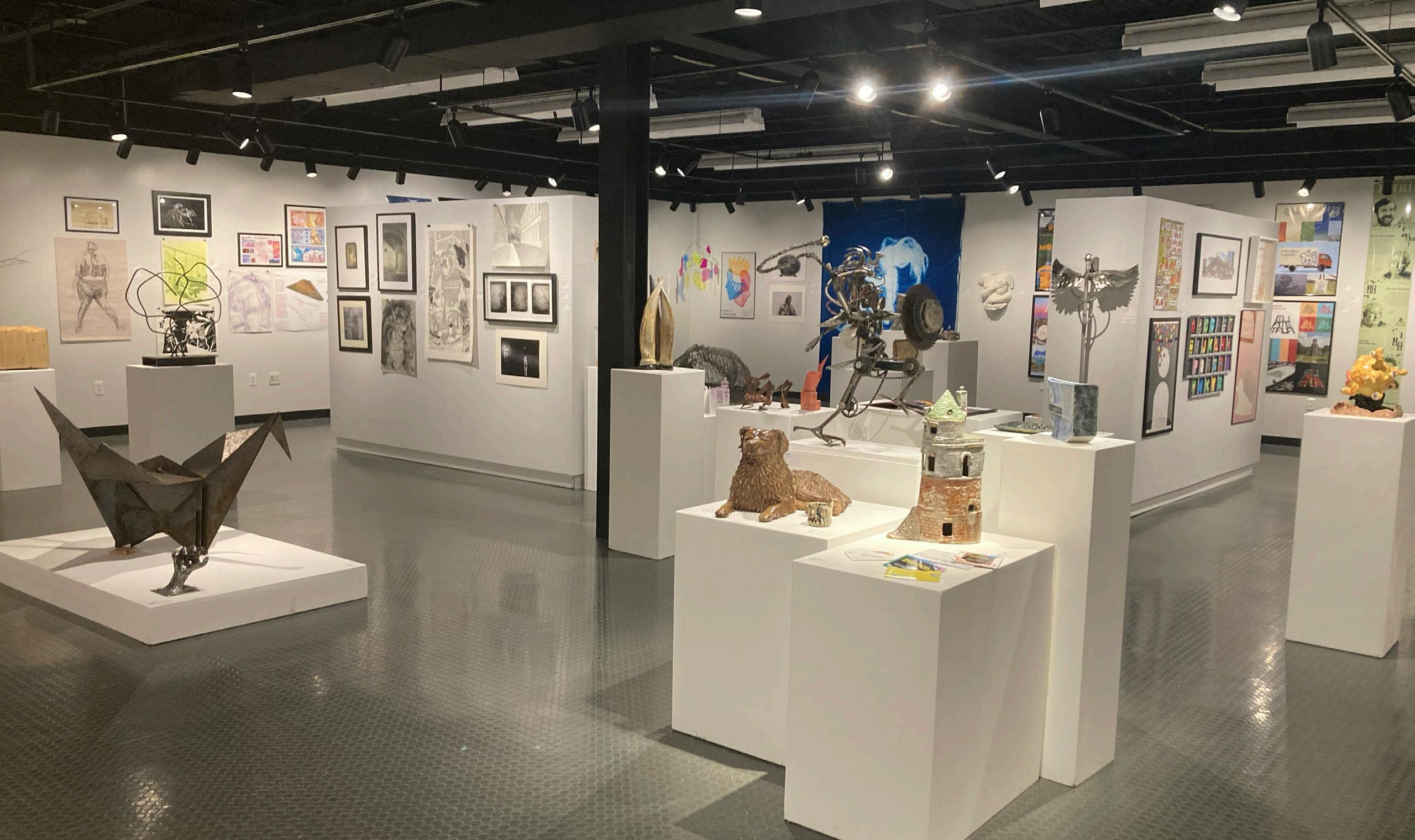
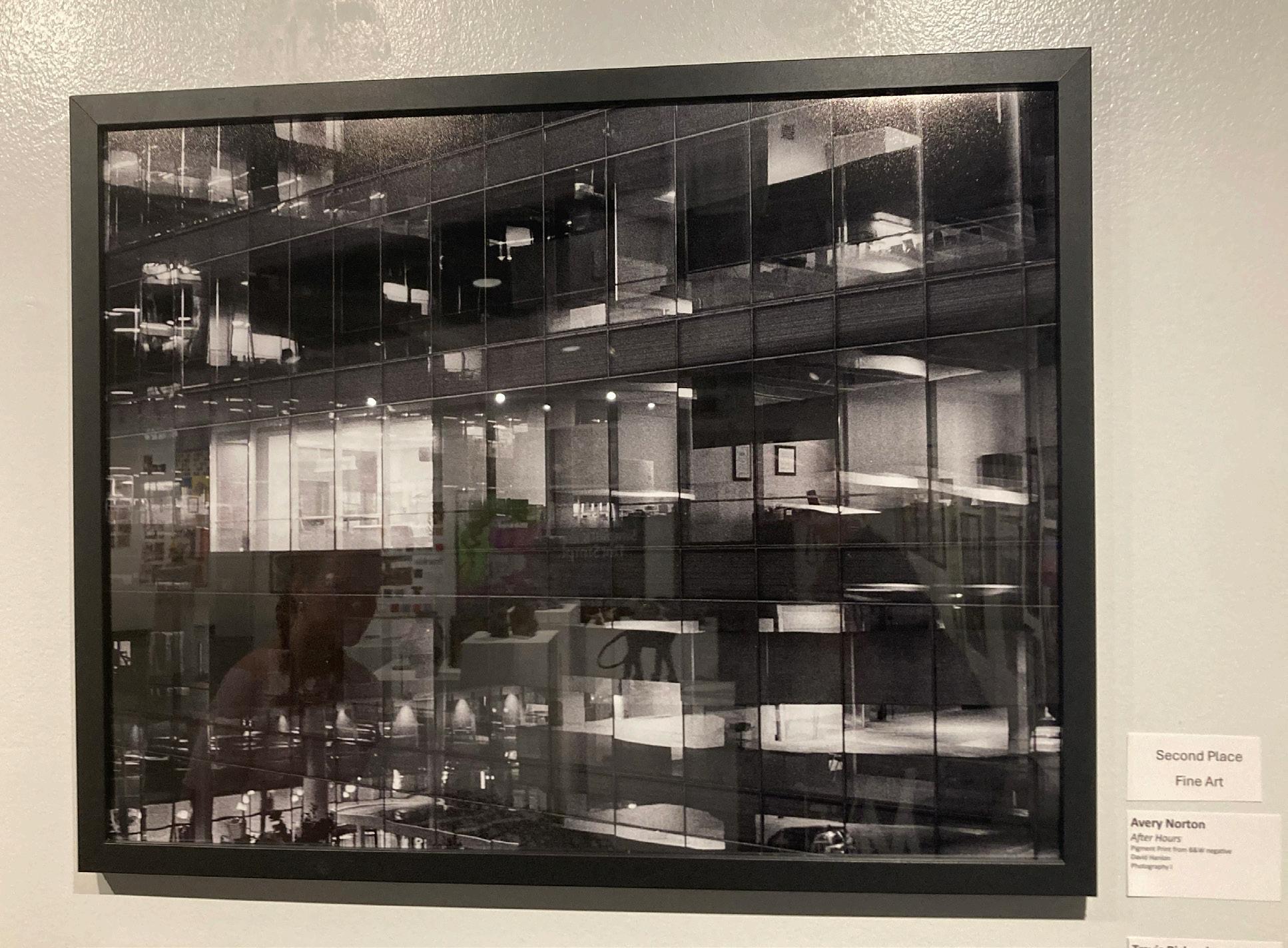
Meramec’s annual student art show featured work from students of all ages. There were 404 submissions, 147 pieces accepted and 37 award winners. Gallery coordinator Ken Wood worked to hang the art pieces, incorporating new changes to the layout and overall design of the display.
“Last year we had a really nice judge who admitted way too many things, and it was a little packed,” Wood said.
Although Meramec usually has two judges, one for fine arts and one for applied arts, this year three judges were invited to view the contending works.
Gina Grafos, judge of fine arts, chose
Avery Norton as a 2nd place winner for her black and white photo of a window scape in downtown Clayton.
“This is my first time in the student art show. I submitted three different photos, and this one made it in,” Norton said.
Students who don’t take classes in the Humanities Building are often unaware of the art being created there.
“The show is important because it spreads awareness for people who don’t know much about the art department or want to know more,” Norton said.
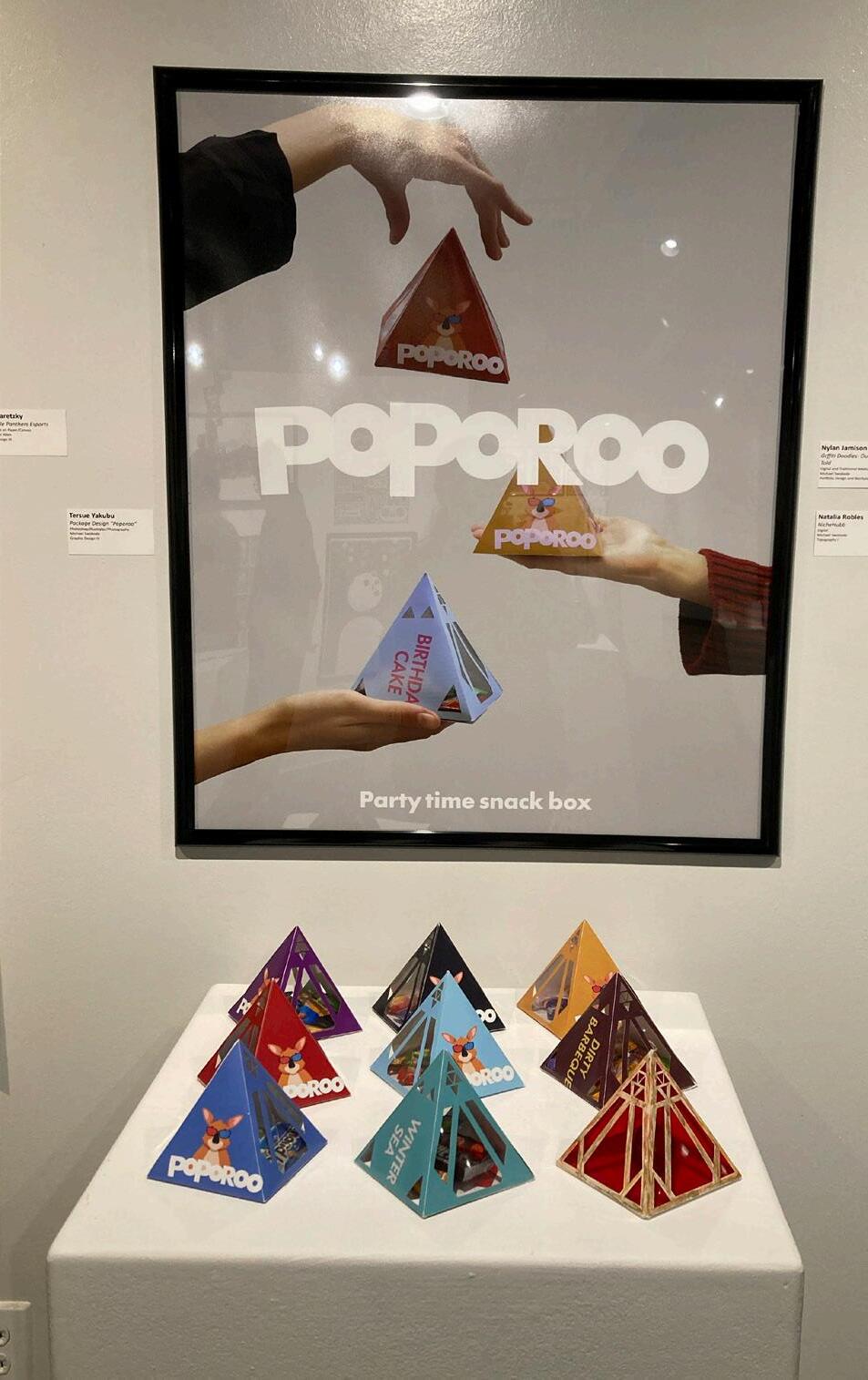
John Gualdoni, judge of applied arts, reviewed many submissions this year, but the one that really blew his mind was Tersue Yakubu’s “Poparoo.” Featured on
a pedestal in the gallery, these triangular candy packages are colorful and distinct.
Lauren Sweet-Schuler took on the role of interior design judge, a new position as of this year. Sweet-Schuler was in the first graduating class of interior design under the leadership of Erin Leclerc, who is still in charge of interior design at Meramec. Sweet-Schuler has a career as an interior designer in St. Louis and has inspired many young creators.
“To be a successful artist, you have to think independently, and that can be about problem solving for visual problems or inventing things that don’t exist yet,” Wood said.
According to Wood, sharing
artwork creates community.
“Being able to create work that you enjoy and that you can share with others can be a great way to be a human among other humans,” Wood said.
Wood said that art school is a great way to learn useful skills.
“I think that learning art is very different from any other kind of learning. Students are evaluated on their learning differently, so the art department is a great place for people who might be neurodivergent or have struggled in a typical classroom setting,” Wood said. The art show will be open to the public until May 7 in the Humanities Art Gallery.
SHAY FREDRICKSON STAFF
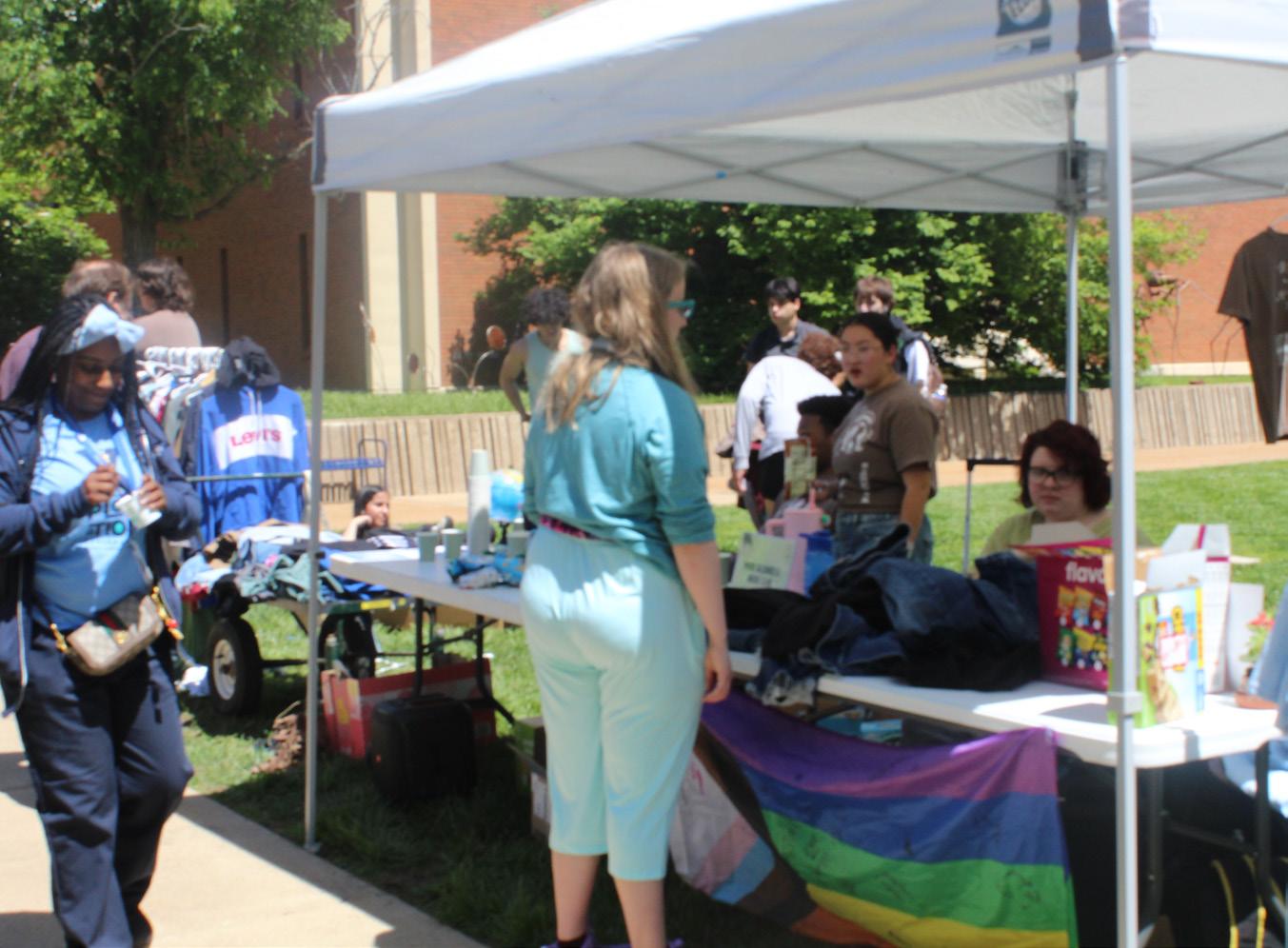
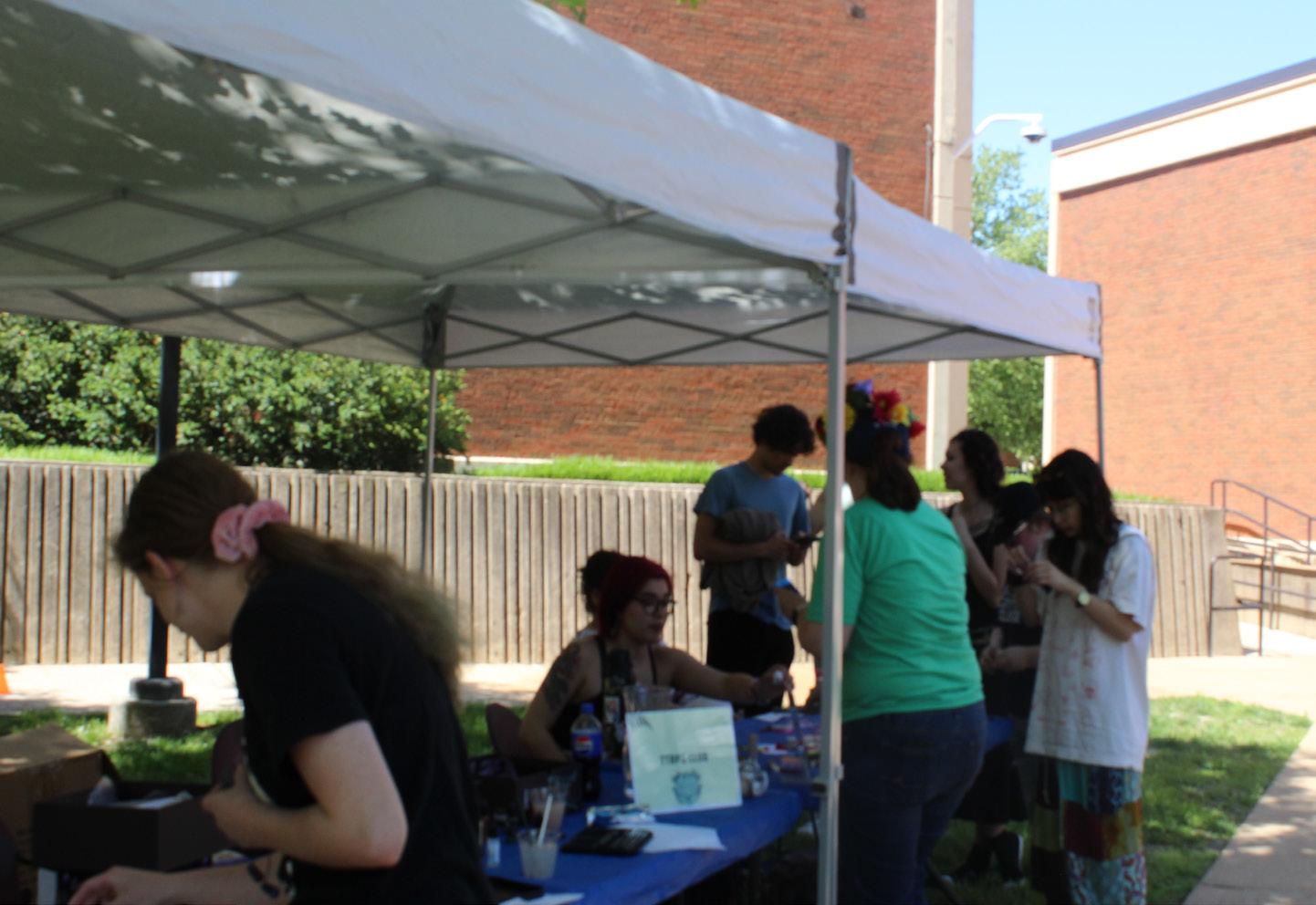
On April 22, several school clubs and students gathered at the Meramec Library Quad for an annual celebration of Earth Day. Students had the choice of participating in many hands-on activities, including tricycle racing, paper crafts, making their own bird feeders and many more.
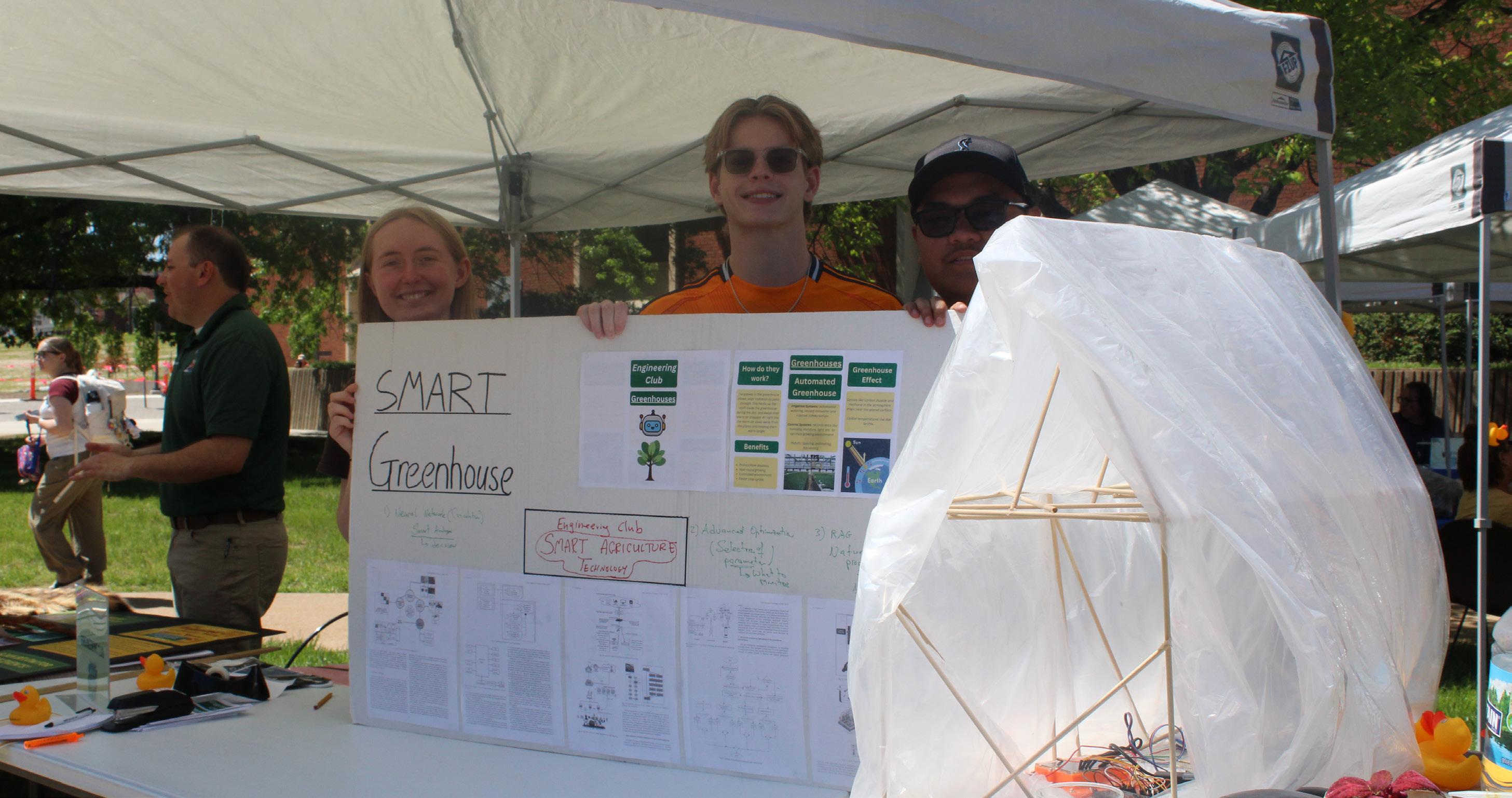
The Engineering Club was among those to be a part of the event, and their display featured a mini greenhouse that aimed to inform students about the benefits that come with greenhouses. Engineering Club member Lily Laudel emphasized that, because the names are similar, the harmful effects of greenhouse gases are sometimes associated with
greenhouses, but they are not related.
A plant used for the greenhouse came from Clay Club’s booth. The Earth Day event was the first ever on-campus event for the club, and the members handmade clay pots specifically for Earth Day.
Two other clubs, set up right next to each other, shared an activity. Music Club and Pride Club set up racks of clothing for students to go thrifting, an increasingly popular hobby among young people that has been celebrated for its ability to save clothes from being sent to landfills.
The Campus Activities Board (CAB) and Meramec Campus Life, responsible for organizing the event, also had their own booths at the event. According to CAB President Jessica Wynn, CAB was responsible for the posters, the conception of the idea and helping make it come
to life. Her group’s booth featured a make-your-own-bird-feeder activity using pinecones, string and peanut butter.
“[Students] know they’re making something they can take home and help birds in their community,” Wynn said.
Not only groups from Meramec had booths, though. A visitor from outside the Meramec community came to participate in Earth Day: The Missouri Department of Conservation.
Matthew Cavanaugh was there to educate students on Missouri’s wildlife.
“Missouri is one of the most diverse states in terms of biodiversity,” Cavanaugh said. “The more you learn, the more you’ll want to protect [the wildlife].”
The booth included fun facts about Missouri’s native wildlife and pamphlets
with information on community events that the organization hosts.
Although it only lasted a few hours, the annual event was focused on building a community for students and allowed the clubs to showcase their identities while also celebrating. Many clubs were recruiting for next year and said they planned to participate in future campus events. The event helped educate students and encouraged them not only to connect with their community, but to help their local ecosystems thrive.
BRINN SMITH NEWS EDITOR
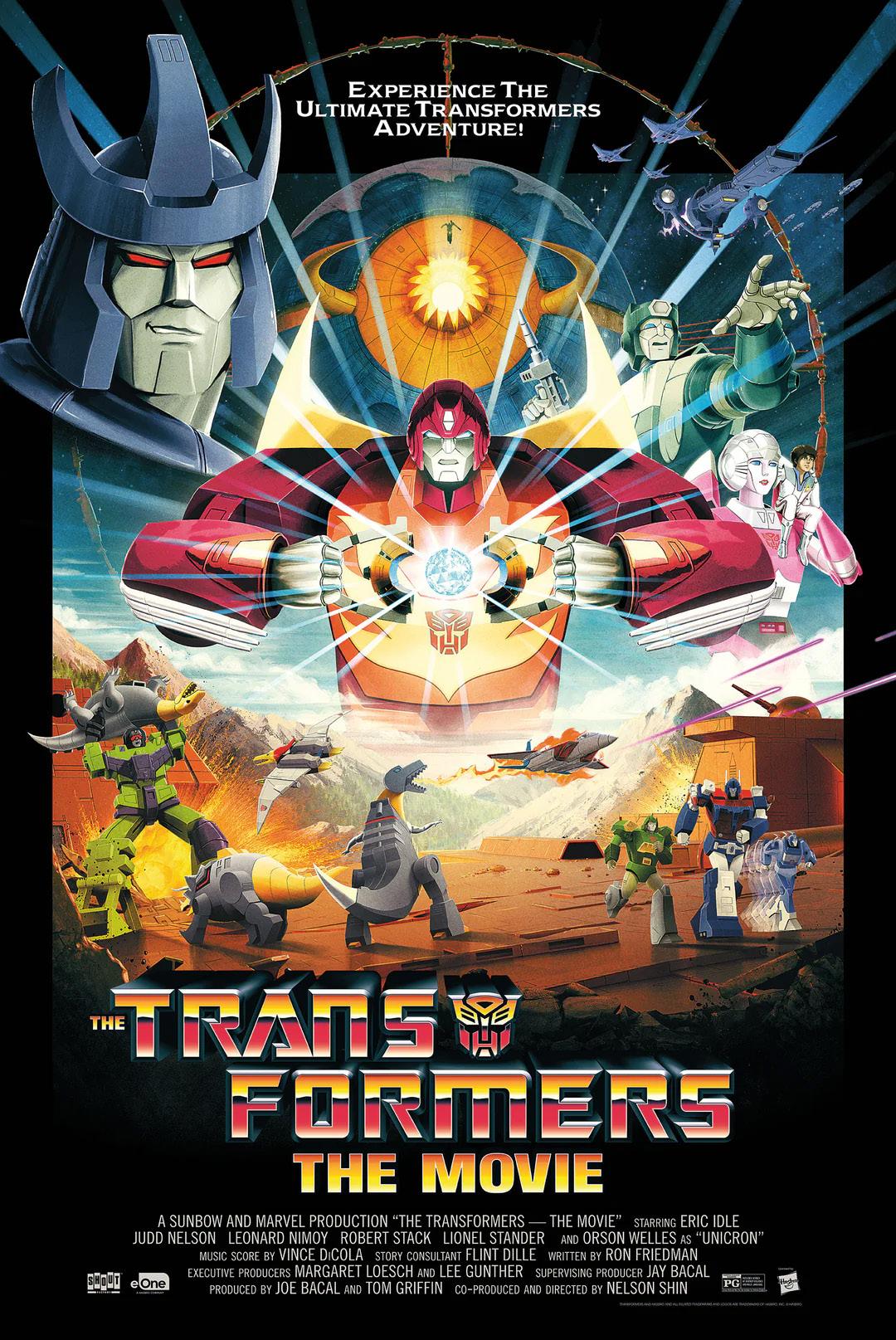
Recently I forced two of my friends to sit in a Discord call and watch a movie from my childhood. Well, it’s from my dad’s childhood, but it was shown to me as a child, so I think it counts. That movie was “The Transformers: The Movie” from 1986. While not necessarily a great movie – my friends even referred to it as a fever dream of a movie in the days that followed –it is a movie that is ingrained in my memory forever, along with the TV show that preceded and followed it (The Transformers, 1984).
The story of the movie is not perfect, far from it in fact. It splits itself into three parts: the fight at Autobot City on Earth and the death of Optimus Prime, the splitting of the main cast into two groups and the final battle with Galvatron on Unicron. The first and last parts carry the movie hard. The middle section feels frantic and a bit disconnected, mostly serving as a way to get our heroes from Earth to the middle of nowhere space and serve some character moments to highlight the new Prime before he gets that title. The main bot that we follow throughout the movie is Hot Rod, a young, heroic Autobot who has traits of a leader but not the confidence to follow through. Hot Rod’s enemy, Galvatron, is the villain Megatron remade by the monster planet Unicron, after being fatally wounded in his final battle with Optimus Prime, and dumped into space by the treacherous Starscream. The supporting cast of the movie includes Ultra Magnus, the successor to Optimus Prime, a bot who
only views himself as a soldier and is very reluctant in Optimus Prime’s choosing of him to wield the “Matrix of Leadership,” despite not being worthy. Kup is an older Autobot who tells stories of his old war days. Springer is a triple changing Autobot who serves more of a typical “action hero” role. Arcee, the first femme Autobot to be consistently part of the main cast, is a caring bot who is still quite capable of putting up a fight. Finally, Daniel Witwickey, is the still child son of the human protagonist Spike Witwickey from the first two seasons of the Transformers cartoon.
This is all to say that, while I find these characters and their story in this movie interesting, the purpose that they serve is not. The company that has owned Transformers from the very beginning, Hasbro, had this movie made to kill off all of the old toy line (with a few exceptions) and make room for the new toy line based on this movie. Optimus Prime? Dead, replaced with Ultra Magnus and Hot Rod, who eventually becomes Rodimus Prime. The older character Ironhide? Dead, replaced with Kup. Bumblebee? Alive actually, but still replaced with new human friendly Autobots like Arcee and Wheelie.
While I don’t hate these decisions (heck, Hot Rod/ Rodimus Prime is one of my favorite Transformers of all time), you can definitely tell that this is the purpose that they are meant to serve. The movie has a 20 year timeskip from the second season of the show, but even then, none of these characters had been seen in the cartoon beforehand, including characters that Optimus specifically calls “old friends” like Ultra Magnus and Kup. The Decepticons are acting like normal though, and I would say that their transition into the new cast was made effectively, with characters from the first two seasons staying around, despite the new toys. Only seven of them are “killed” and six of those are transformations into new characters happening on screen, with the last one being the demise of Starscream, who exists as a ghost in a few episodes going forward. The addition of the transforming monster planet, Unicron, was huge. Literally. The opening scene of
GRETA MCGLAWN
GRAPHICS EDITOR
Recently I attended the 2026 Undergraduate Philosophy Conference hosted by the Meramec Socratic Society. It was an amazing event per usual; all the speakers were interesting and wellspoken. Dr. Sahar Joakim Resch did an amazing job organizing it, as well as all the volunteers who helped.
The conference is a collection of presentations about students’ essays, which are selected by a team of peer reviewers. Each presentation is then followed by a commentator and audience questions. It is a great event to meet others interested in philosophy and learn some new things. There was a wide variety of topics from God to fashion to culture to purpose to art back to God and to death.
When looking back at my notes from the event, one thing that caught my eye was this quote that I wrote down.
“Without the fear of nuclear weapons, we would never have gotten this far.”
That is all I wrote down, so I have no idea who said that. My best guess is it might have been a person from the audience asking a
question to the presenter speaking about artificial intelligence and international law. If it was, I do not remember what the presenter said in response nor what the question was in full.
Nevertheless, this is an interesting idea. Was the creation of nuclear energy and weapons necessary for technological
the movie features it destroying a planet, along with all of its inhabitants, save for one robot. It is such a cool concept, and one that has lasted in Transformers media, with the homeworld of the Transformers, Cybertron, being revealed to be a giant robot in future media, likely because of the groundwork laid by Unicron in this movie.
Everything in this article is to say that I will forever cherish “The Transformers: The Movie.” Is it perfect? Gods no, but it has such an interesting vibe, as well as being the main reason I cherish so many fictional characters into my adulthood. It has a killer soundtrack, and many, many animation errors, but that makes it feel so human, ironically enough.
growth? Is the fear of nuclear war necessary for advancement? Can innovation be possible without fear?
Nuclear fear was, and is, a powerful thing. Since the bombing of Hiroshima, everyone has feared nuclear war because it is incredibly destructive on site and in areas around. In a matter of hours,
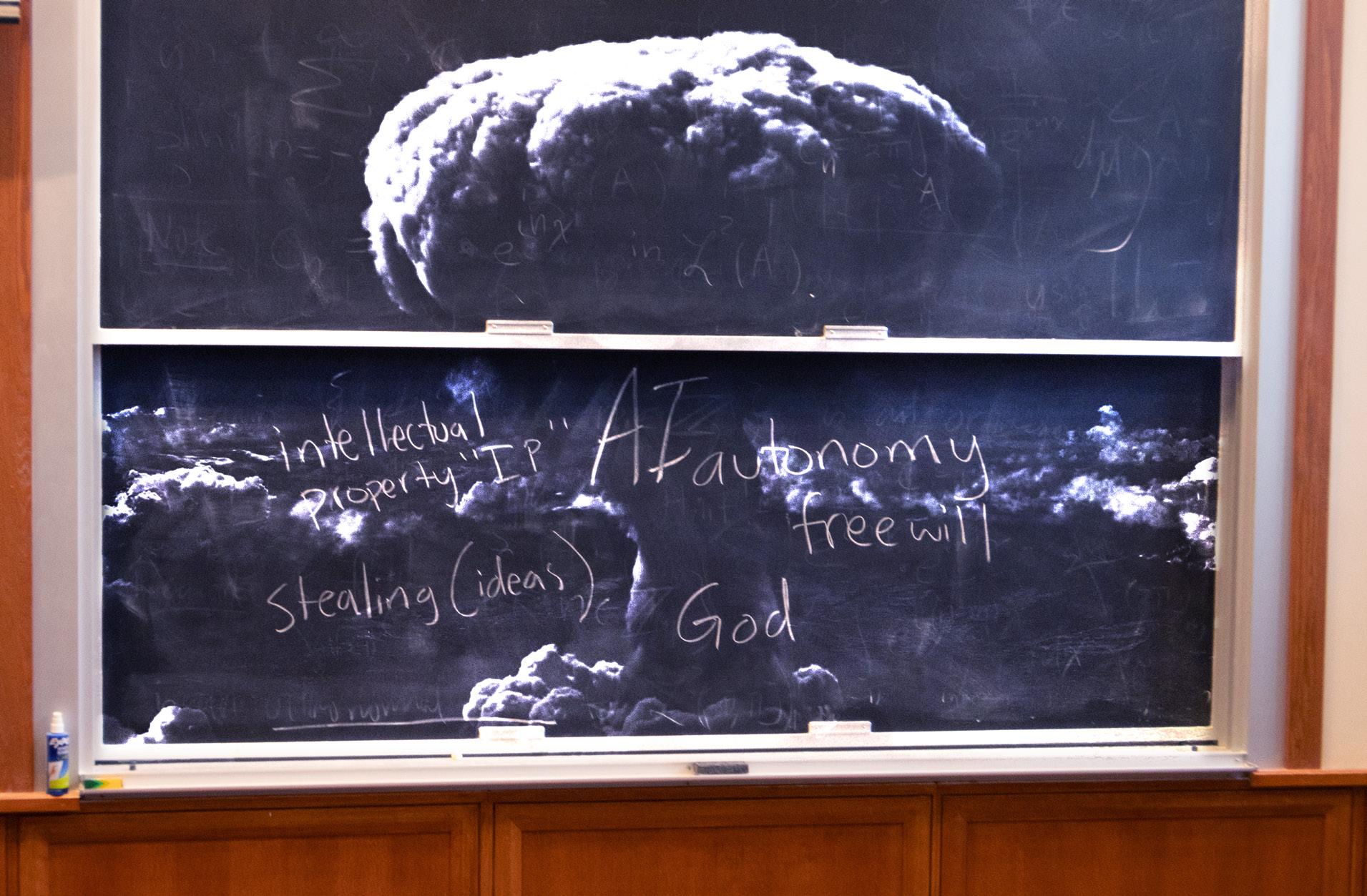
the entire earth could face destruction. But it did not start that way. At first, nuclear science was seen as this potential for easy, clean energy and could have fostered positive growth. Even so, at this point in history, nuclear fear is not what is driving innovations. Scientists are still working on nuclear science and possibly developing nuclear bombs, but not as extensively as in the past.
Considering that our current technology is not nuclear energy based and nuclear science in general is incredibly expensive and often not worthwhile, the nuclear arms race only fostered a lot of hatred and fear. For a long time, nuclear weapons were a secret thing as well, and there was advancement happening in the public. The Industrial Revolution can easily be looked at as necessary to get to this point in history, but not so much for nuclear fear.
JACOB POLITTE ONLINE EDITOR
Because of my status as a part time student, I’ve been on The Montage for longer than most. I started writing these Jake’s Take columns all the way back in early 2019, and at some point, I’ve written about everything under the sun… local, national or otherwise. Some of them have been about life lessons, some of them have been about politics, and some of them have been straight up mindless rants about things that irritated me. While the topics have varied over the years, they’ve all been under the Jake’s Take banner. And now, this is the last one. At least in this medium, at least for now, and definitely in any medium for a long time. It’s also my last issue of The Montage and the end of my long tenure on staff. The time has come, and the best thing one can do is to know when it’s okay to walk away.
I have a new career now, one that STLCC helped make possible. I’ll forever be grateful for that.
I know some in the college and even campus administration are likely breathing a sigh of relief, even though The Montage still asks the kinds of tough questions that I learned to ask. But I’d like to thank those people, who I likely made uncomfortable interviewing. The challenges were worth it. They made me better at my job.
I’d like to thank Shannon Philpott-Sanders, the best faculty advisor The Montage
could possibly have, past or present. No matter who you are or what your role is, Shannon always makes sure every student matters in terms of producing this publication. She encouraged me to take on a more prominent role over time, and she helped make me a leader, and then a better leader.
I’d like to thank every person on staff I’ve ever worked with, past or present. I’ve seen countless eras of reporters and editors pass through the newsroom door over the years. All of them brought a different vibe, and all of them made the job feel forever fresh. There were no boring days at The Montage, except maybe during the COVID year when I was the only one on campus the entire time. And even then, the quiet was its own kind of interesting.
Some of the stories I worked on, and some of the events I’ve been witness to as a result, have been nothing short of extraordinary. It truly is a unique place to be, where you routinely witness a student and faculty body engage in a dialogue that isn’t always calm. More than once, I’ve seen an entire faculty body revolt against those in charge. I’ve seen students stand up for what they think is right on countless occasions in spite of the controversy they knew it’d create. My job was to report on all of it fairly. The good, the bad and the ugly. And I think I did that, even if some didn’t think so. I could only print the quotes from the people willing to talk, and I always made sure as many as I could. That’s why some of those articles were so long!
NOLAN MORROW STAFF
Art has always been tied to money, but lately it feels more openly shaped by market forces. Social media plays a big role in this. Artists often rely on algorithms, trends, and engagement to get noticed, which pushes them to create work that performs well instead of work that feels personal or experimental. Instead of focusing only on expression, art starts to feel more like something designed to sell. At the same time, the cost of living and unstable creative careers make it harder for artists to take risks. Many end up sticking to styles that are proven to make money or appeal to larger audiences. Big industries like film and music are also driven by investors who expect profit, which leaves less room for originality.
Because of that, art can start to feel repetitive or safe rather than bold.
There’s also been a shift in how art is valued. It’s often judged by popularity, price or how viral it gets instead of its meaning or impact. Even the word “content” shows how art is treated as something to be consumed quickly. Still, good art almost always starts underground, outside of mainstream pressure, where artists have more freedom to experiment before it gets picked up and commercialized.
Capitalism has made art more accessible in some ways, giving artists bigger audiences and more opportunities. But when money becomes the main goal, it inevitably shapes what gets created, and that tension between expression and profit continues to define modern art.

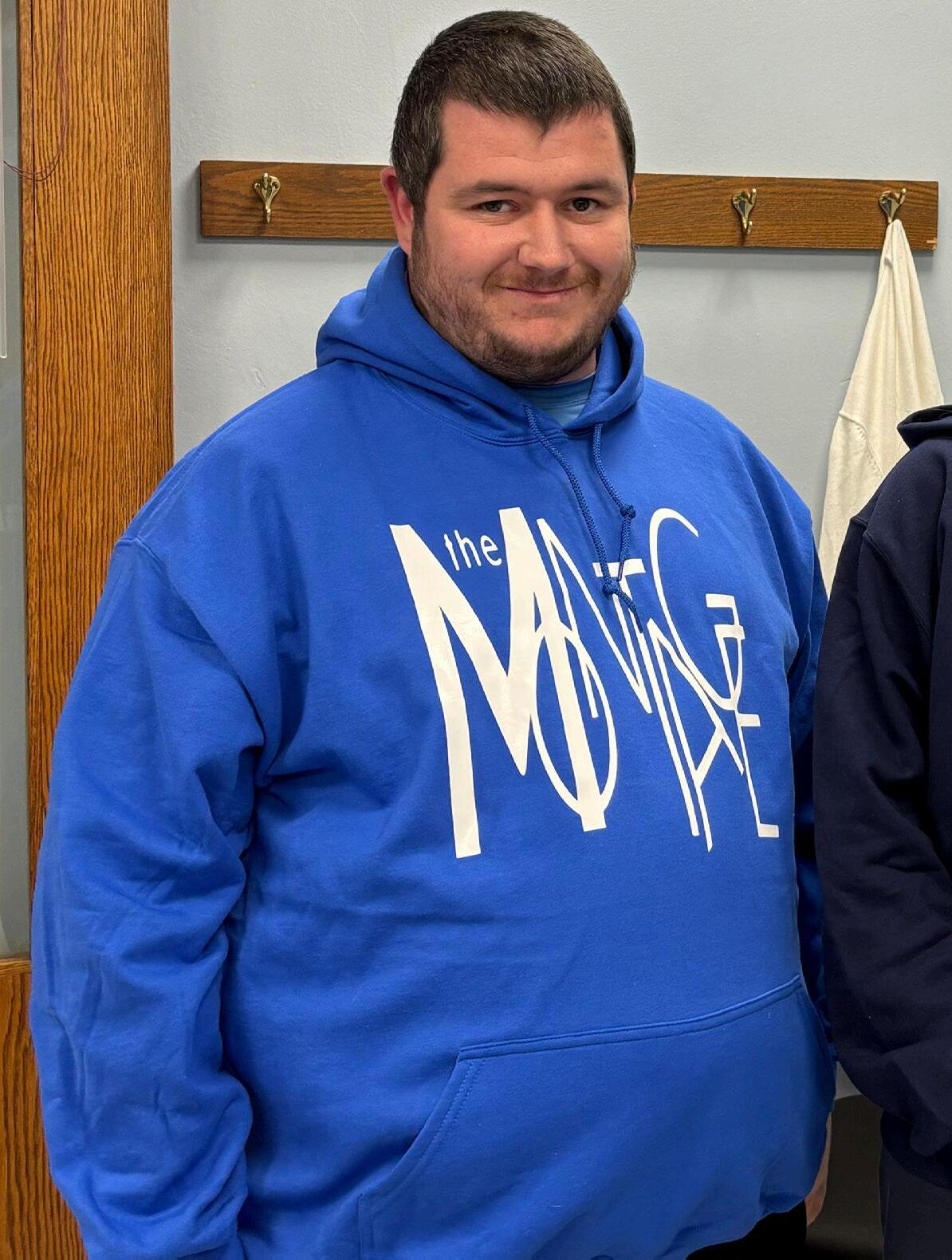
It’s cliche to say, but as someone who’s been to other schools previously, there’s nothing quite like STLCC. And there’s nothing quite like The Montage either. The paper has changed a lot over time, and especially during my tenure. I’m very proud of how far we’ve come, and the times we made it through. I’ve been on staff with three people, and
now a staff with up to 15 constantly innovating and taking up the mantle of producing, in my opinion, a fine product. I will miss The Montage, even as I look to continue my studies. It’s truly been an honor being on this staff.
Thank you all.

DANIEL HOYER STAFF
As a kind of continuation of my last article, “The Magic of Arcane,” in which I talked about how the Netflix show “Arcane” was one of a kind, I wanted to write a whole other story talking solely about the music.
Good music can make or break any TV show or movie. You could have a stellar movie and have a kind of meh soundtrack, and then it completely gets rid of everything good about the movie; at least that’s the way it is with me. Thankfully, Arcane’s soundtrack doesn’t do that.
Right away we get an epic theme song that gives you chills in the first couple seconds. With the slow and almost melodic heartbeat-esque music and the
quiet lyrics, you get the sense that you’re being shown something that should be kept secret, along with a myriad of statues seemingly telling of an ancient legend lost to the mists of time. Then, out of nowhere, you get bombarded with a beat drop that gives you a jumpscare as you see more statues that start to crumble as if they were shot or beaten with a sledgehammer to match the epicness and fierceness of this new musical direction. Then, at the end, the epic music ends as soon as it begins as the title card is sprawled across the screen with a golden light behind it as chunks of stone, assumingly from the destroyed statues, float around the title card as if stuck in time. And that’s just the theme song; imagine the rest of the show!
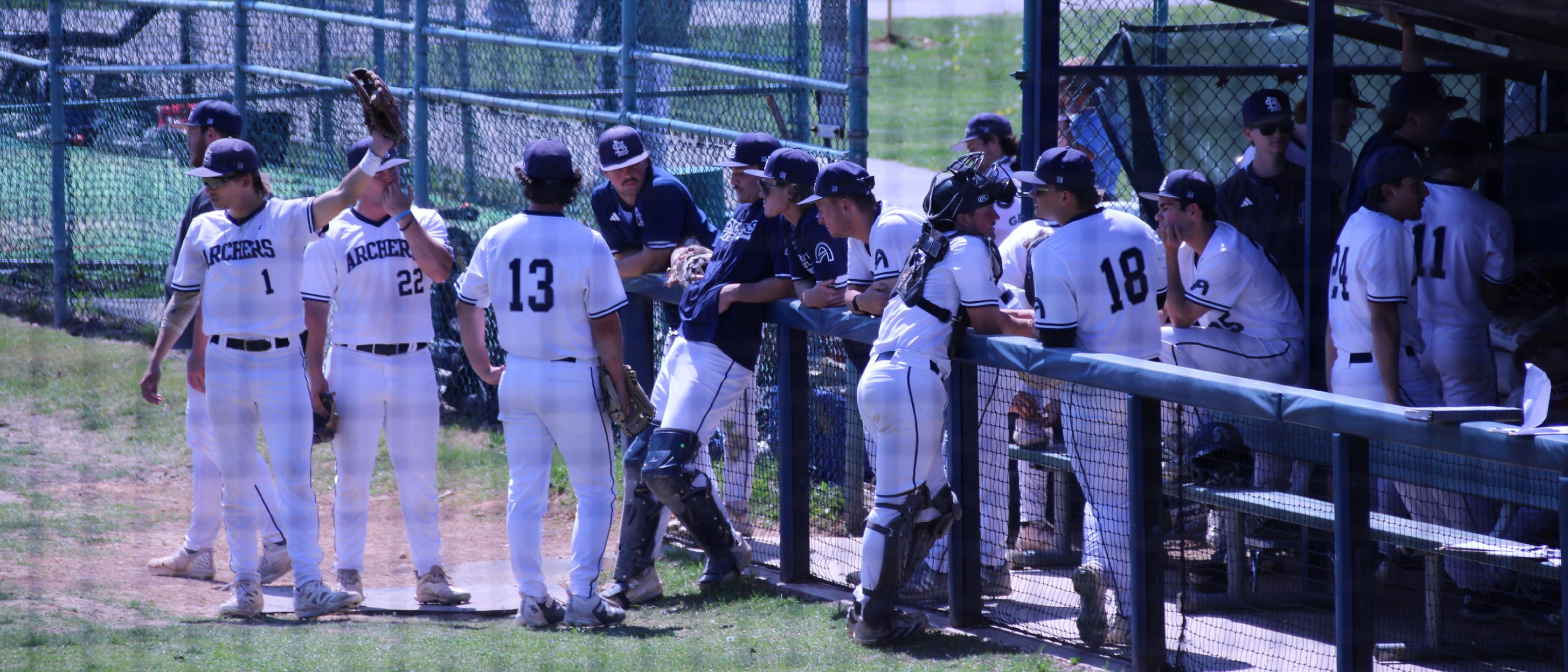
STLCC Archers baseball team wins their first round of playoffs against Jefferson College and heads to Joplin to face Crowder College.
LINDSEY UNNERSTALL SPORTS EDITOR
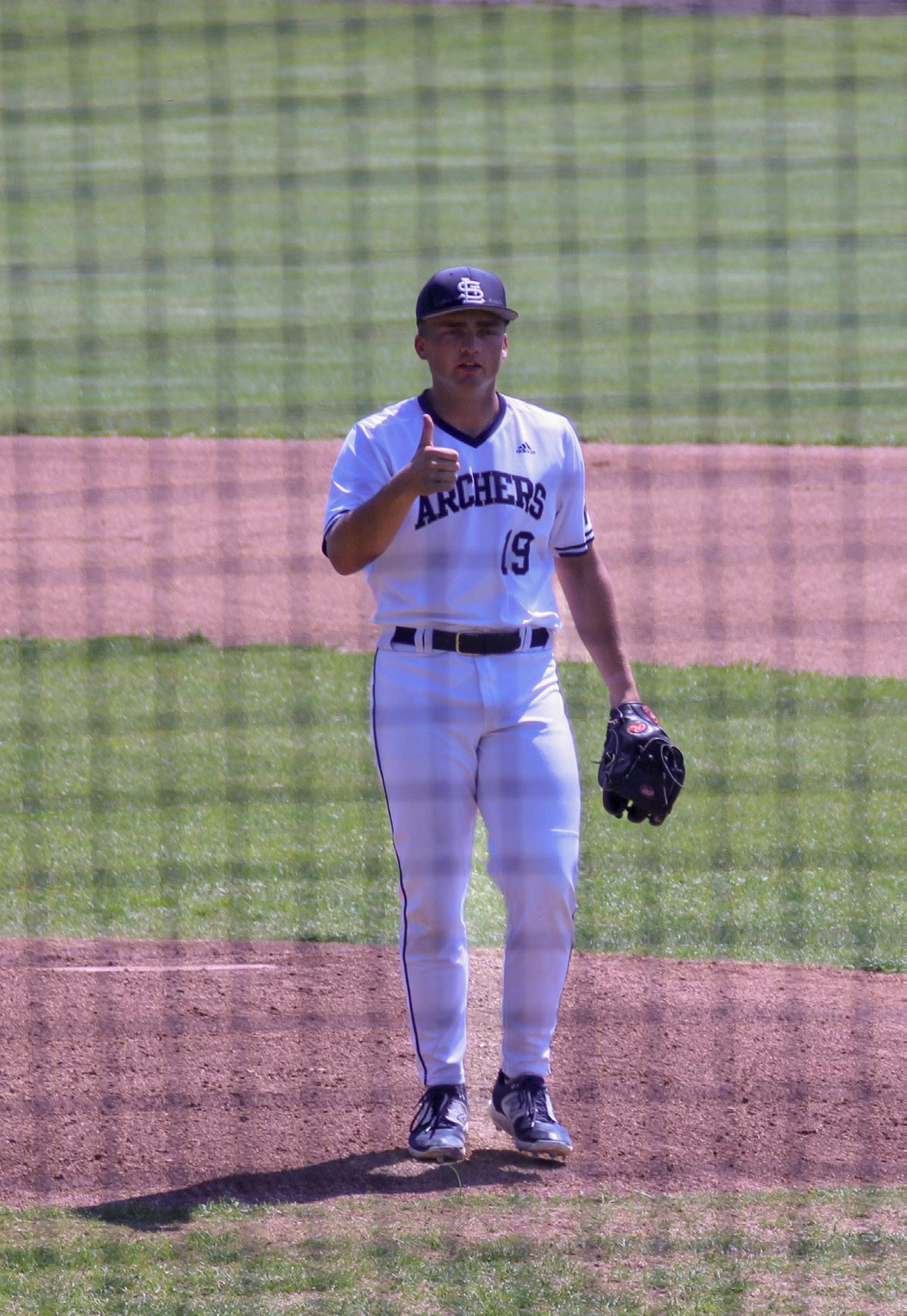
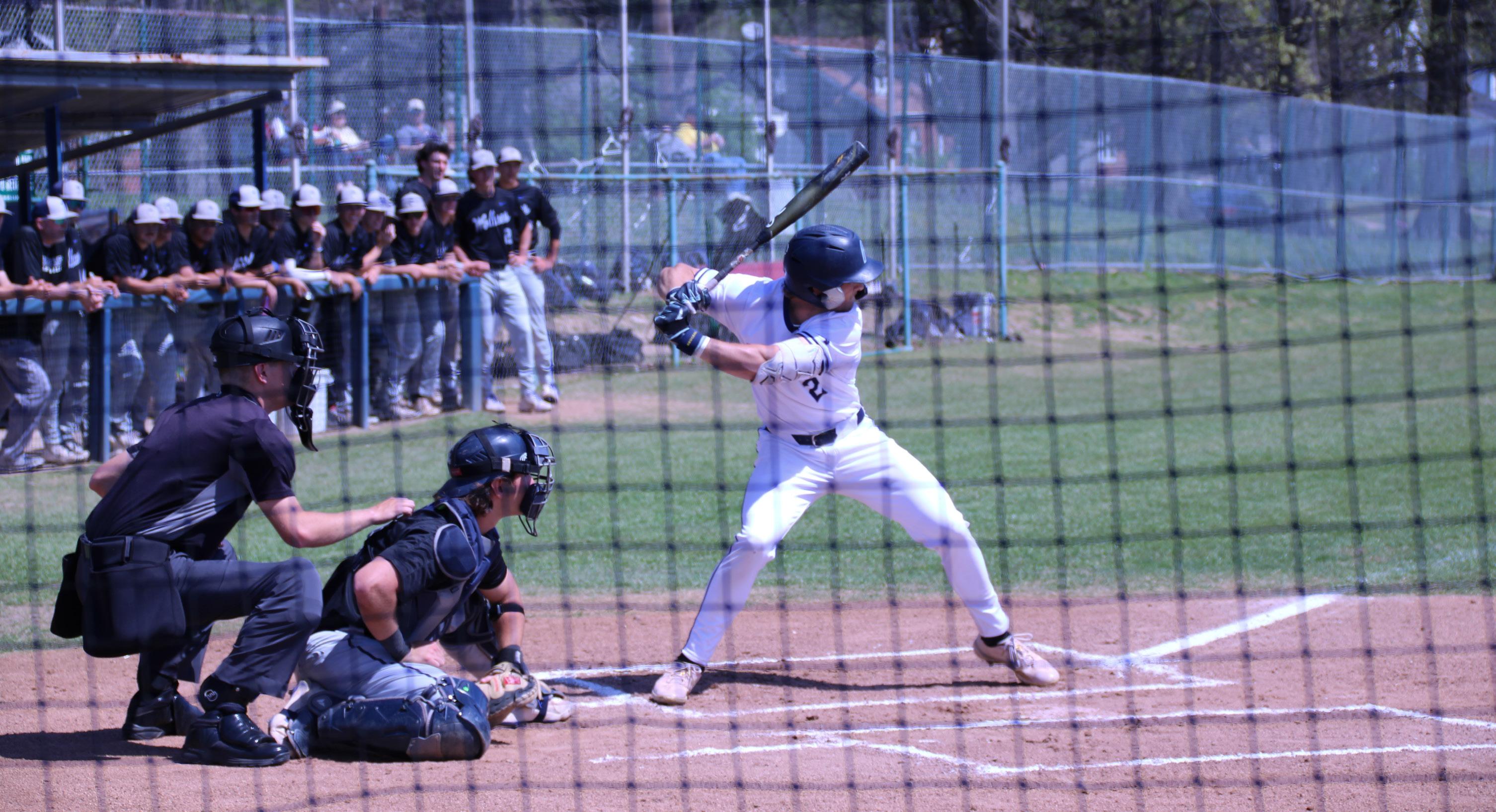
The STLCC Archers baseball team closes out their 2026 spring season with an almost even record of 24 wins to 25 losses. The guys team made it through their first round of the post-season after a threegame series against Jefferson College, with the Archers winning the final game in the 11th inning and upsetting the No. 2 seed team. The win comes after the Archers previous four losses to Jefferson at the beginning of the season.
The team advances to the NJCAA Region 16 Tournament in Joplin, Missouri and faces Crowder College in their next game on May 7. The outcome of the May 7 game will determine if the Archers will continue in the play-offs or end their season in Joplin.
Sophomore pitcher Mason Mitchell has played
baseball all of his life and reflects on this season as one of the best in his career and attributes it to the team of guys and their hard working energy.
“The vibe of the team is the best. People love to be at the field. People love playing the sport. There’s nobody on this team, I doubt, that doesn’t want to be here. They all want to have fun and they all want to go play as best they can,” said Mitchell.
From the off-season to the post-season, the Archers are dedicated and hard at work, putting in hours at both the weight room and the field, working on technicalities, strategies and everything in between. Although they undergo months without any real games or competition, the team uses the time to fine tune everything from their pitches to bunt coverages and base running strategies.
“That’s one thing that us pitchers work on is just how much stronger we can get for the season. Working on our pitches, working
on our mechanics heavily in the offseason, just getting ready for that first game is the biggest thing,” Mitchell said. “So we go all in on working out and working on our skills.”
Sophomore first-basemen and outfielder Nick Bonczkowksi has also thoroughly enjoyed his time with the Archers and plans to take the STLCC skills he’s learned into UMSL this coming fall in terms of baseball and his sports management major. After an injury left him sitting out the entirety of last year’s season, Bonczkowski hit the gas this year with a buzz of energy.
“My hope is to continue playing the game and just enjoy every second. There’s only a few years left of college, so just enjoying the moment and enjoying the memories of meeting new teammates, learning, growing together and just enjoying the game of baseball,” Bonczkowksi said.
BY





CONTINUED FROM P. 10
Both boys agreed that their biggest struggle as a team this season has been staying consistent and keeping their heads in the game when they start to lose.
“Usually when we get down in games, I would say about more than half the time we just let off the gas. We kind of lose confidence,” Mitchell said. “But whenever we’re on and we’re playing really good, we keep that momentum going, and we’re, in my opinion, probably one of the best teams in the region.”
After a long season of non-stop hard work, the team heads into the post-season with a mindset to have fun, play the game and enjoy every moment and every memory.
“We’ve been, as a group, realizing that you only get a few more guaranteed games, so [we’re] really enjoying the little moments together and just playing free,” Bonczkowski said. “We kind of are having the ‘there’s nothing to lose’ mindset which has brought the team even closer these last few weeks.”
The team has found that holding each
other accountable, being mentors and putting their heart in every single game is what has brought them this far. Whether or not they continue to advance in the playoffs, they’ve got memories and friends that will last way beyond baseball.
“So just giving it your all and having the sophomores who had been there the year prior to take some of the freshmen under their wing, just helping them out, guiding them on the right path and just building that team chemistry that translates into games,” Bonczkowski said about
the team’s mentality during the year.
As for the team’s upcoming game against Crowder College, the boys are playing to win and most of all, have a good time.
“We’re just gonna go in there and play as hard as we possibly can. We are actually pretty confident, more confident than we thought we would be,” said Mitchell. “My mindset is to just go in there and play our hearts out. Go in, win a series, and hopefully we move on.”
ANSWERS ON P. 11
Down
1. This amusement park is under new management and soon will be loosing their superhero sparkle
2. You don’t need a checkered blanket but that adds whimsy to this fun outdoor meal
4. The month of June hosts parades celebrating gay _____
5. A classic STL free activity if you love animals and walking
6. ________ marks the day in 1865 when enslaved people in Texas were told of their freedom almost 3 years after the Emancipation Proclamation
10. Watch local birds hit balls playing this sport at Busch Stadium
13. pitch a tent and start up a fire!!!
15. throw your towel onto the sand and put on your sunglasses at the _____ 16. The smell of chlorine makes you feel right at home