In the heart of Silverdale, Kate Allen Aesthetics combines advanced skin and aesthetic treatments with personalised care, natural results and over 21 years of clinical expertise.
YOUR MOST RESULTS-DRIVEN SEASON STARTS NOW
After months of sun exposure, autumn is the ideal time to correct pigmentation, ref ine texture and strengthen overall skin health At Kate Allen Aesthetics, we focus on clinically backed treatments designed for long-term, natural-looking results , never quick f ixes.
FOR A LIMITED TIME
Laser Pigmentation Packages Receive:
2 complimentary LED facials
• $50 skincare credit to use on the day
SkinPen Skin Needling Packages Receive:
• 3 complimentary LED facials
• $100 skincare credit to use on the day
Offer ends June 30th
5/2 Central Boulevard, Silverdale Parking in the Briscoes complex 09 4210910
https: //kateallen co nz
KATIE’S SEASONAL SKIN TIP
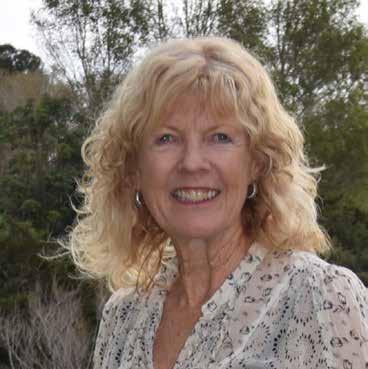
"Winter is one of my favourite times to focus on skin rejuvenation, with cooler temperatures and less sun exposure making it ideal for treating pigmentation, dehydration, and uneven skin texture At Kate Allen Aesthetics, I love combining skin needling to stimulate collagen and improve texture, alongside laser pigmentation treatments to target pigmentation and brighten the complexion For homecare, we have a variety of ranges that can be tailored to your needs Our products deeply nourish and support the skin barrier to promote skin rejuvenation, boost hydration, support collagen, and offer a healthier, more radiant complexion Winter is the perfect season to invest in your skin I look forward to seeing you in clinic soon!"
– Katie, Clinic Manager
INTRODUCING BTL EMSELLA
BTL Emsella is a non-invasive treatment designed to strengthen the pelvic floor using high-intensity electromagnetic energy, equivalent to thousands of pelvic floor contractions in a single session.
The treatment is ideal for those experiencing: Bladder leakage or urgency
• Pelvic floor weakness
• Postpartum changes
• Reduced conf idence during exercise or daily life
Completely clothed and comfortably seated, Emsella treatments are quick, discreet and require no downtime
Book your complimentary consul tation today.
ON THE COVER: The Botanic
In the loop
Found & Fancied
Feature: Meet Trish Beauchamp
Creative Dance celebrates 30 years
Taking a Hike: Stillwater to Okura
The Fishing Spot’s final hurrah
Cooking Questions: Ovens and onions
The truth about electric vehicles
Local fiction by Lorraine Brockbank
Your winter garden
Property Chat
Silverdale Business: From global boardrooms to timber floors
Harbour Hospice celebrates volunteers
A decadent Winter Deco weekend
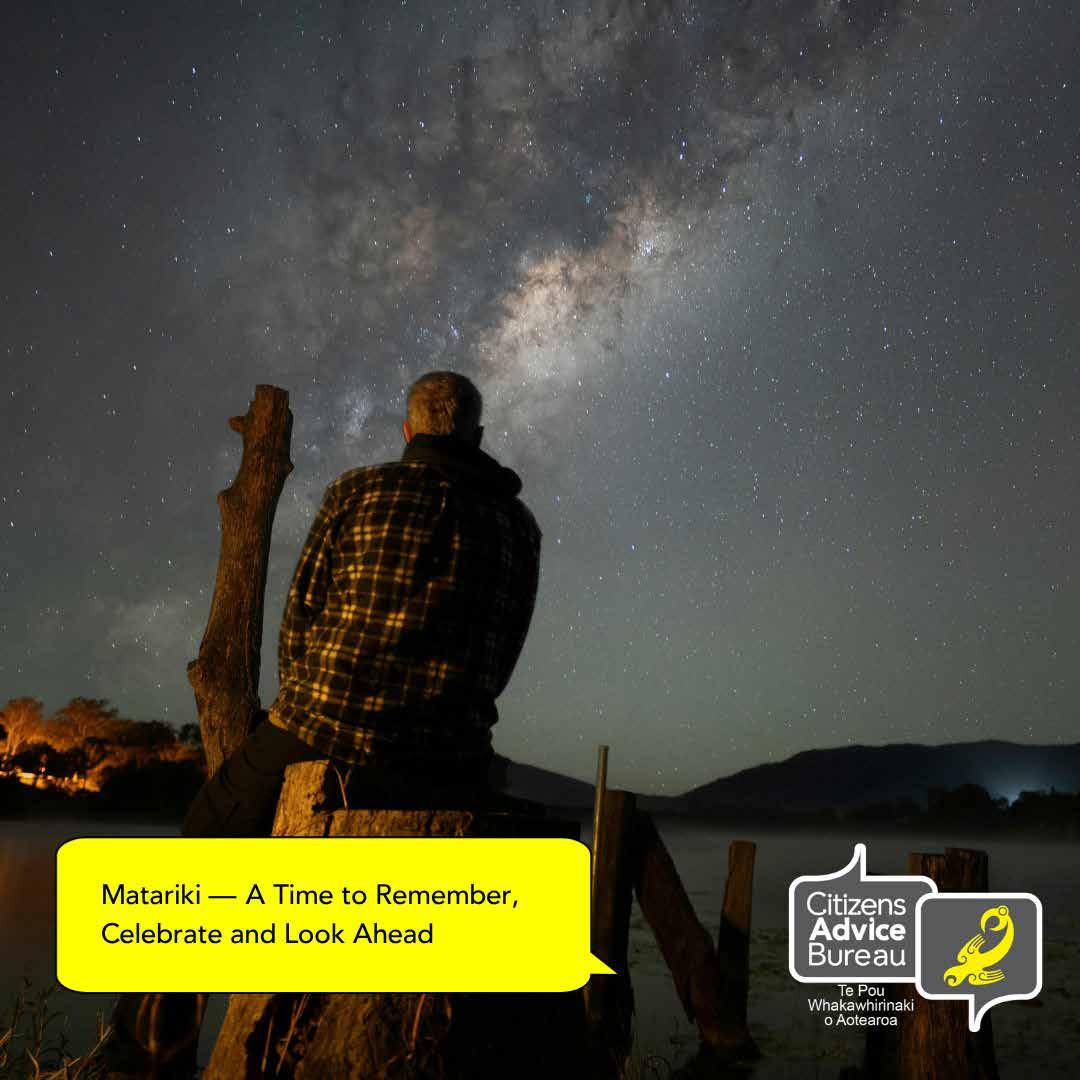
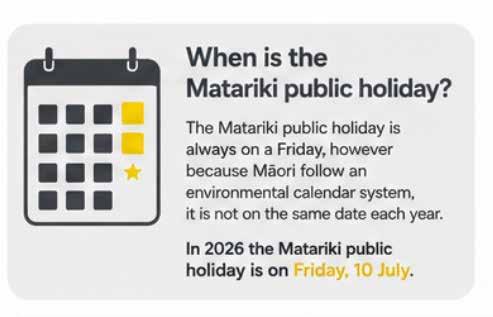
Getting ready for Matariki
Recipe: Chicken Coq au Vin
on at your local
Welcome to our June issue. We have much goodness to share with you in our pages this month, but first I must start with a bit of a tough goodbye – well, more of a see you later than a proper goodbye but it’s still a big one for our mag team, as it will be, I’m sure, for many of our readers. After being a columnist since our fourth issue way back in November 2014, Tim Lawrence has decided it’s time to sign off on his last monthly The Fishing Spot. Over the years Tim has given us so much of his knowledge, his humour and so many incredible fishing pics that would be the envy of any angler. The good news is that while Tim won’t be writing a monthly column any more, he’s likely to pop up as a guest writer now and then when he has an especially epic adventure to share. Tim, thank you. We appreciate the huge contribution you have made to our mag more than words can say.
We still have plenty to celebrate this month. Coastguard is celebrating a successful rescue, Creative Dance is celebrating thirty years in business and we are celebrating our columnist Trish Beauchamp, getting to know the lovely lady behind all the insightful articles.
With winter now upon us, we have advice for you on what to do with your winter garden and on what to do if you find your body stiffening up in the cold weather. We have an excellent idea for a winter weekend getaway next month where fancy warm coats are basically a requirement, and a couple of compelling novels for you to read if you’d rather hang out at home, a Coq Au Vin recipe that’s sure to warm you through and so, so much more. Please, pop you feet up and enjoy.
Claire Nevans
Downsizing without compromise
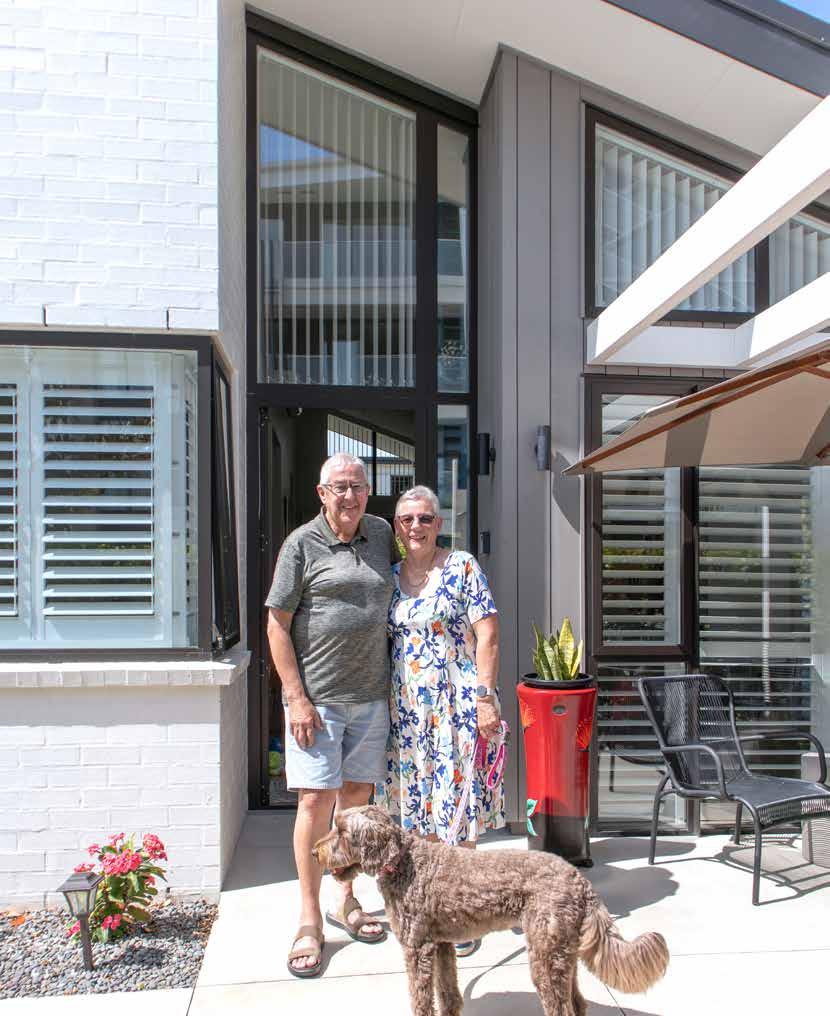
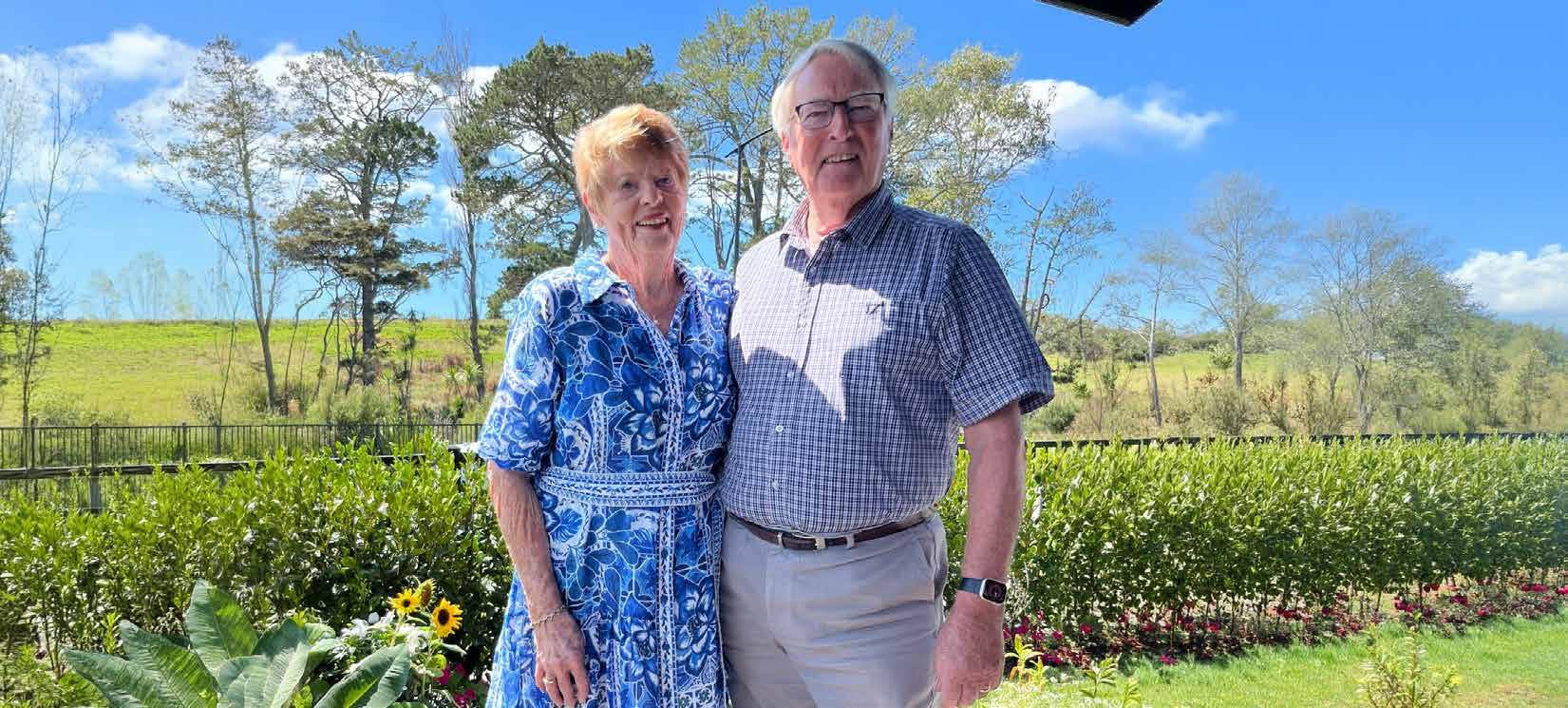
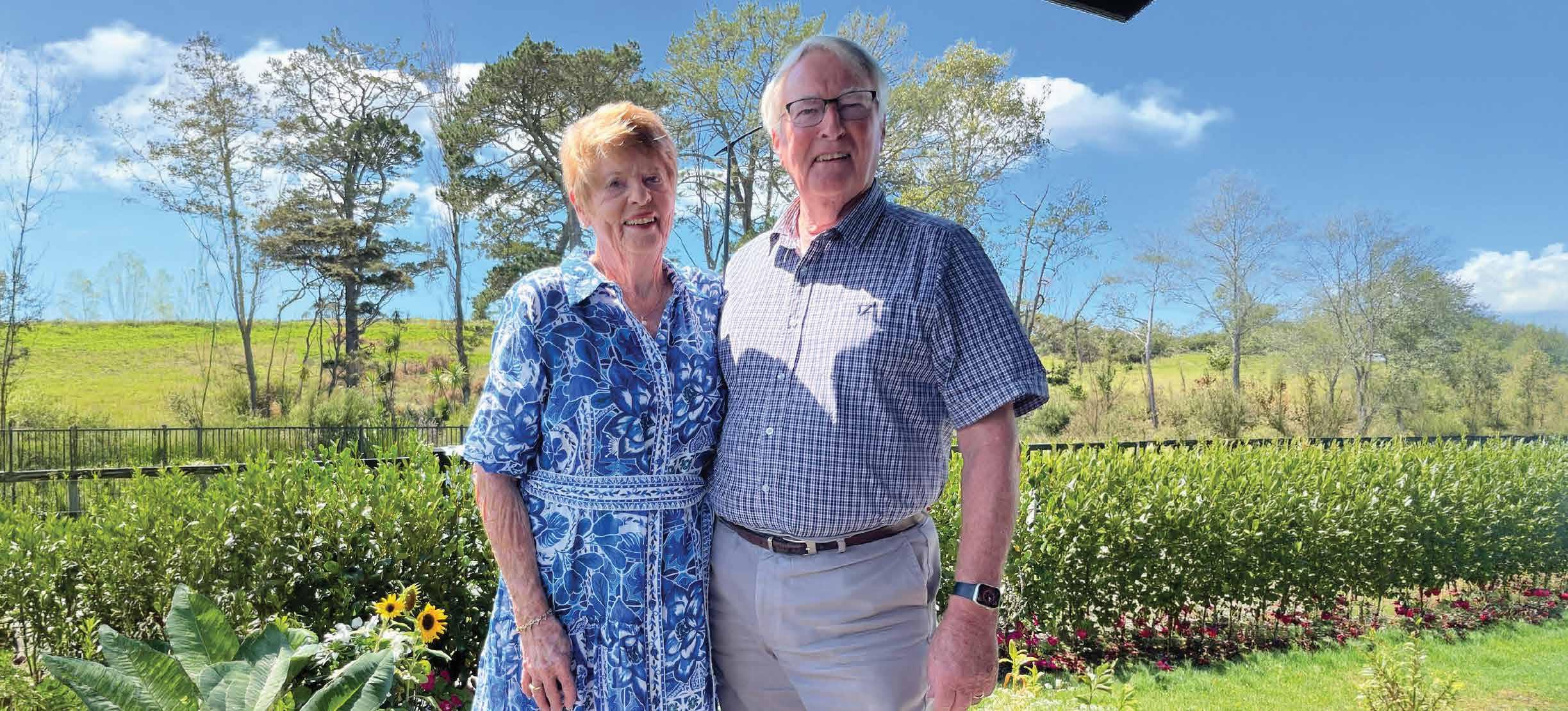
Brian and Margaret Mullan
At The Botanic Hibiscus Coast, residents Brian and Margaret are living proof that downsizing doesn’t mean slowing down.
Prior to making the move, the couple had spent eight years in their treasured 221sqm home in Millwater, where Brian was well known as the first editor of this magazine, then entitled The Millwater Mag While Brian brought a passion for storytelling, Margaret brought plenty of adventure – ticking off everything from wing walking to skydiving. Described by her husband as an adrenaline junkie, she’s now planning a tandem skydive for her 80th birthday, joined by her two children and, hopefully, a grandchild or two.
A visit to The Botanic instantly captured the couple’s attention. ‘We were quite taken with the raked ceilings and the open, spacious layout of the villas,’ says Brian. Before they knew it they were selling up and beginning the process of downsizing. Even through a lockdown, they tackled it with a practical mindset – asking themselves, ‘Do we really need this?’
By the time they moved in, in December 2021, everything had its place. A few carefully chosen new pieces completed their home, and today their villa comfortably hosts up to ten family members around the extendable dining table.
The couple love the sense of space throughout the village, with its thoughtful design and landscaped gardens. ‘I love how open it feels—you can see right through the village, which makes such a difference,’ says Margaret. Having explored other villages, they found many felt too compact and hemmed in. They’ve also personalised their home with custom touches, including additional pantry space and a built-in wine fridge – changes they say were welcomed and supported by the village.
Staying connected remains central to their lifestyle. Margaret attends Tai Chi and swims three times a week in the 20m heated indoor pool, while Brian enjoys the Whisky Appreciation Group and gets involved in village activities. Together, they’ve helped establish
social groups at The Botanic – the ‘Romeos’ (Retired Old Men Eating Out) and ‘Owls’ (Older Wiser Ladies), who get together for outings regularly.
Despite their strong involvement in village life, their connections beyond The Botanic remain just as important. With family nearby in Wainui, they’re actively involved with their grandchildren, and regularly care for Holly the dog during weekly visits and the occasional weekend stay.
For Brian and Margaret, life at The Botanic is about balance: a beautiful, thoughtfully designed home, a vibrant community, and the freedom to continue living life exactly as they choose.
thebotanic.co.nz
Print | Digital | Social
FOLLOW US
thecoastiesmag.co.nz
TheCoastiesMag
thecoastiesmag
11YEARS
DESIGN
PUBLISHER
Grayson & Sarah Furniss
MANAGING EDITOR
Claire Nevans
GRAPHIC DESIGN
KD Design
PRINTER
Treehouse Print
CONTACT US
021 771 140 advertising@thecoastiesmag.co.nz
CONTRIBUTORS
Hayley Crawford
Karen McMillan
Mark Lane
Tim Lawrence
Carmen Bird
Chris Norris
IN THE LOOP
Ingrid Boot invited to join U.S. gallery DTR Modern
Orewa-based artist Ingrid Boot has been invited to join DTR Modern, one of the United States’ most established contemporary art galleries, marking a significant milestone in her international career.
DTR Modern – with flagship galleries in Boston, New York, Washington D.C., and Palm Beach – is a long-established U.S. gallery known for its strong collector base and its presentation of modern and contemporary masters alongside a roster of leading contemporary artists.
Beach, while two works from the same series will be exhibited at Flagstaff Gallery in Devonport, which represents Ingrid in New Zealand.
Her new series, inspired by the iconic visual language of Slim Aarons, blends cinematic composition with a distinctly modern, feminine sensibility.
Ingrid says: ‘It’s incredibly meaningful to see this series find a home in both Palm Beach and Auckland. These works were created with a sense of place, light, and nostalgia, and I’m thrilled they’ll be experienced by audiences in two parts of the world that have shaped my journey as an artist.’
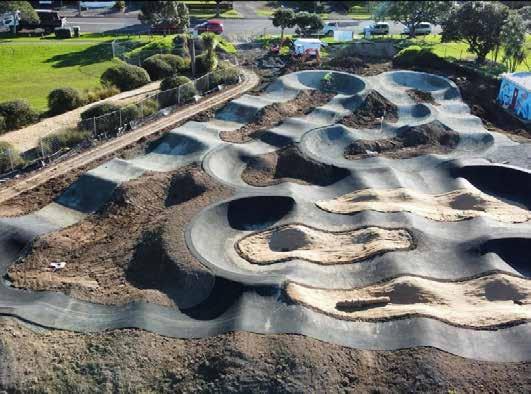
Pump track opens this month in Red Beach
Members of the Hibiscus Coast community are often lamenting the need for more local spaces designed specifically for kids to hang out, get some fresh air and burn off some energy. The new pump track opening this month at Red Beach Park on William Bayes Place certainly fits the bill.
Built for bikes, scooters and skateboards, the pump track is located next to the already established Red Beach playground and toilet facilities, making it a perfect recreation spot for families with kids of all ages.
The track’s official opening is on Saturday, 6 June from 10am to 12pm. There will be coffee, hot chocolate and a sausage sizzle on offer for those wanting to try the track. For more information go to https://www.facebook.com/hibiscusandbays.
Let’s hope this is the first of many.
To celebrate the partnership, Ingrid has unveiled a new body of work in a dual-location launch spanning the United States and New Zealand. Five new paintings will debut at DTR Modern Palm
Image credit to Trailpro, taken during construction
FOUND & FANCIED
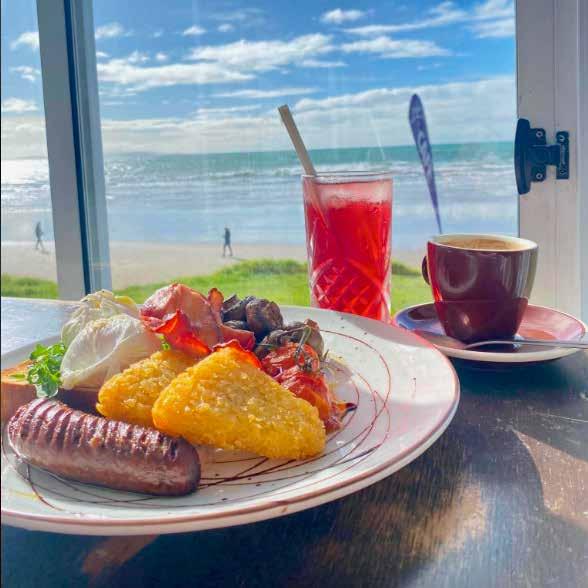
A few local breakfast options, substantial and light, we’ve indulged in and rather fancied.
Big Brekkie at Orewa Surf Club Cafe HBC Highway, Orewa
Date scone at Puff Coffee & Bites Cammish Lane, Orewa
Almond Croissant at La France Authentic French Central Boulevard, Silverdale
French Toast at The Clubhouse Café (The Botanic) Evergreen Drive, Silverdale
HELEN GRANT SASHA CASS
The most important relationship we’ll
ever
have is with ourselves
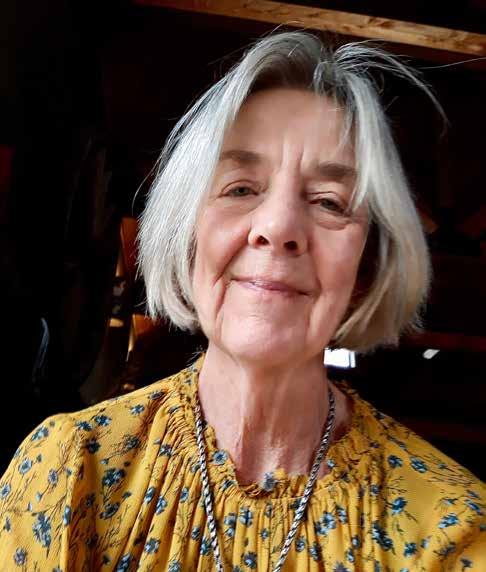
In a world that can often feel overwhelming and stressful, Hibiscus Coast Life Wellness Coach Trish Beauchamp encourages us to focus on our life balance, self-awareness and overall wellbeing. Her articles as a columnist for The Coasties Mag are always so insightful, we wanted to find out more about the person and the perspective behind her words.
Through her work as a life wellness coach, Trish advocates for finding stability in everyday life while also maintaining her own wellbeing. For Trish, wellness is
not something she just teaches, it is something that she actively lives and practices.
Her journey to understand life wellness began during a time when she was experiencing some challenging life events. She became motivated to learn how our mind and emotions impact our wellbeing when navigating change, and how to maintain life balance. ‘I was my first client,’ she says.
One of the most important things to Trish is forming and maintaining meaningful connections
with people. Whether it be with her daughters, grandchildren or friends in the community, staying connected is a priority. ‘Always take time to have fun with others,’ Trish comments, highlighting the importance of leisure time. This focus on relationships is one of the key factors to achieving a healthy life balance, alongside the mental, emotional, physical, and spiritual factors.
Trish also says that living on the Coast has benefits for wellbeing. ‘Maintaining my life balance is easily achieved with what the Hibiscus Coast offers. I am an active member of the Stanmore Bay Leisure Centre, enjoy dance events on the Coast, and love singing in the Coastie choir. We are blessed with many wonderful beaches, my favourite walking places. Research supports what I have learned to be true for me: the rhythmic sound of waves and fresh ocean air calms your nervous system, and sea breezes are naturally charged with negative ions, which are linked to increased serotonin (the ‘happiness’ hormone) and better mental clarity.’
Balance, connection, and self-awareness are some of the
key points to living a fulfilling life, to living as the healthiest version of ourselves. But everyone is unique and there is no ‘one-sizefits-all’ answer. Challenges are a natural part of the journey, that’s why working with a Life Coach and Counsellor can be beneficial. As a life wellness coach, Trish works alongside clients rather than directing them. She explains that one of the best parts of the job is ‘when a client has an a-ha moment’. The journey towards healthy wellbeing is led by the individual; ultimately, their outcome is shaped by the personal growth and change that they choose to make.
Trish supports clients in discovering that the path towards life balance and healthy wellbeing is not about perfection, but about understanding oneself more deeply and recognising the personal effort that needs to be put in to create meaningful change.
Lizzie Blanchard Feature Writer
TAKING A HIKE
Stillwater
to Okura
Work has been full-on lately, and I haven’t managed nearly as much hiking as I’d like. So when a recent autumn day rolled in looking absolutely glorious, I grabbed the chance to head outside. A couple of friends were free, the weather was just superb, and I couldn’t think of a better way to spend a couple of hours. We met at the Stillwater carpark and headed off for some fresh air, exercise and nature.
The track begins gently, following an easy gravel path before narrowing along the edge of the estuary. Recent rain had left things pretty muddy — Jodi’s white shoes didn’t stand a chance and quickly turned a respectable shade of brown. We ducked under a few low branches, scrambled around a couple of fallen trees, and had a few moments of ‘are we even in the right spot?’ before the path opened out onto the shelly beach.
A quick check of the map and the tide chart confirmed we’d timed things perfectly. The tide was low enough to walk around the rocks, which felt like a win. The day had that cruisy, unhurried vibe, I had my camera with me — which, let’s be honest, slows everything down. If you’re an eyes-on-the-prize, power walking type, I’m not your ideal hiking buddy.
We reached Dacre Cottage about an hour later and stopped for a breather, taking in the view across the water. After a short rest, we headed back via the loop over the hill, which meant a decent climb. Enough stairs to get a sweat going, but so worth the stunning views out across the Hauraki Gulf from the top. The bush was beautiful with the autumn light streaming through the tree canopy.
Back near Stillwater, we briefly thought we might be able to walk up the side of the river where the boats are moored, but a stream crossing stopped that idea quickly. A bit of doubling back and we were on the home stretch, returning to the carpark with the satisfaction of ticking off another new spot on our stunning New Zealand coastline.
A fab little adventure with coastline, bush and some mud to navigate, I think we clocked about 7km — and I even made it back in time to squeeze a bit more work into my day.
Carmen Bird
Carmen Bird Photography
We weren’t losing anything, we were gaining a new life.
Before Summerset, Eddie and Dianne Collett had already packed a lifetime into their years. They met as young airline crew in Wellington, Eddie a First Officer, Dianne cabin crew with the National Airways Corporation (NAC).
The couple married in 1971, and a short while later the first of three children arrived. After the NAC/Air NZ merger, they relocated to Auckland and Dianne poured her energy into keeping the family humming through Eddie’s international rosters for Air New Zealand.
After 45-years in their much-loved Murrays Bay home with sea views and a pool, everything changed. “I walked out onto the brand-new deck in slippers,” recalled Eddie. “One leg just took off… I very badly broke my other leg.” Recovery meant wheelchairs, ramps and hard questions. “We realised we weren’t foolproof anymore.”
The couple visited Summerset’s Milldale village on a beautiful day, admired the rural outlook and felt something click. “I said to Eddie, I think we can do this,” said Dianne. “We tend to be decisive,” added Eddie. “We came back the following day and signed.”
From the moment they arrived, the Collett’s felt embraced by the village community. “You wash your car, and it takes an hour because everyone stops to chat,” laughed Dianne. “And Wednesday drinks, nobody is ever late.” New neighbours quickly became close friends, the kind who notice if your garage is open, or a car window’s down.
“People are watching your back,” said Eddie. “Being a gated community adds to our security and peace of mind. And if anything happens, help is at hand.”
After decades managing a large property, practical worries faded, too. “At our age, climbing ladders is not on,” said Eddie. “Summerset washes the villa exterior, clean the gutters, mow the lawns. It’s all taken care of.” Village security also makes the ‘lock and leave’ lifestyle effortless. “We went on a six-week trip, and it was so nice to just lock the door and go,” said Dianne. “Coming home all you have to do is unpack your suitcase, it’s bliss.” They’re off again to Japan for the cherry blossoms, followed by a Viking cruise. “Our children complain they can never get hold of us,” she giggled. “We have more of a social life than they do!”
Perhaps the greatest gift is what it’s meant for their family. “Our children don’t have to worry about us anymore,” said Dianne. “Don’t leave it too late. Don’t burden your kids,” added Eddie. Most of all, the move reframed how they think about home. “We thought we’d miss the view,” said Eddie. “But halfway through selling, we stopped worrying about what we were losing. We were looking forward to what we were going to.” Asked if they have any regrets, Dianne doesn’t hesitate: “Once you move in, you never regret it.” Eddie agreed, “We weren’t giving something up, we were gaining a new life.”
If you’d like to know more about Summerset Milldale, visit summerset.co.nz
Celebrating 30 years of Creative Dance
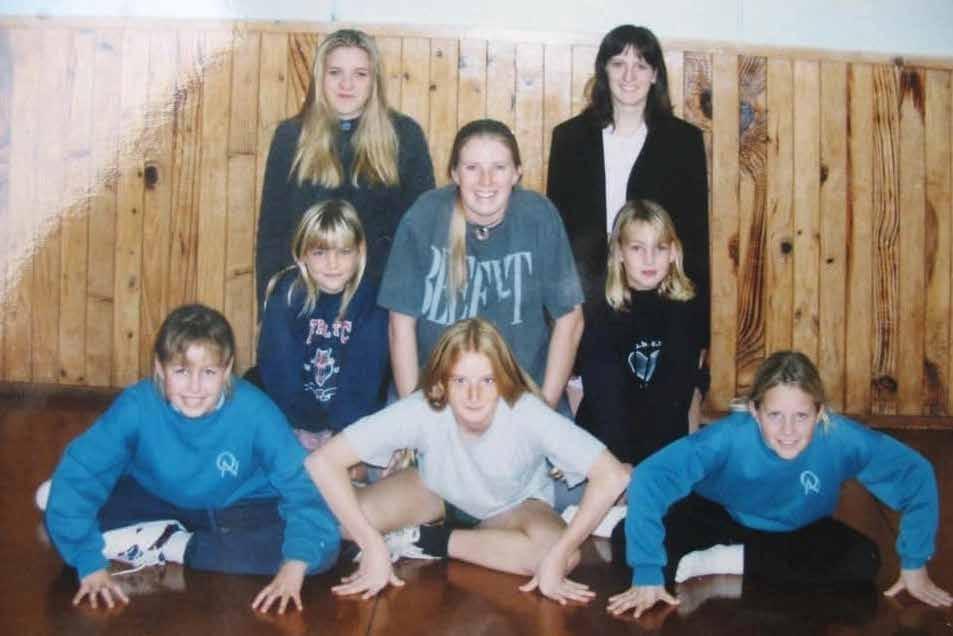
In June 1996, Shelley Elmsly took a leap of faith when she borrowed a boombox from her dear friend Rie, hired the Masonic Hall in Orewa, and rounded up seven neighbourhood kids to be the students at her first ever dance class. Thirty years later her dance school, Creative Dance, is a much-loved institution on the Coast with pretty much every local knowing someone who’s taken dance classes there and many ex-students now bringing their own children along. To celebrate this impressive milestone, we’re looking back at what shaped Creative Dance, what makes it such a special dance school, and what the future may hold.
Shelley has always loved dance, taking lessons from the age of 5 and really finding a passion for it when she started dancing with Ann Skinner at the age of 10. So as a young adult, when she’d just quit her job and was thinking about what to do next, teaching dance came to mind and that’s what she has been doing ever since.
Part of what makes Creative Dance so
special is that everyone is welcome. It’s a true community dance school where it’s all about learning and having fun. ‘My biggest joy in this job is watching people’s confidence grow’ says Shelley. The school holds two shows each year. The term one showcase is an opportunity for the dancers to share what they have been learning and also acts as a fundraiser for a local child or family charity. The end of year show is a colourful celebration of all the dancers have achieved throughout the year.
There have been many highs and plenty of challenges over the last 30 years. ‘The biggest challenge was definitely Covid,’ says Shelley, ‘and the second would be teaching while full term in my pregnancies.’ She considers her biggest achievement staging an outdoor end-of-year show (thanks to Covid restrictions) in November 2021, only possible through sheer determination and the support of her dance families. Other highlights include discos she held in the early days, doing the Santa Parade twice in the rain and taking her students to Victoria Park Market in 2001 to dance on a double
‘I just love it,’ says Shelley. I love the students, the space we have created with like-minded people. I can wholeheartedly say I still love it even though my knees don’t always agree. I feel really lucky to have had this job that I love for 30 years, that allowed me to be there for my daughters when they were young.
Shelley’s daughters, Zoe and Sami Wilson, now also teach at Creative Dance. ‘They both bring so much to the table creatively in their dynamic choreography and worked tirelessly behind the scenes long before they were on the payroll,’ says Shelley. ‘They also bring a heap of fun and laughs. They are both keen to take over when they finally get me to retire, but I’m definitely not going anywhere soon.
‘I’d like to thank my mum and dad, my incredible mentor Ann Skinner and all the families who have stepped through my doors. I am eternally grateful to you all.’
decker bus.
The first class
THE FISHING SPOT WITH TIM
Last month I ticked off one of my bucket list trips to Fiordland with Legacy Fishing Charters, and it certainly didn’t disappoint. Travelling via Queenstown, across Lake Manapouri by ferry, then by coach over the Wilmot Pass into Doubtful Sound was a journey in itself.
Once we arrived at the dock, we loaded our gear and steamed out of Doubtful Sound, heading south toward Dusky Sound. Cyclone Vaianu was closing in, bringing 20–25 knot winds and 4m+ swells, the biggest seas I’ve ever fished in. But it didn’t matter, the fishing more than made up for it.
Over the seven days, we landed some incredible fish. We braved the conditions to head outside the sounds twice for grouper, finishing the trip with around 35, alongside kingfish, trumpeter, bluenose and even a southern bluefin tuna caught while trolling between spots. Closer in, we filled our quotas with oversized blue cod and bins of terakihi.
Midweek, the weather really set in and we were forced to shelter from 50 knot winds deep inside one of the sounds. While tucked away, the hunters were dropped into the bush using the boat’s tender. We watched stags climbing a slip on the cliff face, but they never returned at dusk while the hunters waited.
The highlight of the trip for me was the diving. I managed to get in
the water four times despite the conditions – made easier by hot showers onboard to warm up between dives. My third dive was something special. We were deep inside the sound in calm water, where a layer of fresh icy water sits on top of the salt water. Entry was cold, brown and murky, but beneath it was crystal-clear water.
There was no seaweed, just boulders and ancient kauri logs that had fallen into the sound, creating an eerie underwater landscape. It felt like swimming through a forest of submerged, lifeless trees. Crayfish were everywhere, out in the open, under rocks and almost too easy to catch. If you waited long enough, they would practically walk towards you.
But the real magic was below. Black coral covered the bank and down into the dark below me, glowing like a forest of white Christmas trees. Seeing something so unique and learning it can be 300–400 years old made the experience even more special.
I’ll definitely be back. I’ve already been invited again in 2028. Skipper Steve Fishburn runs a fantastic operation and looks after his guests exceptionally well. I highly recommend this trip to anyone looking for a true Fiordland adventure. You can contact them at mvlegacyfishing@gmail.com for more information. Tight lines everyone! Good luck and catch some fish.
Tim Lawrence
Time for a check-up?
Bowel health is a topic that many avoid, yet silence around it can have deadly consequences. This June, Waitematā Endoscopy is proud to support Bowel Cancer Awareness Month to break the ‘poo taboo’ and encourage open conversations about symptoms, risk factors and early action.
New Zealand has one of the highest rates of bowel cancer in the world, where it is the second leading cause of cancer death, with more than 3,000 diagnoses and over 1,200 deaths each year.
Despite this, awareness remains low, and one of the biggest barriers is not a lack of knowledge about the disease itself, but discomfort around talking about bowel habits. Blood in the stool, changes in bowel motion, abdominal discomfort, or unexplained fatigue are often dismissed or self-managed in silence. Many people hope symptoms will settle on their own, but persistent change is never something to ignore.
Breaking the ‘poo taboo’ is not about creating alarm, it is about creating openness. Normalising conversations about bowel health allows symptoms to be addressed earlier, investigations to happen sooner, and outcomes to improve. In many cases, early assessment leads to reassurance. In others, it allows pre-cancerous changes to be identified and treated before they progress. No one ever died of embarrassment, but they do die of bowel cancer!
A colonoscopy is a common and safe procedure that allows us to investigate the inside of the bowel and remove pre-cancerous polyps at the same time. It is one of the most effective tests available for both diagnosing and preventing bowel cancer at an early, and often
preventable stage.
At Waitematā Endoscopy, we aim to make taking a proactive approach to your bowel health easy. Our experienced team will help to put you at ease when it comes to your endoscopy. Take a virtual tour of the patient journey and our clinic for an insight of what to expect at www.waitemataendoscopy.co.nz/locations
Dr John Perry
Gastroenterologist and Endoscopist
Waitematā Endoscopy
THE BEAUTY BRIEF
As temperatures drop across New Zealand, many people suddenly discover their bodies have entered ‘rusty robot’ mode – tighter, more stiff, and far less willing to move like they used to. Winter often brings an increase in muscle tension, joint stiffness, headaches and lingering aches, especially for those with old injuries or chronic pain conditions.
Cold weather naturally causes muscles to contract and blood vessels to narrow, reducing circulation. At the same time, we tend to move less in winter, which allows tension to build up more easily in the body.
For those living with conditions such as arthritis, fibromyalgia, migraines or ongoing neck and back pain, winter can feel particularly challenging, with symptoms often feeling more intense in colder, damp conditions.
This is where regular massage therapy becomes especially valuable.
Heat therapy for deep relief
www.mintskinbody.co.nz 020 4126 2064 Winter has entered the chat and so has your back
Hot stone massage can be incredibly beneficial during winter. The warmth of heated basalt stones helps muscles soften more quickly, allowing tension to release with less pressure. Many clients find the added heat deeply comforting, helping the body relax on a much deeper level during colder months.
Magnesium support for tired muscles
Magnesium-enriched massage oils are another powerful winter tool. Magnesium plays a key role in muscle function and relaxation, and when used during massage, it helps to ease tight, fatigued muscles. Combined with therapeutic touch, it supports a sense of deep physical ease and recovery.
Circulation, comfort and recovery
Massage helps improve blood flow, bringing warmth and oxygen to stiff, aching areas. This can reduce tightness, improve mobility and support overall comfort when the body feels restricted by the cold.
Winter can also impact stress levels and sleep quality. Massage encourages the nervous system to downshift, helping the body move into a calmer, more restorative state. Many people report improved sleep and reduced stress after treatment.
As winter sets in, listening to your body becomes essential. Small acts of care, such as warmth, rest, hydration and regular massage can make a meaningful difference to how you move through the colder months.
Kerry Venter | Health & Skincare Therapist
Mint Skin & Body Therapy
pain
COOKING QUESTIONS
Your own personal chef with Mark Lane
I have been cooking professionally for 39 years. My business, Culinary Lane Catering, is based in Millwater, providing three and five course dinners in your home, out-catering and grazing tables. Gain the benefit of my experience by emailing me your cooking questions.
Ollie: A couple of oven questions for you. Ovens can vary so much in heat and how evenly they cook, it can be a bit hit and miss going into a holiday home and not knowing that particular oven. Do you have any tricks for testing ovens you aren’t familiar with before using them to cook a big/important meal? Also, warmer drawer, yes or no? We are a family of 5 trying to decide on doing two full ovens or one full size one small oven and a warmer drawer in our kitchen makeover.
Great question for me as I work with at least 1-3 different ovens at clients homes every week, so I’ve used them all. I have three 600mm ovens in my own ‘Culinary Lane Catering’ kitchen. I find the larger ovens (900mm plus) don’t heat as quickly, maintain the heat as well or have as even heat distribution as the 600mm. To be honest, if you have an oven that doesn’t heat evenly, there isn’t much you can do about it apart from getting it fixed as it could be worn out, the elements not working well, restricted airflow, poor calibration or you don’t have fan assisted. If it is an oven you use often that doesn’t heat evenly, you will learn over time the best areas for the most even heat. I have 10 presets on all my ovens, and I only use three of them: fan bake 99% of the time, grill if required and no fan bake if I want no airflow for cooking dishes such as a crème brulee or lemon tart. The fan is the essential part of a modern oven to circulate the hot air evenly for even cooking. I personally don’t like warming drawers as a second oven can do the same job by keeping it at a low temperature. You can also do this to
prove bread if the oven goes low enough. To warm plates, I use the microwave. I don’t like ovens that have so many bells and whistles you need a license to drive them. At the end of the day, it’s about personal preference and your budget.
Jade: Can you please share how to make proper caramelised onions? Mine never seem to turn out right.
It sounds like a simple thing to do, caramelised onions, but it’s quite technical and takes a lot of effort and time to do properly. The first thing to understand about onion is that it is 90% water and that water must be removed before the onion will start browning with its natural sugars. There are 6g per 100g of natural sugars in an onion. The first thing to do is slice the onion very thinly, place into a heavy bottomed, stainless-steel saucepan with a lid with around 50ml of virgin olive oil. Place on a medium to high heat (on my induction I do the whole process on setting 7 out of 9). You are going to steam the onions first, by allowing the moisture in the onion to come out of the onion. This will take around 20 minutes, and you must stir often. A square-topped wooden spoon is best to scrap the bottom of the pot so they don’t catch and start to colour at this early stage, as this will cause them to taste burnt later. They should be translucent at this point, with no colour. Remove the lid and then you need to start caramelising them. At this stage we want to evaporate any liquid left and then the onions will start to catch on the bottom, which is good. You want them to catch but not burn. Keep scrapping the bottom of the pot and removing the caught onion on the bottom entirely and mixing through. Continue to do this until the onions go a dark brown. The whole process can take around an hour. The more onions in the pan the better as you need volume to assist in this method. Turn off and allow to sit. This
is exactly how you make proper French onion soup. You can at this stage add a splash of balsamic vinegar and brown sugar for extra sweetness and sharpness. These will last at least 10 days in your fridge or freeze them and use when you need them. There are simpler recipes by adding more vinegar and sugars while cooking but they won’t taste as good.
Mark Lane | Culinary Lane Catering
www.culinarylane.co.nz culinarylane@gmail.com
Why clarity and advice matter in estate planning
When Mark’s Aunty Beth moved into a retirement village, she made a new will and enduring powers of attorney. As she didn’t have any children of her own, she appointed Mark – one of her six nieces and nephews – to be her attorney, because they were especially close. She intended for all her nieces and nephews to benefit from her estate when she passed, but wanted Mark to receive more, given he’d been good to her over the years. Beth decided to leave her share portfolio to all her nephews and nieces, divided between them. Mark would receive the residue, which would include any money in her bank accounts and the money she got back from the sale of her apartment in the village.
A few years later, Beth had a fall and broke her hip. It wasn’t possible for her to go back to her independent apartment. She spent some time in the hospital part of the village, but her health started to rapidly decline, and the village suggested that she be assessed. The assessment noted a marked cognitive decline, as well as the physical. Mark was called in to discuss the next steps.
The village now had care suites that could be purchased – this would still give Beth a lovely independent room of her own but would also mean that she would get the care that she needed. The cost of the care suite was relatively significant. The village had said that it could be paid for from the sale proceeds of the apartment when it was eventually sold, but because Beth
had purchased the apartment when it was relatively cheap, she would still need to pay a top up amount to the village to cover the cost of the care suite. Mark contacted the investment advisors and withdrew enough from the portfolio to purchase the care suite and enough to pay for Beth’s care on an ongoing basis, as the weekly care cost was large and Beth didn’t qualify for the residential care subsidy. When the care suite sold Mark decided to just put them in a term deposit in Beth’s name as the share market was a bit shaky and he thought it was better to go ‘safe’ in the meantime.
Sadly, a few months later, Beth passed away. Mark went to see her lawyer and found that he was appointed executor of her estate together with the lawyer. He saw he had been left a sixth of the share portfolio as well as the residue of her estate. Mark explained to the lawyer that there was hardly anything left in the share portfolio as the money had been withdrawn to pay for the care suite and that he had invested the apartment proceeds in the bank. The lawyer told Mark that because Beth had specifically said that her nephews and nieces were to get the share portfolio and he receive the residue, he would now get the lion’s share of her estate.
Mark was distraught. He had not meant to reduce the amounts that his cousins would receive from Beth’s estate and genuinely thought he had been doing the right thing for Beth. He also had no idea about what
was in Beth’s will. He knew at least one of his cousins would be furious about receiving less than she would have if the share portfolio had remained intact, and he braced himself for a will dispute and an investigation into his actions as Beth’s attorney.
This highlights the importance of being transparent when updating your will and involving those affected in the discussion, helping to reduce the risk of misunderstandings and unintended consequences.
Tammy McLeod (BA LLB) Managing Director, Davenports Law
Trust and asset specialist, leading the Trust Team.
CRAFTED LEGAL ADVICE FOR PEACE OF MIND.
Protecting Family Assets For Future Generations.
The protection of assets that we have worked so hard to acquire is an important consideration for most people.
Thoughtfully navigating modern family dynamics when planning your generational wealth transfer helps prevent future conflicts and ensures everyone’s intentions are respected.
A specialist can guide you in finding the right structure tailored to your needs. Protecting your family’s wealth for generations to come.
Contact our Trusts and Wealth Protection Team for specialist asset structuring and planning advice.
When did menus get so dark?
Understanding ageing eyes
At some point, some of us start noticing little changes in our vision. Restaurant menus seem harder to read, night driving feels more tiring, and bright sunlight or oncoming headlights suddenly feel much more glaring than they used to.
The funny thing is that these changes often happen so gradually that we simply adapt to them – until one day we realise our eyes aren’t quite keeping up like they once did.
As we age, it’s completely normal for our vision to change. Reading up close can become more difficult, eyes may feel drier or more sensitive to light, and contrast
can become harder to see in dim lighting. Cataracts are also a common part of ageing and can cause vision to appear cloudy, dull or hazy over time.
The good news? Many age-related vision changes can be managed very successfully, especially when detected early. Cataracts, for example, are incredibly common, and treatment options have come a long way. Regular eye examinations help monitor these changes and ensure your eyes are staying as healthy and comfortable as possible.
It’s also important to remember that eye exams aren’t just about updating glasses. They allow optometrists to assess the overall health of your eyes and check for conditions that may not show obvious symptoms at first.
Cataract Awareness Month
June is Cataract Awareness Month – a reminder that cloudy or blurry vision isn’t always ‘just getting older’. Cataracts are extremely common and develop gradually over time, often affecting night driving, glare sensitivity and colour clarity. Regular eye checks can help monitor changes and guide you through the best options for your vision and lifestyle.
So, if you’ve found yourself holding the menu further away, turning up the lights to read, or avoiding driving at night… it might be time for an eye check.
Your eyes change with age – just like the rest of you – and a little support can make a big difference to everyday life.
Come and see the team at Orewa Optics for your regular check-up, and to see our extensive and stylish range of eye wear.
Orewa Optics are here Monday to Friday, 8.30am to 5.30pm, and enjoy extended hours until 7pm on Tuesdays. Call us today 09 426 6646 or book online at www.orewaoptics.co.nz.
Bobby S Barfoot & Thompson Millwater
Known Locally. Trusted Personally. Your Local Guide. On Your Side.
021 0512 769 b.sundarajan@barfoot.co.nz
THE GREEN SPOT
The truth about electric vehicles
To follow up on last month’s fuel saving tips, my next two articles will focus on the benefits of electric vehicles – a long debated topic.
New Zealand is a great place to own an EV because we currently generate approximately 80-85% of our electricity from renewable sources – hydro, geothermal and wind. This allows an EV to be responsible for 90% less carbon dioxide than an equivalent petrol vehicle would emit. Even before the oil crisis, it was significantly cheaper to drive an EV and that’s with road user charges factored in too.
Electric vehicles are high performance with smarter technology, and with fewer moving parts they are low maintenance so potentially have less repair costs and waste. The batteries are built to last and what might surprise many vocal petrol heads is that the batteries can be refurbished, repurposed
and recycled. It may be possible to extend the life of a battery by replacing the dead cells, otherwise it could be sold to be used as storage for electricity from solar panels, or the raw materials can be reclaimed.
The mining for lithium and cobalt to create these batteries do sadly include energy-intensive extraction methods causing pollution, land degradation and potential groundwater contamination. However, the environmental impacts are significantly less than fossil fuel production (coal, oil and gasoline) which is estimated to be responsible for 34 billion tonnes of carbon dioxide equivalent annually, worldwide. Cobalt and lithium mining combined is thought to result in 2.8 million tonnes of annual carbon dioxide equivalent, so considerably better for our planet. It is possible to move towards more sustainable
practices for extracting these minerals and it is imperative that we do so, as they are crucial ingredients for a future of renewable energy technologies, including wind turbines and solar panels. Other elements are being considered, such as iron and silicon, as reserves of lithium and cobalt will not meet future demand.
Join me next month where I cover the safety concerns over fire risks and for the miners of these metals. In the meantime, take ‘charge’ of your emissions output and consider an electric vehicle or hybrid as your next car.
Hayley Crawford | @trashtalkingmama
THE FICTION SPOT
On a prairie somewhere in Iowa
By Lorraine Brockbank
‘Byron, shuffle closer to Nan, and hold the pitchfork with the prongs facing upwards.’
‘Like this?’ the bespectacled man asks.
The artist’s eyes squint. In his outstretched arm, he holds a brush and peers at the composition. The air shimmers in the heat. Side-by-side, two figures stand in front of a two-storey house with a distinctive Gothic window. He wears dungarees with a stitched pocket on the front. She wears a headscarf, and a shapeless dress with a brooch on the collar.
‘Perfect. Hold that pose.’
The painter smudges the colours on his palette, smearing the canvas with the brush. He steps back from his easel, scrutinises his work, smiles and continues to swab the colours, swooshing the brush across the canvas.
Nan glances at Byron, scratching his head. Her forehead furrows. ‘What’s the matter with you?’
‘Something’s not right. I feel uneasy, like there’s a hidden message here, something sinister.’
‘There’s nothing sinister. My brother sympathises with the farmers struggles; cattle dropping dead at their feet through lack of food, crop failure due to ravaging insects and merciless banks foreclosing. The pitchfork is a symbol of their fortitude.’
Byron shuffles his feet. ‘But the recurring three-prongs – the fork, the window, the dungaree pocket, is bothersome, Nan.’
‘The three prongs are a nod to my brother’s love of symmetry. Simple.’
At the whiff of a rotting carcass, Byron’s nose twitches. ‘Or a nod towards the devil? All good Bible-bashers know, the pitchfork symbolises the devil’s wicked ways.’
‘I’m no Bible-basher, Byron!’
A beat-up jalopy, squished full of people like overripe tomatoes, rumbles along the dirt road. A pile of mattresses lashed to its roof waved lazily in the breeze. Pots and pans clatter on the bumper. As apathetic as the dead corn crops, a swirl of dust lingers.
‘So much for farmers’ fortitude!’
The noise of the jalopy fades. With perspiration dripping from their faces, the pair stand resolute as if glued to the cracked soil. In nearby shrubs, the hum of insects murmurs. Behind the easel, the drag of the palette knife scrapes.
‘People will ridicule your brother’s painting for the lie that it is. No respectable gallery will hang his painting.’
Nan stiffens.
‘And his depressive portrayal of the farmers will outrage them. Also, no dirt-poor farmers’ daughter would own a cameo brooch, would they? Your brother’s painting is a joke.’
Nan’s eyebrows crease; a muscle in her jaw tightens. ‘Stick to pulling teeth, Byron. You’re a dentist; not an art critic.’
Spittle dribbles from Byron’s taut mouth. ‘But,
me. My stomach churns with humiliation.’
‘Yet you gladly accepted the fee to pose for my brother,’ Nan said, grasping the handle of the pitchfork.
‘The painting’s fake, and your brother’s a phony.’
‘How dare you call my brother a phony.’ Nan glares at Byron. Wrenching the pitchfork from him, she jabs him, ripping his shirt. ‘A small taste of humiliation, Byron. If you can’t stomach any more, run fast!’
Hibiscus Coast Writers
For more information, don't hesitate to get in touch with the Membership Secretary, Paula
Upgrade
Your Garden
Why Winter Pruning Matters
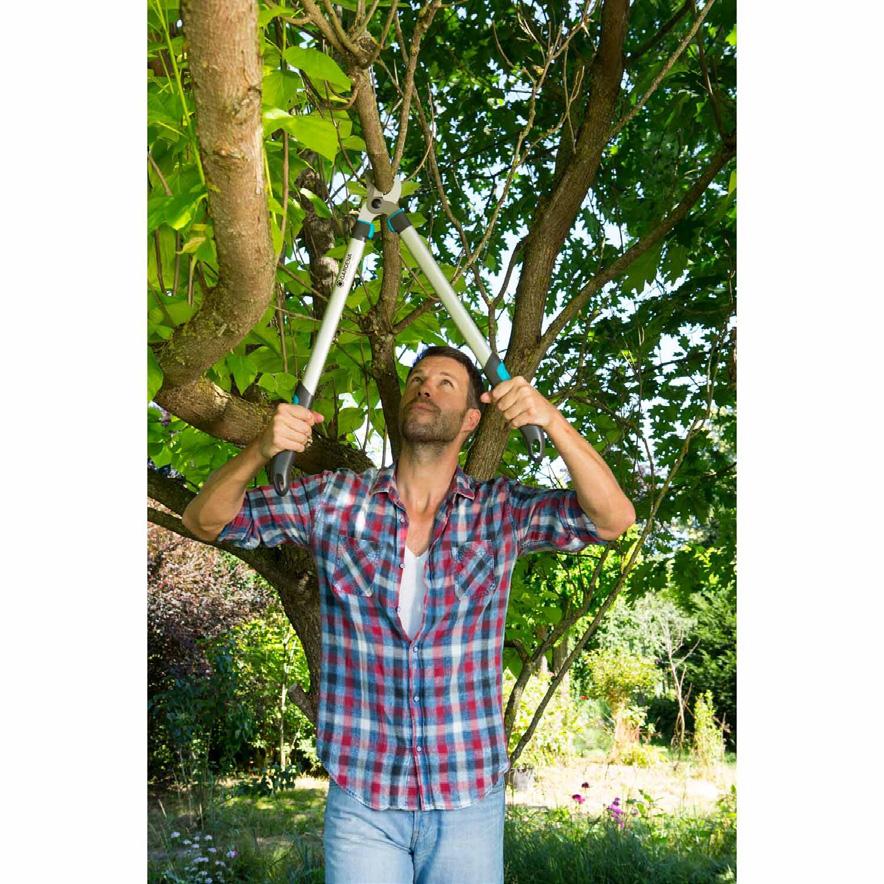
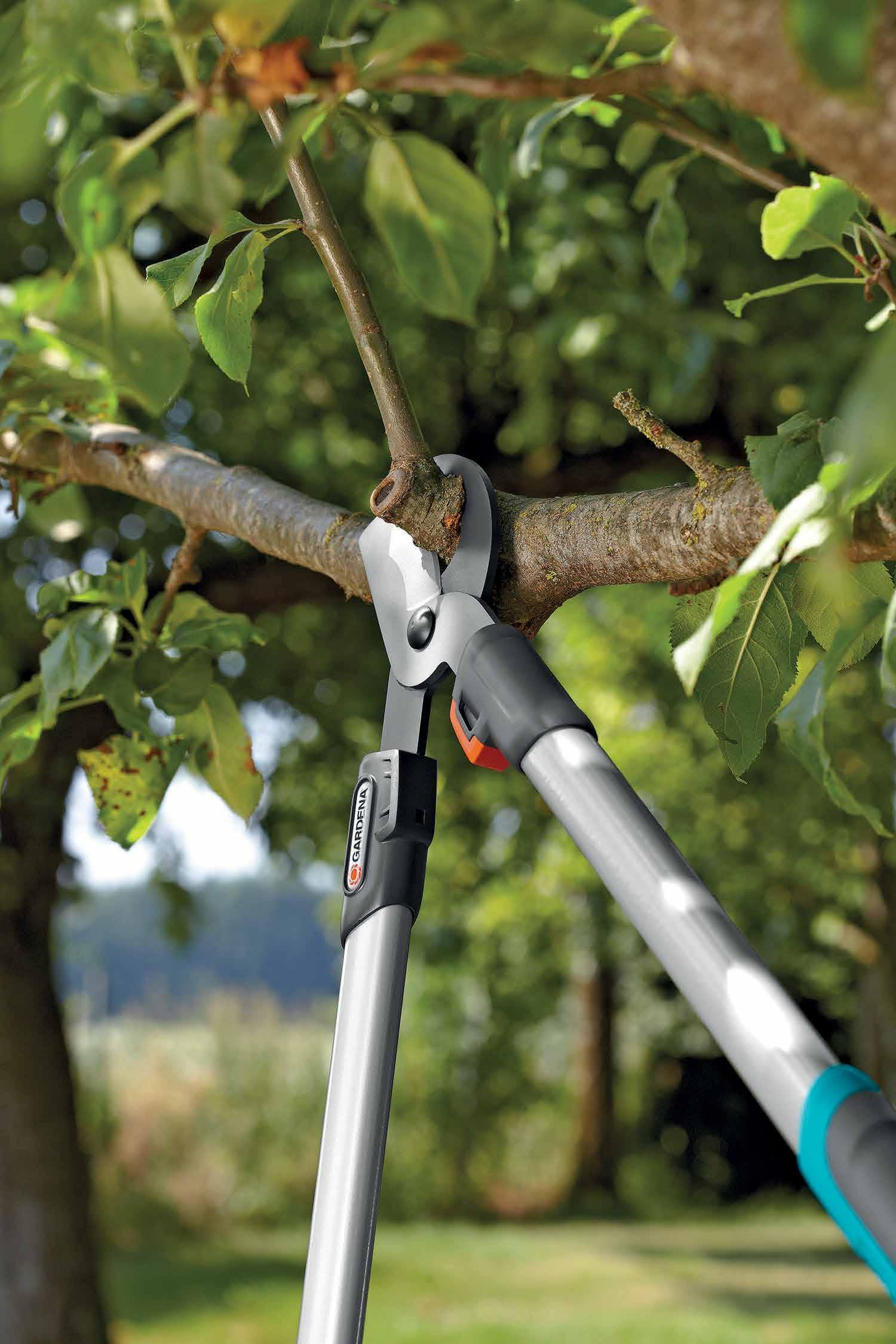
Winter is the ideal time to prune, as plants are dormant and less a ected by cutting. Removing overcrowded or damaged branches improves structure, air ow, and long-term plant health. Tackling thicker, woody growth now also reduces strain on plants during the growing season. Strong, reliable tools like Gardena EasyCut Bypass Loppers make shaping trees and shrubs easier while ensuring clean, healthy cuts.
The Importance of Sharp Tools
Clean cuts are essential for plant health, especially during colder months when healing is slower. Sharp tools reduce tearing and minimise the risk of disease entering pruning wounds. For precision jobs and lighter growth, Bahco Bypass Secateurs deliver smooth, accurate cuts that plants can recover from quickly. Well-maintained tools also make pruning safer, more e cient, and more enjoyable.
Feeding Gardens During the Cold Months
Although growth slows in winter, plant roots remain active beneath the soil. Feeding now helps strengthen root systems and improve overall soil health ahead of spring. Tui Novatec Premium Fertiliser provides controlled release of nutrients, supporting plants without encouraging soft, frost-sensitive growth. It’s a simple way to care for your garden while setting it up for success.
Preparing Now for Spring
Prune for Structure
When using Bypass Loppers, position the bypass blade on the side of the branch you’re keeping before cutting. This ensures a cleaner, closer cut that heals faster and
MORTGAGE MATTERS
How to get mortgage free faster
Most mortgage holders want to pay off their mortgage faster to reduce the overall interest they pay, but many don’t know where to start. Paying your mortgage off faster doesn’t mean living on 2-minute noodles or going without. Making minor adjustments to your mortgage can make a big difference over time and can save you thousands of dollars. If you pay your mortgage off faster, this will reduce the overall interest that you pay. So, what can you do to repay your mortgage faster?
Increase your loan repayments
Your required minimum mortgage repayment is determined by your loan term and current interest rate, but you can opt to pay more. Banks allow you to increase your loan repayments within a threshold without incurring an ‘early repayment fee’. For example, ASB allow you to increase fixed interest rate loan repayments by up to $500 per fortnight or $1,000 per month.
Take a $500,000 mortgage at 5.00% p.a. on a 25-year loan term. The required monthly repayment is $2,923. Over the loan term, you’ll pay $376,885 in interest costs. However, paying an extra $1,000 per month could mean you’d save around $162,900 (assuming an interest rate of 5.00% over the whole remaining mortgage term).
Even a small extra amount, like $20 extra per week, can make a difference on the lifetime of your loan. The faster you pay your principal down, the more interest you’ll save.
Pay fortnightly instead of monthly
When you make monthly repayments, you make 12 payments a year. When you pay fortnightly, you make 26 payments per year, which is like 13 monthly payments in a year. With the extra loan repayment, you reduce your balance by several thousands of dollars in interest over
the lifetime of your mortgage.
Keep your loan repayments the same when interest rates drop
If your mortgage is on a floating rate and interest rates drop, consider keeping your repayment amount the same to repay back your mortgage faster.
Or if your mortgage expires off its current fixed term and interest rates are lower, keep your loan repayments the same when refixing at a lower interest rate.
Structuring your mortgage so you can focus on paying a smaller amount faster
By structuring your mortgage so that you have a small portion on its own loan terms that you can pay off as quickly as you can will make it a lot more achievable to repay your mortgage faster. Once that small portion is repaid, break off another small portion and focus on repaying that amount over a couple of years and so on.
Regularly review your budget
Regularly review your budget and divert available funds to your mortgage. It’s not fun to think about reducing costs by sacrificing and going without, but if it can save you thousands of dollars in interest costs on your mortgage, there is great benefit in doing this.
If your income goes up via a bonus or a pay increase, consider diverting these additional funds to your mortgage too.
Consider refinancing to a different bank
Refinancing your mortgage to a different bank could save you thousands in interest and you could get a cash incentive worth up to 0.9% of your loan value, which you could put towards repaying your mortgage.
If you have a mortgage, we recommend that you seek expert help from an experienced Mortgage Adviser. Let’s chat! Contact Wayne Henry on 021 423 818 or email wayne@waynehenry.co.nz.
Wayne Henry | Wayne Henry Mortgages
Wayne & Karen Henry are Millwater locals. Wayne is a Financial Adviser specialising in mortgages and Karen supports him with all admin related work. Wayne’s Disclosure Statement is available free of charge on request or can be downloaded via website
PROPERTY CHAT
with Jason Croft
Market displaying a ‘cautious stability’
Recent ‘fuel price shocks’ and election uncertainty are causing some agents to report a feeling of falling prices in broader surveys. Figures from realestate.co.nz show the average asking price in Rodney during April was $1,208,960, down 5.2% compared to March and 8.4% year-on-year. While prices have eased, the market is showing encouraging signs of activity, with 386 new listings coming to market – a 20% increase on April last year, giving buyers more choice and signalling continued seller confidence. Sales figures are steady with the median sales price actually rising slightly over last month.
As the market narrative shifts from ‘searching for a bottom’ to a ‘measured recovery,’ Rodney has transitioned into a buyer’s market, with realistic expectations. Ample inventory, particularly across new subdivisions, providing buyers room to negotiate while preventing rapid price spikes. Well-priced Rodney homes typically sell within 30 to 60 days, whereas a discerning buyer pool is actively ignoring ‘aspirational pricing’. Driven by newer housing stock, first-home buyers remain highly active in the $750,000 to $1,000,000 range. Plenty of interest exists out there, evidenced by nearly 500,000 TradeMe property searches for the Rodney area during April (see insert).
It’s not all doom and gloom out there. There’s definitely a sense of caution, but people are still moving forward with their plans and making thoughtful decisions in this steady market.
Bridging the gap
Joe Hurn from Loan market has some thoughts on buying your next home before selling your current one. Flexible lending options are available to help bridge the gap. In many cases, ‘closed bridging’ can provide a simple short-term solution where your existing property is already under contract to sell, giving you the confidence to move forward with your next purchase. There could also be ‘open bridging’ options available in some situations, although these generally require a bit more planning and assessment. Every situation is different, so it’s worth having a conversation to understand what options may be available and how to structure things smoothly.
I trust these insights help you navigate the current market with confidence. If you are considering your next move or simply want a fresh perspective on your property’s value, I am here to help. Let’s start a conversation, give me a call today.
Disclaimer: Data has been provided by a third party (REINZ). All care has been taken to ensure the information is accurate, but it may differ from other sources due to timings.
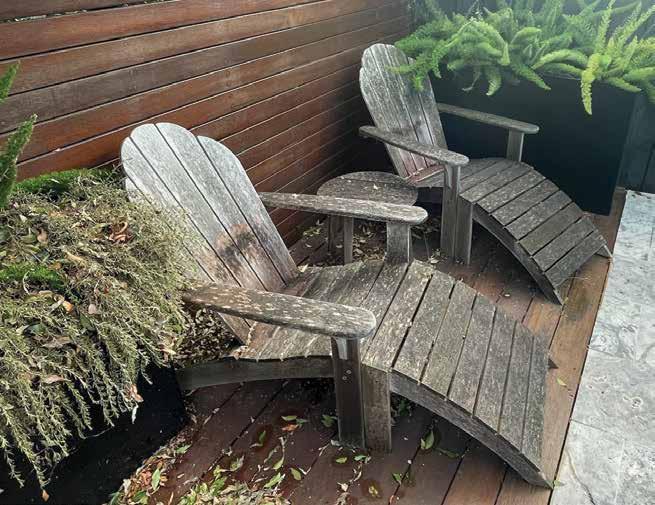
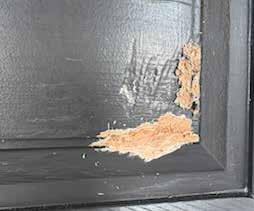
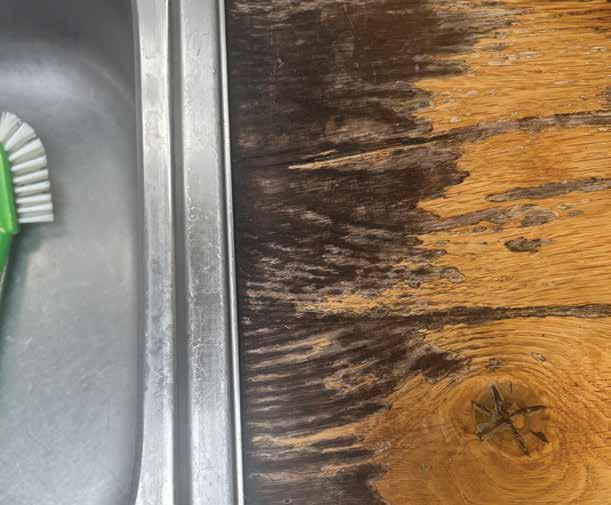
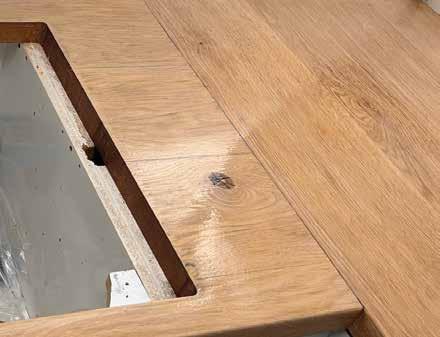
We specialise in precision surface repairs and restoration, including:
• Scratches, chips, dents and scuffs
• Discolouration, fading, stains
• Worn or peeling coatings
• Small damaged areas on floors, furniture and cabinetry
Repair and Restore don’t Replace
From global boardrooms to timber floors
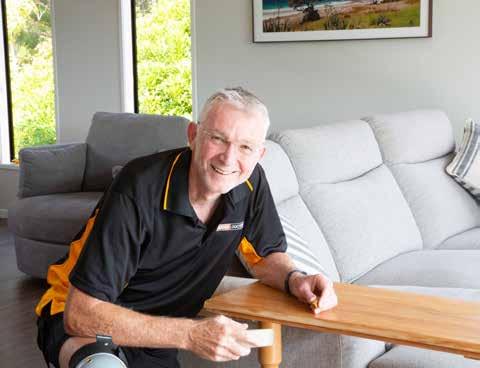
The story of Grant Harvison
There’s a particular kind of courage in walking away from a career that, on paper, looks flawless. Grant Harvison – engineer, global executive, digital entrepreneur – had every reason to keep doing what he’d always done. Instead, he listened to something deeper.
Grant’s professional story reads like a highlight reel. A Mechanical Engineering degree led him into a 35-year career in IT, including the founding of an e-commerce startup in the early 2000s that landed contracts with Microsoft, Yahoo, NZ Telecom, Telstra and Dick Smith — a true pioneer of digital photographic printing before most people knew what e-commerce meant. Add to that
thing he couldn’t ignore. He took the leap, becoming the first Timber & Stone Doctor in Auckland, and hasn’t looked back.
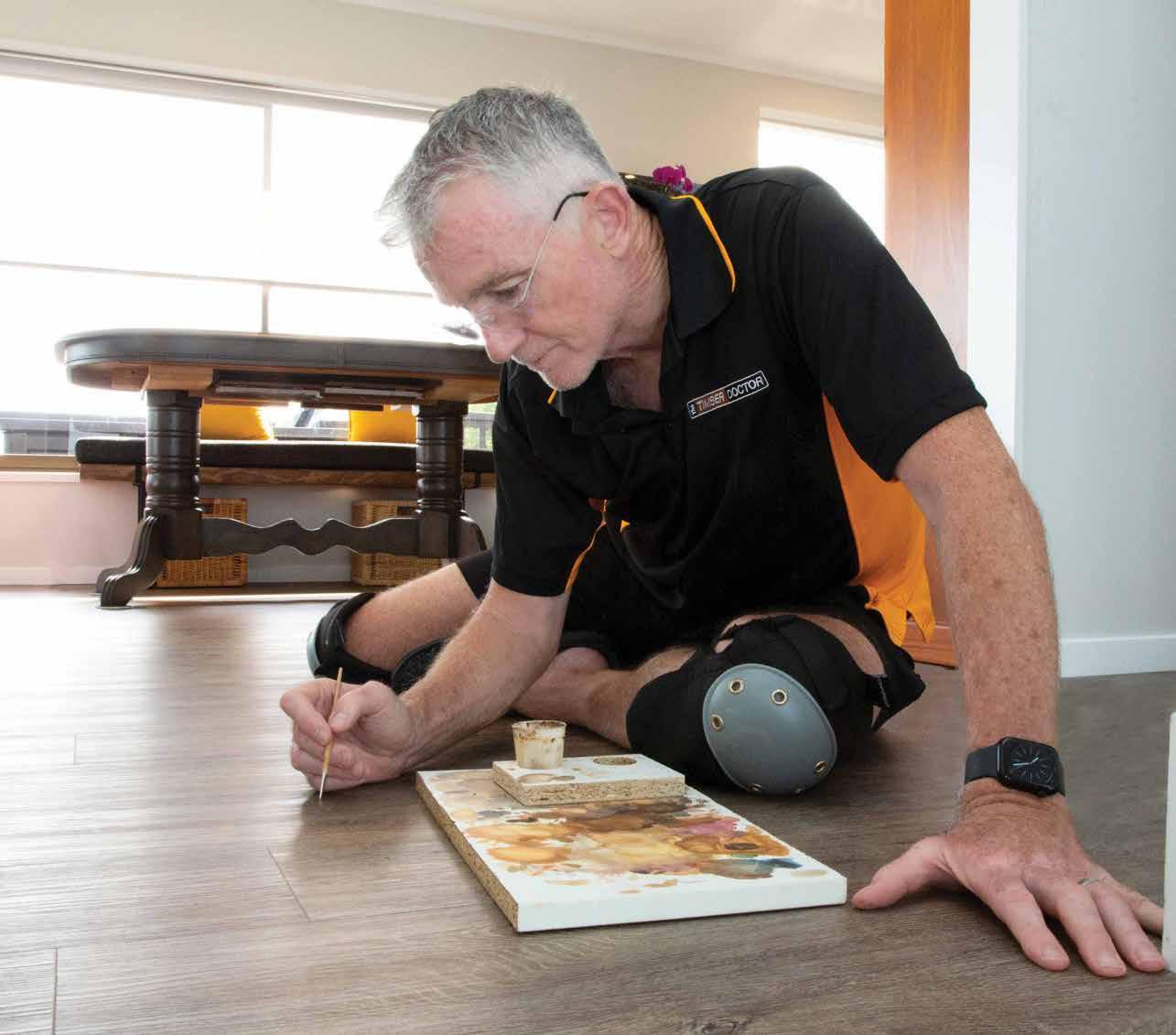
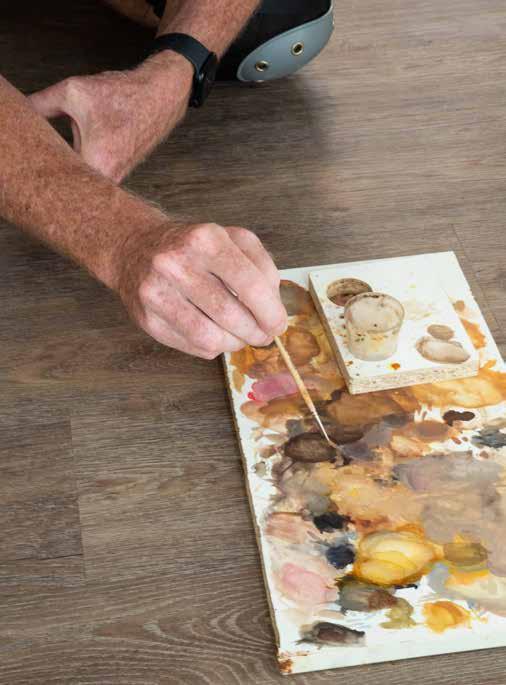
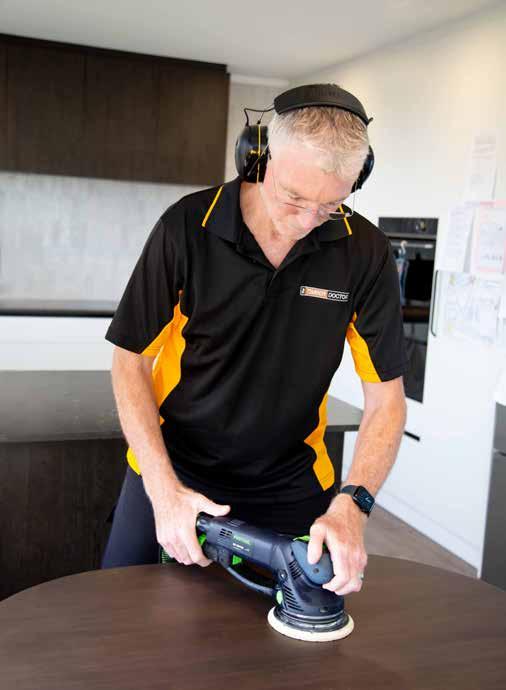
Today, Grant runs The Timber & Stone Doctor right here in our community – a specialist service repairing and restoring timber, stone and composite surfaces for both residential and commercial clients. What he does is genuinely remarkable: matching colours, blending repairs, recreating wood grain so seamlessly that your eye simply glides over the fix. He’s saved businesses thousands of dollars by rescuing floors, benchtops and cabinets that seemed destined for the skip.
From new builds needing remediation at handover to rental properties, house sales and accidental damage, Grant shows up with the quiet confidence of someone who’s finally found their calling.
over 20 years working in London and Zurich for the likes of PepsiCo, The Walt Disney Company, Burmah Castrol and Adecco – the world’s largest HR firm – and you’ve got a résumé that could fill a wall.
But three years ago, Grant made a quiet admission to himself: the spark was gone. He found himself clock-watching, eager to get away from his screen and into something hands-on. He’d always had a love for drawing and art, even considering a Fine Arts degree before engineering ‘won’. That creative itch never left.
Then he discovered The Timber Doctor franchise, based in Australia, and saw some-
For Silverdale Business, Grant Harvison represents exactly what we celebrate: talent that plants itself locally and gives back through skill, craft and genuine care for the people it serves.
Welcome to the community, Grant. We’re glad you found your way home.
Vanessa Li | Marketing Specialist Silverdale Business
www.silverdalebusiness.co.nz
Much on offer in Milldale
There’s a lot of excitement in Milldale at the moment. The settled weather continues to shine down on Milldale, despite the temperatures dropping across the country, as the residential development enjoys a high level of show home and open home activity for the season, with house sales still strong through May, reports many of the building companies in Milldale’s show home village.
The build companies credit the clear, still days for creating the perfect environment for prospective buyers to venture out and explore their options, with particularly healthy numbers visiting the development over the recent long weekends.
‘We have some really unique homes on offer in Milldale at the moment’ says marketing consultant Warren Frogley, representing the show home companies and approved build partners. ‘Completed homes in Stage 6 are in high demand with many just a few steps from the central reserve, offering a fantastic outlook and a great place for the kids to play, to walk the dog or fly a kite. The release of Stage 7 adds a range of elevated homes to the development with sunny north and east facing views across to the town centre and central reserve.’ Frogley says many of these sites allow for larger homes that cater to growing families, multi-generational living, or home and income potential.
For those looking for a more modest home, or to downsize with retirement approaching – a popular choice for those wanting to be near family who have already made the move to Milldale – Frogley says there’s plenty of choice on offer. ‘The range of section sizes and build companies in Milldale means there are many different packages on offer catering to a wide variety of buyers, from young and old, to large families or retirees, plus a small number of investors.’
‘Packages range from spec builds, purchase off-plans, or completely bespoke design and builds, providing buyers a choice from a variety of styles, building options and features that best suit their needs.’
There’s also a lot of excitement around Stage 2 of the Milldale Neighbourhood Centre. With this build well underway, both existing
and soon-to-be residents are looking forward to the convenience of having these new businesses on their doorstep.
For more details on what could be your new home and to see updates on special events held by the build companies, people can visit www.MilldaleShowHomeVillage.co.nz for more info.
Hibiscus Art Award Winners Exhibition 2025
Jocelyn Friis, Sue Hill, Cheong Hoong, Sandy Gaskell, Chris Wadsworth, Gail Smith, Amber Boyd
Mosaics, Metal and More Sonya Young
Stories of the Sea Olga Horne and Irina Azizian
What’s holding you back New Zealand?
A limiting belief is a false or negative idea. An opinion or conviction that we accept as a truth. These can restrict us from working towards our goals or taking risks, and thus reaching our full potential. These are self-imposed barriers effectively shaping our own reality. This type of thinking influences our perceptions and the way we seek or handle a challenge.
Some key characteristics
Limiting beliefs are subjective – usually based on feelings or interpretations of a situation rather than actual facts or evidence.
They are often unconscious – sitting beneath conscious awareness, making them difficult to identify without reflection.
They originate in past experiences – sometimes even from a young age when we may not be ready to correctly read a situation or outcome. Negative or past events may prevent us going forward. We may use a limiting belief as a defence mechanism to avoid future pain, failure, or social embarrassment.
Often they can be self-fulfilling prophecies Believing in a limitation can lead us to unconsciously act in ways that make the belief come true, reinforcing the original idea.
Common examples
Limiting beliefs can often be internal self-talk using phrases such as:
• I’m not very smart because I didn’t do well at school.
• I’m too old/young to apply for that job.
• The financial market isn’t big enough for me to have my share.
• I don’t deserve success or love because of my past break-up.
• I’m not a good networker because I’m so shy.
• Don’t be such an imposter, you can’t be a public speaker.
These beliefs can hold people back in their professional careers, in relationships and from achieving their goals. They can create anxiety and fear of failure. They can cause us to procrastinate or simply give up.
Understanding what might be your limiting beliefs is the first step toward overcoming them, or even ignoring them because they’re untrue.
There is a great deal of literature on the power of positive thinking and positive visualisation. If you want to overcome your
limiting beliefs this is a good place to start. And remember, even if some of these beliefs do hold some truth, back yourself and focus on the future. If you visualise and plan for success you have a far better chance of achieving it.
Chris Norris | AllBrand
Cert. MKTG | MCC | Cert. Typography
Former Chairman of Business Whangaparaoa and Board Member for Silverdale Business. Mentor with the Business Mentors Programme at MBIE. Now runs a locally focussed branding business. Allbrand.co.nz – Revealing the true USP in businesses. Chris@allbrand.co.nz
Excerpt from a session between mem bers of the Independent Board facili tated by Lijlanie Viljoen
The view from the driveway
Living on the Hibiscus Coast, you notice the neighbourhood’s rhythm. The ‘For Sale’ signs, the open homes, families looking for their next chapter. I know what’s on the other side of that door: a family who spent hours hiding the toaster and wondering, ‘Is all of this actually worth it?’.
Selling is one of the most emotional marathons you’ll ever run. The best sales don’t come from a fancy brochure. The best ones happen because the seller found headspace before the ‘For Sale’ sign went up.
Making them fall in love (the psychology of the first five minutes)
Most buyers aren’t scrutinising the floorboards. They’re looking for a feeling. Imagining their Christmas tree in your lounge. That’s hard if your own life is taking up all the room.
The ‘lived-in’ trap: You don’t need a showroom, but you do need to create breathing room. Overflowing cupboards signal poor storage; a cluttered hallway feels cramped. Edit before you open.
The power of the front door: Buyers can decide how they feel before stepping inside. A squeaky gate sends them looking for other faults. A quick waterblast and fresh flowers can do more for your price than a kitchen renovation.
Common stumbles
Avoid over-improving for the sake of the sale. Spending $20,000 on a bathroom only for the buyer to rip it out anyway is heartbreaking. A deep clean and neutral paint are usually enough.
Is your pricing based on ‘need’ rather than ‘market’? Buyers don’t pay based on a seller’s future plans. They pay based on what the house next door sold for. Accepting that reality early can save months of stale listing stress.
The Emotional Rollercoaster
It’s okay to be stressed, feel protective when a low offer lands. I always tell my vendors the first offer is a conversation starter, not an insult. Think of your home as a product passing to its next caretaker. Remove ego from the negotiation and you’ll make better
decisions for your future.
My goal isn’t just to put a ‘Sold’ sticker on a fence; it’s to make sure you leave feeling treated with old-fashioned local honesty. If you’re thinking about a move and want a second pair of eyes on your to-do list, or if you just want to know whether that reno is worth the dust, I’m always happy to grab a coffee.
Bobby | Residential Sales Barfoot & Thompson, Millwater
021 051 2769 | b.sundarajan@barfoot.co.nz
Precision under pressure A Hibiscus Coastguard kayak rescue COASTGUARD
It was a Saturday afternoon shift like many others at Hibiscus Coastguard. Our crew for Hibiscus Rescue 2 (Hib2) was in the shed, working through our routine checks before heading out. It was clear this wasn’t going to be a quiet day. A strong south-easterly was already blowing, with winds pushing 35 knots and gusting up to 45. Even from shore, you could see it was going to be rough out there, and we’d already made the call to stay close to shore.
Around 2.15pm the call came in — a Mayday. Two people in a kayak were overdue and missing, last seen about two nautical miles off Stanmore Bay. Because we were already in the shed with a full crew we were on the water within minutes, heading toward the last reported position, knowing that in conditions like these, time matters.
The trip out was tough. We were punching through heavy seas, with waves breaking over the bow. Everyone onboard instinctively fell into their role. The helms person focused on holding a safe course, our navigator stayed in constant contact with Coastguard New Zealand, and the rest of us scanned the water, looking for any sign of the missing kayakers.
When we reached the search area, there was nothing in sight, just rough seas stretching in every direction. We were tasked with beginning a search toward Hatfields Beach, while overhead, Police Eagle helicopter was deployed to assist.
Not long into the search, we got the update we were hoping for — Eagle had located them. The two kayakers were in the water, clinging to their kayak, but they had drifted much further than expected and were now several kilometres north of where we were.
We turned and pushed toward their position as quickly and safely as we could. It’s always a balance in conditions like that: you feel the urgency, but you also have to respect what the sea is doing around you.
When we arrived, both of them were showing signs of hypothermia
and extreme fatigue after spending a long time in cold, rough water. Our skipper guided them to stay with the kayak while we carefully set up the recovery. It was tense, but we were able to steady the situation and safely bring both people onboard. We also recovered the kayak, and importantly, no one was injured.
For me, what stood out most from this job was the teamwork. In challenging conditions, everyone needs to know their role and trust each other completely. That’s exactly what happened. The coordination between our crew and the Police Eagle helicopter made all the difference, turning what could have been a long and uncertain search into a successful rescue.
As volunteers, we train regularly for moments like this. You hope you’ll never need it, but when you do, you rely on that training and the people beside you. This rescue had a positive ending, but it’s also a powerful reminder of how quickly things can change on the water. It’s important to:
• check the forecast carefully
• dress for the water, not the weather
• always wear a properly fitted lifejacket
• carry a distress beacon and a reliable communication device
In this case, those simple precautions made a difference. The kayakers were wearing lifejackets and had a way to communicate, which helped us find them in time. They are alive today because of this.
I’m incredibly proud to be part of Hibiscus Coastguard. We’re all volunteers, giving our time to train, to respond and to help when it matters most. Days like this remind me why we do it.
Bernie Harris | Coastguard Hibiscus Volunteer
christmasjumpers.co.nz
christmasjumpersnzau christmasjumpersnzau
When is entitlement healthy?
The concept of entitlement is usually associated with negative behaviour – narcissism, self-centredness and having an attitude that demands ‘my rights.’
A healthy entitlement is knowing that you can have needs and wants, even if you might not get them. We all deserve to be treated with respect; to be told the truth rather than lied to; to feel supported emotionally and practically by family, friends and colleagues. Whether you actually get what you want is a separate issue, but it’s okay to want it.
‘Do unto others as you would have them do unto you’ (Luke 6:31) is a well-known Bible verse and often referred to as the Golden Rule. The life principle it speaks of is to treat people with the same respect, kindness, understanding and compassion that you want from them.
As newborns, we depend on caregivers for essential physical needs and emotional connection to survive – this is a healthy entitlement. As we age, our sense of entitlement is shaped by our cultural conditioning, beliefs and prejudices about how we want our lives to be. Feeling entitled becomes a learned attitude of expectations that are not always appropriate.
Healthy entitlement supports your self-esteem while unhealthy entitlement supports your self-importance
Robyn Krugman (Be Seen Therapy) writes, ‘Self-esteem is not built through positive thinking or achievement… you build self-esteem naturally by creating experiences where you can be yourself without performing or earning approval. This means practicing self-compassion instead of self-criticism, setting boundaries, acting imperfectly and trusting your own truth. Over time, these experiences teach your nervous system that you are safe and worthy as you are.’
Self-importance in psychology refers to an inflated sense of one’s own importance, abilities or achievements. Building self-confidence is a positive trait, and some of it comes from feeling important; we all need to know we matter. But when our sense of importance is derived from devaluing others’ importance, we are displaying unhealthy entitlement behaviour.
How we view entitlement will impact our relationships with others: family, romantic partners, friends, the work environment and the
community.
What is acceptable entitlement will always be debated, but we can always have a healthy sense of what we deserve: respect, kindness, understanding and compassion, for ourselves and for others.
Trish | Life Wellness Coach
trishbeauchamp.com
Hospice thankful for volunteers
National Volunteer Week runs from 14-20 June, and Harbour Hospice will celebrate its 1200 volunteers in several ways, including Long Service Awards in late June, which acknowledge volunteers who’ve given hospice 5, 10, 15, 20, 25 and even 30 years of service.
‘Hospice was actually founded by volunteers more than 40 years ago, with the hope of providing the community with much-needed support that wrapped around patients and their families during illness and bereavement,’ says Harbour Hospice Community and Volunteer Engagement Manager Vicki Parker. ‘All these years later they’re still an integral part of Harbour Hospice services and that’s why it’s so important we thank, acknowledge and celebrate our volunteers.’
The range of roles volunteers fill at Harbour Hospice is remarkable. Some work directly with tūroro/patients and whānau, offering companionship, driving patients to appointments, giving practical support to nurses in the Inpatient Unit or staffing the reception desk. Others record patients’ life stories. Many more keep the organisation running behind the scenes, helping in hospice kitchens, gardens and shops.
Parker says volunteers bring far more than their time. ‘Many come with phenomenal skill sets and a wealth of lived experience, and with the right support and training they play a vital role in supporting our clinical teams to deliver an exceptional level of care.’
‘They come with real enthusiasm and a desire to do good for their community, too.’
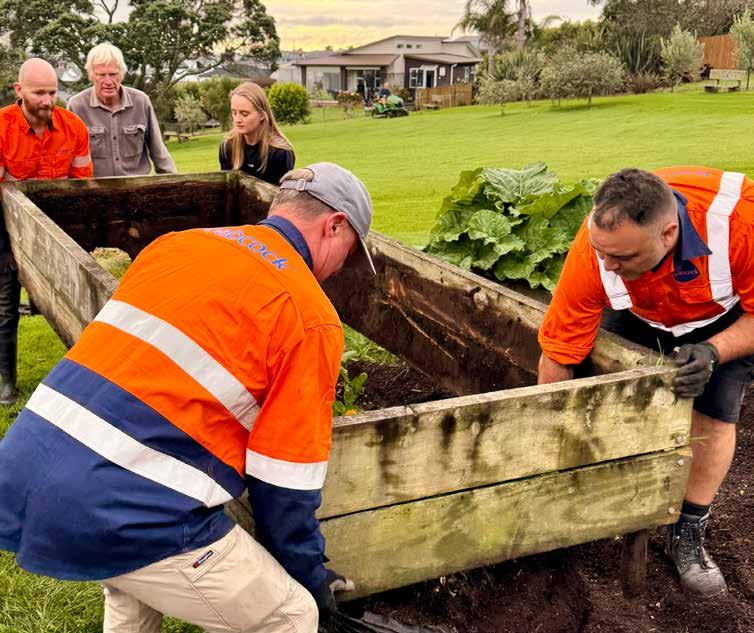
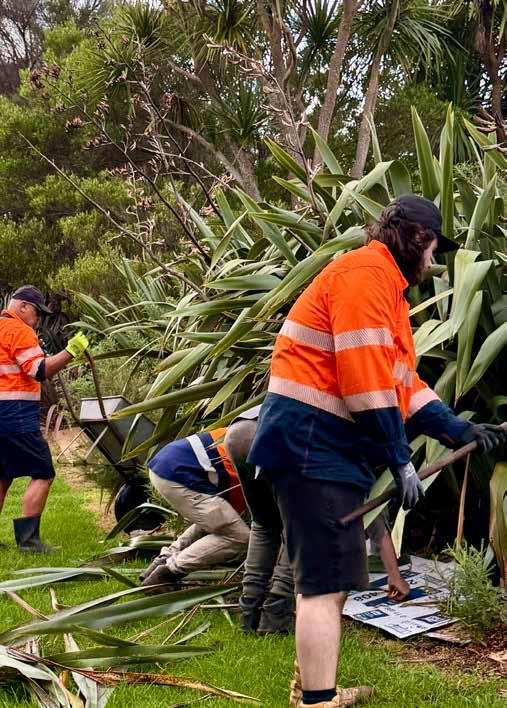
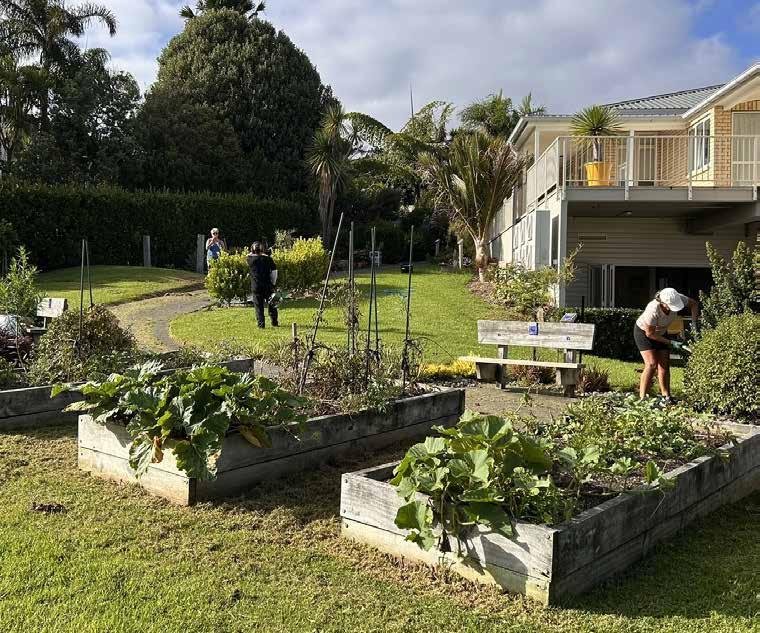
That spirit was on display earlier this month when team members from Babcock Australasia spent a day tidying the gardens at Harbour Hospice’s Hibiscus Coast site. ‘It was a real privilege,’ says Maintenance Development Manager Steve Roberts. ‘The work really brought home the importance of care, dignity and creating a space that feels calm and respectful for patients and their families.’
Roberts says it was as rewarding for the team as it was for hospice. ‘It was a genuinely meaningful few hours, a reminder that days like this do as much for the team as they do for the community.’
If you’d like to volunteer for Harbour Hospice, email volunteer@harbourhospice. org.nz or visit https://harbourhospice.org.nz/
A conversation that changed everything
In 2014, I worked with Sarah Prenter to put a protection plan in place for her and her daughter. As a single parent, it was important that everything was carefully structured around her specific needs.
Recently, Sarah reached out with an unexpected message.
‘I met Theo years ago. He helped me put insurance in place in the unlikely event I became unwell. I had perfect health—never a day of illness.
In 2016, I received a devastating diagnosis of aggressive cancer. Theo’s careful planning allowed me to access the best treatment and the time I needed to fight and recover. My
prognosis wasn’t good, but everything was in place to give me a chance. Thank you a million times over, Theo.’
I remember that time well, and I replied simply:
‘Sarah, it’s been a privilege to stand alongside you through those challenges. Your resilience and strength have been remarkable.’
Stories like Sarah’s are a reminder of why this work matters. It also highlights the importance of a high level of trust and mutual respect between client and insurance adviser.
Insurance isn’t something people wake up excited to talk about. It’s often seen as a ‘maybe later’ decision – until life takes an unexpected turn.
My role isn’t just about putting policies in place. It’s about helping people think ahead, protect what matters most, and ensure they have options when they need them.
When something does go wrong, the right plan can make all the difference.
If you’d value a conversation – or even just a second opinion – I’m always happy to connect.
Theo Simeonidis
| UProtectNZ Insurance Services
Theo is a Financial Adviser, living and working in Millwater on the Hibiscus Coast, and specialising in personal and business insurances. Theo can be contacted on 027 248 9320 or email theo@ uprotectnz.com. Any assistance is provided on a free, no-obligation basis. A public disclosure statement is available on the www.uprotectnz.com website.
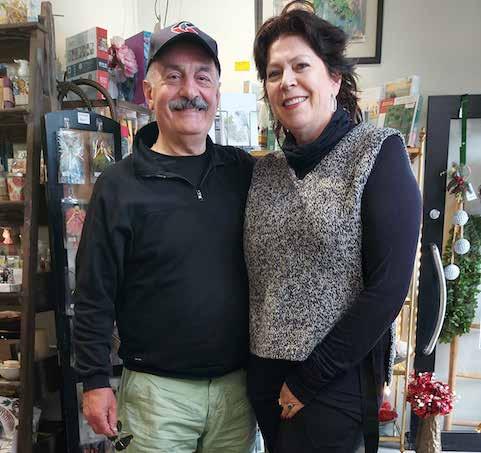
Photo caption:
Theo Simeonidis with client Sarah Prenter in her Wanaka shop. After a serious cancer diagnosis, Sarah credits early planning with giving her the time and options she needed to focus on recovery.
Defective cross lease titles
What every owner should know
When working with clients who are buying or selling a cross lease property, it is not uncommon for us to find that the property has a defective title – and often the seller is not aware it is defective. This can cause a lot of stress as a defective title can impact the value and saleability of the property.
What is a defective title?
A cross lease title is considered defective if the legal flat plan (being the diagram of the property attached with the title) does not match the physical shape (bird’s eye view) of the property. If the house has been extended or changed shape but the plan has not been updated to match, the title becomes defective.
If alterations have been made to a cross lease property, the neighbour’s written consent must also be obtained, otherwise you may be in breach of the terms of the cross lease.
Thinking of selling your cross lease title?
Whilst cross lease property owners who renovate are often aware they need to comply with Council requirements, it is not uncommon for them to overlook the requirement to obtain their neighbours’ written consent to any alterations and to also update the flat plan on their title.
It is not until the process of selling a property that most defective titles are identified. Have your title checked prior to listing, so you have the option of having it corrected prior to going to market. This increases the saleability of the property and could also impact the sale price you obtain, as a lot of banks will not lend on a property with a defective title, and it is not something that can be easily rectified in time before settlement. Vendors are often forced to offer
a costly price reduction for the sum involved to have the title rectified.
Buying a cross lease title
It is also not uncommon for a property to be sold with a defective title. The owner may be unaware their title was defective at the time they purchased, and it becomes a costly issue when they sell. This is why it is important to have your title checked before you commit to a purchase to ensure you do not inherit an underlying issue.
Please contact us if you have any questions or concerns in relation to your existing cross lease title, or if you are considering purchasing a cross lease property. Get in touch at office@mplaw.co.nz or give us a call on 09 421 0559.
Gena Taylor | Registered Legal Executive Martin & Parker Law
Note: This article is published for general information purposes and should not be relied upon as legal advice. For advice specific to your legal issues, please engage a lawyer directly.
BUCKET LIST TRAVEL
A decadent Winter Deco Weekend awaits
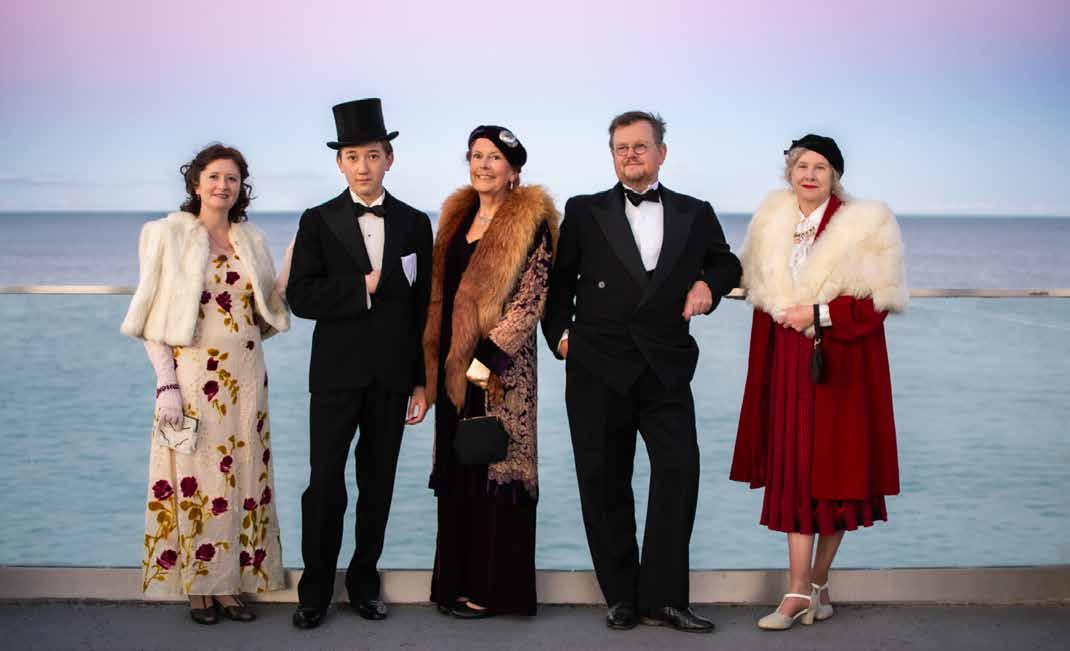
Fancy a ritzy, glitzy weekend away next month? Napier’s Winter Deco Weekend returns from 17 to 19 July 2026, offering a midwinter way to experience the city’s Art Deco story through heritage tours, music, food, vintage style, historic transport and events across the Art Deco Capital of the world.
Napier’s Art Deco character was shaped by the 1931 Hawke’s Bay earthquake, when much of the city centre was destroyed and then rebuilt in the architectural styles of the period. Today, the city’s compact streets, decorated facades and surviving 1930s buildings make it one of New Zealand’s most distinctive heritage destinations.Organised
by the Art Deco Trust, Winter Deco Weekend brings that history to life through a programme of tours, performances, exhibitions, dining events and experiences across the city.
The 2026 programme includes guided walking tours of the Art Deco Quarter, vintage car tours, the Louis Hay Art Deco Building Walking Tour, the Napier City Centre Earthquake Tour and Before the Quake: Historic House & Walking Tour. There are also exhibitions and experiences at Kahukura Hawke’s Bay Museum, including Skyscrapers to Toast Racks and Shockwave: Hawke’s Bay Great Quake 1931.
Across the weekend, visitors can also enjoy heritage rail experiences, the Antique Fair & Collectables, live jazz, dance lessons, a tweed ride, vintage car displays and evening events in some of Napier’s atmospheric venues. Highlights include performances by members the Royal New Zealand Air Force Band, Nicole & The High Society Swingers, jazz dining events, speakeasy-style evenings and Sunday sessions with the Hawke’s Bay Jazz Club.
Food and drink are firmly on the menu, with the new Art Deco Taste Trail bringing a city-wide celebration of flavour to Winter Deco Weekend in 2026. Cranachan, almond petit fours, Royal High Tea, prawn Waldorf salad, Deco Sip & Scone, cheeky beef pie, Oysters Rockefeller, lemon meringue pie, Dirty Martinis, Manhattans and Champagne cocktails with canapés are just some of the flavours waiting to be discovered.
Compared with the annual summer Art Deco Festival, Winter Deco Weekend is a cosy boutique midwinter event. For travellers, it is a chance to explore Napier’s architecture, hear the stories behind the rebuild, enjoy Hawke’s Bay hospitality, discover new
flavours, and take part in a weekend shaped by the city’s remarkable past.
Bucket List Travel will be offering an escorted tour to the Napier Winter Art Deco Weekend 2026, making it easy for travellers to enjoy the event without the stress of planning. The escorted tour includes organised
travel, accommodation and the chance to experience the festival alongside fellow Art Deco enthusiasts. Anyone interested in joining the tour is encouraged to contact Bucket List Travel for more details and booking information.
Michelle Downey | Bucket List Travel www.bucketlisttravel.co.nz
Stop blaming it on getting old
Yes. It’s happening to all of us. One day at a time. But the longer we leave getting our health and fitness under control, the worse off we will be.
Down at my favourite cafe on the Coast there is a group of old boys that regularly gather and socialise (which I think is awesome, by the way…), but often in passing when grabbing a coffee to go, I’ll get shot an, ‘I used to look like you!’. I’ll reply with a grin and shoot back: I’ve got space for another client!
This is where the problem lies. Thinking about our past, the glory days, when you could sprint up the field and goose-step without fear of pulling a hammy, or worrying about trying to look like someone that isn’t you, with different genetics, and different life pressures. It’s setting yourself up for failure unnecessarily.
You are you now (clearly, but bear with me…), not your high school version of you. Not your mid-20’s-stay-up-late-work-all-day-and-stillsmash-the-gym you. But no matter where you are now, there is always something to be done.
First of all, give yourself some grace. If you are older, and your body doesn’t quite move like it used to, just be glad you are still here. Age is a privilege denied to many.
Right. Grace aside. Get moving.
Science shows us something pretty cool. A study conducted by Seguin and Nelson says, ‘It is clear that a variety of strengthtraining prescriptions from highly controlled laboratory-based to minimally supervised home-based programs have the ability to elicit meaningful health benefits in older adults.’
If you’re serious about maintaining your independence as you age through this life, keeping your energy up to run after your kids or grandkids down the beach, and keeping sarcopenia at bay (that’s where your muscles waste away) then there is only one thing for it.
We live in an age of incredible medicines, vaccines and even more fascinatingly, we are on the wave of never seen before technology through a vast array of peptides.
And despite that, there is still there is no
substitute for resistance training.
Get back to the gym and start easy. You’re doing this for you. If you’re not sure where to start, there is infinite information on the internet (instagram/TikTok/YouTube), or the old fashioned way.
Talk to a coach.
Jumper | PE Club www.peclub.co.nz
A time to remember, celebrate and look ahead
Each winter in Aotearoa New Zealand, the early morning skies signal the arrival of something special — Matariki, the Māori New Year. Since 2022, Matariki has also been recognised as an official public holiday, making it the first public holiday in Aotearoa to acknowledge te ao Māori — the Māori world view.
Matariki is marked by the rising of a cluster of stars known internationally as the Pleiades. Across the world, different cultures have their own names for this star cluster — Subaru in Japan, Mao in China, Krittika in India and the Seven Sisters in Greek mythology.
For Māori, the appearance of Matariki in the winter sky traditionally signalled te Mātahi o te
Tau — the beginning of a new year. It was a time to gather together after the harvest season, when food had been collected and stored for the colder months ahead.
Not all iwi refer to this season as Matariki, however. Some iwi instead celebrate Puanga, a bright star also known as Rigel. Because Puanga rises higher in the sky than Matariki, it is more visible from certain parts of the country where the Matariki cluster cannot easily be seen.
At its heart, Matariki is about connection — honouring those who have passed, celebrating the present, and looking forward to the future. It is a time for whānau and communities to come together, share kai, reflect on the year gone by, and set
intentions for the year ahead.
One of the most significant traditions associated with Matariki is the hautapu ceremony, or whāngai i te hautapu, meaning ‘to feed the stars with a sacred offering’. Traditionally, food gathered from forests, gardens, rivers and the sea would be cooked in a hāngī. As the steam rose into the sky, it symbolically carried gratitude and remembrance to the stars.
Today, celebrations take many forms. Some people gather before dawn to watch the stars rise and offer karakia or quiet reflection. Others attend community events, share meals with loved ones, or simply take the opportunity to pause and reconnect.
Unlike many public holidays, the date of Matariki changes each year because it follows the Māori lunar and environmental calendar. In 2026, the Matariki public holiday falls next month, on Friday, 10 July, so now is the perfect time to get planning for your celebrations.
More than just a long weekend, Matariki offers all New Zealanders a chance to reflect, reconnect, and celebrate the unique cultural heritage of Aotearoa.
Need more? Contact CAB for free, confidential info and advice on freephone 0800 367 222, online at cab.org.nz (send a message or speak with a volunteer interviewer on live chat), or visit in person : cab.org. nz/find-a-cab/.
Discounts & free design apply when booking for multiple consecutive issues. advertising@ thecoastiesmag.co.nz 021 771 140
ART SPEAK
Winter exhibitions warm the walls at Estuary Arts Centre
June’s winter chill brings a vibrant new season of exhibitions to Estuary Arts Centre, with five diverse gallery spaces filled with colour, creativity and inspiration.
In Gallery One, visitors can view exciting new works by the winners of the 2025 Hibiscus and Bays Art Awards. Highlights include luminous resin sculpture by Chris Wadsworth and beautifully rendered portraiture by Cheong Hoong, alongside award-winning artists Gail Smith, Sue Hill, Sandy Gaskell, Jocelyn Friis and Amber Boyd.
Gallery Two showcases the bold mosaic and metal creations of Sonya Young, whose bright, vibrant works offer a playful and contemporary take on upcycling through art.
In Gallery Three, painters Olga and Irina present harmonious yet contrasting interpretations of the seascape, bringing together two unique artistic voices inspired by the ocean.
Meanwhile, Gallery Four features the annual Auckland Watercolour Society Cash and Carry Sale — the perfect opportunity to discover beautiful original watercolours at affordable prices.
As we head towards the July school holidays, the team at Estuary Arts Centre is preparing an exciting line-up of hands-on art classes and creative workshops for tamariki and teens. From painting and pottery to mixed media and making, there will be plenty of opportunities for young creatives to explore, experiment and have fun these holidays. Keep an eye on our website and social media for the full programme announcement coming soon.
Don’t be housebound these holidays — get out and about to EAC to create, make and explore the world of art in a welcoming and inspiring community environment.
It is also membership renewal time at the Centre. Memberships can be renewed online or in person at reception and come with a range of benefits including reduced exhibition hire and entry fees, free entry into the Members Gallery, discounts on EAC classes and at participating art retailers and framers, plus invitations to exhibition openings and special events. Membership contributions help support this much-loved creative hub and ensure accessible arts experiences for the wider community.
Estuary Arts Centre is open seven days a week: Monday to Thursday 9am to 4pm, Friday 9am to 3pm and weekends 10am to 3pm. Visitors can also enjoy the onsite café, free parking and free entry to all exhibition spaces.
Visit the Centre at 214B Hibiscus Coast Highway or online at estuaryarts.org.
Sonya Young – Metal hearts
Irina – seascape
Blue Macaw pencil and gold drawing by Amber Boyd (youth winner)
BEST BOOKS
Karen McMillan Author
Looking for your next great read? Let our local author guide you.
The Target
by Riley Chance
His last novel, Weeping Angels, was shortlisted for the NZ Booklovers Award, and Riley Chance’s new thriller, The Target, is once again a page-turning, thought-provoking read. It brings back two memorable characters: former US agent Marla Simmons and New Zealand journalist Grace Marks.
Marla is living a quiet life in the remote South Island, after surviving attempts to kill her from the former agency she once worked for. In Wellington, Grace is covering escalating union protests, and it seems the government might be going to extraordinary lengths to shut them down. Grace meets with one of the trade union leaders, but when a bomb explodes in their offices, echoing the 1984 Trade Hall blast, they are both injured. Was Grace the target, or was she in the wrong place at the wrong time?
When Marla sees the story on the news, she risks returning to Wellington to see Grace and get to the bottom of things. Meanwhile, another agent is in New Zealand with an assignment to assassinate a target, and the bombing was just the beginning of a complex operation. The stakes have never been more dangerous for both women...
Two Roads, RRP $40.00
The Mother Hood
by Vanessa De Carvalho
Violet had a dream pregnancy, but once her baby is born, she is completely overwhelmed and unable to bond with the baby she was looking forward to having. In the depths of postnatal depression, she is caught in a black hole, not sure how to ever bounce back.
Saffi is a natural earth-mother type and finds it easy to conceive, but she is juggling the balance of her life when relationship problems with her partner start to appear.
Lena is over the moon about her one child, but she desperately wants more children. But with a track record of miscarriages and a near-death experience, having another baby is very unlikely. She is now going out of her mind with envy of any other woman with children.
Used to meeting up for coffees and chats, they have created a support village for each other. But when each woman finds themselves at different crossroads, will they survive the challenges, and will their friendships survive?
The characters in this novel about the ups and downs of motherhood are warm and compelling. The Mother Hood is perfect for fans of Marian Keyes.
De Opalho Publishing, RRP $40
WHAT'S ON HIBISCUS COAST
HIBISCUS COAST SCOTTISH COUNTRY DANCE CLUB
Every Weds Silverdale Hall 7:00pm
HIBISCUS COAST ARTISTS
GROUP
Meet on Mon 9.30am-1pm Stanmore Bay Community Hall Whangaparoa. All Welcome.
Shana 021 650 184
HIBISCUS COAST ROCK & ROLL
Every Tues. W’poa Hall 7pm lessons. 8pm general dancing. Wear soft sole flat shoes. See website & Facebook
DANCE FITNESS CLASS
Every Tues/Thurs evening 7-8pm at Kingsway Jnr Campus. First class FREE then $10 per session. Richard 021 504084
PUHOI CELTIC SESSIONS
Every 2nd Thurs at Orewa North Primary School. A sing-around/ play-around event. Alan alanthewag@outlook.com
SUICIDE BEREAVEMENT
SUPPORT
Last Mon of every month (Jan-Nov) 7-9pm HBC Community House. Support for anyone who has lost a loved one.
Susan 021 884 162
OREWA GARDEN CLUB
2nd Thurs of month
Feb–Nov 12.30–3pm.
St John’s Catholic Church Hall, Orewa. Visitors welcome. orewagardenclub@outlook. co.nz
HIBISCUS COAST ORCHID SOCIETY
ST CHAD MARKET
1st Sat of every month 8am-noon 117 Centreway Rd, Orewa. Grant 021 0830 7743 or email office@ hbcanglicanparish.nz
UKELELE CLASSES
Every Thurs at St Andrew’s Church Hall. 107 Centreway Dr 1pm-2:15pm. $15 includes music.
Avon Hansen-Beadle 021 421 109
HIBISCUS COAST CONCERT BANK
Every 2nd Thurs
All ages & abilities welcome hccb.org.nz Call 021 186 4599
WHANGAPARAOA INDOOR BOWLS CLUB
W’poa School Hall Mon 7pm. All ages, beginners welcome. Coaching provided. Maurice 027 392 0541
Orewa Presbyterian Church 10am-12pm. Friendship Club for seniors. Morning tea, guest speakers & outings. Colleen 021 112 3409
HIBISCUS COAST COUNTRY MUSIC CLUB
1st Sun each month
Orewa Community Centre 1-4pm $5.00. Everyone welcome. Janet 0212367094
2nd Sunday of the month. Feb–Dec 1-3pm Masonic Lodge, Centreway Road, Orewa. Visitors welcome. Bruce 09 947 5787 HOUSIE
Every Friday 12.30pm ($1000 jackpot) at Bowls Orewa, 214 Hibiscus Highway. Ph 09 426 5937
MILLWATER PARKRUN
Every Sat 8am
See www.parkrun.co.nz/ millwater for more details
HBC GRANDPARENTS
PARENTING GRANDCHILDREN
Monthly 1st Wed, Support Group. Maygrove Retirement Village. 10:30-1:30 free lunch. Weekly for Coffee Group each Wed 10:30 (various locations). Donna 021 024 30064.
HBC SENIOR CITIZENS ASSN. INC.
Meet Tues for Indoor bowls & cards at Orewa Community Hall. 12-4pm. Membership $5/yr. $2 entry includes afternoon tea. Edna Tibble 0272975554
SILVERDALE BALLROOM STUDIO
Every Thurs Silverdale Hall 7pm. Adult & Improvers classes for beginners & social dancers. 021 031 4216
PIONEER DANCE CLUB
Every Thurs at Silverdale Hall 1.30-3.30pm. Social Ballroom Dance for seniors. 021 031 4216
LINE DANCE CLASSES
Beginners class Weds 10am-midday at Silverdale Hall. Great way to exercise to music & make friends. Sue 021 99 1717
TRAVEL CLUB with Bucket List Travel. 2nd Tues of every month
(Feb-Nov) 9:45am–11am Red Beach SurfLifesaving Club. Michelle 094261490
HIBISCUS COAST
FRIENDSHIP CLUB
4th Wed of the month at 10am Bridge Club rooms, Edith Hopper Park, Manly. Speakers/outings/luncheons together. Peter or Jeanne 09 4268675.
ROTARY CLUB OF OREWA-MILLWATER
1st & 3rd Tues of every month 7pm at The Wade Tavern. 2 Tavern Rd Silverdale. orc.secretary@outlook.com
LADIES CRAFT GROUP
Every school term Tues Orewa Community Church 235 HBC H’way. 10am-12pm. $2 for morning tea & craft creche provided.
SILVERDALE VILLAGE MARKET
Every Sat 8am -1pm Silverdale St Silverdale
KIWI CLUB 4th Sun of each month. Social Dance 5-8pm, all welcome. Silverdale Hall.
HIBISCUS PETANQUE CLUB
Every Tues/Weds 9am12 & Sun 1pm at 214 HBC Highway. New players welcome, free coaching. John 0274894955
10PIN BOWLING FOR SENIORS
W’poa Bowling Centre, Arkles Bay. Looking for senior players to join club for league games. Mon & Fri 10am. Lots of fun and advice. Brett 0210530905
HIBISCUS COAST QUILTERS
1st Tues of the month at 9.30am & 3rd Weds at 7.30pm. W’poa Community Hall. Beginners, experienced quilters & visitors welcome. hbcquilters@gmail.com
HIBISCUS COAST LITERARY CLUB
2nd Sat of the month @ 1pm W’poa Library Workshops. By authors. Writing competitions. Friendly atmosphere. Everyone welcome.
HIBISCUS COAST MIDWEEK BADMINTON CLUB
Every Weds 9am-noon
All welcome . Orewa Badminton Hall, Victor Eaves Park. 021 0870 8118
ARTS GROUP
Every school term Friday Orewa Community Church 235 HBC H’way. 9am-1pm $2 incl. morning tea
Alan 021 039 7155
Mon/Wed/Thur & Sat 10-noon at W'poa Library. By Volunteers from HBC Genealogy Group. Garry on 021 902715 or garryphillips2010@gmail.com
HIBISCUS COAST GENEALOGY CLUB 3rd Tuesday of each month at St Chads Church, 117 Centreway Road, Orewa 2-4pm. Guest speaker. Afternoon tea and fellowship follows. Members free, visitors welcome, $5.
HEARTBEATS CARDIAC SURVIVORS SUPPORT GROUP
1st Tues of every month 10am at HBC Community House. Open to all heart event survivors & their families. Trent Lash 0220 606 199
OREWA LIONS CLUB
1st & 3rd Weds 6.30pm (7pm start) at St Chads Hall 117 Centreway Road, Orewa.
Wendy 021 841 125, orewalionsclub@gmail.com
SILVERDALE NAVAL CLUB
meets the 3rd Sun of each month at HBC Community RSA at 15.00. Vince Sturmey 09 4285222
DAIRY FLAT MUSIC CLUB
Weekly dances/events with live music held at The Dairy Flat Hall, Postman’s Rd. Visit www.dairyflatlive.com for more info.
SUPPORT YOUR LOCAL
Fashion / Art Gifts Homewares
Christmas Jumpers NZ/ AU christmasjumpers.co.nz
Estuary Arts 09 426 5570
Food, Entertainment, Sport & Recreation
Fishing Direct 09 426 0574
Ocean View Retreat stayorewa.co.nz
Health & WellBeing, Fitness & Beauty
Elani Face & Body Studio 022 655 7995
Kate Allen Aesthetics 09 421 0910
Milldale Show Home Village milldaleshowhomevillage.co.nz Housing
Insurance / Finance Business Services
Allbrand 021 743 762
Claire Nevans Editorial Services 021 771 140
First Rate Mortgages 0800 178 726
MTF Silverdale mtf.co.nz/silverdale
UProtectNZ Insurance Services 027 248 9320
Wayne Henry Mortgages 0800WHENRY
Home, Garden & Design
Midway Flooring 09 424 3790
Mitre 10 MEGA
Silverdale 09 426 0760
Davenports Law 09 883 3283
Martin & Parker Law 09 421 0559 Legal
Local Government, Council & Community
Forrest Funeral Services 09 426 7950
Harbour Hospice 021 226 2741
HBC Community House 09 426 3598
Silverdale Business 021 595 048
Treehouse Print
ryan@treehouseprint.co.nz Printing
Bobby Sundarajan at Barfoot & Thompson 021 051 2769 Real Estate
Medical / Dental Optometrist
Orewa Optics 09 426 6646
Waitemata Endoscopy 09 925 4449
Motoring / Boating
Transport
Rodney Auto Centre 09 426 5016
Silverdale Car Services 09 421 1413
Simon Lucas Mitsubishi www.simonlucas.co.nz
Retirement Living
Summerset Milldale 09 304 1632
The Botanic 0508 268 264
LOCAL RECIPES
Chicken Coq au Vin
Ingredients
1.5kg free range chicken, cut into 10 pieces or 8 chicken legs
2 Tbsp plain flour, heaped
2 Tbsp extra virgin olive oil or duck fat
Sea salt and ground black pepper
For the marinade
1L full-bodied red wine, such as shiraz
3 medium carrots, cut into slanted slices 1cm thick
2 celery sticks, cut into slices 1cm thick
12 baby onions, peeled but left whole
6 chopped garlic cloves
1 tsp black peppercorns, crushed
1 bouquet garni (a few parsley stalks and peppercorns, 2 bay leaves and 6 sprigs of thyme, tied together in faggot of leek)
For the garnish
1 tbsp olive oil
200g smoked streaky bacon, rind removed, diced
400g small button mushrooms, trimmed
1 Tbsp chopped fresh flat-leaf parsley
Method
Marinating the chicken
Bring the red wine to the boil in a saucepan and reduce by a third. Leave to cool.
In a bowl, mix the chicken, carrots, celery, baby onions, crushed peppercorns and bouquet garni together and pour over the cooled red wine. Cover with cling film and refrigerate for 24 hours.
Place a colander over a large bowl and put the mixture in it to drain off the marinade. Leave for one hour. Reserve the liquid. Separate the chicken, vegetables and herbs, and pat dry the chicken pieces with kitchen paper. Season the chicken with salt and black pepper.
Frying the chicken
On a high heat, in a large, heavy-based casserole (La Creuset or similar) or frypan, heat the olive oil and colour the chicken pieces in it. Transfer to a plate and set aside. Add the drained vegetables and herbs to the casserole or frypan. Lower the heat to medium-high and cook until lightly coloured.
Making the sauce
Pre-heat the oven to 180°C and sprinkle the flour on a baking tray and cook in the oven until very lightly coloured, to give a nutty flavour. Reduce the oven temperature to 150°C. Spoon out most of the fat from the casserole or frypan, add the toasted flour and stir into the vegetables for a few seconds. On a medium heat, whisk in the reserved wine marinade little by little. Bring to the boil and skim any impurities from the surface. The marinade will now have the consistency of a light sauce. Add the chicken pieces and return to the boil. Cover with a lid and cook in the preheated 150°C oven for 30 minutes. Season if required.
Cooking the garnish
Over a medium heat, in a non-stick frying pan, heat some extra olive oil and cook the diced bacon for 30 seconds. Add mushrooms and cook for a further four minutes. Season with salt and pepper. Mix into the coq au vin. Sprinkle with the parsley and serve piping hot.
Blueberry bread and butter pudding
Ingredients
14-16 slices stale white sandwich bread
3 Tbsp unsalted butter, softened or melted, plus a smidge to butter the pan
1 cup blueberries (fresh if possible, frozen ok)
6 Tbsp granulated sugar
Zest of ½ lemon
Method
Dab bread slices with 3 tablespoons melted butter. If desired, cut the slices on the diagonal.
Lightly butter a 23 x 33cm casserole dish. Fan bread slices out in pan. Scatter blueberries over and be sure to tuck some between slices so that they can burrow and collapse.
Place sugar and lemon zest in the bottom of a small dish and use your fingertips to rub the zest into the sugar, so it breaks up a bit and also releases the most flavour.
2 tsp vanilla extract
6 large eggs
3 cups whole milk
¼ tsp fine sea or table salt
Powdered sugar, golden or maple syrup to finish (optional)
Sprinkle half of the lemon sugar over bread and blueberries. Whisk eggs in a large bowl and slowly whisk in milk. Stir in vanilla and salt. Pour this custard slowly and evenly over bread, berries and sugar. Sprinkle with remaining lemon sugar.
Let mixture soak for at least 15 minutes at room temperature, or overnight in the fridge.
When you’re ready to bake it, heat oven to 190°C. Bake pudding until a knife inserted into the centre of the casserole and turned
slightly causes no liquid custard to spill into the crack, approximately 30 to 40 minutes. This can vary by the density of your bread; it can sometimes take up to 45 minutes.
Let cool slightly before cutting into squares. Dust with powdered sugar or serve with a syrup on the side, if desired.
Source: smittenkitchen.com
WHAT'S ON AT YOUR LOCAL LIBRARY
Special events
Ōrewa
Eat to ease stiff joints and muscles – with Theresa Couper, Clinical & Sports Nutritionist
Friday, 5 June at 10am. Join Theresa, to learn how to use food as your key tool to combat inflammation, rebuild strength, and support structural health.
Macular Degeneration Awareness – free public session for Mandarin speakers
Tuesday, 9 June at 10am. Background facts, anatomy, symptoms and treatment with Ruth Kuo, for Mandarin speakers.
Mindful Creative (Colouring and poetry reading)
Sunday, 14 June at 11.30am. Join Holly Morgan, author of The Power of Positivity and Soulful Metamorphos, along with her two mindfulness colouring books. Attendees can colour, while Holly shares thoughts from her books and reads from some of her poems.
Composting basics – free workshop
Tuesday, 30 June at 10.30am. Join Sarah Williams from The Compost Collective for this ‘introduction to composting’ workshop with worm farm, cold compost and bokashi buckets.Free event but booking is essential. Register at compostcollective.org.nz
Regular programmes
Monthly & fortnightly
Step in, step up, stand out: Tuesday, 2 June at 10am Book Chat: Wednesday, 3 June at 10.30am
Orewa Orators: Fridays, 5 & 19 June at 12pm Board games for adults: Sundays, 7 & 21 June at 12.30pm Parkinson’s Support Group: Monday, 8 June at 10am Family tree maker: Wednesday, 10 June at 1pm Orewa Writers and Poets: Saturday, 20 June, at 1pm
HBC Embroiders Guild: Sunday, 28 June at 1pm
Weekly adult’s programmes
ESOL with Lynn Williams: Mondays at 1pm
Craft group: Wednesdays at 9.30am
BrainCharge: Wednesdays at 11am
Te timatanga o toku Reo Maori Heaerenga group: Wednesdays at 2pm
Digital seniors: Thursdays at 10am
Gentle yoga with Sarah Pearce: Thursdays at 2pm PTE IELTS with Lynn: Saturdays at 9.30am
Weekly children’s programmes (children’s area)
Rhymetime: Tuesdays at 11am (for 18 months to 3-year-olds)
Code Club: Tuesdays at 3.30pm (currently full)
Wriggle & Rhyme: Wednesdays at 11am (for 0 to 2-year-olds)
Storytime: Thursdays at 11am (for 2 to 5-year-olds)
Special events
How to look after your spine
Sunday, 7 June at 1pm and Monday, 15 June at 11am. FREE spinal health talk and spine checks with Dr Diane Sherwin, Chiropractor.
Let’s Chat with the Hibiscus & Bays Local Board Wednesday, 24 June from 3.30pm to 5pm. Drop in and meet your local board members.
Driving with confidence Monday, 29 June at 10.30am. Refresher for seniors with AA Driving Instructor Anette Giles.
Regular programmes
Adult’s programmes
The Reading Revolution: Wednesdays, 2pm to 3pm
Digital Seniors (65+): Wednesdays, from 10am to 12pm
Low Sensory Quiet Hour: Wednesdays, 1.30pm to 2.30pm
CAB Chat: Wednesdays, 10am to 12pm
BrainCharge: Fridays, 2pm to 3pm
Chinese beginner’s English: First and third Fridays at 10am
Brightside spinners: Fridays 9.30am to 2pm
Hibiscus Coast Writers: Saturday, 13 June at 1pm
Children’s programmes
Rythym & Beats: Mondays, 10.30am to 11am (3 to 5 yrs)
Chess Club: Tuesdays at 3.30pm (10 yrs+)
Minecraft Club: Wednesdays, 3.30pm to 4.30pm (all ages)
Wriggle & Rhyme: Thursdays, 10.30am to 11am (0 to 2 yrs)
Te Reo Story Time: Fridays, 10.30am to 11am
Code Club: Fridays at 5pm. Learn how to make computer games (8 to 13 yrs)
Beginner’s Mandarin: Saturdays, 1.30pm to 2pm (6 yrs+)
Teen Craft Club: Saturdays at 2pm
Advanced Mandarin: Sundays, 10am to 10.45am (6 yrs+)
Story time: Saturdays at 10.30am and 11am (bilingual)
Teen Book Club: Thursday, 11 June at 3.30pm. Share your love of reading with like-minded teens, enjoy some snacks and join in some bookish related activities and crafts.
For further events held by community groups please consult the library’s Facebook page. Holiday programme not available at time of print.
Pūhoi settler celebrations
It was 163 years ago, on 29 June 1863, that 84 Bohemian emigrants were brought to Pūhoi by Māori people, landing on the riverbank in a rough clearing in the bush, where two nikau whare had been erected. These were not sufficient shelter for the 50 adults and 34 children, two of them born on the journey.
They had come expecting 40 acres of free farmland per adult and 20 acres for young ones, but were unaware the land was steep, hilly and covered with huge trees and undergrowth. They would be given the title after they cleared a certain acreage and erected a homestead.
On the ‘War Spirit’ luggage space was extremely restricted, so they were woefully underequipped to tackle the bush. If the Māori people had not brought them food and shown
them what they could eat from the bush, they probably would have starved.
But they were genuinely pleased to own their own land and worked together to clear a patch for each homestead, selling the firewood they cut. Gradually, markets for other products such as shingles, wharf
piles, railway sleepers, timber, logs and kauri gum were found, and within 20 years hard work had formed productive farms and the village of Pūhoi.
Every June, Pūhoi people and descendants of the Bohemian settlers celebrate the arrival of the ‘War Spirit’ passengers in Pūhoi. This year’s celebrations are on Saturday 27 and Sunday 28 June. Both days begin with Mass at the Church of Sts Peter and Paul, then move to Pūhoi Centennial Hall. Lunch is available both days but must be pre-ordered and paid.
On Saturday afternoon, the 11 ships that brought emigrants to Pūhoi over the next 20 years will be commemorated. Sunday is a day of traditional music and dance. Raffles, Silent Auction, sales of Pūhoi memorabilia add to the fun. The museum, cafes, gift shops will be open, and there’ll be live music at the pub. All are welcome to come and join in. For more details, email puhoibohemianmuseum@gmail. com.
The Hibiscus Coast’s premier, luxury, resort-style retirement village for 65+
RIMU APARTMENT OPEN EVENING
Join us for drinks & nibbles
Saturday 27 June, 4pm – 6.30pm
Enjoy a relaxed evening with complimentary drinks and nibbles as you explore our beautifully appointed two and three bedroom apartments currently available for sale.
Take a ride in The Botanic Buggy for a guided tour of our village and award-winning amenities, and if you’d like to make a night of it, stay on for dinner at The Clubhouse Café (bookings recommended - call or text 027 389 3511).
Apartments starting from $795,000 | Villas starting from $1,295,000
To RSVP please email kathryn@thebotanic.co.nz or call or text 027 555 5032.