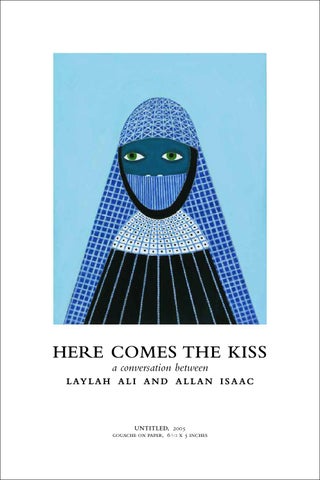
HERE COMES THE KISS a conversation between
UNTITLED, , 1/2
TH E M ASSACH USET T S REV I EW
HERE COMES THE KISS in conversation with A I : The Kiss and Other Warriors is reminiscent of the iconic Kiss by Gustav Klimt.Yours has the same concern with intricate patterns but your version is almost clinical emotionally. Did you actually have Klimt’s in mind at all? LA: I certainly thought about the title, and knew that his work would be an unavoidable reference, but I wasn’t really interested in commenting on his work. I knew my kiss wouldn’t be very romantic. AI: Could you talk a bit about the Warriors part? A kiss comes into being at the moment of contact. Is the kiss being personified here as a violent figure?
LA: I think of the Kiss as a character — like a nickname for someone.“Here comes the Kiss” or “don’t mess with the Kiss — he will kill you.” I know it is open to other interpretations but that is my personal favorite. I think of the Kiss as a warrior. AI: The Typology series flirts with the grotesque and the primitive. Even as you allude to visual taxonomy, you seem to be pushing against the viewer’s ability to make sense of the figures. Could you talk more about where and how you start pushing? LA: I am interested in how our impulses to order and gain control bump up against the unknowability of people — especially how visual interactions are actually quite misleading, but that we rely and trust them as sources of knowledge. People also deliberately project visual cues in order to manipulate or convince others to take certain actions, or to keep them from taking action. AI: The Typology series appeared in a group exhibition in Poland in 2006, entitled “Black Alphabet.”What inspired that title? Do you see the precision of hieroglyphs and pictographs in your work as creating a different sign system like an UNTITLED
1/2 1/2 154
Laylah Ali
UNTITLED
alphabet or a new grammar to explore human relations? LA: I didn’t choose that title so I am not sure how the Polish curators were thinking about that. I’m not sure what I think of that title in its English incarnation — when I first heard it, I bristled at it.The title teeters on containing the black artists presented in an overly simplistic way. It seemed to be a thoughtful show, though. But just imagine that title in the U.S. I think, in general, I prefer the title “White Alphabet” — not for that show, I just prefer the sound of it. That being said, I have, at times, seen my figures as a kind of mysterious alphabet or sign system — but not necessarily a black one. AI: No, the title wouldn’t work in the U.S. However, the title invoked for me Basquiat’s icons and alternative sign systems. I remember I was in your studio perhaps in the early 90s. Back then you were incorporating words and stories a la Jenny Holzer around larger than lifesize figure drawings. How has that evolved into this other sign system of cryptic figures? LA: When I was in college, I was very interested in creative writing and used written words in my work. I started weaning myself from that impulse in graduate school and then stopped using
words at some point. I think the drive to articulate then came out in the figures, though it wasn’t planned: their crispness, the way I grouped them, how one figure in a group always seemed to be active and the others more passive or decorative. It became interesting to me to see how much I could push the viewer to be the one who articulates what is going on rather than me. AI: The figures seem to be suspended in time.Why did you want to hint at a narrative and not make it more explicit? LA: I am more interested in hooking into and playing off of ongoing narratives outside of the picture. So, I provide cues and one can move from the image, off into one’s own reference system, and back onto the image again. 155
TH E M ASSACH USET T S REV I EW
AI: You say in one of the interviews about the Greenheads series that you imagine yourself as a “removed witness” to the violence implicit in the work. Could you explain this perspective? LA: Perhaps my terming it a “removed witness” is redundant because a witness is already removed from the events that he or she is observing. I suppose there are witnesses who are involved but doesn’t that make them into something else, like accomplices, heroes, or victims? I suppose what I mean by that is I think of myself and many of the characters in my paintings as observers of the misdeeds that go on.They often do not intervene but they see what goes on, and that has psychological ramifications.They are often full of what they have witnessed — they could be brimming with it.The word witness has become so bound with our justice system that it seems to have an inherent moral character to it, like a witness is a truth teller that can help to make clear what happened, and thus lead to some sort of rectifying outcome. But
a child witness to domestic violence, for instance, might go on to repeat the violence. Many times, witnessing has no verbal outlet and lives in the body and mind.Witnessing could be a kind of branding — a doomed sort of seeing. AI: The notion of witnessing without a verbal outlet makes me think about the term cryptic in the sense of a burial, a crypt containing all sorts of unspeakable things.You refuse to convey direct information about your figures. How do you see these witnessed scenes animating the viewer’s own imagination? LA: I like to think of the work as prodding the viewer to participate, even though the level of participation that I am requesting is really minimal: I want the viewer to finally name these events, figures, and the goings-on. I want the viewer to decide what is happening, even if that is only for a moment where the assignment of meaning occurs, and then dissipates. Arguably, this kind of exchange happens with all art — but the viewer is often let off the hook by didactic information that accompanies works, or titles, or the artist inserting explanations into the work that are redundant. I want to leave that interpretive space open, almost gapingly so. That being said, I have started to flirt with titling my work again. And I recently made an artist’s book with writing in sentences. So, all of these things are open to change as needed. UNTITLED_
156
Laylah Ali
UNTITLED
3/8 3/8
157
TH E M ASSACH USET T S REV I EW
AI:You’ve mentioned that you like the physicality and the stillness of a painting in the world. As a teacher of literature, I have always believed in the durability and weight of the book. I think that it is important for students to live physically with the text and the work.You do this with the production of an artist’s book with your Greenheads series and now Notes with Little Illustration.What attracts you to this form of your work alongside the exhibition? Or do you see these books as separate from the work hanging in the exhibition hall? LA: I see my artist’s books as separate — they are supposed to be able to go out into the world alone and without props or institutional context. I like the unpredictability of how an artist’s book — and mine are not fancy ones— can travel. I’ve always preferred looking at things in private — one is not burdened with the performance of viewing — so a book allows for that.
AI: Could you explain the “performance of viewing”? How do you imagine the different viewing communities that form around the painting and around the book? LA:When one goes into a gallery or museum to look at art, there are usually others around: viewers or guards, often security cameras as well. One perceives, actively or otherwise, other people viewing, and so I find that the reality of other people’s physical presences has to be reckoned with on some level. Also, the work itself is often given a rarefied or exalted status, even if it is a work that is trying to defy that exaltation. One has to negotiate the relationship of one’s own physical being with the work presented: Distance? Intimacy? Can you touch it? Is it a fast exchange, like a quick hello or something more like a kiss, where one gets very close and looks into the work, almost too close? This all can be part of the allure of seeing shows in person. I think that the best works in such spaces take all of that into account and play with it. But that’s harder to do with paintings and drawings, which tend to be mindful of their boundaries. As for the book, one can minimize his or her physical presence.When I read, I often feel that I have no body, or that it is in a kind of hibernation as I read. Interactions with books can allow for an intensive privacy that can allow for a less guarded interaction — perhaps people are more vulnerable and open in that situation.
UNTITLED
158
Laylah Ali
UNTITLED_
159
UNTITLED, , 7/16 2/16
, ,