2026 MIDTERM ELECTION ISSUE
MOREHOUSE COLLEGE • ATLANTA, GA
www.maroontigermedia.com
AUC STUDENTS BLINDSIDED
INSIDE THE TIGER
Midterm elections overview
Page 2
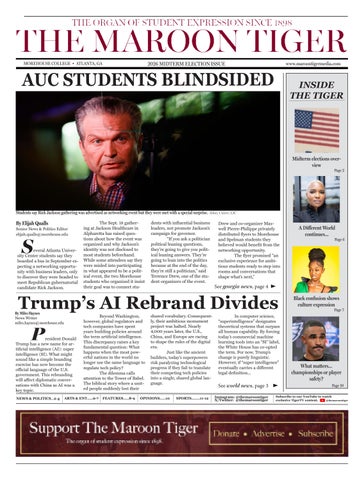
Students say Rick Jackson gathering was advertised as networking event but they were met with a special surprise. Abbey Cutrer/AJC
By Elijah Qualls
Senior News & Politics Editor elijah.qualls@morehouse.edu
S
everal Atlanta University Center students say they boarded a bus in September expecting a networking opportunity with business leaders, only to discover they were headed to meet Republican gubernatorial candidate Rick Jackson.
The Sept. 18 gathering at Jackson Healthcare in Alpharetta has raised questions about how the event was organized and why Jackson’s identity was not disclosed to most students beforehand. While some attendees say they were misled into participating in what appeared to be a political event, the two Morehouse students who organized it insist their goal was to connect stu-
dents with influential business leaders, not promote Jackson’s campaign for governor. “If you ask a politician political leaning questions, they’re going to give you political leaning answers. They’re going to lean into the politics because at the end of the day, they’re still a politician,” said Terrence Drew, one of the student organizers of the event.
Drew and co-organizer Maxwell Pierre-Philippe privately distributed flyers to Morehouse and Spelman students they believed would benefit from the networking opportunity. The flyer promised “an exclusive experience for ambitious students ready to step into rooms and conversations that shape what’s next,”
P
resident Donald Trump has a new name for artificial intelligence (AI): super intelligence (SI). What might sound like a simple branding exercise has now become the official language of the U.S. government. This rebranding will affect diplomatic conversations with China as AI was a key topic. NEWS & POLITICS...2-4
Beyond Washington, however, global regulators and tech companies have spent years building policies around the term artificial intelligence. This discrepancy raises a key fundamental question: What happens when the most powerful nations in the world no longer use the same language to regulate tech policy? The dilemma calls attention to the Tower of Babel. The biblical story where a united people suddenly lost their
ARTS & ENT.....6-7
FEATURES.....8-9
shared vocabulary. Consequently, their ambitious monument project was halted. Nearly 4,000 years later, the U.S., China, and Europe are racing to shape the rules of the digital era. Just like the ancient builders, today’s superpowers risk paralyzing technological progress if they fail to translate their competing tech policies into a single, shared global language.
OPINIONS.....10
SPORTS.......11-12
Page 6
See georgia news, page 4
Trump’s AI Rebrand Divides
By Miles Haynes News Writer miles.haynes@morehouse.edu
A Different World continues...
In computer science, “superintelligence” designates theoretical systems that surpass all human capability. By forcing today’s commercial machine learning tools into an “SI” label, the White House has co-opted the term. For now, Trump’s change is purely linguistic. However, if “super intelligence” eventually carries a different legal definition...
See world news, page 3 Instagram: @themaroontiger X/Twitter: @themaroontiger
Black confusion shows culture expression
Page 7
What matters... championships or player safety? Page 10
Subscribe to our YouTube to watch exclusive TigerTV content. @themaroontiger
2 EDITORIAL BOARD
Joshua Bass ‘27 Editor-in-Chief
NEWS & POLITICS
Midterm elections overview: What you need to know
joshua.bass@morehouse.edu
EXECUTIVE BOARD
Freddrell Green II ‘27 Managing Editor
freddrell.green@morehouse.edu
Aaron Fields ‘28 Multimedia Director aaron.fields@morehouse.edu
Julian Reyes ‘27 Chief Business Officer julian.reyes@morehouse.edu
Isaiah Turman ‘28 Editor-at-Large, Magazine
National Election Day in the United States is Nov. 3, vote now!. Unsplash/Vitalii Abakumov
isaiah.turman@morehouse.edu
By Isaiah Brooks
Aeiress Stancil ‘28 Chief Copy Editor
T
PRINT AND MULTIMEDIA aeiressstancil@spelman.edu
Jiana McDonald ‘27
Supervising Producer
jianamcdonald@morehouse.edu
Elijah Qualls ‘27 Senior News &Politics Editor elijah.qualls@morehouse.edu
Madeline Daniel ‘27 Senior Opinions Editor madelinedaniel@spelman.edu
Myles Chapman ‘28 Senior Features Editor myles.chapman@morehouse.edu
Jamie Armstrong ‘27 Senior A&E Editor
jamie.armstrong@morehouse.edu
Tyler Lewis ‘27
Senior Sports Editor
tyler.lewis1@morehouse.edu
Elijah Blocker ‘28 Video Director
elijah.blocker@morehouse.edu
Teddy Bien-Aime ‘27 Chief Photo Editor
teddy.bienaime@morehouse.edu
Lloyd McFarlene ‘28
News Producer
lloyd.mcfarlane@morehouse.edu
Marcus Craig ‘29 A&E Producer
marcus.craig@morehouse.edu
Christopher Abreu ‘29 Features Producer
christopher.abreu@morehouse.edu
Ryan Perry ‘27 Sports Producer
ryan.perry@morehouse.edu
Jaiden Jones ‘27 Sports Producer
jaiden.jones@spelman.edu
Hunter Ford ‘28 Secretary
hunter.ford@spelman.edu
Paris Graves ‘27 Secretary
parisgraves@spelman.edu
Jeremiah Mitchell ‘27 Digital Content Manager jeremiah.mitchell@morehouse.edu
News Writer isaiah.brooks@morehouse.edu
he 2026 U.S. midterm elections are under way. Here is a guide on what you need to know about this year’s midterm election, and how to become a well-informed voter regardless of your state. To begin, let’s break down the races by elected office. All 435 seats in the House of Representatives are up for re-election every two years, making the House a “revolving door” within the legislative branch. Since representa-
tives serve two-years, a single midterm election can significantly impact the balance of party power between political parties in the House. Since all 14 of Georgia’s House seats are up for re-election, here are some of the representatives who are running for re-election. In the First District, Jim Kingston (R) runs against Amanda Hollowell (D). In the Seventh District, Rich McCormick (R) runs against Tony Kozycki (D). In the Eleventh District, John Cowan (R), Chris Harden (D), Natalie Richoz (Ind), and Amanda Carter James (Ind). Richoz and James are in by way of write-in ballots,
as independents. Approximately one third of the U.S. Senate is up for election every two years. Senator’s terms last a total of six years. This year, a total of 35 Senate seats are up for vote across the country. The Georgia incumbent that is up for re-election this term is Senator Jon Ossoff (D) who is facing off against Mike Collins (R). 36 governors will be elected across the country this year. Governors are state officials responsible for overseeing their state’s executive branch and enforcing state laws. Each state has different standards for the responsibilities and succession of governors. In Georgia, for example, some responsibilities include: allocation of the state funds, the power of veto over the Georgia General Assembly, and foreign affairs relations. Of the 36 state governorships up for election, 18 are currently held by Republicans and 18 by Democrats. In Georgia, Keisha Lance Bottoms is the Democratic candidate, she’s served as Atlanta Mayor from 2018 to 2022, was a senior advisor to former
President Joe Biden and also a member of Atlanta’s City Council. Rick Jackson is the Republican candidate. He founded Jackson Healthcare and is running on a platform emphasizing tax cuts and border security.
SAVE THE DATES! Here are some important voting deadlines in Georgia. Voter registration deadline was scheduled for Oct. 5. Election day is on Nov. 3, 2026. However, early voting is already underway across Georgia and closes on Oct. 30. The registration deadline for a potential runoff is Nov 2. If needed, Georgia’s general election runoff will take place Dec 1. Mail-in ballot rules, voting deadlines and polling place hours vary state by state. Visit Vote.gov to learn more about voting rules and requirements in your state.
Kerry Washington visits Morehouse, encourages AUC turnout for midterms By Freddrell Green II Managing Editor
A
freddrell.green@morehouse.edu
ctress Kerry Washington graced the Atlanta University Center in a surprise visit to Morehouse College’s campus on Oct. 22. The Morehouse College Democrats coordinated the visit. The Primetime Emmy Award winner and star actress from the hit series “Scandal” stood in front of a capacity-filled Q&A audience in Wheeler Hall 214F to encourage students from Morehouse, Spelman College and Clark Atlanta University to make plans to vote during this year’s midterm election cycle. Washington emphasized that students need to go beyond their comfort zones in order to turn out for this year’s election cycle. For her, she said, sacrificing time spent on her career and family is worth it in order to preserve democracy in this moment.
“It’s not going to matter what TV show I am on if I can’t walk down the street without papers,” she said. “It’s about walking away from my child who is crying because I’m not going to be home because I’m coming to Georgia and Wisconsin and Michigan because I understand that I can have a bigger impact here than I’m going to have in my comfortable home in California.” Senior theatre major Dorian Miller ‘27 left the event with a firm understanding of how powerful his vote can be. He says no matter the result of any of the races this year, he will still have that same mindset in the next election cycle. “No matter the results, win or lose, still vote because our voice matters,” he said. “It’s okay to lose sometimes, but we will win at some point.” Morehouse College Democrats President Jaylon Coleman says organizing this event did not come without administrative pushback from the college. Coleman says the day after the Morehouse Democrats started putting the event together, the college had implemented a nonpartisan policy for political events.
Freddrell Green/MT
The policy comes from a statement sent out to Morehouse staff by the Office of General Counsel & Compliance. Because of the college’s 501(c)3 status, partisan action taken on behalf of political candidates without neutral access is prohibited. Washington had announced her endorsement of Democratic candidates Keisha Lance Bottoms and Jon Ossoff for the gubernatorial and Senate races respectively on Oct. 21 and Oct. 22. “I think we can be nonpartisan, but being apolitical in this moment is super dangerous,” Coleman said. “There are ways that the school could help us address these issues like events inviting multiple candidates when you have forums. But we haven’t seen the administration actually do anything to help us besides say no.”
Shannon Mayembe, the moderator of the event, says beyond her love for Washington as a television and movie star, engaging in conversation with her about the urgency of this year’s political climate gave her and the students another reason to appreciate her. “To hear someone who doesn’t do this as their profession still have so much love and passion for it, I think that really resonated with the students,” Mayembe said. “She cares about what’s going on in Georgia politics because it does affect everybody, including her.” In response to a question about regaining hope after the 2024 presidential election results, Washington says that just like with dating, you shouldn’t give up on what you want after the first heartbreak. “You may not fall in love with every candidate,” she said. “But you don’t have to be in love with the candidate. You have to love yourself enough to know that your vote matters and that even if somebody doesn’t seem perfect, they’re making better decisions for you and your community than what’s on the other side.”
3
WORLD NEWS
Policy babel:
How Trump’s “super intelligence” rebrand threatens to fracture global tech law By Miles Haynes News Writer miles.haynes@morehouse.edu
I
t could fracture an already complicated global safety debate. This narrative unfolded during the three-day Washington summit between President Trump and Chinese President Xi Jinping on Sept. 23-25. Both leaders toasted a future of harmony alongside tech CEOs like Sam Altman and Jensen Huang. Meanwhile, a quiet semantic mandate was setting a regulatory time bomb. At the summit, the White House confirmed that Trump successfully pressured the Chinese delegation to replace “artificial intelligence” with “super intelligence” in bilateral talks. On the White House South Lawn, Trump defended the mandatory shift. “I call it SI because it’s a much better name,” Trump said. “Artificial means it’s fake, and it’s not fake.” Days prior, Trump took these exact words to the United Nations General Assembly. His statement transformed a simple preference into a global diplomatic requirement. While Beijing accommodated the phrasing in bilateral discussions, China’s Ministry of Foreign Affairs maintained that they simply understand the U.S. usage of the term rather than officially adopting it. Trump explicitly stated that a new name does not alter the competitive stakes. The U.S. president seeks to flatly reject any international guardrails that would slow American progress. “The United States of America is not going to be putting on brakes,” Trump told reporters. According to Trump during press availability, the U.S. leads China in advanced AI development by up to two years. He asserted that his administration has no intention of opening up or integrating systems with competitors.
Xi countered by emphasizing that leading nations have a responsibility to keep tech under strict human control. This creates a disconnect between the terminology used by the scientific community and the framing co-opted by the White House. Because the U.S. framework departs from established global standards, multinational tech companies could face immediate complications with compliance. Garcia Díaz doesn’t consider Maduro a dictator. Rather, he points much of the blame for Venezuela’s economic struggles to the U.S. The legal rules governing software change the moment it crosses an ocean. If the U.S. eventually encodes SI into legal language, multinational tech companies, from frontier labs like OpenAI and Anthropic to infrastructure and platform giants like Nvidia and Meta, will face complications with compliance. Forcing today’s commercial tools into an “SI” label directly clashes with the hard-coded language of the European Union (EU) AI Act and China’s domestic frameworks. Sectoral sanctions, restrictions on specific industrial activities within a country, were first introduced to Venezuela by the Trump administration in 2017. These sanctions are an intensified model of the Obama administration’s individual sanctions on Venezuelan officials from 2014-2015. Dr. Hye Ryeon Jang, Professor of Political Science at Morehouse College, points out that the rebrand stems from Executive Order 14434. However, she simultaneously notes it remains an uncodified presidential initiative rather than officially adopted federal law. “We also need to make a distinction that it looks like they sort of agreed, but it’s not really a clear agreement on terminology,” Jang explains, analyzing the subtle friction between the White House and Beijing’s foreign ministry.
Chinese President Xi Jinping next to United States President Trump. Alex Brown/AP
“The United States says they both agreed upon it, versus China saying, ‘we understand your usage of the new term.’ European countries and a lot of developed East Asian countries which are leading on AI, they still really prefer to use the term AI with artificial intelligence.” Jang emphasizes that this linguistic gap highlights fundamentally competing philosophies on safety. Washington is chasing an unregulated technical edge while the EU and China favor stricter regulation. “They really wanted to develop cutting-edge technology without thinking about the consequences,” Jang said regarding Washington’s motivations. “It may cause some conflicts in the future,” she warns. This fracturing of terminology is a strategic calculation, according to emerging student political analysts at Morehouse College. Acie Abner, a senior political science major studying Chinese politics, weighs in on how Beijing views the American semantic mandate. “Going along with things like Trump calling it super AI… continues that appearance of China as [being] somebody who’s easy to work with and also prevents any conflicts that would interrupt development internally,” Abner said, maintaining that Beijing will treat the change as a superficial concession while leaving its actual tech laws untouched. Furthermore, a fragmented legal landscape could halt important international safety treaties. A senior political science major who preferred to stay nameless observes how separating technology from its global legal definitions invites new complications into international law. “At this point, countries are just seeing this as a reality of what the current U.S. administration is going to do,” the student states.
He noted that midterm elections have a major role to play regarding international relations: “I think that [midterm elections] will determine if and when and how certain countries, especially in the EU, are going to begin to distance themselves from the United States. Especially if more Trump-aligned politicians become elected come November.” Democrats have responded to Trump’s rebranding, saying it and Trump are being foolish. Sen. Bernie Sanders (I-Vt.) explained that Trump is acting in accordance with his trend of not being informed before speaking. Trump’s decision to change AI’s name, Sanders argues, is ignorant of the broader issue at hand, establishing AI restrictive policy. “I think he is mentally unbalanced,” Sanders told The Independent. “I think he has not a clue about the problems associated with uncontrolled AI.” Sen. Lisa Murkowski (R-Alaska) also warned of the risks associated with AI’s rapid development. “You can call it different names, it still is going to present great opportunity and great challenges and potential threats,” Murkowski told The Independent. For the Morehouse community, this linguistic debate raises questions about the ethical and legal landscape future Black leaders will inherit. Justin Clopton, a senior political science major, argues that the rebranding could obscure the technology’s limitations. “When you hear ‘super,’ there’s immediately a positive connotation,” Clopton said. “Linguistically, it can be used to hide adverse effects on marginalized groups and the biases it picks up. AI works off existing literature, and in the status quo, a lot of the stuff out there is really ignorant of marginalized groups.”
In the digital landscape, true leadership will absolutely require cutting through the noise of this “Policy Babel.” Moving forward, the focus for future policymakers remains on enforcing structural equity and strict tech ethics. Coherent international law is a top priority for moving forward as nations in this increasingly tech-focused future. The age of renaming and reclaiming has officially arrived. Morehouse students must ensure that they remember what these terms truly mean, and what they imply about the future.
Lost in translation Four terms shaping the global AI debate
Artificial intelligence: Technology that performs tasks associated with human intelligence. Superintelligence: A hypothetical form of AI that surpasses human intelligence across a broad range of capabilities. AI governance: The laws, policies and institutions responsible for overseeing AI development and use. Regulatory fragmentation: When countries adopt different AI laws and standards, creating inconsistencies in how the
Queries? Feedback? Suggestions? Write to us: mt@morehouse.edu
4
GEORGIA NEWS
They were promised a networking event. AUC students say Rick Jackson gathering was not what it seemed
By Elijah Qualls
Senior News & Politics Editor elijah.qualls@morehouse.edu
The flyer promised Drew disputed Pugh’s “an exclusive experience for account, saying he was not ambitious students ready to responsible for communicating step into rooms and conthe event’s details to him. Pugh versations that shape what’s maintained that both organiznext,” with access to billioners had discouraged him from aires, White House advisers, publicly criticizing the gathbusiness leaders and Georering. Pierre-Philippe said he gia industry executives. It subsequently tried to arrange a also advertised dinner and private conversation with Pugh a private tour of “one of the to address his concerns. South’s largest business/ Pierre-Philippe defendmedical headquarters,” but ed the organizers’ handling of did not identify any guests or the event, saying students could disclose the location. have learned Jackson’s identity “What we do and beforehand by asking. always have done is invite “He never explicitly people who we believe asked who was going to be on Students say Rick Jackson gathering was advertised as networking event but had a political agenda. Hyosub Shin/AJC would take these opportunithe trip,” Pierre-Philippe said of ties seriously. People that we Upon arrival, students were ushered into Despite the pointed questions, Jackson Pugh. “If he would have asked, know. That’s why we didn’t a large room, where Frank Murphy, who has appeared impressed with the students. Jayanth I would have definitely told publicize this,” Drew said. him of Rick Jackson.” appeared alongside Jackson at campaign-related Chari recalled Jackson praising them as one About 30 students events, briefly addressed the group before intro- of the smartest groups he had addressed and boarded a bus at Morehouse ducing the gubernatorial candidate. Murphy is saying they were “raised right.” College for the event, accoma former NFL player and founder of Churches, After dinner and a tour of the facility, panied by Drew and PierreCommunities, and Schools (CCS) Plan Legacy students boarded the bus back to campus. Pugh Philippe, along with Takosha Institute. said several students questioned Swan about Swan, a lifelong republican Jackson, a billionaire businessman who why Jackson’s involvement had not been diswho ran for lieutenant govgrew up in foster care, is the Republican nomclosed beforehand. Networking in business and ernor and lost the republican inee for governor against Democrat Keisha “If you had known he was going to be politics primary in May 2026. Lance Bottoms. there, you wouldn’t have come,” Swan respondOnly a few students knew With the Nov. 3 election approaching, ed, according to Pugh. An opportunity to meet influenJackson would be there. Some Morehouse student Joshua Meyers said he Neither Swan, Jackson nor Murphy tial professionals attended hoping to challenge welcomed the opportunity to question Jackson responded to The Maroon Tiger’s requests for his political views, while others about his political views. comment as of publication. A professional networking expesaid they accepted pro-Jackson “I was looking forward to the opporTwo days after the event, Swan postrience T-shirts as a joke rather than a tunity to engage with him,” Meyers said. “Not ed on Instagram under the headline “Atlanta show of support. because I agree with him or his political stancHBCU Students meet Republicans.” The bus arrived at Jack- es, but rather because political engagement The post described Swan as connectson Healthcare in Alpharetta, broadly is a good thing.” ing Morehouse and Spelman students with a facility founded by Jackson, Kendrick Pugh, a student who attended “Multibillionaire Businessman & Candidate for although organizers said it was the event, recalled Jackson telling the students Governor Rick Jackson,” without mentioning not their first choice of venue. about his life experiences and how that has that some attendees said they had not known A meeting featuring gubernatoral Drew said they initially impacted his business career. Jackson would be there. candidate Rick Jackson approached the Russell Innova“He really just talked about how he Pugh said he tried to comment on tion Center for Entrepreneurs, wants to make change in the world,” Pugh Swan’s Instagram post to explain that students Jackson became the central but the center declined to host said. “Then at the end, he leads off with ‘I am had not known Jackson would attend, but his speaker the gathering after receiving the not trying to make this political, but I am the comments were deleted and Swan eventually guest list. republican governor candidate.” blocked him. Students then asked political “RICE, when we declared Students then questioned Jackson about Drew said he secured an agreement questions, campaign-related to them the full attendance list, his positions on healthcare, religion and capiwith Jackson’s campaign not to use footage from discussion and subsequent social then turned around and said, talism. Pugh said he challenged Jackson’s supthe gathering for political purposes. Pugh also media coverage followed ‘Well, no, this event can’t happort for capitalism, arguing that the economic alleged that Drew and Pierre-Philippe discourpen,’” Drew said. system was exploitative. According to Pugh, aged him from publicly criticizing the event, a Consequently, the event Jackson defended capitalism, telling students, claim both organizers denied. was relocated to Jackson Health- “Nobody’s holding a gun to your head to use a care, which is owned and found- phone.” ed by Rick Jackson.
What was advertised
What students encountered
5
EDITOR’S NOTE
The cost of not knowing The impact of student journalism in modern day
By Joshua Bass
Editor-in-Chief joshua.bass@morehouse.edu
I
n the Atlanta University Center (AUC), there is a misconception about student journalism that must be addressed: the idea that because journalists are students, their stories somehow matter less. But when a student raises concerns about campus safety, when an institution makes a decision that affects our generation or when a community demands answers from those in power, who tells the story? We do.
Student journalism is not a dress rehearsal for the real world. It is part of the heartbeat of the real world. Look no further than Cornell University, where student journalists at The Cornell Daily Sun helped bring national attention to sexual assault allegations involving seven current and former students and raised questions about the university’s handling of the case. Their reporting demonstrated that student journalists do more than cover campus life. They hold powerful institutions accountable. Some of your favorite people in media started at their student newspapers. Even one of Morehouse’s most celebrated alumni, the Rev. Martin Luther King Jr. ‘48, contributed to The Maroon Tiger.
At Morehouse College, we are taught to become leaders who challenge injustice, question the status quo and use our platforms to bring change to a society often plagued by darkness. Yet leadership also requires something too often overlooked: the willingness to be informed. That is where the organ of student expression comes in. Our obligation is not simply to report what happens on campus. It is to examine why it happens, whom it affects and what it reveals about this institution on the red clay hill. Sometimes that means celebrating our brothers. Other times, it means asking difficult questions, even when those questions make people uncomfortable.
The question is no longer whether student journalism matters.
A newspaper that only celebrates its institution becomes a public relations publication. A newspaper that only criticizes loses sight of the community it serves. Our duty is to pursue the truth, regardless of how it makes us feel. When you read an article, share a story or challenge our reporting, you participate in something larger than a publication. You help determine which conversations receive attention and which concerns The question is what hapcan no longer be ignored. pens when students stop paying Our work will not always be perfect. We will make attention and allow ignorance to take the place of awareness. mistakes, and when we do, we Brothers, I urge you: Don’t must be willing to acknowledge be ignorant. them, make corrections and And we will hold ourhold ourselves accountable with selves to that same standard. the same respect we expect from others.
For more stories, social content and more, scan the QR Code below
Queries? Feedback? Suggestions? Write to us: mt@morehouse.edu
6
ARTS & ENTERTAINMENT
Felicia Pride to continue A Different World legacy By Jamie Armstrong
Senior A&E Editor jamie.armstrong@morehouse.edu
For Felicia Pride, bringing “A Different World” back to television screens is more than revisiting an adored classic. It is about creating a space where audiences can see the experiences, challenges and culture of today’s young Black Americans reflected on screen. Pride, the showrunner behind the sequel, grew up watching the original series and understood the responsibility that came with bringing it back. “I was very nervous,” Pride said. “It’s such a beloved show, and I did not want to be part of messing it up” With the guidance of Debbie Allen, Pride saw the project as an opportunity to listen to and represent the next generation of Black voices. The sequel, which was filmed throughout the Atlanta University Center (AUC), aims to capture the spirit of HBCU life while introducing audiences to a new generation of characters and stories. From funding challenges and campus safety to grief, sexuality and friendships. Pride highlights the larger issues affecting young people and the personal experiences they face every day. And she isn’t new to telling the story of some of TV’s most beloved shows. She worked as a writer and co-executive producer on “Bel-Air,” the dramatic reboot of The Fresh Prince of Bel-Air. With the growing production of remakes and reboots, Pride understands the duty it takes to make something special. The show isn’t just about recreating the original, but to carry on the same feeling into the next generation. “The feeling of warmth that the original show had, the feeling of community and those relationships that the original show had, the HBCU-ness of the original show and then a political consciousness,” Pride
Queries? Feedback? Suggestions? Write to us: mt@morehouse.edu
said. “Those are the things that were our guides in continuing ‘A Different World.’” Authenticity played a major role in the filming of the sequel to “A Different World”, bringing back the feeling of what it means to be at the forefront of the conversation. The original series played a big role in why HBCU alumni decided to go to their respective schools all across the nation. Pride says the influence of HBCUs is stronger than ever, pointing to the growing demand from students who want to experience the culture and community these institutions provide. The campuses of these HBCUs have become increasingly important spaces for education, cultural identity and community. Pride believed the original A Different World helped contribute to the interest and saw the continuation as another opportunity to showcase what makes HBCUs unique. “HBCUs are at the forefront of cultural conversations right now. So the influence is at an all-time high,” Pride said. The series aims to capture that influence while exploring the experiences and challenges facing students on HBCU campuses today. With its return, “A Different World” aims to reflect the experiences of a new generation while showing audiences the continued impact of HBCU culture. As Pride and the cast of “A Different World” start their new chapter, she hopes the series introduces more than a continuation of an adored story. This story centers young Black voices, HBCU culture and the diversity of the new generation. The show is here to honor what came before, but still create something that can stand on its own. For Pride, this comes down to how the show makes people feel. “I think this show gives a lot of us that hug that we need,” Pride said.
Band member Solana Mahabeer sitting midfield as the only female member. Shawn Taylor/MT
Trailblazer in Tune: Solana Mahabeer finds her path in Morehouse’s House of Funk By Jacob Jones
Sports Writer jacobjones@morehouse.edu
“o
h my gosh, a girl!” Kehlani exclaimed when she spotted Solana Mahabeer among a sea of Morehouse men during a surprise visit to a “House of Funk” rehearsal before Homecoming 2025. As the band blared Kehlani’s “Folded” during rehearsal, the singer’s attention turned to Mahabeer, an alto saxophone in hand, standing out in a section where she has grown accustomed to being the only woman. Mahabeer, a Spelman College junior from New York, is currently the only woman instrumentalist in Morehouse’s House of Funk. Mahabeer first picked up the saxophone in elementary school after growing up surrounded by music. Her father, Michael Mahabeer, introduced her to artists such as legendary saxophonist John Coltrane, while jazz, reggae, R&B, soul and hip-hop filled her home. She considered the trumpet, but the saxophone captured her imagination. “The saxophone looked cooler to me because there’s so many buttons,” Mahabeer said. “I was like, ‘Okay, this is different.’” She played simple band music in middle school before transitioning to classical pieces in high school. By her junior year, increasingly difficult music came more easily. For the first time, Mahabeer could hear her own progress. As she approached her first year at Spelman, she considered joining House of Funk. However, she knew she would have to tackle new territory: marching and memorizing. She had never memorized an entire book of music while learning formations and dance routines for an HBCU band. Then, Elijah Grace, whom Mahabeer considers one of her first “big brothers” from Morehouse, encouraged her to take the chance.
whom Mahabeer considers one of her first “big brothers” from Morehouse, encouraged her to take the chance. When she joined the House of Funk, Mahabeer did not realize she would soon carve out a place of her own, while continuing a legacy built by Spelman women before her. Women have been part of Morehouse’s House of Funk for decades, and Mahabeer is continuing that legacy as the band’s only current woman instrumentalist. Christel Jackson, a Spelman student who became the first woman to serve as a drum major for Morehouse’s marching band, faced scrutiny from within her own college. According to a 2019 “Medium” article, Dr. Roland L. Allison, then chair of Spelman’s Music Department, criticized her attire and performance style. “You are a Morehouse man. You walk around in this skimpy little uniform. You’re a Morehouse man,” Jackson recalled Allison telling her. Despite the criticism, Jackson became Morehouse’s lead drum major while maintaining the femininity and performance style that made her stand out. Decades later, Lila Grant became the second woman to serve as drum major. But Grant’s experience also exposed a divide that existed beyond the music. In a 2018 HBCU Gameday interview, Grant described the scholarship disparity, saying, “Most of the Morehouse men that are in the band, they get scholarships for doing this, but Spelmanites in the band, we’re just here out of the love of music.” Now, Mahabeer echoes the same concern. “Spelman students aren’t allowed to receive scholarships band-wise because it’s not our institution,” Mahabeer said
She emphasized that current band director Chad Hughes is actively working on the issue. Hughes fully supports women joining House of Funk, but also understands the sacrifice Spelmanites would have to make to be a member of the marching band. “I would love to have more Spelman involvement because there’s so much talent over at Spelman,” Hughes said. “We just got to find more ways.” Although Mahabeer has raised concerns about Spelman students being ineligible for band scholarships, she said the issue has not created a divide among the musicians. Mahabeer loves spending the long hours with her bandmates and even said, “They treat me like a little sister.” Bandmates don’t just treat Mahabeer like a “little sister.” They also recognize and respect her leadership both on and off the field. Saxophone section leader Cole Kennedy, remembers one of Mahabeer’s first days with the band. On a night when only Morehouse students were required to remain at rehearsal, Mahabeer could have left. Instead, she asked to have a practice room unlocked. “I remember that was the day I was like, ‘Oh yeah. She’s going to be excellent,’” Kennedy said. Kennedy described Mahabeer as a “calm presence” and said that her saxophone reflects her personality. “It’s not necessarily the loudest, but it’s very smooth,” Kennedy said. “You’ll hear it when you need to hear it.” Drum major Michael T. Banks has watched that calmness evolve into authority. When Kennedy is absent, Banks said, Mahabeer often runs the saxophone section through their music. “I’ll come in and she’ll already be running them through music, playing it herself,” Banks said. “She’s always taking that extra step.” Before every rehearsal, Mahabeer blocks out nearly four hours of her evening. Once she enters Ray Charles Performing Arts Center (RayPac), everything else temporarily disappears. Read more at maroontigermedia.com
ARTS & ENTERTAINMENT
Black confusion: Capturing Black identity through cultural expression
wonder what it would look like if you recreated it yourself. The idea from this project became possible simply from making different connections across pop culture references and understanding the common theme of confusion in Black culture. Using the resources that I had readily available and people in my community who I thought would represent the project well, I believe that I produced a very good visual representation of what we call ‘Black Confusion’.
By Che Harmon Williams
A&E Writer/Photojournalist che.harmonwilliams@morehouse.edu
“Black is beautiful” as the saying goes. This Afro-photojournalism project serves as a reminder to celebrate the cultural ambiguity of the black experience. Ché Harmon Williams, a junior, communication studies major and Africana studies minor, carefully crafted this collection, down to the clothing, contrasting colors of the background and visual expressions captured. Students from the Atlanta University Center (AUC) schools gathered to bring the vision of cultural expressionism to life by recreating pop culture references and giving their own spin to it. “Being a part of this project was eye opening. Working in this environment pushed me out of my comfort zone. This was the first time I’ve ever modeled for a project. Typically I’m behind the camera but this project gave me a chance to explore photography from the other side,” Amani Greene said. “Black Confusion” is a colloquial social media expression used to describe a deeply relatable state of confusion, disbelief and utter bewilderment. The facial expression is a visceral, automatic response to the cognitive dissonance exper
A group of students using facial expressions to display Blackness. Che Harmon Williams/MT
ienced by the individual—a reaction that bypasses logical thought and manifests instinctively through the body. “To me, Black confusion is more than just a feeling; it’s an expression on your face or a physical reaction from an emotion so strong that it couldn’t stay inside your body,” Sehinne Yohannes said. By capturing these reactions, the portraits examine the tension between lived Black experiences and the contradictions imposed by society, revealing moments where identity, expectation, and reality collide. The resulting expres-
sions become powerful visual records of confusion, resilience and the deeply human process of making sense of an often nonsensical world. My inspiration as an artist comes from the world around me. I watch the world go by and from my perspective and ask myself, “What is this missing?” I try to relate my expertise to what I interpret and turn it into something that I believe represents a part of my identity. Living in a world where your knowledge to refer and recall different pieces of work is highly sought after makes you
BLACK is Beautiful
MT Review Corner
widowed, embarks on a quest for breast milk for his youngest child. The film expertly crafts an emotional core centered on what it means to be a father, how to navigate faith and the place grief holds in our lives. Ali delivers a performance that captures our hero’s contradictions as he reconciles the By Anderson Watson violence of his profession with A&E Writer his responsibilities as a parent. anderson.watson@morehouse.edu “I wanted Latif to feel Black voices across the real—a man of conviction, but diaspora have struggled to find also of doubt,” Ali told NPR. proper representation in mainLatif benefits from a stream movies and television. supporting cast, including his However, more actors, writers daughter Fatiha, played by and filmmakers are choosing to Adia, and the rambunctious tell these stories authentically Pastor Hwan, played by John and with care. Cho. Each character feels like a Released Oct. 2, “Your necessary part of the story. Mother Your Mother Your The film’s impact is alMother,” directed by Bassam ready being felt across Muslim Tariq and starring two-time communities, even at MoreOscar winner Mahershahouse College. Mohammed Alla Ali, meets that need with pha Diallo, vice president of the perspective and gravitas. The Muslim Student Association, film follows Latif, a devout reflected on how rare it is to see Muslim and practicing hitman a Muslim protagonist portrayed who, after being unexpectedly with such care.
RATING
9/10
7
“It showcases not only the nuance, but the rightful showcasing of what it means to be Muslim American,” he said. Director Bassam Tariq’s vision is calculated and unflinching. The camera lingers, letting performances come through in quieter, tender moments while contrasting them with bombastic action sequences. At its core, the filmmakers have created a film that is both challenging and rewarding. By the end, the film invites audiences to reflect on faith, fatherhood and the bonds we create.
?
20 QUESTIONS LET’S HAVE A REAL CONVO...
1) Do they have a real process? 2) When are they moving out of that hotel? 3) Silence or silenced? 4) Did He really Oversee his own inVitation to the Super
Bowl?? 5) Dean Southern, are we serious? 6) Co-ed dorms……? 7) We need a nursery too, huh? 8) Is SpelHouse really a family? 9) Or is it just a myth? 10) Oh, so you had a Dome experience too? 11) is Casa Dying? 12) Liberation or degradation? 13) Is 13 the guy? 14) Did they actually vote? 15) How can we prove this...? 16) Did y’all dispute those charges?? 17) Nah, seriously..did y’all? 18) When are we going to do more than march? 19) Doctor without a doctorate? 20) These budget cuts a trip, huh??
8
FEATURES
Breast cancer has no gender: Morehouse students challenge health myths By Jaiden Hardy
Features Writer jaiden.hardy@morehouse.edu
E
very October, pink ribbons, fundraisers and awareness campaigns bring national attention to breast cancer and the millions of people affected by it. The pink ribbon remains a powerful symbol of advocacy, solidarity and hope. However, men are often overlooked in these conversations.. Despite growing awareness surrounding breast cancer, many men remain unaware that they, too, can develop the disease. Although breast cancer is overwhelmingly diagnosed in women, men are not immune. According to the American Cancer Society, an estimated 2,670 men will be diagnosed with invasive breast cancer in the United States in 2026,and approximately 530 men will die from the disease. At Morehouse College, an all-male institution, these statistics raise an important question: How much do young men know about a disease they may not realize can affect them? Breast cancer develops when abnormal cells in breast tissue begin growing uncontrollably. Although women typically develop more breast tissue during puberty, men also have breast tissue, making it possible for the disease to develop in either sex. According to the Centers for Disease Control and Prevention (CDC), approximately 1 in 100 breast cancer diagnoses in the United States occurs in a man. Despite its rarity among men, recognizing symptoms remains important. Common warning signs include lumps or swelling in the breast, nipple changes, skin irritation and unusual nipple discharge. Although these symptoms do
not necessarily indicate cancer, they should be evaluated by a health care professional. Several factors can increase a man’s likelihood of developing breast cancer, including genetics, hormonal changes and age. Men with a family history of the disease may face an increased risk, particularly if they inherit certain genetic mutations. Hormonal factors also play a role. Estrogen-containing medications, including drugs historically used to treat prostate cancer, may increase a man’s risk of developing breast cancer. Certain conditions affecting the testicles’ surgical removal to a testicle, have also been associated with increased breast cancer risk. Although breast cancer can develop at any age, the average age of diagnosis among men is between 60 and 70. At Morehouse College, where conversations about Black men’s health carry particular significance, students’ reactions reveal how misconceptions about breast cancer can shape their understanding of the disease. Morehouse freshman Karrington King said he was shocked to learn that men could develop breast cancer. “I think we have to move away from the idea that certain health issues only affect one gender,” King said. “Just because something is talked about more in relation to women doesn’t mean men are immune to it.” King’s comments highlight how perceptions of breast cancer as a women’s disease can influence men’s understanding of their own health risks. Similarly, Kingston Fuller, a premed student, said breast cancer awareness campaigns often focus on women, potentially , leaving men unaware of their own risk.
Doct
“Representation matters, but I don’t think men should become the dominant narrative when discussing breast cancer,” Fuller said. “It’s not about taking attention away from women. It’s about making sure men understand that this is something that can affect us, too.” The lack of awareness surrounding male breast cancer extends beyond college campuses. Medical professionals have also expressed concern that men may overlook symptoms because they do not recognize themselves as being at risk. “It’s so uncommon in men that many ignore the signs,” said Dr. Halle Moore, a medical oncologist and hematologist at Cleveland Clinic, in an article published Aug. 13. “That can sometimes lead them to dismiss symptoms or delay seeking care.” Because routine breast cancer screening is not generally recommended for men at average risk, understanding personal risk factors and recognizing symptoms is especially important. Men who notice unusual changes in their breast tissue should consult a health care professional. As Breast Cancer Awareness Month concludes, the conversations at Morehouse reveal the importance of looking beyond the traditional image of breast cancer. While women remain disproportionately affected, the perspectives of students, King and Fuller demonstrate why awareness should not be limited by gender. At an institution dedicated to developing Black male leaders, understanding men’s health begins with challenging assumptions about which diseases can affect them.
Breast cancer has no gender, and as Morehouse students challenge misconceptions surrounding men’s health, the pink ribbon remains a powerful symbol of awareness, advocacy and solidarity for everyone affected by the disease. Students seeking information about breast cancer can visit the American Cancer Society, Centers for Disease Control and Prevention (CDC) and Susan G. Komen websites for resources on symptoms, risk factors and support services. Morehouse students can also contact the AUCC Student Health and Wellness Center at 404-756-1241 for medical guidance or to schedule an appointment. For King and Fuller, challenging misconceptions about breast cancer begins with recognizing that men’s health deserves a place in the conversation.
Here are 8 questions to ask yourself: 1. Wait, men can actually get breast cancer? 2. How do I know if a lump is serious? 3. Can breast cancer run in my family? 4. What symptoms should I never ignore? 5. Can I get breast cancer even if I’m healthy? 6. Should men get mammograms, too? 7. Who should I talk to if something feels wrong?
Some health questions go unasked because men assume the answers don’t apply to them. The first step toward changing that is knowing what to ask.
8. If men can get breast cancer, why aren’t we talking about it? Don’t let embarrassment or uncertainty keep you from asking questions. Visit the American Cancer Society at cancer.org to learn more about male breast cancer, its symptoms and risk factors.
9
FEATURES
Colin Kaepernick talks “Perilous Fight” at Morehouse, shares journey toward taking a knee By Freddrell Green II
Managing Editor freddrell.green@morehouse.edu
Nearly a decade after Colin Kaepernick first knelt during the national anthem to protest racial injustice, he is still wrestling with a question that has followed him since 2016: When do you respond to your critics, and when do you keep the focus on the cause? “Do I respond how I personally want to,” he said in an interview with Grits and Eggs Podcast host Deante Kyle at the Ray Charles Performing Arts Center on Sept. 19. “Or do I just keep the focus on the movement and on the issues we’re trying to address?” Now as an activist, entrepreneur and author, Kaepernick decided to pick up the pen and write his own story about his activism from 2016 through his perspective in his latest book “The Perilous Fight.” The five-time author and all-time leader for rushing yards by an NFL quarterback takes readers through his up-
bringing in Turlock, California, struggles with racial identity during his childhood, his rise to the NFL, his 2016 protest and the fallout that followed after he became a free agent in 2017. Far from the first instance of national anthem protest, Kaepernick joined the ranks of athletes like John Carlos and Tommie Smith when he initially chose to sit out of the national anthem in August 2016. After consulting with former NFL player and United States Army Green Beret Nate Boyer, Kaepernick changed his protest by taking a knee during the preseason game between the San Francisco 49ers and the San Diego Chargers on Sept. 1, 2016. Described by Kaepernick as “equal parts memoir and manifesto,” “The Perilous Fight” is an expansion on the depictions of his upbringing in books such as “I Color Myself Different” and “Colin Kaepernick: Change the Game.” In publishing this book, Kaepernick seeks to empower readers to overcome power structures similar to the ones
he faced in the NFL. “What we see is this ownership class within the NFL, but also this ownership class across the United States, willing to wield their power to their own self-interest and to the detriment of the people,” Kaepernick said. Kaepernick said his understanding of race and power began developing during childhood. As a Black child adopted by white parents, he said he experienced racial dynamics differently from the family raising him. “It gave me a great understanding of how the U.S. would respond to protests like this,” he said. “We have the historical context. We’ve seen this play out, whether it’s Malcolm X, Martin Luther King Jr., whether it’s the Black Power movement…We’ve seen the response of Black America in relation to Black protests.” Books helped shape Kaepernick’s political thinking long before he took a knee. He said reading “The Autobiography of Malcolm X” in 2015 deepened his understanding of race and
GAMES
Kaepernick in discussion with Deante Kyle on Sept. 19. Zendo Rouson/MT
social issues, while William going down this path.’” Rhoden’s “Forty Million Dollar Another influence beSlaves” reinforced his views hind Kaepernick’s activism was about the power dynamics beDr. Harry Edwards, a founder tween professional athletes and of the Olympic Project for Huteam owners. man Rights (OPHR). Edwards Kaepernick sees the introduced Kaepernick to the NFL as an example of an instihistorical context behind athtution utilizing their financial letes engaged in activism and influence on players to make the cost his protest would have decisions that suit the league’s on his athletic career. interests. Kaepernick sees young “This paycheck is tellathletes struggle with that same ing you to look out for yourself,” dilemma today and emphasizes he said. “And if you don’t… that they have the right to excel the same paycheck is going as an athlete while still contribto be used against you to say uting to their communities. ‘We’ll take this away if you keep talking. We’ll take this away Read more at maroontigermedia.com
WORD HUNT Find ten hidden words in this letter scramble.
E I O S D V Y C R _______________________ _______________________ _______________________ _______________________ _______________________ _______________________ _______________________ _______________________ _______________________ _______________________
10
OPINIONS When prestige overlooks excellence: The missing HBCU voices in top scholarships
By Willie J. Thompson ‘16 Morehouse Alumnus
HBCUs like Morehouse can instill a nearly unshakable belief that their students can accomplish anything they set their minds to, except in one of the most exclusive arenas of higher education: prestigious scholarships and fellowships. Normally, when a Morehouse man returns for homecoming, he is filled with admiration, appreciation and nostalgia. I experienced all of this. However, I also felt a twinge of tension as I attended President Bowman’s town hall. As he shared college updates, I couldn’t help but notice that he highlighted Morehouse’s distinction of having the most Rhodes Scholars of any HBCU: six. As a three-time recipient of highly competitive scholarships and fellowships — Fulbright, Schwarzman Scholars and Knight-Hennessy Scholars (KHS) — one of my biggest frustrations is that I am often the only HBCU graduate in my program. For example, as a Schwarzman Scholar at Tsinghua University, my cohort of 135 people, 54 of whom were from the United States, included only three HBCU graduates. Harvard alone had 10 Schwarzman Scholars. And the kicker? Across the first five KHS cohorts, totaling more than 300 students, I was the only HBCU graduate. Since then, HBCU representation has improved marginally.
Among the 340 KHS scholars admitted in the following four cohorts, only two were HBCU graduates. Fellowship recipient data corroborate my experience. HBCU graduates represent roughly 1% to 3% of admitted U.S. students in some of the world’s most prestigious fellowship programs, including Schwarzman Scholars and Knight-Hennessy Scholars. Meanwhile, graduates of Ivy League and other highly selective institutions, such as Stanford and Harvard, represent 40% to 50%. On top of that, the largest of these institutions tend to send at least three graduates to these programs every year. Aside from Spelman and Howard, HBCUs tend to send one graduate every decade, and many have never sent one. If HBCUs have defined Black excellence and energized upward mobility for centuries, why does it seem to take a century to place HBCU students in the world’s most prestigious scholarship programs? Why do our pedigree and heritage not translate into representation in these programs? Is it because students from institutions like Harvard, Duke or Stanford are more qualified than we are? Absolutely not. One of the most significant contributors to the representation gap is the lack of systemic support within HBCUs to help students identify, select and prepare for prestigious scholarships and fellowships.
Most Ivy League and other highly selective institutions have scholarship departments with full-time staff who identify, coach and support students as early as their freshman year. Ivy League schools have an average of two to three dedicated fellowship advisers, often within offices of up to 10 staff members, while other highly selective institutions, such as Stanford, average approximately 3.5 advisers. HBCUs average approximately 0.3 full-time staff members, and most have none.
Staggering, right?
It’s no surprise that HBCUs struggle to compete in a system that favors well-endowed institutions like those in the Ivy League. Furthermore, if these fellowships, framed as leadership programs, exclude HBCU students, they are, at worst, ignoring our community’s contributions and, at best, ill-equipped to assess our unique strengths. In a world where the future of diversity, equity and inclusion in higher education faces significant uncertainty, these fellowships could benefit from prioritizing outreach and selection efforts that include students from minority-serving institutions like Morehouse. While some fellowships, such as Schwarzman Scholars, have employed Atlanta University Center alumni,
including Raphael Moffett, Some might wonder and sponsored conferences whether spending resources to increase engagement with to prepare students for fellowHBCUs, these institutions must ships is worthwhile compared also prepare students to take with other priorities Morehouse advantage of such opportunicould pursue. ties. To that, I say preparing If, as Benjamin Elijah students is central to MoreMays said, “It is not failure, house’s mission to educate leadbut low aim that is sin,” why do ers. Recipients of prestigious we seem satisfied with only six scholarships often become Rhodes Scholars over the past some of the world’s most influ32 years? ential leaders. If we want our With such a limited brothers to shape the future of pipeline to prestigious scholar- leadership, we need to prepare ships, what can Morehouse do them for it. to make students more competThe benefits also exitive? While I’m aware of some tend to the institution. Calvin efforts by the Howard Thurman Bell ‘24, a Beinecke Scholarship Honors Program, we must do recipient and Rhodes finalist, more. told me that “having MoreAdministrators must house students in these fellowprovide formal support to iden- ships also burnishes our brand tify and coach students for fel- on a global stage.” lowships. While creating a fullAnd what is the payoff fledged office of scholarships for students who receive these and fellowships today seems fellowships and scholarships? unlikely because of current fiFolarin credited the nancial constraints, Morehouse Rhodes Scholarship with placcan make worthwhile investing him in a strong position to ments in cohort-based prosecure a London-based job with gramming to prepare students Google’s public policy team. early in their college careers. But opportunities like Tope Folarin ‘04, More- his should not be the exception house’s third Rhodes Scholar, for Morehouse graduates. recalled the impact a racial What might a successjustice program had on him as ful program look like? Piloting a student. The multiyear proa cohort of high-achieving gram, which included targeted sophomores would be a start. readings and faculty-facilitated Through coaching and guidsupport groups, selected 10 ance from fellowship alumni, Morehouse freshmen who were Morehouse can build a stronger expected to apply for at least pipeline to these opportunities. one prestigious fellowship. Folarin and two other students were shortlisted for the Rhodes Scholarship.
What’s more important, winning games or player safety?
Eagles QB Jalen Hurts in press conference after London game against Jaguars. Alastair Grant/AP
By Lauryn Shields
Opinions Writer laurynshields@spelman.edu
Black bodies have long been valued for what they can produce rather than the humanity they possess. Professional sports is a modern-day extension of that reality. On Oct. 15, the Philadelphia Eagles announced that quarterback Jalen Hurts would miss Sunday’s game against the
Panthers. Former NFL player and analyst Michael Robinson questioned the injury, suggesting Hurts was avoiding responsibility for a potential loss. “I would advise all of our viewers to go Google ‘superficial blood clot’ as opposed to a real blood clot,” Robinson said. Days later, Hurts was
ruled out for the season with blood clots. Robinson subsequently apologized. Hurts was initially diagnosed with a superficial blood clot in his calf on Oct. 10 but was cleared to travel to London and play the following day agaisnt the Jacksonville Jaguars. He was later diagnosed with deep vein throm-
bosis and bilateral pulmonary emboli, raising questions about whether his health received sufficient protection. Have we learned nothing from history? In 2015, NBA star Chris Bosh developed blood clots that traveled to his lungs. Another clot in 2016 eventually ended his basketball career. A decade later, Bosh continues to face complications, reportedly suffering another pulmonary embolism in January 2026. His experience should have served as a warning. Professional athletes sacrifice their bodies for the entertainment of millions, yet Black athletes face additional expectations. Stereotypes portray them as naturally stronger, faster and more resistant to pain. When they demonstrate vulnerability, their toughness is questioned rather than their health prioritized. Robinson’s criticism of
Hurts reflects a larger problem: The expectation that Black athletes must continually prove their toughness, even when their health is at stake. Hurts has given seven years to football, winning a Super Bowl and earning Super Bowl MVP honors. Yet when his health became a concern, his commitment was questioned. The exploitation of Black bodies is nothing new. Today, that physical labor is monetized and celebrated before millions. Jalen Hurts’ situation is bigger than football. For seven years, Hurts has put his body on the line, winning a Super Bowl and earning Super Bowl MVP honors. Yet when he shows vulnerability, his toughness and commitment are questioned. Why should an athlete’s health come second to the expectations of fans and the league? Black bodies are worth more than revenue.
11
SPORTS Protected, but not paid: College athletes face new limits By Kai Settles
Sports Writer kai.settles@morehouse.edu
F
or college athletes, the stakes extend beyond the scoreboard. Injuries can threaten careers, scholarships can determine access to education, and endorsement deals can provide financial opportunities. Now, Congress is considering legislation that would expand athlete protections while restricting compensation and transfers. The Senate voted 77-22 on Sept. 28 to pass the Protect College Sports Act of 2026, advancing a proposed national framework for college athletics. The bill still requires House approval and the president’s signature to become law.
Sponsored by Sens. Ted Cruz, R-Texas, and Maria Cantwell, D-Wash., the legislation addresses name, image and likeness (NIL) agreements, athlete compensation, eligibility and the financial future of college sports. Supporters argue that national standards would bring stability to a system governed by varying state laws and evolving regulations. Under the proposal, schools could not revoke athletic scholarships because of injuries or poor performance. Athletes would also have up to 10 years after their eligibility ends to complete their degrees. The bill would cover sports-related medical expenses for five years after eligibility and cap athlete agents’ fees at 5%, addressing the physical and financial risks associated with college athletics.
PLAYER OF
By Tyler Lewis
Supporters say the legislation could also protect opportunities outside major revenue-generating sports. Cantwell has warned that rising athletic spending threatens women’s and Olympic sports as universities devote more resources to high-profile programs. Cruz has emphasized enforceable rules, traditional rivalries and protections against a breakaway super league. However, the legislation would also restrict athlete compensation and transfers. Athletes could continue earning money through qualifying NIL endorsements and sponsorships, but payments from schools and affiliated organizations would be subject to the bill’s compensation rules. The proposal would generally allow athletes one transfer between four-year institutions without losing immediate eligibility. A second
Sen. Ted Cruz, R-Texas, right, speaks as Sen. Maria Cantwell, D-Wash., left, listens. Mariam Zuhaib/AP
require sitting out the following academic year. Exceptions would include a head coach’s departure, the elimination of a sport, graduate study and circumstances involving sexual assault or harassment. The bill would also shield the NCAA, athletic conferences and schools from certain antitrust lawsuits when enforcing specified compensation, eligibility and transfer rules. Antitrust laws generally prohibit agreements that unlawfully restrict competition. The proposed protections would strengthen athletic organizations’ authority to enforce designated rules, although athletes could still pursue certain legal claims.
THE MONTH
Senior Sports Editor tyler.lewis1@morehouse.edu
Career milestones and back-to-back October victories have put Miles Scott at the center of Morehouse football’s recent success, earning the senior quarterback recognition as Player of the Month. Scott, a Laurel, Maryland, native, delivered one of his strongest performances in the 90th Morehouse-Tuskegee Classic on Oct. 3. He completed 30 of 42 passes for a career-high 392 yards and two touchdowns, leading the Maroon Tigers to a 30-28 victory at Cramton Bowl in Montgomery, Alabama. His previous career high was 367 passing yards against Kentucky State. The performance earned Scott the Classic’s Most Valuable Player award for the second consecutive year. He threw the goahead touchdown pass to Savion Red from 22 yards out with 9:09 remaining, giving Morehouse a lead it would not relinquish. Scott helped the Maroon Tigers finish with 525 yards of total offense and 32 first downs. Morehouse controlled possession for more than 38 minutes, while receivers Noah Rhodes and Jeremiah Gibson each surpassed 100 receiving yards.
The legislation does not determine whether college athletes should be classified as employees. Together, the provisions highlight a central tension: Scholarship guarantees and medical coverage would strengthen athlete protections, while compensation restrictions and antitrust protections could limit players’ financial opportunities and legal options. As the bill awaits House consideration, lawmakers face questions about who controls college athletics, how freely athletes can change schools and which rules they can challenge. For college athletes, greater protection could come at the cost of greater freedom.
Morehouse Football/ Photo
Scott followed that performance with another strong outing in Morehouse’s homecoming victory over Savannah State on Oct. 11. He completed 27 of 37 passes for 269 yards and two touchdowns without an interception as the Maroon Tigers won 34-23. Scott also surpassed 6,000 career passing yards, marking another milestone in his senior season. Morehouse improved to 3-4 overall and 3-3 in Southern Intercollegiate Athletic Conference play with the victory. Across the two victories, Scott completed 57 of 79 passes for 661 yards and four touchdowns with one interception. His completion percentage exceeded 72%, reflecting his ability to sustain drives and distribute the ball throughout the offense. Scott entered the season as a second-team preseason All-SIAC selection after earning SIAC and BOXTOROW weekly honors in 2025. His October performances combined individual milestones with team success: a career-high passing performance, a second consecutive Classic MVP award, a homecoming victory and a place in Morehouse’s 6,000-yard passing club. Scott is also on the Black College Football Player of the Year 2026 Watch List, according to the Black College Football Hall of Fame.
SPORTS
Jackie Robinson The Associated Press
Two HBCU players walking around before the beginning of the 44 Classic at Truist Park in Atlanta, GA. Elijah Blocker/MT
Marquis Grissom The Atlanta Journal-Constitution
The Price of the Dream: Why Black baseball players face a different road to the pros
By Ryan Perry
Sports Producer ryan.perry@morehouse.edu
Under the lights at Truist Park, HBCU Night presented a version of baseball the sport does not always show. Black families filled the stands as children wearing Morehouse and Spelman gear exchanged high-fives with alumni decades removed from campus. For a few hours, baseball looked like a game built for everyone. For many Black children, however, that is not their everyday experience. Baseball has become one of the most expensive youth sports in America, and the barriers begin long before a player reaches a professional scout’s radar. Daniel Mumphery knows that gap firsthand. A former two-year captain of the Morehouse College baseball team who now works for the Atlanta Braves, Mumphery understands the challenges Black athletes face while trying to advance in the sport. “The biggest challenges, just off the top, truthfully, are cost and resources,” Mumphery said. For families with limited disposable income, baseball expenses accumulate quickly.
Players need equipment, coaching and opportunities to compete on travel teams. They may also need to attend showcases where college coaches and professional scouts evaluate talent.. “That cost really, really starts eating away and kind of drives a lot of our best athletes into other sports at times,” Mumphery said. The issue is not simply paying for a glove or bat. Families are often paying for their children to be seen. Travel baseball and national showcases have become unofficial gateways to college recruitment and professional scouting. Families that cannot afford tournament fees, transportation and hotel stays may find their children excluded from the development pipeline before their careers have a chance to begin. Mumphery identified another barrier that makes the financial challenge even greater: access to the places where talented players are discovered. “A lot of times, our Black players aren’t necessarily in the best spaces to be seen, which is one of the best ways to get moved up
to the next level,” he said. More organizations are creating programs designed to close that gap, but the imbalance remains. Mumphery believes middle school is one of the most important stages for keeping Black athletes involved in baseball. “That’s kind of where the game grows and starts to get tougher and starts to get more challenging,” he said. It is also when the cost of playing begins to rise. Athletes may need more advanced coaching, better equipment and stronger competition. For families already managing tight budgets, those expenses can push young players toward other sports. Mumphery believes baseball organizations should concentrate their resources on helping athletes continue playing from middle school through the end of high school. Investment during those years could increase Black representation at the college and professional levels over the next decade. Representation also influences whether young athletes remain connected to the game.
On HBCU Night, the crowd at Truist Park reflected many of the communities these players come from. During an ordinary regular-season game, that level of representation can be more difficult to find. Mumphery sees a direct connection between the athletes competing at the highest level and the children watching from the stands. “Everybody knows, when you idolize someone, you kind of see yourself in them,” he said. “If you don’t have anyone to look up to at that level, it’s kind of hard to imagine yourself there.” Former MLB outfielder Marquis Grissom views his career through that same lens. For him, reaching the major leagues created a responsibility to help the players coming behind him.
“Playing in the major leagues is great, but what are you going to do after that?” Grissom said. “My goal was to thank the people who came before me and to pay it forward to the next generation of kids so they’ll have an opportunity like I had through rec ball and travel ball to get to that next level,” whatever it may be.” Grissom believes Major League Baseball can
make its greatest impact by supporting programs that keep Black children on the field. He pointed to MLB Develops, the Braves RBI program and the 44 Classic as examples of investments aimed at the stages when the sport often loses young players. Greg McMichael, a former Braves reliever who now oversees alumni relations and helps grow the game for the organization, believes those programs should expose young people to opportunities beyond playing. “One of the things we are really trying to help with, as we think about kids and point them toward college, is that we really want them to understand the fundamentals of the game,” McMichael said. “But also, not just playing the game, but being around the game. You think about all the different jobs and different things people can do to be involved in baseball and softball.” That broader approach can introduce young people to careers in coaching, scouting, broadcasting, marketing, analytics and front-office operations— even if they never reach the professional field. For Mumphery, HBCUs also play an important role in creating opportunities. He proudly recommends the HBCU experience to younger athletes, including his own future children.