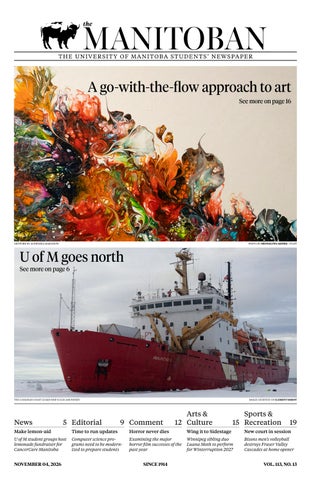
A go-with-the-flow approach to art See more on page 16
PHOTO BY EBUNOLUWA AKINBO / STAFF
ARTWORK BY AGNIESZKA MARCINOW
U of M goes north See more on page 6
IMAGE COURTESY OF CLEMENT SORIOT
THE CANADIAN COAST GUARD SHIP (CCGS) AMUNDSEN
News
5 Editorial
9 Comment
Arts & 12 Culture
Sports & 15 Recreation
19
Make lemon-aid
Time to run updates
Horror never dies
Wing it to Sidestage
New court in session
U of M student groups host lemonade fundraiser for CancerCare Manitoba
Computer science programs need to be modernized to prepare students
Examining the major horror film successes of the past year
Winnipeg sibling duo Luana Moth to perform for Winterruption 2027
Bisons men’s volleyball destroys Fraser Valley Cascades at home opener
November 04, 2026
SINCE 1914
VOL. 113, NO. 13
Vol. 112
No. 13
INSIDE:
109 HELEN GLASS BUILDING UNIVERSITY OF MANITOBA WINNIPEG, MB THEMANITOBAN.COM | 204. 474. 6535 GENERAL INQUIRIES: ME@THEMANITOBAN.COM CIRCULATION INQUIRIES: MISSING OR INCOMPLETE PAPER? EMAIL: DISTRIBUTION@THEMANITOBAN.COM
EDITOR-IN-CHIEF
Mikaela Warkentin
editor@themanitoban.com BUSINESS MANAGER Alice Teufack accounts@themanitoban.com BUSINESS SUPPORT MANAGER Ramisah Musarrat ads@themanitoban.com
EDITORIAL MANAGING EDITOR
Peace Ifeanyi
me@themanitoban.com COPY EDITOR
Eden Quiring
copy@themanitoban.com COPY ASSOCIATE NEWS EDITOR
Lauren Pasveer
Arifah Gheesah
news@themanitoban.com NEWS EDITOR
Roy Albright Obah
NEWS
pages 3 to 5
RESEARCH & TECHNOLOGY
pages 6 to 8
The Manitoban is the official student newspaper of the University of Manitoba. It is published monthly during the summer and each week of regular classes during the academic year by the Manitoban Newspaper Publications Corporation. The Manitoban is an independent and democratic student organization, open to participation from all students. It exists to serve its readers as students and citizens. The Manitoban is a member of the Canadian University Press, and our journalistic standards can be found on the Manitoban’s website.
news@themanitoban.com RESEARCH & TECHNOLOGY EDITOR Mansura Akter Meghla research@themanitoban.com COMMENT EDITOR
Quinn Mayhew
comment@themanitoban.com ARTS & CULTURE EDITOR Boris Tsun Hang Leung arts@themanitoban.com SPORTS EDITOR
Faiyaz Chowdhury
sports@themanitoban.com
DESIGN DESIGN EDITOR
DESIGN ASSOCIATE
Prova Hossain
GRAPHICS EDITOR
Emma Gillich
graphics@themanitoban.com GRAPHICS ASSOCIATE
Hannah Desjarlais
AUDIO AND VIDEO AUDIO EDITOR Max Reid audio@themanitoban.com PHOTO EDITOR
Ebunoluwa Akinbo
photo@themanitoban.com PHOTO ASSOCIATE
page 9
Students and other interested parties are invited to contribute to any section of the newspaper. Please contact the appropriate editor for submission guidelines.
DIVERSIONS
page 10
The Manitoban reserves the right to edit all submissions and will not publish any material deemed by its Editorial Board to be discriminatory, racist, sexist, homophobic or transphobic, ableist or libellous.
Chimarokem Chijioke
Zulkifl Rafah
video@themanitoban.com VIDEO ASSOCIATE
Tashfiqur Rahman
DIGITAL MEDIA EDITOR
Faisal Rahman
social@themanitoban.com SOCIAL MEDIA ASSOCIATE
Aaliyah Velasco
REPORTERS NEWS
Nafisa Al Lilo
NEWS
Wesley Furst
RESEARCH & TECHNOLOGY
Sonja Asmundsson
COMMENT
Carrington Dong
COMMENT
Sadirah Valverde-Nelson
ARTS & CULTURE
Jordan Anglin
ARTS & CULTURE
Debbie Fong
SPORTS
Maleeka Haider
SPORTS
Anthony Otoide
VOLUNTEERS VOLUNTEER STAFF Sijy Varghese VOLUNTEERS Macayla Riney-Lucas
interested in volunteering? email me@themanitoban.com today!
2
EDITORIAL
Deveney Jarrow
design@themanitoban.com
VIDEO EDITOR
The newspaper’s primary mandate is to report fairly and objectively on issues and events of importance and interest to the students of the University of Manitoba, to provide an open forum for the free expression and exchange of opinions and ideas and to stimulate meaningful debate on issues that affect or would otherwise be of interest to the student body and/ or society in general. The Manitoban serves as a training ground for students interested in any aspect of journalism.
Opinions expressed in letters and articles are solely those of the authors. Editorials in the Manitoban are signed and represent the opinions of the writer(s), not necessarily those of the Manitoban staff, Editorial Board or the publisher. A “volunteer staff” member is defined as a person who has had three volunteer articles, photographs or pieces of art of reasonable length and/ or substance published in the current publishing year of the Manitoban.
COMMENT
pages 12 to 13
ARTS & CULTURE
pages 14 to 17
SPORTS & RECREATION
pages 18 to 19
Any individual who qualifies as a volunteer staff member must be voted in by a majority vote at a Manitoban editorial board meeting. Elected representatives and non-students may be excluded from holding votes as volunteer staff members in accordance with the Manitoban Constitution. All contents are ©2026 and may not be reprinted without the express written permission of the Editor-in-Chief.
News
November 04, 2026 news@themanitoban.com
Manitoba Binder Project hosts fundraiser for trans youth The Manitoba Binder Project seeks donations for their Binder Drive and Fundraiser Wesley Furst, staff quality would cost between it’s more like you happen to When Keat started the $40 and $80 on the market wander in and get a binder,” Keat explained.Last year, the Manitoba Binder Project last today, even with a good deal. Keat mentioned that grow- Manitoba Binder Project was year, it was only supposed to be a project for his Global ing up in a conservative rural a success, raising $200 and Issues course in high school. area made it hard to find sup- receiving multiple donations However, after the success of port as a transgender person. of good condition binders. the organization’s first fund- Accessing gender-affirming This year, the project aims to raiser last year, he knew he clothing can also be challen- raise awareness on campus had to continue. The Mani- ging. Chest binders are not and secure more donations toba Binder Project started typically available at local and funding. All proceeds go toward puras a fundchasing the raiser to help “The needs of trans people are becoming materials and “low-income more [of] the forefront of conversations” tools needed […] trans-masto produce culine and — Keat, Manitoba Binder Project founder chest binders. non-binary Keat hopes people gain access to binders.” The goal retail stores, while reaching to organize multiple on-camwas to get donations of gently the Trans Health Klinic can pus fundraisers for support used binders to donate to the be difficult for those without as well as raise awareness of Trans Health Klinic. Looking access to transportation. To the needs of transgender stuforward, Keat hopes to also overcome these barriers, the dents. “The needs of trans people provide accessible care for Manitoba Binder Project aims to establish a free binder bin are becoming more [of] the trans-feminine people. This year, Keat expanded on the U of M campus. This forefront of conversations,” he on the project when he started initiative allows university said. He believes having these learning how to sew his own students to access the support binders. It was the most and community they need fundraisers and establishing cost-effective option — he on campus without having to binder bins on campus will raise awareness of the suponly spent $250 to make 12 travel elsewhere. It also reduces social bar- port transgender people need. binders, or $20 per binder. To buy a binder of comparable riers. “It’s less personal […] While gender-affirming care
IMAGE COUTESY OF @MANITOBA.BINDER.PROJECT / VIA INSTAGRAM
is often associated with medical procedures, Keat hopes to highlight the importance of more accessible forms of care such as chest binders. The Manitoba Binder Project hopes to host an event
soon. Interested parties can head over to the organization’s Instagram @manitoba. binder.project for more details. Those unable to attend can still support the initiative through its ongoing GoFundMe campaign.
‘Toban news briefs Arifah Gheesah, staff Manitoba legislature on affordability and health care The third session of Manitoba’s 43rd legislature concluded on Oct. 29, following the introduction of more than 50 bills addressing affordability, health care, public safety and workers’ rights. Key legislative measures included expanded rent controls, the elimination of provincial sales tax on grocery store food items and new protections against unfair retail pricing practices. The government also introduced a levy on cryptocurrency operations and data centres, with revenue intended to reduce residential hydro bills by approximately $50 annually. Other measures addressed intimate partner violence, non-consensual distribution of intimate images, breast cancer screening and labour mobility for skilled tradespeople.
Saturday night fun with UMSU ICC’s beach volley
A candlelit Qawali night with PSA
UMSU’s International Students’ Community Centre (ICC) is organizing an indoor beach volleyball night on Nov. 14 from 6 to 10 p.m. at the Beach Volleyball Centre. Early bird tickets are $5, and regular tickets will be $7. There is also a group discount available where students can buy four tickets and get an extra one for free. The ticket includes food, drinks and transportation. Students will be able to play a variety of games like volleyball, spikeball, bean bag toss and many more.
U of M Pakistani Students’ Association (PSA) is having a Qawali night on Sunday, Nov. 15 featuring live Sufi poetry. The event will be happening from 5 to 9 p.m. in the MPR in University Centre. To purchase tickets, interested parties can visit their Instagram bio at @uofm_psa. Private tables for families and friends are also available and can be arranged by direct messaging the organization’s Instagram. Seating is limited and will be available on a first-come, firstserved basis.
Gillingham re-elected as Winnipeg mayor Scott Gillingham was re-elected as Winnipeg’s mayor in the Oct. 28 municipal election, securing 39.82 per cent of the vote. Former Progressive Conservative MLA Kevin Klein finished second
with 20.71 per cent, narrowly ahead of Noah Redden, who received 19.84 per cent. Voter turnout stood at 37.9 per cent, with 202,649 ballots cast out of 533,856 eligible voters.
Tax clinic with UMSU UMSU is recruiting volunteers for its 2027 Tax Clinic, which will provide students with assistance in filing their 2026 simple income tax returns. The clinic is organized in collaboration with the Canada Revenue Agency. No prior experience is required, as volunteers will receive training and support. Interested students can apply through the volunteer application form linked in UMSU’s Instagram bio @myumsu.
3
Vol. 113, No. 13 news@themanitoban.com
News
Celebrating Black entrepreneurship at the crossroad The JXNCTION features vendors, cultural performances and interactive activities Roy Albright Obah, staff
I
n recognition of the artistic and innovative work of Black business owners, the U of M Black Students’ Community (BSC) is hosting The Jxnction on Friday, Nov. 6 from 9:30 a.m. to 5:30 p.m. Shumirai Marangwanda, UMSU Black students’ representative, explained the decision to organize the event. “We decided to organize it to put a spotlight on Black excellence that shows up in the creativity of putting yourself out there in the form of a business ad or craft,” Marangwanda said. The event is open to the university community, with its location at the University Centre, which is intended for easy access to students and other campus visitors. 20 vendors are expected to participate in this year’s event, displaying their products at the Fireside Lounge and food court. The program will also feature interactive performances
and drumming sessions. Marangwanda said these activities are intended to make the experience participatory for attendees. Interpreting the reasoning behind the event’s name and its distinctive spelling, Marangwanda explained that the concept draws on the idea of a traffic junction, where different roads converge before leading in separate directions. “The [symbolism] is that all the different businesses and cultures represented in the Black community will meet up at this one spot [...] and guide you down new paths,” she said. “The new paths could be a new experience, new clothes, new accessories, the possibilities are endless.” The event provides an opportunity for people from different cultural backgrounds to interact with each other. “Black culture is beautiful because it is sacred. But when you keep something a secret, it makes it harder for people
of other cultures to understand why we do the things we do and how we do them,” Marangwanda said. She also connected the importance of cultural representation with students’ sense of belonging at the university, referencing the work of other UMSU community representatives in creating spaces for students to find connections. Beyond attendance, she hopes the event will encourage attendees to look beyond stereotypes associated with Black people and recognize their intellectual contributions, entrepreneurial capacity and potential, as well as the importance of supporting their businesses. “I hope the sounds, smells, tastes and feels of The Jxnction remain with people.” For more updates on the event, and other future celebrations, follow BSC on their Instagram page @blackstudents_umsu.
IMAGE COURTESY OF BSC
ASBC to hold pre-UMSU BOD meetings Forum to bridge communication gap between UMSU and students Roy Albright Obah, staff The Arts Student Body Council (ASBC) has introduced discussions ahead of UMSU Board of Directors (BOD) meetings to give students an opportunity to raise concerns about union decisions. The pre-BOD discussions are planned by Kairi Bowden, ASBC UMSU director, and Ethan Wong, the council’s elected UMSU representative. Bowden said the initiative came out of a sense of disconnection from UMSU and difficulties accessing board meetings, agendas and information about how the union operates. Bowden said the discussions also allow them to hear perspectives from students outside the board. In addition, Wong said students may find it intimidating to speak during formal board meetings, particularly when they are unfamiliar with the procedures. “It’s a forum for students to
4
come and share their thoughts in a friendly, low-barrier environment, where you don’t have to raise your hand in a room full of directors or know Robert’s Rules to have your voice heard,” Wong said The latest discussion was organized in collaboration with Queer Student Family, the Black Students’ Community, the Mature and Part-Time Students’ Community and the University 1 Student Council. The discussion focused on the UMSU by-election, giving students an opportunity to discuss the election process and raise questions about the candidates. Fatima Shabir, a 2026-27 UMSU presidential candidate, registered her displeasure about the recent by-election to elect the UMSU vice-president finance and operations and vice-president external affairs. “I think it was not a democratic thing to do,” she said. “I don’t think there was
enough time given for people to decide.” Shabir disagreed with the argument that low student participation justified limiting students’ voting opportunities. Despite her concerns about the election, she believed the two elected candidates will deliver on their tasks. Shabir said candidates should remain accountable to the platforms on which they campaign, including commitments to transparency, financial freedom and advocating for students. Beyond the by-election, Wong said the discussions will also allow organizers to share updates about UMSU activities, services and financial and operational matters that students might otherwise find difficult to follow. Each discussion is free to attend and costs approximately $75 to put on, covering refreshments and occasional printing expenses.
PHOTO BY EBUNOLUWA AKINBO / STAFF
ASBC has funded the sessions so far, with future costs expected to be shared among participating groups. Bowden said organizers generally expect about 10 attendees, although the latest discussion attracted approximately 21. They plan to assess the initiative through attendance records, partici-
pant engagement and social media analytics. Students attending future discussions can access printed board agendas or summaries, alongside links to UMSU’s SharePoint. Meetings will be organized on Wednesdays at 5:30 p.m. prior to UMSU BOD scheduled meetings.
November 04, 2026 news@themanitoban.com
News
UMULH and UMDC host Lemonade Stands for Hope Student groups raise funds for CancerCare Manitoba Wesley Furst, staff
T
he U of M Undergraduate Leaders in Healthcare (UMULH) hosted its second annual fundraiser in support of CancerCare Manitoba on Oct. 19 and 20, offering lemonade and ice cream from the U of M Dairy Club (UMDC) outside the Science Students’ Association (SSA) lounge. UMULH’s philanthropy co-directors, Jenny and Alyssa, shared the motivation behind the initiative. Lemonade Stands for Hope is an event brought to life by CancerCare Manitoba that anyone can host. Upon registering to host a fundraising stand, participants received a starter kit from the organization with the necessary supplies. All proceeds from the fundraiser go directly to CancerCare Manitoba to support cancer patients across the province. So far, $217,000 through more than 350 stands across Manitoba has been raised for this initiative. Following the success of the fundraiser in the past year, UMULH decided to bring the initiative back to campus. Originally introduced by the club’s former philanthropy director, the fundraiser aimed to provide an accessible way for students to support a charitable cause. According to UMULH, many students want to give back and help charities like CancerCare Manitoba but are balancing many things to find the time to support a fundraiser. Additionally, students may not have the extra finances to distribute. With the intervention of UMULH, students are able to conveniently help charities. “By bringing this fundraiser directly to the campus, right in front of the SSA lounge, we essentially made it accessible so students could just stop by between classes, grab a sweet treat and contribute to a meaningful cause at the same time,” Jenny explained.
UMULH also partnered with UMDC during their first fundraiser. Although Lemonade Stands for Hope is usually a summer event, UMULH chose to host its fundraiser in the fall to reach more students on campus. Recognizing that lemonade may be less appealing in October, the club collaborated with UMDC to offer ice cream as an alternative, with all proceeds still going directly to CancerCare Manitoba. This year, UMULH and UMDC raised $645.44 for CancerCare Manitoba. Those who missed the fundraiser can look forward to similar events planned by UMULH. Updates will be shared on the club’s Instagram account @um_ulh. Those interested in supporting the initiative can also donate through the link available on their Instagram pager.
IMAGES COURTESY OF UMULH
5
Research & Technology
Vol. 113, No. 13 research@themanitoban.com
Brown, Babb study changing Arctic sea ice and conditions Exploring sea ice, ocean conditions and their effects on marine ecosystems Mansura Akter Meghla, staff
U
of M researchers are studying sea ice and ocean conditions in a remote region of the Canadian Arctic to better understand how the area is changing and what it could mean for marine ecosystems. Kristina Brown, assistant professor in the department of environment and geography, and David Babb, research associate at the Centre for Earth Observation Science, spent September 2026 aboard the Canadian Coast Guard Ship research icebreaker called Amundsen. Their research focuses on the Queen Elizabeth Islands in the northern Canadian Arctic Archipelago, a region where limited scientific observations have been collected because of its historically extensive sea ice coverage. Brown explained that changing ice conditions have made it possible for research vessels to access areas that were previously difficult to reach. The project is in its second year, with Brown and Babb hoping to return for a third expedition. Babb said the team is working to establish a better understanding of the region’s sea ice and ocean conditions. “As a sea ice scientist, we rely a lot on satellites to provide a long-term view of how the ice is changing in this area,” he said. However, satellite observations cannot provide all the information researchers need. Field measurements help scientists examine ice thickness, its physical properties and the conditions beneath it. Brown’s research focuses on freshwater entering the ocean through melting sea ice, glaciers, rivers and water moving between ocean regions. She is particularly interested in the ways it affects the chemistry of surface waters. The Queen Elizabeth Islands form an important passage connecting the Canada Basin in the Arctic Ocean to Baffin Bay and eventually the Atlantic Ocean. Brown explained that understanding how water moves through this region could help researchers examine potential effects on downstream communities that depend on fishing and marine mammals for food. The region is also part of what scientists call the Last Ice Area, where Arctic sea ice is expected to remain longer than in surrounding regions as temperatures rise. Babb said the area could become increasingly important for marine mammals and other
6
IMAGES COURTESY OF CLEMENT SORIOT
species that depend on sea ice. “As we lose sea ice, this is where sea ice will persist,” he said. Brown noted that parts of the region have been designated as the Tuvaijuittuq Mar-
ine Protected Area. She said scientific observations could help inform decisions about managing and protecting the region. According to the researchers, they have already col-
lected information that adds to the limited observations available from the area. Babb said previous expeditions identified an increased presence of Pacific water, which is relatively fresh compared
with water originating from the Atlantic Ocean. Researchers also measured the amount of freshwater moving through Eureka Sound toward Baffin Bay. They collected extensive measurements of sea ice thickness and identified an ocean feature known as an eddy, where circulating water mixes and brings nutrients toward the surface. The team observed this feature during multiple field programs, suggesting it persists in the area. Beyond sea ice and ocean conditions, the expeditions involve researchers from institutions across Canada studying different parts of the Arctic environment. Their work includes examining glaciers, tracking icebergs, collecting ocean-floor sediments and studying fish, zooplankton and marine plants. According to Brown, sediment samples from the ocean floor may help researchers understand how environmental conditions and marine ecosystems have changed over long periods. Combining these observations allows researchers to examine the ecosystem more broadly rather than studying individual components separately, she added. The project also uses instruments anchored in the ocean that collect measurements throughout the year. Brown, Babb and their team returned during the second expedition to retrieve and redeploy these instruments. They hope to recover them again next year. Brown explained that repeated visits are necessary because the research area is too large to study during a single expedition. The instruments also collect information during periods when researchers cannot be physically present. Both researchers reflected on how their interest in Arctic science began. Brown first participated in an ocean research expedition while completing her undergraduate studies at the University of Victoria. She later began working in the Arctic as a graduate student. Babb’s interest developed earlier, when he joined an Arctic outreach program in grade 11 and spent two weeks aboard the Amundsen during winter. As the researchers continue examining the region, they hope their observations will contribute to understanding present conditions and provide a basis for studying future environmental changes.
UMSU
FOOD RESCUE PROGRAM
WHEN, WHERE & HOW + Biweekly Tuesdays starting November 3rd + 12:30PM - 2:30PM (Food available while supplies last) + UMGPS Lounge + Bring your own bag! + Must be a member of the UM community: student, staff, or faculty and have your student or staff ID card + Available on a walk in basis
@myumsu
www.UMSU.ca
Vol. 113, No. 13 research@themanitoban.com
Research & Technology
New research delivers insight into human milk U of M researcher leads comprehensive effort to understand human milk Sonja Asmundsson, staff
T
wo recently published studies on human milk are helping researchers figure out exactly what makes up our first meals. This research was conducted by the International Milk Composition (IMiC) Consortium and is one of the most comprehensive studies on human milk to date. Meghan Azad is the IMiC director and a U of M professor of pediatrics and child health, as well as a research scientist at the Children’s Hospital Research Institute of Manitoba. Regarding the studies, she said, “The goal was to study breast milk to a level that it’s never been studied before.” Azad was approached by the Gates Foundation to apply her specialization in human milk to existing nutritional intervention trials. The question of how human milk transmits nutrients is crucial for improving infant health. In Burkina Faso, Tanzania, Pakistan and Canada, more than 2,000 samples of breast milk were collected from over 1,000 mother-infant pairs involved in the studies. These samples were then analyzed for over 25,000 compounds. The first study, Nutritional interventions’ impacts on human milk: three trial analyses from low resource settings, showed the effects of supplements during lactation on breast milk and infant health. A key finding was that supplementation beyond pregnancy is valuable for infant health. However, not all components in human milk were affected equally. B vitamins and other compounds related to the metabolism were found to be influenced by supplements, while most macronutrients were unchanged. The varying ways that human milk compounds are affected by supplementation are a crucial finding. According to Azad, this variance not being understood previously could be because most research on human milk up until this point has been conducted primarily in high-income countries. The second study, Shared patterns of human milk composition link mammary gland function to infant growth, provides new insights into the function of the mammary gland. “There’s a lot of research about every part of our human body,” Azad said, “but lactation and the breast have really been understudied.” Through the comparison of milk samples from Canada, Burkina
8
Faso and Pakistan, researchers were able to identify new biomarkers that are connected to the barrier function, metabolism and immune health of the mammary gland.
“Maternal nutrition doesn’t stop mattering when the baby is born” — Meghan Azad, U of M professor of pediatrics and child health and director of the International Milk Composition Consortium While many aspects of human milk are buffered from external influences, a connection between maternal nutrition with mammary gland health and infant health was found to exist. For Azad, these findings offer “new frontiers in terms of diagnostics for mammary gland health and lactation.” Additionally, this research provides a model for future studies of the mammary gland where tissue sampling is not necessary. Together, these findings show human milk to not be entirely determined by diet nor totally fixed. However, both studies point to the fact that maternal nutrition continues to be important during lactation, for the infant as well as for the health of the mammary gland. “Maternal nutrition doesn’t stop mattering when the baby is born,” highlighted Azad. “We’re certainly making an effort to communicate that to organizations that make guidelines about maternal nutrition.” The Gates Foundation is applying this research currently in another series of nutritional interventions. This research is also an important step for changing how we think about human milk, said Azad, “thinking of milk more as a whole rather than reducing it down to a few individual nutrients.” This holistic view of human milk also extends to the interdisciplinary research approach taken by Azad. She directs the Manitoba Interdisciplinary Lactation Centre (MILC) as well, which collects human milk samples for research and links this data with prior health information. MILC also has monthly meetings between researchers and providers. “Having those conversations regularly is really helpful because it helps us
understand what we should be focusing on in order to make a real impact,” said Azad. The linking of donated milk samples with health records provides valuable insight into the lifelong effects of breast feeding. “We’re building a really unique platform for milk research here in Manitoba,” said Azad. This extensive database is not only for researchers in Manitoba and Canada, but researchers across the world can request access. For Azad, this database, as well as international collaborations, make Manitoba a great place to be a human milk researcher. “I think [it] puts us at the cutting edge of this research area,” Azad said. To learn more about the work of the Manitoba Interdisciplinary Lactation Centre, visit www.milcresearch.com.
GRAPHIC BY EMMA GILLICH / STAFF
JOIN OUR
ACCESS
C R E D I T
U N I O N
BOARD OF DIRECTORS C A L L F O R N O M I N AT I O N S - A P P LY B Y D E C E M B E R 1 1 , 2 0 2 6 NEW THIS YEAR: The application process has changed. Please visit www.accesscu.ca for full details.
Are you ready to help shape the future of Manitoba’s largest credit union? We’re seeking passionate, forward-thinking individuals to join our Board of Directors. WHAT ARE WE LOOKING FOR?
We welcome candidates from diverse backgrounds, cultures, identities, and experiences to ensure our Board reflects the communities we serve. Ideal applicants are governance-ready with a digital business and/or information technology background.
WHY SERVE ON OUR BOARD? Influence the strategic direction of a leading financial institution Champion initiatives that benefit members and communities across Manitoba Receive compensation for this role LEARN MORE AT
accesscu.ca
Editorial
November 04, 2026 editor@themanitoban.com
New code, old materials New professors needed for a new era of coding Faisal Rahman, staff
I
n this ever-changing world of computer science, teaching and university curriculum are lagging. Bringing in new professors and faculty with recent industry experience and modern software development knowledge is crucial since the current advancement of the computer science world is being built by new forms of coding languages. New tools and frameworks constantly change how a programmer works, yet the way computer science is taught at the university can feel disconnected. I am certainly not the first one to bring this up, the knowledge gap in the earlier stages of the curriculum makes you feel unprepared for the upcoming challenges of newage job market requirements. The fundamentals of coding languages such as Java, Python, TypeScript, JavaScript and C++ are no doubt needed for core growth. They remain important, and thankfullyremain relevant over decades, so not using the newest programming language is completely fine. However, my university is obsessed with object-oriented programming with Java. Three years have passed, and the only programming language I have used to develop or work on a UI was Java and Math. When I graduate, I will know multiple programming languages but will have limited experience with APIs, cloud platforms or large existing code bases. In the computer science community, computer science is considered a glorified math degree, though it is not. Computer science uses a lot of discrete mathematics. Now, there is an overlap between computational sciences (statistics) and computer science, which is data science. Data science is growing in popularity since artificial intelligence (AI) has been introduced, as work in AI is mostly dealing with data itself. But in university, this major is being handled poorly, as most things I learned from data science courses were R code, whereas
GRAPHIC BY FAISAL RAHMAN / STAFF
industry-wise both Python and SQL should be learned alongside each other. R code is outdated; SQL is being taught at the university, but at the end of the degree on 30004000 level courses. I believe it should be taught at the very beginning so that students get more time and experience with the coding language and learn it the way it is meant to be used. It is unlikely that software development will be com-
pletely automated away by AI, but AI has been an essential tool to work alongside as a programmer nowadays. Simply pretending these tools do not exist does little to prepare students for a workplace where they may encounter them each day. Universities should be teaching students how to use AI critically — for example, if an AI system generates a solution, can the student identify the problem and ver-
ify it by themselves? When a person gets hired in a company, realistic scenarios generally involve working on a large pile of code that has been formed over the years by many developers with different preferences, practices and skill levels. The skill of verifying code and working around someone else’s code is essential as well. In this new era of coding, where new tools are being introduced by the week, it is
unrealistic to expect professors to be experts in languages or tools that may have existed for only a year. My answer is to not ignore these developments. It should be talked about in class, professors should filter and verify these technologies and teach them in smaller parts. Computer science education in university should teach students new languages, how to adapt to new languages and experiment with unfamiliar tools.
9
Previous solution - Easy
5
7 2 5 3 8 2
No. 827
SUDOKU
2
5 3
6 4
1
Very Hard
© 2026 Syndicated Puzzles
2
Medium
7
7 2 4 9 8 3 1 5 6
3 6 9 5 1 4 2 7 8
5 8 1 7 2 6 4 9 3
6 5 2 4 7 9 3 8 1
4 3 8 6 5 1 9 2 7
9 1 7 8 3 2 6 4 5
1 7 6 2 9 8 5 3 4
2 4 5 3 6 7 8 1 9
Previous solution - Tough
8 9 3 1 4 5 7 6 2
© 2026 Syndicated Puzzles
4
8
10
9 8 8 7 9 7 6 5 9 8 7 6 5 1 3 2 5 4 2 3 3 4
Do you have a comic you’d like to submit to the Manitoban? Email your submissions to graphics@themanitoban.com
9
4
cells remove that number as an option in that row and column, and are not part of any straight. Glance at the solution to The solutions will be published here in the n see how ‘straights’ are formed.
xkcd.com
Sijy Varghese, volunteer staff
6 5 4 6 5 2 4 3 2 4 3 7 8 7 6 9 8 1 8 9
4
If you like Str8ts check out our books, iPhone/iPad Apps and much more our store. You can findonmore help, tips and hints at www.str8ts.com
3 2 4 3 2 8 3 1 4 2 8 9 6 7 9 8 7 5 6 6 7
To complete Sudoku, fill the board by entering numbers 1 to 9 such that each row, column and 3x3 box contains every number uniquely.
8 1
2
For many strategies, hints and tips, visit www.sudokuwiki.org
3
board by entering numbers 1 to 9 such that each row, column and 3x3 box contains every number uniquely.
1
6 5 ery Hard 8 1
For many strategies, hints and tips, visit www.sudokuwiki.org
4 3 2 8 Sudoku, fill the To complete
7 5
9 6 5 7 6 5 3 2 5
6 9
9
1 8
If you like Str8ts check out our books, iPhone/iPad Apps and much more on our store.
6
9 7 2 8 6 1 5 3 4
8 7 2 4 5 6
8 1 6 3 5 4 2 9 7
3
ber can . But... ed by black s. These bers that ght is a set can be in s in black an option are not part e solution to The solutions will be published here in the next issue. ed.
8
4 5 3 9 2 7 6 8 1
How to beat Str8ts – Like Sudoku, no single number can Previous solution repeat in any row -orTough column. But... rows by black 7 3and 5 columns 6 4 9 are 1 divided 2 8 squares 2 6 8into 5 compartments. 3 1 7 4 9 These need that 4 9to1be2filled 8 in 7 with 6 5numbers 3 complete a ‘straight’. A straight is a set 9 5 7 4 6 8 2 3 1 of numbers with no gaps but can be in 8 order, 1 2 7 3 9 6Clues 4 in black any eg 5 [4,2,3,5]. 3 4remove 6 9 that 1 2number 8 7 5 cells as an option 2 row 4 3and 9 column, 6 5 8and 7 are not part in1that 7 straight. 9 8 2 Glance 4 3 1at the 6 solution to of5any The solutions will be published here in the next issue. see formed. 6 how 8 3 ‘straights’ 1 7 5 are 4 9 2
4 5 3 9 4 6 1 1 2 9 6 5 3 1 2 1 2 8 7 8 2 4 1
6 2 9 7 8 3 4 1 5
5 3
5 3 1
5 3 1 6 4 2 9 7 8
7
7 4 8 1 9 5 3 2 6
.str8ts.com
1 6 7 4 3 9 8 5 2
To complete Sudoku, fill the board by entering numbers 1 to 9 such that each row, column and 3x3 box contains every number uniquely.
3 8 5 2 7 6 1 4 9
1
For many strategies, hints and tips, visit www.sudokuwiki.org
2 9 4 5 1 8 7 6 3
3 2
6 9
Easy
Previous solution - Medium
Sudoku Solution To complete Sudoku, fill the board by entering numbers 1 to 9 such that each Previous solution - Medium No. 826 box contains 2row, 3 column, 5 6 and 7 3x3 8 1every 2 4 7 5 6uniquely. 8 9 number In Straights, 3like 5 Sudoku, 4 9 6 8no 7 single number 1 to 9 6 5 3 9 4 3 2 7 8 6 5 can repeat in any3row or column. But 5 6 2 7 8 9 4 6rows 7 5and 8 columns 2 3 4are divided by black 9 Straights Solution 1 7 6 into 2 3 4compartments. 5 squares Each 7 8 6 5 3 4 1 2 9” 4 6 compartment must form a “straight. 8 9 3 4 5 2 1 A straight is a set of numbers with How to beat Str8ts – 1 2 no Sudoku, gaps but cannumber be in can any order, eg Like no it single repeat in any row or column. But... [7,6,9,8]. Clues in black cells remove 3 1 rows and columns are divided by black that number as an option squares into compartments. These in that need be filled in with numbers rowtoand column, and arethat not part1of 2 complete a ‘straight’. A straight is a set straight. ofany numbers with noGlance gaps but at canthe be insolution 7 8 2 any [4,2,3,5]. Clues in black to order, see eg how “straights” are formed.
© 2026 Syndicated Puzzles
No. 826
Tough
© 2026 Syndicated Puzzles
No. 826
SUDOKU
Puzzle by Signdicated Puzzles
5
If you like Str8ts check out our books, iPhone/iPad Apps and much more on our store.
STR8TS
Straights
Puzzle by Signdicated Puzzles
2 5 6
SUDOKU
Sudoku
© 2026 Syndicated Puzzles
Vol. 113, No. 13 graphics@themanitoban.com
xt issue.
Diversions
2026 Alance AB
U
S T P e G am M
Look Like You Read a Lot. You drink it. You bin it.
Comment
Vol. 113, No. 13 comment@themanitoban.com
The Manitoban horoscope for the week of Nov. 2 Zodiac sign mania, flip a coin and see your fate this week Quinn Mayhew, staff AQUARIUS January 20 – February 18
not be everyone’s everything. Learn to establish boundaries.
Aquarius, you are destined to make a new friend this week. Make sure you create an inviting presence to let people into your life instead of closing them out.
–
PISCES February 19 – March 20 Pisces, I am very worried about you. You keep inviting people into your life that you know are bad for you. You’re vulnerable, so listen to the people in your life when they tell you that this person will cause you immense emotional pain. ARIES March 21 April 19
–
Aries, you cannot be everyone’s emotional support stuffed animal. People are relying on you too much. You need to learn that you can-
TAURUS April 20 May 20
Taurus, as much as I appreciate your attempts to seem mysterious, let me be the first to tell you it’s not working. Be yourself and be authentic. Anyone who matters will like you for you. GEMINI May 21 June 20
–
Gemini, I am proud of your progress; you know what I’m talking about. Keep establishing boundaries in your personal and professional life. It does no good to anyone if you’re burnt out, staying up all night staring into the dark void of your laptop or phone screen, hoping a romantic interest texts you or your boss answers. Put yourself out there as well. Be more open, less guarded. Stop hiding behind the excuse that you’re
VIRGO August 23 – September 22
shy and/or abrasive. Be kind to others and see what happens. CANCER June 21 July 22
–
Cancers, stop being mean to your family. They are only trying to connect with you. Stop brushing them off when they invite you to family dinners and events, only to stay cooped up in your room or apartment avoiding them. Let them see you and let them help you. LEO July 23 August 22
–
Leos, stop talking to your significant other like they’re a member of your football team — they are not. You need to learn to handle disagreements appropriately and not like every argument is a confrontation. Express how you feel without yelling. Nobody wants to listen when you yell.
Virgos, I need you to know the reason people are mad at you is because you pretend not to be the villain when you are. You often remain “neutral” when others are arguing, then expect people to take your side when you’re involved in a conflict. Stop expecting others to do what you won’t do. LIBRA September 23 – October 22 Libras, I am annoyed with you. You often say the first thing that comes to mind, and it often gets you in trouble — rightfully so. You need to learn to filter what you say so people do not get upset as often as they do. SCORPIO October 23 – November 21 Scorpios, I’d like to say I told you so, and I will. I TOLD
YOU SO. Stop pretending that others’ interests or dreams are stupid, because they’re not. This kind of thinking will get you into trouble later in the week. SAGITTARIUS November 22 – December 21 Sagittarius, I am worried about you. You have had a few losses this week. Make sure you are getting the rest you need this week, both physically and mentally. Curl up on the couch and just allow yourself to wallow. Try not to bottle it all up or you might explode at a later date. CAPRICORN December 22 – January 19 Capricorns, I love you, I hope you know that, but sometimes you are quick to judge others’ work or interpersonal relationships. Make an effort to get others’ opinions before you judge someone too heavily.
Revival of horror in film How the horror genre is making a comeback in 2026 Sadirah Valverde-Nelson, staff With spooky season coming to an end, it’s time to discuss the recent horror revival in film happening throughout 2026. Horror as a genre itself is broad and constantly evolving, fluctuating in popularity more frequently than other genres. The current resurgence in cinema saw notable success with the 2026 releases of Backrooms, Obsession and Leviticus. These films might be referred to as art or elevated horror, which is often used to describe a subgenre that combines classic aspects of horror with arthouse cinema. These films tend to create slow-burn and psychologically challenging atmospheres. All three of these films create tense environments for the characters, but they do so in a way that is subtle and builds over the course of the films. Backrooms, directed by Kane Parsons, follows the story of Clark and his therapist Mary. The two characters move in parallel to one another, as both attempt to deal with their traumatic pasts. Mary’s character shares a monologue at the beginning
12
of the film that highlights this: “We all have our loops, our habits... behaviors that keep us walking in circles... reaching for the same solutions over and over again, thinking each time they’ll take you somewhere new. But they don’t.” This emphasizes the ideology of the film and tells the audience how they should observe the journey of the characters. As the film continues, you begin to notice the habits of Clark and Mary, and why they choose the paths they do. From a horror standpoint, the film does a great job of creating suspense. The scenes that take place in the backrooms, which are a series of yellow, office-like rooms that resemble a labyrinth, create an uncanny environment. The use of found footage and handheld scenes helps the film stand out and submerges viewers in the scenes. Of the films listed, one could argue that Curry Baker’s Obsession created the most discourse. It was a movie that had many women performing a personal social experiment by taking men in their lives (namely boyfriends or romantic partners) to watch the
film so that they could assess their reactions — specifically, whether or not they agreed with Bear’s actions. The film makes a great deal of social commentary surrounding romantic relationships, particularly when there is a power imbalance within the relationship. It emphasizes how, if given the opportunity, men like Bear would prefer to date a woman whom they have full control over. While the film contains moments of gore and jump scare scenes of Nikki creeping around like a stop-motion character that execute classical horror components, the true horror of the film lies within the subtext. Outwardly, Nikki might simply appear as a woman possessed by Bear’s wish, but Nikki represents a woman stripped of her autonomy and her rights, and is unable to decide what happens to her. This is a cruel reality for women all over the world. The last film, which is not talked about as much as the previous two, is Adrian Chiarella’s debut directorial film, Leviticus. This film follows the story of two young
GRAPHIC BY EMMA GILLICH / STAFF
boys, Naim and Ryan, who live in a small religiously conservative town in Australia. The film shows the boys navigating their feelings for one another after undergoing a conversion therapy ritual that leads to supernatural consequences. Similarly to aspects of the other two films, the movie is covert in its display of horror and plot. It does not spell everything out for viewers. It takes care to explore Christianity without being judgmental. Part of why these films garnered the success they did could be due to their up-and-coming directors. Parsons, Baker and Chiarella are all relatively new to directing, with Backrooms and Leviticus serving as directorial debuts. These direc-
tors’ desire to establish themselves within the industry, along with their fresh takes on horror, likely helped in these films reaching the amount of success they did. This revival requires further investigation. What does it say about viewers and what is happening in society? Why is horror so addictive to consume? Maybe because it leaves viewers feeling a wide range of emotions: anxiety, fear, sadness and relief over the protagonist escaping death, or perhaps because it allows viewers to grapple with subjects that are normally too uncomfortable to confront from the safety of a screen. Whatever the case, horror is on the come up, and I, for one, hope it does not come down.
November 04, 2026 comment@themanitoban.com
Comment
What your Halloween costume says about you Costume choices have reflected society throughout history Carrington Dong, staff
E
very year on October 31, whether out on the streets or at parties, you will inevitably find people in costume. There are tried and true costumes like vampires, werewolves and witches, and pop culture staples like Disney princesses and Marvel’s Avengers. There are DIY (do-it-yourself) costumes created from scratch, and costumes purchased at stores like Spirit Halloween. Some go all out, wearing elaborate makeup to match their character, while others simply wear the outfit and let it do the talking. So, what do these costumes say about the people who wear them? It turns out, it goes deeper than one might think. Halloween costumes have evolved over time, just as people have. Historians generally trace the history of Halloween celebrations to Samhain, a Celtic pagan festival. The wearing of disguises was a way for them to protect themselves from wandering spirits, so that they would be mistaken for one of them; on Samhain, it was felt that the line between the living and dead was thin. While Oct. 31 was adopted in the 11th century as a Christian holiday, originally known as All Hallows’ Eve, many of the Samhain traditions continued,
including this. It was in the 18th century that Halloween costumes fully entered North American culture, and the original goal was to be fully disguised to the point of anonymity. Masks were a staple, and costumes were made using whatever people had available at home. In addition to concealing one’s identity, almost all costumes were intended to be terrifying or grotesque, in line with the original spiritual and dark tones of the holiday. Becky Little, in an article for History on the evolution of Halloween costumes, wrote, “Halloween costumes back then were more specifically geared toward spooky themes [...] and mostly homemade.” She explained, “The goal wasn’t necessarily to dress up as a particular creature or character, but rather to conceal identity in a spooky way.” Things shifted in the 20th century as Halloween became more commercialized. Although the 1920s saw the emergence of costume manufacturing companies, it wasn’t until the 1950s, following the Great Depression and World War II, that ready-made costumes became more widely accessible and popular. This is when pop culture began to infiltrate the Halloween costume industry, with licensed character costumes such as Popeye and Mickey Mouse
being produced. With this shift, costumes increasingly took influence from popular media. In 2014, the New York Times declared Elsa, a main character from Disney’s top-grossing animated film franchise Frozen, “Halloween’s Ice Queen” and “the new must-have costume for young girls,” reflecting the phenomenon status of that film worldwide. By 2025, the craze repeated itself with KPop Demon Hunters, as Google search trends revealed that characters from the film made up all the top five Halloween costume searches. Additionally, TikTok and Instagram have influenced costume trends in the 2020s, with algorithms helping to popularize elaborate DIY creations. Beyond popular media, Halloween costumes reflect shifts in society’s mindset. By the 1960s, more revealing costumes became common as women sought to be free from oppressive standards around their bodies and sexuality. The 1970s saw an increase in cynicism toward governments, particularly after the Watergate scandal in the U.S. involving then-President Richard Nixon. Masks of Nixon’s face were made, and they
remained popular long after his time, even as other politicians had their likenesses made into masks as well. It was at this time that adults began dressing up for Halloween again, after years of costumes primarily being for children. Unlike the days of Samhain, many opted not to wear masks and show their faces. As New York University’s Nancy Deihl stated to CNN, “Costumes became a way to play a lighter, special version of oneself: showing the world you ‘were’ Wonder Woman, or Luke Skywalker, or what have you.” Beyond dropping the masks, with adults now making up as many or more of the cos-
tumed celebrants as children, it has been suggested that adults are seeking comfort or escapism through wearing costumes that evoke memories of childhood. Emma Torres of The Port Press suggested that choosing outfits from children’s films, such as KPop Demon Hunters, is a way for adults to embrace their inner child for a day, perhaps remembering a more innocent time. So, when you see a bevy of costumed partygoers, you aren’t just looking at them. You’re looking at a moment in time, a reflection of society as it is today. And with every passing Halloween, it’s bound to look a little different.
GRAPHIC BY HANNAH DESJARLAIS / STAFF
Will I pay off my student loans? We’ll find out Repaying student loans is not like Monopoly, investigate other options Quinn Mayhew, staff
A
s I stare into the unbelievable void of student debt, I begin to question my choices of taking out so many loans. I wish I had looked into other methods of paying for school, considered all my options and asked someone for help. But when you’re staring down the cold epiphany of not being able to have an education you choose, you pick the easiest way out. As my time at school ends, I am starting to question how to pay back all that money. The simple answer for right now is defer. Defer as much as you can. The job market’s crippling, housing is in desperate demand, even minimum wage isn’t enough to cover most necessities. In this economy where everyone wants you to grow up faster, you can’t help but wonder why we’re never fully given the tools to stand on our own two feet. Many students at the U of M
may not realize how quickly they have to start repaying those loans after school ends. Let me tell you, it’s only six months. Six months to find a job with a high enough wage to pay back those loans. A lot of my friends who took out loans are now realizing that they must pay them back instead of letting them be out of sight, out of mind. Some friends are now considering joining the military to have their loans forgiven. The reality is that many students are taking out loans simply to afford an education. Despite there being scholarships and bursaries, that support is only just a drop in the bucket. Students are having to juggle up to three jobs to stay afloat during the school year, often resulting in grades dropping, assignments being late and friendships and relationships being strained. When you spend all day trying to just afford the bare minimum,
this often puts a strain on your interpersonal relationships. When students are considering joining the military to be able to pay off their loans, myself included, you know there’s something wrong with the way the system is established. I jokingly tell everyone I know, “Will these loans ever get paid off?” And to be honest, it’s not quite a joke anymore. Some of my relatives just managed to pay off student loans in their mid-60s, and I unfortunately expect myself to do the same. My degree in the future won’t make me a lot of money, as I expected when I started. English certainly doesn’t garner a pretty penny, but I started because I had a passion for it. If I could turn back time, I wish I had done a degree where job options were a tad more lucrative. Being realistic with expectations of the future is reasonable, but when you’re cast into
GRAPHIC BY HANNAH DESJARLAIS / STAFF
the world of academics at the age of 18, you are ill-prepared and have no idea what you’re doing. My piece of advice would be to investigate other options
before taking out student loans. Really take in what that means, because it’s not just Monopoly money but money that could haunt you for years to come.
13
Arts & Culture
Vol. 113, No. 13 arts@themanitoban.com
Winnipeg Comiccon 2026 draws over 35,000 visitors Celebrities, Ghostbusters, esports and more at multi-genre pop culture convention Boris Tsun Hang Leung, staff
W
innipeg Comiccon marked its sixth edition this year with three days of cosplay meetups, celebrity appearances and photo ops from Oct. 30 to Nov. 1 at the RBC Convention Centre. The 2026 edition drew over 35,000 visitors, according to a press release. This year, the pop culture convention’s guests of honour included actors Catherine Tate, Mark Sheppard and Richard Dean Anderson, along with dozens of actors and creators from across genres as guests. The convention also welcomed community groups such as Winnipeg Ghostbusters. Chris Reid, a Winnipeg Ghostbuster who also works at U of M in strategic marketing communications, explained that the group consists of over a dozen volunteers donning the Ghostbusters costume with a mission to do good in the community. The group attends the convention every year, but this is its biggest yet, both in terms of scale and fundraising. “We raise money for the Children’s Hospital Foundation of Manitoba and other
children’s charities across Manitoba […] We are very close to raising $100,000 all time for Manitoba charities, and this Comiccon is probably going to put us over that $100,000 mark since our inception in 2018,” said Reid. The group has surpassed the fundraising benchmark as of Nov. 1. Moreover, this year’s Comiccon entailed a Super Smash Bros. Ultimate Tournament hosted by Lotus 8 Esports and the Manitoba School Esports Association. Fourth year aerospace engineering student Jared Vergara of the U of M Esports Club qualified into the finals, where the top four players competed on big screens at the convention centre to win $400. “The event does have quite a few of Manitoba’s top talent for the game, [such as] number two in the province. I myself am number six, along with a couple other players,” Vergara said, commenting on the finals. “The most difficult part is the number of characters in the game, so you’re always looking. The game is mostly played in 1v1. There’s like 83 different characters, so you have to learn the intricacies
of each character along with your own.” The esports club was not the only student group involved in Comiccon, with UMAnime co-president Jan Dalonos and staff member Lanze Gabriel Almendral hosting a cosplay contest and a J-Pop dance, respectively. Among the featured guests was Calgary-born actor and motion capture artist Steven Ogg, best known for playing Trevor Philips in the video game Grand Theft Auto V and Simon in The Walking Dead. The Manitoban asked Ogg for a word of advice to students who are interested in pursuing a career in film and video games, and his response is to not quit. “The funding sucks and it’s a long road, but we need artists. So that’s my advice, is don’t cave in, don’t throw in the towel. Just keep fucking creating,” the actor stated. Local comic book artist and U of M fine arts alumni Steven Kaul of the Laundrymen series also echoed Ogg’s advice. “Just keep making comics […] It’s one of those hobbies that could be a career that you can just do. You don’t need any specialized equipment.
PHOTO BY ZULKIFL RAFAH / STAFF
You need a pen and you need paper, and you can just make something, and that’s something I would love everybody to do because creativity is
really good for you,” he said. Stay tuned for Winnipeg Comiccon 2027 by visiting comicconwinnipeg.com.
Rereading the Anne of Green Gables series Why university students can still relate to Anne today Macayla Riney-Lucas, volunteer
Every new room I live in, there are a few books I always make sure to take with me. Anne of the Island by Lucy Maud Montgomery is one of those few. I grew up reading Anne’s story, relating to the school friendships, the pain of growing up and the entire spectrum of emotions young people swing between. However, I was surprised at how much I could still relate to her rereading the book as a university student. Anne of the Island is set in the years Anne goes off to university. Montgomery herself went to university and seems to understand the strangeness of finding yourself somewhere new for the first time with few familiar faces. Suddenly, you have to vouch for yourself and not rely on your friends whom you have known for years. You are also forced to form friendships based on who you are today. Montgomery portrays this uncertainty so clearly in Anne as she struggles to find
her footing in this new world. She balances the feelings of fear and excitement that come only from having to find yourself in a completely new place. This book also feels like an unlearning of what you expect your life to look like when you are supposedly grown up, understanding that being an adult means whatever you want it to mean. It acknowledges this intrinsic pressure to know what life you want to lead and already be on the path to it, a misguided idea that being an adult means having it all figured out. There was one quote in particular that stuck with me from the book — “Miss Stacy told me long ago that by the time I was 20 my character would be formed, for good or evil. I don’t feel that it’s what it should be. It’s full of flaws.” Here, Montgomery captures perfectly the pressure of the need to know who you are and never waver from that, rather than treat yourself as a person being continuously evolving. Like Anne, we are not the
same person we were at 11. We will all always have flaws but we are never finished becoming who we are. Further, this unlearning of expectations for what life should be bleeds into romance. Anne longs for a tall attractive stranger to turn up and sweep her off her feet, and she holds onto this being the only idea of what love can look like, spurning Gilbert as a consequence. However, love is rarely what you expect it to be, and even when you have what you thought you always wanted, it may not fit into who you are now. As a child, the idea of falling in love is tied to overly-dramatic confessions in the rain and fairytale weddings, but when confronted with love as an adult, it may take us a while to realize it for what it is. Growing up is letting go of the fantasies and fairytales we believed in as children and having the courage to change those ideas when confronted with reality. Anne is far from perfect, but that is
what makes her so relatable. She makes mistakes, loses her head and doubts herself. Not only is Anne growing up, but so are the people closest to her. She sees friends begin to get married and fall in love, instilling this outsider-looking-in feeling of suddenly not being able to relate to your friend in the same way. Perhaps the age of 20 is the diverging point in old friendships where the binding nature of school that kept us together
loosens, and you begin to pursue different things in life. Our notions about invincibility in youth also begin to shake and you begin to slowly realize you are lucky to be alive. Growing up happens to everyone, and only the unlucky escape it. I think this is why, over a hundred years later, Montgomery’s writing is still so relevant. She is able to capture the joys, uncertainties, fears and hopes about growing up that remain timeless.
GRAPHIC BY EMMA GILLICH / STAFF
14
November 04, 2026 arts@themanitoban.com
Arts & Culture
Meet Luana Moth Local sibling duo band to perform with Habibi and Holy Void Debbie Fong, staff
L
ocal sibling duo band Luana Moth will perform at Sidestage on Jan. 24, 2027, sharing a bill with Habibi and Holy Void. The show is a part of Winterruption Winnipeg 2027, presented by Real Love Winnipeg and the West End Cultural Centre. Luana Moth is a character who came about when Tony Mazza found a note while walking in Gimli. Tony said the note “had this really cryptic poem, and on the back was scribbled ‘Luana Moth,’ which [he] thought was the title of the poem, and ended up being the name of the person who wrote it.” From there, it spiraled into a story, and it inspired everything. The character of Luana Moth brings the audience on many journeys, and the audience can see her evolution. When asked who Luana Moth is today, Giovanna Mazza said that “[they] ended up finding out or learning more about her and the myth of her, just from communicating with people, specifically in Gimli.” “The more that we have been able to perform and tell this story and become soulbound to [Luana Moth’s] experience, it becomes far more relatable than I could have ever imagined,” she said. “You can boil things so simply down to just the relatability of possibly being an outsider or an outcast in a social community group […] but clearly the things that she has experienced and encountered were far [grander] than [what] we could ever understand.” Giovanna mentioned her relationship with Tony has “changed a lot” since making music together, describing it as a “very deep-rooted unspoken trust.” She continued, “we are kind of in a different universe, our hands are cemented together and we both know that we’re in this for the long haul.” Tony included that “the fundamental of our relationship hasn’t changed, really. It’s more about what we spend our time doing.” He mentioned that most of their time together is spent on working and creating music, and they both consider it fun. The duo shared that they are extremely passionate to be working together on this project. “There’s just a new avenue to channel our energy and I would say for the both of us, we’re pretty one-track minded people,” shared Giovanna. Both Giovanna and Tony’s paths to Luana Moth are fundamentally different. Giovanna shared that Tony has always been musical and
IMAGE COURTESY OF LUANA MOTH
knew that he wanted to make music, whereas her path was more winding. “I always knew that I could sing, but I have such young memories of listening to pop stars and [funnily] enough thinking, ‘I love to sing. I love to perform, but I don’t have any rooted connection in making music,’” shared Giovanna. “I wanted to get into filmmaking. I was really set on being a theatre performer because I really wanted to tell a story. And then that’s when things started to fall in with Luana Moth,” Giovanna said. She explained that she liked that Luana was a character she could both play and have creative control over. On the other hand, Tony told the Manitoban that he was
“immediately infatuated” with creating music when he got a guitar at 10 years old. “I honestly didn’t really learn a lot of other people’s stuff […] I only know my songs and even then it’s kind of funny. I can’t sit down and play a song [from] beginning to end because [in] our songs there’s so much electronic production,” Tony noted. The band said a “huge portion” of Luana Moth’s story has been mapped out. “It’s just a matter of picking sections and deciding what’s the music going to sound like for that and then writing the music,” said Tony, commenting that there are many “skeletal musical projects” in his storage. Currently, both Giovanna
and Tony have been exploring the sonic palette that is going to work for Luana’s journey. Giovanna shared that she always knew about her self-directorial side, but it was an insecurity and something she suppressed. Giovanna shared that her initial desire was for Luana to sound “ethereal” and “soft,” but the project took a different direction. “No matter how hard I tried, Luana Moth always presented as someone who was really angry and really hurt and abrasive […] sometimes I’m literally just growling on stage.” Tony said he realized Giovanna could sing when he heard her sing at her high school musical, and that was when things began clicking
into place for his vocalist and he could stop searching. “It was like Luana Moth was living inside of me the whole time,” said Giovanna. The duo noted that they will play unreleased music they have been working on over the summer at their gig in the new year. “It’s an honour to share a bill with [Holy Void],” shared Giovanna. “The same with Habibi. I just love women, so I love an all-women group, specifically in surf rock,” said Giovanna. “[For Habibi,] I’m so excited to play with out-of-towners and get their perspective on what we’re doing,” shared Tony.
15
Vol. 113, No. 13 arts@themanitoban.com
Arts & Culture
Exploring organic life with fluid acrylic art Agnieszka Marcinow unveils School of Art Student Gallery show Boris Tsun Hang Leung, staff
A
gnieszka Marcinow, a first-year student at the school of art, presented Organic Vision of Life at the School of Art Student Gallery on Oct. 28, showcasing fluid acrylic paintings evocative of microscopic life forms. “I call this exhibition Organic Vision of Life because there [are] so many different terms in [and] around of us connected [to] organic life, for example, ‘cell,’ ‘tissue,’ ‘amoeba’ […] They are around and they are in my imagination,” Marcinow explained. To create the works, she paints the background and decides on a colour palette. Then, it is a combination of pouring and smashing colours onto the canvas and manipu-
lating them with balloons, hair dryers, straws, and other unlikely tools. The end result is lashes and webs of colours evocative of what one might see on a histological slide or microbes on petri dishes. “I really like the small effects […] You can see transparency. You can see cells. You can see so many things happen which I [didn’t even expect to] happen on the painting […] This paint is almost giving me [the] impression that it’s living,” she said, describing a piece in the show. Marcinow did not title any of the works to let viewers freely interpret what the colours depict. A common thread in the artwork is the unpredictability of the medium, and she noted an
element of surprise every time she creates. The artist started to explore fluid acrylics in response to an instructor who critiqued her work and called it “too structural.” Marcinow works at U of M’s Extended Education as a registration system officer. She has been working at the university since 2012 before she embarked on a journey in the school of art’s diploma program. “My journey with art [started many years ago], and I [had a] very long break. I always [loved] art, but I didn’t have time. I have [a] family, [young children], and right now, I [decided] I want to go back to school. I [decided] I want to do fine arts, and especially for this technique.”
PHOTO BY EBUNOLUWA AKINBO / STAFF
Echoing her artwork, Marcinow’s approach to her artistic journey ahead seems just as organic and fluid. “I have to also do my homework, my assignments, and mostly those, right now, they are the drawings. So, I have to also focus on [that]. I don’t have plans for [the] future.
Let’s see what will happen.” Organic Vision of Life is on display until Nov. 4. For upcoming exhibitions at the School of Art Student Gallery, visit umanitoba.ca/art/student-gallery.
Maya de Forest presents my brain like strips of confetti School of Art Gallery show explores and reconfigures dementia Debbie Fong, staff In her solo exhibition, my brain like strips of confetti, Maya de Forest reconfigures and explores her father’s personal and professional archive. The show runs from Oct. 29, 2026 until Jan. 15, 2027 at the School of Art Gallery. De Forest said a lot of her work was done after her father, Claude Pierre de Forest, had passed, and that looking through his archive brought up a lot of her memories from growing up in her family home. “Going through all of these things was a way of processing what was happening, with my mom too because she had a stroke and she was declining and my dad was fully into his Alzheimer’s, so in a way, it was a way to process a lot of [what] didn’t feel like grief, but it’s grief that’s about to come,” she explained. For de Forest, moving back to Winnipeg to care for both of her parents and experience a role reversal while managing their care brought up a lot of grief. She became “quite close” with her father during this time, and when her mother passed during lockdown, she was able to channel all her grief into this project, which she called her “saving grace.” The artist’s father’s personality evolved with his dementia, de Forest explained. “He was always a very imaginative and creative person, and funny, humorous, and so all of those things just evolved. They didn’t decline.” She
16
found her father’s evolution “fascinating to witness and be a part of because when you are with somebody with dementia, you have to go along for the ride.” De Forest learned a new “visual language” through the collages her father made in his nursing home. “He would just put really weird things together and juxtapose different things,” de Forest described, who became fascinated by these juxtapositions. When looking back at her father’s archive, she realized that a lot of his interests were in architecture, art and being creative and imaginative. He was a professor in the faculty of architecture at U of M. “He’s really curious about the mysteries of the universe and the connection between nature and the universe, like how we’re all connected in some way, and so I realized, ‘Oh, that hasn’t really changed very much.’ He was still talking about that in his own weird way,” de Forest explained. This new language and perspective inspired the artist and the project. Works on display include her father’s documents, writing and drawings, along with collages he created in the nursing home. De Forest found the collages “super interesting.” She said, “My dad documented everything, and he also kept everything because he grew up during the war in Europe. And so his parents kept everything [...] During the war,
that’s what you do, because you never know when you’re going to go without something.” According to the artist, the practice of collecting visual information passed down through generations from her grandmother to her father. “He took slides of everything. He cut things out. He did keep magazines.” He also saved boxes of images, which de Forest later re-interpreted. In her collages, de Forest took all those images and juxtaposed them in her father’s language as echoes and reconfigurations of his archives. She mentioned that going back to art school, she knew, “there’s definitely a project here.” “I was telling a friend 20 years ago, because my dad was videotaping everything [...] ‘Mark my words, I’m going to use those videotapes for something.’ Because I knew in the back of my mind that they wouldn’t be used, they wouldn’t be able to go anywhere, and by the time he became older nobody was using VCRs anymore.” De Forest spent 10 years cleaning out her father’s basement, sorting and categorizing the material. The collage with the airplanes in the exhibition uses images and magazines her father collected. “My dad was obsessed with airplanes when he was a kid because he grew up during the war and there were planes flying over Switzerland,” she explained. “I think his cre-
PHOTO BY EBUNOLUWA AKINBO / STAFF
ative mind kept him actually very grounded and happy and productive and inspired,” said de Forest. She brought creative tools to draw and collage with to the nursing home, and her father was content. “Creativity is really a key to aging, and there’s no judgment of what you’re doing […] He was changing, but he was still expressing himself, so I just found that really inspiring.” De Forest highlighted the suitcase with her father’s “weird collections” and the birds’ nest in the exhibition, noting that her father’s appreciation for nature is important to her because she finds herself appreciating the same things he did. De Forest also highlighted her father’s stool that he sat on in his office, which may be overlooked by others. “It’s more just nostalgia for me, certain objects,” she said. The title of the exhibition, my brain like strips of confetti, was taken from her father’s notebook, according to de
Forest. She mentioned that her father always turned his memory loss into “a bit of a joke,” which she appreciated. “I think he meant it, knowing my dad, in a funny way, because he would comment on his brain quite often in cartoons, and I do appreciate the fact that he was able to look at dementia, his memory failing, as something humorous. I think of confetti as a celebration, you throw confetti when you’re celebrating. So I think there’s just that paradox of your brain deteriorating, but you can look at it in the light of a celebration, and I think that’s what my dad did,” she said. De Forest hopes that viewers will take away the richness of her father’s life which allowed him to express his creative mind. “[Getting dementia] doesn’t mean you’re less than a person,” said de Forest. “You’re losing something, but you’re also just moving in a new direction.”
November 04, 2026 arts@themanitoban.com
Arts & Culture
Protest the Hero comes to Winnipeg Band cites Propagandhi as strong influence Jordan Anglin, staff
W
ithin is the latest studio album from Juno award-winning progressive metal band Protest the Hero. Rhythm guitarist Tim MacMillar explained, “Propagandhi is a big influence on the band.” He added, “We have some more thrashy punky tunes, but then some stuff that’s more metal, and some stuff that’s maybe a little bit held back and feel-good. Not pop punk, but just more mainstream or singing [and] melodically driven.” “I was listening to some of our older stuff […] and when the Within stuff comes on, loudness-wise it just hits so much harder,” MacMillar reflected. “There’s a lot more vocals going on. There’s a lot of harmonies, there’s a lot of chanting.” MacMillar highlighted the “feel good rock riff” of “Grandfather’s Axe,” which he is excited to play live. Prior to the upcoming tour, only the anthems “Mouthpiece” and “Fishhook” have been performed live for audiences.
The instruments on the album were recorded and produced by separate studios. The guitar parts were recorded in Colorado, while the vocals, bass and drums were captured everywhere from recording studios to apartments. Propagandhi’s 2001 album Today’s Empires, Tomorrow’s Ashes is a strong influence on Protest the Hero. MacMillar cited it as the first time he heard punk and thrash together with speed metal influences when he was a teenager. Years later, the band also toured alongside Propagandhi in the United Kingdom. MacMillar spoke on the progression of his relationship with Propagandhi. “It happened in a natural way where it wasn’t overnight. I remember going to shows and seeing them and just being like, ‘Oh my God,’” the guitarist recounted. “[We] went from being fans of this band, no contact, [then] we were sharing a bus together. Like, ‘Alright, now we’re living together for the
IMAGE COURTESY OF BERNICE CHAN
next two weeks.’ Everyone got to know each other, and we’ve been in touch over the years.” Propagandhi member Chris Hannah helped MacMillar with writing a book of guitar tablatures, published through former lead guitarist Luke
Hoskin’s company Sheet Happens. Todd Kowalski of Propagandhi also suggested Protest the Hero visit Winnipeg’s Into the Music, where MacMillar and frontman Rody Walker will be signing records before
their show. Protest the Hero will perform at the Pyramid Cabaret on Nov. 26 at 8 p.m. They will also appear at Into the Music from 7 to 8 p.m. the same evening.
The disorientating queer subconscious Laura Lewis explores film noir imagery Jordan Anglin, staff One eye filled with night, a solo exhibition by local oil painter Laura Lewis, is the latest installation at downtown Winnipeg’s Plug In Institute of Contemporary Art. Lewis worked on the pieces for this show for nearly two years. In that time, she attended Residency Unlimited in Brooklyn, New York City, where she was free to experiment and push artistic boundaries in her studio to determine what direction to pursue next. The exhibit is inspired by a number of diverse source materials. One such example is the academic work Queer Phenomenology by Sara Ahmed, which Lewis used as a guide to understand how 2SLGBTQIA+ figures interact with heteronormative coded spaces around them. “[Queer Phenomenology is] a crucial guide in understanding how our actions and orientations towards objects and spaces are shaped by and reflect social norms and identities, especially for those with non-normative or queer orientations,” Lewis explained. “I’ve never really painted a figure in spaces before, so I was really interested in how to recontextualize the figure and
how objects and spaces can imply identities.” “[Ahmed] argues that […] queer folks move through space with a non-normative [orientation] or disorientation,” she elaborated. The show also incorporates elements of film noir, especially Vertigo and The Woman in the Window. Lewis highlights that both films deal with themes of strong desire and facing punishment for them. Film noir’s combination of unease and dream-like qualities feeds into the uncanny sentiment of the figures not quite belonging in the spaces around them. Many pieces display doubles of characters interacting with themselves, hazy blurs of light spots and trails, reflections, gazing eyes, moons and above all else, dark blue hues. Lewis recalled, “I wanted to go further into exploring psychosomatic conflict and diving deeper into the psyche so that people can reflect on their own [psyches] and how they move through the world.” At the back of the gallery, there is a standalone wall with paintings on each side. When the viewer walks around to the back side, they will see a large self-portrait of Lewis titled
“Déjà Vu,” depicting herself in a chaotic gaze straight at the viewer. Behind the figure is the obscured projection of a wall of text, which Lewis revealed to be a letter from a doctor concerning an unprecedented seizure she experienced while in art school nearly a decade ago. “It was such a strange event,” Lewis reflected on “Déjà Vu.” “Everything that I’ve been dealing with in these [kinds] of paintings, like seeing [...] what’s reality, what’s dreams, is kind of encapsulated in that moment for me.” Lewis’s creative process for the show has been highly collaborative and emotional. All the models in the show’s art pieces are people very close to her, including her partner. Each figurative art piece began with them having a photoshoot together, using digital and film cameras. Lewis shared the photos with the models, discussed ideas for the pieces and obtained their consent to recreate the photos with oil paint. Upon completion, she also unveiled each painting to their respective models before any other viewers. “Introspection” features fellow figurative oil painter
IMAGE COURTESY OF LAURA LEWIS
Brianna Wentz as Lewis’s model in a reimagining of Édouard Manet’s “A Bar at the Folies-Bergère.” “Introspection” differs from the original by depicting the bartender in conversation with herself as the patron, who does not appear in the mirror. It was composed from a photoshoot taken of Wentz at the local restaurant Sous Sol, taken after the establishment’s manager kindly made an offer for Lewis to use the space for an afternoon as a way to support her artistic endeavours. Another such example is “Liquid Red,” a still-life of
items belonging to Lewis’s friend. They include an ashtray, lipstick, a carabiner, matchsticks, an empty cup and spilled nail polish. The piece is based in Lewis’s philosophy of objects informing personal identity. She describes the piece as “a way to build a representation of the figure in their absence.” One eye filled with night runs at Plug In ICA until Jan. 9, 2027. An artist talk will be held on Nov. 12 from 5 to 7 p.m., and a curatorial talk and tour will be held on Nov. 28 from 2 to 3 p.m.
17
Sports & Recreation
Vol. 113, No. 13 sports@themanitoban.com
Keep moving, even when the water gets icy An insight into the life of Winnipeg rower Mike Caryk Faiyaz Chowdhury, staff
R
owing is not a mainstream sport in Winnipeg, but that did not stop Winnipegger Mike Caryk from competing in the biggest rowing events in the world. Caryk competed in the Head of the Charles Regatta on Oct. 16-18 in Boston, Massachusetts. The regatta had 2,662 entries from 843 clubs. Caryk took part in men’s club singles and finished 10 out of 42. “It was really good to get the opportunity to race so many great rowers from around the world.” As Caryk was placed in the top 25% in the club single, this meant that he was automatically invited to the race in the following year. Caryk graduated from the University of Victoria with a bachelor’s degree in physical and health education. In the summer, Caryk worked as a coach at the Manitoba Rowing Association. He is currently enrolled in the education program at U of W.
“No matter how hard school gets or just life outside of rowing, I have a competition and it just keeps me excited,” said Caryk. In high school at Glenlawn Collegiate, Caryk was a distance runner and high jumper for the track team. However, his mother and his track coach encouraged him to try rowing, so, at age 17, Caryk began rowing. When Caryk had just began rowing, one of his biggest inspirations was his junior coach, Ed Kornachuk. “He was always there and he always believed in me, and he was always very strict on my rowing technique. He’d always tell me to like to sit up in a boat […] properly. He’s the one who taught me how to row a single.” Caryk also shared that his next race will either be Elk Lake Spring or San Diego Crew Classic. These competitions are not his only priority. Caryk wishes to grow the rowing community in the
city. It is his understanding that having more people to train with can lead to a better environment for everybody to improve their performance. In winter, rowing outside is no longer an option. That’s when Caryk turns to the gym in the Winnipeg Rowing Club. “We do a lot of work in the gym. We do weights and work on the rowing machine. We’ll do cross-training, which is aerobic training,” he said. With any sport, there is at least one element which is disliked by an athlete. Caryk, too, has had his toll with the rowing machine. “You get kind of bored with the rowing machine because you do it for multiple years,” Caryk said. He also added that, especially in winter, training gets hard, but “having teammates to train with makes it more manageable.” Caryk’s ambition does not end at just growing the community. His goal is to use his education and experience to contribute to a program which supports athlete
IMAGE COURTESY OF LOUIS FERRARO
development. He also wishes to improve the quality of rowing experience for everyone in the province. Caryk has already start-
ed a club in affiliation with U of W. Caryk also expressed that if anyone wished to try rowing, they could contact him through his email, mike@winnipegrowing.ca.
Bisons open new court with win over Cascades Bisons women’s volleyball team beats UFV 3-1 in home opener Anthony Otoide, staff The Bisons women’s volleyball team faced the University of the Fraser Valley Cascades on Thursday, Oct. 29. It was the herd’s home opener and the first match on the new court at the Investors Group Athletic Centre. The game started with an early lead for the Bisons as the Cascades struggled to keep the ball in the court. A net ball from the Cascades made it 7-3, and an incredible block from the herd made it 8-3, forcing the Cascades to call their first timeout. Another point for the Bisons came on an ace from Aviendah Plett. The Cascades refused to give up the fight, cutting the score to 10-8 with a well-placed tip, but the Bisons showed their resilience, getting their lead back to four points and holding it the rest of the set. The herd continued to dominate a Cascades team that was having serious offensive issues, and the lead widened to six at 18-12. A massive kill from Bison Alexandria Haip stretched the lead to seven, and the Cascades called another timeout. The Bisons went on to close out the first set 25-17. The second set began with
18
the first point going to the Cascades, but the Bisons retaliated immediately to make it 4-1. The Cascades tied the set almost immediately at 5-5, before taking the lead until the herd tied with them at 10-10. The Bisons kept close, refusing to let the set run away from them. With the score tied again at 11-11, a missed serve from the Cascades let the Bisons retake the lead, and they stretched it to three points at 16-13, then 18-14, as the set seemed to be slipping away from the Cascades. Trailing 20-17, the Cascades made their push. A deadly kill cut the Bisons’ lead to 21-19. The Bisons were not able to stop the Cascades and went on to lose the set 23-25. The Bisons took an early 5-2 lead in the third set and continued to dominate, stretching their lead to six points at 10-4, and then to 10 at 20-10. The Cascades pushed back to shrink the lead but it was not enough. The herd won the set 25-17 to take a 2-1 lead in the match. The Cascades started the fourth set strong with a 3-0 lead, but the Bisons were resilient, coming back to tie the set 5-5 and soon taking the
lead. The Bisons pushed their lead to 16-10 and kept building on it. A bad serve from the Cascades brought the Bisons to match point, and a kill from Jersey Hansen-Young ended the set 25-18. The Bisons’ efforts paid off, and the match ended with the herd winning 3-1. The final statistics showed the Bisons’ edge, with Bethany Carter leading the herd with 14 kills and Hansen-Young adding 11 kills and 11 digs. The Bisons also recorded 12 service aces compared to the Cascades’ six, and Bison Lucy Jürgensen had a match-high 18 digs.After the game, Bisons women’s volleyball head coach Ken Bentley said he was happy with the win, noting that the team looks very different from recent seasons, with many players stepping into new roles. “We won, so I feel great,” Bentley said. “This is a really hard league, so winning’s really hard.” Bentley also highlighted fifth year players and co-captains Chelsea Siebenga and Plett, who were part of the Bisons’ 2026 U SPORTS championship team. He added that
PHOTOS BY EBUNOLUWA AKINBO / STAFF
other players from that roster who were still developing are now getting their chance to play. The Bisons faced the Cascades again the next night and earned another 3-1 win.
The Bisons will play the University of Regina Cougars in Regina, Sask. on Friday, Nov. 6 at 7 p.m. MBT and Saturday, Nov. 7 at 5 p.m MBT.
November 04, 2026 sports@themanitoban.com
Sports & Recreation
Bisons soccer 2026 season review Reflecting on the past season and future of the team with head coach Fabio Capone Faiyaz Chowdhury, staff
T
he Bisons women’s soccer team has finished their run for the 2026 season. They finished with a 4-8-2 record. This is interim head coach Fabio Capone’s first season with the Bisons. Before the herd, he was also with the University of Winnipeg women’s soccer program. There were also reports of Capone being affiliated with FC Manitoba women’s soccer team back in 2021. “There is a PPL league that is currently running, and the hope or the wish was for there to be something in place years ago, so they asked me to coach that team. I said yes, however the team never came to fruition.” Looking back at the season with the herd, there was a lot of learning according to Capone. His biggest takeaway is that he feels that he has built his credibility not only on field but with the players too. One insight that Capone shared was that he was able to teach the players to solve the problems themselves rather
than wait around to be told what to do. “Chapter one has been written. Now we have to keep pushing the needle in the right direction,” said Capone. For the 2026 season, Bianca Cavalcanti, target forward, was the top scorer with nine goals. As per Capone’s analysis, not only did Cavalcanti find ways to score, she was also able to occupy the opponent’s back two defenders, which was an advantage for the herd. The biggest blowouts this season were when the Bisons lost 0-5 to the Calgary Dinos and 1-5 to the Mount Royal Cougars. Capone revealed that the reaction from the athletes to the losses gives insight into their characters. “As much as it hurt at the time, we can reflect back now and collectively say it was good learning.” With the season ending with a 4-8-2 record, Capone wishes to get more wins in next season. Capone pointed to games he felt the team could have won, including the 0-2 loss against the Regina Cou-
gars. “The weather didn’t go our way. We got some unlucky bounces and that’s just the way things go,” he said. With a new season on the horizon, Capone shared that a lot of the players on the roster are not coming back, such as Cavalcanti, Shannon Lee, Taylor Sousa and Elana Kressock. Capone is now busy with the recruitment process for the next two seasons. The recruitment process starts with athletes sending him clips, which he reviews, and preferably attends their games in person. This is only for potential recruits in the same province. If an athlete is out of the province, Capone gets on multiple zoom interviews with the athletes and talks to their parents and coaches. Capone tries to get feedback not only on their technical abilities and physical prowess, but their character to get a better understanding of who they are. “You can bring in a quality player but a poor character for your locker room.” Capone also shared a story
about the time he had travelled to Regina to meet with a player, and two days after showing interest in signing the letter of intent with the Bisons, she went on to get signed by the Pandas. He then emphasized the importance of not missing out on recruiting local players with immense potential, and explaining to athletes the kinds of programs that are available. He warned potential athletes against thinking that the “grass is greener on the other side,” he said, “because many of them have come back and realized we’re a quality program.” Throughout the season, multiple injuries had plagued the roster. Since the season has ended, and with almost seven months on hand, it will be interesting to see what Capone can do recruitment-wise. One thing to consider is that it takes any coach more than a year to build the roster around their system. Given that the soccer program has had three different coaches
PHOTO BY CHIMAROKEM CHIJIOKE / STAFF
since 2024, the program has had to adjust to the different systems. Because the soccer season has such a short window, players may face difficulty learning and adapting to each new system. One might say that stability would be best for the program.
Bisons complete 3-0 sweep against Fraser Valley Bisons men’s volleyball dominates home opener against the Cascades Maleeka Haider, staff The Bisons men’s volleyball team played against the University of the Fraser Valley Cascades at the Investors Group Athletic Centre on Thursday Oct. 29 and Friday, Oct. 30. The first game also served as a ribbon-cutting ceremony for the new Bisons court. The Bisons dominated both games, winning every set both nights. The first and closest set of the Friday game ended 25-20, the second set finished 25-12 and the last set of the game concluded with a scoreline of 25-20. The Bisons finished the game with 26 kills and committed six attacking errors, while their opponent ended with 27 kills, and 23 attacking
errors. Comparing both teams’ offence, the Cascades recorded a total of 76 attacking plays, while the Bisons were involved in 71 attacking plays. The Cascades recorded five times less hits than the Bisons with a hitting percentage of 0.053 per cent, while the Bisons’ hitting percentage was 0.282.In all the plays across the three sets, the Bisons had 24 assists while the Cascades recorded 27. Moreover, the herd successfully achieved eight serving aces while the Cascades achieved two. Additionally, the Bisons had 14 service errors while the Cascades took part in 17. The Cascades made eight reception errors, while the herd made only two.
Furthermore, the Bisons recorded a total of 15 block assists while their opponent recorded just two throughout the match. Both teams committed no errors in their blocks and ball handling. The head coach of the Bisons men’s volleyball team, Arnd Ludwig, commented, “I think we did a really good job because yesterday’s game was pretty quick too, so it was very difficult to stay focused in the game.” He added, “We stayed focused, even when we were down a little we stayed calm and played really well point by point.” Ludwig credited his team’s defence but also emphasized that it needed some additional work. Ludwig then explained
PHOTOS BY EBUNOLUWA AKINBO / STAFF
how his team closed the gap in the first set and won it, saying, “We stayed focused and we didn’t change much because our game plan was pretty good [and] worked solidly yesterday.” Ludwig also explained that to determine if a game plan is working or not, waiting until around 12 points have been scored is necessary
as the early stages of a game is often closely contested. The Bisons men’s volleyball team will play against the Alberta Golden Bears at the Investors Group Athletic Centre on Friday, Nov. 13 at 6 p.m. and Saturday, Nov. 14 at 4 p.m.
19
New to Uber? 40% off your first 2 rides.
Uber
Promo code: CANADAUNI40 To activate the offer, users must enter promo code CANADAUNI40 in the Uber app prior to requesting their first trip with Uber. Maximum savings of CA$10 off. Limited to 2 redemptions. Offer expires on July 24, 2027 at 11:55 PM PT. Offer must be redeemed within fourteen (14) days of being added to the account. Valid only on the user’s first trip taken on the Uber platform. Valid only on trips starting in Canada. Valid only for trips taken on a personal profile. Promotion does not apply to surcharges, government fee-related charges, tolls, tips or taxes (which will be calculated based on the prediscount amount). Cannot be combined with other offers or savings (except for any applicable Uber One member benefit). In some cities, municipal or provincial regulations require a minimum charge for transportation; in such cases, a promo will not reduce the price below the required minimum charge. Offer is non-transferable. Offer and terms are subject to change.