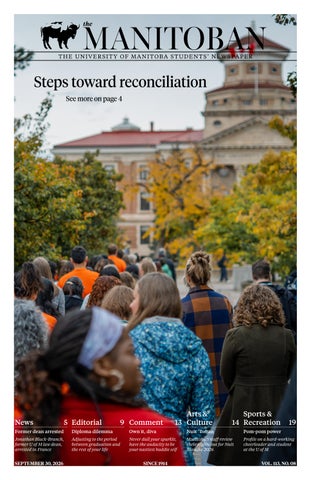
Steps toward reconciliation See more on page 4
News
5 Editorial
9 Comment
Arts & 13 Culture
Sports & 14 Recreation
19
Former dean arrested
Diploma dilemma
Own it, diva
Nuit ‘Toban
Pom-pom power
Jonathan Black-Branch, former U of M law dean, arrested in France
Adjusting to the period between graduation and the rest of your life
Never dull your sparkle, have the audacity to be your nastiest baddie self
Manitoban staff review their nights out for Nuit Blanche 2026
Profile on a hard-working cheerleader and student at the U of M
September 30, 2026
SINCE 1914
VOL. 113, NO. 08
Vol. 112
No. 08
INSIDE:
109 HELEN GLASS BUILDING UNIVERSITY OF MANITOBA WINNIPEG, MB THEMANITOBAN.COM | 204. 474. 6535
NEWS GENERAL INQUIRIES: ME@THEMANITOBAN.COM CIRCULATION INQUIRIES: MISSING OR INCOMPLETE PAPER? EMAIL: DISTRIBUTION@THEMANITOBAN.COM
EDITOR-IN-CHIEF
The Manitoban is the official student newspaper of the University of Manitoba. It is published monthly during the summer and each week of regular classes during the academic year by the Manitoban Newspaper Publications Corporation.
Mikaela Warkentin
editor@themanitoban.com
ads@themanitoban.com
The Manitoban is an independent and democratic student organization, open to participation from all students. It exists to serve its readers as students and citizens.
EDITORIAL
The Manitoban is a member of the Canadian University Press, and our journalistic standards can be found on the Manitoban’s website.
BUSINESS MANAGER Alice Teufack accounts@themanitoban.com BUSINESS SUPPORT MANAGER Ramisah Musarrat
MANAGING EDITOR
Peace Ifeanyi
me@themanitoban.com COPY EDITOR
Eden Quiring
copy@themanitoban.com NEWS EDITOR
Arifah Gheesah
news@themanitoban.com NEWS EDITOR
Roy Albright Obah
news@themanitoban.com RESEARCH & TECHNOLOGY EDITOR Mansura Akter Meghla research@themanitoban.com COMMENT EDITOR
Quinn Mayhew
comment@themanitoban.com ARTS & CULTURE EDITOR Boris Tsun Hang Leung arts@themanitoban.com SPORTS EDITOR
Faiyaz Chowdhury
sports@themanitoban.com
DESIGN AND VISUALS DESIGN EDITOR
Deveney Jarrow
design@themanitoban.com GRAPHICS EDITOR
Emma Gillich
graphics@themanitoban.com PHOTO EDITOR
Ebunoluwa Akinbo
photo@themanitoban.com
AUDIO AND VIDEO AUDIO EDITOR
Max Reid
audio@themanitoban.com VIDEO EDITOR
pages 3 to 5
Zulkifl Rafah
video@themanitoban.com DIGITAL MEDIA EDITOR
Faisal Rahman
social@themanitoban.com
VOLUNTEERS VOLUNTEERS Macayla Riney-Lucas & Madison Beale VOLUNTEER STAFF
The newspaper’s primary mandate is to report fairly and objectively on issues and events of importance and interest to the students of the University of Manitoba, to provide an open forum for the free expression and exchange of opinions and ideas and to stimulate meaningful debate on issues that affect or would otherwise be of interest to the student body and/ or society in general. The Manitoban serves as a training ground for students interested in any aspect of journalism. Students and other interested parties are invited to contribute to any section of the newspaper. Please contact the appropriate editor for submission guidelines.
RESEARCH & TECHNOLOGY
page 8
EDITORIAL
page 9
DIVERSIONS
page 10
The Manitoban reserves the right to edit all submissions and will not publish any material deemed by its Editorial Board to be discriminatory, racist, sexist, homophobic or transphobic, ableist or libellous. Opinions expressed in letters and articles are solely those of the authors. Editorials in the Manitoban are signed and represent the opinions of the writer(s), not necessarily those of the Manitoban staff, Editorial Board or the publisher. A “volunteer staff” member is defined as a person who has had three volunteer articles, photographs or pieces of art of reasonable length and/ or substance published in the current publishing year of the Manitoban.
COMMENT
pages 12 to 13
ARTS & CULTURE
pages 14 to 18
SPORTS & RECREATION
pages 19 to 20
Any individual who qualifies as a volunteer staff member must be voted in by a majority vote at a Manitoban editorial board meeting. Elected representatives and non-students may be excluded from holding votes as volunteer staff members in accordance with the Manitoban Constitution.
Sijy Varghese
interested in volunteering? email me@themanitoban.com today!
2
All contents are ©2026 and may not be reprinted without the express written permission of the Editor-in-Chief.
News
September 30, 2026 news@themanitoban.com
UMSU board meeting highlights UMSU focuses on advocacy, student funding, and an upcoming byelection Arifah Gheesah, staff
T
he UMSU board of directors met on Sept. 24 to discuss executive vacancies, student funding, advocacy initiatives and operational updates. Key decisions included moving forward with by-elections to fill the two vacant executive positions and approving an investment in long-term student financial support. The board considered motions related to the vacant vice-president external affairs and vice-president finance and operations (VPFO) positions. While motions were presented that would have redistributed responsibilities among the remaining executive team and staff for the remainder of the term, those proposals were not adopted. Instead, the board determined that by-elections will be held to fill both vacant executive positions. The discussion and decision regarding the vacancies took place during a closed session. The board approved a onetime transfer of $750,000 from UMSU’s unrestricted operating fund to the Scholarship and Bursary Trust Fund. According to the motion, UMSU’s operating fund maintains a substantial surplus and is projected to end the fis-
cal year with an operational surplus of approximately $300,000. The transfer is expected to leave the union’s operating reserves above the minimum recommendation provided by UMSU’s finance manager. The investment is intended to strengthen long-term support for students by increasing the resources available through scholarships and bursaries. In his final report as VPFO, Cameron Provost described the transfer as an investment that would expand scholarship opportunities for students well into the future. Heaven Kaur reported ongoing advocacy efforts aimed at restoring public healthcare coverage for international students in Manitoba. UMSU has partnered with the University of Winnipeg Students’ Association and the Red River College Students’ Association to host a rally at the Manitoba Legislative Building on Sept. 29. The rally will call on the provincial government to fulfill its commitment to reinstate healthcare coverage for international students. The campaign highlights continuing barriers international students face when accessing healthcare and medication programs in
PHOTO BY EBUNOLUWA AKINBO / STAFF
Manitoba. UMSU’s executive team continues to advocate for a centralized course syllabus database and clearer guidelines regarding the use of artificial intelligence (AI) in coursework. Kaur and Grace Elendu reported meetings are ongoing with university administrators, deans and faculty leaders to advance both initiatives. The proposed syllabus database would allow students to review course outlines and expectations before course registration, while AI guidelines would provide greater consistency and transparency across faculties. The executive team expects to continue discussions with university leadership throughout the fall term.
Manasa Rajesh, vice-president student life highlighted several successful student engagement initiatives, including orientation programming, Bison Bash, Taste of UMSU and the inaugural Summer Games event. The assembly of club executives and board of association executives also resumed for the academic year, with strong attendance from student leaders across campus. Thomas Blumer, UMSU’s managing director, reported a busy start to the fall semester across UMSU services and business operations. The Service Centre has already processed approximately 20,000 U-Pass registrations, assigned around 7,000 new U-Passes and welcomed more than 18,000 stu-
dent visits since the beginning of the academic year. UMSU businesses, including Degrees Diner, IQ’s Café & Billiards, VW Social Club, G.P.A.’s Campus Convenience and UMCycle, also reported positive activity levels and ongoing efforts to enhance services and student experiences. As UMSU enters the fall semester, major priorities include filling executive vacancies through by-elections, advancing advocacy campaigns at the university, municipal, provincial and federal levels, improving student engagement and expanding financial supports for students.
Cameron Provost resigns as UMSU VPFO Second executive position vacant as board decides on by-elections Arifah Gheesah, staff Cameron Provost has resigned from his position as UMSU vice-president finance and operations (VPFO). Provost confirmed his resignation in a statement to the Manitoban, saying the decision followed “much deliberation.” “My resignation was not a decision I took lightly,” Provost wrote. He said he ultimately decided to step down after determining that he was experiencing a “poor organizational fit” and wanted to pri-
oritize his mental health. “I am exceptionally proud of the resilience and effort of our executive team and wish them the best with the remainder of their terms,” Provost wrote. Provost’s resignation leaves the VPFO position vacant. The VPFO is responsible for overseeing UMSU’s financial operations and other areas of the union’s administration. The resignation comes during the 2026–27 UMSU executive term. This marks the second executive vacancy of this term after Aiden Peters
resigned as vice-president external affairs (VPEA) on Sept. 18. The board determined by-elections will be held to fill both positions after rejecting a motion to redistribute the VPFO and VPEA responsibilities among the remaining executive team and staff for the remainder of the term. The decision regarding the vacancies took place during a closed session of the UMSU board of directors meeting on Sept. 24. IMAGE COURTESY OF CAMERON PROVOST
3
Vol. 113, No. 08 news@themanitoban.com
News
Orange Shirt Day reaffirms reconciliation on campus Annual walk reflects on institutional efforts of Truth and Reconciliation Mikaela Warkentin, staff
M
onday marked the 12th annual Orange Shirt Day Walk hosted by the U of M college of nursing and the Nursing Students’ Association (NSA). Orange Shirt Day originated from the experience of Phyllis Webstad, who in the early 1970s had her orange shirt taken from her by staff at a residential school in British Columbia. Orange Shirt Day coincides with the National Day for Truth and Reconciliation in an effort to further connect ideas of reconciliation with the impacts the residential school system continues to have on Indigenous peoples. Due to weather, the majority of the event was hosted in the Helen Glass building on the U of M’s Fort Garry campus. However, the drizzling rain did not put the walk itself on hold, with participants walking from the Helen Glass building around campus and to the front of the administrative building, then to Migizii Agamik Bald Eagle Lodge, after returning to Helen Glass. Ahead of the walk, remarks were shared by U of M administration and community leaders, including Indigenous Student Centre grandmother-in-residence Karen Courchene and college of nursing elder-in-residence Fjola Hart-Wasekeesikaw, with Courchene addressing the belief of residential school denialism — “I have been invalidated in sharing my story, and every time I see an act of denialism, it does hurt my heart.” Courchene added, “your support as allies, as family, as friends, your support in sharing the truth, it helps us […] I know I’m not alone in the truth telling.” Representing the office of the vice-president (Indigenous) at the U of M, Todd Duhamel spoke about the office’s recently gifted name, L’offis Wiichihihwahk, which means “the office that helps” in Michif. Michif is one of the major languages spoken by Métis people, and the name was gifted by U of M elder Charlotte Nolin earlier this year. As a citizen of the Red River Métis nation, Duhamel shared that the name has personal significance beyond a public display of solidarity. “It’s a signal that real change can happen and I hope that it’s not just a name, but an actual philosophy behind what we’re doing.” The keynote address was given by U of M alumna Michelle Monkman, CEO
4
of Keewatinohk Inniniw Minoayawin Inc. (KIM). KIM is an Indigenous self-governed organization based in Thompson and Winnipeg that aims to reflect the needs of Indigenous communities in northern Manitoba through the expansion and improvement of health services. Monkman, in her address, noted that while systemic racism is entrenched in many colonial institutions, nursing as a practice has a particular responsibility. “We are a profession built around care, advocacy and safety, yet nurses participated in residential schools, Indian hospitals and systems that segregated Indigenous people”. Monkman shared with the Manitoban that during her undergrad at the U of M in 2004, she “didn’t see events like this happening, so to be a part of it today and to see the growth and momentum happening and reconciliation is very exciting.” “I do think that we have more work to do,” continued Monkman. “I’m always reminding systems that there’s still lots to do.” For Kayleigh Pagee, Orange Shirt Day is a way to ensure Indigenous voices get heard at the U of M. A first-generation student, Pagee ran for NSA Indigenous representative to continue events like Orange Shirt Day. “I can sit back and watch everything happen, or I can [take] the initiative to make something happen and make change happen for our people as well,” shared Pagee. With Pagee entering her third year as NSA Indigenous representative, she hopes sharing her experiences will encourage more Indigenous leaders. “We have so many types of leadership on this campus and I feel like anyone Indigenous should just keep running, keep putting your voice out there, just keep going.” This sentiment of ongoing efforts for truth and reconciliation was reflected by NSA senior stick Hamidat AhmedIshimel, who shared and reaffirmed the pledge toward truth and reconciliation originally signed in 2015 by the Canadian Nursing Students Association. The pledge outlines the unique duty of nursing in efforts for reconciliation. “As future nurses, we choose to align ourselves with Indigenous children, youth and their families to create an environment that supports, affirms and celebrates all people.” PHOTOS BY ZULKIFL RAFAH / STAFF
September 30, 2026 news@themanitoban.com
News
Former U of M’s law dean arrested in France Black-Branch faces extradition to Canada over $680,000+ court judgment Roy Albright Obah, staff
S
ix months after a Canada-wide arrest warrant was issued, Jonathan BlackBranch, former U of M law dean, has been arrested in France, with extradition proceedings underway to return him to Canada. Black-Branch was employed as dean for the faculty of law at U of M in 2016 for a five-year term, slated to run from July 1, 2016, to June 30, 2021. Four years into his appointment, Black-Branch reportedly took leave without formal notice. Around the same period, a whistleblower filed a complaint with an investigative body at the U of M concerning the alleged misuse of funds by a senior employee. An internal investigation conducted between 2019 and 2020 examined the complaints, and its final report was submitted to the office of the auditor general of Manitoba. Shortly after leaving the university, Black-Branch was appointed head of the University of Southampton’s
school of law in England. The appointment was later revoked, and he ceased to be a member of the school’s faculty. The complaints against Black-Branch centred on misuse of some university funds, including a research and training endowment fund for which he was responsible for authorizing expenditures as director and chair. U of M later referred the matter to the Law Society of Manitoba, which investigated the allegations and found Black-Branch guilty of professional misconduct involving the embezzlement of more than half a million dollars. It determined that the evidence presented at his disciplinary hearing was sufficient to support the findings. Following the society’s findings and disciplinary action, the U of M asked the Winnipeg Police Service to investigate the matter, reversing their earlier position to not press charges against him. A civil lawsuit filed by the U of M in Manitoba’s Court of King’s Bench sought
$660,994.60 in damages and alleged that Black-Branch breached the terms of his employment contract. The lawsuit also alleged that Black-Branch used university funds to reimburse expenses already covered. Other expenditures cited in the lawsuit included approximately $17,000 in membership fees for private clubs, $21,000 for 201 meals at the Manitoba Club and $75,000 to his own external corporation. In May 2025, the court ordered Black-Branch to pay the university over $680,000, and more than $3,000 in costs, as well as an annual interest of three per cent. The default judgment was delivered in absentia after several attempts to serve him. Black-Branch was dismissed by the U of M in 2020 and disbarred in Manitoba in February 2024, in addition to being given a fine of $36,000. Two years later, he was removed from England’s roll of lawyers and was fined £2,670. His extradition case is currently before a French court.
IMAGE COURTESY OF UMTODAY
Marking Mental Illness Awareness Week through art CARE and SOFASA offer students space for creative expression and connection Roy Albright Obah, staff The Centre for Accessibility, Resources and Empowerment (CARE), in collaboration with the School of Art Student Association (SOFASA), presents a public communal drawing initiative on campus from Oct. 5 to 9 to bring students together through art. The event concept stemmed from a desire to create a welcoming gathering space where participants can feel a sense of belonging on campus while uniquely expressing themselves. Kristen Nguyen, UMSU accessibility representative, said the event commemoratess Mental Illness Awareness Week, which she hoped would inspire mental health conversations. The event is open to all students and does not require
interested participants to have any artistic skills. “Students can participate in whatever way feels comfortable for them,” Nguyen said. “Something as simple as a small drawing, a word, a mes-
“Art can offer another way to express what may be difficult to put into words” — Kristen Nguyen, UMSU accessibility representative sage, or adding to someone else’s work can become part of the collective artwork.” She acknowledged SOFASA’s contribution to making the event “more
meaningful and accessible.” SOFASA will be supporting the artistic aspect of the program and providing guidance on its organization and the display of the artwork. An art exhibition, which was part of the initial plan, has been postponed until November due to a delay in a funding request. “Art can offer another way to express what may be difficult to put into words,” Nguyen expressed. She remained hopeful that the “initiative [will help] create a sense of belonging.” The event will take place in studio 460 at the U of M school of art from Oct. 5 to 9. Interested students can find updates and further details on CARE’s Instagram page @accessibility_umsu. PHOTO BY EBUNOLUWA AKINBO / STAFF
5
Meet the Candidates Townhall St. Norbert-Seine River Ward
October 6 3:30-5:30PM Moderated panel from 3:45-4:45PM
IQ’s Café & Billiards 3rd Floor, UMSU University Centre
@myumsu
www.UMSU.ca
Research & Technology
Vol. 113, No. 08 research@themanitoban.com
Finding your way around campus UMaps brings navigation, schedules and campus information to one app Mansura Akter Meghla, staff
F
inding a classroom can be one of the first challenges a student faces in their early days around a new university campus. For fourthyear mechanical engineering student Quadric Francisco, his own experience getting around campus led him to develop a tool aimed at making student life easier. Francisco began working on UMaps during his first year at the U of M. He said, as a new student, he found it difficult to navigate campus while also adjusting to university life. He wanted to create something that could address a problem experienced by many students. “I didn’t know how to get around campus. I didn’t know what was around campus. And in your first year, it’s too much of a stress to even try to figure out what’s on campus because you’re balancing so many other things,” Francisco said. The idea initially focused on an indoor pathfinder that could help students navigate campus buildings. Over time, Francisco expanded the project beyond directions. “UMaps evolved from, ‘Okay, let’s make a better map,’ to, ‘Okay, let’s improve the student experience and improve all of the aspects that we can,’” he said. The current app includes pathfinding alongside information students may need throughout their day. Users can access their schedules from their phone’s home or lock screen and find information about buses and parking. Francisco has largely developed the newest version of UMaps himself. While volunteers contributed at earlier stages, he currently handles development, marketing and user support. According to Francisco, the project also became a learning process for him. Not being a computer science student,
8
PHOTO BY EBUNOLUWA AKINBO / STAFF
Francisco initially taught its Sept. 3 beta launch, UMaps with Francisco working himself coding through docu- recorded more than 2,100 toward displaying the shutmentation. As artificial intelli- verified downloads and 13,000 tle’s actual location and arrival gence coding tools improved, route searches. He said half of information. he said he began incorporat- its users were first-year stuHe is also testing an events ing them into his workflow to dents. feature designed to give stumake development more effiFrancisco mentioned add- dents one place to find and cient and leave time for other ing more features in the app save information about activparts of the project. focused on everyday student ities on campus. Another As UMaps development needs. One planned addition planned area brings stutook place dent resouralongside his ces together “UMaps evolved from, ‘Okay, let’s make a engineering so users do not studies, Franhave to search better map,’ to, ‘Okay, let’s improve the cisco said through mulstudent experience’” maintaining tiple websites motivation and links to — Quadric Francisco, fourth-year U of M was one of the find relevant biggest chalservices. department of mechanical engineering student lenges. For Francisco much of the said some of past three years, the project is restaurant information that these functions could be parhad a small online following, students could filter based on ticularly useful for students he noted. Interest increased dietary requirements, includ- with accessibility needs or after the latest version became ing halal options and aller- specific dietary requirements. available to students this Sep- gens. Another is real-time Privacy has also been contember 2026. tracking for the campus shut- sidered in the app’s developFrancisco said that within tle bus. A simulated version ment. Francisco said the beta roughly the first two weeks of has already been developed, requires a student email for
verification, but the email is not linked to other information. According to Francisco, location, schedules and preferences are stored within the app rather than shared with it. Users can also turn off personalized data reporting and skip survey questions if they wish. Francisco hopes UMaps will eventually become a sustainable service that remains available after he graduates. “The main vision here is, I want UMaps to be a tool that helps students, not just today, but in the future as well,” Francisco said. His long-term goal is for the platform to provide information students need throughout university, “from orientation all the way to graduation.” Students interested in trying UMaps can download the app at myumaps.ca/mobile.
Editorial
September 30, 2026 editor@themanitoban.com
Graduation blues The strange quiet and uncertainty after graduation Mansura Akter Meghla, staff
G
raduation. Isn’t it supposed to feel like a finish line? Like I have achieved a milestone? After years of assignments, deadlines, presentations and checking UMLearn more often than I would like to admit, reaching the end should feel like pure relief, right? Well, in many ways, it does. But it comes with a pinch of sadness too. To be honest, there is genuine relief in knowing that the paper I submitted really was the last one. There is no next semester waiting around the corner, no course registration or multiple 20-page term papers to think about. For the first time in years, the academic calendar no longer determines what the next few months of my life will look like. But somewhere between completing the degree and figuring out what comes next, I realized that relief and sadness can exist at the same time. I miss campus. Not necessarily the rushing to class or trying to finish something minutes before a deadline. I miss the famili-
arity of it all. I knew where I was supposed to be and what I was supposed to be doing. There were familiar hallways, favourite spots in the library when I needed to focus, friendly faces and small conversations with people I might not have known particularly well but saw often enough they became part of my routine. I miss that routine. University gave my days structure. A semester began, I received a course outline and, for the most part, I knew what was expected of me until December or April. Even when university was stressful, there was comfort in knowing the routine. Graduating disrupts that almost overnight. One day, I was a student with deadlines, classes and a clear reason for being on campus. Then, once I had successfully defended my thesis, I was done with university. People congratulated me and asked the inevitable question, “So, what’s next?” Well, that question has become much harder to answer. For me, one of the most dif-
ficult parts of graduating has been coming to terms with not knowing what’s next. I like to know what my day looks like so I can plan accordingly, but when you don’t know what to expect next, it’s much harder to do so. Another part of it is looking for full-time employment. Job searching creates a strange routine of its own — reading postings, adjusting applications, sending them out and waiting. There is excitement when something promising appears, disappointment when it does not work out and a lot of uncertainty in between.
“One of the most difficult parts of graduating has been coming to terms with not knowing what’s next” And then there is the constant questioning. Is this the kind of job I should be applying for? Does it fit what I studied? Should I
be looking in another direction? Am I making good use of my degree? What if I choose something and realize six months later it is not right for me? University trains us to work toward the next milestone — finish the course, complete the degree, graduate. But after graduation, the milestones become much less obvious. I think that is what I was least prepared for. There is an expectation that graduating means finally knowing what you are doing. You have earned the degree, so surely you have also figured out your career and the rest of your adult life. In reality, completing the degree just opens up an entirely new chapter with a set of completely new questions. At the same time, I do not want to romanticize being a student. There were plenty of days when I wanted nothing more than to be done with it. I think most of us do. I remember the stress, the exhaustion and the feeling that there was always something else I should be working on. Still, now that it is over, I understand that I was not only
working toward a degree. I was also building a life around campus without realizing how much I would miss it when it ended. Maybe graduation blues come partly from that contradiction. You can be proud to reach the finish line and still grieve what you are leaving behind. You can be ready for something new while feeling uncertain about what that new thing should be. I am trying to become more comfortable with not having the answer immediately. Graduation closes a familiar chapter, but it does not hand us a detailed plan for the next one. And that has its own perks too. We get to choose where we go from here and what we want our next journey to look like. That freedom is scary, but also liberating. Right now, I am somewhere between feeling relieved that I am done with university for now and missing the life that came with it. However, above all, I am truly grateful for the time I have in between. I am trying my best to enjoy it while it lasts, before the next hurdle begins.
GRAPHIC BY EMMA GILLICH / STAFF
9
Diversions
For many strategies, hints and tips, visit www.sudokuwiki.org
8 Easy
8 9 6 7 4 8 6 7 5 4 3 7 8 6 9 6 5 8 1 4 3 5 6 4 3 2 7 4 5 2 1 3 1 2 5 6 7 2 1 3 2 8
2 1 3 9 8 7
4
1
9
8
5 1
SUDOKU
5
8
Tough
To complete Sudoku, fill the board by entering numbers 1 to 9 such that each row, column and 3x3 box contains every number uniquely.
4 7 3 8 9 5 6 1 2
5
8
4
No. 822
9
6 7
9
5 4
Previous solution - Medium
2
© 2026 Syndicated Puzzles
3
1 2 2 1 5 7 9 8 7 9 8 4 4 3 5 6
4
5 9 8 2 1 6 4 7 3
2 6 1 3 4 7 8 9 5
3 8 6 5 7 4 1 2 9
1 2 4 9 3 8 5 6 7
7 5 9 1 6 2 3 8 4
9 3 2 4 8 1 7 5 6
6 1 5 7 2 3 9 4 8
8 4 7 6 5 9 2 3 1
Previous solution - Medium
© 2026 Syndicated Puzzles
Tough
9
Sijy Varghese, volunteer staff
10
2
8
cells remove that number as an option in that row and column, and are not part of any straight. Glance at the solution to The solutions will be published here in the ne see how ‘straights’ are formed.
xkcd.com
Do you have a comic you’d like to submit to the Manitoban? Email your submissions to graphics@themanitoban.com
8
3
much more on our store. You can find more help, tips and hints at www.str8ts.com
2 8
5 9
7 9
8
4 3 1
For many strategies, hints and tips, visit www.sudokuwiki.org
1
9 6
6 8
4 8
3 6 1 7 5 To complete 8 Sudoku, fill6the 2 board by entering numbers 1 to 9 such that each row, column and 9 3x3 box contains every number uniquely. 9 4 For many strategies, hints and tips, visit www.sudokuwiki.org 2 8 If you like Str8ts check out our books, iPhone/iPad Apps and 3
8
3
6 7 4
1
8
If you like Str8ts check out our books, iPhone/iPad Apps and much more on our store.
5
Medium
2
8
7 8 2 3 1 6 4 5 9
3
4
ber can . But... ed by black s. These bers that ght is a set t can be in s in black s an option are not part e solution to The solutions will be published here in the next issue. ed.
8
5 4 1 8 9 7 3 2 6
5
9
9
9 3 6 4 5 2 8 7 1
How to beat Str8ts – Like Sudoku, no single number can Previous solution repeat in any row -orMedium column. But... rows and columns are divided by black 4 5 2 3 1 7 9 6 8 squares 7 9 6into 8 compartments. 2 5 3 1 4 These need that 3 8 to1be6filled 4 in 9 with 2 5numbers 7 complete is a set 8 2 3 a5‘straight’. 9 1 4 A 7straight 6 of numbers gaps 9 1 4 7 with 3 no 6 8 2 but 5 can be in any order, eg [4,2,3,5]. Clues in black 5 6 7 4 8 2 1 3 9 cells remove that number as an option 4 8 1 5 3 7 9 2 in6that row and column, and are not part 7 straight. 9 2 6 Glance 8 5 4at the 3 solution to of1 any The solutions will be published here in the next issue. 2 3 5 ‘straights’ 9 7 4 are 6 8 1 see how formed.
2
2 7 9 6 4 8 1 3 5
1 5
2 5
8 1 5 7 3 9 6 4 2
9
4
4 6 3 5 2 1 7 9 8
.str8ts.com
8 2
1
6 9 8 2 7 4 5 1 3
To complete Sudoku, fill the board by entering numbers 1 to 9 such that each row, column and 3x3 box contains every number uniquely.
7 9
1 5 7 9 6 3 2 8 4
6
If you like Str8ts check out our books, iPhone/iPad Apps and much more on our store.
3 2 4 1 8 5 9 6 7
xt issue.
Previous solution - Easy
Sudoku Solution To complete Sudoku, fill the board by entering numbers 1 to 9 such thatNo. each 821 Previous solution - Tough row, column, and 3x3 box contains 1 8 7 5 6 2 3 4 6every 2 3 number 5 4 7uniquely. 9 8 In Straights, 3 5 4 6 7 8 like Sudoku, no single number 1 to 9 7 9 8 2 2 3 5 4 6 8 9 7 can repeat in any2 row or column. But 3 4 7 5 6 1 rows 1 8and 3 columns 7 5 4 6 are 2 divided by black Straights Solution 9 7 8 2 3 4 squares into compartments. Each 8 7 6 1 4 2 3 5 9 compartment must form a “straight.” 2 9 8 2 3 5 6 A straight is a set of numbers with How to beat Str8ts – 9 4 noSudoku, gaps but it cannumber be in can any order, eg Like no single repeat in any row or column. But... [7,6,9,8]. Clues in black cells remove 8 rows and columns are divided by black that number as an option in that squares into compartments. These need be filled in with numbers rowtoand column, and arethat not part of 4 8 complete a ‘straight’. A straight is a set straight. at the ofany numbers with noGlance gaps but can be in solution 1 6 any [4,2,3,5]. Clues in black to order, see eghow “straights” are formed.
© 2026 Syndicated Puzzles
No. 821
Medium
SUDOKU
Puzzle by Signdicated Puzzles © 2026 Syndicated Puzzles
No. 821
4 7 9
STR8TS
Straights
Puzzle by Signdicated Puzzles
© 2026 Syndicated Puzzles
SUDOKU
Sudoku
Vol. 113, No. 08 graphics@themanitoban.com
2026 Alance AB
5 9
U
S T P e G am M
Comment
Vol. 113, No. 08 comment@themanitoban.com
The Manitoban horoscope for the week of Sept. 28 Zodiac sign mania, flip a coin and see your fate this week Quinn Mayhew, staff AQUARIUS January 20 – February 18
and not always be so stressed due to bad time management.
Aquarius, you will be inclined to find money this week. Whether on the sidewalk or at your job, you will be inclined toward prosperity this week. You may not want to look too hard because abundance may disappear.
–
PISCES February 19 – March 20 Pisces, why are you doing this tango with me? Why are you trying to trick me into thinking you’re alright? You’re not okay — I see you. If you are struggling, it’s okay to ask for help. Spend time with your family and friends and do things you enjoy. ARIES March 21 April 19
–
Dear Aries, you didn’t heed my advice. You’re late again. Get an agenda, girl — this is chronic. I want you to thrive
12
TAURUS April 20 May 20
Taurus, you need to try to understand. Stop talking at people and try to listen. When people tell you they cannot do something, you need to understand that individuals get tired. Life happens, and adult relationships are complex, be accepting. GEMINI May 21 June 20
–
Gemini, things will be looking up this week. A friend or colleague you haven’t heard from recently will reach out with exciting news, perhaps a new project. Listen when I say that you should follow their idea — it may lead to large amounts of success.
CANCER June 21 July 22
–
Cancers, stop going out every night. I am highly concerned. You do not need to surround yourself with people who do not fill your cup. Stop seeking company in places you know are not good for you. LEO July 23 August 22
–
Leos, put down the credit card and step away from Ticketmaster. You’ve been purchasing way too many items. Your credit card is crying, you need to stop shopping before you run out of money. This is your warning. VIRGO August 23 – September 22 Virgos, stand up for yourselves. Guys, you know I know you, but you need to stop turtling whenever conflict arises. You know when someone is treating you badly, so why do
you let it happen? Stop letting other people always defend you — be the first one to do it. LIBRA September 23 – October 22 Libras, I want you to know that I am not mad at you. Friends have been set aside for new ones. I fear this is a bad shift for you — these new friends may not care as deeply about you as your older ones. SCORPIO October 23 – November 21 Scorpios, you have an imagination that could rival your next-door neighbour’s dog named Frank. You repeatedly make the same mistake because you sometimes lack direction. You need to change the error of your ways before the dog starts laughing at you. SAGITTARIUS November 22 – December 21 Sagittarius, stop trying to
cheat the system. Your mom has told you this, your dentist has as well — just stop it. You need to stop trying to get your friends to pay for you to get into concerts or scroll on Instagram trying to find discount codes. Just be forward and say you can’t do something instead of avoiding what’s hard. CAPRICORN December 22 – January 19 Capricorns, you are the artistic type and have a hard time gripping onto reality. You are afraid to take risks because you think your mind is leading you astray. I need you to hear me when I say this — STOP PUTTING THINGS OFF.
September 30, 2026 comment@themanitoban.com
Comment
I want to kiss the word diva on the mouth Where is the drama? It is crushed under the weight of perfection Quinn Mayhew, staff
I
spam Gen Z terms like it’s my full-time job and I’m getting paid a CEO’s salary. I write emails to my retail boss titled “Hey Diva [smiley face emoji],” wear high-heeled boots all winter long and crank the speaker in my car as loud as it’ll go so the bass is shaking my slightly disturbing Sonny Angels glued to my dash. One might suggest I live in excess. Slinging Gen Z slang gives me freedom to accentuate a point so past reasonable that it’s reaching excess. I love the way diva sounds in my mouth, the way it shapes a conversation. I use this word to gauge how in tune we are with one another — can you match my freak, yes or no? I love nasty women, divas. The meaner, the nastier, the better — I want you to be so unlikable that I want to become you. Where are the people who are annoying, dirty, hedonistic and bra-less? When did we lose authenticity to make way for aesthetic? We lost it when we all wanted to be cool. Cool this, cool that, “Buy this so you too can become cool,” says the robotic voice from your open Instagram page. I will not embrace the monotone voice calling for inauthenticity by performing a version of myself centered on perfection for an audience I do not care about. Let’s embrace mess, the diva, if you will. Divas live in the land of muchness: too loud, too aggressive, too intelligent. In other words, they’re NASSSSTYYY. Maybe we should bottle this plethora of muchness, sell it, double it and make it mandatory. I want you to be hated because at least if you’re hated, you will be hated as yourself. Nerds, I love em. Tell me why you love World War I reconstructive plastic surgery books — speak to me about what interests you, I need to know. I’m on my hands and knees begging in the local Costco — there’s a literacy crisis. The world is drowning in clones, and I need all the information I can get to wade amongst the useless garbage
GRAPHIC BY EMMA GILLICH / STAFF
of sameness. We have brainwashed ourselves into thinking that liking the same things equals coolness. It doesn’t. When we all become cookie-cutter versions of ourselves, we risk losing the opportunity for growth and individuality, trading it in for Tyler, your next-door neighbour, who uses a litre of water per ChatGPT prompt to look up “Ways to be cool.” I froth at the mouth thinking about my next use of bad-
die, diva, baby girl mystique and chic. It’s insatiable. Gen Z terms are my weapon of choice, tied to creativity and identity, used to communicate with people to test them, to understand them — am I too cringe for them? Because I love that they hate me. Where is the spotlight, the feather boa, the drama? It’s crushed under your morbidly sensible Converse sneaker. The diva is less about stomping on people metaphorically
and physically and more of an assist in bringing a smidge of decadence into the monotone sameness of everyday. It’s a need, as Chappell Roan needs her bedazzled, out-of-this-world on-stage costumes. The image of the diva encourages self-indulgence and independence rather than dependence on a narrative that may not be your own. Social constructs ask too much, chastising anyone who challenges homogenized con-
formity as excessive, making the glamorous figure of the prima donna into a form of “bad behaviour” instead of a fully realized person exerting control over their own image. Long live the diva, the ones who demand self-respect instead of shrinking, the nerds in exuding muchness. Aesthetic is temporary, baby girl mystique is forever. Choose to be authentic, reject social surveillance and accept individuality.
13
Arts & Culture
Vol. 113, No. 08 arts@themanitoban.com
The ‘Toban takes on Nuit Blanche (again) Winnipeg’s late-night arts festival, reviewed by the Manitoban Manitoban staff
Boris Tsun Hang Leung, arts and culture editor Nuit Blanche returned to Winnipeg on Sept. 26, bringing art installations and performances to downtown Winnipeg, the Exchange District and St. Boniface throughout the night. The 2026 edition boasted 87 events in total, according to the festival guide. Despite the pouring rain, the festival was well attended with considerable foot traffic. It was amusing to run into people I know when I least expected it, speaking to Winnipeg’s status as a big city with a communal, small-town feel. One highlight was “IMABOX” in the Old Market Square by Winnipeg-based Kurdish artist Bîstyek, whose works on Kurdish culture and identity were previously exhibited at the Winnipeg Art Gallery. This installation of towering illuminated inflatable figures brought his vibrant paintings to life. However, I was disappointed by how the city seemed sparsely populated with visual art. I expected to find a multitude of light-based art installations simply by wandering in public spaces, but instead vendors, DJs and parties dominated places like Arthur Street. Art enthusiasts will likely gain more from the event by planning an itinerary beforehand, given how the festival is spread across multiple areas of the city. Nevertheless, I still enjoyed the variety of art forms represented at Nuit Blanche, from spoken word poetry to interpretative dance. I left with pleasant memories of messily devouring late-night shawarmas and being in good company. Perhaps the art was also the memories we made along the way.
Arifah Gheesah, news editor This year was my first time attending Nuit Blanche, and it was wonderful to see Winnipeg so alive at night. Surprisingly, my favourite part of the evening was the water bus ride. There was something special about being on the water and watching the city shine around you — the Esplanade Riel in all its glory, the tall buildings glimmering through the fog on a rainy night and the Canadian Museum for Human Rights standing tall against the skyline. It was a beautiful way to experience the city from a different perspective.
14
What makes Nuit Blanche so special is seeing so many people come together. Streets that are usually quiet, even during the day, were filled with laughter, music and conversation, despite the rain. It was also wonderful to see people stopping to appreciate art and engage with the different installations around the city. There was a sense of community that made the night feel so magical. An event wholly dedicated to art, culture and community is something Winnipeg could use more often.
Faiyaz Chowdhury, sports editor I was not familiar with Nuit Blanche, so I did not have any assumptions or ideas about what to expect and just wanted to experience whatever was to occur. As the sun was setting, I was completely smitten by the smell of petrichor in the environment, and I found myself waiting in a long line for a boat that was too small. It only took a minute before I started complaining. But my complaints went away as soon as we were a couple of minutes into the boat ride, as I stared over my shoulder into the shallow black water, and everything around me came to a halt. I could almost sense my pulse, although it was not racing. I felt grateful in that moment as I reflected upon everything I had. Maybe this was not an endless night of wonders for me, but there were many moments of self-reflection.
PHOTOS BY ZULKIFL RAFAH / STAFF
Eden Quiring, copy editor J’aime Nuit Blanche. I have seen great art, but at Nuit Blanche, I saw a lot more than that. I also got to watch my friend hem and haw over buying a painting from her favourite gallery and how kindly her boyfriend sup-
ported her. I played Wii Rock Band with my friends in a cool place I had never heard of and got to impress them with my guitar skills. I was reminded of how wonderful and lively the Exchange is when it is filled with people. I also witnessed a mishandled situation that reminded me of Winnipeg’s systemic
issues. A night like Nuit Blanche cannot only bring out the good side of our city, but I found love and community in my friends and many strangers, and they gave me hope for the future of Winnipeg. I saw the best and worst in people too, but I’ll do it all again next year.
Our new website is LIVE!
Our new website is LIVE! For more content, check out The Manitoban Youtube channel! @TheManitobanNews
Vol. 113, No. 08 arts@themanitoban.com
Arts & Culture
Love Medicine at the MacKenzie Art Gallery Review of an exhibition highlighting Indigiqueer experiences Madison Beale, volunteer
L
ove Medicine, a highly anticipated group show by Indigiqueer artists, opened June 12 at the MacKenzie Art Gallery in Regina, Sask. Curated by Métis art historian Michelle McGeough, the exhibition explores how contemporary Indigiqueer artists use love as a methodology and practice to heal. The show primarily concerns kinship and survival amidst ongoing colonial and settler violence enacted upon the two-spirit and Indigiqueer body, but it does not dwell on it. Instead, Love Medicine showcases how artists are reclaiming their identities and histories, using art as a healing medicine. The MacKenzie is the oldest public art gallery in Saskatchewan. It is located in Wascana Park, which takes its name from the Cree words oskana kâ-asastêki (where the bones are piled), referring to Regina’s history as a bone repository during the 19th century massacre of the buffalo. The exhibition opens spectacularly with “Wigwam,” a moderately sized triangular composition of smaller triangular canvas strips stitched together by Anishinaabe Saulteaux artist Robert Houle. The segments symbolize sacred geometries and the energy they hold, and are painted in pale shades of yellow, blue and green. Though it is the oldest piece in the show, being from 1972, this curatorial decision is less chronological than it is thematic. Houle’s legacy as a trailblazing Indigenous artist in Canada is felt throughout the exhibition. Directly beside it are two 2023 wampum belts made by French-Anishinaabe artist Van Racine, featuring a spectrogram of the artist’s father and mother saying “I love you” in French and Anishinaabemowin, respectively. These two anchor the show in an intergenerational context amidst shifting trends in artistic expression with the consistent beliefs that ancient stories and ways of making can be used to understand modern Indigenous life, and that community sustains creativity. A wigwam is a gathering space, and a wampum belt is an agreement. Together, Houle and Racine create a dialogue about legacy and the generative potential of intergenerational dialogue in contemporary art. Towering over the exhibition is Anishinaabe artist Norval Morrisseau’s iconic “Androgyny,” painted in 1983. Love Medicine is some-
16
NORVAL MORRISSEAU, -ANDROGYNY,- ACRYLIC ON CANVAS, 1983. INDIGENOUS ART COLLECTION, CROWN-INDIGENOUS RELATIONS AND NORTHERN AFFAIRS CANADA. DISPLAYED AT THE MACKENZIE ART GALLERY, REGINA. IMAGE COURTESY OF MADISON BEALE
what frontloaded by this colossus overlooking the exhibition, and ending the show with it might have given the other works room to breathe. The polyptych is mesmerizing and towers over the other art works, clearing six meters in height. One cannot help but turn around for one last look at “Androgyny” as one ventures further from it. On a yellow background, a thunderbird stretches its wings over the colourful scene as a main focal point in the busy composition, connected to its surrounding beings by spirit lines that have become synonymous with the Woodland style. The imposition of colonial prejudice has reshaped how sexuality is understood, enacted and embodied. Directly behind “Wigwam” and the wampum belts are three paintings from the Living Evidence 1994 series by Métis
artist Rosalie Favell, which explore the invisibility of lesbian desire — particularly among Indigenous women — in popular culture and in historical record. Favell redacts her ex-lover’s eyes, a decision taken by the artist after the exhibitory venue mandated written permission to display the photos identifying the woman the paintings are based on in the 1990s. The paintings indicate an ambiguous relationship between the women. This distance, and the censoring of Favell’s ex-lover, can remind us that homosexuality continues to be seen as something to be cautious about, regardless of legal protection. Curiously, the show is almost completely devoid of eroticism. However, certain works by the Inuvialuk artist Kablusiak and Métis artist Dayna Danger engage
with sexuality, but ultimately present BDSM as a practice of care and community rather than one of carnality. A charming soapstone “Ball Gag” and “Butt Plug” by Kablusiak are displayed in a glass case that allows for a clear sight line to Danger’s 2020 photograph “Kinky Bundle” and kinship mask titled “Group of 7,” but the sexuality of the show begins and ends in this corner of the gallery space. Love Medicine focuses on many types of queer relationships with community, the world and oneself, but strikes a cautious chord. Melcolm Beaulieu recreates a photograph in beadwork as an homage to matriarchs in their Mi’kmaq lineage, with circular beadwork motifs framing the figures like constellations in the night sky. Chipewyan artist Jake Kimble’s “It’s All So Incred-
ibly Loud” channels beadwork as art passed down generations. In this series of self-portraits, the photographer is slowly subsumed by bright blue beads that begin as a tear drop and end as a frame filled with beads obscuring the artist. While Kimble is not a formally trained beader, they are creating a dialogue with beaders that came before them. The show boasts a unique work by Cree artist Kent Monkman. “Oh For a Thousand Tongues” is an abstract and indirect painting that writes out a hymn bearing the same name in Cree syllabics with indistinct forms of male wrestlers blended into the words. The result is a ghostly composition that actively challenges imposed feelings of cultural and sexual shame, particularly amongst Indigenous gender nonconforming individuals. The show ends clumsily with some weaker works on paper, a comedown offset by the imaginative sculptural works of Cree artist Cheyenne Rain LeGrande and Blackfoot artist Adrian Stimson that are interested in retrieving lost knowledge and cultural practices. Set in a climate, and particularly a global art world, that has become resistant to identity, Love Medicine does not so much push back on this resistance as it does slam the door on the way out of these hostile discussions. While the sexuality in the exhibition was missed, McGeough has nevertheless brought together a formidable group of artists speaking to a range of Indigiqueer experiences. The show celebrates joy within hardship and offers insight into experiences, histories and how a new generation of artists are using traditional techniques to make some of the most exciting contemporary art being made today. For further information and analysis of the pieces from an Indigenous perspective, visit the MacKenzie’s website atmackenzie.art/exhibition/love-medicine/. Madison Beale is a Queer, British-Canadian settler art historian living and working on Treaty 1 Territory. She intends to graduate with a B.F.A. Hons in art history from the U of M in 2027. She hosts and produces the Artalogue, a podcast about arts careers currently in its 5th season. Listen to her conversation with Jake Kimble wherever you get your podcasts.
September 30, 2026 arts@themanitoban.com
Arts & Culture
U of M hosts fine art and music homecoming A night of art demonstrations, performances and a faculty concert Boris Tsun Hang Leung, staff
A
RTlab and the Taché Arts Complex were buzzing with activity on the night of Sept. 23 for the school of art and Desautels faculty of music homecoming. This is the first joint homecoming between the two faculties, according to Steven Runge, the dean of the faculty of music and director of the school of art. The event included live art demonstrations of printmaking and life drawing, and open rehearsals by groups such as the U of M Symphony Orchestra and Concert Choir. It concluded with a faculty concert featuring repertoire from Bach to James Taylor, performed to a full house at the Desautels Concert Hall. “The thing I’d like most people to realize is the breadth
of the activities that happen here in music and in art, the kinds of courses we offer, the kind of programming that we can provide our students, and just the depth of experiences that our students have, but also how talented many of them are, and how they’re so supported by faculty,” said Runge. Abigail Grenke, an honours student at the school of art, helped host the wheel-throwing demonstration outside ARTlab. The students showed passersby how to “throw off of the hump,” a technique used in ceramics to create multiple pieces out of one big clump of clay on the wheel. She explained she came to the U of M specifically to learn from the instructors at the ceramics program.
“The ceramics program here is great,” she said. “Our professors are so incredibly knowledgeable. We have awesome classes of [introductory] ceramics where you get to learn a bunch of techniques from hand building to wheel throwing.” Also among the programming is Returning to the Ambience, a show at the student gallery curated by Zenna Weimar and the School of Fine Art Student Association about finding or returning to a familiar place. Third-year student Abigail Deibert presented the original ceramic pieces “States of Temporality” in the exhibit. “I have three jars here, and they’re representing the [times of day], so daytime, twilight and then nighttime, and I was exploring how the
time of day affects how we feel about the familiar or how we feel about being home,” the artist explained. “In daytime, it’s a time of activity and you’re waking up, and then twilight you might be just arriving home, and then nighttime you’re getting cozy again and settling down, and then you restart the process.” If Deibert could give a piece of advice to first-year students, it would be to go all out. “Don’t hold back, ask your professors questions and really use the first year to explore all options available to you, because that’s what it’s for,” she said. Despite the range of activities showcased on campus for homecoming, Runge also noted the importance for stu-
dents to take advantage of opportunities outside the classroom. “[Students are] here for their courses and for the coursework to make art, to practice music,” he said. “But also [...] so many things that are really important to development happen outside the classroom, attending concerts, going to art exhibits, just meeting faculty, getting to know each other as students as well.” For upcoming events from the school of art and faculty of music, visit umanitoba.ca/ art/exhibitions-and-events and umanitoba.ca/music/ concert-hall-events.
PHOTOS BY ZULKIFL RAFAH / STAFF
17
Vol. 113, No. 08 arts@themanitoban.com
Arts & Culture
Sterling Point is a paradigm shift in teenage drama Review of Sterling Point and why it may resonate with Gen Z Macayla Riney-Lucas, volunteer
E
very now and then, a television show comes along that makes you feel seen. Sterling Point is that show for me. It captures so perfectly the inner lives of Gen Z, how we relate to one another and fall apart and join together. The show’s creator, Megan Park, portrays a relatively realistic life of a modern-day teen, minus the crazy family drama, with a spotlight on female friendships forming the bedrock of the show. Female friendships are so important, and to see them represented so openly and complexly in a series is refreshing. So often the media can present these friendships as girls pitted against one another, celebrity feuds splashed on the front of tabloids or through a sexualized male lens. Here, we get real women being vulnerable together, whether it is through casual tasks of going to the bathroom and debriefing on the night together, navigating relationships and life in general or crying in one another’s laps. Sterling Point gives us a private view into the characters’ feelings through moments of communication and connection. When the characters are talking to their friends and trying to figure out how they feel, there are pauses, repetitions and ineloquence. It feels as though we are stumbling into a shared moment
18
between friends, rather than a highly polished and flat monologue capturing perfectly how someone is feeling. This is how female friendships are built, in these vulnerable moments with one another where we ask for advice on things we do not yet know how to face, sharing our deepest fears and insecurities, all whilst doing the most mundane things like fixing our hair. The characters in Sterling Point are also written so vividly they become real people to us. There are no cliché depictions of anyone as overly masculine or feminine. Instead, they are simply people, each dealing with their own insecurities and emotions. We are not smacked in the face by hypermasculine men or defenceless women often in need of rescuing — something other shows from the ’90s and early 2000s have an abundance of, like One Tree Hill, for example. Instead, the boys share their feelings. The normalization of opening up allows more young men to feel comfortable expressing their emotions, by talking rather than through violence, which the media can so often glorify. Similarly, sexuality in this show is treated as fluid. People are not put into a box of gender expectations. Instead, it shows people finding love without the emotional turmoil other shows depict when coming to terms with being queer. Here, it is almost a non-
issue, a shrug of shoulders saying, “So, why do you care who I like?” Further, Park’s own experience acting on the show, The Secret Life of the American Teenager, made her determined to filter out what she thought was an unrealistic depiction of being a young person, according to a CBC article. In Sterling Point, she gives us a nostalgic return to the teen dramas of the ’90s and early 2000s reimagined in modern times. The show marks a new age of teenage drama, one that current youth can see themselves reflected in. Everything down to the music is thought through. Olivia Rodrigo’s song “maggots for brains” in the show’s opening scene drives home the point that Park knows Gen Z. She knows who we listen to, what we say to each other and how we express ourselves. This is in part due to the atmosphere of approachability she created on set, saying in an interview that she encouraged the young cast to contribute their ideas for the show. What made this show stick with me is the way Park tackles topics that usually are not given a big platform. The scene between all the girls where they talk about their first periods and celebrate another character getting hers is so refreshing. The honesty in that moment helps normalize what women go through.
IMAGE COURTESY OF IMDB
It allows us to feel comfortable expressing our issues, not treating them as unimportant or taboo. This permits us to take up space and be unapologetic. Overall, this show has felt
like a paradigm shift. Together with other shows like Adults, Sterling Point is reinventing the teenage and young adult drama in a realistic and more representative way.
Sports & Recreation
September 30, 2026 sports@themanitoban.com
The smile behind the cheer A glimpse into the world of a cheerleader with Paige Leonardo Faiyaz Chowdhury, staff
C
heerleading is a sport that combines stunts, jumps, tumbling and dance to support and energize teams during games. Cheerleaders are a familiar presence at sporting events like football, and U of M students participate in the activity both on and off the field. Paige Leonardo is a fourthyear U of M psychology student pursuing a bachelor of science with a minor in philosophy and is preparing for medical school after graduation. Leonardo is a classically trained ballerina and as of now, a cheerleader. Leonardo shared that cheerleading practices sometimes run until midnight. She practices three hours a week at either the Fort Garry Lions Football Club, Princess Auto Stadium or L.A. Dance Academy. Leonardo also dedicates another two hours to learning new choreography. She practices the moves at home, blocking them, positioning herself and cleaning the transitions. If all this time were not enough, she has to spend another 45 minutes to an hour just commuting to practice.
According to Leonardo, panels evaluate cheerleaders at tryouts based less on their physical skills and more on their ability to acclimate, learn the choreography and keep themselves calm. “The key to dancing sports, it’s all a mental game,” she said. Mistakes can happen during any performance, and such is also the case for cheerleaders. Leonardo broke it down by saying, “We’re not robots,” explaining that cheerleaders do make mistakes in their performances, but they do not reveal that to the crowd. Leonardo revealed that coaches do not criticize the cheerleaders during performances but voice their feedback during practice sessions. “They’re not focusing as much on the dance as they are about our well-being.” Meanwhile, one other thing that Leonardo prioritizes is her health. She shared that last year she would ignore her body and health and force herself to work through it, but now she is focusing on her health and sleep to ensure that she is more well-equipped. Leonardo emphasized the importance of sleeping. She
added that people should follow a consistent sleep schedule and ideally limit exposure to blue light an hour before bed. She stated that not getting proper sleep could lead to one being “overstimulated” and “grumpy.” Leonardo also mentioned that she volunteers at the Safe Harbour Therapy Centre, where she performs client intake work and helps callers find a counsellor. She is also a resident advisor at the U of M. Just when it seems her daily schedule has no more room, she also serves as the vice president of membership recruitment for the sorority Alpha Phi, where she works with a team of three women who help facilitate new members into the sorority. Talking about her approach toward the workload, she said she deals with the tasks herself and does not exploit her position of leadership by delegating the work to others. While we continue to admire the performances from other sports, recognizing the efforts of cheerleaders from the U of M is essential as well. PHOTO BY ZULKIFLRAFAH / STAFF
19
Vol. 113, No. 08 sports@themanitoban.com
Sports & Recreation
The Griffins soar above the Bisons Bisons women’s soccer loses 2-1 to MacEwan Griffins Faiyaz Chowdhury, staff
T
he Bisons women’s soccer program has been remarkably interesting to follow over the past years. One reason being that in the past three years, the team has had three different head coaches: Vanessa Martinez Lagunas, Mark Colvin and Fabio Capone. Coming to the current season, the herd has played eight games, out of which they have won one, tied two and lost five. This week the Bisons played against the MacEwan Griffins twice, with the first game being a tie 1-1, and the herd losing the second game 2-1. On Sunday, when the herd lost the game, there were flashes of brilliance from the squad, especially in the second half. In the first half, the Griffins’ offence was lethal initially due to the link up between Hannah Corrigan, Lillie Pearson and Ally Tannas. Two minutes into the game, Tannas received the ball and held onto possession before lofting it forward. Pearson raced down the left-wing, using physicality to win the ball before calmly slotting it past the goalkeeper with a soft touch into the bottom corner. The Griffins did not stop with a one-goal lead, and before the Bisons could tie the score, the Griffins had fired multiple shots at the herd’s goalpost. Around the 12-minute mark, Tannas once again launched the ball forward down the left side. Paige Colby raced past a Bison defender, showing control
PHOTO BY FAIYAZ CHOWDHURY / STAFF
over the ball, slowed the pace and blasted the ball into the back of the net to extend the Griffins’ lead. With the Griffins holding a two-goal lead, Griffins’ head coach Dean Cordeiro decided to substitute Corrigan. “It was all just about Hannah returning,” he said, explaining that Corrigan had been coming off an injury. He added, “We were just watching minutes, so we had a predetermined plan. We talked with Hannah, ‘You’re going to start, we need you to help us
generate that offence,’ which she did.” Replacing Corrigan was Ivy Kunn, who took on a more supportive role on the wing instead of playing an attacking winger to help with the ball rotation in the midfield. “Ivy came in and did a tremendous job for us,” Cordeiro said. In this game, it was not that the herd were outclassed by the Griffins. Rather, the Griffins’ system, particularly in the initial stages, yielded results which gave them the two-goal lead. From there, the
Griffins were able to switch to a possession-orientated play. The Bisons had not given up just yet. Three minutes into the second half, the herd had a freekick, and Bianca Cavalcanti lined up to take it. In a moment of pure magic, the ball hit the cross bar and bounced off the ground. As the Griffins were busy trying to clear the ball, the herd had already begun celebrating. The goal stood and the game ended 2-1. With six more games scheduled for the Bisons, it will be
interesting to see if the system coach Capone is trying to implement will yield better results. Cordeiro did not pass on the chance to give credit to the Bisons head coach. “He’s [Capone] done a tremendous job, he had them playing really well.” The Bisons women’s soccer team will next play the Alberta Pandas on Oct. 3 and 4 at the Princess Auto Stadium.
Do you know a place on campus that could use a Manitoban newspaper stand?
Let us know at editor@themanitoban.com
20