UMSU continues provincial advocacy with MLA meetings
Aiden Peters resigns as UMSU VP external Arifah Gheesah, staff
U
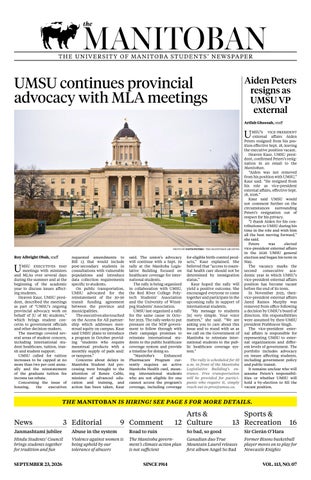
PHOTO BY FAITH PETERS / THE MANITOBAN ARCHIVES
Roy Albright Obah, staff
U
MSU executives had meetings with ministers and MLAs over several days during the summer and at the beginning of the academic year to discuss issues affecting students. Heaven Kaur, UMSU president, described the meetings as part of “UMSU’s ongoing provincial advocacy work on behalf of [U of M] students,” which brings student concerns to government officials and other decision-makers. The meetings covered several areas of student concern, including international student healthcare, tuition, transit and student support. UMSU called for tuition increases to be capped at no more than two per cent annually and the reinstatement of the graduate tuition fee income tax rebate. Concerning the issue of housing, the executives
requested amendments to Bill 13 that would include post-secondary students in consultations with vulnerable populations and introduce data collection requirements specific to students. On public transportation, UMSU advocated for the reinstatement of the 50-50 transit funding agreement between the province and municipalities. The executives also touched on the Access for All partnership which addresses menstrual equity on campus. Kaur said UMSU plans to introduce a program in October providing “students who require menstrual products with a monthly supply of pads and/ or tampons.” Concerns about delays in Manitoba Student Aid processing were brought to the attention of Renée Cable, minister of advanced education and training, and action has been taken, Kaur
said. The union’s advocacy will continue with a Sept. 29 rally at the Manitoba Legislative Building focused on healthcare coverage for international students. The rally is being organized in collaboration with UMSU, the Red River College Polytech Students’ Association and the University of Winnipeg Students’ Association. UMSU last organized a rally for the same cause in October 2025. The rally seeks to put pressure on the NDP government to follow through with their campaign promises to reinstate international students to the public healthcare coverage system and provide a timeline for doing so. “Manitoba’s Enhanced Pharmacare Program currently requires an active Manitoba Health card, meaning international students who are not eligible for one cannot access the program’s coverage, including coverage
for eligible birth-control products,” Kaur explained. She believed that “access to essential health care should not be determined by immigration status.” Kaur hoped the rally will yield a positive outcome. She encouraged everyone to come together and participate in the upcoming rally in support of international students. “My message to students [is] very simple. Your voice matters,” she said. “We are asking you to care about this issue and to stand with us as we call on the Government of Manitoba to reinstate international students to the public healthcare coverage system.” The rally is scheduled for 10 a.m. in front of the Manitoba Legistlative Building’s entrance. Free transportation will be provided for participants who require it, simply reach out to pres@umsu.ca.
MSU’s vice-president external affairs Aiden Peters resigned from his position effective Sept. 18, leaving the executive position vacant. Heaven Kaur, UMSU president, confirmed Peters’s resignation in an email to the Manitoban. “Aiden was not removed from his position with UMSU,” Kaur said. “He resigned from his role as vice-president external affairs, effective Sept. 18, 2026.” Kaur said UMSU would not comment further on the circumstances surrounding Peters’s resignation out of respect for his privacy. “I thank Aiden for his contributions to UMSU during his time in the role and wish him all the best moving forward,” she said. Peters was elected vice-president external affairs in the 2026 UMSU general election and began his term in May. The vacancy marks the second consecutive academic year in which UMSU’s vice-president external affairs position has become vacant before the end of its term. In November 2025, thenvice-president external affairs Jared Ramos Murphy was removed from office following a decision by UMSU’s board of directors. His responsibilities were assumed by then-UMSU president Prabhnoor Singh. The vice-president external affairs is responsible for representing UMSU to external organizations and different levels of government. The portfolio includes advocacy on issues affecting students, including government policy and public transit. It remains unclear who will assume Peters’s responsibilities or whether UMSU will hold a by-election to fill the vacant position.
THE MANITOBAN IS HIRING! SEE PAGE 5 FOR MORE DETAILS.
News
3 Editorial
9 Comment
Arts & 12 Culture
Sports & 13 Recreation
16
Janmashtami jubilee
Abuse in the system
Road to ruin
So bad, so good
Sir Cierán O’Hara
Hindu Students’ Council brings students together for tradition and fun
Violence against women is being upheld by our tolerance of abusers
The Manitoba government’s climate action plan is not sufficient
Canadian duo True Mountain Laurel releases first album Angel So Bad
Former Bisons basketball player moves on to play for Newcastle Knights
September 23, 2026
SINCE 1914
VOL. 113, NO. 07
Vol. 112
No. 07
INSIDE:
109 HELEN GLASS BUILDING UNIVERSITY OF MANITOBA WINNIPEG, MB THEMANITOBAN.COM | 204. 474. 6535
NEWS GENERAL INQUIRIES: ME@THEMANITOBAN.COM CIRCULATION INQUIRIES: MISSING OR INCOMPLETE PAPER? EMAIL: DISTRIBUTION@THEMANITOBAN.COM
EDITOR-IN-CHIEF
The Manitoban is the official student newspaper of the University of Manitoba. It is published monthly during the summer and each week of regular classes during the academic year by the Manitoban Newspaper Publications Corporation.
Mikaela Warkentin
editor@themanitoban.com
ads@themanitoban.com
The Manitoban is an independent and democratic student organization, open to participation from all students. It exists to serve its readers as students and citizens.
EDITORIAL
The Manitoban is a member of the Canadian University Press, and our journalistic standards can be found on the Manitoban’s website.
BUSINESS MANAGER Alice Teufack accounts@themanitoban.com BUSINESS SUPPORT MANAGER Ramisah Musarrat
MANAGING EDITOR
Peace Ifeanyi
me@themanitoban.com COPY EDITOR
Eden Quiring
copy@themanitoban.com NEWS EDITOR
Arifah Gheesah
news@themanitoban.com NEWS EDITOR
Roy Albright Obah
news@themanitoban.com RESEARCH & TECHNOLOGY EDITOR Mansura Akter Meghla research@themanitoban.com COMMENT EDITOR
Quinn Mayhew
comment@themanitoban.com ARTS & CULTURE EDITOR Boris Tsun Hang Leung arts@themanitoban.com SPORTS EDITOR
Faiyaz Chowdhury
sports@themanitoban.com
DESIGN AND VISUALS DESIGN EDITOR
Deveney Jarrow
design@themanitoban.com GRAPHICS EDITOR
Emma Gillich
graphics@themanitoban.com PHOTO EDITOR
Ebunoluwa Akinbo
photo@themanitoban.com
AUDIO AND VIDEO AUDIO EDITOR
Max Reid
audio@themanitoban.com VIDEO EDITOR
Zulkifl Rafah
video@themanitoban.com DIGITAL MEDIA EDITOR
Faisal Rahman
social@themanitoban.com
VOLUNTEERS VOLUNTEERS Adam Johnston VOLUNTEER STAFF Sijy Varghese & Hannah Desjarlais
interested in volunteering? email me@themanitoban.com today!
2
pages 3 to 4
The newspaper’s primary mandate is to report fairly and objectively on issues and events of importance and interest to the students of the University of Manitoba, to provide an open forum for the free expression and exchange of opinions and ideas and to stimulate meaningful debate on issues that affect or would otherwise be of interest to the student body and/ or society in general. The Manitoban serves as a training ground for students interested in any aspect of journalism. Students and other interested parties are invited to contribute to any section of the newspaper. Please contact the appropriate editor for submission guidelines.
RESEARCH & TECHNOLOGY
page 8
EDITORIAL
page 9
DIVERSIONS
pages 10
The Manitoban reserves the right to edit all submissions and will not publish any material deemed by its Editorial Board to be discriminatory, racist, sexist, homophobic or transphobic, ableist or libellous. Opinions expressed in letters and articles are solely those of the authors. Editorials in the Manitoban are signed and represent the opinions of the writer(s), not necessarily those of the Manitoban staff, Editorial Board or the publisher. A “volunteer staff” member is defined as a person who has had three volunteer articles, photographs or pieces of art of reasonable length and/ or substance published in the current publishing year of the Manitoban.
COMMENT
pages 11 to 12
ARTS & CULTURE
pages 13 to 14
SPORTS & RECREATION
pages 15 to 16
Any individual who qualifies as a volunteer staff member must be voted in by a majority vote at a Manitoban editorial board meeting. Elected representatives and non-students may be excluded from holding votes as volunteer staff members in accordance with the Manitoban Constitution. All contents are ©2026 and may not be reprinted without the express written permission of the Editor-in-Chief.
News
September 23, 2026 news@themanitoban.com
Hindu Students’ Council celebrates Janmashtami Students gathered for prayer, performances, food and cultural celebration Roy Albright Obah, staff
F
or the second year running, the Hindu Students’ Council (HSC) at U of M hosted the Janmashtami celebration on Sept. 14 in University Centre. Ashish Charaya, HSC vice-president, explained how the festival forms part of Hindu students’ identity and this gathering gave an opportunity for students to observe the celebration despite the distance from home. “We wanted to create an environment where students could celebrate an important part of their culture and traditions while also giving people who may not be familiar with the festival an opportunity to learn more about it and participate in the celebrations.” The evening began with worship and offerings before moving into performances featuring music and dance. Food was served later in the evening, with the event concluding with dancing to devotional music. Diya Patel, a member of the event’s promotion team, described the ambiance of the event as “vibrant, warm, and very community-oriented,” and said she saw students from different backgrounds fully participating.
“There was a strong sense of celebration throughout the evening,” Patel said. “We wanted the event to feel like an experience that students could genuinely be part of rather than something they simply watched.”
“We are always happy to have new students get involved, whether they want to attend events, volunteer or simply become part of the community” — Ashish Charaya, HSC vice president Some sacred elements, such as aarti, formed an integral part of the celebration and gave participants a chance to take part in the traditional side of the festival. The event received a smaller turnout than HSC typically expected, which Charaya attributed partly to the weather and another festival taking place on the same day. “However, the students who did attend were extremely supportive and seemed to
thoroughly enjoy the event,” he said. Patel also said students responded positively to the celebration. “It was especially rewarding to hear from students who were not familiar with Janmashtami beforehand but enjoyed being able to learn about and participate in the celebration,” she said. Charaya added that “events like this give students a chance to meet people who share similar cultural backgrounds and traditions and, hopefully, build a community that can feel a little bit like family while they are here.” “We are always happy to have new students get involved, whether they want to attend events, volunteer or simply become part of the community,” Charaya said. The Hindu Students’ Council has more events and initiatives planned throughout the year. Students can follow @hsc_uofm on Instagram for updates and access the council’s monitored Telegram community through the link in their bio.
IMAGE COURTESY OF HINDU STUDENTS COUNCIL
‘Toban news briefs Arifah Gheesah, staff Manitoba says goodbye to changing clocks Premier Wab Kinew has announced that Manitoba will remain on daylight saving time permanently. This November, Manitobans will not turn their clocks back to standard time, ending the province’s twice-yearly time change. The move follows similar changes in other Canadian jurisdictions, including British Columbia, Yukon, the Northwest Territories, Alberta and Saskatchewan. The Manitoba government says eliminating seasonal time changes could benefit public health, businesses and families with young children. Art Build for Cuba The U of M Students for Cuba is hosting an evening of art-making in support of Cuba on Sept. 25. Attendees will have the opportunity to create banners, posters, prints and other
crafts. Students of all skill levels are welcome to participate, and art supplies will be provided. Attendees can also bring their own materials. The event will take place at 5 p.m. in room 138 of the Agriculture Building. More information is available on Instagram @uofmstudentsforcuba. UM Anime fall Icebreaker The U of M Anime Club is hosting an icebreaker event on Sept. 25, giving students an opportunity to meet other anime fans on campus. The evening will feature several activities, including Guess the Anime Opening and reverse charades, along with food and other games. The event will run from 5 to 8 p.m. in room 225 of the Architecture 2 Building. More information is available on Instagram @ umanimeclub.
SOMI X MiSC Fall Kickoff The Student-Organized Market Initiative (SOMI) at U of M is collaborating with the Undergraduate Microbiology Students’ Club (MiSC) for a Fall Kickoff on Sept. 26 at Southwood Circle Cargo Bar. SOMI will host three workshops beginning at 6 p.m., where attendees can participate in face painting, decorating sunglasses and making friendship bracelets. The event will also feature food, music, games, activities and other student groups. The Fall Kickoff will run from 5 to 9 p.m. at Southwood Circle Cargo Bar, 5 Sidney Smith St. Tickets cost $7.50. More information is available on Instagram @uofm. somi and @misc.uofm. Rally
for public funding
transit
Climate Action Team Manitoba is organizing a rally on Oct. 6 calling on the provincial
government to increase funding for public transit as the Manitoba legislature returns for its fall session. The rally is part of the Next Stop: 50-50 campaign, which is calling on the province to restore a funding arrangement where the provincial government matches new municipal investments in public transit operations. The campaign is asking the government to restore the funding model by Dec. 3. The event will feature speakers, music, a photo booth and activities for children. It is open to the public, with additional event details expected to be announced. The campaign follows the province’s introduction of free public transit for youth in September. Organizers argue that increased provincial operating funding is also needed to improve transit service and expand coverage for riders.
Faculty of science graduate awards open Applications are now open for three graduate student awards through the U of M faculty of science. Graduate students can apply for the Faculty of Science Fellowship for Graduate Excellence, the Graduate Science Research Scholarship for Indigenous Students and the Molly Weinberg Soudack Scholarship for Women in Science. Eligibility requirements vary between the three awards. Applications are due by 11:59 p.m. on Nov. 30. Students can find eligibility requirements and application information through the faculty of science’s Instagram account @umanitobasci.
More information is available on Instagram @climateactionmb.
3
Vol. 113, No. 07 news@themanitoban.com
News
UMGPS fall 2026 first general meeting Meeting addresses society’s bylaws, grants and awards for grad students Peace Ifeanyi, staff
T
he UMGPS held its first general meeting of the fall semester on Sept. 16, with more than 40 students attending online and several others participating in person. Information about this hybrid meeting including how to register to attend had been sent out since Sept. 9. Emma Heath, UMGPS president, chaired the meeting which opened with the proposed agenda. This included voting on the proposed UMGPS bylaws and the slate of board candidates. Both were passed by members. As part of procedure, graduate students had earlier been invited to submit questions in advance. The first question was regarding the allocation of funds for departmental graduate student associations (DGSAs), and the second was a request for UMGPS to resume administering the conference grant system. There was also a statement made by a student regarding bylaws.
Departmental grant Heath’s response to the question about fund allocation suggested that the ratification for DGSAs would have to first take place, which began Sept. 17. In alliance with the new bylaws passed in the meeting, DGSAs “will be asked to submit a letter to the UMGPS office that is signed by their department head,” said
4
Heath. This is to confirm the association’s recognition and the number of graduate students in the department. The new deadline for this letter to be submitted is Oct. 9 “in recognition of the late opening of the ratification period.” UMGPS has now allocated $30,000 for DGSA grants this academic year. The funding will be divided into two $15,000 payments, one for the fall semester and one for the winter semester. Each payment will be distributed among eligible DGSAs on a per-student basis.
Conference grant The concern here was about whether the grant program could return entirely to UMGPS rather than continuing through a partnership with the faculty of graduate and postdoctoral studies (FGPS). Heath said, “UMGPS does not at this time have the administrative capacity needed to undertake the administration of conference grants.” “We partnered with FGPS on this because they provide faster turnaround times, more consistent support with less mistakes, in addition to greater total financial support,” Heath added. According to Heath, the previous UMGPS-administered conference grants had generated complaints about funding amounts, processing times, communication, administrative mistakes and funds running out.
“All of these concerns have been alleviated by our partnership with FGPS,” she assured. Returning the program to UMGPS would require an additional staff member and more funding, which Heath said could mean higher student fees. However, she included, “If [anyone has any] good reason to believe that the system has negatively impacted student autonomy in attending conferences or receiving funding for conferences […] please reach out to me.” In addressing the statement the society received from a graduate student before the meeting, Heath said it was being mentioned “in the interest of transparency,” despite the UMGPS not understanding what the student meant by simply submitting the phrase, “Exploiting the bylaws.” Heath clarified that UMGPS “staff [followed] up directly with this student, but they did not reply” as of the time of the meeting. She claimed that she had no reason to believe the bylaws had been exploited during her term as president, and assured members, “I will continue to not exploit the bylaws for my own benefit in the future.”
Other concerns raised Travel award eligibility also drew attention from a graduate student who said he had been denied funding because he was no longer registered,
GRAPHIC BY EMMA GILLICH / STAFF
despite not yet having convocated. The student said he had defended his thesis near the end of his program and only secured a conference opportunity afterward. “I think [students in this category] should still have the benefit of getting the travel award,” they said. Heath confirmed that the joint UMGPS-FGPS travel award is currently only available to registered students. However, she said the concern would be raised with FGPS. The meeting also included an announcement that longtime executive director Willow Josephson resigned, effective Sept. 4. A hiring committee made up of UMGPS execu-
tives, board members, Health Sciences Graduate Students’ Association executives and graduate students has begun reviewing applications. Interviews are expected to follow and a new executive director is targeted for October. The association also announced that graduate students can reserve its event space at 217 University Centre free of charge, provided they make a request at least seven days in advance. UMGPS’ next board of directors meeting is scheduled for Sept. 23 and will be partially open to be observed.
FREE HEALTHCARE NOW
AREE C H T L RN AA EALTHUCM HE A H HIS A HUH MTAN A G IS RIIGHT R
FR HE AELETH HEH AL T ASHN CA ORE BONRODW
ERS
HEALTH HAS NO BORDER S
RALLY FOR INTERNATIONAL STUDENTS’ HEALTHCARE September 29 @ 10AM Manitoba Legislative Building (Stairs facing Broadway)
EVERY
THURSDAY 9PM-2AM
BISONS AFTER DARK
FEATURING
ONLY BANGERS
SPECIALS
$2.50
Dub Lager Glasses
$4.50
Jagerbombs
$4.50
Long Islands
$3.50
Mcgillicuddy's shots
@myumsu
VW SOCIAL CLUB
3rd floor - UMSU University Centre
www.UMSU.ca
Research & Technology
Vol. 113, No. 07 research@themanitoban.com
Reading between the rules How state arguments can limit international enforcement Mansura Akter Meghla, staff
W
hat happens when states say they support international law but resist efforts to enforce it? For Bryan Peeler, the way states argue about international law can reveal how the international system itself is changing. Peeler, a U of M department of political science assistant professor, works “at the intersection of international law and international relations.” His broader research is focused on how international law constrains state power. Currently, he is researching how states use legal arguments to justify their actions, challenge other states and shape interpretations of international rules. “The short version is that I study how states argue,” Peeler said. One way Peeler does this is by examining BRICS states arguments within institutions such as the UN Security Council and General Assembly. BRICS is an organization of 11 major emerging economies and developing countries of the world. Originally named after Brazil, Russia, India, China and South Africa, the group has since expanded, with members primarily cooperating on economic, political and development issues. Peeler is studying these arguments in the context of the war in Ukraine. Peeler described a pattern in this research as “enforcement-limiting legalism.” This refers to how states can support international rules while opposing the mechanisms available to enforce them. In one of his recent articles, Peeler explored how BRICS states manage the tension between supporting the Charter’s rules and resisting their enforcement against Russia. His findings suggested that these states do not necessarily reject international law. Instead, they separate the rule
8
GRAPHIC BY EMMA GILLICH / STAFF
from its remedy. They may His interest in these ques- porting the United Nations affirm principles such as ter- tions began with a broader Charter while arguing against ritorial integrity while argu- puzzle about why states com- ways of enforcing it. ing that sanctions, tribunals ply with international law According to Peeler, the or Security Council action when there is no authority research has particular relare illegitimate, selective or that can always force them to evance for Canada. Peeler could escalate a conflict. “It’s do so. Over time, his research said Canada has relied heava strategy that ily on a rulespreserves the based interlaw’s language “The biggest threats to international law usually national order, while holwhile the instidon’t announce themselves as lawbreaking” lowing out its tutions supteeth,” he said. porting that — Bryan Peeler, assistant professor, P e e l e r system are found that contested and U of M department of political science this strategy can change. appears across “Middle both the Security Council and shifted toward examining dis- powers don’t get to rely on raw General Assembly. “The big- agreements over what inter- capability. Rules and instigest threats to international national rules mean. tutions are our terrain, so we law usually don’t announce The war in Ukraine sharp- should understand what’s themselves as lawbreaking,” ened that focus as Peeler happening to them,” he said. he noted. observed states formally supPeeler expressed hope that
his research would provide a clearer way to understand state behaviour that falls between following international law and openly rejecting it. “If a policymaker or an informed citizen can watch a Security Council debate and recognize the strategy being deployed, the work has done its job,” he highlighted. For students interested in research, Peeler recommended working directly with primary sources, learning research methods early and following questions that genuinely interest them. He also emphasized that his own research benefits from collaboration with students.
Editorial
September 23, 2026 editor@themanitoban.com
We are too comfortable with abusers Something has to change in society, and it starts with us Eden Quiring, staff
I
f rape and other abuse allegations ruin men’s lives, why is Donald Trump the president of America? Deep systemic issues are to blame, but I believe the general public is not using their power to their fullest extent. We are not at fault for this system, and it is not fair that we should have to fight against institutionalized patriarchy, but no one else is going to do it for us. In the fight against fascism, we must pay attention to the erosion of women’s rights, and we must reevaluate what we consider small issues. I would like to acknowledge that not all abusers are men, and not all victims of abuse are women. All stories of abuse deserve to be heard and brought to justice. The focus going forward will be on abusers who are men and victims who are women because my purpose is to point out and challenge patriarchal systems of power and the patterns of misogynistic violence they cultivate. Alleged and liable abusive men are not limited to the U.S. government, or the U.S. at all. They can be found starring in Hollywood blockbusters, performing at sold-out stadium concerts, running billion-dollar companies and living in regular households across the globe. While a famous abuser is no more contemptible than a non-famous abuser, a famous man has more power. Not only does he have more power over and access to potentially vulnerable women, he also has a greater cultural impact. Standing by your buddy with abuse allegations impacts his victim and people in your circle, but supporting an abusive public figure online has an even larger ripple effect in normalizing violence against women. I believe that small choices matter a great deal, and you do not have to justify or defend someone from accusations of abuse to be contributing to the normalization of brutality against women. When supporting the career of a man you know to be abusive by seeing his movies, streaming his music, watching his fights and so on, you are aiding the normalization of abusive men holding positions of power and losing nothing. Abusive men could not become presidents if our culture did not allow abusive men to be famous and successful in general. You might be shaking your head and thinking that you
would never support an abusive man, but I am willing to bet most people reading this make exceptions for certain people, or try not to think about it when they are really interested in something an abusive man is involved in. You might say, “Yeah, I hate that guy, but I really want to see this movie,” or, “I know he sucks but his music is just so good,” or, “Separate the art
“Abusive men can make good art, that does not mean it is worth supporting” from the artist, though!” That last sentiment is particularly common, and I would really like to challenge it. Can you separate these things when supporting an abusive man’s art means giving them, and the culture of abuse, more power? Are you really saying that abuse is something you are willing to look past for the sake of good entert a i n m e n t ? A b u s ive men can m a k e good art, that does not mean it is worth supporting. Earlier I said misogyny in society is not ordinary people’s fault, and that is true. We did not put it there originally, but that does not mean we do not contribute to it or that we have no power over it. You cannot sell a product if no one is buying it. If someone is
famous, it is because they have fans. The fans of abusive men are not only people who condone their actions, they are also so often people who look past their actions for the sake of enjoying something else they do. This dynamic implicates us, but it also empowers us. If we have the ability to give these men power, we also have the ability to take it away. Anything you do contributes one way or the other, there is no such thing as neutrality here. Silence about abuse only condones and enables it, especially when your silence is paired with guilty pleasure. Maybe you are not silent, and you speak out against a man while also indulging in his career. Is that any better? Is it easy for you to watch an abusive man succeed? How much has the success of abusive men been normalized in your mind? I am not asking anyone to throw out their music and merch right this instant (although I would not discourage you), I am
simply asking you to think about what you are supporting when you support someone with a history of abuse. I am asking you to make an effort to reject the endeavours of abusive public (and private) figures and make no exceptions. I do not believe we are all helpless individuals just doing our best under late-stage capitalism. We are all part of collectives of people making the same choices as us, and these collectives have great impacts. If you are told you could be doing better and your first instinct is to make excuses, it might be time to take a step back and look inward.
We are all guilty of feeling defensive sometimes, myself included, because it is hard to care and even harder to do something about it. However, I have come to realize our goal should always be to do a little better everyday, not to justify what we are already doing or not doing. Not everyone is equally able to contribute to social change, but most people are not stuck at the absolute apex of their ability. We are all learning and unlearning constantly, and we must commit ourselves to this. Guilt can be paralyzing or push people to feel defensive, so that is not my goal with this article. You have to be gentle with yourself, but not so gentle that you never let yourself be pushed toward changing for the better. Change is hard, but being stuck in this world because we are so afraid of change is much harder.
GRAPHIC BY EMMA GILLICH / STAFF
9
7 2 6 4 3 5
9
5 6
4
8
2
5
3 2 4 1 8 5 9 6 7
9
2 5
1 2
4 7 9
8 7 9 8 3
No. 821
Previous solution - Tough
8 2
SUDOKU
4
7 9
Medium
© 2026 Syndicated Puzzles
Medium
2 5 6 4 7 3 8
1 3 4 7 7 8 6 8 9 5 6 7 5 4 2 3 1 4 2 2 3
1 5 7 9 6 3 2 8 4
6 9 8 2 7 4 5 1 3
4 6 3 5 2 1 7 9 8
8 1 5 7 3 9 6 4 2
2 7 9 6 4 8 1 3 5
9 3 6 4 5 2 8 7 1
5 4 1 8 9 7 3 2 6
7 8 2 3 1 6 4 5 9
Previous solution - Easy
© 2026 Syndicated Puzzles
4
5 6 6 2 3 5 4 2 3 5 3 4 1 8 9 7 8 7 6 9 8
Sijy Varghese, volunteer staff
10
1
5 2
cells remove that number as an option in that row and column, and are not part of any straight. Glance at the solution to The solutions will be published here in the n see how ‘straights’ are formed.
xkcd.com
Do you have a comic you’d like to submit to the Manitoban? Email your submissions to graphics@themanitoban.com
6
2
To complete Sudoku, fill the board by entering numbers 1 to 9 such that each row, column and 3x3 box contains every number uniquely.
6
If you like Str8ts check out our books, iPhone/iPad Apps and much more our store. You can findonmore help, tips and hints at www.str8ts.com
6
Medium
3
4
8
9
4 8
For many strategies, hints and tips, visit www.sudokuwiki.org
9
For many strategies, hints and tips, visit www.sudokuwiki.org
6 8
5
7
1
3
To complete Sudoku, fill the board by entering numbers 1 to 9 such that each row, column and 3x3 box contains every number uniquely.
6
7
9 4 8
1
5
If you like Str8ts check out our books, iPhone/iPad Apps and much more on our store.
6
4 3 7 2 1 6 9 8 5
4 3 1
2 5
4
9 2 1 5 3 8 6 4 7
5 9
1
5 8 6 9 7 4 3 1 2
How to beat Str8ts – Like Sudoku, no single Previous solution - Easynumber can repeat in any row or column. But... 3 1 and 6 columns 4 8 2 are 9 5divided 7 rows by black 2 5 9 into 6 compartments. 1 7 3 4 8 These squares need that 4 7 to8 be3 filled 5 9in with 6 1numbers 2 complete is a set 1 9 2 a 5 ‘straight’. 7 6 4 A8straight 3 of numbers with no gaps but can be in 8 6 7 2 3 4 5 9 1 any order, eg [4,2,3,5]. Clues in black 5 3 remove 4 1 9that8 number 2 7 6as an option cells 9 2 5 7 6 1 8 3 4 are not part in that row and column, and of straight. the solution to 6 any 8 1 9 4 Glance 3 7 2at 5 The solutions will be published here in the next issue. see 7 4how 3 ‘straights’ 8 2 5 are 1 6formed. 9
5
7 9 3 4 6 2 1 5 8
.str8ts.com
7
1
1
5
1 4 8 7 5 3 2 6 9
5
5 2
2
6 5 2 1 8 9 7 3 4
To complete Sudoku, fill the board by entering numbers 1 to 9 such that each row, column and 3x3 box contains every number uniquely.
3
8
8 6 5 3 2 7 4 9 1
3
9
For many strategies, hints and tips, visit www.sudokuwiki.org
6
ber can But... ed by black . These bers that ght is a set can be in s in black an option are not part e solution to The solutions will be published here in the next issue. ed.
3
If you like Str8ts check out our books, iPhone/iPad Apps and much more on our store.
2
6
3 7 4 8 9 1 5 2 6
Tough
4 3 1
8
2 1 9 6 4 5 8 7 3
7
3 2 7
Previous solution - Very Hard
Sudoku Solution To complete Sudoku, fill the board by entering numbers 1 to 9 such that No. each 820 Previous solution - Medium row, column, and 3x3 box contains 8 7 6 1 3 2 4 8 7 5 6 number 4 8 2 1uniquely. 3 every In Straights, 1 6 7 8 5 4 2 1 3 like Sudoku, no single number 1 to 9 2 6 5 7 8 4 can repeat in any 6row or column. But 3 4 1 8 9 7 5 rows and columns are divided by black 5 7 6 3 8 9 4 Straights Solution 3 4 3 2 5 6 7 8 9 squares into compartments. Each 9 2 4 1 3 5 6 7 8 2 compartment must 6form a “straight.” 1 3 2 4 5 A straight is a set of numbers with How to beat Str8ts – 8 7 3 Like no it single can order, eg no Sudoku, gaps but cannumber be in any repeat in any row or column. But... [7,6,9,8]. Clues in black cells remove 3 1 rows and columns are divided by black that number as an option squares into compartments. These in that need to be filled in with numbers that 5 row and column, and are not part9 of complete a ‘straight’. A straight is a set straight. ofany numbers with noGlance gaps butat canthe be insolution any [4,2,3,5]. Clues in black to order, see eg how “straights” are formed.
© 2026 Syndicated Puzzles
4 8
4
No. 820
Easy
SUDOKU
Puzzle by Signdicated Puzzles © 2026 Syndicated Puzzles
No. 820
1
STR8TS
Straights
Puzzle by Signdicated Puzzles
© 2026 Syndicated Puzzles
SUDOKU
Sudoku
Vol. 113, No. 07 graphics@themanitoban.com
xt issue.
Diversions
2026 Alance AB
7
2 5
Comment
September 23, 2026 comment@themanitoban.com
The Manitoban horoscope for the week of Sept. 21 Zodiac sign mania, flip a coin and see your fate this week Quinn Mayhew, staff AQUARIUS January 20 – February 18 Aquarius, I want you to know that I’m mad at you. You have been making poor choices that have been affecting your co-workers by constantly calling in to work. You need to stop calling in for frivolous reasons — save your sick days. PISCES February 19 – March 20 Pisces, you need to know that I am concerned for you. I have said this before, and I’ll say it again, you need individual autonomy outside of your partner. It’s not healthy to have no space or time for yourself. Make sure you create time for yourself. ARIES March 21 April 19
–
Dear Aries, stop being late for everything. People don’t want to consistently wait around
for you all the time — it’s getting tiring. Make sure you are managing your time more efficiently. TAURUS April 20 May 20
–
Taurus, you need to visit a friend or grandparent you haven’t seen in a while, I sense they miss you. You may be putting off visiting because it’s been too long since you’ve reached out. Trust me, they’ll love to see you. GEMINI May 21 June 20
–
Gemini, it’s going to be a harvest moon on Saturday. You will be entering a more subdued version of yourself from the spring or summer. You may feel lower energy this week. Make sure you are taking care of yourself so you don’t get sick.
U
CANCER June 21 July 22
–
Cancers, I see that you are really buckling down this year with your studies. I’m proud of you. Make sure you’re paying more attention to the material in class than to notifications on your phone. LEO July 23 August 22
–
Leos, you have heeded my advice. I see you are making the necessary changes to clean up your mess both literally and figuratively. Make sure you continue the good work of being aware of how your actions affect others. VIRGO August 23 – September 22 Virgos, you need to spend more time outside and less time at home doomscrolling. Although your phone provides endless opportun-
ities for you to fight strangers online in the comment section of Instagram, make sure you are taking a walk around your neighbourhood every so often to get some fresh air. LIBRA September 23 – October 22 Libras, you’ve become quite closed off recently. Friends try to text you, yet you never respond. Emails and messages are all left on read. Respond to the people that care about you and make yourself more open for your own sake as well as others’. SCORPIO October 23 – November 21
SAGITTARIUS November 22 – December 21 Sagittarius, I’m so proud of you. You really stepped outside your comfort zone and did something that scared you last week. Make sure you continue to do things that make you uncomfortable, that’s how you grow. CAPRICORN December 22 – January 19 Capricorns, you know that I know that you’re hiding something, changing the subject when people ask you a specific question. Be honest with yourself. What are you hiding, and why are you hiding it?
Scorpios, stop going to bed at the wee hours of the morning. It’s 3 a.m., go to sleep. You always complain about how tired you are. Take your own advice and go to bed early and do something productive in the morning.
S T P e G am M
11
Vol. 113, No. 07 comment@themanitoban.com
Comment
Mental health is health care Suicide is preventable and Winnipeg needs better resources Quinn Mayhew, staff
S
eptember is National Suicide Prevention Month, a moment to pay homage to the lives lost due to suicide and mental health issues and to support families and people who have experienced the loss of a loved one. Suicide is something that touches everyone, even if you haven’t been personally affected by the ramifications. Every day in Canada, statistically, 12 people die by suicide, with approximately 4,500 deaths by suicide per year. Suicidal ideation often goes unseen, appearing sometimes in those we are least likely to suspect, regardless of race, gender or age. Sometimes the people who appear happiest are struggling the most. Staying alert and aware of warning signs is a big part of preventing suicide, and then knowing what to do with those premonitions is ultimately a big part of not only harm reduction but also overall personal wellness. There’s a big outdated misconception where some people often look at suicide as a form of moral failing — I would like to state that is most certainly not the case. Anyone who has experienced any form of mental duress or mental illness would say
that being plagued by negative or detrimental thoughts is most certainly not a choice. The destigmatization of mental health issues and resources attached to receiving help is essential to the reduction of suicide. This means taking away stigma attached to it, boosting awareness of not only what suicidal ideation can look like, but also learning about the resources in your area. You don’t need to be affected or know someone who has been affected by mental health issues to care. Mental health is health care. Some resources in Winnipeg include the Suicide Crisis Helpline, accessible by calling or texting 988, and mental health inpatient services at the Health Sciences Centre, St. Boniface Hospital or Victoria Hospital. Free counselling at the U of M is offered to current students through the Student Counselling Centre, and although it’s not an immediate fix if you are in a crisis, I recommend dropping by if you are experiencing emotional distress or need someone to talk to. The Women’s Health Clinic offers free counselling for girls, women, Two-Spirit, trans, non-binary and gender nonconforming people, which
can be accessed by calling (204) 947-2422 (extension 204) for an intake appointment. The conversation surrounding normalizing mental health starts by making resources more accessible to people who need them. This means creating more health clinics that have access to intake services for people experiencing mental distress beyond the three hospitals that have absurd waiting times in Winnipeg. Beyond intake services, the implementation of mandatory high school education surrounding suicide and mental health services would allow people to know what resources are available to them, but also what mental health crisis deterrence looks like and how to help someone experiencing one. It’s easy to look through a small window into someone’s life and determine what they’re going through when you only see a limited snapshot of it. I think that’s why for so long I didn’t access mental health resources, because when I told a person I suspected I had OCD, they would mention, “That’s for people who like to clean.” Mental illness comes in different forms, not just one linear perception of sadness
GRAPHIC BY HANNAH DESJARLAIS / VOLUNTEER STAFF
of someone sitting in a dark corner with their hood pulled up, not interacting with people. Although it can look like that, that’s not always the case. I wish I had the knowledge I do now surrounding mental health and resources offered around Winnipeg, it would have saved not only me a lot of mental distress but the people around me, who I may have inadvertently hurt by not
having the resources I needed. When we dislodge the idea that mental health struggles can only look one way, we open the door for more narratives and the destigmatization surrounding people who suffer from mental health issues. We need more resources and education as a populace to reduce suicide loss and attempts across Canada.
Path to Net Zero fails on sustainable transportation Why the Manitoba NDP’s Path to Net Zero plan is ho-hum at best Adam Johnston, volunteer Despite collaborating with Indigenous peoples on renewable and geothermal energy and the electric vehicle incentives evident in its threeyear strategy document — Path to Net Zero — the province ignores the most cost-effective emissions solution, public and active transportation. This proves yet again Wab Kinew’s NDP government lacks the understanding we truly need to tackle the climate crisis in every aspect. Manitoba Minister of Environment and Climate Change Mike Moyes released the three-year Path to Net Zero plan after months of public consultations. Positives include empowering Indigenous peoples in climate action, participation in reforestation toward the province’s goal of planting one million trees yearly until 2030, collaborating with First Nations on a provincial wildfire strategy, supporting Indigenous-owned wind energy projects and tenders, a $300 mil-
12
lion Manitoba Indigenous Loans Guarantee Program to finance majority Indigenous ownership, the Energy Efficiency program supporting upgrades in First Nation communities and funding for a commercial solar-plus-battery storage system on St. Theresa Point First Nation. The province announced Southwood Circle will be the first community powered by geothermal energy, offering a glimpse of what net-zero neighbourhoods could be in Winnipeg. Environmental nonprofits will receive a $6.72 million boost for climate projects, supporting groups like Green Action Centre, Climate Action Team Manitoba and Bike Winnipeg. Projects from these organizations could include a downtown bike parking plan or urban farming programs that weave Indigenous knowledge and climate resilience into community development. This strategy document further discusses expanding
rebates to develop sustainable transportation, switching to zero- and low-emission fuels and supporting public transit — including $400,000 for early planning of the Southeast Regional Transit Initiative — along with expanding year-round active transportation routes. Despite the Manitoba NDP government’s efforts to address the climate crisis, its lack of a clear, detailed plan has frustrated many and remains a hallmark of the current administration. To achieve truly progressive action, the government must provide greater detail. Laura Cameron, Climate Action Team’s program and strategy director, told CBC News the report was more a summary of commitments than real action, calling the lack of detailed modelling disappointing and hindering informed public decisions. Winnipeg Free Press columnist Dan Lett also echoed criticism toward the province’s new three-year net zero plan,
calling it a “work in progress.” Lett said “there’s nothing bad about Manitoba’s new net zero action plan” but “it’s just not good enough.” But what would get Manitoba to true net zero — and even negative emissions? The answer is concrete plans to reduce individual and commercial carbon footprints. A solid three-year roadmap from point A to B, including public and active transportation, would help. That means detailing how to reinstate the provincial-municipal transit funding agreement so municipalities know how much they can invest, then more buses, lower fares for all and safer transit could follow. A concrete provincial active transportation funding plan for large and rural municipalities could promote sustainable travel. Integrating Indigenous knowledge into urban trail networks would also honour reconciliation while building climate-resilient infrastructure. Public and active transpor-
tation are among the easiest options for reducing Winnipeg’s carbon emissions. The city’s Transportation Master Plan aims for a 50–50 mode share by 2050 between private vehicles and sustainable options like cycling, walking and transit. Since transportation is Winnipeg’s greatest contributor to greenhouse gas emissions, accounting for nearly half of the city’s emissions, greater provincial support for public and active transportation could significantly cut our climate impact. Manitoba’s Path to Net Zero plan was a modestly encouraging start, but to become a true climate leader, the province must turn ambition into a concrete roadmap, especially on public and active transportation investments. Adam Johnston hosts Not Necessarily The Automobile on Thursdays at 11:30 a.m. on UMFM 101.5. He can be reached at notnecessarilytheautomobile@gmail. com.
Arts & Culture
September 23, 2026 arts@themanitoban.com
Chronovisor, dark academia meets found footage horror A review of the science docufiction that made me question reality Boris Tsun Hang Leung, staff I have always regarded lost media and conspiracy theories as frivolous entertainment that I put on when I need some thrill in my otherwise mundane life. However, Chronovisor, with its blend of found footage, religion and techno-horror, is one of the most bewitching and cerebral films I have ever seen. Directed by Kevin Walker and Jack Auen, Chronovisor follows Béatrice (Anne-Laure Sellier), an austere and eremitic philosophy professor at Columbia University. The story revolves around her discovery of the titular apparatus, an enigmatic machine invented by Benedictine monk Pellegrino Ernetti that allows users to time travel and witness any historical event on its screen, including the Crucifixion and a lost classical tragedy. However, the monk vanished without a trace, and information on the machine seemed to have been purposefully concealed from then on. Béatrice is fixated on understanding the chronovisor, poring over obscure books, magazines and tapes and plunging headfirst into mania, until she finds the machine in a Portuguese village. One might be tempted to
quickly dismiss the Chronovisor as complete fiction, but ‘Pellegrino Maria Ernetti’ (1925-1994) was a real clergyman who claimed to have invented the chronovisor. Sellier, a professor of behavioural sciences at HEC Paris, also convincingly plays the scholar as she endlessly dives into rabbit holes. This delicate straddling of fact and fiction invites the viewer to question what is and is not real in the film. Chronovisor closely follows the arc of the original sin. Béatrice knows the machine can cause users to lose their sense of reality and befuddle the images with their own memory, yet she locates and reaches for the machine unhesitatingly in a trancelike state. Intriguingly, the narrative never establishes why Béatrice is drawn to the chronovisor in the first place, perhaps a commentary on the allure of parapsychology and the occult. There is no shortage of found footage and archives in the film, and it frequently uses shots of texts and tapes from Béatrice’s point of view to further the plot. Shot on a 16mm film, the textured quality of the film is also immediately apparent, and the screen crops into a 1.33:1 aspect ratio
in the opening scene, making the film itself feel like archival material. Visually, Chronovisor impeccably captures the dark academia aesthetic, with many scenes taking place in the brooding, dark wood libraries of New York City, only illuminated by banker’s lamps and monitors. Despite being set in the modern day, not once does the film show a computer, but instead opting for typewriters, cassette tapes and VHS players. The soundtrack is also beguiling, using whimsical and grandiose compositions by 19th century composer Gustav Holst and otherworldly Gregorian chants. Other scenes are characterized by an eerie stillness, punctuated with ASMR-like noises of writing and fluttering pages. Moreover, Chronovisor depicts the realities of academic research, which is a rarity in mainstream cinema. The late nights, dead ends, finding conflicting information by different scholars and the other characters’ disinterest in Béatrice’s research all hit close to home. At the same time, the thrill of research breakthroughs is not overlooked, conveyed by extreme close-up shots of Béatrice’s
ANNE-LAURE SELLIER AS BÉATRICE IN CHRONOVISOR.
eyes. The film ends with a disturbing sequence, turning the observer to the observed and folding the plot’s timeline upon itself. This is perhaps the first time I felt relieved that a film had ended, not because it was poorly made, but because the suspense was finally over. Throughout the film, the viewer gradually understands that Béatrice will not experience a peaceful ending. The more she learns about the chronovisor, the more bizarre the circumstances become and the more detached from reality she is. I am struck by the tension between intellectual inquiry and mystery in Chronovisor. The machine is intentionally sequestered in the film in fear of it falling into the wrong hands and eradicating
IMAGE COURTESY OF IMDB
the very concept of privacy. Are there technologies that are better left untouched and unseen? If so, what should we make of Béatrice’s relentless pursuit of the chronovisor? However, given the religious undertone of the film, it is just as plausible that the chronovisor is shunned so the church can monopolize the interpretation of biblical events, thus legitimizing its authority. Either way, Chronovisor is a riveting and unsettling watch without any use of gore or cheap jumpscares. Its loftiness might evade mass interest, as confirmed by the yawns I heard from members of the audience, but those with an affinity for conspiracy, spirituality and academia will surely find much to contemplate from seeing the film.
‘Toban turntable True Mountain Laurel — Angel So Bad Mikaela Warkentin, staff
4.5/5 True Mountain Laurel, the joint project between Haley Blais and Sam Lynch, released their debut album Angel So Bad on Aug. 28. Under Winnipeg’s own Birthday Cake Records, Angel So Bad leans into a folk sound that Blais and Lynch do well. While tracks feature instruments from fiddle to pedal steel, harmonies consistently take center stage, bringing an intimacy only furthered by the themes explored in each song. Both established singer-songwriters in their own right, True Mountain Laurel takes Blais’s and Lynch’s individual musical talents to another level. Opening and titular track “Angel So Bad” has the refrain “bitches contain multitudes” — a theme that frames the multifaceted nature of the songs. Uncertainty is dismissed by the narrator here — “The best I’m ever gonna give you is a solid maybe / You
know I’ll never settle down and that’s just showbiz, baby” — but is brought up as something that worries the narrator in “Holy Hell,” singing, “ When I ask you: / Can you give me your word? / Can you give me your word? / And when I ask you / You come and you go.” Both tracks were lead singles for the project, and do not pull punches for the instrumentals or vocals of Blais and Lynch. Catchy, moody and lighthearted enough, “Angel So Bad” and “Holy Hell” open the door for the rest of the album. Exploring the introspection that comes with relationships, Blais and Lynch harmonize over personal worries in “Bird of Prey” — “Now suddenly I’m saying / Baby, don’t put our loving cat out here” with a lighthearted tone despite the rolling, anxious guitar. While Angel So Bad is a product of friends, it is also a clear product of creatives, with the theme of stardom and identity explored in “Sunny”
and the tumultuous process of creating in “East of Anything.” The former serves as an intimate portrait — “Sunny with your hair down / Sunny you’re a big star / You don’t need a redesign,” while the latter turns the reflection in on the musicians themselves — “I was sat at my piano, fighting for my life / At the end of my wick / At the end of the night.” Musically, both wouldn’t be out of place as round songs — the rumination of the lyrics is matched by the instrumental. While the whole album is a tender gut punch, “I Love You, Nicole” is the most honest in its discussion of friendship — ‘But I can’t hate you / No, don’t you see? / Part of me is you and part of you is me.’ This track brightens the middle of the album with lighter guitar, harmonies and the return of the floating pedal steel. The idea of accepting the uncertain and containing multitudes also return here, with the latter half of the song featuring the refrain “Come one
IMAGE COURTESY OF TRUE MOUNTAIN LAUREL VIA BANDCAMP
day / I’ll finally know” floating through the lush instrumental. Led in with “Angel Reprise,” an instrumental which revisits “Angel So Bad” musically, “The Trial” picks up with an introspective drone. Much softer and simpler than the rest of the album, lyrically “The Trial” also closes the door — “It seeks you out to reconcile all the things that you just can’t be / Take your name off the big marquee.” As the final track of Angel So Bad, “The Trial” ties both the sonic
and lyrical themes into not a bow, but a sort of symbolic knot, which acknowledges a more cyclical nature in the final lines — “Saying a word ‘til it don’t make sense / Then you start it all over again/ From the A, to the B, to the end.”It is clear that Angel So Bad is the product of mutual admiration, both as musicians and as persons. It is hard to tell where the work of one artist begins and the other ends — instead, True Mountain Laurel has galvanized Blais and Lynch as a solid singer-songwriter unit.
13
Vol. 113, No. 07 arts@themanitoban.com
Arts & Culture
If sacredness had a colour, what would it be? Galerie Buhler Gallery exhibition explores the sacred in the secular world Boris Tsun Hang Leung, staff
C
olours of sacredness might summon mystical visuals of gilded religious texts or richly decorated places of worship, but for hannah_g, its hues are all around us. Galerie Buhler Gallery in St. Boniface Hospital opened What Colour is the Sacred? on Sept. 17. The multi-media show features paintings, sculptures, photographs and more by 20 contributors to explore the hues, textures and forms of sacredness. As a curator of the gallery since 2022, hannah_g explained that the exhibition is derived from a book of the same name by the anthropologist Michael Taussig, but also from her experience working in a gallery within a hospital. “Sacredness is something which I think about quite a lot,” she said. “Because we’re located in St. Boniface Hospital, there are so many small and very big sacred moments that happen.” She described
transient scenes like someone helping a stranger with their walker, but also life-altering events like childbirth and death. Despite the theme, the exhibition is secular, inviting visitors to contemplate the sacred beyond the bounds of religious traditions. Among the works displayed is a photograph of local drag queen Anita Stallion by Vi Houssin. The drag queen has raised a substantial amount for local charities, said the curator. “[Stallion] creates a lot of community, a lot of care, a lot of love and support. And I think having a solid, supportive community that’s grounded in love and respect is a sacred thing. But initially, you may not think that a drag queen might have a connection with sacredness,” she commented. Another photograph is “The Ice Cream Man” by Karen Asher, which shows a joyous man wearing a nasal
cannula and holding an ice cream cone. The man’s identity and story are undisclosed. “[Asher] has managed to catch this moment really beautifully in this picture of a joie de vivre, of this fleeting moment,” the curator said. “The fact that the ice cream is nearly finished, that it’s melting, that it’s ephemeral [...] can be a symbol of how transient these things are, and how valuable they are, how we should, hopefully [...] pay attention to them.” There is also a “Hope Tree” in the gallery where visitors can write their hopes on cards and tie them onto a suspended piece of bark. The hopes will be read aloud at the end of the exhibition and burned in the hospital’s back garden. The gallery was founded in 2007 to address the physical, emotional and spiritual needs of patients, staff and community members at St. Boniface Hospital. hannah_g also noted that many visitors are
“THE RECORONATION OF MISS CLUB 200, 2025-2026 ANITA STALLION” BY VI HOUSSIN PHOTO BY BORIS TSUN HANG / STAFF
patients, and there are staff members who come to play the piano in the gallery. She hoped people will find their own shade of sacredness by connecting with the pieces. “Often people come into this gallery because they need a quiet space. Something intense is happening in their life,” she said. “I think art galleries are sacred spaces, and
Look Like You Read a Lot. You drink it. You bin it.
14
so by coming in here, the hope is that people can make a connection which is meaningful for them.” “It’s not a place of provocation. It’s a place of contemplation and imagination.” What Colour is the Sacred? concludes on Nov. 26. Visit galeriebuhlergallery.ca for more information.
Sports & Recreation
September 23, 2026 sports@themanitoban.com
Bisons football tramples the Dinos Calgary attempts a comeback but falls short of the lead
IMAGES COURTESY OF COLE ANSEEUW
Faiyaz Chowdhury, staff
T
he Bisons football team played the Calgary Dinos on Sept. 19 at Dakota Collegiate. The herd came out victorious with a score of 38-36. The game started with a touchdown for the Bisons, with an extra point by Maya Turner’s kick, and the herd took the lead by 7-0. In the first quarter, the Bisons outscored the Calgary
Dinos 7-3, followed by a 14-7 advantage in the second quarter. However, the third quarter saw the Dinos dominate as they scored 10-0. This is where the game became close, because the herd had lost a huge lead. In the fourth quarter, the herd scored six points, but the Dinos scored seven, forcing the game into the first overtime. In the first overtime, both
teams scored three points, leading to a second overtime where the herd outscored the Dinos by two points, 8-6. Cole Anseeuw played a big role in the win, especially when he gave the herd 252 yards and four touchdowns with passes to Ishe Matanga and Nathan Udoh. Anseeuw was extremely effective in building up the halftime time lead for the herd. One more thing that worked
extremely well for the herd was that they were able to keep the possession for 31 minutes and 50 seconds, keeping the Dinos’ offence on the sideline and reducing what the Dinos could do in the remaining 28 minutes and 10 seconds they had possession of the ball. This turned out to be a good turn of events for the Bisons after a loss of 23-8 against the Regina Rams on Sept. 11. The herd will next face the
UBC Thunderbirds, who won 25-20 against the Regina Rams on Sept. 18. The Bisons vs. Dinos story is not over yet, as the herd is scheduled to play against them again in Alberta on Oct. 24. The next Bisons football game will take place at Princess Auto Stadium on Sept. 26 at 5 p.m. CT against the UBC Thunderbirds.
15
Vol. 113, No. 07 sports@themanitoban.com
Sports & Recreation
The Bison who was knighted Cierán O’Hara bids farewell to the herd and starts journey with Newcastle Knights Faiyaz Chowdhury, staff
B
isons men’s basketball will have their first game of the 2026-27 season at home on Oct. 8 against the Thompson Rivers Wolfpack. One athlete who has been part of the squad for over five years will not be returning, Cierán O’Hara. Over his time with the Bisons, he played 101 games, with an average of 22.9 minutes and 624 points. He also contributed with 73 steals, 74 blocks and 127 assists. Life for O’Hara was not just restricted to basketball and university, he also is the founder of Amani Health and Wellness, a natural supplement brand. Having ended his time with the herd, O’Hara has started playing for the Newcastle Knights Basketball Club in England at Newscastle University. O’Hara shared that he is also getting his Master of Science degree in business analytics at Newcastle University. O’Hara disclosed that his parents always wanted him to take his education seriously, but his parents let him han-
dle things his way once he started playing sports at the university. “They would come to every home game, they’d watch my games online when I was away,” he said. He also added a fun memory of his father when he used to play in high school, “He’d be yelling at me from the stands.” O’Hara is not new to England. He shared that he was born there and then moved to Canada when he was young. There was not much of a culture shock, although he is in the process of getting used to different accents. The weather, especially the rain, is an obstacle for O’Hara, as well as the leasing laws. O’Hara described the entire process of finding his apartment as a “big hassle” and “a headache.” O’Hara revealed that he had done some walking around the city and by the river, but had not explored the area near the coast, adding that he would like to go hiking. Moving to a new place is never easy, it can sometimes be isolating. O’Hara’s comments suggested he experi-
enced some of these challenges, including having difficulty entertaining himself without friends and without being able to talk to people across the world. It has been almost a month since he moved and he is in the process of adjusting to a new squad, new coach and a different environment. O’Hara called the environment “great” and the players “friendly.” The team is still in pre-season, so he is getting accustomed to the system. According to O’Hara, the biggest difference between the Bisons and the Knights is that with the Bisons, the offence was much more “systematized” with more set plays, whereas with the Knights, emphasis is placed more on the transition basketball and creating actions out of the transitions. The workload is also different. Practices can last close to two hours, followed by an hour strength and conditioning session and ending with two hours of shooting. This adds up to about five hours a day, before the player
includes their own individual workouts. Talking about the difference between coaches, O’Hara said that the Knights’ head coach Mark Elderkin is a lot less hands on, tries not to overcoach and prefers to stop the game as little as possible to allow the players to work it out. The support systems are also different when compared with the Bisons. O’Hara said the Bisons have a dedicated support staff, terming the resources that are available as “luxury.” He disclosed that the Bisons athletes have access to two athletic trainers before and after practices, strength and conditioning coaches, gym spaces and court time whenever they need it. With the Knights, the athletes have access to resources such as message therapists and sports psychiatrists, but their availability is not as consistent. Their services might be available once or twice a week. The strength and conditioning room can also be busy because multiple teams share the same facility.
This has resulted in the athletes having to take more responsibility for their own development. Despite the differences in structure, he mentioned that the team environment is quite similar, and players love working out together. When evaluating reasons for Canadians moving to Europe to play basketball, O’Hara broke it down by saying, “If you’re not going to NBA, you’re [probably going to] Europe, maybe South America or Asia.” He also added that Europe has many leagues with various difficulty levels, so the player can choose what works best for them. O’Hara seemed clear where basketball lies in his life. “I love basketball and all, but I’ve felt like it’s never been something that I wanted to do for the rest of my life.” He continued, “I think there’s more to life for me, and so it doesn’t really bother me. I think it makes it more enjoyable, knowing it’s not going to be here forever, so it’s making you want to make the most of it.”
IMAGES COURTESY OF CIERÁN O’HARA
16