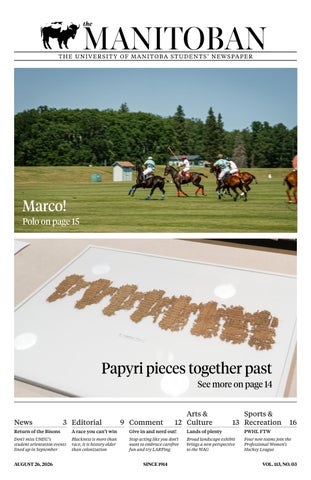
Marco! Polo on page 15
Papyri pieces together past See more on page 14
News
3 Editorial
9 Comment
Arts & 12 Culture
Sports & 13 Recreation
16
Return of the Bisons
A race you can’t win
Give in and nerd out!
Lands of plenty
PWHL FTW
Don’t miss UMSU’s student orientation events lined up in September
Blackness is more than race, it is history older than colonization
Stop acting like you don’t want to embrace carefree fun and try LARPing
Broad landscape exhibit brings a new perspective to the WAG
Four new teams join the Professional Women’s Hockey League
August 26, 2026
SINCE 1914
VOL. 113, NO. 03
Vol. 112
No. 03
INSIDE:
109 HELEN GLASS BUILDING UNIVERSITY OF MANITOBA WINNIPEG, MB THEMANITOBAN.COM | 204. 474. 6535
NEWS GENERAL INQUIRIES: ME@THEMANITOBAN.COM CIRCULATION INQUIRIES: MISSING OR INCOMPLETE PAPER? EMAIL: DISTRIBUTION@THEMANITOBAN.COM
EDITOR-IN-CHIEF
The Manitoban is the official student newspaper of the University of Manitoba. It is published monthly during the summer and each week of regular classes during the academic year by the Manitoban Newspaper Publications Corporation.
Mikaela Warkentin
editor@themanitoban.com
ads@themanitoban.com
The Manitoban is an independent and democratic student organization, open to participation from all students. It exists to serve its readers as students and citizens.
EDITORIAL
The Manitoban is a member of the Canadian University Press, and our journalistic standards can be found on the Manitoban’s website.
BUSINESS MANAGER Alice Teufack accounts@themanitoban.com BUSINESS SUPPORT MANAGER Ramisah Musarrat
MANAGING EDITOR
Peace Ifeanyi
me@themanitoban.com COPY EDITOR
Eden Quiring
copy@themanitoban.com NEWS EDITOR
Arifah Gheesah
news@themanitoban.com NEWS EDITOR
Roy Albright Obah
news@themanitoban.com RESEARCH & TECHNOLOGY EDITOR Mansura Akter Meghla research@themanitoban.com COMMENT EDITOR
Quinn Mayhew
comment@themanitoban.com ARTS & CULTURE EDITOR Boris Tsun Hang Leung arts@themanitoban.com SPORTS EDITOR
Faiyaz Chowdhury
sports@themanitoban.com
DESIGN AND VISUALS DESIGN EDITOR
Deveney Jarrow
design@themanitoban.com GRAPHICS EDITOR
Emma Gillich
graphics@themanitoban.com PHOTO EDITOR
Ebunoluwa Akinbo
photo@themanitoban.com
AUDIO AND VIDEO AUDIO EDITOR
Max Reid
audio@themanitoban.com VIDEO EDITOR
Zulkifl Rafah
video@themanitoban.com DIGITAL MEDIA EDITOR
Faisal Rahman
social@themanitoban.com
VOLUNTEERS Maryam Beg
interested in volunteering? email me@themanitoban.com today!
2
pages 3 to 4
The newspaper’s primary mandate is to report fairly and objectively on issues and events of importance and interest to the students of the University of Manitoba, to provide an open forum for the free expression and exchange of opinions and ideas and to stimulate meaningful debate on issues that affect or would otherwise be of interest to the student body and/ or society in general. The Manitoban serves as a training ground for students interested in any aspect of journalism. Students and other interested parties are invited to contribute to any section of the newspaper. Please contact the appropriate editor for submission guidelines.
RESEARCH & TECHNOLOGY
page 8
EDITORIAL
page 9
DIVERSIONS
page 10
COMMENT
page 12
The Manitoban reserves the right to edit all submissions and will not publish any material deemed by its Editorial Board to be discriminatory, racist, sexist, homophobic or transphobic, ableist or libellous. Opinions expressed in letters and articles are solely those of the authors. Editorials in the Manitoban are signed and represent the opinions of the writer(s), not necessarily those of the Manitoban staff, Editorial Board or the publisher. A “volunteer staff” member is defined as a person who has had three volunteer articles, photographs or pieces of art of reasonable length and/ or substance published in the current publishing year of the Manitoban.
ARTS & CULTURE
pages 13 to 14
SPORTS & RECREATION
pages 15 to 16
Any individual who qualifies as a volunteer staff member must be voted in by a majority vote at a Manitoban editorial board meeting. Elected representatives and non-students may be excluded from holding votes as volunteer staff members in accordance with the Manitoban Constitution. All contents are ©2026 and may not be reprinted without the express written permission of the Editor-in-Chief.
News
August 26, 2026 news@themanitoban.com
Back to campus U of M orientation events kick off the school year Arifah Gheesah, staff
T
he U of M Students’ Union (UMSU) is welcoming students back to campus with a lineup of events, activities and free food throughout September. The week begins Sept. 8 with UM Welcome Day at Fort Garry Campus starting at 11 a.m. The event will also include an information fair from 1 to 4 p.m. for first-year students. Later that evening, students can head to the VW Social Club for karaoke night, beginning at 8 p.m. On Sept. 9, UMSU will host its annual Bison Bash from 10 a.m. to 5 p.m. at the Quad. The event will feature food, music, vendors and activities for students, with free admission. The day will conclude with Withdrawal Wednesday, a wings and game night at the VW Social Club beginning at 8 p.m. Students looking for a night out can attend the weekly dance party at the VW Social Club on Sept. 10. The event begins at 9 p.m.
The following day, Sept. 11, UMSU will host Taste of UMSU at the University Centre at 4 p.m. Students will be able to sample food along UMSU Street while winning prizes and getting VIP experience. More events are scheduled throughout the month. From Sept. 14 to 18, students can start their mornings with free breakfasts catered by Degrees Diner at the University Centre beginning at 9:30 a.m. On Sept. 16, Summer Games will take place at the Quad from 11 a.m. to 3 p.m. The free competition is open to individual students and teams. UMSU will then host its Street Party on Sept. 18 at 8 p.m. at the University Centre. The event will feature a “World Tour” of UMSU venues, themed entertainment and a silent disco DJ battle. Free food will continue later in the month, with lunch events scheduled for Sept. 22 and 23. The Sept. 22 lunch will take place at 11:30
PHOTO BY EBUNOLUWA AKINBO / STAFF
a.m. at the Inner City Campus Student Lounge, followed by another free lunch at the
Bannatyne Campus Brodie Atrium on Sept. 23 at 11:30 a.m.
Students can find additional details available on @myumsu on Instagram.
‘Toban news briefs Roy Albright Obah, staff Free transit passes coming for Winnipeg high school students Winnipeg high school students will receive free Winnipeg Transit passes beginning in September under a provincial pilot program for the 2026–27 school year. The program covers students aged 11 to 21 enrolled in public, independent or homeschool programs in Winnipeg. Passes will be valid from September 2026 through August 2027. Winnipeg Transit is working with Manitoba’s education system to distribute the passes through schools. Distribution will take place by grade, with schools providing families with information on how students can receive their passes. Winnipeg Transit is expected to release further rollout details by the end of August. The Manitoba government committed $10 million to the one-year pilot, which also includes transit systems in Selkirk, Brandon and Flin Flon. The program is intended to reduce transportation costs for high school students and increase access to public transit during the school year.
Winnipeg mayoral race reaches 11 candidates
Mira Safa elected UMGPS VP external affairs & senator
Winnipeg’s mayoral race now has 11 registered candidates ahead of the city’s Oct. 28 municipal election. Incumbent Mayor Scott Gillingham is seeking re-election alongside Mazher Alam, Johnny Calderon, Christopher Clacio, Umar Hayat, Joshua Pagdato, Noah Redden, Zac Uminski, Don Woodstock, Michael Vogiatzakis and Brad Gross. The growing field comes less than two months before voters are scheduled to elect Winnipeg’s mayor, city councillors and school trustees. Candidates must complete the nomination process by Sept. 22 to have their names appear on the final ballot. Candidates have until the nomination deadline to formally enter the race, meaning the current 11-candidate field could still change before voting day. The municipal election will take place on Wednesday, Oct. 28, 2026.
Mira Safa was elected vice-president external affairs and senator of the U of M Postdoctoral Graduate Society (UMGPS) in a by-election held from Aug. 4 to 6. Three graduate students contested the position. Provisional results released by the chief returning officer on Aug. 6 showed Safa receiving 139 votes, representing 48 per cent of the total votes cast. Pacific Rusati finished second with 100 votes, representing 34 per cent of the vote, while Sakshi Verma received 51 votes, representing 18 per cent. Safa, a PhD candidate in the college of pharmacy, said her priorities will focus on maintaining ongoing work while addressing urgent issues facing graduate students. “My goal is for every graduate student to feel heard, represented and confident that their concerns are being brought forward,” Safa said.
U of M welcomes 137 new medical students The U of M’s Max Rady college of medicine welcomed 137 students to its class of 2030 at a white coat ceremony on Aug. 19 at Winnipeg’s Centennial Concert Hall. The incoming students, aged 21 to 49, include 11 Indigenous students, 51 students connected to rural communities and five enrolled in the bilingual French stream.
The ceremony marked the beginning of the students’ four-year medical education, with students receiving white coats from physicians and educators before reciting an ethical pledge for physicians. The new class includes students interested in addressing health-care needs in rural and underserved communities.
3
Vol. 113, No. 03 news@themanitoban.com
News
CIPA inaugurates flagship program Passport to Possibilities connects immigrant professionals to resources Roy Albright Obah, staff
T
he Canadian Immigrant Professional Alliance (CIPA) launched its inaugural Passport to Possibilities event on July 24 at U of M, bringing professionals together to discuss immigration pathways, employment and community resources in Canada. The event marked the launch of CIPA’s Immigrant Navigator Program and brought speakers with experience in immigration, law and community services together with participants. Juanita Ama DeSouza-Huletey, founder, president and CEO of CIPA, spoke about the purpose of the event. “Our goal was to create a trusted space where immigrant professionals can access reliable information, learn directly from government, legal and community experts and connect with peers who understand their journey,” DeSouza-Huletey said. CIPA provides programs including the Immigrant Navigator Program, a Coaching & Mentorship Hub, a Training & Reskilling Hub, a Resource Hub, Social Wellness & Community Support, the Global Welcome Program and the Immigrant Small Business Forum. The U of M provided the event’s venue and refreshments were contributed by the University of Winnipeg. “CIPA is currently 100% volunteer-run,” DeSouza-Huletey said. “Every meeting, every email, every social media post, every partnership, every workshop, every event, every presentation and every resource has been created by volunteers who believe in this vision.”
4
The organization’s programs are open to immigrant professionals at different stages of their careers, as well as allies, employers, educators and community partners. Vicky (Quyen) Lai, program operations manager and co-lead for communications and brand engagement at CIPA, added to this, saying, “We welcome collaboration with anyone who shares our mission of helping newcomers succeed.”. Lai said the event highlighted “the importance of community, collaboration and access to reliable information” for immigrant professionals “navigating Canada’s immigration and employment structures.” The event also provided participants with information and opportunities to connect with speakers and other attendees. Lai said participants provided feedback on the event, which CIPA is reviewing as it develops future programming. “Passport to Possibilities is designed as an ongoing series, and we look forward to offering additional sessions that respond to the needs and interests of our community,” Lai said. Lai added, “We’re grateful to everyone who contributed to making this event possible.” DeSouza-Huletey said Passport to Possibilities will continue as “CIPA’s flagship monthly series, with future topics shaped directly by participant feedback.”
PHOTOS BY EBUNOLUWA AKINBO / STAFF
Follow CIPA on Instagram and LinkedIn to hear about future events, initiatives and volunteer opportunities.
WORK AT THE MANITOBAN! WORK AT THE MANITOBAN! THE MANITOBAN IS HIRING A THE MANITOBAN is hiring a NEWSPAPER ASSISTANT NEWSPAPERDISTRIBUTION DISTRIBUTION ASSISTANT The Newspaper Distribution Assistant works with the Newspaper Distributor to bring the Manitoban to newsstands on the U of M’s Fort Garry campus. $150 per distribution Applicants must have (up to $300 biweekly)
availability Sept. 2026 -Tuesdays April 2027 and Wednesdays, to assist in the pickup of remaining issues and in the distribution of new this could be you! papers. Attention to detail is an asset. The Newspaper Distribution Assistant works with the Newspaper Distributor to bring the Manitoban to newsstands on the U of M’s Fort Garry campus.
This position is paid $150 per distribution (up to $300 biweekly)
ALL APPLICATIONS DUE 11:59 pm ON SEPTEMBER 4, 2026
Applicants must have availability Tuesdays and Wednesdays to assist in the pickup of old papers and distribution of new issues.
Please email all applications to hiring@themanitoban.com Attention to detail is an asset,
FOR MORE INFORMATION, VISIT themanitoban.com/jobs
ALL APPLICATIONS DUE BY SEPTEMBER 4, 2026 11:59PM Please email all applications to hiring@themanitoban.com For more information, visit themanitoban.com/jobs
FALL ORIENTATION 08
SEPT
UM WELCOME DAY 11AM First-Year Students Info Fair: 1:00-4:00PM Fort Garry Campus
14-18 SEPT
KARAOKE NIGHT 8PM VW Social Club
09
SEPT
BISON BASH
16
SEPT
BREAKFASTS 9:30AM Start your day with a free breakfast, catered by Degrees Diner. UMSU University Centre
SUMMER GAMES 11AM-3PM A free, friendly competition open to individuals and teams. The Quad
10AM-5PM Food, music, vendors, and hundreds of fellow Bisons. Free for all students! The Quad
WITHDRAWAL WEDNESDAY
18
SEPT
8PM
UMSU STREET PARTY 8PM Experience a World Tour of UMSU venues with themed entertainment and a silent disco DJ battle. UMSU University Centre
Wings & Game Night VW Social Club
10
SEPT
DANCE PARTY 9PM Make Thursday your night with a weekly dance party at VW Social Club.
22
SEPT
LUNCH 11:30AM Stop by and grab a free lunch!
Inner City Campus - Student Lounge
VW Social Club
11
SEPT
TASTE OF UMSU 4PM Taste your way through UMSU Street with free samples, prizes and a VIP experience.
23
SEPT
LUNCH 11:30AM Stop by and grab a free lunch!
Bannatyne Campus - Brodie Atrium
UMSU University Centre
VISIT UMSU.CA/EVENTS FOR FULL EVENT DETAILS
@myumsu
www.UMSU.ca
Research & Technology
Vol. 113, No. 03 research@themanitoban.com
The language of belonging How gendered wording can shape who feels included in classrooms and workplaces Mansura Akter Meghla, staff
D
anielle Gaucher, associate professor in the U of M’s department of psychology and Canada research chair in social inequality, gender and public policy (tier ii), studies social justice and social change through a social-psychological lens. Her work is focused on the individual and institutional processes that help maintain the status quo, and the conditions that may support meaningful change. Her interest in the field began with a longstanding concern for social justice. When she realized during graduate school that she could bring those interests into social psychology, the direction of her research became clear. “It’s important to keep the needle moving towards pro-social changes, and I feel like our research helps do that,” she said. One of Gaucher’s established areas of research examines gendered wording. Some of her earlier work documented the presence of masculine and feminine wording in job advertisements and found that “gendered wording can dissuade women from feeling a sense of belonging within certain occupations,” she shared. Her recent research extends that question into university classrooms. Gaucher and her collaborators are now examining whether gendered wording in course descriptions can influence how appealing a course appears to prospective students. “Preliminary data suggests that highly masculinely worded course descriptions lead to less felt belonging for some people,” she noted. The research points to a broader question about inclusion. Institutional materials may appear neutral, yet small differences in language can influence whether individuals see themselves as fitting within a particular field, classroom or workplace. Gaucher’s work seems
8
GRAPHIC BY EMMA GILLICH / STAFF
to have moved beyond aca- continuing to expand into gender and “how certain demic research. According other areas related to identity ideologies are associated with to Gaucher, findings on gen- and social inequality. women’s mobility and explordered language in job adverOne upcoming project ation.” tisements have been used by examines how commerThese different projects industry to remain condevelop tools nected by her “Gendered wording can dissuade women from broader interthat identify gendered est of underfeeling a sense of belonging within certain wording in standing how occupations” written materisocial environals. Some of ments and — Danielle Gaucher, U of M department these tools institutions also suggest shape people’s of psychology associate professor more inclusive opportunities, alternatives. identities and “I see the work as both cial ancestry tests can influ- sense of belonging. Gaucher advancing social-psycho- ence people’s understand- wants her work to contribute logical theory but also affect- ing of their social identities. to social change both inside ing real-world outcomes,” she Gaucher also shared develop- and outside academia. said. ing research on contempor“Ultimately, I hope that the Her research program is ary preferences for children’s work helps to make the world
a more just place,” she said. For students interested in social psychology, Gaucher encouraged students to seek opportunities early like volunteering in labs aligned with their interests. According to her, these positions can provide hands-on experience, introduce students to faculty and graduate researchers and potentially lead to paid research assistant positions, honours research or graduate studies. Gaucher’s work has been published in journals such as the Journal of Personality and Social Psychology and Personality and Social Psychology Bulletin.
Editorial
August 26, 2026 editor@themanitoban.com
Africa, Mama How the history we inherited cannot define who we are Peace Ifeanyi, staff
“I
f you know your history, you would know where you’re coming from, then you wouldn’t have to ask me, who the heck do I think I am.” I heard it first from Bob Marley but I am not sure if he invented the saying. But, through “Buffalo Soldier,” he helped generations of listeners to reflect on it. The line has since struck me as more than a reminder to learn dates, names and events. It is a reminder that history shapes how we understand ourselves. And perhaps nowhere is this more complicated than among Africans and people of African descent living in the diaspora. Somewhere, deep in our minds, it can become remarkably easy to bring race into the room when we are trying to explain our lives. Why have I not achieved what I thought I would by now? Is it racism? Why am I being treated differently? Is it because I am Black? Why is getting a job so difficult? Why do some people still react surprised or even amazed that I can speak English this well? Is it because I am African? Why is dating so complicated? Why does society seem to expect something different, usually more, from me? Does being African or Black affect how people see me? Sometimes, the answer is yes. Race matters. Racism does exist. White supremacy still exists. The histories of slavery, colonialism and racial exclusion have not simply disappeared because we have entered 2026. They have shaped institutions, economies, cultural representations and social relationships, and their effects can continue to be felt in the lives of Black people and Africans across the world. But there is another question worth asking. What happens when race becomes the lens through which we begin to interpret everything about ourselves? This is not a call to stop identifying racial discrimination when it happens. Rather, it is an invitation to examine what happens when a history of racialization becomes so deeply embedded in our consciousness that we begin to understand even ourselves primarily through the categories imposed upon us. Because white supremacy does not only operate by telling other people that we are inferior. Its deeper success is
achieved when its assumptions become so familiar that we begin to measure ourselves against them. To understand why this happens, we must understand what Africans and people of African descent h a v e b e e n m a d e to carry. The histories of slavery and colonialism did not merely involve the extraction of labour, land and resources. They also involved the production of ideas about who Africans were. Africans were repeatedly represented as uncivilized, childlike, incapable of self-government and in need of European intervention. The violence was therefore very much psychological. A system that has told people that they are inferior eventually creates a problem that extends beyond the people doing the telling. It creates the possibility that the people being described will begin to ask whether the description is true. If we also consider the complicated relationship some Black Americans have historically had with being identified as African, we see it is easy to dismiss such distancing as ignorance, internalized racism or, in the language of the internet, “delulu.” But can we really blame someone for reacting defensively to an identity that a society has spent generations teaching them to associate with backwardness? If “Africa” has been repeatedly painted as less civil, prosperous or modern, then rejecting an association with Africa can become a form of psychological self-protection. That does not make the rejection historically accurate, but it makes it understandable. And that distinction matters. The problem is not simply that some people do not know African history. The problem is that many of us have inherited a version of African history that begins with our supposed deficiency. We are taught about slavery before we are taught about the civilizations that existed before it. We learn about colonial conquest without always learning enough about the societies that were con-
quered. We hear about African poverty without adequately understanding the historical and political processes that helped produce contemporary inequalities. We are often introduced to Africa through what it lacks. Africa was never simply the recipient of civilization. This is where remembering history becomes important, as Marley pointed out. Africa did not begin with European colonialism. Her societies were not waiting in history for Europe to arrive and introduce civilization. Her peoples across the continent developed complex political systems, economic networks, philosophies, intellectual traditions, technologies, agricultural practices, architecture and forms of social organization. Civilizations across the continent participated in regional and long-distance trade and produced remarkable cultural and material achievements. I am not romanticizing Africa. Africa continues to experience her own fair share of conflict, inequality, political failure, exploitation, patriarchy, corruption and countless other problems. Africans should be able to criticize these realities honestly and criticism is not contempt. But acknowledging African problems does not require concluding that Africans are inherently problematic. That distinction is essential. The goal is to remember simply, accurately and importantly that Europe is not the yardstick. Africa is not valuable because it resembles Europe. African people are not valu-
GRAPHIC BY EMMA GILLICH / STAFF
able because Euro peans recognize their value. African humanity precedes the racial hierarchy imposed upon it.
What, then, do we carry that we must remember from history? We carry the memory of survival and of resistance. We carry languages, music, literature, food, spirituality, philosophy, kinship systems, artistic traditions and forms of community that survived attempts to erase or subordinate them. We carry creativity, strength and belonging. This keeps us going and moving. I say, this is what matters. Therefore, we cannot let race become the only lens through which we interpret everything about ourselves. The question now is not simply, “Who is preventing me?” It is “Given the history I have inherited, what am I going to do with what I carry?” To know history is not to
become trapped in it. It is to decide what deserves to be preserved, challenged and left behind. Marley’s “Buffalo Soldier” reminds us that identity can be complicated and people can carry histories they did not choose. But we must remember. Not because our ancestors’ suffering is all we have, but because forgetting leaves other people to tell us who we are. Europe is not Africa’s reference point. To know this is to finally stop asking whether we are enough according to someone else’s measure.
9
Diversions
Previous solution - Tough
7 8
6
1
No. 817
SUDOKU
4
5 1 4
9 3 6
Medium
© 2026 Syndicated Puzzles
6
Medium
3 2 1
7 5 8 9 1 4 3 2 6
9 6 1 2 3 8 7 5 4
2 4 3 7 5 6 9 8 1
6 1 2 8 4 3 5 7 9
3 9 7 5 6 2 1 4 8
4 8 5 1 7 9 6 3 2
1 3 4 6 2 5 8 9 7
8 2 6 3 9 7 4 1 5
5 7 9 4 8 1 2 6 3
Previous solution - Easy
© 2026 Syndicated Puzzles
2 9
1
7
9
10
xkcd.com
6
2026 Alance AB
8
Provided by Emma Gillich
8 7
COLOUR ME!
1
Do you have a poem you’d like to submit to the Manitoban? Email your submissions to arts@themanitoban.com
6
Gold fishes in big tanks die too, They swim two ways Looking for light and food. They jump out of the tank They jump too soon. They land on the floor Bearing the pain of hope; Big hands place them in the tank all alone. They look at the plants, that do not grow They stay stuck in the still water Hoping someday they will reach their pond.
8 6 2 4 5 7 6 5 7 7 3 6 5 8 7 4 8 5 6 4 2 3 3 1 4 2 2 3 1
Maryam Beg, volunteer Untitled
5 3 4 6 1 3 3 4 2 1 9 8 2 1 2 9 3 4 7 6 5 8 7 5 6 9 8 7
To complete Sudoku, fill the board by entering numbers 1 to 9 such that each row, column and 3x3 box contains every number uniquely.
Poets’ Corner
2
6
If you like Str8ts check out our books, iPhone/iPad Apps and much more our store. You can findon more help, tips and hints at www.str8ts.com
9
1
9 3
8
3
6
For many strategies, hints and tips, visit www.sudokuwiki.org
7
For many strategies, hints and tips, visit www.sudokuwiki.org
3
1 3 5 4 1 2
5 Medium 3 9 3 6
To complete Sudoku, fill the board by entering numbers 1 to 9 such that each row, column and 3x3 box contains every number uniquely.
If you like Str8ts check out our books, iPhone/iPad Apps and much more on our store.
1
4 5 7 6 1 9 3 2 8
1
9 2 8 3 7 5 1 6 4
5 8 7
9
6 3 1 8 2 4 9 7 5
6 3 2 9
2 8 4 1 5 3 6 9 7
How to beat Str8ts – Like Sudoku, no single number can Previous solution repeat in any row -orEasy column. But... rows divided by black 7 9and 2 columns 6 3 4 are 1 8 5 squares 5 6 4into 1 compartments. 9 8 3 2 7 These need in with that 8 1to3be2filled 7 5 4 6numbers 9 complete a ‘straight’. A straight is a set 9 2 7 8 5 1 6 3 4 of numbers with no gaps but can be in 1 3 5 4 6 7 2 9 8 any order, eg [4,2,3,5]. Clues in black 4 8remove 6 3 that 2 9number 5 7 1as an option cells 7 9 5 1 6 8 4 2 in3that row and column, and are not part 5 straight. 8 7 4 Glance 3 9 1at 6 of2any the solution to The solutions will be published here in the next issue. 6 how 4 1 ‘straights’ 9 8 2 are 7 5formed. 3 see
1 7 6 2 9 8 5 4 3
8
5 9 3 7 4 6 2 8 1
.str8ts.com
1
3 4 5 9 8 2 7 1 6
To complete Sudoku, fill the board by entering numbers 1 to 9 such that each row, column and 3x3 box contains every number uniquely.
8 1 2 5 6 7 4 3 9
Tough
6 4
For many strategies, hints and tips, visit www.sudokuwiki.org
ber can But... ed by black . These bers that ght is a set can be in s in black an option are not part e solution to The solutions will be published here in the next issue. ed.
7 6 9 4 3 1 8 5 2
2
If you like Str8ts check out our books, iPhone/iPad Apps and much more on our store.
1 5 4 9 3 8 2 5 4 2 1 3 1 5 2 8 8 3 7 6 2 9 5 8 4 9 6 1
Previous solution - Very Hard
Sudoku Solution To complete Sudoku, fill the board by entering numbers 1 to 9 such that No. each 816 Previous solution - Medium row, 9column, and 3x3 box contains 1 8 3 4 9every8 number 7 5 3uniquely. 2 4 In Straights, 8like 9 Sudoku, 7 6 5 4no 2 single 1 3 number 1 to 9 5 4 9 7 8 6 5 4 1 3 2 can7 repeat in9 any row or column. But 3 4 8 2rows 3 4and columns 7 8 5 9are 6 divided by black 8 Straights Solution 2 4squares 2 5 3 into 6 9compartments. 8 7 Each 3 4 2 1 7 6 compartment must 5form a “straight.” 2 5 1 2 3 6 7 A straight is a set of numbers with How to beat Str8ts – 1 5 Like no it single no Sudoku, gaps but cannumber be in can any order, eg repeat in any row or column. But... [7,6,9,8]. Clues in black cells remove 8 3 rows and columns are divided by black that number as an option squares into compartments. These in that need to be filled in with numbers that 9 5 row and column, and are not part of complete a ‘straight’. A straight is a set straight. ofany numbers with noGlance gaps but at canthe be insolution 8 4 any order, eg [4,2,3,5]. Clues in black to see how “straights” are formed. cells remove that number as an option
© 2026 Syndicated Puzzles
No. 816
Easy
SUDOKU
Puzzle by Signdicated Puzzles © 2026 Syndicated Puzzles
No. 816
1
STR8TS
Straights
Puzzle by Signdicated Puzzles
ext issue.
SUDOKU
Sudoku
© 2026 Syndicated Puzzles
Vol. 113, No. 03 graphics@themanitoban.com
9
in that row and column, and are not part of any straight. Glance at the solution to The solutions will be published here in the n see how ‘straights’ are formed.
U
S T P e G am M
Comment
Vol. 113, No. 03 comment@themanitoban.com
LARP, why not? Forget what you have heard, medieval fun is for everyone Quinn Mayhew, staff
I
was only eight years old in 2011, but I distinctly remember being a fan of Disney Channel and Nickelodeon. My favourite shows included Austin & Ally, Good Luck Charlie and The Next Step. All of these shows shared a similar theme of teenagers navigating drama and complicated family dynamics that occasionally dragged on for multiple episodes. One 2011 episode of Good Luck Charlie stuck with me in particular. The plot was typical, the main character, Teddy, was seeing a potential love interest. As usual, it chugged along with Teddy being invited on a date. The episode ended with her date bringing her to a live-action role-play (LARP) event. The show portrayed LARPing as a stereotypical “nerdy guy” activity, depicting it as something exclusive to hyperactive teenage boys running around the park in homemade costumes. In the early 2010s, the media frequently associated LARPing with men and attached a negative connotation to the hobby. Movies and television
episodes often shamed and shunned participants, using the community as both the punchline and joke. LARPing is defined by participants’ physical and mental absorption in a storyline or storyworld, played out in a specified location during a fixed time period. Unlike the damaging portrayal in most early 2010s media, LARPing is a well-organized community based on having fun and supporting one another. That was how I found myself in a field in the middle of nowhere at the end of July in the sweltering summer heat surrounded by hundreds of people from all different backgrounds. Like many others present at the event, I shrouded myself in a flowy skirt, a shirt with billowing sleeves and donned my hennin — a cone-shaped hat commonly worn by 15th century aristocratic women — for the 2026 Cooks Creek Medieval Feast and Festival from July 24 to 26. LARPing is considered a hobby with hundreds of thousands of participants from around the globe gathering in one place to participate in
a wide range of events. Cooks Creek events consisted of jousting, music in the cathedral, a market, puppet shows, a large feast and demonstrations from the Historical Armored Combat Sports Association and the Valour Historical European Martial Arts Academy, with some of these events running all weekend while others ran on only some days. LARP is not just for hyperactive teenage boys, despite the media’s portrayal. LARPing is for everyone, and I mean everyone. I met doctors who were clothed in monster masks, friends wearing almost identical hennins to mine, older community members, people from Norway and Australia who were jousting in the competition and also my boss at the Manitoban. LARPing creates community. I had the pleasure of interacting with the world’s oldest jouster, both in medieval history and in presentday, 80-year-old Darrell Bossley. Sir Darrell prefers to ride horses rather than to walk anywhere. This retired blacksmith and self-declared lover of adrenaline sports has a long
PHOTO BY ZULKIFL RAFAH / STAFF
history of loving and being around horses. Sir Darrell proves that it’s never too late to dive into your passions and hobbies. LARP is special in the way it creates communities, bringing childhood passions to the forefront as people discuss medieval facts and characters, watch some jousting and
enjoy some really good food. LARP allows an escape from reality that other things don’t allow for completely. Next time a medieval festival is in your neck of the woods, I suggest you go, not just for the community, but for the fun times of running around in a costume you normally wouldn’t wear.
The Manitoban horoscope for the week of Aug. 24 Zodiac sign mania, flip a coin and see your fate this week Quinn Mayhew, staff AQUARIUS January 20 – February 18 Dear Aquarius, if you feel a pull toward the forest, do not go, as a journey you are not ready for may await you. Do not fret too much about choosing not to proceed. PISCES February 19 – March 20 Pisces, you need to stand up for yourself. Stop letting other people make decisions for you. Branch out, figure out who you are without the preconceived notions of who people think you have to be. ARIES March 21 April 19
–
Dear Aries, I say you adopt that cat you’ve been planning to adopt for years. What’s stopping you? Take this as your
12
sign from the universe to go out and do something you’ve always wanted to do but never had the guts to. TAURUS April 20 May 20
–
Taurus, as Billy Idol sings, “When there’s nothing to lose, and there’s nothing to prove, and I’m dancing with myself.” You never have to prove anything to anyone else but yourself. Stop trying to make others happy at the expense of yourself. GEMINI May 21 June 20
–
Gemini, you need to learn how to joke sometimes. Not everything is do or die. It’s okay to relinquish control sometimes and see where the wind will take you. Go with the flow more often.
CANCER June 21 July 22
–
Cancers, unplug from the matrix and get off your phone. Go for a walk, read a book. I worry that life may be passing by without you even noticing. Your phone is not your life! For this week, challenge yourself to put down your device. LEO July 23 August 22
–
Leo, try not to fight with your sibling this week. I sense some tension within your family atmosphere. Maybe put the fighting on pause for this week and become friends again. Sometimes knowing when to stop is your biggest asset. VIRGO August 23 – September 22 Virgos, you need to learn to
take responsibility for your actions. You cannot keep believing everyone else is always at fault. You are indeed very smart but need to do some soul searching this week. LIBRA September 23 – October 22 Libras, you know I love you, but this wishy-washy attitude needs to stop. Stop pretending not to care about things. That’s not cool. Wanna know what is cool? Caring about things passionately. SCORPIO October 23 – November 21 Scorpios, you need to watch Glee. I don’t know why, but I feel as though the character Sue Sylvester would resonate with you so much so that she may become this year’s Halloween costume for you.
SAGITTARIUS November 22 – December 21 Sagittarius, do not waste your time on people who do not appreciate you. You wear your heart on your sleeve, and sometimes you get hurt. Try to notice this week when people might take advantage of your kindness. CAPRICORN December 22 – January 19 Capricorns, you might be receiving bad news this week. I cannot tell you when, but I feel it in the crisp air turning from summer to fall. Prepare yourself before the other shoe might drop.
Arts & Culture
August 26, 2026 arts@themanitoban.com
Rethinking landscapes at the WAG Multi-medium art exhibition examines known land in new ways Boris Tsun Hang Leung, staff
T
he Winnipeg Art Gallery (WAG) unveiled its latest exhibition, Terra Cognita/Incognita, on Aug. 19, featuring over 125 landscape-themed artworks from the gallery’s permanent collection and pieces by four local artists. Riva Symko, the WAG curator behind the exhibition, explained that the idea of Terra Cognita/Incognita is to look at the land through lenses of colonization, reconciliation and climate change. Having witnessed the effects of climate change firsthand, she decided to reexamine landscape art at the gallery. “I haven’t been able to look at historical landscapes really the same since I’ve started to notice the climate change in my own environment,” she said. “I’m from the Canadian Rockies [...] Images of the mountains, for instance, are dear to my heart, but I also know that when I go to visit the Rockies this summer, it’s full of smoke from wildfires.” The exhibition consists of seven subthemes, such as pastorals, the more-than-human
world and land as material and resource. The pieces, selected from the 30,000 works in the gallery’s collection, span over time periods, cultures and mediums. “I wanted historical and contemporary art to speak to the same themes [...] I also tried to get a good cultural variety,” the curator stated. “There’s a lot in here, and I did that deliberately to show how much a variety there is in landscape genre, and just how ubiquitous landscapes are in art.” Symko noted the title of the exhibition comes from the Latin terms used in early maps to denote known and unknown lands, an analogy for the undiscussed political histories that lie behind landscapes. The paintings by the Group of Seven that are on display, for example, reflect colonial views of Canada’s natural world. “The Group of Seven [...] really shaped how Canadians look and see the landscape, and they had a very specific and explicit program to create a Canadian art,” she said. “We’ve thought of their work as these pretty pic-
tures of the landscape, of nation-building, and [they show] us this great, vast, wideopen environment ready for exploitation and settlement. Of course, that leaves out the Indigenous side of the story [...] but nevertheless, these have really permeated Canadian consciousness.” One of Symko’s favourite pieces in the show is a 1715 European engraving that depicts a colony of bipedal beavers building a dam. The artist had never been to Canada nor seen a beaver before, according to the curator. “[The artist] got some of the story right. [Beavers] are hard workers. They do have kind of a timber industry, I guess, but he’s made them very human, but also kind of like a cross between a monkey or a cat,” she commented. “It’s interesting to look back on these early imaginings of Europeans’ views of the Americas, but also the beaver becomes the symbol of Canada,” Symko added. She explained that beaver pelt was one of the first big export industries in Canada, tying the animal to a nation-building story.
PHOTO BY BORIS TSUN HANG LEUNG / STAFF
On balance, Terra Cognita/ Incognita also includes works that reflect Indigenous perspectives. For example, “Fragile Skies” by M’Chigeeng First Nation printmaker Carl Beam depicts caribou, air pollution and what is believed to be his mother to explore “the interconnected worlds of humans, animals and the land.” By mixing landscapes of different chronologies and mediums, Symko hopes visitors will make their own connections between the works. “I want people to just come in, find the pieces that stand
out to them, think about those, and maybe ask questions about [...] why these pieces are together, because they don’t maybe necessarily make sense in a more traditional exhibition format,” she stated. “Sometimes when you take things out of context, it allows you to see it in a new way.” Terra Cognita/Incognita is on display until Nov. 1, 2027. For more information, visit wag.ca/exhibitions/ terra-cognita-incognita/.
13
Vol. 113, No. 03 arts@themanitoban.com
Arts & Culture
Dafoe Library exhibits 2000-year-old papyri Professor Sampson weighs in on why the ancient documents matter Boris Tsun Hang Leung, staff
D
afoe Library unveiled The Ancient Inbox on Aug. 17, an exhibit showcasing 19 papyri from Roman Egypt. This is the first public display of papyri in Winnipeg, according to U of M classics professor Mike Sampson. The documents date from a period when Egypt was under Roman rule, which lasted from 31 BCE to the seventh century CE. The sheets include contracts, receipts and letters written in Ancient Greek, the administrative language at the time. One notable piece on display records the sale of an enslaved person, complete with the buyer and seller’s identities and the individual’s price. While startling, Sampson said it was part of life in Roman Egypt, which he described as a complicated and multicultural society. “For modern sensibilities, the prospect of dealing with ancient slavery as a practice, as an institution, is uncomfortable and unpleasant. But it’s a reality of the ancient world,” he said. “We have other documents on papyrus and other collections that discuss transactions involving people as property.” Papyrus is a flexible, “twoply writing surface” made from the Egyptian plant of the same name. “It’s the everyday writing surface of the ancient world. It’s like modern paper,” Sampson stated. However, literacy rates in antiquity were low, and writing, especially drafting legal documents, was a specialized skill. “The papyri that are on display here are all things that were important enough in antiquity that they had to be written down, and they were important enough [...] that somebody kept them and preserved them,” Sampson said.
14
PHOTO BY BORIS TSUN HANG LEUNG / STAFF
“These are records that you would keep on file in a filing cabinet in your house, and hence the title of the exhibit, The Ancient Inbox.” The documents are loaned from the University of Michigan for a five-week summer research institute that Sampson hosted on campus from June to July. Sponsored by the American Society of Papyrologists, the program trains students and researchers to read, edit and publish papyrus texts. Opportunities like these are scarce, according to Sampson. “Training in papyrology is very hard to come by,” he stated. “Even in prestigious elite PhD programs in classics, it is very rare to have more than one course offered on papyri.” The institute welcomed 12 students, some from as far
away as Egypt and Australia. Sampson also hired two U of M students to create the exhibit. One of them is Mithu Vasanthakumar, an incoming master’s student in classics. Reading the documents is far from straightforward, both Sampson and Vasanthakumar expressed. In addition to requiring an advanced knowledge of Ancient Greek, the texts are fragmentary, written in cursive, and even contain spelling and grammatical mistakes. Nevertheless, Vasanthakumar found gratification in uncovering the daily lives of Roman Egyptians. “One of the things I really learned is how [...] ordinary everyday life was,” she said. “In history courses, you learn about Alexander the Great or Cleopatra or Demosthenes, and they’re interest-
ing, don’t get me wrong, but it’s also really important to learn how the average person lived and how these great men influenced not only their own lives, but the average person.” Vasanthakumar also highlighted the diverse ways in which papyrus can be used to piece together the classical world. Researchers may use tax records to reconstruct ancient economies or gauge a writer’s level of education based on the register of the words used, for example. “Studying the past requires evidence,” Sampson added. “And the best kinds of evidence lead to the best kinds of studies.” “If you want to piece together a picture of what life was like in Roman Egypt, the papyri are an essential source because here you have the writings of individuals living
in that reality who are articulating their livelihoods and their experiences in print.” Sampson hopes the exhibit will ignite students’ curiosity and breathe life into the distant past. “Studying the past is important. If we don’t understand the past, we don’t understand where we came from,” he said. “If you can bring students into touching distance of the material remains of antiquity, they begin to appreciate the fact that the ancient world isn’t just something we talk about, but it was a real place, and real people lived there.” The Ancient Inbox is on display in Dafoe Library’s Archives and Special Collections until Sept. 30.
Sports & Recreation
August 26, 2026 sports@themanitoban.com
Polo, a sport to die for U of M affiliates trot into the Spencer Smith Memorial Tournament Faiyaz Chowdhury, staff
I
n scorching heat, horses graze across a field while players hunt a ball with mallets. While sports such as padel and squash are taking the spotlight now for people to venture into, one sport has stood the test of time. With its rich, cross-continental cultural roots, polo has been played for centuries. With the snow gone, polo came to Manitoba. From July 31 to Aug. 2, the Spencer Smith Memorial Tournament hosted its eighth edition this year at Birds Hill Provincial Park, bringing together local players alongside competitors from Alberta and professional players from Mexico. The tournament was officiated by the United States Polo Association under umpire Robert Lyn-Kee-Chow. For Flight A, Rocking S won the championship, with Regan Smith named MVP. For Flight B, team Alberta won the championship, with Chava Pina Reyes named MVP. Team Manitoba opened the tournament with a blast. On July 31, Manitoba took the lead against Alberta in a threegame series. As it turned out, it was their only win. Alberta got back at Manitoba with a
PHOTOS BY ZULKIFL RAFAH / STAFF
6-5 victory. The series closed out on Aug. 2, when Alberta won 5-4 to claim the B Flight championship 2-1. Manitoba’s lineup was Oscar and Sebastian Basaldua, alongside Jenna Trapp and Nial Carmichael, with Lauren King and Hope Keller rotating in the roster throughout the series. The series did not end without any recognition for Manitoba. Carmichael was honoured with B Flight’s special award for playing above their rating, an indication of improvement in individual performance. Keller also held a roster spot on Rocking S, the eventual Flight A champions. Smith, a U of M graduate, played for Rocking S. He described the tournament as welcoming and family oriented. He shared details about his practice schedule. “I’m here almost six days a week where we practice Tuesday, Thursday evenings at 6 p.m., and then teach lessons Wednesdays and Saturdays and play chukkers on Sundays,” he said. Smith said his interest in polo came from his family’s connection to horses. “I grew up with horses, and my parents played, and so I started playing on little ponies,” he said. He has been riding since he was about five years old. Smith added that there are about 15 U of M students involved with the club. He went into details about opportunities available for students. “We offer a lesson program […] where we teach classes on Wednesday evenings,” he said. “We do private lessons and group lessons where you actually get on the horse, learn the game, learn how to hit the ball.” Smith said he is keen to spread the word about the sport. “What we try and encourage people to do is actually come out and see it in person, live, because a lot of people don’t know what actually is played here, even though it’s been here for quite a while,” he said. Keller, a current U of M undergraduate, played for team Manitoba and team Alberta as a rotational player. She spoke about her passion for the sport. “I’ll be sitting at U of M library thinking about summer days at the club,” Keller said. Unlike most other players, Keller is a first-generation polo player, but her parents did have horses. She expressed her initial disinterest in polo because she was a jumper, which she described as vastly
different from playing polo. Her competitive nature eventually drew her to the sport. “I love the adrenaline from it and I love the intensity of the sport,” she said. Keller also has seen the other side of the sport. At the previous year’s tournament, her horse went down and flipped over, causing the saddle to break and launching her onto the ground, where she broke her collarbone. Despite the injury, Keller’s interest in the sport did not waver. “Two weeks later I was back on the horse doing what I love,” she said. “Even though it hurt like hell, I just kept doing it.” For Keller, that commitment says everything about why polo has stuck around. “I think that speaks a lot about a sport that you love so much, you almost die from it and you still want to play it,” she said. Bruce King, a club veteran and a U of M law graduate, described the club as being made up of local amateur players, adding that they also bring in professionals from Mexico to help train the horses and play alongside them. For King, polo is special because of the relationship between the rider and the horse. He added a key insight, that a lot of the club’s members are second-generation players. “It’s really a family club.” King highlighted the tournament’s mix of professional and amateur players. Every player participating in the tournament is assigned a handicap, which is then combined to balance the teams. “Our tournament today is a four-goal tournament, so the combined handicaps over players should be no greater than four,” he said. “This is designed by the polo community so the professional players can play with amateurs. Professionals have a higher handicap, so there’s several players here that are two-goal players and […] you couldn’t have three two-goal players on your team because that would exceed the handicap.” King emphasized the common concern that people have about the sport. “Some people think it’s dangerous because the horses are going 30 miles an hour, but we have very few injuries,” he said. Despite the heat and potential injuries and collisions, it is the player’s desire to return to the field, captivated by the adrenaline and the relationship between the horse and the rider, that keeps the rider coming back for more.
15
Sports & Recreation
Vol. 113, No. 03 sports@themanitoban.com
Support our women in sports PWHL expansion teams at the forefront of the league Quinn Mayhew, staff
W
ith the announcement that the Professional Women’s Hockey League (PWHL) will add more teams for the 2026-27 season, this expansion in women’s sports not only creates more opportunities in hockey but also increases visibility for women in sports. The new teams for the upcoming PWHL season include Detroit, Hamilton, Las Vegas and San Jose, bringing the league to 12 teams. These additions are the next step in the rapid growth the PWHL has been experiencing. This expansion offers more coverage and development opportunities. Despite additional teams hoping to increase viewership, expansion creates gaps in pre-established team rosters as the league has to find players both already in the league and/or incoming from the draft, forcing a reshuffling of established player lineups. For the upcoming season, the league opted not to hold an expansion draft. Instead it followed a complex multistage process to fill out the new teams, beginning with each existing team protecting three players. This allows for a competitive balance while providing the opportunity to build teams with diverse, multiskilled players. Professional women’s leagues create more opportunities for women athletes to be more visible in sport and media. Participation in girls’
16
sports is inspiring a new generation of women athletes by promoting women’s achievements in media. With the cash infusion from the league’s first outside investors, the league is focused on filling gaps in teams while building a 12-team league that remains owned by TWG Global. This exclusive ownership provides the stability to focus on helping players build legacies in franchises instead of being tossed around like a Snakes and Ladders die. Beyond the league’s expansion, there’s the prospect of the PWHL securing a coveted U.S. broadcast deal to bring in significant revenue while hoping to promote and improve media delivery packages to reach further fan engagement. The goal of the PWHL is to create a history where players are offered fulltime salaries, health benefits and coaching and support staff to promote financial stability. Supporting the visibility of women in elite sports means serving more young girls in sport and bringing them into the spotlight.
GRAPHIC BY EMMA GILLICH / STAFF