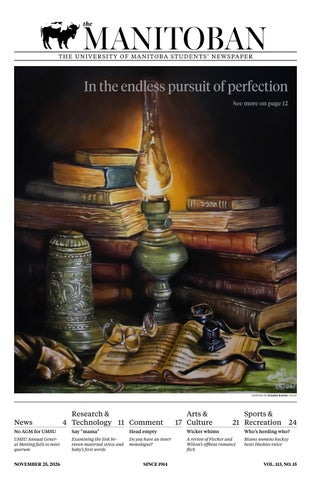
In the endless pursuit of perfection See more on page 12
PAINTING BY ZULKIFL RAFAH / STAFF
News
Research & 4 Technology 11 Comment
Arts & 17 Culture
Sports & 21 Recreation
24
No AGM for UMSU
Say “mama”
Head empty
Wicker whims
Who’s herding who?
UMSU Annual General Meeting fails to meet quorum
Examining the link between maternal stress and baby’s first words
Do you have an inner monologue?
A review of Fischer and Wilson’s offbeat romance flick
Bisons womens hockey bests Huskies twice
November 25, 2026
SINCE 1914
VOL. 113, NO. 15
Vol. 112
No. 15
INSIDE:
109 HELEN GLASS BUILDING UNIVERSITY OF MANITOBA WINNIPEG, MB THEMANITOBAN.COM | 204. 474. 6535 GENERAL INQUIRIES: ME@THEMANITOBAN.COM CIRCULATION INQUIRIES: MISSING OR INCOMPLETE PAPER? EMAIL: DISTRIBUTION@THEMANITOBAN.COM
EDITOR-IN-CHIEF
Mikaela Warkentin
editor@themanitoban.com BUSINESS MANAGER Alice Teufack accounts@themanitoban.com BUSINESS SUPPORT MANAGER Ramisah Musarrat ads@themanitoban.com
EDITORIAL MANAGING EDITOR
Peace Ifeanyi
me@themanitoban.com COPY EDITOR
Eden Quiring
copy@themanitoban.com COPY ASSOCIATE NEWS EDITOR
Lauren Pasveer
Arifah Gheesah
news@themanitoban.com NEWS EDITOR
Roy Albright Obah
NEWS
pages 3 to 8
The Manitoban is the official student newspaper of the University of Manitoba. It is published monthly during the summer and each week of regular classes during the academic year by the Manitoban Newspaper Publications Corporation. The Manitoban is an independent and democratic student organization, open to participation from all students. It exists to serve its readers as students and citizens.
RESEARCH & TECHNOLOGY
pages 10 to 11
The Manitoban is a member of the Canadian University Press, and our journalistic standards can be found on the Manitoban’s website.
news@themanitoban.com RESEARCH & TECHNOLOGY EDITOR Mansura Akter Meghla research@themanitoban.com COMMENT EDITOR
Quinn Mayhew
comment@themanitoban.com ARTS & CULTURE EDITOR Boris Tsun Hang Leung arts@themanitoban.com SPORTS EDITOR
Faiyaz Chowdhury
sports@themanitoban.com
DESIGN DESIGN EDITOR
DESIGN ASSOCIATE
Prova Hossain
GRAPHICS EDITOR
Emma Gillich
graphics@themanitoban.com GRAPHICS ASSOCIATE
Hannah Desjarlais
AUDIO AND VIDEO AUDIO EDITOR Max Reid audio@themanitoban.com PHOTO EDITOR
Ebunoluwa Akinbo
photo@themanitoban.com PHOTO ASSOCIATE
page 12
Students and other interested parties are invited to contribute to any section of the newspaper. Please contact the appropriate editor for submission guidelines.
DIVERSIONS
page 13
The Manitoban reserves the right to edit all submissions and will not publish any material deemed by its Editorial Board to be discriminatory, racist, sexist, homophobic or transphobic, ableist or libellous.
Chimarokem Chijioke
Zulkifl Rafah
video@themanitoban.com VIDEO ASSOCIATE
Tashfiqur Rahman
DIGITAL MEDIA EDITOR
Faisal Rahman
social@themanitoban.com SOCIAL MEDIA ASSOCIATE
Aaliyah Velasco
REPORTERS NEWS
Nafisa Al Lilo
NEWS
Wesley Furst
RESEARCH & TECHNOLOGY
Sonja Asmundsson
COMMENT
Carrington Dong
COMMENT
Sadirah Valverde-Nelson
ARTS & CULTURE
Jordan Anglin
ARTS & CULTURE
Debbie Fong
SPORTS
Maleeka Haider
SPORTS
Anthony Otoide
VOLUNTEERS VOLUNTEER STAFF Sijy Varghese
interested in volunteering? email me@themanitoban.com today!
2
EDITORIAL
Deveney Jarrow
design@themanitoban.com
VIDEO EDITOR
The newspaper’s primary mandate is to report fairly and objectively on issues and events of importance and interest to the students of the University of Manitoba, to provide an open forum for the free expression and exchange of opinions and ideas and to stimulate meaningful debate on issues that affect or would otherwise be of interest to the student body and/ or society in general. The Manitoban serves as a training ground for students interested in any aspect of journalism.
Opinions expressed in letters and articles are solely those of the authors. Editorials in the Manitoban are signed and represent the opinions of the writer(s), not necessarily those of the Manitoban staff, Editorial Board or the publisher. A “volunteer staff” member is defined as a person who has had three volunteer articles, photographs or pieces of art of reasonable length and/ or substance published in the current publishing year of the Manitoban.
COMMENT
pages 14 to 17
ARTS & CULTURE
pages 18 to 21
SPORTS & RECREATION
pages 22 to 24
Any individual who qualifies as a volunteer staff member must be voted in by a majority vote at a Manitoban editorial board meeting. Elected representatives and non-students may be excluded from holding votes as volunteer staff members in accordance with the Manitoban Constitution. All contents are ©2026 and may not be reprinted without the express written permission of the Editor-in-Chief.
News
November 25, 2026 news@themanitoban.com
U of M host Two-Spirit and Transgender Remembrance Day Students host day to honour lives lost to anti-transgender violence and suicide Wesley Furst, staff
T
wo-Spirit and Transgender Remembrance Day (2STRD) was on Nov. 20. Keat Brisebois, Arts Student Body Council’s 2SLGBTQIA+ representative, organized an on-campus event to remember and honour those whose lives were lost to anti-transgender violence and suicide. With support from the student group Queer Student Family (QSF) and other U of M students, the event held a smudging ceremony, a reading of the names of those lost since the last 2STRD, a reading of the poem “Our Dangerous Sweetness” by Amir Rabiyah and messages from U of M faculty and community representatives. Alex Gislason, the Science Students’ Association’s 2SLGBTQIA+ representative, noted, “The term two-spirit was coined in Winnipeg in 1990, 36 years ago, a milestone in decolonizing ideas of gender and sexuality. Yet still, twospirit and Indigiqueer peoples continue to face staggering rates of violence, harassment and murder.” Over 350 names
were read during the ceremony, including people with unknown names upon their passing. Charlotte, QSF vice-president, remarked, “Hearing all those names has been an incredibly sobering experience, reminding us that no matter how far we’ve come in terms of transgender rights, there’s still a long way to go.” QSF is dedicated to hosting events alongside the Trans+ Chill organizers to strengthen community for transgender people at the U of M. “We are proud of the trans and twospirit members we serve and work with,” Charlotte said, “and we will continue honouring and supporting them however possible. All you have to do is ask.” Three speakers attended to share some words with the community, Jarvis Brownlie, a U of M faculty of arts and department of history professor, Zova Da Silva, a 2SLGBTQIA+ representative, and Dene Guillas, founder of Braiding Colours Consulting. Guillas, a Métis, two-spirit, pansexual, transgender man,
shared a speech to remind the community that the people honoured on this day were more than the violence that took their lives. “We must also recognize that violence is not experienced equally,” he said. “Trans women, particularly Black, Indigenous and other racialized trans women, face disproportionate violence, shaped by racism, misogyny, transphobia and the systems that too often fail them. [...] We all deserve to exist.” He read an excerpt from a journal when he was young, and remarked about how we don’t always know what the people around us are struggling with. Having community can help with that struggle, he noted. “For many of us, community isn’t simply somewhere we belong. Sometimes it’s unity that keeps us here.” “Today, we honour those who should still be here, and tomorrow, and every day after, we honour them by doing everything we can to ensure more of us get to stay.” Brisebois ended the ceremony with a sacred tobacco
PHOTO BY CHIMAROKEM CHIJIOKE / STAFF
teaching. This tobacco tie was used as an offering to the spirits of the lives lost to anti-transgender and twospirit violence and suicide. This also is a practice rooted in new beginnings, and Brisbois ended on a sentiment to keep fighting for transgender and two-spirit lives. If you or anyone you know is having thoughts of suicide or self-harm, here are a list of crisis hotlines for immediate support:
Trans Lifeline: (877) 330-6366 Klinic Crisis Line: 1 (888) 322-3019 Canada Suicide Hotline: 1 (833) 456-4566 Mobile Crisis Service: (204) 940-1781 Manitoba Suicide Prevention and Support Line: 1 (877) 435-7170 First Nations and Inuit Hope for Wellness Services: 1 (855) 242-3310
Teach-in connects water justice to federal bills Just Waters panel on Bill C-37 followed a rally against Bill C-39 Nafisa Al Lilo, staff Just Waters, a program at the U of M focused on the issues of water and justice, held a teach-in on Nov. 12 at The Forks “to connect [those] questions to current legislation and issues.” Adele Perry, director of the Centre for Human Rights Research (CHRR) and a U of M professor of history and women and gender studies, said the event was organized by Just Waters, which is connected to the CHRR. The panel featured Leah Gazan, Stewart Hill, Ramona Milliea and Niigaan Sinclair. Perry said they “were chosen for the expertise and engagement on questions of water and Indigenous peoples and lands, and the insight they brought to current legislation.” A rally was held before the event. Perry said it was organized separately by the Manitoba Coalition Against Bill C-39, and that some people who attended the rally also attended the teach-in. Rhea Resendes, a teacher and member of Anakbayan Manitoba, attended the event.
She said she was one of the organizers of an Oct. 24 rally against Bills C-37 and C-39 at the Manitoba Legislative Building. Bill C-37 is the First Nations Clean Water Act. The federal government says it would make drinking water protections for First Nations legally enforceable and affirm First Nations’ right to self-government over water and related infrastructure on their lands. Resendes said the bill would “take away water rights from Indigenous communities and […] make it harder for them to access water they have rights to and take away the treaty rights that they have on this land.” A legal analysis by the law firm JFK Law said the bill’s water sufficiency requirement leaves out water needed for the exercise of Aboriginal rights, and that protecting source water is left to Canada’s discretion. Resendes said, “The environmental devastation that’ll happen from the fast-tracking of resource extraction projects will affect generations to come.” “If we want to build a bet-
ter future for our children, how can we do that if there is no planet left for them?” she asked. Resendes said Anakbayan Manitoba is starting a chapter at the U of M. She described it as “a group of Filipino youth activists fighting for migrant rights here and also national democracy in the Philippines” and said the group plans to file with UMSU to become a registered club. For students who want to take action, Resendes said the “biggest thing would be to organize.” She suggested reaching out to people, attending rallies and events or emailing or calling their member of Parliament and signing a petition. “[The government needs] to know that this [bill] is not being supported, so that hopefully we can push the politicians to be brave enough to say no to this,” Resendes said. Perry encouraged interested students to follow the social media of the Environmental Conservation Lab, the CHRR, Climate Action Team Manitoba and Leah Gazan. PHOTO BY NAFISA AL LILO / STAFF
3
Vol. 113, No. 15 news@themanitoban.com
News
UMSU AGM cancelled for second year in a row More club funding, more advocacy as new executives settle in Roy Albright Obah & Arifah Gheesah, staff
U
MSU’s annual general meeting (AGM), scheduled for Nov. 17, was cancelled for the second consecutive time after failing to meet the required quorum of 200 members. The meeting was intended to update students on the union’s activities and provide an opportunity to question its leadership. However, the absence of the required number of members prevented the AGM from proceeding, in accordance with UMSU’s bylaws. The union’s business continued at its Nov. 19 board of directors meeting, where several reports provided the following updates on the union’s ongoing activities and initiatives.
The Nov.19 BOD meeting Club budget gets a boost According to Heaven Kaur’s (UMSU president) report, the maximum funding allocation available to each student club has increased by $150, from $1,700 to $1,850, effective immediately. The increase is a response to growing club activity across campus and increased demand for financial support as student organizations expand their programming. “Clubs are the heartbeat of UMSU,” Kaur stated in her report.
Exam bookings made easier The union also provided updates on accessibility initiatives following consultations with Student Accessibility Services (SAS). According to the accessibility representative’s report, SAS is developing a new exam-booking database that would automatically schedule exams for students registered with the service, eliminating
4
GRAPHIC BY EMMA GILLICH / STAFF
the need to book each exam individually. The proposed system would also allow students who miss an exam to automatically schedule a makeup exam, bypassing the current waiting period of approximately two weeks. The system will require an expanded budget and no implementation date has been confirmed. A new exam centre for students registered with SAS is also being developed, with Machray Hall identified as a potential location. Other ongoing initiatives include exploring the expansion of Dean’s Honour List recognition for students registered with SAS beyond the Faculty of Arts and consulting with university administration about accessible infrastructure improvements.
UMSU to City Hall Beyond campus initiatives,
UMSU executives continued advocating for student priorities at the municipal, provincial and federal levels. Kaur reported attending a Winnipeg Chamber of Commerce discussion with federal finance minister François-Philippe Champagne about the 2026 federal budget and its implications for Manitoba’s post-secondary sector. The discussion covered investments in housing, youth employment, student financial assistance and Indigenous post-secondary education. Kaur also identified areas requiring further advocacy, including dedicated student housing, increased non-repayable grants, reduced student debt and expanded work-integrated learning opportunities. Alongside the vice-president external affairs, Kaur reportedly met with MP Ginette Lavack to discuss recommendations from the Canadian Alliance of Student
Associations (CASA), including increased Canada Student Grant and loan limits, addressing Indigenous post-secondary funding gaps and broadening the Student Work Placement Program. At the municipal level, Judy Abousetta, UMSU vice-president external affairs, reported beginning outreach to newly elected Winnipeg city councillors following the October municipal election. Meetings have been scheduled with Waverley West councillor Jasmine Brar and Fort Rouge– East Fort Garry councillor Jeff Palmer for late November and early December. Abousetta also reported efforts to arrange meetings with provincial Progressive Conservative MLAs to discuss student concerns including affordability and accessibility.
Back to fiscal business Aisha Bourdanne, UMSU
vice-president finance and operations, also reported progressing through her onboarding and preparing to chair upcoming finance committee meetings. Following the previous vacancy in the position, Bourdanne is reviewing initiatives that had been put on hold including Student Price Card matters and treasurer training.
Navigating academic misconduct procedures Lastly, Grace Elendu, UMSU Vice-president university affairs also reported continued support for students navigating academic misconduct processes. She continues to participate in university committees, including the Academic Integrity Advisory Committee, Senate Committee on Appeals and the UM Board of Governors.
November 25, 2026 news@themanitoban.com
News
Showing up for MMIWG2S+ Community feast raises awareness on campus Mikaela Warkentin, staff The U of M Indigenous Students’ Association (UMISA) and the UMSU Women’s Centre hosted a community feast on Nov. 20 to raise awareness for missing and murdered Indigenous women, girls and two-spirit people (MMIWG2S+). Being a joint venture between the two student groups, UMSU community reps Rayden Seela and Kultaj Kaur took on the lead in organizing. In fact, an event like this had been a long time coming. Seela and Kaur had been planning an event like this since last spring when they “hadn’t even been elected yet.” Prior to the feast, consideration was given by Karen Courchene, best known as Kookum Karen, who is the Grandmother-in-Residence at Migizii Agamik. Mackaila Bruce-Tapley, who was recently appointed as the women’s representative at UMISA, also shared a song. Guest speakers at the feast included Minister of Families Nahanni Fontaine and Minister of Advanced Education and Training Renée Cable. Fontaine outlined the work
done by the provincial government to support Indigenous women, girls and two-spirit people, particularly through the Mino’Ayaawag Ikwewag framework. Mino’Ayaawag Ikwewag means “All Women Doing Well,” as Fontaine expanded on — “What we mean by that is that when Indigenous women, girls and two-spirited are doing well, all of us do well.” Fontaine shared that $15 million has been invested in an endowment fund created to support the families of women and two-spirit people who are missing or murdered. The investment has been made in perpetuity into the Winnipeg Foundation to ensure the longevity of this fund. Another initiative Fontaine took on was the creation of 24/7 safe spaces for Indigenous women and girls. “We have two […] in Brandon.” Fontaine continued, “since those got established, the calls to missing persons police in Brandon have plummeted.” Another similar 24/7 space is on the books in Thompson, according to Fontaine. PhD student Anna Huard discussed working hands-on
PHOTO BY MIKAELA WARKENTIN / STAFF
with community initiatives, particularly like those run by Southern Chiefs, and reflected on the unique challenges notfor-profits face. “Our funding is so limited all the time, and it’s not a constant renewal every year, and so there are certain services that [...] come and go.” Huard also shared that funding can have its lim-
its, as money allocated for an initiative can only be used for certain things. “If somebody who is impacted is a vulnerable or high-risk Indigenous woman [who] can’t make her rent, a grant will not allow you to do that, because you have to go within their agreement.” However, for Huard, com-
munity work goes beyond organization. “You don’t have to be employed at a place to be an advocate, right? It’s just always important to show up [...] It’s gonna suck, but show up, and your heart will be warm, but it’ll be empty at the same time.”
Spiritual care provider leads workshop on Islam Natasha Ali’s presentation aimed to help non-Muslims understand Islam Nafisa Al Lilo, staff The U of M’s Muslim spiritual care provider led a presentation on Nov. 19 in the Education Building on understanding Islam and working effectively with Muslim colleagues, students and classmates. Natasha Ali, psychologist and Muslim spiritual care provider, said the session was “targeted more toward non-Muslims, people who are not familiar with Islam and [do not] have someone who’s Muslim in their close circle.” She said the event was organized for both educators and students, including people in student politics who work with Muslims. Ali said the university still has work to do to address anti-Muslim discrimination, noting that students continue to face challenges with belonging. She said clients have shared experiences of feeling excluded in classrooms, group projects, campus life and student politics during counselling sessions. “[Being Muslim is] a way of building a warm and active
relationship with my creator,” Ali explained. “It is a way of being, a way of thinking that gives me purpose, that gives me meaning in life, and that makes me motivated to become a better person and contribute back to society.” Ali said that as a Muslim, her actions are guided by “the values of not being oppressive, [of] social justice [and] charity.” Ali said that students also reach out to her about faculty-related issues. “I think it’s important for departments and faculties to have socials where there’s no alcohol, it’s not in a club, and women can socialize with women and men can socialize with men, and it doesn’t have to be always a mixing,” she said. She said it should be “okay if people choose to just be with the same gender and not looked at in a weird way because of it.” For non-Muslim staff and students, Ali recommended attending workshops like hers when they are offered, but said, “The easiest thing
is to just go to visit your local mosque or to befriend a Muslim and ask them.” She also suggested visiting the U of M Muslim Students’ Association on both campuses, and asking Muslim students about their faith and culture. Ali noted that Muslims are “not as scary as people make us out to be.” She added that Muslims also need to reflect on how they treat one another. “I think we need to repent and be honest about how we’ve committed oppression on our fellow Muslims,” Ali said. She encouraged Muslims to “invite non-Muslims in and be proud about [the] beautiful religion” and “share it with other people.” Ali explained, “[Islam is] supposed to be something [where] we take care of each other, we take care of the planet, we take care of our body, and we take care of our soul.”
PHOTOS BY EBUNOLUWA AKINBO / STAFF
5
Vol. 113, No. 15 news@themanitoban.com
News
HealthyU hosts Pause for Paws event Drop-in monthly event for students to visit therapy dogs and ease stress Wesley Furst, staff
P
ause for Paws has become HealthyU’s most popular event. Starting as just an event held during exam season at University Centre, the team has expanded to monthly sessions at the Fort Garry campus and are hoping to bring it to the Bannatyne Campus and the William Norrie centre during exams. . According to Bryanna Barker, U of M Student Health and Wellness Education coordinator, research has shown stress-relief benefits from pet therapy. “They’re just there to accept and receive your love, and they’re not there to judge you,” Barker noted. She added, [Pause for Paws] brings people together in a space for a common goal of reducing stress.” With the opening of the Student Wellness Centre at 162 Extended Education in 2023, the space provides a quieter, calmer room to meet with the dogs. Paige Mortiz, the Student Wellness Program assistant, said the centre provides “a home on campus for students to come in and be comfortable.” The centre is open for drop-ins during a variety of times on weekdays with
certain hours called the “Zen Zone” when the room remains quiet for studying and relaxing. During the Pause for Paws event, the space is quiet, as they try to keep a capacity of only 20 people. The event provides information on upcoming pet therapy sessions, other wellness events and introduces attendees to like-minded people in the U of M community.
“[Pause for Paws] brings people together in a space for a common goal of reducing stress” — Bryanna Barker, Coordinator for Student Health and Wellness Education The event is partnered with St. John’s Ambulance and their certified pet therapy program. The dogs go through a training process as puppies to ensure they remain calm in a variety of situations.
IMAGE COURTESY OF LIZA DMYTRIW / STUDENT AFFAIRS COMMUNICATIONS AND OUTREACH
One of HealthyU’s many changes throughout the years was creating a streamlined process for more events at the U of M. The team not only provides their own events, but also books other pet therapy sessions with St. John’s
Ambulance. The next Pause for Paws events will be on Dec. 1 at the Student Wellness Centre from 11:30 a.m. to 1 p.m., on Dec. 7 at the Bannatyne campus and on Dec. 9 at the William Norrie centre.
To find more information on events, support or connecting with HealthyU, visit their website healthyuofm. com or their Instagram @ healthyuofm.
Manitoba middle class families to expect a tax cut next year
Indigenous Scholars Speaker Series
Cadets programs put on hold until the end of the fiscal year
‘Toban news briefs Roy Albright Obah, staff Rohingya crisis ruled as genocide The International Court of Justice (ICJ), in a nineagainst-six ruling, has established that Myanmar’s military actions toward the Rohingya minority between 2016 and 2017 constituted a genocide. This decision came seven years after The Gambia filed the matter with the ICJ to seek justice for the murder and forced displacement of thousands of Rohingya minorities. Myanmar has been instructed by the court to pay reparations, however the ICJ is unable to enforce compliance. The United Nations Security Council, upon receipt of the court orders and through a resolution, may decide to put the orders into action.
6
Employer Advice Café On Thursday Nov. 26, the U of M career services is organizing an informal event which brings together employers across different sectors on campus. The event will offer students the opportunity to connect with employers so they can make inquiries and also seek career advice. The event will take place at IQ’s Café and Billiards on the third floor of UMSU Centre.
To address affordability concerns, the NDP government is proposing a tax reduction for middle-income families in Manitoba through its proposed “mega-deduction” policy. Once implemented, the measure would exempt the first $30,000 of an individual’s annual earnings from provincial income tax, leaving workers with more disposable income to help cover household expenses. However, the proposal has drawn criticism over its potential impact on provincial revenues, with estimates suggesting an annual revenue loss of at least $100 million.
Alex Wilson will be talking at the Dec. 4 Speaker Series event. This is an inaugural lecture of the new landbased series at the U of M. The talk will address the question, “What does it mean to learn from, with and on the land in a university setting?” The conversation will dwell on the present situation of “land– based education in post-secondary contexts.” The venue for the event is the senate chamber, E3-262, Engineering Building on the Fort Gary campus from 12 p.m. to 1:30 p.m.
Several military cadet training programs across parts of the country have been suspended until April 2027 due to budgetary constraints. The directive took effect on Nov. 21. Funded by the Canadian Armed Forces (CAF) and the Department of National Defence (DND), the program provides military exposure and development opportunities for youth between the ages of 12 and 18. The suspension does not affect weekly evening parades but limits cadets’ participation in competitions and weekend training activities until the end of the current fiscal year.
December 1 • 11AM-2PM 1st Floor – UMSU University Centre
$5 PRINTS All proceeds will go to the UMSU Holiday Hampers program.
DECEMBER 2
9AM-4PM
1st Floor – UMSU University Centre
A CELEBRATION OF CULTURE SHARE YOUR CULTURE! We’re looking for students to showcase cultural attire, dance and performances.
APPLY TODAY! Tuesday, February 9 | 4:30-7:30PM | MPR, 2nd Floor - UMSU University Centre
@myumsu
www.UMSU.ca
Vol. 113, No. 15 news@themanitoban.com
News
Law meets faith at Robson Hall Muslim law student group launches to support students Arifah Gheesah, staff unique needs of Muslim law he U of M Muslim Law students, including access to Group (MMLG), a new prayer spaces, professional student club at Robson Hall, connections and guidance on announced its launch last navigating religious practices week. in the legal profession. MMLG is a rebrand of the The university mosque, former Robson Muslim Law located in the Engineering Student Association (RMLSA), building, is a considerable with new partnerships includ- distance from Robson Hall. ing the Manitoba Muslim Plans are currently underway Professionals Association to establish a prayer space (MMPA). closer to Robson Hall with the “We want to increase help of the Manitoba Law Stuengagement for Muslim Stu- dent’s Association (MLSA), dents,” said Adil Hayat, presi- allowing students to pray dent of MMLG. between classes without havOne of the club’s key initia- ing to travel across campus. tives is a buddy program, sim- Hayat noted that he has seen ilar to the mentorship oppor- students praying under stairtunities offered by the Mani- cases due to the lack of a deditoba Bar Association, which cated prayer space. will connect aspiring lawyers He emphasized that the with experienced legal profes- club’s purpose is not to sepsionals. arate Muslim students from Hayat explained that the others, but to create a space buddy program is particularly where they can embrace their beneficial for women who religious identities alongside wear the hijab and may have their professional aspirations. questions about religious “In the ideal world, there’d accommodations in profes- be a Muslim law group, a sional settings. These connec- Hindu law group, and a Sikh tions will provide guidance on law group […] We’re not trynavigating the intersection of ing to categorize them, we’re “We are not really separgender, faith and professional trying to get them to live their ating ourselves, we are just identity in the legal field. identity and be a lawyer at the banding together to talk about The club also plans to host same time.” [...] issues that we face [and an iftar as part of its events According to Hayat, Robson how we can] address them” during the fasting month of Hall already has several initiaHe explained that Islamic Ramadan, as well as panel dis- tives supporting religious beliefs can influence varicussions. diversity including the Chris- ous aspects of a person’s life, The club will also introduce tian Legal Fellowship and the including decisions about pre-law repcareer paths resentatives and legal mat“If we’re going to be individuals [...] that are to its executers. Aspirtive board to coming to this country, we want to build a better ing Muslim act as “a bridge lawyers may future for ourselves. We also have to help in between law have questhe rule of law that exists here” students and tions about the pre-law the religious — Adil Hayat, president of MMLG students.” permissibilThrough ity of certain these initiatives, pre-law stu- Break the Bread event where legal fields, while others may dents will be able to seek guid- students of different religions encounter misconceptions ance on law school admis- come and have food together. about the legal profession. sions, the Law School Admis“The point of clubs at Rob“Every society needs a sion Test (LSAT) and career son Hall is not like university lawyer, every society needs opportunities in the legal clubs. They are not gonna take people to defend the law. We field. the majority of your days or need individuals who are The club aims to support something. It’s something you Muslims to represent MusMuslim law students, lawyers do on the side along with your lims,” Hayat said. and aspiring law students by academics,” Hayat said. He “Our society is not a one addressing challenges that believes that this club is just size fits all [...] We are a mosaic may arise from balancing another avenue for students of cultures and religions.” their religious identities with to come together, to socialize, Hayat stressed the importtheir legal careers. and meet like-minded indi- ance of having lawyers who Hayat highlighted the viduals. understand the cultural and
T
8
IMAGE COURTESY OF ADIL HAYAT
religious backgrounds of the different communities they serve, such as offering support or representation when navigating legal matters such as divorce, wills and other family-related issues. He also believes greater Muslim representation in the legal profession could help challenge stereotypes and reduce Islamophobia. Hayat pointed to Manitoba’s immigrant communities as examples of populations that may benefit from culturally and religiously informed legal representation. International students navigating work permits, immigrants seeking citizenship and refugees going through legal proceedings may face challenges understanding the Canadian legal system. Hayat recalled a visit to Stony Mountain Institution, where he noticed prayer mats and Qurans in some prison cells. He used this example to again, emphasize the importance of Muslim representation in the legal profession. Beyond individual legal rep-
resentation, Hayat highlighted the need for lawyers in the Muslim charitable organizations and non-profits, such as Islamic Relief Canada and Penny Appeal Canada, which require legal assistance with processes. Hayat also spoke about the importance of legal representation for refugees navigating the Canadian legal system. He expressed concern that displacement could increase the demand for immigration and refugee lawyers who understand refugees’ languages, cultures and backgrounds. In addition to encouraging students to pursue legal practice, MMLG aims to introduce members to other career opportunities, including legal research and academia. “If we’re going to be individuals [...] that are coming to this country, we want to build a better future for ourselves. We also have to help in the rule of law that exists here,” he mentioned.
Research & Technology
Vol. 113, No. 15 research@themanitoban.com
Using bacteria to reduce farmers’ reliance on fertilizers Student studies how nitrogen-fixing bacteria could support sustainable agriculture Mansura Akter Meghla, staff
N
itrogen is essential for plant growth, but supplying crops with enough of it often comes at an environmental and financial cost. Badriya Mubashshira, a PhD candidate in the department of microbiology, is studying how naturally occurring bacteria could help farmers reduce their reliance on chemical fertilizers without compromising crop yields. Mubashshira’s research focuses on rhizobia, a group of bacteria that form partnerships with legume plants. These bacteria can convert nitrogen from the air into a form that plants can use, helping them grow. Mubashshira is investigating how to improve this natural process and develop more effective bacterial products for agricultural use. Chemical nitrogen fertilizers have played a major role in increasing crop yields since the 1970s. However, their production requires significant amounts of fossil fuels and contributes to greenhouse gas emissions. Excessive fertilizer use can also contribute to harmful algal blooms, while rising prices create additional costs for farmers. According to Mubashshira, Canada’s reliance on imported fertilizers adds another concern, leaving farmers vulnerable to supply disruptions, geopolitical instability and price increases. Bioinoculants – products containing beneficial microorganisms such as rhizobia, offer a possible alternative, she explained. However, existing products are not yet reliable enough to maintain current crop yields, making their effectiveness an important area of research. Mubashshira said her interest in agricultural research began in Bangladesh, a country with a strong agricultural tradition. She became particularly interested in “the lack of a well-established bioinoculant for an important protein-rich bean crop in Canada.” “I wanted to be part of bridging that gap and contribute to the scientific knowledge that can be turned into practical solutions to benefit farmers,” she said. One of her recent projects examined whether rhizobia could become more effective at supporting bean plant growth through a process called adaptive evolution. The research began with bacteria that were relatively poor at fixing nitrogen. Researchers repeatedly introduced them
10
GRAPHIC BY EMMA GILLICH / STAFF
into bean plants, allowing the ness,” she said. to guide future experiments plants to select bacteria that The findings could inform and generate new research better supported their growth. the development of more questions. “We repeated this process effective microbial inoculants, In the long term, her eight times and observed a although further research is research aims to help develop significant increase in plant needed before they can be bioinoculants suited to differyield after [the third] itera- applied reliably on farms. ent bean varieties and local tion,” Mubashshira said. One part of Mubashshira’s growing conditions. Bacteria Mubashshira and the doctoral research involves could be adapted to particular team then investigated what developing a metabolic net- crops or environments before caused the improvement. work model of rhizobia asso- the growing season, potenThey applied molecular gen- ciated with beans. The model tially improving their effectetics after sequencing the acts as a blueprint of how iveness when introduced into isolated bacteria to identify the bacteria function and agricultural settings. genes assoThe broader ciated with goal is to reduce “I wanted to […] contribute to the scientific increased fertilizer use nitrogen-fixby at least 30 knowledge that can be turned into practical ing efficiency. per cent while solutions to benefit farmers” The researchmaintaining ers identicrop produc— Badriya Mubashshira, a PhD candidate fied several tivity. Accordpromising ing to estiin U of M’s department of microbiology genes. One of mates outlined these genes in her research, also improved nitrogen fix- could help researchers pre- achieving this reduction ation in other related rhizo- dict how changes to their could lower Canada’s greenbia, suggesting more potential genetic makeup affect their house gas emissions by up to beyond the original bacterial metabolism. The model has 2.56 million tonnes annually strain. been drafted and manually and save farmers more than $2 “This work not only dem- reviewed, she noted. billion each year in fertilizer onstrates the potential to Mubashshira has also costs. improve nitrogen fixation tested its predictions against For Mubashshira, the in rhizobia but also helps us experimental data to improve potential impact of the work understand the genetic mech- its accuracy. She hopes to extends beyond the laboraanisms behind their effective- publish the model and use it tory. She said the possibility
of contributing to sustainable agriculture and food security keeps her motivated, even when experiments do not go as planned. “Knowing that our work could eventually make a difference beyond the laboratory is what keeps me excited,” she said. She also emphasized the importance of making scientific research accessible to people outside academic settings. “I believe science communication and advocacy should be an integral part of scientific education and training, allowing us to share our knowledge and contribute meaningfully to society while maintaining scientific integrity,” she said. As her research progresses, Mubashshira hopes that a better understanding of rhizobia will help turn their natural relationship with plants into practical agricultural solutions. For now, her work is focused on understanding the bacteria, identifying what makes them effective and exploring how that knowledge can support farmers.
November 25, 2026 research@themanitoban.com
Research & Technology
Understanding infant language learning development How can stress and other factors impact language development? Sonja Asmundsson, staff
D
epartment of psychology master’s student Isabelle Hadley is studying the connection between maternal stress and its impact on maternal communication and infant language development. Her study is part of the Baby Language Lab, which is led by psychology professor and department head Melanie Soderstrom. The lab focuses on the impact of a baby’s day-today experiences on language development. Hadley’s focus of maternal mental health is only one facet of the lab. The lab explores speech perception in infants and the types of sounds babies prefer. The role of infant-directed speech or “baby talk” in language learning plays an important part in the lab. Additionally, the lab tackles the question of how language learning differs around the world. Previously, Hadley worked with PhD student Megan Gornik to gain understanding of the link between maternal depression and language development in children under age five. In the study, existing data on maternal depression was analyzed and an association was shown to exist between depression and less favourable expressions
involving vocal expression, nal speech. The aim of the milestones were also reported, eye contact and touch. study is to understand how but Soderstrom and Had“We also found that these much moms are talking to ley noted that this data is not children may be less likely to their eight to ten months olds equal to a pass or fail for the seek comfort from their […] and its implication on infant baby. Instead, the study was mother specifically,” Had- language development. interested in observing the ley said. During the infant The study included mul- relationship between comand preschool developmental tiple questionnaires ranging munication and general cogstages, the expressions of a from the cognitive develop- nitive development, which caregiver hold importance.” ment of the infant to the stress is measured through a score. “Part of it is about devel- level of the mothers. To isolate “It’s not a threshold of, ‘This oping that rapport between the impact of stress, maternal baby’s in trouble,’ or, ‘This mother and child,” said Soder- depression and anxiety were baby’s not in trouble,’” Soderstrom, “and part of it is also ruled out as outliers. After the strom said. more attenThe next tional characstage for Had“The goal of this research is not to just add one ley is to anateristics.” For these lyze the data more thing for [caregivers] to worry about” attentional she has colcharacterislected and — Melanie Soderstrom, U of M psychology tics of infantstart pulling professor and department head d i r e c t e d out trends. She speech, Soderis hopeful that strom highlighted the import- questionnaires, mother-in- this research can help mothance of tone. “One of the main fant pairs were invited to do ers become more mindful of characteristics of infant- an observed task in the lab. their communication with directed speech, or childFor 10 minutes, a mother their babies while they are directed speech more gen- was recorded reading a word- experiencing stress. erally, is this higher pitch less book to her infant. “I was Soderstrom noted the and melodic characteris- hoping that because there’s no importance of research as a tics,” Soderstrom said. Mater- words, we might see a little bit tool, not an additional stresnal depression can alter these more variability in how much sor. characteristics, which is asso- moms read to their babies,” “The goal of this research ciated with more negative Hadley said. Afterward, is not to just add one more vocabulary and speech use infants took part in free play, thing for [caregivers] to worry outcomes in children. where the amount of com- about, but to support famEssentially, Hadley is inves- munication and utterances of ilies in being able to lead tigating how the experien- the mother provided further healthy and happy, active ces of maternal stress affect examples of maternal com- lives,” Soderstrom said. She infant language and cognitive munication. also emphasized the value of development through materIn the questionnaire, baby taking the whole system into
account when creating interventions for infant cognitive development. “Interventions focused purely on the child or the infant [are] not going to be nearly as successful,” she said. A major cultural and environmental marker for an infant in North America is the number of caregivers during the beginning stage of life. According to Soderstrom, it is unique to rely primarily on the mother or one care giver during this time. “In a lot of other cultures, there’s much more involvement of grandparents and aunts and uncles and the broader community at large,” said Soderstrom. “There [are] more supports for somebody who’s struggling.” The questions that arise from comparing cultural differences in infant language development enrich research, but overall, Soderstrom emphasized the complexity of infant experiences. Behaviours in one environment that are well supported for infant cognitive development may not automatically be applicable for other environments. “Every infant is developing within its own unique environment,” Soderstrom said.
GRAPHIC BY EMMA GILLICH / STAFF
11
Editorial
Vol. 113, No. 15 editor@themanitoban.com
Perfectionism beyond a personality trait High standards are worth pursuing, they should serve you, not imprison you Zulkifl Rafah, staff
PHOTO BY ZULKIFL RAFAH / STAFF
A
nother sleepless night, and I am stuck to an easel trying to perfect the wooden texture of a violin. I am using my thinnest brush to paint every grain onto my canvas. Something keeps bothering me, maybe the colour is slightly too warm. I know most people might not notice the difference, but I do. Being a perfectionist has trained my eye to notice things others might overlook or not even notice. It has taught me patience, discipline and made me appreciate the complexity of seemingly ordinary objects. Still life paintings have taught me to see the extraordinary in ordinary objects. A transparent glass is not really transparent. It contains reflections, distortions, shadows and changes in colour. A wooden table is never simply brown. It has a history of grain and imperfections. Trying to perfectly capture these details on a canvas makes me look closer. It has shifted my skills for observation into an act of devotion. These disciplines also follow me whenever I pick up a camera to film and into my editing room. Sometimes the gifts of being a perfectionist can become a burden as well. My inability to sleep because a painting doesn’t feel right, forgetting to eat because I am absorbed in correcting something seemingly insignificant, or spending hours adjusting a tiny detail when others might consider the work finished, sometimes at the expense of meeting a submission deadline, are some examples from my experiences of when standards stopped serving me. The frustration of knowing exactly what I want to achieve
12
but struggling to translate it onto my canvas, the difficulty of accepting that an artwork or a video can be finished without being absolutely perfect, and the tendency to measure my own worth through the quality of what I produce are some of the things that keep me glued to my workstation. “Is my pursuit of excellence truly about my artwork, or is it my inability to accept the imperfections in myself?” This is a question I have been asking myself lately. Perhaps, somewhere along the way, the two have overlapped. I remember a particular moment when my painting instructor noticed how much time I was taking to refine a tiny area on my painting. After watching me obsess over the details for a while, she gently reminded me, “It is okay to let go and move on.” At the time, it felt like a simple instruction, but those words stayed with me to this day, eventually becoming a lesson beyond the canvas. I find myself returning to those words whenever I get too absorbed in perfecting a detail, whether I am painting, filming or editing a video. Over time, it has become a voice that helps me maintain my sanity when projects get overwhelming. It has taught me that sometimes knowing when to stop can be just as important. I don’t think that I will ever lose my addiction to noticing the smallest details, nor do I want to. It is part of what makes me an artist and what brings life to the work I create. But I am slowly learning to differentiate between chasing excellence and being imprisoned by the pursuit of perfection. PAINTINGS BY ZULKIFL RAFAH / STAFF
1 2 3 8 6 7
4 1 2 3 2 5 4 3 7 6 8 1 6 7 9 5 8 7 6 1 5 4 2 4 1 7 3 5 6
No. 829
Previous solution - Tough
SUDOKU
2 3 4 5 9 6 1 8 7
Medium
© 2026 Syndicated Puzzles
6 7 9 5 4 3
7 5 6 9 8 1 2 3 4
To complete Sudoku, fill the board by entering numbers 1 to 9 such that each row, column and 3x3 box contains every number uniquely.
5 1 9 8 7 2 3 6 4
7 8 6 3 4 1 9 2 5
3 4 5 1 8 9 2 7 6
1 6 8 7 2 5 4 3 9
9 7 2 6 3 4 5 1 8
4 9 1 2 6 7 8 5 3
8 2 7 9 5 3 6 4 1
Previous solution - Easy
6 5 3 4 1 8 7 9 2
© 2026 Syndicated Puzzles
8
For many strategies, hints and tips, visit www.sudokuwiki.org
Sijy Varghese, volunteer staff
5 9 8 2 1 4 3 3 2 4 7 6 6 5 7
7 4 9 5 3 1 7 8 7 1 9 5 5 8 3 1 2 6 3
cells remove that number as an option in that row and column, and are not part of any straight. Glance at the solution to The solutions will be published here in the ne see how ‘straights’ are formed.
7
5 6
xkcd.com
Do you have a comic you’d like to submit to the Manitoban? Email your submissions to graphics@themanitoban.com
5 8 1
Medium
2 8
If you like Str8ts check out our books, iPhone/iPad Apps and much more on our store.
If you like Str8ts check out our books, iPhone/iPad Apps and much more on our store. You can find more help, tips and hints at www.str8ts.com
3 6 8 2 7
1 8 2
7
9 4 7 1
9 Medium 9
How to beat Str8ts – Like Sudoku, no single number can Previous solution repeat in any row -orEasy column. But... rows by black 2 5and 7 columns 3 1 9 are 4 divided 8 6 squares 3 1 8into 4 compartments. 6 7 9 2 5 These need to be filled in with numbers that 4 9 6 5 8 2 1 7 3 complete a ‘straight’. A straight is a set 8 3 1 7 6 2 9 4 can be in of5numbers with no gaps but 9 order, 7 4 8 3 6 5Clues 1 in black any eg 2 [4,2,3,5]. 6 2remove 1 9 that 5 4number 7 3 as 8 an option cells 3 row 9 2and 4 column, 5 8 6and 7 are not part in1that of8any 6 straight. 2 7 3 Glance 1 5 4at the 9 solution to The solutions will be published here in the next issue. see formed. 7 how 4 5 ‘straights’ 6 9 8 are 3 1 2
9
For many strategies, hints and tips, visit www.sudokuwiki.org
8 1
.str8ts.com
4 5 8 1 7 5 6
To complete Sudoku, fill the board by entering numbers 1 to 9 such that each row, column and 3x3 box contains every number uniquely.
9
board by entering numbers 1 to 9 such that each row, column and 3x3 box contains every number uniquely.
5 7
7 1 9 5
For many strategies, hints and tips, visit www.sudokuwiki.org
3
Tough
4 1
3
If you like Str8ts check out our books, iPhone/iPad Apps and much more on our store.
9
2
2 9 5 4 3 6 1 8
55 8 2 1 6 4 9 7 4 1 8 9 7 3 2 5 9 5 7 8 2 1 6 6 3 8 3 4 6 1 5 7 9 6 7 3 5 9 9 2 8 4 7 4 6 2 5 9 3 1 1 6 9 3 5 8 7 4 2 3 2 1 7 4 8 5 6 To 3 complete Sudoku, fill the
1 8 2
7 3 6 4 2 1 8 5 9
6 5 3
ber can But... ed by black . These bers that ght is a set can be in s in black an option are not part e solution to The solutions will be published here in the next issue. ed.
1 8 7
Previous solution - Very Hard
Sudoku Solution To complete Sudoku, fill the board by entering numbers 1 to 9 such thatNo. each 828 Previous solution - Medium row, column, and 3x3 box contains 6 7 4 3 1 2 7every 8 9 number 2 1 5uniquely. 3 4 In Straights, 8like 5 Sudoku, 6 3 7 9no 4 single 2 1 number 1 to 9 3 4 6 7 9 8 2 4 3 can9 repeat in any row or column. But 8 2 7 6 5 2rows 1 4and 6 columns 5 3 9 8 are divided by black 6 5 8 Straights Solution 1squares 3 2 5 into 4 6 8 compartments. 9 7 Each 4 2 3 6 5 1 7 8 compartment must form a “straight.” 8 3 4 8 7 5 6 A straight is a set of numbers with How to beat Str8ts – no Sudoku, gaps but it cannumber be in can any order, eg Like no single repeat in any row or column. But... [7,6,9,8]. Clues in black cells remove 2 rows and columns are divided by black that number as an option squares into compartments. These in that need be filled in with numbers 9 4 rowtoand column, and arethat not part1of complete a ‘straight’. A straight is a set straight. ofany numbers with noGlance gaps but at can the be in solution 8 7 any [4,2,3,5]. Clues in black to order, see eg how “straights” are formed.
© 2026 Syndicated Puzzles
9 4 4 7 6 5 8 1 8
No. 828
Easy
SUDOKU
Puzzle by Signdicated Puzzles © 2026 Syndicated Puzzles
No. 828
3
STR8TS
Straights
Puzzle by Signdicated Puzzles
xt issue.
SUDOKU
Sudoku
© 2026 Syndicated Puzzles
Diversions
November 25, 2026 graphics@themanitoban.com
2026 Alance AB
13
Comment
Vol. 113, No. 15 comment@themanitoban.com
The Manitoban horoscope for the week of Nov. 23 Zodiac sign mania, flip a coin and see your fate this week Quinn Mayhew, staff AQUARIUS January 20 – February 18 Aquarius, I am afraid to tell you I have no good news for you this week. Someone may possibly betray your trust, and you may be deeply hurt by it. Make sure you listen to your heart about what to do. PISCES February 19 – March 20 Pisces, communication has never been your strong suit. Days pass by where you never see your friends. You are encompassed by your work schedule and tending to your daily routine. Shake up your schedule or you might look up one day and realize how much of life has passed you by. ARIES March 21 April 19
–
Aries, you have gotten better at sitting with your sadness and recognizing when to ask for help. Remember, struggling does not mean you are falling
14
short, and you don’t have to figure everything out on your own. Make sure you let friends and family know when you need them and allow them to lighten the burden. TAURUS April 20 May 20
–
Taurus, take a day trip and have some fun somewhere instead of always being negative. Go sightseeing, maybe take a walk, go to a restaurant. Just try to have fun for yourself. GEMINI May 21 June 20
–
Gemini, someone is mad at you – rightfully so. You have been inconsiderate of someone’s feelings and said something you shouldn’t. Try to recall what you said so you can properly apologize and move forward. It might not be someone you expect.
CANCER June 21 July 22
–
Cancers, I see you online commenting on people’s posts, yet you persist on ignoring important messages that affect your life in pursuit of finding a romantic connection. Prioritize pre-established relationships. LEO July 23 August 22
–
Leos, do something good for the community instead of just saying you will. Stop always saying you’ll do something good without actually doing it. It’s getting tiring, and I’m especially over it. VIRGO August 23 – September 22 Virgos, you are politically angry, and I love that. You show up to rallies, stand up for things you believe in, and try to do the most honourable thing when faced with a difficult situation.
LIBRA September 23 – October 22 Libras, you have an inventive mind. However, you tend to lie when you feel cornered by a choice, and sometimes people think you are a jerk because of it. Try honesty, it pays to be honest. SCORPIO October 23 – November 21 Scorpios, you have a small dog named Clyde to take care of, but sometimes you forget about him. Although having fun is important, you need to also remember you have responsibilities.
to step into the spotlight when the occasion calls for it. CAPRICORN December 22 – January 19 Capricorns, you were harsh with people this week and have been ignoring people’s messages when they ask you questions. It’s worth reflecting on why you are easily annoyed as sometimes your annoyance is misdirected. Look at how you are potentially being hypocritical with your annoyance.
SAGITTARIUS November 22 – December 21 Sagittarius, you want to disappear into the void of faces, slink into the back and be forgettable. That’s okay most of the time, but you tend to blend in, making yourself smaller, when you should be standing out. Don’t be afraid
GRAPHICS BY EMMA GILLICH / STAFF
U
S T P e G am M
Master of Arts in Applied Economics (MAE)
Webinar Information Session: December 2, 7:30pm Registration details: uwinnipeg.ca/mae Scan QR code to Register
We offer a Full-time (1 year) or Part-time program. The MAE is a rigorous yet practical degree which prepares graduates for the labour market or for further academic study. Funding available - scholarships, research or teaching assistantships. Post-Baccalaureate Certificate in Economics (PBCE): Applicants with insufficient background in economics may be admitted to an 18-credit PBCE program.
Application deadline: February 1st uwinnipeg.ca/mae
Vol. 113, No. 15 comment@themanitoban.com
Comment
A tidal wave of blue A blue wave is reaching the USA, and we are not angry about it Quinn Mayhew, staff
W
hen I think of Texas, I think rodeos, BBQs, guns and Republicanism. Texas turning blue is equivalent to telling a penguin it can indeed fly. States like Texas have long been known to be rooted in far-right ideologies: abortion banning, opposition to 2SLGBTQIA+ people, lenient gun laws and supersized everything. Picture the Wild West, but the Wild West is women giving themselves back-alley abortions and 2SLGBTQIA+ individuals being abhorred for simply existing. Now, instead, we have, well, the bare minimum. Nathan Johnson, incoming Texas Attorney General, promises to ease the use of Texas abortion laws, as an instrument of persecution, intimidation, harassment and political showboating. So, instead of human rights being in the pits of Tartarus, it’s now in the trash can instead of a deep, grim abyss. The last time a Democrat won a Senate election in Texas was in 1988. But why did it take so long for a Democrat to be elected? Well, we look to cities like New York, where Zohran Mamdani, a self-described Democratic socialist, is tackling the problem of affordability. The biggest problem can be seen amongst the working class, not corrupt politicians and billionaires. It’s Deborah, your local barista, Fred, the plumbing guy, and Caitlin, your neighbourhood crossing guard, who have to worry about whether they can
16
GRAPHIC BY HANNAH DESJARLAIS / STAFF
afford rent for that month, not Elon Musk and his Cybertruck army. People want to be able to afford a meal, and in a capitalist economy, the solution is to change working-class Americans’ lives while recognizing the issue as partisanship, not populism. So, are we really hungry for change? Well, the answer is yes and no. With any leadership in power comes political agitation. Somewhere, someone will always have a problem with the person elected. But I find this sudden shift
to democratic ideology to be rooted more in affordability and the widespread disapproval of Donald Trump, than in a desire for human decency. Trump’s campaign ran on the illusion of satisfying the American people’s economic values, essentially getting more for your money. But it’s hard to justify that you’re “for” the American people when there’s inflation, high government spending, and tariff wars that nobody asked for. So, in other words, Trump asked people to vote in this midterm
election as though they would be voting for him, and the American people answered with democrats winning control of the U.S. House and Senate. Ironic, isn’t it? So, are the mini-Mamdanis popping up around the U.S. here to stay? I’d like to say yes. Other candidates mirroring Mamdani’s progressive approach are Darializa Avila Chevalier, Brad Lander, and Claire Valdez – all endorsed by Mamdani – who center their values on abolishing ICE, taxing the rich and raising the
standard of living for everyone, not just the billionaires. Democrats are now asking the American people to examine whether they want lower costs or to maintain an oligarchic society. We need mini-Mamdanis caring about you in every neighbourhood, not just in certain cities. We need affordable living everywhere, social progression, and a better understanding of the fact that who you vote for matters.
November 25, 2026 comment@themanitoban.com
Comment
The truth behind fall burnout From homework to weather, here’s why fall can feel like a fail Carrington Dong, staff
E
ver since I was young, I would notice that around November, the people around me would seem moodier. One innocent question could seemingly ruin someone’s day. In school, classmates seemed to find every possible reason to complain and take it out on someone else. Even though this could happen at any time of the year, it always seemed to spike as the season changed and the air got colder. As I got older and began university, I started to experience this burnout for myself. The further it got into the fall semester, I would find that I often felt mentally and physically exhausted. I felt down and sad – even if I had a good day – and lacked motivation to complete tasks. When I would ask classmates how they were feeling, they often expressed similar sentiments. This fall burnout is not just a coincidence. According to Banner Health, one of the largest nonprofit health systems in the United States, fall burnout is very common, driven by the transition from the more relaxed summer months to a busy period. The slower a person’s summer was, the more overwhelming it is to return to activities and responsibilities. As Banner Health notes, fall burnout is especially com-
mon among those with heavy workloads including parents, teachers, university students and professionals with busy schedules. While fall is the start of a new school year, it is also nearing the end of the calendar year. As a result, pressures increase to meet end-of-year goals, both personally and professionally. As businesses look at their results, anxiety and frustration can arise if failures seem to outweigh successes. There are also many holidays that loom during the fallto-winter transition, and the holiday season can bring tight deadlines and a hectic event schedule. When one considers that this season often triggers financial concerns and emotional stressors, it’s not hard to see why this can cause people to feel burnt out. Beyond the increased schedule, the reduced daylight hours can also trigger burnout. The shorter days, longer nights and colder temperatures disrupt our circadian rhythms. Sunlight is important to our energy, and with reduced sunlight serotonin drops and melatonin increases. Because of this, we get tired earlier. It can be easy to feel alone amidst burnout. One might feel tempted to compare themselves to the classmate
who seems calm and collected. But as Olivia Harrhy writes for Memorial University, “Everyone goes at their own pace, and your personal best will not always align with someone else’s […] It’s important to go at your own pace and remember that everyone is different, every semester is different, so be kind to yourself as you navigate what’s best for you.” So, how does one navigate fall burnout? Here are some tips: Block out some time every day to rest. Just like a cell phone needs to be charged, so do you! When possible, focus on one task at a time, prioritizing the things that need to be done the soonest. Some multitasking is inevitable in exam season, but it can lead to feeling drained more quickly. Spend a little time outside during the day. It doesn’t have to be long, even a short walk can boost your mood and focus.
Prioritize what is manageable. It’s okay to say no to some things if they are non-essential. However, remember that you know yourself better than anyone else. These tips may or may not suit you, and that’s okay. The best tip to navigate fall burnout is to do what
works for you. If you are a U of M student and need support, visit umanitoba.ca/student-supports/student-health-wellness to learn more about wellness supports offered by the University. If you are in crisis, call the Crisis Response Centre at 204940-1781.
GRAPHIC BY EMMA GILLICH / STAFF
Does everybody have an inner voice? Apparently not everyone enjoys the company of the voices in their head Sadirah Valverde-Nelson, staff
Some people are born with a condition called anendophasia, which means they have a faint inner voice or no inner voice at all. Unlike an aphasia [a language disorder] often caused by a brain damage/injury or stroke, anendophasia is not a disorder. Anendophasia is simply a different form of thinking. People with anendophasia think in images or visualize words in their head instead of hearing a voice speaking. If you have anendophasia, it is likely that you may not be aware of it until you speak with someone who does have an inner monologue. Perhaps you are reading this article and beginning to question your thinking style. The direct cause of anendophasia is not clear. Researchers continue to explore why some individuals manifest their style of thinking without an inner voice.
How is an inner voice distinct from speaking to yourself? Self-talk refers to the act of verbally expressing how you feel or what you think to yourself. Self-talk is a common and normal act. However, some criticize it or associate it with mental illness. Self-talk can be positive or negative. For example, say you are a student studying for an upcoming exam (as many of us are), you might tell yourself, “Ugh, I am so stupid, I do not understand this unit!” Instead of engaging in negative self-talk, which is likely to hinder your confidence and motivation, to try positive self-talk is more beneficial. While studying, try to encourage yourself by saying, “Ok, I have reviewed the materials, I know what I’m doing.”
GRAPHIC BY HANNAH DESJARLAIS / STAFF
While one could argue that an inner voice and self-talk are both forms of self-monologue, they serve different functions. An inner voice shows up as you think and process information, while self-talk deals with how you express your thoughts to yourself. The two can overlap when you talk to yourself using your inner voice. How your inner voice sounds is unique to you. My inner voice resembles how my own
voice sounds when I speak aloud. Other people might hear the voice of a friend or family member. As children develop language skills and an inner voice, it is possible for their inner monologue to manifest as an imaginary friend. An inner voice is distinct from inner thoughts. Inner thoughts encapsulate the whole of thinking, while an inner voice is when you think in speech. People without an inner voice still have thoughts, they just may not hear them. After reading this, consider asking your friends or family how they think. Do they have an inner voice or do they think without one? You might reflect upon your own inner monologue. How does it sound? Are you overly critical of yourself? Do you have more than one inner voice? If you do not have an inner voice, how do your thoughts appear within your mind?
17
Arts & Culture
Vol. 113, No. 15 arts@themanitoban.com
Art is around us every day Appreciating Winnipeg’s public art structures
PHOTOS BY EBUNOLUWA AKINBO / STAFF
Debbie Fong, staff
H
ave you ever driven past something you see every day and thought to yourself, “Wow, that is beautiful,” or, “That is actually pretty cool?” Whether we are commuting to work, walking through the city or simply going about our daily routines, art is often in front of us. Sometimes, we just need to take a closer look. I recently found myself researching artwork near the Abinojii Mikanah overpass and Chancellor Station. Having commuted along this route for years, I had become familiar with the structure near the station and the wheels attached to the overpass. At first when I noticed these wheels during the pandemic, I could not help but wonder what they were there for. Surely, these wheels did not help to support the overpass.
18
It was not until recently when I researched these wheels that I realized that they are a permanent public art installation by Winnipeg-based artist Warren Carther, titled (Un) still Life with Spoked Wheels. The artwork draws inspiration from the Red River carts designed by Métis people, an important invention used to transport goods throughout the Red River region. With Winnipeg situated on the homeland of the Red River Métis, learning about the history and cultural significance behind this installation made my daily commute more interesting. According to the Winnipeg Arts Council, the artwork uses a visual technique called the moiré pattern, which creates an illusion of movement as viewers pass by it. “The use of dichroic glass, which changes colour depending on the angle
from which it is viewed, further enhances the sense of movement in the sculpture. Though the sculpture is completely still, it appears to spin like a cart wheel,” the website writes. “While the spoked wheel pattern appears to revolve, a sideways figure 8 emerges from the centre of the pattern, rotating as it grows larger and smaller. The infinity symbol, first used by the Métis resistance in 1885, is featured on the official flag of the Métis Nation.” What initially appeared to be an interesting addition to the bridge is an important artwork that incorporates Métis history, innovation and cultural identity into the everyday landscape of Winnipeg. Another installation that caught my attention is located on Main Street and Market Avenue. While passing through the area for Fringe
Festival shows, Royal Manitoba Theatre Centre productions and other events, I noticed what appeared to be a streetcar sinking into the ground. My immediate reaction was that it was an interesting and unusual sculpture. However, I had not considered the history behind it. After doing some research, I discovered that this installation is called Bloody Saturday, created by artists Bernie Miller and Noam Gonick. The artwork commemorates the Winnipeg General Strike of 1919 and the event known as Bloody Saturday. During a protest, a streetcar was overturned and set on fire, becoming one of the defining images of the strike. This installation recreates this moment through a steel and glass representation of the tipped streetcar, emerging from the pavement adjacent to the site of the historical event. What
looks like a streetcar sinking into the ground is a permanent reminder of a significant moment in Winnipeg’s labour history. Both installations reminded me that public art does not always require a gallery visit or a special occasion to appreciate. Sometimes, what we encounter every day are fragments of important histories and symbols, which can go unnoticed or be underappreciated. Now, I find myself looking at works around me a little differently, appreciating installations and wanting to learn more about what is found in our beautiful city. Perhaps the next time you walk past something unusual around Winnipeg, stop and take a moment to look twice. You might discover that what you thought was simply part of the scenery tells a deeper story about the city we call home.
November 25, 2026 arts@themanitoban.com
Arts & Culture
‘Just draw like you’ Nicholas Friesen on Inservice Comics, new festival and advice for budding artists Boris Tsun Hang Leung, staff
C
omics, Star Wars action figures and dozens of records — nestled inside Thirsty’s Flea Market, Nicholas Friesen’s Inservice Comics has something for everyone. “When people come in here and they check out this wall of indie comics, they say, ‘Oh my gosh, there’s nothing else like this in the city.’ That makes me feel good,” said Friesen. “You don’t want to price anybody out. If a little kid comes in and they got two bucks to their name and they want a little Spiderman McDonald’s toy or whatever, they can have it.” At Inservice Comics, Friesen publishes and sells indie comics, zines, graphic novels and sundry collectibles. Among the racks in his store are works such as Underpinnings by Dino Caruso, a comic about Caruso’s experience working in care home, and Jo Higgins’s Roadkill, a horror comedy where a group of friends accidentally run over a unicorn with their car on their way home from a con-
cert. “I’m trying to create a line of books each year that all work together, but also very much stand out on their own,” Friesen explained. Inservice Comics is a “micro press” and only publishes select titles once a year. Friesen is also a cartoonist. His debut graphic novel in 2024, American Youth, is a 140-page full-colour project that tells the story of a young indie rock star’s adventure through space and time, accompanied by an original 21-track album. The drawing and lettering are all done by hand and coloured digitally. The novel took around four years to complete, said the artist. He also published the daily comic strip Abigail Adeline Arizona, which he compared to series like Peanuts and Calvin and Hobbes. “I went to the University of Winnipeg for filmmaking, and when you’re making a film, you have actors, you have [a] camera operator, boom operator, you have an editor, you have a lot of people to rely on,”
he said. “Whereas with comics […] you can be a one-person show. And that’s what I like about it, is you can create a whole universe from your mind.” Moreover, the artist is launching the inaugural Winnipeg Comic Arts Festival on April 24, 2027 at the Forks to fill the void in between the annual Prairie Comics Festival. The new festival centres around Manitoban creators and entails awards in categories such as best artist and favorite zine. “You never know who you’re going to talk to and who you’re going to connect with,” he said, noting that conventions are an opportunity for cartoonists to make connections and “pick brains” with each other. Friesen’s advice for budding artists to stay true to themselves, for it is how one makes interesting and original art. “My art style, it’s just what comes out naturally,” he said. “My best advice is just draw like you. Figure out how you
want to draw.” “Don’t make something because you think that someone else is going to like it. Make something because it matters to you and because you want to see it exist in the
world.” Visit Inservice Comics at 1111 Ellice Avenue. To browse the online store, visit inservicecomics.com.
PHOTO BY ZULKIFL RAFAH / STAFF
Breno Ferreira Barone to perform Haydn cello concerto Cellist and 2026 Concerto Competition winner plays with U of M Symphony Orchestra Boris Tsun Hang Leung, staff
U of M master of music student and cellist Breno Ferreira Barone is performing one of Joseph Haydn’s cello concertos as a soloist with the U of M Symphony Orchestra. The concert takes place at the Desautels Concert Hall on Nov. 30. “Haydn cello concertos […] never leave from a cellist’s life,” said Barone. “It’s my first time performing as a soloist with an orchestra […] But [the concertos have] just been there all along.” Publications such as BBC Music Magazine, Classic FM and Interlude consider these pieces to be some of the best works for cello of all time, owing to their lighthearted and gem-like qualities and the virtuosity required to play them. For this performance, he chose Haydn’s Cello Concerto No. 2 in D Major. “[It is] a concerto I enjoy listening to, I enjoy playing, even though it’s very challenging,” he commented. He admitted his first choice was a concerto by Brazilian composer Heitor Villa-Lobos, whom he said has a “special place in [his] heart,”
but relinquished after difficulties with the demanding instrumentation. Compositions by Fanny Mendelssohn, Mabel Daniels and Maurice Ravel are also on the program for the concert. Barone is one of the three winners of the 2026 Concerto Competition where music students at U of M competed for a chance to perform as a soloist with the university’s wind ensemble or symphony orchestra. The cellist won by playing Pyotr Ilyich Tchaikovsky’s Rococo Variations. “It was a really great learning experience […] I have played it in the past, but it never gets easy. It’s a piece that never gets easy in the life of a cellist,” he explained. Barrone stated the preparation entailed slow practice and using a metronome. “There’s no secret to it,” he said. Barone is originally from São Paulo, Brazil, and his journey with the cello started at eight years old when he encountered the instrument at school. He later graduated from the University of São Paulo and the São Paulo Symphony Academy, also known as the Osesp Music Academy.
As for U of M, Barone met the university’s cello professor Minna Rose Chung at a festival in Brazil. Toward the end of his undergraduate degree, he decided to enrol at U of M, describing Chung as the “first person [who] popped into [his] mind.” The cellist is especially fond of chamber music and named Ravel as one of his alltime favourite composers. He also plays in a trio with violinist Shion Tamashiro and pianist-composer Ari Hooker, both winners of the Concerto Competition in 2025. Barone is now in his final year of his master’s and looks forward to continuing playing and auditioning. “My dream life would be just living off of chamber music and having a group and being able to commission pieces and work in the small ensembles and just performing,” he said. For tickets, visit showpass. c o m /u n i v e r s i t y - o f - m a n i toba-symphony-orchestra-5/. Tickets are also available at the door. Doors open at 7 p.m. PHOTO BY ZULKIFL RAFAH / STAFF
19
Vol. 113, No. 15 arts@themanitoban.com
Arts & Culture
‘Beauty emerging from the monstrous’ Cassette Ghost performs at annual goth event Jordan Anglin, staff
V
ocalist and guitarist Antonio “Toni” Luna described their band Cassette Ghost as goth rock and synth pop. At about this same time last year, the band helped organize a goth Black and White Ball at the then-new DIY basement venue Lo Bar. Luna returned to Lo Bar this year with both of their bands, Cassette Ghost and Linzle, for an even bigger production — the Masquerade Ball. Luna explained a desire “to create more community in the goth scene, and put on some goth shows with principles, too.” They said, “It’s not just about tickets and getting people out there, but it’s about creating community and adhering to the [left-wing] goth values.” This event was created to feel more romantic than last year. For instance, Cassette Ghost’s performance was joined by phantom-like backup dancers. They were given a carte blanche to dance as they saw fit. The band also wore custom masks designed by Winnipeg-based artist
20
Callen Maude. “I gave [Maude] some vibes and they ran with it. I basically said, ‘Butterflies, roses, blue,’” Luna described. “I really want to play with this idea of beauty emerging from the monstrous.” Maude created two masks for the band. One is a full face covered in flowers and butterflies, which Luna compared to the visual style of Guillermo del Toro. The other is a more heroic mask, which Luna compared to that in the film The Princess Bride. Cassette Ghost also performed with a new bass player, Amilia Fehr, who is also the bassist for local band Amby. Her addition to the band was not announced in advance of the show, but rather left as a surprise. Luna highlighted Fehr’s ability to add new dimensions to Cassette Ghost’s songs, such as contrasting an otherwise dreamy tune with a more funk-inspired bassline. Fehr demonstrated a strong commitment to practicing with her new band. “Amilia just had an oper-
ation,” Luna recalled. “And basically as soon as she was allowed to lift her bass, she was like, ‘Let’s practice! Let’s go!’ What a trooper.” Linzle, on the other hand, plays a different style. Luna described it as going in more of a hard rock direction than Cassette Ghost, paired with lyrical subjects such as Mary Shelley, vampires and being lost at sea. Luna has been in Linzle and Cassette Ghost since the spring of 2025. Linzle was searching for a new guitarist, but Luna’s first contribution to the band was a spot in their music video. Luna and their bandmate Charlie Baby put up posters around central Winnipeg to advertise the show, copies of a physical collage designed by local artist and former Cassette Ghost member Brianna Stratton. However, it was not long before several of the posters in Wolseley were mysteriously torn down. Luna assured it was most likely that the posters caught the eye of a random passerby who liked the design and wanted to have it, rather than a targeted
PHOTO BY CHIMAROKEM CHIJIOKE / STAFF
attack. Luna also handed out smaller cards with Stratton’s design printed on them. “I’ve been carrying around these little cards […] and giving those to people,” Luna elaborated. “People chat with you and they [ask,] ‘What are you up to? What’s your next
show?’ I [answer,] ‘Here’s [a card]!’ Which I understand is the old way of doing it, that prior to COVID, people were handing out these little cards or flyers or whatever you want to call them. I feel like there’s something really sweet and personal to it […] You create more of a connection.”
November 25, 2026 arts@themanitoban.com
Arts & Culture
A review of The Devils After 55 years, Ken Russell’s historical psychological horror drama gets deserved recognition Jordan Anglin, staff
Y
ou may ask yourself, “Why is the Manitoban publishing a review of an R-rated movie from 1971?” Well, reader, this is the first time that The Devils has ever been available to be seen in its entirety. It combines a period religious drama with the over-the-top sexualization and horror-filled exploitation characteristic of the era, so it was heavily censored for blasphemous imagery upon its release. Now, after five and a half decades, it has finally been restored to its original form. It is an incredibly blasphemous film, to be clear. The amount of crazed sexual desire the nuns so viscerally embody is beyond normal for movies in 2026, let alone in 1971. If you can look past that, what immediately strikes the viewer as the film begins is the grandiosity of its costuming and set design. It truly captures how opulent French
nobles and clergy would have appeared in the 17th century. Almost every costume is layered with intricate gilding and lace, apart from the nuns’ habits. A good part of the film takes place in Loudun, a city fortified with massive white walls. It is not simply a forced perspective — the actors were standing inside it. I spent the entire screening wondering how they could have possibly built such a grand set to film in. Another surprising aspect, right off the bat, is the film’s humour. There are many depictions of the characters’ sexual desires that are so campy you cannot help but laugh. The Devils is more than an exploitation movie. It is a film about corruption. More specifically, a lesson about the dangers of mixing church and state. It features a morally complex central character, Father Grandier. He starts off wrapped up in shady scandals of his own making
but spiritually reforms himself as time goes on. The conflict arises when a clique of other clergymen and the king threaten Grandier’s absolute power over the city of Loudun. Meanwhile, unbeknownst to Grandier, a nun develops rabid feelings toward him and drags all the sisters into her frenzy — a development the clique manipulates in order to advance its agenda to strip his power. Eventually, Father Grandier gets caught in a trap entirely out of his control. Despite his previous scandals, he had nothing to do with the nuns. He is accused of initiating their lust through witchcraft anyway, because no matter what spiritual reform he tries to undergo, he is still just as much of a political target as he is a priest. The Devils demonstrates that the defendant’s evidence does not matter in a political climate ruled by conspiracy theories and hysteria. IMAGE COURTESY OF IMDB
A review of Alex Huston Fischer and Eleanor Wilson’s Wicker Who doesn’t want a Wicker Husband? Debbie Fong, staff
4/5 Dearest reader, Before I begin this review, I want to remind everyone that we listen and we don’t judge. When I first walked into Wicker, directed by Alex Huston Fischer and Eleanor Wilson, I was not sure what to expect. The trailer for the film looked absurd and hooked me instantly, and I wanted to see what this film had in store. Let me begin by saying Wicker exceeded my expectations from the trailer. This movie is symbolically layered and centred around patriarchy, emotional labour and commodification. Wicker dismantles patriarchal ideas by introducing the audience to the protagonist, the Fisherwoman, played by Olivia Colman. The Fisherwoman is ostracized and shunned by the village for her appearance, smell and status as a spinster. Everyone in the town is married (or soon to be married). Colman’s embodiment of the Fisherwoman is witty and realistic as she uses language that may not be seen as ladylike. Her manners and the way she carries herself go against what the patriarchy has set up for women.
Everyone in the village has a role to play and their names reveal this. The bottlewasher of the town is named Bottlewasher, and his wife is named Bottlewasher’s Wife, illustrating ownership and the wives’ lack of agency. It is similar to the story of Adam and Eve, where Eve comes from Adam’s rib to serve men. The women in Wicker have no independent identity, thus their identities and social statuses are defined by their relationships to their husbands, which reinforces patriarchy. Names are not the only thing that reinforce patriarchy in the village. Once a woman is married, the husband shackles a ceremonial metal collar around her neck as a form of ownership and possession instead of marital rings, which symbolize everlasting love. The collar acts as a cruel physical and social symbol of obedience and suffering from the loss of personal agency that comes with being a wife in the village. When the Tailor’s Wife’s sister gets married, the Bottlewasher places a brass collar around her, and she chokes when it is placed tightly around her neck. The collar is not the only marital ritual that women in the village must go through. There
IMAGE COURTESY OF IMDB
is a ritual where unmarried women shake small baskets containing maid’s eggs, which release coloured smoke to predict who will be married next. This takes a turn when the ostracized Fisherwoman is deemed next to marry during the ceremony. The townsfolk treat this as a negative omen and mock her, which sets the Fisherwoman on a path to commission the Basketmaker to craft her a husband out of wicker. The Wicker Husband takes on his wife’s title as the Fisherwoman’s Husband. The Wicker Husband can be seen as the ideal man because he says kind words to his wife,
supports the Fisherwoman’s labour by fixing the home and can satisfy the Fisherwoman’s needs. Comparably, the bar for the men in the village is low because the men only value women and their marriages through commodification and reproduction to support their own labour. Overall, this film portrays the trap patriarchal systems set up. The men and women of the village become jealous of the Fisherwoman, wanting what they cannot have and making fun of her supposedly unnatural marriage. This is important as men such as the Bottlewasher then attempt to fix their marriages and satisfy
their wives out of love. The trap of patriarchal societal pressures is further emphasized by the Wicker Woman that the Basketmaker creates out of blackthorn, instead of the softer willow the Wicker Husband is made of. In an earlier scene, the branches and berries of a blackthorn cut the Tailor’s Wife, the film’s antagonist, highlighting a woman’s need to protect herself from the harshness of a patriarchal society with thorns. I highly recommend this film to anyone who enjoys monster romances and material culture.
21
Sports & Recreation
Vol. 113, No. 15 sports@themanitoban.com
Manchester set to lose its Premier League clubs United sit in the drop zone while City awaits punishment
IMAGE COURTESY OF MARTIN RICKETT / PA
Anthony Otoide, staff
M
anchester could be left without a Premier League club next season, though it would take a lot to go wrong for both teams at the same time. Manchester United currently sit 19th in the Premier League table with only eight points from 11 games. This is their worst start since the 1986/87 season. On the other side, Manchester City are waiting to learn their punishment after being found guilty of 114 of the 115 charges brought against them by the league. United took seven points from their first nine league games, a terrible start to the season due to their horrible form. Their only league win came on Aug. 30, a 5-2 home win over Ipswich Town. They were then knocked out of the EFL Cup (Carabao Cup) in the third round, losing 3-2 at home to Brighton despite leading by 2-0 within the first 10 minutes. After a 4-4 home draw with Aston Villa on Nov. 8, the club fired head coach Michael Car-
22
rick on Nov. 12. A day later, United named Mauricio Pochettino as his replacement on a deal that runs until the summer of 2029. Pochettino, a former Tottenham and Chelsea manager, left his job as head coach of the U.S. men’s national team to take over. His first game did not fare so well, as Manchester United went on to lose by four goals against Liverpool. According to United fans, the problem goes much deeper, down to the club’s ownership by the Glazers family since their 2005 buyout of £790 million. They accuse the owners of bad decisions over the last 12 years, arguing that their debt-financed takeover led to infrastructural issues in the management of old Trafford. Sir James Ratcliffe, who owns 28.94 per cent of the club, has been equally as vocal on his complaints about the Glazers. United are not favourites to go down, but if they continue to play this way they might get relegated. With the hiring of
Pochettino, they hope to turn this season around. But until there is a shift in the core of the team, we can expect for Manchester United to be relegated, which has not happened since the 1973-74 season. Across town, an independent commission ruled on Sept. 29 that Manchester City has broken the league’s financial rules over nearly a decade. The club was found guilty of all charges related to “serious breaches” of those rules and most of the charges for failing to co-operate with the league’s investigation. The charges covered the accuracy of City’s financial reporting from 2009-10 to 2017-18, payments to a manager and players, UEFA rules and the league’s own profit and sustainability rules. In this investigation, City has been accused of sham sponsorship agreements. The independent Premier League commission concluded that the club’s owners, Abu Dhabi United Group (ADUG), “disguised” over £830 million in direct equity funding as spon-
sorship revenue. Premier League chief executive Richard Masters said the decision “details how the club systematically broke Premier League Rules for nearly a decade.” City denied wrongdoing despite being found guilty. “The club is innocent of the accusations made by the Premier League,” the club said in a statement. City lodged an appeal on Oct. 1. A new three-person panel will hear it, and its decision will be final, with no route to the Court of Arbitration for Sport. The hearing is set for mid-December. As of now, no punishment has been announced. Sanctions are decided separately and are on hold until the appeal is heard, with a decision expected in early 2027. League rules allow fines, points deductions, suspension or “such other penalty as it shall think fit.” Football finance expert Kieran Maguire has suggested a deduction of 40 to 60 points would be in line with past cases, though no panel has ruled on that.
For neither club to play in the Premier League next season, United would need to finish in the bottom three, and City would need to lose their appeal and receive a sanction big enough to send them down. That second part is far from certain. The league cannot simply relegate City, though it could take away enough points to do so. It is also unclear whether any deduction would apply to this season or a later one. One sports lawyer told SI that a deduction would likely be “applied going forward.” Manchester has had at least one top-flight club every season since the Premier League began in 1992. With United fighting to survive in the league and City’s fate in the hands of an appeal panel, that run is not guaranteed to continue, but it would take both clubs’ worst-case scenarios coming true at the same time to end it.
November 25, 2026 sports@themanitoban.com
Sports & Recreation
FC Barcelona, European giants or small-game winners? Mid-season review and analysis of FC Barcelona’s most significant games Maleeka Haider, staff
S
occer club FC Barcelona is a club constantly in the public’s view because of the history and legacy created by many world class players and coaches like Johan Cruyff, Lionel Messi and Pep Guardiola. Now it is now being scrutinized for an entirely different reason. Is Barcelona still a club that can compete with the best in Europe and win the biggest games, or only compete domestically? Since Hansi Flick took over as Barcelona’s head coach, their game tactics have mostly consisted of sharp, high-pressing and attacking football. Raphael Dias Belloli (Raphinha), one of the team’s strikers this season, is essential for executing a high defensive line and coordinated press. Without him, the pressing structure broke down. His injury last season was a contributing reason for the club’s elimination from the UEFA Champions League. As a result, in the summer, the club prioritized strengthening the attack by signing players who pressed, like Anthony Gordon and Karim Adeyemi. However, the club’s squad still lacks a proper number nine and depth in defense. In the first major game of the UEFA Champions
League, Barcelona was scheduled to play the Turkish club, Galatasaray, away from home. In the first half of the game, Galatasaray scored and Barcelona struggled. Then, just before half-time, with the help of João Cancelo, Barcelona equalized. Barcelona went on to win the game 4-1, partially because of two 19-year-old wonderkids, Lamine Yamal and Pau Cubarsí. Yamal creatively picked up two assists in the second half and created many chances, which got him the Player of the Match award. Cubarsí and his centre-back partner immobilized the opposition’s striker Victor Osimhen through the offside trap. In the next game of the Champions League, Barcelona were in Paris to face the defending European champions, Paris Saint-Germain FC (PSG). Flick then made an odd decision by resting Barcelona’s defensive midfielder and World Cup player of the tournament, Rodrigo Hernández Cascante (Rodri). On the other hand, PSG were playing their best and well-rested lineup. Flick’s decision did not go well as Rodri is excellent at providing defensive stability for the centre backs and helping defend against counterattacks, which PSG are wonderful at. Furthermore,
throughout the game, Barcelona athlete Gordon had trouble finishing the chances created and had to rely on their goalkeeper Joan Garcia for defense against PSG’s shots. As a result, Barcelona lost the game 4-2. Pedro González López (Pedri), a standout player for Barcelona, dominated the midfield and controlled the momentum of the game. As soon as he was subbed off, Barcelona immediately lost control, which led to PSG’s third and fourth goals. Five days later, Barcelona was scheduled to play El Classico. October was an exhausting month for the squad. They were incredibly fatigued prior to the much-anticipated fixture because of playing consecutive tough games. This fatigue was also evident on the pitch because there was a clear lack of pressing from the players. Xavi Espart, who played right back behind Yamal, suffered an injury early on, so Cancelo shifted to the right back position while Alejandro Balde was subbed on to the left back spot. This season, Balde has severely lacked game playing time, so he was not experienced to play such a high intensity game. Furthermore, the pairing of Yamal and Cancelo on the
right was unsuccessful. Yamal as a winger does not track back, and when Cancelo plays offensively, this leaves space open for Real Madrid players to capitalize. When Yamal was being marked by Madrid players, Gordon could not utilize the space he was given, making Barcelona’s attack less threatening. Consequently, Barcelona lost 2-1 at home in the Camp Nou stadium. Against the winners of the 25/26 Europa League Aston Villa, FC Barcelona won 3-0, keeping their first clean sheet in the Champions League tournament in this season. The team’s strategy was to use Villa’s mistakes against them, which is ultimately what led to the first goal of the game being scored by Yamal. It looked like the players had learned from their mistakes in the previous games. All Barcelona players pressed and prioritized keeping possession of the ball. Fermín López effectively linked up with Raphinha, which resulted in a goal for the striker. In the back line, Brian Fariñas covered the right back position. This allowed the team to switch to a 3-2-5 formation, pushing Cancelo higher up the pitch. This formation allowed Barcelona a
more efficient attack. In the following league game against Atletico Madrid FC, Barcelona conceded a goal early in the first half. Then, before the whistle, López equalized for his club. In the second half, Yamal linked up with López and assisted the game-winning goal for Barcelona, with the final score being 2-1. In such a demanding stadium, Barcelona was able to control the game’s momentum with the help of three prominent players, López, Pedri and Frenkie De Jong. Their passes ensured that possession was not given away too easily, particularly in the remaining minutes of the fixture, which ultimately led to a victory. Throughout the course of Barcelona’s most important games this season, they have clearly made various errors. However, the games against Aston Villa and Atletico Madrid show that they can learn from their mistakes and improve and adapt to the team they are playing against. However, one question remains -- when the most crucial part of the season arrives in May and June of next year, can the club continue to adapt, or will the wait for the sixth Champions League trophy to return to Camp Nou continue?
IMAGE COURTESY OF MARC GRAUPERA / FC BARCELONA WEBSITE
23
Vol. 113, No. 15 sports@themanitoban.com
Sports & Recreation
Bisons adapt and win 3-1 Game analysis of Bisons women’s hockey against the Huskies Faiyaz Chowdhury, staff
T
he Bisons women’s hockey team played against the Saskatchewan Huskies on Nov. 20 and 21 at the Wayne Fleming Arena. The Bisons won the game 3-1 on Friday.
Period 1 One minute and 30 seconds into the match, Bisons’ athlete Glory Plett took a shot from the opponents’ blue line. The shot was stopped by the Huskies goalie Clara Juca, but the puck rebounded and Bisons’ Alyssa Rasmuson tried to bury the puck and had no luck. Then Bisons Kelsey Huibers came just outside the goal crease and smashed it into the net. Credit to Huibers for being able to capitalize on her quick release skills to get the lead for the herd. The Bisons were already 1-0 in the early stage of the game. The Huskies, trailing by a goal, changed their game style. They moved their defensive line higher and aggressively clogged up passing routes for the Bisons, making it difficult for the herd to play forward passes. Despite this, the Bisons remained dominant in recovering the puck from the Huskies. Bisons’ Seanna Price took advantage of her speed in the turnovers, stretching the Huskies’ defence thin by getting into multiple foot races. Around the six-minute mark, the Huskies were awarded a power play as Bisons Dana Goertzen was penalized for interference. A couple of minutes later, Bisons’ Sophia Anderson cleared the puck in their own zone and passed it to Huibers, who received it around the red line and skated forward, constantly shifting her shoulders to confuse the Huskies defenders. This worked, as the defenders decided to fall back and not charge at Huibers. Huibers then attempted to shoot the puck between the Huskies defenders’ legs, but the Huskies goalie was able to stop it. Despite this play not resulting in a goal for the Bisons, it was enough to pressure the Huskies to mark Huibers as a threat, especially during turnovers. Around the nine-minute mark, the herd received their first power play. Despite a couple of attempts at goal, the Bisons could not capitalize on this power play. Even after an initial push from the Huskies’ defensive
line, the herd’s success in winning the puck allowed them to keep bombarding Huskies goalie Juca. With two minutes left in period one, the Huskies continued to push the puck into the Bisons’ defensive zone, potentially to overwhelm the Bisons’ defenders and exploit any mistakes. This approach was not successful and the Bisons took this opportunity to recover the puck and take long shots at the Huskies’ goal.
The Bisons were back in the lead, 2-1. Despite the troubles in this set for the Bisons, they had improved shot placements. Just like the first set, the Bisons were overwhelming the Huskies defensive zones. With only one minute and
31 seconds left till the buzzer, the Huskies were seen playing without a goalie and going all out on the attack. The herd successfully held off the sudden attacks and, with a minute left, the Bisons were able to score another goal. This goal sealed the fate of
the game, 3-1. The Bisons played the Huskies again on Saturday, Nov. 21, and won the game 3-2. The Bisons are set to play the UBC Thunderbirds on Dec. 4 and 5 in Vancouver, BC.
Period 2 Around the 3-minute mark, Bisons Norah Collins circled around in the Huskies’ defending zone and passed to Sara Harbus right outside the goal crease. Harbus, despite multiple attempts at the net, failed to score. Huskies goalie Juca’s series of saves kept the Huskies in the game. The Huskies continued stretching the Bisons on the field, which allowed them to feed the puck deep into the herd’s defence. The Huskies continued to explore changes to counter the Bisons’ offence. Both teams in this set seemed to be equally matched and had similar opportunities. The edge that the herd had in the previous set seemed to be nullified. Around the 11-minute mark, the Huskies had their best opportunity of the game so far when Huskies Peppi Virtanen received the puck right outside the crease and shot it, but it was saved by Bisons’ goalie Jenna Goertzen. The Huskies kept stretching the Bisons’ defensive line to exploit the gap and feed the puck forward. The Huskies’ offence became evidently dominant and their defence had more success clearing the puck from their own end. With only a minute and five seconds remaining, there was a loose puck around the crease and players from both teams had stumbled into each other to scrap for it. Ultimately, Huskies athlete Kara Mitenko successfully shot it into the net. The game was now tied, 1-1.
Period 3 The third set witnessed fullout attacks from both sides with increased physicality. Around the 12-minute mark, Bisons’ Addison Greve stickhandled from their own blue line up the left wing, then to the faceoff circle, setting up a terrific chance for Rasmuson, who scored. PHOTOS BY EBUNOLUWA AKINBO / STAFF
24