Syrian refugee receives sponsorship from UMSU, U of M
5
A step in the right direction
Majority of teachers support LGBTQinclusive education, study shows
Page 12
Making the ordinary extraordinary
Nick's on Broadway celebrates one year of sandwich-making
Page 21
Governmental appreciation of science holds promise for climate change
Hearing directly from scientists will keep important issues in the public spotlight
JESSICA WHITESEL, THE PEAK
BURNABY, B.C. – After nine years of silence, scientists who work for the Canadian government are once more free to speak to the media. This means that Canadians will again be able to hear about publicly funded research from the scientists themselves, and not statements released by a team of government spin doctors.
This is likely to usher in a new era of understanding climate change and how it will directly affect Canada. While climate research is being undertaken by scientists around the world, since 2006 there has been a distinct lack of Canadian research into the area. It is a poorly kept secret that the Conservative government under Stephen Harper didn’t really care about climate change and was more concerned with bolstering the economy, especially through the exploitation of fossil fuel resources.
The Liberal government with Justin Trudeau at the helm is ushering in a new era of governmental respect for scientists. There is now
a new cabinet position – minister of science – bringing the total number of science ministers to two; the other one being the minister of innovation, science, and economic development. Also, there has been a rebranding of the environment minister – now minister of environment and climate change.
The new Liberal government with Justin Trudeau at the helm is ushering in a new era of governmental respect for scientists
The creation of a new cabinet position and the expansion of the duties for which the environment minister is responsible should be some indication
that the new Liberal government is on track to value scientists and what they can do; not just for the research surrounding vaccines and other health issues, but for the work they can do to help preserve the health of the Canadian environment.
I am looking forward to seeing governmental policy guided by scientific findings instead of the promise of short-term economic gain.
All Canadians should take climate change and the health of the Canadian environment seriously, as it not only affects coastal communities through sea level change but also those who live in the nation’s interior. Those who live in the interior are the most involved with the nation’s agricultural production. The fact that climate change affects weather patterns across the country should be of great concern, as it begins to affect access to affordable food. By working toward improving the Canadian climate as a whole, the overall health of the nation can be improved.
So what should be most exciting with regard to our unmuzzled scientists isn’t that they can talk to
All Canadians should take climate change and the health of the Canadian environment seriously, as it not only affects coastal communities through sea level change but also those who live in the nation’s interior
the media again, it’s that they will be openly valued by this government
for what they are: incredibly skilled people who know way more about one specific thing than most people will in their entire lives. And as a result, when making policy changes, the new Liberal government will openly consider what they know. If the new government manages to keep its promises surrounding climate change and the importance of scientists – which, given the creation of a new cabinet position and the renaming of another, doesn’t seem like too much of a stretch – then our country will not only have re-entered the 21st century, but will have made dramatic progress on the world stage from 2006 when government scientists were wrongfully silenced by the Conservative government.
– National University Wire
Features Editor: Lauren Siddall Contact: me@themanitoban.com
Every teacher for every student
Teachers in favour of LGBTQ-inclusive education, national study finds
LAUREN SIDDALL, STAFF
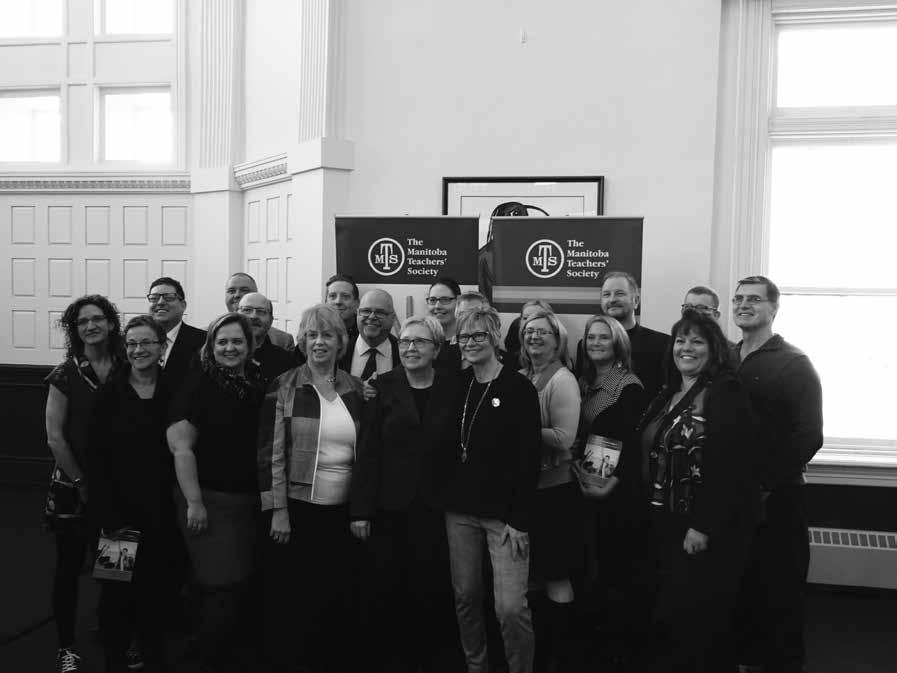
Jan. 15 marked the official launch of the final results of a national study on LGBTQ-inclusive education, dubbed the Every Teacher Project. The study – headed by University of Winnipeg professor Catherine Taylor in partnership with the Manitoba Teachers’ Society – is the largest of its kind worldwide with 3,400 participants.
The study is comprised of an online survey, as well as 24 focus groups, with the intention of investigating “Canadian educators’ experiences and perspectives on LGBTQ-inclusive education.”
“We looked into the data and found that teachers are typically being held back by system resources – lack of training, lack of professional development, lack of resources, and lack of support from school leadership and school division leadership,” said Taylor.
“That’s discouraging in a way, but it’s also something that points a way forward for us and shows us what has to be done with the situation.”
While all the data collected during the study has been compiled into a 180-page report and analyzed quantitatively, there is still work to be done to analyze the data qualitatively, according to Taylor.
97 per cent of educators who participated in the study believed that their school is safe, or somewhat safe, but this number significantly dropped when asked about LGBTQ students’ safety at school specifically. Of the educators asked, only 28 per cent agreed that their school was a safe environment for these individuals, and only 18 per cent made the same statement about transgender individuals.
Further, when asked about homophobic, transphobic, or biphobic incidents that took place over the last 12 months at their respective schools,
67 per cent of educators were aware of verbal harassment of LGBTQ students, 55 per cent were aware that LGBTQ students were the target of rumours, and 53 per cent were aware that LGBTQ students were being excluded from activities by other students.
“We looked into the data and found that teachers are typically being held back by system resources”
– Catherine Taylor, education professor, University of Winnipeg
Taylor believes that the way to mitigating these issues is through LGBTQ-inclusive education to provide students with positive examples of LGBTQ individuals, which will help reduce – and hopefully eliminate – the harassment these students face regularly.
Another major component of LGBTQ-inclusive education is support at the upper levels of the education system. Teachers need to know that they are supported and that their jobs are not on the line when standing up for their students. Teachers and educators also need adequate resources to know how to effectively promote inclusivity and answer any questions that they may be asked.
Taylor used the Roman Catholic school system of Canada as an example of what happens when there is not support at the top of the system. The teachers in the Roman Catholic school system were almost as sup-
portive of LGBTQ-inclusive education as teachers in the public system. When prodded, however, it was found that these teachers were far less likely to engage in LGBTQ-inclusive initiatives in practice. Taylor believes this has to do with the amount, or lack of, administrative- and ministrylevel support.
“Teachers in Roman Catholic schools were only a few percentage points less likely to say they approve of this work, but they were dramatically less likely to have actually talked in inclusive ways or to have participated in any LGBTQ efforts at their school. And I think the reasons for that are obvious – there is less system support for them to do that work.”
Taylor believes that in order for the necessary support to exist, the movement toward inclusivity must involve individuals in positions of authority, rather than just the individuals affected directly by antagonistic behaviour – which, in most cases, are students.
“I think this is a very grassroots kind of movement and most of the pressure for this work has come from students and from teachers who have seen the harm caused by homophobia, but it would be really nice if the grassroots could have the support of the authorities at the highest level.”
67 per cent of educators were aware of verbal harassment of LGBTQ students
An example of such legislative support is the recently amended Bill C-18 in Manitoba, the Public Schools Act, headed by Nancy Allan, the MLA for
St. Vital. The amendment focuses on the areas of the Act regarding bullying and human diversity, and also protects the rights of gay-straight alliances. At the presentation, Allan spoke extensively about her involvement with Bill C-18, which began when an LGBTQ student died as a result of harassment. Unfortunately, this is not the most recent case of a student dying as a direct function of hostile behaviour toward them due to their sexual orientation.
“It
became apparent that there are all kinds of people trying to do this sort of thing and their road block was that they didn’t have solid large-scale research to point to”
–
Catherine Taylor
Taylor had a similar start to her engagement with LGBTQ individuals and their rights. She first became involved in addressing homophobic behaviour in schools while teaching at the University of Winnipeg as a professor of education. She found that when she included LGBTQinclusive education in her courses, she experienced kickback from some students, which she flagged as an issue that needed to be addressed.
“I teach courses in anti-oppressive education, and I always included antihomophobia education in my courses. About 10 years ago, I was having some students leave my classroom in tears or shaking their fists at me,
denouncing me for daring to suggest that it’s alright to tell a child that it’s okay to be gay,” Taylor said.
“I did a lot of work trying to figure out what it was going to take to shift things for students – that was my entry point. Then it became apparent that there are all kinds of people trying to do this sort of thing and their road block was that they didn’t have solid large-scale research to point to. It was work that needed to be done.”
Upon completion of the Every Teacher Project, Taylor and her team received a grant from the Social Sciences and Humanities Research Council to complete a knowledge mobilization project. They will work with a group of representatives from different teaching organizations nationally, such as the Manitoba Teachers’ Society, to create what Taylor refers to as a “recommendation toolkit” to help educators practise LGBTQ-inclusive education.
“In each section, there wil l be our project recommendations, research to back up our recommendations, and suggestions for how to respond to questions at those different levels. That’s going to take us about another nine months to pull together,” said Taylor.
“Then, these teaching organizations across the country are going to have a toolkit to help push for system changes in their own provinces and territories.”
PHOTOS BY LAUREN SIDDALL
Alternative auto energy
Merits of new alternatives to combustion compared
SEAMUS HAMILTON-PATTISON, STAFF
At this year’s North American International Auto Show (NAIAS), Audi debuted the conceptual model of a new SUV, the Audi h-tron quattro, and Chevrolet officially unveiled their 2017 Chevrolet Bolt (after teasing the model briefly at this year’s Consumer Electronics Show).
These two models are particularly noteworthy because each pushes an alternative energy source to the forefront of conversations on burgeoning car technology.
With the official unveiling of the 2017 Chevrolet Bolt and all its accompanying specs, those in attendance at NAIAS were introduced to a car that, while still 100 per cent reliant on electricity for power, will be markedly more palatable to middle-class consumers than anything the electric car’s current flagship company, Tesla Motors, has produced.
The Bolt is powered by a 60-kilowatt hour battery, and a 200-horsepower (144-kilowatt) motor. The battery can be fully charged in nine hours at home, and will last for 200 miles (about 320 kilometres)
However, the most appealing aspect of the Bolt to many consumers is sure to be its price. After a US$7,500 federal tax credit, the Bolt will sell for under US$30,000, making it
the cheapest production electric car thus far. This diminutive hatchback might not be as aesthetically impressive as anything that’ll roll off Tesla’s assembly line – but Chevy’s never been about that. Chevy’s electric car performs well enough for the average driver who needs to get from point A to point B, and is practical and affordable above all else.
Audi’s alternatively powered car, the h-tron quattro, was only debuted in a conceptual form this year with few working parts, but the specs provided by the company on the capabilities of the SUV were impressive nonetheless.
As its name would suggest, the h-tron quattro is powered by energy from a hydrogen fuel cell powertrain. Hydrogen fuel cell engines use hydrogen gas as fuel, reacting with oxygen to generate electricity. Water and heat are the only byproducts.
Audi states the vehicle will have a range of approximately 372 miles (600 kilometres) per tank, which will take only four minutes to refill.
Honda debuted their own hydrogen fuel cell vehicle in November at the 2015 Los Angeles Auto Show. The Honda Clarity Fuel Cell sedan sports comparable fuel specs to the h-tron quattro with a driving range of over 300 miles (480 kilometres) and a refill
time of approximately three minutes.
Honda intends to deliver the Clarity Fuel Cell to select North American markets in late 2016, starting with California and expanding based on the availability of hydrogen refueling networks that will need to be implemented.
That’s really the biggest drawback to the hydrogen fuel cell as a viable energy alternative to the combustion engine – the infrastructure just isn’t in place yet.
The h-tron quattro and Clarity Fuel Cell each sport a driving range that would outlast even the Tesla Model S, and no electric car can compare to the efficiency of the hydrogen fuel cell car’s refueling process (which is more similar to gassing up than anything) that takes only a few minutes.
Small groups of hydrogen refueling stations exist in California (which explains why Honda is testing out the market there), but a worldwide network could take any number of years – and that’s assuming most governments are even on board with hydrogen’s widespread implementation as a fuel source.
However, charging an electric car is as simple as plugging it in in the winter. There are even AC adapters to make an electric car’s charging cord
work with three-pronged outlets, which aren’t exactly in short supply across North America.
Hydrogen fuel cell and electric energy sources are changing the auto industry slowly but surely, and the technologies behind each deserves to be explored and improved upon in years to come.
At this point in time, however –and especially due to the fact that a vehicle like the 2017 Chevy Bolt can even exist – electricity is much farther along than hydrogen, and is infinitely easier to implement on an international scale.
Team of doctors complete first hand transplant in Canada
Woman recovering in hospital after hand and forearm transplant in Toronto
MALAK ABAS, STAFF
Ateam of doctors in Toronto have successfully completed a full hand and forearm transplant, a first for Canada. The surgery, which took 18 surgeons about 14 hours, is expected to be a deciding factor in getting the experimental procedure approved in Canada.
The procedure was performed at Toronto Western Hospital and took over a year of preparation. The patient, a 49-year-old woman, had lost her arm below the elbow after an accident a few years prior.
While there have been 110 hand transplants done worldwide so far, this is new territory for Canadian physicians.
“It’s not a breakthrough as far as doing a new operation,” said Steven McCabe, director of the Toronto Western Hospital’s hand and upper extremity transplant program and the lead surgeon in the procedure, in an interview with the Globe and Mail. “But it means that we have it available now here and that we have a capability of doing this procedure.”
The surgery used a donated limb, along with steel plates and metal
screws. The nerves from the donated limb and the patient had to be connected, and experts are hopeful that she will gain feeling in the hand within 200 days.
They are expecting the hand and forearm’s condition to continue improving over two years. She will also require immediate intensive rehabilitation, and will have to take medication for the rest of her life to prevent the hand from being rejected.
While there have been 110 hand transplants done worldwide so far, this is new territory for Canadian physicians
Hand transplants typically have a 95 to 97 per cent five-year success rate, and the patient appears to be in good condition, McCabe said.
This being said, there are some outliers in these statistics. The first person to receive a hand transplant actually asked for it to be re-amputated due to psychological distress for example. The long road to recovery will be as mentally taxing as it will be physically.
Hand transplants are an especially divisive topic in the medical community because while they may improve functionality, they’re not strictly necessary, and many people are able to live well with only one hand.
Additionally, some of the drugs used to block the body from rejecting the hand have side effects that range between nausea and dizziness to kidney failure and cancer. Whether or not these negatives outweigh the positives really depends on the patient and their pre-surgery condition.
Transplanting body parts is by no means a new frontier. The first hand transplant was performed in 1964, but it only lasted a week before being rejected by the patient’s body.
However, through new breakthroughs in immunology and the creation of better immunosuppressants
we are getting closer to smoother, more ideal transplants. For example, a human head transplant has officially been scheduled for December 2017. What would once be regarded as a
blurb on the back cover of a Philip K. Dick novel is now a factual headline. The future is now.
GRAPHIC BY JONDELL COOMBS
GRAPHIC BY KELLY CAMPBELL
Lumosity pays US$2 million amid claims of false advertising
‘Brain-training’ game company offered incentives for testimonials, says FTC
MALAK ABAS, STAFF
Lumos Labs, the company behind the brain-training program Lumosity, are expected to pay a US$2 million settlement after a complaint by the US Federal Trade Commission (FTC) alleging that their advertising
claims were misleading. Lumosity ads have been almost inescapable within the last few years. You probably remember one. Attractive, usually young, people say they hope to “remember people’s
names” and “to get it from in here, to out there.”
The company, which described its Lumosity product as a “brain training program created by scientists and game designers,” offered over 50 mini-games and claimed that playing just 15 minutes a day, several days a week, through either their website or their mobile app, could result in improved mental cognition.
The FTC complaint states that the creators of Lumosity have said that their games could improve players’ attentiveness, memory, and even lower their risk of Alzheimer’s disease.
“Lumosity preyed on consumers’ fears about age-related cognitive decline, suggesting their games could stave off memory loss, dementia, and even Alzheimer’s disease,” Jessica
Rich, the director of the FTC’s Bureau of Consumer Protection, said in a written statement. “But Lumosity simply did not have the science to back up its ads.”
The FTC also notes that many of the company’s advertised positive testimonials were part of a contest that included prizes like iPads and free subscriptions to Lumosity.
Lumosity sells access to its games for about US$15 dollars a month, or US$300 for a lifetime subscription.
In 2013 it had a revenue of US$23 million, and made Forbes’ list of “America’s Most Promising Companies” at number 66 that same year.
Lumosity currently has 70 million members in 182 countries. The selfhelp market has taken off remarkably in recent years, and brain-training
products alone are currently worth US$1.3 billion. Part of Lumosity’s settlement with the FTC states that Lumosity must offer an easy way for members cancel their subscription and auto-renewal payments.
Many scientists say brain-training games’ claims of better memory and a healthier brain have not been substantiated.
All of this aside, Lumos Labs, creators of Lumosity, stand behind their work.
“It is important to note that this settlement does not speak to the rigour of our research or the quality of our products,” Lumosity said in a written statement responding to the FTC settlement. “We proudly stand behind the Lumosity product that millions of our members train with each month.”
GRAPHIC BY CAROLINE NORMAN
Emotional sensing capabailities of dogs
Dogs show the ability to truly understand human emotions
JEREMIAH YARMIE, STAFF
Dogs can incur the wrath of their owners from time to time – they can do stupid things. But they are also likely to be the recipient of more affection than any other being in their owner’s life. People tend to love their canine friends unconditionally.
It turns out that your pup is able to tell when you are happy or angry, and it does so by using high level emotional processing that has only ever been previously observed in humans.
A recent study conducted by the University of Lincoln in the United Kingdom, the University of São Paulo in Brazil, and the Federal University of São Paulo also in Brazil, published in the Royal Society journal Biology Letters concludes that dogs have the distinct ability to determine both dog and human emotions by integrating information based on facial and vocal changes.
Previous studies have shown that dogs can tell the difference between various human facial expressions and emotional sounds; until now, however, a study has not determined if these abilities are a result of simple association or abstract processing of emotional information.
Integrating information given off by facial expression and vocalizations allows for a faster, more accurate, and more reliable analysis of emotion. This mode of processing informa-
tion is based on categorization (recognition) rather than differentiation (association).
“That is an angry face,” determines the dog brain. “And that is an angry sound. Jeremiah must be pissed off.”
“That is an angry face,” determines the dog brain. “And that is an angry sound. Jeremiah must be pissed off”
This contrasts with determining emotion through association. “When Jeremiah makes this face, I get sent to the kennel. I don’t like the kennel, so this face is bad.”
Ever since dogs were domesticated some 20 thousand years ago, the two most important animals they’ve interacted with are fellow dogs and us humans. Understanding our emotions would have been extremely beneficial in our time spent together since then – we may have even preferred dogs that were adept at this ability.
The researchers took 17 family dogs and simultaneously presented them with a pair of images of a face –either human or a dog – with different
expressions, for example a happy and playful individual or an angry and aggressive one.
A single vocalization was paired with each pair of faces which was either positive, negative, or neutral in emotion – dog barks were paired with dog faces, and human voices were paired with human faces.
To ensure that the dogs reacted naturally, they were never exposed to the test prior to experimental trials. Moreover, the researchers used pictures of unfamiliar individuals and used audio clips of people speaking an unfamiliar language. For these experiments Portuguese was selected.
The emotional stimuli were presented to the dogs for a total of five seconds. Any trial where the dogs were paying attention to the images for at least half of that time was included in the study.
In total, the researchers analyzed almost 200 presentation trials. The dogs looked significantly longer at the faces that matched the emotion of vocalization two-thirds of the time. When the neutral vocalization was used, the subjects did not look at either picture with preference.
The researchers also found that this ability to match image to sound was not effected by the gender or species of the presented individual, or the type of emotion that was used.
Why so blue?
An explanation of unusual colouring in some tarantulas
JEREMIAH YARMIE, STAFF
Certain species of tarantulas display brilliant shades of blue on their bodies, although the colour is not produced by pigmentation.
Researchers from Ohio’s University of Akron and the Scripps Institution of Oceanography at the University of California have recently published a study in Science Advances investigating how and why these blue tarantulas exist.
When we see colours in nature, they are often the result of pigments – molecules that absorb certain wavelengths of visible light and reflect all other wavelengths back at your eyes, allowing you to perceive its colour.
For example, chlorophyll, which is abundant in most plants, doesn’t absorb green light due to its green pigmentation, and anthocyanin is responsible for the not-so-blue colour of blueberries.
Tarantulas do not rely on pigments to produce their blue exoskeleton. Instead, their colours are produced by carefully ordered nanostructures, which cause light to scatter and allow for certain colours of light to be produced and reinforced.
These same structures are responsible for the blue colour seen on but-
terflies and blue jays.
The researchers used high-powered electron microscopes to observe the organization of these nanostructures, which are found on specialized tarantula hairs. If you were to look past these hairs and focus on the surface of the spiders, you would see something rather dull and dark.
But
why so blue?
Well, the
authors of
the study
concluded,
we don’t really know
The researchers found that these structures are either multilayered, much like a crystal lattice, or ‘quasiordered’, much like a sponge.
The researchers looked through 53 arachnid genera – a taxonomic grouping used to classify organisms –and found that 40 of them had at least one species of blue tarantulas.
These select tarantula species tend to be a very specific shade of blue, from which there’s not a lot of variation.
Blue colour was independently developed at least eight times in different lineages in the evolutionary history of tarantulas. And yet, using the two mentioned ways of producing structural blue hues, somehow they all came upon the same shade. This is unlike the broader shades seen among birds and bugs.
And unlike birds and bugs, tarantula blues lack a characteristic shimmer that is seen in the other creatures. As far removed as this research might seem from practical applications, understanding this phenomenon could actually improve colour displays.
But why so blue? Well, the authors of the study concluded, we don’t really know.
What’s even more confusing is how the same shades of blue keep popping up even in tarantulas that developed the colour in different ways.
There are some ideas, though. And the researchers are pretty sure they know what is not a reason: sex.
Sexual selection is the sex-specific choice of a mate, often due to physical features. In organisms with structural colours, sexual selection often results
However, the dogs responded more strongly to dog stimuli in general –that makes sense, as dogs like looking at other dogs. So the next time you act happy
towards your dog, know that they understand how you are feeling. It probably makes them happy too.
in a large variety of colours. But this doesn’t seem to happen with blue tarantulas. Tarantulas have horrible vision and their colour perception of blue is particularly abysmal. Furthermore, one would also expect tarantulas to flaunt their sapphire-stuff during courtship if these colours were sexually selected, but this behaviour has
not been observed. This leads the researchers to believe that these colours are favoured by natural selection for some currently-unknown reason. Perhaps, they argue, blue is a happy-medium signal colour that is dull enough to avoid predators and flashy enough to attract prey.
GRAPHIC
COMIC BY SARAH WALKER
COMIC BY KELLY CAMPBELL
GRAPHIC BY BRAM KEAST
IVORY BUFFALO
Area man awaiting Nobel Peace Prize nomination after switching to almond milk
MURV BERKLEY, STAFF
Local man Devon Eirberg is awaiting a Nobel Peace Prize nomination after making the courageous decision to switch from cow’s milk to almond milk.
Eirberg made the switch after doing extensive research of whichever infographics happened to appear in his Facebook feed regarding the health impacts and harm to animals involved with conventional milk and the benefits of ingesting semi-liquefied almonds.
“Some people drink goat’s milk but there’s still a lot of harm associated with that. For me it’s all about doing the right thing – taste doesn’t even factor into it.”
Eirberg confirmed that he had not consulted his physician regarding the decision,
but said he had instead spoken to his neighbour who is “really into nutrition,” arguing that the medical establishment was in the
“I’m
just a regular guy. Same as Martin Luther King Jr., Ghandi, or Malala Yousafzai”
– Devon Eirberg
pocket of “Big Udder.” He added that he was happy to pay twice as much to drink the dirt-flavoured milk substitute.
Eirberg said that although he is expecting the nomination to come through the mail any day now, he doesn’t want to be treated differently by his friends or coworkers.
“Would I call myself a hero? No. Martyr? Maybe,” Eirberg said.
“I’m just a regular guy. Same as Martin Luther King Jr., Gandhi, or Malala [Yousafzai].”
The Ivory Buffalo reached out the Noble Peace Prize nomination committee for comment but had not received a response as of press time.
GRAPHIC
Front and central
New restaurant the Sentruhl Project takes on Canadian cuisine and more
LAUREN SIDDALL, STAFF
Central [sen-truhl]: In, at, or near the centre. Example: Winnipeg, Manitoba.
Gordon Bailey has been involved in the restaurant business since he was 13 years old, when he got a job in the dishwashing station at a local restaurant to buy a “super cool remote control car.” He quickly moved up to cooking breakfast and became hooked on the culinary arts, travelling all over the world to work with different chefs.
“Once the bug bit me, I never shook it,” said Bailey.
He and his wife eventually settled on Prince Edward Island where the two opened up a restaurant, Lot 30. The two lived there for roughly 16 years before deciding to return home to Winnipeg to be closer to family.
Upon moving back home, Bailey’s plan to make a living through his passion was obvious: open a new restaurant. The two packed up the Lot 30 kitchen into a tractor-trailer, which Bailey jokingly describes as an “IKEA-style restaurant in a box,” and headed to the centre of Canada. Prepped and primed with experience, only one thing was missing: space.
Bailey’s current business partner, Sean Audet, met Bailey while attending culinary school in P.E.I.
“When I couldn’t find a spot right away, I actually looked into where Sean Audet was at the time – a restaurant in Kelowna, Mission Hill Winery. So I sought him out and asked if he would want to be partners in a restaurant in Winnipeg, and he said yes,” explained Bailey. “I thought he was going to take some time to think about it, but he actually took about five minutes before agreeing to it.”
Audet made the move to Winnipeg and the pair continued their search for a location.
About a month and a half into their search, they stumbled upon Shelia Bennett’s new venture, Kitchen Sync. Bennett’s business essentially offers a rental kitchen for those looking to gain experience in the restaurant industry or host a private event such as a cocktail reception or wine tasting.
“We thought if we can’t get a spot right away, let’s get the ball rolling and feel out what the Manitoba marketplace is looking for, what the diners are doing, what the producers are producing,” said Bailey.
“We’ve been away from this province for so long that I wanted to get my hand back on the pulse. In order to do so, why not use this space on weekends and create something really unique and different.”
The partners struck a deal with Kitchen Sync, booking the space exclusively for Saturdays and Sundays to start their culinary project.
“The main idea behind the Sentruhl Project – and I do have to call it a project – is it’s a way for us to discover what it is we want to do, it’s a way for us to figure out how we work together, and really develop
relationships with the community while we figure out what everyone wants,” explained Audet.
Each weekend, the restaurant takes on a new persona – new theme and new menu included. The temporary restaurant then opens its doors to roughly 40 people, who have made reservations in advance.
“It’s a way for us to discover what it is we want to do, it’s a way for us to figure out how we work together, and really develop relationships with the community” – Sean Audet, the Sentruhl Project
“We strive to come up with a completely new concept every weekend. Whether it’s the menu or the dining experience itself, we want to bring forward something unique and this is what our situation is allowing us to do. It’s really exciting for us, and we hope it’s exciting for the community as well,” said Audet.
The process of coming up with a theme and corresponding menu comes very organically for the Sentruhl Project team, according to Audet.
“[The project] exploded into something with a lot of dimension and a lot of intriguing elements to it” –Gordon Bailey, the Sentruhl Project
“It’s a lot of little ideas that expand one way, and then another. We’ll have an idea and we’ll all feel really good about it so we start reading and looking up material, reading old articles, looking up posters. From there – and I know it sounds really abstract – but we can pull concepts,” he said.
“The whole reason this has been successful, and continues to be, is that we let it come organically to us. We don’t try and force it; we try and come up with really cool concepts, make sure we can tie the food to it, and make sure it is something that we’ll be interested in. Once you start putting all those things into the pot, the ideas just start bubbling out,” added Bailey.
The first series was a journey across Canada, focusing on the East Coast, then the Canadian Shield,
the Prairies, and finishing with the West Coast each subsequent weekend. About halfway through the series –after consistently selling out each weekend – Audet and Bailey knew they were onto something.
“We basically did our first four weeks with the first series and realized that we could keep this going. The whole thing started out with us
wanting to get the ball rolling and –for lack of better words – keep busy while we find a space, and it exploded into something with a lot of dimension and a lot of intriguing elements to it,” said Bailey.
“I know there’s going to be a point in time where we have to sever ties with the weekend deal and do it full time, but I feel at that point we’ll
know exactly what we want to do, what Winnipeg needs, and what’s going to keep us motivated and having fun in this industry.”
To keep up with Sentruhl’s everchanging menu and persona, like their page on Facebook.
Light up the night
Astrophotographer Sheila Wiwchar shares tips on night sky photography
TOBI NIFESI, STAFF
When it’s in the right hands, a camera can produce a masterpiece so exquisite that its beauty can only be matched by that of nature. Fortunately, astrophotographer Sheila Wiwchar is passionate about both.
On Jan. 21, Oak Hammock Marsh and Wiwchar will be hosting an astronomy night. Wiwchar will be giving tips on how to capture the beauty of night skies.
“My presentation is really meant to be inspirational to anyone wanting to capture the night sky. Anyone that has a camera will learn something,” said Wiwchar.
“I’ll share lots of tips, tricks, and creative ideas I have learnt by being in the field, from capturing auroras, the Milky Way, and meteor showers.”
Almost a decade ago, the Winnipeg-based photographer’s passion for the night sky and its stars led her into the world of astrophotography.
“I have always been lured by the stars and the mystery behind the night skies,” Wiwchar told the Manitoban
Wiwchar said that her first forays into astrophotography were sparked
by the purchase of a telescope just eight years ago.
“I still remember how seeing Saturn and its rings looked the very first time, and how it made me want to see so much more.”
In a bid to quench her thirst, Wiwchar got herself a high-quality camera and joined some photography groups and associations, including the Winnipeg chapter of the Royal Astronomy Society of Canada (RASC).
She spent years developing her photography skills, while at the same time networking with fellow astrophotographers and making exciting memories.
“I have many amazing memories of my nights under the stars, from being with friends counting meteors from a meteor shower, watching incredible aurora pouring down from the sky unexpectedly, catching the Milky Way rising above an abandoned home you stumbled upon on your own, to seeing incredible treasures show up on your LCD screen of something so far away,” said Wiwchar.
Despite all the fun and good times that are part and parcel of a life gazing at the stars, Wiwchar has had her
fair share of challenges with astrophotography. It took her a while to learn about and get used to the ample amount of equipment and gadgets and the multiple tests it takes to find the right spots. She also had to keep up with the dynamics of technology in modern photography.
“Doing nightscapes requires some fairly decent dark skies and some late nights, so travel time and finding time to catch up on sleep when you have two kids and a full time job is always a challenge,” said Wiwchar.
“Processing really requires a creative and flexible mindset, and takes a lot of experimentation to make a successful image. Technologies and methods are increasing so fast and keeping up with the latest information can be tricky.”
Today, Wiwchar has developed a wonderful catalogue and is steadily making a name for herself in the Winnipeg astrophotography community.
Visit www.oakhammockmarsh.ca for more information about Astronomy Night.
Red Riding Hood reimagined
Local actor adapts classic fairy tale into solo show
OLIVIA MICHALCZUK, STAFF
F
rom Jan. 22 to 23, actress Rachel Smith is set to present a onewoman alternate perspective of the classic Little Red Riding Hood story. The show, titled RED, will be performed in the Manitoba Theatre for Young People’s Richardson Hall. Through extensive research, which includes work done for Smith’s undergraduate degree at the University of Winnipeg and her master’s thesis at the University of Manchester in England, Smith has created an abstract look at the classic fairy tale
with a twist.
Smith took up a special studies course in her final year at the U of W.
The final project for the course was a solo performance, and she began to work on the beginning stages of her journey with the story of Little Red Riding Hood as inspiration for an undergraduate thesis.
Smith came across the story in an annotated version of Grimm’s Fairy Tales, in which the tale is titled “Little Red-Cap.” This version noted that the Grimm version of Little Red Riding
Hood was not the original story and deviated a lot from the original oral version of the story.
In the Grimm version, the wolf tricks Red Riding Hood, eats her, and the huntsman saves her by cutting open the wolf. The annotations stated that the original version has no huntsman and Red tricks the wolf and saves herself.
Smith looked for other versions of the story to include in her onewoman production for her thesis. After Smith’s performance, she thought that was the end of her work with Little Red Riding Hood.
When Smith travelled to Manchester to complete her master’s thesis, she found herself revisiting the story of Little Red Riding Hood, but this time she would have to complete a much more extensive body of work with hours upon hours of research.
“I didn’t realize how much literature, academic research, and different versions of the story there were until I started working on it as part of my master’s thesis,” said Smith.
“In Taiwan there are around 240 different versions of a similar story, just with a tiger instead of a wolf. There’s some in China where [the animal] is a bear.”
Some of the versions she came across had different morals and
meanings than the Brothers Grimm version we are used to. Some are focused on feminism, coming of age, confronting fears, connecting to nature, and others are just based on turning the tale on its head.
“I’ve taken a bit of all these different stories and put it into one. It’s an intertextual performance where it’s weaving all these different stories into one performance. I don’t tell one story from beginning to end, I use bits of all these different stories to create a new tale or a new performance,” Smith told the Manitoban.
“Some of them are humorous versions, grandma eating the wolf instead of the wolf eating grandma, or the wolf singing a song. Little variations that turn it on its head a little bit.
In one of the versions, Red Riding Hood encounters an old woman and she is very nasty instead of a wolf. [In another,] the huntsman being the male predator instead of the wolf.”
Smith went on to explain that she’s tried to incorporate as many variations of the tale into her production as she can without the play becoming too chaotic. To mitigate this concern, Smith said that (with the exception of one) she does not use any version of the story more than once in her production.
“It’s in chronological order but it’s
not necessarily linear,” she said.
“I’ll start with different versions of the beginning all mixed in to one, then move to the woods and what might happen in the woods [...] Think of it as a collage.”
There have been some challenges in producing a one-woman show. All of the characters in RED are played by Smith, so she must make full-body transformations between characters so that the audience is extremely clear on which character she’s portraying at any given time.
Another major challenge Smith has faced is the absence of a director to give her notes and feedback on her performance. Smith has had the help from previous audiences and professors to contribute feedback on how to alter her performance to make it more easily palatable.
RED is self-written and self-produced, and funded, advertised, and performed by Smith alone.
“I really wanted to do it, and I’ve worked really hard to do it,” said Smith.
RED will be performed at 8 p.m. on Jan. 22, and at 2 p.m. and 8 p.m. on the 23rd. Tickets are $15 and can be purchased through Brown Paper Tickets at redbyrachelsmith.bpt.me.
PHOTO BY RETOUCH MEDIA
PHOTOS BE SHEILA WIWCHAR
’Toban turntable
Want us to review your band? Email arts@themanitoban.com today!
SEAMUS HAMILTON-PATTISON, STAFF
Aidan Knight
Each Other
4.5/5
Vancouver-based folk musician Aidan Knight has never failed to evolve his sound with each record he releases, expanding upon the rootsy beginnings of his 2010 debut Versicolour with each subsequent release. Knight’s third album, Each Other, is no different. Each Other ’s brooding title track, the reverb-drenched “All Clear,” and melancholy album closer “Black Dream” are all sure to please fans of Knight’s previous album, while the remaining five tracks veer off and explore a few different (but nonetheless well-executed) styles.
With its simple, palm-muted guitar strumming, sparse piano, and moving crescendos, “What Light (Never Goes Dim)” could have been plucked straight from an Andrew Bird or Rufus Wainwright album. Meanwhile, “The Arp” embraces a modern psychedelicindie sound reminiscent of Tame Impala.
Knight’s distinctive, light baritone is rightfully front and centre in the album’s mix. His lyrics are delivered in a hushed tone and seem rather vague – but this suits the album’s ambient, spacey vibe just fine.
Production-wise, this album is faultless. Every instrument can be heard clearly, and all are balanced appropriately in the mix. The bass is particularly notewor-
thy in this regard for its warm tone, prominence in the mix, and for the melodic lines that drive “The Arp” and “Funeral Singers.”
Each Other is a great, mellow listen, and truly cements Knight’s ability to craft intricate, compositionally dense music without sacrificing anything in the way of dynamics or melody.
www.aidanknight.com
TOBI NIFESI, STAFF
Roger Roger Fairweather 5/5
Roger Roger is composed of singer-songwriters Lucas and Madeleine Roger. On Jan. 17, the Winnipeg-born twin-sibling folk/ roots duo released their first album Fairweather
Fairweather is a collection of nine songs that are collectively laced with folk, roots, rock, and country sounds. These sounds blend together to make for a well-crafted record. This blend is an extension of a greater juxtaposition – the fusion of the twins’ vocal and songwriting differences.
Throughout the record, the siblings take turns to lead while the other gracefully chimes in – and tracks like “13 Crows,” “Fairweather,” and “Scott Free” prove how good they sound together.
As is expected of a folk record, the album has a genuine vibe. As surely as Madeleine’s sweet-sounding ditty “O Rainy Day” calms you,
“Think of Me” and “You Came Around” will definitely get you pumped up.
Fairweather sounds really solid, especially for a debut album. The record was co-produced by the twins’ father, Lloyd Peterson (The Wailin’ Jennys, the Weakerthans), and his experience and influence bodes well for them.
The music on Fairweather will surely leave you feeling fresh, folky, and funky, so go listen to it as many times as possible.
www.rogerrogermusic.com
Nick’s on Broadway turns one
Broadway restaurant celebrates a year of quality sandwiching
TOBI NIFESI, STAFF
Alittle over a year ago, a boyhood sandwich fan spotted a vacant space on one of Winnipeg’s most historic routes. Subsequently, a unique downtown sandwich spot was born – Nick’s on Broadway.
Located on the corner of Broadway and Smith, Nick’s on Broadway is a breakfast and lunch house that specializes in homestyle sandwiches, soups, salad, and pastries.
The restaurant is run by Winnipegborn chef and owner Nick Graumann and fellow chef Ana Damaskin.
The two met while brushing up their kitchen skills at the Culinary Institute of Canada in Charlottetown, P.E.I.
“[Nick] was starting out new and needed an extra set of hands. We had already worked together before so it kind of made sense to just come on board and jump in on this,” Damaskin told the Manitoban
As stated on its website, the deli’s mission is “to make the best sandwiches in Winnipeg.” Sandwiches have always been Graumann’s favorite grub and he sees this restaurant as an opportunity to master the art of sandwich-making.
“For me, sandwiches are what I grew up with. It’s my life,” said Nick.
“I think what makes our sandwiches special is that we try to make as many of the ingredients as possible
[...] Like for our Reuben and hot pastrami, we get it in and brine it [...] it could take about a week to make our pastrami basically,” said Damaskin.
Both chefs pride themselves on their ability to provide quality food services in a beautiful space. They also try to maintain some flexibility with menu selections by switching it up every now and then.
“Part of our mandate is to keep the menu fresh [...] We probably change it every month and a half, and it kind of depends on the season and what is available,” said Graumann.
“I feel like that is almost as good as my inspiration for this; because if you had every access to every thing ever, you would not know what to cook.”
“Menu changes happen quite heavily during the summer months,” Damaskin added.
Presently, the menu’s brightest jewel has to be the pastramis. This bread and beef combo is a piquant glimpse of heaven’s bliss that deserves a page-long article – but that is a story for another day.
The restaurant’s walls are lined with beautiful photographs and artwork, including some by Winnipegbased photographer Mike Sudoma. The owners are hoping to work with more artists and help promote their works.
“This year, we are planning on
inviting more artists and hanging their works here,” said Damaskin.
“I think it would be a good way for Broadway to get a venue to hang up some arts and photography [...] It is not just all about business, it is about living too.”
Located
good place [...] There are a ton of people [living] here, we just need to get them out. Right now, we are servicing mostly the business people in the area.”
Broadway St., one of Winnipeg’s most historic and picturesque routes, is home to a growing number of eateries and coffee houses. Graumann believes the boom in restaurant business on Broadway is exactly what the street needs.
“The vision I had was to revitalize this strip,” Graumann said.
“I felt like this would be kind of a good point to make Broadway a
Another one of Graumann and Damaskin’s visions for Broadway is to eliminate food trucks during the summer months. He believes food trucks and their owners only constitute a nuisance on the street.
“I know a lot of people who are not business owners will disagree with me, but my biggest problem with Broadway is the food trucks. They do nothing for our tourism. We want to have people coming down and talk-
ing about the local businesses here [...] not movable businesses,” said Graumann.
This past weekend marked a year since Nick’s on Broadway opened and the chefs organized a two-day anniversary celebration. On Saturday, the restaurant hosted a number of live acts (including folk and jazz duos) to grace the event.
For more information about Nick’s on Broadway and their menu, visit nicksonbroadway.ca
PHOTO BY CAROLYNE KROEKER
PHOTO PROVIDED BY KILLBEAT MUSIC
PHOTO PROVIDED BY KILLBEAT MUSIC
A battle for momentum
Men’s basketball splits series against seventh-ranked UBC, Thunderbirds remain two points ahead in standings
MIKE STILL, STAFF
It was a tale of two games this past weekend at Investor’s Group Athletic Centre, as the University of Manitoba Bisons used their speed to knock off UBC on Friday, but came up short on Saturday thanks to wellrounded play from the T-birds.
Friday
The Bisons made a huge statement on Saturday night, knocking off top dog UBC in emphatic fashion 66-64.
While the score may look deceiving, Manitoba was the clear aggressor – dictating the tempo for 35 of 40 minutes. The herd took the lead late in the first quarter and never looked back, leading by as much as 15 at one point. The Thunderbirds made a late fourth-quarter charge, pulling the Bison lead to within two in the final minute, but couldn’t get the go-ahead shot to fall.
Justus Alleyn led the home the home side, doing everything asked of him and more. The six-foot-two point guard was excellent on defense with eight rebounds and three blocks, while adding a team-high 21 points. UBC forward Conor Morgan was the leading point-getter for either side, finishing with 22 points and keeping the game close in the final 10 minutes.
Despite being heavily undersized (UBC’s forwards stood at an average height of six-foot-eight, while Manitoba’s tallest defender is sixfoot-seven), Manitoba used their quickness and up-tempo style to frustrate the visitors and keep them
from playing a meticulous game in the post.
Defensively, Keith Omoerah, Wyatt Anders, and Jonathan Alexander kept the gigantic Thunderbird post-players at bay for the most part, while UBC’s playmaking guards Jordan Jensen-Whyte and Phil Jalalpoor were held to a combined 14 points.
Despite being heavily undersized, Manitoba used their quickness and up-tempo style to frustrate the visitors and kept them from playing a meticulous game in the post
The win also marks the second consecutive game where the Bisons have held their opponent to under 65 points, and the third time on the season.
“[Defensive play] is our main focus all season,” Alleyn said post-game when asked about the results from the past two weekend sets. “Every day we work on defense for half our practice, so it’s nice to see it pay off because it’s tiring in practice.”
Saturday
The Thunderbirds gained some revenge in Saturday’s rematch, using a deep bench to defeat Manitoba 76-66.
UBC dictated the pace from the opening tipoff, and never trailed at any point. The visitors received welldistributed scoring with starters Phil Jalalpoor, Jordan Jensen-Whyte, and Conor Morgan all registering at least 10 points. Their reserves also played well, especially forward Will Ondrik,
who had five rebounds, and guard Taylor Browne, who had six of his eight points in the fourth quarter.
The Bisons received offence in spurts, but couldn’t sustain any form of run. They cut the lead to four points on a few different occasions, but every time they gained momentum, the T-Birds would answer right back.
Justus Alleyn was Manitoba’s leading scorer again with 18 points, but eight of those came in the fourth
A royal return to victory
quarter, as UBC was able to contain dynamic guards Alleyn and AJ Basi. Keith Omoerah finished with a double double for the home side as well, but the Thunderbirds still won the rebounding battle as eight players had at least one board.
With the win, UBC advances to 9-3 while Manitoba falls to 8-4. Up next for the herd is a tilt with Lethbridge on the road this coming weekend.
Women’s hockey nabs first win of second half, fall in rematch against Mount Royal
ANDY CHE, STAFF
Friday
After dropping the opening weekend set of 2016 without scoring a goal, the University of Manitoba Bisons women’s hockey team broke their cold spell at Mount Royal on Friday afternoon. In a relentless display at the expense of the Cougars, the herd managed a 4-1 win – their first victory against Mount Royal this season. Both sides played to a scoreless opening period, the fourth scoreless frame between the two so far this season.
Mount Royal grabbed an early second period lead when freshman Talia Terry scored her second goal of the season. The goal came just 1:46 into the frame with Bisons goalie Rachel Dyck giving up a juicy rebound.
However, the Bisons didn’t let up and seized a powerplay opportunity less than four minutes later to level the score. Lauryn Keen’s deflection
on Caitlin Fyten’s point shot eluded goalie Jess Ross for her second goal on the campaign.
Manitoba used their momentum after the second intermission and opened the third period in ruthless fashion. Just 23 seconds in, Ross fumbled a shot that landed between her pads and defenseman Lindsay Blight beat her to the loose puck to put the Bisons ahead.
A 4-on-3 powerplay for the Cougars swayed the way of the herd when Alexandra Anderson managed a shorthanded marker for her first goal of the season.
The Bisons then took Mount Royal to the point of no return as Karissa Kirkup tallied an empty netter for the 4-1 victory.
Despite giving up a rebound that gifted the Cougars the game’s opening goal, Dyck held her ground firmly and turned away 26 shots. At the other end of the ice, Ross – who
pulled off a shutout in the first meeting of the season between the two teams – experienced a busy night with 29 saves on 32 shots.
Despite giving up a rebound which gifted the Cougars the game’s opening goal, Dyck held her ground firmly and turned away 26 shots
Saturday
The Bisons were looking to make it two wins in a row in their weekend series at Mount Royal, and might have done so if it hadn’t been for the Cougars’ resiliency on Saturday afternoon.
The home side responded from trailing three times in the game and topped the Bisons in a shootout by a 4-3 score.
Courtlyn Oswald opened the scoring for Manitoba at the midway point of the period when she tucked a close shot under the bar, beating goalie Jess Ross.
Less than three minutes into the second, the Cougars drew level. The goal was initiated by seeing-eye shot, as Sarah Weninger shoveled the puck on goal while on the ice and it found its way in for the equalizer.
With just over five minutes left in the frame, Manitoba turned a defensive odd-man rush in the other direction. Erica Rieder fed Keen for her second goal of the series and the go-ahead goal for the Bisons. Two minutes later, the Cougars responded again with Jocelyn Froehlich firing her shot through traffic and beating Dyck to level the game again.
At the midway point of the third period, Alannah Sharman managed to gather the attentions of three defenders to tee up Oswald for the 3-2 lead – her second goal of the game.
However, five minutes after going down, the Cougars leveled the game for the third time. Rachel Piitz picked out Megan Carver in the slot to beat Dyck with 4:05 left on the clock.
When overtime solved nothing, the game headed into a shootout. Janessa Jenkins scored on her first shot for the Cougars, while the Bisons were unsuccessful in their next two attempts. Weninger picked the top corner against Dyck to clinch victory for Mount Royal.
With some much-needed motivation, the Bisons return home next week to start a four-game homestand against Mount Royal and Saskatchewan.
PHOTO BY CHANTAL ZDAN
Cougars cruise past Bisons
Men’s hockey drops two straight against eighth-ranked Mount Royal
RYAN STELTER, STAFF
Friday
On Jan. 15, the University of Manitoba Bisons men’s hockey team played host to the Mount Royal Cougars in the first of a two-game set. Mount Royal was able to emerge with the 3-2 win.
The first period was fast-paced with both teams getting chances. The Cougars opened up the scoring 14 minutes into the game. Some miscommunication in the Bisons’ defensive zone allowed Brett Zarazun to walk in and score off of his own rebound.
Mount Royal picked up right where they left off three minutes
into the second period, as forward Matthew Brown backhanded a rebound past a helpless Justin Paulic.
Manitoba would get on the board nine minutes later, as Shaq Merasty picked up a loose puck on the rush and fired a nice pass through the seam to Lee Christensen who snapped home the Bisons’ first goal on the night.
Jordan DePape picked up the second assist on the play, extending his point streak to 14 games.
The Cougars struck shortly thereafter to restore their two-goal lead when a Jordan McNaughton shot from the point beat a sprawling
Paulic.
Mount Royal went to the dressing room up by two in a period in which they carried most of the momentum, forcing 11 saves out of Paulic.
The herd started the third period fast and furious, pressing hard to get back into the game. Five minutes in, Liam Bilton fed a pass to a wide-open Dylan Kelly in the slot who made no mistake, rifling a shot past Cougar netminder Cam Lanigan.
Manitoba continued to pressure hard for the equalizer, but to no avail. Some solid defensive work from the Cougars allowed them to hold on for a 3-2 victory.
Head coach Mike Sirant talked post-game about the sluggish start for the Bisons.
“The first period we did not play the way we have been playing,” Sirant said. “We were moving pucks without purpose, we were out of sync.”
With such a quick turnaround, the Bisons had to be prepared to play on Saturday against the Cougars, something Sirant touched on after the game.
"They are a very good team, you have to be at their best to beat them,” he said. “They play very good within their systems and have very good players.”
Saturday
On Saturday, Mount Royal completed the weekend sweep with a 3-1 victory. The Cougars took all four points from the weekend.
The first period was a scoreless affair that saw both teams get chances.
The Bisons’ top line of Brett Stovin, Jordan DePape, and Jesse Paradis were buzzing all period, generating many good scoring chances.
The Cougars outshot the Bisons 14-6 in the first, but it could have been worse if not for Manitoba’s excellent shot blocking, particularly from Merasty and Adam Henry.
Forty-six seconds into the second period, the Cougars broke the 0-0 deadlock when Connor Rankin showed some great patience on a 2-on-1 and slid a pass around Henry to find Cam Maclise who tapped the puck past Bison goalie Byron Spriggs.
The herd would draw level with 56 seconds remaining in the second when DePape picked up a loose puck
The Stony Mountain sensation
Red-hot rookie Brett Stovin impresses in his first season of CIS hockey
RYAN STELTER, STAFF
S
tony Mountain is a small community 16 kilometres north of Winnipeg with a population of approximately 1,700 people. It’s home to NHL Hall of Famer Babe Pratt – a six-foot-three defenseman who applied his trade in the NHL in the 1930s and 40s. Stony Mountain is also where 21-year-old Canada West rookie phenom Brett Stovin honed his gifts as a hockey player.
Despite his young age, Stovin has the experience of a seasoned veteran. He played the better part of five years in the WHL for the Saskatoon Blades as well as eight games of pro hockey with the Missouri Mavericks of the ECHL. In a short stint with the club, he racked up five goals and one assist.
Stovin has also been a leader. He was relied upon as captain of the Blades in the final year of his WHL
career. Being a leader is something that transcends the jersey you’re wearing and Stovin has stepped up to become one of the leaders on a young Bison squad.
“I’m taking on a bit of a leadership role as much as I can, and some of the guys are talking to me on the ice about different plays now,” Stovin said.
In a second-half matchup against the Alberta Golden Bears, with the score tied late in the third, Bison head coach Mike Sirant called a timeout prior to a power play. Stovin took the coach’s role and explained what everyone should be doing on the upcoming draw. Funny enough, the Bisons ended up scoring a late winner, yet another example of Stovin’s eye for the game and high hockey IQ.
Stovin’s smooth skating and uncanny finishing ability has him
sitting near the top of the rookie scoring race in the Canada West conference with nine goals and 11 assists. He’s also coming off an 11-game point streak.
Stovin’s smooth skating and uncanny finishing ability has him sitting near the top of the rookie scoring race in the Canada West
“The hardest thing about playing in the CIS is not playing all week, whereas in junior you play 72 games
where there are some pretty tough stretches,” Stovin said when asked about the difference between the WHL and CIS.
“The guys are bigger and stronger, guys have more experience and it is a bit faster. You have to think the game differently.”
Stovin had plenty of other offers to go elsewhere, but because he had spent so much time away from home playing for the Blades, he decided to move back close to home and get his education at the University of Manitoba. Stovin said that Sirant was a big reason for his decision to come back home as well.
“This is where my family is from, and getting to spend time with family is important,” Stovin said. “Mike was really approachable and really honest throughout the process which I really liked.”
after a scramble in front and put it up and over Colin Cooper. With the goal, DePape extended his point streak to 15 games and currently leads the Canada West with 33 points in 21 games (13G, 20A).
Mount Royal would regain their lead before the period was up however, when third year Cougars forward Tanner Olstad slid the puck five hole on Spriggs.
The third period saw the Bisons put tons of pressure on the visitors, but they failed to get the tying goal. Mount Royal tried their best to put the game away, including a failed penalty shot attempt, but finally sealed the deal with an empty net goal with three seconds remaining in the third.
Head coach Mike Sirant talked about the Bisons’ performance post game.
“I thought we were better today, we cleaned up a lot of things from Friday night,” he said. “Mount Royal are a very hard team to play against – positionally they’re solid.”
Sirant also talked about the intensity level of the games ahead and the toughness of their schedule coming up.
“These are the types of the games we are going to play, for the next eight games down the stretch. It is going to be tough,” Sirant said.
The Bisons head to Lethbridge next weekend to play a two-game set against the Pronghorns.
Sirant commended Stovin for his performance with the herd so far this season, discussing how he’s become one of the go-to players for the Bisons.
“Brett’s been amazing for us, he has contributed in so many ways,” Sirant said. “On the ice you can see that he’s consistently one of our best players and he plays well on both sides of the puck.”
As a natural bonus, Stovin has also provided Manitoba with some muchneeded confidence as a team.
“He just gets it, he knows how to handle himself with his teammates,” Sirant said. “He provides really good leadership, he’s positive and encouraging and says the right things at the right time.”
PHOTO BY CHANTAL ZDAN
AHL stars NHL-bound?
Moose are maturing despite below-average season
ANDY CHE, STAFF
T
he Manitoba Moose may not be a contending team in the AHL this season, but their lineup boasts a collection of blossoming talent that is en route to starring in the NHL. Masking their woeful 11-21-2-3 record are the individual displays of Chase De Leo, J.P. Lipon, Josh Morrissey, Brenden Kichton, and Eric Comrie.
Though defined as a young and blossoming franchise, the Moose’s below-par season can be attributed to the high-end youngsters in the system already cracking the Jets roster, such as Nikolaj Ehlers, Mark Scheifele, and Jacob Trouba. Earlier this campaign, the Moose lost brawny goaltender Connor Hellebuyck to an NHL call-up, leaving the starter’s job to Comrie – a first-year pro.
If anything, Hellebuyck’s call-up was a blessing in disguise. The native of Commerce, Mich. has emerged as one of the best goaltenders in the NHL since leapfrogging Ondřej Pavelec and Michael Hutchinson to become the Jets’ starter.
Meanwhile, Comrie has also been in top form for the Moose since inheriting the starter’s position. The 20-year-old is getting accustomed to facing more than 30 shots per night, producing a respectable 2.80 GAA, 0.915 save percentage, and his first pro shutout. Expect Comrie to finish the season as one of the Moose’s lifelines.
Manitoba’s concerns lie within the defensive corps, with the back six giving up 35 shots on four occasions since their first game of 2016.
Aside from Morrissey and Kichton, the collective efforts from the rest of the Moose defenders have been nothing other than average. The temporary sending down of Paul Postma should provide the blue line with some much-needed physical presence for a team that has averaged 3.19 goals against this season.
Kichton has been an offensive stalwart, leading the team with 18 assists and three goals this season
Kichton has been an offensive stalwart, leading the team with 18 assists and three goals this season. Meanwhile, Morrissey’s dominant two-way display thus far this season should warrant him at least one stint in the big leagues by April.
Both blueliners are offensive catalysts from the back end with a feisty and disciplined defensive edge, and either would make a worthy successor should the Jets lose Dustin Byfuglien or offload Tobias Enstrom.
As epitomized by forward Nic Petan, the Moose have also been sorely lacking in the offensive department. The 20-year-old forward – who has 110 WHL career goals to his credit – has scored just
two AHL goals this season. To make his next return to the NHL permanent, Petan’s scoring rate will have to increase dramatically within next few months.
John Albert is another Moose who has been scarce in the goal department. The captain has only scored five goals this season, while he netted 16 and 28 in his past two campaigns with the St. John’s IceCaps. Despite the Moose’s league-worst
76 goals this season, 20-year-old De Leo has found a nose for the net. The AHL rookie’s 11 goals in 35 games leads the Moose after scoring just two in his first two months.
Manitoba has also taken advantage of Lipon’s sudden confidence in shot attempts. Often used on the right faceoff circle on the powerplay unit, Lipon has contributed to 23 per cent of the Moose’s successful powerplays this season.
Though the former Canadian World Junior player has declined since hitting 32 assists and 41 points as an AHL rookie, Lipon is on pace to hit the 20-goal mark after scoring just 14 in his first two seasons combined. Should his goal rate continue to reach new ceilings, his presence would be welcome as a second- or third-line winger for the next few seasons to come.
GRAPHIC
Getting to know your Bisons track and field team
Highlighting a few athletes to watch in 2016
MIKE STILL, STAFF
The University of Manitoba Bisons track and field team has made strides over the past few seasons and with a strong roster for both the women and men beginning to come into form, the sky is the limit. Below are the stories of a handful of Bison athletes as they aim for big things in 2016.
“The women’s team has grown immensely in strength and I hope I can be a leader that can one day bring home a Canada West banner” – Sasanie Wanigasekara
Name: Gee-ef
Nkwonta (captain)
Year: Fourth
Discipline: Long jump/triple jump
I took an unlikely route to find track that had me competing in a wide variety of sports with basketball being my main priority. It wasn't until the last month of high school that I even decided to start attempting track and field and the individuality is what has kept me in the sport up until now. I set high standards for myself and once I break them I continue to make a new set of standards. This year looks promising for our fairly young team looking to give
the amazing fifth year athletes their well-deserved swan song. The boys’ side is continuing to show they are a title contender and the women's side is showing that they have the pieces to put up a fight as well.
Personally I’m just aiming to improve. Whether that’s on PRs [personal records] or past results at certain meets, no matter how well I perform, I can be happy but not satisfied.
Name: Wilfred SamKing (captain)
Year: Fifth
Discipline: Sprints/ long jump
I’ve been captain of the Bisons track & field team for the past four years; this year my goals are very large and I want to stand on not only the Canada West Podium but also the CIS podium this season. I will have two primary events this year, the 60-metre and long jump. This year is my first full year of long jump, after making finals and finishing eighth in the country at this year’s Canadian Senior Nationals.
After last year’s injuries I have a newfound appreciation for my teammates, the sport, and all the other blessings that come with being part of such an amazing team. I would like to thank my coaches – head coaches Claude Berube, Alex Gardiner, and my event coaches Rory McIntyre and Mingpu Wu for also believing in my ability and me. This is my final year and I need to perform to the best of my ability on and off the track.
Name: Tamara
Paetsch (captain)
Year: Fourth Discipline: High jump/ pole vaulting
I compete in high jump and have recently started pole-vaulting as well. My love for competition started at a young age as a multi-sport athlete. Through high school I competed in track and field and enjoyed the mental and physical challenge of the sport.
I jumped my personal best of 1.73 metres in high jump last season at the CIS championships. My goal for this season is to jump 1.78 metres. I am proud to be able to represent Manitoba at track meets, and am grateful to have very talented and supportive teammates to compete alongside.
Name: Rebekah Sass (captain)
Year: Third Discipline: Mid-distance/ distance
I am a mid-distance and distance runner competing in events from the 400-metre to cross country, but the 1,500-metre is my main event.
I started my track career in grade 9 with Winnipeg Optimist Athletics. I was not very involved in the sport until my indoor season in grade 10. That year, I ran a 10 second personal best in the 800, which caused me to finally start to take the sport seriously. I continued to improve in my various races so when I raced high school provincials in my grade 12 year I won the 1,500-metre and the 3,000-metre, and came second in the 800 metre. Over my university career I have been a Second Team All-Canadian
in cross country, a First-Team and Second-Team All-Star in Canada West in cross country, third in the 4x800 and third in the 3,000-metre at Canada West track and field indoors. My goals for this season are to make CIS standard and compete at the CIS for the 1,500-metre and for the 4x800.
Name: Aoun Muhammad Year: First Discipline: Sprints
I am an international student from Pakistan and am very happy to be competing this year; last year I was at the International College of Manitoba and was not able to compete for the University of Manitoba. I was hurt because I was beyond excited to be a part of Bisons track and field, but this year I get to wear the singlet and compete for my school.
I will be competing in the 60-metre, 300-metre, and 4x200metre relay races. I’ve also qualified to represent Pakistan at this year’s International Association of Athletics Federations World Indoor Track & Field Championships in Oregon.
My goals this year are to qualify for this year’s CIS Championships, and medal at the 2016 Track & Field Canada West Championships. I would like to thank Canada, the University of Manitoba, and my Bisons track and field team for welcoming me with open arms.
Name: Melissa Richards Year: Fifth Discipline: Pole vault
My former gymnastics coach was a pole-vaulter and invited me to watch one of her track meets. While
watching, I noticed how much fun all the athletes were having and I was truly amazed at how they would sprint down the runway and launch themselves into the air, as if they were flying. They were fearless. When I stopped gymnastics, I tried pole vaulting and this is now my seventh year of being a vaulter.
I jumped my personal best of 3.81 metres last year at the CIS championships in Windsor. My goal for this season is to jump four metres and place in the top three at the championships.
Name: Erin Tramley Year: Second Discipline: Middle/ long distance I started running in grade four and participated in cross-country and track throughout elementary school and high school, but for the most part I played soccer. In grade 11, I decided to switch over to track and have focused on it since.
This past summer I competed at the Western Canada Summer Games. I run both cross-country and track and my events on the track are the 600, the 800, the 1,000, and the 1,500metres. This is my second year as a Bison and I am proud to be a part of such an amazing team.
Individually, my goal this indoor season is to focus on the 600-metre and the 1,000-metre and then compete in one or both at the Canada West Championships in Saskatoon this February. Since both events are only offered in indoor it’s nice to see the progression in them from last year. In terms of team events, my goal is to make the 4x 800-relay team and then hopefully help the team qualify for the CIS Championships in York in March. I had a great experience as part of the relay team last year so I’m hoping we can make it back.
Name: Sasanie Wanigasekara
Year: Third Discipline: Long jump/ triple jump/sprints
In my first two years on the team I have made both the Canada West team individually for triple jump, long jump and the 300-metre as well as the CIS team for the 4x200meter relay. This year however my goals have grown larger as I not only want to make the CIS team for a relay but also individually for triple jump.
It’s early in the season and seeing the improvements already made technically in my chosen events, I know with help of my individual event coaches Rory McIntyre and Alanna Boudreau I will succeed. I would lastly like to thank my team as a whole for making these three years already so memorable. I can’t wait to see what this season as well as the seasons to come have in store.
The women’s team has grown immensely in strength and I hope I can be a leader that can one day bring home a Canada West banner.