New UMSU restaurant opens on third floor of University Centre
Crai G aD olph
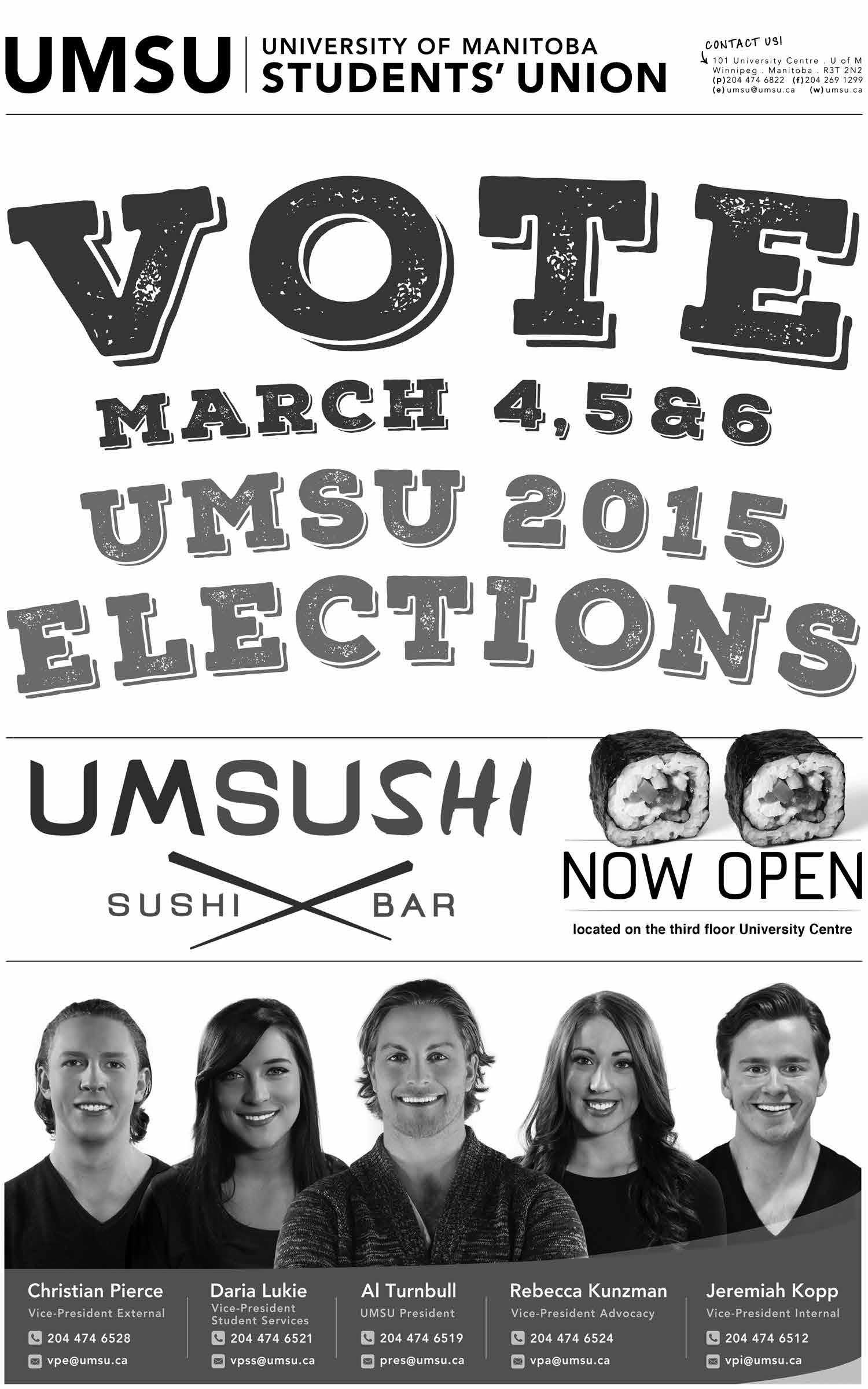
The University of Manitoba Students’ Union (UMSU) held the grand opening for UMSUshi last week, a new take-out restaurant run by the students’ union on the third floor of University Centre.
The sushi restaurant is taking the
place of Global Bubble Tea, which had been leasing the space inside
I.Q.’s Cafe and Billiards from UMSU for several years. The University of Manitoba Students’ Union terminated their lease with Global Bubble Tea in order to make room for the
new business.
The Refresh slate – which won last year’s UMSU election – featured UMSUshi as a cornerstone of their policy platform.
UMSUshi is the seventh UMSU business operating on the Fort Garry campus, alongside Degrees Restaurant, the Hub Pub, I.Q.’s Cafe and Billiards, G.P.A.’s Convenience Store, Archives Used Bookstore, and the Digital Copy Centre.
Jeremiah Kopp, UMSU vicepresident internal, first reported the executive’s plans for UMSUshi to UMSU Council at their July 21 meeting as part of his officer’s report. The new business was proposed as part of a larger redesign plan for University Centre’s third floor, titled “UMSU Street.”
The full renovation included removing the wall at the entrance to I.Q.’s, a mural along the hallway near the entrance to the Hub and the UMFM radio station, small dining tables being added in the hallway, signage bearing the UMSU Street name, and renovations to Degrees
and the Hub.
“We wanted to personalize the third floor, make it a hub for students – no pun intended [ . . . ] this isn’t administration, this isn’t faculty, it’s not staff; it’s you. It’s run by students, for students,” said Al Turnbull, UMSU president.
Turnbull told the Manitoban that, due to the close proximity of Degrees’ kitchen and the relatively easy preparation steps for sushi, they have not had to hire new kitchen staff. UMSUshi is currently run by select staff and management from Degrees.
Food and beverage manager Thomas Blumer will be overseeing the operation of UMSUshi in addition to his managerial roles with the Hub and Degrees.
Blumer told the Manitoban that the sushi will be made with cooked fish prepared fresh every day.
Blumer did not rule out the preparation of raw sushi rolls, but said the introduction of raw fish will be contingent on how the business fares in the coming months. For now, most rolls will be prepared with either
smoked salmon or cooked tuna.
UMSUshi is a “grab and go” takeout establishment, as opposed to a sit-down restaurant like Degrees or the Hub.
“Sushi restaurants are really saturated in Winnipeg, I feel, and we didn’t want to just cookie-cutter a [restaurant]; we wanted to have something that made sense for students here,” Turnbull said.
“If you want a couple rolls of sushi and you want them quick, fresh, and at an affordable rate, then you can come to UMSUshi [ . . . ] I think that’s the model students want.” Turnbull sees the opening of UMSUshi as another step towards the completion of UMSU Street and the fulfillment of promises in last year’s campaign platform.
“We’ve accomplished every single goal that we’ve set out to accomplish since last year’s campaign. I do think we’ve checked off every single thing. That includes Frosh, Frost, UMSUshi [ . . . ] UMSUshi was a campaign promise and we don’t throw those out lightly.”
Photo by sean tam
Online voting off the table this year
UMSU rejects online voting despite success for UMGSA, other universities
S E a MUS h a M ilton- patti S on, staff
University of Manitoba students will be voting using paper ballots again during this week’s University of Manitoba Students’ Union (UMSU) General Election after the union rejected the kind of online voting system that other Canadian universities have embraced.
Al Turnbull, UMSU president, told the Manitoban that it is imperative for candidates and election officials to “physically engage” students, thus providing one reason that the election will be conducted using traditional paper ballots this week.
However, student union elections have seen voter turnout decrease repeatedly under the traditional system.
At the beginning of this academic year, the Manitoban reported a significant decrease in voter turnout for the University 1 student council elections in October, with approximately one-quarter of the prior year’s voter turnout.
est we’ve had.”
Laura Reimer, assistant political science professor at the University of Winnipeg, told the Manitoban that she is supportive of the movement towards online voting.
“I think it’s simpler, it’s immediate, and students won’t have difficulty doing it,” Reimer said.
“The strength of it is that it’s easy – students could be able to vote from their phones with really no excuse for not doing it.
“I think there are too many holes for potential corruption, hacking, etc. [ . . . ] I also think it would take away from us fully engaging the students” – Al Turnbull,
UMSU president
Last year’s UMSU General Election was reported as receiving a lower voter turnout than the year before, with the participation of approximately 21 per cent of eligible students. In contrast, the 2013 general election set a record high of 23.7 per cent.
Such low student voter participation has led some universities to institute online voting in order to improve the convenience and efficiency by which students can cast a ballot.
Wilfrid Laurier University in Waterloo, Ontario, experienced a 158 per cent increase in voter turnout after the introduction of online voting in their 2011 student government election. Similarly, Queen’s University saw a three per cent improvement in their student government election turnout when they switched from paper to online ballots in 2010.
Online voting systems are not confined to Ontario universities. The University of Manitoba Graduate Students’ Association (UMGSA) introduced online voting for its elections in 2011, with a corresponding increase in voter turnout.
“It definitely is a benefit to voter turnout and to the easing of the process for the UMGSA. We started doing online voting in February of 2011, so we’ve done it for our general elections for the last few years and referendums as they’ve come up,” said Laura Rempel, president of UMGSA, noting the particularly high turnout of last year’s referendum on the U-Pass for U of M students.
“For our U-Pass turnout, it was 34.2 per cent, which is definitely the high-
It’s inexpensive, wide-reaching, accessible for everyone who’s got some kind of online expertise.”
While broadly supportive of online voting, Reimer pointed out potential drawbacks that, while more applicable to nonstudent body elections, could be a potential cause for concern for the campus’s less computer literate students.
“I think the only drawback is that it doesn’t encourage participation by people that aren’t computer literate, and statistics indicate the greatest voting population is seniors,” she said. Turnbull told the Manitoban that online voting is not a catch-all solution, and that it creates a host of other problems beyond lower voter participation.
“I think there are too many holes for potential corruption, hacking, etc [ . . . ] I also think it would take away from us fully engaging the students. It saves money, but I think apathy would rise. Our generation is often spammed with this stuff and I don’t think students, unless they’re engaged, can very well get through their degree without knowing their student union,” Turnbull said.
“I do not think it would increase voter turnout.”
Turnbull said he cannot rule out the implementation of online voting by UMSU in subsequent elections, but goes on to cite his own on-the-job experience as the rationale behind his stance, and the importance he places on personally engaging with students.
“After running two hard campaigns, I’m a firm believer in physically engaging the students. We want to make sure everyone’s getting engaged and sometimes they need a push. Campaigns can get aggressive, but I think we’re all better for it in the end. There’s something very human about voting and getting engaged in your election and I don’t think online voting can ever replace that.”
GraPhiC by evan tremblay
Editor-In-Chief:
Fraser Nelund
Contact: Editor@themanitoban.com / 474.6770
Getting fans in the stands
Attendance at Bison sports events needs to improve
Mik E Still, staff
Things are changing for the better when it comes to sports and recreation at the University of Manitoba. The trend in the right direction started in September of 2013, when the Bison football team played their first-ever game in the newlyopened Investors Group Field (IGF). A humungous step up from the old University Stadium, IGF has a capacity of 33,422 spectators, and is hands down the best facility in the CIS.
Another positive step occurred at the beginning of the 2015 winter term, when the sports and recreation fee was tacked onto tuition costs. While the fee currently amounts to $56.25 for full-time students and $42.20 for part-time students, it gives students free access to any Bison sports home game during the regular season.
Both examples mentioned above provide strong incentive for students to come out and support their fellow Bisons as they represent our university on the court, ice, and turf. Despite these advantages, our home game attendance is still abysmal.
It all starts with IGF
In order to diagnose the lack of fan support, it is first important to break down the attendance, based on the sport. The most logical place to start is with football, since we have the second largest seating capacity in the
CIS, second only to the University of Calgary’s 35,650, at McMahon Stadium.
During the entirety of the 2014 Bison football season, the largest attendance level was at the home opener, where 6,435 fans showed up. That’s pathetic.
There are 27,599 students enrolled at our university. Based on that number, each and every individual could theoretically show up to the game to cheer on the herd. Imagine how much of a home field advantage that could give us.
There is nothing more embarrassing than having to use our crossprovince rivals in Saskatchewan as an example of how strikingly low our turnout is.
Griffiths Stadium, where the Huskies play their home football, has a capacity of just 6,171. That is more than four times less than IGF, yet 8,121 fans showed up for their 2014 home opener. That number trumped our biggest turnout, and worse yet, the Huskies ended up winning that particular game. Fan support makes a huge difference.
The top three football teams in home attendance last year (Laval, Western, and Saskatchewan) all averaged over 5,000 fans per game, yet none of those three schools have a facility that can fit anywhere close to
the amount that Manitoba can. Laval comes the closest, at 12,257, which is still more than doubled by the size of IGF.
Manitoba ranked 14th in the CIS in fan attendance at home football games last year, with an average of 2,645. It is simply absurd to me that we can be so far down on the totem pole, when we have a top tier facility that is accessible to all students on campus.
I challenge each and every student to embed themselves in the U of M’s winning culture, and turn out to support your fellow students!
The question then becomes, how does a school like Laval get over 12,000 people to come out to every single football game? Well, it begins with the culture that is embedded on campus.
The Laval Rouge et Or football program has only been around since 1996, but it was an instant success because it gave Francophone ath-
letes—who may not otherwise be able to play due to the language barrier—a school where they were completely comfortable, both academically and athletically. When you have a school that is catered to the students’ background, commitment levels will naturally increase.
Another huge reason for Laval’s whopping numbers is their alumni. There are over 241,000 of them, more than half of whom are close to home.
These alumni, who again, come from a French language background, are able to promote the excitement of the team to family, friends, and students.
Based on the program’s track record of success, it isn’t hard to convince people to come out.
Manitoba has a number of alumni of their own, and in order to attract a higher turnout to IGF, I believe their participation is critical. There needs to be more interaction between Bison sports and former athletes, whose experiences and passion could hopefully start a move in the right direction in terms of turnout.
Why isn’t the Investors Group Athletic Centre crowd equal?
Investors Group Athletic Centre, where both the volleyball and basketball teams play, has a capacity of just over 3,000 people. In 2014, both the
men and women’s volleyball teams led the nation in fan turnout, with an average of 591 people coming out to show support to the women, and 664 for the men.
While that number can become much higher still, it’s quite promising. What isn’t promising is the number of people who came out for basketball this year. Both teams were ranked 10th in average attendance, with just 373 people coming out to women’s basketball through the year.
While I understand that the women’s volleyball team was the defending national champion, which would naturally lead to a higher turnout the following year, the two sports still occur in the same gym. The energy level of the crowd plays an impact, regardless of what sport is being played.
“Bison fans are easily the sixth man for any Bison team,” said men’s basketball co-captain Wyatt Anders.
“They provide energy to players when they cheer and fill our stands. They are valuable to our teams more than they believe, and they take some pressure off us, and add pressure to opponents coming to our gym.”
Even if it doesn’t seem like it, having a strong home crowd can sway the result of a game, especially in Investors Group Athletic Centre, where sound resonates quite effectively. You need look no further than the Big Horns’ booming drums and trumpets to find evidence of that.
Fill the Fleming
The Wayne Fleming Arena, home to both Bison hockey teams, has a capacity of roughly 1,400 people. Unfortunately, neither team had an average of over 300 people attend their home games this year.
Again, I scratch my head at this. Our hockey programs have had consistent success, yet most games simply feature parents and siblings. Imagine how big of a factor students could play if they showed up by the hundreds.
Various head coaches—including Mike Sirant, the men’s hockey head coach, and Jon Rempel, the women’s head coach—have echoed that fan support makes a big difference. It pumps up the players, and can potentially give them the extra kick they need, especially in big games.
Make your presence felt
Next year, students will have the full opportunity to take advantage of free attendance at home games. We have some exceptional teams on this campus, and you’re missing out if you don’t capitalize on the chance to see them play live.
There are facets of student life beyond going to school and going home. Bison sports is one of those facets, and I challenge each and every student to embed themselves in the U of M’s winning culture, and turn out to support our fellow students!
GraPhiC by bram Keast
Parsing the Canadian history wars
Every party, not just the Conservatives, pushes their own view of history
Ethan Cab E l, staff
Among the list of grievances
critics of Prime Minister
Stephen Harper inevitably trot out as further evidence of his profound, Machiavellian evil is the way in which Canadian history has been rebranded, or remade, under his leadership.
The common refrain is that the prime minister insists on emphasizing the country’s ties to the Commonwealth and the monarchy, coupled with perceived military valour (particularly during the War of 1812 and the First World War) at the expense of other historical narratives that are more valuable in understanding Canada’s political and socioeconomic development. He does this, his critics say, for purely partisan political purposes.
Taking these critics at their word and conceding that the prime minister is remaking Canadian history to correspond with the Conservative brand, a reasonable question to ask is whether such rebranding is a perilous injustice committed only by the Harper Conservatives.
But ultimately, every party views history through a uniquely (and oftentimes distorted) partisan lens.
The New Democrats, for example, inevitably see the arch of history as one in which social and labour movements have used collective action, both through political parties as well as through strikes and mass protests, to pressure governments into significant social welfare reforms, from old age pensions to universal health care. For the NDP, history is all about the collective fight for social equality.
The Liberals, in contrast, define the arch of Canadian history as a struggle for independence from Great Britain and a perpetual fight for national unity. Liberals believe the completion of Canada’s historic arch rests on the foundation of constitutionally protected individual human rights for all citizens. Repatriation and the Charter, established by Pierre Elliot Trudeau, is what keeps the country together. For the Liberals, unsurprisingly, history is all about individual liberty.
Then there is the Conservative approach. The Tories ultimately value traditional institutions, such as the monarchy and the Commonwealth, and believe that our stubborn maintenance of these institutions is integral to understanding Canada’s longstanding prosperity and security.
As such, Conservatives emphasize our impassioned resistance to American conquest in 1812 and our valiant effort in support of the mother country, Great Britain, during the First World War. For the Conservatives we are above all British subjects and Crown loyalists who categorically rejected (and still reject) the Republican experiment to the South – and we’re better off for it. For the Conservatives, unsurprisingly, history is all about institutional stability and nationalistic resolve.
Given these competing visions
of Canadian history, each of which conveniently fit into a broader partisan narrative, is it any wonder that the Conservatives, upon winning office, would expound the virtues of Queen and country to a nation all too familiar with Liberal human rights narratives?
In short, no one should be surprised that the Harper Conservatives have chosen to give their peculiar brand of history more prominence on the national stage. Rather, the much more consequential issue raised by Harper’s staunchest critics is the extent to which these partisan skirmishes do any particular harm.
The most virulent critics argue that the prime minister’s approach is not only conveniently blind to historical nuance, but that it deliberately excludes certain under-represented voices from the national dialogue, such as those of Aboriginal people. This was seen recently in the outcry over the celebration of Sir John A. Macdonald’s 200th birthday, which was met with heated criticism from those who believe Macdonald was little more than a genocidal racist.
It was the latest controversy among many.
Seemingly thousands in the academic world cried foul when the Conservatives announced that the Canadian Museum of Civilization in Gatineau, Quebec over the bridge from Ottawa would be renamed the Museum of Canadian History with a distinct focus on the country’s political development; they portrayed the changed mandate as undue political interference in the affairs of an important national institution.
Even the remarkable discovery of the HMS Erebus was confronted with petulance, with many describing the resources spent on the exhibition, and the celebration of the discovery, as a subtle propaganda campaign rather than an endearing (and fascinating) part of our national mythology.
Finally, the planned victims of communism monument has been described as everything from a crass political manoeuvre to attract immigrant voters to yet another extension of Conservative foreign policy bluster in the form of national propaganda.
Naturally, it couldn’t be both inherently political and also a sincere gesture of good will and remembrance of past atrocities. While there is legitimate debate over the location of the monument (it should not dwarf the Supreme Court of Canada), it is entirely appropriate to have such a monument in the nation’s capital.
In short, the Tory historical perspective does exclude large swathes of criticism, but it also adds something that has been missing from Canada’s national discourse for decades – an acknowledgement of our remarkable peace and stability as a society and a celebration of our British institutions, from the monarchy to the Westminster model.
Public money goes to fund innumerable research projects and other initiatives meant to scrutinize, question, and change government policy. Canada’s museums and monuments include a great deal that is expressly critical of past Canadian governments. But politicians are not historians. As politicians, they are fundamentally interested in celebrating—not deriding—Canadian
institutions and traditions, particularly when those traditions suit their partisan purposes and perspectives.
This applies to all parties. One wonders, for example, about the kind of spectacle the 25th anniversary of the Charter would have engendered had the Liberals been in power in 2007. One may wish that the Harper Conservatives had not played politics with the 25th anniversary of the country’s Constitution by downplaying and undermining it, but they did. Just as their opponents will with other issues.
When presented in isolation, the historical perspective of Canada’s three main political parties seems in conflict. But taken together they represent much of what defines Canada’s history. As thoughtful citizens, we should be able to delineate between Canada’s multifaceted historical reality and these individual narratives, while being grateful that we live in a nation that is still enthusiastic about recalling, and celebrating, its unique and compelling history.
GraPhiC by bradly WohlGemuth
Scrutinizing anti-anti-vaccination
Vaccines are great, but we need to be careful how we talk about them
to M i n G ra M , staff
Vaccines have been in the air recently. With the resurgence of anti-vaccination sentiment and the consequent outbreaks of diseases that had been largely forgotten in the western world, the stuff we jab into our arms has been very much a topic for discussion. Even the Manitoban has joined in the fun.
I agree that, in most cases, people should get vaccinated. I agree that the science underpinning the antivaccination movement is highly questionable (to the extent it exists at all). But a lot of the rhetoric coming from the other side is pretty questionable as well, and it is much less likely to be scrutinized.
Since I’m convinced that readers of the Manitoban largely accept the official line regarding vaccines and do not need to be persuaded that they are safe and effective, I think it is useful to play devil’s advocate and point out some of the problems with the anti-anti-vaccination movement.
The medical and academic communities have yet to take adequate responsibility for their role in fanning the flames of the anti-vaccine movement
Whence anti-vaccination?
Much of the modern anti-vaccination movement springs from Andrew Wakefield’s 1998 study that supposedly revealed a link between the measles-mumps-rubella vaccine and autism. The study itself was poorly designed, with a small sample size and numerous other flaws. Its results were never replicated, so its value as science was highly dubious to begin with.
But a fact that has not attracted nearly as much media attention as it should have is that in 2011, more than 10 years after it was published in the Lancet (one of the world’s leading medical and scientific journals), the study was revealed to be a fraud. Wakefield fudged the numbers, altered medical records, and selectively recruited subjects.
The person who uncovered the fraud was Brian Deer – not a doctor or other academic, but a journalist. Let’s get one thing straight: I’m all in favour of a vigorous and inquisitive press, but it is not the role of the media to suss out problems like this in medical studies. It is the role of the medical and academic communities to ensure that such problems do not occur, or, if they do, that they are not published and given the stamp of legitimate science.
The fact that the public even heard of the Wakefield study is evidence that the peer-review system is not working as advertised, at least in connection with medicine.
The study forces us to ask: just how much of our science is totally made up, anyway? It’s probably not a large percentage, but it’s not zero, either. And how much of the research supporting vaccines is fabricated or otherwise tainted? Again, probably not a lot, but there is almost certainly some. We must lessen our confidence in what we think we know.
More importantly, the fact that the Wakefield fraud was not caught forces us to trust doctors less – nothing personal, it’s just statistics. The medical and academic communities have yet to take adequate responsibility for their role in propagating Wakefield’s lies and thereby fanning the flames of the anti-vaccine movement.
Should vaccines be mandatory?
In light of this, I am alarmed when Alex Passey, in a recent article in the Manitoban entitled “The left wing’s science blind spot,” offhandedly mentions mandatory vaccination for all children as if it is a no-brainer for anyone with a rational and scientific worldview.
Vaccines are medicine, not sorcery. There is no a priori reason that any given vaccine should be safe to use in all circumstances, and the revelation of Wakefield’s misconduct does nothing to change this. Again, I stress that for most people, in most circumstances, following the default medical recommendation is a good idea. But there has to be an explicit and informed decision based on consideration of the costs and the benefits, not a blanket proclamation.
Doctors have very little time to read journals, and current knowledge—which, again, is not necessarily trustworthy—takes a long time to filter down to them. This means that it is possible that any given patient could know more about his medical situation than his doctor does. In this environment, it is unethical and offensive to modern notions of patient autonomy for doctors to unilaterally make these quite serious health decisions on behalf of their patients.
How should we talk about it?
People in the anti-vaccination camp are generally portrayed as horrendously stupid conspiracy theorists or hippies. For example, LA Times columnist Michael Hiltzik wrote that the anti-vaccination movement is “backsliding into medieval ignorance,” and words like “crazy” and “idiot” have been used in connection with anti-vaccine advocates. Some pediatricians have even refused to see patients whose parents refuse to get them vaccinated. It seems as if there is a concerted attempt to brand the practice of vac-
cination as a medical procedure for the educated, progressive (but not too progressive) elite. This sort of thing is not helpful.
Branding vaccination as the position of a left-wing intellectual elite will not convince people to start doing it
Branding doesn’t convince people to change what they do, it reinforces existing divides. It creates an artificial
separation between people by which they can identify themselves. Part of the value of a brand is in the people who don’t like it.
Branding vaccination as the position of a left-wing intellectual elite will not convince people to start doing it. It may even have the opposite effect. Insulting people doesn’t make them to change their minds, it makes them to dig in.
Most importantly, we should not forget that, whatever other ugly things it may be mixed with, antivaccination sentiment stems from the most noble of human impulses: the desire to preserve the safety of children.
Members of the anti-vaccination
movement may have their facts wrong, and they may be putting the rest of us at a great deal of risk. But hating them will not help. In the end, blind trust of the medical establishment played a role in creating this mess, and it is unlikely to get us out of it. What we need is an atmosphere of calm sobriety around serious health-care issues, and this is an atmosphere we are currently unlikely to find, either from the anti-vaccine activists or those identifying as their opponents.
Dear prime minister
A very special love letter
Evan t r EM blay, staff
Dear Mr. Harper, It’s time I came clean. I love you. I’ve wanted to say it for a long time, but after reading bill C-51, I just can’t keep it bottled up inside any longer. It’s got me all hot and bothered.
I can’t stop thinking about you, Mr. Harper. Every time I visit a Government of Canada website— I’m sorry, a Harper government website—I’m reminded of you. There’s a lot more blue than there used to be on government websites, which is good – they match the Economic Action Plan signs, and I like well-coiffed visual propaganda.
I love the way you govern, with a certain debonair je-ne-sais-quois that makes me wonder if I should rather say “rule.” I love the way you ignore the premiers of the provinces which comprise our Federation. I love the way you ignore questions in the House, disdain the media, and make important budget announcements at Conservative events. Nothing’s sexier than a man who plays hard to get. I love the way you prioritize spending. Buy fighter jets, and reduce Environment and Parks Canada budgets. You know how to spend money. I was really sorry I missed your War of 1812 party; I hear you spared no expense. But with less money for the CBC, you could afford to splurge.
Dominate archivists and librarians, muzzle scientists, show those veterans who their daddy is. I felt kind of left out, was starting to think maybe I wasn’t your type. But then I found out that environmental groups are being audited and having their charitable status revoked, and I bit my tongue in anticipation.
I love your big, bulging omnibus bills. No time for judicial oversight or parliamentary debate. Just ram it in. You do it a lot; you’ve got experience. I’m sure your omnibuses are clean. It’s enough to make a man faint – but that’s why you prorogue, and like a pro. Hot and cold, legislative edging.
I love Bill C-51.
I love your big, bulging omnibus bills. No time for judicial oversight or parliamentary debate. Just ram it in. You do it a lot; you’ve got experience. I’m sure your omnibuses are clean. It’s enough to make a man faint –but that’s why you prorogue, and like a pro. Hot and cold, legislative edging
That’s what put me over the edge. That’s what made me realize: you know what I want, and you’re going to give it to me; I didn’t even need to ask. I don’t want a soft, babyhands Canada. I want a strong Canada, a manly Canada. I want your Canada, Mr. Harper.
I want a Canada where CSIS has the power to arrest me, and then do anything it wants to me short of “causing death or bodily harm” or “violating my sexual integrity” – I always wanted to try waterboarding. I want a Canada where voicing an opinion which may lead someone to commit an act of terrorism, uttered in private or in public, can get me arrested.
I love your confidence. You didn’t let statisticians tell you the best way to gather statistics. You didn’t miss a beat when you tried to appoint someone to the Supreme Court who wasn’t actually eligible to sit. Kyoto had to go, and you made sure it went. I still shiver when I remember how you stripped the Navigable Waters Act. I love the way you take control.
I want a Canada where “interference with critical infrastructure,” like railways, highways, and pipelines, is considered an “activity that undermines the security of Canada.” I want a Canada where a peaceful protest— even voicing support for what the soft-hearted among us may consider valid forms of political dissent—can get me wiretapped, watched, arrested.
Shh! I know what you’re going to say. Valid protests are exempt. Artistic expression, too. But you don’t have to lie to me, Mr. Harper. I’ve been watching you, Mr. Harper, and I know your willingness to twist or ignore laws you don’t like, to silence dissent, to mislead and lie.
I want a Canada where the prime minister fans public fear of harm,
to introduce legislation that erodes the liberties essential to keeping a democracy healthy, liberties which are needed to heal the sick democracy that ours has become. Where you, Mr. Harper, use fear generated by terrorists to your own ends.
But you’re one step ahead, Mr. Harper. You always are. That’s what I love about you. Terrorism can include
“unduly influencing the government of Canada” – which is, of course, the Harper government. So any rail or pipeline blocking in protest of any of your policies, or any advocating for such becomes terrorism. Never change, Mr. Harper. I love you just the way you are.
GraPhiC by evan tremblay
Science & Technology
Editor: Chantelle Dubois
Contact: science@themanitoban.com / 474.6529
Three’s a crowd
House of Lords in U.K. passes law to allow 3-parent babies as mitochondrial disease therapy
Chant E ll E D U boi S , staff
Recently, parliament’s upper house in the United Kingdom passed a law which allows for the mitochondrial DNA of a donor to be used as therapy for mitochondrial diseases. As early as 2016 some babies may be born with genetic material from three people.
The research for the treatment was developed at the University of Newcastle upon Tyne, led by neurology professor Doug Turnbull.
In an interview with BBC, Turnbull said, “In the most severe cases I’ve looked after, the children died in the first 48 hours of life [ . . . ] That is unusual; often these conditions are associated with increasing levels of disability.”
Mitochondrial diseases affect the mitochondria of the cell – the cellular components responsible for generating adenosine triphosphate, which is used in the body as chemical energy.
Mitochondria also have a role in the cell cycle, aiding in the coordination of cell activity, cell death, and cell differentiation.
Faulty mitochondria affect the heart, brain, skeletal muscles, kidney, liver, respiratory system, and the endocrine system.
Mitochondrial diseases are inher-
ited through the mother’s genes. The three-parent gene therapy—called mitochondrial transfer—would replace the mitochondrial DNA with healthy DNA, which would also eliminate the potential for passing the disorders to future generations by removing the faulty DNA from the gene line. Mothers who are carriers for mitochondrial disease would then be able to have children without the fear of passing it on to their children.
Up to 0.1 per cent of the baby’s DNA will be from the donor. This is equivalent of up to 37 genes. These genes will only affect the baby’s mitochondria. Other genetic features, such as appearance, will be inherited from the two primary parents.
Studies have shown that mitochondrial transfer treatment is successful in primates who have received mitochondrial transfer, but no followup has been done on future offspring.
Those opposed to the treatment have said that not enough is known about the potential effects to future generations.
Additionally, the treatment potentially conflicts with European Union law, which prohibits the alteration of genes that may be passed on through
the gene line.
More than 50 members in the European Parliament have written to the U.K.’s prime minister, David Cameron, to express their concern on the passed legislation. In the letter, the members stated, “Your proposals violate the fundamental standards of human dignity and integrity of the person. Modification of the genome is unethical and cannot be permitted.”
Other concerns regarding mitochondrial transfer include the potential of leading to a slippery slope where more genetic alterations begin to be legalized. The potential of a future where “designer babies” can be born is a highly controversial topic among ethicists and geneticists. Designer babies are children whose physical traits have been selected through germline gene alterations.
Mitochondrial transfer is carried out as part of the in vitro fertilization (IVF) process. The United Kingdom pioneered IVF as the first country to have a baby born as a result of the technique in 1978, which was considered controversial at the time. Now, more than 12,000 babies in the U.K. are born every year as a result of IVF.
Engineered antibody-like weapons
A new development in HIV treatment
J E r EM iah yar M i E , staff
Researchers have developed an antibody-like molecule which may help in the fight against the human immunodeficiency virus (HIV).
The molecule, named eCD4-Ig, was designed to target parts of HIV that do not change very often. These parts are involved in how the virus attaches onto our cells and establishes an infection.
When an HIV molecule infects a human cell, it uses its gp120 protein to attach to the target’s CD4 surface molecule. Once docked, the virus then attaches to a second surface molecule CCR5. This interaction allows the virus to then enter the cell.
The molecule eCD4-Ig is comprised of a portion of antibody attached to pieces of both CD4 and
CCR5, allowing it to bind to the sections of HIV needed for cell attachment. This binding effectively neutralizes the virus.
Molecule eCD4-Ig was developed in a collaboration between 33 researchers from more than a dozen institutes, spearheaded by Michael Farzan of the Scripps Research Institute in Jupiter, Florida.
The molecule provides an alternative imagining of HIV vaccination. Most vaccination efforts have been focused on delivering effective, broadly neutralizing antibodies (bNAbs) to cells.
As part of the study, the researchers tested the molecule’s ability to hold off infection from increasing doses of intravenous virus in four rhesus macaque monkeys. They did this by using an adeno-associated virus (AAV) gene therapy vector. The normally harmless AAV is further modified to disturb its normal viral lifecycle. This allows researchers
to use the viruses to inject desirable genes into target cells without much worry of side effects.
More than 80 per cent of individuals are infected by AAV during childhood. You have probably never noticed because AAV does not cause illness.
ECD4-Ig has components of both CD4 and CCR5 attached to a portion of antibody, allowing it to bind the sections of HIV needed for cell attachment. This binding effectively neutralizes the virus
Adeno-associated virus-based gene therapy has been the basis of a number of clinical trials since its first usage in 1994. Out of the hundreds of humans who have received AAV
treatment, only a few have had serious adverse reactions.
The rhesus macaque monkey experiment did not use HIV itself, but a modified form of the simian immunodeficiency virus, a close relative to HIV that infects monkeys. The modified virus, dubbed SHIV, contained elements of both viruses.
The eCD4-Ig-carrying AAV vectors were injected into the quadriceps of the four monkeys.
The monkeys expressed eCD4-Ig for the entire duration of the 40-week experiment. In theory, eCD4-Ig introduced through AAV gene therapy may be expressed for the lifetime of an individual.
Molecule eCD4-Ig protected all four monkeys from SHIV infection. Four control monkeys that did not receive eCD4-Ig became infected by the same viral doses.
One major concern that arises whenever you place a foreign molecule into an individual is the potential rejection by the host’s immune system. The monkeys did not show a considerable immune reaction to eCD4-Ig, especially when compared to the immune reactions seen against bNAbs.
Another advantage eCD4-Ig has over bNAbs is that it is specific to a
wider range of HIV strains. Because eCD4 contains elements of both CD4 and CCR5, it will hopefully be harder for HIV to mutate its way around the molecule, especially when compared to bNAbs, which typically only target one element of the virus.
Molecule eCD4-Ig only prevents HIV from infecting new cells. Unfortunately, it does nothing for cells that have already been infected. When HIV infects a cell it makes a copy of its genetic material and inserts it into the human DNA. It is the perfect hiding spot for a virus that is difficult to get rid of. Other treatments would still be needed to target the integrated viruses.
As well, the researchers have not yet tested eCD4-Ig’s ability to protect the monkeys from mucosal infections, the most common route of HIV entrance, which typically occur during sex.
Even though the results show that eCD4-Ig has lots of potential, bNAbs still show a lot of promise in the fight against HIV. Our best course of action against the virus is a comprehensive one. Molecule eCD4-Ig may be another reliable option for us.
GraPhiC by KeeGan steele
moleCule models by aldo rios
Recent marijuana studies
Research shows that pot is just as safe as we think it is
J E r EM iah yar M i E , staff
“Pot is safer than alcohol,” echoes a stoner attempting to catch the ears of politicians who aren’t listening.
Many people, especially those who use marijuana recreationally, believe that weed is safer than other drugs, like alcohol.
Recent research published in Scientific Reports delves into the relative dangers involved in recreational drug use.
The researchers determined the risk of death associated with a handful of drugs by calculating the margin of exposure (MOE), which is a ratio between the lethal dose and the typical dose used recreationally.
With respect to individual use, alcohol was the least safe recreational drug. Marijuana was found to be about 114 times less harmful than alcohol.
The report strengthens the findings of a similar study that was composed more than a decade ago by Robert Gable using a similar ratio. In Gable’s study, drugs like marijuana, LSD, and psilocybin had very high ratios, while drugs like alcohol, cocaine, and heroin had very low ones.
This recent research states much of the same. Drugs like alcohol, nicotine, cocaine, and heroin fall within the high risk categories, with MOEs less than 10. Marijuana, on the other hand, had the highest MOE of all the drugs investigated.
Both studies used the median
lethal dose, LD50, from animal studies in the determination of their ratios.
LD 50 is defined as the amount of drug that kills 50 per cent of treated animals over a certain time period.
The study did not look into environmental risks involved with drug use. For example, intravenous heroin use has added risks involving contaminated syringe needles.
As well, the study did not look at drug interactions, which increase the risks involved in drug use.
Relative to things like alcohol and heroin, cannabis has a lower MOE, but this does not mean that it is completely safe. Marijuana comes with its own risks, mainly affecting mental health problems – schizophrenia, for example.
The authors of the study claim that current drug policies lack scientific support. They also suggest that risk management priority should be given to alcohol and tobacco instead of illicit drugs.
Back in the day
Marijuana is more potent today than it has ever been. Studies have shown that the tetrahydrocannabinol (THC) content in marijuana in the United States had increased from an average of three per cent in the 1980s to 12 per cent in 2012.
Through selective breeding over many years, marijuana strains have been selected for higher levels of
the cannabinoid THC. This is the molecule in marijuana that makes you high.
Tetrahydrocannabinol binds to molecules in the body called cannabinoid receptors which regulate things like appetite, mood, and memory. These receptors aren’t there for the purpose of receiving THC –they bind molecules produced by the body called endocannabinoids.
Tetrahydrocannabinol levels have increased from around three per cent in 1993 to more than 12 per cent in more recent tests.
Unfortunately, by selecting for THC, growers have neglected to acknowledge another important cannabinoid, cannabidiol (CBD).
Cannabidiol is not psychoactive like THC. It does not induce a high because it does not bind any cannabinoid receptors.
Cannabidiol has shown medical promise, including the reduction of seizures in individuals with epilepsy.
Recent research from Stony Brook University in New York has shed light on how CBD and THC travel within our cells. The two cannabinoids do not get along with water very well, so they require protein assistance when travelling inside of our blood and cells.
Once inside a cell, THC and CBD bind to fatty acid binding proteins which typically bind endocannabinoids like anandamide. By
Space news briefs
Exciting news about space exploration
Sentinel-2A ready for launch
Sentinel-2A, an Earth observation satellite, is currently undergoing a last round of tests before being shipped to French Guiana for launch. The launch has been planned for June 12, and is part of the Copernicus program.
Sentintel-2A and Sentinel-2B, planned for launch in 2016, will take high-resolution images of the Earth to provide data on changes in land, forest monitoring, and natural disaster management.
The goal of the Copernicus program is a multi-level system which will involve the implementation of observations satellites, in-situ measurements, and provide service for users to access data.
New president for the Canadian
Space Agency
Prime Minister Stephen Harper recently announced Sylvain Laporte as the new president of the Canadian Space Agency. Laporte will assume the position on March 9. Laporte has an MSc in computer engineering
from the Royal Military College of Canada and is currently the CEO of the Canadian Intellectual Property Office. His previous experiences include executive director of the Integrated Technologies Office for Industry Canada, chief informatics officer for Industry Canada, director of logistics for Canada Post, and director of retail merchandising and integration for Canada Post, among others.
Curiosity confirms methane on Mars
NASA’s Curiosity rover has confirmed the presence of methane in the Martian atmosphere after analyzing data collected over 605 soles, or 605 Martian days, which is approximately 37 minutes longer than an Earth day. The data shows periodic spikes in methane content. In the past, methane has been detected by satellites and telescopes, but many of the findings were contradictory. The models scientists currently use to predict the content in the atmosphere suggests that any methane on Mars
would remain for up to 300 years and be distributed evenly around the planet. The data collected suggests the methane peaks in the Northern Hemisphere during the Martian summer, and dissipates within a few months.
Largest black hole to date discovered
A black hole with a mass 12 billion times the Sun has been discovered by astronomers. This black hole is approximated to be 12.8 billion years old. As a reference, the black hole thought to be at the centre of the Milky Way is four to five times bigger than the Sun, and the second largest known black hole is 10 billion times bigger than the Sun. The age of the universe is thought to be 13.8 billion years old. This discovery may change the theories on how black holes form.
Russia to detach International Space Station modules after 2024
Russia has recently committed to operating the International Space
binding these proteins, the presence of THC and CBD results in more anandamide floating around in circulation. This may explain CBD’s link to epilepsy, as anandamide has been shown to protect against seizures. While these studies show that
marijuana is relatively safe, readers should still take care in considering the legal status of the drug, and their safety while under the influence of any substance.
Station until 2024, but has plans to detach the Russian modules of the station once that period is over. The separated modules will be used in the development of a new space station operated independently. Besides the U.S., which is also committed to operating the International Space Station until 2024, all other nations involved currently only have an agreement until 2020. Partners in Canada, Europe, and Japan are currently waiting for funding to be approved to extend their agreements for another four years. Russia previously operated the space station Mir, which was launched in 1986 and deorbited in 2001 after funding was exhausted. Mir was the first space station in orbit.
GraPhiC by Justin ladia
GraPhiC by bram Keast
Manitoban Art Competition
Manitoban Art Competition
Submit your graphics and photos to me@themanitoban.com by March 16 to be featured in the Manitoban Art Competition, scheduled for the March 25 issue. The Manitoban design team will judge the competition and award prizes based on three criteria: concept, originality, and technical skill.
Submit files as 300 dpi jpegs. Images must be a minimum of 3000 x 3000 pixels.
Prizes to be announced. Sponsored by Cre8ive Supplies & Services
Introduction
A look at the candidates in the running to represent you
Crai G aD olph E , staff
T
he University of Manitoba Students’ Union (UMSU) is in the midst of its annual General Election. Campaigning opened on Feb. 23 at 9 a.m. and runs until March 6. The voting period will open March 4 and also runs until March 6, with voting stations available throughout the university.
During this period all UMSU members will be eligible to vote for candidates to fill each of the five executive positions: president, vicepresident internal, vice-president external, vice-president advocacy, and vice-president student services.
Additionally, members of certain communities will be eligible to
cast ballots for specific community representative positions. Aboriginal students’ representative, international students’ representative, LGBTTQ* representative, students living with disabilities representative, and women’s representative are all to be elected by their respective constituents. Candidates for each of these positions are out in full force campaigning for your vote. You may have already spoken to some of them, or their volunteers, in the hallways. They’ll shake your hand and ask for your vote, and often without much of a substantive argument as to why they deserve it. It can be a fairly disillusioning experience for students, particularly those
who don’t know much about the union and what it does for them.
The student union exists to represent the interests of students on campus. It exists to give voice to student issues. It embodies the idea that students should not only show up and receive a service; they are active participants in their education and should have a say in charting the university’s path.
The University of Manitoba Students’ Union is governed by its council. A body that features over 40 student councillors, including elected representatives from faculties at the Fort Garry, Bannatyne, and innercity campus, five community repre-
sentatives, and the five members of the UMSU executive elected by the student body at large.
Although the council is the top governing body for UMSU, in practice the UMSU executive generally charts the path for the union. The election is an opportunity for students to select which five students will hold that power for the coming year.
A comprehensive election feature would look at the history of UMSU General Elections, an in-depth profile of UMSU governance, profiles of notable former UMSU presidents such as Steve Ashton, David Sanders, and Steven Fletcher, a review of UMSU finances, and the issues rel-
evant to students.
Unfortunately, we remain limited in both space and time and are unable to provide that level of depth for our feature.
This feature provides a look at the changes to election rules being used for this year’s election, profiles of executive and community representative candidates, and interviews with candidates from each of the executive slates.
Hopefully the profiles and interviews included provide some information you find useful in casting your ballot for the UMSU General Election.
New rules for UMSU elections
2015 General Election first to pilot new penalty system
Crai G aD olph E , staff
T
he 2015 General Election of the University of Manitoba Students’ Union will be the first to feature new rules related to election penalties after UMSU Council voted to approve changes to their policy manual at their Feb. 23 meeting.
The new rules change how candidates are penalized for breaking election rules. Candidates are now penalized by a reduction in the reimbursements they receive after the end of the election period, meaning some expenses incurred during the election may become out-of-pocket expenses. Before the changes, penalties resulted in a reduction in candidates’ campaign budget, reducing the candidate’s overall spending cap.
However, overspending in the campaign is a disqualifiable offence. In previous years candidates facing a reduction in their campaign budget could face disqualification if they didn’t leave a portion of their budget unspent.
The motion was first presented to council on Feb. 9 by the campaigns
and government relations committee where it was discussed, and was voted on at the council’s next meeting.
University of Manitoba Students’ Union president Al Turnbull, who motivated the motion, said the rules were outdated and that they discouraged candidates from spending their full budgets out of fear of accidental disqualification – effectively reducing their ability to conduct outreach to students.
“There’s never been an election since we’ve had this system where someone has used the full [budget]. And if they have they’re not claiming it – because everyone gets penalties. I had 20, 30 per cent [of our budget cut] two years ago. Now I can have 30 demerits [instead],” said Turnbull.
Turnbull said that even in a wellintentioned campaign penalties could be expected and that those minor violations shouldn’t lead to a candidate’s disqualification.
“My volunteer goes too close to the polling station, that’s a mistake. You can’t control 120 volunteers [ . . . ]
Everyone gets penalties.”
Two draft reference tables, provided with the resolution, offer a list of campaign rule violations with corresponding penalties, and the number of demerits and corresponding reduction of reimbursement to candidates.
Penalties, according to the draft document, include 10 demerits for posting unapproved campaign materials, 20 demerits for having non-UMSU members volunteering, and 10 demerits for campaigning in prohibited spaces.
Reduction of reimbursement first kicks in at $20 for candidates with 11-15 demerits and progresses up to $125 for 46-49 demerits. Upon reaching 50 demerits candidates are to be disqualified from the campaign.
The election rules have had a major impact in the past. In the 2012 General Election, presidential candidate Aaron Griffiths was disqualified from the race after he was assigned a fine for damaging UMSU property. Griffiths’ campaign team used
a painting that belonged to the University of Manitoba Recycling and Environmental Group for use as a canvas for one of his campaign banners. When CRO Mike Safiniuk filed a complaint stating that Griffiths’ repurposing of the painting did $300500 in damage, Griffiths’ campaign team said they found the painting in the University of Manitoba Recycling and Environmental Group offices and believed it was available for use.
In his appeal Griffiths wrote, “Even if the Aaron Griffiths campaign was wrong to recycle the painting, this expense is no different from a parking ticket, which nobody would force a candidate to include in campaign expenses.”
The motion
The resolution presented to UMSU Council read as such:
“Be it resolved that the UMSU Policy Manual be amended as follows.
The Chief Returning Officer (CRO) shall assign demerits to can-
didates for violations of the Election Rules. If a candidate obtains 50 demerit points they shall be disqualified immediately and if the voting period has not occurred their name shall be struck from the ballot. A candidate has the right to appeal this penalty to the ERDIE Board, as per 1050 (17). If a valid appeal is filed within 48 hours the candidate’s name shall remain on the ballot, pending a verdict from ERDIE.
The CRO shall provide all candidates with a table outlining potential offences and their respective demerit penalty at the All Candidates meeting. This table shall not be expected to be all-inclusive, and in the case of uncategorized offences or extenuating circumstances the CRO can assign other penalties.
Offences and infractions considered to be committed by an entire slate, or by a campaign manager, shall be evenly divided between the entire slate.”
Here are the self-submitted profiles of the UMSU General Election executive candidates for Your UMSU
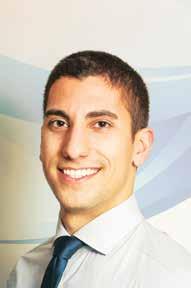
Name: Jeremiah Kopp
Position: President
Studies: Fifth year, political studies
Why I’m running
We have accomplished a lot over the past two years to change the culture at the University of Manitoba, but there is still much more to do. University of Manitoba students can now proudly compare their campus life to that of other top schools around the country. I am running for UMSU president because I want to keep this momentum going and make sure that every student at the University of Manitoba has the most exciting and memorable experience possible.
Relevant experience
My experience includes work in two Winnipeg deputy mayors’ offices, the Senate of Canada, and the House of Commons. I have served as a board member of my local community club, hockey association, and high school. Last year, I was elected vice-president internal for UMSU. I ran the union’s Health and Dental Plan, and oversaw the budget throughout UMSU and its six businesses. I also oversaw the completion of the new UMSUshi restaurant, worked with my colleagues to run the largest and most profitable Frosh Festival in Canada, introduced the Frost Fest to showcase local talent, and created the UMSU Speakers Series.
Name: Rebecca Kunzman
Position: Vicepresident advocacy
Studies: Third year, global political economy
Why I’m running
The moment I decided to run for re-election, I had just come out of a hearing with a student, and realized how impactful it was to be able to represent students in such a direct and significant way. It has been an absolute honour and a privilege to serve as UMSU’s vice-president advocacy for the past year. I have worked to implement the UMSU Volunteer Program and the UMSU Student Access and Initiative Fund. I also worked to revitalize the campaign structure of the union by working with students and student groups to create a true grassroots approach. This year has been a productive one, and I’m excited to (hopefully) get back to work next year!
Relevant experience
The most obvious experience that I have for the role of vice-president advocacy is the past year I have spent serving as UMSU’s vice-president advocacy. However, prior to becoming vice-president advocacy I was heavily involved in the university campus. I was president of the U1 Student Council in my first year as well as social programmer for the Arts Student Body Council. I have also been involved in the World W.I.S.E. Ambassadors Program and was co-chair of the Amnesty International student group on campus. I have also worked as a leadership development officer with the office of Student Life and helped to implement the Student Leadership Development Program and the Emerging Leader Award.
Position: Vicepresident external
Studies: Fourth year, environmental science
Why I’m running
As an international student in Canada, I feel extremely privileged to be at the University of Manitoba. I want to run for the position of vicepresident external because I believe that every student’s voice should be heard. Whether it is working with the government, local businesses, or the university administration, I want to ensure that students feel empowered and UMSU moves forward on the best course of action. A lot has been accomplished by UMSU this year, and I want to continue this momentum and make students feel proud of their time at the University of Manitoba.
Relevant experience
My experience working as the international students’ representative at UMSU and the senator for the faculty of environment, earth, and resources has given me an understanding of how the system works and the changes that could be made to enhance student experience. I have gained valuable leadership and intercultural competence skills by completing the Student Leadership Development Program, Intercultural [Development and Leadership] Program, and the World W.I.S.E. Ambassadors Program. Actively volunteering with a diverse range of student groups has given me an opportunity to connect with the grassroots and the wider university community.
Name: Christopher Bélanger
Position: Vicepresident internal
Studies: Fourth year, political studies
Why I’m running
The reason I am running for UMSU vice-president internal is because at the end of the day this is the students’ money that we are working with and I want to ensure that it is used in the best interest for the students. The University of Manitoba Students’ Union has a unique ability to drastically change a students’ experience on this campus and this is not a role that I take lightly. We are all students, we all have a common goal, and this position allows me to enact positive change to continue the momentum that we have seen on campus over the past two years.
Relevant experience
The opportunity to run for this position with UMSU is the perfect culmination of my school experience and professional work experience. I have almost completed a degree in political studies and, furthermore, just finished a year-long placement at the City of Winnipeg in which I oversaw and ran the office of the deputy mayor as well as the office of the chair of finance for the City of Winnipeg. Besides numerous volunteer experiences and community work, I have been actively involved in creating a student experience that is inclusive and welcoming to all for the last four years.
Name: Jessica Morrison
Position: Vice-president student services
Studies: Fifth year, political studies
Why I’m running Student groups help create the foundation of the university experience for many students. They are a great place to build new and lasting relationships, contribute to the social and cultural life on campus, and foster a sense of community. I had the amazing opportunity this past year to be part of a couple of student groups on campus, while connecting with many others, and I hope to take that experience to UMSU. Vice-president student services works hand in hand with student groups and I am passionate in working to ensure that student groups continue to be the backbone of the university experience.
Relevant experience
In addition to my involvement with student groups, I have been heavily involved with the Arts Student Body Council serving as charity and social services representative, director of finance, and two terms as director of social programming. For the past two years I have represented the faculty of arts as a student ambassador at core events such as student orientation, Career Fairs, Info Days, and also played an integral role in organizing last year’s “Women in Public Leadership” speakers’ event. Lastly, I worked as the site manager for the 2013 Frosh Music Festival and as the orientation programs assistant with the Student Life office this past summer.
Name: Astitwa Thapa
Profile of Clear Slate candidates
Crai G aD olph E , staff
Here are the self-submitted profiles of the UMSU General Election executive candidates for Clear Slate
Name: Spencer Yasui
Position: President
Studies: Fourth year, psychology
Why I’m running
I’m running because I care deeply about this university, and the students who populate it. They have been telling me they’re tired of the negativity and rumours surrounding UMSU. I want to Clear the Slate with a new team of leaders to make this campus exciting again. I’m looking forward to the great things we can do together, and delivering you an unforgettable student experience, that fills you with Bison pride. Clear will deliver you fall Reading Week, the University Cup, an unforgettable Frosh Fest experience, reinvigorated services and opportunities, and more.
Relevant experience
I am co-founder and president of the University of Manitoba Criminology Association of Students, boosting membership 2,000 per cent, and hosting both local and international guest speakers. I received certification from the U of M’s Student Leadership Development Program, and was also honoured to receive the university’s Emerging Leader Award. I returned to the Student Leadership Development Program in the roles of cohort mentor and workshop facilitator. Recently, I was the youngest-ever appointed to the board of directors for the Manitoba Criminal Justice Association, and in the private sector I recently held the role of executive team leader, working with multi-million-dollar operating budgets similar to UMSU’s.
Name: Reanna Blair
Position: Vicepresident external
Studies: Third year, English honours
Why I’m running
I want to be your vice-president external because I know you need a strong voice to advocate for you on important issues, such as transportation and budget cuts. I know that I have the dedication and passion to be effective in bringing your voice to the government, private sector, and other external agencies. We need bottom up, not top down, responsible decision-making and activism and I know that I can provide that. Part of my mandate concerns communication and I want to restructure communication between you and UMSU so that our dealings are always transparent and open.
Relevant experience
I have an extensive and diverse amount of volunteer experience both on campus and externally. On campus, I was the 2014-2015 women’s representative, a position that afforded me opportunities to work with various external agencies to increase the resources and campaigns available to students. In this position I sat as a voting member on UMSU Council and advocated for my constituency while developing [an] important understanding as to how UMSU operates. I have also volunteered as an orientation leader with Student Life for two years, served as the fair trade lead with Engineers Without Borders, and volunteered with St. Boniface Hospital for five years.
Name: Bénédicte LeMaître
Position:
Vice-president student services
Studies: Third year, world religions
Why I’m running
I want to be your vice-president student services. My strong organizational skills will guarantee a well-run year in the area of student services. My experience as a co-ordinator for youth outreach initiatives in my community has prepared me for the leadership role of vice-president student services. My experiences on the St. Paul’s College Students’ Association as well as the Arts Student Body Council have prepared me for the political side of student government. With my expansive experience in organizing events and fundraisers, I have strong co-ordinating capabilities.
Relevant experience
I bring much experience and depth of knowledge in relation to student groups. Coming from a very multicultural family, and having been raised in the midst of many different ethnic communities, I bring to UMSU a deep love for culture. With my interest in all sorts of activities, I am delighted at the opportunity to work with all the activity-based student groups. From the knowledge of religions that I have so far amassed in my degree, and continue to discover, I will be capable of catering to the needs of different religious student groups because of my interest in learning about all the religions of the world.
Name: Jesse Greenberg
Position: Vicepresident advocacy
Studies: Fourth year, commerce
Why I’m running
I am a student just like you and I have so many exciting ideas that I cannot wait to implement. Not only do I want to work with you to make them happen, but I know how to do this effectively because of my expertise and work ethic.
Relevant experience
I founded the Ultimate [Frisbee] Club on campus and have been the president for two years. I’ve been representing the University of Manitoba at a national level for the past four years with two golds and one silver. I have worked with the Manitoba Organization of Disc Sports as a programs associate and for the City of Winnipeg’s initiatives to promote healthy and active lifestyles for underprivileged youth. I am a coach for my old high school. This year I will be playing for Team Canada at the World U23 Ultimate Championships.
I have worked on campus as a Mini U camp leader. Throughout my youth I was a part of student groups such as Youth in Philanthropy [and] Aid for World Crisis Issues, [delivered] Christmas hampers, and took part in a human rights course. I’ve taken part in many events on campus, like Shinerama and the Student Leadership Development Program, and have also held several of my own events such as a charity dodgeball tournament, and a very successful social at the Hub.
Name: Zach Leclerc
Position: Vicepresident internal
Studies: Fourth year, recreation management and community development
Why I’m running
I’ve been on this campus for some time now, and I have seen UMSU executives come and go. I have seen what works and what doesn’t. I am ready to run, to deliver for you. I have strong morals and I hold them incredibly close. I believe in honesty, integrity, transparency, and accountability. That’s what comes to mind when I think of an organization like UMSU. That is what I bring to the table.
During my time as your vicepresident internal, I will expand on the student experience opportunities at our university. I will keep and expand on the amazing services and awards UMSU has to offer. I will bring pride, spirit, and rivalry back to our university. I will work with the great managers of our UMSU businesses to optimize the results for you. And I will do this while maintaining financial accountability and transparency.
Relevant experience
I was the sports representative and co-president of the Resident Students’ Association Council for three years. Currently, I serve as senior stick of the Students’ Association for Health, Physical Education and Recreation Studies (SAHPER) Council. I have sat on both the U of M student experience committee and UMSU’s policy and bylaws committee. I was bar manager for UMSU’s Frosh Fest and Frosh Music Festival, and I have major event, programming, and concert planning experience.
Based on my experiences listed above, I have developed great interpersonal skills, organizational skills, [and] business management skills.
Your UMSU
Mik E Still, staff
Two candidates from each executive slate in the UMSU General Election sat down with the Manitoban after the first week of campaigning to answer questions about their stance on various issues important to students. Jeremiah Kopp, candidate for president, and Rebecca Kunzman, candidate for vice-president advocacy, spoke on behalf of the Your UMSU slate.
The M ANITo BAN: In your view, what are the responsibilities of a student union?
JeReMIAh KoPP, PReSIdeNT: The student union’s responsibility is to create and facilitate the best, and most memorable, most exciting student experience possible, and represent the interest of students to administration, to government, and [in] all facets of student life.
M: What would you do to improve business for UMSU-operated businesses?
KoPP: We’re really excited about our promises to open up a Shawarma Khan, and a Green Carrot [Juice] smoothie bar in University Centre, on UMSU Street, just like we did with UMSUshi. We want to take that same business model [used for UMSUshi]. [Shawarma Khan and
Green Carrot Juice] will be fantastic food options on campus, as they’re affordable, sustainable, healthy, and great tasting.
M: What would you do to improve the campus experience?
ReBeCCA KuNzMAN, VP AdVoCAC y: What we did this year was revitalize the campaign structure. I think what it does is engages more students than we have in the past, and it also enables students to have their voice heard. The intent behind the new structure for the campaigns is to empower students to create positive change within themselves, the campus, and the community. Rather than having the union dictate what interests the students have, it lets the students have the interests, and make their interests heard, and let UMSU support them, and give them the resources to be able to do that.
M: What is UMSU’s future with the Canadian Federation of Students? If elected, would you look at leaving the CFS?
KoPP: The University of Manitoba Students’ Union is at the forefront of student associations around the country, in terms of driving policy, driving advocacy, driving the student experience on all levels, whether it be
social programming, or campaigns. We’re going to continue to do that. We would work with any organization that wants to get on board with our campaigns, with our advocacy, and with any events that we have.
“I think we’ve really done a lot this year to restructure and recreate the backbone of what will enable a positive student experience. I think next year, if elected, it would just be a matter of continuing to embed that in the student experience”
– Rebecca Kunzman, Your UMSU
M: What makes your slate the best group of candidates for the executive seats?
KuNzMAN: I think it’s a combination of things. Obviously Jeremiah and I both bring a lot of experience to the table, having been in our positions previously, and having seen the inner workings of UMSU. Beyond that, I think that the experience that each of the members has really lends to creating that student experience, because we’ve all been involved from the get-go, and this isn’t something we picked up last week. Our first year here, we were involved in campus life in a very big way, and we really know what it takes to make that experience better for everyone else, and we look forward to doing that.
M: What is UMSU’s role in dealing with university-wide cutbacks?
KoPP: Your UMSU is firmly against any cuts to the university, and we also understand how the provincial government has put this university in a very tough place, because they haven’t lived up to their obligations, and haven’t matched their promise of funding the university budget to the tune of five per cent, and instead has been set at 2.5 per cent. Now the university is in a very tough position. We’re going to continue working with the university administration in a respectful dialogue, where we’re at the table, in the room, and advocating for the best interests of students.
M: Where is the limit drawn in terms of the union’s role in political activism?
KoPP: I think the main role of a student union has to be facilitating the voice of the students. We are there to support any student who has a cause, or issue that they want to be passionate about, and we have significant resources that we can put behind that to help spread the word. At the end of the day, our team’s approach is very grassroots, it’s very bottom-up, and we want the students to be the voice behind any political campaigns or advocacy. We won’t be trying to shove any one view down the throats of students.
M: What does UMSU do well right now, and what can it improve upon?
Ku Nz MAN: I think we’ve really done a lot this year to restructure and recreate the backbone of what will enable a positive student experience. I think next year, if elected, it would just be a matter of continuing to embed that in the student experience.
Clear Slate
Mik E Still, staff
Two candidates from each slate for the executive in the UMSU General Election sat down with the Manitoban after the first week of campaigning to answer questions about their stance on various issues important to students. Spencer Yasui, candidate for president, and Zach Leclerc, candidate for vice-president internal, spoke on behalf of the Clear Slate.
The M ANITo BAN: In your view, what are the responsibilities of a student union?
S P e NC e R yASu I , PR e SI de NT: I believe the most important responsibility of a student union is to represent its students. Whether that be university administration, or outside bodies, such as the government, or the private sector, it’s making sure that you are the voice for what the students want. It’s also being responsible with the money that they pay you. That comes from an understanding that it’s not your money, it is the students’ money, and it is to be used on the things that they want it to be used on. Understanding that it is an office that serves the public and not your own interests is at the heart of what a students’ union is for.
M: What would you do to improve business for UMSU-operated businesses?
zACh LeCLeRC , VP INTeRNAL: I do work at the Hub, and I’ve seen a lot from behind the scenes. The first thing I want to do is work closely with the management staff. After all,
I’m a student, I don’t actually have restaurant or management experience, so we’re hiring staff for their resources, and I would utilize those resources to improve our businesses. I know there are redundancies there with the management staff, so I would find those redundancies, reduce them, increase services, hopefully increase revenue, and bring more services to the students.
M: What would you do to improve the general campus experience?
LeCLeRC: I spent many years in residence, and they have what’s called the “spirit cup.” Personally, I believe that residence, and the Big Horns, of late, are the essence of campus spirit right now. In the past couple years, slates have talked about a university cup, and nothing’s come of it. I just want to bring that to fruition, and I think I’m the person to do it, with my experience in residence.
For us, it starts with Bison sports, but it’s not all about Bison sports. We’re already paying for Bison passes in our tuition; why not utilize that, and attend the games?
M: What is UMSU’s future with the Canadian Federation of Student’s? If elected, would you look at leaving the CFS?
yASuI: We’ve been thinking about this very carefully, because we know it’s a contentious issue among students. We recognize that the University of Manitoba is looked to by many other schools as an example, and we believe that we need to take a clear stance on this. In order to do
that, we need to gather more information. We would start by looking at the results of the inquiry that was launched by the UMSU administration two years ago, to see whether or not there is, in fact, value in a relationship between the CFS and the University of Manitoba. Ultimately, once we have gathered more information and are able to make a more informed decision, by looking at all prior communications, then we will take a clear stance on it, and move forward with whichever way the students would ultimately value more.
“It’s not about being R“efresh, it’s not about being Your UMSU, or the Clear Slate. Once you’re elected, you are UMSU, and so it shouldn’t be about our faces or anything” – Spencer Yasui, Clear Slate
M: What makes your slate the best group of candidates for the executive positions?
yASuI: We are the clear alternative to what’s been going on. The students have been speaking to us, and we just hear again and again and again that
students are tired of hearing the negativity, and the rumours that surround current members of the administration who will be re-running, and that they’re ready for something new. There’s been a phenomenal culture shift recently towards a more positive and exciting campus.
I can say that all of our slate members are locked into the perfect positions. We all have the relevant experience for the positions that we’re going to be running for, and we have a proven track record of getting things done, and delivering.
M: What is UMSU’s role in dealing with university-wide cutbacks?
yASuI: UMSU should find out where the students stand, and they should stand with them on that early, and consistently. I’ve been at the Student Action Network meetings, and from everything we hear from inside the meetings, [the executive is] not advocating on students’ behalf. It’s not enough to provide minimal resources, when your job is to be the students’ voice, because they can’t sit in on those meetings. If this is truly something that students want, to stand against the cuts, then there shouldn’t be a divide between them and UMSU.
The University of Manitoba Students’ Union should be taking an active role in these things, if it’s what students want. That’s taking a strong stance early and siding with the students, and then every meeting, making sure that the students’ voice is heard loudly. The Clear Slate does stand against the cuts, and we have been like that since the beginning.
M: Where is the limit drawn in terms of the union’s role in political activism?
yASuI: This ties back into my earlier statement, in making sure that UMSU is giving the students a chance to be heard, specifically in places that they might not otherwise have access to. What I mean by that, is in the private sector, and in all levels of government, these are the bodies that can make change, and as long as UMSU is telling those people what the students’ opinion is, and what the students want, and pushing those sectors for that, that’s the best way to go about it.
M: What does UMSU do well right now, and what can it improve upon?
yASuI: It’s not about being Refresh, it’s not about being Your UMSU, or the Clear Slate. Once you’re elected, you are UMSU, and so it shouldn’t be about our faces or anything. It’s good that people know what we’re up to, and that’s something that we’re committed to providing and making accessible to all students, but we feel there are better ways of utilizing that for the student good. That’s something that we’re pushing for, and obviously it ties right into the Clear name, and that’s transparency. I would rather show where we are in the process, as opposed to making students wait to see what we’ve done with their money. Those would be the main things.
Profile of UMSU’s 2015 community representative candidates
8 candidates vie to fill 5 rep seats
Crai G aD olph E , staff
T
he University of Manitoba
Students’ Union Council includes five seats reserved for community representatives. They are the Aboriginal students’ representative, international students’ representative, LGBTTQ* representative, students living with disabilities representative, and women’s representative.
In this year’s UMSU General Election a total of eight candidates are running for UMSU’s five community representative positions.
Three candidates are running for students living with disabilities representative. Two candidates are running for women’s representative.
Aboriginal students’ representative, international students’ representative, and LBGTTQ* representative are currently uncontested – each only has one candidate running to fill the position.
The Manitoban put a request out to all eight candidates for profiles as part of the Manitoban’s coverage of the 2015 General Election. Alan Bridgeman, candidate for students living with disabilities representative, and Charles Kimball, candidate for LGBTTQ* representative, did not respond. The six candidates who did respond are profiled below.
Name: Will Landon (Wabshkigaabo or “standing white bear”)
Position: Aboriginal students’ representative
Studies: Second year, political studies
What are some of the challenges facing your constituency?
In the university itself we face the issue of systemic racism. We are held up to the standards of a Eurocentric education paradigm. Indigenous identity and learning are vastly differ-
ent compared to European thought. We, as indigenous people, engage in a system that still has underlying tones of colonization and does not take into account the social issues we face in reserves, urban, and rural settings. This results in indigenous students being disadvantaged; impeding success and access to resources. There is also a lack of understanding and knowledge on these issues in the general student body, resulting in ignorance and misunderstanding.
If elected, what do you hope to do to address those issues?
I hope to educate non-indigenous people on indigenous issues, and promote positive relationships between indigenous and non-indigenous [people] within the university. Education can come from workshops, speakers, etc. I want to be able to give all students a voice so I can determine which medium would be effective in reaching the most students to enable deep understandings of the issues Aboriginal people face. Being able to promote positive relationships and interactions can also encourage students to learn from one another, promoting campus inclusiveness, pride, and understanding of each other. Cross-cultural understanding is very important to ensuring quality learning and developing healthy relationships. In order to ensure equal opportunity and success, the issues indigenous people face need to reach educators and administration of the university; this can be achieved by ensuring there is proper representation on student councils, the senate, and Aboriginal student liaisons.
What are your own priorities for the student union overall?
I want to bring awareness to aboriginal students as to who the student union is and what we do. Indigenous people have felt very disenfranchised from UMSU. Disenfranchisement has resulted in indigenous students having a lack of interest in campus life. My priority is to ensure that indigenous students feel welcome and are a part of the campus experience. I want students to feel empowered to vote, raise issues, and have confidence that their voices will be heard and respected.
What experience do you have that would make you a good candidate for this position?
I have been raised in Ojibwe culture. I have a deep reverence of our traditional systems as I regularly attend ceremonies; this helps me identify the issues we as indigenous [people] face. My lived experiences and the guidance of my elders is
where I base my decisions and opinions. My experience of successfully educating non-indigenous peoples about my culture in a respectful way both in the university and beyond has given me the confidence that my methods and initiatives work. My experience as this year’s UMSU Aboriginal students’ representative has taught me the protocols and workings of UMSU, where my strengths have been, where I need to improve as a leader, and what methods have worked in bringing awareness to UMSU about indigenous student issues.
Miigwech.
Name: Andrew Fenwick
Position: Students living with disabilities representative
Studies: Second year, political studies
What are some of the challenges facing your constituency?
Some of the issues facing my community are stuff like ramp inclines or broken elevators; those are the physical barriers. Physical barriers are the most commonly known. But we also face different barriers such as not being able to access different documents on D2L because the documents aren’t accessible documents or not being able to write notes. These are invisible barriers which are just as important. Another huge barrier is employment for students with disabilities.
If elected, what do you hope to do to address those issues?
If I’m elected I will keep up my great relationship with the director of Physical Plant, Brian Rivers, to tackle physical barriers. So far this year I
have co-ordinated with Brian Rivers to fix five elevators, the University College washroom, and two ramps on campus including the Isbister elevator and Fletcher Argue elevator. To tackle something as unseen as invisible barriers I am already working on an accessible documents presentation with Student Accessibility Services that will teach professors about and how to make accessible documents. To tackle something as tricky as jobs I would like to make a list of jobs on campus which specifically points out whether the job is accessible to different students or not. Of course students can go to a job and try it themselves but I think this would take a lot of the leg work out of the job hunt equation. I would also like to advertise different jobs on campus that would apply to all students but would benefit disabled students if those positions were filled such as a note-taker job.
What are your own priorities for the student union overall?
My personal priorities for the student union are to promote a very inclusive campus experience. I am a member of the student group the Big Horns, which is a student group based around that idea of inclusivity, so I am a huge advocate for a very inclusive campus experience. Another issue which is very important to me is inclusive socials hosted by UMSU, because an inclusive learning experience is great, but an inclusive social experience is just as great. This idea is one in which Rocco Scarcella, the president of Beyond Abilities, and I have been discussing for the past few weeks.
What experience do you have that would make you a good candidate for this position?
Some of my experience that would help me in this position includes my work with the Children’s Rehabilitation Foundation, where I was the youth ambassador in 2013, which was a great experience. I got the opportunity to give speeches on behalf of youth with disabilities. I was also the students living with disabilities representative for UMSU and accessibility representative for the Arts Student Body Council in 2014-15 where I got five different elevators, two ramps, and the University College washroom fixed. I also mentioned that I am a very active member of the Big Horns which is a group devoted to inclusivity.
Name: Daniel Tingskou Position: Students living with disabilities representative Studies: Fourth year, economics
What are some of the challenges facing your constituency?
The challenges facing my constituency depend upon the condition of the individual student, which ranges from physical disabilities, auditory and visual limitations, to learning impairments or mental health issues. In each of the formerly mentioned scenarios the student would face a different challenge; for example, a student with a physical disability may be unable to takes notes, students who are hearing impaired may find it difficult to partake in class discussion, those suffering from visual impairment must use alternative methods to process any visuals used in lecture, and students with mental health issues could face severe exam anxiety. Socializing with peers, too, is more difficult for some of my constituents (including myself).
If elected, what do you hope to do to address those issues?
A lot of those issues are being addressed by Student Accessibility Services (SAS); however, one of the things I hope to do is help students in the accessibility program better utilize the services provided by SAS via a mentorship program. The purpose of the proposed mentorship program is to match first- or second-year students living with disabilities with another student who has a similar disability but is more accustomed to university life, such as a third- or fourth-year student. The mentor would be able to advise the mentee on how to fluently transition in the university setting, with the help
Photo by Carolyne KroeKer
Photo by Carolyne KroeKer
Photo by miKe still
of SAS and the mentor’s personal knowledge. I also want to promote the use of SAS. I do not know for sure but it is fair to suggest that some students are qualified to receive the services provided by SAS but choose not to. Student Accessibility Services is here to help; students should take full advantage of this.
As for the social aspect of being a student, I fear that a portion of my constituency may not feel as if they can comfortably mingle with their peers. I hope to provide more accessible social events that people of all abilities can enjoy.
What are your own priorities for the student union overall?
My priorities are the priorities of all University of Manitoba students, not just those living with disabilities. I want to redirect the attention of UMSU away from large-scale social events and towards more key issues. Not to say UMSU shouldn’t provide and promote school spirit – rather, I feel that too much of their resources are spent doing such. For instance, the university’s introduction of budget cuts, after new facilities have been built, and the industrialization of post-secondary education should be on the agenda of UMSU. It is in the best interest of all students for UMSU to have a strong influence on their academic environment
What experience do you have that would make you a good candidate for this position?
My experience as a volunteer with U of M Student Life and the Academic Learning Centre—where I assisted with Orientation Week and work as a writing tutor—has taught me how diverse our campus really is and the importance of ensuring an inclusive environment. I am also a member of Beyond Abilities, which is a student group that is in place to promote an inclusive and barrier-free setting. Being a part of this student group I have been introduced to the members of [the] community who face a wide array of challenges. Thus, I am a good candidate to represent my constituency because of my experiences dealing with different students and my empathetic personality.
Name: Mujtaba Abdul Jalil Position: International students’ representative Studies: Third year, electrical engineering
What are some of the challenges facing your constituency?
I have seen international students encounter many different problems. The biggest challenge international students face is the cultural and social adjustment. The University of Manitoba currently has representation from 104 countries but these statistics are not reflected at any social or cultural event held at our university. Students are provided with a lot of different services at the university but the major population of international students is either unaware or too hesitant to utilize any of these services to their advantage. The international community is not as involved as they can be in UMSU events and I feel improving on these points can build
a better community on campus.
If elected, what do you hope to do to address those issues?
The first thing I would like to do is continue the International Students’ Caucus. I feel it is an excellent platform that provides the opportunity to international students to sit together and discuss the challenges on campus. I think it can be used as a focal point to scrutinize and address all the challenges. I would like to work alongside the elected UMSU team to actually improve the attendance of the caucus. I feel that initiatives such as speaker series and mental health and wellness week are great but they do not capture the attention of international students, so again, the caucus can help provide awareness to international students about how such initiatives can be of advantage to them. As a university student we all receive emails regarding workshops and other programs but I feel that international students need some kind of a moderator to work hard to make sure that students understand those workshops are not just to advertise the services on campus but they are there to be used.
What are your own priorities for the student union overall?
I would like to keep a bigger picture in mind about how all the students can benefit from the decisions [being] made and vote for what feels right.
What experience do you have that would make you a good candidate for this position?
I have worked as the vice-president of Pakistani Students’ Association (formerly known as the Pakistan Students’ Council) from 2012 till 2014. I have worked alongside the previous international students’ representative on different forums. I have volunteered with the Muslim Students’ Association in past years, but the most important thing, in my view, is that I am currently employed at the International College of Manitoba, which is a transition program for international students who would like to pursue studies at the University of Manitoba.
Name: Alana Robert
Position: Women’s representative
Studies: Third year, political studies and economics
What are some of the challenges facing your constituency?
Rape culture, sexual harassment, sexual assault, and violence against women are all issues affecting students every day. The majority of female students in particular have experienced at least one incident of sexual harassment or sexual violence throughout their lifetime, many of them on campus or from fellow students. Although the majority of these incidents do not get reported, this does not mean that they are not happening. Further, some poster advertisements have not promoted the integrity of women, and these are issues that I want to address. This is why I am committed to fostering a safe and inclusive environment for all at the U of M.
If elected, what do you hope to do to address those issues?
My four goals as women’s rep are to:
1. Implement the United Nations [Women’s] Safe Cities initiative, which strives to make public spaces safer through preventing sexual assault, sexual harassment, and violence against women.
2. Include No Means No workshops as part of Student Orientation. I believe that student responsibility extends beyond academic integrity. Including No Means No workshops allows students to be reminded of what constitutes consent, as well as resources available to them (such as the Sexual Harassment Resource page, Safewalk, Peers, etc).
3. I want to ensure the integrity and respect for women is promoted by all in our community, demanding higher standards for poster advertisements, as well as ensure a clause in the U of M’s Code of Conduct specifies the standards of integrity and respect that all representatives and organizations are to adhere to.
4. Make this a university that you can be proud of! I want to lead more advocacy campaigns on issues pertaining to women’s rights, and listen to your stories, so that I can effectively implement our visions of what would help make the U of M a campus that you are excited to belong to!
What are your own priorities for the student union overall?
I will vote for what I believe to be in the best interests of students, based on what has been expressed to me, and what I have observed. I hope that my voice on council would contribute to achieving events, opportunities, and initiatives that the U of M student population can be proud of, and be excited to be a part of! My priority at council is to advocate for students’ priorities.
What experience do you have that would make you a good candidate for this position?
I founded and am currently president of the Justice For Women Student Group, which fundraises and advocates for human rights issues specifically affecting women, as well as provides a voice on behalf of women on campus to ensure the integrity and respect for women is promoted by all in the U of M community. We have
partnered with university administration to create a Sexual Harassment Resource page to make information more accessible as well as encourage reporting, and advocate for all issues from violence against women prevention to missing and murdered indigenous women awareness. I am also president of the World Vision Student Group and am a youth ambassador for the organization.
Name: Fariba Shakibani
Position: Women’s representative
Studies: Third year, human nutritional sciences
What are some of the challenges facing your constituency?
As a woman and a third-year student on this campus, I have firsthand experience with issues I have faced on campus. Resources available to me and other women aren’t properly advertised and unless sought after, are hard to find. Services like those offered by the Womyn’s Centre, Safewalk, Peers, Bison Run etc. are ones that if known, will help create a more safe campus.
I have also noticed that there isn’t a strong platform to discuss the unique issues of women of colour, Aboriginal women, international women, nontraditionally aged women, women with disabilities, and women who identify as lesbian, bisexual, and transgender, all of which are essential to ensuring an inclusive campus.
If elected, what do you hope to do to address those issues?
If elected, to further the collective voices of women on campus, I have a five-pronged approach. Firstly, I want to act as a liaison and work closely with UMSU to improve campus-wide advocacy efforts with regards to sexual health, mental health and safety for women on campus. Secondly, I hope to begin a speaker series of influential women to empower and engage students on campus. Thirdly, I would like the Womyn’s Centre to be more open and inclusive to all women on campus. Promoting the services provided through social media, UMSU newsletters, and the campus newspaper are some ways I hope to accomplish this. Fourthly, as a believer that constant exchange of ideas creates the best
program, I want to create bi-weekly group discussions where people are given the platform to share ideas and initiatives they would like to see. Fifthly, I want to work endlessly on promoting and rediscovering the true meaning of feminism.
I want to substantially increase the voice of women on campus. By collectively encouraging women from every socioeconomic, political, and cultural background, we can create a campus that is inclusive and welcoming to all. Furthermore, I want to foster discussion and debate on campus and empower women to lobby for their rights on a campus level and a community level. I understand that there is a diverse community of women and dialogue is the best way to ensure that each one’s interest is met irrespective.
What are your own priorities for the student union overall?
My priorities lie within creating a welcoming, safe, and inclusive campus. Be it music festivals or revamping the UMSU website, I want to make sure that women are included in all aspects. Music festivals need to have safe spaces and on revamping the UMSU website, the Womyn’s Centre and other services need to be properly advertised. Following talk about budget cuts at the university level and UMSU cutting programs, I want to make sure that services that help women on campus are not cut.
What experience do you have that would make you a good candidate for this position?
I have worked endlessly to create my experience on and off campus something memorable and meaningful. Having volunteered with UMSU, student associations, and the U1 Student Council, I believe that I have the skills and determination to make this campus a truly welcoming and safe environment. Being the women’s representative would allow me to work towards that. The women on campus deserve a representative who truly believes that we can make our campus one of the best in terms of advocacy, safety, hospitality, and overall awareness. The councils and student groups that I have been a part of have allowed me to grow as a person and to grow as a student. I hope to give the same for the women at the university.
Photo by dana hatherly
Photo Provided by Fariba shaKibani
Features pages from the past
Arts & Culture
Musical detox
Rapper Beatox collaborates with U of M jazz students on upcoming EP
i an t.D. t ho MS on, staff
On March 27, Winnipeg rapper
Beatox will release his latest EP, Late Nights, at the Good Will Social Club, In describing why he goes under the name Beatox, Adam Fainman admits three reasons.
“First, I love beatboxing. I do it all the time, everywhere. Secondly— being a rapper/MC—I love writing, storytelling, and making the ‘beat talk,’” Fainman told the Manitoban “Lastly, music has always been a form of a ‘detox’ in my life, helping me stay grounded.”
Fainman— citing D’Angelo and A Tribe Called Quest as his musical
influences—has been a part of the Winnipeg music scene for a few years now. As a member of the now-defunct hip-hop group Butter Pretzels, he saw success with two releases in 2012, Joint Stupidity and Baked Not Fried. The group’s music was described as “stoner hip-hop,” a sub-genre popularized by the band Das Racist. Some of the songs by Butter Pretzels include the hits “Let’s Meet Jack Black” and “Outback Steakhouse.”
With the group disbanding, Fainman launched his solo project “Beatox” in September of 2013 and released the Modest Mouth Mixtape
shortly after.
Beatox plans on releasing an EP entitled Late Nights on March 27. For the EP, Fainman recorded with several musicians from the University of Manitoba jazz studies program, including members of Winnipeg funk band Down to Funk, featuring Sean Burke on bass, Jesse Popeski on guitar, Carter Graham on keys, and Noah Chochinov on drums. The project also features jazz and soul vocalist Joanna Majoko contributing hooks to tracks such as “OZ.”
Being attuned to standard fourbar loops and hip-hop samples, the
jump to working with live musicians was a new and exciting experience for the local artist.
“What the process has been, is that I bring songs I’ve written to them usually with a melody/vibe in mind, and the band will start messing around until something jumps out” – Adam Fainman (Beatox)
“The actual process of making songs with musicians is a new experience for me, and a lot of fun. What the process has been, is that I bring songs I’ve written to them usually with a melody/vibe in mind, and the band will start messing around until something jumps out,” explained Fainman.
“Then we piece it together, record the whole jam, listen back, and then repeat.”
The product of the recordings is Late Nights. The new project’s trajectory bears no resemblance to Fainman’s earlier work with Butter Pretzels. While Butter Pretzels’ intention was mostly seen to be just goofing around, the focus of the new work aims to take listeners “on a journey through darkness and light.”
One of the EP’s songs, entitled “OZ,” starts off how one would expect a partnership between jazz and rap to sound. As the song builds, however, we are presented with a more interesting and experimental take on the formula. From a timid guitar riff intro, the song leads into Joanna Mojoko’s unique vocalization tied with Beatox citing references from the 1939 film, The Wizard of Oz
With plans to release Late Nights on March 27 at the Good Will Social Club, Fainman expects an eclectic musical-mixed event with R&B jazz band Sapphire Empire and rapper 3-PEAT sharing the bill.
“People should expect a lot of energy, some beatboxing, and a nice mix of hip-hop, jazz, funk, and some dancing.”
Beatox will be releasing Late Nights on March 27 at the Good Will Social Club (625 Portage Avenue). Tickets are $10 and will be available at beatox.ca and at the door.
Great swimmers, better songwriters
Great Lake Swimmers’ new EP is more rhythmic and orchestral
Great Lake Swimmers’ new single, “Zero in the City,” evidences that the band is continuing to grow as artists. Lead vocalist Tony Dekker’s voice and the emphasis on wilderness in A Forest of Arms transitions the group’s previously dreamy and retrospective tracks to a more aggressive mood.
The song represents a heavier and more grounded feel. Dekker’s voice is less translucent, taking a more prominent stance among the accompanying instrumental backdrop.
“‘Zero in the City’ is a good crosssection of what’s on the new album,”
Dekker said. “We have a stronger emphasis on the rhythm section, so there’s a real percussive element to some of the songs, but there’s also an orchestral chamber-folk thing that’s happening with some of the string arrangements and the acoustic instruments.”
Dekker said the group tries to diversify their work, explaining why the song takes a minute to recognize, even by fans of their work. The new LP will be introduced to audiences on their Canadian tour, beginning on April 15 , before the official release later that month.
“I’m really happy with how the new songs are sounding. I can’t wait to share them with people,” Dekker said.
“I think it’s some of our strongest and most interesting music yet. I’m filled with anxious energy right now waiting for the album to be released.”
Although the music may feel more solid, the messages have remained constant, especially in the lyricism. The group’s name, as well as the title of the LP, evokes imagery of the wilderness, acknowledging its importance to the members.
“I really love getting out into
nature as much as possible, whether it be camping, hiking, or whatever. Even just getting out to a green space in the city can be really rejuvenating and inspiring,” Dekker explained.
“I think it’s some of our strongest and most interesting music yet. I’m filled with anxious energy right now waiting for the album to be released” – Tony Dekker, lead vocalist
A Forest of Arms also represents the people that contributed to making the LP.
“It’s very much imagery from [British Columbia], but it’s also taken on other meanings, and one of them is recognizing the importance of the community that this music springs
from,” Dekker said.
“Another meaning is the way that personally, in the band, our own families are growing and supporting us in this too. The title just felt really appropriate.”
The group pushed themselves further than ever before to finish the LP. The process involved a lot of experimenting with sounds and instrumentation, giving everyone a chance to “stretch out.”
For Dekker, the album represented some personal growth as well.
“I was even more open to the collaborative spirit with this album, and I think that shines through,” Dekker said.
“I learned that songwriting isn’t always something that needs to be done alone and in private. And that the process is possible while trying to live a balanced and happy life.”
Great Lake Swimmers will be performing on May 25 at 8 p.m. at the West End Cultural Centre. Tickets are $29.75 and are available through Ticketmaster.
h E nko, staff
Photo by marina manushenKo
Photo by ron hooPer
The decade in prints
Urban Ink’s last 10 years of work on display at Parlour Coffee
a lana t raC h E nko, staff
If you want a summary of events that took place in Winnipeg in the last decade, you need to only go as far as Parlour Coffee on Main Street.
Besides excellent coffee and quaint decor, visiting the shop now has the added perk of a view of Urban Ink’s latest exhibit, Dix ans d’affiches (10 Years of Posters).
On until April 2, the exhibit has the same effect as reading a cereal box while you eat breakfast. It gives your morning (or afternoon) coffee a touch of inspiration. Taking up the entire back wall, it’s impossible to ignore, and the burst of colour feels like the only bright thing in the middle of winter.
The posters tell the story of what has taken place in Winnipeg over the last 10 years. Film festivals, craft
sales, and lectures compete with one another for attention. On their own, each poster would stand out with expertly chosen colours and eye-catching graphics. Together, the prints form a collage of vivid aesthetics that flows cohesively across the substantial space that it inhabits.
personal, yet relatable, account of the experience.
Taking up the entire back wall, it’s impossible to ignore, and the burst of colour feels like the only bright thing in the middle of winter
Winnipeg filmmaker Guy Maddin’s My Winnipeg poster is notable among the collection. Maddin’s film, released in 2007, was met with both critical and audience praise. Writers and artists of Winnipeg seem to enjoy portraying their version of what it is to live in this city, an aim that may have gained popularity following Maddin’s highly
What it means to be a Winnipegger is defined anew in every song, text, and image that is produced here. Maddin’s discussion of sleepwalking calls to mind the idea that while being surrounded, having an isolated experience in Winnipeg is common for many of us.
Several years of Reel Pride
Winnipeg posters are thrown into the mix. The not-for-profit organization has seen many successful years in its endeavours to showcase queer artists and stories. In 2014 the festival screened at the University of Manitoba as well as the recently opened Canadian Museum for Human Rights, and drew submissions from Toronto and Vancouver.
One Gay City, an in-depth look at Winnipeg’s LGBTTQ* community, made its world premiere at the festival in 2014.
Urban Ink’s exhibit does more than showcase the company’s eye for design. It reminds us of the vibrant, hardworking, and talented city in
which we live. Although months pass that may look and feel grey, the artists, writers, and human rights activists of Winnipeg are sitting in coffee shops, basements, studios, and wandering the streets creating art that replaces the steely cold with warm and lively ideas and concepts. It has been said before, but it is worth repeating: the cold which we spend so much time hating may actually be the thing that makes this city home to so many, and pushes us to rely on more than sunlight to feel accomplished and successful. It pushes us to connect with each other and the city around us.
Dix ans d’affiches is on display at Parlour Coffee (468 Main Street) until April 2.
Storyteller-in-residence: Dovie Thomason
storyteller
T
he imagination can run wild in the hands of a great story and its storyteller. Dovie Thomason—the current storyteller-in-residence at the University of Manitoba Centre for Creative Writing and Oral Culture (CCWOC)—focuses on sharing traditional indigenous tales. Beginning her tenure in January of 2015, Thomason will be available at the university until the beginning of April. The U of M faculty of arts has been revered for bringing in unique writers and storytellers for the CCWOC. The inaugural residency was Aboriginal poet Gregory Scofield in the 2007 fall semester. In fall 2014, the CCWOC had playwright Liz Duffy Adams come in for the faculty’s residency. Dovie Thomason is the first American to be granted the
position.
Thomason’s works have been highly coveted even outside the realm of storytelling. In 2009, Thomason performed a talk on space exploration and the need for “native science” at a Tedx Leadership Conference. The storyteller has also performed various keynotes, workshops, and consultations for organizations such as the American Folklore Society and NASA.
away by the amount of experiences that could happen,” Thomason told the Manitoban
cultural values coupled with human affection and humour.
“Winnipeg is lively. [There is] a lot going on in the arts [ . . . ] a lot going on in indigenous issues” – Dovie Thomason, U of M storyteller-in-residence
Thomason is grateful for the residency at the CCWOC and spoke highly about the knowledge and wisdom gained from her time at the U of M.
“The variety of a day is brilliant. The hardest thing for me is to not just let myself get distracted and blown
As a Lakota/Kiowa Apache indigenous woman, Thomason’s influence began as a child with her grandmother. The stories were communicated in a traditional way with an intention to teach as well as entertain. They encompassed ideas of both practical advice and indigenous
These stories assisted Thomason in her development as one of the most admired storytellers of her generation.
As part of the residency, Thomason has office hours to share her wisdom and assist with aspiring artists with their various works.
“Someone could come in because they are working on a song, or a poem, an autobiography, or a novel [ . . . ] It could be a retired woman, it could be an undergrad. It could be someone from the community,” said Thomason. “It’s not just students; it’s students, faculty and [the] Winnipeg community.”
Along with assisting the citi-
zens of Winnipeg at the CCWOC, Thomason has used her time at the U of M to explore the “great city” of Winnipeg.
“Winnipeg is lively. [There is] a lot going on in the arts [ . . . ] a lot going on in indigenous issues,” said Thomason.
Dovie Thomason is available for help with creative writing until the first week of April. Her office is located at 391 University College, with office hours on Mondays from 1:30-3:30 p.m. and Thursdays from 1 p.m.-3 p.m. Thomason is also available by appointment.
Photos by alana traChenKo
From basement beer to brewery
Why craft beer is the shit
l aU r E n Si DDall, staff
Selecting a beer from the LC can be a daunting task. The shelves are littered with everything from India Pale Ales (IPAs), to lagers, stouts, porters, and flavoured beers of hundreds of different brands – ranging from cheap domestic all the way to expensive imports. The easy choice is grabbing a six-pack of something generic, heading for the cashier, and calling it quits.
There is, however, an alternative: craft beer.
Falling in between experimental basement breweries and multinational, conglomerate breweries is the sweet spot for beer lovers everywhere.
Craft beer is hard to define. The majority of people who have reached the legal age of consumption have heard the term, but few know what it means. Even within the industry, there is a grey area.
“Craft beer and ‘other beer’ are all beer. The difference is in the approach,” said Half Pints brewmaster and president David Rudge.
“Whereas craft brewers tend to focus on building flavour into their beer and less on marketing, ‘other beer’ brewers tend to focus on the lowest common denominator of fizzy, yellow, and cold while marketing the bejesus out of their product to get it to sell.”
Craft beers, on the other hand, are typically not advertised on mass media. While watching the Super Bowl, you will not see an ad for craft beer, but you will likely see 10 for macro breweries.
Craft breweries also meet several, albeit vague, criteria: “Craft brewers are small brewers, craft brews use traditional ingredients in an innovative way, and craft brewers maintain their integrity by what they brew and their general independence.”
The key characteristic for craft beer, however, falls in the ingredients according to Farmery co-owner Lawrence Warwaruk. While macro breweries use artificially synthesized chemicals to mimic what most people think beer should taste like, craft brewers go right to the source.
“Macro breweries will substitute adjuncts, which is anything else you put into beer that will create alcohol. The sugars they produce would be very similar to the sugars barley would produce, but they use a cheaper ingredient like corn syrup, or corn,” explained Warwaruk.
“Craft beer uses traditional ingredients, so our beer is mainly barley. We use a little bit of wheat malt in our recipe, but then what gives beer flavour is not only the style of malt they use, but also the hops they use.”
I associate “hops” with a joke in the infamous Superbad scene in which McLovin awkwardly tells the unimpressed cashier that he heard that the brewery recently added more hops to his favourite beer, attempting to appear knowledgeable in his quest to misrepresent his age. In reality, the hops included in the brew recipe are paramount.
There are hundreds of different varieties of hops, which can be combined into a variety of flavours. For example, when you combine Chinook, Centennial, and Cascadian varieties, you get a bitter, citrus-infused flavour that is essential in the majority of craft IPAs. When combined with infusing flavours such as berry (a trend to watch for) or otherwise, the combinations are limitless.
This innovation behind releasing new flavours of beer and the freedom to do so is a defining feature of craft beer. Whereas macro factories create brews to appeal to the masses, craft breweries fill the otherwise untapped potential.
“I think craft beer fills a niche much like an independent filmmaker fills a void in the soul of Hollywood. People seek out substance when they constantly find none, and the beer industry has been lacking soul for many, many years,” said Rudge.
“Craft brewers are trying to feed a potential demand that they think is there. And they dream it up, and try to produce it. If it gains traction, they’ll keep on making it,” Warwaruk said.
Being the indie filmmaker of the beer world makes way for a freedom that is paramount to the craft beer industry and what fuels the interesting styles and flavours.
“I think that what craft beer really does is open the window of opportunity and variety. Once people start to experiment, and really get exposed to different styles of beers, that’s when the palate changes a bit,” said Warwaruk.
“The first time you taste black coffee, it’s like, ‘Oh god I can’t handle black coffee, I’m putting sugar into that!’ Or maybe you will love black coffee. And even in black coffee, there’s different styles of roasted beans that you use.”
But that is the beauty behind craft beer; it is not made for the masses, but rather for people looking for something beyond the average.
“True craft beers are honest, flavourful, and fill a specific niche for people searching out better beer. Not every craft beer is going to be appealing to every drinker, and that’s a good thing,” Rudge said.
In case you are looking for some craft beer inspiration the next time you make a beer run, here are some brews that are sure to please.
Half Pints Bulldog Amber Ale: Brewed with British crystal malts, this beer is outfitted with a nutty aroma with an underlying bitterness resonating from the hops.
Big Rock Grasshopper Wheat Ale: My go-to beer; a really light touch of hops makes this beer very versatile, and it is topped with a crisp, citrusy finish. If you want to bring out the citrus, throw a wedge of lemon in.
Farmery Premium Lager: This is as close to homegrown as you can get. Flavoured with three varieties of hops, this lager is refreshing and easy to drink.
Photos
Editor: Mike Still
Sports
Women’s World Cup preview
Everything you need to know about this year’s tournament in Canada
ryan St E lt E r
We’re less than 100 days away from the kickoff of the FIFA Women’s World Cup 2015 and the excitement is building. The men put on a spectacular show in Brazil a year ago, and now it’s time for the ladies to take centre stage and dazzle us with some high quality footy.
There should be no shortage of thrilling contests this year, and I’m going to give you the rundown of the groups, as well as how I think things will turn out.
Group A
Predictions (from first to last in the group): Canada, China, the Netherlands, New Zealand.
The host nation’s hopes lie with captain Christine Sinclair. Her leadership will be put to the test leading a Canadian side that did not fare so well in Germany four years ago, finishing last in their group. Ranked a respectable ninth, they should be able to ride the home field advantage into the knockout stages. An impressive performance at the 2012 Olympics in London, earning a bronze medal, will be something they can draw on.
Thirteenth in the FIFA rankings, China qualified by finishing in the top four of the Asian Football Confederation Women’s Asian Cup. China didn’t qualify for the 2011 World Cup in Germany and will hope to bounce back in Canada. I could easily see them finishing second in this group.
Debutants to this year’s World
Cup, the “leeuwinnen” (lionesses) are ready for action and could potentially make it as one of the four third-place teams advancing to the knockout stages. Many of the members of the Dutch national team play their trade in the Netherlands for the wellknown club, AFC Ajax. The Dutch are a soccer-crazed nation, so don’t be surprised if they make a run.
The “Football Ferns,” New Zealand, have a fighting chance in this group. Ranked 18th in the world, they’re led by Amber Hearn, who’s netted the most goals for New Zealand in their international history. If she can nick a few goals for the ferns, watch out. If not, they will be out of luck.
Led by FIFA Women’s Ballon d’Or winner Nadine Kessler, the Germans cruised through qualification and are ranked first in the world. Fresh off of a 2013 UEFA Women’s Euro Championship, the Germans are a heavy favourite in this tournament and hope to follow their male counterparts and win the World Cup this year.
World Cup winners in 1995, Norway is looking to bounce back from a disappointing 2011 tournament. Runners-up to Germany in the 2013 UEFA Women’s Euro Championship, they will be looking for revenge. Watch out for when the
two clash in Ottawa on June 11.
Making their debut in this year’s tournament, Ivory Coast has a tough slog ahead of them. They are a fairly inexperienced side. Despite finishing third at the 2014 African Women’s Championship, they will have troubles against the European powerhouses in Group B.
Squeaking into this year’s World Cup by winning the playoff against Vietnam in the Asian qualifiers, Thailand won’t put up much of a fight in this group. Dominating the Southeast Asian Games against international minnows, Thailand’s first World Cup will be a tough go.
Current title holders Japan don’t look like they will be slowing down. After defeating the Americans four years ago on penalties, the Japanese could very well repeat last year’s outcome. Since the 2011 World Cup, Japan has captured silver at the 2012 Olympics and won the AFC Asian Cup in 2014.
“La Nati,” as they’re called in Switzerland, are making their World Cup debut in 2015. After winning their group in European qualification relatively easily, the Swiss are entering the world stage in good fettle. The Swiss have a potent offence, finishing with a 52-goal difference in qualifying.
South American side Ecuador is
making their World Cup debut in a group full of rookies. They can only rely on the possible inexperience of the other sides if they have any hope of the knockout stages. I don’t see the 46th-ranked side making it as one of the top-third-place teams.
Current title holders Japan don’t look like they will be slowing down. After defeating the Americans four years ago on penalties, the Japanese could very well repeat last year’s outcome
Ranked 52nd in the world, Cameroon will likely not make it out of the group stages. Along with the Swiss and Ecuador, the Cameroonians are making their World Cup debut. Being a very inexperienced side, they will hope to force a draw against Ecuador.
Group D
Predictions: USA, Australia, Sweden, Nigeria.
The Americans are strongly favoured in this year’s tournament. They’ve been placed in a tough group but I don’t think they will have much of a problem topping it. The stars and stripes, who finished second in 2011, are going to bounce back. They’re playing in North America, and with Hope Solo in between the sticks, the U.S. will be tough to break down.
The 10th-ranked Aussies will be wanting to better their performances in the last two World Cups, being knocked out in the quarter-finals in each. With an aging attack, look for 23-year-old Kyah Simon to make an impact for the Socceroos up front. Australia will have trouble against the U.S., but should finish second quite comfortably.
The “blueyellow” Swedes, who are ranked fifth in the World, could easily finish second in this group, but will qualify for the knockout stages as one of the top-third-place teams. The Swedes suffered one of their biggest losses to the U.S. in 2012, 4-0. This is going to be an interesting group.
On paper the weakest side in the group, 32nd-ranked Nigeria will have to rely on a miracle to overcome the powerhouses of the U.S., Sweden, and Australia. However, crazier things have happened. Nigeria has dominated the African Women’s Championship, winning nine of the 11 tournaments, and could surprise with strong defensive showings.
Group E
Predictions: Brazil, South Korea, Spain, Costa Rica.
The Brazilians are a favourite in any tournament they enter, simply because they have so many people who play soccer. They have won the last two Copa Américas, their most recent championship coming in 2014, and shouldn’t struggle too much to top this group.
Having not qualified for the last two World Cups, it might be a stretch to say that the South Koreans will make it to the knockout stages. They are ranked 17th in the world and will rely heavily on Ji So-Yun, who has nicked 28 goals.
Debutants Spain have little to no track record internationally, having finished seventh in the 2013 European championships, their best performance being a third-place finish in 1997. Ranked 15th in the world, the Spaniards will have a tough time in this group due to their inexperience, and won’t qualify for the knockout stages.
Also making their World Cup debut in Canada, the Costa Ricans have shown us before that they can play. The men made a miracle run a year ago in Brazil. The women will hope to emulate that performance. Finishing second in the CONCACAF Women’s Gold Cup, the Costa Ricans could potentially surprise us this year.
Group F
Predictions: France, England, Mexico, Colombia.
Finishing fourth in Germany four years ago, France, ranked third in the world, should take this group fairly easily. Marie-Laure Delie is the main cog in France’s attack, having netted 57 goals in 80 international appearances.
The country that brought the beautiful game to the World Cup, England is not a strong favourite to win this year’s tournament. However, they should qualify for the knockout stages. Fara Williams will lead the charge. She’s been an effective midfielder for the Three Lionesses, scoring 37 goals for the English.
Having not won an international tournament in recent years, the Mexicans will struggle to gain their footing in this group. If this 21stranked Mexican side can draw upon their success at the CONCACAF Women’s Gold Cup, they might have a shot at being one of the third-place teams to qualify.
The “coffee growers” made their debut four years ago in Germany, and will look to build on their experience. They didn’t win a game but drew 0-0 against North Korea. Many members of Colombia play in North America, which will help, but this South American side won’t make it to the knockout stages.
GraPhiC by bradly WohlGemuth
Tearing up the track
Canada West Championships a success for Bisons
Mik E Still, staff
W
ith the home crowd cheering them on, a young University of Manitoba Bison squad impressed at the 2015 Canada West Track and Field Championships, held this past Friday and Saturday on campus in the newly named James Daly Fieldhouse.
Manitoba finished the weekend with 26 top-six placements, including three gold medals, five silver medals, and two bronze medals. Triple jump and the 300-metre event were Manitoba’s two strongest events. The herd claimed two medals in triple jump, and one in the 300-metre, along with a combined three other top-six finishes in those two events.
The men’s team had a very strong showing, finishing second in the overall team standings with 70 points,
just 14 behind first-place Calgary. The women finished seventh with 36 points, but were just 13 back of fifth place.
First-year standoutEric Guy led the way, with a gold medal in the pentathlon (3,663 points) and a silver in the 60-metre hurdles (8.23 seconds). Rebekah Sass, Wyatt Eyford, Melissa Richards, Gee-eff Nkwonta, Oyinkansola Akinola, Tegan Turner, and Alhaji Mansaray also medalled for the Bisons.
Mansaray ended the two-day event off with a bang, securing a gold in high jump. His 2.17-metre height was a new Canada West conference record, and left the fans in attendance with smiles on their faces at the end of competition.
Including Mansaray’s performance, there were a total of six new conference records set at the fieldhouse, such as Sarah Inglis of Trinity Western’s time of 4:16:84 in the 1500metre event, which broke a 34-year
record.
In the evening following competition, individual awards were handed out at the 2015 conference awards banquet. Guy left with plenty of hardware, as he was named the
Bisons to charge Pandas after eliminating UBC
Women’s hockey comes back from 1-0
In the 2014-15 Canada West regular season, only the University of British Columbia was able to score three goals against the Manitoba Bisons on more than one occasion. For that fact, the Bisons would have been nervous in facing the UBC Thunderbirds in a three-game series. However, as goalie Rachel Dyck and company would prove, nervousness was the last emotion they were experiencing.
Both teams beat each other at home this season, splitting the season series 2-2 and indicating that the playoff meeting would be a tight affair. The University of British Columbia hosted the playoff series, having accumulated the better regular season record. Although, it was Manitoba who clinched the semifinals 2-1, in which all matchups last weekend finished with a 2-1 score.
Heading into the series, the Bisons lost Lindsay Blight to a lower body injury in game one hosting Regina. The veteran defender was taken out behind her own net and remained down, until medical staff removed her from the ice as she avoided placing any weight on her right foot. Coach Jon Rempel com-
mented that the injury was a big loss for the team, and called upon rookie Megan Tully to fill the void.
British Columbia used their home ice advantage to establish early leverage on the Bisons in game one, where the Thunderbirds led 2-0 after the two periods. Dyck was able to hold back the Thunderbirds’ onslaught and stopped 21 of 23 shots, giving a chance for league scoring leader and rookie of the year Alanna Sharman to cut the lead to 2-1.
Captain Maggie Litchfield-Medd assisted on the lone Manitoba goal, recording her fourth point in four playoff games. Despite their best efforts, the Bisons dropped the opening match 2-1.
Game two was an all-or-nothing for Rempel and his young Bisons. The Thunderbirds outshot Manitoba 11-5 in the first period of the game, but Dyck stood tall in the scoreless period. Both teams exchanged goals in the second period, both scoring on the power play.
As regulation time came to a close, the Bisons knew each play would be more important than their last. The next goal wouldd be the most crucial in their season to date.
Manitoba was no stranger to overtime in the playoffs. Their final two games of the quarter-final series against Regina were concluded after regulation time, where Courtlyn Oswald clinched the opening series for Manitoba in game three.
Though facing a higher-ranked team for the second time in two playoff rounds, this young crop of talent is sure to deliver yet another high energy and entertaining performance
This time around, it was Alexandra Anderson who played the role of overtime hero in game two against the Thunderbirds, scoring in double overtime. The Bisons’ season was extended for at least one more game.
Winning at UBC for the first time this season gave the Bisons momentum heading into game three, and Rempel’s side never let up. Having lost game two with Samantha Langford, UBC turned back to goalie Danielle Dube for the matchup, as she was the starter in the Thunderbirds’ game one win.
The Bisons’ top line of Alana Serhan, Alanna Sharman, and Maggie Litchfield-Medd came through despite UBC’s goaltender’s plans, scoring in the first and third periods.
Dyck had arguably her best performance of the Canada West playoffs, stopping 23 of 24 shots and only conceding a goal midway through the third period. The final horn came as relief to the Bisons, who began to succumb to late one-on-one battles in the Thunderbirds’ bid for a 2-2 score.
The game three victory by a 2-1 score marks the second time in this playoff campaign that the Bisons have closed out a series by one goal. This could be a determining factor as Manitoba now faces top-seeded Alberta in the Canada West finals. The Pandas have the conference’s top offence and defence, scoring three goals per games and conceding 1.25.
male rookie of the year, and also received the male community service award, after raising over $2,500 for CancerCare Manitoba.
Manitoba split the regular season series 2-2 with the Pandas, winning one game in Alberta and one at home. The series also featured stellar goaltending, in which Dyck recorded a shutout when Alberta visited Manitoba late in November 2014. Her opposition Lindsey Post also notched a shutout when the Bisons travelled to Alberta earlier that month. Post’s shutout marked the only time this season that any team has kept the Bisons’ high-powered offence from scoring in a game. Despite facing a higher ranked team for the second time in three playoff rounds, this young crop of talent is sure to deliver yet another high energy and entertaining performance, as has been on display for most of this season.
The conference finals are scheduled for this upcoming weekend when the Manitoba Bisons visit Alberta on Friday, March 6; Saturday, March 7; and Sunday, March 8, if necessary.
Photo by Carolyne KroeKer
Curling for Canada
Team
Calvert
bound for Estonia
lE ann E rU tt E r
Three of the University of Manitoba’s own represent Canada this week in Tallinn, Estonia for the 2015 World Junior Curling Championships. Braden Calvert (skip), Kyle Kurz (third), Lucas Van Den Bosch (second), Brendan Wilson (lead), and Colton Lott (alternate) made their way overseas on Feb. 24 to begin their World Junior experience.
Calvert, Kurz, and Van Den Bosch are students at the University of Manitoba studying agriculture, kinesiology, and business, respectively.
This is the second year in a row Team Calvert is curling for Canada in this competition. It’s uncommon for teams to achieve repeat gold medal wins in the Canadian championships, though this team pulled it off.
Manitoba is one of the main “powerhouse” regions for curling, with loads of excellent competition for both men and women.
Calvert had a terrific start to this year’s competitive play as he beat Team Dunstone, former bronze medal champions in the 2013 World Junior Curling Championships, in the final of the Manitoba Junior Provincial Championship. From
then on he won against another strong team, Team Hersikorn representing Saskatchewan, in the national junior championships, for the right to bear Canadian colours.
Calvert had a terrific start to this year’s competitive play as he beat Team Dunstone, former bronze medal champions in the 2013 World Junior Curling Championships
Last year Team Calvert made it to Switzerland for this same world competition and lost 7-5 in the bronze medal game against Norway. These men faced Norway in their first game this year starting on the 28th.
The teams had a slow start for points as they blanked in the first end. In the fourth end, the
Manitoban men produced a huge score of four, giving them a 5-1 lead. A miss on a pressured draw from Norway gave Canada a steal of three by the end of the sixth, a huge breaking point in the game. Calvert successfully made a double take-out, turning it into a blank end in the eighth with an 8-3 lead. At this time Norway decided to shake hands early, making an excellent start for Team Calvert in the competition.
There is some great excitement happening on these sheets between all teams and it is worth the time to watch. So, remember the eighthour time difference between Winnipeg and Tallinn and tune in to cheer and lend support to whichever team you favour.
The competition runs until March 8, with playoffs beginning on March 6. You can follow Team Calvert at the World Junior Curling Championships 2015 website at wjcc2015.curlingevents.com or on their Twitter page, @CalvertTeam. All games are also broadcasted live on YouTube at WorldCurlingTV.
Daniel Grant’s Granada experience
Mik E Still, staff
To say that Daniel Grant is well travelled would be an understatement. The second on the University of Manitoba Bison curling team has been through a whirlwind last two years, which includes a Canadian Junior Curling Championship (2013), a bronze at the World Junior Championship in Russia (2013), a CIS/CCA Curling Championship (2014), and, most recently, a trip to Spain to represent Canada at the 2015 Winter Universiade, which took place from Feb. 4-14.
Grant has been involved with the sport from a young age, and while he stated that it’s time-consuming, the results of his toil are apparent.
“It’s definitely a lot [harder] than people think, but it’s worth it,” Grant said. “We play for fun, we play for money, we play for pride.”
That pride was evidenced when the Bisons captured Manitoba’s first-ever CIS/CCA men’s curling title last year. The win also gave them an automatic berth in Granada to represent their country.
Grant noted that one of the biggest challenges for the squad in preparing to go to Granada was training as a team. Each individual member had separate squads that they played on outside of the CIS curling season.
“Once we won [the CIS cham-
pionship] we knew we had to all commit to this,” Grant said. We had to not really up our training, but focus it towards us. We did have 10 months to get there, which is a long time to wait, because normally you don’t have that.”
The team knew what they were up against once they finally arrived in Granada, and while the result (5-4 final record) wasn’t what they wanted, the experience was still a memorable one, especially getting the chance to interact with other countries on a more intimate basis once the competition was over.
“We watched some hockey, and we got to know people, and we mingled,” Grant said. “People were more than happy to just forget about their sports and talk about stuff. It was very nice to be involved in a multi-sport event, which is something we really took advantage of.”
Putting on the red and white was something that brought a sense of pride for Grant, and despite not capturing a medal, the experience was one he’s sure to remember for the rest of his life.
“Just being there and representing Canada was awesome,” Grant said. “You don’t get the opportunity to do that often, and you want to take advantage of it. I definitely think we did.”