


Craig a dol P he, staff
Two UMSU councillors are speaking out against racism towards Aboriginal people in Winnipeg after a recent cover story in Maclean’s magazine labelled Winnipeg the most racist city in Canada.
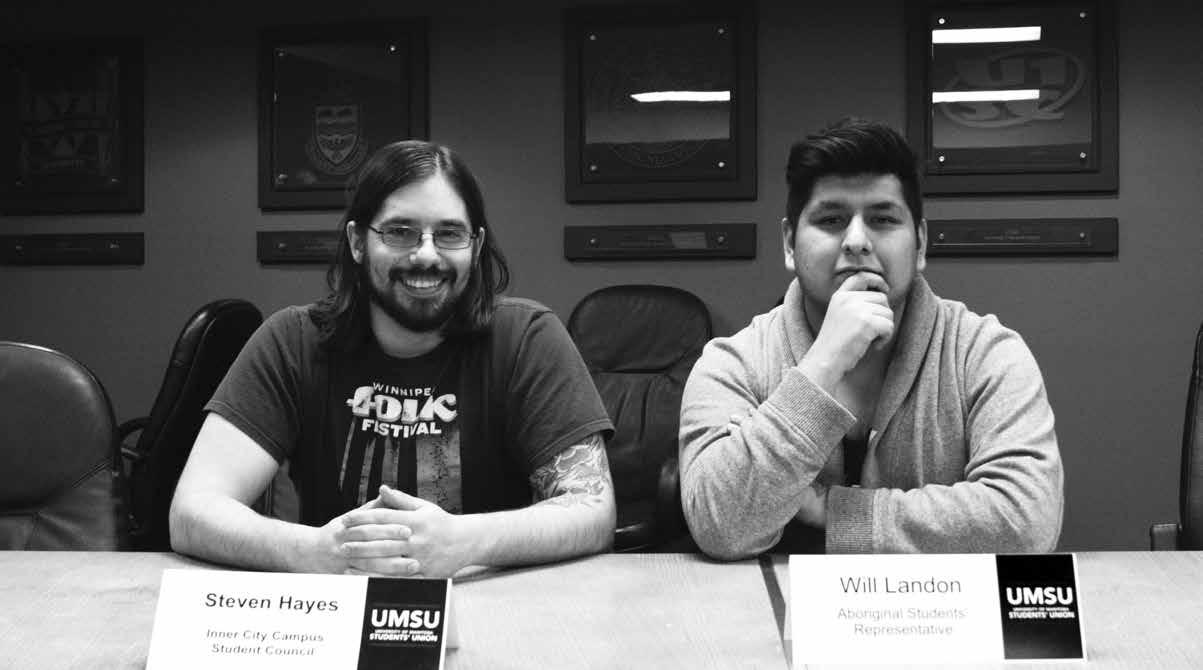
Steven Hayes, inner-city campus students’ council delegate, and Will Landon, UMSU Aboriginal Students’ Representative, spoke to council about the issues raised in the magazine on Jan. 26 and about how they hoped to work with students to address them.
The Jan. 22 issue of Maclean’s has caused a major stir in Winnipeg. On the day of its release, Mayor Brian Bowman, surrounded by a wide range of local community leaders, responded to the claim that Canada’s “race problem” is “ugliest in Winnipeg.”
Bowman, who is Métis and Winnipeg’s first aboriginal mayor, told media in attendance that “Winnipeg has a responsibility, right now, to turn this ship around and change the way we all relate.”
"We have to shine a light on it,” Bowman said, referring to Winnipeg’s racial divide. “Without the light, we can’t see what we’re fighting. We’re not going to end racism tomorrow, but we’re sure as hell going to try.”
University of Manitoba president David Barnard attended Bowman’s press conference as a community leader and made a statement to the press.
“Racism is a problem nation-wide and not specific to Winnipeg, and it hurts everyone – indigenous and nonindigenous peoples. The elimination of racism occurs only with working, listening, and communicating with each other. The University of Manitoba is committed to contributing to this dialogue and working in partnership with indigenous and non-indigenous communities.”
Since the press conference, Mayor Bowman has launched a website: 1winnipeg.ca, which is meant to be a place for people to leave comments, ideas, and discuss racism in Winnipeg. On Jan. 27, Bowman first announced the site was in development. To date, 89 submissions have been posted on the site, including posts by Bowman; Grand Chief Derek Nepinak of the Assembly of First Nations; former national chief of the Assembly of First Nations, Ovide Mercredi; Winnipeg police Chief Devon Clunis; and local radio personality, Charles Adler.
Hayes speaks for inner-city campus
At the Jan. 26 UMSU Council meeting, Hayes and Landon both used their council reports to address the Maclean’s article and issues surrounding it.
Hayes spoke about the significance of the topic for students at the
U of M’s inner city William Norrie Centre at 485 Selkirk Avenue, in the north end of the city.
“The inner city student council believes that regardless of whether or not we are the most racist, that the racism that exists here is a serious issue that must be addressed,” said Hayes. “It is not only shameful, it is in fact oppressive: discouraging aboriginal people from participating as equals in political, economic, and social discourse.
“It disenfranchises youth, discouraging them not only [from] pursuing their dreams, but from dreaming at all; marginalizing individuals, leading to the continued exploitation of entire peoples. Entire peoples. We’re not going to stand by while that happens.”
Hayes said the inner-city social work students were working to establish an honest dialogue on how to address racism in the city, and called on UMSU and the student associations on campus to provide them with support.
“Bring us your ideas. Join in the discussion. It is in the coming together of our various perspectives that we will form a vision. It is in our collective action that our vision will become a reality. This will not happen overnight. It will be an ongoing process; it will take effort and determination.”
Landon highlights positive actions
Landon expressed a desire to address the racism that was highlighted in the article. He shared his experiences of racism growing up on a reserve in rural Ontario, which included multiple instances of violent
assault and having teachers tell him he would not make it to university because of his race.
“Is Winnipeg the most racist city, I’m not too sure about that,” Landon said.
“In my personal experience, I don’t think so. But that doesn’t mean that we shouldn’t address it, because now all of Canada is looking at us. Yes, there’s racism in other cities, but they called us out specifically, a national magazine. So what we have to do is start working together to address it.
“The inner city student council believes that regardless of whether or not we are the most racist, that the racism that exists here is a serious issue that must be addressed” – Steven Hayes, inner-city campus students’ council delegate
“We can’t blame each other. We can’t point fingers anymore,” said Landon.
He called on the university and students to lead the way in addressing racism in Winnipeg.
“I know that at this university [ . . . ] We should be the ones to take a stand and champion this sort of movement. We’re at a university that has one of the highest aboriginal populations in this country. We should be saying something. We should be doing something against this.”
Landon also pointed to a discussion event with guests from Canadians For A New Partnership, organized by the University of Manitoba Aboriginal Students’ Association, as an example of a positive step forward for relations between aboriginal and non-aboriginal people in the city.
The event, which took place on Jan. 22, the same day as the release of the new Maclean’s issue, featured guest speakers Stephen Kakfwi, Phil Fontaine, former prime minister Joe Clark, and Mercredi as representatives of Canadians For A New Partnership. U of M president David Barnard also spoke at the event.
Canadians For A New Partnership was founded after Stephen Kakfwi, former premier of the Northwest Territories and president of the Northwest Territories Dene Nation, began contacting former leaders with the hopes of establishing a strong nation-to-nation relationship.
The group’s website identifies their vision as “building a new partnership between First Peoples and all Canadians so that together we can build the strong economy and valuesbased society that will benefit this and future generations.”
Turnbull weighs in Al Turnbull, UMSU president, said that he thought the speeches were powerful and was glad the
councillors had a chance to discuss the issue. He added that he would like to help the councillors work on the issue moving forward, suggesting that UMSU may play a role in a campaign to address racist attitudes towards aboriginal people.
“Obviously the Maclean’s article was very powerful,” Turnbull said. “I think it, for the most part, was something that everyone recognized is a problem. You get a couple people [ . . . ] going off and defending Winnipeg and condemning the article. That’s bullshit.
“There’s no point making the article the problem. Whether it’s superfluous or hyperbole in the article—which is debatable, you can debate that there’s hyperbole in the article—you can also debate that it’s understated in racism. So there’s no point in discussing that at all. We may as well just come together and say, ‘There is a problem; let’s try and fix it.’”
Turnbull said that he was disappointed that representatives of local student unions—UMSU and the UWSA specifically—weren’t invited to stand in solidarity when Bowman and several other community leaders responded to the Maclean’s article for the first time.
“There’s no representation for the students. There was Barnard and there was the president of the University of Winnipeg but I thought that we would’ve liked to have been supporting, both physically—physically behind Mayor Bowman—and of course metaphorically to build a stronger Winnipeg and a racist-free Winnipeg.”
Bushra Tahir, staff
This year’s annual University of Manitoba Political Studies Students’ Conference, titled “The Great Wars: Marking History and Humanity,” was held Jan. 28-30 at the University of Manitoba’s Fort Garry campus.
The forum focused on politics, defence, and security. Panellists examined the history and impacts of war, along with the future of war –specifically, the use of robotic drones and other sophisticated weaponry.
The event took place in University College’s Great Hall and was organized by students and faculty with the aid of the U of M Centre of Defence and Strategic Studies.
Paul Aseltine, master’s candidate in political studies and a conference organizer, told the Manitoban that the conference provided an excellent opportunity to mark 100 years since World War I, 75 years since World War II, and 25 years since the end of the Cold War.
“We were thrilled with the attendance at this year’s conference. We had a diverse group of speakers presenting on topics that range from the impact of wars on humanity, to the future of warfare. Overall it was a great success.”
The final panel discussion of the conference, titled “the Future of War,” featured a panel of distinguished speakers from the Canadian and French Forces. The panellists included Brig.-Gen. Bruce Ploughman of the Canadian Forces Air Division; Brig.-Gen. Charles Hyde of the United States Air Force; Bryan Peeler, research fellow at the U of M Centre for Defence and Security Studies; and Emmanuel Goffi, captain of the French Air Force.
During the discussion, Ploughman stressed the importance of strengthening protective and defensive strategies entering into complex warfare. Looking into the future requires Canada to “refresh” its war strategies, he added.
Remarking on the importance of acknowledging diverse battlefields— whether in reference to China, Iraq, Syria, Afghanistan, or Libya—he asserted that cookie-cutter models of defence are less likely to be consistently effective.
“Aerospace and meteorology can influence [our domains] where we can start,” Ploughman said.
Hyde, of the United States Air Force, added that the future of warfare looks decidedly different than in previous decades.
“The future of war is not war,” he said.
The future is about drones and technology, Hyde said, adding that there will be an intersection of different varieties of technology in modern war methods. Hyde conceded that there are challenges in how warfare can be reshaped by technological forces, saying that the concept of “robotics warfare is imaginative and is still 10-50 years ahead” of the current status of American military

capability.
Future warfare may be asymmetric, and direct confrontation consequently deteriorates old themes of warfare, according to Hyde. The future of warfare is characterized by the “exploitation of space and cyber domains.”
“Insurgencies may not be our future war,” Hyde said, cautioning that the United States and its allies face many challenges as they move forward.
“New technology does not necessarily mean victory is assured.”
In fact, the failure to coordinate effective war strategies can increase the possibility to lose future wars despite technological improvements, according to Hyde.
Goffi, captain of the French Air Force, emphasized how the historical legacy of war to understand that the “future of the war is not war.” He cited some modern robotics developments as evidence that modern warfare will look significantly different then it does today, and will include machines such as the Boston Dynamics Big Cats, Raytheon XOS 2 Exoskeletons, French Infantry Combat Systems, and General Atomics Aeronautical Systems.
“People are becoming robotic,” Goffi said.
Some 11,000 unmanned aerial vehicles and 12,000 ground robots are deployed by the United States, the world’s leader in military robotics. Goffi acknowledged the potential of 50 countries presently developing 900 different unmanned aerial vehicles.
Across the globe, 76 countries possess drones, and at least 15 countries have the capacity to develop robots.
“It is up to us how to maintain a technology domain,” Ploughman said in his concluding remarks.
“How do we address proliferation of arms? And, how do we recruit people for future conflicts?”

dana h aT herly, staff
Students at the University of Winnipeg have been putting the pressure on its board of regents, the U of W governing body, to improve access to mental health services on campus, demanding that the university increase the ratio of counsellors to students.
Early last week, more than two dozen people—mostly students, some bearing shirts that spelled out, “Support students’ mental health”— met to support the cause, followed by the group’s attendance at the U of W Board of Regents meeting to present about their concerns, pressing for more counsellors.
Protesters said the U of W presently employs only one general mental health counsellor on campus, leaving many students to meet their counselling needs outside the university. According to rally organizers, there is an average wait time of six weeks for students to arrange an appointment with the general counsellor. Their call is for more counsellors –specifically, more specialists.
The University of Winnipeg Students’ Association asked that the U of W hire four more counsellors, supporting the call for enhanced inhouse counselling services.
In addition to the one general counsellor presently responsible for intake assistance, there are various part-time and full-time service workers specific to certain issues. These positions include a full-time social worker, counsellor, and Manitoba Adolescent Treatment Centre mental health clinician; part-time Addictions Foundation of Manitoba community addictions worker, and marriage and family therapy graduate student therapists.
The U of W also offers a full-time nurse practitioner, medical assistant, and part-time dietician as part of the Klinic on Campus, and four elders in residence through U of W Aboriginal Student Services.
On-campus personal counselling is available for free to any student currently registered at the U of W – as well as those registered at the U of W Collegiate high school. Although the counselling environment seems idyllic, it is highly specialized, prompting some U of W students to challenge the adequacy of mental health resources available to students.
University of Winnipeg students have been organizing around the need for more general counsellors on campus. The one general counsellor services about 10,000 registrants. Since last fall, students have handed out literature and started a petition, garnering over 1,000 signatures in support.
Meeting standards
Prior to their attendance at the U of W Board of Regents meeting last week, some U of W students
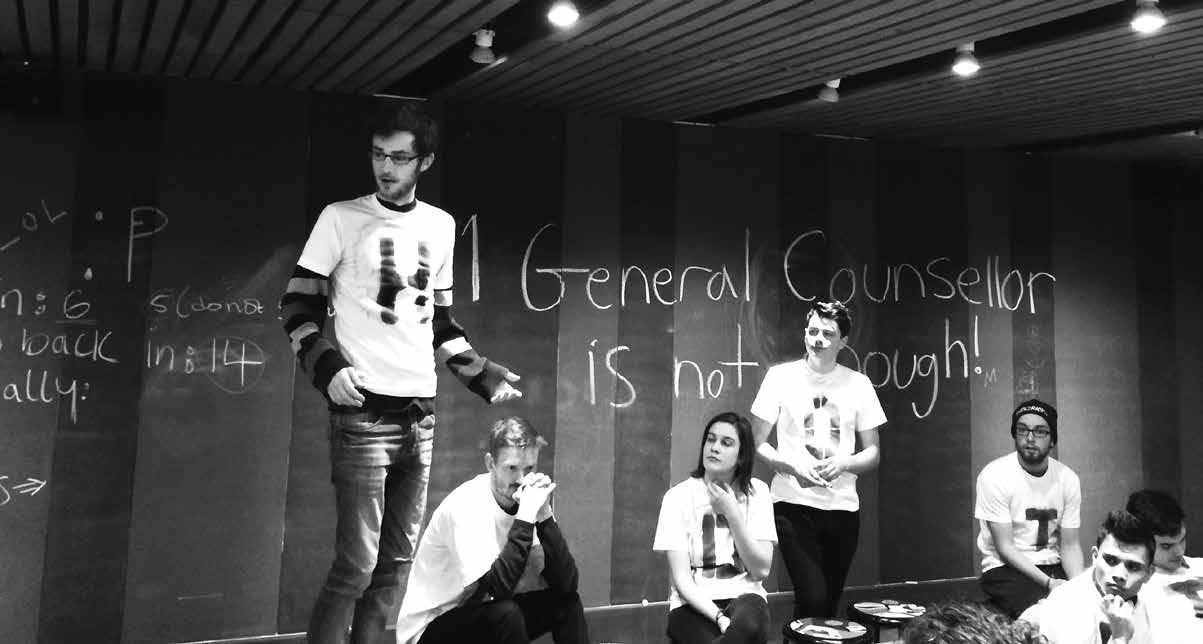
met at the HIVE to discuss the recommended counsellor-to-student ratio for an academic institution.
The International Association of Counselling Services recommends that universities maintain a counsellor-to-student ratio of 1:1,500.
“You basically just sit there for an hour, and tell them what’s going on, and they talk to you about what kind of services they have available”
– Katy MacKinnon, University of Manitoba alumna
According to the International Association of Counselling Services, some foreseeable consequences of maintaining a ratio exceeding the recommended limits include: longer waiting lists, difficulty providing services to students experiencing more severe psychological issues, increased liability risks to the counselling centre and the university, decreased support for the academic success of students, and lessened capacity of counselling centres to offer support to the wider campus community.
Boardroom meeting
University of Winnipeg Students’ Association president Rorie Mcleod Arnould presented to the board of regents, outlining where the U of W ranks in terms of resources per stu-
dent population, suggesting that a move to get more counsellors would be a step towards a more “studentcentred university” where students are not treated like consumers.
Following several student testimonials, read by U of W political science student Andrew Vineberg, students in attendance gave the board of regents reasons as to why the student population needs more counsellors.
University of Winnipeg president Annette Trimbee called these testimonials “moving,” but responded that she didn’t want this to be an “and/or debate.” Trimbee said that she wants to have a strong in-school support system, but that partnerships with the outside mental health care system were a positive thing.
Soon after, the student visitors were thanked by the board and asked to leave for the remainder of the meeting, which was closed to visitors. Among the group of protesters, there was a strong consensus that their plan had been effectively “filibustered.” The initiative has been going on for four months now, according to members of the U of W student group F(un) Class.
On campus counselling
Lisa Erickson, nursing student at the University of Manitoba, has schizoaffective disorder, an illness she described as including symptoms of depression, mania, and psychosis. As a U of M student with specific counselling needs, Erickson previously sought out the Fort Garry student counselling services.
During an interview with the Manitoban in 2013, she spoke about her experience of coping with a mental illness while in university:
“When I was depressed it was hard to make it to class; it was hard to concentrate. [It’s the] same as when I’m psychotic: it’s hard to concentrate for sure. In general it’s hard to find people who understand. It’s just hard to get support.”
The University of Manitoba Student Counselling Centre provides personal counselling services to current U of M students. Personal counselling services are available on a first-come, first-serve basis and are limited in number, with nearly all appointment slots filling up daily.
“We encourage students to arrive as early as possible on a weekday to request one of these appointments,” reads the Student Counselling Centre website.
“When I was depressed it was hard to make it to class; it was hard to concentrate” – Lisa Erickson, U of M nursing student
Erickson said she was turned away twice before finally landing an appointment with a psychiatrist, which was two months since her first application for a meeting.
“Once we got the ball rolling, the help was there. But just getting started, getting turned away, and feeling like nobody really cares, that was how it felt starting out,” Erickson said.
One U of M graduate, Katy MacKinnon, shared her experi-
ence resourcing the U of M campus counselling services last year through the Student Counselling Centre. “It was positive, for the most part,” MacKinnon told the Manitoban MacKinnon said that she first met with the general counsellor, who typically directs students to specialists. She explained the process: “You go in and you have an intake; and to get an intake appointment, you have to be there first thing in the morning. It only took me two days to actually get an intake, so that was good.
“And so [during] the intake, you basically just sit there for an hour and tell them what’s going on, and they talk to you about what kind of services they have available, like personal counselling or certain group sessions, depending on what your needs are.”
In her case, MacKinnon was set up with a social psychologist. Overall, she said that her wait time was short, she felt comfortable with the general counsellor, and that when her specific counselling needs were not being met, changes were made promptly and accordingly.
MacKinnon pointed out that students may access numerous counselling sessions offered through the U of M as part of their student fees. “As a student, you can see them many times throughout the year.”
The U of M Student Counselling Centre provides personal counselling at the Fort Garry campus at 474 University Centre on weekdays from 8:30 to 4:30 p.m. The Bannatyne campus location, S207 Basic Medical Services Building, is open from noon to 7 p.m. on Monday to Thursday and 8:30 to 4:30 p.m. on Fridays.
COGRaD a university-industry partnership to focus on environmental remediation and monitoring
e mily ZaryC h Ta, staff

The federal government recently announced $2.4 million worth of funding for the creation of the Centre for Oil and Gas Research and Development (COGRaD) at the University of Manitoba, generating
mixed reaction from researchers and critics.
The aim of COGRaD is to develop an internationally accredited research facility to focus on environmental monitoring and remediation.
This research will be used to further the study of environmental remediation, a process used by the oil and gas industry to restore contaminated sites, making them safe for humans and wildlife. The centre also aims to develop new environmental monitoring techniques and analytical tools to meet existing environmental challenges.
The funding will be used to purchase highly specialized equipment, allowing COGRaD to work together with the private industry on research and development.
Peter Budzelaar, a professor in the chemistry department at the U of M, said that the department is pleased with the federal funding.
“It is a very nice interaction between our biochemistry and analytical chemistry; they joined from very different starting points to get this into a working project,” Budzelaar said.
Jörg Stetefeld, associate head of the U of M chemistry department, and Gregg Tomy, associate professor in chemistry, are already working on research projects with the engineer-
ing firm Stantec Inc.
Stantec provides environmental services like monitoring and restoration for the oil and gas industry.
Stetefeld’s research group is focused on the structure-function relationship of proteins as dynamic systems, with the long-term goal of increasing the molecular understanding of target proteins in action.
The focus of Tomy’s research group is on developing analytical methods to measure commercially used persistent, bioaccumulative and toxic chemicals, and on uncovering unreported chemicals in the environment using high-resolution mass spectrometry.
Andrew Park, environment critic for the federal Green Party of Canada and assistant professor in the biology department at the University of Winnipeg, told the Manitoban that COGRaD is an important initiative to help clean up some of the environmental damage of Canada’s oil sands.
“Only a very small area of the hundreds of square kilometres of worked out oil sands mining areas have been remediated to date,” Park said.
“Finding ways to achieve acceptable levels of remediation to the surface environment is a complex business and is probably a good use of university researchers’ time.”
Park said that universities frequently partner with industry for research and development, but that this practice contradicts Green party principles.
“The Green party believes in the ‘polluter pays’ principle, and the profitability of the major oil companies was, at least until recently, more than sufficient to fully support such an initiative,” Park said, adding that the oil and gas industry has already received hundreds of millions, even billions, of dollars worth of subsidies like tax breaks.
The Government of Canada news release for COGRaD states that the oil and gas industry generates more than seven per cent of Canada’s Gross Domestic Product (GDP). Statistics Canada states that in 2013, the gas, oil, mining, and quarrying industries contributed 12.2 per cent to Canada’s GDP altogether.
Aiming to increase involvement at Bannatyne campus with hired directorship
e mily ZaryC h Ta, staff
A motion calling for the creation of a director of Bannatyne operations (DBO) was presented to UMSU council at their Jan. 28 meeting, moved by the policy and bylaws committee, and motivated by Al Turnbull, UMSU president.
The motion—which was reviewed, discussed, and will be voted on at the Feb. 9 meeting of UMSU Council— stated that the new position would be responsible for student services programming, promoting the union, and working on advocacy issues particular to Bannatyne members, utilizing the existing UMSU office space at Bannatyne campus.
The DBO would be an UMSU employee, with five set office hours per week at the Bannatyne campus. The candidate would have to be a student studying at the Bannatyne campus and would be selected by UMSU executives, rather than elected.
Turnbull told council that the tentative wage for the DBO would
be a salary of $10,000 for a term of June 1-April 30, but that none of these details have been finalized.
He added that the executive had considered creating an elected Bannatyne position, but decided against it because they expected a full time elected position would interfere with the heavy academic loads of Bannatyne students.
Turnbull said that the idea for the DBO emerged because students at the Bannatyne campus are isolated and alienated from UMSU culture.
“I felt that, we, as an executive [ . . . ] were failing to meet some of the needs of the Bannatyne campus and the students that are there and that are members within the union. And I don’t mean failing in a way where we deprive them of services. They still get the health plan.” Turnbull continued, “In fact we increased the amount of food they get from three to five [days]. We gave them two beer gardens.
“But it was more of an appeasement strategy,” said Turnbull. “‘Hey there, eat up. Have a couple beers. We do things for you.’ But in all reality, they have become a bit of an afterthought.”
Last year UMSU established the Bannatyne board of senior sticks (B-BOSS), as a way to address a lack of representation for the campus.
Turnbull said that that the B-BOSS had improved campus culture at Bannatyne, but said that more could be done. He characterized the new DBO proposal as a way to further enhance the student experience for students at the Bannatyne campus.
“I think moving forward it’s really going to be a living and breathing position that’s going to mold around the needs [of the campus].
“It’ll be, really, the role of the director of Bannatyne operations in the first couple of years to build the position, and to build manuals, and build how it’s done.”
Thomas Hall, UMSU represen-
tative for the Manitoba Medical Students’ Association, said that UMSU has had increased presence at the Bannatyne campus recently, including during orientation week and through special events, like beer gardens and wine tastings.
Hall agreed with Turnbull’s assessment of the need for special representation at the Bannatyne campus.
“The B-BOSS voted unanimously to approve this position.
“We have a unique set of issues on our campus that may not always be addressed by the Fort Garry UMSU [administration],” said Hall. “I think the DBO is a phenomenal idea to further enhance the communication with the council at large and to increase UMSU presence on our campus.”
During questioning period, Jacqueline Robert, UMSU representative for the nursing students’ association, questioned the $10,000 salary proposed for the position.
“If you do the math, that’s $56 per hour,” said Robert. Turnbull responded by saying that the position’s five minimum hours a week were meant to be static office hours, and did not include the other duties of the DBO such as meetings, teleconference calls with the executive, and responding to emails. He said that the DBO will be working on advocacy, student group issues in collaboration with UMSU’s vice-president advocacy and vicepresident student services, and would also provide reports for council and attend council as an ex-officio member with no voting rights. The director of Bannatyne operations must be a registered Bannatyne student, said Turnbull.
Turnbull said that all of this would result in the position requiring more than the five hours per week.
Tom i ngram and dana h aT herly, staff; with files from Craig adolphe, staff
Early last week, hundreds of people gathered in the Engineering Atrium to rally against the proposed budget cuts at the University of Manitoba.
Those in attendance included representatives from the University of Manitoba Students’ Union, the University of Manitoba Graduate Students’ Association, the University of Manitoba Faculty Association, the Canadian Union of Public Employees, the Association of Employees Supporting Education Services, the Canadian Federation of StudentsManitoba, and the University of Manitoba Student Action Network, along with concerned students, faculty members, and staff.
The rally was held outside the Alan A. Borger Sr. Executive Conference Room, where the University of Manitoba Board of Governors was holding their regular meeting. Before the meeting started there were speeches from several organizers. Shortly after the beginning of the meeting, some students entered the meeting chambers as visitors, while the majority of the protesters set off on a march around campus.
Members of the university community exercised their right to attend the board of governors meeting as visitors. However, only a small number were allowed in due to room occupancy limits, and those with placards or recording devices were asked to leave – a policy for board of governors meetings that was posted on the door to the meeting chambers.
One staff member from the Manitoban was admitted to the chambers for a portion of the meet-
ing, but was not able to take pictures or recordings.
After the speeches were delivered outside the meeting chambers, the protesters marched around Chancellor’s Circle. Marchers made their way up the staircase and into the corridors of Chancellor’s Hall—the Administration Building—exiting out a door on the other side of the building, heading towards University Centre, and back to Engineering.
“We want education, not a corporation” – protesters at last Tuesday’s rally
Winnipeg Labour Council president David Sauer spoke to the Manitoban about the labour movement’s presence at the march.
“It’s a show of solidarity all-around. Austerity measures right now are being imposed all across the Western world, and frankly, I think the public is getting sick of it,” said Sauer, adding that cuts to education was a disingenuous route to bolstering the economy and institutions.
“Budget cuts are the worst. Education should be first,” the crowd chanted, marching towards the administration building.
The University of Manitoba faculty of environment is bracing for cuts, according to Shirley Thompson, assistant professor of the Natural Resources Institute. “They’re reorganizing, and talking about cuts, and everyone feels threatened, but also,



people feel like their programming that has been built up is now being torn apart.
“The cuts are hurting students. They’re hurting programs. They’re hurting the potential of the faculty of environment to continue.” Thompson added, “Will [the faculty of environment teachings] occur in the future, or will it be really watered down?”
Niall Harney, political studies student at the U of M, spoke about his involvement with the U of M Student Action Network, saying that with wider, more consistent cross-campus efforts to spread awareness—from global political economic studies to the sciences—his group is hoping to garner mass student support against the cuts.
“We’ve mostly been running an education campaign, thus far, trying to get as much information about the cuts out to as many people as possible.”
Rally attendees carried signs that read, “It’s time to re-prioritize spending at U of M!” with graphs and information about the university’s capital expenditures and general operating fund net revenues.
“Budget cuts are the worst. Education should be first” – protesters
Canadian Federation of StudentsManitoba chairperson Zach Fleisher cited UMFA accounting showing that, in 2013, the U of M’s return on sales—its net revenue divided by operating revenue—is 10.1 per cent, which is comparable to some forprofit corporations such as Canadian
Tire (10.5 per cent) and Sobeys (3.4 per cent).
“We want education, not a corporation,” the crowd roared at one point during the rally.
While many protesters marched around campus, several other protesters remained at the board of governors meeting. However, the board conducts confidential business during closed sessions, which visitors are not allowed to attend. The visitors were asked to leave when the closed portion of the meeting began.
The marchers returned to the Engineering Atrium and the crowd dispersed shortly thereafter.



Carolyne Kroe K er, staff

Water has been on the mind of Winnipeggers following the city-wide boil-water advisory, which lasted from the evening of Tuesday Jan. 27 to the afternoon of Thursday Jan. 29. Following this temporary inconvenience, there has been increased public dialogue surrounding the issue of access to safe drinking water. However, lack of access to clean water is hardly a new issue for several First Nations communities across Canada. The community of Shoal Lake 40 First Nation, for example, has been living within the constraints of a boil-water advisory for nearly two decades.
“Winnipeg got a taste of what life is on the other side of the pipe” – Chief Erwin Redsky
“Aren’t they used to it?” some may ask.
“I don’t think you can get used to anything like this,” is Chief Erwin Redsky’s response.
The chronic inconvenience doesn’t become any less inconvenient over time. When a disenfranchised community is forced to take extra steps to obtain that which is readily available to others, social, physical, and psychological disparities ensue.
Those of us accustomed to accessing safe drinking water from our taps surely caught ourselves having to consciously adjust our daily routine to factor in the few minutes necessary to bring our water to a boil. How can such a seemingly undemanding task throw us so off course? One argument could be that “we aren’t used to it.” But what if this temporary reality became a rather permanent one? Doling out time to prepare water significantly hinders everyday schedules and puts individuals at a disadvantage in comparison to the larger population.
Time must be set aside for this additional step, whether it is acquired through sleep deprivation, sacrificing basic self-care, or forgoing extracurricular activities. What seems to be merely minutes adds up, eventually creating a disparity between those with clean running water and those without. This is particularly significant for individuals already strained by a demanding work schedule, or providing for young children within their households. Although men in traditional heterosexual two-parent households are becoming increasingly involved in domestic caregiving, women still assume the majority of the responsibility relating to child care. Boiling water for children, whether for their formula, their water bottle, or even their bath, thus genders the issue.
Following the boil-water advisory,
many Winnipeggers rushed to the store to buy bottled water, aware that boiling their water within the next few days would significantly alter their schedules. The inconvenience of boiling water, for many, outweighed the exorbitant cost of bottled water. Many Winnipeg stores sold out of water within hours of the city-wide announcement.
When a disenfranchised community is forced to take extra steps to obtain that which is readily available to others, social, physical, and psychological disparities ensue
“The news came on at six and we sold out by seven,” said one Safeway employee. “We ordered more in and sold out later that night.”
What about those who cannot afford to buy bottled water? Chief Redsky noted that trucking water to Shoal Lake 40 First Nation from Kenora by ice road or ferry is very expensive, and must be done on a weekly basis. The sheer cost of obtaining a natural resource freely accessible to many puts communities like Shoal
Lake 40 First Nation at a significant economic disadvantage.
Health and hygiene
Human beings are composed of about 60 per cent water. What happens, then, when our bodies are deprived of the water we need not only to survive, but to thrive?
Lack of access to safe drinking water can lead to the dehydration of those who can neither set aside the time to boil water nor afford to buy bottled water. Hydration is even more important than nutrition. Severe dehydration causes stark health complications, namely heat stroke, hypovolemic shock, and kidney failure. Even a temporary, moderate decrease in daily water intake can have immediate effects on our wellbeing. The human brain itself is composed of roughly 75 per cent water. Cognitive ability is adversely affected by even mild dehydration. This leads to increased irritability and hindered concentration levels, symptoms which decrease workplace performance and impact students’ academic abilities. Aside from the immediate effects of dehydration on our bodies, lack of clean running water can also force those without access to compromise their hygiene to avoid exposure to harmful waterborne diseases or chemicals. Skipping out on brushing our teeth or even bathing children then becomes part of a greater cycle of inequality in which those without access to basic resources may become targets of microaggressions or harassment in everyday social interactions.
We cannot avoid using water indefinitely, and communities like Shoal Lake 40 First Nation are routinely forced to take the risk of using unsafe water. Despite the severe health threat of waterborne diseases, “we have no choice but to bathe our kids in it,” said Redsky.
We cannot stop caring as soon as living without access to safe running water reverts to a seemingly hypothetical scenario
Our neighbours still lack clean water
Those of us who can readily access clean water through our faucets have had the privilege of calling these 48 hours an “inconvenience.” Perhaps the brief change of routine has even forced some of us to realize how much we depend on our faucets. However, the vast majority of Winnipeggers knew this change of routine would only be temporary. We cannot stop caring as soon as living without access to safe running water reverts to a seemingly hypothetical scenario. We cannot stop talking when this issue continues to affect our fellow citizens.

Comment Editor: Tom Ingram Contact: comment@themanitoban.com / 474.6529
Letters published in the Manitoban are edited for spelling, grammar, and punctuation. Views expressed in the letters are those of the author and do not necessarily reflect the views of the Manitoban
i an mCd onald
In recent articles in the Manitoban, I continue to see the Stop the Cuts campaign referred to as a campaign led by the Canadian Federation of Students-Manitoba (CFS-MB). This is a misleading term and one that should probably be avoided if one is attempting to paint an accurate picture of this campaign.
The Stop the Cuts campaign is not a product of CFS in which other groups have joined under the CFS banner. Rather, this campaign was brought about when virtually every union on campus came together on
equal footing, with a unified voice and demand. This includes the University of Manitoba Students’ Union, University of Manitoba Graduate Students’ Association, University of Manitoba Faculty Association, Canadian Union of Public Employees Local 3909, Unifor Local 3007, Association of Employees Supporting Educational Services, and CFS-MB.
CFS-MB has been an integral part of this coalition, but if there is a belief that CFS-MB “leads” in a hierarchical way, this belief is mis-
Thank you, Margaret!
KaT in K a sT e C ina
Margaret Tobin was a counsellor for students at the University of Manitoba when I met her for the first time as a graduate student full of confusion about my life, my goals, my opportunities, and my future. Her job was to advise, not to promise the unattainable, and so she did. Mostly she listened to me, helped to see my real problems and my unnecessary ones, and she helped me through a phase of my life that I consider tough.
I knew little about her then, but
she has been far more than an advisor for university students. She, as a social worker by profession, has established and run a community-wide organization, a choir without audition, welcoming people who want to sing as a form of self-expression, stress-release, meditation, harmony, coming to peace, or just for their spirit’s call. When I met her again several years later, it was during one annual concert of this choir, and by then she had also established a bursary at the U
m ar K Kaje Tania K
Ifrankly find it disturbing and unsettling that Raylene Paci, in her Jan. 21 article “Je ne suis pas Charlie,” takes offence to the Manitoban publishing a cartoon from Charlie Hebdo the week after the attack in Paris. The magazine mocks extremist proponents of Islam, and Paci essentially tries to argue through an appeal to ignorance that publishing this cartoon is an affront to Muhammad and supposedly insensitive to Muslims who are not radicalized and do not support the extremist forms of Islam.
Paci seems to believe that simply publishing a satirical cartoon will cultivate an increasingly xenophobic environment against moderate practitioners of Islam. Paci argues that she supports free speech so long as it’s practised with a “sense of decency, intelligence, and respect” and that “consistently attacking an entire religion just because you can should not be acceptable.”
Even though she accurately describes Charlie Hebdo as a satirical publication, she simultaneously fails to recognize that it is a satirical magazine. By that very definition and
by the freedom afforded to the editors by an autonomous country to be able to practise freedom of speech, the magazine should be able to publish satirical content just as the Manitoban is able to.
Paci essentially calls for censorship because Islam and Muhammad are sacred and cannot be mocked because they are sacred. This kind of circular reasoning is quite dangerous (especially when it comes to discussions on religion) and essentially says that the terrorists in Paris were acting within their rights to protect their religion, even though Paci tries her damnedest to distance moderate Islam from radicalized Islam.
I am in no way insinuating (in the way that Paci will no doubt assume that I and anyone else would be who is exposed to the “damaging” nature of a simple cartoon) that all of Islam is radical – quite the contrary. I recognize every religion has extremist sects and a distinction has to be made between the extremists and the mainstream.
Paci goes on to say that “Radical Islam is different from Islam, some-
taken. CFS-MB has helped “lead” the charge in terms of assisting the mobilization of students, predominantly by working with the University of Manitoba Student Action Network (UMSAN). UMSAN is the group responsible for setting up tables, delivering pamphlets, putting up posters, and performing various other ground work. This work is often done with members of CFS-MB and UMSAN side-by-side, but it is important to make the distinction that we are not being led, but standing together. The coalition of unions
is in an analogous situation. This point is overlooked too often. While the Stop the Cuts campaign has yet to hear an adequate response from the university administration, much has already been accomplished. The broad University of Manitoba community, with the exception of the administration, has banded around a campaign that places the integrity of our education as its highest priority. Groups which may have disagreements elsewhere are joining together in the name of the student body. Other politics have been put aside
as we focus on our goal, and various student groups and unaffiliated students have joined the movement which has garnered support across Fort Garry, Bannatyne, and even the University of Winnipeg. Stop the Cuts is a grassroots movement that has strong support throughout our community.
Ian McDonald
of M for single mothers as an encouragement to engage in post-secondary education in social work. The concert, and several others I attended, also empowered several mothers of many nations or races landing in Winnipeg and many other charities working here to improve people’s lives in our community in many different ways.
I personally enjoyed very much the choir’s concerts and every time I listened to Margaret speak at these events, I felt as if I had done something good for my fellow humans just
by being there. In my life with the work, the kids, and the rush of every day, it has been harder and harder to find a way to help my fellows, and I now realize how people with a special drive, like Margaret, are so important to be with us and help us to give – for harmony.
I will not run into her again in person as she has passed away. Without being able to thank her one last time for all the joyful concerts, for all the beautiful moments of harmony that her work brought to my heart, I
decided to share this story with current U of M students. Perhaps you will grow up to be as she was: empowering the world to be in harmony. Thank you for all that you have done, dear Margaret Tobin. Katinka Stecina Assistant Professor, Department of Physiology and Pathophysiology
thing these cartoons don’t always differentiate.” How, exactly, are they not differentiated? Art does not inherently say anything. Whatever message a person gets from any exposure to media is based around their biases and life experiences.
If a racist bigot sees the cartoon, then their ignorant opinions on Islam will simply be reinforced. Censoring the cartoon does nothing to change the bigot. Art is purely subjective and should not be twisted to fit someone’s notion of maliciously attacking an entire religion and its adherents.
Furthermore, if radical Islam is so different from moderate Islam (which it undoubtedly is), why is Paci taking any offence at all? The cartoon is not directed towards Islam but radicalized terrorists who belong to a wholly different set of beliefs and practices. Believing that anyone who views the cartoon will automatically think that moderate Islam is just as zealous and dangerous as radical Islam is severely underestimating the critical faculties of non-Muslims.
Not every non-Muslim has discriminatory beliefs on moderate
Islam and it should not be implied that they do. When I view the cartoon I see it as boldly mocking radicalized terrorists, not moderate and peaceful practitioners of Islam. This should be applauded because despite a devastating terrorist attack, the editors of Charlie Hebdo are still attempting to practise freedom of the press.
Paci seems to have a black and white understanding of free speech – either you support Islam by segregating and distancing yourself from the cartoon without trying to understand it at all, or you are viciously attacking every contingent of the religion by supporting the Charlie Hebdo cartoon, which is patently absurd. We should be more concerned with trying to understand how moderate Islam is different from extremist Islam and trying to live in this world with all of its differences, intricacies, and complexities without murdering each other. Islam is not the victim here; the 12 murdered innocents are. Making fun of a small contingent of Islam is not akin to attacking the entire religion.
My defence of free speech has
nothing to do with attacking Islam and intentionally provoking its adherents just because I can. We live in an increasingly secular society in which everything is fair game, whether Paci chooses to accept that or not. Why is it that Judaism and Christianity can be openly mocked and discredited while Islam is sacred? Charlie Hebdo, from my understanding, is kind of like South Park: they make fun of everything. We gain power and autonomy over radical terrorists by shoving their megalomaniacal ideas right back into their faces. Despite what she says, Paci has no interest in truly advocating for free speech and is simply blowing a cartoon out of proportion without doing any intellectual reflection on the material, just like the extremists did with the cartoon that precipitated the attack. Between this article and the recent censorship of the film The Interview, I grow more in fear every day that we are nearing an Orwellian state.
Thi B aulT j ourdan
On Jan. 25, a political earthquake shook the European Union. The Greeks elected Syriza, a left-wing party. The newly-elected prime minister, Alexis Tsipras, won a historic victory; for the first time in over 40 years of Greece’s history, a party other than New Democracy (conservative) or PASOK (socialist) has come to power, ending a two-party system.
“Greece leaves behinds catastrophic austerity, it leaves behind fear and authoritarianism, it leaves behind five years of humiliation and anguish,” proclaimed the 40-year-old leader. His main promise was to stop the austerity measures, and renegotiate the funding agreement with its three main creditors, dubbed the Troika: the International Monetary Fund (IMF), the European Central Bank (ECB), and the European Commission. It won’t be an easy task.
Greece has received more than 246 billion Euros in bailout funding so far, but it had to implement austerity measures which profoundly affected Greeks’ daily lives, as well as the political and socioeconomic landscape. Syriza wants the creditors to cancel a part of their debt, which is approximately 366 billion Euros – or roughly 175 per cent of Greece’s GDP.
However, the IMF, the ECB, and the European Commission don’t agree on how far they’re ready to go to help the country. On Jan. 26,
the IMF said it was ready to “keep helping” Greece and wanted to “start negotiations with the new government,” while the ECB was tougher.
“Greece must pay. Those are the rules of the European game. However, I must stress that this money does not belong to the European Central Bank. This money belongs to governments,” said Benoît Cœuré, a board member of the ECB. Greece could take advantage of this disagreement among its creditors.
If Syriza fails, the European people won’t know if there is any other model possible for the EU
Others might fear that Greece may leave the Euro zone. In reality, this is less believable than it used to be. The IMF, the ECB and the European Commission are more worried about the long and tough negotiation that is looming. Moreover, leaving the Euro zone is legally impossible, as the European Commission reminded Greece early January: “Euro membership is irrevocable.” The only way Greece can leave the Euro zone is if they first depart from the European
Union (EU) – very unlikely.
Whatever happens between the Greek government and its creditors, the people of Greece sent a very strong message to the rest of the EU. The people’s vote is a strong call for change. After years of austerity measures implemented by the EU, it is also a call for reassessment of the crisis management approach adopted by the Union. Those measures have driven a new threat to the EU economy: deflation. Thus, Syriza’s election and Greece’s cry for change appear even stronger than a few months ago.
Even if Syriza’s electoral platform might be a little bit unrealistic, it drew people because Syriza’s promises give new hope. For the first time in several years, people other than the far-right are talking about growth and creating jobs. Tsipras wants to use money for economic recovery, not to pay the debt.
Within two years, Tsipras aims to find approximately 15 billion Euros to fund his promises. It may be hard, though, as some analysts insist that he must get his creditors’ agreement first. Takis Michas, journalist and analyst for the Wall Street Journal, wrote: “The broken promises of Syriza could bring anger in the streets.”
Beyond Greece, Syriza’s victory gave hope to all the left-wing and Eurosceptic parties across Europe

in France, Spain, Portugal, and Ireland. Some leaders even predict a “European spring.” A wind of change has come, but the pressure is on Syriza. If they fail, the European people won’t know if there is any other model possible for the EU.


Chan T elle d u B ois, staff

The Planetary Society, a non-profit organization which engages the public in space exploration, has announced test flights for the citizenfunded LightSail project will begin in May 2015.
will ensure funcionality of LightSail before it is tested in space. The solar sails should be viewable from the ground, and the Planetary Society intends on holding viewing events.
A full test flight is planned for 2016, launching onboard SpaceX’s new Falcon Heavy rocket. LightSail will be deployed at 720 km in low Earth orbit from Prox-1, a small satellite designed and built by Georgia Tech students.
Prox-1 will be testing its automated trajectory control systems, which will use passive image processing to maintain relative distance to LightSail. It is planned for Prox-1 to capture images of LightSail as it deploys its solar sails.
Solar sails are a developing propulsion method which relies on light to operate. It works by absorbing momentum from light photons which reflect off the solar sails. Over time, the solar sails will gain speed.
Solar sails have been tested in the past with varying levels of success.
In 2010, JAXA launched the Interplanetary Kite-craft Accelerated by Radiation of the Sun (IKAROS), which contained a 200 metre squared polyamide solar sail. IKAROS spent six months sailing to Venus, and is currently on a flight path to the far side of the Sun.
LightSail is the continuation of a collaboration between the Planetary Society, Cosmos Studios, and the Russian Academy of Sciences
will help satellites deorbit faster to avoid creating space debris. The first NanoSail-D launch in 2008 was a failure. NanoSail-D2 made it to low Earth orbit in 2010 and successfully deployed and collected data.
Sunjammer, a NASA project named after an Arthur C. Clarke sci-fi story, was planned for launch in January 2015. However, the project was cancelled in October 2014, due to “lack of confidence in its contractor’s ability to deliver.” Sunjammer would have used the solar sails to maintain a distance of three million km from Earth, collecting data on the Sun’s coronal mass ejections.
The flight test in May will be a shakedown cruise test launched onboard an Atlas V rocket. This test
LightSail will primarily consist of four deployable solar sails inside a 3U (10x10x30cm) nanosatellite. The sails, made from mylar, will be 4.5 microns in thickness and 32 metres squared. For perspective, a hair strand is about 100 microns thick.
Such technology will help overcome some of the challenges faced in long-distance space flight relating to fuel cost and energy, and will have other possible applications such as orbit control, trajectory correction, or accelerating the deorbiting time of satellites.
NanoSail-D is a solar sail project intended for use as a passive deorbiting method on satellites. It is the result of a collaboration between the NASA Marshall Space Flight Center and the NASA Ames Research Center. These solar sails
LightSail is the continuation of a collaboration between the Planetary Society, Cosmos Studios, and the Russian Academy of Sciences. The initial collaboration resulted in two failed attempts, one in 2001 and the second in 2005. In 2009 it was decided to continue with the development of LightSail-1, LightSail-2, and LightSail-3. This decision was made on Nov. 9, what would have been Carl Sagan’s 75th birthday.
j eremiah yarmie, staff

Researchers from Stanford University have developed a way to extend the life of human cells grown in culture. The technique is a quick and efficient way of increasing the number of times a cell can divide by temporarily extending the cell’s telomeres.
When a cell divides, it first has to replicate its strands of DNA. Unfortunately, the linear structure of most animal DNA results in small portions from the ends being lost with each replication. Our DNA has protective caps known as telomeres which act as a buffer for this loss.
Human telomeres are composed of thousands of short tandem repeats of the DNA sequence TTAGGG. As the telomeres shorten with each cell division, they eventually get to the point where they signal for the cell to stop dividing, known as senescence, or to die, known as apoptosis. This typically happens after 50 cell divisions.
Telomerase is an RNA-protein complex that has the ability to extend telomeres. It does this by using its RNA as a template for extension, and is extended by its protein component.
The research, published in the FASEB Journal, describes a procedure which introduces a modified mol-
ecule of messenger RNA (mRNA), which tells the cell to create telomerase reverse transcriptase (TERT), a portion of telomerase required for activity.
With three treatments spread over a couple of days, the protocol successfully increases the telomeres of skin cells, allowing the cells to divide up to 40 times more than usual.
Researchers have extended telomeres in cell culture before, but this new technique is promising because it only extends telomeres temporarily. This is important because, in addition to short telomeres, telomeres that are too long can also be harmful.
The mRNA used in the study was modified to increase its stability. It remained active for one to two days, after which, the telomeres resumed shortening. Continuous telomerase activity may lead to cell immortality, like in cancerous cells, which is caused by uncontrolled cell multiplication. These cells, however, showed normal senescence after considerable cell division.
As well as acting as a buffer area for DNA, telomeres are very strong. They protect DNA molecules from destruction and unwanted fusion events with other molecules. One way to think of telomeres is that they act
like an internal countdown clock, as they play an important role in aging. Normal DNA is composed of two strands running in opposite directions, forming a double helix. Telomeres are interesting because the terminal end is single stranded and rich in the nucleotide guanosine (G). This region contributes to the stability of telomeres, as it can arrange itself into a strong structure known as a G-quadruplex, which forms when the strand snakes around upon itself. To keep things even tighter, the ends ties themselves in protective loops.
Telomerase activity is first seen during human development, and is present in the developing cells of an embryo up until about 20 weeks. In adults, telomerase is transiently active in certain cell types, and is fully active in stem cells and germ line cells. Constitutive telomerase activity is not good. Tumour cells constitutively express telomerase and, as a result, can replicate indefinitely. Moving forward, the team plans on using this procedure on different cell types. Hopefully this technique opens new options in the treatment of diseases related to aging and telomere dysfunction, like cancer.
j eremiah yarmie, staff
M
ale Herennia multipuncta , more commonly known as ornamental tree trunk spiders, have a grotesque post-mating habit. After mating, males will gnaw off one or both of their sperm-transferring organs called palps. This genital self-removal is called emasculation and leaves the spider as a partial or full eunuch.
Now I know that you must be asking yourself why anything would bite off its own genitals, but there are apparent benefits for this mutilation.
Research recently published from the Slovenian Academy of Sciences and Arts in Ljubljana investigated several hypotheses postulated to elucidate the benefits of this unusual behaviour.
The team collected spiders from areas such as China, Vietnam, and Taiwan for use in the study. Out of 60 mating attempts 32 were successful, with nine males chewing off one palp and 23 chewing off both.
When male spiders mate, they leave behind a small portion of the tip of the palps, which obstructs the female reproductive tract. This pre-
vents other males from successfully mating with the female (how romantic). The male does this instinctively, ensuring the paternity of the female’s offspring.
A eunuch male is very protective of the female he mates with, and is more aggressive against other virgin males in the area. Emasculated males exhibit behaviours such as attacking the virgin spiders and shaking the web they are sitting on. Once a male has successfully done all the mating that he is physically capable of, he has nothing to lose dying in a fight against another male.
The palps are disproportionately large and heavy in these spiders, and it was proposed that with palp loss, males would have better physical agility and endurance. This increased endurance was shown by engaging spider movement using a gentle poke with a paintbrush. If a spider didn’t move after five successive touches, then it was deemed exhausted.
To make things worse for male spiders, females will eat males if they are hungry. Cannibalism is common
in spiders.
Many spider species practise sexual cannibalism, where females eat their mating males before, during, or after sex. Latrodectus species are more commonly known as widow spiders, and their naming was inspired by this phenomenon.
Sexual cannibalism is common in species with sexual size dimorphism, where the female is considerably larger than the male. There are many proposed reasons for why a female would consume a potential mate. If a female is starved, she may consider a male spider as a better meal than a mate. During or after mating, a male makes a free meal and nutrients to pass on to her newly conceived offspring.
The aggressive spillover hypothesis states that females that are more aggressive in hunting prey are also more likely to consume males. Some species of female spiders, like wolf spiders, may reject unattractive mates by eating them.
Males have developed particular behaviours in response to sexual can-

Scientists develop quick and cheap methods to fix misfolded proteins
Chan T elle d u B ois, staff
Researchers at the University of California, Irvine and Flinders University in South Australia have discovered a method to unboil an egg by reverting the proteins back to their original state.
Gregory Weiss, a professor at the University of California, Irvine in the departments of chemistry, and molecular biology and biochemistry, was seeking a way to recycle proteins which have misfolded.
The function of a protein is dictated by its shape, and when a protein becomes misfolded it will typically also become functionally useless.
The method developed was tested on a boiled egg. When an egg is boiled, the bonds of the proteins in the content of an egg are altered in a process called denaturing. The energy from the boiling process first causes proteins to unfold. Energy then continues to be absorbed, enabling the broken proteins to form covalent bonds with other proteins, folding and curling them together tightly. These bonds force water out, and the egg becomes solidified.
In the method Weiss has helped develop, the proteins are returned to their original shape through a twostep process.
The first step is the addition of
urea, which liquefies the proteins. However, the proteins will still be misshapen at this stage.
The second step is to use a vortex fluid device to force the proteins back into their original shape. This process is completed through the use of shear stress and the application of microfluidic films. The proteins are forced to stretch out, and, when the stress is released, they return to their original shape.
This new discovery will have beneficial applications in food science, pharmaceutical research, and cancer treatment
This method only takes a few minutes and requires few steps. It is a fast and relatively affordable way to correct the shape of proteins.
This new discovery will have beneficial applications in food science, pharmaceutical research, and cancer treatment.
Shortly after the announcement of this finding, Weiss took to the social networking website Reddit to engage users in an “Ask Me Anything” thread. “Ask Me Anything” is an informal interview format which allows users to ask the author anything they want.
One of the most highly rated questions asked Weiss if the method developed could be applied to neurodegenerative diseases relating to protein misfolding, such as Alzheimer’s.
Weiss replied, “I really wish our vortex fluid device could fix incorrectly formed proteins inside living cells and organisms. But it doesn’t – unfortunately. We use the mechanical energy from whirling a protein solution in a slanted tube to introduce shear forces to the proteins. The proteins then get a chance to get refolded into their natural shapes. This approach can’t work without removing the proteins from patients.”
Another user asked about the applications of this method on cancer research. Weiss responded, “We’re going to use this approach to produce proteins associated with cancer for use in the development of new anticancer diagnostic tests.”
In addition to being part of the research team to develop this method,

Weiss is also involved in the development of at-home cancer tests and is the co-chair for the Global Young Academy, an organization that engages young scientists in activi-
ties focusing on policy, education, and research.

l auren s iddall, staff
Breaking the barrier between artist and patron has been a long-standing mandate of Synonym Art Consultation; the goal being to integrate the artist community with the rest of Winnipeg. Their latest project, the Tallest Poppy Residency Program, acts as an inevitable extension of their directive.
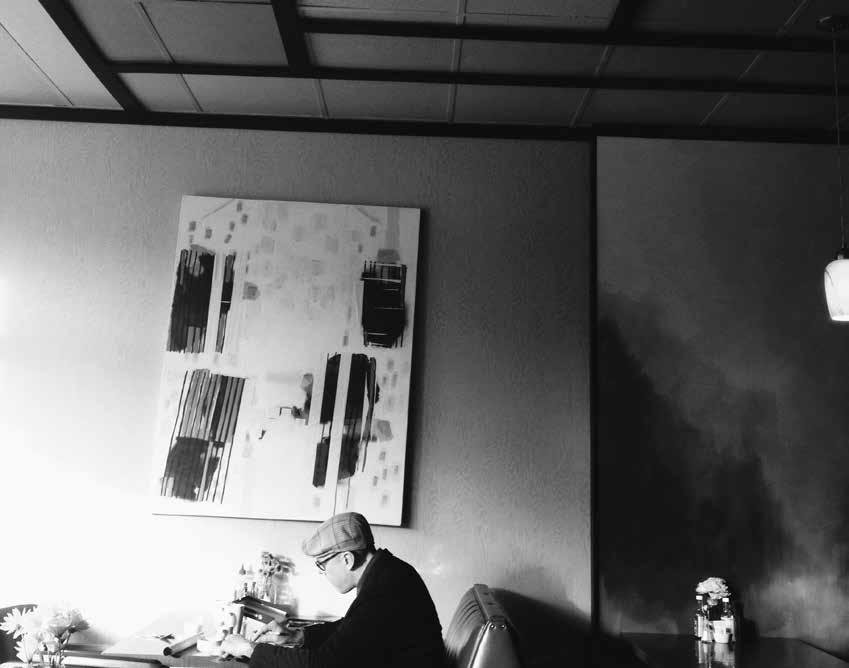
The residency program, running for two days per month, transforms the dining room of the Tallest Poppy into a temporary studio for the artist, wherein the public is encouraged to interact with the artist as they work.
“The idea is to focus on the artist’s process, which not a lot of the public really understand or face really with art. It’s really easy to walk in and see a painting and judge it as a finished project, so this is a chance for the public audience to see what goes on behind the practice of an artist,” said Chloe Chafe of Synonym Art Consultation.
“It was just sort of obvious to work together, and we already have an installation in there from our mural festival from last fall, so it was just a way to extend our interaction with the restaurant. It was just the next inevitable step,” said Synonym’s Andrew Eastman.
The Tallest Poppy owner and chef, Talia Syrie, approached Synonym with the idea following the opening of the restaurant at the new Sherbrook location, due to the success of the program at the old site.
“When we opened here [Sherbrook], I approached Andrew
and Chloe about starting it here again. And they just took it and ran a marathon. I can’t even believe what they’ve come up with; it’s so much more than I thought it would be,” said Syrie.
The first installment of the residency program took place on Jan. 24 and 25 with Christian Procter as the resident artist. During the two-day period, Procter moved from table to table, stenciling out what will eventually become paintings on each tabletop, to match some of the existing furniture within the diner.
“A few of our tables have a print on them; it’s kind of old-style, kind of these long-horned ram or bulls, cows; sort of an old western print on some of our tables that we salvaged from the basement of the hotel. And so he thought it would be neat to do some more print, a variation, painted onto the other tables that we brought from the other restaurant,” explained Syrie.
“He’s creating this whole new collective of symbols that he has been stenciling onto each one of the tables in the restaurant. So the entire restaurant is going to have this conformity to it, while playing off of the old furniture,” said Chafe.
While not all of the artists’ works will remain within the restaurant for longer than a month, Chafe and Eastman are glad the inaugural installation will be more permanent.
“Each project will have some sort of concrete aspect – either documentation or a physical project after the two-day residency is finished, which will be up for at least one
month until the next one. But in this case, they will be on the tables permanently,” said Eastman.
“Maybe they’ll fade off from all the coffee stains and stuff, but it’s definitely a fun way to start it off, with the long-term project.”
Procter’s artwork will be unveiled on Feb. 20 as part of the residency program’s launch – one of Synonym’s storied art parties, in which the Poppy will be transformed from a diner into more of a bar, complete with music and signature cocktails by Steve Ackerman.
“Basically it’s a chance for us to showcase what Christian Procter will have created, a chance for us to announce the second artist, Helga Jakobsen, and celebrate her, and also to bring together the community and really celebrate what’s going on there,” said Chafe.
“It highlights what the business does best, and the artist, and the musicians,” added Eastman.
“I think having an artist in the restaurant that people can engage with, they can ask them what they’re doing, it makes the whole experience of being here more interactive for everybody,” Syrie told the Manitoban
The Tallest Poppy Residency Program will take place for two days each month at the Tallest Poppy (103 Sherbrook Street). Synonym is currently looking for artists to take residency; application is available at synonymartconsultation.com
r aylene PaC i, volunteer staff

Featuring 90 artists and over
220 pieces of art, Art from the Heart is a perfect outlet to buy something unique and locally handmade. There is something for everyone: ceramics, photography, pencil drawings, acrylic, oil, encaustic, printmaking, sculptures, collage, installations, textiles, upcycled art, repurposed art, pen, and ink. Artists will receive 100 per cent of the profits.
The show was founded 15 years ago as a small art sale, showcasing the work of inner city residents who were gathering at the St. Matthews Maryland Community Ministry to paint watercolours and learn from each other. It has since evolved into one of Winnipeg’s largest exhibitions and sales of local art.
“Every show and sale is unique, since artists who participate come from diverse neighbourhoods, cultural backgrounds, artistic practices, and experiences. Many of these artists experience limited access to resources, while also facing personal barriers to their ability to be recognized for their talents,” said Becky Thiessen, art exhibition co-ordinator.
“The show and sale offers them that opportunity, to be recognized, and most importantly, without any barriers to participation.”
Past shows have typically been held in November as a pre-Christmas art sale. They boasted more than 800 attendees and almost 400 works of art. But, due to last minute staff changes this year, there was
not enough time to put together an event earlier.
“A number of us met as volunteers in mid-October and decided to keep the show going, knowing how important it was, but to push the date back so that we could properly organize it,” said Thiessen.
“Art from the Heart is a community in itself; I have been so amazed to see everyone work together to make sure the show happens this year.”
Thiessen is a first-time coordinator this year, but the people she’s met while organizing the event have already profoundly inspired her.
“There is one fellow who is currently incarcerated, but his friend submitted beautiful pencil drawings of his. Then there’s a young woman, recently moved to Winnipeg – a talented painter who started drawing at age three to communicate because she is deaf.
One of our volunteers eventually encouraged her to submit work to the show. A woman from China, who has only been here for six months, heard of the program. She is a trained artist and this show will give her access to show her work in an entirely new community.”
Art from the Heart’s annual show and sale will be held on Feb. 13 from 7-9 p.m. and Feb. 14 from 10:30 a.m.-3 p.m. at Magnus Eliason Recreation Centre (430 Langside Street).
Admission is free and local pop duo ATLAAS will be performing.
a lana TraC hen Ko, staff
Objects of Knowing is currently on display at the University of Manitoba’s ARTlab, featuring pieces that incorporate text and the personal narratives of the artists. Corrie Peters and Michell Wilson, along with four other University of Manitoba master’s students in the fine arts program, have brought together their interpretation of identity and its transient nature.
Particularly striking is the theme of colonization on the glass display case along one of the walls. Artist Phoenix Thomas has eschewed its traditional use, and chosen to add text with marker to talk about his experiences as an artist who is halfAboriginal and half-Caucasian.
Wilson, on the other hand, found and reclaimed an old encyclopedia to express her relationship to animals, an overarching theme in her work.
“The idea was kind of to respond to some texts that we had read [in class], and to create a ‘book’ that referenced our identity in some way,” said Wilson.
“My thesis is very much about defining self in relation to animals,” Wilson said. “How our ethics are
formed, and the negotiations we go through with ourselves about what is acceptable and what is not acceptable to do to non-humans.”
Peters’ piece, “Knitting Lessons,” is a card with laser-cut knit designs that speaks of her experience at a community-knitting group, and preserving the experiences and unexpected lessons she gained by being a part of the group.
“I’ve been doing it for over a year now,” Peters said. “When you’re in these groups and organizations, it’s always this idea that you’re there to help people, but rather, it’s been more this place of learning for me.”
The text on “Knitting Lessons” talks about the importance of challenging oneself and the calming effect of repetition. Peters encourages guests to pick up the card and take a closer look; Wilson also suggests flipping through her encyclopedia, adding a textural element to the exhibit.
The intimate space of the exhibit does not to feel overrun by the pieces of six artists. Peters and Wilson agree that, after creating their individual pieces, collaborating on the exhibit was an interesting part process.

“We got to speak to each other about our ideas and progress them by talking them through,” Wilson said.
“The works all are stronger for the relationship they have with each other,” Peters added. “Because there’s so much text, it becomes a space where you need to spend a fair bit of time [ . . . ] it ended up speaking well together.”
Peters, originally from Montreal, and Wilson, hailing from Ottawa,
both feel they have gained a lot in choosing the university’s art program to develop the focus of their work.
“I came in having a very secure idea of what I would accomplish, and it’s changed in ways that I’ve never anticipated, and in such a great way,” said Wilson. “I had a strict idea [ . . . ] of myself as being a photo-based artist, and that’s opened up, which is fantastic.”
Peters added that the program has
been supportive of her relatively niche area of interest.
“I do work around the area of social practice,” said Peters. “Even though there are no faculty members that are super well-versed in that, they’ve given me a lot of freedom to explore and develop.”
Objects of Knowing will be on display at the U of M’s ARTlab until Feb. 15.

i an T. d. Thomson, staff
Every comedian has his or her own style. Whether you are laughing at Louis C.K.’s cynicism, Seth Rogen’s Canadian stoner movies, or Hannibal Buress’s look at flawed modern trends, these comedians each bring a unique brand to their comedy.
But when it comes to taking jabs at racial injustice and political science, no one’s comedic style is quite like that of Hari Kondabolu. On Feb. 19, the Brooklyn-based IndianAmerican comic will take the stage for an edgy show at the Park Theatre.
While his comedy style is fluid and laid-back, Kondabolu is fully conscious of what he is expressing.
“Race isn’t a thing, it’s a social construct. It’s a way to divide us,” said Kondabolu, leading into, believe it or not, a punchline.
This pithy delivery has earned Kondabolu performances on Letterman, Conan, and a half-hour Comedy Central special. In March of 2014, the comedian also released his debut standup album entitled Waiting for 2042
The album title is in reference to the year, projected by demographers, when Caucasians will be the minority
in the U.S.
“I’m not like most comedians. I don’t deal with just heckles, I’m also dealing with threats and anger. Here I am, a brown person on stage being quite blunt. I talk about white privilege, I talk about U.S. imperialistic practices, I talk about colonialism,” explained Kondabolu in an interview with Intelligent Life.
“I’m not saying things that are easy for people to laugh at.”
Kondabolu’s resume is impressive, even beyond his achievements in the entertainment industry, fitting well with his political onstage presence. He has a BA in comparative politics, has worked as an immigrant rights organizer, and has a master’s in human rights from the London School of Economics.
Comedy seems to run in the family, as his younger brother, Ashok Kondabolu, was a member of the comedy hip-hop group, Das Racist. While Hari made jokes regarding minority groups, Ashok was rapping about combination Pizza Hut and Taco Bell chains. The two also work together on an improvised talk show called The
Untitled Kondabolu Brothers Project. Politics and race are not groundbreaking topics in the world of comedy. Everyone knows Russell Peters’ piece, “Somebody going to get a hurt real bad.” Similarly, shows such as The Daily Show have remained relevant since the late ‘90s with strong doses of political satire.
Kondabolu’s brand of humour, however, is closer to a political New York Times comic. This parallel often leads to a discomfort for those not readily able to accept jokes tackling social injustice so directly.
“I like playing with that space between laughter and discomfort where your discomfort can also make you laugh and you’re confused about the mixed feelings,” explained Kondabolu.
“That’s challenging and I think that’s what makes for some of the best art.”
Hari Kondabolu takes the stage at the Park Theatre on Feb. 19 at 8 p.m. Tickets are $17 in advance at the Park Theatre, Music Trader, and ticketfly.com














Manitoban Art Competition
Submit your graphics and photos to me@ themanitoban.com by March 16 to be featured in the Manitoban Art Competition, scheduled for the March 25 issue. The Manitoban design team will judge the competition and award prizes based on three criteria: concept, originality, and technical skill.
Submit files as 300 dpi jpegs. Images must be a minimum of 3000 x 3000 pixels.
Prizes to be announced. Sponsored by Cre8ive Supplies & Services


l auren s iddall, staff
Women
The University of Manitoba Bison women swept the University of Winnipeg Wesmen both nights –with scores of 25-15, 25-18, and 25-22 on Thursday, and 25-17, 25-18, and 25-22 on Saturday. The Thursday night sets were all neck-in-neck until roughly 10 points apiece, where the Bisons broke away.
Manitoba ran away with the game early into the first set, with right side Rachel Cockrell ringing in seven kills in the set. Cockrell continued her dominant performance in the second and third sets, tallying match-high 19 kills. Setter Brittany Habing, boasting 28 assists, five kills, two aces, and five blocks also helped to lead the team to victory.
The Bisons continued their dominating performance against the U of W on Saturday, with a brilliant defensive performance by libero Caleigh Dobie, who racked up an impressive 27 digs.
Dobie’s coverage, combined with the Wesmen’s struggling offence, created optimal conditions for the Bisons to thrive. With passing on point, the U of M team was able to capitalize on middle attacks, illustrated by Jordana Milne’s nine kills on the game.
While the Bisons took the early lead in all three sets, the Wesmen fought hard to the end, almost taking the second set. U of M left side Kalena Schulz took over in the third set, dominating at the net and the service line, delivering a kill followed by serving an ace to bring the Bisons to match point.
The men’s volleyball team split the games this weekend in a heated rivalry between the Bisons and Winnipeg, both fighting for the final home playoff spot. Each team took their home game, with the Bisons winning Thursday, 25-16, 25-16, 21-25, 26-28, and 15-13 in a hard-fought match. U of M player of the game
Luke Herr totalled a game-high 50 assists, connecting with right side Devren Dear for 25 kills, making Dear the number one scorer of the game.
The Bisons continued their dominating performance against the U of W on Saturday, with a brilliant defensive performance by libero Caleigh Dobie, who racked up an impressive 27 digs
Herr and middle hitter Josh Crellin had great chemistry, combining for three kills in the first set and seven overall. The Bisons took the first substantiated lead in the third set, but were unable to close following some untimely errors.
The Wesmen had a fiery start to the fourth after a massive comeback in the third. The Bisons rallied
together and found themselves tied at 21. After two kills from Kenny Rooney, the Bisons were unable to end the set, and were forced into a fifth.
The fifth set began with kills back and forth, each team fighting for the deciding set. The Bisons took the first countable lead at 10-8, which was extended to 11-8 following a massive stuff block by Rooney. A couple unforced errors by U of W and a kill by Dear gives the Bisons a win on their home turf.
The Wesmen came into the Saturday game wanting to win, and ended up taking the Bisons 25-22, 25-18, and 25-23. The Wesmen’s Thomas Douglas-Powell was untouchable, accumulating 18 kills in just three sets.
Douglas-Powell’s attack and captain Kevin Falconer’s hurt ankle did not combine well for the Bisons. Canada West’s eighthranked attacker for kills, Adam DeJonckheere, tacked eight kills on to his total. While they fought hard to the end of the third set, the Bisons were unable to take the game, totalling only 10 kills in the third with nine hitting errors.
The Bisons take on MacEwan University for their final match of the regular season next weekend. The MacEwan men are currently 0-21 this season, and the women are 10-12.


Bison men’s basketball team gives up early lead, swept by Wesmen
m i K e sT ill, staff
L
osers of five of their last six games, the University of Manitoba Bison men’s basketball team entered this past weekend’s games looking to get back on track. Adding intrigue to the matchup was the fact that the Bisons were taking on their crosstown rivals, the Winnipeg Wesmen, with the final game of the Duckworth Challenge taking place on Friday.
Unfortunately, Winnipeg was able to get the upper hand against the herd on both nights, with nearly identical scores. Friday the Bisons fell 85-67, and Saturday they dropped the contest 83-67.
Friday’s matchup featured a backand-forth contest for three quarters, with Winnipeg pulling away in the fourth, outscoring Manitoba 22-13.
The Wesmen shot 51.9 per cent from the field, including going 9-of-17 from beyond the arc, which had a big
effect on the outcome. In comparison, the Bisons went just 4-of-18, and had a field goal percentage of 40 per cent.
Despite having five players score in double figures, Manitoba was unable to correct a tough start, along with 22 turnovers.
Jelane Pryce led the way in points, scoring 18 for the Wesmen, off of 5-of10 shooting from the field, as well as going 3-for-4 from three-point range.
Saturday’s rematch saw Winnipeg get out to another early first half lead, which they didn’t give up all game
Manitoba entered the break down by 18. They showed resilience in the second half, getting the score to single digits on a few different occasions, but were unable to erase the large deficit
Manitoba’s leading scorer was AJ Basi, who finished with 14 points.
Justus Alleyn also played admirably, especially down low, where he recorded a surprising 10 rebounds from the guard position.
long. The Bisons shot an abysmal 18.8 per cent from the field in the first two quarters, including going 0-for-8 from the three-point range. The herd had an enormous amount of trouble finding the basket in the second quarter specifically, scoring just nine points compared to Winnipeg’s 20.
Manitoba entered the break down by 18. They showed resiliency in the second half, getting the score to single digits on a few different occasions, but were unable to erase the large deficit.
Points off the bench were key for a second week in a row, as the Wesmen scored 45, compared to Manitoba’s 15. All three of Winnipeg’s leading scorers were reserves, with Christopher Baxter recording a teamhigh 17 points.
Basi and fifth-year co-captain Wyatt Anders—who was possibly playing in his last career home game—tied for the team lead with 17 points as well. Anders was proud
of the team’s effort in the second half, but noted that the sluggish start was ultimately a huge factor in the final score.
“If we erased our first half, we wouldn’t have been scrambling so hard in the second half, and fouling all that time,” Anders said post-game.
“If we eliminated that bad first half, the game would have been completely different.”
Manitoba will have a week off this weekend, before heading to UBC to take on the Thunderbirds in the final two games of the regular season on Feb. 13 and 14. The Bisons are currently sitting in the seventh and final playoff spot in the highly competitive Pioneer Division, and will likely need a sweep of the 10-6 Thunderbirds to guarantee themselves a spot in the post-season.
m i K e sT

It may be surprising to some to see a rookie in the top two in scoring in the Canada West conference, but for those that know Alanna Sharman’s track record, it’s no shock at all. The first-year player out of Nelson McIntyre has always had a history of finding the back of the net.
To find the proof, you need to look no further than her time with the Winnipeg Avros, of the Manitoba Female Midget Hockey League, which was created in 2008 to provide elite female hockey players in Manitoba a league with stiffer competition.
Sharman credited the midget program for helping her take the next step in her game.
“The midget program was definitely the biggest improvement to my game. A lot of team effort those years, and I really enjoyed playing.”
Sharman was a standout in her time with the Avros, leading the squad in points in both the 201213 and 2013-14 seasons, along with being named co-MVP last year. Her success on the ice also led to an invitation to Hockey Manitoba’s Program of Excellence Top 40 Camp in 2012-13, and a roster spot on Team Manitoba for the U18 National Championships a year
and a half ago. Not only has Sharman successfully made the jump to the CIS, she has done it in an impeccable fashion. Sharman has played on the top line for Manitoba, and looked unstoppable.
Despite her success, Sharman credits her linemates—captain Maggie Litchfield-Medd and sophomore Alana Serhan—for aiding
With 32 points in 24 games so far this season, Sharman has played a critical role in the Bisons’ impressive 2014-15 season thus far
in her impressive rookie campaign.
“Maggie is really hard-working, so it’s easy to play with someone like that. Then, [Alana] Serhan is always ready to go. They make it easier, and more fun out there,” Sharman said.
Litchfield-Medd has had an especially lasting effect on Sharman, both on and off the ice. Their chem-
istry, both as teammates and friends, is evident in their performance.
“People always ask me why I think I’m doing so well this year, and it’s definitely a lot to do with Maggie,” Sharman said. “She definitely helps me out a lot. I feel like we’ve kind of connected since the beginning. We both play very similarly.”
When asked about Sharman’s play, women’s hockey head coach Jon Rempel offered nothing but positives.
“She’s a special kid, she’s a special player. You don’t get many like her that have that kind of hockey sense, offensive ability, ability to make players around her better,” Rempel said. “She really doesn’t play like a first-year player.”
With 32 points in 24 games, Sharman has played a critical role in the Bisons’ impressive 2014-15 season thus far. Her speed, finesse, and ability to get pucks to the net have made her a very difficult opponent to play against.
Sharman has already shown this season that she can be dominant at the CIS level and, with four years of eligibility remaining, could become a household name not only for the Bisons, but also at the national level.
I
f you were to take a glance at the University of Manitoba Bison women’s hockey roster for 2014-15 at the start of the season, it would be easy to tell that significant changes have been made. The 25-person roster fostered 10 rookies, along with seven sophomores.
One would naturally assume that this would be a transition year for Manitoba, as the young players would have to take time to adjust to the university game. There would be no way that the Bisons could contend in a very tough Canada West conference, right? Wrong.
The team as a whole has clicked, putting up 50 points – good for second place in the conference, and just one point behind Alberta. Much of that success can be attributed to the rookie class, which includes Alanna Sharman, Lauryn Keen, Courtlyn Oswald, and Erica Rieder.
Four of the Bisons’ 10 first-year players are in the top 10 in rookie scoring, led by Sharman, whose 32 points lead the way, and are also good for second in the entire Canada West.
For head coach Jon Rempel, there was never any doubt that these players would be able to come in and make a difference immediately.
“I brought in a lot of kids that are used to winning, and have had a big hand in winning in their programs that they’ve come from,” Rempel said, right before the start of the 2014-15 campaign.
“Team success, individual success, kids that really want to be in this program, and that I didn’t have to do a whole lot of convincing with to be here. I think those were big factors for me.”
Fifth-year captain Maggie Litchfield-Medd has also noticed the difference, both in team attitude and performance on the ice. She is playing on the top line with Sharman and sophomore Alana Serhan. The trio has put up mas-
sive numbers this season, especially down the stretch.
While Sharman has been the statistical leader of the bunch, her linemates have also put up impressive numbers. Serhan’s 22 points are good for a tie for sixth overall in the conference, and Litchfield-Medd’s 16 tie her for 20th.
Despite playing alongside the most noticeable rookie, LitchfieldMedd was quick to praise the entire recruiting class.
“They all pull their own weight, and honestly it’s just a breath of fresh air this year to have all these young kids bringing something different to the table, and each of them have a great, positive attitude,” Litchfield-Medd said.
“They’re just a lot of fun to be with on the ice, off the ice. It’s great having all these young kids.”
The Bisons utilize speed to their favour, frequently playing a “dump and chase” style, and outhustling their opponents. The rookies, especially, have taken advantage of the fast-paced style of play, and have seen significant minutes all year.
“It was a big class, and everyone has played substantial minutes on this team this year. I think that’s part of the reason that we’ve had the success we’ve had, because it’s a shared responsibility between players. Everyone feels like they have a role, and are included,” Rempel said. The squad has been dynamic all year, but have stepped their game up since returning from winter break.
The Bisons were 8-0 in January, and have put themselves in a great position for a deep playoff run.
Regardless of what happens in the post-season, Rempel can be happy knowing he has a steady group of talent to build off of for many years to come.
“It’s an incredible group of kids, and I look forward to the next few years after this one, of seeing these girls keep developing for sure,” Rempel said.

Bison women’s hockey team’s top line wreaks havoc against Mount Royal
m i K e sT ill, staff
Winners of six straight games heading into the weekend, the University of Manitoba Bison women’s hockey team continued to roll towards the playoffs, with a sweep of the Mount Royal Cougars at home. The Bisons’ top line was the difference in both games, contributing all but one goal over Friday and Saturday.
Friday night saw the Bison women’s hockey team reel off three unanswered goals, en route to a 4-2 victory.
Courtlyn Oswald got Manitoba on the board first at 5:31 of the opening period, off of a tremendous pass from the corner by Nicole McGlenen. Mount Royal would answer back just over five minutes later, as Reanna Arnold crashed the net, putting away a rebound on the power play. Heading into the break, the game was deadlocked at one a piece.
The Bisons took control in the second period, and didn’t look back. They used their speed to keep the puck in the Cougars’ zone, and their top line of Alanna Sharman, Maggie Litchfield-Medd, and Alana Serhan put on an absolute show.
Sharman would give Manitoba back the lead at 12:45 on the power play, off of another great pass, this one from her linemate, Serhan. Then, with less than a minute left Sharman would return the favour, putting a puck on net that Serhan would finish off, to give Manitoba the 3-1 lead.
Serhan would tack another goal onto the total in the third, putting the game away at 5:51 on the power play, off of some great passing, where four of five players touched the puck. Sharman would be the one dishing off the final pass yet again.

by
Mount Royal shortened the lead to two with just over 12 minutes left, but it wasn’t enough to topple the Bisons.
Bison head coach Jon Rempel was quite pleased with the play of his top line on Friday.
“When things are hot like that, and you have a group that’s playing with that much confidence, it’s fun to watch,” Rempel said. “They feed off each other, they share the puck, they play with a lot of energy, and when you have a line with that much chemistry, things just work.”
Saturday’s matchup saw captain
Litchfield-Medd and head coach Rempel head off for Granada, but it didn’t matter, as the top line for Manitoba clicked again, this time with Erica Rieder stepping in. She contributed both goals, including the game-winner in overtime, to give Manitoba the 2-1 victory.
Mount Royal’s lone goal came from Taralynn Suzuki.
The Bisons will continue their push for first place in the conference this weekend, as they take to the road against UBC.
Bison hockey players representing Canada at the 2015 Winter Universiade
m i K e sT ill, staff
As numerous CIS teams begin their preparation for the postseason, a number of athletes will be focusing their attention on a completely different prize: a gold medal. From Feb. 4-14, players from various universities across Canada will represent their nation in the 27th biennial Games, taking place in Granada, Spain. In total, 43 different countries will send university athletes to compete.
Of the 10 different sports present in competition, hockey would be the one in which Canada has had the most success. The last time the games occurred, in 2013, both the men’s and women’s teams took home gold. This year, Manitoba will have representatives on both the men’s and women’s teams, and will look to stay at the top of the podium.
Men
Since 1997, the men’s team has cycled between all three CIS conferences, on a six-year basis. This year, the Canada West will be represented, and three Bisons will be coming along for the chance to repeat as champions. Two of Manitoba’s alternate captains—forward Jordan DePape and defenceman Luke Paulsen—will skate for the team, while Bison head coach Mike Sirant will serve as an assistant coach.
season, and is also a key cog on the power play.
Paulsen has been a leader on the back end for the Bisons, and his leadership and poise has been key on a young squad. With just four penalty minutes all season, and 12 in his career at Manitoba, Paulsen
a bronze medal. His experience and knowledge of the international game will be a valuable asset.
Women’s hockey made its debut at the Universiade in 2009. They have gone 21-0, and will look to keep the streak going with another gold medal in 2015
DePape has been a star all year for the herd, putting up 27 points in 28 regular season games, good for a tie for sixth in the conference and first on his own team. He has played on the Bisons’ top line all
has also shown his discipline on a regular basis.
For Sirant, this won’t be his first rodeo, as he was head coach of Canada in 1997, where the team won
Women’s hockey made its debut at the Universiade in 2009, and since that time, Canada has dominated. They have gone 21-0, and will look to keep the streak going with another gold medal in 2015. Canada’s roster will consist of players from each CIS conference, and the Bisons will have two representatives. Forward, and Manitoba captain Maggie LitchfieldMedd, along with her head coach, Jon Rempel, will travel to Granada. Litchfield-Medd has been an
anchor for the Bisons, not only this season, but in her entire five-year career with Manitoba. In the 201415 season, the herd has compiled an 18-6 record, and Litchfield-Medd’s 16 points, and team-leading plus-18 rating, have contributed greatly. Her veteran presence is a keystone for the team.
Rempel will make his first appearance at the Universiade, after guiding Manitoba to another impressive regular season and playoff appearance. He was named Canada West Coach of the Year in both 2004-05 and 2006-07, and has guided the Bisons to conference titles in both 2008-09 and 201011. His passion for and knowledge of the game will aid in Canada’s chance to keep their roll going.