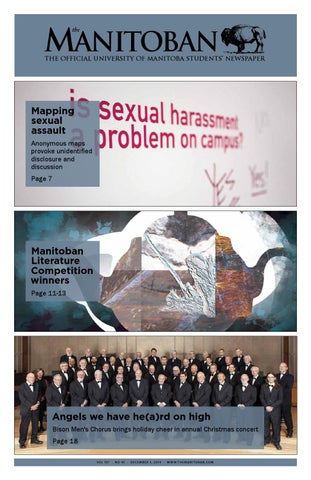
Anonymous maps provoke unidentified disclosure and discussion
Page 7
Manitoban Literature Competition winners
Page 11-13
Page
Psychology
Neurosurgery
r eporters
Volunteer Contributors
MANITOBAN
A “volunteer staff” member is defined as a person who has had three volunteer articles, photographs, or pieces of art of reasonable length and/or substance published in three different issues of the current publishing year of the Manitoban. Any individual who qualifies must be voted in by a majority vote at a Manitoban staff meeting. Elected representatives and non-students may be excluded from holding votes as volunteer staff members in accordance with the Manitoban Constitution. The Manitoban is the official student newspaper of the University of Manitoba. It is published monthly during the summer and each week of regular classes during the academic year by the Manitoban Newspaper Publications Corporation.
The Manitoban is an independent and democratic student organization, open to participation from all students. It exists to serve its readers as students and citizens.
University of Manitoba Students’ Union speaks out against University of Winnipeg Students’ Association, Canadian Federation of Students’
Eth A n C A b EL , staff
The University of Manitoba Students’ Union has said that it will not condemn impending budget cuts at the University of Manitoba, sparking criticism from students who claim that the union is not doing enough to protect their interests.
“They’ve stated that they are going to be neutral and I think that’s just unacceptable as a union that is supposed to represent students,” said Ian McDonald, a third-year philosophy student at the U of M.
“This is an issue that will obviously be detrimental to all students,” said McDonald. “I don’t know their justification for this. Really, there isn’t a justification.”
Last Wednesday, a public assembly was held at the U of M as part of the “Stop the Cuts” campaign organized by U of M students in conjuction with the Canadian Federation of Students-Manitoba (CFS-MB). The public assembly provided information to U of M students about the cuts, which are set to average four per cent this year and four per cent next year, affecting both academic and non-academic units across the university
Following the assembly, a student meeting was held to plan for future action surrounding the budget cuts.
The cuts have sparked criticism from a range of groups representing U of M students, staff, and faculty. Critics include the Canadian Union of Public Employees local 3909— which represents sessional academic workers and teaching assistants— CFS-MB, U of M Graduate Students’ Association, and the University of Manitoba Faculty Association.
In addition to these groups, the University of Winnipeg Students’ Association (UWSA) has condemned the impending cuts.
Kopp on union responsibilities
Jeremiah Kopp, UMSU vice-president internal, attended the public assembly on Nov. 26 and came away concerned about what he characterized as a preponderance of University of Winnipeg students and activists at the event.
“Budget cuts are an important subject for the University of Manitoba students,” Kopp said.
“I think the UWSA should mind their own business and stick to the University of Winnipeg issues, and the democratically elected University of Manitoba Students’ Union executives should be looking after student interests on our campus.”
According to Kopp, the staunch opposition expressed by CFS-MB, UMFA, and others does not adequately take into account the university’s complex budget outlook, limited revenue sources, and the need to balance competing priorities at the U of M.
“[UMSU] will stay neutral on political issues.”
“It is too early yet to have a deliberate response.”
Kopp argued that UMSU’s role is to be a mediator between various conflicting political interests. Furthermore, he said he rejects the involvement of CFS-MB in issues concerning U of M students.
Last Wednesday, a public assembly was held at the U of M as part of the “Stop the Cuts” campaign organized by U of M students in conjuction with the Canadian Federation of Students-Manitoba
“My view of UMSU’s role is one of a mediating and clear voice to cut through various political interests,” Kopp said, adding that there is significant room for common ground between U of M administration, students, and faculty.
“The CFS is irrelevant at the University of Manitoba and doesn’t represent students at the University of Manitoba any longer.” Kopp continued, “There are some good ideas that CFS has, and they have some beneficial campaigns, but ultimately it’s an
organization that I don’t respect and the average University of Manitoba student doesn’t respect because of the way they conduct their business.”
Rorie Mcleod Arnould, UWSA president, was also present at the Stop the Cuts assembly. He said that the UWSA has a direct interest in opposing the cuts given that the U of M consistently receives more money from the provincial government annually than the University of Winnipeg.
“If the University of Manitoba administration is squandering public funds, that limits the ability of [the U of W] to get more money to offer services to [its] students,” Mcleod Arnould told the Manitoban
“It is my problem. It’s everybody’s problem. How public institutions spend money is not something that Jeremiah Kopp or UMSU have sole jurisdiction over.”
Accounting for the cuts
Among the information presented to students gathered at the public assembly on Nov. 26 was a budget analysis by Cameron Morrill, U of M associate professor in the department of accounting and finance.
Morrill argued that the U of M operating budget shortfall—estimated by administration to be over $10.5 million for the 2015-2016 academic year—is the result of transferring operating budget surpluses into other areas, like capital assets.
According to Morrill’s presentation, the U of M transferred $56.6 million from its general operating
fund to capital assets in 2014. Capital assets constitute the “acquisition of, or renovations to, buildings, land, office equipment and furniture, heavy equipment, etc.”
“I think the UWSA should mind their own business and stick to the University of Winnipeg issues, and the democratically elected University of Manitoba Students’ Union executives should be looking after student interests on our campus” – Jeremiah Kopp, UMSU vicepresident internal
Zach Fleisher, chairperson for CFS-MB, defended the organization’s “Stop the Cuts” campaign.
“I think it’s clear that we’ve made an impact on students who are concerned about class cuts, who are concerned about the potential faculty losing their jobs,” Fleisher said about
the role of CFS-MB in the campaign to oppose budget cuts at the U of M.
“I think that students, once they see the potential impact of these cuts, will see the role of the CFS in opposing them.”
However, not all students see the benefits of the CFS-MB stance.
Mark Stewart, fourth-year political studies student at the U of M, agrees with Kopp that a balanced approach to the budget cuts controversy is needed.
Stewart was the 2013-2014 president of the U of M Arts Student Body Council and worked as campaign manager for the “Refresh” slate of UMSU candidates that was elected earlier this year.
“We, as a student body, need to decide whether we want a cheap education or we want a good education. We can’t have both,” Stewart said.
He added that low tuition fees in Manitoba—coupled with unreliable increases in the annual operating grant from the provincial government—has put the U of M in a budgetary bind.
“The way the provincial government’s budgets have been looking, it’s entirely insane to expect there to be a sharp increase in funding towards education issues. It’s unacceptable for us to believe that the onus for paying for education should fall on the government because what we’ve got right now is still one of the cheapest educations in the nation.”
NDP government plans to increase number of courses offered online
Cr A ig Ado L ph E , staff; with files from Dana hatherly, staff
At last month’s throne speech the provincial NDP announced a number of policies to be implemented in the coming year. While interestfree student loans have been heralded as a major treat for post-secondary students, a number of other policies that will affect students have been proposed. Among those is a two-fold increase in the number of courses to be offered online – from 500 to 1,000 across the province.
“We will build on the significant steps taken over the last decade to ensure post-secondary education is accessible and affordable,” said Premier Greg Selinger in a speech to media on Nov. 20.
Enrolment in online courses is already on the rise at the University of Manitoba. In the 2013/14 academic year, 9,318 U of M students were registered for online courses. That represents a 42 per cent increase from 2009/2010, when 6,547 students were registered for online courses.
In 2013/14, 151 online degree credit courses were offered across 12 faculties and 28 departments.
Extended education at the U of M, which oversees distance and online education, does not have access to the number of students who graduate either entirely or primarily through online courses.
Currently, U of M students may complete their bachelor of arts, bachelor of arts in geography, bachelor of social work, or post-baccalaureate diploma in education by taking distance and online education courses.
Students completing their bachelor of arts with distance and online education are able to major in Canadian studies, criminology, economics, English, geography, history, philosophy, political studies, psychology, and sociology.
Students who live in the city must come to the Fort Garry campus to write their exams as a component of
online courses that have final exams. Students who do not live within city limits are not required to visit the campus; another location is selected.
Lynette Phyfe, interim director of distance and online education, told the Manitoban that online courses provide greater flexibility for students when it comes to time management.
“Courses that are taken through online delivery provide students flexibility for their schedule, location, and program completion.”
Canadian Association of University Teachers on distance education
The Canadian Association of University Teachers released a policy statement, last revised in 2009, which outlines its position on distance education.
“[The Canadian Association of University Teachers] is dedicated to the removal of barriers that traditionally restrict access to and success in post-secondary institutions and to increasing equality and equity of educational opportunity for all Canadians.
“Distance education is one medium that allows post-secondary educational institutions to pursue these goals. Post-secondary institutions’ employers may nonetheless misuse distance education techniques to increase managerial control over academic staff and/or as a way to save money.”
The statement also lists a number of items that faculty associations should ensure are included in contract language as part of an effort to maintain a high-quality level of education.
These points include that “adequate time and resources are available to learn to use new computer technologies and distance education techniques”; “courses shall be taught by fully qualified staff”; and “academic staff have the right to determine the
The Canadian Association of University Teachers’ member associations include faculty associations from across Canada. Locally, these include the University of Manitoba Faculty Association, the Brandon
University Faculty Association, the University of Winnipeg Faculty Association, the St. John’s College Faculty Association, the Association des professeur(e)s de l’Université de Saint-Boniface, and the Manitoba Organization of Faculty Associations.
Local voices look at online courses
method of course delivery.”
David Camfield, associate professor of labour studies and sociology at the U of M, was critical of the pro-
photo by Carolyne KroeKer, staff
Continued on next page
graphiC by evan tremblay, staff
posed increase in online courses being offered in the province.
“Expanding access to post-secondary education is a good thing. However,” Camfield continued, “I also have concerns about the quality of education. Not all courses are equally suitable for offering online. In-person classes with small class sizes offer unique opportunities for learning. We need more of them; but, because of budget cuts, there are fewer of them available to students.
“Many of the new online courses will no doubt be taught by sessional instructors who are paid less than tenure-stream faculty, with little or no job security and weaker academic freedom protection. That’s a problem.”
Zach Fleisher, chairperson for the Canadian Federation of StudentsManitoba, shared some of Camfield’s concerns. However, Fleisher said that if the courses were used to help rural and distance students, then it would be a benefit to post-secondary students.
“I’m often wary about the usage
of online courses on university campuses as there are concerns regarding the ‘mass production’ of education, which could theoretically lead in turn to less professors and offerings. In my personal experience as a student, I’ve often leaned towards the in-classroom experience.
“My understanding around the provincial throne speech and online courses is that the new offerings will primarily be targeted towards rural and distance students, in which case this is a positive development for extending education to those who don’t always have access.”
Fleisher noted that specifics in implementing the plan were not yet available and said that he would be monitoring its execution.
“Courses that are taken through online delivery provide students flexibility for their schedule, location and program completion” –
Lynette Phyfe, interim director of distance and online education
“I don’t have the exact information on how these new developments for online courses are taking place. Traditionally, the university would have jurisdiction on classes on its own campus, so we’ll have to keep an eye on this proposal as it develops.”
Student experiences Danielle Murphy, U of M human nutritional sciences student in the faculty of agriculture and food sciences, said she had some difficulty
the first time she took an online course.
“I took Statistics 1000 online for about a month before the first midterm; then I ended up dropping it.
“It was easier to teach myself, but I found it was really hard to discipline myself to study. I was always studying for my other courses that [took place in a classroom] because it would remind me what I had to do in the classes; whereas online, I had to remind myself, so I found that really hard. So I ended up just taking it [the next semester] in an actual classroom with a professor instead.”
Murphy said she did better when she took the course on campus the following semester, but that she would still recommend online courses to other people.
“I would [recommend it] – because my roommate actually took a couple of online courses this summer and she really, really liked them. Because she felt that she could just go home and work still, while she had the convenience of doing school.”
Sabine Hergenreiter, a U of M student taking prerequisites for nursing, has also taken online courses in the past.
“I tried like three years ago, but I didn’t find it was something for me so I dropped the course.
“I found it really confusing at first actually and I had to talk to my sister and she helped me a little bit,” Hergenreiter continued, “But I found that I wasn’t able to concentrate really [well]—just at home I guess—so I like the classroom setting way better.”
Hergenreiter was less willing to recommend online courses to a friend.
“I guess it’s convenient, but I really wouldn’t want to do it again.”
For more information about online courses offered at the U of M, check distance and online education’s website: umanitoba.ca/faculties/coned
Robert-Falcon Ouellette wants indigenous university
Winnipeg political figure developing business plan for aboriginal-focused academic growth
dA n A hAth E r Ly, staff
Less than 48 hours following the day of the Winnipeg mayoral election which saw Robert-Falcon Ouellette place third, Ouellette announced that he is developing a business plan to start an indigenous post-secondary institution.
Ouellette said his plan is “to create a privately-funded, elite university that would cater to indigenous students.”
In his opinion, educational institutions are not fully meeting the needs of aboriginal people across the province.
Furthermore, Ouellette said that there is a need for an indigenousfocused university in Winnipeg. The university concept that he proposed would operate at a high cost to reflect an equally high value of academic standards for about 500 students with an endowment fund to reduce the tuition costs.
Indigenous enrolment
The University of Manitoba’s overall 2014 fall term enrolment as of Nov. 1 was reported at 29,657 students. This total represents a slight decline of 65 students—about 0.3 per cent—compared to reports from this same time last year. Over the past few years prior to this recent minor reduction, the
U of M had been steadily increasing in overall enrolment by one to three per cent.
Since the fall 2013 term, indigenous enrolment has grown 1.3 per cent to a total of 2,168 students.
Indigenous enrolment was recently slated at 7.9 and 4.2 per cent for undergraduates and graduates respectively, and 7.3 of the general university student population during 2013-2014. Ten per cent of the city of Winnipeg’s residents and 15 per cent across the province of Manitoba were indigenous according to a 2006 Statistics Canada census.
The U of M Board of Governors approved a motion stating that “by 2023 Aboriginal enrolment should increase to 15 per cent of undergraduate and eight per cent of graduate enrolment.”
The approved motion was based on the strategic enrolment plan. This plan “serves as the road map to achieving specific institutional goals, typically connected to student body size, enrolment mix, and revenue, while also providing specific indicators on the effectiveness of the learning environment.”
The University of Manitoba claims to have one of the highest indigenous student populations across Canada,
and seeks to meet the demographic demands of the province.
“By the time the program proposal makes it back to the community for implementation, the community may be under new leadership, or people have left and interests have changed” – RobertFalcon Ouellette, program director, U of M Aboriginal Focus Program
Indigenous enrolment at the U of W showed that in 2012, about 12 per cent of students self-declared indigenous status.
Ouellette said that reports on
indigenous enrolment likely involve “a higher number of Métis and a proportion who do not declare [indigenous status].” The U of M recognized some of the challenges to university access and success faced by the populations targeted by the strategic enrolment management planning framework.
An aboriginal focus
Ouellette is the program director of the U of M Aboriginal Focus Program (AFP). The role of the AFP is to offer programs, certificates, and diplomas; take general courses from the university and then add an indigenous component to it; and try to get out into the communities to offer something community-based.
“The difficulty with that often is that the communities don’t have money to pay for the programs, and so how do you get enough students to fill up the courses?”
Ouellette said that the program is in a state of flux.
“It’s always hard to find money. The university wants new programming and they want it now but often it takes many years to push it through.”
The Aboriginal Focus Program is not a very large program. This program merged with the U of M
Access Program to serve as a support network to increase student success.
“You’re in a university,” said Ouellette. “There are just certain things they just can’t do. The structure of the environment just doesn’t allow it.”
Ouellette gave an example of a hypothetical proposal for an educational program in environmental science on a First Nations reserve.
“By the time the program proposal makes it back to the community for implementation, the community may be under new leadership, or people have left and interests have changed.
“That’s the nature of universities, that’s how universities function; they’re slow-moving,” Ouellette said in regards to the university’s commitment to collaborating with indigenous communities on research that impacts them.
Ouellette’s planned privately-run, indigenous-based university might be in competition with the U of M, targeting the same portions of the population for student recruitment and fundraising purposes.
Ouellette said he is looking forward to his next challenge.
Sexual assault maps
U of M, Exchange maps provoke anonymous discussions about sexual assault
JA n ELLE Curry
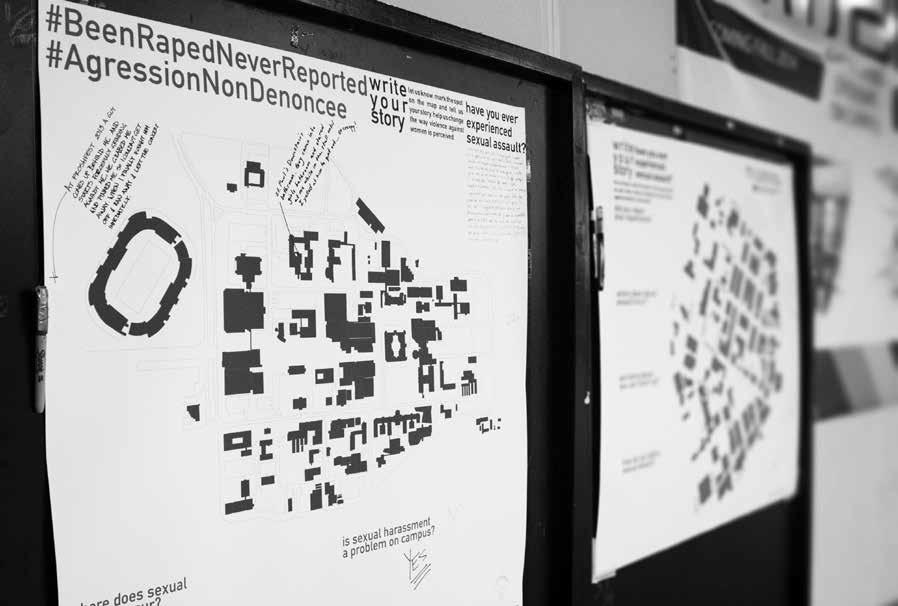
Last week, two posters featuring hashtags such as #BeenRapedNeverReported along with maps—one of the University of Manitoba’s Fort Garry campus and the other of the Exchange District—were posted next to the U of M Bookstore in University Centre.
The #BeenRapedNeverReported began trending on Twitter after several women who came forward with allegations against CBC host Jian Ghomeshi were questioned about why they did not report their violent encounters to the police.
The posters were hung in a hightraffic area on temporary dividers located in front of the food services that are presently under renovation on campus. With markers attached by string and tape dangling from the posters, the posters’ text is directed at passersby and requests them to write their own story of sexual assault; mark the place(s) where it occurred; whether they reported it; and whether there are places they will avoid because of fear of assault.
The posters’ heading reads: “Help us change the way violence against women is perceived.”
As also read on the poster, “71 per cent of incidents of sexual assault are not reported.”
Statistics Canada’s 2009 general social survey found that the rate of reporting sexual assault to police is much lower than 29 per cent. They defined sexual assault as “forced sexual activity; an attempt at forced sexual activity; or unwanted sexual touching, grabbing, kissing, or fondling.”
According to the same report, in Canada in 2009—excluding data from the territories, and based on selfreporting in a sample survey—88 per cent of sexual assault incidences were not reported to the police.
In a fact sheet by the Canadian Federation of Students-Ontario about reporting sexual assault, they noted that “statistics related to sexual and gendered violence are often based on reports that are formally reported to police. However, most cases of such violence are not reported by victims for several reasons.”
One report on Canadian statistics read that there are 460,000 sexual assaults each year. Out of 1,000 sexual assault occurrences, “33 are reported to police,” “29 are recorded as crime,” “12 have charges laid,” “6 are prosecuted,” “3 lead to conviction,” and “997 assilants walk free.”
A look behind the maps
The maps do not provide indication about who posted them or which group or individual is responsible for them. No one has yet come forward to claim ownership.
The maps—having received the official stamp of permission to post posters in University Centre—were posted on wooden dividers in front of the temporary wall for the food services renovations. Rebecca Kunzman, UMSU vice-president advocacy, said
that all posters in University Centre must be given approval stamps at Answers. The sexual assault maps were posted on spaces rented out by U of M Conference and Catering Services.
Answers is not permitted to provide approval for materials without any indication of affiliation within the university.
“Maybe you can catch somebody after the fact, but if you actually started talking about [sexual assault] more and addressing the issues, then maybe you wouldn’t need all the cameras” –Erin McNally, U of M biological sciences student
Conference and Catering Services would not provide the Manitoban with information about who was responsible for renting the spaces or posting the posters on the rented spaces. The U of M ancillary services—responsible for overruling the approval materials—was unable to provide any indication of affiliation by the time of publication.
The Manitoban was unable to confirm who was behind the posters.
Kunzman and Reanna Blair, UMSU’s women’s representative, both said they had seen the posters but did not know who had posted them.
One Health Sciences Centre sexual assault nurse, Candace Wylie, said, “It is disconcerting. The posters should be saying who it is from because it is a very sensitive topic,” referring to the lack of information and indicated affiliation.
“If you’re going to share [sexual assault] experiences, you should be offered information as to resources that you can access.”
A look at the maps
Two comments written on the campus map draw attention to places where there are no cameras, one of which states it made the commenter feel unsafe at night.
When asked if additional cameras would increase her sense of safety on campus, Erin McNally, second-year U of M biological sciences student, said, “No.”
“Maybe you can catch somebody after the fact, but if you actually started talking about [sexual assault] more and addressing the issues, then maybe you wouldn’t need all the cameras,” said McNally.
Though the maps draw attention to sexual assault on campus and downtown, McNally said that instances of sexual assault are not limited to those locations.
“I’ve experienced it on my own street before. Really, it could happen anywhere.”
Wanda Hounslow, a U of M sociology student and the lead initiator of the #NoMoreBlurredLines campaign by UMSU, commented on the placement of the maps in the middle of University Centre.
“I noticed that I felt self-conscious that someone would see me writing my story on there. It makes you realize how talking about this is still so taboo.”
A look online
The popular Facebook group called “UManitoba Confessions 2.0” is followed by nearly 7,000 Facebook members. The group’s administrator posts messages, broadly defined as confessions received, from anonymous U of M students.
Last Tuesday, the following post was made: “#573: To the girl who woke me up in iqs (sic) because I was
snoring, it’s not a quiet area! You’re lucky I did not destroy your dark star, and entered your black hole.”
People immediately commented on the nature of the language. One person asked, “Is that supposed to be a rape reference? Cause that’s ridiculous.” Another person commented that “rape jokes are bad.”
Other commenters appeared to support the post, leaving messages that included “LMFAO” and “Buhahahahahhaha.” As of press time, the original post had received 52 likes.
The admin for UManitoba Confessions 2.0 said that, “the site’s aim is to give people a way to make public confessions anonymously. All confessions are user-submitted and unedited, and comments are moderated.”
“The more controversial or surprising to me that a post is, the more I’m going to post it,” the site’s admin said in an interview with the Manitoban last March.
“I’m frustrated and I’m disappointed, and I’m not surprised,” said Hounslow upon hearing about the post. “It’s a bigger problem than just one individual [the original poster];
it’s a culture that supports this individual.”
“University no longer exists solely on the physical grounds of the campus,” Kunzman said in response to the sexual assault threats that were issued online.
“A lot of university life these days occurs online. This is a community, and you have to be a responsible citizen within it.”
Hounslow is one of various students and faculty members involved with the U of M Sexual Assault Working Group. This new initiative, established earlier this term, seeks to address concerns about sexual assault on campus.
“The group is putting forward a streamlined protocol that each office [that deals with sexual assault on campus] can follow to address cases,” said Kunzman.
The group also put forth a web page for public awareness about sexual assault on the university’s website, giving clear definitions of assault and consent. The page can be accessed at umanitoba.ca/student/sexual-assault
photo by Carolyne KroeKer, staff
Editor-In-Chief: vacant
Contact: Editor@themanitoban.com / 474.6770
The new F word
Misconceptions around a movement toward equality
L Aur E n SiddALL , staff
The idea of feminism has been a dominating theme in media and conversation this year. From Rosetta physicist Matt Taylor’s infamous shirt splattered with bodacious women, to Time magazine’s placement of the word “feminist” on their “which word should be banned in 2015” list, to numerous female celebrities outwardly stating their disapproval of the movement, the word “feminism” has become pervasive.
But not in the way it should be.
When Shailene Woodley was asked if she is a feminist, she replied, “No because I love men, and I think the idea of ‘raise women to power, take the men away from power’ is never going to work out because you need balance.”
Taylor Swift gave a similar answer, stating, “I don’t really think about things as guys versus girls. I never have. I was raised by parents who brought me up to think if you work as hard as guys, you can go far in life.”
Swift has since changed her tune
after understanding the definition of feminism.
Several other female celebrities have decided to call themselves “humanists” rather than feminists, including Madonna, Susan Sarandon, Sarah Jessica Parker, and Demi Moore.
Campaigns entitled “Women Against Feminism” cite some of their reasons as “I don’t need feminism because my boyfriend treats me right,” “I don’t have room in my heart for hate,” and “I embrace what makes me different from men. Being different isn’t the same as being lower or less important than men.”
To clear things up, the Oxford English Dictionary defines feminism as, “The advocacy of women’s rights on the grounds of political, social, and economic equality to men.” Not oppressing men in order to gain power and authority.
Canada’s only female prime minister was Kim Campbell, who sat in office for under six months, from June
25 to November 4, 1993.
Malala Yousafzai was shot it the head by the Taliban for fighting for the basic right of women’s education.
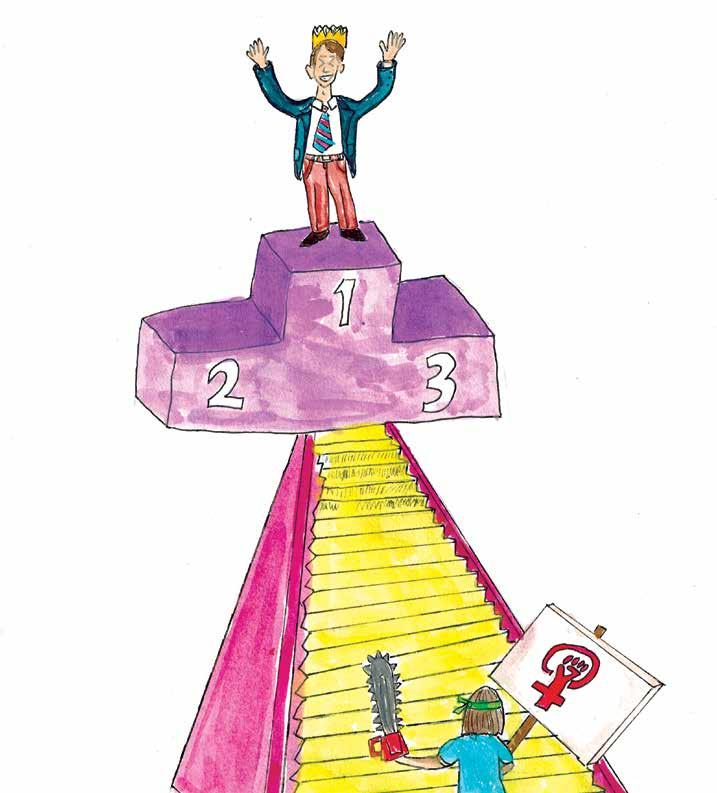
We still celebrate individuals becoming the “first woman to [insert accomplishment]”—as seen in the Engineering Complex at the University of Manitoba—which is problematic. We should not need to celebrate the achievements of women separately from the achievements of men; distinguishing genders greatens the inequality between the sexes.
The fact is, women are still not paid as much as men are; women are still not as likely to hold high executive positions within businesses; women are still taught to have a man escort them to their car late at night; women are still not given full control of the decisions they make regarding their bodies; women all over the world still need to fight for education; opinionated women who assert their power are still “bitches”; and women are still subject to “gender pricing.”
This is why we need feminism.
How can a word representing the movement for gender equality be ugly?
Emma Watson perhaps said it best in her recent address to the United Nations, as goodwill ambassador for UN Women, to launch her “HeforShe” campaign.
“I decided I was a feminist and this seemed uncomplicated to me. But my recent research has shown me that feminism has become an unpopular word. Apparently I am among the ranks of women whose expressions are seen as too strong, too aggressive, isolating, anti-men, and unattractive.”
In her campaign, Watson has included both genders in an attempt to abolish the misconstrued “us vs. them” mentality. Feminism is not about hating men, oppressing men, suppressing masculinity, or playing the victim. It is believing that women are just as capable and deserving of opportunities as men are.
The problem arises when people
assume that increasing the status of women will decrease the status of men. Feminism does not mean men should not hold political office, ask women out on dates, hold doors open for women, tell a woman she looks beautiful, or run companies. It means women should be allotted these opportunities too.
The conception of feminism as anything but a fight for equality between the sexes is indicative of the importance of the feminist movement and the need to abolish the extremist stereotyping of what it means to be feminist.
The counter-feminist movements, such as “Women Against Feminism,” are more damaging than they appear at first glance. By stating that women do not need feminism, these movements are negating the struggles of women everywhere in the fight for equal rights.
Counter-feminist movements are built upon selfish hypocrisy – an ideology built from a place of privilege. You may not need to fight for equal rights from the position you are standing in, but some women do.
Anti-feminist campaigns, while road-blocking the renewed feminist movement, also sustain the “ugly feminist” stereotype. Feminists are all too often portrayed as aggressive, angry, oppressive individuals who are more concerned with telling women what they can and cannot do than seeking equal opportunity. This is not the case.
“I decided I was a feminist and this seemed uncomplicated to me. But my recent research has shown me that feminism has become an unpopular word” –Emma Watson, UN Women goodwill ambassador
In fact, it is ironic that feminists are criticized for being consistently depicted as angry. We should all be angry; if you are not angry, you are not paying attention.
It is 2014, and I am still taught that I should not walk alone at night, I am not expected to climb as high on the corporate ladder as men, I am still subject to unwelcome catcalls, and I am not taken as seriously as an authority figure.
And I’m in a position of privilege. No, Time magazine, we do not need to ban the word feminist. We need to use it more often.
What holiday season?
Generalizing about the holidays trivializes other cultures
to M i ngr AM , staff
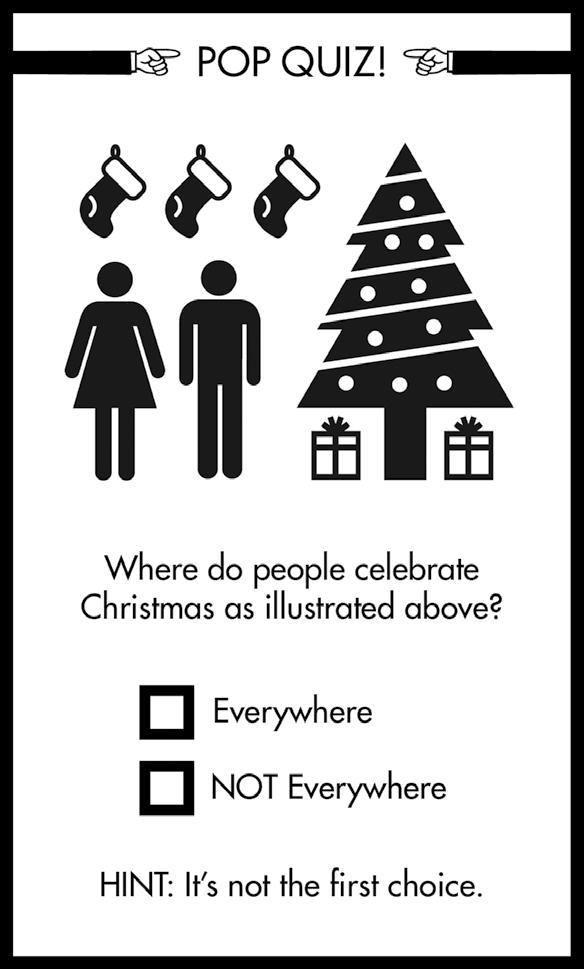
As we begin to set up our nondenominational holiday trees and paint the words “season’s greetings” in our windows, we are about to be inundated with tiresome arguments about the secularization of the holiday season – why it’s a terrible thing that must be stopped, and why it’s a great example of the progress made by Western culture.
These articles write themselves, so there is not much point in reading them. They are two complementary examples of meaningless noise due to obsessive thought patterns in our public discourse. Whenever you see one of these incessant, insoluble debates in the media, there’s probably some underlying confusion or manipulation going on.
First of all, let’s get a few things straight: whatever one thinks of a pluralistic society, as a matter of pragmatism in a place where you can’t make any assumptions about the religious adherence of a stranger, it is useful to be able to say some insipidly pleasant phrase such as “happy holidays.”
And, conversely, the verbal acrobatics that must be performed to avoid mentioning Christmas even when it is clearly being talked about are a little absurd, rather like characters in a 1950s sitcom using elaborate euphemisms to avoid saying the word “pregnant.”
So saying “happy holidays” is dumb, but polite and harmless. There is no reason to get mad at your Walmart greeter. The phrase is nothing to be alarmed by; it’s just a way for people from many different backgrounds to get along during the
holiday season.
What I am alarmed by instead is this artificial notion of a holiday season. When I was about seven, I recall my school putting up posters with the names of various holidays along with drawings of stereotyped children celebrating these holidays. There was one for Christmas, Hanukkah, Kwanzaa, Ramadan, and Diwali, and possibly others I’ve forgotten.
The idea that a religion embodies the fundamental principles of a way of life is alien to many North Americans
The point of these posters was obvious: they were designed to instruct us in the ways of pluralistic society, portraying our own (mostly Christian or pseudo-Christian) observances as only one possibility among many.
They did a good job of teaching us that others could be very much like ourselves. But I think it was perhaps too good a job, which left us unable to conceive of people who think much differently from ourselves. And we were well-fed, clothed, predominantly white kids living in a very safe part of the world and reasonably assured of a prosperous future.
These holidays are all very different. They occur in all parts of
the year and are of widely varying length. Some of them are inextricably attached to a religion, some are rooted in old traditions but not necessarily religious, and some have gone over almost entirely to the commercial machine.
But to hear all the talk of a “holiday season,” or to see the posters hung in elementary schools, you would think that these very different observances were all merry late-December feast and gift-giving days differing from Christmas only in the date and some of the decor.
This has the effect of collapsing all cultures down to one in our minds. We are taught to think of people from other cultures like the aliens in Star Trek who are exactly like the Earthlings in all respects except for wearing an unusual hat. Most of us have given up xenophobia, but we have replaced it with xenoscepticism, which is scarcely an improvement.
The idea that a religion embodies the fundamental principles of a way of life is alien to many North Americans. The idea that these principles might differ from what we are used to in important and complicated ways is even more so.
But assuming that all cultures are minor variations on our own makes a lot of world events unintelligible. And, paradoxically, it weakens our sympathy for the rest of humanity who cannot get over such petty differences as what date to hold the December feast and buy each other televisions and microwaves.
A wake-up call for the best country in the world
Canadians are fortunate to be safe from terrorism
n October, a disturbed and radicalized Michael Zehaf-Bibeau shot Cpl. Nathan Cirillo in cold blood while the reservist stood on guard at the National War Memorial, a symbol honouring the men and women who have fallen for Canadian freedom. Zehaf-Bibeau proceeded to hijack a ministerial car and charge the steps of Parliament, possibly with the intent to kill members of Parliament. If this wasn’t an act of terror, what is?
A few weeks later, in the deadliest attack in Jerusalem in six years, the Abu Ali Mustafa Brigades, the military wing of the Popular Front for the Liberation of Palestine, murdered four innocent Israelis during morning prayers. Hamas, which is recognized by Canada and its allies as a terrorist organization, swiftly praised the murder. Like the actions of Zehaf-
Bibeau, this was a barbaric, evil, and cowardly attack. If this wasn’t an act of terror, what is?
The only difference between the attack in Ottawa and the attack in Jerusalem is that terrorism is a deadly reality that Israelis confront every single day. The only difference between Canadians and Israelis when faced with such heinous acts is that Israelis are not afraid to call a spade a spade. According to the Jewish Virtual
The only difference between Canadians and Israelis when faced with such heinous acts is that Israelis are not afraid to call a spade a spade
Library, from 2000 to present, there have been 1,232 Israeli deaths as a result of terror attacks. The Israel Defense Forces report that, since 2001, over 15,200 rockets or mortars have been targeted at Israel, mostly from the Gaza Strip, an average of more than three attacks every day. Try to imagine what life would be like if the threat of senseless terror and murder, like the act of Zehaf- Bibeau, were a regular occurrence, as it is in Israel.
It is worth reflection.
We shouldn’t be ashamed that we don’t always recognize terrorism for what it is. Canada is a strong, courageous, and peaceful country. Our Parliament, thankfully, spends far more time debating health-care policy and taxation than it does on security and counter-terrorism.
On the world stage we can be counted on to provide meaningful military contributions and take focused action where we can be the most effective, such as our current efforts against the Islamic State of Iraq and the Levant, but this action has always been far from home. We are not afraid to stand up for what is right, even when it isn’t fashionable. However, until the recent terror attack, it has been decades since we have witnessed violence at the heart
of our nation’s capital. Canadians should open their eyes to the fact that radicalism does not exist solely on some distant desert battlefield. If we remain ignorant to its proliferation, we do so at our own peril. While ensuring that our civil liberties are protected, it is vital that further efforts be made to appropriately address the issue of radicalism head on.
The poetic justice of this act of terror is that its effect on Canadians was the opposite of what was likely intended. It opened our eyes and hearts, brought us closer together and strengthened our will to continue to face evil as the best country in the world.
graphiC by Justin ladia, volunteer staff
Thank you to our sponsors: David’s Tea, Thin Air, and the Manitoba Writers’ Guild.
In the prose portion
Runner up: Dan Hrynick with “The Life of Rye.” The winning entry: Alex Passey with “Looking Out.”
Life of Rye
dA ni EL h ryni CK
It was a weird Thanksgiving. I peeled out of the driveway of my mother’s house in a LeBaron that she would never drive again. The last words I said to her were, “I’m leaving.”
I raced down the gently winding street of my otherwise perfectly quiet gated community. The old divorced battle axes couldn’t open the blinds fast enough to see who was making all that noise. At the front gate of the Golden Bear Estates (the developers swear they had no idea who Jack Nicklaus was) I came to an aggressive stop and let that butthead—Gord—open the gate for me. He was smiling at me with the mouth of a ventriloquist, saying through his smile, “you little fucker.” I wondered what his loudmouth wife had said to him before he left for work that morning. She probably told him to get a real job. Gord pressed the big green “OPEN GATE” button for me, and began with the small talk that is typical of subservience.
“Off to see your old man?”
“Yeah, something like that.”
“Well, drive safe. Lot of people on their way to be with their families today.”
Had I not been in such a rush to leave, I would have put the top up on the LeBaron to avoid our excruciating exchange. There was silence for what seemed to go on for generations when the gates of the Golden Bear Estates finally opened just wide enough to let an ’87 LeBaron go roaring through. As I left, Gord sighed and pointed his eyes to the ground. Without looking, Gord reached with his right hand, found the big red “CLOSE GATE” button, pushed it, and said to himself, “this is horse shit.”
Truthfully, I didn’t know where I was going with this LeBaron. Not to my old man’s house, that’s for damn sure. I’d pass on another awkward hello with a woman I was meeting for the very first time, thank you very much. The more I thought about where I was going to or running away from, the less I was focusing on my driving. My mind was wandering and the potholes were sitting there – waiting. Their mouths open like they were in line for the buffet at Cathay House. In no time, I hit a big one.
“JESUS CHRIST!” I yelled as the LeBaron drove over the concrete abyss. The force of the impact nearly threw me from the LeBaron. With my heart in my throat, I turned down the radio and slowed down to let the LeBaron tell me what kind of shape it was in. I could hear the sound of a terrible grind, and all I could say was, “this is horse shit.”
I pulled the LeBaron to the side of the road and turned on the hazard lights. Ahead of me, a city worker held a “SLOW” sign in her left hand. Road work ahead. She let the sign lean against her body as she adjusted her glasses, pushed her hair aside, and dug deep in her pockets to find a smoke. She eventually found a cigarette in the pockets of a co-worker who was holding a shovel but not paying attention. She lit the cigarette, took in a deep haul, and exhaled a toxic cloud of relief. She then jerked her arm out to reveal her wrist watch from underneath her long-sleeve safety gear, checked the time, and while shaking her head, muttered something like, “this is horse shit.” After a long, blank stare into the distance, the city worker turned her attention to the LeBaron. She was likely wondering what a LeBaron with the top down was doing on the side of a busy street with no parking. After a while, though, I could tell that she recognized the LeBaron. And I knew she did, because she was my mother’s old friend and current number one enemy, Judy. I put my head down, wishing that I had put the top up on the LeBaron, and reached for my phone.
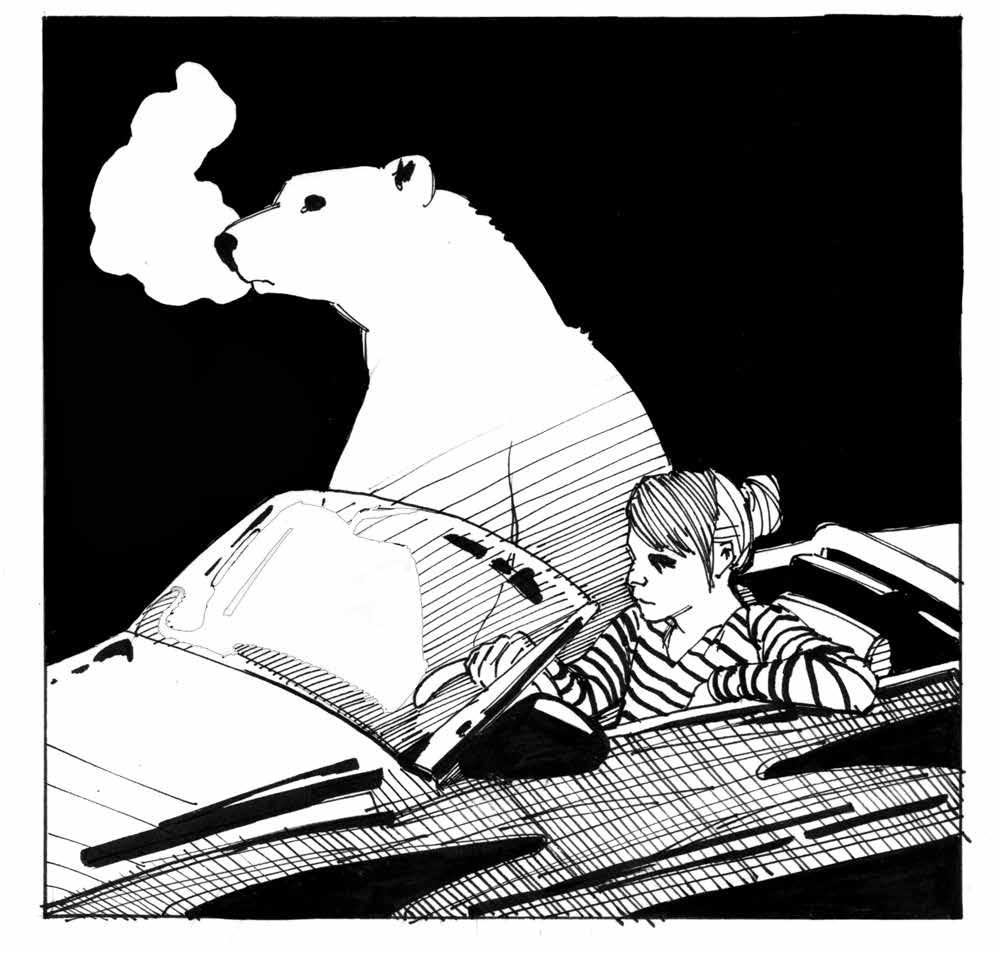
“Great, now what?” I wondered aloud. I couldn’t call my father, I just made my mother cry, and I didn’t have the Haynes Repair Manual for mid-size Chryslers 1982 thru 1995. Minutes passed while I sat frozen in the LeBaron. My forehead had taken the shape of the steering wheel when suddenly, I heard a low, growly voice from the passenger side say, “you look lost, man You okay?” I lifted my head to turn towards the voice, and was shocked when I saw who it was. It was Hudson, the talking polar bear from the Assiniboine Park Zoo.
“Uh-uhhhh… s-sure.”
In the poetry portion
Due to a large number of entries, three runners up were selected: Elizabeth Walker with “Lovers of Valdaro,” Kieran Dublin with “Mixed,” and Alex Passey with “Raindrops.” The winning entry: Daniel Guezen with “Slough.”
“Listen, man, I’m not gonna hurt you, but it’s important that I get into this LeBaron.”
“S-sure thing, w-whatever you n-need.”
Hudson hopped into the LeBaron. Reluctantly, I turned off the hazard lights, put the LeBaron into drive, and drove the LeBaron slowly past Judy, like the sign said. She smiled the same ventriloquist smile as I had just seen on Gord’s face, waved politely as acquaintances should, and butted the shoveler’s cigarette on the road with her CSA safety boot.
“You know her?”
“N-no, n-not really.”
“Hey now, I’m on your side. Don’t be afraid, man.”
“O-okay.”
“Ha-haaa, that’s right. You got it, man.”
What ensued was a daring journey to the north perimeter of Winnipeg in a struggling LeBaron. A journey of discovery made possible by the unlikely pairing of two of Winnipeg’s more privileged lost souls. We took turns both as the talker and the listener, hoping to discover more about ourselves and each other. Hudson wanted to know why people would want to live in a gated community. He would say, “man, that sounds like horse shit.” I would then ask Hudson why some animals could speak to humans but other animals could not. Or why people only gave a shit about the animals who could speak to humans in the first place. Hudson wanted to understand why a white boy from high-income earners would be so strongly opposed to going to university, getting a job, paying taxes, or voting. He wanted to know why it was so difficult to make a city work. “You all value the same basic things, don’t you? You know you’re not that different from us polar bears, man,” Hudson said with a grin. I wanted to know how Hudson got out of his cage so easily, and why he thought the LeBaron could
make it all the way to Churchill. How far away did he think Churchill really was?
“You know, Hudson, the plight of the polar bear is something else.”
“We’ll be fine, man. You humans worry about us too much.”
“Hey, we just want to make sure we don’t lose polar bears. Big tourism draw, you know.”
“I know, man.”
And then, the wheel finally stopped turning. The journey to the north perimeter was barely incomplete. The LeBaron let out a terrible roar as the front passenger-side wheel broke off from the axel and came to rest in a wetland drainage trench. The wheel stood as a rubber prairie monument until the next generation of workaday Winnipeggers eventually grew sick of the wreck of the old ’87 LeBaron off Highway 7.
A cold, October wind was blowing in from the north, carrying with it the smell of horse shit from the ranches surrounding Winnipeg. Why, why did I leave the top down? Before self-loathing could start to consume us, Hudson looked at me and said, “good luck, man.” Hudson crawled out of the LeBaron which was now only partially blocking the right lane of Highway 7. Irate motorists honked as they passed by.
I watched Hudson walk north until he was completely out of sight, and then I called my mother. She finally arrived, and I quietly got in her truck. We both sat, listening to a CJOB newsman cover the developing story of Hudson the polar bear’s daring escape from the Journey to Churchill exhibit at the Assiniboine Park Zoo. In the silence of my mother’s truck, as we turned into her tire-marked driveway, I heard that Hudson had been located and captured by the new police chopper. Hudson was on his way to his new home in a more secure area of the zoo.
graphiC by bram Keast, staff
Looking Out
A LE x pASSE y
“Can you please just get out of my way?” Melissa demanded.
“Seriously, what the hell?” Amy objected as Melissa’s elbow dug into her ribs, jostling her away from the bathroom mirror. “I was in here first.”
“Yeah, but Evan is going to be here soon,” Melissa said. She was already pulling her makeup kit out of the drawer, not bothering to spare even a sideways glance for her sister. “So I’m kind of in a hurry. You can have the bathroom when I’m done.”
“No, I was here first,” Amy argued. “So you can have it when I’m done.”
This time Melissa did spare a sickeningly sweet look of indulgence for Amy. “Oh, I’m sorry, big sister,” she said. “Do you have a date tonight too?”
“Why do you have to be such a bitch?” Amy asked. Melissa was always taking shots at her like she was ugly and couldn’t possibly get a date, despite the fact that they looked so similar to each other. Amy might not dress as alluring or wear as much makeup, but she knew could attract a guy if she wanted to. She didn’t really see the appeal, though.
“All I want to do is brush my teeth and stuff,” Amy said, trying to be diplomatic. “I won’t even be five minutes. Just let me go first.”
“Brush your teeth?” Melissa scoffed, already applying her mascara. “Why bother? No one is going anywhere near that mouth. Now will you please get out of here so I can have some privacy?”
Amy did step out of the bathroom then, but only a step, because that was how far she needed to go so she could lean over the railing and yell downstairs to their mother.
“Mom, Mel is being a bitch again!” she shouted.
“Watch your mouth, young lady!” her mom shouted back.
“Well it’s true,” Amy said.
“I don’t want to hear that language in this household. I raised you better than that.”
Amy rolled her eyes. “Can you just tell her to get out of the bathroom? I was in there first.”
“God, can’t you people shut up?” Melissa said. “I’m trying to concentrate.”
And with that she slammed the door shut.
“Just let her be,” Mom called up to Amy. “She won’t be long. A little waiting isn’t going to kill you.”
“You know she takes forever in there,” Amy complained. “Besides, I was in there first.”
“Amy, she’s your little sister,” Mom said, starting to sound impatient. “Cut her some slack. You’re supposed to be looking out for her, you know.”
Amy rolled her eyes again. Right, she was supposed to be looking out for Melissa. She wasn’t even a full year older, but it was like their parents expected Amy to carry Melissa around in a little pouch like some kind of marsupial guardian. If they were out playing hopscotch on the sidewalk and Melissa fell and scraped her knee, the question was always why Amy wasn’t keeping a closer eye on her little sister. Or if Melissa’s grades weren’t as good as Amy’s, it was always asked why Amy hadn’t done more to help Melissa with her schoolwork. And when the two sisters fought, as they had many times, both verbally and physically, it always boiled down to why couldn’t Amy be the mature one and broker peace. Everyone was always clamouring to give Melissa the whole world on a silver platter and Amy’s only purpose in life was to make sure that she didn’t drop it and smash it to pieces.
“Whatever,” Amy muttered. She stormed downstairs, making sure that every stomp of her feet reverberated through the house. She slumped onto the couch in the living room, picked up the remote, and started flipping through the channel guide. She scrolled fast, squeezing the little down arrow like she had the remote pinned in a thumb war. She wasn’t even paying attention to what was on the screen. Amy just wanted to sit there and fume.
Melissa came racing down the stairs then, not seeming in much better spirits than Amy despite having won the battle for the bathroom. Melissa threw open the door of the linen closet and began rifling through it.
“Are you done yet?” Amy asked.
“Does it look like I’m done?” Melissa asked. She spread her arms out wide to accentuate the fact that she was clad in nothing more than a towel and a bra.
“Well, hurry up,” Amy told her.
Melissa turned back to the closet. “I’d be done a lot faster if there were ever enough towels,” she said.
Then something caught Amy’s eye.
“What the hell, is that my bra?” she accused.
Melissa turned again, smiling that insufferable smile of
hers. “This?” she asked innocently. “I’m pretty sure it’s mine. You really think this would fit you? It would hang off you like grapes in a hammock.”
“We’re the same cup size, Mel,” Amy said.
“Sure we are, sis. After a box of Kleenex or two.”
“You are such a bitch,” Amy said, shaking her head.
“Whatever. By the way, where are the car keys?”
“Why? This is my night with the car.”
“So? You’re not going to use it. Evan’s car is in the shop and he needs me to drive tonight.”
“Not my problem,” Amy said smugly, glad to finally have the upper hand on her sister.
“No way are you ruining my night,” Melissa said. “Mom! Amy won’t let me take the car out!”
“Why won’t you let your sister use the car, Amy?” Mom’s voice drifted out to them.
“I might want to use it later,” Amy said.
“Oh yeah?” Melissa sneered. “What for?”
“I was thinking about going to see a movie or something.”
“Oh come on, by yourself?” Melissa said. “Don’t be so lame.”
“Just let your sister use the car, honey,” Mom’s tired voice decreed. “There are plenty of movies you can watch on TV.”
“Oh my god, fine, whatever,” Amy huffed. “The keys are on my dresser.”
“Thanks,” Melissa smirked. Then the doorbell rang, and Melissa’s face contorted in horror.
“Oh my god, he’s already here!” she cried, turning and racing back up the stairs. “Tell him I’ll be right down!”
“Yeah, yeah,” Amy said, pulling herself up off the couch. Amy opened the front door and there was Evan, in all his stereotypical jock glory. His blond hair was cut short and neatly combed to one side. The sleeves of the baby blue shirt he was wearing were long, but it was tight enough that the muscles underneath were obvious anyway. He looked like he’d been plucked right out of some teen movie from the 90s.
“She’s still in the bathroom,” Amy said, doing her best to smile pleasantly. “Come on in and have a seat.”
“Okay, thanks,” Evan said.
“Is she going to be long?” he asked, settling into a place in
the middle of the couch.
“She should only be a couple minutes,” Amy said. She came to stand near the edge of the couch and cocked her eyebrow at Evan.
“Sorry, did you want to sit down?” Evan asked, moving to scooch over.
“That’s okay,” Amy said. She stepped over Evan with one leg and sat down in his lap, straddling him and locking her fingers behind his neck. “This spot is fine.” She lunged forward and assaulted him with a deep, hungry kiss.
“Whoa,” Evan said, grabbing Amy’s shoulders and holding her back, after a few seconds had passed, mind you. “We can’t be doing this.”
“You didn’t mind last time,” Amy said saucily.
“Yeah, but… Jesus,” Evan said, glancing over his shoulder nervously. “Mel is right upstairs.”
“Oh, we have plenty of time,” Amy purred.
Amy locked Evan in another violent kiss, and this time he didn’t resist. She ran her fingers through his hair, or tried to, and was totally unsatisfied by the lack of a mane she found there. She ran her hands over his body and was mildly disgusted by the bulk of corded muscles under her fingertips. She tried not to cringe as his hands crept up under her shirt, and his tongue probing her mouth made her feel faintly like vomiting.
Her hands slipped down to unbutton his pants.
“Okay, whoa,” Evan said, bringing events to a stop once more. “Come on, baby,” Amy breathed. “What’s the big deal?”
“Okay, I’m ready!” chimed Melissa’s voice from upstairs.
Evan was up like a shot, tossing Amy aside so she landed gracelessly on the couch. “Hey, babe,” he said. “You look great. Ready to hit the road?”
“You know it,” Melissa said. She turned and shot Amy a snarky grin on her way out the door. “Don’t wait up.”
Melissa shut the door and Amy blew out a long sigh. At least she had the bathroom to herself now, because a nice hot shower sounded like the best thing in the world.
graphiC by bradly Wohlgemuth, staff
Slough
pulled from the depths of mire by contractions and gloved hands we emerge to brightness and uncertainty
a disruption of the stagnancy that reigns over a plain populated with thin trees like crooked cribposts or ancient tombstones lining the shores to watery wounds from a wanton glacier’s thrust that moved like we moved, crawled, staggered the first steps we took away from repose
we learned to laugh and slough it all off old library books, newspapers, birthday cards, unmailed letters, hoarded cans of tea steeped in hospital bands and concert ticket stubs, crumbling dried flowers and herbs and the friction of day and night grown thick on neglected surfaces until the only things we have left are thinned skin and lucid whispers
The Lovers of Valdaro
Bright moon and sun
Where two is one, Are Cosmic lovers leaping
Rotating gaze Form nights and days, Fixed distance ever-keeping.
Igniting the skies With watchful eyes, Bear witness to the sorrow
Of the lovers’ embrace Whose unknowing face, Shall never know tomorrow.
Two hearts entwined Till time unwind, A pair forever sleeping; It’s The Unquestioned Last, Eternal cast; For Love can’t stop the Reaping.
Mixed
In the wake of the scoop, I was born. Many dreams bestowed upon my back; decolonization, the dream but nightmare to some.
But who am I, of the mixed blood, to help those who reject me? I, too, have felt the same anger, have I not?
I was once known as half-breed, I am now known as Métis— an insult just the same.
I am proudly mixed. And I do not wish to borrow title from independents who dish out title so begrudgingly.
I am mixed and I am proud, and perhaps you will accept me when we take the same blows upon the battlefield.
Raindrops
A LE x pASSE y
So simply we slip from the sky
So fast can this plane, of friction and flame
Vanquish us into vapour
Not eviscerated, but evapourated
Back to whence we came
Cloud nine runs parallel to the ninth ring of Hell
But for a while we freely fall
Plunging to uncertainty
Beautifully, devastatingly free
In flight we catch nothing but light
Reflecting prismatic iridescence so bright
Plummeting gems tumble from space
A small splash on Earth, without a trace of grace
But there the tale does not end
We pool and we puddle, we gather and grow
We stream between dreams, in rivers we flow
Combined our shimmer shines a thousand fold
We dance in the summer and wait out the cold
Though by design, through turmoil or time
Back to the sky, we all make the climb
But still the tale does not end
We, the diamond sea
We, the crystalline clouds
We, the omnipresent ocean
We, divine and damned and drowned
graphiC by bradly Wohlgemuth, staff
graphiC by bram Keast, staff
graphiC by bram Keast, staff
graphiC by evan tremblay, staff
MedTalks the talk
A lecture series shedding light on life as a medical doctor
J E r EM i A h yA r M i E , staff
Do you want to be a physician?
Chances are the thought has crossed your mind at one point in your life.
The University of Manitoba Science Students’ Association (SSA) is endeavouring to shed light on what life as a medical doctor is like through the MedTalks: Student Edition lecture series.
The series is developed by the SSA in collaboration with the college of medicine’s continuing professional development division.
According to U of M science student Ian T.D. Thomson, the co-ordinator of the lecture series, the inaugural MedTalks: Student Edition lecture took place on Oct. 9. Dr. John Embil did a talk on infectious diseases found in Manitoba and Ontario, which “wasn’t for the faint of heart,” said Thomson.
Embil is a physician, U of M professor, and the director of the Health Sciences Centre’s infection prevention and control unit. Embil’s passion for infection control education has seen him collaborate with the likes of Kermit the Frog, and don an alter-ego named Soapy, who spreads the good word about hand-washing.
On Thursday, Nov. 20, Dr. Michael Ellis—U of M alumnus, neurosurgeon-scientist, and medical director of the Pan Am Concussion Program—joined U of M students to discuss the path that led to him
become a medical doctor.
The SSA partnered with the U of M’s Undergraduate Psychology Students’ Association (UPSA) for Ellis’ talk.
Ellis received his bachelor of science degrees in psychology and medicine, as well as his MD, from the U of M. In his medical training, Ellis was able to travel to prestigious institutes and work with influential researchers and clinicians in the field of neurosurgery.
Eventually, Ellis joined the Pan Am Concussion Program as its medical director. The program, to which every child with a concussion in Manitoba is referred, provides individual care for patients. The program also carries out interdisciplinary concussion research.
Ellis concluded his talk by sharing some key advice with the audience.
“Find your mission,” Ellis urged, highlighting the importance of reading, volunteering, utilizing social media sites such as Twitter, and talking to others.
Ellis also encouraged the audience to find mentors, and listed the individuals who helped him along his way. Finally, Ellis told the audience to “have a lot of faith.”
“There are many students within the U of M faculty of science who are interested in the discipline of medicine; however, they may not be aware of all the interesting specialties of the
field. Suffice to say, it’s a very broad subject. With MedTalks: Student Edition, we hope to share with students what different physicians across Winnipeg observe and deal with on a regular basis,” said Thomson.
Medical outreach events like the MedTalks lecture series can help open the doors to medicinecurious students from a variety of backgrounds.
“In Manitoba there is still a very urgent need for us to have great people in the field of medicine,” said Ellis. Thomson hopes MedTalks: Student Edition will grow into a popular lecture series for students within the faculty of science, and at the U of M as a whole, leading into next year.
“I haven’t confirmed a speaker at this time; however, I would like to
continue with the idea of partnering with student groups to further the MedTalks: Student Edition name, like we did with UPSA,” said Thomson.
Keep your eyes out for the next MedTalks: Student Edition lecture. It may inspire you to begin the first chapter of your own medical career.
Effects of oral contraceptives on the brain
Study suggests oral contraceptives may have an effect on facial recognition
Ch A nt ELLE d uboi S , staff
Oral contraceptive pills were first produced in the United States in the 60s, revolutionizing sexual health for women all over the world. Millions of women around the world use hormonal methods of contraception, but effects of the use of these medications are still being investigated.
Recently, researchers in Austria found a possible link between brain function and the use of oral contraceptives.
The two most common types of oral contraceptives to be used by women are the combined oral contraception pills, which contain the hormones estrogen and progestin, or progestin-only contraceptive pills.
In this study, 20 women between the ages of 20 and 33 participated in experiments with facial recognition performance. The subjects in the study had either never used oral contraceptives, used oral contraceptives for a duration of less than a year to five years, or were currently using oral contraceptives. The women who had used or were currently using oral contraceptives included those using
both combined and progestin-only oral contraceptive pills.
In the experiment the subjects were shown 20 faces of both males and females with neutral expres-
The relationship between the use of oral contraceptives with brain structure and related behaviours has only recently begun to interest researchers
sions for three seconds. During this time, subjects were asked to indicate whether the face was male or female.
Half an hour following the initial slideshow of faces, another slideshow of 60 faces was shown to participants. Thirty of those 60 faces were from the previous slideshow and participants were asked to indicate if they had seen
the face before or not.
Subjects also had MRI scans of their brains to determine physical differences in specific areas.
The results were that the women using anti-androgen oral contraceptives had more grey matter in the area of the brain relating to facial recognition, and were also the subjects with the highest scores in the facial recognition tests.
What the experiments did not account for were age, the androgenicity of progestin in the birth control pills, and whether or not effects of oral contraceptives were reversible or dependant on the duration of use.
Negative long-term effects of the use of oral contraceptives, such as depression and higher risk for bone density loss, have been studied before. Positive side-effects range from the ability to control reproduction, acne treatment, and a reduced ovarian cancer risk.
Positive effects of birth control— including other forms beyond just oral contraceptives—extend to social and economic impacts. One positive relationship, among many others, has
been found between access to contraception and the pursuit of post-secondary education. Such correlations relate to the ability of women and their partners to choose when to have children.
What the study in Austria aims to do is explore effects of oral contraceptives that have not been previously considered. The relationship between
the use of oral contraceptives, brain structure, and related behaviours is a new area of interest for researchers.
When choosing whether or not to use oral contraceptives, it is always important make an informed decision while considering both the pros and cons, and consult your family physician for advice on what may be the best option.
photo by Jeremiah yarmie, staff
Ian T.D. Thomson (left) and Dr. Michael Ellis (right)
graphiC by Katerina Koza
Not so silent nights
Three musical events to carry you into the New Year
iA n t d t ho MS on, staff
With the holidays quickly approaching along with the obligations they entail, tracking down good musical events can be a daunting task. Here are three December events that will make the search easier and tide you over until 2015.
The Bison Men’s Chorus Annual Christmas Concert
On Dec. 14, the University of Manitoba Bison Men’s Chorus will be performing their annual Christmas Concert at Charleswood United Church. The event will include audience participation to get people in the festive spirit, as well as performances of both traditional and seldom-heard Christmas songs
“As always, the chorus members will attempt to express their love of music and fellowship with enthusiastic and sensitive performances of all types of Christmas music,” chorus member Paul Hope told the Manitoban
The Bison Men’s Chorus began in September of 1985 by Larry Patterson of the U of M faculty of education,
and is affiliated with the Desautels faculty of music. The communitybased chorus is comprised of U of M graduate students, faculty, staff, and alumni, in addition to community members of the surrounding Winnipeg area. Since its inception, the group has released two cassettes and three CDs, their most recent being He(a)rd Across Canada (2010).
In keeping with their Christmas tradition, the chorus will be donating any of the free event’s offerings to a local charity. This year, the proceeds will go to Ronald McDonald House Manitoba, an organization that offers housing for families in Winnipeg when their children are receiving treatment for an illness.
While the event is off-campus, Hope wishes for continued support from the U of M.
“We’d love to see lots of members of the university community to help us celebrate the season.”
The U of M Bison Men’s Chorus performs their annual Christmas concert
on Dec. 14 at 3 p.m. at Charleswood United Church (4820 Roblin Blvd). It is free admission to attend, with donations to the Ronald McDonald House Manitoba greatly appreciated.
The Bros. Landreth: “Bros. on the Run”
To help ring in the New Year, local alt-country act the Bros. Landreth will be performing a cover show at the Park Theatre. The band will be covering the music of Paul McCartney and the Beatles for a “Retro New Year’s Eve Party.”
The Bros. Landreth, made up of brothers David and Joey Landreth, have received critical and popular appraisal since the release of their debut album Let It Lie in 2013.
In addition to plans for more continental success, the band has remained prominent in the local music scene. Along with their special New Year’s show, the band will continue their reign in Winnipeg with a sold-out show at the West End Cultural Centre on Dec. 6.
For the New Year’s Eve cover show, it was an easy decision to focus on the music of Sir Paul McCartney.
“As always, the chorus members will attempt to express their love of music and fellowship with enthusiastic and sensitive performances of all types of Christmas music” – Paul Hope, Bison Men's Chorus member
“We came up with the idea together with Erick Casselman, who owns and runs the Park [Theatre].
We have started almost every Bros. Landreth concert with a Paul McCartney song and we’re all pretty huge fans of his,” explained David to the Manitoban
“When he suggested a tribute as a theme for the night Joe [Landreth] and I blurted ‘Paul’ simultaneously.”
Along with playing multiple sets of classic rock music, the night will be themed around the era of the groovy 70s.
The Bros. Landreth bring “Bros. on the Run” to the Park Theatre (698 Osborne St) on Dec. 31. Tickets are $34.99 (champagne included) and are available at Ticketfly.com
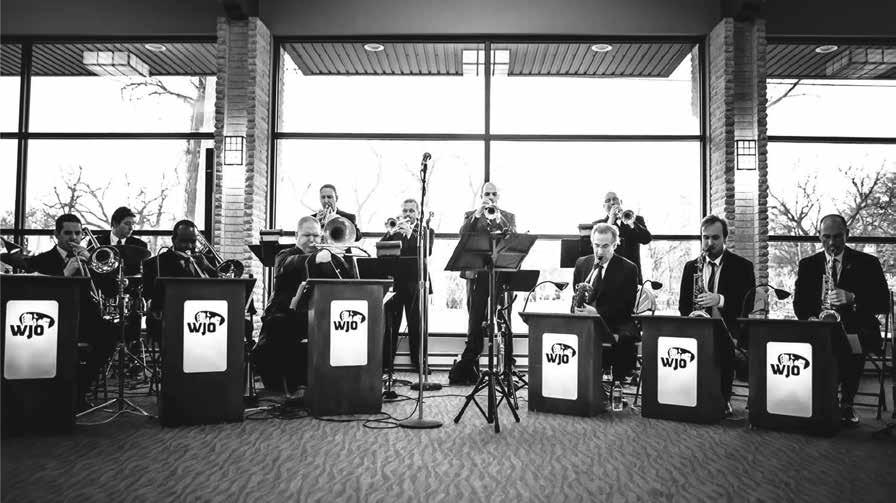
The Winnipeg Jazz Orchestra with Erin Propp: Suite Messiah
Bringing the big jazz band flavour
to the holidays, the Winnipeg Jazz Orchestra (WJO) will be performing George Frideric Handel’s suite Messiah at the Winnipeg Art Gallery on Dec. 14.
The suite Messiah, composed by Handel in 1742, was originally presented around the Easter holiday. However, over time, the composition took on a new interpretation.
“Like the Nutcracker (which we performed last December), Handel’s Messiah is very much associated with the Christmas season,” explained WJO artistic director Richard Gillis to the Manitoban
The Messiah suite will be split into three movements: “And The Glory,” “Sheep to Keep,” and “Hallelujah.” While pieces of the Messiah such as “Hallelujah” are often attributed to choruses, the WJO’s interpretations are more “opened up” – in “Hallelujah”’s case coming to a ravishing conclusion.
Along with Handel’s magnum opus, the event will feature jazz renditions of holiday favorites such as “Huron Carol,” as well as music by other jazz artists, such as Nat King Cole.
The event will also feature collaboration with singer-songwriter Erin Propp.
Propp has collaborated with the WJO on two other occasions, including debuting with the WJO in 2012. For the December performance, Propp will be joining the orchestra for a rendition of “Angels We Have Heard on High.”
“We always love to collaborate with the talented and charismatic Junonominated Erin Propp,” said WJO general manager Brent Johnson to the Manitoban.
The Winnipeg Jazz Orchestra performs Suite Messiah on Dec. 14 at 2 p.m. and 7:30 p.m. at the Winnipeg Art Gallery. Tickets are $35 and are available at winnipegjazzorchestra.com
photo provided by Carl dong photography
photo provided by ian smart photography
Winter Folk Fest
Escape the deep freeze with an afternoon of great music
Jo S huA Wright
In the midst of the mid-winter blues, when thoughts of a warm summer afternoon seem to be only a faint memory—when shoveling, hibernating, and studying become all too familiar—hope exists.
This much-needed silver lining can be found in a music-filled retreat from the “big city” of Winnipeg to a festival designed to warm the bodies and souls of attendees.
In Portage la Prairie, about a 75-minute drive west of the U of M, the one-day Winter Folk Fest will be returning for its third year, after being established in 2013 as a vibrant mid-winter sanctuary.
On Feb. 8, 2015, from 1:30 p.m.-5 p.m. the single-day folk festival— relatively small and intimate in comparison to others—will be held in the stunning Trinity United Church, built almost 120 years ago. The historic church, situated in Portage’s downtown, boasts a beautiful interior with vaulted ceilings and fabulous acoustics. Since its beginnings, Winter Folk Fest has showcased a multitude of eclectic talent.
The 2015 Winter Folk Fest lineup is sure to, once again, make for an amazing experience.
Portage la Prairie singer-songwriter Ed Goertzen, performing jazz-infused root music, will open the folk fest.
Slated to follow Goertzen is Vancouver’s Ben Rogers, who embodies the values and musicality of traditional folk, Americana, and country – captivating audiences with his storytelling abilities.
Adventures of FINN
Less rafting, more guitars
It is a chilly Tuesday night when I arrive at Cousins Deli & Lounge to meet with Winnipeg band, FINN. The guys seem to decide unanimously on dark beer, and we hole up in the quietest corner we can find.
FINN will release their EP on Dec. 5 at the Good Will Social Club, one of Winnipeg’s newest music venues. The bar has already seen an impressive roster of acts, including John K. Samson. But the real reason it is perfect for the guys?
“We get the most done because we’re not married to an idea [ . . . ] we’re open to criticism, and it’s okay if the other person doesn’t like it. If it’s not working, alright, it’s not working,” said John.
“There’s pizza,” said Matthew.
Following the first three acts, Cloney’s five-piece band is excited to bring the Prairie Kitchen Party to the festival as a new feature.
The workshop will include guest musicians Goertzen and Chris “The Accordion Guy” on stage with Cloney and her band.
The festival concludes with the AfterFest Jam, immediately following the workshop. The jam session is open to everyone and is hosted by the Winnipeg group TWIN, who spend their summers touring and performing in Manitoba and beyond, travelling by canoe along river ways. The duo is currently on tour in the United States, introducing a new genre known as North Americana to the contemporary music scene.
Participants of the AfterFest Jam are invited to bring an instrument to play along with fellow musicians, to create music through rotational improv.
Early Bird tickets can be purchased online until Dec. 24 through Brown Paper Tickets. By taking advantage of the Early Bird rates, students get in for $10 with Student ID, and adults for $15. Tickets for children 12 and under are free and families can purchase a ticket to admit all members for $50.
Winnipeg’s Emma Cloney, a recent U of M graduate, will be taking the stage after Rogers. Influenced by blues, bluegrass, Celtic, and country, Cloney also incorporates pop elements to her melodies. Notable members of Cloney’s band include Patti Kusturok and Jeremy Rusu.
Right away it’s obvious – they are ready to release their EP. In the short year since they have begun to play shows around the city’s venues, have gathered a considerable fan base and are gearing up for tour in the spring of 2015.
It seems that FINN has, as they say, skipped the part where they have to open for other bands. How exactly did they manage that? It would appear to be a combination of first, being seriously talented, and second, born into a family of musicians. Although it is safe to say that Darren Hebner and Cody Iwasiuk aren’t related to brothers Daniel, John, and Matthew Baron, that is merely a technicality at this point.
“Siblings aren’t always good friends, but in this case, we are,” said Matthew.
It is easy to think that FINN may have stumbled onto their success through luck, but all of the members have been in bands that did not make it past the community centre phase, and they are putting what they have learned into making this one stick.
“We’ve all done the grunt work [ . . . ] we’ve all played in bands in high school, we’ve played those awful shows that make you want to quit music,” said Hebner. “We know what we need to do to get to the next stage, so we’re not letting ourselves make a lot of the mistakes that brand-new bands do.”
Another thing about working with family and good friends is that you can be honest about things you dislike.
The songs on the EP showcase the intricate harmonies and chord progressions that the group is capable of. FINN’s track, “Cold Comfort,” nods to Band of Horses with its sleepy guitar and affecting vocals, while “River’s Shore” begins to experiment with tempos and riffs.
The production on the tracks is a testament to the group’s attention to detail.
“We went into the studio and recorded in three weeks,” said Daniel. “The hardest part was the post-production – we were being picky about how everything was mixed and mastered and how it came out in the wash.”
For more information, go to ep.finnmusic.ca
photo by Josh dooKhie
photo provided by emma Cloney's KitChen party
Lord of the crease: the two towers
Top ranked goalies square off
dAvid g r A d, staff
W
ith the clock ticking down on the first half of the regular season, the University of Manitoba Bisons welcomed the Alberta Pandas to town. Heading into the game, the Bisons were riding a two-game win streak and sitting in a four-way tie for first place. UBC, Saskatchewan, Alberta, and Manitoba all started Friday night with 26 points.
Manitoba split the weekend against Alberta, keeping them deadlocked for third place with the Pandas.
Looking to knock Alberta down the Canada West rungs, the Bisons relied on Rachel Dyck for another strong performance in net. Dyck has been having a stellar year, leading the conference with a .950 save percentage, and entered the game with a record of 8-2. Dyck has also allowed a league low of 13 goals against all season, for goalies who have played a minimum of five games.
Squaring off against Dyck on the other side of the ice was Lindsey Post, who sits just below Dyck as the second best tender in Can West, with a record of 10-6.
Friday night was a battle of two towers in net, with Dyck earning a shut-out and Post making 25 saves in a 1-0 loss.
Dyck looked good early in the first, making a flurry of saves on the Pandas. The lone goal for the Bisons was scored by Charity Price in the
second period, assisted by rookie Alanna Sharman and Lauryn Keen off a turnover by the Pandas. Sharman is also having a standout season for the Bisons, as she is now tied for second in the Canada West for points.
Dyck has been having a stellar year, leading the conference with a .950 save percentage, and entered the game with a record of 8-2
Coach Jon Rempel wasn’t surprised by the low score of the game.
“I figured it would be a 1-0, 2-0 kind of game. We both don’t give up much and we’re both hard to play against,” Rempel said. “We did a good job of keeping them to the outside; we blocked a ton of shots.”
The Bisons were also led by the energetic play of captain Maggie Litchfield-Medd.
“Her energy, work ethic, and desire is infectious,” said Rempel. “When we’re having tough times, the girls feed off that, and that’s what a good captain is supposed to do.”
Jets fly by
Highlighting Winnipeg’s defence and goaltending
Andy Ch E , volunteer staff
The Winnipeg Jets have some serious momentum heading into the third month of the 2014-15 NHL campaign. Though they’re slightly sluggish on the offensive side, defense and goaltending have risen to become the team’s strengths this season.
The sudden defensive onslaught during the early season could be a short-term spell; however, a diligent Jets backline and revitalized starting goaltender have helped the team avoid any of the fundamental setbacks in their own zone that they suffered last season.
Jacob Trouba has emerged as Winnipeg’s X-Factor on defense and will only continue to improve over all 200 feet of ice. The 20-year old is prone to the occasional turnover due to his inexperience, but he has displayed a relentless awareness whether carrying the puck through traffic from blue-line to blue-line, or knocking possession away from his opponents.
combination of Evander Kane and Blake Wheeler are deadly when a man down. Both players’ speed have many times nearly reached fruition on the odd-man rush.
It’s not just the veterans doing their defensive duty. Rookie Adam Lowry has thrown the third most hits this season, behind only Dustin Byfuglien and Andrew Ladd.
Mark Scheifele has also seen adequate minutes in the defensive zone and looks just as comfortable defending as he does at the opposite end of the ice. The seventh overall pick in the 2011 NHL Entry Draft puts his six-foot-three frame to work around his own net, and is quick to get his stick into passing lanes.
Defensive forwards Chris Thorburn and Jim Slater have been living up to their usual reputations, while newcomer Mathieu Perreault leads the team in takeaways.
Saturday night did not go as well for the Bisons, as they dropped the contest 3-2. Post returned to action for the Pandas, with the Bisons opting to start Amanda Schubert.
Alberta jumped out to a 2-0 lead, with goals in the first and second period. Megan Tully responded for the Bisons midway through the second, with assists from Jayden Skoleski and Nicole Carswell.
Momentum was short-lived, as the Pandas found the back of the net again four minutes later.
Michelle Pawluk scored late in the third with assists from Keen and Litchfield-Medd, but it was not enough to push the game into overtime.
Despite the loss on Saturday night, the Bisons have dramatically improved since last season. When asked about his team’s success, Rempel was enthusiastic.
“I knew that this group had potential to do some things, I’m surprised how soon they came together and the amount of good team play,” Rempel said.
“That’s surprised me as much as anything else because when you’ve had as much turnover as we’ve had, sometimes that can take a long time to gel. This group has done a really good job of embracing the team concept.”
The Bisons now enter the Christmas break and will start the second half of the season in Lethbridge on Jan. 8.
Trouba is not afraid to jump into the rush or wander into the opposing zone with the puck, even when the Jets are on the penalty-kill. In addition to a wellrounded two-way game, he is developing an intense edge to his physicality, especially around his own net. A potential future Jets captain or alternate, the sophomore has shown a tendency to rough up his opponents after the whistle.
It’s clear to say that goaltending is in the best condition in Jets’ 2.0 history. The same goes for their all-around defensive play
Zach Bogosian is largely considered the Jets’ best shutdown player and one of the team’s best puck-moving defensemen. Though sometimes criticized for holding onto the puck too long, Bogosian has showed tremendous effort in desperate situations such when dealing with tight odd-man rushes and dangerous rebounds. It’s a possible reason why the Jets’ penaltykill is ranked in the NHL’s top 10 at December’s start.
Mark Stuart, Bogosian, and Trouba, comprise the Jets’ mostoften used penalty killers. Stuart, the former Boston Bruins firstround pick, is quite silent on the offensive front; however, he plays a consistent stay-at-home style. He’s also blocked the second most shots out of any Jet this season, just behind Trouba, and is in the top 20 in the NHL for that category. Winnipeg’s forwards have also done their part, especially on the penalty kill. Bryan Little has scored one of Winnipeg’s three shorthanded goals this season, while the
Fellow free agent signing TJ Galiardi has also made his presence felt while short-handed. The 26-year-old has yet to tally his first point as a Winnipeg Jet, but a grinder-like edge and ability to create turnovers has earned him nearly three minutes per game on the penalty kill. Perhaps the most noticeable change in the Jets’ defensive play has been their goaltending. Both Jets netminders are above a .915 save percentage heading into December, while combining to keep the team’s average goals against below 2.25.
Ondrej Pavelec’s hot play was highlighted with a shutout at New York, while backup Michael Hutchinson showed his ability to be a number-one in the NHL with an impressive 1-0 victory at Chicago during the next game.
The biggest improvement in Pavelec’s game has been rebound control, which has contributed to the Jets’ 27 shots against per game against, compared to 30 last season. The presence of Michael Hutchinson as a stellar backup may subconsciously factor into the difference in the 27-year-old Czech’s performance this season.
Whatever the case may be, it’s clear to say that goaltending is in the best condition in Jets’ 2.0 history. The same goes for their allaround defensive play.
photo by shaWn Coates
Grabbing momentum
Hynes records first win as women’s basketball head coach, men sweep Lethbridge
The final weekend before the winter break was a successful one for the University of Manitoba Bisons basketball program, as the men took both games at home against visiting Lethbridge, while the women secured their first victory of the 2014/15 campaign.
Women
After losing by 23 on Friday night,
Manitoba bounced back in a big way in the rematch against Lethbridge on Saturday, successfully handing Michele Hynes her first conference win as head coach of the Bisons program, with a 70-64 victory.
The Bisons were led by captain Robyn Eyer, who played a team leading 26 minutes, and also put up the most points for Manitoba with 24. Both teams had strong accuracy,
with Lethbridge shooting 45.5 percent from the field, while Manitoba shot 42.6 percent.
The home squad trailed 17-14 after a back-and-forth first quarter, but would retake the lead for good at 5:43 of the second frame, off of an Eyer three ball. The fifth-year Bison went 5-for-6 from beyond the arc, which helped to consistently keep the momentum with Manitoba.
Lethbridge mounted a late fourthquarter comeback, cutting the Bison lead to three with 42 seconds left; however, Eyer put the game to bed shortly thereafter, cashing in on both free throw attempts with just 16 seconds left, to ensure the victory for Hynes.
“It was a total team effort,” Hynes told gobisons.ca postgame. “We stuck to a game plan for 40 minutes. This is a good one.”
Men
The men kept on rolling this weekend, taking Friday’s game 79-72, and Saturday’s rematch 81-74. With the pair of victories, the Bisons kept their home winning streak alive, at 6-0.
As has been the case a number of times already this season, Manitoba got out to a quick first quarter lead on Friday, and didn’t relinquish it for all four quarters. The Bisons utilized their speed and quick transition game to stun Lethbridge early and often.
Shifty guards AJ Basi and Justus Alleyn led the way for Manitoba, with 20 and 16 points, respectively.
Lethbridge started the fourth quarter on an 8-4 run in the first three minutes and cut the lead down to eight points on a several occasions, but didn’t have enough gas left in the tank to top the Bisons.
Despite the quick tempo offensive game from the Bisons, head coach Kirby Schepp still felt the team could improve.
“That’s definitely what we try to do. We try to run, and get up and down the floor. I thought we did it in spurts tonight,” Schepp said. “I didn’t think we were consistent enough with it, and in the end we’ve just got to make shots.”
Saturday’s game saw co-captain Wyatt Anders explode in the fourth quarter, spearheading a comeback win from Manitoba.
The Bisons found themselves down 37-31 at halftime, thanks to some strong perimeter shooting from Lethbridge, as well as foul trouble on Manitoba’s end. Big men Alfreeman Flowers and Wyatt Anders found themselves heading into the half at three and two fouls, respectively.
The Bisons responded in the final two quarters. Andre Arruda kick started his squad with a pair of treys with just over four minutes left in the third, as the two teams went to the fourth tied at 48. That’s where Anders took control.
The six-foot-seven power forward had seven rebounds in the fourth quarter alone, to go with 11 points. What’s more impressive is the fact that Anders was consistently battling six-foot-ten forward Brent Watkins down low, and for the most part, outrebounded him.
A combined 59 points were scored in the final quarter, with Manitoba netting 33 of those, en route to the 81-74 win.
“When I got on the court, I just made sure that we weren’t losing this game, so I went after every board, and I made sure we sealed the game,” said Anders on his fourth quarter performance.
Both basketball squads will be off for the winter break, and will return to action Jan. 9 and 10, against two tough Victoria squads.
Hard work on the hard court
The story of Bison basketball guard AJ Basi
Mi KE Sti LL , staff
AJ Basi has always had a love for the game of basketball. Born in Toronto, Basi grew up watching both his older brother and the Raptors play, which began to pique his interest in the sport. Once he moved to Winnipeg at age nine and saw a Wesmen game, he was hooked.
“My cousin played for the Wesmen, and I always went to a bunch of games,” Basi said. “The first time I watched them play, ever since then, I’ve wanted to play basketball.”
Basi stayed devoted to his passion, playing for Sturgeon Heights all through high school. He helped lead the team to a Junior Varsity (JV) title in grade 10, and was named to the Manitoba Basketball Coaches Association All Manitoba Team in his senior year.
Basi didn’t receive much recruitment attention outside of Manitoba, due to his small frame. Playing shooting guard and standing at just six feet, Basi wasn’t the tallest player, but that didn’t phaze him.
“Being undersized, you’ve got to work on different things and be that much better,” said Basi.
One person that believed strongly in his abilities was Bison basketball head coach Kirby Schepp, who coached the varsity program at Sturgeon Heights when Basi was still in JV, before moving on to the U of M. Once Basi committed to Manitoba, Schepp gave him some valuable advice.
“Schepp, when he recruited me, he wanted me to red shirt for one year right after high school, to work out
all year, and put on some weight and strength. That helped a lot,” Basi said.
“Being a little bit shorter, it’s tougher to get your shots off. He said improve your range, and become a way better three point shooter, and be more consistent.”
The advice from a familiar face has paid dividends for Basi, who is now in his third year of eligibility, and has improved each year with Manitoba, including 2014/15. He currently leads the team in points per game, at 18.3, sixth in Canada West overall.
Basi is a great example of what hard work and commitment can do for a player. Despite being undersized, he is making a large impact for the Bisons.
photo by shaWn Coates
photo provided by bison sports
Following the herd
Mid-season report
Mi KE Sti LL , staff
With each Bison team taking a month off for the winter break, the Manitoban decided it was an ideal time to see how each team is doing heading into the second half of the season.
Men’s basketball Record: 8-2
Record in last six games: 5-1
Team leader in rebounds per game: Wyatt Anders (11.5, second in conference)
Analysis: The men have seen a huge turnaround from last season, showing tremendous character despite setbacks to two of their captains. Amir Ali is out for an extended time with a torn ACL, while Stephan Walton has been hampered by a hamstring injury. The team has kept their focus up, relying on balanced scoring.
AJ Basi (sixth), Andre Arruda (24th), Justus Alleyn (29th), and Jonathan Alexander (37th), are all in the top 50 in points per game, with each putting up double digits in that category.
Playoff projection: Sitting in a tie for first place, this team is one of the hottest in the Canada West right now due to their depth at each position and ability to score from anywhere on the court. They lead the conference in points per game, at 85.4, and head coach Kirby Schepp has the group believing in their abilities. Key matchups with Victoria and Alberta right after the break will have a big say in where this team finishes overall,
but rest assured, they will see post season action and very well might host a home playoff game.
Women’s basketball Record: 1-9
Record in last six games: 1-5
Team leader in points per game: Robyn Eyer (13.3, 20th in conference)
Analysis: The women are coming off of their first win of the Canada West season and will look to take that momentum into the second half of the year. Losing Allison Balasko to a long term shin injury has hurt the team as she is big on the boards, and provides key leadership on the court.
Playoff projection: This team is still building chemistry with each other, and alongside first year head coach Michele Hynes, they likely have a long way to go before they become competitive in a very deep conference. The team is still young and will benefit from being able to develop a number of young players.
Men’s volleyball Record: 7-7
Record in last six games: 2-4
Team leader in blocks per set: Kenney Rooney (1.37, first in conference)
Analysis: After starting the season at 5-1, the men have sputtered over their last eight games, going 2-6. They have gone 5-1 against cellar dweller teams, such as Regina,
UBC Okanagan, and Thompson Rivers , while getting swept by the top five teams in Brandon, and Trinity Western. Despite falling to .500, Manitoba has been competitive in every contest, and has a steady set of impact players, led by captains Rooney, Kevin Falconer, and Adam DeJonckheere.
Playoff projection: The team currently sits just out of a playoff spot, right behind Saskatchewan and Mount Royal. Matchups just after the break against those two teams will be crucial in determining if the Bisons make the post-season. Faced with a similar situation last year with basically the same squad, there is a strong chance that Manitoba can battle through and make the playoffs. Having Garth Pischke, the coach with the most wins in North American history will also help down the stretch.
Women’s volleyball Record: 6-8
Record in last six games: 3-3
Team leader in kills per set: Rachel Cockrell (4.82, first in conference)
Analysis: Losing key contributors from last year’s National championship team—Emily Erickson and Taylor Pischke—has hurt this team. The squad has gotten big numbers from Rachel Cockrell, Brittany Habing, and Caleigh Dobie, and their play in the second half of the
year be will a defining factor in Manitoba’s record at season’s end.
Playoff projection: Manitoba has played tough against a number of top five teams so far, and has a favorable schedule in the second half, facing lower rung teams in Mount Royal, Saskatchewan, and MacEwan. They are right in the pack, sitting just outside a playoff spot, and if they can peak at the right time theycould be dangerous to play against.
Men’s hockey Record: 8-10-0
Record in last six games: 3-3
Team leader in points: Jordan DePape (17, eight goals, nine assists, eighth in conference)
Analysis: A young squad, the men’s hockey team has shown flashes of brilliance in wins against Mount Royal, and a sweep against second place Calgary this season. However, they have looked overwhelmed in certain games, specifically against first place Alberta. Goalie Deven Dubyk has been outstanding, while 2013-14 standouts DePape, Aaron Lewadniuk, and Taylor Dickin have all been big again this year on a young Manitoba squad, along with first year Bison Shaquille Merasty.
Playoff projection: Alberta, Calgary, and Mount Royal have begun to separate themselves at the top of the Canada West pack; however, the final three playoff spots are wide open. Just four points separate
the teams from fourth to seventh in the conference. Manitoba currently sits in sixth, but a strong second-half push could easily land them a home playoff game.
Women’s hockey Record: 8-2-6
Record in last six games: 3-3
Team leader in points: Alanna Sharman (16, 10 goals, six assists, tied for second in conference)
Analysis: Another very young team, the women have silenced any doubters while en route to a successful first half. Led by passionate captain Maggie Litchfield-Medd, this team is fast and energetic, focusing on a dump-and-chase style of play. The rookie Sharman hasn’t played like a first-year athlete, providing a big impact in every game. Rachel Dyck has also been a rock in net, leading the Canada West in save percentage and goals against average.
Playoff projection: Manitoba has proved that they can beat any team in the conference, and sit right in the hunt for a first round bye, just one point out of second place and three points out of first. With games against bottom three teams, in Lethbridge, Mount Royal, and Regina, the Bison’s chances of staying at the top of the pack look strong.
Bison Briefs
Men’s hockey and football
dAvid g r A d, staff
Men’s hockey
In the last weekend before the Christmas break, the University of Manitoba Bisons men’s hockey team were the only team on the road, as they travelled to Alberta to take on the top-ranked Golden Bears.
The final weekend of play was not kind to Manitoba, as they dropped Friday and Saturday night’s games to the Golden Bears, 5-3 and 3-2.
Deven Dubyk, who has now faced 163 more shots than any other goalie in Can West, continues to carry the load in net for the Bisons.
On Friday night, Dubyk had 39 saves in the loss while his team only managed to put 13 shots on goal against the Golden Bears. Dubyk kept the game within reach for the Bisons, who struggled to generate chances, but were able to capitalize on the few that they managed to create.
Alberta opened the scoring in the first five minutes, but Channing
Bresciani responded a minute later with an unassisted goal. Alberta went on to add two more goals in the first period, one in the second, and a power play midway through the third period.
Shaquille Merasty scored in the dying minutes of the first period and added a second goal on the powerplay in the second period.
Saturday night the Bisons were once again held to under 20 shots by the Golden Bears in the 3-2 loss. Manitoba mustered just 15 shots
on goalie Luke Siemens. Dubyk stood tall in net again, making 30 saves.
Slotback Nic Demski earned his fourth selection as All-Canadian, making him the first University of Manitoba player to earn the distinction of holding four consecutive All-Canadian National Awards.
Merasty opened scoring on Saturday late in the first period, assisted by Chad Robinson and Jordan DePape. Merasty now has 8 goals on the season and was one of Manitoba’s best players against Alberta over the weekend.
The Golden Bears stormed back in the second period, scoring two unanswered goals to take a 2-1 lead heading into the third. The Bisons
were once again able to capitalize on limited chances against their opposition, and tied the game up early in the third period with a goal from DePape, assisted by Jesse Paradis and Brock Sutherland.
Alberta would go on to score the eventual game winner, benefiting from two late penalties by the Bisons that put them down a man for the last three minutes of the game.
Manitoba will resume their season against UBC at home on Jan. 3.
Football
Coming off their strongest postseason performance since their 2007 Vanier Cup Championship, eight players from the Bisons were selected to the Canada West Conference All-Star Team, and one Bison made history.
Slotback Nic Demski earned his fourth selection as All-Canadian, making him the first University of Manitoba player to earn the distinc-
tion of holding four consecutive AllCanadian National Awards.
Demski was named All-Canadian at the insider receiver position for the second straight season this year. In the 2011 and 2012 seasons, Demski was selected as All-Canadian at kick returner.
The former Oak Park running back/slotback played his second full season with the Bisons at inside receiver this year, and ranked first in the CIS and Canada West in receiving average, pulling in 21.8 yards per reception over 8 games. Demski was also tied for third in Canada West and ninth in the CIS with five receiving touchdowns on the season.
The Winnipeg native added 589 receiving yards in only six conference regular season games, and finished fourth in the conference (17th in CIS) in all-purpose yards, at 923.