
Speak no evil
Corporate greed is evil, whether we call it that or not
EVAN TREMBLAY, STAFF
There was a time when you could call something evil and people knew what you meant. They understood that you were not speaking in hyperbole. They understood that evil is one of the central players in the human drama, a thing that will not perish from the earth. Nowadays, to call something evil is to invite scorn and a sniggering assumption of provincialism. To be labelled as “religious” or “spiritual,” words which have of late gained a patina of ironic contempt.
The slow-motion disaster that has been our culture’s embrace of postmodernism, in which no viewpoint enjoys special privilege or validity, has robbed us of the language needed to discuss even the concept of evil, which presumes certain immutable truths. What we do not discuss, we are prone to forget exists. Men who do not believe in evil cannot believe that they (or anyone) serve it. They are perhaps the most likely to do evil.
The artistic (and thus spiritual) embrace of postmodernism has been accompanied by widespread implementation of the principles of globalization in economics. The currently under negotiation Trans-Pacific Partnership, once adopted, will be the most advanced manifestation of this system yet realized. It will be a crystallization of trends which see the bleeding of the poor of money, jobs, and dignity for the sake of increasing the wealth of the few.
Like postmodernism, globalization is empty of moral values or judgements. Human ideals are cast aside, and the poverty and economic inequality resulting from this system are accepted because no moral caveats are placed on the accumulation of capital through profit.
Together, postmodernism and globalization give birth to neoliberalism. This is a fearsome system that refuses the validity of moral criticism – it could be called evil, if we still accepted as a culture that things can be evil. A system is not conscious; by itself it cannot be evil. But there are men behind the corporations, those entities which are the chief beneficiaries of neoliberalism. Despite unnerving legal arguments to the contrary, a corporation is not a person. It cannot be evil. But the men who make decisions for that corporation certainly can be.
Consider what is no more than a particularly glaring recent example of corporate malfeasance: the rigging of cars by Volkswagen with software designed to deceive regulators during fuel emissions tests, thus allowing cars that pollute much more than the legal amount of emissions to be sold. The justification? None has been offered so far, but the reason for this cannot be anything but pure greed on the part of decision makers within the company. For the sake of increasing their already obscene wealth, they purposefully deceived regulators and purposefully increased their role in polluting an already weakened planet.

Harming the collective good for the sake of their own wealth. Mammon, that used to be called, in a time when men could recognize specific forms of evil.
The slow-motion disaster that has been our culture’s embrace of postmodernism has robbed us of the language needed to discuss even the concept of evil
The CEO of Volkswagen has apologized. “I personally am deeply sorry that we have broken the trust of our customers and the public,” he said, as if the crime was a misunderstanding and not something that could not have been done without malice aforethought.
It is hardly the mea culpa that human decency would demand. It has all the insincerity of a child apologizing for stealing a cookie. What is the lesson learned when evil exposed is so easily excused? That evil no longer needs to bother about staying hidden.
We are entering into a time when evil can be openly done with near impunity. The economic and cultural system we live under has no energy, will, or desire to punish it. General Motors (GM) was recently found guilty of selling cars with a known defect that has killed at least 174 people. Again, what could be GM’s motive but profit? How can we describe people who make decisions which permit human deaths as collateral to profit, and then lie to investigators in an attempt to hide this, except as evil? But still, that word is not even whispered; no GM executive will face jail time.
GM and Volkswagen exist as logos; we think of them as a whole, as personalities – what they would call their branding. One undeniable result of this is that the sins of the corporation do not accrue, in the minds of the public, on individuals, no matter how great their personal involvement in offences.
Lesser-known corporations and firms cannot offer this cloak of anonymity, leaving specific individuals in full sight, exposed for what they are. Thus it is that the scorn of the world is focused on one Martin Shkreli.
Shkreli is the CEO of Turing Pharmaceuticals, which recently acquired the right to produce Daraprim, used to treat toxoplasmosis, a parasitic infection which is deadly
for individuals with compromised immune systems – especially people suffering from HIV. Under Shkreli, Turing Pharmaceuticals increased the price of Daraprim from US$13.50 per pill to US$750 per pill. Without a well-known corporate avatar to hide behind, Shkreli must defend his own actions in the court of public opinion. He does not seem particularly worried about negative verdict. It is clear he recognizes nothing wrong in his actions.
Shkreli has appeared in video interviews defending this price increase, and thus we are treated to the expressions of his face as he claims “The drug was unprofitable at the former price, so any company producing it would be losing money. At this price, it’s a reasonable profit, not excessive at all.” The drug has been produced since 1953 under freewheeling capitalism; one assumes a profit was being made. After the interviewer asks “you see how greedy this move looks?” he responds with “Yeah, I could see how it looks greedy. But I think there’s a lot of altruistic properties to it.” He then flashes a tight smile that comes nowhere close to reaching his eyes.
“And his eyes have all the seeming of a demon’s that is dreaming,” Edgar Allen Poe said of a certain bird of ill-omen. There is an emptiness there behind his eyes. His pale face
seems almost lit by the sickly light of a golden calf. After a few moments of watching Shkreli’s face, it hits you – the man is evil. Not possessed-bythe-devil evil. But he believes what he’s saying, and what he’s saying is evil.
If it seems hyperbolic to call another human evil, then I would observe that a healthy dog will recognize a rabid dog. Shkreli honestly believes that increasing the price of a drug people need to stay alive by more than 5,000 per cent is perfectly fine, if it is justified in terms of profits. There is no ulterior motive. No grand conspiracy. It’s out in the open, and it has no shame at its nakedness. If only poetry can suffice to describe the empty windows into Shkreli’s soul, nothing else but poetry can capture the cruelty and the horror of the system which produced such a man. Though he has suddenly become the most visible face of that system, he is not unique. He is one of a growing number of vessels for the emptiness Allen Ginsberg describes in “Howl”: “With the absolute heart of the poem of life butchered out of their own bodies” such men are, and their kingdom is “Moloch whose mind is pure machinery! Moloch whose blood is running money! Moloch whose fingers are ten armies!” It terrifies me that such men walk the earth.
GRAPHIC BY EVAN TREMBLAY


Features Editor: Dana Hatherly Contact: features@themanitoban.com / 474.6520
Mr. Martin goes to Ottawa
Media misses the mark in Winnipeg Centre debate coverage
CRAIG ADOLPHE, STAFF
On September 16 the Downtown Winnipeg BIZ hosted an election forum featuring candidates in the Winnipeg Centre riding.
The forum garnered attention in the media – including CBC, CTV News, Global News, the Winnipeg Free Press, the Winnipeg Sun, and the Metro, among others – because of foul language used by incumbent NDP MP Pat Martin, who called Green Party candidate Don Woodstock a “son of a bitch.”
What garnered little attention was an interesting accusation by Woodstock in the lead up to Martin’s comment. Woodstock criticized Martin for not doing enough to directly help people in the riding coping with mental health issues and addiction.
Roughly halfway through the two-hour event, Woodstock asked Martin how many people with mental health issues he had helped in his 28 years working in the neighbourhood, 18 of which he had spent serving as an MP. Martin argued that in his time as an MP his staff had done a great deal to help people who came to his office, including assisting with 10,000 immigration cases.
“You’re insulting my staff who work diligently to help people that walk into my office on a regular basis,” Martin said. “They have a reputation that is second to none.”
Woodstock responded, “I said you. You have a staff that does it, see. You answered correctly. And to the staff, good on you guys. Good job. But Mr. Martin, it comes to you, the question is: how many times in the 28 years have you –” before being cut off by Martin.
It was in the middle of Woodstock’s attack that Martin mouthed his salty rebuttal. Although he wasn’t near his microphone it was clear what he had said.
While the media was quick to pounce on Martin’s language as the main story coming out of the forum –it’s an easy story to write – they didn’t really take note of the implications of Woodstock’s criticism. Woodstock’s issue seems to be that Martin has not personally dealt with people coming to his office, a point he continued to argue after the forum.
“He doesn’t live here. Period. End of story,” Woodstock said in a postforum interview. “If he had lived here he would have seen the problems, he would have seen the issues, he would be able to address them. But he can’t address them so he depends on his staff, paid people, to do his work, while he goes off and pretends he’s the cat’s meow.”
Liberal candidate Robert-Falcon Ouellette, who has been criticized

by both Woodstock and Martin for trying to represent the riding while living in St. Vital, told the media that if elected he would spend seven days a week working in the riding.
During the forum, he also proposed an advocacy program for people having difficulty dealing with police after being the victim of crime, the intent being to have an advocate take information through a phone service and bring it to the local MP in order to have those issues addressed.
“It’s just a quick idea. It’s easy, it’s simple to do, and it doesn’t cost a lot of money. Just a lot of my time, but you know, I’m here for your service,” Ouellette told the crowd.
The main theme in both Woodstock and Ouellette’s statements is the idea of MP as social worker, but this isn’t what MPs are
actually supposed to do. MPs are selected from across the country to ensure each area is represented in Parliament. Their primary responsibility is to work in Ottawa, writing, reviewing, and passing legislation for the country as a whole.
To ensure they have adequate outreach and are receiving feedback from the community, each MP hires staff to represent them in their constituency – dealing with members of the public and acting as a representative for them while they work in the country’s capital.
Alison Loat and Michael MacMillan, co-founders of Samara Canada, a non-profit focused on increasing civic engagement, interviewed former MPs about their experiences in their 2014 book “Tragedy in the Commons.”
In the book, Loat and MacMillan write that a common problem facing new MPs is confusion about their responsibilities after first being elected.
Loat and MacMillan noted they were “taken aback” by the variety of answers they got when asking MPs how they spent their time. They argued that the diversity of responses they received was reflective of a lack of a clear job description for MPs and a lack of direction from parties once newly elected members first appear in Ottawa.
Although there were a variety of answers, one common response from MPs was that they and their staff spent a large amount of time and took the most personal satisfaction from work as front-line service people, in which they acted as go-
betweens between members of the public and the federal bureaucracy in cases where it was failing them. It’s understandable that work in which you can see people benefiting from your intervention would be the most emotionally satisfying. And the fact that MPs can win over voters by personally advocating for them certainly doesn’t discourage the practice, but ultimately this is not meant to be the main work of an MP.
“If he had lived here he would have seen the problems, he would have seen the issues, he would be able to address them. But he can’t address them so he depends on his staff, paid people, to do his work, while he goes off and pretends he’s the cat’s meow” – Don Woodstock, Green Party candidate, Winnipeg Centre
Their job is not to act as a personal ombudsman to a patchwork federal bureaucracy. Instead, it’s their responsibility to pass legislation that might improve the bureaucracy and develop a system in which those bureaucracies don’t fail the public (at least not as often).
Beyond the practical matter of how an MP’s time is spent, there’s also a larger matter of principle at play. A system in which quality of service to members of the public is dependent on who they know doesn’t correspond to the Canadian ideal of good government.
While the people of Winnipeg Centre will only be able to elect a single person to represent them as MP, it would appear not every candidate has the same idea of what an MP is responsible for doing. Whoever is elected to represent Winnipeg Centre on Oct. 19 will have to think about exactly what job they’re being elected to do.
GRAPHIC BY BRAM KEAST
Conservative candidate dips out of U of M debate
Tory boycott of public events not uniform across Canada
DANA HATHERLY, STAFF

Given the Conservatives’ track record of skipping public debates, not many people were shocked when Gordon Giesbrecht, Conservative candidate for the Winnipeg South riding and a professor at the University of Manitoba, declined an invite to an all-candidates’ debate at the university.
All Winnipeg South candidates were invited to the U of M debate
held by the University of Manitoba Students’ Union (UMSU) and the University of Manitoba Faculty Association, slated for Oct. 5. Green Party candidate Adam Smith, Brianne Goertzen of the NDP, and Liberal contender Terry Duguid have all confirmed their attendance at the event.
According to UMSU, Giesbrecht’s campaign office issued a statement
confirming that he was unavailable to attend debates before the election at any time.
Event organizers were critical of his decision to decline their invitation.
“As an incubator for research and innovation, the university and the students deserve a conversation on the federal government’s role in postsecondary education,” said Astitwa Thapa, vice-president external for UMSU, in a written statement.
This is not the first example of a local Conservative candidate refusing to attend public events in the past week. Elmwood-Transcona candidate Lawrence Toet did not attend a forum last Tuesday held by the Public Service Alliance of Canada and St. Boniface-St. Vital candidate François Catellier backed out of an interview with CBC the next day. Catellier also refused to participate in a debate at the Université de Saint-Boniface.
Conservative candidates across the country have felt the negative backlash of not showing up to public events, such as the mocking of London North Centre candidate Susan Truppe after she declined to attend a debate hosted by the student union at Huron University College
in London, Ont.
Ending the boycott
The Conservatives have been criticized for dodging public events and interviews all over Canada.
Contrary to popular belief, several local Tory candidates and senior campaign workers said they were not advised to avoid media interviews or decline debates, according to the Winnipeg Free Press. They reported that local candidates have been relatively accessible.
Ted Falk, Conservative candidate for the Provencher riding, agreed to attend a debate scheduled for Oct. 1, after shunning all debates and evading reporters throughout the 2013 by-election.
Across the country, Conservative Party candidates have not uniformly ruled out debates held by student groups and unions on university grounds. Saskatoon-University Conservative candidate Brad Trost spoke at St. Thomas More College on Sept. 18 for a crowd of mostly Liberal and NDP supporters. Fred DeLorey, the Conservative candidate for Central Nova, also attended a recent all-candidates’ debate at St.
Francis Xavier University.
At Winnipeg’s own Sisler High School, students were thrilled when all four invited candidates were present at their Winnipeg North forum organized by a political student group.
The students prepared a list of questions sent out to candidates prior to the forum, CBC reported. Students said they made the decision to provide their questions ahead of time after seeing media coverage of Conservative candidates ducking debates, interviews, and forums.
Winnipeg North Conservative candidate Harpreet Turka said he was unaware that he was the determining factor in the students’ decision. He accepted the invite, attended the forum, and read from his script, for the most part – as did NDP candidate Levy Abad, whereas the Green Party’s John Redekopp and Liberal incumbent Kevin Lamoureux reportedly spoke off the cuff.
Sisler students were pleased that all candidates were in attendance to share their priorities and policies, regardless of the scripted responses.
‘Old stock Canadian’ defends against coded racism
A response to Harper’s pledge to cut health care for refugees
EVAN TREMBLAY, STAFF

There is nothing inherently wrong with the phrase “old stock Canadian” used by federal Conservative leader Stephen Harper in the recent leaders’ debate to defend cuts to health care for refugees. The families of some people have been in this country longer than the families of others; that’s a fact. If the phrase had been used by anyone other than Harper, I would have assumed they were using it to describe either
the First Nations or the Québécois, descendants of the first settlers of New France.
Apparently not.
Quick to distance himself from the potentially racist implications of such a phrase, Harper later said that by “old stock Canadians” he meant: “Canadians who have been the descendants of immigrants for one or more generations.”
Although this might fly for a
general dinner table discussion, such a broad definition of “old stock Canadians” cannot be reconciled with Harper’s pointed use of the term. He was ascribing a very specific attitude to his reference of “old stock Canadians” – a kind of rabid distrust of refugees’ motives that apparently exists among his Conservative base, but not, in my experience, with most Canadians.
This is a recurring theme in Harper’s narrative of Canada: one of us versus them, in which the definition of “them” may shift to suit his needs at any given time.
Harper is notably lacking in that most typically Canadian of traits, quiet understatement. He sees enemies at the gates where Canadians are used to seeing people with different viewpoints.
Liberal leader Justin Trudeau hit the nail on the head when he said, “Mr. Harper is yet again highlighting that he doesn't believe that a Canadian is a Canadian is a Canadian, and that there are different categories of Canadian.”
Canada is a diverse place, filled with diverse people. This is our strength and pride. Our provinces are the size of nations and our borders extend “a mari usque ad mare.”
There is plenty of room in Canada for a variety of viewpoints and lifestyles – it would be strange indeed if a country so vast were as uniform in outlook as Harper seems to think it is.
If racist is too strong a word, xenophobe is not
My family was amongst those named Canadiens long before the Dominion of Canada was founded. Every time that Harper invokes “Canadians” (old or new) and “Canadian values,” he is using the primary name by which my family has identified itself for over 400 years. I am frequently brought to the edge of tears, seeing him use this name to justify government oppression, stigmatization of minorities, environmental degradation, and naked mean-spiritedness.
I think that Harper is a racist based on his well-known and documented comments about mosques, head scarves, and refugees, coupled with his lack of willingness to work with First Nations communities as equals.
If racist is too strong a word, xenophobe is not.
I think that Harper is a fearmonger, conjuring up exaggerated threats of terrorism to rule through fear. I also think that Harper is in the pocket of the petroleum industry, as he muzzles environmental scientists and fails to enact national policies that have any real chance of stopping climate change.
Harper’s policies on the environment, the economy, and foreign relations are the absolute antithesis of everything that I, as an “old stock Canadian,” value and hold dear. He does not speak for me.
I am Canadian, and Harper is, too. We’re both entitled to hold and express our (wildly divergent) points of view, as are all Canadians – whether they’ve been here for millennia or a single day.
Harper needs to stop conflating his own views with the views of the Canadian majority. We’re all one big family in Canada, but Harper should wake up to the fact that if he chooses to speak in terms of division and xenophobia, then he’s the black sheep.
GRAPHIC BY JUSTIN LADIA
PHOTO BY CAROLYNE KROEKER
The aesthetics of voting
Style trumps substance in electoral decisions
TOM INGRAM, STAFF
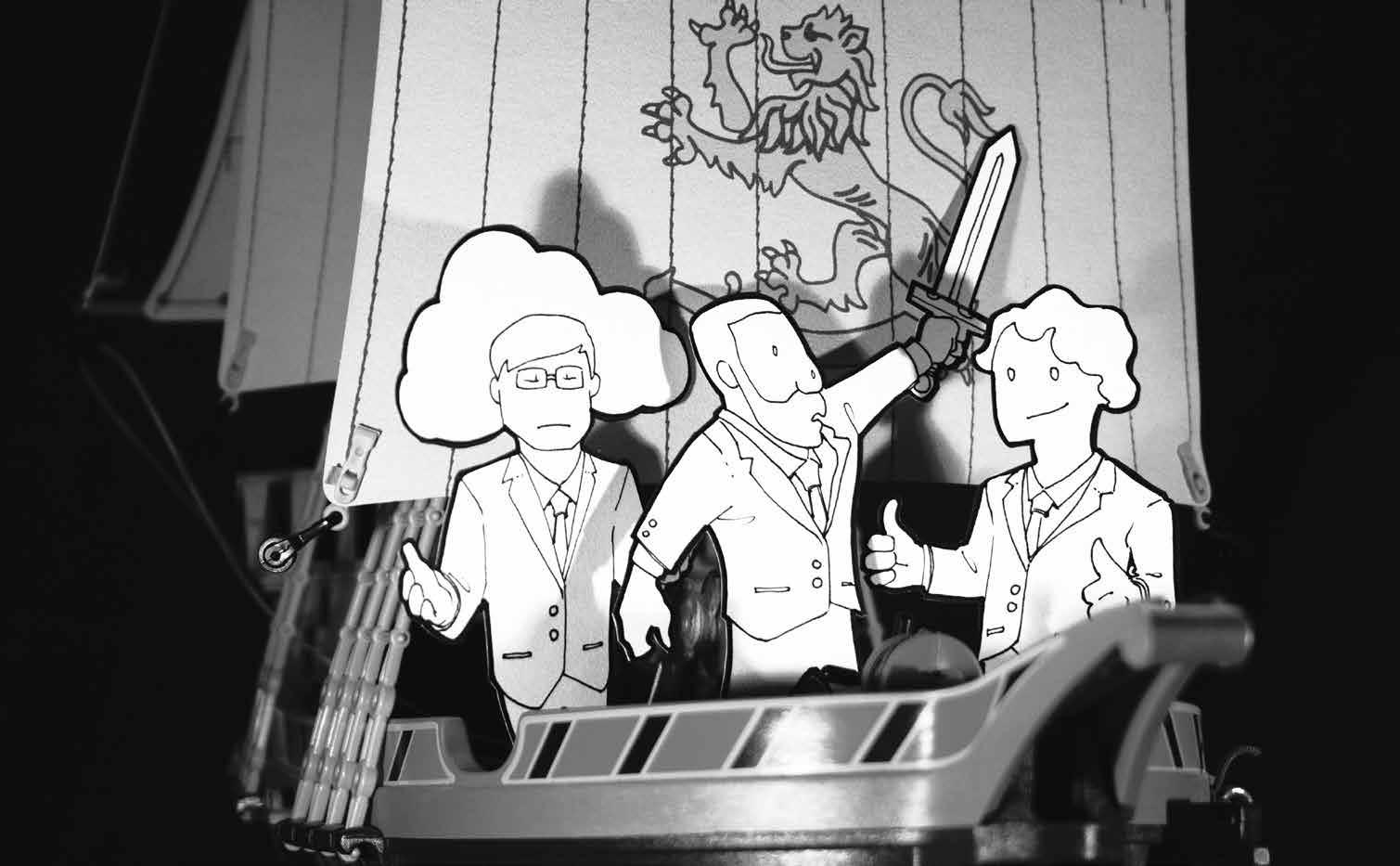
Do you know who you’re voting for come Oct. 19? I have an idea, albeit a vague one.
I’m leaning toward the NDP and Thomas Mulcair. I feel a strong pull in this direction that is hard to explain – though it is certainly not based on any dispassionate consideration of policies.
Before you laugh, consider the source of your own opinion. Of the people I know, only the wellinformed ones have considered in detail what the party leaders say they will do. Only the uncommonly wellinformed ones have tempered this with an evaluation of what the leaders actually intend to do and the likelihood they will be able to accomplish these plans.
The vast majority of the people I know, and I include myself in this group, were already leaning in one direction due to their upbringing and current circumstances. The subsequent campaigning has shifted opinions somewhat, but mainly it has reinforced familiar messages. For most of us, style has played a greater role than substance in shaping our opinions.
If I had to identify the one thing that led me to see Mulcair as especially prime ministerial, it would not be a policy he promised, but an offhand comment he made.
During a question period last year, when Mulcair was questioning parliamentary secretary Paul Calandra on the subject of troop deployment in
Iraq, Calandra repeatedly responded with a condemnation of an obscure former NDP staffer’s opinions on Israel – a totally unrelated subject, obviously meant to deflect the question.
Mulcair appealed to the House of Commons Speaker, Andrew Scheer, who refused to intervene.
The brands that Canada’s federal parties are trying to project are evident in everything from the policies they choose to emphasize and the criticisms they level at their rivals to their choice of candidates
“Well, Mr. Speaker, that does not speak very favourably about your neutrality in this house,” Mulcair replied. For this Mulcair lost the opportunity to ask the rest of his questions.
It is debatable whether Mulcair was genuinely owed an answer or simply grandstanding on a point where he held the moral but not the procedural high ground. But given the sort of person I am, I found this futile exchange had an aspect of
Promethean heroism.
Politics and branding
In his documentary series The Century of the Self, Adam Curtis traces the introduction of a Freudian conception of the self into advertising and the subsequent adaptation of advertising theory to politics, thus creating a conception of democracy where the public isn’t in charge, but rather the public’s desires: a situation that is much easier to manipulate.
The brands that Canada’s federal parties are trying to project are evident in everything from the policies they choose to emphasize ($15 minimum wage) and the criticisms they level at their rivals (“Just Not Ready”) to their choice of candidates: the Liberals get trusted career politicians, the NDP get respected community leaders, and the Conservatives get random schmoes who have firm handshakes but are otherwise not ready for prime time.
So the NDP doesn’t appeal to me because of some special knowledge or judgment on my part. They appeal to me because of a combination of my deeply orange upbringing and certain personal qualities that were semideliberately targeted in Mulcair’s parliamentary outburst.
Like commercial branding, political branding works by harnessing targeted hatred as much as targeted adoration. For example, the fact that I, a buzzkill dweeb with a degree in classical music, dislike top-40 radio
is part of the appeal of top-40 radio. This principle largely explains the tumescent hatred of Conservative leader Stephen Harper by urban intellectuals and other lefty types across Canada. The Harper brand is designed to appeal to a particular sort of person and is repulsive to the people it is not aimed at. “Who could possibly like this guy?” we’re supposed to think – and the fact that Harper is an eminently mockable poindexter makes thinking this very easy.
In fact, quite a large number of people like Harper. His frequent public appearances with his family and references to them in speeches position him as the family-oriented candidate. He is arguably handsome and has a modest ability at the piano –both qualities which make old people squeal with delight.
Although he’s as much Ottawa elite as the next guy, he’s branded as a Western maverick from outside the establishment. This thrills the Stetson and pocket-protector crowds both, and generally makes even leftwing Westerners see him as “our man” in a way Mulcair or Liberal leader Justin Trudeau could never be.
Note that it’s irrelevant whether the Conservatives’ policies under Harper are good for Canada or not. I think they aren’t, but if I’m being honest with myself, I have to admit that I arrived at this belief first and justified it later. It was a foregone conclusion that I would believe some-
thing along these lines; what my best self would want on reflection doesn’t enter into the discussion.
The bleak truth
Specialists, the people with the time and inclination to fully understand the major issues of public policy, are somewhat immune to this branding effect. But they are keenly aware of just how narrow the field of policy options actually is. And there are only a few of them – too few to make much of a difference.
This federal election is not going to be decided by a sober consideration of the issues. It will be decided by a clash of collective egos in which individual thought is largely irrelevant. The three major parties each have their own well-oiled branding machines, and these have brought them into an unprecedented deadlock that is only likely to be broken by a fluke. In the midst of all this, there’s not much you as an individual can do with your vote to get the policies you think you want. While we have our absurd little arguments about whether or not we should vote and for whom, the forces that shape our world move on, serenely oblivious to our pleas. One day our perfect Skinner box will be complete and there will be no need for any of us to exert effort in decision-making again.
In the meantime, get ready for change! Vote NDP!
GRAPHIC BY BRAM KEAST
Editor: Dana Hatherly


Physician-assisted suicide
Exploring a sensitive issue
CHANTELLE DUBOIS, STAFF
Physician-assisted suicide is a sensitive and polarizing topic among Canadians. For some, the choice to die with the assistance of a physician in the face of terminal illness, severe disability, or lowered quality of life is a right that they want to be given. For others, the sanctity of life, the protection of the vulnerable, and the trust between doctors and their patients take precedence.
Soon, voters will be electing the next Federal government. This government will be responsible for overseeing the outcome of a Supreme Court ruling earlier in 2015 that declared laws preventing physicians from assisting patients with suicide invalid.
The ruling deemed that the current laws were not justified under the Canadian Charter of Rights and Freedoms, violating the right to life, liberty, and security of the person. Being denied the autonomous choice of death takes away the choice of bodily integrity, and therefore the right to liberty. Additionally, being forced to endure intolerable suffering was found to infringe on the right to security of the person.
The ruling states that a competent adult can consent to physicianassisted suicide if they are “suffering intolerably” due to their “grievous and irremediable” condition.
Prior to this ruling, it was possible
that physicians could be charged with murder or manslaughter for helping a patient die. The Criminal Code of Canada makes aiding or abetting a suicide illegal.
The federal and provincial governments were given a year from the date of the February 2015 ruling to develop laws overseeing physicianassisted suicide.
Regardless of where Canadians stand on the topic, it is clearly time for it to be discussed, especially in light of an impending election
In July, five months after the court’s ruling, the Conservative government assigned a panel to discuss the issue and to report the results after the October federal election. It appears likely that an extension on the ruling will have to be requested by the new government, according to Justice Minister Peter MacKay.
For Steven Fletcher, the Member of Parliament for Charleswood-St. James-Assiniboia, the matter of phy-
sician-assisted suicide is very personal. Fletcher became quadriplegic when he was 23 after a vehicle collision with a moose in 1996. He relies on 24-hour care for all his basic needs. After the accident, he continued to suffer from complications, and during a 2012 surgery, he asked that the surgeons walk away from the operating table if brain damage would leave him “cognitively impaired.”
In 2014 Fletcher presented two bills in the House of Commons regarding physician-assisted death. The first bill would allow physicians to assist patients in dying, and the other would create a commission to keep track of physician-assisted deaths, collect data, report to Parliament, and to help improve oversight.
The Conservative party, of which Fletcher is a member, does not support physician-assisted death, and so Fletcher introduced the bills as a private member.
It is clear why Fletcher feels strongly about this topic; in an unexpected accident his life completely changed, and in the years following he endured suffering, loss of independence, lowered quality of life, and physical pain from complications. At the very least, he wished to have had the choice to die if his situation were to deteriorate further, and would hope that his loved ones have the choice if they ever find themselves
in similar circumstances.
The argument against physicianassisted suicide can be just as persuasive. While those who support physician-assisted suicide strongly believe it is a choice to be made willingly, those opposed suggest that there will be instances where a patient might be pressured into the choice by their families, by their physician, by economic circumstances, or the belief that it is their only option.
It is also possible that an assisted death could fail and leave the individual in worse condition than before the attempt.
Importantly, it potentially gives physicians too much power over who lives and dies.
Currently, physician-assisted suicide is legal in Switzerland, Albania, the Netherlands, Colombia, Belgium, Luxembourg, and the U.S. states of Oregon and Washington. Switzerland is the only country which permits foreigners to seek physicianassisted suicide.
When considering a Canada where physician-assisted suicide is legal, it may be important to consider how the laws and culture surrounding assisted suicide have evolved in other countries.
In Belgium, physician-assisted suicide became legal in 2002. In 2014, the laws were extended so that
anyone of any age may request an assisted death if they are terminally ill. For a child to request an assisted suicide, it has to be proven that they understand what they are requesting, and they must undergo evaluation by physicians and psychologists, and have approval from their parents.
In the summer of 2015, a 24-yearold Belgian woman was granted an assisted suicide due to emotional suffering from a lifelong affliction of depression and suicidal thoughts. She was considered to have been suffering excessively and endlessly.
Some other issues Canadians and lawmakers must consider: How would a physician-assisted suicide be carried out once requested? Is there a timeline between when the request is made and when it is completed? What if a patient diagnosed with dementia didn’t want the suicide to occur until a future date? What safeguards will be in place to protect the vulnerable? How many times should a patient have to request an assisted suicide before it is granted?
Regardless of where Canadians stand on the topic, it is clearly time for it to be discussed, especially in light of an impending election.

Science & Technology
The discreet charm of the zebra finch
Flirtatious birds are helping humans understand the biology of falling in love
MALAK ABAS, STAFF

Human beings and zebra finches don’t seem likely to have much in common, but new studies show that we agree on at least one front: love is a complicated thing.
Most animals appear to choose their mate based on physical or genetic traits that would result in an increased chance at healthy reproduction, and with this in mind it’s easy to pass off the idea of “love” as an emotion exclusive to humans. These birds are proving that this is not necessarily the case.
Zebra finches (Taeniopygia guttata) are small, cute, and very popular as pets. They are quick to adapt to their environment, are less likely to become ill than most birds, and they waste no time attempting to breed. This, however, does not mean that they are not choosy.

Zebra finches look for a mate for life and are socially monogamous the vast majority of the time. Couples raise their chicks together and share parenting duties. There are a few other animals that are monogamous for life as well – beavers, for example – but what makes the zebra finch so special is how they choose their significant other.
There are no real physical attributes that determine which male finches the females (who do the choosing) will find most attractive. While there are some male finches that are considered generally attractive to all female finches, this was shown to not make a difference when it came to the female finch’s final choice.
It turns out, much like humans often try to claim, looks really don’t
matter to the zebra finch. In fact, like humans, female finches have attributes that they personally prefer in male finches that may differ from their fellow females.
A study by Malika Ihle of the Max Planck Institute for Ornithology in Seewiesen, Germany, wanted to test just how important letting zebra finches “fall in love” was to their likeliness to reproduce.
Ihle, along with a team of researchers, proceeded to let 160 single zebra finches to get to know each other in groups of 20 males to 20 females. When the birds had found a partner, which was visible when they began to groom each other, half were allowed to love the one they were with, and the other half were broken up and re-paired with a finch they did not choose.

Due to the monogamous nature of zebra finches, the birds had to be convinced that their partners had died. They were placed in smaller cages for a few months to encourage them to connect, and afterwards they were all released into a group aviary.
Due to the monogamous nature of zebra finches, the birds had to be convinced that their partners had died
What happened next was surprising. Throughout the extensive amount of recorded observation, there was a constant: the finches in the arranged partnerships were three times more likely to produce unfertilized eggs. The love-struck finches, on the other hand, were 37 per cent more likely to have their chicks survive.
In the partnerships forced by human intervention there was also a greater chance of the chicks dying within 48 hours of hatching. Researchers observed that the male finches were notably less interested in raising their offspring and that the females were less interested in their male partners.
The researchers also switched eggs between the two different couple types, and found that this did not affect the likelihood of the embryo surviving, which suggests that the determining factor is parental care.
Reproduction was not the only thing affected in the forced couples. Female finches were much less likely to respond when courted by their male partners, and the males were more likely to pursue other females and act in a promiscuous manner.
Looks may not matter to the zebra finch, but the ability to choose their partner obviously does. It is unlikely, however, that zebra finches choose their mate due to genetic compatibility, as scientists have yet to find an evolved trait that would allow females to be able to know which males are indirectly compatible with them. The most likely answer is that zebra finches make the choice based on behavioral compatibility.
This also explains why the zebra finches that naturally chose each other were more likely to have healthy offspring. Female finches do not all find the same behaviours attractive. Male finches, however, all find the same quality in a female finch attractive: parental compatibility with the female. The ability to be a good parent seems more important to the female zebra finch than physical or genetic attributes.
So does this have a human application? Maybe. We are not birds, but what we have in common with the zebra finch is enough for us to understand their plight. The need for compatibility in a significant other, the despair of a loveless marriage – these are not just soap opera tropes. They might be biological desires that have basis in evolutionary traits. So if you haven’t found that special someone, don’t delete Tinder just yet. Being a hopeless romantic might just be evolution’s way of making sure you’re partnered with the perfect mate.
GRAPHIC BY BRAM KEAST




Notes from the Star Field
Discussing the future of space applications and the launch industry at the European Space
Policy Institute autumn conference
CHANTELLE DUBOIS, STAFF

The European Space Policy Institute (ESPI) is a think tank organization for space policy, established by the European Space Agency Council and the Austrian Research Promotion Agency in 2002. ESPI’s purpose is to provide advisory services to European policy-makers on issues relating to the space sector and to create awareness of developing space technologies and their applications.
The head office of the Space Generation Advisory Council (SGAC), the organization I am interning with, is in the same building as ESPI’s. While they are completely separate organizations, many of their goals overlap, such as generating awareness of space policy and being a catalyst for global co-operation.
I was lucky to start my internship on the same day as the beginning of ESPI’s 9th annual autumn conference. This year’s theme was “Access to Space and the Evolution of Space Activities,” and the twoday conference featured speakers from Austria, France, Germany, the Netherlands, China, and the U.S. The speakers came from a mix of academic and industry backgrounds.
The crowd was a combination of older professionals, young professionals, and students. Many of the delegates I spoke to had backgrounds in policy, law, government, and international relations, with some engineers in the mix. I even met one philosopher.
While every presentation was interesting, a few that stood out to me were the ones given by CNES director of launchers Jean-Marc Astorg, Virgin Galactic’s vicepresident of business development and governmental affairs Richard DalBello, and James Schwartz, assistant professor from Wichita State University.
Astorg discussed new Ariane rocket design concepts and how
reusability is becoming a more economical option. The presentation had a systems engineering approach, with details on how reusability of certain stages of the rocket impacted costs, the emerging demand for small satellite launchers, and the CNES’s goal of reducing launch costs to 10,000 euros per kilogram by 2020.
Overall, the European Space Policy Institute autumn conference was a very exciting introduction to life in the Space Generation Advisory Council office
DalBello made the interesting comment that only 551 people have ever been to space, touched on the SpaceShipTwo accident (which killed one pilot and injured another) and how the company has responded in overcoming the tragedy, and talked about Virgin Galactic’s LauncherOne – a planned launch vehicle for small satellites.
Schwartz went into the ethics of resource exploitation of celestial objects using the International Telecommunication Union’s system for managing radio frequencies and orbits as a model. He believed that a regulating body should ensure that these resources are not used in a way that is trivial or frivolous. Additionally, to guarantee that using resources has a positive social and economic impact and that all nations have equal access to them, a committee should be established to oversee near-Earth resource exploitation.
During one of the breaks I had the opportunity to be part of a discussion with DalBello about space traffic management and how it could potentially be regulated. One recurring sentiment that I have encountered over the last year-and-a-half since I started attending space conferences was that space debris and managing orbital traffic is an issue that needs to be addressed.
One reason for this is that the rising popularity and accessibility of the cubesat platform has meant that a lot more small satellites are making their way to orbit, and not all of them are being tracked or have de-orbiting capabilities. The cubesat platform is being used widely in academic and commercial settings, and gaining popularity due to their relatively low cost and short build-time.
There have already been incidences in the recent past of inactive satellites colliding with other satellites, creating space debris. If this happens too often, there could be a day where certain orbits become unusable. With increasing numbers of satellites in low Earth orbit, collisions could potentially begin to happen more often.
The U of M’s Space Applications and Technology Society has considered this issue before, and is currently working on solutions so that if our nano-satellite is launched, it doesn’t remain in orbit for an excessive amount of time after its useful lifespan ends.
Overall, the ESPI autumn conference was a very exciting introduction to life in the SGAC office.
Chantelle Dubois is currently interning with the Space Generation Advisory Council in Vienna, and will be writing about her experiences in the Notes from the Star Field series for the Manitoban
PHOTO BY CHANTELLE DUBOIS






IVORY BUFFALO
Aging slob disappointed with professional athlete’s performance
Overweight dad calls player’s competence into question
MURV BERKLEY, STAFF
Forty-eight-year-old Gordon Berger is up in arms after seeing what he called an underwhelming performance by CFL quarterback Jeff McMann in a televised game over the weekend.
The overweight father of two
identified numerous instances where the professional athlete was unable to outperform other professional athletes as evidence of his general incompetence.
“You see that throw? That was garbage! I don’t know why they don’t just
trade this guy,” Berger yelled to no one in particular after an incomplete pass by McMann.
“His range is really nothing to write home about,” added Berger, who last threw a football at age 16.
The Ivory Buffalo reached out to

Jeff McMann for reaction to Berger’s criticism but did not hear back by press time.



The Park’s pinnacles
Park Theatre staff and performers reminisce as venue’s 10-year anniversary approaches
OLIVIA MICHALCZUK, STAFF
The Park Theatre is a very wellknown and cherished venue in Winnipeg where arts and entertainment are recognized and celebrated all year round.
The old-school movie theatre façade with flashing lights begging you to notice the weekend line-up is just as enticing as the crowd of showgoers below. They range from Rocky Horror Picture Show attendees in tights to toqued teenagers awaiting an aweinspiring performance for only 10 bucks. If you bow to common sense, you will find yourself in the beautifully renovated Park Theatre.
The venue screams “Winnipeg” from the welcoming, friendly bartenders serving Standard lagers non-stop in the lobby to the theatre itself. Inside, you’ll feel like it’s a crime to be so close to the talent until they hop off the stage after their performance and humbly accept your praise and ask your name. The sense of community is contagious and you always leave feeling like you were a part of something special.
This weekend marks the 10th anniversary of the Park and many local favourites are honouring the venue with four days of talent-filled shows from Oct. 1-4.
Promotions and talent buyer Kevin Mozden wanted to showcase all the unique talent they have to offer.
“No two nights will be alike. We have really booked something for every musical taste this weekend,” he said.
The Park Theatre wasn’t always the venue we know and love today. Owner Erick Casselman made thorough renovations to get the establishment in working condition.
“It had literally sat empty for almost 25 years. The electrical, the heating, cooling, the roof, plumbing – there was nothing that wasn’t rebuilt or replaced,” said Casselman.
Starting off as a humble coffee shop with DVD rentals, after a while the stage began to be used for performances. Investments in the PA system and lighting then created a perfect venue to produce a variety of shows.
Over the past 10 years, the Park Theatre has hosted a number of great acts.
“There have been so many amazing nights and great memories in this room, every night stands out as a highlight,” said Casselman.
“If I could be so bold to pick a few, it would be JP Hoe recording his live beta project here, the night Imaginary Cities and Royal Canoe played the same show back-to-back, back-to-back sold-out nights with Said the Whale, the Strumbellas show with the entire room singing along, Jen Kirkman’s night of comedy, and Hannibal Burress.”
Mozden had some highlights as well. One was “when Mac DeMarco – playing to a sold-out crowd in June of 2014 – crowd-surfed all the way from the stage to the bar at the back of the room, ordered a drink, then was carried all the way back to the stage by the crowd.”
“The other was when Alvvays played here and lead singer Molly Rankin finished their show by jumping into the
crowd and having them carry her all the way out of the venue, into the lobby and to the merch area.”
“Random, silly things like that are always great to see and they are things that people will always remember.”
The sense of creating those moments for the audience and performers is evident to those who hold the Park Theatre dear. Romi Mayes, local musician and Sunday night feature in the anniversary show series, describes the venue as “monumental in the constant development and maintenance of the reputable thriving arts scene in Winnipeg” and calls it “one of [her] favourite places to perform and to see performances.”
Headliner of the Sunday night show Scott Nolan described the Park Theatre as “an anchor for the whole neighbourhood.”
A recent illness forced local punk rock band The Ripperz to alter their Friday night set for the upcoming anniversary show weekend to a solo set performed by band member Chris Sawatzky.
“I think the Park Theatre accommodating this is the neighbourly thing to do. I really like playing that room,” said Sawatzky.
The Park Theatre’s role has changed during the lives of many, including local musician Kieran West, who originally attended shows there as a teenager.
“Those artists and those shows are what inspired me and showed me that I could be doing the same thing,” West told the Manitoban
West has now gone on to play shows solo and as the lead singer of Kieran West and his Buffalo Band in events
such as the Park Theatre’s former concert series Heartworn Highways and as an opener for Western Canadian Music Award winner Del Barber. West has also earned himself a slot in the Sunday night anniversary showcase alongside local folk/country artist Richard Inman.
So what makes the Park Theatre stand out to locals in such a positive way?
“I think one of the things that is so unique is just the diversity of our programming here,” said Mozden.
“We are welcoming to pretty much anything. We have hosted events for nearly every genre of music thinkable on top of doing comedy events, film screenings, poetry readings, plays, and much more. We’ve hosted birthday parties for children, retirement gatherings, socials, and weddings. The room looks great and really lends itself well to just about any kind of event you can think of.”
Casselman and his team make the Park Theatre accessible to a variety of talent and he doesn’t plan to slow down anytime soon.
“We have a lot in store for Winnipeg, and are looking forward to another 10 years and more with this amazing city.”
For more information and to purchase tickets online for the Park Theatre’s 10th anniversary weekend, please visit www.parktheatervideo.com/ event-calendar/category/park10/



Ar ts & Culture
While you’re waiting for Episode VII
A review of Celebrations Dinner Theatre’s production of Star Warz
If you’re anything like me, you’ve spent countless hours over the past year scouring the Internet for new tidbits about Star Wars: Episode VII. A teaser-trailer here, a leaked image of the Millennium Falcon there. The wait for the release of The Force Awakens on Dec. 18 has only gotten harder as the date grows nearer.
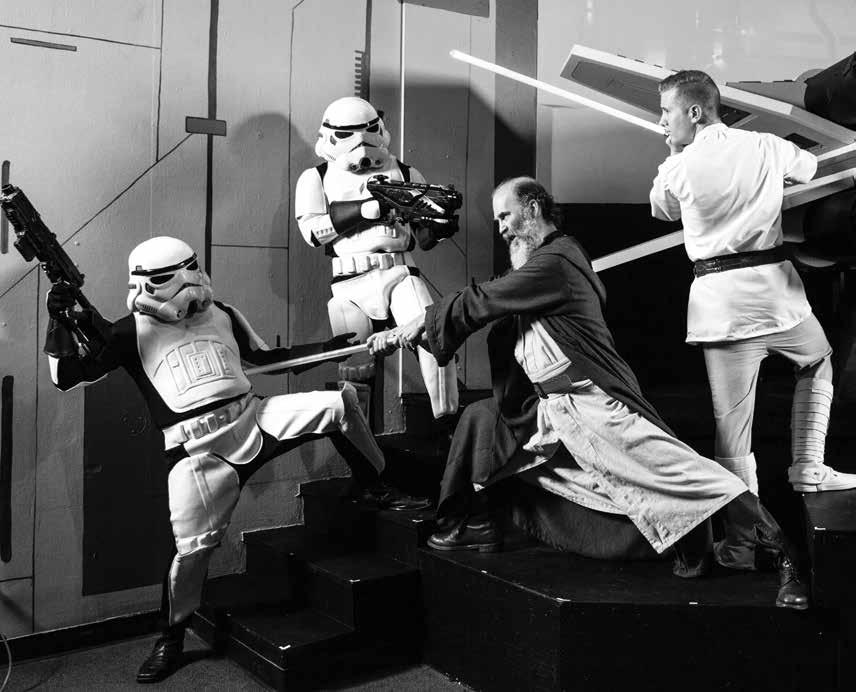
In an attempt to mollify my building need for anything Star Wars, I decided on a change of course – after all, a person can only spend so much time staring at a blurry image of a bearded Luke Skywalker. I pulled myself away from my computer screen and headed over to Celebrations Dinner Theatre to see their production of Star Warz: A Galactic Rock Comedy
When I entered the theatre, a giddy smile was glued to my face. Rom Fantini and Jamie Cooney’s set design was gorgeous. The stage had been turned into the interior of one the Galactic Empire’s Imperial Star Destroyers. If an image doesn’t immediately come to mind, think sci-fi spaceship set.
Everything was made of hightech-looking metal panels. Sliding doors stood on either side of the stage and multi-coloured, brightly lit buttons covered nearly every surface. At the centre of the stage, a ramp led up to an upper platform and the “window” of the ship. Through the window (with the clever use of video projection), one could see the starry expanse of space and – in the distance – the Death Star.
After some tasty soup and salad to start, the Empire’s new PR man Kristoff came up on stage to introduce himself. Then, with no explanation other than that he enjoyed dancing, he began to sing “My Sharona.” Don’t worry, it made as little sense as it sounds like it did.
Off to the side, a screen began to show the traditional text scrolling off into space. “In a galaxy far, far away...” it said, followed by, “Yes, even further away than Transcona.”
If you found that funny, then this show’s humour is for you.
The show’s greatest weakness was its writing. Now, I wasn’t expecting a Galactic Rock Comedy to be Shakespeare, but I was hoping for some clever parody.
The main character was NASA astronaut Luke Skyrocker. He appeared in the galaxy through a strange wormhole while searching for his lost lover. He bumps into Obi-Wan Kenobi and Han Solo (who oddly don’t have parody names), who take him on a journey to destroy the Death Star. At that point, the plot more or less follows that of Star Wars: Episode IV
The music was not what I was expecting. I was ready for Star Wars-themed classic rock parodies. Instead, what they gave me were classic rock covers by people in Star Wars costumes (albeit very nice ones), followed by Star Warsthemed interludes.
Most times, the songs were tied into the plot by a single line. For example, when asked who he is, Han Solo sings the Steve Miller
Band’s “The Joker,” which begins with the line, “Some people call me the space cowboy.” Perfect. Very fitting, until the song continues and it’s just a guy dressed as Han Solo singing a cover. Sadly, that example is one of the better ones. Many of the songs were forced into the show for no conceivable reason other than that they were popular rock songs. Thankfully, all of the performers were quite strong. Brad Zacharias as Luke Skyrocker and Kesinee Haney as Princess Leia had the standout voices, while Corey James’s charmingly over-confident Han Solo and Len Harvey’s wacky old man Obi-Wan gave the strongest acting performances.
So, is it worth seeing? Well, for the student price of $46, and accounting for the fact that you get a four-course meal with the show, it’s not a horrible value. If you enjoy over-the-top silly humour, classic rock covers, and of course Star Wars, then it’s certainly not the worst way you could spend your money and your evening.
But, did it satisfy my Star Wars cravings while I wait for the new movie? No, it didn’t. But in all fairness, until I’m sitting in that theatre on December 18, I doubt anything will.
If you’re interested in seeing Star Warz, the show runs until Oct. 10. For details and tickets, visit www.celebrations.ca.

KAI CHOCHINOV
PHOTO PROVIDED BY CELEBRATIONS DINNER THEATRE
’Toban Turntable
Want us to review your band? Email arts@themanitoban.com today!
OLIVIA MICHALCZUK, STAFF
Carly Dow Ingrained 4.5/5
It is no surprise that Ingrained graced the National top 10 charts in the folk/roots/blues category and subsequently carried Carly Dow on tour across Canada.
Ingrained is instrumentally tight with a variety of contributions including a soulful harmonica in the song “Casanova,” and a bluesy guitar crawl through “This Dress.”
A stomp-and-clap keeps the beat for the extremely strong opening folk-march “Olive Branch,” which has incredible harmonies and powerful lyrics, a foreshadowing for the album’s fantastic vocal lead.
Dow uses lyrics to tell fantastic, emotional, and poetic stories, as is illustrated in “Down the Road” and “All Sleep Tonight.” There is no particular stand-out track in this album because all the songs are fantastic and different in their own right.
There are a variety of songs that cater to a range of moods, thoughts, and emotions. The morose vibe of “Soil to Dust” is amazing, especially for such an upbeat song. Your heart jumps when a track opens with a capella vocals because it is such a clear and soulful instrument and a treat to enjoy independently.
The fact that Dow


recorded parts of the album in the Visitor Centre of Riding Mountain National Park adds to the folksy charm and sense of intimacy intertwined into the incredible music performances. I highly recommend this album to anyone who is in Folk Fest withdrawal and needs something to tide him or her over until next summer.
www.carlydowmusic.com
SEAMUS HAMILTON-PATTISON, STAFF
The Sheepdogs Future Nostalgia
4/5
Honestly, I was a little apprehensive about reviewing this album at first. The band’s self-titled release of 2012, produced by drummer Patrick Carney of awardwinning blues-rock revival duo The Black Keys, didn’t grab me at all. In fact, the fuzzedout, muddy tones of tracks like “Feeling Good” and “Alright OK” just sounded like a rehash of Carney’s own band. That being said, I’m glad I set my worries aside and gave Future Nostalgia a listen. From the moment the album’s opening track “I’m Gonna Be Myself” hit my ears, any preconceived worries I had about this album repeating its predecessor were crushed beneath bright, ringing chords, a soaring Hammond organ, and the band’s signature harmonized guitar leads. All of these cohesive elements form the perfect musical lovechild between Thin Lizzy and Lynyrd Skynyrd, and a wonderful way to begin an album. Perhaps it was frontman Ewan Currie’s decision to produce the album himself alongside engineer Matt Ross-Sprang, or perhaps the group’s new Winnipeg-born lead guitarist Rusty Matyas brought the pop sensibilities of his old band Imaginary Cities into the mix. Either way, the

band has created an album full of brighter, catchier songs that forsake none of the bluesy rock and roll credibility built over the band’s nine-year career.
If you’re one of the many who did like the band’s last effort, fear not. There are still plenty of swampy, sleazy numbers on Future Nostalgia guaranteed to please any blues-rock revivalist. “Back Down” and “Help Us All” stick to this dynamic, with considerable riffy flair (it’s The Sheepdogs, after all). With the new album’s brighter production and renewed emphasis on tight, catchy song arrangements, I like these songs too.
In short: if you’re already a fan of The Sheepdogs, you won’t be disappointed. If you couldn’t really get into their last release, give this one a try. If you’ve never heard these guys, but you’ve got a penchant for classic rock crossbred with Band of Horses and The Black Keys, what are you waiting for?
www.thesheepdogs.com

MICHALCZUK, STAFF
T. Nautilus
T. Nautilus 4/5
Ifound T. Nautilus to be the exact opposite of what I was expecting based on the album artwork. The opening song of the album, “A Weird Nautilus,” is intriguing yet very slowgoing, similar to that of a grade-seven band concert that eventually builds in to some sort of modern sea-shanty with new-school instrumental contributions. An odd combination, yet it turns out to be a pretty impressive evolution. At this point you have no idea what to expect.
The album is upbeat and very catchy, with a really cool arrangement. The vocal performances are strong and the lyrics are well placed and meaningful. “Down on the Ground” and “Feel it Now” are fantastic – they are the two songs on the album that I couldn’t stop listening to. They’re so interesting and both have awesome melodies that will be stuck in your head all day. It reminds me of Foster the People with a hint of Winnipeg and just the right amount of experimentation.
There are a variety of layers in all the songs with tons of instrumental sounds coming in pleasingly odd places. However, I sometimes found the odd noises and vocals incoherent and random in the middle of songs. Sometimes they

forced the song to linger and lose the potential for a strong finish or perfect simplicity. On the other hand, “Silencer” ended so abruptly that I wasn’t even expecting it and I found myself comparing it to someone putting a stick through your bicycle spokes as you’re cruising along. I would highly recommend listening to it more than once before you make a full judgment because there is a lot going on and this album can be pretty weird. With this in mind, the album will find itself back in the CD player over and over again and I’m adding quite a few songs to my local music collection.
www.tnautilus.bandcamp.com

OLIVIA
Ready to launch
Local indie rock/pop duo release long-awaited second album
SEAMUS HAMILTON-PATTISON, STAFF

Local indie rock/pop duo Cannon Bros. are set to release their second full-length album Dream City on Saturday, Oct. 3 at the Good Will Social Club.
Dream City is the follow-up to the band’s 2011 release Firecracker/ Cloudglow and sounds like a perfectly logical progression from its predecessor.
The opening track and lead single of the album “Can’t Sleep” provides no elaborate introduction to the album; it simply crashes in with a jangly, reverb-drenched guitar keeping time to a driving, simplistic drumbeat. Vocalist/drummer/guitarist Alannah Walker’s sharp, nasally, quirky, and charming vocals begin the first verse shortly after.
The rest of the album continues in the same vein, for the most part. Almost every track is under three minutes in length and nearly all of them showcase the group’s uniquely refined blend of jangly pop melodies and blaring, discordant indie-rock guitar tone. “Totally Crushed” – sung by other vocalist/guitarist/drummer Cole Woods – exemplifies this
type of songwriting with particular gusto, sounding for all the world like Japandroids had cleaned up their guitar sound and added in some Pavement-esque melodicism to their vocal arrangements.
“This time, we didn’t shy away from having basslines and more guitar overdubs – stuff like that. We didn’t shy away from having it sound more like a full band” – Alannah Walker, Cannon Bros.
Walker attributes the formation of Cannon Bros. to her and Woods’ acquisition of drum kits, which prompted the two to start playing songs together. The band began out of a casual and mutual appreciation for music and appears to have continued to exist in such a manner, with both Walker and Woods switching between the roles of drummer, guitarist, and vocalist as they see fit.
“The way we wrote and put the songs together is pretty much exactly the same,” Walker said of the new album.
“With our first album, we wanted it to sound like a two-piece. So any of the bass on that album is just low keyboard: subtle, and not really noticeable. This time, we didn’t shy
Old concept, new deli
away from having basslines and more guitar overdubs – stuff like that. We didn’t shy away from having it sound more like a full band.”
Containing 19 songs, Dream City is long for an album, especially when considering the current popularity of EPs (brief, four-to-five track releases) among local acts.
“We wanted all those songs on there, and they’re not very long [...] To me, it doesn’t feel super long. If we had gone with like 12 and they were the length that they are, it would have been a pretty short album,” Walker told the Manitoban.
Walker also addressed the band’s four-year hiatus between releases, closing the interview reinforcing her excitement at its imminent release.
“We started recording this album maybe two years ago, with the intention of finishing it more quickly than we did. It didn’t take us long to finish actually recording it, but the lyrics weren’t finalized and so we had to go back and do that [...] I would say the main reason is, probably, after we finished touring I wanted to finish my degree. That became my number-one priority,” said Walker.
“We’re really excited to release this album, and I know it’s been a long time coming. We just hope that people enjoy it.”
Cannon Bros. will be joined by special guests Shotgun Jimmie and Iansucks for the Dream City album release on Saturday, Oct. 3 at the Good Will Social Club. Tickets can be purchased for $10 at the Good Will Social Club, Music Traders, and online at www.ticketfly.com.
New sandwich shop in West Broadway embraces traditional kosher-style deli food
STEPHANIE JOHNSTON
Calling all sandwich lovers: a new deli concept restaurant has opened on Sherbrook St., and it’s sure to satisfy any appetite.
This isn’t your local grocery store deli counter. Sherbrook Street Delicatessen has taken the business back to the golden age of delis (think New York circa 1990) to show Winnipeg what sandwiches are really about. Serving kosher deli fare, Sherbrook Street Deli is about more than your average ham and turkey.
The menu features a variety of sandwiches, most with no more than four ingredients, along with soups and salads. The restaurant offers both sit-down and take-out options, as well as “cuts” or “scoops” for at-home sandwich making.
Owner Jon Hochman hopes to “stay true to the concept of the deli
and how it originated.”
A single sandwich equipped with meat, bread, and mustard may seem a bit stingy for its $8.75-$10.50 price tag, but it’s stacked high enough to give anyone the meat sweats.
“Our most popular sandwich has three ingredients,” said Hochman. To him, the key to success is to “focus on the simple things and do it really well – that’s how classics are made.”
sourced. For Hochman, this is more than a business; it’s a “labour of love.”
The restaurant business has been Hochman’s bread and butter long before the opening of his deli.
Hochman has a do-it-all attitude when it comes to food preparation, with all ingredients, from mustard to smoked meat, hand-crafted in house. Anything he can’t make is locally sourced
Hochman has a do-it-all attitude when it comes to food preparation, with all ingredients, from mustard to smoked meat, hand-crafted in house. Anything he can’t make is locally
Hochman’s passion progressed from washing dishes in the kitchen at summer camp to helping his Zaida and Baba cook at home to completing the Culinary Arts program at Red River College.
Hochman’s first venture into the restaurant business was Fitzroy, an American-style restaurant featuring tapas and bar food. Fitzroy closed after three years when Hochman decided to turn the space into the new home of Sherbrook Street Deli. Opening a deli has been Hochman’s dream since he was 12 years old, and he is not looking back.
“Fitzroy was fun, but it wasn’t well received,” said Hochman.
“[The deli] is a better move – sandwiches are very approachable.”
Winnipeg’s West Broadway neighbourhood is no stranger to
sandwich shops, with a Stella’s, Subway, and The Tallest Poppy surrounding Sherbrook Street Deli.
Hochman sees no conflict between the restaurants, saying “everything is very different, each with their own specialty.”
For Hochman, the difference comes with respecting the tradition of the delicatessen and adding his passion and experience. The most important thing, Hochman says, is to “show love of the product. If [the ingredients] were store-bought, it would just be a business.”
Located at 102 Sherbrook St., Sherbrook Street Delicatessen is open 10 a.m.-10 p.m. daily.
PHOTO BY MARIE-FRANCE HOLLIER


Build it and they will come?
Bison Sports pushes for better attendance at games
MIKE STILL, STAFF

In September 2013, the University of Manitoba Bisons football team played their first ever home game in the newly built Investors Group Field (IGF). The field has a capacity of 33,422, but the Bisons saw only 6,435 fans come out to support the herd. Unfortunately, that number is the most that Manitoba has ever had come out to watch a Bison game at IGF.
So far in 2015, numbers have been low again. A total of 3,291 fans came out to Manitoba’s home opener, and the following week only 2,406 showed up for the herd’s matchup against University of British Columbia (UBC).
The university has 24,903 students enrolled full time for the fall 2015 term and with the addition of the sports and recreation fee this year, each one of those individuals gets in free for any Bison game on campus. With that knowledge, one would think it would be pretty simple to pack the stadium. But it’s not as simple as it sounds.
Roxanne Scarth, who’s responsible for marketing, sponsorship, and ticketing for Bison Sports, noted that there were staff and athletes set up all over campus during the first week of school, trying to educate and inform students about the new fee and the importance of coming out to support their fellow students.
“We had a lot of tables set up, such as in University Centre, and had athletes there, as well as Billy the Bison, to try and connect with the students one-on-one and create awareness about the fee,” Scarth said.
“Also, when [students] activate their passes at the Active Living Centre and get a sticker, they’re all being told again verbally.”
Bison Sports has also been working with the University of Manitoba Students’ Union (UMSU), using their resources to help advertise the free admission to Bisons games.
“With the students and the student fee, we’ve been relying on internal partners like UMSU to help with that communication,” Scarth said. “We’ve been using UMSU’s televisions to put [information on the athletic fee] on, and that kind of partnership.”
Bison Sports are making sure that students are aware. The rest is up to individuals to take the initiative and show up.
Working with a budget
Bison Sports’s ability to promote athletic events is also hampered by their budget and number of staff.
“If you look at other schools, like the University of Alberta, or Calgary, or UBC, their athletic department, not including coaches, has about 12-15 core staff people. In Bison Sports, we only have six core staff people, so we
have to look at what we’re able to do within our 35 hours a week that’s realistic,” Scarth said.
“We try to do our best, and we offer the best quality of entertainment that we can, but it’s hard to get to everything.”
Out of the three universities Scarth mentioned, UBC stands out.
They were in a similar boat in terms of fan attendance up until a few seasons ago, but a change in funding to the athletic department has helped. One strong example of this change was the 6,950 fans they had come out to their homecoming game this year, which is more than both of the Bisons’ first two home games combined.
“If you look at UBC, they’ve pumped a lot of money into athletics the last few years, so that also correlates to the university taking from, in my opinion, a huge backing and support of athletics,” Scarth said.
“That means other departments like student life, or residence, are also engaging and connecting. We’re starting to get there, but it’s going to take some time.”
Scarth also added that budget cuts, which came into effect this year, had a strong effect on the athletic department, which is included in the faculty of kinesiology and recreation management.
“Because a lot of our costs are fixed costs, because of travel, we had to
look at other areas that we had to tighten up on,” Scarth said.
Despite the cuts, the faculty of kinesiology and recreation management is doing their best to make promising changes in order to hopefully get students more excited about heading to sporting events.
“Our dean, Douglas Brown, who’s a big supporter of sport and recreation, is working on a strategic plan for our faculty, to kind of get a business plan, to sort of bridge some of those gaps [in resources and funding],” Scarth said.
Structurally within Bison Sports, Scarth has also been happy with a number of things that have already been accomplished.
“We’ve gotten a new website, which has been really big, obviously IGF is another addition, and now the Active Living Centre, so we have some really great facilities that are coming to fruition which have been in the works for a long time,” Scarth said.
“Other things have also been working on, like getting a new Billy the Bison costume, working on marketing and branding with the university’s marketing and communications office, and trying to have a unified visual identity for Bison Sports.”
Importance of homefield advantage
While Bison Sports is working hard to create an optimal fan experience, it’s still up to the students and fans to do their part and actually show up.
Bison linebacker and captain DJ Lalama emphasized the importance of home field advantage.
“Football is the ultimate team sport, and momentum can change the pace of a series, game, or season. Fans can have a huge impact on the above,” Lalama said.
“IGF is the best facility in the country when it comes to football. We are a nationally ranked team, and the support at home would only make it tougher on opposing teams to come in and compete, while elevating our own levels of play while at home.”
Lalama also touched on the atmosphere that a large crowd helps create.
“When we travel to Montreal or Saskatoon and see 8,500 fans, it’s exciting. It brings up the energy from both teams, and makes the game what it’s supposed to be,” Lalama said.
“It creates an atmosphere where the home team often succeeds, and if not, at least gives them a distinct advantage. The students at U of M could very much impact our next two home games. Show up, and we won’t disappoint.”
PHOTO BY CAROLYNE KROEKER
Pushing forward
Bison basketball player’s astounding return to the court after ACL surgery
MIKE STILL, STAFF

September 14, 2014 is a day Amir
Ali won’t soon forget.
Ali, a University of Manitoba Bisons men’s basketball player, was doing a normal transition drill in practice. “I was just attacking the rim, same move I’ve done a million times,” he said.
“I think I got myself caught a little behind the backboard, and went a bit too far and tried to cut back. It was a normal basketball play, happens all the time. All of a sudden, boom, knee goes.”
Ali had torn his ACL. Up until that day, he had never had a knee problem in his career. The timing couldn’t have been any worse, as he was named a co-captain for the second consecutive year in 2014-15, and was just putting the final touches into what was supposed to be a memorable final year with the herd when the injury occurred.
At first, Ali was in denial, but that quickly turned to frustration when he realized his career might be over. “It’s just one of those things where it’s like, fifth year, is this really happening right now of all times,” Ali said. Since Ali had already graduated from the U of M, and was coming back just to play his final year with the Bisons, he chose to try and rehabilitate the knee and get on the court for the 2014-15 season.
Ali worked hard during his rehab, pushing himself for six weeks. He sat out all of the pre-season before making his return to the court for the opening series of the year against Trinity Western.
Ali would log a total of 18 minutes that weekend, as well as the next, against Regina. His knee, while still a bit wonky, was improving.
“It was literally a year ago last week that I got hurt, and I had no clue that this was how it was going to go. It’s crazy how things change fast” – Amir Ali
Friday, Nov. 14, against the Brandon Bobcats was an entirely different story.
“It was during that fifth game, right at my first shift, it came out bad,” Ali said. “It was way different than normally. That one rattled the cage, I was like, ‘oh shoot, this is bad.’”
Ali would have surgery in January 2015, and at that point he didn’t know
if he was going to play again. He would meet with Dean Kriellaars, an associate professor in the U of M’s department of physical therapy, to weigh the options.
For the second time in four months, Ali began the rehabilitation process, this time post-surgery. He improved drastically in a short amount of time and was quick to credit Kriellaars’s program, which was intensive but worked. Three days after surgery, Ali was already walking without crutches.
“Dean is the best at what he does, but it’s because he works you into the ground,” Ali said. “It was 12 sessions a week for seven months, essentially.”
It was a tough summer, with rehabilitation three times a day, but Ali fought through. All he had to do now was wait.
Big decisions to make
In mid-May, two important events occurred in Ali’s life. The first was being informed that he got his fifth year back due to the medical redshirt rule.
A player who played over five games of the regular season wouldn’t be eligible for medical redshirt status, making the timing of Ali’s setback a fortunate one in that regard. If his reinjury had occurred a day later, then he may not have had a chance of step-
ping back on the court in 2015-16.
“If I had played another game, then I think my appeal process would have been an actual process, but because I didn’t actually break any of the rules, or pass that limit, then it was okay,” Ali said.
It
was a tough summer, with rehabilitation three times a day, but Ali fought through. All he had to do now was wait
About a week after hearing the positive news, Ali found out he got early acceptance into medical school at the U of M. While he was excited, he also knew he had a big decision to make. His knee wasn’t at 100 per cent yet, and it would be tough to try and balance athletics with medical school.
About a month before med school started, Ali got another blessing in disguise.
He was asked to speak at the Winnipeg Boys and Girls Club’s annual general meeting, where he met a man named John Wade, a for-
mer dean of the U of M’s college of medicine.
A little while later the two met up, and Wade helped Ali in making his decision, which was ultimately to try to defer his acceptance to medical school in order to focus solely on basketball.
Wade introduced Ali to Bruce Martin, director of postgraduate medical education at the U of M, who was able to help him make arrangements to defer.
“We talked about it, and he was awesome, such a nice guy,” Ali said. “He presented me with my options of deferring, and at that point, I kind of knew that I wanted to be playing again.”
Ali was reserved a spot in next year’s class, and will start medical school in August 2016.
Fate dealt Ali a cruel hand, but patience and hard work slowly turned his negatives into positives. His knee feels good, he has his educational future figured out, and now he can focus solely on helping win a Canada West basketball banner for Manitoba.
“It was literally a year ago last week that I got hurt, and I had no clue that this was how it was going to go,” Ali said. “It’s crazy how things change fast.”
PHOTO PROVIDED BY BISON SPORTS
Bisons bounce back
Manitoba outscores Alberta 26-7 in second half, snaps two-game losing streak
RYAN STELTER, VOLUNTEER STAFF
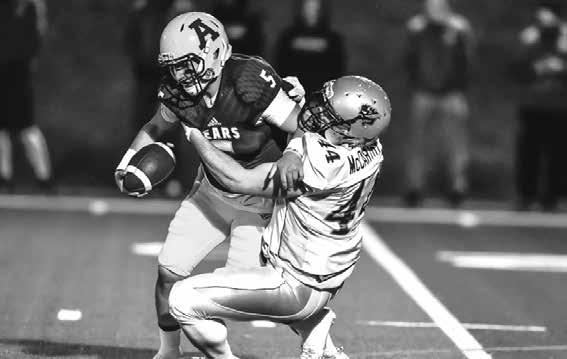
The University of Manitoba
Bisons football team headed into Friday night’s game against Alberta desperate for a win after two disappointing losses against UBC and Calgary. After trailing by nine at halftime, the Bisons would complete a second half comeback, winning 42-32.
Star performances from running back Jamel Lyles and slotback Alex Vitt helped spur the herd to victory.
The Bisons showed their resolve from the very beginning. Quarterback Theo Deezar started the game by throwing an interception on Manitoba’s first drive, but the Bison defence held, with Braden McCarthy recovering a fumble on the ensuing Alberta possession.
Manitoba got on the board right after that on a one-yard run from Cameron Fox. Alberta responded with a touchdown of their own shortly after. The Golden Bears and Bisons traded scores in the second quarter, with Alberta leading 25-16 at the half.
Manitoba opened up the second half with a four-play, 60-yard touchdown drive capped off with a 21-yard pass to receiver Jesse Walker.
The Golden Bears scored on their very next drive to keep Manitoba at bay.
Alberta was not prepared for Lyles in the second half, however. The running back completely took over. He put the momentum in the Bisons’ hands on a wonderful 73-yard punt return at the end of the third quarter, levelling the score at 32.
Manitoba couldn’t be stopped after that, as they outscored the Bears 10-0 in the fourth quarter. Lyles added another touchdown and Ryan Jones scored a field goal with five minutes remaining to make it a two-possession game for Alberta.
The Golden Bears attempted to make a comeback, but that effort was stymied by an interception by Brett MacFarlane. The win brings the Bisons back to .500 and keeps their perfect road record intact.


Mr. All-Purpose
Lyles has been dubbed “Mr. AllPurpose,” and rightly so: he collected 258 yards in total offence for the Bisons.
He was a beast in the backfield specifically, racking up 119 yards on 14 attempts and scoring a touchdown. The Surrey, B.C. product now has 416 rushing yards total on the year and is averaging 104 yards a game.
Lyles has been dubbed “Mr. AllPurpose,” and rightly so: he collected 258 yards in total offence for the Bisons
Spreading the love
The Bison receiving core were all involved in this game, with seven receivers making at least one grab. Vitt led the pack with six catches and 131 yards. Walker also continued his touchdown streak, scoring in his third straight game, while Anthony Dyck scored his first CIS touchdown in this game as well.
Shutting it down
The Bison defence also performed very well in this game, recording three sacks. McCarthy, a defensive end, had two, while defensive tackle David Onyemata added a sack of his own as well as eight tackles.
Defensive end/tackle Evan Foster led Manitoba with nine tackles. He is the team leader in that category this season with 22.5. That also puts him eighth in the Canada West conference.
The win puts the Bisons in a tie with multiple teams for second place in the conference. Manitoba heads back home for homecoming weekend against the Regina Rams this weekend, who are winless so far this year

PHOTO BY JEFF MILLER
Another weekend, another turnaround
Keepers Werle, Wilford star in matchups ahead of IGF derby clash
ANDY CHE, STAFF
T
he University of Manitoba Bisons women’s soccer team is certainly developing a good way of responding to deficits. Following a tough loss to the Calgary Dinos on Saturday, the Bisons hammered the Lethbridge Pronghorns 3-0 on Sunday.
The victory against Lethbridge will provide some needed comfort before their derby match against the Winnipeg Wesmen at Investors Group Field on Oct. 9. It also caps off another weekend which saw the Bisons respond to a loss with a resounding victory.
Calgary vs. Manitoba
The Dinos and Bisons kicked off their match in excruciatingly windy conditions – a major contributing factor in the performance for both sides. Calgary goalkeeper Erica Fox was under early pressure when she faced Bisons strikers Camille Plett and Alanna Shaw on breakaways, but she was equal to them.
Calgary took the lead through Jordan Smith’s curling effort that
flew past Chloe Werle’s reach. Ten minutes later, Manitoba responded through Shaw, who rounded Fox and finished for the equalizer.
Heading past the half-hour mark, the wind nearly took its toll on Fox. Megan Graca’s ambitious half volley from a distance slipped through the hands of the goalkeeper before pinging the crossbar. Werle was almost celebrating an extraordinary goal of her own when her long ball traveled the length of the pitch and bounced just past Fox’s post.
Just after halftime, Werle produced her finest save of the match by tipping away a Maddison Fritze drive from 20 yards at full stretch.
The Bisons’ number one was kept busy, making 14 saves.
At the 69th minute, the Dinos snatched the go-ahead goal through Mollee Ramsay’s strike, which slipped through the grasp of Werle, despite the keeper being able to get her hands on it. Three minutes later, Calgary cushioned their lead through Fritze, converting a drive to the bot-
tom left corner.
Speaking after the 3-1 loss, coach Vanessa Martinez-Lagunas discussed her game plans for their meeting against the Lethbridge Pronghorns.
“You need to believe that no matter what obstacle comes your way, you can overcome it. We lost the game but we haven’t lost the battle so we have the opportunity tomorrow to finish with a successful weekend.”
Lethbridge vs. Manitoba
The Bisons swapped goalkeepers for their second matchup of the weekend, with Wilford replacing Werle ahead of their visit from the Pronghorns.
Within the opening half of the first 45 minutes, Manitoba had already gotten off to the ideal start. Shaw played through winger Selina Speranza to draw first blood for the Bisons. After 20 minutes, the lead was extended to 2-0 through Elyce Molyneaux’s premiere goal of the season.
Ten minutes into the second


half, the Bisons began to run away with it. Plett’s strike saw the Bisons take a commanding 3-0 lead, yet the Pronghorns continued to prove themselves a threat.
At the 75-minute mark, Emily Felker forced a save from Wilford and then the Bison goalie denied striker Lindsay Amatto with two more saves in succession to keep Lethbridge at bay.
The goalkeeper played the entire 90 minutes, keeping the Dinos’ score sheet clean while making an astounding 14 saves.
With their fourth victory of the
BY
CIS campaign, the Bisons have matched last season’s mark with six competitive matches remaining before the playoffs. It’s a clear indication that the Manitoba Bisons are improving and will continue to do so for the rest of the year.
The herd will take a break for the upcoming week before their derby match at IGF and the Duckworth Challenge. Finishing on a high note with three points and a clean sheet to boot, the Bisons have generated some much-needed momentum and confidence ahead of the critical match.
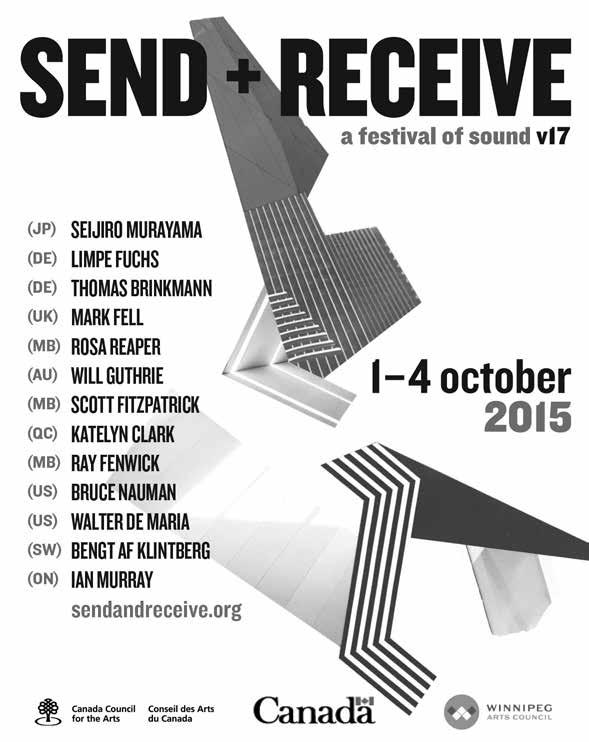

PHOTO
CHANTAL ZDAN