Hub closing during the summer months after losing money this year
S E amu S h amilton-Patti S on, staff
The Hub, the campus bar run by the University of Manitoba Students’ Union (UMSU), will be closed over the summer months this year after failing to break even.
The fiscal woes of the campus pub come despite claims by current executive members that they had helped rescue the bar from financial ruin.
During the 2014 UMSU General Election, the winning Refresh slate had stated it “took the Hub out of a $450,000 hole.” The factual accuracy of this statement was disputed during the campaign, resulting in an official complaint filed against the Refresh slate with the UMSU chief returning officer, Jacqueline Keena.
Keena ruled the statement was not incorrect and—with confirmation from UMSU general manager Clark Cunningham—was made in reference to UMSU’s efforts to “reach a break-even point by the end of the fiscal year.”
The University of Manitoba Students’ Union Council meeting minutes for Dec. 9, 2013 document former vice-president internal Amanda McMullin stating that the Hub was “projected to make $12,000 but that just hasn’t happened yet,” adding that it was “in the hole, but significantly less than last year.”
McMullin further told council in 2013 that net losses for the entire union amounted to $294,000, with UMSU businesses losing $24,000 in the month of November alone.
Jeremiah Kopp, president-elect for UMSU and the current vicepresident internal, confirmed the context of last year’s statement with the Manitoban
“The context of the comment made
in the last election was that the Hub was seeing drastic improvements in its financial situation, which remains the case. The Hub has been performing better now than it has since its creation. However, due to the nature of the Hub and due to the seasonal nature of university, it is a difficult business to make a profit on,” he said.
“When I’m president of the union, starting May 1, the Hub will not be open over the summer months” – Jeremiah Kopp, UMSU vicepresident internal
Kopp told the Manitoban that, while the Hub may not be turning a profit, UMSU’s other retail and food service businesses have been making money.
“The only place the union is not profitable is with the Hub. Everywhere else is performing better than what we budgeted for, and we’re very pleased with the financial situation of the union overall. The union this year is in excellent financial health and we’re very happy about that; the one cause for concern is the Hub’s continued losses,” Kopp said.
Brandon Whyte, manager at the Hub, told the Manitoban that he has faced significant challenges in running a bar that is seasonally volatile.
“I do think there is a serious chal-
lenge to running a bar on any campus. I’ve run [a campus bar] previously at the University of Alberta, and one of the main challenges is simply that it’s a seasonal business,” Whyte said.
“You tend to bleed a little money when there are no students on campus. The U of M is the third largest city in Manitoba when it’s filled with students in the winter. Then we go from almost 32,000 people to 1,500 in the summer.”
Kopp also cited the bar’s seasonal downturn as a cause for concern, adding that he believes the cost of labour and the kitchen’s size could also be contributing factors.
“About two-thirds of revenue is tied up in labour costs. When that’s the case, that’s just not a situation you can be profitable in and there’s a whole host of reasons for that,” he said, listing off some of the primary issues with the Hub.
Kopp said that the Hub has a large kitchen with an overly diverse menu that is similar to Degrees’, which is just down the hall. He further identified the high cost of food items as an issue, but added that the biggest source of financial instability revolves around the four summer months, where the Hub has typically remained open despite the campus being significantly less populated.
“When I’m president of the union, starting May 1, the Hub will not be open over the summer months,” Kopp said.
“That will be saving costs of approximately $75,000 right off the bat. That’s a move I’m going to make right away to make sure that we’re not losing money while the campus is less populated.”
For his part, Whyte told the Manitoban he has a history of working at, and helping to turn around, bars that he described as “failing miserably” prior to managing the Hub. He said now, he is continuously working to improve the business at the Hub.
“One of the biggest things I’m doing besides increasing training, the whole ‘work smarter, not harder’
thing, is increasing awareness and just better control. One of the things I always notice when I take over a bar is how it’s set up, how the room is set up.”
Whyte pointed out one issue is that the space is not laid out in a conducive manner for a functioning bar, suggesting that “an interior designer designed the Hub, not someone who had worked in the business.
“It’s a matter of changing some small things, like making a service station for the servers, so they can get their drinks out to the floor quicker. Something like changing where the food line pick-up is and how we can deliver the food a little more efficiently,” he said.
Whyte elaborated on another fiscal challenge facing the facility.
“One of the challenges I’ve had is just getting every single faculty, group, association, team, club, everybody, to buy into knowing that they’ve got a campus bar. We don’t charge anything for the room. That’s where, since I’ve taken over, there’s been a substantial and noticeable difference in the numbers coming in. January, February, and March, I had every single weekend day booked with group fundraisers, socials, and events. I love offering up the Hub to do that, it’s a win-win for that association and the Hub.”
Kopp said that, despite the Hub’s problems, he still believes offering commercial services through UMSU is beneficial for students, stating that private companies on campus do not provide the same high quality of food, nor do they provide the most affordable options.
photo by Carolyne KroeKer
Brandon Whyte, Hub manager
Graduate Students’ Association election results
U of M graduate students elect some familiar faces to UMGSA executive
S E amu S h amilton-Patti S on, staff
After nearly two weeks of campaigning, the 2015 University of Manitoba Graduate Students’ Association General Election resulted in the re-election of several former executives as well as the election of some new faces.
The University of Manitoba Graduate Students’ Association (UMGSA) is the association that represents all U of M graduate students.
Between March 16 at 9 a.m. and March 18 at 8 p.m., graduate students voted online to elect the new UMGSA executive.
Candidates from the two registered slates, Choice Matters and Graduate Student Action, faced off for the positions of president and vice-president academic at the graduate students’ table. The remaining positions for vice-presidency went unopposed.
The preliminary outcome of the UMGSA vote resulted in the election of Graduate Student Action candidates for six out of the seven positions, with the exception of one senator seat.
Former vice-president academic Kristjan Mann was elected president of the UMGSA in favour of candidate Junhui Gong.
David Terrazas, an electrical and computer engineering PhD student, was elected vice-president
academic over fellow nominee Aida Adlimoghaddam.
“I
hope [the high voter turnout] reflects a rise in student engagement and
knowledge of the issues, especially when considering the difficult road we have ahead of us in terms of the proposed budget cuts for next year” – Kristjan Mann, UMGSA president-elect
Enoch A-iyeh, another candidate pursuing a degree in electrical and computer engineering, was elected vice-president external. The position was uncontested.
Vice-president internal Valery Agbor was successfully re-elected to
the same position with no opposition.
Beibei Lu was also re-elected to her position as vice-president marketing and events, with no opposing candidates.
Graduate students at the U of M are represented by three graduate students on the Senate, with two senator positions open to Fort Garry candidates, also elected by the UMGSA during this election period. Senators are required to attend UMGSA executive meetings, in addition to representing graduate students at the level of the university’s governing body.
Four graduate students competed for the two senator positions. Senator positions were filled by independent candidate Kathryn Marcynuk and Graduate Student Action’s Gagan Sidhu, who won out over Gustavo Mejicanos and incumbent Richard From.
President-elect Kristjan Mann said graduate students could look forward to high-quality services from the association in the coming year.
“They will see a UMGSA that is driven to advocate for graduate student issues first and foremost in every matter, and to ensure that we maintain and improve the quality of students’ academic and social lives on campus at every opportunity,” said Mann.
Joseph Dipple and Karalyn Dokurno, UMGSA’s chief return-
ing officers, reported a voter turnout of 17.6 per cent to the Manitoban, the second highest voter turnout in UMGSA history.
Mann said he was particularly excited by the number of graduate students who took part in the election.
“I hope [the high voter turnout] reflects a rise in student engagement and knowledge of the issues, especially when considering the difficult
City council in the U-Pass driver’s seat
road we have ahead of us in terms of the proposed budget cuts for next year.”
The 2015 UMGSA General Election results shown here are based on preliminary results provided by the UMGSA’s chief returning officers. The results must be ratified by UMGSA Council before they are considered official.
Student transit pass up for adoption following full approval from participating universities
Dana h ath E rly, staff
The U-Pass is back in the hands of Winnipeg city council after the University of Manitoba’s Board of Governors (BoG) voted unanimously to endorse the U-Pass implementation, following its recommendation by the infrastructure renewal and public works committee to council.
Jenny Gerbasi, city councillor for Fort Rouge East Fort Garry, told the Manitoban that the motion was approved by the city’s public works committee. It then went to Winnipeg’s executive policy committee, and on Wednesday, she said the report will be voted on by city council, affirming that the program will be set for implementation in September 2016.
“The report is confirming that council agrees that they will proceed with everything, and that is passed on Wednesday,” Gerbasi said.
The 2015-2016 operating and capital budgets were both approved by council today, including cost projections for the U-Pass.
Winnipeg’s standing policy committee on infrastructure renewal and public works met for a full day last Monday, including a cost analysis of the U-Pass implementation and delegate speeches by councillors and
transit stakeholders. The result was that the city’s standing committee recommended the U-Pass to the Winnipeg’s executive policy committee for approval in a unanimous vote.
The Manitoban reported early last week that the U of M BoG had to approve their finance committee’s recommendation, as part of the U of M’s final step towards sealing the deal, to ensure that U of M students are to receive the U-Pass following the city’s formal implementation. The unanimous vote by the BoG signalled the intent of the University of Manitoba Students’ Union (UMSU) and the University of Manitoba Graduate Students’ Association, along with the U of M’s full approval for city council to move forward on further recommendations regarding the U-Pass.
The situation at the University of Winnipeg is different.
Rorie Mcleod Arnould, president of the University of Winnipeg Students’ Association (UWSA) told the Manitoban that the UWSA’s relationship with their governing bodies, the board of regents and Senate, is different from UMSU’s relationship with the U of M’s governing bodies.
The relations between UMSU and the BoG are established in the
University of Manitoba Students’ Union Act. On the other hand, although the UWSA is mentioned in the U of W Act, the UWSA does not have its own incorporating act. Mcleod Arnould told the Manitoban about what he believed to be the implications of the different students’ associations’ relations with governing bodies. The UMSU Act “is a rather paternalistic document, that I think places students’ unions as hubs of student organizing subordinate to the university’s board of governors,”
said Mcleod Arnould.
“That these have to be approved by the board of governors before they’re implemented is a fundamental indication of a lack of sovereignty [at the U of M]. At UWSA, we implement the fees and notify the administration, whereas [UMSU’s fee proposals] have to satisfy some form of litmus test.”
Mcleod Arnould pointed out that at the U of M, UMSU was required to have their referendum vote approved by the BoG, emphasiz-
ing that the UWSA is autonomous in setting their fees. The procedures for student fee increase proposals are laid out in the bylaws, and direct the students’ association to contend either by referendum or an annual general meeting, Mcleod Arnould said.
The University of Winnipeg Students’ Association’s official endorsement of the U-Pass, in conjunction with the majority support of students in October’s referendum vote, confirmed to city hall that U of W students were in favour of the pass.
photo by Carolyne KroeKer
photo by Carolyne KroeKer
Kristjan Mann, UMGSA president-elect
Respect campaign garners disrespectful responses
Initiative results in racist and sexist comments
Dana h ath E rly, with files from Bram Keast, staff
Aside from some inappropriate posts, including racist and sexist remarks directed at Nigerian women, the university’s “Scrawl on the Wall” initiative garnered mostly positive attention last week. The initiative was meant to garner responses from the University of Manitoba community on how to live, study, and work in a respectful environment.
Students, faculty, and staff were invited to publicly post their ideas and comments about respect and integrity as part of the poster campaign. Located at 20 locations across the university’s three campuses from March 16-20, the posters posed four questions to passersby: “what does respect mean to you?”; “when have you felt respected on campus?”; “when have you felt disrespected on campus?”; and “this campus would be more respectful if,” followed by space to fill in the blank.
One of those anonymous comments scrawled on the wall, filling in the blank, read, “When Nigerian girls start wearing decent clothes” followed by “#forGodssake.”
This was not an isolated incident. A similar post directed at Nigerian women was reported on at least one other poster in University Centre.
University of Manitoba Nigerian Students’ Association president Oyindamola O. Alaka was unaware of the comment up until the matter was brought to her attention by the Manitoban
“This is a very disrespectful and racist comment; it is part of a bigger problem in [the] world, an issue of feminism, racism and double standards,” said Alaka in a statement to the Manitoban
“We need to have more discussion about respect in society.”
Although some of the comments found on posters were disrespectful, administrators had braced for unwelcomed remarks, ensuring security response procedures were in place.
“We anticipated that this would occur to some extent,” Jackie Gruber, the university’s human rights and conflict management officer, told the Manitoban in an email.
“Security Services [has] been extremely helpful in this project,” Gruber said.
“If there were inappropriate comments, they took a photo and emailed [the comments] to me directly, and then we would go to the location and cover up the comments.”
Various negative comments were covered up by administrators, using masking tape and paper to block the comments from view.
“I feel disappointed that some of our community members felt it was okay to write such comments, but it is not entirely unexpected. It would not be honest for us to suggest that problems ranging from disrespectful behaviour to outright racism do not exist on our campus,” Gruber said.
As she pointed out, censoring comments by hiding them out of sight did not mean they would be ignored by administration.
“In a sense, even those inappropriate comments have their use as evidence to inform our decisions on what we need to work on with the community,” she added.
Targeted task force
Posters are being collected from across campus, and responses reviewed by the committee over the upcoming week. However, the call for scrawl was not the university’s only plan for community consultation.
In her email, Gruber told the Manitoban that the university will be conducting focus groups with students to obtain more information about how to bolster their respectful work and learning environment policy and procedures.
The Respectful Work and Learning Environment policy guide is in place to ensure that individuals have the “right to participate, learn, and work in an environment that promotes equal opportunity and prohibits discriminatory practices.”
The University of Manitoba president’s advisory committee on respect is the taskforce behind the community consultation initiative, as stated in their press release.
Created by U of M president David Barnard and co-chaired by vice-provost (students) Susan Gottheil and associate vice-president (human resources) Greg Juliano, the committee is tasked with co-ordinating initiatives and organizing
consultative processes surrounding respect and integrity, in the context of the university’s strategic plan titled “Taking Our Place: University of Manitoba Strategic Plan 2015-2020.”
The committee is helping to consult with the campus community, using such initiatives as “Scrawl on the Wall,” and construct a plan to bolster “inclusion, diversity, accommodation, human rights, civility and collegiality” in new and existing initiatives.
Last year Barnard emphasized the university’s role in fostering a respectful campus in a statement to the university community.
“At the University of Manitoba, education has no borders or barriers,” Barnard said in his statement to mark the beginning of the academic year.
“We support a climate of respect where all people are valued, and where individuals from all communities, ages, and cultures are welcome.”
Most of the comments garnered from the campus community as part of their latest consultation were positive. As Gruber pointed out, those messages included a positive affirmation of what a respectful workplace looks like:
“Respect means recognition of unique values, opinions, and the right to express them in a polite and well-reasoned manner,” wrote one anonymous commenter.
“Respect means acknowledgement of experience and exposure to ideas, concepts, and challenges external to those normally experienced in this work environment.”
Gruber noted that moving forward, there will be more focus groups in place for faculty and staff, with input coming from the university community helping to shape plans for additional consultation.
Since posters have been taken down, members of the university community are invited by the office of human rights and conflict management to leave comments online at umanitoba.ca/admin/ president/respect/index.html
photo by Carolyne KroeKer
Being alone
Reflections on homelessness
Evan t r E mblay, staff
This was originally going to be a very negative article about the students camping outside of University Centre for 5 Days for the Homeless. I appreciate that they’re raising money for a good cause, but I don’t think dressing up does much for awareness or understanding. But complaining about people dressing up doesn’t do much for awareness or understanding, either.
To help towards the sleepers’ goal—raising awareness of the hardships of homeless youth—I’d like to share what being a young homeless person was to me, based on the time that I’ve spent in that situation: not the experience of someone who’s known a life of suffering, but the experience of a person who’s slept without a home, and done so without encouragement, food brought to him, or, most importantly, the knowledge that he couldn’t be kicked out of the place he was sleeping for the night, for many nights in a row.
This isn’t the experience of mothers, elderly, or disabled who are homeless. I’m young, educated, and healthy – just like the people hanging out on the steps of University Centre. But unlike them, the meaning of being homeless isn’t something I have to concede I couldn’t manage or imagine. What does being homeless mean to me?
Being homeless means having no money to burn. And realizing how few places you’re allowed to be, to loiter, in our society without spending money, or at least intending to
Being homeless means not going for walks in the rain, because you don’t have another set of clothes. It means having few or no clean changes of clothes, because you have to carry the anything and everything you have yourself; and vanities are heavy when you carry them on your back. It means not having a place to shower – and even if you don’t care, the people who shower, shampoo, condition, moisturize, blow dry, and towel down every single morning do care, and aren’t very prone to pretending they don’t.
Being homeless means learning to fall asleep observant, wake up on guard, and sleep lightly. If you have something that matters, you fall asleep with your arms around it. You wear your shoes to bed. You also wake up, every single morning, to the rebirth of the sun, to dew, to mist. Or maybe to the realization that the concrete corner that seemed at least a warm shelter last night when all you wanted was somewhere soft reeks of
urine, and now you do too, and there’s a police officer telling you to move out.
It means not having a place of retreat. No private place to go when sad, alone, scared; nowhere to be angry, or less than couth, without being judged. What was your assumption the last time you saw a homeless person crying, screaming, muttering to themselves – things we all do at some point?
Maybe you were right: maybe they were drunk, or high, or fucked in the head. Either way, they weren’t blind, and in the midst of tears, rage, darkness, they saw you: they knew your assumption, and they had nowhere
to shelter from it.
Being homeless means having no money to burn. And realizing how few places you’re allowed to be, to loiter, in our society without spending money, or at least intending to. Our cities are vast, glittering hives of places to spend money, or to enjoy the things that we’ve spent money on. Coffee, food, movies, parking, driving, sitting in your house or yard. Conducting business. By the time you take away all the places you can’t be without spending money, what are you left with? Public parks, and benches. The benches are designed so that you can’t sleep on them, and
the parks are patrolled.
Being homeless means being hailed as “brother” by people who’ve never met you, but who know you. It means being generous with your food, your smokes, your alcohol. With anything and everything you have. When you have little, you give a lot.
Being homeless means being generous with your love. It means wanting to be loved. Wanting the chance to express that love. To yearn to create art, but to have no medium. To try to speak, but have no voice that people will listen to. To have your smiles cast to the ground by angry glances, eyes that flash “how dare he.”
It means being alone.
Being alone leads a person to think – about who they are, what they’ve done. About who they’d liked to think they were. Being alone, you’re forced to come to terms with the things you already know: “the person I’ve been isn’t the person I want to be.” With a home, that knowledge leads to growth and, through it, peace. Without a home, it’s a Sisyphean burden that teaches you the priceless value of what you don’t have.
An epistle to the arts
A polite protest against the budget cuts
K. r m organ
I must begin with an apology
For my utmost and true sincerity. My mind is at the mercy of my pen, (A weakness for the strongest of [wo]men.) It speaks the truth, and to it I must yield, Indeed, la vérité will be my shield. Given this, and without further ado, My mind’s burdens I shall present to you.
I am writing thee an advisory ’Gainst a disguis’d friend (a true enemy). He has been depleting your sustenance And blaming you for lowered finances. He claims that changes are necessary, Though his motives are simply mercenary. Indeed, your friend (who goes by Dr. B——) Cries for pity, then dances to the bank.
In fact, he has gone so far as to fabricate a deficit. He tells you sweet nothings to cushion the hit. When all is said and done, he cares only for himself – putting your needs on the highest shelf (out of sight, out of mind; to your desires, he is blind). And yet his loves only he defends, for on certain faculties his job depends. To cut THEIR funding would be considered offensive. As such, when he weaves tales with his silver tongue, we must be...apprehensive. What would the world be sans humanities?
Empty of culture, inevitably. Not to mention the social sciences, Who must join our budding alliances. Without us (for my allegiance lies with you), Academia would have been brought to A halt. Around you, the world is structured; This significance must be recaptured.
To start, dear Arts, you have Philosophy Who has refined the way the world we see. Further, Economics lies in your midst: By others his efforts have been eclipsed. Everything is at stake: from Linguistics To Criminology; même the Classics. Arts, all of your children must see that they Are doomed, unless they act without delay.
English, Film, and Theatre are up next. Without them, we would not have this text. Without them, entertainments would Be scarce indeed. No movies to deem good Or bad, no books to carry you away; No meanings to find, nor players to play.
’Tis the same with French, German, and Spanish: B——’s plan to hurt you seems quite outlandish. You know, for someone who claims to love poetry, Dr. B——’s soul seems to be empty. How can one have respect for the creation, but pay its maker no attention? If our funding is axed and our classes cancelled, more than Academia will be shaken and rattled.
These struggles will your students inherit, Just because he does not know your merit. Speak to your students, O Psychology –Bid them to join us and change History. Those who remain unmentioned are no less Vital. All are needed to escape this mess. Together, we can defend our virtue; United we stand, to see the fight through. History, you must examine the past: Show us how to end the reign of an a—.
Advocating for students
Balancing priorities is not a student union’s job
tom i ngram, staff
Earlier this academic year there was a fleeting debate in the Manitoban on the role of student unions in connection with political advocacy. Since that time a great deal has happened. The University of Manitoba Students’ Union (UMSU) initially announced that they would not condemn the impending U of M budget cuts, citing their position of neutrality on political issues.
In a subsequent letter they backtracked somewhat, saying they are opposed to budget cuts but are taking a stance “not [ . . . ] of neutrality, but of rationality.” Jeremiah Kopp ran for and won the position of UMSU president. On the matter of political advocacy, he said, “We are there to support any student who has a cause or issue that they want to be passionate about.”
It seems that there is a concerted effort being made to redefine the role of the student union vis a vis advocacy.
Back in November, in an article entitled “UMSU gets it right with political neutrality,” Ethan Cabel argued that the current situation at big universities makes it inappropriate to treat UMSU members like a single political bloc. Therefore, he argues, it is not appropriate for an organization like UMSU to engage in special interest political advocacy on issues that do not bear specifically on students.
To some extent this makes sense – one of Cabel’s examples is campus bottled water bans, an issue that is not really the business of a student union. But somewhere along the line we’ve elided the distinction between special interest issues that are irrelevant to students and special interest issues per se.
Advocacy regarding tuition, the status of international students, budget cuts, and conditions on campus are still very much within our union’s purview. And another consequence of the heterogeneous makeup of the student body that Cabel mentions is that many students will disagree with whatever stance UMSU chooses to take on
these student-related issues.
It is impossible to take a stance that will please everyone. But as the elected representatives of a student advocacy group, it is the responsibility of the UMSU executive to take stances on these issues anyway. At some point you have to disagree with somebody. To construe the role of the student union as passively supporting whatever students choose to advocate—as Kopp seems to—is simply to ignore the duties that were given to him as a result of the election.
Advocacy regarding tuition, the status of international students, budget cuts, and conditions on campus are still very much within our union’s purview
Members of the UMSU executive sit in on meetings at all levels of university governance. They have power to effect change in ways that no other students possibly can – and a mandate to use this power on behalf of students. Refusing to use this power is not the wise restraint of a Cincinnatus; it is an explicit decision to endorse the status quo. Which is fine—it may actually be the case that the status quo is an acceptable state of affairs—but let’s at least be honest about it.
It is not UMSU’s role to be neutral or equivocal on issues that bear on students. It is their role to take a position and fight for it. If the student body doesn’t like it, the student body has ways of getting new executive officers who will adopt different positions.
Kopp was among three members of the outgoing executive who signed a letter in the Manitoban outlining UMSU’s position on budget cuts. This letter took a
rather lukewarm stance, stating that UMSU is opposed to budget cuts but was not going to press the administration on the issue.
“UMSU recognizes the university’s complex budget outlook, limited revenue sources, and the need to balance competing priorities,” the letter said.
But it is not UMSU’s job to “[recognize] the university’s complex budget outlook.” That’s the job of the university administration. It is UMSU’s job to advocate for students’ needs regardless of the university’s budget outlook. The administration can do with that advocacy what they will.
The union has no responsibility to balance competing priorities within the university; they can negotiate, but their first and only responsibility is to look out for their members. Faculty, staff, and the administration all have their own representatives to look after their own interests.
It is possible, fun even, to criticize certain other student unions for overstepping their mandate by advocating for issues that are not relevant to students. But it’s also possible for a union to go too far in the other direction and advocate for considerations that are outside their mandate because they are the proper domain of government and university administration.
Given the choice, I’d rather have a union that stands up for workers’ rights and the environment than one that tries to act as impromptu emissaries from the administration.
As the incoming president of UMSU, Kopp is in a position where he has to make a number of hard decisions. I would like to remind him that he was elected as a student leader, not as an administration mouthpiece or the representative of our aggregated id.
I challenge him to make these hard decisions explicitly and transparently, and to fight openly for the decisions he has made, rather than continuing with the wishy-washy equivocation of neutrality and balance.
photo by Carolyne KroeKer
GraphiC by evan tremblay
Science & technology
& Technology Editor: Chantelle Dubois
Science
Contact: science@themanitoban.com / 474.6529
Data mining
I heard you like data, so we put information in your information
J E r E miah yarmi E , staff
We are making data all the time.
Unbeknownst to most individuals, data is stored every time we use our credit cards, post on social media, or make a web search. Sure, we could be interested in the specific details of your search history or Amazon purchases, but the patterns within this data also hold a lot of information. This brings us to the field of data mining.
Data mining, also known as “Knowledge Discovery in Data,” is the purposeful identification of implicit patterns that are found within large databases.
“Data mining can be considered as a task of performing advanced analysis on data,” said Carson Leung, computer science professor at the University of Manitoba.
Leung’s Database and Data Mining Laboratory at the U of M focuses on developing ways to detect frequently occurring patterns and abnormal items within large databases. Leung’s research attempts to incorporate more human control over the data mining algorithms, letting the humans do the hard thinking and letting the computers do the hard work.
10
Data mining is a multidisciplinary field, incorporating elements from fields like artificial intelligence, machine learning, data visualization, and statistics.
Data mining tasks include detecting relationships between different variables, clustering similar data into groups and clusters, and summarizing the data in a concise way. Often these tasks are much more laborious than something a normal human can handle. Computers can do this no sweat. These tasks allow data miners to also predict likely outcomes. Governments and corporations can learn a great deal more about you as an individual or as a member of a larger group through data mining.
Data mining is what makes it possible for Walmart to analyze its millions of daily transactions.
When you shop for groceries at a supermarket, the stores will often record what kinds of items are frequently purchased by customers. That sort of information is easy to find and retrieve, but data mining allows the store to determine the relationships between individual purchases.
“For example, store managers may find that customers often purchase bread and butter, which you may expect,” said Leung. “However, there are some other less obvious patterns too.” These stores can utilize customer behavioural patterns to increase their sales.
Data mining allows us to find patterns in large amounts of data
“On the one hand, if many customers purchase items A and B frequently together, the store may place them together for the customer’s convenience,” said Leung. “On the other hand, the store may put these items apart so that customers would likely walk between the two items and potentially purchase more items along the way.”
To a further extent, customer behaviours can also be monitored on the individual basis with the use of loyalty cards, which allow the store to use data mining for analyz-
ing behavioural sequences and do personalized promotion to targeted customers.
This example focuses on the frequency of a behaviour, but data mining can be used to analyze behavioural sequences as well.
The amount of data being stored about us is equal parts beneficial and concerning. You may worry why every single purchase you make with a credit card has to be monitored, but data mining allows for the detection of anomalies. Credit card companies can use data mining to become aware of fraud by detecting uncharacteristic purchases.
Facebook uses data mining to find people you may know.
“If you put on your profile that you are an undergraduate student here at the U of M who started in a particular year, then Facebook can mine their databases and find people with similar backgrounds,” said Leung.
Data mining can be used in other scientific fields as well. By analyzing the patterns of variation within our DNA sequences, we can figure out how they relate to things like disease.
I Love Science Week
Let’s Talk Science celebrates
Chant
E ll E Duboi S , staff
Let’s Talk Science at the University of Manitoba is holding the first I Love Science Week from March 23 to 31. Space Days, being held at the Manitoba Museum’s Science Gallery on March 21 and 22, will precede it.
I Love Science Week will see over 23 in-classroom activities, and two mall outreaches.
The first mall outreach will be held at Kildonan Place Mall on March 28 from 10 a.m. to 6 p.m, and the second mall outreach will be at St. Vital Centre on March 30 from 12 p.m. to 2:30 p.m.
“I thought of the idea when I was thinking about ‘I Love to Read Month,’” said Richard Jung, coordinator for the U of M’s Let’s Talk Science branch.
Chrissy Troy of 103.1 Virgin radio will be present at one of the events during the week.
The idea of I Love Science Week was brought up during the Let’s Talk Science Western Regional Conference, which was held in February and hosted by the University of Manitoba. Representatives from Simon Fraser University, as well as the universities of Victoria, British Columbia, Calgary, Alberta, Saskatchewan, and Winnipeg were all present. This conference brings together Let’s Talk Science coordinators from Western Canada to discuss future activities, brainstorm, and troubleshoot any problems the branches are facing.
This will be the first year that Let’s Talk Science hosts I Love Science Week. Jung hopes that next year the event will expand nationally and that the event brings the
same kind of attention to science as other awareness campaigns bring to their various causes.
“No money is being collected; we just want to get people’s attention and raise science awareness,” said Jung.
The repertoire of activities being hosted over the week include: Crazy Cryptography, Molecular Biology, Bright Lights Big Science, Feast for the Senses, Bone Zone, Exploration Mars, and various other activities ranging from astronomy to zoology.
Let’s Talk Science is an awardwinning national science outreach program, which has locally managed sites across the country. The mandate of Let’s Talk Science is to promote science literacy to children through engaging, hands-on science-themed activities.
The program has had ties in the past with Chris Hadfield, the retired International Space Station commander, who has previously recorded videos for the Let’s Talk Science Challenge in 2013. Hadfield was also involved with the RaDI-N2 & You project, a collaboration between Let’s Talk Science, CurioCity, and the Canadian Space Agency.
RaDI-N2 & You involves high school students in measuring the varying neutron radiation levels across the country and in the International Space Station. Their data is then shared through the Let’s Talk Science website.
For information about Space Days or I Love Science week contact Richard Jung at lts.uofm@gmail.com
photo provided by let's talK sCienCe
GraphiC by Caroline norman
Bringing it back
Tortoises reclaim the Galápagos from rats
J E r E miah yarmi E , staff
The Galápagos tortoise, an endangered animal, has begun to reproduce naturally in the wild after being unable to for 100 years. The threat of black rats to tortoise eggs has made this nearly impossible until recently.
The Galápagos Islands inspired Charles Darwin as he pondered evolution and speciation. The islands, which lay to the west of Ecuador in the Pacific Ocean, have not resembled what Darwin saw in the 1830s in a very long time.
The tortoise population of the Galápagos Islands has decreased significantly due to human activity. Through over-hunting by whalers, competition from non-native species like goats, and habitat destruction through agricultural practices, the number of tortoises has decreased to a couple thousand from an estimated
250,000 in the 16th century.
Hell, even Darwin himself didn’t shy away from eating Galápagos tortoise meat.
However, the most damaging contribution humans made to the Galápagos Islands were black rats. These rats eat tortoise eggs and hatchlings.
We humans try to do good just as often as we inevitably mess up. To atone for our mistakes, several initiatives have been undertaken to re-establish the Galápagos tortoise populations.
For the past 50 years, individuals have been raising tortoise hatchlings in captivity until they were mature enough to be released into the wild and hold their own against the infestation of rats. These rearing efforts have so far seen more than 6,000 tortoises reintroduced into
the wild.
The conservational efforts also involve eradication attempts. In 2012, the Galápagos island of Pinzón was declared rat-free after comprehensive poisoning of the rat population. Poisoned rat bait was dropped around the island via helicopter.
It seems like the work has paid off. Newborn baby tortoises were found on Pinzón this past December. This marks the first time Galápagos tortoises have successfully reproduced in the wild in over 100 years.
The group that discovered the young tortoises also searched for signs of rats, but to no avail.
It is estimated that the tortoise population of Pinzón has nearly tripled since the 1960s. The next step is to ensure that the rat populations do not come back to the island.
No longer short-sighted
The reason for the increase in myopia
Chant E ll E Duboi S , staff
Researchers may be closer to understanding why there appears to be an increase of myopia around the world, and it is not entirely related to genetics.
Myopia is nearsightedness due to the elongation of the eyeball.
In recent studies, it was found that the level of education and the occurrence of myopia were strongly
associated. For children in East Asia, more pressure may be placed on them to perform better academically, leading to more time being spent studying. This increased time spent studying may result in more close range reading, influencing eye development.
This theory is supported by statistical data of the occurrence of myopia over a few generations. Sixty years
How Galápagos tortoises are faring outside of the wild
Someone has found themselves in a bit of trouble after doing something incredibly stupid to a Galápagos tortoise in captivity. A 24-year-old man is facing six months in jail for standing upon a 120-year-old Galápagos tortoise in Nehru Zoological Park in Hyderabad, India.
This blatant disrespect towards a creature five times his age was done because the man wanted a lot
of “likes” on Facebook. Despite getting the “likes” he wanted, he may be going away for his actions under the Wildlife Protection Act.
Speaking of zoos, a 25-year-old Galápagos tortoise recently died at Akron Zoo in Ohio. The tortoise, who had a large amount of fluid surrounding her heart and multiple diseased organs, died much sooner than the average Galápagos tortoise. Tortoises, especially those in captivity, have lived up to 170 years.
ago only 10 to 20 per cent of the Chinese population suffered from myopia, compared to today where up to 90 per cent of young adults are nearsighted. In the United States, 25 per cent of the population had myopia in 1971, compared to up to 41 per cent in 2004.
Additionally, more and more children and young people are using smartphones, computers, and tablets, creating similar conditions for the development of myopia.
The concept of nearsightedness being related to prolonged studying first emerged over 400 years ago when Johannes Kepler, a historically famous German astronomer and mathematician, blamed his excessive studying for his myopia.
Myopia severity is measured using diopters. Diopters are the units used in measuring the optical power of corrective eyewear.
Mild myopia is classified from being -0.25 to -3.00 diopters. Moderate myopia is -3.25 to -6.00 diopters and high myopia is anything below -6.00 diopters. Those with moderate to high myopia are at greater risk of other vision problems, such as cataracts, retinal detachment, and glaucoma.
Researchers have also found that time spent outdoors may help protect children from developing myopia. The studies are still being developed to thoroughly prove this hypothesis, but preliminary data suggests that, even if the time spent outdoors is spent reading, it has a protective effect.
It is not certain if this is related to lighting, or due to greater viewing
distances.
The leading hypothesis is that light induces dopamine release in the retina, blocking the elongation of the eye. The eye produces retinal dopamine in a diurnal cycle, which may be disrupted by indoor lighting and causing irregular growth of the eye.
In China, experiments were conducted that had several randomly selected groups of Chinese students aged six to seven spend 40 minutes outdoors at the end of the day over a period of three years. Control groups were also randomly selected. The experiment involved over 900 children in Guangzhou.
The result of the experiment showed that 30 per cent of children in the group that spent time outdoors developed myopia by the end of the study, compared to 40 per cent of the
children in the control group.
Further studies to investigate this relationship are currently being planned; future experiments may involve teaching children in glass classrooms to study the effect it has on myopia development. Other methods to slow down the development of myopia include eye drop medication or artificial light therapy. However, some of the researchers involved in this study believe that encouraging children to spend more time outdoors may have other benefits beyond protecting their eyesight, including lowering the risk of obesity since they would also most likely be more active.
GraphiC by bram Keast
GraphiC by Kailey-trevithiCK
Carolyne's fur-Children inquire about veGGies
illustration by bram Keast
illustration by bram Keast
illustration by evan tremblay
Arts & Culture
Handmade with love
Tara
Davis Studio Boutique
l aur E n Si DDall, staff
brings you the best from across Canada
F
inding work in the creative field is hard; working freelance jobs in between shifts at various establishments in order to scrape together a livable wage is all too common. But for Tara Davis, the solution was simple.
“I knew I wasn’t the kind of person who wanted to make things tucked away in a studio. But I would work my job and then go to my studio, and they were two totally different things. Often, I was at the studio at not my ideal times because I was working during those times,” said Davis.
“What I really wanted was to have a studio where I got to work with the public and actually make a living wage. The best part is that I get to work within my work.”
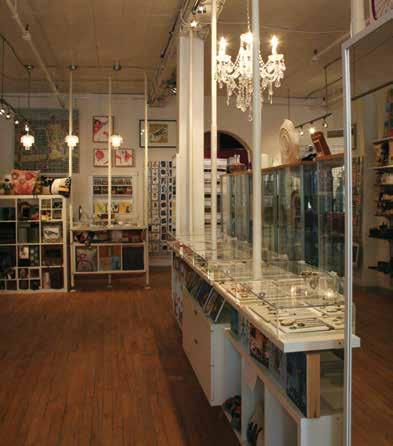
The result is an eponymous amalgamation of shop, studio, and gallery – Tara Davis Studio Boutique.
“It’s a hybrid boutique, gallery, and studio. It varies what the focus is at different times. Sometimes the focus is on my studio, because it’s January and February and no one is really coming in. And sometimes the
gallery is the focus, because there’s a really big artist or group of artists that people really want to see. And sometimes it’s shopping season.”
The shop had humble beginnings in Nelson, B.C., in a tiny—300square-foot—space rented by Davis.
“I had actually shopped in there a year earlier and when I left the shop, I thought that’s exactly what I wanted to have as a shop one day, that space. And then it was for lease, and I took the plunge. I rented it and moved in four days later to set up my shop. And it wasn’t scary because it was so little.”
Equipped with enough studio space to set up her loom in the back of the shop, Davis opened for business by recruiting fellow creatives from Winnipeg to provide merchandise to sell. Soon, Davis found herself the carrier of over 30 different makers within the walls of the tiny shop.
“The focus became much more on supporting other local makers. I knew I liked working retail but I thought initially that the focus would be on my making. But I actually really like working in the shop and supporting
other makers. That part has really grown,” said Davis.
Pulled back home by her heartstrings, Davis returned to Winnipeg and opened another location in the Exchange District.
“What I really wanted was to have a studio where I got to work with the public and actually make a living wage. The best part is that I get to work within my work” – Tara Davis
“It was really perfect for me because I would have not necessarily had the courage to open up a shop in Winnipeg,” said Davis.
“Winnipeg is actually home. I was born and raised here, and have left three times but I keep coming back because it’s my favourite place. Sometimes I forget that and I take
off again, but then I realize I want to be in Winnipeg.”
The new location came with more square footage and the opportunity to feature more makers from across Canada in her shop. Endowed with her experience at the Nelson shop, Davis was apt to expand her expertise.
“In the beginning, I used to pick things I thought my mom would like or my little sister would like. And I liked them, but I was picking them thinking who the customer would be that would get it. Whereas now, it’s really just what I’m drawn to; I have to love it.”
Davis searches across Canada for handmade merchandise to feature in the boutique, but for the gallery located within the shop, she stays local.
“Throughout the shop, it’s across Canada and not just because it can be, because I really want it to be to have that variety that you don’t necessarily get when it’s from such a small region. With the artwork, I think there is just so much talent in Winnipeg that it doesn’t make sense to look elsewhere.”
While the majority of artwork showcased in the gallery goes through a vigorous selection process, Davis said she has to bypass the process for certain artists.
“You don’t plan on some encounters. Michael Turner walked in off the street in November and wanted to show me his art, and I wasn’t going to look at it because things were starting to pick up for the holidays. But he told me that he was actually homeless and was hoping to show it now, rather than next year. So just upon meeting him, I decided that I really wanted to work with him,” said Davis. Through the gallery in her shop, Davis is also able to make art more accessible to individuals who would not visit a traditional art gallery, which she believes is important.
“I really try and have it be more salon style, where artists are willing to let us group things in and layer them up the wall. I find that’s how people find the art more accessible. Here, it literally is someone buying a pair of earrings or buying a card that sees the piece and loves it. I think it’s so exciting to be able to make the art more accessible. I love that.”
Tara Davis Studio Boutique is located at 246 McDermot Avenue, and is open MondaySaturday from 11 a.m.-6 p.m.
photos by lauren siddall
Adapting and captivating
WAG’s current exhibit combines artistic vision as well as solutions
a lana t raC h E n Ko, staff
Winnipeg Art Gallery’s new exhibit, Arctic Adaptations, is receiving well-earned attention. The gallery’s director, Stephen Borys, continues to outdo himself in his choice of exhibits, having recently brought the Salvador Dalí exhibit to Winnipeg to great response, and the Greco-Roman exhibit currently being constructed is stopping in only two cities in North America –Winnipeg and Montreal.
Arctic Adaptations feels less like the work of a lone artist and more like a panoramic view of what the Arctic does, and will, look like. The majority of Canadians have not had the opportunity to travel as far north as the Arctic, making it feel completely removed from our attention or concern. Arctic Adaptations is one of the many efforts being made to close the gap between the northern and southern regions of the country.
The exhibit is monochrome.
Fitting for describing a land that is made up of white snow and black water, the exhibit is comprised of black, white, and cool tones. The WAG curators have succeeded in setting a mood that is sparse and minimal, yet somehow inviting. The light that is present is strategically placed; backlighting adds to the coolness.
Light in general is a large component of the exhibit, presented in different ways throughout.
One side of the exhibit displays a variety of buildings found in the Arctic. Soapstone carvings done to scale accompany photographs, depicting the wide variety of structures located in the North. Soapstone not only represents the structures, it physically connects the exhibit to the land it represents.
Past, present, and future are three distinct spaces within the exhibit. The
past is illustrated on one wall, showing the beginnings of community all the way up to present day. There is also a diagram outlining when the North made contact with Europe, as well as when hospitals and schools were built and when specific communities began to take shape.
Past, present, and future are three distinct spaces
The time needed to take in the information is well worth it; life in the Arctic has a deep and intricate history that cannot be dismissed while tackling the current issues. Rich in information as it is, the design of the exhibit keeps it from feeling like an encyclopedia.
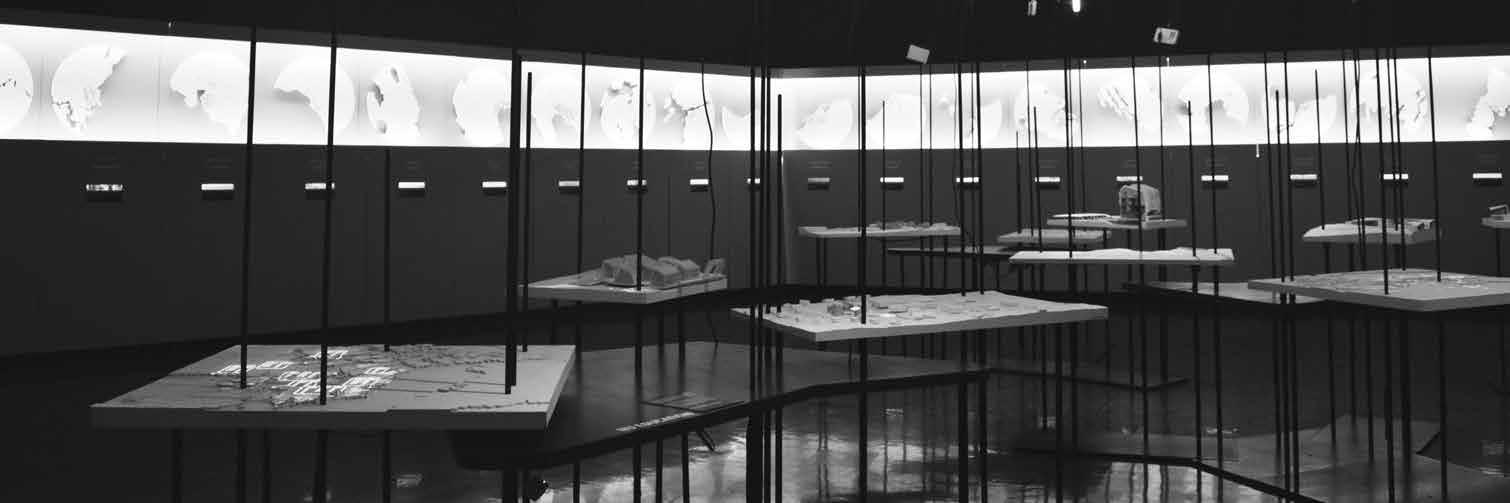
The present is illustrated around the contour of the room. Separate villages and communities are repre-
sented under moon-like pieces. To conceptualize what the village feels like, visitors can look into a slot and get, quite literally, a snapshot of the area. The photographs invite interaction, especially among younger visitors. The number of communities to see is another surprise. The Arctic is sometimes thought of as a place of little variation, or of little action, but the opposite is true – a feeling that resonates after visiting the exhibit.
Lastly, and most intriguing, is the future. Three dimensional models illustrating what the future holds for the Arctic in terms of education, recreation, housing, and arts populate the middle of the exhibit. The models are fascinating; they are entirely white, providing a background for the video projections above them. The cameras shine tiny snowmobilers and whales onto the models, bringing the vision to life.
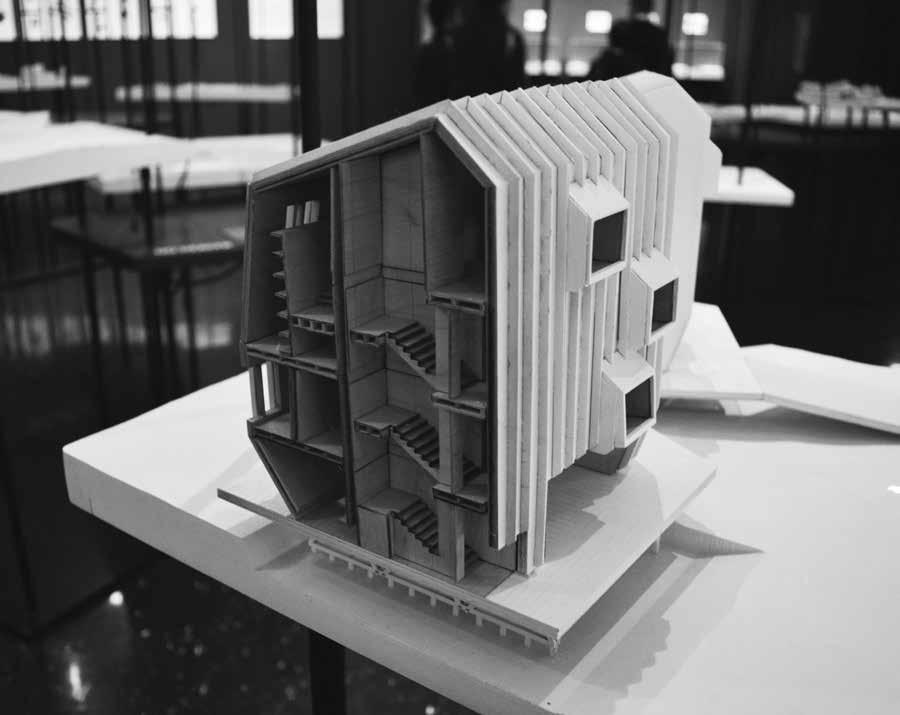
The intricate details of houses, roads, and lakes have a way of inviting imagination to fill in the spaces,
picturing the lives and activities that could happen there. Possibly the most satisfying model is the housing one, which includes a home cross-sectioned to show the rooms and stairs. In another section, a string of the same buildings is displayed along a river, illustrating what a neighbourhood might look like.
The exhibit is an excellent way to educate the city about what happens, and can happen, in the Arctic. It is an introduction for students of all ages to the complexity and dynamic nature of the Arctic; a vastly important lesson to teach to a generation that we hope will work towards resolutions. In addition, the beautiful minimalism is worth a look for art and design lovers.
Arctic Adaptations is on display at the WAG until May 3. Admission for students is $8.
photos by alana traChenKo
18 Cannes of commercial creativity
WAG screens encore of world’s best commercials
i an t.D. t hom S on, staff
hirty-second commercials
Tfracturing your favourite sitcom may not spark your imagination. However, this does not mean aesthetically-driven commercials are completely absent from television. In hopes to provide Winnipeggers with a taste of more pleasing and artistically astute advertisements, the Winnipeg Art Gallery (WAG) is presenting an encore screening of the Cannes Lions International Festival of Creativity on April 1, 2, and 4.
The Cannes Lions International Festival of Creativity is the world’s leading advertisement awards event. Held in Cannes, France the festival is a global happening for those involved in creative communications. The festival winners are selected from over 35,000 advertisement entries across 94 countries.
The awards are presented in 16 different categories, ranging from radio advertisement to health and awareness advertisements (such as promotion of medical applications and devices). This provides a broad spectrum of innovative commercials, each with different messages presented from different cultures.
The WAG presented the Cannes Lions International Festival of Creativity commercials in December. Previously, the gallery has only screened the festival in the spring but due to an earlier availability, the WAG was able to screen the popular event twice.
Selections from the show include both obscure and recognizable advertisements. Advertisements such as “The Old Spice Guy” by American brand Old Spice and the “‘Sorry I Spent it on Myself’ Gift Collection” by English department
store Harvey Nichols are screened at the event. Many of the commercials also deal with serious themes in the span of seconds, including Colgate’s “Close the Tap” commercial, presenting the importance of water conservation.
“Whether funny or serious, all the Cannes commercials start with an idea and work to creatively share that idea through visuals, words, and technology – and the WAG is the perfect venue to showcase these innovative works” – Tammy Sawatzky, WAG public relations co-ordinator
“Many are very poignant and deal with serious subject matters such as water conservation, drug abuse, and the ramifications of drunk driving,” WAG public relations coordinator Tammy Sawatzky told the Manitoban
“You will definitely laugh but you might also be close to tears, too.”
The WAG continues to provide
Misc. circles
Local songwriter circle presents workshop at the WECC
i an t.D. t hom S on, staff
SWinnipeggers with recognizable, yet innovative approaches to familiar concepts and creators. In September of last year, the gallery staged an exhibit, Dalí Up Close, on the Spanish surrealist. While most may be familiar to Dalí’s popular work such as “The Persistence of Memory,” the exhibit featured the artist’s later work, including many unearthed sketches and paintings.
The relationship between aesthetically-pleasing paintings like “Santiago El Grande” and straightto-the-punch marketing ploys may be seen as more of a stretch insofar as what constitutes “art.”
However, Sawatzky explained to the Manitoban the connection between screening the commercials and the WAG’s mandate to engage learning and inspiration through art.
“The festival believes creativity drives all things and the Winnipeg Art Gallery shares that belief,” said Sawatzky.
“Whether funny or serious, all the Cannes commercials start with an idea and work to creatively share that idea through visuals, words, and technology – and the WAG is the perfect venue to showcase these innovative works.”
The WAG presents the 2014 Cannes Lions International Festival of Creativity on April 1, 2, and 4. Tickets are $12 for WAG members, seniors, and students and $14 for non-members. They are available at wag.ca and the WAG (located at 300 Memorial Blvd).
ongwriting is not an easy process. Obtaining the necessary levels of musicality, rhythm, and sincerity in a song requires patience. This often leads to tedious and frustrating trial and error. In hopes of alleviating part of the struggle of the musical process, the Manitoba Independent Songwriters Circle (MISC) will be putting on a songwriting workshop at the West End Cultural Centre (WECC) on May 5. The Songwriters Circle was founded in 2001 and consists of budding songwriters who wish to improve their craft through interaction with like-minded peers.
Founding member and workshop facilitator Chris Freeman credits the circle with assisting his own writing.
“Before I started working with the circle, I wasn't writing that strongly. It's an indication of how the circle has helped me,” Freeman explained to the Manitoban Meeting the first Wednesday of every month, the circle is open to anyone who writes songs and is looking for constructive criticism.
Comments vary based on what is brought to the table by each songwriter.
“The meetings consist of everyone bringing a song and some lyrics, performing the song, and then getting feedback from the group about how to make it stronger, better,” said Freeman.
“Sometimes people give general comments and sometimes a person might ask for specific feedback on a certain area like melody, or lyrics, or structure.”
The songwriting circle partnered up with the WECC for the May 5 workshop. This is not the first time MISC has held sponsored workshops. Freeman cited workshops
where established songwriters such as James Keelaghan, Vance Gilbert, and Manitoba Hal have assisted in the learning process.
Freeman sees this songwriting workshop as another opportunity to gain greater insight for writers from their peers.
“The workshop we will be doing at the WECC this time is an idea I’ve had for a while. As a songwriter, I often find myself studying songs even when I am listening at parties, on the road, etc. and I learn a lot from paying attention to what others are doing in that way,” said Freeman.
“Also, as writers, sometimes we encounter writer’s block and we are trying to finish something but the ideas aren’t flowing.”
The workshop will be split into three parts. Writers will first have a chance to share one of their favourite songs with the group. After listening to the songs, the writers will have a chance to sit and work on a song idea or partially completed song. Finally, the songs created through the influence and ideas generated will be shared with the group.
“People can expect to learn some of the various approaches and techniques to writing a song from other songwriters, and as a group we will study the techniques used by various famous songwriters,” MISC board member Ian Chadsey told the Manitoban
The songwriting workshop will take place on May 5 at the West End Cultural Centre from 7 p.m. - 10 p.m. Registration for the workshop is $20.00. To register, email Manitoba Independent Songwriters Circle at manitobasongcircle@gmail.com
photo by matt duboff
photo provided by the WinnipeG art Gallery
Manitoban Art Competition
1st place Graphic
Kelly Campbell
1st place Photo Sponsored
Honourable mentions
Graham Wiebe
Jon Denby
Mike Villeseche
Trevor Smith
Editor: Mike Still
Battling on
Manitoba product Travis Hamonic’s hockey success inspired by late father
a n Dy Ch E , staff
ew York Islander Travis
NHamonic is one of the finest hockey players produced by Manitoba in recent years. Like many other NHLers, the St. Malo native took the junior route to professional hockey with a few conditioning stints along the way.
However, not all is what it seems. The 24-year-old may be a pillar on the blue line for the Islanders; however, behind the dream of wearing an NHL uniform lies a 10-year old boy who overcame an unforgettable nightmare.
Sept. 15, 2000 in the Hamonic household. Ten-year old Travis was awakened by his sister in the middle of the night, unaware of the commotion. Paramedics weare taking his father out of the house in a stretcher.
Speaking to E60, Hamonic recalled the painful memory.
“I remember rushing out of my room and at that point, my dad was getting stretched out. He couldn’t talk at that point, he just held out his hand and I remembered just grabbing it and they wheeled him away. That was it, that’s the last memory I have.”
At only 44 years of age, Gerald Hamonic died of cardiac arrest, leaving behind a family of four children. Still in elementary school at the time, Travis could not comprehend the situation and took refuge in the only way he knew how: playing hockey. Hitting the ice for two hours each day after school became his form of therapy.
2008. The Canadians returned home with a gold medal.
Although Hamonic’s numbers heading into his draft year seemed less than spectacular (22 points in 61 games), his attraction for the puck combined with a raw physical edge highlighted his energetic two-way play. On Draft Day 2008, the boy who had fought for his father every time he hit the ice became NHL property.
A projected third round selection, the New York Islanders drafted the 75th-ranked prospect at the 54th position.
By 2010, Hamonic had transformed himself from a slightly undersized, offensive-shy defenceman into one of the most dominant blue-liners in the WHL.
Having been omitted from the 2009 Canadian World Junior squad, Hamonic’s second bid at a position on the team for 2010 proved successful. He was amongst a group of Canada’s finest under the age of 20, and fighting a for a tournament record-sixth consecutive gold medal win.
Some NHLers play for the logo on their sweater; others play with their heart on their sleeve. For Travis Hamonic, every night is a battle dedicated to his father
Playing a shutdown role on that 2010 World Junior team, Hamonic and the Canadians reached the semifinal stage for the 12th consecutive year. In closing stages of their semifinal clash hosting the Swiss, Hamonic was crushed into the boards, suffering a separated shoulder.
three draft picks. Hamonic was on his way home.
By his mid-teens, Hamonic’s excellence on the ice had caught the attention of junior scouts. In 2006, he debuted in the Western Hockey League for the Moose Jaw Warriors at the age of 16. By his second season, Hamonic had blossomed into one of the CHL’s finest defensive packages.
His on-ice ability spoke volumes beyond his years, so much so that Team Canada rewarded his exceptional league play with a trip to the U18 IIHF World Championships in
He missed the thrilling gold medal game, which the U.S. clinched in overtime, ending Canada’s bid for a sixth consecutive first-place finish.
Hamonic returned to Moose Jaw with a silver medal. Despite the fact that the 19-year-old had his World Junior dreams shattered while wearing the maple leaf on his jersey, there was a silver lining in the making, just days after the 2010 gold medal game.
On Jan. 10, 2010, the Moose Jaw Warriors traded their point-per-game defenceman to the Brandon Wheat Kings in exchange for a prospect and
Speaking to the Wheat Kings media after the trade, he was very enthusiastic about playing just hours away from the community where he had developed from a boy into a man.
“I thought something would happen, but you never know how it will work out. But this is just one-and-a-half hours away from my home—really, it’s as close to home as I could possibly play—so that’s exciting. There are great guys
Underneath the dream of wearing an NHL uniform lies a 10-year old boy who overcame an unforgettable nightmare
on this team, and the team is really good. It’s great to have the chance to contend, and obviously with us hosting the Memorial Cup it’s a great opportunity,” Hamonic said.
If Hamonic had any intentions of staying in Manitoba for the long haul, his parent team New York Islanders had other ideas.
The very next season he turned pro with the Bridgeport Sound Tigers in the AHL. By November 2011, Travis Hamonic had become a full-time NHLer.
From St. Malo, to Winnipeg, to Moose Jaw, and now wearing the colours of the New York Islanders, Hamonic has endured countless transitions over the course of his hockey career. But one thing has never changed. Every time the Canadian national anthem is played, Hamonic whispers a prayer for his fallen father. Five years into the NHL, Hamonic is well on his way to assembling a successful professional career. Night in and night out, the fans dressed in blue and orange appear to salute their beloved Islanders. Some NHLers play for the logo on their sweater; others play with their heart on their sleeve. For Travis Hamonic, every night is a battle dedicated to his father.
GraphiC by bram Keast
The WHL and Winnipeg
Could the ’Peg support a junior team?
ryan St E lt E r, volunteer staff
We all know that Winnipeg is a hockey-mad market. The return of the Jets had the city in euphoria. The question is whether Winnipeg could support two hockey teams.
There is no doubt in my mind that it could be done. Every single city in Canada that has an NHL team also has a junior team.
Edmonton, Calgary, and Vancouver all have teams in the Western Hockey League (WHL), while Ottawa has the 67s, who play in the Ontario Hockey League.
Montreal also has a team playing in a nearby suburb, in the Quebec Major Junior Hockey League.
With the move of the St. John’s IceCaps to Winnipeg confirmed, the WHL dream might have to be put on the back burner.
Winnipeg Warriors were added as an expansion team but ultimately moved to Moose Jaw for the 1985-86 season.
The Warriors were moved because of attendance issues. They had to compete with the Jets. This is slightly troublesome because it may very well happen again.
The population of Winnipeg was hovering around 560,000 people at that time and the city was clearly not ready to support two teams.
“If there was to be relocation certainly from an Eastern Conference standpoint, our first priority would be Winnipeg” –Ron Robison, commissioner, Western Hockey League
However, with an AHL team coming back to Winnipeg, it could provide a good test to Mark Chipman and True North on the response of the move.
If Winnipeg can support both an AHL team and an NHL team, it would be a no-brainer to move a WHL team to the ’Peg.
The last time Winnipeg had a WHL team was in 1984, when the
I think the mentality of the Winnipeg market has changed. The overwhelming response when the Jets held their season ticket drive was incredible.
This city loves its hockey.
Take the Regina Pats or the Saskatoon Blades as another example. These are two WHL teams in the larger cities of Saskatchewan, and as of last season they were both getting 4,000-5,000 people at their games.
Saskatoon only has a population of around 250,000 people, and posting that kind of attendance is impressive. The SaskTel Centre in Saskatoon has a capacity of around 15,000 people, similar to the MTS Centre in Winnipeg.
Ron Robison, the commissioner
of the WHL, knows of Winnipeg’s potential. He said during last year’s WHL playoffs that, “If there was to be relocation certainly from an Eastern Conference standpoint, our first priority would be Winnipeg.” Winnipeg clearly has the backing of the commissioner, so it really is a matter of time before we see a WHL team in Winnipeg. There were rumours that True North Sports & Entertainment were in talks with purchasing the Kootenay Ice, but that deal fell through.
The Lethbridge Hurricanes have made it clear that they are having financial worries. They have lost a considerable amount of money in recent years, and all attempts to revamp that have been unsuccessful.
There is also Prince George, who finished dead last in attendance last year, posting an average of around 1,700 people. The Cougars have been in the bottom five of the league in that category since 2004-05.
Swift Current—the smallest market in the WHL, with a population
of around 1,500 people—has reported financial losses in recent years. But the Broncos aren’t going anywhere; they reportedly still have some financial stability, despite the losses. I believe we will see a junior team come to Winnipeg in the near future. The return of the AHL will only help Winnipeg’s case if the city shows its ability to support two professional teams.
Bison Briefs
Football and women’s hockey
m
Football recruits
The University of Manitoba Bisons’ football program has been busy during the off-season, as usual. After announcing the commitment of six promising recruits in early February, Manitoba was back at it again, signing three more talented athletes over the past month.
First off was Mike West, a versatile defensive end out of New Westminster, B.C., who committed to the herd on Feb. 22.
West attended Terry Fox High School, a Triple A program in Port Coquitlam, B.C., ranked one of the top 50 high school football programs in the nation by Canada Football Chat. The six-foot-four, 215-pound senior played all six skill positions during his time with the
Ravens, demonstrating tremendous athleticism.
Offensively in 2014, West had 350 yards rushing on 47 carries, to go with seven rushing touchdowns. He also hauled in 18 catches for 549 yards, which equates to a whopping 30.5 yard average per reception. Defensively, he added 27 tackles at the end position.
For his efforts, West was named 2014 B.C. High School Triple A Player of the Year. He was also a member of the Ravens’ championship squad in Grade 10, and received the MVP award when Terry Fox High reached the finals yet again the next year.
On March 18, two more local standouts announced their commitment to the Bisons. Offensive line-
man Braiden Watson and defensive back Brenden Cowan were added to the mix.
Watson, a Miles Macdonell grad, played the last three seasons with the Winnipeg Rifles and was named both a PFC All-Star and CJFL All-Canadian this past year. The six-foot-three, 275 pound lineman also attended the Winnipeg Blue Bombers rookie camp in 2014. Cowan, a Plumas, Manitoba native, played for Neepawa in the Rural Manitoba High School Football League. The six-foot-three, 197 pounder was all over the field, spending time at the quarterback, receiver, and defensive back positions. This past year, Cowan had over 1,700 all-purpose yards, and totalled 18 touchdowns.
Pre-season football at IGF
March 18 was a monumental day for Bison football. Along with the commitments of Watson and Cowan, Manitoba also announced the first ever CIS pre-season football game at Investors Group Field.
On Saturday, Aug. 22, Manitoba will welcome the Guelph Gryphons of the OUA to town. Guelph had a strong 2014 campaign, finishing as OUA finalists, before falling 20-14 to the McMaster Marauders in the Yates Cup.
The Bisons haven’t played a nonCanada West opponent in the preseason since the 1990s. Prior to the upcoming matchup, Manitoba had faced Guelph twice in the pre-season – in 1991 and 1973.
Sharman named CIS Rookie of the Year
Alanna Sharman’s stellar rookie season continues to garner her recognition. On March 11, the Canada West’s leading scorer was named CIS women’s hockey Rookie of the Year. Sharman became just the second Bison in the program’s history to win the award, with Caitlin MacDonald being the only other in 2009-10.
Sharman’s 40 points in 28 conference regular season games placed her at the top of the conference and gave her the honour of being just the third rookie in the Canada West’s 18-year history to win the scoring title.