GRAPHICS EDITOR Emma Gillich graphics@themanitoban.com
GRAPHICS ASSOCIATE Teegan Gillich
AUDIO AND VIDEO
AUDIO EDITOR Max Reid audio@themanitoban.com
PHOTO EDITOR Mike Thiessen photo@themanitoban.com
PHOTO ASSOCIATE Ebunoluwa Akinbo
VIDEO EDITOR Zulkifl Rafah video@themanitoban.com
DIGITAL MEDIA EDITOR Faisal Rahman social@themanitoban.com
SOCIAL MEDIA ASSOCIATE Paula Robles Andia
REPORTERS
NEWS Arifah Gheesah
NEWS Nafisa Al Lilo
RESEARCH & TECHNOLOGY Nawal Semir
COMMENT Thandeka Katsika
COMMENT Kyra Campbell
ARTS & CULTURE Carrington Dong
ARTS & CULTURE Jordan Anglin
SPORTS Faiyaz Chowdhury
SPORTS Israel Abejoye
VOLUNTEERS
VOLUNTEER STAFF
VOLUNTEERS
interested in volunteering?
email me@themanitoban.com today!
The Manitoban is the official student newspaper of the University of Manitoba. It is published monthly during the summer and each week of regular classes during the academic year by the Manitoban Newspaper Publications Corporation.
The Manitoban is an independent and democratic student organization, open to participation from all students. It exists to serve its readers as students and citizens.
The Manitoban is a member of the Canadian University Press, and our journalistic standards can be found on the Manitoban’s website.
The newspaper’s primary mandate is to report fairly and objectively on issues and events of importance and interest to the students of the University of Manitoba, to provide an open forum for the free expression and exchange of opinions and ideas and to stimulate meaningful debate on issues that affect or would otherwise be of interest to the student body and/ or society in general. The Manitoban serves as a training ground for students interested in any aspect of journalism.
Students and other interested parties are invited to contribute to any section of the newspaper. Please contact the appropriate editor for submission guidelines.
The Manitoban reserves the right to edit all submissions and will not publish any material deemed by its Editorial Board to be discriminatory, racist, sexist, homophobic or transphobic, ableist or libellous.
Opinions expressed in letters and articles are solely those of the authors. Editorials in the Manitoban are signed and represent the opinions of the writer(s), not necessarily those of the Manitoban staff, Editorial Board or the publisher.
A “volunteer staff” member is defined as a person who has had three volunteer articles, photographs or pieces of art of reasonable length and/ or substance published in the current publishing year of the Manitoban
Any individual who qualifies as a volunteer staff member must be voted in by a majority vote at a Manitoban editorial board meeting. Elected representatives and non-students may be excluded from holding votes as volunteer staff members in accordance with the Manitoban Constitution.
U of M Indigenous studies celebrates jubilee anniversary
50 years of education, community and impact, tracing roots to student activism
Roy Albright Obah, staff
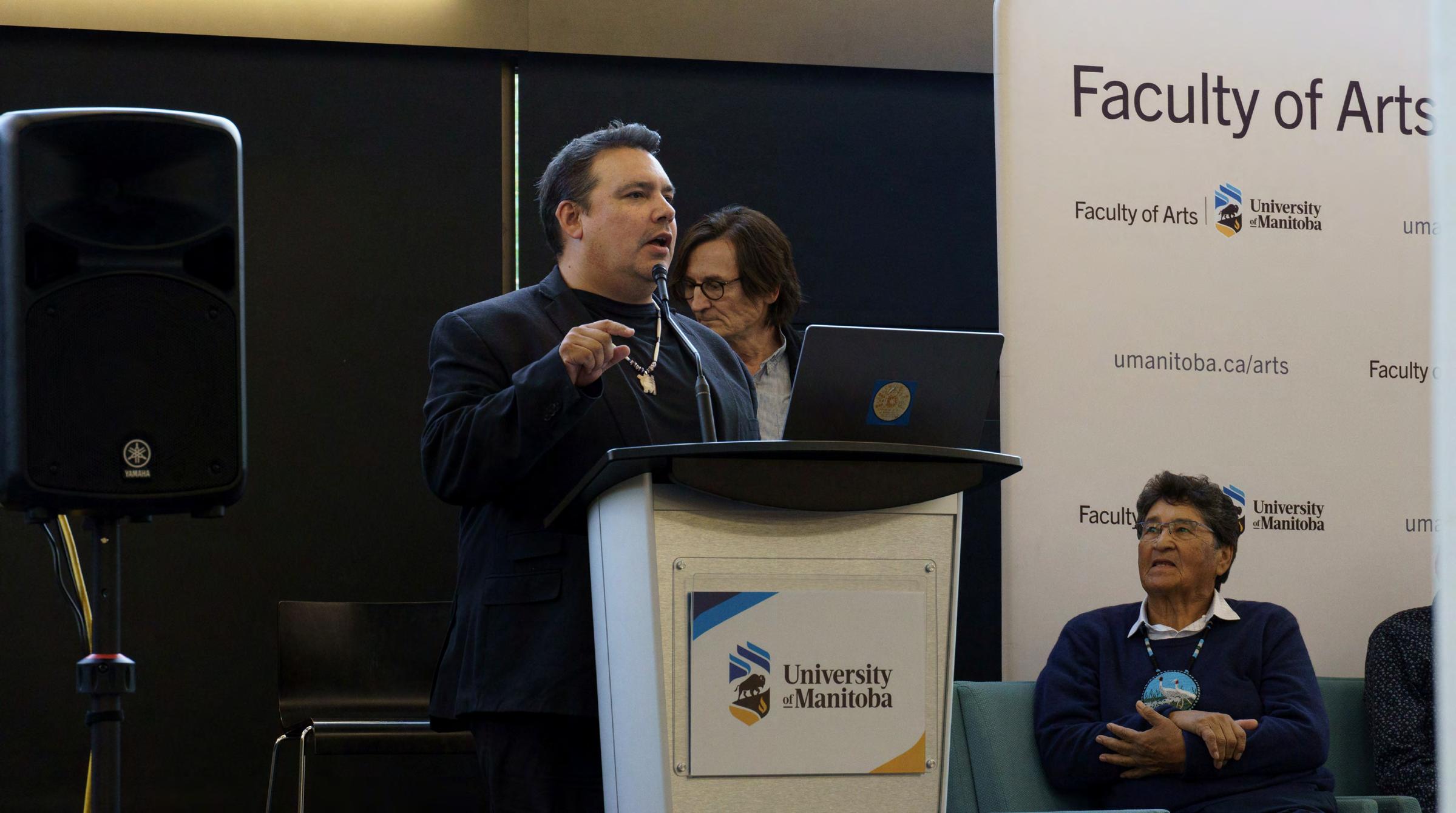
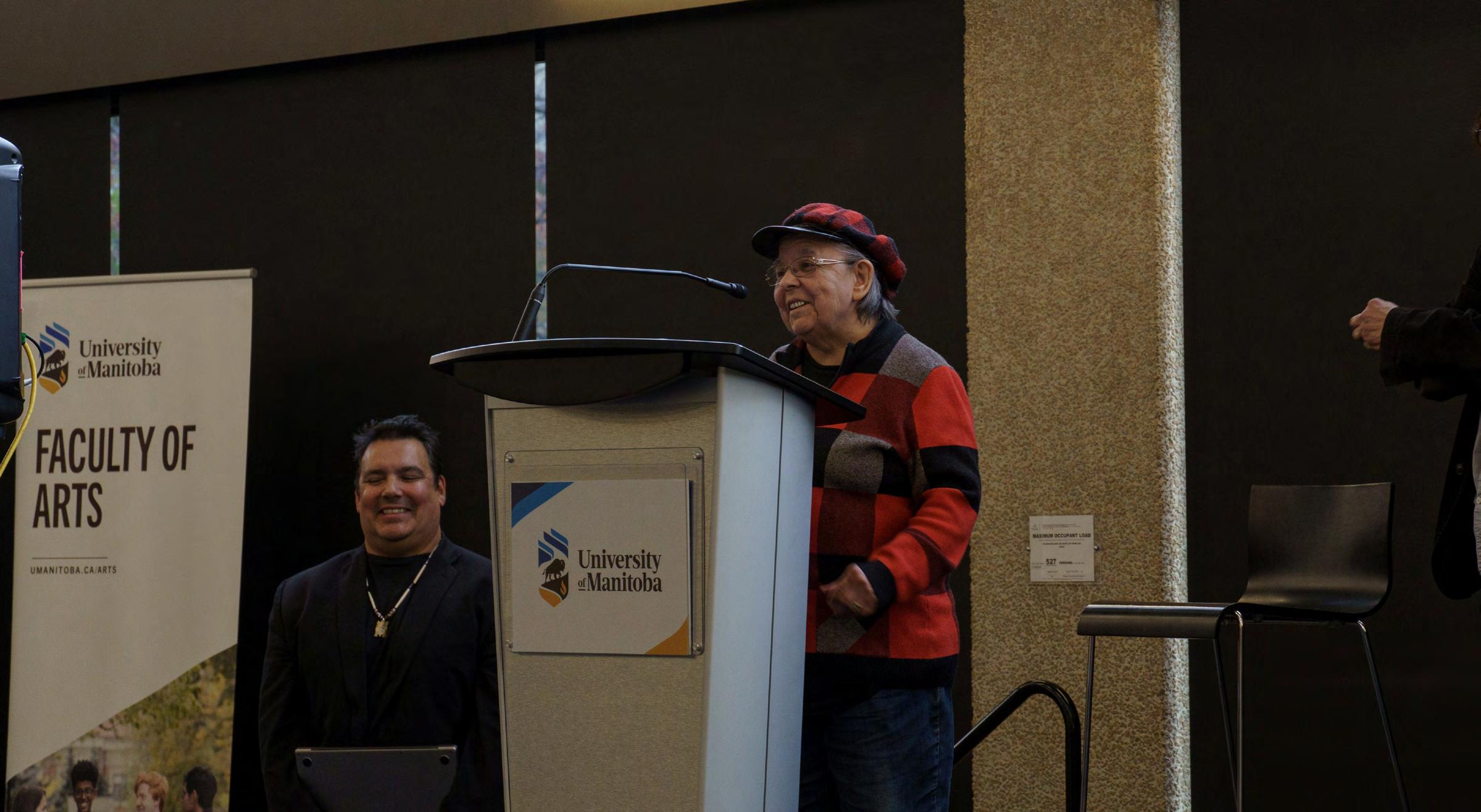
The U of M’s department of Indigenous studies celebrated its 50th anniversary on Oct. 15 at Marshall McLuhan Hall. The event brought together faculty, alumni and students to honour five decades of Indigenous excellence, academic impact and community-building.
The gathering was an opportunity to both reflect on the past and reconnect with those who helped shape the department’s journey over the years. Founding members of the Indian, Métis, and Eskimo Student Association (IMESA), formed in 1971, were among the honoured guests.
Edwin Jebb, one of the original members of IMESA, shared that the formation of the association came during a time of strong social movements on campus. He said Indigenous students at the U of M faced racism on campus and believed that education was one of the best ways to challenge it. “We wanted to push for an Indigenous studies program. That way, we would educate the world and educate other students so they would have a better understanding of our people,” Jebb said.
Muriel Houle, an alumna of the Indigenous studies program, expressed her hopes for the department’s future. “I hope to see something new. As I was coming to U of M, I was very excited to take [a course on] my own language, and I know that was a recent development through a lot of hard work,” she said. “I love this community, and I really hope I can continue to be part of this community going forward.”
Encouraging new students to participate, Houle added, “Join the community, join the clubs, [there are] lots of opportunities […] I was [in] lots of clubs last year and it helped [me] build a family on campus.”
David Parent, an assistant professor of Indigenous studies and history, spoke about the importance of community engagement for Indigenous students. He said, “I would encourage you to get involved […] in your communities, in your nations, and always give back.” He also cautioned about the risks of disengagement, noting that it leaves the responsibility to individuals who do not have the lived experiences of Indigenous people, which can lead to “problematic frameworks.”
Lydia Gork, a Métis PhD
student, said the department’s interdisciplinary approach was key to her academic path. “I found that the department of Indigenous studies was the perfect fit for my research because of its interdisciplinary nature and the way that it privileges Indigenous knowledges.” Gork noted that her studies allowed her to “bring my family’s Métis knowledge into the academy […] to help challenge existing histories that have dehumanized Métis people.”
Niigaanwewidam Sinclair, a professor of Indigenous studies, former head of the Indigenous studies department and a current colum-
nist for the Winnipeg Free Press, surveyed the immense impact of the department’s alumni. “[At the department] you have seen people who have changed lives, published the most groundbreaking books, you have seen people who have done incredible contributions to Indigenous communities at the grassroots level,” he said. “Many of our students go on to become chiefs, or counsellors, or doctors or lawyers,” he added, citing the Grand Chief of Manitoba as a former student.
For Sinclair, this evidence demonstrates “that Indigenous studies is not only a critical part of this university,
but it’s really a critical part of the province.” The department’s work, he explained, has formed a critical foundation. “It has formed the basis for so [many] of the relationships we now know between Indigenous peoples and Canadians.”
Sinclair concluded by defining the department’s enduring legacy. “The legacy of Indigenous studies is really about building the country but also building the sovereignty […] of our First Nations, Inuit and Métis communities.”
The event also honoured Emma LaRocque, Indigenous studies professor and
author of the influential 1975 book Defeathering the Indian, for her contributions to the department. Sinclair was also honoured for his 2024 publication, Wînipêk. Indigenous student enrolment at the U of M grew by 10.7 per cent this term, increasing from 2,933 students in fall 2024 to 3,248 in fall 2025. This growth highlights the university’s continued dedication to reconciliation and Indigenous excellence, and reflects the confidence Indigenous students place in the U of M as a meaningful part of their academic path.
PHOTOS BY ZULKIFL RAFAH / STAFF
Islamic Heritage Month in Manitoba
Celebrating faith, contributions and justice
Arifah Gheesah, staff
he month of October
Tmarks Islamic Heritage Month (IHM) in Manitoba, a time to recognize the history, culture and contributions of Muslims across the province.
The legislation, outlined in Schedule 32.1 of the Statutes of Manitoba, acknowledges the growing Muslim community and its social, economic and political impact. This month serves as both a celebration and a reminder of the ongoing fight against Islamophobia.
On Oct. 30, the Esplanade Riel bridge and the Winnipeg sign at The Forks will be lit green, celebrating the growth and unity of Manitoban Muslims and the wider Manitoban community, a reminder of how deeply connected our lives have become.
Throughout the month, several events are being held across Winnipeg to celebrate
and educate. Some highlights include Celebrating Muslim Women’s Contributions: Past and Present on Oct. 25, hosted by the Islamic Social Services Association (ISSA) and the Canadian Muslim Women’s Institute; Celebrating Muslim Youth Volunteers on Oct. 26, organized by ISSA and Winnipeg Central Mosque; and Healing Across Centuries — Muslim Physicians at the Forefront on Oct. 29, hosted by the Muslim Medical Association of Canada. The U of M Muslim Students’ Association (UMMSA) is also planning an event during the first week of November.
Hussein Chokr, an executive member of Students for Justice in Palestine at U of M, said, “We are called to remember that our heritage is not only one of faith, art and knowledge, but also one of justice, compassion
and unwavering resistance to oppression.”
He added that Muslims have “a legacy of standing with the oppressed.”
“Islam taught us that faith without justice is incomplete,” Chokr said, connecting IHM to broader struggles for justice, including the ongoing struggle of Palestinians. “In their steadfast, we see the spirit of Islam — the refusal to surrender one’s dignity no matter how great the hardship.”
Chokr also reflected on the teachings of Imam Hussein, which show that the stand for justice transcends time.
“Our fight for justice doesn’t just stop at Palestine […] From the Indigenous people of Canada defending their lands, to the Black Lives Matter movement, to women demanding safety and dignity, to students calling for divestments from occupation and apartheid
— as Muslims, our heritage aligns with all of these struggles.”
Ayesha Sultan, current executive member and immediate past president of UMMSA, as well as current universities and schools coordinator at Islamic Heritage Month Manitoba (IHMM), said she joined the committee because she wanted “to amplify Muslim voices and to celebrate their contributions that they have [made] within our communities.”
For Sultan, IHMM is an opportunity to apply what she has learned through her leadership at the U of M. “Over the years, my time at university and living in Canada as well, I learned a lot about Muslims and their impact in Manitoba, and across the world,” she shared. “At the same time, unfortunately, being part of university and in
general, I have seen that there are challenges that Muslims face, either being underrepresented, or overlooked. That made me even more determined to be part of [IHMM].”
“This is just the first year of our committee. It’s really exciting to help lay the foundation,” Sultan said. “I really hope and pray it will grow and even make a greater impact in the coming […] years, for more youth, and elderly, and everyone, to learn from.”
Islamic Heritage Month is a reminder that there is so much we can learn from one another. By celebrating faith, contribution and justice, Manitobans are invited to grow together, share experiences and strengthen the bond that makes our community strong.
Women’s Centre hosts Pro-Choice and Protesting 101
Student-led event to educate peers on reproductive rights and engaging in activism
Nafisa Al Lilo, staff
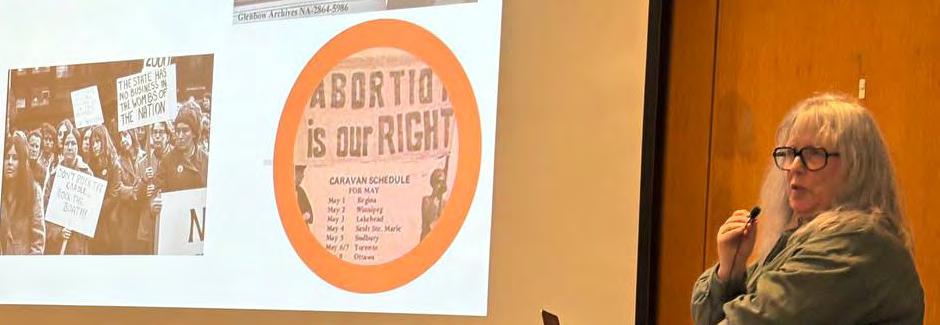
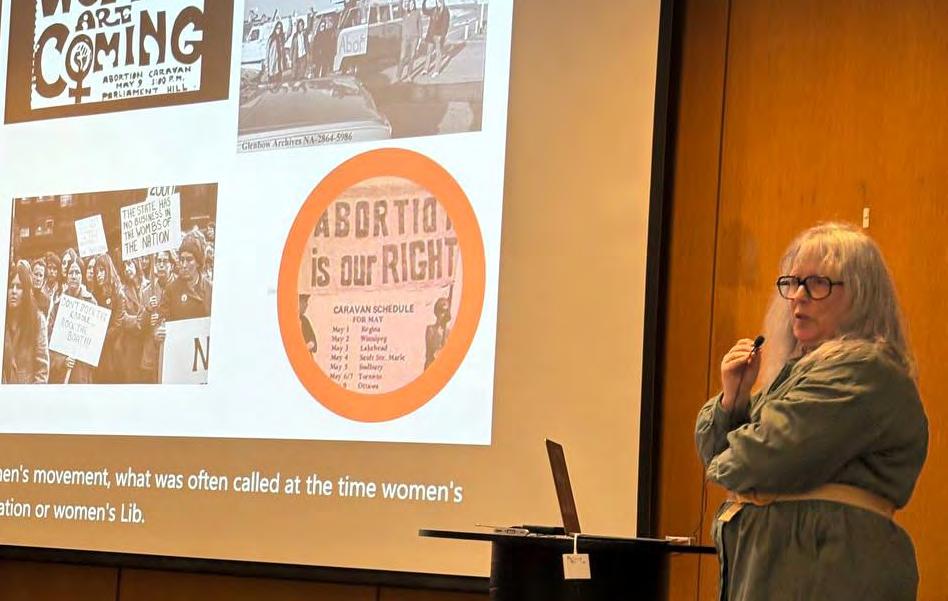
Students filled the John A. Russell Building atrium at the U of M on Oct. 15 for ProChoice and Protesting 101, an event designed by UMSU’s Women’s Centre to educate students and community members about reproductive rights, protest safety and community advocacy.
Leata Goulet, the event’s intiator and UMSU women’s representative, said the idea came from witnessing anti-abortion demonstrations on campus.
“For a long time now, the anti-choice group has always made their way onto our campus, pushing their so-called ‘pro-life’ agenda with extremely triggering and false images,” said Goulet. “Last year, I was a part of the Women’s Centre team and [helped plan] the counter-protests, especially in March where they were here for four days in a row.”
Goulet stated that those experiences inspired her to take an active leadership role.
“After that week, and after I knew that I was going to be the next [UMSU women’s representative] I knew that this [was] something I had to take a role on.”
Goulet outlined that the university’s neutral stance on this topic has made it challenging to restrict anti-abortion protests on campus.
“They are legally allowed to be here, so it is quite difficult, especially since the university is neutral on this stance.”
The idea for pro-choice education came in June, after Goulet joined a virtual
meeting with student leaders across Canada who have faced similar issues.
“They really recommended putting together an educational event,” said Goulet.
“To not only show support to our community through counter-protesting, but [show] support through actually trying to reach out and educate people about the importance of these [reproductive health] services.”
The evening brought together both campus and community organizations,
‘Toban news briefs
Jesse Brogan, staff
Tax exempt system for churches in Canada is under consideration
Parliament’s Finance Committee’s 2025 prebudget report proposes two measures that could impact faith-based charities. This change could revoke charitable status for pro-life groups and eliminating “advancement of religion” as a ground for tax exempt registration. This is a change urged by the B.C. Humanist Association. If adopted in the next federal budget, religious organizations could lose tax exemptions and the ability to issue donation receipts, and if the provinces also follow the change, it could mean the loss of property-tax breaks as well.
First Nigerian Muslim mosque opens in Winnipeg
Winnipeg’s Nigerian Muslim community opened its first mosque, Al-Haqq Masjid, at 500 Dovercourt Dr. in Whyte Ridge on Saturday. The new mosque is fully funded by local donors through the Al-Haqq Prayer Group of Canada. The mosque and resource centre will host worship, education and community programs open to all faiths. Leaders, including community member Titi Tijani and Imam Yunusa Salami, said they discovered rapid growth in the Muslim population in Manitoba and it’s important to have a new area to accommodate the growing community.
including the Women’s Health Clinic, the Centre for Human Rights Research, the Social Justice Hub, UMSU and the Sexuality Education Resource Centre.
Beyond advocacy, the event also emphasized calm and respectful dialogue.
“One of my goals for counter-protesting [this year] is to have more calm conversations with these people,” said Goulet. “[That’s] why I brought in the Social Justice Hub […] to talk about the importance of trying to use
your words properly in a conversation and to not always be so defensive.”
For Goulet, being prochoice is ultimately about showing respect to others.
“There is no harm in being pro-choice,” said Goulet. “Every human should be able to make decisions about their own body and about what they want their future to look like.”
“When abortion is accessible, it happens less often and women don’t die as much or get injured as much,” said
Goulet. Her message to students is simple — education and empathy go hand in hand.
“We’re seeing people’s human rights being taken away across the world right now, not only just about abortions, but in many different ways, and this is a very basic right that people should be able to have,” said Goulet.
“If you want to support women, you should support their right to make their own choices about their bodies and what they want to do with their own lives.”
Premier Norquay biography wins prestigious award
The J.W. Dafoe Book Prize named its 2025 winner — The Honourable John Norquay: Indigenous Premier, Canadian Statesman by U of M professor Gerald Friesen. Published last year, the biography pulls from family-preserved letters in the Archives of Manitoba to fully bring to life Norquay’s premiership and character. Friesen said the honour is a “remarkable validation” after a decade of work.
New Indigenous language bachelor’s degree programs
Two Manitoban institutions will launch Indigenous language bachelor’s degrees
in January 2026. The University of Winnipeg will offer an Anishinaabemowin (Ojibway) immersion BA and University College of the North (UCN) will create an Ininimowin (Cree) BA. The province is contributing $4.5 million for the development of these projects, of which $2.3 million will go toward U of W’s program and $759,000 will go toward UCN’s program. $1.49 million out of the province’s contribution will be used to develop a new Centre for Aboriginal Languages and Culture at UCN. The programs are in alignment with the Truth and Reconciliation Commission’s calls to action and hopes to develop Indigenous language teachers.
Manitoba arts and culture generates $2 billion
A new Manitoba Arts Council (MAC) report says arts and culture generated $1.75 billion in 2023, which equates to about 3 per cent of Manitoba’s GDP and 20,000 jobs. Two thirds of Manitobans through a survey said arts is a vital part of their well-being and support government funding. Live music, museums and festivals topped the list as respondents’ favourites, and the survey showed roughly half of respondents attended an event last year. Nearly half of respondents said they do not view the sector as economically important — a perception MAC and Probe Research say needs to change.
PHOTO BY NAFISA AL LILO / STAFF
ADELE PERRY, DISTINGUISHED PROFESSOR AND DIRECTOR OF THE CENTRE FOR HUMAN RIGHTS RESEARCH, SPEAKS AT THE
Understanding capitalism’s impact on the environment
Exploring how social and economic systems shape our relationship with nature
Mansura Akter Meghla, staff
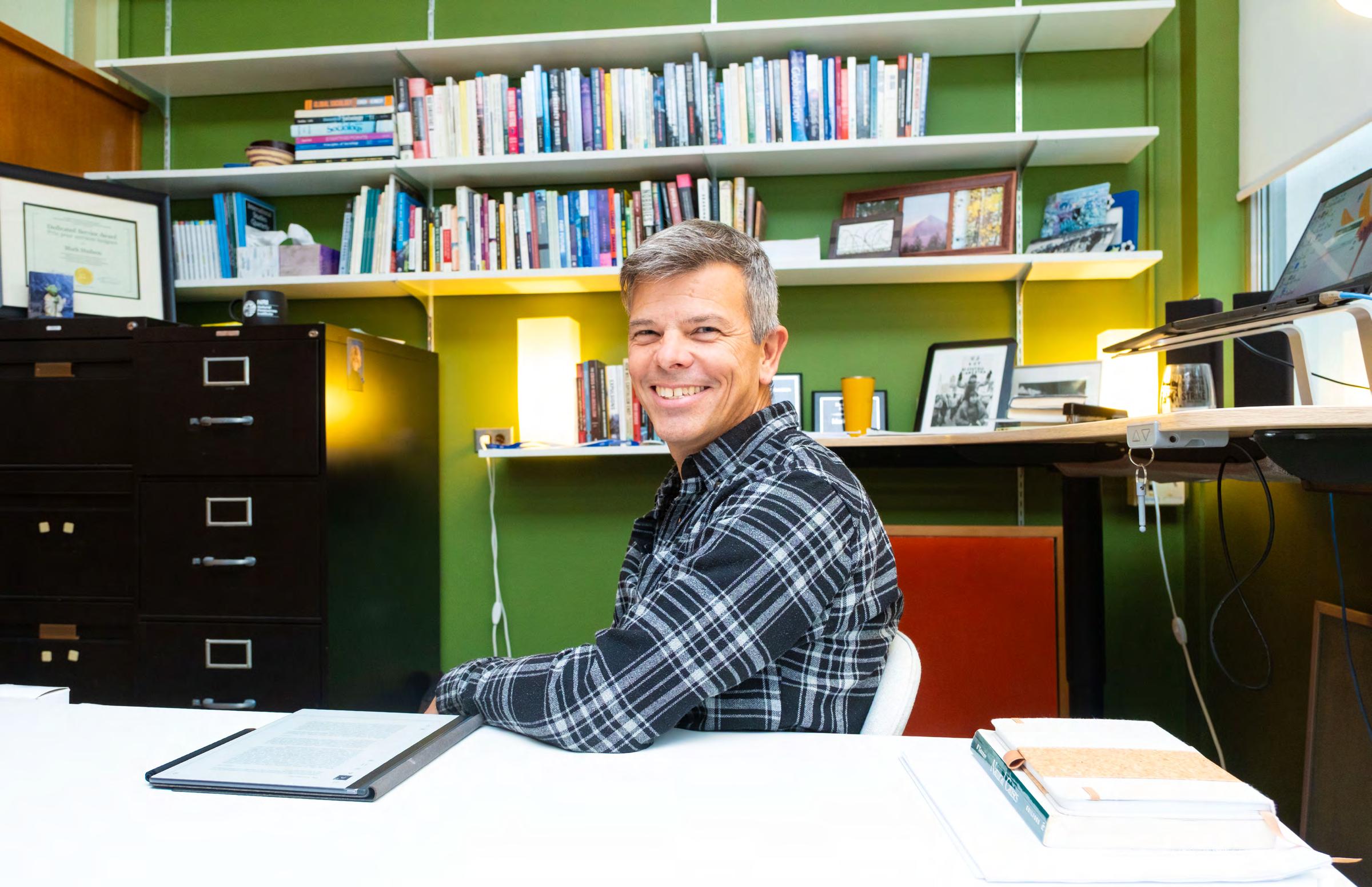
M ark Hudson, a professor in the department of sociology and criminology at the U of M, studies how social structures and political economies influence the way people relate to the non-human world. His research has taken him from coffee farms in southern Mexico to union halls in Manitoba, examining how work, trade and politics shape both human and ecological systems.
Hudson’s work connects environmental sociology, labour and political economy — fields that often intersect in global climate discussions. His research stems from observing how capitalist economies have intensified environmental degradation.
“Our relationship with the non-human world is in a critically bad state,” he said. “In critical areas like climate change, biodiversity and nutrient cycles, all signs point toward a worsening of the situation, perhaps beyond critical tipping points.”
His interest in environmental research began while working as a tree-planter in British Columbia. “Walking the vast clearcuts, thinking about the labour of the loggers and my own labour planting monocrop, even-aged tree farms […] got me more interested in this work,” he said. That experience led him from economics to an interdisciplinary master’s in environmental studies.
Hudson recently co-authored a report on Alberta’s coal phase-out alongside research assistant Khatereh Salimi, an MA student in sociology. The project examined what happened to nearly 3,000 coal workers affected by the province’s plan to end coal-fired energy generation by 2030.
“We wanted to get rich accounts of what happened in people’s lives, rather than statistical results about re-employment,” Hudson said. Most participants found themselves in similar or better situations after transitioning out of coal production, though many still faced social and financial strains.
about how to support workers through what all of the climate science tells us is an absolutely necessary phaseout of fossil energy,” he said. Hudson’s broader goal
“Our relationship with the non-human world is in a critically bad state”
—
Mark Hudson, professor in the U of M’s department of sociology and criminology
According to Hudson, the challenge now is ensuring that climate policy aligns with justice for workers, before the window to act closes. “We need to be thinking seriously
is to reframe climate politics. According to him, much of today’s climate politics remains overly reliant on elite-driven solutions — whether those are political negotiations, techno -
logical fixes like carbon capture or market-based incentives for renewable investment. While such efforts may play a role, Hudson noted that history offers little evidence they can meet the scale of the crisis. Instead, he hopes his research shifts focus toward people-led action.
“If we want a liveable planet, it will need to be built by the 99 per cent,” Hudson said. For him, the fight for environmental sustainability and workers’ rights are deeply interconnected as they are “rooted in the same soil.”
Currently, Hudson is returning to research on wildland fires — the subject of his PhD and first book. He plans to spend part of his upcoming sabbatical in Finland and Sweden to study how societies can live with fire, rather than seeking to eliminate it entirely. Hudson wants students to “have really good mental health supports, and build or join a community of critical but supportive colleagues.” He also encouraged students to look beyond surface explanations. “Always take the extra step to move from people’s values or beliefs to […] investigate where they came from.”