

Editor-In-Chief: Craig Adolphe
Contact: Editor@themanitoban.com

Editor-In-Chief: Craig Adolphe
Contact: Editor@themanitoban.com
CRAIG ADOLPHE, STAFF

BY
As of this past fall term, student fees paid to the Manitoban have gone up from $4 to $6 a semester.
A proposal was put forward by the Manitoban to the University of Manitoba Students’ Union (UMSU) in late 2014 to increase per-student funding to be comparable to other student papers in the province, thus enabling an increase in staff wages and an increase in the number and calibre of services provided by the paper.
The increase was passed by the UMSU council in February 2015 and by the university’s board of governors in June.
As was stipulated in the original UMSU motion, the additional fees have been held in trust by UMSU until a new contract could be signed to update the relationship between the student union and the Manitoban Newspaper Publications Corporation, the non-profit which publishes the paper. While the terms had been settled in late 2015, it wasn’t until Jan. 19, 2016 that representatives of UMSU and the Manitoban were able to sit down and finally sign the new contract.
The additional fees are already increasing pay for reporters, associates, and editors as well as services to students, but it’s important that readers understand why.
Staff wages have been stagnant for years – prior to this month reporters’ weekly pay had only increased by $5 over 10 years – and staff have historically been drastically underpaid. While we do recognize our role as a learning paper and open forum for students to volunteer and get involved in a casual capacity, the number of hours and intensity of work that staff put into production justified a pay increase.
We’re also trying to provide increased services. That means more content and more resources dedicated towards our online presence, which is an increasingly popular format among our readers, who are primarily U of M students. As we’ve previously announced, we’re making a push to put up new content online every day and are making greater efforts to reach students through social media. We’ve hired additional reporters to ensure we can adequately cover campus news, research, arts, and athletics while also making plans to provide increased coverage of the Bannatyne and inner city campuses.
A $2 fee increase may not be a huge difference for each individual student, but it will give us a major opportunity to improve the quality and scope of our coverage. We will strive to make the difference tangible in our final product as we continue to put out a
paper of substance every week of the school year.
While the reasons behind the Manitoban ’s proposed fee increase were very practical, there’s also a more abstract value in having a strong student press. That is, having a functional alternative model we can look to in producing the news.
This past week Postmedia, the media giant that owns the National Post as well as a number of the country’s most popular regional newspapers, fired roughly 90 journalists, announcing plans to merge the newsrooms of the Sun chain of newspapers with other prominent Postmedia dailies: the Ottawa Citizen, Calgary Herald, Edmonton Journal, and the Province (based in Vancouver). In each of the four affected cities two papers will share a newsroom and editorial board.
Postmedia is also moving to centralize all of their sports coverage to come through a single desk in Toronto.
It’s an unhealthy dynamic, this shrinking number of voices in our news media. The remaining voices are increasingly corporate ones, as we saw when it came time for papers to announce their editorial endorsements for the 2015 election.
There may soon come a day where we recognize Canada’s media crisis for what it is and plan to rebuild.
When we do, it’s important that we have a model we can look to. Something local, something funded by and produced by members of the community. If at that point people can look to student media as a functional alternative (in terms of structure, if not scope of coverage) to the status quo that is corporate, debt-leveraged, Toronto-based media conglomerates, then we might have a chance.
Thanks
A few people deserve special thanks for their work towards the funding increase.
I had the pleasure of working on the proposal with former editor-inchief Fraser Nelund. Developing the proposal, motion, and sharing a vision for the project and future of the paper was a great adventure. I’m extremely proud to be able to oversee the changes that came of a project we started together.
Former UMSU president Al Turnbull has by his own admission had a tense relationship with the Manitoban – a dynamic that is likely true for most any UMSU president. Despite his own disagreements with the paper, stemming from cover-
age during his time as president, he saw the value of the Manitoban to the campus and had the strength of character to push for the motion in both UMSU’s finance committee and UMSU council. I remain in admiration of his willingness to put personal differences aside and champion the motion after deciding that it was the right thing to do.
Last year’s UMSU council heard our request (and the motivation by Turnbull) and had the foresight to see what we could do with the additional funding and what value that would produce for students. Collectively, I’d like to thank them for hearing our presentation and passing the motion brought by the finance committee. Lastly, and most importantly, I’d like to thank U of M students for supporting the Manitoban. Not only with your student fees, but as readers and writers. This paper is made for and by U of M students and the U of M community: this is your paper. Those of us who are lucky enough to work here for a couple of years can only do our best to produce the finest possible paper and keep you informed and entertained. We thank you for the opportunity.

EVAN TREMBLAY, STAFF
If you have Facebook, you know that David Bowie is dead. News of his death spread quickly through that lowest common denominator of communication, and lingered on in print newspapers like the stench of a dead body, for a good week. This stench was well-exemplified by an article in the Winnipeg Free Press: “Free Press writers remember a legend.” We get it – someone famous died, and that’s always a good way to sell newspapers.
Every time a celebrity dies, we are more likely to hear of the death of other, less noteworthy celebrities. The press gives the people what they want, and if Bowie can only die once, than they can at least inform us that Celine Dion’s husband has passed on. We see quite quickly that the headline being sold is not news of a noteworthy passing; it is simply “Death!!!”
The slew of status updates and newspaper stories tells us more about ourselves than it does Bowie; it says more about our relationship with celebrity, and death, than it does about his music. Or rather – it might, if we were willing to learn from the experience. We always react to death with surprise. Somehow, it’s never anything less than a tragedy.
Our cultural fascination with
celebrity speaks to the emptiness of our own lives which, rather than examining and confronting, we replace with the experience of a glamour not our own. Our fixation on the “tragedy” of a celebrity death (no matter how great their contributions in life, no matter how much we like to think they created their art just for us) is not a virtue. It is a symptom of a culture that does not like to think about death. Those who accept death as natural love life; those who love life do not waste theirs in the adoration of others’.
Our fixation on the “tragedy” of a celebrity death is not a virtue. It is a symptom of a culture that does not like to think about death
Interest in, or even borderline worship of, celebrities is not in and of itself bad or unnatural. Humans desire to attach themselves to some-
thing greater than themselves, to set up stars on the horizon they can move towards and live their lives by. But those stars were once deathless; they were totems, saints, gods, unchanging platonic ideals. We fear death, but we chose things that must surely die within our own lifetimes to idolize. We set ourselves up to suffer. It is natural to be wary of that “undiscover’d country, from whose bourn no traveller returns.” But it is also natural to make our peace with this. Where North American culture is most dominant, we find celebrity culture most prominent. And there we surely find near-omnipresent (though rarely spoken of; that would, somehow, be a weakness) the gnawing fear of death.
This cultural deficiency of ours is not a thing to be passed over. Most of our celebrities are getting on in years (and we continue to add people to the list of celebrities), and if we continue to place importance on their deaths (and we will tend to, if the media continues to make a big fuss over them), the public ritual of lamenting celebrity death will soon become as continuous as it is empty of meaning.
JILL PATTERSON, STAFF
In a recent CBC interview, Howard Sapers, the Correctional Investigator of Canada, outlined some of the most recent statistics on prison populations and incarceration rates in Canada. They show dramatic increases in the number of Aboriginal people incarcerated in Canada, which can only be described as proof of the systemic racism inherent in our country’s judicial system.
Twenty-five per cent of the incarcerated population in federal correctional facilities are of Aboriginal ancestry. In the Prairie provinces, this rises to 48 per cent. When looking at Aboriginal women independently, over 36 per cent of women in Canadian prisons are of Aboriginal ancestry. To put this into perspective, Aboriginal people made up 4.3 per cent of Canada’s population in 2011 (the year of the last census).
These numbers are staggering, but even more so when compared to the statistics from previous years. Thirty years ago, only ten per cent of inmates were Aboriginal people.
Although the population of Aboriginal people in Canada has been growing, the Aboriginal population in Canadian correctional facilities has been growing at a far more rapid rate than that of the general population. There remains a strong sentiment among Canadians that rac-
ism no longer exists in Canada, and that the social and economic situation of Aboriginal people in this country is far better than it used to be. It may be true that there is more awareness of the social marginalization of Aboriginal people in this country, but I would argue that the statistics outlined above show that the level of social exclusion of Aboriginal people certainly has not improved significantly over time – nor is it moving in that direction.
This past May I was fortunate enough to hear Sapers speak at a critical criminology conference in Ottawa where he reiterated what he has been saying for several years: the treatment of Aboriginal people by our criminal justice system is far worse – and far more discriminatory – than that received by non-Aboriginals. One statistic he cited was that even among the prison population, Aboriginal people are subject to the most and longest stays in correctional segregation (i.e. solitary confinement). The treatment of Aboriginal people by our criminal justice system, and our government more generally, can be attributed to a lack of recognition of (or willing blindness to) the impact of residential schools. Contrary to what most people may believe, these effects are still very much present today.
The recently released Truth and Reconciliation Commission report shed new light on the effects that residential schools continue to have today.
Justice Murray Sinclair, the commission’s chair, said that “the legacy of residential schools and government actions towards indigenous people since Confederation is staggering. Every social condition measurable in Canadian society places Aboriginal people at the most disadvantaged position of all people in the country.”
Much has been written about the social circumstance of Aboriginal people in Canada and my goal is not to reiterate what many people already know – that Aboriginal people are marginalized. There is still much that needs to be done, and perhaps we have not come as far as we think. What I find most problematic is the sentiment shared by many in Canada that there are too many “handouts” for aboriginal people and that it is time for them to help themselves. The recent incarceration statistics show that systemic racism and intergenerational trauma is still present.
I would, however, like to remain optimistic that at the very least there is more awareness of these issues and that this will lead to change. The new Truth and Reconciliation Commission report is a testament to this growing awareness, and an

example of the acceptance of the lingering trauma produced by the historical abuse of Aboriginal people. Hopefully the popular saying “the night is always darkest before the


JEREMIAH YARMIE, STAFF
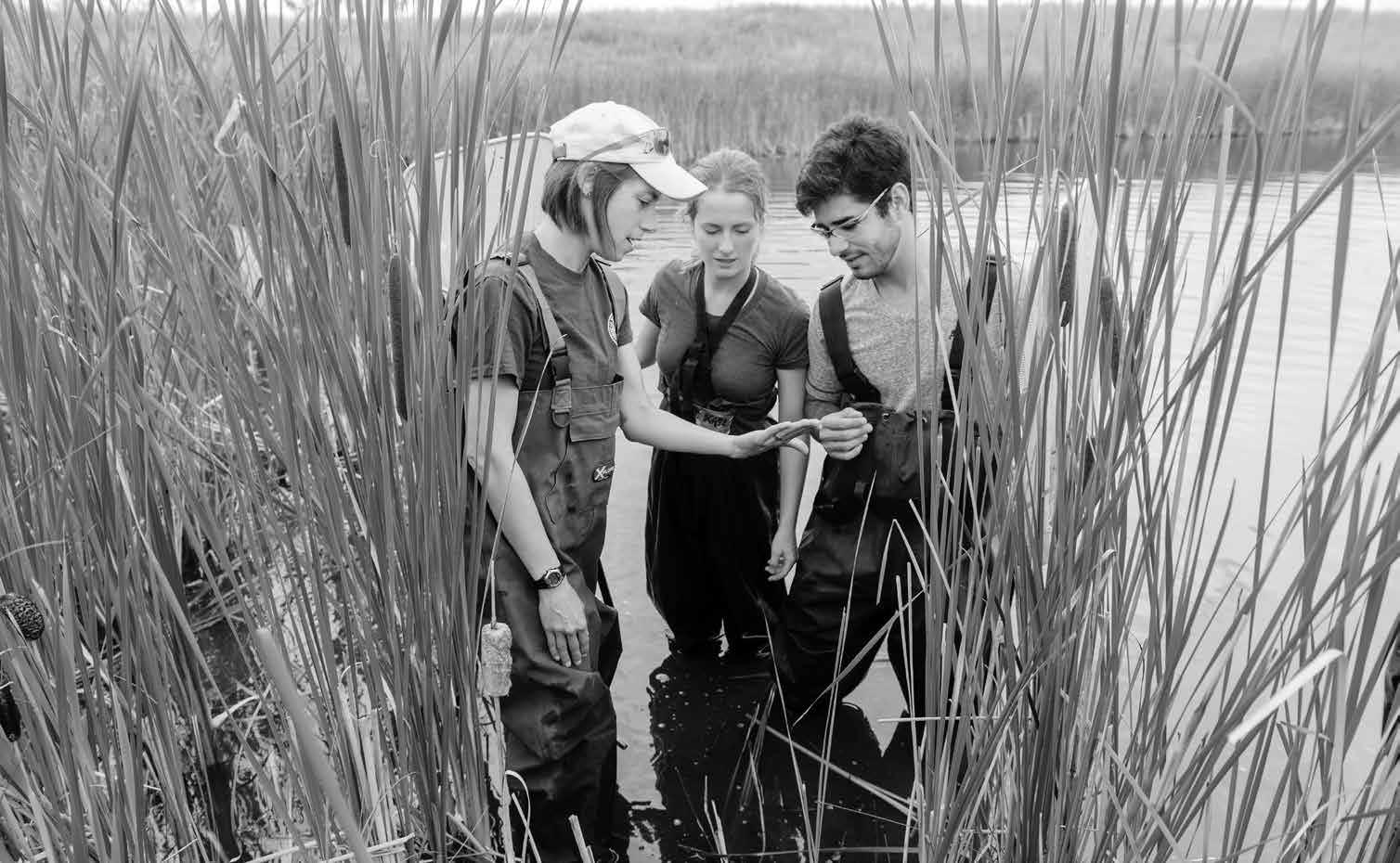
Jillian Detwiler is an assistant professor in the department of biology at the University of Manitoba. As an evolutionary ecologist, Detwiler researches host-parasite interactions.
“My research focuses on the impacts of host ecology on parasite distributions – especially the distribution of parasite genetic variation,” Detwiler told the Manitoban
Her lab looks at flatworm parasites with complex life cycles – while they use mammals and birds as their final hosts, the parasites require intermediate hosts like snails, amphibians, and even larger worms to survive.
Parasites with complex lifecycles are very different from “specialists” –parasites that are highly adapted to a specific host. Detwiler’s lab looks into the biological benefits of being either a “generalist” (less dependent on a specific type of host) or a “specialist.”
“We’re actually finding that some parasites are using more than one snail species as their intermediate host, which is exciting because it goes against the paradigm in the scientific literature,” said Detwiler.
Her lab combines field and benchtop molecular work to create a unique research experience.
“We couldn’t have one without the other,” said Detwiler. “For me, evolution and ecology happens in the field – it’s ground zero.”
She completed her undergraduate studies at the University of Nebraska, where she initially majored in piano performance.
How does a music student become
a parasitologist?
“As a music major, you had to take one science class. I didn’t want to just take intro biology, so I convinced my adviser to let me take a class called biodiversity,” said Detwiler.
Her biodiversity professor asked all of his students to come to his office to talk to him for five minutes – just to get to know his students a bit better.
“I walked into his office and he had pictures of parasites everywhere, copies of covers of the New Yorker, watercolour paintings [...] He started talking to me, and he said, ‘Oh, you’re a music major. You should come work in my lab,’” said Detwiler, as she began to laugh. “I said, ‘Really?’ and he was like, ‘Yeah!’”
How does a music student become a parasitologist?
Her future supervisor said her work ethic, drive, and creativity as a music major would translate well to science – especially having perseverance when troubleshooting problems.
“Of all of the places I could have gone to university, I went there. There were other sections of that class and I just happened to have picked him.”
“A lot of the other professors on that campus would have never recruited me, and I needed to be recruited,” said Detwiler.
Detwiler eventually decided to do
a double major in music and biology.
She also received a master’s degree from the University of Nebraska before moving to Purdue University in Indiana for her PhD.
Detwiler has a couple of favourite parasites, like any parasitologist should. The first is the Dicyemida.
“They’re so weird: they don’t have excretory, digestive, nervous, or circulatory systems,” said Detwiler.
Dicyemida are found parasitizing the kidney-like appendages of cephalopods like octopuses. Not only are they weird, but they have a cool host.
The second is the pentastome.
Pentastomes are odd because they are endoparasitic crustaceans, which means they are found inside the bodies of their hosts. Most parasitic crustaceans are exoparasites, and found on the host’s surface.
Detwiler has even found pentastomes inside the lungs of geckos in Texas, where she did a post-doctoral fellowship at Texas A & M University.
One of the only fossils of a parasite is of a pentastome. The fossil dates back to the Cambrian period – about 400 million years ago.
In the past, Detwiler has called New York, Colorado, Ohio, and South Dakota her home.
When asked about her favourite things about Winnipeg, she said, “The people I have met here are great – my neighbours, my colleagues, and my students.”

JEREMIAH YARMIE, STAFF

Amajor cause of male infertility is the production of sperm that are unable to complete the long, arduous journey to the egg. They’re not strong swimmers.
the tail of individual sperm. The head of the sperm sticks out the front and is secured by a noose-like ring.
The motor is controlled by a magnetic field to maneuver it around a sperm cell. Once the sperm are strapped in, they are directed towards their destination by rotating magnetic fields.
This isn’t the first time the research group – led by Oliver Schmidt – has made the news with their robotic sperm
spermbot is very similar to the sperm tail, which is used to swim.
The sperm still provide most of the propulsion with their tails, but the spermbot adds that extra oomph that the little gametes were missing.
Immotile sperm are not necessarily bad – their genetic information is often just as healthy as the information found in strong swimmers.
To ensure that the poor swimmers they captured were healthy in every other sense, the researchers used a viability test that causes the tails of healthy sperm to swell.
placing microscopic metal cylinders onto the heads of bull sperm, which were directed around with similar magnetic fields.
The spermbot is attractive because it has the potential to be used in vivo – sperm would be directed through the uterine cavity and oviducts to allow for fertilization inside of the human body.
Using this technology would be an attractive alternative to artificial and in vitro fertilization methods, which have their own limitations. There would be less risk to an embryo which has to be transferred back into the uterus after culturing.
Enter the spermbot, an invention of German scientists from the Leibniz Institute for Solid State and Materials Research and the Chemnitz University of Technology that acts like a powered-up flutterboard. Published in the American Chemical Society journal Nano Letters, their study details how the spermbot works, as well as preliminary studies of it in action.
The spermbot was carefully designed to avoid sharp components that could kill the sperm cells.
The spermbot is a microscopic helix-shaped motor that fits around
In the nanotechnology world, micromotors often take the shape of the natural machines they aim to replace. The helix-shape of the
The researchers were able to successfully capture weak swimmers and move them towards an egg in an experimental set-up. Once the sperm had arrived at the destination, they were easily released by reversing the magnetic field that is used to rotate the spermbot.
This isn’t the first time the research group – led by Oliver Schmidt – has made the news with their robotic sperm. In 2013 they developed a rudimentary spermbot prototype by
The spermbot hasn’t been perfected yet. The researchers found that the microscopic motor would often become permanently stuck to the sperm cells. As well, the researchers do not currently have a way of monitoring a spermbot as it travels through the reproductive system.
MALAK ABAS, STAFF

Recent studies have shed some new light on why almost dying feels like it does, but it’s not what you might think.
The study on the link between near-death experiences and cardiac arrest explains that the heart and the brain make unusual connections when your brain believes it’s about to die, and that it might be a lot less beneficial than it feels.
Further studies show this flash of feelings might be detrimental to the patient’s chances of surviving
Near death experiences sometimes occur when an individual is facing impending death. Usually the experience is characterized by unusual sensations such as warmth, calmness, sensing the presence of a light, or outof-body detachment.
What happens after you die?
Accounts of people who have escaped death seeing white lights, passed-on family members, and green fields have been the center of debates concerning the existence of the afterlife for decades.
However, science says the process may go like this: your heart slows down, even stops, and your blood stops flowing. Your brain panics and starts an intense and erratic burst of hormone activity.
Some of the hormones include dopamine, the feel-good hormone you get when you keep a healthy exercise regimen or become a drug addict, amongst other things.
Another is norepinephrine, which bumps up your heart rate and makes you very aware. This mixed bag of hormones is pretty euphoric, and it very well might be a scientific answer to many claims of feeling peaceful or even joyful just before being resuscitated.
While this is all well and good, further studies show this flash of feelings might be detrimental to the patient’s chances of surviving.
A study performed by the University of Michigan medical school using rats showed that these brain signals synchronized with the rats’ heart rhythms. Blocking these brain signals, however, actually turned out to delay ventricular fibrillation, also known as an uncoordinated heartbeat, which is the most common arrhythmia in heart attacks – so, in a way, delaying death.
Would a similar attempt to recreate the blockage of hormones in humans reduce cardiac arrest fatali-
ties? Does this prove that “walking towards the light” is our brain’s way of comforting us over our impending death?
Aside from raising compelling questions about the mystery of the afterlife, these findings could eventually greatly improve the relatively poor chances of surviving a cardiac arrest.
Up to 40,000 cardiac arrests happen every year in Canada, and approximately 20 per cent of cardiac arrest survivors report having a neardeath experience
Up to 40,000 cardiac arrests happen every year in Canada, and approximately 20 per cent of cardiac arrest survivors report having a neardeath experience. This research could lead to information that may enable more patients to survive heart attacks. In the meantime, the question of what happens after death is one of the most divisive ones on earth.
MALAK ABAS, STAFF

For the first time in over 10 years, there will be five planets simultaneously visible to our naked eye. For the rest of January, and up until around Feb. 20, early risers will
get to see Saturn, Mercury, Venus, Jupiter, and Mars aligned.
The rarity of this occurrence stems from the fact that, due to their dissimilar rotation times, it is very rare for all of these planets to be on the same side as the sun. The orbit time of each planet varies from days to years. The last time the planets aligned was in December 2004.
Here’s how to experience it in the best way possible: set your alarm to an hour or so before sunrise, as this gives you time to get ready, psych yourself up a bit, and get to an ideal viewing spot. Your best chance of getting a clear view will be in an area with as little light pollution as possible with a clear view of the southeast horizon. Then look up. It’s that easy.
Randy Attwood, executive direc-

tor of the Royal Astronomical Society of Canada, also recommends bringing a star chart, which can be downloaded online.
For the rest of January, and up until around Feb. 20, early risers will get to see Saturn, Mercury, Venus, Jupiter, and Mars aligned
Jupiter will be visible late at night. Mars will appear at about 2 a.m. Within the next few hours, Saturn
and Venus will become visible. These should all be relatively simple to make out. Mercury will most likely be a bit more difficult, as it appears close to sunrise, and is close to the sun. Bring binoculars if you have them, as some planets will be brighter than others.
While the planets will be visible for the entire month, their level of visibility will vary. Kelly Beatty, senior editor of Sky and Telescope, recommends that if you are planning a specific time to check it out, do so around the last week of January to the first week of February. This is because Mercury will appear brightest to us at that time.
If you miss out, don’t be too disappointed. All five planets will be visible again this year, from Aug. 13 to 19. However, the planets will have found
themselves on the other side of the sun, meaning people will be able to see them just after sunset, rather than before sunrise. The planets will not be aligned, and Mercury and Venus will be less visible.
So try and get out there now, if you can. Getting a peek at what exists beyond our planet is a pretty exhilarating experience. Life is too short to sleep in, especially when you could be viewing another part of our solar system instead.










It's a Date Part 2



SEAMUS HAMILTON-PATTISON, STAFF

O
n Thursday, Jan. 28, the UMSU 2015-16 Speaker Series will bring renowned Canadian entrepreneur Arlene Dickinson to speak in the “fishbowl” area just off of the Drake Centre’s atrium. The event is free of charge and open to all U of M students.
Dickinson, best known for her eight-year term on the Canadian edition of popular business reality show Dragon’s Den, has extensive business experience and is worth an estimated $80 million.
In addition to her former television duties, Dickinson remains the
CEO of large independent marketing service Venture Communications and the founder and CEO of YouInc, an online company dedicated to helping all entrepreneurs learn and grow in the business world.
“Ultimately, the goal we had in mind was to bring in a wide variety
of speakers that touched upon different topics, and Arlene was one that immediately came to mind,” UMSU’s vice-president student services Jessica Morrison told the Manitoban
“We got her because – in having her in mind so early – we were able to seek her out and find what timeline worked best. She was always someone that we did want to bring in.”
Dickinson will be speaking primarily about the idea of “achievement.” According to Morrison however, the discussion should hopefully be driven by the input of students as well.
“We want to give students the opportunity to ask her questions based on her story and based on her experiences, so the floor is really open to them to chat with her about what they would like to hear her speak on,” said Morrison.
Morrison went on to explain that it’s easy for young adults to identify with an entrepreneurial show such as Dragon’s Den due to the focus it places on contestant’s personalities, as well as their products.
“A lot of the folks that you see coming on Dragon’s Den – they’re
not only selling this product, idea, or concept, but a lot of the time they have a personal story to share alongside it,” Morrison explained. “I think, for us as young people watching the show [...] we can identify with what it is they’re selling. Whether it’s their personal story, whether it’s their product, their concept, their idea, and I think we’ll definitely hear a lot of that come through when Arlene comes to speak.” Morrison stated that although she can’t announce any names just yet, UMSU is currently working on arranging the next Speaker Series event for a date in late March or early April. The event will feature a speaker to coincide with the U of M’s “sustainability week.”
To learn about Arlene Dickinson and her businesses, visit www.arlenedickinson.com, www.venturecommunications.ca, or www.youinc.com
TOBI NIFESI, STAFF

Over the next three months, students with a flair for writing will have the opportunity to be advised by the seasoned Canadian writer, Jeanne Randolph.
This winter term, the University of Manitoba’s Centre for Creative Writing and Oral Culture will be hosting Randolph as their new writerin-residence. Randolph is more than just a writer; she is a cultural theorist and psychoanalyst whose career spans over 30 years.
Randolph said she had decided upon a career very early in life, even before she fully understood what that career would entail.
“Well, I am an odd duck. When I was in grade two, down in the
swarms of Texas, I decided that I was going to be a writer. I did not even know what that meant,” Randolph told the Manitoban
“It became very clear, as I got my training with a psychoanalyst, that what I really meant by ‘writing’ was to be a writer who is a cultural critic.”
Randolph’s most recent book, Shopping Cart Pantheism, is a satirical take on consumerism and religion.
Randolph has written eight books and several journal articles. She has also contributed to a number of monographs and exhibition catalogues for artists like Vera Frenkel and Ian Carr-Harris.
Her books – which include Psychoanalysis and Synchronized
Swimming (1993) and The Ethics of Luxury (2008) – are narratives that are loosely based on cultural and psychoanalytic theories. However, Randolph believes anybody can easily relate to them.
“My writing has almost a surreal idiosyncratic narrative flair to it [...] I am really fascinated and dedicated to how the mind works, and how ideas get scrunched up in the mind,” said Randolph.
“I am not drawn to narrative of human predicaments. I am drawn to ideas and images and ambiguities so people can read in between the lines.”
“Some of the things I write are just daffy and fun, and the connection with psychoanalysis will be that they have a free consciousness to them such that the theory does not present itself out front.”
As a cultural theorist, Randolph is most interested in consumerism, technology, mass media, and other pop phenomena. That being said, Randolph believes writing is her first and foremost obligation – one she cannot do without.
“I would say that I am obsessed or possessed; I must write. I must think about ethics, technology, mass media, consumerism, and advertising. Those things are forever my feeding ground. Nothing would stop me from writing,” said Randolph. Randolph, who is also a performance artist, believes that literary
writing is an art. Every artist has a creative niche from which they draw inspiration. For Randolph, her inspiration comes from her ability to refine existing imageries and ideas.
“I would say that I am obsessed or possessed; I must write. I must think about ethics, technology, mass media, consumerism, and advertising. Those things are forever my feeding ground” – Jeanne Randolph
“I am a driven person. I am a thief. I will take an image and idea from anybody and metabolize it. That is mostly where I draw from.”
She believes it is important for writers to broaden their scope and be easily influenced, as this will enhance their creativity. This will be the focus of her weekly workshops at the Centre for Creative Writing and Oral Culture.
“The thievery of looking around, listening, distorting a phrase they have read somewhere, the ability to loosen up and take those things in like an amoeba would take in a grain of something, I encourage that.” During Randolph’s workshops, she will use her knowledge of psychoanalysis to get the most out of students and make them better writers.
“[Writers should] not try to be so correct. I have always said that psychoanalysis is a form of portrait painting [...] That means it is fair game for anything you want to do creatively,” said Randolph.
“Follow your curiosity.”
In addition to working on students’ creativity during her residency, Randolph is interested in editing written pieces and helping student writers efficiently express themselves in their writings.
For a free meeting with Jeanne Randolph, contact her at ccwocwir@ umanitoba.ca or at 204-480-1067. Her office hours are Mondays and Tuesdays from 10:30 a.m. to noon. You can also attend one of her weekly workshops, held each Wednesday from Feb. 3 to March 23 (with the exception of Feb. 17, which occurs during Reading Week). She will be in residence through to the first week of April.
Experimental music festival celebrates 25th anniversary with multimedia events, daring collaborations
OLIVIA MICHALCZUK, STAFF
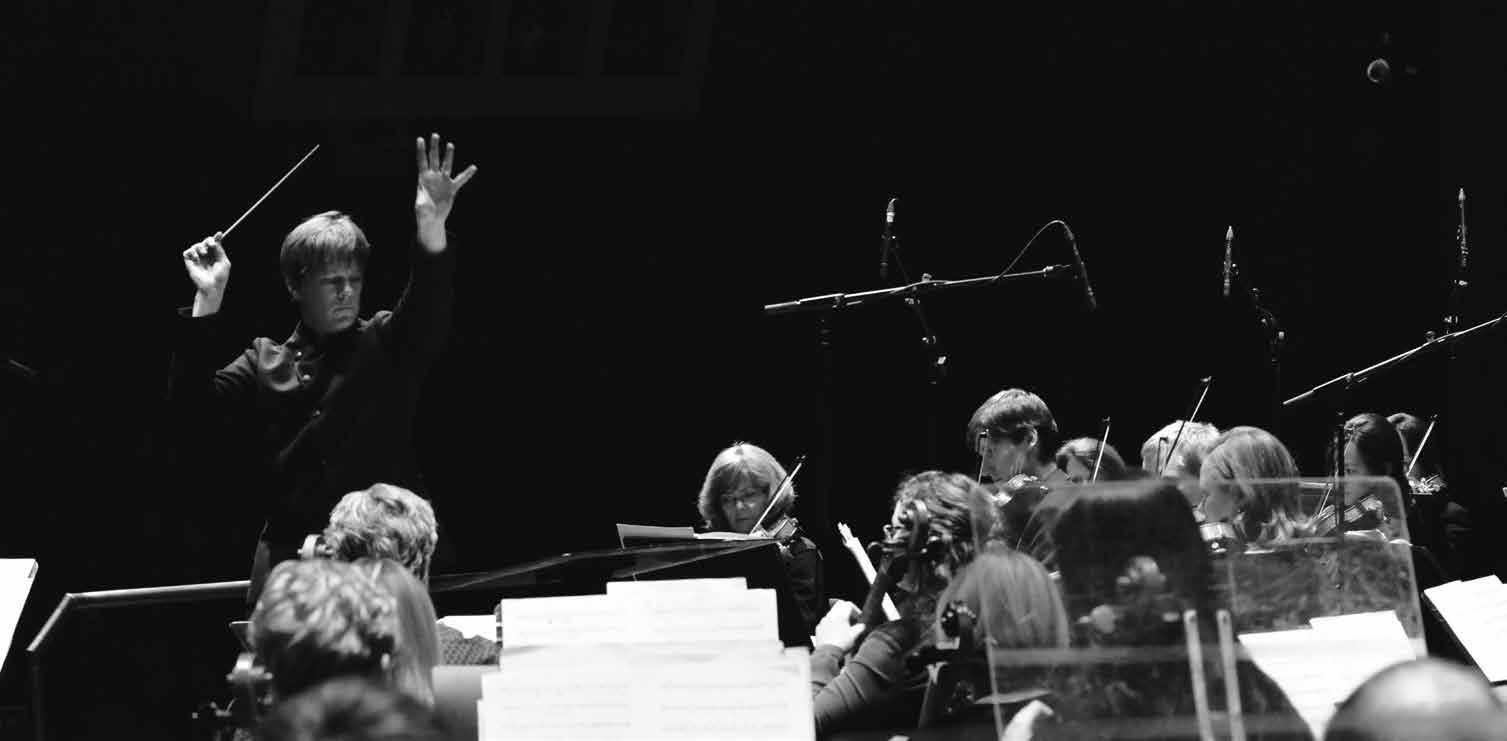
Winnipeg’s New Music Festival (NMF) is turning 25. To celebrate their anniversary, the local festival will be hosting many exciting events popping up at various venues across the city from Jan. 23-29.
In 1989, Bramwell Tovey was appointed to the position of music director for the Winnipeg Symphony Orchestra (WSO). Tovey had a widespread knowledge of Canadian music and energy that was matched by the WSO’s first composer-in-residence, Glenn Buhr.
Together, they focused their enthusiasm and enterprise for music into launching the first NMF in 1992. Buhr will be returning to the NMF this year to celebrate the quartercentury anniversary of the widely acclaimed festival by debuting some new music of his own.
Since the festival’s inception, many contemporary composers –both in Canada and abroad – have come to Winnipeg to share their music with the open and receptive audiences of NMF.
“It’s one of a kind, at least in North America,” current WSO music director Alexander Mickelthwate told the Manitoban
“There is no orchestra [that has performed] in our 25 years that also has seven consecutive nights of living composers. It’s something extremely special and internationally recognized, so from that angle it is very unique.”
Micklethwate’s journey with the NMF started 10 years ago, when he was chosen as conductor of the WSO.
“For two or three years, I was looking and guest conducting different orchestras from Honolulu to
Winnipeg to Nashville, and it’s like a blind date, but for one person to choose 80 people,” Mickelthwate said of finding the orchestra he would be best suited to conduct.
“Here it felt good, they picked me and I picked them. That was 10 years ago. Then I realized they had this fantastic festival, and I became part of this whole endeavour.”
Though classical music may seem a little out of the musical taste of many, the festival is meant to push the boundaries of conventional views of the genre
This year, there will be several acts that push the conventional boundaries of going to the symphony. One of the featured performances this year is the So Percussion quartet, which will be playing pieces by David Lang, Steve Reich, and Bryce Dessner.
So Percussion’s performances are especially unconventional because of their instrument selection. The quartet makes music on everyday percussive objects such as tin cans and corked wine bottles, even making their own actual instruments on occasion.
“It’s always really fun to work with percussion,” said Mickelthwate, explaining that So Percussion was
chosen based on the receptiveness to similar acts in the past, as well as their unique talents.
Another stand-out event will feature members of the WSO at Pan Am Pool. The event, titled Music and Trauma, features the performance of composer Gavin Bryars’s The Sinking of the Titanic with the Winnipeg Synchronized Swimming Club and Sistema Winnipeg Choir to add to the multimedia performance.
Members of the WSO will be perched on Pan Am Pool’s fixed diving platforms, playing above the pool. U of M Symphony Orchestra cellists Andre Washington, Leandro Salterelli, and Yaxin Sun will be included in the musical performance.
With outside of the box performances come challenges and additional artistic considerations, said Mickelthwate.
“We’ll dim the pool lighting, we’ll have some blue lighting, and dry ice. We don’t really have any rehearsal time because it is a public pool, so they will be shutting it down in the afternoon to set it up. It will be quite exciting for everyone how it will turn out.”
Mickelthwate highlighted some of his favourite performances throughout his involvement with the festival.
“We had works where instruments were not only on the stage, but in the balconies, so we were surrounded. I was surrounded by instruments. There was one composer – John Corigliano – from New York, and he wrote a piece, ‘Circus Maximus ’ It was a really powerful piece, and we were all surrounded by sound.”
Mickelthwate told the Manitoban
“Also, when we had movie director
Jim Jarmusch. He did Down by Law and several other really cool independent films. We were workshopping an opera of his, and it was, for me personally, really exciting.”
Among this year’s performances, one of the highlights is sure to be Stephen O’Malley in both his solo show at Union Sound Hall and his collaboration with the WSO on the festival’s closing night at the Centennial Concert Hall.
O’Malley is a Paris-based experimental musician, producer and composer, known best for his drone/noise metal band, Sunn O))).
His music is an unconventional choice for collaboration with the WSO, but both Mickelthwate and O’Malley acknowledge and embrace this odd combination.
“It’s very different. The classical tradition is based on melodies. The melody and accompaniment chords that shift fast, it’s a different way of architecturally putting together a piece of music. Stephen O’Malley and other sound artists may play one chord for six minutes, and you’re just taking a bath in that sound. The philosophy behind them is different and the way he is writing is different,” said Mickelthwate.
“It’s so interesting nowadays with contemporary music. It’s just a huge range of creativity of sounds, and his is that kind of doom-drone that sticks in one sound, and morphs really slowly. I like that, I personally really love it.”
Mickelthwate went on to explain his belief that musicians like O’Malley just have an entirely different perception of sound from classical composers, tradition
notwithstanding.
“Long stretches of simple, slow shifts of sound: softer, louder, percussion banging in. It’s his own thing. I like that different way of looking at composition, and that’s why we picked him.”
O’Malley’s perspective on classical music and the collaboration is intriguing and promising in terms of creating a unique musical experience.
“Many forms of music inspire me, and I find genre to be a limiting idea. The symphony orchestra is a strange, immensely complex and arcane instrument with a conduit directly into history,” said O’Malley.
“I find the range of what can be accomplished on and with this instrument. I am [a self-taught] musician and composer, the exploration of [musical] ideas in parallel universes fascinates me.”
Though classical music may seem a little out of the musical taste of many, the festival is meant to push the boundaries of conventional views of the genre, while incorporating other elements that are meant to please the senses including food, drink, and visual arts.
“It is a very creative place – we connect. It’s a coming together of different art forms and it is breaking the barriers of what one is used to, and it’s a lot of fun. Everything is allowed, and it’s a place of the highest creativity, right here in Winnipeg,” said Mickelthwate.
Passes for NMF are $49 for students, $89 otherwise. To purchase passes, or find more information on shows and individual ticket prices, visit www.wnmf.ca.
JESS KOSTUIK

Months before The Revenant was released, stories were flooding in from set reporting the difficulty of the shoot, with one crewmember even referring to the production as “living hell.”
Filmed over a nine-month period in remote areas of Canada and Argentina, the film was shot using only natural lighting. This meant that only a few shooting hours were available each day, putting enormous
pressure on the cast and crew. Many workers quit, and others were fired. So, did these outrageous exertions from the cast and crew translate onto the screen? Undoubtedly.
The Revenant is loosely based on the true story of Hugh Glass (portrayed by Leonardo DiCaprio), a member of a fur trading expedition travelling through unsettled American wilderness in 1823.
This is about all the audience
learns before being thrown headfirst into the action, when the expedition is attacked by members of the indigenous Arikara tribe. We follow Glass and his son Hawk (Forrest Goodluck), Captain Andrew Henry (an always solid, though underwritten Domhnall Gleeson), and the rest of the team as they fight to escape.
It’s a powerful scene, with arrows startlingly taking down frontiersmen at any given moment. The camera whips through the action as if the audience is truly a part of the battle. The cinematography has a breakneck pace and with impeccable precision. Emmanuel Lubezki is the master cinematographer of the film, teaming up for the second time with director Alejandro González Iñárritu (both claimed Oscar glory last year with Birdman).
Lubezki keeps the camera close to the characters at all times, immersing the audience in the film. Both Iñárritu’s direction and Lubezki’s camera work are best showcased after the Arikara attack, when Glass is mauled by a grizzly bear, who attacks not once, not twice, but three times before Glass finally takes it down. It is a remarkably terrifying and
visceral experience, hearing Glass’s bones break under the bear’s weight as he is clawed within an inch of his life. The scene is executed expertly, and the highlight of the film.
In a film where realism is everything, DiCaprio rises to the challenge magnificently
Tom Hardy performs wonders as John Fitzgerald, the antagonist and fellow frontiersman to Glass, who leaves him for dead after the bear attack. Hardy does a terrific job of finding the humanity in the villain but despite his terrific performance, the film belongs to DiCaprio.
Barely clinging to life after the attack, the rest of the film focuses on Glass pushing past every obstacle that comes his way to seek revenge on Fitzgerald. DiCaprio threw himself into the role of Glass like he never has before. He learned to speak two indigenous
languages (Pawnee and Arikara), and even ate a slab of raw bison liver for the film.
In a film where realism is everything, DiCaprio rises to the challenge magnificently. The depth DiCaprio can exude is remarkable in an almost entirely physical performance. Watch his eyes to see authentic desperation and anger in a man. It’s a haunting performance, and his best one to date. DiCaprio was nominated for the Academy Award for Best Actor and is the favourite to win.
In a nutshell, the film is about Glass battling man and nature alike to seek retribution. At its core, the film may lack substance, and could be criticized as simplistic. However, Iñárritu’s aim isn’t philosophical significance, but to tell the story of survival. There is no doubt that he’s achieved this, and executed it perfectly.
Visit www.cinemaclock.com to view all showtimes for The Revenant at theatres in Winnipeg.
Local singer-songwriter J.P. Hoe’s newest release carries heavy emphasis on family
MIKE STILL, STAFF

W
hen your voice draws comparisons to Canadian music legends Neil Young and Gordon Lightfoot, you know you have something special, and for J.P. Hoe, that’s exactly the case. Take his 2012 sophomore record Mannequin for example, which received three Western Canadian Music Awards nominations the following June.
After keeping his listeners patiently waiting, Hoe was back at it this past August, releasing his third album Hideaway.
While Mannequin was special to Hoe from a creative point of view (it was the first album he co-produced), Hideaway carried a much deeper, familial meaning. This was due to both Hoe’s marriage and the birth of his son, Parker.
“Before I had my son, [music and touring all over the world] would fill me completely. I thought this was part of the experience, I can’t ask for anything more,” Hoe said.
“And now, sitting and reading a book with him somehow is as enjoy-
able as sitting on a terrace in Paris, and so when it came time to making this new record, I knew there was going to be a lot of Parker built in, because I’ve just changed as a person and I’m trying to find that balance of continuing to pursue my passion and my career to as full an extent as possible but also enjoy and savour being a dad for the first time.”
“Actions speak louder than words and I desperately want him to have that inside of him. Whatever he wants to do, do it to the best of your abilities and whatever happens, happens” – JP Hoe
Hoe noted the importance of sincerity – not only on his latest record but when making music in general – a message he’s also hoping to pass down to his son through his lyrics.
“I think from an emotional point of view, it’s important that [Parker’s] able to understand that it’s OK to acknowledge what you’re feeling, and if there’s an outlet to get it out, to get it out,” Hoe said, adding that that applies to anything you may have a passion for.
“And then from a non-artistic point of view, it’s really important for me to show him when he gets old enough to understand, that you have to try your hardest. And that’s not a lesson that can be expressed verbally in the same way as showing somebody,” Hoe said.
“Actions speak louder than words and I desperately want him to have that inside of him. Whatever he wants to do, do it to the best of your abilities and whatever happens, happens.”
In terms of Hideway as a whole, Hoe had the opportunity to collaborate with Andy Stochansky (composed songs for Faber Drive, the Goo Goo Dolls, and many others) on four songs, including the intro track, “Beautifully Crazy.”
“For me, it was more of an exercise of what can I learn from this songwriter who’s got a lot more experience than I do, and is there anything that he can bring to me, that would help my catalogue – just to shift it over a bit and to make me think in other
ways,” Hoe said.
“They’re four songs that I don’t know if I would have been able to finish in the same way, and I’m really happy that we did work together.”
Hoe also sought out Rusty Matyas (produced records for Imaginary Cities, Sweet Alibi, and many others) to help produce the album.
“The two of us sort of hunkered down in the studio and we played all the instruments except for the strings. And that was also really nice, because there was a lot of pushing and pulling, but we trusted each other,” Hoe said.
“I was able to trust him knowing whatever he was pushing back on, there was a good reason. But if it really didn’t sit well with me, I could push back [...] that’s a working relationship you can only dream of, especially in a creative environment.”
To learn more about J.P. Hoe and to purchase Hideaway, visit www.jphoe.com
TOBI NIFESI, STAFF
In his new book The Piano Maker, Kurt Palka draws inspiration from a time of economic and social crisis in post-First World War Canada to create a noteworthy story. The potency of this book is rooted in its historical settings and in Palka’s ability to sift through the difficulties of the times without actively drawing the reader’s attention to them.
Palka’s novel follows the life of a French woman, Madame Helene Giroux, and the fortunes and misfortunes that line her journey from Montmagny, France to Saint Homais, Que.
In a time when women were not recognized for their craftsmanship, nor their potential in the business world, Giroux defies the norm. She is
witty, strong-minded, and passionate like many women of her time.
In a time when women were not recognized for their craftmanship, nor their potential in the business world, Giroux defies the norm
That being said, Palka is guilty of focusing on Madame Helene Giroux
so much so that other characters had to suffer for it. The book lacks substantial character development, with the exception of the protagonist.
Many characters seem to have been created to spice up a certain moment in Giroux’s life. However, this might have been part of Palka’s intention to portray her as a sojourner; and as such, other characters would be mere souvenirs.
The adventures of Helene (which could easily have been the book’s title) are only narrated from her perspective. The reader is only aware of what she reveals, and this makes for a very mysterious main character. As the plot thickens, readers will have to question the details of previous chapters and cautiously search through
the remaining pages. In this regard, the story is captivating and riveting.
The compelling plot unfolds through flashbacks. Palka transits in time from past to present and back. He does this often, but it could easily be missed because his transitions are so seamless. The reader will come to appreciate the importance of this continuity in the last few pages.
Palka uses simple yet refined language to paint a picture. The Francophone setting allows him to squeeze in a few French terms and expressions here and there, but the bulk of the narrative, in English, is beautifully written.
Palka’s words have a way of transporting readers, placing them in a time that is long gone. The historical
and cultural setting is well-described in dialogues, and the post-war struggles and hopes of several characters are revealed through their resoluteness.
This is Palka’s sixth novel, and as evidenced by his previous works (especially 2012’s Clara), he’s no stranger to historical fiction. His interests in the lives of those who lived in war eras have spurred him to write romantic, adventurous, engrossing, and suspenseful prose. The Piano Maker is nothing short of that.
To order The Piano Maker in print or e-book form, visit www.penguinrandomhouse.ca




Editor: Mike Still
MIKE STILL, STAFF
It was an offensive outbreak in Lethbridge this past weekend as the University of Manitoba Bisons managed a split against the Lethbridge Pronghorns and kept their chances of hosting a home playoff game alive.
Friday
The Pronghorns used a strong shooting performance – going 50.7 per cent from the field – to down Manitoba 96-74 at home on Friday night.
The home side took an early firstquarter lead and never let up, using an effective zone defence to stymie the visitors. Lethbridge did a particularly effective job shutting down AJ Basi, who was held to only four points, all of which came in the second half. The home side also won the rebounding battle, where 37 of their 47 boards came while on defence as Manitoba had very few second-chance shots.
Lethbridge took a nine-point lead heading into the second quarter and an 11-point lead at halftime, but the Bisons were still in the game, cutting the lead down to as little as five at one point. The Pronghorns played lights out at the beginning of the third quarter, though, eliminating any opportunity the herd may have had to come back.
Eight of those points on the 14-0 run came from guard Brandon Brine, who finished with 27 points on 17-of34 shooting. Pronghorns forward Rob Olsen led all scorers with 30 on the
split against the Pronghorns, 10294. It’s the first time the defensiveminded herd has scored over 100 points in a game this season, shooting 48.6 per cent from the field overall.
Jonathan Alexander picked up the slack in the second half at the forward position, netting nine of his 14 points in the final 10 minutes, while Wyatt Anders and Keith Omoerah provided well rounded play once more
After Keith Omoerah had cut the Lethbridge lead down to seven (4437) just under two minutes into the third quarter, the home side caught fire, swishing five straight shots –four of which were three-pointers – to take an insurmountable 21-point lead (58-37).
evening, and showed his range going 3-of-5 from beyond the arc. Justus Alleyn was Manitoba’s most productive player, with a team-leading 21.
Six of Manitoba’s eight players scored in double digits on Saturday night to help the Bisons manage a
The score was even more impressive considering the fact that Ilarion Bonhomme II and Malik Irwin were out of the lineup and
Brett Jewell played just 13 minutes off the bench. The latter – despite struggling on defence – did his part on the offensive side, scoring 19 points, 12 of which were in the first half.
Jonathan Alexander picked up the slack in the second half at the forward position, netting nine of his 14 points in the final 10 minutes, while Wyatt
RYAN STELTER, STAFF
T
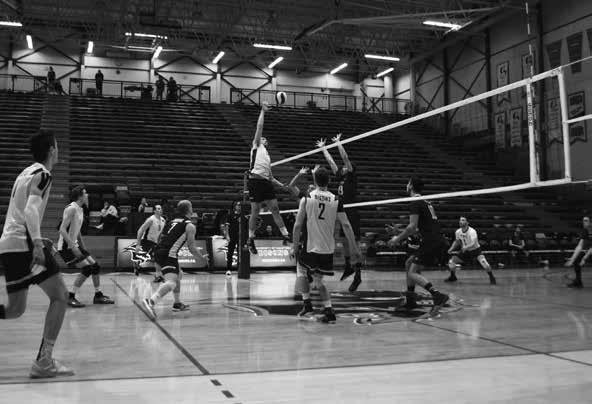
he University of Trinity Western Spartans gave the University of Manitoba Bisons all they could handle this weekend, winning three of four games, including one against the third-ranked men’s team.
Men In what should have been an easy game for the Bisons men’s volleyball team, the herd got complacent and lost to a Trinity Western side (2025, 26-28, 25-21, 23-25) sitting in sixth place in the Canada West standings. The loss snapped the Bisons’ fourgame win streak.
Trinity Western broke a fourgame losing streak with the win, helping stop their skid into the basement of the Canada West Standings. Despite the loss, Devren Dear once again put on a marvellous per-
PHOTO BY CHANTAL ZDAN
formance, registering 23 kills. Dear also led the herd with 10 digs, with Adam DeJonckheere close behind with nine. Dear is averaging 4.26 kills per set, placing him fifth in Canada in that category.
Setter Luke Herr led everyone on the court with 50 assists. He averages 11 assists a set this season, making him third-best in the conference.
Manitoba also managed just two service aces on the night, compared to Trinity’s six.
Despite the lopsided score line, the game was fairly tight. The Spartans only outscored Manitoba by a maximum of five points on the night. The herd attempted to mount a comeback after winning the third set but the heartbreaking fourth set saw the herd lose by just two points.
The Bison men’s volleyball team
hosted the second of a two-game set against the Trinity Western Spartans on Saturday, eager to bounce back from a loss on Friday. Manitoba won the day by a score of 3-0 (25-16, 25-23, 25-16).
The first set was a back and forth affair, but the herd managed to gain an eight-point advantage and never looked back. Devren Dear scored six kills in the first set and came up with seven digs as well.
In the second set, the Spartans and the Bisons answered each other point for point. The Bisons managed to emerge with a 25-23 set victory after Adam DeJonckheere smacked home a lightning quick kill to win the set. He finished with eight on the day.
The herd stampeded out into the third set, going on a run of seven straight points to gain the early advantage. The Spartans were never able to regain the momentum and fell 25-16.
he said. “We were good last night, but we weren’t there to kill, to win the big games you need that heart.”
The Bisons travel to Thompson Rivers next week to play the Wolfpack in a two-game set.
This past Friday night, the University of Manitoba Bisons women’s volleyball team had a tough task ahead of them, taking on the secondranked nationally Trinity Western Spartans. The Spartans showed all their skill in this matchup, easily putting away the herd 3-0 (25-11, 25-20, 25-15). Manitoba made it close in the second set, but in the end they were no match for the top team in the Canada West.
Setter Luke Herr led everyone on the court with 50 assists. He averages 11 assists a set this season, making him third-best in the conference
Manitoba only mustered two kills in the first set, and were dominated 47-17 in that department as a whole.
Anders and Keith Omoerah provided well-rounded play once more. Anders had 12 points, seven rebounds, and eight assists while Omoerah added a double double with 17 points and 11 rebounds, and seven assists.
“Tonight we found some rhythm and played the way we should,” Anders said post-game. “The ball moved way better and we came together.”
Next up for the herd is a critical tilt with the Regina Cougars this weekend at home. The weekend set will have heavy playoff implications as the two teams are just behind each other in the standings.
After such a disappointing loss against the Spartans on Friday, Bison head coach Garth Pischke talked post-game about the difference maker on Saturday.
“We played with heart and fear, knowing that Trinity is a good team,”
Spartans outside hitter Elizabeth Wendel smacked home 17 kills on the night, which was as much as the entire Manitoba squad combined. Sophie Carpentier added 16 kills of her own as well for the Spartans.
On Saturday, the Bisons women’s volleyball team looked to rebound
at home after a crushing defeat on Friday. The Spartans completed the weekend sweep of the Bisons however, winning 3-1 (25-17, 28-26, 17-25, 25-15).
With the pair of losses, the Bisons see their losing streak extend to five games and their record fall to an abysmal 2-14.
The Spartans picked up right where they left off and took the first set of the night 25-17. A thrilling second set saw the Spartans take a chokehold with a 2-0 lead after beating the herd 28-26.
With their backs against the wall, the Bisons managed a 25-17 win in the third set, with Tori Studler putting in a great performance, coming up with many key blocks and kills. The Bisons would fall in the fourth set by a score of 25-15.
The Bison women travel to Thompson Rivers to face off against the Wolfpack next weekend, who are currently sitting in fifth place in the Canada West
ANDY CHE, STAFF
T
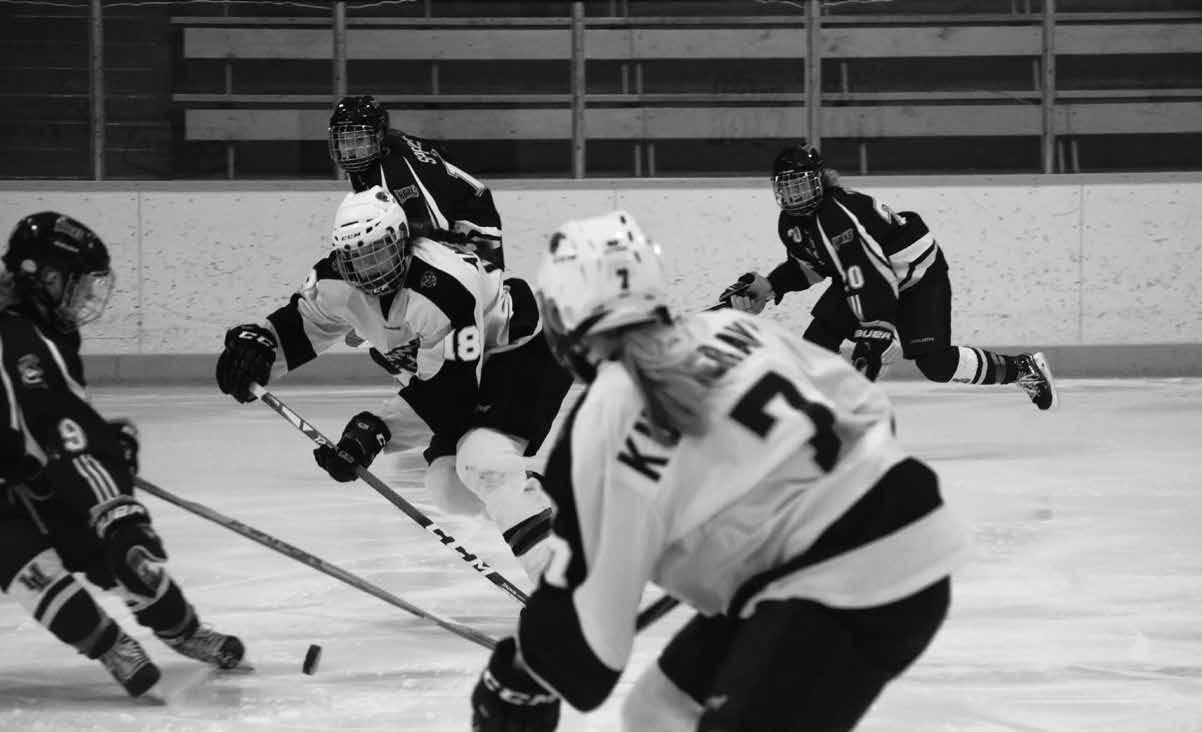
he University of Manitoba Bisons women’s hockey team ran into a hot goaltender this past weekend, which ultimately led to their downfall against the Lethbridge Pronghorns.
Manitoba peppered the opposition net with a flurry of shots, but the visitors left the Wayne Fleming Arena with a 3-2 victory.
Not long after the puck dropped, Manitoba native Aislinn Kooistra jumped on a loose puck that bounced behind Manitoba goalie Rachel Dyck and shoveled in the game’s first goal. The Pronghorns fought to extend their lead, with a Chelsea Kasprick breakaway that was smothered well by Dyck.
Midway through the first period, the Bisons would get themselves on the board. A shot from the slot by Alana Serhan flew through the commotion and took a touch off a skate to elude Lethbridge goalie Alicia Anderson.
The Pronghorns then took all momentum away from the Bisons within the first quarter of the second period.
First, Sarah Spence picked out Dyck’s short side to grab the goahead goal for the Pronghorns just one minute into the frame. A few minutes later, the lead was extended to 3-1 when Jenae Culp followed up some expert stickhandling by Kaitlyn Bauer and beat Dyck from the slot.
Dyck was pulled after conceding three goals on 13 shots, with Amanda Schubert entering the game as relief.
By the end of the second period, Anderson had risen as the difference maker with 23 saves on 24 shots.
Manitoba did manage to get themselves within one goal in the third period, as Alanna Sharman tallied a marker midway through the third frame. The goal was her team-leading seventh goal this season.
However, it was the closest Manitoba would come to tying things up.
The second-year winger managed to create further chances on Anderson, but the Pronghorns’ goalie kept the Bisons silent. The rookie ended the night with 31 saves on 33 shots to preserve her first win against the Bisons this season.
The Bisons had their offensive gears running right from the start of Saturday’s meeting against the Lethbridge Pronghorns, but it was Anderson who stole the show for the second straight game. Delivering 24 saves, the rookie goalie held strong
allowing the Pronghorns to preserve a 2-1 win.
Lethbridge had Anderson to thank for keeping the first period scoreless. She stretched out the left pad for the desperation save after being outmaneuvered by Sharman early on in the game. The Pronghorns nearly took the lead on a power play midway through the first, but a shot from the slot struck Dyck’s left post and miraculously ended up trapped between her pads.
Anderson continued to hone her fantastic form in the second period, denying Lauryn Keen on a delayed penalty. Sharman dispossessed a defender inside the offensive zone
Manitoba salvages weekend to stay in a playoff position
RYAN STELTER, STAFF
This weekend, the University of Manitoba men’s hockey team hit the road after their four-game home stand to play the Lethbridge Pronghorns. The Bisons were able to win 4-1 on Saturday after dropping the first contest on Friday by a score of 5-2.
The Bisons snapped a threegame losing streak with the win on Saturday to keep their record at .500.
Friday
The Pronghorns started the game off with a four-goal explosion in the first period. Mitchell Maxwell opened the scoring three minutes into the opening frame with a powerplay
marker. 45 seconds later, Lethbridge would double their lead through Manitoba native Justin Valentino.
It would only get worse for the herd as they gave up a short handed goal seven minutes later, as Maxwell would get his second of the night with two minutes remaining in the first. Valentino, clearly fired up to play against his hometown, made it 5-0 for the ‘Horns at the 11:04 minute mark of the second period. This forced Byron Spriggs to be pulled after allowing four goals on 12 shots. Justin Paulic, who came in relief, stopped 15 shots and allowed just one goal.
The Bisons would get on the board
35 seconds after the fifth Lethbridge goal, when a shot from Adam Henry beat Pronghorns goaltender Damien Ketlo. Rookie sensation Brett Stovin would get his 10th goal of the year with three minutes left in the second. That was all the scoring this game had left in it, as the Pronghorns emerged 5-2 victors. An awful start for the Bisons was what cost them in the end, as they outscored the ‘Horns 2-1 across periods two and three.
Saturday
In the rematch on Saturday, the Bisons were determined not to let a bad start hurt them again. They did just that, as 27 seconds into the game
and set up Keen outside the crease, only to see Anderson go post-to-post for a formidable save.
Moments after, Erica Rieder’s point shot was blocked right in front of Anderson who was out of position on the play. Nicole Carswell turned and fired on goal, only to see Anderson dive across to smother the goal-bound shot.
Shorthanded, the Bisons were finally able to beat Anderson. Breaking out from a two-on-one, Venla Hovi picked out Sharman, who ripped a shot off the crossbar glove side. Seconds later on that same power play, the Pronghorns recovered and scored through Jenae Culp, shov-
eling in a loose puck inside the crease. Ultimately, Lethbridge completed the sweep when Amber Yuha stepped out of the box, received the go-ahead pass from Brett Campbell and picked out Dyck’s blocker side for the 2-1 lead.
Being swept didn’t sit well with Jon Rempel, but there were positive notes from the Bisons’ head coach.
“Lethbridge grabbed the momentum back from us heading back to the third period,” said Rempel postgame. “I thought that was turning point and the letdown but I don’t have too many arguments about the way we played today.”
defenseman Rene Hunter opened up the scoring to make it 1-0.
Jordan DePape, who had his 15-game point streak snapped the game prior, added to the Bisons’ lead seven minutes into the first, assisted by his partner in crime, Stovin. DePape is now fifth in all of Canada with 33 points.
Lethbridge would score their lone goal ten minutes after DePape’s marker to make it 2-1 after one period of play.
The Bisons would add to their lead when Lee Christensen scored his second of the season with three minutes to play in the second period.
Joel Schreyer would get the Bisons’
fourth goal late in the third period to ice the game, as the visitors salvaged the weekend after a poor performance on Friday.
Paulic played fantastic in the win, stopping 34 of the 35 shots he faced. He is now third in save percentage in the Canada West at .914.
Manitoba faces a tough test next week against the high-flying Saskatchewan Huskies, ranked second. The Huskies have won their last six games and are the team to beat in Canada West, sitting atop the conference with a very impressive 18-3 record.
MIKE STILL, STAFF

W
ith the Duckworth Challenge reaching its 25th year and the back half of the 2015-16 edition just under two weeks away, the Manitoban decided to take a look back at some past Bisons MVPs in their individual sports against the Wesmen and where they are now.
Name: Michael Munday Sport: Volleyball in 2000-2001
Individual sport result: Won 3-1 (27-25, 19-25, 25-11, 25-21)
Duckworth Challenge result: Won 3-1 (Also won women’s volleyball and women’s basketball)
A three-time National Champion and two-time Athlete of the Year with the Bisons, Munday went on to represent Team Canada for eight years and also played five years of professional volleyball in France and Dubai. In 2003, he was also selected to carry Canada’s flag at the World Universiade Games in Daegu, Korea. In 2009, Munday – along with another former Bisons Duckworth MVP Scott Koskie, who played 10 years as a pro – also created the Success for Volleyball development program. It was the first of its kind in Manitoba and is aimed to help develop the skills necessary for young volleyball players between the ages of 11-16.
Name: Taylor Pischke Sport: Volleyball in 2013-14
Individual sport result: Won 3-0 (25-21, 25-16, 25-19) Duckworth Challenge result: Won 5-0 (first ever 5-0 win in Duckworth Challenge history)
Pischke was an integral member of the Bisons 2013-14 CIS National championship team, and has gone on to become a dominant beach volleyball player. Her accomplishments include two North, Central American and Caribbean (NORCECA) beach volleyball circuit titles, a NORCECA gold-medal, and two Under 23 Beach Volleyball World Championship bronze medals.
Name: Jon Lundgren Sport: Basketball in 2005-06
Individual sport result: Lost 86-76 Duckworth Challenge result: Tie 2-2 (Won in men’s and women’s volleyball, lost in men’s and women’s basketball)
After completing his CIS career, Lundgren would enjoy success as a basketball coach in the province. He was an assistant coach for the Bisons from 2006-08 and Canadian
Mennonite University from 200910, and also won a Provincial Championship as head coach of the junior varsity boys program at Fort Richmond Collegiate in 200708. On top of that, he was also the head coach of the Under 15 Manitoba Provincial Team Program from 201013, guiding them to two bronze medal finishes.
Lundgren currently sits as the head coach of the Oak Park Raiders and is on the coaching staff of the Basketball Manitoba Centre for Performance Under 15 team.
Name: Terri-Lee Johannesson Sport: Basketball in 1994-95
Individual sport result: Lost 95-64
Duckworth Challenge result: Won 3-1 (Won in men’s basketball and women’s and men’s volleyball)
Johannesson – the only three-time individual sport MVP in Manitoba’s Duckworth Challenge history – will arguably go down as the greatest player to ever grace a Bisons women’s basketball uniform. She was a CIS First-Team All-Canadian from 199497, Great Plains Conference Player of the Year in 1995-96, and CIS Athlete
ANDY CHE, STAFF

Aof the Year in 1996-97.
The Duckworth MVP in women’s basketball for Manitoba from 1994-97 was also a member of the 1996 and 1997 back-to-back winning CIS National Championship teams, which were inducted into the Manitoba Basketball Hall of Fame in 2011 and are the most recent women’s basketball team from Manitoba to win a national title. In both seasons, Johannesson was also named CIS Championship Tournament MVP.
The challenge was started by the late Dr. Henry E. Duckworth, who served as president of University of Winnipeg for 10 years beginning in 1971 and was also chancellor at the U of M from 1986-92. It originated in the 1991-92 season and was Duckworth’s attempt to create a spirited cross-town rivalry between the two universities. The sports involved are volleyball, basketball, and soccer (women’s only), which was added in the 2013-14 season.
States Hockey League (USHL) –the most competitive junior hockey league in the U.S. – from 2012 to 2015.
Connor has been nothing short of an offensive powerhouse for the Michigan Wolverines this season.
In 21 games, his staggering 18 goals and 18 assists ranks him third amongst NCAA offensive leaders, despite his freshman status.
Even more impressively, he’s getting accustomed to the Big Ten conference, scoring 12 goals in just eight games against Big Ten opposition.
NCAA, winning the Mike Richter award as best goaltender for 2014 as a UMass-Lowell Riverhawk.
In his career already with the Michigan Wolverines, Connor (a former USHL player of the year) is certainly proving his high ceiling. If he can keep pace with his NCAA superiors, the Jets will have no problem tapping into his vast potential.
Connor’s next stop in his hockey journey is 900 miles away from home, where his future awaits, in Winnipeg
The 19-year-old’s remarkable introduction to postjunior might be a surprise to some, but it’s nothing out of the ordinary for Winnipeg.
His meteoric rise could be attributed to his fortunate outcome at the draft and subsequent positioning down the Jets pipeline.
Nikolaj Ehlers, Josh Morrissey, and Nic Petan, there is a more relaxed timeframe for Connor to develop into an NHL-ready prospect. In addition, his status as NCAA athlete puts him in a no-rush scenario unlike prospects drafted out of Canadian Major Junior Hockey.
The left-winger was Winnipeg’s 17th overall selection from the 2015 NHL Draft. Described as a “solid two-way player” by NHL Central Scouting, Connor starred for the Youngstown Phantoms of the United
pparently, the Winnipeg Jets love college athletes. Three former NCAA superstars are currently plying their trade for the Jets on a fulltime basis, while many more college stars await their chance in Winnipeg. In their collection of prospects, 10 currently represent the NCAA and are headlined by the University of Michigan’s Kyle Connor.
Jacob Trouba lined up for the Michigan Wolverines during the 2012-13 season before forgoing his collegiate career to join the NHL. The defenseman was joined by Andrew Copp, who completed three years with Michigan. Current Jets starter Connor Hellebuyck also graced the
As the 14th-ranked prospect, Connor was passed on three consecutive picks (13th to 15th) by the Boston Bruins. Considering that two of those three Boston picks were the 19th- and 38th-ranked prospects respectively, the pressure is eased off Connor in living up to his top-15 pick status.
As a member of the Jets developmental system, Connor is also a relatively small fish in a big pond. With Winnipeg’s youth focus on the likes of
While many other Jets in the pipeline have been on display at prospect showcase events, Connor has yet to play for the Winnipeg crowd. He was unable to appear in the 2015 Penticton Young Stars tournament with that summer’s crop of Jets prospects as a result of NCAA restrictions. As he’s shown already, he’s making up for some lost time with a very compelling start as a college freshman. Perhaps location is the greatest weapon in his arsenal. Hailing from Clinton Township – an area within metropolitan Detroit – Connor is playing hockey in his home state of Michigan. The Jets will be hoping that a trip up north in a few years will be close enough for the prospect to continue to his exuberant form. For now, Connor’s home is where the heart is. The next stop in his hockey journey is 900 miles away from home, where his future awaits, in Winnipeg.