Unions claim loss of staff will result in drop in morale, services
G A rett Willi A ms, staff
The union representing support staff in the University of Manitoba libraries is lamenting the loss of nearly 40 positions resulting from ongoing across the board departmental restructuring efforts.
Laurie Morris, president of the Association of Employees Supporting Education Services (AESES), reported to members in an August newsletter that a total 38 positions were discontinued in May, including the elimination of 30 part-time positions and eight full-time slots. While 10 full-time job openings, with new duties and greater responsibility, have been introduced to replace the lost positions, Morris said the cuts will have a direct and negative impact on services.
“The staffing resources have now been reduced to, essentially, a skeleton crew with library closures and long wait times likely being the end result,” Morris told the Manitoban in an email.
Morris said the elimination of the part-time positions amounts to the complete loss of sessional library staff. She said the adverse impact of the restructuring on membership morale forced the union’s hand to break its general spirit of not raising public objection to changes implemented at the university.
“In this case, the groundswell of concerns raised by our members, and the immensely adverse impact this has caused to general morale, has led us to make our concerns public,” she said.
“Our goal in this is to impart upon the university the need to pause and reflect on the impact of their decisions and to reconsider what is the right balance for change.”
Morris acknowledged library administration held meetings prior to announcing any changes but said not all staff were invited to participate
and suggestions that were presented largely went ignored.
“We had a brief meeting shortly before the discontinuances were issued to inform us that they would be taking place,” she said. “However, at the time of our meeting, the decisions had already been made to enact these job cuts and the positions had already been identified.”
Mark Hudson, president of the University of Manitoba Faculty Association (UMFA), echoed Morris’ sentiments, expressing “great disappointment” in an open letter and called the action “yet another instance of the administration exercising misguided priorities.”
Hudson noted upper-level library staff, including UMFA librarians and archivists, have already seen their workloads increase in recent years and the further restructuring will only continue that trend.
“While we understand that some of the work done in these positions is becoming outdated due to technology, there remains a great deal of indispensable work that is being done by the members who are losing their jobs: running circulation desks, processing and distributing library materials, directing library patrons on the use of equipment, processing materials purchased for the libraries’ collections, and more,” Hudson states in the letter.
Hudson also noted there have been at least six instances since February when libraries were unable to open their doors due to unforeseen staffing shortages.
“These closures are a blow to the health of the University community.”
According to Morris, University of Manitoba libraries have lost more than 30 full-time positions since 2007, representing a loss of more than 25 per cent.
Since January alone, she said
AESES has seen more than 70 positions eliminated university-wide.
Shifting demands
According to university librarian Mary-Jo Romaniuk, the 30 lowlevel, part-time positions – including shelvers and library assistants – amount to about nine full-time slots, based on working hours. She also noted three of the eight full-time positions cut were moved to another unit and one employee retired.
The restructuring is taking place across the university’s library network, which includes 10 libraries on the Fort Garry campus and nine health sciences branches.
Replacing the discontinued positions will be 10 full-time openings that will take on greater responsibilities, including one supervisor.
Romaniuk said the shift will help bring the university’s library services more in-line with the advancing customer service needs of students and faculty.
“We wouldn’t do it if we weren’t trying to be more helpful,” she said.
“This isn’t about cutting costs –because it actually costs more money to have higher-grade people – but we didn’t have the capacity to provide the kind of services that a research library should be providing in this day and age going forward.”
Romaniuk said customer service demands, especially from students, are largely shifting to online and the eliminated positions were out of date.
“They were jobs that were designed 20 years ago when we used to shelve a lot of books and people borrowed a lot of books and the skill sets for that really weren’t today’s skill sets,” she said.
Rather than create more library closures, Romaniuk argued the new staffing model will facilitate longer hours by pushing service requests
online – where students can interact remotely with staff for assistance accessing resources, whether they are in a physical branch or studying off-site.
Electronic checkout services will also get a boost, including a downloadable app allowing books to be checked-out with a mobile device.
“The staffing resources have now been reduced to, essentially, a skeleton crew with library closures and long wait times likely being the end result” – Laurie Morris, president, AESES
She added that staffing libraries with fewer full-time employees, rather than several part-time workers on various schedules, will facilitate more consistent service.
Romaniuk also noted security services are in place to ensure staff do not have to work alone and libraries are not left unattended, saying “the big piece is we have security backstopping that, so we should never have to close a library anyway.”
“I have some long-term people that still want to guard books but that’s not what we’re there for, we’re there to enable information,” she said.
“And I think the last thing we need to worry about is guarding books –we need to make sure our students are safe when they’re in the libraries [and] we need to make sure our staff are safe and that we have the right
people doing the right things.”
Budget crunch
While departments universitywide are facing a third consecutive year of three per cent cuts, Romaniuk noted the libraries are faced with the aggravating factor of a fluctuating Canadian dollar.
She said a one-cent drop in the value of a Canadian dollar compared to US currency results in a $60,000 slip in purchasing power.
As a member of both the Association of Research Libraries and the Canadian Association of Research Libraries, the university is locked into multi-year agreements as a means to control costs, including a locked-in inflation rate.
However, the agreements don’t have locked-in exchange rates and as a result, the 2016-17 university budget set aside an additional $1.875 million as a libraries acquisition exchange reserve, in addition to a $250,000 inflation allowance.
She said if university administration did not set those funds aside, library administration would have to make some cuts to purchases outside the locked-in agreements, which would affect some faculties disproportionately.
Overall, libraries are operating within a budget of just more than $25.2 million. While that marks a cut of more than $758,000 from a year ago, Romaniuk reiterated the budget isn’t driving the restructuring.
“You can say it’s budget-based – if you had more money, you would do things, perhaps, differently – but it isn’t really budget-based, it’s really about customer service in the long term.”
photo by miguel yetman
New pathway for Manitoba midwifery students
Partnership with McMaster University will allow students to complete their degrees in Manitoba
tO m i n G r A m, staff
Following protests about the cancellation of Manitoba’s only bachelor of midwifery program, the province and the University of Manitoba have announced a new plan to allow stranded midwifery students to complete their degrees.
The new plan, announced Aug. 5, involves a partnership with McMaster University, which offers Canada’s oldest midwifery training program. Students who have completed the first year of the joint University of Manitoba-University College of the North (UCN) midwifery program will be enrolled in the second year of McMaster’s program and have their UCN credits transferred.
A modified fall term will bring the students up to Ontario standards to move into clinical placements. The program will be delivered entirely in Manitoba, with the U of M providing academic support, offering clinical courses and labs taught by its own instructors, and hosting McMaster courses online.
Jill Larner, one of the midwifery students who will now be enrolled in the McMaster program, was cautiously hopeful about the announcement. She said midwifery students have just recently found out about the new partnership and many of the details are not clear yet.
“Information is slowly trickling out,” she said in an interview. “We’ve just basically had enough time to do the basics of registering.”
“Everybody’s on a time crunch, right? If you think about it, we’ve all got three weeks to do everything that people have four to six months to do. We haven’t had a big giant sitdown. There really isn’t time to do any of
that. It’s basically, we’re just sitting here refreshing our emails, and as we get instructions we’re reading them out and figuring them out.”
Since the announcement in late June that the U of M-UCN program would not run in the fall, a lot has changed, Larner said.
“We’re going from ‘we have nothing’ to ‘we have nursing,’ to ‘we have an entire program, and I might be graduating in 2019.’”
“Definitely a roller coaster this summer,” she said. “I’m happy to have a little bit of resolution. You know, as students we’re all happy to have a solution that works for everybody and that we’re going to be able to resume our studies.”
The political side Education Minister Ian Wishart said in June that “there will be a program in place” for the current midwifery students in the fall. In a provincial release, he said the McMaster partnership fulfils that promise.
“This new partnership will ensure the midwifery students in Manitoba who have already invested significant time and effort toward their studies can complete their coursework uninterrupted,” said Wishart in the release.
“We are proud to follow through on a commitment that was made and I commend our partners for their hard work in reaching this resolution, which will help meet the growing demand for midwives in our province.”
Late in June, midwifery students were offered places in the U of M’s college of nursing, prompting outrage. Lauren Henderson, another midwifery student, said at the time,
“It would be like saying to an electrician, ‘you can’t be an electrician, but you can be a plumber.’”
In a June 23 committee meeting, Wishart implied he favoured training nurses with additional midwifery credentials rather than standalone midwives.
“The nature of filling [the need for both nurses and midwives in the north] might change from midwives alone, stand-alone midwife positions, to something that is more an evolution of nursing,” he said.
The provincial NDP criticized the cancellation of the midwifery program, emphasizing the impact it would have on remote northern communities.
“When you talk to people in northern Manitoba, one of the top overall health priorities that they have consistently identified is returning birthing to their communities,” said Wab Kinew, the NDP education critic, in a June interview.
“People in large northern First Nations like Norway House don’t want to have to come to Winnipeg or Dauphin or Brandon. They’d rather see the ability to deliver babies at home.”
UCN program closed
For now, the new partnership means the end of midwifery education at UCN. The northern university is not involved in the new arrangement between the U of M and McMaster.
“UCN is no longer offering a midwifery program, with no plans to do so in the near future,” said Jim Scott, UCN’s director of communications, in an email.
In a statement, a spokesperson for
the provincial NDP expressed concern that UCN was no longer a part of the midwifery program.
“While it is important that the needs of existing students are met to ensure continuation of their studies, it is very concerning that it appears existing programming for northern students will no longer be funded.”
“It is important that the demand for midwifery services among indigenous and northern communities be met.”
UCN’s standalone midwifery program debuted in 2006 and ran till 2014. In part due to the difficulty finding clinical placements, no students graduated from the program until 2013. Only nine students ever graduated from the program, at a cost of nearly $900,000 per graduate.
The program was suspended during the 2014-15 academic year, while a new intake of students was planned for 2015-16. These students were to be the first cohort of a new joint midwifery program between the U of M and UCN to be delivered in Winnipeg with annual intake of students and clinical placements around the province.
However, the new faculty, staff, and academic supports required for the second year of the joint program would have cost an additional $844,000, meaning its provincial funding would have to nearly double. While the previous NDP government committed this money as an election promise, the new Progressive Conservative government did not provide for it in their first budget in May.
Without enough money to operate the joint program, and with the standalone program no longer rec-
U-Pass to roll out this fall
G A rett Willi A ms, staff
of Manitoba Graduate Student Association members who cast ballots vote in favour of the program, UMSU, the University of Manitoba, and the City of Winnipeg entered into a four-year agreement in July to unfold the program beginning in September.
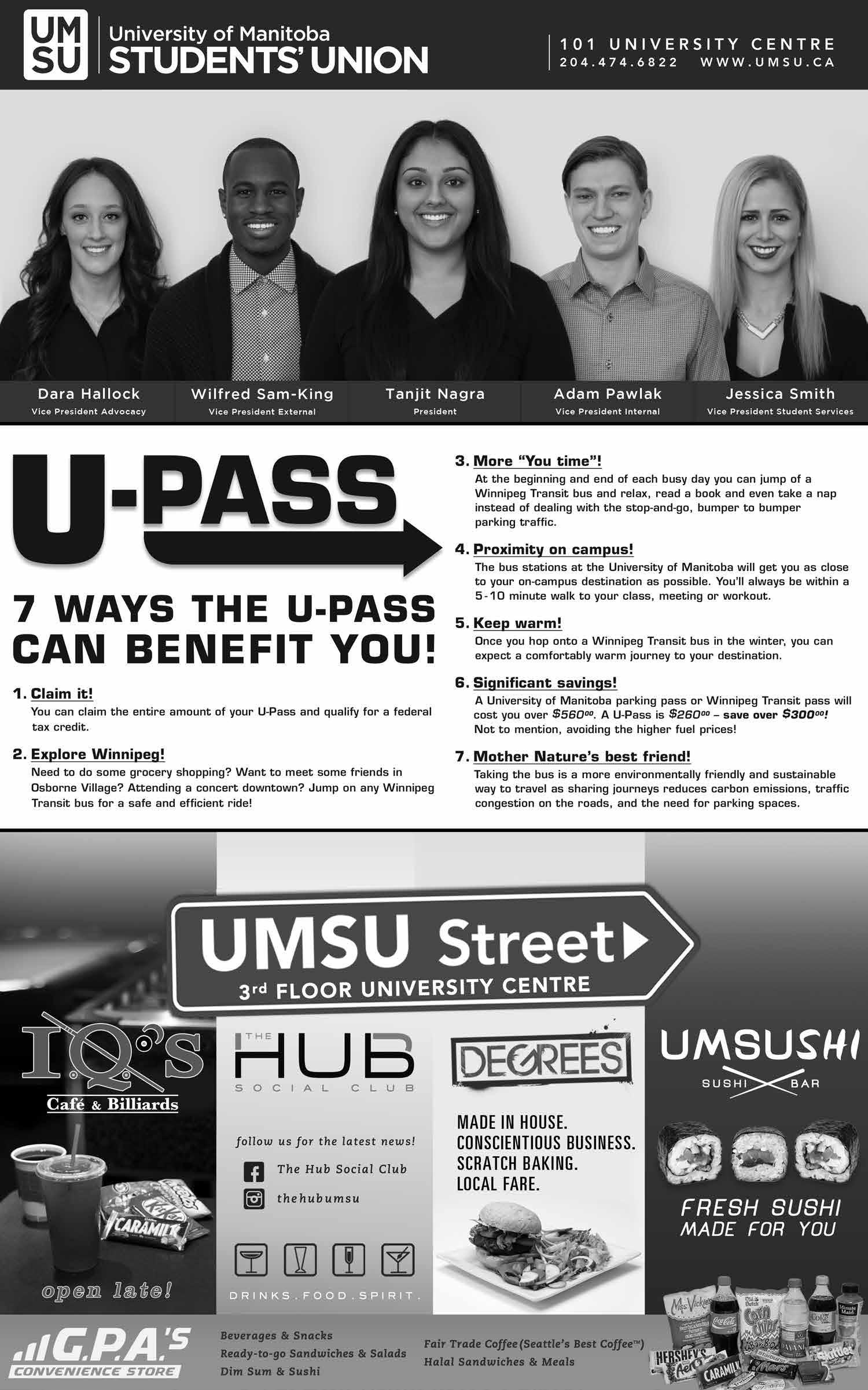
Full-time U of M students will be assessed an additional fee of $260 – $130 per term – payable along with tuition. The fee represents a $306 savings from regular student rates for monthly bus passes and gives students access to Winnipeg Transit from September through April.
“For many students, the U-Pass will entail significant cost savings,” said Tanjit Nagra, UMSU president.
“It will save students money as well as time by avoiding lining up every month for a bus pass. For those who drive, they now have the option of easy parking with access to Park and Ride facilities and have a backup if their vehicle needs repair.”
Part-time students don’t have access to the discounted pass and will not be assessed an additional fee.
In a lopsided 2015 vote, Winnipeg city council voted 13-3 in favour of subsidizing the program to the tune of $570,000 in 2016. That number is expected to climb to $1.33 million in 2017 due in part to lost fare revenue and the purchase of nine additional buses to facilitate the anticipated increased ridership.
ognized by the College of Midwives of Manitoba, the regulatory authority for midwifery in Manitoba, the province was briefly left without any viable option for training midwives. The 14 students who had completed the first year of the new program were left stranded.
With a new program now in place for the fall, Larner is hopeful for the immediate future.
“I’m hoping that this is the stepping stone. Now that we’ve been able to get out of the limelight, settle down into some classes and studying and now that this big immediate emergency is over, that the plan is to continue to focus on the long term solution,” she said.
“We need an education program here in Manitoba. We can’t just stop at short term. And I don’t think we as students will be just letting it go now that we’ve got our own class. Until all women can say that they have a choice and they have an option to birth how they want to, I don’t think we’re done here in terms of pushing for it.”
Larner said the partnership with McMaster University, which has run a midwifery program since 1993 and already operates collaborative programs at Laurentian University and Ryerson University, makes for a promising future.
“I’m hoping that it will be more of a positive thing, partnering with someone who has been running a successful program for a long time. That can do nothing but boost the program, whether they intend to remain a partnership or whether it’s going to be a standalone program. It’s anybody’s guess at this point.”
The city also authorized the hiring of an additional eight employees this year and another 17 in 2017, said Nagra.
Beginning mid-August, students can pick up their pass at Answers on the Fort Garry or Bannatyne campuses.
Students residing outside city boundaries, registered with the Canadian National Institute for the Blind or Handi-Transit, studying outside Canada for more than 60 days, or who are employees of Winnipeg Transit can opt out of the program by filling out forms which will be available at on UMSU’s website beginning Sept. 1.
N early two years after University of Manitoba students voted in favour of a universal transit pass (U-Pass), the program is set to begin in the fall.
photo by miguel yetman
St. Paul’s College newspaper to celebrate 75th anniversary with special issue
The Paulinian, the official student newspaper of St. Paul’s College, turns 75 this year. To celebrate, a former editor is compiling a special retrospective issue featuring clippings from several old issues and new contributions from former editors.
“It features alumni, it features current students, it brings everyone together – Paulinians all, as we call it,” said Matt Semchyshyn, who briefly served as editor of the Paulinian before being hired as the marketing and communications officer for the college.
The Paulinian was founded in 1941 as the Crusader. The name was changed in 1956, shortly before the college moved to the University of Manitoba’s Fort Garry campus, leaving St. Paul’s High School behind in central Winnipeg. A paper called the Crusader still survives at the high school.
“It was kind of nice because back then the Crusader would be, part of it would be written by high school students and part of it would be written by university students,” Semchyshyn
said.
Production of the paper lapsed in 2008. In 2013, as senior stick for the St. Paul’s College Students’ Association, Semchyshyn was instrumental in reviving the paper. A relaunched edition was published in March 2013, and new issues have been released regularly, once or twice a semester, since then.
The Paulinian provides an outlet for students to write about a variety of things, from the social, academic, and athletic affairs of the college to more high-minded topics. The first issue of the paper, released in December 1941, features front page stories titled “Dramatic society scores again” and “Catholic and socialist are contradictory terms.”
The spectre of the Second World War loomed over the early issues. The first issue contains an ominous reference to conscription, which was debated at the federal level throughout the early 1940s.
“Those issues are very – they’re kind of sad to read, too, because they’re talking about different casu-
alties of war, different students that had passed away,” Semchyshyn said.
Semchyshyn said he also noticed a roguish wit in the early pages of the Paulinian. The paper’s content was moderated by the Jesuits, but students tried to see what they could get away with.
“They’re witty, and that’s what’s so different from now. The sense of humour is very different,” said Semchyshyn. “Back then it was very clean. We just interviewed one of the editors [...] and he was talking about that they tried to push the limits back then with what they could put in there. They wanted to prank people but in print.”
One notable example was the “Miss Paulinian” contest, in which students were supposed to submit a 50-word statement explaining why they should be the one to escort the (fictional) “Miss Paulinian” to the college’s annual dance in 1958. Entries were to be judged on “originality, sincerity, and neatness.”
The editors said they received 300 entries from a student body of around
100. The gag was a ploy to try to get more students to attend the annual dance, and it landed the editors in hot water with the Jesuits.
The retrospective issue
Semchyshyn has been tracking down former editors of the Paulinian to interview them or ask them to contribute to the retrospective issue, which will feature new content alongside clippings from the archived issues.
Some notable past editors of the paper include Arthur V. Mauro (who went on to a successful business career and terms as chancellor of the U of M and Lakehead University), Christopher Guly (the Canadian correspondent for the Los Angeles Times), Ken McKinnon (former commissioner of the Yukon), and Martin O’Malley (a CBC journalist). Paul Adams, the first editor-in-chief of the Paulinian, is the father of Chris Adams, the current rector of St. Paul’s College.
“What’s significant is that this issue features articles from a lot of
people who actually had careers in the news,” Semchyshyn said. “So one of the people who wrote for the project was Marguerite McDonald, and she was a reporter for CBC.”
McDonald, who was a nun for 12 years before becoming a professional journalist, died of cancer in 2015. Semchyshyn said the retrospective will feature the last article McDonald ever wrote. A few other editors have also passed away since submitting their pieces.
“Almost all the living editors wrote something, whether it’s an article or sending in a congratulatory note,” Semchyshyn said.
“I don’t think any of these people thought they’d ever write an article for the Paulinian again.”
The retrospective issue of the Paulinian will be published in mid-September.
photo provided by the paulinian
Editor-In-Chief: Craig Adolphe
Contact: Editor@themanitoban.com / 474.6770
A difficult path
The quality and quantity of bike lanes in Winnipeg must be improved and cycling culture better respected
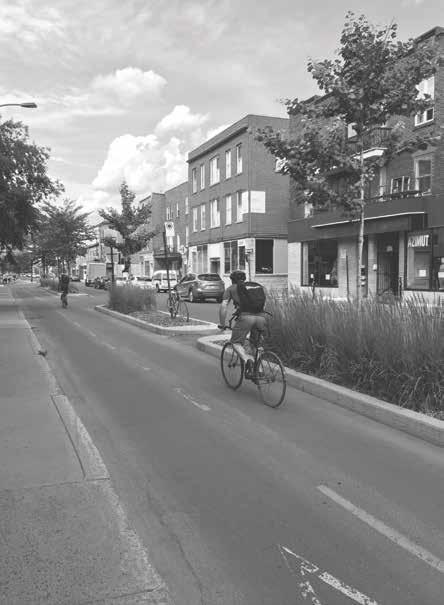
Iwill admit it before I begin: I do not cycle to university. I, like many other U of M students that live more than four or five kilometres from campus, either bus or carpool to school. It is not that I do not want to grab my obviously super cool and hip-looking fixie bike and ride to class, although I admit that there is some laziness involved in my decision to drive; rather, it is because I do not feel safe commuting by bicycle in this city.
Simply put, Winnipeg does not yet have the right mindset or adequate infrastructure for cyclists to ride safely to work, school, or almost anywhere else. Although there have been efforts to increase the allure of cycling in Winnipeg, the city has some serious flaws that have prevented a majority of those efforts from becoming reality.
The lack of sufficient bike lanes, unhealthy rhetoric at City Hall, and a proposed mandatory helmet bylaw have made this summer a tense one for current and prospective commuting cyclists. Despite these obstacles, there are ways this city can improve its biking culture just like a number of other cities, many of which share similarities with Winnipeg, already have.
Time to take notes
Just last year, I had the privilege of spending a semester living and studying in Aarhus, Denmark. I assume you can see where this is going: bicycle culture in the land of the Danes, much like in bike-savvy Holland, is far superior to ours in many ways.
Virtually every street has a separated bike lane on each side of the road that is clearly marked and securely divided from the sidewalk. As well, the Danes have installed separate, smaller, traffic signals at each intersection solely for cyclists. The Danes have also made right-hand turns on red lights illegal for motor traffic for fear that a cyclist may get hit. In fact, respect for fellow commuters on bicycles is so ingrained in Danish culture that collisions between drivers and cyclists almost never occur.
When explaining this incredible system to Winnipeggers, I usually receive a little scoff and some sort of short explanation as to why that could never work here. Today I pose the question in return: why not?
Montréal, a city much closer to home and about twice the size of Winnipeg, has also shown in recent years that major urban centres must focus on improving cycling culture. The city has recently introduced BIXI bikes, which are for-rent bicycles placed
on racks throughout the city that are available for $5 a day. Montréal has also significantly expanded its number of separated bike lanes and the province of Québec recently passed a law requiring a one-metre buffer zone between motorists and cyclists.
Unhealthy rhetoric
These changes were not easily won for Montréal, nor will they come easily for Winnipeg. City Hall, not surprisingly, has dragged its feet on this issue for years. Not only have councilors stalled introducing plans for better and safer cycling routes, but some city councillors have even outright antagonized proposed improvements to our bike culture as well.
One such councillor, Russ Wyatt of Transcona, has been an avid supporter of a proposed bylaw that would enforce all cyclists to wear helmets. To some, this sounds like a variation on seatbelt laws in cars and as such, would be completely acceptable. In reality, however, this proposed bylaw is a veiled attack on commuting cyclists and an excuse for city hall to continue evading the prospect of providing safer bike lanes for Winnipeggers.
By propagating this bylaw, city councilors like Wyatt are attempting to shift the blame for the number of cyclist injuries and fatalities. Lawmakers are trying to condemn cyclists for the results of the dangerous situations they find themselves in, rather than face the reality that cyclists are being injured or killed in incidents that could be prevented. This is a dangerous sentiment to hold.
On July 8, Leslie Freudenberg was cycling down Hamilton Avenue at 2:40 p.m. when he was struck by a construction vehicle. He was pronounced dead at the scene.
On July 20, a woman was hit by a semi on her bike at the intersection of Main Street and Logan Avenue. She died soon after.
There are no separated or painted bike lanes at Main and Logan.
In April, Casey Donaldson, a local musician and father of two, was cycling on Nairn with a friend when a drunk driver hit him in the curb lane, then drove away without stopping. Donaldson died of his injuries.
Nairn Avenue is a major thoroughfare in Winnipeg. It has no bike lanes.
Let’s roll up our sleeves
Lawmakers at City Hall and our community as a whole must work harder to make this city a bike-
friendly one. Fortunately, plans for new bike lanes on major streets downtown are currently being reviewed and attitudes are shifting toward a more progressive stance on bike culture at the grassroots level. For now though, I may just stick to getting to school by car. To those who brave the narrow lanes and fast moving traffic early on frosty mornings, I applaud and support you. Our city has a long way to go until its bike lanes are up to Denmark’s, or even Montréal’s, quality and there are some serious hurdles in our path, but if cyclists in this city know one thing, it’s how to weave around obstacles.
Letters to the editor
A letter to upcoming graduates from a mature student
I am a ‘mature’ student who was enrolled in the Integrated Studies program and I have spent three and half years with you all here at the U of M. I would like to say that I am most impressed with you all. You are intelligent, well mannered, pleasant to be around, and helpful when I got stuck on the computer at times!
Indeed, there is a generational bias in which older generations look down on the younger ones; I experienced the same treatment in my twenties. I think the older generations have forgotten what it
is like to be young and full of fire. Anyways, I want you to know that there are many advocates and allies that you all have on your side and I am one.
I have always been most impassioned about those in their twenties and thirties. I am proud of you; you will do well and thank you so very much for your passion, enthusiasm, and dedication to yourselves, friends, and the planet.
Much peace.
Lori J Westman
photo by levi garber
New Pokémon game an opportunity to reconnect with others and ourselves
ryA n s her BO
Even if you’re not playing Pokémon GO yet, chances are you've heard of it.
The new mobile game for iOS and Android launched on July 6 in the U.S. and July 17 in Canada. Developed by Niantic and the Pokémon Company, the game layers augmented reality (AR) technology on the real world. As you walk around your neighbourhood or school, you are able to capture, train, battle, and interact with Pokémon; the brightly coloured creatures from Nintendo’s 20-year running franchise. Already Pokémon GO has over 15 million downloads.
Pokémon GO is far from Niantic’s first run at AR games (they released their first, Field Trip, in 2012) and it builds on concepts developed as early as the turn of the millennium with geocaching, a worldwide GPS treasure hunting game. However, GO may well be the first such game in a franchise as recognizable, or meaningful, as Pokémon.
I started playing Pokémon at three years old with the original games –Pokémon Red and Blue. Some of my earliest memories are of huddling over a GameBoy Color screen with my parents, fighting our way through caves and discovering new secrets. As a nerdy, introverted kid, the ability to interact passionately and creatively with a game that was so expansive and so far-reaching was incredible.
As the years went on, the franchise continued with new games and new batches of Pokémon released every few years (now up to six generations, and soon to be seven). While only a small number of fans stayed with the franchise, many people around my age stopped playing some time during
those years – after all, middle- and high-school are very reconstructive times for a young person’s identity. However, there remained a collective nostalgia for the franchise.
Enter Pokémon GO. What is truly surprising, and very heartening, is not that Pokémon-lovers have embraced the game, but that such a wide-reaching audience has found something in it to enjoy. Many of the Pokémon GO players that I have seen, whether they are walking around their neighbourhoods or posting pictures of their favourites online, are people in their twenties or early thirties: people who loved the games as children but have not returned to them since. For these people, the game can, with its nonlinear objectives and global span, be a way to personalize a journey of discovery while sharing the experience with fellow players.
As with nearly any popular trend, there has been a range of comments and criticisms about Pokémon GO.
Some have pointed to the game’s potential dangers. Large numbers of young people walking around staring at their phones do tend to cause some distress, but these are problems that have existed for years with phones and portable music players. They require caution, but not alarm. While some worry about the dangers to children who might roam around at night in search of Pokémon, one wonders if proper parental supervision, as well as an influx of older, friendly faces with a shared goal, might not even help brighten up the community a bit, as evidence would seem to suggest.
The largest opposition that I have seen to GO’s stellar success, however, has been somewhat different, carrying a tone not of concern, but of acrimony, elitism, and mean-spirited pessimism. Articles, think-pieces, and tweet after tweet have decried the game’s popularity and insulted its players.
To this I have only one response: not only is Pokémon GO fun, it is also important. It is important in an age where nostalgia is often a corporate product, for us to reconnect with our childhoods on our own terms, in a way that makes us happy and inspires our creativity. This is something that GO, a game about personalizing your experience and
taking your own journey, allows us to do. It is important for us to relate to the next generation on shared terms that let us enjoy each other’s company – the image of parents and older siblings connecting and sharing their youths by playing Pokémon GO with young children comes to mind. Even to those who may never have heard of the series, GO is too positive to be stamped down by the negativity. As well, it is important for us to do all of these things in a way that promotes activity, exercise, healthy living, and adventure.
An article has been passed around on Facebook recently, written by the
mother of a son with autism, describing how the game has improved his life and his interactions with the people around him. To me, this is perfectly indicative of the power of entertainment that can unite us around a shared love. And when that shared love is something already ingrained in the history of so many people, it becomes very powerful indeed.
So if you have been resisting the pull to get into GO, give it a try and set out on your own journey – your inner child might just thank you.
graphic by kelly campbell
A Strong UMSU For You
UMSU president Tanjit
Nagra
shares her executive’s goals for the upcoming year
tA njit nAG r A
The University of Manitoba has 20,000 full-time undergraduate students who are all members of the University of Manitoba Students’ Union (UMSU). In the last election, 16.8 per cent of UMSU members voted for the union’s five executive positions. Although this turnout is normal for Canadian university student governments, it is safe to say that most of our members are not very interested in UMSU, and many that are interested were displeased.
In the 2016 UMSU general election, we witnessed the largest number of candidates in U of M history. This year, the number one goal of the executive team you elected is to make you – UMSU’s members – more interested in what your union is doing for you.
High-profile events, lofty campaigns, and splashy projects can be important, but they can also be distractions from our union’s mandate. One must ask whether their practical benefits to the day-to-day lives of students are proportionate to their cost.
Cost can be calculated both in terms of dollars – for example, Frosh
Fests running annual deficits of over $100,000 for more than a decade –and in terms of opportunity – all the things we could have been doing but are not as a result of burning energy and money. In short, UMSU’s members, and members of most student governments across the country have good reason to not be interested in their unions: they too often waste time, energy and money on things that do not necessarily help their members in meaningful ways. To make your union worth your interest we are changing the game plan.
Goals for a new executive
For my part, I came to university to receive an education and what I want from my student union is support in achieving that goal. “Support” comes in many ways. To an individual member of UMSU, what constitutes support in a post-secondary education (PSE) setting depends on a combination of present circumstance and personal situation.
We must work to relieve acute distress as a result of financial,
legal, health (emotional or physical), familial, living, immigration, social, or academic situations. We must also strive to aid students in achieving their goals, accessing basic services, enhancing the PSE experience through social enrichment and engagement, and providing safe spaces for self-expression, identification, and discovery. Finally, we will work to get students to participate more broadly in efforts to enrich the student condition and our society at large.
All of these types of support and engagement have evolved into the responsibilities of your student union. This will build the lived experiences of our union’s members as a collective. Support for your experience, whatever it may be, is what your union is meant to provide.
The individuals that comprise your executive team do not match every profile of our union’s members. We are a diverse group, but it is not reasonable to expect five people to directly relate to each UMSU member’s lived experiences. This can be a problem, as the direction and tone of our union is largely set by the executive team. Executives have the greatest ability to command the union’s resources and shape the union’s discourse.
Furthermore, student politics are notoriously politically charged, and executives have the most “skin in the game,” having gone through the ordeal of a general election, which involves substantial personal investment. In theory, however, our union is not beholden to the individuals on the executive team – it should be much more broadly accountable.
So, we must ask the question: how does the executive team ensure that the focus of the union is directed on the greater collective of our membership, while endeavouring to provide meaningful support for the individual needs of its membership, all while not getting caught up in petty student political nonsense that alienates the membership and distracts from the union’s mandate?
Practical steps
We, your UMSU executive team, believe that the first step in providing a lasting and satisfactory answer to
that question for our members lies in the democratic structures, governance, and communication practices of our union. A solid foundation constructed of those elements can precipitate a cultural shift so badly needed at UMSU that will ensure that our union is responsive to the real needs of our members.
To accomplish this, your executive team will endeavour to make sure that our union engages in a few fundamental activities and follows some basic principle, which include:
• Regularly and clearly informing our membership of what the union is doing, what it is considering, and what it is planning.
• Providing robust and varied feedback mechanisms so members can provide input of whatever kind on union operations and activities.
• Ensuring that governance structures fairly and appropriately represent our highly heterogeneous membership and its varied voices.
• Ensuring that services are responsive to our members’ needs.
• Ensuring that advocacy, outreach, and lobbying activities, both internal and external, are efficient and effective.
• Ensuring that funds collected from our members are not being used wastefully, that spending is accurately and clearly reported, and that the union stays on budget.
• Ensuring that business activities are aimed at satisfying members’ needs so that they support the union’s primary objective of providing meaningful support to our members.
• Ensuring that union operations in all regards have the broad support of an informed membership.
• Not becoming embroiled in petty student politics and managing interpersonal conflicts within the union so neither of these detract from the union’s responsibilities to its members. This list may seem obvious because it is what UMSU should have always been focused on. More than a decade’s worth of history demonstrates that this is not the case. We are going to change that so that your union takes meaningful steps to serve you in the ways you need, and that doing so becomes an enduring feature
of UMSU’s culture.
The team
To put things on a practical footing, here is some of what your executive team will be concentrating on as part of, or in addition to, our usual portfolio tasks.
Wilfred Sam-King will be working on our union’s communications strategy. Jessica Smith will be working on the retooling of our union’s services. I, Tanjit Nagra, will be working on phase three of our governing documents overhaul. Adam Pawlak will be working on reforming our financial accounting and reporting procedures. Dara Hallock will be working on restructuring our internal advocacy and lobbying procedures. Additionally, we will be providing UMSU council with detailed work plans setting out what you should expect from your executive team. These will include motivation as well as the timelines and resource allocations required for each matter. UMSU Council is the highest governing body of our union.
UMSU council is comprised of representatives from every faculty (appointed by their respective faculty associations), as well as representatives from a number of UMSU stakeholders including residences, colleges, and community groups. Although you, as members, can always contact us directly, we encourage you to provide your input about UMSU to those who have the highest authority over its operations: your faculty councillors, and the councillors representing stakeholder groups with whom you identify.
For your executive team’s part, we look forward to finding the best ways to communicate with you and to serve you in ways that are meaningful and important to students. Although we might not be as splashy and fun as previous teams, we think that by refocusing on the fundamental principles of a union, we will do a job you will be proud of and want to support for the benefit of our entire membership.
Tanjit Nagra is the current president of the University of Manitoba Students’ Union.
photo by sean tam
Canadian Space Agency seeks two new astronauts
Ch A ntelle Du BO is
In June of this year, the Canadian Space Agency made a rare announcement: they are currently looking to fill two vacant positions of Canadian astronauts.
Qualified candidates are those who are Canadian citizens or residents of Canada, have a bachelors degree in science, engineering, medicine, or dentistry, stand between a height of 149.5 – 190.5 cm, and weigh between 50 – 95 kg. Potential candidates should be in excellent health.
In addition to physical and academic qualifications, potential
astronauts should also be excellent communicators, and enthusiastic representatives of Canada and the Canadian Space Agency.
While the agency specifies such minimum qualifications, they seek to have a diverse pool of potential applicants and encourage all those interested to apply.
Most recently, the agency has made a special request to women to apply. Of the 3,300 submitted so far, less than a third of applications are from women.
After the Aug. 15 deadline for
applications, the agency will undergo a year-long process of reviewing applications, pre-selecting candidates, inviting the first round of qualifying individuals for a public service entrance exam, interviews, medical tests, and security clearance, before an official announcement in summer 2017.
History of the Canadian Astronaut Corps
The first Canadian astronaut recruitment campaign occurred in 1983 and received 4,000 applications. Among the first Canadian astronauts are Ken Money, Marc Garneau, Steve Maclean, Bjarni Tryggvason, Robert Thirsk, and Roberta Bondar. Garneau became the first Canadian in space in 1984. Bondar became the first Canadian female astronaut in space in 1992.
Nine years later, in 1992, the agency announced another recruit-
ment campaign, receiving over 5,000 applications. Four more qualifying individuals became a part of the Canadian astronaut corps: Mike Mckay, Julie Payette, Dave Williams, and former commander of the Interntional Space Station Chris Hadfield.
The last astronaut recruitment campaign occurred in 2008, once again receiving 5,000 applications, and welcoming Jeremy Hansen and David Saint-Jacques to the corps. Hansen and Saint-Jacques are currently the only two of 12 Canadian astronauts still in active service.
In 2018, Saint-Jacques will be undertaking a mission to the International Space Station as part of Expedition 58/59, becoming the ninth Canadian in space.
New Celebrity Interest in space and space exploration has been renewed within
the last several years, attributed to savvy social media use, the rise of the commercialization of the sector (sometimes referred to as alt.space or NewSpace ), and its drift back into popular media.
When NASA put out the call for applications for astronauts in mid2015, they received 18,500 applications – a record for the agency. Their 2012 campaign had received 6,300 applications.
The celebrity status of CEOs such as Elon Musk of SpaceX and Jeff Bezos of Blue Origins is another nod to the glamour now associated with the space industry.
While the Canadian Space Agency astronaut recruitment campaign will soon come to a close, it will be interesting to see the final count for applicants and who will be representing Canada as the next astronauts.
graphic by kelly campbell
Turnaround for Blue
Winnipeg is attempting to salvage this season the best they can
DA n mO rtimer
Two weeks ago, the tone for the Winnipeg Blue Bombers was bleak and gloomy, as it looked like they were trundling towards yet another miserable 5-13 season. But in the highly volatile Canadian Football League (CFL) things can change in a week, and did things ever change for the Bombers.
The turnaround in the team’s performance over the past two weeks is nothing less than remarkable. The Blue Bombers have rallied to move from dead last in the league up to the number three spot in the West division.
This brief rally has dramatically boosted morale, temporarily halted sighs of discontent, and given hope to a fan base desperate for any reason to remain interested, especially given that the beer snake has been so unjustly eradicated.
Over the first four weeks of the season, it appeared as though the most popular form of fan entertainment at games was to call for the heads of coach Mike O’Shea and quarterback Drew Willy. Angry wails of dissatisfaction from the Bud Light-guzzling fans echoed through Investors Group Field.
Improved Defense
The state of affairs is a far cry from where it stood a mere two weeks ago. Strong defensive efforts spearheaded by a tenacious linebacking crew are to be duly noted. A few Bombers are doing well on the league stage, as defensive lineman Jamaal Westerman places second in the league for sacks, and linebacker Ian Wild tops the league in tackles. Defensive back Kevin Fogg is not far behind him in the number four spot.
The Blue Bombers defense now ranks first in the CFL categories for forced fumbles, interceptions, and passes defended. If you would have told someone this information in week three, they would have called you crazy. This outstanding effort was apparent last Thursday night when Big Blue managed to hold Hamilton to a mere 11 points. Pinning the redhot Edmonton offense to 23 points on July 29 is no small feat either. It appears that for now, the struggling defense we saw over the first four weeks has found its stride.
Offense is firing on all cylinders
Offensively it seems that the change up at the quarterback position has supplied the team with the intangible element that it was desperately lacking – intensity. The new knight in shining armor, pivot Matt Nichols, has brought new life into the Bombers offence. On the first drive of his initial start against Edmonton, Nichols paraded the offence on an 85 yard scoring drive, with big contributions from slotback Weston Dressler, who hauled in two passes for 60 yards – his first notable input thus far. That drive yielded the team’s only first quarter touchdown of the year up
until that point.
The new vigor brought by the offence shouldn’t be entirely attributed to the change at quarterback. The offensive line has healed up since their week four walloping, and bought sufficient time for intermediate range pass plays instead of crumbling like a Nature Valley granola bar.
In addition, tailback Andrew Harris has been stepping up to the plate, and he is now second in the league with 382 rushing yards. The Bombers' expensive offseason acquisitions are just now starting to pay their dividends.
From what we can gather, the performances of recent games reflect the way that the offence was designed to be run. Quick pass plays mixed with the occasional deep ball, effective blocking, and a competent running game create the type of fast pace and balance the team needs.
Quarterback controversy?
To address the recent alteration at
quarterback, it would unreasonable to state that Nichols should have been the starter all along. What needs to be realized is that by statistical measures, Nichols is not superior to Willy. Not yet at least.
Last season in 2015, Willy finished the year with 1434 yards and eight touchdowns over just six starts before suffering a season-ending injury in week seven. Nichols managed 1757 passing yards and ten touchdowns over eight starts. So the statistics don’t heavily favor one over the other, except the fact Willy had a higher completion percentage (68.6%) than Nichols (60.6%) as well as 9.1 yards per completion versus Nichols’ 7.2. However, statistics can only tell you so much, and those statistics are a year old.
Nichols seems to fit offensive co-ordinator Paul LaPolice’s system significantly better. Nichols’ quick release, willingness to make risky throws, and his ability to buy time on his feet have served the team well
when looking to build or maintain momentum. These are traits that for some reason Willy does not seem to possess.
Since October 2012, the Bombers have started nine different QBs at least once
With an inconsistent offensive line, Willy’s inability to scramble is possibly his biggest challenge, as it gets him sacked frequently, and ultimately subjects him to a risk of injury, as seen in 2015. But even with the recent success of Nichols, it would be a shame to see Willy be sidelined indefinitely. Being compensated with a $400,000 per year salary, he deserves more than to play second fiddle. Whether or not his future lies with Winnipeg is yet to be determined, but his competency as a quarterback has been showcased
many times over the course of his carreer so far.
Since Oct. 2012, the Blue Bombers have started nine different QBs at least once. Here’s hoping that they have now found the stability they have desperately needed at the quarterback position.
2016 looking up
Only the future will tell what lies in store for the 2016 Winnipeg Blue Bombers. The team and fans can surely find excitement in this temporary success, but it is still a long season ahead, and momentum can be shortlived.
The Blue Bombers gear up to take on the Toronto Argonauts for the first time this season next week. They will undoubtably be tested by the Argo’s experienced roster. With any luck, what we have seen over the past two weeks is merely the tip of the iceberg, and this may finally be the formula the franchise needs to become a consistent competitor.
graphic
Downtown Commons is a brand new 14 storey building offering open concept living in our 1, 2 & 3 bedroom suites available for occupancy in September 2016. Conveniently located across the street from the U of W at 320 Colony Street. New concrete construction with modern amenities including dishwasher, full size fridge with bottom drawer freezer and smooth glass cook top stove, pre-wired for high-speed internet access.