
Editor-In-Chief: Craig Adolphe

Editor-In-Chief: Craig Adolphe
EVAN TREMBLAY, STAFF
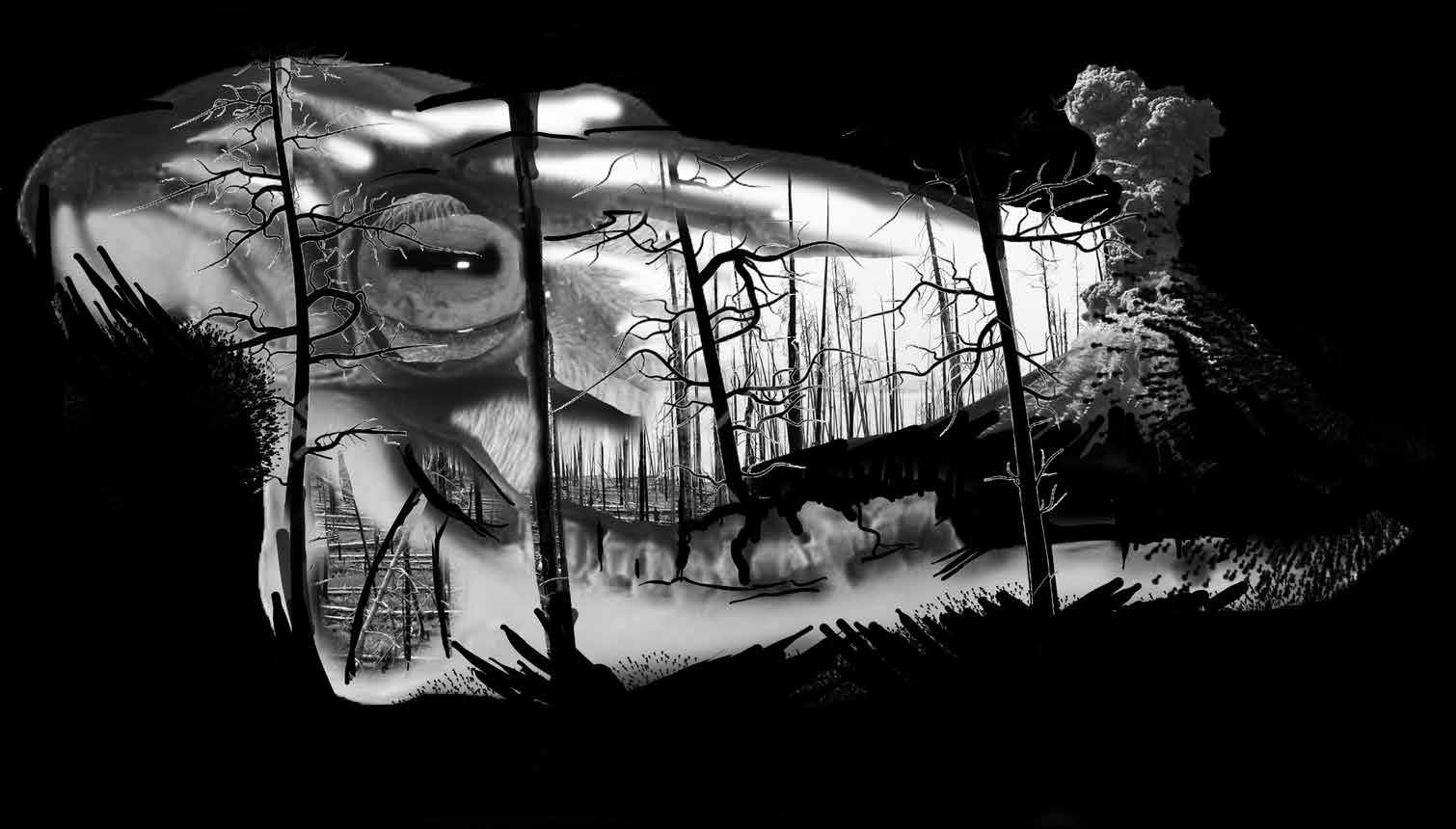
The world is burning.
Over the summer, for days, the sun was veiled in smoke, a gibbous and hideous orange. At midday you could look directly at it. An old neighbour commented that he had not seen such a thing since the eruption of Mount St. Helens. That was the first time the sun was dimmed, when it was fires in Saskatchewan and the Northwest Territories.
Later the smoke returned. The rainforests of Washington were dry, dying, and burning. At midday, near Riding Mountain, the smoke lingered in the valleys like mist. The horizon was indistinct, and the birds seemed loath to fly.
Bad things coming
As the years go on, more and more forests will burn. More and more days will be shrouded in smoke. Ecological collapse, brought on by climate change, will continue for the rest of our lives – probably for many centuries – getting continuously worse. This is the new business as usual: endless death and destruction, the unravelling of the thread of life which has allowed our species to flourish.
Climate change has been brought on by centuries of unhindered industry and capitalism. Simply put, we have injected so many greenhouse gases in the atmosphere that we have upset a balance that took 3.8 billion years or so to develop.
If it were only a matter of greenhouse gases, we might have a snowball’s hope in hell of pulling through,
of reversing the course. But it’s quite a bit worse than that. The greenhouse gases started the process, but the process is now self-perpetuating. The climate is a dynamic system that has been put out of balance, and it will seek a new equilibrium.
The greenhouse gases have raised the average temperature of the earth. But that rise in temperature has set off a whole series of positive feedback loops, which themselves now contribute to climate change.
The disappearance of sea ice in the north causes more heat to be retained, thus accelerating warming. The increase in summer temperatures causes permafrost to melt, venting methane into the air, thus further accelerating warming. Even if we were today to stop the emission of greenhouse gases (our governments cannot even commit to meaningful reductions over the course of decades), the positive feedback loops that we have kickstarted cannot be stopped.
The damage done to the earth not directly caused by warming –the acidification of oceans, the loss of arable soil, the cutting down of carbon-sequestering forests – weaken the very systems that might play a part in offsetting the damages done by humans. Not only have we set our house on fire, we got rid of the fire alarm and extinguishers long ago.
Every plant yielding seed
Plants are the foundation of any ecology; we have a bad habit of overlooking them as essential to our wellbeing. All animals, including humans,
depend on them, and will suffer as surely as us as climate change proceeds. Imagine the vast farmlands we all depend on – and which in turn depend on stable climatic conditions – dead. It does not take great imagination to picture the suffering that will follow.
Greenhouse gases started the process, but the process is now self-perpetuating
Unlike animals, plants cannot move quickly. If conditions change rapidly to something unsuitable for them, they will die. If they cannot disperse seeds far and quickly enough to keep pace with a shifting climate, they will become extinct.
Mature ecosystems take many years to develop; individual large trees are usually hundreds of years old. There will always be plant life, even in a changing climate, but it will be young, sickly, weedy, uncomplex life; the lowest common denominator. The world will be poor where it was once wealthy.
As this diminishment of the richness of the natural world proceeds, human society will suffer a similar fate. Even now, we have abandoned as useless most of the finer arts our ancestors made, trading beauty and subtlety for cheapness and conve-
nience. In a world of shrinking food resources, massive human migrations, and extreme weather, of wars fought over dwindling resources, can there be any doubt what our society will come to be?
As weeds replace the ancient forests, so it will be with us: “The best lack all conviction, while the worst are full of passionate intensity.” Even in a stable, generous climate, humans are prone to war, genocide, and cruelty. Dark inertia will take terrible forms, which will do nothing to stop the ecological ruin around us.
The future before us is bleak. The myth of progress is just that – a myth. There’s no cosmic law declaring that the future will be better than the present. Look around you – are there any signs that as a culture, we accept what is only the logical result of our actions? Sooner or later, we’re going to have to change our lifestyles. We should start now, while there’s still time to figure out the best way to live.
I can’t dictate to others what that looks like, and I’ll never be in a position to guide the course of society. But it’s not hard to imagine a very different lifestyle from what most people in our society live, one that would not only be more spiritually fulfilling, but significantly less harmful to the world around us. It would only become easier, as more and more people adopted it. Purposefully spare, so as to consume few resources and generate virtually no waste. This means
not driving or taking planes. This means not buying new things. This means eating very little meat, and much less food generally than we now consume. Constantly evolving and being fine-tuned so that through the years there is a shrinking, rather than expansion, of one’s ecological footprint. Avoiding any of the more vulgar aspects of our culture – anything with the word “celebrity” is a good start – which do nothing other than instil the desire to consume. This would result in a massive amount of free time, since such a lifestyle would require less money to maintain, and thus fewer hours worked. This free time can be dedicated to living mindfully: meditation, reading, cultivating of personal interests (I’ve been teaching myself contact juggling), creating art, going for walks. Things that require very few resources, produce no waste, and make the lives of each individual, and their whole social circle, richer. A life of poverty by our current standards – so that it can more easily be rich in spirit, and just in actions. I think it’s a good trade-off, and I encourage everyone to consider doing this, to whatever degree they’re able. If enough people give up on something bad it can make a difference; at this point, it seems like individual sacrifice is our best hope. And if not – living a life focused on living lightly and doing no harm is its own reward.

TOM INGRAM, STAFF

Stephen Harper is no longer the driving force of Canadian politics.
Though I’m less than happy with the results of the federal election, it is a relief to be able to say that.
While most Canadians seem glad to see the back of him, the usual gadflies have predictably emerged to salvage what they can of Harper’s reputation in an effort to construe him as some kind of noble, tragic hero. This simply cannot be allowed.
Under Harper, the Conservative Party of Canada developed a relentless election-winning machine. I would liken the Conservative strategy to the concept of “moneyball,” wellknown from the book and Oscarnominated movie of the same title.
The moneyball strategy is to find underappreciated player statistics that are good proxies for games won, and throw as much money at purchasing players with these statistics as possible. In this way, you can build a game-winning machine out of seemingly uninspiring players who were overlooked by other teams.
The Conservative strategy is to target their base and hit it hard, and to effectively ignore anyone else. They seem uniquely uninterested in changing the minds of people who disagree with them or in bridging ideological gaps (the Liberals, on the other hand, were largely voted in by people who disagree with them). Hence the dodging of debates, the failure to respond to the media, and the dubious electability of many of their candidates in the last election.
The reductio ad absurdum of mon-
eyball is that if you do it too well, you break the game. If you can trade on the athletic stock market with enough efficiency, then actually playing baseball becomes somewhat redundant. The outdoor theatre in which spectacles of success, failure, grace, and meanness play out for the public becomes a kind of ridiculous and antiquated ritual.
Our politics may be democratic, but culture is not, and values cannot be decided by popular vote
Likewise, moneyball in politics diminishes the extent to which the electorate is treated as intelligent human beings rather than objects that tend to behave in a certain way. It emphasizes the voices of the least excellent people in our country –whose votes are as good as anyone else’s – and speaks to the least excellent impulses of the human soul. It leads to treating almost anything that works as a valid electoral tactic.
This last is where I must draw the line. Harper’s defenders like to suggest that people object more to the way he did things than the things he did. Putting aside the issue of whether or not that’s true, it’s important to remember that methods matter.
Some methods run afoul of Canadian values. Some methods
are simply out of court for anyone who wishes to be considered a serious person.
To take one example, let’s look at the absurd non-issue cum electoral wedge that was the debate over whether Muslim women should be allowed to wear the niqab, a traditional face-covering veil, during citizenship ceremonies.
When it became clear that their hard-line stance against the niqab was causing them do well in the polls, the Conservatives doubled down. They announced a potential ban on the niqab for anyone providing or receiving public services from the federal government.
They announced a plan for an RCMP tip line to report “barbaric cultural practices,” a term that comes from a bizarre and pandering piece of legislation passed earlier this year concerning honour killings, forced marriages, and polygamy.
Essentially, this was a matter of stoking the base’s enthusiasm by making promises that appeal to the dangerous, xenophobic elements of Canada. The issues per se are unimportant matters of principle involving a small number of people, but they represent something much larger: a flagrant defiance of Canadian values, and an appeal to backwards people and base impulses.
According to polls, a great many Canadians actually supported Harper’s stances on these issues, especially the niqab. The polls can say what they will; notwithstanding their dubious accuracy, it means nothing.
Our politics may be democratic, but culture is not, and values cannot be decided by popular vote. Canadian values are the assumptions which underpin the life and work of the most excellent Canadians. They are the standards by which we judge ourselves. If many Canadians hold an opinion that is vicious and uncharitable, all this means is that many Canadians are – by our own shared cultural standards – rather poor Canadians.
If I were to define Canadian values, I would locate them in institutions like the open-minded, humble, and welcoming United Church of Canada.
I would point to scholars like Marshall McLuhan, the obscure Catholic mystic who was deeply suspicious of industry and branding and could rarely bring himself to make straightforward arguments; Northrop Frye, who turned literary criticism on its head in a quixotic attempt to recapture an epiphanic vision he had in his school days; and Erving Goffman, the sociologist who envisioned that “it is possible for all of us to become fleetingly for ourselves the worst person we can imagine that others might imagine us to be.”
I would point to musicians like R. Murray Schafer, whose soundscape compositions show an awareness of a majestic natural environment in which we are only temporary visitors. Or perhaps Malcolm Forsyth, who blended eastern Anglo-Canadian culture with the rich indigenous culture of the Prairies and his own South African heritage, and Colin McPhee, who turned composers’ fascination
with the Balinese gamelan into something more than vulgar Orientalism. I would point to writers like Robertson Davies, whose Dunstan Ramsay recounts his transformative life journey at its end, uncertain of many things, making judgments that can never be more than tentative and contingent.
In a country that is arguably founded on the original sin of invasion and genocide, we should never be so certain of ourselves – and our place here - so as to permit the embrace of bluntly moralistic terms like “barbaric.” We do what we can to stop the things we judge to be wrong, but we don’t get up our asses about it –because after all, who the hell are we?
We certainly do not stir up xenophobic rage at an entire vaguely defined ethnic group, whether out of tactics or sheer bile. We certainly do not tell people what they can and can’t wear at citizenship ceremonies or while working for the government – the Canadian thing is to be vaguely uncomfortable telling people to do anything at all.
I was taught as a child that Canadians do not start fights – we end them. I was taught to respect, welcome, and learn from people of other cultures. I was taught to protect nature, to be polite to others, to help the less fortunate, and to always seriously consider the possibility of my own wrongness.
These are Canadian values as I understand them. As far as I’m concerned, anything further is a barbarous innovation that has no place in the country that I love.
SEAMUS HAMILTON-PATTISON, STAFF
With the exception of those who carry a puritanical aversion to anything remotely close to the cadaverous, Halloween can be a wonderful time of year.
For young adults, it’s party time. Your coolest home-owning friends are probably planning some sort of costumed shindig already. Even if they aren’t, there’s a bevy of nightclubs and pubs in Winnipeg ready to play host to the masquerading masses.
You’ll get dressed up as something iconic, hilarious, scary, or endearing. You’ll have some drinks and hit the dance floor. A perpetually roaming club photographer might snap a photo of you for social media posterity, and that’d be pretty cool – but if you end up in the news the following day, there might be a problem.
This article is about that problem. I mean, it would be, if I hadn’t already written that article two years ago.
One of the first articles I ever contributed to the Manitoban was an indictment of one individual who on Halloween of 2013 chose to hit Stereo Nightclub in blackface. The photo of the individual was shared hundreds of times on social media, according to the CBC. The image was posted as a part of Stereo’s promotional photography albums. Thus the establishment also came under rightful fire for allowing the individual in.
This Halloween, save everyone the grief and the media circus.
If you, as a non-black individual, want to dress up like a culturally iconic black celebrity such as Jimi Hendrix, then I’ll applaud your right to do so, but only if you leave your face the colour it is.
You are not making a more accu-

rate costume by painting your face in such a way. You are evoking an age-old cultural stigma, the wounds of which are still far from fully healed.
The Black Lives Matter movement and the very recent, very racially motivated riots in Ferguson, Mo. are proof enough that the marginalization of black North Americans is far from over. As such, no one stands to benefit from treating blackface and minstrelsy with any kind of frivolity.
You are not making a more accurate costume by painting your face in such a way. You are evoking an age-old cultural stigma, the wounds of which are still far from fully healed
Cultural appropriation certainly doesn’t begin and end with blackface – far from it. A cursory Google search will yield innumerable options for “Indian” (in a misnaming that deserves its own article) costumes for both adults and children.
The indigenous minority has been persecuted for years. From colonialism to the “cowboys and Indians” trope to the (albeit, recently banned) wearing of Native American headdresses at music festivals such as Osheaga and the Edmonton Folk Music Festival, indigenous culture has been taken out of the hands of

those it belongs to for long enough. What might be a cute Hallow’s eve outfit to some will be racially and even spiritually offensive to many. Again, this isn’t exclusive to any particular racial minority. This also means no “Chinamen”, Hinduistic deities, stereotypical Hasidic Jew garb (if Macklemore couldn’t get away with that one, just think how

you’ll fare), and any other racial stereotypes under the sun.
The point of this article is not to infringe on your freedom of expression – it’s to prompt you to think about what that expression represents.
You are free to dress in whatever costume you please on Halloween. However, if you choose to evoke such racially charged imagery, do so
knowing that you’re aligning yourself against the right of Canadians and Americans alike to have their respective cultures and races respected and free from mockery.


Features Editor: Dana Hatherly
Contact: features@themanitoban.com / 474.6520
DANA HATHERLY, STAFF
The history of Halloween has been linked to ancient Celtic origins, when people would ward off ghosts with costumes and bonfires. Once designated as a time to honour saints and martyrs – in other words, people who have died – it remains a widespread time of celebration and superstition, of life and death. This edition of the Manitoban’s features section focuses on the latter, with stories of death and dying – from dealing with
the deceased and preventing death to global catastrophe and human annihilation.
Although global traditions in the spirit of Halloween vary in countries throughout the world, death is universal. Scientific perspectives and belief systems about dying and the dead have been observed and debated over time. Unanswered questions about the missing and deceased leave us yearning for more.
Extinction or, more accurately in this case, complete annihilation of our species on Earth due to humancaused catastrophes such as nuclear weaponry and climate change has been considered a serious threat by scientists. As part of this feature, the Manitoban’s science editor, Chantelle Dubois, discusses the Bulletin of the Atomic Scientists’ Doomsday Clock, a symbolic representation of our proximity to total annihilation.
Jeremiah Yarmie, a biology student at the U of M, contributes a medical sci-fi article that looks to the future of humanity and the possibilities for achieving eternal life by overcoming death.
Since ancient times, humans have dealt with death differently in various societies. Humankind has had a plethora of beliefs and practices for mourning and celebrating the deceased. Science reporter Malak
CHANTELLE DUBOIS, STAFF

The Doomsday Clock provides a symbolic measurement of how close humanity is to its own annihilation. Established in 1947 by the Science and Security Board of Bulletin of the Atomic Scientists, the Doomsday Clock was initially set at seven minutes to midnight, making its debut on the cover of Time in that same year.
The founding members of the board were scientists involved with the Manhattan Project.
The clock was developed as a way to communicate the dangers of nuclear weapons to the public as tensions between the Americans and Soviets during the Cold War began to rise. At that time, America was the only nation known to have nuclear weapon technology.
The Doomsday Clock has oscillated between two minutes and 17 minutes to midnight over its 68 years of existence
Since then, the board has reviewed the clock every year to determine the state of humanity’s safety. The board, which includes 17 Nobel laureates, now considers climate change and emerging technologies to be among the biggest threats to humankind.
The Doomsday Clock has oscillated between two minutes and 17 minutes to midnight over its 68 years of existence. Here are some of the more terrifying moments in history that brought the world less than five minutes from Doomsday since the clock was first set.
Three minutes to midnight – 1949
In 1949, seismic activity raised suspicions that the Soviets had carried out an underground nuclear test. Fear of the progression of the Soviet nuclear program sent the American government into a panic, and a nuclear arms race blasted off. The Americans increased funding to accelerate military programs and later develop the hydrogen bomb.
Two minutes to midnight – 1953
In 1952, the Americans tested their first hydrogen bomb. The bomb resulted in a yield of 10.4 megatons with a fireball more than three miles wide, destroying an island. The test was only meant to prove the theory behind the bomb, as a deployable bomb had yet to be developed.
Soon after, in 1953, the Soviets also carried out hydrogen bomb testing. While their bomb was much less powerful, with a yield of 400 kilotons, it was small enough for deployment. With the power of destruction increasing on both sides, the Doomsday Clock ticked closer to midnight.
Four minutes to midnight – 1981
Nearly 30 years later, Cold War reached a new height. While various events had led to the Doomsday Clock’s hand moving further away from midnight, indicating hope for the future, the events of 1981 brought the hand mere minutes to the hour once again. The Soviet invasion of Afghanistan, provocative American rhetoric, and a rapidly increasing arsenal of intercontinental ballistic missiles and planes capable of delivering nuclear bombs on both sides threatened the future of humankind.
Abas examines the science and art of embalming, or preserving the dead. Lastly, for medical students, encounters with death are regularities on the curriculum; students must study the bodies of the deceased to learn about the living. University of Manitoba medical student Jordyn Lerner shares his experience with death on the syllabus.
Three minutes to midnight – 1984
In 1984, the Bulletin of Atomic Scientists moved the hand closer to midnight, explaining that “every channel of communications has been constricted or shut down; every form of contact has been attenuated or cut off. And arms control negotiations have been reduced to a species of propaganda.”
Nuclear weapon proliferation continues to be a threat
Three minutes to midnight – 2015
While the Cold War has long since ended, relations between Russia and the U.S. are once again icy. Nuclear weapon proliferation continues to be a threat. It is thought that there are nine nations currently operating with nuclear weapons, including Russia, the U.S., France, China, the United Kingdom, Israel, Pakistan, India, and North Korea. In addition to the risk of nuclear catastrophe, climate change continues to melt polar ice caps, thaw permafrost, and destroy shorelines, with a continued dependency on fossil fuels further threatening the safety of humanity.
JEREMIAH YARMIE
Oct. 28, 2205
This morning, the World Health Organization (WHO) announced a landmark in the field of medicine: humanity has beaten death.
Humans have fought against death for some time. Different societies practiced different forms of medicine, sure, but the end goal has always been to prolong life.
Medicine advanced tremendously in the 20th and 21st centuries. Physicians and nurses found new ways to save lives by using groundbreaking discoveries made by medical scientists.
Countless individuals aspired to become physicians, attracted to the prestige, money, and power associated with the profession.
But somewhere along the way medical professionals lost sight of what they were working towards.
No one was asking medicine’s big philosophical question. Nobody was asking what the end goal of medicine truly was.
It is clear today, in the wake of WHO’s announcement, that the answer to that question is eternal life.
Gone are the days of “old age,” a time when things like cancer and dementia easily stole our bodies and minds.
Experts have predicted the conquering of death for quite a while now. The potential for this shift in human existence was first noted when medical scientists and physicians successfully overcame the process of aging. By genetically altering our biological clocks, processes like cancer and tissue wasting were permanently prevented.
Although the biological degradation associated with aging was halted, things were not perfect. There was a mental disconnect between our bodies and minds that allowed for things like dementia and depression to cause more suffering than ever before.
Despite our physical wellness, the suicide rate had actually increased in the mid-to-late-22nd century.
Medical researchers and professionals worked diligently to bring our level of mental health care to the same level that physical health care had achieved. Eventually the HappyHub, a brain implant which provides our brains with biochemicals when our normal levels fall out of balance, was developed.
The last piece of the puzzle was defeating infectious diseases. Pathogenic bacteria and viruses have always proved to be a daunting challenge for us as humans due to our differences in biology. Bacteria and viruses reproduce much more rapidly than we do, so no matter how quickly we adapted, they were always one step ahead of us.
This problem was solved when medical researchers realized that instead of attacking these pathogens, we should be improving our defences.
To achieve this, researchers developed a way to improve the efficiency of our immune systems through the use of specialized nanobots.
The World Health Organization’s announcement this morning came after confirmation that the common cold, humanity’s last known infectious disease, had been eradicated
Our nanobot-bolstered immune systems are now so adept at fighting off infections that it was only a matter of time before every single human pathogen would be wiped out.
The WHO’s announcement this morning came after confirmation that the common cold, humanity’s last known infectious disease, had been eradicated.
Today, physical and mental health has progressed so far that the global suicide rate has dropped to a fraction of what it used to be. Infectious diseases are no longer a concern. Suffering is a concept that will hopefully be forgotten over time.
The potential for this shift in human existence was first noted when medical scientists and physicians successfully overcame the process of aging. By genetically altering our biological clocks, processes like cancer and tissue wasting were permanently prevented
Sure, people can still die in freak accidents, but current health and safety technologies make those scenarios nearly impossible. For instance, we no longer have to worry about murder or assault due to the DePROVOKER chips that are inserted into our brains alongside our HappyHubs shortly after birth. Death is a thing of the past, and
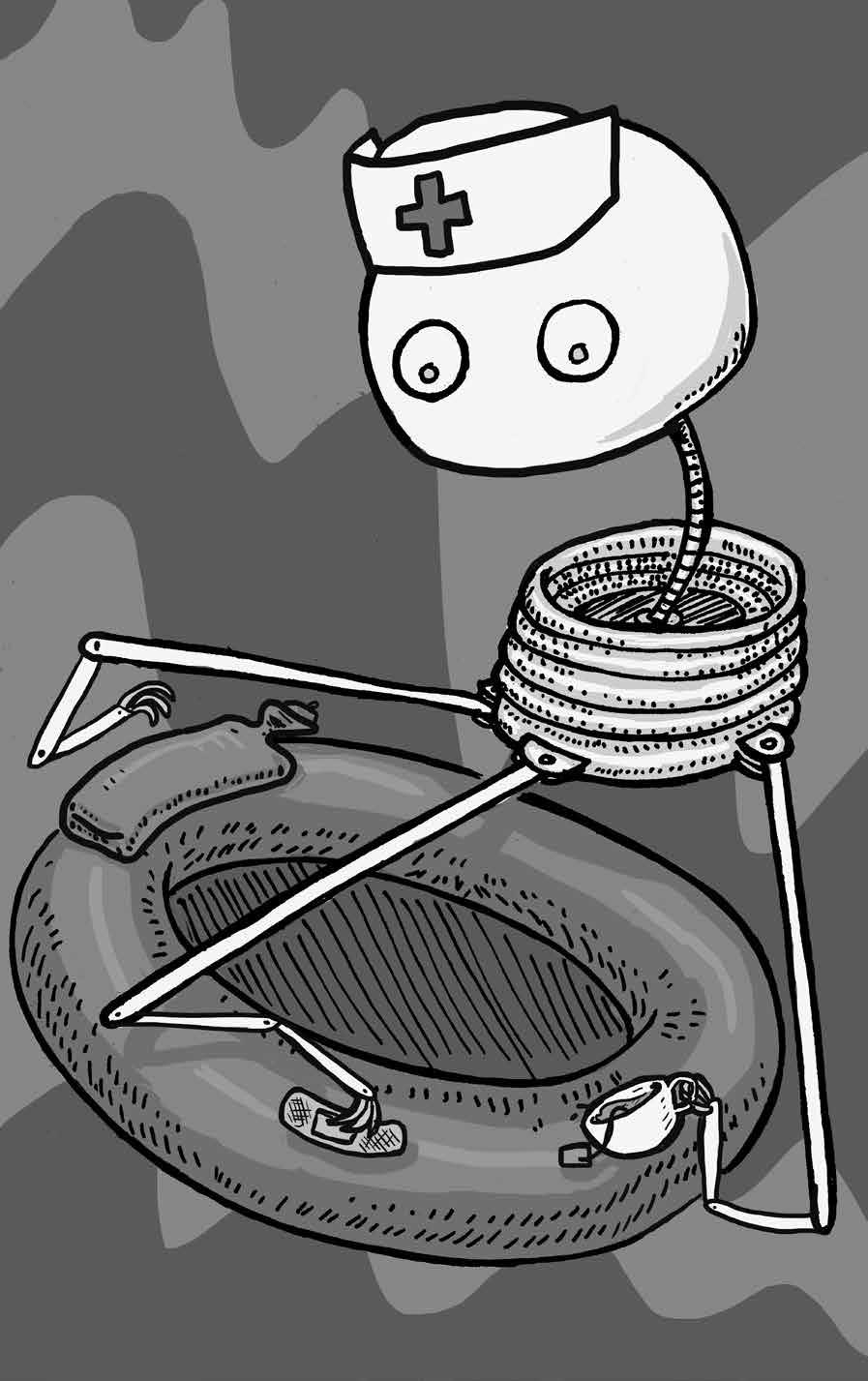
I couldn’t be more excited about it. Let’s marvel at what this means for all of us moving forward into the forever-future.
Unlimited time means that everybody has the opportunity to learn and do everything. Experts believe that every single individual will have mastered all skills and fields of knowledge within the next five hundred years. Eternal life has given us the opportunity to end natural inequality at the small expense of individualism. In just a few hundred years, everybody will be the exact same.
What happens after that is anybody’s guess, but I’m sure we will figure out new things to explore as a collective entity.
The WHO made another major announcement during this morning’s press conference. The Global Reproductive Restriction, which was established at the beginning of the 22nd century to combat the unsustainable growth of our global population, has officially ended.
Instead, it has been replaced with the Global Reproductive Prohibition. New generations of humans are no
longer needed since there will no longer be deceased individuals to replace. As a result, the current generation of children will be the final generation of new humans. Mandatory sterilization for all individuals will be implemented within the next few months. Once this generation reaches adulthood, it is very likely that most family structures will be dissolved. I think these personal sacrifices are an extremely fair payoff for the opportunity to live forever. Only time will tell what humanity accomplishes next.
Editor: Dana Hatherly
Live fast, die young, and leave a good-looking corpse
MALAK ABAS, STAFF

Death can be a very ugly thing. With dying comes decomposition, germs, and general grossness. So if you’ve ever seen a serene-looking dead person (or at least a photo of one), they were probably preserved through the art of embalming.
Embalming, despite being generally associated with the tombs of ancient Egypt, is a process used to this day to help preserve the recently deceased through physical and chemical processes.
In ancient Egypt, there were trained priests who would guide the body through the process of mummification, in which they would wrap the body in a cloth and scrape the brain out with a piece of iron.
Embalming in past millennia was often partnered with a cultural significance – Egyptians believed that
the soul of the person who had passed on would return to their corpse, thus the attempts to keep it as pristine as possible – but this is not so much the case today. In fact, embalming is banned in both Judaism and Islam, and has no history in Christianity or Buddhism.
So, why do we choose to embalm our loved ones? It remains a matter of personal preference. Some people are embalmed for the sake of having an open casket funeral. Some professional embalmers believe that seeing a loved one post-embalming can actually help initiate the process of grieving.
And guess what: it’s not as creepy as it sounds. Let’s go over the modern-day science and artistry of embalming.
If you have ever watched embalm-
ing in a movie, you may assume that it’s more invasive than it actually is.
Research suggests that seeing a loved one post-embalming can actually help initiate the process of grieving
Organs are, in most cases, not removed. What is removed, however, are bodily fluids, which are usually replaced with a formaldehyde-based solution to preserve cells and prevent deterioration.
Before that, the features of the
body must be set. Bodies naturally stiffen after death, and massaging the body slows this process. The face is shaved for both men and women. The body is washed in a disinfectant, and the body is then ready for facial rearrangement.
The eyes are closed with great care, as the eyelids tend to sag. A cotton ball or plastic cap is sometimes used to fix this. The process of sewing eyes shut is a myth, but depending on the nature of the body, the eyelids may be glued down. The mouth and jaw may then be wired shut. This is done by inserting a wire into the mouth with a needle injector, and tying it tightly to ensure the mouth doesn’t drift open.
It is now the embalmer’s job to ensure the body looks as serene and content as possible, and many will consult a photograph of the recently
deceased taken during happier times. The actual embalming process can now begin. Arterial embalming is what gets the body’s blood out and the embalming solution (called formalin) in. The blood is typically removed via the right jugular vein. The formalin is pumped into the body through the arteries, and the embalmer ensures that it spreads throughout the entire body by massaging the body again.
Moisturizer, foundation, and mascara are as important in the process of embalming as trocars and formaldehyde
Cavity embalming is the next step. The embalmer will make an incision just over the belly button, and use a sharp object called a trocar to puncture several organs and drain their fluid content. If an embalmer was to forget or ignore this step, many of the gases and fluids drained using the trocar would find their way through the body and expel themselves out of the body’s nose and mouth, in what embalmers call “purging.” Maybe this part actually is as creepy as it sounds. The incision is then closed up with a trocar screw.
At this point, the embalming process for most bodies is over. If the body is severely damaged, extra cosmetic or draining procedures may be used. Usually, however, this is the time when embalmers will wash the body for a final time.
Then the body will be dressed and makeup applied. Makeup is usually applied to all genders in hope that the body will look more vibrant and peaceful. Moisturizer, foundation, and mascara are as important in the process of embalming as trocars and formaldehyde.
The body is now ready for whatever lies ahead.
While some people may think of this process as disgusting or scary, I implore you to think about it as a surgical process that has existed for longer than almost any other. The need to see our loved ones one last time, the desire to look healthy even postmortem: these feelings connect us to human beings in ancient Egypt and even the people of the Chinchorro culture in 5000 BCE.
Never send to know for whom the bell tolls; it tolls for thee. It wouldn’t hurt to ask yourself what you want to happen to your body afterwards, either.
JORDYN LERNER, VOLUNTEER STAFF


Most students at the University of Manitoba wouldn’t consider death to be part of their curriculum. But for medical students, death is just that.
In the preclinical years of medical school, death is formally denoted on the schedule by the location of a session being held in the Gross Lab. Gross Lab is short for Gross Anatomy laboratory. “Gross” is used in its traditional sense of “large,” rather than the modern meaning of “disgusting,” although many have made that joke. Students work in groups to dissect their cadaver. Cadavers are dead bodies that have been bequeathed to the university. One student reads from the anatomy atlas while the others move through layers of fat and other tissues to find the organ in question. If an organ is difficult to dissect, students examine prosected specimens instead. Prosected specimens are cadavers, or parts of cadavers, that have been previously dissected.
The Gross Lab sessions differ by organ system. When learning the anatomy of the nervous system, students are presented with an unassuming white bucket. In that bucket, submerged in a pool of liquid preservative, is a whole brain, a half brain, and a spinal cord. Students reach in, grab the specimen they need, and start learning.
A quote on the Gross Lab wall reads “mortui vivos docent.” It means the dead teach the living
All dissections are done with the utmost respect for those who gave their bodies.
A quote on the Gross Lab wall reads “mortui vivos docent.” It means
the dead teach the living.
In the clinical years, death is no longer a series of scheduled sessions. Instead, it’s an unplanned, but not unexpected, part of hospital life.
In the emergency room, death is announced overhead by “Red Romeo 3.” This is paramedic code for an unstable patient under resuscitation after a traumatic injury. Within minutes of the announcement, the team is working on a man who was attacked with a weapon. They take over CPR from the paramedics and give the patient litres upon litres of blood. Although he has no heartbeat, the patient isn’t technically dead until half an hour later, when the team leader calls it and announces the time of death.
Much like in the Gross Lab, mortui vivos docent holds true in the hospital. A young man is dead on arrival in the emergency room after a motor vehicle accident. His pelvis is very unstable from the force of the
collision. If he were alive, his pelvis would need to be secured right away, or he could die from internal bleeding. But since he’s already dead, there’s no such urgency. Instead, it’s a chance for medical students to feel an unstable pelvis so that they can recognize it on a living patient.
In the clinical years, death is no longer a series of scheduled sessions. Instead, it’s an unplanned, but not unexpected, part of hospital life
Death isn’t always an unplanned experience in the clinical years. Students on their obstetrics and gynecology rotation participate in
an abortion clinic. Students sit in the procedure room while women undergo dilation and curettage. Dilation and curettage is a procedure in which the cervix is opened and the contents of the uterus are removed. The physician examines the tissue to make sure the entire fetus is removed. Depending how far along the pregnancy is, that could mean looking for a head, torso, and four limbs. Failure to remove all the fetal tissue could result in an infection for the woman.
Whether in the Gross Lab or the hospital, experiences with death in medical school are inevitable. The important thing for students is to learn from each death they encounter, so that they can better prevent the next.


CHANTELLE DUBOIS, STAFF
An international collaboration is shedding light, or rather radio frequencies, on the true shape of distant galaxies. Among those involved is the University of Manitoba’s own Jayanne English, associate professor in the department of physics and astronomy.
The Continuum Halos in Nearby Galaxies (CHANG-ES) survey uses the Karl G. Jansky Very Large Array (VLA) telescope in New Mexico to collect data on galaxies as close as 11 million light-years, and as far as 137 million light-years away.
The shape most people are familiar with when it comes to galaxies are the flat, two-dimensional spirals. When astronomers observe these galaxies, there appears to be nothing above or below this flat spiral.
This is because the galaxies are only being observed in the visible light spectrum. The CHANG-ES survey observes these galaxies in the radio frequency spectrum. The team discovered that a radio halo exists all around the visible spiral after observing 35 different galaxies.
The radio halo is created by the noise emitted by cosmic ray electrons moving around in the galaxy’s magnetic field at the speed of light.
The recently upgraded telescope enables scientists to collect data on faint radio light surrounding the
observed galaxies, which create a halo cloud that has otherwise been invisible to observers.
In order to observe these clouds, galaxies were viewed edge-on to help distinguish the galaxy from its halo.
English scaled 30 images from a selection of 35 galaxies, and stacked them to see the typical distribution of the radio halo.
“From the median image of the galaxies made from the radio data, you can see the large vertical extent away from spiral disks that is otherwise invisible in optical wavelengths. It shows that these radio halos are not just associated with a few galaxies, but rather are a more common property,” English said in a U of M news release.
The team also found evidence that the density of the radio light halo correlated with the star formation rates; the larger the halo, the higher the star formation rate surface density, the measure of how many stars are born per year in a region of a galaxy. This, along with other measurements, could help astronomers determine the age of observed galaxies.
The results of this survey will help astronomers and physicists answer questions about the evolution of galaxies, the formation of stars, as well as their magnetic field structures.
The observation of radio halos
confirms theories and predictions of the VLA’s namesake, Karl Jansky, on cosmic-ray halos. His predictions date back to to 1961 and are described in his book The Origins of Cosmic Rays
Jansky is known as the father of radio astronomy, and was the first to detect radio frequencies of extraterrestrial origins in the 1930s, mostly by accident.
Working for Bell Telephone Laboratories, Jansky set out to determine what was disturbing transatlantic radio-telephone communications.
After collecting data for seven months, he discovered weak 20 MHz static, which he eventually learned was coming from the centre of the Milky Way. Jansky would eventually complete his master’s dissertation on star noise.
Since then, radio astronomy has expanded and now includes mapping of gas clouds, the discovery of neutron stars which emit beeping, and the discovery of quasars.
Radio astronomy also led to the discovery of the cosmic microwave background radiation, which is considered one of the most essential pieces of evidence for the Big Bang theory.
The unit of measurement for the strength of an astronomical radio source has also been named in Jansky’s honour.










Arts & Culture Editor: Seamus Hamilton-Pattison
Contact: arts@themanitoban.com / 474.6529
LAUREN SIDDALL, STAFF
Y
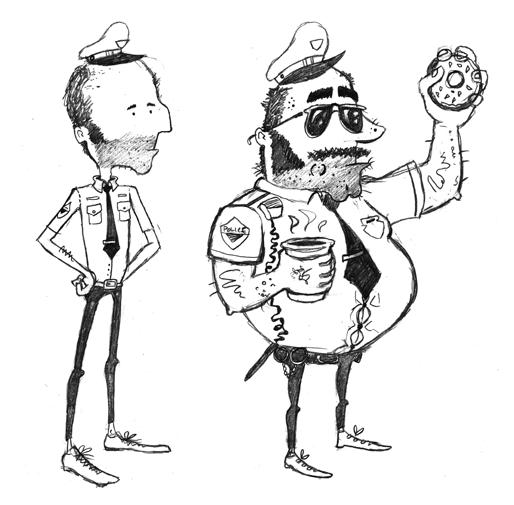
es, Halloween is fun. It’s an excuse to eat junk food, drink, and listen to “Monster Mash” on repeat. It’s also an opportunity to showcase your creativity – and apparently to perpetuate stereotypes.
Part of the problem is costume
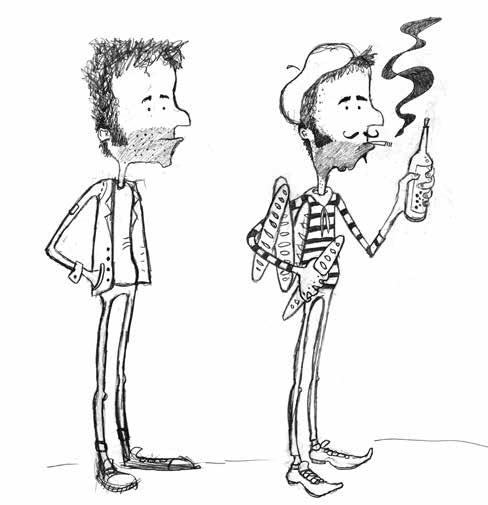
retailers. While most of us plan to create our costumes from scratch, very few people do in practice. Thus, we rely on the pre-made costumes of retail conglomerates. While the costumes are convenient, there is an alarming lack of fabric and a disre-
gard for respectful social norms. Making fun of a nationality, religion, race, occupation, or gender is frowned upon every day of the year; Halloween is not an exception. But yet, we continue to purchase the
SEAMUS HAMILTON-PATTISON, STAFF
Halloween and the days approaching it are a time when many look to temporarily embrace the macabre.
Music and the feelings it is capable of evoking can help with this to a great extent. It is with this objective in mind that I would like to share some albums that I feel best showcase the dreary, the depressing, and the downright creepy.
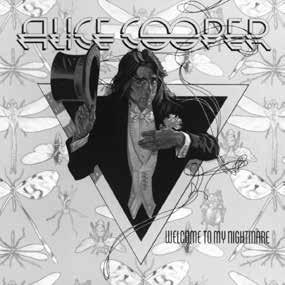
Alice Cooper
Welcome to my Nightmare
Let’s start with a classic. Released in 1975, Welcome to my Nightmare is a concept album loosely based on the childhood nightmares of a fictional character created by Cooper. This album is perfect Halloween listening. It’s not particularly heavy or ominous, but has all the elements of a corny classic horror film with a soundtrack more reminiscent of Rocky Horror than the heavy metal Cooper is known for producing.
The album’s bombastic Broadwaymeets-hard rock musical stylings are contrasted by dark lyrical content spanning a variety of horror movie mainstays. “Some Folks” is a swinging, piano-driven song about a repressed inclination to murder and bloodshed awakening in ordinary blue-collar folk. The most upbeat and typically hard rock song on the album, “Cold Ethyl,” concerns a man’s illfated love affair with a corpse.
“Devil’s Food” and “Black Widow” tell one continuous story about the rise of a sentient race of spiders that humanity will fall to and worship, with featured guest Vincent Price delivering a perfectly clichéd monologue. It’s a testament to Price’s vocal and theatrical prowess that, in spite of the B-movie subject matter, the songs retain a very unsettling, disturbing atmosphere.
This atmosphere reaches its apex in a trio of songs: “Years Ago,” “Steven,” and “The Awakening.” The music trades theatrical fanfare for eerie, minor-key melodies carried mostly by piano and a string section. The lyrical subject has turned to Cooper’s fictional character, Steven, who is now fully grown and a full-fledged serial killer, but with his child self’s voice still whispering in his head.
Alice Cooper himself is the perfect vocalist to fit his lyrical content. He tackles songs such as “Some Folks” and “Cold Ethyl” with a
warped sense of humor, but adopts a frighteningly sombre tone for “Years Ago” and the tracks that follow. For this trio of songs, Cooper’s choice to primarily sing in a child’s sing-song falsetto and using an infantile dialect takes them to a level of unnerving comparable to, well, most horror films that feature children.
The Great Southern Trendkill
Sometimes the circumstances behind an album’s creation bear just as dark a tone as the album itself. In 1994, Pantera’s lead vocalist Phil Anselmo was embroiled a heavy drug problem. He had, according to his bandmates, been behaving strangely and distancing himself from the group, going so far as to record all vocals for The Great Southern Trendkill in New Orleans while the remainder of the band worked in Dallas.
The morbidity of this album lies in the sheer volume of unadulterated hatred put forth by every single aspect of it. The music is crushingly heavy and barely controlled, switching from a punishing wall of noise to dragging, rhythmic thumping at a moment’s notice. Anselmo’s vitriol reaches alarming levels throughout the album, his tortured screams carrying songs about drug abuse, suicide, and more drug abuse.
It’s lines like “Would you look at me now?/Can you tell I’m a man with
grossly overpriced costumes, regardless of their implications.
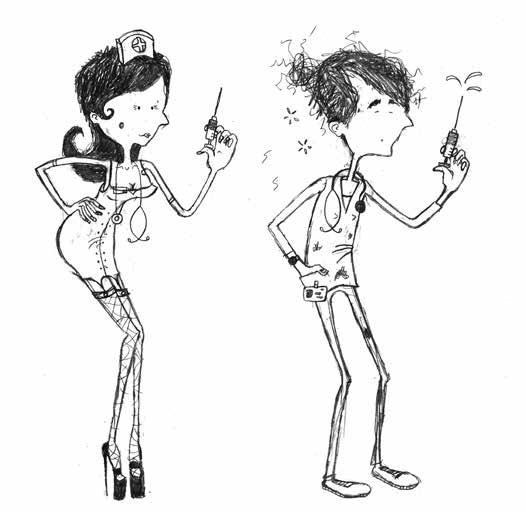
Saving lives is already sexy without a “sexy” nurse costume. And frankly, it’s demeaning to the people in the occupation. Their job is not
to wear the smallest dress they can fit into; it’s to ensure the wellbeing of their patients – which I’m certain they would not be able to do whilst wearing fishnet stockings and a skintight corset.
these scars on my wrists/to prove I’ll try again?” and “Drop the needle and stop what you’re changing into/ Erase the end dissolving, disgrace is needed more” that may underscore what Anselmo was going through at the time and inspired such themes.
Those looking for creepy music on the heavy end of both the lyrical and musical spectrum ought to take note of this one. It’s an extremely powerful and emotional listen, with the added bonus of likely scaring you away from hard drugs forever.

Wednesday 13
Transylvania 90210: Songs of Death, Dying, and the Dead
At the risk of coming across as oxymoronic, this last pick will make for some great morbid party music. Transylvania 90210 falls squarely into the Misfits-inspired “horror punk” genre, combining upbeat punk rock music with lyrics that draw distinct
similarities between this album, The Addams Family, and classic horror B-movies along the lines of Night of the Living Dead
The music is a fairly basic poppunk/hard rock affair reminiscent of Andrew W.K. or Jimmy Eat World. Somehow, this musical backdrop works incredibly well with lyrics that handle horror tropes such as cemeteries, ghosts, zombies, and Dracula with a tongue-in-cheek enthusiasm.
Once again, this album’s vocalist is perfectly suited to the material. Vocalist and bandleader Wednesday 13 brings his parodic horror lyrics to life with his charismatic, raspy bark and completes an album perfect to keep the energy up and set the atmosphere at any Halloween rager.
OLIVIA MICHALCZUK, STAFF
Millennials quiver with excitement at the sight of anything tacky, nostalgic or vintage. It became not a question of if, but when a genius and soon-to-be billionaire would begin the audio cassette revival when everyone is starting to realize that vinyl isn’t cutting it like it used to in a generation addicted to convenience.
The benefits of cassette are more than just the cool vintage appearance and throwback to nostalgic pop culture; they are both convenient and musically different than the media that are popular today.
There are quite a few benefits of listening to albums recorded to cassette for both the consumer and the producer. The beauty of an album not only lies in the songs themselves, but also in the composition and organization of the album. The ability to scroll through songs or handpick hits with CD or MP3 players have tarnished the way music is being consumed in comparison to earlier generations.
With the record and the cassette, music can be consumed and enjoyed from beginning to end, giving you the ability to understand the bigger picture and realize the intention of the artist.
Albums are stories and journeys that should be enjoyed in the linear fashion set by the artist themselves.
Cassette is much more difficult to skip through, and that is a plus. You are forced into the habit of being a thoughtful music consumer.
The rise of the record can be attributed to many things, but the patience and deeper understanding that can come from listening to the hard work of an artist from beginning to end could create a generation of educated music consumers.
Though you also get these benefits from vinyl as well, the tape proves to be more convenient physically.
The tape can go in your pocket or backpack, and the fear in the delicacy of a vinyl is absent. Tapes don’t skip, and the durability in comparison with CD and vinyl is a bonus. You can listen to tapes on the go and designer tape players will soon be in production. On the whole, the music industry may see a change in the type of music consumers with a growing demand for entire albums on vinyl or tape.
Local musician Micah Erenberg has and currently uses cassette tapes to record some of his music. Though he says the convenience is clearly not up to par with the digital era, the sound quality is much different from that of digital recording.
“Tape is continuous sound. What you record fully exists on tape and on
digital, it is broken into tiny pieces. This is the difference of seeing a painting in real life or seeing it on a computer screen,” said Erenberg.
“No matter how ‘hi-def’ you make it, to a computer audio will always be a matter of frames per second.”
The sound on an audio cassette is also more complementary to the sound that is produced by the instruments being played. The ability to pick up and adapt to frequencies allows the sound produced by tape to be ideal and doesn’t require frequency modification in the same way digital recordings do.
“You don’t have to change the sound for it to become pleasing, whereas digitally, you would be modifying the tone of your guitar,” Erenberg added.
Along with the technical aspect of cassette recording, Erenberg highlights the rewarding aspect of the process along with the physical product.
“The most definitive answer I can give for tape being better is the feeling I get when I use it. You feel it in your heart [...] When you record a track and then you look at the physical tape and know that you are actually on that tape, it’s pretty amazing and rewarding,” Erenberg said.
“Holding a tape and knowing what you played is physically on it is some-

thing you’ll never feel while holding a hard drive.”
Now that cassettes are becoming available at major clothing distributor Urban Outfitters, it is only a matter of time before the appreciation grows with the nostalgia and the wave of supporters start buying music on cassette.
We should all prepare for a wave of cassette parties and romantic boombox holsters playing your very own mix tape on the horizon.
SEAMUS HAMILTON-PATTISON, STAFF
Nostalgia can be an extremely powerful motivator. If a significant object of one’s past is no longer widely available or relevant, then a sense of nostalgia will often amplify and create a great demand within a person to have that nostalgic object made available again.
Nostalgia has created a rather specific type of supply and demand in artistic fields. It probably played a significant part in Jurassic World being the highest-grossing film of 2015. It’s why the upcoming seventh Star Wars movie has every chance of blowing Jurassic World ’s total out of the water in December. Nostalgia is also why American clothing retailer Urban Outfitters has begun producing cassette tapes.
It’s a pragmatic move. Record stores and cassette tape manufacturers alike have noticed a definite upswing in the demand for the old physical medium.
But does it really make sense?
Movies based on old franchises are
still new, and it would be utterly uncouth to reproach someone’s personal preference for the cassette tape.
However, from a strictly logical standpoint, to embrace cassette tapes as a mainstream medium is to take one confusing step backwards in the way music is released and produced in the present day.
First off, there’s the physical limitations of the medium itself. Tapes are encoded with an analog signal. Though tapes have been and are now produced by professional manufacturers to a very high degree of quality, the scientific fact is that, as an analog medium, tapes will always be more susceptible to noise (known to ears worldwide as the ubiquitous “tape hiss”) than digital encoding.
The word “digital” has a bit of a dirty synonymy with the less personal, the more computerized. This, again, simply doesn’t make sense. The same diversified technology company that spawned compact cassettes also had a hand in creating the technical
specifications for compact disc digital audio – Philips.
The music you’ll hear digitally is lovingly crafted by an artist for your listening pleasure, just as it was when it was pressed on cassette or vinyl. Music should be appreciated regardless of the physical medium it is produced on, thus this technological advance should be embraced as Philips enabling us to hear it a little clearer.
There are still many who stand by analog mediums as a superior way to appreciate music. This opinion is a subjective one, but should be respected nonetheless.
That’s why vinyl’s renaissance is a good thing.
A vinyl record retains the sound and slight hiss of an analog recording, which many enjoy. Unlike cassette tapes, however, vinyl allows a listener to easily select their favourite track from an album. Furthermore, vinyl can sport some aesthetically impressive packaging: large album inserts
with lyrics and photos of the artists, a record that can be printed with a coloured or patterned face, and cover art you don’t have to squint to see. If you love owning physical media, then what better option is there?
Looking past the comparisons between digital and analog encoding, the only problem with vinyl is its portability. Vinyl is, for obvious reasons, completely infeasible as a portable music medium.
Thankfully, portable music has, for the vast majority, migrated to music players on smartphones and the iPod, Zune, or other portable music player. Digital music can be enjoyed at a very high audio quality and has the added benefit of doing away with the now-unnecessary production of the portable Walkman and CD players.
Even for the audiophile who cherishes the allegedly “warmer” sound of analog media, it just makes sense to enjoy them at home with a highquality stereo system to highlight their defining features. Similarly,
when you’re on the go and your listening has been relegated to earbuds or headphones anyway, it’s logical to go digital and use your phone or portable music player. You’ll forego having to lug around a Walkman or CD player, and won’t be helping create a demand to bring them back, because they simply don’t need to come back.
Once again, if you vehemently adhere to cassette tapes as your preferred medium, then that adherence should be respected. You occupy a niche market.
There’s nothing wrong with enjoying cassette tapes, but they ought to stay in that niche market. Cassette tapes crossing over into mainstream popularity in the modern age would be illogical and, when the added increased production of the Walkman is considered, rather wasteful.
for Creative Writing and Oral Culture provides opportunity for creative writers to hone their craft
TOBI NIFESI

A s with any skill, writing requires consistency and knowledge to be honed. The University of Manitoba Centre for Creative Writing and Oral Culture is giving students and Winnipeggers the opportunity to
be advised on their writing this fall. Students and other aspiring writers can do this by booking a session with the current writer in residence, Irish novelist and playwright Kitty Fitzgerald.
Beginning her residency in September 2015, Fitzgerald will be available at the university until early December.
Fitzgerald is a renowned storyteller whose works span from a short story collection to plays to novels. She is the author of five novels, including the critically acclaimed Pigtopia. She has written four plays for BBC Radio 4 and has been shortlisted for several awards, winning second place in the Barnes & Noble Discover Award for Pigtopia
Born in Ireland, Fitzgerald moved to England after the Second World War and believes that her experiences at the time may have influenced her writing style.
“I am always searching for the right voice for whichever thing that I’m writing [...] I think my main theme is outsiders,” said Fitzgerald.
“It may be the fact that I was an immigrant in Britain [...] I think that is probably what influenced me at an early age; that notion that you can be rejected not just for who you are as a person, but for where you come from.”
She believes that young writers need to get rid of the constraints that limit them from writing in a certain style.
As a radical politics enthusiast
Ben Caplan and the Casual Smokers Birds with Broken Wings 5/5
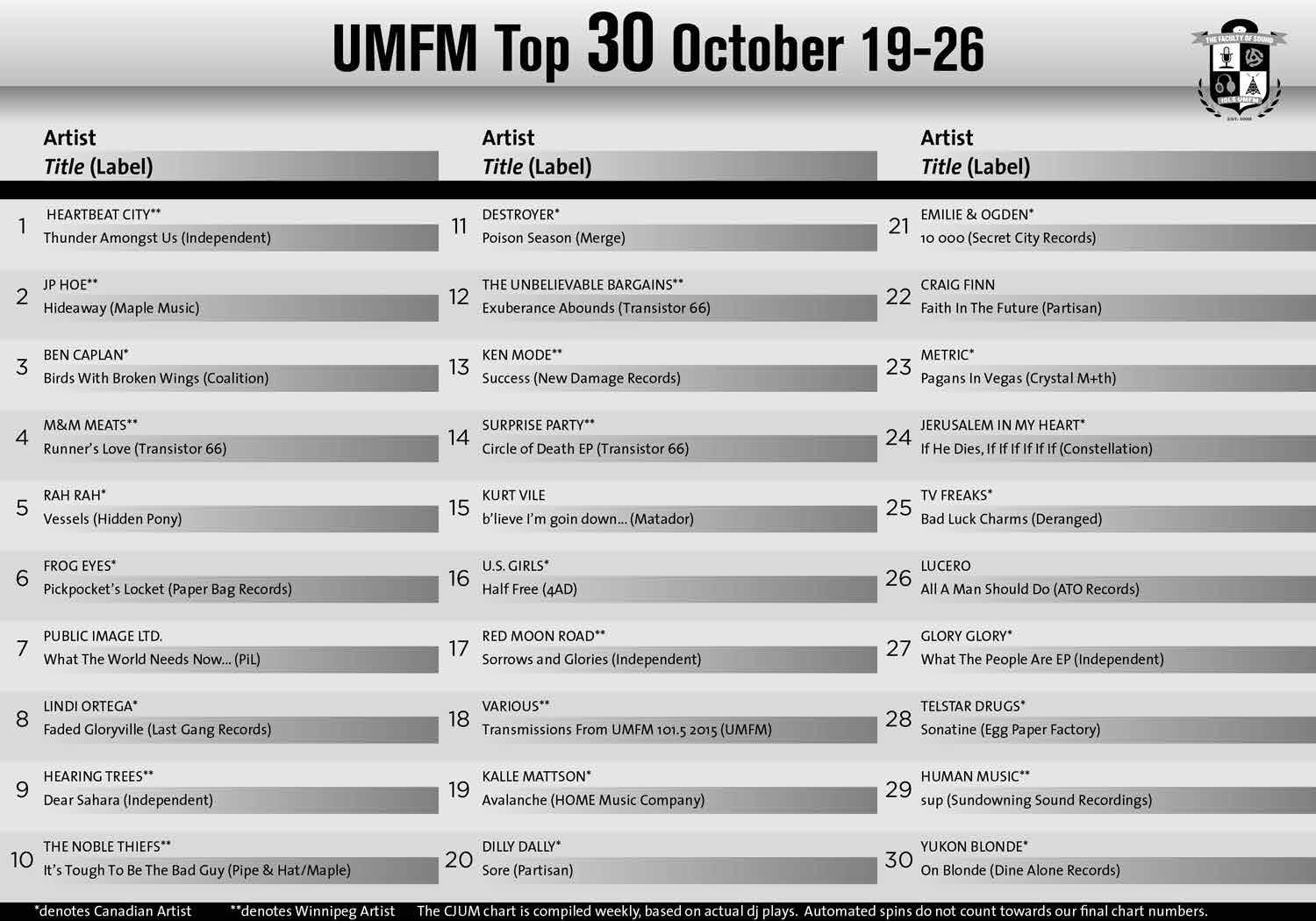
With absolutely no surprise, Ben Caplan and the Casual Smokers’ sophomore album perches atop Canadian community and campus radio magazine !earshot ’s national folk/roots/blues chart.
The album opens with a beautifully twisted and villainous song called “Birds with Broken Wings.” This song contains a variety of instruments that add many moving layers that instantly hook you and keep you begging for more.
Caplan’s voice is raspy and animated. The wide variety of cultural influences, including elements of Slavic and Spanish music, add so many more musical intricacies that keep your ears keen on every note.
The lyrical simplicity in the album’s second song “I Got Me a Woman” – in comparison to the complexity of the first tune – allows you to slow down and appreciate the band’s talent and Caplan’s vocals. Your appreciation of their musicianship grows when you
hear how they do simple so well it’s mesmerizing.
The beautiful moving romantic piano ballad “Lovers’ Waltz” is coupled with unconventional, raw lyrics that seize your heart strings. This song inspires you to imagine the most love you have ever felt, which still leaves me in tears every single listen, though I have heard to it upwards of a dozen times.
“40 Days & 40 Nights” is the most well-known song on the album, especially on independent radio stations. Many people I’ve spoken to became instant fans and went to Caplan’s recent show at the Good Will Social Club on that song alone. The crawling tempo throughout the song is so well done and the pauses in the middle will take your breath away in begging anticipation.
The lyrical genius of this album, in both complex and simple tunes, is mind-blowing and the instrumental composition is perfectly complementary to a strong vocal performance. I honestly have to grasp at any criticism, which slips through my fingers immediately.
If you are a poet, musician,
music lover, dancer, emotional, unemotional, or a person that owns a device that plays music, listen to this album.
www.bencaplan.ca

growing up in a political environment, Fitzgerald was subject to certain barriers but learned to heed to her inner voice and write what she needed to say.
“I always have a notebook with me. I am always making notes. I observe people all the time [...] and I read a lot of the news, I am very interested in what is happening in the world,” said Fitzgerald.
“What usually happens is there will be an inspiration that could come from any of those places – from observation, from listening, or from reading news.”
Aside from being inspired and having a creative process, she advises writers to set out a time and place to write frequently.
Today, several writers are creating an online or social media presence for themselves and self-publication is becoming a very popular option for producing literary works. Fitzgerald believes there is a place for both ventures.
“I think there is a place for it [...] [Hire] a professional editor to do the final editing because we need some distance from our work to see it clearly.”
“The difficulty with self publishing is if it is not picked up, getting
reviews, getting it out there, and getting known is quite hard, so you depend a lot on social media.”
She advised young writers who write as a hobby while focusing on a different career path to find the perfect balance between the two. Those that want to write professionally are urged to take it seriously.
“If you want to build a writing career, you have to take it seriously. You have to have people who can give you honest feedback, not just friends who say ‘that’s great,’” Fitzgerald said.
“You’ve got to be tough because there are so many obstacles. I would encourage anybody who really feels they have a drive in writing to keep going.”
Fitzgerald looks forward to meeting students and Winnipeggers who are serious and passionate about writing during her time at the university.
Kitty Fitzgerald is available for help with creative writing at the Centre for Creative Writing and Oral Culture at 391 University College until Dec. 7. She can be contacted at 204-4801067 or at ccwocwir@umanitoba. ca to arrange a free meeting.
Picture a wave undulating in a heavy storm on a nippy and overcast day. It is a dark and dangerous sight, but it calms you nevertheless. That feeling is what the Sumner Brothers have to offer on their latest album, The Hell in Your Mind
Over the past ten years, the band has developed a reputation for their rootsy, gutsy, and stirring sound. On this album, they build on that reputation and dare unbelievers to doubt again.
Recorded in a cabin on Galiano Island off the coast of British Columbia, this record is reminiscent of a beautifully twisted symphony – the music is excitingly unnatural.
The album opens on a loud emphatic note in “Last Night I Got Drunk.” As it progresses, it goes through the motions and tries to play it cool; cue “It Wasn’t All My Fault,” and “Go This One Alone.” That being said, the album ends on a more soothing note in “My
Dearest Friends.”
The lyrics are dark, melancholic, and emotive. Simply put, you might get lost in the words if you pay too much attention.
After a couple listens, “Ant Song,” “It Wasn’t All My Fault,” and “Lose Your Mind” stood out. The instrumentation on these tracks was sombre enough for their gloomy lyrics, making the perfect balance.
On this album, the Sumner Brothers sound like the National with less baritone and more emotion. The Hell in Your Mind is alternative country music at its best. The music is pleasant and the lyrics are unapologetically raw. Give it a listen.
www.thesumnerbrothers.com
Established musical improv comedy troupe kicks off new season with two-for-one Halloween show
RYAN CAPAR
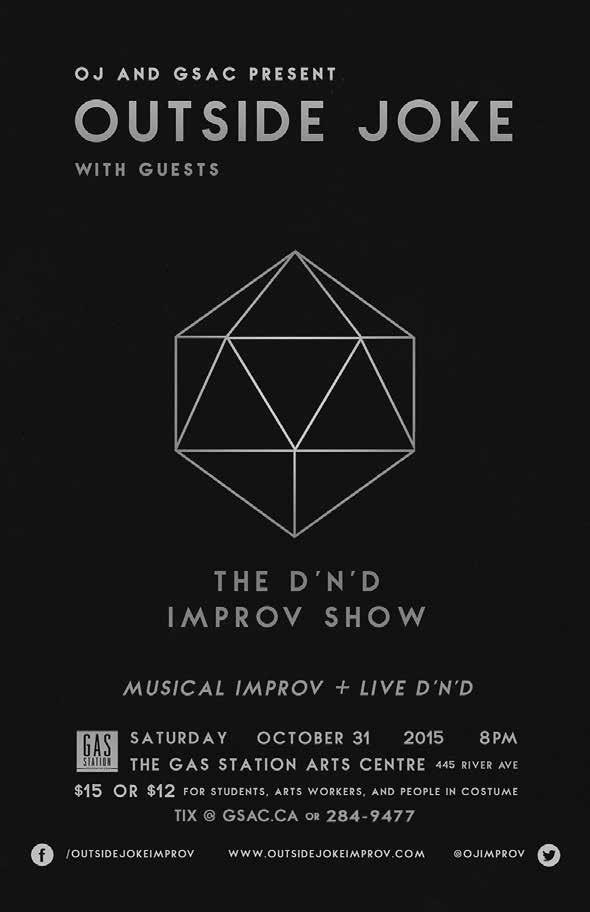
This Halloween the musical improv comedy group Outside Joke is teaming up with the Dungeons n Dragons Improv Show to kick off their fourth season of comedy at the Gas Station Arts Centre.
Outside Joke is a troupe of seasoned improv veterans who have been entertaining audiences with their style of musical improv for over a decade now.
“We’re 13 years old this year,” said RobYn Slade, one of the six improv comedians that make up the group.
The group’s success and longevity is not only about each member’s talent but also the dedication they have for their craft and their desire to keep the show fresh and exciting for their audiences.
“We’ve grown and continued to grow by travelling to festivals and taking workshops both as a company and as individuals, and then we pour what we learn back into our shows,” said Slade.
The DnD Improv Show, on the other hand, has solidified its status as a theatrical hit over its nine-year run. From 2011 to 2015 the show has earned five-star reviews from the Winnipeg Free Press and has been performed at a variety of festivals including the Winnipeg Improv Festival, Winnipeg Comedy Festival, and the Winnipeg Fringe Festival.
The decision to team up and launch the new season on Halloween is simple.
“We love a good party,” said Slade. “It fits so well with the DnD Improv show’s aesthetic. Swords, cloaks, masks, fake blood. At the

Fringe Festival, they offer a discount for audience members who come in costume, so it’s a perfect pairing for improv and Halloween lovers alike.”
Outside Joke will kick things off first and treat fans to what they are known for: musical improv.
“Expect it to be weird, and fun, and bloody, and you’ll have a great time” – RobYn Slade, Outside Joke Improv
“It’s been a while since Outside Joke got to bust out our signature musical improv show with all six members of our company, so we’ll be doing that for our half of the show,” said Slade.
Exciting moments are inevitable during improv because neither you nor the actors really know what’s coming next.
The second half belongs to the DnD Improv Show. If Dungeons and Dragons isn’t your bag, don’t worry.
“You don’t need to know the rules of DnD to enjoy the show,” explains Slade.
“The Dungeon Master does a great job of guiding the audience through the die-rolling, decision-making, and plot-twisting [...] Expect it to be weird and fun and bloody, and you’ll have a great time.”
Those who are new to improv and
have never attended one of these shows before should remember that, as an audience member, you are part of the show. That’s part of the fun.
When speaking with the Manitoban, Slade highlighted the importance of a great crowd.
“Not only is it important to us as producers, but there’s a kind of magic that happens when, as an audience member, you’re able to lose yourself in a crowd and laugh and cheer and maybe even cry a little without feeling self-conscious.”
Outside Joke and the DnD Improv Show will perform at the Gas Station Arts Centre at 8 p.m. on Saturday, Oct. 31. Cover will be $15, and $12 for all students, art workers, and costumed audience members. Tickets can be purchased in advance online at www.ticketweb.ca.




streak
RYAN STELTER, VOLUNTEER STAFF
This past weekend, the University of Manitoba Bisons men’s hockey team faced off at home against the University of British Columbia Thunderbirds in a two-game set. They were dominated in the opening game on Saturday 4-2 but battled back on Sunday afternoon to grab a 3-2 win in a second overtime.
Saturday night
The story of the night for the Bisons was special teams. They had four power plays, but were unable to cash in on any of them – including a lengthy five-on-three in the third period.
The Thunderbirds, on the other hand, capitalized on their only power play chance off a nice shot from the top of the wheelhouse via the stick of Scott MacDonald.
UBC opened the scoring five minutes into the first period off a scrappy rebound goal from speedy forward Anthony Bardaro. Manitoba
generated a few chances of their own, including a Warren Callis breakaway, but was stymied by Thunderbirds goalie Eric Williams.
The visitors jumped out to a twogoal lead early in the second, with MacDonald getting his first of two on the night. Manitoba was able to answer six minutes later, as rookie Liam Bilton shelfed a pass from fellow rookie Jonah Wasylak to make it a one-point game.
The Bisons’ momentum didn’t last long, as UBC scored 19 seconds into their first and only power play. They say that a two-goal lead is the worst lead in hockey to have, and that was the differential going into the second intermission.
UBC continued their trend of scoring early period goals and fired one in off a two-on-one three minutes into the third. Manitoba was in a hole at 4-1, but they attempted to battle back and even found themselves with a five-on-three, but could
not convert. The Thunderbirds’ penalty kill was superb, blocking almost everything the herd threw on net.
However, forward Dylan Kelly scored off a sharp angle shot shortly after the unsuccessful power play and suddenly the Bisons had life.
They pushed hard for an equalizer, getting lots of chances and hitting the post on one occasion, however Saturday was not their night as they dropped the two points.
Sunday afternoon
Manitoba had to put that loss on Saturday out of their minds quickly, as the puck dropped on the second game on Sunday at 1 p.m.
The herd looked sloppy in their own end to start the game and found themselves down 1-0 with five minutes remaining in the first period. Bardaro scored a power play goal off of a beautiful spin-o-rama at the side of the net to put the Thunderbirds ahead.
The Bisons answered back with a power play goal of their own after captain Jordan DePape finished off a beautiful passing play on a Bison five-on-three.
The second period was a tight physical battle with both goaltenders making great saves. The middle period started off with a flurry of Bison power plays, including another five-on-three, but they couldn’t convert despite generating lots of chances.
Late in the second, UBC goalie Matt Hewitt made the save of the game on a Warren Callis penalty shot to keep the score tied.
Manitoba came out flying in the third period and were rewarded when DePape got his second on the night, 57 seconds in, firing a low hard shot on Hewitt. UBC answered two minutes later off a short side snipe by Austin Vetterl.
After three periods, the two teams were in a deadlock.
The first overtime saw lots of
Bison women’s hockey team ends four-game losing streak at UBC
ANDY CHE, STAFF
T
he University of Manitoba Bisons women’s hockey team visited the University of British Columbia Thunderbirds this weekend on the back of three consecutive losses. Entering the matchup, the herd’s last win was at Regina on Oct. 9.
In their trip to Canada’s west coast, Manitoba dropped a 2-1 decision before winning convincingly 4-1 the very next day.
The 2-1 defeat on Friday marked the first time since the 2012-13 season which the Bisons have lost four consecutive games.
Friday
UBC was looking to extend their run of four straight wins on Friday. Meanwhile, Manitoba got off to the
perfect start in their hunt to end a three-game losing streak.
Charity Price scored just 1:51 into the game after linemate Nicole Carswell intercepted a Thunderbird pass in front the opposition goal. Price managed to beat goaltender Samantha Langford’s high glove for her first goal of the season.
The goal also broke a cold spell for the Bisons, who scored in the opening period for the first time all season.
As quickly as the Bisons got their offense running, so too did the Thunderbirds, and the home side pulled off a first-period turnaround to take the lead before the first intermission.
UBC levelled the game five minutes after trailing through Rebecca
Unrau. The forward capitalized for her sixth goal of the season after a mad battle for the puck behind Manitoba goalie Rachel Dyck’s net.
Forward Katie Zinn, who gave possession away for the Bisons’ goal, made up for her earlier mistake by taking the lead for UBC just minutes after equalizing. The former Penn State player beat Dyck for her second goal of the season.
Both goaltenders remained sharp for the rest of the game, as the score would remain 2-1. Dyck finished with 19 saves while Langford was relatively untested with 15 stops.
The Bisons gained an early lead yet again, scoring six minutes into

the second matchup on Saturday. Defenceman Erica Rieder tallied the goal on a power play.
Carswell added to the lead, notching her second point in two games to increase Manitoba’s lead to 2-0 midway through the first period.
Celine Caron scored just 2:19 into the second period to mount a comfortable Bisons lead. Alana Serhan notched the lone assist on the goal for her second of the game.
Just a minute and 14 seconds later, UBC launched a comeback bid when Kathleen Cahoon capitalized got the Thunderbirds on the board.
That was as far as the hosts would get to landing a second straight win over the Bisons, however. Leading scorer Alanna Sharman scored short-
chances, but nothing came of it. It took 24 seconds into the second overtime period for the home side to find the breakthrough.
Winger Shaq Merasty picked up the puck in the neutral zone and came in on a two-on-one with defenceman Adam Henry. Merasty made a beautiful feed to Henry, and he made no mistake, securing the 3-2 win.
Head coach Mike Sirant talked post-game about the way the team performed on Sunday, claiming that this was their best game of the year.
“It was the best game of the season for us,” Sirant said. “It was a team win – all forward lines made contributions. It’s a good team win.”
Manitoba snapped their three game losing streak with the win on Sunday and improve to 2-3-1 on the year. Manitoba heads to Calgary next weekend to take on the Dinos, who are 3-2-1.
handed before the midway point of the game to restore the visitors’ threegoal cushion.
The game finished 4-1 for the Bisons, who had combined for just three goals in their previous three matchups heading into Saturday’s head-to-head.
The two performances marked a significant weekend for head coach Jon Rempel’s team. Not only did the Bisons improve to 3-5, but finally scored a first period goal and more than two goals in a game for just the second time in the season.
Manitoba returns home next weekend to host the Calgary Dinos on Oct. 30 and 31, respectively.

RYAN STELTER, VOLUNTEER STAFF


ANDY CHE, STAFF
On Friday, the University of Manitoba Bisons football team went into battle during their last home game of the season against the Alberta Golden Bears. The Bisons cruised to an easy 29-7 victory, despite missing some key players.
This game never looked in jeopardy for the herd. They came out flying in the first quarter, scoring a touchdown on each of their first two drives.
The Bison offence, led by backup quarterback Foster Martens, who stepped in for an injured Theo Deezar, garnered 11 first downs in the opening 15 minutes alone.
Martens did a great job executing the game plan, going 13-of-20 for 165 yards and no interceptions. He also made several superb throws while on the run, evading the Bears’ pass rush effectively.
The six-foot-two Steinbach native never missed a beat and helped the Bisons punch their playoff ticket.
“My role today was to just manage the game. I didn’t need to win the game, I didn’t need to put it all on my back,” Martens said after the victory.
ground attack
The Bisons offence ran the ball an astonishing 50 times, led by Alex Christie and veteran running back Andrew Barry. The two combined for 186 yards on 28 attempts. Senior fullback Matt Hallock added in two goal-line touchdowns as well.
Head coach Brian Dobie commented on the strong performance of the Bisons backfield post-game.
“The offensive line did a great job. Barry was like a bowling ball tonight,” he said. “Jamel Lyles had
his moments and Christie certainly had some big moments.”
The Bisons’ defence was dominant on Friday. They didn’t allow a touchdown and on two occasions forced a field goal with Alberta in the red zone.
The Bisons’ front four won the battle in the trenches, recording five sacks and repeatedly pressuring Alberta pivot Ben Kopczynski.
Christian Turner, a linebacker turned defensive lineman, made his first start on Friday and shone. He registered 7.5 tackles, including three tackles for losses. He also pitched in with 2.5 sacks on the night.
“I felt like we were dominant today, we had a good week of practice,” Turner said postgame. “The offence has been carrying us, we’ve been allowing a lot of points so we took it upon ourselves today to make a statement.”
Next week the Bisons head to Vancouver to take on the University of British Columbia in what will be a battle for second place in the Canada West.
The Thunderbirds edged the Bisons at home the last time the two teams met, so the herd will be out for revenge.
Speranza strikes twice in regular season split, Bisons move on to playoffs
S elina Speranza scored the lone goal in a 1-0 win against Regina on Saturday and then scored again in a 2-1 loss against Saskatchewan on Sunday, as Manitoba concluded their regular season at home with three points.
The winger is the last Bison to score in the regular season, having also tallied their première goal against Thompson Rivers back in September.
Although the match kicked off with a slower tempo, chances were still created by both sides. Regina goalkeeper Savannah Williams smothered an early one-on-one chance by Speranza, while her opposite number Madison Wilford acrobatically held onto a chance in struck
from close range.
A minute after Wilford’s saviour moment, she was in trouble with a dipping shot from distance that just skimmed over her bar.
Manitoba was awarded a free kick from a dangerous distance midway through the first half. The set-piece tactic – inspired by Notts County Ladies FC who performed a fake argument of who was to take the free kick in order to psyche out the opposition – nearly gifted the Bisons a cheeky goal.
Defender Robyn Coffey made a crucial challenge late in the first half when she poked Karlee Vorrieter off possession, preventing a Cougars breakaway.
Just one minute into the second half, Speranza provided relief for the Bisons. Sent in on a one-on-one, she
kept her composure and finished to the near post for the breakthrough.
“Especially with a breakaway against the goalkeeper, you have to execute and finish for the team so we could get the win to finish the season on a positive note,” Speranza said about her goal post-game.
Just one minute into the second half, Speranza provided relief for the Bisons
The Bisons kept the Cougars at bay for the entire second half, with Wilford making a crucial one-on-one save in the 75th minute.
Heading into injury time,
Manitoba’s defensive tactics began to crack when Alyssa Daley and Camille Plett took undisciplined yellow cards. The bookings summed up a spell of questionable calls made by the referee during the 90 minutes, but ultimately it didn’t change the result.
During their two previous meetings this season, the Manitoba Bisons lost a preseason and a regular season match to Saskatchewan by 1-0 and 3-2 respectively.
The Bisons got off to the perfect start when Speranza struck just 13 minutes in to their final matchup game of the regular season. However, Manitoba was not in celebratory mode for long. Seven minutes after the half, Huskies midfielder Erica Hindmarsh scored
her fourth goal of the season to draw Saskatchewan level.
Hindmarsh proved difficult for the Bisons to deal with in the first 45 minutes, producing a total of six shots at goal. Wilford saved three of her attempts and two were blocked by defending Bisons.
While Manitoba would have considered a draw a positive against a team that had beaten them twice already, fate just wasn’t on their side. Hindmarsh scored right at the depths of injury time to clinch a hat-trick of wins by the Huskies against the Bisons during the 201516 campaign.
The loss keeps Manitoba fourth in the Canada West table, which means they face MacEwan on the road on Oct. 30 to open up the playoff season.
ANDY CHE, STAFF
Experienced, composed, and with a clever trick or two up her sleeve, the University of Manitoba Bisons’ Megan Graca knows her way around a CIS pitch. This season, the midfield maestro leads the team with five assists in 12 appearances and is set to conclude a memorable university career.
Although she keeps her game simple, Graca possesses a certain know-how that sets her apart from any midfielder. Her creativity can be summed up by a match this season against Calgary, when she took advantage of windy conditions and tested the goalkeeper with an impressive 40-yard volley. The result was a spectacular effort that struck the crossbar.
Yet things weren’t so defined for a younger Graca in her hometown of Thunder Bay, Ont. The product of Lakehead Express Soccer Club was a relative puppy amongst the top dogs of youth soccer.
For Graca, the experience was motivational both physically and mentally.
“ For most of my soccer career in Thunder Bay I played with players older than me,” said the fifth-year player. “It made me push myself to be better every day. I had to be quicker and smarter about everything, knowing I had a disadvantage.”
As an under-18 player, she contributed to Lakehead’s gold medal victory at the 2010 Kanata Invitational Soccer Showcase Tournament. It was proof that her hours of effort on the training ground had paid off exponentially.
From the outskirts of northwestern Ontario, Graca then made the decision to try soccer outside of Thunder Bay. Although leaving home is never an easy endeavour, the verdict was decisive for the then-teenager.
“Right from high school I knew I
Megan Graca overcame the challenges of soccer not once but twice

wanted to go away to university to play soccer,” Graca said. “It was just a matter of where and how far I wanted to go. I decided to pick the closest school from home and settled on the University of Manitoba.”
Her choice on joining the herd also extended a Lakehead Express connection with the University of Manitoba through alumnus Laura Harrison. The former Bisons goalkeeper was recruited from the Express in 2008.
From Thunder Bay to the Prairies in 2011, Graca had taken on another challenge: the transition of turning into a CIS-level athlete right out of the U-18 ranks.
MIKE STILL, STAFF
I t was an action-packed weekend for the University of Manitoba Bisons yet again.
The volleyball teams finished with opposite outcomes once more, as the men maintained their undefeated record and the women took two tough losses, while in crosscountry two familiar faces have begun the campaign with impressive performances.
Volleyball
It was a battle of two nationally ranked teams in men’s volleyball on Saturday and Sunday night, as the fifth-ranked Manitoba Bisons took on the sixth-ranked UBC
Thunderbirds. The herd would come out on top, winning 3-2 (2522, 24-26, 25-22, 20-25, 15-13) in game one, and 3-0 (25-23, 28-26, 25-20) in the rematch.
The Bisons got 34 kills from Adam DeJonckheere over the two games. Luke Herr and Alex Strachan also pitched in defensively with 12 and 10 digs respectively.
There was a clear indication right from the kick-off of her Bisons career that the competitive nature of the CIS was well beyond her expectations.
“Nothing really truly prepared me for the CIS besides field experience in actual CIS games. The style of play in the CIS is way different from what I experienced in Thunder Bay,” Graca said.
“It is much more aggressive and you have to be so fit to be able to keep up with everybody else. It took me almost two years to finally get the hang of playing to the level required.”
First she conquered the challenge at the U-18 level in Ontario, then repeating that feat in the CIS.
At the peak of her eligibility, Graca can hang up her boots having transitioned from an untested freshman to a dominant presence in the Canada West Division.
The journey not only earns a personal ovation from the athlete herself, but it also sets a genuine example on the approach to turn the next group of young and talented Bisons into CIS success stories.
Perhaps the extra motivation to make a role model of herself came with the honor of meeting soccer idol Desiree Scott. A two-way midfielder with tireless work rate, Graca’s style of play resembles that of the former Bison.
“I admire her for her foot skills and toughness on the ball,” said Graca. “Not only is she a good soccer player, but she also does a lot for the community like running soccer camps and is always willing to take time to talk to her fans. In my Bisons career, I was privileged to get to know Desiree and even have her coach a few of our training sessions.”
Graca’s greatest soccer memory might as well serve as a testament to yet another uprising in her soccer career. Like many athletes of her pedigree and experience, there are many moments to pick from, but her choice was clear: a goal that clinched victory against heavyweights the Calgary Dinos last season.
On the occasion, Graca curled a late free kick from distance beyond goalkeeper Samantha Chang-Foidl as the Bisons saw off the Dinos 3-2. The strike marked her only goal for that season, but it was unforgettable nevertheless.
“ It was an emotional yet thrilling goal. I was glad to be a part of the win and it gave our team more confidence. I think we took that coming into this year’s season,” Graca said.
Any given CIS career is littered with an impressive number of lessons to be learned. Heading into her final playoff appearance at the university level, Graca is grateful for what Manitoba Bisons soccer has given her over the last five years.
“I’ve learned that you can’t take any moments for granted,” said Graca. “Every game played has been such an amazing experience and I’ve learned so much from playing at the university level. Not only have I grown as a player, I have grown as a person and I can thank soccer for that.”
was only able to put up more than 20 points in one set over the weekend and was held to just 14 points on three separate occasions. Jordana Milne led the way with 11 total kills.
Sass did equally well in the third competition of the season, placing second in a field of 54 runners in the Ron Pynn Invitational in Grand Forks, N.D.
The women unfortunately couldn’t replicate the men’s victories, losing to UBC 3-0 in both games. The herd
Next up for the herd is a tilt with MacEwan University on Halloween weekend.
Abduselam Yussuf and Rebekah Sass both put together strong showings in separate meets for the herd. Yussif finished second overall in a field of 415 runners at the Roy Griak Invitational in Minneapolis, which took place on Saturday, Sept. 26 – the first competition of the season.
Yussif ran the 8-km race in 25:41, and his secondplace result is the highest any Bison runner has finished in the Invitational
in over a decade. Sass did equally well in the third competition of the season, placing second in a field of 54 runners in the Ron Pynn Invitational in Grand Forks, N.D.
She finished the 5-km race in a time of 17:38, and was less than four seconds behind the winner.