

Editor-In-Chief:
Craig Adolphe
Contact: Editor@themanitoban.com / 474.6770

Editor-In-Chief:
Craig Adolphe
Contact: Editor@themanitoban.com / 474.6770
CRAIG ADOLPHE, STAFF

The CBC has been hobbled.
Decades of funding cuts under both the Liberal and Conservative governments and political interference through board appointments by Stephen Harper have severely hampered the national broadcaster’s ability to meet its mandate: to “provide radio and television services incorporating a wide range of programming that informs, enlightens and entertains,” according to the 1991 Broadcasting Act.
The government’s 2012 budget alone cut the CBC’s budget by $115 million over the next three years. In mid-April the job losses in the past year numbered over 1,400 across the country including 23 in Manitoba in the last round of cuts.
And now, under increasing financial pressure, the broadcaster has announced plans to sell off all of their property across the country with the intent to move or lease back any working space required for their own operations.
Stephen Harper has continued to deny that any cuts have even taken place, saying the government hasn’t cut the CBC’s budget and that any problems they’re facing are the result of a loss of viewers. The Conservative
Party has simultaneously painted the CBC as a haven for liberal elites and party enemies in order to rally the base and raise funds.
The hack-and-slash approach to public services is a common first-step in neoliberal privatization efforts –something we can simultaneously see occurring with Canada Post. First the public services are cut and reduced ensuring quality drops and then as dissatisfaction with the level of services grows the public services can be scrapped altogether and replaced by private, profit-driven providers.
Friends of Canadian Broadcasting worked to make funding for the CBC and an end to political interference priorities in the election, effectively putting them amongst other non-profits working to keep the Conservatives from winning the election.
You may have seen their “I vote CBC” yard signs or television commercials. The group conducted sitdown interviews through 2015 with three of the five major party leaders –Thomas Mulcair, Elizabeth May, and Justin Trudeau all participated, while Stephen Harper, Mario Beaulieu,
and Gilles Duceppe (the latter two being the Bloq Québécois’s two most recent leaders) didn’t respond to Friends of Canadian Broadcasting’s requests.
In each of their interviews and through other public announcements each party (other than the Conservatives) has made promises regarding how to manage the CBC. The difference between Liberal, NDP, and Green commitments to the CBC are relatively indistinct with each promising to undo the most recent round of cuts, with the Liberals and Greens also promising additional funding.
All three criticized the system under which the prime minister appoints individuals to the board, which has led to nine of the current 11 members being Conservative party donors. The NDP and Green party said if elected they would change the system of governance to reduce political interference and the Liberals said they would review it.
We’ll have to see whether the newly elected Liberal government follows through with their commitments. Some reservations are certainly valid since under Chrétien the Liberals actually imposed about $400
million in cuts to the CBC in the 90s, but if they hold to their promises this time around the future is likely to be much brighter for the broadcaster.
That’s good news, because in the final days of the election some of the other major players in Canadian media began to show their true colours – pointing out a dark truth about the state of our national media: it’s not ours.
The media landscape
The Globe and Mail is currently under fire for their awkward election endorsement. In their pre-election editorial, the Globe and Mail endorsed the Conservative Party while criticizing Stephen Harper and calling for a change in leadership.
If the Liberals hold to their promises the future is bound to be much brighter for the broadcaster
People have been showing their contempt using the hashtag #MoreGlobeEndorsements, offering mockery with endorsements such as “I endorse the Globe but not the Mail,” “The News, but not Huey Lewis,” and “Mordor, but not Sauron.”
Endorsing the party and not the leader is laughable for a number of reasons, not least of which the fact that Harper has been the only person elected to lead the party since it was formed in 2003 through a merger of the Reform and Progressive Conservative parties, meaning there is no Harperless Conservative Party for us to know and look back on affectionately. The Conservative Party we’ve had is the only Conservative Party there has ever been – although since Harper announced his plan to resign his leadership it looks like we’ll have a chance to find out what a Harperless Conservative Party does look like.
The Globe and Mail ’s editor-inchief David Walmsley said that the decision of the endorsement was his own but that he had talked to the publisher about it first. This was a change from the process that was used for the paper’s controversial 2014 provincial endorsement of Ontario Conservative leader Tim Hudak. The Hudak endorsement was the result of a last minute override by Walmsley after the editorial board went through a lengthy process to collectively decide on endorsing Liberal leader Kathleen Wynne.
Postmedia Network Inc. – the largest publisher of English-language daily newspapers in Canada, which owns the National Post (Canada’s only other national daily newspaper), the Calgary Herald, Edmonton Journal , Ottawa Citizen , Windsor Star, Montreal Gazette, and a variety
of locally tailored Sun newspapers, among others – are also facing criticism for their endorsement of Harper. The Edmonton Journal ’s columnist Paula Simons stated that the decision for the Journal to endorse Harper was made by the paper’s owners as opposed to its editors.
On Friday, independent news outlet CANADALAND reported that Andrew Coyne, comment and editorial editor for the Postmedia’s flagship publication the National Post, had signed off on running the company’s editorial but that he had planned on running his own article with a separate endorsement – which Coyne later confirmed was for the NDP. However, CANADALAND stated that Coyne’s article had been nixed. Since then Coyne has announced his resignation as editor but explained that he would be staying on as a columnist.
In the week before the election our own Postmedia paper, the Winnipeg Sun, ran hackneyed, owner-inspired editorials such as “Our choice is clear – Stephen Harper,” and “No change best change,” on top of equally unpalatable but more conventionally issue-oriented pieces such as “Maternity leave extension flawed,” which argued against an extension of Canada’s parental leave, calling it “a non-starter.” This is a position that could only be taken by a person who has to pay for the parental leaves of others.
It’s ironic to see flagship Canadian media outlets calling for four more years of Conservative leadership considering the party has been so antagonistic towards the media, particularly during the election.
The endorsements ring particularly hollow as polling (along with the actual election results) consistently showed the majority of Canadians wanted Harper and his party gone. The awkward gap between the will of the public and the will of the few individuals who own a majority of our media outlets is rarely exposed in such transparent terms.
We’ve seen a high turnout in this election. People have shown their disapproval off the current regime by calling for a new government. But if people are concerned about who’s running their government they should be equally concerned about who’s running their media. It’s a narrowing few with similar tastes.
The model we’ve used to fund the majority of our media has led to an effective monopoly by a select corporate class and these endorsements have shown that when they want us to think something they’re willing to interfere in the editorial process to make it happen.
It’s not enough to have a national broadcaster alone – maybe we should start exploring other options in community owned media. But in the meantime, thank God for the CBC.

EVAN TREMBLAY, STAFF
There is predictable opposition to the erection of a new sevenstorey, 78-unit condo tower on Roslyn Rd. As usual with almost any development proposal, the opposition comes mostly from local residents offended at the idea of any change, with a smattering of know-it-alls who assume that their personal opinions constitute sound urban planning policy.
Some people are outraged that city has approved a variance allowing a lower-than-mandated number of parking spaces (70 instead of 94), with no extra visitor parking. They seem curiously oblivious to the fact that the people who want to move into Winnipeg’s most densely populated neighbourhood, a stone’s throw from downtown, may not need parking stalls. Not everyone lives in a suburb, and a major damper on the quality of life of those who do not is the provision of parking, parking, parking everywhere for those who do.
Reducing the number of parking stalls is an efficient use of land, a benefit to the walkability of the neighbourhood and the local street-
scape, and a step towards making the neighbourhood more people-friendly. To be blunt, the kind of people who cannot conceive of anything less than 1.5 parking stalls per resident are not the kind of people we should be taking advice on city planning from. We’ll never become less reliant on cars if we keep building for car-reliance even in the most built-up parts of our cities.
Others take umbrage at the number of units proposed for the site. The Winnipeg Free Press quotes local resident Joan Hodgson as saying, “The residents in the area are opposed because the size of the project is too big for the land that is available.”
The beauty of a tower, of course, is that the footprint of the land it is built on has no bearing to the number of units it can support. The majority of the residents in the area already live in towers, including the four tallest residential structures in the city. Hodgson herself lives in a seven-storey structure, though with fewer units than the proposed building. It is difficult to imagine anything other than NIMBYism animating
her opposition to others living in slightly more than the same density at essentially the same location.
Osborne Village is not the suburbs –which is precisely why people want to live there
This project might well be out of place on a quiet residential street in the suburbs, but Osborne Village has little in common with the suburbs –which is precisely why people want to live there. Arguments based on damaging the character of the neighbourhood extend this strange point of view to absurdity; the neighbourhood is dense and urbane, the finest example of city living between Toronto and Vancouver.
The development will involve the demolition of Dennistoun House, which is a fine old building – and nothing more. Local residents will
lose one nice house to rest their eyes on, and the city will become, by a small measure, more of a city. Dennistoun House is not unique or important architecturally. It would have been a net loss to see it replaced by another building of similar density. It is a net gain to see it replaced by another building of higher density.
There are some people – far too many – who do not understand that there is a difference between city living and suburb living. You cannot export the joys and varieties of city living to the suburbs, and you should not saddle the densest and most beloved neighbourhood in Winnipeg with the flaccid lifestyle and architecture that form the gold standard of suburbs. The people who live in Osborne Village and object to any change that makes it more like a dense, vibrant city core are, despite their postal code, suburbanites – suburbanites who couldn’t stand to live in the suburbs, which are the communities that result when people like them get their way.
DEVON HANEL, VOLUNTEER STAFF
T
he papacy has never enjoyed as glowing a reception as today, and notably among progressives. Pope Francis has been met with praise for his strong condemnations of “unbridled capitalism” and the visible inequities and environmental degradation it has produced. This focus on social justice, the pontiff’s seemingly humble, compassionate persona, has convinced many on the left that he is to be considered a “radical pope” and a force for institutional change. I think caution needs to be urged in applying this label, largely because many of the moral positions of the Catholic Church are fundamentally conservative in nature.
Now, this is not a problem arising from an impressionable left; rather, it is the message, made nearly unanimous by the media, that Pope Francis is a go-to moral authority – the voice who has authority to lend credibility to existing social movements.
When the Vatican comes to its senses on a moral issue the immediate reaction should be “about time” and not “thank you for affirming our existing views.” That being said, there is no doubt the Pope helps to serve a practical function by raising awareness, particularly on climate change where general conservative opinion is one of denial and action is woefully lacking. What needs to be rejected, however, is first the idea that those of
moral conviction need the weight of the Vatican behind them and second that the Pope is a progressive radical.
Hardly a week after the Charlie Hebdo shooting, Pope Francis (though not endorsing violence) remarked that this kind of murderous response is “normal” and to be expected if one insults the faith of others. Instead of standing up for the liberal – and, I thought, progressive – value of freedom of expression, Pope Francis gave remarks that almost suggest he might be head of an institution with a history of censorship. If you thought this vulgar defense of faith was supposed to be replaced with liberty and pluralism, then you would have forgotten the traditionalist nature of the Catholic Church.
The phrase “radical pope” is and always will be an oxymoron
Suppose you’re not much concerned with the rights of sinners. Well, take the Pope’s view that samesex marriage is not just a threat to the traditional family but, by extension, a “threat to society itself.” It is true that Pope Francis is generally more respectful than his predecessors on this issue, but we should expect


more than just a civil tone from a man whom Jonathan Freedland called the “new hero of the left.” Or consider his view that euthanasia is a “sin against God.” Or perhaps his recent canonization of Junípero Serra, an 18th-century Spanish missionary whose subjugation of the indigenous population of California led to untold misery – an act which was nothing short of colonial in terms of ideology.
The Pope is no feminist, either. He opposes the ordination of women into the priesthood, saying “that cannot be done.” He is an enemy also of both abortion and the use of contraception. Katha Pollitt is incisive on this
point, saying the Earth “will never be healed of its economic, social, and ecological ills as long as women cannot control their fertility.”
With the growing population of the planet, resources will only become increasingly inaccessible for an evergreater number of people. Granting women the ability to determine their future can greatly reduce this level of poverty and suffering. To oppose such a simple issue as contraception, and to instead suggest that Catholics not breed “like rabbits,” is to be more than indelicate, it is to be downright reactionary.
While Pope Francis is correct
about the need for action on climate change and poverty, it should be recognized that this action is not going to be achieved top-down from the fossilized traditions of the Vatican, but instead from those at the bottom who insist on thinking for themselves, who become their own moral authors, and who fight for a more just society. So when Pope Francis tells us “I’m not really a leftie,” I believe him; the phrase “radical pope” is and always will be an oxymoron.
Tom Ingram’s article, “Give us a break,” appeared in the Oct. 7 issue of the Manitoban. In it he argues that students should not be blamed for low turnout at Bison sporting events on campus. Mike Still’s response originally appeared on our website last week, when we did not produce a print issue, and sparked a wave of discussion about Bisons attendance.
MIKE STILL, STAFF
Aweek ago, I wrote a sports piece entitled “Build it and they will come,” which discussed what Bison Sports has been doing to try and encourage fans to come out to sporting events. In this piece, I stated it’s also up to students to do their part and show up to the games.
Similarly, I wrote an editorial last March which essentially criticized our university for having such low fan turnout. I used words such as “abysmal” and “pathetic” to describe our attendance.
I would to apologize on both counts, for trying to put the bulk of the blame on the students for not showing up.
In his article “Give us a break,” Tom Ingram states “there just isn’t time for many students to attend football games even if they wanted to. It’s nothing short of cruel to suggest they are in some way letting somebody down by prioritizing school, work, and other responsibilities over football – which, let’s not forget, is not the main purpose of a university.”
He is right. As a student, you have no obligation to attend a football, basketball, soccer, hockey, or volleyball game. It’s your choice, and trying to guilt-trip you into going is by no means effective. The comments I made were insensitive, and frankly, just plain rude.
With that being said, I would like to vouch for why I love attending sporting events on campus, and, like I should have done originally, why I think it would be fun for you to go as well. There will be no guilt-tripping or finger pointing involved.
What are some of the benefits of going to a game?
When you attend any sporting event on campus you’re not only supporting the team on the field, you’re also joining together in community with the people around you. For two to three hours, no matter your background, you’re in unity with your peers. It’s a fun social activity, and also a great way to meet people. Personally speaking, I met the love of my life via a sporting event. Secondly, it’s a great stress release.
I’m a student just like the rest of you. I study hard and work hard, and every once in a while, it’s nice to get away and forget about the pressures of university life. Now, I understand that sporting events aren’t for everyone. For some, reading a book, playing an instrument, or going for a walk may be some of the activities that are preferred. I would encourage you to come out to just one game, though, just to see and feel the energy contained in a single building.
Who knows, you may have a good time and come back again. The games are free for U of M students, so you can come whenever you have time
and not have to worry about fishing out the cash to get in.
Why Bison Sports means so much to me
While I’m at it, I also feel it’s important for me to explain why I get so fired up when talking about fan attendance at Bison games, and why I accidentally got carried away in both of my articles.
When you attend any sporting event on campus you’re not only supporting the team on the field, you’re also joining together in community with the people around you
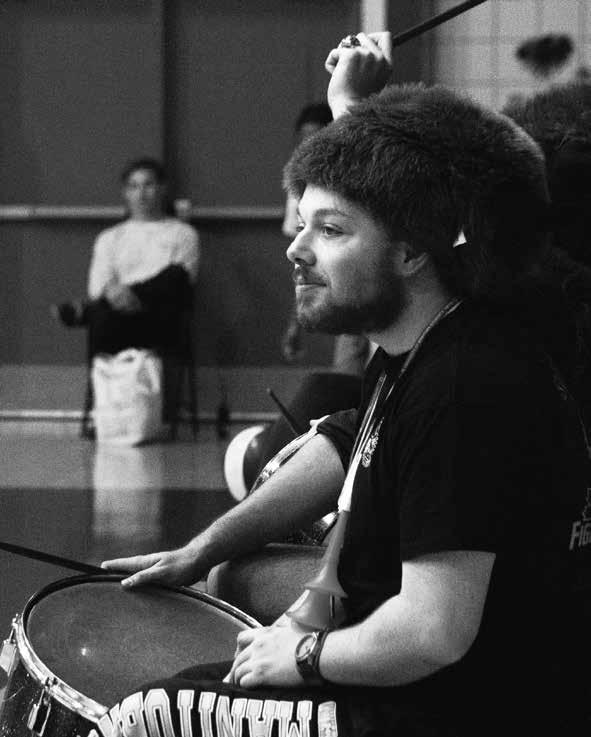
For me, it’s a euphoric feeling, and something that is near indescribable. To have the Big Horns pounding their drums, children on the edge of their seat, and students side by side, harmoniously chanting “Go Bisons Go!” is a feeling that brings me great joy, and brings back so many fond memories.
I remember attending my first ever Bison football game in 2005, at age 10. It was an experience I will never forget. The team was still playing at the old university stadium, and I recall with fondness seeing them run out of the locker room and onto the field. They were like gods to me, and as a peewee football player myself at the time, I brought a notepad with me to take notes on how I could improve as a player based on the technique of those playing in the game.
The energy in the stands was electric, and I completely immersed myself in the experience. That experience included being able to step onto the field post-game to get autographs from the players. Being able to stand beside them and ask questions was a dream come true. One player specifically changed my life forever, and I will never forget what he did for me.
His name was Dave Beakley, a defensive back. Much like myself, he wasn’t the biggest player on the field, but he was fearless. He took on players twice his size and came out on top. I wanted to play the game in the same way he did.
I approached “Beaks” – as he was known by his teammates – after the game and showed him my notepad. We played the same position, and I told him I wanted to be just like him when I got older. He looked at me with a smile, and said that was an honour. He then escorted me, along

with my dad, to the locker room for a tour.
As a 10-year-old who had dreams of playing the game for a long time, that moment changed my life. I never
I am, and always will be a Bison fan through and through
missed a Bison game for the next nine years afterward.
I remember Beaks, I remember the hard-hitting linebacker Kenton Onofrychuk, I remember the calm and collected quarterback John Makie, and I remember the clutch kicker Scott Dixon.
I remember when running back
Matt Henry broke his femur in the 2007 Vanier Cup game, and his team rallied around him and brought back a ring, and I remember when Jeremy Botelho took a missed field goal back a CIS-record 129 yards to the house in 2009.
These are all things I will never forget. I am and always will be a Bison fan through and through.
When I started covering the team in my second year at the U of M, it was yet another dream come true. I have developed relationships with a number of players on a number of teams that I will always hold close to my heart.
Whether that be the openness of “the BC boys,” Jordan Yantz, Jordan Linnen, and Matt Sawyer in 2014, or the humour of Wilfred Sam-King and Oyinko Akinola of the men’s
track and field team in 2015, there isn’t an encounter I’ve had with a Bison athlete that hasn’t been positive.
The recollection I have of my time both in the stands and in the press box of Bison sporting events has been nothing short of spectacular. I know how hard these athletes train, and I also know how loud our fans cheer.
You don’t have to come out if you don’t want to. But, if you have time and aren’t doing anything else on a Friday or Saturday night, I’d suggest checking out a game. If your experience has been anything like mine, you won’t be disappointed.
As a campus, we should be encouraging what we have for fan support already
DAVID GRAD
I’m also not a fan of calling attendance pathetic or voicing frustration at the student body for not attending. Using that kind of language and shaping that sort of argument creates a right and wrong, and presupposes a moral high ground.
Going to a sports game is supposed to be fun; celebrate the fact that students did come out. Highlight their experience and work to making it better. If it’s a good experience, more people will come out the next time because of the atmosphere around the game.
Publicly shaming poor attendance or saying there is a problem doesn’t encourage anyone to want to attend. It probably turns people off from wanting to go, as it puts a cloud of negativity over what should be a fun expression of school spirit. It also takes away from highlighting the athletes’ positive performance by focusing on negativity.
Using appreciative inquiry, we should be looking at what’s gone well, and continue to do what’s gone well and build on it. Baby steps. Fandom and school spirit won’t grow over night, but slowly over years.
To me, it is a huge success if
even 20 more people think going to a Bison game is something they want to do. Let’s make it something they remember and want to continue doing. Celebrate and highlight what the people that do attend enjoy and get out of it.
It only took six fans to help bring out the best of a talented women's volleyball team in Regina in 2013
If this interests others, they will come: word will spread. If it doesn’t, well, sports aren’t everyone’s cup of tea. For them, enthusiasm or school spirit might mean getting engaged in student government, student groups, or other ways.
Maybe someone wants to just come, get an education, and leave. I feel that person may miss out on what was a great experience for me, but maybe it isn’t for them.
In short, we should enjoy what
we have. If it is truly good, over time more people will want to be part of it. It just takes a few people at a time; there’s no need to try and guilt people into attending or shame people for not being interested in school sports. That’s just guaranteed to turn people away and create negativity around fandom and Bison sports, because we made it feel unfriendly.
It’s a sports game – it should be a fun social activity that contributes to campus culture. Don’t detract from it by singling out or criticizing shaming those who do not share an interest in sports or that brand of school spirit.
Let’s show some love for the 2,800 people that do come out, and the groups that come out to basketball, hockey, soccer, and volleyball. Let’s not make them feel unappreciated. I think it’s amazing that 2,800 came out; attendance can only increase if the experience gets better.
I love that The Big Horns get 8-10 people to other games. That’s awesome, and maybe in a few years it grows to 20 or 30.
It only took six fans to help bring out the best of a talented women’s volleyball team in Regina in 2013. Every fan counts in large amounts!
Homecoming attendance a microcosm for school apathy
ERIC MACLISE
In his response to Tom Ingram’s Oct. 8 article “Give us a break,” Mike Still apologized for “trying to put the bulk of the blame on students for not showing up” to Bisons Sports events. While I think Still’s Sept. 30 article was taken out of context by Ingram, Still’s editorial from last March was more critical, arguing that despite incentives encouraging students to attend, “home game attendance is still abysmal.”
I would like to shift the discussion on low attendance at Bisons football home games, specifically the Homecoming game that drew 2,800 fans on Oct. 3 this year.
While Ingram is correct in clearing students of any obligation to attend sporting events, there is an obligation on the part of the university, UMSU, Student Life, and Bisons Sports to instill a culture where Bisons football is seen as a fun, “cool” event. After that, it is up to the students to choose whether to attend games. Ingram comments that Bisons football is only short of league averages for attendance by hundreds, but Bisons Sports are not trying to be average, and this university should not settle for average.
I know several University of Manitoba students who flew to London, Ont. for Western University’s homecoming weekend
this year, but did not walk across campus for the Bisons football homecoming game. While this comes across as funny, it highlights a huge issue plaguing our university: lack of school spirit.
Let me clarify, I am not blaming students for this. I’m a student and I would also much rather go to Western’s homecoming. There’s more spirit, more people sporting Mustangs attire – it’s a way better party.
The low attendance at the Bison Football Homecoming game is a microcosm of apathy at the University of Manitoba
With that culture of spirit, Western had 10,291 fans for their homecoming game on Sept. 26. Western does not have a higher ratio of football fans than the University of Manitoba. Rather, the culture that exists at Western fosters larger support for school events. There are beer
gardens and a concert at the U of M during the first week of school, but after that we’re home by 2 p.m. any chance we get.
The low attendance at the Bisons football homecoming game is a microcosm of apathy at the University of Manitoba. Bisons Sports wants more students at their games, the Black Hole Theatre wants more support, UMSU would like more buzz around Mental Health Awareness week, and the Manitoban wants more volunteers.
I believe that an increase in support for Bisons football games would see some spill over into other areas.
With all the student groups and events on campus, increasing engagement becomes an overwhelming task. I suggest first focusing on Bisons football games, believing that if students go to games, have fun, and buy Bisons merchandise, they will become more invested in the university community. We have to start somewhere, and when you think of highly spirited universities like Western or many in the U.S., what is the first evidence of that spirit that comes to mind? For me, it’s the student support of sports and the football games.
I acknowledge that comparing the University of Manitoba to Western is not entirely fair. London is a uni-
versity town and we are a commuter campus. However, that should not prohibit the U of M from striving for more.
I feel safe in assuming a good chunk of Western or Arizona State (an extreme example, I know) homecoming fans are not necessarily football fans. Many are there to drink a lot of alcohol, party, and support their school. Luckily for us, IGF has a great tailgate/pre-gaming Plaza outside Gate 2. Let’s work with the Bombers to make use of that space with food, drinks, and DJs two hours before Bisons football games.
Second, there should be socials on campus after every game. Our (we’re in this together) highest attendance this year was on Sept. 11 when there was a post-game social on the IGF concourse. They don’t necessarily have to be in the stadium; use the multi-purpose room in University Center.
Many students still don’t know when games are. Bisons Sports should start creating Facebook events for the homecoming game, and pay the small amount needed to have it promoted within Facebook. We “like” so many things that Facebook cannot include it all in our news feeds; paid promotions are a sure-fire way to separate yourself from the pack. Our campus
radio station 101.5 UMFM started doing this, and it drastically increased the station’s reach and engagement. Bisons Sports is putting money into print and radio ads, which are great for reaching the community, but I would argue that they don’t reach the necessary demographic of students. Play a game at 1 p.m. on a Friday. It addresses the commuter campus issue: The game is already free for students, and now you wouldn’t have to worry about getting them back to campus like you do for a night game. This would hurt your community fans working day jobs, but it should be seen as an investment in the student market.
So whether it’s Bisons Athletics, or the Get Out to Vote campaign, I hope we can discuss ways to increase student engagement. UMSU has started several great initiatives this year. Hopefully these are the early stages of creating a culture where students get involved, because once the opportunities and awareness exist, it is the students’ responsibility to decide whether they want to contribute to strengthening the university community and increasing school spirit.
Eric MacLise hosts Covering the Spread 10 a.m. Tuesdays on 101.5 UMFM.

CHANTELLE DUBOIS, STAFF

I travelled from Vienna to Jerusalem for the Space Generation Congress (SGC), held Oct. 8 to 10, and the International Astronautical Congress (IAC), held Oct. 11 to 16. This was my second time attending both of these conferences, and like last time, I left feeling incredibly inspired, excited, and motivated to continue searching for my place in the space sector.
The SGC was held at the Bloomfield Science Museum in Jerusalem, and 126 delegates from 41 countries participated. These delegates, who were students and young professionals between the ages of 18 and 35, were selected competitively based on applications to attend. They came from a variety of professional and educational backgrounds, including law, policy, engineering, science, and business.
The delegates were separated into one of five different working groups covering several different perspectives and topical issues: nanosatellite policy, space exploration, space Internet, Earth observation for climate change monitoring and management, and supporting the growth of entrepreneurial activities in the space sector.
Subject matter experts guided the discussions of each work group, and the results will be eventually compiled into a formal report and presented to the United Nations Committee on the Peaceful Uses of Outer Space technical subcommittee.
I had signed up for the nanosatellite policy work group, but spent most of my time assisting the organizing team with various tasks throughout the event. I did occasionally drop in to try and participate in the ongoing discussion on how to manage the increasing accessibility of low Earth orbit for nanosatellites being launched by non-commercial entities. The results of this discussion I have to save for the SGAC to report on, but the work group developed very interesting recommendations on the matter.
In between work group discussion periods, guest speakers gave presen-
tations. This included several individuals from NASA, the Israeli Space Agency, the Mexican Space Agency, Lockheed Martin, the International Astronautical Foundation, and the European Commission.
Higuchi’s presentation detailed how various aspects and philosophies of human culture would change once we become a multiplanetary species. Like how humans would no longer identify nationally, but by their planet, the concept of up and down would change, and table etiquette would become different in zero-gravity environments
One of the presentations that I found most interesting came from Kiyoshi Higuchi, who is the president of the International Astronautical Foundation and vice-president of the Japanese Aerospace eXploration Group (JAXA). He presented work on cosmo-anthropology, detailing how various aspects and philosophies of human culture would change once we become a multiplanetary species. This touched on things like how humans would no longer identify nationally, but by their planet (instead of a Canadian, I become an Earthling), the concept of up and down would change, and
table etiquette would become different in zero-gravity environments. It is always interesting for me, as an engineering student, to hear about the perspectives of other disciplines.
At the end of the third day of the congress, a gala dinner was held at the Belgium House at the Hebrew University of Jerusalem. The dinner was sponsored by Lockheed Martin and had the heads of NASA, the European Space Agency, the Italian Space Agency, the Israeli Space Agency, and various important figures from Lockheed Martin in attendance.
The keynote speakers for the gala dinner were Wanda Sigur, vicepresident and manager of civil space at Lockheed Martin, Jan Wörner, director general of the European Space Agency, and Charles Bolden, administrator of NASA. They all spoke on the importance of the next generation of space leaders and explorers and of international collaboration in future space missions. The latter point would be a common theme in the IAC that followed.
Although the SGC was now behind me, the five-day IAC would prove to be just as busy. The IAC welcomes roughly 3,500 delegates per year from a diverse range of backgrounds in academia and industry. For five days, various panels, presentations, receptions, and special events are held, this year centering on the theme “Space – The Gateway for Mankind’s Future.”
Throughout the week I felt as though I was constantly zipping from one end of the International Conference Center to the other, attending meetings and talking to people. One of the main events held every year at the IAC is the Heads of Agencies plenary. This year representatives from the U.S. (NASA), Russia (ROSCOSMOS), China (ISRO), Europe (ESA), Japan (JAXA), and Israel (ISA) were present.
Earlier this year, Sylvain Laporte assumed the role as the president of the Canadian Space Agency, succeeding Luc Brûlé and General

Walter Natynczyk. However, he was absent from the plenary so I assumed that it was possible he did not make it to the congress.
After the plenary, I headed to the SGAC’s booth in the exhibition hall. When I arrived I was informed that the president of the Canadian Space Agency had stopped by to ask about our work mere moments before I had arrived.
When I had heard that he was in fact at the congress, I immediately took to searching for his contact information to try and arrange a meeting. I had no real agenda other than to introduce myself to him, and sent an email simply asking if he was willing to meet sometime during the congress. I figured the worst that could happen was that he would decline.
I was pleasantly surprised when he responded that same afternoon. We arranged a meeting for the upcoming Wednesday. I decided to contact other Canadian university students from the Canadian Satellite Design Challenge who were also at the IAC that week and invited them to join.
The meeting with Laporte went very well. Students from Concordia University, two of my colleagues from the University of Manitoba, and one fellow SGAC member from the International Space University joined me. The majority of the discussion revolved around our participation in the Canadian Satellite Design Challenge and our experiences as Canadian students with space ambitions.
Laporte spoke about reviving the agency’s outreach program, which had been slowly phased out over the years and has been virtually nonexistent for a while. He also talked pragmatically about Canada’s role in
future space missions, in collaboration with other nations.
I sincerely appreciated that Laporte took the time to meet with us, despite how informally I had contacted him. He exchanged business cards with us and joined us for a group photo before departing.
The next day I attended a reception where I ran into someone I knew as a judge from the Canadian Satellite Design Challenge. He does spacerelated work for Canadian Defence Research and Development, and he and I ended up having an insightful discussion about the job climate for Canadians looking for space work, space-related graduate education in Canada, and about the competition itself. He gave me a lot of advice about my future.
Near the end of the reception, Laporte joined us for some discussion unrelated to space. It was at that moment that I really felt like I had truly made the most out of this congress. I managed to connect with one of the most important figures in Canada’s space sector, and apparently left a good enough impression that he would stop by to talk to me.
I leave Israel now with a handful of business cards with new and fascinating connections, several Facebook requests from new friends located around the world, and many memories with familiar faces belonging to the Space Generation family. Most importantly, I leave feeling even more connected to the space industry.
Chantelle Dubois is currently interning with the Space Generation Advisory Council in Vienna, and will be writing about her experiences in the Notes from the Star Field series for the Manitoban.




MALAK ABAS, STAFF

The diverse nature of our planet has always inspired curiosity in people young and old. National Geographic, in association with Global Experience Specialists, appeals to that curiosity with their exhibition National Geographic Presents: Earth Explorers, which arrived at the Manitoba Museum as part of its tour across North America on Oct. 3. It is an immersive experience of some of the most interesting places on Earth.
The exhibition features five different environments and a base. The Base Camp begins the exhibit and features an off-road vehicle. Other stations include a visit to the African savannah which has a virtual hot air balloon that visitors can step into, a model of the living conditions in the Arctic, an interactive look at the Himalayas through the Mountains and Caves installation, the variety of insects in the Amazon rainforests, and – my personal favorite – an interactive model submersible that uses surrounding video to mimic deep-sea diving. These eco-zones all offer their own separate activities. While there is plenty of reading material, National Geographic has also provided an app to pair with the exhibit. Before visiting, download the “Earth Explorers Air Experience” app, available for both Android and iOS platforms,
on your smartphone or tablet. There are several areas in the exhibit that provide an interactive experience if scanned using the app.
Earth Explorers appeals to all ages. Adults will enjoy the in-depth descriptions of the environments and the explorers who are studying them at every eco-zone. The interactive elements of the exhibit, such as the thermal camera at the Arctic cabin or the touchable fake animal droppings, will appeal to kids and parents alike.
While the official blog of the Manitoba Museum says that the exhibit is most suitable for children in Grade 3 and up, the museum is also offering a specialized version of the Earth Explorers programming designed for pre-school aged children from 9 a.m. to noon most Mondays for the duration of the exhibit.
Along with Mini-Explorer Mondays, the museum is also offering a program in association with Petland. On select days for the duration of the exhibit, pet counsellors from Petland will be at the exhibit with live animals.
I had the opportunity to visit the Earth Explorers exhibit right before it officially opened. The visuals were beautiful, a trademark of National Geographic at this point, and the various sculptures (such as a great white shark fitted with a ‘crittercam,’ a tool used by explorers
and photographers) were colorful and interesting. A personal favorite feature of the exhibit was the focus on the people who help us decipher our world – National Geographic’s scientists, filmmakers, and photographers. Both text and video content provide insight into how and why these people are so motivated to discover the unknown. The fact that I’m an adult did not stop me from enjoying even the most kid-friendly features, such as the crystals displayed at the cave area of the exhibit, or the ice plate at the Polar installation that lets you test how well different gloves fare against the cold winter.
The Manitoba Museum has always been a pillar of the science community in Manitoba, and their determination to provide worldclass exhibits has been proven time and time again. This time is no different. Whether you are already a nature enthusiast, or just curious about what there is to see and do, visit the Earth Explorers exhibit. This virtual trip around the world is accessible, innovative, and a lot of fun.
For specific dates for both MiniExplorer Mondays and Petland visits, or more information about the Earth Explorers exhibit, please visit the Manitoba Museum’s website: www.manitobamuseum.ca










OLIVIA MICHALCZUK, STAFF

As artists, friends, family, and curious spectators arrived at the lobby of the Centennial Concert Hall on Oct. 9, six easels patiently awaited 20-minute masterpieces constructed by the paintbrushes of 12 talented locals for the Winnipeg Art Battle.
Simon Plashkes and Chris Pemberton created Art Battle in 2009 and since then it has grown in popularity. Winnipeg’s Art Battle event is one of many nationwide that seek to bring people together through art, regardless of their knowledge on the subject.
There are two rounds of painters that are given a white canvas, their choice of tools, paint, and exactly 20 minutes to transform their blank canvas to a masterpiece worthy of taking them to the final round for a
chance to be crowned the Art Battle champion.
Six
easels patiently awaited 20-minute masterpieces constructed by the paintbrushes of 12 talented locals
The competition encourages spectators to buy and support local by building a connection with the artist and works of art being created before them.
“As an artist myself, I know first-
hand the struggle that comes with being a ‘starving artist.’ I felt that Art Battle was an opportunity to break that stereotype and promote fellow local artists and their talents so we become ‘surviving artists,’” said Kristi-Marie Chech, the organizer and host of Winnipeg Art Battle.
“I loved the concept behind Art Battle: bringing awareness to the art community by building relationships between people who may not know a lot about art and artists themselves [...] By bringing this event to Winnipeg, my goal was to put Winnipeg and Manitoba artists on the map. Much to my surprise, I have had artists travel from outside our province to be a part of Winnipeg’s Art Battle.”
The first round of six artists took
their places around their roped off easels at the centre of the room, brushes at the ready. Once the timer began, the painting commenced as spectators systematically circled the artists. Some of the artists outlined their paintings quite quickly while others took the slow and steady approach, revealing the subject of the painting in the final minutes.
The circling became less and less smooth as spectators’ steps were interrupted by beautiful landscapes, portraits, and abstract subjects that grasped their attention. Regardless of style and strategy, the crowd was kept on their toes as they watched beautiful works of art come together before their eyes.
“The nature of the interaction between artist and audience is unique” – Kelley Morrell, artist and Art Battle competitor
After the paintings were completed, the spectators were asked to vote on their favourite as the next group prepared their tools to paint their competitive pieces.
The winners of the first round were Jola Liebzeit’s work, a woman painted on an abstract blue and green background, and second-time competitor Kelley Morrell with a fantastic rainbow-pastel Canadian landscape.
The voting was followed by a silent auction in which the works of art could be purchased by bid, with half the proceeds going to the artist: a rare and fantastic opportunity to own a piece of art that you watched being created before your eyes.
“I wanted to create a piece that someone would feel connected with enough to want to bid on,” said Liebzeit.
The second round, like the first, was a 20-minute painting round followed by a vote and auction.
Taisa Matthews’s night-time mountain scene and David Oro’s whimsical 20s-style female silhouette with a modern twist won the remaining two finalist spots.
The four winners faced off in a final round in which the artists were to produce a second painting to determine who would be the Winnipeg Art Battle champion.
Jola Liebzeit came out victorious with an intriguing and abstract female silhouette with many appealing components that snagged her the win.
“The second-round piece had a story and meaning for me and an element of whimsy that allowed me to enjoy the process even more. I wanted to create the best-quality piece I could given the 20-minute time frame challenge.”
The artists all seemed to be proud of their pieces and grateful for the experience at Art Battle regardless of the outcome. Art Battle meant much more than winning a title to the artists, spectators, and organizers.
“The nature of the interaction between artist and audience is unique,” said Morrell.
“Generally, artists work in seclusion and with a liberty of time to create and peruse. Under the pressure to create based on time while being observed, realizing that your work will later be voted on, is somewhat unnerving and that adds another unpredictable element to creating.”
“For the audience to be a part of that allows for a mutual respect and excitement that is unique in its experiential nature. Ultimately, I appreciate the aspect of the encounter of artist-in-process as entertainment, and the somewhat intimate interaction of the supporters with the artists.”
Chech believes that the effect Art Battle has on Winnipeg is contributing to our cultural scene in a positive way.
“ Now in our second year, Winnipeg’s Art Battle has grown proving our province most definitely supports the awareness of fine arts and the talent of the artists competing. I feel Art Battle has made a significant contribution to this.”
“We as a province need to our support local artists and buy their local artwork. I want to help fellow artists have their talents recognized, regardless of winning the title as Winnipeg’s Art Battle champion. We have artists wanting to compete repeatedly for the love of the battle but mostly for their passion for art,” she added.
Twelve artists with very unique styles had the opportunity to share their work thanks to the Art Battle event.
After the first and second rounds, the third-round paintings already looked familiar and emulated the style you could attribute to the artist that you had watched create once before. The experience itself was a unique treat for any art lover, appreciator, or the curious.
The next Winnipeg Art Battle will take place in spring of 2016. For more information visit www.artbattle.ca or www.facebook.com/artbattlecanada
Local writer and Toban alum talks music history
EMELIA FOURNIER

The 90s birthed many of the University of Manitoba’s current students as well as huge noise and punk rock bands like Nirvana, Hole, Propagandhi, and Kittens.
The latter two emerged from little isolated Winnipeg.
Despite producing influential and popular underground rock bands like the aforementioned Propagandhi and Kittens – as well as the Weakerthans, Dead Ranch, and many more – Winnipeg’s alternative rock scene in the 90s has not been the subject of any real comprehensive work. Until now.
Over Thanksgiving weekend, I talked to writer and journalist Sheldon Birnie about his upcoming book, Missing Like Teeth: An Oral History of Winnipeg’s Underground 1990-2010, which is set to be released at the Windsor Hotel on Saturday, Oct. 24.
Birnie is a local freelance writer and alumnus of the Manitoban. He has written numerous articles on the subject of Winnipeg’s music scene, particularly from the 90s. Suitably, the title of his latest work even references a lyric from one of its prominent subjects, the Weakerthans.
According to Birnie, the idea for a book of oral history on Winnipeg’s underground rock scene stemmed from the sheer mass of material on the topic and the uniqueness of the period.
Music-centric Canadian publisher Eternal Cavalier Press was interested in the project, as were the subjects of the book.
Birnie was able to use Winnipeg’s small size to his advantage. For the most part, he was able to arrange interviews easily either through his own contacts and his contacts’ contacts that he had made over the years of participating in Winnipeg’s interconnected music scene.
“With a couple exceptions, people were really keen to share, to talk [...] It’s kind of cool that people are still interested in the work that was so important to them back then,” said Birnie.
While bands like Propagandhi, the Weakerthans, and Red Fisher – all of whom are featured heavily in Missing Like Teeth – did have commercial success, none of them went into making music with recognition
as a goal.
“The biggest goal was, y’know, play the Albert and maybe make a seven-incher or a tape. There was no, ‘we’re gonna get on this circuit, we’re gonna get this grant,’ it was to try to do something different,” Birnie said.
“People were just doing what they wanted to. They weren’t doing what they thought would make them successful in any way.”
As we all know, Winnipeg is geographically isolated, and it takes about eight hours to get anywhere. This isolation has been minimized nowadays with the advent of the Internet, and local bands are able to market themselves on a larger scale.
Touring and distribution in the 90s was an old-fashioned process that required a lot more time and effort, so for the most part the bands’ priorities lay in the production of music for its own sake and for the local scene.
There were also a multitude of all-ages shows in the 90s, particularly at the West End Cultural Centre. These shows allowed kids to get into alternative and underground music before their driver’s licences and later the internet made it accessible to them.
While the distribution and touring processes of the 90s music scene may be archaic today, the sound itself is still out there.
When Birnie sees local noise rock and metal bands like Tunic or Dead Ranch perform, he thinks “oh yeah, this kind of weird, strange, dark noise is still happening in Winnipeg and that’s really cool.”
According to Birnie, even basement and house concerts exist now as much as they did in the 90s.
“There’s always something real original and strange going on in the basements of the Winnipeg scene, I don’t think that’ll really ever change.”
Sheldon Birnie will be discussing Missing Like Teeth at the Winnipeg Anarchist Book Fair at the Millennium Library on Oct. 24 at 5 p.m. His book release party will be held at the Windsor Hotel at 10 p.m. and will feature performances by Johnny Sizzle and Breath Grenades. Cover at the Windsor is $5.
RAYLENE PACI, VOLUNTEER STAFF

Ballet. Jazz. Tap. These are just a few dance classes you might have taken as a child at the urging of your mother. You might have been horrible or you might have even continued throughout your adolescent and adult life. But have you ever heard of swing dancing?
Enter UMSwing, a student-run group right here at the University of Manitoba whose aim is to provide cost-effective swing dance lessons to anyone wishing to try something new and learn a few moves along the way.
Swing dancing is a wide genre comprising several forms of dance. These can range from the beginner favourite, Lindy Hop, all the way to the high-energy and fast-paced Charleston. Both types of dance can trace their development all the way back to 1920s America in the rising age of jazz music.
Although the height of swing’s popularity in the aforementioned “swing era,” by the late 90s a fullon swing revival was gearing up, setting the stage for the UMSwing student group to form in January 2000. Before UMSwing, there were limited options for Winnipeggers who wanted to dance the night away to Benny Goodman and other swing bandleaders of that time.
As UMSwing now continues into its 15th year, Christine St. Martin, the group’s director of publicity and promotions, shared her enthusiasm about the growth of the organization with the Manitoban
“Many people do not realize how big UMSwing really is. We are one of the largest groups on campus. Over the last 15 years, thanks to the hard work of all current and past executive members, we have hundreds of members,” she said.
“You don’t need a partner or previous dance experience.
Swing dance is a great way to exercise, meet new people, and have fun” – Christine St. Martin, director of publicity and promotions, UMSwing
This semester, the student organization is offering Lindy Hop and Blues on Tuesdays at 6 and 7:30p.m. respectively in room 204 at St. John’s College on the Fort Garry campus, as well as the Jive and Balboa on Fridays at the same times in room 201. A new series of lessons will be started for the winter term as well.
UMSwing hosts special events throughout the year in addition to
these regular lessons. Coming up this month is the Michael Jackson “Thriller” workshop on Oct. 31 at 4 p.m. in St. John’s College. Tickets are available through Answers in University Centre and attendees are encouraged to bring out their best costumes to learn the iconic dance routine just in time for Halloween.
Other opportunities UMSwing recommends students to check out include events run through different organizations such as Hepcat Studios and Swing Dance Winnipeg.
Beginners should consider the Saturday Night Swingout at Ted Motyka Dance Studio where they’re invited to drop in for an introductory lesson before the dance begins later that night.
For those hesitant to step out onto the dance floor, St. Martin insists that aspiring dancers from all walks of life can find it easy to get into.
“Everyone, absolutely everyone, comes out to these events. I have been on the scene for about four years and I have danced with all ages and all types of people. Even those who think they have two left feet,” she said.
“You don’t need a partner or previous dance experience. Swing dance is a great way to exercise, meet new people and have fun.”
For more information on upcoming events and lessons, visit umswing.ca
RYAN CAPAR
On Oct. 24, Toronto-based
Broken Pencil Magazine, a publication dedicated to “zine culture and the independent arts” will present Canadian zine event Canzine 2015 in Winnipeg. Broken Pencil Magazine will once again join forces with the Winnipeg Anarchist Bookfair, uniting Winnipeg’s literature and zineloving population with both events under one roof.
This year’s Canzine festival will be held at the Millennium Library from 12 p.m. to 6 p.m. Admission is free with a suggested $5 donation.
The success of the relationship between Broken Pencil and the Winnipeg Anarchist Bookfair is a result of the commonalities both organizations share when it comes to values, literature, and the independent arts.
According to the magazine’s editor Alison Lang, “Broken Pencil is currently the world’s only magazine devoted solely to zine culture and the independent arts.”
Founded in 1995 by Hal Niedzviecki, Broken Pencil has not only been able to gain success over the years but has given a voice to writers and zine enthusiasts alike by providing them a platform to showcase their talents.
Canzine festivals are nothing new
for Broken Pencil ; they have been around as long as the magazine has.
“We held our first Canzine fair in 1995 at the now-defunct Spadina Hotel in Toronto with a skeleton crew of volunteers and hours of hard labour,” said Lang.
Since that time, the meaning of Canzine has not wavered: not surprisingly, that meaning is simply to support those involved in zine culture.
“Hal’s goal with Canzine was to have a non-exclusive, non-curated gathering space where zine makers could sell their wares to a curious public,” said Lang.
Similarly, and according to the group’s online bio, the Winnipeg Anarchist Bookfair began as a way to “create space for people to share anti-capitalist ideas and culture, and present viable living alternatives through radical literature and free skill-sharing given as mutual aid to any and all who partake.”
The organization held its first “Bookfair and DIY Fest” back in 2009 and has continued to do so annually.
Wayne Antony, a co-publisher at Fernwood Publishing and one of the people involved in organizing the Bookfair since its inception, explained to the Manitoban that “we just come together to do the book fair. It’s just people who are interested in it,
who are a part of other organizations and activist organizations in the city.”
Canzine 2015 will mark the second time Broken Pencil Magazine and the Winnipeg Anarchist Bookfair have collaborated. The first was last year.
“Expect
to see over 25 vendors of zines, comics, small press books, and indie art from all over Manitoba and beyond”
– Alison Lang, editor, Broken Pencil Magazine
The idea of joining forces can be credited to Winnipeg Anarchist Bookfair member Tim Brandt. “[Brandt] had known about Canzine and started talking to them before last year. I think they were just doing it in Vancouver and Toronto, so he asked them if they’d be interested in doing it in Winnipeg, and then when time came to start talking about the Anarchist Bookfair for last
Delhi 2 Dublin
We’re All Desi
5/5
This album is loud as hell and all the better because of it.
To introduce world music collective Delhi 2 Dublin’s latest album We’re All Desi in such a manner might seem rude, even trite. Even if it is, it’s still a significant part of what makes this album so instantly engaging. We’re All Desi is by no means easy-listening music. This is the album you put on when you’re ready to party, hit the gym, put on your dancing shoes, or anything else that involves working up a sweat and having a great time.
Following on the heels of the group’s remix and live albums of 2014, We’re All Desi continues Delhi 2 Dublin’s tried and true melting pot of traditional Celtic and Indian instruments with modern electronic music. This time, however, the group has joined forces with producer Nick Middleton, a man who has made his own name in music as half of electronic dance duo the Funk Hunters.
Possibly due to Middleton’s
influence, We’re All Desi sports the group’s strongest emphasis on purely electronic music to date. The interwoven fiddle, sitar, and tabla parts Delhi 2 Dublin fans have surely come to know and love are still there, but they’ve become noticeably infrequent in the wake of the album’s throbbing bass, wobbling synth lines, and forceful, pronounced drum rhythms.
As if to underscore Middleton’s influence, the Funk Hunters even guest on two of the album’s strongest tracks – “Fool’s Gold” and “Strumph.” The former is a loud-ass club banger that could motivate the stuffiest of crowds onto the dance floor, while the latter is a slowburning funk-influenced number that sports a neat sitar interlude and a groovy slap-bass line.
Vocalist Sanjay Seran still brings his charismatic blend of rapping and singing in both English and Punjabi. He’s got a calm yet cathartic lyrical flow reminiscent of modern-day Eminem when he raps, while his singing is as booming and passionate as ever.
A perfect score is subjective, but this album couldn’t be better
at what it does. If you like electronic music, you’ll love this album. Perhaps you don’t, but chances are you could still find something about We’re All Desi to draw you in. Just play it loud, play it proud, and let the music take care of the rest.
www.delhi2dublin.com

year, he just came to one of the meetings and said ‘so what do you think, should we join up with Canzine and broaden our audience and base a little bit?’ And we all thought, well, let’s give it a try and see how it goes, and it worked out quite well,” said Antony.
It has proven to be a great move, one in which both Broken Pencil and the Winnipeg Anarchist Bookfair seem to benefit, and so do those living in Winnipeg.
“This partnership has been an amazing way for Broken Pencil to become exposed to the many brilliant artists, writers, activists and performers in Winnipeg,” said Lang.
This year’s Canzine promises to accommodate both newcomers and those who have attended in the years past.
“Expect to see over 25 vendors of zines, comics, small press books, and indie art from all over Manitoba and beyond,” said Lang.
The festival features zinesters Kristin Nelson and Leslie Corbay and will also hold a panel on accessibility this year.
Other fun events include the 1-2 Punch Book Pitch “where anyone can come and pitch their book idea to our panel of judges and receive glowing praise or tough love,” said Lang.
There are workshops as well,
including an introduction to unionism by the International Workers of the World and the Radical Reading Series, which features authors Sheldon Birnie, Jeanne Randolph, and Ariel Gordon.
For more information on Canzine 2015, go to www.brokenpencil.com/canzine-winnipeg and wpgbookfairdiyfest.com

Lindsey White Renegade 4.5/5
Released eight years after her previous album This is Now, Lindsey White’s Renegade expands on her ability to experiment with different sounds and instruments and fuse them with classic folk-rock tunes.
This album showcases a stylish coalescence of a number of instruments – each coming in at their finest hour. Be it the brass in “My Best Shot,” the violin in “Asylum,” or the strings in “Bugs,” each instrument works well and helps to produce a stimulating sound.
The album touches on a few musical genres, ranging from classic folk music on “Equinox” to the soulful “Headingley” to the rockinfused “Monster” – almost every track touches on more than one genre. That being said, my favorite track on the album has to be “Unwell” – a beautiful blend of bossa nova, jazz, and folk.
Tracks like “Bugs,” “Monster,” and “Heart Strike” do well to accent White’s vocal prowess. Her lyrics sway between optimism, resilience,
and melancholia. These themes resonate throughout the album and appropriately sum up the album’s title.
The lyrics, sung by White and backdropped with fancy instrumentation, do well to tell a story of a strong-willed fighter. Renegade sounds like the love child of Regina Spektor’s Far and Florence and the Machine’s Lungs It’s a well-crafted experimental album.
If you are a fan of groovy folkrock or you just need some good music to chill out to, you will find what you need on this album.
www.lindseywhite.com



Sports Editor: Mike Still Contact: sports@themanitoban.com / 474.6529
RYAN STELTER, VOLUNTEER STAFF
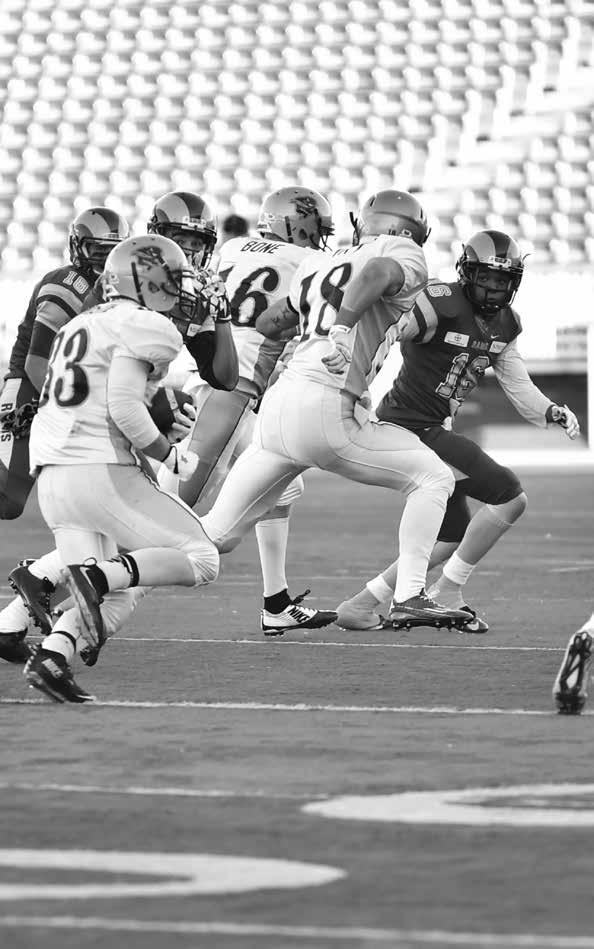
The Manitoba Bisons football team locked horns with the Regina Rams on Saturday and emerged with a 49-46 victory. The win helps keep the Bisons’ perfect road record and keeps their cross-province rivals winless on the year.
The herd fell in close games against both the University of British Columbia and Calgary earler in the year, but were able to pull this one out.
Ryan Jones proved to be the hero on the night; his 41-yard field goal late in the fourth quarter was the game winner.
Jones went four for four on the day, his longest being the game-winning kick. He’s only missed four field goals on the year and also has 60 points this season.
Bison pivot Theo Deezar played another solid game, going 29 of 39 and racking up 339 yards. He added four touchdowns as well, and for the second consecutive game he did not throw an interception.
Deezar has thrown 17 touchdowns on the year, placing him in a tie for third-most in the CIS. His 371 yards per game also put him second in that category.
Christie carrying the load
It is well known that the Bisons have a very strong backfield. All three of the running backs possess their own abilities to chew up yards. On Saturday, it was Alex Christie’s moment in the spotlight.
Christie ran for 93 yards on 13 attempts, averaging seven yards per
carry. He also caught three balls for 30 yards. The five-foot-nine back out of Thorold, Ont. made a statement on Saturday, carrying the bulk of the load with Jamel Lyles playing only on special teams.
It is well known that the Bisons have a very strong backfield. All three of the running backs possess their own abilities to chew up yards
No starters, no problem
Manitoba was playing without four starters on defence, two of them being linebackers – DJ Lalama and Brett MacFarlane. The defence did well adjusting after halftime, allowing only 16 points in the second half.
Mitchell Harrison led the defence with six tackles, and the whole unit got in the game. Fourteen players recorded at least two tackles.
Walker the Swiss Army knife
Jesse Walker had another big game, scoring on both a rushing and receiving play. Walker has scored a major in every game but two so far
in 2015.
The rookie made eight grabs for 105 yards, bringing his total up to 463 on the year. Walker also proved to be a threat in the backfield, rushing for 46 yards on three carries. This was his best output on the year from behind the line of scrimmage.
Manitoba now sits in a tie for second in the conference with the UBC Thunderbirds. They are riding a three-game winning streak and will hope to continue their run of form against Alberta this weekend at Investors Group Field.
Manitoba now sits in a tie for second in the conference with the UBC Thunderbirds
The last time the Bisons played the Golden Bears, in week four, the herd came out 42-32 victors. The Bears will be looking for revenge, and it should be a key battle in the standings. Alberta are four points behind Manitoba and will hope to gain ground on the herd.
Women’s soccer drops both weekend games facing Pacific Division sides
ANDY CHE, STAFF
Holding onto third spot in the Prairie Division, the Manitoba Bisons travelled west to visit Fraser Valley and Trinity Western of the Pacific Division this weekend. While the herd mounted an admirable comeback effort against the Fraser Valley Cascades in a 3-2 defeat on Friday, the Bisons were thrashed 6-0 by the Trinity Western Spartans, who sit on top of the Pacific table.
The back-to-back defeats mark the first time this season that Manitoba has been unable to finish a weekend with more than a point.
Bisons vs. Fraser Valley
It was an action-packed first half when Manitoba visited the Fraser Valley Cascades on Friday evening.
Goals from Monika Levarsky and Shelby Beck saw Fraser Valley take a 2-0 lead inside the opening 25 minutes of the first half.
By first half injury time, the Cascades had taken a comfortable 3-0 margin with defender Tristan
Corneil striking off a set piece from Beck.
The Bisons’ defeat marks their heaviest competitive loss in four years. On that occasion, Manitoba dropped a 6-0 decision to the Alberta Pandas in the final weekend of the 2011 season
With two shots on target and facing a 3-0 deficit, the Bisons pressed during the little time that they had.
Bisons goalkeeper Madison Wilford unleashed her ability to play the long
ball when she sent in Alyssa Daley, a 29th minute substitute, for a chipped finish past keeper Kayla Klim.
The Cascades kept the Bisons at bay for majority of the second half. In the 85th minute, Daley played through winger Selina Speranza who then chipped her finish over substitute keeper Emily Harold for a 3-2 score.
The late push to earn a draw at Fraser Valley’s expense would not materialize as the Bisons lost for the first time in four matches. The early goal conceded by Wilford also ended the Bisons’ spell of over 300 consecutive minutes keeping a clean sheet.
The Bisons travelled to Langley, B.C. to face Trinity Western the very next day. Within the first 10 minutes, history repeated itself as Manitoba conceded two early goals through a Krista Gommeringer brace.
The striker’s cross was then impeded by a handball in the 21st
minute, earning the Spartans a penalty. Alessandra Oliverio converted the spot kick for her 10th goal of the CIS season and Manitoba found themselves once again trailing 3-0 in the first half.
Isabella Di Trocchio added a fourth goal to widen the gap in the 40th minute, reducing any chances of a Manitoba comeback – a feat accomplished by the Bisons on three separate occasions this season.
Down 4-0, the herd did not do much to help their cause, having only taken two shots in the first 45 minutes, both off target.
Veteran goalkeeper Chloe Werle replaced Wilford at halftime and managed to keep the Spartans’ attack subdued for the better part of 35 minutes.
Halftime substitute Brooklyn Tidder rounded off a dominating night for Trinity Western by playing through defender Amy Gartke for an 82nd-minute goal. Tidder then struck at 88 minutes to take the lead to 6-0.
Trinity Western’s frontline produced 30 attempts at goal during the 90 minutes. Meanwhile, the Bisons lacked inspiration in their attack, failing to force a single save out of Spartan keepers Ally Williamson and Rachel Sydor.
The Bisons’ defeat marks their heaviest competitive loss in four years. On that occasion, Manitoba dropped a similar 6-0 game to the Alberta Pandas in the final weekend of the 2011 season.
Despite back-to-back defeats, the herd still occupies third place in the table ahead of the MacEwan Griffins, who have a match in hand.
The Manitoba Bisons return home next weekend to host the Regina Cougars and Saskatchewan Huskies on Saturday and Sunday respectively.
ANDY CHE, STAFF
With a 2-2 record heading into the third weekend of the CIS season, the University of Manitoba Bisons women’s hockey team were hoping to climb up the Canada West standings against Mount Royal. Heading into the matchups at Wayne Fleming Arena, the odds were against the Cougars who were winless in four games and had scored only four goals in that timeframe.
At the Bisons’ expense, Mount Royal notched two away wins – a 1-0 shutout on Friday and a 2-1 comeback on Saturday. The weekend sweep propelled the Cougars above Manitoba in the standings. The herd now sits second last in the Canada West division, having lost three consecutive games.
Friday’s Matchup
It took until 5:45 of the third period for the game to see its first and only goal, with Cougars forward Kennedy Bozek capitalizing on a rebound after Bison goaltender Rachel Dyck denied Hali Reardon. Mount Royal was able to hang on from there for their first win of the season.
Much of the credit in the Cougars’ victory could be given to goalie Jess Ross, who turned aside 31 shots for a spectacular shutout performance. Manitoba had their chances in this game, but they couldn’t beat the iron.
Coming off a hat-trick last weekend, Alanna Sharman snapped a low-blocker shot off the post midway through the second period. Later on, Charity Price lifted a backhand shot in the slot over Ross’s high glove and hit the post for the second time in the period.
Even in defeat, Dyck stood out for the Bisons, making 14 saves and bail-
ing her team from a couple of neardisastrous turnovers in the defensive zone.
Despite their fluidity in the offensive zone, Manitoba was shut out for the second time this season, equaling their entire total for regular season last year.
“I didn’t think we were ready to play tonight. It took us too long to get going,” said head coach Jon Rempel post-game. “As a group we got a little bit out of our game plan and a little frustrated at the end.”
Saturday’s Matchup
As seen in Friday’s performance, the Bisons and Cougars experienced some disciplinary issues combining for 18 minutes in penalties. Effective powerplay opportunities would play into their second meeting of the weekend as well, which saw both teams opt for a change of goaltenders ahead of the game.
Amanda Schubert replaced Dyck in the Manitoba net, while Mount Royal swapped Friday’s first star Ross for Emma Pincott.
After a scoreless first period, Manitoba broke the deadlock. Alana Serhan notched her first goal of the season on the powerplay, with linemate Sharman registering her teamleading sixth point.
Eventually, it was penalty trouble which killed the lead and the herd’s momentum. Less than two minutes after trailing, the Cougars capitalized on the powerplay through Rachel Piitz to level the score.
Five minutes into the third period, Manitoba found themselves down five on three, with blue-liners Erin Kucheravy and Erica Rieder in the box. Carley Bertram scored at 15:49 to give the Cougars a 2-1 lead.
Pincott, who impressed by denying Sharman on three separate breakaways, registered 26 saves for Mount Royal’s second win of the CIS season. Manitoba’s Schubert was also sharp, making 26 saves in the loss.
The Manitoba Bisons hit the ice again next week when they visit the University of British Columbia Thunderbirds.

MIKE STILL, STAFF

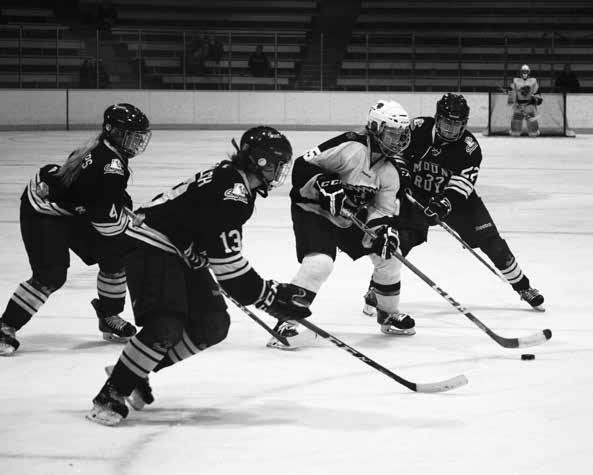
The University of Manitoba Bisons men’s hockey team ran into a hot Mount Royal Cougars powerplay unit over the weekend, falling 6-1 on Friday and 3-1 on Saturday. Overall, the home squad went 4 for 6 with the extra skater, and also recorded a short-handed goal, while the herd
was 0 for 5. Friday’s game featured a threegoal first period for the Cougars, where Bison goalie Justin Paulic was peppered with 17 shots. Manitoba was never able to bounce back, registering just 18 shots all told.
The Bisons took an early penalty and Mount Royal made them pay, as Matthew Brown potted the first marker of the game at just 5:58. The Cougars would add a second tally at 10:54, but the goal that really blew the wind out of the Bisons’ sails was Tyler Fiddler’s, which was scored with just one second left in the opening frame.
To make matters worse, it was a short-handed goal, as the herd had gone on a powerplay with 27 seconds left in the first.
The rest is history, as the Cougars would add three more goals – two of which were scored with the man advantage, to secure the win.
The rematch on Saturday featured a fast-paced second period, where three of the four goals were scored
Manitoba’s Liam Bilton did manage to get the herd on the board with less than two minutes to go in the
third, but it was far too late to matter.
The rematch on Saturday featured a fast-paced second period, where three of the game’s four goals were scored.
It was a bit of déjà vu for the Bisons, as Mount Royal opened the scoring on the powerplay yet again, this time in the middle period. Once more, it was Brown with the goal.
The Bisons stayed determined, though, tying the game up at 9:04 courtesy of their top line. Brett Stovin would get the equalizer, with assists going to his linemates Shaq Merasty and Jordan DePape.
The tie was short-lived, however, as Cody Cartier – who’s been a thorn in the Bisons’ side on many occasions throughout his career, scored the
game-winning goal at 11:17.
The Cougars would add an insurance tally at 18:06 of the third to put the icing on top of their weekend sweep.
For Mount Royal, the two wins were their first in a young Canada West hockey season, as they improved their record to 2-1-1. With the backto-back losses, the Bisons fell to 1-2-1.
Next up for Manitoba is a home series this weekend against the UBC Thunderbirds, who have yet to lose in regulation play this year. Game times are 7:30 p.m. on Saturday and 1 p.m. on Sunday.
Men’s volleyball sweeps home opener, women fall in two tight contests
MIKE STILL, STAFF
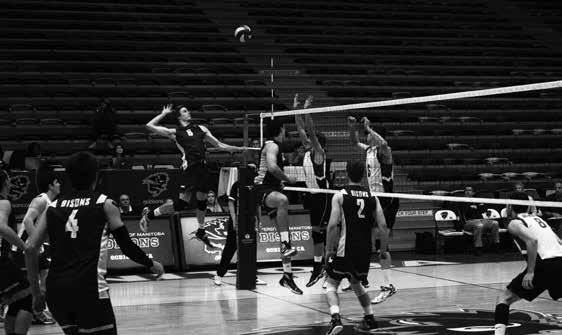

The University of Manitoba
Bisons volleyball squads got their 2015-16 regular season started last weekend, taking on the Saskatchewan Huskies at Investors Group Athletic Centre. The men continued their momentum from the pre-season where they went 6-1, while the women weren’t able to finish off their cross-province rivals.
Men
The fifth-ranked men’s squad showed they will be a force to be reckoned with this season, emerging with a dominant 3-0 win (25-16, 25-21, 25-22) on Friday and a comefrom-behind 3-2 win (27-29, 23-25, 25-19, 25-21, 15-12) on Saturday.
It was a well-rounded performance from the herd, with five different players recording at least 10 kills over the two games. Left side hitters Adam DeJonckheere and Kevin Falconer led the way with 22 and 21 kills respectively. Fellow left side hitter Josh Goossen, who saw his first regular season action on Saturday, also impressed with 15 kills in the rematch.
The men got contributions from their entire lineup – especially in game two, when nine different players had at least three digs. This is a unit with a lot of depth, a fact that Bisons head coach Garth Pischke commented on post-game.
“Very good. Totally different than last year and that’s what really hurt us,” Pischke said.
“We had a couple injuries, and we didn’t really have guys with enough experience, but we’ve got some real quality guys who didn’t get on the floor [on Friday] and

they’re going to be a really big part of this game.”
The men got contributions from their entire lineup – especially in game two, when nine different players had at least three digs
The women didn’t fare as well as their counterparts, as the Huskies came back in both contests to win 3-2 (20-25, 20-25, 25-16, 25-22, 15-10) on Friday and 3-2 (23-25, 30-28, 23-25, 25-18, 15-13) on Saturday.
The home squad gave up set leads of 2-0 in game one and 2-1 in game two.
Despite the losses, Manitoba did get strong play from their veterans. Middle hitter Jordana Milne led the team in kills on both nights, with 13 on Friday and 14 on Saturday, while libero Caleigh Dobie had a total of 41 digs over the weekend, and middle hitter Sarah Klassen had eight blocks.
Both units will now head to UBC to take on the Thunderbirds on Oct. 23 and 24. Game times are 8 and 7 p.m. for the women, and 9 and 8 p.m. for the men.

MIKE STILL, STAFF
The University of Manitoba Bisons soccer and football teams have impressed in the first half of the season. Below is a look at how both squads stack up in the standings, along with a brief analysis of each.
Football
Manitoba is currently ranked eighth in the nation and is also fresh off of a come-from-behind 49-46 victory over the Regina Rams this past weekend. They have now won three straight games with their only two losses coming against UBC and Calgary, who are ranked ninth and first nationally. Their offence has been electric all season long, and the statistics back
up that statement.
Quarterback Theo Deezar leads the conference with 17 passing touchdowns and is also second in the Canada West in passing yards, with 2,227. Freshman running back Jamel Lyles has also been a terror for opposing defences and stands fourth in the conference with 544 rushing yards. His all-purpose stats are even more impressive, as he leads the conference with 1,271 combined rushing, receiving, and kick/punt return yards.
In terms of receiving, veteran Alex Vitt and rookie Jesse Walker have been Deezar’s favourite targets. Vitt is third in the conference with 685 yards, and Walker is sixth with 463. The two slotbacks offer a great
complement for their pivot, as Vitt is a smart, physical player who runs crisp routes while Walker is more of a finesse player who’s difficult to bring down in space due to his speed.
Defensively, the Bisons have suffered a few setbacks due to injury, but are still capable of making big plays at any time. The one major stat that stands out, however, is passing yards per game, where the herd are second last in the conference, giving up an average of 370.2.
This is a bend-but-don’t-break unit, though, and a number of players have stepped up in 2015.
Halfback Jayden McKoy leads the team and is 11th in the conference with 34 tackles, while defensive
NOTE: Two games left. Top 4 teams qualify for post-season, with top two hosting semi-final X=clinched playoff birth *=clinched home-field advantage
tackle David Onyemata is fourth in the conference with 3.5 sacks along with 27 tackles. Defensive end Evan Foster has also been a dominant force, with 31.5 tackles and 1.5 sacks. For interceptions, cornerback Eric Plett leads the team with two.
Soccer
The Bisons have just two regular season games left and have guaranteed themselves a playoff berth and at least a fourth-place finish. Depending what happens this weekend, they could finish as high as second in the conference standings.
NOTE: Two games left. Top 6 teams in each division qualify for post-season X=clinched playoff birth
NOTE: Two games left. Top 6 teams in each division qualify for post-season X=clinched playoff birth
The team has gotten great production from a number of players, which has shown on the scoreboard and in the standings. Forward Bruna Mavignier leads the team with six goals and eight points. Right behind her are midfielder Megan Graca, with seven points, along with forward Alanna Shaw and midfielder Selina Speranza, who both have six points. Graca is also the team leader in assists, with five.
In terms of goalkeeping, rookie sensation Madison Wilford has recorded three shutouts, good for a tie for fourth in the conference. Her nine goals against are also fourth in the Canada West. Veteran Chloe Werle has also impressed. Her 48 saves were good for eighth in the conference.
hard not to
ALEX MICHAELS AND MIKE STILL, STAFF
Major League Baseball’s (MLB) longest playoff slump finally ended in 2015. For the first time since winning the World Series in 1993, the Toronto Blue Jays are back in the hunt for October and the entire nation is buzzing about this team’s chances to make a push for the championship.
After coming back from a 2-0 American League Divisional Series (ALDS) deficit last week to beat the Texas Rangers, Toronto is now one step closer to bringing a banner back to the six. They are currently facing the Kansas City Royals in the American League Championship Series.
In order to fully understand this team’s progress, a bit of backstory is necessary.
The Jays made key moves to bolster their lineup and rotation in order to make a deep run in the post-season.
Prior to the 2015 campaign they acquired third baseman Josh Donaldson, who is now a frontrunner for the American League’s Most Valuable Player award. The team also brought in some Canadian talent behind the plate in Russell Martin, who is a great leader and the team’s “quarterback” at backcatcher.
As if that wasn’t enough, they went out and acquired Troy Tulowitzki, who is a gold glove short stop and is going to be a mainstay in their lineup for years to come. As an added bonus they brought in David Price to be their bona fide ace. Both players were acquired just before the trade deadline, and have been integral to this team’s success.
The lineup is scary up and down. The Jays have players who can steal bases, hit for average, and hit the ball over the fence, so there is no real weak point offensively.
The team also led the league in
three offensive categories – runs scored with 891, home runs with 232 and runs batted in with 852.
Since the trade deadline the Jays went 48-23, which was the best record in baseball. They also leapfrogged the New York Yankees en route to winning the division title. This was a squad who were four-and-a-half games back heading into the second half of the year.
Whether or not you’re a baseball fan, it’s hard not to fall in love with the only MLB team north of the border
Whether or not you’re a baseball fan, it’s hard not to fall in love with the only MLB team north of the border. There are so many storylines which make this unit a thrill to follow.
First, there’s the resilience of 24-year-old pitcher Marcus Stroman, who’s come back in full force from a torn ACL in the spring, providing the Jays with a brilliant one-two punch along with Price.
Then, there’s the youth movement. Second baseman Ryan Goins, who’s 27, and centre fielder Kevin Pillar, who’s 26, have provided this group with sound fielding and clutch batting down the stretch, while 23-year-old starter turned reliever Aaron Sanchez and 20-year-old closer Roberto Osuna have thrown smoke out of the bullpen. Both also stepped up in Toronto’s ALDS victory over the Rangers.
Stroman, Sanchez, Pillar, and Osuna also all have a prior Canadian connection. All four
developed their game with the Vancouver Canadians, the current Northwest League affiliate of the Blue Jays, from 2011-12.
Finally, there’s the veteran presence of José Bautista and Edwin Encarnación, who joined the team in 2008 and 2009 respectively. It was fitting that Bautista – who has the longest tenure on the team of any player, was the one who sent the Jays onto the next round of the playoffs, with a three-run homer in game five, with the game tied at three all.
Blue Jays fever is alive and well. Regular season and playoff games have consistently sold out, and Jays jerseys and shirts are flying off the racks.
Not only have they been scoring a ton on the field but off the field as well.
The Jays have players who can steal bases, hit for average, and hit the ball over the fence, so there is no real weak point offensively
The Canadian viewership in late September and early October was tremendous, with over a million people tuning in to watch the Jays’ series against both the Boston Red Sox and Tampa Bay Rays.
The entire nation is holding their collective breath hoping and praying that it will be the year that the Jays can go all the way to the World Series, and win it all for a city and an entire country that is dying for a championship.