Blue, white, and red. Over the last week my Facebook feed has been filled with profile pictures tinted in those colours.
It’s not only the images, though; everyone seems to have something they want to say to address the tragedy in Paris in which 130 people were killed by ISIS terrorists. Roughly half of the commentary I’ve seen through social media appears to be outpourings of sympathy towards the people of France and frustration about the violence that was done to them.
The other half has largely been directed at pointing out the discrepancy between how we react to death and tragedy we see in the wealthy, predominantly white, Western countries when compared to the rest of the world. As many people are pointing out, we weren’t given a preset option to tint our profile pictures with the red and white stripes and green cedar tree of the Lebanese flag after the recent attack in Beirut.
The second group makes an astute point. There is a major difference in how we react to this information. However, as you might guess it’s not done out of malice. It’s not a conscious effort to disregard the suffering of people whose lives are perhaps slightly further removed from ours.
For most people, the difference in reaction represents a lack of aware-
ness of what’s happening in these countries. Certainly the media hasn’t covered the attack in Beirut, where dozens of people were killed the day before the attack in Paris, nor the natural disasters that recently took place in Japan and Mexico, to the same degree.
A deep-seated institutional racism also plays a part in ensuring we react more emphatically to the death of white people, but this too is reinforced by expectations created through the media and is something that can be overcome.
People who care about recognizing and preventing the death and suffering of people outside of wealthy, predominantly white, Western countries can and should take this time of mourning to bring attention to tragedies that haven’t received media attention or recognition from the public at large. Unfortunately, the approach I often see taken is both obnoxious and insensitive.
There’s an attempt to guilt people for not having shown empathy for other countries’ suffering. Whether they meant it as such or not, I see people making comments that diminish the suffering of people in Paris, even blaming the French people for instigating ISIS – comments that show an amazing lack of tact for anyone trying to win people over.
Winnipeg has a sizable French community, largely centred and historically rooted in Saint-Boniface. This community has strong connections to both Québec and France through family and a shared history, language, and culture. When the Charlie Hebdo shooting occurred I saw a sincere and deeply personal outpouring of emotion. When the Lac-Mégantic rail disaster occurred I knew people in the FrancoManitoban community who were affected directly, having family and friends in Lac-Mégantic. The Cathédrale de Saint-Boniface played host to a vigil after the tragedy; the community’s pain was real and tangible.
The guilt-trippers who are claiming a greater insight into the fundamentals of how society works show an ironic and alarming lack of understanding of influences on individual behaviour when they use shame and a holier-than-thou rhetoric to try to win over people in mourning.
The people who have voiced their concern and support for Parisians have demonstrated compassion for others; if anyone wants them to widen their circle of empathy it will come about through respectful dialogue and recognition of that group’s sincere and legitimate pain.
GRAPHIC BY JONDELL COOMBS
Climate change, flooding, and land use
A look at the effects of climate change in Manitoba in the lead up to COP21
DANA HATHERLY, STAFF
Humans are the most disruptive creatures on the face of the earth. We destroy forests, we litter our garbage wherever our hearts desire, we kill off species after species of animals, and we have rapidly altered the climate of our planet.
Human activities generate greenhouse gases over and above what naturally occurs in the atmosphere, which means that more heat is trapped and the mean temperature of the Earth is slowly rising. While warmer weather may sound like a blessing, especially with our frigid winters, the effects of climate change are extremely damaging. According to the United Nations conference on climate change (COP21), if the average global temperature rises above 2 degrees Celsius compared to preindustrial levels, the results will be cataclysmic.
From Nov. 30 to Dec. 11, countries interested in combatting global climate change are invited to attend COP21 in Paris. National leaders from around the world will gather to create a new international agreement on climate change and form what they call a “Paris Climate Alliance” in order to keep global warming below the crucial 2-degree point.
France is one of the lowest greenhouse gas-emitting countries in the world, producing just 1.2 per cent of global emissions, which results from their extensive political and economic contributions to the cause. Since the first conference, held in 2012, France’s president has set a clear course aimed at making the country a leader in the fight against global warming. By 2030, France hopes to reduce greenhouse gas emissions by 40 per cent compared to levels from the 1990s and reduce fossil fuel consumption by 30 per cent compared to their consumption levels of 2012.
Canada’s contribution to the cause
Canada’s federal government submitted its proposal to the United Nations Framework Convention on Climate Change prior to COP21. In the proposal, the government sought a sector-by-sector approach by developing “regulations to address methane emissions from the oil and gas sector, as well as greenhouse gas emissions from natural gas-fired electricity, chemicals, and nitrogen fertilizers.”
One week before heading to Paris, Trudeau met with a group of premiers for a “climate briefing” with some top climate scientists to construct the cohesive message they will be delivering as the Canadian representatives at COP21.
Manitoba premier Greg Selinger and Thomas Nevakshonoff, the province’s minister of conservation and water stewardship, will be among Canadian officials in attendance at the Paris summit.
Nevakshonoff’s press secretary, Zach Fleisher, wrote in an email that the provincial NDP looks forward to
working with others under federal leadership.
“We understand that all communities, municipalities, provinces, and the federal government have to work together to develop and implement a path going forward,” he wrote.
The provincial government is attempting to deal with climate change by developing the “green economy,” which Fleisher said “will balance the environmental needs of our province along with our economic plan to ensure sustainable prosperity for generations of Manitobans to come.”
“But now basically any radiation that’s emitted by the land’s surface and trying to escape to outer space is intercepted by these additional gases. And they re-radiate down to the surface” – Ronald Stewart, professor, department of environment and geography, U of M U of M proffesor Ronald Stewart
A scientific approach
Ronald Stewart, a professor at the University of Manitoba who studies weather and climate extremes, has focused on two main components of climate change in his studies – temperature and precipitation.
“The way we’re using climate change is basically the effects of humans on the climate, so it’s ‘anthropogenic climate change,’ and we’re doing that in a number of different ways, but the one that is most important is that we’re putting greenhouse gases into the atmosphere,” Steward told the Manitoban
We release greenhouse gases in the atmosphere by burning coal, oil, or natural gas. We use the energy from these fuels to keep our houses warm, run cars and machinery, and to turn the wheels of industry. Gases like carbon dioxide occur naturally in the atmosphere, but Stewart described how human activity substantially adds to these concentrations, especially by burning fossil fuels.
“Many millions and millions of years ago, we had a huge abundance of carbon dioxide in the atmosphere, we had very warm temperatures on the Earth’s surface. Through numerous processes, including continental drift, much of that was brought down and buried inside the Earth where it no longer participated in the greenhouse gases,” Stewart said.
“But now we dig it up and burn it and put it back into the atmosphere.”
“These [fossil fuels] were buried in the earth and basically weren’t participating in the warming of our planet, because they weren’t in the atmosphere. But now basically any radiation that’s emitted by the land’s surface and trying to escape to outer space is intercepted by these additional gases. And they re-radiate down to the surface,” he said.
He further explained that these gases have resulted in the first impacts and biggest indications of climate change: rising atmospheric and surface temperatures. There has not been a continuous increase in temperature on Earth, and all planets undergo climatic changes, but systematically, he said, our planet is certainly warming.
Temperature change, however, does not occur in isolation, Stewart said. Warmer temperatures mean that oceans are slightly warmer, he said, and increased water temperature leads to higher rates of evaporation. Thus more water is in the atmosphere, which leads to changing patterns of clouds and levels of precipitation.
“We’re altering the water cycle, so that makes it very, very complicated,” Stewart said. “Just because you evaporate the water from a particular region, doesn’t mean that the greater amount of water will fall in the same region.”
“You have to understand not only what’s happening over the land.
Drought gets drought,” Stewart said.
Although it is tricky to determine whether droughts are increasing or not, Stewart cautioned that we may be entering into a situation where we have some wetter regions, but also some drier regions.
“But actually calculating where, exactly, is going to be complicated.”
In our own backyard
Earlier this year, in conjunction with other researchers, Stewart put out an article in the American Meteorological Society’s online journal on the flooding of the Assiniboine River in the summer of 2011.
The research team found that the flooding wasn’t related to melting snow, as it usually is. Rather, they discovered that the storms that dumped down on the region during the summer followed different tracks and moved slower than they normally would – a potential function of the changing climate.
“They came from the south, with a very northerly trajectory, and they were in no hurry to leave, which means they dumped a lot of rain in a very short period of time,” Stewart said.
Another factor they observed was related to land surface. “We’ve actually eliminated so many of our wetlands, so now when rain falls to the ground, there’s no longer the holding capacity, so the water tends to flow off into the rivers more quickly than it used to,” Stewart said.
“It’s for the farmers. I mean, they obviously want to have more crops, which is understandable. But they drained the wetlands.”
Two main anthropogenic factors were identified in the flooding in the Assiniboine River basin – an area dominated by agriculture. Firstly, gases emitted by human activity altered the dynamics of the atmosphere to produce slow moving, persistent rain over the region. Secondly, this precipitation fell on land that was altered by humans.
Stewart said that these two factors, working together, have not been considered before.
Overall, 97 per cent of actively publishing scientists effectively agree that climate change is due to a build-up of greenhouse gases primarily caused by human activities. The latest climate research supports the notion that targeting greenhouse gas emissions is crucial, but also shows that humans influence the land and water in many other ways that have a more widespread, longer lasting impact on the climate than we once thought.
With this spate of evidence for climate change in recent years, local and international leaders at the COP21 will have a lot on their plate as they take a seat at the world table, in working toward a meaningful, legally binding global accord.
PHOTO BY DANA HATHERLY
Science briefs: The latest in outer space
New space research proves truth really is stranger than fiction
MALAK ABAS, STAFF
Ice volcanoes on Pluto
New research suggests that Pluto may be home to some strange volcanoes
NASA has released 3D maps that show what might be ice volcanoes on the southern region of Pluto, the dwarf planet.
The maps, which were released at the Annual Meeting of the American Astronomical Society’s Division for Planetary Sciences in National Harbor, MD, are the result of the combination of images taken during NASA’s New Horizons mission.
The maps appeared to show two mountains, which researchers believe may be cyrovolcanoes. These volcanoes appear to be completely different than their earthbound counterparts, and erupt substances such as ice and nitrogen.
While it is not confirmed that these mountains are in fact cyrovolcanoes, they do have physical evidence that ties them to Earth’s volcanoes.
“These are big mountains with a large hole in their summit, and on Earth that generally means one thing – a volcano,” said Oliver White, one of New Horizon’s researchers.
The mountains, named Wright Mons and Piccard Mons, are both between two and four miles (3.2 to 6.4 km) tall and hundreds of miles wide.
If it is proven that Pluto does in fact have recently active ice volcanoes,
it will open up many questions about the nature of Pluto’s structure.
Volcanoes need heat, and therefore an energy source, to be active. There is speculation as to where Pluto would get this energy, but no solid answer just yet. There is some speculation the heat source is coming from Pluto’s core, although this remains unconfirmed.
Whether these mountains prove themselves to be ice volcanoes or not, they are a breakthrough in our understanding of Pluto’s geological surroundings.
New Horizons scientist Oliver White perhaps said it best: “Whatever they are, they’re definitely weird”.
Flowers will bloom in space for the first time
NASA announced that as of Nov. 16, there are flowers growing in space for the first time.
The experiment, adorably named “Veggie”, will have zinnias growing in the International Space Station (ISS) for 60 days. The zinnias, a member of the daisy family, are expected to be fully formed by the beginning of the new year.
The experiment, developed by Orbital Technologies Corp. in Madison, Wisconsin, is being carried out by astronaut Kjell Lindgren. Lindgren will activate LED lights, water and nutrient systems, and
monitor the flowers’ growth.
This is not the first time plant life has grown in space. Astronauts have already successfully cultivated and eaten romaine lettuce while on the ISS. NASA hopes to have tomatoes growing in space by 2017.
Growing the zinnias will take twice as long as the lettuce did, however.
If it is proven that Pluto does in fact have recently active ice volcanoes, it will open up many questions about the nature of Pluto’s structure
“Growing a flowering crop is more challenging than growing a vegetative crop such as lettuce,” said Giola Massa, the team leader of the NASA scientists working on the Veggie experiment. “Lighting and other environmental parameters are more critical.”
Monitoring the zinnia’s growth will provide data on how flowers survive in microgravity, and getting fresh
food growing on space stations has a long list of benefits.
The data will hopefully shed some light on seed germination and the effects of pollen on the astronauts.
The data will also touch on the effects of blooming flowers on astronaut morale.
There is also the inevitable speculation that this research is the beginning to the possibility of communities one day living healthily on space stations.
For now, however, space gardening is in its beginning stages. Only time will tell.
Telescope spots dwarf star more powerful than the sun
Researchers working with Atacama Large Millimeter/submillimeter Array (ALMA) have spotted a dwarf star that has a magnetic field that compares to our sun’s.
The dwarf star, named TVLM 513-46546, exists about 35 light-years from Earth. The star is on the border between being categorized as a relatively cool and small red star and a slightly larger brown dwarf star.
The star creates solar flares that erupt constantly, and these flares are unusually intense compared to the relatively small size of the star. The flares may be associated with the star’s incredibly strong magnetic field.
To put it into perspective, this
star is one-tenth the size of the sun. The star has magnetic fields that are hundreds of times more powerful than the sun’s. This star is also 10,000 times brighter than the Sun. The Sun takes an entire month to perform a full rotation. This star performs a full rotation in about two hours.
The sun, however, provides benefits to the earth that this star would not be able to.
The magnetic field of the star is so strong that it creates radiation that can reach other planets. If the Earth were close enough, the magnetism would render our satellites useless.
Additionally, such radiation would have major implications on the environments of nearby planets.
“It might be extremely difficult for life to evolve at all in such a stormy environment,” said Peter Williams of the Harvard-Smithsonian Center for Astrophysics in an interview with ScienceDaily Red dwarf stars are the most common star type in the Milky Way, and because of this, astronomers are particularly interested in the unusual strength of this one.
Researchers are not yet sure if this star is the first discovered in a whole separate breed of strong red dwarfs, or, stranger still, an anomaly.
GRAPHIC BY KELLY CAMPBELL
Understanding the web: HTML and CSS
A web page’s skeleton and its skin
TOM INGRAM, STAFF
Ihave no particular qualifications or expertise in the field of web programming and design. I learned to do it the old-fashioned – and still the best – way: at 11 years of age, in my parents’ basement, using abstract intellectual structures as a substitute for friendship.
It strikes me that the kind of clear, methodical, and organized thinking that comes from learning how to use computers well on an advanced level is sorely needed in today’s world. And as the Internet gains prominence in our everyday lives, understanding how it works is an increasingly important survival skill.
To that end, I’d like to talk a little bit about the basics of how webpages work. The obvious place to start is at the beginning.
Hypertext Markup Language (HTML)
The simplest kind of web page possible is a single file that doesn’t do much of anything and doesn’t contain much more than plain text. Of course, other kinds of files can be transmitted over the Internet, but these are not web pages as such. A web page, in its most basic form, is an HTML file.
HTML stands for Hypertext Markup Language. A markup language is a computer language that allows you to specify a complex hierarchical structure for data. We sometimes talk about HTML code, but HTML is not really code – it doesn’t do anything, it just organizes things. Markup languages are visually intuitive, and in fact they have become a minor touchstone of Internet slang – you may have seen someone end a passionate tirade with “</rant>” or enclose a snide remark in “<sarcasm></sarcasm>” tags. Markup languages use enclosed bits of text in these tags, which can be nested inside each other to create hierarchy.
HTML is just the particular markup language that is used to mark up hypertext – plain text that is meant to be read by web browsers and can be enriched with things like images and links.
By enclosing a bit of text in a certain tag and specifying the destination URL, you instruct the user’s browser to render the text as a link pointing to that destination URL. Links are really the great strength of the web. It’s easy to forget now, but the ability to effortlessly travel from page to page by clicking links was a novel and exciting thing only 20 years ago.
Most of the other functions of HTML are less revolutionary, but no less useful. With HTML tags you tell the user’s browser what is text to be displayed and what is metadata (information about the page). You tell the browser what bits of text function as headings and what is the actual text body of the page. You can create lists, tables, forms, and more.
What you can’t do is control how the page looks. HTML provides some control over formatting, but these controls are clunky and tend to
make for extremely ugly web pages – and web pages that are designed in this way are extremely difficult to redesign in the event of a rebranding.
For the most part a plain HTML file will be black text in a plain font against a white background. Paragraphs run all the way to the edge of the screen and it’s impossible to place different blocks of text side by side without resorting to hacks like using tables for layout.
The more elaborate layouts you’re used to seeing on the web come from a different technology.
It’s easy to forget now, but the ability to effortlessly travel from page to page by clicking links was a novel and exciting thing only 20 years ago
Cascading Style Sheets (CSS)
CSS is the language that provides designers with control over the way an HTML page is displayed. CSS is also not a programming language – like HTML, it doesn’t do anything by itself. All it does is tell the user’s browser how a web page should look.
CSS is “cascading” because of the order in which its design rules are applied – rules that are more specific and rules that appear later in the CSS file override earlier or less specific ones.
The philosophy is that an HTML file should specify the hierarchical organization of different elements on a page, while the CSS file should specify how this hierarchy is to be represented visually
With CSS, designers have the ability to place blocks of text in different spots on the page – CSS is what allows many websites to use two- or three-column layouts that pack more information into less space and generally make websites easier on the eyes.
CSS also gives greater control over fonts, colours, spacing, borders, and much more.
The philosophy behind CSS is that an HTML file should specify the hierarchical organization of different elements on a page, while the CSS file should specify how this hierar-
chy is to be represented visually. The HTML provides the skeleton, giving you the shape of the page, while the CSS is the skin, which determines how it will ultimately look.
Taking to its extreme, this philosophy spells total separation of content and design, and that is the method that many web designers promote. However, in practice it’s rarely so simple.
For example, HTML provides <b> and <i> tags to bold and italicize text. Under a strict separation of content and design, these ought to be discarded in favour of the <strong> and <em> tags, which usually have the same respective visual effects but carry semantic connotation of strength and emphasis.
However, strength and emphasis are not the only reasons we bold or italicize text. For example, we italicize movie titles not to emphasize them, but to separate them from the surrounding text to avoid confusion.
HTML doesn’t provide tags for these situations, and someone who is not seeing a web page – for example, a visually impaired user who uses a screen reader – might be confused if their software emphasizes a movie title.
For this reason, it is sometimes better to use the deprecated <b> and <i> tags, breaking this separation of content and design.
Function
HTML and CSS together provide everything you need to make a web page look good. However, web pages don’t stop there. When we’re viewing a page, we usually don’t just want to passively read. We want to do things. We search, we post, we reply, we log in and out.
Aside from links, HTML and CSS do not allow for much in the way of interactivity. HTML does allow you to create forms, but these forms by themselves don’t do anything. You
need some actual executable code “under the hood” to make them work.
It was not long into the web’s existence before people realized that pure HTML by itself is quite limited. Today, almost nothing is done in pure HTML – even Google’s home page, which was for a long time one of the simplest popular pages on the Internet, is now loaded down with all kinds of interactive crap. Now it is almost always a combination of HTML and something else. What else? Well, getting into that would take a whole new article.
GRAPHIC BY KELLY CAMPBELL
Graphics Editor: Bram Keast
IVORY BUFFALO
Fort Richmond overrun by worthless suburbanites
Students, faculty to form residents’ committee to tackle illegal family housing
SEPTIMUS LUKER, STAFF
M embers of the University of Manitoba community will meet this Friday to discuss the formation of a residents’ committee to deal with the problem of suburbanites illegally purchasing homes adjacent to the university campus.
A zoning bylaw reserves the Fort Richmond neighbourhood exclusively for student rental housing, making home ownership for residential purposes illegal. But within the last six years, dozens of homes in the neighbourhood, which lies immediately south of the university’s Fort Garry campus, have been bought up by unscrupulous realtors and sold to unsuspecting accountants, civil servants, and marketing professionals.
“The University of Manitoba has occupied the area formed by this bend in the river for over a century and is very concerned about
the character of the neighbourhood,” said U of M president Dag Bjarnstad. “When we established our home here, we never expected that it would become a haven for office drones and soccer moms.”
Bjarnstad pointed to the university’s declining property values, among other complaints. “Our community members feel afraid to cross the street with all the SUVs speeding around.”
Students living near campus have reported a rash of mild-mannered barbecues, bourgeois passive-aggression, and incidents of leaf blower use at ungodly hours of the morning.
“What is even the point of a leafblower?” said U of M student Larissa Etheridge, who lives in a rooming house on Tulane Bay and frequently sleeps in on the weekends after
pulling 18-hour days during the week.
“Leaves fall on the ground. Where else are they supposed to go?”
Calvin Bergeron, president of the University of Manitoba Students’ Association, discussed some possible activities for the committee.
“We’re really looking at coordinated efforts, to make it clear that the whole community feels very strongly about this and wants change,” he said.
Chief among the ideas that have been floated by student organizers is reporting vehicle-owning residents whose cars are suspected of violating environmental bylaws. This could result in fines or, in extreme cases, seizure. Bergeron said this would be unlikely to affect all the illegal residents of the neighbourhood, but would drive off
“enough of them to stem the tide.”
However, Janet LaFarge, city councillor for the St. Robert ward, cautioned students not to make hasty judgments.
“There is not a scientific study of which residences in the area are suburban family housing or who exactly is living there,” LaFarge said, adding that just because someone has a bad moustache, drives a minivan, and works as a broker at a medium-sized insurance firm does not necessarily mean that they are a horrible philistine cretin who ought to be run out of town on a rail.
“Are they in fact suburbanites? Are they in fact worthless? One can’t assume just on anecdotal evidence that those are always the facts.”t
ILLUSTRATION BY BRAM KEAST
COMIC BY SARAH WALKER
COMIC BY SARI HABILUK
COMIC BY ANTHONY LABONTE
ILLUSTRATION BY BRAM KEAST
PUZZLE BY WILLIAM GIBSON
COMIC BY KEEGAN STEELE
Arts & Culture
Arts
The alternative living movement
Trading in typical living space for economic, geographical, or financial freedom
CHANTELLE DUBOIS, STAFF
T
he housing market is a major issue across many large cities in the western world. Finding affordable, quality living space is a challenge in places like New York, San Francisco, London, Toronto, and Vancouver. For today’s young professionals, trying to get by with entry-level wages, while paying off student loans and living day-to-day, can be a difficult and fragile balance.
Emerging from this economic climate are various alternative lifestyle movements which free young professionals from the financial drain of large mortgages with high interest rates, and enable them to channel their money towards student debt, travel, and their savings account, sacrificing only the traditional concept of what a home is.
Here is a look at three movements that are gaining traction in North
America.
Micro-lofts
Micro-lofts, also known as microcondos or micro-apartments, are generally between 250 and 450 square feet, and laid out in a way that allows the bedroom, living-room, and kitchen to co-exist as one large space. They are basically the same thing as bachelor suites in apartments, typically seen as a single-person unit.
Micro-lofts are generally built in a way that cleverly maximizes every inch of space available. Usually innovative architecture and engineering is involved, such as multi-functional furniture, manipulation of vertical space, or portable room dividers. The goal of a micro-loft is to provide a single space in which you can sleep, eat, work, and entertain. The philosophy is to have an affordable place
to live without sacrificing any of the convenience or comforts of a traditional home.
Micro-lofts have begun popping up in cities like Vancouver and Toronto, where they have been met with mixed reaction. In Vancouver, where the cost of living is significantly higher compared to other cities in Canada, Reliance Property established one of the first microapartment buildings in the city. The project was started in 2013, with an expected completion date of 2016. In just over one month after opening, application for unit rentals that were between 219 and 291 square feet, every unit was claimed.
Currently, there are some questions on the long-term marketability of micro-lofts. With these questions, some banks may be hesitant to provide mortgages. Additionally,
micro-lofts are cheaper overall than more traditional homes, but are more expensive on average per square foot. Some experts question whether or not the introduction of micro-apartments will have a negative impact on the housing market for this reason.
Micro-lofts also depend on the occupant to be predisposed to a certain lifestyle. Generally, this means minimalists who don’t own a lot of possessions, and may spend a significant amount of time away from home, such as at work, local coffee shops, or libraries. Micro-lofts can also be difficult to manage for more than one person, let alone families.
Mini-homes
Very recently in Manitoba, a company called Manitoba Mini Homes opened its doors to customers interested in small customized homes. Unlike mini-lofts, these are small, individual housing units, which are insured as trailers by Manitoba Public Insurance.
Emerging from this economic climate are various alternative lifestyle movements, which free young professionals from the financial drain of large mortgages with high interest rates
Starting at $28,000, they range in size from 100 to 400 square feet, and can function as temporary, seasonal, or year-round residences.
Mini-homes have all the necessities of traditional homes, including a kitchen, shower, toilet, washing machines, living-room, and bedroom. The homes, usually about 9,800 pounds, can be transported on wheels, but a more permanent foundation can also be built.
Darrell Manuliak and Anita Munn started the company and began showcasing some of their minihomes in November. Their website describes the homes as energy efficient, environmentally friendly, and an affordable option for homeowners.
Over the summer, the Tiny House Festival was held near Montreal, where various mini-homes ranging from 200 square feet to just over 300 square feet were showcased by exhibitors. The largest home shown was valued at around $50,000.
Van dwelling
When news outlets picked up a story on a 23-year-old Google employee in San Francisco living in a 128 square foot truck, many were not sure whether they should consider him crazy or a genius.
The employee purchased a 2006
Ford cargo truck for US$10,000 and added in a bed, a dresser, and a clothing rack, then parked it in the campus parking lot. Since Google provides employees with meals and a gym with shower facilities, he doesn’t require a kitchen or a bathroom to get by. His only fixed cost is insurance, which costs him about US$121 per month.
The employee stated that he could not justify spending the minimum of US$2,000 per month on rent for just a single bedroom. By living in the truck, not only does he save on the cost of rent, but also subsidizes the cost of transportation.
The lifestyle has afforded him the ability to enjoy his life in San Francisco by freeing up money available for going out and dining at nice restaurants. He has already paid off a significant portion of his student loans, and estimates that he will pay off the remainder within the next six months.
Although it has insofar received limited media coverage, van dwelling is actually a well-established movement, with entire online communities of individuals committed to living in vans who share stories, tips, and photos of their living space.
Van dwellers, as they call themselves, generally opt to purchase vans which enable them to live clandestinely – typically in work vans with few or no windows.
Some of these van dwellers sink lots of time and money into renovating the cargo area to provide all the necessities they need to live. Generally, this includes a bed, a small kitchenette, solar panels to generate electricity, and storage space. Some install a portable shower. Others rely on publically accessible Wi-Fi for Internet access and day-passes at local gyms for shower facilities.
A number of van dwellers are also travellers who drive their vans from city to city, sometimes working remotely or living off of the money they’ve saved.
The lifestyle attracts those wanting to free themselves of the geographical and financial burden of a traditional home.
Some vagrancy laws and nocamping laws make van dwelling an illegal activity. Most van dwellers have reported little difficulty when encountering law enforcement. They are usually just asked to leave the street or property they are on, or given a fine at worst. It is, however, possible to be arrested.
While these unusual living arrangements are not for everyone, they most certainly are some of the more interesting and creative solutions to enable this generation to have it all: a home to live in, the ability to travel (whether through saved money or by living in a van), and financial freedom.
GRAPHIC BY JONDELL COOMBS
Jessica Jones: darker than Daredevil
Marvel’s most morbid cinematic offering to date delivers
SEAMUS HAMILTON-PATTISON, STAFF
On Friday, Nov. 20, the first season of Jessica Jones (based on the comic book character of the same name), a Netflix original series, debuted on the streaming service. However, it doesn’t really feel like the Marvel Television product it is.
Sure, the comic book giant is no stranger to cinema, but upon seeing that trademark bright-red logo during the show’s opening sequence, it was hard not to assume that I was in for something along the lines of the action-packed Agents of S.H.I.E.L.D.
In truth, Jessica Jones has a lot more grit and realism than either title. You won’t see Jessica fighting her way through hordes of alien baddies or web-slinging her way through sarcastic one-liners.
However, you will see her drink alone and contemplate her lot in life. You’ll see her unhappily hook up with a stranger. You’ll see her flash back to the mysterious events that birthed her PTSD and repeat the same comforting phrase to herself. You’ll see her mess up and hurt people she probably shouldn’t. In short, this series is messy and troubling, and feels all the more realistic for it.
Jessica is a hard-edged antihero running her own private investigation business. She suffers from PTSD and evidently possesses superhuman strength along with an innate sense
of deduction.
The show begins with Jessica accepting a case on the disappearance of college athlete Hope Shlottman from concerned parents. As she begins to unravel the case, Jessica discovers a connection between herself, Hope, and mysterious events of her past involving one particular man – the man who kidnapped Hope and has seemingly returned to haunt Jessica again.
Established supporting actor Krysten Ritter (Confessions of a Shopaholic, 27 Dresses) is cast in the leading role, and portrays Jessica magnificently with a deadpan attitude occasionally undercut by emotional, frenetic energy.
Ritter’s portrayal fits perfectly with the show’s film noir-meets-Law & Order: SVU aesthetic and makes Ritter herself reminiscent of a more melancholy Debra Morgan (Dexter, played by Jennifer Carpenter).
Ritter’s supporting cast is, unfortunately, a little uneven. Rachael Taylor (Grey’s Anatomy) plays Jessica’s best friend Trish and Carrie-Anne Moss (The Matrix) portrays Jessica’s frequent employer, attorney Jeri Hogarth. Their performances, while well-acted, were marred by stilted, wooden dialogue.
Perhaps Taylor and Moss are simply filling the cookie-cutter roles of
sympathetic best friend and overconfident, domineering boss that were provided to them.
Ultimately, Taylor and Moss’s performances are inconsequential. It’s really Jessica’s story, and Ritter is a strong enough actor to drive the plot herself despite a one-dimensional supporting character or two.
You won’t see Jessica fighting her way through hordes of alien baddies or web-slinging her way through sarcastic one-liners
Ritter does receive some good support in the form of Mike Colter (Million Dollar Baby), who portrays Luke Cage, a bartender with a connection to Jessica's past. He first appears in the pilot episode, and though Colter cuts a physically impressive figure, he plays Luke with a reserved, deadpan sadness to match Ritter.
By the second episode, you’ll find out that Luke has powers of his own. This, and Colter’s immediate chem-
istry with Ritter, indicate that Luke will be sticking around for more than just the beginning of the series. In fact, those who’ve followed Marvel’s cinematic productions thus far ought to get used to Colter’s portrayal of Luke – he’ll be getting his own Netflix series in 2016.
The main antagonist of the show, and arguably its biggest star, has been handled with a tentative air thus far.
David Tennant of Doctor Who fame plays the villain Kilgrave and for the first two episodes of the show, and you’ll see no more of him than is absolutely necessary. When he does
Room for breakthrough
Room represents realized potential of Canadian cinema
TOBI NIFESI, STAFF
T
he recently released CanadianIrish movie Room provides a gripping experience for its audience. This is primarily down to Irish director Lenny Abrahamson and the excellent casting in his film.
Abrahamson’s work on last year’s critically acclaimed comedy-drama Frank has earned him some muchdeserved recognition, propelling the Irish native across the Atlantic to direct Room, a movie set in Canada.
In Room, Brie Larson plays a kidnapped mother, Ma (or Joy Newsome), to five-year-old Jack, played by newcomer Jacob Tremblay, who she bore during her seven-year captivity.
Both characters must either accept the surroundings they have come to know or find a breakthrough to the world that is beyond the four corners of the room they’re held captive in.
Larson puts on a coming-of-age performance that is well-matched by Tremblay’s ardency. They bask in the unfortunate lot of their characters and masterfully portray their strengths and weaknesses.
Barring instances of sexual assault by her kidnapper, Old Nick (Sean Bridgers), Ma and Jack are the only
characters we see throughout the first – and most engaging – half of the movie.
The scenes in this half are shot in a small room, with a tiny window in the roof serving as the only glimpse into the outside world.
These shots are capable of inducing feelings of claustrophobia and fright in the audience. This way the viewer gets to experience, for about an hour, the predicaments the characters are faced with.
The solid performances of the supporting cast, led by Joan Allen (Ma’s mother, Nancy Newsome) and the legendary William H. Macy’s brief cameo (Ma’s father, Robert Newsome) provide just the right supplement to the leading roles.
The bulk of the story is told from Jack’s perspective. The movie highlights the five-year-old’s contentment, curiosity, bravery, and adaptability, an emotional rollercoaster for the viewer.
That being said, the real story revolves around the psychological state and melodramatic behaviours of Larson’s character. It is Ma’s temperament, resoluteness, and mental cognizance that thicken the plot. More
focus should have been given to her.
Room was filmed in Toronto and is an adaptation of Canadian-Irish author Emma Donoghue’s awardwinning novel of the same name.
The critical acclaim the movie has received and the fact that majority of the cast, including the lead actor –eight-year-old Jacob Tremblay – are Canadians put major emphasis on the potential of the Canadian movie industry.
Top critics and awards experts have already predicted several nominations, including the Oscars, for the movie and its cast.
In an era where film adaptations are breaking ground and making major efforts to offer a good semblance to the written works on which they are based – The Fault in Our Stars, Gone Girl, and Brooklyn, among others – Room stands out for its originality and coherence.
Abrahamson’s ability to cast and direct the perfect ensemble, breakthrough performances by two unexpected lead actors, and a beautiful screenplay written by Donoghue herself make Room one of the best movies of 2015. Room is currently playing in the Landmark Cinema at Grant Park Shopping Centre. Visit www.
appear, it’s chilling.
Doctor Who fans will be shocked to hear any trace of levity or cutesy mannerisms gone from Tennant’s voice, replaced with a curt monotone devoid of empathy.
With running themes of sex, abuse, suicide, PTSD, and psychological torture, Jessica Jones is Marvel’s most adult-oriented cinematic foray to date. Primarily thanks to Ritter’s unfalteringly strong performance cast against a film noir aesthetic that epitomizes the detective genre without parodying it. They pull it off beautifully.
GRAPHIC BY JUSTIN LADIA
GRAPHIC BY BRAM KEAST
Consent culture caucus
Panel discussion at U of W to foster discussion on consent, rape culture, and marginalization
OLIVIA MICHALCZUK, STAFF
The University of Winnipeg Students’ Association and the Canadian Federation of Students, in coordination with their Consent is Mandatory campaign, will be hosting a panel discussion in the U of W’s Eckhardt-Gramatté Hall on Nov. 30. The focus of the discussion, titled “Sexualizing the ‘Disposable’ Woman,” is the intersectional systemic oppression of women. That is, a woman in more than one marginalizing category such as age, race, religion, class, sexual orientation, etc. will face a crossover of different types of discriminatory behaviour.
The event is intended to create an open and safe space to discuss the issues surrounding consent culture with several of the powerful women
that Winnipeg has to offer.
Topics of discussion include the history behind marginalized women’s susceptibility to violence, misogyny and patriarchy, slut shaming, and sexualisation of women’s bodies, with the goal of normalizing consent culture – which can be defined as “a culture in which asking for consent is normalized and condoned in popular culture.”
A widespread consent culture in which everyone participates will eliminate the awkward and uncomfortable feelings that surround asking before you start and stopping when you are told to stop.
Social worker and Style & Soul podcast host Adeline Bird, a firsttimer to panel discussions, was
approached about participating because of her attention to social issues, life experiences, and her ability to conduct positive and meaningful conversations.
We asked Bird what the event’s title means to her.
“To me, the phrase means the continuous disregard and disrespect towards women who are marginalized by things like race, class, and gender, and because of it are more susceptible to experience violence,” Bird told the Manitoban
“This violence is perpetuated through media that creates ideologies about marginalized women, such as [the idea that] women of colour are ‘exotic,’ and because of this are objectified. Or because a women
comes from a certain social class, if she ends up missing or murdered no one will care anyway. Particularly when it comes to prostitution, there is this idea that that’s all women in the sex trade are prostitutes and there is no regard to the fact that they are someone’s loved one.”
For more information, look up the “Sexualizing the ‘Disposable’ Woman” event on Facebook.
PHOTO PROVIDED BY ALEXA POTASHNIK
Campus creatives
An architect and a musician tell their stories
OLIVIA MICHALCZUK, STAFF
The arts and culture scene in Winnipeg is thriving and University of Manitoba graduates are taking advantage of the opportunities our city has to offer.
These outstanding artists are using their degrees as more than just a piece of paper, creating the foundation for an upcoming generation of artists, designers, musicians, and entrepreneurs.
Zephyra Vun
Zephyra Vun is an ambassador for accessible design. After attending the U of M from 2005-2011, Vun graduated with her bachelor’s in environmental design followed by a master’s in architecture. She founded anARCHI design in 2012, and since then has been creating multi-disciplinary art on her core principle of accessibility.
With anARCHI design, Vun critiques the insensitivity of the “superior designer” to the “lowly commoner.” By creating works of art that are accessible outside the realm of design, Vun is blazing a trail for the humble, yet formally-educated artist.
Vun’s architectural background creates a solid and unique platform for her art and design work. She creates images that deconstruct the ordinary, pushing the boundaries of simplistic and familiar figures by facilitating
alternate perspectives.
She strives to create transparent and inclusive art, dissolving the boundaries that separate us from the seemingly inaccessible, intimidating, and unaffordable sphere of design culture.
A focus on handcrafted art and design work makes Vun’s art a projection of her attention to detail, and dedication to authentic design that is fighting to stay relevant in the digital era.
Vun says her education in architecture has given her a unique perspec-
tive about the value and intention of art.
Design doesn’t need to be an abstract place. Vun is trying to bridge the gap between our abstract and unsure notion of architectural concepts, and ideas about our built environment. In doing this, she makes her work relatable for everyone, regardless of their architectural knowledge or design background.
“I believe my roots in architecture allow my art to be explicit, detailed, and rigorously conceived. In comparison, my artwork then also becomes the outlet through which I can disseminate architectural concepts by presenting them as subjective art forms, rather than objective design principles,” Vun told the Manitoban “Ultimately, my architecture background and my involvement in the arts culminate to create a platform from which to generate meaningful and accessible art.”
Learn more about Zephyra Vun’s work at www.anarchi-design.com
Evans Musonda Jr.
Evans “Muzo” Musonda Jr. has been rapping since high school but put his music on hold to pursue his post-secondary education.
Since graduating with his bachelor of arts, he began recording his new
album Struggle, Trouble & Pain
Musonda’s self-promotion has proven to be successful, landing him gigs at U of M events such as the Bisons’ “Return of the Herd” athletic social and the ASBC UPSTART back-to-school social.
Musonda recently grabbed national attention from online music hub Hip Hop Canada and is receiving thousands of hits on Youtube and Soundcloud.
Musonda had his beginnings in a rural part of Kamwe, Zambia, living with his grandparents and 10 others after the loss of his parents. He was taught from a young age that education was a precious asset.
He remembers the day when he left Zambia for Canada. At the airport, there were people crying that had no business doing so, his aunt told him.
“They aren’t crying because they will miss you, they are crying because they wish it was them going to Canada,” she said.
Musonda decided then that his degree would not only be for him, but for his family, friends, and those who were not able to get the opportunity of education he was gifted.
“I did it for my people, and one day it will all make sense,” Musonda told the Manitoban Musonda’s voice is embedded in
his music. He has the ability to create change, be a positive influence, and to be a voice for his community both in Canada, and his hometown in Zambia.
Check out Evans Musonda Jr.’s music at www.soundcloud.com/muzomusic
PHOTO PROVIDED BY ZEPHYRA VUN
PHOTO PROVIDED BY EVANS MUSONDAJR
Felines need financing
Winnipeg cat shelter has overcome debt, still seeking regular donations
EMELIA FOURNIER
As of Nov. 9, local animal shelter
In order to implement and maintain programs and services unique to Winnipeg’s largest cat shelter, they require a steady stream of smaller monthly donations.
In August 2015, CSC implemented a neonatal kitten care unit – the only one of its kind that Scott is aware of in Canada.
Orphan kittens need to be fed every two hours, around the clock, for three weeks. Typically, orphan kittens are put in a foster home with the rare experienced volunteers who are willing to sacrifice time and a regular sleep schedule for three weeks.
Instead of hunting for this unicorn volunteer, CSC established a unit in their adoption centre for the orphaned kittens, to be manned by in-house volunteers.
accomplish with a regular source of income,” said Scott.
The shelter requires about $20,000 per month to cover basic expenses such as rent, utilities, monthly care, and payroll for permanent employees.
CSC has embarked on a pledge drive, hoping to gain more monthly contributors. Due to the harbouring clause of Winnipeg’s animal control bylaw, CSC is not recognized as a charity, which makes donations harder to come by.
Years ago, some may have heard about a Wolseley resident sheltering dozens of cats in her own home. That’s because CSC started off in Scott’s residence on Craig St., officially in April 2008.
Winnipeg Free Press, and publicized her efforts. Pretty soon, people from all over the city were coming to her door with strays that needed a home. Just before she moved to a larger location on Madison St. in 2013, almost one hundred cats were residing in Scott’s Wolseley house, with a “small army” of volunteers coming in every day to help tend to the cats. The shelter is now located at an even bigger location on St. James St., and is home to approximately 5,000 cats.
In order for this organization to survive, they require volunteers – whose job involves a lot of cat cuddling – as well as small donations.
“As always, the challenge is money,” said Scott.
While the shelter has no outstanding debts, it has grown too large over the years to rely on sporadic large donations and time-consuming fundraising campaigns.
Craig Street Cats (CSC) has paid its outstanding bills. Lynne Scott, executive director and founder of the organization, is relieved about this turnaround from a mere few weeks ago, when Winnipeg’s largest cat-specific shelter was on the verge of shutting down. However, her work, and the work of the community is far from over.
Unfortunately, at around the same time the neonatal unit was established, a wave of feline parvovirus hit, which cost the lives of upwards of 45 kittens and CSC around $50,000 in expenses. This forced the closure of the unit shortly after it opened in order for CSC to make ends meet.
CSC hopes to reopen this unit and improve their current care now that they are back in the black.
“There is so much more we could
The precipitating event occurred slightly before, in the fall of 2007, when a stray kitten made its way into Scott’s house and wound up staying. She spotted some pink noses poking out of a firewood pile outside, and those kittens joined. Scott began counting strays on her block. She counted forty stray adult cats on Craig St. alone. Scott tried looking for “that magical person” to take them all in; finding no one, she decided to become that person.
Scott’s neighbour wrote for the
A $10 pledge per month is less than the price of two beers at a bar. As for volunteering, playing with cute animals on a regular basis is a proven stress-reducer, and if you’re less stressed, you’ll do better on your exams and assignments – technically it’s an investment for your future success.
Be sure to check out CSC’s website www.craigstcats.ca to learn more about donating, adopting, and volunteering.
Get on your bikes and ride
Local non-profit educates Winnipeggers on all things cycling
TOBI NIFESI, STAFF
A team of cycling enthusiasts came together in 2010 to create an organization that strives to give Winnipeg cycling community a few things to smile about. This team has blossomed into a large number of volunteer cyclists and their impacts are commendable.
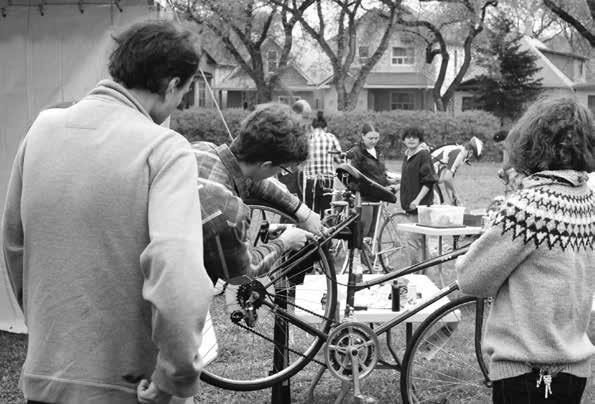
The Wrench is a local non-profit organization that makes bicycles readily accessible for cyclists and provides bicycle manufacturing, repair, maintenance, and education.
Geoff Heath, The Wrench’s mechanical director, has worked at
the community bicycle shop since its inception and has watched the organization grow into a community cycling resource.
“[At the time] community bike shops were not able to provide programming for schools [...] so a group of volunteers got together, wrote some grants and created The Wrench as a non-profit,” Heath told the Manitoban
“We assist community bike shops that already exist, [...] help teach people how to fix their bikes by [providing] advance training from
mechanics, helping to purchase tools from distributors, [organizing] various community events [...] We do a whole bunch of programing with youths and schools.”
Heath believes the services at The Wrench are vital to Winnipeg’s cycling community. This is evident in the growth the organization has experienced over the years.
“The Wrench has grown by leaps and bounds since [2010]. It started with two staff members and we have grown to have a very large volunteer base. There are over 30 schools now that have school bike repairs. That’s due to us promoting bicycling to [them] and providing bicycle programs to teachers who are interested in doing something different with their students.”
A large volunteer community of cyclists has powered The Wrench from the beginning. However, the demand for The Wrench’s services always outstrips the manpower available.
“Winnipeg does have a really great volunteer culture. We have the highest number of community bike shops per capita in North America. We do have a lot of volunteers but the demand is also very high,” said Heath.
“We have a large percentage of
people below the poverty line choosing bicycles as their form of transport.”
The volunteering culture fostered at this bicycle shop is an admirable feat. Nevertheless, The Wrench is more than a non-profit or a bicycle repair shop.
“I think of us as an educational organization. We foster an environment of learning,” said Heath.
Winnipeg has a growing cycling population, and several cycling enthusiasts, like Heath, are aware of the environmental and economic benefits of riding bicycles. But winter cycling may provide a bit of a hurdle for riders. Heath believes this menace can be curbed.
“I have been a winter cyclist for many years and I am very excited to see that many people are getting excited about it,” Heath told the Manitoban
“It’s making more sense to a lot of people, and with improved biking infrastructure, and the rise of the number of people who are riding their bikes during the winter, it is becoming easier and easier.”
In recent years, Winnipeggers have seen the development of a number of cycling programs such as the Walk Bike Winnipeg program. These promote the significance of cycling
and the need to practise cycling safety.
“It’s getting better as a cycling city. Winnipeg has made improvements in our infrastructure, and our bike trails. [However] there is still a lot of needed education [for] drivers as to how they can respect cyclists on the road. There’s a lot of need for educating cyclists, especially young cyclists,” said Heath.
As part of The Wrench’s mandate, the shop organizes community events every so often. The organization just concluded a fundraiser event at the Good Will Social Club on Nov. 24, and will be holding their annual Cycle of Giving event in December.
The Cycle of Giving is a 24-hour bike-building marathon event, during which volunteers come together to build over 350 bikes for Winnipeg children in need.
“This is our fifth annual Cycle of Giving event. We created this event in order to find a way to deal with all the little kids’ bikes that go into the landfill. [It’s also] a fundraiser to support bike programming,” said Heath.
Visit www.thewrench.ca to learn more. The Cycle of Giving event takes place from the 12 p.m. on Dec. 12 to 12 p.m. on Dec. 13 at 1609 Elgin Avenue West.
PHOTO BY NATHAN WILD
GRAPHIC BY JONDELL COOMBS
Discussions with DJ
Chatting about the end of the season, and preparations for the upcoming CFL draft
MIKE STILL, STAFF
I
t was a disappointing end to the 2015 season for the University of Manitoba Bisons football team. But for players such as DJ Lalama there’s no time to linger on what could’ve been, as he now sets his sights on the 2016 CFL draft this coming spring. The Manitoban sat down with Lalama for the final instalment of “Discussions with DJ” to talk about his preparations for the CFL evaluation camp and draft, as well as his final comments on the 2015 campaign.
MANITOBAN: What were the emotions like for you at the end of the season?
LALAMA: Disappointed. I think the way we left off was almost embarrassing considering the expectations we had for ourselves at the beginning of the season. Little things like sitting back and watching Guelph take home the OUA championship after our defence arguably shut them out completely in the pre-season in the first half, and then to have 52 points put up against us in that last game, things just don’t really add up. It’s just one of those things where it just wasn’t in the cards this year and hopefully everyone that’s wearing that jersey next year will have a chip on their shoulder and brings that every time they step on the field.
M: How would you rate the defence’s play this season?
L: In such a short season, you basically just look to progress every week. I think that we did that. Would we have liked to have gotten better quicker? Yeah, sure, you could say that, but overall I think the games that we put together like week seven and week eight and even the first little bit of the playoff game – sometimes we were dealt a crappy hand – and I
think we responded well, but obviously it wasn’t enough.
“It’s nice to have your name mentioned alongside Russ Jackson and the other nominees, but I’d do anything to be out there and playing still” – DJ Lalama
M: Why do you think the team struggled so much playing against UBC this year?
L: The first game when we played them, I really think special teams were the difference. You can arguably say that 21 to 24 of their points were contributed just solely on special teams in that game and I think that’s where it lies in that game differencewise. The last game of the season, going in there with our third-string quarterback basically by the time the second quarter rolled around, we weren’t expecting ourselves to win, but we wanted to play and leave a good taste in our mouths heading into the playoff game. We didn’t have our quarterback; we were just doing our best to win a football game. Lastly, that last playoff game, yeah they had our number. It was pouring, I’ve never played in as much rain as that game before – not to use that as an excuse, but there was definitely some home-field advantage there. That first half as a defensive player, we were dealt a shittier deal for lack of a better word. We got into a hole and it just kept on getting worse
and we couldn’t get ourselves out of it.
M: What does being given the conference student-athlete community service award mean to you?
L: Obviously on a personal note it’s a high honour to be chosen by your coach first of all and the head coaches in the conference, to represent Winnipeg, the Bisons, and Canada West moving forward in that nomination. With the way our season ended though, I think if anything it’d just be a small consolation. It’s nice to have your name mentioned alongside Russ Jackson and the other nominees, but I’d do anything to be out there and playing still.
M: Moving onto the next step in your football career, are you doing anything differently to train for the CFL draft?
L: Obviously the calendar speaks for itself, as you now have to be ready now at the end of March as opposed to the end of August regarding being in peak physical form in order to test properly. I think now as well a lot more focus will be on the technique side of things for the specific combine tests as opposed to pure athleticism and strength as it would be in a normal off-season.
Lastly, getting on the field much earlier is going to be crucial for the two days of one-on-ones and stuff like that at the E-camp. Normally you don’t do that kind of stuff in the summertime. Now everything is just sort of squished into four months.
M: Do you know what to expect heading into the combine, in terms of what scouts are looking for from you?
L: I think they’re making notes about everything, I don’t think there’s
anything in particular. From what I’ve heard from ex-teammates that are now in the CFL, it’s about that improvement off the testing scores to sort of see that you’re working and not just content with where you are. In terms of extra things on the field, everyone wants to go out there and have a great showing, but at the end of the day, it’s a very, very small sample size.
“All I can do is get myself in the best shape possible by that combine date, and hopefully [the scouts] tune into my film and appreciate what I’ve done” – DJ Lalama
For example, I’ve got four years of film where you can’t hide anything. [The scouts are] going to be in tune to that much greater than what you
PHOTO BY JEFF MILLER
do on the one day at the E-camp. But definitely, that’s a place where you can raise or drop your stock.
M: Knowing where you stand as a player, do you have any specific expectations for draft day?
L: I’ve done I think, four years of well more than what the average university student athlete gets to enjoy. So for me, being graduated already, it’s definitely exciting to have that opportunity to move on, but now the onus is on me to make that happen.
In speaking with the CFL representatives and Coach Dobie, I’m definitely expecting to get drafted. Where, I mean your guess is as good as mine. It depends on the ratio, it depends on who needs a long snapper, who needs a linebacker, or what kind of system they play, so that’s completely out of my hands.
All I can do is get myself in the best shape possible by that combine date, and hopefully [the scouts] tune into my film and appreciate what I’ve done. Wherever I go I’ll be happy, I’m just excited about the opportunity to make it to the pros and represent Bison football.
Big man on campus
After five standout years with the Langley Rams, former CJFL All-Canadian returns home
MIKE STILL, STAFF
Anthony Daley’s football journey has taken him from the Greendell Falcons midget program all the way to B.C., but he’s finally back home again.
A graduate of J.H. Bruns Collegiate in Winnipeg, Daley was courted by a couple different junior football programs, but ultimately chose to play for the Langley Rams in Langley, B.C. as he had family close to that area and wanted to experience the game outside of his home province.
“I googled the closest team to where my uncle lived in B.C., and my uncle lived in South Surrey and the team was in South Surrey at the time but they moved to Langley a couple weeks after that coincidentally,” Daley said.
“I talked to the coach (former Manitoba Bison Jeff Alamolhoda) and we didn’t know each other from a hole in the ground, and he was just like ‘come out to spring camp and we’ll see what you can do.’ Then it all just kind of took off from there – I did well and now I’m where I am.”
To say Daley did well is a bit of an understatement. The offensive lineman went on to win two British Columbia Football Conference (BCFC) championships – the first in 2012 and the second in 2014 – and was also named a CJFL All-Canadian in both 2012 and 2013.
actually told me they thought that I should go to school,” Daley said.
“The thing I’ve been hearing from a lot of people over the years is, ‘hey, go get an education and come and do this [play professionally] after, there’s no rush.’ So, that’s kind of where my mind’s at with that.”
Daley’s relationship with Brian Dobie
Bisons football head coach Brian Dobie has recognized Daley’s talent for a number of years, and the offensive lineman has a tremendous relationship with the herd’s bench boss.
“He’s a unique recruit, because I’ve recruited him for a few years now, and I know him the way I know many of my own players,” Dobie said.
The Bisons head coach also noted Daley’s dedication to his hometown, as he would return from B.C. in the offseason to take classes in the winter term.
“He brings a lot. He’s an intelligent guy; he’s an aggressive player and an intelligent person” –Brian Dobie, head coach, Bisons football
“The fit back here is so good, because he’s been a U of M student for the last few years,” Dobie said. “He plays football in the fall and doesn’t go to school. Second term he comes back home, crosses the river and goes to the U of M, so he’s moving towards his degree already.”
With two veteran offensive linemen from the 2015 season now graduated, Daley’s commitment couldn’t come at a better time for Dobie in terms of leadership and experience.
Daley’s success with the Rams also garnered him some attention from the B.C. Lions. For three seasons, starting in 2013, he practiced with the team as a territorial exemption (someone who doesn’t count towards the team’s roster limit).
After finishing his final year of junior eligibility this past year, Daley faced an interesting dilemma. He could either pursue the possibility of gaining a roster spot – much like fellow BCFC graduate Andrew Harris did in 2010, or he could return home for university and hone his game in the CIS. Ultimately, Daley chose the CIS route and a commitment to the University of Manitoba Bisons for 2016.
Daley noted the importance of a college education as one of the biggest reasons for coming back home.
“A lot of the guys [in B.C.]
“He brings a lot. He’s an intelligent guy; he’s an aggressive player and an intelligent person. That’s a pretty good combination,” Dobie said.
“He’s got great junior experience combined with some literal pro experience – another great set of criteria as to why he’s so valuable as a recruit. We lose a couple starters on our offensive line, and Anthony coming in just makes us that much more competitive.”
Ultimately, Daley is no stranger to the Bisons program and his addition to the roster, in the eyes of some, is a long time coming.
“I was training with the team in the offseason so I’ve always been a familiar face – I guess a bit of a tease, so I’m sure it’s a bit of a relief now,” Daley said.
Ready for the big leagues
Taking a look at the three rookies in the Winnipeg Jets lineup
ALEX MICHAELS
There is little doubt in most people’s minds that the Winnipeg Jets have a bright future with a number of high-level prospects coming through the system. With players such as Michael Frolík, Lee Stempniak, and Jiří Tlustý leaving during the offseason, new players have an opportunity to try and crack the lineup.
Nikolaj Ehlers, Nic Petan, and Andrew Copp did just that.
Ehlers – who’s 19 years of age –was drafted by the Jets ninth overall in the 2014 NHL entry draft and is thought to be one of the best prospects the team has. He has blazing speed and a quick wrist shot that can beat any goalie in the NHL.
The biggest question mark surrounding Ehlers was his defensive game – something that Jets head coach Paul Maurice made note of early in the season.
“So, can he play well enough defensively? He’s shown, really from day one, that he has a real interest in it. He understands that he needs to do that to play at this level and he’s made some good defensive plays," Maurice told the Winnipeg Free Press Ehlers had plenty of success during his playing career with the Halifax Mooseheads, posting 86 goals and 119 assists in two seasons (2013-2015). It’s now all about getting
stronger and more accustomed to the faster NHL game.
Nic Petan is a very crafty player who fell in the 2013 draft to the Jets 43rd overall in the second round. He was a big time player for Team Canada at the World Junior Hockey Championship in 2013-14 and 2014-15, and will look to be the same for the Jets in the future. In 14 games for Canada he put up 16 points and always seemed to come up with a clutch play for the squad.
gifted out of the three rookies. In high school, Copp was a quarterback and he is well-suited for the physicality of the heavy Western conference.
“It’s also probably why he’s not afraid to go into the corners [...]
In high school Copp was a quarterback and he is wellsuited for the physicality of the heavy Western conference
Petan’s willingness to do anything for his team – including blocking a shot in game one against Boston – is a winning formula for a rookie trying to stay with the big club, something Maurice noted.
“[Blocking shots is] good on the bench. That’s the enthusiasm of youth and especially for a real skilled guy [...] Those things, that’s great currency in the room for him,” Maurice told the Free Press
At six feet tall and 203 pounds, Andrew Copp is the most physically
He’s probably been in some tougher areas,” Maurice told the Free Press in reference to Copp’s time as a QB.
In three seasons for the University of Michigan Copp posted 67 points, and while he isn’t a flashy player like Ehlers or Petan, he has the size and strength to be a productive and effective bottom-6 forward.
Ehlers, Petan, and Copp are just the beginning of what looks to be a bright crop of future stars for the Jets for years to come.
GRAPHIC BY CAROLINE NORMAN
Huskies take bite of Bisons
Men’s hockey loses two straight games against conference-best Saskatchewan
RYAN STELTER, VOLUNTEER STAFF
This past weekend, the University of Manitoba Bisons men’s hockey team welcomed Canada West’s top team, the Saskatchewan Huskies, into town. The Huskies swept the weekend series, taking Friday’s game by a score of 6-3 as well as Saturday’s rematch, 4-3.
Saskatchewan have now won five of their last six games and improve their conference-best record to 12-2.
Manitoba has dropped four straight and have an abysmal 2-6 record at home. Manitoba is now sixth in the Canada West with 12 points.
Friday
The home side started the game off well. Two minutes into the game, Warren Callis buried a shorthanded goal to put the Bisons up 1-0. The Huskies would bounce back, through
goals from Josh Roach and Matthew Spafford. Shaq Merasty would tie the game up before the end of the period, though, with his ninth marker on the year.
Saskatchewan got their lead back two minutes into the second period off a Parker Thomas power play goal. The Bisons would once again tie the game up before the end of the frame with a power play goal of their own,
however.
In the third period, the visitors would grab a two-goal lead, which was enough to seal the deal. The Bisons pushed hard to equalize, but the Huskies would ice the game by scoring an empty net goal with three minutes to go.
Jordan DePape extended his point streak this weekend to nine games, and is now third in the Canada West with 19 points
Manitoba surrendered a total of 38 shots on goal, with goalie Byron Spriggs making 33 saves. Spriggs has now made 30+ saves in four games this year.
Saturday
Saskatchewan opened the scoring six minutes into the game, but just six minutes later, Jesse Paradis tied the game up for the herd with his second goal of the campaign.
Rene Hunter would give the Bisons a 2-1 lead heading into the first intermission and the momentum looked to be in Manitoba’s favour. Saskatchewan would fight back, however, as they scored two goals to
give themselves a 3-2 lead. Despite outshooting the Huskies, the herd found themselves down by one heading into the third.
Levi Cable would give Saskatchewan a two-goal lead five minutes into the third and things looked bleak for Manitoba. Merasty would bring the Bisons within one with two minutes left in the game, and the Bisons did everything they could to tie the game but to no avail.
Rookie goaltender Justin Paulic played admirably in the loss, making 32 saves on the night, and is now sitting at a .892 save percentage while averaging 3.76 goals against per game.
Jordan DePape extended his point streak this weekend to nine games, and is now third in the Canada West with 19 points, while averaging 1.3 points per game. Rookie Brett Stovin also extended his point streak to seven games, notching eight points in that time span.
What’s next?
The Bisons head out to Regina to play the Cougars next weekend. The last time these two met was the opening series of the season, with both teams registering wins. Manitoba has a 3-3 record on the road and will hope to snap their four game losing streak. Regina is coming off a weekend in which they scored 15 goals in two games against the Lethbridge Pronghorns. The Cougars have yet to win a game at home this season, and the Bisons will look to take advantage.
One streak ends, another begins
Bisons’ win, shutout streaks end as Manitoba and Saskatchewan split action-packed series
ANDY CHE, STAFF
T
he University of Manitoba Bisons women’s hockey team had their five-game winning streak snapped on Friday night by the Saskatchewan Huskies in double overtime, but they are heading home on a positive note. Saturday’s matchup saw the herd erase an early 1-0 deficit, coming back to win 3-1. The victory closed out a four-game road trip for the herd, who produced a 3-0-0-1 record during that span.
Friday Saskatchewan entered the series having dropped both games last weekend to the UBC Thunderbirds in a 1-0 double overtime loss and 4-3 regulation defeat, respectively. Meanwhile, Manitoba was sparkling under some hot goaltending, coming into the contest with three consecutive shutout victories.
The Bisons and Huskies couldn’t break the deadlock after the opening 20 minutes, with the hosts leading
7-5 on the shot clock. Just 1:27 into the second frame, though, it was the Bisons who took the lead as Kayleigh Wiens scored her third goal of the season.
As the period progressed, the pendulum gradually began swinging Saskatchewan’s way. The Huskies leveled the contest midway through the period when Elizabeth Salyn scored her first ever CIS goal. Saskatchewan’s tally also snapped Manitoba’s shutout streak of almost 250 minutes unbeaten.
Six minutes before the second intermission, the Huskies took a 2-1 lead. Kaitlin Willoughby blew by her opposing defender and beat goalie Rachel Dyck for her third of the season. Saskatchewan also continued to dominate the shot clock, leading 17-14 through two periods.
With less than seven minutes to go in the final frame, the Bisons pressed for an equalizer. Defenceman Erica Rieder provided relief for the visitors
when she jumped on a rebound to level the score at 2-2. Wiens drew an assist on the goal for her second point of the game.
The 3-2 double OT loss marked the Bisons’ first loss since Oct. 23 against the UBC Thunderbirds
Neither side could pot the game winner on regulation, requiring two overtime periods before either team could clinch the extra point.
At 3:01 of the second extra frame, Marley Ervine broke in and sniped the game-winner past Dyck’s glove side. It was the fifth-year player’s 12th point through 13 games on the season.
The 3-2 double-OT loss marked the Bisons’ first loss since Oct. 23
against the UBC Thunderbirds.
Saturday
The Huskies used their momentum from Friday’s game to get to the Bisons early in the second matchup of the weekend. Julia Flinton scored unassisted to get Saskatchewan on the board just 2:23 into the first. Impressively, the goal was the blueliner’s 12th point in just 14 games this season.
Looking to cut into the Huskies’ early lead, Bison forward Karissa Kirkup leveled the score on the power play after Saskatchewan’s Lauren Zary took a tripping penalty midway through the period. The freshman snapped a nine-game goal drought with the tally.
Less than five minutes later, Kirkup scored again on the power play, claiming the lead for the Bisons heading into the first intermission.
Alana Serhan notched assists on both of Kirkup’s first-period goals.
Though the score remained 2-1 after two frames, the game got feisty as both sides combined for 16 minutes in penalties during the second period.
Up by a single tally, Manitoba needed some help from Dyck, who produced 17 saves through two periods. She stayed sharp, saving 13 more in the final 20 minutes to preserve the win.
Alanna Sharman clinched the game with less than a minute remaining in the third, helping the Bisons came out on top 3-1.
With the victory, Manitoba climbs to second in the Canada West Division, level in points with the Alberta Pandas.
The herd will head back home this weekend, hosting the Regina Cougars on Friday and Saturday at the Wayne Fleming Arena.
PHOTO BY CHANTAL ZDAN
Getting defensive
Men’s basketball sweeps Alberta, hold Golden Bears under 70 points in both contests
MIKE STILL, STAFF
The University of Manitoba Bisons men’s basketball team completed their first sweep of the season last weekend, dominating the visiting Alberta Golden Bears defensively with scores of 90-68 on Friday and 74-61 on Saturday.
One of the biggest reasons for the herd’s success was their ability to shut down starting post players Brody Clarke and Brett Roughead. The seven-foot-one Roughead had just two points and two rebounds all weekend, while the six-foot-eight Clark was held to 12 rebounds.
Manitoba’s dominant power forward Wyatt Anders, on the other hand, registered 23 boards, while swingman Keith Omoerah pitched in with 11.
Friday
The opening matchup was close heading to halftime, with the herd leading by a slim 41-35. The Bisons pulled away in the third quarter though, outscoring Alberta 29-17 en route to the win.
Reserve Malik Irwin – who saw
28 minutes over the weekend – was a critical piece on both sides of the court for Manitoba, as fellow big men Brett Jewell and Jonathan Alexander ran into foul trouble.
Irwin totalled a season-high eight points in the first matchup, and was aggressive on defence all game long.
While Irwin was critical off the bench, the player of the game for the home side was definitely Omoerah, who totalled a game-high 29 points. He was 11-of-14 from the field as well as 4-of-5 from beyond the arc and seemed to get better as the game went along.
Omoerah’s performance was clutch, considering that high-scoring guards Justus Alleyn and AJ Basi were held to just 27 combined points.
“We were just aggressive today,”
Omoerah said after Friday’s game. “They were denying probably our most skilled scorer in AJ Basi, so other guys had to make plays today and we stepped up.”
Saturday
The rematch was another defensive
slugfest, with Manitoba surrendering no more than 16 points in a single quarter.
The difference came down to perimeter shooting, where the home side shot 55.6 per cent, compared to just 23.1 per cent for the visitors. Manitoba’s success draining threes came from the usual suspects, as Alleyn was 3-of-5, Omoerah was 2-of-3, and Basi was 4-of-7. Basi also led all scorers with 20 points.
The Bisons also got increased production from Jewell and Alexander. Jewell recorded eight points, while Alexander had five boards.
Another critical factor in this game was Anders’s mid-range shooting, where he was 4-of-8. The co-captain usually scores the major-
ity of his points from the free-throw line, however he was forced to adjust on Saturday due to the Golden Bears’ zone defence inside the paint.
The player of the game for the home side was definitely Omoerah, who totalled a gamehigh 29 points.
“I did know that they [Alberta] were going to double,” Anders said post-game.
A weekend to forget
Both Bison volleyball teams get swept by Alberta
RYAN STELTER, VOLUNTEER STAFF
The University of Manitoba Bisons men’s and women’s volleyball teams both ventured to Edmonton this past weekend to take on the University of Alberta. Neither squad was able to pick up a win, as the men’s undefeated run was snapped, while the women’s losing streak was extended to four games.
Tough losses for the men
With two of the top three teams in the nation facing off, the weekend matchup should have been quite competitive. Unfortunately, that wasn’t the case, as Alberta lost just one set all weekend.
The Bears bested the Bisons in three straight sets (25-16, 25-21,
25-19) in the opener on Friday night. Alberta dominated the herd in every statistical category, but individually, Manitoba’s Devren Dear smacked home 17 kills, the most of any player on the court. Dear is now averaging 3.87 kills a set on the year.
The home side made 17 errors on the night, while the herd only made 15, despite losing every set.
The Golden Bears completed the sweep on Saturday, winning 3-1 (25-17, 25-23, 23-25, 25-19).
In the rematch, the herd didn’t register a single ace, while Alberta managed six. Dear once again led the Bisons with 17 kills, while Alex Strachan had a team-leading six digs on the night.
Manitoba is now third in the Canada West after the sweep, and will hope to rebound next weekend on the road in Regina. The Cougars are currently sitting at a 1-9 record.
Women remain winless away from home
The women headed into the weekend riding a two-game losing streak, and despite their best efforts had that streak extended to four, as they were in tight against the second-place Alberta Pandas.
On Friday, Manitoba lost 3-0 (2522, 25-17, 25-20). The Pandas outscored the Bisons by just 13 points, but were still able to hold on.
Cassidy Pearson had a team-best
nine kills on the night, while secondyear libero Cassie Bujan racked up 12 digs.
The home side made 17 errors on the night, while the herd only made 15, despite losing every set fairly handily
The women had a quick turnaround and were looking to rebound on Saturday. They looked great to
“As soon as I did a nice move and I let that guy go by, boom another post defender was there and I was trying to find my partner Brett or Keith or Jon. I knew that the only way I was going to get buckets was off of midrange, so I just started shooting it every time I saw it.”
While Alberta did an effective job limiting the inside game, they ended up being susceptible to the outside shot, and it showed in the final score.
The Bisons will now head on the road against Brandon to end the first half of the season. Game times are 8 p.m. Friday and 7 p.m. Saturday.
start off, grabbing the first set, but fell in the next three (25-23, 18-25, 19-25, 19-25).
The Bujan sisters stole the show for the herd on Saturday, with Cassie once again leading the team in digs, with 15. Her sister Haillie was right behind her with 13 digs of her own. Haillie also led the team in kills with 14. With the two losses, Manitoba is now second-last in the Canada West with a 1-9 record, and will travel to Regina next weekend, to take on the winless Cougars.