
Editor-In-Chief:
Craig Adolphe
Contact: Editor@themanitoban.com / 474.6770

Editor-In-Chief:
Craig Adolphe
Contact: Editor@themanitoban.com / 474.6770
CRAIG ADOLPHE, STAFF

Watching Justin Trudeau and his 30-member cabinet being sworn in earlier this month, something struck me as extremely offputting about the whole affair.
It wasn’t the spectacle they made of Trudeau, his family, and his ministers’ long walk to Rideau House, where he was to be sworn in. Not the excited members of the public who came to watch what was ultimately a long process of 31 people filling out paperwork for a new job. Not even the media’s swooning as they spoke excitedly about who might make the cut for cabinet.
These sorts of ceremonies are always dressed up with excessive formality and theatre. But all of those tradition-based idiosyncrasies aside, one aspect seemed particularly dated: the oath Trudeau and his ministers made to our head of state, the monarch of Canada, Queen Elizabeth II.
“I, Justin P. J. Trudeau, do swear that I will be faithful and bear true allegiance to Her Majesty Queen Elizabeth the Second, Queen of Canada, Her Heirs and Successors, so help me God,” he said, first in French, then in English.
“I, Justin P. J. Trudeau, do solemnly and sincerely swear that I will
be a true and faithful servant to Her Majesty Queen Elizabeth the Second, as a member of Her Majesty’s Privy Council for Canada. I will in all things to be treated, debated, and resolved in Privy Council faithfully, honestly, and truly, declare my mind and my opinion. I will keep secret all matters committed and revealed to me in this capacity or that shall be secretly treated of in council. Generally, in all things, I shall do as a faithful and true servant ought to do for Her Majesty, so help me God.”
Finally, he ended with an oath more relevant to his responsibility to Canadians.
“I, Justin P. J. Trudeau, do solemnly and sincerely promise and swear that I will truly and faithfully, and to the best of my skill and knowledge, execute the powers and trusts reposed in me as prime minister, so help me God.”
After his oath he shook hands with Governor General David Johnston, who serves as the Queen’s representative in the country, and was met by a roaring round of applause and a standing ovation by those in attendance. Afterwards, each of the incoming ministers came up one by one to make similar oaths.
It shows a special sort of cognitive dissonance to swear an oath of fealty to a British monarch as part of the ceremony to be recognized as the elected leader of Canada – specifically, in the year 2015, with no threat of violence to our country. In Trudeau’s defence I have little doubt both Thomas Mulcair and Elizabeth May would do the same if they had won – we already know from previous ceremonies that Stephen Harper was willing to take that oath.
Even if the Queen’s position of head of state came with no power and was restricted to the symbolic gesture it’s argued to be, it remains an offensive gesture
Despite the seemingly ubiquitous willingness among Canadian politicians to swear an oath to serve
that British lady with all the funny hats, I’m convinced it’s not the kind of tradition I want my country to be a part of.
If we were to reinvent our political system from the ground up now, no one in their right mind would suggest we select our head of state to be handed down generation to generation like an old photo album
Symbolic position, actual power
The power of the Queen and the governor general is often argued to be symbolic, but that’s not necessarily the case. In December 2008, we were treated to a prorogued Parliament at the will of then-governor general Michaëlle Jean. Stephen Harper went to her with a request to prorogue Parliament – temporarily shutting it down – to prevent opposition parties from triggering a vote of non-confidence for his minority government, and replacing it with their own coalition government.
In the time that Parliament was out of session, Harper was able to secure the support of the Liberals to maintain power through a stimulus budget.
Jean’s decision on whether or not to intervene had a major impact on the future of the country. As nice as she appears to be – I’ve heard great things about her charity work and time with the CBC – I’m not really comfortable leaving that sort of decision to someone approved by, and representing, a foreign monarch (even if she was recommended for the position by then-prime minister Paul Martin). It’s hard enough giving that sort of authority to elected politicians.
The same argument applies to our current governor general, Dave, or His Excellency the Right Honourable David Johnston (as his friends like to call him). He’s a well-respected academic and administrator, and I don’t know of anything he’s ever done to make me think he wouldn’t make for excellent company at dinner.
That being said, the pomp, the prestige, the power, all tied to the birthright of a family of thin-blooded Brits, needs to go.
Even if the Queen’s position of head of state came with no power and was restricted to the symbolic gesture it’s argued to be, it remains an offensive gesture. What message does it send when our country guarantees a special place of honour and authority
for any person as a birthright?
Defenders of the monarchy
The reasoning I hear in defence of the monarchy ranges from ridiculous to incomprehensible.
I’ve been told that the legal implications of removing our Queen as the head of state would be too complicated to overcome, but that can’t be the case because other countries seem to have figured it out.
I’ve also heard arguments that the country has thrived under the monarchy and that severing our connection with the monarchy would fundamentally change who we are as a nation. The former is a facile take on a complex history and while I wouldn’t necessarily disagree with the latter, based on the way it was said I’m guessing they meant it was a bad thing.
Perhaps the sincerest, and simultaneously the most frustrating, defence of the monarchy in Canada is hearing people suggest that we give it up after the death of Queen Elizabeth II. The proponents of this position (some of my friends and family amongst them) have pointed out that Queen Elizabeth II seems like a nice woman “and she’s already been Queen for so long...” they say before trailing off. Apparently wanting full practical and symbolic freedom to self-determination as a country is something you don’t want to offend anyone over. Overall, most people don’t seem to care much, which is maddening in its own right. We just held an election in which 17,559,353 people participated by voting because they wanted a say in who governed our country. Of those, 6,930,136 voted for the Liberal party, giving them enough seats across the country to form a majority government and guaranteeing Justin Trudeau became the next prime minister of Canada – pending the approval of Queen Elizabeth II (or as the case happened to be, the Governor General in her absence). Whether that decision is a symbolic gesture or not, it’s an affront to the nearly 18 million people who participated in the election.
The Queen holding the position of head of state is, like most unquestioned power dynamics, a wacky tradition. If we were to reinvent our political system from the ground up now, no one in their right mind would suggest we select our head of state to be handed down generation to generation like an old photo album. And they definitely wouldn’t pick an old lady to act as head of state for Canada from her castle in Britain. We can think of our current predicament as an accident of history at best and a vestigial remnant of a more openly colonial era at worst. Either way, it’s time to make a clean break: there can’t be a monarch, symbolic or otherwise, in a serious democracy.

EVAN TREMBLAY, STAFF

I
n a full-page trumpeting of the University of Manitoba Students’ Union (UMSU) executive’s accomplishments, UMSU president Jeremiah Kopp refers to the renovations begun and planned to the hallway on the third floor of University Centre as a “marquee, $1.4-million, world-class capital project.”
That’s the kind of hyperbole (some might call it bullshit) that makes me blush, and then write an article about it.
We’ll skate over the things that might go into making an actual world-class hallway; they involve a subtle understanding of design and purpose of location I suspect would be lost on the group of students that sees the defining purpose of an institution of higher learning as getting the best acts for Frosh. Having a world-class hallway would involve having a world-class understanding of the function of that hallway; it would involve the understanding
that what would be a good addition to a mall might not be the best thing to replace quiet study areas at a university. People come to university to study, not to consume.
What are we getting, that UMSU Street will be considered worldclass? An expansion of Degrees, and remodeling of IQ’s have both been mentioned; the addition of a patio to the Hub was previously in play. They’re all UMSU businesses, and it’s in the interest of students that they do well, but one has to wonder if lack of capacity is really what’s holding them back.
Lacking architectural renderings , it’s difficult to acquiesce to a “worldclass” label. There is some really beautiful architecture out there, in the world. What evidence do we have that the planned expansions will hold a candle to it – or for that matter, even be of the same quality of the current spaces?
A “fresh coat of paint”, which
“showcases student artwork” was mentioned in the Your UMSU policy book – nothing against said artwork, but the mural they’re talking about (already completed) doesn’t strike me as world-class. There was also mention made of improved lighting; I suppose you do need good lighting, if you want a marquee. Some tables and chairs outside of Degrees; too few, and too cheap, too make much of an impression or difference.
So far, none of the changes mentioned add up to world-class. They add up to the kind of minor improvements that might be expected as routine to a building in constant use since 1970. This leaves us with the plans to bring in a smoothie bar as the only thing that Kopp could mean when he uses the phrase world-class. Apparently, for the UMSU executive, world-class is synonymous with “slightly increased options for spending money.”
That attitude is unpleasant as a
personal position; it’s the kind of attitude that ascribes “world class” to “biggest” and “newest,” that sees no irony in calling a cookie-cutter suburb built on virgin prairie “worldclass” if it has the same colour palette as suburbs in wealthier places. Any business, according to this attitude, is better than no business.
But this isn’t a personal position. UMSU collects money from every single student, every single semester. That’s the money it’s using to bring about its vision of worldclass. Students that cannot afford the luxury of Shawarma Khan or a smoothie or whatever other minor luxury ends up replacing study space will be involuntarily subsidizing the purchases of those students who can.
One year, I went hungry for two weeks before the start of school – I had enough money in my bank account to pay tuition, and nothing else. I was not alone; there is a food bank on campus, and for good reason.
What to do with our Remembrance Day poppies?
MICHAEL BELL
“In Flanders fields the poppies blow...”
A hundred years ago, these familiar lines by John McCrae first showed the connection between our fallen soldiers and the poppy. Then the “Poppy Lady,” American professor and YWCA volunteer Moina Michael, became so inspired by this poem that she created the modern day poppy movement
I could not afford Mr. Noodles, let alone a smoothie. Then, as now, it was a source of great bitterness that certain students used the money that was levied on me to support pet projects that benefit only the wealthier, indolent segment of the student body, while adding nothing to the intellectual and academic life which should be the sole reason for attending university. UMSU Street is not, and will not be, what Kopp claims. The $1.4 million of our money that he seems eager to tell us he’s spent will go towards making the third-floor hallway (I’m sorry – UMSU Street) a little bit more like any mall food court, and a little bit less like a university - not a good thing, and certainly far short of world-class.
Sometimes I see people wearing them into late November. But then what? Sometimes they get lost. Sometimes they fall under the car seat. Sometimes they’re put away in drawers, mixed in with socks and old pennies. There must be a better destination for our poppies.
So here’s an idea: leave your poppy behind.
Every year I try to attend a Remembrance Day ceremony. I’m always deeply moved by the reverence and solemnity of the occasion. And when it’s over, I always take away with me a stronger relationship with
So we go to our local store or veterans’ association and buy a poppy. We buy one and wear it on our left side – close to our heart. The poppy has become a recognized symbol of remembrance and commemoration for our fallen military personnel. But at the end of the day, what are we supposed to do with our poppies?
history and the echoes of the past.
Leaving your poppy on a monument or on a wreath may be a small act, but it's a powerful one
Last year, after attending a ceremony at Vimy Ridge Park on Portage Avenue, I noticed hundreds of spectators laying down their poppies around the wreaths and monuments. This is a newer practice observed by many
across the country and especially notable in Ottawa. I wasn’t completely familiar with the ritual.
Thinking about this action, I realized that the purchase of a poppy could be interpreted as an unspoken pledge. We buy it, we wear it, but to complete the bond, perhaps we are meant to give it back. It sounds counter-productive, but maybe the poppy is worn so it can be returned. By giving it back, you’re giving something back to the men and women who have given us so much.
This year I attended the ceremony at Bruce Park in Winnipeg. For the first time, I left my poppy behind. I’m not advocating everyone should
do it (what we choose to do with our poppies is a matter of personal choice). But perhaps think of it as an alternative to leaving it somewhere more trivial. And if you have a few poppies lying around, bring them to a local cenotaph or military memorial. Nov. 11 doesn’t have to be the only day for remembrance. Leaving your poppy on a monument or on a wreath may be a small act, but it’s a powerful one. The journey of the poppy will have come full circle.

MALAK ABAS, STAFF

Three Manitoban lakes have received criticism that they are comparable to some of the worst managed fisheries in the world. Seafood Watch, a California-based program that works to raise public awareness
concerning sustainable sources of seafood, has asked consumers to avoid fish sourced from Lakes Manitoba, Winnipeg, and Winnipegosis.
SeaChoice, a program that collaborates with Seafood Watch,
released a statement calling these lake fisheries “comparable to some of the most poorly managed fisheries in the world.”
The statement also blamed this rating on “lack of catch limits for some species, inadequate data, poorly regulated bycatch, non-enforceable multi-species quotas, and absence of harvest control rules.”
The three lakes targeted by Seafood Watch account for 81 per cent of the fish caught in Manitoba, and Manitoba’s commercial fishers are pushing back against the scathing remarks.
Kris Isfeld, a spokesperson for commercial fishers in Lake Winnipeg, told the Winnipeg Free Press that the Lake Winnipeg fishery “is one of the most successful, sustainable fisheries in the world.”
Isfeld also called eco-certification, a set of ethical regulations that improve sustainability for an aspect
of the environment, a “load of crap.”
The intense response to Seafood Watch’s report is understandable. The commercial fishing industry produces $30 million in annual sales – with around 85 per cent of fish caught in the province being exported to the U.S. and Europe – which is good for the province’s economy.
It is also worth noting that Manitoba has also received positive recognition in the past for its fisheries.
The Waterhen Lake fishery was the first freshwater fishery in Canada to earn eco-certification. The fishery received the certification from the Marine Stewardship Council for their northern pike and walleye fish in 2014.
The province of Manitoba has promised an in-depth review of the lakes in question. In a statement, Conservation and Water Stewardship Minister Tom Nevakshonoff promised to take action on Manitoban
fishery sustainability, and issue a formal report in 2016.
“We agree with SeaChoice in that we need to take action on Lakes Winnipeg, Winnipegosis, and Manitoba by developing and implementing modern and comprehensive management plans in co-operation with the province’s commercial fishers.”
The review will no doubt come with some hard truths, however, as eco-certification for the lakes in question is a pipe dream at best at this time, with the costs to do so being estimated at around $250,000 just to certify Lake Winnipeg.
The review will enlist the help of economist Harold Westdal, who will work with the Lake Friendly Stewards Alliance, commercial fishing representatives, and First Nations stakeholders.

On Nov. 10, the United States Senate passed H.R. 2262, also known as the Spurring Private Aerospace Competitiveness and Entrepreneurship (SPACE) Act of 2015. What is interesting about this legislation is that it gives citizens the right to own resources mined from asteroids. It is also the legal framework for future space commercial endeavors. It may sound like science fiction
to some, but it is an effort by the U.S. government to encourage commercialization of outer space. The intent is to use competition to drive innovation in space-related technologies. The importance of competition is that it will help bring down the cost of accessing space; this can be evidenced by the launch market, in which companies are currently competing to develop reliable, reusable rocket technology resulting in the
cost of launching objects into space being reduced.
The space race during the cold war drove both the U.S. and Soviet Russia to compete in developing technologies to launch into orbit and then to the moon. While government entities still remain one of the most significant innovators in the space sector, private innovation could speed up the pace.
Just as the name implies, space mining is the act of mining resources from objects in space. This could be the moon, other planets, or asteroids.
Resources on Earth are limited, and with growing economies and demands, running out of various metals or water will become a reality. These resources are needed for food production, electronics, infrastructure, luxury items, and the basic necessities of life, and they could be mined in space.
Additionally, space resources could help enable humans become an interplanetary species. Mined resources could build habitats on other planets and provide sources of water and fuel.
The most likely candidates for space mining in the foreseeable future are near-Earth asteroids, which are asteroids that orbit around the sun at distances between 0.983 and 1.3 Astronomical Units. An Astronomical Unit is the distance
between the sun and Earth. There are approximately 13,000 near-Earth asteroids currently known.
While space mining has yet to occur, there are already companies in existence which are currently developing technologies necessary to abstract resources in space. Planetary Resources and Deep Space Industries, which are both located in the U.S., are two such companies.
The United Nations Outer Space Treaty
Some have reacted to the SPACE Act by saying that it violates the United Nations’ Treaty on Principles Governing the Activities of States in the Exploration and Use of Outer Space, including the Moon and Other Celestial Bodies – known more simply as the Outer Space Treaty.
The Outer Space Treaty was established in 1967 during the cold war and serves as the general framework for space legislation around the world today. It has been ratified by 104 countries, including the U.S., Russia, and Canada.
The part in the treaty that some people believe the SPACE Act contradicts is Article II, which states: “Outer space, including the moon and other celestial bodies, is not subject to national appropriation by claim of sovereignty, by means of use or occupation, or by any other means.”
What this means is that a nation
cannot claim to own a planet, the moon, an asteroid, or anything else in space.
Whether space mining violates the Outer Space Treaty depends on whom you ask.
One opinion is that space mining is a peaceful use of space, and as long as there is no interference of other individuals, companies, or nations from doing the same, mining resources does not explicitly violate the treaty.
Another view is that space mining violates Article I of the Outer Space Treaty, which states: “The exploration and use of outer space [...] shall be carried out for the benefit and in the interests of all countries, irrespective of their degree of economic or scientific development, and shall be the province of all mankind.”
The mining of resources most likely will only benefit whoever is mining it, and not necessarily benefit all of mankind.
It is important to note that the SPACE Act recognizes the U.S.’ obligation to pre-existing treaties and outlines that commercial space activities should not interfere with any other activity in space.
Space law and policy remains a largely complicated matter. In this age of increasing technological ability, it will likely continue to be a politically precarious subject for years to come as people from all walks of life strive to explore the final frontier.
MALAK ABAS, STAFF
Canadian scientists are finally receiving real support from their government. Almost immediately after being sworn in as prime minister, Justin Trudeau began working to “unmuzzle” scientists and their research.
For almost a decade, scientists were silenced by Stephen Harper’s restrictive policies. As of 2006, journalists were no longer allowed to speak directly with scientists, but instead had to go through government communication officers, which typically resulted in delayed and unclear answers.
The science community fought back. The Union of Concerned Scientists, an American organization that advocates for scientific integrity, wrote to Harper in an open letter in 2014, urging him to revoke the communication blocks faced by federal scientists. The letter also contained over 800 signatures from 32 countries.
In 2012, a mock funeral was held on Parliament Hill to mourn “the death of science.” People wore lab coats or all black and delivered eulogies.
Eliminating the communication
blocks was a key point of Trudeau’s campaign. The official website of the Liberal party includes a petition titled “Stand Up for Science” and implores people to consider where their tax dollars meant for research are going, saying “your money pays for government research – but Mr. Harper continues to muzzle scientists and cut off their ability to share information.”
The petition is still available to sign.
Trudeau also promised to “establish a Chief Science Officer to ensure government science is freely available to the public,” a motion that had been put forward by the Liberals in Parliament once before, but was defeated by the Conservative majority in May 2015.
Trudeau did not waste any time in beginning to make good on his promise to change restrictions on scientists.
Just days after Trudeau and his cabinet were sworn in, Navdeep Bains, the newly appointed minister of innovation, science, and economic development, released a statement ensuring the Liberal government would “treat scientists with respect.”
“That is why government scientists and experts will be able to
speak freely about their work to the media and the public.” the statement continued.
“We are working to make government science fully available to the public and will ensure that scientific analyses are considered in decision making.”
Federal scientists who may have worried Trudeau’s promises would dissipate after his landslide win had their fears assuaged almost immediately.
Journalists requesting to speak with Bains after the statement received prompt responses. Pauline Dakin, the national health reporter for CBC News, called this “a remarkable thing.”
“I covered the national health beat for almost 14 years,” Dakin wrote in an article for CBC.
“In the last six or eight years of that assignment, I was never able to interview the federal minister of health. The only time the minister or a government health spokesperson appeared in my stories was following a staged media or public event with prepared statements.”
Only time will tell if Trudeau and

his team will continue to promote and improve communication and transparency among federal scientists and the general public past this post-
JEREMIAH YARMIE, VOLUNTEER STAFF
In 2013, a Colombian man died of cancer – what makes this particular case unusual was that the cancer wasn’t his, but that of a parasitic tape worm.
The man initially presented symptoms of fatigue, fever, cough, and weight loss. He was diagnosed with human immunodeficiency virus (HIV) infection in 2006 and, at the time of admittance, wasn’t taking his medication to treat this infection.
Following the HIV diagnosis, CT scans revealed unusual cell growth in various parts of the man’s body. Abnormal cells were found in biopsies that were taken from the man’s lungs and lymph nodes – small organs used by the immune system to filter blood.
The cells looked and acted similarly to those seen in cancer – they even showed invasive characteristics, which are a hallmark of cancer – but the cells were too small to be human.
Diagnostic DNA-based techniques showed that these cells originated from Hymenolepis nana, commonly known as the dwarf tapeworm.
Initially, doctors did not consider the possibility of the cells originating from a tapeworm since they didn’t appear to be complex enough.
Around 75 million individuals are
suspected to carry H. nana, making it the most common human tapeworm. Because the tapeworm can thrive entirely in the human intestine, individuals can carry the parasite for years without knowing. The immune system, however, eventually clears out the parasites.
The cells looked and acted similarly to those seen in cancer – they even showed invasive
characteristics, a hallmark of cancer – but the cells were too small to be human
Cancers were not known to occur in tapeworms prior to this study.
Genetic analysis of the cancerous tapeworm cells showed that they possessed many mutations which parallel those seen in mammalian cancers.
The man may have contracted the
parasite by eating food contaminated from a variety of sources including mouse droppings, insects, or feces from another infected individual.
The man’s HIV infection left his immune system compromised. HIV preferentially attacks immune cells that express a molecule called CD4, specifically CD4+ cells called T helper cells, which are a vital component in immune system response. When an individual’s CD4+ cell counts drop, they are less able to fight off infections that the immune system is normally able take care of.
It is believed that a weakened immune response against these tapeworm cells allowed them to divide unchecked. When cells are allowed to divide freely for a long period of time, they eventually develop mutations which may result in the cells transforming into a cancer.
Furthermore, it is thought that tapeworms rely on signals from the human immune system to develop properly. It is possible that these cancerous mutations developed more easily because the tapeworm cells weren’t receiving the proper signals from the human host’s immune system to grow and divide.
Cancer is generally not considered a transmissible disease, although

there have been exceptions, such as the Tasmanian devil facial tumour disease.
The cancer develops on the face of the animals, usually resulting in large tumours around the mouth. Eventually, most tasmanian devils
die of starvation.
The disease is thought to spread when infected cells come in contact with the tasmanian devil’s teeth. This can happen through biting of another infected animal or when sharing food.











TOBI NIFESI, STAFF

Sketch comedy group H.U.N.K.S. began performing in early 2015 and is set to perform their fifth original show on Nov. 19 at the Park Theatre.
H.U.N.K.S. is a troupe of five comedians and one filmmaker serving as the group’s director. These six talented Winnipeggers (Tim Gray, Quinn Greene, Sam McLean, Matt Nightingale, Dana Smith, and Rory Fallis) love sketch theatre and are very serious about it.
That being said, they could not care less about the meaning of their
name. It is not an acronym despite being stylized as one.
“[H.U.N.K.S.] is like a great piece of art, everyone interprets it their own way,” Gray told the Manitoban.
“We wanted it to be big and ridiculous, but also not mean anything. We just wanted to remove the gender [denotation].”
Prior to the group’s formation, each member had been involved in some form of comedic entertainment; five of them were cast on Shaw TV’s recently completed mock news show, The Week Thus Far


“We are just a bunch of similar comedic minds that have different sensibilities,” Gray said.
“Matt’s a standup comedian. Dana Smith and I came from theatre here at the U of M. Sam’s an improviser, [...] Quinn’s an actor and writer.”
“Rory had a car and credit card,” Gray joked.
The group performs under the creative direction of Fallis, a filmmaker and writer. He highlights the sketch comedy segments he worked on for The Week Thus Far as part of his inspiration for the H.U.N.K.S.
The group booked themselves to have six shows in a year at the Park Theatre. So far, they have performed four and relish the challenge to maintain a high level of productivity.
“We have those deadlines. We know we have a show by [a set date] and we know that for months leading up,” Fallis told the Manitoban
“It is the chemistry in the group too. We don’t have to force it; we didn’t know that going into it. We hoped for the best.”
“It’s kind of like learning how to fly by jumping out of the airplane,” Gray added.
The ideas, scripting, and directing of the show is a collective process. Each member tables their ideas and is involved in the writing process.
Besides their four previous shows at the Park Theatre, the troupe has performed at the Winnipeg Fringe Festival and Oddblock Comedy Festival. They have been encouraged by the reviews and attention they have received so far.
“We took the best of our first three shows and did it at the Fringe so it really helped to get us to a wider audience,” Fallis said.
“[The response has been] pretty cool. It keeps us going in the way of like, ‘well, it’s working and we just have to keep going.’”
H.U.N.K.S. have featured a
number of other local sketch comedy groups like Hot Thespian Action and are set to work with Jump Shark and Bucko in their next show.
“The unfortunate thing is that there are just not a lot of groups out there, and the fortunate thing is that they are all really good,” Gray said.
“We love doing shows with the people [we have worked with],” said Fallis.
“[These are people] we are lucky enough to be friends with, so we can showcase them as much as they are showcasing us.”
Their next original show at the Park Theatre promises a faithful adherence to established sketch comedy routines supplemented with a healthy dose of variety and nonsensicality.
“[People] can expect to see a brandnew show that really runs the spectrum of classical sketch comedy like you see on SNL [...] and off-the-wall sketch comedy that makes no sense, but is just so fun,” said Gray.
H.U.N.K.S. is performing at the Park Theatre on Nov. 19. Tickets are $10 in advance, $12 at the door. Advance tickets are available at Music Trader, the Park Theatre, or online at www.ticketfly.com

JESS KOSTUIK
Since Daniel Craig first took up the role of James Bond nine years ago in Casino Royale, each 007 film featuring Craig has had a different, specific theme that prevails throughout.
The fantastic Casino Royale focused on the reinvention of Bond, which was then followed by the mediocre but action-packed Quantum of Solace, depicting a Bond hell-bent on revenge.
In 2012, with the Oscar-winning Sam Mendes as director, Skyfall followed the same blueprint that worked so well in Casino Royale, giving the audience a fantastic character study, and showing Bond more vulnerable than you’ve ever seen him.
So, where does Spectre – the latest instalment in the Bond franchise and Craig’s fourth (and possibly last) time playing the legendary spy – land among the rest?
Like its predecessors, Spectre also has a tone that is detectable throughout the entire film: nostalgia. Spectre pays homage to the many 007 films that preceded Craig’s tenure. If you are a Bond nerd, you will be delighted by the many references thrown into the film, going all the way back to Dr. No, the first episode released in 1962. However, if your knowledge of the earlier films is lacking, no worries, Spectre still serves as a solid action flick.
Spectre ’s script (penned by John Logan, Neal Purvis, Robert Wade, and Jez Butterworth) follows a basic formula used many times before. A globetrotting Bond going from action sequence to action sequence comprised of shootouts, car chases, and fistfights. If not handled correctly, Spectre could have had a similar fate to the soulless Quantum of Solace
Craig is not offered as much space to develop his character, but he nails every opportunity he is given through his blunt, yet nuanced performance
Fortunately, the superb filmmakers involved – both behind and in front of the camera – propel Spectre above the average action flick. Mendes returns to the director chair, this time working in tandem with cinematographer Hoyte van Hoytema (Interstellar, Her). Together


they bring a stylish flair to the film, with every scene beautifully framed and shot.
Their skills are best showcased in the tremendous opening sequence, set in Mexico City on the Day of the Dead, and featuring hundreds of extras. In this sequence, Bond tracks down bad guy Marco Sciarra (Alessandro Cremona), finishing in a nail-biting battle aboard a helicopter.
Craig is dynamite, once again proving that he is the best man for the role. In comparison to Casino Royale and Skyfall, Craig is not offered as much space to develop his character but he nails every opportunity he is given through his blunt, yet nuanced performance.
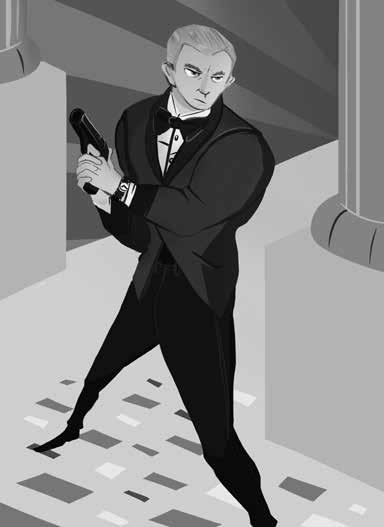
Bond’s conquests are aided by MI6, which includes mission master M (played by the consistently reliable Ralph Fiennes), his secretary Moneypenny (Naomie Harris), and the brainy Q (Ben Whishaw, who is able to offer moments of comic relief).
However, MI6 faces their own bureaucratic difficulties in the form of Max Denbigh (Andrew Scott), who
Bond quickly labels as C. C aims to end the 00 program, replacing the agents with drones.
After Bond’s mission in Mexico City he is led to Bond Girl number one, Lucia Sciarra (Monica Belluci), widow to Marco Sciarra. She sends 007 onto the trail of Spectre, a criminal organization led by Franz Oberhauser (Christoph Waltz), a mysterious man from Bond’s past.
Waltz nails the role, playing
Oberhauser with a venom-laced calmness. Another nostalgic reference comes in the form of Mr. Hinx (former pro-wrestler Dave Bautista). Hinx is a man of very few words (he speaks one word in the entire film), reminiscent of henchmen from Bond movies past.
When Bond heads to Austria looking to take down Oberhauser and Spectre, he is introduced to Bond Girl number two, Madeleine Swann (Léa Seydoux).
Swann is less than impressed by Bond’s set of skills and licence to kill. Although, just as you’d guess, she eventually falls for the debonair spy.
On paper, Spectre looks like a film that we have seen many times before.
It is the work of the cast (led by Craig) and a tasteful filmmaker in Mendes that raises Spectre above its relatively simple script. It may not rank among Casino Royale and Skyfall, but it suffices as a well-made Bond film.
Spectre is currently playing in both Landmark and Cineplex theatres across Winnipeg. For showing dates and times, visit www.cinemaclock.com.

OLIVIA MICHALCZUK, STAFF

The Univeristy of Manitoba's School of Art Gallery has been transformed once again, with quotelittered walls and a variety of ceramics balanced atop minimalist stands. The simple yet beautiful and intriguing exhibit MUD, Hands, fire. Wheel Thrown. The Legacy of Canadian Studio Pottery was brought to the gal-
lery by school of art professor Mary Ann Steggles and will be a fixed exhibit until Dec. 18.
Before you enter the gallery, you must check your bags and coats at the door to lessen the risk of nudging the delicate pieces off their perches. The functional purpose of the pieces vary but they share a common element of
individual beauty.
The colour, shape, and texture of each work of art becomes more and more enticing the closer you get to the piece of pottery, tableware, or decoration. The mind is pushed out of its comfort zone when examining the ceramics without their functional purpose and seeing, for example, a mug as a work of art.
Steggles’s perspective on the medium is fascinating and strange, as she lends a great deal importance to the physical dimensions of the pieces alongside their aesthetic qualities.
“Ceramics is a very interesting medium. Not only do vessels enclose space, as does architecture, but they have existed or descended from a sixor more thousand-year tradition that, like architecture, is concerned with the visualization of spatial form,” she explained.
“The concept of containment as well as hollowness is unique to ceramic vessels, although they could fool us and be solid masses. It is also central to the maker’s perception of space.”
I went back to the gallery again with this new-found knowledge and my perspective on the pieces was altered quite drastically.
I pictured myself as a tiny person wandering through and around these
works of art as though they were buildings and art fixtures around the Exchange District; it was a completely surreal experience.
“There are many who will tell you that ceramics has no place in either the modern or contemporary art world. This is of course, not so,” said Steggles.
The ceramic medium has, in fact, been an important area in the school of art since the school moved to the U of M Fort Garry campus and Steggles claims the program is “arguably one of the best in Canada.”
Currently 35 artists have their work displayed in the gallery and their experience, comfort, and success with the ceramic medium varies.
“The core vision had to do with masters, mid-career artists and those beginning their careers in ceramics,” said Steggles.
“I also wanted to showcase the legacy left by those master potters including their role as mentors and teachers.”
Of the master potters mentioned, six have won either the prestigious Saidye Bronfman Award for Excellence in Crafts, or the Governor General’s Award in the Visual and Media Arts. One was made a Companion of the Order of Canada and received the Queen’s Diamond
TOBI NIFESI, STAFF

The West End Cultural Centre will reverberate with an enchanting sonic wave on Friday, Nov. 20. Such is the effect of the music on Sweet Alibi’s new album, Walking in the Dark Fresh off the successful tour of their sophomore album We’ve Got
To, Sweet Alibi is set to release their third album this weekend. Sweet Alibi is Amber Quesnel, Jess Rae Ayre, and Michelle Anderson. All three core members provide vocals and at least two instruments apiece. The local folk/roots trio burst onto the Winnipeg folk
music scene in 2009 and since then, they have broadened their horizons, singing their way into music libraries across the country.
Over the years, the group has blended their folk basis with pop, roots, country, and soul music. This has resulted in a catalogue of soothing, piquant music.
“I think we started out really folky but we have sort of moved into a popindie-folk thing,” said Quesnel.
“We really don’t overthink it when we are writing, we write songs that are coming from our hearts and go from there.”
The band’s last album was acclaimed both in Winnipeg and across the country We’ve Got To earned Sweet Alibi a countrywide tour as well as nominations and awards from the Canadian Folk Music Awards and Western Canadian Music Awards (WCMAs). The trio was even named Roots Group of the Year at the WCMAs.
“We were not expecting to win [at the WCMAs]. We were in a category that had people who had been in the industry for years [...] We were just happy to be nominated,” said Ayre.
“It was really exciting and it was
nice to be recognized within the community. We don’t do this just to win awards, but it is nice to know that all the miles you put on the road are being heard.”
The recognition and accolades only spurred them to work harder in the production of their latest album.
“You want to live up to what your fans are expecting. We put a lot of time and effort into writing the songs and making them something that we are proud of,” said Ayre.
Sweet Alibi’s Walking in the Dark is a musical expedition of a wide range of emotions; especially those provoked by a life on the road. The first single off the album, “Showing You,” is a snippet of this experience.
“We thought ‘Showing You’ was a really universal song for people. It has a really good healthy message of being there for the people you love,” said Ayre.
“It takes on the whole theme of the album. It is also very powerful vocally.”
Juno award-winning producer and musician Murray Pulver (Crash Test Dummies, Doc Walker, the Bros. Landreth) helps capture the trio’s vocal prowess and evolved musi-
Jubilee Medal, and one was the first potter ever elected to the Royal Academy of Arts.
“Today the ceramics department remains well-known throughout Canada and our graduates go on to some of the finest MFA programmes in North America, Britain, or Europe,” Steggles told the Manitoban
To see these everyday objects as works of art created by a variety of artists is quite interesting and the ability to view them as art in a gallery is an eye-opening experience.
Hopefully this exhibit will not only change your perspective on ceramics, but everything that is going on around you.
On this, Steggles quoted one of the leading ceramic artists of the modern era, Peter Voulkos.
“If the energy is there, I don’t give a damn what you call it. A really fine Japanese tea bowl can give you the same kind of excitement you get from painting and sculpture.”
MUD, Hands, fire will remain on display on campus at the school of art gallery until Dec. 18, 2015. Visit umanitoba.ca/schools/art/ gallery/index.html for the gallery’s location and regular hours.
cianship on this album.
“[Murray’s] really good at taking parts of things that you like and making them better [...] He’s really easy to work with,” said Anderson.
The upcoming show promises to be exciting and will feature performances from the band and several guests.
“We have been working very hard. We have a really cool opening act; they are called the Empty Standards. For us, we have got quite the production happening on stage [including] dancers and a children’s choir,” explained Anderson.
The three musicians are set to hit the road with their band following the release of the album. In the next few months, they will be touring across the country, and even playing a gig in Kansas City.
Sweet Alibi is performing on Friday, Nov. 20 at the West End Cultural Centre. Tickets are $20 in advance, $25 at the door. Advance tickets are available at the WECC, Music Trader, the Winnipeg Folk Festival Music Store, and online at www.ticketfly.com


MIKE STILL, STAFF

The University of Manitoba Bisons football team didn’t end 2015 quite the way they wanted – falling in the conference semi-final. There were, however, a number of bright spots during the season. Below are the Manitoban’s top 10 stories and moments from this year’s campaign.
10. Dyck and Dyce record first CIS touchdown receptions
After redshirting in 2014, wideouts Trysten Dyce and Anthony Dyck both got their chance to perform in all eight regular season games this year. Dyck started every game on one side, notching eight receptions for 139 yards, while Dyce saw considerable time opposite him, hauling in 12 passes for 170 yards.
Both players also had one touchdown reception – hopefully the first of many for the up-and-coming pass catchers.
Dyck’s first career major was a 29-yard grab in a week 4 away game against Alberta, while Dyce’s was an eight-yard reception on the road versus Regina – a game that his father Bobby, the interim head coach of the Saskatchewan Roughriders, was at.
9. Turner impresses in debut
Christian Turner – a former linebacker with the Wilfrid Laurier Golden Hawks who was converted to defensive end upon transferring to Manitoba in 2014 – spent most of this past season as a backup. When starter Braden McCarthy went down in game six against Regina however, Turner stepped up.
His first start was the following week against Alberta, and the brother of current CFL defensive lineman Junior Turner was nothing short of
spectacular, amassing 10 total tackles to go with 2.5 sacks, including a play where he chased Alberta pivot Ben Kopczynski down from halfway across the field.
Turner displayed a high motor and was Manitoba’s best pass rusher against the Golden Bears. He finished the regular season with 21 tackles, 14 of which took place at the end the year.
Theo Deezar had the game of his life in week 3 against the UBC Thunderbirds, throwing for a Bisons record 519 yards and four touchdowns
8. Fox trucks Dinos defender
Former Calgary Colts running back Cameron Fox was a valuable piece of the Bisons’ “three-headed monster” in the backfield this season. Frequently used in goal-line situations, Fox finished the season with 34 carries for 120 yards and three touchdowns.
It was one of Fox’s six receptions on the year that got him onto this list, though.
In Manitoba’s home debut against the Calgary Dinos in week 2, Fox took a routine pitch at the line of scrimmage and absolutely bulldozed a Calgary defender when it appeared he would be stuffed for a short gain.
Fox lowered his shoulder, causing the Calgary linebacker’s helmet to go flying. Fifty-one yards later, he had
set the home squad up with tremendous field position. The hit was hands down the largest all year on either side of the ball.
7. Fong gets first interception of season in style
After falling 156 feet down a Vancouver Island waterfall this past May, it was somewhat shocking that Bisons safety Tyler Fong was able to play at all this season. Despite sustaining a broken rib and punctured lung, Fong was back better than ever at training camp in August and started the regular season in impressive fashion just a few weeks later.
With the ball at Manitoba’s fouryard line, Fong stepped up from his safety position to record a diving interception on a pass thrown by Saskatchewan quarterback Drew Burko. It was the first pick of the year for the Bisons in a game that they would go on to win after trailing 13-7 early on.
6. Barry runs through Golden Bears
Another player who showed inspiring resilience in 2015 was fullback Andrew Barry. He tore his ACL in the season opener one year prior, requiring reconstructive surgery. Barry was originally told that he wouldn’t play football again, but he proved that assumption wrong, starting in all eight regular season games this year.
Traditionally used as a lead blocker and goal-line back, Barry saw his workload increase in the herd’s final home game of the season against Alberta. The hulking 235-pounder put up a season-high 13 carries for 82 yards and a major in the game, en
route to a 29-7 win.
5. Walker executes wildcat formation to perfection
Entering the 2015 season, the Bisons had fairly large shoes to fill due to the departure of versatile slotback Nic Demski to the CFL. The worry about finding an adequate replacement for Demski was quickly erased when rookie Jesse Walker stepped on the field for training camp.
The Mission, B.C. product stepped into the vacant starting slotback position early on, and didn’t relinquish his duties all year, recording 533 receiving yards and four touchdowns, along with 121 rushing yards and a major.
While the bulk of Walker’s rushing yards occurred on jet sweeps, his only rushing touchdown occurred in the wildcat formation in week 6 against Regina.
Trailing 8-7 with five minutes to play in the first quarter, Walker lined up behind centre in the shotgun formation and took the direct snap 37 yards to the house – evading several Rams defenders near the sidelines in the process.
The Bisons would go on to win the game 49-46.
4. Lyles opens game with kick return touchdown
While Walker was an immediate playmaker from day one, fellow rookie Jamel Lyles did him one better – becoming an immediate game-changer.
The Surrey, B.C. native was dynamic in all facets of the game as he led the conference with 1,564 all-purpose yards and was named Canada West Rookie of the Year.
One of Lyles’s more memorable plays took place against Calgary in week two. Battling against the team that was considered the best in the nation, Manitoba knew they would need a quick start. Lyles gave the herd exactly that, taking the opening kickoff 107 yards to paydirt.
While the Bisons didn’t end up winning the game, they were the only team to go toe-to-toe with the Dinos in a competitive matchup all season. The final score was 46-38.
3. Martens wins CIS debut
In his second year of eligibility and third with the team, backup quarterback Foster Martens saw his first action as starter in week seven against Alberta. Stepping up for injured captain Theo Deezar – who went down with a concussion the week prior – Martens managed the game perfectly, going 13-of-20 for 165 yards with no interceptions.
The quarterback hailing from
Steinbach has shown tremendous growth during his three years with the herd, and the victory over the Golden Bears was the culmination of his commitment and hard work with the squad.
Barry was originally told that he wouldn’t play football again, but he proved that assumption wrong, starting in all eight regular season games this year
2. Ihanza scores game winner on first career CIS catch
It’s not often that your first career CIS catch is a touchdown, but for Lerenzo Ihanza, that’s exactly what happened. Trailing 28-24 to Saskatchewan in the regular season opener, Ihanza, a backup slotback, got into the game due to a small injury to Alex Vitt.
While he was only in the game for one play, it made all the difference in the world.
Just over a minute into the fourth quarter, Deezar hucked a ball from the midfield stripe that had no business being caught by any Bisons receiver. It fell in and out of the hands of two waiting Huskies defenders and into the outstretched arms of Ihanza, who went 58 yards for the game winner.
While the rookie only had one other grab all season, he can lay claim to arguably the most memorable firstcareer catch in team history.
1. Deezar breaks team passing record
Theo Deezar had the game of his life in week three against the UBC Thunderbirds, throwing for a Bisons record 519 yards and four touchdowns. While the herd didn’t end up winning the game, it was still an exciting contest to be present for with both offences lighting up the field for over 1,000 yards overall.
Deezar finished the regular season with 2,385 passing yards and was a thrill to watch all year. He still has a few seasons left with the team and if he can keep his 2015 pace up, should have a good chance of eclipsing a few more Bison passing records.
ANDY CHE, STAFF
Although Ryan Kubic took a longer route to the Western Hockey League (WHL) than most, he’s proving that the stops in between were well worth it.
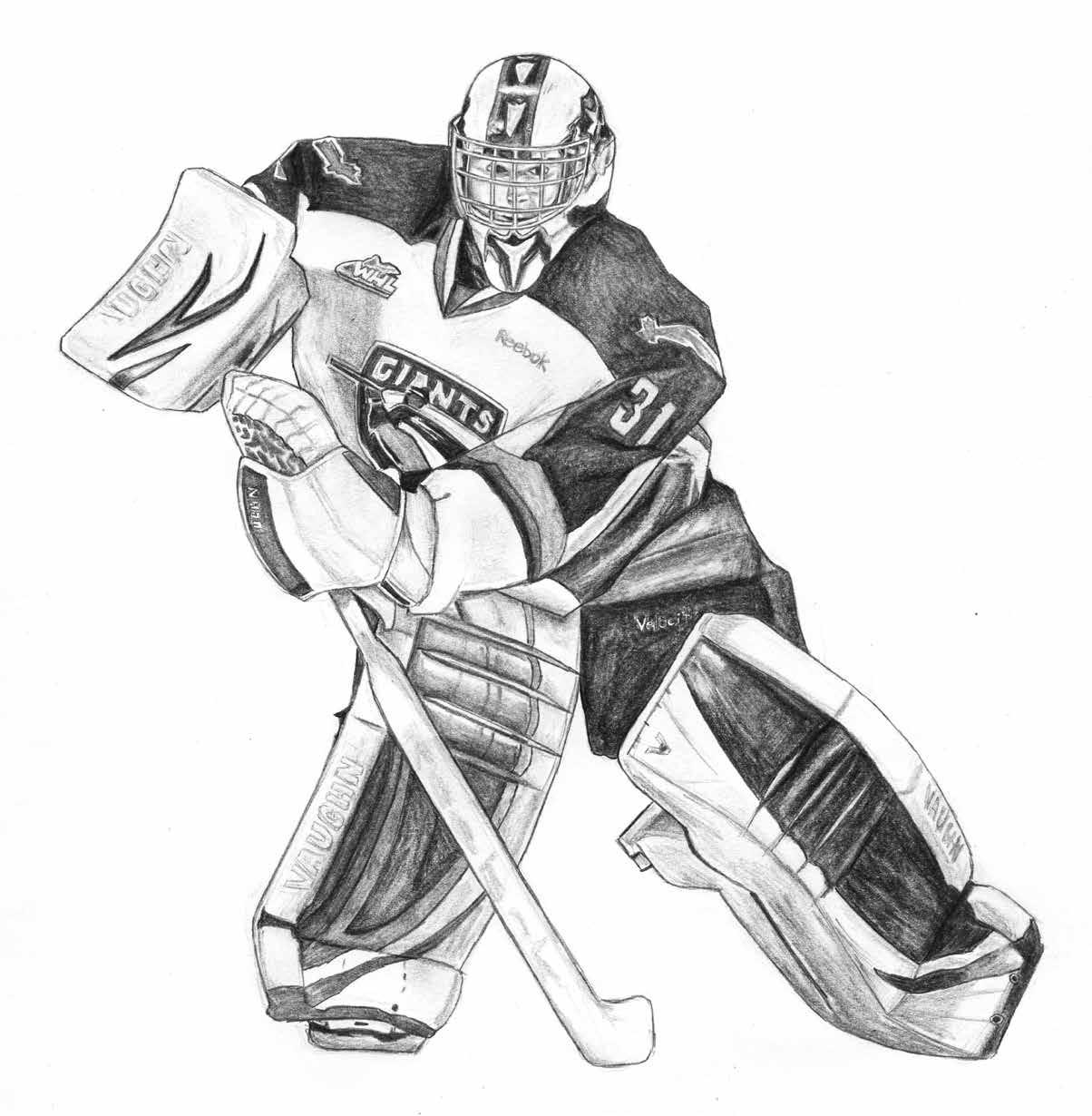
After starring for the AAA Winnipeg Thrashers, Kubic was drafted into the WHL in 2013, before being reassigned to the North American Hockey League (NAHL) for a season’s conditioning stint one year later. This year, the St. Andrews product cracked the Vancouver Giants’ fulltime roster.
Like many young goaltenders, Kubic didn’t initially start out playing in the crease. A forward to begin with, he seized the opportunity to strap on the pads early in his developmental years and gradually learned to embrace the position.
“I started off as a forward for my first two years of hockey,” Kubic said. “Then I got a chance to go in net when my team needed a goalie. I loved being on the ice for the whole game so I just stuck with it and the love for it has grown ever since.”
At only 15 years old, the second goaltender taken in the 2013 draft took one step closer to the NHL. His numbers during his final year of midget hockey were outstanding, producing a 1.40 goals against average and 0.947 save percentage in 21 games for the 2013-14 season.
“It’s
every kid’s dream that plays hockey growing up to one day play in the NHL. I hope to accomplish that dream someday, but for now I have to just keep developing and believing in my game” – Ryan Kubic
It wasn’t long after that Kubic would grace the net for the first time in the WHL, seeing action in his first game on Jan. 19, 2014.
Twelve days after turning 16, he debuted as relief for Payton Lee after the starter surrendered three goals on 12 shots.
The five-foot-ten netminder turned aside 10 of 11 shots in the 4-0 loss. His second appearance that season came in another relief effort – a 24-save performance in a 6-5 loss to the Kelowna Rockets.
The following summer, he was amongst Canada’s most distinguished goalies as part of the Program of Excellence under-17 class for 2014. He was brought back to the program in 2015 as an under-18 invitee.
Kubic is also following in the footsteps of other locals who have been through the Program of Excellence
already.
Fellow Manitoba native Chris Driedger – currently a promising prospect in the Ottawa Senators system – entered the camp in 2013.
Kubic’s former Giants teammate Lee was also amongst that year’s crop.
Lessons learned
Last season, Kubic graduated from Manitoba AAA yet was still rather unfamiliar to the sights and sounds of top-tier junior hockey. His reassigning to the NAHL’s Brookings Blizzard ultimately prepared him for the WHL, a wise management decision that further advanced his career in such a short period.
He finished the season in Brookings, S.D. with a 10-15-5 record, 2.74 goals against average, a 0.907 save percentage and even earned his first shutout as a junior goaltender.
“Playing in the NAHL was a great experience,” Kubic said. “I managed to crack a spot as the starter and got
a taste of junior hockey. You learn so much playing hockey away from home.”
“The most important thing I learned was how to handle such a long season and how important it is keep working hard no matter how you are feeling.”
Undoubtedly the pressure of playing fulltime junior hockey to crack an NHL roster can get to some teenagers. For Kubic, it’s a non-factor.
“I handle pressure by not worrying about it,” He said. “I just take it one day at a time and focus on the task at hand.”
The future looks bright
On Nov. 5, the Giants dealt number-one Lee to the Edmonton Oil Kings for a sixth-round selection in the 2016 WHL Bantam Draft. Lee will suit up for his new team immediately, after an injury to Alec Dillon, an LA Kings prospect.
Following the trade, the Giants
acquired Daniel Wapple from the Regina Pats. Since the 1995-born goaltender is considered an over-age junior player, he might not be around the WHL for much longer.
In a short amount of time, the reins could be there for Kubic to control. There might be lofty expectations for the 17-year-old, especially considering his realistic opportunity to be the Giants’ number-one by the end of this season.
The goaltender of three WHL seasons has only seven career games to credit, yet his impressive track record warrants more minutes in a league known for honing elite-quality goaltenders.
While Kubic’s main task at the moment is contributing to the Vancouver Giants, there is no doubt his dream for the future is to play in the NHL.
With the 2016 Entry Draft approaching, it will be time for many promising CHL players to
prove their potential to NHL scouts. Goaltenders usually take a backseat until the later rounds, though the honor of having their name called to the draft floor is very much the same at any pick.
Manitoba has fairly been well-represented at the NHL level, especially with the men behind the mask such as Ed Belfour, Terry Sawchuk, and Trevor Kidd. If selected in this summer’s draft, Kubic will be just the second NHLer to hail from St. Andrews after Detroit’s Darren Helm, and the very first netminder to represent the municipality of 12,000 people.
“Obviously it is every kid’s dream that plays hockey growing up to one day play in the NHL,” Kubic said. “I hope to accomplish that dream someday, but for now I have to just keep developing and believing in my game.”
When asked about his mentality toward carrying out that dream, there was only one angle for Kubic.
RYAN STELTER, VOLUNTEER STAFF


T
he University of Manitoba Bisons men’s hockey team played host to a pair of games this weekend against the Lethbridge Pronghorns. They dropped the first tilt by a score of 7-5 on Friday and fell 5-1 on Saturday. Lethbridge extended their winning streak to five games with the pair of wins over the herd.
The Bisons started the game on Friday strong, opening up the scoring four minutes into the first when hot hand Shaq Merasty scored his third goal in as many games. Things went downhill for the herd pretty fast though, as the Pronghorns would explode for three goals in three minutes at the end of the period.
Lethbridge would tie the game up when forward Brandon Clowes came streaking in on a breakaway, and after a casual forehand, backhand roof the Pronghorns were back in business.
Thirty seconds later Lethbridge took the lead off a Justin Valentino power play marker. The situation got even worse when Mitchell Maxwell pulled off a filthy toe drag to get around Bison defenseman Adam Henry and then slid the puck through the legs of Bison goalie Justin Paulic to make it 3-1 for the visitors.
The Pronghorns kept the pressure up in the second. Valentino grabbed his second goal of the night a minute into the second frame off a nice onetimer from the top of the slot.
Two minutes later, Warren Callis
picked up a rebound and cut the Pronghorns’ lead back to two. That didn’t last long, unfortunately, as Blake Orban finished a rebound off the boards to put Lethbridge back ahead by three.
Four minutes later, Joel Schreyer made a nice behind-the-back feed to Liam Bilton, who made no mistake and put it top corner.
Within seconds, Bisons captain Jordan DePape scooped up a rebound to bring the Bisons within one. The two teams would head into the third with the Bisons down 5-4.
Manitoba came out flying in the third period, dominating the early going and hitting the post a couple different times on strong chances.
The bouncy boards of Wayne
Fleming Arena came to haunt the herd as Cassidy Mappin capitalized on a loose puck that ricocheted to put Lethbridge up 6-4.
Twenty-four seconds later, Pronghorn centre Dalton Sward came streaking in on a breakaway and fired it up over Paulic’s shoulder to put the game to rest.
Merasty would add a goal late in the third on a power play but it wasn’t enough.
Head coach Mike Sirant talked post-game about his team’s effort on Friday.
“We scored enough goals to win, we had enough chances to win, but we were far too casual defensively,” he said. “We win as a team, we lose as a team, and you can’t expect to be successful when you're giving up 40 shots in your home rink.”
Sirant was hopeful ahead of Saturday’s rematch, saying that the herd couldn’t think about the loss too much.
"We've got a short turnaround, so we can’t dwell on this. We've got to be mentally prepared to come back and try to salvage the weekend, which I think we will.”
“Certainly not the weekend we were hoping for. For whatever reason we were not mentally prepared” – Mike Sirant, head coach, Bisons men’s hockey
The rematch between Manitoba and Lethbridge was a chance for the Bisons to redeem themselves after Friday’s poor showing. The Pronghorns were eager to continue the success they had offensively on Friday, however.
The visitors opened up the scoring two minutes into the game off the stick of Dustin Fostvelt, who put one away on the rush. At around the midway mark of the first, Lethbridge capitalized on a too many men penalty from the Bisons and took a twogoal lead.
DePape had an opportunity to cut the lead in half minutes later, but was stymied on a breakaway chance. The Pronghorns made the Bisons pay as Ryon Moser came barreling in on a two-on-one and slid the puck past Manitoba netminder Byron Spriggs.
Lethbridge would add to their lead before the period was up, as Robert Lindores one-timed a Fostvelt pass into the top of the net. The visitors went into the room with a fourgoal lead, leaving the Bisons with a big hill to climb.
The second period saw back and forth action between the two teams.
DePape made a dent in the
Pronghorns’ lead seven minutes into the period and the Bisons seemed to gain a little momentum. They pushed hard to get the second goal and had many chances to no avail. Penalties hurt the flow of their game and the Pronghorns maintained their lead.
the Bisons were a nightmare this weekend as sloppy plays in their own zone, turnovers, and an inability to defend adequately in the slot cost them
With 45 seconds remaining in the frame, Valentino was sprung on a breakaway and backhanded a shot through the wickets of Spriggs. Once again, the Bisons found themselves down by four at the intermission.
A lackluster third period saw no goals scored as Manitoba struggled to form any type of comeback. The Pronghorns shut it down defensively and saw out the win.
The Bisons allowed a combined seven first-period goals on the weekend, which landed them in a tough hole.
Sirant discussed the team’s tough start in both matchups post-game.
“It’s tough when you give up four goals like that in the first,” he said. “We had a tough time defending the rush, a lot of those goals were scored on the rush.”
Defensively, the Bisons were a nightmare this weekend as sloppy plays in their own zone, turnovers, and an inability to defend adequately in the slot cost them. Allowing 12 goals in two games at home was not something Sirant was too happy about.
“Certainly not the weekend we were hoping for. You have to give Lethbridge credit, they played well,” Sirant said.
“For whatever reason we were not mentally prepared for [Friday] and we gave Lethbridge a lot of confidence for [Saturday], which makes it harder to take that confidence away with the tone that was set on Friday.”
Manitoba stays at home next weekend, hosting the Saskatchewan Huskies in a pair of games. The Huskies are sitting atop the Canada West and riding a four-game win streak. The Bisons will hope to end the Huskies’ momentum and snap their two-game losing streak.
Men’s basketball takes one of two against sixth-ranked Calgary, both games go to extra session
MIKE STILL, STAFF
For two straight weeks, the University of Manitoba Bisons men’s basketball team has taken on a top 10-ranked team in the nation, and in both affairs, the herd have shown that they’re on the same level as the top tier teams in the Canada West conference.
This past weekend’s games were a phenomenal example, as Manitoba battled back-and-forth against a Calgary Dinos team that had 13 returning players from 2014-15 and were picked by many experts to win the conference this season.
Playing at home for the first time this season, the boys in brown and gold took the Dinos the distance – winning on Friday night 96-90 in overtime, before falling in the rematch 90-87, also in OT.
Friday
The opening game of the series was a tale of resolve for the Bisons. They found themselves down 38-34 at halftime and 59-53 after three quarters, but stuck to the game plan and generated well-rounded scoring to emerge victorious.
Power forward Wyatt Anders had himself a game, with 20 rebounds, while five Manitoba players finished in double digits in points – led by guard Justus Alleyn with 27. It was a different tale for Calgary, as guard Thomas Cooper did pretty much everything for the Dinos offensively. The University of NebraskaKearney transfer had a game-high
38 points, including 22 at halftime.
Cooper was 13-of-26 from the field and 5-of-7 from the perimeter overall, but didn’t get a lot of help from his teammates as the visitors’ second-highest scorer was guard Jhony Verrone with only had 11 points.
Alleyn – who was tasked with defending Cooper one-on-one for the entire second half, did a great job of limiting the guard’s shot selection and forcing him to dish the ball off.
Cooper had just nine points in the third and fourth quarter combined which helped the Bisons get back into the game and ultimately come out on top.
“I just noticed that he [Cooper] liked to go left a lot off of hesitation, so we tried to limit his looks going left to try and force him right because he seemed to be less comfortable and passed more going right,” Alleyn said postgame.
“I felt like if we could get it out of his hands and into other guys’ hands and make them make plays, we’d just get better defensive stops.”
That’s exactly what happened for the Bisons as they got themselves back into the game in the fourth thanks to Alleyn’s play at the baseline as well as Anders’s performance in the post.
The home side would go on to outscore the Dinos 16-10 in overtime, thanks in large part to their play at the line where they shot 82.1 percent overall compared to Calgary’s 60.9 percent.
Four of Manitoba’s starting five logged over 30 minutes of play overall, as well as Ilarion Bonhomme II who played 33 minutes and was critical off the bench in the second half, providing up-tempo play right when it was needed.
“I think [the starters] got into a good rhythm and we play well together,” Alleyn said. “We like to flow off each other so it just seemed to work out.”
The rematch saw improved play in the backcourt for the Dinos as starters Cooper, Torrez McKoy, and Verrone combined for 38 points and 25 rebounds. Jasdeep Gill and Josh Owen-Thomas also contributed off the bench with a combined 32 points.
The herd was led by their co-captains, as Anders had a double-double with 17 points and 13 rebounds, while guard AJ Basi had a game-high 32 points on 12-of-24 shooting from the field.
The Dinos, however, won the rebounding battle 62-52 and while Anders played admirably, he didn’t get much help from fellow big men Brett Jewell and Jonathan Alexander –who had just four combined rebounds.
After leading the fourth-quarter comeback in the previous night’s game, Bonhomme II was rewarded with 38 minutes of court time and much like Alleyn on Friday, kept Cooper at bay in the fourth, where he scored only two points.

Fouls became an issue late in the game as Alexander and Alleyn both exited with five for Manitoba, while forward Matt Ellis did the same for the Dinos. Both squads were in the bonus in the extra session and Calgary was able to penetrate inside
ANDY CHE, STAFF
The University of Manitoba Bisons women’s hockey team had some inspired goaltending in their weekend set at Lethbridge, earning backto-back shutouts with 4-0 and 1-0 victories, respectively.
After losing four games in a row dating back to last month, the Bisons have turned their season around. Head coach Jon Rempel’s squad has now captured five straight wins, improving their record to 7-5 on the season.
Last season the herd swept the Pronghorns 4-0, averaging four goals per game.
Manitoba didn’t take long to reignite the form displayed in 2014-15 versus Lethbridge. Forward Kayleigh Wiens took an early lead for Manitoba when she beat goaltender Alicia Anderson down low.
Forward Charity Price has been playing with a hot stick as of late, and notched goals in the second and third periods. She has now recorded four points in the past two games.
Courtlyn Oswald also added to the 4-0 victory, scoring in the second period. Her individual effort gave her two goals in as many games.
Goalie Rachel Dyck posted 26 saves and recorded her first shutout of the season. The goose-egg was under siege when Caitlyn Fyten and Alexandra Anderson took bodychecking minors just 29 seconds apart in the middle frame.
Dyck kept her composure and closed out the second with 22 saves after two periods, while her backline held Lethbridge to four shots in the third.
Her opposite number Anderson handled a barrage of shots in the third period when she made 18 saves
in the frame. The CIS rookie – who impressively went 7-1 to start the season- totaled 28 saves on 32 shots.
Both coaches opted to swap their goalies for the second game of the weekend. Jessica Lohues was in place of Anderson, while Amanda Schubert started for the Bisons coming off a shutout victory against Calgary two weeks ago.
For the seventh consecutive game the Bisons opened the scoring, courtesy of Alana Serhan. Her second goal of the season was scored on a screened Lohues six minutes into the first period.
Wiens, the opening scorer from Friday’s game, nearly doubled the Bisons’ advantage when she partially broke away shorthanded to beat Lohues, but not the post.
Similar to the previous game,
Manitoba’s blue-liners came up strong for their netminder. Lethbridge was held to one shot on goal in the opening 12 minutes, and just four shots in the final frame.
The Bisons have shut out their opponents for the third consecutive game, the first time they have done so since 2008-09
The Pronghorns did generate a golden opportunity to level the game on a five-on-three power play, yet Jocelyn Sabourin’s shot clattered the frame and stayed out.
just a bit more effectively, helping them to split the weekend set. Manitoba will stay at home this Friday and Saturday, welcoming the Alberta Golden Bears to town. Game times are 8 p.m. and 6:30 p.m. respectively.
Lohues starred in goal against an attack-minded Bisons squad, producing 33 saves on 34 shots, but in the end, Serhan’s first period goal was enough to clinch a 1-0 victory for the herd with Schubert posting 20 saves for her second consecutive goose-egg. The third-year goaltender has now assembled a shutout streak of over 120 minutes, dating back to a thirdperiod goal from Mount Royal on Oct. 17. The Bisons have also shut out their opponents for the third consecutive game, the first time they have done so since 2008-09.
Manitoba will visit the Saskatchewan Huskies next week, before returning home to host the Regina Cougars ahead of the Christmas break.