
Editor-In-Chief:
Craig Adolphe
Contact: Editor@themanitoban.com / 474.6770

Editor-In-Chief:
Craig Adolphe
Contact: Editor@themanitoban.com / 474.6770
Increased awareness critical when supporting a loved one with mental illness
MIKE STILL, STAFF
Mental illness has historically been a difficult topic for discussion, for such reasons as a lack of knowledge of its effects or the naive belief that it’s a rarity even in today’s society.
Unfortunately, due to this rationale, public awareness isn’t as high as it could be. This is especially problematic for families who have a loved one struggling with their mental health.
As an example, in September 2014 I had a panic attack for the first time. It was one of the scariest experiences of my life, as I had no control over my body and no idea what to do next. Thankfully, my roommate at the time was there to help me through.
Not even two weeks later I had another panic attack, but this time I was alone. Scared and concerned for my safety, I turned to the only people I could think of that could help – my family.
Struggling for breath, I trekked down to my old home and crashed through the front door. By that time I could barely see, and proceeded to faint in the hallway.
When I woke up, I expected to be on a bed with my mother and father consoling me. That wasn’t the case. Instead, dazed and confused, the first thing I heard was their laughter.
It was during that evening that I realized something was wrong, and that mental health awareness needed to be a more prominent topic of discussion within families going forward.
The main thing that resonated with me was that my roommate knew exactly what to do when I was struggling, yet my family did not.
I credit the difference to this individual’s own struggles with mental illness, and knowing exactly how to act and what to say in my time of fear from personal experience. My family members, on the other hand, had no knowledge of how to proceed during that time.
Other examples
On Saturday, Oct. 24, 33-yearold Winnipeg resident Reid Bricker, who suffers from mental illness, went missing. He was released at 3:20 that morning from the Health Sciences Centre’s emergency ward shortly following his third suicide attempt and third trip to a hospital within 10 days. He has yet to be found.
In an article written in the Winnipeg Free Press on Nov. 2, Bricker’s mother Bonnie stated that her son’s mental health struggles began many years prior, but that “we didn’t know how to help him.”
Similarly, in March of 2009, 22-year-old Toronto native Kulmiye Aganeh, who had schizophrenia, died while incarcerated at the Oakridge (now called Waypoint) Centre for Mental Healthcare in Penetenguishine, Ont. His passing was the result of sudden cardiac arrest due to the toxicity of Olanzapine –an antipsychotic drug that he was administered while in a chin hold.
In December 2014, Aganeh’s sister
Ubah testified at a coroner’s inquest into his death. Along with the rest of her family, she was frustrated with the way the mental health system controlled him and treated his illness after he was dispatched to Oakridge in December 2007, to receive proper care.
“We were overwhelmed. We didn’t know how to help him,” Ubah told the inquest.
We didn’t know how to help Those six words resonate strongly and seem to be commonplace when discussing mental health, especially in family circles
We didn’t know how to help. Those six words resonate strongly and seem to be commonplace when discussing mental health, especially in family circles. From personal experience, it’s an emotionally draining and frustrating occurrence.
I’m by no means saying that these families are to blame for what happened to their children. I feel for them and their grief. I simply wish it didn’t get to the point where these mothers and fathers felt helpless in the matter and needed to leave the safety of their son or daughter in the hands of an institution. Because as the two above examples demonstrate, sometimes these end up being less advantageous options.
Battling with mental illness isn’t easy and it’s made tougher when your family feels they cannot help
you
Workers at hospitals or mental health facilities don’t know the individual patient like the patient’s family does. They don’t know what makes the patient tick or what being “OK” may look like.
A stranger – even one with the right qualifications – is still guessing in a way.
Using Bricker as an example, being suicidal as he was and having been in and out of different hospitals in less than two weeks, one might think that the medical staff would’ve been more cautious before letting him go.
His family wasn’t made aware

that he had been released due to the Personal Health Information Act, and had they been, maybe he wouldn’t still be missing. While they would likely still be struggling to figure out how to help him most effectively, their presence even for a short time could have made a difference.
Speaking from experience, when you’re on the verge of ending your life, sometimes all you need is someone to tell you that they care. They probably won’t be able to help you cope with your personal struggles, but simply knowing someone is there speaks
volumes and cannot be expressed enough.
What needs to be done?
Battling with mental illness isn’t easy and it’s made tougher when your family feels they cannot help you. The first and most important step towards changing this is education.
The best way to provide proper information is through organizations like the Canadian Mental Health Association (CMHA). I don’t think it would be a stretch to have the CMHA provide monthly workshops
to families who want to learn more.
Distributing informational pamphlets door to door and having citizens answer questionnaires about their knowledge of mental illness could also be a strong way of gauging the population’s understanding, and would also give the government a reference point for what direction to take going forward.
Regardless of what the approach is, action needs to be taken so that no more families are torn apart by the stigma of mental illness.




Despite claims, a fall reading week has little to do with mental health
JORDYN LERNER, VOLUNTEER STAFF

Ifully support an UMSU campaign on mental health. Public health insurance does not fund most mental health services, particularly preventive ones. The university offers limited student counselling, but it’s not the university’s role to operate as a pseudo-healthcare system. As such, students may be unable to access the care they need when they need it.
But what is mental health?
Unfortunately, the UMSU campaign does not offer a definition. While the sexual assault and accessibility campaigns both define their principal subject matter, the mental health campaign does not. By not starting with a coherent definition of mental health, the campaign strays from its original focus.
Definitions of mental health can go two ways. A progressive definition likens mental health to a state of well-being. Mental health is an ability of people to enjoy life and overcome challenges. A more practical definition of mental health is the absence of mental illness. If you’re not sick, you’re healthy. Depending on the definition used, a mental health campaign can be very broad, or very focused.
“Success Through Wellness”,
the University of Manitoba’s 2014 campus mental health strategy, is an example of how over-inclusive a campaign can be when mental health is equated to well-being. The university’s campaign favours the progressive definition of mental health as well-being. In fact, it goes so far as to use the terms mental health, well-being, and wellness interchangeably.
A mental health campaign is a must. But a campaign on mental health actually needs to be about mental health
Most of the university campaign’s recommendations to improve mental health are reasonable, but some suggestions like increased campus beautification and increased student involvement in curricular content are a stretch.
Given that UMSU has fewer resources than the university, its
campaign has to be more focused than the university’s. UMSU doesn’t have the capacity to implement peripherally related projects like campus beautification.
To its credit, the UMSU campaign is largely focused on the prevention and treatment of mental illness. For prevention, the campaign promotes the activities of the student group Active Minds. These activities include public awareness campaigns to reduce stigma and promote selfcare behaviours like mindfulness. For treatment, the campaign promotes university counselling services, and expands the peer support program.
But then the campaign includes the fall mental health reading week. This was originally an election promise of Your UMSU, sold as a chance for students to “relax and rejuvenate their minds” before final exams.
In reality, a fall reading week and its mind rejuvenation ability is not a core mental health intervention so much as it is an excuse for a vacation. Just because you call something a “fall mental health reading week,” doesn’t mean it’s actually relevant to mental health.
A fall reading week is an example what can creep into a mental health campaign that does not start with a concrete definition. Its inclusion hurts the entire campaign by distracting from the real mental health initiatives.
A mental health campaign is a must. But a campaign on mental health actually needs to be about mental health. A campaign needs to start with a coherent definition so that it maintains focus and avoids peripheral projects like a fall reading week.
EVAN TREMBLAY, STAFF

You may have noticed that, for some time, there’s been a food truck parked on campus. A welcome relief from the unrelenting mediocrity of campus food services (though I’ve yet to actually see anyone buying poutine there), the Poutine King is inarguably an asset to life on campus.
The whole point of a food truck, however, is that you can park it anywhere; the specific spot the truck currently occupies is not only inappropriate, it is offensive. The truck should be moved – perhaps more importantly, whoever told it to park there should have known better in the first place.
The good
The truck is parked in one of the most significant spots on campus. It is smack dab in the middle of the great axis that runs from Pembina Highway to the foot of the Administration Building. Along most of its length, this axis is planted with elms; where the continuity of the double-row of elms is broken, landscaping elements (such as decorative paving, plantings, and rows of non-elms) ensure that the linearity is unbroken.
The elms were planted at the end of the First World War in memory of those members of the Manitoba
Agricultural College (as the U of M was then known) who had lost their lives fighting in the war.
This memorial avenue – the spine of the great axis, which dates to 1914 –is much more than the standard street trees so prevalent in our city. It was intended as, and remains, a living monument to the dead, and (as all old trees are) a source of joy for the living. That’s the great thing about a university: it is, almost by definition, a venerable institution with a concrete and noble history.
Visually and spiritually, it cheapens and distracts from what is, after all, a monument to those who died a terrible death
The elms run the length of Chancellor Matheson Road, ending at University Crescent. They originally went farther, but the inter-
vening years saw the construction of Frank Kennedy and University Centre. The very end of their original run is marked by one lone survivor, just outside the entrance to University Centre, where a plaque explains the planting of the memorial avenue.
If they were not a living monument – or if they were a living monument in some other part of the city – the axis might have remained broken. But a university is a special kind of place. Its coherence, sense of self, and memory spans decades. The path over Frank Kennedy is unassuming, but from there to the steps of the administration building is one of the most intensely well-done pieces of landscaping in the city.
A broad, paved path, framed by generous and beautiful plantings. A raised circle of grass, acting as a second quad (how peaceful, in summer, the people sprawled on the grass); groves of newer, younger trees (how lovely, the little hills they sit on top of).
The plaza on top of University Centre, with smaller trees in planters ( Acer ginnala; how delicate the graceful stems beside the concrete mass of the building), and lushly planted in the summer, and finally, closing the axis: the façade of the administra-
tion building, its columns speaking to dignity and tradition. One straight line, approximately two kilometres in total – well and purposefully landscaped, maintained for over a century. Nothing in this province compares.
I studied landscape architecture, and that’s the dream; the long axis, well-done, full of meaning, with a distinctive classical building at the end. In fact, the faculty of architecture faces the circle on that axis. Every time I’d take a smoke break, in the long grueling years of my degree, I’d look out onto that circle and see the physical realization of the thing I was studying.
It made me proud, and cemented my love for both my craft and my school: it validated all the high things my professors taught about design and memory and the joy of those things given beautiful form.
The bad
If I go to smoke at that same place now, or go to stroll along that axis, the view is interrupted by a food truck. Nothing against the truck – it is in the nature of food trucks to grab your attention, and the food this one sells is a Canadian specialty. But it is in the direct centre of the line of the great axis, and the axis as a whole –
as one coherent and understandable feature, is broken by it.
Visually and spiritually, it cheapens and distracts from what is, after all, a monument to those who died a terrible death. It is hard to hold faith in the respect of the living for the dead when, of all the parking lots and access roads on campus, this is the spot assigned to a bright red truck selling cheese curds and gravy. It would be a different thing entirely if the arrangement was temporary, say a few days for Frosh Fest. But on and off, the truck has been there since March.
If the truck is on the campus that long, then a more suitable (or at least, less inappropriate) location can be found. Perhaps it is at its current location because of high pedestrian traffic; that’s perfectly understandable, from a business point of view. But a university, being a very special kind of institution, should balance other priorities, and remember the intentions of its past.
Remember, as you walk past that truck, that before it got parked there, breaking the flow of your eyes over the landscape, that the only words (there were no advertisements, no exclamation marks) you’d see were things like Education, Nursing, Architecture.
The ugly
The placement of that truck says something about our campus and therefore us. It says we do not remember (or if we do, do not care about) our past. It says we value the chance to buy something over the chance to reflect on something.
What does it say to walk out of a building (like architecture’s John A. Russell Building) that is a gem of Canadian architecture, and see a food truck given equal prominence? What does it say to walk out of a nursing lecture on how to heal people and treat disease, to find gravy being sold? It says something dark: “pay us to learn high ideals – but we ourselves don’t have time for such things.”
For that matter, what does it say to any student, on a campus where the parking agents are known for a certain deadly ferocity and fell purpose, to see a car parked beside that food truck? You had to park in the toonie lot in bad weather, and pay for that privilege. But the Poutine King parks where it is most convenient for him. I like poutine, and I like food trucks. But I also like to think that the university is the kind of place that puts higher ideals – remembering its dead, and providing a beautiful setting for its living – before those things.
The truck can be moved, but it’ll be hard to forget that it got put there in the first place.
“If ye break faith with us who die We shall not sleep, though poppies grow
In Flanders fields.”

DANA HATHERLY, STAFF
To live is to eat. In this feature the Manitoban explores the conventional food system and looks at some alternatives to it.
Some experts have argued that human population grows to the limits set by the food supply. When population growth exceeds the amount of food available for consumption, further population increases result in higher mortality rates and lower fertility rates. In some cases, the lack of sustenance (among other things) leads to violent conflicts.
Other experts reasoned that
humans have manipulated the food chain to address this offset. While some still rely on hunting and gathering for food acquisition, others have tried to exert more control over food sources through agricultural practices so that people could produce and consume their own food. Animal and plant domestication have become widespread, with centralization of the food system as the logical outcome.
In their attempts to control the food system at more intensified, large-scale levels, societies across the world have caused major impacts on
the economy, the environment, and each other which continue to be disputed by researchers, politicians, and communities.
As part of this feature on food, Evan Tremblay and Malak Abas each writes about the importance of connecting with the surrounding ecosystem in the search for food, whether it’s by looking for food that is native to the area, or resorting to eating our own waste and other innovative sources of existing edibles.
Chantelle Dubois looks at the point of interaction between food
service providers and consumers with her article on learning from the quirks of the hospitality industry.
Finally, with the University of Manitoba under the lens, the Manitoban shows how the complexities of food provision have led to some perplexing practices at different levels of the campus food system.
Read on to learn from some of these perspectives on the food system, and how it relates to you.

CHANTELLE DUBOIS, STAFF
Some people look down on food service jobs. “I would never work in a restaurant” – a phrase I have heard many times in my life. As someone who has worked in restaurants since the age of 15, I feel it has been one of the most beneficial sources of learning I’ve had.
My journey into food service began in a family restaurant when I was in high school and simply wanted a way to make extra money. However early in my twenties when I made the transition into fine dining, it became more of what I consider to be my first career.
In my opinion, working in food service and hospitality has made me a more balanced person. It has taught me so many skills I never would have learned elsewhere. Here are some of the most important things I have learned in restaurant settings.
How to work on a diverse team
People work in restaurants for various reasons. Sometimes it is their career. Quite often, it is a job for while one is studying. For others, it is a second source of income.
The food service industry attracts a wide variety of people. I have worked on teams where the youngest employee was 15, and the oldest over 60. Some of them might not have finished high school, while others are completing their master’s.
Yet, despite where you come from or what your day job is, you all learn to work together as a team. You learn to communicate. And most likely, you all become friends in the process. Some of my closest friendships formed while working in restaurants. This has translated into other areas of my life by making it easier for me to transition onto new teams. I’m used to a range of personalities. I can hold conversations on a variety of topics. And I understand many types of humour.

Social intelligence is incredibly important in hospitality. In the age of Trip Advisor, OpenTable, and Yelp, any faux pas you commit could result in your name being smeared all over the Internet. And it can ruin special occasions for the guest.
Most importantly, your primary job working in a restaurant is to ensure that the guest has a positive experience. This can be completely different for every person who comes in. Some people want you to be very
involved in their restaurant experience, recommending beverages or menu items, and being involved in their conversations. Some people want to barely notice you even exist. Sometimes people will not tell you that they are unhappy, and other times people will yell it in your face. Most of the time you want to prevent the latter from happening, so you need to recognize signs that indicate whether a person is happy or unhappy. In doing so, you truly become a reader of faces and body language.
Head down, avoiding eye contact, arms crossed, and lots of silence?
They could be displeased, but don’t want to make a fuss.
This helps in other areas in my life because it is much easier for me to read someone’s body language and emotions.
How to handle pressure
In hospitality we have a phrase for when we’re really overwhelmingly busy. We like to say that we’re “in the weeds.” I have no idea about the ori-
gins of this phrase, but every person who has worked in a restaurant has experienced it at least once.
We even have nightmares about it.
The host seats several new tables in your section, you have multiple drink orders to pick up, you haven’t put in orders for tables, and table 55 asked for ketchup 10 minutes ago. It is easy to become overwhelmed and disoriented with every request and task that comes up. Failure to keep up means unhappy guests, unhappy kitchen staff, and an unhappy manager.
No matter what industry you work in, you’re going to be under pressure at some point or another. You get a lot of practice trying to remain calm, professional, and organized while under pressure in a restaurant.
Not everyone learns this. But, to maintain your sanity in the restaurant industry, you don’t worry about the small things.
You don’t take insults or snide remarks from guests or colleagues personally. If your manager snaps at you, if the chef gets frustrated, if someone for a moment loses their cool, you let it go.
Restaurants can be some of the most stressful environments to work in. While the vast majority of guests I’ve served have been extremely pleasant, there are some that will take all their frustration out on you. While most of my colleagues have been great, I have seen some of them lose their cool, and then later begin the apology ceremony.
The only way to survive is to let it go and move on.
I feel like anyone who has never worked in hospitality is missing out on a lot of great experiences and lessons. This is why I would work in – and wish everyone would get a taste of working in – the food service industry.
DANA HATHERLY, STAFF


Many competing interests drive the food system at the University of Manitoba. Here the Manitoban attempts to break down some of the complexities of competing interests and concerns, barriers, and drivers of what has been called the “campus food revolution.”
The student strategy
For the Campus Food Strategy Group (CFSG) at the University of Manitoba, the food system on campus reflects the university’s culture, and the student experience is impacted by that food culture.
CFSG is a student-led initiative fostered by its co-coordinators, Michaela Bohunicky and Abigail Maniego.
“University students should be able to participate, voice their opinions, and have an active role in how their university food system operates and how it evolves and changes to suit everyone’s need, including theirs,” Bohunicky told the Manitoban
“We strongly believe that the University of Manitoba has an immense capacity to house a safe, healthy, just, and sustainable food system.”
“Our second objective would be to involve students to have a meaningful role in that system,” Bohunicky added.
Bohunicky said that the main challenges facing her food strategy group were a lack of student awareness about food issues on campus, lack of connectivity across campus, the pull of food service providers, the physical isolation of the Fort Garry campus, and the need for the university administration’s support for initiatives.
“Universities tend to work in silos,” she said about the need for more inter-faculty studies and crosscampus partnerships, as well as more opportunities for students to work on U of M food projects. “The different efforts around food could always use more connection and collaboration.”
Various stakeholders in the university food system include students, the University of Manitoba Students Union, the U of M office of sustainability, university administration, food service providers, and faculty.
“We strongly believe that the University of Manitoba has an immense capacity to house a safe, healthy, just, and sustainable food system” –Michaela Bohunicky, co-coordinator, Campus Food Strategy Group
“Food service providers hold a huge stake, [...] particularly the one that holds the monopoly, Aramark,” Bohunicky said. She expressed dissatisfaction with the decision-making process that led to the renewal of the contract between the U of M and Aramark, a large American corporation that provides food, custodial, and uniform services to schools, prisons, hospitals, and other institutions.
Back in 2012, CFSG conducted
an informal campus survey, funded by anti-hunger nonprofit Meal Exchange, which showed students were unhappy with the food system. They wanted cheaper, healthier options.
After what the university called “an extensive best value [request for proposal] process,” the U of M signed a new 10-year contract with Aramark in 2014. As part of the contract, Aramark agreed to invest in renovations and new food outlets and to improve the nutritional value of their food.
When the university’s main food court in University Centre completed renovations in early 2015, there were no fast food options. There were, however, more diverse, healthier food choices set at prices comparable to what was previously offered.
However, Bohunicky remains critical of the new Aramark contract.
“The potential for change is limited in that 10 years, but that being said, I have a lot more to do to see how I can work with the current food service provider. Even beyond that, there’s a lot we can do in preparation for that contract expiry,” which, she said, might be their next big chance to move towards a more localized university food system.
For inspiration, Bohunicky pointed to the food revolution taking hold on other post-secondary campuses across the country – including at the neighbouring University of Winnipeg, where Diversity Food Services has transformed the campus by developing partnerships with the community, public, and privatesector organizations.
In what she described as her ideal campus food system, Bohunicky

envisions “connections between foods grown on campus, processed on campus, sold on campus – connecting those different links in the food chain within the boundaries of the campus.”
CFSG hosted the Food Challenge on Oct. 16-17, which was part of a pan-Canadian initiative that invited students to design innovative solutions for food security issues on university campuses.
Participants pitched their design proposals to win money and opportunities to carry out their project in the winter term. Experts were also in attendance to provide feedback and insight.
Five groups with five ideas were registered in the competition. One of the winning designs, a hydroponic initiative, has already been started on the U of M campus. This pioneering study uses water to grow greens without the use of soil.
Ian Hall, director of the U of M’s office of sustainability, said his office has looked at supporting food production on campus through gardening activities and matching campus food producers with buyers and consumers.
In Hall’s opinion, the University of Manitoba Students’ Union, with initiatives like their UMSU-run Degrees restaurant, leads the way in the sustainable food drive on campus by “supporting our food service partners to use food from Manitoba producers or that is sustainably certified, like organic or Fair Trade certified, and reducing food waste and its impacts.”
Partnered with CFSG and other university community foodies, the office of sustainability works to draw awareness to food system issues facing the university.
“Other sustainability-related objectives at the University of Manitoba include food safety, providing food
choices including vegan, vegetarian, and culturally appropriate options,” said Hall.
Their office also runs into problems in the process of cultivating a more sustainable food system.
“One of the biggest challenges that I have observed is that the food system is very large, complex, and at times seems invisible or disconnected from our day-to-day experience, in spite of the fact that we all eat,” Hall said about the main issues met by the sustainability office.
To address this challenge, they produced a report on what is produced, processed, served, consumed, and wasted on campus.
“The results have been used as the basis of community conversations about the current state and opportunities for change,” Hall said.
Out of these conversations have come the Food Challenge event and the creation of a new campus-wide food service committee that has sustainability as a central part of its mandate. Hall said his office arranged a partnership between the Daily Bread Cafe at St. John’s College and the Asper school of business marketing program, who brought forward their plan to implement the restaurant’s reusable take-out container program. With the use of stainless steel takeout containers, called tiffins, these food providers encourage students to return to their restaurant with the containers – clean or dirty – and get their meal served in clean ones.
The office of sustainability also facilitated collaboration between the City of Winnipeg’s Brady Road Landfill and researchers studying compost at the National Centre for Livestock and the Environment located at the U of M’s Fort Garry campus.
“Looking forward, my office is hoping to partner with the Province of Manitoba’s waste reduction and pollution prevention program to conduct a waste audit that can be used to evaluate options for organic waste diversion at the Fort Garry campus.”
Annette Desmarais is an associate professor of sociology at the U of M, studying food sovereignty and agrarian change.
“Since ‘healthy, just, and sustainable food systems’ is one of the key themes of the University of Manitoba’s research plan (20152020), I thought that it was important to conduct some research on what is actually happening here at the University of Manitoba itself. That is, to take a look at what is happening in our own back yard,” Desmarais told the Manitoban in an email.
“I thought that it was important to conduct some research on what is actually happening here at the University of Manitoba itself. That is, to take a look at what is happening in our own back yard,”
Annette Desmarais, associate professor of sociology
This led Desmarais to start up two research projects. Her work derives from a food sovereignty perspective coined by La Via Campesina – a line of theory that places the producers, distributors, and consumers of food at the helm of the food system and views food as more than just a commodity – who advocate for people’s needs to be the main proponents of food governance as part of more environmentally conscious, localized food systems.
Desmarais and her research team are analyzing the extent to which the

U of M and U of W source local and sustainable food and the decisionmaking processes behind food issues by looking to what is happening at other Canadian intuitions.
The U of M has also joined various other universities across Canada who are looking at food security among students on each of their campuses.
Desmarais said the University of Saskatchewan, Acadia University, and schools in Ontario are among those who intend on putting out a survey for students in order to look at the degree to which they have safe and secure sources of food.
Desmarais said she hopes that her research takes a critical look at the extent of food security on campus and, by echoing the Province of Manitoba’s push for small-scale food production and processing, drives the local food economy.
More research on the menu
One University of Manitoba graduate has been looking at how much local and sustainable food is being purchased at Manitoba institutions such as hospitals, schools, and government institutions.
Leanne Dunne is the project coordinator for Manitoba on the Menu. It’s an initiative of Food Matters Manitoba, which is a registered charity “working toward food for everyone in the province, from teaching cooking skills, to helping communities grow their own food,” according to Dunne.
The University of Manitoba was one partaker in her study, which has two phases in total. The U of M was part of the first phase, which was to track local and sustainable food purchases.
“I tried to identify ways to understand how much food was being purchased by institutions, by the U of M,” Dunne said.
She categorized food purchases in terms of whether they were sourced in the province or not, although she said that this information – where product was produced and processed, and who owns it – is difficult to track.
Dunne found that about 18 per cent of the university’s food came from local sources.
“It isn’t terrible, but there’s certainly a lot of room to grow,” Dunne said, especially when compared to other Manitoba institutions. Local food purchases ranged from two to 60 per cent at other institutions under study, including Maples Personal Care Home, St. John’s-Ravenscourt School, a home economics class at Sisler High School, and the University of Winnipeg.
“The U of M is unique in that it’s the only institution that I worked with that had such an array of different types of vendors selling food. You know, you have the Daily Bread all the way up to Aramark. It was interesting to see how a post-secondary institution can have different purchasing models on one campus.”
Dunne’s work outlines certain obstacles facing post-secondary institutions in their quests for alternative food systems. Some barriers included the price of local or organic food, the timeframe involved with obtaining food from suppliers or producing from scratch, and restrictive food service contracts which limit where products can be bought from and the types of foods that are purchased.
Some of the recommendations coming out of the study push for food service contracts that include definitions of what local and sustainable means, having institutions setting goals and targets for increasing those purchases, and building relationships with small businesses to work toward more local purchasing opportunities.
Dunne said that universities should be leading the way, and students can be the drivers of change.
“Being a post-secondary community, you do have a community of people that can enforce or ask for change that might be less common elsewhere. Students have a lot of clout, a lot of power, because they’re the consumer at the end of the day.”



EVAN TREMBLAY, STAFF
We all have to eat; we might as well eat well.
Eating well can be more than a strict fixation on carbs, sugars, gluten, or whatever else it is we’re supposed to be extra-worried about this year. It can be a way to get to know the physical place you live in, to connect with the landscape around you. Being able to get even a small amount of food from the plants growing wild around you is a wonderful expression of the difference between living in a place and dwelling in that place.
Harvesting wild plants is a rewarding experience. Not only does it result in unusual edibles (often much higher in nutrients than domesticated plants), but it forges a real connection with the ecosystem around you.
To know the use of something is to know its possibilities, to assign it a possible future. Knowing that the plants around you, in addition to being beautiful and a habitat for animals, are a source for food makes you more connected to them. It’s a connection we could all do with a little more of.
What follows are some of my favourite edible plants native to Manitoba. They can all be found growing wild within the city (there’s more wilderness in the bigger parks than most people realize), are safe (have few lookalikes), and are also all eminently suitable for planting in your (or your parents’) home garden. If you’re going to plant, you may as well plant things that are a source of food.
When harvesting wild plants, always be careful to select from plants that haven’t been covered in herbicides or pesticides and to avoid plants that are growing in old industrial sites or along rail lines. Be respectful of others who might be looking to use them after you (including wildlife), and avoid harvesting all of the plants at a given location.
Dandelion (Taraxacum officinale)

You’ve probably heard it before, but I’ll repeat it here – dandelions are totally edible. Every single part of the plant is edible, and they grow everywhere. Apart from the omnipresent threat of them being covered in herbicides, you could spend days harvesting them from around the city. The leaves (youngest are best) make a great salad green, or they can
be boiled like spinach. They’re high in iron and vitamin A. The roots can also be used to make a cocoa substitute. For this, medium-sized roots work best. The flowers make a good base for fritters, or can be eaten plain.
Dandelions are very hardy plants, and if you start harvesting leaves or flowers early in the season, you could come back to the same plant several times.
Harvesting wild plants is a rewarding experience. Not only does it result in unusual edibles, but it forges a real connection with the ecosystem around you
)
If you’ve ever passed a stand of tall green plants growing in a ditch or other wet place and thought to yourself “that looks like a bunch of weed,” chances are it wasn’t weed, but stinging nettle. Probably our most abundant local plant for herbal teas, stinging nettle is rich in vitamins A and C, as well as iron and protein.
The leaves from the plants are best harvested when the plants are young (or if the plants are older, pick only the youngest, most tender leaves). Wear gloves to avoid getting “stung” by the barbs covering the stalk of the plant. The leaves can be used for tea, or chopped up to make a good addition to soups. They make a good addition to pretty much anything, actually – healthy, abundant, and easily recognizable, stinging nettle is the poster-child for local plants.
Caragana (Caragana spp.)
Not native, but naturalized, Caragana was once very popular as a hedge plant. You can find lots of it in older residential neighbourhoods. In the form of a large shrub, Caragana will be found covered in yellow flowers in early summer. These flowers are edible, and make a colourful addition to salads. If unsure of the identification, keep in mind that the

flowers look exactly like pea-flowers, which isn’t surprising, as they come from the same family. The pods that the flowers turn into are not edible.
Caragana was the first plant I learned to eat from. As a child walking home from school I would pick the flowers off a local hedge, bite off the tips, and suck the nectar out. There isn’t much of this sweet nectar (which is why the flowers are best accompanied by dressing in salads), but it’s a lovely treat on a hot day.
Wild Rose (Rosa spp.)
Wild rose petals are edible all on their own, having a soft, delicate perfume unlike anything we’re accustomed to in a modern diet. They also make a good addition to salads, or as garnish for deserts. Rose hips are a distinctively shaped fruit best harvested in fall, which can be collected and dried. Just add five to 10 to boiling water for a refreshing tea. This tea tastes very distinctly of apple, and is a source of vitamin C.
The plants can grow into a respectable hedge, and are a favourite nesting place for songbirds.
If you have to plant, you may as well plant things that are a source of food
Milkweeds (Asclepias syriaca, A. speciosa, A. ovalifolia)
Apart from being an excellent plant to attract butterflies (swamp milkweed is the only food source for monarch butterflies), milkweed is a very hardy native perennial. If you plant it in your garden, you can expect it to form almost pure stands. The buds, flowers, seed pods, and new shoots are all edible. The flowers can be used to make fritters, and the rest of the plant can be cooked in water and then added to stir-fries. The milky white sap can also be applied as a treatment for warts.
If you’re interested in learning more about native plants, local author and first-rate plant lover Laura Reeves has written a book called Laura Reeves’ Guide to Useful Plants – From Acorns to Zoom Sticks.
(
MALAK ABAS, STAFF

It’s common knowledge that human beings, especially those living in the industrialized world, have seriously impacted the Earth’s environment. We know that the cars we drive and the factories we build have harmful effects on the environment, but what about what we eat?
Some of the world’s greatest minds have worked to invent more sustainable options for the public to use, while other solutions have always been here, just waiting for the wider population to catch on. Whether it’s eating wrappers or wasp larvae, it’s time for us to rethink what we will and won’t put on our plate.
Edible packaging
Edible packaging is one possible answer to reducing landfill waste.
Landfill sites currently account for 38 per cent of Canada’s methane emissions. In the U.S. alone, over 75 million tons of packaging waste found its way into landfills in 2010.
Biodegradable packaging already exists in several forms. WikiPearls, also called WikiCells, are a shell-like packaging for food products.
The packaging, produced by WikiFoods and created by bioengineer David Edwards, is built with a biodegradable membrane made with particles from natural foods like fruit and chocolate, and bound by calcium and sugar. The membrane can coat liquids, foams, and solids, and has the
soft consistency of the skin of a grape. The skin can be flavorless, or flavored to complement the food it contains.
Whether it’s eating wrappers or wasp larvae, it’s time for us to rethink what we will or won’t put on our plate
The commercially available version of the WikiPearl looks like a doughnut-hole and can be filled with ice cream or frozen coconut milk. A slightly more crude solution is being tested by KFC, of all places, in the form of an edible chocolate coffee cup.
While the concept of edible packaging seems like an obvious solution to landfill waste, there are issues holding back mainstream production. While the WikiPearls packaging itself can be eaten or thrown away, human squeamishness towards eating food that strangers have touched would most likely result in the WikiPearls being sold in containers.
This being said, WikiPearls can be washed in the same way you would wash fruit after buying it. It seems like the next barrier for innovators will be getting the public’s approval. While the complete upheaval of
the way people package their food may seem daunting, it isn’t stopping Edwards. WikiPearls were named one of Time ’s “Best Inventions of 2014,” and Edwards is currently working with the WikiFoods team to apply this packaging technique to other foods.
While the average Canadian might shudder at the idea of eating beetles or ants (also called entomophagy), the truth is that insects are a smart, sustainable alternative to mammal meat.
Livestock production accounts for about 18 per cent of the world’s greenhouse gas emissions. Beef is notoriously terrible for the environment, with some experts saying that reducing our consumption of red meat could be more beneficial to the environment than giving up cars.
Meanwhile, only some types of insects emit methane, and in much smaller amounts than livestock.
Another aspect of livestock production is land clearing, which is the practice of removing the natural plant life from an area and breaking up the soil, usually for the sake of agricultural production. Land clearing has already been directly linked to greenhouse gas emissions in Australia, where 6,878 square kilometres of native vegetation is cleared every year.

Insects require substantially less land space to rear and feed. Rearing crickets, for example, would require 12 times less feed than cattle to produce the same amount of protein.
Insects are already regularly consumed all over the world by approximately 2 billion people in countries such as China and Brazil, where ants are considered healthy and delicious. They’re even nutritious – studies show that, gram for gram, grasshoppers are much less fatty and nearly as proteinpacked as beef sirloin.
The “disgust factor” has a history of endangering the environment and causing waste
So why has snacking on bugs in North America never caught on?
People are influenced by the food culture of their environment and are unlikely to try new foods if they aren’t already commonplace.
It isn’t easy to promote insects as food in countries that haven’t already incorporated them into their diets due to something a United Nations report calls the “disgust factor.”
The report also calls on cooking workshops and restaurants to encour-
age and normalize entomophagy. Some restaurants are even answering, including the Danish restaurant Noma, led by chef René Redzepi, a recipient of two Michelin stars. Noma has served insects in the past, and has introduced a new insect dish to the menu this year: a live shrimp covered in ants served over ice.
Discussing the disgust factor
The common barrier between these two innovative practices is public disapproval. Unfortunately, the “disgust factor” has a history of endangering the environment and causing waste.
North Americans have proven themselves to be so wasteful that our cosmetic standards for food forces retailers to throw out fruits and vegetables because they are “ugly” – while this is happening, 4 million Canadians and 48.1 million Americans are considered food insecure.
We seem to be willing to let the negative consequences happen rather than change our minds. However, through slow public introduction, or perhaps eventual necessity, we might be looking at food in a whole new way sooner than you think.

Science & Technology Editor: Chantelle Dubois
Contact: science@themanitoban.com / 474.6529
CHANTELLE DUBOIS, STAFF

K
evin Fraser is an assistant professor in the University of Manitoba’s department of biological sciences, with research interests in ecological studies. On Nov. 16, Fraser will be giving a lecture as part of the U of M’s Science Research Talks series. This series invites local scientists to talk about their research and ways that students can be involved through the undergraduate research awards.
In preparation for the lecture, titled “Can migratory songbirds keep up with the pace of global change?
New insights from migration tracking research,” the Manitoban spoke to Fraser about his research and what advice he has for students who might be interested in his field.
THE MANITOBAN: What is your academic background?
KEVIN FRASER: I have an interdisciplinary academic background and have studied at several Canadian institutions including a BA at McMaster University, an MSc at Queen’s University, a PhD at the
University of New Brunswick, and two postdoctoral fellowships at York University.
M: What is your research focus?
KF: My work intersects the broad research areas of behavioural ecology, conservation biology, global change biology, and ornithology. Most of my current research is on the longdistance migration of songbirds, where my students and I are exploring what environmental, genetic, and morphological factors influence migration behaviour, and how species are responding to global change. Many migratory species are experiencing steep population declines so we also aim to determine the specific factors causing declines and point to solutions.
M: How did you get into this field? What inspired you to pursue this research?
KF: I have long been fascinated by bird migration and early on in my career discovered that there were huge gaps in our knowledge about this amazing natural phenomenon. With new technologies we can now study in great detail the patterns of migration, what influences when and where birds migrate, how fast they travel, how they respond to climate change, and more. I would say that
my inspiration comes from dual interests in migration research and the challenge of better conserving our declining migratory species. One of my first opportunities to conduct my own research came after summer employment as a field research assistant. This not only opened my eyes to the possibilities in this field but also allowed me to meet and work with people who provided the opportunities and training for me to take my interests further.
M: To date, what has been your favourite or most interesting work in your field?
KF: The next thing we are about to figure out through our research is often the most interesting thing. This sense of discovery makes the work continually engaging. Most recently, we used new lightweight GPS devices to track migratory swallows from their breeding sites across North America to their overwintering sites thousands of kilometres away in the heart of the Brazilian Amazon. To our great surprise, we discovered that birds from breeding sites more than 2,000 kilometres apart often roosted together at night on small islands in the Amazon river and its tributaries. Drawing these precise connections allows us to study interactions of environment and behaviour across vast spatial scales, which is
JEREMIAH YARMIE, VOLUNTEER STAFF
Researchers from the Flinders University of South Australia have developed a simple and cheap substance that may make cleaning up mercury pollution a whole lot easier.
The compound, sulphur-limonene polysulphide, is created by reacting sulphur with limonene, a fatty molecule found in the oils of citrus fruit peels.
Millions of tons of sulphur are produced annually as byproducts of the petroleum industry. Limonene is

isolated from discarded citrus rinds.
Because the starting compounds used to produce the polysulphide are mass-produced byproducts, it is inexpensive to synthesize.
The polysulphide is produced by adding limonene in a one-to-one ratio to molten sulphur, which is heated to 170 degrees Celsius. After cooling, the mixture takes on the form of a red, waxy substance. The final product can be manipulated into a variety of shapes, and can even be used to coat other materials.
Sulphur-limonene polysulphide does not dissolve in water, meaning it is an attractive compound for use in cleaning environmental water samples.
The research project started out with the simple goal of developing a new plastic out of readily available industrial by-products. The researchers ultimately thought to test the polysulphide’s ability to sequester mercury since elemental sulphur has been used successfully in mercury disposal.
Sulphur-limonene polysulphide was shown to bind mercury rather
effectively. In experiments, the polysulphide successfully absorbed mercury from spiked river water and pond soil samples.
Sulphur-limonene polysulphide would be an excellent resource for the approximately 1,500 people living in Grassy Narrows First Nation
Unexpectedly, the polysulphide changed to a bright yellow colour when it bonded to mercury. This colour change was not observed with any other tested metal.
While other highly effective substances exist for use in removing mercury from the environment, sulphur-limonene polysulphide has the added benefits of being cheap,
easy to produce, and has a way to alert users when it has undergone mercury binding via colour change.
To ensure that the polysulfide is safe to use in waterways and ecosystems, the researchers conducted toxicological studies on liver cell lines. They showed that water exposed to sulphur-limonene polysulphide did not pose a negative health effect to the lab-grown cells.
The researchers hope that sulphurlimonene polysulphide will be used to coat the inside of domestic and waste water pipes, as well as in large-scale mercury remediation projects.
Mercury in Grassy Narrows
Sulphur-limonene polysulphide would be an excellent resource for the approximately 1,500 people living in Grassy Narrows First Nation, a small Anishinaabe community about 200 kilometres east of Winnipeg in northwestern Ontario.
Between 1962 and 1970, the Dryden Chemicals pulp mill dumped 9,000 kilograms of mercury into the English-Wabigoon River system. The Grassy Narrows community
very exciting.
M: How can undergraduate students become involved in this kind of research? Any advice on how to pursue careers relating to ecological sciences?
KF: There are lots of great opportunities for students to get involved in research on campus, which can lead to future careers in many scientific fields. One way is to get some experience as an assistant on a lab- or fieldbased research project, either as a volunteer or as through a universityfunded program such as the undergraduate student research awards. This can be a great way to jump into a particular field of research to see what it is all about and if it is something you would like to pursue further. It is also a great way to acquire new skills that can lead to further academic work or employment in the field. Students who are keen to get involved in research should look into the student support programs that are available, and talk to their profs and fellow students about opportunities in the many great research labs we have right on campus.
Kevin Fraser’s talk will be held on Nov. 16 at 12:30 p.m. in Migizii Agamik. For more information, contact justin.rasmussen@umanitoba.ca.
relied heavily on fishing as their main source of food, but high levels of mercury in fish discouraged this practice in the 1970s.
The individuals living in Grassy Narrows are still experiencing the effects of mercury poisoning today.
Sediment mercury levels in parts of the Wabigoon River are currently twice the threshold for remediation. Recommendations for remediation were proposed and subsequently ignored 30 years ago.
A recent study showed that mercury levels are still rising in the waterways around the community.
Concentrations of mercury in the top sediment layers of the river system indicate that mercury contamination is ongoing – over time contaminants are buried away in the bottom of river systems.
A report conducted by fresh water scientists for the province recommends investigating if commercial logging endeavours in the community are the source of this pollution.
CHANTELLE DUBOIS, STAFF
It is estimated that in 2015, only 45 per cent of the world’s population is connected to the Internet. For those of us in more privileged areas of the world, being without Wi-Fi or LTE access is an inconvenience that deprives us of access to Instagram or Snapchat.
The remaining 55 per cent of the world remains without the benefits of instant communication, instant information access, or the ability to share and spread ideas or information.
However, there are many plans being proposed by big companies to change this in various ways, including Facebook, Virgin Galactic, SpaceX, and Google.
What would a world with global Internet coverage look like? It would mean that remote parts of the world would finally gain the benefits of Internet. It would open up channels for ideas and perspectives from these regions. It would connect remote talent in Africa, Asia, and South America to the rest of the world. It would help foster global communication and collaboration. It would create new economic opportunities. It would mean selfies from exotic parts of the world not yet hashtagged on Twitter.
So what are some of the plans and challenges lying ahead?
Facebook’s Internet.org initiative targets the obstacles to Internet access in developing nations relating to cost, perceived value, and infrastructure. Not all people understand the benefits of the Internet, and creating the infrastructure to deliver Internet access can be a costly and lengthy process.
The initiative considers Internet access to be on par with necessities such as food and water. The focus is on developing innovative data transfer methods to allow more data to be sent more efficiently, and business models that will help connect more people.
Internet.org does not attempt to tackle this objective alone. Several high profile tech companies, including Ericsson, Mediatek, Opera, Samsung, Nokia, and Qualcomm are also part of the effort.
Their current efforts include the Free Basics service, which is a service that allows users to access local websites with employment or health information for free from any device used in parts of Africa, Asia, and Latin America.
Internet.org also provides an Innovation Lab service, which allows app developers to test if their apps will work in remote regions of the world, where the infrastructure might be different.
Additionally, Internet.org is also researching alternative ways to deliver Internet access, including lasers, high-altitude planes, and satellites.
The Challenge: Some critics say that, despite Facebook’s seemingly good intentions, it takes advantage

of poverty as an excuse to violate the principle of net neutrality – that all Internet traffic should be treated equally. This is because Internet.org select which services and websites are accessed for free, and could confuse incoming users into believing Facebook and the Internet are one and the same.
The initiative considers Internet access to be on par with necessities such as food and water
Facebook’s privacy policy and Internet.org’s banning of secure connections have also come under fire. New Internet users may not be aware of the implications of these policies.
Virgin Galactic and SpaceX
OneWeb is a company that intends to launch the world’s largest constellation of satellites into low Earth orbit to provide nonstop, global, Internet access. Virgin Galactic and Qualcomm are major investors in OneWeb’s project.
OneWeb relies on the development of Virgin’s LauncherOne, a small satellite-launching rocket, which will bring down the cost of launch and become a dedicated launch vehicle for small satellites.
In June 2015, Virgin Galactic signed a contract with OneWeb to launch 39 satellites to provide Internet access, which is one of the largest commercial launching agreements to date.
Similarly, SpaceX has also announced its own plans to launch a constellation of 4,000 satellites to provide global Internet access. Additionally, Elon Musk, CEO of SpaceX, has made statements that suggest Internet coverage would eventually be extended to Mars.
The Challenge: Currently, launching enough satellites into orbit to ensure continuous, global coverage is an expensive task. While Virgin Galactic and SpaceX are actively working to bring this cost down, their plans would still launch more satellites into orbit than are currently there today. There are just over 1,300 active satellites in orbit, with about 700 of those in low Earth orbit. Together, Virgin Galactic and SpaceX want to launch nearly 5,000 additional satellites.
There is also the problem of even-
tual overcrowding of orbits. Space traffic management of orbits is an upcoming issue the space industry faces as more companies, research institutions, and private citizens gain access to space.
While Virgin Galactic and SpaceX are actively working to bring this cost down, their plans would still launch more satellites into orbit than are currently there today
As for Mars Internet, that is still a long way away. Gwynne Shotwell, president and chief operating office at SpaceX, stated that the company’s satellite Internet plans are currently not a main focus for the company, and that the details reported on to date are speculative.
Google’s Project Loon intends on using high altitude balloons pow-
ered by solar energy to provide global Internet access. The idea is that these balloons, which float at the edge of space, use algorithms to determine where they need to be and then use varying wind layers to travel in the desired direction, while emitting a signal to LTE devices. The altitude of the balloons means that airplanes, wildlife, and human populations would remain undisturbed.
The project has already gone through a pilot test in New Zealand.
The Challenge: In an article for the Atlantic, Will Butler points out that the Loon balloons could technically be considered unmanned aerial vehicles, not balloons, and that the regulatory framework in place in the U.S. is not ready for the changes that this technology would bring about. Additionally, it is still not clear which jurisdiction, if any, the balloons will exist in if they are floating in the stratosphere. Some aviation attorneys say that the balloons will still have to ask permission to enter a country’s airspace.










MURV BERKLEY, STAFF
Agroup of students has announced plans to stage a musical focused on ongoing U of M budget cuts in the university’s Black Hole Theatre.
‘Stop the Cuts: The Musical,’ which was written by U of M English student Amelie Pendict with songs from music student Neil Herb, focuses on the impact of budget cuts on a group of students, teaching assistants, and faculty members and is scheduled to run from Dec. 7-11.
Pendict told the Ivory Buffalo that her own experiences as a student and teaching assistant were what inspired her to write the musical.
“In Stop the Cuts one of the characters finds that there’s limited seating in her creative writing course after one of the other sections is closed and the registration caps on the other sections are raised. That actually happened to me. At the time, I remember thinking ‘people need to hear about this through a musical num-
ber,’” said Pendict. The musical will feature both
“As part of preparing for the role, I spent days roaming the campus eliminating redundancies and terminating sessional instructors” – Karl Blygard, actor playing the university president
upbeat songs like “I Graded a Paper” and “Students Know Best” and more solemn numbers such as “Four Per cent of My Soul” and “Goodbye Public Education.”


Karl Blygard will play a nefarious moustachioed university president intent on ruining the educational experience of local students. ‘Stop the Cuts: The Musical’ marks Blygard’s first entry into musical theatre after taking on a number of dramatic roles.
Most recently, Blygard played the role of Dr. Derekson, an orthodox economist in love with a heterodox economist, in ‘Split,’ a romantic tragedy about tensions in the economics department.
“My background is mostly in drama,” said Blygard.
“But I think that background helped me quite a bit. As part of preparing for the role I spent days roaming the campus eliminating redundancies and terminating sessional instructors.”
Tickets for ‘Stop the Cuts: The Musical’ are $10 for students, $20 for community members and can be purchased in the administrative building of the Fort Garry campus.


SEAMUS HAMILTON-PATTISON, STAFF

After unsatisfactory financial results prompted the summer closure of the University of Manitoba’s campus bar, the Hub is performing well in the new school year and is continuing to make improvements, including the installation of a new sound system.
While giving a financial update at the University of Manitoba Students’ Union’s (UMSU) Oct. 22 council meeting, UMSU president Jeremiah Kopp stated that he believes the Hub is “on pace to break even” this year, reporting a profit of $23,000 for the
month.
“The goal with the [UMSU] businesses and especially the Hub is that they eventually start producing in a way that they can help feed the endowment fund, and feed a contingency fund for the businesses, so if they ever want to make renovations they can dip into that,” UMSU vicepresident internal Zach Leclerc told the Manitoban.
Leclerc also stated that the addition of a new sound system works in tandem with an increased emphasis on live music at the Hub, citing
Hub manager Brandon Whyte’s “Canarchy” music series, which launched during the previous school year and is continuing through this year.
”Last year, Brandon’s big idea was Canarchy – every Thursday there were live rock bands [...] It had a pretty reasonable following, depending on the groups that were in and the interest level of that group and it did well [...] This year, Brandon’s focused more on just bands in general, recognizing that students nowadays are more into indie or funk than heavy rock.”
Whyte informed the Manitoban that the Hub’s summer closure gave him time to plan for the upcoming school year, stating that he focused on cutting costs, adding menu items, and thinking of creative marketing. Whyte also confirmed Leclerc’s comments on his emphasis on live music.
“I think live music in a campus bar is the perfect vibe, the perfect atmosphere,” said Whyte.
“I’ve seen some amazing bands all over this country at campus bars, so I really love the idea of bringing that back into a big part of the Hub [...] Not only getting a great sound system, but getting one of the city’s best audio techs as well, it steps us up.”
The expert in question is Marc Norris, who has worked with UMSU for 12 years. Norris installed the new sound system himself and now works
as the Hub’s head audio technician.
“Well, me and [UMSU general manager] Thomas were talking, and I just kind of felt that – when I came and saw the original sound system –it was adequate up to a certain point, but we have a really great sound system downstairs that sits down there for the majority of the year not being used,” said Norris.
The addition of a new sound system works in tandem with an increased emphasis on live music at the Hub
The large sound system will still be used for the big UMSU events on campus for which it was originally intended. Both Norris and Whyte noted that the sporadic occurrence of these events means the sound system’s occasional removal from the Hub can be scheduled around and should not disrupt the bar’s own events.
Whyte and Norris confidently informed the Manitoban that their partnership and the recent changes to the Hub will set the bar apart from the other live music venues in Winnipeg that primarily conglomer-
ate in the city’s centre.
“With everything that is in place now, with Brandon, myself, and the system, there is nowhere else that’s gonna be like this in the city,” said Norris.
“The other fantastic PAs that we have in this city are all in dance clubs [...] I’ve taken a lot of care and a lot of time with this system to make it sound this good. It’s not just a case of the systems around the city, it’s a case of how much time people have put into the system to make it do what it needs to do.”
“We also have some of the cheapest pricing in the city,” noted Whyte.
“I know when I was a poor musician, it was awesome to go to bars that understood that they couldn’t get $6 a pint from people or things like that.”
When asked for his thoughts on the future of the Hub, Whyte promised continuous improvement with three words.
“Bigger, better, more.”
For more information on events at the Hub Social Club, go to www. facebook.com/the-hub-social-club
Local organization prompts artistic moms to meet and create
Acommittee of female artists in Winnipeg found that post-graduation, women artists were falling off the grid.
Even though the majority of graduates from fine arts programs were female, there was a lack of opportunities in terms of accessibility to programs and tenured teaching programs.
In 1984, Plug-In Art (now known as Plug-In ICA) took all of these concerns into consideration, and from the struggle of female artists blossomed MAWA, Mentoring Artists for Women’s Art.
In 1990, MAWA became an independent organization and flourished as a female artist group that prided itself on mentoring artists by
passing on invaluable knowledge, experience, confidence, and networking opportunities. Though their focus is on female artists, male artists are also welcome as members and are encouraged to attend talks, lectures, workshops, and studio visits.
MAWA offers a variety of programs and opportunities, including mentorship programs, workshops, lectures, and specific clubs that are applicable to different demographics of female artists.
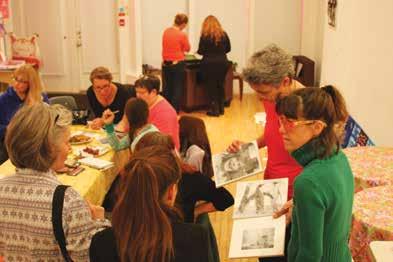
The Artist Mothers group holds meetings on the first Wednesday of each month with the goal of not only sharing and creating art but also fostering a community of like-minded and supportive individuals.
“We usually have a theme and it’s usually tied into mothering because that’s something we all have in common as mothers and artists,” group member Briony Haig told the Manitoban
The club meeting that I attended was the Artist Mothers’ One-A-Day Bash. The goal set by the group members for their November meeting was
to create one piece of art per day for the month of October present them to the rest of the group at the bash.
The pieces varied from small-scale line drawings to collages to wishbone art.
“Everybody is making art and making such a diverse kind of art and pushing the edges,” said Haig.
“I feel like everybody inspires me at some time or another. It’s a powerful sisterhood.”
As the women presented their art, the encouraging atmosphere was extremely evident. Group members were supportive and attentive, while still discussing the pieces being presented with constructive criticism.
“We do generally bring work to every meeting, [...] talk about it and get a little bit of feedback, suggestions, and support,” added Haig.
The group’s co-founder, Sandra Brown, said only two women showed up at their first meeting. From there, the artist mothers have grown into a group of 15-20 women attending meetings where they can relax and create in a safe space.
“There are constraints on mothers, but we still created a group,” said Brown.
Haig says the group has been an important part of her life as an artist mother.
“This group has been actually profoundly meaningful for me as an artist. I work full time as an art teacher so I am tantalizingly close to art. I think about and talk about art all day long, but I’ve been way too good at putting off making my own art. Then I joined this group, and it’s just what we all do, we all make art and we have shows. You have to produce for a show so that’s been gold for me.”
For more information on membership, workshops, lectures, and events, visit www.mawa.ca
OLIVIA MICHALCZUK, STAFF
Exchange Studios is a photography studio based in the Exchange District of downtown Winnipeg. The studio is meant to be an affordable space for photographers to create and shoot.
Owner and local photographer Kevin Lawrence created Exchange Studios out of necessity. By creating a space that other photographers could rent out, he was able to afford to have his own studio outside of his home – while still supporting amateur-to-professional artists and photographers by offering a very low rate of $25-50 per hour.
“I had decided to open to other photographers right from the beginning,” said Lawrence.
“I want a space for artists who are beginning to have a place they can be creative in.”
Included with the rent, the studio has a variety of resources available upon request. This includes backdrops, lighting, and furniture that is already in the studio with little to
no renting cost.
Beginning any hobby or profession has its ups and downs, but Exchange Studios makes the experience quite easy and inexpensive for anyone that wants to try it out or pursue a career in photography.
In addition to the cheap rental rates, Exchange Studios offers a discount to students with proof of enrolment.
“I am not out to make a living off the rental of my space. I do not advertise,” said Lawrence.
“All my business is word-of-mouth and repeat business, so I feel I am doing something right. People thank me that my prices are below the big studios in the city, and I have always maintained it’s about creative exchange, not a way to bleed my fellow artists.”
The studio does not only benefit beginners and one-time studio users, but also regular customers that are unable to rent their own studio space.
“They speak to me about how ner-
vous they are about sourcing enough business to afford a place on their own. So in that vein, I think there is a role in the community,” Lawrence explained.
“I have always maintained it’s about creative exchange, not a way to bleed my fellow artists” – Kevin Lawrence, owner
Exchange Studios is designed to be a versatile space that can cater to the needs of many types of photoshoots.
“There is a very broad range of photography in the studio. I personally shoot creative and fashion photography, but I know that family photos,
newborns, maternity, and boudoir are the most common uses when rented,” Lawrence told the Manitoban
“They love that I am willing to open up the space so that they have a place to go when the weather is awful, or for that newborn shoot.”
Among the many shoots at the Exchange Studio, one in particular stood out for Lawrence.
“I think the most memorable shoot in the space was last year – it was a collaboration of a few local artists,” said Lawrence.
“One was a local body painter by the name of Kim Brennan, another was an amazing hair stylist by the name of Amber Hobbs, and me shooting. The concept was to paint the model like the Joker from the Batman comics, though we genderbent the character using a female model. To me, that coming together of creative minds is the most memorable. It speaks to how great the artistic community is in the city.”

For more information, visit www.exchangestudios.ca
TOBI NIFESI, STAFF
After reading Settler: Identity and Colonialism in 21st Century Canada, a settler Canadian would know more about themselves than they would like to.
Two Canadian academics – Emma Battell Lowman and Adam J. Barker – joined forces to write a book about the relationship between indigenous peoples and other Canadians, the settlers.
This issue has been debated for years and at times it seems a consensus may never be reached. That being said, this book sheds some light on the issue by redefining the roles played by the parties involved. In doing so, it aims to bring both parties closer to reconciliation of a seemingly never-ending conflict.
Canadian culture, as we know it, is cordial and hospitable; the country’s history is based off this notion. However, Lowman and Barker believe there is more to Canada than meets the eye.
“In Canada, we like to think of ourselves as having a fairly inclusive society; we pride ourselves on being open and accepting of difference [...]
and we lie by omission, because we do not talk about the country being built on attempted destruction of other nations, [...] our history of profiting from invasion and dispossession,” Lowman and Barker write at the beginning of the book.
As Settler ’s authors point out, Canada has always been hostile to one cultural group: the indigenous community. This kind of hostility is one that can only be shown by the settlers.
“The drive to ameliorate the rift between Anglo and FrenchCanadian [...] dominated the political stage [...] Indigenous people had to fight to make their voices heard.”
The book’s opening pages touch briefly on the identity of the settler. It references past political events that have resulted in the coining of the terms “settler,” “settler colonialism,” and “colonial invasion.”
The next couple chapters expand on the roles and responsibility of the settler. The authors describe what they call the “settler colonial systems and structures.”
The settler’s capacity as an invader
on a foreign land is emphasized. It is a role they continuously play by living in a country where the indigenous community is slowly being eliminated.
“The unsettling reactions this book may provoke [...] are important elements of the effort to create just and respectful futures on these lands” –Settler: Identity and Colonialism in 21st Century Canada
The closing chapters of the book attempt to settle the differences between the settler and the nonsettlers. Each party has a role to play
and responsibility to assume before positive change can be seen. However, the awareness and acceptance of one’s identity is the most crucial step.
“If we learn to see ourselves and our roles in the systems and structures of settler colonialism – to ‘identify’ with the kinds of settler colonial thought and action we describe – then we create an incredible opportunity.”
Throughout the book, the authors make clear their intention, which is to open the eyes of the settler Canadian.
Regardless of how they react to the book’s revelations, they must react.
“The unsettling reactions this book may provoke, including feelings of guilt and shame, anger and outrage, or fear and despair, are important elements of the effort to create just and respectful futures on these lands.”
The arguments and tenets presented in the book are repeated more times than they probably should be. Some of the ideas and principles are over-emphasized, while the authors struggle to provide a concrete resolution for the issues they have raised. Rather, they simply lay down the framework for further research.
That being said, the historical and political references made throughout the book help the authors to buttress their argument.
The definitions and descriptions made are simple and perspicuous. The writing is fluent and the arguments are clearly presented and well-articulated.
Settler: Identity and Colonialism in 21st Century Canada denounces the idea of an “Indian problem” and presents the “settler problem.”
If the settler realizes that he is indeed a settler, and that he is a part of the problem, then the first step towards decolonization has been made.
Settler: Identity and Colonialism in 21st Century Canada , written by Emma Battell Lowman and Adam J. Barker, was published by Fernwood Publishing in October 2015. Visit www. fernwoodpublishing.ca for more details.
TOBI NIFESI, STAFF

The brainchild of Jason Neufeld, Wood Anchor is a wood reclamation company established in 2005.
Neufeld, referred to as “el capitano” of Team Wood Anchor, started the company with the goal of putting recycled wood to good use.
Over time, the company began designing and producing custom art pieces that are well-suited for both private and public settings.
“The goal was just to use recycled wood [...] in a more production mindset such as flooring,” Neufeld told the Manitoban
“As time went on, Wood Anchor focused more on custom pieces and public art pieces.”
Located in south Winnipeg, the Wood Anchor woodshop is an atelier for the handcrafting of original furniture, furnishings, and wood art. The
wood pieces created can be used for both interior and outdoor purposes.
This studio is unique for one reason in particular: the kind of recycled wood used.
“In our region, we are the only ones using urban elm [...] we have pushed the design of how we use it,” said Neufeld.
Urban elm is a tree species that used to be common in several developing urban communities. In the past few decades, a fungal affliction called Dutch elm disease has been found to affect the barks of these trees.
Many North American municipalities have developed Dutch elm disease programs tasked with removing affected urban elms and landfilling or burning the trees. As a result, millions of trees have been burnt.
Winnipeg is home to the largest remaining urban elm forest in North America. Each year, thousands of Winnipeg urban elms are removed and landfilled to control the spread of Dutch elm disease.
“I was dropping something off at the landfill [...] and I saw this monstrous pile of elms that wasn’t being used, and I thought it would be nice to be able to [...] use some of it,” said Neufeld.
Neufeld reached an agreement with the city of Winnipeg to collect affected urban elms and make the most of them. This way, instead of being chopped down, the affected trees can be used to design original works of art.
The handcrafted works of Wood Anchor can be seen at a number of popular sites in the city. These include the Winnipeg Airport ARA, the fire patio at the Qualico Family Centre, the signage at St. Amant Spirit Cottage, and the Living Prairie Museum & Park renovations, among others.
Recently, the company has been contracted to work on the Forks main building renovations.
“We are doing all the furniture for the Forks,” Neufeld said.
“Their architect approached us and [...] we co-designed these pieces together. The Forks approved everything and now we are in the process of finishing.”
In the past few years, Wood Anchor has collaborated with the University of Manitoba’s faculty of architecture by facilitating tours and lectures for students.
“We have a number of classes every year in the faculty of architecture that
Want us to review your band? Email arts@themanitoban.com today!
RYAN CAPAR, VOLUNTEER STAFF
Rayannah
Boxcar Lullabies
3/5
Winnipeg’s Rayannah is very much a one-woman band. Using a variety of pedals, she is able to loop vocal patterns, layering each individual piece into a collective whole, resulting in a unique musical soundscape.
On her first release, Boxcar Lullabies, Rayannah showcases her talent for texturing sound. With the help of co-producer Carlin Lemon, that sound reaches fruition with the use of synth, bass, and various stringed instruments such as cello, violin, and viola.
Rayannah’s voice on Boxcar Lullabies is crystallized and pure, fitting well with the music. She’s able to cut through and float over the top of the layers of sound. On the Purity Ring-esque title track, her voice cuts through the pulsing rhythm, growing triumphant towards the end.
Rayannah switches things up on “Growing Song,” singing to a more R&B-style rhythm propelled by a slow jazz bass line. Here her vocals become more soulful and seductive. The track feels more like a Sade
slow jam, which is a good thing. I found myself coming back to this track the most due to its infectious soulful tone.
However, Boxcar Lullabies is not without its faults. I thought the second track “Tivoli” was weak and forgettable, sounding like something out of Disney or what would have playing during a montage in a Mandy Moore movie.
Also, the emphasis on layering sounds leaves something to be desired. When the songs are all textured and accented by strings and synths, there’s nothing for the listener to grab onto. Layers of sound can be interesting, but without some sort of groove or riff to propel the song, you run the risk of everything becoming a sonic wash.
The brightest spots on this EP are when Rayannah was able to move the song forward. The title track has a percussive pulse the whole way through, “Growing Song” has a relatively simple beat and sexy bass line, and the rhythmic drum pattern that comes in towards the end of “The Water” keeps it from becoming forgettable.
Boxcar Lullabies is a strong first release from Rayannah. She’s explorative and has imagination.

Listeners should be interested in hearing where she takes her sound and how she will evolve in the future.
www.rayannah.ca
EMELIA FOURNIER
Murray Pulver & Friends
The Guest List 5/5
Former Crash Test Dummies and Doc Walker guitarist Murray Pulver has been a prominent figure in the Winnipeg music scene for decades.
The Guest List provides Pulver an opportunity to highlight the diverse work he has done over the years by collaborating with a different musician on each tune.
Pulver’s impressive range is not just vocal, but also in genres. From the funk, horn-filled “Ego Spank” to the haunting collaboration with local alt-country outfit The Bros. Landreth – for whom he produced a Juno-winning album – The Guest List highlights both Pulver’s talent and the talent of the musicians he has worked with.
It is an energetic album that will leave any music lover smiling. The collaboration with Brad Roberts of the Crash Test Dummies sticks out on the album with Roberts’ deep, signature voice, and angry energy.
The prairie tone of J.D. Edwards is another highlight on the album.
“Back to You” features his strong, raspy vocals alongside twanging
come here for tours,” said Neufeld.
“The benefit of having students here is that we can educate them about wood and how we build and [...] look at each piece of wood differently.”
Other than the kind of recycled wood used, Neufeld believes the Wood Anchor brand has benefited from their contemporary style of design.
His Wood Anchor team of six consists of woodcraft and design experts that ensure their products are well-detailed and well-suited for their purposes.
“Our role is to challenge what the norm is,” said Neufeld.
“The benefit for us is we are heavily involved in the design community, but also we are not part of any [architectural] memberships or organizations [...] so we can kind of push things from the outside.”
The recycling of Winnipeg’s wood is important to the minds of Wood Anchor. Neufeld hopes the city can benefit from the company on a larger scale in the long run.
Visit www.woodanchor.com to see Wood Anchor’s portfolio and read more about their services.
instrumentals that flow together. Other artists featured on the album are J.P. Hoe, Steve Bell, Chris Thorsteinson of Doc Walker, and even Kids of the Hall alumnus Kevin McDonald.
The strong musicianship is apparent on each track, from the haunting harmonies and mournful guitar on “Rust,” to the blasting horns and funk bass of “In a Lonely Place.”
Despite the eclectic mix of artists, the album has a weird coherence. Murray Pulver and his friends hold The Guest List together in a dynamic way.
It’s like you invited just the right combination of people to a party, and it’s a swinging success.
www.murraypulver.com




ANDY CHE, STAFF
The 2015 women’s soccer season was quite memorable. Below are the Manitoban’s top 10 stories and moments from the pitch.
10. Lord of the wings
Eighteen minutes into the regular season, winger Selina Speranza opened the Bisons’ account for 201516. Striker Bruna Mavignier played in the winger, who rounded the keeper and broke through for goal number one on the year.
During the final weekend ahead of the post-season, Speranza struck twice in two matches to close out the season in style. Her lone goal in the 2-1 loss at home to Saskatchewan marked her fifth goal of the CIS season.
9. Mavignier magic
Even though Bruna Mavignier’s season was cut short due to injury, she still did nothing less than replicate her lethality in front of the goalmouth. The Brazilian scored six goals in six games, including a brace in the season opener against Thompson Rivers.
Her final appearance of 2015-16 was perhaps her best performance, netting another brace in a comeback effort at Mount Royal.
Mavignier’s limited appearances had a tremendous effect on the Bisons, who won three matches, drew twice and lost once when she was selected to start. Last season, she impressed with eight goals in twelve appearances and now has fourteen goals to her credit in just 18 CIS career matches.
8. Comeback keeper
Chloe Werle overcame one of the biggest battles of her career when she started the first match of the 2015 CIS season against Thompson Rivers. With a back fracture that jeopardized her future in soccer, the goalkeeper and captain put her entire 2014-15 season into recovery mode and ultimately succeeded.
She made a total of six appearances this year and although Werle was later dislodged by Madison Wilford as the number-one goalkeeper, it is miraculous that she was able to reinvigorate her CIS career when it appeared to be over.
7. Into the playoffs
For the first time since 2012-13 season, Manitoba qualified for the Canada West playoffs. Last season, the Bisons’ 4-4-4 record kept them
alive in the playoff race ahead of the final weekend, but two straight draws against Lethbridge to close out their season saw them crash out of the playoff picture.
While it contributed to a spectacular goal for Notts County in the Ladies’ Premier League, the planning and practice have not paid off for the Bisons yet
Much of their qualification this season can be attributed to performances in which the Bisons scraped out a point in matches which they have trailed. The post-season came a bit earlier for 2015-16, as Manitoba attained a twelve-point league cushion for the final playoff position.
Unfortunately, the herd’s 2-0 loss to MacEwan last week ended the Bisons’ run in the playoffs at the quarterfinal stage.
6. The swan song
For four Bisons, the 2015-16 season marked the final season of their CIS careers. The graduating class includes goalkeeper Chloe Werle, midfielders Alyssa Robinson and Megan Graca, and defender Elyce Molyneaux.
Aside from finishing off her last CIS season with a comeback from injury, Werle nearly clinched the icing on the cake when she just about scored a goal against Calgary. The product of Winnipeg Soccer Academy launched a long ball that caught her opposite number off her line and was inches from going in.
Robinson served as a vice-captain in her final year, in place of Werle and the injured Amanda Wong. Her two goals during the season were scored in the same weekend, a 3-2 loss to Saskatchewan and 2-1 win at Regina, respectively.
A playmaker in centre midfield, Graca scored two goals while leading the Bisons with six assists in her final season. She scored the lone goal during the Duckworth Challenge which Manitoba won 1-0, and scored again during a comeback effort against MacEwan in the regular season.
“I wish I would have known how quickly the five years goes before I
started. Every game played has been such an amazing experience,” said Graca when reflecting on her CIS career.
Molyneaux bowed out of the CIS with one last hurrah when she was named player of the match in the 2-0 defeat to MacEwan. The left-back for the Bisons scored one goal in the season, during Manitoba’s 3-0 win against Lethbridge.
It is rather impressive when a goalkeeper concedes only two goals in her first six performances of the season. It is even more impressive when she can go almost 300 minutes unbeaten for part of the season. Yet, when that goalkeeper is only a CIS rookie, it’s time to take notice.
Bisons keeper Madison Wilford won starting duties over captain Chloe Werle this season and has not relinquished the position ever since. In a four-match span beginning Sept. 27, she failed to concede a goal in over 280 minutes of play.
By the end of the season, Wilford had firmly secured her spot in the pecking order and started Manitoba’s first post-season match since 2013.
“It’s been so much fun playing alongside these talented girls and I’m very grateful for the opportunity to support them in goal,” said Wilford on her freshman experience.
By the end of the season, Wilford had firmly secured her spot in the pecking order and started Manitoba’s first post-season match since 2013
4. That goal
It could have been the Bisons’ goal of the season, but it wasn’t even the season yet.
Alyssa Robinson’s wonder-strike against Minnesota-Crookston clinched a 1-0 pre-season victory back on Aug. 28. Even the likes of Gareth Bale and Cristiano Ronaldo would have been proud of that one.
From outside the area, Robinson hammered a belter with her left foot, clattering the crossbar and post


before crossing the line. The leftsided midfielder managed two goals during the competitive season, yet her pre-season stunner easily tops the bunch.
3. The derby
Manitoba’s derby match against Winnipeg at Investors Group Field marked the first CIS match that was held in an ex-World Cup venue. The Bisons rose to the grand occasion, producing a 2-0 victory over their cross-town rivals.
Midfielders Chelsea Dubiel and Sara Schur potted goals on either side of halftime to send Manitoba home happy. The match was played in front 778 people.
2. Psych-out free kicks
Coach Vanessa MartinezLagunas was surely captivated by Ellen White’s free kick goal for Notts County – the club which is also represented by former Bison Desiree Scott.
“I do follow Desiree’s team a little bit and I saw that free kick, so I brought it to the team,” said Martinez-Lagunas. “It’s going to work one day.”
The plan features a fake argument between three players as the run-up is taken and a sneaky layoff to catch the opposition off guard.
While it contributed to a spectacular goal for Notts County in the FA Women’s Super League, the planning and practice have not paid off for the Bisons yet.
1. Comebacks galore!
A three-month CIS soccer season makes for the realization that there are not that many points to lose. Despite conceding the first goal in six matches this season, the Bisons produced spectacular comebacks on three occasions. The result was a win and two draws, adding five points to their season total when trailing. The cornerstone for their comeback spirit was striker Alanna Shaw. The spirited freshman equalized in a 1-1 draw against UBC-Okanagan, then scored and assisted in a spectacular 2-2 draw against MacEwan after trailing 2-0. Bruna Mavignier contributed to the other performance, a brace which saw the Bisons dish out a 2-1 victory over Mount Royal.

MIKE STILL, STAFF

PHOTO BY WILL MCDONALD
were unable to move the ball offensively for the majority of the contest. Due to this, Manitoba was frequently forced to punt from the shadow of their own goalposts and the home side were often able to start their drives past midfield, needing to travel just 40-45 yards for a major.
The play that sealed the Bisons’ fate occurred with just under five minutes left in the first half.
defensive back Stavros Katsantonis.
The pick appeared to take the wind out of the Bisons’ sails, as UBC would go on to score 10 more points to end the half, effectively erasing any chance of a potential Manitoba comeback.
throwing across the middle – while his counterpart Michael O’Connor amassed 231 yards to go with three touchdowns and no interceptions.
For the second week in a row, the University of Manitoba Bisons football team travelled to UBC looking not only to defeat the Thunderbirds for the first time in 2015 but also defend their conference title.
The Thunderbirds rushed out to a 16-0 lead after one quarter and didn’t look back. Their success early on and as the game progressed was due mainly to favourable field position.
The herd was pinned behind their 30-yard line virtually all game and
The result couldn’t have been any worse for the visitors as their opposition blew them out 52-10, ensuring that the Hardy Cup didn’t remain in the ’Peg for a second consecutive year.
Trailing 19-0, Manitoba’s defence had begun to find a rhythm – recovering a Thunderbirds fumble when it appeared the home side was about to score again, as well as stuffing UBC’s run game. Just two drives after forcing the turnover, the herd was able to move past their own 50-yard line for the first time on offence after Bryden Bone hauled in a 29-yard reception.
The following play, though, Bisons pivot Theo Deezar tossed his third interception of the half. Thunderbirds safety Taylor Loffler was able to rip the ball out of Manitoba slotback Alex Vitt’s hands near the goal line, and into the waiting arms of fellow
With the win, UBC head coach Blake Nill advanced his career playoff record against Brian Dobie to 4-1
Rainy conditions were a factor during the game on Saturday afternoon and they took their toll on Deezar – returning to the lineup after missing the past two regular season games with a concussion.
He finished with just 158 yards passing and four interceptions –unable to get much gusto when
Manitoba’s three-headed monster in the run game – which helped the squad gain confidence throughout the season when the aerial attack wasn’t operating on all cylinders, was shut down for a second consecutive week as well.
Canada West All-Star Jamel Lyles finished with just 28 yards on the ground, while Alex Christie and Cameron Fox combined for just 45.
On the other side, Thunderbirds tailback Brandon Deschamps was effective with 124 yards rushing and a touchdown, along with an average of 8.9 yards per carry.
With the win, UBC head coach Blake Nill advanced his career playoff record against Brian Dobie to 4-1 and his squad will now head to Calgary next weekend to take on the top-ranked team in the nation in the Hardy Cup.
Men’s basketball takes one out of two games against number seven-ranked Huskies
MIKE STILL, STAFF
The University of Manitoba Bisons men’s basketball team kicked off their regular season on the road this past weekend, looking to accomplish two things. The first was to knock off a top-10 nationally ranked team, in Saskatchewan. The second and more substantial goal was to defeat the Huskies for the first time since the 2012-13 season.
Both feats were fulfilled as Manitoba won a 91-88 last-second thriller on Friday night, before falling 77-70 in the rematch on Saturday.
Friday
The opening game of the weekend was a wildly entertaining contest that saw 14 different lead changes.
The Huskies looked to have the game wrapped up after a three-ball from forward Trevor Severinski gave the home side an 88-85 lead with just 55 seconds left, however Bisons guard AJ Basi wouldn’t be denied, swishing two shots from beyond arc in the final 43 seconds to steal the win for Manitoba.
The game winner occurred with only one second left on the clock,
as Basi took an inbound pass from point guard Ilarion Bonhomme II and executed a perfect fadeaway shot. The co-captain for Manitoba finished the game with 22 points.
The fourth quarter turned into the Bonhomme II show, as he contributed 11 of his 15 points in the last 10 minutes
The Huskies led 24-18 after the first 10 minutes, thanks largely in part to lights-out three-point shooting –going 4 of 8 from the perimeter. The herd would respond in the second quarter, taking a 47-44 lead into the break on the strength of a well-rounded team performance highlighted by 13 points from Basi, as well as four assists and rebounds from swingman Keith Omoerah. Manitoba opened up a 14-point
lead immediately following halftime only to have the Huskies go on a 15-1 run to tie the game. Jauquin Bennett-Boire was the catalyst for Saskatchewan, scoring eight points in the third and giving his team back the lead with 1:21 left in the quarter. Heading into the final frame, the home side were on top 69-65.
The fourth quarter turned into the Bonhomme II show, as he contributed 11 of his 15 points in the last 10 minutes, making the score 81-72 for Manitoba with just over five minutes left.
The Huskies kept pace, though, going on a 13-4 run over four minutes to tie things up with a minute left. That’s when Basi and Severinski started raining treys, with Basi getting the last laugh and the victory for his squad.
The rematch was a tale of two halves, with both units stepping up defensively after Friday’s offensive outburst.
The Bisons would lead 27-17 after one and 45-37 at the break, thanks
in large part to their job on the glass, where they had 18 defensive rebounds compared to Saskatchewan’s 12 over the first 20 minutes.
Forward Wyatt Anders was spectacular during that time – frequently posting up, while recording 10 boards and limiting the Huskies’ abilities for second-chance points in the paint.
Offensively, Basi and Omoerah combined for 26 of Manitoba’s 45 first-half points, with 15 and 11 respectively. Their combined shooting percentage was also impressive, at 69 per cent.
The second half was an entirely different story, as Saskatchewan guard Shawn Lathan kept Anders at bay and the entire Huskies defence stiffened up – specifically reducing the impact of Basi and Omoerah.
Just eight combined points (five by Manitoba, three by Saskatchewan) were scored in the first five minutes of the third, but by the end of the quarter the Bisons’ lead had been trimmed to four.
Free throw shooting was Manitoba’s Achilles heel in the fourth, as the team left numerous
points off the board due to their inability to capitalize from the charity stripe. Overall, the herd shot just 52 per cent at the line and couldn’t close out the victory.
Saskatchewan would take their first lead of the game (71-70) with 2:11 left and wouldn’t relinquish it – outscoring the visitors 21-10 in the final frame en route to the win.
Weekend at a glance
Manitoba’s co-captains were nothing short of spectacular to start the season.
Anders had a double-double on both Friday and Saturday, picking up 15 points and 10 rebounds in the opener and 10 points to go with 15 rebounds in the rematch, while Basi was a sparkplug offensively all weekend with 42 points over the two games. Both players also logged over 30 minutes both nights.
Next up for the herd is their home opener this weekend, as they take on Calgary – looking to gain some revenge on the team that knocked them out of the post-season in 2014-15.
RYAN STELTER, VOLUNTEER STAFF
This weekend, both the Bisons men’s and women’s volleyball teams went head to head against the Mount Royal Cougars. The men swept their two matchups against the visitors, maintaining their perfect record. The women didn’t fare so well, as they dropped both of their games.
Men continue to win
The Bison men’s volleyball team has not lost a single game this season, and has only dropped six sets all year. They kept their winning ways alive against the Cougars.
Friday’s game was tighter than the 3-0 score line suggested, as the Bisons had to fight back in both the second and third sets.
Head coach Garth Pischke talked post-game about the third set on Friday, where they battled back from a five-point deficit.
“We kept our composure on servicing and we came up with a couple really good blocks,” Pischke said. “We slowed them down and that gave us momentum and kept us in it.”
Right side hitter Devren Dear dominated the early proceedings for the herd, collecting five kills in the first set, and then collecting another six in the second. He finished with 15 on the night.
On Saturday it was more of the same for Manitoba, with another 3-0 victory (25-21, 25-19, 25-20).
Adam DeJonckheere led the line in the rematch, earning 15 kills. Luke Herr came up with seven digs, while Dear had another stellar day, recording nine kills and six digs.
The two wins help the men improve to 8-0 and first place in the Canada West conference. They are currently the hottest team in the West, as they are one of only two
undefeated teams in the conference.
The men are on the road next weekend against the University of Alberta Golden Bears. The Bears are the only other undefeated team in the conference, so it’s sure to be an entertaining matchup.
Women get clawed by the Cougars
It hasn’t been the greatest of starts for the Bisons women’s volleyball team, as they sit with a 1-7 record and second-last place in the Canada West.
Friday night was a frustrating night for the women, as they lost 3-1 (26-28, 23-25, 25-21, 18-25). In the first two sets they blew a considerable lead and couldn’t close things out.
Mount Royal recorded seven more blocks than Manitoba, which really helped their efforts in bouncing back. Despite the loss, middle hitter Jordana Milne had herself a strong evening, as she led the herd in kills, aces, and blocks.
Saturday saw the Bisons drop another game in similar fashion, losing 3-1 (14-24, 12-25, 25-20, 14-25). The home side was simply out-played in this one, as they were soundly beaten in all but one set.
Manitoba only managed three blocks all game, compared to Mount Royal’s twelve. They were outscored 72-46 and were never really in contention.
Sophomore Tori Studler had 11 kills on the day – two shy of her season best, while Caleigh Dobie was clutch once again, recording 14 digs.
The women hit the road as well next weekend to face off against the University of Alberta Pandas. Alberta sits tied for first in the Canada West with a 6-0 record.


RYAN STELTER, VOLUNTEER STAFF
T
he University of Manitoba Bisons men’s hockey team was back on the road in Alberta this weekend to face off against the defending CIS champion Alberta Golden Bears. The visitors lost a heartbreaker on Friday night in overtime by a score of 3-2. They then bounced back and won 3-2 in the rematch.
Friday
In a wild game, the Bisons and the Bears put on quite a show for the fans. Alberta found themselves with a two-goal lead midway through the third and thought it was all done and dusted.
Then Shaq Merasty happened. The Bears were not prepared for the show the six-foot-five power forward was about to put on.
With seven minutes remaining in the third period, Merasty cut the Golden Bears’ lead in half through a power play goal. Five minutes later, Merasty would get his second on the night to tie the game up for the Bisons. Momentum was on Manitoba’s side heading into overtime.
It was not to be, however, as Jamie Crooks scored two minutes into the second frame of overtime to save the game for the Bears and secure two points.
Justin Paulic once again put on a fantastic performance in the crease, recording an astonishing 42 saves, and was a big reason the Bisons were able to stay in the game.
The first-year player out of Thompson is putting up impressive numbers this year, with a 0.914 save
percentage and a 2.86 goals against average.
DePape
now leads the league in points with 14, and has not missed a beat
After a crushing loss the night prior, Manitoba was out for revenge in the second game. It looked like another rough start for the herd, as Alberta managed to get on the board first, five minutes into the first period.
Brett Brooks must have eaten what Merasty had on Friday because he
decided he wanted some time in the limelight. He scored his first on the night three minutes after the Bears opened things up, and then added his second goal with four minutes remaining in the first period to give the herd the lead.
The two goals broke a sevengame point drought the rookie was enduring.
The Golden Bears made a late comeback, equalizing with three minutes to go in the final frame. Manitoba answered back quickly, though, as captain Jordan DePape fired home yet another game winner – his team-leading fifth goal, with just 12 seconds remaining in the game.
DePape now leads the league in points with 14, and has not missed a beat after his stellar performance
against Calgary the week prior –where he was named Canada West male third star of the week.
After this weekend’s action, the Bisons sit at an even 5-5 record and are fourth place in the conference. They are one point behind the Golden Bears in the standings and will hope to leapfrog them next weekend at home against the Lethbridge Pronghorns.
Lethbridge is second-last in the conference, but they have won their last two games, so nothing is guaranteed.