Professors launch Truth and Reconciliation petition
Controversial views on residential schools not U of M consensus, say professors
ETHAN CABEL, STAFF
Just in time for the federal election campaign, four University of Manitoba professors have launched a petition urging all levels of government in Canada to take concrete steps toward truth and reconciliation with indigenous people.
The petition, which has received 1,464 signatures of its 2,000-signature goal, is a direct response to the Truth and Reconciliation Commission (TRC) report, which made 94 recommendations about how governments can address the legacy of the Indian residential school system.
“We [...] call upon the country’s political parties to consider incorporating the TRC’s recommendations into their respective platforms,” the petition reads, in part.
The petition was launched by associate English professor Adam Muller, history professor Adele Perry, native studies assistant professor Niigaanwewidam Sinclair, and sociology professor Andrew Woolford.
“We think the recommendations are quite pointed and clear, and we don’t have to wait until after a general election to see government take concrete steps to address the concerns for which the recommendations speak,” said Muller, adding that the country has not taken the TRC report as seriously as it should.
The TRC has spent the last seven years crisscrossing the nation, gathering evidence about the Indian residential school system, which saw 150,000 indigenous children forced to attend mandatory boarding schools from the 1880s to the mid-1990s.
The schools sought to teach indigenous children English or French and
convert them to Christianity, effectively assimilating them into what had become the dominant Canadian culture.
Pervasive physical and sexual abuse was well-documented by the TRC, with thousands of former students testifying to the commission about their treatment at the hands of school officials.
The condition at the schools, as well as their fundamental objective, have led many, including TRC chair Justice Murray Sinclair, to describe the residential school system as an attempt at the “cultural genocide” of Canada’s indigenous peoples.
“The system was predicated on the idea that Aboriginal life was a problem, that it was something in need of overcoming, and that it was through education that indigenous people could be civilized and assimilated into central Canadian life,” Muller said.
“That impulse, that impulse to deracinate and re-acculturate, is a genocidal impulse.”
Among the 94 recommendations of the TRC report are several major changes to the way the federal government interacts with First Nation communities across the country, including greater sovereignty for Canada’s First Nations, increased education funding for children living on reserves, and a new framework for health, child welfare and justice policies affecting indigenous people.
“The petition is obviously just one small piece of a wider, ongoing discussion,” said Perry, one of the four professors who launched the petition.
“I hope that the issues that are
raised in the TRC summary report around the ongoing impacts of histories of colonization in general and residential schools in particular [...] get taken seriously and, as we are now in a full-on lead-up to an election, we’ll see if that does happen or if it doesn’t.”
“The system was predicated on the idea that Aboriginal life was a problem, that it was something in need of overcoming, and that it was through education that indigenous people could be civilized and assimilated into central Canadian life” – Adam Muller, associate English professor
The other side
According to Muller and Perry, the petition is in part a response to two articles published in the National Post by retired U of M anthropology professor Hymie Rubenstein and professor emeritus in the faculty of
education Rodney Clifton.
The two professors published a controversial article on June 4 disputing the predominantly negative portrayal of the residential school system and the research methodologies used by the TRC to gather evidence.
The article resulted in a response from U of M professors published by the National Post on June 5, which disputed Clifton and Rubenstein’s characterization of the residential school system. Seventy-nine professors eventually added their signatures to this letter to the editor, which was uploaded online.
Clifton and Rubenstein then published a response to the 79 professors and other critics, published on June 22.
“The way to solve disagreements in academia is to debate them rather than to denounce people that disagree with you, and we have been denounced rather than argued with,” Clifton told the Manitoban
“About one third of Aboriginal children during this 120-year period went to residential schools, the average child went for four years, and we think that is not enough time to create all of the pathologies that we see in Aboriginal societies today.”
Clifton worked as the senior boys’ supervisor in Stringer Hall, the Anglican residence of a residential school in Inuvik, Northwest Territories, from 1966-1967. He also lived at Old Sun, the Anglican residential school in the Blackfoot reserve in Alberta for four months in 1966.
Clifton’s wife, a Blackfoot indigenous woman, attended the Old Sun residential school from 1951 to 1961.
Clifton claims that the portrayal of the schools presented in the TRC report is fundamentally inaccurate and relies on evidence garnered disproportionately from former students who had experienced abuse at the schools.
He claims that many students had a positive experience and were able to speak their native languages and see their parents on weekends and during the summer.
“Most of the white supervisors, as with myself, decided not to go because we knew what would happen if we went and presented,” Clifton said of the TRC hearings, arguing that the Commission facilitated an environment where emotions ran too hot for rational discussion.
“There was no way of getting a more sensible or reasonable discussion of both the good and the bad of the residential schools under a situation like that.”
Clifton views the TRC as flawed social science based on a flawed conception of the problems facing indigenous Canadians, which he argues are based on colonial dependency. As for the 94 recommendations of the TRC report, which would involve a great deal of new government spending, Clifton says they “sound a lot like dependency.”
“I don’t like the idea that we have 94 recommendations, costing an unknown amount of money, each one of equal value and each one being funded,” he said.
“I don’t think that’s reasonable.”
PHOTO BY CAROLYNE KROEKER
U of M English professor Adam Muller
Cape Breton University Students’ Union loses court case
Nova Scotia union weighing options after being ordered to pay CFS $400,000
CRAIG ADOLPHE, STAFF
PHOTO BY CAROLYNE KROEKER
The Cape Breton University Students’ Union (CBUSU) is considering declaring bankruptcy a month after a court ruling which found them responsible for damages and court costs to the Canadian Federation of Students (CFS) amounting to roughly $400,000.
The award included damages for unpaid memberships dating back to 2008 amounting to $293,159.13, as well as roughly $100,000 in legal expenses for CFS. The case is the culmination of a dispute about the validity of CBUSU’s 2008 defederation referendum in which 92 per cent of those casting ballots voted in favour of leaving CFS.
The judge overseeing the case found that the referendum broke rules laid out in the CFS bylaws and is invalid as a result, meaning that CBUSU continues to be a voting member of CFS with all the responsibilities this implies.
The judge noted that the motion to hold a referendum was moved by the union’s president, a member of the executive, who would be expected to act in the best interests of the CFS on campus, and not a student councillor. Additionally, CBUSU failed to remit all applicable outstanding fees prior to the referendum. Notice from CBUSU of a defederation referendum was not, at that time, accompanied by a petition signed by at least 10
per cent of the individual members – a requirement according to CFS’s bylaws.
“If we go bankrupt it’s essentially signing a death sentence for the students’ union. It would be a massive and devastating loss for us” – Brandon Ellis, president, Cape Breton University Students’ Union
Ultimately, the judge found that “there is no bad faith on the part of CFS,” adding that “if there was any bad faith, it is [on] the part of the CBUSU’s [2007-08] executive,” referring to his findings that thenpresident Ian Walker Lindsay didn’t inform CBUSU’s student council that the validity of the referendum was being contested or that CFS would recognize the referendum as valid if they agreed to hold it at a later date – in September 2008 – at
no additional cost to the union.
The judge went on to note that there was no “evidence of prejudice to the students if the vote were delayed to September except for a possible loss of publicity for Mr. Lindsay.”
Weighing options
Since 2008, the fees, which had previously been collected and sent to CFS, have been collected and spent by CBUSU directly in providing other student services. The $400,000 owed to CFS will have to be taken out of the union’s annual budget, which amounts to roughly $500,000 a year according to current CBUSU President Brandon Ellis.
Although early reports mistakenly claimed that the students’ union had already declared bankruptcy, Ellis confirms that the student union is still weighing its options.
Ellis explained that the union is first appealing the ruling – a process he claims may take anywhere between six months and a year. Should that process fail, CBUSU will have to either arrange a payment plan with CFS or declare bankruptcy.
“If we go bankrupt it’s essentially signing a death sentence for the students’ union. We would cease to be a corporation, we would cease to exist,” he said.
“We’d lose 80 jobs. We’d lose all of the progress we’ve made over the last 41 years of being. It would be a massive and devastating loss for us.”
While Ellis is limited in what he can say about ongoing discussions between CBUSU and CFS, he acknowledged that other student unions that have had disputes with CFS have been offered payment plans in the past.
“They offer payment plans and repayment plans to student associations who are behind on their payments. And the reason they offer them is if [a student union] has a big damages award against them, [they] cannot hold a referendum to leave CFS until those outstanding fees are paid off,” Ellis said.
“That would be greatly limiting [the] democracy of the students [...] We’d be locked in for the term of the payment plan.”
Other groups have voiced support for CBUSU in the dispute.
In June 2014 Cape Breton University’s Board of Governors approved a motion to support the students’ union. Additionally, StudentsNS, the province’s other leading student union alliance, of
which CBUSU is also a member, released a statement supporting CBUSU and condemning the actions of CFS, calling them anti-democratic.
For its part, CFS claims that it is simply enforcing its membership rules and wants students at Cape Breton University to have full access to the benefits of CFS membership.
“I hope that the executive of CBUSU will prioritize the best interests of students and work with the federation to find a solution that's in the best interest of all students,” said Bilan Arte, national chairperson for CFS, in an email.
The U of M connection
The University of Manitoba Graduate Students’ Association (UMGSA) has been in a similar dispute with CFS for several years. After researching the history of UMGSA’s relationship with CFS and compiling a report in 2012 UMGSA has taken the position that it was technically never a member of CFS.
The report argues that the original agreement between UMGSA and CFS was made before the former established itself as autonomous from the University of Manitoba Students’ Union and is thus void. Further, it argues that the individual who acted as a signatory for UMGSA didn’t have the authority to serve in that capacity and that the union didn’t pay any fees until years later when CFS approached a new executive who had a limited understanding of the two unions’ history.
Despite UMGSA’s position, CFS holds that UMGSA remains a member of the federation and continues to list them as a member on their website, although fees have not been remitted since 2011.
Despite the ongoing dispute, last year UMGSA collaborated with CFS and a number of other organizations – including the Canadian Union of Public Employees Local 3909, the University of Manitoba Students’ Union, and the University of Manitoba Faculty Association –in coordinating the Stop the Cuts campaign, which aimed to prevent department cuts which came as part of the university’s budget.
UMGSA President Kristjan Mann said the collaboration hadn’t changed UMGSA’s position on membership within CFS.
“UMGSA’s primary goal is to advocate and provide services for U of M students. I have no problem teaming up with external organiza-
tions that have similar goals to ours on campus or nationally [...] We have no issue dealing with them as partners. But that in no way indicates membership in that organization.”
“I think the recent events that happened with the Cape Breton students’ union kind of highlights some of our basic reasons for not wanting to be members. It doesn’t seem like they have the best interests of students at heart if they’re bankrupting student organizations,” said Mann.
However, Arte pointed out that CBUSU has not filed for bankruptcy and that CFS is working with them to establish a payment plan.
“It has never been and never will be the intent of the federation to put any students’ union in any position of financial constraint or bankruptcy,” said Arte, “The federation is committed to ensuring students at Cape Breton University have access to the local, provincial, and federal representation to which they are entitled.”
Despite the similarities between CBUSU and UMGSA, UMGSA has taken measures to protect themselves in the case of a lawsuit. They continue to collect fees, equivalent to those member unions pay to CFS, which they hold in an “external relations fund.”
“We attempted to hedge our bets by continuing to collect an amount equal to CFS membership fees in the event that they do try [to] unreasonably sue UMGSA for what they feel are lost membership fees,” Mann explained.
“We’re working with a lawyer and a portfolio manager to invest that money and have the returns further fund the operating budget for UMGSA and increase services such as awards and conference grants.” Ellis commented that UMGSA’s decision to continue to collect and hold fees for long-term investment was smart.
“We’d received legal advice that our referendum was valid so the students’ union’s executives from 2008 on didn’t feel the need to put any of the money aside that we could have put aside to prepare for litigation or a possible damage reward. But that was all under the basis of what our legal counsel had told us,” said Ellis.
Brandon Ellis, CBUSU president
Health and dental premium hike approved by student union
UMSU agrees to premium hike with StudentCare, Manitoba Blue Cross
ETHAN CABEL, STAFF
Students at the University of Manitoba will be paying more for their health and dental insurance this year after the University of Manitoba Students’ Union (UMSU) finished negotiations with insurance broker StudentCare and provider Manitoba Blue Cross for a new annual rate.
The premium increase will amount to $45.25 annually for students entering university in the fall term, with the combined health and dental insurance premium increasing from $246.75 to $292. Students entering the winter term will pay $194.65, up from $164.50 last year.
Students on family insurance plans, which are charged a rate 1.5 times the rate charged to students on the individual plan, will also see their annual rate increase.
The premium increase comes one year into a five-year contract between UMSU and StudentCare, a for-profit insurance broker that specializes in securing group insurance plans for university students from various providers.
The contract with StudentCare gave UMSU a one-time $100,000 donation for the 2014-15 school year and $10,000 in annual sponsorships.
The contract was touted by UMSU at the time as providing long-term rate stability, but rates will be renegotiated through StudentCare for each of the next three years after increasing for 2015-16.
According to Zach Leclerc, vicepresident internal for UMSU, the union hopes that further increases won’t be necessary.
“I feel we’re reaching a plateau point [...] where the number of students enrolled levels off and the overall claims toward the plan levels off,” he said, adding that the plan will
“hopefully” increase by no more than inflation in a few years’ time.
Leclerc said that the premium increase is necessary due to a large uptick in plan enrolments and benefit claims over the last two years.
“Recognizing that a fee increase is always a touchy topic, our fellow students are benefiting from this and that was the initial mandate and purpose of this group insurance plan” – Zach Leclerc, UMSU vicepresident internal
Leclerc told the Manitoban that this increase in claims can be attributed to the plan’s ease of use, ensuring that the plan is providing benefits to more students than the previous provider, Greenshield.
Greenshield provided insurance to UMSU through the Canadian Federation of Students’ (CFS) broker from 2002 to 2013 before UMSU switched to StudentCare and Manitoba Blue Cross for one year. In the subsequent year, the union signed a five-year contract with StudentCare.
Leclerc said that Manitoba Blue Cross is not penalizing U of M students with a premium increase, but rather seeking to break even in their operations after dental claims shot up
over the last two years to an almost one-to-one ratio of student fees to benefit claims.
“Recognizing that a fee increase is always a touchy topic, our fellow students are benefiting from this and that was the initial mandate and purpose of this group insurance plan,” Leclerc said.
Earlier this summer, UMSU sent out a survey to students seeking input on potential changes to the health and dental insurance plan. After receiving approximately 800 responses, UMSU determined that a premium increase was preferable to benefit cuts.
According to Leclerc, StudentCare was provided with the results of the survey, and the broker then provided UMSU with three options, including re-signing with Manitoba Blue Cross for another year.
“Manitoba Blue Cross still provided the best offer with their increase,” Leclerc said.
The survey also asked students whether they would be amenable to segregating undergraduate and graduate students into two separate health and dental plans.
The current plan includes both undergraduate and graduate students, but the survey claims that U of M undergrads heavily subsidize the health and dental benefits of graduate students.
While Leclerc ruled out a segregated plan in the near future, Kristjan Mann, the president of the University of Manitoba Graduate Students’ Association (UMGSA) is exercising caution in the event that UMSU changes its mind.
“We feel all students should be treated equally and have equal access to services regardless of factors such
as what they choose to study and at what level they do so; and we believe that our colleagues at UMSU feel the same way,” Mann said in a statement to the Manitoban
“That being said, we are taking action to obtain our own independent quotes from various brokers that will ensure that grad students do not experience a lapse in coverage in the event that UMSU decides to segregate the health and dental plan.”
When UMSU switched from the CFS broker Morneau Shepell and subsequently signed a multi-year deal with StudentCare, the move came with its share of controversy.
The union had to amend the UMSU Policy Manual in order to give it the ability to sign a multi-year
contract for insurance.
Moreover, the deal with StudentCare was approved in the middle of the summer with only 27 of 44 council members present at the meeting to approve the contract.
The University of Winnipeg Students’ Association remains with the CFS broker and their provider, Greenshield.
Students at the U of W pay significantly less than University of Manitoba students for health and dental insurance. A full-time single student entering university in the fall pays $204.60 annually compared with the new UMSU rate of $292.
GRAPHIC BY BRAM KEAST
Weighing in
Some thoughts on web comments as we remove ours
TOM INGRAM, STAFF
Over the last month we’ve been hard at work on the back end of our website. Among other things, we have switched to a new web host that provides a better service than we were previously getting. The Manitoban’s web traffic has grown by an order of magnitude in the last few years and we’ve become too big for the space we had at the old host.
As a regular reader of the Manitoban, you shouldn’t notice any difference except for faster load times and a lack of server errors at peak hours. Only one major change has been made to the functionality of our website: the removal of comments.
If you look at the Manitoban ’s website now, you will notice that there is no longer a form to post comments to articles (comments that have already been published remain in place, of course). This is a decision we made late last year for a number of reasons.
The first and most important consideration is the fact that we don’t get very many comments, and we get far more spam and trolling comments than legitimate ones. So online comments have always been a marginal aspect of the Manitoban’s operations; we are shutting down a service that not very many people used.
A related reason is that although comments are the responsibility of our editors, we as a publication don’t get much use out of any individual comment. It’s our job to ensure that
comments are accurate, civil, and not defamatory – it’s sometimes a more difficult job than you’d think, despite the low volume. A number of potentially interesting comments have languished in our spam queue for days or even weeks because editors were unable to source their claims.
Determining whether a comment is publishable is a low priority for us because, however interesting they may or may not be, the likelihood that anyone will see any particular comment is small. Despite doomsaying about the death of print publication, student newspapers still have folded sheets of dead tree at the centre of their operations. Anything that doesn’t go in print is of less value to us and to our readers, especially if it is complicated for our editors to deal with.
Another reason to remove comments is that online habits have shifted. These days, if readers have something to say about an article, they will usually say it on a social networking site like Facebook. Here they are speaking to people they know and can engage in meaningful conversation, while posting a comment directly on an article is more like bellowing full-voiced into the night.
Web 2.0’s detritus
There are also some more philosophical reasons to question the value of comment sections, though of course my idle ravings should
not be taken as representative of the Manitoban’s decision-making process.
Ubiquitous comment sections are a child of Web 2.0, which was among other things a movement toward user-curated or even user-created content. YouTube, Facebook, and Wikipedia are examples of some of the most successful sites to emerge from that movement. Web 2.0 was a frantic indulgence of the creative urge and resulted in heavy investment of intellectual, social, and financial capital almost without regard for what people actually needed or wanted.
It is now common wisdom that, except when visiting the few places that deliberately cultivate a community, you should never look at the comments
One of the unhappy results was that the traditionally cranky content of the newspaper letters page spilled uncurated onto the Internet as every news website installed a comment section whether or not they had any interest in maintaining it. It is now common wisdom that, except
when visiting the few places that deliberately cultivate a community, you should never look at the comments. Still from time to time we all glance. It’s like cracking open some proscribed book or rubbernecking at a car crash: we can’t help ourselves. And what do we find? Naked racism of the kind my elementary school teachers told me was gone from the world. A distressing inability to comprehend humour or irony. Top of mind responses that not only express the same sentiment as thousands of others, but even use the same words.
The comment form is an invitation to our predetermined top of mind responses to claw their way out and loose themselves upon the world. It’s an invitation to the crank, the rubbernecker, the guffawing boor within ourselves. The world in which we live now, the Web 2.0 world of comments and tags and AJAX and upvoting, conspires to train these ignoble parts of ourselves, sharpen their talons and amplify their hollers.
The central distinction between a comment and a letter to the editor is the lag between completion and publication. Usually your comment is completed, sent, and published within a few minutes of you reading the article, and usually it represents a raw brain dump. On the other hand, a letter takes longer to write and may not be sent the moment it is completed. The fact that letters will
be reviewed by an editor between submission and publication means that letters generally represent a more reflective, post-critical view.
Under our new system, readers will have to talk to someone before their thoughts are published. This has numerous practical advantages – for example, we can clarify wording if we are unsure what is being said and ask for sources for uncertain factual claims.
But I like to think it has a more long-term moral advantage as well in that it pushes us away from reliance on the wisdom of crowds. As a persuasive writer, encountering resistance, even the mild resistance of clarifying questions, is edifying. If your ideas are tenable, they take on a sharper focus and become even more persuasive. If they are not, they crumble and you realize that you do not actually believe what you thought you believed. Either way, the world has become a slightly better place. These days it’s hard to keep one’s faith in Web 2.0. We’ve all seen what has happened to Reddit, the great Web 2.0 outpost that is utterly reliant on user contributions and user curation through upvotes and downvotes: it has become a cesspit in which the most revolting sections of humanity wallow and gurgle publicly for the amusement of ghoulish readers. Perhaps it is time to reconsider whether the crowds are that wise after all.
Landscapes of extraction
Musings on remediation
SAIRA ABDULREHMAN
Extraction landscapes are the most prominent landscape type in modern prairie ecologies. With only five per cent of grasslands remaining in pre-agricultural and pre-settlement condition, the nostalgia for this untouched ‘hinterland’ landscape is one for a thing that no longer exists.
The idea of hinterland beyond the city edge is loaded with connotations – unexplored, a back country full of mystery. This concept of the landscape which surrounds us carries dangerous connotations because of its blatant disregard for the indigenous peoples of Canada. There is no landscape in the prairies that is uncharted or unexplored; the First Nations have inhabited this land for thousands of years.
In Canada, it is required that mining companies remediate (return to an undamaged ecological state) the landscape after resource extraction. But a political ecology and desire to set standards and to monitor this remediation has not emerged. The sites are “greened” without thought
of healthy ecosystems and ecological strength, offering the quickest and easiest solution to industrialized landscapes. Draglines, for example, will pile up extracted soil in order to encourage water retention so the mounds of land “green up” at a quicker pace. The artificial hilly landscape, which develops forested areas that bear no relation to the flat, grassy, plains they replace, save that some form of vegetation has returned. The manner in which the petrochemical industry scars the landscape and defamiliarizes it from our historical and cultural understanding is the most blatant example of a process which occurs in all landscapes of extraction.
The prairie functioned as a cohesive ecosystem for thousands of years as an inherently resilient ecological assemblage. European settlement of the prairies saw the hinterland transform from open plains to 90 per cent agricultural and range land. The imposed quarter-section grid of the settlers organized the majority of the landscape into rigid geometries,
framing and enclosing the prairie hinterland into fixed hectares of production. Remediation must confront the fact that there can be no return to a virgin state.
The complete annihilation of bison in the Western Canadian landscape, and as a factor in the ecology of that landscape, is one pivotal reason that the nostalgic prairie can never be restored. This illustrates the fundamental flaw in the practice of hinterland preservation in the prairies; the yearning for something no longer possible.
This hinterland, bound to industrialization and urbanization, forgets its cultural and ecological heritage. Mining and quarrying move billions of tons of land every year, at a physical and temporal scale far in excess of the slow, steady flow of water, wind, and ice which shaped the plains. With the displacement of land at such vast magnitudes, what then becomes of hinterland? Of the plants, animals, and human ecologies which were an integral part of it?
Approaching resource extraction by treating the hinterland as a provider for global economies isolates the local communities from their land, often excluding them from jobs and wealth associated with the resource industry as well as excluding them from use of the physical resource. With extraction of resources increasingly for exports and global use, regionally the benefits of extraction landscapes are rarely reaped.
We should challenge our historically colonial attitude towards landscapes of extraction – at the least, we should think of them as something other than a helpless hinterland, waiting to be returned by us to a vanished past.
GRAPHIC BY SAIRA ABDULREHMAN
Protest! The conscience demands it
On speaking loudly without raising your voice
EVAN TREMBLAY, STAFF
There are a lot of things to protest.
Take your pick: environmental degradation, wealth inequality, institutional racism, war, intolerance, hate. All the bad things, new and old. For every individual conscience, there is an individual vision of how the world should be more just.
There are a lot of ways to protest, too. They run the gamut from personal reformation to violent uprising. Picking how we protest is much more difficult than picking what we protest.
We all have a vision – fostered in good part by an unsympathetic media – of what a protest looks like. People blocking streets, loud chanting, signs, slogans, police and tear gas. Protestors being dragged away by police, police being assaulted by protestors.
Even when we admit that most protests do not swell to such confusion – that they are mostly just assemblages of people, listening to speakers – we see them as something out of the ordinary.
When we see them in person, they are jolting – an inversion of how we expected to find public space used. When we see them through the lens of the media, they are presented as a flare-up, not as a concentration of continuing grievances. An intrusion on ordinary life, not a part of it.
This is a certain kind of protest –public – which springs up eternally, in all times and places. It seldom bears fruit; it places its hope in shaming the powers of society into justice, who are usually the chief cause of injustice. The shameless will know shame – if only there are enough of us, if only our chants are succinct enough, if only our solidarity is firm enough.
If we dissever what true protest is (speaking truth to injustice) from what we are used to seeing it as (loudly and publicly speaking of injustice) it is found to already be a part of our everyday lives.
When we spend a little bit more, take a little more time, show a little more restraint, because we believe to not do so is wrong, that is a protest. Every time we make a conscious choice to do what we know is just, even though that may be unusual or unpopular – that is a silent, personal protest.
If we truly believe that we have identified an ill, we should not hesitate to change our lives so that they are free of it – “if thy right eye offend thee, pluck it out.” We will often find, in the necessary contemplation and self-examination, that we are ourselves more connected to what we despise than we had thought. It is harder to silently change than loudly chant. But our conscience demands it. In heeding our conscience – and what, other than that, is the purpose of having consciousness? – we will find a path clear before us. This is the path of protest, of differentiation form the norm. Not of calling out, but of turning away. True protest, the kind that seeks change, must be more affirmation than negation. It is
focused on the actions we can ourselves take, not the actions not taken by others.
Affirmation
One of the best examples of this I can think of – morality lived, rejection of injustice couched in affirmation – is the Unist'ot'en camp, which is both an ongoing confrontation of injustice, and a lived alternative to that injustice.
First, some background. The camp is located in the territory of the Wet'suwet'en, in British Columbia –land which was never ceded to the crown of either the United Kingdom or Canada. Through this land, whose sovereignty was never extinguished, lies the proposed route of several pipelines which will carry petroleum products from the Oil Sands of Alberta to the ports of B.C.
The First Nations inhabitants of this land have made clear their absolute rejection of any pipelines passing through their territory, unless they can be guaranteed to pose no “irreparable environmental impacts,” as is their right. They have made clear that any plans by the federal government which calls for the pipelines passing through their territory without consent is a violation of their sovereignty.
Despite the justice of their position, however, there is no evidence that the powers that be pay them any heed. Surveyors for oil companies trespass, and must be ejected from their lands.
The body which will approve or reject the route of these pipelines is the National Energy Board (NEB). It has been described as a “captured industry regulator” by Marc Eliesen, former CEO of BC Hydro, who resigned his part in NEB consultations in protest, and as being stacked with members of the oil industry. The most recent appointee to the NEB, Steven Kelly, is an industry consultant who authored Kinder Morgan’s economic justification for its proposed pipeline expansion. There is little reason to hope that traditional protest – the pointing out of unbearable injustice – will bear any weight in the decisions of the NEB.
The paths of the proposed Enbridge and Pacific Trail pipelines would pass through structures of the Unist'ot'en camp. As described on the camp’s website:
“The Unist'ot'en homestead is not a protest or demonstration. Our clan is occupying and using our traditional territory as it has for centuries. Our fee prior and informed consent protocol is in place at the entrance of or territory as an expression of our jurisdiction and our inherent right to both give and refuse consent. Our homestead is a peaceful expression of our connection to our territory.”
Consisting of a bunk house, healing center, and dining hall, the camp exists for purposes beyond pipeline opposition; it is a venue for living lives that, through positive affirmation of their values, are their own protest. If
not the loudest form of protest, this is surely the one which has the greatest chance of success. An example to be followed is better for effecting change than an error highlighted.
Negation
The Wet'suwet'en, though in a hard spot, are lucky. They belong to a living tradition that offers an alternative to the injustice brought upon them by the elites in our society. Many of us are not so fortunate. We were born, raised, and live in the same society whose wrongs we would protest. It is nothing so clear as an assault on our sovereignty that we must overcome; the enemy is, in large part, ourselves.
Whatever we can protest, it is connected to everything we do and are. If we really want to be an example of change, if we really want to reject injustice, rather than just whine about it, we have to change our lifestyles. We cannot protest – demand change – and be unchanged ourselves. Our lives, if dedicated to a thing or dedicated to the elimination of a thing, must become radical. Truly moral people, who have thought long and deeply about justice, and what a just society looks like, stand out in a crowd.
They dress differently – not because they want to attract attention, but because if you want to avoid petroleum-based synthetics, child labour, exploitative fashions, poor quality of work – you cannot wear the clothes you buy at Walmart, or the mall, or pretty much anywhere.
They eat differently – not because they are picky or think themselves too good for common fare, but because if you want to avoid meat that comes from creatures who lived dark nightmare lives of suffering, food laced with carcinogenic pesticides and herbicides, or sugar and salt in amounts our bodies simply did not evolve to handle, you cannot eat what most people eat, or buy groceries where most people buy groceries.
They spend their time differently – not because they have different likes or dislikes than others, but because spending money, watching television, shopping, and consumption are like narcotics; they are fun, and bring gratification, but come at the price of physical addiction and mental sloth. Truly moral people stand out by what they don’t do.
If you see something wrong in the world, something you know should be different: don’t shout, don’t make signs, don’t point frantically. Draw your line in the sand; your silent rejection of crossing it will speak louder than traditional protests ever could. Be the change you want to see in the world, and the world will be changed, one person at a time.
The new jocks
The rise of competitive gaming
CHANTELLE DUBOIS, STAFF
The sports section of the Manitoban may begin to change in the near future. Alongside Bison briefs, you may begin to see profiles on local professional gamers, or the results from the latest League of Legends tournament.
All jokes aside, competitive gaming, also known as eSports, has rapidly risen in popularity over the past decade. Competitive gaming has grown from an activity reserved for enthusiasts to encompass legitimate sporting events with millions of dollars at stake, and there is no doubt that it is now a mainstream
and quickly growing industry.
Valve
Corporation, the company responsible for the Steam video game distribution platform and the Half-Life and Portal game franchises, hosted the International, a Dota 2 tournament, in early August at the KeyArena in Seattle, Wash. This event boasted the largest prize pool of any eSports event held to date, offering over US$18 million for competitors from 16 teams. It is estimated over 20 million viewers worldwide tuned in to watch the competition, and 10,000 fans filled the KeyArena. Competing teams came from the USA, Europe, and China.
An interesting fact about the International is that over US$15 million of the prize money was raised through viewer contributions with the purchase of a virtual compendium. This in-game item allows viewers to engage with the competition
by providing virtual prizes unlocked by accurate tournament predictions and the completion of various challenges. The compendium cost viewers US$12.50, 25 per cent of which goes towards the tournament’s prize pool. As the prize pool increases, new virtual prizes for fans who purchased the compendium are unlocked. In 2014, US$10 million was raised through fan purchases of the compendium.
Other high profile eSports events include the League of Legends World Championship and the Electronic Sports League Counter-Strike: Global Offensive World Championship. Both of these events will be held in Germany this year, in Berlin and Cologne respectively.
Matt Doak is founder of BecomeTheGamer, a local startup currently being developed to connect local players to resources to improve their gaming ability. Fully immersed in the local competitive Dota 2 gaming community, Doak believes the ability to capitalize on eSports is helping drive investors to sponsor big events like the International.
“The biggest transition I’ve seen is that eSports are no longer driven solely by the companies that develop the games. eSports betting companies are in, eSports tournament
companies are operating with massive success, and viewership has skyrocketed. Seemingly out of nowhere eSporting events are now executed with the same professionalism as mainstream sports,” Doak told the Manitoban.
Businesses are even investing in arenas built specifically for eSports events. Last spring, Gfinity and Vue Cinema opened the Gfinity Arena in London, the first of its kind in the United Kingdom.
“It’s exciting to see eSports becoming so popular, but I think it will still take a while before people accept it as being normal or compare watching an eSports tournament to a game of football or baseball,” said Filip Podkański, a U of M alumnus and competitive video game enthusiast
“People still seem to look at me funny when I say I’m going to watch a Counter-Strike tournament on a Saturday morning, while if I say I’m going to a bar to watch a soccer game I get a completely different reaction.”
Robin Scott, a local who plays Ultra Street Fighter 4 and Team Fortress 2 at the competitive level, experiences a similar reaction when discussing competitive gaming.
“[I] have played on soccer teams, ultimate frisbee teams, done cross-
country running competitions. And when I tell people about those things they think it’s awesome, but when I mention I also play a game competitively I get made fun of, and labeled as a ‘geek’ and that somehow invalidates my other qualities” said Scott.
“I think that people who compete in eSports are ahead of the curve. Like it or not, it’s becoming larger, and now there are scholarships at universities to be a player on their university team. These scholarships are handed out to talented players. It won’t be too long before there’s highly paid ‘cyber atheletes’ that will attain somewhat of a celebrity status in society.”
For anyone interested in getting involved with the local eSport community, Skullspace offers a free eSport LAN event every Thursday at 6 p.m. Contact Matt Doak at matt@becomethegamer.com for more information.
Wearing nothing but a smile
Why are we attracted to a significant other who rubs our funny bone?
LAUREN SIDDALL, STAFF
W
hile the early bird may get the worm, the funny man always seems to get the girl. Countless movies depict the awkward, funny guy attracting the attention of the beautiful girl seemingly by magic: he says something witty and clever, and suddenly she’s smitten. But is there science behind the desirability of someone who leaves your sides splitting, or is it just movie magic?
According to a 2006 study by
Bressler et al., men prefer women who are receptive to their humour and women prefer men who can make them laugh. Further, when the study was recently replicated and modified by Hone, Hurwitz, and Lieberman, they found that men listed humour responsiveness as a necessity when describing their ideal partner, while humour production was cited as a luxury. Women, on the other hand, stated the opposite – consistent with the theory that preference in humour is shaped by sexual selection.
Some theorists believe women are attracted to humour because it signifies intelligence in a potential mate, with the idea being that men
who are quick to find a punchline will also boast a higher IQ, and that more intelligent men are more likely to make good parents and providers.
Men listed humour responsiveness as a necessity when describing their ideal partner, while humour production was cited as a luxury
If this were the only reason for women preferring funny men, however, this preference would likely disappear as women move toward a more equal status with men. But according to a recent study published by Christopher Wilbur and Lorne Campbell, the tendency to prefer funny men is still alive and thriving.
For their research, Wilbur and Campbell analyzed the Lavalife.com profiles of 266 Canadian singles ranging in age from 21 to 35, 133 of each sex. They looked for key features in
the profiles relating to humour, specifically how often a person claimed to be funny or tried to be funny and how often they requested a partner with a funny bone.
Not surprisingly, men were much more likely to claim they have a great sense of humour and women were much more inclined to request a funny partner – but those who claimed to have a good sense of humour were not the ones who wished to date someone funny; these traits were sex specific.
Moreover, the researchers found that men whose profiles included humour significantly increased the romantic interest of women while adding humour to a woman’s profile did little to attract the attention of men. If humour were strictly linked to perceived intelligence, it would no longer make sense for humour to hold such desirability only in a woman’s search for a significant other. In economically unstable times, it would, in theory, play a larger role in a man’s search for a significant other too, as they would also seek financial security.
But there is another piece to the puzzle.
Smiling and laughing cause the brain to release dopamine – the neurotransmitter responsible for the brain’s reward and pleasure centers. Research has found that men generally have higher levels of dopamine than women do – supported by men’s greater susceptibility to dopamine related disorders, such as schizophrenia, addiction, and ADHD. Perhaps, then, women seek men who make them laugh as a mechanism to boost dopamine levels.
Laughing also acts as a natural stress reliever, causing levels of cortisol – a major player in the classical stress hormone response – to decrease. Women, whose reported levels of stress have been steadily on the rise, may then look to use laughter as a means of reducing their stress, which would sustain humour as a desirable trait in a significant other, even when women no longer need to heavily rely on an intelligent man for financial support.
The moral of the story? Pick up a copy of Anchorman or Zoolander and take notes. Making her laugh is psychologically and evolutionarily proven to help spark a romance.
GRAPHIC BY TIFF BARTEL
GRAPHIC BY SAM SECTOR
Science briefs
Nintendo is healthy, screams are scary, flatworms are weird
JEREMIAH YARMIE
HEY! WHY ARE YOU SCARED?
There is something ineffable about a human scream. They are particularly good at making us feel uneasy
and alarmed. Recent research has discovered why screams are so much better at putting you on high alert when compared to other loud and high-pitched noises.
Human screams are unique in that they possess a distinct acoustic property called roughness. This acoustic property is not found in any other kind of human vocalization.
Roughness refers to a high rate of change in a sound’s loudness over small periods of time. Human screams tend to change much more rapidly than normal speech.
Using clips of human screams taken from movies, YouTube videos, as well as volunteers in a sound booth, the researchers analyzed how screaming effects the human brain.
The researchers found that the roughness of a human scream produced a response from the amygdala, a part of the brain that is responsible for the fear response.
It is likely that this specific reaction to human screams helped our ancestors remain alive in perilous situations.
The researchers noted that this discovery can help improve things like car and house alarms, as well as making movie screams more realistic, by imitating these qualities.
Nintendo wants to improve your quality of life
Last month a Nintendo patent was noticed online in part due to its interesting design. This device, distinct from Nintendo’s new upcoming video game console, appears to be geared towards promoting a healthy lifestyle.
The patent, which was filed in January 2014, describes an alarm clock-sized docking station with speakers and a ceiling projector.
Some people speculate that this device may be a sleep monitor that Nintendo had mentioned last year in a company leadership statement.
The patent describes the device’s ability to obtain physiological information about the owner as they sleep, such as pulse rate and body temper-
ature. This would be a rough gauge of how well the user is sleeping.
The device would then send the collected information to Nintendo servers where it can be analyzed.
A sleep score would be sent back to the device and projected onto the ceiling. The ceiling projector may also include suggestions on how to improve your sleep, such as a different diet or exercise regime.
This device would be a stepping point in Nintendo’s hopes of developing a quality of life venture. Don’t worry – they still plan on making video games.
Auto-fertilization from a self-inflicted wound to the head
For most animals, not being able to copulate with a mate effectively terminates its opportunities to reproduce. For the aquatic flatworm Macrostomum hystrix, it means that the only thing left to do is to get freaky with itself.
M. hystrix is a hermaphroditic worm, meaning it possesses both male and female reproductive organs.
M. hystrix ’s stylet, the male copulatory organ found near the tail, is very similar to a needle in its design. This allows for a mating strategy called hypodermic insemination, where sperm is introduced into a mate’s body through a traumatic wound.
When faced with total isolation from mates, these worms will do something bizarre and super-duper kinky: they use their needle-like stylet to inject sperm into their own heads.
While some animals are designed in a way that allows their male and female gametes to float towards each other to allow for fertilization, M. hystrix is not so lucky. These worms
have to poke themselves with their stylet because their male and female reproductive bits are physically isolated from each other.
When mating with another worm, these puncture wounds are typically close to the female reproductive parts. But when there isn’t a mate around, the sperm don’t mind making the longer journey from the head.
When mating with oneself, the puncture wound has to be in the head because that is the only part of the worm where the stylet can reach.
Not surprisingly, this is the first documented case of animals injecting sperm into their own heads.
Reproducing with oneself is usually less desirable than mating, as your offspring are less genetically diverse and are often less likely to survive variable environments. In the animal world, however, having offspring of any kind is usually better than having no offspring at all.
IVORY BUFFALO
University sees jump in administrative costs
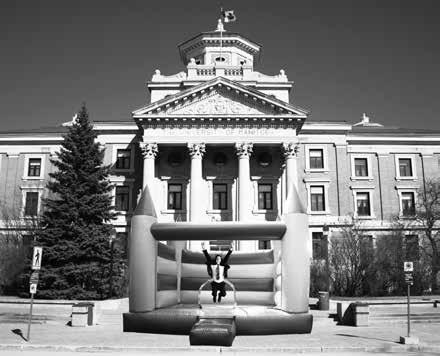
Vice-president defends increased funding for administration’s bouncy castles
MURV BERKLEY, STAFF
The University of Manitoba’s department of administrative perks has seen a 400 per cent increase in their budget over the last three months, according to financial statements obtained by the Ivory Buffalo
The funding increase has been largely tied to rentals of bouncy castles and cotton candy machines, available only to the university’s administration.
Gerrard Hanerd, the department’s vice-president called the added expenditures necessary, citing low morale among senior administrators.
“We have high-ranking univer-
sity administration who are feeling extremely underappreciated, given recent events,” said Hanerd.
“Faculty and students have spent the better part of the last year organizing to stop these cuts without any consideration of how that impacts senior administrators. I don’t think they realize how much time they spent working to slash these budgets. They’re in here cutting department budgets eight, 10, sometimes 12 hours a day. We want them to know that their efforts are appreciated.”
David Chalmers, U of M accounting professor, has been critical of the
department’s funding increase.
“I question the necessity of a funding increase of this magnitude,” Chalmers said.
“The university’s administration has spent tens of thousands a week renting bouncy castles through the summer. Why aren’t we looking at purchasing these bouncy castles or at least leasing them? That would be the fiscally responsible thing to do.”
Hanerd was unavailable to respond to Chalmers’ concerns prior to publication, as it was his turn in the bouncy castle.
PHOTO BY CAROLYNE KROEKER
M
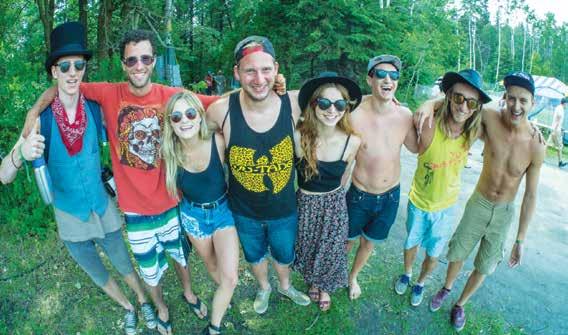
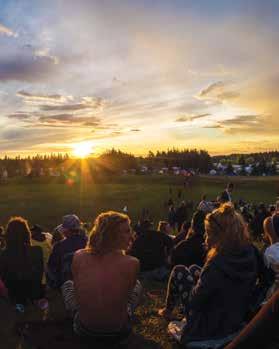
usic festivals are a tradition I look forward to all year long. Each year, it seems more and more festivals are popping up all over North America, each one with its own unique lineup of performers. While the performers at a festival are a big draw, at the end of the day it’s not the most important part, at least not to me. Every festival has something special to offer in terms of its culture and design. The Winnipeg Folk Festival has an amazing family-oriented atmosphere. Forest canopies at the smaller stages present an opportunity to escape from the heat. Bonnaroo has a massive ferris wheel you can use to scope out the festival grounds and a giant mushroom fountain you can run through to cool off. The experience is shaped by making memories with the friends you travel with as well as with the new festival-goers that you meet.
PHOTOS
Plaid to the bone
Criticizing the critiques of hipster fashion
NATALIE SERAFINI, THE OTHER PRESS
NEW WESTMINSTER,
B.C. – Hipsters are the worst, am I right? The way they try to be ohso-original – liking obscure bands that you probably haven’t heard of, drinking fancy craft beer instead of a classic Caribou, and getting all their “vintage” clothing from outlet stores.
Um, well now. This is rather awkward. As my glasses, plethora of plaid, and aesthetic construction would suggest, I like hipster fashion – and I get a little frustrated at its public denigration.
Complaints seem to perpetually be about how contrived hipsters are; how they put so much effort into the selection of thick frames, vinyl, and ukuleles they don’t actually play.
The problem with this line of criticism, though, is that all style is constructed; we make conscious choices when shopping, selecting items that suit our values and style. When we shop for clothing, we do so in an effort to represent ourselves, or at least our sense of style. Very few people walk around wearing a garbage bag, and even that would make a statement (Google the ‘80s “punk” movement for that). Whether you’re choosing thick-rimmed glasses, Ugg boots, or basketball shorts, each item says something about yourself and the image you want to present to the world. Saying one sense of style is “too constructed” makes no sense when all fashion is purposeful – in other words, contrived.
Maybe the problem is that hipsters appear to be inauthentic. They shop at Urban Outfitters, while overtly shirking the mainstream. They put so much effort into their
appearances, while heaving sighs over people who exclusively frequent high-end stores. These sorts of contradictions would mean hipsters are hypocritical at best, and entirely fake at worst. But style is made up of choices, which are sometimes contradictory. Hell, life is made up of choices that are sometimes contradictory. I don’t eat meat, but I will occasionally buy higher quality leather shoes. Does that mean I’m inauthentic? Or does it mean that leather shoes tend to last longer? So many choices go into a person’s style, but sometimes it’s a simple matter of liking how something looks. So what if a vintage-looking lace dress is from Top Shop, rather than the result of hours spent hunting through bins of stained, torn, second-hand clothing. Who cares?
When we shop for clothing, we do so in an effort to represent ourselves, or at least our sense of style
How about that desire to be unique – that can be pretty annoying, when someone’s choices are predicated on being alternative, indie, or out of the ordinary. Yet, wanting to be original isn’t particularly new or noteworthy. If I showed up wearing some hot little number, only to be wearing the exact same thing someone else is, I’d be pretty frustrated. We all want to be dis-
tinct, to stand out in certain ways. That’s been the case just about since the inception of “mainstream.” Goth, grunge, punk, hippie, beatnik – wait a second! All of these styles have something in common: they began as alternative, and then were co-opted by the mainstream as they grew in popularity. Hipster fashion began as a way of subverting what’s popular, doing quaint little things like shopping at second-hand stores and making DIYs. As more people began wearing increasingly big glasses, it made sense for companies to take note and begin selling those items. And thus, vinyl became more widely available outside of dusty old record stores, and finding the perfect plaid became a simple matter of trudging down to TNA.
I’m perfectly fine with admitting that my style is constructed. I own a ukulele that I only pick up occasionally, I like taking pictures of my food, and when my bank account isn’t hurting so much, I like stopping by Urban Outfitters and salivating over stuff I shouldn’t buy. The choices I make in fashion are no more and no less contrived than the choices other people make. Even someone who purposely buys noname brand, or wears clothing they inherited from an ancestor makes a statement about subverting consumerism. We’re all constructing our appearances, for ourselves and our public image.
The next time you want to laugh over silly hipsters, consider what choices are behind your own wardrobe.
– National University Wire
The grass looks greener outside city limits
An exploration of why we love to hate Winnipeg
LAUREN SIDDALL, STAFF
The raindrops race each other down the window while the sky continuously sends new waves of runners. This is the third day of rain in a row; I want my summer vacation back. With each new raindrop that hits the glass, another location gets added to my list of places I’d rather be.
Paris.
Florence.
Montreal. Berlin.
The list goes on.
There are more places on my “To travel to” list than there are weeks in the year. I think the draw of adding to the list is starting to plan the trip – looking up the best breakfast joints, finding out where the architectural masterpieces are hidden, and looking at enough pictures of the buildings that it’s like I’ve already been there, that sort of thing – even though I know I’ll lose my itinerary before I even book my flight, if I ever book my flight.
But still, I lust over the idea of waking up at a repulsive time of day (is it considered “day” at 3 a.m.?) to go to the airport, sit for hours on end in a metal tube while some overly comfortable stranger lets their leg touch mine no matter how far away from them I try to sit, watch some terrible reality show on the six-inch TV screen fastened to the back of a chair that gets jostled whenever the occupant breaths, and eventually arrive at an airport where everyone is sort of sweaty and no one knows where they’re going so we all follow the most competent-looking person
until we finally reach the exit. Then you’re there. And it doesn’t matter where exactly there is as long as it’s not here.
We are always so happy to escape here – maybe because our mantra is “I hate Winnipeg.” But I think it’s deeper than that: we love to hate Winnipeg. We get some sort of perverted sense of pride from hating our city. We will cheer our hearts out for the beloved Jets, and then yell at the TV when they lose in the playoffs because “the Jets suck.” We have a tumultuous romance with the city dependent on hockey, the weather, and the roads.
But there is more to our island on the prairies. Unlike most European cities, whose culture is set in stone (sometimes literally), we are in the position to help create our cultural identity. We’re practically bursting with potential, waiting to be tapped into and recognized.
Maybe that’s why some people claim to hate Winnipeg: because it seems to some that “nothing happens here.” But in reality, there is a monumental amount of activity buzzing just under the surface. Eclectic new restaurants continue to pop up – think the Merchant Kitchen or SMITH, among others. Phenomenal cultural festivals continue to take the city by storm. We are cultivating eminent local artists and musicians.
The cultural landscape we are creating is thriving, if you look in the right places.
We may not be quite there yet, but it will be worth the wait.
PHOTO BY LAUREN SIDDALL
GRAPHIC BY ED APPLEBY
A huge commitment
From Team Canada to UND and back, Zack Williams’s
MIKE STILL, STAFF
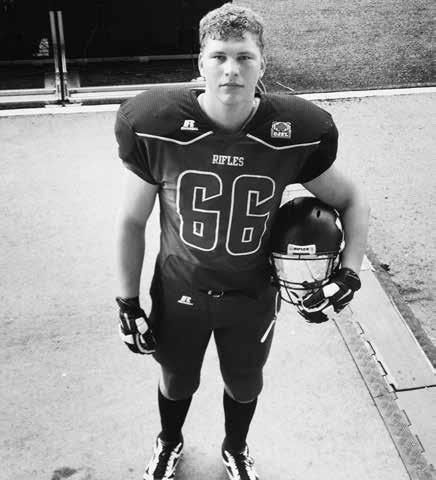
Zack Williams is one of the most humble, polite individuals you will meet. Once he hits the gridiron, however, the six-foot-six, 285-pound offensive lineman turns a switch on, and if you’re in his way, you’ll find
yourself on the turf in a hurry. Williams’s football journey is an interesting one. He played the game from age seven until 12, but then stopped in order to pursue hockey.
Football caught his attention again in high school, though, and he chose to take it up in grade 10 at Murdoch MacKay Collegiate.
Things didn’t go as planned in his sophomore season, unfortunately, as he saw little to no game action. Instead of getting down, Williams took his lack of playing time as motivation – working hard and get-
recruitment journey is a long one
ting serious with his training in the off-season, putting on an extra 30 pounds. That’s when things changed for the better.
“I feel right now, it’s a good shot this year to win a Vanier” – Zack Williams
Williams ended up starting every game at left tackle the following season for Murdoch, and also earned a spot on Team Manitoba for the 2013 Football Canada Cup, where he played in every game at his more natural position of right tackle.
He would earn the nod for Team Manitoba again in 2014, and was also selected to Team Canada later that summer. To cap things off, he chose to forgo his grade 12 season at Murdoch and instead played for the CJFL’s Winnipeg Rifles, where he
was named PFC Rookie of the year.
With all the accolades Williams was gaining, it’s no surprise that he was highly recruited. He talked to every single CIS football team heading into his senior year, except those in the RSEQ conference. Ultimately, he decided to commit to the University of North Dakota, a Division 1 American school.
Things looked great going forward, but Williams knew that his decision to commit to UND wasn’t wholehearted.
“Deep down, I wanted to go to the [University of Manitoba] Bisons, but the pressure I guess you could say, sucked me down,” Williams said.
“Even before the [recruiting] process, I thought that I wanted to stay home.”
Because Williams committed before grade 12, he had a whole year to ponder his choice. Just under a month ago, he opted to de-commit, for a variety of personal reasons. Not too long after that, he became a Bison.
Williams stated that he’s com-
European soccer preview
How the top four leagues will break down
RYAN STELTER
The beautiful game is set to return to countries all over Europe this winter, and it should be thrilling as always. With the season looming, the Manitoban decided to give fans a look into what the four big leagues across Europe should look like come the end of the season.
Spain Barcelona is coming off another historic treble, winning La Liga, the Copa Del Rey and the coveted
Champions League title. They don’t look like they’ll be slowing down, either. With the attacking trio of Lionel Messi, Luis Suárez and Neymar, Barcelona will be terrorizing Spain, and the rest of Europe, with their attacking might. Real Madrid, however, will be standing in Barcelona’s way. With Rafael Benítez as their new coach, and the dynamic Cristiano Ronaldo, they will be contending for the title this year as well.
Atlético Madrid has an outside shot at grabbing the league title, but I think this will be a two horse race.
Atlético lost its main striker in Mario Mandžukić , but bought Jackson Martínez and added many pieces to their defense, so they have the potential to raise a few eyebrows.
The team from Turin has worn the Scudetto on their shirts for the past four seasons
England
The Barclays Premier League is always wildly entertaining, but last year we saw Chelsea dominate the top of the table for much of the season. Of course, they are the favourite to do it again. This season Manchester United, Arsenal, and Manchester City all look poised to take a run at the title as well.
United has brought in a wealth of new signings, including German legend Bastian Schweinsteiger and young Dutch phenom Memphis Depay. They look like they have the best chance of nabbing the title this year.
Arsenal also has a very good squad, but injuries really hit them last season.
Manager Arsène Wenger brought in Petr Čech, formerly of Chelsea, to guard the net and shore up a very good defense and excellent midfield. Attack remains the only question mark.
Manchester City has added Raheem Sterling to their attack and they will be looking to take back their 2014 crown. The team can count on a very good attack, but their spotty defense might be costly, and Joe Hart can only do so much in goal.
Italy
Juventus went through a massive overhaul this summer, losing Andrea Pirlo, Carlos Tevez, and Arturo Vidal.
The “Old Lady” still looks like the team to beat in Italy, though.
The team from Turin has worn the Scudetto on their shirts for the past four seasons and could possibly do it for a fifth time this year. Led by Paul Pogba in midfield, the Italian giants don’t look as if they will falter.
Inter Milan, AC Milan, Lazio, and Roma will all most likely fall under Juventus, but in what position? Roma has brought in Wojciech Szczęsny on loan from Arsenal, so that should help them out in goal. With Mohamed Salah in attack, this Roma team might give Juve a bit of a scare.
AC Milan has spent some money this transfer window, bringing in Andrea Bertolacci from Roma. The Italian midfielder will be a big boost
fortable with his choice to stay at home, and the entire coaching staff likely is too – none more than head coach Brian Dobie though, with whom Williams has a very strong relationship.
“We have a strong connection. He was very welcoming right off the hop, and a very nice guy,” Williams said. “He makes you feel like a part of the team right away.”
With Williams’s recent decision to play for Manitoba, the Bisons now have few different options at the currently vacant right tackle position. The soft-spoken lineman would like to fill that void immediately, and help bring the Vanier Cup back to the prairies. Given his track record, he has a good shot.
“I feel right now, it’s a good shot this year to win a Vanier,” Williams said. “I want to do what I can to go out and win one.”
for the Milan side as they hope to regain their former glory. They might fight for a spot in Europe with their other Milan rival, Inter.
Germany
Powerhouse Bayern Munich has dominated the German Bundesliga for the last three seasons, with the Bavarian club taking home the title in each of those three. It doesn’t look like that trend will be changing, either.
The Munich club has let go of their longtime leader, Schweinsteiger, and brought in Arturo Vidal, a significant upgrade. They also added Brazilian Douglas Costa to provide depth on the wings.
Wolfsburg seems to be Bayern’s biggest threat at the moment. The Wolves took home their first ever DFB-Pokal in 2015 and will be hungry for more trophies. With Belgian superstar Kevin De Bruyne and newly signed Max Kruse in attack, Wolfsburg could take the title away. Leverkusen, Dortmund, and Borussia Mönchengladbach are all outside bets to win the Bundesliga but will most likely duke it out for one of the top four places.
PHOTO PROVIDED BY ZACK WILLIAMS
GRAPHIC BY JEN GOERTZEN
Leading the charge
Bison football players to watch in 2015-16
MIKE STILL, STAFF
With the start of the CIS football regular season just around the corner, the University of Manitoba Bisons are primed and ready to begin their defence of the Hardy Cup.
With a few key players now graduated, including perennial all-stars Jordan Yantz, Evan Gill, and Nic Demski, the 2015 edition will have some big shoes to fill. Thankfully, Manitoba boasts significant depth at every position, and with a number of playmakers returning, the herd should be Vanier Cup contenders again this year.
Below are a few Bison players to look for when the regular season begins on Friday, Sept. 4, in Saskatchewan.
Draft-eligible players will be difference makers
Manitoba will have seven CFL draft-eligible players on their roster for the coming year. Each individual has proven their worth with the Bisons in previous seasons, and will be looked upon for leadership in 2015. Knowing it’s their draft year will also provide additional motivation.
Three of these players (DJ Lalama, Cam Teschuk, and Alex McKay) will likely be captains for the upcoming campaign.
Lalama has stepped up all over the
field for the herd. The starting middle linebacker tallied 40 solo tackles in 2014, which was third in the entire Canada West conference. He also recorded a sack, fumble recovery, and 26-yard interception return for a touchdown.
Fong has racked up five interceptions over his first two seasons with the herd, and is simply a hard working, intelligent player
The previous year, he was a Football Reporters of Canada Conference All-Star as a specialist, after totalling 27 special teams tackles, three fumble recoveries, two blocked punts, and two touchdowns.
Lalama is one of the conference’s most well-rounded players, and his athleticism places him in a category almost all on his own. He’s already shown he can be a difference maker, and he’ll be the vocal leader Manitoba needs.
Teschuk was a captain last year,
and will likely pick up right where he left off in terms of experience and guidance. The St.Paul’s High School grad doesn’t have the size of a lockdown cornerback, at just five-footeight, but makes up for his stature by simply playing smart, technical ball.
He had three pass knockdowns in 2014, and alongside Tremaine Apperley, the duo become two of the toughest players to go deep against. His ability to read the field and help his teammates adjust as the season goes along will be instrumental.
McKay will anchor an offensive line that will be one of the biggest strengths for the herd in 2015, with three returning hoggies.
The veteran left tackle is a no-brainer to assume leadership responsibilities for a now-graduated Robert Smith. He’s been a CJFL AllCanadian, Canada West All-Star, and most recently, East-West Bowl participant.
McKay has also had two of his former running backs get drafted into the CFL (Anthony Coombs and Kienan LaFrance). With a track record like that, it’s hard not to lean on the big man.
Along with the three aforementioned athletes, Manitoba’s other four draft-eligible players should also factor in big this season.
Stalwart defensive tackle David Onyemata, left guard Nevin Gamblin, and receivers Alex Vitt and Dustin Pedersen were all starters in 2014, and that won’t change in 2015.
Onyemata and Pedersen joined Lalama and McKay at the East West-Bowl this past May. Onyemata specifically will be one to watch this season. He’s ranked as one of, if not the, best defensive tackle prospects in all of Canada, and rightfully so.
Lalama is one of the conference’s most well-rounded players, and his athleticism places him in a category almost all on his own
The native of Lagos, Nigeria has played the game for less than five years, and in that time, has become a mainstay in the front four with the Bisons. He’s recorded 44.5 tackles over the past two seasons, and his hulking frame forces teams to double him on almost every snap. This frees up other players to go in unblocked, effectively stuffing most opponents run games entirely.
The last time the Bisons had a defensive tackle this highly touted was when a guy named Israel Idonije strapped on the pads, and with Onyemata’s progression, he could ultimately end up in the NFL one day, much like his predecessor.
Pedersen and Vitt will anchor this year’s receiving corps. The former was hampered by nagging injuries last season, but showed what he’s capable of midway through 2014, after a season-high seven-reception, 103-yard performance against a stingy Calgary Dinos team, in game four.
After an invite to the East-West Bowl, and the graduation of his former Vancouver Island counterpart, Matt Sawyer, Pedersen should be able to take over the versatility role at wideout in 2015.
Vitt is a legitimate Canada West All-Star contender at slotback for Manitoba. He started in seven of the team’s eight regular season games in 2014, before being sidelined with a leg injury. In that time, he put up 489 receiving yards, which was good for second overall with the Bisons.
With Nic Demski now with the Roughriders, and Vitt back to 100 per cent, the future looks bright for the 205-pounder.
Gamblin will return to the left guard spot, which he patrolled for all of 2014. The Brandon native is capable of playing guard as well, which is invaluable for this team. He’ll be playing alongside McKay, who he also played junior football with. The duo’s chemistry makes the Bisons left side one of the most feared in all of the CIS, without a doubt.
The future of Bison football Jayden McKoy, Tyler Fong, Theo Deezar, and Alex Christie, have made their names known for various reasons with Manitoba. They’ll all be expected to step up in 2015, and beyond this year as well.
McKoy and Fong were both part of a stalwart Bisons secondary in 2014, and will lead the way again this year, along with Teschuk.
Fong has racked up five interceptions over his first two seasons with the herd, and is simply a hard working, intelligent player. He’s consistently in the right place at the right time, and the 21-year-old safety has quickly become a necessity for Manitoba in the deep third.
McKoy made a name for himself at halfback in quick fashion in 2014. After redshirting the year prior, he amassed five interceptions in his first full year of eligibility, good for second in the conference. He’s yet another smart, sound player who rarely makes a big mistake, and his poise will be valuable yet again as a starter.
While Fong and McKoy will be instrumental on defence, Deezar and Christie will provide a powerful punch on offence.
Both players are stepping in as starters for the first time, but have already shown they can get the job done.
Christie was a punt-blocking machine in 2014, totalling four, and demonstrating his impressive acceleration, while Deezar stepped up when Yantz was injured last year, and now has full control of the helm.
With a fierce offensive line, both of these players’ jobs will likely be made easier, giving them a chance to contribute in a big way.
PHOTO PROVIDED BY TYLER FONG
A team in photos
Memories from the 2014-15 Bison football season
The University of Manitoba Bisons football team enjoyed a tremendous run to the National semi-finals last season. Despite a few roadblocks along the way, the herd came together as a group, and generated an impressive post-season run. There were many highlights, and below are just a few memories from 2014.
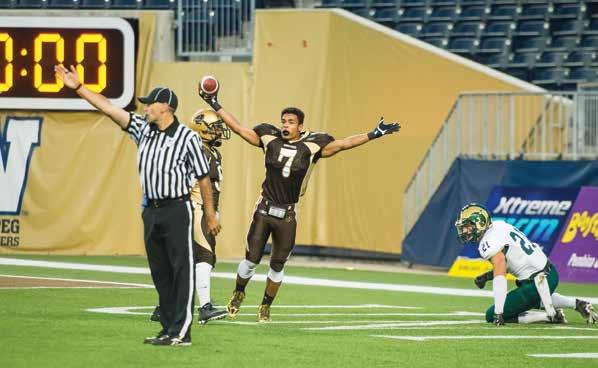
Top photo: Jayden McKoy was a phenom at the halfback position for the Bisons last year. Above, he celebrates his first career CIS interception, alongside cornerback, and
teammate Tremaine Apperley (#8). McKoy would add four more pics as the 2014 campaign progressed, finishing the year second in the Canada West conference.
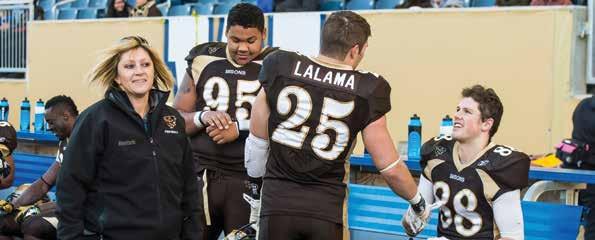
Middle left photo: The herd proved all season long why they were not only a team, but a family. Receiver Zach Regert (#88, seated), and linebacker DJ Lalama (#25, standing) demonstrate just one example of this, with a friendly embrace on the sidelines after a big play, as Kent Hicks (#95, standing)
Bottom photo: Theo Deezar will step into the starting quarterback position in 2015, now that Jordan Yantz has graduated. Here he is, showing his scrambling abilities in game action against the Huskies.
looks on.
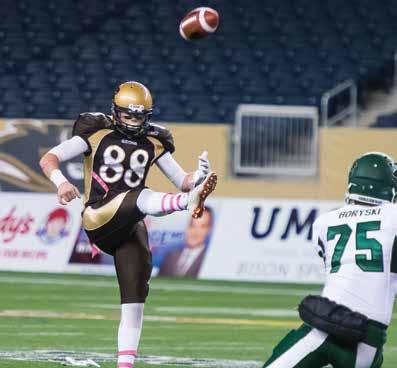
Middle right photo: Regert also has a cannon for a leg, proven by this big boot against the Saskatchewan Huskies. He averaged 37 yards per punt in 2014, with a longest of 67.
PHOTOS BY JEFF MILLER
Second time’s the charm?
KHL could be key to a successful Burmistrov return
ANDY CHE
Alexander Burmistrov’s return to the Winnipeg Jets best exemplifies both general manager Kevin Cheveldayoff’s patience with youth, as well as Burmistrov’s commitment to the franchise he calls home.
The 23-year-old forward departed Winnipeg in favour of playing in the Russian Kontinental Hockey League (KHL) in 2013. This past summer, Burmistrov inked a two-year contract worth US$3.1 million with the Jets, and will lace up the skates in Winnipeg for the second spell of his NHL career this season.
Selected eighth overall in the 2010 NHL Entry Draft, Burmistrov, was deemed NHL-ready by the Atlanta Thrashers at 19 years old, despite his 5-foot-11, 157-pound frame.
Though blessed with speed and soft hands, he tallied a dismal 20 points in 74 games during his rookie season. With limited maturation after two years in Winnipeg, a Russian rendezvous saw him tally 64 points in 108 KHL regular season games – a great improvement on his 58 points in 194 games as an NHLer.
There is no reason why Burmistrov shouldn’t be a consistent second or third line playmaker for the Jets.
Head coach Paul Maurice will come as a welcome relief to Winnipeg’s returnee. His abil-
ity to create offensive cornerstones out of younger NHLers will help Burmistrov to reach his scoring potential sooner rather than later.
The coach of 11 years previously mentored the likes of Jeff Skinner, Eric Staal and Alex Steen early in their NHL careers.
The comeback will also compensate for the loss of Michael Frolík to free agency this past summer. Although Burmistrov doesn’t possess the forechecking ability of Frolík, his mobility alone is an upgrade on the Calgary-bound Czech.
Burmistrov should surpass the 40-point barrier for 2015-16 – a figure which Frolík reached twice in two seasons as a Jet. He is expected to center the third line alongside Adam Lowry, which will complement the playing style of both players. Relentless as a forechecker, Lowry can handle the physical aspect while Burmistrov’s speed creates open ice.
Under a new contract, Cheveldayoff is continuing to be patient with Burmistrov. Yet with an annual average value of US$1.55 million over the next two years, the Jets aren’t taking the risk of a long-term deal in case little progress is made. By doing this, Winnipeg could still offload Burmistrov to another team, as his price tag isn’t overwhelming,
and he’s still rather young.
Cheveldayoff’s no-rush approach also differs from the road taken by Burmistrov’s draft colleagues, Nino Niederreiter and Brett Connolly. Selected fifth and sixth overall in 2010 respectively, both players failed to adjust with the franchises that drafted them and were subsequently traded.
A similar scenario is unlikely to occur with Burmistrov, especially taking into consideration his lowrisk salary. Jets management would probably prefer to see more Burmie for their buck.
The KHL could be key
Perhaps Burmistrov’s greatest weapon to enduring a successful return to the NHL are the two years of experience he gained in the KHL – a route taken by others along with and after him as well.
Selected eight positions after Burmistrov in the 2010 Draft, Vladimir Tarasenko rose as one of the NHL’s leading point-getters this past season. The St. Louis Blues’ sniper is also one of the best Russian NHLers to have emerged since Burmistov’s draft year.
Recently in the NHL, there has been an underlying pattern between the early NHL success of Russian
players and their junior development. Tarasenko is one of the very few Russian NHLers not to have developed his North American game in the CHL. Instead, he honed his skills in six years as a KHLer. This past season, the Yaroslavl native tallied an NHL 10th-best 73 points in 77 games.
Washington’s Evgeny Kuznetsov also opted to reject the CHL in favor of KHL development and played an integral role in the Capitals’ playoff run this season.
Alongside Colorado’s Mikhail Grigorenko and Edmonton’s 2012 first overall selection Nail Yakupov, Burmistrov continued junior hockey by entering the CHL through the import draft. Perhaps it was a step backward in his development, playing against juniors of a similar age while having previously played against professionals in the KHL.
Burmistrov has tallied an NHL career point-per-game average of 0.30, while Grigorenko and Yakupov average 0.21 and 0.46 points per game, respectively.
Having returned to the NHL on the back of two seasons performing against KHL opponents, Burmistrov can embrace the challenge of toplevel hockey once again with reinvigorated confidence. Surely the native of Kazan will be looking to avenge the dismal 10-point season he tallied during his last campaign in the NHL.
His brief hiatus from Winnipeg, however, does not absolutely guarantee he will return an improved hockey player in every attribute of his game. Yet, it does control some damage inflicted by the Atlanta Thrashers when the club introduced Burmistrov into the NHL prematurely.
Don’t forget that he never endured an AHL spell in Atlanta and only spent 22 games with the St. John’s IceCaps as a Jet. A reintroduction into North American hockey fresh off KHL action will perhaps be an easier transition for Burmistrov, similar to the adjustment Tarasenko underwent.
A positive change in Burmistrov’s game would be more than welcome for a franchise undergoing somewhat of a youth movement. Criticized in the past for underperforming, he enters a new era with a playoff-contending franchise and will even wear new digits since Jacob Trouba now wears his number eight.
The Jet’s newest number six on the roster is an old face with a fresh start and will discover the true outcome of his KHL stint beginning on opening night.