graphics eDitor Kelly Campbell graphics@themanitoban.com photo eDitor Miguel Yetman photo@themanitoban.com
Design associate Kellie Huynh
graphics associate Aldo Rios
photo associate Chantal Zdan
photo associate Star Roxas
photo associate Megan Colwell
r eporters
n ews Osho Samuel Adetunji
n ews Hannah Froese
n ews Diana Ubokudom columnist Jeremiah Kopp columnist Shaden Abusaleh arts & culture Olivia Michalczuk
arts & culture Emelia Fournier
sports Kellen Taniguchi
sports Jason Pchajek copy Joseph Gonzalez
MANITOBAN
109 HELEN GLASS UNIVERSITY OF MANITOBA WINNIPEG, MB R3T 2N2
General Inqu I r I es & a dvert I s I n G
Phone: (204) 474.6535
Fax: (204) 474.7651
Email: manitoban@themanitoban.com
Free Med I a Campus Plus Media Services Phone: 1.780.421.1000
Email: advertise@free-media.ca
A “volunteer staff” member is defined as a person who has had three volunteer articles, photographs, or pieces of art of reasonable length and/or substance published in three different issues of the current publishing year of the Manitoban. Any individual who qualifies must be voted in by a majority vote at a Manitoban staff meeting. Elected representatives and non-students may be excluded from holding votes as volunteer staff members in accordance with the Manitoban Constitution. The Manitoban is the official student newspaper of the University of Manitoba. It is published monthly during the summer and each week of regular classes during the academic year by the Manitoban Newspaper Publications Corporation.
UMFA ratifies new collective agreement, classes back underway
Faculty union, U of M reach one-year agreement after three-week strike
Garett William S , staff
The University of Manitoba Faculty Association (UMFA) ratified a one-year settlement agreement Monday evening, calling an end to a strike that stretched on for three weeks.
Shortly after 10 p.m., the union – which represents 1,200 professors, researchers, and librarians –announced that a proposal including workload protections, and enhancements to collegial governance and new guidelines for assessment practices received overwhelming support from membership.
With the agreement in place, all classes affected by the 21-day strike resumed Tuesday, Nov. 22.
The new agreement will be in place until the end of March.
UMFA president Mark Hudson said the wins secured by the union will positively impact both students and faculty alike and would not have been achieved without the labour action.
“There are some very significant gains in there, I think – gains that we never would have gotten without the strike and without the strike vote,” he said.
“Those really do go to the heart of the actual student experience,” he said, “and give us, as faculty members, a little bit more control over how it is that we will do our work and therefore how it is that we will be able to interact with students.”
David Barnard, University of Manitoba president and vice-chanc ellor, said Tuesday he was relieved a deal was struck to bring students back into the classroom.
“It was good to find an agreement,” he said. “We needed to find one and we found one and we’ll move ahead with it.
“I think in other circumstances, we’d rather not have the same kind of disruption in order to find ways to
get an agreement.”
The contract does not include a salary increase after the provincial government directed the university in October to extend the existing agreement an additional year without a raise.
Hudson said the 11th hour intervention, which was raised to the union in the first session of mediation discussions and only days before the strike was called, took some wind out of the union’s sails at a crucial stage in negotiations.
“I think in other circumstances, we’d rather not have the same kind of disruption in order to find ways to get an agreement” –David Barnard, U of M president
“At that point, a pretty significant bargaining chip is off the table,” he said.
“It may be that had the province not intervened at that late stage that mediation would have been successful and we could have avoided the strike.”
UMFA has filed a complaint with the Manitoba Labour Board in relation, claiming the university was not bargaining in good faith after it withdrew a previously introduced seven per cent offer.
While Barnard acknowledged the mandate – which came more than six months into negotiations – was “a sharp turn in the road,” he said it is
common for public sector employers to have restrictions in place from the province.
Barnard said he has not spoken with the province about the next round of bargaining, which will begin in the next few months.
“It wouldn’t be unusual to have some broad expectations from the provincial government,” he said, “but we haven’t had any specific conversations going forward. We’ve just been working pretty hard on the conversations that have just come to a conclusion.”
The agreement
The included workload protections – an issue critical to the union throughout negotiations – are drawn from a governance model in place at the University of Saskatchewan that gives faculty more of a say in developing their own schedule.
Promotion and tenure framework within the agreement substitutes the complete authority of deans for a more collaborative process.
The agreement also places controls on the use of performance metrics in teacher evaluations and promotion considerations.
A six-member committee made up of faculty below the level of dean – three appointed by UMFA, three by the administration – will be struck to study the risks and benefits of the metrics.
If the committee recommends their use, “very powerful limitations” are inserted into the collective agreement, said Hudson.
A joint committee will also be struck to examine gender-based salary differentials, whether a gap exists, and how it can be addressed.
The settlement also includes a commitment by University of Manitoba administration not to lay off any member librarians or instruc-
tors before the start of 2019.
UMFA began picketing Nov. 1, affecting hundreds of classes, after months of negotiations failed to reach a resolution. Members have been without a contract since the last
“Far from being held hostage, as the administration wanted to portray students, students were taking an active role in it” – Mark Hudson, UMFA president
agreement expired March 31.
While a revised academic schedule approved by the U of M senate called for the cancellation of the winter reading break if the strike continued into this week, the university issued a release Monday committing to maintaining the February break as regularly scheduled.
“We knew that was an important break,” Barnard said.
“We were reluctant to see a schedule that gave it up. So when we were very close to being able to stick with a plan that would keep it we wanted to do that.”
Student support “critical”
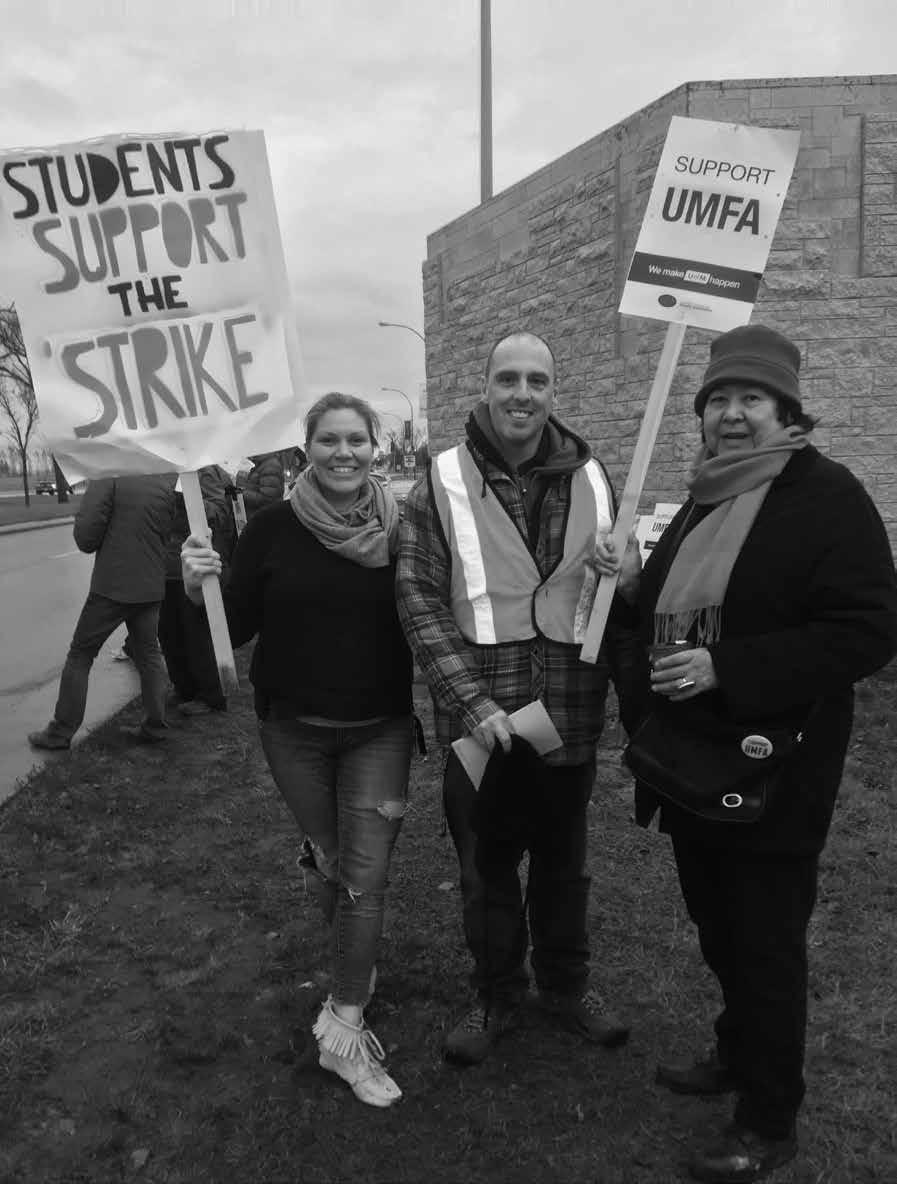
On Nov. 18, roughly 200 students joined UMFA on the picket line before marching into the administrative building as a show of support to faculty.
The rally was organized by members of the University of Manitoba Student Action Network and the
University of Manitoba Students’ Union, which adopted a position supporting faculty’s educational and child care demands at its last regular meeting on Nov. 10.
Barnard said that while administration takes the views of the current student body into account, the university is also looking further into the future when negotiating faculty agreements.
“We need to think about the situation we’re going to leave behind for students who come after the current students, as well, and the ability of the institution to function,” he said.
“When we hear what people’s views are, we certainly take them into account but we balance those against the implications as we move forward into the next year, and the year after, and the decade after.”
Hudson said the student support for faculty not only buoyed the spirits on the picket lines but played a critical role in pressuring the university toward an agreement.
“Far from being held hostage, as the administration wanted to portray students, students were taking an active role in it,” he said.
“Students were actually engaging with the issues. They were looking for themselves to see what the issues were [...] and then becoming real actors in the strike. Not bystanders. Not hostages. But actually taking matters into their own hands, making their voices heard. That had an incredible, critical impact on the strike and our ability to get a good agreement.”
photo by chantal zdan
Friday student rally on campus precedes UMFA, admin agreement
U of M students join UMFA on picketing lines
Diana Ubok UD om, staff
Roughly 200 students joined the picket line and marched into the U of M administrative building as a show of support for the striking University of Manitoba Faculty Association (UMFA) Friday.
The action – organized by the University of Manitoba Students’ Union (UMSU) in partnership with the University of Manitoba Student Action Network (UMSAN) – came only days before the university and faculty reached a tentative agreement late Sunday evening.
Students joined the picket at Chancellor Matheson Avenue and Pembina Highway and representatives from UMFA, UMSU council, UMSAN, the Canadian Federation of Students-Manitoba, and students at-large addressed the crowd before a large group of students and faculty marched toward the administration building.
Once there, a group of nearly 200 students entered the building and recited anti-administration chants for nearly 15 minutes before leaving.
After calling on individual faculties’ student associations to develop their own positions in the first week of the strike, UMSU passed a motion Nov. 10 affirming its support for
UMFA’s demands concerning workload assignments, childcare, protections against the use of performance indicators, and job security for librarians and instructors.
The motion called on the union to organize the day of action to join UMFA on the picket lines as a show of support.
“Our university has been treating students as consumers. Education is not being prioritized at the moment” – Saif Baloch, international students rep, CFS-MB
All four UMSU executives were attending the Canadian Federation of Students (CFS) annual general meeting in Ottawa and did not participate in the rally.
Elizabeth McMechan, a women’s and gender studies student and mem-
ber of UMSAN, said UMSU’s decision to support faculty was laudable and a step in the right direction.
“I'm very proud of UMSU,” she said. “I think that this whole rally that they collaborated with us to organize is amazing and we're really excited that UMSU is willing to work with us ”
McMechan said UMSAN backed UMFA because their demands benefit all students.
“We’re supporting UMFA because they're supporting us,” she said. “If our profs are completely overworked and can’t give as much time to our education, it affects the quality of our education.”
Saif Baloch, international students’ commissioner for the Canadian Federation of Students-Manitoba, said the university has failed to set quality education as its top priority.
“Our university has been treating students as consumers,” he said.
“Education is not being prioritized at the moment. The university is rather focused on capital expansion instead of paying attention to education.”
McMechan said that even though the strike meant being out of classes temporarily, UMFA deserved all the
support they can get.
“When your professor gets back to you on your email at 1:30 in the morning, or you don't get your test back for a couple of weeks, these are all signs of overworked professors – a sign that our university is being corporatized,” McMechan said.
“I have felt the effects of it. I'm definitely stressed as a student” –
Cerah Dube, U of M criminology student
“I don't want to be in a classroom where my professors are being exploited and I don't want to be in a classroom of 200 people where I have to sit on the floor.”
Cerah Dube, a criminology honours student, said the quality of education offered at the U of M was on the line with the strike.
“The class sizes have been increased so much it makes it difficult for me to access my profs,” she said. “The
feedback I get on my assignments, I've noticed there's less comments because the profs have so much to do.”
Dube added that, contrary to the belief some students had that striking faculty members were acting based only in self-interest, she sees the opposite as true.
“There is this misconception that profs are not working towards getting us back into class,” she said Friday. “I don’t think that's true at all. I don't think anyone wants to be out here picketing in this weather.”
Baloch said strikes are an effective measure for ensuring fairness for workers and the strike has considerations beyond the U of M.
“It’s okay to be selfish when it comes to your education,” he said. “But the way I see it is that strikes and unions are very crucial for a socially just society.”
photo by levi garber
Transportation proposals unveiled by U of M office of sustainability
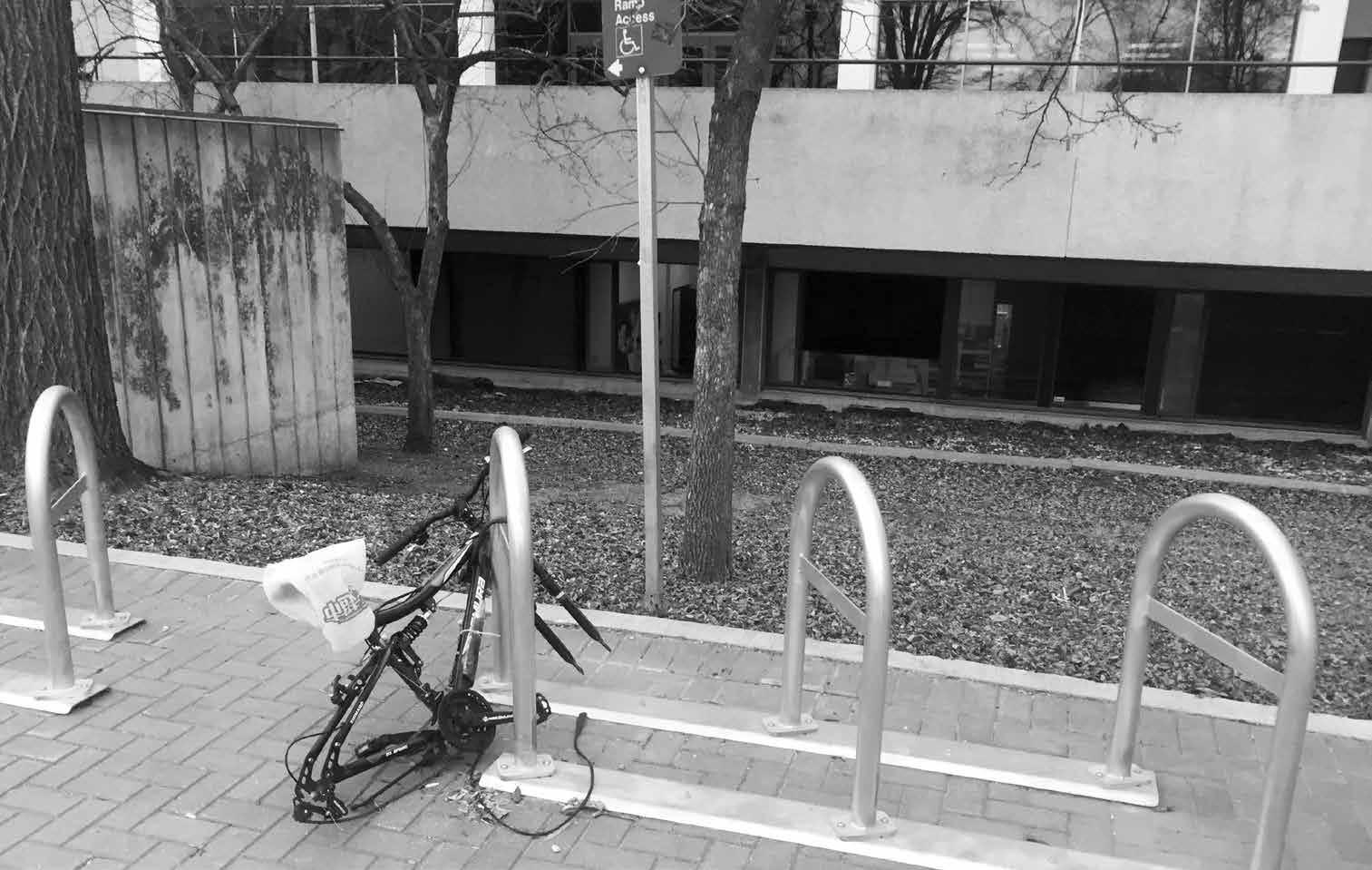
Bike lockers coming to campus to curb theft
oSH o Sam U el aD et U nji, staff
The University of Manitoba’s office of sustainability is preparing to unveil improved transportation strategies based on the results of a 2016 campus commuter survey.
The survey was circulated in January 2016 to poll the commuting habits of students, faculty, and staff.
The office used the results to draft 80 action strategies to enhance sustainable transportation options on both the Fort Garry and Bannatyne campuses.
The survey recorded about 4,300 responses with 39 per cent coming from students, 37 per cent from employees, 16 per cent from faculty and 8 per cent from non-university employees .
Respondents showed that the most common mode of year-round transportation for both campuses is to drive alone, while the least preferred is to park-and-ride.
Respondents were also asked how they preferred to commute to campus. The top three choices for Fort Garry campus were carpooling, driving alone, and cycling. On the Bannatyne Campus, commuters’ most common
mode of transportation was driving alone, followed by carpooling and cycling.
“The most important things any rider can do to ensure their bike is locked safely are to use a high quality lock and lock to something that is secure” – Anna Weier, sustainability engagement coordinator, U of M office of sustainability
According to sustainability engagement coordinator Anna Weier, the feedback was instrumental in
developing strategies for the future.
“We now have a much better sense of how our community travels to our campuses and the types of transportation programs, policies, and infrastructure changes that may influence travel choices,” she said.
Weier said proposed actions include improvements to the carpooling program; making it easier for staff, faculty, and students to find partners; the development of a pedestrian and cycling plan for the U of M’s campuses; and improving the efficiency and affordability of transit options.
Installation of bike lockers
According to the survey results, under ideal conditions, 35 per cent of the respondents from Fort Garry campus would prefer to make use of bikes, while 31 per cent of Bannatyne respondents would rather cycle in their commute.
To facilitate increasing the number of cyclists riding to campus, Weier said the sustainability office is implementing a bike parking and security strategy, which has included bumping the capacity of campus bike racks by
200 spaces over the last few years.
According to the monthly statistics released by U of M security services, there have been 51 reports of stolen bikes this year.
“We now have a much better sense of how our community travels to our campuses”
– Anna Weier
Reports of bike thefts peaked in the summer, with 10 reported stolen in June and 13 in July. Another five bike thefts were reported in August.
“The most important things any rider can do to ensure their bike is locked safely are to use a high quality lock and lock to something that is secure,” Weier said.
To further shore-up bike security, Weier said 24 bike lockers would be installed on the Fort Garry campus
in early 2017. The lockers will be centralized at four main locations: at the extended education complex, the engineering building, Fletcher Argue, and the Elizabeth Dafoe Library.
She also noted that cyclists could register to lock their bike inside the parkade bike station on the Fort Garry campus by contacting physical plant. Bannatyne riders can contact physical plant or Health Sciences Centre parking to gain access to that campus’s bike cage.
Other plans to foster bike usage on campus include the construction of a bike kiosk and cycle plaza in conjunction with University of Manitoba Students’ Union, which will replace the recently shuttered Bike Dungeon.
Weier said plans for pedestrian and cycle routes, including crossing improvements, are ongoing and expected to begin construction to begin in the spring.
photo by miguel yetman
Tanjit Nagra loses bid for CFS national chair
Tensions between CFS and locals dominate annual general meeting, says UMSU president
l evi Garber, staff
University of Manitoba Students’ Union (UMSU) president Tanjit Nagra has lost her bid to become the national chair of the Canadian Federation of Students (CFS) this weekend at the federation’s annual general meeting in Ottawa.
The election took place Monday evening during the closing plenary session of the meeting. Nagra ran against Coty Zachariah , the current chair of the CFS National Aboriginal Caucus.
Nagra lost the election by a vote of 35-24, with each student union local casting a single ballot.
The current CFS chair, Bilan Arte, was UMSU president during the 2012-13 academic year.
Following the session, Nagra said she fully supports Zachariah in his win.
“During our speeches, it was pretty clear that we had similar goals in mind for the federation and that we were both able to address divisiveness amongst the locals within the federation and vow to fix those issues,” she said. “I think that he’ll be great.”
Despite her support for the new chair, Nagra said the strained relationship between UMSU and CFS going into the meeting this weekend was not mitigated .
“I still think it’s quite tense. It’s clear that there’s a divide not only with us, we’re not the only ones,” Nagra said. “Folks that are from locals that don’t necessarily agree with all of the values that CFS upholds are kind of on the outskirts, which is unfortunate because I think
that the body should be to unite students across Canada and not divide them.”
On Nov. 17, before traveling to Ottawa for the meeting, the four UMSU executives issued a joint press release claiming that they were willing to work with CFS despite an unpleasant relationship since taking office in May.
“During our speeches, it was pretty clear that we had similar goals in mind for the federation”
– Tanjit Nagra, UMSU president
“We started our term with the goal of improving the relationship and rapport between our two organizations for the betterment of the student movement,” states the release.
“During the summer, we continued attempts at developing a working relationship with [CFS-Manitoba] with little to no avail,” it stated.
“Unfortunately, our good intentions were not reciprocated and yet again we find ourselves at odds with the CFS entities.”
Past rows
Disputes between UMSU and CFS are nothing new.
In 2013, UMSU held a review of
the union’s membership in CFS following a dispute regarding day-timers.
Members of the then-UMSU executive ripped pages of CFS promotional material out of 20,000 student day-timers after learning they were unable to cancel a contract signed by the previous executive for the purchase of the promotional materials.
The relationship continued to sour and for the next three years UMSU refused to pay its fees to the advocacy group.
In March, UMSU council voted to condemn CFS-MB for expressing what it called political favouritism toward the provincial NDP during the spring provincial election after the lobbying group made statements praising the party’s education-related campaign promises.
In June, UMSU council finally agreed to pay CFS nearly $1 million in outstanding fees.
At the last CFS general meeting in July, UMSU vice-president external Wilfred Sam-King and Brandon University Students’ Union president Nick Brown got into a verbal altercation over UMSU’s previously-unpaid membership fees to CFS, according to UMSU’s Nov. 17 release.
“Despite anti-harassment officers being present at the conference to ensure a ‘safe space’ and staff members of CFS Inc. and CFS-Services Inc., along with CFS-MB chair Michael Barkman all witnessing the altercation as passive bystanders, it was not until the altercation had ended that someone approached our
vice-president external to check on his well-being,” it stated.
On Nov. 2, Sam-King was allegedly prevented from addressing students at CFS’s National Day of Action at the Manitoba legislature, where students from all of the province’s major universities rallied, demanding free post-secondary education.
“They have a huge transparency issue”
– Tanjit Nagra
Motions brought to the meeting
UMSU introduced three motions at the general meeting’s closing plenary that they hoped would “advance the student movement in Manitoba.”
The first motion would amend the schedule of future general meetings to give more time for “proper debate” on proposals.
Another motion would require CFS to publicly release its approved budget within a week of the closing of any future general meetings and that CFS and CFS-Services – a separately incorporated entity that provides services to members of CFS – produce separate, independent budgets.
According to Nagra, CFS’s financial accountability is “questionable” and these reforms are vital to the trust students place in the federation.
“They have a huge transparency
issue. It’s super hard to look at the finances of the auditor reports – why aren’t they available online? Why is it that CFS and CFS-Services are two separate entities, but they combine the budgets?” she said.
“In the June meeting, as well at this meeting, [CFS] reported on finding bank accounts that they didn’t know existed,” Nagra told the Manitoban “I think things like that are super corrupt and I think that there needs to be serious overhaul and an audit on what exactly is happening.”
The third motion UMSU presented at the general meeting would obligate CFS to support UMSU’s motion passed at its Oct. 12 meeting calling for the Manitoba provincial government and U of M board of governors to lock any future hikes in international student fees to the same rate as domestic students.
Following a heated debate, in which Nagra claims she was verbally harassed regarding prior UMSU fee increases, UMSU executives decided to table the motion on international student fees until CFS’s next general meeting in June. Nagra said significant pushback to the motion influenced their decision.
The other two motions UMSU introduced were also tabled by CFS until June.
Editor-In-Chief: Craig Adolphe
Contact: Editor@themanitoban.com / 474.6770
Kellie Leitch could usher in a Trumpesque political movement in Canada
Rhetoric behind anti-Canadian values and barbaric cultural practices is a threat to our politics
Kellie Leitch is a name that seemed to be nowhere and then everywhere in Canadian politics all at once. Leitch, one of Canada’s current Conservative leadership candidates, has had a lot to say in the last month or so.
If you don’t know already, here are some basic facts about the woman in question.
Leitch declared her candidacy for the Conservative leadership in April of this year. She’s a pediatric surgeon who was born in Winnipeg. Leitch has called the late Margaret Thatcher a political role model. She’s also called Donald Trump’s presidential victory an “exciting message that needs to be delivered in Canada,” and based on her statements and political positioning, she plans to be the one to deliver it.
It’s easy to compare her recent prominence to Donald Trump’s rise to the presidency. Both have done a lot of talking about how they represent the everyman and claim to have “called out” the wealthy elites. While Leitch praised Trump for “throwing out the elites,” just this past Monday,
she hosted a $500-a-plate fundraiser in Toronto, organized by Stanley Hartt, who was once the chief of staff to former Prime Minister Brian Mulroney.
What would Leitch consider to be an elite, if not Hartt? Who are the elites, if they are not people paying $500 for a seat at Leitch’s table?
Who are the elites, if they are not people paying $500 for a seat at Leitch’s table?
Also, for the record, Trump’s anti-elite persona is (at least) equally exaggerated. Political allies have confirmed that the silver spoon inheriting, billionaire real estate developer is considering former Goldman Sachs partner Steven Mnuchin for treasury secretary.
Even with her faux anti-elitism considered, Leitch’s most controversial statements have centered around
immigration. In an email survey sent out to her supporters, her team asked recipients if they would support additional screening of potential immigrants and refugees that would seek out “anti-Canadian” values. Even among prominent Conservatives, the move has been referred to as dog-whistle politics. Beyond the obvious Trump comparison, Leitch’s campaign’s anti-Canadian question also speak to her desperate need for attention.
In late 2015, Leitch championed the Conservative’s election campaign promise around what was called a “barbaric cultural practices” tip line. Leitch, through the Harper government, was promoting unease and flatout Islamophobia. That rhetoric has real-world consequences. We need only look to the United States or Britain where following the success of two political campaigns fueled by xenophobia (Donad Trump’s presidential bid and Brexit) reported incidents of hate crimes rose dramatically. Earlier this year, and right after announcing her bid for the Tory leadership, Leitch
was on TV adamantly expressing her regret over announcing the tip line. Her regret, however, means nothing; the damage has already been done.
Even after her much published show of regret, Leitch is still stoking anti-immigrant sentiments with her questions about anti-Canadian values. While what, exactly, Leitch and her team believe to constitute anti-Canadian values is still unclear, one has to wonder.
As the child of a Middle Eastern Muslim immigrant, I find myself wondering if my mother, with her thick accent and the fabric-coated Qur’an she keeps on her always, would pass Leitch’s test. Would my aunts? Would my elders? Would my friends? What is a Canadian value? Islamophobic hate crimes have doubled in Canada between 2012 and 2014. Does that not qualify as barbaric? While I would never use my family or my peers to define all Muslim immigrants – I’ll leave that kind of broad-brush painting to the people who tried to create an anonymous tip line for reporting on “barbaric cultural practices” – the fact that the definition of anti-Canadian values was not explained in the email suggests that it could essentially mean anything.
Leitch, in what I can only assume is a scramble for damage control, has been tweeting graphics claiming that positive values like equality are “Canadian values” and that intolerance is an “anti-Canadian value.” That’s all well and good, but Leitch’s actions don’t correspond with these claims. Her strongest campaign points – shaking up Canada’s elite, and altering our country’s approach to immigration – are based on headlinehunting half-truths. Is hypocrisy a Canadian value?
Leitch, despite claiming to not support Trump, has values in common with the American presidentelect, and her staying power is Trumpian in method. Her modus operandi is what Trump’s was: seizing media attention by any means possible.
Perhaps in a more idyllic, alternate universe, presidential candidates would be cut from major news coverage and their shot at the presidency after facing rape allegations or, say, openly mocking a disabled reporter. However, the opposite happened. For nearly two years, Donald Trump was everywhere. News sources eagerly reported every one of his fumbles under the guise of journalistic integrity while the ratings (and ad revenues) rose, thus turning one of the most important campaigns in American history into a reality television format that Trump flourished under. While it wouldn’t be fair to place the blame for Trump’s newfound power entirely on the media, it was undeniably a factor.
What comes next for Leitch is as much up to us as it is up to her. There will always be fearful, paranoid, and flat-out racist Canadians for Leitch to feed phrases like “anti-Canadian” and “barbaric cultural practices” to. For every news story about Canadian citizens welcoming and supporting Syrian refugees, there is one where those same Syrian refugees are subject to threats and harassment by Canadian citizens.
Right after announcing her bid for the Tory leadership, Leitch was on TV adamantly expressing her regret over announcing the tip line
If Leitch’s track record remains the same, one can only assume she will continue to spout overtly controversial statements, get the news machine rolling, and eventually slightly backtrack.
Even now, Leitch has gotten more media attention than the other Conservative candidates combined. When we give phrases like “barbaric cultural practices” the media’s attention, it insinuates regressive values and a certain culture are inherently entwined and makes nascent racism a valid stance for a politician to take. By giving attention to these fallacious claims, we give those statements power. We should learn from what just happened in the United States. For Canadians to shrug off her statements as just politics is foolish – it’s dangerous. To allow Canadian politics to devolve into the same realitytelevision dystopia that the United States’ election became would be the worst mistake we could make.
We can only wait and see what “anti-Canadian values” Kellie Leitch will condone next. If she continues to utilize the news media and creates the same divides Trump did, we could be looking at a frightening Conservative leadership come May 2017.
graphic by kelly campbell
After the storm: what happens now that bargaining is over?
Faculty and administration must learn how to work together in the long-term
j eremia H kopp, staff
The recently resolved strike at the University of Manitoba has revealed a deep divide in the university community. The confrontation had reached a fever pitch with friends and colleagues pitted against each other in the political pressure cooker of a collective bargaining process. From my perspective as a student, I have never witnessed that level of frustration from my peers. This is understandable – students had their academic schedules upended with little insight into when bargaining was to be resolved. Typical of high intensity political situations, rhetoric and emotion often dominated the debate on both sides.
Despite what many people say, both parties genuinely believed that their decisions and actions would lead to a better learning outcome for students. Behind the talking points, UMFA and administration are dueling over competing visions for the direction of the university. As these divergent paths are fought over, students are often pressured to pick
sides. While there are many passionate students who took different positions in this debate, the majority of students just wished that administration and UMFA would quickly reach an agreement. Most understand that both parties are essential to university governance and are doing what they think is best for students.
The fundamental issue throughout this collective bargaining process is just how differently administration and some faculty see our university and its future
In last week’s issue of the Manitoban, political studies profes-
sor Radhika Desai penned a magnum opus of what many UMFA members feel that they are fighting for. It was the first time that this vision has been articulately expressed to the university community and is an appreciated contrast from the typical soundbites that were distributed on the picket lines. This ideology may be harder to communicate, but it is what should be expected of our academic thought-leaders in this public discourse. Faculty and staff had real concerns, such as rapidly increasing workloads and class sizes, but often these core issues are diluted with red herrings like attacks on administrative pay or the university’s marketing budget, which is relatively small when compared to other U15 schools. These are not issues that are even remotely central to the future of our academic institution and their use in the debate had distorted UMFA’s real cause. Yet this kind of messaging is consistently used because it is easy to understand and invokes an emotional response. Similarly, we need the administra-
tion to more clearly express why they feel that the university’s strategic plan will make our degrees more competitive and result in a better learning environment. Administrative decisions are guided by our position in the market, government funding, and relatively low tuition rates. There are many good reasons for why decisions are made but it is not always communicated in a way that students can relate to. It must be acknowledged that there is a disconnect between students and actions taken at senior levels of administration. While this may just be a natural separation that will always occur, ideally, students would have an understanding of what the university’s priorities are. Fairly straightforward bargaining issues are not resonating amongst the student body and that should be cause for concern. The fact that a plurality of students do not see the relevance of department heads or deans having the ability to direct programming, for example, points to a more systemic gap between students and the
administration.
The fundamental issue throughout this collective bargaining process is just how differently administration and some faculty see our university and its future. While competing narratives and viewpoints should always be welcomed, especially in academic environments, paths that are too divergent will become an impediment to progress. If both parties cannot reconcile their different visions and begin moving in the same direction, the school will become paralyzed beyond collective bargaining. Now that this negotiation has ended, how will both sides pick up the pieces? No matter the outcome, the true test of leadership will be in how this relationship between the faculty and administration is repaired. The status quo has simply been unacceptable. If administration and faculty cannot learn to work together over the long run, ultimately, it will be the students that suffer.
photo by megan colwell
Students are minds, bodies, and souls, not customers
The U of M strike is not about money
As a Jesuit priest in the Roman Catholic Church as well as professor of Catholic studies and education at the University of Manitoba, my decision to participate in the UMFA strike is ostensibly not about money. I took my vow of religious poverty more than two decades ago and am content with the salary that I receive.
The issue for me is that education on many university campuses has turned into an impersonal, abstract process. With the rise of neoliberalism within the realm of academia, it is increasingly essential to struggle against the tendency for administrators to objectify our students. They are more than just nameless, tuitionpaying entities. Every student in my class is a human person with a deeply unique history and identity.
Nevertheless, with increased class sizes and decreased resources, professors are losing control of this relational aspect of the process. In the Jesuit tradition – which remains the pedagogical foundation upon which St. Paul’s College has been built –our professors adopt a humanistic approach that recognizes students are minds, bodies, and souls. If we are not able to deal with them in all their complex and dynamic individualism, then education is merely a commodity and professors are simply cogs in the system.
The Roman Catholic Church has long supported the right for workers to strike. On May 15, 1891, Pope Leo XIII released a major encyclical titled Rerum Novarum. In this, he outlined the rights and responsibilities of workers. He emphatically claimed that all who labour have a right to form into guilds and unions, especially when an injustice has taken place in the workforce.
As an educator in Canada, I see that a great injustice exists. There is a continued move toward dehumaniz-
ing the students at universities across our nation. The push to make postsecondary education an abstract and impersonal endeavour will ultimately hurt many individuals. Yet, in my mind, the greatest to suffer will be the students themselves.
I am not walking the picket line because I have a need for more money. Rather, I am walking because students have a right to professors who can engage them as individuals and not merely as another coin in the coffer.
The professors are risking much because they in fact care deeply for their students and will fight for the very soul of our postsecondary education
I urge every member of the University of Manitoba to consider seriously how UMFA has not gone to strike for its own motives. Rather, the union pickets because it cares deeply for the students and has committed to fight for the very soul of our institution. Even if you cannot spare an hour on the lines in solidarity, then – at least – become aware of the core issues. This is far more than an usversus-them dispute. We are in this together, and nobody walks the line alone.
Editor's note: This article ran online at www.themanitoban.com before the end of the UMFA strike.
photo by Jeffrey burwell
Winnipeg should follow Sweden in their dramatic overhaul of road safety regulations
O
n Nov. 14, Winnipeg commuters witnessed two pedestrian-road crashes. One was at the intersection of Kenaston Boulevard and McGillivray Boulevard, which resulted in a fatality, and the other was at the intersection of Morley Avenue and Osborne Street. Days later, another pedestrian was hit by a car at the corner of Osborne Street and Wardlaw Avenue. These recent pedestrian-road crashes only highlight the necessity for our city to catch up on improved and safer roadways. This is especially important when you consider the fact that almost 50 per cent of pedestrian fatalities in Manitoba happen when the pedestrian is crossing an intersection. It is no doubt that road safety is a public safety issue, and as our city continues to grow, the urgency for an improved road safety strategy is only becoming more and more apparent. Many have advocated for the city to adopt Vision Zero, including city councillor Janice Lukes.
Vision Zero is a road traffic safety project, first implemented in Sweden back in 1997, that aims to completely eliminate traffic deaths and serious injuries. This long-term strategy is applied through making changes
in road safety rules and regulation, improving road infrastructure, and designing roadways that lessen the risk for motor-vehicle crashes. The project even includes implementing changes to the culture of traffic-safety – such as highlighting the importance for drivers to be more attentive and cautious of speeding. In Sweden, Vision Zero has been a massive success. It is high time Winnipeg follows that lead.
The awful occurrences of road-related injuries and fatalities on Winnipeg roads can and should be reduced
Sweden is now known for being home to the world’s safest roads because, despite experiencing an increase in the number of cars driven in Swedish roadways since 1970, the country witnesses fewer than three traffic-related fatalities for every
100,000 Swedes. In comparison, a 2014 report by Transport Canada reveals that, per 100,000 Canadians, there are 5.2 traffic-related fatalities.
In January of this year, Canada adopted Vision Zero as a federal strategy, but it has yet to be implemented in our cities. Edmonton became the first Canadian city to adopt Vision Zero when its city council approved of the plan in 2015.
Prior to its adoption of Vision Zero, Edmonton created an office for traffic safety – the first in North America – and in spite of the population growth, the changes made by
this department to improve road safety have resulted in a significant decrease in traffic related injuries and deaths since 2006 – a drop of almost 53.5 per cent. Ten years later, as part of its Vision Zero goal to continue reducing traffic injuries and fatalities, Edmonton has spent nearly $5.7 million to upgrade 30 intersections known for their high collision rates. These changes include improving pre-existing pedestrian crossings and building new ones, installing turn-on-the-arrow-only left turn signals, upgrading school safety zones, and installing digital driver
The Conservative Party of Canada is ripe for a populist takeover
Kellie Leitch stands out in a crowd of conventional conservatives
j e SS e b lackman
Canada’s official opposition has begun the ritual of finding a new leader – one that can lead the party to victory in the 2019 federal election.
As we find ourselves on the heels of the American election and a year into a new Liberal federal government, this leadership race can seem insignificant. However, those are two good reasons the Conservative leadership race is worth following.
Based on the Saskatoon leadership debate the night following the election of Donald Trump, there was a clear sense the candidates running for Conservative leadership are lacking a sense of new direction, rather choosing to stick with what the Harper government has left them with. Despite this, the Conservatives need be taken very seriously. Populist politics are back in vogue; whether thinking of the Ford legacy in Toronto, the far-right in Europe, Brexit, or Trump, appeals to voter frustration and alienation have been all-too-present in politics today.
A new leader could tap into antiestablishment tendencies that exist in Canada. Our national political landscape is not beyond the wave of disaffected voters defying pollsters around the world.
At the base of many of these movements is a push for jobs and economic growth. If the debate in Saskatoon is any indication, the Tory platform will centre on economic issues. What the leadership candidates agree on is that Trudeau and the Liberals are destroying the good work of Stephen Harper.
Solutions to the Liberals’ reign include core economic changes revived from the Harper-era: capping spending, cutting debt, slashing personal and corporate taxes, downsizing bureaucracy and regulations, and opening internal borders for professionals to relocate to different provinces.
More divisive suggestions branched out from a question about the Liberals’ record on job creation. Candidates proposed policy changes such as getting young people into the
workforce to replace temporary foreign workers, establishing free trade with Asia and Europe, renegotiating NAFTA, lowering the corporate tax rate, cutting subsidies to big corporations, rejecting carbon taxes, and abolishing the Indian Act.
Some candidates highlighted their goal of working with U.S. presidentelect Trump to maintain trade ties with the United States. Others see Trump’s victory as an opportunity to diversify Canada’s export portfolio and reduce Canada’s reliance on U.S. trade. However, no individual positions set forth by the debaters set any leadership candidate apart.
The bottom line for the Conservative party is a platform that promotes free trade with markets around the world as well as reduced barriers for the interprovincial movement of goods, services, and skilled and experienced workers. This unified Conservative vision amounts to eliminating borders whenever possible for trade.
Nauseatingly uncreative clichés
are carelessly flung around to describe the economy, making each candidate sound like the next: “the government needs to get out of business,” “the government needs to be run like a household,” which all translate to the misguided idea that Canada’s future generations need to be saved from the spend-happy Liberals.
What the leadership candidates agree on is that Trudeau and the Liberals are destroying the good work of Stephen Harper
Too bad government is neither a household nor a business; otherwise these famed Conservative analogies might actually be useful. Most candidates come from simi-
feedback signs on more and more highways. The $5.7 million spent on these changes has been funded entirely through photo radar tickets. We are far too physically vulnerable in vehicle collisions to play chance with fate – the likelihood of surviving an injury if struck by a car travelling at 60 km/h is very slim. It falls on us to make policy changes toward increased road safety and provide strategic investment in order to ensure safer and more secure roadways for pedestrians and drivers alike.
lar backgrounds, often the private sector. Many candidates worked closely with Harper, something they don’t want any voter to forget. They’re essentially one and the same, all lacking inspiration.
Kellie Leitch is the exception. She has been outspoken with her support for xenophobic screening policies reminiscent of Trump to protect her version of “Canadian values.” Quite frankly, the other Conservatives do nothing but regurgitate the plan they credit with bringing Canada out of the recession and dish it with different sprigs of social conservatism for garnish.
Unless they can find a way to harness a new, coherent vision for the country that sets them apart, their chances of victory in the next federal election are conservative at best.
photo by star roxas
Space conference hosted in Winnipeg
The Canadian Space Summit shows how Winnipeg is at the “centre of it all”
cH antelle D U boi S
For one weekend, Canada’s space industry came together in Winnipeg.
The Winnipeg chapter of the Canadian Space Society (CSS) hosted the 15th annual Canadian Space Summit from Nov. 14-15.
The non-profit two-day event in Winnipeg welcomed over 80 delegates from across Canada, the U.S., and further abroad to the Inn at the Forks. The delegates included students, academics, educators, industry experts, military representatives, and general space enthusiasts. The conference theme, “The Centre of It All,” was chosen to highlight Winnipeg as not only the geographical centre of Canada, but also a central area for research on space activity.
Workshops and tours
One of the Canadian Space Society’s main goals as an organization is to use outreach and education keep Canadians informed on the progress of space development.
As a precursor to the conference, the CSS partnered with the Manitoba Museum to host a series of public events on Nov. 12 and 13, along with several workshops during the actual Canadian Space Summit.
The CSS has made a particular attempt to reach out to the public through art, and regularly includes gallery exhibits or artistic workshops in its repertoire of activities. During the weekend events, a series of workshops were held which included beginner and intermediate rocket construction, and a solar system workshop for kids which uses the Manitoban grade six teaching cur-
riculum to get children to imagine, and then paint, what they believe a solar system looks like.
Throughout the weekend, the Manitoba Museum also provided special programming at the planetarium and in the Touch the Universe science gallery. Present in the science gallery’s fun zone was a replica of the Sputnik satellite, the first satellite launched into orbit in 1957 by the former USSR.
The CSS has made a particular attempt to reach out to the public through art, and regularly includes gallery exhibits or artistic workshops in its repertoire of activities
On Sunday, a tour of the Magellan Aerospace facilities was also held. Magellan Aerospace is currently working on completing and testing its RADARSAT-2 satellite bus, and as of last year completed the construction of its advanced satellite integration facility in a partnership with the University of Manitoba.
The public event day activities were brought to a close Sunday evening with a showing of Mars One, which made its debut during the
2015 Winnipeg Fringe Festival. The quirky, one-person show uses lighting and props to tell a story of a person invited to live on Mars. Integrated into the show are a series of interview recordings of local Winnipeggers reacting to the controversial Mars One initiative.
After the public event days, the Canadian Space Summit also offered several tours and workshops. Day one of the Summit invited participating delegates to the Canadian Museum for Human Rights for dinner and a tour of the museum.
During day two of the Canadian Space Summit, the “Getting Space into the Classroom” workshop was held with educators from K-12, university, and outreach representation. The discussion focused on educational and outreach initiatives that benefit Canadians.
Speakers and presentations
A “Space Leaders Roundtable” was also held with several representatives from non-profit organizations, non-governmental organizations, universities, and industry representatives. The discussion – lead by Kate Howells, global community outreach manager from the Planetary Society – focused on how to coordinate an effort to communicate clear objectives for the Canadian government to take the direction of the Canadian space industry.
Manitoba Aerospace also held its young professionals luncheon where participants were given presentations by Tom Tessier, president of Solara Remote Data Delivery Inc., Khaled Shariff, CEO of Project Whitecard,
and Steven Freeland. There were a multitude of topics discussed, including VR technology’s impact on the local and global industry, and the legal challenges of commercial space initiatives.
John Spray, director of the Planetary and Space Science Centre at the University of New Brunswick, gave a keynote presentation on the science being conducted on Mars by the Curiosity Mars rover.
The presentations were a large draw at the Summit, as many visitors had a science background or were pursuing aerospace as a possible career.
“Some of the sessions that I enjoyed the most were definitely ones in space applications,” said André Marchildon, a mechanical engineering student from the University of Manitoba faculty of engineering. “I’m a final year mechanical [engineering student] with a focus in aerospace, so hearing what’s happening right now in the aerospace industry is very interesting.”
The Canadian Satellite Design Challenge
Along with the workshops, speakers, and technical sessions, the Canadian Satellite Design Challenge (CSDC) held its systems requirement review for the upcoming competition, which will span from 2016 to 2018.
The CSDC challenges post-secondary students from across Canada to build and compete with nanosatellites. These satellites, which are roughly the size of a two-litre milk carton, must be designed and built by the student teams, and must have a scientific payload that can collect
data for at least a year. At the end of the two-year competition cycle, the teams then proceed through satellite testing before being judged by industry experts. 12 of the 14 participating teams were present for the review lead by CSDC manager, Larry Reeves.
After the conference
While the delegation to the Canadian Space Summit conference was relatively small, the diversity in experience, disciplines, and interests facilitated plenty of productive discussion among participants.
Sophie Orr, a graduate student in space studies at the University of North Dakota, traveled to Winnipeg to attend the conference.
“The wide variety of talks gave us the opportunity to meet experts from fields that we don't normally interact with,” said Orr.
“This played into the idea of space as an interdisciplinary field, where it is important to know about all aspects of it in order to make informed decisions.”
The next Canadian Space Summit conference will be hosted in Ottawa on Nov. 21 and 22, 2017, with the theme “Canada’s Next Space Generation.”
photo by chantelle dubois
CRISPR method of gene editing used on a human cancer patient for the first time
This
simpler, cheaper method of editing genomes could be the next big cancer treatment
m alak a ba S , staff
CRISPR, a relatively new method of editing genomes, has been used for the first time on a human patient in China.
Let’s break down this pretty amazing statement. CRISPR technology is primarily built to fight cancer – the patient in China has metastatic lung cancer – and works by allowing scientists to focus on a specific gene, tweak it, and insert it back into the body of the patient in hopes that it will attack the cancer cells. This is done through the use of an enzyme (which can cut strands on DNA) and a piece of RNA that is used to guide CRISPR to specific parts of the gene and then bind to it. With these two molecules working together, scientists can alter cells. While CRISPR has been tested on monkeys and human embryos, this marks the first time a human has been given this treatment.
This particular patient was treated by a team of researchers led by oncologist Lu You at Sichuan University. The team extracted cells from the immune system of the patient, removed a gene using CRISPR technology, and then cultured the cells to create a large batch. These cells were then injected back into the patient. The gene removed is one that cancer-
ous cells use to multiply further, and it’s hoped that these edited cells will be able to fight, and even destroy, the cancer. While not much is known of the patient’s condition, Lu noted that the treatment went well, and that the patient will be receiving a second injection in the near future.
The gene removed is one that cancerous cells use to multiply further, and it’s hoped that these edited cells will be able to fight, and even destroy, the cancer
While this is not the first time gene editing has been used to treat cancer, the CRISPR method is so revolutionary because of its simplicity and its low price tag. While other treatments required more strenuous treatments for both the scientists and the patients (an infant treated with
a different method of gene editing last year had to have her pre-existing immune system destroyed in the process of receiving the edited cells), CRISPR works as more of a cut-andpaste tool, and scientists can paste in ‘steps’ to fight cancer cells. Basically, scientists can give the cells they’re tweaking instructions to attack specific, cancer-causing cells.
Now that the first patient has reacted well to the treatment, the research team now plans to treat 10
people, who will be monitored for six months.
While gene editing is a promising innovation in the field of medical science, its progress has been hindered in the past due to ethical concerns. The most common argument is the fear that gene editing could eventually progress into what is often called “designer babies,” a sort of dystopian future where embryos are genetically altered to maintain a standard of desirable traits.
While this might be a ‘side effect’ of sorts to progressive gene editing, there have been great strides in the field of cancer treatment. This particular treatment, for example, bypasses many of the ethical concerns surrounding gene editing as it does not create hereditary genetic tweaks. American trials using CRISPR to treat cancer cells are expected to begin early next year.
U of W alumnus releases first digital novel
Local author’s novel explores the fascinating and urban lifestyles of millennials
tobi n ife S i, staff
U
niversity of Winnipeg alumnus
Jonny Symons has spent the last seven years working to get his manuscript published. In 2008, after receiving a grant from the Manitoba Arts Council, he pitched his work to several publishing houses. His efforts may have proved futile but that didn’t stop him.
Today, thanks to Amazon.com’s self-publishing service, Kindle Direct Publishing, Symons is a published author in his own right. His first novel, Take Me Out Tonight – which is now available for sale, digitally, on amazon.com – is a testament to the sort of transformation the publishing world has experienced over time.
A bachelor of arts in creative writing graduate, Symons’s exploration into being an author began with a short creative writing assignment in his first year as an undergraduate. Over the years, the assignment developed to become the manuscript for his new novel.
That being said, Take Me Out
Tonight ’s plot details a story that is indeed true to its time. Set in modern day Winnipeg, the novel covers the lives of three 21st century kids who unwittingly set off on a journey to self-awareness via aimless exploration. In an interesting way, this is a story that is capable of resonating with today’s youths.
Pete, Sara, and Tobias are millennials, on the verge of their adulthood, who rummage through the moral decadence of their time and come to terms with the advances and adversities of their society – social media, pop culture, and addictions, amongst others.
Nevertheless, like many young people today, these characters have artistic talents and are aware of the fact. Their gifts, relationships, and lives are constantly being affected by the choices they must make as they navigate through adolescence.
In his 324-page novel, Symons details the experiences of his characters from their perspective. This
gives the reader a unique understanding of how these youths view themselves and the world around them. Through plot twists as well as funny and thought-provoking conversations, this novel will keep readers engaged. Despite being a novel about millennials, Take Me Out Tonight is a beautifully written literary piece that will be appreciated by readers of any generation. More so, Symons’s success with getting it published and released, albeit digitally, is a comforting sign for aspiring writers out there.
The digital copy of Take Me Out Tonight is now available for download at amazon.com /Take-OutTonight-Jonny-Symons-ebook/dp/ B01M0OOZB5
Winnipeg Comedy Showcase returns for its 12th edition
Winnipeg Comedy Showcase returns for the 12th edition
e melia fo U rnier, staff
T
he Winnipeg Comedy Showcase (WCS) is one of Winnipeg’s most popular comedy events. It started two years ago, when Kevin Mozdzen, who works as a media personnel for the Park Theatre alongside being the founder and artistic director of the ODDBLOCK Festival, contacted local comedian Jared Story to discuss how the Park Theatre could contribute to Winnipeg’s comedy scene. Story began the WCS as a weekend comedy showcase as opposed to the weekday bookings that comedians usually have. He decided to make it a quarterly event that features six of Winnipeg’s most talented comedians, both new comers and veterans, delivering their best material. There is no underlying theme or category that performers have to abide by. The only restriction is that the same comedian cannot perform on backto-back shows, allowing for a wider
variety of comics.
The first WCS took place on Jan. 24, 2014 and sold out two weeks in advance. Since then, most subsequent shows have sold out. Story hopes to build on the showcase’s success with the upcoming 12th edition, which takes place Dec. 16 at the Park Theatre.
“We may have stumbled across this format, but we must be doing something right,” said Story.
The upcoming show features Ashley Burdett, winner of this year’s Winnipeg’s Funniest Person with a Day Job; BUCKO, a sketch comedy husband-and-wife duo made up of Lauren Cochrane and Aaron Merke; H.U.N.K.S. duo Tim Gray and Matt Nightingale; Chad Anderson; and Kyle Bergstresser.
Burdett has over ten years of improv experience. For six seasons, she performed a weekly improvised
soap opera with local improv group Soap Scum Presents, and made her stand-up debut at Dana Smith’s Women’s Open Mic last year. She draws influences from goofy, honest, silly performers, like Amy Poehler, Bo Burnham, and Kate McKinnon, to name a few. Being a comedian who is able to talk and joke about difficult scenarios has helped Burdett get through some tough times.
“If by talking about some tough stuff for me can help someone else, that makes me really happy. Like, if someone sees me and thinks ‘aw, man, yeah! These dating situations and living alone stories make me feel better knowing that someone else is going through them!’ that makes me feel really good,” said Burdett.
In a similar fashion, BUCKO’s Lauren Cochrane finds comedy to be a great medium to connect with others. She draws personal influences
from the likes of comedians such as Catherine O’Hara, Maya Rudolph, Molly Shannon, and Lucille Ball.
“[Comedy] appears naturally everywhere if you look for it. It’s one of the best ways to communicate and tell stories” – Lauren Cochrane, member of comedy duo BUCKO
“[Comedy] appears naturally everywhere if you look for it. It’s one of the best way to communicate and tell stories. Humour can disarm people so they are more able to listen.
You can slip a lot of life lessons in comedy,” said Cochrane.
The 12th Winnipeg Comedy Showcase will take place on Friday, Dec. 16 at the Park Theatre. Tickets are $10 and can be purchased at the Park, Music Trader, and Ticketfly, as well as from any of the comedians on the bill. Doors open at 8 p.m. and the show starts at 9 p.m.
photo provided by Jared story
photo provided by Jonathon symons
Steve Bell to celebrate twentieth album
Local
gospel singer-songwriter explores love, compassion and wisdom on new album
e melia fo U rnier, staff
Oist. In a unique way, he sings his way through the album playing an acoustic guitar and blowing a trumpet.
“Given the days we’re in, I think it would bode well for us all to listen intently to Indigenous voices around the world” photo
ver the last three decades, Steve Bell, one of Canada’s bestknown Christian singer/songwriters, has released music that is appreciated by Christians and non-Christians alike. His music explores spirituality through love, compassion, and wisdom.
Released on Nov. 1, Bell’s latest and twentieth album, Where the Good Way Lies, builds on these virtues and on Nov. 26, the Juno Award-winning musician will be celebrating the album’s release with a performance at Grant Memorial Church. The album showcases Bell’s prowess as a songwriter, singer, and instrumental-
Where The Good Way Lies features Winnipeg rapper Fresh I.E. and backup singing by traditional pow-wow singer Ray Co-Co Stevenson. By collaborating with these Indigenous artists, Bell sought to incorporate some of their wisdom into his new album. This is particularly evident in the title track, which is inspired by a quilt made by Métis elder Ruby Payette and highlights the seven sacred teachings of Indigenous wisdom – courage, humility, honesty, truth, respect, wisdom and love.
“It was the quality of [Payette’s]
craft that moved me, but then those seven words themselves dug into me, such that a melody started to form and I knew a song was coming,” Bell said. “It didn’t take long to begin to reflect on how significant the number seven, representing perfection and wholeness, is to Judeo-Christian spirituality, and soon the title track emerged.”
This juxtaposition of Indigenous and Judeo-Christian spirituality not only inspired Bell to craft his new album but to strengthen his faith. Bell sees our society at a crossroads and believes his faith will carry him through.
“The key to this latest project is in the title. It is lifted from a Hebrew scripture passage that encourages us to ‘stand at the crossroads, ask for the ancient paths, see where the good way lies, and walk in it,’” said Bell.
“Unfortunately, western Christianity has come so unmoored from its roots that we have forgotten that we were given a good creation, from a good God, to steward, not exploit. In other words, we have to return to seeing the earth as a garden and not as a business opportunity.”
Bell believes the cacophony of our chaotic society has overshadowed core values of Christianity. These values, which include helping others and nurturing our environment, are essential and it is necessary for us to hold on to them. Bell’s album highlights this need.
“We have to return to seeing the earth as a garden and not as a business opportunity” –
Steve Bell
“Given the days we’re in, with their social unraveling and alarming degradation of the environment as a consequence of our almost religious commitment to consumer capitalism, I think it would bode well for us all to listen intently to Indigenous voices around the world. And, given the relentless onslaught of colonial assimilation, the astonishing resil-
iency of those voices should be the first indication that they may harbour a vital gift for a time such as this,” said Bell.
The overarching tone of Where the Good Way Lies is peaceful and hopeful. It is a mix of jazz, acoustic, and rap, woven together with poetic lyrics that uplift and celebrate love and beauty, while incorporating spiritual wisdom and courage throughout.
At times, courageous, as on “Bring It On” and “Where the Good Will Lies,” and at others softer and calmer, as on “Freedom Song” and “Let Beauty Awake,” Bell takes listeners on a journey of hope and wisdom through his Christian faith. Where the Good Way Lies provides relief and philosophical guidance in a seemingly dark world.
Steve Bell’s Where the Good Way Lies is available online and in stores. The official CD release show will feature the Steve Bell trio (featuring Mike Janzen on piano and Gilles Fournier on bass) on Nov. 26 at Grant Memorial Church in Winnipeg. Tickets are available online or at Hull's Family Bookstore (1317 Portage Avenue).
Sports Editor: Ryan Stelter
Contact: sports@themanitoban.com / 474.6529
Free agent frenzy
Blue Jays will be active this year in the free agent market
j oe Gonzale S , staff
It’s the end of an era for the Blue Jays. José Bautista and Edwin Encarnacion declined their qualifying offers and elected to go to free agency. It is assumed that they will both sign elsewhere as they are both in demand, especially with Encarnacion at 33 years old coming off another spectacular season in which he led the American League in RBIs with 127. Bautista, at 36 years old, showed signs of aging the past two seasons with injuries and so the demand for his help in the outfield may not be as high, but he still provides some pop in the batting lineup.
That leaves some holes for Jays management to deal with. They patched the open DH spot left behind by Encarnacion and signed Kendrys Morales to a three-year, USD$33 million contract. The switchhitting Morales played for the Kansas City Royals last year and in 154 games slashed .263/.327/.468. He hit 30 home runs and batted in 93 runs. He’ll fit well with a team that is known to rely on the long ball and has a batting lineup dominated by right-hands. With that, there’s some added flexibility. There is still a hole in the outfield that could potentially be filled by the speedy Dalton Pompey or Darrell Ceciliani, but those options are less than desirable. Relief pitching has also been somewhat a topic as of late for the Jays. Joe Biagini was a fantastic rule five pick as shown in 2016, Jason Grilli added depth and a veteran presence and so
his option was picked up for 2017, and Roberto Osuna has shown no signs of stopping. Still, the lefty Brett Cecil signed with the St. Louis Cardinals, and besides the aforementioned three, if you saw anyone else come into the game in 2016 it was usually followed with a groan. First base will likely be platooned by Justin Smoak and possibly Chris Colabello. Their poor batting may tempt management to look for some help at that position.
There is still a hole in the outfield that could potentially be filled by the speedy Dalton Pompey or Darrell Ceciliani
The Manitoban takes a look at some of the players the Jays should pursue this off-season. There will be a brief look at the defensive side as well using “Total Defensive Runs Saved” (DRS). DRS measures how many runs the player has saved above or below the average for that position.
Dexter Fowler, outfielder
With Josh Reddick signed by the Houston Astros, the pool of outfield free agents suitable for the Jays has thinned. Fowler is one to look at, although it comes with a price, and
not just salary-wise. Fowler rejected a qualifying offer from the Cubs, and so any team that does sign Fowler must surrender a first-round pick. This might be a bit of a turn-off for the Jays, as their farm system has been depleted through the trades for Josh Donaldson, Troy Tulowitzki, and David Price.
They are surely looking to rebuild that system, but this is a question of balancing costs. With Fowler, you get a premier lead-off man who had an on-base percentage of .393 in 2016 with the Cubs. Overall, he hit .276/.393/.447 for the season with a DRS of one. As well, should Encarnacion and Bautista both sign elsewhere, as a result of the qualifying offer system, the Jays will be compensated with picks at the end of the first round in the 2017 MLB draft. At the age of 30, Fowler would probably look for a similar contract that the 29-year-old Reddick signed: a four-year, $52 million deal.
Koji Uehara, relief pitcher
The Jays seem to have a knack for taking old pitchers and getting whatever life they have left in them: first LaTroy Hawkins in 2015, followed by Joaquin Benoit and Jason Grilli in 2016. So why not try with Uehara?
The 41-year-old had a decent 2016 campaign, garnering a 3.45 ERA and 12.06 strikeouts per nine innings in 47 innings pitched. Though the velocity has dipped recently, he still carries a nasty splitter and has not been known
to be a hard hurler. What works for him is the spin rate he gets on his pitches that deceives batters, much like starting pitcher Marco Estrada. He also won the World Series with the Red Sox in 2013 and was named MVP in the American League Championship Series of that year. He could provide some depth and experience for a Jays bullpen that has been trying to find answers the past couple seasons.
The Jays seem to have a knack for taking old pitchers and getting whatever life they have left in them
Dae-ho Lee, first base
Signed away from overseas in 2016 by the Seattle Mariners, Lee appeared in 104 games for the Mariners. Though he was sent down to the minors late in the season due to poor performance, there is still some potential here if you compare the numbers with the current first basemen the Jays might roll with in 2017: Lee (317 plate appearances): .253/.312/.428, 14 home runs, 49 RBIs; strikeout percentage, 23.3; DRS (622 innings), -3
Colabello’s 2015 stats were used since his 2016 season was cut short due to suspension. It’s also important to note that he absolutely turned it up in the second half of the 2015 season and hit .315/.360/.551, which definitely inflated his stats. In 2016 he completely crashed, and in his lone 32 plate appearances he hit .069/.156/.069 and had one RBI to his name. He had no DRS to measure, as he spent one inning in the outfield and the rest as DH.
With that in mind, it’s easy to see that Lee would be somewhat of an upgrade compared to the two possible candidates at first base. Anyone who kept up with the Jays in the second half of the season knows how painful it was to watch Smoak chase pitches and strikeout. Though Lee is 34 years old, the Jays could get him at a bargain to help hold down the fort until something else comes along. Having him in a hitter-friendly park like the Skydome also helps, rather than the outfield abyss that is Safeco Field. It would be a low-risk, high-reward situation, especially for a man who might be looking to redeem himself after a mediocre 2016 season.
Bison women’s hockey team gets swept by Pandas
ja S on p c H ajek, staff
This weekend, the sixth-ranked University of Manitoba women’s hockey team took on the Alberta Pandas in a two-game series at home. They lost 4-3 in a shootout on Friday night, and were shutout 1-0 on Saturday afternoon. The Bisons are now 8-3-1 on the year.
Friday
The game was a tight checking affair, with neither side giving much room to breathe defensively. The Pandas built a three-goal lead, but the Bisons buckled down in the third with three straight goals to force overtime. They eventually lost in a shootout.
Alberta drew first blood seven minutes in, off the stick of Alex Poznikoff. Autumn McDougall got the puck low, and drove into the Bisons’ corner. She flipped a pass to the slot for a streaking Poznikoff,
who fought off a check and deflected home her third of the year.
The Pandas extended their lead to two late in the second. After a power play expired, Amy Boucher entered the Manitoba zone, dropping the puck to Ashley Morin along the boards. She side-stepped a Bison defender and put a shot low blocker on Rachel Dyck. The puck rang off the post and in for Morin’s first of the season.
After Hannah Olenyk put the Pandas up 3-0 off a great individual effort, Alanna Sharman got the Bisons on the board. Sharman took a pass in the high slot, hammering the puck past Lindsey Post to cut the lead to 3-1.
Sharman drew a penalty the next shift, setting the stage for Karissa Kirkup to get the Bisons within one. After an extended sequence and a battle in front, the puck slid to Kirkup.
She fired a shot through a crowd toward the Pandas net, for her first of the year.
“I don’t think we were sharp in our playmaking. I didn’t think our power play was mentally sharp enough” – Jon Rempel, women’s hockey head coach
Midway through the frame, the Bisons tied things up at three. Lauryn Keen fed an open Venla Hovi at the side of the net, and put it short side for her third of the season.
Two extra overtime periods couldn’t solve this one, as the two teams decided this in a shootout. The Bisons shooters got nothing from Post, who stopped everyone she faced. Olenyk played hero for Alberta, using a shimmy move and tuck in goal to steal the extra point from Manitoba.
After a week off, the Bisons seemed to struggle finding their skating legs for most of the game, but found them in time to battle back from the three-goal hole.
“We played more like we should’ve played all game,” Bisons head coach Jon Rempel said postgame. “I think mentally and from a maturity standpoint it was big to come back from three nothing down with sixteen minutes to play.”
Saturday
Following a tough shootout loss Friday night, the Bisons were back on
Bisons drop two to fifth ranked Golden Bears in men’s hockey
ryan Stelter, staff
This weekend the Bison men’s hockey team was in Edmonton to take on the Alberta Golden Bears in a two-game series. The Bisons lost 6-3 on Friday night, and were bested 5-2 on Saturday. The Bisons are now 5-7 on the year and sit in sixth place in the Canada West conference.
Friday The Bisons got on the board early
through captain Jordan DePape. They headed into the intermission with a 2-1 lead after Warren Callis scored his third of the season with four minutes remaining in the first.
Alberta tied it up midway through the second, but the Bisons regained their lead when Jonah Wasylak scored his second goal of the season two minutes later. It was all Alberta after that, though, as they added two
more goals in the second to lead 4-3 after 40 minutes. The Golden Bears added two more insurance goals in the third to take the opening game of the series 6-3. Byron Spriggs made 30 saves in the loss.
Saturday Manitoba found themselves in a hole on Saturday, trailing 2-0 at
the halfway mark of the second. The Bisons showed some resilience and managed to score two goals in quick succession. Shaq Merasty cut the lead in half at the 6:33 mark of the second. Justin Augert grabbed his team-leading eighth goal 33 seconds later to make it 2-2.
That was all the scoring the Bisons could do on the night however, as Jayden Hart scored his second short-
the ice looking for redemption against Alberta on Saturday. Manitoba struggled to get rolling shift after shift, and were stifled in a 1-0 shutout loss.
The Bisons had their legs early. They moved the puck and got deep in the Pandas end for extended stretches. Alberta was equal to the task, however, as they defended well and got lots of help from netminder Post.
A flurry of penalties in the latter half of the first saw the man advantage switch hands multiple times, but the Bisons remained strong. Manitoba had all the pressure, forcing Post to make some difficult stops.
The hard work payed off for Post and the Pandas, as Boucher broke the scoreless tie in the second period. Boucher scooped up the puck, entered the Bisons’ zone all alone, and after fighting off a check she was able to get a backhander on net through Amanda Schubert. The goal swung the momentum Alberta’s way, putting Manitoba on their heels.
This held up as the final score, as the Pandas swept the series. Manitoba walks away from the weekend with a single point, looking towards a better result next week.
A major point of concern this weekend was the play of the Bisons on the power play. They couldn’t finish on Saturday, going zero-for-five with the man advantage.
“I don’t think we were sharp in our playmaking. Particularly I didn’t think our power play was mentally sharp enough,” Rempel said postgame. “We adjusted well, tried to, but couldn’t do what we wanted against their [penalty] kill.”
The Bisons look to bounce back on the road next week against the University of Saskatchewan Huskies on Nov. 25-26.
handed goal minutes later to give the Bears a 3-2 lead. The Bears added two more to win 5-2 and sweep the herd.
The Bisons are back home to take on the Saskatchewan Huskies in a two game series beginning on Nov. 25 at 7 p.m. at the Wayne Fleming Arena.
photo by star roxas
Men’s volleyball upset Alberta, women falter
ryan Stelter an D k ellen tani GU c H i, staff
This weekend, the Bison volleyball teams were tasked with playing the University of Alberta. Both the men and women’s volleyball team are ranked number one in the country. The fifth-ranked men managed to sweep the Bears, while the women battled hard but were unable to come up with a win this weekend.
Men On Friday, the Bisons jumped out to quick starts in each of the first sets, and even though they lost the opening set, the Bisons stormed back to win 3-1. Devren Dear was back on top of the kill count for the Bisons and hammered home 16 on the night, including some key attacks to maintain the lead for the herd.
The Bisons put on their best against this tough Alberta team but were able to get the win with some great discipline. The Bisons only reg-
istered 13 errors on the night, while the Golden Bears had 25. Adam DeJonckheere was forced to leave in the second set, which set the stage for Scott Vercaigne to step in. He played well in the absence of DeJonckheere and smacked seven kills.
Setter Luke Herr was clutch for the Bisons early on. He made some athletic dives to keep rallies alive for the home side, and it paid off with the win. He had a team-best seven digs on the night.
The Bisons swept Golden Bears in exciting fashion on Saturday with a, 3-2 victory.
The first set, like the whole match, was very back and forth. The home side was able to score four unanswered points early due to a couple of attacking errors by Alberta, and never looked back from there. The Golden Bears flirted with tying the game multiple times, but Manitoba
never gave it up and won the set 25-23.
Alberta came out much stronger in the second set, as they took an early 11-4 lead over the hosts. Vercaigne had back-to-back kills late in the set, but it was too late as the visitors held onto set number two.
Manitoba got momentum back in the third set as they took an early 12-6 lead and ran with it. The herd went on to win the set 25-19. After a hard-fought fourth set, Alberta managed to send the game to a fifth and final set.
In the fifth set Manitoba never trailed, as Alberta’s serving errors and Ken Rooney’s game-winning kill, gave the Bisons a 15-8 set victory. The Bisons swept the Bears and have now won six straight games.
“Confidence is going to be very huge,” Bisons head coach Garth Pischke said after the game. “We just defeated a very, very strong team,
and probably the best program in the country for the last 10-15 years.”
Women
On Friday, the Bisons managed to win the first set by a close 25-23 margin, but that was the only set they would win all weekend. The Pandas took a closely contested second set 25-22 and mopped up in the third by a score of 25-14. The Pandas sealed the deal with a 25-21 fourth set victory.
The Pandas were too much for the Bisons to handle, as every single one of their attacks were finished off with lethal precision. The Bisons were caught scrambling many times and were unable to come away with any type of momentum.
Saturday was another tough loss for Manitoba, losing 3-0. They lost their fourth consecutive game, with their record dropping to 2-6.
The visitors controlled the majority
of the contest, and made quick work of the herd. Alberta was able to slam down 40 kills, while the home side was only able to hit 24. A positive note that Manitoba can take from this match was that they were much better and very competitive in the final set.
“We just defeated a very, very strong team, and probably the best program in the country for the last 10-15 years” –Garth Pischke, men’s volleyball head coach
In the final set, Manitoba came out with a lot more energy, but were unable to win it. The herd held a 22-20 lead, before giving up five straight points and falling 25-22 in the final set.
“I think we realized we played with an energy you have to play with at this level,” Bisons head coach Jon Hykawy said postgame. “I was happy with the energy we had in the third set, and if we win that set who knows what happens.”
The Bison volleyball teams are on a bye next week and will be back in action on Dec. 2-3 when they take on the University of Saskatchewan in Saskatoon.
Bison men’s basketball team get swept by UBC Thunderbirds
k ellen tani GU c H i, staff
This weekend, the University of Manitoba men’s basketball team played a two-game series against the UBC Thunderbirds in Vancouver. The Bisons lost 96-89 on Friday, and fell just short on Saturday by a score of 75-72. The Bisons now hold a 2-4 record and sit in the middle of the Canada West standings.
Friday
Despite a fourth quarter comeback to get within four points, the Bisons did not have enough left in the tank to earn the victory on Friday.
Manitoba was led by Ilarion Bonhomme with 31 points, 20 of which came in the second half comeback; Bonhomme also had seven boards, second to Keith Omoerah who had a team-high of eight. UBC’s win was powered by Conor Morgan’s double-double, as he netted a gamehigh 35 points and 11 rebounds.
The Thunderbirds won the turnover battle in the first half, as they were able to force 14 by Manitoba and only committed five themselves. UBC took advantage of the turnovers given to them, as they shot just over 50 per cent in the half. Morgan scored 22 of his 35 points within the first two frames, helping the home side to a 46-30 halftime lead.
With the loss on Saturday, Manitoba got swept for the first time this season
The herd came out much better in the third, and were able to keep the lead from growing any bigger, still down by 16 entering the final frame.
The Bisons made a comeback attempt in the fourth quarter to cut UBC’s lead to four, but the Thunderbirds pulled away in the final few minutes to ice the game.
The Bisons second half surge was led by Bonhomme and Omoerah. Omoerah put up 16 of his 18 points during the second half. Justus Alleyn put up four straight points to cut the lead down to just four points. Morgan then added seven of his points in the final three minutes, and allowed UBC to take the win.
Saturday
The Bisons lost the second game of the weekend against the UBC Thunderbirds 75-72. The herd had a lead at halftime but were not able to hold on. They made a comeback in the final quarter, before losing the nail-biting game that had six lead changes throughout. With the loss
on Saturday, Manitoba was swept for the first time this season.
Captain AJ Basi led in scoring for the visitors, putting up 17 points in the game, and Morgan once again led the home side, scoring a gamehigh 22 points.
The first quarter started slow, with the Bisons only shooting 30 percent, and UBC shooting 32.3 percent, leading to the 12-12 tie heading into the second quarter. Shots began to fall a bit more in the second quarter, more so for the Bisons who got on a 9-0 run late in the half. With the late surge, the visiting Bisons were able to take a 34-27 lead into the locker room at halftime.
Basi led the Bisons with 10 points in the first half, but it was Omoerah who led the late charge for Manitoba. Omoerah hit four key free throws late in the half, starting off the 9-0 run.
The Thunderbirds outplayed the
herd in the third quarter, ending the frame on a 11-1 run; UBC held a 54-50 lead heading into the final quarter. The herd were able to grab their first lead of the fourth quarter with just over a minute left. The comeback stemmed from Alleyn, who led the Bisons with 10 points in the final frame. But a late jump shot from Jordan Jensen-Whyte gave UBC a one-point lead with just 40 seconds left to play. The Bisons were unable to get a shot to fall on their next possession, and UBC iced the game at the free-throw line.
Manitoba will be back in action on Nov. 25-26, as they host the Alberta Golden Bears at the Investors Group Athletic Centre.
photo by chantal zdan
Jordin Tootoo gets a second chance
Churchill product battles demons to save career and brother’s dream
ja S on p c H ajek, staff
Terence Tootoo tragically committed suicide in 2002. He left a note addressed to his brother Jordin and it is a poignant reminder of brotherly love, and the catalyst for his drive to play in the NHL.
“Jor, go all the way. Take care of the family. You’re the man. Terence,” Terence wrote in his note, his final words to his brother.
Jordin Tootoo has always been an interesting figure. The small and scrappy forward from Churchill is known more for one-punch knockouts than scoring goals. With the release of his book All The Way: My Life on Ice back in 2014, readers got to see another side of the man.
In his book, Tootoo opened up about more than just his life as the first Inuk player to put on an NHL jersey. He let the public see the vulnerability hidden behind the tough enforcer. He talks about his abusive childhood at the hands of his parents, the effect the death of his brother had on him, and how his career spiraled out of control due to his drinking.
Pulling no punches, as Tootoo is oft to do, he berates players and executives as he sees fit. He names people, calls out their actions, and is unexpectedly candid for a player in a sport where being humble and
respectful is the name of the game.
Starting his career with the Nashville Predators, Tootoo became the darling of Manitoba. Everyone knew his name, and his agitating style of play was something to admire. However, the dream spurred on by his late brother Terrence was almost derailed in 2010 when Tootoo checked in the NHL’s substance abuse program.
Jordin Tootoo has always been an interesting figure.
The small and scrappy forward from Churchill is known more for onepunch knockouts than scoring goals
Detailed in the book, “[Predators GM] David Poile had heard all of it too many times before, and he wasn’t buying it anymore at this time the ultimatum was offered, and Tootoo accepted saying, ‘Right then and
there, I decided I wasn’t going to fight it anymore. I said [expletive], I’m done. Let’s go.’”
After leaving rehab, Tootoo remained quiet on the issue, providing the usual generalizations while going about his career. He left the Predators following the 2011-12 season, playing stints in Detroit and New Jersey before landing his current job with the Chicago Blackhawks.
Tootoo fills the gap left by the departures of Andrew Shaw and Bryan Bickell, by playing his brash, blue-collar type of hockey. He’s yet to rediscover the scoring touch he had back in his days with the Brandon Wheat Kings – where he put up 74 points in his final season – but is playing his role. Tootoo has recorded 16 hits and 11 penalty minutes while suiting up for 17 games this season. This is a great sign for an enforcer in the modern NHL, where guys like him struggle to hold down a job.
Tootoo is just one in a long list of NHLers to combat substance abuse issues, and trying to right the ship to save their career. Scott Darling of the Chicago Blackhawks went from using alcohol to battle crippling social anxiety to winning the Stanley Cup in 2015. Devin Setoguchi fell to the same demons, which derailed what
was at one time an extremely promising career. He is currently with the Los Angeles Kings, trying to remind the hockey world of his potential.
The NHL/NHLPA Substance Abuse and Behavioural Health program is a closely-guarded secret. However a leak of league documents has shed light on the comprehensive program, which is in place to help players get back on track. The league-funded program is administered by a multi-national network of doctors, at locations specifically chosen for the player in need. Players undergo education regarding their circumstance, individual counselling and treatment, and are
under the care of the team physician following discharge.
While exact numbers of players treated are unknown – as the entire program is kept completely confidential – from the success of players like Tootoo, it seems to be working. After a lifetime of abuse, the death of his brother, and the near loss of his dream, Tootoo seems to be back on the right track. He’s a key part of a Stanley Cup-contending team, staying in the lineup almost every night. Where other guys who play his role have fallen out of favour with the league, he keeps finding a way to keep the dream alive and prove that he has a part to play.
If the Cubs can end their drought, when will the Bombers?
Both teams have had faced similar circumstances in their fight for their leagues’ top spots
k ellen tani GU c H i, staff
On Nov. 2, the Chicago Cubs won game seven of the World Series over the Cleveland Indians. The Cubs finally broke the curse, and it only took them 108 years to do so, which was the longest active championship drought in all major sports. The Bombers have not won the Grey Cup since 1990, 26 years ago, which is nothing compared to how long Cubs fans had to wait. With the Bombers crashing out of the 2016 playoffs after not even making it for the past five seasons, Winnipeg football fans look over to Chicago perhaps a little green with envy.
Both teams have come close to winning it all in their quest for the ultimate prize in their respective leagues throughout the years. The Bombers can only hope they can replicate the success of the Cubs this past season.
Championship appearances
Before this year the Cubs last won the World Series in 1908. The club had made seven World Series appearances since then, and many would argue that it would have been eight times if it wasn’t for the infamous Steve Bartman incident on Oct. 14, 2003. The Cubs were up 3-0 in the eighth inning in game six of the National League Championship
Series, and all they needed was a win to move on to the World Series. The Marlins hit a foul ball, and outfielder Moises Alou tried to catch it, but the ball was interfered with by Bartman in the stands, which made it a dead ball. That would have been the second out of the inning. The Marlins put up eight runs, and won the game 8-3 before taking game seven of the series. Luck didn’t seem to be on the side of the Cubs back in 2003.
1990 was the last time Winnipeg brought home the Grey Cup, but the team has had five other chances to win it all, and failed. The year that Bomber fans believe they should have won the Grey Cup was in 2007, the year that Kevin Glenn got injured late in the East Division Final, forcing backup Ryan Dinwiddie to start the big game. Lady luck was cruel to the Bombers, as Dinwiddie threw three interceptions in the game, and the blue and gold lost 23-19 to the Saskatchewan Roughriders. Both the Cubs and the Bombers have come within inches to winning it all in their quest for the ultimate prize in their respective leagues throughout the years.
Championship experience
The 2016 Cubs benefited from the World Series experience that starting
pitchers Jon Lester and John Lackey and catcher David Ross brought with them from the Boston Red Sox. World Series MVP Ben Zobrist won it all with the Kansas City Royals last season. Chicago had veteran management during their 2016 run as well. Team president Theo Epstein brought his winning formula from Boston to Wrigley Field. He was in charge when the Red Sox broke their 86-year championship drought. Cubs manager Joe Maddon also brought experience as he led Tampa Bay to the World Series in 2008, but lost to Philadelphia in five games.
The Bombers have not won the Grey Cup since 1990, 26 years ago, which is nothing compared to how long Cubs fans had to wait
Experience is big, as you’ve seen from the 2016 Cubs, and the Bombers had that with running back Andrew Harris who won the Grey Cup in 2011 with the B.C. Lions. Head
coach Mike O’Shea also had Grey Cup coaching experience, and he won with the Toronto Argos in 2010 as their special teams coach. Offensive lineman Stanley Bryant and newlyacquired Weston Dressler also have their names on the Grey Cup. It didn’t help Winnipeg this season, but there is always next season – a saying most Bomber fans are probably sick and tired of hearing.
Reliable players
Besides the experienced players, Chicago also had Jake Arrieta and Aroldis Chapman who pitched lights out almost every time they took the mound. Arrieta had a no-
hitter through five innings of work in game two of the World Series, and Chapman shut the door almost every time he was called upon.
The Bombers finally had a quarterback they could count on in Matt Nichols. He is very careful with the ball and avoids turnovers; his injuries appeared to be a thing of the past, so with Nichols healthy the blue and gold may be able to avoid another Dinwiddie incident. Bombers management might want to add a few more players this off-season before they can call themselves Grey Cup champions again.
photo provided by lisa gansky graphic by aldo rios