FREE MEDIA Campus Plus Media Services Phone: 1.780.421.1000
Email: advertise@free-media.ca
Canadian Publications Mail Product Sales Agreement #589160
A “volunteer staff” member is defined as a person who has had three volunteer articles, photographs, or pieces of art of reasonable length and/or substance published in three different issues of the current publishing year of the Manitoban. Any individual who qualifies must be voted in by a majority vote at a Manitoban staff meeting. Elected representatives and non-students may be excluded from holding votes as volunteer staff members in accordance with the Manitoban Constitution. The Manitoban is the official student newspaper of the University of Manitoba. It is published monthly during the summer and each week of regular classes during the academic year by the Manitoban Newspaper Publications Corporation.
UMSU, ASBC advance motions on pro-life groups Councils will
MALAK ABAS, STAFF
vote to oppose “coercion” by reproductive rights groups
UMSU and the Arts Student Body Council (ASBC) both put forward motions last week opposing “coercion” by groups on campus concerning reproductive choices.
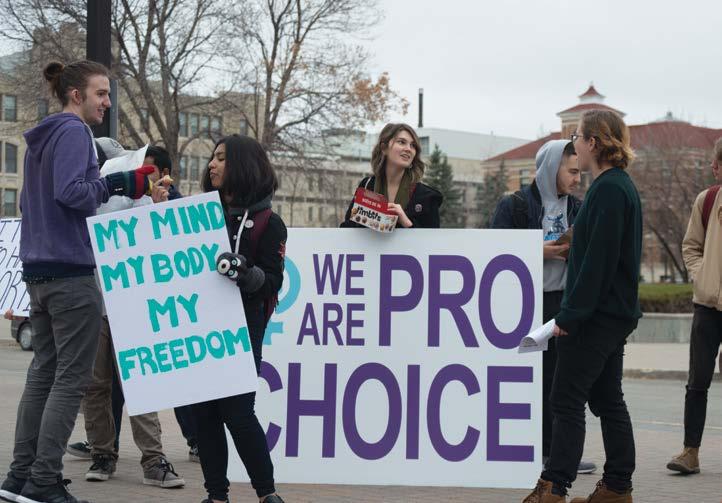
The motions come after recent protests by the Revolutionary Student Movement (RSM) in opposition to pro-life campaigning on campus, primarily by the Canadian Centre for Bio-ethical Reform (CCBR).
CCBR has campaigned a pro-life stance several times on campus this year, handing out literature while wearing torso-length billboards featuring graphic images labelled as early-stage aborted fetuses and ultrasounds. The group is not affiliated with the university and is not a student group.
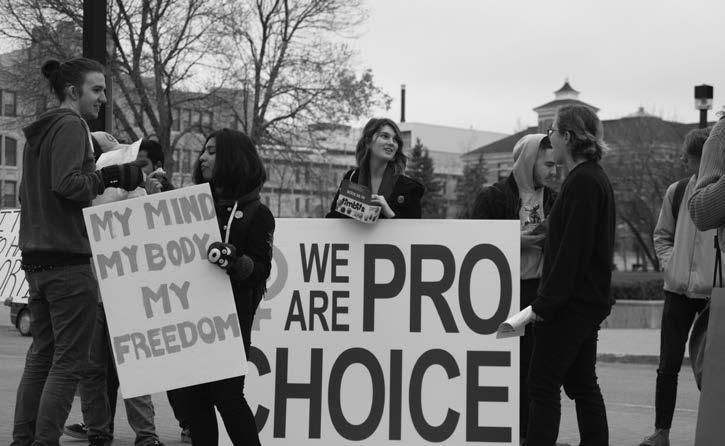
The RSM, which is a student group, responded with pro-choice signage and literature.
The motion from UMSU, which will come to a vote on Nov. 8 and was moved by president Jakob Sanderson, suggests UMSU amend one of its position statements to support “a woman's right to freedom of reproductive choice; and a woman's right to be free from coercion or attempted coercion with respect to making reproductive choices,” and oppose “any act of coercion or attempted coercion with respect to making reproductive choices.”
In an email sent out to arts students Monday, ASBC president
Julius Chester wrote “recent events at the University of Manitoba have led ASBC to adopt a position that, while respecting the rights and beliefs of groups and individuals, is focused on student safety in the university environment.”
“We wanted to sort of establish something a little more clearly on whether this is something that we’re okay with continuing on our campus or not” —
Jakob Sanderson, UMSU president
Sanderson said the UMSU motion can be amended, but as it currently stands will focus on opposing coercion specifically, and pro-life groups would be allowed to continue meeting on campus should it pass.
“What UMSU is opposing and prohibiting is coercion, or attempted coercion, of anyone with regards to
reproductive choice,” he said.
“So we’re not saying you can’t have pro-life beliefs, you can even still be a student group that has pro-life beliefs, you can hold meetings to talk about issues that are important to you. However, what we don’t want to see any UMSU-affiliated groups doing is using their student group status and their booking status and even potentially funding to coerce or attempt to coerce someone.”
Sanderson added graphic imagery would “definitely not be permissible.”
The UMSU motion states that while the union recognizes the right to free speech, it also acknowledges that right should not be used to violate other groups’ right to feel safe on campus.
Sanderson added that cases of coercion within such groups would be approached on a case-by-case basis, referencing a situation earlier this year in which the U of M pro-life student group Students for a Culture for Life was the cause of complaints from students due to content it was presenting while tabling.
According to Sanderson, the materials were confiscated by UMSU, and after referencing the UMSU safe environment policy, it was determined the group violated the rules and the table bookings were revoked.
“We wanted to sort of establish something a little more clearly on whether this is something that we’re
okay with continuing on our campus or not,” he said.
Sanderson noted that while the motion would affect all UMSUaffiliated student groups, CCBR exists outside of that jurisdiction and UMSU would not be able to request they leave campus.
“We would also work with the faculty of arts to ensure that their presence in arts buildings would be, or at least the presence of graphic images, would be limited”
— Julius Chester, ASBC president
“I really can’t say for sure whether the university, if they had it entirely their way, would like to allow [CCBR’s] demonstrations or not, but what’s been communicated to me is that even if they didn’t, essentially the provincial freedom of expression laws put them in a bind, because this
is a public space,” he said.
“So the university doesn’t even have full jurisdiction over that. We certainly don’t.”
The ASBC motion, which was presented by its LGBTTQ* representative Christina Trachenko, would prohibit “graphic images and the targeting of vulnerable individuals” within the arts complex.
Chester explained the possible new bylaw would focus on limiting violent imagery in ASBC spaces, including posters throughout the arts complex.
“Groups who would display insensitive images, not that it was a problem before in the past, but they would not be allowed to present their images in ASBC spaces [...] the arts lounge, for example,” he said.
“We would also work with the faculty of arts to ensure that their presence in arts buildings would be, or at least the presence of graphic images, would be limited.”
Chester said he was “made aware” of the UMSU motion by ASBC and UMSU representatives, but the two groups did not collaborate on the motions.
He added ASBC would be voting on the motion “during reading week.”
The Action Against Anti-Choice Coalition demonstrates outside UMSU University Centre Friday.
PHOTO BY ALEXANDER DECEBAL-CUZA
Reinventing patient-to-patient networks
Lecture outlines risk and reward of illness support through social media
DAVID ZIRANGEY, STAFF
While the inherent vices of social media continue to make headlines, online patient support groups are making a strong case for the upside of social media.
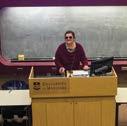
Chair of the education committee of the Manitoba chapter of the Canadian Hemophilia Society (CHS) and U of M graduate Milena Pirnat gave a lecture on the Bannatyne campus Friday as part of the Bold Ideas Colloquium Series
on the role social media can play in healthcare.
One group was explored in particular — the Facebook group Hemophilia Mother, which Pirnat founded.
The group creates a virtual support space connecting patients and families of people with hemophilia and other bleeding disorders from around the world.
Hemophilia is a rare genetic con-
dition passed from mother to child. Only males can be hemophilic, while females are carriers.
Due to the complete or partial absence of a protein clotting factor that normally helps the blood clot, hemophiliac patients bleed longer than others. The severity of hemophilia varies from mild to severe, with severe hemophiliacs bleeding spontaneously for no apparent cause.
There is no cure for the condition
but prophylaxis — regularly administering blood-clotting treatment — and on-demand therapy promote the quality of life of persons with hemophilia.
Hemophilia comprehensive care clinics, like the Manitoban chapter of the CHS, have a hematologist, registered nurses, social worker, physiotherapists and psychological service available by demand.
“Management and care is kind of dealt with through the system,” said Pirnat in an interview.
“But there is [still] a lot of coping strategies that are needed [...] I thought that more is needed than just [learning how to infuse factors].”
When Pirnat considered what families dealing with hemophilia needed, it became obvious a wider support network was key.
“I thought maybe there was a need for patients to talk to patients,” she said.
Pirnat, herself a carrier with an adult hemophiliac son, recounted receiving her son's diagnosis in 1997.
“When I went through the process [of raising my son] I thought that often you might feel alone,” she said.
“This is a very rare disorder and so you don’t have people to talk about it and you don’t have anybody who would understand basically what hemophilia is about. That part for me, being an immigrant and being isolated and not having family and not having a support system if you have a child that has [this condition], I thought that other people felt the same.”
According to Pirnat, a virtual group where people can reach out, anonymously or otherwise, “ends isolation because this is a rare disorder.”
In her presentation, Pirnat characterized the types of questions and support messages members typically post.
People will often post information
comparing treatments, information about new non-profits and support groups, scientific literature articles, requests for emotional and spiritual support and inspirational messages of hope and support.
“Most questions are [centred around] emotional support and education,” said Pirnat.
Pirnat found despite the overall positivity within the group, some risks still exist, including concerns about privacy, members soliciting, selling and promoting treatments and unintentional but well-meaning medical advice that could be misleading. Pirnat recalled once being forced to deal with members soliciting other member posts to drive propaganda toward another page.
“I thought maybe there was a need for patients to talk to patients” — Milena Pirnat, Hemophilia Mother Facebook group founder
Pirnat ended her presentation by reading an anonymous letter she received from a member of the community from Turkey.
In the letter, the woman — a carrier — recounted her experience receiving her son’s hemophilia diagnosis and expressed gratitude for the group’s support.
“It is helpful as emotional support, as mentoring for some people, as an education and practical advice,” said Pirnat.
“In a way, it does build a community and a platform for people to feel comfortable in it.”
Student union developing flexible parking pass option
Program would offer flex passes to accommodate student schedules
TY BRASS, STAFF
UMSU is working on introducing a more flexible parking pass system.
According to UMSU vice-president external Owen Black, the program is still “in the beginning phase of planning.”
“Parking services is still examining how to roll out the program and what the program will look like,” said Black.
“This includes partnering with UMSU to do a survey of our membership to determine what exactly students would want to see in a flexible parking pass.”
Black said he hopes to have the program introduced for September
2019.
Black said he expects the program will allow students to purchase two different passes — one for Monday, Wednesday and Friday, and another for Tuesday and Thursday, to accommodate the different schedules students may have.
“This is aimed at students who stack their courses onto those two different schedules,” Black said.
“We have heard a lot from students that they only take classes, say, on Tuesday and Thursday but are also paying for a pass on Monday, Wednesday and Friday despite them not coming to the university on those days. This would allow more flexibil-
ity for students to cater their schedule to their needs, as well as save them money due to not having to buy a full-time pass.”
Black said the pass is likely to take this two-day or three-day schedule-based form due to “system limitations.”
“This new flexible parking pass would not replace the full-time pass, but instead be an additional offer from parking services,” said Black.
Annual parking passes for both commuter students and resident students currently cost $592 for the Fort Garry campus. Student parking permits are valid from Sept. 1 to April 30 of each year.
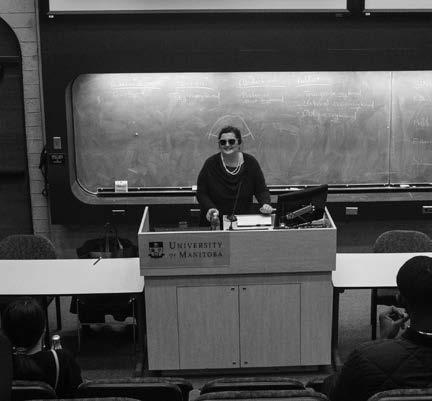
Milena Pirnant delivered a lecture on online patient supports groups at the Bannatyne campus last Friday.
PHOTO BY TANVIR AHMED
PHOTO BY ASHA NELSON
Moving reconciliation beyond the buzzwords
Indigenizing Canadian art and institutions
MALAK ABAS, STAFF
Prairie punk-turned-art-critic Lindsay Nixon visited the U of M to discuss queer Indigenous art Oct. 24.
Nixon — who goes by gender neutral pronouns — is an art curator currently pursuing a Ph.D. in art history at McGill University. They are also the editor-at-large for Canadian Art magazine. Their memoir, nîtisânak, was published in September 2018.
The presentation, which was part of the U of M native studies department’s fall 2018 colloquium series, included a close look at their own work but also discussed the work of other Indigenous artists.
artists referenced included Dayna Danger and Thirza Cuthand.
In an interview, Nixon discussed the crossover between the Canadian art scene and the world of Canadian academia, particularly in the recent attempts by both to incorporate more Indigenous content into their frameworks.
“It’s really complex,” they said. “I
Nixon said the idea of Indigenizing being focused in policymaking was also prevalent within the art community, and sometimes just providing additional funding to Indigenous people was not helpful.
“There was a lot of funding just, like, pumped into Indigenous art initiatives in Canada last year with the reconciliation funding,” Nixon said.
“Perhaps I’ve had to me and similar colleagues doing similar kinds of work have had to fight for our space in this discipline a little bit" Lindsay Nixon, artist
Nixon, who is Cree-MétisSaulteaux, brought up the inherent struggles behind being a queer Indigenous body in the world of fine art.
“Perhaps I’ve had to — me and similar colleagues doing similar kinds of work have had to — fight for our space in this discipline a little bit,” Nixon said.
“And for respect of the objects, materialities and experiences that we write about.”
Other queer Canadian Indigenous
think that art institutions and universities alike right now are pushing Indigenizing and decolonization as very buzzword topics. But I’m curious, more concretely, what that means for these specific institutions.
“Because I don’t know if I agree that Indigenizing always creates safer spaces for Indigenous students — I can think of, within the last several years, the really quick hire of whoever was Indigenous and who had a Ph.D., and at times that wasn’t always who was best equipped for mentoring students, and then different conflicts are happening in native studies departments.”
“But [...] it’s still very white-passing-native dominated. I think that a lot of that funding propped up people who already were very successful in the field and just gave them more funding for the projects that they were undertaking. I don’t know if it is creating avenues of access for marginalized Indigenous peoples, or even that Indigenous peoples are being told that they have access like that.”
Indigenization efforts, be they on a campus or through the work of art curators, is about more than just increasing Indigenous people in these spaces, Nixon said, noting it is also about maintaining a dialogue and productive support when Indigenous people are in these spaces.
“It’s not as easy as just bringing Indigenous people in,” said Nixon.
“It’s like — who are you bringing in, how are you creating access to communities who don’t even know these are possible futures for them? How are you supporting Indigenous students tangibly once they are in these institutions?”
Nixon also read the epilogue from their memoir during the lecture, recounting experiences growing up as what they called a “concrete warrior.”
“Recently, with everything that happened with Tina Fontaine and Colton Boushie, I think that there are a lot of [...] Indigenous writers and scholars who were in a moment where
U of M hosts Nobel Peace Prize laureate
Jody Williams spoke on solidarity and societal change
TY BRASS, STAFF
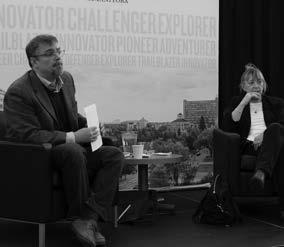
Nobel Peace Prize laureate Jody Williams visited the U of M to discuss the pursuit of peace in a question-and-answer session Thursday.
The session — moderated by Adam Muller, director of the U of M’s graduate programs in peace and conflict studies — was the first of two local events featuring Williams. It was followed the next day by a lecture at the Canadian Museum for Human Rights.
strategist and spokesperson for the International Campaign to Ban Landmines (ICBL). The organization was instrumental in bringing about an international treaty banning antipersonnel landmines known as the Ottawa Convention, which was
During the Q-and-A, Williams talked about the hostility she encountered from male colleagues when she was awarded the prize.
“Many people are afraid of the word activism, the word activist” — Jody Williams, Nobel Peace Prize laureate
The university hosted Williams as its 2018 Robert and Elizabeth Knight distinguished visitor. The talk was part of the Sol Kanee Lecture Series on Peace and Justice.
During the session, Williams took questions about how to work toward societal change on a person-to-person level.
“Many people are afraid of the word activism, the word activist,” she said.
“The root of those words is to act. Taking action on something I care about.”
Williams has been a peace activist since the Vietnam War and is well known for her work as chief
signed in 1997.
The treaty was initially signed by 122 countries, a number which has since grown to 162.
For her work with the ICBL, Williams and the organization were jointly awarded the 1997 Nobel Peace Prize “for their work for the banning and clearing of anti-personnel mines.”
Williams was only the 10th woman in history to be awarded the prize. In 2006, she and other female Nobel Peace laureates founded the Nobel Women’s Initiative, which Williams said was created “to use the access and prestige of the prize to shine a light on the work of grassroots women around the world.”
“When it was announced that we had received the Nobel Peace Prize, and our campaign was huge, there were five people in the campaign who publicly attacked me for having the named individual, as if I had anything to do with the decision,” she said.
“All five were men.”
Williams said her feelings of disappointment at the Nobel campaign dissipated after founding the women’s initiative.
“I was very agitated with the Nobel prize personally prior to the Nobel Women’s Initiative, but now I feel like I’m sharing it with women all around the world so I’m happy to have it,” she said.
Williams also spoke about how people can bring about change and the importance of working together.
“It takes citizen pressure,” she said. Solidarity, Williams stressed, is the key to feasible and productive activist work.
we just knew we needed to make writing not for a larger Canadian public, but for the people who needed it most,” they said.
“And it was queer and trans Indigenous youth, who might not necessarily know they have a future. And for me, this book is about the queer and trans Indigenous future. To let these folks know that if they hang on it can exist. It can be as freaky as you want it to be, and I made it, and so can you.”
“These things are doable, but they’re doable when you reach out to other people who share the vision and the goal and you work together to make it happen,” she said.
“It’s the only way change happens. So whatever the issue is you want to work on, you find an organization working on it, or if it doesn’t exist, create it.”
Williams used her own journey to
the Nobel Peace Prize as an example of the great power people can have if they collaborate.
“I contributed a small part in the landmine campaign, and together we changed the world,” she said.
“We, we, we, we. Hundreds and thousands of people from different walks of life contributed in their own way. We did it.”
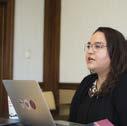
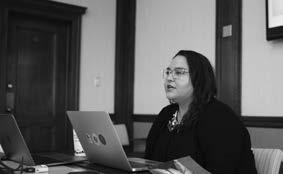
Lindsey Nixon, Ph.D candidate and editor for Canadian Art magazine, presented on queer Indigenous art as part of the department of native studies fall 2018 colloquium series.
PHOTO BY ASHA NELSON
PHOTO BY DAN GWOZDZ
Comment Editor: Jacob Singleton
In defence of the pro-life position
Being pro-life is not anti-woman
JUSTIN CHENG
Echoing the common slogan, “pro-choice is not anti-life” of pro-choice activist groups, many pro-life individuals would argue “pro-life is not anti-women.”
On Oct. 25, UMSU president Jakob Sanderson brought forward a motion to the UMSU board of governors to amend the board’s position statement on reproductive rights.
The motion implicitly refers to the recent pro-life campaign on campus as gender discrimination.
However, this interpretation of the pro-life campaign is misrepresentative.
According to a poll by Ipsos, 23 per cent of Canadians are not in favour of abortion. It was found a further 24 per cent supported limited abortion for certain circumstances like rape. These two groups represent a significant portion of Canadians — men and women — with the sincerely held belief that abortion be restricted.
Feminists for Life (FFL) of America self identify as pro-life feminists. This undoubtedly challenges the claim that the pro-life position is incompatible with women’s rights.
FFL holds the view that there is no right way to choose between the woman and the unborn child in a pregnancy. Instead, they believe a feminist must tackle the societal
barriers that lead women to choose abortion.
This is echoed in the slogans, “refuse to choose” and “women deserve better than abortion.” The group believes that a need for abortions is a reflection that we have not properly addressed and met the true needs of women.
This logic is not new. Many pioneers of the women’s rights movement in the 19th century campaigned on the premise that supporting abortions was against the feminist ideology.
In an 1869 feminist publication, writer Mattie Brinkerhoff
To understand this view, one must look at the causes underwriting women’s choice to have an abortion
said, “When a man steals to satisfy hunger, we may safely conclude that there is something wrong in society — so when a woman destroys the life of her unborn child, it is an evidence that either by education or circumstances she has been greatly wronged.”
FFL is committed to “system-
atically eliminating the root causes that drive women to abortion.” The organization believes abortion rights are not the solution to the systemic issue of gender inequality, but rather that they go against the fundamental principle of feminism opposing violence.
To understand this view, one must look at the causes under writing women’s choice to have an abortion. The Abortion Rights Coalition of Canada lists relation ship, financial readiness and timeli ness as the core reasons why women get abortions.
All these issues can be addressed without abortion. A comprehensive support system can be an alterna tive. FFL argues society is funda mentally broken and abortion is only a symptom of its dysfunction. The structural issues that position women in precarious economic positions and drive mothers into underpaying jobs are responsible for making abortion the seemingly only viable option. To overcome the barriers facing women is to overcome the principle driver of abortion.
There is nothing anti-woman about the deep commitment to the social supports and structural changes pro-life feminists embody. The pro-life position is in favour of better funding for programs such as temporary custody programs, single-parents support systems or better adoption systems would be viable alternatives to abortion.
Resisting the Band-Aid solution for these systemic problems is the first step in bringing about a more equitable future for women.
Currently, the Trudeau gov ernment plans to spend a portion of its $650 million allocated for sexual and reproductive health and rights worldwide on a battle against anti-abortion laws inter nationally. Imagine if even a frac tion of that went to improving our adoption systems, providing bet ter maternity options for working women and on support systems to help young expecting mothers cope with the many stresses that come with pregnancy.
To argue that the pro-life posi tion is misogynistic is fundamen tally flawed. Jakob Sanderson’s motion, which functions like a condemnation of the so-called discriminatory practices of the pro-life campaign, is nothing but his attempt to suppress an idea he does not like.
Supporters of the pro-life position have a right to advocate for a new future where abortions are restricted and its necessity is overcome by social supports. The UMSU president’s motion is an attempt to stifle that right.