Communication breakdown between UMSU and CFS causes protracted web domain issue
tom i ngram, staff
The University of Manitoba
Students’ Union (UMSU) is planning to break away from the Canadian Federation of Students’ (CFS) web and other services even after the apparent resolution of a protracted dispute over administrative control of the domain name umsu.ca.
“What concerns UMSU the most is that extraordinarily simple requests—requests which should take any competent and well-intentioned service provider a few minutes to satisfy—have been met with an astounding degree of inattention, delay, and belligerence,” said Christian Pierce, outgoing vice-president external for UMSU, in an email to the Manitoban
“As with all services formerly provided by CFS, for the benefit of the union, its members and its staff, UMSU will continue to transition their implementation to professional, responsive, cost-effective, and courteous service providers.”
In early January, the Manitoban reported that UMSU has been with-
holding $640,000 in fees owed to CFS, of which UMSU is a local, with those fees having been collected from students by UMSU. Pierce stated that UMSU has not determined whether to now pay CFS the outstanding fees, as the executive has not yet had a chance to meet as a whole due to the election.
The dispute between the two organizations arose in part due to CFS’s administrative control over the umsu.ca domain name, which CFS had yet to transfer to UMSU’s control after multiple requests that they do so.
A comment piece published in the Manitoban on Feb. 11 provided some technical details on the dispute and argued that CFS should transfer administrative control of the domain as soon as possible. Since then, the Manitoban has learned that the dispute has been in large part resolved.
The Manitoban obtained an email dated Jan. 9—just days after the dispute was first made public—in which Anna Dubinski, national treasurer
for the CFS, provided outgoing UMSU president Al Turnbull with an authorization code that would allow UMSU to regain administrative control of the domain. On Jan. 21, Dubinski sent a followup message after UMSU apparently did not take any further action on the matter.
“The authorization code permits transfer of total control over the domain including any such associated contact information [as the administrative contact],” Dubinski told the Manitoban
Dubinski also stated that, although CFS technically has the ability to unilaterally transfer the domain without any further action on UMSU’s part, they have never done that as it would run afoul of their policies.
When asked for an update on the situation from UMSU’s point of view, Turnbull stated that as of Feb. 23, he had asked CFS for the domain name server (DNS) records that UMSU needs in order to complete the trans-
fer without interruption of service.
“We felt that a week would be more than enough time for CFS to provide us with the necessary information; it should only take a few minutes for them to collect it and send it. However, we have received no response to this request whatsoever,” Turnbull said in an email.
According to Pierce, the first request for a transfer of control over umsu.ca was sent in July of 2013. The request was ignored, Turnbull suggests, and after several failed attempts, the executive decided to give up and try again the next year.
In July of 2014, an UMSU staffer contacted CFS again, asking for the authorization code required to transfer control of the domain along with DNS records related to the domain.
The University of Manitoba Students’ Union has sent repeated requests for the DNS records since that time, according to Pierce, and has only just recently received a response. The authorization code was provided to
UMSU on Jan. 9. On March 3, just after Turnbull made his statement about the dispute, CFS responded to UMSU. In the response, Dubinski provided Pierce with the requested DNS information. Dubinski noted that this information is readily available through public lookup utilities or by contacting their web host. Pierce told the Manitoban that best practices demand up-to-date DNS information directly from the web host, as the publicly available information may not be current. Since UMSU’s web host is CFS, Pierce described Dubinski’s statement as “dumbfounding.”
National union demands changes in economics department
Two months after scathing report, CAUT still pressing university for reforms
e t H an Cabel, staff
Over two months after the Canadian Association of University Teachers (CAUT) released a controversial report on tensions within the department of economics, the national union is calling on the university to act immediately on its recommendations.
“The administration can bluster all it wants, but at the end of the day there’s still a problem that needs to be solved and we stand ready to work with the administration and the [faculty] association to find a way forward,” said David Robinson, CAUT executive director.
The report on the department of economics was compiled on the basis of an investigation conducted in the spring and summer of 2013. The report ultimately concluded that nonmainstream or “heterodox” economics professors had been systematically marginalized in the department since 2006, violating both the traditions of the department up until that point and the academic freedom of the professors in question.
The CAUT economics report was the first of two released about the University of Manitoba since the beginning of this year. The second, which detailed disputes within the faculty of architecture, recommended that dean Ralph Stern be dismissed from any administrative or supervisory role in the faculty.
The Manitoban reported last week that Stern would not be seeking reappointment as dean when his term ends on Aug. 31.
“I think with the architecture program there was a lesson learned [ . . . ] I hope now that we see some action on the economics program,” Robinson said.
The report on the department of economics makes several claims about the working conditions and ideological direction of economics at the U of M since 2006.
The report makes a fundamental distinction between heterodox and mainstream, or “orthodox,” economists. Generally speaking, heterodox economists are seen to occupy the left side of the political spectrum, focusing on the influence of power dynamics on the distribution of resources.
Mainstream or orthodox economists, on the other hand, are largely seen by the heterodox economists as occupying the right or the centre of the political spectrum. They study the market economy, using mathematical and statistical models in hopes of predicting the aggregate behaviour of individual buyers and sellers.
The CAUT report outlines myriad disputes within the department between these two groups, arguing that heterodox economists have been marginalized over time and no longer hold positions of authority or influence in the department.
Revelations include the fact that
labour studies broke from the economics department in 2010 after what the CAUT report describes as harassment on the part of mainstream economists toward their labour studies counterparts. Furthermore, reviews of both the undergraduate and graduate programming within the department excluded heterodox professors, according to the CAUT report, and thus established curriculum changes that favoured mainstream economic approaches.
These disputes between the two opposing camps extend into personnel matters such as the hiring of a professor in Canadian economic policy, whereby the dean of the faculty of arts allegedly ensured that the hiring committee would be dominated by mainstream economists. The report also goes into considerable detail about internal disputes over the selection of a department head
Robert Chernomas, a heterodox economics professor at the U of M, was interviewed by CAUT during its investigation and his concerns are cited at length in the report.
Among those concerns was a grievance filed by Chernomas and the University of Manitoba Faculty Association in 2009 claiming that the process for selecting a department head was “contrary to the collective agreement, unfair, unreasonable, and biased in relation to Dr. Chernomas.”
Chernomas had applied for the job but was not shortlisted by the committee, which CAUT describes as being dominated by “members who favoured mainstream economics.” The committee eventually selected Pinaki Bose, an economics professor from the University of Memphis, in 2010.
“The department head that came in here with the promise of reconciling
differences has made things much worse,” Chernomas said.
“We’ve been suppressed and isolated and the department is being changed without any regard to our rights and interests.”
Chernomas provided the Manitoban with a letter signed by six members of the U of M economics department outlining what they view as an inadequate response from U of M senior administration to the recommendations in the CAUT report.
“The administration can bluster all it wants but at the end of the day there’s still a problem that needs to be solved” – David Robinson, CAUT executive director
The recommendations revolve around a perceived restoration of balance within the department, ensuring that both heterodox and mainstream professors are well represented on committees responsible for curriculum development and faculty hires. However, CAUT also recommends that an acting head from outside the department be appointed to replace Bose, that the curriculum be immediately reviewed with heterodox input, and that the next three department hires should be heterodox economists. Despite the CAUT recommendations, Bose is seeking a renewal of his term as department head.
The other side
The CAUT report has been met with consternation by both senior administration and several faculty members in the department of economics.
University of Manitoba president David Barnard would not comment when contacted by the Manitoban through marketing and communications last week. However, he has provided several detailed statements on the matter to the University of Manitoba senate and to the wider campus community.
“We do find ways in our society and in our academic communities to protect against the ongoing disadvantaging of minorities by the majority, often taking longer than many of us would like to bring changes about. But we do this when there is clear evidence of inequity,” Barnard said in a statement.
“It is reckless to suggest that a majority of members of an academic unit acting through established collegial processes is being tyrannical, without a great deal of evidence in hand—and carefully weighed—to support that conclusion. There is no indication in the report that the committee had such evidence.”
All faculty and administrative staff were informed of the investigation and encouraged by CAUT to participate. However, most chose to remain silent.
According to Janice Compton, an economics professor at the U of M, their refusal to participate stems from a perception of bias on the part of the investigators.
Compton was particularly outspoken about the CAUT report, writing a scathing critique of the national union’s investigation on a blog she
maintains with her husband, Ryan, also a U of M economics professor. When contacted by the Manitoban, she vigorously defended the silence of her colleagues.
“Spending time responding to this and going through the recommendations they made when it’s being made on biased information to begin with doesn’t seem to be a valid use of time, in my opinion,” Compton said.
“I think this whole report should have just been ignored.”
In particular, Compton maintains that changes to the undergraduate and graduate curricula were made through a collaborative process that ultimately benefits the department and responds directly to student needs.
At the undergraduate level, the department has increased quantitative requirements by bolstering economic theory and econometrics. These changes will take effect this fall.
At the graduate level, the department has removed some heterodox and mainstream elective requirements, reducing the overall number of courses needed to graduate. According to Compton, those changes will likely be implemented in the 2016-17 academic year.
“This is out of a desire of the majority of the department to have standards that are consistent with the other economics departments across the country so that our graduates are trained in the same quantitative skills that the other graduates have,” she said of the curriculum changes.
“It has moved toward a more standard curriculum that is similar to other universities.”
Photo by Carolyne KroeKer
American deserter speaks at U of M
Joshua Key seeks refugee status after fleeing to Canada
m ike Still, staff
ormer United States solider
FJoshua Key delivered a speech to a near-capacity crowd at the University of Manitoba last week, describing his experience as an army deserter and war resister living in Canada. Key, who is seeking refugee status from the Canadian government in order to avoid court martial in the United States, described what he calls his fight for freedom during the campus event.
Joining Key was Amar Khoday, an assistant professor in the faculty of law, who provided insight into the requirements for refugee status in Canada.
Key’s story
At age 20, Key was a welder making $7 an hour and a father of two children with a third on the way. He knew he was going to need a better job to support his family. He chose the army, enlisting in 2002, a year before the Iraq War.
“When I signed on the dotted line, I didn’t sign for money for college. The only thing I wanted was steady pay, and health care for my family,” Key said.
He said he attended basic training under the assumption that he would be a bridge builder. Once he arrived, he was trained in landmines and explosives.
Key was stationed in Fort Carson, Colorado, the closest location to his family. He also assumed that he would not be sent to Iraq because of his choice of station in Fort Carson. However, he was deployed to the Middle East for the 2003 invasion of Iraq along with over 100,000 other troops from the American volunteer army.
“When you sign the contract before basic training, they make one thing very clear,” Key said. “You are no longer a citizen of the United States of America; you are now U.S. government property. You no longer have a bill of rights.”
As soon as Key got to Iraq, he took his military contract to the lieutenant, questioning him about its contents and promises he felt were made to him. Key said the lieutenant brushed him off, and told him that he simply didn’t know the military way of life yet.
“For weeks after that I was hazed, hazed severely to the point where I never questioned anything. I shut my mouth, and I did my job and that’s exactly how I took it day by day,” Key said.
Key served as a combat engineer for eight months in Iraq. He claims that he witnessed a number of brutal acts inflicted upon citizens, including unnecessary raids and bombings of houses and vehicles, resulting in a significant death toll.
When Key returned to Fort Carson for his two weeks of leave,
the first thing he did was call a military lawyer, demanding that he not go back to Iraq.
“We were the aggressors, we were the terrorists, not them,” Key said.
The lawyer told him he could get back on the plane to Iraq or go to prison.
Key ran. He spent 14 months hiding in the U.S., before fleeing to Canada.
Applying for refugee status in Canada
Key arrived in Canada in 2005, spending six months in Toronto, before moving to British Columbia, then Saskatchewan, and finally Manitoba. He had his first hearing with the Immigration and Refugee Board of Canada on Oct. 20, 2006, but was denied refugee status.
“They wouldn’t let me talk about the legality of the war, they wouldn’t let me bring in the Geneva Conventions’ international law; they basically stated, ‘You’re just a mere foot soldier. Anything you’re told to do, you have to do it,’” he said.
Over the course of the next four years, Key continued to fight for refugee status, but was turned down again by the Immigration and Refugee Board, who held that, since he signed a contract, he had a commitment to the U.S. military.
“People break contracts every day,” Key said. “But since I had one with the U.S. military, then it’s alright, and you need to go back to prison.”
Key wrote a book about his experiences during his time in Canada. Entitled The Deserter’s Tale, it was published in 15 different countries, in 13 different languages.
“In the military standpoint, you did the worst thing ever,” Key said.
“You wrote about your experiences in war, you ran to another country. You’re still U.S. government property, and you’re going to talk about it, and then you’re going to write a book about it. I didn’t think about it at the time.”
While Key’s actions placed him in a difficult situation, he was not the first American army deserter to speak out in Canada.
“There’s been about 21 of us on record that sort of did what I did, which is talk about it, and do everything they can to alert Canadians of why we’re here,” Key said. “Many have been sent back to prison.”
“The standard involves being outside of your country of nationality or residence, and/or unable, or unwilling to return to that country on account of a well-founded fear of prosecution for reasons of race, religion, nationality, membership in a particular social group, or politically,” Khoday said of Canada’s refugee status requirements.
Watch your mouth
Derogatory speech leads to disparaging actions
l auren Siddall, staff
The concept of linguistic relativism—despite infiltrating the disciplines of cognitive psychology, linguistics, anthropology, and philosophy—has yet to reach the paradigm of everyday discourse. Also known as the Sapir-Whorf hypothesis, the theory postulates that the language spoken by an individual in turn affects the way they think and conceptualize the world around them.
The language we use creates a framework for the way we process other information, as well as perceive situations and individuals, which makes sense. Language is the way in which we communicate, converse, and express ourselves. Therefore, this means of expression is bound to actively affect our cognitions.
What happens, then, when our language is infused with derogatory terms and offensive slang?
Mental disorders are being used as adjectives, misogynistic and androcentric terms are being used to convey weakness or inferiority, and homophobic words are being used as insults. The popularization of this language sets the stage for an abhorrent society. The more we conceptualize these words in harmful ways, the more we perpetuate the stigmatization of these people.
When did “retardation” mutate from a clinical description to a term of derogation? The original introduction of “mental retardation” as a medical term was to signify an individual with profound intellectual disabilities who was virtually unable to survive unassisted. In the Diagnostic and Statistical Manual of Mental Disorders (DSM), this intellectual disability was demarcated by an IQ result of approximately two standard deviations below the general population, which equates to around 70. The DSM also outlines the effect the disorder has on conceptual, social, and practical domains.
The DSM has removed the term “mental retardation” from the latest publication in 2013.
The replacement of the clinical term with “intellectual developmental disorder” reflects several changes of the way in which society uses the word and other pejorative forms of it, such as “retard” or “retarded.” The use of these terms marginalizes individuals who suffer from intellectual disabilities, bolsters societal stigmatization, and contributes to harmful stereotypes.
The popularization of mental disorders as adjectives spreads far beyond the r-word. People who are not as happy as usual refer to themselves as depressed, people experiencing mood swings claim to be bipolar, and people feeling fidgety refer to themselves as having ADHD. Not only is this use of these medical terms inaccurate, it also alienates individuals with the disorder, leads to further denunciation of mental disorders, and paints faulty stereotypes.
It also presents mental disorders a joke. An individual with major
depressive disorder lives a significantly different life than someone who cracked the back of their phone and is now “depressed.” The hyperbolizing of situations—as we so often do in our society—is offensive to people living in that situation. You are showing firstly, that you do not understand what they are going through, and secondly, that you do not take it seriously.
When did “retardation” mutate from a clinical description to a term of derogation?
Ironically, though many platforms have been established to help stop the stigmatization of mental disorders, the usage of the language has never been higher. It does not matter that you tweeted “#BellLetsTalk” if you turn around the next day saying, “I’m so OCD.” Using OCD in this manner trivializes the legitimacy of what other people are experiencing. Unfortunately, using the living situation of an individual as derogatory slang extends to realms beyond mental illness.
Despite movement towards equality, it is still an alarmingly common practice to use misogynistic and androcentric language as insults to convey weakness or inferiority. These terms and phrases range from “You throw like a girl” to “Stop acting like a girl,” and everyone knows what you mean when you refer to someone this way.
Mental disorders are being used as adjectives, misogynistic and androcentric terms are being used to convey weakness or inferiority, and homophobic words are being used as insults
I think part of the issue is that the English language is designed in an androcentric manner. There are numerous “gender neutral” pronouns that are nowhere near egalitarian status; think “mankind” or “fireman.”
This vocabulary that is engrained into our language favours males. In addition, as a society, we do not simply call all individuals working in the field of theatre “actors,” we ostracize the women in this field by calling them “actresses.” The suffixes added
imply inferiority and belittle the women they are applied to; they are almost actors in their own right, but not quite.
We also lack a grammatically correct word to encompass “he or she” in the English language. Thus, the latter often gets dropped for the sake of convenience and laziness.
This primes us for a society in which masculinity is considered synonymous with strength and logic, and femininity with weakness and emotionality. Even the association of women with nature, such as “Mother Nature,” contributes to this perception by paralleling women with primitiveness and thereby distancing them from logic.
These stereotypical representations are then further embedded into societal perception when we continue to use being female as an insult. The more females are represented as inferior and emotionally
reactive, the more we perpetuate an androcentric and patriarchal society.
The same goes for use of derogatory terms referring to LGBTTQ* people, especially when these terms are so often used to describe someone doing something unintelligent or not agreeable. Calling someone “queer” for not wanting to participate in a given event contributes to the marginalization of homosexual individuals.
The term “faggot,” or “fag,” etymologically originates from a term meaning “bundle of sticks.” This was applied to male homosexuals because they used to be burned at the stake, because being homosexual was a capital offence. It has extremely strong connotations of execution, and yet is tossed into everyday language as though it means nothing.
The issue is that the use of these words has become habitual. We throw them into conversation with-
out realizing their harmful effects or offensive connotations. We have become so used to these disparaging terms that we do not bat an eye, which I think speaks volumes about our behaviour as a society.
Calling your friend a “retard” when they forgot their phone at home, telling your teammate that they “throw like a girl,” and referring to someone as a “fag” is not acceptable. Yet we use these words and wonder why the world is so hostile. Inhospitable thoughts lead to inhospitable behaviour. To create a more inclusive society, we need to create a more inclusive language.
Leave the tweets out of it
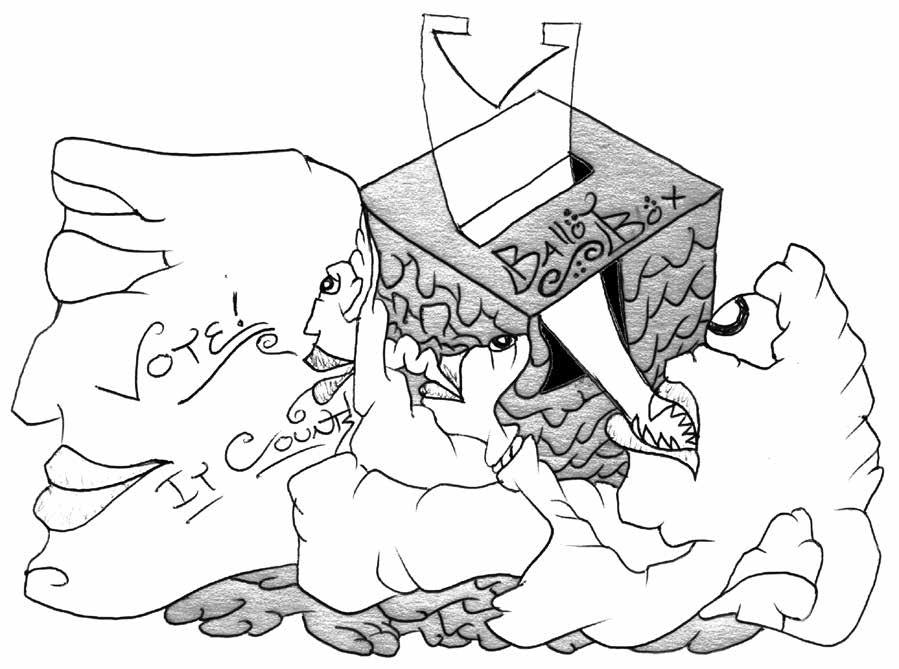
Anti-Bélanger campaign should not provide a model for future UMSU elections
tom i ngram, staff
S
hortly after Christopher
Bélanger confirmed his candidacy for the position of vice-president internal of the University of Manitoba Students’ Union (UMSU), a set of screenshots of offensive tweets made by Bélanger in 2012 and 2013 began to circulate. After that, many denounced him as an unsuitable candidate for the UMSU executive.
Let’s get a few things straight: I am no fan of the Your UMSU slate. I did not vote for them, and I hope you didn’t either. I also do not wish to defend sexism or cast aspersions at the work of feminists generally.
But this nonsense is in danger of becoming a Winnipeg electoral tradition.
During the recent mayoral election someone dug up an old Facebook post by Lorrie Steeves, wife of candidate Gord Steeves, that contained a racist remark. People immediately demanded that Gord Steeves explain and apologize for the post, thus ending Winnipeg’s racism problem forever.
On a more down-home scale, shortly after Al Turnbull began his first term as UMSU president in 2013, someone leaked an old photo of him wearing a T-shirt that said, “Cool story, babe. Now go make me a sandwich.”
Obviously these two remarks are
grossly inappropriate and unbecoming, but they were republished with a transparently ulterior motive: in the one case, the discrediting of a recently elected official; in the other case, providing a platform for political point-scoring during an electoral campaign.
If this is the very worst dirt that could be dug up, we need to get a better class of whisper campaigner
Now it is Bélanger’s turn. The comments that were singled out for censure included Bélanger’s meditations on the subjects of “skinny bitches” and “booteyy.” One picture from Instagram depicted a MercedesBenz car with the caption “Arian [sic] pride. Benz for life.”
These screenshots have been published by the anonymous person or people who run the blog This is Our UMSU. The blog makes some fairly hefty accusations against the current UMSU executive; any concerned UMSU member should be aware of
and read it.
But the rhetoric about Bélanger coming from This is Our UMSU is a touch overblown. We are not talking about a Watergate scenario here. I hate to be the one to have to say this, but here it is: the comments that Bélanger made on Twitter and Instagram are not as bad as we’re being told.
The worst that can be said about them is that they are vulgar and crass. Sexist, certainly, though describing some of the comments that way is reaching; to call them racist is dislocating your shoulder. If this is the very worst dirt that could be dug up, we need to get a better class of whisper campaigner.
The most recent of the tweets dates back to August of 2013, which was nearly two years ago. The oldest is nearly three years old. It is important to take responsibility for one’s past, but as university students most of us are young and all of us are on a journey of intellectual upheaval.
People frequently find that they are not the same person six months into university as they were when they started. If your views on anything have not changed significantly in two years of university study I would have to question whether you’re doing it right.
This is not to say that Bélanger has
changed his ways in that time – I have no way of knowing if he has, and I don’t much care. But it’s not utterly ridiculous to believe he might have. I hope I’m not alone in admitting that I’ve said and done things I’m not proud of within the last two to three years. Some of these things were said online and are still available to anyone who might be looking for them.
This whole episode trivializes sexism by using legitimate social justice concern as a cover for petty political manoeuvring
We are the first generation that has had our routine social utterances from our teenage years onward recorded for posterity. The impact of this technological change has not yet fully been felt. The upshot is our past selves will be more readily available to the present than ever before. This is a decidedly mixed blessing.
I think the accusations against Bélanger are flawed. But even I have to admit that they have a fair bit of
merit to them. Bélanger did something stupid and it bit him in the ass. Justice is served.
But looking at things from a long-term point of view, there’s a more troubling issue here. If these social media-based character assassinations become a widely accepted annual occurrence, it will create a toxic environment for campus politics at the University of Manitoba. I do not want an UMSU where anyone who puts their name forward as an executive candidate is immediately subjected to this kind of in-depth personal investigation. All this will do is discourage people from seeking nomination, further limiting our options to riffraff with media consultants and a hypertrophied sense of self.
Some background checking is understandable, but you don’t find posts like these unless you‘re looking for them
Some background checking is understandable, but you don’t find posts like these unless you’re looking for them – i.e., you have some pre-existing reason to want to discredit someone, and you’re looking for anything that will do the job. The bar for unforgivable offensiveness is set rather low, and if the badness of the comments themselves is not enough, you can always surround them with text that suggests they’re worse than they are.
The issue here is not sexism. In fact this whole episode trivializes sexism by using legitimate social justice concern as a cover for petty political manoeuvring. Those who are honestly offended by Bélanger’s remarks are being taken advantage of, to the detriment of the entire student body. Who can withstand this kind of scrutiny? I certainly can’t. My friends can’t. I wonder whether the people disseminating these screenshots can.
Bélanger can’t, either. I’m not suggesting that we should be soft in our judgment of his comments (though I am suggesting we be proportional), but they should never have reached us in the first place. They only did because the UMSU elections have recently been a place for bickering, grandstanding, and unseemly external influence.
Instead of judging candidates based on years-old Twitter posts, why don’t we judge them on their policies and their actions? Those factors alone gave us more than enough reason to seek alternative candidates for the UMSU executive.
graPhIC by evan tremblay
A higher empathy
It’s harder to feel Vincent Li’s pain, which is why it’s so important
a lex Pa SS e Y, volunteer staff
Vincent Li has been a household name for years now, and has been the source of much debate in Manitoba, and all across Canada. In 2008, Li was arrested for killing and beheading a man named Tim McLean on a Greyhound bus. Li was found not criminally responsible for the crime and was remanded to Selkirk Mental Health Centre.
Li’s case is an issue of a man and an illness, and it has been commented on by people who are not doctors ad nauseam. Nevertheless, I feel there is a perspective that is lost on many people in regards to Li, and so I will add my own to the cacophony of voices speaking about Li’s situation, for whatever it’s worth.
I think that at its core this is a matter of empathy. Every single thinking and feeling decent human being will examine this case and feel instant
empathy for McLean and his family. We can easily imagine the horror that McLean must have felt that night on the bus. We have all suffered the loss of a person we love, and so we can share in the grief of a family who not only lost their son, but had him taken from them. And we can all empathize with the family’s need for some sort of retribution after they were the victims of such a horrible event.
These are the things that are easy for us to do, because we are all very much like McLean and his family. When we put ourselves in the shoes of anyone in this situation, it is invariably these victims. But there is another victim here, and that is Li, only he is much more difficult to empathize with.
It is fairly obvious why we have such a difficult time empathizing with Li. We look at what he did that night on the Greyhound bus, and of
course none of us can even imagine ever doing something so horrible. But the problem with that is that we are trying to imagine this while in our right minds, because that is all our minds are capable of knowing.
It is an impossible thing to try to extrapolate our own experience into an understanding of the untreated schizophrenic mind
It is an impossible thing to try to extrapolate our own experience into an understanding of the untreated schizophrenic mind, and yet so many
people are quick to pass judgment on Li despite this fact. The only people who have a real window of understanding into Li’s condition are mental health professionals. Li has spent years with such experts now, and they agree that, like you, when in his right mind, Li would never do something like he did to McLean, and is no danger to the general public.
They are also confident that they have come up with a mechanism to keep Li in his right mind. And considering that in Manitoba no person found not criminally responsible for a killing due to mental illness has ever committed a violent crime after being released, I would say our experts have a pretty good record of being right.
Empathy is a wonderful and powerful thing, and it is the reason that we identify immediately with McLean and his family, and they deserve all the support we can give
them. Unfortunately in cases like this, empathy is a double-edged sword, for it is also what brings some of us to see only the horrible deed that Li committed, and not recognize the disease beneath. There are also those of us who see the disease as well, who recognize that Li was not in his right mind that night, but still feel that someone still needs to pay for this crime.
These people have also fallen short of the level of empathy we should strive for. We need to remember that there is a man underneath that disease, a man who isn’t a criminal and whose doctors believe can be a productive and peaceful member of society. Vincent Li will always suffer from the deed and the disease, but it is up to us how much more he has to suffer from.
Asymmetrical organocatalysis
Researcher profile: Rebecca Davis
Jeremia H Yarmie, staff
Bright lights
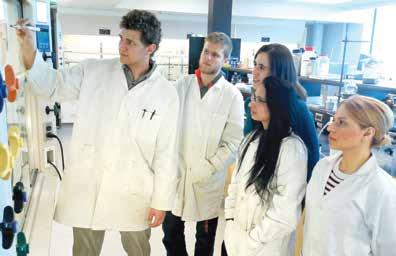
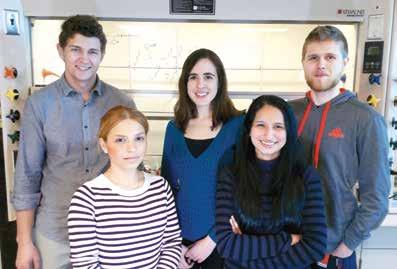
Rebecca Davis is an assistant professor in the department of chemistry at the University of Manitoba. She completed her BSc in chemistry at Washington State University and her PhD at the University of California, Davis.
“I am a physical organic chemist,” Davis told the Manitoban. “Our research is in studying the mechanisms of organic reactions and using that information to develop new reactions and new catalysts.
“Physical organic chemistry is a very small field – there aren’t a lot of us in it. For me it’s fun to think about how mechanisms work and how two molecules come together to make a new one.”
Davis’ work focuses on asymmetric organocatalysis.
“This field actually has developed essentially in the same amount of time as I have,” said Davis. “It’s a young field and an exciting one to be in.”
“Organo-” refers to organic molecules – those that contain carbon atoms.
In chemistry, catalysts are substances that speed up chemical reactions by changing the energy requirements of the interactions. Catalysts are not consumed in the chemical reaction and are recycled
at the reaction’s end.
This leaves us with the idea of asymmetry. If you look at your right and left hands, you notice that they are very similar but not identical. You cannot find a way to place them on top of each other so that they look the same – they are non-superimposable mirror images.
Non-superimposable mirror images occur in organic molecules all the time. These complementary molecules are known as enantiomers.
By understanding how asymmetric organocatalysis works, we can understand how to utilize it in the synthesis of enantiomeric compounds.
“In order for this field to develop much further and become a prevalent field of organic chemistry, we have to understand how these catalysts work on a molecular level,” said Davis.
Through understanding those mechanisms of action, not only can chemists develop new catalysts and apply them to new reactions, but also use current catalysts in new ways.
“We’re looking into expanding the field of reactions that known catalysts can be used in.
“Asymmetric catalysis is the underpinning of most pharmaceuticals at this point,” said Davis.
When it comes to certain drugs, enantiomeric form can mean the
Scientists unsure what bright spots detected on Ceres are
Bright spots on Ceres, the largest object in the asteroid belt, have left scientists puzzled as to what they could be.
The bright spots were first detected on Jan. 13 in one of Ceres’ craters. One spot is notably brighter than the other.
NASA’s Dawn spacecraft arrived at the dwarf planet Ceres on the morning of March 6 to begin surveying its surface and taking photographs.
Dawn travelled 4.9 billion kilometres over 7.5 years to reach Ceres.
Before making its journey to Ceres, Dawn first orbited around Vesta, another large object in the asteroid belt, analyzing the surface for 14 months.
These tasks make Dawn the first spacecraft to orbit around two celestial objects in the solar system, this has also been the first NASA project to use ion propulsion to obtain orbit.
The purpose of the Dawn mission is to visit proto-planets and collect data, which may provide scientists with more information on how planets are formed.
Both Vesta and Ceres are considered proto-planets – planets that failed to completely form.
It is thought that Ceres is composed of 25 per cent water hidden beneath the surface, which would mean there is more water on Ceres than freshwater on Earth.
Some theories on what the bright spots could be include:
Salt – The simplest explanation of the bright spots would be a mineral deposit left by an impact or perhaps from a time when the dwarf planet may once have been covered with water. Salt is a reflective mineral.
Metal – One of the biggest motivators for exploring asteroids is the possibility of mining resources. The possibility of aluminum or silver being found on an asteroid is not completely far out. Since metals are reflective (especially if polished) this could be a possible explanation.
Ice – Scientists believe there is an abundance of water on Ceres, and so it would not be unreasonable to find ice on its surface. Ice is highly reflective.
Water vapour – Plumes of water have been previously detected on Ceres by the European Herschel telescope in 2014. Perhaps these bright spots are related.
Cryovolcanoes – Initial specula-
difference between medicine that helps you feel better and medicine that causes harmful side effects.
Like any new professor, Davis was tasked with the development of her own lab.
“I was really drawn to having the opportunity to do the research that I wanted to do,” said Davis. “One of the reasons I was looking in Canada for a position was because I like the research environment here.”
Any new Winnipegger is burdened with at least one question about the cold. Davis was no exception.
“I didn’t know cold got this cold,” she joked.
Davis commented on how the department of chemistry and its faculty have been very helpful regarding her new responsibilities as a professor.
“As a researcher, you don’t have any administrative duties; you’re just doing research. This job has many more factors to it,” said Davis. “The faculty is very supportive; it is one of the reasons I wanted to come here.”
Davis has also enjoyed her first few terms of teaching.
“One of the reasons I wanted to become a professor was I enjoy watching people learn, and knowing that I have had an influence in their lives and taught them something.”
tion was that the bright spots were active cryovolcanoes, volcanoes that emit water, ammonia, or methane as opposed to magma. However, due to the lack of other indicators of volcanic activity, such as volcanic peaks or dust, this theory has been dismissed. Headlights – Of course, the two bright spots next to each other resemble headlights, and some wilder theories suggest these lights may be artificial in nature. Some imaginations tend to run wild when unknown objects in the universe are encountered.
It seems most likely the bright spots are a reflective material and are not emitting light themselves, as they appear to fade and then disappear on the night side of Ceres.
As Dawn is now currently decreasing its orbit around Ceres, getting closer and closer to its surface, it will only be a matter of time before the spacecraft is able to provide closerange photographs.
Photos ProvIded by rebeCCa l davIs
Keast
The Turing brain
The brain decides like Alan Turing’s statistical analysis solved the Enigma code
C H antelle d uboi S , staff
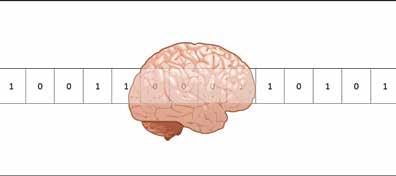
Researchers from Columbia University recently discovered that the brains of rhesus monkeys make decisions using the same algorithms as Alan Turing’s decoding machine utilized during World War II.
For those unfamiliar, Turing helped decipher encrypted messages Nazi Germany used to relay information in secrecy. This information included weather reports, military intelligence, and other information that ended up being critical in helping the Allies win the war.
Turing used a form of statistical analysis called “Banburismus,” which gave each letter a weight. Some letters were more common than others and had higher weights.
When analyzing encrypted information, the machine accumulated the probability of the decryption being correct. If the probability was too low, the solution was rejected.
Some of the messages had predictable pieces of information (such as, “the weather report for today is…”) and so those letters were given high probabilities for being correctly deciphered.
Once enough letters were deciphered, the overall weight of the code would break the accepted threshold and the code was then considered cracked.
Neuroscientists at Columbia found that the brain assesses evidence in the same way.
Monkeys were presented clues on where to find a reward on a screen, which would only be shown to them for a brief period of time. Some of these clues were reliable, while others were not.
The monkeys would then use what they knew about the correctness of the clues to try and determine the reward’s location.
A study of the neural activity in
the monkey’s brains showed that neuron activity was linked to the confidence the monkey had in the clue being correct. If the clue did not have a strong association with the reward, the neuron activity would not be as impactful. If the clue had a strong association with the reward, the neuron activity had a higher impact.
The monkey would then make a decision based on its confidence in the clue’s correctness, either rejecting or accepting the location the clues suggested the reward was hidden. The researchers believe this is similar to how humans make decisions.
Statistical analysis is used in everyday life to determine information that many take for granted.
In weather forecasting, models use statistics from past weather conditions and current weather conditions to predict future weather conditions. The more recent the data, the more confident the forecast is, which is
why forecasting is only reliable for the near future.
Insurance is also determined by statistical analysis. When determining an insurance rate, companies will use information about the likelihood of that insurance being claimed based on data by others insured for similar reasons. For example, homes in areas at a high risk for natural hazards would have a higher insurance rate due to the likelihood of damage,
Hot pepper pain relief
How capsaicin pain relief works
Jeremia H Yarmie, staff
Recent research from Rutgers New Jersey Medical School has helped us understand how chili peppers alleviate pain.
The research, published in Science Signalling, looked at the molecular action of capsaicin, the compound responsible for the spiciness of chilis. Capsaicin has been used in pain relief ointments for a while now, with its first extraction from chilis in the early 1800s, but the mechanism of this calming effect has not been investigated until recently.
Capsaicin binds to a heat-sensing receptor called transient receptor potential vanilloid 1 (TRPV1) found on pain and heat-sensing neurons. This is why you experience a burning sensation when you eat sriracha or use a capsaicin ointment.
Temperatures between 37 and 45 degrees Celsius typically activate TRPV1. TRPV1 activation results in a large influx of calcium ions—charged
atoms—in the neurons that possess it.
When this calcium influx occurs in pain-sensing neurons called nociceptors, it results in changes to the molecules which compose the cellular membrane. Certain fat components, called phosphoinositides, are cut out of the cellular membrane by a protein called phospholipase C. This process was not observed when calcium wasn’t present surrounding the cells, indicating that phospholipase C activity was dependent on calcium signalling.
This reduction in phosphoinositides results in the inhibition of two ion channels called Piezo1 and Piezo2, which detect mechanical changes to the cell membrane. These mechanical changes, usually stretching, typically occur during pain-causing events. The two Piezo channels likely rely on phosphoinositides when detecting pain.
This inhibition effect results in
the nociceptors entering a refractory phase where they are no longer responsive to pain-causing stimuli.
So why do chili peppers create capsaicin at all?
Capsaicin, also known by its chemical name 8-methyl-N-vanillyl6-nonenamide, is a member of the vanilloid family. This family includes the molecules responsible for some of the flavours of vanilla, bay leaves, and ginger.
Capsaicin naturally acts as a deterrent for mammalian species like humans. Capsaicin is most concentrated in the white pith of the pepper, which is where the chili seeds are found.
Birds typically spread chili plants between areas because their digestive tracts do not damage any seeds. This is possible because the TRPV1 channel does not react to capsaicin in birds.
Mammals, on the other hand,
tend to crush up seeds with their teeth. It is likely because of this that capsaicin developed to be reactive in mammals.
Capsaicin’s flavour is due to its long hydrocarbon tail. It also doesn’t mix with water very well, which is why water doesn’t relieve an overly hot mouth.
Everyone has heard that a glass of milk helps calm down your mouth if you have accidentally eaten too much spicy food.
Hydrophobic proteins in milk called caseins help alleviate the burning sensation by mopping up the excess capsaicin that is hanging out on your tongue.
In this way, caseins act similarly to detergents when they mop up grease in a sink.
It is still unknown whether milk will help after a run-in with the Merciless Peppers of Quetzalacatenango, the fictional
compared to a home in an area of low risk for natural hazards.
Statistical analysis is also used by stock market analysts to determine economic activity.
Overall, the brain appears to use the most fundamental method of determining the correctness of data by using statistical analysis. This occurs subconsciously, so studying for your STATS 1000 final is still advised.
“insanity pepper“ Homer Simpson eats at a chili cook-off, but we will keep you posted.
Fishing in the dark done right
Lake Shaker promises to be a night of winter fun
a lana t raCH enko, staff
F
undraising is an essential tool in any non-profit’s belt, so it is always important to create events that are worth coming to. FortWhyte Alive has had no trouble with that, as their Lake Shaker event sold out three weeks before the event. It is no wonder when looking at what the night entails: skating, sledding, ice fishing, and live music – all on the frozen lake.
Sarah Carson, the event’s co-ordinator, said that the event is brought together by a team of staff and volunteers, and all proceeds support
“As a non-profit organization, we rely on these kinds of fundraising events to continue doing the work that we do each and every day,” Carson said.
Not only is there snow bocce and cocktails, but the added benefit of knowing that ticket sales are going to a good cause.
Carson said that for those attending, the night will be a nostalgic reminder of field trips as kids.
“I think most people don’t think of
FortWhyte Alive as a place to go for a hike, go ice fishing, or have a bonfire with friends – but that’s a big part of what we do here every day,” she said.
“For many, this will be FortWhyte Alive like they’ve never seen it before. And there has been a lot of excitement around hatchet throwing. The toboggan slide is incredible, and definitely not just for kids.”
The toboggan slide in question is the Richardson Rrrun, Winnipeg’s tallest toboggan slide that rockets tobogganers onto the frozen lake. It certainly does add another ele-
A Walrus of a night
ment of interest, in case the party on the lake did not have that covered.
The menu is street food style and provided by Diversity Foods, while local band the Reverend Rambler will be playing live music.
The event, like many others in Winnipeg, has the effect of reminding us that winter can be fun, and that ice and snow are less obstacles than they are new materials for entertainment.
“I think it’s important to showcase what winter in Winnipeg can be,” Carson said. “And I think people
really are craving those authentic ‘winter experiences’ – having the event sell out three weeks in advance, I think, is a testament to that.”
The FortWhyte Alive Lake Shaker will take place on March 14 at 7 p.m. All funds raised will support FortWhyte Alive’s environmental education programs. To get involved, visit fortwhyte.org
Walrus Talks is hosting their first event in Winnipeg at the WAG
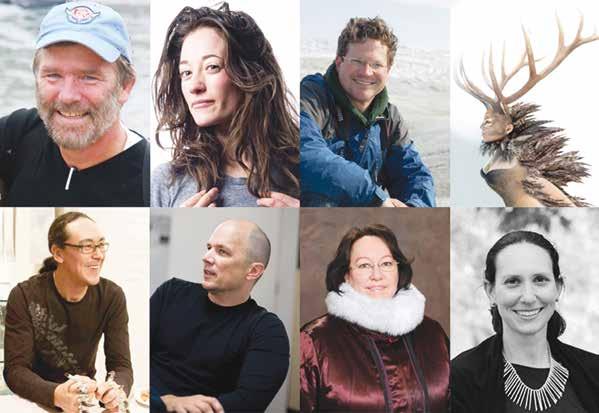
The Walrus Talks is making its first appearance in Winnipeg since the event began in 2012. Co-ordinated by the Canadian magazine, the Walrus, the presentations take place in 15-20 cities across the country. The night happens in two parts: first, eight speakers present on
topics that are related to their field of work for approximately 80 minutes, followed by a reception during which audience members and presenters are free to discuss the ideas that have been shared.
David Leonard, the director of events at the Walrus, said that the
reception is meant to be educational, but not academic. The lines between presenter and listener are erased once the presentations are over, in the hopes that dialogue can take place and cause change in the areas that are discussed, such as housing, urbanization, and sovereignty.
“The idea behind the Walrus Talks is that we always want to take the overarching theme of the night, which is a matter that is vital to Canadians,” Leonard said.
This year, the focus of the presentations is the Arctic and the unique challenges that those living there are faced with.
“What keeps coming back to us is, climate change is huge, housing, culture,” said Leonard. “As well as the collision between the North and South, and between tradition and modernity.”
Speakers include artists, historians, authors, and architects. Speakers are chosen based on their ability to bring something new to the topic they are speaking on, and diversity among speakers is emphasized as well.
“In some cases, the speakers have a lot of experience presenting, and with someone like Tanya Tagaq, you usually see her singing on stage, so you get the opportunity to now hear her speak on stage,” Leonard said.
“You want to get different perspectives on stage.”
Leonard said that while 80 minutes is not enough time to adequately discuss all the issues pertaining to the Arctic, the Talks are meant to stimulate conversation and shed light on areas that Canadians should be paying attention to.
“The hope is that, with high-level ideas from the right people, you can get to the heart of the matter, and the audience, who is curious and thoughtful and engaged, will go out and do some reading,” Leonard said.
“Maybe they’ll take another step and be more engaged in the issue. All of a sudden, the issue moves forward.”
The events are meant to be an extension of the type of editorial content that the Walrus is known for; Leonard’s job is to find speakers and presentations that translate onto the stage the way that the magazine reads. There is a focus on diversifying perspectives and informative content. Another element is added with speakers who are proficient in their fields, discussing topics about which they are passionate.
The reception also acts as an invitation to the community, urging them to get involved and illustrating why it is important to do so.
The Walrus Talks will take place at the WAG on March 26 at 7 p.m. Tickets are $15 for students and are available at thewalrus.ca/the-walrustalks-arctic. The event coincides with Arctic Adaptations: Nunavut, currently exhibited at the gallery.
a lana t raCH enko, staff
Photo by alana traChenKo
Photo Collage ProvIded by the Walrus
Hard work is for Fools & Horses
Winnipeg’s newest coffee break destination
l auren Siddall, staff
Amidst a tumult of business transactions, impending deadlines, and difficult co-workers is the perfect reprieve: Fools & Horses –named after the beloved British sitcom Only Fools and Horses, about a group of people who spend all their time trying to come up with “get rich quick schemes” and, ironically, work all the time.
“The idea of being called Fools & Horses is a take on this idea that we all live to work, we don’t work to live, so we want this to be a place where people can focus on enjoying themselves,” said Fools & Horses co-owner James Magnus-Johnston.
“I think that speaks to millennials today; they’re spending so much time trying to figure out how to use the degree that they spent so much money on, they’re trying to find ways to make a simple living. We came to the conclusion that if we’re destined for simple livelihood, maybe we should try and do something good with that livelihood.”
Anchoring the idea is the modbar – essentially an under-the-counter espresso machine that allows you to profile it based on pressure and volume. Aside from being aesthetically pleasing, the new technology should lead to a higher quality coffee product. Designed by engineers turned musicians, the modbar has permeated the market on the West Coast and is slowly creeping into other metropolitan areas.
“Conceptually, the modbar will be very interesting; it’s very unique. But then also the idea of this being a social enterprise, something that reinvests in the community and catalyzes jobs for young entrepreneurs,” said Magnus-Johnston.
With this, the mandate of Fools & Horses was born. The business is pillared on three main ideologies: social, environmental, and economic. Not only is Fools & Horses designed to serve as a refuge from the stresses of everyday, it has also been constructed to help young entrepreneurs and businesses find their footing by creating a large network of local suppliers, which has the added benefit of reducing fossil fuel requirements.
On the roster so far: Miss Browns and Shawarma Khan on sandwiches, Jonnies Sticky Buns providing pastries, and up-and-coming baker Michael Harms providing bread for gourmet toast – with charcuterie and yogurt parfaits both on the menu as well.
Owners of the shop have also been working with local dairies and meat providers to cater only the best quality, while being as locally-sourced as possible.
As part of this mandate, Fools & Horses is teaming up with the dairy processing facility at the University of Manitoba for fresh yogurt for their parfaits. These partnerships, while contributing to lower carbon emissions, are also a way to create connections within the community.
“To me, that’s where innovation
is now. To innovate is to reconnect to people now, which is kind of sad. You’ve got all these large monopolies now so you have to reconnect to the community.”
And what better way to connect than over coffee, wine, and beer.
“The other thing that’s going to be unique about this is we’re focusing primarily on coffee but then we’re also going to have other drinks on tap: beer and wine will be on tap too.”
Starting at noon, the taps will open to serve beer from Half Pints, Lake of the Woods, and Paddock Wood brewing companies, as well as wine from Vineland Estates Winery – making Fools & Horses one of the first establishments in Manitoba to serve wine from a keg.
Although the feat was far from easy, Magnus-Johnston said that finding wine to be served in a keg was important to the company not purely from an innovation standpoint, but for keeping fossil fuel requirements and waste to a minimum – it’s low carbon wine.
While new to Winnipeg, the idea of serving coffee, beer, and wine together has proven to be successful across the pond.
“In Europe, there are these places in Denmark and Belgium, and the Netherlands; there’s this concept that translates loosely to ‘the good life’ but also it means ‘coziness.’ And it’s centred on the great drinks: coffee, beer, and wine. Those are the kind of things that bring people together,” said Magnus-Johnston.
“We’re trying to figure out how to make that happen in Winnipeg. Winnipeg can thrive; it is thriving. We just need to create venues for those great things to happen. We don’t need to move to those places, you just need to create it and then it becomes a part of the culture.”
No strangers to culture, the owners of the shop are working to establish Fools & Horses as a hub of cultural activity, intending for the location to open after-hours in order to serve as the venue for art and music enthusiasts.
“One of the things that Fools & Horses is going to try and achieve is acting as an intimate venue for really excellent arts and culture. A really great jazz trio is not going to rent out Burton Cummings; they need a small, intimate venue. You can do some really neat things. I think it could be so innovative,” said Magnus-Johnston.
“We’ll start with really good coffee, and grow from there.”
Fools & Horses is located at 379 Broadway and is slated to open in late March, with hours from 7 a.m.-7 p.m. Monday-Friday and 8 a.m.-6 p.m. on Saturday.
Photo ProvIded by Fools & horses
Review: Gnarr
The story of how Icelandic comedian Jón Gnarr became the mayor of Reykjavik
Craig a dol PH e, staff
Jón Gnarr was not a conventional politician. But, after a seemingly sporadic decision to enter politics with a comical and unconventional campaign, the stand-up comedian and actor was elected mayor of Reykjavik, Iceland’s largest city and capital, in 2010.
After a single term, Gnarr left office in early 2014, subsequently releasing his book Gnarr: How I Became the Mayor of a Large City in Iceland and Changed the World Gnarr, a self-described armchair anarchist and political pacifist, was a passionate figure in Reykjavik’s arts scene. After the 2008 financial collapse hit Iceland, Gnarr began asking people what effects bailouts—which were said to be coming—would have on his community.
The answer he got from friends was that the country would probably see austerity conditions imposed, cutting funding to the arts and privatizing national resources and services.
Fearing cuts and unhappy with the failure of the elites to predict or prevent the financial crisis in Iceland, Gnarr decided to create his own political party: the Best Party.
Relying on his own friends— mostly other members of the arts community—for support, Gnarr’s team navigated the legal process to register a party and began making outlandish promises to draw attention to their campaign.
After the Left-Green party promised to provide teens with free access to pools, the Best Party promised to provide free access to the city’s pools for all citizens and a free towel Gnarr facetiously proposed to bring a Disneyland to Iceland, saying that it would provide jobs and that people would enjoy being able to take pictures with Mickey Mouse. He promised to stop corruption by “participating in it openly” and vowed to make Parliament drug-free by 2020. He even had his party design a website that was meant to be the ugliest party website on the Internet. They capped it all off by promising that the Best Party would not keep any of their promises – effectively nullifying their previous campaign promises.
This glib attitude continued until the final weeks of the campaign when the party, by then leading in the polls, began to tone down their use of humour and begin engaging in what Gnarr acknowledged to be the “pure theatre” of more conventional politics. Although he did maintain enough humour to, just before the election, make a speech announcing the Best Party’s withdrawal from the race before yelling out “Joke!” to roars of laughter.
The story of Gnarr and the Best Party parallels some other comedic candidates to grace ballots over the years. It draws to mind Canada’s own Rhino party—their greatest years behind them—who campaigned on promises that included repeal-
ing the law of gravity, paying off Canada’s public debt with an American Express card, and paving over Manitoba to make a parking lot; Jello Biafra running for mayor of San Francisco; Stephen Colbert’s televised 2012 presidential candidacy; or even the University of Manitoba’s own Aaron Griffiths, who ran his “No More Tears” campaign in the UMSU General Election in 2012.
The one major difference is that Jón Gnarr won. The Best Party finished first with 34.7 per cent of the vote.
Gnarr is a fittingly unconventional book from the unconventional former mayor
Reykjavik’s electoral process requires that if no party holds a majority of the votes they be required to form a coalition government with other parties in order to govern.
Gnarr insisted that he would not form a coalition with anyone who had not watched The Wire. In the process of the Best Party’s negotiating a coalition to govern with the social democratic party, Samfylkingin, Gnarr remarked of the social democrat leader Dagur Eggertsson, “He must watch The Wire [ . . . ] What am I to talk to him about otherwise – socialism?”
Gnarr suggested that in the process of negotiating a coalition—aside from continuing to insist Eggertsson get caught up on The Wire —the Best Party’s priorities were focused on making the city “more human, more welcoming, and more modern” while the social democrats prioritized labour and education policy, which the Best Party endorsed in principle as well.
Analysis
Gnarr is sometimes over the top, making utopian predictions of the future in which nobody ever dies and where people are able to stop in at the local bank to have money printed as a free service. Other times, he’s more direct and analytical, railing against privatization and the neoliberal agenda or loss of Icelandic sovereignty through EU encroachment. He does not provide a complete, cogent, or comprehensive vision for an alternative; his ideas are fragmented and contradictory at times. But Gnarr is not a book you will want for its sociological or political theory. Gnarr’s memoirs tell a story. They are a vivid example of how a group of artists, with no political background, were worried about cuts to something they cared about and were able to organize and protect their interests (University of Manitoba Student Action Network take note).
Gnarr’s team reached people not by parroting the neutered, vanilla language of a detached political class, but by actively speaking to people on their own terms: using humour to mock the process and its conventional players, and discussing the issues that relate most directly to people.
They used their comedic and artistic talents to wrestle power away from the political class and catapult themselves into city council, with Gnarr, as mayor, at the helm.
The book does not do much to elucidate the philosophy behind Gnarr’s rejection of the social democratic party. He acknowledges shared interest, or at least a willing acceptance, of their platform points before forming a coalition with them.
Gnarr hints at several reasons in the book. He suggests the political class was overly calcified, with even those of a sympathetic ideology being at least moderately complicit in the lead-up to the financial crisis. He also highlights how, as a matter of culture, he wants those from the artistic community to receive respect for their contributions.
However, ignorance may be just as big a factor, as he acknowledges he knew virtually nothing about the local political players before deciding to run.
Gnarr tells the story of having run into a woman during the campaign that he did not realize was the incumbent mayor of Reykjavík, Hanna Birna Kristjánsdóttir. He later
acknowledges that even up until taking the seat he “had no idea what a mayor actually did.”
the race, and later job, he has committed himself to.
The story of Gnarr and the Best Party parallels some other comedic candidates to grace ballots over the years. The one major difference is that Jón Gnarr won
Reaction
With the party’s policy guide, moral code, and a letter to U.S. president Barack Obama squeezed between short memoirs, anecdotes about Facebook and the 2008 financial crash, and political essays about democracy and world peace, Gnarr: How I Became the Mayor of a Large City in Iceland and Changed the World is a fittingly unconventional book from the unconventional former mayor.
Although the sections tend to jump quickly from one to the next, with no chapter lasting more than 12 pages, they form a narrative that is coherent enough to appreciate the build-up of events and empathize with Gnarr’s situation as he navigates
Gnarr alternates between a sense of certainty and seriousness—relatively speaking—in his political essays to bouts of doubt and cunningly timed antics in his memoirs from the campaign trail. His sincerity and openness about his own ignorance of the process and occasional self-doubt makes the narrative much more engaging – it often appears unclear to the reader, and perhaps even to Gnarr, what the intended outcome of his actions are.
He jumps off the page like a social savant – unintentionally taking his island-home by storm. Several times while reading the book, I would be openly laughing at the antics of Gnarr and his Best Party compatriots.
Gnarr is a short book, at only 177 pages. It can easily be read in a day or two, depending on your reading speed. It may be unconventional to have such an eclectic assortment of content interjected between chapters, but it works for Gnarr. I cannot imagine finding a more entertaining book chronicling a municipal election in Scandinavia.
Gnarr: How I Became the Mayor of a Large City in Iceland and Changed the World is available through the Winnipeg Public Library and for sale at McNally Robinson as a hardcover for $23.95.
graPhIC by Carol ne norman
One step ahead
Detailing Bison track and field athlete Eric Guy’s impressive background
m ike Still, staff
E
ric Guy does it all. Whether it’s on the track or in the community, the sprinter has earned the respect and admiration of anyone who meets him.
Guy started running when he was nine years old, and has progressed every year since. He set provincial records in his age class in both the 60- and 110-metre hurdles, and was part of Vincent Massey’s “AAAA” provincial track and field championship teams, in both 2012 and 2013.
He was also a double medallist at the 2013 Canadian Junior Track and Field Championships, placing third in both the men’s 100- and 400-metre hurdles. Despite all of his high school accomplishments, Guy maintained a humble attitude.
“You never really worry about records and stuff,” Guy said. “You kind of just worry about running your best, and hitting specific marks.”
That humbleness translates to Guy’s personal life as well, where he volunteers his time at various locations, such as the Children’s Hospital, with kids between the ages of six and 17. He started volunteering there roughly a year and a half ago.
it’s just so real to be around these little guys who are asking the simple questions and want to just have fun.”
One day, Guy and his friend Wade Ryplanski–who also volunteers [in the oncology unit] at the Children’s Hospital—came up with an idea to raise money for CancerCare Manitoba, after being affected in a positive way, by all of the people they came in contact with while volunteering.
“The reason we did CancerCare is because it’s such a common thing. People know about it,” Guy said.
“Our initial goal was to raise $500, and we knew we’d raise more than that. We kind of thought we’d be around $1,000, and then it just kind of took off.”
“I love working with kids. I think it’s refreshing. It’s just so real to be around these little guys who are asking the simple questions and want to just have fun” – Eric Guy
Along with the Children’s Hospital, Guy also helps out with Special Olympics Manitoba, as well as Mini U. For the Vincent Massey alum, being in contact with kids on a consistent basis helps him reconnect with the basic joys of life, after long days on the track or in school.
“I love working with kids. I think it’s refreshing,” Guy said. “With kids
At the end of their campaign on Feb. 20, Guy and Ryplanksi had raised over $3,000, which was quite impressive, considering the timespan.
“The majority of our $3,300 came within an 11-day period,” Guy said. “It started off, we marketed to our friends and family and stuff. Once we got a couple hundred bucks, we threw the tweets out, and made the Facebook statuses.”
Guy’s hard work earned him some well-deserved recognition at the Canada West track and field yearend banquet, where he was selected as the male Community Service Award winner.
His committed work ethic was also demonstrated with the herd this year, where he earned two medals at the Canada West Track and Field Championships – one in the
60-metre hurdles (silver), and another in the pentathlon (gold).
His accomplishments on the track were enough to garner him Canada West Rookie of the Year honours, as well as a trip to CIS nationals later this month.
While Guy was happy to receive
the award, he also noted that he wants to continue fundraising going forward, and help out other charities down the line.
“My hope would be to continue doing some form of fundraising every year, kind of like an annual event,” Guy said.
Not matter what Guy plans to do in the future, it’s a near certainty that he will put all of his effort into it, and continue to effect change in a positive way for those around him.
Photos ProvIded by bIson
Barricaded in Alberta
Bison women’s hockey falls to Pandas in Canada West final
The past
Throughout the 2014-15 season, the University of Manitoba Bison women’s hockey team was highlighted by the high-flying line of Maggie Litchfield-Medd, Alana Serhan, and Alanna Sharman. The trio combined for 83 points in the regular season, making Manitoba one of the most feared oppositions in the Canada West conference.
The pressure of the playoffs did little to deter Manitoba’s top line from continuing in their offensive fashion. Though a very young team, the Bisons have taken the post-season with the same level of intensity and character as displayed in the regular season.
Manitoba head coach Jon Rempel mentioned at the playoffs’ start, “I told them not to change too much. Your team’s personality is what it is, and you have to play that way for the whole year.” However, a stingy Alberta Pandas team were well aware of Manitoba’s talents, and shut them down right from the start of the series.
The present
If the series could be defined in just 20 minutes of hockey, the opening frame of the Canada West
finals would do both teams justice. Manitoba created plenty of chances but were denied on several occasions by an in-form Lindsey Post in the Pandas’ goal, and Alberta capitalized on the few chances they had.
The Alberta goaltender may have been the one defining factor over the two games, as she has been a staple in the Pandas’ defence, which ranks fourth in the league. Post collected a sparkling 10 shutouts in 27 regular season games. Game one took place on Friday, Feb 6. The Bisons never recovered from a 1-0 first period deficit for the entire series, consistently playing catch-up hockey.
Manitoba dropped the game 4-0.
The Bisons were hoping to take inspiration from their comeback series against UBC into game two on Feb. 7.
The herd broke a 100-minute non-scoring streak early in the third period when defender Jayden Skoleski scored only her second goal of the campaign. Though the lead gave Manitoba hopes of extending the series, Alberta rallied for a late comeback and won game two by a 3-1 score.
“Your team’s personality is what it is, and you have to play that way for the whole year” – Jon Rempel, head coach, women’s hockey
For only the third time throughout the entire campaign, Manitoba was held off the scoresheet. After conceding four goals on 23 shots, Bisons goalie Rachel Dyck was pulled midway through the third period and
Bison Briefs
End of year awards and recognition
m ike Still, staff
It was another successful year for Bison sports, and a number of players were recently awarded for their hard work, both on and off the court, ice, and field.
Sharman named Canada West Rookie of the Year
First-year women’s hockey phenom Alanna Sharman has been a dynamic player all year for Manitoba, and her abilities on the ice garnered her the nod as Canada West Rookie of the Year. She finished first in conference scoring, with 40 points, and was also tied for second in gamewinning goals, with five.
Along with her Rookie of the Year nod, Sharman was also named a Canada West First Team All-Star.
Teammates Rachel Dyck and Michelle Pawluk also gained recognition – both were selected as second team all-stars.
Cockrell selected CIS women’s volleyball Player of the Year
For the first time since the 2001-02 season, a Manitoba Bison was named CIS women’s volleyball Player of the Year, as Rachel Cockrell secured the award in her final year with the herd. She was first in the country in kills per set (5.06), total kills (471), total points (535.5), and points per set (5.8).
The award is the final feather on the cap for Cockrell, who was also named MVP of last year’s CIS championship, in which Manitoba won.
In her four years with the Bisons, Cockrell has also been named to the CIS All-Rookie Team (2010-11), and was a CIS Second Team AllCanadian in 2012-13.
DePape named 2014-15 Canada West men’s hockey Student-Athlete Community Service Award winner
Jordan DePape capped off another strong campaign with the herd, by
The future
Perhaps the Manitoba Bisons had outdone themselves during the 2014-2015 season, having gone this far into the playoffs. I would be willing to bet not many, if anyone, would have predicted Manitoba would make this deep of a post-season run, considering 10 of the 23 players on the roster are only in their first year
of CIS eligibility.
With that many young stars, the future of this talent crop is bright. The cream of the crop is rookie Alanna Sharman, whose league-leading 41 points earned her CIS Rookie of the Year honours. The last freshman to accomplish that feat was the legendary Hayley Wickenheiser.
In her fifth and final year of CIS eligibility is Bison captain Maggie Litchfield-Medd. With next season just around the corner, the Bisons will potentially have to name a successor. The most likely scenario for an unexperienced team is to promote one of their young guns, such as Sharman or Alana Serhan to alternate captaincy, while the most likely veteran candidate to be named captain is defender Lindsay Blight.
Yet, Rempel and his staff could take the matter one step further and hand the coveted “C” to Serhan or Sharman, who have exemplified a youthful, raw, on-ice leadership equivalent to NHLers Gabriel Landeskog and Steven Stamkos.
Along with Litchfield-Medd, the Bisons also lose veteran Michelle Pawluk on defence. With 19 points this season, Pawluk ranked third overall amongst defencemen in scor-
ing. Her graduation from the CIS will not come as an insurmountable loss to the Bisons, however, as rookie Erica Rieder and sophomore Caitlyn Fyten are capable of playing an offensive-style game from the back end. Both players combined for seven goals and 20 points in the regular season and are expected to elevate their point total even further for the upcoming campaign.
Although the Bisons could not extend their Cinderella run in the post-season, coach Rempel can sleep easy knowing that the youthful exuberance of his team has only started to cast its shadow on CIS hockey. Speed and skill are two elements of the game which Manitoba puts to full use every night.
The consistency at which these incredible hockey players are displaying game-in and game-out marks the beginning of a very exciting new era for Manitoba Bison women’s hockey. As the 2015-16 season approaches, one can only wonder what’s in store.
receiving some off-ice recognition, as he was named the Student-Athlete Community Service Award winner in the Canada West.
DePape has been highly involved in the community, including being a CanU mentor, Siloam Mission volunteer, diabetes educator, and Junior Bison hockey coach. DePape also maintains a 3.3 grade point average, majoring in criminology.
On the ice, he was seventh in conference scoring, with 27 points, and was also a member of Team Canada at the 2015 Winter Universiade, where the squad took home a bronze medal.
Nine Bison football players selected to CFL regional or national combines
Nine Bison football members were rewarded for their hard work on the gridiron, with selections to either a CFL regional combine, or the national combine.
Six members of the herd (Jordan Linnen, Tremaine Apperley, Mitchell Harrison, Jonathan Jones, Robert Smith, and Matt Sawyer) will be heading to the Edmonton regional combine on March 17, while three (Jordan Yantz, Nic Demski, and Kienan LaFrance) have been invited straight to the CFL national com-
bine, taking place in Toronto from March 21-23.
A strong performance at the CFL regional combine could merit any of the six Bisons a spot at the national combine a few days later. Former
Manitoba linebacker Thomas Miles took advantage of the opportunity at the regional combine last year, eventually getting drafted by the Toronto Argonauts, and spending time on the special teams unit as a rookie.
graPhIC by bradly Wohlgemuth
Hardcourt commitment
The story of Bison basketball forward Wyatt Anders
m ike Still, staff
It’s incredibly hard to miss Bison basketball co-captain Wyatt Anders on the hardcourt. With his six-foot-seven frame and signature mohawk, he makes his presence felt week in and week out for the herd.
What you may not know, though, is that Anders wasn’t originally recruited to play for Manitoba. In fact, he almost quit the sport entirely, back in high school.
“I got cut in Grade 9, Grade 11 I quit, and was like, this just isn’t for me,” Anders said. “Grade 12 I wasn’t even going to play, but a couple people persuaded me to play.”
After finishing off his senior season, Anders chose to attend the University of Manitoba for school. He played pickup basketball on the side, but was not a member of the Bisons in his first year.
School was a struggle at first for Anders, whose grades weren’t strong in University 1.
“[In my] first year at U of M, I failed a course, plus got a C in another course, and dropped another. It was a very bad start,” Anders said.
After an ugly beginning, Anders chose to attend Canadian Mennonite University, where he played on their basketball squad for two seasons, and made his name known. He was named the male rookie of the year in his first year in 2011, and followed that up by being named MVP in 2012.
“The first year at U of M, I was walking by, and the coach at CMU was working at the desk, and asked if I wanted to redshirt,” Anders said.
“Kirby Schepp [head coach of the Bison men’s basketball team] didn’t want me as a redshirt, I asked him. He really didn’t think I would be
playing in the CIS, but he kept the connection, which was smart on his part.”
While his grades still weren’t excellent at CMU, Anders worked his tail off every day, and was rewarded with a full-ride athletic scholarship in 2013, to play for Schepp, the same person who turned him down just a few years prior.
“Right now, I’m an academic allCanadian. It’s a very big turnaround for basketball and school” – Wyatt Anders, forward, Manitoba Bison basketball
As the season was beginning, Schepp had a discussion with Anders about his schooling.
“I remember Schepp looking at my grades, and going, ‘you gotta pick up your grades.’ I said, ‘Schepp, you trusted me to be on this team. You trusted me on that, and you can trust me on the grades.’ Ever since, he never said anything,” Anders said.
The Sturgeon Heights grad stayed true to his word, not only improving in the classroom, but excelling.
“Right now, I’m an academic allCanadian. It’s a very big turnaround for basketball and school,” Anders said. “I matured more, and really put in the hard work.”
Anders’ hard work earned him significant minutes in his first year with the Bisons, and while his playing time decreased in his second year with the team, he stayed patient and continued to work hard. This eventually earned him a starring role this season, with Anders putting up big numbers, averaging 9.1 rebounds and 10 points, along with being on the court for roughly 30 minutes a game.
It was an impressive turnaround for a guy who was only getting 15 minutes a game in his first year.
Interestingly, it wasn’t the first time Anders had to fight for his time on the court.
“Opportunity is a funny thing,” Anders said. “There was a guy that was ahead of me at CMU that was better. We were splitting minutes, then he left the team. All of a sudden they needed me more, and so I got more touches and more playing time. All of a sudden, I became a really good player.”
If there’s one thing Anders has learned throughout his athletic journey, it’s simply to trust in your abilities and believe that things will work out, whether that be on the court or in the classroom.
“It’s funny how opportunity presents itself,” Anders said with a grin.
After deadline day
How the Jets shape up in the aftermath of the deadline
rYan Stelter, volunteer
T
he NHL trade deadline is behind us, and with that the season is heading into the final 20 games of the year. A total of 24 deals were completed last Monday; the Jets made none. However, they made a few key moves prior to the deadline.
General manager Kevin Cheveldayoff made a big move a couple weeks before the deadline, sending Evander Kane and Zach Bogosian to the Buffalo Sabres for lanky defenceman Tyler Myers, and gritty forward Drew Stafford.
Chevy wasn’t done yet, acquiring Jiri Tlusty and Lee Stempniak prior to the March 2 deadline. Although not major deals, the Jets added some depth up front, getting them relatively cheap. If Winnipeg is to make the playoffs, adding these players should provide head coach Paul
Maurice with some options.
In previous years at this stage in the season, the Jets have been on the outside of the playoff picture looking in. However, they look to be in good shape this year, currently sitting in the second wild card spot, and just seven points back of Chicago in the Central Division.
Jets have to grab at least six points over that span to stay in the hunt.
In previous years at this stage in the season, the Jets have been on the outside of the playoff picture looking in; however, they look to be in good shape this year
The Jets face several teams currently in playoff position during this stretch run, so the road to the postseason will not be easy. Winnipeg is about to embark on a four-game road trip that could essentially make or break their season. Playing three of the top four teams in the NHL, the
Winnipeg has been playing poorly of late, winning just two out of their last five games, but they have collected points in four of them. At this stage in the season, dropping points can be critical. With Mathieu Perreault and Dustin Byfuglien on the shelf for a long period of time, that could hurt the Jets in their push for the playoffs.
Big Buff is the man for the Jets, a power play quarterback who plays huge minutes. Can Tyler Myers fill the massive hole that Byfuglien leaves?
I don’t think so. Byfuglien is a one-of-a-kind player; he’s a skating refrigerator. He takes no prisoners and is a fan favourite for his bone-crunching hits.
Byfuglien is also a massive contributor offensively, scoring 15 goals and providing 27 assists thus far in the season. Despite this, the Jets have shown in the past they can play when shorthanded on the blue line, playing without four of their top defencemen for a large part of December.
Everyone on the Jets’ back end will have to step up and help fill the void. The biggest question mark for Winnipeg is goaltending. Ondrej Pavelec, or Michael Hutchinson? Hutchinson seems to be the hotter goalie at the moment, but will he finally be given the chance to start the majority of the games down the stretch? Who knows, but the goaltending question is something that needs to be answered.
Will the Jets make it into the playoffs for the first time since returning to Winnipeg? I believe they will. If unproven Hutchinson can get hot and the depth that Chevy added can step up, the Jets could even do some damage in the once they get there.