“The struggle to defend the civil space of controversy and political debate has just begun”
words continue on pages 6-7
M any of you may have heard that a discipline committee at the faculty of health sciences has overturned the suspension of the fourth-year nursing student
Arij Al Khafagi. The discipline committee was staffed by four faculty members and four student representatives from different schools and programs in health sciences, and it is part of the democratic struc-
tures of self-government at the University of Manitoba. The administration — and even university president Michael Benarroch, if he wanted to — does not have the right to intervene into these
independent university disciplinary processes. We can be proud to have these structures of independent self-government, and we should defend them vigorously, if need be. Thus, I was honoured to be the
spokesperson for Al Khafagi at the appeal hearing on Jan. 17, and I would like to share here some of what I said at the hearing.
Cont’d p. 6 / U of M >
20 Punch-up in the ‘Peg
Bisons women claim Duckworth Challenge win
graphic / Teegan Gillich / staff
EDITOR-IN-CHIEF Gillian Brown editor@themanitoban.com
BUSINESS MANAGER Dhruv Patel accounts@themanitoban.com
ADVERTISING CO-ORDINATOR Diego Castro ads@themanitoban.com
EDITORIAL
MANAGING EDITOR vacant me@themanitoban.com
COPY EDITOR Simon Pensato copy@themanitoban.com
COPY ASSOCIATE Paula Samaniego-Ayllon
NEWS EDITOR Sarah Cohen news@themanitoban.com
NEWS EDITOR Colton McKillop news@themanitoban.com
RESEARCH & TECHNOLOGY EDITOR Elah Ajene research@themanitoban.com
VIDEO EDITOR Kennedy Legault video@themanitoban.com
SOCIAL MEDIA EDITOR Violet Baker social@themanitoban.com
REPORTERS
NEWS Alicia Rose
NEWS Kyra Campbell
NEWS Michaela de Hoop
RESEARCH & TECHNOLOGY Rhea Bhalla
COMMENT Braden Bristow
COMMENT Lakshmisree Shaji
ARTS & CULTURE Kelsey Chin
ARTS & CULTURE Alison Holliday
SPORTS Quinn Mayhew
VOLUNTEERS
VOLUNTEER STAFF
Bahareh Rashidi, Christina Tran, Romin Cheema Adam Johnston, Michele Melendez
VOLUNTEER
Ben Baader
interested in volunteering?
email me@themanitoban.com today!
109 HELEN GLASS BUILDING
UNIVERSITY OF MANITOBA WINNIPEG, MB 204. 474. 6535
The Manitoban is the official student newspaper of the University of Manitoba. It is published monthly during the summer and each week of regular classes during the academic year by the Manitoban Newspaper Publications Corporation.
The Manitoban is an independent and democratic student organization, open to participation from all students. It exists to serve its readers as students and citizens.
The Manitoban is a member of the Canadian University Press, and our journalistic standards can be found on the Manitoban’s website.
The newspaper’s primary mandate is to report fairly and objectively on issues and events of importance and interest to the students of the University of Manitoba, to provide an open forum for the free expression and exchange of opinions and ideas and to stimulate meaningful debate on issues that affect or would otherwise be of interest to the student body and/ or society in general. The Manitoban serves as a training ground for students interested in any aspect of journalism.
Students and other interested parties are invited to contribute to any section of the newspaper. Please contact the appropriate editor for submission guidelines.
The Manitoban reserves the right to edit all submissions and will not publish any material deemed by its Editorial Board to be discriminatory, racist, sexist, homophobic or transphobic, ableist or libellous.
Opinions expressed in letters and articles are solely those of the authors. Editorials in the Manitoban are signed and represent the opinions of the writer(s), not necessarily those of the Manitoban staff, Editorial Board or the publisher.
A “volunteer staff” member is defined as a person who has had three volunteer articles, photographs or pieces of art of reasonable length and/ or substance published in the current publishing year of the Manitoban.
Any individual who qualifies as a volunteer staff member must be voted in by a majority vote at a Manitoban editorial board meeting. Elected representatives and non-students may be excluded from holding votes as volunteer staff members in accordance with the Manitoban Constitution.
Changes to the management system will begin rollout in March
Kyra Campbell, staff
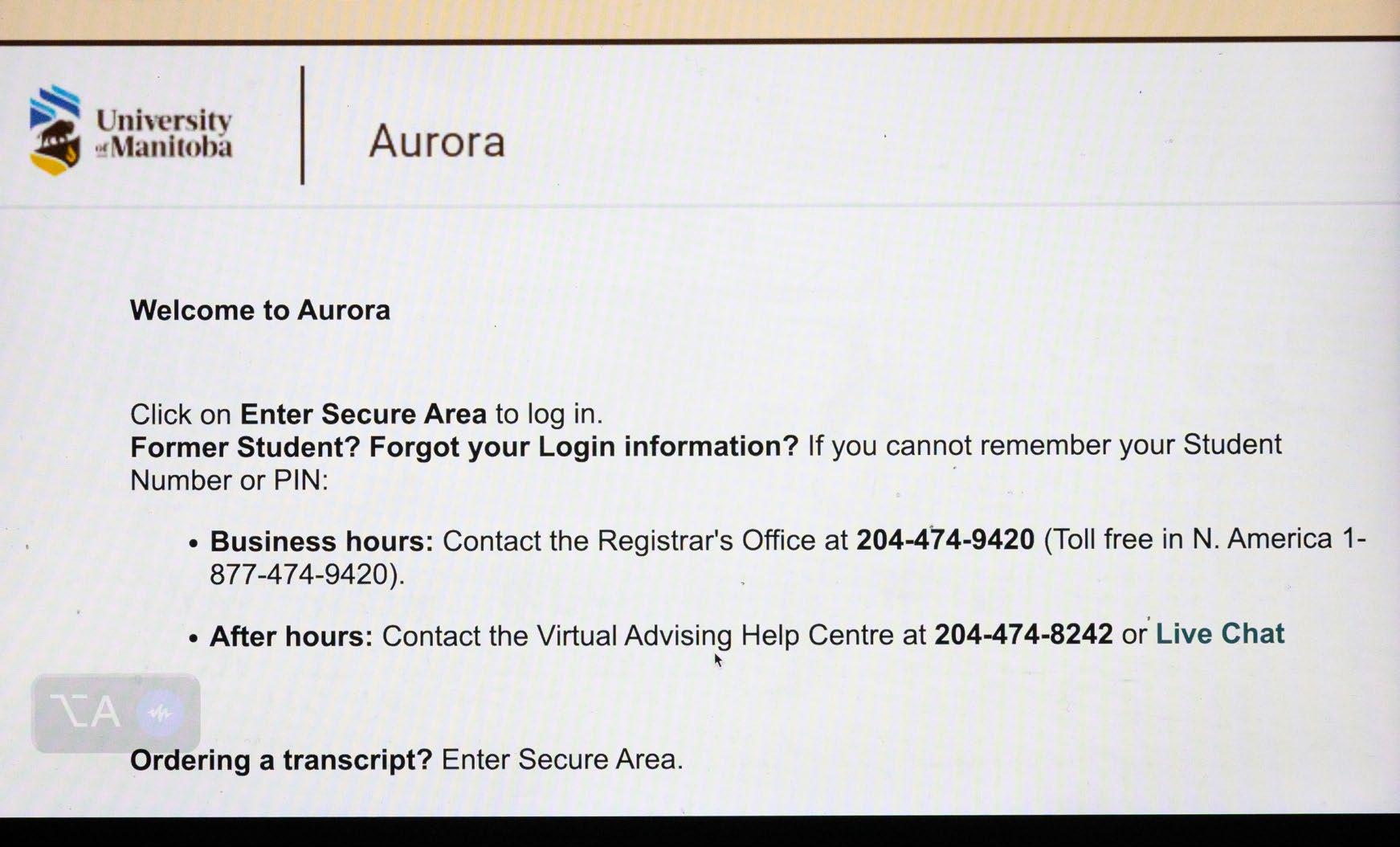
Keep an eye on your computer, because changes are coming to Aurora beginning in March.
U of M associate registrar and director of service and records Elfie Smith explained that the self-service student records and registration management system will undergo “significant changes” in March and continuing throughout 2024. “The system we’re currently using, it is up for an upgrade,” said Smith.
The changes will be “incremental” throughout 2024, beginning with a new front page that will link back to current Aurora pages under the existing system.
Students should expect to see updates rolled out in a “phased approach,” Smith said. She explained that this will be temporary, and the rollout will continue to replace the old Aurora functions with new ones as the months go on.
“It won’t be everything new all at once, and it’s not wrong if it brings them to something that looks like it’s our previous system. That’s by design.”
Smith described the student experience when navigating Aurora as “fragmented” and said students can find it difficult to locate what they need.
Victoria Nelson, a U of M student currently pursuing a master’s in human rights said it is difficult to find classes without knowing the course number.
“They’re all just in one large area and it’s kind of disorganized,” she said.
Nelson drew attention to the likelihood that users may find themselves “on a dead end” when looking at the awards and scholarship ssection.
“If you click something and you’re not sure where to go, you have to open more tabs and do all this instead of it directing you somewhere else and it can take a long time to go through all of it,” she said.
Smith said students told them they wanted a more “modern feel” to the website, where all aspects are streamlined for easier accessibility.
Functions like course registration will not see an update until after the summer 2024 registration period, when many students are already registered for courses.
When Smith’s team spoke to students in November about prospective upcoming changes to Aurora, one aspect that caught a lot of attention was the ability to access UM Learn
and UM Achieve through Aurora. She said the goal is to make Aurora “A one-stop destination.”
While plans are still “being finalized” and Smith said she could not give a precise timeline for when all changes will be implemented, the goal is to have the transformation “substantially completed” by the end of this year.
“2024 is our big year,” said Smith.
Smith said the new system will be more “mobilefriendly,” and will give stu-
dents the ability to personalize their Aurora experience.
Instead of the current system, students will see a page with cards that will take them to one of the various functions on Aurora. Students can “click and drag” these cards to organize the functions they use the most, positioning them at the top of their Aurora home page.
For students who need assistance using the new features, navigational tools will be available in Aurora’s new launch page.
More information regarding the changes that students can expect when accessing Aurora over the coming months will be communicated after reading week. Students looking for more information on changes coming to Aurora can contact the U of M registrar’s office or visit https://umanitoba.ca/student-supports/ ask-umanitoba-contact.
Travelling refugee museum exhibit comes to Winnipeg
Exhibition by CMU prof focuses on southeast Asian refugees in Canada
Alicia Rose, staff
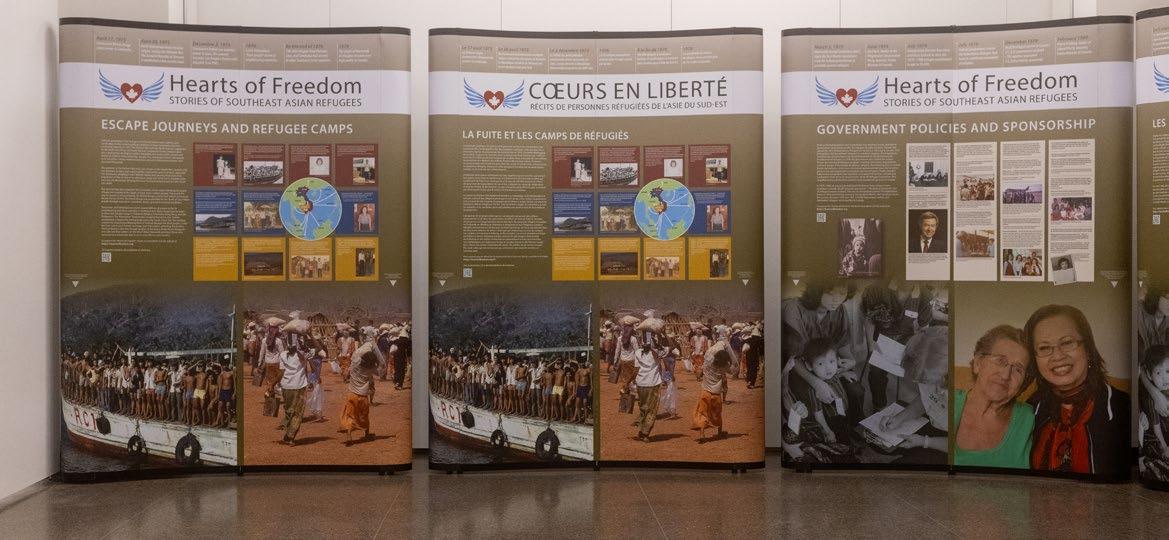
An exhibition featuring the experiences of southeast Asian refugees curated by a professor from Canadian Mennonite University (CMU) is currently featured in the Manitoba Museum’s Festival Hall. Run by the Hearts of Freedom project, the exhibition, entitled Hearts of Freedom: Stories of Southeast Asian Refugees, focuses on refugees to Canada during the 1970s and 80s.
The Hearts of Freedom project was founded by members of the Vietnamese community in Canada. The organization soon expanded to include the Laotian and Cambodian communities, as all were affected by the Vietnam War.
Stephanie Phetsamay Stobbe, a professor of conflict resolution studies at CMU and member of Hearts of Freedom, is the curator of the travelling exhibition.
Stobbe said Vietnamese, Laotian and Cambodian
people “were part of the mass exodus of people from their home countries, as a result of the violence and persecution that they were experiencing and the lack of freedom in those countries.”
Stobbe and her team spoke with 173 individuals across Canada, conducting interviews in five languages: English, French, Vietnamese, Laotian and Khmer.
“Many of them said that this was the first time that they have ever told their stories,” she said.
“They wanted to be able to share this with their children, as well as their grandchildren, and share it with their communities here in Canada.”
Stobbe emphasized the importance of the project for her, as her own family came to Canada as refugees.
“I came to Canada as a young child, and have experienced warfare, displacement, resettlement and settlement,” she said, “and I really con-
nected to the different people we interviewed for this project.”
Early discussions about the project began in 2015 and it received funding in 2018. Interviews for the project began in 2019 and were completed in 2021. The majority of the interviewees were former refugees, but also included government officials — including former prime minister Joe Clark — and other sponsors of the organization.
Eventually, Stobbe decided to create a travelling exhibition based on the project.
“I wanted to bring it back to the communities, to the people who we interviewed across Canada, so that they can share with their families and friends, and with their communities,” she said.
Stobbe hopes that in the future, the exhibit will find a permanent home in Canada. These stories and issues are “still very important and relevant today,” she said, due to
the continuing problems of war and displacement.
“We need to really continue to look at these issues and looking at ways we can help refugees,” said Stobbe. She said that with recent refugees in Canada, it is important to look at the services they need to help them integrate to their new country and overcome language barriers.
She said that it is important to “highlight the positive stories of integration and the contributions that these former refugees and their descendants are making” in Canada.
After finishing the exhibition in January of 2023, it was launched at the Canadian Museum of History in Gatineau, QC. The Hearts of Freedom exhibition has been travelling across the country since.
The Hearts of Freedom exhibition will remain at the Manitoba Museum from Jan. 5 to April 7. To get tickets please visit my.manitobamuseum.ca
photo / Matthew Merkel / staff
photo / Ebunoluwa Akinbo / staff
UM hosts panel of experts discusses generative AI
U of M profs discuss artificial intelligence that can chat, write, compose music
Colton McKillop, staff
A
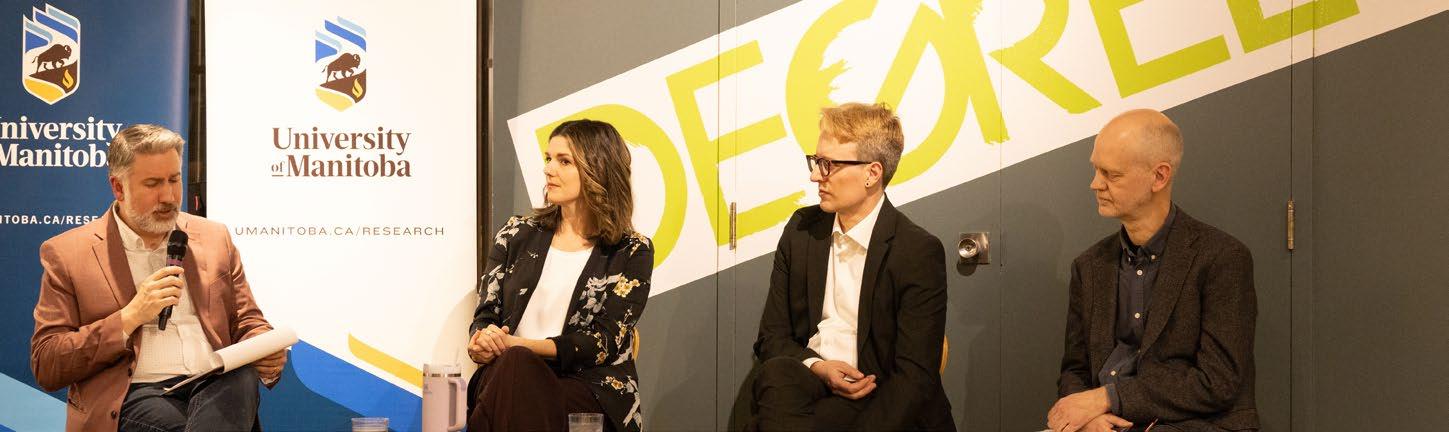
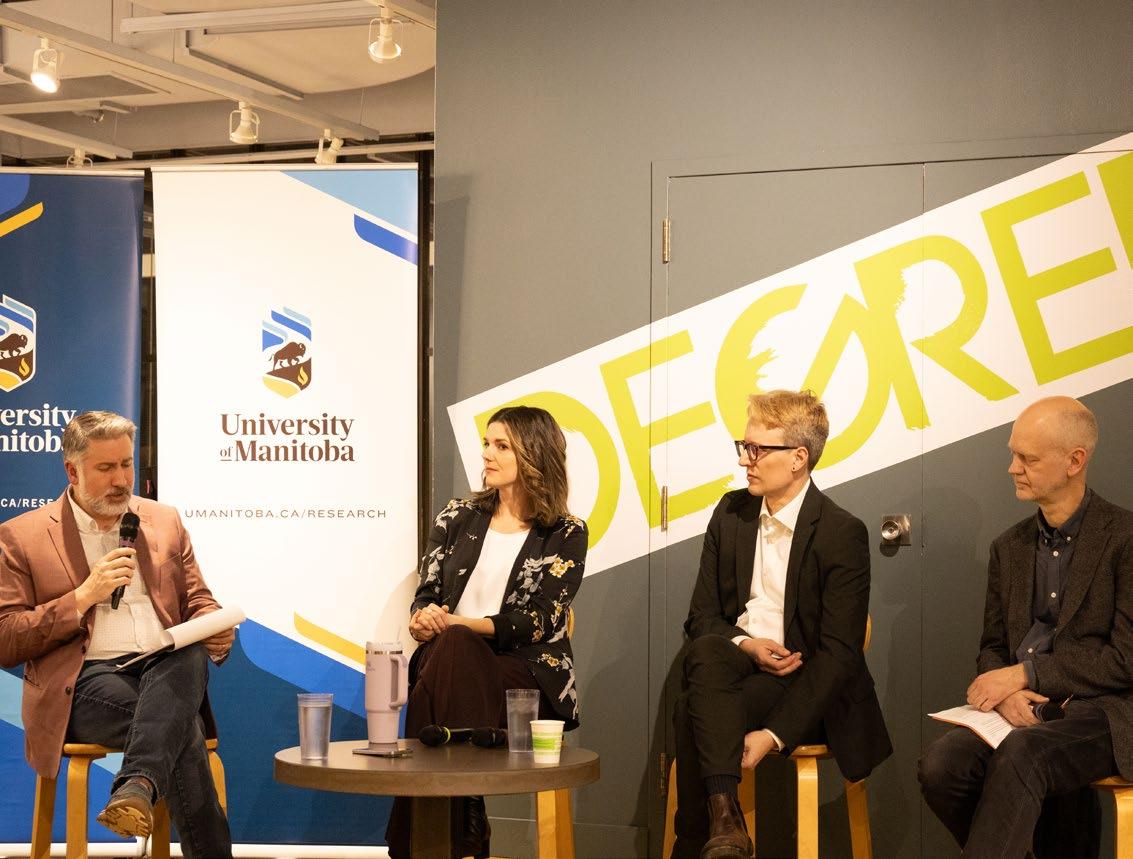
UM Knowledge Exchange panel discussion last Wednesday brought together experts from a variety of backgrounds to explore the challenges generative artificial intelligence (AI) poses to artists, legal professionals and others.
Entitled “Next Steps with Generative AI,” the presentation featured U of M professors with expertise on the topic. The event took place at Degrees Diner in University Centre.
The panel was moderated by David Gerhard, head of the U of M computer science department. Gerhard said while the “core technologies” behind AI have been in development for decades, it caught the public’s attention in the past few years with the rise of models that could “generate content.”
“The fact that these models could create images based on any description or attempt to answer any question, the public became very excited about these models,” he said.
of the potential use of AI in legal practice and argued that it was only capable of mimicking what writing is supposed to look like based on statistical likelihood.
At the panel, Szilagyi said while some argue lawyers should make the most of the latest technology to provide good service to clients, some judges question how the use of AI impacts the duties of a lawyer.
She highlighted a recent story concerning a British Columbia lawyer who used ChatGPT to prepare legal briefs for a B.C. Supreme Court civil case. The AI was found to have “hallucinated” legal cases that had never happened, which were subsequently included in the brief.
“When you submit that as a
Applied Ethics at U of M Neil McArthur’s research on AI focuses on its impact in human interactions and the development of relationships between humans and AI. During Wednesday’s panel he noted that people often “freak out when it comes to our relationships” with technology — drawing particular attention to robots and AI. People also worry that technology will “invade our society and destroy our relationships with each other,” he said.
He said that some people have begun to form relationships with chat bots, including intimate relationships.
“These models could create images based on any description or attempt to answer any question”
— David Gerhard, panel moderator, head of U of M’s department of computer science
lawyer, there’s duties of ethics that are implicated there,” she said to the panel.
Katie Szilagyi, an assistant professor at U of M’s faculty of law, said she is “pretty critical”
Associate professor of philosophy and director of the Centre for Professional and
“They’re looking to them as therapists, they’re looking to them as friends, they’re looking to them as grief counsellors and they’re looking to them as religious leaders or religious gods,” he said. He urged people to avoid stigmatizing humans forming attachments to AI, and instead, embrace the technology while being realistic about its limitations, pointing to possible companionship, and the “therapeutic uses” of AI.
McArthur told the Mani-
toban that one of his biggest misgivings about the possible negative effects of this technology is privacy concerns. He recommends “strong regulation” for private AI companies.
“When you’re divulging these kinds of personal details to an AI, I think that the security of your information and how it’s being used becomes very important,” he said.
Örjan Sandred, a professor of music composition at the faculty of music, uses generative AI to explore “new ways of structuring music for [himself].”
“I strongly believe that the tools you use will affect your output,” he said.
In his portion of the panel discussion, Sandred explored
whether generative AI could compose music without the help of a human. He argued that simply showing an AI a particular type of music, such as compositions by Mozart, would simply result in music that sounded similar to Mozart rather than anything original, unless the computer makes a mistake.
By teaching an AI the rules of music theory, however, Sandred argued a composer could then “start to tweak” the rules in order to “create music that no one ever heard before.”
The panel was followed by questions from Gerhard and the audience.
Lectures explore colonialism, Indigenous activism
Distinguished visiting lecturer examines Red Power Movement, colonialism’s impact
Michaela de Hoop, staff
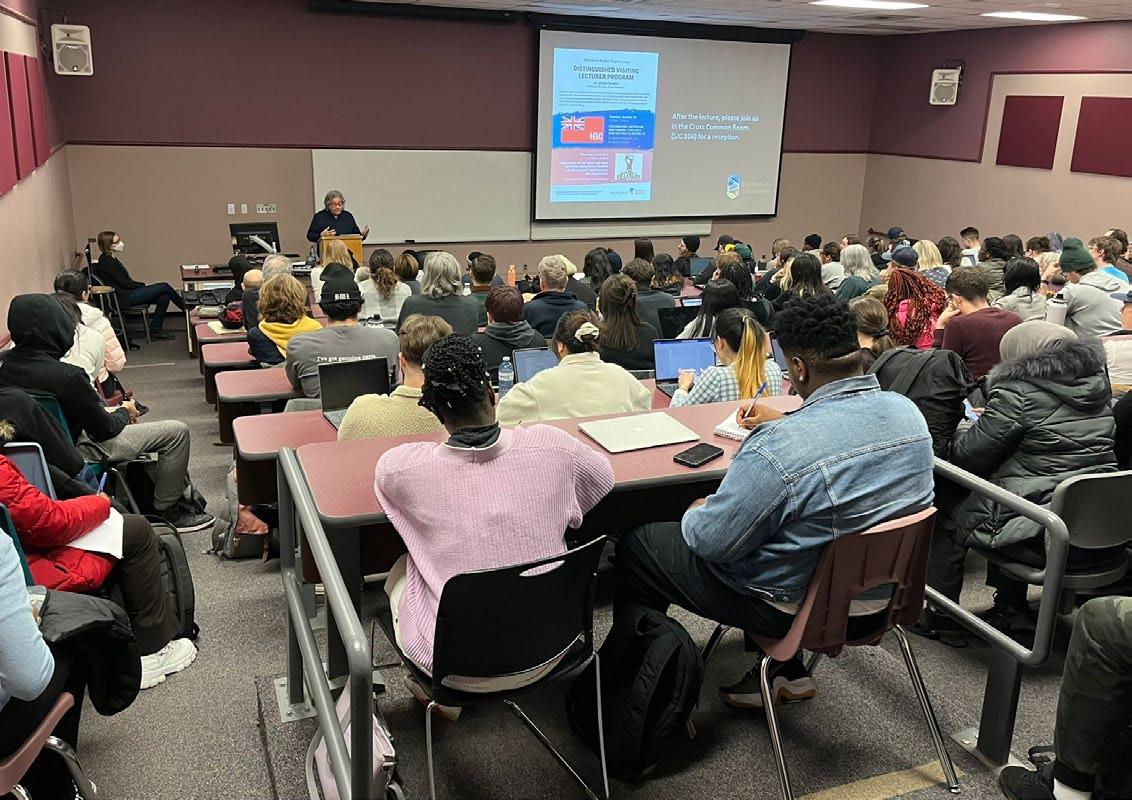
The University of Manitoba labour studies department hosted a two-part lecture series on Indigenous political issues and engagement in Canada last week as part of the U of M’s Distinguished Visiting Lecturer Program.
Professor emeritus of Canadian studies at Trent University Bryan Palmer presented the series, holding one talk titled “Colonialism, Capitalism, and Canada, 1500-2023: How the Past is Before Us” on Jan. 30 and another called “Red Power in the 1960s and Now: Situating Indigenous Protest and its Legacies Historically and Politically” on Feb. 1.
The first part of the lecture series at U of M looked at the exploitation faced by various people in Canada, from Indigenous peoples to working class and immigrant Canadians, that came as a result
of colonialism and capitalism. The second part of the lecture series focused on the Red Power Movement, a wave of Indigenous activism in the 1960s and 1970s.
The Red Power Movement included a series of protests addressing the mistreatment of Indigenous people across North America, over concerns about education, land rights and other issues.
Palmer highlighted the importance of history in social movements.
“I have always regarded historical scholarship as something that can be useful in current struggles around social justice and transformation,” he said.
He described the Red Power Movement as an “invigorating and exciting explosion of youthful Indigenous militancy,” and described its efforts to form connections with other youth movements
as “the kind of thing that needs to be rebuilt.”
He said that reseaching Indigenous protest offered “exciting” explanations on the ways Indigenous people have been “structured” into a position of marginalization and showcased their resilience in continuing “to exist and fight in spite of the incredible effort and energy” put into keeping them in that position.
Palmer said the lectures originated from a Canadian publisher’s request that he write a book on capitalism’s history in Canada, but according to Palmer, “you can’t really do that unless you write about capitalism and colonialism, because the one is integrally related to the other,” he said.
Palmer is currently working on that book, one that he described as “a long history” of Canadian colonialism and capitalism.
“It looks at how colonialism
and capitalism were, in some senses, intwined from the very beginning in the emergence of what would become Canada,” said Palmer.
Palmer explained his research on the topic was an attempt to highlight what he called the “common cause” many different people share to “change society,” in terms of issues including working class alienation, poverty,
wealth inequality and the oppression of ethnic and sexual minorities.
“As a historian and an academic, if I can write something and publish things that move people to see the necessity of fighting around certain issues then I’ve done my small bit for the moment,” he said.
photo / Ebunoluwa Akinbo / staff
photo provided
Students receive delayed charges from UM food vendor
Credit card charges caused by processing delay, will be waived for affected students
Alicia Rose, staff
S
ome students at the University of Manitoba received delayed credit card charges at the end of last month from purchases made in the fall.
Aramark, a food distribution company, has overseen dining and food services on campus since entering a tenyear contract with the U of M in April 2014. Students who purchased goods from the Snack Exchange in the Asper school of business from September to October 2023 were not charged for their purchases until January.
Japnjot Singh, general manager for Aramark Canada, said in an email statement that “these charges are not fraudulent or duplicate charges” and that the delayed charges were a result of processing delays.
“Dining Services recognizes that this is unacceptable and has decided to void these charges so that impacted customers will not be responsible for paying them. We apologize for any inconvenience that this may have caused,” Singh said.
U of M professor Ben Baader on academic freedom, antisemitism and Israel-Palestine
< Cont’d from front page
Al Khafagi’s social media posts and the charges of discrimination and antisemitism
The social media posts on the basis of which Arij Al Khafagi was suspended were neither hateful nor threatening. They were forceful political commentary in a dramatic historical situation. They were not discriminatory. In fact, the word “discriminatory” is misplaced in respect to Al Khafagi’s posts.
“Discrimination,” according to the U of M Disclosures and Complaints Policy that defines these terms for the Respectful Work and Learning Environment Policy, is “differential treatment” of individuals or groups.
In general, this does not apply here. And in particular, Al Khafagi’s posts did not constitute discrimination against Jews. Al Khafagi’s critical commentary did not target Jews as Jews, or even Israelis as Israelis. Her posts critiqued Israeli soldiers and the Israeli government.
This is evident from the posts themselves. And it is made even more obvious in Al Khafagi’s follow-up posts, in which she applauded Jews who publicly demanded a ceasefire in Gaza. Arguably, Al Khafagi calling Israel “Shitrael” is disrespectful, but her posts featured neither threats, nor anti-Jewish stereotypes, nor any hostility against Jews. In fact, many Jews hold political positions in line with Al Khafagi’s posts.
What is playing out here is a political disagreement, with both Jews and non-Jews on either side of the fence. All of this has nothing at all to do with religion or faith, or even Jewishness as an ethnicity.
The most controversial post might be the one that shows an Israeli soldier pointing a gun at a woman in a hijab on the ground, and in the mirror in front of them, a Nazi soldier pointing a gun at an emaciated Jewish man. And the caption reads, “the irony of becoming what you once hated.” This type of political commentary that accuses Israelis of behaving like Nazis is commonplace among Jews and non-Jews.
Similar statements and comparisons have been part of Jewish and Israeli political discourses for decades, at least since the Israeli public intellectual Yeshayahu Leibowitz, a committed Zionist (d. 1994), coined the term “Judeo-Nazis.” Leibowitz warned that Israeli soldiers who served in the West Bank and the Gaza Strip after Israel captured these territories in the 1967 Arab-Israeli war
became “Judeo-Nazis” when violently dominating another people.
Many Holocaust survivors and their descendants have made statements along the same lines. In fact, in a rather inflationary comparison, Reuben Moscowitz, who survived the Shoah in Rumania, went as far as to state in 2010 that “what I went through during the Holocaust ... the besieged Palestinian children [in Gaza] are going through.” Academic Norman G. Finkelstein compared Israel’s military occupation to the Nazi regime.
Thus, one might find it inappropriate or even offensive for a non-Jew to compare Israelis to Nazis, but this is not threatening, does not stereotype, and it does not target Jews as a group, religious or otherwise. According to established standards of what constitutes antisemitism, this is not antisemitic.
tories) published the Jerusalem Declaration on Antisemitism in 2020, which provides a more specific, and less politicized definition of antisemitism. According to the Jerusalem Declaration, Al Khafagi’s comparison of an Israeli soldier to a Nazi soldier is not antisemitic.
Academic institutions have since struggled under the pressure of various interest groups that urge them to adopt one or the other definition of antisemitism. An exemplary case is the University of Toronto, which in 2020 installed an Antisemitism Working Group. In its final report, the working group recommended that the U of T not
other. Therefore, the U of M’s Respectful Work and Learning Environment Policy stresses the values of dignity and self-esteem, diversity, equity and inclusion.
But the only two violations that the policy is concerned with are discrimination and harassment. The policy is not designed to protect students, staff or faculty from ideas or opinions of other members of the university community that they disagree with or find offensive.
Any compsomise on the free expression of political views and of controversial perspectives on current or past political events jeopardizes the educational and scholarly essence of the academy
Along the same lines, calling Israel “Shitrael” is disrespectful, but it is not antisemitic. And calling the Israeli government and army “terrorist” is sharp political commentary in dark and dramatic times, but it is not antisemitic. In fact, the Pope himself has recently called the Israeli acts in Gaza terrorist.
The controversy about defining antisemitism
I use a scholarly, well-established definition of antisemitism. Yet in 2016, the International Holocaust Remembrance Alliance (IHRA) formulated an expanded and politicized definition of antisemitism, according to which certain critical statements, including “comparisons of contemporary Israeli policy to that of the Nazis” are antisemitic.
In the past decade, the community-driven IHRA has engaged in extensive lobbying. As a result, a significant number of institutions and governments, including the government of Manitoba, have adopted the non-legally binding IHRA definition of antisemitism.
However, this definition is widely contested, most vehemently in the academic world. 128 scholars, who called the IHRA definition “vague and weaponized,” urged the United Nations not to adopt it. Likewise, 210 of the most distinguished scholars in Jewish studies, Middle East studies and Holocaust history (today about 350 signa-
adopt any of the recently proposed definitions on antisemitism. It noted that the university is “a place in which difficult and controversial questions” need to be addressed freely.
And the working group pointed to the university’s principled commitment to “freedom of inquiry and open debate [...] The university does not take positions on social or political issues, apart from those directly pertinent to higher education and academic research. Instead, its role is to provide a forum within which issues can be studied carefully and debated vigorously.”
These principles should be honoured at the University of Manitoba, too. Thus, I applaud the faculty of health sciences appeal committee for exonerating Al Khafagi from the politicized charges of antisemitism and discrimination and for thereby defending the freedom of political contestation at the university.
About free political expression and codes that enforce civility
Now, let me talk briefly about the relationship between the civil space of political contestation, and the concept of a respectful work and learning environment, which was evoked in the proceedings against Arij Al Khafagi.
In fact, the ideal of a polite, well-tempered and conflict-free work and learning environment and the principle of open political debate exist in some tension to each
And this is the way things need to be, because, as the U of T report quotes from the University’s Statement of Institutional Purpose, “in the unique university context, the most crucial […] rights are the rights of freedom of speech, academic freedom and freedom of research. […] These rights are meaningless unless they entail the right to raise deeply disturbing questions and” at times challenge “cherished beliefs.”
This means that discomfort and hurt feelings are at times the price of open debate, and they do not constitute discrimination. These facts are also beautifully and clearly put into words by the 2019 Statement on Freedom of Expression at the University of Alberta:
“Members of the university community have the right to criticize and question other views expressed on our campuses, but may not obstruct or otherwise interfere with others’ freedom of expression. Debate or deliberation may not be suppressed because the ideas put forward are thought by some, or even most, to be offensive, unwise, immoral or misguided
“It is for individuals, not the institution, to make those judgments for themselves and to act not by seeking to suppress expression, but by openly and vigorously contesting the ideas they oppose. The university does not attempt to shield members of the university community from ideas or opinions they disagree with or find offensive. Mutual respect and civility are valued, but their absence does not constitute sufficient justification to limit free expression (emphasis mine).”
of T Statement of Institutional Purpose do.
The entanglement of emotions and political interests
Finally, I wish to address the issue of safety, or more precisely, the issue that members of the university community reported feeling unsafe or frightened by Al Khafagi’s posts.
First of all, these are terrible times, and anyone who has some connection to the Middle East lives in a state of anxiety and is emotionally strained. The horrific massacres, rapes and abductions of Israelis by Hamas on Oct. 7, 2023 have triggered massive fears among Jews.
As a scholar of Jewish history, I could tell much about the history of persecution and discrimination that East European Jews faced in the past 300 years, while at other times Jews have often experienced centuries of stability, peace and prosperity.
Yet Canadian Jewry stems for the most part from Eastern Europe, including a very large group of Holocaust survivors, and its historical memory is understandably shaped by these events. It is fair to say that Canadian Jews as a group live with significant ancestral trauma.
Moreover, Canadian Jewry has experienced more than a century of substantial antisemitic discrimination and hostility within Canada. This only really shifted with the rise of multiculturalism in the 1970s. University quotas and restrictions on beaches and real estate, for instance, were lifted in Canada much later than in the United States.
Against this background, the founding of the state of Israel after the Shoah (Holocaust) has played an immense role for the self-esteem and sense of security of Canadian Jews as a group. Many Jews intensely identify with Israel. They believe that Israel guarantees the safety of diaspora Jews, and that critique of Israeli politics endangers them. These feelings are real as feelings, and they have fuelled the accusations against Al Khafagi.
Yet on the other side, what is currently unfolding in the Middle East during the Israeli military campaign in Gaza, the enormous death toll of civilians, and the suffering and starvation of the population, is also horrific. And Palestinians, Muslims and other non-Jews with Middle Eastern roots, are in distress, along with Jews and Israelis.
At the University of Manitoba, we are in dire need of a policy that enshrines and protects the right of free expression for everyone on campus along the lines that this U of A Statement on Freedom of Expression and the U Cont’d p. 7 / As >
Cont’d from p.6
As a group, Palestinians and Muslims have their own history of displacement and colonial violence in Palestine and beyond, and many have lived through discrimination and racist assaults in Canada. They are frightened, too. Thus, everyone is emotionally on edge, and rightfully so. Some experience the Palestinian flag as menacing, while others feel that way about the Israeli flag.
This is the context in which Al Khafagi made her social media posts, and it is the context of the accusations against her.
Yet feelings are not all that is at play here. Entangled with emotions are real political interests. Thus, some Zionist faculty at the University of Manitoba, and the Jewish student organization Hillel, hand-in-hand with the off-campus organization B’nai Brith, engage in a campaign of reporting what they experience as hateful and frightening speech, and what they consider antisemitic.
They do so out of fear for
Israel and for themselves, and in a calculated maneuver to support the current Israeli war effort. This local engagement here in Winnipeg is part of a larger campaign across North American campuses.
On the other side of course, the public support for Al Khafagi has been partially driven by political sympathies for the Palestinian cause. But not everyone who has expressed concern about this case is committed to pro-Palestinian or anti-colonial politics.
For many, what is at stake here, most importantly, is the right of free political contestation in a dramatic situation of war and destruction. The conflict in the Middle East is long standing and enormously complex, and in a university setting there needs to be space for a large range of views and political expressions about this conflict — including expressions that make some of us uncomfortable.
Afterword
Arij Al Khafagi’s social media posts were neither
hateful, nor threatening or discriminatory, and they did not deploy antisemitic stereotypes. They were forceful political commentary in an extraordinarily tense historical moment. Thus, it is only reasonable and fair that Al Khafagi was cleared of all charges of discrimination and antisemitism and that she was reinstated as a student in good standing. This outcome is good for all of us. Al Khafagi’s right of free political expression is Haskel Greenfield’s right to insult me publicly.
However, not everything is fine now. Can we trust that the ruling of the health sciences appeal committee will set a precedent for a university-wide approach of how allegations of antisemitism and discrimination are handled, when Israeli politics or actions are being criticized?
And even if this was the case, students in professional programs need to be aware that the codes of conduct or codes of ethics of their school can be used against them. In fact, all students have to be wary of charges of non-aca-
demic misconduct, which the recently revised Student Non-Academic Misconduct and Concerning Behaviour Procedure defines rather broadly.
Moreover, the Procedure declares “electronic communications, including communications through social media, where matters regarding the University or members of the University Community are a significant focus” to be “University Matters.”
This understanding of what constitutes University Matters opens the door to the scrutiny of even personal social media accounts. Thus, the generally vague and expansive language of the procedure and clauses such as the one defining University Matters are more than concerning. Together, they pose a threat to free speech and to unencumbered political contestation at the university.
The struggle to defend the civil space of controversy and political debate has just begun. Of course, true discrimination or harassment cannot be tolerated. And I call
on all of us to be as respectful as we can and to consider as much as possible the feelings and experiences of those with whom we disagree.
However, any compromise on the free expression of political views and of controversial perspectives on current or past political events jeopardizes the educational and scholarly essence of the academy. Inquiry into and vigorous argument about complex and uncomfortable issues are crucial to the mission of the university.
As the battle about what can be said and written about the war and the decades-long conflict in the Middle East rages on university campuses worldwide, it is our task to defend and to cultivate the civil space of unfettered debate, academic freedom and free political expression at the University of Manitoba.
Dr. Benjamin M. Baader is an associate professor in the history department at the University of Manitoba, specializing in European history and Jewish history.
Research & Technology
Advancing equity in cancer care
Assistant professor seeks to address barriers to lung cancer care with new project
elah ajene, staff
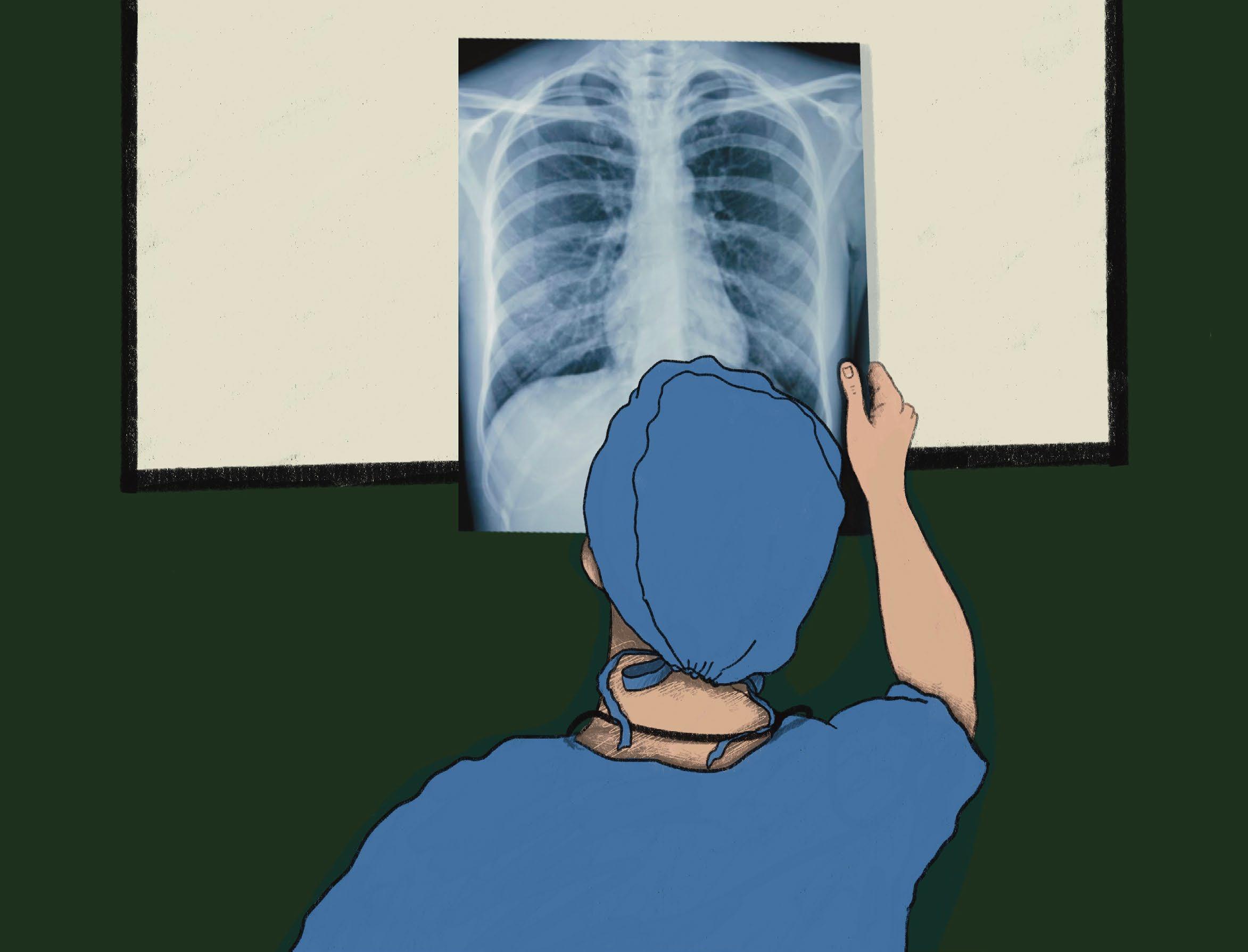
Last month, U of M assistant professor in the college of nursing Tara Horrill was among the winners of the Canadian Cancer Society’s 2023 Emerging Scholar Research Grants competition, receiving funding for her research aimed at addressing barriers faced by socially disadvantaged individuals dealing with lung cancer.
Horrill’s work revolves around the broader theme of advancing equity in cancer care, focusing on understanding why certain groups, often socially disadvantaged, face challenges in accessing timely and quality cancer services.
As Horrill delved into her upcoming lung cancer study, she explained the correlation between lung cancer, geography and income. She highlighted that individuals with lower incomes residing in more remote areas are disproportionately diagnosed with advanced lung cancer and face challenges in accessing treatment in Canada.
Horrill’s curiosity lies in understanding the reasons behind this disparity — emphasizing the need to explore how socioeconomic factors impact access to treatment.
The project, beginning this February, aims to engage with both patients and health-care providers to identify challenges and ultimately inform changes in health-care policies and services.
Horrill outlined the upcoming lung cancer study as the next step in a broader strategy to design and implement interventions that improve access to care.
with patients, Horrill shared her commitment to addressing health-care inequalities.
“It’s really challenging to hear about, and it’s much more challenging for them to experience,” she said, “I think hearing those stories always
Although research is still underway, the study has identified that cancer care services often neglect the social context of individuals, leading to challenges for those experiencing homelessness or unstable housing situations.
“There’s this fundamental mismatch between how services are designed and the actual needs of people”
— Tara Horrill, U of M assistant professor in the college of nursing
Horrill’s background as a registered nurse working in the field of oncology for 10 years inspired her to bridge the gap between clinical practice and research to understand and address disparities in cancer care. Reflecting on her experiences interacting
fuels my interest and my drive to make some sort of positive change.”
Her most current project investigates barriers to cancer care within two large urban areas of a province in Western Canada, focusing on the impact of health systems and organizational factors on cancer care accessibility.
“There’s this fundamental mismatch between how services are designed and the actual needs of people who are experiencing various forms of disadvantage,” Horrill said.
Additionally, Horrill discussed the pressure to reduce wait times within the healthcare system, emphasizing that such efforts can disproportionately affect already disadvantaged individuals. Policies aimed at efficiency, such as strict rules around keeping
appointments, may inadvertently hinder access to essential cancer treatments for those facing the most barriers, she explained.
The physical and clinical spaces also play a crucial role.
Horrill noted that hospital environments can feel “cold and institutional.” This may act as a deterrent for specific populations, such as Indigenous people who have undergone experiences in residential schools or foster care, from seeking care.
“When a building feels like an institution, it can mean that people don’t want to access care there,” she said.
The study further underscored the pervasive issue of racism, stigma and discrimination affecting individuals seeking cancer services.
“Sometimes they experience that when they’re trying to access cancer services, but sometimes they’ve experi-
enced that many times over the course of their lifetime,” Horrill said.
“That makes them not want to go back if they’re anticipating some form of negative treatment.”
Recognizing the prevailing distrust toward healthcare providers, institutions and researchers, particularly in settings studying disadvantaged populations, Horrill stressed the importance of establishing strong foundations through relationship-building within the community.
“It’s a really important first step,” she said. “Hearing from the people that are most affected by these problems can make your research more meaningful, and hopefully, more impactful in the long run.”
graphic / Teegan Gillich / staff
The future of meat
U of M associate professor talks meat and sustainability
rhea bhalla, staff
Argenis RodasGonzález, a former farmowner, fled Venezuela with his family amid threats of kidnapping and ransom. As a professor, researcher and ranch consultant with a degree in veterinary medicine, he immigrated to the United States, where he completed a PhD in animal science at Texas Tech University.
Now an associate professor in the U of M department of animal science, Rodas-González’s research focuses on domesticated and exotic meat animal species to improve meat quality.
Aided by his experience researching water buffalo in Venezuela, Rodas-González began studying bison. His work focused on extending the shelf-life of bison meat and improving its colour.
“The problem with bison is in a few hours the dark red colour becomes brown,” said Rodas-González. “It’s a rapid deterioration.”
While traits other than colour are related to shelf-life, he explained that colour is the main trait that drives consumers’ decisions. Unless it is frozen, the shelflife of bison meat is usually five days.
“If I can extend it from five to seven, I gain two more days where the meat is going to have the opportunity to be purchased by the consumer, instead of getting brown,” he explained.
A second study used high-voltage electrical stimulation to improve shelf-life, while a third used various packaging types. Nitrile film packaging, which directly contacts the meat’s surface and allows nitrite (a chem-
next generation of pigs.
“What is the potential of that boar to provide those genetics to the next generation?” said Rodas-González. “We were evaluating the different boars, different estimated value, and segregating the animal according to the feed conversion [ratio].”
“Livestock producers and companies related to livestock production […] are doing our best to produce sustainable, efficient products to the consumer”
— Argenis Rodas-González, U of M associate professor of animal science
In one study co-authored by Rodas-González, researchers used plant extracts to extend the shelf-life of bison strip-loin steaks. Oregano and rosemary extracts were found to increase the stability of the colour and reduce discolouration due to their antioxidant properties.
ical compound formed by the oxidation of ammonia, often used in meat as a preservative) to dissolve into the meat juices, was especially successful.
Another one of RodasGonzález’s projects involved work with a genetic company focused on pigs. The company used CT scans to evaluate and select boars that would provide genetic material for the
Feed conversion ratio is the weight of feed given divided by the weight gained by the animal in a certain period of time. Animals with high feed conversion ratios are able to efficiently convert their food into muscle and fat on their bodies.
“If we apply these genetics tools, estimating breeding value for that particular trait, feed conversion rate, the meaning is the boar is going to provide that genetic material to the offspring,” RodasGonzález said. “And they are
going to require less feed to grow.”
His work involved the exploration of factors related to a pig’s feed conversion ratio. Examining the animal’s microbiome, his team detected a strain of bacteria called lactobacillus that improved the animal’s ability to absorb food passing through its digestive tract.
He found that highly efficient animals are better able to digest key nutrients such as protein, calcium, and phosphorus. When expelled from animals in manure, nutrients like phosphorous can contribute to major ecological problems like algal blooms.
“[Highly efficient] animals, if they are excreting less protein, less calcium, less phosphorus,” said RodasGonzález, they will produce “less contamination.”
Feed conversion ratio, Rodas-González explained, is “not a new term.”
“But now, it’s taking on more relevance because we are talking about environ-
ment impact, sustainability.”
Conserving feed, he noted, is “another metric for sustainability.”
One study found that investing in feed efficiency can reduce the greenhouse gas emissions of cattle in the Nordic region by approximately 20 per cent by the year 2050. Another study found that breeding higher efficiency Angus steers reduces their methane emissions by 25 per cent.
The meat industry accounts for approximately 15 per cent of global greenhouse gas emissions. Researchers like RodasGonzález aim to alleviate the environmental burden of this large sector of the Canadian economy.
“From my side, I can guarantee livestock producers and companies related to livestock production […] are doing our best to produce sustainable, efficient products to the consumer,” said Rodas-González.
“We care.”
Critique confidently to construct a better world Learning how to give constructive criticism is a necessary skill
Simon Pensato, staff
Can I offer you some constructive criticism?
Many readers may reflexively cringe at that question, which makes sense. For many of us, criticism feels primarily like a threat. As someone who relies on student loans and wage labour to get by, if I get too much “constructive criticism” from my profs or my boss, I could fail out of school or lose my job, and therefore wouldn’t have money to buy groceries or pay the bills.
Capitalism teaches us to especially fear criticism from authority figures at school and work, but also from our friends, family and other community members. Like losing a job, if we lose our friends and family, we could be stranded without a social safety net that gets us through hard times and makes grinding away at school and work worthwhile.
All this understandable anxiety around being criticized translates to fear around criticizing others, too. We’re trained to people-please, avoid making mistakes and smooth over conflict, so we develop fear around bringing up concerns directly with other people — you wouldn’t want to send someone else into an anxiety spiral.
The problem is that we all mess up sometimes. From time to time, everyone needs a little constructive criticism. No matter how much we try to perfect our tasks or our relationships, we will make mistakes.
The people around us will also make mistakes. People are sometimes forgetful, unkind or ill-prepared. But when we live our lives fearing criticism, it’s incredibly difficult to offer feedback when it’s needed or receive it when we’re the ones who goofed.
All of this creates a tangled web of neuroses. We’re desperate not to hurt each other and we feel like garbage when we do, which sometimes means the injured party must console the one who’s done the hurting. What a mess.
these crises don’t always bring out the best in people. When conflicts come up among folks I’m organizing with, none of us know how to handle it.
After one particularly heated venting session in the Signal chat, a comrade suggested that I read a book that has since changed my life, Constructive Criticism: A Handbook by Vicki Legion, which I think everyone should
to change things in a direction that is more just for everyone.
Changes happen for better or worse when we encounter contradictions and have to deal with them, but they don’t happen smoothly — change can be painful, terrifying and exhausting.
From time to time, everyone needs a little constructive criticism
I’ve lived my life as a major people-pleaser, to mixed success. While I try to be a good friend and partner, be thoughtful and efficient at work and school and maintain a genial attitude towards strangers on the bus, it’s impossible to go through life without hurting people.
This year, I’ve started to get involved in community organizing and activism after years of being politicized under the thumb of crappy landlords, living through a pandemic that no one in power seems to care about, seeing friends struggle with crisis after crisis without support and witnessing major world leaders, including our own prime minister, shrug at and enable Israel’s genocidal war on Palestine.
Lives and livelihoods are on the line, but unfortunately, the high stakes of dealing with
read. Originally written in 1974, the book is based on Legion’s work as an organizer in the communist, women’s and gay liberation, antiracist and anti-war movements. Despite the 50 years of separation, the issues Legion deals with in this text feel familiar to me as an aspiring organizer in all of these areas and as a worker under capitalism.
Legion writes about the ways vectors of oppression play into our understanding of the world and the ways we interact with each other, including where and when it can be helpful to engage in criticism. She says it’s best to engage in this process “among friends and allies” — people you’ve committed to supporting and mutually learning and growing with.
A key idea she works with is that “everything changes.” People and material conditions are in a constant state of flux and flow, and we can work
All of our actions and reactions are connected to our social world — we’re trained to react to situations in particular ways, and our environments provide a limited set of possibilities to work with.
Part one of the book sets up a theoretical basis for what follows, and part two is full of practical examples of how to deconstruct knee-jerk passive-aggressive responses to conflict, respond to feedback and ultimately, communicate effectively with friends and comrades. Essentially, Legion re-orients the goal of offering feedback from keeping “everyone feeling good and [keeping] everything running smoothly” to ensuring that movements work effectively for liberation.
Not all of us are organizers or revolutionaries, but the principles Legion outlines — criticizing ideas and actions rather than “separating one person from another,” grounding critiques in “objective observations” rather than bad faith interpretations, describing feelings and identifying their sources rather than suppressing them and expressing
what specifically you want to change and what the purpose of that change is — apply to all kinds of conflicts.
Legion also spends a fair bit of time talking about how to receive criticism. When it’s in good faith, criticism can help us grow and change and become better people. When you receive it, paraphrasing criticism to understand it better and to show empathy to someone who makes a more heated criticism can be helpful.
Reacting defensively to criticism can show others that criticism is dangerous, which erodes trust. So Legion recommends receiving criticism, especially from friends and comrades, with the assumption that it is given in good faith. Ultimately, both giving and receiving criticism is hard but necessary work. We can’t change without coming into conflict. Throughout our lives, we discard old ideas and adopt new ones, learn new skills and create relationships which make things possible that are impossible on our own. A better world is necessary and achievable, if we learn to work on our flaws and help others overcome theirs.
Constructive Criticism: A Handbook is available for free on Marxists.org
graphic / Teegan Gillich / staff
Arij Al Khafagi proof that safe spaces in academia are vital
Political freedom in academic setting must include dissent
Lakshmisree Shaji, staff
Following the reinstating of Arij Al Khafagi after almost two months of suspension, it is clear that there needs to be more focused conversations on the political identity of students and censorship in academic institutions.
Al Khafagi was suspended for sharing an Instagram post that depicted a cartoon comparing an IDF soldier to a Nazi with the caption “the irony of becoming what you once hated.” This was deemed antisemitic by the university. She was also removed from the Nursing Students’ Association council, and a motion that she brought to the UMSU board of directors meeting on Dec. 14 requesting that the union release a statement affirming students’ rights to freedom of expression was ruled out of order.
The importance of freedom to express political opinions in an academic environment cannot be overstated.
However, that also launches us into inevitably talking about the conservative talking point of 2017 — free speech versus safe spaces. This was also the only year Jordan Peterson probably ever produced a coherent argument, of course while being hateful and obtuse.
side of the internet is enough to inform anyone about the right wing’s obsession with free speech that often masks hate speech.
The argument that higher education institutions are largely left-leaning and, hence, hostile to conservative voices is not new. The Macdonald-Laurier Institute, a non-partisan thinktank, conducted a statistical survey which suggested that, largely, this point was true. So, enforcing absolute free speech, for the advocates, becomes an outlet to further the systemic inequalities imposed on the marginalized in academic settings.
purported to have a left-leaning bias, and yet Al Khafagi was suspended.
U of M should not have encroached on Al Khafagi’s freedom of speech by punishing her, arguing her social media post was antisemitic when it wasn’t. The reinstatement should make us think about what matters in the face of an ongoing conflict to the university — the mental and physical well-being of our students, or appeasing the national interests of the country?
Those in favour of free speech do not represent a population that faces discrimination due to various sociopolitical reasons. Instead, they are upset that they cannot share sexist, homophobic, classist, antisemitic, Islamophobic, transphobic and racist views without being held accountable.
The importance of freedom to express political opinions in an academic environment cannot be overstated
Half an hour spent on the Matt Walsh and Ben Shapiro
The irony that free speech might not hold the same meaning for different people in society because of the power imbalance caused by the imperialist, racist history of this country is not lost on me either. Universities are
Peterson, following rightleaning-free-speech pundits, was also up in arms against safe spaces on campuses. Safe spaces are spaces — not necessarily physical — that centre the mental and physical well-being of the marginalized. In a class where the topic of discussion is racism and the history of Canadian imperialism, it is only natural that those who are the victims of these systems are respected at all times. So many of our friends and colleagues have been affected by the conflict in Gaza. Therefore, we must create safe spaces for discussing it inside and outside the campus.
It is my opinion and experience that the U of M generally provides a healthy space for political discussion and encourages political literacy
/ Teegan Gillich / staff
questions and the responsible handling of evidence when discussing history. Due to shared academic freedom, all stakeholders of the institution — including administrative staff, faculty and students — have the responsibility to listen and speak carefully. on campus. This is vital to the existence of any educational institution. In the face of active political turmoil, an institution cannot and should not remain politically neutral, and neither can people associate with it.
Academic freedom and safe spaces encourage political discussions and are essential for any educational institution. These spaces promote the asking of uncomfortable
graphic
Eckhardt’s name is a humiliating stain
Winnipeg institutions should have wiped Nazi’s name long ago
braden bristow, staff
S
omehow, seemingly without anyone realizing, the Winnipeg Art GalleryQaumajuq (WAG-Qaumajuq), the University of Manitoba and the University of Winnipeg honoured a Nazi sympathizer and fascist, Ferdinand Eckhardt, by etching his name into their buildings. These organizations only began to reckon with their honouring of Eckhardt after the Walrus published an article by Conrad Sweatman on Nov. 9, 2023 exposing this fact.
I use the term “sympathizer” because, while Eckhardt technically was not a card-carrying member of the Nazi party, he was part of a group with 87 others who made a public pledge to Adolf Hitler in 1933. Pledging allegiance to Hitler is effectively equivalent to joining the Nazi party itself.
Not only did Eckhardt pledge allegiance to Hitler himself, but, as Sweatman details, Eckhardt also worked for Bayer IG-Farben for several years before and during the Second World War. Bayer IG-Farben supported Hitler ’s regime and also participated in crimes against humanity as the regime conducted human experimentation and murdered prisoners in concentration camps.
Regardless of whether Eckhardt was involved with those crimes, he still actively worked for this company. As an employee of Bayer IG-Farben, Eckhardt directly and financially benefitted from the Holocaust.
Sweatman shows additional pieces of evidence indicating Eckhardt’s sympathy for Nazi and fascist ideas. However, these two details are damning in and of themselves. All the organizations who honoured a man willing to support to Hitler and assist such a horrific company should be ashamed of themselves. Eckhardt was a Nazi. I have not found evidence that he ever once publicly renounced his past or denounced the Nazi party. Eckhardt pledged his allegiance to Hitler, he worked for a company complicit in genocide and never showed any sign of guilt.
Meanwhile, for years, Eckhardt’s name draped numerous respectable institutions across Winnipeg. The WAG-Qaumajuq, the U of M and the U of W each honoured the man Admittedly, they honoured his achievements following his move to Canada, after which he served as director of the gallery from 1953 to 1974. Both the U of M and the U of
W have stated spaces named after Eckhardt are under review, including those bearing the names of Eckhardt and his wife, Sophie-Carmen Eckhardt- Gramatté
Eckhardt and EckhardtGramatté contributed to Canadian society at large through their art and art preservation. Eckhardt held his position as WAG director for 21 years, and under his tenure the WAG purchased numerous pieces of Indigenous art, held Canada’s first public display of First Nations art in an art gallery and moved the WAG into its current blocky building.
Eckhardt- Gramatté, in her own right, was a prolific and award winning composer. She made such a contribution to the music scene of the previous century Brandon University awarded her an honorary Doctorate of Music
However, their names are permanently tainted by Eckhardt’s association with the Nazis and Eckhardt- Gramatté’s tolerance of this It might seem harsh to wipe away contributions because of political affiliation, but when the affiliation is with
the most heinous ideology on earth, it is far from harsh.
Having said that, no number of achievements can wipe away the immense shame that accompanies supporting the Nazi party. Eckhardt’s legacy should never have been honoured in the first place, and his appointment as director of the WAG is a stain on such an important part of Winnipeg’s art scene. Eckhardt- Gramatté may not have been a Nazi, but she was more than happy marrying one. Scrub both Eckhardt’s and Eckhardt- Gramatté’s names from anything they are associated with.
Each of these institutions had decades to realize their failures, and it took a popular article to finally push them in the right direction. Any location associated with Ferdinand Eckhardt either through bearing his wife’s name or his own is an insult to those killed or impacted by the Nazis. I think honouring any other Canadian artist would be better for anything named after these two.
The Eckhardt- Gramatté Music Library at the U of M could be renamed to the Ala-
nis Morissette Music Hall, for God’s sake. While the Morissette Music Hall is just an example, of course — though the name does roll off the tongue pretty well — any artist who has contributed to Canadian culture could be honoured.
Rather than make any change, the U of M has yet to permanently remove Eckhardt s name. The U of M instead opted to lazily slap a piece of paper over it
As previously reported in the Manitoban, U of M spokesperson Eleanor Coopsammy stated regarding the issue that any painting or plaque with Eckhardt’s name on it will remain covered until a review is finished. This vague statement combined with the U of M’s inaction is an embarrassment to everyone associated with the U of M.
Numerous students at the U of M would be reviled by the Nazi party Eckhardt was so fond of. Jewish students are first to come to mind, however, there are also disabled students, Black students, 2SLGBTQIA+ students and many others. Sending a mes-
sage to all these students that Nazis have no place at the U of M seems much more important than ensuring there is no disrespect to a Nazi’s legacy, but that’s just my opinion
The U of W is similarly waiting for a review to be conducted on Eckhardt despite the quite damning evidence of his Nazi past. A quick internet search shows that the Eckhardt- Gramatté Hall at the U of W and U of M retain their original names online.
As far as I am concerned, there is hardly any need for review. Educational institutions should be places of progress, diversity and learning
The U of M certainly claims this is its goal with diversity and positive change being important values Unfortunately, this is tough to believe when a Nazi’s name is scrawled on signs.
The U of W and U of M continue to drag their feet on taking real action. Meanwhile, Eckhardt’s name sits behind the U of M s piece of paper, staining the walls of what should be a place of progress.
graphic / Dallin
Chicoine / staff
Re: Zionism, Hindutva and the fascist brotherhood
Dear Editor,
I’m so sorry that Lakshmisree Shaji is so uninformed about Zionism. Zionism is built upon the yearning by Jews to live and pray in the land of their ancestors. Zionism can be interpreted as the foundation of Judaism. NonJews who support the existence of Israel are also Zionists.
There is no supremacism in the Jewish religion. Judaism’s holy books and teachings never mention other religions like Christianity and Islam. God’s promise to make Jews the chosen people has never become part of their religious observances. Most Jews are rueful about the chosen people shtick, echoing Fiddler on the Roof’s Tevye who said, “I know, I know. We are Your chosen people. But, once in a while, can’t You choose someone else?”
— Larry Shapiro, Calgary, Alta.
Dear editor,
Lakshmisree Shaji is obviously totally unfamiliar with Judaism. Judaism is based on the 3,500 year old Jewish Bible, a k a the Old Testament.
The Jewish Bible’s foundational narrative centres around the Jewish people’s return to Zion what today is Israel. It is not complicated: Zionism is Judaism. That is why Jerusalem is mentioned more than 660 times in the Jewish Bible. F.Y.I. — the word “Jerusalem” does not appear even once in the Quran.That is why for over 2,000 years, Jews at the Passover Seder — as they will April 22 — have stood and loudly and proudly prayed the ultimate Zionist prayer, “Next year in Jerusalem.” To claim that Zionism is not Judaism is to deny the singular 3,500-year-old foundational narrative of the Jewish Bible and to wallow in antisemitism.
Nobel Peace Prize winner Martin Luther King Jr. understood that Judaism is Zionism when he said at Cambridge, Mass. shortly before his death: “Israel’s right to exist as a state in security is incontestable.”
Second, nothing could be more ahistorical than Shaji’s use of the term “historical Palestine.” In recorded history there has never been an internationally legally recognized country called Palestine.
Palestine actually Syria Palaestina — was a Roman designation of an area, not a country, a name specifically created to obliterate 1,500 years of Indigenous Jewish culture including what the area had been called, Judea.
Following the First World War, there
was the British mandate for Palestine (1917-1948) — a trust, not a country. In fact Palestinians have rejected an independent state, whether called Palestine or anything else, in 1937, 1947, 2000, 2008, 2019 and 2020. The Palestinian Authority is not a country. Opining for non-existent historical “Palestine,” though, does not change history.
Further, Shaji ignores the fact that Article 80 of the United Nations Charter, which affirms the agreements of all current mandates at the time of 1945. This includes the 1922 League of Nations Palestine Mandate, which declared all of what was then Palestine to be the reconstituted homeland of the Jewish people, recognizing the Jewish people’s 3,500 year historical presence on the land. Simply put, one cannot annex or occupy one’s own territory. As an international treaty, the UN Charter supersedes any and all resolutions of the Security Council and the General Assembly that may conflict with it.
As Eugene Rostow, Dean of Yale Law School (1955-1965) and under secretary of state in the Lyndon B Johnson Democratic administration writes:
“Legally the West Bank and Gaza are unallocated parts of the Palestine Mandate” and “it must be remembered that, in contrast to other League of Nations mandates, the Palestine Mandate was not established as a trust for the Indigenous population of the area, to be terminated when the population was ready for self-government. Rather, Rostow continues, “It was set up […] as a trust for the Jewish people, in recognition of their his-
toric connection to the land on the condition that the civic and religious rights of the Muslims and Christians be respected.”
Jewish people’s right, Rostow says, “to settle in the West Bank has never been terminated” and is “protected by Article 80 of the United Nations Charter and hence necessarily part of the domestic law of the West Bank.”
Professors and students on college campuses embrace today by their public support of Hamas. Meanwhile, article 7 of the old Covenant of Hamas — which Hamas used between 1988 and 2017 —requires every member and supporter of Hamas to kill every Jew on earth. Neither Israel, Zionists nor “the occupation” is mentioned in Article 7.
Having rejected endless offers of an independent state which the Jews accepted, it is obvious that Palestinians’ concern is not about land. It is an existential dispute about the existence of the Jewish people. Once all the land is Judenrein, Palestinians will declare peace.
On Nov. 30, 1947 when Palestinians rejected an independent state offered by the UN General Assembly which the Jews accepted, their leader, Nazi war criminal the Grand Mufti Amin al Husseini, commanded the Arabs to: “Kill the Jews wherever you find them.”
It is unlikely Shaji knows much about the “Palestinian people.”
— Richard Sherman, Margate, Fla.
To complete Sudoku, fill the board by entering numbers 1 to 9 such that each row, column, and 3x3 box contains every number uniquely. In Straights, like Sudoku, no single number 1 to 9 can repeat in any row or column. But rows and columns are divided by black squares into compartments. Each compartment must form a “straight.” A straight is a set of numbers with no gaps but it can be in any order, eg [7,6,9,8]. Clues in black cells remove that number as an option in that row and column, and are not part of any straight. Glance at the solution to see how “straights” are formed.
If
To
For
Intertwining human connections, student theatre, For Elise
Director Catarina Mello Schultz discusses her Lunchbhagg
alison
Holliday, staff
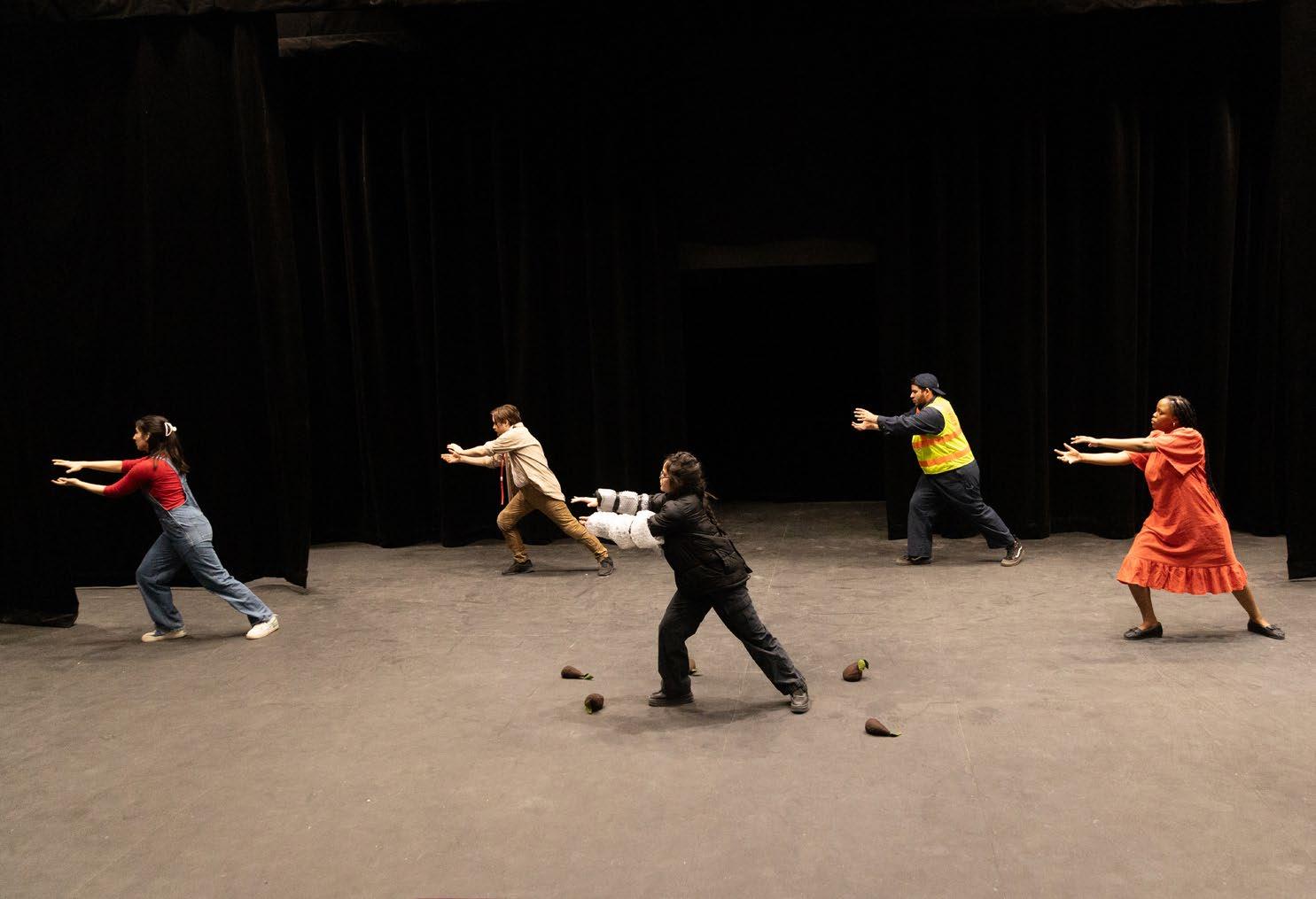
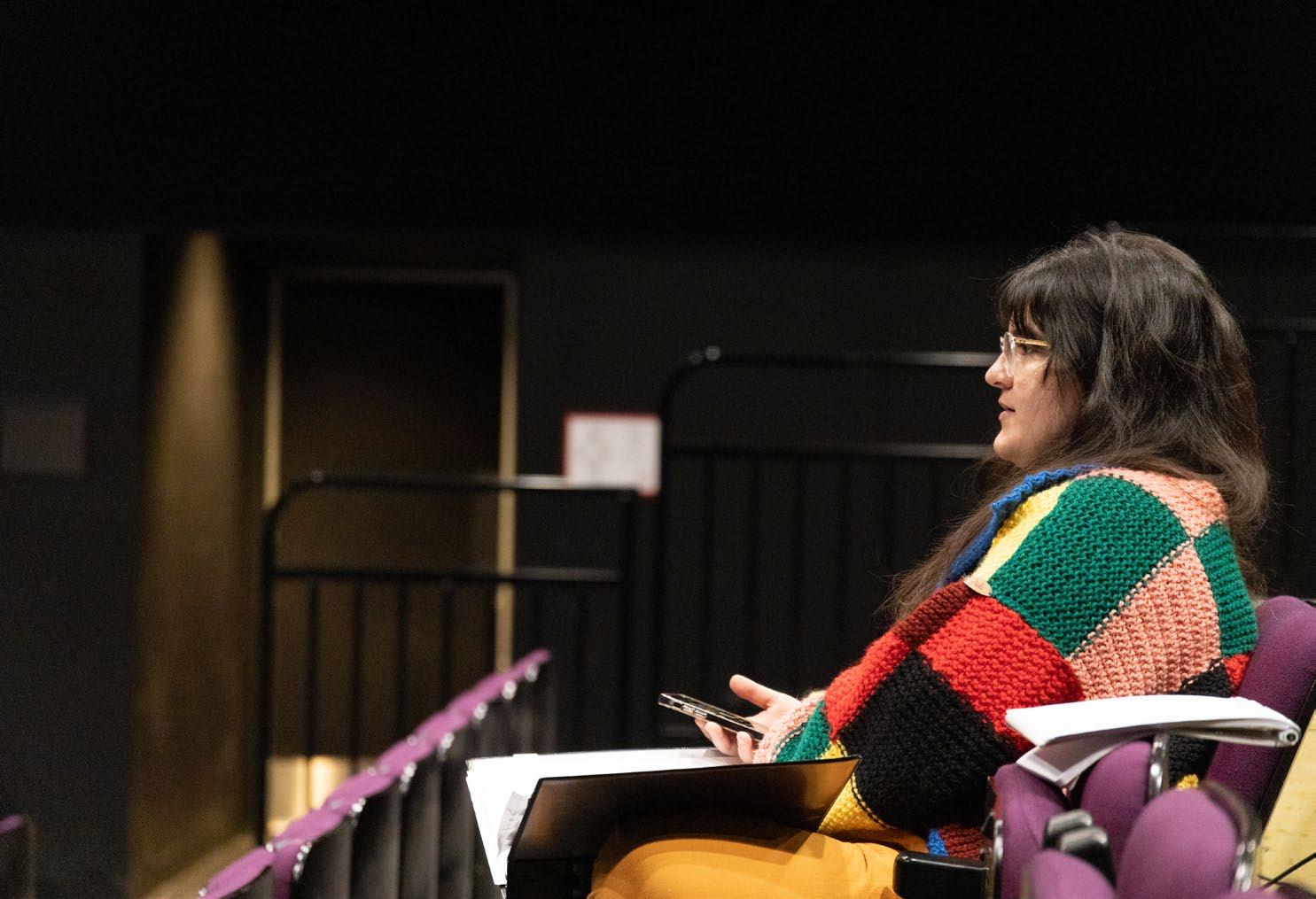
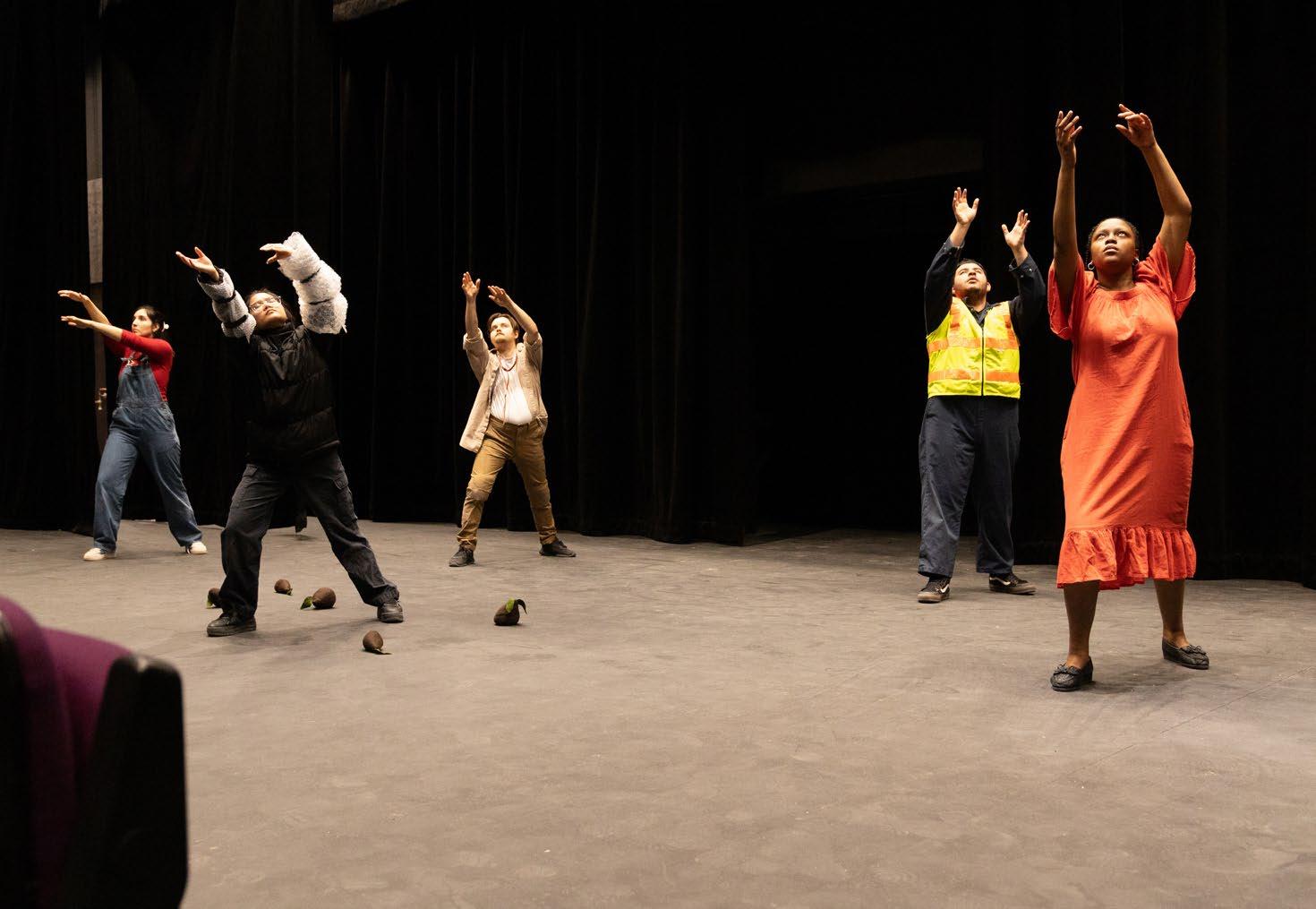
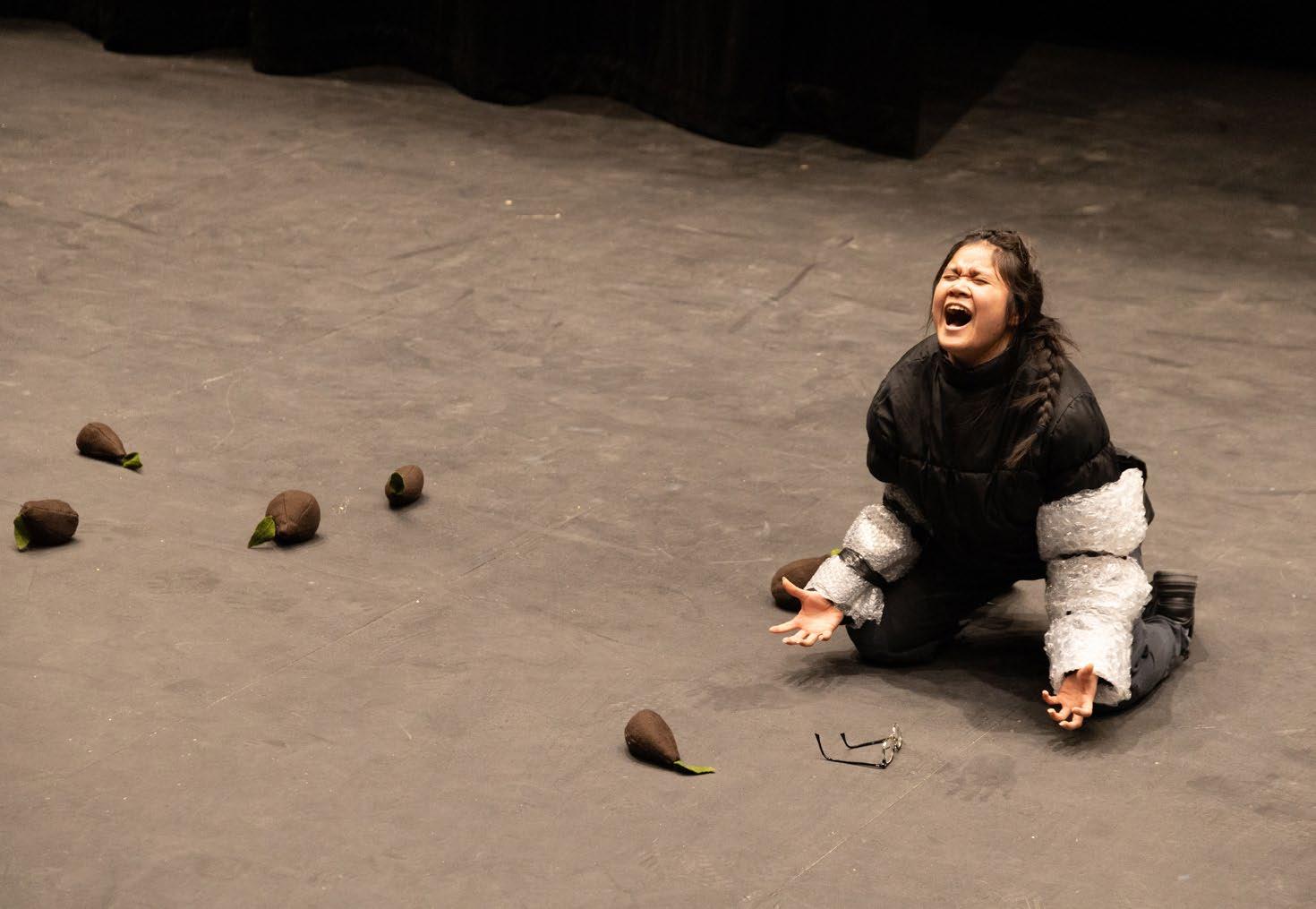
Abustling scene unfolds in the green room of the John J. Conklin Theatre as students return to rehearsals for the third student-led show of the year, colloquially known as a LunchBHAGG: For Elise by Brazilian playwright Grace Passô, translated by Daniel Hahn, and directed by Catarina Mello Schultz. The show will open its doors to audiences Feb. 6 and 7.
The play follows five characters’ intertwining lives as they live, work and interact all within the same neighbourhood.
A housewife, played by Emang Tlale, tells the audience the tales of her neighbours — a woman and a garbage man, played by Martina Caceres and Rodrigo Córdova, chase each other across the stage. An official known by no other title, played by Kirstin Caguioa, searches for a sick dog while a man, played by Zane Lindberg, begins barking.
Each character has their own fully realized story and
is given a moment to shine, interacting with one another or appearing onstage alone.
The show is playful, energetic and filled with childlike wonder. It portrays a bizarre and vibrant tapestry of life, even though we are only able to witness brief moments.
In only 45 minutes, these characters come together in a story about the cruciality of human connection. Characters move through the feelings their relationships provoke, experiencing fear or love as the story blurs the lines between the emotional and rational, the human and the animal.
“I think the biggest idea of the story is to show how people connect,” Mello Schultz said.
“We are all going on with our lives but we will connect to other people, and some people might try not to get involved with anyone else, with anything, maybe to spare themselves. But it’s hard not to.”
When Schultz applied to direct one of the U of M theatre program’s student-led shows,
her main priority was to find a Brazilian-written show.
The search was fuelled by a desire to see a story that she could not only connect with more, but enhanced that connection in regard to her own culture and language. So when given the opportunity to direct a show herself, she chose to introduce her classmates to “something closer to home.”
During her process of directing the play, Mello Schultz found herself inspired by the other theatre classes she is taking. Her inspirations come from discussions on books like I Hope We Choose Love by Kai Cheng Thom, or the Seven Teachings she learned in her Canadian Indigenous theatre course taught by Ian Ross.
Mello Shultz spoke fondly of her professors and classmates in the program, emphasising that “it wouldn’t be theatre without community.”
The theme of community relates heavily to For Elise The learning process and student theatre were vital for Mello Schultz embracing the
actors’ human moments to heighten the performance.
Mello Shultz’s choice of play and Passô’s clever writing emphasize the importance of reading more stories, trying new things and opening ourselves up to connection.
For Elise will be playing at the John J. Conklin Theatre, Gail Asper Performing Arts Hall on the third floor of Taché Arts Centre on Feb. 6 at 12 p.m. and 7:30 p.m. and Feb. 7 at 7:30 p.m. Admission is free.
photos / Ebunoluwa Akinbo / staff
Travel in other dimensions through Re-Sound Paint & Play
Art and music experience takes audience members to another dimension
Kelsey
Chin staff
In Re-Sound Paint & Play, the Desautels faculty of music and the school of art come together to present an exhibit unlike any other.
Victoria Sparks, instructor of percussion at the Desautels faculty of music, told the Manitoban that the event is a series of concerts. Last year, Re-Sound was done by the faculty in connection with the Winnipeg New Music Festival as a way to provide free concerts that allowed people to see what students at the U of M and the faculty of music were doing.
This time, the program and school brought together students from both disciplines to create a live visual and aural experience, separated into three parts that only build one upon the other.
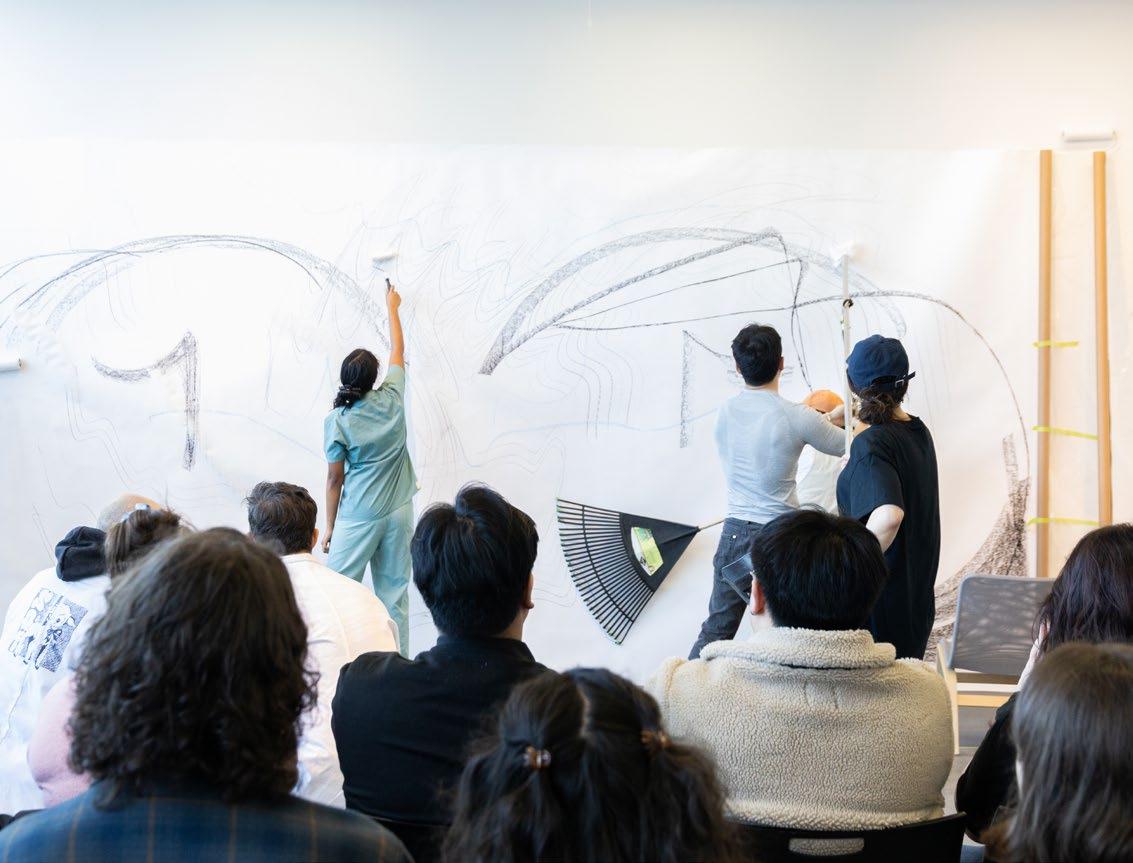
In the first part, the musicians started playing their music to inspire the painters, who then began creating their work collaboratively on a large white piece of paper taped to one end of the art room.
The musicians played sounds directly to one side and in front of the event space, which mimicked a sort of surround sound, connecting with
the title of the performance.
The sounds were surreal and something akin to a fantasy anime, like I was a character transported into a different dimension of my own, despite being in a crowded room.
They had a mystical and beckoning feel that produced an odd sensation, like being in a trance. Painters used rollers, paint brushes and even a rake to make their strokes on the paper, sticking to blacks, greys and whites with a dappling of blue.
The musical piece had its light and airy notes that drew listeners toward those feelings.
However, there were strong elements of warning and foreboding laced in the music that reminded audience members that not everything was as it seemed.
The less traditional ways of creating sound were the most striking. For example, some musicians had cymbal-like instruments which they spun on the floor until they came to a resounding stop.
The sound they created got more and more intense as it spun itself closer and closer to the ground and nearly left
me wracked with heart palpitations.
The second part of the event, which saw the musicians creating a new piece based on the finished artwork, was no less panic-inducing.
The sounds in the second part were very ominous, destitute and animalistic. There were sounds of screeching birds and elephant calls.
Then came a signal, lost on the radio. Again, it sounded almost as if I was in another dimension where something was very, very wrong.
Contrastingly, towards the end of this second piece of the performance, attendees were guided towards something calmer and more uplifting, which was a nice break but also strange, considering the amount of time we’d spent in a state of panic and surrealism.
Finally coming to the third part of the performance, things essentially turned into a sensory overload.
Musicians and painters worked at the same time to draw upon one another’s work and the result was a cacophony of everything happening everywhere, all at once.
This wasn’t a bad thing in itself, it was just intense. It
Calling all Cake-Clubbers!
gets in viewers’ heads, and makes your heart and mind race.
Like the second piece of the performance, there are parts later on where it settled down a bit, with a remnant of dread that felt like the calm before the storm.
Chanson Lussier and Kelsen Hadder, two of the musicians playing at the show and both students from the faculty of music, told the Manitoban their own experiences with the performance after the show.
“You’re kind of building the plane as it’s taking off, is the
The U of M Cake Club spins yarns, events and hopes for the new year
Kelsey Chin, staff
While the U of M Cake Club may sound delicious, don’t be fooled by its name alone.
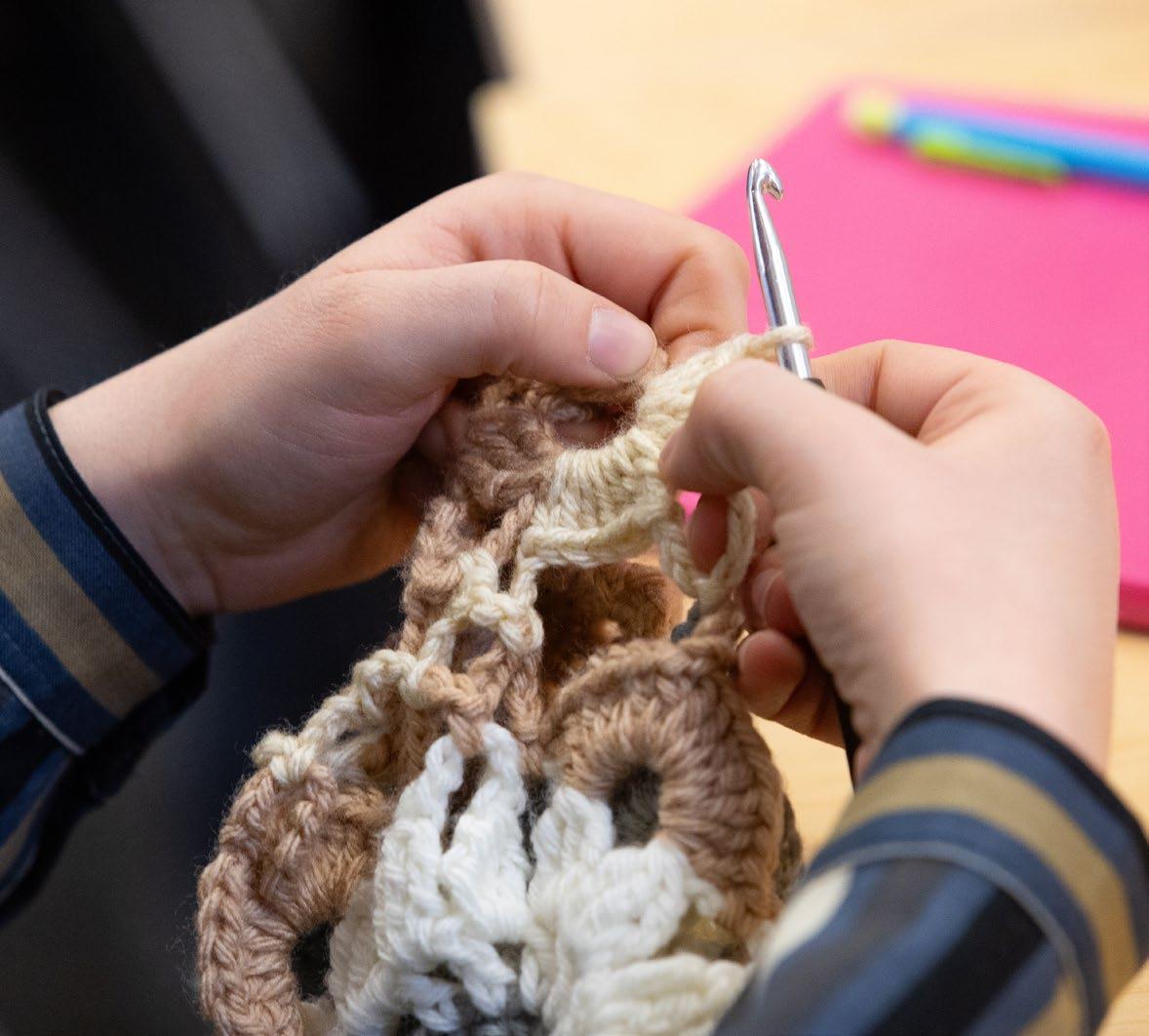
Cake, which stands for Crochet and Knitting Enthusiasts, hosts meetups every Thursday in room 302 of the Tier Building for crochet and knitting enthusiasts alike to socialize, but it is also open to individuals who would prefer to drop in and simply meet new people.
The space has a welcoming and community-driven atmosphere for those who want to come out and unwind, work on some projects or to spend some time with friends.
“It’s very casual,” said Brooke Sullivan, vice-president of U of M Cake. “You can just stop by […] You don’t even have to crochet or knit, you can just show up if you want to hang out.”
“If you do any kind of crafts, you’re absolutely welcome. It’s lots of fun,” she said.
The club, which held its first meeting of the new year on Jan. 25, not only strives to
bring campus knitters and crocheters together but to also hold fun events for members, particularly those with fun pun-based names, such as a bowling event they hope to host tentatively called “Pins and Needles.”
Another initiative the club champions is creating blankets for local animal rescue shelters.
Sullivan said that it is one of the club’s goals to “help out some of the smaller rescues in the city” that may have less support than larger rescues and that it’s “nice” to see some of the adopted animals “go home with a little treat” that they take with them after adoption.
“It’s nice because sometimes we get to see people start a blanket, and we get to see the progress on that blanket and then it eventually goes to an animal or a shelter in need, which is amazing,” said Sullivan.
She said that one of the highlights of being a part of the club is simply being able to see the progress people
make.
Rachel Dupas, president of the club, agreed.
“It’s amazing to see how we’ve taught someone this skill that they’ll never forget now […] It warms my heart,” she said. “Even though that sounds corny, it’s true.”
Sullivan told the Manitoban that in the prior year, the club saw plenty of attendance, including a lot of firsttime U of M Cake-goers. She said that seeing that turnout was “amazing” and is looking forward to seeing how things go for the remainder of the year.
“I’m very excited to see how it goes this year and I hope we get the opportunity to hang out and teach more people how to do a fun activity,” said Sullivan.
She also wanted to emphasize that the club is free in every sense of the word.
“It’s low commitment. You can drop in for 30 minutes if you’re busy, you don’t have to come to every single meeting, it’s very casual and it costs you no money.”
feeling,” said Hadder. “Laying down the train tracks as you’re going there.”
This interpretation of the music resonates with my own: a little bit alarming, a little bit panicked, but definitely an experience.
“You don’t know what’s going to happen until it happens and so that freedom is fun but also scary,” said Lussier.
Despite still recovering from the experience, all in all, Re-Sound Paint & Play was an event that I would lend my ear again in a heartbeat, palpitations and all.
In addition to club participation itself being free, supplies such as knitting needles, crochet hooks and yarn are available for members to use at no cost.
“Don’t be shy coming to the meetings,” said Dupas.
“Even if you’re too shy to talk, there’s always some sort
of entertaining conversation happening somewhere in the room that you could find somewhere to jump in on. It’s a very welcoming community.”
U of M Cake meets Thursdays from 12 p.m. to 3:30 p.m. at 302 Tier Building.
photo / Matthew Merkel / staff
photo / Ebunoluwa Akinbo / staff
Women’s basketball edges Wesmen while men disappoint
Women have first win against U of W since ‘08, men miss as Hildebrandt injured
Joshua brandt, staff
W ith crucial playoff
seeding at stake, the Uni versity of Manitoba basketball teams each faced off against bitter rival, the U of W Wes men, this past week in the basketball leg of the annual Duckworth Challenge.
Women’s team
Looking to move into the 12th and final playoff spot in the CanWest conference, the herd needed to beat rival U of W — something it had not done for years.
Coming out extremely motivated, Emerson Mar tin was excellent in the first game, pouring in 20 points, eight rebounds, and sinking three three-pointers.
Making up for a dis mal shooting night, Lau ren Bartlett also distributed a stellar 11 assists, time and time again sifting deft passes through the Wesmen defence with near-clairvoyance.
Off the herd’s bench, firstyear forward Anna Miko chipped in with nine points and seven rebounds.
The game was a back-andforth, nail-biting affair until the herd went on a remarkable 7-0 run in the dying minutes to escape the Duckworth Centre with a narrow 73-66 road victory.
The win marked the first time the herd defeated its cross-city rival in CanWest regular season play since 2008.
Riding the high of its historic win, the herd’s offence was firing on all cylinders in the second game.
4.8 assists per game, Bison guard Bartlett is now first in the CanWest conference in assists per game.
Coming off the bench again, though not to be outdone, Miko shot the lights out, going eight for 11 from the field, five for five from the free-throw line and even notching a solitary triple.
Overall, she contributed 22 points — doubling her previ-
Men’s team
Looking to climb into the top four of the CanWest standings to automatically secure a spot in the quarterfinals for the CanWest men’s basketball tournament, the men’s team sought to distance itself from inner-city rival U of W.
Lauren Bartlett was on another level, recording a double-double with 26 huge points and 11 exquisite assists
ous career-high of 11.
Seemingly making a distinct effort to make up for her uninspired shooting performance in the previous game, Bartlett was on another level, recording a double-double with 26 huge points and 11 exquisite assists. She also knocked down a new careerhigh five three-pointers.
Dishing out an average of
Ultimately, the herd’s offence just could not be stopped, piling up 98 points to edge the Wesmen 98-82 in the second game, recording backto-back wins in the process.
With the pair of wins against the Wesmen, the herd is now placed precipitously in the final playoff spot in CanWest. Although, with two games remaining, its playoff
Unforeseeably, however, things did not go exactly to plan.
In the first game, the herd gave a hearty effort and looked good at times, though the stellar play and 22 points of the U of W’s Donald Stewart led the Wesmen to an 86-79 victory.
Daren Watts led the squad in scoring with 15, but he went 0-9 from three, which encapsulated the Bisons’ night.
In the second game, it looked as though the herd had bounced back from its pre-
vious loss, and was going to cruise to an easy victory, for in the third quarter, it led by as much as 15.
It was in the third that Watts, once again the herd’s leading scorer, did most of his damage as well —totalling 26 points on the night.
Nevertheless, the Wesmen clamped down on defence in the fourth quarter, held the herd to just 12 points — while it pulled in 32 — and snatched an 88-78 victory from the hands of a visibly discouraged Bisons team.
Back-to-back losses to its bitter rival were not the only factor in the herd’s discouragement, however.
The team’s most valuable player, Simon Hildebrandt, left the final game late in the fourth quarter with what appeared to be some kind of “lower-body-injury,” as they say in the business.
He collided with a Wesmen player and required the assistance of his teammates to make it off the court.
Naturally, any extended
absence on his part would be a devastating blow to the team. He is currently scoring about 17 points per game, and those 17 would be tough to make up.
Moreover, as the herd hosts the men’s CanWest basketball tournament in a couple of weeks, Hildebrandt’s status looms large. The team very likely aspires to win the tournament on its home court. Yet, without its star player — “The Golden Boy,” as he’s known locally — one would have to concede that its chances of doing so diminish considerably.
Both the women’s and men’s teams will close out CanWest regular season play at the Investors Group Athletic Centre this weekend, Feb. 9 and 10, as they face off against the University of British Columbia Okanagan Heat.