VIDEO EDITOR Kennedy Legault video@themanitoban.com
SOCIAL MEDIA EDITOR Violet Baker social@themanitoban.com
REPORTERS
NEWS Alicia Rose
NEWS Kyra Campbell
NEWS Michaela de Hoop
RESEARCH & TECHNOLOGY Rhea Bhalla
COMMENT Braden Bristow
COMMENT Hanako Teranishi
COMMENT Lakshmisree Shaji
ARTS & CULTURE Kelsey Chin
ARTS & CULTURE vacant
SPORTS Joshua Brandt
SPORTS Quinn Mayhew
VOLUNTEERS
VOLUNTEER STAFF
Bahareh Rashidi, Christina Tran, Romin Cheema Adam Johnston, Michele Melendez
VOLUNTEER
Octavius Kahiya
interested in volunteering?
email me@themanitoban.com today!
109 HELEN GLASS BUILDING
UNIVERSITY OF MANITOBA WINNIPEG, MB 204. 474. 6535
The Manitoban is the official student newspaper of the University of Manitoba. It is published monthly during the summer and each week of regular classes during the academic year by the Manitoban Newspaper Publications Corporation.
The Manitoban is an independent and democratic student organization, open to participation from all students. It exists to serve its readers as students and citizens.
The Manitoban is a member of the Canadian University Press, and our journalistic standards can be found on the Manitoban’s website.
The newspaper’s primary mandate is to report fairly and objectively on issues and events of importance and interest to the students of the University of Manitoba, to provide an open forum for the free expression and exchange of opinions and ideas and to stimulate meaningful debate on issues that affect or would otherwise be of interest to the student body and/ or society in general. The Manitoban serves as a training ground for students interested in any aspect of journalism.
Students and other interested parties are invited to contribute to any section of the newspaper. Please contact the appropriate editor for submission guidelines.
The Manitoban reserves the right to edit all submissions and will not publish any material deemed by its Editorial Board to be discriminatory, racist, sexist, homophobic or transphobic, ableist or libellous.
Opinions expressed in letters and articles are solely those of the authors. Editorials in the Manitoban are signed and represent the opinions of the writer(s), not necessarily those of the Manitoban staff, Editorial Board or the publisher.
A “volunteer staff” member is defined as a person who has had three volunteer articles, photographs or pieces of art of reasonable length and/ or substance published in the current publishing year of the Manitoban.
Any individual who qualifies as a volunteer staff member must be voted in by a majority vote at a Manitoban editorial board meeting. Elected representatives and non-students may be excluded from holding votes as volunteer staff members in accordance with the Manitoban Constitution.
No timeline specified for implementation of new voting system
Colton McKillop, staff
The UMSU board of directors voted at its Jan. 11 board meeting to move toward the implementation of a ranked ballot voting system for general elections.
Motion 0588, which proposed adopting a ranked ballot voting system, was written and brought forward by student and former UMSU vice-president advocacy Victoria Romero. The motion was prompted by the former chief returning officer’s (CRO) recommendations that the governance committee “restructure the election” following last year’s results.
Last March, UMSU presidential candidate Justin Langan was disqualified the day before voting started, but his name remained on the ballot, and he received 22.1 per cent of the vote — 912 total votes.
Current union president Tracy Karuhogo defeated runner-up Victoria Romero by only 16 votes, prompting an almost four-hour long UMSU board meeting concerning a motion to hold a revote for the presidential election. The motion was eventually ruled out of order.
One suggestion that followed the election was ranked ballots, a system where voters rank candidates in order of preference. In the event that one candidate receives less than 50 per cent of the vote,
the lowest scoring candidates are eliminated and second place votes are counted. The system is repeated until a candidate reaches 50 per cent.
Romero presented motion 0588 to the board at the most recent UMSU meeting, arguing it would make the union more “equitable and representative.” Later in the meeting, she said a ranked ballot system would still consider the preferences of voters who unknowingly vote for a disqualified candidate like Langan, as their other votes would still be counted.
The governance committee advised the board to vote against motion 0588. The committee’s chairperson Michael Prokipchuk argued that implementing a new voting system could create confusion and further reduce the already low turnout in UMSU elections. Last year’s election saw a turnout of only 22.8 per cent of undergraduate students.
Prokipchuk stated that, while the committee was not opposed to a ranked ballot system, it felt the time was not right to implement it.
He pointed out that UMSU’s CRO had already begun preparing for the next election — the nomination period of which opens in a matter of weeks — to be conducted using UMSU’s pre-existing first-past-the-post voting sys-
tem. Prokipchuk argued that a new system could overwhelm the CRO and “effectively erase” their work up to this point.
Romero countered that the motion did not specify a timeline to implement the changes. She argued that “voters are already disengaged” and that ranked ballots would allow students to feel better represented, rather than being “forced to make a choice.” She also said it would demonstrate that UMSU was listening to students’ concerns.
Avery Groeneveld, the U of M Commerce Students’ Association (CSA) representative on UMSU’s board of directors, spoke in favour of the motion. Her association already uses ranked ballots in its elections.
Groeneveld told the Manitoban that CSA has “never had any issues” with voter turn-
out or explaining ranked ballots. She argued that since an “ongoing priority” for the union is increasing voter engagement, UMSU could include ranked ballot education as part of a general campaign to teach potential voters and increase turnout.
Ivan Nunez Gamez, Racial Equity Inclusion and Alliance co-president, served as governance committee chair during last year’s election. He said the votes for Langan being “essentially thrown out” underscored the need for reform to “ensure everyone feels heard” and avoid the perception that the winners of UMSU elections lack legitimacy.
He said he immediately thought of ranked ballots when tasked with restructuring the election and consulted the board about it, but lacked
Barbershop opens on U of M campus
Swish offers hair services to UM community
Alicia Rose, staff
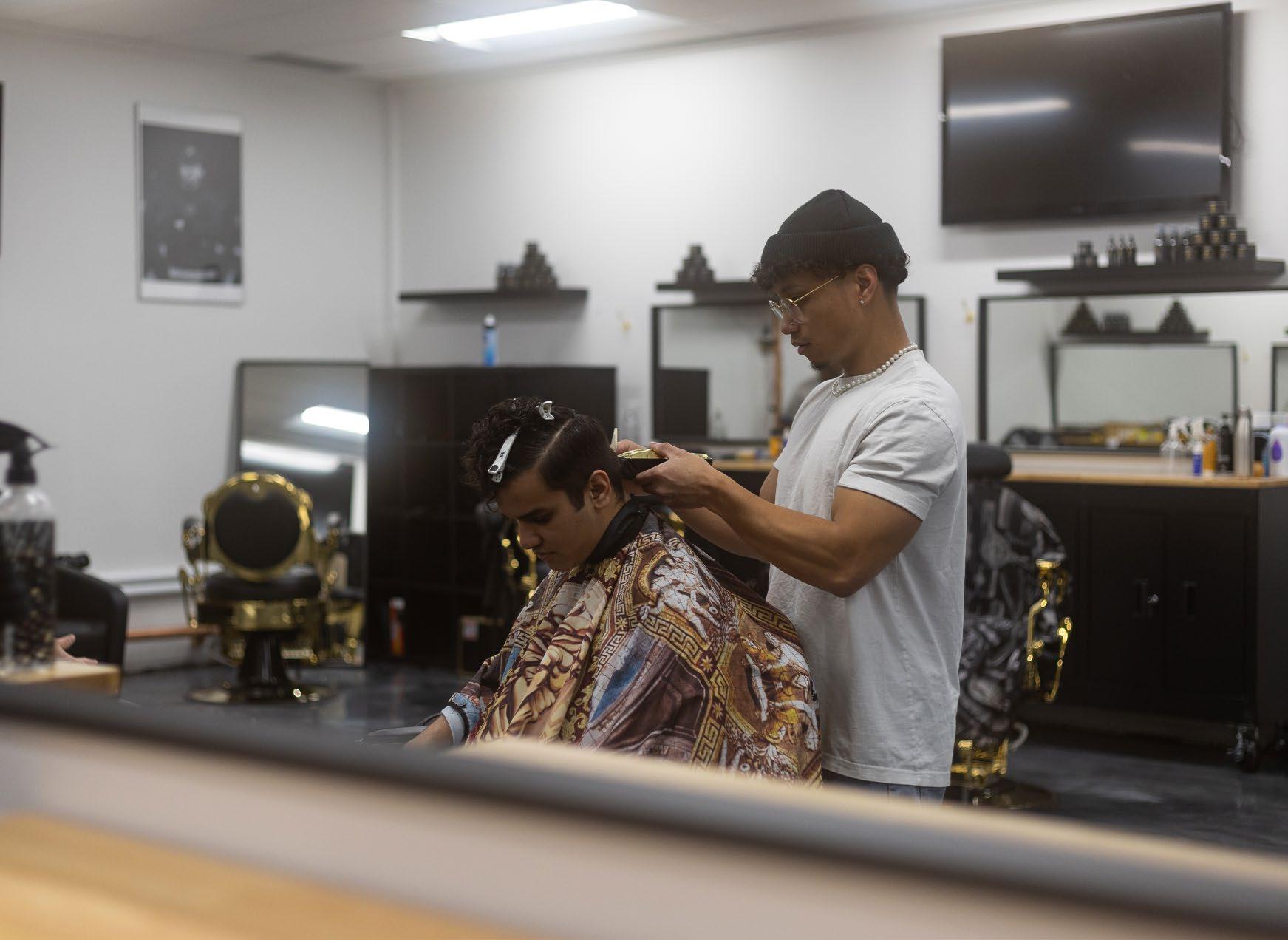
Two years after the opening of its first location in 2019, Swish Barbershop was voted the number one barbershop in Winnipeg by CommunityVotes Winnipeg. Since then, the shop has opened two additional locations to serve customers.
The Winnipeg chain was founded by U of M alumnus Reagan Tran, a local entrepreneur.
Doors opened at the newest location in UMSU University Centre on Jan. 3. Darren Smith, a barber at Swish, said he enjoys the “culture of the barbershop,” his co-workers and the clientele.
Smith said since the opening of the barbershop, there have been times during the week when “every chair is full,” and he expects it will only get busier.
Swish is different from other barbershops in the area in the variety of customers and people in the shop, according to Smith.
“We’ve got every single culture coming in getting their hair done, all different styles,” he said. “You get to meet people from all different places, all different genres, all doing something different in life.”
Swish offers haircuts for men and women. The shop also offers hair services, apparel and products.
To book services and contact Swish Barbershop, those interested can reach out on Instagram @swishbarbershop or book on the shop’s website, www.swishcanada. com.
the time to enact reforms before his term was up.
The job was transferred to the following governance committee, which “was not keen on the idea” of continuing with ranked ballots, he said.
Romero told the Manitoban that she brought the motion forward because, initially, the governance committee rejected ranked ballots without allowing the board to vote on the idea, and she wanted to give its members the opportunity.
Although the motion did not specify any timeframe for the changes, NunezGamez said it gives the board “a clear mandate” to implement ranked ballots and said he hoped to see them used as soon as “this election cycle or the next one.”
photo / Ebunoluwa Akinbo / staff
photo / Matthew Merkel / staff
Three friends of U of M appointed to Order of Canada
Kroeker, Henault, Hetmanczuk honoured by Governor General
Alicia Rose, staff
M embers of the University of Manitoba community Richard Kroeker, Gen. Raymond Henault and Victor Hetmanczuk were appointed to the Order of Canada for their achievements and contributions to the country on Dec. 28.
Kroeker said it was a “great honour” receiving the Order of Canada, and one that came as a surprise. He received his bachelor’s degree in environmental design from the faculty of architecture at the U of M. He was awarded for his work in architecture.
small and “sometimes beleaguered communities,” and integrating western architecture with Indigenous thought processes and values, which he said is part of what makes Canada special.
“We’re starting to gain a better understanding of what that contributes to who we are now and what we’ll become going into the future,” he said.
Henault said being
ate of law by the U of M. Henault served as chief of defence staff in Ottawa, where he led Canadian military responses following the terror attacks on Sept. 1, 2001. He was later elected as the chair of the North Atlantic Trade Organization (NATO), military committee.
Although retired, Henault will be a guest of honour of the RCAF at a number of functions for their upcoming hundred-year anniversary.
“Suddenly I felt like, rather than going down a narrowing tunnel, I was entering a broad world” — Richard Kroeker, Order of Canada recipient
During his time at the U of M, Kroeker said his professors and colleagues inspired him and made him feel like he belonged. In the faculty, Kroeker said there is a mix of creative activity that draws on various other fields.
“Suddenly I felt like, rather than going down a narrowing tunnel, I was entering a broad world,” he said. His work focuses on architecture for
appointed to the Order of Canada was not only an honour for himself, but for members of the Royal Canadian Airforce (RCAF) and the Canadian Armed Forces (CAF) for their contributions to the country.
Henault graduated from the U of M with a bachelor’s degree in political science and geography after serving in the CAF. Henault was later awarded an honorary doctor-
Victor Hetmanczuk was appointed to the Order of Canada for his contributions and work in the Ukrainian community.
Hetmanczuk sees the award as recognition for not only his own work, but the work done by volunteers in Canada, in particular, Ukrainian-Canadian volunteers.
“It is a medal for the whole community, not just for me as an individual,” he said.
After working as a chemical engineer, Hetmanczuk began working in charity, where he
helped set up a national distribution network for the Daily Bread Food Bank in Toronto.
Hetmanczuk is the current chair of the Canada Ukraine foundation and has contributed and organized a medical missions project for those affected by the Russia-Ukraine war . He hopes to talk with other Ukrainian members of the Order of Canada to continue
the work for Ukrainians in Canada and identify what other needs Ukraine or the Ukrainian community may have in the future.
Damilola Ojo named UMSU Black students’ rep Board elects Ojo in recent by-election
Sarah Cohen, staff
Becoming the new Black students’ representative on the UMSU board of directors feels like a “full circle moment” for Damilola Ojo.
Ojo was elected as Black students’ representative for the remainder of the term during a by-election held at the UMSU board of directors (BoD) meeting on Jan. 11. The position had been vacant since a Nov. 30 special BoD meeting.
Ojo said her new position is a way for Black student voices to be heard throughout the university.
This is not the first time Ojo has been a voice for the Black community. In grade 11, Ojo created the first-ever Black History Month event at St. Mary’s Academy.
In grade 12, she expanded the event, showing other students how she started the event at her school, because “when [she] did it, there was no blueprint.”
“I’m happy that I didn’t let this passion of activism and
this passion of being a leader die in high school,” she said.
Ojo was the U of M Black Students’ Union president in 2022 and co-president in 2023.
During her term as president, she felt that the various student groups within the Black students’ community were lacking in collaboration.
“It kind of just felt like we were all in competition against each other,” she said.
That reason was part of Ojo’s motivation to run for the Black students’ rep position.
The night of the election, Ojo and the other two candidates, Emmanuel Amaraizu and Ihuomachi Puilolui, spoke about the initiatives each hoped to bring to the position. Ojo said between the three of them, regardless of who was elected, they would have congratulated each other, “because we’re all on the same team.”
Organizing the recent vigil for Afolabi Stephen Opaso –a U of M economics student from Nigeria who was killed by police on Dec. 31 – was a “taxing event” for Ojo. She hopes that it was “a first step into making something more permanent here on campus.”
By the end of the winter term Ojo hopes that, as Black students’ rep, she can help “his memory live on” on the U of M campus.
Ojo said that being in leadership while Black, “you do at some point need to put your foot down and be able to voice your opinions without getting the negative stigma back.”
“Being a Black woman just in general isn’t easy,” Ojo said. And being a Black woman in a leadership position is even harder, Ojo said.
However, being elected “just reminds me that I’m on the right path in life,” said Ojo.
photo / Kennedy Legault / staff
photo / Ebunoluwa Akinbo / staff
Kinew revokes Eckhardt’s honours, WAG drops name
U of M still reviewing honourary degree, spaces bearing name in light of Nazi ties
Kyra Campbell, staff
Premier Wab Kinew posthumously revoked one of the province’s highest honours from Ferdinand Eckhardt earlier this month. Eckhardt was an art historian and philanthropist who was recently uncovered to have been a Nazi sympathizer.
Eckhardt was the director of the Winnipeg Art Gallery-Qaumajuq (WAG-Qaumajuq) from 1953 to 1974. The art gallery has removed the now-deceased gallery director’s name from public spaces as well.
In an exchange with media on Jan. 10, Kinew said he rescinded the Order of the Buffalo Hunt given to Eckhardt by the provincial government in 1982, noting that Eckhardt “pledged an oath of allegiance to Hitler.”
Kinew said Eckhardt “has no place being honoured in the public sphere here in Manitoba.” He said once his team discovered Eckhardt had received the honour, they took “immediate action” to repeal it.
The Manitoba government established the order in 1957. It is awarded to people who exhibit “outstanding skills in the areas of leadership, service and community commitment.”
ciations, such as an oath of allegiance he swore to Adolf Hitler, his early 1930s writings in Nazi-sympathetic jour-
in Vienna before moving to Winnipeg to run the Winnipeg Art Gallery.
“[Eckhardt] has no place being honoured in the public sphere here in Manitoba”
— Wab Kinew, Premier of Manitoba
The WAG-Qaumajuq announced in a statement mid-December that it would take steps to remove Eckhardt’s name from its entrance hall and other materials within the gallery, along with any information about him on its website.
An article published in the Walrus on Nov. 9, 2023 detailed Eckhardt’s Nazi asso-
nals and his time working for IG Farben. The company used slave labour, built the Auschwitz concentration camp and produced Zyklon-B, the compound used to kill over 2 million people in gas chambers.
Aside from when Eckhardt was conscripted into the German army from 1942 to 1944, he was employed at IG Farben until the war’s end, then lived
WAG-Qaumajuq said in a statement that it is researching any art donated by Eckhardt and the Eckhardt-Gramatté Foundation to confirm that it was not stolen by the Nazis during the Second World War. If any art is found to be stolen, it will be returned to the original owner.
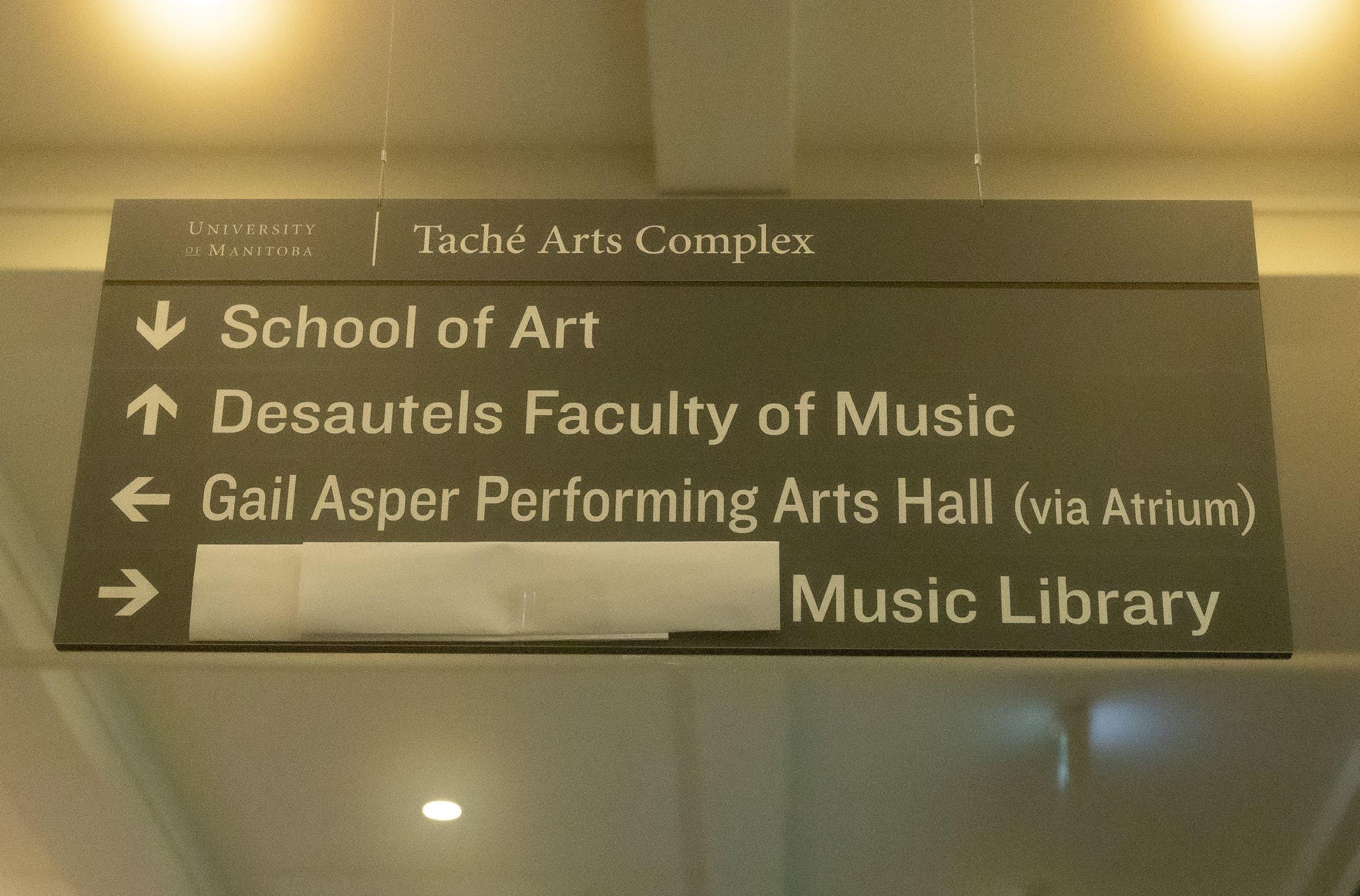
Throughout his life, Eckhardt promoted his wife’s legacy with several public spaces named after her, including the Eckhardt Gramatté Music Library on the U of M’s Fort Garry campus.
Since the revelations about
Eckhardt’s Nazi connections, the U of M covered all signs featuring the Eckhardt Gramatté Music Library.
The university is reviewing all university associations to Eckhardt’s name, including an honourary degree that the U of M presented to Eckhardt in 1971. U of M spokesperson Eleanor Coopsammy said “any painting or plaque that bears the name will be covered until after the review.”
The timeline of the review is unclear, and when asked if the recent actions by Kinew and the WAG-Qaumajuq would put further focus and priority on the review, Coopsammy had no comment. She stated that “not a lot has changed” since the news about Eckhardt broke in November.
When completed, the U
of M’s review will be used to decide “next steps” regarding Eckhardt’s campus legacy. The University of Winnipeg also has public spaces named after Eckhardt’s wife, the Eckhardt-Gramatté Hall and the Eckhardt Gramatté Library. U of W spokesperson Caleb Zimmerman said that, while the spaces at U of W are not named after Ferdinand Eckhardt, the recent information about him is being taken “very seriously” and that all university associations with the Eckhardt family are under review.
Regarding the hall, Zimmerman said it will be renovated soon, and its name will be reviewed as part of that process.
photo / Matthew Merkel / staff
Research & Technology
Let’s talk about baby talk U of M prof discusses infant communication
Rhea Bhalla, staff
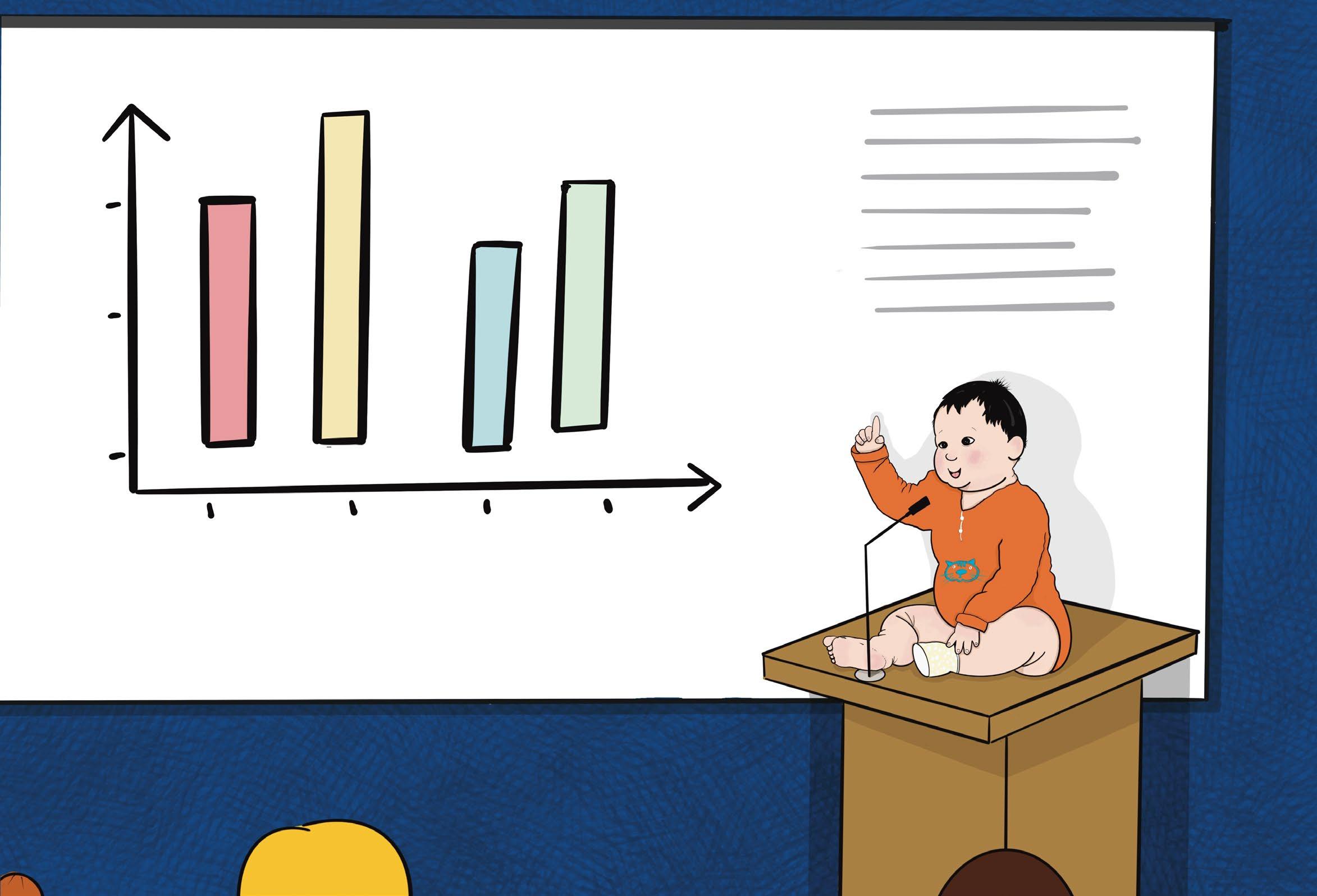
Before babies are even born, they begin learning how to speak. In the uterus, they hear and respond to voices and start to understand how words, rhythm, sound and speed of speech work together as part of language. Once born, babies watch other people and learn to copy the facial and tongue movements that produce speech.
The development of language in babies is a research focus of Melanie Soderstrom, U of M psychology professor and director of the Baby Language Lab.
Soderstrom started her research journey in biology. As an undergraduate student, she was involved in a twin study that examined genetic precursors to language development. She quickly “fell in love” with the subject and switched tracks to psychology.
“I just think the early processes of language development in humans is really fascinating and impressive, and one of the most amazing features of our human development,” she said. “I love to study it.”
One focus of the Baby Language Lab is to study infant speech perception. This is done by playing a variety of speech sounds for babies. Researchers can better understand the process of early language development by evaluating babies’ preferences and ability to distinguish between different sounds.
The lab also looks at babies’ daily soundfilled environments. This is done by collecting audio recordings of their daily lives, analyzing the sounds they hear and understanding their responses.
Soderstrom said. “It’s one thing to understand this process from the perspective of what happens in a laboratory, but language development doesn’t happen in a laboratory, it happens in the real world.”
Over the last few years, much of Soderstrom’s work has been on infant-directed speech, more commonly known as baby talk. This speech tends to be highpitched with a happy tone,
paper titled “What Do North American Babies Hear? A large-scale cross-corpus analysis.” The study used a collection of day-long recordings of 61 homes from four cities in North America to analyze what babies hear on a daily basis.
“Understanding [language development] is really fundamental to understanding human nature”
— Melanie Soderstrom, U of M professor of psychology
using short utterances and a simple vocabulary.
“We’re trying to get a window into infants’ everyday real-world experiences,”
Further exploring the nature of what babies hear, Soderstrom co-authored a
The study found that babies heard two to three times more speech from women than men. Women used baby talk 11 per cent more frequently than men. This is expected, researchers explained, as there tend to be many caregivers in the early period of an infant’s life who are women. Because of the high amount of speech babies hear from women, the study theorized that babies tend to use phonemes, or sound units, that are characteristic
of women.
Soderstrom emphasized the importance of language development. She said language, whether spoken or signed, is necessary for humans to flourish.
“Every human infant needs some sort of language to communicate with people around them,” Soderstrom said. “It’s really a fundamental process in our everyday experiences.”
Soderstrom highlighted that, even though there are still sometimes those who disparage baby talk, a vast body of research exists demonstrating its importance.
When babies hear baby talk, they often understand it is directed toward them and pay close attention to it. Baby talk, with its exaggerated pitches, melodic patterns and happy tone, is often easier for babies to listen to than regular speech.
Western Sydney University researcher Marina Kalash-
nikova encourages parents to use baby talk early in their infants’ lives in order to become comfortable using it. Additionally, researchers at the University of Florida found that the sounds adults make when using baby talk imitate the vocalizations produced by a smaller vocal tract. Not only is baby talk enjoyable for babies to listen to, it could help them understand how to create speech themselves.
Ultimately, Soderstrom encourages mothers to engage their infants in baby talk, “whether it’s in a highly exaggerated form of infantdirected speech, or just the natural way that you communicate with your infant,” she said.
“The more engagement with your infant, the better.”
How AI is transforming research and learning
Assistant professor discusses limitations, encourages use in post-secondary spaces
Elah Ajene, staff
I
n the ever-changing landscape of technology, Artificial Intelligence (AI) has steadily gained prominence, particularly in the spheres of education and research — reshaping conventional practices and offering novel opportunities within these domains.
As society adapts to the evolving impact of AI, U of M assistant professor at Asper school of business Wenxi Pu shared insights into the intersection of AI, education and research. As an assistant professor specializing in management information systems, Pu discussed his role in teaching programming for business analytics, specifically in the MIS 3020 course offered by the U of M.
In this class, students learn Python programming and data analysis — incorporating open-source large language models, such as Llama 2, in coding and data analysis projects.
Last semester, Pu taught an introductory course focusing on business analytics where students delved into data visualization and the ethical use of large language models, emphasizing the responsible application of AI tools.
“Essentially, in my teaching, I encourage my students to use AI to help with their work,” he said.
He expressed the importance of responsible AI use, encouraging students to leverage AI for efficiency while remaining mindful of its potential downsides.
In his research, Pu focuses on three major perspectives of AI. The first aspect explores AI’s role in the hiring process, particularly in the potential biases it may introduce. Pu discussed the discrimination individuals with mild mental health challenges face, and how AI-generated hiring processes might inadvertently disadvantage them.
The second perspective Pu’s research examines is human reactions to AI threats, examining how individuals can defend against job displacement by AI. He focuses on the concept of moral identity — the extent to which ethical considerations like compassion, justice and generosity play a role in an individual’s self-perception. Pu explores whether people with a higher moral identity are better equipped to navigate potential threats posed by AI.
“We believe that with this AI threat in place, individuals would have broader moral
different countries. By leveraging AI and analytics, Pu seeks to uncover how climate change is discussed globally, considering sentiments and regional perspectives.
Pu shared his insights into the future of AI in both research and education, emphasizing the undeniable permanence of AI and its pivotal role in various aspects of people’s lives.
“There’s a saying, ‘lawyers won’t be replaced by AI, it’s lawyers who use AI that will replace lawyers who don’t’”
— Wenxi Pu, U of M assistant professor in management information systems
“We are still trying to prove that humans actually cannot detect the differences because of mental health challenges,” he explained, highlighting his ongoing experiments designed to ascertain whether human evaluators could detect such differences.
scope,” he hypothesized.
Pu also shared his use of AI in research related to climate change. Using text mining techniques, he analyzes millions of news articles to identify patterns and narratives about climate change across
Focusing on the implications for education, Pu encouraged schools and universities to integrate AI into their programs and curriculums. He also stressed the need to effectively train students to leverage AI within their specific domains, and to be aware of the impact and shortcomings of AI.
“There’s a saying, ‘lawyers won’t be replaced by AI, it’s lawyers who use AI who will replace lawyers who don’t,’” he joked.
Shifting to research, Pu touched on the ways AI is shaping the future of scholarly pursuits. He highlighted
AI’s potential to level the playing field for researchers with diverse language backgrounds. By automating language correction and streamlining processes, AI could facilitate more equitable participation in global research endeavors.
Pu outlined the different stages of the research process where AI can contribute, including idea generation, literature review, experimental design, data collection and writing. While acknowledging AI’s capability to assist in these areas, Pu also raised concerns about its limitations, particularly in terms of creativity. He cautioned against over-reliance on AI, emphasizing that it remains a tool to augment human capabilities rather than replace them.
While AI is expected to bring about significant advancements and efficiencies, Pu emphasized the irreplaceable role of human intellect, creativity and self-awareness in driving innovation and breakthroughs in these domains.
“I believe humans are still the drive of the creativity of new research breakthroughs,” he said. “I can’t tell what’s going to happen in the long term.”
Epiphanies grow from joyful movement
What over 10 years of skating have taught me
Sarah Cohen, staff
My seventeenth birthday was a Friday, which meant I had to (got to, really) spend my evening at Center Ice Arena. At this point I had been skating for almost eight years, had been a junior coach for a year or so and occasionally got to teach my own classes of toddlers how to get on the ice and try not to fall.
Anyways, my seventeenth birthday, Friday. My boyfriend, we’ll call him Larry, was a dick. The morning of my birthday, I got all cute, curled my hair, did my makeup, picked out a great outfit and was ready for everyone to pay me the bit of attention I believed I deserved. I went into my first block of the day and class began. Larry was supposed to be there, but he was not.
Disappointed, I looked down at my phone to see a text from him telling me to go outside the class. You can imagine the excitement bubbling inside me anticipating what may have been in store.
And there he was standing against the wall adjacent to the restroom, stupid electric skateboard in hand, staring at his phone. No flowers, no balloons, no present and no
card, Larry just had the stupid skateboard. He didn’t look up or acknowledge me until I was standing right next to him.
His careless hello and no mention of my birthday sent a shock through my system. It wasn’t like we’d been together for only a few weeks and he didn’t know when my birthday was. We had even made plans weeks in advance for the next day we would celebrate. Then nine words filled the space between us like a thick fog that turned day into night: “Hey, so you’re not doing enough for me — sexually.”
But that also meant that I wasn’t good enough for him, period. My heart sank, with good reason. The tears from my eyes and nonchalance from Larry poisoned my day. And there was still no happy birthday from Larry. What followed was a panic attack where Larry was forcibly removed from grasping my arm, a conversation with a guidance counsellor about what could be fixed in me “not being enough (sexually)” and one more panic attack. And still, I had received no happy
birthday from my boyfriend.
The rest of the day, I felt like no one cared, like no one wanted me around.
But the day had to go on, and I had skating students to coach. Later, I got to the rink and played games with my toddlers, picked them up when they fell and watched a few skate toward me without my help. I had a lesson with my own coach and skated around helping and just hanging out with some of the other kids and junior coaches, numb.
My mood had improved a
ten in green. The girls began to sing happy birthday. I had no idea they knew it was my birthday, or that they cared enough to make me a cake.
They did care. Everyone at the rink cared. If I wasn’t cared for by Larry, I was cared for by the people I skated with. “Happy birthday Coach Sarah” everyone announced, and happy birthday played throughout the building. Every feeling I had from the day, of not being worthy or enough, dissipated for just a moment.
Every feeling I had had from the day, of not being worthy or enough, dissipated for just a moment
little, but I still felt like shit. I told a few of the girls skating with me I was going to take my skates off and head out, but they asked me to come with them. I followed them into the café — “warm room” as we called it — and they sat me down at one of the tables. Right in front of me, there was a container with a two-layered chocolate cake slathered with chocolate icing and “happy birthday Sarah” writ-
Now that I am 21, I’ve had time to process everything from high school. Larry is long gone, and I no longer live in California or work as a coach. But holy crap I miss it — not the Larry part, God, not that part.
I never realized just how much my rink and the sport of figure skating meant to me. When I was sad, I would go for a skate. When I was happy, I went for a skate. Whenever I had good news, the people at the rink were the first ones I wanted to tell.
In October of 2020, I was in a bad car accident and nulled
the thought of skating ever again. But six months later, the head coach asked me to come back as a full-time coach. The joy I felt the next year was monumental. I was at the rink every day, sometimes for 10 hours a day, teaching and watching my skaters grow in the sport. The excitement we felt when they mastered a skill and the rush of adrenaline from my students’ competitions felt like nothing I can thoroughly explain in words.
I got to work with so many kids of different ages and abilities and now that I’m away from it, I want it back. It was fantastic money for a job that didn’t feel like work. It was home.
Don’t let go of your happy place. Being on the ice made me feel invincible, safe and most importantly, wanted. Do what makes you happy in life. I may be getting a degree in criminology, but all I want to do is play “Baby Shark” on repeat and have toddlers glide their little feet across the ice toward me every day until they don’t need my guidance anymore.
Your routine is more than just coffee
The importance of routine and ritual
Braden Bristow, staff
My morning routine often looks something like this: I wake up to an obnoxious alarm at 8 a.m., grind coffee beans, brew myself a cup and then enjoy burning the roof of my mouth with my dad. Just like the pioneers used to, although they probably didn’t have automatic coffee grinders. While the pioneers probably used coffee to power through the dysentery ravaging their intestines, to me and my dad, coffee is a ritual. The term “ritual” might have some odd connotations for a reader, but in actuality, it is relatively mundane. For the purpose of definition, rituals are more than just routines. They are acts of repetition that can be a routine, cultural engagement or religious activity. Even the very mundane act of blowing out a candle and singing for our friends on their birthdays is a ritual.
There is a twofold nature to my typical morning ritual. First, I have a consistent habit of grinding coffee and brewing it, which starts my day off with a simple task that is easy to complete. Second, I begin my day with what is typically a very positive social interaction.
Studies indicate that routine, or ritual, especially for those struggling with mental health, can be critical in providing a sense of structure and control in one’s life. In the article “Why Routines Matter,” researchers Femke Koome, Clare Hocking and Daniel Sutton found that routines were particularly valuable for adolescents dealing with mental illness. The researchers found that routine, or ritual, helped adolescents struggling with mental illness to develop a sense of control and prevent stressors.
Furthermore, evidence indicates that family routine can provide resilience against crisis by promoting family unity and close relationships. Studies on crisis find that time spent together along with ritual fosters resilience within the family unit against due to their promotion of healthy dynamics.
My dad’s and my routine began closely after the loss of my uncle Jamie, who unfortunately passed away last year. Having this structure during a period of loss, confusion and hurt likely benefited both of us. I know it certainly helped me.
However, outside of improving social cohesion and providing stability during crisis, routines have importance in our day-to-day lives. Routines can reduce stress while promoting structure in our lives, especially healthy routines like reasonable amounts of sleep. While promoting bedtime might be the most boring thing I have ever done in writing, it certainly isn’t harmful to suggest a better sleep schedule.
The history of partaking in caffeinated beverages dates back much fur - ther than when I first learned to grind and brew. Drinking tea as a medicine or stimulant was first practised in
ancient China around 4,000 years ago. As time passed, the culture of tea took off in China and tea began to spread across the world.
At least one tea enjoyer, Lu Yu, set out to write a book about it. Yu’s book Cha Jing, known in English as The Classic of Tea, details the proper way to cultivate and enjoy tea with details such as the gathering of water and tea itself. Not only was tea important to Yu, and likely all who enjoyed his book, but so too was the ritual and details of the tea itself.
If we look at religious rituals, clearly people have always derived something of value from routine. Christian baptism, Harai and other forms of purification in Japanese Shintōism as
millions of people across the world engage in frequently. While these acts could very well provide social cohesion, they can also kill you. Coffee, however, is a mostly harmless drink that many people worldwide partake in. Nations around the world have distinct cultures around coffee. Italy in particular is home to numerous styles of coffee, with the trade of coffee itself originating in Arabia hundreds of years ago.
In simple terms, coffee as a ritual has roots around the world.
The point I am hopefully illustrating is that ritual, routine, habit or whatever term you prefer is a critical part of human history, society and health. While my dad and I aren’t conducting baptisms, purification rituals or prayer together, we are engaging in a daily habit that provides structure and social cohesion.
Though my dad and I are individuals engaging in routine together, ritual as a concept itself is part of a greater social behaviour that spans the entirety of history.
well as the spiritual practice of sweats in numerous Indigenous cultures show that people feel replenished and cleansed from rituals. A majority of the world follows some sort of religion. With that in mind, billions of people probably follow some sort of typical religious ritual.
Of course, just because a large number of people continually engage in a behaviour doesn’t mean it’s positive. Habitual drinking and smoking are rituals that
The key takeaway is that ritual is an important and natural part of life. Engaging in ritual can improve our mental health and social well-being with others while providing structure. Family dinner, coffee with friends or a daily walk are deeper parts of life than they are given credit for.
Morning coffee is more than just a cup of hot water with caffeine, it is a ritual that connects people, it connects me and my dad with every bean I grind.
Resisting exploitative labour in academia
Support the undergraduate research award, but do so with caution
Hanako Teranishi, staff
Early last week, an email was sent out from the office of the vice-president (research and international) announcing the application period for the Undergraduate Research Award (URA) to students.
The URA provides a great opportunity for students to get involved with and pursue their own research interests, but can become exploitative very quickly.
This summer, I had the honour of being one of the recipients of the award. It was an incredible experience where I was able to explore my own interests more thoroughly with the support of a supervising professor who helped guide me through the processes and develop my own skills.
This experience threw open the figurative doors of how I imagined my place and engagement within academia. It encouraged me to push toward engaging with my research interests while accommodating my own stakes and emotions in a way
that research within academia would normally not accommodate.
The award also provided me with significant financial support. The URA has a monetary value of $7,000. This allowed me the financial freedom of not having to work a full-time job over the summer and to dedicate the majority of my time to my research projects.
Ultimately, I would not be on the path I am now if not for the experiences that the URA enabled.
I would highly recommend that any students with a research project in mind or even an interest in pursuing research apply for this award. I especially encourage students studying the arts and humanities to apply. This is because it commonly feels like research awards are designated for STEM fields. However, this award is open to students from all research fields and departments who seek to engage with scholarly or creative work.
My support does come with a slight precautionary footnote, though. While the appli-
cation process highlights conversations between students and professors, labour descriptions and protections are not clearly outlined to the student.
The application process includes students interviewing a professor who may potentially become the student’s supervisor. This interview involves discussing the professor’s current research endeavours and how both parties will support each other and work together during the research experience. The student is also required to detail their time availability and work capacity for the summer work term.
When you finish the online application, there is a checkbox that declares the student will dedicate full-time work
hours toward the project, which spans from between 20 to 40 hours per week. At 20 hours per week, the hourly wage works out to about $21.87. However, at the maximum 40 hours per week, the hourly wage is about $10.94.
Students working 40 hours per week would be paid severely below minimum wage, which sits at $15.30 per hour as of Oct. 1, 2023.
There is a note attached to the checkbox stating that any hours beyond 40 hours per week will demand additional pay of minimum wage that goes beyond the $7,000 value of the award. However, there are little to no readily available supports for reinforcing this declaration beyond the application. The lack of details regarding students’ labour
expectations and rights is a slippery slope that can contribute to the ongoing exploitation of student labour within the academic institution.
I am deeply thankful to the professors I have worked with who always made sure that my time and labour were fairly compensated and respected. Even so, I implore students to make sure they are advocating for themselves when applying for this award and having these discussions during the interview process.
While it may seem intimidating to voice concerns as an undergraduate student, I assure you that your concerns, time and labour are of utmost importance and should always be respected.
How to boost Winnipeg Transit’s brand and service
There are three easy ways to increase bus ridership in Winnipeg
adam Johnston, volunteer staff
The Free Press’s special series on Winnipeg Transit provided a good analysis of the challenges of our current public transportation system, stressing the improvement of functionality, the need for more federal and government funding and security concerns. The newspaper’s series highlighted Winnipeg Transit’s importance for those who need it the most: lower-income people, immigrants and other people in need.
I have some suggestions for improving our city’s transit system that received brief coverage in the Free Press special. My ideas can boost ridership, address financing and support Winnipeg Transit in making it equitable for everyone during a climate crisis.
1. Gradually implementing a universal fare system
Winnipeg has lagged in ridership compared to major Canadian cities. The Climate Reality Project’s report, “National Climate League Standings 2022,” placed Winnipeg middle to the bottom
for ridership compared to Vancouver and Montreal.
With most transit riders making below $50,000, working toward zero to low-cost fares would boost transit ridership. Boosting ridership would help reduce key security concerns for operators who face hostile riders who often can’t pay fares, because more people would be around.
City councillor Vivian Santos forwarded a motion to have the city study $1 bus fares in 2021, but the motion failed. Winnipeg City Council should start implementing universal bus fares for people 18 and under while capping adult bus fares at $2, with the eventual goal of $1.
Deeply discounted adult bus passes should be available for everyone, as opposed to $111.65 for a full-fare adult monthly pass. Currently, the WINNpass program offers a discount of more than 50 per cent for full-fare bus passes and e-cash rides for eligible low-income earners. Low to zero-cost fares are the way to go here if we want to accelerate increasing ridership.
2. Fund Winnipeg Transit by increasing revenue streams
Winnipeg is struggling for revenue with a projected deficit of $7.1 million for the city, including a $900,000 deficit for Winnipeg Transit, according to CBC News. With a warming planet, these deficits will get worse as we face higher costs from battered infrastructure.
Winnipeg must address revenue deficiencies and ensure climate-resilient infrastructure, including public and active transportation. Some ideas for new revenue streams which I think could work are a payroll or toll tax on those who live on the city’s outskirts in areas like East and West St. Paul, Lockport and Niverville.
Another idea I support is a transit sale tax like Minnesota’s that the province of Manitoba could look at adopting. After all, the average bus fare in the Twin Cities for most routes is between $2.00 to $2.50.
We all win with fewer cars on the road, while those on the city’s outskirts pay their
fair share for city services and build a financially resilient city in the process.
3. Improving Winnipeg Transit advertising
Winnipeg Transit needs to improve its communication outside of the online world. The only way you can get a hold of their system maps is on their website. Want to access timetables? You more than likely need the Winnipeg Transit app for that. Transit needs to tap into traditional media to boost its message. More television advertisements during big events, like the Super Bowl, could help with its visibility.
So could combining the current cycling map with a new transit route map in time for the primary transit network launch in 2025, which will be available at all libraries.
Meanwhile having local celebrities push the launch would help Winnipeg Transit’s visibility further.
Winnipeg Transit could focus on any of these ideas to improve ridership and its brand.
Adam Johnston hosts “Not Necessarily the Automobile” Thursdays at 11:30 a.m. on UMFM 101.5. He can be reached at notnecessarilytheautomobile@gmail. com.
graphic / Dallin Chicoine / staff
graphic / Teegan Gillich / staff
Pax Americana is gone, now what?
Amidst global turmoil, the U.S. could regain power
Octavius Kahiya, volunteer
W
ar made the United States what it is. In the wake of geopolitical conflict, the country was catapaulted into world dominance, but now, the relative stability that emerged following the Second World War is waning. War continues, and the scales of the balance of power are tipping out of the U.S.’s favour.
There is a clear problem, and current events only intensify it. The question is: what can be done?
Pax Americana generally refers to the post-1945 world order when the U.S. emerged as the dominant player in geopolitics. This emergence was followed by a global project that involved America aiding to restore free market democracies in western Europe known as the Marshall Plan.
More importantly, the U.S., unlike the British Empire that preceded it, was interested in working alongside other nations as opposed to acting without concern for other states’ interests. This led to the establishment of the United Nations (UN) and the Bretton Woods Agreement, the latter of which led to the creation of the International Monetary Fund and the World Bank.
Despite these initial intentions, the degradation of Pax Americana began with the U.S.’s own policies. After the Second World War, the U.S. maintained various military bases across the world. As of 2021, the number of remaining bases was estimated to be at 750. These bases were either
a direct result of the world war or a result of what came after the war, including the containment of Soviet communism and the deterrence of Germany and Japan, which had launched a deliberate attack on the U.S.
This military expansion backed the U.S.’s post-war economic boom. This made the U.S. the most dominant player in global affairs. However, for decades after the war, this dominance was constantly challenged by a rival superpower, the Soviet Union, which fell in 1991, leaving the U.S. without a counterweight in the world order.
Soon after came the age of empire largely associated with the Bush Doctrine, which stressed opposing terrorism. This is because this opposition, one of the U.S.’s most important significant foreign policy measures, came in the wake of the 9/11 attacks.
While there has been a global debate about whether the hostilities in Iraq that followed 9/11 were justified or not, the invasion of Iraq created one major problem for the U.S: it delegitimized the U.S.’s foreign policy. The UN Secretary General Kofi Annan clearly stated in 2004, one year into the conflict, that hostilities in Iraq were illegal.
Now, the U.S. was operating outside of the legal parameters that it had helped to create after the Second World War, acting in in its own right and doing so without fear or consequence. The invasion of Iraq not only dele-
gitimized U.S. foreign policy within the global lawsbased order, it delegitimized the order itself. If the U.S. was not going to be subject to the moral order that they were responsible for creating, then why should anyone else be?
Today the relative peace seems to be waning with a war in Gaza that threatens to spread across the region, another war in Europe — which some have argued was in fact
/ Teegan Gillich / staff
inspired by the Iraq war — and of course, the threat of a showdown between the U.S. and China over Taiwan, this is where that big question comes in.
The answer is simple. It lies in a return to the rules-based order.
The U.S. ought to return itself to the rules-based order. This would include a reconciliation process with Iraq and joining the International Criminal Court. This would pave a new path to legit-
imacy both within the UN and the broader international community.
A charismatic foreign policy forged from within the UN might expand the U.S.’s influence in ways not thought to be possible before. Like the Marshall Plan, which came during the post war period, the U.S. could expand its economic development tools across the world through the UN. These policies could soon grow to rival China’s Belt and Road Initiative.
This would be especially crucial in Africa, where other major powers have made headway and the U.S. seems to be lagging, particularly when it comes to its geopolitical rivals like China. New economic partnerships could come out of this as the U.S. begins decoupling from China economically.
As it stands, even the UN’s refugee aid is underfunded and has had little impact on many of the geopolitical issues plaguing the world, ranging from climate change to the alarming number of coup d’états in Africa. All this comes on the back of a global economic crisis that is likely to stay with us for the rest of 2024.
With all these problems boiling up and threatening to disturb the world order, a new approach may be necessary.
graphic
To complete Sudoku, fill the board by entering numbers 1 to 9 such that each row, column and 3x3 box contains every number uniquely.
For many strategies, hints and tips, visit www.sudokuwiki.org for Sudoku and www.str8ts.com for Str8ts.
If you like Str8ts and other puzzles, check out our books, iPhone/iPad Apps and much more on our store.
numbers with no gaps but it can be in any order, eg [7,6,9,8]. Clues in black cells remove that number as an option in that row and column, and are not part of any straight. Glance at the solution to see how ‘straights’ are formed.
To complete Sudoku, fill the board by entering numbers 1 to 9 such that each row, column, and 3x3 box contains every number uniquely. In Straights, like Sudoku, no single number 1 to 9 can repeat in any row or column. But rows and columns are divided by black squares into compartments. Each compartment must form a “straight.” A straight is a set of numbers with no gaps but it can be in any order, eg [7,6,9,8]. Clues in black cells remove that number as an option in that row and column, and are not part of any straight. Glance at the solution to see how “straights” are formed.
To complete Sudoku, fill the board by entering numbers 1 to 9 such that each row, column and 3x3 box contains every number uniquely.
For many strategies, hints and tips, visit www.sudokuwiki.org for Sudoku and www.str8ts.com for Str8ts.
If you like Str8ts and other puzzles, check out our books, iPhone/iPad Apps and much more on our store.
Space Girl goes digital
Review for the digital run of Space Girl
Kelsey Chin, staff
Space Girl, a play by Frances Koncan which ran at Prairie Theatre Exchange (PTE) last March and April, is now being shown digitally through PTE’s website. The digital version of the play debuted Jan. 17 and will run until Jan. 28.
The play follows the protagonist Lyra, played by Brynn Godenir, a social media influencer born on the moon who loses her position as the top influencer in the galaxy just in time for an asteroid to have set its sights on earth. Circumstance finds herself landed and stranded on Earth, and must begin a journey to get back home.
I was intrigued by the first half of the play. Its cool, spacethemed set and lighting are everything one would expect to get from a galactic setting — purply-silver holographic hues, luminescent shine on Godenir’s face and a smattering of stars across a blue night sky. The familiar figure
of a social media influencer placed within the unfamiliar cosmic setting is an intriguing combination.
The digital show has moments where it moves between video footage that Lyra takes on her phone and normal footage of the stage, which makes the experience more immersive by taking the viewer directly into the digital world.
I enjoyed this shift in viewpoint, especially after learning that the video footage from Lyra’s phone is part of the regular play — digital viewers just get to experience it in a different way.
The second half of the play, however, has a bit of trouble coming together.
The show tries to blend different elements such as Winnipeg references with a lost vagrant character in a Winnipeg Jets jersey, a Hollywood star turned Manitoban farmer, and elements of The Wizard of Oz. The way these things meet up in the end is confusing, but
the journey there is still worth a watch if you’re up for a challenge.
One thing I liked about the digital play is how accessible it was, both in its pricing and its format. The show uses a “pay what you want” pricing system ranging anywhere from $0 to $20, giving almost anyone the chance to see it.
Purchased tickets are valid beginning at 2 p.m. on the ticket date, and remain valid for 48 hours. Viewers can watch the play whenever they want, and as many times as they want, within that window.
Additionally, the show’s digital format allows viewers to enjoy all the elements of theatre from the comfort of their homes, or anywhere they choose, while allowing them to take breaks as needed by pausing.
With this digital screening, Space Girl is able to reach a much wider audience — perhaps even one of galactic proportions.
Take care when ordering your tickets, however. I found the process of actually ordering the tickets to be unclear at first, with more steps than I thought necessary.
Aside from this, I found the
convenience and accessibility of the digital play itself to be a great way of opening the doors of theatre to more people. Don’t miss your opportunity to take off with Space Girl.
photos / PTE / provided
Basement Mixtapes for Bisons: Surviving winter term
A mixtape to wallow and survive the second term with
Jacob Davis, staff
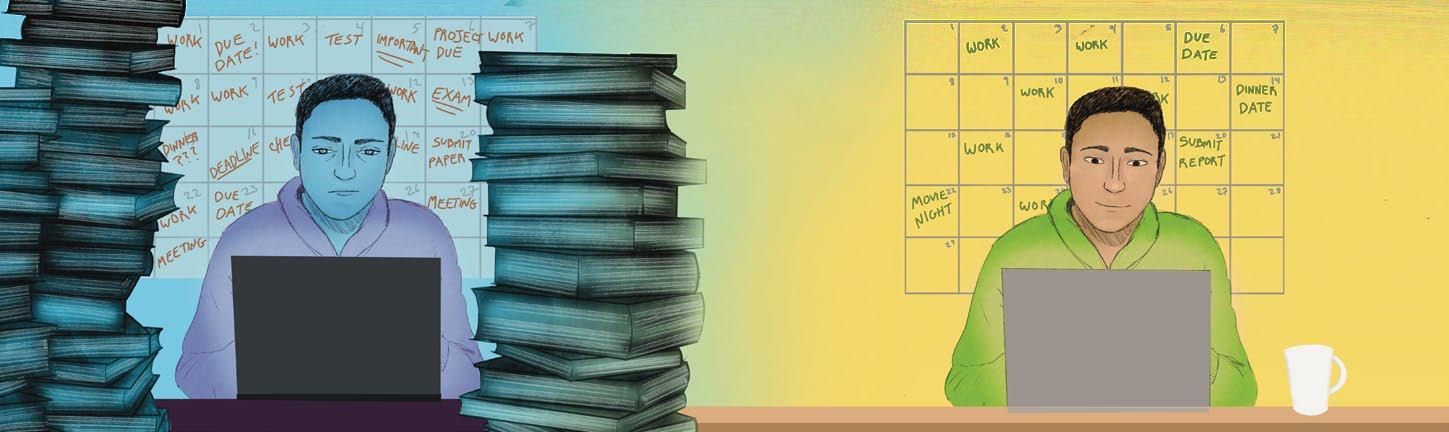
After two weeks of winter term, I’ve noticed my classmates, friends and colleagues all expressing a similar malaise regarding this semester.
It seems that, much like myself, people were burned out well before the holiday break.
I feel like the late arrival of winter somehow messed up my internal system. The lack of a true blue winter during the holidays had my brain forgetting due dates, mixing up times, dampening my mood and enabling general thoughtlessness.
While the cause of this burnout and general exhaustion that feels unique to the 2023-24 academic year is uncertain, if the simultaneously humorous yet concerning UM Reddit posts are anything to go by, the student demographic is feeling it.
During my lurking on social media out of a desire to know how other students are faring, I found there is an uptick in students struggling to balance and get through the academic year.
Students are expressing intersecting struggles, including several complaints since the fall term about ungodly
amounts of chattiness in designated quiet and or study spaces, and I empathize with them.
So, in a means of attempted solidarity and understanding, I’ve created a mixtape of pop, electronic and alternative songs that I hope will act as a cathartic release to the frustrations my fellow U of M survivors are experiencing.
Personally, when I’m fed up, I love to wallow for a minute as a means of validating myself, licking my wounds before moving on to solutions.
This playlist embodies that concept. It contains several tracks that are meant to valid-
ate before travelling into the realm of motivation. It ends off with a track by U of M local, Faouzia, who has likely experienced the same winter term blues as the rest of you.
I hope these tracks keep you company as you trek through the winter snow to get to your classes on time. While summer might seem millions of years away, every day that passes is one day closer to freedom.
brutal — Olivia Rodrigo, SOUR
Deceptacon — Le Tigre, Le Tigre Hard Times — Paramore,
After Laughter
Gone — Charli XCX, Christine and the Queens, Charli Flesh Without Blood — Grimes, Art Angels
We Got the Power (feat. Jehnny Beth) — Gorillaz, Jehnny Beth, Humanz (Deluxe)
Kids — MGMT, Oracular Spectacular Team — Lorde, Pure Heroine
Before the World Was Big — Girlpool, Before The World Was Big This Mountain — Faouzia, This Mountain
Bisons basketball rumbles with Vikes
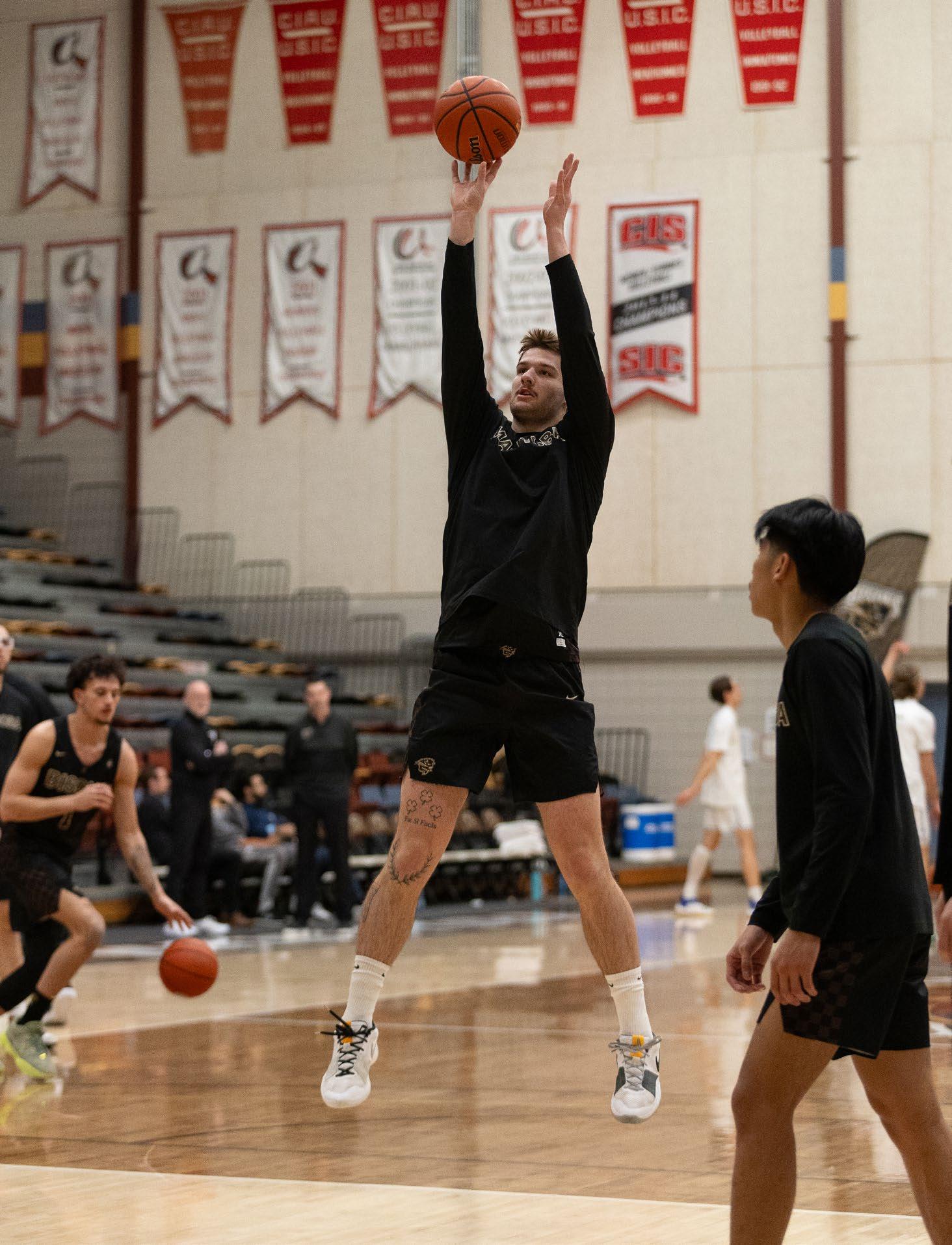
Hildebrandt scores career high 41 points, both teams go 1-1
Grace Anne Paizen, staff
The women’s and men’s basketball teams hosted the University of Victoria Vikes this past weekend in two fast-paced series.
Jockeying for playoff positioning as the 2023-24 basketball season starts to wind down, both teams needed at least a win against Victoria going into Friday night’s match to climb in the rankings for better playoff spots.
The women’s team burst out of the gates in game one of its matchup against the Vikes, fighting its way to a 21-15 first quarter lead.
The two teams went toeto-toe in the second quarter, each stepping up its defence, but the herd managed hold on to its six-point lead going into halftime.
In the second half of the game, the Bisons pulled away, draining 41 points and pulling off the much-needed win 76-61.
Lauren Bartlett recorded her second double-double of the season, leading the team with 17 points and 11 assists.
Bartlett also led in steals with five.
In addition to Bartlett, three other Bisons had double-digit nights. Emerson Martin tied Bartlett for points with 17, Emily Johnson scored 13 and Emily Mandamin drained 11.
It was an all-around team win, with Johnson, Mar Tomas Arbos and Anna Miko recording five rebounds apiece. Miko also recorded three blocks on the night.
Saturday’s game was a much more defensive matchup, with the Vikes starting on top 13-9 after the first quarter. Pulling away in the second quarter and taking a 34-17 lead into halftime, the Vikes never let up, putting the game away in the second half and defeating the Bisons 77-42.
and tied with Treyah Paquette in team-high rebounds with five, while Mandamin put up eight points.
In many ways, the Bisons men’s basketball team mirrored the women’s in its series, as it also started strong out of the gate in game one on Friday.
The men put up 42 points to the Vikes 31 in the first half
43-point record set in the 197475 season.
Daren Watts put up 15 points on the night, while Brandt Lenz rounded up the top three scorers with eight. Tito Obasoto led in steals with four and Hildebrandt, Wyatt Tait and Jonam Kazadi all led in rebounds with five each.
Simon Hildebrandt had a career-high night in points with 41 and now holds the record for second-most points in a game in men’s program history
Johnson was the only Bison with a second double-digit night in the series, with 10 points in Saturday’s contest. Miko had nine points on the night, led in steals with four
before a hard-fought third quarter. The herd pulled away in the third with a 69-54 lead, but Victoria stormed back in the fourth, putting up 25 points to the Bisons 14. However, the herd held on for the win, with a final score of 83-79. Simon Hildebrandt had a career-high night in points with 41 and now holds the record for second-most points in a game in men’s program history, just two behind the
While Saturday’s game started off in favour of the Bisons — the herd taking a 15-point lead into halftime — the Vikes’ Renoldo Robinson put up 23 of his team’s 38 third-quarter points in a 46-point career night of his own. The Bisons only managed a single-digit, nine-point third and found themselves down 76-62 heading into the fourth quarter. The herd came out stampeding in the fourth, netting 28 points and taking a narrow two-point lead in the dying seconds of the game. The Vikes countered with a dunk, tying the game at 90 and for-
Sports teams’ schedules
U of M Bisons — Women’s Basketball
Victoria Vikes @ Bisons
Jan. 19 — Final: 61 – 76
Victoria Vikes @ Bisons Jan. 20 — Final: 77 – 42
Bisons @ Winnipeg Wesmen Feb. 1 — 6 p.m.
Winnipeg Wesmen @ Bisons Feb. 3 — 2 p.m.
U of M Bisons — Women’s Hockey
Bisons @ Calgary Dinos
Bisons @ Calgary Dinos
Jan. 19 — Final: 2 – 4
Jan. 20 — Final: 1 – 0
Trinity Western Spartans @ Bisons Jan. 26 — 7 p.m.
Trinity Western Spartans @ Bisons Jan. 26 — 7 p.m.
U of M Bisons — Women’s Volleyball
Bisons @ UBC Thunderbirds
Jan. 19 — Final: 0 – 3
Bisons @ UBC Thunderbirds Jan. 20 — Final: 3 – 2
Winnipeg Wesmen @ Bisons Feb. 2 — 7:45 p.m.
Bisons @ Winnipeg Wesmen Feb. 3 — 6:45 p.m.
U of M Bisons — Men’s Basketball
Victoria Vikes @ Bisons
Jan. 19 — Final: 79 – 83
Victoria Vikes @ Bisons Jan. 20 — Final: 103 – 100 / OT
Bisons @ Winnipeg Wesmen Feb. 1 — 8 p.m.
Winnipeg Wesmen @ Bisons Feb. 3 — 4 p.m.
cing overtime.
Overtime was hard-fought, with the teams trading baskets until the Bisons made a costly turnover late in the extra frame. The herd was only able to pull within three points of the Vikes with one second left on the clock, with Victoria pulling off the narrow win 103-100 in extra time. Four Bisons had doubledigit points in Saturday’s match. Watts led with 26, while Hildebrandt recorded 22, Obasoto netted 20 and Mason Kraus scored 10. Kraus also led in steals with five and Hildebrandt led in rebounds with eight.
Heading into the bye-week, women’s and men’s basketball returns Feb. 1 and 3 as the herd takes on the University of Winnipeg Wesmen in the basketball leg of the Duckworth Challenge.
U of M Bisons — Men’s Hockey
Calgary Dinos @ Bisons Jan. 19 — Final: 5 – 1
Calgary Dinos @ Bisons
Bisons @ Trinity Western Spartans
Bisons @ Trinity Western Spartans Jan. 27 — 3
U of M Bisons — Men’s Volleyball
Bisons @ UBC Thunderbirds Jan. 19 — Final: 0 – 3
Bisons @ UBC Thunderbirds Jan. 20 — Final: 3 – 1
Winnipeg Wesmen @ Bisons Feb. 2 — 6 p.m.
Bisons @ Winnipeg Wesmen Feb. 3 — 5 p.m.
U of M Bisons — Swimming
photos / Matthew Merkel / staff
Bisons volleyball resilient against Thunderbirds
Both teams split series with UBC after losing first match
Joshua Brandt, staff
The University of Manitoba Bisons volleyball teams were in Vancouver this past weekend, facing off against the University of British Columbia (UBC) Thunderbirds.
With both teams facing first-place UBC, the Bisons needed to give a complete, relentless effort.
Women’s team
As UBC surely knew, the herd looked to usurp the Thunderbirds’ top position in the CanWest conference going into the weekend series. Sitting one spot behind the T-birds in the standings, the Bisons braced and fortified themselves for a couple of challenging matches.
In the first match, the herd fought valiantly and played the T-birds close in every set.
However, the Bisons did eventually fall in straight sets, losing the first set 25-23, the second 25-22 and the third 25-22, again.
Notable performers from the first match were Eve Catojo, who contributed seven kills on an efficient .462 hitting percentage, and Ella Gray,
who recorded eight kills while hitting .368.
Likewise, the most prolific offensive weapon in CanWest, Raya Surinx, hammered home 18 kills and managed to chip in defensively with 11 digs.
Showing great resilience by bouncing back from the previous night’s loss, the Bisons put everything on the line in the second match, turning in one of their most inspired efforts of the season thus far.
In what was a back-andforth affair, the herd managed to emerge victorious in the second game and split the series, winning 3-2.
Manitoba was aided by Light Uchechukwu’s phenomenal — and often very timely — 17 kills, Surinx’s 19 and the other-worldly defence of Julia Arnold, who scrounged up 24 digs on T-bird attacks, many in jaw-dropping fashion.
Andi Almonte contributed with a couple of service aces, as well as an extremely crucial kill in the fifth set to put the herd up 12-10.
By splitting the series with the now 16-2 T-birds, this Bisons team is still in the running for the top overall seed in the CanWest playoffs. In a tight race for first, the differ-
ence between a record of 14-4 and the Bisons’ current record of 15-3 is huge.
Men’s team
Seeking to end the T-bird’s eight-game winning streak last Friday, the herd was aided by the arrival of a new player to its roster.
Karil Dadash Adeh, the sixfoot-eight right side with a thunderous lefty-serve, will surely help this Bisons team as it looks to lock down a playoff spot in the not-too-distant future.
Dadash Adeh certainly made his presence felt in the first match, smashing a Bisonhigh 12 kills.
Nevertheless, it was a losing effort for the herd, which was swept in straight sets 3-0. Looking to bounce back in the second match, the herd stampeded out of the gates to win the first set 25-21.
Riding the momentum of its first-set win, the herd cruised to a 3-1 victory in the match.
Eric Ogaranko led the way for the Bisons, registering 12 kills, including the final kill to give the herd the victory.
Sammy Ludwig also played
very well, distributing countless crisp, deft sets to keep the UBC block off-kilter. He finished the match with 36 assists.
With the win, the herd improved its record to 11-7, which is good for sixth place in the CanWest standings.
Women’s hockey nabs win over Dinos
Men swept by Calgary, while women go 1-1 over weekend
Quinn Mayhew, staff
The University of Manitoba women’s hockey team kicked off its weekend series against the University of Calgary Dinos with a hard loss on the road Friday night. Calgary scored the first goal of the game halfway through the first period. The U of M continued to struggle in the first frame and the Dinos took a 2-0 lead over the herd into the first intermission.
Calgary, using its momentum, scored a third goal in the second, pulling away from the Bisons.
However, the herd managed to get on the board shortly afterwards on a loose puck in the high slot courtesy of Jena Barscello, which cut the Dinos’ lead to two.
The Bisons went into the third trying to make a comeback. Ashley Keller scored early in the frame for the herd, just squeezing the goal in through a leg on the post.
Calgary later hit back, scoring its fourth goal on a power play and defeating the herd
4-2.
In Saturday’s game, the Bisons were finally able to snap their seven-game losing skid in what was a very close match.
The first period yielded no goals for either team, the two sides equally matched.
However, the second period picked up a bit with Kylie Lesuk scoring on a backhand shot against Calgary late in the frame. This gave Manitoba the lead for the first time in the series, and the herd took the 1-0 lead into second intermission. The third period was a defensive clinic for the U of M, who fended off the Dinos’ efforts for a 1-0 shutout victory on Emily Shippam’s 26 saves in net.
On home ice, the University of Manitoba men’s hockey team played a difficult weekend against the Dinos. The first period of Friday’s match was slow, both teams deadlocked at 0 heading into their locker rooms for the intermission. Early in the second frame, the herd’s Riley Zim-
merman managed to put a goal past Calgary’s strong defensive line.
However, shortly after the Bisons’ goal, Calgary scored twice, taking a 2-1 lead into second intermission. The third period is when the Dinos took over the game. Calgary was in control in the third, scoring its third goal of the game early in the final frame. The Dinos went up 4-1 later in the period, and put the final nail in the coffin with an empty netter near the end of game, beating the herd 5-1.
Unfortunately, the Bisons fared no better during Saturday’s game. Calgary started off the first period full of energy in its skating.
The Dinos opened scoring on an early power play, then scored two more times in the frame to cap off the first period up 3-0. After going down 4-0 on a Dinos’ power play early in the second the Bisons looked more promising, getting on the board with a Parker Malchuk power-play goal and managing to fend off two
After a bye-week, both Bisons volleyball squads will face off against the University of Winnipeg Wesmen on Feb. 2 and 3, each seeking to win their leg of the annual Duckworth Challenge.
more Calgary power plays. With Calgary taking a 4-1 lead into the second intermission, the Bisons could not mount a comeback in the third. The Dinos scored the only goal of the third frame and swept the U of M with the exact same 5-1 score as Friday’s match.
The women’s hockey team hosts the Trinity Western University Spartans Jan. 26 and 27, while the men’s team is on the road in Langley, B.C. to take on the Spartans.