VIDEO EDITOR Kennedy Legault video@themanitoban.com
SOCIAL MEDIA EDITOR Violet Baker social@themanitoban.com
REPORTERS
NEWS Alicia Rose
NEWS Kyra Campbell
NEWS Michaela de Hoop
RESEARCH & TECHNOLOGY Rhea Bhalla
COMMENT Braden Bristow
COMMENT Hanako Teranishi
COMMENT Lakshmisree Shaji
ARTS & CULTURE Kelsey Chin
ARTS & CULTURE Alex Braun
SPORTS Joshua Brandt
SPORTS Quinn Mayhew
VOLUNTEERS
VOLUNTEER STAFF
Bahareh Rashidi, Christina Tran
VOLUNTEER
Michele Melendez, Lucas Gomes, Romin Cheema
interested in volunteering?
email me@themanitoban.com today!
THEMANITOBAN.COM
109 HELEN GLASS BUILDING
UNIVERSITY OF MANITOBA WINNIPEG, MB 204. 474. 6535
The Manitoban is the official student newspaper of the University of Manitoba. It is published monthly during the summer and each week of regular classes during the academic year by the Manitoban Newspaper Publications Corporation.
The Manitoban is an independent and democratic student organization, open to participation from all students. It exists to serve its readers as students and citizens.
The Manitoban is a member of the Canadian University Press, and our journalistic standards can be found on the Manitoban’s website.
The newspaper’s primary mandate is to report fairly and objectively on issues and events of importance and interest to the students of the University of Manitoba, to provide an open forum for the free expression and exchange of opinions and ideas and to stimulate meaningful debate on issues that affect or would otherwise be of interest to the student body and/ or society in general. The Manitoban serves as a training ground for students interested in any aspect of journalism.
Students and other interested parties are invited to contribute to any section of the newspaper. Please contact the appropriate editor for submission guidelines.
The Manitoban reserves the right to edit all submissions and will not publish any material deemed by its Editorial Board to be discriminatory, racist, sexist, homophobic or transphobic, ableist or libellous.
Opinions expressed in letters and articles are solely those of the authors. Editorials in the Manitoban are signed and represent the opinions of the writer(s), not necessarily those of the Manitoban staff, Editorial Board or the publisher.
A “volunteer staff” member is defined as a person who has had three volunteer articles, photographs or pieces of art of reasonable length and/ or substance published in the current publishing year of the Manitoban.
Any individual who qualifies as a volunteer staff member must be voted in by a majority vote at a Manitoban editorial board meeting. Elected representatives and non-students may be excluded from holding votes as volunteer staff members in accordance with the Manitoban Constitution.
ourth-year nursing student Arij Al Khafagi is facing academic discipline following what lobbyists say were social media posts “expressing her opposition to Israel’s extreme violence against Palestinians in Gaza.”
Al Khafagi, senior stick of the Nursing Students’ Association, confirmed her suspension on her Instagram on Nov. 23. The Manitoban was unable to confirm the reason for her suspension.
One group, Canadians for Justice and Peace in the Middle East (CJPME), began a campaign to email administration at the U of M urging Al Khafagi’s reinstatement, and for her academic record, which CJPME says currently has a five-year reprimand, to be cleared.
At the time of publication, 10,473 emails have been sent.
Al Khafagi has a history of activism for several communities. In 2020, she was one recipient of U of M’s Emerging Leaders award, given to students “recognized for outstanding contributions.”
Al Khafagi did not respond to multiple requests for comment.
The Manitoban contacted the U of M requesting to speak with U of M president Michael Benarroch or a representative from the college of nursing, and was instead provided with a written statement on behalf of the university.
U of M spokesperson Eleanor Coopsammy cited privacy as the reason disciplinary cases could not be discussed further, but said that “The university does not suspend students for exercising freedom of speech.”
In the statement, she pointed to the university’s respectful workplace and learning environment policy and the violent and threatening behaviour policy, as well as the academic and non-academic misconduct guidelines.
The statement said that decisions regarding disciplinary cases are only made following consideration of the evidence and circumstances, and that students have the opportunity to appeal if they wish.
The same message was communicated to students in the college of nursing.
Palestine talk raises academic freedom concerns
MP Ben Carr criticizes event, Jewish organization demands cancellation, academics stand firm
Colton McKillop, staff
An academic discussion on the Israel-Palestine conflict held by a number of University of Winnipeg professors has stirred up controversy and raised questions about academic freedom.
The event took place Nov. 24, the first day of a fourday ceasefire and hostage exchange between Israel and Hamas, and was entitled “Palestine and Genocide: Reflections on Imperialism, Settler-Colonialism, and Decolonization.”
The day saw a teach-in and a roundtable discussion exploring what the event’s description called the genocide in Palestine and its similarities to genocides around the world, including of Indigenous people in Canada.
Winnipeg South Centre MP Ben Carr, who is Jewish, criticized the university in an interview with CBC News, saying the talk failed to provide an opposing perspective for balance and accusing some of the events’ speakers of having “significant antisemitic undertones.”
Carr could not be reached for comment.
Jeff Lieberman, CEO of the Jewish Federation of Winnipeg, called for the event to be
cancelled. He said the event was “one-sided” and failed to feature opposing viewpoints.
Lieberman called freedom of speech and academic freedom “an important part of what [universities] do,” but said schools also have a responsibility to not allow speakers who spread antisemitism and “a very tainted view of history.”
“This presentation was held with a number of speakers that did that,” he said.
Lieberman and Carr both pointed to comments by Ghada Sasa, one of the speakers and a former board member of Canadians for Justice and Peace in the Middle East (CJPME), concerning Hamas’ attack on a music festival on Oct. 7.
On Real Talk Ryan Jespersen, Sasa said she had read first-hand accounts from survivors of the attack on the rave who said Israeli forces were responsible for some of the deaths of attendees.
The following day, CJPME released a statement saying Sasa had been suspended from her position on its board, saying “some views that Ms. Sasa has expressed publicly are not aligned with the policies and positions of the organization.”
President of the University
of Winnipeg Faculty Association Peter Miller called academic freedom “paramount” and said he didn’t see anything antisemitic in the suggested topics of the event.
Miller disagreed with Carr’s insistence that the event should feature opposing viewpoints, arguing that academic freedom entails taking a specific position and arguing for it.
“In academic articles, people don’t present the opposing viewpoint,” he said. “When academics put together professional conferences, they don’t ensure that there are people arguing for and against things,” he said.
The Manitoba Organization of Faculty Associations released a statement the day before the talk, stating that it was “gravely concerned about comments made by prominent Manitoba politicians” regarding the discussion event, and that critics were attempting to influence university administrators.
“MOFA categorically rejects such interventions by politicians of all parties and in all levels of government,” the statement said.
“Academic freedom requires neither neutrality nor ‘balance’ but entails engage-
NDP announces free birth control
ment and commitment to an honest search for knowledge and understanding.”
Judith Norman, professor of philosophy at Trinity University and a member of Jewish Voice for Peace, was one of the speakers at the event. She said concerns about supposed antisemitic themes in the talk are “poorly founded” and distract from what she called an “ongoing genocide in Gaza.”
“As a Jewish person, that distresses me enormously,” she said.
Norman said she has a “family history of fleeing from genocidal violence in Europe,” and that she feels “a Jewish responsibility to bear witness against genocidal violence.”
She argued that the state of Israel tries to suppress criticism of its treatment of Palestinian people and control narratives through “propaganda,” and that post-secondary campuses are often a “site of struggle in Israeli propagandistic attempts to justify” its treatment of Palestinians.
“We have these little struggles over free speech, over freedom of expression that really distract from the central point and amount to an abuse and an attempt to wear out the critics of Israel.”
MB becomes second province to subsidize reproductive health
Sarah Cohen, staff
The newly formed New Democratic Party (NDP) government of Manitoba reassured the right to reproductive health care, including access to prescription birth control, last Tuesday.
“Our government will protect and affirm Manitobans’ right to access abortion services, protect abortion providers and make prescription birth control free,” said Lieutenant Governor of Manitoba Anita Neville.
The NDP’s commitment includes oral contraceptives, the morning-after pill, copper and hormonal intrauterine devices and hormonal contraceptive injections. The commitment does not include
condoms. However, students can get free condoms at the Rainbow Pride Centre . Different varieties of birth control can also be helpful for regulating menstrual cycles, lessening heavy bleeding or cramping during menstrual cycles, treating conditions like endometriosis or PCOS and can help with acne and migraines.
As of now, British Columbia is the only other province or territory providing residents with free prescription birth control.
A press release from the Women’s Health Clinic (WHC) said it was “thrilled” to hear the announcement, and that the plan “will make a difference in the lives of so many
of [their] clients and so many Manitobans.”
The WHC offers reproductive health services including abortion, sexually transmitted infection testing, pre- and post-natal care and birth control.
WHC is just one of several clinics in Winnipeg that offers reproductive health care and services for Manitobans, the rest of which can be found in the Winnipeg health services directory.
U of M centres to host harm reduction workshop
Collaboration will feature panel, instructions to make harm reduction kits
Colton McKillop, staff
The Student Wellness Centre (SWC) and Rainbow Pride Centre (RPC) are collaborating on an interactive workshop on harm reduction this Friday.
The event will feature a panel discussion aiming to challenge myths surrounding harm reduction, followed by a lesson on how to make a harm reduction kit.
SWC assistant Lizzie Magaji called collaborating with RPC on the event “a no-brainer,” pointing out that RPC already provides information and other resources on harm reduction, particularly for 2SLGBTQIA+ students.
“I think when talking about harm reduction, it’s very important to get a diverse array of perspectives to add to the dialogue,” she said.
Alex Rana, UMSU 2SLGBTQIA+ representative and co-president of RPC, said SWC reached out to collaborate on the event. He noted that while RPC had offered safe sex workshops in the past, it had not “had the opportunity to
do anything on harm reduction specifically yet,” a space he thought needed to be filled.
“A lot of students do use substances, and abstinence-based education is not really good enough to ensure that people are using things safely and acknowledge the reality that people do use these,” he said.
Magaji said many harm reduction programs are “not explicitly geared towards students and the substances that they commonly use.”
“Of course students can go out to these community services and use the services that they provide, but here we have the data to know what substances and behaviours that students commonly engage in.”
She noted that many students are living on their own for the first time.
“We have a lot of new adults at the university who are able to access substances a lot easier than they could have in the past,” she said.
“We think it’s really important to provide information for
those students about the substances that they may want to engage in.”
Rana said a big problem the 2SLGBTQIA+ community faces is negative myths and stereotypes that interfere with education about safer sex, and said sex education often is not inclusive.
“A lot of things they teach about safer sex don’t use inclusive languages,” he said. Rana said educators often
focus on “one type of sex” and that “people who don’t fall into that just don’t learn what they need to,” he said.
The harm reduction kits will contain educational materials and items including internal and external condoms, lubricant, safer substance use supplies and electrolyte packets.
Rana will be one of the speakers for the panel on Friday, sharing experience with
harm reduction he has gained from his job and his role as a member of the Safer Social Events team.
The panel will also feature community addictions worker Maireke Veldhuis to discuss myths surrounding substance use and harm reduction and how the risks of certain behaviours may vary for people with different identities.
Magaji called harm reduction “an approach or a strategy that can be fit into a lot of different prospective careers.”
“Of course, we have the somewhat obvious ones like health care, but really any career where you are dealing with the community at large, you can use harm reduction strategies or a harm reduction approach when engaging with people,” she said.
The workshop will take place at 1 p.m. at the Student Wellness Centre.
To register for this workshop, students should email healthandwellness@umanitoba.ca.
photo / Matthew Merkel / staff
Asper awards celebrate Indigeneity in business
Winners Michelle Cameron, Matthew Sabourin honoured as business leaders
Michaela de Hoop, staff
M ichelle Cameron and Matthew Sabourin, two Winnipeg business people, were honoured earlier this month with awards in Indigenous business.
Nov. 16 marked the 17th annual Visionary Indigenous Business Excellence (VIBE) award celebration and fundraiser held by the Asper school of business’s Indigenous Business Education Partners department.
Michelle Cameron, CEO of Dreamcatcher Promotions, Indigenous Nations Apparel Company (INAC) and Dreamcatcher Executive Offices, shared about her experience as an Indigenous woman in the business world.
“I’m an entrepreneur in my heart and soul,” said Cameron.
“For me, Dreamcatcher is a symbol of our Indigenous culture,” she said. “When you think Dreamcatcher, it goes to say who we are and why I’ve started my company and pursued my dream.”
“To be showcased and honoured that night, it just proved what is possible when you dream big.”
“I love being a part of the
growth in our community, and I love seeing our people wearing product with Indigenous artwork on it because it’s showing pride,” she said.
Only a few years ago, Cameron did not see many people wearing clothing that reflected Indigenous culture.
“There was a time when most of us were ashamed of being Indigenous or showcasing our culture on clothing,” she said.
“I love creating a store where you can go in there and every single thing might appeal to an Indigenous person.”
Dreamcatcher Promotions is currently Canada’s largest Indigenous-owned promotional company, selling a variety of products with Indigenous designs. Its inventory is available for purchase online or at the INAC store in Polo Park.
President and co-founder of Nonsuch Brewing Co. Matthew Sabourin said he has “always felt so inspired by the recipients, their speeches, just the whole idea.” He added it was an honour “to be on the recipient end,” and hopes to be an inspiration to others with his success.
“We say that the company is our love letter to Manitoba,” he said.
Although the Nonsuch’s role in the fur trade was significant, Sabourin said that “some people see that as a negative thing, and I want to believe that is a very positive thing because this is what I’ve come from.”
Sabourin said they started the company with the hope of making the province proud.
He said they dream of a “more sustainable, more just, more equitable, more diverse and more prosperous” Manitoba, and Nonsuch embodies that.
Sabourin noted the significance of celebrating Indigenous business owners at a critical moment in the province’s Indigenous history. Sabourin believes “we’re in a
very special time,” especially with Manitoba’s first-ever First Nations premier being elected.
“I’m so thrilled and honoured to be an entrepreneur during this period, and I think that this is a wonderful opportunity for the Indigenous community to get the spotlight they’ve always deserved,” Sabourin said.
Eckhardt-Gramatté music library’s name under review
Exposé alleges Eckhardt had Nazi ties, library covers signs bearing his name
Alicia Rose, staff
The legacy of Ferdinand Eckhardt, a former director of the Winnipeg Art Gallery, has come under scrutiny after an article published in the Walrus on Nov. 9 alleged he had Nazi sympathies.
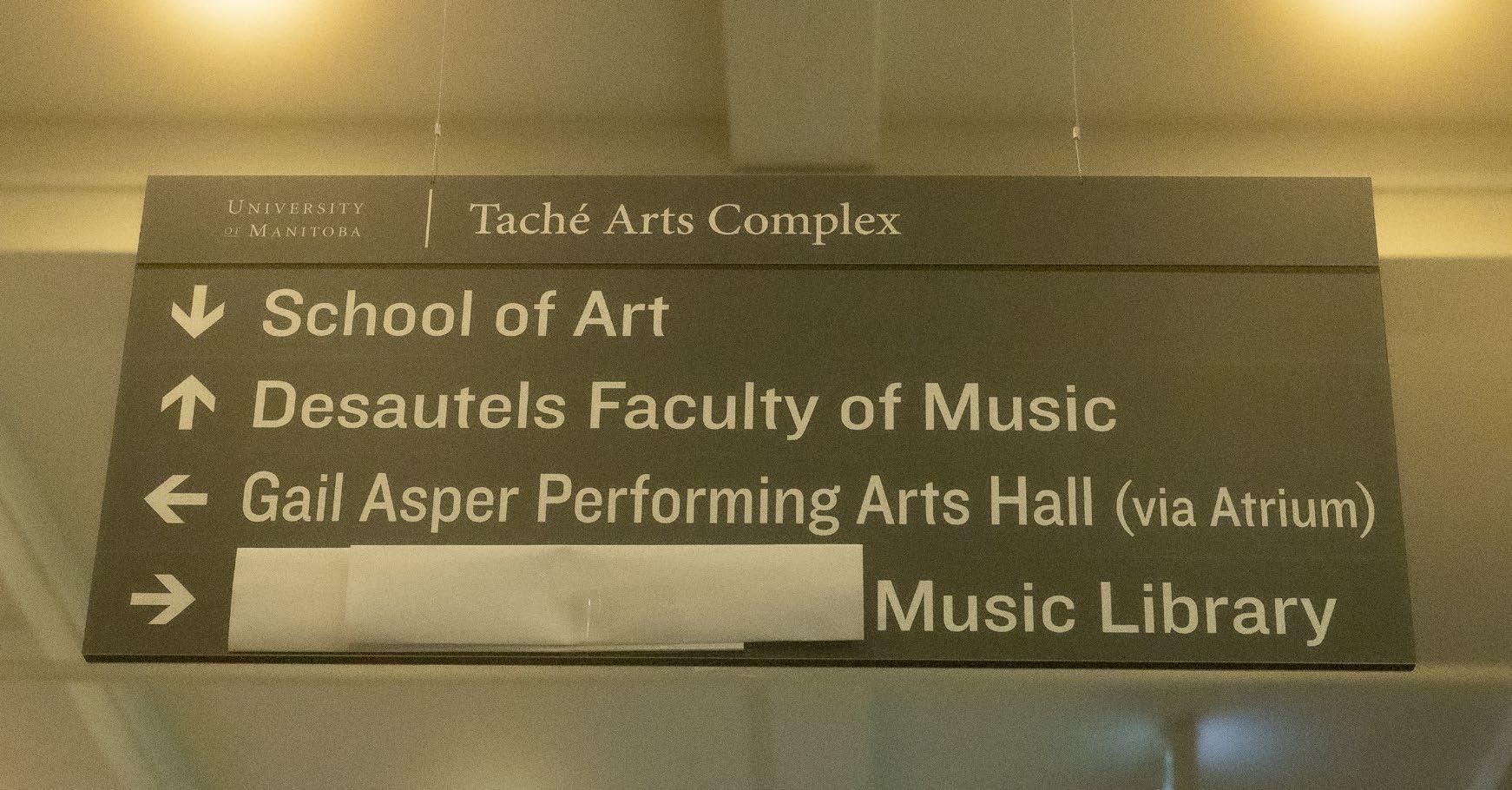
The University of Manitoba’s music library was named after Eckhardt’s wife, Sophie-Carmen Eckhardt-Gramatté, a Russian composer and musician. Since the Walrus article was published, the sign displaying the name of the library has been covered.
The article, “Was the Winnipeg Art Gallery Led by a Nazi?”, written by Conrad Sweatman, discusses Eckhardt’s past associations with Nazism, such as signing an oath of allegiance to Adolf Hitler, his writings in Nazialigned journals in the early 1930s and his work with IG Farben, the company that constructed the Auschwitz concentration camp and produced Zyklon B, the compound used in gas chambers.
While Eckhardt was the director of the Winnipeg Art Gal-
lery in 1973, Karl Stumpp, a German ethnographer who assisted Einsatzgruppen killing squads in selecting their victims, held a presentation in the gallery about persecution of ethnic Germans by the Soviet Union.
The Eckhardt-Gramatté music library has been part of the university since 1965 and was relocated to its current location at Taché in 2015. Since then, the Eckhardt-Gramatté Foundation has given the U of M $500,000 toward the growth of the library and the Desautels faculty of music collection.
Eckhardt-Gramatté’s name is also memorialized in the University of Winnipeg’s Eckhardt-Gramatté library, University of Winnipeg’s and University of Calgary’s Eckhardt-Gramatté Hall, Brandon University’s Eckhardt-Gramatté conservatory of music, and the Eckhardt-Gramatté national music competition in strings.
Josiah Wurch, a third year music student, was “shocked” after reading the Walrus article. He said it “raises the ques-
photo / Matthew Merkel / staff
tion of whether or not these names should be [removed].”
“I think it definitely is good to reassess the names that we put on places like libraries or streets,” Wurch said.
“Especially in the light of current world events right now, I think it is very important for us to be mindful about who we’re naming things after.”
Wurch said that if Eckhardt was found to be a member of the Nazi party, removing the
name would be “a step in the right direction.”
The U of M is currently conducting an investigation into Eckhardt’s past, according to a statement from U of M spokesperson Eleanor Coopsammy.
“A few weeks ago, a Walrus article raised the possibility of Ferdinand Eckhardt having ties to the Nazis before the Second World War and his immigration to Canada,” Coopsammy said.
“These allegations are
alarming and disturbing and, if accurate, would put the naming of the music library in violation of UM’s naming policy. UM is conducting a full review into the naming of the space to determine next steps. In the meantime, any painting or plaque that bears the name will be covered until after the review.”
Nonsuch Brewing Co. was named after the historic vessel, the Nonsuch, said Sabourin.
Research & Technology
Festivals as catalysts
UM professor explores the impact of festivals on community resilience
Elah Ajene, staff
After finishing a degree at the U of M, Christine Van Winkle worked at the Winnipeg Fringe Theatre Festival. Serving initially as the volunteer co-ordinator and subsequently occupying various roles at the festival over the years, Van Winkle gained first-hand experience that allowed her to discern the distinctive impact of the Fringe Festival in Winnipeg’s Exchange District.
Witnessing the festival’s ability to unite people from diverse corners of the city for shared experiences and performances proved to be an enlightening experience for Van Winkle, spurring her interest in the multifaceted roles festivals play in shaping and influencing communities.
With a background in festival administration and curiosity about the organizational dynamics behind events, Van Winkle’s research initially focused on the role of mobile devices, particularly cell phones, in shaping visitors’ experiences.
Through her research, Van Winkle found an indispensable role of mobile phones in creating a sense of safety and security during festival experiences. Van Winkle also highlighted the impact of social media and its potential to spread misinformation during events.
As a U of M professor in the faculty of kinesiology and recreation management, Van Winkle explores festivals and their impact on communities that have experienced disasters or crises. Her current research offers a fascinating peek into how festivals, often associated with joy and merriment, can aid communities on the path to recovery.
One of her research projects zeroes in on festivals’ involvement in communities affected by wildfires.
United Nations’ buffer zone, serves as a unique case study.
Van Winkle explored the role of festivals in post-conflict situations, shedding light on the intricate dynamics at play.
When considering the differences in the impacts of
to address specific community issues.
“They’re able to produce an event that responds to the unique issues that the community is facing at the time,” she said.
“They can play a meaningful part of that recovery process”
— Christine Van Winkle, U of M professor in the faculty of kinesiology and recreation management
Van Winkle considered case studies from Australia, the United States, Canada and Mexico, examining how these festivals play a role in both preventing wildfires and aiding in recovery.
In another project, she focused on the role of festivals in Cyprus, a post-conflict community that was divided by active conflict in the 1970s.
The Buffer Fringe Performing Arts Festival, hosted on both sides of the divide and in the
festivals across countries, Van Winkle emphasized the importance of unique contexts.
“The role that festivals play after a disaster really builds on the role that they play in the day-to-day lives of the community,” she said.
Van Winkle underscored how organizers’ understandings of these unique contexts and their networks enable them to tailor events
Van Winkle’s research uncovered not only the positive aspects of festivals but also the associated challenges and drawbacks.
One of the challenges she found is the under-resourcing of festival organizations, which are often not-for-profit entities with limited financial resources. This underfunding poses a significant hurdle to their effectiveness in times of crisis.
However, festivals uniquely connect with diverse aspects of a community, making them valuable contributors to recovery efforts.
“But if we chronically underfund these organiza-
tions, they struggle to be able to play that part when the time comes,” Van Winkle said.
Another challenge arises from the heavy reliance of many festivals on volunteers.
In post-disaster communities, volunteer resources may need to be redirected toward recovery efforts. Additionally, Van Winkle pointed out the considerable difficulty faced by communities in managing an influx of visitors in the aftermath of a crisis or disaster.
“It definitely isn’t always positive,” she said. “There are also drawbacks to festivals in communities, and they take certain resources.”
When it comes to measuring the impact of festivals on community resilience and recovery, Van Winkle said her studies are still in the analysis phase. Thematic analysis, which includes perspectives from various stakeholders, forms a crucial part of understanding the multifaceted role festivals play in recovery efforts.
“We interview people both
connected to the event organization, but also people not at all connected to the event organization,” she said.
As for future research directions, Van Winkle envisions a focused exploration of festivals in post-conflict communities.
“I’ve already had the opportunity to meet with different festival organizers in communities that have experienced conflict,” she said.
“We’re looking at using a new model to help us better understand how festivals play a part, or don’t, in these communities.”
Van Winkle’s research unveils a new dimension to the world of festivals, positioning them not just as moments of celebration but as potentially integral components of community resilience and recovery.
“They can play a meaningful part of that recovery process,” she said.
graphic / Dallin Chicoine / staff
The neurobiology of grief
U of M hosts seminar on bonding, grief and the brain
Rhea Bhalla, staff
E
arlier this month, the Rady faculty of health sciences hosted a seminar on the neurobiology of grief. The seminar featured a presentation by Mary-Frances O’Connor, associate professor of psychology and director of the Grief, Loss and Social Stress lab at the University of Arizona.
O’Connor touched on the role of neurochemicals in relationship bonds and how rumination and avoidance can make it difficult to accept a loved one’s passing.
She began the presentation with a metaphor. Imagine your dining room table has been stolen. One night, you wake up to get a glass of water, and as you cross the dining room to enter the kitchen, you pass through the space where the table used to be.
“You feel the absence, the hole, where the dining room table should be,” O’Connor explained. “Just at the level of your hip, there’s this vacuum.”
Though the biological process of sensation is clear, O’Connor noted that neuroscientists struggle to understand this phenomenon.
“What’s very difficult to explain is how we can notice the absence of something,” she said. “And this, I think, is a good metaphor for the way that many bereaved people feel. That, in fact, they feel that they are continuously walking into a room where their loved one should be and feeling that absence, feeling that hole.”
This example, she noted, may be more than a metaphor.
the rats. Certain cells in the brain, called object cells, fired in response to the blue tower.
Later, the blue tower was taken away. For eleven days after the tower was removed, the object cells continued to fire in the rat’s brains as though the tower was still there. Like the table in O’Connor’s metaphor, the absence of the blue tower could be felt.
“We think of all the millions of ways that someone we’re close to is more important in our life than a blue tower, and thus the enormous amount that we have to learn when a loved one dies,” O’Connor said.
This, she noted, is why grieving can be thought of a form of learning.
The brain functions as a prediction machine, O’Connor explained. By making predictions about the future, the brain allows us to effectively engage with the world based on a set of underlying assumptions.
“We have certain assumptions in the world,” O’Connor said. “That includes understanding what it is to have a loved one. What is it that we are losing when a loved one dies?”
To answer that question, O’Connor emphasized the importance of studying bonding and attachment.
The brain uses chemicals such as dopamine, opioids and oxytocin to encourage relationships with loved ones. Attachment bonds are
graphic / Dallin Chicoine / staff
Bonding “is physically encoded in the brain,” O’Connor said.
“Our loving relationships with others permanently change our brain,” she said.
“Because they loved us and we loved them, we carry them physically with us forever.”
“Our loving relationships with others permanently change our brain”
— Mary-Frances O’Connor, University of Arizona associate professor of psychology
A 2013 study conducted by Nobel Prize-winning researchers studied rats placed in black boxes. At one point in the study, a blue LEGO tower was placed in the box, sparking the interest of
“invisible tethers” that tie us to our loved ones and are used as “motivating circuits” that provide neurochemicals as a reward for time spent with loved ones.
An attachment bond is distinct from other bonds because it “comes with the implicit belief I will always be there for you and you will always be there for me,” she explained.
O’Connor is currently working on a hypothesis focused on how the brain interprets a loved one as being simulta-
neously “gone and everlasting.” She said the brain may be constantly accessing “two conflicting streams of information.” First, the memory of the loved one’s death, and second, the attachment belief that arises through bonding.
The attachment belief is the understanding that even when a loved one is not in our physical presence, they still exist. While loved ones are alive, attachment beliefs are important for survival.
O’Connor cited the example of emperor penguins. Emperor penguin males forgo eating to care for their egg while the female leaves to hunt for up to two months. The male penguin must believe their partner will return. If their belief wavers and they leave the egg to hunt for themselves, the
egg will not survive.
“Believing in the enduring and everlasting nature of our bond is what is critical to our survival,” O’Connor said.
Despite knowing that a loved one has died, O’Connor explained that the belief they exist still endures. Over time, most people learn to reconcile their attachment belief with the knowledge that their loved one has passed.
O’Connor concluded the seminar by suggesting that, after considering the perspective of the brain, we may pose different questions to those who are grieving.
“Instead of asking ‘how are you doing?’ we might ask ‘what has changed since your loss, what have you learned about grief and grieving?’” she said.
A ballad of songbirds, snakes and ingenuity A retrospective
Kennedy Legault, staff
Ever since the trailer for The Ballad of Songbirds and Snakes came out this April, the world of The Hunger Games — or as some might call it, my own version of the Roman empire — has been on my mind every day.
But this isn’t something new to me. I first read Suzanne Collins’s The Hunger Games back in 2012 when the first movie was released, which then became the catalyst to my unhealthy hyperfixation on the series that has stuck with me for the last decade.
The excitement for this new prequel has caused a resurgence of new and old fans alike, and while many dystopian novels-turned-movies around the early 2010s have come and gone — most of them leaving you with a bad taste in your mouth — The Hunger Games series has always seemed to do it right.
While the first film has had its fair share of criticism, it can be hard to deny how remarkably the country Panem was brought to life. Although Gary Ross only directed the first movie, his vision for the world, the casting and the overall feeling he gave the film was a great start to kick off the adaptations.
Francis Lawrence knocked it out of the park with the final three movies, the newest prequel, Catching Fire being the most highly regarded. The cinematography, cast performances and overall pacing made for an electrifying watch in theatres.
in light of The Hunger Games’ renaissance
how close you can get and still do a phenomenal job. I know for myself and probably many other book lovers, it was greatly appreciated.
Of course, an adapta-
There is still a constant reminder that some things you might think are fictional are much closer to reality
Although it is impossible to adapt every detail from the book onto the screen, Catching Fire in particular proves
tion can only be as good as its source material. Collins’s powerful mind brought forth a diverse cast of compelling characters and a post-apocalyptic world that often mimics
the real world. Collins writes only from the restricted first-person perspective of the main character, Katniss Everdeen, and this is a defining reason why I think the series is so enthralling. The limited knowledge of what is going on around these characters leaves much up to interpretation. Collins has a way of writing main characters that aren’t exactly likeable, but you find yourself engrossed in their lives and rooting for
their victory. She writes from the theme, the story comes after. One thing I respect is how she isn’t writing for a cash grab. The vast world of Panem and its slew of characters opens the opportunity for endless stories. But Collins seems to write mainly to shed light on heavy modern-day topics.
Ignoring the ironic way the media tried to sensationalize the story’s love triangle aspect, these novels were so much more than that. The themes of struggle for power and control, social inequality and desensitization by the
media really hits home, especially now. That’s why I think this franchise is still so popular and relevant in modern times.
With the release of The Ballad of Songbirds and Snakes, it is evident that Collins’s masterful writing techniques are ever more present and are here to send a message. While it can be fun to watch the great filmmaking and performances, there is still a constant reminder that some things you might think are fictional are much closer to reality.
graphic / Michele Melendez / volunteer
To my sisters who are killjoys
An emotional feminist is a perfectly fine feminist
Lakshmisree Shaji, staff
I was told I was a very emotional child while growing up. When something or someone upset me, I argued, and tears shortly followed the argument.
I was soon diagnosed as emotional because I’m a feminist — someone who likes to pick fights by finding inequality and oppression in everything that happens around them.
I have been offered multiple remedies to my activist disease over the years. Ignoring whoever is saying problematic things to me, accepting that the person who is winding me up is preparing me for the world and bigger bullies, meditation and anger management classes were all possible cures
I think I genuinely tried some of them because, after all, I did not like being vulnerable in front of people who were clearly hurting me by intentionally saying misogynistic, casteist, homophobic, racist and classist things. I did not feel safe crying or “losing control.”
Perhaps my experience constantly being wound up is one of the reasons why the works of Sara Ahmed, scholar and writer, influenced me so much. Her essay “Feminist Killjoys (And Other Willful Subjects)” was a before-and-after event of my life. It changed my brain chemistry.
Ahmed shares the discomfort of dealing with sexism while being blamed for ruining dinner and causing disruptions. If you are squirm-
Political activism begins at our dinner tables
heart to see four to five fully grown men shouting at her daughter because she disagreed with their hateful politics She was one step away from clamping my mouth shut with her own hand.
In this essay, Ahmed talks about the narrative that feminists are disagreeable, perpetually angry and party-pooping hotheads. She draws examples from her life, specifically at dinner tables, where very uncomfortable conversations happen.
ing in your seat while reading this, you know exactly what Ahmed is talking about. You know, the Thanksgiving conversations that started as a discussion but led to you shouting — sometimes crying if you are like me — and ending in remarks like, “ Woah, she needs to chill.”
My mom used to prepare me for big family gatherings by telling me not to pay heed to the sexist jokes that would surely be made. It broke her
But I questioned, argued and cried every holiday. Since they were all older than me, it was also quickly established that I am not respectful to my elders. I wish I had taken my mother ’s advice, because I miss being able to enjoy my porotta and chicken curry or my biryani in silence.
It hurts, because these people know you You love them, and they claim they love you. How much I wish I didn’t have to clench my ice-cold fists,
ignore my pounding heart and heated abdomen, and fight against the one tear drop that is waiting to jump from my eye.
But I did: I fought, I cried over and over again. Because Ahmed is right: “ To be involved in political activism is to be involved in a struggle against happiness,” and political activism begins at our dinner tables.
I bet those who wound me up didn’t think I would write about my emotions in a university newspaper being read by thousands of people. I don’t think they ever thought I would find my community and that I would thrive in my female friendship and camaraderie. I bet they didn’t think that I would be mostly happy
and content because, in their world, feminists are not happy. I will take that win. Holidays are nearing. If you know you will get triggered, please ensure you have at least one person in the room supporting you. Sometimes, glancing at your sister shaking her head at the other side of the table is enough for you to double down and ignore nasty, sexist middle-aged men, no matter how vulnerable that may make you.
To all my sister killjoys, to those who stayed and to those who left: you let me remain a disagreeable woman, and I’m thankful.
photo / Teegan Gillich / staff
Engaging Men and Boys Against Sexual Exploitation and Sex Trafficking
Principal Investigator: Dr David Delay, Faculty of Social Work University of Manitoba
The purpose of this project is to explore men’s beliefs, attitudes, opinions and behavioural motivations relating to purchasing sexual services within Manitoba’s sex trade. “Sex trade” is a term used to describe a broad range of sex-related activities/services including but not limited to: escort services, street-level sex work, exotic dancing, erotic massage, pornography, internet sex work, and phone sex services. You can complete the survey anonymously. There is a draw for a gift card for those who provide an email address .You can also indicate whether you would like to be contacted for future related research.
the Survey at: https://cssrp.ca1.qualtrics.com/jfe/form/SV_9WGslPBvYRXcEXI
Basic income is a band-aid solution
Universal basic income fails to address systemic problems
braden bristow, staff
U
niversal basic income (UBI) is the application of the radical, and somewhat devious, idea that citizens, for some reason, deserve to have their basic needs met.
UBI is a measure in which the government makes cash transfers to each citizen with a guaranteed basic amount. This idea has made such waves that it has now been tabled in the Canadian Senate.
The appropriately titled National Framework for a Guaranteed Livable Basic Income Act was under consideration by the standing senate committee on national finance, as of Nov. 27. Should this act be approved in the House of Commons, the minister of finance would be required to create a national UBI framework.
This income program would determine what constitutes a livable basic income that ensures a good quality of life. While I feel social welfare is important, especially for those who are unable to work for any number of reasons, it ultimately fails to address certain issues. Namely, it does not hold companies who fail to provide for their workers accountable.
For example, in 2022 alone,
Loblaw Companies Limited made $56 billion in revenue with $1.9 billion of this amount being net earnings. However, on a starting Loblaws salary, one can expect to make a handsome minimum wage.
I worked for Shoppers Drug Mart, a subsidiary of Loblaws, for a total of two days and earned $15.30 an hour. Meanwhile, also in 2022, former president and CEO of Loblaws, Galen Weston, was given $8.4 million in compensation.
Between the low pay and precarious nature of part-time work, many Loblaws staff are left in economically vulnerable situations. Loblaws, however, is simply an example. There are thousands of Canadians who find themselves working for poor pay across the country.
While $15.30 an hour probably sounds like quite a bit of money, when one stops to consider cost of living in Canada it is much less impressive. The average one bedroom dwelling in Canada sits at $1,889 monthly and $1,282 in Winnipeg. If you find yourself with a friend, family member or some other person who tolerates you, the average two bedroom dwelling is $2,329 nationally and $1,692 in Manitoba.
Meanwhile, the average cost of food rose 9.8 per cent in 2022, and gas rose 28.5 per cent.
You might be shouting right now, “but columnist Braden! We need UBI to save us from the greed of Loblaws and assorted landlords!”
On a financial level, I have no issue with UBI. I could always use more cash in my pocket. But UBI fails to address the fact that companies like Loblaws and the housing market generally are simply allowed to continue running amok.
UBI removes the responsibility from employers, landlords and any other private entity while forcing taxpayers to flip the bill for their social welfare. It hardly seems appropriate that rather than force a higher federal minimum wage or a maximum rental cost, the solution is to simply hand out cash transfers sourced from government income.
Canada, as a nation, should not absolve the individuals and corporations responsible for paying workers and housing citizens of their responsibility to the people of this country.
There are at least three basic measures Canada could take to address this issue.
Firstly, companies must pay a living wage according to the local cost of living. There is no excuse for a CEO to bring in millions of dollars while employees barely recoup their expenses. The Canadian Centre for Policy Alternatives estimated that a living wage in Manitoba in 2022 was $18.34 an hour. If Canadians can afford to make their employers billions, employers can afford to pay their employees a living wage.
Secondly, Canada must have rent control that comes out of the pockets of landlords rather than the taxpayer. Rent control should be adjusted to minimum wage rather than the whims of the market. A UBI framework would do nothing to address the absurd costs used to line the pockets of landlords. There is no issue with taxes going toward social welfare for those who need it, but the taxpayer shouldn’t flip the bill when the average taxpayer didn’t cause the problem.
Thirdly, grocery costs need to be lowered at the expense of corporate bodies. Profiting off of the survival of the masses is bad enough, but with rising costs across the country, something must be done.
Feel free to explain how the
invisible hand of the market or the tough economy is hurting everybody, but the fact of the matter is that profit margins are up. Were the cost of food rising simply because of factors out of the control of the capitalist overlords who sell us our chips and soda, this would not be the case. I don’t know about you, but I would sleep better at night if Loblaws’ revenue percentage and food costs both dropped.
Of course, those who cannot work deserve social protection and the changes I recommend would not assist anyone who cannot work. One should not have to go hungry or without shelter because they mentally or physically are unable to work. Statistics Canada found in 2011 that the employment of Canadians with disabilities sat at 49 per cent against a 79 per cent for those without. In situations like this, social welfare is necessary.
Before Canada starts cashing cheques, profiteers in this country must be critically examined. Canada ought to take from the pockets of the moneymakers before taking from the pockets of the moneyless collective.
The spectre of fascism haunts hatred of kids
How legitimate grievances are twisted for fascists’ aims
Jessie Krahn, staff
Iwas chatting with some guests at a wedding when a few kids trotted past the table where we were swilling wine. Someone scoffed and bemoaned weddings that don’t ban kids from the guestlist. I recognize kids are difficult. Some of my best friends are children, but even I can’t always handle the disarray they leave in their wake.
But if we get a peek under the hood of off-hand comments about how kids are awful, what initially seems like playful mockery is the engine of something more sinister. An outright hostility toward the presence of children pipelines to a specific pool of ecofascism.
Women and queer folks especially favour this brand of humour, miming projectile vomiting when kids are mentioned in conversation. No one can really be blamed for these reactions — women are so often expected to want kids, as if they have no interiority unspooled from motherhood.
Women who say they do not want children are sometimes accused of being “selfish” in a feat of logical acrobatics.
Queer folks experience a special iteration of this, where walking crust buckets like
Arizona state attorneys have argued queer relationships are illegitimate because they won’t have biological kids. Society treats childlessness like voluntary social leprosy.
People’s reproductive rights have been under threat for a long time. Alongside the deterioration of their choice to get an abortion in the wake of the overturning of Roe vs. Wade in the U.S., many people’s rights to permanently abstain from parenthood are often unrealized.
For people with fallopian tubes, undergoing a tubal ligation — where their tubes are tied, cut or blocked — can be near impossible. Doctors often block women in particular from undergoing sterilization procedures on the chance they might regret it.
Fighting for a system to honour their reproductive rights leaves many people jaded and traumatized. In search of community, some stumble onto Reddit, and they spiral through r/childfree to r/ antinatalism.
The childfree movement has grown in popularity over the years as people without kids have pushed back against assumptions that we all must have children to live full lives.
Partly because the inter-
net is a poisonous hellscape, many people on r/childfree are less affirmative and have flipped the dehumanizing language they’ve dealt with onto children and parents. These Redditors have not only developed a lexicon of pejorative terms like “breeder” and “spawn” to refer to parents and kids, many are vocally antinatalist.
Antinatalists typically hold that giving birth is an immoral action, because life inevitably involves suffering. Take the earwax-infused philosopher David Benatar, who argues by creating a person, you are introducing them to suffering that they wouldn’t have experienced in non-existence.
To the uninitiated, this sounds like a tempered position on human reproduction. Even I’ve parroted the truism that I would never bring a person into this terrible world. But this is the point where antinatalism careens into outright ecofascist territory.
Ecofascists are often antinatalist, viewing a climbing population as an ecosystemic nightmare and generally holding that less people will solve the climate crisis. This position ought to always be viewed with suspicion, because it conveniently does
not account for the wealthiest 10 per cent of people in the world producing a whopping 50 percent of all emissions worldwide, according to a 2015 Oxfam report.
The other problem is that any belief that humans should stop having kids is disproportionately going to impact racialized communities. Most places flagged as “overpopulated” tend to have Black and brown populations. The fact that most kids are going to be racialized means that vocalizing a hatred for kids is racist in the same way that saying nurses should be paid less is misogynistic. Inadvertently, the statement applies to specific people.
What we have is a cascading effect from frustrated people finding community over their lack of reproductive freedom under institutional barriers to pure stigma spilling over into toxic attitudes about children.
Ultimately, children come to symbolize the infringements people face on their reproductive rights, and those people are pushed into ever more radical positions like antinatalism. We normalize hating children and become numb to the pangs of ecofascism hampering our collective psyche.
It’s not the explicit agenda of the people who spend substantial amounts of time on these subreddits to eliminate Black and brown people, but their attitudes are compatible with, and conducive to, that fascistic end.
Logic like the antinatalists’ takes advantage of people who are frustrated and railing against a world that denies them the right to choose to be parents. It is conducive to ecofascism. Not too long ago, I wrote on the ways fascist ideology builds a mythological homogenous population by encouraging sameness and disappearing differences.
Complaining that children exist in a space that we aren’t in command of, that children are near us, and asking that a space be childfree for no other reason than certain people do not want to associate with them, invites ecofascism in. You don’t have to have kids, but you don’t get to hate them. The social contract you opt into by being in the world demands that you at times accept there are people unlike you in your community. If we ever feel rage against the system that grinds us down, the only wrong place to direct those feelings is toward groups of human beings.
Tree planting, or a student’s paradise
Summer jobs for financial and personal fulfilment
Lucas Gomes, volunteer
F or most students, summer jobs are a source of income. I’ve been fortunate enough to discover one that is more than just a lucrative paycheque — it doubles as a source of fulfilment.
Just before the pandemic hit in 2019, I overheard two students talking about their intention to go work as tree planters that summer. Later that day, my curiosity about the job remained. Within a few hours, I researched and applied to work for Brinkman Reforestation Ltd. as a tree planter. The next morning, I was hired — beginning my journey into Canada’s hidden industry.
Four years and hundreds of thousands of trees planted later, I can safely say that applying was one of the best decisions I’ve ever made. There are few things, never mind jobs, that I speak of with as much reverence as I do with tree planting.
There are numerous reforestation companies nationwide. I’ve worked for multiple myself across four different provinces, each with its own merit. I visited the stunning mountaintop views in Alberta, refined my French in a monolingual workplace in rural Quebec and acquainted myself with the amicable people in Ontario.
Every workday one can expect to do a single task: plant trees. As a planter, you are fed by camp cooks, taken to and from work and told what, where and how to plant. A planter’s only job is to plant. Each tree weighs only a few grams. Planters wear a set of bags with one on each side, which hold the trees waiting to be planted. Depending on the species, bags can carry between two and six hundred trees. The catch is the more in your bags, the heavier they are, which slows your movement.
The amount people plant varies, and so does their pay. The job is piecework. Depending on several variables such as land difficulty and species, the amount one is compensated per tree planted ranges from 14 cents to upwards of 28 cents.
It was explained to me once that in planting you “earn what you’re worth.”
Planting one tree is easy, any able-bodied person can do it. But when you get paid 14 to 28 cents per tree, there is no money in planting one tree. Think of planting as picking up around 17 pennies that are six feet apart all day. The formula is simple: the more you plant, the more you make.
/ Teegan Gillich / staff
Want to make a little over $500? Plant 3,000 trees. The freedom planters are given is a double-edged sword. You are free to take breaks throughout the day and plant low amounts. However, you are also free to make as much as you’d like if you’re willing to earn it. As good as it feels to break all day instead of planting, it feels better to make $700. Given the demanding physicality of the job, you work three or four days on and one day off. You lose track of weekdays. There is no Monday to Friday. Your schedule is day one, two, three and day four — also known as party night — and then a day off. Planters cherish party nights. After a few days of gruelling work, the only thing we want is to let loose until the sun rises.
The entire job is outside. This, I admit, is the most unappealing aspect of the job. If it rains, you work. If it’s hot, you work. And here’s the kicker: you live in a tent. The good news is that the job is temporary — a planting season itself is usually around two months from May to early July.
There is the option of planting the remaining summer months and fall. Last year, I planted for nearly four months earning enough for my tuition and semester abroad in Belgium. I’ve heard countless stories of people planting each summer and finishing their degrees debt-free.
Given the scale of land needed for a camp to plant more than 100,000 trees every day, a planter’s workplace is often located near an obscure rural town. Places you’d other-
wise never visit become home for a few weeks until your camp packs up and moves to another area or province.
In most camps, there are roughly 60 people, most of whom are students.
More than anything, the people are the reason for my return. A camp is a society separated from the outside world, each with its own culture and population. The lively population turns tree planting into an experience rather than a job. In two months, those who begin as strangers turn into adored friends.
Tree planting is not easy, it is a physical and mental challenge with great rewards. It’s extremely fulfilling to be able to look at the forest you planted at the end of each day. There is a great sense of pride in the resilience of being a
planter.
It’s equally as fulfilling to share that experience with your campmates. The highs and lows foster a group bond that cannot be replicated or understood by anyone who wasn’t there. Through tree planting, I’ve met people who’ve come to be a defining part of my life.
Unbeknownst to me when applying, I stumbled upon what I can only describe as a student’s paradise. There is no place I’d rather spend my summer.
The experience is well worth doing for all those willing. It’s a boisterous adventure of new friends, money, partying and a summer you’ll never forget.
To complete Sudoku, fill the board by entering numbers 1 to 9 such that each row, column, and 3x3 box contains every number uniquely. In Straights, like Sudoku, no single number 1 to 9 can repeat in any row or column. But rows and columns are divided by black squares into compartments. Each compartment must form a “straight.” A straight is a set of numbers with no gaps but it can be in any order, eg [7,6,9,8]. Clues in black cells remove that number as an option in that row and column, and are not part of any straight. Glance at the solution to see how “straights” are formed.
Arts & Culture
The mundane and sublime at WAG-Quamajuq
Two new, wildly different exhibits of painting and photography come to the gallery
Alex braun, staff
This fall, two major exhibits opened at the Winnipeg Art Gallery (WAG)-Qaumajuq. Though disparate on their surfaces, certain thematic resonances connect them.
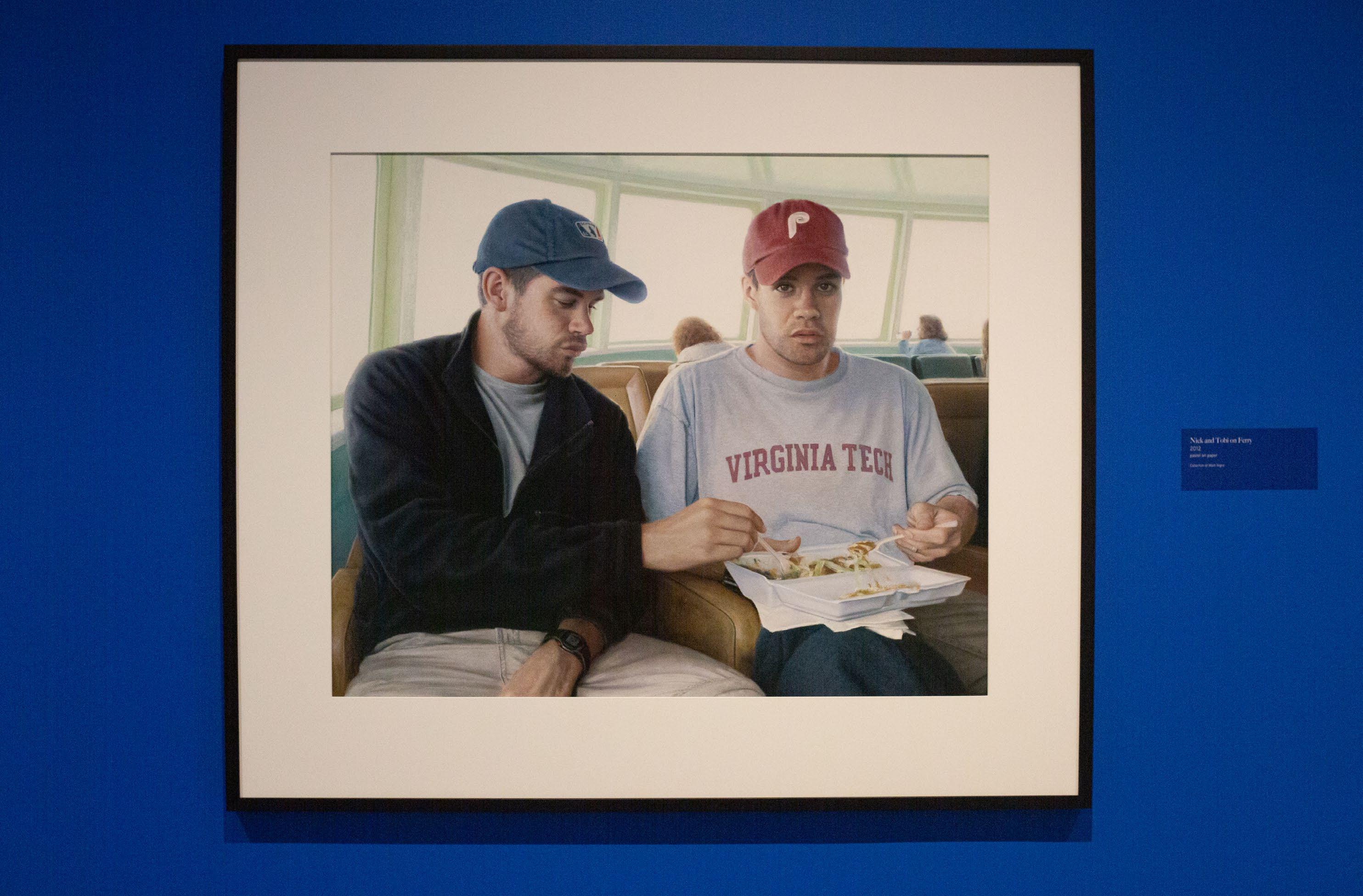
The first, titled Tim Gardner: The Full Story, opened in October and is a massive retrospective of a prolific artist with Winnipeg roots. Tim Gardner was born in Iowa City, Iowa before moving with his family to Canada, where he graduated from Winnipeg’s Fort Richmond Collegiate before pursuing a bachelor of fine arts degree at the U of M. Gardner’s work is largely based in watercolour and depicts friends, strangers and landscapes, highlighting harsh modern aesthetic interruptions to the consuming beauty of North American nature.
The collection spans a number of rooms at the WAG-Qaumajuq and features over 130 paintings and drawings from throughout the artist’s career. These works plainly show Gardner to be a master of his mediums, with the ability to realistically translate his sub -
jects in vivid colour and detail.
The exhibit’s texts reflect this focus on technique, giving space for Gardner to discuss his classical influences and specific technical processes.
What the exhibit seems to lack is a coherent thematic or aesthetic framework.
Despite this being a wide-ranging retrospective on a prolific artist, I found myself confused walking through the loosely organized collection. I was often struck with whiplash in the transitions between kitschy familial works, placid landscapes and recreations of raunchy early digital photographs of his friends.
At its best, the collection displays an unsteady sense of nostalgia and natural connection, a reaction to a constantly changing modern world that still holds space for sublime beauty and humanity.
portraits of friends, which captured masculine scenes of drunken debauchery in all their digitally distorted glory — red eyes and strange colour saturation and all.
There is a certain perverse humour in finding a painting called “Beer Mile” depicting young men in basketball clothes guzzling cans in a parking lot in the esteemed halls of WAG-Qaumajuq.
Later works, like 2022’s “Ribfest” or 2012’s “Fletcher Square” capture more widescreen banalities with emotional assurance, juxtaposing gorgeous natural backdrops with harshly modern idling pickup trucks and strip mall signage, respectively.
tighter collection that similarly uses landscapes and everyday normalcy to communicate an emotional truth, but perhaps one with a more immediate and clear effect.
Organized by the Ottawa Art Gallery, Dark Ice is a collaboration between artists Leslie Reid and Robert Kautuk that collects photographic prints, videos and paintings to capture the effects of climate change on Northern communities.
The layout of the space is immediately stunning and diverse despite the exhibit’s tight focus.
Though disparate on their surfaces, certain thematic resonances connect them
At its worst, it is a collection of well-rendered but empty renderings of ordinary images.
The paintings that struck me most were his early 2000s
These strangely affecting works are muted by their placement among technically impressive but non-descript landscapes, early figure studies and nocturnes that lack the unique aesthetic tension of his other work.
The other, newer exhibit at WAG-Qaumajuq is a much
Prints are laid out in thoughtful order and across a variety of mediums. Some are normal prints, some are printed onto thick sheets of metal and in the second room of the exhibit there are stunning light boxes that bring aquatic photos to life.
On an immediate level, I was struck by the sheer beauty of the images, which capture the landscape of the North in evocative texture and detail.
But beyond these first
impressions, the exhibit’s true mark is in its human and political anchoring, communicated both in the work and in supplemental writing and videos telling the stories of local communities affected by changes in the climate.
One cluster of drone photographs by Kautuk shows a wide perspective on researchers and community members working, small figures made a part of the landscape, one with the ice. Another cluster by Reid contrasts Cold War-era aerial photographs of the region with current day images, rendering the changing landscape in literal and aesthetic contrast.
Dark Ice and Tim Gardner: The Full Story are two formidable and varied shows, which, along with the gallery’s permanent collection and its other current exhibitions of Inuit art and Tarralik Duffy’s work, make the gallery well worth a visit.
Tim Gardner: The Full Story opened Oct. 7 and will run until Apr. 7, 2024. Dark Ice opened Nov. 18 and will run until May 26, 2024.
Second annual Indigenous Winter Market held at U of M
Community members gathered at Migizii Agamik to support Indigenous student artists
Kelsey Chin, staff
T
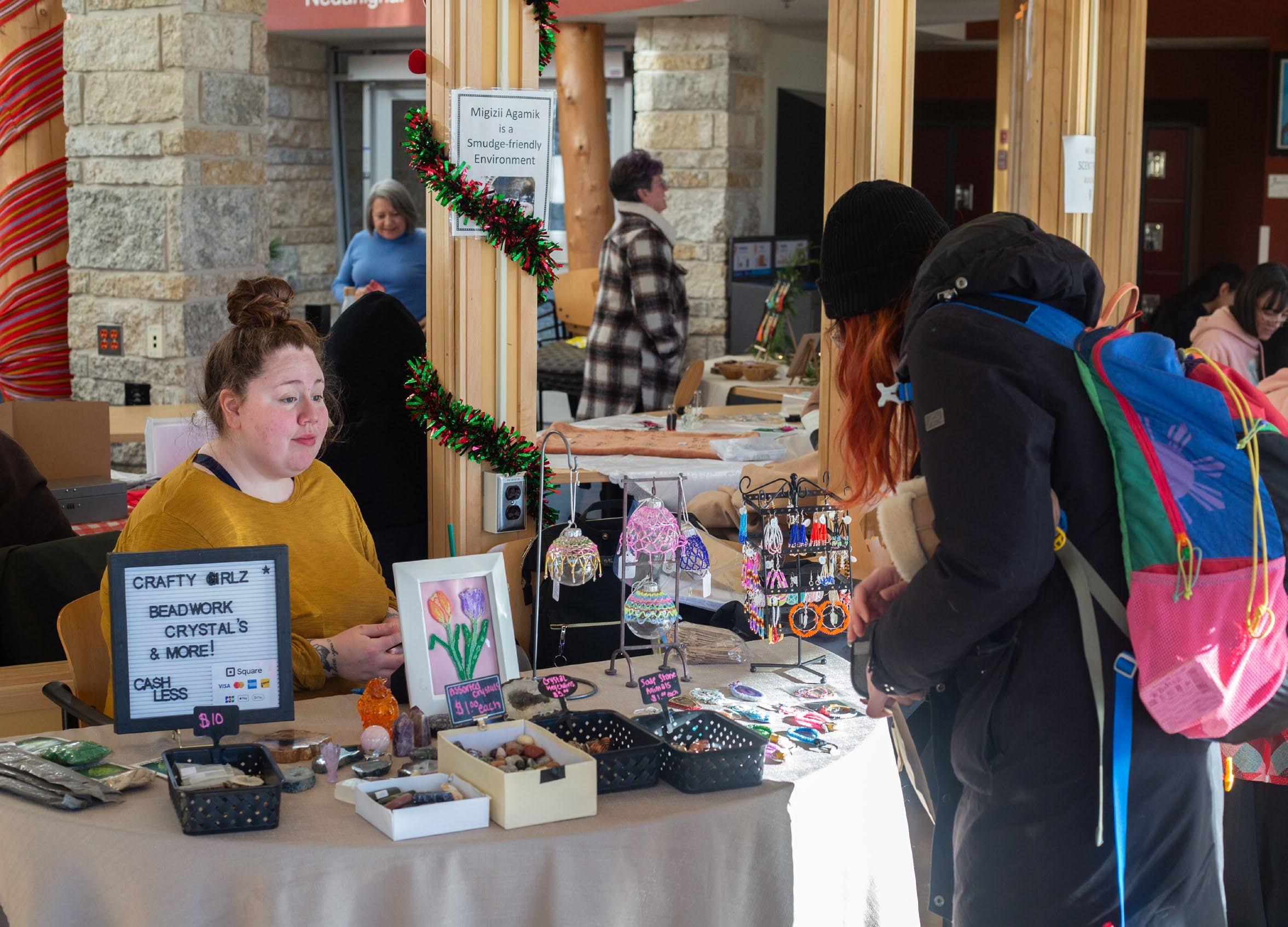
he annual Indigenous Winter Market had its second run last week, Nov. 23 and 24.
The event was created last year by Vanessa Lillie, director of cultural integration with the office of the vice-president (Indigenous) at the U of M. Lillie had received questions from faculty and departments regarding where to find Indigenous artists studying at the U of M, and so she decided to create the Indigenous Winter Market to showcase the artistic talents and gifts of current Indigenous U of M students.
This is the second year that Lillie has hosted the market. She said that last year, she was “completely, wonderfully surprised” by the turnout, and also overwhelmed.
“There were over 160 people who came over the two-day span, and it’s only for three hours each day,” said Lillie.
Last year, the market featured 10 vendors during the two days it was held. This year, the market hosted 20 vendors over the two days.
The event was held at Migizii Agamik, where the Indigenous Student Centre (ISC) is located. Lillie said she chose Migizii Agamik as the location for the market to encourage people to see the space and get familiar with the supports the ISC provides for Indigenous students.
Lillie said there are many events put on by the centre that welcome all people to come and learn, whether they
are Indigenous or not.
“We welcome the entire community to the Indigenous Student Centre for their programming,” she said.
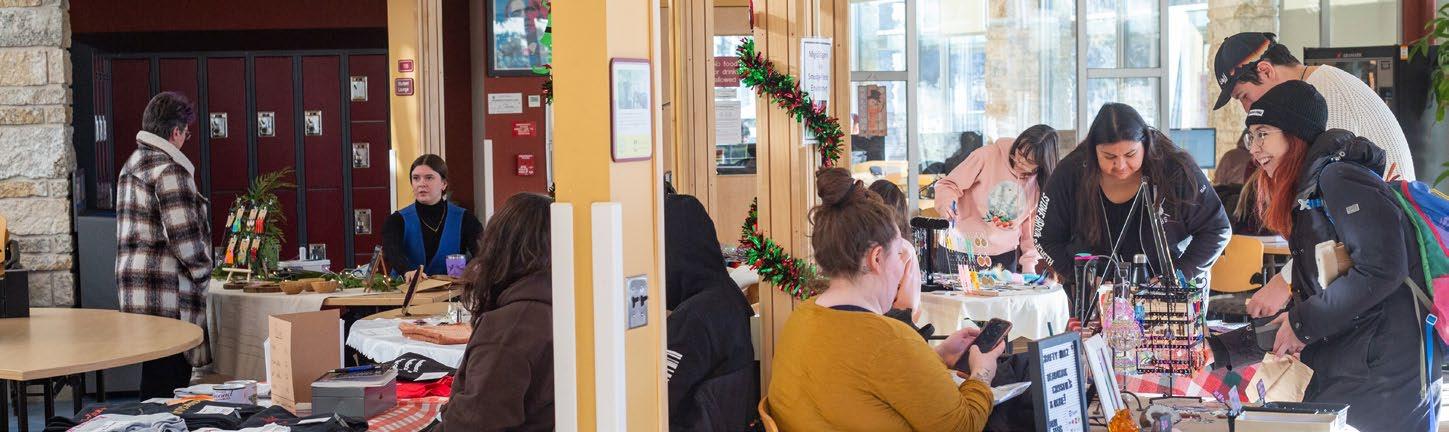
Last Thursday, the day I attended the winter market event, a warm, inviting atmosphere filled Migizii Agamik and the foyer buzzed with conversation.
Many students were selling jewelry and artwork, includ-
ing handmade beaded earrings, patches and buttons, t-shirts and holiday cards. Items like phone grips with beadwork decoration, mukluks and moccasins were also on offer. Prices were determined by the student vendors selling the items, and ranged anywhere from $1 to $350.
Attendees were standing and talking with one another or sitting in the many comfort-
able armchairs in the space, catching up. UMFM, the U of M’s campus radio station, was on site playing tunes throughout the event, and cookies, chocolates, candy canes and hot cocoa were being served in the kitchen.
Lillie said she was excited community members could come experience the Migizii Agamik building, socialize and support the vendors at the
market.
“I suspect that we’ve already outgrown our space,” she said. “Next year we may be moving to a larger space, because we’ve had such a great response from vendors.”
For details on upcoming events held by the ISC, check out their program calendar on the U of M website.
photo / Ebunoluwa Akinbo / staff
Reincarnating the religion department
Coffee events, lounge renovation first steps in reviving interest in religion studies
Jacob Davis, staff
The University of Manitoba is renovating its lounge and planning coffee and donut get-togethers for students as part of a larger plan of rejuvenating the community in the department.
Nicole Goulet, an instructor in the religion department who came to the U of M in 2021, is one of the faculty members leading the charge to make the lounge “a nice space for our majors and minors, basically, so they can create a community there.”
“It’s hard to build a community amongst our students when they’re scattered, doing different courses, maybe not talking to each other in class,” she said.
Head of the religion department and associate professor Kenneth MacKendrick said the religion department lounge, which has been previously considered a space primarily for graduate students, has the potential to be a place where all religion students can connect.
Coming out of the lockdown period during the COVID-19 pandemic, the faculty has been looking for ways to support and improve community spirit within the program and reach out to undergraduate students.
Part of those changes will include making sure undergraduate students have a space to get to know each
other outside of classroom settings, MacKendrick said.
“We had tried a couple of events, but we were never really able to get a lot of things off the ground,” he said. “I think one of the shifts that COVID brought about was we became increasingly aware of the difficulties and challenges of undergraduate student life.
“As a research university, I think we have a long history of supporting graduate students and graduate student life,” MacKendrick said. However, he emphasized that role undergraduate students play on campus is “actually, for us, a hugely significant part.”
The first step into further helping religion students connect with the department has been the two Religion and Coffee drop-in events that have taken place this year. Students were invited to the religion student lounge to get to know each other and their professors, who have also been eager to connect with students.
For instance, Goulet expressed not really “knowing students” and said this was part of the reason she pushed for the events and lounge renovation.
Regarding plans for the new lounge, she said she will be “totally satisfied on the day where, every day, there’s a group of students going in.”
MacKendrick said the department has put together a “swag committee” to cre-
ate merchandise similar to larger departments. Coffee mugs, stickers and bookmarks are some of the hypothetical goodies in the making.
“Hopefully, one day, we’ll have hoodies,” Goulet said.
Goulet is also behind the department’s first-ever newsletter, which began this year and will aim to release its second issue in January. A religious studies colloquium is also scheduled for January.
The department is dealing with changing post-secondary culture toward the humanities, MacKendrick said.
“I think we’re in a process of rejuvenation,” he said.
“I think humanities are facing some real challenges in terms of students and getting students together, and getting students excited about the humanities, because I do think there’s sort of a depressive atmosphere,” MacKendrick said.
“People like the humanities and take a lot of our classes, but they don’t necessarily feel like they can commit to our program in order to get a job.”
He explained that the difficulty of having people who are
interested but not committing is something the department has noticed and is trying to change.
MacKendrick said getting people in a room and talking is what needs to happen first.
He said that, even though interests across the department vary widely, from rituals to ancient texts, “we’re all still bound by this nebulous thing that we call religion.”
“In one way or another we’re all affected by it.”
Nature and art combine at Plant and Paint Night
First joint event by SOFASA and UMSU debuts during Sustainability Week
Kelsey Chin, staff
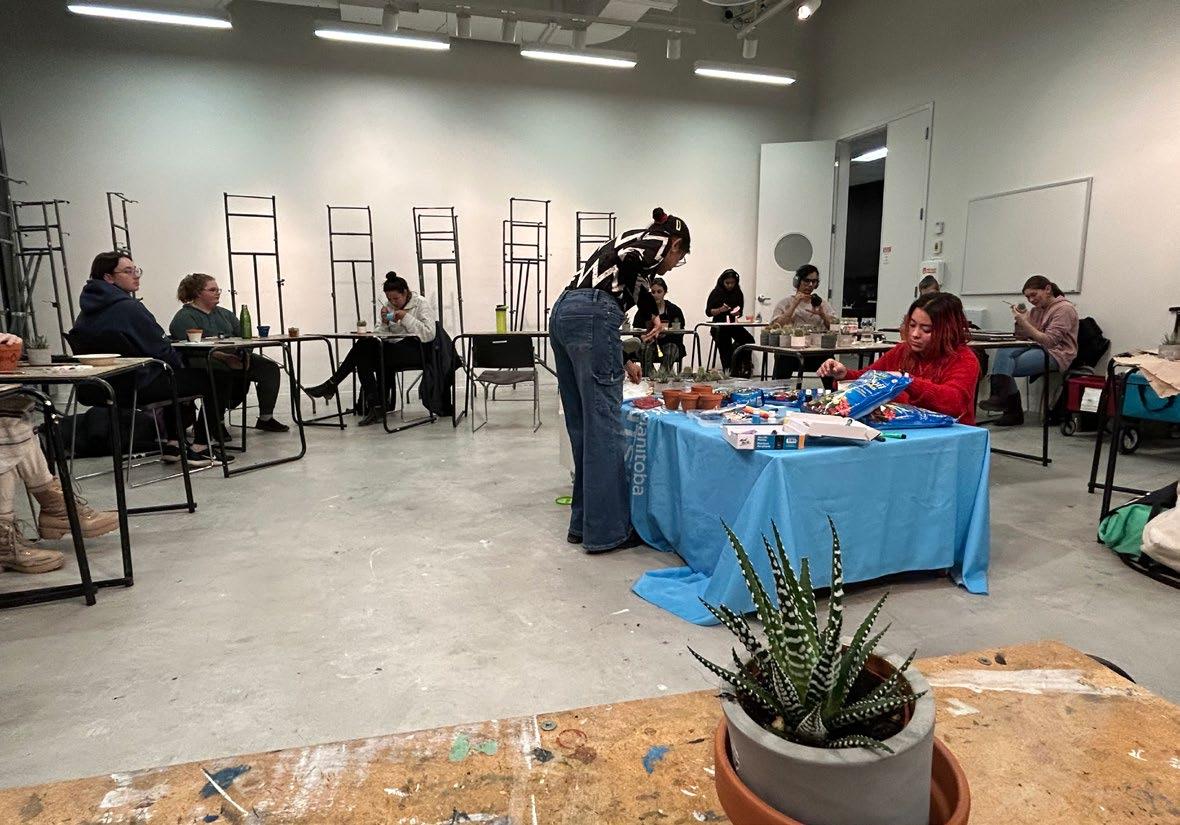
UMSU and the School of Fine Arts Student Association (SOFASA) hosted their Plant and Paint Night event on Nov. 22. The event marked the first joint initiative between SOFASA and UMSU. The student association and the union teamed up for the paint night to promote UMSU’s Sustainability Week, which took place from Nov. 20 to 24. Attendees were provided with materials to paint plant pots and plant a succulent in their finished pieces.
Co-president of SOFASA Charli Feener said the Plant and Paint Night was a chance to take an “environmentally focused” approach to art.
Students had the opportunity to paint and design whatever they wanted on their pots. Feener said this open struc-
ture was intended to make the event “a little more meditative” than a guided painting experience, allowing painters to “embrace the creativity and the chaos that comes with it.”
“It’s what we do a lot in our faculty,” she said.
The night was a comfortable mix between concentrated students who put on headphones while doing their work and groups of friends who came together to unwind and de-stress. Many painters’ works incorporated patterns, images from nature, abstract designs or solid colours.
Feener said partnering with UMSU helps enable SOFASA to host larger events like the paint night.
“We’re a very small faculty and very small council, so sometimes hosting events that we want to host, even for our own faculty, gets a little diffi-
cult because we don’t have the resources or the reach to host events like this,” she said.
This year, SOFASA is trying to give back by combining art events with different initiatives such as the Plant and Paint Night for Sustainability Week, Feener said.
Feener said students may not be aware of the resources SOFASA is able to provide.
“We do a lot more than just paint,” she said, highlighting the group’s ability to collaborate for events or help create things like stickers.
“We’re here to help the students, whether it’s our own faculty students or the broader campus.”
Feener and SOFASA co-president Rebecca Smith said they wanted to use the Plant and Paint Night as a trial to see what is possible when planning similar events.
Feener said some ideas for future events include painting canvases and mugs or designing stickers.
“We’re just excited to have people out in our building painting, expressing themselves, doing something cre-
ative, doing something sustainable,” Feener said, adding that students should keep an eye out for more events from SOFASA and from UMSU in the future.
photo / provided
graphic / Teegan Gillich / staff
Bisons host thunderous series against the Pronghorns
Men’s basketball sweeps Lethbridge, while women’s team drops close contests
Grace Anne Paizen, staff
T
he women’s and men’s basketball teams hosted the University of Lethbridge Pronghorns last Friday and Saturday night in thrilling contests that amounted to a thunderous weekend of hoops.
The beginning of the women’s Friday match set the tone for both games over the weekend. The contest started tight, with plenty of lead-changing in the first quarter alone before the Pronghorns began to pull away in the second quarter, taking a 39-32 lead into the second half.
Lethbridge dominated the third quarter, pulling ahead of Manitoba by 13 before the Bisons staged a late comeback in the fourth. The herd tied the game with just over two minutes remaining, queueing up the thrilling finish. Lethbridge went up by a basket before the Bisons managed to pull ahead by one with 20 seconds left in the game. However, the Pronghorns stole the lead back with four made free throws, winning the game 71-68.
Lauren Bartlett posted her first double-double of the
season with 11 points and 10 assists, and led the team in steals with seven. Emerson Martin and Emily Mandamin led the team in points with 12 each. Emily Johnson had 10 points on the night and led the team in rebounds alongside Autumn Agar, with seven apiece.
Saturday’s contest was just as close. Lethbridge burst out of the gates, ending the first quarter with a 12-point lead, but Manitoba stormed back in the second and took a 42-36 lead into halftime.
The Pronghorns chipped away at the herd’s lead in the third, but the Bisons held a five-point lead heading into the fourth. With six minutes left in the game, Lethbridge leapt ahead, but the Bisons fought back to take a one-basket lead. However, the Pronghorns outscored the herd 7-2 in the final minute of play, winning the game 77-72.
Martin posted a careerhigh night with a team-leading 23 points, while Agar and Johnson both recorded double-doubles — Agar with 12 points and 11 rebounds and Johnson with 11 points and 14 rebounds.
The men’s games were just as thrilling over the weekend. In Friday night’s contest, the two teams were neck and neck in the first, with Lethbridge taking a slim 22-19 lead into the second quarter. However, the Bisons were able to turn things around before halftime, taking a 41-34 lead into the locker room. In the third quarter, the Bisons caught fire, leading by as many as 16 points. The herd continued to dominate the rest of the game, winning 83-69.
Mason Kraus and Simon Hildebrandt led the team in points with 14 apiece, followed closely by Tito Obasoto, Wyatt Tait and Daren Watts, who recorded 12, 11 and 10 points, respectively. Kraus led the team in steals with four and Hildebrandt led the team in rebounds with nine.
Saturday’s match followed the same pattern, starting off with a close first quarter that ended with a two-point Pronghorn lead. The Bisons turned the tables in the second, leading 56-41 at the half.
Lethbridge began to close the gap in the third before cutting Manitoba’s lead down to 11 in the fourth quarter, but
The Bisons’ last series before winter break will see both teams hosted by the Trinity Western University Spartans Dec. 1 and 2 in Langley, B.C. the Bisons would ultimately maintain the lead and win 99-86. Five Bisons posted double-digit points on the night, Hildebrandt leading the team with 27 followed closely by Watts’s career-high 24. Kraus recorded 13, Jonam Kazadi made 11 and Brandt Lenz