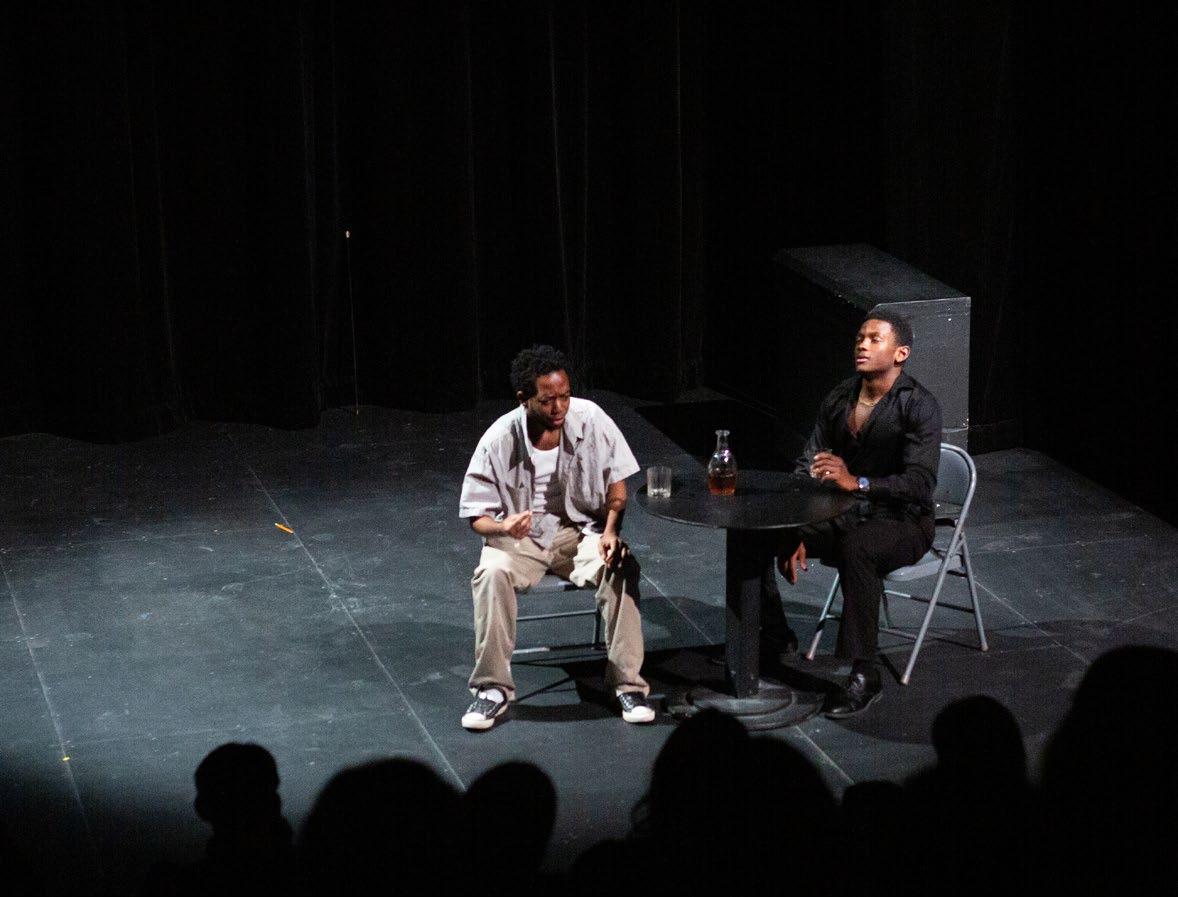
the John J. Conklin Theatre rose to their feet in a standing ovation on Wednesday, Nov. 1 for the final show of Renee’s theatrical run, presented by the Black Hole Student Theatre Community.
The play is the first for writer and director Ryan Osodo, a third-year theatre and philosophy student at the U of M.
The story follows a trio of childhood friends — the passionate and frustrated title character Renee, played by Ivy Akhidenor, Renee’s boyfriend, the ambitious, straitlaced actor Manny, played by Tomisin Akintokun and his brash bad boy buddy Kane, played by Emmanuel Oderemi — as their relationships come to a head, finally being pulled apart.
The play came together for Osodo in a moment of inspiration while watching a Black Hole Theatre production of Scorched this past March. Having already seen the play multiple times, Osodo’s mind started to wander.
“The play just started forming itself,” Osodo said. “I just wrote it in my head, like a rough draft at the moment.”
Tired of the melodrama and stuffiness of the classic theatre pieces he had studied in school, Osodo found the play Topdog/Underdog by
Suzan-Lori Parks to be inspiring.
“It wasn’t trying to be ‘theatre,’” Osodo said. “It was just someone who wrote the work, a story that felt compelling and it was urban, and it was about the struggle in the inner city.”
Renee takes after Topdog/ Underdog in depicting urban struggle, largely taking place in a time of financial insecurity for Manny and Renee, as Renee works as a waitress while Manny is trying to find work as an actor. Manny also owes money to childhood friend Kane, now a swaggering hustler who does not take well to debtors, threatening Manny’s life throughout.
Osodo pointed to a Seinfeld-ian drive to normality in the writing, saying, “regular life has a lot of stuff that happens and it’s very interesting.”
The play’s dialogue, written in very loose, modern language certainly reflects this, coming across as quite natural. Oderemi’s portrayal of Kane especially exuded ease and confidence, even as the character’s underlying insecurities and violent temper came to the surface.
This is not to say that the play is especially understated though. The tensions and stakes of Renee rose very quickly, with multiple attempts on the characters’
lives and extreme bumps in Manny and Renee’s relationship.
This combination of heightened, violent dramatic reality with modern, casual dialogue, as well as the play’s sub-hour runtime being similar in length to an episode of a TV drama, made for an exhilarating and accessible experience.
Akhidenor’s performance in the title role of Renee certainly justified her central place in the play, as she chewed up the scenery in her many screaming fights with Manny and displayed a certain looseness and excitability that made the character the emotional heart of the story.
Akintokun as Manny also did well, but in a more reserved way, embodying his character’s tightly wound, stressed-out state with just the right level of uncomfortableness.
As far as the future goes, Osodo is considering stageing the play again for the Winnipeg Fringe Theatre Festival and looking at a possible slot at Winnipeg’s Gargoyle Theatre, which specializes in locally written material. But what he is really looking forward to is writing his next play.
“In the process of writing and directing and working with more people, I’ve learned a lot and I know that there’s more to be done.”
EDITOR-IN-CHIEF Gillian Brown editor@themanitoban.com
BUSINESS MANAGER Dhruv Patel accounts@themanitoban.com
ADVERTISING CO-ORDINATOR Diego Castro ads@themanitoban.com
EDITORIAL
MANAGING EDITOR Ezra Taves me@themanitoban.com
COPY EDITOR Simon Pensato copy@themanitoban.com
COPY ASSOCIATE Paula Samaniego-Ayllon
NEWS EDITOR Sarah Cohen news@themanitoban.com
NEWS EDITOR Colton McKillop news@themanitoban.com
RESEARCH & TECHNOLOGY EDITOR Elah Ajene research@themanitoban.com
VIDEO EDITOR Kennedy Legault video@themanitoban.com
SOCIAL MEDIA EDITOR Violet Baker social@themanitoban.com
REPORTERS
NEWS Alicia Rose
NEWS Kyra Campbell
NEWS vacant
RESEARCH & TECHNOLOGY Rhea Bhalla
COMMENT Braden Bristow
COMMENT Hanako Teranishi
ARTS & CULTURE Kelsey Chin
ARTS & CULTURE Alex Braun
SPORTS Joshua Brandt
SPORTS Quinn Mayhew
VOLUNTEERS
VOLUNTEER STAFF
Bahareh Rashidi, Christina Tran
VOLUNTEER interested in volunteering?
email me@themanitoban.com today!
THEMANITOBAN.COM
109 HELEN GLASS BUILDING
UNIVERSITY OF MANITOBA WINNIPEG, MB 204. 474. 6535
The Manitoban is the official student newspaper of the University of Manitoba. It is published monthly during the summer and each week of regular classes during the academic year by the Manitoban Newspaper Publications Corporation.
The Manitoban is an independent and democratic student organization, open to participation from all students. It exists to serve its readers as students and citizens.
The Manitoban is a member of the Canadian University Press, and our journalistic standards can be found on the Manitoban’s website.
The newspaper’s primary mandate is to report fairly and objectively on issues and events of importance and interest to the students of the University of Manitoba, to provide an open forum for the free expression and exchange of opinions and ideas and to stimulate meaningful debate on issues that affect or would otherwise be of interest to the student body and/ or society in general. The Manitoban serves as a training ground for students interested in any aspect of journalism.
Students and other interested parties are invited to contribute to any section of the newspaper. Please contact the appropriate editor for submission guidelines.
The Manitoban reserves the right to edit all submissions and will not publish any material deemed by its Editorial Board to be discriminatory, racist, sexist, homophobic or transphobic, ableist or libellous.
Opinions expressed in letters and articles are solely those of the authors. Editorials in the Manitoban are signed and represent the opinions of the writer(s), not necessarily those of the Manitoban staff, Editorial Board or the publisher.
A “volunteer staff” member is defined as a person who has had three volunteer articles, photographs or pieces of art of reasonable length and/ or substance published in the current publishing year of the Manitoban.
Any individual who qualifies as a volunteer staff member must be voted in by a majority vote at a Manitoban editorial board meeting. Elected representatives and non-students may be excluded from holding votes as volunteer staff members in accordance with the Manitoban Constitution.
U of M partnership with UCN reaches 25-year milestone
Collaboration allows UCN to use U of M curriculum to train nurses for the north
Colton McKillop, staff
This fall, the Rady faculty of health sciences’ college of nursing is celebrating the 25th anniversary of its partnership with the University College of the North (UCN) in northern Manitoba.
Since 1998, the two schools have worked together to provide U of M bachelor of nursing degrees to students in Thompson and The Pas, where both UCN campuses are located. The same curriculum is used at both universities.
Around the time the partnership started, the province began shutting diploma nursing programs as it consolidated nursing education, requiring a bachelor’s degree for nurses to begin practice.
UCN was founded in 2004, as it took over the role of Keewatin Community College and began to offer academic courses as well as skills and vocational training.
Although UCN has been able to confer its own degrees since then, dean of health at UCN Helga Bryant said the partnership with U of M continues because it benefits both institutions.
She said the UCN program gains additional credibility from its partnership with the “very long-standing, well-established college of nursing at U of M” and the academic approach they offer.
Bryant said that while the school’s mission is to “educate Northerners for the North,” it also often accepts students from Winnipeg.
“U of M typically has a waitlist,” she said, “we don’t always have a waitlist for our seats in the North.”
She said the U of M also values “having this program located at two campuses some 800 kilometres outside of Winnipeg.”
Applicants from U of M are given the choice to wait for a seat in the U of M program or relocate to the North. The UCN program accepts 20 students each in Thompson and The Pas per year. Over 540 nurses have passed through the program over the years.
As part of its 80-year anniversary on Sept. 24, the U of M college of nursing celebrated 25 years of the UCN partnership. The program also works with northern health-care agencies to provide clinical placements for graduates.
Dean of the college of nursing Netha Dyck explained that “clinical practice is a very important component” of the curriculum, comprising “more than 50 per cent” of the program’s hours.
“From an employer perspective, it’s also a great investment because they’ll be able to hire high-calibre graduates from our program,” Dyck said.
The province is facing a significant shortage of nurses, with northern communities, especially First Nations, being hit particularly hard. Staffing shortages led hospitals and emergency rooms in northern and rural communities to close a number of times in 2021 and 2022.
“In remote communities, it can often be one nurse calling in sick or not being able to get to work for some reason, and that person is the only nurse on, and then there is significant trouble because now you don’t have any nurses for the patients,” Bryant said.
The Northern Health Region scores worse than the rest of the province on a number of health metrics, including higher infant mortality rates, higher rates of death from injury and nearly double the rates of heart attacks and diabetes.
Josh Goldstein, a paramedic in The Pas and thirdyear nursing student in the U of M program at UCN, hopes to work in diabetes management when he finishes his
degree.
In his time as a paramedic, Goldstein has seen how the health-care system in the North struggles with a lack of resources.
He said many in health care have been “drained” since the pandemic, with some nurses quitting altogether.
“The resources have been depleted, specifically since the pandemic and even a little bit before too, in the North,” he said.
Bryant said vacancy rates across Manitoba are so high that the numbers the program is “funded for and can graduate at this point are not adequate to meet that need.”
“But we do what we can with the resources we’re given and with the funding levels we
have from government,” she said.
A 2018-19 UCN graduate satisfaction report found 68 per cent of employed graduates in the faculty of health have jobs in the North. Goldstein said he would likely not remain in the North after his degree is complete, but that his time up north has “only benefited” him.
“I’ve seen a lot of selfgrowth because of working in the North compared to if I were to just stay in the city for the last seven years,” he said.
“It’s something I would recommend for anyone just to give a shot. You learn a lot about yourself. You can see firsthand the impact you have on the community.”
August and September campus crime statistics
Campus security release crime stats
Sarah Cohen, staff
Campus crime statistics gathered by the University of Manitoba security services are now available for the months of August and September. The PDF presentations were published Nov. 1 on the security services page of the U of M website.
Gordon Perrier, director of campus security, said the statistics only include incidents reported to the department. Numbers may change by the end of the year depending on additional information that security services receives. He said when looking at the statistics, it is important to remember that not all crime committed is reported. Some
is not noticed at all. Bike thefts continue to be the highest incidence of crime on campus.
August
There were 30 total incidents reported in August 2023 on the Fort Garry campus and seven on the Bannatyne campus.
There were eight bike thefts or attempted bike thefts, one moped theft, incidents of harassment and motor vehicle and public order violations. There was one incident of hate propaganda and one indecent sexual act reported during the month of August.
Campus security received
and responded to 55 calls about suspicious people or vehicles and six medical emergencies.
September
A total of 36 incidents at the Fort Garry campus and three at the Bannatyne campus were reported in September 2023. There were 12 bike thefts in September. Three vehicles were vandalized and there was one instance of breaking and entering.
In addition, campus security responded to 43 calls of suspicious activity and 12 medical emergencies.
/ Matthew Merkel / staff
photo
Menstrual product audit planned for U of M washrooms
Project aims to assess how many of U of M’s over 1,500 washrooms offer products
Kyra Campbell, staff
A
s menstrual equity projects spread across the country, the University of Manitoba project, Period Poverty and Equity on Campus and Beyond, is undertaking an audit of all U of M washrooms to judge the availability of menstrual products on campus.
Julia Smith, an assistant professor of labour studies and co-investigator on the project said federally-regulated employers are mandated to provide menstrual products to employees at no cost and said she hopes provinces will follow the federal government’s lead. Smith said she hopes the audit can give the university a better idea of how accessible menstrual products are on campus. She pointed out that U of M serves tens of thousands of people.
“We’re basically like a small city,” Smith said of the U of M. “People live here, they work here, they spend a lot of time here, and menstruation is something that a large segment of the population deals with.”
Smith herself has struggled to find washrooms with accessible products on campus. The Fort Garry campus alone has over 1,500 washrooms, and it is unclear how many provide menstrual products.
“For many people it’s something they don’t think about unless they’ve been in that situation,” she said.
The goal of the audit is to determine which washrooms offer menstrual products, dispensers and disposal bins.
Victoria Romero, a student research assistant on the project, said she looks forward to understanding the scope of menstrual equity in all washrooms, not just the ones labelled for women.
“We need to make sure that the spaces that are available to all people are accessible for the needs of all people,” they said. Romero, then-UMSU vice-president advocacy, was central in the establishment of the UMSU Menstrual Products Pilot Program earlier this year, which provided free menstrual products in 10 U of M washrooms.
Romero said she appreci-
ates the work done by the university through the pilot project, but pointed out that having free products in only 10 washrooms still leaves gaps in access to supplies for menstruating people at the university. Romero also said the 10 washrooms involved in the UMSU project do not include any men’s washrooms.
Both Smith and Romero are hopeful that the audit will lead to data that can be presented to university administration, along with recommendations on how to further improve menstrual equity so that everyone on campus can “participate fully” in life on campus.
The project is currently looking for members of the U of M community to help audit the washrooms. Volunteers would be involved in a short training session and spend a minimum of two hours of auditing washrooms. In return, volunteers receive an honorarium and letter of recognition for their participation.
For those considering volunteering on the project,
Romero highlighted that it will be an opportunity to work with “like-minded, passionate individuals” and contribute to a project that positively influences the lives of U of M students. Romero said it has been “such an amazing journey” to see the “wave of
inspiration and catalyst for change that is happening” on the issue of menstrual equity.
“It is a very exciting time, not only at the U of M, but across the country for menstrual equity and menstrual justice,” they said.
New Student Wellness Centre opens on campus
Centre serves students with peer advising for health and wellness
Sarah Cohen, staff
Creating a student wellness Centre on campus was once just a dream for Arlana Vadnais and the other members of the team behind its inception. Now, the dream has become a reality.
Vadnais, now the associate director of wellness and prevention after previously being the campus mental health facilitator, works to promote mental health and wellness to students, as well as to implement the mental health strategy already in place and to help create a new strategy at the university.
Vadnais said that the centre was created with funds from the $100,000 Bell Let’s Talk grant that the project received in April.
After finding out in April that they had been given the grant, it was a “mad dash” to find a space and get things ready for students.
Found at 162 Extended Education, the Student Wellness Centre (SWC) functions as part of the student counselling and wellness unit at
the University of Manitoba. In collaboration with Healthy U — a student-led support service for health issues — students can access trained peer health educators through the SWC that they can talk to about mental, physical and sexual health and substance use, among other health and wellness-related topics.
The peer health educators are not trained in crisis counselling, but are able to provide the resources students may require to access higher urgency supports.
Vadnais explained that mental health care comes in a spectrum. She calls it a “stepcare approach” that tends to the level of support a person requires for their mental health.
That spectrum can range from maintaining mental health wellness, to speaking with a peer or a counsellor, to seeking medication from a doctor or spending time in hospital. The Student Counselling Centre (SCC) is a part of that spectrum, Vadnais said. The SWC aims to provide
lower intensity care for students that do not immediately need urgent mental health services.
“By bringing the wellness piece in, we’re expanding that stepped-care piece,” she said.
Students who may not need private, one-on-one counselling can come to the SWC and have the opportunity to privately and confidentially speak with a trained peer to address minor issues regarding health and wellness.
“A lot of what this space is for is to create community,” Vadnais said, adding that it is a place where “people could come and feel safe, not judged.”
The space has couches and armchairs, colouring sheets, Play-Doh, self-help books and resources for wellness and health, but most of all, it is a space away from “the chaos of everything.” Additionally, the SWC is home to a few HappyLights, a full-spectrum lamp that is designed to help people with seasonal affective disorders.
An even greater dream
would be to create private offices for peer-to-peer meetings and sensory spaces, Vadnais said.
Centre hours vary each day and each term, and peer counselling is accessible based on student volunteer availability. Appointments with peer health edu-
cators can be booked on the Healthy U website and students are welcome to come by the SWC for a drop-in meeting.
More information is available at www.healthyuofm. com.
photo / Ebunoluwa Akinbo / staff
photo / Ebunoluwa Akinbo / staff
Research & Technology
How human health has evolved through time U of M professor gains insights from skeletal remains
elah Ajene, staff
With a focus on skeletal remains, U of M associate professor in anthropology Julia Gamble offers a unique perspective on how early life experiences can shape later life outcomes.
Gamble’s research centers around bioarchaeology, a field that examines human remains within an archaeological context. By studying skeletons and teeth from past populations, she seeks to understand how past health conditions evolved.
Teeth offer valuable insights into early life stress episodes, which can disrupt growth and leave a lasting mark on dental development, Gamble explained.
“[Teeth] grow like trees in a sense that they form incrementally,” she said, adding that there are daily and weekly markers that record disruptions caused by various stress factors.
By examining these disruptions and combining them with other skeletal growth indicators and age at death, Gamble can develop an indicator for overall health and shed light on the connections between early and late life experiences.
For her research, Gamble primarily works in Europe, including Denmark and Austria, where repositories of skeletal remains provide a wealth of data. These repositories house tens of thousands of well-preserved individuals, offering a rich source for her investigations.
remains themselves to gather more information about the individuals’ health and life experiences.
Despite the wealth of information that can be extracted from skeletal remains, Gamble acknowledges that this work is not without its chal-
more nuance there that we’re not catching,” she said.
When examining stress levels and the impact on survivorship or age at death, Gamble found that a contrast between males and females emerges.
“That has the potential to really inform our understanding of that connection between early life and later life”
— Julia Gamble,
U of M associate professor in anthropology
lenges. Preservation issues are common, and even teeth can wear down over time, erasing valuable information.
Additionally, Gamble takes an interdisciplinary approach, collaborating with experts in proteomics (the study of proteins), isotopes and ancient DNA.
She collects high-resolution dental impressions, which she later analyzes under a microscope to identify surface indicators of stress. Additionally, she studies the skeletal
“There are limits to what skeleton can tell us,” she said, adding that information from skeletal remains does not reflect the full state of well-being of these individuals.
Gamble pointed out that identifying sex in archaeological work, including her own, is often oversimplified to a binary of male and female.
“There’s obviously a lot
Females who experience early-life stress, evident through their teeth, either survive longer or are not affected in their survivorship. In contrast, males facing similar stress tend to have shorter lifespans. This sex-based discrepancy also extends to children.
A development in this regard is the use of proteomic techniques for sex estimation from dental enamel, particularly for children. This method has emerged in recent years, offering a less destructive and more cost-effective alternative to DNA-based approaches, which are highly influenced by poor preservation conditions.
One aspect of Gamble’s work involves collecting teeth for pathogen DNA analysis. She has been part of a project looking for evidence of the Black Death’s pathogen, Yersinia pestis, in the teeth of Danes from the 12th to 18th century.
Furthermore, DNA analysis plays a pivotal role in Gamble’s work, particularly in researching the historical Black Death epidemic in Denmark. Collaborating with colleagues and researchers at institutions such as McMaster University, the team has identified immune markers that signify a profound selective event associated with the Black Death.
Gamble explained that these markers still impact populations in terms of specific chronic diseases today, despite the Black Death’s occurrence dating back to the 14th century. This enduring influence on modern health adds another layer to the study of ancient populations and their health outcomes.
Ultimately, Gamble’s research offers a unique perspective on the connection
between early life experiences and later life health outcomes. It has the potential to inform the developmental origins of health and disease, a critical concept in modern health research.
While studying modern populations can be challenging due to the long timescales involved, Gamble’s research allows for a cross-sectional approach, studying different phases of an individual’s life through well-preserved skeletal remains.
“We can do it by looking at single people and elements of their skeleton that capture different phases of their lives,” she said.
This method essentially crafts a longitudinal study with a large sample size.
“That has the potential to really inform our understanding of that connection between early life and later life,” Gamble said.
“There’s more work that’s starting to be done that might open further doors there.”
graphic / Dallin
Chicoine / staff
The modern lawn is dead
It’s time to bring your front lawn into the 21st century
Teegan Gillich, staff
The overwhelming popularity of the short grass lawn is one of the single most devastating trends in residential landscaping. Not only is it boring and unimaginative, it is an ecological nightmare based on classist ideologies.
Prior to grass lawns, the most typical uses for yards in North America were gardens and agriculture. The suburban front lawn gained popularity in the 18th century when French and English nobility romanticized the idea of an open velvety green landscape.
Well before the invention of the lawnmower, the nobility had servants cut their grass by hand or had their livestock graze the land. This process was extremely tedious, and only the extremely wealthy could afford to accomplish it. This expensive undertaking led to the short grass lawn becoming a status symbol.
In 1806, Thomas Jefferson implemented a short grass lawn on his own property, and thus, the lawn took hold in wealthy American land-
scapes. In the late 19th century, lawn care grew in popularity, and the introduction of the first American golf course in New York cemented the idealization of short grass in people’s minds.
By the 1940s, lawnmowers were made affordable to the middle class, with a well-manicured lawn as the foreground for any well-to-do American home.
Now, beyond its history, how could a simple lawn possibly be so terrible? It’s just grass after all, and green is good, right?
consistent watering, fertilization, re-seeding and weeding. Using pesticides, herbicides and fertilizers will pollute the water system and run off into the surrounding environment.
Funnily enough, one of the most ideal habitats for dandelions is the short grass lawn because there is nothing to compete with its growth. If you are tired of fighting off weeds, it might be time to let
the backyard, leaving what remains of the front to be an empty lawn, not to be walked on or touched.
If the front lawn is not going to be stepped on anyway, what is the point of keeping the grass short?
There are alternatives that are better for the environment and require less maintenance overall
Sure, it is better than concrete, but the main issue with a short grass lawn from an ecological standpoint is that it doesn’t provide any services for the environment. It provides no shelter for animals, the pesticides we use to maintain it poison animals’ food supply and it creates a lack of species diversity.
Turf grass also requires a high level of maintenance, including regular mowing,
your lawn do the fighting for you. In addition to environmental shortcomings, the front lawn itself serves little functional purpose beyond aesthetics. Where once the front yard promoted connection and community within a neighbourhood, newer suburbs are now coldly planned with wider front driveways and fewer sidewalks. Outdoor leisure is reserved for
All this isn’t to say that short grass shouldn’t exist at all, but there are alternatives that are better for the environment and require less maintenance overall. A combination of native species placed tastefully into the suburban landscape can enrich species diversity and create a beautiful plant palette that is interesting all year round.
In a city defined by the rapid expansion of suburbs, Winnipeg homeowners have an opportunity to rejuvenate their yards and create a healthier landscape. Native species require little additional watering and maintenance because they are already adapted to Winnipeg’s climate. Wildflowers and mixed grasses will
choke out weeds and will also feed native pollinators.
Incorporating larger plants such as shrubs or trees can also help to protect your health and your home by cooling and purifying the air. Winnipeg is facing a severe tree loss of nearly 60 per cent of the urban canopy with the removal of elm and ash trees due to invasive insect species. While the city lacks urgency to rectify this issue, homeowners can take the initiative and rejuvenate their streets.
For many, the lawn may fade into the background and scarcely be given a second thought. When we consider how much land, water, money and labour we dedicate to short grass, it is important to ask ourselves why. The status quo is easy to take for granted, but it doesn’t mean it is the only solution. Diverse lawns are an easy way to help the environment and to bring beauty to an otherwise plain landscape.
graphic
/ Teegan Gillich / staff
Comment
The trap of inclusivity
Being inclusive is nice, but falls short of correcting injustices
Jessie Krahn, staff
Society is awful — homophobic, transphobic, racist, ableist, misogynistic, imperialistic and classist too. With this horrible cloud clogging up our social stratosphere, institutions jostling to appear inclusive start to seem more threatening than promising.
The government of Canada trumpets its own efforts to promote inclusion “at home and abroad” on its website, flagging inclusivity as something that makes societies more — this is the exact word it uses — “innovative.” The University of Manitoba’s centre for the advancement of teaching and learning brands inclusivity as more than just “an invitation to join a group,” also instilling in people a sense of “mattering and belonging.”
Inclusion is an important stepping stone toward a more virtuous, just, righteous, antiracist, anti-sexist etc. world, but it’s not a productive political goal.
Any critique of inclusivity is going to initially ring alarm bells for people who are leery of right-wing hand-wringing about political correctness gone mad. Rest assured that I am no right-winger. I am an anarchist, which means my Marxist friends talk about me behind my back and I squabble with people on Reddit about sectarian philosophical issues.
Look again at the language that the government of Canada and the U of M use to describe inclusivity. You might notice how capitalistic Canada’s language is — inclusivity makes societies innovative, as if innovation is inherently good. The U of M focuses on interpersonal things like feeling as if you matter. I sometimes feel like I matter amongst men, but that doesn’t mean the space is generally inclusive to women.
These websites make no mention of how inclusivity rights wrongs or straightens out a skewed picture. No, inclusivity makes societies more innovative, it makes members feel like they matter, like this is a start-up for an accursed specialized dating app that needs to reinvent a broken wheel.
to think about what inclusivity actually looks like when we try to execute it, otherwise it amounts to including oppressed people in a racist, homophobic, sexist space and calling it a day.
Making spaces inclusive, and all the labour that involves, falls far too often to the very people who need
Inclusivity presumes people’s exclusion begins with each individual person’s exclusion and is solved with those people’s inclusion
In my view, inclusivity is supposed to rectify injustices. For example, inclusivity ought to extend opportunities to racialized people where racism has deprived or continues to deprive them of those opportunities. So how is any injustice being rectified if racialized people are asked to take on extra work in addition to their regular workloads for the sake of making a racist institution less racist?
warped to suit institutions and allow them to take on the sheen of proactive entities oriented toward justice, and this has prompted some scholars to ask whether or not there aren’t some problems with the foundational principles inclusivity is built upon.
There are problems with inclusivity as a political horizon, but because it is so ill-defined and palatable it is easily absorbed into the tissues of oppressive systems. We have
to be included. Scholar Sara Ahmed writes in her book On Being Included that when she first spoke up about her colleagues’ laissez-faire attitude toward addressing racism, she was invited to take on equity, diversity and inclusion work. Therein lies another problem: students, staff and faculty in universities are asked to do the work to make exclusive spaces inclusive and perform the day-to-day tasks they’re paid for.
Does inclusivity at its core even do what we want it to do? I think the reason inclusivity is adopted by government bodies and universities alike is that it is premised on one assumption: the systems and societies we live with right now are basically fine. There’s no need to smash it all to bits and rebuild from the ground up. All we need to do is sprinkle in some mentally ill bisexual women and we’ll be golden.
Inclusivity is so easily
Carleton University professor of sociology and anthropology Kelly Fritsch writes about the problem with inclusivity in disability rights in Keywords for Radicals. Inclusion in a space where disabled people were previously excluded sounds great, she says, but focusing only on inclusion individualizes systemic problems.
Inclusivity presumes that people’s exclusion begins with each individual person’s exclusion and is solved with those people’s inclusion. Inclusion does not in and of itself restructure a world that is designed to be ableist, one that considers disabled bodies faulty and able bodies as the default.
As a political goal, inclusivity falls short of action that
leads to substantial change, but this is not to say that its limitations justify exclusiveness. It’s very, very easy to implement inclusion measures because they don’t require disrupting a system, and being inclusive is the bare minimum any of us can and should do.
It seems to me that people who are politically pubescent suffer from an undercooked imagination at times, however well-intentioned they are. So many are stuck anxiously tabulating all the different individual people who might be excluded from their merch company’s product offerings or from their hyperniche essay about anime sex scenes that they never pause to consider the big questions. I doubt a just world looks as simple as a woman in a managerial position at Cineplex. If we stretch our imaginations, we might be able to envision a world where unjust hierarchies and systems themselves are shattered to make room for something new.
Movie Night – “The Grizzlies” November 3, 4pm
Spray Paint Night November 10 at Migizii Agamik
Ribbon Skirt/Shirt Workshop November 13, 9am-6pm at Migizii Agamik
Indigenous Leaders Gala November 28
Losing my Mé tis status to navigate Canada’s health insurance
The nature of social and legal aspects of Indigenous identity in Canada
braden bristow, staff
I have been a citizen of the Manitoba Métis Federation (MMF) since I was 13 years old. Recently, however, I have made the choice to apply for Indian status, and since the Métis are a distinct Indigenous group, I can only legally be Métis or have status.
One reason for such a major life change concerning my Indigenous identity is, of course, insurance. Since graduating and aging out of my parents’ insurance coverage, I am woefully uninsured, and therefore susceptible to the perils of lacking dental and vision care.
In fact, the very event that influenced my choice to apply was cancelling a dental cleaning that would have cost me at least $300 without insurance.
But there is hope. Through the Non-Insured Health Benefits (NIHB) program, individuals that are registered under the Indian Act can have their dental care, vision care and prescriptions covered. Unfortunately, Métis people are not covered under the NIHB.
register for Indian status, you must submit an application to Indigenous Services Canada. After submitting an application, there is then a wait from anywhere between six months to two years before you hear back from Indigenous Services if you are accepted at all.
The reality of my identity does not lie in the opinions of my peers or even in the recognition of the Government of Canada. My identity is more accurately rooted in my ancestry and community. By ancestry I mean who my ancestors were, where they came from and the communities they belonged to. In terms of community, I refer to my immediate family, extended family and wider cultural group.
So, if I am accepted, I will have a distinct legal identity, however, my Indigenous identity is unaffected. This goes for any other Indigenous person whose personal or community identity is misaligned with their social or legal recognition.
The harms of the University of Manitoba’s land acknowledgement
Performative words without action cut deep
Hanako Teranishi, staff
The University of Manitoba’s land acknowledgement appears more akin to settler faux-innocence than reconciliation.
colonial beliefs and violence. They enable settler ignorance which in turn allows them to distance themselves from colonial violence.
While this is a good insurance program for those who have pre-existing status, it also means that I am forced to give up citizenship to the Métis community that much of my immediate and extended family belong to if I want to keep my teeth.
This is one instance of my identity being put under scrutiny for the umpteenth time in my short life. When I was in high school, my peers would guess my identity, questioning if I were “not white.” Even more insulting were moments when I would tell someone I am Métis and they would correct me and inform me I am actually white or just insist I am First Nations.
In fact, a list of the ethnicities people have guessed or insisted I am include: Mexican, Jewish, “not white,” “something mixed,” “native” and Greek. While I would be honoured to be any of these ethnic categories, I am, in my heart, a Métis man with various traces of First Nations.
To be Indigenous is to have your social and legal identity under constant social or legal scrutiny. To even
In an ideal society there wouldn’t be any need for this type of discourse, as non-status people would be covered under NIHB. In an even more ideal society, we would simply have universal coverage. Unfortunately, the Canadian government has the final say on whether or not nonstatus people get coverage and who is and is not status.
When my shiny new status card comes in the mail, it won’t change the fact that I am Métis, not unlike the way my peers questioning if I was fully white or some other variant of mixed-ness did not change who I was.
Marginalized peoples such as Indigenous people should not be forced to rely on government arbitrators or white approval. Identity isn’t, and never has been, formed in the courts or in the hearts of those who have never lived what you have lived through. However, for better or worse, the Indian Act, and along with it, the definition and registration of Indian status, is here to stay.
I want to emphasize the critical importance of land acknowledgements. They are necessary statements to show respect, acknowledge that the lands we reside on do not belong to a settler nation, express gratitude to the original occupants of the land and demonstrate a commitment to taking actionable steps toward reconciliation. They absolutely are not meant to be passive comments that excuse institutions and individuals from being complicit in a settler-colonial system.
The university’s land acknowledgement lands closer to the latter.
The land acknowledgement states that “we acknowledge the harms and mistakes of the past.” This portion is particularly problematic because of the words’ connotations.
The first issue lies in the word “mistakes.” This word ignores the intentions of settler colonialism, which are to purposefully create settlements through the displacement, dispossession and genocide of Indigenous Peoples. The word creates a space where settler ignorance can flourish by softening the reality of settler colonization and the violence that follows.
Calling this process a “mistake” ignores the nation’s intentional colonial project by removing agency, instead framing it as a misfortune that cannot be fully condemned. In turn, the university, as a colonial structure, can also avoid addressing its complicity in settler colonialism.
The second issue within that portion lies in that it places everything in the past. By framing the acknowledgment’s events as things of the past, it completely erases the reality that settler-colonialism is not an event with a clear ending, but rather, an ongoing system of oppression. The statement implies an obliviousness to how the violence of colonization is also carried to the present, disregarding the lived experiences and realities of Indigenous people living in Treaty One territory.
Another portion I find concerning is the end, which advertises the university’s intention to “move forward” with Indigenous communities in the “spirit of reconciliation and collaboration.” While this statement appears to have a progressive momentum in mind, it is incredibly stagnant.
The promise of moving forward is empty, because it makes no indication of where it intends to move. The overall statement lacks action. It has an empty promise of taking steps forward but does not actually outline any specific goals or the specific actions the university will perform to reach such goals. The dedication and promise appear incredibly performative.
The motion toward reconciliation is backhanded. Any steps toward reconciliation are inherently disregarded because of the words and meaning within the acknowledgement. The specific framing of colonial violence as a past experience rather than an ongoing lived reality reinforces colonial beliefs surrounding violence. While the words may be lovely, they are gutted of all meaning and actionable intention.
The acknowledgment is ultimately disingenuous.
Both of these issues contribute to the maintenance and regulation of
There is a sick irony rooted in the under-handed nature of the acknowledgement, in how the University of Manitoba also publicly recognizes how acknowledgments can be performative. The university’s syllabus creation guide specifically states that land acknowledgements are meant to be calls to action, to have purpose behind and throughout them and to be commitments to “disrupting ongoing settler colonial violence.” Yet, the university’s acknowledgment fails in all categories. Colonial violence persists throughout Canada as many different dimensions of prejudice, discrimination and false motions toward reconciliation. If the university truthfully wishes to take steps forward in the spirit of reconciliation, it should reconsider the words it regurgitates and reflect on the colonial violence it maintains.
/Teegan Gillich / staff
/nageeT
h / staff
To complete Sudoku, fill the board by entering numbers 1 to 9 such that each row, column, and 3x3 box contains every number uniquely. In Straights, like Sudoku, no single number 1 to 9 can repeat in any row or column. But rows and columns are divided by black squares into compartments. Each compartment must form a “straight.” A straight is a set of numbers with no gaps but it can be in any order, eg [7,6,9,8]. Clues in black cells remove that number as an option in that row and column, and are not part of any straight. Glance at the solution to see how “straights” are formed.
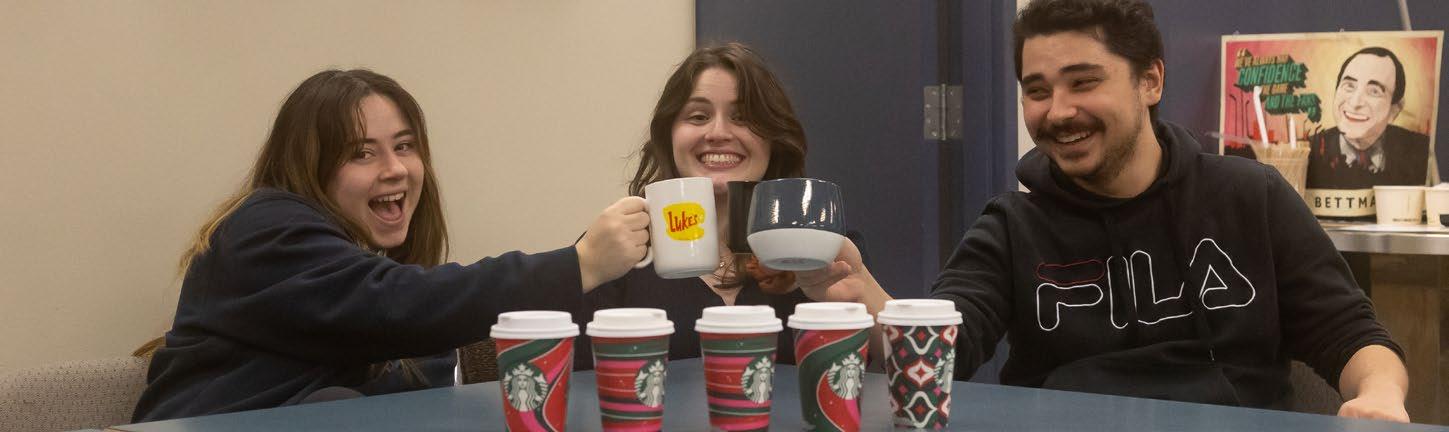
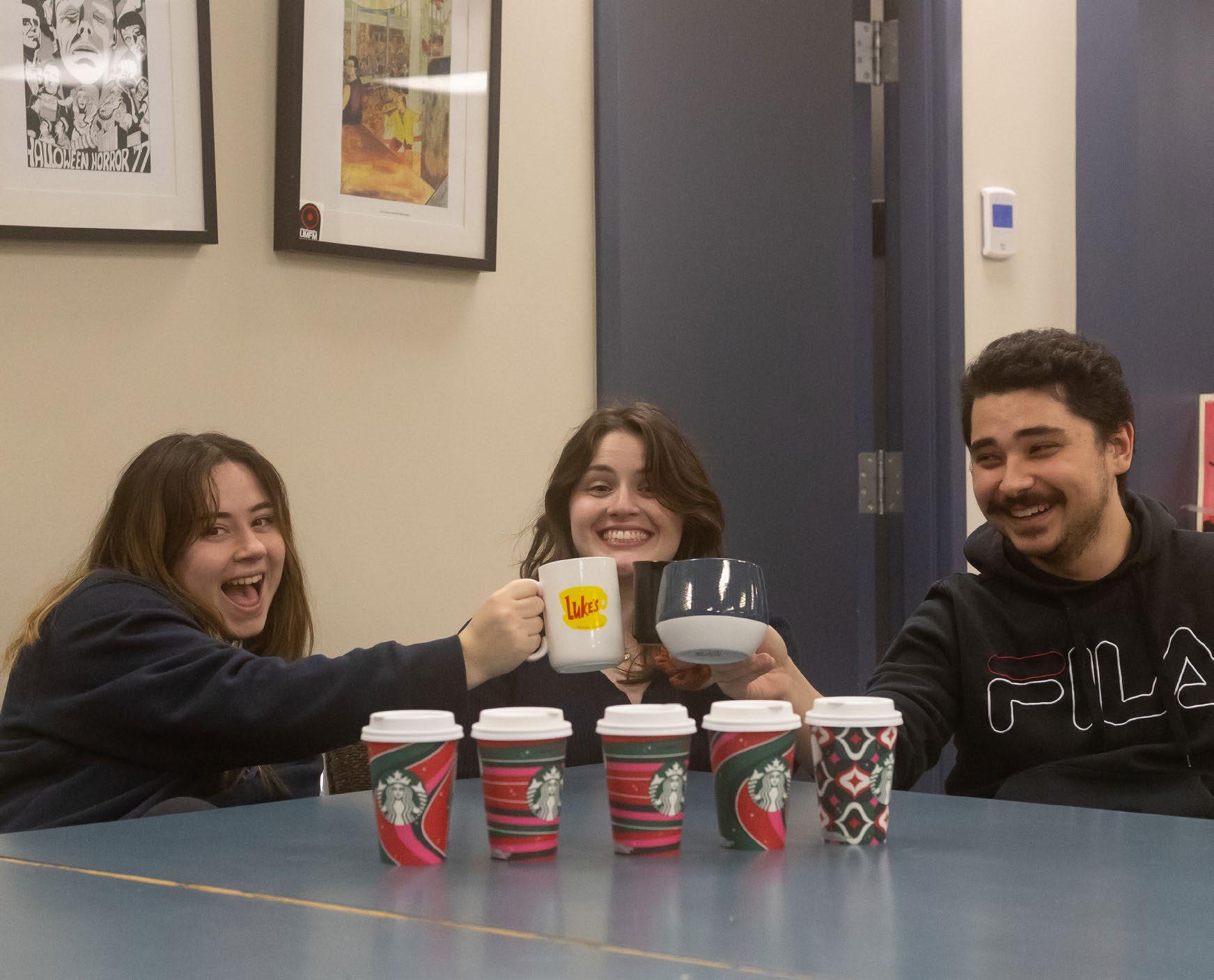
’Toban staff try the new Starbucks holiday drinks
If Santa was a barista, would he work at Starbucks?
Gillian brown, Sarah Cohen and braden bristow, staff
With Halloween being so last week and Starbucks officially having its holiday drinks out, we at the Manitoban tested them all so you don’t have to.
Our tasters ranked each drink — the gingerbread oat chai latte, chestnut praline latte, sugar cookie oat latte, caramel brûlé latte and peppermint mocha — on a scale of one to 10, factoring in taste and holiday vibe.
The tasters
GILLIAN BROWN, EDITORIN-CHIEF: I love peppermint. I love peppermint mochas, I love mint chocolate chip ice cream, I had a peppermint mocha for breakfast this morning. I am really happy to be here.
SARAH COHEN, NEWS EDITOR: I love the taste of a good brown sugar cookie.
BRADEN BRISTOW, COLUMNIST: I like coffee.
Gingerbread oat chai latte
GILL: It smells good.
SARAH: Yeah, it does.
GILL: I can’t taste the gingerbread, but it tastes kind of like a milky chai, and I love chai. It smells more gingerbread-y than it tastes.
SARAH: I think it has a really strong gingerbread aftertaste.
BRADEN: I enjoy it, it makes me smile, but I’m getting almost a cinnamon-y flavour and I’m not a cinnamon head, if I’m being honest.
The tasters agreed the drink tasted more like a gingersnap than gingerbread.
GILL: Considering the taste and the holiday vibe, I’d give it a six, maybe a six and a half.
SARAH: I’d say a seven.
BRADEN: I’m gonna go a solid six.
Score: 6.5/10
Chestnut praline latte
SARAH: It doesn’t taste like much.
GILL: I’m getting a lot of milk again.
BRADEN: It’s milky. It’s kind of nutty. It does not taste like Christmas. It doesn’t taste like Kwanzaa, Christmas or Hanukkah. None of them.
SARAH: It smells better than it tastes.
GILL: Taking into consideration holiday vibe and taste, I’m gonna go with a five.
SARAH: I’m gonna go with a three. I’m not getting much.
BRADEN: I like that I tried it, but I wouldn’t order it again. I’d give it like a four and a half.
SARAH: I feel like this is what you’d put out for Santa if you wanted to give him an upgrade from just regular milk.
BRADEN: I do think it’d make Santa happy.
GILL: I agree.
Score: 4.17/10
Sugar cookie oat latte
SARAH: This one smells like Christmas more.
BRADEN: It smells nice, it smells happy.
GILL: Full disclosure, I have had this drink before but I get it with almond milk, and I think I like it better with almond milk.
BRADEN: I like this. This is making me feel joy. This feels like a joyous Christmas-y drink.
GILL: It does smell like a sugar cookie.
SARAH: I like the buttery taste.
BRADEN: It’s smooth, it’s kind of rich, it’s good. I like it.
GILL: Taking into consideration holiday vibe and taste, it’s got a really nice holiday vibe, but that taste is not there for me. I just can’t get past the oat milk, so I’m gonna go with a five, happy medium.
SARAH: I’m gonna go with a seven because it is Christmas-y, but I think it’s just a little too buttery.
BRADEN: I’m gonna give it an eight. I think critiquing it for oat milk — that seems almost like user error. I liked it!
Score: 6.67/10
Caramel brûlé latte
SARAH: This smells like Christmas in my opinion.
GILL: Okay, so we said rich before. This, to me, is rich.
SARAH: Oh, that’s delicious.
GILL: It’s just a caramel macchiato with a fancy name.
BRADEN: That’s the review right there.
SARAH: This one makes me feel like Santa’s coming to town.
GILL: Rating it based on holiday vibe and taste, there’s no holiday vibe and the taste is mid for me, so I’m gonna go with a four.
SARAH: I think this is a solid nine. I think this is good.
BRADEN: I agree that there’s not a holiday vibe other than the cup, but I think the flavour is good, and I don’t know, I enjoy it. It’s rich, richer than the last one even though I said that already. Seven seems fair. It would be an eight if it were Christmas-y or holiday-y.
Score: 6.67/10
Peppermint mocha
GILL: This is Christmas. This is minty chocolate. It’s Christmas.
SARAH: I very much disagree. I feel like, if I was at a fancy restaurant and they gave me an after dinner mint, it would be this.
GILL: And I love it!
BRADEN: It tastes distinctly like the Olive Garden chocolates.
GILL: My favourite chocolates!
SARAH: You know, I thought it was gonna be better.
GILL: This is a 10 for me, taking into consideration holiday vibe and taste.
SARAH: I think this is a six. I think it tastes good. I think there’s too much peppermint.
BRADEN: I’m gonna give it a solid seven for the exact same reasons, but I’m more lenient.
Score: 7.67/10
Jungle juice (all drinks mixed together)
GILL: I just want to say, it smells delicious.
SARAH: Right?
GILL: This is not bad at all.
SARAH: No.
BRADEN: That’s pretty good.
SARAH: That tastes like Christmas.
GILL: This tastes like Christmas.
BRADEN: We figured it out. I’d give that a nine.
GILL: I give it a nine.
SARAH: I also give it a nine.
BRADEN: I think for a fun holiday activity, you could try this and then try to make it at home. That could be a fun holiday activity.
Score: 9/10
“This tastes like Christmas”
— Gillian Brown, taster-in-chief
photos / Matthew Merkel / staff
Hone your skills with writer-in-residence Peter Jaeger
Current writer-in-residence hosting writing workshops for fall term
Kelsey Chin, staff
Peter Jaeger, the current fall term writer-in-residence for the U of M’s Centre for Creative Writing and Oral Culture (CCWOC) and author of 14 books ranging from poetry to fiction, is holding multiple writing workshops until Dec. 4 as a part of his residency to help writers hone their skills.
Attendees will learn various techniques ranging from meditative mindfulness to alternative essay writing, which encourages people to take creative routes with research.
In the upcoming two-part workshop titled “Writing Pictures,” Jaeger will be going over writing text from looking at photos, drawings, paintings and film.
“It’s a translation of picture and pictorial image into writing,” he said. “Visual image is everywhere in our culture. It’s so prevalent, and it’s useful as subject matter to write about.”
The workshop will focus on what some writers have already done in their work with media crossover, giving attendees the chance to put some of the techniques they learn into practice.
The first session will take place on Nov. 10 at the U of M, while the second session will be held on Nov. 12 at Winnipeg Art Gallery (WAG)-Qaumajuq. Jaeger said having the workshop at the WAG-Qaumajuq will allow students to write in relation to different works the gallery holds.
“It’s basically sampling using other writing as a basis or springboard in some way to write something new and maybe take a new angle, an ironic distance, from the ori-
ing the Alternative Essay,” will take place on Dec. 4, and will centre on “hybridizing” the standard academic essay by taking on more creative approaches to research writing.
“What really excites me is when I see students learning”
— Peter Jaeger, writer-in-residence at the U of M’s CCWOC
ginal piece of writing,” said Jaeger.
Jaeger’s next two-part workshop will take place on Nov. 20 and 27, and will focus on “Recycled Writing.” This involves using other pieces of writing as a base canvas when creating new pieces.
The second part of the series will take place at the U of M Archives & Special Collections in the Elizabeth Dafoe Library, giving participants access to a multitude of historical sources to work with.
The last workshop of Jaeger’s residency, titled “Writ-
During each session, participants will practise the skills they learn and will then receive feedback from their peers and Jaeger. The techniques covered in these workshops, Jaeger said, can be applied to fiction, non-fiction and poetry.
For Jaeger, one of the best parts of leading these workshops is watching writers develop their skills.
“What really excites me is when I see students learning,”
he said.
Seeing the surprising works that can be produced during the limited timeframe of a workshop is also fascinating for Jaeger.
“Some of it actually is professional-level,” he said. “It’s really interesting what can happen.”
Apart from his CCWOC workshops, Jaeger is also working on a climate change-related project, and is looking to receive brief responses from a wide range of individuals to the question, “How has climate change affected your life?”
Responses can be submitted to ccwocwir@umanitoba.ca in written form or as a recorded audio file, and can range from a single word to a short paragraph. The deadline to submit these responses is
Nov. 20, and all submissions should include the word “seasons” in the email subject line. Those looking for more information on Jaeger’s project can contact him via email.
Workshop participants or anyone interested in creative writing can also reach out to Jaeger to book a consultation if they would like to discuss their work with him individually. Having conversations with emerging writers about their craft is “very refreshing,” Jaeger said.
“I feel it’s a gift,” he said, “a blessing, in a way.”
Visit CCWOC’s website for more information on Jaeger’s workshops. Writers of all skill levels can book an individual writer consultation with Jaeger by emailing ccwocwir@ umanitoba.ca.
photo / Ebunoluwa Akinbo / staff
Pitikwé noseslides into Portage Place mall
Indoor skatepark now open to the public
Jacob Davis, staff
Nestled inside of Por-
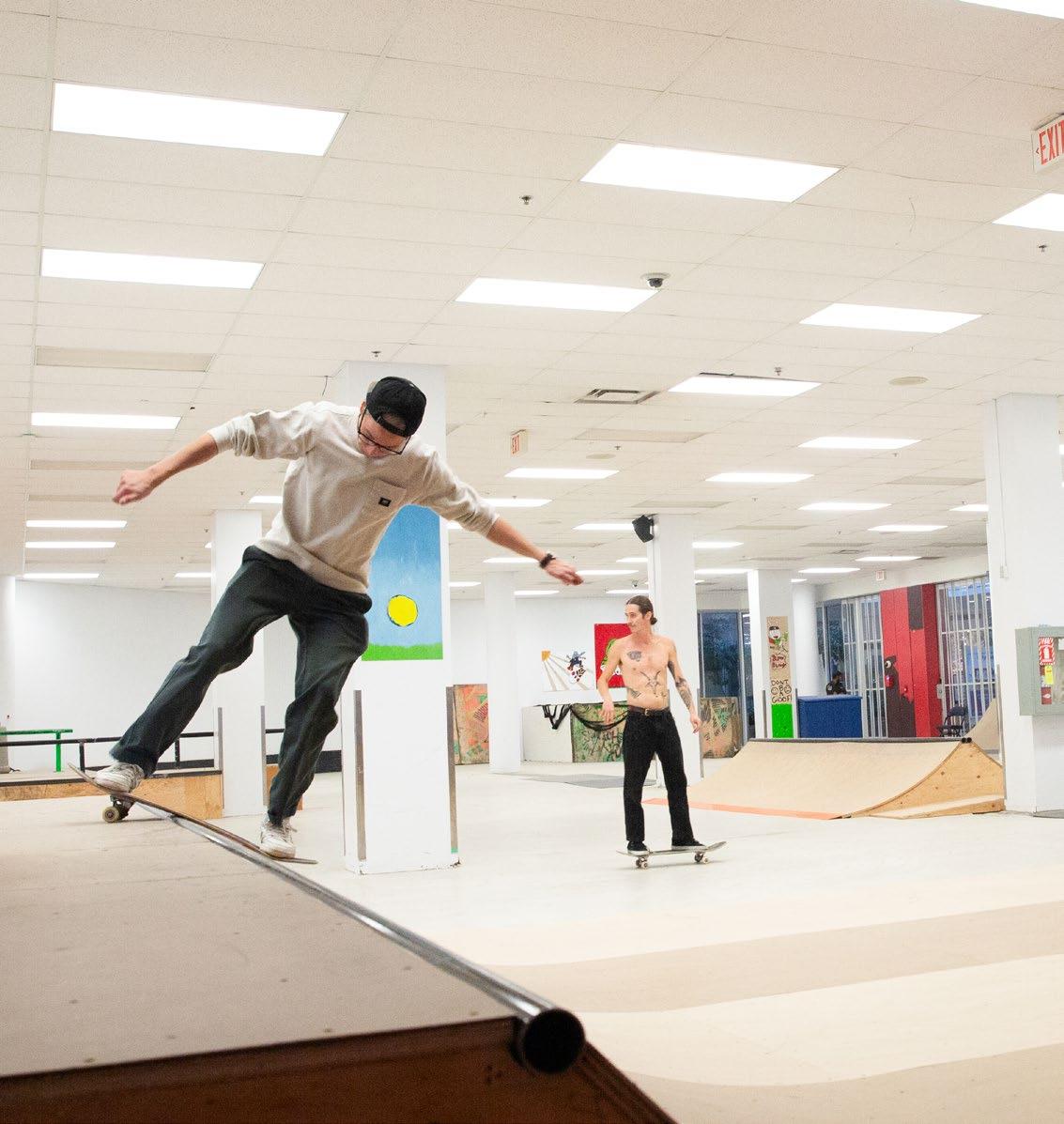
tage Place mall in downtown Winnipeg is a new indoor skatepark formed from community effort, called Pitikwé.
Pitikwé, which is a Cree word meaning “come in,” came into being after the Manitoba Skateboarding Coalition brought community members together to create an indoor space built on safety and inclusivity for the city’s skateboarding community.
Graham Constant, executive director of Pitikwé and president of the Manitoba Skateboarding Coalition, said the park’s Oct. 27 grand opening was a massive success.
“Our capacity is only at 100, and we were at capacity right away,” Constant said, adding that there was a lineup of people eager to access the park. Staff had to cycle groups of attendees out every hour to make sure everyone got a chance to experience Pitikwé.
“It shows that the community really wanted this and really needs this,” Constant said.
Accessibility was on the minds of everyone involved in Pitikwé’s creation. Constant said having a central location that community members and riders alike could easily
get to was an important consideration, and Portage Place met that need.
A skatepark inside a mall might seem odd to some, but Constant said it comes back to the understanding that the community “really wanted this.”
To further support accessibility, the site also has skateboards and safety equipment to loan out to skaters who might not have any, free of charge.
Entry is $5 for those under 25 and $10 for those aged 25 and older. There will also be a season pass option allowing skaters to pay a one-time fee to skate all winter. Constant added that volunteers at the site get in free.
“Anybody can come here and we’ll do our best to accommodate,” he said.
To make the park a safe and inclusive space for all, the Pitikwé team took care to thoroughly develop the park’s code of conduct, which is displayed at the front of the site. Security is also present at the front of the park for every session, and trained staff and volunteers are available to provide assistance to park attendees.
Constant said there has been some concern from
folks about the location of the skatepark and that the downtown area is known for being “fairly dangerous,” but he feels it depends on your opinion.
While he understands concerns about the downtown area at night, as a resident of downtown Winnipeg for over seven years, Constant believes staying safe is all about self and situational awareness.
“I’ve heard people saying, ‘How long until somebody gets stabbed here?’” he said. “You guys don’t say that when you’re attending a hockey game across the street.”
“It’s just people’s mentalities that have to change, their perspectives have to change, because downtown isn’t dangerous to me,” he said. “It’s got its own scene, you’ve just got to get used to it.”
Since the creation of the skatepark, Constant said people have come up to him to express their gratitude and excitement. He emphasized the large role the community had in the forming of Pitikwé.
“It’s by the community for the community,” he said.
Alongside open skate sessions, Pitikwé offers sessions specifically for women and/or trans skaters, BMX and scooter riders, youth and adults.
The variety doesn’t end there, however. Constant also hopes to offer media production programming through Pitikwé where he can teach youth how to use cameras and edit footage.
“That’s how I got into filmmaking, and now I’m a business owner and I’ve been doing that for the past five years,” Constant explained.
“I never would’ve thought that picking up a camera and
filming my friends and editing montages together would translate to a real job.”
For Constant, an important focus of Pitikwé is to try to connect with Indigenous, inner city and at-risk youth and “show them what skateboarding can do for them.”
Sessions at Pitikwé Skatepark can be booked online through its website, https:// pitikweskatepark.com/.
photo / Ebunoluwa Akinbo / staff
’Toban Turntable
Helena Deland — Goodnight Summerland
Alex braun, staff
4/5 Stars
Goodnight Summerland, the second album from Montreal artist Helena Deland is about loss, but it is not a goodbye — only a goodnight. It is a farewell with the knowledge that nature is cyclical, the sun will fall and rise again, the seasons will change back around and the moon will be full again.
Named for the singer-songwriter’s birthplace in the Okanagan region of British Columbia, the album was recorded after the death of Deland’s mother, causing her to both confront the mysteries of death ahead and the remnants of her past.
Deland is largely focused here on memory and place, and often refers to vague moments with an unspecified “we” or “you,” seemingly talking to an intimate lover or a loved one.
Natural settings colour these impressionistic recol-
lections, like the audible beach setting of “Swimmer” or the aptly titled “The Animals,” which sets a moment of vulnerability against the backdrop of a nighttime walk through the woods, woodland creatures in the trees.
This combination of distinct physical geography and narrative cloudiness is quite emotionally effective, provoking memories from one’s own life to come flooding in to fill the gaps in the song’s dialogue.
Though her short but varied career has led Deland through collaborations with rapper JPEGMAFIA, ambient artist Claire Rousay and experimental pop artist and fellow Montrealer Ouri, Goodnight Summerland sees Deland largely in straightforward singer-songwriter mode.
Recorded with noted Big Thief collaborator and solo artist Sam Evian in the Catskill Mountains of New York, the album has a distinctly naturalistic feeling to it. The
recordings are relatively slapdash, leaving in all the imperfect textures of the largely acoustic instrumentation, but the arrangements are delicately minimal and precise, overflowing with ambience and warmth.
Deland’s voice appears in two distinct modes. In her lower register, Deland has a solemn dignity and demanding precision, not unlike Montreal legend Leonard Cohen. In her high register, Deland is flitty and angelic, gliding above the richly textured and ethereal instrumentals.
Musically, the album maintains a constant cozy atmosphere. Early tracks like “Spring Bug” and “Bright Green Vibrant Gray” have a folky jaunt to them, while later tracks like the haunting “Who I Sound Like” or the closing “Strawberry Moon” descend into darkness.
Goodnight Summerland is a triumph of atmosphere and closely observed writing, and
Goodnight Summerland is available on major streaming services.
a perfect album for the winter — warmly comforting and intimate.
New York Rangers @ Jets Oct. 30 — Final: 3 – 2 / OT Jets @ Vegas Golden Knights Nov. 2 — Final: 2 – 5
Jets @ Arizona Coyotes
Jets @ St. Louis Blues
Nashville Predators @ Jets
Dallas Stars @ Jets
New Jersey Devils @ Jets Nov. 14 — 7 p.m.
Buffalo Sabres @ Jets Nov. 17 — 7 p.m.
Arizona Coyotes @ Jets Nov. 18 — 6 p.m.
Jets @ Tampa Bay Lightning Nov. 22 — 6 p.m. *All times CST
Women trounce Bobcats, men get clawed off court
Bisons women’s volleyball team sweeps Brandon while men get swept
Joshua Brandt, staff
To kick off November, the Bisons women’s and men’s volleyball squads each squared off against their interprovincial-rival, the Brandon University Bobcats, this past weekend.
The four games provided a bevy of excitement and a bit of disillusionment.
In need of a couple victories to get back in the win column, the women’s team entered play against the lowly Bobcats this past weekend coming off a serious two-game drubbing at the hands of the University of the Fraser Valley (UFV) Cascades.
Nevertheless, coming off the tough losses, Brandon was a welcome opponent. The Bobcats currently sit dead last in the CanWest standings and finished dead last in the 202223 campaign as well, collecting a grimy 0-24 record.
The last time the Bobcats women’s volleyball team won a match was Mar. 3, 2022 in the 2021-22 CanWest playoffs against the University of Calgary Dinos. Entering play against the Bisons on Friday, the famished squad had not
tasted a victory for 610 days.
As one might expect, the herd made sure the Bobcats would have to wait a little longer.
In the first match, the herd handled the Bobcats with ease, winning in three straight sets and never allowing Brandon to score over 14 points in a single set.
Dishing out 29 assists, Katreena Bentley played great in the win — consistently getting the ball to her teammates in good spots to hit and often generating one-on-ones as a result of her brilliant offensive orchestration.
One cannot fail to mention the great Raya Surinx either.
The Bisons’ superstar finished the match with 18 kills on 26 attempts.
In the first set of Saturday’s match, the Bobcats’ team showed it was not entirely de-clawed, forcing the Bisons to come back from a one-point deficit to win the first set 27-25.
It seems the avoidably close first set was a wake-up call for the herd, as it then went on to crush the Bobcats in the second and third sets, picking up its second sweep in a row.
Bentley matched the 29 assists she garnered in the first match with 29 more, Surinx added another 17 kills to give her 88 on the season — currently the most in CanWest — and Simone Crevier got her first kills of the season, registering four. The women’s team now sits in fifth place in CanWest.
To put it bluntly, it was a challenging weekend for the men’s volleyball team.
After looking so promising and clinical in its season-opening series against the UFV Cascades, the herd may have left supporters disillusioned with the team’s ability to close out games after last weekend’s performance against the Bobcats.
In the first match, the herd played well in every set, but could not close any of them out. When the points mattered, the herd seemed to shirk away.
Ultimately, the Bobcats took the first match 3-0, which is a score that does not do the herd’s effort justice.
Still, several key players had good games — Eric Ogaranko had nine kills and Jordon Hep-
pner had six, while Josh Jehle and Kai Boyko scrounged up four digs a piece.
In the second match, the herd was once again in every set except the last.
When closing time rolled around, Bobcats players just made better shots than the Bisons and possessed that proverbial yet elusive “clutch gene.” Jehle, currently leading CanWest in digs per set, made six more, while Spencer Grahame also had a nice match, swinging efficiently with 10 kills. Sammy Ludwig tallied 31 assists in the match
as well, now sitting second in CanWest assists per set with an average of 9.93.
After falling to the Bobcats twice, the herd dropped to 2-2 on the season and sit tenth in CanWest standings.
The men’s team will look to bounce back at Investors Group Athletic Centre as it faces the University of Calgary Dinos Nov. 9 and 10 before co-hosting the Mount Royal University Cougars Nov. 17 and 18 with the women’s team, which will be coming off a bye week.
Bisons fall to T-Birds in tight Hardy Cup semifinal
Maya Turner makes history once again
Grace Anne Paizen, staff
There were two major storylines from the regular season that hung over the herd’s Hardy Cup semifinal game in balmy Vancouver Saturday afternoon.
The last time the two teams met, Maya Turner was not the starting kicker and the University of British Columbia (UBC) Thunderbirds walloped the Bisons 56-10 while starting quarterback Jackson Tachinski was out with an injury.
The penalty-filled semifinal was a tightly contested matchup, the opposite of the September domination. The first drive of the game ended with receiver Michael O’Shea Jr. running a missed T-Birds field goal attempt out of the endzone. The effort was rewarded by a long Bisons drive downfield capped off by a history-making Turner 13-yard field goal to open the scoring.
After exchanging the ball with both defences settling in, UBC tied the game with a field goal of its own early in the second quarter.
The herd responded with a grinding drive downfield, with running back Noah Anderson
racking up six carries and 36 yards alone. The Bisons would punch the ball in for a major courtesy of offensive lineman Matteo Vaccaro.
After the Bisons got the ball back, running back Vaughan Lloyd rumbled down the field for a huge 41-yard touchdown run, putting the herd up by two possessions.
However, UBC would not go away and added another major of its own, the Bisons taking a 17-10 lead into halftime.
Starting with possession after the half, Manitoba quickly give the ball back to UBC, but the T-Birds kicker missed his third field goal attempt on the day, adding only a single.
After another grinding drive downfield, Turner’s sure foot would capitalize from 26 yards out, putting the Bisons up 20-11.
While the herd held UBC to a quick two-and-out, the T-Birds forced a fumble and would add a major onto their score before the fourth quarter.
The Bisons managed to add to their lead with a thundering punt by Nathan Udoh for a single, putting the herd up by
a field goal over UBC.
After exchanging the ball again, a holding penalty on Manitoba aided UBC to another major before adding a single on the ensuing kickoff. Quickly stopping the herd’s next drive, the T-Birds tacked on another field goal.
Down by one possession in the dying minutes of the game, the Bisons needed a major and a two-point conversion to push overtime. How-
ever, the herd’s comeback was shut down and the team bowed out of the Hardy Cup playoffs with a 29-21 loss.
The Bisons’ valiant effort amassed 231 rushing yards alone on offence and two sacks courtesy of defensive linemen Tristan Francis and Kaleb Mackie-McLeod, as well as a breakup recorded by defensive back Stephen Adamopoulos on defence. Turner made history once
again, becoming the first woman to dress for and score points in a U Sports post-season football game. Perfect on the afternoon, Turner racked up eight points on her own, with two field goals and two one-point conversions. While the final score will sting Bison players and fans alike, the game was an encapsulation of the team’s “never quit” attitude this season.
photo / Matthew Merkel / staff
photo / Matthew Merkel / staff
Thrilling Bisons basketball season openers
Women sweep Bobcats, while men go 1-1
Grace Anne Paizen, staff
The Bisons basketball season tipped off last Thursday with back-to-back games against the Brandon University Bobcats at Investors Group Athletic Centre.
The women’s team played first, with Emily Johnson scoring the game and herd’s first points. Minutes later, Lauren Bartlett scored the first threepoint shot for the Bisons.
With intelligent play, the herd took a 46-31 lead into halftime over the Bobcats.
The women’s team did not look back, dominating the second half and winning the game 92-67.
The Bisons top scorers in the first match were Johnson, who had a double-double on the night with 20 points and 11 rebounds, Emily Mandamin with 17 points and Autumn Agar with 15.
Mar Tomas Arbos had seven rebounds on the night, while Bartlett, Agar and Emerson Martin recorded six each.
Friday night’s game for the women was a much closer contest. While the Bisons began to pull away from the Bobcats at the end of the first quarter, Brandon stayed in the
game, tying the score back up with 8:13 left in the first half.
The Bobcats took the lead late in the second quarter, racking up the baskets by capitalizing on Bison turnovers and taking a narrow 38-35 lead into halftime.
Both teams came out hot after halftime, exchanging the lead throughout the third quarter. The Bisons struggled throughout the night with free throws, only making 10 points off 21 tries from the line.
However, the herd took a one-point lead into the fourth quarter, opening on an impressive 7-2 run. While the Bobcats managed to get Manitoba’s lead down to one possession late in the fourth, the Bisons dominated the final minutes of the game, pulling off the 77-66 win and first sweep of the season.
Bartlett led the team in game two with 20 points, while Johnson came in at a close second with 19 points and three steals on the night. Martin registered 11 points and Agar pulled in 10 rebounds, showcasing the allaround team effort in the win.
The men’s first game followed the women’s on Thurs-
day night, with Simon Hildebrandt opening the scoring on a three-point basket. The Bisons dominated the game from the start, leading 26-12 at the end of the first quarter.
While the Bobcats pushed back in the fourth quarter, chipping away the Bisons’ lead to eight points, the herd came out on top, winning the first match of the weekend 86-74.
Mason Kraus led the Bisons’ offence in Thursday’s contest, recording a double-double on the night with 16 points and 10 rebounds. Teammates Hildebrandt, Tito Obasoto and Cieran O’Hara also had impressive performances, with Hildebrandt putting up 15 points and six rebounds, Obasoto recording 13 points and O’Hara registering 11 points.
Friday night’s game flipped the script for the two teams. While Hildebrandt once again opened the scoring, this time with a point from the freethrow line, the Bobcats dominated the entire contest.
Down 28 points at the start of the third quarter, the herd was not able to sink a threepoint shot until late in the third. The Bobcats’ largest
lead of the night was 34, also in the third quarter.
While the Bisons won the fourth quarter, they ultimately lost the game 94-68, draining only five of the 26 three-points shots they put up on the night.
Daren Watts led the team in points with 14, while Hildebrandt and Andre Gray
II recorded 11 points each. O’Hara led in rebounds with six. The Bisons women’s and men’s teams play back-to-back series Nov. 10 and 11, hosted by the University of Calgary Dinos before continuing their Calgary road trip from Nov. 17 to 18 to take on the Mount Royal University Cougars.
Bisons hockey pulls off one win against Trinity Western
Women win Friday game, men still searching for win column
Quinn Mayhew, staff
The Bisons women’s hockey team hit back from last week’s tough losses with a thrilling game one win Friday night against the Trinity Western University Spartans.
The weekend clincher was on the Spartans’ home ice. Friday’s game had a slow start, with no penalties or power plays until the height of the game in period three. The entire game consisted of evenly matched opponents with mostly clean plays.
Neither the herd nor the Spartans scored during the first period, keeping play pretty tame early on.
The game picked up when Kylie Lesuk scored 2:40 into the second period, putting up the first and only point for the Bisons in the game.
The game ended in a 1-0 shutout win for the herd, with goalie Meagan Relf stopping all 25 shots on net.
The series continued on Saturday, with neither team scoring in the first period once again. However, the Spartans soon capitalized on the Bisons’ fatigue, with Spartan Brooklyn Anderson scoring on the breakaway five and a half minutes into the second period.
The team looked like it was trying to catch up from puck drop, and the Spartans took advantage of that from the very start.
The Spartans scored two times within the first three minutes of Thursday night’s game, setting a precedent for what was to come.
Trinity Western scored for a third time during the first period, taking a 3-0 into the first intermission.
The second period slid by without either team scoring, the Spartans taking their three-goal lead into the final frame.
The third period was rough, with the Bisons fighting for a goal to put them on the board.
The game ended in a 1-0 shutout win for the herd, with goalie Meagan Relf stopping all 25 shots on net
The Bisons continued to play nicely until the third period when Dana Goertzen received a minor penalty for tripping.
The Spartans took advantage of the Bisons’ disarray, scoring two more times in the second frame. The Bisons women continued to struggle as the game wore on, and were ultimately shut out by Trinity Western 3-0, finishing the weekend series 1-1.
The Bisons men’s hockey team started off its series against Trinity Western on home ice Thursday night.
The herd kicked into high gear, scoring for the first time courtesy of captain Jonny Hooker nearly 13 minutes into the third period.
The Bisons scored a second time with a power-play goal by Hayden Ostir in a last-ditch
effort. Despite the herd making a major comeback in the third, they would fall short by a goal, narrowly losing 3-2.
Friday’s game started with a Spartans goal that was quickly answered by Bison Dylan Thiessen, who scored on a power play in the first period.
However, the Spartans found the net yet again, taking a 2-1 lead into the first intermission. Trinity Western put another goal up on the herd in the second before the Bisons’ captain netted his second goal
of the weekend. The Spartans continued to score throughout the third frame, winning 5-2 and sweeping the herd in the two-game series.
The women’s team will host the University of Regina Cougars Nov. 9 and 10 and the University of Calgary Dinos Nov. 17 and 18 at Wayne Fleming Arena, while the men’s team will be hosted by the Cougars Nov. 10 and 11 and the Dinos Nov. 17 and 18.