VIDEO EDITOR Kennedy Legault video@themanitoban.com
SOCIAL MEDIA EDITOR Violet Baker social@themanitoban.com
REPORTERS
NEWS Alicia Rose
NEWS Kyra Campbell
NEWS vacant
RESEARCH & TECHNOLOGY Rhea Bhalla
COMMENT Braden Bristow
COMMENT Hanako Teranishi
ARTS & CULTURE Kelsey Chin
ARTS & CULTURE vacant
SPORTS Joshua Brandt
SPORTS Quinn Mayhew
VOLUNTEERS
VOLUNTEER STAFF Bahareh Rashidi
VOLUNTEER Christina Tran , Romin Cheema
interested in volunteering?
email me@themanitoban.com today!
109 HELEN GLASS BUILDING
UNIVERSITY OF MANITOBA WINNIPEG, MB 204. 474. 6535
The Manitoban is the official student newspaper of the University of Manitoba. It is published monthly during the summer and each week of regular classes during the academic year by the Manitoban Newspaper Publications Corporation.
The Manitoban is an independent and democratic student organization, open to participation from all students. It exists to serve its readers as students and citizens.
The Manitoban is a member of the Canadian University Press, and our journalistic standards can be found on the Manitoban’s website.
The newspaper’s primary mandate is to report fairly and objectively on issues and events of importance and interest to the students of the University of Manitoba, to provide an open forum for the free expression and exchange of opinions and ideas and to stimulate meaningful debate on issues that affect or would otherwise be of interest to the student body and/ or society in general. The Manitoban serves as a training ground for students interested in any aspect of journalism.
Students and other interested parties are invited to contribute to any section of the newspaper. Please contact the appropriate editor for submission guidelines.
The Manitoban reserves the right to edit all submissions and will not publish any material deemed by its Editorial Board to be discriminatory, racist, sexist, homophobic or transphobic, ableist or libellous.
Opinions expressed in letters and articles are solely those of the authors. Editorials in the Manitoban are signed and represent the opinions of the writer(s), not necessarily those of the Manitoban staff, Editorial Board or the publisher.
A “volunteer staff” member is defined as a person who has had three volunteer articles, photographs or pieces of art of reasonable length and/ or substance published in the current publishing year of the Manitoban.
Any individual who qualifies as a volunteer staff member must be voted in by a majority vote at a Manitoban editorial board meeting. Elected representatives and non-students may be excluded from holding votes as volunteer staff members in accordance with the Manitoban Constitution.
Party campaigned on promises to restore international students’ health care
Colton McKillop, staff
The Manitoba New Dem-
ocratic Party (NDP) took office last Wednesday and appointed a team of new cabinet ministers, including rookie MLA for Southdale, the province’s newest advanced education and training minister, Renée Cable.
The new minister said that access to post-secondary education “changed the trajectory” of her life.
“I’m thrilled to be part of the team that’s going to open those doors for other people and to ideally make it as easy as possible to move towards those goals,” she said.
As advanced education and training minister, Cable will be responsible for implementing government policy related to post-secondary education, student support and skill training.
Some of the NDP’s campaign promises included supporting post-secondary students and institutions through repealing Bill 33 — a law which gives the minister of advanced education the power to set guidelines for university fees and tuition — providing more grants and loans to student aid recipients and reinstating international students’ health care.
Cable said she is “looking
forward to really sinking [her] teeth into the job,” and that one of her department’s first priorities is “to repair some broken relationships.”
“The last seven years have brought quite a bit of strain to the public service and to other sectors that rely on a solid relationship with government,” she said.
“Our first priority is really resetting that relationship, and ideally creating an open door and collaborative working relationship between folks.”
The previous Progressive Conservative (PC) government was often at odds with the post-secondary sector, with student groups, faculty associations and university presidents criticizing the government’s approach.
“I can say that there were a number of moments that didn’t exemplify the most collegial working relationship,”
Cable said.
The University of Manitoba Faculty Association (UMFA) went on strike twice during the PC majority government between 2016 and 2023.
The union took the government to court, alleging that the province secretly interfered in negotiations in 2016 by demanding that the university offer no wage increase.
In 2022, the government was ordered to pay the union $19.3 million.
Allison McCulloch, president of the Manitoba Organization of Faculty Associations (MOFA) and professor of political science at Brandon University, said working with the PC government “wasn’t always necessarily an easy relationship.”
“I don’t think that there was much in the way of consultation with associations like MOFA during the period of the last government,” she said.
She said the last seven years were “difficult times for the post-secondary education sector as a whole,” citing funding cuts, the two strikes and the government’s push for a performance-based funding model for Manitoban universities.
Performance-based funding would have tied funding for universities to metrics such as student graduation rates and graduate employability rather than lump-sum grants. The PCs signalled their support for such a model, although they dropped these plans after opposition from post-secondary stakeholders.
The University of Winnipeg Faculty Association (UWFA) left one virtual consultation in 2022 because its members felt
the government was unwilling to hear opposition to its plans to implement performance-based funding. Peter Miller, a University of Winnipeg professor and president of UWFA said the province only held the meeting in order to claim they had offered consultation. MOFA did not receive an invitation to the meeting.
McCulloch said she was pleased that the government backed away from performance-based funding and that she expects “that the new government would not move forward” with any similar plans.
She said MOFA hopes to see the new government provide stable multi-year funding for post-secondary institutions, increases in bursaries, increases to Research Manitoba funding and “a re-commitment to university autonomy.”
UMSU president Tracy Karuhogo said the change she is looking forward to most is the reinstatement of health care for international students, as she is an international student herself, along with nearly 23 per cent of those who study at U of M.
“There’s so many students who would benefit from putting back international students onto the health coverage,” she said.
The PC government revoked international students’ free access to Manitoba’s health care system in 2018.
Cable said that reinstating international students’ health care is “at the top” of her list of priorities and she wants to “encourage as many people as possible to pursue their education here.”
Karuhogo also highlighted the NDP’s promise to increase grants and student aid.
“In our positions as the UMSU executives, we get to meet so many students on the ground, in meetings, even those who reach out in our office hours, and they’re really talking about the effects of inflation on their budgets,” she said.
Karuhogo noted that while she appreciated the opportunities UMSU received to consult with the previous government, some of the student union’s attempts to reach out for consultation “were left unanswered.” She said the union had numerous meetings with NDP representatives while they were in opposition and that she is looking forward to working with Cable.
Study permit challenges concern U of M students
Government tensions and permit denials leave students uncertain
Kyra Campbell, staff
When Aahan Rajput applied for his student visa, he was left feeling confused, unsupported and ignored.
Rajput, now a bachelor of commerce honours student in his third year, was a minor at the time he applied to come study in Canada from India. Because of his experience with Immigration, Refugees and Citizenship Canada (IRCC), the lengthy process was “a lot more stressful for me and my family to figure out,” he said.
The U of M’s international student population has increased by 6.3 per cent, now at 7,035 students. Many of these students, just like Rajput, face challenges when obtaining and extending study permits.
Concerns regarding study permits for international students were brought up in conversation during the fall enrolment update at the most recent U of M board of govern-
ors meeting on Oct. 10.
Diane Hiebert-Murphy, U of M provost and vice-president (academic), noted in the meeting that the university had been “hearing a fair bit” about student visa delays for Iranian students, and a “sizeable percentage” of visa denials for many students applying from African countries. In 2021, only 39 per cent of Iranian students applying for study permits were successful.
U of M president Michael Benarroch said that the university is trying to analyze what percentage of international students accepted to U of M are denied study permits. Benarroch said Universities Canada and U15, two collectives of universities across the country, “have brought the issue to the attention of the federal government.”
President of UMSU Tracy Karuhogo raised the concern of international students from India regarding recent ten-
sions between the Canadian and Indian governments at the board of governors meeting.
Rajput said he found the IRCC website difficult to navigate without support. He also said it can be tough to get responses through the IRCC system regarding questions about study permits.
The recent tensions bring up uneasiness not only for Rajput, as a student who has applied for extended study permits, but also for his friends and family who wish to come visit him while he studies in Canada.
“If I am graduating soon, I would like to see my family come here and have them celebrate some occasions with me,” said Rajput.
If Canada were to suspend visa services, Rajput worries that he could be put in a “questionable” position if he needed to travel out of the country.
Rajput is concerned that fears about tensions are being taken less seriously because of biased attitudes toward marginalized groups of international students. He feels that some Canadians do not understand the severity of the situation.
Rajput said because of the idea that there are already so many Indians in Canada, “it’s not seen as that big of a deal.”
Increased public support from the university would be welcomed, said Rajput. This could mean an added focus on supporting students in navigating documents and study permit applications.
Fanny Levy, director of the U of M International Centre, said that the centre received reassurances from the federal government that there have not been any changes in policies regarding immigration application from India, and that they “were very clear
that they were not expecting any changes.”
Karuhogo noted that herself and UMSU vice-president advocacy Liam Pittman will bring concerns of high student permit denial rates and tensions with India to members of the federal government when they travel to Ottawa for Advocacy Week with the Canadian Alliance of Student Associations at the end of November.
For undergraduate students facing student permit delays, U of M offers multiple start dates on the initial admission offer for open programs.
More information about study permits and workshops can be found on the U of M International Centre website.
Take a bird’s eye view
Indigenous Birding Club a place for Indigenous knowledge and birds of Manitoba
Sarah Cohen, staff
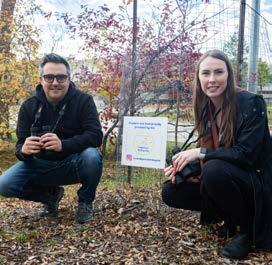
W innipeg is home to many species of birds, some even here on the University of Manitoba campus, and with the UM Indigenous Birding Club, you may just be able to see an indigo bunting in its breeding habitat.
Bailey Hendry is a University of Manitoba alumnus and is currently a student advisor and program co-ordinator at the Indigenous Student Centre at the U of M. Justin Rasmussen is also a U of M alumnus, along with the director of Indigenous leadership programming at the U of M. Hendry and Rasmussen serve as the co-founders and co-leads of the birding club.
The two began the club this last summer out of passions for birding, student success and well-being. Hendry also said they started the group because ornithology, the study of birds, is a “colonized and western hobby,” and they wanted to “create a safer space for BIPOC folks to come and engage in the wonderful world of birding.”
“A big part of what we do
is also promoting Indigenous knowledge around birds and traditional teachings,” said Hendry.
“When we were thinking about the start of this club, we wanted to make sure that we were also incorporating traditional teachings and traditional peoples to come and share Indigenous knowledge and promote the ecological Indigenous knowledge that has already been here for thousands of years.”
Birding — different from bird watching — is tracking of the number, frequency and location of different species of birds in the wild.
“It’s a little bit more involved in actually tracking what you’re seeing and engaging in the space,” said Hendry.
Indigenous Birding Club goes on walks where they will teach you the basics of birding. Rasmussen said that a major part of their group is inclusivity. Whether an individual is an ornithology expert or knows nothing about birding, they are welcome to join.
The group has gone on 13 bird walks so far, at places like
Kings Park and FortWhyte Alive. Most walks, according to Rasmussen, are from 12 to 1:30 p.m. around campus. They also have binoculars to lend to those needing them during walks.
Rasmussen said they see an average of 15 to 20 species of birds throughout the walks and at least one memorable bird. Hendry and Rasmussen recently saw three eastern blue birds which they said were “a nice way to punctuate all our spring and summer and fall walks.”
Joining Indigenous Birding Club means joining a “fantastic community of people that care about nature and care about getting out there.”
Hendry started birding during the pandemic to help her mental health.
“Participating in birding, it’s kind of forcing you to participate in mindfulness at the same time,” she said.
If students of any background want to join the group for a bird walk, go to the group’s Instagram page @umindigenousbirdingclub and keep up to date with posts
that give details for upcoming walks and events. More information is also available on their website www.umindigenousbirdingclub.com.
The group’s next event, led by Elder Stanley Kipling, will immerse students in Indigenous knowledge of bald eagles. The event is on Nov. 1 in Migizii Agamik from 11:30
a.m. to 2:30 p.m.
Hendry and Rasmussen also extend their gratitude to the Indigenous Initiatives Fund for allowing them to keep doing what they are doing.
2SLGBTQIA+ campus groups unite to oppose transphobia
Manitoba 2SLGBTQIA+ Student Action Coalition takes part in counter-protests
Colton McKillop, staff
When Keegan Vergara was asked as a queer representative on the Social Work Students’ Association to make a statement on the 1 Million March 4 Children (1MM4C), he and the other queer rep decided they needed to do more than just make a statement about it.
Since then, student clubs and 2SLGTBQIA+ groups from the University of Manitoba and the University of Winnipeg have joined forces to oppose anti-trans sentiment in Manitoba.
Vergara, one of the co-organizers of the Manitoba 2SLGBTQIA+ Student Action Coalition, said the group formed “just within the last month or so.” Vergara proposed the initial idea of a counter-protest that would oppose the statements 1MM4C was making.
“Everything that they’ve been spreading around is built around misinformation, fear-mongering and just general hate speech, to be honest with you,” he said.
Manitoba has seen a number of controversies regarding education on 2SLGTBQIA+ issues in recent months.
Brandon School Division
faced a barrage of phone calls, letters and emails in May demanding that books including 2SLGBTQIA+ content be removed from school libraries, though the board of trustees ultimately voted 6-1 against a proposal to form a committee to review books rather than removing them altogether.
Most recently, the Manitoba Progressive Conservative Party ran a series of campaign ads in the recent provincial election promising to expand parental rights in schools, which many critics interpreted as a coded message to those who oppose sexual orientation and gender identity education in schools.
Vergara said these narratives are “targeting the autonomy of youth within school” and pointed out that “not everyone comes from supportive homes.”
Many 2SLGBTQIA+ youth still face the risk of homelessness, shunning or violence from their families if they are outed.
Vergara said society needs to “ensure that the public school setting remains a safe space for queer and trans youth,” and the idea that parents should be informed if
their children come out at school is “putting the lives of so many at risk.”
A recent Angus Reid institute poll found that 49 per cent of the 252 Manitobans surveyed believe parents should be notified and asked to consent to changes in their child’s gender identity at school and another 27 per cent think they should be informed.
Vergara reached out to other 2SLGTBQIA+ representatives from student groups and 2SLGTBQIA+ groups on campus such as the Rainbow Pride Centre, the UM EngiQueers and the Queer and
Trans Health Sciences Graduate Students’ Group. The coalition also includes the U of M Women’s Centre and the Arts Student Body Council.
The coalition helped organize a counter-protest to the 1MM4C protest on Sept. 20 and supported the Rally For Trans Youth on Sept. 24. Following these rallies, its members reached out to student groups at the U of W to organize collectively under the name Manitoba 2SLGBTQIA+ Student Action Coalition.
The group also took part in Saturday’s No Space for Hate “counter-protest party,” orga-
nized by the No Space for Hate Collective — which includes a range of community groups and organizations in Winnipeg — in response to another 1MM4C rally. Hundreds of participants gathered at the legislature in an event featuring speakers, music and a drag storybook reading.
The organizers of the No Space for Hate rally demanded that the new government “take action against the rise of anti-2SLGBTQIA+ hate and extremism in their first 100 days in office.”
photo / Matthew Merkel / staff
photo / Ebunoluwa Akinbo / staff
The science behind fright
Associate professor dives into the psychology of fear
Elah Ajene, staff
Fear is one of the most primal emotions and has fascinated researchers and curious minds alike for generations. But what goes on in our brains when we experience fear? And why do we willingly expose ourselves to it, especially during Halloween?
Associate professor in the department of psychology Steven Greening explores these questions through the neurocognitive processes involved in controlling and adapting to emotions like fear.
Greening views fear as an evolved state that encompasses both physiological reactions and behavioral responses like sweating, an elevated heart rate and the instinct to either flee or freeze when faced with a threat.
At its core, fear is associated with a subjective feeling of being afraid — a shared human experience, especially during the Halloween season.
The brain plays a pivotal role in processing fear. Greening highlighted the amygdala — a region of the brain that processes emotions — and its robust response to fear. The amygdala is accompanied by responses from other brain regions, such as the anterior insula and the dorsal anterior cingulate cortex, which contribute to our fear response.
While debates about the uniqueness of amygdala activity in response to fear continue, evidence suggests that these regions are indeed involved in the experience of fear.
Greening explained that humans are not only capable of responding to threats but are also able to communicate their fear to others.
“We have this evolved capacity for responding to threat,” he said.
“We also have, as part of our fear responses, our expression of fear to most, our fear can become contagious or can sig-
nal to the other members of our group that this is a fearful situation, and we should all flee together.”
Greening’s work studying fear emerged after he was initially drawn toward understanding how emotions can sometimes overwhelm individuals, and the capacity to regulate emotion effectively piqued his interest.
order and various forms of phobias and anxiety, making it a crucial area of study.
“It’s an interesting emotion that’s widely studied and has some broader applicability in terms of being of benefit to some people,” he added.
Greening highlights an
our survival instincts. When appropriately linked to a threat, it is highly adaptive and can motivate individuals to take action — increasing their chances of survival.
This is also where the link between fear and entertainment comes into play.
“Fear, in certain contexts, can also be enjoyable”
— Steven Greening, U of M associate professor in the department of psychology
“The reason for studying fear was almost a practical consideration,” he said.
Being one of the most widely studied emotions, fear presented an opportunity for Greening to explore the various aspects of emotion regulation.
Furthermore, fear is closely tied to mental health issues like post-traumatic stress dis-
important misunderstanding about fear.
“One of the misconceptions is that fear is negative and therefore it ought to be avoided at all costs,” Greening said.
He emphasized the multifaceted nature of fear. Fear is deeply interconnected with
Halloween, a season filled with horror movies, haunted houses and eerie decorations, is synonymous with fear.
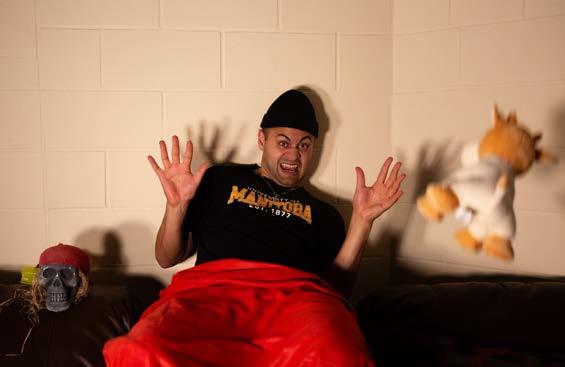
Experiencing fear in a safe and controlled environment like a haunted house offers an opportunity to practise feeling fear without real danger — much like a fire drill prepares students for emergencies.
“Nothing’s actually going to happen [to us], and so we can experience the sen-
sation, those psychological responses associated with fear,” Greening said. “We can practise experiencing them.”
Greening highlighted that while voluntary exposure to fear differs from involuntary fear, there is an element of practice involved in voluntarily experiencing something scary.
“It’s different, but similar enough that it might almost be like a practice — the practice of being in a threatening situation, the practice of being afraid,” he said.
To Greening, the Halloween season and activities like haunted houses exemplify that “fear, in certain contexts, can also be enjoyable.”
photo / Ebunoluwa Akinbo / staff
Advocating for the disability community
U of M professors tackle ableism through academia and activism
Rhea Bhalla, staff
eople with disabilities
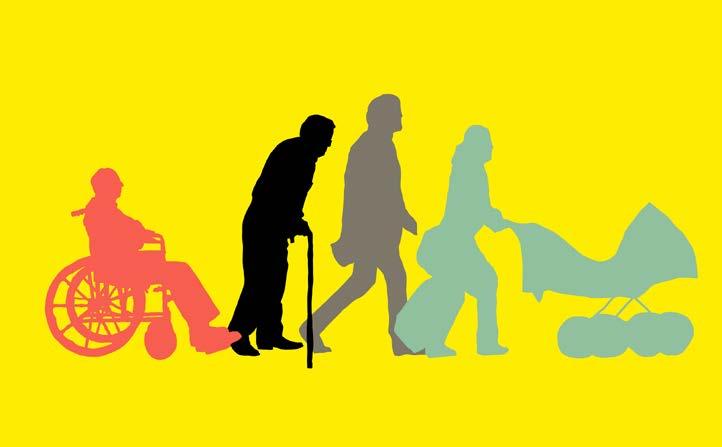
Pmake up 22 per cent of the Canadian population aged 15 and older. Despite being a global community of an estimated 1.3 billion people, they face numerous social, institutional and physical barriers. Advancing the rights of people with disabilities is a central goal to the work of advocates across Canada.
One of those advocates is Nancy Hansen, U of M professor and director of disability studies. As a person with a disability, Hansen noted the lack of disabled representation in academia.
The perspectives offered by academics with disabilities improve academia and the community, not just for people with disabilities, but for everyone.
These themes are explored in a 2018 book co-authored by Hansen, Untold Stories: A Canadian Disability History Reader. The 23-chapter collection provides an overview of the untold histories of influential Canadians with disabilities, many of whom brought about social change and paved the way to a more accessible future.
Their contributions have shaped disability rights and provisions outlined in the Canadian Charter of Rights and Freedoms, the United Nations Convention on the
ative and contribute meaningfully to society.
“Disabled people are the largest minority in the world, but it’s always a surprise when we show up,” she said. “We’re either exceptional or unexpected.”
For society to be inclusive, disability must be expected, respected and accommodated for.
“Disability is always present, whether or not it’s recognized,” Hansen said. “The world is a better place because we’re in it.”
“We need to say what we need and have people believe us.”
— Diane Driedger, U of M assistant professor of disability studies
“It’s incumbent upon us to pay it forward,” she said.
Hansen’s current research focuses on critical issues of disability justice, such as the impacts of conflict zones, housing access, medical assistance in dying and poverty rates among people with disabilities. Many of those Hansen works with in the field are activists and academics with disabilities, as the two are rarely mutually exclusive.
Rights of Persons with Disabilities and the Accessibility for Manitobans Act. These advancements in disability rights were significantly influenced by Winnipeg disability advocates, such as Doreen Demas, Jim Derksen, Yvonne Peters, Henry Enns, George Dyck and Allan Simpson.
Ultimately, Hansen hopes for disability to be viewed as a natural part of the human condition. She explained that people with disabilities are, often by necessity, highly cre-
U of M assistant professor of disability studies and co-author of Untold Stories Diane Driedger could not agree more.
Her involvement with the disability community began in 1980 while working with the Manitoba League of Persons with Disabilities (then known as the Manitoba League of the Physically Handicapped) as a university summer student.
“I was drawn in because so much was happening,” she said, describing the rapid advancement of the disability rights movement on a national and international level at the time. “I was not a person who had a disability at that time, but I really believed
in the rights of people to speak for themselves.”
Driedger explained that people with disabilities often experience others speaking for them, such as doctors or parents. These attitudes cost people with disabilities their voice and can infringe on their autonomy.
Familiar with past social justice movements, such as the women’s movement and the Civil Rights movement, Driedger became an active advocate with the disability community. For over 40 years, her work at the forefront of the disability rights movement led her to work locally and internationally for the cause. She has published 11 books, and is the chair of the Arts AccessAbility Network Manitoba, a group of disabled artists working to ensure that artists and audiences with disabilities are fully included in every part of the arts community.
10 years after becoming an ally to people with disabilities, Driedger acquired a disability due to fibromyalgia, which has symptoms such as musculoskeletal pain. As a longtime ally of the disability community, she recognizes people with disabilities often work in different, yet equally effective ways. Accommodation is vital to ensuring accessibility.
Driedger emphasized the importance of advocacy at
every level. When those with lived experience of disability advocate for themselves, decision-makers are better able to enact meaningful change for the community.
“We need to say what we need and have people believe us,” she said.
When it comes to change, there are few cities with a better track record than Winnipeg, Driedger said.
“People don’t know that about little old Winnipeg,” she said, referring to the many advocacy movements that have their roots in the city.
“We are the birthplace of disability rights.”
Over the decades, Winnipeg has become a hotspot for people organizing themselves. In 1982, Canada made a constitutional commitment in the Charter of Rights and Freedoms to equality for those living with disabilities, signalling a new era of accessibility and opportunity. This campaign was spearheaded by the Council of Canadians with Disabilities, a national group headquartered in Winnipeg.
Today, Winnipeg is the city where advocates like Hansen and Driedger work to advance disability justice.
“We as citizens have a lot to contribute,” Driedger said.
Change and adaptation in the flow of life
Growing and e volving amid moments of change
taeran An, staff
I think life is something that has to go through a process of constant change and adaptation. These changes are important parts of our lives, including changes in emotions, human relationships and in the environment. Everyone is caught up in this wave of change at least once, and what’s important in this process is the ability to adapt to new environments. These changes and adaptations present great challenges and opportunities for our growth and learning.
Personally, I have undergone three major environmental changes, and I have experienced adaptation and growth each time. Now, I am once again riding the wave of change and trying to find a better self.
The first time I experienced a major environmental change
was when I left for the United States as an exchange student in grade 10. After growing up in Seoul for 15 years, I suddenly started a homestay in a small town in the U.S. In Korea, I thought of myself as an extrovert and sociable person by staying only with people I knew at school.
The reality is that I couldn’t speak a word of English at that time, and I realized how difficult it was to be nervous and close to new people in a strange place. At that time, I think I should have understood myself better and prepared better for these changes.
was able to adapt thanks to the host family who enjoyed Korean culture at home and kindly taught me about Michigan and American culture.
After returning from Michigan, my desire to study at university in another foreign country grew during the time I finished high school.
Change and adaptation have made my life more prosperous
But I needed time for this, and I got to understand myself more deeply, adapting to the language and the new environment for about three to four months. In addition, I
After finishing high school, I moved to Winnipeg about two months later and entered the University of Manitoba Leaving Seoul after 18 years brought me through another major environmental change, as I was away from the convenience of a large city with high-rise buildings and convenient public transportation systems.
But at the time, I moved
without any information or preparation, so everything was unfamiliar from day one. Fortunately, I arrived in May, so I was able to adapt starting with summer, a relatively warm season. However, as winter came, I had a hard time facing the tricky weather and scenery. But as time went by, I became more attuned to life in this area. After graduating from the University of Manitoba this summer, I travelled for about three months, pursuing change once again. One of the difficulties was that communities related to my own interests were limited. At school, it was relatively easy to share and enjoy interests through club activities or classes, but it was difficult to find these activities after graduation.
I recently moved to Toronto,
where I rediscovered my passion for the city’s diverse activities and cultures. Currently, I’m looking for different communities related to my interests in Toronto and trying to expand my own local network by connecting with local culture. These experiences of change and adaptation have made my life more prosperous, and motivate me to continue to achieve self-development through change in the future. Change is frightening, but through adaptation and hard work, we can grow into stronger and more mature people. After all, these experiences allow us to reach our full potential and connect with the world in a cooler way.
photo / Taeran An / staff
RE: “U of M prof soft on Putin” A U of M alumna’s thoughts
Linda christian
Iwas taken aback to see
Matt Soprovich’s slanderous attack on University of Manitoba political studies professor Radhika Desai in the Manitoban, published Oct. 10, 2023. This “commentary” combined an ad hominem attack on the professor’s character with an array of clichéd, propaganda motifs about Russian president Vladimir Putin.
Soprovich found fault with Desai because she attended the Valdai Conference in Russia. This is a world-class forum. It is recognized and attended by geopolitical analysts, legal experts, economists, historians and philosophers from all over the world. Yet, Soprovich harped on the fact that Desai missed teaching a Thursday class to attend the forum, as if she was shirking her professorial duties to hob-nob with Putin. Attending such conferences is one of the duties of a good university professor.
Soprovich’s characterization of Desai is not only petty and slanderous, it is untrue. The mean-spirited characterization represents an inversion
of the professor’s actual qualities. She is one of the few who has the courage and integrity, both moral and intellectual, to stand up and speak for what she assesses to be true. Now, more than ever, people like Desai are needed here in Canada.
Soprovich says little about the content of Desai’s question to Putin: what did Soprovich think of the incident in Parliament where all of Canada’s elected officials, irrespective of party affiliation, gave standing ovations to an old Ukrainian Nazi?
Yaroslav Hunka, the old Nazi honoured in Parliament, was a former volunteer for Hitler’s Waffen SS Galicia division, notable for its butchering of Jewish and Polish civilians in the Second World War.
We are supposed to accept that the honouring of this Nazi was all the fault of former speaker of the house Anthony Rota. Are Canadians really so gullible as to think that the speaker alone was responsible for inviting Hunka to Canada’s Parliament? Are we supposed to believe that the Liberal government’s pledge of $650 million of tax-payer dol-
lars to Ukrainian President Volodymyr Zelensky was not a planned event? Are we supposed to believe that no one else in cabinet or government knew anything about it? It doesn’t add up.
Who is guilty of manipulating public discourse here in Canada? It’s not Putin. In introducing Hunka as a “Canadian hero” for fighting “against the Russians,” Rota falsified a very basic historical fact, and misleadingly implied that Canada was fighting with Ukrainian Nazis against the U.S.S.R. during the Second World War. Did Putin force every single member of parliament to stand up and clap for the old Nazi and the speaker’s falsification of history? Did Putin force Liberal House leader Karina Gould to motion that the shocking affair be struck from Hansard? He did not.
Let’s support Desai’s right to freedom of speech and conscience, and let’s fight the creeping resurgence of Nazism here in Canada, for all our sakes.
Linda Christian is a University of Manitoba alumnus.
Horrify your parents, ruin your body
Scars, ugly tattoos and body hair aren’t so bad
Jessie Krahn, staff
W
hen I got a tattoo, a relative asked me, “What are you going to do now that you’ve ruined your body?”
That relative is no longer with us — not by my hand. But I thought the question was interesting, because according to many people for most of my life my body had already been ruined.
I’ve had chronic cystic acne all over my body — yes, even on my butt — since I was twelve. No skin care routine aside from heavy medication can best it. People have always offered unsolicited, dermatologically novice advice for dealing with it because acne that bad was going to scar.
It did scar, and aside from one angry woman at a bus stop who yelled that I would get beaten up in prison for my acne, nothing terrible has come from it. I simply will avoid going to prison and I’ll show that lady. But my acne
and the constant unsolicited comments I received about it taught me an important lesson: it’s worthwhile to look a bit weird.
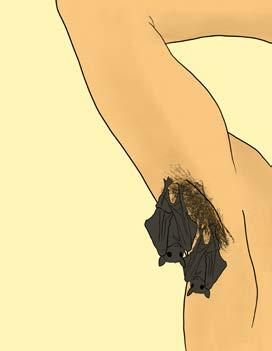
Just before the beginning of the pandemic, I started growing out the hair in only one of my armpits at a time. Every four to six months I shave both and alternate which one will be the hairy one. People don’t notice when I shave both pits. Meanwhile, if I let both grow out, I notice their eyes drift to my sides whenever I raise my arms. But when only one is hairy, people blank out and ask “why?”
I started doing it to see whether I liked the sensations of a bald pit or a hairy pit better. All I discovered was that both suck. The bald one chafes and the hairy one holds dampness for way too long.
The longer I’ve done this though, the more it has offered respite from the sorts of political decisions that we have to make about our bodies. Peo -
ple who hate me can’t call me a hairy-armpitted feminist without stating a falsehood — one is bald. And people who like me show they’re scrutinizing my body for weirdness even if they don’t mean to. People turn both my body hair and my lack thereof into a statement. When I do both, they panic and die.
When we see someone whose body looks different, we react with uncertainty, apprehension and even fear. Ableism is at the heart of the problem. The weirder a body looks to us, the more we make assumptions about a person’s fundamental character.
I don’t care if I’ve ruined my body. I’m a thin, able-bodied white woman, and even I have to deal with other people moralizing my body’s flaws whether I’m in control of them or not. There’s no winning. Ruin your body, I say. We’re all going to die anyways, and people need to learn to mind their business.
The human cost of conflict
There are no winners when wars are waged
braden bristow, staff
I am not an outright pacifist — sometimes war is necessary and sometimes it is justified. As a Métis person I feel the Red River Resistance of 1869 was wholly necessary, and I also feel that in the Second World War the invasion of Germany was unavoidable. However, war is the most depraved and horrific creation of mankind.
In the Red River Resistance, an anti-Metis agitator named Thomas Scott was executed by firing squad. Following the conflict, the Red River Expedition terrorized the people of Red River resulting in the death of at least one man, Elzéar Goulet.
In the Second World War, approximately 60 million lives were lost, with 45 million of that estimate being civilian deaths. Of course, had Germany not been invaded, the number of deaths would still range in the millions and were mostly civilian.
The terror and violence of war is especially relevant considering the current Russia-Ukraine and Israel-Palestine conflicts. While these conflicts frequently appear in our news media, the Geneva
Academy monitors at least 110 armed conflicts worldwide.
The conflicts in Ukraine and Israel-Palestine frequently appear in the media for good reason: these conflicts are horrific. As of Sept. 11, 2023 the Office of the United Nations High Commissioner for Human Rights estimates at least 27,000 civilian casualties in Ukraine alone. Meanwhile, the casualties rise daily in Israel and Gaza with numerous reports of violence and displacement.
I cannot claim to know how to resolve any international conflict with minimal loss of life, but nations and international leaders can take steps to reduce harm. Another example of action that can work toward peace is a United Nations expert demanding that Israel rescind its evacuation order for northern Gaza. The order has resulted in the displacement of approximately 500,000 Palestinians as of Oct. 17.
Historically, displacements such as this have resulted in losses of life that are entirely preventable. In 1838, 4,000 Cherokee lost their lives on the Trail of Tears during the forced displacement of 16,000
Cherokee. The calls for a ceasefire in Israel-Palestine are certainly a good place to start.
There is also a considerable negative effect on mental health for those trapped in active war zones, subjected to the threat of injury and death.
A study was conducted on 381 13-year-old students living in Hebron, a city in the West Bank — an active conflict zone. The study found that 295 participants experienced moderate to severe symptoms of PTSD.
While territory may change hands and generals may win medals, it is the people of these regions who suffer the most in all the conflict. Some conflicts may be justified, especially those that come in self-defence, but we have to think critically about the real consequences of war.
Generals, world leaders and those with the power to create and end wars are certainly the most responsible for conflict by far. Soldiers, by nature, are more so tools of these leaders.
In some nations such as Canada, there is entirely voluntary military service save for extreme circumstances such as the First and Second World
Wars which, in my opinion, means there is a greater deal of personal responsibility.
In other nations, such as Ukraine and Russia, there is mandatory military service. Though all soldiers are still responsible for their actions, these soldiers are more directly at the whim of their nation.
As I said, I am not a pacifist, and I am not under the impression that all our worldly con-
flicts can be resolved with kind words and offerings of peace. But I do know that we should avoid unnecessary death and war whenever possible. When war breaks out civilians are the first to suffer under the might of nations coming to blows. Even when a war ends, the pain of loss and suffering that comes with destruction continues for years to come.
graphic / Christina Tran / volunteer
graphic / Dallin Chicoine / staff
Fear, horror and gaming
Horror games take the next step in horror media
braden bristow, staff
I
n 1996 Capcom released Resident Evil for the original PlayStation, changing horror gaming and horror as a whole. Games such as Sweet Home (1989) for the Nintendo Entertainment System and Alone in The Dark (1992) had been out for years, but with Resident Evil’s dark atmosphere, violence and terror, the game was in a league of its own.
Horror games take the visual media established with horror film and push it beyond simple visuals and into the interactive.
observer, only along for the ride. By contrast, in Resident Evil the player directly controls Jill or Chris exploring a mansion infested with monsters.
In horror games, you can’t look away when things get intense, and you can’t just yell at the characters to stop being stupid because now you are the one in control. Silent Hill 2, which was released on the PlayStation 2 in 2001, takes the sense of terror even fur-
Silent Hill, which is covered in a thick fog as a soundtrack filled with droning sounds and ominous effects plays in the background Games like Silent Hill 2 specifically invoke feelings of being watched or even stalked in a safe environment without any unfortunate real-life implications.
The closest one can get to escaping a pursuer or wandering through a frightening location is through horror games
To clarify what I mean, I can use a horror movie such as Scream as an example, which was also released in 1996. Scream is a great movie in its own right. However, Resident Evil had something Scream did not. While a movie like Scream has violence and an imposing atmosphere, the viewer is always a passive
ther than Resident Evil does. While Resident Evil was an action horror, Silent Hill 2’s horror was much more atmospheric and imposing.
While Resident Evil’s mansion was highly detailed and had frightening style to spare, Silent Hill 2’s atmosphere is nothing if not oppressive. Throughout Silent Hill 2 the player explores the town of
Until technology advances to the point where media and reality are indistinguishable, the closest one can get to escaping a pursuer with no risk to their person or safely wandering through a frightening location is through horror games. Silent Hill 2 and Resident Evil allow us to get even closer to horror than a film does.
Silent Hill 2 and Resident Evil are aging, but the remake of Resident Evil 2 released in 2019 only intensified those feelings.
In Resident Evil 2 (2019) you attempt to escape a police sta-
tion infested with zombies with all the wonders of modern technology to enhance the experience. The environment is dark and frightening as you explore the police station. You can hear each footstep or creak of the building. As the game progresses, you are eventually hunted by an unstoppable monster throughout the police station, creating intense feelings likely not experienced since the days of being hunted by ancient lions in the Savannah.
The dark side of foreign aid
Foreign aid is neocolonial and undermines development
romin cheema, volunteer
Foreign aid, once seen as a beacon of hope for struggling nations, is facing scrutiny today as it perpetuates inequality and undermines economic growth in developing countries. There is a complex relationship between foreign aid and development, and it often serves Western interests while hindering progress in vulnerable African states and beyond.
Foreign aid has a long history, rooted in economic motivations. But today, it has taken on the form of neocolonialism. Instead of using direct military or political control, powerful nations employ globalization, capitalism and cultural influence to dominate and exploit weaker economies.
The dependency theory highlights how post-colonial states often accept Western conditions for loans and aid out of desperation, perpetuating their reliance on foreign assistance.
Financial institutions have become tools of neocolonialism, enabling a handful of powerful capitalist countries to exert control over weaker nations. They use for-
eign aid as a means of imposing economic pressure, political influence and cultural supremacy. As the line goes in the documentary Poverty Inc., “the reason there will be no change is because people who stand to lose from change have all the power and people who stand to gain from change have none of the power.”
During the 19th and early 20th centuries, European countries introduced tariffs to protect their markets and promote mass production in their countries.
Similarly, in neocolonialism, when these different organizations and governments bring in cheap foreign products or free products, it destroys local business and the state’s economy. Individuals do charitable work and inspire others to join them, while international organizations and non-governmental organizations (NGOs) contribute funds and resources with the noble intention of aiding national development. Although this comes from a good place, it does not work.
In Africa, foreign aid takes various forms, from project support to investment, but some view it as a means
of exploitation. Aid is often seen as ineffective in alleviating poverty, which exists despite the continent’s rich resources, such as oil and diamonds. The debate over aid’s efficacy continues, as it exacerbates income inequality and hinders economic growth and fosters corruption.
After the 2010 earthquake in Haiti, the influx of NGOs and foreign assistance appeared to turn a shortterm natural disaster into a long-term unnatural one. The organizations supplying free resources ultimately hurt Haiti’s economy, demonstrating the need to strike a balance between short-term relief and long-term development.
The influence of foreign aid on development is complex, shaped by ideologies promoted by entities like the World Bank and International Monetary Fund. These institutions often export neoliberalism, or the ideology that promotes free-market capitalism. These institutions perpetuate Western control over African development. In countries like Ghana, foreign aid has historically prioritized economic stability over labour interests, leading to economic
Horror games let us experience paranoia, fear or adrenaline on a level that is difficult to replicate on a movie screen. Because it is a video game, Silent Hill 2’s atmosphere and feelings of dread forces the player to continue. They can’t look away from the screen or sink into their chair.
Resident Evil and Resident Evil 2 (2019) makes the player defend themselves from attackers in a way they could only watch a terrified teenager or action star do so on screen.
imbalances.
The way states experience foreign aid varies, but common themes include volatility, unpredictability and difficulties in long-term planning. Donors often allocate aid according to their sectorial priorities, and these funds often come with conditions. The debate over foreign aid’s necessity continues, and alternatives to aid are explored. While NGOs have played a significant role in development, their shift toward charity and neoliberalism raises questions about their broader responsibilities and impact in Africa.
Promoting certain demographics of population as poor and malnourished through songs and media, the way some aid organizations do,
contributes to damaging stereotypes about people. Celebrities and organizations are guilty of perpetuating this cycle, passing it down to the next generation. It’s crucial to note that there’s no conclusive evidence that any nation has thrived due to government aid and donations.
While foreign aid aims to enhance the lives of those in need, it frequently falls short, perpetuating neocolonialism and obstructing genuine development. The world must reconsider its approach to assisting developing countries, recognizing the necessity for a fundamental shift that ensures aid achieves its intended purpose without reinforcing negative stereotypes and dependencies.
graphic / Christina Tran / volunteer
graphic / Teegan
Gillich / staff
Presentist paralysis and the desire for a more loving future
The world is scary, but we should not hide from it anymore
Hanako teranishi, staff
H alloween is quickly creeping upon us, and I wish the scariest thing terrorizing my dreams were goblins, ghouls and the other creatures that stalk the night. Ultimately, my heart is haunted by an ever-growing impending sense of a doomed future.
I have found myself brushing my teeth, writing, sitting in classes, even being amongst friends and having cold dreadful questions penetrate my heart, mind and soul: “what am I doing here? What is the purpose of any of this?”
My pre-existing and seemingly never-ending dread stems from high housing and food prices alongside unsustainable wages in Canada, the country being on fire, the recurring pushes to privatize social services the Manitoba Progressive Conservative government made, over 600 days of the Russo-Ukrainian war, the ongoing 75-year conflict between Israel and Palestine — and the list goes on.
What has pushed me to write are the most recent attacks on Gaza, which is referred to as the world’s largest open-air prison. Gaza is under a sea, land and air blockade that completely restricts Palestinian mobility and their access to electricity and clean water. Earlier this month, Israel ordered a complete siege of the area, preventing food, fuel, water and medical supplies from entering Gaza and only recently agreeing to conditionally allow aid in.
civilians because of the limited exit ways out of Gaza. This is a humanitarian crisis — and the word “crisis” should not be taken lightly — which, as stated by the organization Jewish Voice for Peace, borders the definitions of genocide. A United Nations (UN) expert has labelled what is happening in Gaza as an ethnic cleansing.
When I hear the words “crisis,” “genocide” and “war crimes,” I expect an enormous call to action and demands to protect human rights and to protect lives. Yet, there is a lack of discussion and national coverage of the atrocities being committed in Gaza against Palestinians.
My bones feel so heavy and my heart feels empty as I learn more and more. The phrase “information just washes over me” doesn’t describe my feelings. It implies this information doesn’t affect me and that it can just be brushed aside and ignored.
A future of repeated injustices and reproduced oppression is not a future I want to imagine for myself to live in
In Gaza since Oct. 7, thousands of Palestinian civilians, including children, have been killed by Israeli airstrikes.
Escape from the airstrikes and war is made close to impossible for Palestinian
This information cannot and should not be ignored. Information and horrors of the world we live in do not flow over us like water. These horrors are sap. They are sap that seeps into our pores and oozes under our skin. These horrors will never let us go. They will follow us and they will catch up with us.
I cannot turn away from the horrors and injustices in this world. They scare me, they make me want to run away and hide under my blan-
kets with a flashlight until the morning sun comes. But I cannot just sit and wait for the future to come to me. A future of repeated injustices and reproduced oppression is not a future I want to imagine for myself to live in.
We cannot sink into the manufactured comfort of our suburbanite safety blankets. I wish I was able to say things will get better or things will go back to normal as a sense of comfort, but I know things will never go back to normal. There was never a normal. Our world is a
revolv -
ing door of chaos and we must find ways of navigating through it.
Even with this heaviness in my bones, I still hold on to hope and the desire for a better, more loving and kind future. I have dedicated myself to finding a better future for myself and the people around me on this chaotic planet.
Instead of trying to find hope in a non-existent safe past, why don’t we look toward the future with risk? Together, by facing horror head-on we may create a bet-
ter world slowly but surely by taking a chance on those risks that lie beyond our existing ideas of safety.
I don’t have the answers to make the world better. I am still looking, and maybe I will never stop looking, but this lack of an answer gives me hope. We are not confined to one image of the future, but multiple. Instead of reproducing existences we’re comfortable with, let’s allow ourselves to imagine new realities and strive toward them.
Diversions
To complete Sudoku, fill the board by entering numbers 1 to 9 such that each row, column, and 3x3 box contains every number uniquely. In Straights, like Sudoku, no single number 1 to 9 can repeat in any row or column. But rows and columns are divided by black squares into compartments. Each compartment must form a “straight.” A straight is a set of numbers with no gaps but it can be in any order, eg [7,6,9,8]. Clues in black cells remove that number as an option in that row and column, and are not part of any
Straights Puzzle by Syndicated Puzzles Puzzle by Syndicated Puzzles
Sudoku
Ghosts and Mushrooms by: Christina Tran @stainedsmudges
10 by 40 orthogonal maze
We’ll never go out of style and neither will concert movies
My experience at the opening night of Taylor Swift: The Eras Tour film
Kelsey chin, staff
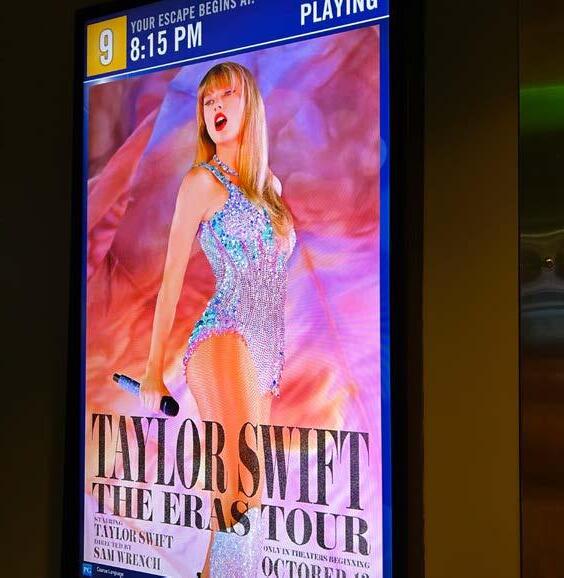
Stepping into Scotiabank Theatre for the opening night of the Taylor Swift: The Eras Tour film screening felt like stepping into a different world.
Attendees wore sparkly cowboy boots, Eras Tour merch or dressed like Swift herself. Most congregated at the concession stand, waiting in line to get their hands on precious cargo — Taylor Swift: The Eras Tour drink cups and popcorn buckets.
While in the lobby I spoke with Rebecca Kirk, her daughter Heather Kirk and her friend Calleigh Pritchett. Kirk and her daughter were dressed up for the occasion, one sporting a pink cowboy hat and sparkly pink top, the other’s attire reminiscent of Swift’s in the “22” music video.
After they were unable to get tickets for the Toronto live show, coming to the movie concert together seemed like a no-brainer.
Heather Kirk believes Swift’s popularity is partly because she is not just a musician, but a role model as well.
“She does more than just sing, she’s talked about her political views,” she said. “Some of her songs are about important things in society, and I think most teenage girls look up to her.”
Pritchett pointed to Swift’s history encouraging people to participate in voting as a notable example of the impact the artist can have on the world.
“I think she’s really, really smart,” said Rebecca Kirk. “When you listen to her lyrics, she’s an amazing lyricist, she’s up there with anybody you can think of and she reinvents herself all the time. She’s made some amazing power moves as just a businesswoman, so sort of [an] all-around smart woman who has made it in this industry.”
Also attending were Morgan Kopytko, Kay Miller and Jess Sodeinde, who, like myself, were wearing friendship bracelets. We exchanged bracelets, a customary practice since the Eras tour first started. It was friendship at first bead all around.
Kopytko mentioned how she went to see Swift perform live in Minneapolis this past summer, a show I went to as well.
“I’m kind of hoping there’s
“Some of her songs are about important things in society, and I think most teenage girls look up to her”
— Heather Kirk, Taylor Swift fan
stage, so while I had already gotten lots of close-ups on the concert screens, part of the main stage was blocked from my vision. I was hoping the film would showcase more of the stage, the dancers, the action and the spectacle that I may have missed at the live show.
so, focuses on Swift herself. This is swell. This is what the people want to see, but “look at how my tears ricochet.”
Miller and Sodeinde had never seen Swift perform live before, but Kopytko had. She came to have the experience again in a new way and to share it with people who haven’t attended a concert like Miller.
a little bit of voice-overs, more like her other concert movies,” said Kopytko. She added that she looked forward to having a better view at the screening than the concert. “I’m looking forward to having a lot better of a close-up.”
I sympathized with Kopytko’s comments but had the opposite feeling going into the film. My seat at the concert was towards the side of the
When I went into the theatre and found my seat, the people to my left offered me friendship bracelets— and again I participated in trading. Then I passed the other bracelets they made to my right, to share the friendship.
Soon the film started to play. It was wonderful, magical and electric. However, I was a little disappointed to see that Kopytko’s hopes were more gratified than my own. The film, probably rightly
When I go to a concert, I want to see the full spectacle. I want to feel the community of those I’m surrounded by, as we all take part in — and are a part of — this electrical, ephemeral moment that is the concert itself. I want to feel the energy of those up on the stage and hear and feel the power of the voice that sings. I want it all. Was that too much to ask for from the concert film?
As the main draw was obviously Swift herself, it appears the answer was yes.
Despite my sulking, I had a marvelous time, and so did the rest of the theatre.
The nearly three-hourlong film takes viewers through Swift’s many “eras,” also known as her different albums, all the way through to her latest album, Midnights.
Throughout the film, groups of people in the theatre started to stand and sing along. Some people were even dancing, myself included. Some of the hype may have come from the fact that 1989 (Taylor’s Version) is coming out this Friday, Oct. 27. Despite some of the drawbacks inherent to being turned into a movie, the Taylor Swift: The Eras Tour movie concert is one for the books. It is filled with light, love, darkness and energy.
Best of all, though, it’s communal. It provides a space for people who love Taylor Swift to connect and share in joys, pains and dreams, and a chance to scream, shout, sing and dance the night away.
So, make the friendship bracelets. You’re not on your own, kid — you never have been.
photo / Kelsey Chin / staff
The ’Toban staff’s spooktacular Halloween media picks
Creepy content to curl up with for Halloween
The Thing (1982)
John Carpenter’s The Thing (1982) is a masterwork of horror filmmaking. The oppressive, cold atmosphere evokes an extreme paranoia in the audience from the start of the movie to the appearance of the eponymous “Thing.”
The fact that part of the movie was filmed in refrigerated sets and on real glaciers does a lot of work to build this atmosphere. When the creature is not in frame, it feels as
Hellraiser (1987)
To be honest, I am an absolute freak who watches this movie year–round, not JUST for Halloween. However, for the non-freaks out there, Hellraiser, directed by Clive Barker should be your ’80s horror movie pick for the remainder of the Halloween season simply because, in my opinion, modern horror movies hardly catch the gory campiness and eroticism of the time Hellraiser was released.
Frankenhooker (1990)
The full title of Mary Shelley’s 1818 novel Frankenstein harkens back to the story’s tragic Greek inspiration. Frankenstein; or, The Modern Prometheus ruminates on — or portends, really — the horrific outcomes awaiting humanity as science enables us to twist the world to fit our own snarled imaginations. The 1990 dark comedy Frankenhooker invites audiences to zoom in on the question of
The Addams Family (1991)
Barry Sonnenfeld’s brilliant 1991 film, The Addams Family, is a Halloween classic. It is almost too well-known to put on this list. We have all seen the gif-sets. Some of us have dressed up as Wednesday Addams for Halloween at the last minute when all we could find was a black wig, a dress that we last wore to our grandfather’s funeral and a dour expression — or maybe that’s just me.
Stranger Things (2016)
What better way to get into a spooky vibe than with Stranger Things? I was recently introduced to the series through one of my film studies classes, and I have to say, I like it a lot more than I anticipated. I’m not typically a person who enjoys the scary or horror genre, but this show quickly captured my attention.
What made it different, palatable and in truth, “good”
’Toban Listens: The Magnus Archives
Eldritch horror, a skeptical archivist and terrifying cryptids
Jacob Davis staff
“Statement begins.”
Those two words are familiar to anyone who has tuned into Rusty Quill’s horror fiction podcast, The Magnus Archives (MAG). The weekly anthology series is produced by Rusty Quill, directed by founder and CEO of the company Alexander J Newall and written and performed by Jonathan Sims.
If Lovecraftian horror and the universe of the SCP Foundation had children, one of them would be MAG. The series follows protagonist Jonathan Sims, newly appointed head archivist of the Magnus Institute, an organization that researches the paranormal and weird, as he sifts through a disorganized collection of supernatural statements in dire need of a categorical upgrade.
Despite initially dismissing these statements, Sims, his team and the listener start to realize as the series progresses that something is not quite
right, and that something may even be lurking within the archives.
Each episode opens with a haunting violin tune accompanied by a brief introduction to the series and the episode title followed by a brief loud banging sound. The listener then hears the iconic clicking sound of a tape recorder as Sims introduces the episode’s statement.
These stylistic choices are some of the series’ strongest points, making the listener feel like they are hearing a pre-recorded tape of a real archivist somewhere in London. My favourite kind of podcast is a horror podcast, yes, but especially one that transports its listener into its world through clever use of the podcast form. Despite having no imagery or visuals, MAG creates another world through its masterful use of audio.
For example, near the series’ season one finale, episodes are still presented as recorded tapes, but not just of state-
ments. They are instead conversations between archive staff, or an interruption caused by an incident inside the institute that exposes the listener to the perilous fates of Sims and his coworkers, ending on a cliff-hanger.
I have often found myself completely immersed after such an escalation occurs. More times than I can count, I have shot up to attention at the sound of yelling, or when I’ve heard something in the room that Sims himself has yet to notice. It is for this reason that I cannot recommend MAG for studying.
Too many times I have fallen victim to procrastination due to this podcast. It is too engaging too frequently to zone out to and despite being a weekly anthology series, the overarching plot involving the archive itself is littered throughout each episode in some manner that will come full circle in later episodes and seasons.
One could listen to it while
doing a mindless task like washing dishes, knitting or taking the bus, but the ultimate listening experience for MAG is in bed at night with the lights off. Will you get any sleep? No, absolutely not. Will it be worth
it despite the eldritch nightmares falling asleep to an episode might bring? Yes.
Happy Halloween! “Statement Ends.”
photo / provided
Sports
Bison briefs
Grace Anne Paizen staff
Bisons cross-country
The Bisons cross-country team had impressive finishes in the Stewart Cup on Saturday, Oct. 14, in Alberta.
The herd had four Bisons in competition. In the women’s 6k, Angela Kroeker finished ninth with a time of 24:25 and rookie Lena Klassen finished a second behind in 10th place. In the men’s 8k, Justin Kroeker had a fantastic race, finishing in second place, just five seconds behind the leader. Teammate Noah Fillion finished 14th with a time of 27:56, with all Bisons placing within the top 15 of their respective races.
This last Saturday, Oct. 21, saw the team have a successful Chris McCubbins Provincial Championships at home.
On the women’s side of the team under the Bisons banner, Natalie Fournier placed first in the women’s 6k U20 (under 20) race, three minutes ahead of the rest of the pack.
Bisons Sophia Alexander, Amy Shier, Maisey Williams and Lily Francis placed sec-
ond through fifth in order, all recording times under 30 minutes. In the women’s 8k Senior race, Annika Niblock placed first in the race, clocking in at just under 36 minutes, while Shayna Giesbrecht placed a close second and Aspen Shier third.
On the men’s side under the Bisons banner, Wylie Garchinski placed first in the men’s 8k U20 race. Jonah Leppelmann placed second, just five seconds behind Garchinski, while Alejandro Civetta placed third. In the 8k Senior race, Gavin Maxwell placed second, just eight seconds behind first. Unai Apraiz Zenon placed third, just six seconds behind Maxwell, while Dylan Peters placed fourth.
The herd’s next race is the CanWest Championships on Oct. 28 hosted by the University of British Columbia-Okanagan Heat in Kelowna, B.C.
Bisons football
The season will come down to the last game this week
for Bisons football after the team’s 35-25 loss against the University of Alberta Golden Bears last Friday night at IG Field.
With a Bisons win or University of Calgary Dinos loss on the out-of-town scoreboard this past weekend, the herd would have punched its ticket to the post-season. However, the Dinos squeaked their second win on the season last Saturday afternoon, meaning the Bisons’ and Dinos’ seasons will be decided on Saturday as the clubs go head-to-head at McMahon Stadium in Calgary. The victor will play the Hardy Cup semifinal.
The herd kept the game impressively close against the CanWest Conference-leading Golden Bears. The Bisons defence forced a two-andout to start the game before the offence capped off its first drive of the game with a major. The Bisons scored two touchdowns in the first half, with quarterback Jackson Tachinski calling his own number in the first quarter before finding receiver AK Gassama in the second.
For the majority of the second half the teams exchanged field goals before running back Breydon Stubbs punched in the herd’s third touchdown of the night, pulling within a field goal of the Golden Bears’ lead. Unfortunately, the Golden Bears blocked the tying field goal attempt, and even though the defence got the ball back in the QB’s hands for a final push into field goal range once more, Tachinski threw an interception that would ultimately result in an Alberta touchdown on the Golden Bears’ final drive.
Bisons women’s volleyball
The Bisons women’s volleyball team picked up right where it left off last season in the regular season and home opening series Friday and Saturday at Investors Group Athletic Centre. The herd swept the University of Regina Cougars, winning three straight sets in both games.
In Friday night’s match, Katreena Bentley registered a massive 31 assists. Bisons
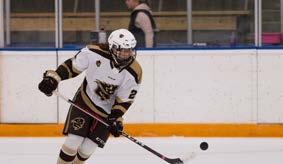
Bisons hockey plays whirlwind series
Women’s team sweeps Griffins, while MacEwan sweeps men’s team
Quinn Mayhew, staff
The University of Manitoba Bisons women’s team rallied against the MacEwan University Griffins after two devastating losses against the University of British Columbia Thunderbirds last weekend.
The herd bounced back against the Griffins and showed dramatically improved team collaboration and great defensive work during Friday night’s game, picking up the first win of the season while defending home ice at the Wayne Fleming Arena. When the Griffins took their foot off the gas, the herd put the pedal to the metal.
The Bisons took their first penalty 46 seconds into the game, setting a physical precedent.
The game’s first goal was scored by Makenna Schuttler from MacEwan, who capitalized on the Griffins’ power play before Allee Isley put MacEwan up by two goals.The Bisons counterattacked, surrounding the Griffins in their zone. Taking advantage of the previous puck battle won by Bison Glory Plett, Bison Rachel Gottfried scored the
first point of the game for the U of M before the first intermission.
The herd’s momentum carried into the second frame, with Camille Enns firing an otherworldly wrist shot on net to score her first point of the season and the second goal for Manitoba.
The Bisons dominated the rest of the game, cleaning up with a 6-3 win over the Griffins.
The winning streak carried over into Saturday’s game against MacEwan, but not without a challenge.
Although the first Bisons point of the game was scored 28 seconds in by Kylie Lesuk, the celebration was shortlived, with the Griffins scoring their first power-play goal of the game later in the frame.
The Griffins went into the first intermission blazing, netting two points in the first period and leading Manitoba 2-1.
The Bisons quickly bounced back, tightening up defence in their own zone and playing the second period with a mission.
The herd scored three goals in the second, beginning with Katie Gregoire’s goal 52
seconds in on a breakaway that tied the game 2-2.
Two minutes later the Bisons found themselves on the power play, allowing Sarah Dennehy to score the Bison’s third goal of the game and the Bisons to pull ahead of the Griffins. The Bisons lead was further cemented after Ashley Keller made the game 4-2 for Manitoba.Despite a late MacEwan goal in the third, the Bisons held on against the Griffins, narrowly beating them 4-3.
Across the Prairies, the Bison men’s team was hosted by MacEwan in a rough weekend series on Edmonton’s ice.
The Griffins monopolized the puck the entire first game from start to finish, staying tight on defence and constantly putting offensive pressure on the herd — MacEwan’s Ethan Strang recording the first-ever Griffins hat trick in a CanWest hockey game.
Although the Bisons experienced a devastating loss, goaltender Kolby Thornton made 23 saves in net.
The Bisons did attempt to fight back in the second frame, outshooting MacEwan 15-9, but could only sit and watch
2022-23 Female Rookie of the Year Raya Surinx registered 13 kills, three blocks, three aces and eight digs, while veteran Julia Arnold was quick on the defence with 11 digs.
The herd dominated the opening set before changing leads with Regina in the second, the Cougars forcing extra points. The third set was close, but Manitoba ultimately came out on top in the first shutout of the weekend.
On Saturday, the first set of the game started off close but the Bisons would gain momentum mid-set and dominated the rest of the game to record the second sweep of the weekend. In the second contest, Ella Gray led the team in the attack alongside Surinx and veteran Light Uchechukwu, who registered 12 and 10 digs, respectively.
The women’s team will be on the road next weekend, hosted by the University of the Fraser Valley Cascades in Abbotsford, B.C.
as the Griffins continued to outscore and outmaneuver them.
The herd just could not get going in the game, losing 5-0.
Saturday night’s game kicked off with the Bisons looking for redemption after the five-point shutout loss.
The first goal of the game was scored by Bison captain Jonny Hooker late in the first period before the Griffins punched back with a goal of their own.
The Bisons hit back before the buzzer, going into first intermission 2-1 over MacEwan.
While Manitoba failed to score throughout the second and third periods, the Griffins were consistent and steady, scoring in both and tightening up their lines.
The men’s team ultimately lost Saturday’s game to MacEwan 4-2 and remains in search of its first win of the season.
Both the men’s and women’s teams face off against the Mount Royal University Cougars this weekend, with the men playing at home and the women on the road
The herd looked confident going into the second frame, but were outshot by MacEwan, who were hungry for another win.
photo / Matthew Merkel / staff
Josh on the Jets: 2023-24 outlook
Storylines and players to keep an eye on this season
Joshua brandt, staff
The highs of being a Winnipeg Jets fan can be very high — the city-wide euphoria when the team returned, the 2018 Western Conference Final run and, of course, the joyous delirium of whiteout parties.
However, the lows are likewise very low. Take last April, for instance, when head coach Rick Bowness lambasted his team fresh off an uninspired game five performance in which the Jets lost their firstround playoff series to the Vegas Golden Knights. In his post-game press-conference, Bowness said he was “disappointed and disgusted” because the team had “no push back.” But time heals all wounds and the next season is here, full of promise, hope and change, so here’s a few things to keep an eye on.
An offseason to remember
When the Winnipeg Jets went into the summer of 2023 with a gale of rumors, questions and doubts gusting from the prematurely deserted Canada Life Centre, the team’s future seemed bleak.
Many wondered what the team was going to do with aging former-captain and franchise points leader Blake Wheeler. Popular sentiment around the club was that it was
time for number 26 to move on. He had given his heart to the organization, but he just could not compete at the level the Jets needed him to anymore. Consequently, after failing to find a trade partner, the team bought out his contract and he signed a new deal with the New York Rangers.
Moreover, Pierre-Luc Dubois, who was unwilling to sign long-term in Winnipeg, was the next domino to fall. Many thought the French Canadian was seeking a return to the province of his hometown, Quebec, and sign with the Montreal Canadiens. However, in a sign and trade deal, Jets general manager Kevin Cheveldayoff sent Dubois to the Los Angeles Kings in return for three solid players and a second-round draft pick, which was heralded by many as a brilliant move.
Furthermore, this summer the Jets — who were captain-less during the 202223 season after freshly hired Rick Bowness stripped Blake Wheeler of the C — named fan-favourite, heart and soul player Adam Lowry the third captain in the team’s history.
The most significant transaction of the summer, however, was an internal one. Most pundits thought topline centre Mark Scheifele and Vezina-calibre goaltender Connor Hellebuyck — both of
whose contracts were expiring at the end of the 2023-24 season — were going to be traded alongside Dubois.
The Jets obviously had other plans. Not two days before the team’s opening game, the pair were re-signed to identical seven-year deals — a bold move that shows fans the team still wants to win.
Attendance concerns
The move to re-sign Scheifele and Hellebuyck did not come out of a vacuum, however. Through the first three home games of the year, the club has been dealing with noticeable attendance concerns.
The purpose of this section in the paper is not to diagnose the potential economic or social factors behind the drop off in in-person fan support, but it is a reality that can be observed clearly at the once packed rink. Some of the players are even noticing it.
On a positive note, students at the University of Manitoba can access cheaper tickets by texting “STUDENT” to +1-888606-5378, should they wish to take a break from studying and go to a game.
Key players
Ultimately, if all else crumbles, Hellebuyck needs to be elite for the Jets to suc-
ceed. Even if things go well, he still needs to be. And the Vezina-winning goalie has been consistently terrific. Although, to start this season, he’s been a bit wobbly, maintaining a pedestrian .878 save percentage, which will need to improve.
Moreover, a breakout year for speedster Nikolaj Ehlers plus a spell of good health would do wonders for this club. Over the last three seasons, Ehlers has been scoring .90 points per game. The trouble is, he has not played a full year without injury since 201718.
Another challenge is how the Jets can make up for the absence of Dubois and Wheeler. One hopes it would come from the trio of players acquired from the Kings — Gabriel Vilardi, Alex Iaf-
Sports teams’ schedules
U of M Bisons — Women’s Hockey
MacEwan Griffins @ Bisons
Oct. 20 — Final: 3 – 6
MacEwan Griffins @ Bisons Oct. 21 — Final: 3 – 4
Bisons @ Mount Royal Cougars Oct. 27 — 8 p.m.
Bisons @ Mount Royal Cougars Oct. 28 — 4 p.m.
U of M Bisons — Women’s Volleyball
Regina Cougars @ Bisons
Regina Cougars @ Bisons
Bisons @ UFV Cascades
Bisons @ UFV Cascades
U of M Bisons — Men’s Hockey
Bisons @ MacEwan Griffins
Bisons @ MacEwan Griffins
Mount Royal Cougars @ Bisons
Mount Royal Cougars @ Bisons
Oct. 20 — Final: 0 – 3
21 — Final: 0 – 3
27 — 9:45 p.m.
28 — 8:45 p.m.
Oct. 20 — Final: 0 – 5
21 — Final: 2 – 4
U of M Bisons — Men;s Volleyball
Bisons @ UFV Cascades
Bisons @ UFV Cascades
falo and Rasmus Kupari, who combined for 40 goals in 202223. However, the recent MCL injury to Vilardi, who already has an inauspicious injury history, muddies those hopes significantly.
Final projection
Nonetheless, according to the predictions from The Athletic, the Jets had a 70 per cent chance of making the playoffs at the beginning of the season. However, after going 2-3 in their first five games, the team’s chances have dropped to 66 per cent. Nevertheless, on paper, the Jets should make the playoffs, with the clinching of a wildcard spot the most likely scenario. But a Stanley Cup? Well, that seems like a pipedream for the moment.
U of M Bisons — Cross Country
Canada West Championships
U of M Bisons — Football
Alberta Golden Bears @ Bisons
@ Calgary Dinos
Winnipeg Blue Bombers
Edmonton Elks @ Bombers
Winnipeg Jets
Los Angeles Kings @ Jets
27 — 8 p.m.
graphic / Teegan
Gillich / staff
Around-the-horns, vol. 3
Bisons athletes to celebrate this Women’s History Month
Grace Anne Paizen, staff
F or those following
Bisons sports, it has been a privilege to watch the women athletes make history and emanate excellence this year. It would be remiss to not take a moment to celebrate an exciting time in sports at the university.
As Women’s History Month wraps up, here are some phenomenal current and former Bisons who have made a mark on their respective programs, and who carry the torch of excellence beyond varsity sports.
onships last season. Winning Female Field Athlete of the Year at CanWest, Lawrence went on to grab that title at the U Sports level as well after winning double gold in both CanWest and U Sports in the pentathlon and high jump. Lawrence set a Bison record at U Sports with her 1.80metre high jump and in pentathlon points, with 4114. Her points record is the fourthmost in U Sports history, and
the team. Surinx also represented Team Canada beside fellow Bison Ella Gray at the Pan American Cup this summer and finished the tournament ranked number one on Team Canada and seventh overall for points.
Maya Turner, football
It would be remiss to not take a moment to celebrate an exciting time in sports at the university
Karina Bagi, soccer
Having just wrapped up her final year with the herd, Bisons goalkeeper Karina Bagi now holds two giant records in the women’s soccer program.
The Kelowna, B.C. native recorded the most saves in a single game over the University of British Columbia Thunderbirds with 17, and as of the Bisons final game of the season, Bagi holds the record for most saves in program history with 232 over her tenure with the herd.
Lauren Bartlett, basketball
With the women’s basketball season ready to tip off at the beginning of next month, point guard Lauren Bartlett is one to watch this season. The 2022-23 women’s basketball MVP, Bartlett recorded the women’s basketball single-game assists record, the second most single-game steals record and earned the fifth triple-double in program history this January in a dominating contest against the MacEwan University Griffins. Madisson Lawrence, track and field
Despite a healing broken toe, track and field’s Madisson Lawrence was named 2022-23 Bison Female Athlete of the Year for her outstanding performance at both the CanWest and U Sports Champi-
she has one more year of eligibility left with the herd as the new season is set to start in November.
Desiree Scott, soccer
This list would be incomplete without mentioning former Bison midfielder Desiree Scott. The first individual Bison athlete to be inducted into the Canada West Hall of Fame, Scott has three Olympic medals for Team Canada under her belt, including a gold medal at the Tokyo 2020 Olympics. She has won a gold in the 2011 Pan American Games and 2010 CONCACAF Gold Cup, as well as a CONCACAF U20 silver medal with the team.
Although she was out with a knee injury for the 2023 FIFA Women’s World Cup, she has already left her mark on the Canadian women’s soccer program, and was inducted into the Order of Manitoba in the summer of 2022 for her illustrious career.
Raya Surinx, volleyball
Already hot on the court this season, Raya Surinx was not only the 2022-23 Female Rookie of the Year but recorded a whopping 417 kills in her rookie season alone, nearly matching what some of her teammates have recorded over multiple seasons with
The first woman to make points in a U Sports football game, the first woman to dress for a regular season U Sports football game and the first woman to make points in a regular season U Sports football game — including the game winner — are just some of the many feats in Maya Turner’s budding career as kicker with the herd. Turner has a .750 field goal percentage, her longest a 48-yarder against the University of Regina Rams, and holds a perfect point-after record. Her foot has helped the Bisons turn their season around and make a push for the post-season.
Kelsey Wog, swimming
When swimmer Kelsey Wog graduated in 2022, she had already qualified and swam in finals for Team Canada at the Tokyo 2020 Olympic games. The 2019-20 U Sports Female Athlete of the Year, most-decorated Bisons swimmer of all-time and holder of five U Sports records is currently representing Canada at the 2023 Pan American Games in Santiago, Chile.