RESEARCH & TECHNOLOGY DESK ? research@themanitoban.com
Michael Campbell (ed.)
Emma Rempel
COMMENT DESK ? comment@themanitoban.com
Lucas Edmond (ed.)
Ivan Nuñez Gamez
ARTS & CULTURE DESK ? arts@themanitoban.com
Shaylyn Maharaj-Poliah (ed.)
Alex Braun
Zoë LeBrun
Grace Paizen
SPORTS DESK ? sports@themanitoban.com
Matthew Merkel (ed.)
Isaiah Wagner
PHOTO DESK ? photo@themanitoban.com
Basel Abdelaziz (ed.)
Mohammad Arsalan Saeed
DESIGN DESK ? design@themanitoban.com
Matthew Doering (ed.)
Mikaela Warkentin
GRAPHICS DESK ? graphics@themanitoban.com
Dallin Chicoine (ed.)
Marina Djurdjevic
AUDIO DESK ? audio@themanitoban.com
Josh Wesey (ed.)
SOCIAL MEDIA DESK ? social@themanitoban.com
Molly Smyth (ed.)
Audra Ashley
VOLUNTEERS THIS ISSUE ?
VOLUNTEER STAFF ? Emily Unrau-Poetker
interested in volunteering? email me@themanitoban.com today!
THEMANITOBAN.COM
109 HELEN GLASS BUILDING
UNIVERSITY OF MANITOBA
WINNIPEG, MB
204. 474. 6535
The Manitoban is the official student newspaper of the University of Manitoba. It is published monthly during the summer and each week of regular classes during the academic year by the Manitoban Newspaper Publications Corporation.
The Manitoban is an independent and democratic student organization, open to participation from all students. It exists to serve its readers as students and citizens.
The Manitoban is a member of the Canadian University Press, and our journalistic standards can be found online at toban.news/jsp.
The newspaper’s primary mandate is to report fairly and objectively on issues and events of importance and interest to the students of the University of Manitoba, to provide an open forum for the free expression and exchange of opinions and ideas and to stimulate meaningful debate on issues that affect or would otherwise be of interest to the student body and/ or society in general. The Manitoban serves as a training ground for students interested in any aspect of journalism.
Students and other interested parties are invited to contribute to any section of the newspaper. Please contact the appropriate editor for submission guidelines.
The Manitoban reserves the right to edit all submissions and will not publish any material deemed by its Editorial Board to be discriminatory, racist, sexist, homophobic or trans-phobic, ableist or libellous.
Opinions expressed in letters and articles are solely those of the authors. Editorials in the Manitoban are signed and represent the opinions of the writer(s), not necessarily those of the Manitoban staff, Editorial Board or the publisher.
A “volunteer staff” member is defined as a person who has had three volunteer articles, photographs or pieces of art of reasonable length and/ or substance published in the current publishing year of the Manitoban.
Any individual who qualifies as a volunteer staff member must be voted in by a majority vote at a Manitoban editorial board meeting. Elected representatives and non-students may be excluded from holding votes as volunteer staff members in accordance with the Manitoban Constitution.
In an increasingly wireless and connected world, we rely on our devices to communicate with each other constantly and autonomously on our behalf. Wherever there is a wireless connection, there is an antenna to send and one to receive data. The design of antennas and the networks that allow for their communication is crucial to the continuing use of the internet in our devices. Leading this charge is Ekram Hossain, a professor in the electrical and computer engineering program at Queen’s University working on improving wireless systems alongside University of Manitoba alumna Hayden Banting.
Antennas are one of the basic building blocks of electronics. They work by transforming an electrical signal, embedded in wires and circuitry, into waves in free space. They also work in reverse, receiving waves and transforming them into signals.
Antennas have become more diverse and sophisticated than the classic television antenna. Wireless networks have also become more sophisticated than the traditional wireless link of a cellphone’s connection to a tower.
Researchers employ many methods to improve our wireless devices and networks “The scope of these problems and challenges have really evolved quite recently”
In today’s smartphones, many different types of communication occur simultaneously. There are different antennas within the device for each type of connection, including Wi-Fi, GPS, Bluetooth and cellular. Each antenna needs to be individually designed and optimized for its desired function. They are also used in an increasing array of devices: smartwatches, wireless headphones and medical devices worn on the body. Many of the safety features in cars rely on wireless systems. The broad range of uses for these devices requires a broad range of designs.
“The scope of these problems and challenges have really evolved quite recently,” said Banting.
More devices have become part of what’s known as the Internet of Things (IoT). The IoT refers to objects, often household ones, that are interconnected through wireless communications. These devices can “talk” to each other, sharing data for various purposes.
According to Hossain, one of the primary challenges in designing wireless networks to accommodate the IoT is that these signals are generally less reliable than wired channels, leading to transmission errors. Another challenge is working within the constraints of limited resources, like power and bandwidth. There are also security concerns to be addressed, since devices connected to the internet can be vulnerable to attacks and interference.
staff
— Hayden Banting, PhD candidate
One of the goals of Hossain’s research is to optimize wireless systems to improve coverage, connectivity, capacity and reliability. Optimization is the mathematical search for the best balance of parameters to achieve the desired result within a set of constraints. It is the systematic process to find the best solutions in engineering and electronics.
Banting is working to optimize the design of antennas. Antenna design requires various parameters to be balanced, often without knowing the outcome of various tweaks and modifications before they are implemented. He relies on simulations to sort through a high number of potential solutions.
One strategy Banting is exploring uses the principles of biological evolution.
An algorithm applies these principles to the design process to generate optimal antennas for a given purpose.
In nature, parental genes recombine to produce offspring with a unique set of genes that may or may not provide an advantage in their environment. Individuals in a population with advantageous genes are then favoured by natural selection. Over many generations, the population can acquire these advantageous traits to become more suited to their specific environment.
“Nature does a pretty good job of optimizing,” said Banting.
In Banting’s work, the parallel for the population of living organisms is a diverse set of potential solutions for antenna design. These designs vary
across parameters like size, shape, placement and composition. Through simulation, they are then mixed and combined, like parental generations reproducing to create offspring.
In this way, engineers can simulate and test thousands of different trait combinations to reach a desired outcome. Here the success of an individual to suit their environment is analogous to how well the antenna meets its design specifications.
“It’s actually [the best] way to solve these really complex and challenging design problems.”
research@themanitoban.com
/ Dallin Chicoine /
TOB AN the MANI
Omicron proof vaccine patents must be waived
Variant could have been avoided if public good were prioritized over greed
EDITORIAL
In a rare piece of good COVID-19 news, researchers in Texas are developing a COVID-19 vaccine called Corbevax that developers say will be based on conventional vaccine technology, will be cheaper to produce and less complicated to store. Crucially, they do not intend to patent the vaccine, hoping this will make it more accessible in low-
countries.
Meanwhile, rich nations have been hoarding and wasting vaccines while people in less affluent countries are dying in droves. The One campaign estimates G7 countries had almost 600 million unused vaccines by the end of last year.
These same affluent nations, along
The pharmaceutical industry is already one of the most profitable in the world. A 2020 study published in the Journal of the American Medical Association found the median net income margin — the percentage of revenue received after deducting expenses — of 35 large pharma companies is nearly double that of 357 non-pharma companies listed in a stock index that tracks 500 of the largest publicly traded stocks in the U.S.
Further, pharmaceutical companies have already made astronomical profits from their COVID-19 vaccines. In 2021, Pfizer expected to make nearly as much revenue from its COVID-19 vaccine alone as it did from all sales in 2020.
free market enthusiasts unmoved by arguments based on social responsibility, how much global economic strife should the world be willing to accept to maintain rich nations’ unyielding ideological commitment to intellectual property rights?
Even if innovation were reduced by waiving patents, innovation has already been diminished by a global pandemic that has wreaked havoc on the global economy and ruined the livelihoods of numerous aspiring and innovative entrepreneurs.
quasi-lockdown we currently find ourselves in.
Some political figures have called for patent protections on existing COVID-19 vaccines to be dropped entirely. For example, New Democratic Party (NDP) leader Jagmeet Singh recently called on the Liberal party to support a waiver. Proponents argue that by doing so, lower-income countries could produce their own vaccines.
This would go a long way toward closing the massive gap in vaccination rates between rich and poor nations. According to the Global Dashboard for Vaccine Equity, only seven per cent of the population in low-income countries have received their first dose as of late November, in contrast to almost 64 per cent in high-income
still just 16 per cent of the amount promised. Canada has pledged 50 million doses to low-income countries but so far has only delivered about 12.7 million of them.
Lower-income nations were recently insulted when rich countries “donated” over 100 million vaccine doses that were too close to their expiry dates to be effectively distributed in time. The number of vaccines was also too large for the recipients to store, so the offers were rejected and most of those vaccines went to waste.
Opponents and industry figures argue waiving patents will stifle medical innovation by removing the financial incentive for pharmaceutical companies. However, these arguments are just a smokescreen for corporate greed.
Before the pandemic, Moderna had an average revenue of approximately $100 million a year. Now, Moderna estimated it would earn $15 to $18 billion in 2021. This is a 65 per cent profit margin on a vaccine that received nearly a billion dollars in public funding from the Biomedical Advanced Research and Development Authority.
So much for the supposed independence of the free market.
Putting aside inconvenient facts about the public funding of vaccines, how far do we allow the argument that capitalism breeds innovation to go? Is there no scenario in which the dire consequences of a public health catastrophe outweigh the perks of the free market?
You do not have to be an opponent of capitalism to see that rigidly clinging to the rights of corporate entities in the face of such a widespread social crisis is misguided. For those die-hard
COVID-19 hasn’t exactly been great for profits, either.
Speaking of innovation, the researchers working on Corbevax say this obsession with innovative technology caused governments to overlook much simpler and cheaper vaccine options. The researchers say they tried — unsuccessfully — to attract public funding, but the government chose to lend their support elsewhere.
Pharmaceutical companies need to get out of the way of governments around the world and drop the patents so vaccines can be produced locally in the countries that need them most. Governments in wealthy countries have a moral obligation to throw their weight behind efforts to waive international patent protections. The next Omicron could be around the corner if we don’t.
The University of Manitoba Bisons travelled to Alberta this past weekend as the track and field team participated in the Golden Bear Open, with both the men’s and women’s teams making the trip out west.
The female roster finished fifth in the weekend rankings while the men’s team impressed and tied for second, a competitive showing by both teams.
This put the Bisons at a combined team score of 146, which placed it in fourth overall.
Taking a look at the female division, the team was highlighted by Anna McConnell.
McConnell placed at a tie for 15th overall in the standings, excelling in the only event that she participated in.
The third-year finished first in the women’s shot put 4-kilogram open.
On the men’s side of things, the squad was represented extremely well.
Leading the way was the incredibly athletic Daxx Turner, who finished tied for second overall after finishing high in his two events.
He placed not only second in the high jump, but an impressive first in the triple jump.
Coming in sixth place overall was the second-year athlete out of Medicine Hat, Alta. Joshua Suelzle, finishing very high in both of his events just like his fellow Bison athletes.
A second-place 7.26-kilogram shot put and a third-place 15.88-kilogram weight throw set Suelzle up for a nice weekend. This strong Bison will look to continue that success in future events.
Track and field head coach Claude Berube was impressed with his team’s performance in the meet.
“The team competed very hard and well this weekend,” Berube said.
“I am very proud of the group that
Launch
photo / Brooke Jones / provided
we put out there. I was extremely impressed with the focus and dedication that was put in to practice before the event.”
The Bisons have five more events throughout the year before hosting the Canada West championship in late February.
“We are very excited to host the Canada West championship,” Berube said.
“Overall, I think we just need to put in the work in practice. We have a great team who has the ability to perform.”
The schools hope to be able to participate despite the fact the COVID-19 is still a factor in Manitoba and all of Canada.
The 2020 track and field championships were cancelled due to COVID-19, so the teams were not able to compete.
The Bisons travel next weekend to Grand Forks, N.D. for the UND Open.
sports@themanitoban.com
path to success MASTER OF TAXATION
Become a highly-valued member of the Canadian tax community. Join Canada’s most comprehensive English-speaking program for the development of tax professionals. O ered through the University of Waterloo at our downtown Toronto classrooms.
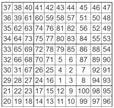
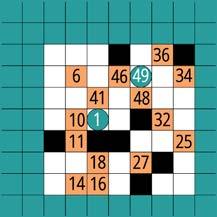
by Syndicated Puzzles
G. De Sanctis. 183?. Esemplare di alfabeti diversi fregiati di fiori, di animali e di altri ornati. Naples.