THE M A N I T O B A N
since 1914
since 1914
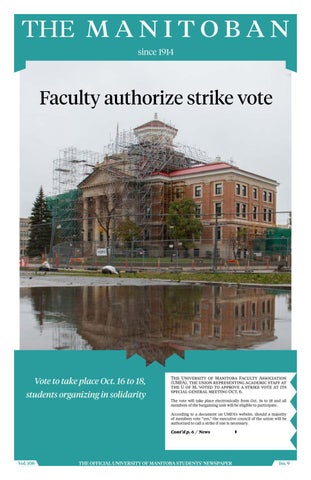
Vote to take place Oct. 16 to 18, students organizing in solidarity
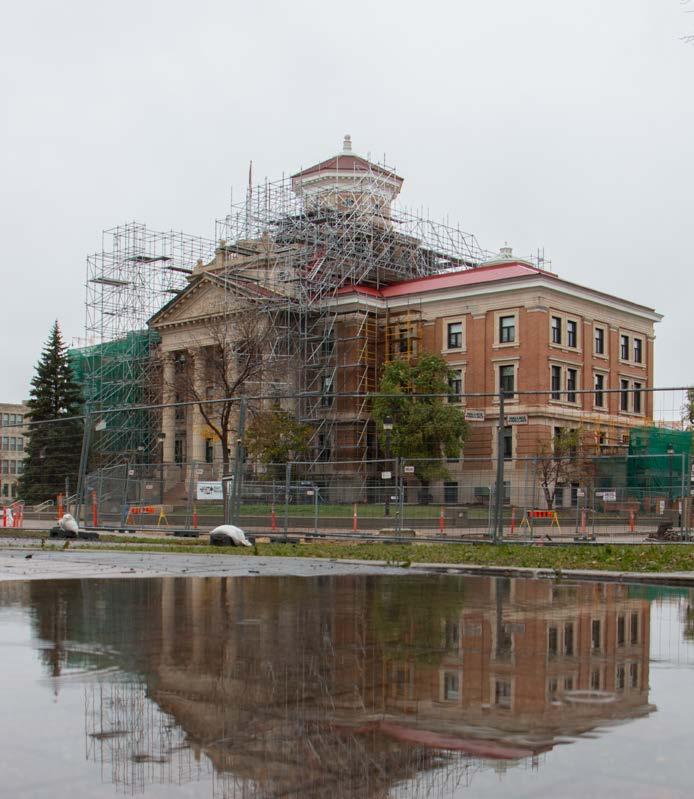
The University of Manitoba Faculty Association (UMFA), the union representing academic staff at the U of M, voted to approve a strike vote at its special general meeting Oct. 6.
The vote will take place electronically from Oct. 16 to 18 and all members of the bargaining unit will be eligible to participate.
According to a document on UMFA’s website, should a majority of members vote “yes,” the executive council of the union will be authorized to call a strike if one is necessary.
Cont’d p. 6 / News >
EDITOR-IN-CHIEF ? editor@themanitoban.com
Ty Brass
BUSINESS MANAGER ? accounts@themanitoban.com
Cindy Nguyen
ADVERTISING CO-ORDINATOR ? ads@themanitoban.com
Diego Castro
MANAGING EDITOR ? me@themanitoban.com
Sarah Doran
COPY DESK ? copy@themanitoban.com
Ursula Chojko-Bolec (ed.)
Evan MacNeil
NEWS DESK ? news@themanitoban.com
Cam Cannon, Liam Forrester (eds.)
Colton McKillop
Dimitar Tomovski
RESEARCH & TECHNOLOGY DESK ? research@themanitoban.com
Michael Campbell (ed.)
Emma Rempel
COMMENT DESK ? comment@themanitoban.com
Lucas Edmond (ed.)
ARTS & CULTURE DESK ? arts@themanitoban.com
Shaylyn Maharaj-Poliah (ed.)
Zoë LeBrun
Grace Paizen
SPORTS DESK ? sports@themanitoban.com
Matthew Merkel (ed.)
Isaiah Wagner
PHOTO DESK ? photo@themanitoban.com
Basel Abdelaziz (ed.)
Mohammad Arsalan Saeed
DESIGN DESK ? design@themanitoban.com
Matthew Doering (ed.)
Mikaela Warkentin
GRAPHICS DESK ? graphics@themanitoban.com
Dallin Chicoine (ed.)
Marina Djurdevic
AUDIO DESK ? audio@themanitoban.com applications open, see themanitoban.com/jobs
SOCIAL MEDIA DESK ? social@themanitoban.com
Jalene Moman, Molly Smyth (eds.)
Audra Ashley
VOLUNTEERS THIS ISSUE ? Ivan Nuñez Gamez
VOLUNTEER STAFF ? Emily Unrau-Poetker
interested in volunteering? email me@themanitoban.com today!

109 HELEN GLASS BUILDING
UNIVERSITY OF MANITOBA WINNIPEG, MB
204. 474. 6535
The Manitoban is the official student newspaper of the University of Manitoba. It is published monthly during the summer and each week of regular classes during the academic year by the Manitoban Newspaper Publications Corporation.
The Manitoban is an independent and democratic student organization, open to participation from all students. It exists to serve its readers as students and citizens.
The Manitoban is a member of the Canadian University Press, and our journalistic standards can be found online at toban.news/jsp.
The newspaper’s primary mandate is to report fairly and objectively on issues and events of importance and interest to the students of the University of Manitoba, to provide an open forum for the free expression and exchange of opinions and ideas and to stimulate meaningful debate on issues that affect or would otherwise be of interest to the student body and/ or society in general. The Manitoban serves as a training ground for students interested in any aspect of journalism.
Students and other interested parties are invited to contribute to any section of the newspaper. Please contact the appropriate editor for submission guidelines.
The Manitoban reserves the right to edit all submissions and will not publish any material deemed by its Editorial Board to be discriminatory, racist, sexist, homophobic or trans-phobic, ableist or libellous.
Opinions expressed in letters and articles are solely those of the authors. Editorials in the Manitoban are signed and represent the opinions of the writer(s), not necessarily those of the Manitoban staff, Editorial Board or the publisher.
A “volunteer staff” member is defined as a person who has had three volunteer articles, photographs or pieces of art of reasonable length and/ or substance published in the current publishing year of the Manitoban.
Any individual who qualifies as a volunteer staff member must be voted in by a majority vote at a Manitoban editorial board meeting. Elected representatives and non-students may be excluded from holding votes as volunteer staff members in accordance with the Manitoban Constitution.
All contents are ©2021 and may not be reprinted without the express written permission of the Editor-in-Chief.








NEWS Cam Cannon, staff
After not taking place last year due to the uncertainty posed by the COVID-19 pandemic, the annual protest against sexual violence, intimate partner violence and street harassment Take Back the Night returned in a virtual format last Wednesday.
Organized by a coalition of organizations including Klinic, Rainbow Resource Centre, the Women’s Centre on the U of M campus, Canadian Federation of Students — Manitoba and others, the virtual rally heard from a diverse set of speakers sharing their struggles and hopes for the future.
Tracy Karuhogo, an organizer of the event, said organizing remotely posed challenges but ultimately events like this still need to take place.
“Living in Winnipeg itself, even with a pandemic, thinking that people stay at home, or it’s quiet, it’s really not,” she said.
“We always hear of missing Indigenous women, missing women in general, you always see stories [telling us] do not go to this point at this time because there’s some girls who have [gone] missing, or there’s a member of the LGBTQ+ community who has been hurt, who has been threatened, and all this, even during the pandemic.”
UN Women has reported an uptick in violence against women since the pandemic began.
The rally began with an opening prayer dedicated to missing and murdered women, girls and two-spirit people from Alvina Smith of the Buffalo clan and an honour song from the Buffalo Gals Drum Group.
UMSU vice-president student life Savannah Szocs shared her experiences of sexual violence on campus and called for more preventative measures as well as more survivor-centric approaches to justice for survivors.
She gave an account of being drugged and raped on campus and after reporting the incident being “interrogated” by a lawyer hired by the U of M to investigate.
“This process lasted six months and absolutely consumed everything I had left in me during that time,” she said.
“This lawyer was undoubtedly biased. She was paid by the university and was influenced to find an outcome that [the university was] satisfied with. If she found that the perpetrator was guilty, the university would be liable. When the investigation wrapped, the lawyer concluded that although she didn’t believe I was fabricating anything, since I was under the influence of a date rape drug at
the time, my rapist’s accounts of the night were ultimately more credible than my own.”
In the end, the perpetrator faced no consequences and Szocs said she was left “in a worse place” than she had been before the investigation.
Statistics Canada reported in 2017 that from 2009 to 2014 only around five per cent of sexual assaults were reported to police. Of those cases reported, only 43 per cent resulted in charges being laid, and of those cases, only half went to court and of those, 55 per cent led to convictions.
Around 50 per cent of those who did not report to police chose not to do so due to “the hassle, burden or belief that they would not see a positive outcome in the justice system.”
Struggling with the long-lasting effects of her assault, including post-traumatic stress disorder, anxiety, depression and body dysmorphia, Szocs decided to join a campus group called Justice for Women.
She spent three years with the organization, leading and coordinating consent culture workshops.
“After feeling so lost and alone for months, I found a community that allowed me to feel validated, supported and understood,” she said.
“My biggest priority was to expand that community as much as possible so that everyone else like me could

realize they too weren’t alone.”
Attendees also heard from other speakers including Women of Colour Community Leadership Initiative president Jennifer Chen, Canadian Labour Congress president Bea Bruske, Two-Spirit Michif Local vice-chair Charlotte Nolin and Islamic Social Services Association co-founder Shahina Siddiqui.
news@themanitoban.com
The name of the largest college in Manitoba has changed to better reflect changes in its approach to education.
The institution formerly known as Red River College (RRC) added the word polytechnic to its name and will now be known as Red River College Polytechnic, or RRC Polytech.
“The term polytechnic is one that’s used around the world to describe institutions that do exactly what we do, that really focus on strategic workforce development,” said RRC Polytech president and CEO Fred Meier.
Meier said Red River College was founded 80 years ago as a community college, but “over probably the last decade and maybe a little bit more, we’ve really grown into a polytechnic institution.”
The name change was announced as part of the release of RRC Polytech’s new five-year strategic plan called In Front of What’s Ahead, which covers 2022 to 2026.
The plan lays out three priorities — changing the learning model to meet new and emerging needs, committing to truth and reconciliation with Indigenous people and deepening partnerships with businesses and communities.
“The learning model that we have and the way that we’ve approached [it] in the past, it’s very traditional,” Meier explained.
“It’s cohort-based, it’s time-bound, traditionally Monday to Friday, [8 a.m. to 4 p.m.] over two terms.
“What we heard from both our learners and also from employers, and [also from] our other partners, was that it
really wasn’t working. We needed to build more flexibility and agility into that learning model […] We’re not going to stop what we’ve traditionally done and our traditional modes of delivery, but we’re looking to expand that sort of high-quality delivery that we have in academic programming through more flexibility.”
The college will also begin to offer microcredentials and short-term training to meet the needs of students who are working and not going to school full time but need to gain “new and emerging skills.”
The second priority laid out in the plan is a commitment to truth and reconciliation with Indigenous people and support for equity, diversity and inclusion.
“We know that when we make this a priority, it does transcend through our students into the workforce and we also heard from our partners that are employers that are looking for a diverse talent pipeline as well,” Meier

explained.
“It’s quite clear that we need to be more deliberate about increasing diversity, about creating an anti-racist culture inside of our institution and a culture that’s inclusive of our staff, of our students, of our partners and […] we need to be open to new perspectives […] including traditional Indigenous ways of learning and teaching into our academics, but really into all of our operations as well.”
news@themanitoban.com
Biggest ever leak of financial documents, numerous political leaders implicated
NEWS Colton McKillop, staff
The finances of some of the world’s rich and powerful have been revealed earlier this month in the largest financial document leak in history.
The documents — dubbed the Pandora Papers — consist of 2.9 terabytes of data including 11.9 million files. The papers exposed a global network of offshore companies that enables the rich to conceal their wealth and evade taxes using popular tax havens throughout Europe, the Middle East, Central America and the Antilles.
The International Consortium of Investigative Journalists received and shared the leaked files with various media outlets. Over 600 journalists spent more than eighteen months analyzing the data before beginning publishing their findings Oct. 3.
The papers name over 100 billionaires, alongside celebrities and business leaders. In many cases, the owners of secretive shell companies were identified for the first time.
Thirty-five world leaders have also been implicated in the leak, including current and former presidents and prime ministers. The hidden finances of more than 300 government ministers, military generals, judges, mayors and public officials in over 90 countries have also been leaked.
Hundreds of Canadians’ assets have been exposed in the papers.
Lax tax laws “not taxing wealth the way they should”
While establishing offshore companies is not illegal in itself, their secrecy provides cover for those looking to evade taxes, launder money and commit fraud.
According to Radhika Desai, a political studies professor and director of the Geopolitical Economy Research Group at the U of M, “the heart of the matter” is the tax code itself.
“People try to distinguish between […] tax evasion, which is bad, and tax avoidance, which is perfectly legal,” said Desai.
“In reality, even if you paid every last penny of your tax, our tax laws are so lax that they allow a lot of people to become obscenely rich, particularly from financial profit and rentier profit, that is to say, from unproductive income.”
The legal use of tax havens to avoid paying taxes is estimated to cost governments billions of dollars in lost tax revenue.
Numerous political leaders and their associates from around the world have
had their financial secrets exposed, including the Qatari ruling family, the King of Jordan, the Czech prime minister and the family of Kenyan president Uhuru Kenyatta.
While little attention has been paid to Canadians in the Pandora Papers, some of the names listed in similar financial leaks in 2017 included former Canadian prime ministers Brian Mulroney, Jean Chrétien and Paul Martin. There was no evidence to suggest that their offshore investments were illegal.
Desai did not “wish to minimize” the actions of those named in the papers, but argued coverage of these financial disclosures focuses too much on individual crimes.
“[This draws] attention away from the fact that it is perfectly possible to get obscenely rich without contravening tax laws, because our tax systems are not taxing wealth and very, very high incomes in the way that they should,” she argued.
When the Panama Papers were released in 2016, many nations launched investigations, recovering more than $1 billion in lost tax revenue, removing implicated politicians from office and prosecuting tax evaders.
The Canada Revenue Agency (CRA) identified nearly 900 Canadians named in the Panama Papers. No one named in that leak has been charged and as of April 2019, only five criminal investigations were underway.
In the Panama Papers, Canada itself was also revealed to be a tax haven
graphic / Dallin Chicoine / staff

for some due to the country’s lenient anti-money laundering laws.
So far, the CRA has assessed taxes and penalties on 40 Canadians totalling $29 million, but they cannot confirm whether those funds have been recovered.
$15 billion a year in tax revenue is lost to offshore tax havens according to CRA estimates.
“Even if you paid every last penny of your tax, our tax laws are so lax that they allow a lot of people to become obscenely rich, particularly from financial profit and rentier profit, that is to say, from unproductive income”
— Radhika Desai, political studies professor, U of M
“An extremely punitive attitude” toward petty tax evasion
In contrast with the massive losses estimated by the CRA, Desai observed “people have an extremely punitive attitude toward petty tax evasion” and revenue loss that happens on a much smaller scale.
Last year, the government proposed a bill that threatened fines and even possible jail time for people who deliberately lied on their application for the Canada Emergency Response Benefit, though they eventually backtracked following public outcry and resistance from the NDP.
The CRA also received thousands of anonymous tips accusing others of abusing emergency aid programs designed to help people through the COVID-19 pandemic.
“I’m not endorsing petty tax evasion, but […] it’s a bit like encouraging small people to attack each other instead of uniting them to look at how they are being collectively shafted by the big people,” said Desai.
“The real scandal is our tax system itself, which permits all too many people to get obscenely rich without making any serious social contribution — on the contrary, by engaging in activities that are actively harming society.”
news@themanitoban.com
NEWS Liam Forrester, staff
A byelection is on the horizon in Fort Whyte after former MLA Brian Pallister vacated the seat early last week.
The former premier resigned from Manitoba’s legislative assembly effective Oct. 4, ending a near decade-long stint in provincial politics.
Pallister announced he would not be seeking re-election in early August. The decision to resign as MLA comes a month after formally stepping down as premier and Progressive Conservative Party leader on Sept. 1.
A byelection to fill Pallister’s Fort Whyte seat must be held within six months of the seat being vacated.
The outcome of the upcoming PC leadership race will play a significant role in determining who will be nominated to run in byelection. Given the PC’s margins in Fort Whyte for the past decade, the leadership decision will likely determine the electoral division’s next MLA.
Manitoba PC caucus director Keith Stewart confirmed the party is taking things one step at a time.
“There is no rush to call the [byelection] before the leadership election on October 30,” he wrote.
St. Boniface MLA and Manitoba Liberal Party leader Dougald Lamont suspects PC leadership candidate Shelly Glover might run should she win her leadership bid.
“Who gets to run in that seat will be determined partly by the leader,” Lamont said.
“So, Shelly Glover could run there because she doesn’t have a seat if she wins. She’s unlikely to run there, I think, if she loses.”
“If the current premier were to call a byelection right now, it would make it very hard for [Glover]. There would be a nomination battle over who is actually going to run there because Shelly Glover might want to run there, Heather Stefanson might want somebody else to run there.”
Beyond the byelection, the leadership race will likely decide the direction of Manitoba’s COVID-19 policies. That possibility has Lamont and the Liberals worried.
In a press release last Friday, the Manitoba Liberals described comments Glover made regarding vaccines for pregnant people as reckless and disqualifying.
In an interview with La Liberté, Glover expressed concern over the possibility health-care workers could be fired or subjected to reduced hours due to mandatory COVID-19 testing. She brought up an unnamed pregnant nurse whose doctor allegedly advised against vaccination out of concern it could harm the baby.
“Take the example of a nurse who is pregnant. Her doctor tells her she shouldn’t take the vaccine because it could cause complications with her
/ Mohammad Arsalan Saeed / staff

baby.”
Lamont weighed in on the comments in an interview Friday.
“She seemed to imply that it was dangerous for pregnant women to get the vaccine, which is a really shocking thing to suggest because it’s the opposite of the truth,” he said.
“In fact, women who are pregnant are at […] higher risk of severe COVID. It was a completely reckless and irresponsible thing for her to say.”
The Society of Obstetricians and Gynaecologists of Canada released a statement back in April calling for pregnant people to be prioritized for vaccination because of the risks and complications posed by COVID-19. The organization continues to assert that the vaccine is safe for all pregnant people.
Pregnant people who contract COVID-19 are more difficult to put on ventilators, are more likely to
require intensive care, are more likely to require caesarean delivery or give birth prematurely and their baby is more likely to require admission to a neonatal intensive care unit.
“Some of these things, it’s a matter of degree. It is much worse than anything Stefanson has said to this point. Both of them oppose vaccine mandates,” Lamont said.
“Glover, when pressed on why she opposed the vaccine mandate, gave the example of a nurse who was pregnant whose baby could be endangered by the vaccine when that’s an absolutely reckless thing to say because there are ICUs with pregnant women on ventilators and pregnant women who died from COVID.”
“It’s a shocking thing for her to say and totally inappropriate.”
news@themanitoban.com

Ethicist explains restrictions are ethically necessary under Canada’s charter
FEATURE
Dimitar Tomovski, staff
The Manitoba government announced new COVID-19 restrictions on Oct. 5 that specifically target those that have not yet been vaccinated against COVID-19.
The restrictions limit indoor private gatherings to guests from one other household whenever an unvaccinated person who is eligible to receive the vaccine is present. This includes unvaccinated people living in the household.
Similar restrictions exist for private outdoor gatherings, indoor public gatherings and faith-based gatherings.
Philosophy professor Arthur Schafer — founding director of the Centre for Professional and Applied Ethics at the U of M — observed some of the opposition to instating restrictions targeting the unvaccinated claims it creates a two-tier society and that the restrictions are discriminatory.
“I don’t find that a plausible argument because the distinction [is that] the people who are targeted by these restrictions chose not to be vaccinated,” said Schafer.
Schafer said under Canada’s Charter of Rights and Freedoms, Canadians are allowed to live their lives according to their own values and preferences without coercive interference of others. However, there are instances where restrictions are reasonably necessary.
To paraphrase John Stuart Mill, “Your freedom to wave your fist around in the air stops when it gets in the vicinity of my nose,” Schafer said.
“You don’t have the liberty to act in such a way as to endanger other people’s liberty.”
When it comes to targeted restrictions, Schafer explained, the safety benefits must outweigh the harm of the restrictions.
“What ethicists say, is that if your actions are likely to cause serious harm to others or society […] and if it’s necessary in order to protect others and protect society to restrict [your] liberties […] and if the good it’s likely to produce outweighs the harm, then the restriction is legally justifiable and ethicists would say morally

justifiable,” Schafer said.
Schafer believes anyone who challenges pandemic restrictions in court will be met with the claim that the restrictions are necessary and justifiable in a free and democratic society. Schafer assumes the restrictions imposed on the unvaccinated are the minimum required.
“I think it’s right, reasonably, to accommodate people who are unvaccinated,” he noted.
“But the special restrictions that are targeted at the unvaccinated aren’t unfair if they’re reasonably necessary to protect others.”
Schafer drew a distinction between excluding people on the basis of vaccination status and exclusions that
warrant legitimate ethical concern.
“If someone is excluded from a gym because of their race or their religion or their age or their ethnicity, that’s arbitrary and unfair,” he stated.
“If they’re excluded from the gym […] on the grounds that they pose a health danger to the other fully vaccinated people who are attending or, more importantly, if they pose a danger to the sustainability to our healthcare system with potentially dire consequences, then it doesn’t pass as a regulation that restricts access and thereby minimize the effects of the pandemic on society would be reasonable.”
features@themanitoban.com
“A ‘yes’ vote doesn’t necessarily mean there will be a strike,” read the document.
“A strong vote on its own might see the administration start to take bargaining seriously, where up until now they’ve made no significant moves at the bargaining table.”
In the event of a strike, faculty will cease all “teaching, supervision, advising, library, service and administrative duties,” with members expected to contribute job action at least three hours per day from Monday to Friday if they wish to receive strike benefits.
These benefits amount to $200 per shift.
Those on research and study leave will not be affected by job action and will be able to continue to perform their duties.
Wages for faculty have effectively been frozen since the passage of the 2017 Public Services Sustainability Act. Although the legislation was struck down by courts, the provincial
government launched an appeal to the decision in January of this year.
During negotiations last year, it was revealed that the provincial government had mandated no salary increases for the 2020-21 academic year occur.
At a U of M senate meeting Oct. 6, U of M president Michael Benarroch stated this year there is another mandate from the province to cap salary increases at 0.75 per cent for two years and 1 per cent in the final year.
“This provincial government needs to stop interfering in negotiations,” said UMFA president Orvie Dingwall in a press release.
“And we need the university to come to the bargaining table with a reasonable salary offer so we can negotiate a fair deal.”
Other professors and unionists offered their thoughts on the state of the current labour dispute on Twitter.
“Most people would be surprised by what a small proportion of the university budget is made up by faculty salaries,” said Manitoba Organization of Faculty Associations president Scott Forbes in a tweet Oct. 8.
“Salaries of the admin infrastructure are larger & grow larger year by year. Professors are becoming almost an afterthought.”
Dingwall has previously indicated that in addition to salary, faculty are also concerned about what they view as infringements on their academic freedom, with the university pushing for measures which would require faculty members engaging in outside activity to clear it with their respective deans first.
School of Fine Art Student Association representative on the UMSU board of directors Travis Hunnie said that he and other students are “preemptively” organizing in support of faculty as part of a small organization called Students Supporting UMFA.
“We recognize the struggle that the faculty association is going through right now in their labour dispute,” he said.
“We want to stand in solidarity with them.”
The purpose of the group is to have a centralized organization to tackle larger pro-UMFA campaigns.
“Our faculty wants what is best for the students and the administration knows that, which is why they continue to take advantage of them,” he said in an emailed follow-up statement.
“The voices of students are important in this struggle, and if we feel strongly that UMFA isn’t getting a fair deal, we need to make that known. Spread the word, make it public and tell the administration directly that this is not okay.”
Those wishing to participate in student organization supporting UMFA can reach out to standwithumfa@gmail.com.
UMSU president Brendan Scott said at the Oct. 7 board of directors meeting that the place to find unbiased information about the ongoing negotiations is the university’s website.
Detailed information can also be found on the union’s website.
The UMSU board of directors is expected to receive presentations from representatives of the university and UMFA later this month.
news@themanitoban.com
Obsessive or harmonious: what kind of Jets fan are you?
Michael Campbell, staff
Ben Schellenberg, assistant professor in the faculty of kinesiology and recreation management, has launched a study into the experiences of Jets fans. The study consists of a survey where Jets fans are asked questions about how hockey influences their social life and feelings of harmony, as well as charting their obsession at three points in the season — pre-season, mid-season and end-of-season.
Schellenberg has experience conducting research at the intersections of psychology and kinesiology. Specifically, he has an interest in social psychology and its applications to both athletes and sports fans.
Schellenberg hopes to test the data he is collecting against a couple of general models of motivation. One of the models that Schellenberg will use to assess the data is the dualistic model of passion, which posits that passion is demonstrated in activities that allow people to define themselves. Within this model, passion develops into either harmonious or obsessive passion. Obsessive passion occurs when one feels surrendered to the activity, whereas the fan remains in control when experiencing harmonious passion.
Schellenberg also hopes to apply the team identification-social psychological health model to the data. In this model, team identification leads to the creation of social connections and an improved sense of well-being. This sense of well-being can reinforce one’s desire to identify as a fan.
“A big part of [being] sports fans, especially those who are highly identified, is that being a fan of a team, that becomes part of your identity,” Schellenberg said.
“It becomes part of who you are.”
This is especially true in Winnipeg. Since the return of the Jets to Winnipeg in 2011, fans have demonstrated their devotion through traditions like whiteouts, yelling “True North” during the national anthem and pouring out in the street for playoff appearances.
“I think being in Winnipeg is the perfect place to study sports fans,” Schellenberg said.
“I think this is a fantastic area because there’s so many people who are fans of one team — the Jets.”
Because Schellenberg is studying only one team, it is possible to analyze how the team’s on-ice performance over the course of the year may affect fans’ passion for them.
“If the Jets are winning or losing when we’re collecting data at the same time

“I think being in Winnipeg is the perfect place to study sports fans”
— Ben Schellenberg, assistant professor
points, some fans might be more even throughout their experiences — high or low — whereas other fans might be more reactive to how the Jets are doing at that moment,” Schellenberg said.
Schellenberg speculated suspending sports during the pandemic restricted fans’ ability to connect with others in their established and ritualized way.
He also found passion type could be an indicator for coping strategies during the pandemic sports shutdowns. Schellenberg studied the effect of the NBA’s shutdown in March 2020 on harmonious and obsessive fans.
“The more obsessed these fans were, the more distressed they were during the period of time when the NBA was suspended due to the pandemic,” he said.
“They’re more distressed, they use more things like more alcohol use to
cope with the fact that their favourite sport is no longer being played, whereas the harmonious passionate fans were doing much better.”
Sports unite Canadians from all walks of life. People seem almost as interested in understanding the phenomenon of sports fans as they are in watching their favourite teams.
Schellenberg said he is surprised by the media attention that this study is receiving.
“I do research with athletes [and] students,” Schellenberg said.
“[But] the media have only contacted me about my research that we’ve done with sports fans.”
The Winnipeg Free Press published an article on the study in September. CBC Radio’s Up To Speed with Faith Fundal also interviewed Schellenberg.
“The media attention with this specific study is just sort of reinforcing this sort of idea that I’ve been having that people are really interested in research of sports fans,” Schellenberg said.“So that’s sort of giving me some more motivation to continue.”
The media attention is due in part to the fact that fandom seems to defy logic. Die-hard fans support their team regardless of the outcome.
“A couple of times I’ve been contacted by media outlets in Toronto asking me, you know, ‘Why are these [Toronto] Maple Leafs fans […] still Maple Leafs fans?’” Schellenberg said.
“‘Year after year, they’re disappointed, but they’re still Maple Leafs fans.’”
research@themanitoban.com
If you want to eat well, you need to understand protein. Not all proteins are created equally, so to make healthy choices, it’s important to have all the facts.
22.5g
2.6g 0g 45mg
INGREDIENTS: 1

PROTEIN: 17g
INGREDIENTS: 20+
Plant-based Plant-based 9g 11g 320mg
Canada’s Food Guide suggests filling a quarter of your plate with protein, and since the average Canadian needs about 25g of protein per meal, lean meat like chicken makes the most nutritional sense.
more at chicken.ca Visit chicken.ca to learn more about the di erent types of protein and find some healthy recipes everyone will enjoy.
Emma Rempel, staff
Researchers at the Rady faculty of health sciences are innovating breast cancer detection, diagnostics and prognostics. Using artificial intelligence (AI) to analyze medical images and genomic datasets, members of the Hu Lab are making advancements in precision medicine for the fight against breast cancer.
Pingzhao Hu is an associate professor of biochemistry and medical genetics at the University of Manitoba and joint holder of the Manitoba Medical Services Foundation Allen Rouse basic science career development research award. Hu has been working on AI-based approaches to breast cancer diagnostics and prognostics for the past several years.
In medicine, treatments are not generally developed for single individuals, but rather for populations. Increasingly, groups of patients can be identified using genomics, allowing for more specific treatment targeting.
When it comes to breast cancer, diagnosis and treatment programs are undergoing a paradigm shift away from a broad, one-size-fits-all approach to one that’s more personalized. The use of more sophisticated diagnostic techniques, like genomics, allows researchers to better characterize the tumour and results in better patient outcomes.
“I want to look at this question at the DNA level to see whether they have a genetic profile difference,” Hu said.
Hu’s research employs deep learning algorithms, a form of machine learning which trains itself on complex datasets and makes highly accurate predictions. This method requires less manual input than regular machine learning algorithms. The use of deep learning AI in diagnosing breast cancer would potentially result in increased speed and reduced costs, while also delivering precision medicine to the patient.
One of the projects Hu is working on aims to analyze over 20 years of MRI images collected from women in Manitoba. It is recommended that women over the age of 50 undergo mammograms every two years. This screening process has generated a huge quantity of MRI images for both healthy women and women with breast cancer.
Hu is currently in the process of determining whether AI can help radiologists to interpret these images and identify tissue abnormalities earlier.
“[W]e are trying to use this type of AI technology to […] help radiologists to detect the cancer,” said Hu.
Hu is hopeful that the use of AI will

“I want to look at this question at the DNA level to see whether they have a genetic profile difference” —Pingzhao Hu, associate professor
result in earlier detection of breast cancer by up to two years, which may improve the patient’s prognosis.
Qian Liu is a graduate student currently working on incorporating AI with breast cancer diagnosis. Liu’s PhD program is interdisciplinary, with three contributing departments: biochemistry and medical genetics, computer science and statistics.
Liu’s project combines computer science and statistical testing methods to analyze breast cancer patient outcomes. By applying AI algorithms to MRI images and genomic datasets, Liu can solve clinical questions like whether a reliable indicator for breast cancer can be found in MRI images. Since diagnoses and prognoses for breast cancer are still mainly based on the genetic profile of the patient, an AI approach to MRI would save time and costs.
In addition to breast cancer research, Liu and members of the Hu Lab are working in collaboration with clinicians and researchers to implement their AI algorithms to fight other diseases, including COVID-19.
Liu was recently granted a fellowship to develop a deep learning model and apply it to whole genome sequencing (WGS) data of 10,000 Canadian patients with COVID-19. This would allow researchers to create a scoring system that would predict disease
severity for each patient. The funding was provided by the CANSSI Ontario STAGE HostSeq Fellowship, which was created for researchers interested in COVID-19’s genetic factors.
In this area, Liu is analyzing chest CT scans of patients with COVID-19 using AI models to generate risk scores associated with disease severity outcomes.
Due to bottlenecks in rapid PCR testing kits for COVID-19, there have been calls to use CT scans as rapid tests instead. When Liu learned of this, she saw a possibility to implement her research.
“That’s how we decided to transfer or use our knowledge in analysis […] to the COVID-19 images,” said Liu.
Liu’s development of AI algorithms to rapidly analyze these scans would reduce the need for doctors to interpret these images and increase the feasibility of the test.
As an undergraduate student, Liu majored in medical imaging, with no computer science or genetics in her background. She largely credits Hu for creating a supportive environment for learning, and the collaborative nature of the lab for her personal development.
In 2021, Hu was awarded a U of M Graduate Students’ Association
teaching award as well as the Health Sciences Graduate Students’ Association’s Ed Kroeger mentorship award.
Since 2014, students and trainees at the Hu Lab have won 69 international and national awards, collected almost $700,000 in award funds, and have published more than 130 peer-reviewed articles.
To any prospective students interested in such a dynamic area of research, Hu had a few words of advice. A strong background in computer science or statistics and a familiarity with the life sciences will be highly beneficial, and a strong sense of personal initiative will carry you far.
Given the interdisciplinary nature of research in biostatistics, computer science and life sciences, researchers in the Hu Lab come from a variety of backgrounds. Due to the variation in skillsets, it is a highly collaborative space.
“This may include computer science, engineering, statistics and also the life sciences, such as genetics,” said Hu.
research@themanitoban.com
Lucas Edmond, staff
A new semester at the University of Manitoba just wouldn’t feel right without a potential strike looming. Now, U of M students can rest assured they’re at home again. It is unsurprising the U of M finds itself at these critical junctures year after year, as the administration has continuously coughed up horrible yearly contracts to put off inevitable discontent among members of the University of Manitoba Faculty Association (UMFA). When students are pointing fingers, direct them at Michael Benarroch and the Progressive Conservatives (PCs) he finds himself beholden to.
The U of M has been pushing appropriate bargaining back since 2016, and the issues that precipitated that strike continue to influence UMFA’s patient deliberation with their squabbling peers at the administration building and the legislature.
In 2016, the U of M offered a meagre 1.5 per cent wage increase to professors after their collective bargaining agreement expired in March. By October, then-president David Barnard was reportedly “summoned” to discuss the negotiations with then-finance minister Cameron Friesen and then-premier Brian Pallister. The administration was instructed to withdraw any discussion of wage increases, effectively strong-arming the negotiations in bad faith. In late November, after significant strike action, UMFA made the decision to accept a one-year deal that included zero per cent wage increases in exchange for improvements to governance and labour relations.
In 2017, the Manitoba Labour Board took exception to the bargaining methods of the U of M and fined it $2.4 million. By complying with the government’s intervention while keeping the disputes a secret, the U of M leapt into a mediation process with little intention of offering the union a
deal it desired.
Following the short-term deal, the PCs introduced Bill 28, the Public Services Sustainability Act (PSSA), which attempted to freeze the wages of roughly 120,000 public sector employees for two years. This legislation overlapped with the expired collective agreement that was jammed down UMFA’s throat. As a result, the university and UMFA agreed to reopen contract discussions after the PSSA expired.
However, in June 2020, the PSSA was deemed unconstitutional by the Manitoba Court of Queen’s Bench for violating charter rights and freedoms of association. “The [bill] has made it impossible for the plaintiffs to achieve their collective goals and limits the right to freedom of association,” Justice Joan McKelvey concluded.
After the legislation was voided, a new contract could be discussed. The U of M had ample time to offer a contract prior to the fall semester that year but refused to negotiate in good faith. UMFA demanded fair third-party arbitration, but the university refused to cooperate.
“They’ve just come forward and said they’re not willing or prepared to offer anything in this round of negotiations even though this round was specifically to take into account [the PSSA],” said UMFA member Michael Minor in an interview with the Manitoban last year.
The negotiations that did occur looked unpromising and students were sure a prolonged strike would occur. That year, the PCs intervened in the dispute again and demanded
the U of M reject wage increases and cut its labour budget a further 2.5 per cent.
As a result, UMFA reconvened to authorize a strike vote. Of the 85 per cent of union members who showed up to vote, 80 per cent approved of strike action. However, in an attempt to avoid disruption in an already tumultuous year, UMFA moved to ratify a deal offered by the administration that included less-than-ideal terms. The deal passed with less than 55 per cent approval from UMFA members and the strike was called off.
The deal included a small stipend for the horrific working conditions during the pandemic — far from the 1.5 per cent wage increase, better salary grid and more support for professors caring for their children and family during lockdowns that UMFA was expecting.
This deal likely would not have been ratified if not for the unprecedented context of the pandemic. Professors acted in the best interests of the students and sacrificed important wages, benefits and conditions that made navigating the precarity of COVID-19 easier.
Now, with a strike vote being authorized to take place from Oct. 16 to 18, students should work with their peers to show support for the professors who made this sacrifice.
This year, professors are reporting mental exhaustion due to the U of M’s inability to retain employees. According to an internal poll conducted by UMFA, 14 per cent of faculty members are looking for work elsewhere. If these members manage to find work, they will likely leave. Wages have been frozen for five years, resulting in massive salary losses.
In an interview with PressProgress, assistant professor in the department of pharmacology and therapeutics Sachin Katyal noted he found a position at an Ontario university that offered him $40,000 more at the same capacity. “There’s no reason to stick around here because there’s no hope for any growth,” he said.
Like Katyal, almost two hundred other faculty are looking for employment elsewhere. Their departure would take with it crucial grant funding and jobs, and strain the university with a lengthy hiring process. So, the question remains — with millions of dollars hemorrhaging from the university’s budget due to labour flight, how much are they really saving in the long run? It is not hard to imagine that the university’s unsustainable labour relations strategy has cost them more than what they’d spend paying their professors.
With the flight of quality professors, who will the university attract when they leave? Likely nobody that will do a better job. By refusing to pay professors, the administration has taken action to reduce the quality of education that students are paying more than ever for. When professors strike, they are striking for students, too.
The university administration has folded to the PCs’ austerity agenda. This has little to do with the well-being of professors or students. If a strike should be called come Monday, students must support UMFA — not only because they sacrificed key negotiations for us last year, but also because it is in our best interest. As union activist and leader Harry Bridges once said, “The most important word in the language of the working class is ‘solidarity.’” When the time comes, lay down your pens and pick up the pickets.

COP26 will prove if Canada is committed to diligent climate action
Ahead of the 2021 United Nations Climate Change Conference — often referred to as COP26 — environmental ministers came together in Milan, Italy to lay groundwork for Youth4Climate. The summit, which was set to provide a platform for intergenerational discussions on creative climate action, was received by countless protests demanding for climate justice. COP26 will be the first climate conference in which signatories of the Paris Agreement will be evaluated on their commitment to reduce greenhouse emissions — something Canada has fallen short of.
Aside from the U.S., Canada is the only G7 country — an intergovernmental political forum — to fall short of achieving its Paris Agreement goals, and the consequences are evident. In the last year, Canada has directly faced the realities of climate change. Excessive wildfires and strong heat waves across multiple provinces ravaged the nation this summer.
Before the elections, polls found most Canadians described climate change as a top issue, but despite public pressure the government has not followed with strong action. The Liberals, who allegedly had the most efficient and least costly climate plan, have faced serious backlash for not leading by example. In fact, the Liberal party has little place to boast about its plan considering it purchased the Trans Mountain Pipeline in its last term and continues to support polluting technologies.
While in Milan, minister of environment and climate change Jonathan Wilkinson emphasized the importance of capping oil and gas emissions while eliminating fossil fuel subsidies. Despite concurring with many fellow ministers, his message was received with a high level of skepticism from environmentalists, especially Greta Thunberg.
The young climate activist, who rose to fame in 2018 after skipping school while advocating for climate action, described the dialogue as “words that sound great,” but continued to criticize governments’ inaction. According to Thunberg, political rhetoric has taken over climate advocacy and instead of engaging with younger generations for the creation of an effective action plan, world leaders cherry-pick young environmentalists to attend events such as Youth4Climate as a facade. The sad part is, there is a lot of truth to this.
Despite significant awareness regarding the global climate emergency and several initiatives led by the G7 and China to stop funding coal-fired power stations abroad, the exploitation of coal prevails. According to the International Energy Agency, the level of coal production forecast for 2050 is about four times the limit needed to reach net zero emissions — a keystone in the Paris Agreement. And coal is just one-fourth of the problem.
In his opening remarks, British Prime Minister Boris Johnson, who will be hosting COP26 in Scotland in late October, indicated the renovated approach to tackling climate change has four pillars — coal, cars, cash and trees. Aside from replacing coal as the main resource for the production of electricity, the head of the U.K. government suggested the world needs to stop using internal combustion engine vehicles and start mass reforestation projects. But one remark regarding climate finance stood out. Johnson indicated funds need to be gathered in order to tackle climate change in the developing world, yet this has become an uphill battle.
Earlier this year while attending the G7 summit, world leaders reaffirmed their 2009 commitment to raising US$100 billion for poorer countries to fight the climate emergency by 2025. This goal was extended five years


from the 2020 deadline. But according to the Organization for Economic Co-operation and Development, there is a US$20 billion gap that needs to be closed before leaders gather for COP26. This shortness on cash is where Canada and Germany can be the game-changers.
The Canadian minister of environment and climate change and the German secretary of state for the environment were tasked with gathering over US$20 billion to help developing countries deal with the effects of climate change and build greener economies. According to Wilkinson, what was first described as “mission impossible” has now gained momentum through a series of bilateral meetings with some of the wealthiest nations. Though there are still no new donations, Wilkinson reaffirmed Germany and Canada will deliver the US$100 billion
commitment.
Though the effort to find funding deserves praise, there is still much to be done. According to recent studies, the point of no return to counter climate change is set for 2035. Despite the efforts of grassroots organizations, the state of the world requires a systematic reorientation that only governments can provide. Carbon neutrality by 2050 and all the statutes under the Paris Agreement are feasible, but the politically convenient approach needs to be substituted by consequential policy. The time to repair all the damage we have done is now.
As of Oct. 1, the minimum wage in Ontario has been raised 10 cents to $14.35 per hour.
This is up from the 25-cent increase on Oct. 1, 2020 and the previous $2.40 increase on Jan. 1, 2018.
While three minimum wage increases in the last few years may look good on paper, the recent 10-cent increase is hardly enough for Ontarians to be excited about. For those minimum-wage workers in Ontario who clock 40 hours per week, the raise amounts to an extra $4 each week before taxes. This difference is even more negligible for those working part time.
The move comes as a result of the Making Ontario Open for Business Act passed in 2018, which mandated the minimum wage be frozen at $14 per hour until 2020. After this, wages would begin to increase annually at a rate consistent with inflation.
Although Ontario’s minimum wage is increasing with inflation, the prices of goods and services aren’t anything close to charitable.
For example, since the beginning of the pandemic, grocery prices in
Canada have been steadily rising. This year alone, Sylvain Charlebois — a professor at Dalhousie University in Halifax, N.S. — said the price of pork has increased by five per cent, and the price of beef has increased by almost 10 per cent. Charlebois predicted a lower food inventory for the fall which, in turn, would drive prices even higher.
Although prices for food items like chicken, produce and pasta have dropped, not all Ontarians have access to big-box stores where these items are sold at cheaper prices. For those living in rural and remote communities, having small, local grocery stores — where food prices tend to be higher overall — as the sole option for shopping makes the rising grocery prices hit even harder.
The extra 10 cents per hour won’t ensure minimum-wage workers come out on top. Instead, it only ensures they lose slightly less.
But minimum-wage workers shouldn’t be the only ones unsatisfied with this increase.
Small business owners may experience significant financial setbacks as a result of the increase. For example,
a small business owner with just five employees working an eight-hour shift each day will now be required to pay an extra $16 per month in employee wages. This amounts to an extra $192 per year, which — for businesses that have suffered tremendous losses during the pandemic, including a potential decrease in customers due to Ontario’s vaccine passport mandate for select businesses — can be a big chunk of change. In response, small business owners may be forced to lay off employees or reduce hours, hurting minimum-wage workers and the community even more.
So, if a slight raise in minimum wage is both useless to workers and harmful to businesses, we need a viable third alternative.
Enter universal basic income (UBI).
With UBI, every citizen would receive a guaranteed minimum amount of money regardless of factors like employment or financial need. This means workers would be able to afford the rising costs of goods and services without relying on paltry minimum-wage increases or working multiple jobs. It would also help ensure workers aren’t put in serious financial trouble if they are laid off from their jobs.
Further, UBI could mean businesses

have a better shot at gaining and retaining employees — it would ensure workers can actually afford to have their sole employment income be from minimum-wage work. This might entice workers to undertake minimum wage jobs, many of which have been notoriously difficult to fill during the pandemic.
In fact, a recent ongoing experiment in Stockton, Calif. has demonstrated the potential benefits of a universal basic income. Over two years, some individuals living in low-income neighbourhoods were given $500 per month to spend however they pleased with no stipulations. The results were positive — the guaranteed income helped to reduce financial insecurity, and much of the money went back into the economy through the purchasing of basic necessities. Participants were allowed a sense of financial freedom they wouldn’t otherwise have had access to.
Further, contrary to the opinions of opponents of UBI, the study found the guaranteed income did not deter participants from continuing to work or seek employment — the portion of participants with full-time employment actually increased 12 per cent. Unsurprisingly, a two-year experiment in Finland produced similar results. Although not as strong, the Finnish study concluded that, at the very least, UBI did not harm employment rates.
In Canada, a similar, albeit shortlived, project was launched in Ontario in 2017. Various cities and surrounding areas were targeted to assess the efficacy of UBI in both rural and urban areas. However, the project was scrapped in 2018, two years before its proposed end date. As a result, the province missed out on potentially insightful data regarding the effects of UBI for Canadians in the long term.
Although the Ontario government might scoff at the thought of UBI, a 10-cent increase to minimum wage isn’t much better. What’s clear is slight raises in minimum wage harm both workers and employers, creating an economy that’s difficult to survive in. Unless Canada can find a better way to mitigate these harms, considering UBI should not be off the table. For workers getting nickel and dimed by the provincial government with meagre minimum-wage increases, UBI could make a well-heeled difference in their wallets.
graphic / Marina Djurdjevic / staff words / Ursula Chojko-Bolec / staff








Zoë LeBrun, staff
Have you ever thought about what it truly means to be in a “public” space? Tapume, an exhibition at the Winnipeg Art Gallery (WAG), asks this very question.
Eduardo Aquino, the artist behind Tapume, studied architecture and urban studies in Brazil and earned his MFA in open media from Concordia University. He is also a professor at the faculty of architecture at the U of M and runs his own practice called spmb.
“I’m an architect [and] an artist, and I have been both all my life, and part of my practice actually is working the interstices of those two disciplines, architecture and art,” said Aquino.
“Tapume, the project at the WAG, is pretty much the synthesis of all of that […] That friction between a found architecture structuring the city and a selection of body of paintings.”
The exhibition is also a living example of Aquino’s theory of non-public spaces, which challenges us to consider whether “public” space truly exists.
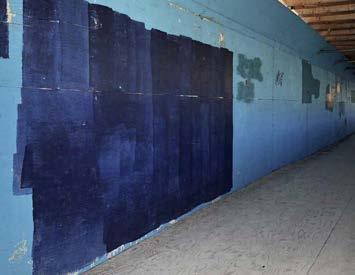
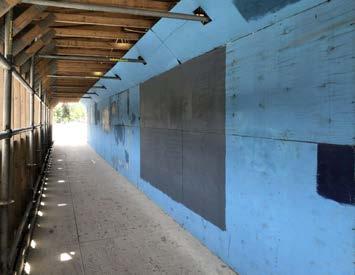
Tapume consists of a construction hoarding, which was previously in use during the construction of Qaumajuq, as well as a row of smaller paintings along one side of the gallery space.
“For me, there is an interesting, strong meaning on the hoarding, because it really shows the limit between what’s public and what’s not public, what’s accessible [and] what’s not
accessible,” said Aquino.
The walkway is covered in swatches of blue paint due to buffing, a practice in which construction companies paint over graffiti tags, tire marks and other public traces. Aquino saw this cycle as a dialogue between the construction company and the public and, as the hoarding accumulated layers, it reminded him of Mark Rothko’s large colour-field paintings. This eventually inspired him to pursue Tapume as an artistic project.
“There was this play going on between taggers, or graffiti people, and the construction company. So, you know, as soon as they would find a mark, it would be covered and then another mark would be on top of it and will be covered,” Aquino said.
“I see the blue wall as a painting, just a large painting created by a conversation in public space.”
Upon entering Tapume, it is almost impossible to resist walking through the structure, particularly when coming from Qaumajuq’s side of the gallery.
In addition to its aesthetic and conceptual qualities, the walkway also mirrors its exact placement outside the WAG’s walls when it was in use and creates a flow of movement through the gallery space, which loops to where Aquino’s paintings line the gallery’s back wall, creating the hoarding’s shadow.
The flow provides a sense of an
interior and exterior space in the gallery, a juxtaposition emphasized by the small holes in the hoarding’s wall, which provide a limited view to the paintings on the other side. These contrasting ideas and voyeuristic qualities lead viewers to consider the structure’s original function as an outdoor feature and divisive line between the realms of public and private space.
The paintings of Tapume are intriguing as well. Although they appear identical from a distance, their uniqueness emerges as they are approached.
Amidst their small variations in form, one can also find abrasions, paint splatters and even natural debris embedded in their paint. Each painting feels like a comment on how the world can influence a person, object or our perception, a quality that resulted partially from Aquino’s painting process, which occurred in his back alley.
Aquino’s paintings also speak to the introduction of industrial materials into the context of fine art, recalling artists such as Richard Serra and JeanMichel Basquiat.
“It’s a kind of another subdued way to bring everyday life into the museum, to bring something that’s really accessible to everybody,” said Aquino.
Like Rothko’s paintings, there is also a spiritual aspect to Tapume in Aquino’s eyes.
“For me, one of the most rewarding, spiritual and beautiful — and not even beautiful, I would call ‘intense’
— intensely aesthetic experiences in the city, more than even visiting a museum, is to walk down a back alley,” he said.
“You recognize beauty in things that people totally disregard. Even further, they ignore [it], they are indifferent about it, they even call [it] ugly. But if you go back to art history, every kind of ground-breaking moment or artwork usually is responded to like that […] so the very first moment is a shake-up to people and say, ‘Hey, look around in the world, the world is really beautiful, even a back alley.’”
After leaving the WAG, Tapume will go on to transform into a chapel, as a nod to the Rothko Chapel, at the School of Art Gallery in the new year. It will be further deconstructed into a series of paintings to be shown at the faculty of architecture gallery in fall 2022.
“The project starts in the art gallery as architecture and ends in the architecture gallery as art, as paintings,” Aquino said.
Overall, Tapume embodies a series of actions that transform into a visual and aesthetic element while simultaneously showing the interplay between public and private space. Beyond the power dynamics and social relationships Tapume speaks to, Aquino also impresses upon us the unexpected beauty of the urban world, reminding us that not only is realism still alive, but that it can be conceptual and abstract as well. Tapume, in its current form at the WAG, is on display until Nov. 7.
arts@themanitoban.com
“I see the blue wall as a painting, just a large painting created by a conversation in public space” —Eduardo Aquino, architect and artist
Grace Paizen, staff
4/5 stars
By the end of the 1970s, rock music had splintered into the new wave era. As bands reassembled from the debris, new forms emerged into strains of alternative and progressive rock. 40-odd years later, up-and-coming local Winnipeg band Moonfield can be found in the asteroid field of this musical equivalency of space dust.
With the self-proclaimed sound of Radiohead and the Cure, the space debris of electronic and progressive music past found in Moonfield’s new EP Televox ranges throughout the alt-rock spectrum.
Dropping Oct. 16 during the band’s concert at the Royal Albert Arms, the four tracks play like a solid full album in the making.
Opening track “Don’t Go” is the perfect launching point for the EP. With a solidly paced tempo, lead vocalist Hayden Major’s singing style evokes
the Strokes’ Julian Casablancas.
The components of the song itself give shades of New Order, particularly with the theme of “Don’t Go” emphasized in the chorus — “will you take me away to a place I know I belong” — and the bassline reminiscent of New Order’s “Singularity.”
Second track “Bad Days” gives off immediate Wallflowers vibes. A slow burn, the song bursts in a melodic chorus akin to Keane’s “Perfect Symmetry.”
The timbre is distinct — the spaceage-like instrumentals lend the feeling of floating into an asteroid field and out of our solar system.
“1919,” the third song of the EP, is redolent of the Alan Parsons Project through its experimental sound — the drums, then voices set the listener up for the story of the song.
Though the guitar riffs are energetic, the dissonance featured throughout
Sile Englert, an Ontario-based poet and multidisciplinary artist, has released her debut full-length poetry collection, entitled The Lost Time Accidents Published Oct. 5, Englert’s release is introspective and metaphorical, yet imbedded in reality, time and connection.
Throughout The Lost Time Accidents, it’s evident that every piece of Englert’s vivid and complex writing carries multiple meanings and reference to a vast array of topics, which ultimately feel autobiographical. On the surface, the poems focus on one subject — such as the body, insomnia or childhood toys — while a whole other narrative exists beneath.
The collection is split into three parts, all of which are left to the reader to determine their meaning. Within these sections, Englert includes poems of varying lengths, styles and forms. These components work together to convey her surreal and psychological subject matter, coalescing to create a body of work that is not only cohesive but manages to maintain intrigue and momentum throughout.
columns on either side of the page. This not only adds visual interest to the pages but allows the reader to find the rhythm Englert may have intended these works to be read with easily, centring on a flow of words that allows their meaning to sink in appropriately. This effect was strongest in “The Day I Swallowed a Dragonfly,” which can almost be read as two separate poems consolidated into one.
Englert’s shifting of narrators throughout The Lost Time Accidents is a very successful aspect of this work as well. While each poem has the undercurrent of Englert’s voice, different speakers bring slightly different tonal values, colours of emotion and perspective that lend themselves to a deeper understanding of each the messages the author intended to convey in her poems.

the song does its job best in the conclusion as it paints a picture of physical conflict through sound, bringing about the theme of the song’s namesake.
Finally, apart from glimmers of Nirvana in closing track “Lay My Crown,” this is where Moonfield hits its mark. The mid-song instrumental and the elongated conclusion give a glimpse into Moonfield’s own sound — an instrumental conversation marks the band’s unique electronic space-rock vision.
The EP’s only real flaw is the heavy influence of great bands past. However, the talent showcased in
the EP is bursting to find a larger audience.
By the end of Televox, Moonfield reveals itself as a band to watch as they grow toward nurturing and harnessing their own unique sound in the asteroid field of rock music.
Moonfield’s EP, Televox, will be available Oct. 16. Want us to review your album? Email us at arts@ themanitoban.com today!
arts@themanitoban.com

The standout poems were those in which Englert strayed from conventional formatting, breaking up sentences with large spaces or into
Zoë LeBrun, staff arts@themanitoban.com
For instance, “Voyager 1 Sings to Her Sister” reminisces about life on earth, as told from the perspective of the satellite itself, pulling us back from our own existences to think about the world in a different way. In contrast, the plural voices in “Eighteen Hundred and Froze to Death” travel in between our current base of historical knowledge and the past, reminding us of our collective history and experience as human beings.
Englert’s many historical, scientific and artistic references are a nice touch. Coupled with their shifting narrators, these seemingly disparate references brought a truly multidisciplinary feel to Englert’s poems in an intelligent way. Additionally, they refocus interest on the writing each time they come up, particularly when what the author is referring to is immediately apparent.
Some poems which were especially fascinating in this regard are “Claudel and The Age of Maturity,” which references the sculptors Camille Claudel and Auguste Rodin, “We Are Barnum’s
Feejee Mermaid,” which dives into the real-life Fiji mermaid hoax from the perspective of the mermaid and “Unearthing,” which speaks to Amelia Earhart’s disappearance and near discovery.
Beautiful, haunting, psychological and vividly real all at once, Englert’s The Lost Time Accidents is definitely worth the read. ARTS & CULTURE
Grace Paizen, staff
There is arguably nothing in this world more fitting than being inside a Victorian mansion at Halloween. Better yet, a haunted Victorian mansion at Halloween. For those of us who live in Winnipeg, we are lucky to have this combination made in spooky heaven in the form of the Dalnavert Museum.
A house with such a long history has spurred historians and spook enthusiasts alike
Built in 1895, Dalnavert was first a home to former Manitoba premier Sir Hugh John Macdonald, and then sold and turned into a rooming house before the Manitoba Historical Society rescued the house in the 1970s. In 2013, the Victorian behemoth had its doors closed once more before its current guardians, Friends of Dalnavert Museum, gained custody.
A house with such a long history has spurred historians and spook enthusiasts alike. Once again, Dalnavert welcomes a broad list of Halloweenrelated events throughout the month of October.
And yes, according to programming and marketing director at Dalnavert Charlene Van Buekenhout, the house is “reputed to be haunted.”
The main event this October is an encore of last year’s popular adventure, the Empty House.
Running from Oct. 15 to Halloween night, the Empty House is an immersive experience inside the Dalnavert centred around Victorian author Algernon Blackwood’s short story of the same name.
The short story “tells the story of an aunt and her nephew who decide to explore a haunted house and spend the night in a haunted house,” Van Buekenhout explained.
“It’s pretty perfectly aligned to Dalnavert, which is [...] basically empty — as in there’s no one living there right now.”
“The story logistically will take place on your own device — streaming on

your device — or we have MP3 players in case you don’t want to use your own phone.”
Participants follow the characters around the house, Blackwood’s short story lining up as much as possible with Dalnavert itself.
“It’s very scary,” Van Buekenhout said.
“When we piloted the program last year and I had to do a rehearsal to make sure everything lined up, and I went into the basement and I was like ‘I don’t know if I can do this.’
“You know, it’s a story about a haunted house and you are walking through a dark — a very dark — old house.”
The lights of Dalnavert are turned off and replaced by the light of LED candles for a “spooky atmosphere.”
The audio is more than just the story, including a guide to direct you where to turn and where to go, and there will be volunteers in the house to help out guests in need.
Tickets for the event are a pretty student-friendly $25 and can be purchased online until four hours before doors open. Disposable headphones are provided.
It is asked that participants arrive 10 minutes early, and because of staggered entry, maximum group size is two people per timeslot.
The limited entry event was necessitated by COVID-19 restrictions but ended up ultimately being a success.
“Last year, we had some restrictions in place due to COVID and the pandemic, but we were able to allow a certain number of people in the house at once, so that led us to do this kind of story, as everything would be guestled,” Van Buekenhout said.
“The house is quite narrow — the hallways are narrow — so it actually works better for us.”
The Empty House experience has returned for a second year because there was more demand than allowable guests last year.
For the haunted house enthusiasts who prefer to be spooked in the comfort of their own home, Scriptum Summatus is a new, online event.
Offered three times, twice in October and once in November, participants will Zoom with actor Theresa Thomson for “a horror game” event.
“It blends theatre and effects and escape room and book club,” Van Buekenhout said.
“The host is inside Dalnavert live streaming [from the museum]. When you play the game, you get a package before the event and you read the story, and there’s a couple other things you have to do [...] What it ends up being is a choose-your-own adventure. So, you kind of are at the helm of choosing what happens that night that you’re playing the game.”
Van Buekenhout also warns that this event is much more for the proper horror fan.
“It is a horror-style kind of game, so be comfortable with the occult and be prepared for some scary things to be happening.”
For those on a tighter budget, there is a free online lecture on Bram Stoker and his inspiration for Dracula on Oct. 24 by Kevin Klassen. You must register for the event online prior to the lecture.
If you prefer few-to-no frights, in-person tours of the Dalnavert are led almost every day of the year, with virtual options available on the Dalnavert’s website.
Finally, Van Buekenhout insists those interested should stay tuned for even more Halloween-related “late-in-thework stuff” at the museum.
“I know a volunteer who has had many ghostly experiences in the house and she said she was willing to talk about them with everyone now,” Van Buekenhout said.
“That might be happening at the end of the month as well, just a discussion about the ghostly, haunting happenings at Dalnavert.”
For more information about all events and the museum itself, visit friendsofdalnavert.ca.
OCTOBER 7, 10, 14, 17, 24 • 7 PM–11 PM OCTOBER 21, 28, 31 • 7 PM–12 AM
OCTOBER 8, 9, 15, 16 • 6:30 PM–12 AM OCTOBER 22, 23, 29, 30 • 6:30 PM–12:30 AM
FRIDAYS & SATURDAYS — $45/PERSON THURSDAYS & SUNDAYS — SAVE $5/PERSON + UNLIMITED RE-ENTRY!
Come into our haunted corridors where you’ll encounter scenes straight out of your worst nightmares. Or linger outside with your fellow scaredy-pants, where there will be food trucks and photo ops.
Each of our four mazes varies in length from 8–12 minutes, while taking years off your life. Plan for 2 to 3 hours for the full experience. Sorry, no costumes allowed.
Expect fog, strobe lights, special effects and more than 100 costumed actors. Our cast will never make physical contact with Heebie Jeebies guests.
See these creatures and more, in flesh and bone and all their grisly, gory glory!

INTENSE MAZES – ONE PRICE


SPORTS Matthew Merkel, staff
The U of M Bisons men’s hockey team split a two-game exhibition series against the University of Regina Cougars, losing the first game 1-2 and winning the next 3-1.
The first game of the series was played Friday night at the Seven Oaks Sportsplex.
The Bisons got off to a quick start in the first. On the power play, Brandon, Man. native Keaton Jameson put the Bisons on the board, firing a shot from the top of the circle through the five-hole of Cougar goalie Donovan Buskey.
Although the Bisons found themselves up one early, the lead was not safe. Three minutes later, a Noah Basarab tripping penalty put the Cougars on the power play. At the tail end of the Regina man advantage, Cougar forward Riley Krane stole the puck while the Bisons were in transition, breaking in alone on Bison goalie Jeremy Link. Krane tucked it far side on link, tying the game at 1.
As the first progressed, the Cougars would lay multiple punishing hits on the Bisons, highlighted by a massive open-ice hit on first-year forward Duncan Pierce. Both teams traded breakaway chances but were not able to capitalize on either.
The Bisons were unable to finish on the power play. Midway through the second period, the Cougars swapped out Donovan Buskey for second-year goalie Curtis Meger. Bison forward Keaton Jameson fired the first shot past Meger, but it met the crossbar.
A few minutes later, the Cougars got their opportunity to strike. Former Steinbach Piston Christian Riemer sent a long stretch pass to Connor Chaulk, who quickly kicked it out to Ben Duperreault. The fourth-year forward walked in and made no mistake, firing a wrister post-and-in glove side past Link.
The Bisons did not find the net in the third. Bison forward Connor Barley was stopped twice on two breakaways. Galvanizing behind their goalie, the Cougars applied heavy pressure, overtaking the shot count. Link did his best protecting the Bisons’ net, stopping five shots from the Cougars, several from point-blank range.
The Bisons pulled Link for the extra attacker with 1:12 left on the clock but were unable to tie it up, losing 2-1.
After the game, Bisons head coach Mike Sirant emphasized the importance these two exhibition games play in the Bisons’ schedule.
“I think we have to generate more offence, only scoring one goal tonight […] but I thought defensively we were pretty good,” said Sirant.

“These are two really important games in our evaluation process for final team selection”
—Mike Sirant, Bisons men’s hockey head coach
“I thought it was a better performance tonight than the last time we played Regina. It was a good effort, although we’ve got to start finding ways to win some hockey games, too.”
Sirant was in the stands watching the first game of the weekend and making final evaluations. He said to land a roster spot, players will have to focus on finer details, making sure to understand the coaches’ systems.
“These are two really important games in our evaluation process for final team selection,” said Sirant.
“We only have a few more games left in pre-season before we start the regular conference play in Calgary next Friday, so these next two games against Regina […] are really important now […] If we really start to come together with the execution of our systems and our concepts […] for tomorrow, we’ll find a way to win a game.”
Fortunately for the Bisons, game two would look much different.
Both teams came out fast and physical
in the first period, laying punishing hits on each other’s defencemen.
Former Winnipeg Ice goalie Liam Hughes started in the net for the Bisons. He came up big in the first frame, stopping multiple odd man rushes from the Cougars.
At the other end, former Dauphin Kings goalie Brandon Holtby also stood on his head, fighting off scrambly plays in front and making a couple acrobatic saves.
Although the Cougar goalie was perfect in the first, the Bisons nabbed one early in the second. Off a slick pass in front from Brett Davis, thirdyear forward Colton Veloso jammed one in from a tight angle past Holtby, making it 1-0 Bisons.
Like their first meeting of the weekend, the Cougars once again responded quickly. Less than two minutes later, a Tyler Adams ice-burner from the left faceoff dot beat Hughes low blocker side, tying the game.
Unbothered by the goal, Hughes stood tall in net for the rest of the period.
The Bisons took over in the final frame. In a two-on-one, Devon Skoleski roofed a slick cross-crease pass from Veloso stick-side, putting the herd up one. On another rush, Brett Davis found Veloso alone in front, where he shot past Holtby short-side, adding insurance to the Manitoba lead.
The Cougars pulled their goalie for the extra attacker, but the brown-andgold held the lead for the rest of the game, winning 3-1.
The win on Saturday is the first of the Bisons’ exhibition schedule. The weekend prior, they lost two games, the first 7-1 against the Cougars and the second 3-1 against the University of Saskatchewan Huskies.
The men’s hockey team will be looking to build off Saturday’s win ahead of their season opener in Alberta, where they face the University of Calgary Dinos Oct. 15 and 16.
sports@themanitoban.com
The Canada West Golf Championships took place this past weekend, with the University of British Columbia Thunderbirds taking home the championship.
The U of M Bisons men’s team finished the weekend at beautiful Squamish Valley Golf Club tied in fifth place with the University of British Columbia Okanagan Heat — impressive considering the competition they had to square up against.
This gave the men’s team the same result they had last year at the championship.
Fourth-year Bison Cameron McIntyre led the way with a ninth-place finish, while teammates Stefan Lavallee and Cole Peters finished 15th and 16th respectively.
The Bisons women’s team also played well this past weekend. Marissa
Naylor finished at a solid 12th place, while Dayna Dubnicoff tied at 25th. After their impressive showing at this year’s tournament, McIntyre and Naylor were each awarded for their efforts. Both golfers were crowned Bison athlete of the week.
Fellow Bison Connor Stewart also impressived in Squamish, shooting a two-day 10 over par, tying him at 30th on the leaderboard.
Stewart started his golf career at St. Paul’s High School before joining the Bisons. He has now been with the squad for four years and has taken advantage of the opportunities he’s been given.
Golf is a game that requires constant practice, day-in and day-out. When asked about his ability to continually develop, Stewart recognized that.
“I think what I attribute to my improvement is being at the golf course almost
every day and constantly working on my game and the parts that I consider my weaker parts,” Stewart said.
Overall, the Bisons had a great season of golf. The team’s fifth-place finish capped off a successful year. A bit more rest helped the team stay focused on training and get ready for the championship.
“This year was different from other years because we normally go to the U.S. for tournaments, but this year we stayed in Canada,” Stewart said.
“We also played in a few less tournaments compared to a normal year.”
With golf being a very mental and physical game, it is important to train well and effectively. You train for the sport that you play and golf is no exception. Stewart described how he spends his summer focusing what he does on the course.
“During the summer, I don’t do much other than running and stretching,” Stewart said.
“During the winter, I hit the gym every day and I mostly just do strength training. Other than the gym, I try and get in about an hour of practice every day during the summer and in the winter about three days of the week I try and hit some balls.”
Most golfers also play other sports during their off-season, as long as they get in some practice when they can.
“My off-season will consist of hitting the gym almost every day and I’m also playing hockey,” Stewart said.
“Over the winter I’ll try new concepts with my swing and work on bigger swing changes that I wouldn’t want to do over the summer.”
The Bisons are set to play next on Oct. 10 and 11 in the Battle at the Bear tournament at the Okanagan Golf Club in Kelowna, B.C.
sports@themanitoban.com

to available for graduate students in Manitoba conducting research on: $10,000







When a pathogen that scientists really don’t like is close to disappearing it gets added to the sarcastic endangered species list. The list includes polio, Guinea worm, and this one particular enterovirus strain that they’ve been tracking out of spite after it went around the lab a few years ago.


To complete Sudoku, fill the board by entering numbers 1 to 9 such that each row, column and 3x3 box contains every number
For many strategies, hints and www.sudokuwiki.org
If you like Str8ts check out our books, iPhone/iPad Apps and