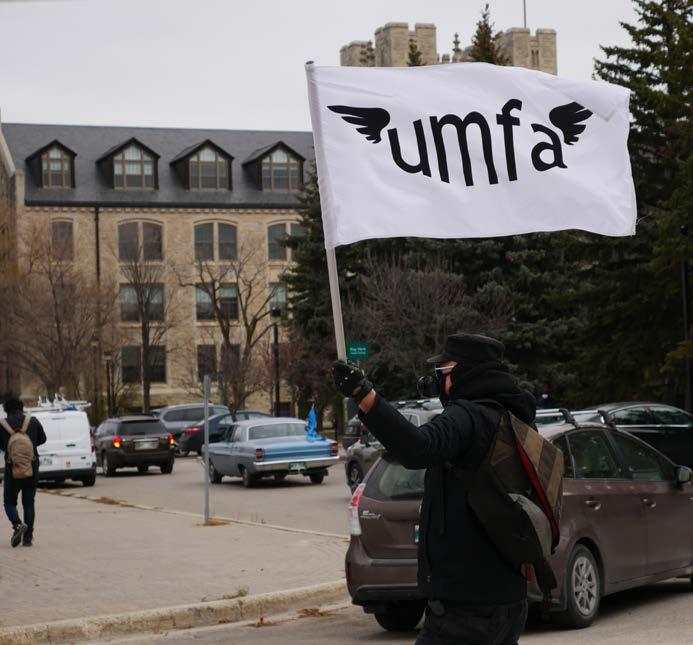
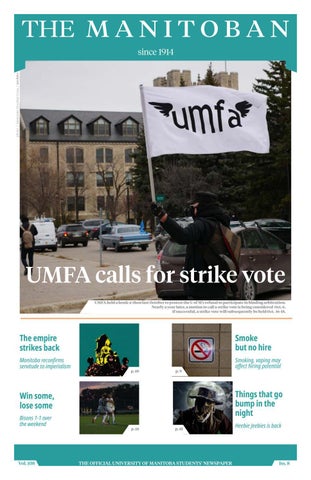
UMFA calls for strike vote
The empire strikes back
Manitoba reconfirms servitude to imperialism
Win some, lose some


Smoke but no hire
Smoking, vaping may affect hiring potential


Bisons 1-1 over the weekend Things
The empire strikes back
Manitoba reconfirms servitude to imperialism
Win some, lose some
Smoke but no hire
Smoking, vaping may affect hiring potential
Bisons 1-1 over the weekend Things
EDITOR-IN-CHIEF ? editor@themanitoban.com
Ty Brass
BUSINESS MANAGER ? accounts@themanitoban.com
Cindy Nguyen
ADVERTISING CO-ORDINATOR ? ads@themanitoban.com
Diego Castro
MANAGING EDITOR ? me@themanitoban.com
Sarah Doran
COPY DESK ? copy@themanitoban.com
Ursula Chojko-Bolec (ed.)
Evan MacNeil
NEWS DESK ? news@themanitoban.com
Cam Cannon, Liam Forrester (eds.)
Colton McKillop
Dimitar Tomovski
RESEARCH & TECHNOLOGY DESK ? research@themanitoban.com
Michael Campbell (ed.)
Emma Rempel
COMMENT DESK ? comment@themanitoban.com
Lucas Edmond (ed.)
Ivan Nuñez Gamez
ARTS & CULTURE DESK ? arts@themanitoban.com
Shaylyn Maharaj-Poliah (ed.)
Zoë LeBrun
Grace Paizen
SPORTS DESK ? sports@themanitoban.com
Matthew Merkel (ed.)
Isaiah Wagner
PHOTO DESK ? photo@themanitoban.com
Basel Abdelaziz (ed.) Mohammad Arsalan Saeed
DESIGN DESK ? design@themanitoban.com
Matthew Doering (ed.)
Mikaela Warkentin
GRAPHICS DESK ? graphics@themanitoban.com
Dallin Chicoine (ed.)
Marina Djurdevic
AUDIO DESK ? audio@themanitoban.com applications open, see themanitoban.com/jobs
SOCIAL MEDIA DESK ? social@themanitoban.com
Jalene Moman, Molly Smyth (eds.)
Audra Ashley
VOLUNTEERS THIS ISSUE ? Kitty Kerr
VOLUNTEER STAFF ? Emily Unrau-Poetker
interested in volunteering? email me@themanitoban.com today!

UNIVERSITY OF MANITOBA WINNIPEG, MB
204. 474. 6535
The Manitoban is the official student newspaper of the University of Manitoba. It is published monthly during the summer and each week of regular classes during the academic year by the Manitoban Newspaper Publications Corporation.
The Manitoban is an independent and democratic student organization, open to participation from all students. It exists to serve its readers as students and citizens.
The Manitoban is a member of the Canadian University Press, and our journalistic standards can be found online at toban.news/jsp.
The newspaper’s primary mandate is to report fairly and objectively on issues and events of importance and interest to the students of the University of Manitoba, to provide an open forum for the free expression and exchange of opinions and ideas and to stimulate meaningful debate on issues that affect or would otherwise be of interest to the student body and/ or society in general. The Manitoban serves as a training ground for students interested in any aspect of journalism.
Students and other interested parties are invited to contribute to any section of the newspaper. Please contact the appropriate editor for submission guidelines.
The Manitoban reserves the right to edit all submissions and will not publish any material deemed by its Editorial Board to be discriminatory, racist, sexist, homophobic or trans-phobic, ableist or libellous.
Opinions expressed in letters and articles are solely those of the authors. Editorials in the Manitoban are signed and represent the opinions of the writer(s), not necessarily those of the Manitoban staff, Editorial Board or the publisher.
A “volunteer staff” member is defined as a person who has had three volunteer articles, photographs or pieces of art of reasonable length and/ or substance published in the current publishing year of the Manitoban.
Any individual who qualifies as a volunteer staff member must be voted in by a majority vote at a Manitoban editorial board meeting. Elected representatives and non-students may be excluded from holding votes as volunteer staff members in accordance with the Manitoban Constitution.
All contents are ©2021 and may not be reprinted without the express written permission of the Editor-in-Chief.








NEWS Cam Cannon, staff
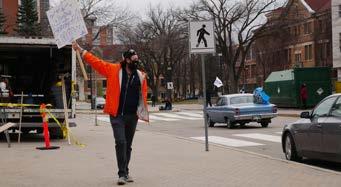
Without a collective agreement since April of this year, the University of Manitoba Faculty Association (UMFA), which represents around 1,200 academic workers including professors, instructors and academic librarians at the university, is calling for a strike vote.
The union has called a special general meeting for Oct. 6 to consider a motion to call a strike vote that would take place from Oct. 16 to 18.
Last year the union came close to striking after negotiations with the university reached an impasse, with an agreement being met during mediation in November that year.
According to UMFA president Orvie Dingwall, the top concerns of the union centre around salaries and academic freedom. She indicated the issues this time around are largely the same as last year’s.
“Since 2016 we haven’t been able to freely and fairly bargain our collective agreement, particularly on salary,” she said.
In 2017, the provincial government passed the Public Services Sustainability Act, which froze wages for over 120,000 workers in the public service for two years and further capped their wage increases for another two.
The caps in pay increases were below the rate of inflation, at 0.75 per cent and then one per cent — meaning
even the nominal maximum legal raise in wages would still represent a cut in terms of real wages.
In June 2020, courts ruled the legislation was unconstitutional and struck it down. In January of this year, the provincial government filed an appeal to the decision.
The union has raised concerns that compensation has fallen behind that of other provinces, pointing toward potential issues in terms of attracting and retaining staff.
Dingwall contends the legislation continues to play a role in UMFA’s negotiations with the university.
According to Dingwall, the position of the university in negotiations represents limitations on academic freedom.
“The administration [has] a proposal included in their package that would put limits on UMFA members’ ability to do outside professional activity,” she said.
This would include work in the community such as the music faculty doing performances or private lessons.
“The university wants more control, they want every single time a member wants to do one of these activities to check in with the dean first,” she said.
“We think that that’s a limit on academic freedom and we also think that that’s putting unnecessary control and constraint on our
members, and so we’re not okay with that.”
In a press release issued Sept. 29, Dingwall said the union has been reaching out for meetings with MLAs from the Progressive Conservative Party of Manitoba.
“We have met with a number of MLAs from the NDP and Liberal MLAs as well, including both Wab Kinew and Dougald Lamont,” Dingwall said.
“I’ve been hearing from so many members [that] they’ve been really collaborative and certainly the NDP and the Liberals are both against government interference in collective bargaining and they’re also against government interference in how the university runs.”
The New Democratic Party of Manitoba (NDP) has launched a petition which stated that “The PCs are trying to interfere in universities again — so they can dictate how faculty teach and what programs are funded.”
“Partisan agendas don’t belong in universities. The PCs should stop interfering,” the petition continued.
The union has also set a meeting with UMSU for Oct. 6 to discuss the strike vote. The meeting will be to keep communications open between the unions so UMSU has updates as soon as possible, but also to ask for the support of students.
Dingwall stressed in an interview the last thing workers want to do is go on strike, but that it is necessary. The well-being of students remains the top priority for the union.
“Talk to your professors, instructors and librarians and ask them about what the wage freeze since 2016 has meant to them, and let’s just have a conversation,” she said.
“Nobody ever wants to go on strike. There is still lots of time for the university to come with a fair and reasonable salary offer.”
news@themanitoban.com
Reverend Helen Holbrook urges reflection on the mistakes of the past
reconciliation is a sign of wider positive change.
As orange shirts and orange lights across Canada signalled the first federally-recognized National Day for Truth and Reconciliation last week, the U of M was no exception.
An hour of silence was held at the Chapel of St. John the Evangelist in St. John’s College from 11 a.m. to 12 p.m. on Sept. 30. The silence is meant to provide a space to reflect on the unmarked graves of Indigenous children at residential school sites.
Orange ribbons and shoes were displayed in the chapel. Reverend Helen Holbrook, St. John’s College chaplain, lit candles for the hour of silence.
Holbrook saw the silence as an opportunity for reflection and self-awareness.
“I guess I’m hoping that maybe that’s what this hour would have helped, because it is a self-awareness exercise,” she said.
“To be self-aware in terms of reflecting on their own relationships and understanding of the history of Indigenous peoples.”
Holbrook promoted the practice of sharing circles to give non-Indigenous people context and perspective on the history of residential schools.
“It goes back to listening to the stories, I think that can be quite powerful,” she said.
“I think the more opportunities to do something like that, the greater.”
For Holbrook, the day of truth and
“I’m grateful that I was allowed to do this, I think that is good and if you think about it, could we have done this 30 years ago, would you have been ready?” she said.
The last residential school in Canada did not close until 1996. The last residential school in Manitoba was Mackay Indian Residential School in Dauphin, which closed its doors in 1988.
Looking forward, Holbrook concluded it is time for churches to be open and honest about their history.
“The university has come along, and same with the churches, in being open […] let’s listen, let’s do the work we need to.”

NEWS Colton McKillop, staff
Many voters struggled to vote in this year’s election due to COVID-19, with some ultimately failing to cast a ballot despite their best efforts.
Elections Canada reduced the number of polling stations and warned voters to expect long lineups as a result of additional COVID-19 protocols and staff shortages.
Despite the barriers caused by COVID-19, 62 per cent of eligible voters participated — a drop from recent years, but roughly average for contemporary Canadian elections.
The previous two federal elections featured higher voter turnout, with 67 per cent in 2019 and 68.3 per cent in 2015.
Prior to 1988, federal elections regularly featured turnout of around 75 per cent.
A record number of voters — roughly 850,000 — used mail-in ballots.
Although ridings had fewer polling stations, more booths were available at each station, meaning the number of voting booths overall was relatively unchanged.
However, voters still faced barriers, such as longer distances to understaffed polling stations.
Since schools in Manitoba were not allowed to host polling stations in the midst of the COVID-19 pandemic, voters cast their ballots at a number of unconventional polling stations, including IKEA, shopping malls and the Assiniboia Downs racetrack.
There were about 15,400 polling stations in 2019 and 14,400 available this year, with 3,760 advance polling stations in comparison to 2019’s 3,800.
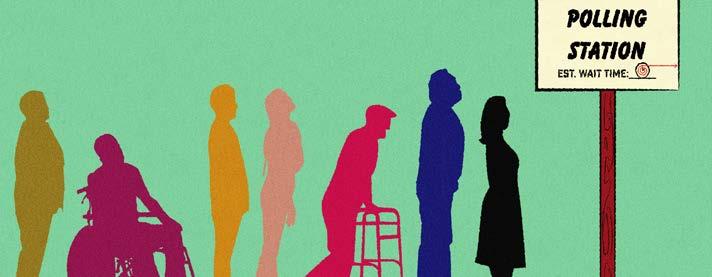
Disabled and elderly struggle, sick voters left with no options
Voters who tested positive for COVID-19 the week before the election, but after the deadline for advance and mail-in voting, had no means to vote, as they were required to self-isolate on election day.
In a statement to the Manitoban, spokesperson Matthew McKenna defended Elections Canada’s performance.
“For this election, we did our best to make sure Canadians were aware of the voting options available, and of the important dates and deadlines so that they could make a plan and find options that worked best for them — particularly because of the risk of situations where they might miss an opportunity to vote due to a late COVID diagnosis,” McKenna said.
Elections Canada apologized that many older voters, parents with young children and people with disabilities were unable to vote due to long lineups but insisted COVID-19 restrictions left them with few options.
“We did our best to inform electors that, as a result of the COVID-19 pandemic, their voting experience might be different at this election, including the fact that they may have to travel further to go and vote, or that they might be voting at a location that was less familiar to them,” McKenna said.
“We also tried to make clear that this might impact the overall accessibility of polling locations.”
Elections Canada also said voter information cards and the Elections Canada website contained details on the accessibility of various polling stations for the elderly or disabled.
“We let electors know that if a polling
place is not accessible, they may be issued a transfer certificate to allow them to vote at an accessible polling place in their electoral district.”
Numerous Indigenous leaders have criticized Trudeau’s decision to call an election during a pandemic, with some describing it as “opportunistic” and predicting low voter turnout as a result.
A recent APTN News poll of elected and community Indigenous leaders found unanimous opposition to the decision.
Indigenous communities have been hit harder by the COVID-19 pandemic due to poor health-care access and many felt containing the virus should have taken precedence over calling an early election.
Elections Canada stated they worked extensively with Indigenous communities “months before the election was called” to ensure voting access and safety. They listed numerous services offered to Indigenous communities, including a call centre to communicate with band administrations about their voting needs and provide election materials in
Indigenous languages.
“Voting options available on a First Nation reserve will depend on the health and safety situation at each place,” McKenna said.
“Voting options will vary based on local circumstances and timing will depend on the option(s) chosen.”
“Local returning officers consult with administrators on reserve to make the best plan possible under the existing circumstances,” he said.
Indigenous communities still faced significant challenges in this election, with many Indigenous people receiving voting cards with inaccurate information.
Additionally, three fly-in First Nations in the Kenora, Ont. riding had no polling stations available on election day.
McKenna had little to say regarding the timing of the election.
“Elections Canada’s mandate is to be ready to deliver an election at any time.”
MEJC failed to reach Jim Carr despite spending the day at MP’s office
NEWS Liam Forrester, staff
A group of environmental
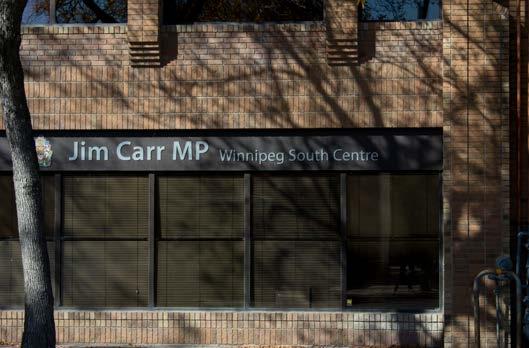
activists occupied Winnipeg South Centre MP Jim Carr’s office for 10 hours last Tuesday, but were still unable to contact Carr.
Activists with the Manitoba Energy Justice Coalition (MEJC) arrived at Carr’s office the morning of Sept. 28 shortly after it opened.
Daniel Friesen, an organizer with MEJC, saw the activists’ purpose as twofold.
“We were occupying MP Jim Carr’s office to try and get his attention and present him with the People’s Climate Mandate,” he said.
The mandate is a document prepared by the MEJC. It advocates for an end to all fossil fuel subsidies, an immediate end to all new fossil fuel development projects and for the government to honour the United Nations Declaration on the Rights of Indigenous Peoples (UNDRIP).
The activists succeeded in occupying the office but were not able to contact Carr during the occupation.
“There was no real trouble except for the staff not being very communicative about if Jim Carr knew we were there or if he would agree to speak to us,” Friesen said.
“It was very clear that [Carr] was totally unwilling to speak with us, didn’t want to engage with us at all or to even listen to our demands.”
After the office closed, the activists left without incident.
“It was peaceful the whole time, there was no real conflict or anything, and when we decided that we had […] attempted to do what we were there to do, then we decided to leave and we left of our own accord,” Friesen said.
The MEJC chose Carr for their demonstration because of his role in the Liberal Party of Canada’s climate record.
“[Carr has] been a cabinet minister and supporter of the Liberal government’s mandate for the last two terms, and specifically he was minister of natural resources when the Liberal government bought the Trans Mountain Pipeline, which is directly in the face of any kind of climate action,” Friesen said.
“He also has stayed in lockstep with the totally insufficient climate plan that the Liberal government has been trying to claim is progressive.”
Carr acted as minister of natural resources from November 2015 to July 2018 and has publicly said the government was determined to see the
“It’s very clear that they’re not interested in talking with people about their concerns about climate change at all”
— Daniel Friesen, MEJC organizer
Trans Mountain Pipeline expansion built.The Trans Mountain Pipeline expansion purchase was agreed upon by the federal government and Kinder Morgan in May 2018 but wasn’t finalized until August when shareholders approved the transaction. The price listed in that 2018 agreement was $4.5 billion.
Annie Cullinan, press secretary for Carr’s office, was available for comment but did not directly acknowledge the sit-in when asked.
“Climate change is the greatest threat facing our planet and it demands our urgent, and ongoing, attention. Our government has a renewed mandate to take even bolder action on climate change and Minister Carr looks forward to delivering on our ambitious agenda,” Cullinan said.
Meanwhile, Friesen and the MEJC are still waiting for their meeting with Carr.
“We were simply hoping to chat with him on the phone to set up a future meeting. His staff made it very clear that he was not interested in doing that […] and we would have to wait for another day to even set up an
appointment to talk to him,” he said.
“The day after the occupation, one of […] the people who was there the day previous went back first thing in the morning when the office was supposed to be open and there were no staff there. They tried calling the phone number and no one picked up the phone.”
Friesen was not optimistic Carr’s office would call them back.
“They were saying on the day of, ‘Oh yes, tomorrow we can set up an appointment to see him,’ and then when we came back, they again dodged us and totally made it impossible for us to even […] have the conversation to set up an appointment to talk to Jim Carr,” he said.
“So, it’s very clear that they’re not interested in talking with people about their concerns about climate change at all.”
Cullinan stated the office got in touch but did not provide any further details.
“Minister Carr’s office is in communication with members of the
organization,” she said.
Friesen acknowledged the office got in touch Friday.
While Friesen remains hopeful smaller change is possible under the Liberal minority, he sees meaningful change as antithetical to Canada as it currently exists.
“It’s a country built on resource extraction, on disenfranchising Indigenous people, on genocide, on white supremacy and for Canada to take real action that’s necessary to move and do the things that are needed to mitigate the worst outcomes of this crisis would go against what Canada is fundamentally, […] so it will mean a pretty seismic shift in who we are as a country,” he said.
“I think small steps can and might be taken, but I don’t think we’ll get anywhere close to what really should be happening in the face of the horrible genocide of Indigenous people and also the existential crisis of climate change.”
news@themanitoban.com
NEWS Colton McKillop, staff
Following disappointing election results and months of infighting over the IsraelPalestine conflict, Annamie Paul announced last week that she is stepping down as leader of the federal Green Party of Canada (GPC).
In a press conference Sept. 27, Paul explained she did not want to face a potential leadership review less than a week after the election.
“I just asked myself whether this is something I wanted to continue,” Paul said.
“Whether I was willing to put up with the attacks I knew would be coming, whether to continue to fight and struggle just to fulfil my democratically elected role as leader of this party […] I just don’t have the heart for it.”
Paul resisted multiple calls for a leadership review, with party executives trying to revoke her membership only weeks before the election.
Paul blamed unnamed party insiders for the poor results of last month’s election, as well as the party’s national council for withholding funds for the campaign and the infighting she said “undermined her leadership.”
Green Party executives tabled a motion at a federal council meeting in June to withhold $250,000 previously reserved for Paul’s campaign in Toronto Centre. She did not have a seat at the time and failed for a third time to secure the riding in September’s election.
“It doesn’t take a rocket scientist to know that when you head into an election without funding for your campaign […] it’s going to be very hard to convince people to vote for your party,” she said.
Paul is the first Jewish woman and first Black person to lead a major federal party and has characterized challenges to her leadership as racist and sexist gatekeeping by party insiders.
“What people need to realize is that when I was elected and put in this role, I was breaking a glass ceiling,” Paul told reporters at the press conference.
“What I didn’t realize at the time was that I was breaking a glass ceiling that was going to fall on my head and leave a lot of shards of glass that I was going to have to crawl over throughout my time as a leader.”
Members push back against racism claims, argue Paul was “autocratic”
Matthew Sloly, a Black Green Party activist, doesn’t deny the Green Party has a white bias, describing it as
“the least racially diverse of all our federal parties, including the People’s Party of Canada,” but disputes Paul’s accusations.
“I can’t speak for the motives of people [because] I’m not living in their heads, but I don’t see any evidence of it,” Sloly said.
“It’s been suggested that there’s institutional racism, which I agree exists everywhere [but] it’s not a blanket excuse to claim that every single act that anyone does that happens to impinge on a person that happens to be Black is racism.
“That’s just a complete abuse of the term.”
Sloly, along with “nearly four dozen” racialized and Jewish members of the party, signed an open letter to the media, published July 19, pushing back against Paul’s claims that racism and antisemitism were driving attempts to remove her from power.
In an interview, Sloly argued that if she was committed to fighting racism in the party, Paul should be willing to discuss specific details of the alleged racial discrimination she faced rather than making vague accusations.
Sloly said Paul also made unreasonable demands in the three-month-long negotiations over her employment contract that Paul’s supporters raised as an example of racism she faced in the party. Sloly claims federal council members were “browbeaten” into accepting the terms of Paul’s contract without reading it.
According to Sloly, “it’s wellknown that there was a lot of hard negotiation.”
“She almost instantly brought lawyers in and hard-balled it and basically made ultimatums about that contract,” he explained.
“It is rumoured that she was paid quite in excess of precedent in the Green Party, in a party that was already financially suffering.”
Additionally, Sloly said despite being offered former party leader Elizabeth May’s riding, Paul insisted on running in Toronto Centre, “one of the most expensive media markets and one of the least-winnable ridings in Ontario,” where she had already lost previous races.
While Paul and her supporters argued characterizations of her as “autocratic” — as a leaked document from a federal council meeting alleged — were racist and sexist, Sloly argued, given the facts he laid out, that “it does not seem like an inappropriate description.”
In an Oct. 3 op-ed for the Toronto Star, May broke her silence, further

May claimed Paul — who allegedly controls party communications — prevented the party from issuing press releases regarding the election of Lorraine Rekmans, an Anishinaabe woman, to the position of party president.
May further alleged Paul refused to allow Rekmans to make a public statement for the party on Sept. 30, the country’s first official National Day for Truth and Reconciliation.
Party beset by infighting over Israel-Palestine conflict
When conflict erupted in the Middle East in May over the removal of Palestinian families from the East Jerusalem neighbourhood of Sheikh Jarrah, many party members perceived the statement Paul made condemning violence on both sides to be insufficiently critical of Israel’s disproportionate use of force against Palestinians.
Jenica Atwin and Paul Manly — both Green Party MPs at the time — responded, with Atwin describing Paul’s response to “apartheid” as “totally inadequate” and Manly referring to Israel’s actions as “ethnic cleansing.”
Soon after, one of Paul’s advisors, Noah Zatzman, made a Facebook post accusing some unspecified Green MPs of antisemitism.
“We will work to defeat you and bring in progressive climate champions who are antifa and pro LGBT and pro indigenous sovereignty and Zionists!!!!!” the post read.
The party’s federal council passed a motion demanding Paul repudiate Zatzman’s attacks on Green MPs or face a non-confidence vote.
Paul’s refusal to do so provoked outrage among members who perceived her inaction as a signal she agreed with Zatzman’s call to replace
two of the Green Party’s few MPs. Atwin soon crossed the floor to join the Liberal Party of Canada, prompting calls for a leadership review and the attempt to revoke Paul’s membership.
The scheduled non-confidence vote was ultimately cancelled over concerns it would interfere with the party’s chances in the federal election. The challenge to her party membership was also abandoned.
Jewish party member and author Kim Goldberg argues that the concept of antisemitism is being “weaponized” to silence criticism of Israel.
Paul “does not agree with and cannot vigorously defend or articulate the party’s policy on Israel-Palestine,” she said.
“Members who speak out against her acts of institutional sabotage are neither racist nor antisemitic for doing so.”
Following Paul’s refusal to criticize Zatzman’s comments, Goldberg and other party members decided to only donate directly to local Green MPs and bypass the central party office in order to deprive them of funds until the controversy was resolved.
“Many people — party members as well as party supporters — do not want to contribute to the party when a portion of their donations are going to her salary and while she is still at the helm,” Goldberg explained.
“She allowed her senior advisor to publicly attack and defame the party’s small caucus. She allowed caucus to be gutted by the fall-out from this rather than swiftly move to defend and shield caucus from the smears […] The [two] MPs her advisor targeted for defeat in May 2021 are now no longer Green MPs.”
news@themanitoban.com
OCTOBER 7, 10, 14, 17, 24 • 7 PM–11 PM OCTOBER 21, 28, 31 • 7 PM–12 AM
OCTOBER 8, 9, 15, 16 • 6:30 PM–12 AM OCTOBER 22, 23, 29, 30 • 6:30 PM–12:30 AM
FRIDAYS & SATURDAYS — $45/PERSON THURSDAYS & SUNDAYS — SAVE $5/PERSON + UNLIMITED RE-ENTRY!
Come into our haunted corridors where you’ll encounter scenes straight out of your worst nightmares. Or linger outside with your fellow scaredy-pants, where there will be food trucks and photo ops.
Each of our four mazes varies in length from 8–12 minutes, while taking years off your life. Plan for 2 to 3 hours for the full experience. Sorry, no costumes allowed.
Expect fog, strobe lights, special effects and more than 100 costumed actors. Our cast will never make physical contact with Heebie Jeebies guests.
See these creatures and more, in flesh and bone and all their grisly, gory glory!

INTENSE MAZES – ONE PRICE


All are welcome to join
research centre’s
Michael Campbell, staff
The Centre for Social Science Research and Policy launched quietly during the pandemic and has been offering online workshops for the past several months. The centre is run by Royce Koop, academic director of the centre and professor of political studies, and Jennifer Dengate, executive director of the centre.
The goals of the centre include providing high-quality training and professionalization, sharing knowledge with the broader community, facilitating research and creating partnerships. The centre offers workshops, certificate programs and a professional development series to students, faculty and community members.
“The centre was started as a result of an investment from the dean of arts, an original investment that was made to create a centre that would be similar to the [University of Manitoba] Institute for the Humanities,” Koop said.
Plans had been in the works for the past several months to develop and welcome guests to the centre.
“COVID came along and kind of derailed everything, and everything was delayed,” Koop said.
Koop is the second academic director for the centre, following Tracey Peter’s brief tenure as acting academic director. Peter is now the vice-provost of academic affairs at the University of Manitoba.
Koop served as the department head of political studies for five years and is now the coordinator of the interdisciplinary Canadian studies program.
“I’ve used a lot of different kinds of social science methodologies,” Koop said.
“In my research, I do interviews, participant observation [and] work with large datasets.”
Dengate acts as the full-time executive director of the centre, overseeing day-to-day operations. She is a proud University of Manitoba alum, having completed her undergrad and master’s degree in the department of sociology before returning as a postdoctoral fellow after her PhD at the University of British Columbia.
“I was working kind of embedded between sociology and soil science, just so happens, a soil scientist wanting to do some research on equity, diversity and inclusion,” Dengate said.
The centre’s mandate encourages interdisciplinary thinking and lifelong learning. Acting as a bridge between departments and disciplines,

“In three to five years, the centre should be known clearly as the hub for social science research at the University of Manitoba”
— Royce Koop, CSSRP academic director
the centre allows faculty and students to learn about research that may complement or expand upon their own field of expertise. The centre also provides practical opportunities to students.
“If you sign up for a research methods course, you’re there for four months or eight months and you have to learn the theory and read a textbook that’s this thick,” Koop said.
“Sometimes I think what students want, what they need, is just […] the crash course in how to do this. You know, how to do interviews, how to do this focus group, how to do this and how to do that.”
Community members are also invited to participate in the centre’s activities.
“We currently […] welcome anyone to come,” Dengate said.
“If you are a member of the public [and] you want to upskill or you want to take a workshop, you work for an industry, but you want to collect data through focus groups, you’re more than welcome to attend the workshops when they’re offered.”
The fees associated with workshops and certificate courses are on a sliding scale. Students — who may face the largest financial barriers to accessing programming — pay a reduced rate compared faculty and members of the public.
The centre is offering a workshop on semi-structured interviews called “Inside Interviews: How to Conduct an In-Depth Semi-Structured Qualitative Interview” on Oct. 14 from 9 a.m. to 11 a.m. The workshop is free for all to attend.
The centre has practical workshops
for students today and ambitious plans for the future. Over the next five years, the centre would like to expand to host several certificate programs with diverse student, faculty and community member participation. The centre would also like to continue to develop its speaker series and research engagements.
“In three to five years, the centre should be known clearly as the hub for social science research at the University of Manitoba,” Koop said.
For more information about the centre, email cssrp@lists.umanitoba.ca to be added to their mailing list.
research@themanitoban.com
Anti-smoking and vaping stigma may prevent qualified applicants from being hired
Emma Rempel, staff
A study has demonstrated that the stigmatization of smoking and vaping can have negative effects in professional settings. Research published by Namita Bhatnagar, professor and F. Ross Johnson fellow at the Asper school of business, shows biased attitudes against smoking — and to a lesser extent vaping — persist in hiring decisions.
Bhatnagar and her co-author Nicolas Roulin, associate professor at Saint Mary’s University in Halifax, N.S., published the smoking study in the international journal Human Relations
Decades of negative marketing have contributed to reframing smoking as solely a public health issue. With her background in marketing, Bhatnagar wanted to explore whether this campaign has resulted in negative repercussions for individuals who smoke or vape.
Smoking and vaping was found to negatively bias the first impression of applicants in the eyes of interviewers. Troublingly, even a strong job interview was insufficient to counteract this negative first impression. Negative attitudes were found to be stronger toward smokers than vapers, indicating a stronger societal stigma against smoking.
To test Bhatnagar and Roulin’s hypothesis, they conducted mock job interviews. Participants in the study played the role of interviewers and rated actors portraying job applicants. Attitudes toward applicants who smoked or vaped were compared against a neutral behavior, like using a cellphone. The interviewers were allowed to select questions ranging in difficulty and were asked to assess the applicant’s responses.
In addition to participant ratings, the study assessed initial unconscious attitudes toward smoking applicants by using eye-tracking technology. This allowed researchers to determine that interviewers were fixated on smoking cues, indicative of negative attitudes toward smoking.
Bhatnagar recommended that students seeking employment be aware of their visibility as smokers, both in person and online. Social media posts can be screened during the hiring process, so applicants should exercise caution when posting on social media. Applicants should also be wary of smoking in highly visible public spaces designated for smoking, where an interviewer may spot them before an interview.
Additionally, the interviewer should undertake bias awareness training to encourage empathy. These courses could expand to include smoking and other stereotypical signifiers of
lower economic status such as weight, tattoos, piercings and cannabis use.
“There’s no end to the traits that you can use to look down on people,” Bhatnagar said.
It is not currently illegal in Canada to discriminate against smokers. It has been proposed that legal protections expand to protect smokers from discrimination, although there has been resistance.
“Legally, there’s a little bit of push and pull right now around smoking,”

“There’s no end to the traits you can use to look down on people”
— Namita Bhatnagar, professor in the Asper school of business

Bhatnagar said.
This places the responsibility on the individual applicant to be aware of potential anti-smoking biases.
Smokers themselves may be unaware of the extent to which this stigma touches aspects of their lives, including in a professional setting. Many current smokers may have retained the “glamorous” connotations around smoking that have persisted historically. It is this glamorized ideal that public health messaging has targeted.
Historically, shame and finger-wagging have been the go-to methods for public health messaging.
“Public health campaigns are designing messages to dissuade people from doing things that they deem as negative,” Bhatnagar said.
Bhatnagar acknowledged this campaign has successfully reduced smoking rates, particularly in youth and young adults. However, she worries whether the extent of stigmatization has resulted in negative outcomes that outweigh the benefits.
“On the one hand, it has lowered smoking rates, there’s no doubt about it,” Bhatnagar said.
“But on the other hand, it’s come at a cost.”
Some may see parallels in public attitudes toward individuals who choose not to vaccinate against COVID-19. Both are personal health-related decisions that can negatively impact and harm others. Bhatnagar wants to research more into effective strategies for communicating health messages without shame and stigma.
“I think the shame-based strategies, it alienates people that would have otherwise listened,” Bhatnagar said.
The challenge now facing Bhatnagar is to come up with effective marketing strategies to discourage smoking and vaping that do not result in stigmatization. Her research going forward will focus on changing perceptions on a variety of smoking products and the people who use them.
“How do you dissuade people from risky behaviors when you care about them?” Bhatnagar asked.
Marketing solutions could consider the social responsibility, acknowledging the harmful secondary effects of stigmatization.
“Marketing has created this monster,” Bhatnagar said.
It’s fitting that marketing can be a part of the solution.
research@themanitoban.com
Lucas Edmond , staff
More than three months have passed since the toppling of the Queen Victoria and Queen Elizabeth II statues at the legislative building. It has been reported that for the past two months, 90 soldiers from Manitoba have been training to serve the queen from Oct. 4 to 22. The timing cannot be a coincidence. It appears officials assume the public has forgotten the racist institutional response to the action Indigenous people took against the symbols of colonialism. But it also seems the government is prioritizing reconciliation with Queen Elizabeth II over the Indigenous people the statues offended.
The famous self-described “Black, lesbian, mother, warrior, poet” Audre Lorde once said, “the master’s tools will never dismantle the master’s house.” By this, Lorde meant the knowledge structures that facilitate systems of oppression must be dismantled before true liberation is possible for marginalized groups. Oppressors can never, and will never, become saviours.
Indigenous populations may find this quote resonates with them considering their long and difficult confrontation with colonial institutions — confrontations which are systemically organized to place them on the losing end of conflicts. In the process, they continue to lose their ancestral lands and rights.
Token actions of change have been made along the way in an attempt to scab an unhealing wound, but these performative gestures have mostly
been institutional attempts to quiet the screams these wounds have produced. For the most part, hollow efforts by lawmakers, private interest groups, legislators and parliamentarians have been Band-Aids on shark bites.
For example, five years ago a group of activists noticed there was no tribute to First Nations people on the legislative grounds. Even the atrocities of the Holodomor are commemorated due to the large Ukrainian population residing in Winnipeg. However, none exist for the atrocities First Nations had to endure on the very land where the monolithic gears of colonialism continue to churn.
Last year, the province agreed to invest in a statue of Chief Peguis — the chief who played a crucial role in negotiating Treaty 1 and aided settlers on Indigenous land — by 2024. However, the statue had to share a public space with the statues of Queen Victoria and Queen Elizabeth II. These two figures of the English monarchy visually memorialized perpetuators of genocide. For Indigenous people, the statues were more than just damaging symbology — they were an open embrace of settler colonialism and the collective trauma it caused.
As a result, on the momentous afternoon of July 1, 2021, Indigenous people gathered in outrage after the unearthing of mass graves found at various residential schools to express their indignation. The group proceeded to tear the colonial statues down.
Many described the political demonstration as a collective moment of catharsis. Indigenous people took matters into their own hands, laid down the tools of their oppressor’s house and symbolically took the first step toward ripping the house down.
institutions responded with rage.
Then-premier Brian Pallister promised retribution. He then went on a racist tirade glorifying the history of colonialism which later culminated in his demise as the premier of Manitoba. British representatives also condemned the actions.
An excerpt from the famous social theorist Frantz Fanon’s seminal book The Wretched of the Earth best describes these colonial responses to Indigenous Manitobans’ social action.
“The settler makes history and is conscious of making it. And because [they] constantly refer to the history of [their] mother country, [they] clearly indicate that [they themselves are] the extension of that mother-country. Thus, the history which [they] write is not the history of the country which [they] plunder but the history of [their] own nation in regard to all that she skims off, all that she violates and starves,” he writes.
The constructed history Fanon refers to has clearly influenced the decision to extend a peace offering to the British crown. By sending Manitoban military forces to guard the figurehead of settler-colonial states around the world, Canada is revalidating its commitment to imperialism. This politically charged expression of solidarity should not fly under the radar. The timing is clearly correlated to the toppling of the statuary at the legislative building.
Dialogue surrounding the statues and this horrific history should remain open, but how long can Indigenous populations stand using the same tools that were used to construct their marginalization? How long until they are treated with respect?
The truth is, there is no perfect solution to reconciliation and decolonization. These decisions are, and should be, up to Indigenous populations. However, disassociation from the crown and colonial figureheads should be a minor first step. Putting the truth of genocide first, recognizing Canada and its various western institutions’ role in these injustices and extending uncontested self-determination to Indigenous populations is far more constructive than empty, white-led discourses about reconciliation. As activists shouted during the wresting of the statues, there is “no pride in genocide.” It is time to surrender the oppressor’s tools.
comment@themanitoban.com

Ivan Nuñez Gamez, staff
Gabby Petito’s disappearance might have captivated the international community and brought awareness to the existing threats women face in the 21st century, but the unparalleled media attention it attracted demonstrated the bias and systemic racism in policing and news coverage. Indigenous women and girls face those threats at a disproportionately larger scale. Nonetheless, their cases don’t receive half as much attention and are treated less diligently by officials. This negligence calls into question whether opening an investigation is enough to provide justice for mourning Indigenous families and create enduring reconciliation.
Petito, an aspiring vlogger who documented her van journey, was reported missing in Wyoming Sept. 11 following continuous confrontations with her fiancé. Her story controlled U.S. and foreign media for numerous days with her family eager to find resolution. After an extensive search, Petito’s remains were found and the police are currently searching for her fiancé as a person of interest.
Despite mourning the death of all women lost to violence, it is undeniable that Petito’s case came to show the systemic racism that is inherent in media outlets and policing. In Wyoming alone, at least 710 Indigenous people went missing between 2011 and 2020, yet almost none made it to the headlines. And the story in Canada is not far from the same.

After his 2015 election victory, Prime Minister Justin Trudeau launched the national inquiry into missing and murdered Indigenous women and girls (MMIWG) which sought to reveal the persistent and deliberate violations against the rights of Indigenous women, girls and two-spirit people. Despite significant findings, and over 200 recommendations provided, Canada still faces challenges battling the recurring violence against Indigenous women.
Due to an absence of support and the historical and contemporary effects of genocidal racism, once Indigenous peoples — especially women — leave their communities and move to the cities, they become highly susceptible to poverty which can lead to violence enacted upon them. This vulnerability has contributed to the murders and kidnapping of Indigenous women in metropolitan areas like Winnipeg. Nonetheless, this high rise in crimes hasn’t been accompanied by congruent police action. Indigenous families, desperate for answers regarding the state of their loved ones, seeking help at local police stations are often slammed with racial bias and lack of action. This leaves many Indigenous communities to rely on each other to find their well-deserved answers.
Local organizations like the Bear Clan Patrol have acted as first responders in high-risk metropolitan areas where there are concentrations of Indigenous residents who could be at risk. Likewise, mourning families have gathered volunteers to look for the remains of their missing family members. Despite these grassroots efforts, mainstream media has acted oblivious to them.
The historic lack of action and reporting has done nothing but propel the problem as Indigenous women are seen as easy targets for all kinds of aggressions. In the last decade, Manitoba has become a hotspot for violence against Indigenous women with 18 active cases of MMIWG. Though steps have been taken to battle the growing problem in Winnipeg by creating a special police unit, an estimated 90 to 95 per cent of the reported missing people are still Indigenous women or girls.
The political hiatus on the discussion of MMIWG was so notable that it became a topic for the federal leaders’ debate earlier this year. What could have been a great opportunity to acknowledge the wrong-
doings of the past and promote viable solutions for the current surge in violent crimes against Indigenous women and girls became nothing but a partisan politics discussion. Prime Minister Trudeau took the opportunity to promote his MMIWG action plan, which has been described by the Native Women’s Association of Canada as “toxic and dysfunctional.”
In such a historic moment when reconciliation is more crucial than ever before and media coverage is increasingly influential, the lack of reporting of MMIWG must pick up pace. By letting media outlets off the hook, we are only propelling the collateral damage of colonialism.
As disheartening as Petito’s death is, we must also mourn and demand answers for all the Indigenous women and girls that have had the same fate. We must say their names and let their stories be told.

In the six years that Justin Trudeau has been prime minster of Canada, his government has been in the hot seat for several pieces of legislation that limit freedom of speech. Prior to Trudeau dropping the writ and dissolving Parliament for the federal election, his government was working on several pieces of legislation containing limits to Canadians’ freedom of speech. Such laws included Bill C-36 and a notyet-proposed law to curb pandemic misinformation. Possibly the most
social evils such as counselling a crime, advocating genocide, public incitement of hatred and discriminatory speech and actions under the Canadian Human Rights Act. Each of these limitations are codified into Canadian law and are demonstrably justified in accordance with freedom and democracy.
In 2016, Bill C-16 — An Act to amend the Canadian Human Rights Act and the Criminal Code — was met with uproar from free speech enthusiasts who claimed that
content in several newly emerged online platforms. Specifically, the Canadian Radiotelevision and Telecommunications Commission (CRTC) — which oversees traditional media — would be granted similar authority over web-based platforms.
The CRTC regulates content to promote so-called Canadian content. Canadian content does not simply refer to content’s country of origin but must also meet the “needs and interests” of Canadians, the definition of which is loose and marred with the relative secrecy of the CRTC innerworkings.

egregious example can be found in the now-dead Bill C-10.
The right to free speech is not absolute. In Canada, freedom of thought, belief, opinion and expression — “including freedom of the press and other media of communication” — are protected by section two of the Canada’s Charter of Rights and Freedoms. These rights are limited by the first section of the charter, which indicates these fundamental freedoms are “subject only to such reasonable limits prescribed by law as can be demonstrably justified in a free and democratic society.”
The legalese of section one requires a bit of parsing. Reasonable limits to charter rights must be prescribed by law and the legislators must demonstrate the justification of such limits while upholding principles of freedom and democracy.
Canada has a history of placing reasonable limitations on free speech. Such examples include prohibiting
additional restrictions to speech were unwarranted and unconstitutional. However unpopular in certain circles, it was generally agreed among elected officials that extending human rights protections to gender expression and identity was consistent with Canadian laws and values despite the limitation on speech.
Debate surrounding Bill C-16 fractionated Canadian society into warring political camps that exploded into protests, epithets and — in some cases — outright violence. Perhaps Trudeau’s team recalled the effective wedge issue and decided to employ it in advance of the 2021 campaign.
In the spring, Trudeau’s government rushed to pass several key pieces of legislation before Parliament went on summer break. One such bill was Bill C-10, introduced to the House of Commons by Steven Guilbeault, minister of Canadian heritage. The bill sought to amend the Broadcasting Act, granting the government more control over Canadian
To quell fears, Bill C-10 was introduced with a provision to prevent user-generated content from being regulated by the CRTC. However, in a controversial move, Guilbeault removed the provision and thus opened the doors for the government to regulate the social media content created by Canadians.
In response, Peter Menzies — the sitting vice chair of the CRTC — rebuked the controversial decision to remove free speech protections for citizens.
“Granting a government agency authority over legal user generated content […] doesn’t just infringe on free expression, it constitutes a fullblown assault upon it and, through it, the foundations of democracy,” Menzies said, according to the National Post.
Proponents of the bill point to clause 1 in section 2 (2.1) which distinguishes a user from a broadcaster. The upshot of this clause is that
while the government would not be able to regulate the content that Canadians post, it would instead be able to regulate which user-generated content could be broadcast over the platform.
In short, if your tweet was not consistent with the standard of Canadian content — that is, it did not promote the loosely defined “needs and interests” of Canadians — Twitter may have been compelled by Canadian law to suppress the tweet.
The possibility for misuse or malevolent application should be enough to send a shiver down your spine.
Could a political party have their content suppressed for lacking loosely defined Canadian values? Could citizen dissent be suppressed under the same guise?
The answers remain unclear. Such blatant disregard for fundamental freedoms should not be ignored.
Trudeau’s Liberals had the audacity to propose the legislation once and you can bet that similar restrictions will be coming down the pike. As Trudeau enters his third term as prime minster, we must reject his flirtations with regulating speech.







Zoë LeBrun, staff

With Halloween just around the corner, the immersive horror experience Fear5 is making its long-awaited return, beginning Oct. 1 and running every Friday, Saturday and Sunday for the duration of the month. This year, Fear5 is putting on four terrifying experiences where participants have one goal — get out alive.
Between 2015 and 2018, Fear Winnipeg’s annual events sold out every year, instilling terror into the hearts of over 40,000 people during the four-year period. Unfortunately, in 2019, a massive fire destroyed their venue, along with thousands of dollars’ worth of materials and props for the event.
The event’s lead organizer, Jay Hall, said “the fire was absolutely devastating.”
“When I showed up to see the building engulfed in flames and the walls crumbling, I won’t lie, there
were a couple of tears,” Hall said in a press release.
The fire led to the postponement of 2019’s event, which got pushed back even further due to the COVID-19 pandemic in 2020.
Now, after two years of inactivity, Fear5’s organizers are back with a vengeance, ready to make the fifth installment of these bone-chilling experiences the most frightening one yet.
This year, Fear5 is offering four unique experiences at a secret venue. Two days prior to their scheduled event, ticket holders will be contacted with the event location. While this strategy is meant to deter people from posting about the location on social media, it also enhances the creepiness of the experience.
However, Fear5 ensures the venue “is in downtown Winnipeg, easy to get to, on major bus routes [and has]

plenty of parking options.”
Experiences this year include “Blind,” a Bird Box-inspired experience, where you are blindfolded and must navigate an unpredictable space using your other senses, “The Copycat Killer,” a Dexter-inspired theme which calls on you to participate in a grisly murder, “Virtual Horror,” a terrifying virtual reality experience that forces you to conquer fears of falling and a new spin on Fear Winnipeg’s classic zombie theme called “The Cure,” in which you must find your way through a zombie-infested building while being as quiet as possible.
As much as Fear Winnipeg loves to scare the living daylights out of its guests, the team also loves doing good for the community. This year, Fear5 will be making a donation in support of Winnipeg Harvest.
In a press release, Bailey Danae — another of Fear5’s organizers — said
& CULTURE
LeBrun, staff
4/5
Astral Swans’s new LP represents a turning point in the band’s discography to date.
Following the success of its first two records All My Favorite Singers Are Willie Nelson and Strange Prison, the band’s new self-titled album has introduced a more upbeat energy to its instrumentals, resulting in 12 songs that are beautiful and fun as much as they are philosophical.
Simply put, Astral Swans is an excellent record. Comprised of a wonderful blend of mellow guitars, spacey synthesizer, clear vocals and a variety of unique instrumental additions, it presents a fascinating mixture of lightness and darkness with a laidback yet psychedelic sound.
However, this album does require its listener to have a taste for eclecticism, and some aspects of its contradictory nature can be off-putting
if you’re not in the right mood — like a choose-your-own-adventure story, you get out of it what you bring to it.
In a pleasant mood, you may focus on Astral Swans’s uplifting vocal
melodies, appreciate the emotionality behind sections of screeching guitar and find the thoughtfulness and humour in its surreal and existential lyrics.
However, in a less ideal mindset there are times when the album’s instrumental chaos feels intrusive and haphazard rather than intentional. This flip-flopping of enjoyment is most evident with the song “More Nothing Than Something,” which, depending on the listener’s mood, feels either interesting and conceptual or truly off-putting due to a particularly intense section of screaming guitar near the end of the track.
Although the band Astral Swans consists solely of musician Matthew Swann, many guest collaborators join him on this record, including Julie Doiron, Jim Bryson and more. These musical additions are to the album’s benefit, and some of the most successful tracks on Astral Swans are those which feature more than one vocalist, such as “Spiral,” “Flood” and “March 28/20.”
The addition of a second vocal track fused seamlessly with these songs
they “filled a [12 ft. by 12 ft.] room in 2018 to the [10 ft.] ceilings with food, clothes and other items.”
“I hope we do at least that this year. It’s really redeeming to see Winnipeg come together to give that kind of a donation.”
Hall also said “this is as much a community-driven event as it is about Halloween.”
For more information, head to fearwpg.ca or Fear Winnipeg’s official Instagram page, @fearwpg.ca.
image/ Fear Winnipeg / provided
arts@themanitoban.com

and heightened their cinematic and psychological aspects. Additionally, the rhythm at which these songs are interspersed throughout the album lent a subconsciously recursive feel to the record, adding yet another layer to Astral Swans’s already complex narratives and sounds.
Astral Swans’s self-titled new release will be available Oct. 8. Want us to review your band? Email arts@themanitoban.com today!
Grace Paizen, staff
Calling all fans of things that go bump in the night: Heebie Jeebies returns for another year of terrifying fun.
Running every Thursday through Sunday starting Oct. 7, Heebie Jeebies is the ultimate Halloween event in Winnipeg.
The main attraction consists of four terrifying mazes, each with a creepier theme than the last.
Bunker Z is themed as a military experiment gone horribly wrong, the “Z” alluding to the zombie horror unleashed by the experiment.
The Junkyard, paired with the warning sign of “no trespassing,” baits participants to enter the “abandoned” space at their own peril.
Though a jest toward our neighbours to the west à la Troy Westwood and the Banjo Bowl — “a bunch of banjo-pickin’ inbreds” — the Saskatchie Cuzzies maze is far from a good joke.
Themed as an abandoned farmhouse of a long gone cannibalizing, redneck family, it will take guts to find out whether the farmhouse is really abandoned after all.
Last, but definitely not least in nightmare fuel, Bobo’s Funhouse is a Stephen King-like horror brought to life. If you are afraid of clowns, you may want to sit this one out, as the fun in the funhouse is reserved for the building’s residents.
Due to the ongoing pandemic, tickets must be purchased on the Heebie Jeebies website. It is also advised that you arrive early for smooth entry as you will need proof of double vaccination via QR code and government issued ID to enter the event.
Tickets are non-refundable, but you can transfer them to your friends for a fee if you can’t make it.
There are two passes to the event. The first pass is for the amateur horror enthusiast — and student
budget friendly — called the “scaredy pass” which costs $15, but you don’t have access to the mazes.
The second pass, the regular pass, is for the ultimate horror enthusiast and includes access to the mazes, It is not as budget-friendly at $40 for Thursday or Sunday entry, and $45 for Friday or Saturday entry, though on Thursdays and Sundays there is unlimited re-entry into the mazes.
For those who purchase the “scaredy pass,” there is still plenty of Halloween fun to be had. Apart from the four mazes, there are food trucks, free hot chocolate and carnival games and even fireworks on select nights.
If you are brave enough to purchase the regular pass but can’t handle the zombie apocalypse or night of the living dead, there will be staff who will help you get out mid-maze so that you can chill and collect yourself with some hot chocolate.
Located southwest of Winnipeg on La Salle Road, you will need a ride to the event with carpooling as your best option.

There are also no costumes allowed, for your safety. It cannot be stressed enough that you want to be assured the terrifying clown jumping out at you is a hired actor and not a psychopath.
With 70,000 square feet of horror fun, Heebie Jeebies is the Red River Ex version of Halloween events in the ’Peg.
Information and tickets for Heebie Jeebies can be found at heebie-jeebies.ca.
arts@themanitoban.com
Kitty Kerr, volunteer
WHEN VEINS MEET LIKE RIVERS, the current exhibition at the Plug In Institute of Contemporary Art, is comprised of a triad of indefinable and ephemeral artworks. Featuring Oglála Lakȟóta artist Suzanne Kite, Inuk filmmaker asinnajaq and Métis, Saulteaux and Polish artist Dayna Danger, the rich complexity of the works provoke deep thinking on the nature of convergence and related tensions of resistance.
The exhibition’s name describes its embodied plurality of meeting — that of the artists’ work, creating the space itself, the careers of each artist and the coming together of the artists’ Indigenous nations. The artworks share an intimate bond, generating a frequency of sound and inter-space relation by which the artists can call and respond to one another within the gallery space.
The triad shares a reverence for the land and natural phenomena in tension with the presence of synthetic technologies. Through reference to “rivers, stones, pathways and shores,” the artworks employ non-colonial modes of storytelling to engage with themes of consent, care and the processes of submitting and resisting.
The initial artwork the visitor is invited to witness is Danger’s “to submit, to resist, to submit, to resist.”
The visitor is confronted with what is to be discovered as Danger’s performance ephemera — an assemblage of a skull and antlers connected to a brightly painted wooden frame by bright blue nylon rope. The assemblage immediately begs the question of presence — was there a body this rope was once tied on?
The visitor’s senses then check into the sounds of the room — nature samples, drumming and a voice uttering words that echo throughout the gallery: “It’s not gonna work unless we activate it.” There is a video of the space — a recording of Danger’s performance — and instantly the assemblage is recognizable. The performance comprises the careful dressing and bonding of the assemblage by one person to another’s pelvis area. Then the bonded figure, dressed in a spandex camo catsuit gently drags the assemblage of antlers throughout the gallery space.
The action draws the visitor’s attention to the remaining, perhaps unnoticed, gallery space. Entering further, one encounters a second sound frequency from above. Kite’s

installation, “Iron Road,” employs a television displaying drone footage of her family’s trust land amidst thunderstorm imagery and Lakota symbols. An overhead speaker playing the sound of a warm voice is storytelling and a second assemblage of stones is on the gallery floor. Kite’s work tells a visual story of her great-great-great grandmother who escaped the Wounded Knee Massacre on foot. Kite’s environment is intimate and tender and the energy between the works is palpable.
Finally, flooded with light in the second gallery is asinnajaq’s massive installation “Cradling River Piece.” asinnajaq’s video performances are displayed on a hanging screen, behind which hang cascading layers of fabric, printed with images of frothing waves. The synthetic waterfall spills onto an image of magnified cranberries on the ground. The video
/ provided performance is a loop of the artist moving upstream, the soaking fabric of her clothing and dragging herself in the opposite direction of the current. She nearly reaches the edge of the frame and then lets go, floating swiftly with the current off-screen.
The exhibition is tender and provocative. It invites its audience to work through sometimes uncomfortable and complex ideologies of consensual convergence and historical realities.
When Veins Meet Like Rivers is on display at the Plug In Institute of Contemporary Art until Dec. 17. For more information, please visit plugin.org.
arts@themanitoban.com
Grace Paizen, staff

Winnipeg has a long and rich history of paranormal fame.
At the height of spiritualism in post-First World War Canada, carried over from a popular Victorian diversion of attempting to communicate with the dead, T.G. Hamilton, owner of Hamilton House — still standing in the Elmwood area — hosted seances and captured photographs of alleged ectoplasm.
This inexplicably active portal to the other side, conveniently based in Winnipeg, brought followers from all over the country to experience the phenomenon. Even former prime minister William Lyon MacKenzie King and Sir Arthur Conan Doyle of Sherlock Holmes fame participated in the ectoplasmic playground of Hamilton House.
In celebration of our haunted city, author and ghost enthusiast Matthew Komus developed Winnipeg Ghost Walk tours for the brave souls who wish to learn more of the history of Winnipeg and its residents who are no longer viable to be claimed on the census.
For the entire month of October, Winnipeg Ghost Walk will be hosting tours starting in the Exchange District every Thursday through Saturday starting at 7 p.m. in Old Market Square. At $15 a ticket, this activity has lots of bang for students’ buck.
The walking tour highlights stories of the paranormal from Old Market Square to Pantages Playhouse Theatre to the Burton Cummings Theatre.
Tickets for the Ghost Walk can be purchased on site, but with a 25-person tour capacity, online is your best bet to guarantee a night of spooks.
This is an outdoor event, so be sure to dress for the weather and bring snacks. Who knows, maybe a ghost will ask for a bite of your granola bar.
For our city’s beloved cyclists, Winnipeg Ghost Walk and Bike Winnipeg are pairing up to host a Pedal Powered Ghost Tour on Oct. 16 through the Seven Oaks area, complete with visiting Seven Oaks House, whose claim to fame is being the oldest haunted house in Winnipeg — though, whether oldest necessarily means haunted is for the tour group to determine.
With the cycling tour notably on Oscar Wilde’s birthday, if Hamilton’s portal to the spirit realm remains open, perhaps the famous playwright will pay a visit.
The Pedal Powered Ghost Tour starts at 7:30 p.m. and also costs $15.
While on tour, you can pick up your own copy of the Haunted Winnipeg: Ghost Stories from the Heart of the Continent from your tour guide. Written by Komus, the book gives a detailed overview of the city’s most infamous hauntings.
Winnipeg Ghost Walk is a great opportunity for horror genre lovers, ghost enthusiasts and amateur ghost hunters to get to know the city’s rich past of paranormal activity.
Information and tickets for the Winnipeg Ghost Walk tour and Pedal Powered Ghost Tour can be found at winnipegghostwalk.com

Cavalcanti continues to lead herd in scoring
SPORTS Matthew Merkel, staff
The U of M Bisons women’s soccer team lost their first game of a weekend series against the University of Regina Cougars, only to rebound the next day and win the second.
The first half of game one was a physical affair. Numerous fouls were taken fighting for loose balls, including a Bianca Cavalcanti collision with Cougars goalie Allyson Ford.
There were many chances for both sides in the half. Breakaways from Cougars forward Nicole Klassen and Bison rookie Jordan Cistarelli were stymied by each team’s defenders. In the 13th minute, Bison defender Shaylyn Dyck was awarded a penalty. The fifth-year put too much power behind her kick, sending her penalty sailing over the opponent’s net, a big break for the Cougars.
In the 39th minute, the stalemate was broken as Bianca Cavalcanti finished a dangerous cross in front from Camila Goldsztein, making the game 1-0 for the Bisons.
Cavalcanti’s celebrations were cut short soon after scoring, as a Haylee Evans tackle flipped Cavalcanti in the air, sending the Brazilian national falling to the ground and crashing her neck into the turf. After lying on the field for a few minutes, Cavalcanti walked off with the help of an athletic therapist. The Bisons’ leading scorer remained on the Manitoba sideline for the rest of the game.
Cavalcanti’s absence on the field appeared to rattle the Bisons, helping the Cougars swing the momentum in their favour. The Cougars held possession in the Bisons’ end for the majority of the half, relentlessly sending balls at their net.
Although Bison goalie Karina Bagi tried her best to prevent the Cougars from tying the game, the U of R eventually found twine. Fourth- year Cougar forward Kyra Vibert broke through the Bisons’ defence and shot a ball past the left of Bagi, evening the score at 1.
The Cougars continued to amp up the offence. In the 74th minute, Cougar Sally Bachmann was stopped by Bagi on a breakaway from the top of the box. Unfortunately for the Bisons, the resulting corner kick resulted in a Sophia Stevens goal for the U of R, putting the Cougars up 2-1.
The Cougars would continue to dictate the majority of the play by putting the Bisons on the defensive, stifling any hope of a comeback and helping the Cougars walk away with the win.
The impact of losing Cavalcanti for the Bisons can be seen when looking at each team’s shots on net. After putting up ten shots in the first half, the Cougars would keep the Bisons to four in the second, compared to the Cougars’ eight.
Although Saturday afternoon’s game was an inconsistent effort, the Bisons
“We just got to keep doing what we’re doing, the wins will come and as the season progresses”
— Jenna Kunkel, first-year Bison women’s soccer player
would put on a dominant performance in game two.
Less than four minutes into the Sunday matinee, a rejuvenated Cavalcanti flew through the Cougars’ box, heading in a corner kick to put the herd up 1-0.
Cavalcanti and the Bisons did not let up, holding the Cougars in their end for the majority of the half, tiring out the U of R backline.
In the 41st minute, Bison midfielder Alexandria Paul dribbled the ball uncontested to the Regina net, firing it past Allyson Ford.
In the second half, the Bisons continued to play keep -away from the Cougars. Plugging up the midfield, the Bisons shut the Cougars out of the interior.
Playing in a much more defensive role, U of M’s Jessica Tsai and Tabata Bravo won many one- on- one battles

and cleared any dangerous loose balls, helping the Bisons secure their fourth win of the season and splitting the weekend series.
Sunday’s win was integral in the herd’s pursuit of the Canada West playoffs. The U of M is one point back of the U of R for the final playoff spot in the east division.
The week prior, the Bisons helped their bid by winning both games of a weekend series against the University of Winnipeg, including a 5-1 win in the Duckworth Challenge game.
Bison forward Jenna Kunkel said she and her team were very motivated to strike quickly against their cross-town rivals. Kunkel had two goals and an assist in the game, helping her garner the title of Bison athlete of the week.
“I think we came into the game very prepared,” said Kunkel.
“We’ve been preparing all pre-season and [the University of Winnipeg] is a huge rival, so we were very, very motivated to win that game.”
“It’s a big derby, and we just came out there and […] got off to a very quick start, and we got a goal early and I think as a team we just kept fighting and we just won every ball.”
Kunkel and her Bison teammates will be looking to add a couple more wins onto their belt at home against the University of Saskatchewan Huskies on Oct. 15 and 16. The first-year forward said the wins for the Bisons will come if they continue to build on the success they’ve had this season.
“We just got to keep doing what we’re doing, the wins will come and as the season progresses, I think now that we have played a few games we will be able to wrap up the season with more wins than losses if we keep going along the path we are going,” said Kunkel.
The Bisons’ next games are Oct. 15 and 16 against the University of Saskatchewan Huskies at the West Turf Fields.
sports@themanitoban.com
The U of M Bisons football team travelled to Edmonton, Alta. this past weekend for a bout with the university of Alberta Golden Bears.
The Bisons were up to the task, taking the 31-17 victory, despite losing one of their coaches to cancer at the age of 29 earlier in the week.
Scott Naujoks was the receiver coach for the Bisons and was ultimately loved throughout the locker room. A win on Friday was possibly the best way to honour their coach.
The previous week’s win against the University of Regina Rams was important for getting off to a hot start on the season.
Bisons defensive back Stephen Adamopoulos chimed in on the momentum after a win.
“Last week’s win was huge to be able to start the season undefeated,” Adamopoulos said.
“We played a great game and looked to continue that great play in Edmonton.
We just continued to work hard in practice throughout the week and take the momentum from last game and use it to our advantage.”
The team also lost starting quarterback Des Catellier to a leg injury head coach Brian Dobie said is “extremely concerning.”