Unpopular contest
Snap election sees Trudeau approval slump
Unsettling the settlers
Evan J Hoskins on his new poetry collection




Stepping up
Stefanson first to announce candidacy for PC leadership
Reina Iizuka, first U-Sports female football player

Unpopular contest
Snap election sees Trudeau approval slump
Unsettling the settlers
Evan J Hoskins on his new poetry collection
Stefanson first to announce candidacy for PC leadership
Reina Iizuka, first U-Sports female football player
EDITOR-IN-CHIEF ? editor@themanitoban.com
Ty Brass
BUSINESS MANAGER ? accounts@themanitoban.com
Cindy Nguyen
ADVERTISING CO-ORDINATOR ? ads@themanitoban.com
Diego Castro
MANAGING EDITOR ? me@themanitoban.com
Sarah Doran
COPY DESK ? copy@themanitoban.com
Ursula Chojko-Bolec (ed.)
NEWS DESK ? news@themanitoban.com
Cam Cannon, Liam Forrester (eds.)
RESEARCH & TECHNOLOGY DESK ? research@themanitoban.com
Michael Campbell (ed.)
COMMENT DESK ? comment@themanitoban.com
Lucas Edmond (ed.)
ARTS & CULTURE DESK ? arts@themanitoban.com
Shaylyn Maharaj-Poliah (ed.)
SPORTS DESK ? sports@themanitoban.com
Matthew Merkel (ed.)
PHOTO DESK ? photo@themanitoban.com
Basel Abdelaziz (ed.)
DESIGN DESK ? design@themanitoban.com
Matthew Doering (ed.)
GRAPHICS DESK ? graphics@themanitoban.com
Dallin Chicoine (ed.)
AUDIO DESK ? audio@themanitoban.com applications open, see toban.news/jobs
VIDEO DESK ? video@themanitoban.com applications open, see toban.news/jobs
SOCIAL MEDIA DESK ? social@themanitoban.com
Jalene Moman (ed.)
VOLUNTEERS THIS ISSUE ?
Zoë LeBrun, Kunal Rajpal
VOLUNTEER STAFF ?
interested in volunteering? email me@themanitoban.com today!

109 HELEN GLASS BUILDING
UNIVERSITY OF MANITOBA WINNIPEG, MB
204. 474. 6535
The Manitoban is the official student newspaper of the University of Manitoba. It is published monthly during the summer and each week of regular classes during the academic year by the Manitoban Newspaper Publications Corporation.
The Manitoban is an independent and democratic student organization, open to participation from all students. It exists to serve its readers as students and citizens.
The Manitoban is a member of the Canadian University Press, and our journalistic standards can be found online at toban.news/jsp.
The newspaper’s primary mandate is to report fairly and objectively on issues and events of importance and interest to the students of the University of Manitoba, to provide an open forum for the free expression and exchange of opinions and ideas and to stimulate meaningful debate on issues that affect or would otherwise be of interest to the student body and/ or society in general. The Manitoban serves as a training ground for students interested in any aspect of journalism.
Students and other interested parties are invited to contribute to any section of the newspaper. Please contact the appropriate editor for submission guidelines.
The Manitoban reserves the right to edit all submissions and will not publish any material deemed by its Editorial Board to be discriminatory, racist, sexist, homophobic or trans-phobic, ableist or libellous.
Opinions expressed in letters and articles are solely those of the authors. Editorials in the Manitoban are signed and represent the opinions of the writer(s), not necessarily those of the Manitoban staff, Editorial Board or the publisher.
A “volunteer staff” member is defined as a person who has had three volunteer articles, photographs or pieces of art of reasonable length and/ or substance published in the current publishing year of the Manitoban.
Any individual who qualifies as a volunteer staff member must be voted in by a majority vote at a Manitoban editorial board meeting. Elected representatives and non-students may be excluded from holding votes as volunteer staff members in accordance with the Manitoban Constitution.
All contents are ©2021 and may not be reprinted without the express written permission of the Editor-in-Chief.







The Liberal Party of Canada’s proposed federal employee vaccine mandate has become an early wedge issue in the upcoming election.
In its Aug. 13 announcement, the Liberal party signalled its intention to require all employees of the federal public service to get vaccinated by the end of September at the earliest and October at the latest. The announcement also outlined accommodations and alternative measures for those who are unable to get vaccinated.
The plan has not been finalized, and the announcement states the details will come as the mandate is implemented.
Liberal leader Justin Trudeau stated that failure to comply would result in consequences for employees but did not elaborate what those consequences might be.
Meanwhile, the New Democratic Party is pushing for a firmer version of the Liberal party’s vaccine mandate, including disciplinary measures and firing for non-compliant employees.
Suggestions that employees could be terminated over refusal to comply with the vaccine mandate has the public service alliance of Canada (PSAC) — the union representing federal government employees — on edge.
“PSAC supports vaccination requirements for federal workers to ensure the safety of our members in their workplaces, and to protect our communities, but using discipline and termination to enforce them is unacceptable,” a website update from the group read. The Conservative Party of Canada opposes the vaccine mandate and instead expressed support for daily rapid testing.
U.S. land border remains closed
Less than two weeks after Canada opened its land border to non-essential travel for fully vaccinated American citizens and permanent residents, the U.S. announced that it will be extending its land border restrictions until Sept. 21.
The U.S. Department of Homeland Security cited concerns over the Delta variant in an Aug. 20 tweet announcing the extended restrictions at land and ferry crossings with both Canada and Mexico.
“To minimize the spread of [COVID19], including the Delta variant, the United States is extending restrictions on non-essential travel at our land and ferry crossings with Canada and Mexico through September 21, while continuing to ensure the flow of essential trade and travel,” the tweet read.
The U.S. border restrictions have been in place since March 2020.
The extension does not affect American citizens and permanent residents in Canada who wish to return to the U.S. via the land border. Canadians who meet certain requirements are still able to enter the U.S. via air travel.
Canada’s southern border has been open to non-essential travellers in a limited capacity since Aug. 9.
To qualify for entry, travellers must prove they are fully immunized with an approved vaccine. A negative COVID-19 test taken within the last 72 hours is also required. Travellers will not be required to quarantine upon entry.
Canada plans to open its borders to other fully vaccinated international travellers Sept. 7.
— Liam Forrester, staff
news@themanitoban.com
NEWS Liam Forrester, staff
Tuxedo MLA and former health minister Heather Stefanson has become the first official candidate in the race to replace Premier Brian Pallister as the leader of Manitoba’s Progressive Conservatives.
Stefanson declared her candidacy and resignation as health minister Aug. 18, just eight days after Pallister announced his intention to step down. The focus of her campaign thus far has been to scrap Bill 64, the controversial Education Modernization Act.
Stefanson has widespread support from the PC caucus, with 24 of the total 35 Tory MLAs supporting her candidacy. That includes Education Minister Cliff Cullen, who is largely responsible for Bill 64.
Pallister announced his decision to step down Aug. 10 after more than five years as premier. The exact timing of his departure remains undetermined.
Liberal leader Dougald Lamont described Pallister’s decision as “long overdue.”
“The PCs have convinced themselves that Pallister was the problem and I think they’ve made a mistake because he didn’t do it alone,” Lamont said. “It was a team effort.”

“The PCs seem to be saying that they want to find an anti-Pallister, and that’s pretty hard to find when every single member of his party […] voted one hundred per cent
with him on every single vote.”
U of M political studies associate professor Royce Koop offered some insight as to why so few MLAs spoke out.
“[Pallister] has a genuinely iron fist when it comes to dealing with his party,” Koop said.
“If you don’t nurture […] relationships with your caucus as times get hard, they’re not going to be there for you
The 44th Canadian federal election is now in full swing.
On Aug. 15, Governor General Mary Simon accepted Liberal leader Justin Trudeau’s motion to dissolve parliament, thus triggering a snap election. Canadians will cast their votes Sept. 20, leaving only 36 days for federal leaders to pitch their vision for the post-pandemic recovery. This is the shortest election period permitted under Canadian federal law.
Royce Koop, associate professor of political studies at the U of M, suspects that Trudeau’s motives for calling a snap election were less than altruistic.
“It’s a completely opportunistic election call, there’s no reason for it to happen,” Koop said.
“The government has a mandate. It’s about two years old, they’ve looked at the polls and they’ve made a political calculation that now is the right time
to go.”
Trudeau’s election call has been criticized by the opposition as an unnecessary risk given the state of the COVID-19 pandemic.
“I think the fact that it’s happening as a fourth wave of the pandemic engulfs us is regrettable,” Koop said.
“Under our system of governance […] the prime minister can pull the plug on the government, the governor general goes along with it […] but there should be a political cost to doing so.”
The Liberal party is currently seeing some of that cost. According to nightly election data from Nanos Research, support for the official opposition — the Conservative Party of Canada (CPC) — has jumped almost four points between Aug. 13 and Aug. 21.
As of Aug. 22, the two parties sit uncomfortably close at 31.43 points
[…] and that’s exactly what happened. If Pallister had been more conscientious […] he could have survived this kind of thing.”
The next election in Manitoba is not scheduled until 2023, leaving time for a change in party leadership to boost opinion polls.
“Pallister was so much the public face of the government that him leaving could really give the party a boost because he takes a lot of that controversy with him,” Koop said.
Lamont expressed doubt that a change in leadership would make much of a difference in the way the PCs would
govern going forward.
“Pallister has left a much deeper mark on his party than people realize,” Lamont said.
“I think what the PCs think is that they can put on a show […] the problem is, what has actually happened under the PCs is they’ve broken our government.”
The PCs did not respond to requests for comment.
news@themanitoban.com
for the CPC and 32.5 for the Liberals, a far cry from the 13-point lead the Liberals held less than a month ago in that same poll.
“As we’ve had more discussion of the motives behind calling this election, [Trudeau’s] popularity has actually gone down. People don’t want an election,” Koop said.
“I don’t think [the Liberals] predicted that people would disapprove of the election call. We are already seeing evidence that this whole discourse about calling an early election opportunistically has already dented his popularity.”
If present trends continue, a Conservative minority is not outside the realm of possibility.
“I think people have massively underestimated the Conservative leader, they think he’s a dud, he hasn’t polled well […] but that’s a big mistake,” Koop said.
“The Tories in Canada have a block of
voters and it’s just rock solid. There are people that are going to vote Tory no matter what.”
The poll data seems to support this claim. A poll conducted by opinion research firm Ipsos between Aug. 13 and Aug. 16 has CPC leader Erin O’Toole polling six per cent behind his own party’s popularity.
Koop insists O’Toole is not out of the race yet.
“I wouldn’t dismiss him. It hasn’t looked well for him, but he’s also not a pushover. He’s been a politician for a long time, he’s had some interesting personal circumstances that I think prepare him for the job,” Koop said.
“It could be a hell of a race.”
coverage
NEWS Cam Cannon, staff
Calvin Lugalambi, an international student who recently completed his studies at the International College of Manitoba, is set to begin working toward a degree in civil engineering at the U of M this fall.
However, he faces uncertainty after finding himself saddled with $123,000 of medical debt after a stay in two local hospitals that lasted three weeks.
In early May, Lugalambi sought medical attention for abdominal pain at Victoria General Hospital where he found out that his insurance plan through Guard.Me — an international insurance service — had expired.
“I said, okay, if that’s the case, you know, do what you need to do, I’ll try to get this sorted and try to find out what happened,” he said.
“Because I need to get admitted, I’m in pretty rough condition, I don’t know what’s going to happen to me, I’m not trying to die.”
After testing, it was found that Lugalambi had an intestinal obstruction, a condition that can lead to life-threatening complications without prompt treatment.
The next day, he was transferred to St. Boniface Hospital.
Prior to leaving, Lugalambi tested positive for COVID-19, which he said he must have contracted while at the hospital.
This complicated things, causing Lugalambi to stay in the ward designated for COVID-19 patients and then
that the intestinal obstruction he was seeking treatment for was a pre-existing condition and therefore ineligible for coverage.
Lugalambi then began looking for help, trying to understand how he could be billed $123,000 for his treatment.
“Most of the doors closed on me,” he said.
“I was trying to get some help, but I couldn’t get help.”
Lugalambi was faced with two choices: agree to a plan to pay $1,000 a month to the hospital, or risk the bill going to collections, possibly resulting in his deportation from Canada.
His friend eventually launched a GoFundMe campaign to help alleviate the burden, which as of Aug. 23 has raised $55,371 from 893 donors.
“I really commend the efforts of people trying to help me out,” he said.
Being between two different post-secondary institutions has only made getting assistance more difficult. Lugalambi said UMSU has been unable to help him because he is not yet a member of the union.
However, he said the Canadian Federation of Students Manitoba has been supportive, reaching out to him and trying to spread awareness of his GoFundMe. Recently, the federation has been trying to set up a meeting with Minister of Health and Seniors Care Audrey Gordon.
Lugalambi emphasized that international students need to be given

later in the recovery ward following an invasive procedure that saved his life.
Lugalambi’s stay was lengthened after his abdominal pain returned — a CT scan found there was a collection of fluids in his pelvis causing infection — and he had to take a course of antibiotics. He was finally discharged May 25.
After his discharge, Lugalambi was able to get his insurance reinstated going back to May 4 — two days after he was admitted to Victoria General Hospital.
However, the insurance company rejected the hospital bills, claiming
more thorough and detailed information about how the health-care system works in Manitoba, especially when it comes to technicalities which can leave students either without care or drowning in debt.
He has heard similar stories from other international students — in one case, a student allegedly being billed thousands of dollars for bloodwork. In another, a student in Saskatchewan passed away after being denied treatment while in a mental health crisis.
In 2018, the provincial government ended access to Manitoba’s provincial
health plan for international students. Prior to this, international students accessed health care with a Manitoba health card, the same way as citizens and permanent residents. The move was expected to save the province $3.1 million.
Manitoba is one of the only provinces in Canada to not allow access to its
intake appointment and a blood test, Wu made another appointment only to find that the doctor seemed to have forgotten about the forms and medication.
In another instance, Wu was seeking screening for a what he feared was cancer and found that the soonest appointment was three months away
“Most of the doors closed on me”
— Calvin Lugalambi, student
provincial health plan. Out of the territories, only Yukon does not offer health care.
Complications from this exclusion of international students from the Manitoba health plan also manifested this summer in terms of confusion over access to “vaccine passports,” which requires all eligible holders to have a Manitoba health card. Tommy Wu, a fifth-year computer science major at the U of M, also voiced concerns.
In 2017, when international students were still on the provincial health plan, Wu sought a tetanus shot after getting a cut on his hand. He had applied for a Manitoba health card, but it was not yet processed.
At the hospital, he was told that he would be billed over $1,000 to see a doctor. After being turned away from different clinics, he was finally able to get the U of M’s health service clinic to agree to put a hold on his account until he received his health card.
In the years since, Wu has struggled to consistently access medical care.
“I have totally no idea how [the] health-care system works here,” said Wu, noting that there are significant differences between how the systems work here and back in his home country of China.
Difficulties he encountered included being turned away from clinics because they did not accept his insurance, having difficulties understanding why decisions were made to send him to different doctors and an overall issue with finding a family doctor for regular care.
In one instance, he had a panic attack and sought care at a hospital. However, he was discharged after refusing to undergo a blood test due to a fear of needles.
At one point, a doctor referred him to another for the purpose of filling out forms for student accessibility services and medication. After their
— a duration of time in which, he said, he would have died had he been right.
He said that because of these issues, many international students from Asia find it easier to fly back to their home countries for treatment and then return to Canada after, although restrictions during COVID-19 have made this considerably more difficult.
“For us international students, this entire situation is […] pretty dire,” Wu said.
“If we get something here […] the only thing for us is death, think about that.”
A common thread through these experiences is that without proper information and support in navigating Manitoba’s health-care system, international students struggle to access the care they need.
“This is a long-standing issue that needs to be addressed,” said Lugalambi.
“As you can see, many people out there [are] being affected even considering the fact that vaccinations and health cards [are] another issue as well for international students.”
Lugalambi would like to see change happen in how health care is provided to international students and especially in how students are educated on Manitoba’s health-care system.
“We’re not treated as well as people say,” said Lugalambi.
“It needs to change. People aren’t going to stay quiet [anymore] […] when we’re already living in a very difficult time.”
photo / Quincy Houdayer / archives news@themanitoban.com
NEWS Cam Cannon, staff
The University of Manitoba announced Aug. 19 that individuals visiting campus this fall will be required to show proof that they are fully vaccinated against COVID-19.
The university has joined the University of Winnipeg, University College of the North, Canadian Mennonite University and Red River College on the list of Canadian post-secondary institutions mandating full vaccination against COVID-19.
As of Aug. 23, Brandon University has yet to announce a vaccine mandate despite pressure from the Brandon University Faculty Association and the Manitoba Organization of Faculty Associations (MOFA).
“This would not have happened if not for pressure from faculty and their representatives,” said MOFA president Scott Forbes in a press release.
“We are delighted that a strong, clear message from faculty was heard by university administrators who eventually reached the correct decision.”
Those eligible to receive a vaccine — anyone aged 12 and over — must have their first dose by Sept. 22 and their second dose by the end of October if they wish to step foot on campus.
“Vaccines are safe and significantly reduce the risks of the most serious outcomes of COVID-19,” wrote U of M president Michael Benarroch in an email to staff and students.
He continued stating that vaccines are currently accessible through University Health Services and plans for pop-up clinics are in the works. Those unable to receive a vaccine for medical reasons will be accommodated and those who request accommodation on “other grounds” will be worked with as well.
Although details on the
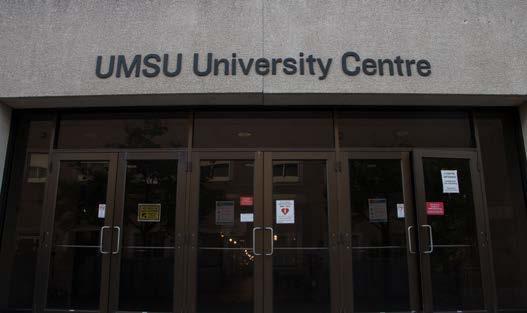
implementation of the mandate are still being worked out, there will be an emphasis on supporting international students who still cannot access provincial “vaccine passports,” a U of M spokesperson confirmed in an email Aug. 20.
Despite previous silence about their positions on a vaccine mandate amid the campaign by faculty — UMSU indicating it would wait for a university announcement and the results of a student survey before taking a position, and the Manitoba branch of the Canadian Federation of Students likewise stating it wanted to further engage students on the matter first — both organizations have taken cooperative stances since.
“The [university’s] decision to mandate vaccines is ultimately the right way forward for our campus,” said UMSU president Brendan Scott in an email Aug. 23.
“Coming up with a mandate that satisfies all students as well as allows us to get back to normal will be a challenge,
but I have full faith in the COVID-19 recovery steering committee to develop the best possible policy.”
Manitoba branch chairperson Alexandra Koslock stated that the federation is monitoring changes in terms of vaccine mandates and public health guidelines for post-secondary education.
“As an organization, we are sharing the new mandates on campus so students can safely and meaningfully participate in the fall term,” she said.
“We continue to advocate for the health and safety of our members and encourage our members to stay informed and follow public health orders.”
The response from students on social media has been mixed, with some strongly against COVID-19 vaccinations, some uncertain about implementation and others “relieved” by the announcement.
“The vaccine mandate is the right
choice to keep students and staff safe against COVID-19,” said third-year Asper School of Business student Felipe Cattai.
Cattai said he feels safer knowing that those around him will be vaccinated. He also feels that a mandate is the only way to ensure a return to in-person classes for winter semester.
“Everyone that I have talked to agrees with the university’s decision and are all looking forward to being back on campus full time,” he said.
“I encourage everyone to get vaccinated if they haven’t done [so] yet so we can all go back to doing the things we love.”
news@themanitoban.com

Kunal Rajpal, volunteer
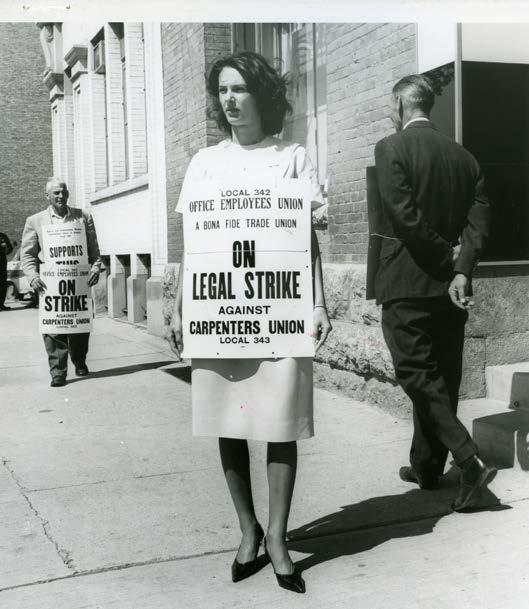
This summer, Julia Smith, assistant professor in the labour studies department, and Hannah Guenther-Wexler, an undergraduate labour studies student, are researching the history of feminist labour activism in Manitoba in the 1970s and ’80s.
Smith explained that the pair were tackling a lacuna in labour discourse. Smith and Guenther-Wexler are building on the growing interest in society to reveal gender inequalities by studying the intersection of feminist labour activism and the grassroots movements located in Manitoba as they emerged in the ’70s and ’80s.
“There’s not a lot that has been written about this topic, so […] it’s been really fun and exciting,” Smith said.
“Feminist labour activism is [defined as] women who were working on organizing around issues around gender inequality but putting work and labour issues at the centre of that. So, making connections between the inequality that women experienced kind of in broader society […] connecting that to the inequality they faced in the workplace.”
Feminist labour activism reached prominence in the ’70s and ’80s, as the previous decades brought with it the second wave of the women’s movement.
“There is definitely an uptick in overtly feminist activism in the ’60s and ’70s,” Smith said.
“And so, what you see in the ’70s and ’80s is women who are organizing around those issues in the workplace, but also in unions.”
People may assume that gender inequalities in the workplace are a relic of the distant past. However, history moves slower than some would expect.
In July, the Canadian Labour Congress elected the second woman to be president in its history. The Canadian Labour Congress is the largest labour organization in the country and brings together unions of all sizes to represent more than 3 million workers. Its first female president, Shirley Carr, was elected in 1986 and serves as an example of the turning tides of the decades Smith and Guenther-Wexler are studying. The incumbent, Bea Bruske, was formerly a labour activist from Winnipeg.
Smith highlighted that Manitoba is starting to see some national recognition for its feminist labour activism in Bea Bruske.
“A lot of stuff tends to focus on bigger cities, right,” Smith said.
“Vancouver, Montreal, Toronto — what’s happening there. And that can lead to the idea that there’s nothing happening in Winnipeg. Which, of course, anyone who knows anything about Winnipeg, or Winnipeg’s history, knows that there’s a long history of labour activism [and] of feminist activism.”
Guenther-Wexler emphasized that many of the labour and women’s movement successes in larger cities were also fought in Manitoba.
“There are very similar patterns in how the movement developed in each of those places that it also developed here,” Guenther-Wexler said.
In her research, Guenther-Wexler found a group close to home.
“One group we found was the Winnipeg Women’s Liberation,” she said.
“They started at the U of M, with students as well as a professor [...] They were a feminist group, but they really focused on labour issues. They published newsletters to their membership base.”
Smith has been relying on her research assistant to explore the landscape of Manitoban feminist labour activism. “Hannah [Guenther-Wexler] is really focused on kind of doing like a fact-finding mission,” Smith said.
“[Guenther-Wexler is] going through newsletters, identifying groups, identifying activists, identifying strikes […] mapping out what was the feminist labour scene in Manitoba and this time period.”
Smith said that the modern work force has been shaped by the actions of past activists.
“Most students are workers and either are working now, or will end up being
workers,” Smith said.
“All the things that we experience as workers in Canada today […] from health and safety protections to the minimum wage, all of those things have come about as a result of people’s organizing and activism on these issues.”
research@themanitoban.com
Michael Campbell, staff
Katherine Starzyk’s social justice laboratory recently published an article finding a correlation between connectedness to nature and support for reconciliation between Canada and Indigenous people. Starzyk, assistant professor in the department of psychology, published the article alongside Aleah Fontaine, Leora Strand and Katelin Neufeld.
Fontaine works with Starzyk’s lab as she completes her PhD thesis. Strand participated in the project as part of her undergraduate honours thesis. Neufeld, a PhD student and then a postdoctoral fellow, has been associated with the lab for more than 10 years.
“We’ve been studying reconciliation for the last couple of years,” Fontaine said.
“We’ve been really trying to understand what reconciliation means to Indigenous and non-Indigenous peoples in Canada, and we’ve conducted several different […] ongoing projects on the topic.”
The recently published project recruited over 200 non-Indigenous students at the University of Manitoba to complete an online survey.
“[Participants] completed an online study that asked them many different questions kind of assessing their attitudes toward nature, the way that they think about different animals as well as their attitudes toward reconciliation,” Fontaine said.
“At the core of the project is this idea that moral expansiveness — or the breadth of entities that we consider to be worthy of moral concern and treatment — is one of those underlying attitudes that connect all of those things. So, we had participants complete measures assessing how connected they felt toward nature, the extent to which they viewed humans and animals as similar and equal, how supportive they were toward reconciliation and then that breadth of entities that they consider worthy of moral concern.”
The project stemmed from a finding in the Truth and Reconciliation Commission of Canada’s (TRC) final report. When describing reconciliation, many testified that both reconciliation between social groups and between humans and nature are necessary.
For example, in the summary of the TRC’s final report, it was written that Elder Reg Crowshoe said reconciliation “also requires reconciliation with the natural world.”
“If human beings resolve problems between themselves but continue to
/ Dallin Chicoine / staff

“I really think that we need to kind of move beyond this very human-centric way of thinking about issues of social justice”
destroy the natural world, then reconciliation remains incomplete,” the report said.
Fontaine said this concept of reconciliation between both social groups and humans and the natural world stuck out to her.
“It had reminded me of some other research that I had come across […] that had kind of made connections between how people think about members of other different social groups […] [and] other animals and how there are some common underlying ideologies that people have that kind of informed their attitudes toward members of other social groups and animals,” she said.
Building on this notion of reconciliation, Starzyk and co-authors hypothesized, in part, that connectedness to nature would have a significant and positive effect on
— Aleah Fontaine, psychology PhD student
attitudes toward reconciliation and moral expansiveness.
Just as people feel concern for close family members, friends and colleagues, people also feel concern for other people and things.
“People can also feel concerned toward entities that are also considered pretty dissimilar,” Fontaine explained.
“So, maybe people from different social groups, people who are unlike us, but also animals, chickens, bees, dolphins, as well as things that are not living — rocks, rivers, Banff National Park.”
In 2019, Fontaine received one of the six Vanier Canada Graduate Scholarships — each valued at $150,000 over three years — awarded to graduate students at the University of Manitoba that year. Vanier
scholarships are considered by some to be the Canadian equivalent of the prestigious Rhodes Scholarships offered to students as an international graduate-level award to study at Oxford University.
“I am very mindful that, you know, we are really living in a time of climate destabilization, climate change,” Fontaine said.
“I really think that we need to kind of move beyond this very human-centric way of thinking about issues of social justice, and if it’s possible, to […] address some social justice issues such as reconciliation through other means, like connecting people to nature.”
research@themanitoban.com






















Manitobans should not trust Cullen in threshold moment for education
There are countless lawn signs throughout the province of Manitoba, all of which express residents’ protests to Bill 64, the Education Modernization Act.
“Slam the Door on 64” is but one of the slogans on the signs. Each, however, reflect vigorous disapproval of constituents.
Bill 64 is a business model disguised as legislation that purportedly plans to “modernize” the educational system by replacing elected local school boards with a centralized government-appointed education authority. The legislation will result in increased government control of schools, no local elected officials to reflect priorities in different regions of the province and minimal parental representation in decision-making matters.
The bill clearly focuses on control and standardization in schools rather than advancing education with students in mind — including students who are new immigrants, students from different races or the LGBTTQ* community, students with physical or mental disabilities and students from impoverished homes. These reforms will hurt Manitoba’s children, first and foremost.
Public opposition is so widespread that earlier this spring, 3,200 parents from all 37 school divisions and 208 communities in our province signed an open letter to Premier Brian Pallister and Minister of Education Cliff Cullen opposing the bill.
Yet Cullen has relegated this negative public reaction to a “vocal minority,” limited to special interest groups including the Manitoba Teachers’ Society and Manitoba School Boards Association, whom he accuses of perpetrating misinformation to instill fear and anxiety in parents.
It is dumbfounding that the government simultaneously asks us to heed advice from medical experts for public policy on COVID-19 but denounces the advice from teaching experts for public policy on education. Cullen defends the government’s proposed education change by suggesting that the majority of Manitobans support Bill 64.
In “Civil Disobedience,” an 1849 essay on government and society, Henry David Thoreau wrote, “Moreover, any [person] more right than [their] neighbours constitutes a majority of one.” Thoreau wrote this to display his dedication to morality over conformity — a person can be right and constitute a majority if they have the moral high ground. Possessing the truth and being committed to good is more important than going along with a majority that may be unjust, morally wrong or following a lie. Morality, in this case, is equivalent to a majority

— not numbers.
It is this principle that is a cornerstone to a functional democracy and it is this principle that upholds the right for Manitobans to protest Bill 64. Cullen’s dismissal of the vocal minority is undemocratic at best and borderline tyrannical at worst.
Members of Pallister’s government has shown they do not care about teachers, students or education through their actions. They are more concerned about money than they are about educating kids or valuing teachers who were on the frontlines during the pandemic. The same teachers who went back and forth between working remotely and in person with little notice, the same teachers who were not prioritized for vaccines even with increasing numbers of students contracting COVID-19 in classrooms and the same teachers who had to fight just to get access to rapid testing.
In appreciation for their valiant efforts and dedication to their students, school budgets were slashed and layoffs were forced — up to 130 teaching positions in the Winnipeg School Division were cut in 2021-22. This included axing many firstyear teachers who were filled with anxiety about teaching in new roles. These fears were compounded by
the threat of COVID-19. Overworked and tired, teachers continued to give their best when society needed it most. With minimal job postings for the upcoming year, these first-year teachers are now unemployed — used and discarded.
With this kind of track record, when Cullen says that Bill 64 will not result in layoffs, who will believe him? Nobody with anti-Bill 64 signs on their lawn.
Pallister stepping down as leader of the Progressive Conservative party does not mean Bill 64 will be slashed. Despite cries from the opposition to scrap all remaining bills until a new leader is elected, Bill 64 remains on the table. Members of the Conservative party who passed the first reading of the bill all remain in power and will likely continue to push the bill through its second reading in October.
Students are our future and COVID-19 has highlighted just how instrumental teachers are in the student learning process.
Now is the time to listen to those experts in the classroom who are instructing an increasingly diverse student population each day. Now is the time to heed the advice of those
school administrators who are struggling to provide consistent, accessible education to all their students with increasingly limited resources. Now is the time to listen to parents who are concerned about increased work, decreased representation and potential school closures.
Teachers deserve better. Students deserve better. Parents deserve better. All Manitobans deserve better.
The Pallister government may dismiss Bill 64 protesters as a vocal minority, but to Manitobans directly impacted, they constitute a majority of one.











LETTERS
Brendan Scott, UMSU president
Dear Bisons,
I hope you are enjoying your summer as Manitoba’s restrictions lift and the vaccine rollout continues successfully.
Since my last address, the executive team has been working hard to ensure the University of Manitoba Students’ Union (UMSU) is able to transition to progressively more normal operations throughout the fall term. While our service centre has remained open for quite some time, Aug. 30 will see the entire UMSU staff return to campus.
Here is what we have been up to these past two months.
The University of Manitoba Students’ Union has been working hard this summer to improve the student health and dental plan.
As part of UMSU’s ongoing commitment to supporting members’ well-being, the current coverage for mental health practitioners has been expanded to include visits to counsellors and psychotherapists, in addition to licensed clinical psychologists and practitioners.
UMSU health coverage under the health and dental plan continues to cover 100 per cent of the cost per visit for these eligible mental health practitioners to a combined maximum of $1,250 per policy year.
This past spring, students voted 79.3 per cent in favour of being covered by the Studentcare legal protection program. To show off the program, UMSU has committed to pay for this service for all eligible students covered under the UMSU health and dental plan. From Sept. 1, 2021 to Aug. 30, 2022, students will have the ability to talk to legal representation on any legal matter. Students will also be able to receive legal representation in trials involving housing rights, employment rights and academic rights. Keep an eye out for more information through all UMSU media channels.
As promised, the UMSU executives have been hard at work to optimize students’ campus experience. These past two months have been spent renovating UMSU spaces in the basement of Helen Glass with new paint, carpets and furniture. The project is expected to be completed in September and will allow all 200-plus UMSU clubs to operate in an improved space.
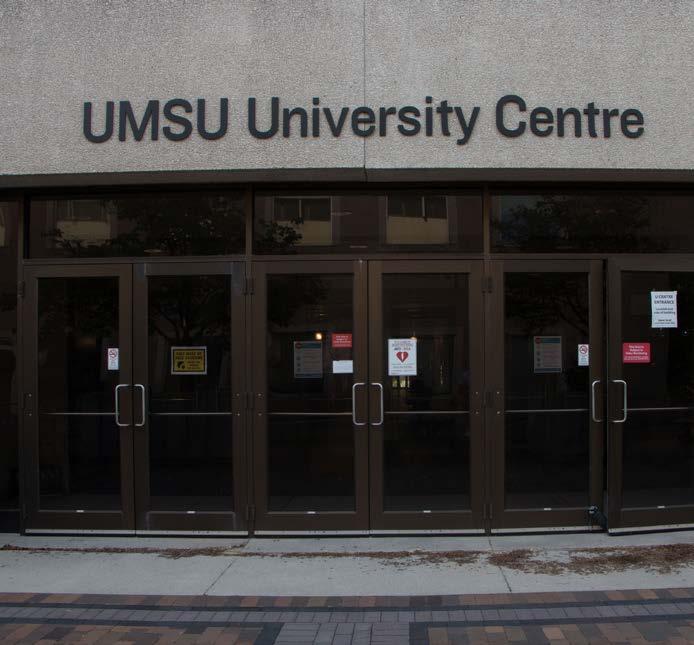
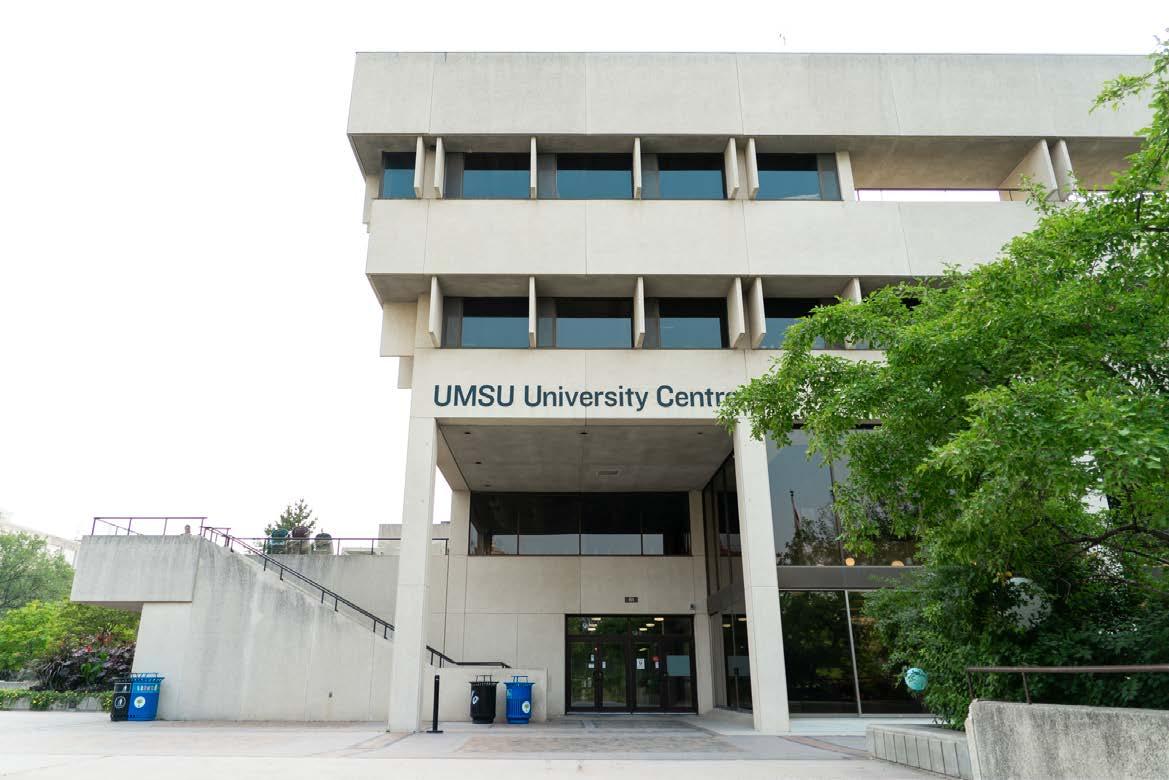
With classes starting in a month, planning on re-engaging the student body through an orientation event has begun. From September 8 to 10, your executives will be in UMSU University Centre to welcome you back to school. Food trucks will be set up at Curry Place to give students a
graphic / Dallin Chicoine / staff

chance to grab lunch. Stop by to learn more about your union and pick up some free UMSU swag.
Currently, UMSU is continuing to negotiate a new U-Pass contract with the City of Winnipeg and Winnipeg Transit. As the fall semester at the University of Manitoba will still be mostly online, students will not be charged a U-Pass fee for the upcoming semester. A post-secondary semester pass is the best option for students who will rely on transit this fall. UMSU will be providing a transit subsidy to students who purchase a post-secondary semester pass and are in financial need. Keep an eye out for this subsidy in the coming weeks.
The executive team had the honour
of meeting with the Member of Legislative Assembly from St. Vital Jamie Moses to discuss what is affecting students the most these days. We will continue to meet with provincial members of parliament to make sure students’ voices are heard.
In other news, the UMSU board of directors will be able to meet in person for the first time since March 2020. A board retreat will take place to engage with and train the board together.
Enjoy the rest of August, and we’ll see you in the fall.
Brendan Scott President, University of Manitoba Students’ Union
letters@themanitoban.com

Lucas Edmond, staff
Platitudes are often employed to rationalize periods of crisis, but coupled with manipulation, they are empty. There is no phrase more suitable for Prime Minister Justin Trudeau’s recent justifications for his abrupt snap election. Not only are Trudeau’s excuses for the election egregiously untrustworthy, but his call for the election is point-blank hypocrisy.
On Aug. 15, Trudeau requested Governor General Mary Simon to dissolve the parliament as a precondition for the election. The prime minister’s meeting with the governor general is standard practice after a sitting government fails to win a confidence vote in parliament. However, these are the only conditions that snap elections should be called — the Trudeau administration won its last confidence vote last October.
Upon the election’s announcement, Trudeau claimed that the coming year is a consequential one — referring to the COVID-19 recovery plan — and that the decisions made during this time will have lasting effects for decades. Spending budgets will likely skyrocket in an attempt to stimulate a suffering economy and, hopefully, the budget will include historic steps toward green investments during this catastrophic convergence between the economic, health and climate crises.
Although Trudeau is right to discern this threshold moment in history, the election couldn’t come at a worse time considering the novel coronavirus is far from eradicated.
As a result, some Canadians are questioning Trudeau’s intentions. Opposition parties have described the election as a “power grab” and because the Liberal Party of Canada was polling close to a majority before the parliament was dissolved, critics’ accusations are valid. The fact is, many members of parliament (MP) across the floor prefer to avoid an unnecessary election before the standard four-year term expires.
Canada’s New Democratic Party leader Jagmeet Singh went so far as to call on the governor general to break constitutional convention and decline Trudeau’s request. Singh’s request was ignored as it fell between a heated debate about vying interpretations of Bill C-16 and the governor general’s constitutional duty not to interfere in political proceedings alone — a duty that generally precipitates the power of the prime minister to dissolve a parliament when they desire.
However, Bill C-16 — a bill passed in 2007 — critically restricts any federal government’s ability to call snap elections unless it loses a confidence vote. The bill was introduced to quell leadership from pursuing opportunism

and short-term political gain. Fixed elections make voting an easier, safer and fairer process. However, constitutional convention dictates that the governor general listens to the prime minister when they suggest dissolving the parliament, making the most recent snap election somewhat of a grey zone with various legal loopholes.
Indeed, Bill C-16, despite near universal approval across the parliamentary floor, has already been ignored on two occasions since it was drafted. Ironically, yet unsurprisingly, the conservative government that drafted the bill ignored the laws no less than a year after its royal assent. Then-prime minister Stephen Harper announced the bill in a speech to Victoria constituents, saying that “fixed election dates stop leaders from trying to manipulate the calendar simply for partisan political advantage.”
Harper managed to bypass the legislation by arguing the opposition parties had met an impasse with the minority conservative administration’s ability to govern — at the time, Harper was essentially daunting the opposition to collapse the parliament with a no-confidence vote. Due to the dysfunctional parliament, however, Harper was
unjustly able to announce a snap election in 2008. Although Harper didn’t manage to win a majority, the election threatened Bill C-16 with a dangerous precedent.
At this same time, the Liberal party was kicking and screaming over the fact that the Conservatives may obtain a majority all due to judicial ambiguities. So, why now is it acceptable for the Liberal party to pursue its own political agenda and bypass critically important election laws? In 2008, then-Liberal MP Bob Rae questioned the standards Canadians hold their government to. “Is this the kind of government you want?” Rae said. “Do we want a party in place that is so undemocratic that it will not meet in the House of Commons?” Now that the tables have turned, and the Liberal party is pursuing a majority, the answer from Canadians may be “no.”
Although the Liberal party chose to call the election because polls estimated a potential majority government, the decision to call an election during the pandemic is an extremely unpopular one. A recent poll administered by the Toronto Star and done by Mainstreet Research — a polling and statistics agency — suggests that approximately
two-thirds of Canadians disapprove of the election. If this poll translates to the ballot, the Liberal party may find themselves taking parliamentary losses come Sept. 20.
In the words of Noam Chomsky, “The will to power is not so much cloaked in idealism as it is drowned in fatuity.” Trudeau is gambling on his power, and his determination to win a majority government before the standard electoral cycle is exposing his cards to Canadians. Time will tell whether his political manoeuvre pays off or not, but one thing is guaranteed: his constituents don’t want an election.
NDP could be set for a runaway election as PCs unravel at the seams
Lucas Edmond, staff
After five years of anxiously waiting for Premier Brian Pallister and his uncooperative majority regime to fall in Manitoba, progressives and activists received some good news — Pallister will not be seeking re-election. The announcement came after a sorry excuse for an apology about his terrifyingly ahistorical comments that suggested the intentions of white settlers on the continent were to “build.”
By claiming Europeans came to the continent to purportedly “build,” the premier brushed off Canada’s legacy of genocide and the cultural importance of Indigenous civilizations — as if nothing, or nobody, had existed on the continent prior to colonial exploitation. Pallister was then politically strongarmed into an apology that he likely did not want to make.
“I feel awful about the reaction and the misunderstanding I created with my comments,” the premier said.
Pundits and Indigenous leaders condemned the apology as more of an excuse than a display of genuine regret. The next week, on Aug. 10, Pallister announced his resignation with no immediate timetable.
However, his resignation was a long time coming considering he ambiguously pointed toward a resignation in December after a poll by the Angus Reid Institute — a non-profit think tank —suggested Pallister had the lowest approval ratings in Canada. Paul Thomas, professor emeritus of political studies at the University of Manitoba, suggested after the poll that the Progressive Conservatives (PCs) might request he step down if his popularity didn’t improve.
This June, a Probe Research Inc. poll — a data research centre located in Winnipeg — noted the PCs only had support from 29 per cent of decided voters.
While it is unclear whether Pallister resigned of his own volition or that of the PCs, Manitobans should not have much optimism about any of his potential replacements — after all, Pallister had, for the most part, unwavering support from his colleagues throughout years of his detrimental policy and discourse.
Still, New Democratic Party (NDP) leaders, union leaders and Indigenous leaders continue to make demands for a more cooperative replacement in the wake of Pallister’s announcement. Wab Kinew and Nahanni Fontaine — the official leader of the opposition and official opposition house leader, respectively — have asked the PC caucus to revisit questionable legislation that Pallister had approved during his time in office.

As of now, the NDP has stalled Bill 16, the Labour Relations Amendment Act; Bill 40, the Manitoba Liquor and Lotteries Corporation Amendment and Liquor, Gaming and Cannabis Control Amendment Act; Bill 35, the Public Utilities Ratepayer Protection and Regulatory Reform Act; Bill 57, the Protection of Critical Infrastructure Act; and finally Bill 64, the Education Modernization Act. The bills are scheduled to be reviewed in the fall and the NDP are galvanizing the PCs to rip up Pallister’s calamitous legislation.
Each bill has stirred varying degrees of public outrage. Bill 16 was criticized for making it easier for employers to fire striking workers and ending the requirement for binding arbitration after 60 days without resolution — effectively giving employers the option to starve strikers out of their picket lines. Bill 40 was admonished for opening the door toward privatizing liquor sales in Manitoba. Bill 35 could potentially rob decision-making capacities of Manitoba’s public utilities board, which acts as a check on provincial governments that intend to raise hydro rates.
On the other hand, Bill 57 seeks to criminalize protesters that blockade railways and other infrastructure during a critical juncture in the climate crisis and the Indigenous rights movement. Finally, Bill 64 plans to cut nearly $40 million in administrative expenses by dissolving every school board except la Division scolaire franco-manitobaine — effectively setting up a centralized education authority and transferring power from elected officials to appointed technocrats.
So far, the PC caucus has not commented about the NDP’s request in public. But Heather Stefanson, the member of legislative assembly for Tuxedo, is running for leadership under the promise to rip up Bill 64. However, this is likely an attempt to ride the bipartisan wave of discontent the bill caused.
Nonetheless, political rivals of Pallister should not get their hopes up. Stefanson was the minister of health and seniors care during the COVID-19 pandemic and oversaw policy which precipitated the outbreak at Maples Long Term Care Home. The tragedy garnered national attention after a private care facility was forced to call paramedics to help with an understaffed and undertrained workforce on a grim night in November. First responders reported finding people
The PC caucus has dug itself into a political crisis of colossal scale. It would be tough to reconcile all the social harm the party has caused over the past five years. Although regaining the public’s trust before the next election will take significant work, it starts with taking responsibility and scrapping the most extreme bills the NDP have shelved until the legislature’s fall sitting.
Nonetheless, it appears Manitoba’s sole conservative party has shot itself in the foot. As of now, the NDP are projected to come close to a majority in 2023. If history manages to repeat itself, the coercive actions of the PC administration may have set the table for another decades-long NDP stranglehold over the province. Although the thought of kicking the PCs to the curb come 2023 is speculative, Manitobans can take comfort in knowing that one thing is for certain: Pallister will no longer serve as the leader of the PCs nor premier and his legislation should go with him.
comment@themanitoban.com
Emerging musician Sophie Kate on where she started and where she plans to go
Zoë LeBrun, volunteer
Few people are lucky enough to find something they’re passionate about early in life — Sophie Kate, an emerging singer and songwriter from Winnipeg, is one of those individuals.
Kate, who began recording and producing music in March 2020 and recently independently released her second single of 2021 titled “What About Me,” has been interested in the craft for as long as she can remember.
“Music has kind of always been a part of my life,” she said.
“I’ve been in choirs since I was in first grade.”
Since then, Kate has continued to build up her musical skills and knowledge by learning piano through a local mentorship program and teaching herself to play the guitar.
“Through that [mentorship], I learned taking a song that you hear, finding chords for it […] and making it sound like a full song on just the piano and basically doing everything by ear, which was exactly what I wanted to do.”
Kate’s love of music led her to write her own songs from as early as nine years of age. However, it is only over the last year that she began to take songwriting more seriously and release her music on public platforms.
“Songwriting has always been a way for me to deal with things I’ve gone through and cope with emotions I’m unfamiliar with,” said Kate in a press release.
“Over the years, I’ve continued to nurture this passion. I started writing songs more often and, eventually, I decided that I needed to do more than just write them. I wanted people to hear my music.”
The initial COVID-19 lockdowns in March 2020 ended up being the catalyst for Kate to realize this goal of releasing her music to the world.
“When COVID hit, it was kind of like ‘Okay, well, now I have absolutely nothing to do,’” Kate said. “I was writing more and more songs just to process how I was feeling at the time […] I started saving up all the money I was making to just buy really basic recording and producing equipment, and then by the end of the summer I’d saved up enough to get a computer that I could use to record with.”
Storytelling features heavily in Kate’s music, with most of her inspiration coming from daily life and personal narrative.
“My favourite way of writing songs is going through something that’s really meaningful and really impactful on

“My favourite way of writing songs is going through something that’s really meaningful and really impactful on my life, and then coming back and writing about it”
— Sophie Kate, singer-songwriter
my life, and then coming back and writing about it,” she said. “It’ll start out as a voice memo of me just playing guitar or piano, just saying whatever is on my mind, and then a little bit later […] I’ll come back to it and I’ll listen to it, and then kind of go through stuff I have on my phone already and kind of piece it together.”
Five singles and one EP later, Kate has learned a lot not just in terms of songwriting, but in terms of producing and recording her music as well.
“[Learning to record] was kind of weird at first,” she said, “a lot of it was Googling and YouTube research […] a lot of it was just by [trial and error].”
One of Kate’s predominant musical
influences is Taylor Swift, who she began listening to shortly before diving into her own songwriting with renewed vigor last March. Another of Kate’s musical influences is Katelyn Tarver, an indie-pop musician and actor.
“A lot of [Swift’s] music helped me through some of the lowest times I’ve been through and I really just fell in love with her songwriting,” said Kate.
“When I listen to other songwriters, how they write, I like to take inspiration from their techniques and listening to the different ways they word songs and the ways they work around obstacles that they might’ve had while writing.”
In the near future, Kate’s main goal is to continue working on her songwriting and production skills in order to release as much music as she possibly can.
“I just kind of want to try everything I can and see what sticks,” Kate said. “I’m very excited to see where music can take me in life, how much I’m going to grow and how many lives will be touched by the music I’m making.”
“What About Me” by Sophie Kate is available through Spotify, Apple Music and YouTube.
arts@themanitoban.com
Shaylyn Maharaj-Poliah, staff
Ripping down half the trees is the first poetry collection from Evan J Hoskins, who writes under the name Evan J. Having been influenced by socially active writers and poets, the work is unapologetically critical of the structures that perpetuate harm while simultaneously acknowledging his own privileged perspective.
Primarily written in free verse and drawing upon his experiences living in Sioux Lookout, Ont., Hoskins seeks to remove the veneer of Canadian equality to expose multiple injustices at the nation’s core — racism, ableism and sexism, just to name a few. The poems cover a multitude of subjects — things, places, people and institutions that are doing things wrong — but also aim to draw attention to the upstanding actions of individuals that seek to incite widespread change.
The collection is divided into thirds,
with each section containing a multitude of poems of varying lengths and styles based around specific regions in Canada, but more specifically, Ontario. The first section, “The Metro,” focuses on cities and towns like Toronto, Ont. and Gimli, Man. while the middle section, “Northwestern,” is about the upper areas of Ontario. The book’s longest and final section, “Sioux Lookout,” is based on Hoskins’s experiences teaching digital literacy and working at the Sioux-Hudson Literacy Council’s Adult Learning Centre.
Hoskins’s writing style is very direct, artful and conversational, and the tone of the collection remains emotive and contemplative until you close the back cover. Hoskins’s use of vivid imagery and enjambed lines creates a startling duality — a beautiful melancholy of what was, what is and what should be. His words jump off the page and his craftsmanship is fresh, dynamic and exciting.
One of the standout pieces from the collection is called “All the friends at the party.” At three stanzas made up of three lines each, the poem isn’t very long, but it speaks volumes about the damage caused by mass silence and white solidarity, especially when it comes to those in positions of power.
Another highlight is “Colonialism for dummies.” Inspired by Laurie D. Graham’s 2016 poetry collection titled Settler Education, the poem is an intense confrontation with certain ideologies and beliefs about Canada’s history and responsibility that is meant to unsettle and destabilize colonial spaces. It also encourages readers to assess their own privilege and how it impacts their approaches to allyship.
Ripping down half the trees is a powerful and topical piece of work. Clocking in at about 100 pages, Hoskins encourages his readers toward reflection and discourse by deftly saying a lot with a little bit of space and a small number of words.


Shaylyn Maharaj-Poliah, staff
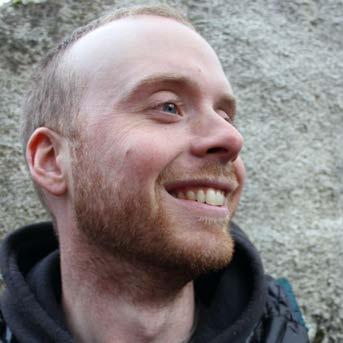
In his latest poetry collection, titled Ripping down half the trees, Evan J Hoskins presents an artful exploration and criticism of the social problems and racial injustices found within Canada. Tackling a range of topics, from apathy and allyship to nature and grief, each poem seeks to unsettle the oppressive colonial structures that cause undue harm and inspire readers to reflect on their own roles and responsibilities as settlers on this land.
Hoskins — who writes under the name Evan J — grew up in Winnipeg and currently resides in Sioux Lookout, Ont., developing curriculum and teaching adult education in and around the area as well as in northern communities. He is a former volunteer contributor to the Manitoban and graduated from the University of Manitoba in 2012 with a degree in English and history. Since graduating, he has published a few short poetry chapbooks over the years and has been featured in several literary magazines. Ripping down half the trees, which was released this past June, is his first full-length collection.
Writing was not always in the cards for Hoskins, though. It was not until he took his first creative writing class at the U of M and gave the craft the proverbial college try that he really started thinking about it.
“That was the first time I’d ever really
tried [writing],” said Hoskins, “and, of course I was terrible, but I remember that [the professor] took everybody aside at the end of our course and told them all how amazing their work was […] that was a major seed back then to hear someone think ‘Oh, you can actually do that.’”
Drawing inspiration from the works of Katherena Vermette, Lee Maracle, Audre Lorde and Dionne Brand, Hoskins aims to incite conversation and action through his poetry by speaking about the social issues present specifically in Ontario, but also occurring across the country.
When asked about what he hopes his readers take away from the collection, Hoskins emphasized emotions and understanding. “I would want people to read it and feel the emotions and understand that I’m describing one sliver of the world that I am seeing and I’m mashing a bunch of things into a bunch of poems, but it does give a bit of a snapshot of a few conflicts in a very specific area.
“I would want people to read that and understand that it doesn’t represent every treaty area, every First Nation, or the whole country, but it certainly gives a good idea of major issues happening throughout North America. I would want people to notice that and reflect on it.”
Hoskins encourages his readership to reflect in very artistic ways, striking a
between the
of his poetry and the execution of his writing. Hoskins said,
“I don’t enter poetry from an exclusively social justice [or] social protest way [but] I am really trying to be artful about it and I’m trying to write poems somewhere along that line — so, very intense, but also trying really to hit hard with the craft as well.”
He urges other writers and poets to do the same and provides two refreshing
“I don’t enter poetry from an exclusively social justice [or] social protest way [but] I am really trying to be artful about it and I’m trying to write poems somewhere along that line”
— Evan J Hoskins, poet
pieces of advice to those who are just starting out. The first is to “read like crazy.”
“Every literary journal says that,” he said.
“You hear that advice often, but I would put a second clause on that sentence and say [to] read everything and take note of everything — the craft, the pacing, the tone, everything.”
His second piece of advice — which comes from personal experience — is to be mindful of the topics you are writing about and pay attention to current, popular writing trends.
“If you’re writing something and you’re not getting published, you are most likely writing something about a loss of a parent, about Alzheimer’s or about young, heteronormative love,” said Hoskins.
“These things are all so powerful that, I think, writers […] see them, they feel them and they think ‘I have to write about this,’ and you should write about it, but you should also realize that everybody else is writing about that as well and it’s very hard to make your story about that stand out, unless it has some significant edge to it, something very unique.”
“Write something very small [and] specific to you.”
Evan J Hoskins’s debut poetry collection, Ripping down half the trees, is available for purchase from Amazon or through your local McNally Robinson Booksellers, Indigo or Chapters.
arts@themanitoban.com
SPORTS Matthew Merkel, staff
Normally for U of M athletic director Gene Muller, like many other Manitobans, July and August offer an escape from the day-to-day grind experienced during the fall and winter.
However, with the effects of the COVID-19 pandemic continuing to be felt, his summer and those of the rest of the Bisons sports community has been hectic. After all U-Sports schedules and championships were cancelled due to the virus last year, Muller and his staff made it their goal to create a safe environment for Bison athletes so they may represent the brown and gold come September, making summer semester a busy one for the athletic department.
“We’ve mostly been busy with activities related to the reopening,” Muller said.
“We really wanted to provide training continuity, strength and conditioning continuity, psychology and nutritional and athletic therapy continuity to Bison Sports athletes and at the same time to plan for a competition. “We’ve maintained our strength conditioning, we’ve retained athletic therapy, we’ve trained psychology and nutritional support [staff] through the whole lockdown, so it’s been just maintenance.”
Although Muller said fan attendance at Bison sporting events is “still to be determined,” he emphasized that the goal is to have students supporting their classmates in the stands as soon as it is safe to do so.
“We would like to see fans back at our games,” he said.
“We want that. I mean, I think it’s really good to see a full Bomber stadium, but in terms of what we all expect in terms of numbers, in terms of capacities, in terms of vaccination status, those details are still being worked through.”
“I think we need fans, and we need many other fans, but we also need it to be safe and controlled and well thought through.”
If Bison home games are to be played in front of empty stands, Bison fans can still watch their favourite athletes on Canada West TV. The U of M has partnered with the subscription streaming service to help broadcast Bison home games online.
“Probably one of the few advantages of COVID for us is that it gave us time to review our technology setup in order to be able to broadcast, produce and generate high-quality footage of our teams in action. So, we are in the process right now of installing a new video system that enables us to capture and broadcast games.”

“We’ve got the setup […] for all our court sports, basketball [and] volleyball. We’re setting it up at hockey and we’re also setting it up at women’s soccer, so hopefully we’ll be able to have a higher-quality broadcast. I think we realized that probably streaming and the generation of quality broadcast is part of the future of sports. We love getting people there face-to-face, but it’s not always possible, so we want to generate high-quality footage.”
With each decision regarding the return to sports, the university’s reopening committee has the final say. Muller explained how each decision made by the athletic department goes through a lengthy approval process.
“All of our activities need to be vetted and approved by the reopening committee, so we didn’t have autonomy in saying, ‘OK, that’s what we can do, this we can do.’ It’s the process of […] [deciding] what we propose we are going to do, write the proposal, attend the committee meeting and then approval.”
The reopening committee also continues to make important decisions regarding student life, including the Active Living Centre where masks are mandatory and capacity is capped at
75 per cent.
“I think both those measures are really appropriate,” said Muller.
“I mean, we know that COVID is a communicable disease spread through droplets, so I think having a mask mandate is responsible and appropriate and compassionate to society and to our members.”
“I think the 75 per cent is probably related to the amount of equipment that can go into the space while still maintaining a measure of social distancing, so we took that into consideration […] how many people can safely be in a space.”
“I’m very proud of our facilities and recreation services staff. Their cleaning protocols have been spot on […] I’m proud of the fact that I think we’ve contributed to both safety and providing an activity outlet for society.”
A fourth wave of COVID-19 still may hit Manitoba, yet Muller remains optimistic and is encouraged by signs of normalcy, driving him to continue to strategize for the return to competition. He feels that with careful preparation, the U of M athletic
program will return to pre-pandemic form.
“My final thoughts are just excitement and a feeling of a return to normalcy, even our offices […] I can see we’re starting to do press releases for football training camp, we’re starting to do season previews for our different teams, and it has a sense of normalcy.”
“It’s just an excitement that things might be returning to what we know.”
sports@themanitoban.com
SPORTS Matthew Merkel, staff
Throughout history, white men have erected structural barriers preventing people of different races, genders and sexual orientations from participating fully in society, and these barriers persist today. Fortunately, many find the agency to thwart those impediments — something we continually see happen in sports. Reina Iizuka is an example of this. In 2018, the Mississauga, Ont. native became the first female athlete ever to be named to a U-Sports football roster when she was named to the University of Manitoba Bisons football team, a monumental moment for sports in Canada.
For Iizuka, attending the U of M was a choice made easy after meeting Bison head coach Brian Dobie.
“I really believed in him as a person and as a coach,” Iizuka said.
“I find when you get to a higher level […] it’s really hard, I think sometimes, to find people who don’t treat you like a piece of meat, and […] who actually cares about you as an individual.”
“He’s real and he was honest with me throughout the entire recruiting process […] I knew he was somebody that, if I’m going to go away from home, my mother would feel comfortable with, and I would feel really comfortable with.
“So, he’s the reason why I went to Manitoba.”
Interestingly, the bond formed between Dobie and Iizuka almost

never happened. Thanks to a late decision by Iizuka, she was able to perfectly time her meeting with the Bisons’ coach.
“I met him at a prospect camp [which] actually I wasn’t going to go [to],” said Iizuka.
“I wasn’t feeling it. But then I’m like ‘You know what, no. I feel like I should go.’ I just had that gut feeling, and then I went, exchanged contacts with him. Then literally two [to] three weeks later I tore my ACL. So, it was so meant to be that I met him just before I tore my knee.”
Thanks to Dobie, Iizuka’s first experience with the U of M came effortlessly. However, she would quickly learn that her time with the Bisons would still involve hardship. In her first year at the U of M, she was a redshirt freshman and spent the football season recovering from the knee injury she suffered after meeting coach Dobie. The next two years she would ply her time on the practice squad. In her grad year, the COVID-19 pandemic would lead to her final season being cancelled.
Through all the trials and tribulations,
Iizuka.
“There were guys who really supported me and then there were guys who didn’t care, which is cool, that’s honestly what I like. Then there were guys who absolutely did not want me there, for sure,” she said.
“It came with a lot of good things, though, don’t get me wrong […] [it was] positive all around and I think a lot of growth happened [over] the past four years, but yeah, there were a lot of difficult times, too.”
“It was, I think, perfect in that regard, in terms of wanting to grow. It was a great environment for that for me.”
Now that Iizuka has graduated, she has shifted her focus to her professional career. The philosophy major is currently making the transition to rugby and is currently in talks with professional teams to play next season. Iizuka also has Olympic and World Cup dreams, something that is not far from her reach considering her football experience.
“I’m supposed to head out to play pro next year, probably next summertime,” Iizuka said.
“I would like to be an Olympian and play in the World Cup […] I would like to be one of those players that can do both, and I would like to medal and be a team captain eventually.”
“I think a lot of growth happened [over] the past four years, but there were a lot of difficult times, too” — Reina Iizuka, former Bisons football player
While she may be switching sports, Iizuka intends to keep football as her true passion. The former defensive back hopes to make a career out of coaching and aims to land a position at the highest level.
“I’m not leaving football, I’ll be coaching for sure,” said Iizuka.
“After I retire from playing rugby, I think I want to try to coach football at a high level, probably [the] NFL would be my goal.”
It is evident that Iizuka is fueled by her passion for the game. While she does acknowledge that becoming the first woman to make a U-Sports football roster is an incredible accomplishment which may have positive ramifications for other females in the sport, it is not what drives her to lace up her cleats every day. Personal growth is Iizuka’s goal. Whether it be physically or mentally, she pushes herself every day so that she not only becomes a better athlete, but also a more well-rounded human being.
This is the mindset that has enabled her to achieve her goals to date and propel her in the future, all while unintentionally opening doors and inspiring other athletes down the line.
Iizuka is thankful for her time with the Bisons. She recognizes that it was an important stage in her development.
“It’s not a straightforward answer […] because there’s a lot of layers,” said
sports@themanitoban.com