SOCIAL MEDIA EDITOR Kathy Dinh social@themanitoban.com Cam Cannon Zoë LeBrun
U of M announces major in data science
Faculty of science’s bachelor of data science to launch in fall 2021
SARAH DORAN, STAFF
The faculty of science has created a new interdisciplinary bachelor of science with a major in data science degree program, set to launch at the start of the 2021-22 academic year. The program will require 120 credit hours of courses in mathematics, statistics and computer science, as well as courses designed specifically for the major.
Data science is a rapidly growing field involving recording, storing, managing and analyzing data of various kinds. While computers are often involved in the process, com-
puter science is a separate area because the underlying focus of computer science is writing and understanding the logic behind computer programs rather than a specific data component.
The University of Manitoba currently offers joint honours programs, such as between computer science and mathematics and between computer science and statistics, that are cumulatively similar to a data science program but do not have the interdisciplinary focus the new degree will.
Carson Leung, a professor in the department of computer science,
has long been interested in data science. He runs the Database and Data Mining Laboratory, which offers both undergraduate and graduate students the opportunity to conduct research on theoretical and practical aspects of data science with real-life applications.
“In addition to participating in research, students interested in data science have had opportunities to acquire knowledge by taking data science-related courses,” Leung said.
Several data-related courses are being offered during the 2020-21 academic year throughout a range of programs, including computer science, environmental science, mathematics, management information systems and statistics.
Leung said the U of M is also in the process of creating several data science graduate programs, including a master’s in data science and a master of business analytics program.
The wide variety of fields in which data scientists can be employed is a major reason why Manitoba Economic Development and Training approved the creation of
the new degree program.
“As data science has emerged as a significant influencer in many sectors of our economy, data scientists are in high demand, but it can be challenging to find skilled employees,” Leung said.
“Data scientists are in high demand, but it can be challenging to find skilled employees”
— Carson Leung, computer science professor
Ben Li, faculty of science associate dean of undergraduate programs, explained further in a press release.
“The data science undergraduate degree aligns perfectly with the current needs of major employers and,
with the integration of co-operative education as a degree option, students will graduate with a competitive advantage,” he said.
“They’ll have actual work experience and be able to jump in and solve complex real-world issues from the get-go. [The degree] will also serve as a solid foundation for further studies at the master’s and PhD level.”
Across town, the University of Winnipeg is also launching its data science program this fall.
However, the program is a specialization within the U of W’s existing statistics degree. The course list is heavily focused on statistics and mathematics classes, including a few courses newly created for the program, but students are also required to take at least six applied computer science courses.
The U of M has not yet released the planned degree requirements for its data science major program. Leung said more details will be announced as they become available.
Campus libraries, computer labs reopen at limited capacity
New
systems to support students most affected by COVID-19
Fall semester is rolling in amid uncertain times, but the U of M is aiming to put supports in place for students that are most affected by the changes brought on by the COVID19 pandemic.
“This is a real concern for us,” said Laurie Schnarr, vice-provost (students).
The university is planning on reopening spaces on campus to provide a place for students that need it to study and to have access to internet and technology.
need,” said Schnarr.
Another study area is being prepared in the libraries, which Schnarr said will prioritize those most in need of a study space.
She said need will be determined based on referrals from advisers.
“Advisers and counsellors at the grassroots are often most wellattuned to which students are in greatest need, [whose] home situations are not good, or [students that] just do not have the technology or even internet to enable them to do the work that they need to do for school,” she explained.
requirements for computers, which are available on Aurora during class registration.
The resources also include online tech support during exams, guidelines for best practices for technology use and a toll-free system that allows students with limited connectivity to join audio of live classes by phone.
to ensure that students are receiving some kind of quality of learning now that is comparable to what they would have received had things been back to normal,” she said.
Dela Cruz said those being impacted disproportionately by the pandemic include international students.
“A couple of international students have approached us now, saying that in previous years they’ve already struggled to meet the tuition deadlines,” she said.
Elizabeth Dafoe library will be available for walk-in access only for students with U of M ID cards, and the sciences and technology libraries will have 80 pre-booked spaces.
Both libraries will have open computer labs with social distancing guidelines in place.
The university is also working to put in place 350 non-bookable study seats in lecture theatres across campus to accommodate social distancing.
“We’re going to continue reassessing as we get a better sense of the
This week, there has been a soft launch of the opening of the Elizabeth Dafoe library and the sciences and technology libraries, which will be followed by a hard launch in September. Both will be open from 10 a.m. to 6 p.m. Monday to Friday with limited occupancy to adhere to social distancing guidelines.
“If [students in need] do not already have established relationships with advisers, they’re being referred there.”
For students in the city with limited access to technology, the U of M technology fund grants a $500 subsidy for those identified by advisers to be in need, along with an application form to complete through the U of M bookstore.
“In some cases, we shipped those computers to students who were in the far North and so on to make sure that they got the computers without having to come to campus,” she said.
The university has prepared resources for students for working with technology at home. Among them are guidelines for system
“We’re going to continue reassessing as we get a better sense of the need” — Laurie Schnarr, viceprovost (students)
A reduced data plan through Bell MTS for U of M students will soon be available as well.
UMSU president Jelynn Dela Cruz said the union is working with the university along with other community groups on campus to “create accessible funding for students who are particularly marginalized and impacted disproportionately by the COVID-19 pandemic.”
“We’re absolutely putting lowincome students at the forefront and doing everything within our power
“So now that COVID-19 is happening, different countries across the world are impacted disproportionately.”
To assist with these changes, UMSU has been advocating for looser deadlines for both courses and tuition.
“It’s challenging now for parents to find work in their countries, so it’s harder to fill the tuition requirements as well.
“So one thing that we are planning on doing, and we have been doing, is ensuring that those stories are brought to the forefront and are fully considered by administration,” she continued.
“Whether they address [those stories] in action or not, we’ll continue to push to ensure that they’re being heard.”
GILLIAN BROWN, STAFF
PHOTO BY ALEXANDER DECEBAL-CUZA
GRAPHIC BY JENELLE MCCANN
Financial misuse and mismanagement allegations arise
Office of the auditor general considering audit of the University of Manitoba
GILLIAN BROWN, STAFF
An internal investigation at the University of Manitoba has found that a senior employee mismanaged and misused university funds and directed others to do so as well.
Allegations that the employee may have been former law dean Jonathan Black-Branch came forward last Friday in a confidential letter to the Law Society of Manitoba from a group of U of M-affiliated lawyers.
The letter cites details from the 2019-20 Annual Report — Public Interest Disclosure (Whistleblower Protection) Act (PIDA), a report that annually releases disclosures received under the act.
The investigation results were made available in late July.
According to the report, from the fiscal year April 1, 2019 to March 31, 2020, PIDA received and acted on one disclosure. One investigation
was commenced and one finding of wrongdoing resulted.
The report read “the investigation concluded that wrongdoing had occurred with respect to the purchase of goods and services, conflict of interest and mismanagement and misuse of funds.
“There were also findings that the employee directed other persons to commit wrongdoing.”
An anonymous staffer who spoke to the Winnipeg Free Press said the investigation’s aim was to solve the disappearance of over $1 million.
The report disclosed neither the name nor department of the employee engaged in misuse of funds.
In early May, Black-Branch went on leave from the university for reasons undisclosed.
Former associate law dean Bruce Curran took his place as acting dean, and on July 1, David Asper — a for-
mer law professor at the university — was appointed interim dean for the remainder of Black-Branch’s term.
University spokesperson John Danakas said privacy legislation prevents the university from disclosing any private information about employees.
The Winnipeg Free Press sources said this year there was a change in how expenses were approved.
Staff typically would submit expenses to the financial officer for approval, and then the dean would approve them after that.
They said Black-Branch recently stopped giving his approval.
After the investigation, the review found “some internal control weaknesses in the [U of M] system of controls related to the use of discretionary funds, the non-purchase order invoice process and the monitoring of spending patterns of expense claim
submissions, that require corrective
“Responsible, transparent financial stewardship is both a responsibility and a core value of the University of Manitoba community” — Michael Benarroch, U of M president
attention,” according to the report.
The review recommended a further analysis of the internal control
issues identified. The recommendation has been accepted by the university.
“Responsible, transparent financial stewardship is both a responsibility and a core value of the University of Manitoba community,” said U of M president and vice-chancellor Michael Benarroch in the university’s comment on the report.
“Immediate corrective action is being taken with respect to internal financial controls.”
The university said the results of the investigation have been reported to the office of the auditor general.
In an email statement to the Manitoban, auditor general Tyson Shtykalo said the office is “aware of some financial irregularities at [the] University of Manitoba and are considering a potential audit,” but that he cannot provide any additional details at this time.
PHOTO BY STAR ROXAS
Bear Clan co-founder raises concern over police input
Board membership, inappropriate conduct allegations led to James Favel’s removal
CAM CANNON
James Favel, c o-founder and f ormer executive director of the B ear Clan Patrol Inc., has raised concerns about the influence of current and former Winnipeg Police Service (WPS) officers as well as a board of directors that he described as increasingly unrepresentative of the communities they serve following his d ismissal announced July 31.
The Bear Clan is an Indigenous community organization that conducts street patrols, a ssists with rides and escorts and delivers food to those in need, among other services. The organization has been working with the WPS and its board includes current and former officers.
Beginning with disputes over how to continue to operate foot patrols and food delivery amid the COVID-19 pandemic in March, Favel said he became increasingly at odds with the board.
“The loudest voices [against continuing patrols] were [current] Winnipeg Police Service and retired Winnipeg Police Service [officers],” Favel said.
“I realized at that moment that it could be said that Bear Clan patrols were shut [down] vicariously by the Winnipeg Police through their membership on our board […] I started thinking in terms of reducing the amount of police on our board of directors and making sure they didn’t hold an executive role.”
In an Aug. 18 statement on the organization’s website , the Bear Clan
s tated two m embers with WPS ties currently serving on the board — B rian Chrupalo and D evon Clunis — were recruited by Favel himself, and that “seven out of the nine current board members” were similarly brought onto the board by Favel.
F avel was later s uspended amid allegations of inappropriate conduct and concerns over accepting reimbursements for travel costs — allegations he’s denied and has since h ired a lawyer to dispute.
Favel was the subject of a Workplace Health and Safety investigation, which resulted after complaints of intimidation and unprofessionalism by Favel against a Bear Clan staff member.
There was further tension between Favel and the board following c ontroversial statements made on social media by then-board member R éjeanne Caron — a W PS constable who has since s tepped down from the Bear Clan board amid public outrage, which included a petition signed by 2 ,000 people calling for her removal — which spurred Favel to publicly call for her removal.
Favel emphasized he stands by the decision to work with the WPS and his concerns are about the individuals on the board — not the WPS as a whole.
Favel also said he believes the current board is acting undemocratically — holding a virtual annual general meeting restricted to members rather than open to the public, as Favel said they traditionally have been.
“Proper notification was not given ,” he said.
“They’re trying to hijack the e lection. They’re trying to silence the voice of the community.”
The Bear Clan’s website message
“It saddens me to no end that we’re fighting this way about this organization that is providing so much for so many people” — James Favel, co-founder and former executive director of Bear Clan Patrol
states they have not yet held an annual general meeting for the 2020 year due to the COVID-19 pandemic, and that the date for the meeting is to be announced.
In an email, a spokesperson for the Bear Clan stated that the Bear Clan has been advised against speaking to the media.
C oncerns Over the Impact of Operating as a Charitable
Organization, Ties to Police
The U rban Warrior Alliance (UWA) — another I ndigenous community organization operating in the city — was approached with a partnership by WPS in 2015.
For H arrison Powder, a member of the UWA, the partnership was unappealing — it would require denouncing other Indigenous organizations such as the C razy Indians Brotherhood, an anti-gang group he said was labelled a gang by the WPS.
“We said there was no way we can do that. We [would] rather help youth who want out of the gang life, but we can’t do that if our name is no good to them,” he said.
“The police try to take control of our groups,” Powder said. “[They] offer funding and pay [you ] to be part of their visions. There’s also consequences if you don’t do things their way, like with [Favel.”
For B ronwyn Dobchuk-Land, assistant professor of criminal justice at the University of Winnipeg, this approach from the police is not surprising.
“Often community organizations want to respond to people’s problems in ways that are avoiding criminalization,” she said.
“The point of community involvement from the perspective of the police is to extend their reach, extend their information-gathering capacities and extend the network of policing,” she said.
“You don’t generally see these partnerships resulting in police
changing practices, they’re much more likely to change the practices of the organization that police are partnering with.”
Dobchuk-Land further stated that often, funding structures for community organizations — be they attached to the state or civil society — result in community organizations becoming less accountable to the communities they serve and more so to their funders.
“We actually don’t need funding to engage in the structural changes that would reduce people’s vulnerability to violence,” she said. “In fact, funding structures often limit our capacities to engage in that structural change.”
Favel expressed frustration in the direction the Bear Clan is going.
“ To see it come to this point is just horrific,” Favel said. “It saddens me to no end that we’re fighting this way about this organization that is providing so much for so many people.
“The board is not representative of the community at this point, the community knows it. There shouldn’t be any discussion. The board should just step back and give it back to the community.”
The Bear Clan’s statement can be found on the organization’s website, on https://bearclanpatrol. org/a-message-from-the-board-ofdirectors-of-bear-clan-patrol-inc/.
PHOTO FROM BEAR CLAN PATROL WEBSITE
Class scheduling application created during pandemic
Build-your-own
class
schedule alternative to Aurora made by U of M students
Unsatisfied with the experience of planning his class schedule through Aurora, fifth-year computer engineering student Laith Alsheikh decided to take matters into his own hands.
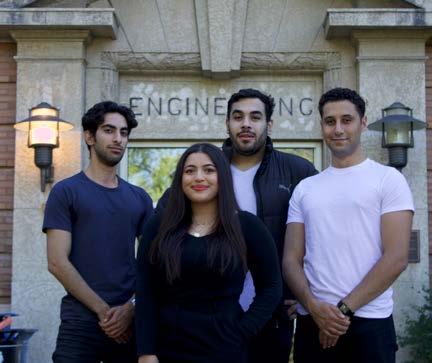
Alsheikh put together a team with computer science student Khaled Elzeiny, computer engineering student Habiba Mahmoud and law student Fayez Arheam. Together they set off to make class scheduling easier.
“We took advantage of the free time the pandemic lockdowns offered and got to work,” Alsheikh said.
The team adopted different roles according to their skill sets. Alsheikh acted as project and development lead, Elzeiny took on front-end software development and Arheam and Mahmoud tackled marketing and design, respectively.
“I have a strong passion for the arts as well as technology. For those reasons, I took on the opportunity to join the uniSkedual team as the design lead,” said Mahmoud.
Less than two months later, the team launched a web application that allows undergraduate students to plan for classes and visualize their timetable in a simple, easy-to-use interface: uniSkedual.
The motivation to build uniSkedual came from first-hand frustration when planning classes through Aurora.
“The main reason why we were
motivated to build uniSkedual was because we were personally affected by the problem,” Alsheikh said.
“We all experienced frustration when it came to [registering] for our courses,” said the uniSkedual team.
With the 2020-21 academic year registration well underway, uniSkedual has succeeded in helping U of M students since its July 7 launch.
Why uniSkedual?
While it may seem that uniSkedual fixes a problem Aurora has already solved, Alsheikh disagrees.
“On the contrary, Aurora does not offer our functionality. Aurora lacks the visualization aspect, meaning that when going through the course catalogue and selecting courses, you will not be able to see your week at a glance until after you register. This causes a lot of issues for students, such as time conflicts and non-optimal selections.
“The university’s current recommended selection process involves manually entering course data on a sheet, which is error-prone and tedious.”
Developing an application for public use is no easy task. Team members Arheam, Elzeiny and Alsheikh had to overcome several obstacles.
On the marketing side, Arheam struggled with sending students a clear message.
“One issue from a marketing perspective was the failure to understand our value proposition, which [Fayez] later tweaked to a more effective and compelling prop,” Alsheikh said.
On the technical side, building the application required plenty of learning.
Alsheikh said he and Elzeiny “faced difficulty when integrating complex and unfamiliar libraries as well as having a short time frame to build all the required components.”
The team’s software developers think the knowledge acquired through their U of M programs aided uniSkedual’s success.
Alsheikh said that Elzeiny “did find that the [computer science] curriculum was useful in terms of understanding programming fundamentals as well as best practices.”
Alsheikh credits a humancomputer interaction course taken through the department of computer science as being instrumental for his contributions.
“It’s a class that definitely changed the way I think when it comes to software products, and it stressed on the importance of building user-focused products rather [than] tech-focused products, which was vital to the success of uniSkedual,” said Alsheikh.
The uniSkedual team is currently in talks with the U of M’s administration and exploring different paths for future work.
News Briefs
Former director of NCTR set to continue decolonization work at University of Victoria
On June 24 it was announced that Ry Moran, founding director of the National Centre for Truth and Reconciliation (NCTR) has been appointed the inaugural associate university librarian (reconciliation) at the University of Victoria.
Moran’s new position is the first of its kind in Canada.
The NCTR was established at the University of Manitoba in the summer of 2015 with the goal to “preserve the memory
U-Pass not in effect for fall semester
U of M students will not be seeing the U-Pass fee reflected on their fall semester account statements.
The U-Pass, which carries a $200 fee per semester, will not be in effect until the winter 2021 term at the earliest. Due to fall term largely being offered remotely, the U-Pass program is not in effect during the term. However,
Former music professor
Steve Kirby to receive $286,000 payout from the U of M after sex assault accusation
Steve Kirby — a former U of M jazz professor in the Desautels faculty of music — has won a sizeable payout from the U of M.
In June 2018, Kirby was charged with sexual assault, with the incidents in question allegedly taking place between September 2014 and January 2017. The charges stemmed from allegations of sexual assault of a 19-year-old female who was
of Canada’s residential school system and legacy,” and to house all materials gathered by the Truth and Reconciliation Commission of Canada.
Moran’s work has focused on ensuring approaches to preserving and accessing such documents remain respectful to survivors and faithful to the historical record in a way that empowers Indigenous peoples.
As a member of the senior libraries staff at the University of Victoria, Moran is to continue his work of decolonizing approaches to preserving knowledge.
UMSU is offering a subsidy to students requiring a postsecondary pass that would bring the cost of the pass in line with the cost of the U-Pass. A form to apply for the subsidy will be available online in the coming weeks. For students in need of financial assistance, the UMSU hardship fund is currently open for applications until the fund is depleted. The form to apply for this fund is now available on the UMSU website.
his student at the time. The charges were stayed. Kirby filed a grievance in 2017 with the University of Manitoba Faculty Association, claiming — according to the grievance ruling by arbitrator Arne Peltz — “privacy breaches, including damages and the reinstatement of the grievor to his employment with the university.”
According to the Aug. 5 ruling, Kirby declined to be reinstated at the U of M despite the arbitrator being prepared to do so.
Following arbitration, Kirby is set to r eceive $286,000 from the university.
MARIO MENDEZ DIAZ, STAFF
CAM CANNON
AMIRA TEKLE, STAFF
AMIRA TEKLE, STAFF
PHOTO PROVIDED BY THE UNISKEDUAL TEAM
Editor-In-Chief: Matthew Doering
Contact: editor@
Remote learning puts education out of reach
Education’s ‘new normal’ has far-reaching consequences for students and society
SHAYLYN MAHARAJ-POLIAH, STAFF
Ever since COVID-19 reached Manitoba this past March, students of all ages have had to adjust to online learning. With the school closures forbidding in-person instruction through June, teachers and learners alike have had to make a quick transition with a steep learning curve.
Educators in primary, secondary and post-secondary schools did not have adequate time to plan for the switch from in-person to online classes and much of the necessary training has been self-directed and impromptu.
Considering the circumstances, distance learning is the most effective way to maximize public health and safety by minimizing physical contact.
It also saves time and money not having to commute from school to home, thereby reducing carbon emissions, and provides flexible learning opportunities for people with full-time jobs, children or other commitments.
Remote learning also has the potential to be cheaper for families than in-person classes because students are spending less money on textbooks and are not utilizing oncampus amenities such as computer labs, student lounges or food services.
Yet, the University of Manitoba is raising tuition costs almost four per cent for the fall 2020 term, even though nearly all classes will be taught remotely.
There are some central issues with the distance learning model, however.
One of the most prominent issues is the assumption remote learning makes about the socioeconomic sta-
tus and agency of students.
Many students in the Canadian school system who live in rural areas lack devices and internet access at home. Many of these students previously relied on the technology provided by their school to access and complete their assignments — an option that has since been stripped from them.
In the case of K-12 schooling, at least one school division in Manitoba has provided laptops to families in need, but this is merely a BandAid solution to the larger problem of the widened economic disparity this new learning model highlights. Unfortunately, solutions to this problem are not being implemented evenly across the educational sphere.
With this new remote learning model, the onus is placed on the students to be responsible for their own learning.
However, the loss of routine, the lack of constant support from peers and teachers and the anxiety caused by the developing pandemic are detrimental to the students’ still-developing cognitive capacities.
It has also caused anxiety for parents, who may not be able to offer their children the support they need for a variety of reasons, such as work or inexperience with course material and technology.
This is especially detrimental to newcomer students and students who speak an alternative language at home.
Their language development will likely become stunted due to a lack of exposure to English or French, which
will make their acclimatization to the new language that much more difficult to cope with.
Though students are required to engage with their online learning, these factors — paired with heavy workloads and potentially unreliable technology — may prevent them from doing so in a meaningful way.
Thus, the dreaded “summer learning loss” will be exacerbated by a “quarantine learning loss.”
A recent joint paper put out by researchers from the Northwest Evaluation Association, the University of Virginia and Brown University suggests that up to 33 per cent of reading progress will be lost and up to a 50 per cent loss in math progress will result.
In some cases, this is the equivalent of missing a full school year.
This leaves students severely underprepared for the fall, especially for those students heading into a graduated level of schooling such as middle school, high school or post-secondary.
There is potential for this learning loss to persist with the hybrid model proposed for grades 9 to 12 by Manitoba’s Minister of Education, Kelvin Goertzen.
At this time, the model does not have a set form and will most likely differ depending on the school division.
But, one thing is certain: all students will have to learn to juggle more than one type of learning.
This means disrupted routines, inconsistent support and anxiety surrounding physical and mental health
will also persist.
It seems as though education has found itself in a situation where there is no winning: the school board should not risk going back to normal
It seems as though education has found itself in a situation where there is no winning
when that normal jeopardizes the health and safety of students.
At this time, keeping students at home and having them miss out on learning the soft skills necessary for life outside of the classroom is worth the loss.
Manitobans and Canadians must make exceptional sacrifices to their habitual lifestyles in order to maintain our collective health and keep the pandemic’s case curve flat.
There is already speculation that some parents will refuse to send their children back to school to maintain their safety — an understandable decision considering the risks a packed classroom full of kids that forget to wash their hands every second trip to the bathroom poses.
Post-secondary students are not exempt from the downsides of digital learning.
Many professional programs around the world are becoming forced to find ways to continue with
practicum and clinical experiences necessary for graduation.
COVID-19 has placed professional programs in a precarious situation. Practicums in the faculty of education at the University of Manitoba are scheduled to resume in November — but the faculty has made it clear the dates for resuming in-person practicums are floating, awaiting approval from the province. No strict plans have been published to date.
Online learning is not a viable substitute for these hands-on learning experiences, leaving some graduates ill-prepared for real field work.
Education leads to more employment opportunities, improved health and a higher quality of life. When society’s most vulnerable directly struggle to attain even basic education, they often access social assistance programs — programs that are funded through taxpayer dollars.
All taxpayers, whether participating in remote learning or not, are affected by its societal consequences. Taxes may be increased, which could be debilitating considering Canada’s current economic recession, or government spending may be redirected to fund social assistance programs. As a result, the adverse outcomes of emergency remote learning for kindergarten through post-secondary school students has far-reaching ramifications in society that will reverberate for many years to come.
So, who does remote learning leave behind?
All of us.
GRAPHIC BY JENELLE MCCANN
Comment Editor: Lucas Edmond Contact: comment@themanitoban.com
Invocation of social contract theory unveils nothing ‘lamentable’ but the chief’s contempt
LUCAS EDMOND, STAFF
The idea that social contracts exist between peoples and institutions which form the foundation of civilization would suggest that there is a deeply participatory and democratic forum which people utilize to consent to structures of power and social organizations.
Danny Smyth, the police chief of Winnipeg, recently wrote an opinion piece for the Winnipeg Free Press discussing the “erosion” of a mythical social contract between citizens and police officers.
Instead of working toward constructive ends, Smyth seemingly used this platform as an opportunity to push a form of pity discourse which many police officers have run to since people have begun expressing their discontent with the system.
Contrary to Smyth’s assertions, no such forum or social contract truly exists in the elitist society we live in today. People have not consented to their racial and class subjugation.
Beyond this, the existence of a social contract suggests that culture is a bounded and homogeneous whole not subject to change. We are not born into a social contract nor do we ever re-negotiate them. A contract implies a level of permanence, but culture is in a continuous flux, often from individuals collectively
redefining their identity and their relationship with hegemonic norms and power.
The social contract political theory is a dated and overly simplistic Enlightenment-era philosophy developed by a number of controversial figures to legitimize unequal modes of government.
The original thinker to publish work on social contracts, Thomas Hobbes, vouched for absolutism as the only viable option to maintain peace.
Absolute methods of ruling essentially provide an authoritarian ruler unlimited power to repress rights of the members of a society with impunity. Hobbes viewed humans as inherently greedy and self-interested. Therefore, he exclaimed institutions of power, in this case an authoritarian ruler, would be tasked with restricting peoples’ rights in exchange for peace — a suitable theory to help validate the expansion of the police state.
Another liberal thinker, John Locke, later built on the social contract theory, establishing that it was essentially rich white men that were to be in charge of maintaining power and peace. Locke argued that property played a central role in a person’s ability to participate in civil government. Due to the fact that
virtually only white, rich men could own property — because African Americans were largely unable to own land before the American Civil War — the ability of marginalized groups to influence government was radically suppressed.
Locke was also an avid supporter and participant of the transatlantic slave trade. As a matter of fact, Locke was involved in the creation of the Fundamental Constitutions of Carolina, which supported the absolute authority of “freemen” over Black slaves.
The irony that the police chief is using a theory developed by such controversial and dated thinkers to validate and rally support for the police department is deplorable.
The fact is, police forces exist to protect status quo structures of power, not the people. Smyth’s article serves as a dangerous example of just how embedded the colonial rhetoric of service and protection has become. The paternalism that police forces express daily is part of the issue — certain peoples are delegitimized in the eyes of the law.
And now that the law has become delegitimized in the eyes of the people, it is suddenly the masses who are to blame for the so-called “erosion” of this mythical contract which, to my knowledge, nobody living has signed
nor consented to.
What is more disturbing about this article is that Smyth truly believes that over the course of the Winnipeg Police Service’s 145-year history, the so-called checks and balances on police officers have worked.
I suppose checks and balances were in place when Indigenous children were ripped from their parents’ arms by the RCMP and forced into lives of precarity, abuse and malnourishment. I suppose checks and balances worked when J.J. Harper, an Indigenous leader, was shot and killed by a Winnipeg police officer and the case was neglected due to racial assumptions and stereotypes.
I suppose checks and balances are currently underway when the police officers who fatally shot 16-year-old Eishia Hudson are still walking freely.
Even if Hudson’s death is ruled within the legal parameters of lethal force, police should not have the right to act with impunity and publicly kill people, let alone children. Police must be held accountable for their actions.
If a social contract had ever existed, it was never the people who were to blame for its degradation — it was and remains the deplorable actions of power, systemic racism and violence perpetrated against Black and Indigenous lives which has sparked
unrest with these so-called “checks and balances” Smyth holds such faith in.
The fact is, police forces exist to protect status quo structures of power, not the people
This system’s roots are embedded in a colonial soil and these hierarchical systems will forever grow to enrich racial and class discrepancies.
This is precisely why “immediate and drastic” responses to injustices inherent in this system must be deployed.
Minor reforms have done nothing for Black and Indigenous lives over the past century and, if anything, work to simply keep populations docile while maintaining underlying power structures.
Defunding the police is not a “woke” or “instant gratification” movement like Smyth claims it is — it is a response to centuries of injustice and a demand for a more equitable future.
GRAPHIC BY JENELLE MCCANN
Ecological integrity of Lake Winnipeg is deteriorating
With numerous solutions available, now it is a matter of political will
LUCAS EDMOND, STAFF
After cutting funding for environmental organizations during the pandemic, the Manitoba government seems to have had a change of heart in regard to the pivotal importance of climate action.
Premier Brian Pallister announced July 22 that $5.6 million will be invested in an array of projects to help protect lakes and rivers in Manitoba with the restoration of natural riparian areas.
While a step in the right direction, the government’s investments are but a Band-Aid on a shark bite.
Lake Winnipeg was named the world’s most threatened lake in 2013 and the eco-crisis facing the lake has not improved much since.
Interlinked issues that face Lake Winnipeg include phosphorus pollution leading to decreased oxygen supplies in the lake, a massive watershed that spans international, provincial and state borders — making saving the lake a political nightmare — and the threatened natural riparian areas which help reduce nutrient pollution and erosion.
These problems display just how expensive the lake we have spent centuries destroying will cost to save.
That blue-green gunk people sometimes see on a summer’s day when the city is too hot to bear is more than just naturally occurring alga — it is cyanobacteria, a nitrogenfixing organism that now dominates the lake due to the lake’s phosphorus pollution.
This bacterium is far from harmless — it is quite literally killing the lake and the surrounding ecosystem
that relies on it.
Plants and algae in lakes have adapted over billions of years to rely on very little phosphorus and nitrogen in order to grow. But following runoff from things like our sewage system and industrial agriculture, due to the degradation of riparian areas, our lake has been overwhelmed by the exponential growth of aquatic plant life and algae.
The overgrowth of aquatic plant life in lakes might sound benign, but it’s not. Overgrowth can lead to eutrophication — a process which leads to thick mats of algae that block the sun’s penetration of the lake, killing other plants. These dead plants and later the dead algae are then decomposed by an influx of bacteria which require oxygen. This influx of bacteria then uses up all the available oxygen, thereby suffocating the ecosystem.
What’s worse, without an oxygen supply, decomposition creates methane — a greenhouse gas that is significantly more damaging than carbon dioxide.
Lake Winnipeg will sooner, rather than later, become a major contributor to the heating of our world if the problem is not addressed.
So, how can Manitoba stop an ecosystem from potentially collapsing? The answer is — likely not what the Manitoba government wants to hear — more money.
Protecting the lake from nutrient and soil pollution is not a small task and will require heavy infrastructural investments including a high degree of political co-operation and bilateral
policy agreements.
The watershed that drains into Lake Winnipeg is estimated at around one million square kilometres. This means restoration cannot rely on provincial solutions alone — rather, transnational agreements must be made if we wish to maintain the integrity of our collective ecological health.
Excluding the costs of infrastructure and restoration projects, such interprovincial and international co-operation is costly in and of itself.
Reaching a bilateral agreement is next to impossible when the decisions in one area can produce costs elsewhere. Unfortunately, bureaucracy makes productive solutions painstakingly long and expensive.
Nonetheless, it is worth the cost, and there are initiatives Manitoba can pay for now that can significantly ameliorate the damage done to the lake.
Winnipeg’s sewage treatment plants alone contribute approximately five per cent of the lake’s phosphorus pollution annually. Manitoba can start by eliminating pollution from man-made pipes and sewage disposal.
Winnipeg has already passed plans to upgrade the North End Water Pollution Control Centre to include biological nutrient removal systems which eliminate phosphorus and nitrogen from waste waters. However, this plant only regulates roughly 70 per cent of the city’s sewage.
The other 30 per cent comes from older Winnipeg neighbourhoods which are serviced by a dated model
of combined sewage. This system was designed for the wet season, so what backup the water treatment facilities cannot handle is diverted to a separate drainage system which goes directly into the rivers — subsequently ending up in Lake Winnipeg.
Annually, billions of litres of raw sewage rushes into Winnipeg’s river system. Numbers that edge up to about one million litres daily.
Fixing the combined sewage system in older developments of Winnipeg would be a solid starting
While a step in the right direction, the government’s investments are but a Band-Aid on a shark bite
point in reducing our ecological footprint on Lake Winnipeg. But pollution from sources less easy to identify than a pipe or drain still remains a large factor in the lake’s degradation.
Remedying this kind of pollution may be less straightforward. However, a few things can be done.
Investing more in riparian areas along stream banks, lakeshores and wetlands can do much more than they appear to.
By promoting the development of natural communities of vegetation, these ecosystems act as nutrient filters
to incoming runoff and also prevent erosion by holding soils together. These areas are essentially nature’s sponges and soil’s armour.
Beyond this, reducing the phosphorus and nitrogen runoff from industrial agriculture is crucial. Big agriculture has become virtually reliant on phosphorus fertilizers and industrially-produced nitrogen due to exhausted soils.
As a result, much of the applied nutrients usually end up eroding into water systems.
Building tile drainage to manage where the runoff from agricultural plots goes is a large but necessary project in reducing much of the nutrient pollution facing Lake Winnipeg. Manitoba is a province of extremes. The spring is often too wet, resulting in runoff, and the summers are too dry, forcing farmers to apply their own irrigation.
Tile drainage would capture runoff and store it in a place accessible for later use.
Not only would this make farms more sustainable, it would also allow farmers to utilize the excess fertilizer and water they applied earlier in the year, ultimately preventing the risk of polluting surrounding ecosystems.
The ecological crisis facing Lake Winnipeg will take much more than a measly investment from the provincial government.
If more is not done soon, our lake is at risk of suffocating under significant stresses.
Lake Winnipeg is a pillar of our ecosystem and if it falls, who knows what will fall next.
GRAPHIC BY JENELLE MCCANN
Celebrate Folklorama your way, any day, in a safe way
Folklorama 2020 introduces programs to bring a customized cultural experience to your doorstep
SHAYLYN MAHARAJ-POLIAH, STAFF
Over the last 50 years, Folklorama has become the longest-running and largest annual multicultural festival of its kind in the world. With the cancellation of major summer festivals in Manitoba to abide by COVID-19 health precautions, the pandemic has paused this run.
Yet, respect and appreciation for multiculturalism is needed now more than ever with marches against racism taking place globally and protesters collectively demanding changes to policies that give rise to societal inequalities.
With 40 pavilions representing unique ethnic communities within Manitoba, Folklorama serves as a
valuable vehicle that creates respect and appreciation for multiculturalism through its mission of celebrating diversity and promoting cultural understanding.
While visiting pavilions is not possible this year, the Folklorama operations team has reimagined Folklorama for 2020.
Tanya Williams, Folklorama’s director of marketing and communications, outlines new programs offered this year.
A virtual experience is just a click away. Vibrant ethno-cultural performances may be caught online on both Instagram and Twitter at any time of day or night. These feeds are con-
PHOTO PROVIDED BY TANYA WILLIAMS
stantly updated to showcase recent cultural performances in Manitoba.
For a more immersive, customized experience, you can now take Folklorama to your work, school or home. Just select your entertainment and choose your cuisine. Folklorama will work within your budget to tailor an hour-long cultural event just for you within a couple of weeks.
Many senior homes have taken part in these programs, including River Gardens residents who enjoyed the Franco-Manitoban entertainment of TiBert le Voyageur.
“Folklorama is very COVIDcareful when it comes to planning these events,” Williams said. “All
artists are screened pre-performance.” Event attendees are also required to fill out a screening sheet, which provides a safety level to protect both performers and patrons.
For larger events, Folklorama at Play is planned for the fall when government public health regulations become less restrictive and more information will be provided at that time. With so many youth becoming involved in social protests and even leading human rights activities,
“The reasons people book these parties are truly beautiful”
— Tanya Williams, director of marketing and communications
cultural awareness has become a vital part of education. Folklorama plans to work with reopened schools to customize cultural experiences that follow the Manitoba curriculum.
With Folklorama being the only Canadian festival to offer an inhome version of the festival, more than 60 bookings have been made as of early August. Reasons for book-
ings include bringing Irish culture to a 50th anniversary party when the planned Ireland trip was cancelled due to COVID-19 and recreating the excitement of Trinidad and Tobago’s Carnival at a backyard party.
“The reasons people book these parties are truly beautiful,” Williams said.
These programs have been so popular that Folklorama has made them permanent, running 365 days a year.
Even with this source of income, many ethno-cultural communities are challenged to fund projects that sustain their culture, especially in light of lost pavilion profits this year. To provide financial support, Folklorama has announced the creation of the Folklorama Cultural Preservation Fund to preserve cultural history for many years and future generations. Assistance will be provided for music programs, outreach programs, language lessons and cultural summer camps, to name a few. Donations to this fund are accepted on Folklorama’s website. At a time when it’s most needed, the reimagined Folklorama offers new programs to continue the tradition of breaking down cultural barriers to value diversity.
For more information about Folklorama’s programming, please visit folklorama.ca.
Maharaj-Poliah
Shaylyn Maharaj-Poliah
Two Manitoba heritage museums reopen their doors
The Cooks Creek Heritage Museum and the New Iceland Heritage Museum welcome visitors after months-long closures
ZOË LEBRUN
In the midst of the COVID-19 pandemic and discouragement from travelling out of province, those looking for both a fun and educational outing without leaving Manitoba’s borders can look no further than the Cooks Creek Heritage Museum (CCHM) and the New Iceland Heritage Museum (NIHM).
Both museums reopened in early June and are excited to be accepting visitors this summer, under new COVID-19 safety precautions.
The CCHM showcases the history of Eastern European Slavic immigrants who settled in the Cooks
Creek, Man. area, what life was like for them in Canada and the cultural items and traditions they brought with them from overseas.
The CCHM consists of the main building — converted from a rectory to a museum by priest Alois Krivanek in 1968 — and many outbuildings that include a blacksmith and woodworking shop, a wayside chapel and restored pioneer homes, which show visitors the types of buildings many immigrants inhabited as they began life in Canada.
The CCHM is jam-packed with interesting artifacts — often donated
by local families who have been in the area for generations — and the museum’s knowledgeable tour guides are always happy to share the stories and history of the people who settled in the area.
However, in light of COVID-19, there are some changes in the usual operations.
Tour guides are required to wear face masks and guests are required to use hand sanitizer upon their arrival. Visitors are also encouraged to wear face masks and book tours for large groups ahead of time. Drop-in tour groups of six or more are to be split
in two.
Additionally, the events usually hosted by the CCHM over the summer have been cancelled and are expected to resume in the summer of 2021.
For those unable to make it out to Cooks Creek in order to visit the museum this summer, the CCHM’s Facebook page is full of interesting information about the museum and the histories it offers.
Those looking for both a fun and educational outing without leaving Manitoba’s borders can look no further
You can even take a virtual tour of the museum through their website with audio provided by RiverCity 360.
The NIHM teaches its visitors about the story of New Iceland and the lives of the Icelandic people who settled in the area of Gimli, Man. in the 19th century.
The NIHM currently sets visitors on a self-guided tour that begins with a short video following stories of some of the Icelandic families that
journeyed to Canada.
Then, guests are walked through various facets of the living experience of an Icelandic settler through multimedia exhibits that include interactive recordings, video installations and dioramas.
Currently at the NIHM, there is a visual arts exhibition called Déterré/ Unearthed by Candace Lipischak, on loan from the Manitoba Arts Network until the end of August. This exhibition speaks to how nature finds a way to evolve and of the environmental issues that affect our society today.
Due to the COVID-19 pandemic, some changes to the NIHM’s usual procedures include mandatory hand sanitizer use by all visitors, encouraging guests to wear masks and maintain social distancing standards, as well as controlling the flow of traffic into the museum and reducing building capacity.
Associated with the NIHM is the Lake Winnipeg Visitor Centre, dedicated to the fishing industry and the natural history of Lake Winnipeg.
For more information about the New Iceland Heritage Museum, please visit nihm.ca. For more information about the Cooks Creek Heritage Museum, please visit cchm.ca.
Manitoban artist takes art lovers on journey to the past
Kandis Friesen explores her own history and identity in latest work at the Plug In ICA
Manitoba-born Kandis Friesen is a multimedia artist whose work mainly centres on archival processes, diasporic languages and cultures closely intertwined with her family history.
Friesen currently has an exhibition up at the Plug In Institute of Contemporary Art called The Cedar, The Birch, Our Hands At Full-Mast, Behind The After, which reflects on these topics, but particularly on the
exile of Russian Mennonites within the diasporic culture. The exhibition itself is minimal, with no plaques on the walls detailing titles or explanations of the work. However, for viewers without prior knowledge of Friesen’s work, the pure emotion conveyed throughout the exhibition is more than able to make up for the narrative details and impresses upon the viewer the sense of a home lost and a struggle
to maintain identity in relation to culture.
The first thing encountered upon entering the gallery space is the large black banner set up in its centre, facing away from the entrance and dominating the field of view. In a way, this builds anticipation as you set foot into the gallery, as the side with visual information is obscured from view and must be discovered.
In addition to this, having the
banner divide the space this way and drawing viewers’ attention to it helps create a flow of movement in the space and sets us up for a narrative journey throughout the exhibition and engages the viewer in the space.
In a way, this builds anticipation as you set foot into the gallery
The banner itself is cryptic to those who are not clued into the specifics of Friesen’s work — the wall of windows facing the banner illuminates it just enough to catch a glimpse of the raised writing that covers it, which is written in Russian, speaking directly to a small population of Russian Mennonites from the Soviet Union.
An English translation of what is written on this banner can be found on the windows facing out to the street. The translation reveals it to be a protest banner, with the writings a call to arms drawn from many
sources including Ukrainian anarchists, Soviet conceptualists, Friesen’s own writing and more. Behind this banner, there is a shift to Friesen’s wall-based works, which are pieces from an ongoing series, Our hands meet the sun at the edge of things. The focus of this section are four objects — a postcard, a painting, a stone and a blanket — which give the sense of a specific geographical location. Additionally, the lengths of the wooden shelves and expanses of glass that frame these objects amplify feelings of depth and convey a palpable distance of both time and space that separates the exhibit from the items’ origins.
Despite the solemnity of Friesen’s exhibition, and even a sense of aggression with its protest banner, this set of work still leaves the viewer with a feeling of hope and conveys the connection Friesen feels to the land and culture that her family was exiled from, bridged by the language and stories they brought with them as they fled Russia.
The Cedar, The Birch, Our Hands At Full-Mast, Behind The After runs until Aug. 22.
ZOË LEBRUN
PHOTO PROVIDED BY NEW ICELAND HERITAGE MUSEUM
PHOTO PROVIDED BY THE PLUGIN INSTITUTE OF CONTEMPORARY ART
Seth Jarvis a potential Jets pick in 2020 NHL draft
Lots of opportunity at the draft for a great future
ISAIAH WAGNER, STAFF
It was a tough last couple weeks for the Winnipeg Jets.
With a span of injuries, the Jets ultimately lost the best-of-five series in four games to the Calgary Flames in the qualifying round of the 2020 Stanley Cup playoffs.
Despite the bad news, the Jets did receive some good news during the month of August.
After the NHL lottery draft, it was announced that the Jets will receive the 10th overall pick in the entry draft.
The New York Rangers landed the big fish in the sea as they were given the first overall pick and will in all likelihood be selecting Alexis Lafrenière. Lafrenière has been a top-ranked player through the 2019-20 season, leading the league with 112 points in 52 games.
Although the NHL draft typically takes place in June, the league decided to postpone the draft until Oct. 9 and 10, 2020 due to the COVID-19 pandemic.
The Jets have many needs when it comes to their future.
Whether it be defence or a centre, the Jets will have plenty of options when Winnipeg’s name is called and they are on the clock.
One player that would be a great option for the Jets is Winnipegborn Seth Jarvis.
Jarvis played for the Portland Winterhawks of the Western Hockey League, in Oregon, for the past three years.
The 18-year-old centre put up
a whopping 98 points in 58 games last year which put him second in league scoring.
The year was an important milestone for Jarvis in his very early career.
“This year was massive for not only my on-ice development but off of the ice balancing school [and] hockey and interacting with teams was very busy but forced me to mature very quickly,” Jarvis said.
“On the ice, I was able to make massive jumps in my overall game and confidence on the ice.”
Jarvis’s outstanding year was no accident.
He has trained hard and treated every day like a day to better himself.
“A regular day looks like waking up around 8:30 [a.m.] and heading to the rink to work out and skate in the morning, then get home and work out again with my dad,”
Jarvis said.
“The rest of my day is either golfing or just hanging around with friends for the most part and trying to see them as much as possible before we all leave again.”
Jarvis continues to train day in and day out with his hockey season in question for the year.
“My plans are to continue training and skating as normal and continue to stay in the gym to make more improvements up until the season [begins] then return to Portland to prepare for this upcom-
ing season with the team,” Jarvis said.
With all of this in mind, Jarvis still has the NHL draft to worry about and what his future holds.
His experience with this whole
“It would be really cool to be drafted by a team that I grew up watching. It feels like I would be living a dream of getting drafted to the hometown team and the fact that I have an opportunity to is very humbling” — Seth Jarvis, NHL draft prospect
process has been life-changing and has left him starstruck.
“My experience has been really cool with this weird time,” Jarvis said.
“Instead of in-person interviews, they’ve been over Zoom and I’ve met some NHL legends and guys
I have looked up to through these calls which has been really fun.”
The Jets have plenty of options at the number 10 overall pick.
A player and a person like Jarvis might be the piece the team needs to be a powerhouse in future years to come.
With a bright future of Mark Scheifele, Patrik Laine and Kyle Connor, Jarvis would be a great fit for the team.
When he is ready, Jarvis could ultimately be slotted in as the second-line centre alongside Laine and Nikolaj Ehlers.
The five-foot-ten-inch Jarvis would be a great complement in the middle to right-wing sniper Laine.
Jarvis’s 56 assists in 58 games last season would be something Laine — who once scored 44 goals in a single season — could be grateful for.
Jarvis and Jets fans alike will both have a chance to be very excited when the NHL entry draft takes place in October.
Getting drafted in the NHL is something that is amazing, but Jarvis said being drafted by your hometown team is something that would be unbelievable.
“It would be really cool to be drafted by a team that I grew up watching,” Jarvis said.
“It feels like I would be living a dream of getting drafted to the hometown team and the fact that I have an opportunity to is very humbling.”
The Active Living Centre (ALC) reopening is something the students at the University of Manitoba have looked forward to for months.
After closing due to COVID-19, the ALC officially reopened July 27.
Although exciting, the health and safety of gymgoers and staff is extremely important.
To maintain physical distancing, some of the regulations in place include members being required to book 90-minute workout blocks; limiting capacity to 100 people; no water fountain usage; no towel service and the pool, shower and sauna remain closed.
The reopening of the ALC has been a great success as it has been maintained well and has reached the capacity limit most days.
This was confirmed by U of M student, Adam Guercio.
Guercio has been going to the gym since he first started at the U of M and has been pleased with the reopening.
“They have done a great job keeping [the ALC] clean,” Guercio said. “Machines are constantly washed by the staff and distance is usually maintained.”
Physical distancing measures include only some machines available for use, the interspersed machines bear “do not use” signage to maintain distance between people using the equipment.
Guercio added that the ALC has been busy since reopening.
“I have tried to book a session a couple of times and could not because it had reached the capacity.”