U of M continues with tuition increase during pandemic
Provincial post-secondary budget cuts to go into one-time institution support fund
GILLIAN BROWN, STAFF
Mondor.
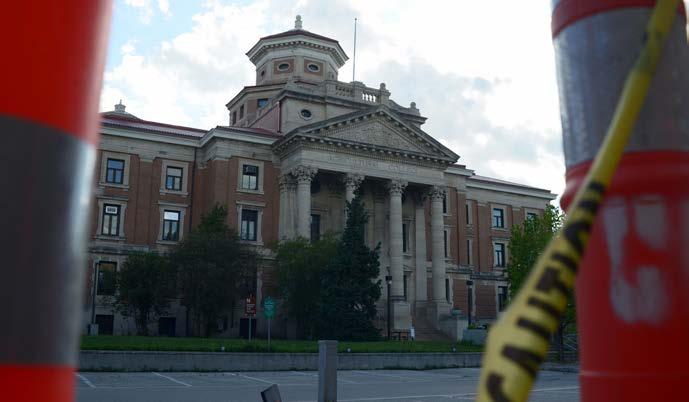
In the midst of a global COVID19 pandemic, the U of M has announced that, as outlined in the 2020-21 budget, tuition for undergraduate and graduate classes will be increased by an average of 3.75 per cent beginning this fall. Most courses offered in the fall 2020 semester will be remote learning classes.
The tuition plan, developed beginning about a year earlier by Todd Mondor, deputy provost (academic planning and programs), was based on the one per cent — or $3.5 million — reduction in the university’s operating grant from the province and was approved by the board of governors and announced May 19.
Mondor said the increase was a necessary step.
“We need to have a certain amount of revenue coming in to support everything that we do,” he said.
“It’s sort of a last resort, increasing student tuition.”
He said half of the money for the operating budget comes from the province and a quarter comes from tuition. The remainder comes from university services as well as other grants, donations and investment income.
To set the tuition increases in each faculty, tuition rates across other Canadian post-secondary institutions were consulted, but the U of M maintains the lowest tuitions across Western Canada.
Students in the arts, education and medicine faculties will see an increase of seven per cent.
Students in the environment, health sciences, kinesiology, management programs and the faculty of science will see their tuition increased by 5.5 per cent.
The agricultural and food sciences, architecture and music faculties as well as the fine arts program will have an increase of 3.75 per cent while tuition for engineering, law and social work will increase 2.25 per cent.
The school of dental hygiene and the colleges of dentistry, medical rehabilitation, nursing and pharmacy will see the lowest increase at one per cent.
All graduate programs will see a 3.75 per cent increase, excluding the master of business administration and the master of finance programs in the Asper school of business.
economic recovery,” it read.
“If [the cut to the operating grant] continues next year, it’s going to be hard to keep everything going” — Todd Mondor, deputy provost (academic planning and programs)
Within the approved tuition changes is also a new lab fee structure based on lab delivery costs along with an increase in the Desautels faculty of music’s major and minor practical study fees from $50 to $500, to be phased in over a period of four years with the goal to bring the costs closer to music programs at other Canadian institutions.
International students’ tuition will increase the same percentage as domestic students, with the exception of international PhD students, who will pay the same amount as domestic PhD students.
The International College of Manitoba and the U of M international centre declined to comment.
A source of concern for the U of M since the pandemic hit has been provincial announcements of funding cuts for the purpose of helping Manitoba financially during the pandemic.
In April, the provincial government asked the U of M to prepare for budget cuts of up to 30 per cent.
This was more recently brought down to a five per cent — or $17.3 million — reduction.
A four per cent reduction is only for this year, but the predetermined one per cent cut will be ongoing. The approved U of M tuition increases take only the planned one per cent
“Especially
“Employees displaced in the economic downturn will be turning to our institutions to refresh their skills and connect to work. We have businesses who need employees with specific skills and abilities and individuals who need good jobs. We want our students to succeed in their studies and secure employment that provides a high quality of life for themselves and their families.”
It also said that “going forward, there will need to be more attention paid to supply and demand in our workforce,” and that the focus should be on providing students with the skills necessary to “facilitate a quicker connection to employers upon completion.”
given the financial hardships a lot of, if not almost all of, the student population is going through, it’s just not the time to be raising [tuition] yet again” —
Emma Cheal-Brownlee, U of M student
With these increases, international students in engineering should expect to pay $715 more per year, and those in arts and science will be paying approximately $950 more for a full course load.
Though the increases were planned before the COVID-19 outbreak, “there was no contemplation to stop the tuition increases,” said
reduction into account.
In a letter sent May 25 from the provincial department of economic development and training to the university, the importance of postsecondary education and students in the rebuilding of the economy and their role in the workforce was emphasized.
“Our colleges and universities will play a critical role in our province’s
On May 25, the previously announced one per cent ongoing budget reduction from the university — along with the four per cent one-time pandemic-related cut — were announced to be redirected to a transitional support fund of $25.6 million.
The fund will be made available to institutions after the province receives the schools’ plans to orient programs toward the labour markets, ensure high-quality education through online materials and tools and to address international student enrolment challenges.
Mondor said that to offset the budget reductions, the university has limited travel and conference attendance, halted all discretionary
spending, limited reordering of supplies and left vacant positions empty.
In addition to the provincial cuts, the university is bracing for further revenue loss through the non-operation or low operation of university services.
“If [the cut to the operating grant] continues next year, it’s going to be hard to keep everything going,” he said.
At the May 19 board of governors meeting, the board expressed concern over the impact the budget proposal will have on students experiencing unprecedented hardships along with the impact of the pandemic on enrolment and the communication with students about the tuition increases.
Mondor said “the university is sympathetic to students and their families, yet revenue must increase in order to maintain and enhance programs, supports and services.”
He said bursaries for students in need of financial aid will be increased “as much as possible” within the constraints of the budget.
UMSU executives Jelynn Dela Cruz and Kristin Smith and UMGSA president Silvia Sekander opposed the motion to increase tuition.
The reaction from U of M undergraduate and graduate students has been unsupportive overall.
Emma Cheal-Brownlee, a firstyear student, said “tuition is not all of the expenses that are a part of the university experience.”
She drew attention to the fact that students are also responsible for housing, course materials and fees, and feels like “that’s not being taken into account.”
“Especially given the financial hardships a lot of, if not almost all of, the student population is going through, it’s just not the time to be raising [tuition] yet again,” she added.
PHOTO BY ALEX DECEBAL-CUZA
New U of M president set to lead through pandemic
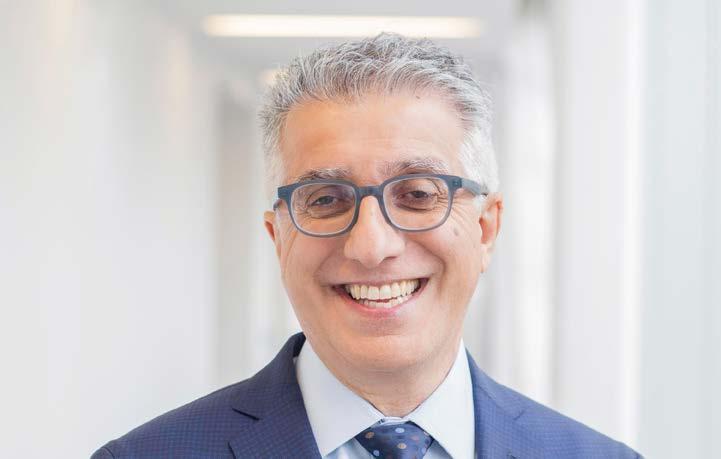
Former U of M dean Michael Benarroch begins tenure as president and vice-chancellor
JARED ROST
Following the completion of for-
mer U of M president David Barnard’s tenure, Michael Benarroch began his term as the University of Manitoba’s 12th president and vicechancellor July 1.
The new president’s focus is on “where we want to go next as a university.”
He said the “University of Manitoba is an essential and critical part of the province and of the economy of Manitoba, and the economy and the world are constantly changing,” and he wants the university to reflect that.
His plans for the U of M focus on establishing it as a leading research institution among its peers in Western Canada.
Another priority is cultivating a space for marginalized communities to both academically succeed and feel safe by ensuring the university is an institution that “confronts racism in all its forms and responds meaningfully to the challenges we have around these issues.
“It’s incumbent on us as a university to take a lead in these areas,” he said, drawing special attention to the 94 calls to action of the Truth and Reconciliation Commission of Canada (TRCC).
Returning home Moroccan-born, Benarroch immigrated to Winnipeg with his family when he was three years old
and was the first generation in his family to attend university, receiving his bachelor’s degree from the University of Winnipeg, his master’s degree from Western University and his doctorate degree from Carleton University, all in economics.
Following the completion of his PhD, he spent almost 20 years as a professor at the U of W and was the founding dean of the U of W’s faculty of business and economics. He went on to serve as the dean of the U of M’s Asper school of business for over five years and is currently an internationally recognized economist, an award-winning community member and a leader with extensive board experience.
Most recently, he served as the provost and vice-president academic at Ryerson University for just over three years. During his tenure, he led truth and reconciliation efforts and contributed to the development of a new academic plan which emphasized advancing Indigenous initiatives, community and urban partnerships, innovation, graduate studies and student experience.
After his work at Ryerson, Benarroch is looking forward to returning to Manitoba.
“I think my values and my beliefs around higher education, around what we want for our province, I think those really align very well with the [U of M],” he said.
“I never stopped calling Winnipeg
home even though I was [living] in Toronto, so I’m really excited about the opportunity to come back,” he later added.
Benarroch is a familiar face at the U of M, known for his time as the dean of the school of business from 2011 to 2017. During his tenure, he proposed a five-year plan which has led the faculty to the forefront of the business community.
Among his successes are improvements to the U of M’s Indigenous business education program. Under his leadership, the program saw unparalleled growth, with more Indigenous students graduating than ever before. In addition to this, his plan saw significant growth in graduate student programs and the institution of a master of finance program, along with international exchange programs and research funding.
Benarroch looks fondly back on his time as dean, calling it “a really exciting six years.
“There was never a dull moment. It was action-packed and everybody pushed each other to constantly be better during that time.
“I think we laid the groundwork for the continued growth and success of the school.”
To welcome a new leader, an old one must leave. On June 30, the U of M said goodbye to David Barnard.
Over his 12-year term, Barnard increased both the Indigenous and international student populations and
led the U of M to philanthropy and research successes.
“I
think my values and beliefs around higher education, around what we want for our province, I think those really align very well with the [U of M]” — Michael Benarroch, U of M president and vice-chancellor
Barnard also spearheaded truth and reconciliation efforts by being the first leader of a post-secondary institution to make a formal apology in front of the TRCC.
In recognition of his achievements, he has been appointed president emeritus, an honour given only to presidents who have served at least five years and have rendered distinguished service to the university during their term.
Barnard is only the third person to receive this honour. He follows the ninth U of M president Arnold Naimark, for his work in promot-
ing health sciences research at a national and provincial level along with creating the department of family medicine.
He also comes after the 10th president, Emőke Szathmáry, who, during her time as president, doubled Indigenous enrolment, tripled international enrolment, tripled sponsored research income, built a dozen new research facilities and helped the university undertake a $237 million philanthropic campaign.
Benarroch commended Barnard’s accomplishments.
“Over the 12 years, the university has taken its place amongst global universities, not just Canadian universities, and I think it’s a real credit to the work that he did in his position,” Benarroch said.
Entering his tenure during a pandemic, Benarroch already has plans in place for the U of M’s future. In terms of COVID-19, he emphasized a safe reopening.
“I think the U of M has put a good plan in and I think what we’ll start to see is a slow reopening, a safe reopening of campus,” he said.
“COVID has sent us all a shockwave and it’s not quite how we all want it to be working at this time,” he added. “But, I think it’s incredible how the community has come together and been able to continue to deliver education of the highest quality.
“It’s what inspires me every day.”
PHOTO BY MS ALIA YOUSSEF
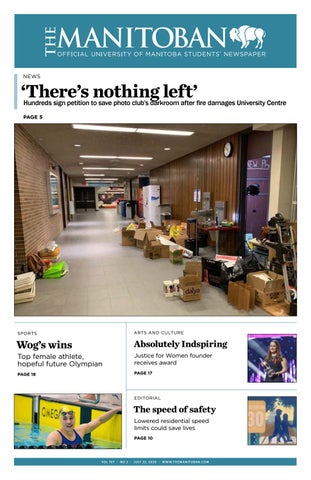
UM photo club losing darkroom after fire at UC
116 University Centre is being renovated into ‘bookable’ spaces
AMIRA TEKLE, STAFF
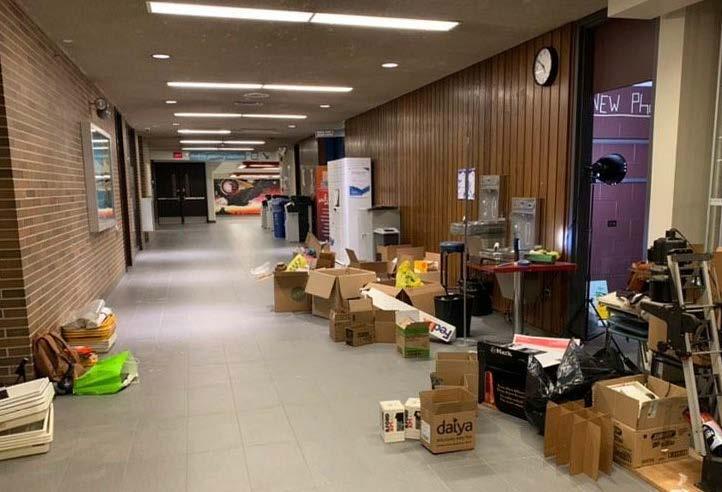
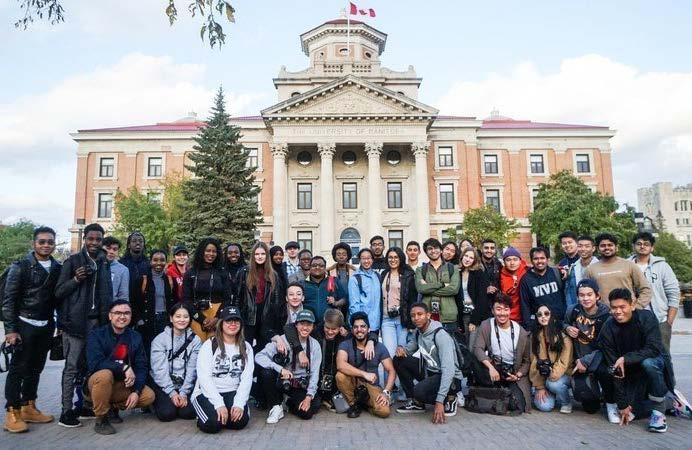
The existence of the UM photo club is in jeopardy after a fire took place outside UMSU University Centre (UC) March 13.
The student club is one of the oldest on campus, dating back 50 years. Photo club president and computer science student John Baptista wants UMSU to continue providing a space for the long-standing club.
According to Baptista, the photo club has roughly 50 members with more students coming in to use the darkroom services. The club uses its space to store equipment, hold workshops, congregate, take members on walkabouts and provide a darkroom to develop photos either for free or at a low cost.
The club offered free development for black and white photos for members and $2 development for colour photos.
“A lot of the students come in because our prices at our darkroom are really good compared to other public darkrooms around the city,” Baptista said.
The photo club is now being pushed out of its permanent space in UC.
The space included the last public darkroom at the U of M. Baptista said the photo club needs the darkroom and storage space at 116 University
Centre to function.
“Running the club without a space would be very logistically difficult,” he said.
Baptista said the first contact from UMSU regarding the fire was from UMSU service centre manager Leeandra Wren March 23 to tell them to vacate their space and remove all items due to the damage caused to the space by the fire.
“Basically just [saying] ‘There was a fire […] can you please take your stuff out of the room because we need to do repairs,’” Baptista recalled.
He said all members of the photo club executive team are storing club equipment in their homes and a storage unit they purchased after being refused alternative storage space by UMSU.
Baptista said he was concerned about the future of the darkroom from the beginning and asked Wren to clarify about whether it would remain a darkroom and how long repairs would take.
“She responded [that] it would take around 18 months and ‘I’m not sure how it will look after,’” he said.
Baptista said the club requested to see the reconstruction proposal tender and the contract work plan to get a better idea of what the space would look like, but the inquiry fell
on deaf ears.
The photo club then received correspondence from Thomas Blumer — UMSU’s general manager — on March 31 saying the photo club would no longer have sole use of the space.
According to Baptista, Blumer said “This situation has prompted UMSU to re-evaluate how our space is used currently.”
“Later on in the email [he said] ‘Unfortunately, we can’t give you a room,” Baptista said.
“We didn’t feel like we were heard” — John Baptista, photo club president
Blumer declined to comment for this article.
Baptista said he was told that UMSU is trying to move away from permanent club spaces to “rentable spaces.”
“This makes sense for clubs, but for our club which needs the darkroom, needs the space, needs the storage, it wouldn’t be very valuable for us,” he said.
Baptista said that due to “the
nature of our club, we need a space to do what we need to do.”
Baptista said the photo club started a Change.org petition due to frustration over not making progress with UMSU executives and staff. He said the photo club was not properly informed of the removal of the darkroom and UMSU failed to give the club any say in the process.
“We didn’t feel like we were heard,” he said.
“At this point, we’re not getting anywhere — we can’t talk to [Wren and Blumer], we can’t talk to [UMSU president Jelynn Dela Cruz]. What are we going to do?”
The petition was launched on May 10 and calls for Dela Cruz, UMSU vice-president student life Savannah Szocs, Blumer and Wren to make efforts to save the darkroom. Baptista said the photo club is overwhelmed and pleased with the support — the petition has garnered over 600 signatures to date.
However, Baptista and other members of the club were able to see the progress of the renovations in person and he describes the room as “flattened.”
“There’s nothing left.”
The club is now left trying to work with UMSU to secure another space on campus.
Szocs said the affected spaces are “not going to exist in the same way that they did before the fire occurred.”
She said access to the spaces affected by the fire will not be possible for another two years, and the club darkroom space at 116 University Centre will no longer exist due to a redesign of the affected area.
Szocs said UMSU cannot give an alternative space to the photo club because it is impossible to give all student clubs their own dedicated spaces.
“There are [many] student clubs that exist that are recognized through UMSU at the university right now. As much as we wish that we could give all […] clubs their own private space to work in […] unfortunately, we don’t have jurisdiction over [that many] different spaces at the university.
“We 100 per cent respect the work they’ve put into their club, community and the services that they provide to students,” Szocs said.
Szocs said the goal for UMSU in these renovations is to provide more clubs with an opportunity to use the spaces to gather and meet.
“We want to provide as many student clubs on campus as possible with the opportunity to have access to an office space.”
PHOTO PROVIDED BY THE UM PHOTO CLUB
Professor working with Fossil Discovery Centre
Research into extinct teeth to improve knowledge of prehistoric Manitoba
SARAH DORAN, STAFF
U
niversity of Manitoba assistant professor of paleontology
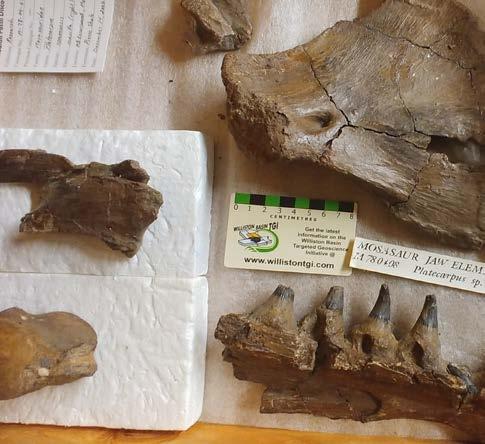
Kirstin Brink has taken an adjunct vertebrate curator position with the Canadian Fossil Discovery Centre (CFDC) in Morden, Man. The centre boasts the largest collection of marine vertebrate fossils in Canada.
Brink’s role involves advising the CFDC on initiatives involving its fossil collection and field sites, as well as providing a conduit between the resources at the centre and the university.
“The main goal of my adjunct curator position will be to highlight the existing collection of the CFDC in
terms of research potential and to grow the collection through fieldwork,” Brink said.
“There will be plenty of opportunities for students to work on honours theses, M.Sc. and PhD projects focused on the fossils of Manitoba.”
Brink is the first academic vertebrate paleontologist with the CFDC since the 1980s, when Elizabeth Nicholls helped expand the centre’s collection of marine fossils.
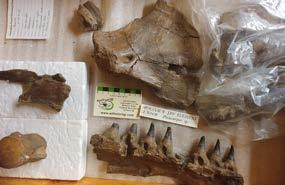
One specimen of a plesiosaur, discovered in 2004 and extracted in 2005, is nicknamed “Betsy” in Nicholls’s honour.
“A lot of the plesiosaur’s bones
are still covered in sediment from the field, so work needs to be done before research can be completed,” Brink said.
“CFDC staff and researchers have shown that the specimen has associated gut contents, so we can tell what the plesiosaur’s last meal was before dying.
“These interactions are hard to find in the fossil record.”
Teeth play a large role in Brink’s research. Her work focuses on the evolution and development of teeth and bones, as well as how those changes interact with the animal’s environment.
“Right now, I am very interested in the teeth of Cretaceous-aged animals found in Manitoba,” Brink said.
Betsy the plesiosaur is particularly interesting for Brink because the specimen has a full set of teeth.
“Teeth are very useful because they give us an idea of what an animal ate and their role in ancient ecosystems […] I will be working on projects with undergraduate and graduate students looking at the microstructure and the chemical composition of these teeth to understand in great detail how they are formed and what information they can give us about tooth function.
“In order to better understand the development, diet and lifestyle of extinct animals, data collected from these teeth will be compared to data collected from living animals, since we can watch living animals grow and interact with their environment.”
“The main goal of my adjunct curator position will be to highlight the existing collection of the CFDC” —
Kirstin Brink, assistant professor of paleontology
Most vertebrate animal fossils in Manitoba are marine fossils. The deposits around the CFDC date from the late Cretaceous period, roughly 80 million years ago, when the Western Interior Seaway split North America in half. Brink calls the province’s fossils “relatively underexplored” in comparison to other Prairie provinces,
since Alberta and Saskatchewan are internationally known for their animal fossils, particularly dinosaurs.
Brink’s research on teeth at the U of M will help her and other paleontologists understand aspects of life in the prehistoric Western Interior Seaway. The process involves cutting fossils into tiny pieces and examining them using technology like powerful microscopes and computed tomography (CT) scans.
“The nanostructure of bones and teeth can be used to determine how extinct animals grew and under what conditions, which in turn gives us clues to how these animals interacted with their environment and what the planet was like when they were alive,” Brink said.
The CFDC runs over 30 active dig sites in southern Manitoba, where the general public can join researchers and staff in excavating fossils. The 2020 dig site tours have been cancelled due to the ongoing COVID-19 pandemic, but the CFDC galleries are open to visitors and Brink remains optimistic.
“This will give us a chance to prepare for next season by searching for new, significant quarries that could be opened for public participation next year,” she said.
Scholar integrates Indigenous knowledge and science
Myrle Ballard aims to explore how science can learn from traditional knowledge
MARIO MENDEZ DIAZ, STAFF
Alecture by assistant professor and Indigenous scholar Myrle Ballard — part of the U of M’s Science Public Online Talks (SPOT) series — explored how the lexicology of the Anishinaabemowin language is descriptive of ecosystems and their inhabitants. The lecture, which took place July 10, also emphasized how science can benefit from Indigenous knowledge.
Ballard’s lecture delved into Indigenous expertise, showcasing how Anishinaabemowin indicates properties of an ecosystem, such as water flow, weather and fishing patterns.
“We have our own knowledge base that has existed with us [for] a long time, since time immemorial,”
Ballard said in the lecture. Anishinaabemowin also contains specific and concise animal descriptors.
“We have descriptors of the various animals,” Ballard said. “For example, ‘ajidamoo’ refers to squirrel. ‘Ajidamoo’ means the way the animal moves […] These descriptors can be used for behaviour and baseline indicators.”
Indigenous science involves knowledge of the community. When planning for community development, Ballard said it is important to include the rich oral history and tradition of Indigenous peoples.
“Within western science […] community planning involves knowledge of the land,” she said.
“If you don’t engage the knowledge holders when you do planning, you are going to miss a lot of important details regarding the land,” she added.
Ballard said she believes bringing Indigenous knowledge to science — what she calls “Indigenizing science” — will complement the relationship between culture, spirituality, environment and sustainability. She proposed that Indigenous peoples be the “first responders,” the voice for land, people, flora and fauna.
“We are the ones that know what is at risk,” Ballard said.
“We know what the species are — what’s happening with the species. The science goes a long way, it’s not just about flora and the fauna.”
Ballard thinks that in disaster
management communities should be consulted.
“If you don’t engage the knowledge holders when you do planning, you are going to miss a lot of important details” — Myrle Ballard, associate professor and Indigenous scholar
“When they want to release water, they have to consult because the Indigenous knowledge users will be the ones that know what’s happening with the land and what’s happening with the fish,” she said.
The federal government’s Species at Risk Act — which protects endangered and dwindling species in Canada — requires advisory bodies to implement subcommittees specializing in Indigenous traditional knowledge in order to assist with wildlife reports.
As highlighted by Ballard, a call to action from the Truth and Reconciliation Commission of Canada — whose work has been transferred to the National Centre for Truth and Reconciliation at the U of M — calls upon the government to “provide the necessary funding to post-secondary institutions to educate teachers on how to integrate Indigenous knowledge and teaching methods into classrooms.” This is an end Ballard’s current research focuses on.
Ballard, an Anishinaabe from Lake St. Martin First Nation, received her PhD in natural resources management and policy from the U of M in 2012.
In her work, Ballard has been a part of numerous advisory bodies related to biodiversity and Indigenous peoples, such as the provincial ecological reserves advisory committee, the Winnipeg regional health authority and the provincial clean environment commission.
In February, Ballard was awarded funding through the University Indigenous Research Program and the University Collaborative Research Program. This funding will aid her in establishing a framework in which Indigenous aquatic knowledge and western science can work together.
PHOTO PROVIDED BY THE CANADIAN FOSSIL DISCOVERY CENTRE
PHOTO BY ALEX DECEBAL-CUZA
Research and Technology
Research and Technology
Research and
U of M libraries offer access beyond online catalogue
Improved access available for eligible students, faculty members
MARIO MENDEZ DIAZ, STAFF
The U of M research community
— particularly graduate students and faculty — have one less obstacle in their academic work amid the ongoing pandemic.
Starting July 15, as part of the gradual reopening of services, the University of Manitoba Libraries (UML) launched a curbside pickup program.
Eligible students and faculty are now able to request and access hard copies of items in the library collection.
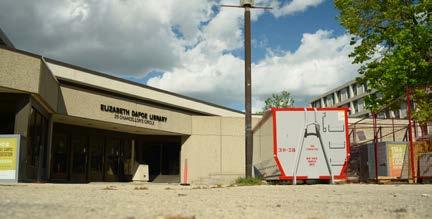
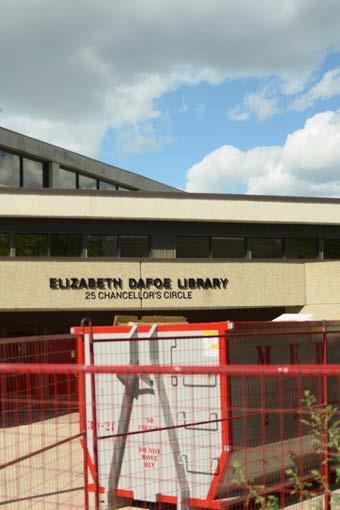
Based out of Elizabeth Dafoe Library, the program features materials from all libraries on both U of M campuses.
While the curbside pickup program is only available to faculty, postdoctoral researchers and graduate students, a service that includes undergraduate students is in the works.
According to an announcement by Lisa O’Hara, university librarian,
undergraduate students might need to wait for an equivalent service until September.
Lack of immediate access to physical resources delays research. Additionally, graduate students often require materials not available digitally.
The safety measures implemented — while necessary — could force some graduate students to purchase materials themselves.
Materials requested through this
program will be quarantined before delivery for the safety of staff and students.
Results of a study released June 22 by the Reopening Archives, Libraries and Museums (REALM) project found that the virus responsible for causing COVID-19 is not detectable on library materials such as hardback book covers, plain paper pages and DVD cases after three days. The REALM project is in part executed by the Institute of Museum and Library Services, an organization in charge of research and policy for libraries and museums in the United States.
Requesting materials could take up to 10 days, quarantine and shipping included.
The curbside pickup measure comes as the second initiative aimed at offering access beyond the scope of materials available digitally.
On June 17, UML introduced on-demand scanning of items in the physical collection.
In accordance with copyright law, library staff will generally be scanning up to 10 per cent of an item. The library is also offering to purchase e-book versions of materials, if digital versions are available.
An aspect of graduate student life
inevitably lost to the current situation is navigating the library halls in
While the curbside pickup program is only available to faculty, postdoctoral researchers and graduate students, a service that includes undergraduate students is in the works
search of additional resources. Online access to library resources and services has gone uninterrupted, but access to library facilities remains indefinitely suspended since its announcement March 20. Due dates for lent library items were extended until Aug. 21, but students may still turn in materials through the return bin outside the Elizabeth Dafoe Library.
Anthropology department to offer COVID-19 course
Course set to explore cultural response and effects of the pandemic
GILLIAN BROWN, STAFF
T
he COVID-19 pandemic brought uncertain times for the University of Manitoba, but this fall assistant professor and cultural anthropologist Lara Rosenoff Gauvin hopes to explore and understand its effects with her students.
“Why I wanted to offer [the class] was to be able to create a space for students, young people, to be able to
document and examine [the cultural effects of COVID-19],” Rosenoff Gauvin said.
This fall, the U of M anthropology department is offering ANTH 4780, a remote learning course titled “Anthropology Now: COVID-19.”
The class has 10 spaces and is available for fourth-year students, those with written consent from the
department head and those in graduate studies.
Rosenoff Gauvin hopes to help her students look at “the human experience now, in real time.”
While teaching online during the winter semester, she recognized that her students, instead of sticking to the syllabus, wanted to look at the sociocultural climate around them
and their own changing experiences.
“I thought [modifying the course content] worked really well, and I think it actually provided a space that many of us, including myself, needed to be able to speak and look at our own experience with a little perspective,” she said.
“Just as much as COVID shaped us, we shape the possibilities that we can live within the post-COVID world” —
Lara
Rosenoff Gauvin, assistant professor of anthropology
To offer a more in-depth version of that class discussion, the new course aims to examine “human experience today in terms of the pandemic from multiple perspectives.”
Using media and art as well as academic texts to capture “the range of human experience,” Rosenoff Gauvin’s focus will include a look into
how North American media in particular has responded to the rapidly changing pandemic, as well as the world’s varied responses and the institutions that cause those responses.
The course will also examine historical pandemics and how historical factors and current perspectives directly affect community health.
Rosenoff Gauvin said the course content will be flexible, reflecting that as the climate changes, her class will respond to those changes.
To her, anthropology students have a particular duty to look at this pandemic, to look at the changing world and to determine the skills they need before entering the workforce or continuing studies.
She said students “are going into the future.”
“You are the ones that are going to be shaping the COVID and postCOVID world,” Rosenoff Gauvin said.
“Just as much as COVID shaped us, we shape the possibilities that we can live within the post-COVID world.”
The class, along with all fall 2020 and winter 2021 courses, is listed on Aurora. Registration opens for returning students July 23.
PHOTO BY ALEX DECEBAL-CUZA
PHOTO BY ALEX DECEBAL-CUZA
Art instructor departs over racist artwork uproar
Instructor Steven Cochrane resigned effective June 30 after student-led email campaign sought his dismissal
AMIRA TEKLE, STAFF
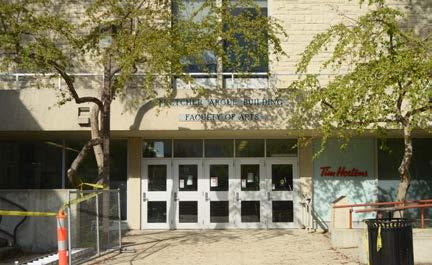
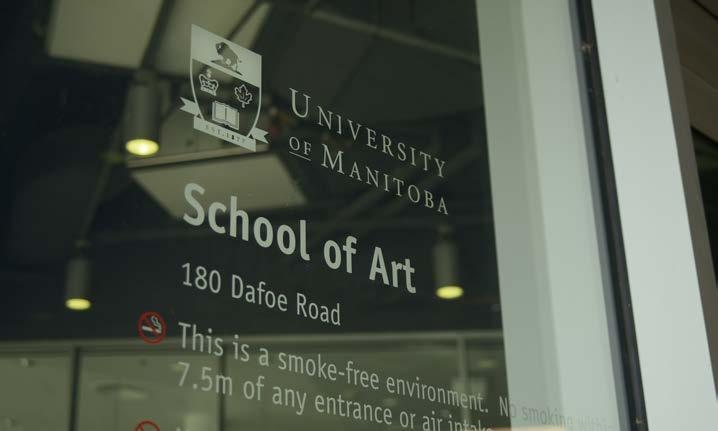
Current and former U of M students in the school of art have expressed outrage over a white instructor’s collection of artwork depicting himself in blackface and depictions of racial stereotypes along with racist titles to some of the works.
Former instructor Steven Cochrane has resigned, effective June 30, from the school of art at the U of M.
This occurred following an email campaign led by Chroma, a collective for Black, Indigenous and people of colour (BIPOC) artists in Winnipeg. The email campaign — titled “Steven Cochrane Must Go!” — urged students and members of the public to send emails using a template to the school of art administration to ask for the removal of Cochrane from his position.
On June 5, the acting director of the school of art, Jeffery Taylor, informed students in an email that he accepted Cochrane’s resignation, effective June 30.
Cochrane’s personal website formerly displayed several works of his art depicting racial stereotypes, Confederate flags and white figures in blackface. Works titled “Selfportrait as a Racist Joke,” “Still Life (Mammy Jar and Watermelon)” and “Swanee River Minstrel Co.” were removed from his website following a social media storm surrounding the offensive pieces.
Ekene Maduka is a former copresident of the School of Fine Arts Students Association (SOFA) and graduated from the school of art
this summer. She is also a member of Chroma.
Maduka said she was the first to broadcast the works to the community via her Instagram story and that she was disappointed in the actions of an instructor she had taken classes with in past years.
“I’ve taken several classes with Steven Cochrane and participated actively in those classes,” she said in an email.
“We are actually quite familiar with each other, which is why my disappointment with his behaviour is the way it is.
“My post got a lot of buzz and many U of M students who had taken classes with [Cochrane] replied to me and expressed heavy discomfort and some even [said] they felt weird when seeing the works during classes, but didn’t know how to react to them in the moment,” she said.
Maduka thinks Cochrane and the school should shoulder more accountability for racism within the school of art. She also believes the faculty members should be made up of more diverse faculty members to help prevent future events like this.
“The school has a lot to do to stop systemic racism and they also have to train their staff via diversity training as it is unacceptable to have to go through these things and have professors make excuses that they are unaware they are being offensive,” Maduka said.
“The faculty generally also lacks diversity in their staff, which is unfortunate.”
Cochrane apologized on his Instagram page following the wide-
“The school has a lot to do to stop systemic racism” — Ekene Maduka, U of M alumna
spread online sharing of his racist works.
“For me, the biggest issue was [Cochrane’s] apology that was nothing more than a lot of paragraphs explaining the work and patting himself on the back for being bold enough to make the work at the age he made them,” Maduka said.
A current student in the school of art who wished to remain anonymous said they had seen one of the offensive paintings twice — first in “Art Now,” a mandatory first-year course taught by Cochrane, and then again on another isolated occasion.
“When I was in my second year, [Cochrane] came to my studio to see what I was working on,” the student said.
“He was telling me how he studied painting at some school in the U.S. […] and he showed me one of those paintings […] and I was really shocked that he was showing me in person,” they said.
“He would show this stuff in class […] and try to put it in [the] context of
what he did in school back in the day.”
They believe the persistent email campaign led to Cochrane’s resignation.
“People in the community were sending emails about how this was not okay,” the student said.
They believe hiring practices at the school of art should be changed to foster a more inclusive and diverse environment.
“It’s not just a Steven Cochrane problem,” they said.
“There are more people like him [in the school] […] there are other people also who are not as extreme as Cochrane but have done harmful things to BIPOC students.”
“They should hire BIPOC [candidates],” the student added.
Annie Beach is a former student at the school of art who graduated this past spring. She was the co-president of SOFA for two years and served as the Indigenous representative for SOFA during her time at the university.
Although Beach did not observe the paintings in class directly, she said the paintings were shown to previous years’ honours students in Cochrane’s class.
She also heard rumours of the paintings prior to viewing them on social media.
“I was in [the honours program] this past year and happened to miss the class that he did show the paintings [in], so I didn’t see them in the classroom, I didn’t have to go through that whole ordeal of sitting amongst peers and seeing that.”
“I think the school has tried to brush this aside and get it out of the way as much as possible, despite having a very direct hand in enabling it and also in other racial acts against students, Black students, Indigenous students and students of colour,” Beach said.
Beach said it did not take sitting in the classroom that day to feel shocked and hurt by the paintings.
“It goes to show that not even having to sit in that classroom, [I was] very shocked and hurt to see them,” she said.
She believes the school of art should go beyond merely tokenizing BIPOC students and make a greater effort for equity and diversity in the faculty.
“What I mean [by] tokenizing is I remember having to [lead] a tour for a high school and asking […] [if] there was a land acknowledgement and [the student advisor said] ‘Oh, right’ so [it’s an] afterthought,” Beach said.
Beach said she is disappointed that the display of the offensive works to students has been going on for so long without action.
“And then to know that this has been happening for a couple of years […] and that students have had to sit in his class and see these works as if it’s part of the curriculum or that they have to learn it to get their degree is pretty disappointing.”
PHOTO BY ALEX DECEBAL-CUZA
Editor-In-Chief: Matthew Doering Contact: editor@themanitoban.com
City, province must put foot on gas to slow traffic Pilot
project to reduce residential speed limits is long overdue
MATTHEW DOERING, STAFF
One of the benefits of the COVID-19 pandemic is, arguably, the increased numbers of cyclists and pedestrians turning to the outdoors for exercise. But with vehicles returning to the city’s roads, ensuring their safety is paramount.
The calendar year of 2019 broke the record for the highest number of pedestrian deaths caused by motorized vehicles in Manitoba — there were 17 deaths compared to Manitoba’s annual average of 12 deaths. On average, a further 130 pedestrians are injured by vehicles on Manitoba’s roads in a typical year.
Compounding this, there are approximately four cyclist deaths and 78 injuries per year in Manitoba, meaning action is needed to protect all users of our roads.
Winnipeg city council is set to evaluate, at its July 23 meeting, the proposal of conducting a pilot project to reduce the speed limit on several residential roads to 30 km/hr and on at least one street in each city councillor’s ward to either 30 km/hr or 40 km/hr.
Council will also evaluate the proposal of requesting the provincial government to modify the Highway Traffic Act to allow for reduced sig-
nage should speed limits be lowered city wide.
Currently, the traffic act sets an urban speed limit of 50 km/hr and requires frequent signage at any departure from that speed.
But having a universal residential speed limit would open the possibility of “gateway signage,” which is defined as the posting of default speed limits along the edges of neighbourhoods or cities.
This would allow the urban speed limit to be reduced along with reduced signage and greatly reduced cost — one estimate is $7.8 million to sign all residential neighbourhoods given the current traffic act.
Pushback to this proposal seemingly falls into just a few categories: 30 km/hr is too slow, it’s too hard to maintain speed while always looking at the speedometer — which removes drivers’ attention from roads — and cruise control does not work at such slow speed.
However, if a reduced speed limit prevents fatal collisions with pedestrians and cyclists and reduces the number of collisions with these unprotected users of roads, then it is appropriately slow.
These concerns, then, highlight
the need for driver education. A reduced speed limit may take time for some drivers to get used to, but opposition may also speak to overconfident driving attitudes.
Frequently checking all the mirrors and driving under the speed limit is part of being an engaged driver. Checking mirrors ensures drivers are aware of everyone around them and driving slightly under the posted speed limit gives room for speed fluctuations without the need to continually monitor the speedometer.
Cruise control should never be used at lower speeds and should not be used in the city at all.
It is intended for clear weather and highway driving.
In setting a target for reduced speed limits and thinking about improving pedestrian and cyclist safety, the question arises as to whether it is about saving lives or reducing injuries.
In fact, there has been some research that suggests that speed limits between 30 and 40 km/hr are sufficient in order to prevent most fatalities while speed limits below 25 km/hr prevent most injuries.
A 2011 study done by Bert Lauwers — Ontario’s chief coroner at the time
of the study — suggests that when pedestrians are hit by a vehicle travelling up to 30 km/hr, roughly 10.3 per cent are killed or maintain critical injuries. That rate reportedly jumps above 50 per cent of all pedestrians
Alongside a speed limit reductions is a need for driver education
hit by vehicles travelling 60 km/hr.
Depending on the reports consulted and the priorities identified by city council, school zones may need a further reduction in speed if all residential speeds are reduced city wide. However, such a decision would likely be highly controversial.
Although precise speeds appropriate for Winnipeg’s neighbourhoods are not yet clear, what is clear is the city’s need for reduced speeds to protect pedestrians and the provincial need for a modernized traffic act that allows the city to cost-effectively regulate speeds in Winnipeg’s
neighbourhoods. But these actions alone are not enough. Alongside speed limit reductions is a need for driver education.
Education on why lowered speed limits are critical to saving lives and reducing injuries.
Education on safe driving strategies to ensure attention remains on the road and not solely on the speedometer.
Education on the need to be aware of your surroundings as a pedestrian or cyclist sharing roadways with speeding, possibly lethal rolling frigates of metal.
Continued education and enforcement of distracted driving offences. And re-education of currently licensed drivers on the new speed limits — 30 km/hr unless otherwise posted.
Following 2019’s record number of collisions with pedestrians, the city must investigate ways to improve pedestrian safety and road safety in general.
As well, the province must modernize the Highway Traffic Act.
Let’s hope these actions are embraced and we can all cross the road without yelling “I’m walking here!”
GRAPHIC BY JENELLE MCCANN
Comment Editor: Lucas Edmond Contact: comment@themanitoban.com
Goertzen’s discussions with U.S. politicians worrisome
Provincial education minister’s trust in market solutions will put Manitoban children at risk
LUCAS EDMOND, STAFF
Brian Pallister promised Manitobans that he would phase out property taxes designated for the education budget during his election campaign in 2019.
Austerity measures have long been used as a tactic to disrupt the functionality of public entities which then allow radical free market politicians to fill the vacuum with damaging forprofit institutions.
Now, alarmingly, Manitoba’s education minister, Kelvin Goertzen, participated in webinars with U.S. Secretary of Education Betsy DeVos and Republican Texas Senator Ted Cruz to discuss policy alternatives in the education system.
DeVos and Cruz have become notorious allies of the private school movement in the United States, seeking to reduce the role of the U.S. federal government in education.
Instead of expanding the budget expended on the sector, DeVos and Cruz have a record of promoting more “choice” in order to emphasize personal private benefits over social public ones. This is a typical rhetoric used by many free market politicians
to justify and promote profiteering of universal public goods.
Patricia Rucker, a Republican senator for West Virginia, also partook in one of the webinars. Rucker is a representative of the American Legislative Exchange Council — a conservative think tank that provides legislators pre-drafted bills which attempt to reduce corporate taxation, promote anti-gay laws, water down environmental legislation, attack labour unions, oppose gun control and promote the privatization of public schools.
Taking advice from groups and individuals like these displays the underlying nature of conservative thought in Manitoba and Goertzen had already made clear before the webinar that Manitobans should expect further austerity and privatization.
Manitoban families, then, should get ready for radical changes in the way their children are taught.
Selling public schools out to market mechanisms would be disastrous for Manitoba. Not only would privatization cut off low-income families
from quality and free universal education, it would also stunt children’s personal ability to learn.
Promoting additional expenses for vulnerable low-income families would likely increase rates of childhood stress and trauma at home — ensuring that at-risk youth would become less equipped to learn than they were in public school settings.
Our children’s education should not be treated as a tradable commodity
Further, the curriculum is virtually unregulated in non-government funded private schools. This inevitably would divide education on class lines.
Poorer communities would likely become segregated from more affluent families who can afford to send their kids to private schools with
high-end, expensive equipment and curriculums.
Applying market solutions to our education system, then, would establish less robust schools and leave poorer children in precarious environments unable to access proper education.
Social mobility would also likely tighten due to a less equitable universal curriculum, and the sheer expense of schools would redistribute necessary tax funds and individual dollars into the hands of private profiteers.
The solution to raising the standard of education in our system will not and should not be found in forprofit institutions.
In fact, recently, the leader of the Manitoba Liberal Party, Dougald Lamont, called for Goertzen’s resignation.
Lamont believes Manitobans should be worried that our education minister, and one of the most senior members of the Progressive Conservative government, is sharing ideas with Republican politicians. While Lamont himself respects private schools, he sees no benefit to the
government defunding the public school system.
If the provincial government wants better results in the public school system, Lamont believes they should put money into fixing it instead of essentially freezing public school funding and beginning the privatization process.
The prospect of privatization in Manitoba’s education system is worrisome and the COVID-19 crisis appears to have emboldened the Progressive Conservatives politically. They have been making cuts and pushing through unpopular legislation under the pretence of the pandemic and meetings with U.S. politicians who have condemning track records should not go unnoticed. Our children’s education should not be treated as a tradable commodity. Subjecting them — and their basic human right to quality education — to the market mechanism would spell disaster for the province and its families.
When Goertzen says Manitobans should expect further austerity and privatization, know that he means it.
GRAPHIC BY JENELLE MCCANN
Care-free, mask-free behaviour puts Manitobans at risk
Pallister is neglecting the possibility of a second wave of COVID-19 in Manitoba
LUCAS EDMOND, STAFF
Manitoba Premier Brian Pallister has made it clear to Manitobans that the health of the economy is more important than the risk COVID-19 poses to the province’s workers and families.
Unfortunately for Pallister, his obsession with reopening the economy may backfire.
Manitobans have taken to various public venues of Winnipeg since the province began its phased reopening May 4.
And Winnipeg’s jolt to public life has, perhaps, disseminated from Pallister’s nonchalant leadership throughout the crisis.
Moreover, recently, the premier was photographed sitting in Toronto Pearson Airport without a mask on, talking to Conservative Leader Andrew Scheer.
The premier’s actions pose a considerable health concern. Not only
is Ontario one of Canada’s hardest hit provinces during this health crisis, Toronto Pearson Airport has made mask wearing mandatory at all times because it is a national and international point of entry. Worse, Manitoba’s elected officials are not required to self-isolate after travel unless they are symptomatic.
In an interview with CTV News Winnipeg, Uzoma Asagwara — critic for health for the New Democratic Party of Manitoba — criticized Pallister for his carelessness. Asagwara referred to Pallister’s actions as “shameful” and highlighted the sacrifices citizens have made across the country in order to maintain the safety of the public.
Asagwara is right to criticize Pallister. His neglect to wear a mask, placed in the context of the risk he has put Manitobans in when he pushed them back to work, dis-
played his privilege of power. It also revealed his priorities as the leader of the province.
Thus far, Pallister’s actions dealing with COVID-19 have reflected opportunism as opposed to a genuine care for the health of Manitoba’s citizens.
Just a few weeks before Manitoba’s reopening, the premier was mostly concerned with attacking the public sector and unions with the threat of budget and employment cuts, leading to mass layoffs.
The contradiction here lies in the fact that the provincial government cited the health, safety and functionality of the health-care system as the reasons for the cuts — it was asserted that money should be re-invested from “non-essential” public services into the health-care system.
But if Pallister were really concerned with the severity of the pan-
demic, wouldn’t the economy remain closed?
The premier’s actions pose a considerable health concern
Pallister’s budget cuts, his plans to reopen the economy shortly after these cuts and his neglect to wear a mask in order to prevent the spread of the virus cannot be understood in isolation from each other.
These political actions and lapses of judgement serve as commentary to a political leader full of contradictions.
If the health of Manitobans were wearing on Pallister’s mind, the economy would have remained precautionarily shut down and he
would be sure to wear a mask when travelling to a COVID-19 hotspot. Yet, circulation of money seems to be Pallister’s priority.
Rather than pursue policy alternatives, Pallister has pried businesses back open rather than pursue policy alternatives — a decision that may very well lead to a second wave of cases in Manitoba and the subsequent closure of the economy yet again.
While Manitobans suffer from austerity or risk of infection due to detrimental policy, Pallister was witnessed acting remiss to the safety measures so crucial for keeping the pandemic at bay.
His obsession with reopening the economy has put Manitobans at risk and so has his precaution-free travel.
GRAPHIC BY JENELLE MCCANN
Winnipeg’s annual summer theatre festival will go on
The Winnipeg Fringe Theatre Festival goes virtual amid COVID-19 restrictions
SHAYLYN MAHARAJ-POLIAH, STAFF
Asummer in Winnipeg is rarely complete without a visit to the Winnipeg Fringe Theatre Festival.
In years past, patrons could take in a show, check out the free entertainment in Old Market Square, visit the beer tent or grab a tasty, affordable lunch in the heart of downtown.
Due to the health and safety concerns caused by COVID-19, this year’s Fringe Festival has been cancelled for the first time since its inception in 1988.
The annual festival, presented by the Royal Manitoba Theatre Centre, produces live, independent theatre from almost 200 local, national and international companies, and festival participants range from seasoned performers to aspiring artists.
The cancellation comes as a disappointment for many, especially because Winnipeggers begin planning for the festival in November, when the festival passes begin to be sold.
These passes, called Frequent Fringer Passes, allow patrons to view either eight or 14 shows at a fixed price point. Due to the event’s
cancellation, the Fringe organizers issued full refunds to early purchasers of these passes.
Despite the cancellation of the physical event, the festival is undeterred and, following the lead of many festivals in the Fringe circuit, has moved online for festivalgoers to get their fix.
The Winnipeg Fringe Theatre Festival presents Virtually Yours, #WpgFringe, a four-day, online version of the festival hosted by U of M alumnus Ray Strachan.
Fringe fans without a Facebook account have nothing to fear as the event will also be streamed via the festival’s YouTube channel.
“We’re doing Virtually Yours just this year because we wanted to give
critically acclaimed comedian Mike Delamont, who returns with a new addition to his God is a Scottish Drag Queen stand-up comedy series.
“Our goal was to make sure we had a representative sample of the type of work and artists that patrons would normally get a chance to see during the Fringe Festival,” McEwen said.
“We’re doing Virtually Yours just this year because we wanted to give [Fringe fans] a chance to see something and performers a chance to perform or put their plays online” — Chuck McEwen, festival producer
[Fringe fans] a chance to see something and performers a chance to perform or put their plays online,” festival producer Chuck McEwen said.
To this end, Virtually Yours, #WpgFringe boasts a range of genres, including comedies, dramas, spoken word, puppetry, clowning, musical theatre and musical interludes, all running at approximately 20 to 25 minutes each.
people can watch at home whenever they choose.”
This webpage will be continually updated as more online theatre content becomes available and remain up over the course of the summer. These shows, separate from the official program, are available to view for free, by donation or for a fixed price.
“That way, it gives us a chance to support more artists,” McEwen said.
Artists and companies who were selected for this year’s Fringe Festival but opted out of participating in Virtually Yours, #WpgFringe for various reasons were given the option to hold their spot for the 2021 festival or to forfeit their guaranteed spot and receive a full refund on their application fee.
Virtually Yours, #WpgFringe runs from July 14 to 17 and begins at 7 p.m. nightly, with a new lineup of shows every evening and an approximate three-hour runtime per night. The shows are free to watch on the Winnipeg Fringe Theatre Festival’s Facebook page.
Though the program is significantly smaller than what Fringe fans are used to, the lineup is packed with a variety of theatre and musical performances from local favourites — such as Winnipeg’s own comedy groups Outside Joke and Hunks — to
The productions are not full-scale, but the spirit of the festival is still captured through these creative works and works-in-progress being given the opportunity to be shared.
In addition to the scheduled livestream event, McEwen said the Fringe has launched another webpage “with a list of online plays available that
When asked about festival plans for next year, McEwen said, “if we’re able to put on an indoor live festival next year, that is what we’re planning on right now and that’s what we’re hopeful will be able to be achieved.
“If it’s possible, we want to do it.”
For more information go to winnipegfringe.com.
Maharaj-Poliah
PHOTO BY LEIF NORMAN
Shaylyn Maharaj-Poliah
Indie film amplifies voice for mental health awareness
‘February’s Dog’ provides a timely exploration of toxic masculinity and depression
DOMINIQUE WIGHTMAN
W
hile mainstream cinema has a history of stigmatizing mental illness, Calgary, Alta. filmmaker Paul J. Chinook, promises a progressive contribution to mental health discourse.
February’s Dog, Chinook’s upcoming directorial debut, provides an intimate character study based on the male experience with depression.
February’s Dog follows Dale Walters and Nigel Loggins, two distinct yet archetypically masculine Albertan oil workers struggling with economic catastrophe, unemployment and depression.
Walters, played by Chinook, is a charismatic and optimistic selfmade man. Loggins, played by Kevin Davey, is a reserved and calculated military veteran. Both men are laid off following a decline in the Alberta oil sector, which they are assured is a temporary disruption.
However, the protracted economic crisis has destructive consequences in
Walters’s and Loggins’s personal lives, threatening to destroy both men and their loved ones.
Chinook said the script is inspired by his own experiences with unemployment.
“In 2015 […] I thought I had my life course plotted out,” Chinook said.
This was until the Alberta oil crash, which Chinook described as “a temporary interruption that lasted three years.”
Through his film, Chinook hopes to share the valuable lessons he learned.
“I had been in a relationship where I was dealing with someone who was going through depression, anxiety and job loss,” Teechma said.
The actor hopes the film will illustrate the importance of interpersonal connection in a relationship burdened by depression.
“Talking with somebody and
A poignant reminder of the correlation between unemployment and mental illness, the film will resonate with many grappling with the anxiety and depression borne of indefinite unemployment.
“Make sure that your identity isn’t tied to something that could be taken away from you” — Paul J. Chinook, filmmaker
“Make sure that your identity isn’t tied to something that could be taken away from you […] learn to operate with gratitude and accept that things can change,” he said.
Quinn Teechma, a supporting actor in the film, similarly has a personal connection to the script.
connecting with somebody is what’s going to pull you out of […] depression,” she said.
Discussion of unemployment and depression is particularly relevant during the COVID-19 pandemic, an unforeseen circumstance which has caused a surge in unemployment across the world.
February’s Dog is also a statement on toxic masculinity and mental health stigma. Chinook hopes the film will contribute to the burgeoning discourse on men’s mental health. There is a pervasive cultural sentiment, according to Chinook, that “men don’t have emotions, men don’t want to talk about [depression].”
“We’re supposed to be in control and put on this mask all the time, when [in reality] we’re totally lost,” Chinook said.
Chinook hopes the film will destigmatize male vulnerability and help men to better vocalize and connect
with their emotions.
Actor Jill Maria Robinson also echoed Chinook’s sentiments, asserting that the film will help break barriers to progress discussion of men’s mental health in the film industry.
“I think [Chinook’s] breaking the boundaries to talk about men’s mental health,” she said.
“I hope with the film more people are inspired to bring up their authenticity of mental health […] we really hope it makes a difference.”
February’s Dog is currently in postproduction, with the cast and crew hoping for a theatrical release in fall 2020.
Luctor Pictures, Chinook’s own production company, has recently entered the 2020 Cannes Film Festival Marché du Film to share February’s Dog with prospective international distributors.
For updates on the film, go to februarysdogmovie.com.
PHOTO PROVIDED BY LUCTOR PICTURES
U of M alum honoured at Indigenous awards ceremony
Alana Robert receives recognition for women’s rights activism at the 2020 Indspire Awards
SHAYLYN MAHARAJ-POLIAH, STAFF
T
his past June, Indspire — an Indigenous-run charity that focuses on funding the education of Métis, Inuit and First Nations peoples across Canada — broadcasted their 27th annual event, the Indspire Awards.
Indspire is an organization that aims to fund Indigenous education on a national level and seeks to inspire Indigenous youth to achieve greatness. One of the charity’s goals
’Toban
is to increase the graduation rate of Indigenous students through financial aid and mentorship programs. It was also selected as a Top Rated Charity in 2019 by Maclean’s magazine.
Since 1993, the Indspire Awards has been recognizing Indigenous achievement in Canada across a variety of fields such as education, sports, business and more.
Recipients of the awards can be
nominated by anyone via nomination form and are selected by a jury of past winners.
The ceremony does not only highlight professional accomplishments, but also honours the achievements of outstanding youth who have demonstrated leadership potential in their communities.
The event physically took place at the National Arts Centre in Ottawa on March 6, but aired on CBC on
turntable
Silver Clouds — ‘Silver Clouds,’ 4/5
The artwork for the debut record from Silver Clouds — with its splattered psychedelia and tossedoff lemon slice — recalls immediately the cover of the Stone Roses’s 1989 debut, another self-titled album that made big, bold sounds from drums, guitars and bass.
But where the greys and greens of The Stone Roses reflected that band’s particularly English brand of cheery melancholy, Silver Clouds is all bleeding neon and glowing, transparent white.
Silver Clouds is a brighter, faster, goofier band — elements of ska and pop-punk fuse with classic indie pop, making for a debut record that’s high on energy and low on flab.
Made up of members of Duotang, Novillero, Boy and Transonic, the band is a who’s who of Winnipeg’s music scene. Rod Slaughter fronts the group, and he sings with a refreshing absence of irony. There’s a bright-eyed sincerity to what Silver Clouds does. Songs are played with immense skill and legitimate vigour. Buzzy keyboards, lively drums and skidding, dynamic
guitar lay the foundation of the record, with beachy vocal harmonies and third-wave ska horns rounding things out.
At a time when simple pleasures feel more vital than ever, it’s a rush to hear good songs played with real passion
The band rarely lets up the momentum — the closest thing to a breather is the brief, gently strummed middle section of closing track “The Conversation,” which continues to build into a cathartic “na na na” sing-a-long before fading out on tumbling piano.
The highlights are plentiful, from the bounce of “Maginot Line” to the slow-burn of “Inclement Weather,” or the aforementioned “The Conversation” — the album manages to rope in a variety of styles without sacrificing a consis-
tent mood, a glittering mosaic of five decades of indie rock.
Slaughter’s lyrics are quickwitted and slyly political. Songs encompass the state of the world and the state of the self, breakups, break outs and everything in between.
The lyrics almost always explode in a memorable chorus just when they need to.
This is concise, clear-eyed song writing made to be played fast and loud.
It’s a nervy, danceable record with something genuine to say — an invigorating collection of songs by a band with enough humour and experience to know exactly what they’re doing.
At a time when simple pleasures feel more vital than ever, it’s a rush to hear good songs played with real passion.
If this is the first glimpse of what Silver Clouds has to offer, we can only hope they continue on.
Want us to review your band? Email arts@themanitoban.com today!
June 21. It was also broadcast on APTN and CBC Radio One and is available to stream on demand on CBC Gem.
The ceremony does not only highlight professional accomplishments, but also honours the achievements of outstanding youth who have demonstrated leadership potential in their communities
This year’s award show was cohosted by Juno award-winning Inuk artist Tiffany Ayalik and Anishinaabe actor Craig Lauzon, known for his work on the television show Royal Canadian Air Farce and for his upcoming mini-series, Trickster. This year is especially notable as all of the award recipients, known as laureates, identify as female.
Among those honoured at this year’s event was Governor General’s Award recipient and U of M alumna
Alana Robert, who was the recipient of the Métis Youth Award for her human rights advocacy, namely her founding of the U of M’s Justice for Women student group and her involvement in Equal Voice, an organization dedicated to supporting women in politics.
Her work with Equal Voice included presenting to the House of Commons’ standing committee on gender-based violence.
Robert currently serves on the board of directors of the Native Women’s Resource Centre of Toronto and works tirelessly to improve the legal rights of Indigenous women and girls through her work with the Women’s Legal Education and Action Fund.
In addition to honouring their new laureates, the 2020 Indspire Awards also showcased some of the Indigenous musical talent that Canada has to offer, from emerging young artists to long-time veterans of the craft.
The lineup included Juno awardwinning musicians Tom Wilson and Leela Gilday, Theland Kicknosway — a singer, hoop dancer and Indspire’s youngest laureate to date — and Chuck Copenace, a jazz musician from Winnipeg.
For more information about Indspire and the Indspire Awards, go to indspire.ca.
KAELEN BELL
PHOTO PROVIDED BY INDSPIRE
Sports Editor: Isaiah Wagner
Bison wins Canadian university female athlete award
Swimmer Kelsey Wog talks routine and future goals
ISAIAH WAGNER, STAFF
Bison swimmer Kelsey Wog has been named the 2020 U-Sports female athlete of the year.
With this award, she becomes the first member of the University of Manitoba Bisons to receive it.
Wog undoubtedly had a year to remember. She won gold medals in the 50, 100 and 200-metre breaststroke events at the 2020 U-Sports Swimming Championships in Victoria, B.C.
Not only did she win, but she also set a U-Sport record in the 200-metre breaststroke.
Although Wog knows she has accomplished so much early in her career, she is excited for the future.
“I have been super happy with my career so far, but every time I accomplish something that I think I would be satisfied with, I want more, so I keep pushing,” Wog said.
“I never imagined that I would get to this level in sport, so each day it is really incredible.”
This kind of determination is not
something that can be taught. It is rare and makes for the best of the best athletes.
But becoming a dominant athlete is not easy. It requires hard work and dedication.
Wog believes that a routine is something that has made her into the athlete she is today.
“A typical [pre-COVID-19] day looks like me waking up around 6:30 a.m. to get to the pool for 7:30 a.m. to start some activation and warmup,” Wog said.
Practice makes perfect and Wog has proved that time and time again.
“I would get into the pool and swim from 8 a.m. to 10 a.m., go to class, then swim again around 12 p.m. for 45 minutes […] take a rest and eat lunch, then swim again around 3 p.m. for 45 minutes […] then go to weights and lift for an hour and a half,” she said.
“I would finish my day with a massage or some sort of recovery and go to bed early.”
Wog’s training may look different than other sports, but it is, arguably,
“I have been super happy with my career so far, but every time I accomplish something that I think I would be satisfied with, I want more, so I keep pushing” — Kelsey Wog, Bison athlete
a whole lot tougher.
“I do both swimming in the pool and weights,” she said. “We have a
more intensity-based program where training is shorter but super high intensity, and I love it.”
Sport is something that is not only fun, but can also be meaningful in someone’s life and make them a bet-
“Olympic trials are the main focus for next year, then hopefully the Olympics” — Kelsey Wog
ter person.
“Sport has taught me so much,” Wog said.
“It has taught me about trust, patience and persistence. It has taught me so much about overcoming struggle and coming back stronger than before.”
Winning this award is a great honour. It not only represents Wog well, but also the U of M sport program.
“In my life, I have won a lot of awards, but this one is by far the most meaningful,” Wog said.
“I have really enjoyed my time on the Bisons and I am very proud of everything that I have been able to accomplish. I am proud of how I have been able to represent the university.”
With Wog’s power, determination and work ethic, the sky may be the limit for the young Bison athlete.
With uncertainty about when she will be competing next, Wog will wait for her next chance to claim first place and hopefully another prestigious award.
“My future plans are to graduate from university in May 2021 and I will keep swimming for as long as I am still enjoying it,” Wog said.
“Olympic trials are the main focus for next year, then hopefully the Olympics.”
PHOTO PROVIDED BY KELSEY WOG
University football eligibility rules face uncertainty
Multiple Bisons players impacted by controversial U-Sports decision
ISAIAH WAGNER, STAFF
U-Sports has announced it will not be extending the age restriction for Canadian university football players.
This is significant because of the cancellation of the 2020-21 season due to the COVID-19 pandemic. Overall, what this means is that
any player who turns 25 years of age before Sept. 1, 2021 will not be allowed to take the field in a football uniform despite what their eligibil-
This ends up impacting 13 Bison football players this year and ultimately 16 others who will lose a full year of eligibility if their birthday is before Sept. 1.
players on the field, but it also causes them to lose a year of scholarship money to pay for school.
This is something that can be crucial for some families that rely on scholarship money to get the education the athlete needs.
Although already announced, U-Sports has said they will take another look at this rule.
This is mainly caused by the negative feedback they have received from staff and players.
A fifth year can be a critical year for an athlete’s life.
It can determine whether they end up going pro or unfortunately hanging up the cleats and pursuing other career options.
Although the rule is up for debate, players, coaches and fans are going to have to wait patiently to hear the good or the bad news that will come out of it.
ity says.
This ends up impacting 13 Bison football players this year and ultimately 16 others who will lose a full year of eligibility if their birthday is before Sept. 1.
Not only does this impact the
Jets play Flames in return to play NHL playoffs
Winnipeg vs. Calgary deemed to be great series
ISAIAH WAGNER, STAFF
On Aug. 1, the NHL Return to Play will commence with 24 teams in competition.
The playoffs will begin with eight best-of-five series between the 16 teams competing in the qualifying round.
The other eight teams — the top
four teams from the regular season’s Eastern Conference and Western Conference — will play a roundrobin and then wait patiently to see who they will be competing against in the 2019-20 Stanley Cup playoffs.
One of the matchups in the Western Conference qualifying
round is the hometown Winnipeg Jets vs. the Calgary Flames.
The Jets finished the 2019-20 season 37-28-6, while the Flames finished 36-27-7.
The teams played once during the regular season, with the Jets taking the 2-1 victory.
This is a prime example of two evenly matched teams.
There are many key matchups and storylines to watch for during this series, the first being the goaltending.
Connor Hellebuyck has recently been nominated for the Vezina Trophy, which is given to the league’s most outstanding goaltender
Connor Hellebuyck has recently been nominated for the Vezina Trophy, which is given to the league’s most outstanding goaltender.
Hellebuyck finished the season with a 2.57 goals against average (GAA) and a .922 save percentage (SV).
In between the pipes on the other side remains a question mark. It could be Cam Talbot (2.63 GAA, .919 SV), or David Rittich (2.97 GAA, .907 SV).
Either or, the Jets and the Flames
are both going to have a tough time scoring against these netminders. Although a goaltender is an important piece of a dominant team, the Jets and the Flames also have superior firepower at the forward position.
The Jets are led by captain Blake Wheeler, Mark Scheifele, Patrik Laine and Kyle Connor.
The Flames have similar firepower as they are led by Johnny Gaudreau, Sean Monahan, Matthew Tkachuk and Elias Lindholm.
With the great goaltending and superior offence, the fans are in for a treat after a long time without hockey, and this matchup has the potential to be a very exciting series.
The Winnipeg Jets face off against the Calgary Flames at Rogers Place in Edmonton, Alta., Aug. 1 at 9:30 p.m. CDT.