Stop Asian Hate rally mourns victims, opposes gender stereotypes
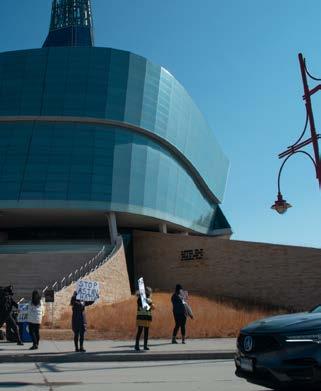
Two weeks ago, in the Atlanta area in the United States, eight individuals at three different spas were murdered, six of them being Asian women. In response to this incident, Winnipeggers gathered together at the Canadian Museum for Human Rights for the “Stop Asian Hate Rally.”
Organized by the Women of Colour Community Leadership Initiative (WCCLI) and Manitoba Chinese Family Centre (MCFC), the rally saw dozens of vehicles making noise from 11:30 p.m. to 12 p.m. Saturday in support of Winnipeg’s Asian communities.
Cont’d p. 5 / News >
TOB AN the MANI
and
is a member of the Canadian University Press, and our journalistic standards can be found online at toban.news/jsp
The newspaper’s primary mandate is to report fairly and objectively on issues and events of importance and interest to the students of the University of Manitoba, to provide an open forum for the free expression and exchange of opinions and ideas and to stimulate meaningful debate on issues that affect or would otherwise be of interest to the student body and/or society in general. The Manitoban serves as a training ground for students interested in any aspect of journalism.
Students and other interested parties are invited to contribute to any section of the newspaper. Please contact the appropriate editor for submission guidelines. The Manitoban reserves the right to edit all submissions and will not publish any material deemed by its editorial board to be discriminatory, racist, sexist, homophobic or trans-phobic, ableist or libellous. Opinions expressed in letters and articles are solely those of the authors. Editorials in the Manitoban are signed and represent the opinions of the writer(s), not necessarily those of the Manitoban staff, Editorial Board or the publisher.
U of M hopes to welcome students back for fall 2021 with some restrictions
While the university anticipates its phased return to in-person instruction, dialogue continues regarding specifics and ambiguities for students.
The decision comes amid more uncertain times as the number of cases of variants of the novel coronavirus increases across the country, and as the university’s operation depends on public health orders, which were considered when determining the current phased plan, and which vice-provost Janice Ristock says will determine the protocols followed. As such, the U of M “will continue to monitor and adjust as necessary.”
Ristock anticipates that on-campus COVID-19 protocols like social-distancing and mask-wearing will remain for some time, and encourages the U of M community to get vaccinated, “if not for themselves, for immune-compromised members of our community.”
International students who are enrolled in in-person courses will follow federal travel requirements,
including a mandatory 14-day quarantine and two COVID-19 tests, one upon arrival and one at the end of quarantine.
While plans are not currently being discussed with regard to a compassionate grading scheme come fall semester, UMSU president Jelynn Dela Cruz said that while her term as president is coming to a close, she continues to sit on the COVID-19 recovery steering committee and she hopes to raise those concerns, along with any other concerns that may arise during her time on the committee.
Dela Cruz emphasized the importance that, while restrictions permit, courses beginning in-person stay in-person, and courses beginning remotely remain remote.
“Regardless of what their decision may be for in-person or online classes, student well-being is at the forefront of it so that they aren’t necessarily making a shift that is dramatic enough to disrupt student well-being.”
She noted that, if plans do change, it
is easier for classes in-person to shift online than it is for remote classes to come onto campus.
It is for that reason, Dela Cruz added, that the university’s decision to keep
U of M tuition continues to increase
Following the board of governors’ approval of the 202122 operating budget, students at the U of M can expect another increase in tuition of an average of 3.75 per cent for the third year in a row.
The increased amount varies between faculties and departments with some, like dentistry, engineering and pharmacy, seeing an increase of one per cent while arts, education and medicine will see a proposed increase of five per cent.
This means that, depending on faculty and courses taken, students in a full course load can expect to see a tuition increase of between about $66 and $575.
Graduate tuitions, along with university-wide fees, are proposed to have an increase of 3.75 per cent with the exception of the MBA and master of finance programs. International tuition rates will increase at the same rate as domestic tuition.
The tuition increases come in part as a result of this year’s 1.75 per cent reduction — $5.7 million — of the provincial operating grant. Over the past three years, the university has seen a total reduction of $10 million. Given this context, “future years’ operating grants are uncertain,” according to the board of governors’ report.
“A sustainable future and the ability to invest in appropriate student programming continues to rely critically on tuition and course-related fees.”
A year later, UMSU president Jelynn Dela Cruz said, “we’re seeing the exact same headline.”
Last year, the U of M’s provincial operating budget was cut by five per cent, four percentage points higher than the initially proposed one per cent due to pandemic-related costs, some of which was transferred into a transitional support fund which the U of M would later be eligible to receive following a submission of plans to align programs with the supply and demand of the labour markets and ensure high-quality remote education.
Of the $17.23 million that the university was eligible for, it received $14.5 million.
Though the cuts did increase during the pandemic, Dela Cruz said in a press release that “the mistreatment of post-secondary education extends far into the past, before COVID-19.”
“The circumstances that we’re finding ourselves in now are no longer unprecedented,” she said.
The UMSU representatives on the board of governors voted against the tuition increase but voted in favour of
the allocations in the budget that will be “targeted to areas of highest need,” which includes support for student accessibility and enhanced online learning.
Minister of Advanced Education, Skills and Immigration Wayne Ewasko emphasized in an interview that his main priorities are to keep education affordable and maintain quality programming along with rebuilding the provincial economy.
In 2016, Ewasko said that when the government formed, it inherited a $900 million deficit. The platform that the Progressive Conservative party ran on was balancing that deficit within eight years of the mandate, and that post-secondary cuts were a part of that.
However, he noted that this past fall the books had been balanced.
From there, cuts to the operating grant, he said, is “all part of making sure that we’re able to continue to deliver the programming, tuition fees low, but at the same time trying to make sure that we’re looking out for the Manitoba taxpayer as well.”
According to Ewasko, a part of the cut to the operating budget is going back to post-secondary institutions in deferred maintenance. In that, he said “they’re receiving more money than they did last year.”
He reported that despite the tuition increases, Manitoba still maintains
large classes and classes that can achieve their goals remotely online is “one of the safest things that they can do.”
news@themanitoban.com
the third lowest tuition rates in the country.
Despite Ewasko’s goal to provide “top notch” programming to Manitoba students, the Manitoba Alliance of Post-Secondary Students’ (MAPSS) #StudentsSpeakUp campaign says that the provincial cuts are “leaving institutions to do more, with less.”
While raising tuition, the campaign explains that institutions are forced to reduce the number of courses they can deliver, defer repairs to infrastructure and reduce supports for students.
“The University of Manitoba should be celebrating the fact that they are doing a lot more with a lot less and have been doing so over the past four years now,” said Dela Cruz.
photo / Basel
Abdelaziz / staff
TOB AN the MANI UMSU board meeting update
Motions
Two motions concerning the finalization of changes to UMSU’s bylaws were brought forward by the union’s governance committee at the board of directors meeting March 25.
The first motion contains the bylaw amendments to abolish the use of slates in UMSU elections. The second motion contains the language to implement UMSU’s adoption of the International Holocaust Remembrance Alliance (IHRA) definition of anti-Semitism. The motions are expected to be put to a vote at the next UMSU board of directors meeting on April 8.
Slate abolition
The abolition of the slate system was expected to be implemented in time for the recently held UMSU general election in which a slate consisting of mostly incumbent executives won four out of five executive positions.
Tino Dogo, current UMSU vice-president community engagement — who recently won re-election as part of the Renew UMSU slate — raised concerns about slate abolition in an emailed statement to the Manitoban. His concerns centred around “efficiency, collaboration and engagement.”
According to Dogo, the slate system allows the chief returning officer — who runs UMSU elections — to more efficiently communicate with candidates if they are on slates rather than running as individuals.
Dogo said slates allow a more efficient
transition to a new executive after an election because they already have a shared mandate and know generally how they will work together. He also raised concern that the abolition of slates will negatively impact voter turnout and student engagement with UMSU.
“A slate of candidates, supported by an election team, is necessary for wide engagement at a school that has well over 20,000 students,” Dogo wrote. “Decreased voter turnout, uncontested and even empty positions are the most likely result of abolishing slates.”
If the motion passes, candidates running in UMSU elections will not be permitted to run either officially or unofficially as slates — the language in the bylaws will prohibit any kind of collaboration between candidates that might functionally resemble forming a slate.
IHRA definition of anti-Semitism
According to motion 0504, the IHRA definition of anti-Semitism states that anti-Semitism is “a certain perception of Jews, which may be expressed as hatred toward Jews.
“Rhetorical and physical manifestations of anti-Semitism are directed toward Jewish or non-Jewish individuals and/or their property, toward Jewish community institutions and religious facilities.”
While the definition has been adopted by a number of Canadian student associations and both the Ontario and
Cont’d from front page
where they are seen as sexual objects, as “quiet, silent and invisible.”
Canada governments, it has also been the subject of controversy.
An author of the definition, Kenneth Stern, stated in a December 2019 op-ed in the Guardian that the definition “was never intended to be a campus hate speech code.”
Writing in the context of Donald Trump’s adoption of the IHRA definition for use on campuses, Stern also raised concern around the definition creating a “chilling effect” on students, academics and activists on campuses — the definition has been used by right-wing political figures like Jared Kushner to conflate anti-Zionism with anti-Semitism.
“I’m a Zionist,” Stern said. “But on a college campus, where the purpose is to explore ideas, anti-Zionists have a right to free expression.”
A recent declaration on anti-Semitism — the Jerusalem Declaration on Antisemitism — signed by over 200 scholars across fields ranging from Holocaust history to Middle East studies criticized the definition for being “unclear in key respects […] weakening the fight against [anti-Semitism].”
The declaration is meant to clarify the definition and create guidelines for its application to prevent the definition from being used toward political ends, such as labelling the boycott, divestment and sanctions movement anti-Semitic and censoring it as such.
The University of Manitoba Faculty Association (UMFA) was set to vote on a motion to oppose the IHRA definition at its March 25 meeting. However, the agenda for the meeting was not approved by the UMFA board of representatives and no vote was
held.
Distinguished professor Haskel Greenfield, the co-ordinator for Judaic studies at the U of M, wrote in an op-ed for Winnipeg Jewish Review that “It is unfathomable that this motion calls out UMSU for its courageous and well-considered decision to adopt the IHRA’s definition of [anti-Semitism].”
UMSU president Jelynn Dela Cruz said in a statement that “Next board meeting, we will be going to a vote to officially adopt the wording of IHRA’s Anti-Semitism definition into our Position Statement book.
“I hope that, with the addition and approval of a definition on anti-Semitism into UMSU’s formal documents, more passionate students at large will come forward with their proposals to make the organization as inclusive as possible for their communities in the future.”
news@themanitoban.com
“Here in Canada we’ve seen the incidents of reported racism have increased dramatically across Canada,” said Jennifer Chen, WCCLI president.
She explained that the goal of the rally was to first mourn the victims of the recent shooting, but to also oppose the discrimination against the Asian community and the gender stereotypes imposed on Asian women.
“We know the [reason the] tragedy, the Atlanta shooting, happened was because of the gender stereotypes imposed on women.” said Chen.
She pointed out that the suspect in the Atlanta shooting had said that his motive was to eliminate temptation, and that this tied into a typical stereotype imposed on Asian women, one
“We’re holding this rally and we want to send a message that we are not silent, we are strong and that we will be heard.”
Within Canada there has been a surge of anti-Asian discrimination and attacks since the onset of COVID-19. Assisting in bringing this to light is the Chinese Canadian National Council’s (CCNC) Toronto chapter that released the results of two surveys conducted, which revealed there were 1,150 cases of self-reported racist attacks across Canada from March 10, 2020 to Feb. 28, 2021.
Online, a website formed together by the CCNC Toronto chapter, CCNC Social Justice, Chinese and Southeast Asian Legal Clinic and Civic Engagement Network Society
of Canada works to tracking and reporting “COVID racism,” anti-Asian racism and xenophobia in Canada.
The project’s goal is to “validate the spectrum of experiences felt across Asian Canadian communities and seeks to use the documentation to inform future effort for collective action against anti-asian racism and xenophobia,” and includes incident timelines and an incident map as well as the option to report an incident.
On-ground attendee at the rally Jobelle Baylon holds the same beliefs as Chen regarding the existence of racism in Canada, and added that “there’s just this thing going on, this belief in Canada where it’s like ‘oh, racism doesn’t exist here,”
“With [people of colour] it ‘doesn’t happen here,’ when in fact, from my personal experiences and with my friends it does happen in our high schools and the stores that we go to.”
Baylon shared a few incidents that had happened to her friends, including an incident a high school classmate who had been spat at, punched and called “a virus.”
As far as what people can do to support communities right now, Chen said that she wanted to see community leaders support the community.
“We want to see people come together to support each other and support people who want to speak out who experience the racism and the gender discrimination.
“We are seeing people coming together supporting each other and that’s very promising.”
Campaign priorities are health care, uninterrupted semesters, financial stability
On March 19, the Manitoba Alliance of Post-Secondary Students (MAPSS) began a two-week campaign called #StudentsSpeakUp.
In a statement, Jelynn Dela Cruz, UMSU president and union representative at MAPSS, said, “when it comes to quality and access, students are not asking for much.”
“In reality — especially considering that we are the central stakeholders of post-secondary — we are requesting the bare minimum.”
The campaign advocates for “affordable health care for all, semesters free of disruption and financial stability as communities navigate their way out of this pandemic.”
The initiative asks the provincial government to address several key issues for Manitoba’s post-secondary students including the removal of international students’ health care coverage along with “cuts to
post-secondary operating grants resulting in higher tuition rates.”
MAPSS criticized the Pallister government for “consistently [reducing] operating grants to Manitoba’s post-secondary institutions.”
The student group pointed out that to cover the losses, colleges and universities have had to increase tuition, reduce the number of courses and support services available to students and delay repairs on campus, with the University of Manitoba reporting $312 million of deferred maintenance.
Dela Cruz said she worried about students being saddled with “reservoirs of student debt upon graduation as a result of tuition hikes.”
MAPSS is also pressuring the government to “avoid re-imposing” its zero per cent bargaining mandate for post-secondary institutions in upcoming labour negotiations with faculty, a policy that almost triggered a strike at the University of Manitoba
“For the past four years, UMFA has been denied their rights to fair bargaining with the university administration due to interference from the province,” said Dela Cruz.
“MAPSS is opposed to this mandate because we believe that students should not have to begin their semesters in fear of potential academic disruption due to the province’s restrictions placed on faculty bargaining.”
A press release from MAPSS also highlighted cuts to international students’ health care services in 2018, which has forced international students to pay for private insurance plans that feature higher health care premiums for international students than anywhere else in Canada.
MAPSS had a meeting with Finance Minister Scott Fielding on Feb. 18 to provide budget recommendations, including a proposal to enable international students to buy into the public health system for $352, a rate that would allow the government to break even.
Dela Cruz said that while Fielding seemed receptive to their proposal, she questioned why the government was not already implementing policies like this to reduce costs for international students.
She said that MAPSS hopes to receive an answer to that question by the end of its two-week campaign.
International students currently already have to pay an average of two to three times more on tuition rates than domestic students. In addition to that, they are buying into private health insurance that comes with high premiums, said international student and UMGSA representative Etinosa Osemwota.
“Combining that with continued cuts to operating grants and subsequent increases to the already exorbitant tuition fees, our voices need to be heard by the provincial government,” she said.
Enhanced nursery schools request provincial government preserve Enhanced Nursery School grant
Numerous enhanced nursery school directors and board members in Manitoba signed an open letter to the provincial government requesting the government reverse its decision to end the Enhanced Nursery School Operating Grant that is set to take effect this upcoming July.
The new funding plan was announced in January, and spurred concerns regarding the financing of public day care centres.
The letter, addressed to Premier Brian Pallister and Minister of Families Rochelle Squires, says that the new funding model’s proposed annual operating grant would constitute a 50 per cent cut to enhanced nursery schools.
According to the letter, this will lead to shortages in operating revenue ranging from $20,000 to $70,000.
Centres are advised to increase the daily parent fee by 100 per cent but, even if they do so, day care centres “will continue to face a loss of revenue into the thousands annually,” the letter states, referencing the province’s suggestion that schools offset funding decreases by raising parent fees.
The letter points out that families rely on the fee of $5 a day for quality licensed early learning and care
programs for their children. It dismisses the government’s suggestion that these families should use the Manitoba Child Care Subsidy Program to make ends meet as “dangerously misleading.”
“The current subsidy program is very outdated and flawed, resulting in the majority of families not qualifying,” the letter explains. “An entire demographic of Manitoba families exists that live below or at the poverty line, but [are] above the subsidy threshold for approval.”
In a public statement, Squires criticized the Enhanced Nursery School Grant, saying that it had no income testing to ensure that schools receiving the grant were servicing low-income families, and that while 66 nursery school programs were getting enhanced funding, 96 were not.
She argued that their reforms will increase grants for all nursery schools and make the system more equitable.
Executive director of the St. James Montessori Association Laura Burla said she found this statement “deceptive [and] misleading.”
“There are families living around all enhanced nursery schools in the province who are low-income. And they seek out these programs as they are the only programs they can afford,” she said.
“But most importantly, she leaves out each time that the enhanced grant was never intended to create a two-tier funding system for nursery schools when it was created in 2006,” Burla continued.
“The intent was to bring all nursery schools up to enhanced funding, but that stopped when this government came into power.”
The letter outlines numerous negative consequences of the change in policy, such as a decrease in well-trained early childhood educators along with inaccessibility of services to rural families and difficulty securing services for children with disabilities.
“Without access to our programs, families face additional years waiting for these services, while simultaneously missing the most critical window of their child’s development during which these external support services can have the most impact,” the letter warned.
The letter contains four “clear and critical requests” of immediate action the government should take, including, the first being to repeal the decision to implement the new funding model.
The letter also asks that the province reinstate the previous operating grants, bring all of Manitoba’s nursery schools up to the enhanced rate and reinstate the annual two per cent increase to all non-profit early learning and child care operating grants in fall 2020.
With previous cuts, the letter noted that child care centres had already been forced to fundraise in order to simply pay educator’s salaries.
“We have had zero consultations regarding this, and instead have faced an onslaught of misleading information and misrepresentation of our services to Manitoba families,” Burla stated.
“There are no consultations planned with any directors or board members of enhanced nursery schools, and unless this new funding model is overturned, enhanced nursery schools will cease to exist come July 1.”
TOB AN the MANI
Manitoban alumnus nominated for National Newspaper Award
NEWS Damien Davis, staff
The day Manitoban alumnus Ryan Stelter found out he had been nominated for the 2020 National Newspaper Awards (NNA), he woke up to an email from his boss congratulating him. Heart pounding, he checked the news release to see he was one of the finalists. Stelter had sent his work in “with a hope and a prayer,” knowing it was a long shot but also thinking, “why not?”
“I can’t ever get the award if I don’t put my name in it, right?” said Stelter. He applied and thought nothing of it until the announcement, and then his phone started “blowing up.”
The finalists for the awards were announced two weeks ago, with nominees from across the country in various categories.
Stelter, current managing editor of the Kenora Miner and former sports reporter and editor for the Manitoban was nominated for the Claude Ryan Award for editorial writing, the first nomination that the Kenora Miner has ever received for the award, and the path leading to today began for Stelter at the University of Manitoba.
“I wanted to be a business guy at U of M,” he said. “I was going to do the whole Asper schtick and walk around in a suit but I figured out I can’t do
math.” Stelter laughed, saying that he had always liked writing but never figured he could earn money from it.
After hearing that it was one way to get started, Stelter sent an email to the Manitoban and soon began volunteering.
“I was at the ’Toban I think for four years, almost my whole degree there.”
Stelter had a few internships during the summers, including one in Kenora, Ont. where he later got a full-time position and stayed for 18 months before getting a job opportunity with the Brandon Sun for sports writing. He stayed in Brandon, Man. for around seven months before being asked to head back to Kenora to manage the paper.
“I was like ‘what? That’s pretty crazy, I’m 24! I shouldn’t be managing a newspaper!’” said Stelter.
“They said they wanted me back, so then I came back in about May of 2020 and I’ve been here ever since and I couldn’t be happier about it.”
Regarding his past with the Manitoban, Stelter said that “The ’Toban was everything for me, really.”
Working at the newspaper, “you get experience writing and doing exactly
what you would want to do at a ‘reallife paper.’” Stelter said it was “the closest thing you could get.”
“I met people of all different walks of life, people I didn’t think I would ever meet otherwise.”
“I was just this big dumb jock who could write who was hanging out with all these random people from all over,” Stelter said.
“The experience you get is just invaluable.”
“For me as a sports guy, I was sitting at five sports games every week just filing away and talking to players, working on my interviewing skills, working on my writing skills.”
“I see this award as a win for everybody. A win for Kenora, a win for northwest Ontario, and a win for the Manitoban, you know?”
“I hope one day they can talk about that I came from there, and I hope people can look at that and [think] ‘hey look, if this idiot can do it, anybody can do it.’”
“That’s the goal, right? We want to create and develop more journalists.”
For the future, Stelter is taking it “year by year.” He’s happy in Kenora, and intends to keep plugging away. Stelter said that, given how “random” his career path has been, and how it’s
“just kind of been handed to [him], in a way,” there’s no real way to prepare.
“When the right opportunity comes around I’ll take a stab at it, but for now, I’m just happy to keep serving the people of Kenora and provide the news.”
news@themanitoban.com
Incoming UMSU president responds to remote learning survey
Brendan Scott hopeful for fall semester improvements
RESEARCH & TECHNOLOGY
Sarah Doran, staff
Last week, the Manitoban published the results of a survey gauging how students felt about their experiences during a year of remote learning. Nearly 500 students responded, offering insights on mental health, workload, accessibility, learning environment and suggestions for improvement.
The University of Manitoba Faculty Association (UMFA) ran a similar survey in December 2020, receiving slightly over 500 responses. Not all of the UMFA survey’s questions were analogous to the Manitoban’s survey questions, but the two had some in common.
Students and faculty reported similar numbers when asked if they felt like they never stopped working, with 55 per cent of students and 52.9 per cent of faculty saying they strongly agreed. However, students reported more extreme levels of feeling tired and unable to concentrate — compared to 72.2 per cent of students, only 54.7 per cent of faculty said they strongly agreed.
Incoming UMSU president Brendan Scott, who currently serves as
vice-president finance and operations, said the survey’s data about students feeling isolated reinforced his plans for UMSU during the 20212022 academic year.
“One of the policies we ran on was a steady transition or seamless transition back to campus,” Scott explained.
“So, we knew that at some point during the year we were going to be back on campus […] The goal would actually be to still have some online events, but if allowed, the goal would actually be to have up to 75 per cent of our programming on campus.”
Scott said he would like to see students studying in the library or meeting up with friends while classes are still partially online, in an effort to improve general mental health and provide more of a traditional campus atmosphere.
“It just overall will help,” he said.
“Let’s say we go back fully in the winter — these students are more used to being on campus because we promoted them to come during the fall.”
However, Scott said student feedback from the survey also made him newly aware of some issues, including laboratory fees and difficulty accessing the campus bookstore for students who do not live in Winnipeg.
“That was the one thing from [the survey] that put off alarm bells in my mind — all the students who are out of town about to spend so much money on shipping,” Scott said.
“The bookstore was very much accessible during the beginning of fall and beginning of winter, but not towards people who lived out of town, and obviously with [COVID-19] more people are living out of town than on campus.
“It’s just another reason to get open educational resources.”
Scott said he loved his online learning experience and was pleasantly surprised to see students generally pleased with their remote learning environment.
“It’s just also going to be hard to justify when, come fall, we see half the universities in Canada be fully in-person, and we’re one of the other half that aren’t.”
photo / Ryan Stelter / provided
photo / Alexander Decebal-Cuza / staff
•
•
TOB AN the MANI
1 – Rally protester shows a sign that reads “#Stop Asian Hate,” while standing through the sun roof of their car.
2 – Rally protesters and news teams begin to assemble in front of the Canadian Museum for Human Rights.
3 – A child looks out of their car and watches the rally from inside. On their car are two signs which read “Racism has no home anywhere” and “Love Heals, Hate Kills – Stop Asian Hate.”
4 – People were encouraged to tie yellow ribbons on their car so that rally vehicles could be easily identified. In this photo, you can see one of the volunteers at the rally tying yellow ribbons to the cars of attendees.
5 – People ride by, honking and making noise to show support to the Asian community. In this photo a driver stops to greet the people on the side of the road.
6 – “Stop Hate and Start love”: A final message.
7 – Cars line up in front of the Canadian Museum for Human Rights honking their horns. Many have the yellow ribbon attached to their side mirror to show that they are part of the rally.
8 – Rally volunteers have set up further away from the Canadian Museum for Human Rights to help direct people to where the rally is. The sign on the left with the green arrow is used to point in the direction that cars are supposed to go.
TOB AN the MANI
Supreme Court recognizes threat of global warming
Ruling a step in the right direction in mitigating carbon emissions
COMMENT
Grace Gyolai, staff
The Supreme Court of Canada ruled on March 25 in a 6-3 majority decision that the federal government’s carbon tax is within the legal scope of the constitution.
The Greenhouse Gas Pollution Pricing Act (GGPPA) was enacted in 2018 and set minimum standards for carbon pricing for both industrial polluters and individuals alike. Under the act, provinces are allowed to formulate their own plans as long as they meet the minimum pricing requirements outlined by the federal government.
If provinces decide not to implement a plan, or their plan is not up to federal code, Ottawa will apply its own carbon tax policies. Consumers will reportedly reap the benefits of the tax with revenue being recycled back into individual coffers.
The Supreme Court of Canada ruled that the tax is constitutional under the peace, order and good government clause (POGG) as part of the Constitution Act of 1867.
The POGG legally allows the federal government to interject in provincial policies when provinces exhibit an inability to handle federally applied laws and that failure to co-operate influences other provinces’ ability to apply the same law.
In this particular instance, POGG is justified by the Supreme Court because failure to respond to the imminent threat of climate change is a national concern.
Since 2018, the carbon pricing law has been met with pushback from several provinces. Alberta, Saskatchewan and Ontario asked provincial appeal courts to review the GGPPA’s constitutionality.
The central controversy surrounding the GGPPA is the potential for risk it poses to the competitiveness of Canadian businesses globally due to the increased costs to produce goods. Further, there are concerns about companies offsetting these expenses by inflating prices for goods including fuel, natural gas and propane.
The carbon pricing law will increase the fuel charge annually from its current state of $40 per tonne until it reaches $170 per tonne in 2030. This will likely raise costs for industries and individual consumers alike. However, a rebate policy to offset individual consumer costs will rise alongside the taxes.
Despite any hullabaloo the carbon tax has stirred, it remains a central pillar in Canada’s plan to reduce greenhouse gasses and meet its 2050 target to be a carbon-free economy.
According to the World Bank — an international development organization — 64 countries have some form of carbon pricing and the system is widely endorsed by economists.
According to a statement signed by 3,589 U.S. economists in the Wall Street Journal, a carbon tax is the cheapest way to reduce carbon emissions to reach 2050 targets.
The Supreme Court recognizes that these kinds of economic policies are essential in order to make serious and meaningful improvements to Canada’s fight against climate change — it is much harder to get industries and citizens to stop polluting if it is free to pollute.
The dangerous climactic changes caused by human pollution impact coastlines, the Arctic region and Indigenous people disproportionally. Without centralized efforts, Canada
/ Jenelle McCann / staff
would be ignoring the continued and future suffering of its own citizens.
However, it is essential that while the government imposes this new carbon tax, it also invests in creating new jobs and options for Canadian citizens in order to address some of the valid criticism of the law.
A comprehensive climate plan involves not only incentivizing businesses and people to transform their habits but also providing accessible ways to supplement current lifestyles and business practices.
Justin Trudeau’s government has stated it will invest $2.6 billion to help homeowners reduce their homes’ carbon reliance — this will not only help owners decrease costs, but also aid in long-term climate objectives.
Canada is also in a unique position to produce electric vehicles due to the fact that it is so resource rich — we have all the minerals required to manufacture advanced batteries for electric cars. We also produce 14 of the 19 minerals and metals needed to make solar panels.
These investments and others like them will help the economy and society shift to more eco-conscious policies, but the federal government needs to continue to evaluate where funding is lacking and how much funding is necessary in order to provide the smoothest possible transition to a carbon-free economy.
It’s no longer enough for provincial leaders to agree on the fact that climate change is real. Provinces that are unable to articulate their concern for the climate in policy need to be held accountable as a means of harm reduction.
The Supreme Court of Canada’s decision to uphold the federal carbon tax is a bold step in the direction toward lower carbon emissions and, eventually, decarbonization. To build an economy that will withstand the future, the environment must be protected.
comment@themanitoban.com
A letter from the MLA for Fort Richmond, Winnipeg
Understanding the Advanced Education Administration Amendment Act
LETTERS
As the MLA overseeing an area vibrant with those in the postsecondary community, it is my responsibility to listen and engage with students’ concerns and provide them with valuable information. I understand that Bill 33 has become a topic of conversation as of late, and I would like to clarify some important aspects of this bill.
Bill 33 makes amendments to the Advanced Education Administration Act. The main purpose of this bill is to ensure that post-secondary students have access to high-quality, affordable post-secondary education today and into the future.
In fact, this bill will bring additional
oversights to protect students from significant increases in course fees and other fees. However, it is important to note that student union fees will not be affected whatsoever. All fees set by student unions and associations are approved democratically by students and are specifically excluded from this bill’s definition of “student fees.”
As well, Bill 33 will not affect student group funding, such as transit U-Passes, campus publications, food bank services, safe-walk services or other campus programs. We recognize that these services are important to post-secondary institutions and we know the value students expect to see from their student union fees.
After additional consultation on this bill, Advanced Education, Skills and Immigration Minister Wayne Ewasko heard the concerns raised by students that Bill 33 could be clearer in order to ensure these exceptions are guaranteed, regardless of the government of the day. In response, the minister is currently looking into options to resolve this, including a possible bill amendment.
I can attest that this bill presented by the Manitoba government will allow it to adapt to the changing needs of students, institutions, employers and the labour market. This flexibility is of particular significance as we continue to work with our post-secondary partners to move forward from the COVID-19 pandemic.
I hope that this provides students,
and all those in the post-secondary community, with clarity and an understanding of what Bill 33 is meant to achieve. I look forward to supporting this bill to protect students and enhance post-secondary education.
If you have any additional questions or concerns, please reach out to my MLA office.
— Sarah Guillemard, MLA for Fort Richmond 27 – 2855 Pembina Highway Winnipeg, MB R3T 2H5 (204) 221-8881 contact@sarahguillemard.com
graphic
Resistance to Bill 33 must be a collective struggle
Student debt collectives provide path forward for students fighting tuition crisis
COMMENT
Lucas Edmond, staff
Bill 33, the Advanced Education Administration Amendment Act, is threatening the autonomy of universities. More importantly, it is silencing the pleas of students during a year of extreme precarity.
Although likely months away from royal assent, if passed, Bill 33 will cut university subsidies by 1.75 per cent. Even now, the University of Manitoba is planning on raising tuition by 3.75 per cent as a collateral expense for the Progressive Conservative party’s fiscal discipline. This will be the second time the university has been forced to raise tuition during COVID-19.
However, the province’s pattern of raising tuition in the name of cost-cutting is nothing new. In fact, tuition fees have been rising at a fast pace since the cap on tuition fees in Manitoba was removed in the 2017-18 academic year. That same year, the operating grant provided by the provincial government fell below levels of inflation. Instead of increasing the subsidy, the provincial government placed the financial burden on university students by radically raising tuition fees by 6.6 per cent.
Canada’s tuition crisis
Judging by annual data collected by Statistics Canada, universities across Canada are in the same fiscal chokehold as Manitoba. Undergraduate tuition fees have inflated by roughly 100 per cent in a 21-year period from the 1999-00 academic year to 2020-21. In that same period, graduate students who have attended university in 2020-21 paid over 107 per cent more than graduate students who attended in 1999-00.
Economically, this is a matter of tremendous concern. Historical data collected on annual inflation rates indicates Canada’s economy grew only 40.35 per cent from 1999 to 2020. This means Canadian university fees have outpaced inflation rates by approximately 60 percentage points over this 21-year period.
This inflammatory trend is further reflected by the total burden of debt students have accumulated in Canada. The National Student Loans Service Centre dished out approximately $2.1 billion in the 2020-21 academic year. Still, this massive number doesn’t include the concerning amounts of debt students have accumulated
through incalculable private loans, lines of credit and compound interest.
Credit data agency Equifax indicated in 2020 that the average Canadian owes approximately $73,500 in debt. A significant proportion of that number is likely held by individuals with student loan debt unable to keep pace with the speed that university tuition is rising at — roughly 20 per cent of all insolvencies in 2020 included student debt. Further, student debtors on average owe an additional $42,780 in consumer debt.
What can students do about it?
For students to gain a legitimate seat at the negotiating table, it will take far more than social media infographics and the occasional picket line. Students must find leverage in a political atmosphere that constantly counts us out. This will take uniform and radical action that perhaps extends the direct legal purview of the University of Manitoba Students’ Union (UMSU) or the Manitoba
branch of the Canadian Federation of Students. Although these unions are important representative bodies, UMSU and the federation, like most legal unions, have been restricted from radical action by legal operation.
Historically, peaceful strike methods such as wildcat strikes, walkouts, solidarity strikes, workplace occupations and general strikes have been the most effective means for unions to fight for their rights. And these strike methods were widely used prior to Canada’s adoption of various pieces of legislation that legalized the right to associate with a union in exchange for the restriction of these strike methods in the post-war period. As a result, unions have progressively lost out on their ability to leverage employers and governments into granting their demands.
Without the ability to withhold their labour, students have a different avenue of leverage that has arisen amidst the pile of student loan debt that has accumulated over the years — student debt collectives.
As Jean Paul Getty — a 20th-century industrialist — once said, “If you owe the bank $100, that’s your problem. If you owe the bank $100 million, that’s the bank’s problem.” This is the same logic that has been used time and time again when big industry is bailed out after economic meltdowns. But roles can be reversed here. By organizing debt, students have the power to say no.
Apathetic attitudes toward student politics are granting provincial and federal governments free reign to exploit students. Governments are sacrificing our financial security to offer collateral for detrimental budget cuts. Students must organize in more radical ways to be heard. Individually, students are helplessly exposed to the callous interests of debt finance, but together students have the power to withhold payments and force governments to listen to demands. The only way to scrape a degree of power from the interests of governments and debt finance is through our collective struggle for more equitable education.
comment@themanitoban.com
graphic / Dallin Chicoine / staff
TOB AN the MANI
O’Toole running into trouble with social conservatives
Leader of opposition faces heavy resistance from within own party
COMMENT
Liam R. Forrester, staff
Conservative Party of Canada (CPC) leader Erin O’Toole has a problem. His party harbours an internal tension that threatens to rip the Conservative party apart. On one side of the rift is O’Toole’s push to embrace big-tent politics — a broad-spectrum approach to political thought. On the other hand, dedicated social conservatives are making O’Toole’s work as party leader as difficult as possible.
The modern CPC is a relatively young party. In 2003, the members of the Canadian Reform Conservative Alliance (CRCA) and the Progressive Conservative Party of Canada (PC) ratified a merger between their two parties. The subsequent union brought together the socially conservative populists from CRCA and the establishment Conservatives from the PCs. At its best, this combination led to the 2006 to 2015 reign of the Harper government. At worst, it has resulted in the kind of election-losing disunity displayed at the Conservative party policy convention.
The Conservative party policy convention took place over the weekend of March 18. Leading up to the convention, there was a hesitancy to vote on divisive policies that has garnered significant media attention. Despite the best efforts of anti-abortion groups like Campaign Life Coalition, not a single anti-abortion proposal reached the convention’s delegates. Much like the Harper government, O’Toole is pro-choice but allows for party members to vote with their conscience.
Unfortunately for O’Toole, huge swathes of his party are beholden to anti-abortion organizations. Almost 40 per cent of CPC national council members were openly endorsed by anti-abortion groups. This is a problem for O’Toole’s leadership due to the fact that the national council has significant power over campaign budgets and, as a result, selecting local candidates. Campaign Life Coalition wrote in its report on the convention that “the number of councillors who will fight against the disqualification of pro-life, pro-family candidates has grown by [75 per cent]. It might even be as high as [100 per cent]. There
are now seven elected councillors, and possibly an eighth, who will fight against the disqualification of social conservatives.” The report goes on to gleefully discuss how pro-O’Toole candidates were successfully blocked in four Ontario nomination races.
While Campaign Life Coalition does not encompass all of social conservative thought and activism in Canadian politics, its influence and prominence during the convention was impressive. A motion to recognize the existence of climate change was rejected with a 54 per cent majority. The motion offers the barest acknowledgement of climate change and states, “We recognize that climate change is real. The Conservative Party is willing to act.”
Even this mealy-mouthed acknowledgement was a bridge too far for Campaign Life Coalition. They took it upon themselves to distribute a policy package which offered a voting guide linking climate action to attempts by global elite to partake in population control. The voting guide alludes the preposterous claim that global warming is purportedly being used as an excuse for elites to control populations through sterilization and abortion.
O’Toole has repeatedly stated that he
does not want to see his party painted as climate change deniers. After the motion was struck down, a frustrated O’Toole told convention delegates, “I will not allow 338 candidates to defend against the lie from the Liberals that we are a party of climate change deniers.” It seems as though the Liberals can leave their paint and brushes at home, as the Conservatives have already done the hard work for them.
Further, O’Toole’s alienation from the social conservatives has a long history. The catalyst, however, was O’Toole’s decision to oust Member of Parliament Derek Sloan from the Conservative caucus in late January. A favourite among the far-right, Sloan espoused conspiracy theories and was accused of anti-Asian racism for his comments toward Chief Public Health Officer Theresa Tam. Sloan’s ousting stemmed partially from accepting donations from a known white nationalist. Many Conservative representatives did not like Sloan, including O’Toole, who said Sloan exhibits a pattern of “destructive” behaviour.
Campaign Life Coalition took Sloan’s expulsion from the party hard and accused O’Toole of trying to deflate social conservative enthusiasm.
While Sloan’s removal is a loss for the Canadian far-right, it was undoubtedly a good move for the party as a whole. Especially when it comes to engaging moderates and the centre — a goal O’Toole needs to achieve in order to have a hope of defeating the Liberal Party of Canada in the coming elections.
The saddest part is that O’Toole seems like he wants to do the right thing. After the U.S. Capitol building riots on Jan. 6, O’Toole shifted his rhetoric. He openly denounced the far-right presence in the CPC, ousted Sloan and adjusted his shadow cabinet.
The mainstreaming of far-right rhetoric over the course of the U.S. presidency emboldened conservative extremists in Canada. The Campaign Life Coalition is exploiting the party process as a means of imposing its values through policy. Only time will tell if there is still room left in the right for cooler heads to prevail. Otherwise, the next election may be lost to radicalism.
comment@themanitoban.com
graphic / Jenelle McCann / staff
TOB AN the MANI
’Toban turntable
Jane Inc — ‘Number One’
ARTS & CULTURE
Kaelen Bell, staff
4.5/5 stars
Indulgence is a tricky thing. The line between splendour and overkill is a razor-thin tightrope that has sunk many an ambitious, maximalist records. Number One, the glittering debut from Jane Inc, shows us how to indulge responsibly. Part of the constellation of Toronto artists surrounding Meg Remy’s U.S. Girls project, Carlyn Bezic is one-half of pop duo Ice Cream and one-fifth of psychedelic hard-rockers Darlene Shrugg. Number One finds the middle ground between these poles, an odyssey of serpentine funk, equal parts sweaty and synthetic.
The record is a masterclass in the giddy joy of pushing it to the next level — bursting with colour, texture and heat, it is a florid showcase for the multi-instrumentalist’s unrestrained talent and exacting ear. Bezic plays a bevy of instruments across Number One and co-produced the record alongside Steve Chahley. It is a neon-splattered document of reclamation and autonomy, songs about work, expectation, identity and independence. The two-minute “Faceless, Bodiless” features audio from Jane Fonda in 1971’s Klute — “what I’d really like to do/is be faceless/and bodiless/and be left alone” — an old, unshakeable desire reconfigured for today’s internet-led hypervisibility.
“Dirt and the Earth” follows, bringing these fantasies of formless freedom back to the ground. Riding immense pads of synth, a jaunty drum pattern and wiggling bassline, it is a sterling example of Bezic’s knack for enormous simplicity — there is not a ton going
image / Jane Inc / provided
Molly Annelle
— ‘ELEVATOR MUSIC’
Kaelen
on, but the song feels big enough to bowl you over. There are no small songs on Number One, but the penultimate “Mine/His” comes closest. Like a mix of Throbbing Gristle at their most humane and Laurie Anderson circa United States Live, the album is a meditative piece of digital shrapnel, just Bezic’s mantric voice and piano scrambled and dive-bombed by a flurry of effects.
For all of Bezic’s airtight hooks and unshakeable songwriting, Number One is a weird album. The sort of pop, almost funk and nearly disco sound is like a dusty bargain-bin dance record put in the microwave and allowed to bubble and warp. It’s also a colourful record — whether or not you’ve got synesthesia, listening to Number One is a kaleidoscopic experience. It is joyful, listening to an artist that plays with shape and colour as jubilantly as Bezic, and Number One finds so many shades it nearly feels on the verge of creating a new one.
arts@themanitoban.com
’Toban cornertable
4/5 stars
It is risky business naming your record ELEVATOR MUSIC. The name likely would not raise eyebrows coming from a hardcore band, but the association with faceless, vibey background music is dicier when you make the kind of tasteful R&B that populates Molly Annelle’s debut. Luckily for 17-year-old Annelle — and us — the ironic title doesn’t totally backfire. ELEVATOR MUSIC is smooth and stylish, but Annelle and producer Louise Burns inject just enough personality and strangeness to keep the record from sinking into anonymous playlist-filler.
The Vancouver-based Annelle is a child prodigy of sorts. Writing her first song at five years old and arranging choral harmonies at nine, ELEVATOR MUSIC reflects both the young artist’s studied technical skill and impressive instincts, a record that feels confident and clear-eyed above all. From the goofy studio banter on opener “WELCOME” to the winking Bossa nova influence, Annelle always sounds like she is having a good time, even when navigating heartbreak on “ALL IN” or self-doubt on “NATURAL.”
Annelle’s fascination with Bossa nova lends a retro-weirdo streak to the slick surroundings, but it would have helped to expand on the form slightly — “BOBBIE” and the title track ride startlingly similar clipped-acoustic rhythms and, save for variations in top melody and production flourishes, they are nearly the same song. Annelle fairs better when her melodies are not tied to such obvious genre forms — the aforementioned
Anna van Valkenburg — ‘Queen and Carcass’
ARTS & CULTURE
Zoë LeBrun, staff
From Anvil Press and its subsidiary, A Feed Dog Book, comes a new collection of poetry called Queen and Carcass, written by Mississauga, Ont. author Anna van Valkenburg. Originally from Konin, Poland, van Valkenburg’s debut collection inhabits a fantastical yet familiar world filled with psychological complexities that explores identity and experience in unpredictable ways.
Filled with vivid metaphors, volte and rich imagery, Queen and Carcass is captivating, tracing the line between darkness and beauty and weaving the two together seamlessly to create a surreal world that one can nearly feel on their skin as they read. Through both short and long form poems,
van Valkenburg has truly created an enchanting collection of work that allows us to dive into the themes she presents in a fascinating otherworldly manner.
One of the ways these ideas are explored in Queen and Carcass is in van Valkenburg’s use of figures from Slavic folklore, such as rusalka — a female entity that often harbours hostility toward mankind. This not only speaks to the author’s Polish background, but sets various archetypes plucked directly from the collective unconscious into settings both real and imaginary, where these characters pursue truth, no matter how uncomfortable or difficult that might be.
/ Anvil
“NATURAL” is a highlight, birdsong dipping between crackling drumbeat and steady bass with Annelle’s harmonies rising through the trees. The twinkling “HOW WAS YOUR DAY?” rides stuttering funk guitar and whirling synths, a slow-burn groove that tackles loneliness and killing time with solemn quietude.
One of Annelle’s greater strengths is her lyricism — a mostly straight talker with a penchant for just-floweryenough poetics, her lyrics can sting and float. She stumbles sometimes, with a reliance on too-common phrasing and a fixation on candlelight that appears on several songs, but her words and music run the gamut of feeling and experience, making for a debut that gives a 360-degree view of Annelle as a writer and musician. ELEVATOR MUSIC is not all that easy to ignore, and it heralds an intelligent new voice in pop songcraft.
arts@themanitoban.com
We begin stepping into van Valkenburg’s surreal, psychological landscapes in “Melodies,” the first
/ provided poem featured in Queen and Carcass. Cont’d p. 14 / ‘I won’t’ >
A timeline of a storied career
Influential Winnipeg artist presents career-spanning survey of work
ARTS & CULTURE
Zoë LeBrun, staff
The Plug In Institute of Contemporary Art is currently presenting I’m Not Your Kinda Princess by Winnipeg-based artist Lori Blondeau. Curated by Nasrin Himada, I’m Not Your Kinda Princess is a survey of Blondeau’s iconic career, featuring some of her most critical works as well as a new installation piece titled “Stones From My Kokum’s House.” This exhibition is timely, as it opened right on the heels of the public announcement of Blondeau’s receival of a 2021 Governor General’s Award in Visual and Media Arts — I’m Not Your Kinda Princess showcases many of Blondeau’s most decisive works that have contributed to her impact on the art world, leading up to receiving a Governor General’s Award.
Since her emergence in the Canadian art scene, Blondeau has worked in many areas of the art world as a curator, the executive director of the Indigenous art collective TRIBE and much more. But, above all, she is an artist who has been vital in creating action toward the “ever-increasing centrality of Indigenous art and knowledge production in Canada” and has used her intelligence, humour and vulnerability to create critical artwork that tells viewers important yet often ignored stories, challenges stereotypical representations of Indigenous women and speaks to the resilience of Indigenous peoples.
Upon entering Plug In, the first things to note are the sounds of speech, thunder and trains emanating from the exhibition space dedicated to I’m Not Your Kinda Princess.These noises set the tone for the works, constantly changing the energy from ominous to reverent to exciting.
The show is split into two areas, so I first entered the one on the right through a pair of tall, dark glass doors, which contained the main gallery space and the bulk of Blondeau’s featured work.
Passing the iconic “COSMOSQUAW” on the way in, I proceeded down a
short hall to reach the main space where large-scale prints of Blondeau’s works “Grace” and “Asinîy Iskwew” hung amidst photographic documentation of “States of Grace,” a backlit print of “Lonely Surfer Squaw” and a large video screen displaying video documentation of three performances by Blondeau.
These three videos — titled “COSMOSQUAW,” “Sisters” and “States of Grace” — represent samples of Blondeau’s performance work over the course of nearly a decade and align with the other bodies of work presented in the exhibition. Additionally, all three of these performances have strong audio components, providing what felt like a soundtrack of music, voice and hammering to their printed counterparts.
While Blondeau is an interdisciplinary artist, her performances are where her humour, wit and passion truly shine — though the running time of the videos featured in I’m Not Your Kinda Princess is over an hour, they entrance with their liveliness and bluntness, and I returned to watch and listen to their softly spoken stories, enigmatic sounds, familiar melodies and ASMResque action noises.
In the second room stood Blondeau’s most recent installation piece,
‘I won’t become an adjective’
< Cont’d from p. 13
Its two initial stanzas activate all the reader’s senses and begin to simultaneously present and question the duality and ambiguity of identity and phenomenological experience, engaging the reader immediately.
Yet for all their dreamlike qualities, not all of van Valkenburg’s poems are completely ambiguous or take place in a fragmented, Boschian plane. “Citadel,” for instance, begins by speaking to a very common childhood experience and feeling — the breathless fear that comes with running
down into a dark cellar or basement to complete a chore. Van Valkenburg manages to capture this feeling in a unique, lyrical sense, all while establishing a strong tone as the rest of the poem unfolds.
Another highlight in Queen and Carcass is the collection’s concluding poem, titled “An Afterword: Oath of Modern-Day Rusalka,” in which the author reflects on all the people she once was and has yet to become. In this poem, van Valkenburg utilizes abstract yet detailed similes and metaphors to paint us a picture of the identity she sees herself personifying in the future.
“Stones From My Kokum’s House.”
While the work’s title may imply a wistful message, it is difficult to know what you are about to walk into when approaching this installation. From its entrance, all that is visible is a heavy, green velvet curtain, with ambiguous sounds akin to rolling thunder and vehicles seeping from behind it, providing a strange sense of foreboding while walking in.
At the far end of this space sits a large boulder, framed by a semicircle of six white flags with various coloured ribbons hanging from them and weighed down by piles of stones. In this formation, there is a certain stateliness to the objects presented — these stones and the flags that towered over them commanded attention, stating their presence in an authoritative, yet nostalgic and sacred way. In conjunction with the installation’s audio, consisting of a rumbling rainstorm that grows from a drizzle to ominous thunder only to fade away into road noise, the arrangement of these items and the heavy curtains that shielded them and the viewer away from the rest of the world made for a powerful work, even while keeping the exact significance of these objects ambiguous.
I’m Not Your Kinda Princess is truly a wonderful survey of work from
one of Winnipeg’s most influential artists and a must-see for those both familiar with and new to our city’s art community. Blondeau has not only helped define Canada’s contemporary art scene on an international scale but has blazed a trail for Indigenous artists in the Prairies to continue in her footsteps and set a standard of excellence in the frankness, brevity and intelligence for artists nationwide, all of which is expertly showcasedinI’mNotYourKindaPrincess.
I’m Not Your Kinda Princess will be on display at the Plug In Institute of Contemporary Art until June 19. For more information, visit plugin. org.
arts@themanitoban.com
The poem’s last two stanzas finish with a simple, yet profound statement that resonates with a broader understanding of what it means to be human:
“I don’t have to be physical./I don’t have to have colour or structure/in the soft of a palm; I can be air/that lives inside one lung/then pushes into another./I will be the pushing.//I will be a verb, a zoo, shoe leather/after rain. At the very least,/I won’t become an adjective.”
This powerful sentiment — that we exist and live as nouns in action and not as definitively stable descriptors that lay on the surface — is the essence of Queen and Carcass and is a deeply meaningful, psychological reflection of how identity shapes our perception of and active role in the world around us.
arts@themanitoban.com
TOB AN the MANI
Winnipeg Ice playing season in Regina bubble
SPORTS Isaiah Wagner, staff
The Winnipeg Ice played last year’s season at home, sweet home, the Max Bell Centre. But for the 2020-21 season, in the midst of the COVID-19 pandemic, a bubble has been implemented in Regina, Sask. as the hub city.
The Ice are playing in a division with the Moose Jaw Warriors, Prince Albert Raiders, Regina Pats, Saskatoon Blades, Swift Current Broncos and the Brandon Wheat Kings. Western Hockey League (WHL) commissioner Ron Robison recently put out a statement regarding the bubble situation.
“With our extensive protocols and the necessary approvals now in place, we are looking forward to play getting underway in Regina and allowing our players to continue their development at the highest level in the Canadian system,” he said.
Last season the Ice finished with a 38-24-1 record, putting the team second overall in the East Division. So far this season, they have a 6-3 record and sit last in the East division. Although it is not the best record to start the year, the squad still has some great players to get itself out of the hole.
First off, the team is led by Vegas Golden Knights draft pick, Peyton
Krebs. Krebs already has 14 points this season and will look to try and lead the league when it is all said and done.
The Okotoks, Alta. native has already proven that he is a great player for the Ice and will look to make the Golden Knights roster next year.
Manitoban Conor Geekie is another player that fans should watch out for, as he is very talented and went second overall to the Ice in the 2019 draft. The rookie has played in all eight games for the Ice this season and has put up a total of seven points.
Geekie will look to continue his hot hand and get ready for the National Hockey League draft in the future.
The final player to watch out for this season is Connor McClennon, who was the second overall pick in the 2017 draft for the Ice.
McClennon has 11 points for the Ice this season and will be a big part in the team’s success.
The Alberta native was drafted in 2020 by the Philadelphia Flyers and will someday hope to make the competitive roster.
The Ice only have 16 games left to play this season, but all of them will be
graphic / Jenelle McCann / staff
fighting for their playoff lives.
Although a tough start to the season, they have the firepower and the talent to get out of the hole and really make a push toward the playoffs.
Although there are no fans in attendance, fans can listen to the Ice on CFRW 1290 AM or live stream it on the iHeartRadio app, which was announced before the start of the shortened season.
“We look forward to all games being
available to Ice fans on the radio, the iHeartRadio app and via live stream at winnipegICE.ca,” said Matt Cockell, president of the Winnipeg Ice.
“The 3.5 hours of programing allotted to each Ice game allows our team to provide consistent comprehensive coverage of the Winnipeg Ice and the Western Hockey League.”
sports@themanitoban.com
MASTER OF TAXATION
Become a highly-valued member of the Canadian tax community. Join Canada’s most comprehensive English-speaking program for the development of tax professionals. O ered through the University of Waterloo at our downtown Toronto classrooms.
TOB AN the MANI
NCAA patriarchal preference on full display
SPORTS Matthew Merkel, staff
The National Collegiate Athletic Association (NCAA) male national basketball championships are one of the most profitable sports events in the world.
Last tournament, the NCAA made over a billion dollars in revenue. In 2010, the NCAA signed television deals with CBS Sports and Turner Broadcasting that would bring in $10.8 billion till 2032.
Additionally, Americans annually wager nearly 8.5 billion on tournament bets every year.
revenue in recent years, the NCAA does not market the women anywhere near the same as the men.
Universities that win the women’s championship are also paid less than those that win the men’s championship. The women’s tournament doesn’t even bear the popular “March Madness” nickname that the men have used to market their tournament.
March Madness is the NCAA’s marquee event. The tournament generates 90 per cent of its annual revenue.
For this reason, it should come as no surprise that the men’s national championship is one of the most heavily advertised and marketed events by the NCAA.
However, the women’s national championship does not receive the same treatment. Although the women’s championship has seen a rise in
While the inequities between the two tournaments are already quite visible to the average college sports fan, the 2021 edition of the men’s and women’s championship highlights the patriarchal nature of the NCAA.
Basketball Association and the National Basketball Association condemned the NCAA for the mistreatment of the female athletes.
Emerson Martin, a member of the University of Manitoba’s women’s basketball team was one of the many onlookers shocked by the conditions the NCAA had created for its female athletes.
“Like many others, I was shocked to see the difference in treatment between the male and female athletes,” Martin said. “I was aware of a gap between the treatment of male and female athletes in the NCAA, but I was not aware of how large this gap was.”
“It’s super important when these athletes are isolated from their friends and family to provide them with the resources that high-level athletes need like an adequate weight room and nutritional food options, especially considering they cannot leave the bubble,” Martin added.
When asked about her personal experience with U-Sports, Martin applauded the governing body of university sports in Canada for its treatment of female athletes and its representation in the media.
“I think U-Sports ensures equal opportunity for both male and female athletes and continues to promote women with events like Shoot for the Cure,” Martin said.
the organization this money like “amateurs,” therefore they are not paid.
The NCAA justifies not paying its players by stating that players are “compensated” through receiving education and getting the chance to represent their university athletically.
However, this stance is flawed because most NCAA athletes are not on full athletic scholarships and still pay for their education.
Couple that with the fact that their education is hampered by rigorous practice and game schedules that physically and mentally take a toll on athletes’ health. Meanwhile, some coaches are paid thousands and, in many cases, millions of dollars to coach the same athletes.
Yet, the NCAA still maintains that student athletes are amateurs.
Since this is its fundamental approach, it should be expected that all athletes be treated the same, regardless of how much more money one event makes than the other.
If the NCAA really treated its athletes like amateurs and not a disposable product, the marketing of collegiate women’s sports in America would be on par with the men.
As female athletes arrived to the San Antonio bubble, they were outraged with what they saw. Weight rooms, quality of food, the level of COVID-19 testing and even merchandise supplied by the NCAA that paled in comparison to what the male athletes had received in Indianapolis. After female athletes and coaches had posted photos and videos of their experiences in the bubble, the NCAA faced heavy backlash. Coaches and players from the men’s tournament, university officials, Women’s National
“At the U of M there has been equal representation in the media for both the male and female teams,” Martin said. “Representation in the media is extremely important for young aspiring athletes and in promoting women’s sport.”
Martin’s experiences are a good sign for U-Sports and the U of M. The athletic and educational goals of its athletes are being put first.
Although this may not be the case for all athletes in U-Sports, it is evident that it is a fundamental idea that the organization and its members hold.
The actions of the NCAA do not reflect the same ideals. Unlike U-Sports, the NCAA makes billions of dollars every year. Traditionally, the NCAA has treated the athletes that make
As long as the NCAA treats its athletes like a cheap product with a 4-year investment, then inequality will persist between male and female athletics. The 2021 NCAA women’s basketball championship is a reflection of the NCAA’s patriarchal behavior and showcases the madness in its decision-making to treat equally talented student athletes like secondclass citizens based off television deals and sponsorships.
There should be no excuse for unequal treatment between female and male athletes. All student athletes, regardless of gender, race or sexual orientation, deserve the chance to compete at the highest level in a safe and healthy environment.