THE
M A N I T O B A N

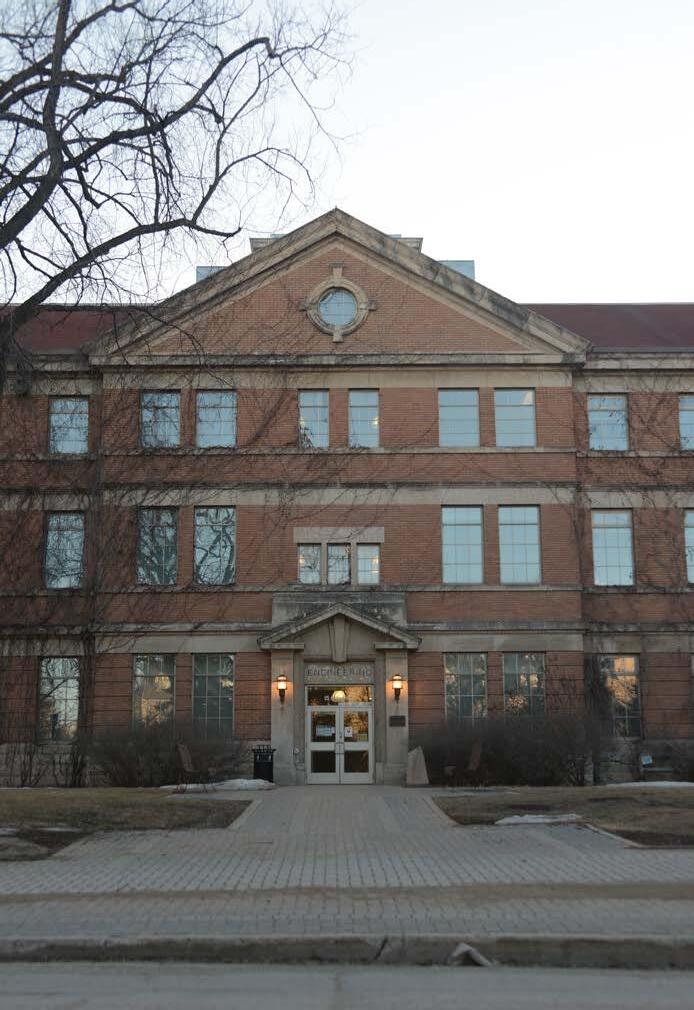
You had your say ’Toban remote learning survey results pages 8 to 13
Plans released for limited fall reopening, possible full return in winter 2022 page 3
You had your say ’Toban remote learning survey results pages 8 to 13
Plans released for limited fall reopening, possible full return in winter 2022 page 3

The Manitoban is the official student newspaper of the University of Manitoba. It is published monthly during the summer and each week of regular classes during the academic year by the Manitoban Newspaper Publications Corporation. The Manitoban is an independent and democratic student organization, open to participation from all students. It exists to serve its readers as students and citizens. The Manitoban is a member of the Canadian University Press, and our journalistic standards can be found online at toban.news/jsp
The newspaper’s primary mandate is to report fairly and objectively on issues and events of importance and interest to the students of the University of Manitoba, to provide an open forum for the free expression and exchange of opinions and ideas and to stimulate meaningful debate on issues that affect or would otherwise be of interest to the student body and/or society in general. The Manitoban serves as a training ground for students interested in any aspect of journalism.
Students and other interested parties are invited to contribute to any section of the newspaper. Please contact the appropriate editor for submission guidelines. The Manitoban reserves the right to edit all submissions and will not publish any material deemed by its editorial board to be discriminatory, racist, sexist, homophobic or trans-phobic, ableist or libellous. Opinions expressed in letters and articles are solely those of the authors. Editorials in the Manitoban are signed and represent the opinions of the writer(s), not necessarily those of the Manitoban staff, Editorial Board or the publisher.
A “volunteer staff” member is defined as a person who has had three volunteer articles, photographs or pieces of art of reasonable length and/or substance published in the current publishing year of the Manitoban. Any individual who qualifies must be voted in by a majority vote at a Manitoban editorial board meeting. Elected representatives and non-students may be excluded from holding votes as volunteer staff members in accordance with the Manitoban Constitution.
All contents are ©2021 and may not be reprinted without the express written permission of the Editor-in-Chief. Closing date for Manitoban executive
COPY DESK ? copy@themanitoban.com
Ursula Chojko-Bolec (ed.)
Aldin Sabic
NEWS DESK ? news@themanitoban.com
Gillian Brown (ed.)
Cam Cannon (ed.)
Damien Davis
Colton McKillop
RESEARCH & TECH DESK ? research@themanitoban.com
Sarah Doran (ed.)
Kunal Rajpal
COMMENT DESK ? comment@themanitoban.com
Lucas Edmond (ed.)
Liam Forrester
Grace Gyolai
ARTS & CULTURE DESK ? arts@themanitoban.com
Shaylyn Maharaj-Poliah (ed.)
Kaelen Bell
Zoë LeBrun
SPORTS DESK ? sports@themanitoban.com
Isaiah Wagner (ed.)
Matthew Merkel
PHOTO DESK ? photo@themanitoban.com
Alex Decebal-Cuza (ed.)
Basel Abdelaziz
DESIGN DESK ? design@themanitoban.com
Joshua Wesey (ed.)
Mikaela Warkentin
GRAPHICS DESK ? graphics@themanitoban.com
Jenelle McCann (ed.)
Dallin Chicoine
AUDIO DESK ? audio@themanitoban.com
Tino Hove (ed.)
Tawana Matizanadzo
VIDEO DESK ? video@themanitoban.com
Jesse Boily (ed.)
Arsalan Saeed
SOCIAL MEDIA DESK ? social@themanitoban.com
Colin Ijebor (ed.)
Jalene Moman
NEWS Gillian Brown, staff
As one year marks the onset of COVID-19, the closing of campus and the beginning of remote learning for the university, U of M president Michael Benarroch announced “with cautious optimism” that the university plans to begin a phased reopening of campus beginning this upcoming fall semester.
“As we reflect on how far we’ve come, and on how much this year has cost us, I am encouraged by the opportunities ahead,” he said in a statement to students at the university.
The current plan is based on recent public health advice along with expectations for vaccine administration in the province.
For in-person instruction, the university has set a limit of 20 students in a course section and 40 in a total course. Labs will be restricted to a maximum of 25 students or the COVID-19 capacity limit, whichever is smaller, and large classes will continue remotely.
Depending on COVID-19 restrictions at the time and room capacity limits, final exams may be held in person.
An emphasis will be placed on “meaningful” experiences and courses for first and second-year students, including labs, hands-on training, language training, clinical activities and field work.
Special focus will also be placed on courses that depend on in-person interaction in programs like theatre and the Desautels faculty of music, and activities that benefit from an instructor’s close monitoring and advice, like courses in the faculty of architecture.
Currently, up to 40 per cent of employees at the university may return to work on campus in areas including research and teaching. However, it is maintained that all work that can be conducted remotely should remain so.
Other academic activities that may require in-person attendance will
graphic / Dallin Chicoine / staff

be determined at the discretion of faculty deans.
While the U of M has already announced the primarily remote delivery of the summer term, Benarroch said the university hopes to fully return to on-campus operations come winter 2022, and that as vaccination in the province continues, the COVID-19 recovery steering committee will plan to reopen non-instructional activities
as well.
“The situation can change quickly, but this is what we believe is safe based on what we know right now.”
news@themanitoban.com
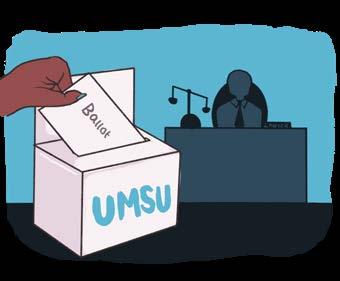
The UMSU board of directors passed two motions at its March 11 meeting signalling an upcoming referendum on the question of purchasing legal aid services for members at the cost of $28 per academic year. If the referendum were to pass, members would be able to opt-out of the service.
Other questions that will be included in the referendum are whether UMSU should join the Manitoba Alliance of Post-Secondary Students (MAPSS) and the Canadian Alliance of Student Associations (CASA) at no extra cost to members. There will also be a non-binding plebiscite regarding the U-Pass program’s continuation.
Voting in the referendum is set to take place April 7 through 9.
The service, Studentcare’s Legal Protection Program, would offer assistance in the form of a legal assistance helpline and legal coverage in various areas including housing and employment disputes, and disputes with an academic institution. The service would cover a student’s legal expenses in these contexts.
The program would cover “experts’ fees” up to a maximum of $1,000 excluding taxes.
A program brochure notes, however, that its lawyers will not provide legal advice that is against the interests of either student associations, groupings
of student associations within Manitoba or Studentcare itself.
According to a January 2021 UMSU membership survey, 79 per cent of respondents “felt that it is either extremely important or very important for students to have easy access to legal advice and services,” but 66 per cent felt currently legal aid resources were inaccessible and 61 per cent felt it was too expensive.
“The spirit of the legal aid question within the referendum kind of began [over] the past year really,” said UMSU president Jelynn Dela Cruz. “Previous UMSU executive teams have heard from students that the resources available for students are inadequate as it comes to legal assistance.”
Dela Cruz said that many students, for reasons such as navigating immigration law and housing issues, have been accessing and utilizing legal services for assistance.
According to Dela Cruz, one option that was explored was the possibility of establishing a legal aid clinic within UMSU University Centre. After exploring other options it became clear to the executive that it would be more efficient to make use of the service offered by Studentcare.
“The program itself hasn’t been confirmed yet, that’s what the referendum question intends to do, so as soon as we hear back from students on whether or not this is something
graphic / Jenelle McCann / staff
that is acceptable to them, then we will take the steps forward to sign a contract with Studentcare and begin the service as early as next year,” said Dela Cruz.
“This project has also faced increased attention due to issues exacerbated by the COVID-19 pandemic, like housing and immigration,” she said. “While students have voiced [issues
of] inadequacy or inaccessibility of existing resources, the pandemic has placed increasing importance [on] the service.”
news@themanitoban.com
Kunal Rajpal, staff
A team at the U of M’s Rady faculty of health sciences is developing a new way for people with dementia and their caregivers to interact.
Amine Choukou, an assistant professor in the department of occupational therapy at the college of rehabilitation sciences, is co-lead of a team working on telepresence robots, a tool to enhance the way caregivers and people with dementia communicate.
Due to their memory impairment, people with dementia may forget to take a bath, clean their house or eat, and are at greater risk of injury. These telepresence robots are being developed to support and care for them in the physical absence of the primary caregiver.
The robots are operated by computers, tablets or smartphones, which allows the caregiver to “see” and “hear” what the robot is observing in real time. Additionally, it also gives the patient the capability to look at and interact with family caregivers at the same time in ways that are sometimes not possible.
“It can be tricky for a person with dementia to use a mobile phone,” Choukou explained.
“It’s even maybe risky, or simply not recommended for people with dementia to use a mobile phone because someone can steal their password — they don’t know how to manage passwords and all that […] This pathology, it’s related to memory, so imagine how challenging it is to function in daily life.”
Hence, a telepresence robot is a novel and innovative way to improve the relationship between a family caregiver and someone suffering from dementia, especially during a pandemic.
Choukou said the inspiration behind telepresence robots came from similar robots being used by big companies to collaborate with people who are not physically present in the country.
“Initially, this technology [was] used in multinational and multisite companies to improve the collaborative work,” he said, explaining that it functions as a more tangible version of something like Zoom.
“Companies basically use it because

they are meeting so many people and they want to show what they’re doing in different locations and communicate [to] different people with different things around them.”
He emphasized that the major appeal to telepresence robots is the physical presence of something nearby, which is not the same as having a human there but mimics it enough to make a difference. Another benefit, particularly for those with dementia, is that telepresence technology requires minimal involvement on the patients’ part. In fact, the robots can even be commanded to charge themselves.
“The involvement of the patient is extremely low, should be less than one per cent — maybe touch it one time a month,” Choukou said.
“We think we would be able to train the caregivers so that they […] can use the tech.”
This project is mainly aimed at family members acting as caregivers, who need to maintain a continuous link to their loved one while maintaining
a life of their own. This situation is especially common during the pandemic when the caregiver may be isolated from their loved one due to social distancing restrictions.
Telepresence robots give caregivers the ability to interact with the patients without leaving their home.
“If you’re a caregiver and you’re working full-time, it’s extremely hard to reach out to your family member living with dementia,” Choukou said.
“So you might use this technology just over a lunchtime to make sure. Possibly in the morning […] prior to going to work, during your breaks and then lunchtime, or simply in the beginning of the evening, things like that.
“You can still do that and you will feel less burdened. So, it’s about time management, but also the burden and your own well-being, because you might be working full-time but blaming yourself.”
At the moment, the telepresence
robot program is a pilot study, with 15 families in four regions of Manitoba. Choukou acknowledges that not all areas have sufficient internet access to guarantee connectivity for the robots, which is a concern for the future.
“We want to learn about the process, see how people interact and what are the effects,” Choukou said.
“But all that is a pilot study, so what we want to do is to make sure that we can go to a broader study and, most importantly, implement the technology in the communities.”
Choukou said if the families find the telepresence robots useful, the researchers will give them the technology to keep because their overall goal is to improve dementia patient care in real terms.
“We’re trying to give back to the community.”
research@themanitoban.com

NEWS Colton Mckillop, staff
In the past few weeks, Minister of Advanced Education, Skills and Immigration Wayne Ewasko has attempted to alleviate concerns around Bill 33, the Advanced Education Administration Amendment Act.
In a series of tweets and letters to student advocacy organizations, Ewasko reassured that fees set by student unions and associations would be excluded from the bill’s provisions.
However, he acknowledged concerns that “the current language of the bill might be unclear.”
In the letters, Ewasko promised the government would follow up after “reviewing options [to provide] additional clarity.”
In an interview with the Manitoban, chairperson of the Manitoba branch of the Canadian Federation of Students Brenden Gali called this response “frustrating,” saying, “the concern that we initially highlighted is that this bill was drafted without consultation from students.”
Gali acknowledged that the minister’s letter said the bill excludes student union fees, but told the Manitoban, “it’s not law, we’re hoping to see that somewhere written in the bill.”
The bill would allow the minister to set guidelines for fees charged by a university board, such as tuition and/ or student fees.
If the bill is enacted, the minister would have control over whether particular fees are mandatory, set maximum limits and allow the department to reduce the school’s grants by an amount equal to the overcharge if they determine that fees are overpriced.
Scott Forbes, president of the Manitoba Organization of Faculty Associations (MOFA), called for the elimination of provisions for differential tuition fees, saying it “interferes with university autonomy over academic programming.”
“The minister can declare he doesn’t want students to take programs in the arts and humanities and can act on that by doubling or [tripling] […] tuitions in those programs,” he explained.
“Those decisions should be left to universities to decide.”
Forbes also said the language of the bill required further clarification.
“The issue of student fees requires the bill to be amended,” he said. “As it stands, any fees approved by the board of governors […] are covered by the bill, whether the minister intends that or not.”
“The language [of the bill] has to
be changed to specifically exclude student fees collected on behalf of student groups.”
Gali shared the same sentiment.
“What we’re still seeking from the minister is clarity around which fees they will be looking at, as well as what the tuition will look like depending on those guidelines set out by the minister’s office.”
“If it’s not student union fees, if it’s not student association fees, what fees are they looking at?” Gali later asked.
“What is the purpose of this amendment if not student union fees?”
At a press conference organized by the Manitoba NDP earlier this month, the Canadian Federation of Students Manitoba and MOFA met with the party to collectively criticize the bill and called for it to be withdrawn.
All three groups have criticized the province for not consulting with students and faculty before drafting the bill.
Gali said the response that the groups are currently hearing is that Bill 33 will not be touching student union fees, and that the department may revisit the bill and propose amendments.
“It’s good to hear — it would have been better if students were consulted to begin with.”
Forbes said the bill was past the point of being salvaged with amendments.
“There has been some very recent consultation with students and none with faculty. The onus is on the minister to consult.”
In a series of tweets posted March 11, Minister Ewasko claimed MOFA had “made no attempts to engage in meaningful discussion or ask for clarification around Bill 33.”
However, MOFA shared an email with the Manitoban sent to Wayne Ewasko on March 9 in which they requested “a real process of consultation involving faculty and students.”
As of March 18, Forbes said the organization had “tried to reach out to the Minister on several occasions using his different email addresses without response,” and only recently received a response which said little besides acknowledging their message had been received.
MAPSS considers Ewasko’s statements an “advocacy win”
The minister met with the Canadian Federation of Students Manitoba and the Manitoba Alliance of PostSecondary Students (MAPSS) March 2 to discuss the bill.
Kristin Smith, UMSU vice-president advocacy and MAPSS UMSU representative was at the meeting and said the association expressed concerns around the bill and proposed an amendment to exclude fees set by student unions.
She said Ewasko reassured them in their meeting that his legal team had ensured that student union fees would be outside the scope of the bill, but MAPSS’ legal review “produced very different findings.”
MAPSS’ approach has been to engage with the contents of Bill 33 in order to “address areas of concern and advocate for tangible change,” which they consider “more productive than simply denouncing it on the whole.”
“Let me be clear: MAPSS is not a fan of Bill 33,” Smith said.
Rather, the alliance views it as “but one component of a larger, consistent intrusion in the autonomous governance of Manitoba’s post-secondary institutions.”
However, she continued, “We have to remember that Pallister’s majority means that the bill will almost certainly pass in some way, shape or form.”
She added that she considered Ewasko’s statement conceding the bill’s lack of clarity and promising to review options an “advocacy win.”
However, Gali and Forbes disagreed with this assessment.
“While we’re moving in a positive direction [with] this bill […] being opened up and possibly amended […] the job is not done yet,” Gali said.
While he said that “everyone who’s advocating around Bill 33 and representing students should be really proud of the work that they’ve done so far,” he also pointed out that the bill currently has no provisions to protect student union fees.
“I don’t, personally, want to be satisfied with calling this a win.”
Liam R. Forrester, staff
In 2019, data collected from the Organization for Economic Co-operation and Development
— an intergovernmental development group — indicated that among all Canadian K to 12 students, Manitoba students scored the lowest in math, science and second last in literacy. Following this, thenminister of education Kelvin Goertzen launched a commission to review to detail the province’s lagging education system. The commission’s report was released on March 15, alongside the Education Modernization Act, Bill 64, and was met with fury and indignation from Manitoba teachers and administrators.
The commission was tasked with improving student outcomes and “creating long-term sustainability.” To that end, a core component of the proposed reforms is the amalgamation of Manitoba’s 37 anglophone school divisions into 15 regions by 2022. Currently, each school division has its own board of trustees and supporting administrative staff. The Better Education Starts Today report claims that despite Manitoba spending the most per student out of any other province and having a robust school trustee system, our student outcomes remain among the worst in Canada.
Taken at face value, this seems like a reasonable idea for reform. Simplify the existing system down into a more manageable set of divisions to pool resources, and then pour the money saved into classrooms, education assistants and extra-curricular programming. A lovely thought, but ultimately a fantasy.
It appears the eventual goal of Bill 64 is a massive partisan takeover of education in Manitoba. Consider the proposed administrative bodies, the provincial education authority (PEA) and provincial advisory council on education (PAC). The PEA will “oversee the delivery of education” in conjunction with the PAC. The PAC is comprised of 15 members elected from within the 15 new regions and aims to “provide the minister of education with direct parental advice on matters relating to the education system.” The PEA will be comprised of members appointed by the provincial government, two parent representatives appointed by the minister of education from the PAC and an additional elected trustee from the division scolaire franco-manitobaine (DSFM). The DSFM will remain largely unchanged by the reforms save additional reporting requirements to the government of Manitoba.
The proposed amalgamation collapses school divisions that service regions that historically support the Liberal party and New Democratic Party (NDP) and leave intact regions that service conservative strongholds. There has been little care taken to account for geography or population.

To illustrate, Winnipeg’s post-amalgamation region would contain an overwhelming majority of Manitoba’s K to 12 population — around 100,000 students not counting the DSFM. Winnipeg generally votes NDP, especially the inner city. The Winnipeg school division mainly services the inner city has the highest student population out of any division at 32,743 students with the closest runner up being River East Transcona at 16,851. All six existing divisions in Winnipeg will be collapsed into one region, with only one representative on the PAC.
The geographically massive frontier school division, which services the majority of northern Manitoba, is being amalgamated with the Kelsey, Flin Flon and Mystery Lake school divisions. The three provincial election ridings contained in that area, Flin Flon, Thompson and Kewatinook, voted overwhelmingly for the NDP in the 2019 election, and have generally voted against the PCs since 1999.
By contrast, both Brandon and Hanover school divisions, which represent 9,004 and 8,353 students respectively, are not being
amalgamated with any other division and will remain their own region. Brandon school division represents students residing in the city of Brandon which voted conservative in the last two elections. Hanover school division represents Steinbach and has been voting PC for the last two decades.
There has yet to be a clear articulation as to why the regions were devised this way. In a press conference on March 15, Cliff Cullen claimed the regions were merely laid out geographically. However, Cullen’s statement is confusing considering the map of the proposed regions. The Seine River school division will be left untouched by the consolidation plan and forms an encircling of two-thirds of Hanover. Brandon, meanwhile, is sandwiched between the proposed region of Beautiful Plains, Park West and Rolling River to the north and Fort La Bosse, Southwest Horizon and Turtle Mountain to the south. The proposed regions in contrast to Manitoba’s regional health authorities are starkly different which brings to question the integrity of Cullen’s claims.
Representatives in the PAC will overwhelmingly come from steady conservative ridings. The proposed structure of the PAC will inevitably and disproportionately privilege conservative voices in the oversight and delivery of Manitoba’s education system.
During the Monday press conference, a reporter from the Steinbach Carillon gave the game away by asking, “In regard to the roles that are appointed, if the NDP forms the next government [and] they could appoint these people in conservative regions, what will this new plan offer conservative parents skeptical of some progressive trends?” The PAC may be structurally biased in favour of conservatives, but the nature of the PEA appointments makes their domination of education contingent on staying in power.
Cont’d p. 19 / Problems >
NEWS Cam Cannon, staff
The provincial government released its commission report on kindergarten to Grade 12 education March 15. Legislation to enact sweeping reforms to the education system — the Education Modernization Act, Bill 64 — has also proceeded to second reading.
The bill was one of 19 introduced to legislature in early November without text, which was met with criticism by the opposition Manitoba NDP and community organizations such as Communities Not Cuts.
If passed, major aspects of the act would see the province’s English language school boards dissolved, with elected trustees replaced by government appointees who would preside over a newly created provincial education authority.
The proposed changes would not impact French language education in the province except for changes to the names of the francophone school board and division.
Other changes would include the creation of school community councils, intended to give input to principals on school matters, and the removal of principals and vice-principals from collective bargaining units also containing teachers.
Teachers will be required to collectively bargain in “good faith” before an arbitrator can be called in to mediate negotiations. Arbitrators will also be required to take into account the economic and fiscal state of the Manitoban economy and government when making their decisions.
On March 17, Minister of Education Cliff Cullen tweeted a message from the executive director of the Manitoba Association of Parent Councils (MAPC) that claims the changes are a “big win” for parents concerned about how “sensitive” topics are taught to children.
MAPC, in a 2013 position statement, claimed that sensitive topics include human sexuality and “evolution theories.”
These topics will be defined by the provincial government as “within a physical education or health education course that deals with human sexuality, substance use and abuse prevention and personal safety,” and parents will be allowed to pull their children from portions of classes teaching that content if there is a “conflict between the content and the parent or child’s religious, cultural or family values,” according to language in the proposed bill.
The proposed changes have been met with criticism from a variety of people including concerned parents, school staff and academics with the Manitoba Organization of Faculty Associations (MOFA).

Shortly after the K-12 education report was released and Minister Cullen held a press conference detailing the proposed changes on March 15, a call out was made on Twitter for a honk-athon on the street outside of Premier Brian Pallister’s house.
Andrew Kohan, a concerned parent who put the call out for the protest, expressed concerns over the loss of democratic control of education — which allowed for recent “wins” in terms of local efforts to get school boards to cut funding to school resource officer programs.
“I’m here because of the schools tonight, but there are so many other issues that are wrapped up in this legislative agenda,” he said. “Brian Pallister is systematically dismantling this province bit by bit […] everything good that has been built up here, that is publicly owned and publicly controlled, he’s taking away from us.
“I think if you see this as just an education issue, you’re going to lose out. We have to see these as connected issues, we have to fight them together,” he said.
The protest was dispersed by police after less than an hour. Initially, police arrived and announced that the protest was an offence. Shortly after, a protester was pulled over and appeared to be briefly detained before being released and allowed to drive away.
There is an additional honk-a-thon protest being organized by a group called Manitobans Against Pallister’s Education Reform. The protest is set to take place on March 31 outside of the legislature building.
Last Thursday, MOFA released a public statement alleging that the reforms and overall legislative strategy being pursued by the provincial government are reminiscent of laws put forward by the American Legislative Exchange Council (ALEC), a far-right think tank that drafts “fill-in-the-blank” model legislation on behalf of legislators.
In the past, ALEC has been criticized for its model legislation aimed at the privatization of public education, turning government-provided education into private for-profit education funded with taxpayer dollars.
In the summer of 2020, then-minister of education Kelvin Goertzen made headlines after attending a seminar also attended by former U.S. secretary of education Betsy DeVos — whose family contributes funds to and works with the ALEC education and development taskforce — as well as U.S. Senator Ted Cruz and Patricia Rucker, a Republican senator and ALEC representative.
Both DeVos and Cruz openly champion a form of public-school privatization known as “charter schools.”
Goertzen was minister of education when the bill was introduced without text in November 2020.
In an email statement, a spokesperson for the provincial government denied MOFA’s allegations, calling them “nonsensical conspiracy theories” and “toxic partisan politics.”
The spokesperson alleged that any similarities between ALEC legislation and Bill 64 are, “at best, coincidental and, at worst, an inaccurate and inflated claim by MOFA.” The statement also highlighted that it is Manitobans “including a team of
non-partisan legal experts” who draft legislation.
MOFA president Scott Forbes in an email statement explained that the “real evidence” of the similarities — and demonstration of at least influence from ALEC — lies in the pattern of legislation.
According to Forbes, this is most clear in terms of Bill 57 — new legislation intended to crack down on protests that disrupt “critical infrastructure” — the titles of bills are simply re-ordering of the words used in ALEC’s model legislation, “Critical Infrastructure Protection [versus] Protection of Critical Infrastructure.”
First, legislation was drafted in Oklahoma in 2017 in response to an upsurge in Indigenous land defence amid the Standing Rock crisis. ALEC then used that legislation to create a model bill which was then pushed through its network of legislators and adopted in 17 Republican-leaning states through 2019 and 2020.
Now, in 2021, similar bills are being pushed through in Alberta and Manitoba.
“It is simply not credible to pretend that the Manitoba Bill 57 and Alberta Bill 1 are not linked to this legislative effort,” Forbes wrote. “The case grows stronger when you see Manitoba cabinet ministers rubbing shoulders with ALEC connected.”
“It strains credulity to pretend that there is no link between ALEC and the Manitoba PC government,” he wrote. “It’s possible that some ministers are unaware of these connections, as they don’t necessarily write their bills, having staffers do that job. But if they are not aware of the connections, they very well should be.”
news@themanitoban.com


On March 23, 2020, the University of Manitoba officially switched to remote learning in the midst of the COVID-19 pandemic. Now, a year later, the Manitoban has conducted a survey of U of M students to gauge how they feel about the experience.


Of the survey’s 469 respondents from faculties across the university, 89.7 per cent were undergraduate students, with graduate students pursuing their master’s or PhD making up 8.8 per cent and 1.5 per cent respectively. Roughly a third of the respondents were in the first year of their degree, while 29.1 per cent were second-year students, 21.8 per cent were third-year students, 9.8 per cent were fourthyear students and 6 per cent were in their fifth or higher year.


When asked what primary device(s) they used to attend classes and complete assignments or exams, 98.9 per cent of respondents said they use a computer. In addition, 26.2 per cent of respondents use a mobile device and 21.3 per cent use a tablet. The vast majority — 91.7 per cent — said they do not have to share their device with anyone else.

Overall, students reported generally favourable learning conditions. The majority said they have a good environment to attend class or study, with 62.5 per cent choosing a positive response, and 70.9 per cent agreed to some extent that their internet connection was fine for remote learning.
Most students also felt they had adequate access to textbooks and course materials, with 68.7 per cent agreeing to some extent. However, some students expressed frustration with instructor expectations not reflecting pandemic reality.
“Some of us can’t leave our homes to order [or] purchase course materials, and it would be so much more efficient and effective if professors could provide what’s needed to know for assignments [and] exams rather than quiz us on stuff covered in the textbook when some of us don’t have access to the textbook,” said one firstyear faculty of science undergraduate.
A fourth-year faculty of agricultural and food sciences undergraduate agreed, pointing out students who cannot travel to Winnipeg are at a disadvantage due to high shipping costs for unique items from the campus bookstore.
“I paid [three times] the shipping as I did for the actual lab manual I needed,” they said.
“Not all of us are able to live in the city since the pandemic and we need things shipped. This is not the place to price gouge.”


Library resources were also a mild concern. Students were fairly evenly split on their opinions of access to library resources, with 25.8 per cent somewhat positive about access, 24.3 per cent neutral and 23.9 per cent somewhat negative.
That said, students in more specialized fields found themselves disproportionately affected by library restrictions, with faculty of architecture students particularly vocal about it.
“Maintaining access to the libraries in terms of pickup of physical books is absolutely essential,” said a fifth/ higher year faculty of architecture master’s student.
“Much knowledge is simply unavailable online.”
Students overwhelmingly reported feeling isolated from their peers, with 72.6 per cent of respondents saying they felt much less connected with other students than last year. Only 9.1 per cent reported any degree of increased connection, and even those students had caveats.
“I only said I feel more connected as students are mobilizing and coming together on apps such as Telegram,” a second-year faculty of arts undergraduate said.
“A lot of profs are frustrated with students for creating Telegrams to help us stay connected with each other. If that is the case, they should
Compared with last year, how connected
urge the university to get a program which is as user-friendly for students in a way that students like — with messages we can easily access and in one place with a chronological order.
“The UM Learn thing is okay for computers and teachers that make us use it, but not for ease of communication with each other, and email is not helpful in the same capacity.”
First-year undergraduate students in particular have struggled with the remote learning format. Of firstyear undergraduate respondents, 82.2 per cent reported feeling much less connected to other students. Several requested that professors create opportunities for classmates to interact with each other, like breakout rooms.
Students were less adamant about how connected they felt with their instructors. The bulk of respondents reported their professors were a little less accessible (31.7 per cent) or about the same (36.5 per cent) as last year.
However, many wrote that they would appreciate more empathy from their professors. Lack of flexibility or trust around internet connectivity issues was a major complaint, along with not enough consideration for students in other time zones.
Some students also asked for more consistent use of UM Learn within their faculties, saying that while professors may think they have found a more convenient platform to share information, it only makes life more difficult for students in multiple classes.
“[The] University of Manitoba has done a fine job, but professors — from my experience — need to learn how to use one platform,” wrote a thirdyear faculty of agricultural and food sciences undergrad.
“I have some classes that use four to five different interfaces and it is so, so, so confusing trying to find and remember where things are. They need to use one portal, because when five classes use different interfaces each, I have to manoeuvre between 10 different webpages and apps at minimum for content.”
“I feel like I can’t breathe”
The most consistent themes throughout survey responses were complaints of exhaustion, overload and worsening mental health. Of the 85.6 per cent of students who said their workload had increased over the past year, 55 per cent said it had increased a lot, and a combined total of less than 5 per cent of respondents said their workload had decreased in any capacity.
When asked if they felt like they never stop working, an astounding 89.9 per cent of respondents agreed to some extent. In addition, 72.2 per cent of students strongly agreed that they were more tired than before the pandemic and found it more difficult to concentrate. Cont’d p. 11 / ‘As a student’ >

•





The Manitoban conducted a survey of students from March 7 to 19 asking about the student experience during the past year of remote learning.
There were 469 students who responded to the survey. These pie charts show some of the results of the survey.
I am more tired than before the pandemic and find it more difficult to concentrate.
468 responses
Strongly disagree (11)
Somewhat disagree (13) Somewhat agree (85)
UMFA conducted a survey of the association’s membership from Dec. 7 to 22, 2020 asking how the pandemic has affected faculty members. There were 570 UMFA members who responded. These pie charts show some of the results of the survey. More coverage of the UMFA survey results is planned for our next issue.
I am more tired than before the pandemic and find it more diffi cult to concentrate.
514 responses
Strongly disagree (11)
Somewhat disagree (30)
Neutral (50)
Somewhat agree (142)
Strongly agree (281)
514 responses
Strongly disagree (272)
Somewhat disagree (137)
Neutral (54)
Somewhat agree (142)
Strongly agree (281)
‘As a student, there’s sometimes days when I’m on Zoom more than I sleep’
< Cont’d from p.8
“It has been so challenging this past year and it seems like profs don’t seem to think that we’re stressed [or] always working,” said a fourth-year faculty of agricultural and food sciences undergraduate.
“As a student, there’s sometimes days when I’m on Zoom more than I sleep […] Yet I am paying for university in the same fashion I would if I were on campus. To be honest, it’s incredibly difficult, and it hasn’t gotten easier with time.”
Across virtually every faculty that responded, students asked for very similar workload changes — instead of multiple smaller assignments worth less, due on a weekly basis, they would consistently rather have fewer small assignments worth a higher percentage of the final grade, with due dates spread across the semester.
Students said small weekly assignments pile up very quickly between classes, and when combined with the amount of screen time and eye fatigue students are already facing from attending class, their coursework has a markedly negative effect on their health.
students, then turning around and making them hard to access or cost money after a few sessions?” asked one first-year University 1 student.
“As a student, I already am paying large sums of money to this institution. Seeing as how the professors are being paid terribly and classes are online, I’m wondering where all this extra money is going. Maybe invest into the students more, because since attending this school I feel like just a number.”
Some students expressed disappointment that mental health outreach seems to consist of peppy emails and half a page in course syllabi, but little else.
“I feel like some people are thriving in this environment and others are having a very difficult time,” said a second-year faculty of architecture master’s student.
“This survey is the first time I’ve actually been asked how I am doing and how I think the year is going, which is pretty disappointing. I feel like the virtual ‘me’ that professors and advisors see is not representative of the internal struggles and stresses I’ve been experiencing.”
or tutorial sections in their courses.
“Online labs are not only horrible, but they are also pointless,” a first-year faculty of science undergraduate said.
Every cloud has a silver lining
Despite everything, respondents also found positive aspects to remote learning life.
“I really like the idea of remote learning [in] that you can always or mostly go back to the things that you might have missed during the lecture,” said one second-year faculty of science master’s student.
“Plus, professors [and] instructors are much more accessible than before.”
“It is difficult to focus on assignments worth [more than 25 per cent] when instructors add on weekly readings [and] assignments that are not graded or receive minor grades, but take up hours of time,” a second-year faculty of architecture master’s student said.
Other respondents did not directly criticize the university’s existing support services, but said other policies have actively worsened their mental health. A particularly common offender was Respondus LockDown browser, used to prevent cheating during quizzes and exams.
“What am I going to learn by filling in a worksheet based off of class material? That is not a lab, that is just course work. A lab is intended to be a hands-on experience to teach you valuable skills that you will use throughout your career. The lab co-ordinators are doing [a] decent job of providing the material online, sure, but it is useless. Labs the way they are being done now serve no purpose and do not enhance my learning whatsoever.
But one group has faced more intense pressure than any other subsection of the university — nursing students.
“Our students have had the added stress of working on units that have been subject to [COVID-19] outbreaks, which has interrupted their clinical learning, made them miss precious clinical hours needed to finish our degree and the constant worry that we might be putting the people we live with and love at risk,” said a fourthyear college of nursing undergraduate.
“Many of us have had to make hard choices about whether we should continue to pursue our degree or put it on hold until things settle […] Working through difficult situations isn’t a new concept for nursing students, but doing it in the midst of a pandemic and all the complexities that come with that learning environment is.”
All in this together?
When asked whether they felt the university had provided them with adequate emotional/mental health support, the largest group — 41.3 per cent of students — responded neutrally. However, the second-largest group at 24.7 per cent picked the most negative possible option, and several students expressed their disappointment in the university’s approach.
“Can the university please stop advertising mental health services to
“On top of that, we still need to pay our ridiculously expensive lab fee. Why? We aren’t using any equipment or even showing up on campus.”
“The [Respondus LockDown browser] gives me such anxiety and I find I don’t have time to finish my exams because of it,” said a fourth-year Asper school of business undergraduate.
“I live with five other people and it is loud, and I have to share my study space so there’s nowhere private to go, which flags you on the software. I’ve had to rent hotel rooms just to write my exams because of it.”
A first-year faculty of arts undergraduate agreed, specifying that while their faculty of arts classes were “great,” their science courses with labs had been “very unorganized and sometimes very rushed.”
This frustration extended to other faculties as well.
A number of respondents said their professors have done a great job of adapting to online classes by coming up with creative ways to involve students and present information, with one — English, theatre, film and media associate professor Jonah Corne — being praised by name.
Other students said the rise of openbook tests and take-home exams has been a welcome change, and they hope instructors will continue to allow such options as the university gradually returns to in-person learning.
“I think more remote learning options should be made available in the post-pandemic era so that all students have the ability to do well in their courses,” a third-year faculty of architecture undergraduate added.
Students also called for reworking the current lab format, saying that remote labs often defeat the purpose. A combined 54.3 per cent of respondents expressed some degree of dissatisfaction with lab, workshop
“I feel like I will be very behind in skill next year as many critical lab skills were supposed to be taught in my courses this year,” a third-year faculty of agricultural and food sciences undergraduate said.
“I am very concerned about this, and hope professors will adjust the lab curriculum and account for this when we go back.”
Remote learning has improved over the past year.
469 responses
Strongly disagree (72)
Somewhat disagree (111)
Neutral (94)
Somewhat agree (146)
Strongly agree (46)
With the U of M officially adopting a blended in-person and remote learning approach for the fall 2021 semester, students will have more opportunities to be on campus, interact with classmates and professors, access lab space and technology currently unavailable and generally take the first steps toward regaining typical university life.
In the meantime, many students are hoping for improvements in the U of M’s implementation of remote learning.
Student responses on synchronous vs asynchronous learning
“Get rid of asynchronous learning. I am not paying that much money so my prof can upload one 20-minute lecture every Tuesday and Thursday.”
— first-year faculty of science undergrad
“No more synchronous lectures. I want to be able to view them at my leisure and they should remain online”
— third-year faculty of agricultural and food sciences undergrad
“There needs to be adequate adjustments and support for asynchronous learning. Time zones are a real issue and my professors have not been flexible.”
— fourth-year faculty of engineering undergrad
“Make all lectures live.
— third-year Asper school of business undergrad
“[For] professors to provide recorded versions of live lectures, for flexibility of access — as an international student studying from abroad, the time difference has made it difficult. Some professors do not upload lectures and so the classes are in the middle of the night.”
— third-year faculty of arts undergrad
“Make exams available for 24 hours minimum [so] students overseas do not have to take [an] exam at 3 a.m.”
— third-year faculty of agricultural and food sciences undergrad
“Make all lectures synchronous, but then record them for students who want to see them later. Having classes at designated times when the professors will log on and actually interact with us are the only classes I attend.”
— second-year faculty of science undergrad
“Many of my professors post extra parts of lectures on UM Learn and expect the students to watch/take notes instead of teaching it during the next lecture, which never happened during in-person learning.”
— second-year faculty of arts undergrad
“It’s unfortunate that UM Learn doesn’t have a dark mode feature. We stare at our screens 12+ hours a day — it’d be nice if they gave us some accommodations with it since we can’t avoid screen time.”
— second-year faculty of arts undergrad
“Facilitating more opportunities for students to connect with each other in class, especially firstyear students.”
— first-year faculty of science undergrad
“It would be helpful if we could get printer and ink stipends so we can print articles for reading without a screen. Less lecture-based classes and more seminar-based classes.”
— first-year faculty of architecture master’s
“Required mental health workshops as a part [of] grade rubric for classes — at least one per term.”
— fifth/higher-year Asper school of business undergrad
“Don’t clump so many courses in the same department on the same day — it’s good for in-person but not online. Three-hour lectures staring at a screen is painful on my eyes and it feels impossible to concentrate. It’s especially bad when I have three lectures all on one day.”
— third-year faculty of arts undergrad
“The course that best adapted to online learning […] utilized downloadable weekly podcast lectures with weekly guest speakers. Instead of trying to recreate the classroom as accurately as possible, the course instead made use of the new way of learning; I could take the classroom with me on walks, or listen as I do chores around the house. We were actually encouraged to spend time away from screens while we learned and so it was really nice to feel like the prof sincerely cared about our learning experience and our actual physical well-being.”
— fifth/higher-year faculty of arts undergrad
“More engaging lectures without just screen sharing and talking.”
— first-year faculty of science undergrad
“Utilize breakout rooms! Concentration on course content is much harder online and encouraging participation through breakout rooms or chat discussions is helpful for myself to stay engaged and focused.”
—fourth-year Asper school of business undergrad
“One of the challenges of students is being expected to use tools to accomplish assignments that are simply better suited to another time and condition. For example, threehour lectures maybe make more sense to limit commuting, but when we are already stuck at our computers all day, this really doesn’t seem like the best way to learn anymore.”
— second-year master’s, faculty not given
FEATURE Shaylyn Maharaj-Poliah, staff
In March 2020, when the COVID-19 pandemic was confirmed to have hit Winnipeg, U of M students were met with uncertainty and anxiety, with questions about school running through their minds — “Am I going to graduate on time?,” “Will I have to extend my degree?,” “Will these degree requirements count?” and, the most pressing of all, “How is the winter 2020 term going to continue in the midst of this global crisis?”
These sentiments echoed even louder for students in the faculty of education, who found themselves amid the chaos with the school closures and the transition of education to remote learning platforms occurring from dual perspectives — that of post-secondary students and of aspiring teachers.
Manitoba Education and Training requires teacher candidates to complete a minimum of 24 weeks of practicum to be eligible for professional certification, meaning that the full five weeks are vital for continuing in the program and for graduation — especially for those who have jobs lined up to start in September.
At the time, students in the faculty of education were beginning their final practicum blocks for the term as teacher candidates and, between the lack of communication from the university and the unclear directives from higher-ups in the local school divisions, were feeling more than a little at sea.
A second-year science education student in the senior years stream at the U of M, who wished to remain anonymous to protect their identity and student status, said that the gaps in communication in those early days were the most frustrating parts.
“Upon speaking with teacher candidates from other universities, I learned that the other universities were very efficient with the change and had clear ideas on how to direct their teacher candidates for the remainder of the semester,” they said.
“Teacher candidates from University of Manitoba were uncertain if the time they had committed to the practicum would count towards their certification due to the back-and-forth from the university.”
Indeed, at one point during 2020’s winter term, the U of M teacher candidates were the only teacher candidates still attending their practicum placements while students from the University of Winnipeg were removed until further notice. U of W education students Sheena Manghera and Amy Adair said that last April’s practicum was an entirely different experience for them.
Manghera said that they “worked on an alternative practicum remotely.”
“We were told that we would not be going back, and we were to submit [unit] plans for each subject we were teaching to our advisor,” said Adair. “Along with that, we were to submit a 10-page, single-spaced report as to how we would implement our plan.”
For U of M teacher candidates, practicum officially began Monday, March 16, following the first confirmed positive case of COVID-19 in Winnipeg, and, by that Wednesday, the schools were borderline empty with nothing but frazzled teachers rushing through the halls, trying to move their classes online without adequate training. Teachers were given exactly two weeks to prep before going fully remote and had limited time, if any at all, to support and train teacher candidates, who often felt bereft and burdensome.
However jarring it was, and continues to be, for the teachers, though, the jump to emergency remote learning was even more challenging for the students. A math education student at the U of M, who requested anonymity, reiterated the difficulty of losing the face-to-face aspect of high school learning. “It was difficult to communicate with students only through email and it was [their] responsibility to make sure they engaged in the material,” they said. “At times, it was quite difficult to motivate students to complete work.”
“Live-streamed lessons were not permitted so students only heard me through my videos and through reading my handouts. There was a huge disconnect between the students and myself, which I was really disappointed about,” said the science education student.
Despite these initial problems, fall 2020’s practicum block went much more smoothly but operated “slightly different than last year.”
In a normal year, teacher candidates would attend practicum in the schools every Monday, but this was not the case in the fall term, to give teachers time to adjust to the new public health
and safety guidelines before the teacher candidates arrived.
“The first time I met any of the students was on the first day of my block,” said the math education student, “it was more difficult to form relationships quickly and establish routine since I only saw students every second day.”
Since schools are operating on different schedules, with students coming into the building either one or two days a week, instructional time is cut in half. Further, to abide by provincial health and safety protocols, some practicum requirements — such as participation in extracurriculars and observing other teacher candidates — have been waived “to minimize contact between cohorts and [to] keep everyone safe.”
When it comes to in-person classes, learning occurs asynchronously and teacher candidates are only able to communicate with each other via discussion forums and social media, which has caused a shift in the ways education professors teach pedagogy. Cameron Hauseman, an assistant professor in the faculty of education at the U of M, said that “it feels like we have lost much of the discourse and camaraderie that separates the bachelor of education program and the faculty of education from rest of the university.”
“The switch to remote instruction has sapped much of the fun out of the teaching,” he said. It has also led to fewer opportunities for students to collaborate with one another, which is a shame as those activities are designed to mirror how pre-service teachers will be asked to collaborate with their colleagues once they enter the profession.”
The science education teacher candidate continued this line of thought from the student perspective: “For us second years, connections between students are not as awkward since most of us already met during our first year. For first year students, some have expressed the lack of connection between peers as they have never met
in person previously. Courses in the faculty encourage community-building […] but the remote learning makes this more difficult for second years and even more so for first-year students.”
These sentiments are echoed by assistant professor Shannon Moore, who believes that while the purpose of the education is the same, the remote learning environment requires certain distinct approaches to teaching and learning.
“You have to find different ways to connect with your students, to build community and to encourage dialogue and deliberation,” said Moore. “In the faculty of education this is a particular challenge; normally, professors can model [face-to-face] pedagogy through their own teaching. Now, we are using online platforms to teach [face-to-face] methods — recognizing that teacher candidates will eventually fully return to the classroom.”
As teacher candidates prepare to go into their practicum blocks this April, there is still some lingering anxiety from last year, but the U of M education students are confident in the continued adaptability and diligence of Winnipeg’s teachers, teacher candidates and communities at large.
“All parties in the educational field [have] been working really hard during this pandemic,” said the science education student. “Teachers are working harder than ever to ensure students’ success and families are trying their best to accommodate in this new normal.”
“I have seen firsthand, and experienced for myself, how hard teachers are working this year,” said the math education student. “I wanted to say teachers are superheroes and should be acknowledged for all their hard work and countless hours they spend pouring into their students.”
‘Zack Snyder’s
League’ shows value of artists’ original vision
Last week marked the release of the long-awaited Zack Snyder’s Justice League
After the disappointing 2017 release of Justice League, fans of the superhero film genre and of Snyder himself are finally getting a taste of Snyder’s cut.
The 2017 film was originally directed by Snyder, but he left the project after the sudden death of his daughter. He was replaced by Joss Whedon, who lent his distinct style to the film, but ultimately fell short of captivating audiences, with the movie receiving a mediocre reception.
Whedon stepped in fresh from his time in the Marvel Cinematics Universe, directing Avengers and Avengers: Age of Ultron
The two directors had very different visions of what the film should be, but without Snyder, we received Whedon’s version. The film felt more like a Marvel movie than something from the dark and gritty universe Snyder imagined for Justice League
After the success of the more lighthearted films Marvel was producing at the time like the Avengers and Guardians of the Galaxy movies, it appeared Warner Bros. and DC Comics wanted to follow suit with a more colourful universe. But, this contradicted Frank Miller’s dark and perturbing old comics, which were strong influences on Snyder.
Many fans left the cinema disappointed after the theatrical release of Justice League. On the second anniversary of the movie’s first screening, fans that were committed to the DC Extended Universe’s cinematic atmosphere demanded that Snyder’s cut be released to make amends for Whedon’s Marvel-inspired version. On Twitter, #ReleaseTheSnyderCut received over 1 million tweets and trended globally.
Many people believed that much of Snyder’s original vision for the film still physically existed. In March 2019, Snyder confirmed that a version of his film existed and that it would be up to the studio to release it.
Director cuts in movies have been common since the early days of film. For example, Charlie Chaplin’s The Gold Rush was originally released in 1925, only to be edited and re-released again in 1942 with audio, voice-over narration and, what would become a common theme in the future director cuts, deleted scenes.
Many films released in cinemas are cut for time to ensure more showtimes and increase ticket sales.
The Lord of the Rings trilogy of films faced these same problems with an already-long theatrical cut running just over three hours for the third film, Return of the King. In contrast, the extended cut has a runtime of four

hours and 11 minutes.
When art is commercialized, that is the price we pay — we lose out on a large chunk of the artist’s original work.
Director’s cuts are almost always better than theatrical cuts. It is impossible to grip the director’s artistic intention without their full story.
George Lucas is notoriously known for the plethora of adjustments he made to the Star Wars films. In 1997, he released the special edition Star Wars films. In them he introduced Star Wars fans to new characters, backgrounds and even whole scenes that had been excluded from the theatrical versions of the movies.
In an interview with the Associated Press, Lucas explains, “Anybody that makes films knows the film is never finished. It’s abandoned or it’s ripped out of your hands, and it’s thrown into the marketplace, never finished.”
Movies are a collaborative art form. The movie-making process consists of various artists and professionals with different perspectives trying to
bring a story to life. Unfortunately, synergistic projects as large as movie production requires a large amount of revenue. For example, big epics like Justice League, Avengers and Star Wars often cost hundreds of millions of dollars to produce. The problem is the people who invest in these multi-million-dollar movies want to play it safe to ensure they make their money back.
In 2015, a reboot of the Fantastic Four directed by Josh Trank premiered and went down in history as one of the worst superhero films to be produced.
Trank’s Fantastic Four has a nine per cent approval rating on Rotten Tomatoes.
Trank would take his frustrations out on the poorly received movie in 2015 tweeting, “A year ago I had a fantastic version of this. And it would’ve received great reviews. You’ll probably never see it. That’s reality though.”
Director cuts provide audiences an intimate view of the real film that a filmmaker wanted to create. Cuts to this art is detrimental to the film industry.
That’s why it’s more important than ever to support and watch a movie like Zack Snyder’s Justice League — it is a director’s vision come alive.
It is dark and gritty. It’s not made to sell children’s toys. It has a long runtime — just over four hours — but it was created with comic book fans in mind.
We’re unlikely to get masterpieces from film studios that are purely focused on maximizing profits. But, if creators are granted the freedom to make what they believe in, then at the very least audiences will be set to experience creativity and vision in its purest form.
Lucas Edmond, staff
Non-profit news organization
PressProgress released a report March 16 indicating that Uber — the transnational ride-hailing app — is lobbying provincial governments to scrap Canadian labour laws that were established to protect employees of gig companies.
In June 2020, the Supreme Court of Canada ruled that Uber drivers were entitled the right to be governed by the labour laws outlined under Ontario’s Employment Standards Act, setting precedent for other provinces across Canada.
Prior to the Supreme Court’s ruling, Uber had argued that they contracted independent workers as opposed to hiring official employees, which, under Uber’s perverted logic, abstractly gave them an excuse to bypass labour laws and withhold rights formally afforded to employees in Canada.
Now, Uber is lobbying for damaging legislation to establish a legal separation between independent contract models and employment models in exchange for things like their selfdirected benefits plan — a program which Uber claims facilitates a portion of drivers’ earnings to benefits they desire depending on the number of hours they work.
Uber’s senior vice-president of mobility and business Andrew Macdonald noted in an interview with BNN Bloomberg — a business news network — that in order for Uber to provide benefits to its workers, Canada’s employment classification system must be modernized to fit the rising tide of informal gig work.
However, as Joshua Mandryk — a labour lawyer — noted in an interview with PressProgress, these are intentionally deceptive policies that exclude employees from their formal rights to pension plans and employment insurance for a benefits system that workers pay out of pocket for while Uber lines its wallet.
Uber is exploiting language such as “modernization” and “flexibility” to whitewash potentially devastating labour reform laws. More concerning, Uber’s lobbying efforts mimic the discourse used by the Progressive Conservative Party of Manitoba (PC) when it was pushing Bill 30, the Local Vehicles for Hire Act, through legislature in 2017.
Without proper public purview, Uber could influence key legislation and undermine the unionized transportation industry in Manitoba using the significant resources it has at its disposal.

In 2015, Uber’s then-public policy manager Chris Schafer had revealed the company’s interest in entering Manitoba and establishing the ride-hailing app across the province’s cities.
Shortly after, a commissioned 169-page report released by the accounting advisory firm Myers Norris Penny indicated that Winnipeg’s taxicab-to-population ratio was extremely low compared to the rest of Canada. The report surveyed approximately 10,000 Manitobans who raised concerns about long wait times and prices that accompany Winnipeg taxi companies. It concluded Winnipeg’s vehicle-for-hire system needed “modernization.”
This report opened the floodgates for advocates to push a deregulatory agenda in the transportation industry by replacing restrictive bylaws to allow ride-hailing companies into Manitoba at the potential detriment of unionized transportation workers employed by public transportation and taxi companies.
Roughly two years later, Bill 30 received royal assent. Bill 30 was proposed to allow municipal governments direct oversight of bylaws that regulate taxis and gig drivers. This was effectively the first piece of legislation that allowed ride-hailing companies
access to municipal markets like Winnipeg.
At the first reading of the bill, Eileen Clarke — Progressive Conservative Member of Legislative Assembly (MLA) representing Agassiz — was tasked with introducing the legislation to the assembly. During the reading, she articulated a desire to deregulate and modernize Manitoba’s transportation sector.
“Industry oversight has become riddled in red tape,” she said in 2017. “The government just completed the most extensive consultations on the vehicle-for-hire industry in decades, where the public and stakeholders spoke up to say that the existing regulatory regime needs to be modernized.”
However, senior New Democratic Party MLA for Elmwood Jim Maloway criticized Bill 30 for its lack of public debate. He noted that Bill 30 “should be renamed an act to destroy 1,600 jobs and turn-make a new low-wage economy in Manitoba.”
Uber is likely salivating at the prospect of a provincial government
in favour of deregulating its vehiclefor-hire sector. The situation becomes more dire in the prospect of a failing PC government that looks highly unlikely to poll well in the next provincial election. In the coming years, the number of suspect pieces of legislation will likely rise as a shift in power to the opposition party becomes more likely. This potentially opens a period of opportunity for Uber to lobby the provincial government to neglect the Supreme Court’s ruling in favour of coercive legislation.
The PC government has clearly shown interest in opening avenues for the ride-hailing industry to exploit workers with the hollow justification of modernization and flexibility. Manitobans must reject any motions to reform labour laws in the interests of gig work. Not only could reform undermine unionized transportation jobs, but it could also work to further dismantle a social safety net that workers have spent over a century fighting for.
comment@themanitoban.com
Hospitality and its workers require continued support after a year of precarity
Grace Gyolai, staff
It started in Toronto, quickly popped up in British Columbia, then in Quebec, and within just a few weeks cases of COVID-19 were being reported across Canada with provinces declaring states of emergency one by one.
I, like many workers in the service and hospitality industry, watched the news while progressively coming to the hard realization that I would soon be out of a job.
Sure enough, come the end of March, nonessential businesses were restricted in an attempt to limit the spread of the virus resulting in an initial round of layoffs.
According to Statistics Canada, from March 2020 to February 2021, approximately 17,100 Manitobans in the culinary sector were forced out of work and 6,000 more have left the sector in search of new employment.
However, this recession is sector-specific — restaurants and hotels have faced the brunt of the economic crisis witnessing a 31 per cent drop of employment rates.
In an attempt to aid these businesses struggling to rebound, Manitoba’s government has recently announced a new $8 million relief program for the hospitality and tourism sector.
The money will be distributed through grants as to cover a selection of business costs including property insurance, mortgage interest, service fees, resource retention costs and land leases.
Businesses in the hospitality and tourism sector are vital contributors to the health of Manitoba’s economy and have sacrificed a great deal to ensure our local communities can stay as healthy as possible.
The influx of funding is coming at a crucial moment as many tourism related businesses are expected to endure a second year of little to no business as a result of international travel restrictions.
Due to potential risks posed by the COVID-19 variants, it’s also important that the provincial government continue offering support in new ways to those who need it most in order to prepare for unknown consequences.
The new relief funding is obviously welcomed by business in the industry, but the question of whether this $8 million will be sufficient in meeting their needs still remains.
Even if best case scenarios are realized, with new vaccine rollouts offering a glimmer of hope, it’s expected that the hospitality and tourism sectors will not fully recover from the COVIDinduced recession for several years.
A report from CBRE Hotels detailed that in Winnipeg, occupancy in hotels

dropped from roughly 71.1 per cent to approximately 33.7 per cent over the course of the last year.
Because of low occupancy combined with minimal revenue from other sources, including restaurants and bars, the tourism industry has not had the need or ability to hire back most of their laid off employees.
Many individuals have relied on Employment Insurance (EI) or the Canada Recovery Benefit (CRB) as a source of income due to job loss.
EI is notoriously difficult to contact and many people have to wait on hold for hours just to speak to a correspondent if they can even get through by phone at all. Beyond these complications, EI or CRB might not be enough to cover bills and expenses long term, especially for families.
Employees in this situation may be waiting patiently for their former employers to call them back to work,
but the tourism sector is not expected to reach normal revenues until 2024. It may be years until hotels, lodges and other businesses in the industry are operating at pre-COVID capacity.
If laid-off employees are not able to return to work, the government needs to develop long term systems to aid those caught in the middle.
It’s also important provincial and federal governments evaluate how much additional aid they will need to provide businesses directly. After a devastating year and with an unknown future ahead, the government must dig deep, get creative and cultivate an unparalleled solution to the current situation.
No one planned to endure COVID19, and the hospitality and tourism industries have faced huge complications and widespread closures in order to follow restrictions required to maintain public health and safety.
helping
thousands of people daily — another example of how much these spaces and industries in Manitoba have given up for the greater good.
While the new relief fund is a step in the right direction, increased aid should be provided to businesses and employees in the hospitality and tourism sectors to ensure we can enjoy the myriad benefits these businesses bring to Manitoban communities for years to come.
‘These years have been chock-full of memories, experiences, successes, failures’
Nick Noonan, volunteer
In April, God and my professors willing, I will write my last set of final exams at the University of Manitoba. Once pen is finished being put to paper I will have completed seven years at the institution we all know, love, curse and, most commonly, get parking tickets at. My last seven years have been composed of four years at the Asper school of business and three years at the faculty of law. These years have been chock-full of memories, experiences, successes, failures and everything in between. Yet, when I reflect on these years, my mind flicks back to my first day at the university. In fact, it turns to my very first class.
First day, first class. The room is filled with nervous students, shaking in their chairs at the reputation of the professor before them.
The professor, upon walking in immediately pointed his finger at a student in the back row and exclaimed “Why are you here?” The student stumbled on their words and ultimately came back with something along the lines of “Because I am enrolled in this class.”
Unsatisfied, the professor searched the room for another student or, rather, another victim. He pointed at another student and asked, again, “Why are you here?” This time, the student came back with “Well, I paid for the class.”
He remained unconvinced. And there I sat, head down, boldly positioned in the middle of the front row, hoping not to be asked. When I dared to glance up, the professor’s excited eyes stared back at me. “You,” he said to me, “why are you here?”
My somewhat panicked answer was that I wished to learn new things, understand how the world worked and have a better future. My professor seemed to accept this and, these years later, I stand by it. To me these are the three major purposes of post-secondary education: developing a more formidable intellect, gaining an understanding of society and, ultimately, finding a job.
So, based on these criteria, how has the U of M done?
There is an increasingly vocal school of thought that argues, given the breadth of freely available information on the internet, the educational value of post-secondary institutions to their students no longer justifies the cost of their tuition. And they are not entirely wrong.
However, there have most certainly been courses over the past seven years that have not contributed in any meaningful way to my intellectual growth. But, I have also most certainly taken courses of incomparable value which could not have been replicated by any other means than the classroom I experienced them in.

Based on conversations with friends at universities across Canada and North America, this dichotomy does not appear to be unique to the U of M. The difference between the former category — for which I can only wish for my tuition back — and the latter is determined by the quality and pedagogy provided by the instructor. Interest in the subject doesn’t hurt either.
I have also found that, as one would assume, I have found greater joy in courses whose subject areas I am interested in. That being said, my advice to prospective students is not to only take what they are interested in; rather, it is that the purpose of this education is to educate you holistically and broadly, so take courses in fields you may be unfamiliar with. You never know, you may fall in love with something you initially scoffed at — the way I did with tax law.
Further, the U of M has instilled a better understanding of how the world works. But the ability of post-secondary institutions to teach its students the complexity of the world is a difficult lesson.
On one hand, some argue that since the university system is fundamentally separate from the “real world,” students cannot learn how the world works from it. To me, post-secondary education serves as a reliable means of disseminating this knowledge. This is where universities truly shine, students often require exam or assignment-based motivation to spur them to read and learn what they perhaps should independently already desire
to.
In this sense, I think the U of M has provided me a better understanding of the world. However, this success is predicated on an individual student and their own course of study. Improved competency in reading and writing across all programs has been, and continues to be, a focus of the U of M, and rightfully so. Being able to communicate your thoughts in writing is crucial, both as a future employee and as a citizen of the world.
However, to me, there is an intangible value in the critical thinking capacities that a university education provides. These skills offer students a less myopic lens through which to see the world.
In terms of employability, I have been fortunate enough to land a job. The labour market for university graduates is highly saturated. By most accounts, there are more potentially employable graduates than there are jobs. While my friends in science, technology, engineering and mathematics are often quick to blame any uncomfortable job market statistics on the so-called “unemployability of an arts degree,” this stigma is a gross generalization. The truth is simply that finding a job is difficult, no matter your degree or course of study. In fact, in my own circle, many friends with arts degrees are gainfully employed while my other friends with experience in the hard sciences continue to look for work.
Avoiding this job market crunch is certainly possible. Find an area of
study that you are interested in, work hard to get good grades and, wherever possible, seek out practical experience in your field. Get involved on campus, not only to buff up your resume, but also to build connections with other students.
Perhaps I am wrong that university provides valuable skill sets. Maybe the future will be one ruled by Instagram entrepreneurs, cryptocurrency investors and non-fungible token traders free of the burden of both student debt and degrees. However, until such a time, a university education will remain valuable both pragmatically and in principle.
As my time at the U of M draws to a close, I often reflect on my professor’s question from my first class. To varying degrees, the three basic values I wished to obtain from my university experience were gained. Perhaps more important, however, is what the university experience has given me beyond that. I have formed lifelong friendships as a result of the struggle and shared experience that university education put me through. I gained an appreciation for the world around me before I was thrust into it and all its responsibilities. I suppose, at the end of the day, I am a better person for having attended this institution. And I think that was the point all along.
Kaelen Bell, staff
Kae Sun’s 2018 full-length
Whoever Comes Knocking was drawn in broad strokes — abandoning the rock and retro-pop of 2013’s AFRIYIE for throbbing basslines and snaking synth loops. It made for a slick record in a state of constant, pulsing motion. This year’s Midnight and Other Endings EP finds the Ghanaian-born artist in a different mode — where Whoever Comes Knocking surged and jumped, Midnight and Other Endings opts to melt and drip. The five-track EP is more patient and sensual than Sun’s previous work, leaning more heavily into loose grooves and hazy zone-outs.
Things open with “Mass (Intro),” a slow-ticking thaw featuring vocals from Montreal’s Sam I Am Montolla, a fittingly diaphanous introduction to a record that seems to hover in the air like smoke. The EP sees Sun finding a new depth of softness in his writing and delivery, and he sounds exceptionally comfortable in these fluid surroundings. Midnight and Other Endings is quietly lush, adult music, another new shade from an artist accustomed to chameleonic shifts.
The low groove of “Midnight Creepshow” rides slithering bass and a sticky funk guitar line, though the repeated title in the chorus comes off somewhat, well, creepier than perhaps intended. Still, the music itself never breaks the spell, its golden haze of synth and atmosphere softening all the corners. The strongest showcase of Sun’s new direction is “404 Eros,” its gentle smear breaking into a diaphanous funk, growing slightly with each minute.
The penultimate “Bright Lights,”

while not the EP’s catchiest or most immediately memorable, is perhaps its most impressive — across fourand-a-half shape-shifting minutes, the song seems to dissolve the gentle grooves of what came before, taking the EP to an entirely weirder and more shapeless place. Its descending synth lines verge on unnerving, and the heat-ping loop that materializes at the 1:30 mark brings weight to Sun’s lyrics
about police sirens and cities torn to the ground.
The EP fades out on Vancouver, B.C. artist Debby Friday’s steely-eyed spoken word, her immense gravity pulling all the playfulness of the previous four tracks somewhere deeper and more haunting, a fittingly unsettled end to the night. Kae Sun seems capable of finding room in just
< Cont’d from p.6
However, the school community councils (SCC) will likely serve as a potential power check on progressive agendas. The SCCs are meant to “engage parents” at every school and “advise the school principal on school matters, including the needs of the community it serves.”
Consider this in conjunction with the fact that, under Bill 64, principals would be excluded from the Manitoba Teachers’ Society — their associated union. The degree to which SCCs can influence principles is both troubling and unclear. Effectively, without union protection, principles would be massively vulnerable to community pressures.
Consider the massive backlash from parents in Ontario in 2015 regarding changes to their sex-ed curriculum. Parents threatened to pull students
from schools in protest to the changes which would teach children about puberty, sexually transmitted infections, consent, sexual orientation and gender expression.
Sexual education is clearly controversial but is essential in protecting students from unplanned pregnancy, safe sex and stigma surrounding gender and sexuality. Manitoba is still experiencing a massive syphilis outbreak and has the fourth highest teen pregnancy rate in Canada. Is it in the best interest of students to put access to this important information in the hands of reactionary, unqualified members of SCCs and the overwhelmingly conservative PAC?
Not to mention the obvious class issues that threaten this model. It is an unfortunate reality that due to time constraints, most parents lacking substantial socioeconomic resources are restrained from their participation
in their children’s education. Poor families that work multiple jobs, physically demanding jobs or jobs at odd hours will likely be structurally excluded from participating in these councils by the very nature of their economic circumstances. On the other hand, two-parent and single-income households that have more time for civil participation will inevitably be overrepresented.
Manitoba has the highest rate of childhood poverty in two-parent households out of any province in Canada. According to educators, poverty is likely what has been impacting Manitoba’s K to 12 education scores.
The Better Education Starts Today report fails to mention any program to meaningfully alleviate poverty at the school level. Instead, impoverished students are left with partisan bodies and all the blame for their province’s
arts@themanitoban.com
& CULTURE
Zoë LeBrun, staff

Constructing identity through history, lineage and culture is at the heart of Meryl McMaster’s practice. It is also the main focus of As Immense as the Sky, her current exhibition on display at the Urban Shaman Contemporary Aboriginal Gallery.
Coming from a Plains Cree and European background, McMaster began creating the body of work through an interest in travelling to places where her ancestors once lived and how this informed her own identity. From here, the idea grew into a more in-depth exploration of her family history through the wisdom, stories and the meaning these landscapes held for her ancestors — both as settlers and original inhabitants — as well as the mark that current generations are leaving on the planet and the different ways we perceive time.
“I was really interested in listening and collecting this knowledge of these stories and animating this and retelling it, through this personally transformative kind of process of my images,” said McMaster. “A lot of these stories that I was listening to took place at these kind of contact places of Indigenous and European ancestors, but then also they were stories that were specific to my Plains Cree culture and they were their stories of the land.”
As Immense as the Sky consists of large-scale photographic prints next to brief poems written by the artist that depict McMaster in surreal
costumes and props that she makes herself within immense and beautiful landscapes. The scale of these images lends an ethereal, immersive feeling to the works, and the short poems add further texture to her dynamic photographs.
McMaster’s artistic process is unique in the sense that there are sculptural and performative elements that are entirely absorbed into her final images. Her performances, which are her transformation into these dreamlike characters in seemingly distant locations, are completely private. Additionally, she doesn’t consider her sculptures to be stand-alone additions to be displayed alongside her photographs.
Using an eclectic range of materials, McMaster’s otherworldly sculptures are often worn or used as props for her images. For instance, in “On the Edge of this Immensity,” we see McMaster carrying a small boat filled with birds, lending the work a lyrical and surreal energy.
Regarding the reason why she doesn’t exhibit these sculptures on their own, McMaster said, “they’re part of the artwork itself, which is the photograph. When they’re on their own they kind of lose their kind of magic […] they’re built and meant for the image.”
McMaster’s photographs possess a distinctive, fantastical style that blend the elements of theatre, landscape and fashion photography into one fascinating creation.
This innovative combination is particularly prevalent in her works “Of Universes We Have Just One” and “What Will I Say to the Sky and the Earth I and II,” which focus more on sculptural costume aspects rather than props. These photographs are composed beautifully, harnessing ideas surrounding environmental devastation and universal connectedness with strikingly unique energies. McMaster has expertly balanced the figurative aspects with the landscapes in these works, creating a cohesive world for these characters to inhabit while simultaneously telling the stories behind them.
The ethereal nature of McMaster’s work solidifies the questions she raises about conceptions of time in her work, as it removes the viewer’s outlook from the plane of reality with which we identify and into an unfamiliar world.
When viewing As Immense as the Sky, I often felt like I was seeing various glimpses into a history that were just beyond the grasp of my complete understanding — places I had been before and yet had never seen but were impactful in a way that made me want to sit with and learn from them. This feeling likely stems from McMaster’s inclusion of how her differing cultural backgrounds perceived time as either cyclical or linear.
These different perspectives on time are what eventually led McMaster to her thoughts on the impact we are currently having on the planet, and why she sought out these places of
ancestral wisdom to confront and relieve these fears.
Unless the viewer comes to this exhibition familiar with the symbolism and stories from which McMaster pulls her inspiration, it can be difficult to discern exactly what each work is about — however, this is what McMaster intended.
“There’s little poems that are beside the image that are a little bit [of a] portal into some of the ideas behind the image,” McMaster said, “but I hope people can read those and it might trigger their own memory of history or even their own lived experience.
“I also really welcome the interpretation of others and for people to let their mind[s] wander and maybe dream a bit and kind of go down their own path in any of my works […] I hope people can think about these really beautiful landscapes, but also think about the forgotten landscapes that you pass by every day.
“Sometimes you forget to look at the beauty around you.”
You can catch As Immense as the Sky at the Urban Shaman Contemporary Aboriginal Gallery until April 17. For more information, please visit urbanshaman.org.
arts@themanitoban.com
first mainstage show says a lot about art, life the
Shaylyn Maharaj-Poliah, staff

The University of Manitoba’s theatre program is jumping on the virtual theatre bandwagon and is presenting its first, and only, mainstage show via Zoom. Unlike most digital offerings, though, the original play — titled Zoom Lens by Winnipeg theatre artist Debbie Patterson — was uniquely written for the platform.
Directed by Katrina Dunn and with dramaturgy by Bill Kerr — two professors in the department of English, theatre, film and media — Zoom Lens takes place during a lockdown and follows a group of university students taking a brand-new online course, “Cultural Representations of Pandemics,” which is being taught by a struggling professor.
The production is a very much collaborative effort that, Dunn said, grew out of “a year-long, program-wide focus on new play development” that ran throughout 2019-20, with Patterson teaching playwrighting, Kerr covering dramaturgy and Dunn instructing an advanced directing class that focused specifically on directing fledgling productions. The project concluded with the theatre program’s Fire in the Hole festival, which ran last December.
Dunn said that, in addition to Fire in the Hole, the process culminated in commissioning Patterson to write a new play that “the whole group of students that had gone through [the] focus on new play development would also get to develop.”
They are not the only students involved in the production either. The students in the upper-level theatre course “Theatrical Techniques:
Backstage” are primarily handing the technical and design aspects of the production, such as stage management, costuming, props and sound.
Unlike Fire in the Hole, which was a series of staged readings — meaning the actors still partially read from their scripts — Zoom Lens “is very much a full production,” said Dunn. “The actors are off book, there are design elements, there’s music […] it’s a fully rehearsed production from start to finish.”
Every aspect of the production has taken place online. Instead of holding in-person auditions, Dunn said that students videotaped their audition pieces and sent them along for consideration. Dunn, Patterson and Kerr did the casting together but, with this digital mode, she felt there was no real connection between them and the auditionees.
“What you get to see is the actor’s craft and how far along they are in what they’re doing, how they connect with a character, you get a sense of what kinds of things they’re comfortable playing,” said Dunn. “But you lose a lot. You don’t [get] to feel out the rapport between yourself and the actor. You don’t get to generate ideas with them. And the most important part, I think, is that you don’t get to give them a direction and see how they respond to it.”
The production’s rehearsal period ran for approximately two months and was conducted entirely on Zoom. Though much of the process remained the same, there were, predictably, some key differences that came with the medium.
“One of the things that I was really tracking as a director is: how does focus work [and] what is our eye drawn to?” said Dunn. “We have a lot of big group scenes where there are nine squares on [the screen], and we have to look from one character to the other and follow a train of thought and a storyline, and that’s very different from how it happens on stage.”
Further, Patterson’s writing style incorporates “very short, sharp dialogue with lots of characters cutting each other off and speaking at once,” but this effect is difficult to capture through the digital medium and having the actors’ movement restricted to a small onscreen box was challenging.
“One of the main ways that we tell stories in the theatre is through movement in space and we just do not have that in any kind of way,” said Dunn. “You have a little bit of play in space, from what you can see in the square, but beyond that, it’s pretty limited.”
“I found myself trying to define a whole new set of rules for how we express and communicate in this new form.”
Zoom Lens is Dunn’s directorial debut with the theatre program. Though she has directed productions at other institutions and professionally, this is the first time she is working with students that she has taught over a long period of time.
“I, like the students, [am] just grateful to be making art in any way — it is energizing. Also, working in this context, you get to see students really
grow and develop and experience breakthroughs, and that is very exciting and satisfying.”
Dunn believes that the play is incredibly relatable amid the COVID-19 pandemic and will hugely resonate with its audience, especially the university students and faculty who have been going through it this past year.
“The way we teach, the way we learn, has all been compromised and adapted and we’ve changed enormously,” she said. “We’ve found very creative ways to do the things that we can’t do anymore, but we’re all working so hard — this play has a lot to say to everybody who’s been through that process.”
When asked about the theatre program’s plans for next year, Dunn is optimistic that there will be a return to more regular programming, with more productions being mounted.
“Everybody will be so hungry to get back to doing our work in the way that we’re accustomed to […] so, that is the next thing — coming back from the summer with renewed excitement and theatre activity.”
You can catch the U of M Theatre Program’s virtual production, Zoom Lens from March 24 to 27 at 8 p.m. nightly and completely free of charge here: toban.news/zoomlens. For more information, please refer to the program’s social media channels.
Kaelen Bell, staff
A lot has been said about culture’s current obsession with ’90s revivalism and, while usually fun and mostly harmless, it’s missing the one aspect that would make it feel truly worthwhile — the specific, shadowy weirdness that was allowed to blossom in mainstream pop-radio and video channels. Canadian trio DISHPIT is interested in that sort of revival. Enlisting Steve Albini — famed producer of ’90s world-shakers PJ Harvey, Nirvana and the Breeders — the band’s debut DIPSHIT is less throwback than rejuvenation, a lanky art-punk cough with plenty of fury and wit to spare.
DISHPIT has an off-kilter sense of humour and, while the band’s music is raw and bruised, it’s rarely self-serious. From the interpolation of “Entry of the Gladiators” — the iconic circus music — on jumpy instrumental “Splinter” to the thrashing self-immortalization of “Trash Queen,” the DISHPIT members never sound like they are having anything less than a great time. While Albini’s infamously raw, cacophonous production and frontperson Nora Kelly’s animated vocals tie the record to a certain era of angst, the band’s gripes are entirely modern. For instance, “1000 Ways to Die” grapples with the doom that beckons on the horizon for so many young people, while “Plaza People” deals with the pains of perception.

However, “Plaza People” — along with “Serious” — also showcases one of the record’s small issues. At times it feels like some of these high-octane songs should hit harder, a surprising gripe given Albini’s knack for sharp and uncompromising sound. It is not a problem that presents itself often, and it actually helps highlight the band’s surprising strength — DISHPIT’s best work seems to be when the band aims a bit softer, letting the musicians’ inventive playing and Kelly’s engaging voice pull focus.
The final one-two punch of “Fix Your Life” and “Get Rich or Die” is the
album’s quiet peak. “Fix Your Life” in particular sees the band access a depth and melodic sensibility that’s not always showcased across the rest of the record. It is a gift that the band left these tracks for the end. Where the previous nine songs prove where they excel, “Fix Your Life” and “Get Rich or Die” show where they still have yet to
explore — it’s a promising glimpse of what DISHPIT is so clearly capable of, and proof of a band with nowhere to go but up.
arts@themanitoban.com
On March 10, the Canadian Football League (CFL) commissioner Randy Ambrosie announced that the CFL was involved in discussions with the XFL on future opportunities.
Started by WWE chairman Vince McMahon, the XFL plays an alternative version of four-down American football. The league prides itself on its engagement with fans and giving ex-college players who don’t have NFL contracts an opportunity to play professional football in America.
Although the league has only played for less than one season in its current iteration, many players were thrilled
with the level of football played and the entertainment value the league provided to the fans. Many players were also able to be signed to NFL contracts after the XFL season concluded.
Midway through that first season, the COVID-19 pandemic halted the league’s inaugural season.
The CFL has also faced its challenges as of late. After the 2020 CFL season was cancelled due to the COVID-19 pandemic, the league faced more financial troubles. It suffered financial losses of over $20 million in 2019 and lost between $60 to $80 million by the end of the 2020 as a result of the pandemic.
After the Canadian government denied a request by the CFL for financial assistance, it became clear that the CFL would have to think outside the box if it hoped to continue to operations in the future.
Despite these financial hardships, the two leagues are persevering in the hopes for future financial security in spite of the pandemic.
The CFL has announced a 2021 season schedule while the XFL is planning for a return in 2022.
The XFL also has new owner in Dwayne “The Rock” Johnson. The superstar actor is a former CFL player and WWE wrestler.
While the two leagues have been
tight-lipped about what the topic of conversation could be, news outlets, fans and players suspect the topics could surround a future alignment where CFL and XFL clubs play games against each other.
This would not be the first time the CFL has explored south of the border. In 1993, the league expanded adding a team in Sacramento, Calif. and by 1995 there were five CFL clubs based out of the U.S.
In 1995, the Baltimore Stallions won the Grey Cup, becoming the first and only American champion of professional Canadian football.
Cont’d p. 23 / CFL >
SPORTS Isaiah Wagner, staff
The Winnipeg Jets have had a successful start to the 2020-21 season so far with an 18-11-2 record, putting the team third in the North division as of March 21.
So far in the season, the Jets have been led by Mark Scheifele almost every game. He has 37 points in 31 games and has been a driver of the play all season long.
His supporting cast of Nikolaj Ehlers and Kyle Connor have also had a great start to the year, with 15 and 16 goals respectively.
Although the Jets have played well this season, the team still sits four points out of the number-one spot, which is currently held by the Toronto Maple Leafs.
To finish ahead of the Leafs in the overall standings by the end of the year, the Jets need to fix a few areas of its gameplay.
The first area that desperately needs to be fixed is on the defensive side of things. The Jets are not playing bad defensively, but do not have enough talent on the blue line to contend.
This all starts at the trade deadline for
the Jets this season. The team has a few prospects coming up on defence, but they will not be ready to play at a National Hockey League level until next season.
One name that pops out for the Jets to take a poke at is Mattias Ekholm of the Nashville Predators.
Ekholm is a guy who can slot into the top four of the squad’s blue line right away and make a significant impact.
He has a great toughness that can bode well for a not-very-aggressive Jets defence core.
Another name that comes to mind is David Savard from the Columbus Blue Jackets.
Savard is a player like Ekholm but it would cost the Jets less to acquire him.
A less expensive Savard could be a better option if the Jets are not willing to part ways with any big-name prospects.
The next area that the Jets need to improve on is winning the big games.
As of March 21, the team’s past two games were losses against the
Edmonton Oilers and that put the Oilers in front of the Jets in the overall standings.
Games like these are crucial down the stretch if the Jets want to finish top two in the division and have home-ice advantage in the playoffs.
The Jets play the Oilers and the Maple Leafs many times throughout the next two months, which are going to be huge.
As the season moves on, look to see the standings constantly changing and some teams to get hot while others get cold.
The final area that the Jets need to improve is the consistency to play its third line against the other team’s top line.
The line of Adam Lowry, Mason Appleton and Andrew Copp has played extremely well so far this season.
The way that they wear down the other team’s first or second line has been among the best in the league, which is crucial to allow the Jets’ top line to get better matchups.
Appleton has had a career year so far this season and has been tenacious on the puck whenever he is on the ice.
< Cont’d from p.22
Even with the Stallions’ success, the CFL’s attempt to market itself in the U.S. was a failure overall.
U.S. teams faced poor attendance records, rocky ownership and a substandard level of play. Subsequently, all American franchises would fold prior to the 1996 season.
Canadian fans were also put off by the idea of their country’s
league being infiltrated by subpar American clubs, a sentiment CFL fans continue to express today. Football in Canada has history that dates back more than 150 years.
Even the league’s championship is held in very high esteem. The Grey Cup was created by former governor general of Canada Earl Grey in 1909.
The XFL, on the other hand, does not have an esteemed history like the CFL.
The league was only in operation for less than a full season.
If CFL fans are concerned about a possible overhaul of their beloved Canadian football, they should be assured that the two leagues are moving very slowly in their discussions.
In a recent interview, Ambrosie talked with 3 Down Nation’s Justin Dunk on how the two leagues are conducting their discussions.

“I had a great moment earlier today when [Stephen Shamie] and I got to call the players’ association, and it was good because something we’re really trying to do well is to talk with the players about things,” Ambrosie said in the interview.
“We are putting no expectations on this other than two highly energized groups that see value in what each other does, and how might we help grow the game of football together and collaborate.”
Johnson also offered encouraging words via Instagram to fans both sides of the border.
“As an owner of the XFL, our discussions with the CFL have been very exciting,” Johnson wrote. “There’s a real pulse here because you can feel the unique opportunity we can

He has 15 points in 31 games and has also been great on the penalty kill.
Lowry and Copp have also provided the Jets with offensive and defensive help in all zones of the ice. This line needs to give the team their best for the rest of the season.
Overall, the Jets have had a great season but can improve many areas of its game.
If the Jets fix these areas, the team might finish first or second in the North division by the end of the season.
sports@themanitoban.com
potentially create together.”
No matter what the result of these discussions is, the perspectives of the fans and players will be at the forefront.
While some Canadians have had mixed emotions regarding news of the discussions, they should be comforted by the fact that the CFL is not attempting to make any drastic moves.
XFL ownership respects the CFL and the history of Canadian football. Expect Ambrosie to be cautious in his talks with the XFL.
The previously attempted American CFL expansion as well as the optics surrounding the XFL and its wildly different approach to marketing itself will likely play a part in Ambrosie’s decision-making.
If he hopes to preserve the authenticity of the CFL, he should continue talks with Johnson and the XFL very cautiously, and only make deals that benefit the players and the CFL’s fans. graphic / Jenelle McCann/ staff