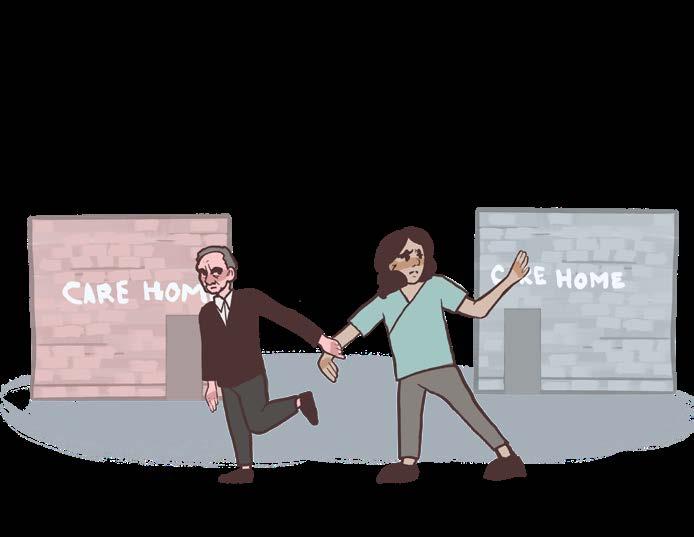
In December, only two days after a COVID-19 outbreak at a Kildonan personal care home, the Manitoba government granted the facility an exemption to a health order requiring health care workers to only work at one site.
In a press release issued March 3, Manitoba Liberals slammed Chief Provincial Public Health Officer Dr. Brent Roussin and the Progressive Conservatives (PCs) for allowing the exception for the Revera-owned Kildonan Personal Care Centre. Two days after an outbreak was declared at the home — Dec. 5 — executive director Matthew Braun requested an exemption from the Winnipeg Regional Health Authority.
Cont’d p. 4 / News >
TOB AN the MANI
a member of the Canadian University Press, and our journalistic standards can be found online at toban.news/jsp
The newspaper’s primary mandate is to report fairly and objectively on issues and events of importance and interest to the students of the University of Manitoba, to provide an open forum for the free expression and exchange of opinions and ideas and to stimulate meaningful debate on issues that affect or would otherwise be of interest to the student body and/or society in general. The Manitoban serves as a training ground for students interested in any aspect of journalism.
Students and other interested parties are invited to contribute to any section of the newspaper. Please contact the appropriate editor for submission guidelines. The Manitoban reserves the right to edit all submissions and will not publish any material deemed by its editorial board to be discriminatory, racist, sexist, homophobic or trans-phobic, ableist or libellous. Opinions expressed in letters and articles are solely those of the authors. Editorials in the Manitoban are signed and represent the opinions of the writer(s), not necessarily those of the Manitoban staff, Editorial Board or the publisher.
A “volunteer staff” member is defined as a person who has had three volunteer articles, photographs or pieces of art of reasonable length and/or substance published in the current publishing year of the Manitoban. Any individual who qualifies must be voted in by a majority vote at a Manitoban editorial board meeting. Elected representatives and non-students may be excluded from holding votes as volunteer staff members in accordance with the Manitoban Constitution.
UMGSA election voting period ends (5pm) Closing date for Manitoban executive applications; toban.news/jobs
meeting / Skype / 5:30pm
COPY DESK ? copy@themanitoban.com
Ursula Chojko-Bolec (ed.)
Aldin Sabic
NEWS DESK ? news@themanitoban.com
Gillian Brown (ed.)
Cam Cannon (ed.)
Damien Davis
Colton McKillop
RESEARCH & TECH DESK ? research@themanitoban.com
Sarah Doran (ed.)
Kunal Rajpal
COMMENT DESK ? comment@themanitoban.com
Lucas Edmond (ed.)
Liam Forrester
Grace Gyolai
ARTS & CULTURE DESK ? arts@themanitoban.com
Shaylyn Maharaj-Poliah (ed.)
Kaelen Bell
Zoë LeBrun
SPORTS DESK ? sports@themanitoban.com
Isaiah Wagner (ed.)
Matthew Merkel
PHOTO DESK ? photo@themanitoban.com
Alex Decebal-Cuza (ed.)
Basel Abdelaziz
DESIGN DESK ? design@themanitoban.com
Joshua Wesey (ed.)
Mikaela Warkentin
GRAPHICS DESK ? graphics@themanitoban.com
Jenelle McCann (ed.)
Dallin Chicoine
AUDIO DESK ? audio@themanitoban.com
Tino Hove (ed.)
Tawana Matizanadzo
VIDEO DESK ? video@themanitoban.com
Jesse Boily (ed.)
Arsalan Saeed
SOCIAL MEDIA DESK ? social@themanitoban.com
Colin Ijebor (ed.)
Jalene Moman
UMSU releases 2021-22 budget recommendations
Open education resources tops list of priorities
NEWS Gillian Brown, staff
UMSU released its recommendations for budget spending, and for the 202122 academic year, students can expect to see movement toward the adoption of open educational resources (OER) along with increased supports for the Student Counselling Centre (SCC), hardship relief for international students and consent culture training programs.
Vice-president advocacy Kristin Smith said that the union’s recommendations are based on the results of a survey sent to students asking to rank their priorities for increased spending.
According to Smith, the initiative that garnered the most support was free
digital textbooks. Among the highest priorities were more opportunities for financial aid, increased mental health supports and improved online learning resources.
The lowest priorities for students included more funding for events online or in-person, composting and more ethical food options.
UMSU’s first recommendation is to allocate $400 thousand toward regarding OERs, especially in firstyear courses. Among that will be funds dedicated to creating an open education librarian position with two supporting staff, IT upgrades, education and training for faculty and a fund to compensate faculty members for “above-level workload” needed for adaptation of available resources into digital textbooks for standard use in
the 10 most popular 1000-level classes in the faculties of arts and science.
The recommendations allocate $150 thousand for sexual violence and consent culture workshops for all first-year students, Bison athletes and those living in residence.
UMSU also hopes to renew the additional funding of $350 thousand that was provided to the SCC last year so that it can increase its accessibility for in-person mental health services when students return to campus in the fall.
Fourth, $600 thousand is recommended to be granted to a student hardship fund for international students. This will help to offset pandemic-related costs and will assist with health-care coverage, which Smith reported is the highest in Canada for international students.
This totals $1.5 million, which Smith said represents about 0.2 per cent of the university’s total budget.
As of right now, Smith said that the union is awaiting the final proposed university budget, which is set to be presented at the March 23 board of governors meeting.
“We feel hopeful that considering the degree of community consultation that took place, it will result in a majority adoption of our recommendations,” said Smith.
news@themanitoban.com
Manitoba NDP and MOFA call for withdrawal of Bill 33
NEWS Colton McKillop, staff
The Manitoba Organization of Faculty Associations (MOFA) and the Manitoba NDP are calling on the provincial government to withdraw Bill 33 — proposed changes to the provincial Advanced Education Administration Amendment Act that have been under fire from critics for months.
In recent public statements and a press conference, MOFA and the NDP said that student and faculty groups were not properly consulted on the legislation.
If passed, Bill 33 would allow the minister of advanced education, skills and immigration the authority to set guidelines for tuition and student fees charged by a university board.
The bill would give the minister control over whether particular fees are mandatory and set maximum limits. If the minister were to determine that fees were overpriced, they could reduce the university’s operational grants by an amount equal to the overcharge.
Wayne Ewasko, minister of advanced education, skills and immigration, has denied that the bill would give the province the power to overrule student fees decided on through campus referendums, attributing this interpretation to “misinformation.”
He claimed in a tweet posted March 3 that “MOFA has made no attempts to engage in meaningful discussion or ask for clarification around Bill 33,” but in an interview with the Manitoban, MOFA president Scott Forbes said they have tried to get a hold of the minister in the past week and have received no reply.
NDP MLA Jamie Moses said he was “very concerned about the consultation process that the minister has done,” pointing out that Ewasko only spoke to students after the bill had already been drafted.
“We think the minister should withdraw the bill, go back to the table, consult properly with students and with faculty and then go about creating a bill that would actually benefit universities and students and ensure that university remains affordable,” he continued.
In a video posted to Twitter, Moses questioned the sincerity of the Manitoba government’s commitment to affordability for students, citing tuition hikes during the COVID-19 pandemic and years of funding cuts to post-secondary institutions.
“We’ve seen a track record over the last few years of cuts to funding for post-secondary institutions,” Moses said in an interview.
“As a result, we’ve seen tuition increases. That’s been their track record.”
Moses and Forbes both drew comparisons to the failed Student Choice Initiative in Ontario.
The Student Choice Initiative in Ontario was struck down by a unanimous court decision in 2019 because it violated the law and denied autonomy to universities.
The policy led to a widespread decline in funding for student groups and services across the province, with schools like Brock University losing half a million dollars.
graphic / Dallin Chicoine / staff
“This would be disastrous for things like student daycare, student health programs, food banks [and] student newspapers,” Forbes said.
“The bill — as written — gives the minister wide latitude,” he continued.
“If he didn’t intend this, he shouldn’t have submitted a bill which contains this potential.
“Unless significant changes are made, the bill remains a permanent threat. This minister might choose not to use these legislative powers, but nothing prevents future ministers from doing so,” he warned.
“It’s like leaving a loaded gun on a table, and saying don’t worry, I’m not going to use it. Its simple presence, even with that reassurance, is intimidating.”
Forbes also raised concerns about provisions allowing the minister to set tuition fees program by program.
“This represents a serious political
interference with academic programming,” he said.
“The government then has the power to decide which programs it likes, and which it doesn’t, a level of political interference in internal university governance that the courts have already ruled unlawful — the Ontario court decision on the Student Choice Initiative is very interesting reading,” Forbes elaborated.
Regarding recent statements by Ewasko on Twitter about potentially adjusting the language of the bill, Moses said, “The minister putting out a tweet is not good enough, he has to make changes to legislation.
“Anything that he’s doing to Bill 33 has to be done through legislation, not through a tweet.”
TOB AN the MANI
Virtual Advising Help Centre launches to be point of contact for students
With the winter semester coming to an end and COVID-19 still affecting students and their education, a new online tool developed by the U of M has been launched this week in order to assist students and their concerns more effectively.
The Virtual Advising Help Centre (VAHC) is an online help service staffed entirely by students — with the exception of co-ordinator Heather Nicolson — working seven days a week to answer any questions either by phone, email or online chat.
The student services navigators will be available from 8:30 a.m. to 9 p.m. Monday to Friday, and on the weekends from 10 a.m. to 5 p.m.
“We’re hoping that this new service is […] going to take some of the transactional advising traffic away from the advising offices,” said Nicolson.
The service aims to answer “those really quick-to-answer questions, clarifications that students often need [...] nothing that really needs an in-depth meeting with a student advisor, but more those quick and snappy questions.”
Nicolson explained that by doing this, they hope to clear up the large email queues and long waits students face in advising offices, and allow for the student advisors to more efficiently offer and focus on in-depth meetings.
“We’re also hoping we can provide students with that point of contact, like we can be a place to start when they’re feeling lost and confused about U of M services.”
“This of course is really important right now during times of separation.”
Nicolson added that regardless of the pandemic, the new service would have a significant role for students based on the fact that the U of M is a commuter campus and that a lot of students go to campus simply to go to class.
Currently, a work day at the VAHC is simply responding to any questions that they receive, however Nicolson’s plan for the summer term is that the Virtual Advising Help Centre can
Cont’d from page 1
In an email to Gina Trinidad, chief health operations officer for the Winnipeg Regional Health Authority, Braun wrote, “we are struggling in recruiting agency nursing staff” and that they needed the exemption “in order to take a proactive approach ahead of staffing shortage.”
The email was forwarded to Roussin at 9:35 p.m. and at 9:39 p.m., he replied, “I support this exemption for 4 weeks.”
A provincial spokesperson stated “based on the recommendation of the region of a pressing and urgent need to ensure enough staffing to provide continued care for patients at the site, an exemption was granted.”
The “single-site rule” was implemented in a public health order on May 1, 2020 and was intended to prevent the spread of COVID-19 between facilities.
The rule applies to private and public care homes but not to acute-care facilities like hospitals.
In its March 3 statement, the Manitoba Liberal Party criticized the Pallister government for not doing enough to prevent understaffing at personal care homes, saying the incident revealed its “complacency and lack of preparation.”
“The idea that personal care homes would be facing a shortage of staff when outbreaks begin to happen is not a surprise,” said Manitoba Liberal Health Critic Dr. Jon Gerrard, pointing out that Liberals had been calling since May for rapid response teams to staff personal care homes should a multi-site outbreak occur.
He rejected the notion put forward by the PCs that the sudden surge of cases in late October and November, arguing that provinces like Quebec were training additional staff for personal care homes all summer.
“We warned them, not once, not twice, but many times,” Gerrard said, “Pallister responded by taking the summer off.”
A Nov. 7 letter penned by Maples’
expand and host educational activities for students as well.
“Instead of just being reactive to whatever the question of the day is, we’re going to try and do a little proactive educational work,” said Nicolson.
If interested, the student services navigators are also working to develop and run an educational workshop and, when the time comes, present it to the student body.
Nicolson brought attention to the fact that for some students, it is easier to talk to another student about their questions, and that could be intimidating to ask an advisor for various reasons.
“Hopefully we can ease some of that and help out where we can,” she said.
“I think our main mandate is just to try and be a point of connection for students.”
She continued that the centre realized during times of COVID-19 the importance of “extra points of human connection and communication.”
“They were always important,” she said, “but we’ve come to realize just how important now that COVID has hit.”
executive director Matthew Braun obtained by the Manitoban shows that the facility was working with a full staff of seven registered nurses, but with only 13 of the 20 health care aide positions filled. The letter also revealed that 107 residents had
become infected with COVID-19 to that point, with seven of those residents dying.
news@themanitoban.com
graphic / Jenelle McCann / staff
graphic / Jenelle McCann / staff
NEWS Damien Davis, staff
NEWS Colton McKillop staff
Manitoba’s pandemic recovery ‘must be feminist,’ report
‘We need to do a reset and think of what a feminist recovery looks like,’ Molly McCracken
NEWS Damien Davis, staff
With the current she-cession on the rise and on the minds of many, the director of the Canadian Centre for Policy Alternatives (CCPA) Manitoba, Molly McCracken, released a 10page report on March 8, titled Manitoba’s COVID Recovery Must be Feminist
It follows a 67-page national report published the same day by CCPA’s senior researcher and director of initiative on gender equality and public policy, Katherine Scott, titled Women, work and COVID-19: priorities for supporting women and the economy, concerned with “women and the pandemic economy,” responses to the current “she-cession,” and working toward a “gender just recovery.”
McCracken’s report discusses the impact that COVID-19 has had on Manitoban women specifically, what the government can do to “support a feminist recovery” and how they can afford to do so.
The report came to be, according to McCracken, from “all the data that’s coming out [demonstrating] that women are being severely impacted by the economic consequences of COVID.”
“It’s set women back, particularly low-income women and racialized women, decades,” she said.
“So I just really feel an urgency that if we just proceed with the status quo it will leave women behind […] We need to do a reset and think of what a feminist recovery looks like.”
McCracken’s concerns echo a statement that Prime Minister Justin Trudeau released on International Women’s Day, where he expressed that the pandemic threatens to roll back progress made, but “we simply cannot let that happen, and we won’t let that happen.” He also acknowledged a need for a feminist approach to recovery.
Trudeau announced the creation of an Action Plan for Women in the Economy, and a Canada-wide child-care system to get women back into the workforce.
Referring to the measures of action in the CCPA report, McCracken notes that the first measure in a feminist COVID recovery involves “social infrastructure.”
She explained that this month the Manitoba government had announced more infrastructure spending, money going to highways, roads, hospitals
and schools. According to McCracken, acknowledging this is important, but these are traditionally male-dominated fields that we should encourage women to enter.
“We also need to consider social infrastructure, we need roads to get to work, we need child care and longterm care to support women to go to work and COVID just showed that so starkly when child care and schools were shut down.”
This announcement follows the government’s prior announcement in January that funding would be cut for nursery school programs, effective this July, which triggered concern of the she-cession in Manitoba.
McCracken herself felt “acutely” what it was like to work from home while taking care of a child during COVID. Though she and her partner adapted to working from home and the difficulties with a child, she still experiences privilege.
“We’re kind of seeing two worlds, we’re seeing certain groups of workers who [were] able to adapt, and another group of workers lost jobs or hours and those are low-income people to begin with and mostly women.”
McCracken commented that while the federal government has addressed the issue and released stimulus money and wants to have gender analysis central to that, she would like the province to do the same, but currently they are “not talking that way.”
“If the province could acknowledge social infrastructure is as important as roads and bridges to get people to work, that would be huge.”
While the Manitoba government introduced the child care act changes on March 11, a new legislation that would “support greater equity and flexibility in child care, while maintaining parent fees at their current levels for three years,” McCracken voiced her concerns
care, which is not the best practice.”
“We really need a universal child-care system just like K to 12 education system but for younger kids and we need a willing provincial partner with the federal government to do that.”
“I’m a settler white woman, I am able to still have a job and work from home, and there’s lots of women who are facing job losses or cuts in hours,” she continued.
regarding the clarity of what it might do for childcare.
“They kind of have an ideological leaning towards private home-based
TOB AN the MANI
TOB AN the MANI
NDP to block controversial Bill 35
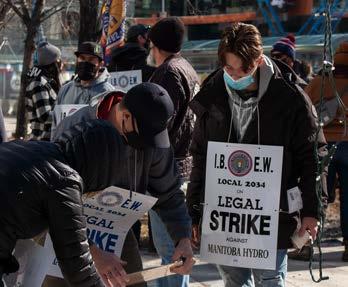
At a March 15 rally outside Manitoba Hydro Place, NDP leader Wab Kinew stated the NDP’s intention to delay the Progressive Conservative government’s Bill 35, the Public Utilities Ratepayer Protection and Regulatory Reform Act.
The bill is under scrutiny due to its perceived weakening of the Public Utility Board’s control over electricity and gas rates.
photos / Alexander Decebal-Cuza / staff
TOB AN the MANI
Interior design studio using 3D visualization tech
Real-time evaluation fosters connection during remote learning
RESEARCH & TECHNOLOGY
Kunal Rajpal, staff
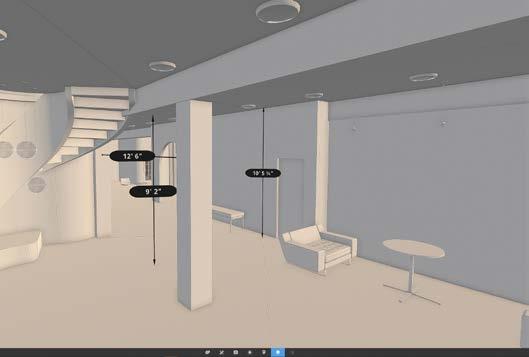
Due to constraints introduced by COVID-19, remote learning has provided both students and professors with exciting and novel challenges. It allowed some innovation in the faculty of architecture’s department of interior design, which has introduced a new technology to supplement current class structures: an augmented reality framework where students’ digital models are converted into “virtual interior environments.”
Jason Shields, assistant professor of interior design and the studio head, described the program as a tool “to analyze 3D space without being able to enter 3D space with each other.”
The project is being developed with the help of the faculty of architecture’s fabrication lab FABLab, the VRLab (a joint venture between the faculty of architecture and Price faculty of engineering) and the Student Innovation and Enrichment Fund (SIEF).
“When students begin to ideate and create buildings, we no longer just do it in a two-dimensional drawing, like the typical drafting that you would see for architectural drawings of the past,” Shields said.
“What we do is we create a fully almost immersive model, in a sense. So, there’s software which you use to create and produce the drawings and the 3D model, but that’s usually somewhat static in a sense — it’s used to kind of produce the drawings so that you can get the building built.
“It’s not as much used for exploration and examination.”
Shields explained students already had to make 3D models for their classes prior to the pandemic, but reviewing them was more difficult due to remote learning.
“We have now moved into this digital framework now for a year, in a sense, where we are no longer able to go over to the student’s computer and help them,” he said.
Pandemic constraints prevented Shields and his students from using the VRLab, since it would require sharing public devices. Instead, Shields was able to figure out a distance-friendly approach that could
run on devices students are more likely to have, like tablets and laptops.
“It’s almost like jumping into a video game,” Shields said.
“You are that first-person view, and you have control over […] the avatar, and you can walk and traverse all throughout the model. Additionally, you can chat and talk to other people who are in the model.”
This focus on accessibility allowed students who aren’t able to visit the university or who have vertigo issues with VR to engage with the studio. It also means Shields can invite visitors.
“If I was wanting to, say, have some students come into the model, and I wanted some professionals to also assist and be able to look at what the student’s work is, collaborate with other fields, all I simply do is I send them a URL, and they’re able to download some software and just jump right into that model,” Shields said.
He went on to discuss the benefits this technology has for teaching theory in the classroom.
“Imagine it as we all take a field trip to whatever we’re building, and we are all inside the building pointing
things out and talking about it, rather than postulating and theorizing about what it could look like,” Shields said.
“The term I often say is, ‘Don’t tell me how it works, show me how it works,’ and I think this really allows you to be able to see where the connections, architecturally, are occurring.”
Further, Shields talked about how this approach can be used for architecture in the future.
“I think this now allows for even better cross-collaboration and discussion,” he said.
“Now, if the person who’s constructing the building or contractors want to see exactly what it is, the engineer or the architect can begin to invite them into the model. They can have the discussion right in the model — they don’t have to drive halfway across the city [or] things of that nature.”
However, Shields said internet equity is a concern.
“If you’re connecting to Zoom all day, and you’re connecting the 3D models and such, it may have an effect if your internet is not strong or if you have data caps,” he said.
“We have to look to solutions. There’s
kind of an inequitable approach to that, where if everyone’s in the same space at one time in person, we don’t have to worry about their connection falling out because they’re in person with you […] We have these technological hurdles that we have to encounter now and often, because class times are quite short, we don’t have much turnaround time if there are any issues.”
Still, every piece of technology comes with drawbacks, and on the whole Shields is very pleased with what his studio has been able to accomplish with the format.
“I see it as a really great tool for analysis, for evaluation and especially for individuals that have issues with accessibility,” Shields said.
“I think by creating this digital 3D framework, it allows for many different people, from many different fields, from many different locations, to be able to engage in it.”
research@themanitoban.com
image / Jason Shields / provided
UWSA releases plans for reform
Recommendations to start being implemented for upcoming elections
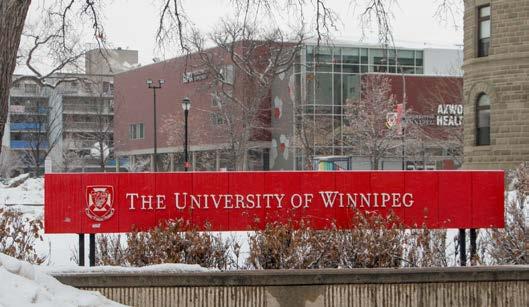
Following a controversial season, the UWSA is set to begin elections this month, but this time the association will see new rules in place, both during the elections and afterward.
The reforms come from recommendations by an external report conducted this past summer and released earlier this month, after former executives shared their experiences of racism and harassment while campaigning, and allegations of racism and discrimination were made against the winning executive slate, who resigned earlier last semester citing a “continued perpetuation of pervasive racism and prejudice within the UWSA.”
After the report, the UWSA aims to solve issues surrounding support of students and executives regardless of ideological views and address the allegations of discrimination within the association.
The first recommendation concerns election processes and suggests that the association establish UWSA’s values and instate a “mini campaign school” for candidates to “learn how to run a political campaign that does not cause harm,” and reform the chief electoral commissioner
(CEC) position’s responsibilities and strengthen the complaints systems both during campaign season and within the workplace.
Regarding governance and organizational stability, the report recommends that the association staggers terms for board members to “ensure continuity of knowledge” around
Launch
key functions of the UWSA, which has been implemented, along with the CEC reforms, introduction of new positions, removal of slates and processes to further prepare and encourage candidates to allow for the goals of the report to be achieved.
The association declined request for an interview.
path to success MASTER OF TAXATION
Become a highly-valued member of the Canadian tax community. Join Canada’s most comprehensive English-speaking program for the development of tax professionals. O ered through the University of Waterloo at our downtown Toronto classrooms.
photo / Basel Abdelaziz / staff
NEWS Gillian Brown, staff
TOB AN the MANI
Sports activism should be encouraged, not silenced
Athletes
are more than the sports they play, let them speak
EDITORIAL
An athlete has a powerful voice, and they must use it as a platform for real world problems.
Recently, Zlatan Ibrahimović — a forward for the soccer team AC Milan — revived an old debate about famous sports players and their role in social issues. In an interview with the Swedish sports news channel discovery + sport, Ibrahimović told basketball player LeBron James that he was a state-of-the-art-athlete but that he should stick to sports and leave politics to politicians.
This comment was reminiscent of Fox News commentator Laura Ingraham’s famous take on athletes’ role in activism just three years ago. In February 2018, Ingraham spoke out about LeBron James’s comments condemning the former president of the United States, Donald Trump.
“It’s always unwise to seek political advice from someone who gets paid $100 million a year to bounce a ball,” Ingraham said. “Keep the political comments to yourselves […] Shut up and dribble.”
In a press conference discussing the comments that Ingraham made, James stood up for himself.
“We will definitely not shut up and dribble […] I mean too much to society, too much to the youth, too much to so many kids who feel like they don’t have a way out,” said James.
James has over 80 million Instagram followers and he should be allowed to say what is on his mind and what he thinks is wrong or right with the world.
Just because he dribbles a ball for a living does not mean his voice is meaningless. He is a voice for many who may not have the courage or resources to say what they want and be heard.
It isn’t as if James’s life experience amounts to just playing basketball. James has done many great things for his community, most notably the I Promise School that he founded in 2018. The school services over 1,300 disadvantaged public-school kids in Akron, Ohio. Ultimately, James’s school has changed the lives of many children and families who needed free quality education. Nobody should reduce their role in society to just dribbling a ball. James’s views are his to share.
Professional sports players are devalued in the real world and are only seen as people who make a lot of money playing sports for the entertainment of others. But athletes have the power to change lives. Using their voices is certainly a tool to do just this.
With social activity held to a minimum during COVID-19, sports have become an increasingly popular pastime in people’s lives. Audiences seeing
players speak about issues important to them is a great avenue for social change and acceptance. Ingraham and Ibrahimović have to open their eyes and see that everyone has a voice and a right to express it.
Colin Kaepernick — an athlete that played for the San Francisco 49ers — is one of the most memorable sports activists in recent history. His refusal stand for the national anthem in 2016 as a protest against the oppression of people of colour gave a voice for people who could not speak.
Kaepernick was awarded by Harvard University with the W.E.B. Du Bois medal — the highest honoured medal available in the department of African and African American studies — for
his bravery for combatting racial inequality and injustice. His dedication to the cause ultimately cost him his position in the National Football League. Due to the outrage from high numbers of conservative fans and team owners, many teams were unwilling to sign the quarterback. Kaepernick remains true to his cause to this day and his sacrifice elucidated that many athletes are more than the sport they play.
When asked if he or his protests could be seen as un-American, Kaepernick said, “I don’t understand what’s un-American about fighting for liberty and justice for everybody.”
James and Kaepernick are only a couple of examples of athletes who
have stood up and practiced what they preached.
A voice is a voice no matter who uses it, but athletes must use theirs to be positive examples for many young people who look up to them. Media must stop seeing athletes as empty vessels for our amusement, it is silencing crucial voices that must be heard.
Though useful at preventing the spread of disease, borders remain a violent construct
COMMENT Lucas Edmond, staff
It was clear that COVID-19 would become a health crisis when anarchist thinkers from around the world were pleading for populations to follow centralized state authorities. The pandemic has proven that borders are crucial for reducing the global spread of disease. However, as we imagine our world re-made by the novel coronavirus, activist groups must continue to advocate for the abolition of borders and the violent dynamics these arbitrary lines precipitate.
Nationhood is an imagined idea as fictitious as any other constructed social system. Yet, every corner of the globe has been divided into parcels of land to be exploited, usually at the benefit of a small minority.
These imagined communities rarely embody shared values. Considering the population of most nations combined with geographic breadth, it would be foolish to assume everyone shares a belief system based on dotted lines on a map. What does it mean to be Canadian? Personally, I don’t have an answer. The truth is: borders have been constructed to serve the interests of power and power alone. It is a mechanism to guard wealth inequality.
Intuitively, this all makes sense. Individuals with large chunks of accumulated wealth move with relative ease, but those residing in nations that have been subject to traumas by no fault of their own remain forced to stay in their dire circumstances.
Scholars often refer to the contemporary world as “globalizing” — the notion that the world is becoming increasingly connected through transportation, technology and trade. But what pieces of our world are actually globalizing? It is true, time and space are shrinking with increasingly fast transportation. Even our social lives have been dislocated from space and our relationships are accessible through the tap of a button on our smartphones. Yet, the primary things moving around the world remain commodities and wealth. As a matter of fact, pre-COVID, people were being restricted from moving across borders at stricter rates than any time in history. Passports were once seen as largely symbolic tools before the onset of the Second World War. Now they are wielded by many with national pride.
If we truly believed the things that we tell our children, it would be safe to assume most of us would be anarchists in favour of border abolition. If you’ve ever heard the phrases “It doesn’t matter who started it,” “Two wrongs don’t make a right,” “Do unto others…” or “Don’t be mean to people just because they’re different” growing up, then you were unwittingly raised with anarchist sentiments. But these important lessons usually get
distorted by blatantly incorrect fallacies that feed anti-immigration and contradict the lessons we were taught when we still held onto a degree of innocence.
Fallacies pertaining to terrorism, crime rates, job availability and wage deflation are blatantly incorrect and are primarily fuelled by xenophobia.
For example, a study authored by Nicola Jones from the University of Warwick indicates that high migration rates do not correlate with terrorist activity. Rather, high migration rates may actually reduce terrorist acts. The Cato Institute — a conservative-libertarian think tank — controversially published a study in 2016 which took a great deal of statistics out of context and served as fuel for anti-immigration rhetoric in the U.S. It is unclear whether they attempted to publish damning immigration statistics or not, but in many cases some of the stats did the opposite. They asserted that from 1975 through 2015 the chance that an American would be killed in a terror attack by a refugee was roughly 1 in 3.64 billion a year. To put this into context, more people died from peanut allergies
than refugee-initiated terror attacks in the same period.
And key studies have been published to debunk other anti-immigration fallacies, too.
When your average globalist is asked what they advocate for, it usually doesn’t include the abolition of borders and states. Renowned anarchist anthropologist David Graeber refutes really-existing-globalization as contradictory in practice. However, he imagines a globalized world as the free movement of people.
“Anything else is just a sham,” he says in his seminal book Fragments of an Anarchist Anthropology
The free movement of people could serve to guard from things like labour exploitation. Circles of economists sitting in their ivory towers love to philosophize about which pseudo-scientific economic model would best alleviate poverty the fastest. To Graeber, the answer is quite simple: the immediate pardon of international and personal debt, the abolition of intellectual property and, of course, the abolition of borders.
Many may question how feasible these measures are. I ask, why do we think the piece of paper we call money is worth anything more than it is? Simply, it is because somebody powerful told us it was. The exact definition of fiat money — the type of money the world uses — is currency that is delimited by bureaucrats. Still, it is fairly uncommon for people to question how strange this unwarranted faith is. Our taboos are selective, and they usually materialize in the conservation of grotesque privilege.
If we can put our faith in systems of power that regularly exploit labour in the interests of the ultra-rich and perpetrate violence in the name of sovereignty, who is to say we cannot put our faith in everyday people? The world is what we see it as, and it could be radically improved if we used our imagination and stopped questioning the feasibility of sound and equitable policy that appears different to the status quo people are used to.
graphic / Jenelle McCann / staff
Master plan will finally bring transit system up to speed
Decaying transit system is in need of revenue, city council’s proposal will do just that
COMMENT
Grace Gyolai, staff
Winnipeg Transit has been developing the Winnipeg Transit Master Plan (WTMP) since December 2018. The goal of the development plan is to provide Winnipeg residents with reliable and adaptive transit that will meet the challenges of our growing city and provide better service.
The final plan of the WTMP released this month underwent consideration by the infrastructure renewal and public works committee on Thursday, March 11. Upon approval by city council, Winnipeg Transit plans to apply for a grant through the Investing in Canada Infrastructure Program for the Public Transit Infrastructure Stream.
This funding from the federal government is designed to help Canadian cities and provinces address their timeworn transit systems, along with other infrastructure, that have not developed at the same rate as the cities themselves. Winnipeg is no exception to this.
Winnipeg’s first version of public transportation began in 1882 with horse-drawn street cars. Since, public transportation in Winnipeg has survived many changes over the century, but has seen minimal progress over the last few decades.
The gradual changes that Winnipeggers have observed are not sufficient to meet current demands of the growing urban area.
Due in part to the poor usability and accessibility of the current transit system, data from 2019 showed that Winnipeg had the lowest ridership rates of any large Canadian city.
Our city only averaged 67 annual trips per person according to the National Climate League, an environmental non-profit organization. In comparison, Montreal, Que. — the city with the most public transit use — averaged 236 trips per person.
According to Statistics Canada, as of 2016 the percentage of commuters using public transportation was on the rise, indicating that there are flaws in Winnipeg’s transit system. In the last census, Winnipeg was the only city to see average commuter rates in public transit decline in the last 20 years.
These trends are concerning on a municipal level for many reasons — public transportation is a crucial part of any developing city and reflects on the ability of the government to meet the city’s needs.
Public transportation limits congestion — long, traffic-stuffed commutes force people to waste time sitting idly in their car. That alone likely amounts to billions of dollars lost in productivity each year in Canada.
Public transportation also has notable benefits in reducing carbon emissions. With the transportation
sector accounting for approximately a quarter of total emissions in Canada in 2018, decreasing the number of individual vehicles on the road can positively impact the environment by reducing greenhouse gases.
Transit is part of the democratic process as well. Public transportation allows the community to have a say in any new developments or directions the system takes — unlike private sector transportation like Uber or Lyft.
Because of the beneficial impact public transit has on neighbourhoods and cities at large, supporting our local service is a big way to engage positively with our society. Directly using transit is one way to show that support and is particularly important in Winnipeg. If more diverse communities utilize the public transit system, more revenues would be available to help reduce costs for vulnerable communities.
Winnipeg’s transit system relies heavily on bus fares for funding since the province unfortunately, but unsurprisingly, ended the evenly split funding with the city in 2017.
As a result of divestment, frequent transit service is out of convenient reach for most Winnipeggers. This
has created a positive feedback loop problem since the only way to increase ridership is to invest in the transit system, but without more riders the funds for the necessary improvements are hard to come by.
It is important for city council to support the WTMP. The project will receive some outside funding and is designed to provide more frequent and reliable service to a greater number of people. This will increase participation and, hopefully, revenue.
The WTMP has many subprojects. The proposed project most beneficial to community access is the Long-Term Network Plan which will allow 73 per cent of dwellings to be within an 800metre walk of frequent service.
If more people are able to use the public transportation system in Winnipeg it would not only result in increased funds, but it also helps ensure that citizens of different socioeconomic statuses are able to navigate the city.
Good public transit allows most areas to be connected and helps people in poorer areas find employment outside of their neighbourhood.
As a community we contribute to public schools, libraries, roads and
more by paying taxes that fund those crucial parts of the community. However, in Manitoba, public transportation is at risk of being left behind in that realm.
If city council can commit to the WTMP, it could finally grant Winnipeg a transit system that meets the city’s demands — a system that Winnipeggers can see as an integral piece of the community.
If we have service that can be used widely and with pride, it will not only connect the city in a new way, but hopefully introduce more citizens to the importance of a functional and reliable transit system.
TOB AN the MANI
WE Charity facing Parliament, public image challenges
The
charity’s problems go beyond its involvement in the
student grants scandal
COMMENT
Liam R. Forrester, staff
Craig and Marc Kielburger — cofounders of the scandal-ridden WE Charity — have finally agreed to testify before a House of Commons ethics committee. The Kielburger brothers’ decision comes after the ethics committee voted unanimously on March 8 to compel the brothers to testify on their charity’s involvement in the defunct 2020 student grants program and on allegations of donor fraud.
Guy Giorno — a lobbying lawyer for the WE Charity — stated that the brothers would testify with legal counsel. He said the brothers would avoid some questions, namely those that could become part of an RCMP or Canada Revenue Agency (CRA) investigation.
WE had declined on behalf of the Kielburger brothers in a March 3 statement. The charity alleged, since committee member and New Democratic Party member of Parliament Charlie Angus had requested that the RCMP and CRA investigate WE, they ought not be subject to an additional parliamentary investigation. The statement reads, “no organization should be subject to both an investigation of the same matters by a partisan Parliamentary Committee which wishes to carry out its own substitute investigation.”
“I’m very, very perplexed that they’re taking this strategy,” said Angus in an interview with the CBC. Angus is right to be confused — it is not a great look for the charity.
Should the brothers wish to escalate the situation further, the ethics committee can refer the matter to the House of Commons who can then issue an order to appear in court. Ignoring an order from the House of Commons would likely result in being found in contempt of the parliamentary order, an offense for which the Kielburger brothers could be imprisoned.
What did the charity allegedly do that warrants this level of legal trouble? Let’s start with the student grants scandal.
As part of a broader COVID-19 relief plan for post-secondary students, the WE Charity was tasked with administering the Canada student service grant (CSSG). The $912-million program aimed to give students struggling to find summer employment the opportunity to volunteer in national service activities as part of the pandemic response in exchange for grants. $43.53 million would be paid to the WE Charity as part of the CSSG agreement. Both Prime Minister Justin Trudeau and former finance minister Bill Morneau had family ties to WE and did not recuse themselves from discussions pertaining to the CSSG agreement. Essentially, both men had family members working closely with the WE Charity and did not disclose this as a potential conflict of interest. Trudeau apologized and Morneau stepped down. The CSSG was effectively abandoned.
This may not be WE’s fault, per se. Rather, it brings into question the integrity and competence of Trudeau, especially when the SNC-Lavalin scandal is still fresh in the country’s collective memory.
However, the committee is also reviewing allegations of donor fraud and this could be much more damning to the charity.
American television journalist, news anchor and former WE donor Reed Cowan told the ethics committee that the plaque on the Kenyan school he funded bore the name of a different donor. The plaque was meant to display the name of his son Wesley who passed away in 2006 following an accident. Reed alleges that WE senior staff told him repeatedly he was the sole fundraiser and that the school was “Wesley’s.” He later discovered photos and video of the plaque bearing another name and another group being celebrated for the project. After repeated and unsuccessful demands for a detailed accounting of where his money went, Reed believes the charity told two groups they had funded the same school.
In a letter to its donors, the WE Charity promised an investigation into Cowan’s allegations and stated that the plaque had since been restored. The letter goes on to explain that “When donors support programs such a farm animal or a schoolhouse, those funds are often pooled to help villages, as is common with other major international development
organizations.” “WE Charity seeks to put the needs of the communities we serve first. A village’s needs may shift, requiring a redeployment of committed funds or raising additional funds to support the village,” the charity explained in the letter.
But even the most charitable interpretation of WE’s practices doesn’t explain why the same building would be shown to multiple groups of donors or why the plaque was taken down to begin with.
There are a lot of questions one can raise about the ethical standards of the WE Charity. Former WE employees have alleged that the charity enables a hostile work environment where young people are guilted into accepting lower wages and longer hours with the logic that better pay would take resources away from children in more desperate conditions.
Beyond violating ethical working standards there’s the frankly baffling amount of property held by the company relative to other international development charities. WE Charity has physical real estate holdings totalling approximately $43 million. In contrast, World Vision Canada, which contributed $362 million in charitable work in 2018, holds property valued at roughly $18 million. WE spent only $19 million in that same period. The properties were meant to be sold to create an endowment fund to sustain its charitable work. However, no information on
prices, dates listed or a list of properties is available.
All the shadiness and big money dealing could have been excused if the charity’s model of international development was transparent and ethical. In an article from July 2020, the McLeod Group — an international development and foreign policy nonprofit — criticized WE for its ME to WE voluntourism trips where young Canadians travel to communities in poorer nations to participate in volunteer work. Voluntourism is widely seen by international development scholars as an exercise in poverty voyeurism and white saviourism.
The WE Villages program seems less flawed as it promotes a holistic approach to community development, but it too faces criticism for branding villages with the WE name — an almost deliberately colonial practice. Further, the program provides Band-Aid solutions to poverty and ignores the broader political and economic realities which these communities exist in.
This is all to say that charities require almost constant oversight and critical reflection if they are to stay ethically sound in the complex field of international development. No matter how bold the mission or how earnestly felt the desire to change the world is, a charity’s actions can never be beyond reproach.
graphic / Dallin Chicoine / staff
A new era of art exhibition
School of art finds protest, activism, whimsy, self-care in video game-based exhibit
PAWS: Protest, Activism, Whimsy and Self Care in Animal Crossing belongs to a burgeoning era in art exhibition. Curated by secondyear school of art student Ciel Noel, not only is PAWS completely digital, but actually takes place entirely within the video game Animal Crossing: New Horizons.
It has been almost a year since New Horizons was released for Nintendo Switch. Since then, the world has witnessed massive social and political movements, as well as the devastating impact of the COVID-19 pandemic. These events led many individuals to come together in this time of need, but left others burnt out and in need of escape — enter New Horizons’ timely release here.
Since its release in March 2020, the laidback nature of New Horizons has made players turn to this adorable, customizable game as a way to escape from the stressful realities of the real world, maintain connections during worldwide lockdowns and as a mode of self-expression. The gaming platform has also since become an unlikely site of activism and, now, art exhibition.
Battleax Bunny, PAWS’ island designer, said, “I think [Animal Crossing] opened up a lot of connections for people […] it created some accessibility despite the fact that we couldn’t go anywhere.”
Noel was researching online exhibition spaces through her work-study position with the School of Art Gallery, which led her to discover the game as a potential alternative. She
was particularly inspired to investigate Animal Crossing specifically as a platform for art and activism after witnessing the protests occurring in Hong Kong in 2019. When these protests were shut down by China’s government, protesters turned to games to continue protesting and made virtual installations about these topics.
Regarding why she chose to include self-care as a vital part of PAWS, Noel said, “I can never think about doing any sort of activism without thinking about self-care […] self-care for survival.”
“It’s kind of unfair to ask people of colour to only ever do work about activism or protest […] people need to be able to make art in joy and talk about their joy, and that will lend to a quality of life that we need, that we are actually […] also fighting for along with activism.”
Featuring work by Adelle Lin, Kayelynn Kennedy, Hailey “Hōkū” Kanoe Schurz and designed by Battleax Bunny, PAWS consists of an Animal Crossing island hosting multiple displays. As there are creative limitations on what can be done within the world of the game, artworks included mainly consist of clothing and object installations, both found and customized, as well as custom prints and posters, which make up the outdoor exhibition’s visual language.
The first letter in the PAWS acronym is “Protest,” which is showcased in both Lin’s works as well as their umbrella installation.
The umbrella installation, a work by Noel and designed by Battleax Bunny, is dedicated to Hong Kong’s Umbrella Movement and their most recent protests, displaying many umbrellas arranged on the ground as well as newspaper and custom prints.
Lin’s work is a memorial for the Black Lives Matter movement and consists of custom prints of some well-known victims of police brutality. Surrounded by flowers, candles and spaces to sit and contemplate, this thoughtful memorial echoes one that Lin had built in her own Animal Crossing world.
Another exhibit in PAWS carrying elements of both activism and selfcare are Schurz’s works, which reflect Schurz’s mixed Indigenous heritage. “Land Back Flag,” in particular, speaks to the artist’s support of the movement by the same name, which fights for Indigenous rights to the lands stolen from them among many other calls to action.
Schurz’s works consisted of custom posters, prints and clothing and their relationship to self-care actually lies in representation, because Schurz was able to make traditional clothing and face paint designs in alignment with their cultural heritage.
“Being able to customize the character in a way that represented them was part of the element of self-care,” Noel said.
Kennedy’s work in PAWS also speaks to self-care through clothing, and her portion of the exhibition displays Kennedy’s favourite outfit on clothing
stands and in a custom pattern print.
“I wanted to have artists speaking to the joy and self-care and fun that they get out of Animal Crossing,” Noel said. “When I spoke to [Kennedy] about self-care and Animal Crossing, she spoke a lot about the outfits […] especially […] during lockdown, the pandemic, when you’re not always having opportunities to dress up and go out, you’re not necessarily having energy or money or resources or whatever you need to dress up and go out, so she would change her outfit quite a bit and that would bring her a lot of joy.”
Additional programming for the exhibition includes PAWS Artists in Conversation, a panel discussion composed of the artists featured in the exhibition and moderated by Noel, as well as the PAWS Curatorial Tour and Pattern Jam Workshop, in which Noel discusses the process of creating the exhibit as well as how Animal Crossing players can create custom patterns to decorate their own islands. Both talks will be uploaded to the School of Art Gallery’s YouTube channel.
You can catch PAWS: Protest, Activism, Whimsy and Self Care in Animal Crossing until May 7, viewable through the exhibition’s Dream Address on Animal Crossing: New Horizons or by watching the gallery tour, both of which are available on the school of art website.
ARTS & CULTURE
Zoë LeBrun, staff
TOB AN the MANI
Finding solutions through illusions
The Mariachi Ghost’s Tim Friesen on his new music collective
ARTS & CULTURE
Kaelen Bell, staff
A web search of the word “trinsicate” uncovers more questions than it does answers — it might be an old English word meaning to ooze or converge, it might be a shortening of “extrinsication,” the act of externalizing, or it might mean nothing at all. What is clear is its onomatopoeic pull, the way it conjures images of complexity, knottiness, intricacy and complication. It is this imagined meaning that makes most sense when considering Tim Friesen’s Trinsicate project — dense, referential art-pop that twists and contorts decades of popular music into neon-coloured splatter.
The brainchild of Mariachi Ghost member Friesen, with arrangement and production work from Craig Boychuk, Trinsicate’s story began way back in 2016. However, it would be four years before the first record, 2020’s bombastic Solutions, saw the light of day.
“We had kind of made an agreement, Craig and myself, that we would only release it after we were both happy, and there were some technical difficulties that we had,” Friesen said. “I guess we were looking for a certain sonic texture that would kind of be a little bit different than what we had worked on together.”
Years of tweaking and not-quitegetting-it, combined with Boychuk’s move to British Columbia, made for a constantly mutating collection of music — Friesen said there are hundreds of versions of the record, a sound map of the last five years.
“It was quite a process and journey, and we went through a lot of personal and life changes, both Craig and myself,” he said. “It kind of became a soundtrack for that era in our lives.”
What Friesen didn’t know was that starting work on his second Trinsicate record would be what finally closed the chapter on the first — this year’s Illusions is the polar opposite of the tricky soundscapes of Solutions, a quiet companion piece that trades all the bombast for glittering piano and open space.
“It’s definitely a more minimal approach, and I think just [being in] that kind of relaxed vein, it helped us to finish the first project,” he said. “We were able to kind of hear it differently. I’ve kind of jokingly said that we found our solutions through Illusions.”
The long, complicated journey to both Solutions and Illusions wasn’t necessarily surprising to the collaboration-driven Friesen, who said the total freedom of creating solo
’Toban turntable
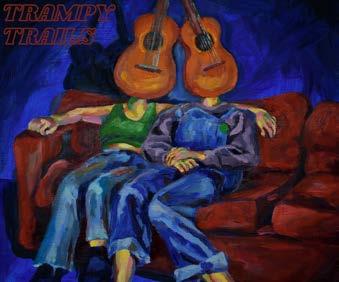
Trampy Trails — ‘I Lie Awake’
ARTS & CULTURE
Kaelen Bell, staff
4/5 stars
Beneath These Trees, the debut EP from Thomas Steur’s Trampy Trails project, was an exercise in simplicity. Whether by choice or necessity, the then-17-year-old’s first offering communicated a lot with very little — quiet social critique, forlorn love songs, odes to his hometown and small, pointed vignettes all set to simple acoustic guitar and Steur’s measured, youthful voice. The writing was strong enough to hold its own, but some tracks felt held back by a lack of experience and resources. Now, two years and a whole lot of life later, he brings us I Lie Awake, a debut fulllength and Steur’s strongest collection of material yet.
I Lie Awake is bigger, cleaner and more self-possessed than its predecessor and, like most sudden leaps in confidence and size, there are some growing pains. Steur wrote, performed, produced and mixed the record entirely alone in his small bedroom studio. While the results are largely exceptional, there’s an
awkwardness to some of his arrangements — a teen learning to fill a suddenly larger frame. Steur taught himself to play and record drums for the purpose of making I Lie Awake and, on songs like “Take Some Time,” “Loon” or “Hey Killer,” it’s clear that he’s still coming into his own as a percussionist and rhythm arranger. Patterns hiccup and fills stumble, but they’re small foibles on a record that otherwise sees Steur crafting the best work of his young career. That he attempted the drums at all is impressive; that the small slip-ups are largely overshadowed by the strength of his songwriting is even more so.
Steur possesses an enviable restraint, and I Lie Awake’s small flourishes — the lonesome trumpet on “Incongruous,” the silvery vocal harmonies that appear at the end of “Borrowing Purpose” and the understated solo that ambles across “Nuthatch” — are considered and just so, never overstaying their welcome. He has a clear reverence for the ’60s and ’70s folk canon. The chords that open “Take Some Time” are pure Joni Mitchell circa Court and Spark, and
images / Trinsicate / provided
work can sometimes overwhelm the process.
“When I’m writing music for myself, or for Trinsicate, I have more of like a blank canvas, where I hear a lot more possibilities of how the music could sound in the end,” he said. “Whereas when I’m collaborating with an artist, a lot of the canvas has started to be completed by other musicians.”
While the burden of choice nearly derailed them, their records seem better for it — two complex labours of love that bear their ambition and care proudly. They’re the kind of grand, spirited works that might be more difficult to conjure after a year of isolation and lockdown, when inspiration is hard to come by and malaise becomes the default setting.
“I think starting around November or December it really started to wear on me, and I haven’t been able to
write or record very much,” he said. However, as spring returns and an end seems to be dangling somewhere in the distance, the cogs have started turning again. “I got my first idea last week, that was the first song idea I had in maybe […] three months or so,” he said, laughing.
If Solutions and Illusions prove anything, it’s that one idea quickly becomes 10, becomes a thousand, becomes two entire records. Whatever Friesen comes up with next will likely be worth the wait — the canvas needs filling again.
arts@themanitoban.com
Steur’s songwriting has shades of Bob Dylan’s political bite and Neil Young’s working-class poetics.
While it sometimes feels like he’s still finding his voice divorced from these obvious reference points, there’s a clarity to Steur’s storytelling and melodies that can’t be aped. I Lie image /
Awake is an incredibly promising offering, and it feels like only a hint of where Steur will go.
AN the MANI
Bridging a gap through speech and performance
Crucial conversations sparked about the artist’s role in truth and reconciliation
ARTS & CULTURE
Shaylyn Maharaj- Poliah, staff
The Royal Manitoba Theatre Centre (RMTC) continues its pandemic programming with The Bridge: A Festival of Ideas. Originally conceived as an in-person event for the company’s 2020-21 season, the festival has moved online and will offer all of its programming free of charge.
The event, which will take place annually from here on out, invites audiences to explore deeply relevant topics and engage in conversations about the social issues impacting our world today. This year’s theme focuses on the role of art in furthering conversations about Canada’s colonial history and bringing respect and understanding of the oppressed cultures through reconciliation. Over the course of four days, the RMTC is offering panel discussions, play excerpts, conversations with prominent Indigenous figures in Canada as well as a livestreamed theatrical production. Programming will begin at 10 a.m. daily and continue throughout each day.
The Bridge: A Festival of Ideas was curated by Winnipegger Kim Wheeler, a writer and producer for CBC. On curating the event, Wheeler said in a statement, “as a journalist, my personal mandate has always been to bring positive Indigenous stories to the media and masses. Curating [The Bridge] has been the culmination of 28 years of covering the Indigenous arts community.”
The festival will include fireside
chats on all four days, hosted by Winnipeg’s own Rosanna Deerchild in conversation with playwright Tomson Highway, artist Kent Monkman, broadcaster and writer Jesse Wente and professors Heather Igloliorte and Julie Nagam.
Similarly, each day will feature a panel discussion on various subjects — such as playwriting, cultural dance, storytelling and Indigenous women in theatre — moderated by arts practitioners, authors and playwrights, including U of M alumnus Ian Ross.
The keynote speech on March 20 will be given by former senator Murray Sinclair, Manitoba’s first Indigenous judge and former chairman of the Truth and Reconciliation Commission, and his son, Niigaanwewidam “Niigaan” Sinclair, an associate professor at the U of M in the department of Native studies.
The livestreamed production is a performance of Isitwendam (An Understanding) by Meegwun Fairbrother. Through storytelling, song, ceremony and, uniquely, the use of Plains Indigenous Sign Language, this one-man show explores the relationship between father and son and deals with the themes of forgiveness and, of course, understanding. The play will be presented live from the Tom Hendry Warehouse Digital Studio on Sunday, March 21 at 2 p.m.
On all four festival days, participants can take part in the A Mile in Our Moccasins walking tour. Without even
leaving the house, Winnipeggers will have the chance to view Indigenous public art installations and murals around the city. Award-winning artist KC Adams and the Winnipeg Art Gallery’s curator of Indigenous and contemporary art Jaimie Isaac host the tour together.
By honouring Indigenous artists and providing a platform to amplify their voices, RMTC’s The Bridge: A Festival of Ideas serves to build community by promoting critical conversations while simultaneously recognizing and celebrating their contributions to the arts. This year’s theme serves as an opportunity for Manitobans to
open their minds and their hearts to new perspectives and truths and to take another step toward respect and equality for all.
The Bridge: A Festival of Ideas will take place virtually from March 18 to 21. For more information and a full festival schedule, please visit royalmtc. ca.
Watts commits to Bisons for 2021-22 season
putting in work to get a much more consistent shot,” Watts said.
After a successful 2019-20 men’s basketball season for the Bisons, its prospect pool has become even stronger with the announcement that Daren Watts has committed to the team for the 2021-22 season.
The Bisons finished 16-4 in 2019-20 but the 2020-21 season was cancelled due to the COVID-19 pandemic.
Watts is a talented 6-4 guard out of Miles Macdonell Collegiate who Bisons head coach Kirby Schepp spoke ecstatically about.
“We are very excited to have Daren commit to the Bisons,” Schepp said. “He was best scorer in Manitoba as a Grade 11 player last season and we feel he has developed his game even further in the past year.
“He has great size for his position and he can put the ball in the hoop in many different ways. He checks all of the boxes for us as a player, student
and person. He will be a key piece of our program for the next five years.”
When asked what made Watts decide to go play for his hometown province of Manitoba, he said he respected the program.
“The great success most of the guards and players in general have had coming out of this program, and being able to stick close to home,” Watts said.
In Watts’s own opinion, his ability to score in many different ways and his coachability are his two strongest assets that he can bring to the Bisons.
Although he is a strong player, there is always room for improvement at such a young age. When asked about what he needs to improve on as a player, Watts did not shy away from his imperfections.
“Main thing would be becoming a lot bigger and stronger, and also just
Although he wants to get stronger, COVID-19 has been hard on everybody with the closing of fitness facilities and gyms.
Watts said that COVID-19 restrictions “limited my ability to get in the gym a ton, both on the court and in the weight room, but as restrictions ease up hopefully I can get back to being on the court every day.”
There has been recent movement on this front, as the province has decided to open up the gyms and allow people to start working out again.
Overall, Watts is very excited and is ready to get started.
“I am excited for this opportunity to play for my home province with the [U of M] Bisons,” Watts said. “The program consistently produces highlevel players and is known for a familylike environment, making [U of M] the clear choice for me. The mentality of hard work and determination that my
arts@themanitoban.com
family and coaches have instilled in me over the years give me the confidence that I will excel in a program like this.”
This type of dedication and determination is something that should prove well for the Bisons when the ball is dropped for the 2021-22 season, hoping that the season will be allowed to play on as scheduled.
sports@themanitoban.com
photo / RMTC
(by Joe Bucci)/ provided
SPORTS Isaiah Wagner, staff
TOB AN the MANI
Contentious Stanley Cup champ hired to mind Huskies bench
SPORTS Matthew Merkel, staff
The University of Saskatchewan Huskies has hired Stanley Cup champion and two-time Olympic gold medallist Mike Babcock to man their bench for the next two seasons.
Babcock will serve on a “full-time volunteer basis.” Not only will he help lead the Huskies for the next two seasons, but he will also assist in the hiring of his successor once Babcock’s time in Saskatoon is finished.
Prior to the hiring of Babcock, the Huskies bench was manned for the last 28 years by Dave Adolph.
As the head coach of the Huskies, Adolph led the men’s hockey team to two national silver medals, four bronze medals, seven Canada West titles and a record 488 regular-season wins, making him the most-winning coach in Canadian university men’s hockey history.
Although Adolph will surely be missed, the Huskies are gaining another accomplished coach in Babcock.
Babcock spent a year with the Huskies in between two seasons in the Western Hockey League (WHL).
After his junior career, Babcock played four seasons at McGill University, where he served as a captain in his final two seasons. After his time at McGill, Babcock played one season of professional hockey for the Whitley Warriors, where he amassed a whopping 132 points in 36 games as a defenceman.
Babcock returned to North America the following year to coach Red Deer College of the Alberta Collegiate Athletic Conference. Babcock would then coach in the WHL for eight seasons, making a pit stop to coach at
the University of Lethbridge in 1993.
Babcock also coached Team Canada to a gold medal at the 1997 World Junior Championship.
Babcock’s first professional gig came when he was hired by the Anaheim Ducks to coach their American Hockey League affiliate, the Cincinnati Mighty Ducks in 2000, then as the head coach of the NHL club two seasons later.
He led the Ducks to the Stanley Cup final in 2003, where the team would lose to the New Jersey Devils. However, that summer, he won his first World Cup of hockey as head coach of Team Canada.
After the 2004-05 NHL lockout, Babcock joined the Detroit Red Wings, where he won the Stanley Cup in 2008.
Over the next 12 years, Babcock coached Team Canada to two Olympic gold medals in 2010 and 2014 and a second gold medal at the 2016 World Cup.
Babcock’s career as a head coach at the NHL level and track record with Team Canada is impressive, but his firing by the Toronto Maple Leafs in 2019 has led to his coaching methods being scrutinized.
After the firing of Calgary Flames head coach Bill Peters for past racist comments toward former player Akim Aliu and allegations of physical abuse by other former players, the conduct and methods of NHL coaches were put under the spotlight.
The older generation of coaches of the league often use harsh criticism in front of teammates, publicly embarrass players, play mind games and use very aggressive communication as a way of motivating players and
graphic / Dallin Chicoine / staff
establishing a “culture of toughness” or a “high standard of play” in the dressing room.
While this method has been used by coaches throughout hockey for years, many coaches and players have stated that these methods are counterproductive to a player’s skill, mental development and team chemistry. Still, a large majority of coaches in the NHL swear by these methods.
Babcock is known around the league as one of these coaches.
Although Babcock has had an extremely successful coaching career, and many players have vouched for him, claims have surfaced during the last two years with players speaking negatively of Babcock’s behaviour and coaching methods.
Former player Chris Chelios recalled Babcock “verbally assaulting” teammate Johan Franzen when they played for the Detroit Red Wings. A claim that Franzen has backed up.
“Some of the things [Babcock said to
Franzen] on the bench, I don’t know what he said to him behind closed doors one-on-one, but he blatantly verbally assaulted him during the game on the bench,” said Chelios to the Spittin’ Chiclets Podcast.
Nonetheless, one of the best coaches in modern NHL history will be walking into a University of Saskatchewan dressing room that has been dominant for nearly 30 years. The Huskies are already a contender for the University Cup.
It will be interesting to see how Babcock’s old-school tactics will work with the younger generation of players, and whether his methods will guide the Huskies to success or failure.