




Tino Dogo, VP community engagement
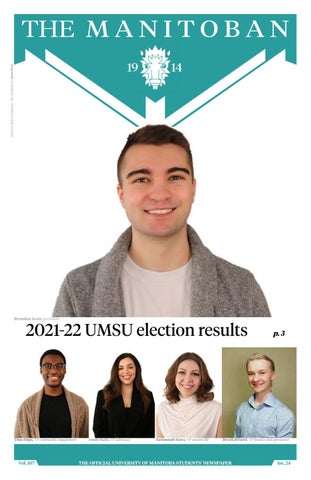
Brendan Scott, president
Emily Kalo, VP advocacy Savannah Szocs, VP student life Brook Rivard,

a member of the Canadian University Press, and our journalistic standards can be found online at toban.news/jsp
The newspaper’s primary mandate is to report fairly and objectively on issues and events of importance and interest to the students of the University of Manitoba, to provide an open forum for the free expression and exchange of opinions and ideas and to stimulate meaningful debate on issues that affect or would otherwise be of interest to the student body and/or society in general. The Manitoban serves as a training ground for students interested in any aspect of journalism.
Students and other interested parties are invited to contribute to any section of the newspaper. Please contact the appropriate editor for submission guidelines. The Manitoban reserves the right to edit all submissions and will not publish any material deemed by its editorial board to be discriminatory, racist, sexist, homophobic or trans-phobic, ableist or libellous. Opinions expressed in letters and articles are solely those of the authors. Editorials in the Manitoban are signed and represent the opinions of the writer(s), not necessarily those of the Manitoban staff, Editorial Board or the publisher.
A “volunteer staff” member is defined as a person who has had three volunteer articles, photographs or pieces of art of reasonable length and/or substance published in the current publishing year of the Manitoban. Any individual who qualifies must be voted in by a majority vote at a Manitoban editorial board meeting. Elected representatives and non-students may be excluded from holding votes as volunteer staff members in accordance with the Manitoban Constitution.
All contents are ©2021 and may not be reprinted without the express written permission of the Editor-in-Chief.
UMSU meeting / Skype / 6:30pm
UMGSA election campaign period begins
UMGSA election campaign period ends
UMGSA election voting period begins (9am)
UMGSA election voting period ends (5pm)
Closing date for Manitoban executive applications; toban.news/jobs
UMGSA meeting / Skype / 5:30pm
COPY DESK ? copy@themanitoban.com
Ursula Chojko-Bolec (ed.)
Aldin Sabic
NEWS DESK ? news@themanitoban.com
Gillian Brown (ed.)
Cam Cannon (ed.)
Damien Davis
Colton McKillop
RESEARCH & TECH DESK ? research@themanitoban.com
Sarah Doran (ed.)
Kunal Rajpal
COMMENT DESK ? comment@themanitoban.com
Lucas Edmond (ed.)
Liam Forrester
Grace Gyolai
ARTS & CULTURE DESK ? arts@themanitoban.com
Shaylyn Maharaj-Poliah (ed.)
Kaelen Bell
Zoë LeBrun
SPORTS DESK ? sports@themanitoban.com
Isaiah Wagner (ed.)
Matthew Merkel
PHOTO DESK ? photo@themanitoban.com
Alex Decebal-Cuza (ed.)
Basel Abdelaziz
DESIGN DESK ? design@themanitoban.com
Joshua Wesey (ed.)
Mikaela Warkentin
GRAPHICS DESK ? graphics@themanitoban.com
Jenelle McCann (ed.)
Dallin Chicoine
AUDIO DESK ? audio@themanitoban.com
Tino Hove (ed.)
Tawana Matizanadzo
VIDEO DESK ? video@themanitoban.com
Jesse Boily (ed.)
Arsalan Saeed
SOCIAL MEDIA DESK ? social@themanitoban.com
Colin Ijebor (ed.)
Jalene Moman
NEWS Cam Cannon, staff
Renew UMSU has won four out of five executive positions with one independent, Brook Rivard, winning the vice-president finance and operations position.
The 2021 UMSU executive is comprised of Brendan Scott as president, Tino Dogo as vice-president community engagement, Savannah Szocs as vice-president student life, Emily Kalo as vice-president advocacy and Brook Rivard as vice-president finance and operations.
In an emailed statement, Scott stated he is honoured to have been elected and wants to thank Renew UMSU’s campaign team, volunteers and supporters, writing “the love they showed was astounding.”
“I want to acknowledge my opponent [Judith Oviosun’s] hard work during this election, she ran an amazing campaign and I can’t wait to see what else she will accomplish with her time on campus,” the statement read.
The race for president was tight with Scott garnering 51.4 per cent of votes while Oviosun won 48.6 per cent.
In 2020, the race for president was less closely contested, with current UMSU president Jelynn Dela Cruz winning 59.7 per cent of the vote and her closest contender, Sia Yamba, winning 20.2 per cent.
“A new major priority is re-engaging this campus when we return to
in-person studies so that we can see high voter turnout like we did last year,” the statement continued. “It is no one’s fault but the pandemic that we saw this year’s election have few candidates and lower interest from students.”
Voter turnout for the election this year was 20.4 per cent, down from last year, representing 5,045 members out of 24,735 participating. Comparatively, turnout in 2020 was 27.7 per cent with 6,355 members out of a total 22,969 placing ballots.
“I am very proud of the hard work my team has put in, I am excited to serve all 24,000+ undergrad students to the best of my abilities and make our union the strongest it’s ever been for when we return to campus. Hopefully that will be this fall,” the statement concludes.
Brook Rivard, the UMSU vice-president finance and operations-elect, also issued a statement by email to the Manitoban
“I’m touched that so many in the student body got involved in the election and have placed their trust in me to represent them,” the statement read. “I’m excited to get started on the work ahead of me and to implement my policies.”
Rivard also offered his condolences to the unsuccessful candidates and stated that he hopes to have many opportunities to work with them in


the future.
“With the involvement that was seen this election cycle, I hope that students stay engaged in student governance through the year and will hold us accountable to their desires,” the statement ended.
For the community representative races, Tracy Ayebare Karuhogo was confirmed for the position of womyn’s representative.
Tolani Olanrewaju won the race for international students’ representative
International students will be vaccinated for COVID-19 on the same timeline as domestic students, according to a spokesperson for University of Manitoba.
“We don’t expect that the process for international students to receive the vaccine will be any different than for other students,” said Myrrhanda Novak, executive director of public affairs at the U of M. “Currently, if you look at the eligibility that the province has posted, it’s just based on age.”
According to Novak, the university has received informal assurances from the provincial government that international students will not have to wait for the vaccine due to their “international” status.
“We’ve asked the province to confirm that to us in writing so that we can share it with our international centre and post it, but they have confirmed [it] just in conversation,” Novak explained. Novak said she was told a Manitoba health card is not currently
required to get the vaccine.
The Public Health Agency of Canada has also stated residency status will not be a factor in COVID-19 vaccine rollout.
Federal and provincial vaccination plans are based on recommendations by the National Advisory Committee on Immunization (NACI), which has warned that, in general, immigrants can be at a higher risk for COVID-19.
These heightened levels of exposure to the virus are a result of factors such as international travel, occupation and language barriers.
To address this, the NACI recommends measures such as engaging with trusted community leaders in planning immunization efforts and creating culturally appropriate communication materials.
Canada has so far approved four different vaccines, including the recently greenlit Johnson & Johnson

single-dose vaccine and the others produced by Pfizer-BioNTech, Moderna and Oxford-AstraZeneca.
So far, the Moderna and Pfizer vaccines have been shown to be the most effective, with an effectiveness of roughly 94.1 and 95 per cent, respectively.
“At this time, we consider all available vaccines to be effective,” said Health Canada’s chief medical adviser Supriya Sharma at a recent press conference, stating that Canadians should get any of the available vaccines.
Provincial officials recently announced that all Manitobans could receive their first dose of the vaccine by mid-to-late May at the earliest, and the end of June if there are delays in shipments.
Previous estimates have predicted that those aged 18 to 29 would have to wait until at least the end of August.
The University of Manitoba Students’ Union (UMSU) is seeking changes to the UMSU Act, the provincial legislation regulating the student union, in order to correct discrepancies between the act and current UMSU bylaws.
UMSU hopes to amend sections in the act put in place in 2018 that require a referendum before joining external organizations, such as the Canadian Alliance of Student Associations (CASA).
The UMSU bylaws, in contrast, only require a simple board vote to join external organizations, as long as the group does not make every student a member automatically.
When the UMSU governance committee reviewed the discrepancies, it ruled that the bylaws were more in line with UMSU’s values and recommended that UMSU pursue an amendment to the act once again.
This discrepancy between the bylaws and the UMSU Act has existed since the latter was amended in 2018.
In 2018, the UMSU Act was amended — with some controversy, amid tensions between UMSU and the Canadian Federation of Students — to require the board to vote every two years on UMSU’s continued membership in external organizations, such as the federation.
That was only the second time the UMSU Act had been amended since it was written, the first amendment being passed in 1990 to make the act bilingual as part of a broad reform of provincial law.
In November 2020, UMSU voted against maintaining membership in the Canadian Federation of Students, signalling the beginning of a second attempt UMSU has made to leave the federation since 2018.
According to Kristin Smith, UMSU’s vice-president advocacy, the UMSU board failed “to reaffirm [UMSU’s] membership with the [federation], thereby mandating the executive to take the necessary steps to leave the [federation], which would need to include a referendum of the membership.”
“A referendum to leave has not taken place yet,” Smith said. “We put forth an emergency motion at [the federation’s] national AGM to allow online voting during COVID-19 to help us fulfil this mandate, but that motion was not considered emergency and was instead referred to the national executive to decide on months later.”
Tensions between UMSU and the federation go back years, with UMSU making attempts to leave the
federation since 2013.
In 2016, then-UMSU president Tanjit Nagra accused members of the federation’s executive of verbal harassment and demanded a public apology. That same year, another UMSU executive also claimed that the federation prevented him from speaking at a Day of Action rally.
UMSU has also criticized the federation for advocating on issues they say are less relevant to students, such as minimum wage or pipelines. In 2018 and again in 2019, UMSU denounced the federation for supporting the boycott, divestment and sanctions movement, arguing that it was “divisive” and “ill considered.”
“Many of the issues that the [federation] advocates on, while not student-focused, are still very worthwhile causes,” said Smith. “However, that doesn’t change the fact that advocating on those issues are out of scope for UMSU.”
“Any time spent organizing a demonstration or engaging with politicians on say, issues of international politics, is time not spent speaking with decision makers encouraging decisions that would impact students in their time at university, right now,” she continued.
“Additionally, when the [federation] ventures into particularly controversial non-student issues, it can alienate
subsets of the student population and pit students against one another.”
Other reasons Smith cited for attempting to leave the federation included a belief it is not as effective in lobbying as other organizations and is more expensive. According to Smith, membership in the federation costs approximately $300,000 per year while CASA — a competing external organization — costs approximately $56,000 per year.
The attempts to defederate in 2018 occurred despite assurances from then-UMSU president-elect Jakob Sanderson that defederating from the federation was not a motivation behind the changes.
Later that year, as president, Sanderson publicly advocated that UMSU leave the federation and join CASA instead, even though a non-binding plebiscite of UMSU members held in early 2018 showed a majority 64 per cent of UMSU members supported continued membership in the federation.
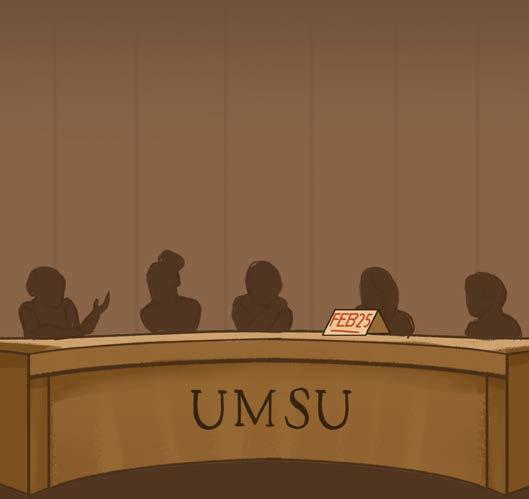
In the Feb. 25 UMSU board of directors meeting, Smith cautioned that leaving CFS could take up to two years.
“Attempting to leave the [federation], especially during COVID-19, will be incredibly challenging,” she said in an
interview with the Manitoban. “For instance, they require paper ballots and in-person voting.”
“Then, for the referendum to be legitimate in [the federation’s] eyes, a significant percentage of our membership will need to show up to vote in person, and they are asking for numbers narrowly attainable in election season with online voting.”
Prior to any referendum, those seeking to leave the federation must first hold a petition and collect the signatures of at least 15 per cent of the union’s membership.
At that same meeting, Smith gave a presentation in which she endorsed formally joining CASA as an alternative to the federation. She pointed out that UMSU’s two-year free observership — a “free trial” according to Smith — with CASA is set to expire this year.
At the meeting, Smith reminded the board that joining CASA by fall 2021 would require a referendum, as the UMSU Act is unlikely to be amended by that time and the 2018 amendments require a referendum to join any external organization.
Post-secondary institutions across the province are currently in talks with Manitoba’s department of advanced education, skills and immigration and Minister Wayne Ewasko regarding the province’s plans to implement the recommendations of the department’s document titled Manitoba’s Skills, Talent and Knowledge Strategy.
The strategy, released in early February, was created to “support efforts to create jobs in our new landscape” with the aim of recovering from the economic disruptions brought by the pandemic.
According to Ewasko, the strategy was also the result of research and engagement among post-secondary institutions along with businesses and immigration professionals, and according to the recommendations from recent post-secondary reviews and the Auditor General’s October report which revealed “weak” monitoring of post-secondary institution funds and suggested an improvement on oversight and accountability of publicly funded institutions.
The proposed funding model — which was first brought forward last fall — will work on a performance and outcomes basis following the Tennessee model, a model which allocates funds according to numbers of student credits along with graduations, degrees opposed to enrolment numbers.
In a statement to the Manitoban, Ewasko said the proposed funding model in the strategy will “strengthen outcomes for Manitoba students, enhance accountability in post-secondary education and align education and training with strategic priorities.” This way, the province is able to monitor government investments in those institutions to ensure they “lead to student success and remain focused on supporting economic growth.”
The Skills, Talent and Knowledge Strategy proposes the change to the financial system as one of the means to achieve four goals: anticipate skills needed for the job market in the future, align education and training to meet labour market needs, encourage entrepreneurship and innovation and grow and attract talent in the labour force to Manitoba.
The strategy, along with the new funding model, is being developed at the same time the province cut four percentage points more from the annual university budget than was initially planned, which went into a pandemic-related transitional support fund made available to institutions after receiving their plans to direct programs toward labour markets and ensure high-quality remote education through online materials and tools.

After submitting its application for the transitional support fund, the U of M, which was eligible for $17.23 million, received $14.5 million in December according to U of M spokesperson Myrrhanda Novak.
Also at the same time, students at the U of M have seen a tuition increase of an average of 3.75 per cent
U of M president Michael Benarroch reported that the university has been working to try to connect students to the job market in all faculties. Students are able to get hands-on introductions to the labour force through co-op programs, internships and learning through real-life experience in studios and with industry mentors.
Benarroch said that, though meeting the labour demands of the province is important, he believes that “the purpose of the university is to educate students,” and that, at the university, “we do more than just prepare for particular jobs.”
He also said the university receives significant funds for scholarships and bursaries through the government, which was used to launch a program to support students during the pandemic.
According to Benarroch, the university has a “mission of accessibility.”
Despite the movements to meet labour market demands, he hopes that “we […] continue to see our scholarships, or our bursaries at least, to be focused
on access to education.”
However, U of M economics professor Robert Chernomas believes that if the province moves forward with an outcomes-based funding model, the opposite will happen.
Chernomas is one of the many U of M academics who oppose the province’s pivot away from an education focus and toward a workforce focus.
“It’s providing less funding, raising tuition and, of course, raising tuition means less accessibility.”
Chernomas said that essentially, by implementing a performance-based funding model, “governments punish universities for maintaining academic standards.”
When funding is distributed according to performance, Chernomas explained that publicly funded universities will lower their standards in order to increase graduation numbers, or money will be “diverted away from the disadvantaged in order to make sure that they meet the standards of the government.”
Alenna Mark, a fifth-year U of W student, echoed that sentiment and said that “this is going to make post-secondary [education] much less accessible for people, which is really unfortunate.”
By working solely through a Manitoban lens, the Skills, Talent and Knowledge Strategy proposes funding
post-secondary programs according to a “very parochial, small-town model,” one similar to a republican American state like Tennessee.
Chernomas said he believes that the province will not achieve the goal of attracting talent to the province and growing its economy and that the model will “undermine the long-term economic prospects of our students and our businesses and our not-for-profits.”
Creating a situation where students going into the workforce come from universities with lowered standards or less funding, the outcomes-based model “works against everything the universities stand for,” he said. Further, students will be unable to compete with other universities in the world, which U of M students are able to do right now with a similar educational background.
“Our students will suffer for this.”
— with files from Colton McKillop
NEWS Cam Cannon, staff
Statistics Canada has released the quarter four data on the Canadian economy for 2020, giving an overall picture of how the country performed throughout 2020 — a year rocked by the COVID-19 pandemic and economic uncertainty.
The numbers show that although real gross domestic product (GDP) grew by 2.3 per cent in the fourth quarter of 2020, the year saw an overall decline of 5.4 per cent. The decline represents about $113.6 billion in lost economic activity throughout the year.
Real GDP is the most common measure of an economy’s performance, representing the total amount of goods and services produced and sold over a given period of time — it includes the value of everything produced for sale from fast food burgers to construction on skyscrapers.
However, GDP is not the be-all and end-all of economic measures, as it does not account for the value of non-market labour such as the care work usually done by family members in the home.
Further, the household saving rate — how much of disposable incomes are saved instead of spent — remained firmly in the double digits throughout most of 2020. The quarter-four saving rate was 12.7 per cent, up 10.7 percentage points from quarter four’s 2.0 per cent in 2019.
According to U of M head of economics Ian Hudson, while a shrinking GDP does indicate some level of economic turmoil and uncertainty, the quarter-by-quarter metrics show some responsiveness to the lockdown measures put in effect across the country.
With more stringent lockdowns, economic activity greatly decreased — driving down GDP — but it also recovered to an extent as the measures were lifted.
“What that drop [in real GDP] signifies, is simply the combined very, very negative impacts of both COVID as a disease and the […] measures governments have taken to try and prevent its spread,” Hudson explained.
“The good news […] is that this is a direct result of a very specific problem, which is COVID and the government’s lockdowns as a result of COVID.”
Hudson said the extent to which this economic hardship endures is linked to how much longer the COVID-19 pandemic remains an issue.
“This problem could potentially […] go away very quickly,” Hudson said.
“This is not a situation like the 2008 crisis where you’ve got people losing their houses […] it is not that kind of long-term problem.
graphic / Jenelle McCann / staff

“It is a problem that […] could be very short-term, depending on what happens.”
In 2008, the U.S. financial system broke down with disastrous effects for economies internationally in the following years, including Canada.
In that year, Canada posted GDP growth of 0.7 per cent followed by a 2.8 per cent shrinkage in 2009.
Low growth rates characterized the highly developed capitalist economies in the years that followed, leading American economist Robert Gordon to declare in 2016 that “U.S. economic growth is over.”
Generally, contraction of GDP — such as in a recession — is associated with increasing unemployment rates, which have also fluctuated over the last year. The unemployment rate for full time students aged 15 to 24 was estimated by Statistics Canada to have hit as high as 39.2 per cent in May 2020, early in the pandemic, and dropping to 25.8 per cent by August.
For Hudson, the job prospects for students — many of whom work in the service industry — this summer rely on how quickly the vaccine rollout happens and whether people decide to resume normal life, patronizing businesses as they normally would,
or if people generally take a more cautious approach and continue to stay home.
“Right now, it’s all about timing and the problem is that time’s running out,” he said. The “term ends [in] April, exams are over two weeks after that […] so we’ve really got two months […] to roll out a vaccine and open up the economy before students start looking for work.”
In a March 5 briefing, the co-lead of Manitoba’s vaccine implementation task force Johanu Botha stated that Manitobans can expect to be vaccinated as early as mid-May and as late as the end of June.
“What these GDP numbers tell you is that if we have to maintain the kind of lockdown over the summer that we’ve maintained over the winter and spring, it’s going to be terrible for students looking for jobs,” he said, adding that if the vaccine rollout goes smoothly and the economy opens back up, there is the potential for employment to pick up again.
Amid declining GDP, cause for optimism is to be found in the unusually high savings rates of Canadians throughout 2020, which historically have been “really, really low,” according to Hudson.
“What that tells me is that people […] actually do have money that preCOVID they were spending, but now they’re not,” said Hudson. “So, there is this pocket of money that could
then be spent if people were a little more confident about the economy and if they were allowed to go out and spend it on services.”
news@themanitoban.com
NEWS Damien Davis, staff
The Tallest Poppy, a local restaurant located in the West Broadway neighbourhood, received some online criticism last week when a police officer was paying for his food at the restaurant and noticed posters placed up by the restaurant in support of the abolishment of police.
According to a social media post, the officer in question allegedly argued with a staff member on the sentiment and individuals began criticizing the establishment on social media.
The posters were created by a community organization called Winnipeg Police Cause Harm (WPCH), which formed in the fall of 2019.
WPCH describes itself as “a community-centred police abolitionist group committed to defunding the Winnipeg Police Service and reallocating resources to life-sustaining services.”
Daniel Friesen, one of the organizers with WPCH, explained that the group works “to draw attention to the harms caused by the Winnipeg Police Service.”
The organization also tries to “bring awareness to what a world without police could look like, how policing is
not the best way to make communities safe and how there’s other options out there that create actual real community safety outside of the system that we currently have.”
Friesen said this incident with the Tallest Poppy was the first of its kind and that WPCH had its posters online and available for anyone to access for roughly one year.
“We were distributing them just ourselves before, but when we launched our website […] we put them up on there so anyone can download them and print and distribute them as they wish, but we’ve never had any kind of public backlash like this around them before,” Friesen said.
WPCH itself learned about the situation from being sent social media posts which were later photographed and added to WPCH’s social media.
“We thought it was something worth drawing attention to,” they added.
The Facebook post was written by Susan Desjardine who reposted the original story from the officer who noticed the posters onto her own Facebook page. The post sparked a number of comments, one comment suggesting placing orders with the restaurant and not picking them up.
Friesen said as far as backlash for WPCH itself, “of course with ideas like this that are new to some people […] of course there’s [going to] be some misunderstanding, and then some people will take that to a point of […] trolling online or things like that.”
Friesen added that while they have not received personal backlash, there are people who actively “try to troll [WPCH] online […] somewhat regularly.”
However, Friesen said the current situation with the Tallest Poppy “is a bit of an escalation into the physical world.”
The Tallest Poppy released a statement via Instagram March 7 expressing gratitude to everyone who had been ordering food in support or simply offering support in general over the past week. In terms of the Winnipeg Police Service, the restaurant staff said they feel that “there are more valuable ways the city could choose to spend its money.”
“We feel this misallocation of funds is causing harm in our community,” the statement read, echoing the posters featured in the restaurant.
“I think an important takeaway should be from this whole thing for people is that this is just a very small example of the type of targeted harassment that is built in to policing,” Friesen said.

Friesen continued to explain how this was an “unprovoked” response to someone simply noticing actions that police had committed and alleged that the posters featured in the Tallest Poppy contained factual statements about the police service and its finances, statistics about salaries and actions of the police.
“And so, when pointing that out, their reaction is to target and harass people and I think that’s just a very small example of what policing is in general.”
news@themanitoban.com
On Feb. 25, Winnipeg city council passed a motion for research into safe consumption sites. The motion allows for public service to research into the possibilities of creating a “low barrier, supervised drug consumption site” in the city, and passed with nine votes in favour and six against.
According to Shohan Illsley, executive director at the Manitoba Harm Reduction Network (MHRN), the Winnipeg community has been conferring about solutions regarding safe consumption for a few years, “and chatting about it increased as our overdose crisis increased here in Manitoba.”
Illsley, among those who presented to the council that day, explained that the discussion around what safe consumption could look like has been ongoing for almost five years.
Other provinces have opened up sites — Alberta, British Columbia, Ontario, Saskatchewan and Quebec — although some sites have temporarily closed.
During COVID-19, the MHRN has had
to switch to “pandemic mode” as far as advocacy is concerned, and Illsley said that since the pandemic began, the “drug poisoning crisis” has only increased.
According to government data by the federal public health infobase, between April and June 2020, 1,628 “apparent opioid toxicity deaths” have occurred. This is an increase of roughly 58 per cent from the previous period of January to March 2020, and the surveillance showed that “at least five provinces and territories have observed record-breaking numbers of deaths” in the period from April to June 2020.
Currently, Winnipeg has no safe consumption sites, and while some health centres in the city may provide harm reduction supplies, this does not provide an individual the safety and support a safe consumption site would.
“The outcome [without safe consumption sites] is that we’re having an increase in […] overdosing and […] an increase in drug poisoning and drug poisoning deaths,” Illsley said.
graphic / Jenelle McCann / staff

Illsley hopes that when the motion’s report is completed in 120 days, the city will have a report that achieves what the motion set out to do, and will examine what safe consumption services could look like in Manitoba.
She said she would also like to see in the report what funding and the kind of options there are, “because there is federal funding […] that we’re not accessing because the province isn’t pulling that funding down to bring it into Winnipeg.”
From that report, Illsley hopes that the city can start looking at what the next steps are in the direction of achieving
safe consumption sites for drug users in the city.
Within that, she said MHRN’s goal is seeing the decriminalization of drug use and possession, and further, a legalization and regulation of substances in order to eliminate drug poisoning, along with better access to harm reduction tools.
NEWS Kunal Rajpal, staff
A new book co-edited by Kjell Anderson, assistant law professor and director of the University of Manitoba’s master of human rights program, examines the methodology and pitfalls of conducting research on perpetrators of genocide.
Anderson, along with co-editor Erin Jessee of the University of Glasgow, will launch Researching Perpetrators of Genocide on March 11. The event will be hosted by the Perpetrator Studies Network with the co-operation of the Scottish Centre for War Studies and the U of M’s Centre for Human Rights Research.
“The book is about the perpetrators of mass atrocities,” Anderson said.
“Basically, it brings together people who have done this kind of research in different contexts [...] It’s basically about what are the methodological and ethical dilemmas that you face in doing that kind of research.”
The book aims to explore the unique challenges that researchers face when working with perpetrators of genocidal violence, as well as the prejudices that often accompany that research. A collection of case studies by academics from various disciplines provides insight into fieldwork from experts with firsthand experience.
“Our philosophy was really just to reflect on what we have done personally and to also learn from what other people do in similar situations,” Anderson said.
He explained that the book can benefit those who are already doing research on this topic as well as others interested in social science research in general.
“Maybe it’s an unusual case in some ways, doing research with perpetrators, but a lot of the same issues also arise in other kinds of research,” Anderson said.
Working with perpetrators of genocidal violence can raise a number of moral clashes, but the key is to minimize these clashes by using standard social science protocols.
“In a way, they are like other research subjects,” Anderson explained.
“You have to still protect them and

you have to treat them respectfully even if you might obviously disagree with what they’ve done. But that kind of bias eventually won’t produce good results — it won’t produce good research.”
However, complications come from more than just the researchers and subjects themselves.
“There are a lot of difficulties,” Anderson said.
“Some of them come from the sensitivity of the topic. Sometimes governments are reluctant for you to do this kind for research, or they try to interfere with your research, so that’s a challenge, navigating that.
“Of course, sometimes people also perceive the research negatively, in
the sense that they think that [in] understanding the perspective, you endorse that perspective, which of course isn’t the case. Like any social science, we’re trying to seek an understanding of how other people think.”
In fact, Anderson and Jessee had some trouble finding the geographical spread of authors they were aiming for and ended up having fewer contributors than they hoped.
“People are nervous both about the word ‘perpetrator’ and the word ‘genocide,’” Anderson said.
“These are two heavy words.”
Researching Perpetrators of Genocide is intended to fill a gap in the field, with little published discussion of how to achieve better research in the
field.
“We didn’t see a book like this out there, so we decided to make it ourselves,” Anderson said.
The book ends with a “code of best practice” for conducting research of this kind, which Anderson said is not meant to be definitive, but rather a guide toward improvement.
“Our hope is really that it just moves the conversation a bit further along,” he said.
news@themanitoban.com

Sarah Doran, staff
The University of Manitoba’s department of political studies hosted a colloquium March 5 discussing the COVID-19 pandemic’s effect on local, provincial and federal policy.
The colloquium, co-hosted by department outreach committee member Yuliia Ivaniuk and assistant professor Réal Carrière, was split into two parts.
The first hour consisted of an introduction from department head Andrea Rounce and keynotes from associate professor Andrea Charron, director of the university’s Centre for Defence and Security Studies, and Susan Prentice, the Duff Roblin professor of government from the department of sociology and criminology.
In her introduction, Rounce spoke about the ebook she co-edited with political studies associate professor Karine Levasseur titled COVID-19 in Manitoba: Public Policy Responses to the First Wave
The book, which came out in late November last year, features 27 chapters analyzing various government actions.
“We are still facing many of the same issues that we were facing in the first wave, and many of those issues have even more impact now that we’re nearly a year into the pandemic,” Rounce said.
“Government decision-making speeds up during a pandemic, but over the past year public servants and elected government have been planning for the future while also doing the daily business of government.”
Charron talked about the effect COVID-19 has had on the Canadian Armed Forces, particularly in regards to standard crisis planning before and after the pandemic hit. She emphasized that these plans are not intended to apply to the general civilian, and discussed some of the problems arising from questions of whether military operations at various levels are considered essential work by military, federal and general population standards.
Prentice spoke about childcare and women’s work during COVID-19, pointing out the precarious situation the industry was already in before the pandemic hit — demand wildly outstripped the amount of actual child-care spaces available, and even when families could secure a spot, they often spent over 20 per cent of their net income to pay for it.
With many child-care centres closing, women experiencing disproportionate job losses and general pandemic economic woes, Prentice said many are becoming more aware of the potential for policy change.
The second hour featured two student presentations from Delaney Coelho

and Holly Hunter, which focused on their perspectives from their own careers. Coelho spoke about her work as a human rights officer with the Manitoba Human Rights Commission and the need to create a more equitable approach to policy design and implementation, while Hunter, a K-12 educator and school trustee, discussed the pandemic’s effect on schools and the progression of government response.
Rounce, Charron and Prentice also spoke to the olpb in a separate interview about the pandemic’s impact on the daily realities of their lives as researchers and academics. All three agreed the experience reminded them why they enjoy working in the field.
“I find, actually, always keeping in mind the relevancy of my research makes for much better research because it forces you to double-check facts, to test hypotheses,” Charron said.
“If you’re just like, ‘Let’s assume the world is fabulous,’ you never get to actually test things […] By always being relevant and thinking there’s
a person at the other end of this who either has to live with this decision or make a decision or whatever, it makes me a better researcher, I find, because I have to live in this real world and own up to the recommendations I’m making as well.”
Rounce mentioned the unusually short time it took to produce COVID-19 in Manitoba — only six months from pitch to publication — and credited it to the team’s enthusiasm for the topic.
“It was a reflection of the commitment of the contributors,” Rounce said.
“People who took the time to write, really think about the issues and to engage in those issues in a really compressed timeframe did it because they were committed — because they thought it was really important to document what was happening and to tell part of the story of what was happening in the first round of [COVID-19].”
The book is free, meaning the university press does not make any profit. Even so, a variety of bodies around the university offered financial resources,
including the university libraries, the dean of arts and the department of political studies.
“It took a lot of different people to really see it as valuable, and then to put the resources behind it — the time, the energy behind it — to actually make it happen,” Rounce said.
Prentice, who is a noted activist in addition to her academic responsibilities, expressed a feeling of pride.
“I have to say, speaking personally, I feel like I’ve been getting ready for this moment my whole career,” she said.
“I feel so, so good that in a moment like this, when social care and questions of gender and work and family and children are suddenly surging on the public agenda, that I’ve got stuff to say.”
Many people have taken or been sent an intimate photo. A survey consisting of 2,000 people across America and Europe shows that roughly 40 per cent of men and 36 per cent of women aged 18 to 24 in America have admitted to sending a sexual photo. These figures are relatively similar in Europe. It appears that amongst younger generations, there is less stigma that follows sharing intimate images. With the Intimate Image Protection Act in place to protect people’s images from getting shared without consent, taking sexual photos is becoming more and more common.
In simple terms, anyone who publishes, shares or sells an intimate image without clear consent is guilty of violating the Intimate Image Protection Act. Individuals that violate these regulations are liable to imprisonment for up to five years or a summary conviction which includes financial fines and potential prison time.
Recently, a violation of the Intimate Image Protection Act went to court in Brandon, Man. Brittany Roque had a three-month affair with a Brandon police officer in 2015.
Two years later, the officer’s girlfriend — Terri-Lyn Peters — found approximately 100 intimate photos sent from multiple women, including Roque. When Peters found out that Roque was applying for a job as a constable with the Brandon Police Service, she sent the private images to the police service.
Peters claims it was done out of the public’s interest. However, she testified to not even knowing how her boyfriend had received those images. For all she knew, he could have stolen the images. The bottom line is that Peters broke the law by sharing these photos without Roque’s consent. The knowledge of a potential employer having intimate photos of you is humiliating and uncomfortable.
Upon receiving these photos, the Brandon Police Force removed Roque from consideration for the position of constable. Roque is a victim of “revenge porn,” yet she was punished. So, what exactly is the Intimate Image Protection Act protecting victims from if the very institutions meant to uphold this act neglects it?
As the act stands currently, victims can request to have the photos returned or destroyed, or they can sue the person who released the images. There is nothing to protect how peers will view these individuals afterwards and nothing to protect victims from being discriminated against in their careers. A lot of this is due to how society views people who partake in this activity.
There are a lot of unnecessary stigmas attached to intimate images, especially considering how common it is. Taking intimate photos of yourself

is not illegal, and it shouldn’t be anyone else’s business — let alone employers’. What is illegal is distributing these photos without consent. When intimate images are leaked, we shouldn’t be offended that they were ever taken. We should be offended that someone would share those images without permission.
Like many other issues, the general public is quick to question the victim. “Love doesn’t always last forever, but pictures do! This Valentine’s keep your privates private,” tweeted RCMP Manitoba in 2016.
Instead of warning people of the
potential risk they take when sending intimate images, we need to hold offenders accountable. The more we speak up about this issue, the easier it will be for future victims to come forward.
Like it or not, intimate images will be taken. More measures to protect people from unseen consequences are necessary. If someone sends an image to a significant other, the last thing they are thinking about is the possibility of revenge porn.
Speaking up about these issues can be horrifying, but power comes in numbers. Changing a stigma cannot
be achieved overnight, and there are simply too many victims to avoid the conversation any longer. If an institution that purportedly upholds the value of the law can disregard that law to the detriment of victims, then something is grotesquely wrong.


drug
heights, new ideas are needed to help reduce
Grace Gyolai, staff
As Manitoba inches closer to the one-year anniversary of the COVID-19 pandemic, it’s hard not to reflect on everything that disappeared or changed since last March. However, it would be negligent to ignore how the pandemic has produced inequality in various communities.
Many vulnerable populations have faced serious obstacles this past year. For example, some people suffering from substance use disorder have had a harder time receiving treatment and peer lead supports.
This decline in accessible service has had fatal consequences. Across Canada, record numbers of opiate-related deaths are being recorded.
According to the Winnipeg Fire Paramedic Service, its crews saw a sharp increase in the number of Naloxone doses — a medication that can reverse opioid poisoning — administered in 2020.
For that reason, the recent decision made by Winnipeg city council to explore all possible options in creating a supervised drug consumption site is crucial.
These sites allow people to consume substances in a clean environment, under medical supervision in case an opiate poisoning or other medial emergency occurs.
The city’s decision is not necessarily a surprise — 63 per cent of Manitobans support safe consumption sites and many provinces including Ontario, British Columbia, Saskatchewan, Alberta and Quebec have already opened them.
Yet despite the opioid crisis and the city’s attention and growing public support for the lifesaving measure, Premier Brian Pallister refuses to budge on his outdated view of this particular harm reduction technique.
The Pallister government’s reasons for rejecting the expert recommended sites include a lack of research — that was the excuse when a report commissioned by the Manitoba government itself omitted a recommendation for the supervised consumption sites in its final draft.
Pallister himself has said that he will not govern by public opinion on this matter and that his stance is based on existing research questioning the sites. What research he’s referring to remains unclear.
A majority of studies find that supervised consumption sites save lives, decrease unsafe usage behaviours and can be cost-effective — but it is true that Winnipeg is in need of its own research.
The underlying issue is that the provincial government is in the primary position to commission, conduct and
/ Dallin Chicoine / staff

fund such research. Now, the city of
to the issue as a means of filling the void left by the PCs’ refusal to address the problem.
If Pallister is concerned about whether the sites are needed in Winnipeg, he cannot simply ignore public opinion and claim a lack of research. It is his responsibility as leader of the province to gather the information required to make a calculated decision to benefit Manitobans.
Although it’s disappointing and dangerous that the Progressive Conservative leader will not consider the implementation of safe consumption sites, it is on-brand for the party at large.
According to a national poll released by the Angus Reid Institute — a Canadian think tank — last month, roughly 39 per cent of Progressive Conversative (PC) voters in Manitoba support safe consumption sites. In juxtaposition, approximately 85 per cent of New Democratic Party voters support this initiative.
It’s the nature of politics for leaders to uphold the view and values of their primary voter base, but in contrast, only 18 per cent of Manitobans believe the current government is doing a good job fighting addiction.
It is clear that a majority of Manitoban citizens are eager to implement new approaches to the treatment and overall harm reduction surrounding drug use. However, the government continues to cling to ineffective harm reduction strategies like education and criminal law.
A vast majority of community members with substance use disorder and their advocates want more public spaces where people can safely use drugs. Supervised consumption sites are one way to meet this criterion.
Scientific evidence suggests that patients must identify their own goals and create a personalized plan in order for treatment to be most effective.
Offering additional services including safe consumption sites widens the
options people who use drugs have at their disposal to improve their health and identify treatment goals.
If the provincial government continues to dismiss safe consumption sites it is not only ignoring expert and public opinion but also opposing a health-care option that could potentially save lives.
As Manitobans continue to battle the lasting effects of the COVID-19, it is reckless for the PCs to deny drug users access to safe consumption sites.
Manitoba deserves provincial leadership willing to take risks and place public health and scientific evidence at the forefront of their agenda, but unfortunately the municipal government may have to pick up the slack for the time being.
COMMENT
Lucas Edmond, staff
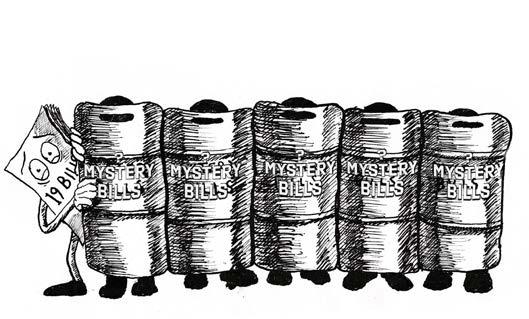
The province of Manitoba erupted in outrage following the undemocratic tabling of 19 “mystery bills” which critics are saying were presented without text and supressed public deliberation. Legislation regarding heath care, education and child care are expected to be included in the contents of the bills.
In a letter penned to the provincial government, members of parliament, members of the legislative assembly and University of Manitoba’s professor emeritus of political studies Paul Thomas expressed concerns about the government’s notable exit from legislative norms.
Additionally, Communities Not Cuts Manitoba — a grassroots anti-austerity organization — wrote a letter noting that the restriction of the bills’ content is “unprecedented, undemocratic, undermines the intent of our political system and sets a dangerous precedent for future governments.”
The provincial government is undeniably restricting democratic proceedings and straying from legislative norms. But whether its actions are setting a “precedent” or not may be worth digging deeper into. It seems as though the actions of the Progressive Conservative Party of Manitoba (PC) reflect neoliberal governments’ — governments focused on subjecting national markets to global trade and shrinking their role in the economy through cuts, privatization and deregulation — historic tendency to restrict democracy in times of economic crisis and push forth undesirable policy to the detriment of the working class. As Ian Bruff — a prominent critic of neoliberalism — would suggest, the PCs are resorting to “authoritarian neoliberalism” in a period when approval ratings for Brian Pallister’s leadership and agenda are historically low.
As Bruff notes, authoritarian neoliberalism is usually a symptom of economic crisis. In response to these crises, governments tend to become less democratically motivated and begin to implement legislative reform in the name of “economic necessity.” This “necessity” typically materializes in the form of austerity, bailouts and other policies that may serve the interest of private profit and property. In response, governments routinely receive disapproval for their agendas and communities become aggravated as social conflicts compound.
In turn, the government promoting the unpopular and fragile agenda resorts to more authoritarian measures to curtail social movements in order to protect its motivations. Crucially, Bruff notes that authoritarianism does not always take form in brute force, but also in attempt to sheathe unfavourable policy from dissent.
More concrete examples of
authoritarian neoliberalism have been historically exemplified by the forced removal of the Occupy movement from Zuccotti Park, New York in 2011.
In this case, physical force displayed the violent ends the state will take to protect big banks from criticism, regardless of how peaceful the protestors are.
Further, the Indignados anti-austerity movement in Spain — formally an extension of the same principles of the Occupy movement — protested Spain’s central government in its decision to undemocratically apply spending cuts and fiscal discipline post-financial crisis.
Although abstract, Bruff’s work hits the nail on the head. The dynamic he outlines is paralleled, in almost every sense, by the current crisis facing Manitobans. The government’s intentions have become unintentionally transparent amidst the economic crisis. What Manitobans are witnessing is but one example of a government that seems to have
constitutionalized austerity above all else, even democracy.
In December of 2020, polls from Angus Reid Institute — a non-profit research centre — suggested that nearly 70 per cent of Manitobans disapproved of the premier and his agenda. Pallister’s approval rating was the lowest in Canada at the time the poll had been released and has likely not improved since.
This development is significant considering Pallister has done an embarrassingly good job at deflecting responsibility and ignoring masses of people screeching for him to put his horrid policies to rest. Post-publishing of these polls which suggested a super-majority disapproval rate, instead of listening and learning from ideas suggested by local groups like Communities Not Cuts Manitoba, the premier chose to hide his legislation from dissidents in fear of adding to the pile of public criticism he had already accumulated.
In principle, suppressing the voices of disapproving Manitobans at best
represents the repression of local democracy, and at worst it is a worrisome expression of authoritarianism.
The bitter truth of the matter is that this government does not care about the livelihoods and well-being of its constituents as much as it cares about maintaining status quo politics and economics. If it did care, what exactly would it fear by making the contents of the “mystery bills” public? This is a blunt recognition of the fact that the PCs see their democratic legitimacy as teetering.
As constituents, it is Manitobans’ responsibility to resist and condemn these dangerous political acts. They are not only violent toward the health of the legislative process, but to the health of the community. Policy always precedes dispossession.
comment@themanitoban.com
Liam R. Forrester, staff
Facebook, without a doubt, creates problems in the world today, and it may take substantial regulation to fix them.
In Myanmar, Facebook was used by the military to facilitate the ethnic cleansing of the Rohingya through the co-ordinated use of sham accounts flooding Facebook with hate speech and disinformation. Facebook admitted its role in 2018 stating, “we weren’t doing enough to help prevent our platform from being used to foment division and incite offline violence.” The subsequent trial in the International Court of Justice saw Facebook attempt to block requests for disclosure of documents and communications that facilitated the genocide on the grounds that the request was too broad.
In 2019, a viral Facebook post from Ethiopian activist Jawar Mohammed, claiming he was about to be arrested, sparked racial tensions and a riot that killed 80 people in the Oromia region. The year 2020 saw further racially driven riots in Ethiopia after the assassination of singer Hachalu Hundessa — an Ethiopian singer, songwriter and activist — on June 29, 2020. The riots were largely exacerbated by the widespread sharing of hate speech and deliberate incitements of violence on Facebook.
To be clear, Facebook is not directly responsible for these crimes, rather its program was a useful tool for those who wished to spread hate speech and incite violence on a mass scale. Facebook’s inconsistent approach to content moderation has a large role to play in proliferating political tensions in the United States and Canada, as well.
Take for instance the banning of far-right conspiracist Alex Jones in 2019. Jones had also been relentlessly spreading hate speech against minority groups via Facebook. An act which warranted his ban and removal of support for Jones under Facebook’s Dangerous Individuals and Organizations policy. Following this incident, a former employee who dealt with the corporation’s policy explained that “Mark personally didn’t like the punishment, so he changed the rules.” The rule change permanently banned Jones from the platform but had no effect on praise and support for Jones, allowing his followers to continue to spread his hate speech and grow his following. The former employees that spoke to Buzzfeed allege that Zuckerberg’s decision led to delays in deplatforming far-right militants, some of whom participated in the Jan. 6 attack on the U.S. Capitol.
So, Facebook evidently needs some kind of regulation and international oversight to limit the spread of hate speech and violence. Unfortunately, the legislation being discussed does

not serve to protect human life; it aims to protect corporations.
The Australian government decided to regulate Facebook and other big tech companies. Its aim was not to combat the myriad problems of misinformation and bigotry that have dogged Facebook, but rather to mandate that the social media platform compensate news sites when Facebook users share news links. Facebook, presented with a choice of paying to platform content or not platforming that content at all, chose to wipe anything that could be considered news from their platform.
As a consequence of Facebook’s news ban, government information, non-profits and even the weather saw related links disappearing. Australian news site traffic dropped 13 per cent. The ban lasted from Feb. 18 to Feb. 26 and managed to acquire concessions from the Australian government.
In Australia’s case, the conflict was less about the government fighting to regulate big tech companies and more about the government intervening on the side of Australia’s own largely private news media. It was effectively Rupert Murdoch’s — a billionaire famous for his media empire — News Corp that played an effective role in lobbying the state to legally siphon money from their social media competitor.
It is a shameful display from all parties that ignores the larger problems with Facebook. Unfortunately, it looks like Canada may jump on board the political posturing.
Canadian heritage minister Steven Guilbeault was among the most vocal in decrying Facebook’s move. Shortly after the ban began, he stated that
Facebook imperiled public safety by banning government pages. He added that Canada would not be deterred in pursuing its own legislation to make social media pay for news.
Guilbeault mentioned a possible coalition on issues relating to Facebook which includes Australia, Finland, France and Germany in an effort to make the social network’s position “untenable.” Guilbeault also suggested future legislation may include the legally mandated blocking of “hurtful” comments. The choice of language from Guilbeault is so vague it may include anything from hate speech, to harassment, to anything that hurts a government official’s feelings.
If Canada does indeed adopt similar measures as Australia, who will benefit? If News Corp’s efforts are any indication, it seems like big Canadian media outlets would be the biggest beneficiaries. Postmedia and Torstar have blamed the tech industries monopolistic practices for the financial decline of local newspapers. Both companies have also been lobbying the Canadian government for bailouts worth millions. Additionally, each company has advocated for legislation resembling the Australian link tax.
The fact that Postmedia and Torstar seem so concerned about Facebook’s detrimental influence on local newspapers is laudable considering the Canadian authorities shut down a three-year criminal conspiracy investigation into Postmedia and Torstar in early February despite evidence indicating the papers planned to shut down local papers to carve out territory in a non-competition agreement.
After investigation documents were
made public Feb. 11, it was revealed that Postmedia and Torstar had closed a total of 35 papers the companies had exchanged in Nov. 2017. Effectively, the shutdowns ensured that only one paper was operating in a given market, dividing the province of Ontario into a set of regional monopolies.
If it is the case that large media corporations are going broke because of social media, should Canada bail them out with a link tax despite their past practices? What will happen to accurate journalism, a service that is so essential to a functional democracy, should these companies fail?
I think the answer lies in taking profit out of journalism. PressProgress — a Canadian non-profit news organization — has been doing award-winning coverage since 2013 funded by monthly donations averaging $10. American non-profit news company Democracy Now! has been doing similar work since 1996 and proudly touts its independence from advertisers and government agencies.
Quality non-profit journalism is feasible and sustainable without link taxes. However, there remains a risk of less ethical publications growing and continuing to produce the hate speech that so often leads to acts of violence. That is where governments must step up and hold social media companies to their stated policies and the country’s own existing laws on hate speech and violence.

LeBrun, staff
Currently on display at the Winnipeg Art Gallery (WAG) is Born in Power, an exhibition of photography and installations that speak to the identities and representations of Indigenous and Black people — particularly women and non-binary people.
Curated by Jaimie Isaac, curator of Indigenous and contemporary art at the WAG, Born in Power was meant to open back in November 2020, but the unveiling was postponed due to COVID-19. However, the exhibition was augmented this past February to include a variety of virtual programming, in partnership with Safe at Home Manitoba in honour of Black History Month, to give audiences opportunities to engage with the exhibition’s topics with other community members, and to make this exhibition more accessible throughout the pandemic.
Born in Power features artists Anique Jordan, Meryl McMaster, Ella Cooper, Kali Spitzer, Hagere Selam “Shimby” Zegeye-Gebrehiwot and Raven Davis, among others. These artists explore the power in self-representation through the mediums of film and
photography, which have historically been employed as weapons of colonial objectification and racial violence.
The artists reclaim the power that comes with being the director of these lenses, using it to discuss collective and intersectional histories and oppressions while simultaneously asserting their rights to occupy space and control the representations of their own bodies and identities in institutional spaces.
To visit Born in Power, patrons cut through Simply Splendour, an exhibition of decorative arts and drawings from the WAG’s collection. The shift in tone between this exhibition and Born in Power is striking. Simply Splendour’s colourful, Europeanfocused works juxtaposes Born in Power’s powerful, minimalist and highly contrasted imagery in a way that feels as if you are travelling forward through time and into contemporary reality.
Upon entering Born in Power, the space is filled with sound. This includes audio of the subjects from Spitzer’s work, “An Exploration of Resilience and Resistance Project,”
speaking about their own life experiences and identities, faint music from Davis’s video installation “It’s Not Your Fault,” and audio from Zegeye-Gebrehiwot’s video “Yaya/ ahat.” These sounds and voices create an all-consuming ambiance for the space and, for Spitzer’s work in particular, add another layer of realism and vulnerability to the photographs displayed.
Visually, the first set of works noticed upon entering Born in Power’s gallery space is Anique Jordan’s series “Darkie.” Circling through each of Jordan’s images repeatedly, I enjoyed the artist’s wonderful use of movement, texture and contrast to create these close and carefully composed self-portraits that challenge western and Eurocentric beauty standards.
Meryl McMaster’s “Ancestral” series is also a sight to see. In these photographs, the artist projects images of their own ancestors onto themselves, raising questions about finding one’s identity in relation to past generations. McMaster’s projection process wasn’t obvious at first, which made these ethereal self-portraits even more fascinating to look at, decode and realize the nature of their surreal energy.
Each step further into Born in Power is a step into the theme of identity and positionality within the context of our current sociopolitical realities, yet embedded in the colonial histories that have been presented to us our whole lives from the white, male anthropological point of view.
This results in a solemn, yet intimate act of self-determination and reclamation of representation and the medium of film photography itself. In the images Born in Power presents, we as an audience also find space to reflect on the images of Black and Indigenous people that we have seen throughout our lives, as well as our own positionality in relation to these ideas.
Born in Power is on display at the Winnipeg Art Gallery until the summer of 2021. For more information, please visit wag.ca.
Learn how to launch a successful career as a doctor of chiropractic at our virtual Discovery Day. Join us on March 20, 2021.
arts@themanitoban.com

Zoë LeBrun, staff
In honour of International Women’s Day on March 8, the annual celebration of women’s achievement, the Manitoban is highlighting one of Winnipeg’s most prominent artist-run centres, Mentoring Artists for Women’s Art (MAWA).
Founded in 1984, MAWA works from an intersectional feminist perspective. Its mandate is to “encourage and support the intellectual and creative development of women in the visual arts.” MAWA also recognizes the wide expanse of the gender spectrum and welcomes cis women, trans women and non-binary participants into all its programs.
Shawna Dempsey, one of the co-executive directors, said the organization works hard “to create opportunities across different sectors of identity.”
“Many of us are subject to more than one oppression, and the way in which those oppressions interlock and overlap are key to our own unique identities.”
“Until we’re all free, none of us are free.”
Dempsey first became involved with MAWA as an artist in 1990 and mentored before becoming a co-executive director in 2008. Since then, Dempsey has seen the organization flourish. With hundreds of current members and 27 different programs in operation, MAWA has something for everybody and has been key in creating many helpful services and
projects to benefit local and international artists alike.
At MAWA’s heart is its Foundation Mentorship Program. Active since the organization began, this program partners emerging artists with more established ones for a year to work on their practices by engaging in meetings and activities, culminating in a final exhibition by the mentees.
“Mentorship is core to everything that we do,” Dempsey said, “it can make such a big difference in people’s lives.”
MAWA also operates two main residency programs. The Rural Artist Urban Retreat offers rural women and non-binary artists free housing in the MAWA apartment for up to two weeks, and the Artist in Residence program allows women and non-binary artists from all over the world to work in Winnipeg for up to six months.
Regarding theory and criticism, MAWA offers a fantastic resource library and has even contributed to literature on art theory and history.
In 2017, MAWA co-published Desire Change: Contemporary Feminist Art in Canada, alongside McGill-Queen’s University Press, which is currently entering its second printing. MAWA initiated this project when some of its members realized the lack of contemporary resources on Canadian feminist art theory and history.
“There were specific books that would deal with Canadian feminist performance art […] but not visual arts in all media,” said Dempsey, “so [we]
ARTS & CULTURE
Kaelen Bell, staff
3.5/5 stars
Iskwē’s acākosīk was a big record — massive walls of guitar, surges of programmed beats and spirals of synth that blew her commanding songs of reclamation and healing into the stratosphere. The 2019 album was difficult to ignore, and it seems it was just as hard to shake; iskwē’s latest, The Stars, is a reimagining of acākosīk’s enormity, stripping away the corroded guitars and electronics in favour of piano and strings.
The record’s artwork lays out this new domain with obvious purpose, joining a lineage of iconic photographs of artists like Billie Holiday or Aretha Franklin — the singer approaches the mic with quiet intention, prepared to
unleash a whole universe from their mouth. And unleash she does. The Stars may be a reimagining, but it’s not exactly stripped down. There are fewer instruments and the electronics have been jettisoned, but The Stars is every bit as bombastic as its sister record, swelling and crashing in great waves of feeling.
It is moving for its sheer force alone, employing the same gut-punching bravado of a good soundtrack, the climactic build that puts a lump in your throat whether or not you care about what’s happening on screen. In terms of pure impact, it’s an effective approach to the source material. However, it sometimes feels like replacing one brand of overwhelming for another. The enormous “Night Danger” feels baggy when it should soar. It is when iskwē pares down
thought, ‘well, for future discussion groups at MAWA, we just need to create our own textbook.’”
Since then, the publishing of Desire Change has made history as “the first book about feminist art, in all media, ever published in Canada.”
MAWA continued to make waves in art education with its Resilience Project, a billboard exhibition featuring works by Indigenous women nationwide. Dempsey mentioned that MAWA followed this up with creating “a kit for art educators about how to use Indigenous women’s art in the classroom to talk about Indigenous history [and] Indigenous perspectives.”
Considering the COVID-19 pandemic, business at MAWA has changed slightly, but it is still going strong.
“Almost all of our programs are online at this point,” Dempsey said, “but, interestingly, we have been able to offer more programs this year than ever before […] it’s been great in terms of engaging beyond Winnipeg’s borders.”
Regarding the importance of organizations like MAWA, she said, “I think the great thing about artist-run centres across Canada is that they’re run by artists, and who better to know what artists need than artists?”
Artists or curious individuals can get involved with MAWA simply by attending its programs, many of which are free and run on a drop-in basis with all-welcome policies.
“There really is something for everybody [in our] programs,” Dempsey

said.
“We’re also kind of small and scrappy, and we just keep doing our thing,” she said. “I continue to be inspired by the MAWA community, by my co-workers and by the programming MAWA provides.”
“I’m always learning on so many levels thanks to MAWA.”
For information about MAWA and its upcoming programming, please visit mawa.ca.
arts@themanitoban.com
the original recordings further that The Stars takes flight — the clean, string-led reimagining of ballad “Sweet Tuesday,” the solo rendition of previously communal “Interlude,” or the nearly art-punk saw of “Breaking Down” are far more successful, bringing a different sort of energy to these heart-pounding songs.
The record closes on the previously-Tanya-Tagaq-featuring “The Unforgotten,” which also avoids the overwhelming renovation that swamps “Night Danger.” It’s one of iskwē’s most affecting songs — still strong even without Tagaq’s magnetic presence — and it demonstrates the clarity that comes from letting these songs breathe. While it’s not uncommon for artists to re-record works in this way, it is perhaps more surprising when the artist is as committed to maximalism as iskwē. This also explains why some of these tracks could use further paring — they

may have benefitted from shifting the emotional landscape even more significantly. Still, it was a worthy experiment, and the majority of The Stars matches or even exceeds the impact of acākosīk — sometimes less really is more.
& CULTURE
Kaelen Bell, staff
Being perceived is hell. The feeling that you are standing wrong in a crowd, that your voice is weird, that your clothes and skin and thoughts and gender are bad — the nightmare of perception has been written into oblivion, one of the few truly inescapable forces that tie us all together. The eye of another is a complicated place to live, and answers on how to navigate it are few and far between; some look to books and lectures, some to therapy and some choose not to look at all. Many, however, including the members of Winnipeg’s Virgo Rising, look to the stars.
“The rising sign represents how you’re perceived and how you engage with other people, which is something that really influences our music,” said 20-year-old Jenna Wittmann, who, along with fellow multi-instrumentalist sister Lauren and guitarist and vocalist Emily Sinclair, is gearing up for the release of debut EP Sixteenth Sapphire, a spidery collection of songs that tackles the ways we engage with visions of ourselves and others.
“Having Virgo in our charts is something we all have in common — I have a Virgo rising and Lauren and Emily are both Virgo suns,” Wittmann said. While the trio’s music isn’t about astrology in any obvious way, they play with intuition and connection that may well have cosmic origins.
The band members have a knack for subverting expectation, writing songs that morph and quicken at a moment’s notice — their playing is technical and expressive, a musical chemistry recalling the intense symbiosis of
bands like Big Thief or early Girlpool.
“I find it really interesting when I’m listening to a song and it ends up somewhere totally different, but it’s not really something we purposely try to do, it just seems to happen naturally,” said Wittmann. “It’s also really fun to play those kinds of songs live and feel the audience’s reaction.”
The trio describes recording at House of Wonders as nerve-wracking. “We weren’t super familiar with ‘studio etiquette’ and were nervous most of the time we were there,” said 23-yearold Lauren Wittmann, but it was exhilarating, too — a chance to elevate their rich, complex songs to their full potential.
“We had a strong sense of what we wanted going into the studio but we still did some experimenting and messing around,” said Jenna Wittmann. “[Producer Adam Fuhr] has a lot more gear and instruments at the studio than what we’re used to, so we were able to try lots of new things and find new sounds that really worked for us.”
Those new sounds include the psychedelic smear of “Sleep in Yr Jeans” and the swirl of atmosphere that closes “Molly Ringwald Dances in the Front Row.” The trio possesses an enviable restraint and understanding of tension, knowing just when to pull back and when to explode into technicolour.
As Lauren Wittmann describes it, that intense chemistry came naturally, the trio’s friendship blooming on

the strength of their shared musical language. “The first band practice we had we were all so shy,” she said, “but warmed up to each other pretty quick and found we had a lot of fun making special music together.”
For 19-year-old frontperson Emily Sinclair, the record is an ode to that rare symbiosis, a document of coming together. “My mom wore a sapphire ring that she eventually gave to me when I turned 16. I wrote a song about it a while back and I called it ‘Sixteenth Sapphire,’” she said. “We all weren’t crazy for the song, but for some reason the title of it stuck with us. We thought my sapphire represented not only our songs, but our friendship.
“Sapphire is also an incredibly durable stone, so it represents how strong our bond is.”
The band members said they are always writing new material and a full-length record is somewhere on the horizon. For now, though, the trio is basking in the strange light
Winnipeg Jets fans have experienced some whiplash from game to game since the start of March.
Starting March 1, the team began its two-game set with the Vancouver Canucks, losing 4-0 and winning 5-2. The Jets then went on to do the same against the Montreal Canadiens, winning 4-3 and then losing 7-1.
The big question is, why have the Jets played so well during moments of some games, yet so poorly during others?
First, during the Canucks series, the Jets played terrible in the first game going down 3-0 in the first period. It is very tough to come back from a threegoal deficit.
Transitioning over to the next game, the Jets came firing out of the gate scoring the first goal just over five
of Sixteenth Sapphire, a singular document of perception and youth and friendship. Whatever comes next will likely only be brighter.
“I’m just proud of our general creative power and ambition when it comes to making and playing music,” said Lauren Wittmann. “I think we’ve come a long way and are really finding our voice and our sound, and I’m proud of us for that.”
Virgo Rising’s debut EP, Sixteenth Sapphire, will be available March 12.
arts@themanitoban.com

SPORTS Matthew Merkel, staff
The 2021 Scotties Tournament of Hearts was an incredible success for Curling Canada. Kerri Einarson’s team out of Gimli, Man. won for the second year in a row.
A key part of the tournament’s success was that there were no cases of COVID-19 among any players or coaches. Thanks to the bubble system implemented by Curling Canada, everyone taking part in the event was able to come out of Calgary, Alta. healthy.
This system is the same system implemented by the National Hockey League (NHL) and the National Basketball Association during the 2020 playoffs last summer.
A city and arena are selected to host all teams partaking in the event. Players, coaches, trainers and team management are regularly tested for COVID-19. Fans are not permitted in the arena and players and coaches never interact with anyone outside of the game or league.
When implemented properly, sporting events are able to properly take place.
However, the use of the bubble system in Canada has primarily been used for big-money sporting events like the IIHF World Junior Championship and other professional events like the Scotties, the Brier and the NHL season.
League (WHL), the best junior league in western Canada, is using the bubble to have a 24-game hockey
sports season will be played between teams from different provinces in Western Canada.
If the WHL manages to maintain low to zero levels of COVID-19 across the league and players are able to play
That will only happen if the conditions are safe. The use of the bubble system could be a way to make that happen.
For example, Canada West could possibly implement bubbles in Saskatchewan, Alberta and British Columbia, with teams in close proximity taking part in each hub.

host bubbles for each division.
Amateur sports did not have the resources or knowledge to properly use the bubble system when the pandemic began in March 2020.
A year later, non-professional sports leagues are trying their hand at the bubble system. The Western Hockey
> Cont’d from p. 18
The next game, the Jets went out and beat the Canadiens 4-3 in overtime. Paul Stastny’s two goals propelled the team to win. Stastny has been a great addition to the team so far this season and this game proved it to the management and the fans.
Pierre-Luc Dubois ultimately played hero for the Jets as he sniped the overtime winner to give the team its second consecutive win.
After an impressive performance as a team, the Jets went on to lose the next game 7-1 against the Canadiens.
This game was all over the place for the team. The Jets started playing
In Regina, Sask. the East division will host the two Manitoba-based clubs, the Brandon Wheat Kings and the Winnipeg Ice. All games and practices will be played exclusively out of the Brandt Centre, home to the Regina Pats.
This will be the first time an amateur
very well in the opponent’s zone, but as soon as the team got scored on once, the goals just started to pour in.
Some highlights from these games were the play of Mason Appleton and Mathieu Perreault.
Although Appleton only put up one goal in the four games, he has played very well up to this point. He is tenacious on the puck and has a keen sense of where to be in the defensive zone, which allows him to be a great penalty killer.
Perreault had a great four-game stretch as he scored in the last three games for the team. This puts him at 11 points in 24 games for the Jets, which are great numbers for a fourthline player.
With the two entities garnering such a close relationship, the success of the WHL’s bubble system may be closely evaluated by U-Sports.
All 2020-21 U-Sports championships have been cancelled since COVID-19 has ravaged the country. With vaccinations across the country helping Canada transition into a post-pandemic era, U-Sports will be looking to get its athletes back into competition.
The Jets also had some bad players, which include Nathan Beaulieu and Tucker Poolman.
Beaulieu has earned one point in 24 games and has not played well. He was a minus four in the final game against the Canadiens and looked like a defensive liability every time he stepped on the ice.
Poolman played almost the exact same way. He had a few costly turnovers for the Jets and has earned zero points in 10 games for the team.
A very interesting four-game set for the Jets, but all in all the team still picked up four points in the overall standings and sit in second place in the Scotia North division.
Playoffs or tournaments could be played in a strict schedule, while regular-season games could take place under a condensed schedule.
In sports where physical contact with opponents is not necessary, social distancing would be easier to maintain.
Bubbles have already been implemented in collegiate sports in the United States. The National Collegiate Hockey Conference ran a bubble at the beginning of its hockey season. Fans were barred from the arena, games were successfully played and players were still able to focus on their studies.
Although sport budgets for NCAA division 1 schools are significantly larger than those of most Canadian universities, an indicator that a U-Sports bubble might be financially viable can be found in the case of the WHL. Most WHL franchises rely heavily on ticket sales. The goal for some franchises yearly is to break even. Junior hockey clubs are traditionally for the community and not necessarily a lucrative business venture. If WHL owners would be willing to take a financial loss to play a condensed schedule, then surely Canadian universities could find a way to let student athletes compete in a safe environment like a bubble next year.
sports@themanitoban.com
The one thing missing for the Jets is a top-four defenceman. A guy like Rasmus Ristolainen, Matt Dumba or Mattias Ekholm would be a perfect fit to a defence core that could use some work.
The Jets started its three-game road trip against the first-place Toronto Maple Leafs on March 9 and will look to gain some points in the standings with a few more wins under its belt.
sports@themanitoban.com