
and

a member of the Canadian University Press, and our journalistic standards can be found online at toban.news/jsp
The newspaper’s primary mandate is to report fairly and objectively on issues and events of importance and interest to the students of the University of Manitoba, to provide an open forum for the free expression and exchange of opinions and ideas and to stimulate meaningful debate on issues that affect or would otherwise be of interest to the student body and/or society in general. The Manitoban serves as a training ground for students interested in any aspect of journalism.
Students and other interested parties are invited to contribute to any section of the newspaper. Please contact the appropriate editor for submission guidelines. The Manitoban reserves the right to edit all submissions and will not publish any material deemed by its editorial board to be discriminatory, racist, sexist, homophobic or trans-phobic, ableist or libellous. Opinions expressed in letters and articles are solely those of the authors. Editorials in the Manitoban are signed and represent the opinions of the writer(s), not necessarily those of the Manitoban staff, Editorial Board or the publisher.
A “volunteer staff” member is defined as a person who has had three volunteer articles, photographs or pieces of art of reasonable length and/or substance published in the current publishing year of the Manitoban. Any individual who qualifies must be voted in by a majority vote at a Manitoban editorial board meeting. Elected representatives and non-students may be excluded from holding votes as volunteer staff members in accordance with the Manitoban Constitution.
All contents are ©2021 and may not be reprinted without the express written permission of the Editor-in-Chief.
UMSU meeting / Skype / 6:30pm
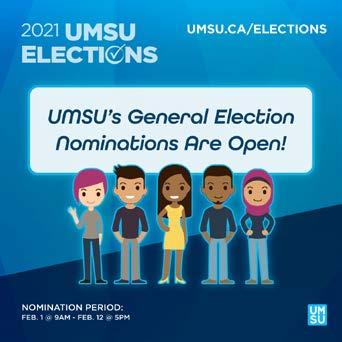
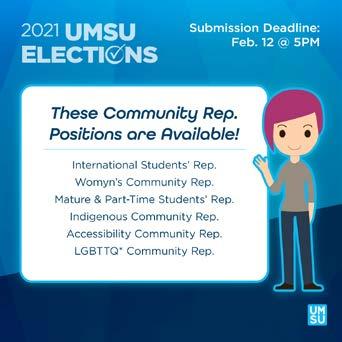
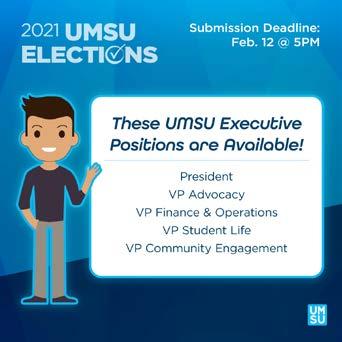
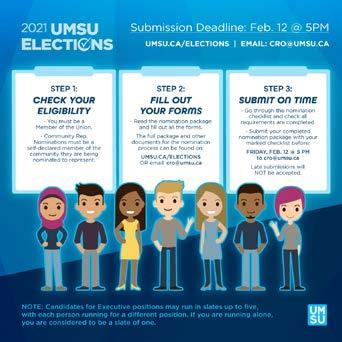
UMSU election nomination deadline / 5:00pm
UMSU meeting / Skype / 6:30pm
UMGSA election nomination deadline / 4:00pm
UMGSA meeting / Skype / 5:30pm
UMSU meeting / Skype / 6:30pm
UMSU election campaign period begins
COPY DESK ? copy@themanitoban.com
Ursula Chojko-Bolec (ed.)
Aldin Sabic
NEWS DESK ? news@themanitoban.com
Gillian Brown (ed.)
Cam Cannon (ed.)
Damien Davis
Colton McKillop
RESEARCH & TECH DESK ? research@themanitoban.com
Sarah Doran (ed.)
Kunal Rajpal
COMMENT DESK ? comment@themanitoban.com
Lucas Edmond (ed.)
Liam Forrester
Grace Gyolai
ARTS & CULTURE DESK ? arts@themanitoban.com
Shaylyn Maharaj-Poliah (ed.)
Kaelen Bell
Zoë LeBrun
SPORTS DESK ? sports@themanitoban.com
Isaiah Wagner (ed.)
Matthew Merkel
PHOTO DESK ? photo@themanitoban.com
Alex Decebal-Cuza (ed.)
Basel Abdelaziz
DESIGN DESK ? design@themanitoban.com
Joshua Wesey (ed.)
Mikaela Warkentin
GRAPHICS DESK ? graphics@themanitoban.com
Jenelle McCann (ed.)
Dallin Chicoine
AUDIO DESK ? audio@themanitoban.com
Tino Hove (ed.)
Tawana Matizanadzo
VIDEO DESK ? video@themanitoban.com
Jesse Boily (ed.)
Arsalan Saeed
SOCIAL MEDIA DESK ? social@themanitoban.com
Colin Ijebor (ed.)
Jalene Moman
Telegram has been used by students to communicate with each other since before the U of M made the switch to remote learning but, since then, the messaging app has seen a rise in usage.
According to one student in her second year, Telegram has only enhanced her university experience.
Grayson Cranney said that the app “helps me to clarify class schedules, have a community and allows me to remain engaged during class.”
“In the age of pandemic learning, it’s important to be able to keep up that momentum of wanting to learn,” she said.
She added that for her, and for many other students, “it’s really easy to get discouraged in regards to understanding material [and] thinking you are the only one struggling.”
In the faculty of arts, however, though there is no specific policy in place regarding chat forums, instructors are being warned that students may also
be using the app and apps like it to cheat on their assignments.
The warning follows UMSU’s academic integrity campaign in December which was in response to a reported rise in cases of academic misconduct.
The campaign aimed to decrease the number of those cases by reminding students that the same rules apply for exams as they would in on-campus classes.
Associate dean of undergraduate affairs Heidi Marx encouraged instructors to “make it very clear to students that they are aware of the fact that students will use these chat forums, and to make it very clear what is appropriate and inappropriate participation in them.”
She reported that many cases of academic dishonesty are brought to the faculty’s attention by other students in the group chats.
Chat forums are not the only method of sharing course materials. Instructors also warned students

against uploading copyrighted course content to sites that allow students to post course materials like slides and test answers.
Professors have made clear that sharing content onto sites like Chegg and CourseHero are “illegal […] and grounds for expulsion.”
Though there have been a rise in reports of academic dishonesty, it remains that Telegram chats will continue to be used by students.
Marx relayed the faculty’s basic message that it aims to convey, which is that “students should use whatever supports they can to succeed in their courses and to build a sense of community with each other in these difficult times short of engaging in academic dishonesty.”
news@themanitoban.com
Current UMSU executives are making good on campaign promises made during last year’s election by taking steps toward creating a legal aid program accessible to all UMSU members.
UMSU is considering taking up legal aid services from Studentcare — the firm which provides health, dental and vision coverage for students at U of M — at a potential cost to members of $9.33 per semester. Students will also have the option to opt-out of the program if it is adopted.
According to the Studentcare website, the coverage would include legal services in the areas of tenant disputes, employment rights and academic rights as well as access to legal advice on any topic over the phone.
UMSU vice-president advocacy Kristin Smith said that although past executives have identified legal aid for UMSU members as a need, the union currently “falls behind” in terms of what legal services are available when compared with others across the country.
“Legal assistance is something you don’t realize you need until you need it,” she said. “I think a student union is the appropriate body to provide that service to students.”
Before being implemented, UMSU
expects to first conduct a survey of the student population to gauge interest in such a program before finally putting the decision to a vote in a later referendum.
The results of preliminary research conducted by UMSU on the question revealed that some of the main areas students at U of M seek legal aid in are immigration, tenant disputes, employment disputes and alcohol-related infractions.
“As well, I think a good part of this program is it provides a resource for students to understand their rights as it pertains to instances of sexual violence apart from having to approach a university office,” Smith said.
Initially, UMSU was exploring the possibility of establishing an “arm” of the Legal Help Centre — a Winnipegbased non-profit organization which aims to assist people in need in representing themselves legally — available to students at the U of M which would provide legal services to students in exchange for monetary contributions from UMSU.
UMSU was in the process of developing a proposal to the Legal Help Centre which would have included logistically how implementation would take place, what monetary contributions UMSU could make and trying to make the case that students

fall under the centre’s mandate.
“Of course, that is very resource-intensive [for] UMSU but I saw that as being completely worth it,” said Smith.
She explained that the option was explored out of a desire on the part of UMSU to find a way to implement legal aid to students without charging additional fees.
“I thought, ‘I don’t want to put another fee on the back of students during COVID-19, I don’t want to do this with the backdrop of Bill 33, is there a way that UMSU could […] just invest and fund such a program through our own means?’” said Smith at the Jan. 29 UMSU board meeting.
“With things changing in the winter and realizing how much work it would take to get something like this off the ground […] I thought we might as well put the question to students,” Smith
subsequently said, referring to plans to gauge interest through a survey.
Smith also argued that beyond the immediate benefits of offering legal services to those that need them, the introduction of legal services for UMSU members could help drive “innovation.”
“A lot of students have ideas for start-up businesses and they have questions pertaining to the legalities of […] making that legitimate,” she said.
“If we’re able to provide a service that could provide legal advice on that, we’re going to get students more willing to pursue those passions as well.”
news@themanitoban.com
experiencing homelessness, the use of both legal and illegal substances is common.
Homelessness in Winnipeg is an issue that continues to grow and shows no sign of stopping amid both household-based restrictions during a pandemic and extreme cold warnings.
Jeff Browaty, North Kildonan city councillor, made several online comments last week on several social media platforms about homeless individuals staying in bus shelters.
In one tweet, he asked what the Winnipeg Police Service is doing “to ensure the safety of citizens by evicting illegal squatters?” And in a Facebook comment, Browaty expressed that he hoped “if people staying in bus shacks are inconvenienced enough, especially in winter, they’ll take advantage of the shelters that are out there, with available space.” He went on to say that the city had “wet” shelters, where residents would be able to continue substance use.
Browaty did not respond to requests for comment.
The Canadian Observatory on Homelessness’s “Homeless Hub” reported in 2012 that — including those at risk of becoming homeless, without permanent residency, in a short-term crisis and living on the streets — 144,865 people, which was over one-fifth of Winnipeg’s population at the time, may be struggling to seek shelter from the Winnipeg winter.
There are just over 500 emergency
shelter beds in the city according to a CTV article from September of last year. Out of all the shelters in the city, Main Street Project, a community health centre located in Winnipeg, is the only “low-barrier” shelter that is “free from as many requirements as possible.” The only rules for a low-barrier shelter pertain to health and safety.
Despite their best efforts, Main Street Project is facing obstacles with capacity and operating during a pandemic.
According to Anastasia Ziprick, director of development at Main Street Project, “COVID was one of many [obstacles], but the main obstacle [was] that we had to space everybody out appropriately.”
“But we’re still at capacity every night, we have been since we opened,” she added.
Available to the public all day every day, Main Street Project is the only shelter in the city that offers daytime services.
Main Street Project operates on an approach of “harm reduction,” meaning that the shelter aims to reduce the potential harms and risks associated with substance use and abuse.
According to the Canadian Observatory on Homelessness’s “Homeless Hub,” for individuals
While addictions may be a cause of homelessness for some, for many substance use is a response to the stresses and instability that those facing homelessness experience.
Ziprick said one misconception people have is that there are a lot of options for people in this situation. “It takes all levels of government to support people in this predicament.”
Relaying a similar statement, Molly McCracken, director of the Manitoba office of the Canadian Centre for Policy Alternatives, said that “when we see people sheltering in bus shelters, we need to have compassion, [because] this is a structural problem that’s being exacerbated by COVID.”
McCracken explained that there are a number of reasons we’re seeing an increase in visible homelessness during the pandemic, including the end of the provincial eviction ban for non-payment of rent, the end of the Canada Emergency Response Benefit (CERB) and mental health and addictions challenges.
She also pointed out that some may not want to go to a shelter, that housing is something people want but face difficulties finding housing at a rate they can afford.
Rather than it being the fault of these individuals alone, this is a result of inaction on all levels of government, and that the city and the country have

had a problem with homelessness for years.
In June, Main Street Project created a set of recommendations as part of a strategy to support unsheltered individuals in the city.
“Everybody needs to act on those recommendations if we’re going to see positive change,” said Ziprick.
news@themanitoban.com
The commissioners of the Truth and Reconciliation Commission of Canada (TRC) issued a public statement Dec. 15, five years after the release of its final report, expressing disappointment about the “slow and uneven pace” of the government’s response.
In its statement, retired senator Murray Sinclair, Chief Wilton Littlechild and Marie Wilson call on governments and Canadians to renew the sense of urgency and commitment to the calls to action recommended by the TRC’s final report.
Though they were encouraged by some signs of progress, such as legislative efforts to establish Orange Shirt Day as a National Day for Truth and Reconciliation, they warned of continued “barrier[s] to reconciliation.”
According to the statement, “essential foundations for reconciliation have yet to be implemented, despite government commitments. In some
jurisdictions, there is danger of losing gains that have been made.”
In an APTN InFocus special about the fifth anniversary of the TRC’s final report, released shortly after the commissioners’ statement, Sinclair acknowledged that “reconciliation is going to be hard, and [it will] take a long time.
“It is, however, very concerning to us as commissioners that five years later, the federal government still does not have a tangible plan for how they will work toward implementing the Calls to Action,” he continued, “and progress is not being tracked by any one federal department.”
Sinclair, Littlechild and Wilson commended the federal government for committing to establishing a National Council on Reconciliation and tabling legislation to implement the United Nations Declaration on the Rights of Indigenous Peoples (UNDRIP), which the commissioners called “the framework to achieve [...] reconciliation
at all levels and across all sectors of society.”
However, they criticized the governments of Alberta and Ontario for rolling back progress on public school curriculums — a move they called “an attack on the truth.” They also pointed out that six provincial governments have called for the implementation of UNDRIP to be delayed.
In November, Indigenous relations ministers from the provinces of Alberta, Manitoba, Saskatchewan, Quebec, Ontario and New Brunswick requested that the federal government delay legislation that would apply UNDRIP’s principles to federal law, but Justice Minister David Lametti refused.
The provincial ministers claimed the federal government’s timeline did not give them sufficient time to consult with industry stakeholders and Indigenous communities, especially during the COVID-19 pandemic. The justice minister responded that Ottawa had made its intent to implement UNDRIP by the end of 2020 clear in throne speeches in December
2019 and September 2020.
Obstacles like these, the commissioners’ report asserted, are why the proposed National Council for Reconciliation is so important to “track, assess and report on all aspects of national reconciliation.”
Sinclair, Littlechild and Wilson lamented the fact, in their statement, that thousands of residential school survivors have died, including three members of the TRC Survivor Committee, before more substantial progress could be made.
“They and thousands of others who have also passed since our reporting, contributed so much to our national understanding.” “They deserved to see real and meaningful progress in their lifetimes.”
features@themanitoban.com
Kunal Rajpal, staff
Marketing in our society frequently revolves around maximizing profits for a company and its shareholders, regardless of the consequences of its actions on society, the community or even the organization in the long run. This is a significant contributing factor to society’s socio-ecological issues today, such as climate change and the increasing wealth gap between the wealthy and the poor.
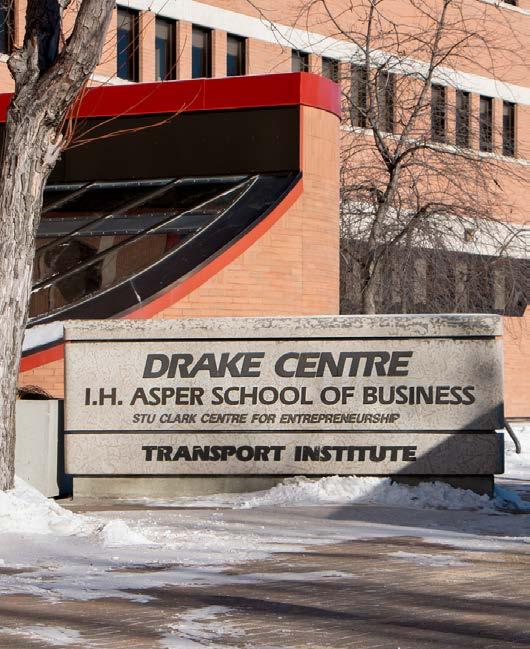
I.H. Asper school of business professors Bruno Dyck and Rajesh Manchanda addressed this issue in a paper titled “Sustainable marketing based on virtue ethics: addressing socio-ecological challenges facing humankind.”
“So far, marketing has generally prioritized consumption as being the be-all and end-all,” Manchanda explained.
“The more we consume, the better off we are. And there is a growing body of literature and scholars who are arguing that that is not beneficial. It is not beneficial to the environment, it is not beneficial to society, it is not beneficial to our mental health.”
During the past four years, Dyck and Manchanda have developed a social and ecological thinking (SET) approach to sustainable marketing, which takes ethics into account when evaluating business options.
As Dyck explained, “social and ecological thought [is] a new paradigm, a different paradigm, that is needed if we are going to solve the social and ecological problems facing humanity.”
“It’s different than financial bottom-line thinking, which says it’s all about maximizing profits […] Social and ecological thought says that in order to take care of the environment, we need to relax the need to maximize profits.”
As an example of the practices SET is working against, Dyck spoke about the concept of greenwashing, which means giving false impressions or misleading information about a company’s environmental credentials.
“Consumers don’t want greenwashing,” he said.
“They are skeptical. They know marketers dress things up. So, if there is transparency [...] they are going to buy those products.”
SET principles also mean taking a “macro-level perspective” of a given business’s prospective future.
“What we are talking about is using marketing as a tool for the greater good [...] as opposed to having profits front and centre,” Manchanda said.
He explained it as beneficial for both the company and the world at large.
“It is also a risk-mitigating strategy,” he said.
“If you’re not investing in climate change, if you’re not investing in society, you are going to have a very hard time as a company succeeding in the long run.”
The pair have received encouraging feedback on their work so far, particularly from students.
“Major corporations probably won’t be so thrilled,” Dyck said.
“But the smaller companies that are already doing this will be thrilled, I think, because we are putting some words and names and theory and ideas that is consistent with what they are already doing. And our students are thrilled [...] they feel good about this stuff.
“We’ve done some research — when students learn about social and ecological thought principles, they move
in that direction, so by the end of the year only five per cent of students are [supporting] the financial bottom-line perspective.”
However, even corporations are slowly pivoting toward the pair’s ideas.
“There are many major corporations also who are interested in SET-like ideas,” Manchanda said.
“These are what are called B-corporations — benefit corporations is what that stands for. And there are more than 4,000 [...] benefit corporations in 17 countries around the world, in 150 different industries, all of whom are prioritizing social and ecological well-being.”
“More and more companies are joining this platform as well. There are many companies who are engaged in social and ecological thought practices who may not be listed formally as a benefit corporation, so there are probably another four [to] five thousand who
we don’t even know about easily. It’s more mainstream than we would like to think.”
Dyck and Manchanda have started a follow-up study based on local organizations in Winnipeg managed according to the SET principles. The study investigates how organizations of our neighbourhood which are governed by these principles are doing their marketing and whether those practices match with Dyck and Manchanda’s theory.
Dyck summarized the paper very aptly: “People and planet trump profits.”
Sarah Doran, staff
This September will be the 20th anniversary of the terrorist attack known colloquially as 9/11. Throughout January and February, University of Manitoba political studies students are holding a conference on the legacies 9/11 has had across various spheres of life.
Created in 1985, the J.W. Dafoe Political Studies Students’ Conference (PSSC) is an annual event with a focus on international affairs, defence and security. Students organized and are running the event with the assistance of faculty advisor Andrea Charron, an associate professor in the faculty and the director of the university’s Centre for Defence and Security Studies.
The 2021 conference is titled “The Legacy of 9/11 and the Defence of North America” and features five panels. The panels include discussions of the event’s economic, social and defence implications, as well as a keynote specifically about policing since 9/11 and a final panel talking about the day Sept. 11, 2001 itself.
The topic of 9/11 had been planned for this year ever since the previous conference was held last January, but the outbreak of COVID-19 forced the organizers to grapple with unexpected questions of format and viability.
“We decided that it was still important that we reflect, in the year of the anniversary of 9/11, on the topic,” Charron said.
“[COVID-19] does present sort of a foil to 9/11 because they’re big shocks to the system, and so what’s been really interesting is how many of the panels have used 9/11 as one signpost and [COVID-19] as another signpost. Then the way policies or agencies have reacted, too — some cases have been very similar, some cases have been very different.”
While Charron acts as a supervisor, the conference is organized and run entirely by political studies students.
“One of the things that’s great about this conference is it requires a little bit of research on the part of the students, to get to know the background of the various speakers,” Charron said.
She explained students involved with the PSSC make note of scholars discussed in classes or assigned as readings. They decide as a group who they might want to invite and how those people might be divided into panels.
“That’s where the faculty advisor comes in, who can sometimes help guide them and say, ‘Well, actually this individual is more of a specialist in this area, so maybe they’d be more appropriate on this panel.’”
Other student roles include managing attendee registration, running PSSC’s social media, moderating panels, advertising the conference, organizing

Zoom logistics and co-ordinating panel preparations with speakers. In other years, students have also acted as guides for panellists traveling to Winnipeg, even driving them to and from their hotels.
With COVID-19 forcing the conference online, that responsibility is no longer required, but Charron said the Zoom format has removed constraints in other ways.
“It’s free, and we can advertise pan-Canadian,” she said.
“Before, when it’s in person, you have to be able to get to Winnipeg to attend, so not very many people are going to put that kind of cost in unless they’re local. Whereas with Zoom, we can have people from across Canada, even around the world, hop onto the Zoom session.”
Charron added that the virtual format
also meant more freedom in engaging panellists. PSSC speakers are volunteers who do not receive honorariums, which in the past could affect willingness to travel to Winnipeg. On a Zoom panel the only real constraint is time zones, broadening the field considerably.
Conducting a conference that normally takes place over three days over Zoom, however, is not without its struggles.
“We decided when we went virtual to spread it over several weeks because we knew Zoom fatigue is a real thing,” Charron said.
“And if everybody’s already attending classes all week long and then we try to fit in five extra hour-and-15-minutes, hour-and-a-half events, that’s just too much. Having one a week is something that everybody can fit into their schedule. We’ve also tried to
vary it so some are in the evenings, so then we can get more of the Manitoba and Canadian population at large to join in.”
The next panel, “Defence Implications of 9/11,” will take place Thursday, Feb. 11 at 11:30 a.m. Registration information can be found on the political studies department website.



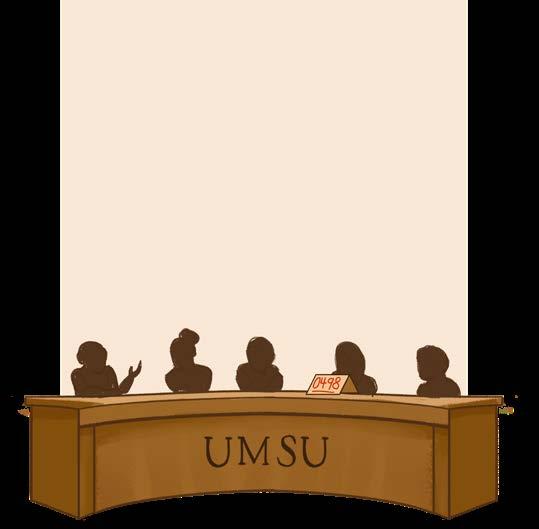
Recently, the University of Manitoba Students’ Union (UMSU) adopted the International Holocaust Remembrance Alliance’s (IHRA) working definition of antiSemitism in collaboration with Hillel Winnipeg, a Jewish student organization.
While I applaud UMSU in its efforts to make campus as safe as possible for all students and make advances in terms of equity, diversity and inclusion, the adoption of the IHRA definition is a step backward in trying to meet these ends — especially when it comes to reconciliation and representing Indigenous students.
The reason for my criticism may not be immediately apparent — after all, this is a measure being taken to combat anti-Semitism on campus, and the Canadian government has adopted the same definition. How exactly is adopting this definition a bad thing?
Most criticisms of the IHRA’s definition centre around its vagueness and the examples of anti-Semitism it provides — many of which conflate criticisms of Israel with anti-Semitism in ways that are hardly in good faith.
The definition has also faced criticism from human rights organizations, over 40 progressive Jewish organizations and Palestinian academics.
Even Kenneth Stern, an author who contributed to the IHRA’s definition, penned an op-ed in the Guardian in 2019 expressing concerns about how right-wing, pro-Israel groups were exploiting the definition as a way to silence criticism of Israel on campuses.
According to Stern’s op-ed, the definition was intended for gathering data on anti-Semitism, not as a “campus hate speech code.”
In 2018, the Winnipeg chapter of Independent Jewish Voices Canada (IJV) organized an event along with other organizations to discuss thenU.S. president Donald Trump’s decision to move the U.S. embassy in Israel to Jerusalem — a symbolic move that further confirmed the country’s anti-Palestine stance by indirectly recognizing Israel’s sovereignty over the city which is shared with Palestine. This ultimately escalated Israeli-Palestinian tensions.
The event was denounced by B’nai Brith Canada as anti-Semitic due to various talking points brought up in the discussion that directly criticized Israel for a number of its domestic policies. This later led to an apology from the University of Winnipeg, which made use of the IHRA’s definition of anti-Semitism in its review of the event.
The next year, Trump signed an executive order — for which Charlie Kirk, the founder of the conservative
organization Turning Point USA, took credit — officially adopting IHRA’s definition for university campuses. The move was panned as “culture war” antics which did nothing to combat anti-Semitism but instead opened the door to increased repression against Palestinian advocacy on U.S. campuses.
To stand with Indigenous peoples in Canada and struggle with us for our self-determination is necessarily also to stand in solidarity with the Palestinian nation. One cannot selectively uphold the rights to selfdetermination and resistance of just one Indigenous people — to stand against settler colonialism in Canada is to stand against settler colonialism everywhere, including in Israel.
There will inevitably be contention over this framing of Israel as a settler colonial project. However, I encourage people to read the works of Zionism’s intellectual founder Theodor Herzl — who explicitly conceived of Zionism as a colonial project — and to investigate the conditions of violence, displacement and destruction being imposed on the Palestinian nation by the Israeli state. Violence which human rights organizations have continuously condemned.
One does not need look much further than the “nation-state law” adopted by Israel in 2018. The law defines the
right to national self-determination as exclusively for Jewish people, relegates Arabic as a language to a “special status” and declares “Jewish settlement [in Palestinian territory] as a national value.”
Displacement, side-lining of Indigenous language and settlement as a national value are all undeniably characteristic of settler colonialism — the exact same process has been playing out in Canada for centuries. It must be opposed in both cases.
Universities are sites of knowledge production as well as the production and reproduction of ideology. Theoretically, in Canada — a capitalist and imperialist settler colony — this means that universities will tend to produce knowledge that suits the interests of the ruling classes of our society. But, due to the uniquely settler-colonial nature of the state, it also produces ideology that benefits the oppressive settler nation.
However, it is possible to inhabit these institutions and at the very least temporarily re-direct them toward serving the interests of oppressed peoples and classes. Similarly, student unions such as UMSU — which are deeply political institutions — can be appropriated in the service of anticolonial interests as well.
In 2018, UMSU denounced the
Canadian Federation of Students for upholding the Boycott, Divestment and Sanctions movement — a movement that advocates for peaceful economic divestment in Israel in order to pressure the state into respecting Palestinian rights — claiming that it is not the place of a student union to take a position on such divisive issues.
Now, UMSU is taking a strong position in favour of Israeli settler colonialism, whether it is conscious of it or not. This is despite the fact that the federation — which UMSU is working to leave — has adopted IJV’s definition and acknowledged the potential harm that could arise from adopting the IHRA’s definition.
The choice is clear for UMSU: stand with settler colonialism and silence its dissidents or re-consider the adoption of IHRA’s definition of anti-Semitism and work with a plurality of Jewish organizations who are critical of the regime in Israel.
graphic / Jenelle McCann / staff words / Cam Cannon / staff
Attendees

Lucas Edmond, staff
As Canada enters its second month of the tenuous COVID-19 vaccine rollout, citizens are becoming unnerved by its disorganized distribution. Although impatience is surfacing, slow distribution was predicted by the federal government. Earlier in January, Maj.-Gen. Dany Fortin, the military commander handling the logistics of vaccine distribution, claimed that there would be a limited supply of vaccines in the winter, which will purportedly begin to improve come April.
It is not a surprise that the vaccines are being distributed slowly, considering the Pfizer-BioNTech and Moderna vaccines are being produced in a select few private manufacturing sites. How can two companies with limited manufacturing capacities be expected to supply billions of vaccines worldwide in such a short period of time? The truth is: they aren’t.
Unfortunately, governments have to fall in line and respect multilateral intellectual property law. Or, in other words, respect these companies’ right to profit from an international disaster.
And profit they will.
Antithetical to intuition, the longer these two companies take to roll out the vaccine supply, the more they are likely to make from reeling nations still hoping to get their hands on the high demand “commodity.”
Albert Bourla, the CEO and chairperson of Pfizer, noted that the vaccines would be sold at “very marginal profit” in order to reduce costs to the public. However, how countries choose to make up lost space in the budget doesn’t necessarily mean the product will be “free.” Citizens will still likely have to pay for the vaccines in the form of budget cuts. Beyond this, poorer nations with less lucrative contracts with the companies could be given the short end of the stick as global vaccination numbers rise.
As the pandemic stabilizes, vaccine costs may rise as contracts with capped pricing systems expire and the global spotlight is veered elsewhere. The unfortunate reality is that the last person in line will likely spend more as prices surge.
This raises highly contentious questions about the ethics of profit in private health care and scientific research. Should a select few be allowed to make inordinate gains from public calamities? Intellectual property rights would suggest it was these companies who discovered the vaccines, so they should reap the benefits of their efforts. But, just how “private” was this research in the first place?
Pfizer-BioNTech and Moderna were not funded through private
/ Dallin Chicoine / staff

coffers alone. Indeed, governments from around the world subsidized these companies’ research heavily. BioNTech, the company that contributed the RNA technology which triggers an immune response to the proteins lining the SARS-CoV-2 virus, received subsidies upward of $445 million from the German government. Meanwhile, the research that produced the Moderna vaccine was mostly paid for by various U.S. agencies funded by taxpayers. Beyond this, money from around the world lines and continues to line the pockets of various private research groups searching for more vaccine options.
The point being, the companies’ discoveries should be public property as public effort and money has stimulated the global attack on the novel coronavirus. Vaccines produced under the shrouded terminology of “private property” do not deserve to be respected by intellectual property law.
Should the technology be made public, the efforts to supply and distribute the vaccines would be significantly more effective and equitable.
Discussing national efforts to come together and manufacture for a common interest is not beyond reason. Just take the wartime economy during the Second World War, for example. Key infrastructural capacities were seized by the state to make room for the production of various weapons, ammunition and medicines that troops across seas utilized.
If the Canadian government can push aside private interests for the sake of making deadly weapons, you would think it would do the same for a product that could save lives.
Nations from around the world have the infrastructure to produce these vaccines at rapid speeds. The global crisis could logistically be dealt with at a much more rapid pace if knowledge were disseminated, production was decentralized and associated fees were scrapped. The problem is, they don’t have the right to.
And now, Canada is opposing crucial efforts from India and South Africa to allow poorer nations the right to produce these vaccines and temporarily waive the intellectual property rights enforced by the World Trade
Organization.
Why might the Canadian government do this? Because it recognized the value of the vaccines early and placed enough orders to vaccinate Canada’s population five times over. One imaginable scenario is the federal government had planned to flip the sale of the vaccines when prices spiked to pay for its own receipt.
This is an international moral failure of colossal scale. When Pfizer-BioNTech and Moderna are remembered in the history books, I hope it is not as the companies that saved the world from the deadly effects of the pandemic, but as the profit-gouging companies that stunted an effective rollout of the vaccines.
‘COVID fatigue’ may be getting the best of us, but now is not the time to take our foot off the gas
Grace Gyolai, staff
Manitoba Premier Brian Pallister warned government appointees Feb. 1 if they travel outside of designated zones “for leisure purposes,” they will be terminated. This is a new stance taken nearly a year into the pandemic and following many examples of government leaders breaking the very rules that Manitoban citizens are instructed to follow.
Up until this point, when politicians or other government appointees have been caught travelling to vacation destinations, they faced public shaming from social media and the wider press, as well as criticism from their colleagues from opposing political parties.
Many of us can empathize with the restlessness that corrupted the decision-making of our out-of-touch politicians, but now is not the time to let “COVID fatigue” dictate our decision-making — unfortunately, there is still no clear end to this pandemic in sight.
Nearly a full year after the first COVID-19 case in Manitoba, there are over 3,000 active cases reported, and vaccinations aren’t expected to be administered to the lowest age group — ages 18 to 29 — until late August, or even later, depending on supply.
It’s a natural response for those who have followed the restrictions diligently to feel anger or resentment toward others who are travelling and putting community health at risk — we are all desperate for this nightmare to end. Sometimes I find myself thinking, have we still not shamed rule-breakers into compliance?
However, as evidence from past pandemics and disasters has shown, shaming does not work to change human behaviour in the long run. Just look to our leaders — so many upper-level government employees indulged in unnecessary trips that they had to be threatened with job loss. No public shaming could curb their jet-setting ways.
Shame is one of the five survival emotions — accompanied by fear, anger, disgust and sadness — that activate stress hormones and tend to make people defensive and aggressive. When people are shamed, they feel as though their identity is being questioned as opposed to realizing that they are engaging in behaviour with negative consequences.
In the midst of a pandemic, feelings of fear, sadness and even anger are in no short supply and adding shame to the list is a short-sighted approach that materializes poor results.
We cannot assume the reason someone is breaking a COVID-19 law or guideline, so immediately showing them aggression should be avoided when positive results are desired.
/ Dallin Chicoine / staff
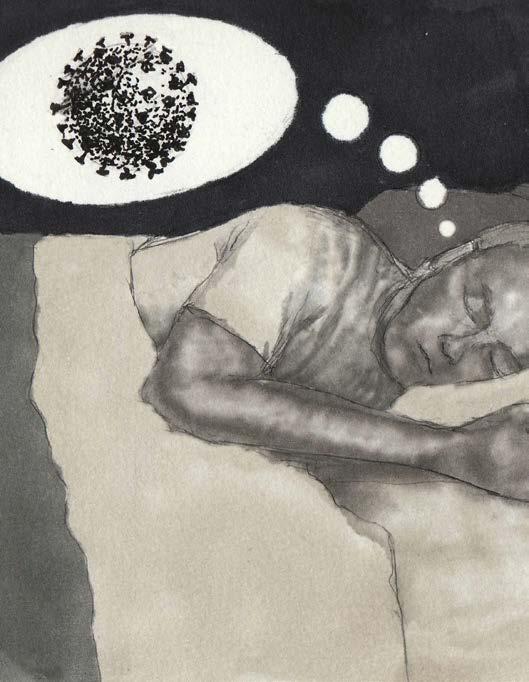
That being said, it’s still important that the rules are followed for everyone’s safety.
As of now, the only way for Canadians to get back to the pre-mask social norms is to focus on behaviour and fighting our own “COVID fatigue,” while encouraging our neighbours to combat the fatigue with us.
As tiresome as it may be to see a maskless person on the bus or posts from a friend hosting a party — how some individuals don’t get this by now is a modern mystery worth a book in questions — focusing on the community aspects surrounding COVID-19 might help your own resilience while also strengthening it for those around you.
Emphasizing the fact that everyone you come into contact with will meet with many other people is a good way
to visualize how fast COVID-19 can spread and should force you to choose social interactions wisely.
It’s not always emphasized in our cultural landscape that we coexist as part of one larger community, but our collective actions have widespread impacts. Following the COVID-19 guidelines allows us to maintain some control over our health while also being a positive example in our community. Leading by example is a more positive way to change behaviour than shaming.
It’s impossible to measure whether an elderly community member or a person with an immune disorder will be directly protected by your decision to stay home, but making that choice is one of the only ways to ensure that you are not causing them unintended harm.
We cannot account for the actions of others, even the people we elect. So, instead of pointing fingers, try turning the conversation around and show compassion and concern.
We still have a long road ahead. Maintaining our safety is important, but so is our sanity.
After my two-year hiatus in India, in which I had to tend to my ill parents, I finally decided to travel back to Winnipeg, where I belong. I have been a student and called it home since 2011. I was aware that travelling when the microscopic monster virus — causing COVID-19 — was on the loose would be a near-ridiculous amount of hassle, but being unemployed in India while still trying to pay for an apartment and a car back in Winnipeg drove my finances and credit score below sea level.
I had always enjoyed the thought of dedicating my life to people by being a doctor, but little did I know that fate had other plans, forcing me to quit my studies midway. However, I got to spend the most fabulous years taking care of my parents, so I do not regret it, and I might not get the opportunity again.
But when the opportunity came to return to Winnipeg, I knew it was time. I had managed to secure some funds to book a ticket to Canada and pay for my 14-day mandatory quarantine.
I proceeded to buy tickets from British Airways (BA) to travel on Jan. 22 from my home city of Kolkata. It would be a long journey, and I was scheduled to arrive in Winnipeg on Jan. 23.
I had been diligently following the news on any travel updates because India had previously banned flights to and from the United Kingdom due to a new novel strain of COVID-19. Accordingly, I booked my COVID-19 RT-PCR test for Jan. 20, which gave me more than 72 hours before my entry to Canada as mandated by law. My flight was scheduled from Kolkata to Mumbai, where I had a four-hour layover, followed by a 10-hour layover in London Heathrow International Airport and another eight hours in Toronto Pearson International Airport, before arriving in good ol’ Winnipeg at 11:30 p.m. on Jan. 23.
After teary-eyed goodbyes, my parents finally came to terms that I was leaving India. I proceeded to get my boarding passes at the local airport. I was told that due to some technical difficulties, my passes to Winnipeg were not being printed, and I would be able to get my other boarding passes in Mumbai at the BA counter.
I proceeded onward to Mumbai, knowing that I would be home very soon, hoping that, in the near days, I could help with the efforts to vaccinate people from this terrible virus.

Upon reaching the airport in Mumbai, I was told that I would not be allowed to board flights to London because people with Indian passports lacking a British visa were not allowed to transit through the U.K. I froze dead in my tracks. I did not know what to do. I could not speak because I felt the saliva drying in my mouth. I stuttered while they escorted me out of the airport.
There I was, in the middle of Mumbai — an unknown city to me — stranded, with very limited funds. I begged the airport staff as I did not know what to do. They simply told me that BA was responsible, and they could not do much. I managed to book a hotel for the night and proceeded to think about my next course of action.
I went to the hotel, which overcharged me for signing in at 1 a.m., but I was helpless. I could not sleep in the streets of Mumbai with my luggage and everything. I was on the phone with my travel agent, trying to reschedule and rebook my flights. I paid an extra $1,600 to book my tickets to Winnipeg through New Delhi and Newark, N.J. on the next day. This completely broke my bank.
My flights to New Delhi and Newark were quite uneventful, albeit with a two-month-old sitting next to me. She was surprisingly very quiet and happened to be very entertained
throughout the flight. Upon landing, I proceeded to wait for four hours for my connecting flight to Toronto at Newark Liberty International Airport.
That’s when Air Canada told me that I would not be allowed to board my flight to Toronto because it was already over 72 hours since my COVID-19 test.
I was told that they had a testing facility at Newark Liberty, but since it was Sunday, I would have to wait another day for my results. Air Canada was kind enough to reschedule my flights for free, which I shall remain forever grateful for.
The next day I proceeded for my COVID-19 test, where I had to pay US$200. This was the final nail in my bank account’s coffin. I was only left with $45 following my arrival in Winnipeg. However, I powered on. I believe in Canada and my ability to find a job here.
I tested negative for COVID-19 the
following day, and I boarded my flight to Toronto, and soon, to Winnipeg. These legs of my journey were glitchfree, and I was again overwhelmed by the niceness of the Canadian Border Services Agency.
A temperature of -27 C greeted me on my arrival in Winnipeg on Jan. 25, but this frigid air never felt so sweet and welcoming. I felt relief that I was home again. My friends and neighbours have been more than nice helping me with food while I am quarantining. I believe the upcoming days will be better once I am working again. I hope everyone has a wonderful and safe winter!
Tom Chakraborty, U of M student
Liam R. Forrester, staff
We warned them, but they did not listen. After months of escalating restrictions, multiple lockdowns, and the government all but begging Canadians not to travel, some folks went and did it anyway. Now their chickens have come home to roost.
Prime Minister Justin Trudeau announced Jan. 29 that major Canadian airlines have agreed to close their Mexico and Caribbean routes along with a new set of travel restrictions.
Air Canada, Air Transat, Sunwing and WestJet have all suspended service to those destinations until the end of April. In addition, all inbound international flights must land at one of four major airports — the Montréal-Pierre Elliott Trudeau International Airport, the Toronto Pearson International Airport, the Calgary International Airport or the Vancouver International Airport.
All passengers must then submit to a COVID-19 test and sequester in a government-designated hotel for up to three days. A negative test will see travellers finish their 14-day mandatory quarantine at home with an additional swab after 10 days. Transport Canada states it expects few exceptions to travel without adhering to the outlined restrictions.
The main point of contention, it seems, is the price tag.
Travellers are required to pay for this stay in federally-approved hotels themselves. The estimated cost? More than $2,000. These measures are not unique to Canada. Our new travel restrictions are similar to those found in Australia, where travelers can expect to pay closer to A$2,800.
The new measures serve an important function. The added personal cost and inconvenience is a deterrent to keep would-be travellers home and penalize those who have already left. In addition, the restrictions are an attempt to limit the spread of the new variants first detected in the United Kingdom and South Africa.
And they seem very necessary. Despite all health recommendations, people like Manitoba’s own chair of the Winnipeg Regional Health Authority (WRHA), Wayne McWhirter, were still taking winter vacations. McWhirter, an appointee with the provincial government, just got back from a lovely holiday in Arizona. As of now, we still do not know how long he had been there or why.
Thankfully, McWhirter stepped down from his position. And, to Brian Pallister’s credit, he immediately banned any leisure travel for all government personnel, stating that: “Should they do so, their appointment will be terminated.”
New Democratic Party of Manitoba
staff

leader Wab Kinew wasted no time in shooting down our government snowbird, wryly commenting that the former WRHA chair was “attempting to run our health-care system from Arizona.”
It is worth pointing out that these restrictions are broadly popular. In a recent Leger poll, 86 per cent of Canadians support the federal government’s decision to impose these restrictions and 87 per cent of respondents want the government to go further and outright ban international travel until the pandemic eases up.
While I agree with these measures, I think they may lack some responsiveness to the needs of certain vulnerable individuals.
For instance, temporary foreign workers make up a crucial part of the maritime fisheries workforce: 2,500 by the industry’s own estimation. It is unclear whether these workers will be declared essential and granted exemptions, as many come from Mexico. So, even if they were exempt from the ban on Mexico, they may be required to land in Montreal and quarantine, which would pose significant
costs and delays.
One might argue quite convincingly that limiting these workers is essential to maintaining the lockdown. What seems less defensible is the lack of exemption for some medical patients seeking life-saving treatment internationally.
CBC interviewed two cancer patients from Vancouver who make regular trips to Los Angeles, Calif. to participate in an immunotherapy clinical trial. The $2,000 hotel stay only increases the cost of seeking out life-saving treatment.
To make this situation worse, a missed appointment could spell the end for these patients’ treatment. Anna Nyarady, one of the patients who took part in the clinical trial, stated that if you miss a treatment, you will be automatically expelled from the trial.
This seems like the clearest possible instance of an essential traveller. Yet, the new restrictions offer no exceptions for these two. The federal government outlined exceptions if you provide essential services, maintain the flow of essential goods or people, regularly cross the border to work, live
in an integrated trans-border community or are receiving medical care within 36 hours of entering Canada.
That last point sparked outrage among the Vancouver patients. Effectively, those seeking medical care in Canada are exempt, while those seeking care outside Canada are, thus far, out of luck.
As important as it is to shut down international travel to vacationers, these restrictions may have been too rushed. While we may see specific exemptions granted as the government becomes aware of these admittedly uncommon cases, it is troubling to see the disorder around the edges.
Zoë LeBrun, staff
Amidst these uncertain times, Winnipeggers can look forward to a boost of joy in the coming weeks because Festival du Voyageur is back for another year. Though it will look a bit different, Festival du Voyageur is finding new ways to reach Winnipeggers and celebrate Métis and French-Canadian culture from a distance.
The 2021 festival has moved primarily online and will be offering virtual programming this year. Not to worry, though — all your favourite events will be back in full force, including the annual concerts, competitions, kids’ activities and special collaborations with local restaurants.
From Feb. 12 to 21, audiences will be able to enjoy performances from over 40 artists such as Celeigh Cardinal, Kelly Bado, Super Duty Tough Work, Ariel Posen and the one and only Faouzia from the comfort of their own homes via Facebook or YouTube.
Throughout the eight days of concerts, various dates are dedicated to highlighting Indigenous and francophone talent. Feb. 12 will showcase emerging francophone musicians and Quebec’s Marie-Pierre Arthur and both Louis
Riel Day and Feb. 20 are dedicated to showcasing Indigenous talent.
These concerts will present a wide range of programming such as music, spoken word poetry readings and puppet shows. Louis Riel Day will even feature a special performance from Tia Wood, renowned powwow singer and TikTok star.
Something new to the festival’s programming this year are two video series titled “Festival du Voyageur at Home” and “Minut Michif.”
“Festival du Voyageur at Home” provides families an array of festival-inspired activities to do at home. Some of these videos include lessons on French-Canadian cooking and how to build your own snow sculptures and instruments.
The “Minut Michif” series focuses on Métis traditions through a contemporary lens. These videos explore topics such as Métis fashion, art practices, bannock making and how traditions are passed down to each new generation.
In addition to this, the festival’s 2021 Kids Zone will be online this year and features free activities such a virtual
ARTS & CULTURE
Kaelen Bell, staff
The best love songs are not romantic — instead, they say something about romance.
The Last Beat of My Heart —
Siouxsie and the Banshees, Peepshow
tour of Fort Gibraltar, activity and colouring books and even the lyrics to traditional voyageur songs.
An exciting part of Festival du Voyageur that will also be continuing this year is the competitions. Whether you can cook, dance, fiddle or grow a beard, the festival has a place for you to let your talent shine from home.
For fiddling and jigging, participants will submit videos from home to be reviewed by judges with the winning results announced immediately after the competition airs.
The annual beard growing competition will take place entirely over social media, where participants will be judged in four categories — clean shaven, voyageur, open and novelty — for a chance to win beard-themed prizes.
Finally, the festival’s pea soup competition will be accessible through Promenade Café and Wine, where customers can pick up a kit with multiple soups from local restaurants and vote for their favourite online.
Promenade Café and Wine is also offering a variety of festive dishes to go — such as tourtière and bannock — that will be available for pick-up and takeout for you to enjoy from the comfort of your own home.
For those 18 and over, specialty cocktails and ice glasses will be available to order from Patent 5 Distillery as well. This year, the distillery has created two Festival du Voyageur-inspired cocktails for you to enjoy at home responsibly.
One of the only festival features that will be available for in-person viewing is the snow sculptures and this year they will be quite a sight to see. There will be nearly 30 snow sculptures erected around Winnipeg for the 2021 festival — much more than in past years — with an interactive map online to help guide you to each of the beautiful sculptures featured around the city.
Last but not least, you can grab the latest Festival du Voyageur merch through its online boutique. This year, the festival’s official merchandise logo was created by Winnipeg artist Jordan Stranger and represents “the Sacred Fire that’s at every ceremony lighting our way and the warmth and closeness that so many are missing throughout the pandemic.”
Head over to Festival du Voyageur’s official website at heho.ca for more information on events, concert lineups and more.
arts@themanitoban.com
Celebrate love in all its forms with this eclectic Valentine’s Day playlist graphic / Jenelle McCann / staff
Sometimes they are about friends or parents or children or pets or music itself. Sometimes they are desperate. Sometimes they are giddy and ridiculous.
Whatever angle it may take, a good love song will make you see love in a different way — some alien perspective that gives the love you know a whole new shimmer.
From Siouxsie Sioux’s life or death drama, Alex G’s glowing pride, Sade’s ode to a lost friend, the Motels’ obsessive fixation, Björk’s complex ritualism or Jenny Hval’s cerebral exploration of the very concept of romance, this Valentine’s Day playlist is home to some of the greatest, most dizzying love songs of the past six decades.
It is not always easy to love, and it might be even harder to express it in a way that gives it justice.
These are the songs that come closest to translating it — all the rush and quietude and softness and violence.
Just Like We Never Said Goodbye — SOPHIE, Product Hammond Song — the Roches, The Roches Nothing Compares 2 U — Sinéad O’Connor, I Do Not Want What I Haven’t Got Sin — Tomberlin, Projections
Proud — Alex G, Rocket
Maps — Yeah Yeah Yeahs, Fever to Tell
This Must Be the Place
(Naive Melody) — Talking Heads, Speaking in Tongues
Land of My Dreams —
Anna Domino, L’amour fou
Maureen — Sade, Promise
IKnew — Lightning Dust, InfiniteLight
Her Eyes Are a Blue Million
Miles — Captain Beefheart and the Magic Band, Clear Spot
Summer Girl — HAIM, Women in Music Pt. III
We Belong Together —
Rickie Lee Jones, Pirates
Futile Devices — Sufjan
Stevens, The Age of Adz Train Song — Vashti Bunyan, Some Things Just Stick in Your Mind
Conceptual Romance —
Jenny Hval, Blood Bitch
I Just Wanted to See You So Bad —
Lucinda Williams, Lucinda Williams
Total Control — the Motels, Motels
Alan — Perfume Genius, No Shape

Baby Birch — Joanna Newsom, Have One on Me
Gaymo — 12 Rods, Gay?
Laura — Bat For Lashes, The Haunted Man Thirteen — Big Star, #1 Record
Hyperballad — Björk, Post Lover’s Spit — Broken Social Scene, You Forgot It in People
I’m On Fire — Bruce Springsteen, Born in the U.S.A. You Ain’t Goin’ Nowhere — the Byrds, Sweetheart of the Rodeo Good Woman — Cat Power, You Are Free It Takes a Muscle to Fall in Love — Spectral Display, Spectral Display
When I’m With Him — Empress Of, Us Anything We Want — Fiona Apple, The Idler Wheel…
Marlene — Kevin Coyne, Marjory Razorblade
ConstantCraving — k.d. lang, Ingénue Right Down the Line
— Gerry Rafferty, City to City Little Green — Joni Mitchell, Blue I Can’t Shake the Stranger Out of You — Lavender Country, Lavender Country
You Said Something — PJ Harvey, Stories from the City, StoriesfromtheSea Stars — Angel Olsen, Burn Your Fire for No Witness
Maria — Patti Smith, Banga First Person — Gord Downie, Introduce Yerself
Gigantic — Pixies, Surfer Rosa Baby Love Child — Pizzicato Five, This Year’s Girl
Buy Her Candy — Sleater-Kinney, Dig Me Out
arts@themanitoban.com
Shaylyn Maharaj-Poliah, staff
During Manitoba’s initial shutdown due to the COVID-19 pandemic in April 2020, many beloved institutions were shuttered and long-anticipated events were cancelled. One of these closures was the Winnipeg Film Group’s Cinematheque, a local independent movie theatre located in the heart of the Exchange District.
The executive director of the Winnipeg Film Group, Greg Klymkiw, said that the Cinematheque completely closed according to public health guidelines at the time, but soon began to offer its streaming service, Cinematheque at Home, as a safe alternative to physical moviegoing.
Klymkiw said Cinematheque at Home was “extremely successful and created additional interest beyond our loyal patrons and created a new market for artistic cinema in the province.”
In fact, the service has been so successful that it will remain a permanent fixture in programming activities at the Cinematheque.
When the province opened things up again in June, the Cinematheque resumed its usual programming. However, Klymkiw said “it was anything but ‘normal.’”
“The team used the down months to create a whole new system in anticipation of welcoming audiences back into the cinema,” he said. “The safety protocols followed provincial guidelines and, in fact, exceeded them. We could only accommodate 25 per cent of the cinema’s capacity, but it was important to bring the big-screen experience back and do so safely.”
Regrettably, with the most recent shutdown in Manitoba, “all Winnipeg Film Group programming, including workshops and screenings, are available only online. Equipment and facility rentals during the current shutdown have been suspended until things open up again.”
On the state of the local film industry during these unprecedented times, Klymkiw said “the pandemic has created considerable challenges, but the filmmakers here have always had to maintain resiliency and this continues through the pandemic […] filmmakers continue to write scripts and plan to make films beyond the pandemic and it is our desire to ensure that they have the means to create their work in a post-pandemic world.”
“Art is always important,” he said. “If anything, the pandemic will create work that speaks directly to the challenges of these unprecedented times. The best art reflects the times we live in. While audiences might turn to film and television to ‘escape,’ I think many audiences seek work that creates an opportunity to reflect upon the new realities we all face.”

With the popularity of streaming services at an all-time high due to these new realities, there is the question of whether movie theatres will maintain their relevance in the future. Klymkiw’s answer is a resounding “yes.”
“A theatre like Cinematheque will always remain solvent and relevant in a post-pandemic world as it offers a big-screen experience of films that cannot be seen anywhere else in the city,” said Klymkiw. “Generally speaking, though, the fact that studios continue to move their biggest titles down suggests that there will always be a need and appetite for movie theatres.”
These are tough times for the entertainment industry and, though there have been trials and tribulations, Klymkiw sees the work itself as fulfilling.
“Being part of creative and artistic work is a challenge in the best of times,” he said, “but in the worst times, morale and wellness is rooted in the work itself and the creativity that must be employed to keep doing what we do.”
And what they are doing next is their Safe at Home initiative. Thanks to a grant from the provincial government, “the Winnipeg Film Group is offering Manitobans a full slate of Canadian films over February and March to stream entirely for free.”
The new slate of programming will be available alongside the regular Cinematheque at Home offerings and will feature films from across the country, with the intent of “showcasing the best in contemporary Canadian film.”
“The mission of this project is to provide Manitobans an accessible,
free and stimulating entertainment option during these trying times and to expose more Manitobans to the wealth of film talent right here in Canada,” said Klymkiw.
In this way, the Winnipeg Film Group shows art as reflection of the world we live in, with all the pains but also the hopes that bind us together, especially as we face and continually adjust to this new normal.
For more information about the Winnipeg Film Group’s Safe at Home initiative, please visit winnipegfilmgroup.com.
If you watched 2016’s Trolls and felt it could have used an injection of Swedish art-house drama, then 2018’s Border is the scratch to your hyperspecific and ultimately misguided itch. This strikingly acted and surprisingly grounded movie shares almost nothing with the cotton candy explosion of the Trolls franchise — directed by Ali Abbasi and starring a prosthetics-altered Eva Melander, Border is an unsettling, beautiful and incredibly moving portrait of self-discovery.
A fantasy-noir about a shame-sniffing troll sounds like a potential disaster, but Abbasi balances the absurdity with a socially conscious hyper-realism that makes for a tonally consistent, thought-provoking and seriously touching drama. The film’s visual world is rich and real, contrasting the limp greys and beiges of Tina’s ferry customs job with the vibrant greenery that surrounds her home. Crucially, it never slips into obviousness or grandiosity, instead finding beauty in the ugly minutiae of the natural world and its unconventional protagonist.
Eva Melander’s subtle, heartbreaking work as Tina anchors the film, finding a graceful nobility beneath layers of seamless prosthetics It is the kind of performance — and story — that transcends any potential silliness. Though it dips into some dark and uncomfortable waters, a thread of hope and discovery runs through Border, making for a movie that is hard to shake after first watch
— Kaelen Bell, Arts & Culture reporter
It is around this time every year that the Academy of Motion Picture Arts and Sciences honours some of the best filmmaking, acting and technical work at its Academy Awards ceremony, colloquially known as the Oscars.
Though this year’s awards have been postponed until April due to the coronavirus pandemic, the second annual Global Movie Day — held on the second Saturday of February — is still on.

Kicking and Screaming, directed by Noah Baumbach, is a movie I revisited recently and would highly recommend to anyone who is about to graduate, enjoys mumbly films that focus on the relationships between characters and their development and doesn’t mind flashback scenes that are not clearly delineated from the main timeline.
The film follows a group of friends coming to terms with having completed their bachelor’s degrees, touching on archetypes like the heartbroken writer who takes himself too seriously, the perpetual student and the student so terrified of moving on that, instead of going to graduate school, abruptly leaves the airport last minute and decides to hang out with the boys.
Overall, the film is charming with memorable dialogue and performances from lesser known actors that hits painfully close to home despite its flaws
— Cam Cannon, News editor
The staff at the Manitoban recommendeds some of the films we have been enjoying to celebrate the power of movies and the comfort they continue to bring to us during these unprecedented times.
Celebrate this year’s Global Movie Day by re-watching a favourite film with your friends and family, discovering something new to view or sharing the most iconic quotes and movie posters on social media using the hashtag #GlobalMovieDay.
Dead in a Week or Your Money Back (2018)
Dead in a Week or Your Money Back is a delightfully dark movie starring Tom Wilkinson and Aneurin Barnard that I discovered during a particularly late night of scrolling through Netflix.
I enjoy movies that employ morbid humour and are so bad they’re good, so I gave the film a shot based on the comedic promise of its title and it did not disappoint I would watch it again in a heartbeat.
The story begins with William, a young writer who cannot seem to find success in his craft. For this reason, he sets out on a mission to end his own life, but is frustrated to find he cannot succeed in this respect either.
After multiple attempts, he decides to hire an assassin to complete the job for him, but the man assigned to his case, Leslie, is not terribly proficient in the art of murder.
Remarkably, immediately after hiring Leslie, developments in William’s life make him change his mind about taking his life. Now, he must evade his own assassin to pursue the life he was ready to give up on.
Filled with great acting as well as twists and turns, Dead in a Week or Your Money Back provides a unique take on self-preservation and the meaning of life with plenty of laughs along the way — it is a must-see for those who enjoy quirky, dark humour.
— Zoë LeBrun, Arts & Culture reporter
Fantasy VII: Advent Children (2005)
Film adaptations of video games don’t have the best reputation, no thanks to disappointments like the Assassin’s Creed, Prince of Persia and Silent Hill movies. However, there are some that have earned the distinction of being wonderfully nostalgic and, generally, pretty okay — Detective Pikachu, I choose you.
Final Fantasy VII: Advent Children, the movie sequel to the s e venth entry in the long-running Final Fantasy series, falls into the latter category. A fter saving the world two years prior, Cloud’s attempts at living a normal life are, predictably, disrupted when three mysterious men appear, seeking to bring his archenemy back from the dead.
The entire film is computer generated and the animators paid meticulous attention to detail — you can actually count each individual hair on Cloud’s head. The textures of the characters’ eyes are especially stunning and, though the animation doesn’t hold a candle to the graphics of the recent remake of the original game, at the time, it was impressive.
Less impressive is the film’s paperthin plot. It basically serves as a bridge between the action sequences, but those scenes are incredibly entertaining and defy the laws of physics, if only to satisfy the rule of cool.
As far as c u t e , t r o u bled, silver-haired bad guys go, Kadaj is a great villain and Showtaro Morikubo’s impeccable voice work makes him sound suitably unhinged, a far cry from the more down-to-earth characters he has played in recent years.
The soundtrack contains a combination of new songs and remixes of old favourites from the original game, including a metal version of “One-Winged Angel” — the song was already haunting, but now, it’s certifiably badass.
Though the film caters to a very niche market, it does deliver if you enjoy high-octane fight scenes and stylish animation.
Just do yourself a favour and watch it in Japanese.
—Shaylyn Maharaj-Poliah Arts & Culture editor

& CULTURE
Kaelen Bell, staff
As its name would suggest, Six-Foot Citrus is a band with a handle on absurdity — an instrument-swapping lineup with a constantly rotating frontperson, the quartet feels amorphous and playful, striking the balance between sly humour and frank feeling. Trombone player, songwriter and sometimes frontperson Benjamin Hill describes the group’s approach as free-flowing and democratic, a musical connection that grants each bandmember some space in the spotlight.
“Whoever writes a song has to sing it — that’s kind of the rule,” Hill said. “You write your own song and get it as complete as possible so that it’s easiest when we come together, and then everyone just picks an instrument.”
After meeting in high school and at local shows, Hill calls the group’s decision to start a band simple and obvious.
“I had written a bunch of songs and wanted to play them, but I didn’t have a band to play with. And they played instruments and wanted to be in a band, so it made sense.”
When Hill summed up the band’s sound — ’60s pop, modern bubblegum, folk and groove, the Beatles and the Beach Boys and some minor-key blues for good measure — the sense is that of freedom. Whatever the song needs is whatever the song gets. Recent single, the swaying rodent-ode

“Prairie Dog,” is perhaps the band’s best yet, but it is the track’s video that Hill is really excited about. Shot during lockdown under strict regulations, it is a high-budget production from a band accustomed to do-it-yourself scrappiness.
“We made a music video, our first one, on a budget of $60 — and that just bought us a penguin costume,” they said. With an exponentially larger budget, the warped, comical outlaw fable — finger guns and candy cigarettes abound — impressed even Hill.
“I was very surprised by how it turned out, because I expected to make a joke music video,” they said. “I thought
it was going to be silly and look bad, but it looks really good […] we had the right people and the right sets and the right costumes.”
Hill also calls the video a muchneeded distraction from lockdown blues. “It was a good thing that we could work on while we weren’t able to actually play music together,” they said. “That’s the reason we do the band — so that we can play live. I’m not huge on studio recordings, and I’m not trying to sell a product big time.”
They put it succinctly: “It’s been pretty crappy not [being able] to jam with my buddies.”

An album is somewhere in the future, but true to the Six-Foot Citrus ethos, Hill does not seem too pressed about it — the real goal is to make it back to the stage. “When I write a song and I have this idea, it feels so good to have it fleshed out and become a live thing that really has an effect — I feel this very magical effect — and when other people feel that, on a stage setting? That’s the best thing ever.”
arts@themanitoban.com

Countless sports events around the world have faced cancellations since the beginning of the COVID-19 pandemic. However, the bubble system — utilized by leagues such as the National Hockey League and National Basketball Association — has allowed some events to take place in an environment safe from the virus.
Curling Canada will implement the bubble Feb. 19 to 28 for the 2021 Scotties Tournament of Hearts in Calgary, Alta.
Last year’s champion Kerri Einarson and her team out of the Gimli Curling Club will be looking to defend their title.
Jennifer Jones, returning this year with Team Manitoba, will be aiming to capture her record-setting seventh national title.
For the first “wild card” position, Tracy Fleury’s team out of the East St. Paul Curling Club will have a new look. Fleury, the team skip, will be staying home with her daughter who is undergoing medical treatment, with Chelsea Carey filling in.
Although Carey has not yet practiced with Team Fleury, she is definitely the best skip available for this year’s event, being a two-time Scotties winner, winning in 2016 and 2019.
Team Wild Card #3, with skip Beth Peterson, will get a shot at the national championship at this year’s Scotties. The team out of the Assiniboine Memorial Curling Club was awarded a wild card position after finishing 12th in the Canadian Team Ranking System standings.
The final wild card entry will be filled by reigning world junior champions Team Zacharias out of the Altona Curling Club. While academics are a priority for the entire team, curling will remain their main focus.
“We are super fortunate this year that reading week lands on our first week at the Scotties,” Team Zacharias wrote in a social media message to the Manitoban. “This extra break will help us focus on the curling without getting too behind in our studies.
“We also reached out to our professors when we knew there was a strong possibility of us heading to the Calgary bubble, and they have all been so supportive as well as accommodating in helping us move exams. We’ve been prepping ourselves and trying to get ahead in our assignments and studying so that we can really enjoy our time at the Scotties and take in the full experience.”
With code-red restrictions closing all curling rinks, Team Zacharias has used all resources off-ice to prepare for the event.
“It has definitely been a challenge to get ourselves as prepared as we

would like to be heading into such a competitive event,” Team Zacharias stated.
“With no gyms or ice available to us since the start of November, we’ve been focusing on the strategic and mental aspects of the game. We’ve also been working with our Curling Canada trainer Kyle Turcotte to condition our bodies as best as possible before heading out to compete.”
“We are not sure what to expect when we get out there, or how we’ll be able to perform, but we hope we’ll be able to pick up right where we left off in October. We also know that many
teams from across the country are in the same situation as us and so we’re optimistic we’ll still be able to hold our own.”
The team sees Manitoba’s heavy representation at this year’s national championship as beneficial for the teams attending and for curling in Manitoba as a whole.
“We think that so many Manitoba teams competing at the Scotties represents how deep the field is in Manitoba,” Team Zacharias wrote. “We are very excited to get to share the ice with our fellow competitors from Manitoba and like the idea that we
all get the chance to make Manitoba proud.”
In a tournament like no other, Team Zacharias has the opportunity to play alongside the best Canadians in curling.
With an incredibly experienced and talented group of Manitobans, the Keystone province will be well represented on the national stage.
It’s that time of year again, when the next batch of young recruits join the University of Manitoba Bisons sports teams.
The newest recruit goes out to the women’s hockey team and they did not disappoint Bison fans, as the team acquired Louise Fergusson, an exciting player to watch.
Fergusson’s commitment to the Bisons was announced Feb. 2 and she seemed as ecstatic herself as fans ought to be. She said the team “seems like a good fit for me.”
“I’ve always wanted to play at a higher level and I really liked the school and program,” Fergusson said.
The 16-year-old defenceman out of Vincent Massey High School in Brandon, Man. played for the Yellowhead Chiefs and had a solid year with the team in the 2019-20 season.
She put up a total of 10 goals and 12 assists in 43 games for the Chiefs in the regular season and an additional five points in the playoffs. 22 regular-season points is an achievement for any player, but it is great for a young defenceman.
She was also second on her team in points this season before it was cancelled due to the COVID-19 pandemic.
Fergusson brings many different skills to the table — obviously, after putting up 22 points — but she has two specific traits that she believes make her a particularly good player.
“I’m an offensive defenceman and I work hard,” Fergusson said.
A player of high skill is a must for the Bisons as the team collectively put up only 34 goals in 28 games during the 2019-20 season.

Not only did the Bisons have the least goals in the league, but also were second worst when it came to being scored against.
The Bisons started off great with its recruiting by trying to address the problem that is at hand. A big, point-earning defenceman should help the team out in the offensive and defensive zone on the ice. Overall, Fergusson is a great recruit when it comes to filling a need on the ice.
University-level hockey was cancelled for the 2020-21 season and minor hockey in Manitoba was also put on hold and ultimately cancelled due to the pandemic.

Although this is unfortunate for the players, many are making the most of it, including Fergusson.
“Since the gyms have been closed for a while I’ve just been doing things in my garage that my trainer has sent me,” Fergusson said. “Along with skating a lot outdoors.”
“Other than not getting to play hockey this year, [COVID-19] hasn’t impacted me that much, as I’m only in Grade 11,” she said.
The young defenceman is set to make her Bisons debut during the 2022-23 season. This gives her plenty of time to grow as a player to be ready to make
that jump to university level. It also gives her a couple years to continue to grow physically. Fergusson already stands 5-9, which is very big for a female defenceman who is only 16 years old.
Bison fans have to wait a while until they get to see Fergusson in action, but if she is the type of player that she sets out to be, it will be well worth the wait.
sports@themanitoban.com