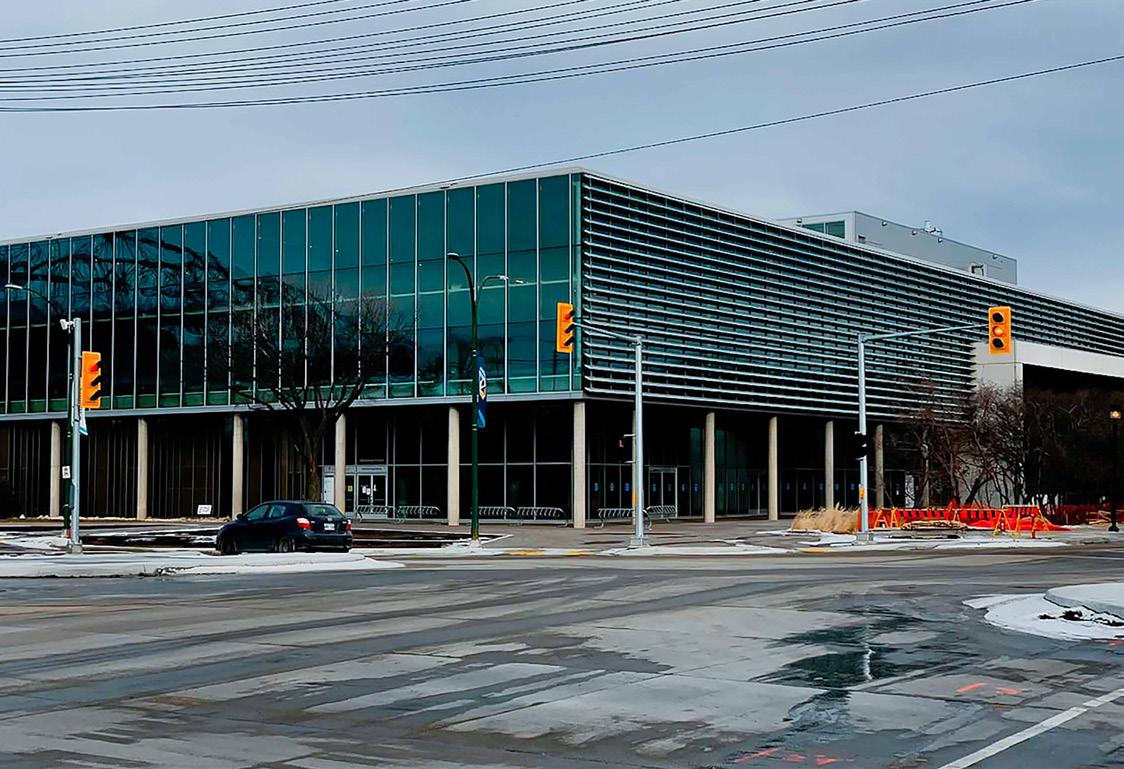
U of M adheres to provincial mandate of a zero per cent salary increase
The University of Manitoba Faculty Association (UMFA) and U of M administration have reached a tentative deal to end the immediate threat of a strike.
Despite demands from UMFA for third-party binding arbitration, a deal was reached through mediation Sunday. The agreement is yet to be ratified by UMFA members.
Mediation took place over the course of four days, from Nov. 12 to Nov. 15. The strike deadline was moved once — from Nov. 14 to Nov. 15 — to allow more time for talks to continue.
The deal the U of M has offered includes a one-time COVID-19 stipend of $1,950, and a zero per cent salary increase in line with the demands of the province. UMFA also retains its rights to legal action against the effects of the unconstitutional Public Services Sustainability Act and a guarantee on salary discussions in bargaining the upcoming collective agreement.
This agreement is a far cry from UMFA’s original ask, which called for “a more equitable salary grid, a modest increase to wages for the 2020-21 contract year and extra supports during the pandemic for those with dependent care responsibilities.”
In a release, UMFA president
Michael Shaw said “Premier [Brian] Pallister and his government continue to interfere in collective bargaining.”
“Rather than investing in postsecondary education as enrolments increase and Manitobans look for opportunities for re-skilling, Pallister is using the pandemic as an excuse to undermine public education and public sector unions.”
The release also stated that the U of M “refused to negotiate on COVID-related relief for dependent care, despite member pleas for support.”
In a statement, U of M president Michael Benarroch said “we are thankful that students are able to continue their classes and academic activities.
“To our faculty, we value and respect you as indispensable collaborators in our shared mission of advanced research and higher education. We are pleased that our community will be able to continue teaching, learning and researching at [U of M] without interruption while the voting process takes place.”
UMFA membership will vote on ratifying the agreement later this week.
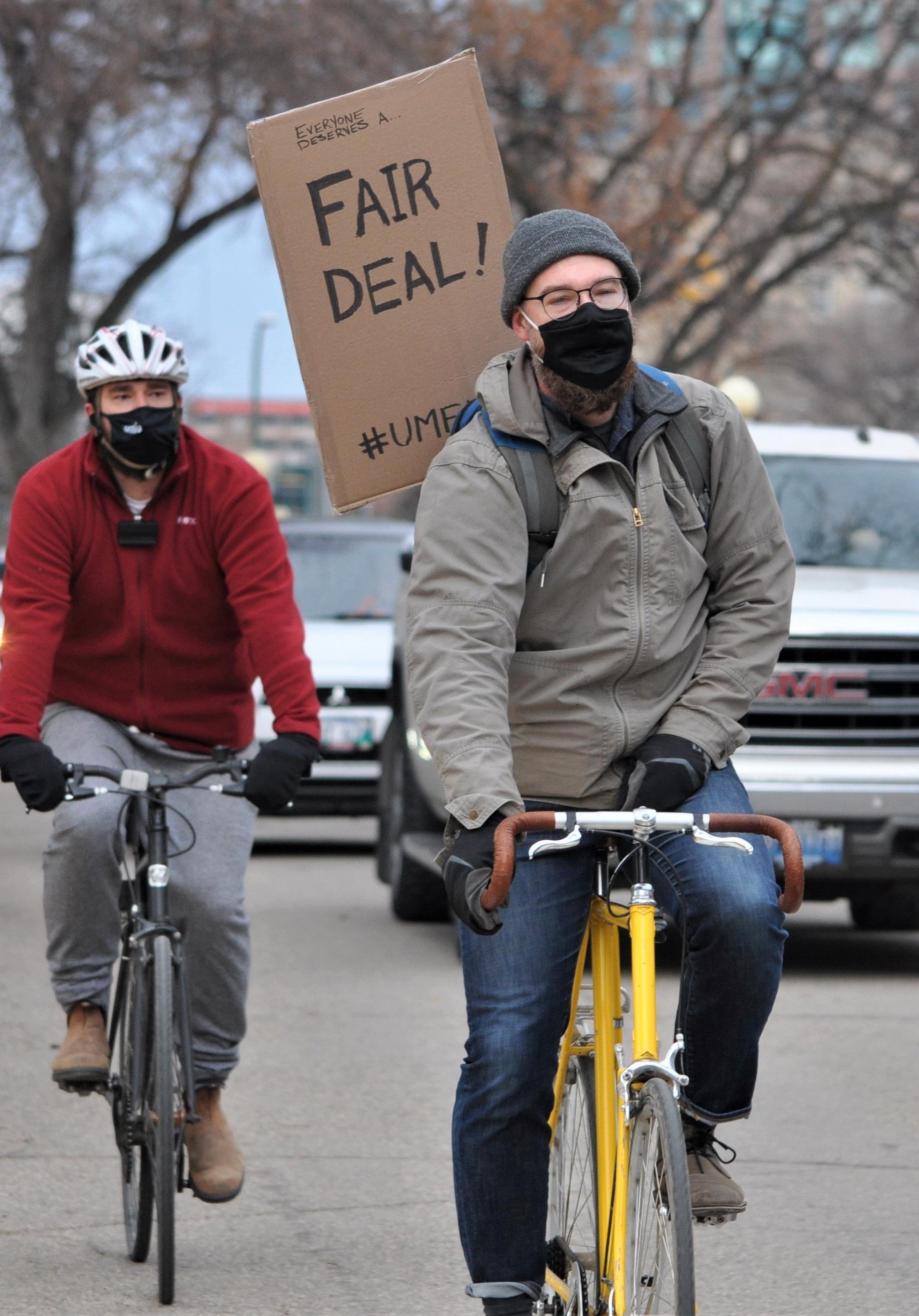
Members of the U of M faculty association (UMFA) were joined by members of other unions Nov. 5 as they drove, cycled and walked around the Manitoba legislature protesting the provincial government’s interference in the salary re-opener negotiations between UMFA and the U of M administration. UMFA will vote on a tentative agreement later this week.
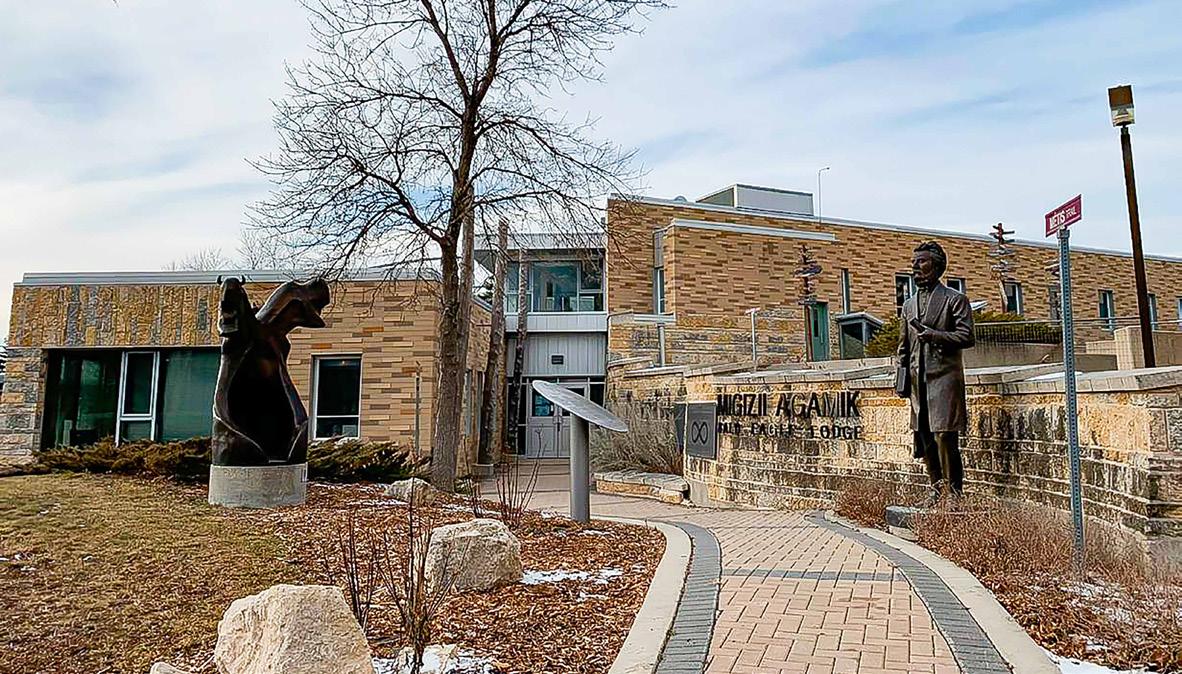
Indigenous content requirement coming to faculty of arts
Strike averted, for now UMFA, UM tentatively agree
UMSU campaign to ‘mobilize students’ if UMFA strikes
#SaveTheSemester urges action through petitions, emails, staying informed
GILLIAN BROWN, STAFF
As the labour dispute between the U of M administration and the U of M Faculty Association (UMFA) goes on, the impact it has on students continues.
“We’re seeing students reduced to a bargaining chip, meanwhile we are the largest stakeholders at the university and the reason why it exists,” said UMSU president Jelynn Dela Cruz.
Amid the still-possible faculty strike, neither UMSU’s endorsement of binding arbitration nor other campaigns plan to change.
“We still have a very important and collective role to play in minimizing its impacts and length.”
With that in mind, the union has begun the campaign #SaveTheSemester, which Dela Cruz
said is meant to “mobilize students, to have us all focus in on the factors at play in [a possible strike].”
Those factors include potential for binding arbitration to resolve the dispute and recognizing the influences outside of UMFA and the university, according to Dela Cruz.
Dela Cruz said UMSU’s focus remains on the wellbeing of students both academically and financially.
“We’ve seen so many things that students have had to cope with since the beginning of remote learning,” she said.
Through “reduced quality of education,” along with increased tuition and a spike in enrolment, Dela Cruz said that “it just isn’t adding up.”
“And I think the reason why it
isn’t adding up is because we have that additional interference from the province.”
A central conflict between UMFA and the university is the university’s refusal to budge on a zero per cent wage increase mandated by the provincial government.
On Sunday, a tentative agreement between the two parties was announced.
In an email sent to all U of M staff and students, it was announced that though the university will not disclose the specifics of the offer made to UMFA, it did meet the provincial mandate to freeze wage increases.
Rather than meeting UMFA’s original demands, the university administration offered the union members a one-time payment of $1,950.
The agreement will remain tentative until UMFA members vote on whether to accept the offer by the end of the week.
To combat the negative consequences of the dispute, UMSU’s #SaveTheSemester created a petition to Premier Brian Pallister, Minister of Finance Scott Fielding and Minister of Economic Development and Training Ralph Eichler.
Rather than placing blame on UMFA or the university, the peti-
tion urges students to look at the province’s role in what UMSU refers to as “the last straw in a long list of decisions by the province of Manitoba which have harmed post-secondary students” in “what is supposed to be an autonomously-governed institution and its faculty.”
Prior to the 2020 dispute, the province cut Research Manitoba’s previous budget by 20 per cent.
In 2018, U of M also saw provincial international student health care cut and the recommendation of a 3.75
“We’re seeing students reduced to a bargaining chip, meanwhile we are the largest stakeholders at the university and the reason why it exists”
— Jelynn Dela Cruz, UMSU president
per cent average tuition increase.
Along with signing and passing along the petition, Dela Cruz urged students to send emails to U of M president Michael Benarroch in support of binding arbitration.
For academic support, UMSU is looking to address concerns for students in an environment where “our quality of learning is already severely compromised.”
Dela Cruz said academic considerations include an option for automatic authorized withdrawal instead of having to voluntarily withdraw and possible refunds for those courses.
The last main issue that UMSU is aiming to draw attention to with #SaveTheSemester is informing students on the labour dispute and potential strike.
A recent UMSU poll revealed that over 65 per cent of participants received their information regarding the dispute by word of mouth.
“Many of these students are either misinformed or don’t have all the information,” said Dela Cruz.
That being the main source of information for many students, she emphasized the importance of staying informed and ensuring that others stay informed.
“There’s a lot of power in that.”
UMSU optimistic on new Indigenous content requirement
UMSU would like to see Indigenous students supported and consulted through fall 2021 implementation
AMIRA TEKLE, STAFF
At its Nov. 4 meeting, the University of Manitoba senate passed a motion modifying graduation requirements for students in the faculty of arts to include an Indigenous content requirement beginning in the fall 2021 term.
This will require all students beginning undergraduate studies that term within the faculty of arts to complete a three credit-hour course that satisfies the requirement. It is required across general, advanced, honours and integrated studies streams.
Courses satisfying the requirement include many Native studies
courses as well as some history, political studies and women’s and gender studies courses.
A committee within the faculty of arts was established in 2018 to explore the idea of an Indigenous content requirement, with the goal being to “ensure every student graduates with a basic understanding of the importance and contributions of Indigenous peoples in Manitoba and Canada.”
A similar requirement was implemented for all students at the University of Winnipeg in 2016.
UMSU president Jelynn Dela Cruz said the requirement is a long time coming for UMSU.
“As long as I’ve been a student at the University of Manitoba, I know it’s been a key priority for UMSU to have some kind of Indigenous content requirement integrated into various programs,” said Dela Cruz.
UMSU Indigenous students’ representative Alicia Kubrakovich said the faculty of arts is “paving the way” for education on Indigenous peoples.
“Coming in as an Indigenous student with these [professors] not having that understanding of intergenerational trauma and just that background knowledge of what it’s like to be an Indigenous student,” said Kubrakovich.
A Native studies major, Kubrakovich said she was the only Indigenous student in some of her summer courses.
“It was really tough, and I was happy that the [professor] was Indigenous and she understood that — she never forced me to speak, never forced me to talk about my trauma.”
“Sitting in a classroom with a lot of non-Indigenous students [is] really intimidating,” she said.
Dela Cruz said her support for the move came from “the need that there is in our society and the role that the university plays at the moment
in graduating informed and wellrounded citizens who will be leading our various communities.”
“You want those individuals
“There needs to be an entire consultation process again with Indigenous students”
— Jelynn Dela Cruz, UMSU president
to have a full knowledge of their relationship to the land and the [Indigenous] peoples that were here long before us,” she said.
Dela Cruz said UMSU has concerns about support for Indigenous students as this requirement is rolled out.
“There needs to be an entire consultation process again with Indigenous students,” Dela Cruz said.
She said that within the senate meeting, she brought up concerns from Indigenous students concerning what might happen in the classroom when the requirement is
implemented.
One glaring concern is “whether or not Indigenous students will be pinpointed, nitpicked on or singled out for being the Indigenous individual within that classroom,” said Dela Cruz.
“Many, many students now [will] not only [be] attending theses classes […] to learn more about the relationship to their land, to the Indigenous peoples who were here long before us, but are doing so out of obligation. There will be those individuals who are a little bit more ignorant, unfortunately,” said Dela Cruz. “We don’t want their learning and their growing mindset to come [at] the expense of Indigenous students’ well-being.”
UMSU will be consulting with Indigenous students as this requirement comes into play next fall “so we can see what goes well, what goes poorly and ensure that we are proceeding carefully and taking into account our Indigenous classmates.”
“The key priority at this point in time is that it isn’t coming at the expense of Indigenous students and potential re-traumatization despite the various barriers they’ve already had to overcome in order to get to those institutions,” said Dela Cruz.
PHOTO BY BASEL ABDELAZIZ
PHOTO BY ALEXANDER DECEBAL-CUZA
‘Our learning shouldn’t stop in the classroom’ Second annual Indigenous students’ month
celebrates Indigenous culture
DAMIEN DAVIS, STAFF
UMSU is celebrating its second annual Indigenous students’ month open to the general public throughout the month of November. This year, the organizers are taking a virtual approach to engaging and honouring the Indigenous community through events hosted by the University of Manitoba Indigenous Students’ Association (UMISA) along with other Indigenous student groups.
In the coming weeks, participants will be able to join in and listen to Indigenous speakers on key issues as well as language tables and beading.
Despite Manitoba’s provincial COVID-19 response level reaching critical code red, UMSU Indigenous students’ representative Alicia Kubrakovich said that aside from some changes, organizing this
year’s Indigenous students’ month ran smoothly.
“We always had a backup plan,” she said.
“As soon as the restrictions hit, it set a barrier for us because we wanted to kind of plan [the events] more land-based,” she added.
UMSU president Jelynn Dela Cruz said that although organizing did have its difficulties, finding avail-
able speakers and panelists has been, for the most part, easier than last year, where they found difficulty in finding panelists mainly because they were not in the city or weren’t able to make it down to [UMSU University
“We’re not often represented” — Alicia Kubrakovich, UMSU Indigenous representative
Centre], but this way it’s a little bit easier to connect.”
Kubrakovich emphasized the importance of paving the way for Indigenous leadership and representation at U of M.
“Being an Indigenous student, navigating these paths for our youth and our students, our voices are often shunned […] we’re not often represented.”
“So, […] alongside Jelynn, I wanted to create this campaign to showcase all the Indigenous youth, all the Indigenous talent we have on campus
[…] we often don’t see that.”
Both Dela Cruz and Kubrakovich said they prioritize the continuation of Indigenous students’ month and its role in utilizing both Indigenous and settler voices in decolonizing the U of M, “an institution of higher learning that is historically colonial,” according to Dela Cruz.
“Our learning shouldn’t stop in the classroom,” she said.
According to Kubrakovich, a major benefit that participants get from this month is “the knowledge” that participants are exposed to.
“That’s why I’m really pushing for a lot of crowd at these panels because all these panels have a lot of knowledge that you can take from.”
“You may not know that. You’ll attend a panel discussion and maybe you won’t take anything out of it, but just attending that panel discussion kind of sets that perspective, or that sets that first step of understanding whose land you’re on.”
Details on events and event scheduling for the rest of the month can be found on UMISA’s social media.
PHOTO BY ALEXANDER DECEBAL-CUZA
UMSU board meeting update
Motions passed include creation of a Black students’ rep. position and incoming structural changes to the board
CAM CANNON, STAFF
At the Nov. 5 UMSU board of directors meeting, two motions were passed — one giving the green light on incoming changes to the structure of the board, and the other creating a position on the board for Black students’ representation.
The board also received a presentation from the Canadian Alliance of Student Associations (CASA) — a student advocacy organization which lobbies at the federal level.
The presentation consisted of an overview of CASA and what the organization does. UMSU is not currently a CASA member.
The changes to the structure of the board with the passing of motion 0495 include reducing the number of
board members to 11 from the current 53, the banning of proxies attending meetings on behalf of board members and new rules limiting permitted absences of board members from meetings to five in a year, or three consecutively.
“What [the governance committee] has been working on for these past three months is addressing Susan Roger’s biggest concern with UMSU as an organization, which is its board [of directors],” UMSU vice-president finance and operations Brendan Scott said in presenting the motion.
Further, the changes include new rules for electing the board of directors.
Directors will be elected under-
graduate students with elections taking place one week after the election of the UMSU executive and representatives.
Directors are currently elected by students in their respective faculties. Slates are typically used to elect a student association executive, which includes candidates for UMSU’s board.
Those who unsuccessfully ran for positions in the executive or representative elections will be ineligible to run for a board director position. All candidates must be independent — not part of any slate.
Once the changes come into effect, UMSU representatives — such as those representing the Arts Student Body Council or Indigenous Students’ Association — will no longer be required to meet a quorum for UMSU board of directors meetings but will be “encouraged to come, weigh in on debate, present, report to the board and report back to their respective councils,” reads the motion.
Current quorum for the UMSU board of directors is a majority of the 53 sitting members.
“Nothing is changed in terms of UMSU [representatives],” Scott said.
“All council bylaws and operations
are unaffected.”
The changes come as part of efforts
“By adding a Black [students’] representative to the board of directors, UMSU is ensuring that someone on the board is actively advocating for the black students of U of M” — Reem Elmahi, UMBSU president
begun by last year’s UMSU executive, for which Susan Rogers of Rogers Leadership Consulting was commissioned to file a report evaluating the board’s structure and effectiveness.
The second motion — motion 0496 — put forward by UMSU vice-
president community engagement
Tino Dogo was to create a Black students’ representative position on the UMSU board of directors. The motion passed unanimously.
The motion is the result of shared efforts between UMSU and the newly created University of Manitoba Black Students Union (UMBSU).
Speaking in favour of the motion, UMBSU president Reem Elmahi said “By adding a Black [students’] representative to the board of directors, UMSU is ensuring that someone on the board is actively advocating for the Black students of U of M.”
In speaking on the motion, Elmahi named Vimbainashe Daisy Gudu, vice-president advocacy for UMBSU, as a possible appointee to fill the new position in the interim.
“The creation of this position is a massive step toward a fully equitable UMSU where the needs of Black students can be directly advocated to the board,” Dogo said.
“I’m looking forward to seeing the [UMBSU] grow, since the community is the strength behind Black excellence on campus.”
GRAPHIC BY JENELLE MCCANN
Wave of novel coronavirus continues
JOSHUA WESEY,
STAFF
EDITOR-IN-CHIEF Matthew Doering editor@themanitoban.com
BUSINESS MANAGER Alice Teufack accounts@themanitoban.com
ADVERTISING CO-ORDINATOR Diego Castro ads@themanitoban.com
EDITORIAL
MANAGING EDITOR Ty Brass me@themanitoban.com
NEWS EDITOR Amira Tekle amira@themanitoban.com
NEWS EDITOR Gillian Brown gillian@themanitoban.com
COMMENT EDITOR Lucas Edmond comment@themanitoban.com
ARTS AND CULTURE EDITOR Shaylyn MaharajPoliah arts@themanitoban.com
SOCIAL MEDIA EDITOR Colin Ijebor social@themanitoban.com
REPORTERS & ASSOCIATES
NEWS REPORTER Cameron Cannon
NEWS REPORTER Damien Davis
ARTS AND CULTURE REPORTER Kaelen Bell
ARTS AND CULTURE REPORTER Zoë LeBrun
COLUMNIST Matthew Averbeck
DESIGN ASSOCIATE Mikaela Warkentin
PHOTO ASSOCIATE Basel Abdelaziz
SOCIAL MEDIA ASSOCIATE Jalene Moman
VIDEO ASSOCIATE Arsalan Saeed
AUDIO ASSOCIATE Tawana Matizanadzo
GRAPHICS ASSOCIATE Dallin Chicoine
COPY ASSOCIATE Aldin Sabic
SPORTS REPORTER Matthew Merkel
VOLUNTEER CONTRIBUTORS
Maureen Cooper
A “volunteer staff” member is defined as a person who has had three volunteer articles, photographs, or pieces of art of reasonable length and/or substance published in the current publishing year of the Manitoban. Any individual who qualifies must be voted in by a majority vote at a Manitoban editorial board meeting. Elected representatives and non-students may be excluded from holding votes as volunteer staff members in accordance with the Manitoban Constitution.
Homegrown filmmakers are setting a new standard for Winnipeg in Canadian film
ALEX DECEBAL-CUZA, STAFF
The film industry is transforming, and Winnipeg’s local film scene is no exception. Winnipeg’s film industry has become a hotspot for quite a few large productions recently, and its independent filmmakers are starting to see more success on a national level. From indie films to union projects, a new bar has been set.
Within the past couple of years, the local film community in Winnipeg has made a significant effort to support its filmmakers, and the industry has seen a lot of growth as a result.
Organizations such as the Winnipeg Film Group (WFG) have been taking initiatives to help many filmmakers kickstart their journey into the industry. For example, in 2018, the WFG started offering free editing and sound workshops for women.
It also hosted the first annual Afro Prairie Film Festival in 2018. This was the first festival to thematically feature Black films in Western Canada. Not only has the organization played a conscious role in providing equitable opportunities to diverse communities, but it has continuously supported local filmmakers by providing spaces to host a variety of film festivals. Not to mention the constant flow of affordable workshops the organization provides.
It is a struggle to get into the film industry, but having these sorts of resources available opens opportunities for a large portion of Winnipeg’s aspiring filmmakers. This type of support drives the film community to excel in their passion. The WFG has played a large role in the growth of film in Winnipeg, and its contributions do not go unnoticed.
Local feature films, such as STAND! and I Propose We Never See Each Other Again After
Tonight, exemplify Winnipeg’s jump into the scene as a film city. The former is a musical based on the 1919 Winnipeg General Strike and the latter is a romantic comedy about a Filipina woman and a Mennonite man who live in Winnipeg. Both films, however, have recieved great attention for Winnipeg’s central role in production and the storyline.
It is safe to say that the Winnipeg film sector has caught the eye of various governing bodies, displaying just how much promise the city has to become a central location for Canadian arts and film
It’s not often Winnipeggers see a film that represents their hometown so well on the big screen. Films like these not only create job opportunities for our local motion picture technicians and actors, but they are also an active example that Winnipeg is a city with stories to tell. Winnipeg is often touted for its exceptional art scene but, up until recently, it seems this reputation has not been reciprocated in film.
Now Winnipeg’s film industry is growing quickly. A report published in 2019 by On Screen Manitoba, a non-profit media productions organization, claimed that Manitoba’s
movie industry growth rate is larger than the majority of Canadian provinces. The community has had tremendous support from local organizations and even the provincial government. It is safe to say that the Winnipeg film sector has caught the eye of various governing bodies, displaying just how much promise the city has to become a central location for Canadian arts and film.
And Winnipeg is not just filming its own stories anymore — large production companies have taken notice of the local talent and are starting to shoot their features and television series here with local motion picture technicians. For example, Winnipeg has become a hotspot for Hallmark Channel movies and, recently, Amazon Prime Video productions as well. The feature film Night Hunter was largely shot in Manitoba and starred award-winning actor Henry Cavill. Beyond this, the television series Tales from the Loop was shot in Manitoba as well. Both productions are now found on Amazon Prime Video.
This is a big step in the right direction for Winnipeg. The larger productions are going to need filmmakers, and with companies like these shooting projects here, our current indie filmmakers are the ones who will fill this role. There are several talented and hardworking filmmakers in Winnipeg, and there is a strong community being built to support them. Our filmmakers today are meeting new challenges and setting a new bar for the industry. Local filmmakers and motion picture technicians are continuing to create more ambitious films with powerful storytelling, and in the meantime, they are putting Winnipeg on the scene in the Canadian film industry.
PHOTO BY AHMED PESHIMAM
Dear 2020 Holiday Hamper Program Sponsors,
Due to COVID-19, we are seeking monetary donations for students in need during the 2020 holiday season. All our sponsors will be recognized and thanked in at least one social media post for their contributions to the program.
If you are interested in donating, have any questions, or need more information please email: scoulthard@umsu.ca
Comment Editor: Lucas Edmond Contact: comment@themanitoban.com
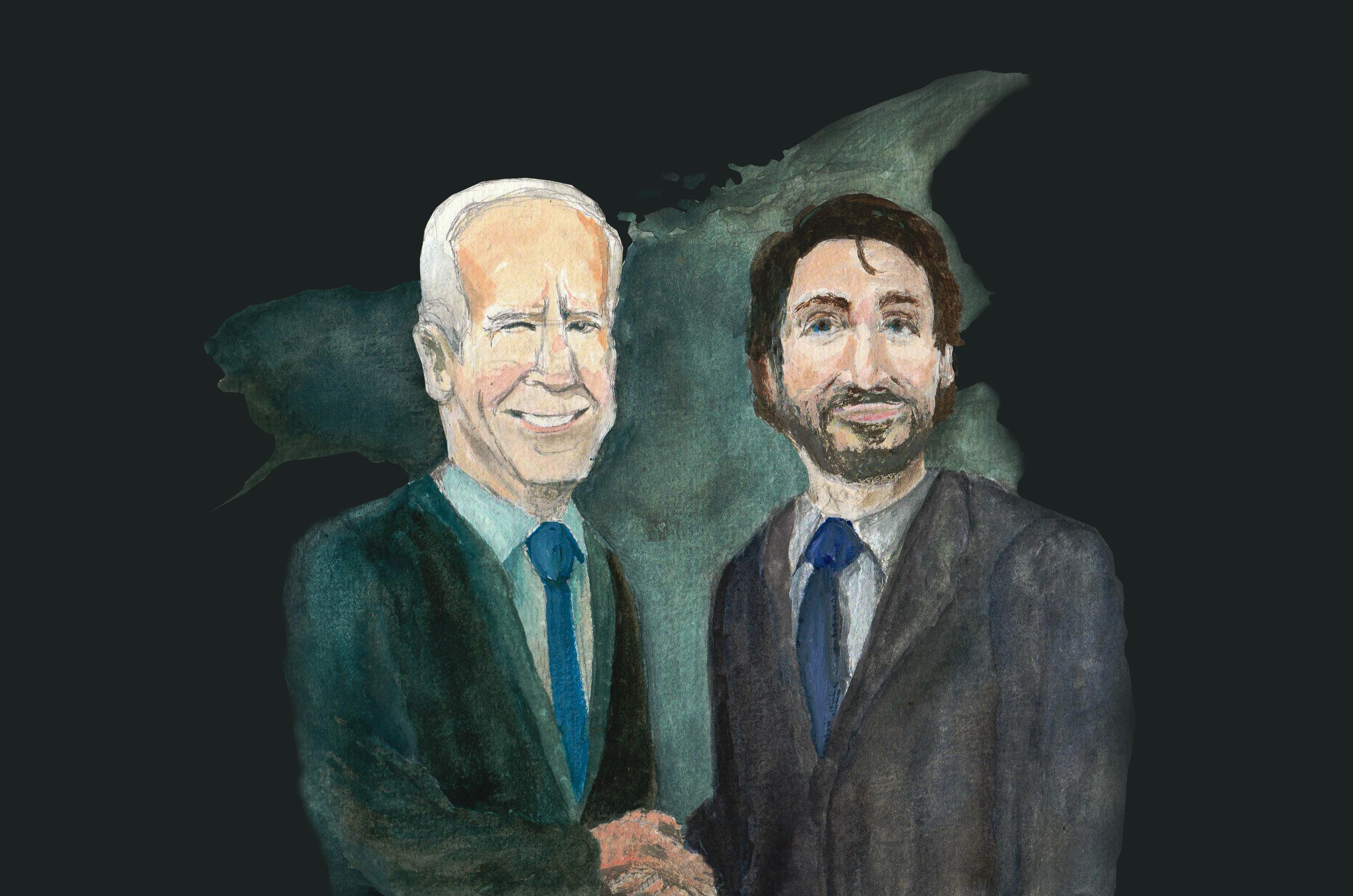
The election of Joe Biden is a victory for Canada
The Biden administration will restore co-operation and close ties with Canada
MATTHEW AVERBECK, STAFF
Over the last four years, I have been contemplating whether to stay in Canada after graduating from the University of Manitoba. I’m from the United States, a country that constantly flaunts the promise of the “American Dream” for all of its citizens yet fails to live up to these promises in so many ways. High tuition costs and a rapidly dividing country led me to attend the U of M back in 2016, and I have stayed here ever since.
After the loss of President Donald Trump earlier this month, Americans may be more inclined to pack up and move home. The nation is well on its way back to normalcy. However, while I was relieved and even elated by the results of the election, it didn’t change my mind about where I see my future — here in Canada.
Canada already has many of the progressive policies that so-called “radical-left” Americans — including myself — have been calling for: universal health care, paid maternity and paternity leave, marijuana legalization, stronger unions and more.
President-elect Joe Biden is unlikely to bring about any of those so-called radical changes for Americans when he takes office on Jan. 20, 2021. Instead, it appears he will opt for a more measured approach to domestic policy, asserting to U.S. citizens that he is eager to
be more bipartisan considering the massive rift between the parties that has grown in the past four years.
However, where there will be dramatic change — compared to the Trump administration — is in regard to foreign policy. Most importantly to the readers of this newspaper, the Biden presidency will drastically improve relations and increase cooperation between the U.S. and Canada — likely to resemble the relationship that the two nations had grown accustomed to prior to Trump’s election in 2016.
This matters not only to me as an American attempting to gain citizenship in Canada, but it is important to Canadian and U.S. citizens writ large. Precedence can support this claim. Joe Biden, during his tenure as vice-president, was a strong ally to Canada, and that relationship will likely carry into his presidency.
The Biden administration will likely rejoin the Paris climate agreement — a landmark international climate change plan that the Trump administration officially left this month. This could potentially make ecological management for the Canadian government easier.
Unfortunately, the pollution caused by one nation does not stop at politically defined borders, displaying the importance of nations working
in unison to curb the degradation of our natural surroundings—especially those geographically close to each other.
Prime Minister Justin Trudeau is an advocate for this agreement, and he and his cabinet have placed combatting climate change on their agenda.
For the first time in four years, the
The election of president-elect Biden and vice-presidentelect Kamala Harris was not only a victory for the U.S., it was a victory for Canada as well
Liberal Party of Canada will meet with a U.S. government that has similar climate goals to them. This is a positive development for Canada and the rest of the world.
On the COVID-19 front, a Biden administration will seek to follow the direction and advice of scientists and
doctors to get the novel coronavirus under control.
Since March, Canada and the U.S. have closed their shared border to non-essential travel.
This has affected many Americans and Canadians who have loved ones on the other side of the border and has had an impact on businesses that rely on tourism.
Despite cases currently spiking at record-breaking levels in the U.S., a Biden administration will hopefully improve the situation and work closely with Canada to safely re-open the border if COVID-19 cases can be managed at an effective rate.
Canada will also benefit from new trade deals as Biden will likely look to curb some of the more protectionist trade policies that the Trump administration adopted. For the last four years, Trump, along with the Republican party, consistently threatened and imposed tariffs on Canadian exports.
While the U.S. is likely going to maintain some of its protectionist policies, the Biden administration will likely be far more willing to negotiate.
This will be beneficial for steel and aluminum companies and their workers who have been hurt by the U.S.’s aggressive trade strategy.
Beyond tangible government
policies, a Biden administration will presumably seek to bring calm and respect back to the United States. Canadians have had a front-row view of the United States’ quick decline during the Trump era — like they have been watching a close friend repeatedly make bad decisions — but the new government will hopefully ease Canadian observer’s nerves.
A Biden victory also sends a message to conservatives across the world — including here in Canada — that far-right populism will lose should it challenge the will of voters. This is especially pertinent to the Conservative Party of Canada that has seemingly embraced right-wing populist rhetoric.
While there will certainly be challenges with the U.S. government over the next four years — including the probable death of the Keystone pipeline — a Biden presidency will restore the neighbourly relationship between the two countries.
The election of president-elect Biden and vice-president-elect Kamala Harris was not only a victory for the U.S. — it was a victory for Canada as well.
I hope that this election will return normalcy and strong relations, not just for my birth country, but for the country that I now choose to call home, Canada.
GRAPHIC BY DALLIN CHICOINE
Refuse to cross potential picket, show solidarity
The U of M and Brian Pallister are negotiating in bad faith
LUCAS EDMOND, STAFF
The University of Manitoba Faculty Association (UMFA) approved strike action in the first week of November. After three days of voting and an 85 per cent membership turn out, approximately 80 per cent of union members voted in favour of striking.
Although a strike is not yet off the table — a ratification vote on the tentative agreement will be held by UMFA members later this week — students are expressing significant anxiety about its potential during a tumultuous semester.
It would be easy to blame UMFA for the strike — as the administration likely wants students to do seeing as they have a degree of influence in university affairs — but before students make snap sentimental judgments, consider the context that a strike may be called under.
From the public services sustainability act (PSSA) being declared unconstitutional this summer to the Brian Pallister-led Progressive Conservative Party (PC) playing an unfair union-busting role in discussions, students should be outraged by the University of Manitoba administration’s treatment of its faculty members. Solidarity with our professors should be a priority, and, in the event
that a strike is called, students should consider not crossing the picket line.
UMFA has been attempting a new deal with the U of M since August after the PSSA was struck down by the Court of Queen’s Bench on June 11.
For context, the PSSA was a piece of austerity legislation passed by the PCs in 2017 to prevent salary increases of public sector workers. This simultaneously meant that the U of M could not — with legal backing at the time — raise salaries of faculty members.
Instead, in 2017 UMFA and the U of M negotiated terms to re-open discussions when the PSSA expired. So, while it seemed the 2016 strike was resolved, it was effectively just put off to a later date.
Since the PSSA was deemed a violation of the constitutional rights of public sector workers to partake in collective bargaining, salary discussions should have taken place months ago without the PCs rearing their heads. But, despite this, it seems the U of M is still in bed with the provincial government’s anti-union stance.
The provincial government has been playing an active role in reducing labour costs over the course of the COVID-19 pandemic. The U of M
stated in a press release detailed by UMFA that the PCs will not allow salary increases because it may act as “precedent” for arbitration and strikes in the public sector. But if strikes across the public sector are called, it won’t be due to precedent — it will be because of Pallister’s careless treatment of workers during what is perhaps the largest crisis of the 21st century in Manitoba. This is simply another example of Pallister’s costreduction obsessed politics and his lazy public discourse tending toward blaming others for his own faults.
Recently, a report from the CBC suggested that the provincial government is insisting the U of M seek a two-and-a-half per cent reduction in labour costs in negotiations. With this coming to light, an agreement between UMFA and the U of M seems unlikely anytime soon.
If students are not yet convinced that the U of M is bargaining in bad faith, consider that despite the health and economic crises unfolding before our eyes, the U of M’s budget has not been dramatically affected. As a matter of fact, students were the ones that took a hit. Enrolment was up approximately 11 per cent this summer and has risen three per cent this fall. Further, the administration raised
tuition by 3.75 per cent. Even if the university’s books are not completely balanced, I cannot imagine they are
Pallister’s baneful agenda affects the entire province and we should resist it together
taking in losses heavy enough to suppress negotiations with UMFA — negotiations that the U of M agreed to re-open in 2017.
What’s more, the U of M’s unwillingness to budge does not bode well for attracting new skilled labour to the university. Professors’ salaries at the U of M are low enough to do that already, but the administration’s behaviour is making matters worse. Students’ ability to get the quality of education they deserve is influenced by the quantity of funds our professors are provided.
But, beyond the more tangible rationales behind this strike, UMFA
standing up for itself is important in principle for Manitobans writ large. With the Pallister government bent on austerity politics as Manitoba’s economy falls deeper and deeper into recession, Manitobans are going to need unionism more than ever.
Leader of opposition, Wab Kinew, criticized Pallister’s government after “the premier ordered the biggest single-day budget cut in Manitoba’s history” in May. Considering the PCs have lost ground in its balancedbudget due to COVID-19, don’t expect Pallister’s administration to let up on its union-breaking, privatizing and budget-cutting momentum. Pallister’s baneful agenda affects the entire province — students, professors and workers alike — and we should resist it together.
Workers must fight alongside each other when the time comes. The tides of unionism are changing in Manitoba. No longer can we rely on state-sanctioned arbitration to protect our rights from employers. Now, the government is an active proponent of union suppression.
When the time comes, students should work with UMFA and refuse to cross the virtual picket line, now divided by an abstract universe of network connections and Zoom links.
GRAPHIC BY JENELLE MCCANN
Comment Editor: Lucas Edmond Contact: comment@themanitoban.com
Nutrition North Canada riddled with problems
Subsidy program serving northern communities discourages food sovereignty
MAUREEN COOPER
Indigenous leaders have continuously struggled to be heard when they call on the federal government for a policy that contributes toward restructuring our mainstream governing systems. Policies surrounding food and nutrition in northern regions of Canada are not excluded from this and should be of utmost importance to the federal government.
The recent racist attacks perpetrated against the Mi’kmaq people in Nova Scotia and their fishing livelihoods have brought mainstream attention to the mistreatment of Indigenous people, their land and their foodways.
On April 14, the federal government announced that it would provide an additional $25 million to the Nutrition North Canada (NNC) subsidy program so northern families can have access to better food and hygiene products during the COVID-19 pandemic. According to the 2018-19 fiscal year report, this is roughly a 32 per cent increase from the subsidies usual allowance.
The NNC program provides northern retailers subsidies to allow them to lower their prices for items such as flour, infant formula, milk, vegetables, fruits, meats and more. For many well-intentioned policy analysts, this program may seem
like a praiseworthy effort by the government to tackle the issue of food insecurity in northern Canadian communities. However, there are numerous flaws.
Although the NNC program serves northern Inuit and Indigenous commmunities alike, the problems with the program primarily stem from far-north Inuit peoples foodways and the diets they have historically consumed.
According to the NNC’s official webpage, the program currently subsidizes products such as fresh and frozen fruits and vegetables. Although many of these fruits and vegetables are nutritious according to a Eurocentric diet, they have little place in the diets of Canadian Inuit people.
The same goes for milk, bread and beans. Having disproportionately southern grown and produced foods covered under the subsidy ignores community needs, and it is discriminatory due to the lack of attention paid to the benefits of the diets historically consumed by Inuit populations.
The NNC fails to provide necessary items such as hunting and fishing gear. It does not subsidize bottled water, despite the fact that many of these communities are under boil
water advisories and cannot access clean drinking water. The NNC has neglected to examine the context in which it operates.
As a result, they have simultaneously neglected what would actually benefit populations living in the north.
The NNC program was implemented in 2012. The then-Conservative federal government — the party in power at the time — did not consider community demands and implemented the program despite their criticisms. The failure to consult with Inuit and Indigenous communities, or implement culturally sensitive policy, mimics colonial governmentality.
In 2018, Inuit leaders called for policy changes that would meet the needs of their communities — effectively calling out the NNC as an ineffective program.
The increase of funding for the NNC from the Justin Trudeau administration is not only disrespectful to communities who demanded change, but it is also a slap in the face to anyone who had hopes that a Liberal-led government would take steps toward reconciliation, or better yet, steps to dismantle the deeply rooted colonialism that drives many social inequities in Canada.
The federal government should
be reallocating its funds to programs that provide sustainable nutrition in northern communities. According to a 2019 CBC article, many northerners will go to “great lengths” to curb the heavy retail costs of food and water.
Even with the NNC subsidies, food is too expensive for people to afford.
The failure to consult with Inuit communities, or implement culturally sensitive policy, mimics colonial governmentality
According to Statistics Canada, since the program was established, food insecurity in northern communities has grown.
Unfortunately, it seems the NNC program does not view food as a human right.
It appears that the only value the program places on food is monetarily measured. In places of extreme poverty and malnourishment, making food slightly less expensive but
still not affordable to community members is unethical. Policy and programs developed to help food insecurity must first recognize food as a human right.
Over time, federal policies that favour industry have also led to significant environmental destruction. For example, some rivers and lakes have become unsafe for fishing in many of these communities due to high concentrations of methylmercury caused by hydroelectric dams.
There is a lot of work that needs to be done by government officials in order to properly support communities while improving food security, living conditions and the dignity of Inuit people.
In place of the NNC, funding should be reallocated to conserving the knowledge and practice of traditional diets. Further, more focus should be placed on environmental protection.
The NNC is a colonial system that encourages Eurocentric lifestyles and simultaneously hampers Inuit food sovereignty.
Canadians must pressure the federal government to end financial support of the NNC and allocate funding to policies that work to reconcile their relationship with Inuit populations.
GRAPHIC BY JENELLE MCCANN
A season of measured optimism
Artistic director of MTYP discusses the pandemic and looking to the future
ZOË LEBRUN, STAFF
When the COVID-19 pandemic hit Winnipeg, theatres were some of the first institutions to be shut down. The Manitoban sat down with the artistic director of Manitoba Theatre for Young People (MTYP), Pablo Felices-Luna, to learn more about how its programming was disrupted by the onset of the virus in Manitoba and its plans for the future.
At the time of the first Winnipeg lockdown, three major changes were made to the end of MTYP’s season.
The first was the cancellation of Windmill Theatre Company’s North American tour, Beep, as the Australian company pulled back its actors due to travel restrictions. Another cancellation was the second portion of MTYP’s Gala performance weekend, which musical theatre students had been preparing for in MTYP classes. Spelling 2-5-5, a tour that was to be the season’s last show in May, was also shut down as schools withdrew.
During this time, MTYP had originally planned on announcing its 2020-21 season but postponed it to rethink what the year would look
like amidst the pandemic.
In April, the company announced it aimed to tackle the following season with what Felices-Luna called “measured hope.”
“We do want to come back together to do what we do for audiences in person, but we also understand that [the] hope that we are trying to maintain has to be qualified by the reality of what we are living through,” he said.
Some changes to MTYP’s 202021 season include shortening it, adding digital offerings and reducing class sizes.
“We looked at the summer and we said, ‘What can we do within public health guidelines and with an abundance of caution, but still to offer opportunities for self-expression and to support families?’” FelicesLuna said.
The result was a scaled-down version of on-site summer camps using cohorts — a practice that continued into the fall session until Winnipeg went into critical code red, forcing MTYP into strictly digital offerings.
As for productions, subscribers can look forward to previously postponed
shows being remounted as well as new ones.
Felices-Luna also spoke about the complexity of making shows for young people during this pandemic. Not only does MTYP serve multiple
“It’s a choice to remain hopeful” — Pablo Felices-Luna, artistic director
audiences of varying ages, but it must also consider how guest companies fit into programming and keep all those involved with MTYP safe while seeking and creating programming that is reflective of current times.
“I love advanced planning,” FelicesLuna said.
“I think it helps everybody, the more we know early on, and we need to be completely prepared for [plans] to go out the window because things are changing constantly and we need to remain as nimble as possible to adapt.”
Overall, Felices-Luna feels that the restrictions placed due to COVID-19 have been both creatively fruitful and frustrating.
“There’s been some really good opportunities for creation,” he said.
“Our school has been trying to sort of think about how to deliver programs differently, whether it’s in person or online […] there’s been lots of exploration in all of those directions.”
In this difficult time, morale is something that MTYP has sought to keep up as much as possible.
“MTYP is going to make whatever accommodations necessary for people to continue working and working in a way that they feel good about,” Felices-Luna said.
He stressed the importance of keeping all MTYP employees informed of the company’s path during these troubled times to reduce uncertainty.
On a personal level, Felices-Luna said his biggest struggle as MTYP’s artistic director is the limits on the creative process for both himself and artists he works with.
“There’s this thing that you’ve trained your entire life to do, and you’re not able to access it — I think it’s that loss that is really, really challenging for a lot of artists,” he said.
In regard to this, Felices-Luna mentioned how he finds encouragement in “moments of recharging” and spoke to the importance of this concept across MTYP as a whole. Since the organization is supported by many other departments, maintaining optimism at each level of involvement is vital.
Until Winnipeg’s COVID-19 case numbers go down, Felices-Luna said that all MTYP can do is continue monitoring the evolving situation and head into its upcoming seasons with measured optimism, ready for whatever changes come next.
“It’s a choice to remain hopeful,” said Felices-Luna.
“It’s not something that just happens, and it’s not easy […] it’s not that we are unaware of the fact that things will have to change, but at least let’s hold onto hope, let’s make an active choice to say, ‘things are going to get better.’”
Creativity in a climate of constant change
Odario Williams talks about the evolution of his first solo EP
KAELEN BELL, STAFF
As we plunge headfirst into another wave of tightening restrictions, it’s hard not to look back at the pandemic’s tentative beginnings in March, when it all felt more like a temporary circumstance rather than the new world order.
Odario Williams remembers it
PHOTO BY LINDSAY DUNCAN
well. It was Friday the 13th — only two days before he was set to host the 2020 JUNO Awards — when he received two phone calls.
The first told him that he needn’t get on that flight to Saskatoon, Sask. as the JUNOs had been cancelled.
The second was from CBC — he
’Toban turntable
couldn’t come in to record his radio show, Afterdark , for the next two weeks until everything was under control.
“You can’t come in for two weeks,” he said. “‘We just need two weeks to clear things up, and then you can come back.’ I remember we were told that.”
Those two weeks stretched into a month, and then stretched on further.
For Williams, this didn’t just mean lost hosting opportunities, but a total overhaul of what was meant to be his first foray as a solo artist.
“The sound of it changed, the lyrics I was writing changed, the production, for sure [changed], even the process,” he said.
The EP was originally slated for release in May. When Williams first spoke with the Manitoban about his solo effort at the tail end of January, COVID-19 was just a whisper, but Good Morning Hunter finally arrived, a completely different animal than before.
Good Morning Hunter is a kinetic and meditative EP, seven tracks that span hip-hop, soul, jazz and strange detours into glittering electronica and swirling psychedelia.
The EP features an array of collaborators, with contributions from Angelita SB, Dawn Pemberton,
Odario — ‘Good Morning Hunter,’ 4.5/5
KAELEN
BELL, STAFF
There is a notion that times of political and social turmoil create incendiary music, the kind of essential, galvanizing work that inspires and unites people.
It’s true that sometimes certain artists are able to capture the zeitgeist and make something definitive of a time and place.
However, oftentimes, this kind of turmoil sows little more than despair — COVID-19 has seen the closure of dozens of beloved venues, left artists unable to tour or record and cast the future of working musicians into the unknown.
Odario Williams, known professionally by the mononym “Odario,” after decades of making music with Mood Ruff and Grand Analog, has found a tentatively hopeful middle ground between despair and cleareyed truth-telling on his first solo EP.
Good Morning Hunter is shaped by the extraordinary circumstances in which it was made, but it’s never about the pandemic — it’s about those living through it, what came before, what comes after and the small fires that drive people through the unknown.
A sparkling medley of hip hop, jazz, soul and small, insular electronic music — think Mort Garson by way of Erykah Badu — Good Morning
Hunter is uplifting without being cloying, a guest-heavy dash through a multitude of colours and textures that leaves room for moments of quiet introspection. Most of these moments are courtesy of spoken word artist Angelita SB, whose steely-eyed appearances on “Reprise”
“Good Morning Hunter” is uplifting without being cloying, a guestheavy dash through a multitude of colours and textures that leaves room for moments of quiet introspection
Chad Price, Kamilah Apong, Len Bowen, Adrian X and Grand Analog members Ofield K, Aubrey McGhee and Warren Bray.
“It ended up being like-minded
“It sounds like we got together and jammed, but it was all remote” — Odario Williams, artist
musicians that needed a creative outlet to get by,” Williams said.
“They needed a creative outlet as a form of therapy.”
The music they created, mostly over email and Zoom, is warm and colourful, driven by deep grooves and a sense of joyous comradery.
“It’s amazing because it sounds like a jam,” he said.
“It sounds like we got together and jammed, but it was all remote.”
The next step was to stitch together these disparate demos — making songs from sounds that, in some cases, had traveled thousands of kilometres.
“It’s a mess,” Williams said.
“I wonder if I kept those demos
— they sounded terrible! The early demos sounded like it was remote […] but at the end of the day, it came together.”
Good Morning Hunter isn’t about the pandemic so much as the feelings it inspires — the loneliness and fear, the introspection and moments of self-discovery and hope.
“It was such a spooky time,” he said.
“The city of Toronto [Ont.] was a ghost town. And that’s how the song [‘Midnight: Ghosts’] came about — [it] was about that ghost town feeling.”
That solitude runs through Good Morning Hunter in tandem with the sense of community and togetherness — the EP wouldn’t be what it is without the understanding that one can’t exist without the other.
If anything, the tension that drives our current reality seems to have lit a fire in Williams, a desire to discover what comes next.
“I think the world over likes to hear nice things, watch beautiful things and, if the powers that be can continue to help artists […] make beautiful things, the world will accept it and take it in somehow, some way,” he said.
“I know I have the hunger and the energy to tap into whatever it is.”
and “Disastro” ground the EP in our tumultuous reality. The highlights are plentiful and spread evenly throughout. The EP is properly sequenced, rising and falling just when required, allowing sunlight and shadow to dance around each other just so.
“Midnight: Ghosts,” with its echoing insect-click backing, feverish build and twinkling chorus is an encapsulation of everything that Good Morning Hunter does well, sprinting through a series of styles while still giving time to breathe. The title track’s skittering jazz percussion and floating guitar solo, courtesy of Adrian X, melts effortlessly into Ofield K’s kinetic dub remix, a onetwo punch of dynamic heat. By the time things close out on “Hot Hot Heat,” featuring the dynamic Kamilah Apong, you’ll likely feel more energized than you did when you first hit play.
Good Morning Hunter is a complex, insular EP, but its major motivations are movement and togetherness — finding a sense of complicated hope among all the despair.
The Evies celebrate this year’s shortened theatre season
Awards
remember the best performances and technical work from before the pandemic
SHAYLYN MAHARAJ-POLIAH, STAFF
Earlier this month, the fourth annual Winnipeg Theatre Awards, known as the Evies, was streamed online for the first time. This year’s awards ceremony was hosted by Melissa Langdon and Matthew Paris-Irvine from local theatre collective Out From Under the Rug.
In lieu of ticket purchases, viewers were asked to donate to the Actors’ Fund of Canada or to the awards themselves to support an arts community that, like many, has been devastated by the COVID-19 pandemic.
The Evies celebrate and recognize excellence in Winnipeg’s professional theatre community through both onstage and backstage contributions.
A couple of years ago, the Winnipeg Theatre Awards were renamed in honour of Evelyne “Evie” Anderson, a prolific Winnipeg actor who appeared in more than 100 productions and whose career spanned over 50 years.
Anderson was honoured with the Lifetime Achievement Award at the inaugural award ceremony in 2017 and passed away last February at the
age of 89.
The awards are operated by a volunteer committee that chooses a diverse jury of Winnipeggers to select winners of the awards from theatre productions that run from September to August each year.
Despite theatres closing their doors indefinitely in mid-March, the Evies were able to honour some of the stars that shone prior to the lockdown.
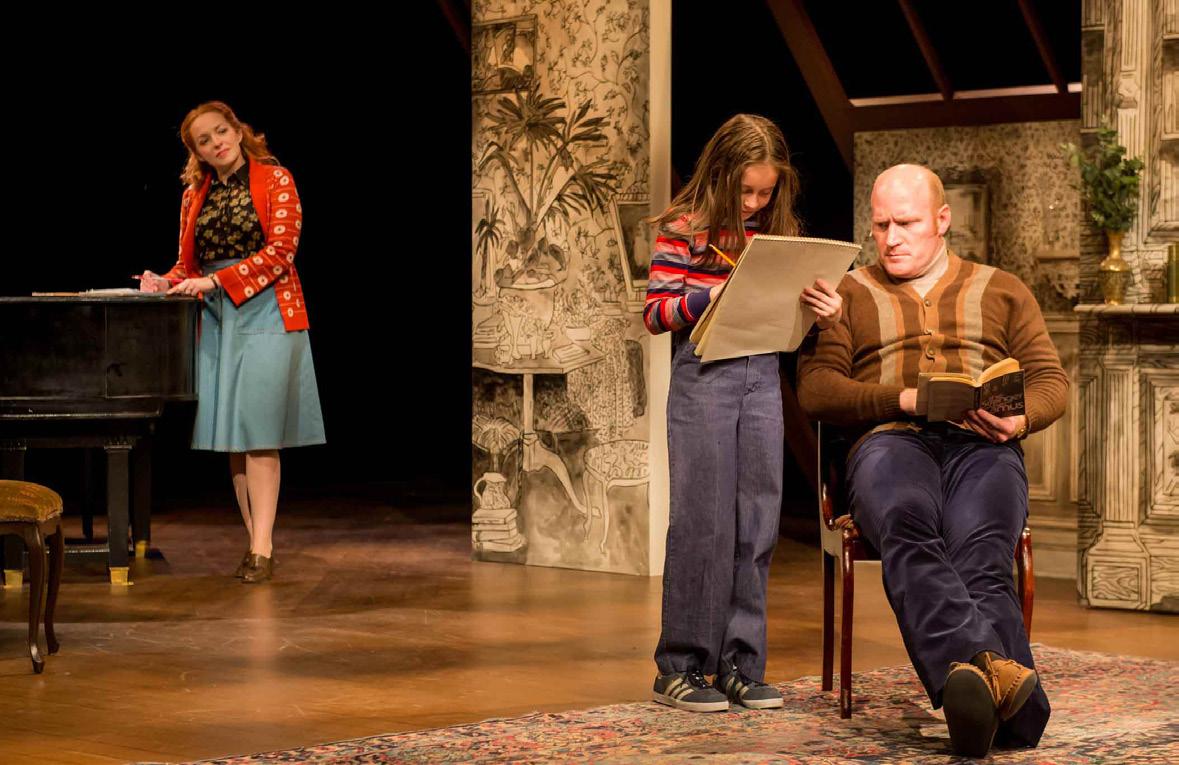
Among this year’s winners is Carson Nattrass for his portrayal of tormented father Bruce Bechdel in the musical adaptation of Fun Home, Alison Bechdel’s comic book memoir. Laura Olafson took home the award for Outstanding Supporting Actress for her work in Ann-Marie MacDonald’s Goodnight Desdemona (Good Morning Juliet), which ran earlier this year as part of Royal Manitoba Theatre Centre’s 20th and final Master Playwright Festival, ShakespeareFest.
U of M alumnus Ian Ross was presented with the award for Outstanding New Work for his dramedy, The Third Colour, which premiered at Prairie Theatre Exchange
last October and offered a colourful commentary of Canada’s colonial his-
The Evies celebrate and recognize excellence in Winnipeg’s local theatre community through both onstage and backstage contributions
tory and the idea of reconciliation.
Théâtre Cercle Molière swept the behind-the-scenes categories with its production of La Cantatrice chauve et La Leçon, receiving awards for set design, costume design and lighting design, while the big winner of the performance awards was the musical adaptation of The Color Purple. Tara Jackson, in the role of
Whether you’re
Celie, was awarded the prize for Outstanding Lead Actress and the show itself received recognition as an outstanding production with an equally outstanding ensemble cast.
In addition, it was announced that the next year’s Evie Awards would introduce new categories, including an award for the best production for young people and families and outstanding performance awards in three genres: drama, comedy and musi-
375 C
323 C
cal. These latter awards will replace the current gendered performance awards of outstanding lead and outstanding supporting actor and actress. An Outstanding Livestream category has also been added to the award roster for next year to honour the productions that kept theatre alive during the pandemic and those that will continue to enrich the lives of Winnipeggers until theatres are safely reopened again.
Share your thoughts about moving around Winnipeg and help shape the future of our transportation network. Participate in the Transportation Master Plan: 2050. Visit winnipeg.ca/tmp2050 to: • Register for an online workshop
• Take the online survey
• Download a discussion kit and host a small group
• Share your thoughts on the future of transportation on social media: #tmp2050 #gettherewpg
If you require alternate formats or interpretation to participate, please contact tmp2050@winnipeg.ca or 204-927-3444 (ext. 231)
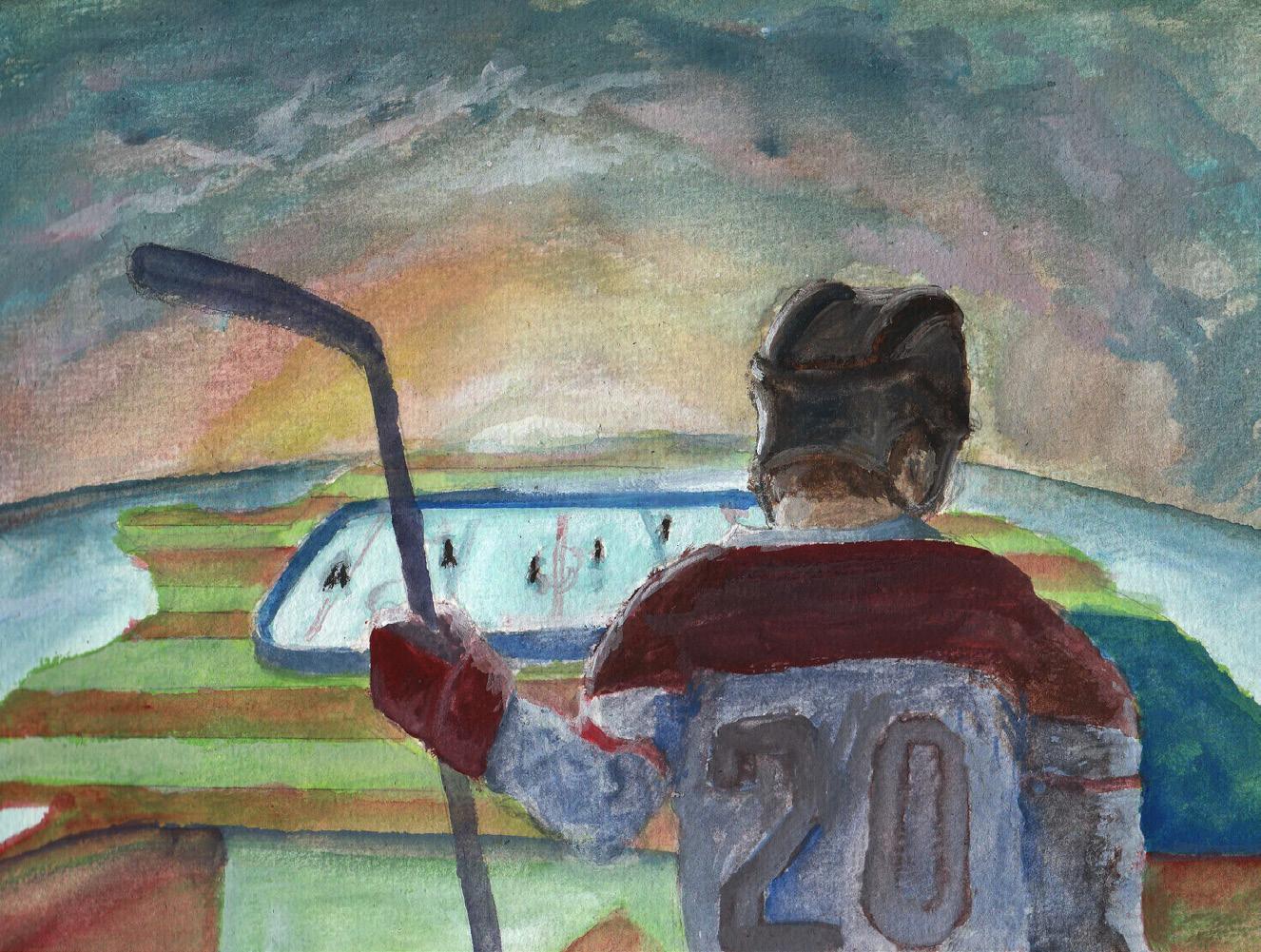
Canadian athletes prepare for lockdown as Americans begin play
Athletes from both sides of the border discuss the pandemic
MATTHEW MERKEL, STAFF
In October, Canada West announced the cancellation of the majority of its fall and winter sports seasons due to the COVID19 pandemic, and with the Manitoba government’s recent shut down of all sports facilities as part of the code red initiative brought on by a high number of COVID-19 cases, many athletes are unable to work on personal skill development or increase their strength and conditioning in the gym, leaving some mentally vulnerable.
Former Bisons men’s hockey assistant coach Brent Zelenewich knows how integral athletics is to young adults and their mental health. The former professional hockey player now specializes in the development of goaltenders at a variety of levels, emphasizing a focus on mental resiliency.
“While the season is cancelled, many student athletes may experience a great degree of stress and anxieties,” Zelenewich said.
“In my opinion, mental health issues will be on the rise.”
“The game is a release from their academics. The game helps students balance their emotions, both anxiety and depression, with a great emphasis on cohesion amongst their teammates.”
On the economic side, Zelenewich noted that financially, universities and U-Sports will also be impacted by the loss of a season.
“The future of Canada West and U-Sports could be set back [five or more] years,” Zelenewich said. “The economic impact could be felt amongst the budgetary constraints and limited resources for those student athletes.”
U-Sports has prioritized health and safety over athletics this season. This is in stark contrast to the National Collegiate Athletic
Association (NCAA), which has proceeded with many of its sports schedules. Zelenewich highlighted the divergence between Canadian and American values in relation to scheduling decisions.
“[Canada is] prioritizing health while the U.S. is prioritizing capitalism.”
Zelenewich noted that the NCAA’s decision to continue with scheduling made some sense economically, considering how much larger its endorsement and sponsorship deals typically are in comparison to those of its counterparts north of the border.
“While the season is cancelled, many student athletes may experience a great degree of stress and anxieties” — Brent Zelenewich, former Bisons hockey assistant coach
Winnipegger Rianna Aasen, an outfielder for the Minot State University Beavers women’s softball team, has had a different semester than Manitoban students.
“All of my classes are hybrid, which means every other day the class rotates between online and in-class [instruction],” Aasen said.
“We are required to wear masks everywhere on campus and sanitize everything before and after use.”
With most NCAA and other American university athletic organizations opting to continue to run amidst the pandemic, the athletic
careers of students in America have been less affected than U-Sports athletes.
For Aasen, this has been the case for her and her Beaver teammates.
“We’ve made adjustments, such as wearing masks and sanitizing equipment after use, so that we are able to continue practicing and working out as normal,” Aasen said. “No one knows if we will have a season, but we are practicing with the expectation that we will.”
As Aasen continues her academic and athletic journey in Minot, N.D., she empathizes with fellow Canadian athletes who have had their academics or athletics negatively affected by the pandemic.
“Seeing Canadian universities [and] sports having shut down, I think that it was the safe and cautious decision, but I can sympathize with the athletes especially because I know that can be very difficult as we had our last season cancelled when the pandemic hit earlier in 2020,” Aasen said.
It is safe to say that Manitoba is now taking a much stricter approach to managing COVID-19 than its southerly neighbours. With cases remaining high in Manitoba, the province has shut down for the next four weeks. For Aasen, her home province shutting down has been a frightful thing to watch, especially as North Dakota has also had a high number of cases. Yet as the semester has continued, administrators at Minot State have helped her and her fellow students feel safe while case numbers remain high.
“The U.S. hasn’t shown the same sense of urgency to respond as Canada has, which can be very stressful, but Minot State has really pushed to keep us running as normal as possible in a safe environment.”
Active Living Centre closed due to COVID-19 pandemic
Recreation centre remained open before restrictions tightened earlier this month
ISAIAH WAGNER, STAFF
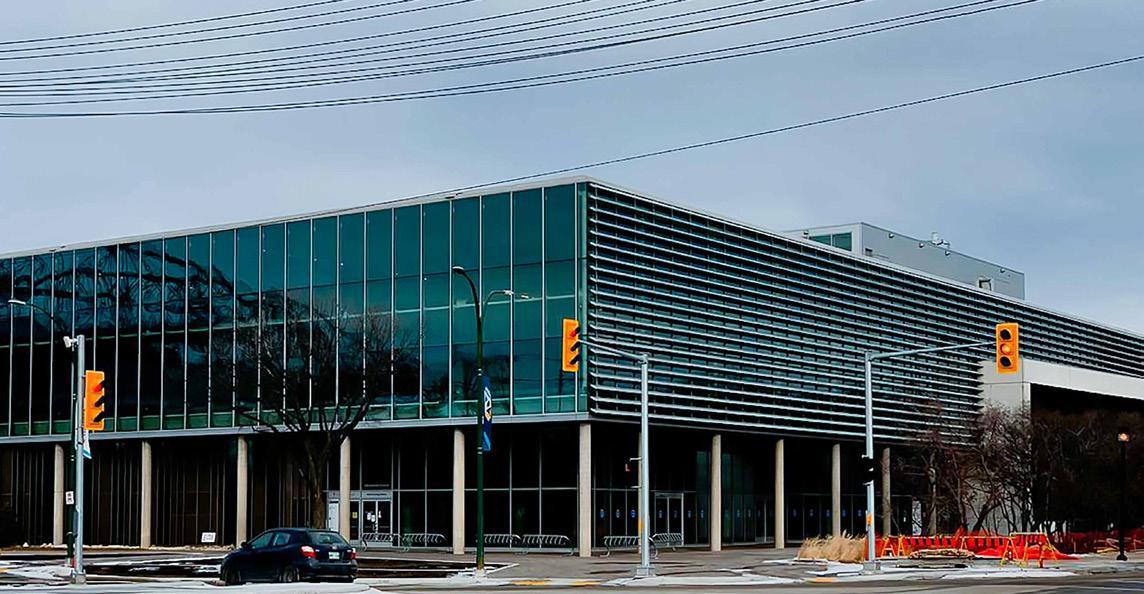
The Active Living Centre (ALC) has been closed by the U of M until further notice due to the rising number of COIVD-19 cases in the province.
The Manitoba government announced on Nov. 10 that the province would be moved into the red stage on the pandemic response system, which includes the closure of recreation facilities.
“I think once COVID is over, the ALC is going to be a different place”— Devyn Turner, ALC member and U of M student
Until now, the ALC had stayed open and remained a safe place for students and staff to come and enjoy physical activity for the day.
U of M student Devyn Turner is an active member at the university gym, and said he was satisfied with the way the gym handled the protocols.
“The staff has been very good during this whole time,” Turner said. “They walk around and make sure people are social distancing, wearing a mask and wiping down their machines.”
“They are making it a very safe place for themselves and the people working out.”
Many people might complain that their workout is affected by having to wear a mask and follow other protocols, but that is not the case for Turner.
“No, my workout has not been impacted,” said Turner.
“The only difference is that I have to wear a mask, which is not a big deal at all. Fitness is very important to me, and a lot of others, and I can
still do all my normal activities.”
“Since the ALC has now been closed, I will have to improvise like everyone else,” Turner said. “I believe that the government is doing the right thing for everyone and has our safety as their first priority.”
Since Oct. 2, only four possible exposures to COVID-19 have been at gyms around the city of Winnipeg. This is a relatively small number compared to other areas, such as schools.
Although there has been little exposure, Turner remains cautious.
“Not many cases have been at gyms around the city, but I think that a gym is actually a very easy place to get COVID if protocols are not followed properly,” Turner said.
“With the ALC following protocols, I never really saw it as an issue.”
Now, with the ALC’s closure, many students will have to find other ways to stay active such as hiking, biking, running, virtual fitness classes and at-home bodyweight workouts or, for a lucky few, working out using at-home equipment.
“I will have to start working out at home or going for runs,” Turner said. “It is important for me to stay healthy, and even with a time like this, it is no excuse to slack off and not better myself.”
A question that is central to many regular ALC-goers is what the recreation centre will look like when restrictions are lifted and society returns to some semblance of normality. Will it maintain heightened sanitation protocols, or go back to how it was previously?
Turner believes it will be the former.
“I think once COVID is over, the ALC is going to be a different place,” he said.
“People are going to be more cautious and sanitize more, which is probably for the better.”